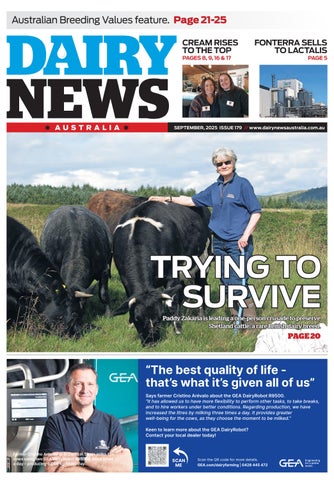
Australian Breeding Values feature. Page 21-25 CREAM RISES TO THE TOP
PAGES 8, 9, 16 & 17
FONTERRA SELLS TO LACTALIS
PAGE 5
SEPTEMBER, 2025 ISSUE 179 // www.dairynewsaustralia.com.au
TRYING TO SURVIVE Paddy Zakaria is leading a one-person crusade to preserve Shetland cattle, a rare British dairy breed.
PAGE 20
“The best quality of life that’s what it’s given all of us” Says farmer Cristino Arévalo about the GEA DairyRobot R9500. “It has allowed us to have more flexibility to perform other tasks, to take breaks, and to hire workers under better conditions. Regarding production, we have increased the litres by milking three times a day. It provides greater well-being for the cows, as they choose the moment to be milked.” Keen to learn more about the GEA DairyRobot? Contact your local dealer today!
Farmer Cristino Arévalo at El Carrizal, Spain milks 136 cows using two GEA DairyRobot R9500s, three times a day – producing 6.000 kg. Milk / Day.
SCAN ME
Scan the QR code for more details. GEA.com/dairyfarming | 0428 445 472
DAIRY NEWS AUSTRALIA SEPTEMBER 2025
NEWS
// 3
All eyes are on NZ as spring arrives Australian dairy export price index
BY ELIZA REDFERN 350
Season brings highs and lows. PG.12
Buffalo milk fills a dairy niche. PG.18-19
NEWS �������������������������������������������������� 3-20 AUSTRALIAN BREEDING VALUES FEATURE ���������������������� 21-25 PASTURE IMPROVEMENT FEATURE ����������������������������������������26-29 ANIMAL HEALTH �������������������������������30
300 250 200 150
competitively priced, trade policy announcements since February have caused some buyers to look elsewhere, namely NZ and Australia, while European dairy sits at a premium in most categories. In the year to May 2025, imports into South-East Asia and Japan increased 3.3 per cent and 4.3 per cent, respectively. In contrast, Greater China has maintained relatively stable import volumes over the same period, but have purchased about 6 per cent more from NZ while importing less from the Northern Hemisphere key exporting regions. While milk production in China remains down and stockpiles somewhat limited,
Milk faster and gentler DeLaval Flow-Responsive™ milking closely follows the milk flow of your cows and is able to adjust the key milking parameters of vacuum and pulsation during each milking session. The outcome is a steeper and shorter milk flow profile.
To learn more, talk to the
delaval.com
Jul-25
Mar-25
Jul-24
Nov-24
Mar-24
Jul-23
Nov-23
Mar-23
Jul-22
importing activity will likely stay buoyed in the meantime. While global demand remains relatively robust, tighter product availability in key exporting dairying regions and higher farm gate milk prices will likely provide some level of support to Australian export prices. The mounting weather challenges of last season, especially the dry conditions in southern regions, are expected to have longer term implications for milk production. Operating costs remain high and there are less cows in larger milk producing regions which will likely weigh on spring volumes, despite a more favourable weather outlook over this period. As such, Dairy Australia is forecasting that Australian milk production will drop two per cent in 2025-26, taking into account lower volumes across the Victorian regions. The market has now caught glimpses of the potential impact of spring NZ product, however looking ahead, tightened product availability in Europe and robust demand for Oceania product may keep prices in some categories firm. For Australia, the trade policy uncertainty that now characterises global markets has proved to be beneficial for Australian dairy, with global price support welcome as long as it may last. ɋ Eliza Redfern is Dairy Australia’s analysis and insights manager.
DELAVAL FLOW-RESPONSIVE™ MILKING
1800 817 199
Nov-22
Source: Dairy Australia
MACHINERY & PRODUCTS ��������� 31
Upgrade Specialists
Mar-22
Jul-21
Nov-21
Mar-21
Jul-20
Mar-20
Jul-19
Nov-19
Mar-19
Jul-18
Nov-18
Mar-18
Jul-17
Nov-17
Mar-17
A$
Nov-20
US$
100 Jul-16
SA celebrates best farmers. PG 10
product availability and recovering export demand have supported global dairy prices in 2025. Now as the market heads into the Southern Hemisphere peak, all eyes are looking to what impact New Zealand’s spring might have for dairy export prices. Across the key exporting regions, global supply has shown mixed signals. In the United States, signs of recovery have emerged following last year’s avian influenza outbreak in dairy cattle, with milk production rising 3.3 per cent year-on-year in June, supported by increases in both cow numbers and per cow yields. On the other hand, Europe is facing more significant challenges, after a bluetongue outbreak and drier than average weather conditions in key producing countries weigh on milk volumes across the region. Additionally, lingering fertility impacts from the bluetongue outbreak are limiting the number of replacement heifers, which may have longer term impacts on production. Nonetheless, after four months of lower volumes, European production increased 1.2 per cent year-on-year in April 2025. Meanwhile, NZ’s milk production continues to grow, with favourable weather on the South Island supporting pasture growth and strong farm gate milk prices incentivising supplementary feeding. As such, milk volumes surged 14.6 per cent year-on-year, albeit at a lower producing time of year. Looking ahead, the country’s production is tipped to remain strong, and volumes offered for some products (especially milk fats) on the GlobalDairyTrade (GDT) platform have started to rise, weighing on prices to an extent. However, rising purchasing interest from buyers in key export markets (particularly for Oceania dairy) appears to be limiting some of the supply side impacts to pricing. Despite some US product being
Nov-16
TIGHTENED NORTHERN Hemisphere
*Based on test results from Willcox Farm. Individual results may differ; information does not constitute warranty/guarantee of service or performance.
DAIRY NEWS AUSTRALIA SEPTEMBER 2025
4 // NEWS
Report lists key dairy issues BY GEOFF ADAMS
THE DAIRY industry is being propelled by innovation and technology at farm and processor level, but the industry is calling for support to continue to grow. A new report developed by key industry stakeholders has identified five key areas for future development of the industry in the Murray-Darling Basin, stretching across four states. The report notes the basin’s dairy industry employs more than 10,000 people and produces more than two billion litres of milk annually. The Murray-Darling Basin Dairy Industry Strategic Plan was launched by the MurrayDarling Basin Dairy Industry Steering Committee on August 1. It creates a comprehensive blueprint designed to strengthen the competitiveness, sustainability and prosperity of the dairy sector across the basin and beyond. While facing some strategic challenges, steering committee chair Lindy Nieuwenhuizen said the industry was experiencing what she called perpetual momentum in how it adapts and changes according to circumstances. “When we look at what is in front of us, obviously technology is redefining what is possible on-farm and in factory,” Lindy said. “Processors are needing to find higher value product lines, and some of the R&D investment in that space to come up with different production lines. That is an exciting place. “We have looked at milk, cheese, cream — and now I stand inside factories like those in Shepparton producing nutritionals for body builders, and products for weight loss or infant formulas. “All these different products that were not
possible in the past. “We are living in an extraordinary era, witnessing the many different ways milk is being utilised.” The report identifies unique characteristics of the basin’s dairy industry, finding the industry’s processors and farms are strategically and geographically located. “Most of us are enjoying the benefits of irrigation so that makes us very reliable, more stable and quicker to bounce back, than other production regions,” Lindy said. Dairy creates a steady demand for water
which enables other commodity producers to take advantage of the irrigation network. Irrigation industries rely on dairy as a critical anchor to the irrigation network. “We produce about 20 per cent of the national milk pool but we process almost 25 per cent of the pool,” Lindy said. “Our geographic location is an advantage for moving milk around the states.” Regional communities often express that they need dairy, but dairy also needs regional communities with shared needs, around education, training, housing, services and
technical support. The report identifies five critical issues for future directions: ɋ Climate and water policy reforms: Adapting to climate change and evolving water management is essential for sustainable production and risk management, with ongoing policy uncertainty and the prospect of further non-strategic water buybacks undermining investor confidence at all points of the supply chain. ɋ Energy reliability and transition: The industry faces rising energy costs and reliability concerns, with a pressing need to invest in renewables and grid infrastructure to remain competitive. ɋ Workforce and skills: Attracting, training and retaining a skilled workforce is vital as the sector transitions to more technologically advanced and intensive operations. ɋ Community and infrastructure: The dairy industry is deeply interwoven with regional communities, requiring strong partnerships to deliver housing, health, education and transport services that attract and support workers. ɋ Research, innovation and technology: Continued investment in R&D is crucial to drive product innovation, improve sustainability, and meet changing consumer preferences. “These themes already exist at federal and state government level,” Lindy said. “Our job is to integrate what we have discovered through this process and supplement it with additional industry data to guide and inform how those strategies play out. “And to make sure we carve out outcomes for the regions that reflect what we genuinely need.” ɋ For more information or to access the full Murray-Darling Basin Dairy Industry 2025 Strategic Plan, visit: https://www.gardinerfoundation.com.au/mdb-dairy-strategy/
SUPERMARKETS URGED TO PASS ON MILK PRICE RISE THE PEAK representative body for dairy
farmers hopes Coles and Woolworths pass a recent 10 cent per litre increase in the price of home-brand milk on to dairy farmers. The increase comes as dairy farmers battle high input costs, drought and flood clean-up, threatening to send some broke. Australian Dairy Farmers said after the
quiet lift in prices, two litres of milk at either supermarket is now priced at $3.20, up from $3 less than a fortnight ago. “With almost half of Australia’s dairy farmers either battling drought or recovering from floods, this is a timely increase, and we hope it’ll flow back to the farm gate,” Australian Dairy Farmers president Ben Bennett said. He said for more than a decade,
supermarkets have been discounting milk, constraining the money flowing back through the supply chain. “The fact is, when people buy milk, the supermarkets, processors and everyone in between take a cut — leaving dairy farmers as price takers in the supply chain,” Mr Bennett said. “This season is extra tough, dairy farmers are facing skyrocketing feed and input
Unexpected growth spurt? Don’t let your farm insurance fall behind. Scan the QR Code and Request a Quote for Your Chance to WIN one of five $1,000 Gift Cards!*
Not renewing yet? No worries. Get ahead for the 2025–26 season today.
*Terms and Conditions Apply
www.achmea.com.au/FarmFit 1800 724 214 info@achmea.com.au Insurance issued by Achmea Schadeverzekeringen N.V. (Achmea) ABN 86 158 237 702 AFSL 433984. The information in this document is general advice only and does not take into account your individual objectives, financial situation or needs (your personal circumstances). This means any advice may not be appropriate for your circumstances. Before using this information to decide whether to purchase the insurance policy, you will need to consider the appropriateness of any general information or advice we give you and how it relates to your specific situation to ensure the insurance cover meets your needs and the relevant Product Disclosure Statement and Target Market Determination (TMD) available from the ‘Important Documents’ section of our website achmea.com.au/important-documents. For feedback and complaints, visit achmea.com.au/complaints. To view Achmea Farm Insurance’s privacy statement, visit achmea.com.au/privacy.
costs. Many are losing money because it costs more to produce the milk than what they’re paid for it. “So, while the supermarket price increase is modest, that 10¢/litre would be welcomed by farmers. “We hope supermarkets and processors will pass it on to help keep our fragile industry afloat, and dairy on the table of every Australian family.”
DAIRY NEWS AUSTRALIA SEPTEMBER 2025
NEWS // 5
Fonterra sells to Lactalis
would be confirmed once a dispute with Bega Cheese Limited is resolved. If for some reason the Bega licences are not included in the sale, Fonterra expects to receive a fair value payment from Bega for the
licences which would need to be determined at the time. Under the terms relating to the sale, Fonterra will continue to supply raw milk, dairy ingredients and products to the divested businesses under long-term supply agreements. Lactalis is the world’s largest dairy group with operations in more than 50 countries in the Americas, Europe, Africa and Asia Pacific. The company employs more than 85,500 people with reported revenue of 30.3 billion euros in 2024, placing it among the top agrifood companies globally. Fonterra’s New Zealand farmer shareholders will vote on whether to proceed with the sale to Lactalis at a special meeting in late October or early November Fonterra’s annual meeting has been deferred from November 2025 to December 2025. Subject to receipt of approvals, the sale is expected to be complete in the first half of 2026.
previous year. The increase in production in NSW offset the reductions in drought-affected areas of southern Australia. The group spent $3.5 million in supporting farmers through the Better Farms program with projects for animal welfare, effluent management and irrigation and water management. Export dairy commodity prices improved in the year, and the “realignment” of dairy commodity prices and farm gate prices resulted in a recovery of the bulk segment of the business. During the year, the company reduced
debt by about $36 million. A fully franked divided of six cents per share was announced, taking the total dividends for the year to 12 cents. Mr Irvin and CEO Peter Findlay expect continued growth in the branded segment of the business and stable returns in the bulk division. They anticipate the launch of new retail products during the current year. The company expects earnings (EBITDA) in the range of $215 million to $220 million at the end of the current year. Bega Cheese has about 575 suppliers.
BY GEOFF ADAMS
FONTERRA PLANS to sell its Australian business, including its milk processing factories, to the French giant food company, Lactalis. The New Zealand-based Fonterra made the announcement as part of a NZD $3.8 billion deal, which will include Fonterra’s global Consumer business (excluding Greater China) and Consumer brands; the integrated Foodservice and Ingredients businesses in Oceania and Sri Lanka; and the Middle East and Africa Foodservice business. Lactalis will scoop up the factories in Stanhope, Cobden, Derrimut, Darnum, Spreyton, Wynyard, Campbellfield and Bayswater. In addition to the base enterprise value of NZD $3.845 billion, there is potential for a further NZD $375 million from the inclusion of the Bega licences held by Fonterra’s Australian
The Fonterra Stanhope factory in northern Victoria will soon be owned by Lactalis.
business, which if progressed would take the headline enterprise value of the transaction up to NZD $4.220 billion. Fonterra said the inclusion of the Bega licences held by Fonterra’s Australian business
BEGA CHEESE POSTS A PROFIT BY GEOFF ADAMS
BEGA CHEESE has recorded a profitable year on similar revenues to last year. The company has announced $165 million earnings before interest, taxes, depreciation and amortisation (EBITDA) with a total revenue of $3.5 billion for 2024-25. Bega executive chairman Barry Irvin reported strong volume growth in branded white milk, yoghurt and spreads, the successful launch of branded high protein products and the implementation of cost savings.
This included the news of the closure of the Strathmerton cheese packaging factory in northern Victoria and the transfer of production to Bega Valley by the end of the 2026 financial year. The financial reports disclose the shift will save the company about $30 million annually, and the combined cost of redundancies at Strathmerton and two Queensland peanut production sites are expected to generate one-off redundancy costs of $34 million. The group received 1.34 billion litres of milk during the year, which represented an increase of one per cent compared to the
ACM TAKES COMPETITOR TO COURT BY GEOFF ADAMS
A NORTHERN Victorian milk processor is
taking Fonterra Australia to court with a claim that a field officer has been approaching ACM suppliers. ACM, in Girgarre, claims Fonterra Australia’s field officer has been encouraging dairy farmers to break exclusive supply agreements. The writ filed with the Supreme Court claims that the field officer encouraged ACM
suppliers in Bamawm and Cohuna to break their contract in return for a higher milk price. ACM is seeking an injunction to prevent Fonterra from approaching its suppliers. Fonterra is denying the allegations made by ACM. “We’ve always treated our competitors and farmers with respect, and we did not interfere or seek to interfere with any contracts as claimed,” a spokesperson for Fonterra said. “As such, we don’t believe an application for an injunction was warranted.”
The writ, filed in the commercial division of the court, alleges the Fonterra field officer met with the Bamawm family in June, when a financial report was generated setting out what the supplier could receive under the Fonterra prices. ACM then alleges that the farmer sought to secure a higher price from ACM, or they would break the contract. ACM’s claim says that the same field officer had approached a Cohuna supplier in May, suggesting their contract with ACM
could be broken. ACM wrote to Fonterra with the allegations and asking Fonterra to desist, according to documents filed with the court; Fonterra replied that Fonterra staff did not attempt or intend to procure the breach of existing contracts. Fonterra made no admission to the accusations and refused to provide any undertakings sought by ACM. No date has yet been set for the hearing of the application, expected to be held in Melbourne.
™ #1 for Rapid Recovery from Scours & Dehydration
5
BILLION CFU / DOSE
Imagine RAPID RECOVERY for sick or ill-thrift calves. Because RAPID REHYDRATION and PROBIOTICS get them back on track fast. What if RECOVERY took hours… not days — and didn’t cost you more? We’ve put the science in — you get the recovery out. ELECTRO-CALF™ came highly recommended - and it delivered as promised. Rapid recovery, rehydration, and calves stayed on feed. It’s earned its place in the shed.
Rapid recovery starts here. Call Jon Reynolds: 0423 008 495
FORMULATED ON
DAIRY NEWS AUSTRALIA SEPTEMBER 2025
6 // NEWS
Farmers look for water security BY RICK BAYNE
FARMERS IN south-west Victoria’s Heytesbury region are looking for ways to shore up their water supplies for the future. Nearly 50 farmers met in Simpson on Wednesday, August 13 to discuss ways to secure a reliable stock water supply. Various ideas were floated at the meeting and will be the subject of further investigations. The United Dairyfarmers of Victoria (UDV), Food and Fibre Great South Coast, Victorian Farmers Federation and Corangamite Shire Council hosted
the meeting. UDV president Bernie Free said close to 50 people attended, reflecting the level of concern within the local farming community. “We got a diverse range of views and ideas and the next step is to collate them,” Mr Free said. “They all agreed that water is an issue — the question is what is it going to cost to fix the problem.” The meeting was called after the region suffered through another drought this year, forcing some dairy farmers to have to buy in water for stock. But Mr Free said it wasn’t a new issue for the region which has experienced prolonged
droughts in 1967-68, 1982-83, 1994-95, 2006, 2012-15, 2016 and 2023-25, along with an overall reduction in rainfall. “People agree that something needs to be done and it has given us the impetus to continue,” he said. “Farmers acknowledged that every time there is a dry autumn and they get into a drought situation they struggle for water. “If this isn’t a good spring for run-off, they’re going to be in trouble again. They prefer to be self-sufficient and not spend the money, but is that possible?” Suggestions ranged from a stop-gap solution of more standpipes through to a fully integrated system that connects to the
Wannon Water system. The UDV will now collate the information and further consult the farmers who attended. “We need to go away and look at what everybody said and do a pre-feasibility study on all the suggestions to get a rough idea of what they would cost,” Mr Free said. “Cost is always the problem but we want to make the total system more resilient. “There’s a fair bit of concern and farmers see it as a critical issue. “We don’t necessarily have the answers at this stage but it would be good to give them some water security so they can move forward without having this over their heads.”
OLD BUTTER FACTORY TO HOUSE FARM WORKERS BY RICK BAYNE
AN OLD butter factory at Noorat in south-
west Victoria will be restored to provide housing for agricultural workers, addressing one of the major challenges facing the local dairy industry. The Glenormiston Butter and Cheese Factory, known by locals as Noorat Butter Factory, was built in the early 20th century and remained a prominent local outlet before ceasing production in the early 1970s. It was later used as a basketball and netball court but has been left dormant for many years before being purchased in early 2024 by Dixie dairy farmers Matt Glennen and Lucy Collins. Boosted by a grant from the Victorian Government’s Regional Worker Accommodation Fund, they plan to build 13 new dwellings to support local agricultural businesses. It is expected workers from south-west dairy farms and allied agricultural industries will be the main users. Lucy Collins says the project will meet a big need in the region. “It has been an ongoing challenge for our own farming business and through discussions with our farming community and local discussion group, it became obvious it wasn’t unique to our farm,” she said. “This is an opportunity to help address a challenge for a lot of local farms, along with allied agricultural businesses, such as AI technicians providing highly skilled service support to the region. “We bought the building with a vision but the scope was going to be much smaller than what we’re going to be able to achieve with the funding from the Regional Worker Accommodation Fund. “Accommodation problems are not unique to agriculture, it’s a big issue for the region including teachers and care providers, but this has been funded for agricultural workers.”
An old butter factory will be converted into accommodation for agricultural workers in south-west Victoria.
Lucy and Matt want to start on the project as soon as possible and hope the first accommodation will be ready in about two years. “We’re still working with council to go through the final stages of planning. Everyone is poised and ready for action as soon as we can.” The cost of the redevelopment is not available with the figures being kept commercial-in-confidence. The factory is of aesthetic significance primarily for its 1924 frontage with decorative parapet and projecting office buildings. The redevelopment will retain the façade. “We want to preserve and celebrate the building’s history and its significance to the
Advertising Rachel Fowles 0429 675 962 rachel.fowles@dairynewsaustralia.com.au
Dairy News Australia is published by Shepparton Newspapers Pty Ltd. All editorial copy and photographs are subject to copyright and may not be reproduced without prior written permission of the publisher. Opinions or comments expressed within this publication are not necessarily those of the staff, management or directors of Shepparton Newspapers Pty Ltd.
Editor Sandy Lloyd (03) 5820 3252 editor@dairynewsaustralia.com.au Regional editor news@dairynewsaustralia.com.au
local community,” Lucy said. “It was going to fall down if no-one did anything with it, which would have been a great loss. People understand it needs some serious TLC to keep it standing.” The 13 dwellings will include one three-bedroom family residence, four studio apartments aimed at couples and a shared living dormitory-style section for short-term, seasonal backpacker-style accommodation. “We expect a lot will be high-turnover, short-term accommodation but there is an option for longer-term,” Lucy says. “Within our social network, we approached a lot of farmers when we were putting in the
application so we could understand their needs. “There were 12 farms in our postcode that indicated a need for accommodation, adding up to about 85 workers, including skilled workers coming to our region at different times of the year.” Lucy said the project was receiving strong community support. “Everybody is so happy to see something done with it. There’s a lot of community attachment to the building and people realise we’re locals and we’re doing it for locals.” ɋ People can follow the redevelopment’s progress on social media: @nooratbutterfactory
Publisher Shepparton Newspapers Pty Ltd
Dairy News Australia welcomes contributions from stakeholders in the dairy industry, and particularly from organisations wishing to advance the industry.
Printed by Newsprinters Pty Ltd Head Office 7940 Goulburn Valley Highway Shepparton, VIC 3630 Phone (03) 5831 2312 Postal address PO Box 204 Shepparton, Victoria 3632 Australia
WWW.DAIRYNEWSAUSTRALIA.COM.AU
Contributions and photos can be sent to: editor@dairynewsaustralia.com.au Letters to the editor on topical issues are also welcome. Letters should be concise and carry the name and town address of the author, as well as a contact phone number, not for publication.
The winning combination.
0–3 mths
3–12 mths
12–23 mths
Veanavite® No.1 Calf Pellets
Veanavite® No.2 Weaner Calf Pellets
Veanavite® No.3 Heifer Developer Pellets
The Veanavite® Range provides the essential elements in maximising development and productivity, from calf to heifer. Veanavite® pellets have been the products of choice for Australian farmers for over 35 years. Each product provides a highly palatable blend of readily fermentable carbohydrates and high quality proteins to support optimal growth, development and immune system function at each growth stage. Contact your local reseller or go to www.veanavite.com.au to find out more.
DAIRY NEWS AUSTRALIA SEPTEMBER 2025
8 // NEWS
Event is cream of the crop BY JEANETTE SEVERS
THE FOURTH Cream of the Crop conference was in Warragul, with most of the women attending from across Victoria and a few from NSW and South Australia. Held on July 29 and 30, this year’s conference was sold out. The format has enabled women to build their networks within the dairy industry and feel more confident about initiating business development ideas and attend training in their regions, according to one of the founders. The Cream of the Crop conference was aimed at providing personal and professional development and networking opportunities for women dairy farmers and industry representatives, according to one of the founders, Chloe Brown. MC Sarah Thompson announced the conference had reached 433 people in the past four years, with more than 100 women dairy farmers and industry representatives at Warragul. “This is a safe space for you,” Sarah said, as she welcomed attendees and encouraged them to ask questions of the presenters throughout the day. “We all wear many hats and this conference aims to provide a safe space for learning, and asking questions without judgement. “And we encourage you to network and meet new friends during the day.” “Rabobank funded 10 attendees who were in financial difficulties due to environmental conditions,” Chloe said. “Also recognising the environmental conditions affecting so many farmers at the moment, Fonterra Oceania was able to ensure all conference pricing was available at the discounted rate, which meant there was one less barrier to attending. “Fonterra recognised a lot of people are in financial constraints, and did it to benefit all the dairy industry, not only their own suppliers. “This support from our sponsors helps more women to be in the room and their voices are amplified, and they’re inspired to do better and be better, which they might not get if the cost of attending the conference excludes them. “Sponsorship continues to grow. Many of the conference sponsors have been there from the start and attract other supporters. “Our conference sponsors are proactive about backing the upskilling and support of women across the industry — that is really positive.” Day one of the conference saw presentations about farm safety from Renee Ashmore,
Attendees included dairy farmers, sharefarmers, farm workers, field staff and other industry representatives.
Jessica Knight from Stratford and Chloe Brown from Kirkstall are both first-time dairy farmers and podcasters. Chloe is one of the founders of Cream of the Crop. Photos: Jeanette Severs
succession and tax from Claire Booth, grant writing from Bridget Johns, Dairy Australia’s pilot dairy beef program from Louise Sundermann, and branding from Alison Meagher, who is also known as Butcher Girl Alison. These speakers were also involved in breakout workshop sessions. A panel presentation that saw three guest speakers discuss community connections and why stories matter included Dairy News Australia journalist Jeanette Severs, Deanne Kennedy from Cows Create Careers and dairy farmer and Central Queensland University agricultural researcher, Amy Cosby. Day two of the conference saw participants on the road, with a tour of Ellinbank SmartFarm to hear about research projects on the commercial research farm, and a tour of the Gippsland Jersey fromagerie factory and retail store. “Holding the conference at Warragul was a continuation of our loop of Victoria,” Chloe said. “We held our first two in western Victoria, then in northern Victoria in 2024, and Warragul completed the loop. “The conference is not region-specific, but about connecting the industry across regions. We saw that in the first-timers and the returning attendees this year. “It’s nice to have an event that people want to come to because they can see the value in it. “We chose Warragul for a multitude of reasons. Women in dairy is already supported in
Gippsland — there is a hole in that representation in western Victoria, but it doesn’t exist in Gippsland.” Chloe said the conference committee now faced the challenge of deciding what to do next. “Conversations are well under way about how we continue to replicate this and make it relevant,” she said. “Our thinking behind the conferences is that they need to provide professional and personal development. “Originally we discussed how we could go to an event and feel comfortable and able to ask the questions we want addressed in a female-friendly environment.” That aim was personal to the three founding committee members — Chloe Brown, Lucy Collins and Renata Cumming. “I was new to the south-west Victoria region and the dairy industry. Lucy and Renata were new to the region,” Chloe said. “We all had a deep desire to learn more and do better. “We were inspired by the leadership piece about if we’re not included in the conversations, we’re missing out. “We wanted a space where we feel empowered to ask questions and we will return back to the farm feeling informed enough to have a conversation about how our businesses can use that information. “After the first year of the Cream of the Crop conference, we recognised the model would work and we wanted to replicate that, and we
Sarah Thompson was conference MC.
Cream of the Crop conference attendees during tours of the Gippsland Jersey factory at Pakenham on day two.
brought Jess (Jess Brown) on board the committee to provide financial acumen.” Chloe said she now feels more comfortable when she goes to a training day, because she will know someone there who she has met at a conference. “For example, I’m going to cups on cups off training, and I know someone I met at conference who is also going to be there, so I feel more comfortable,” she said. ɋ For more stories and pictures from the Cream of the Crop conference, see pages 9, 16 and 17. And go online to: www.dairynewsaustralia.com.au
��� ��������T��T ������������� �eedin� �marter� �armin� �tron�er �ith KEENAN diet �eeder�
���������������� �onal �lack�ell � ���� ��� ��� � d�lack�ell�alltech.com Alltechlienert.com.au/keenan
DAIRY NEWS AUSTRALIA SEPTEMBER 2025
NEWS // 9
Granting access to funding BY JEANETTE SEVERS
WITH GRID power a significant cost on dairy farms, when Bridget Johns began talking about grants for solar panels, she had the attention of the audience at the Cream of the Crop conference. Bridget is a professional grant writer, and as one of the conference speakers, she shared her own experience of an 11-month delay between applying for grant funding for solar panels, and receiving approval. There were further delays before the money was disbursed. “This makes it difficult for businesses to action projects if they are relying on grant funding for immediate needs,” Bridget said. Her recommendations to conference attendees are applicable for private and public applicants. Using local government as an example, what are called ‘shovel ready’ projects are applications for funding where all the information and quotes have been gathered and are waiting for a grant opportunity to be published. Bridget recommended preparing a prioritised “wish list” of projects, to align with funding opportunities. She suggested an online folder that contains commonly requested documents such as financial statements, business or strategic plan, and insurance and legal documents — proof of company, sole trader, partnership or incorporation certificate — depending on whether it is a business or a non-profit seeking funding.
Bridget Johns said long delays to receive funding grants were a problem if the business was looking for money for immediate needs. Photo: Jeanette Severs
These documents are then easily available to be added to the online funding application. Bridget also recommended adding a contingency amount to quotes, given that sometimes there is delay and cost increases between funding application and receipt. “Once a grant amount is approved, no additional funding will be available if costs increase,” she said. “It can also be an advantage to provide copies of bank statements to the grant organisation to prove you have matching funds in the bank and the project is ‘shovel ready’.” Sometimes applications for funding are
actioned as they are submitted, and funds are allocated on a “first in, best dressed” scenario, Bridget said. One of her examples centred on a butcher with high energy bills, who applied for a Federal Government energy efficiency grant as one-to-one funding, to construct a cool room. The timeline for the funding turnaround was short and applicants were assessed as they submitted. With all the documents in place, the butcher’s application was lodged early and was successful. “Their application was submitted within 15 minutes of the grant opening, making them
one of the first applicants to be considered,” Bridget said. The ‘first in, best dressed’ scenario was increasingly common. “There are similar on-farm drought assistance grants available now where applications are assessed in order of submission,” Bridget said. She stressed the importance of understanding the tax implications of receiving any particular grant, carefully reading contracts, and adhering to reporting timelines. She said it was also important to keep in contact with the fund auspicing organisation about any project changes. When it came to professional development, Bridget suggested looking for funding opportunities specifically aimed at women. She was a finalist in the 2023 South Australian AgriFutures Rural Women’s Award, which enabled her to complete the Australian Institute of Company Director’s diploma. “Look for scholarships, awards with cash prizes, funded training and even angel investors,” Bridget said. The state government sector has funded a large number of TAFE-delivered qualifications, and the regional dairy authorities also provide free training in certificates as varied as Cups On Cups Off and farm management. Bridget also recommended contacting Regional Development Australia to receive monthly grant updates, which can be modified for relevancy to specific regions and funding focus.
Push it...
…effortlessly with the Lely Juno Lely Juno removes the manual task of pushing the feed multiple times a day. By pushing feed regularly, it is within the cows’ reach, providing access to the roughage they need for optimal rumen health and supporting overall production improvement
Find out more via the QR-code, and feel free to to get in touch with your Local Lely Center to see how our feed pushers are running on several farms in Australia!
www.lely.com/au/solutions/feeding/juno
DAIRY NEWS AUSTRALIA SEPTEMBER 2025
10 // NEWS
SA celebrates best farmers BY SOPHIE BALDWIN
MORE THAN 300 farmers parked their gumboots for the night to come together and celebrate the best of the South Australian dairy industry for their annual awards night. Held on August 15, the gala recognises the best of South Australia’s dairy industry, acknowledging innovative farming practices, sustainable leadership, processor relationships and, of course, young farmers who are shaping the future. Special guests included government ministers Clare Scriven and Nicola Centofanti, Danielle Watts from Foodland and Paul Roderick from Dairy Australia. SA Dairyfarmers Association president Rob Brokenshire said the one constant that came across from the judging panel was the quality of nominations for each award. “SADA is a proud sponsor of tonight’s dinner and is pleased to be a sponsor of three of tonight’s award categories, and recognises how each of these areas supports excellence in the South Australian dairy industry,” Rob said. “In some ways it is disappointing to have to separate one winner from such a field, but that was the job at hand.” Narelle Zanker from Mannum was announced Young Farmer of the Year — an award recognising passion, dedication, innovation and leadership. Narelle works alongside her husband and parents and is a skilled farmer, but what sets her apart is the way she has turned her passion for education into something remarkable. With a background as an agriculture teacher, Narelle has founded Dairy Adventures, an agritourism initiative bringing school groups, aged care residents and corporate visitors onto the farm. Her aim is to connect people with where their food comes from and to create meaningful, safe and positive experiences. Narelle worked closely with industry and SADA to ensure the on-farm experience is safe and biosecure, and in the process has set the gold standard for how agritourism and dairy can work hand-in-hand. Her award citation says Narelle brings thoughtfulness, integrity and care to everything she does with her work, reflecting a strong respect for the land, animal welfare, people and for the future of dairy farming. Best Relationship with a Processor was awarded to Mark Chandler of Mulgundawa Dairy, for recognition of an enduring and evolving relationship with Udder Delights spanning
Young Farmer of the Year was Narelle Zanker. She is pictured with Nicola Centofanti.
Reece Donhardt from Nangkita Dairies was awarded Innovative Farmer of the Year. He is pictured with Clare Scriven.
nearly two decades. The partnership has grown from supplying goat milk to a full supply of cow’s milk building on quality, trust and shared success. His award citation says Mark is loyal, transparent and always focused on the long game — for his family, his farm and his processor. “Whether navigating the shift from organic to conventional supply, taking on the challenge of self-delivery, or collaborating on exciting new product launches, Mark and his team have never lost sight of the bigger picture. “And while there have been challenges, the focus has always been on what can be controlled — not the weather, not the market — but the relationship, the milk, and the values shared.” Reece Donhardt from Nangkita Dairies was awarded Innovative Farmer of the Year. Working on a family-run farm of 750 cows, he has embraced technology in a way that’s
transforming how dairying looks for his business, including the installation of 14 Lely robots. This has enabled the farm to access previously underutilised land for pasture — even swampy areas once inaccessible by tractor. What was once considered too hard, Reece now calls opportunity. Reece has invested in advanced agricultural drone technology, allowing drones to manage weed control, including difficult blackberry infestations on steep slopes allowing him to improve land as he goes. Calf rearing is also automated with precision feeders, and decision-making across the business is data-driven, forward-thinking and environmentally conscious. His award citation says Reece meets challenges head-on with strategic action, continuous learning and a deep commitment to sustainability by investing in technology and the
Mark Chandler of Mulgundawa Dairy (right) was awarded Best Relationship with a Processor.
The annual South Australian Dairy Awards are a highlight for farmers and industry.
future. While it was a night of celebration, Rob Brokenshire also touched on some of the challenges facing the industry including drought and elevated input costs, while pointing out the rising value of dairy products. “SADA is committed to working with all parts of the dairy supply chain in pursuit of the goal of South Australia advancing as the premier dairy producing provenance in the world,” he said. “The South Australian Dairy Industry Action Plan 2024 – 2029 is key evidence of that commitment.”
NEW CARBON PROTOCOL NSW GOVERNMENT scientific researchers have partnered with Danone, Fonterra, Nestle and the New Zealand Ag Emissions Centre to develop a framework to support robust emissions reduction claims associated with the implementation of on-farm greenhouse gas (GHG) mitigation technologies in dairy systems. NSW DPIRD senior research scientist Aaron Simmons said the release of the MiLCA protocol will allow consumers and investors to have greater confidence in the carbon reduction claims of dairy companies. The acronym ‘MiLCA’ stands for Mitigation actions in Life Cycle Assessment. “Dairy companies are already implementing new technologies that reduce GHG emissions but have not been claiming these reductions due to the lack of a consistent approach that ensures claims are credible,” Dr Simmons said.
“The development of the MiLCA protocol gives dairy companies the confidence to include these emissions reductions in their GHG emissions reporting and promote their action on climate change to consumers and investors, without the risk of being accused of green-washing. “While there are existing ways to assess the carbon footprint of dairy production, MiLCA closes a recognised gap by giving high integrity to GHG emissions reductions that can be robustly assessed and confidently integrated into carbon footprints. “We are already seeing MiLCA being used by dairy companies.” ɋ Download and view the MiLCA protocol at: https://globalresearchalliance.org/wp-content/uploads/2025/07/MiLCA.pdf ɋ Go to www.dairynewsaustralia.com.au for the full story.
DAIRY NEWS AUSTRALIA SEPTEMBER 2025
NEWS // 11
Stop farmers running dry THE VICTORIAN Farmers Federation is call-
ing for swift action to fund and complete key water infrastructure projects needed to secure the future of critical water supplies needed for rural communities and agricultural industries in times of drought. Central to the ask includes the completion and green-lighting of key water infrastructure, including the Balliang Western Irrigation Network, Southern Wimmera and Northeast Pyrenees Water Supply Project, East Grampians Rural Pipeline, Coleraine to Casterton Pipeline and the Heytesbury District Pipeline Water Plan. VFF president Brett Hosking said the opportunities for farmers, rural communities and the environment from reliable, piped water supplies has been highlighted during this current
drought and the challenge for government is to see those benefits expanded across all water supply regions to ensure communities are better prepared for future droughts. “A reliable water supply is absolutely critical for farmers and when the tap runs dry, it’s diabolical. We’ve seen that in recent times and it brings farmers and the industry to its knees,” Mr Hosking said. “Reliable pipeline infrastructure is essential for drought preparedness, providing consistent and efficient access to water when natural supplies run low. “This is a smart investment that government can commit to today. It’s about using one of our most precious resources, water, in a way that ensures food security alongside greater community and environmental outcomes as we
face an increasingly uncertain climate future. “We don’t know when this drought will break, but we do know there will be more to come and securing our water future through a network of key water projects is critical for drought preparedness.” Mr Hosking said the proven success of the Wimmera Mallee Pipeline should be seen as a blueprint for the future. “The Wimmera Mallee Pipeline shows what is possible when governments invest in modern water infrastructure,” he said. “It’s resulted in enormous benefits, including increased crop yields, improved water security, better fire-fighting capacity, and reassurance in knowledge their livestock and farms have year-round access to safe water.” The VFF is calling on the Victorian and
federal governments to: ɋ Complete the Balliang Western Irrigation Network to provide secure, efficient irrigation water for farmers in the region. ɋ Green-light the Pyrenees Pipeline project to improve water reliability for agricultural and community use. ɋ For the Commonwealth to fund the Eastern Grampians Pipeline project to safeguard water access for drought-prone communities. ɋ Implement the Coleraine to Casterton Pipeline to strengthen water supply networks in western Victoria. ɋ Continued discussion to implement a Heytesbury District Pipeline Strategy to support agriculture and community resilience in the region.
TEENS FUNDRAISE FOR DROUGHT-AFFECTED FARMER BY JEANETTE SEVERS
TWO TEENAGERS recently stepped out of
their comfort zone for the sake of compassion and to raise money for a dairy farmer in need. Bonnie Ross from Heath Hill and Tandia Sharman from Shady Creek are friends who have grown up on dairy farms and know it can sometimes be challenging. The two 18-year-olds are also aware that the current drought in Gippsland, including in their own district, is a challenge to many in the dairy industry. In July, Bonnie approached Sallie Jones, co-founder of Gippsland Jersey, and asked for her help to raise money to support a dairy farmer in need. Bonnie said her idea was simple. She wanted to use one of the Gippsland Jersey caravan shops to make milkshakes and raise money. She had chosen SnowFest, a community street fair at Warragul held in late July, as the venue for her endeavours. She enlisted her friend, Tandia, to help her. “I met Sallie for the first time on the day of SnowFest,” Bonnie said. “Beforehand I’d phoned her and Steve (Ronalds) and talked to them about a fundraiser using the Gippsland Jersey caravan. “We wanted to raise money to help a dairy farmer in financial need.” Sallie Jones and Steve Ronalds are co-founders of Gippsland Jersey, which produces award-winning milk and dairy products. Sallie and Steve hadn’t met Tandia and Bonnie before they handed over their caravan and products, with trust for their enthusiasm.
Bonnie Ross from Heath Hill, Sallie Jones from Gippsland Jersey, Karen McLennan from GippsDairy, and Tandia Sharman from Shady Creek.
“I met Sallie at Warragul when she drove in to SnowFest with the caravan,” Bonnie said. “And then she helped Tandia and I set up the Gippsland Jersey caravan at SnowFest.” From every milkshake sold during the evening event, the two young women wanted to donate $1 to their fundraising efforts. “We didn’t know how hard we’d be working,” Tandia said. “We were busy all night.” Bonnie and Tandia raised $400 during SnowFest. At the recent Cream of the Crop conference, the pair spoke about their fundraising efforts in the closing moments of the conference. They wanted to be able to donate the $400 to a deserving dairy farming family in Gippsland, but were stuck about how to identify someone. GippsDairy general manager Karen McLennan offered to put them in touch with a dairy farming family who would appreciate the efforts of Bonnie and Tandia.
Bonnie Ross and Tandia Sharman have been raised on dairy farms at Heath Hill and Shady Creek respectively. The teenagers recently raised $400 to assist a dairy farmer in need. Photos: Jeanette Severs
DAIRY AUSTRALIA ANNOUNCES BOARD NOMINEES DAIRY AUSTRALIA will hold its Annual
General Meeting on November 27 in Wollongong, NSW. The terms of three directors — Kären Moroney, Andrew Maughan and Alan Bell — will expire at the AGM, resulting in three vacancies on the Dairy Australia Board. The positions for election at the AGM are for a director with milk producer (farming) skills, a director with finance and risk management skills, and a director with research, development and commercialisation skills. Dairy Australia’s Board Selection Committee chair Paul Bennett said after a comprehensive selection process, the three candidates
recommended by the committee are Ms Moroney, Mr Maughan and Steve Jefferies. Appointed to the Dairy Australia Board in 2023, Ms Moroney is a dairy farmer from the Mitta Valley in north-east Victoria. She brings extensive leadership experience, having served as chair of Murray Dairy, director of AgBiz Assist, and member of the Mitta Valley Landcare Group. Mr Maughan is managing director of corporate advisory and investment firm Somerset Capital, chair of AgLink Australia, AGnVET Services and Langdon Group. He was previously The Pastoral Pork Company chair and a director of Gardiner
Dairy Foundation and Pork CRC. Dr Jefferies is chair of Rice Breeding Australia Ltd and non-executive Director of Australian Pesticides and Veterinary Medicines Authority. He was previously managing director of the Grains Research and Development Corporation (GRDC), the inaugural CEO of Australian Grain Technologies Pty Ltd, and was a non-executive Director of Grain Producers South Australia, Barley Australia and Birchip Cropping Group. Professor Alan Bell will step down at the expiry of his term, at the conclusion of November’s AGM. “Alan has made significant contributions
during his tenure on the board, and we thank him for his service to Dairy Australia and the industry,” Mr Bennett said. Dairy Australia members will vote for directors at the AGM or in advance by proxy. All dairy farm business operators are eligible to become members of Dairy Australia and vote at the AGM. Farmers can contact the Dairy Australia member line on 1800 004 377 or email membership@dairyaustralia.com.au to become a member or confirm that their details are correct. ɋ Information about participating in the AGM as well as instructions for voting, will be provided closer to the date. The meeting will also be accessible online.
DAIRY NEWS AUSTRALIA SEPTEMBER 2025
12 // NEWS
Season brings highs and lows BY SOPHIE BALDWIN
IT HAS been a few months since opening milk
prices were announced across the country and farmers are getting on with the job of doing what they do best — producing milk. After a dry autumn, many areas have received some welcome rain but uncertainty still remains across the majority of our dairying regions. In South Australia farmers are currently experiencing a green drought. Fleurieu Peninsula dairy farmer Mandy Pacitti said rain over the next month will be critical for the season ahead and the future of the industry. “The reality is we are receiving a good milk price but our costs have just skyrocketed due to drought conditions,” Mandy said. “We are being slammed on so many different levels.” She said their business, which will peak at 280 cows, is facing an estimated $100,000 fodder shortfall this month. The family have been feeding a feed mix of almond husk, potatoes, oat husk, brewers grain and malt combings, along with some silage to extend their home-grown fodder. “We have dryland paddocks we haven’t been able to graze at all and we have now shut them up and will try and keep them for hay and silage — if we had grazed them, we would have nothing left,” Mandy said. She said farmers are actively talking to the SA Department of Primary Industries and
Milk prices and the weather are front-of-mind as farmers settle into the new season.
looking at options to drought-proof the state and prevent a year like 2024-25 ever happening again. For Ebony Mull from Gundowring, in northeast Victoria, the season ahead is now looking promising. “We have had consistent rainfall over July of 150mm and some good drizzling rain which has soaked in and we have started to get some good growth,” Ebony said. She said their dairy business had previously fallen into the trap of hanging onto animals for too long when the season was uncertain, so in autumn they offloaded 30 underperforming cows and dried off their spring calving cows early.
“We also sold our beefies to make room for our young stock.” Ebony said as a Mountain Milk supplier she was happy with her milk price. “We have people whose job is to represent us when negotiating our milk price so we can just focus on running our farms — the co-op fight for us,” she said. In the NSW Riverina and northern Victoria, high temporary water prices are creating a few sleepless nights for farmers reliant on the temporary water market. Koondrook dairy farmer Skeeta Verhey said he was happy with his milk price but commodity prices remain a major concern. “There will be pressure on hay and grain
reserves, especially from areas like western Victoria and I am a bit nervous,” Skeeta said. “Our allocation has been slow to start and people are sitting on the fence about whether or not to buy into the temporary market; there seems to be a lot of water coming into the system below us.” On the positive side, Skeeta said northern Victoria has had three good seasons and hopefully farmers have some reserves up their sleeves. “People may have chewed through some of their surplus due to the dry autumn and water use was probably higher for most, but the red meat market remains good to help with cash flow.” Riverina farmer Brett Napier said good early spring rains will help set the job up for the year ahead, but high water prices remained a worry. “Milk prices are better than this time last year and we had some field officers come out the other day and they said there is a possibility of a step-up, so things could get better yet,“ Brett said. “Some farmers are struggling to stay on top and an increase in milk price will help.” Their dairy business has just invested in collars for their 300-cow herd in the hope of lifting conception rates and milk production. “We will keep poking along, the collars have been a big investment for us and our business,” Brett said. Like all farmers, Brett is hoping for a bumper spring to build up stock reserves and put some silage and hay away for the seasons ahead.
Power Systems Australia are the Australian AKSA distributor for a large range of Diesel, Gas & Hybrid generators for stand-by and prime applications. No matter what style or size of generator you are looking for, Power Systems Australia are your Generator specialists.
CONTACT US TODAY FOR A FREE QUOTATION
Power Systems Australia Pty Ltd 1300 453 054 3 Holcourt Road Laverton North Victoria 3026 www.powersystemsaustralia.com.au sales@powersystemsaustralia.com.au
DAIRY NEWS AUSTRALIA SEPTEMBER 2025
NEWS // 13
Less water, more milk solids A RESEARCH project by the Dairy UP team aims to reduce the water content of cow’s milk and increase the concentration of milk solids. If successful, the research could lead to a more environmentally-sustainable product and reduced transport and processing costs. The Dairy UP team is exploring ways to influence lactose production to reduce the amount of water in milk, while maintaining production of milk solids. Project lead Juan Gargiulo said lactose played a key role in determining milk’s water content. “We’re investigating the theory that those cows that produce less lactose would produce milk with less water and higher concentrations of solids,” Juan said. “As milk is 87 per cent water, producing milk with less water is an opportunity for the dairy industry to improve its carbon footprint, reduce energy costs and improve water use efficiency.” The project builds on earlier work in California led by Dairy UP collaborator Russ Hovey that demonstrated it was possible to reduce the lactose in milk production without negatively affecting total milk solids output. It is an international collaboration, with Australian Dairy UP researchers investigating factors that influence lactose secretion in the cow, and University of California researchers aiming to better understand lactose synthesis and how it is regulated. The Australian researchers are looking at the influence of milk composition, genetics and
calvings and seasonal conditions. Juan said Dairy UP’s research had identified cows that consistently produced milk with reduced lactose content or yield while maintaining similar fat and protein levels. “These findings indicate there could be
opportunities to improve milk production efficiency by enhancing milk composition and reducing water content,” he said. The research shows that stage of lactation has a strong impact on lactose output, peaking in early lactation and decreasing as the lactation continues, and that hot, humid weather negatively affects yield of milk, lactose and milk solids, but did not affect lactose percentage or other milk components. Holsteins had the highest lactose yields, while Jerseys had the lowest lactose yields and produced more milk solids per unit of lactose. Juan said the findings highlighted the potential for selective breeding for cows that produce less lactose, more milk solids and less milk volume. “Lactose production could potentially be influenced through genetics, nutrition or other interventions,” he said. The findings also highlight the potential to develop management strategies to influence lactose production and enhance the milk production efficiency of cows. “The ability to influence lactose production has broad implications for improving the cow’s energy balance, reproduction, milking persistency, genetics, milk quality and animal welfare,” Juan said. The research is continuing with an in-depth analysis of cows that have shown reduced lactose production and milk volume and higher milk solids. ɋ For more information, visit: www.dairyup. com.au
Wholesale olesale ppricin ic g
Demandd response
Go beyond peak and off-peak contracts by accessing cheaper, cleaner energy during daytime hours.
Shift energy-intensive operations to times of low electricity prices. Small changes can lead to significant savings.
Smart technology a t technolo
Solar storage ola & sto ag
View energy insights and control your consumption in real time via our customer portal and hardware installed on site.
Reduce your reliance on grid energy and generate and store your own electricity with rooftop solar and batteries.
Dairy UP researchers are exploring ways to reduce the water content of cows’ milk to achieve a more environmentally-sustainable product and reduce transport and processing costs.
environmental conditions by analysing millions of records from Dairy UP monitor farms, NSW herd test results and DataGene’s Central Data Repository. Results to date show significant variations across breeds, lactation stages, number of
Meeting efficiency goals with low-cost energy Burra Foods, a leading dairy producer, now sources renewable energy through a 10-year partnership with Flow Power and Ararat Wind Farm. This sustainable solution supports its high-demand operations, cuts costs, and contributes to a cleaner energy future.
Learn more
Members of the South Australian Dairyfarmers' Association (SADA)
flowpower.com.au | 1300 08 06 08
DAIRY NEWS AUSTRALIA SEPTEMBER 2025
14 // NEWS
Pastures in tough seasons A TWO-DAY Grassland Society of Southern Australia Pasture Roadshow in September will highlight which pasture cultivars have excelled during the past two difficult seasons. The travelling roadshow on September 17 and 18 will also give participants a rare opportunity to see inside the work of the Pasture Trials Network (PTN) in identifying productive and persistent pasture cultivars. The roadshow will include visits to the Wando Bridge PTN phalaris trial site, the Strathkellar sub clover PTN site, the DLF Seeds’ tall fescue and phalaris pasture demonstration sites at the old Terang DemoDAIRY/ RIST training site near Terang, and the Southern Farming Systems (SFS) pasture trial site at Rokewood. All the sites are in western Victoria. Grassland Society president Tim Prance said the roadshow would be a great opportunity for farmers and agronomists to see what new and old cultivars worked and what management practices succeeded during the drought. “It’s important to learn from what worked and what didn’t work during the drought so we’re better prepared for next time,” Mr Prance said. “The roadshow will show that there is some light at the end of the tunnel. Some pasture cultivars and management systems have worked in the difficult seasons and we want to highlight those successes.” Mr Prance said the roadshow would highlight the importance of PTN field trials. “The PTN is a valuable resource available
Pasture Trials Network executive officer Tony Butler will join the tour.
to farmers that want verified information on what pastures are more productive and more persistent in our changing climate,” he said. “The roadshow will visit different farm paddocks so participants can look at the varieties and make up their own minds.” The roadshow is open to Grassland Society members and non-members. PTN executive officer Tony Butler will also join the tour. The PTN is funded by Meat & Livestock Australia, Dairy Australia and commercial pasture seed companies. Active PTN sites are not open to the public, but the Grassland Society has been allowed to visit the sites at Wando Bridge and Strathkellar.
The September roadshow will visit Pasture Trials Network sites in western Victoria.
As a result, GSSA roadshow participants will be required to register via the Grassland Society website at www.grasslands.org.au to be provided with the exact paddock locations. The roadshow will also include a dinner in Hamilton with an online presentation about Barenbrug’s clover breeding program and planned new sub clover varieties due to be
released in the next three to four years. GSSA has successfully promoted the business of grass, science and farming since 1959 and has branches in Victoria, South Australia and southern NSW. 2 People interested in joining the GSSA (students can join for free) can visit: https:// www.grasslands.org.au
*0% over 36 month finance is offered on new Bobcat telehandlers on a chattel mortgage with 10% deposit required, followed by equal monthly repayments and no balloon. Finance is subject to credit approval and is only available to approved ABN holders. Not available in conjunction with any other offers. Terms and conditions apply. For further details, contact Clark Equipment.
Distributed by www.bobcat.com.au | 1300 736 848
www.auspacingredients.com.au
DAIRY NEWS AUSTRALIA SEPTEMBER 2025
16 // NEWS
Farm safety is a hot topic BY JEANETTE SEVERS
FARM SAFETY and its implications was one
of the topics of discussion at the recent Cream of the Crop conference, held in Warragul. Renee Ashmore, founder of PDV Safety Compliance, brought her experience on dairy farms and in occupational health and safety to discussing how to create practical workplace safety solutions for the sector. She wanted to fill gaps she had identified in the agricultural sector in occupational health and safety and human resources management. Renee said her focus was on creating workplaces that protect people, and emphasised that safety on farms is a leadership issue. “Safety culture has to be modelled from the top down,” she said. “Management must follow the same safety rules as their workers and visitors to the farm. “It’s hard for workers to maintain consistent safety practices when leadership doesn’t model the desired behaviours. “We see a lot of clients. Those who have efficient teams that they actually build, have that strong safety culture from management down.” Some of the key takeaways for conference attendees included ensuring a proper induction into safety practices and regular team meetings with safety as a dedicated topic. Renee said a proper induction into farm practices was one that occurred over time, and she suggested a range of tools to achieve this — including assigning a buddy to the new employee, regular check-ins with them by management to ensure their understanding of workplace practices, and asking for their feedback over the time of their induction. “An induction should occur over time, rather than overwhelming the employee with information by cramming everything into their first two days,” she said. “Ideally, induction should occur over the employee’s first month. It includes site tours
Renee Ashmore led a discussion about farm safety at the recent Cream of the Crop conference Photo: Jeanette Severs
and demonstrations of procedures specific to that farm workplace.” Renee also recommended varying induction and training for multicultural workforces, where language barriers may exist. She discussed using videos and photos to support varying learning styles. Regular team meetings were essential, with safety as a dedicated topic to discuss, and management open to feedback. In the same way, regular one-on-one meetings between the manager and workers can reveal issues that were not apparent. “Communication and consultation are absolutely key, particularly in the safety space. “When you consult with people, and you give them input and ownership, they suddenly feel a sense of accountability to farm safety. “Creating that opportunity for half an hour,
once a month, is just so important for everybody to be on the same page. “Having regular one-on-one meetings with staff members enables you to ask and actually hear their responses to questions like ‘how are you going?’ ‘Any challenges?’” These discussions can also highlight training needs among the work team. Renee also encouraged the dairy farmers attending the conference to conduct inductions into workplace safety for visitors to the farm, including industry representatives, contractors, delivery drivers and extended family and friends. “Farmers don’t set aside the time because they don’t perceive any risk to people who are only on the farm for a short period. But the farm is a workplace, and it contains many risks.”
She encourages farmers to begin developing safety resources and documentation, even if they are imperfect. “Imperfect safety measures are better than none at all,” Renee said. “Create hazard maps and display them prominently. Require everyone to sign on and off, including all visitors. Even a basic to-do list acknowledging issues is a valuable resource.” A to-do list gives the farmers and management a basis for developing improved procedures and adapting safety principles into existing processes. Renee recommended using resources from Dairy Australia and WorkSafe, rather than creating everything from scratch. If an incident does occur, it was important to document it, and be aware of any legal complications such as preserving the scene. “Written evidence is essential if an incident does occur. Have a procedure for immediate response that everyone knows.” That procedure should include calling emergency services, contacting the farm’s safety adviser if applicable, reporting directly to WorkSafe, documenting the incident thoroughly, and preserving the incident site for investigation. Renee said it was important to document near misses as well as actual incidents. “Near misses aren’t just lucky escapes, they’re actually important warnings,” she said. “You can use these as learning opportunities to prevent future incidents. Dangerous incidents should be documented, even if no-one is hurt.” Renee encouraged farmers to use electronic means to complement their safety procedures. That could include a shared WhatsApp or other digital platform where incidents and safety issues can be immediately shared among users, for follow-up action. Renee also recommended considering media management for serious incidences that occur on the farm.
FARM SAFETY CAMPAIGN HIGHLIGHTS NEAR MISSES BY JEANETTE SEVERS
THIS YEAR’S national farm safety campaign,
‘Second Chances – Who knows how many you’ll get’, was chosen because near misses are more than lucky escapes. The campaign was rolled out throughout Australia in July, and encouraged farmers to make simple changes to prevent the next near miss. It was supported by real life anecdotes that ranged from a man with a shattered pelvis after an impact accident with cattle, a toddler in a cattle crush, and a woman with a broken leg after a wether rammed into her. Farmsafe Australia’s chair Felicity Richards said every near miss on the farm is an opportunity to learn. “So many incidents are preceded by a ‘close call’,” she said. “We all have incidents that, on another day or with slightly different timing, might have changed our lives forever. “I’ve had my own near misses, moments that still make my stomach drop when I think back to them. “I’ve seen my kids get too close to situations that could have ended very differently.” Felicity and her husband, Mark, engaged a safety consultant to help them develop plans and procedures for their family and farmworkers. “My husband and our workers walk into high
risk jobs day after day,” she said. “The data shows that farm safety isn’t just about preventing the worst-case scenario. It’s about reading the signs before they happen. “If we don’t talk about what just happened and what we did differently afterwards, we’re missing the opportunity to change our behaviour. “When we share a near miss with a focus on the lesson, we create space for a conversation that can lead to real action — putting on seatbelts in side-by-sides, rethinking fatigue and stress management, changing how we supervise children on the farm.” In 2023, Australian farmers recorded a historic low in on-farm fatalities. There were 32 fatalities. In 2024, that rose rapidly to 72 people who lost their lives on Australian farms. It was the highest fatality figure on farms in more than two decades. Of those 72 fatalities, 87.5 per cent of them were male. For the first time, side-by-side vehicles have overtaken quad bikes and tractors as the leading cause of fatality on farms. This was a major shift in data trends in the past 10 years. Incidents occurred because of lack of safety precautions — seatbelts left unfastened, helmets not worn, overloaded vehicles, operating vehicles on steep and unstable terrain, and lack of appropriate training and risk assessment around use.
Summary of farm fatalities and injuries, 2024 and 2025.
There were 14 fatalities involving side-by-side vehicles, compared to 10 involving quad bikes, and eight people died from tractor incidents. There were five farm fatalities involving aircraft. Most (63 per cent) of the fatalities occurred in people over 45 years old. Farmsafe Australia partner, WFI Insurance, recorded 1800-plus claims relating to farm vehicle collisions, rolls and accidents in 2024 — including life altering injuries from neck and spinal fractures and brain traumas. The number of severe injuries and amputations as a result of farm accidents have also risen, and have remained consistently high for more than a decade. WFI Insurance has recorded a 44 per cent increase in impact related claims — 18.8 per cent of incidents were the result of a person being hit by a moving object and just over four per cent
of claims were a result of a person hitting a stationary object. There has also been a 274 per cent increase in fall related claims, attributed to falls from heights, slips and trips. Other claims in 2024 also demonstrated increased frequency and severity of crush injuries that have resulted in severe impairing injuries, often involving fencing, farm machinery and cattle. WFI Insurance has also seen increased third-party claims outside of workers compensation. Millennials — people aged 25 to 44 years — recorded the highest accident incidents in 2024, at 46 per cent of incidents. But 15 per cent of injuries collated by Farmsafe Australia involved children under the age of 15 years. Dairy cattle farming recorded 3.39 per cent of these agricultural incidents in the 2024-25 financial year. “Everyone has a role to play in creating safer farms, whether it’s by starting a toolbox talk, sharing a story, or pausing before a job to check in,” Felicity Richards said. “This is about taking steps to incorporate a safety culture, being conscious of the importance of safety, and trying to do better every day.” In the first six months of 2025, 17 fatalities and 87 injuries on farms have been recorded nationally.
DAIRY NEWS AUSTRALIA SEPTEMBER 2025
NEWS // 17
CREAM OF THE CROP GALLERY BY JEANETTE SEVERS
DAY TWO of the Cream of the Crop confer-
ence 2025 saw dairy farmers and industry representatives out in the field, visiting Ellinbank SmartFarm, at Ellinbank, and Gippsland Jersey’s fromagerie factory and retail store at Pakenham. At the Ellinbank SmartFarm, conference attendees heard about research into farming to reduce methane emissions, the carbon footprint of industry, using renewable energy, and improving pastures. They also toured the dairy and paddocks to see and hear about some of the trials in action at Ellinbank. At Gippsland Jersey, attendees toured the factory, which has been in operation for less than 12 months for the company, which is expanding its cheese production.
Many of the dairy farmers and industry representatives on the tour on day two of the Cream of the Crop conference 2025, held this year in Warragul, Victoria. Photos: Jeanette Severs
ɋ For many more pictures from the Cream of the Crop conference, go to: www.dairynewsaustralia.com.au
Claire Booth discussed some of the reasons why succession discussions fail. Photo: Jeanette Severs
Planning for farm succession BY JEANETTE SEVERS
CLAIRE BOOTH is a first-generation mixed commodity farmer in the Dubbo region of NSW, and was a speaker at the Cream of the Crop conference held recently in Warragul, Victoria. Claire spoke about her journey to becoming a farmer, after a long-held ambition she shared with her husband. She said that despite growing up in the agriculture sector in the Hunter Valley, there was an unspoken understanding that farming was not meant to be her destiny. However, after meeting and marrying a man who shared her goals, in the past couple of decades Claire has embraced building wealth and equity through first-generation land and asset ownership. Claire is also a lawyer, with a long experience of working in rural legal offices. She now focuses on succession planning and capital gains tax strategies for agricultural businesses. Her presentation at the Cream of the Crop conference was aimed to help the dairy farmers at the conference to understand how to effectively transfer wealth between generations, while minimising tax implications. In Claire’s experience, succession discussions often fail for a number of reasons — unclear expectations between family members, parents failing to plan for their own future, and there are assumptions about capability that often do not consider women in roles in agriculture. “Many succession issues arise from
poor communication and unclear expectations between family members,” Claire said. “Parents should first determine their own goals before involving their children or the next generation in succession discussions.” She also encouraged clear documentation of expectations of other family members, when it came to inheriting the farm business and assets. This mindset was key to Claire’s discussion and presentation. She discussed the often lack of awareness by farmers about the value of their businesses, and the value of their equity in those businesses. “Many farmers don’t recognise they’re running large businesses, with assets over $10 million,” she said. “Australian farmland has appreciated significantly, outperforming most other asset classes. “Australian farmers believe their land value grows by only about three per cent, when in reality it’s increased six to 11 per cent annually.” Claire encouraged attendees to think of themselves as farmers and as business owners and managers. This mindset would enable them to think of the equity in their business as an opportunity to grow and invest in their business growth. This was reflective of a healthy approach to debt, Claire said. She also recommended farmers need to understand capital gains tax and potential CGT liabilities, and how to manage these from the business growth perspective and the succession perspective.
Narelle Boardman from Montgomergy and Katrina Galindo, Browns Fertilisers at Leongatha.
Nadine Lynn for Gunbower with Eva Lynn, and Mia Francis also from Gunbower.
At Ellinbank SmartFarm, conference attendees were allocated into four groups to tour the
DAIRY NEWS AUSTRALIA SEPTEMBER 2025
18 // NEWS
Buffalos fill a dairy niche BY DJEMBE ARCHIBALD
DRIVING PAST this northern Victorian prop-
erty, you might think it’s just a run-of-the-mill dairy farm. But behind the sheds and tractors at Koroop, near Kerang, lies a herd of more than a thousand buffalos. Buffalo Milk Australia, one of four buffalo farms in Victoria, is a unique business. Daniel Leimgruber joined the farm in 2019 after owner Mitch Humphries was looking for a new face. He hasn’t looked back since. “This was an amazing opportunity,” Daniel said. “I didn’t really want to be on the farm fulltime, and I also wanted something that was paying better than dairy farming, because I’ve been in dairy farming since I was 17.” Why buffalos? According to Daniel, Mitch wanted something different. “He’s a bit of an innovative thinker, you know, he wants to do something different,” Daniel said. When Daniel came on board, it was April 2020, but COVID-19 wasn’t the biggest issue the farm was facing. “Initially, it (the pandemic) did look bad, but the milk picked up,” he said. “The farm was in a pretty bad state when I got here, as the drought had just about finished them off. “Production was very low, and it took us probably six months to build it back up.” The 364 hectare property holds between 1100 to 1200 buffalos, consisting of 700 milking buffalos and 400 heifers. Each of the milking buffalos produces between seven to nine litres of milk per day from two milkings.
Daniel Leimgruber with his three-day-old calves.
Buffalo babies take their time The female calves are kept on the farm, while the male calves get sold for campdrafting.
A.B.N. 53 066 781 280
In terms of aesthetics, buffalos and cows have one obvious difference: horn span.
However, Daniel said their curious nature and placid personality make up for the weapons on their head. “You only have to watch them when they’re calving, that’s the main thing; otherwise, their horns are not really a problem,” he said. “They’re very placid, and they don’t fight much between each other. “They know what their pecking order is, and it’s a lot tighter than cows, so you find they’re a lot more friendly to each other. “You’ll go out there, it’s very peaceful — they’d be twice as quiet as cows.” Some of the other main differences are mating, gestation, and birthing. “I have all our herd bulls, and I don’t do any artificial insemination,” Daniel said. “It’s a lot more difficult with buffalos because they have a lot more silent heats.” The farm’s cattle originate from Italy, with the herd numbering 80 in the 2000s when it was located in Queensland. A buffalo’s gestation period is 300 to 330 days, and if the pregnancy is tough, they can carry the baby longer. Daniel said they had a preference for an autumn birth and were built with a good pelvis for birthing. “Since I’ve been here, I’ve seen probably 2500 calvings, and we’ve pulled maybe five,” he said. When a calf is born, females are kept as replacements in the herd, while males are sold for campdrafting. “We sell a fair few bulls,” Daniel said. “They rear them up for camp drafting, and we have a guy taking them and rearing them up to sell them for meat.” At the end of their lives, buffalos head to the abattoir, just like dairy cattle. However, they have a long life before that, with some buffalos at the Koroop farm reaching the age of 15.
Strong builds need nothing fancy
Due to the buffalo’s stockier and more muscular build, the farm had to ensure all equipment was heavy-duty.
GENESIS INDUSTRIES (AUST) PTY LTD SPECIALISING IN ANIMAL HEALTH
The Power Doser 100ml Power Doser Kit with Floating Cattle Hook
TM
Built and designed for high volumne drench delivery. Provides accurate product delivery.
More than 1100 buffalos roam the paddocks on this Koroop farm.
High quality stainless steel floating cattle hook. A class leader on Australian farms for over 30 years. Phone your local Genesis Industries Aust Representative Marlin Walsh Ph: 0438 552 181 Main Office: (02) 6372 7203 Anything cows wouldn’t eat, buffalos have no problem chowing down on.
DAIRY NEWS AUSTRALIA SEPTEMBER 2025
NEWS // 19 “All the bars and gates had to be made bigger, and we had to add concrete under the troughs and put heavy-duty pipes to keep them from jumping in and damaging it,” Daniel said. “Everything had to be upgraded because they just naturally break everything.” Daniel said he would never trade in his buffalos for cows, but milking had its challenges. “I love the ease of buffalos, I hated the health issues of dairy cows,” he said. “The buffalos are really easy to do, except for milking, because their teats are a lot tighter, which makes them harder to milk.” In terms of the milk itself, it is higher in both butterfat and protein than cow’s milk. “We aim for around eight per cent butterfat and about 4.5 to five per cent protein,” Daniel said. The only supplement he provides is magnesium when the buffalos get temperamental during milking. When it comes to their diet, well, that is unlike any other. “I grew massive amounts of pasture, it all looked great, and I was expecting all their production to go right up, but they went straight to straw and hay. They didn’t change one bit,” Daniel said. “We feed them almond hulls and usually rain-damaged hay. “I buy all the rain-damaged hay from around the place. “Anything that dairy cows don’t eat, we feed that to them.” Daniel described buffalos as masters of roughage, with a gut that “pulls everything out of everything”. “We don’t feed them any chemicals. We
don’t feed them any antibiotics,” he said. “They’re pretty much as natural as they come, and we find that if you feed them right and treat them right, we don’t have to do a thing. “We’re a closed herd, so not much goes in and out.”
They love some dam water
When the 2022 floods hit, it wasn’t the buffalos the farmers needed to worry about — they have sealed teat ends built for being in the water. This in-built swimsuit lowers their risk of mastitis. “They do get mastitis, but it’s pretty rare, and they do heal themselves a lot better,” Daniel said. “We actually built dams for them to swim in, and on a 40-degree day, you’ll go up there and find half the herd in the dam, and they’ll be in there for two or three hours.” The farm’s milk gets picked up twice a week and services three main markets. Italians use it to make mozzarella; Indian processors make milk, yoghurt and ghee; and the Iraqi market makes kaymak or geymar, a clotted cream. Their milk is distributed across Australia, specifically to Brisbane, Sydney, Melbourne and Shepparton. The farm is working on becoming self-sufficient energy-wise in the next few months. “We already have 45 kilowatts of solar, and we’re going to be doubling that, putting another 50kW of solar and another 100kW of batteries,” Daniel said. “That will be happening in the next two months, and we will be virtually self-sufficient.”
They milk each cow twice a day in their 50-a-side, reinforced milking shed.
As buffalos are drawn to water, they like to hang out in a wet, muddy paddock.
Put More Fat in the Vat — With Intelligent Nutrition. MFP® Feed Supplement provides HMTBa methionine in a highly bioavailable, dry powder form, helping to support rumen health and optimize milk fat synthesis. Backed by NOVUS expertise, it’s a trusted tool to help maintain consistent milk fat production as part of your nutrition program. Increase rumen microbial production Increase milk fat response & milk protein production Speak with your Novus representative today to learn more about the role of MFP® Feed Supplement in your feeding strategy or visit Novusint.com
Novus Nutrition Pty Ltd | info@novusint.com +61 2 8339 4874
and MFP are trademarks of Novus International, Inc., and are registered in the United States and other countries. ® TM Made of More is a trademark of Novus International, Inc. ©2025 Novus International, Inc. All rights reserved.
DAIRY NEWS AUSTRALIA SEPTEMBER 2025
20 // NEWS
Rare breed trying to survive BY RICK BAYNE
WE’VE ALL heard of Shetland ponies, but what about Shetland cattle? Paddy Zakaria has been leading a one-person crusade to introduce a sustainable Shetland herd in Australia, not only because she likes the cattle but because there are no other populations outside the United Kingdom. Paddy started the first Australian-based herd in 2012 and this year hit her peak number of 18 cattle, along with a selection of stored genetics. Now past retirement age, Paddy is looking for someone to continue her legacy and ensure the survival of the breed in Australia. Shetland cattle date back about 5000 years and hail from the Shetland Islands north of Scotland. They faced extinction in the 1980s but their numbers have rebounded, although the breed is still considered at risk. Paddy started working with cattle in Scotland in 2004 and in 2012 decided to start a herd of Shetlands in Australia. “I’d become interested in the breed and there was no overseas population of Shetlands. In the event of something catastrophic happening in the UK, the breed’s survival was at risk,” she said. While other native British breeds thrived in countries around the world and could be re-established at home if anything went wrong, Shetlands never took off even though some cows and bulls were exported. “The whole purpose was to set up an offshore gene pool for future security of the breed,” Paddy said. “They don’t look spectacular like the Highland cows — just like ordinary cattle — but they are a useful breed with a lot of attributes.” The Shetland is predominantly a dairy breed and the milk makes a uniquely flavoured cheese, but it is also popular in the UK as beef. Paddy lived in Scotland from 1973 until returning to her native Australia during the COVID-19 pandemic, initially to the Otways in Victoria but more recently on a 21ha property near Port Arthur in Tasmania. She chose the land for its high rainfall, although it’s also a pretty spot overlooking the ocean. “It’s good for cattle,” she says. “It usually gets about 46 inches of rain but this year we’ve only had about 31. It has been enough to keep it green, but I’m feeding them as well.” Paddy admits there have been a lot of ups and downs since she started breeding. “It didn’t go well for a long time, which was one of the reasons why I came back from Scotland,” she said. “Trying to manage two herds on two different hemispheres doesn’t work. I put so much into it, it would be a disaster if it failed, so I’ve got to develop some sort of succession plan. “I need to work out how to future-proof the herd. If they just disappeared, it would be a total waste of everything.” Paddy blames a lack of planning to create sustainable populations across the world, but she was determined to make it work in Australia. By 2015 she had a small population of Shetlands in Australia, the product of implanting embryos in surrogate Ayrshire heifers. “It took time because you can’t bring animals into Australia, only by embryo,” she said. However, there were hurdles. She lost one cow at a genetics facility, one to staggers, had hoped to increase numbers by natural births but for three years in a row got nothing but bull calves, and lost one cow to a snake bite. She sent embryos and semen for a herd to be
established in the United States, but it didn’t work out. Today, she has virtually all the breed’s gene pool in Australia. “I’ve got the genetics of 93 per cent of the founders of the whole breed,” Paddy said. “Even if I didn’t get any more, I’ve got enough for a completely viable, healthy longterm herd here in Australia.” It’s a small gene pool, but Shetlands cope very well with in-breeding. Paddy started with 16 embryos and estimates she has spent a lot of money to get her 18 animals and stored semen. In the hope of creating broader interest, she donated semen to a Rare Breeds Trust of Australia auction last year and will again this year. She has also contacted dairy farmers about taking on the breed, but with no success. If Australians aren’t aware of Shetland cattle, neither are most Shetlanders. “They’re not even well known in Shetland where the majority of cattle are commercial,” Paddy said. “The numbers there are very small, but they had been used just to keep families alive when people were very poor. Families lived off the cow.” Nobody in Shetland has ever milked them commercially. “The milk is really special,” Paddy said. “It has a distinctive flavour but it has never been exploited because the Shetlanders used the milk to keep themselves alive.” One Yorkshire cheese-making enterprise was a success and today The Rare Dairy, south of Liverpool, sells Shetland milk and yoghurt. Paddy would like to see something similar in Australia, describing it as a potential goldmine. Then there’s the option of beef. “Chefs and butchers who have tried the meat in the UK say it’s the best of all the British natives,” Paddy said. “A lot of people don’t know about the breed, let alone try the meat, but people who do know it, rave over it.” Paddy isn’t set up for a dairy — “I’d love to do the whole cheese thing, but I can’t be starting a dairy at my age” — but she reckons there’s potential for other farmers. “Australia is full of amalgamations of other breeds that work commercially for the Australian climate and environment,” she said. “They blend and experiment here and the Shetland would be a good animal to use in that way because they’ve got some really interesting attributes, though I’d like to see the purebreds continue.” They are very hardy and Paddy says their strengths include their composition and volume of milk, strong udders, high levels of conjugated linoleic acid (CLA) in milk and lower levels of trans fatty acids than other breeds, great flavour meat, feed efficiency, longevity, high fertility, fast and easy calving, docile temperament and robust health. The cows are also uniquely multi-coloured. Paddy’s herd is named Zetralia, combining the original spelling of the islands, Zetland, and Australia. “If I could snap my fingers, I’d like to find someone like me who has the passion and understanding of breeding programs to take over some of the animals,” Paddy said. “Now that the herd is big enough, I’d prefer to have them on more than one address. “This breed is here and it has interesting attributes that could be used in a composite breed or it could be used for a niche commercial enterprise like they did in the UK.” ɋ If anyone is interested in the herd or genetics, they can contact Paddy Zakaria on 0408 715 104 or email zetralia@gmail.com
Paddy Zakaria has spent more than a decade establishing the only Shetland cattle herd in Australia.
Shetland cattle numbers have rebounded since the 1980s but the breed is still considered at-risk.
Shetland cattle come in all colour varieties.
DAIRY NEWS AUSTRALIA SEPTEMBER 2025
AUSTRALIAN BREEDING VALUES // 21
Bull genomic testing boom THE GENOMIC testing of dairy bulls has increased six-fold (656 per cent) in the past decade, giving farmers more genetics tailored for Australian systems than ever before. And it’s not just a total rise in genomic testing that’s helping drive genetic gain in Australian herds — genomics enables global herd improvement companies to search the world for bulls that specifically perform well in our unique local conditions. Today, a huge proportion of all dairy bulls worldwide are evaluated on DataGene’s genetic evaluation system, led by the Balanced Performance Index (BPI), before they are purchased. DataGene stakeholder relations specialist Peter Thurn said the increase in bull genomic testing means farmers now have a broader choice when it comes to genetics. “Thanks to genomics, Australian farmers have access to bulls specifically brought into the country because they are tested to perform in our dairy farming systems,” he said. “While an increase in choice is always a great thing, more genetics brings additional benefits to the Australian dairy industry such as new bloodlines — more outcross options — and bulls which maximise feed conversion, production, are sustainable, long-lasting and healthy.” During the past decade, genomics has become the breeding cornerstone of the Australian dairy industry, with the
Attaview
a country — and dairy industry — the size of Australia,” he said. “It’s a reflection of the growing credibility of Australia’s genetic evaluation system and the value placed on some of our cutting-edge breeding values such as the Heat Tolerance ABV.” Australian farmers can easily identify the bulls that best suit local conditions by selecting those with a ‘Good Bulls’ logo from the DataGene Good Bulls Guide or using the app. “Using the Good Bulls Guide, farmers can then refine their bull selection based on indices such as the BPI, Health Weighted Index (HWI) or Sustainability Index (SI),” Peter said. “They can also drill-down into individual Australian Breeding Values to focus on specific traits they want to improve their individual herd.”
The ABS bull Jeronimo is a good example of a bull who found a niche in the Australian production system.
technology now underpinning the marketing of genetics. At the farm gate, this genetic improvement is reflected in the BPI with the top 10 bulls on the August 2025 Holstein Australian Breeding Values averaging 573 BPI. That’s almost six times the current average BPI of the top 10 bulls from 10 years ago (110 BPI).
INCHSTA-P
Peter said this improvement is the result of a combination of scientific grunt-work — developing world-leading breeding values — stringent bull screening and an evaluation system which reflects the national breeding objective. “The fact that many young overseas bulls are evaluated on our system before bull companies decide to buy them is outstanding for
WANT TO KNOW MORE? 2 To see the August ABV tables, go to: https://www.datavat.com.au/abv-list-reports 2 Download the Good Bulls Guide at: https://www.datagene.com.au/good-bullsguide/ 2 For more information about the August ABVs, go to: https://www.datagene.com. au/wp-content/uploads/2025/08/ABV-release-Update-August-25.pdf
Starlord / Oliver-P / Brax
• New release sire • Heterozygous polled sire with high daughter fertility +106 • 324 BPI, 267 Milk, 109 Mammary • A2A2 JH1F
Genomic testing with CLARIFIDE® can help set your herd up for improved health, profitability, production and, ultimately, to support sustainability.
Half sister to Dam: Attaview Bontino Inch EX92
The closest bull to perfection we have seen in the breed to date. Apollo-PP appeals to every modern producer in the industry. Dave Eastman, Validity Genetics
#1 GPA-LPI “PP A2A2” Bull in Breed
Impressive rankings on TPI
2957 GTPI
+2.14 PTAT
VECTOR FRA APOLLO-PP
1.3
C/EASE
724HO02040 CANM14911360 A2A2 / BB
LOGIC-PP x ALLDAY-P (VG-86 2yr) x HOTSPOT-P (EX-90)
4969 Princes Hwy, Camperdown Vic 3260 Phone: 03 55 932 016 sales@tlg.com.au www.tlg.com.au TLG Product Specialist Mat Dennis 0467 027 178
Contact Zoetis: NSW & QLD – 0437 226 122 VIC, TAS, SA & WA – 0419 664 834
DAIRY NEWS AUSTRALIA SEPTEMBER 2025
22 // AUSTRALIAN BREEDING VALUES
Accident sets a new course A LIFE-CHANGING accident has led Wagga
farmer Neil Jolliffe back to where he started his agricultural career. Neil has joined Genetics Australia as a beef and dairy breeding consultant after a ruptured disc in his back curtailed his ability to farm. While Neil and his wife Simone continue to oversee their dairy farm, he can no longer milk or do heavy work. However, he has taken on a job with Genetics Australia that returns him to his main love of farming – breeding. “Being a farmer, we always want to do something,” he said. “Sitting home and doing nothing doesn’t help my recovery. The best thing I can do is go down the paddock and see what has to be done, organise the staff and then come home and get on the phone and do something positive to help the beef and dairy industries to move forward with genetics.” The newly created position means Neil will get to reconnect with contacts he amassed over his decades working with the dairy and beef industries. Neil grew up on a dairy farm, but spent his teenage years to his mid-20s breeding Limousin cattle and a total of 22 years selling cattle semen. “On leaving school I returned to my parents’ property where I started my own Limousin stud, Riverlea,” Neil said. Seeing a gap in the market and having confidence in his capability to select suitable genetics, he started his own company Riverlea
Advanced Genetics at age 17 and began sourcing, importing and marketing Limousin semen. He later returned to dairy and Neil and Simone, who is currently in her second threeyear term with Dairy Australia as a non-executive director, have had their own stud herd, Currajugle Holsteins for 24 years. They started out as sharefarmers and have owned their 283-ha farm since 2008. They currently milk 320 cows in a yearround calving system. Having commissioned a barn 14 months ago, they are on a growth trajectory towards 400 cows and robotic milking. During his time with the Currajugle stud, Neil has bred and sold dairy herd bulls commercially as well as a number of bulls into the AI industry. While he still loves farming, Neil’s future was under a cloud when he ruptured a disc in his back two years ago in an on-farm injury lifting bags of fertiliser. The injury hurt, but “being a farmer, you grunt through it,” Neil said. “It hurt at the time, and then it never went away. Two months later, I was making some hay feeders and rolling them around; the next day I couldn’t get out of bed.” Neil had four weeks on the lounge before surgery and recovery has been very slow. He won’t get back to milking cows, but at age 52, the thought of leaving farming never crossed his mind. “My Dad sat with me to watch some TV and said I could sell the farm and buy rental properties and live off them. I said `that’s not on the
Neil Jolliffe has joined Genetics Australia as a beef and dairy breeding consultant.
horizon, Dad’.” Neil is now up and about, though still somewhat restricted. “I’m still strong,” he said. “The frustrating part is that I could pick up a 20-kilo bag off a bench and move it, but I couldn’t pick it up off the ground.” But one setback can lead to an opportunity. “I still love the farm life and breeding cattle,”
Neil said. “Breeding has always been my favourite part of farming and I’m basically back to what I was doing.” Neil and Simone have three full-time employees responsible for day-to-day farm operations so he has plenty of time to pursue his new Genetics Australia role. “I’m looking forward to getting out there and talking to my old networks from years gone by and helping the beef and dairy industries to move forward with genetics,” he said. Neil believes genetics and genomics will be the cornerstone to growth for both dairy and beef industries. “They will play a huge role in the future. In the dairy side, genomics are everything and they are coming into beef. Not everyone agrees with the data, but the trends are being backed so much by reliable science that is showing they are correct. “The early adopters of genomics in beef will be way in front.” While Neil will work mainly across NSW, he will also follow his networks Australia-wide. “This is what I used to do because it interested me,” he said. “It’s like a hobby as much as work, but we have something positive to offer. “Genetics Australia has been at the forefront of genomic technology and has a strong team of beef and dairy bulls and the joint venture with URUS also enables us to bring in top-quality genetics that makes the GA line up second to none.”
THE POWER OF POLLED GENETICS A new generation of Polled sires is here, and they’re leading the way for genetic profitability! World Wide Sires offers the most complete, competitive and profitable lineup of Polled sires in the industry. Maximize your herd’s genetic potential while adding Polled genetics to your herd. CODE#
NAME
BPI HHP$ DWP$ NM$ CFP UDC ®
250HO17394 ALMOND-PP
HERE FOR YOU. Product of the USA
Phone (03) 5831 5559 • info@wwsaustralia.com
wwsaustralia.com
PL
SCS
CCR SCR
SCE
A2
PEDIGREE
PRICE SEXED
382
516
484
370
57
1.34 2.7
2.76
2.8
NA
2.5 A1A2
LILSMOOTH-P X PARFECT
$30
$65
7HO16099
AMEN-PP
408
451
295
422
54
0.71 2.7
2.70
1.0
0.7
2.8 A2A2
LUSTER-P X DRASTIC-P
$22
$55
14HO16102
CANDY-PP
360
323
339
272
40
0.56 2.3
2.98
1.7
0.0
1.9 A2A2
EXTRA-P X LUSTER-P
$20
$50
7HO17688
CARLAN-PP
408
464
604
389
49
1.59 3.4
2.80
2.0
NA
2.0 A2A2 BEDROCK-PP
$32
$65
250HO16402 FABIUS-PP
451
546
554
542
61
0.37 3.9
2.93
1.4
-2.4
1.8 A2A2
SIG SAUER-P X ACURA
$24
$60
744HO17073 HAZARD-PP
257
53
-34
104
21
0.96 0.0
3.03
0.4
NA
2.2 A2A2
LUSTER-P X MIRAND
$36
$75
7HO17101
KARMA-PP
334
331
161
213
38
1.13 2.8
2.68
1.6
NA
2.7 A2A2
ISON-P X LUSTER-P
$30
$60
14HO16751
TRIP-PP
386
475
533
487
69
0.32 3.2
2.95
0.3
NA
2.3 A2A2
CIRRUS-P X EXTRA-P
$28
$55
7JE02283
JX CURVE {6}-PP
263
494
688
447
43
20.8 5.1
2.78
0.4
NA
NA
A2A2 JX GOALS {5}-P
$32
$65
7JE02375
KRONOS-PP
190
287
167
222
15
19.9 2.4
2.89
0.9
NA
NA
A2A2
LAMOURE-PP X CRAZE
$30
$62
®
WORLD WIDE SIRES
®
HANX-P X
SEISMIC-PP X
HHP$ is a registered trademark of Select Sires Inc. All gender SELECTED semen is processed using Ultraplus™ technology. Ultraplus is a trademark of STGen LLC. ®DWP$ is registered trademark of Zoetis, Inc., its affiliates and/or its licensors. Evaluations are powered by CDCB™ unless otherwise noted. 04/25 CDCB, HA and AJCA data. 06/25 Zoetis data.
®
Product of the USA
DAIRY NEWS AUSTRALIA SEPTEMBER 2025
AUSTRALIAN BREEDING VALUES // 23
Polled power drives success AUSTRALIA’S TOP-SELLING polled Holstein bull has surged up the national rankings, driven by standout performances from his daughters in herds across the country. This achievement comes as ABS Global claims the top five Holstein polled genomic bulls in the country — and six of the top 10 — in the latest Australian Breeding Values release. Perfecting polled genetics, to ensure there’s no compromise when breeding animals that do not require disbudding, has been a long-term focus for ABS Global. With farm operation costs continuing to rise, farmers are benefiting from the savings associated with no de-horning when using these polled sires. ABS Global Australian business operations manager Bruce Ronalds said strong local demand for bulls that “tick all the boxes” has shaped ABS’s strategic matings, delivering a new generation of high-performing polled sires. “We have four polled bulls over 500 Balanced Performance Index (BPI), so there’s no excuse for not having polled,” Bruce said. “There’s no compromise on profit, production or health traits, while reducing the cost of disbudding.” Bruce said new sires Denovo 23176 HIGHFERT-PP-ET and Denovo 21598 HAYWARD-PP were the result of targeted breeding for the Australian market. “ABS identified a high-ranking genomic overseas cow, strategically mated her to the
ABS representative Brian Enbom with South Gippsland farmer Roy Opray.
highest polled bull ESTATE PP and we got exactly what we needed — and most importantly — what the industry wanted.” ELLIS-PP, at 485 BPI and 61 daughters across eight milking herds, was the original polled Holstein to deliver the complete breeding package, he said. Farmers embraced him as a genomic sire years ago — and he has since become Australia’s biggest-selling polled Holstein. ELLIS-PP excelled in Daughter Fertility, Production and Health. Now, with an additional 34 BPI points and a lift to 115 in Daughter Fertility, the arrival of milking daughter data is confirming his genomic predictions and
delivering profit on-farm. South Gippsland farmer Roy Opray is among those seeing the results, now milking nine ELLIS-PP daughters in his herd. He’s been impressed with their nature — how quiet they are in his 230 to 240-cow herd — their udders, teat length and general structure. “When we picked ELLIS-PP we were looking at Calving Ease, Temperament, Teat Length and — the main thing — that he was polled,” Roy said. “Having polled animals means it’s just one less job to do at a time of the year when it’s always busy.”
An avid user of sexed and polled genetics — with a focus on breeding for Calving Ease and black animals — he’s used ELLIS-PP again and bulls including ESTATE-PP, DENOVO 19187 EMPORIA-P-ET, JERONIMO-P-ET and BOMAZ POMPEII-PP-ET. Roy reared 99 heifers this year and only 29 had horns — something he’s pleased about as it cuts his workload and costs. For those looking for the next new polled genetics, HIGHFERT-PP at 539 BPI and HAYWARD-PP at 522 BPI are full brothers sired by DENOVO 4798 ESTATE-PP-ET at 528 BPI, but unlike ESTATE-PP, HIGHFERT and HAYWARD are A2 carriers and offer elite daughter fertility. WARATAH OBERON-P — the Gippslandbred son of ELLIS-PP — has risen to number four on the ABV genomic ranking at 574 BPI, adding important gains in Survival, Daughter Fertility and Mastitis Resistance. High Daughter Fertility sire CHAD PP at BPI 518 rounds out the top performers and continues to add daughters to his Australian proof. In the proven space, farmer favourite ABS JERONIMO-P still holds strong in the top four Australian proven sires at 457 BPI and has never dropped out of the top five since becoming proven in August 2021. Hoogerhorst Dg Oh RUBLES RED is still the number one Australian proven for type and is now number six Australian proven. ɋ Go to www.dairynewsaustralia.com.au for ABS Global’s ABV results for Jerseys and Aussie Reds.
DAIRY NEWS AUSTRALIA SEPTEMBER 2025
24 // AUSTRALIAN BREEDING VALUES
THE TOP COWS AND HERDS HOLSTEINS Cows ɋ The Henry family’s Wilara herd of Tinamba, Victoria is again dominating the top of the Holstein ABV list with the top four BPI cows coming from this herd which is ranked 12th nationally. ɋ Wilara Calister B Nickie GP83 is the top Holstein cow with a BPI of 640. Sired by the polled bull TLGBOLTI, this young cow also carries the polled gene. Nickie is owned jointly by the Henry family and Craig Lister of Calivil, Victoria. Craig Lister’s Calister herd ranks 9th nationally. Nicki is the dam of Wilara NOUGAT (sire: GXCANDYMAN) the number 2 BPI Holstein bull. ɋ Sisters Wilara Nippon Jordonna GP84 with a BPI of 639 and Wilara Nippon Jordana (BPI 631) hold down 2nd and 3rd positions respectively. Their mother, Wilara Jeronimo Jorda is ranked 12th (BPI 609). Jordonna is also the top genomically tested cow in the country for Sustainability Index and the mother of the Genetics Australia bull JORDLIV (BPI 581). ɋ Jelbart Diamond Barbe 16916 is the top HWI cow at 643 HWI. She is bred by the Jelbart family of Leongatha South, Victoria and was purchased by the Henty Dairy Co of Mead, Victoria at International Dairy Week in 2024.
VikingHolstein
Built to Last
Genomic heifers
VikingHolstein cows are bred for long-term success, with exceptional fertility, longevity, and feed efficiency. They are easy to manage and cost-effective to maintain. Their ability to produce lots of milk high in components ensures long-term profitability for your dairy business.
VH Klim
Leading protein component improvement sire +0.62% 30kg P BPI 496 ASI 265 OT 104 MS 104
VH Nader
Correct forward udder tilt, improve attachments. Rump comp. 105, pin set 105. BPI 498 ASI 208 OT 107 MS 105
Use VH Klim & VH Nader to improve udder traits and health. VikingGenetics provides you with quality Nordic genetics to boost your herd’s health, fertility, and productivity in every semen straw.
Our latest catalogue is available. Order now!
9/22 Stanley Street • VIC 3690 Wodonga Tel 02 6024 5972 • info@vikinggenetics.com.au
ɋ Bryan and Jo Dickson of Terang, Victoria, are the breeders of the top BPI heifer. Emu Banks Rizboy Tiffany 15111 (BPI 569) was recently sold by the Dicksons at the Settlement Sale for $17,000 to Agri-Gene and will contribute to their bull breeding program. ɋ Huw Evans’ GINFO herd in Bairnsdale, Victoria is the home of the top Holstein HWI heifer. With a HWI of 667, 6855 is a polled daughter of 29HO20629–Ellis-PP. ɋ Rockwella Farm Varley Judith continues to hold down top spot among the heifers for Sustainability Index with an SI of 1033. She was bred by Wes and Rita Hurrell, of Yankalilla, SA.
JERSEYS Cows ɋ The number one Jersey BPI cow is again Araluen Park Jiggy Sandra EX-90, Bred by Trevor Saunders and Anthea Day of Shady Creek, Victoria, Jiggy Sandra has a BPI of 550. She is also the Jersey breed’s top Sustainability Index cow at 1162 SI. ɋ In second spot with a BPI of 526 is Beulah Gislev H Bouy 83 at two years. Owned by Daryl and Lani Hoey, Wonthaggi, Victoria, she is a daughter of the Viking bull VIKJGISLEV. Bouy also holds the top position for health traits with a Health Weighted Index (HWI) of 486. ɋ Also from the Bouy cow family but this time from the Kaarmona herd of Rohan and Graeme Sprunt is Kaarmona Bosa Bouy 15, 85 at two years who is the number 3 BPI cow at 525 BPI and the number 2 Sustainability cow at 1072 SI. The Sprunt family farms at Kaarimba, Victoria.
Genomic heifers ɋ The Hoeys are the breeders of the top BPI and equal top HWI Jersey heifers. Beulah Star D Fairy 2 has a BPI of 417 and a HWI of 433. She is the 7JE01726 (Starlord) daughter of the former number one BPI heifer Beulah Dougg T2 Fairy. Her sister Beulah Star D Fairy is the number 3 BPI heifer and equal number one HWI heifer. ɋ Murray Brook Silvermine 5882, bred by
Paul and Adam Lenehan of Crossley, Victoria is the number two BPI heifer at 414 BPI. ɋ Another Starlord daughter holds down 4th position for BPI: Araluen Park Starlord Sandra 3 is a daughter of the current number one BPI Cow Araluen Park Jiggy Sandra EX-90, bred by Trevor Saunders and Anthea Day of Shady Creek, Victoria. ɋ Jugiong Vicky 9096 is the number one Sustainability Index heifer with a SI of 844. Sired by the number one BPI and SI bull CSCBRADY, she is a daughter of the former number 1 SI cow Craigielea Roulette Vicky 6682. Jugiong Vicky 9096 was bred by Pat and Brendan Nicholson of Girgarre, Victoria.
AUSSIE REDS ɋ The top ABV Aussie Red cow is a VIKRTOKYO daughter 6487, owned by Paul Cocksedge of Tarwin, Victoria. 6487 has a BPI of 409. She is also the breed’s top Sustainability Index cow with an SI of 992. ɋ In second spot is Blackwood Park 1416 at 389 BPI, owned by Phil Stasiw and the Clarke Family of Mt Gambier, SA. ɋ 4813, a daughter of VIKRUPPURA, is the top BPI Genomic heifer at 338 BPI. She is owned by Frank and Marianne Kelly of Tragowel, Victoria.
TOP HERDS Holsteins ɋ The Emu Banks herd of Bryan and Jo Dickson has retained top spot with an average BPI of 379. It is also the highest herd for the Sustainability Index (SI) at 656 and number one for the Health Weighted Index (HWI) at 366. ɋ Securing second position is Rohan and Graeme Sprunt’s Kaarmona herd, Karimba, Victoria with an average BPI of 354. Breeders have the opportunity to purchase members of this herd at Shepparton Selling Complex on September 11. ɋ George Wagner’s Rengaw herd holds down third position with an average BPI of 347.
Jerseys ɋ After a short sabbatical in second position, Con and Michelle Glennen’s White Star Jersey herd from Noorat, Victoria, has moved back into top spot with an average BPI of 281. They are also the number one Sustainability Index herd with an SI of 601. ɋ The top HWI herd is the Dickson family’s Emu Banks Jerseys with an average HWI of 226.
OTHER BREEDS ɋ Aussie Reds: Ron and Sam Graham of Numbaa, NSW, have the number one herd for BPI and HWI while Mike Green’s Waikato Farm herd, Numurkah is the top for Sustainability Index. ɋ Illawarras: The Hamiltons Run herd of Graeme and Michelle Hamilton, Mt Gambier, SA is the number one Illawarra herd for all three key indices. ɋ Ayrshires: Trevor Saunders and Anthea Day of Shady Creek, Victoria have the top BPI and Sustainability Index Ayrshire herd. ɋ Brown Swiss: P & S Balfour of Kanoona, NSW have the top Brown Swiss herd for BPI, HWI and SI. ɋ Guernsey: The Cleggett family of Glencoe, South Australia are the leading Guernsey herd for BPI and SI, while Ian Gallus of Strathmerton, Victoria has the top HWI Guernsey herd.
Please note: Cows must be genomically tested. – From DataGene.
DAIRY NEWS AUSTRALIA SEPTEMBER 2025
AUSTRALIAN BREEDING VALUES // 25
THE TOP BULLS HOLSTEINS Australian-proven sires ɋ The number one and two daughter-proven Holstein bulls for BPI come from the acclaimed Carenda herd of the Kitchen family in WA. Carenda PILBARA and Carenda Varley are owned by Genetics Australia. Both bulls are high protein transmitters with significant daughter numbers in their production ABV. PILBARA is also the leading proven Sustainability Index bull with an SI of 1005. ɋ 0200HO11386–Westcoast Reverso from Semex is the leading HWI bull at 532 HWI.
number 2 with a BPI of 340. IVERSON was bred by the Graham family of Numbaa, NSW, the top ABV Aussie Red herd in Australia. ɋ The top Aussie Red HWI bull is 252NR12136–HAUEN–PP at 273 HWI. This homozygous polled bull is a superior fertility and protein transmitter. He is marketed by ABS. ɋ The top Aussie Red Sustainability Index bull is 252NR12344–NR Haaland-P with an SI of 806. He is available from ABS.
OTHER BREEDS ɋ Ayrshire: The leading Ayrshire sire is NZGSUPASONIC–Iwa Super Sonic with a BPI of 278. He is available from LIC (Livestock Improvement Corporation). ɋ Illawarra: The genomic sire Cluain Lyons–CNLYONS is the leader at 303 BPI. This superior production transmitter was bred by Graeme & Michelle Hamilton, Mt Gambier, South Australia, which is also the current number one Illawarra herd. CNLYONS can be
purchased from Genetics Australia. ɋ Guernsey: The top Guernsey bull is BLMAFIA, Brookleigh Rep Mafia at 230 BPI. In second spot is LEYTONET, Brookleigh Novak Leyton Et Imp at 186 BPI. Both were bred by the Cleggett family of Glencoe, South Australia. ɋ Brown Swiss: GGIVIP–VIP is the leading Brown Swiss bull at 237 BPI. 93SBJ03–Hercules is in second with a BPI of 223. Both bulls are available from GGI Australia. – From DataGene.
Genomic bulls
BETTER COWS FOR A BETTER WORLD
ɋ Bulls from the Henry family’s Wilara herd hold down the top 2 positions on BPI. NOUGAT (589 BPI) and JORDLIV (581 BPI) are sons of Australia’s top 2 BPI cows. JORDLIV is also the leading Sustainability Index Holstein at 1175 SI while NOUGAT is the breed’s highest BPI Polled bull. They are both available from Genetics Australia. ɋ Third position on the BPI list is held by 29HO22291–Waratah Oberon-P with a BPI of 574. Bred by the Tracy Family of Waratah Bay, this polled sire is also the first bull from this herd to enter AI and is available from ABS. ɋ There is a newcomer at the top of the HWI listing. 7HO17665–Heatwave is available form WWS. He has outstanding ratings for Fertility, Mastitis Resistance and Survival.
JERSEYS Australian-proven sires ɋ The Viking Jersey, VIKJGISLEV, leads the way on the Jersey daughter proven list with a BPI of 433. With 280 daughters in 33 herds, VIKJGISLEV is also the top daughter proven HWI and SI Jersey. ɋ Brookbora BORUNG holds down second spot with a BPI of 385 based on 196 milking daughters. ɋ With well over 1000 milking daughters, DOUGGAN occupies 3rd position with a BPI of 372. BORUNG and DOUGGAN are available from Genetics Australia.
Genomic bulls ɋ CSCBRADY, bred by the Sprunt brothers of Kaarimba, Victoria and marketed by ABS is the Jersey breed’s leading BPI sire at 445. From their renowned Babe cow family, CSCBRADY transmits an amazing combination of production and type. The super production also contributes to his number one ranking for Sustainability Index at 937 SI. ɋ The WWS bull, 7JE01726–Primus Craze Starlord (number 8 BPI and number 4 HWI) is the sire of several young bulls performing well. 0200JE08194– Songstar and ELSTAR, both bred by Mark and Philippa Flemming of Cobrico, Victoria are the number 2 and 3 genomic BPI sires. When it comes to HWI, ELSTAR comes out on top (HWI 442) and 0200JE08194–Songstar (HWI 435) comes in second with a HWI of 435.
AUSSIE REDS ɋ VIKRALFIE is the new top BPI Australian Red sire with a BPI of 346. Available from Viking Genetics, this newcomer has a well-balanced, all round proof. ɋ Beaulands IVERSON is a young sire from Genetics Australia, coming in at
Australian Breeding at its Finest Summit View Zephyr-IMP-ET
Boggy Creek Patsy D
ZEPHYR
PATSYD
Decipher x AltaMagnifque
Varley x River
BPI Daughter Fertility Overall Type Dairy Strength
471 112 112 107
Phone: (03) 5367 3888
www.genaust.com.au
BPI Sustainability Index ASI Teat Length
519 1105 279 115
DAIRY NEWS AUSTRALIA SEPTEMBER 2025
26 // PASTURE IMPROVEMENT
Bec Wyper from Dairy Australia discussed maximising ryegrass pasture growth in workshops for northern and southern Victorian dairy farmers.
Bec Wyper says to look for the 2.5 to three-leaf growth stage of ryegrass pasture, to encourage daughter tillers at the base of the plant.
Maximising home-grown feed BY JEANETTE SEVERS
FOR AUSTRALIA’S dairy farmers, grazing
management and profit are related. Pasture is the cheapest source of high-quality feed in Australia, which means farmers need to maximise it for production and profitability, says Dairy Australia’s Bec Wyper. “Bought-in feed is the most expensive source of high-quality feed,” Bec told farmers at Pasture 101 workshops in northern and southern Victoria. “The balance is utilising as much homegrown feed as possible.” Despite the cold growing conditions and poor soil moisture in many dairy regions in southern Australia, a soil test on good paddocks where results preclude the need to apply extra fertiliser, can either save the farmer money, or enable them to decide if it is worth fertilising traditionally poorer production areas on the farm. Jake Frecklington, from DLF Seeds, said the cost of a soil test — at $200 — was the best way to identify paddocks for summer cropping and what pasture varieties to sow for spring and autumn grazing. In a recent Dairy Australia webinar addressing the ongoing drought, Jake said pasture growth has been slow due to the lack of rain and cold conditions in Gippsland, south-west Victoria and South Australia. While rain in some regions has lifted the soil moisture profile and raising hopes for spring
Grazing rotation needs to incorporate managing for pasture growth for production and for surplus feed to harvest silage and hay.
growth, there have been other negative issues affecting pastures. “Many farmers didn’t sow paddocks in the autumn, and newly sown paddocks have been slow to establish or may be dead,” Jake said. “Where it has rained and where pastures are growing, many are affected by the cold, so we’re getting a green drought in some areas. “There’s also been pest pressure from red
legged earth mites, snails and crickets.” Jake said he had also seen, and heard about, animal health issues across the south-west Victoria and Gippsland regions. “Nitrate poisoning has occurred in some herds.” He said the variable and challenging conditions across fodder growing regions would result in expensive and short supply in this
season and potentially in successive seasons. “Queensland is wet, half of NSW is wet and the other half is in drought, Victoria and South Australia are dry. Fibre is hard to source or is very expensive and expected to be expensive for the next season,” Jake said. “It’s important to look at how to grow pasture and feed on the farm.” The on-farm pasture workshops led by Bec enabled participants to learn about how ryegrass grows and grazing management for production, managing residuals and creating a feed wedge. When choosing which paddocks to prioritise for fertiliser and resowing, a soil test can help decision making. It is also an affordable investment for decision making. “The emphasis is on producing quality feed to graze,” Bec said. “The cost of a soil test on your best paddocks can impact positively on the cost of applying fertiliser, for the reward of high-yielding and dense pastures.” Bec said dense ryegrass pastures benefited from grazing that encouraged the production of daughter tillers. In ryegrass paddocks, encouraging the growth of daughter tillers enables increased plant density. As the daughter tillers develop their own roots and leaves, becoming independent plants, pasture becomes thicker and higher yielding. Continued on page 29
Control pests in Forage brassicas to increase yields Caring for your crop at key times will help maximise yields and ensure your livestock get the most from the Forage brassica crops. Exirel® uses clever chemistry to protect forage brassicas from destructive pests like Cabbage white butterfly, Centre grub, Diamondback moth, Native budworm, Soybean looper and Grey cabbage aphid. It’s also gentle on key beneficial insects. Visit ag.fmc.com/au for more information. ALWAYS READ AND FOLLOW LABEL DIRECTIONS. FMC and Exirel ® are trademarks™ of FMC Corporation or an affiliate. © 2022 FMC Corporation. All rights reserved. 07/22.
FMC Australasia Pty Ltd Phone: 1800 066 355 ag.fmc.com/au
DAIRY NEWS AUSTRALIA SEPTEMBER 2025
28 // PASTURE IMPROVEMENT
Give pasture a better future MAIZE SILAGE is proving to be a valuable feed option across all production systems for dairy farmers seeking ways to improve profitability and resilience. Feeding maize silage helps optimise pasture utilisation by maintaining ryegrass in its most productive growth phase and helps to avoid overgrazing. It also supports pasture renovation, allowing farmers to smooth the soil surface, break compaction layers and reduce weed and insect pressure for higher future yields. During wet conditions, maize silage combined with stand-off areas can reduce pugging damage and preserve pasture quality.
Its consistent quality and long shelf-life, when properly stored, makes it a reliable feed source year-round that can help stabilise the variability of pasture yield and quality. From a sustainability perspective, maize silage contributes to the dairy industry’s 2030 goal of reducing greenhouse gas emissions intensity by 30 per cent. It has around double the nitrogen use efficiency of a ryegrass pasture, converting the same amount of nitrogen into more feed, and cows fed diets containing maize silage have a lower urinary nitrogen output compared to those fed high-protein, pasture based diets.
Pioneer maize silage offers high dry matter yields, up to 30 tonne/DM/ha under
ideal conditions, making it one of the most cost-effective feeds available. Its efficiency extends to water use, with trials showing yields of 5 tonne/DM/Ml, outperforming perennial pastures fivefold. Whether grown on-farm or sourced from contractors, maize silage offers flexibility, consistency and performance. Pioneer’s dairy specialists Greg and Leighton are available to help farmers tailor maize silage strategies to their unique systems. 2 Improving pastures is just one of the benefits of maize for silage. To learn more, visit https://www.pioneerseeds.com.au/contact
PASTURE RESOURCES AT FINGERTIPS DAIRY AUSTRALIA has resources to help
farmers make the most of their pastures.
Forage Value Index
The Forage Value Index (FVI) helps Australian dairy farmers make more informed decisions when selecting profitable ryegrass cultivars. Developed in collaboration with DataGene, Meat & Livestock Australia and the Pasture Trials Network, it provides an independent and reliable assessment on the potential economic value of perennial, Italian and annual ryegrass cultivars. Each year, the FVI is updated with fresh
trial data to ensure the cultivar rankings remain as accurate as possible. In 2025, FVI trial sites were conducted in several dairy farming regions across Victoria, NSW, Tasmania and Western Australia. Any newly available commercial cultivars that meet the requirements for listing have been added to the rankings. To view the FVI tables for each region, go to: https://www.dairyaustralia.com. au/feeding-and-farm-systems/pastures/ forage-value-index
DairyFeedbase
DairyFeedbase is a long-term joint
venture between Dairy Australia, Gardiner Foundation and Agriculture Victoria focused on improving feed management, animal health and farm profitability. It uses farm-based research from the Ellinbank and Hamilton Smartfarms combined with the latest technology and bioscience to focus on feed, soil and animal nutrition. Research from DairyFeedbase has already delivered insights into increasing milk production without having to also increase feed resources, managing heat stress in animals, and improved
profitability through nutrition in early lactation. The latest research focuses on reducing synthetic fertilisers, understanding different forage management practices, improving the number of replacement heifers making it to second lactation and using farm data to make real-time decisions. 2 Access detailed information about DairyFeedbase and other industry research initiatives below at: https://www. dairyaustralia.com.au/about-us/purpose-and-value/collaboration-partners/ dairyfeedbase
Iron-fisted on slugs & snails. Gentle on the environment. • Next generation, iron-based, all weather slug & snail ttechnology for maximum bait with attractiveness, palatability and persistence • Gentle on the environment, crops and non-target organisms • Nil withholding period for grazing and harvest • Certified input for organic production
®Registered trademarks. 240124
DAIRY NEWS AUSTRALIA SEPTEMBER 2025
PASTURE IMPROVEMENT // 29
Maximising home-grown feed Continued from page 26
“Grazing should be at the 2.5 to three-leaf stage,” Bec said. “The plant is more palatable and the stem is less fibrous.” After grazing, sunlight was able to get through to the base of the plant, where the tillers were growing as offshoots. “You need daughter tillers for dense pastures,” Bec said. If the grazing rotation between paddocks is too long, pastures grow too much stem. “A taller and bigger stem has more fibrous content and cows don’t like it, so they’ll eat less,” Bec said. “If the cow is eating more fibrous plants, this also fills up her stomach so she eats less better quality feed.” A tall residual will also mean the daughter plant has to grow taller to access sunlight. Daughter tillers start growing off the plant at the two-leaf stage. Daughter tillers producing thicker pasture means farmers can then push out the time between grazings. “At the three-leaf stage, you get 40 per cent more growth of the leaf surface of the plant,” Bec said. “If it takes 45 days to grow the plant to the 2.5 to three-leaf stage, then you have a 45 day rotation. “This growth is, of course, affected by temperature, moisture, and hours of daylight and sunlight. “Therefore, rotation can be out to 70 days during winter. In mid-spring, it should be down to 18-21 days. “As the weather warms up and days are longer, and with sufficient soil moisture, residual growth turns into silage and hay.” As grazing rotation shortens with longer days, Bec said farmers needed to be mindful that pasture needed to get past the two-leaf
stage before cows were allowed on it. “As the plant is growing the second leaf, it is reliant on energy from the seed of the plant,” she said. “The seed is the battery. Leaves one and two help the plant to use the sun to recharge the battery. “If we graze it at this stage, the plant won’t have enough battery energy to regrow leaves to potential capacity size. “A shorter grazing rotation impacts this potential. And daughter tillering is dependent on the three-leaf stage.” Applying fertiliser helps the plant to grow a bigger third leaf, which is the plant’s solar panel for recharging energy. “The larger the leaf, the more energy is recharged into the plant — the bigger the leaf, the bigger the plant,” Bec said. “Therefore, fertiliser impacts are greater on bigger plants.” This is when the farmer needs to calculate the value of fertiliser against pasture growth in their farming system. Bec recommended on/off grazing, commonly used in northern Victoria, to reduce overgrazing and help establish plants. “Feeding silage and hay on the feedpad for cows to eat as they exit the dairy, or in the paddock, reduces the chance of them overgrazing pasture.” She also recommends shortening the grazing rotation length or increasing rotations when the plant canopy gets dense. “When you can’t see the ground, the sun can’t get to the plant’s battery, and the plant will start to die-off. “Then the pasture has less nutritional value, and the cow is producing less milk in the vat.” She cautioned keeping an eye on pastures to ensure daughter tillers grew at the base of the stem and did not grow up the stem. “Daughter tillers growing too high up the plant don’t add volume to pasture.”
Bec Wyper says pasture is the cheapest source of high-quality feed in Australia, and farmers needed to maximise it for production and profitability.
The pasture workshops are hands-on and practical for participants to learn about identifying and managing pasture growth.
The on-farm workshops were designed to provide participants with basic knowledge about growing pasture.
DAIRY NEWS AUSTRALIA SEPTEMBER 2025
30 // ANIMAL HEALTH
Check your bulls’ fertility BY DR ROBERT BONANNO
SEPTEMBER IS such a busy time on most
dairy farms, calving is coming to an end, spring forage harvesting is (hopefully) getting into full swing and one of the furthest things from a farmer’s mind is preparing the bull team for the upcoming mating period if you plan to use bulls in your breeding program. As dairy farmers, we put enormous time, money and energy into ensuring each breeding season is a success, carefully planning mating programs, managing cow nutrition, and scheduling joining dates to align with the herd goals. Yet, one critical step is sometimes overlooked — procuring and testing bulls well before the breeding season begins. Whether you run a natural service program or use bulls alongside artificial insemination, pre-breeding bull checks can mean the difference between a compact calving period and an extended, costly one. No farmer should ever ‘test’ their bulls’ fertility by taking a chance with their entire livelihood. The primary reason to test bulls before breeding is simple: fertility is not guaranteed. Even the best looking bulls can have reproductive issues that won’t show up until we find that the cows are left empty months later. Common causes of subfertility or infertility in bulls include low sperm count or poor semen motility, physical injuries to legs or feet that affect serving ability, testicular abnormalities
or infections, age-related decline in fertility or previous illness or high fevers that may temporarily reduce semen quality. A bull’s fertility can change from year to year — and sometimes even within the same season — so relying on past performance is risky at best. Most veterinarians recommend a Bull Breeding Soundness Examination (BBSE) six to eight weeks before joining, allowing for any problems to be addressed and for replacement bulls to be sourced if needed. The breeding soundness exam is not just a crush-side assessment of a semen sample — it also includes a thorough physical examination, palpation of the reproductive tract and appropriate measurements, and I also strongly recommend that semen morphology is assessed. Semen morphology is assessed in the laboratory under high-powered microscopes looking at more than 200 individual spermatozoa to check for developmental abnormalities. This is important because some semen defects do not necessarily affect the sperm’s ability to swim to the egg, but any resulting fertilisation will not result in a viable pregnancy. So, a bull with a high percentage of mobile but abnormal sperm can dramatically increase the risk of an unsuccessful mating because if the sperm that penetrated the egg first is abnormal, that cow will return in three weeks’ time and can result in late calving animals who fall out of the desirable ‘high fertility cycle’. The high fertility cycle is simple. Early calving animals have calves that are
older and likely better grown at their own first joining so they also become early calving heifers. An early calving animal has longer to recover after calving before mating start date and therefore has a lifelong advantage. Empty cows are expensive, not just this year but for years to come. When subfertile bulls are put with a mob, it may result in a higher number of late-calving or empty cows. If using multiple bulls, it’s worth testing them all. A single infertile dominant bull can suppress the activity of the other more fertile bulls, leading to poor conception rates. Ensuring bulls are a similar size, age and temperament can reduce this risk. I absolutely love when a client contacts me early and asks me what steps they should be taking to ensure their bulls are in tip-top form rather than it being a huge rush at the end and bulls are not correctly managed, exposing a herd to unnecessary risks. If there is plenty of time, not only can we ensure that the bulls are fertility tested prior to use but we can also ensure that they are ear
notch tested for BVDV (pestivirus) and fully vaccinated against diseases like vibriosis, botulism, BVDV and up-to-date with 7-in-1 vaccines so they are less likely to succumb to, or spread diseases. I strongly advise my clients against leasing bulls or buying aged bulls that have been used previously in other herds as it is just good biosecurity. There are a lot of herds that I work with who tell me that they are a closed herd, having not bought any cows for years, yet they buy a handful of bulls each year. Testing bulls before the breeding season is one of the most cost-effective insurance policies you can take out for your dairy herd. A single infertile or subfertile bull can cause ripple effects that last for years in your calving pattern and bottom line. By contacting your vet and investing in a BBSE and proactively managing your bull team’s health, you give your herd the best chance for a tight calving pattern, strong milk production and long-term profitability. 2 Dr Rob Bonanno is a ProDairy lead veterinarian based in Gippsland.
GLOBAL IVF LEADER IS HERE TRANS OVA Genetics, a global leader in bovine reproductive technologies, has launched in Australia in conjunction with Total Livestock Genetics. Trans Ova says Australian beef and dairy producers will benefit from the advanced IVF technologies developed by the US-based company. “Australia presents an exciting opportunity for growth,” Trans Ova chief operating officer Katie Jauert Jess said. “Producers here already recognise the value of advanced reproductive technologies, and we’re thrilled to deliver our industry-leading IVF solutions to support their success.” Since the beginning of the year, Trans Ova has been working closely with the team at Total Livestock Genetics to integrate its proven systems and rigorous protocols into the Camperdown facility. Several members of the TLG team have completed extensive hands-on training in the United States, ensuring the seamless
delivery of services that meet Trans Ova’s quality standards. Upon passing all quality control checks, the new lab has already started creating IVF embryos for clients commercially. “We are pleased that Genetics Australia will be collaborating to bring the Trans Ova brand and technology to Australia,” Genetics Australia chief executive officer Anthony Shelly said. “In our business we strive to do what is best for our clients and the Trans Ova team has similar values. “Having access to the technologies of Trans Ova, which is one of the best if not the best company doing IVF in the world, will be very rewarding for our clients.” Trans Ova is internationally recognised for its animal husbandry and reproductive expertise. The company operates through an integrated network of regional centres, satellite locations, and on-farm services. Trans Ova expects to expand further into Australia in the future.
PRODAIRY.
WE’VE GOT YOU COVERED. Designed for Dairy Farmers. Delivered by Dairy Vets.
PROACTIVE BIOSECURITY PLANS TO MITIGATE THE RISK OF NEW DISEASES ENTERING YOUR HERD. ProDairy can assist you with the development of a tailored plan:
• On-farm visit by a ProDairy veterinarian. • Review of the current biosecurity principles, the major risks and actions taken to reduce those risks.
• Development of a customised biosecurity plan. Visit prodairy.com.au for more information.
SCAN TO FIND OUT MORE.
PRODAIRY.COM.AU
Tineke Jehu of Total Livestock Genetics and Leah Stauber of Trans Ova Genetics at Camperdown TLG facility.
DAIRY NEWS AUSTRALIA SEPTEMBER 2025
MACHINERY & PRODUCTS // 31
Simplifying herd management TECHNOLOGY IS playing an increasingly
important role in how dairy farms are managed, from reproduction and health monitoring to daily decision-making. For Brady Croft and his father in Allansford, Victoria, embracing technology with CowManager has helped simplify the complexity of managing a 300-cow herd while improving outcomes across the board. Running a pasture-based operation across 200 hectares, Brady and his family were looking for a way to streamline herd monitoring; especially when it came to heat detection. “We milk 300 cows — mostly Jerseys — and started working with CowManager in December 2021,” Brady said. “We wanted a heat detection system and had a look at a few others, but CowManager is what we chose.” Their decision to choose CowManager was based on both the functionality and ease of set-up, which made implementing it across the farm a smooth process. Modern dairy tech needs to work with the farm’s existing environment. For Brady, the CowManager system did just that — powered entirely by solar. “The whole farm is networked on a solar set-up. It’s been very simple. I think we’ve got seven solar routers,” he said. “Installation of the system was very simple. They [representatives from WWS Australia] came out here and helped us put the sensors in and put the routers up.” Once the system was in place, it didn’t take
long for it to become part of the daily rhythm on the farm. CowManager’s ease of use is a recurring theme for Brady and his dad. “Working with the system is extremely simple and it’s worked really well,” he said. “Me and my father, we both use the data sharing function, so we’ve both got it and know what’s happening all the time. “We find it very easy to read the system. The graphs are very easy to understand and they’re all colour-coded for their activity. “It’s good when you’re away from the farm. It’s just made it a lot easier. When I’m not here or my father’s not here, it’s made things a lot simpler.” CowManager’s heat detection module has helped the Crofts improve the accuracy and timing of joining, especially with all cows submitted to AI. They’re using both the heat and health modules — ensuring year-round visibility into herd performance. “We use the Fertility Module for heat detection, for our joining. And the Health Module we use all year round, just to keep an eye on the cows’ overall health. “Probably the main advantage of the heat detection is getting your cows joined at the right time. “And the fertility reports, that’s a good one. So, you can pick up cows that may be cycling odd or not cycling at all. “We’ve seen a lot better conception and a lot better first round submission rate, too. “Because you can pick up those cows that
Brady Croft uses CowManager in his 300-cow herd.
RAPID TESTING DEVICE FOR RAW MILK The Zeulab IRIS2 is a device for automatic detection of antibiotic residues (beta-lactams and tetracyclines) in raw milk within six minutes. It helps dairy farmers, tanker drivers and dairy processors to quickly identify if raw milk is contaminated with antibiotics, during transport or upon arrival at the plant in a simple way. IRIS2 has in-built incubation and optical sensors to provide accurate and reliable readings when a drop of milk is added to the test. The device is simple to use and does not require specialised training, making
it suitable for different points in the dairy supply chain. It helps prevent contaminated milk from entering production, supporting compliance with food safety standards. The test can be performed easily by anybody from anywhere, as the IRIS2 is a portable incubator/reader device. It has a battery life of four hours and stores up to 1000 results, which can be shared using the IRIS App and the cloudbased test4all.es platform. ɋ For more information, go to: https:// www.vendart.com.au/
Brady Croft checks CowManager on his smartphone.
aren’t quite right and you can get them sorted early. You’re submitting every cow to AI, so it’s been a lot better. “We started using sexed semen within the last two years with CowManager. “And now they’ve got the little timing graph (Insemination Window) on there, which makes it a lot easier to use, too.” Health monitoring plays just as important a role as fertility on a busy dairy, especially during calving. With CowManager, problems are identified before they become emergencies. “During calving time, you might get an alert for a cow that’s a bit less active, and you keep an eye on her,” Brady said. “She might have milk fever or even an issue.
This year we’ve had a couple of LDA’s (displaced abomasum). CowManager picked them up before we did, so it’s done its job there.” Those early alerts don’t just save cows — they save costs, too. “If you’ve got a crook cow, you’re picking them up before they really go downhill,” Brady said. “So, if you save yourselves a few cows, you’re probably earning back your subscription costs every year. “Just on a few cows that you might pick up, might keep in the herd, or a few extra pregnancies; it all adds up.” ɋ For more information, go to: http://www. cowmanager.com