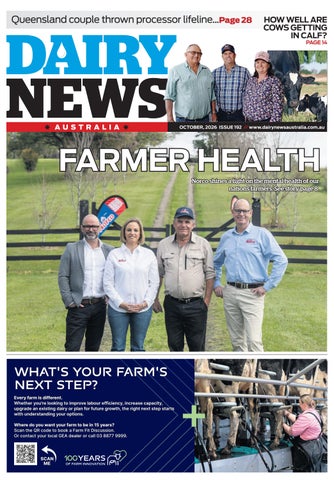
Queensland couple thrown processor lifeline...Page 28
HOW WELL ARE COWS GETTING IN CALF? PAGE 14
OCTOBER, 2026 ISSUE 192 // www.dairynewsaustralia.com.au
FARMER HEALTH Norco shines a light on the mental health of our nations farmers. See story page 8.
WHAT'S YOUR FARM'S NEXT STEP? Every farm is different. Whether you're looking to improve labour efficiency, increase capacity, upgrade an existing dairy or plan for future growth, the right next step starts with understanding your options. Where do you want your farm to be in 15 years? Scan the QR code to book a Farm Fit Discussion. Or contact your local GEA dealer or call 03 8877 9999.
SCAN ME
FROM DAY ONE, A LIFETIME OF INSIGHT
Age 1 Day Health Index 84 Lactation 2 DIM 1 Daily Rumination 256 Health Index 82
SENSEHUB® DAIRY - WITH YOU EVERY STAGE OF LIFE sensehub.com.au • 1300 138 247
This product is not intended to diagnose, treat, cure, or prevent any disease in animals. For the diagnosis, treatment, cure, or prevention of disease in animals, you should consult your veterinarian. The accuracy of the data collected and presented through this product is not intended to match that of medical devices or scientific measurement devices. Copyright © 2026 Merck & Co., Inc., Rahway, NJ, USA and its affiliates. All rights reserved.
DAIRY NEWS AUSTRALIA OCTOBER 2026
NEWS // 3 Volume share by origin 60%
50%
40%
30%
20%
10%
0% 2020/2021
Tassie sharefarmer of the year. PG.12
2021/2022
NEW ZEALAND
THERE WAS a huge turnout at the recent
Master Breeder Atlast PG.20
NEWS ..................................................3–29 ANIMAL HEALTH .............................. 30 MACHINERY ......................................... 31
2023/2024 US
EU
2024/2025
2025/2026
Other
Why US exports are pouring in BY ELIZA REDFERN
National award for Narelle. PG.18
2022/2023
Fine Food Australia Expo, especially from the United States (US). The US Department of Agriculture (USDA) held a trade mission for 38 agribusiness and trade organisations, and representatives from 10 state agricultural departments, for this year’s expo. Furthermore, the US was the show’s first ever ‘Official Country Partner’, hosting events to showcase US dairy (particularly cheese), aiming to connect suppliers with Australian buyers. So why are we talking about this? As detailed in Bendigo Bank Agribusiness’ recent Monthly Commodity Update reports, Australia is increasingly seen as a target for overseas dairy, as its milk pool declines over time and the disparity between the value of Australian dairy versus the global market becomes glaring at times. The US has a lot of dairy to sell; the number of cows nationally has surged to a 30-year high after 2024’s avian influenza outbreak, keeping milk flows elevated despite recent heatwaves
(US production +3.4 per cent in 2025/26). They also have a significant amount of cheese from all the new midwest processing capacity that’s come online. Between July 2025 and May 2026, Australia purchased 78 per cent more tonnes from the US (around 70,000 tonnes compared to 39,000 tonnes), taking the US’s share of imports to 24 per cent, up from the previous season’s more typical 14 per cent. Australia has been importing substantially more butter and cheese (which together form about half of Australia’s imported dairy) from the US, and sourcing less from New Zealand and Europe. The stories of US butter emerging on some supermarket shelves during late 2025 follow a broader trend of increased penetration of imports to retail level. The US no doubt see the 2026/27 season as a similar opportunity. The current Australian Commodity Milk Value (CMV), calculated by the Australian Dairy Products Federation (ADPF) sits $1/ kg milk solids higher than the Oceania CMV (which indicates the average value of global prices).
This is how progress lasts.
The last time there was such a difference was during the 2022/23 season, when Australian farmgate milk prices, and its imports of overseas dairy, reached historic highs. Despite demand-driven bouts of support in some recent GlobalDairyTrade events, world export prices have been under pressure from a market flush with milk. While European milk flows are slowing, they remain in growth territory, and there are minimal signs of US and New Zealand production pulling back as we enter the southern hemisphere’s spring. With global values weakening, there is less support for Australian export prices, especially as its own milk flows grow (national production +1.5 per cent in 2025/26). As the US looks towards Australia as a home for its dairy, cheaper imports and softer returns abroad will force local product to find one too. With more milk on the way from overseas and here at home, it seems the likelihood of mid-season farmgate milk price step ups have dampened. To access and subscribe to the Monthly Commodity Updates, visit the Bendigo Bank website.
Progress is more than production - it’s what you pass on. Every smarter decision, every better day builds a stronger farm for the next generation. With DeLaval, you’re shaping a future worth handing down. Let’s shape progress on your farm.
DAIRY NEWS AUSTRALIA OCTOBER 2026
4 // NEWS
Virtual fencing valued BY GEOFF ADAMS
EARLY RESULTS of a Charles Sturt University trial are demonstrating the significant potential of virtual fencing technology to transform livestock management, improve farm productivity and support animal welfare outcomes. Conducted at the University’s Global Digital Farm in Wagga Wagga, the Charles Sturt Virtual Fencing Demonstration Trial uses GPS-defined boundaries and electronic neckbands to manage cattle movements without the need for traditional fencing. The technology enables producers to create, modify and move grazing areas within minutes using a computer or mobile device, delivering unprecedented flexibility in livestock and pasture management. One of the strongest early findings from the trial is how quickly cattle learn to respond to the audio stimulus delivered through the neckbands without needing electrical pulses.
At the beginning of the project, about 60 per cent of fence interactions were resolved using the audio warning alone. As the cattle adapted, that figure increased to about 97 per cent audio-only interactions, demonstrating that animals are responding to the warning cue without requiring electrical stimuli. Early indications are that virtual fencing technology can operate as a communication tool rather than a correction device, reinforcing confidence in animal welfare outcomes. Minister for Agriculture, Regional and Western NSW Tara Moriarty said virtual fencing had the potential to deliver major benefits for producers across NSW. “The NSW Government is proud to support this innovation to help farmers improve productivity, while maintaining strong animal welfare standards,” she said. “The technology gives producers greater flexibility to manage grazing, reduce infrastructure costs and respond more quickly to changing seasonal conditions.”
Jason and Lisa Rozynski were told in June by Maleny Dairies they no longer required their 3.3 million litres of milk.
Queensland dairy plan in question already BY SOPHIE BALDWIN
A PLAN to rebuild, strengthen and grow the
Virtual fencing has been tested in a university trial which has shown cattle are quick to respond to audio stimulus.
ACCURATE MIX CONTROL KEENAN machines are proven, farmer-tough, and ready for whatever work lies ahead. The trusted combination of unique algorithms + nutrition advice ensures the exact formulations, mixing order, speed and rotations. KEENAN Business Manager Donal Blackwell 0408 377 304 | dblackwell@alltech.com
Queensland dairy industry is being tested after one Queensland family has found itself in the terrible predicament of having no processor to take their milk. Jason and Lisa Rozynski were told in June by Maleny Dairies they no longer required their 3.3 million litres of milk. At the very last minute they were rescued by Kenilworth Dairies but the reality was for many months, the Rozynski’s were in the terrible and stressful situation of not having a processor to take their milk. Ironically, processors and the Queensland Government only launched the 2026-32 Queensland Dairy Plan earlier this year, with the aim to lift the volume of milk produced in the state by five per cent. CEO of eastAUSmilk Eric Danzi said processing capacity, shutting down of the Lactalis factory in southern Queensland and the movement of processed milk into the state, had culminated in a “perfect storm”. “We need existing factories to increase processing capacity and retailers and consumers to support locally manufactured milk. “Government has a role to play by supporting processors to expand existing capacity, and we also need more truth in milk labelling so consumers can look and see where their milk
is actually processed,” Eric said. He said Queensland milk production sat around 280 million litres, while annual consumption was around 580 million litres. “No-one is arguing that we need to bring milk into Queensland, that’s not the issue. “The issue is the reducing processing capacity, and the impact this will have on farmers moving forward, and the fact retailers are transporting milk into Queensland. “How do we grow our industry if we can’t process the milk here?” Eric said he was concerned about what would happen when many farmers come off their milk supply contracts next year. “I have already heard of a couple of farmers who are being proactive and exiting the industry on their own terms.” He said eastAus Milk was actively lobbying processors, retailers and government to inform them of the situation and they were looking to get consumers on board as well. “Processing creates employment and keeps our farmers in business, and we want that to continue for our industry — what we don’t want to see is a reduction,” he said. Eric said importing cheap staple food products was shameful and costed Australia more in the long run. “Government should be supporting our agricultural sector and encouraging productivity including the Queensland dairy industry.”
WITH IMPROVED PRODUCTIVITY
DAIRY NEWS AUSTRALIA OCTOBER 2026
NEWS // 5
Retailer puts Aussie dairy on the line WOOLWORTHS’ BILLION-DOLLAR profit has
raised fresh questions about how Australia’s biggest food retailer backs home-grown dairy, local processors and regional jobs. Woolworths reported an 18.1 per cent increase in net profit to $1.14 billion for FY26, with its Australian Food segment sales reaching $53.9 billion. Australian Dairy Farmers president Ben Bennett said Woolworths use of imported United States dairy products, including their home-brand cheese, put pressure on home-grown Australian produce, dairy farmers, processors and regional jobs. “Woolworths has built its brand as the ‘fresh food people’, but it’s putting Woolworths-branded imported cheese into Australian shopping baskets,” Mr Bennett said. Mr Bennett said the Woolworths case was symptomatic of a broader and worrying trend, with both United States and European imports increasingly appearing on Australian supermarket shelves. “And some of those products sit in Green and Gold-style packaging, so shoppers aren’t even being
Hillview butter imported from the United States is packaged in green and gold.
given clear information about whether they are buying Australian dairy or imported product. “Every imported product that replaces Australian dairy takes demand away from local processors and farmers. And that demand supports farms, processing capacity, regional communities and Australia’s food security.”
Mr Bennett said major retailers needed to be clear about what they put on shelves and how those choices affect local production. “This is not just about shopper choice. It is about retailer responsibility. “Governments are talking about food security and resilient supply chains, but sourcing decisions
like this put more pressure on the farmers and processors who produce food here at home. “Woolworths and other major supermarkets decide which products get shelf space, and those decisions help determine whether Australia maintains a strong domestic dairy industry. “Once farms close and processing capacity disappears, it is extremely difficult to rebuild.” Mr Bennett said Woolworths’ strong profit result made it fair to ask how the retailer supported Australian dairy farmers and local food production. “Woolworths reported a $1.14 billion profit, while Australian dairy farmers compete with imported home-brand products from much larger overseas markets. “Australian dairy farmers are not asking for charity. They are asking major retailers to value Australia’s own produce, its own food. “Woolworths should explain how it will keep Australian dairy farmers and processors in its supply chain while selling Woolworthsbranded imported dairy products.”
100 years for Western Star WESTERN STAR is celebrating its 100th birthday, marking a major milestone for one of Australia’s favourite butter brands and reflecting on how it has remained part of Australian kitchens across generations. Born in Victoria’s Western Districts in 1926, Western Star has grown from its regional beginnings into one of Australia’s most recognised dairy brands. Western Star is the number one chilled spreads brand in Australia, with a pack purchased every second and products purchased by nearly 1 in 2 Australian households each year. Its continued success is built on a reputation of consistency and care that have made it a staple in Australian kitchens for decades. The centenary is an opportunity to highlight the craftsmanship, dedication, and people that have helped the brand endure across generations. Proudly Australian made in Cobden, Victoria, the brand continues to be shaped by local farmers and butter makers. Managing director, Lactalis-Mainland Dairy Oceania, David Breckenridge said reaching 100 years is a proud milestone for a brand that has continued to earn its place in Australian kitchens. “Very few brands have the privilege of being part of Australian households for 100 years,” Mr Breckenridge says. “Western Star has built that trust through generations of craftsmanship, consistency, and the expertise that goes into every block and tub. “As we mark this milestone, we’re proud of
the legacy behind the brand and are focused on ensuring it continues to be loved by future generations.” Throughout its history, commitment to quality continues to be recognised, with Western Star being named Australian Champion Butter eight times, and receiving multiple gold medals at both the 2026 Victorian and Australian Dairy
IS YOUR ELECTROLYTE
Industry Association Awards, including the trophy for highest scoring consumer pack butter. Group marketing manager for LactalisMainland Dairy Laura Blewitt, said the brand’s multigenerational appeal comes from understanding what Western Star means to Australian consumers today. “Western Star has remained part of Australian
kitchens because it continues to play a meaningful role in everyday cooking and baking,” Ms Blewitt says. “While food habits have changed over the decades, Australian’s continue to value quality ingredients they can trust. That’s why Western Star remains a familiar part of everyday cooking and baking today.”
ADVANCED
PROBIOTICS
DOING
RAPID HYDRATION. RAPID RECOVERY.
THE WHOLE JOB?
electroCALF
Photo: Rach Ramsey
For 100 years, Western Star butter has had a place on Australia’s kitchen table.
™
2-IN-1 PROBIOTIC ELECTROLYTE
ONE PRODUCT. BOTH BENEFITS. WHY PAY FOR TWO? MAKE THE SWITCH
Call Jon to find your local stockist
0423 008 495
DAIRY NEWS AUSTRALIA OCTOBER 2026
6 // NEWS
Footy’s favourite farmer A CUDGEWA dairy farmer and dedicated
community volunteer has become the first ever woman to be crowned Footy’s Favourite Farmer. Elise Hill was nominated for her extraordinary contribution to the Upper Murray community, where she balances life as a dairy farmer with extensive charitable work and numerous volunteer roles at the Cudgewa Football Netball Club. As this year’s winner, Elise has secured $10,000 worth of safety improvements for her farm and a further $10,000 in safety upgrades for Cudgewa FNC. The annual competition, run by WorkSafe in partnership with AFL Victoria and Netball Victoria, recognises Victorian farmers who go above and beyond for their sporting clubs and communities. For years, Elise has been a driving force behind the Cudgewa Blues, volunteering as a first-aider, trainer, fundraiser, committee member, roster co-ordinator and umpire. She’s also become a trusted source of support for locals experiencing mental health challenges. Elise said helping others had always been part of life in the Upper Murray. “For a lot of us around here it’s never been about awards or recognition,” she said. “We all pitch in and help others however we can, because that’s what being part of a community means.” Earlier this year, Elise and her husband stepped in to support the family of a local farmer who tragically died following a quad bike rollover, helping maintain dairy operations and care for livestock. WorkSafe chief executive officer Cathy Henderson said Elise's commitment to supporting others could be felt across the region. “Whether she’s supporting her local club, advocating for better mental health awareness, running her dairy operation safely and smoothly, or helping neighbours through tough times, Elise is always looking out for others,” Ms Henderson said. “The strongest communities and safest workplaces are built on people who genuinely care for one another, which is exactly the spirit that Elise embodies and why she is such a worthy winner.” Elise’s own experiences inspired much of her community work. After the devastating 2019-20 bushfires destroyed much of her family’s farm and livestock, Elise and her community grappled with immense loss, including the death of her 21-year-old son Sam to suicide.
Elise Hill is a worthy recipient of the 2026 WorkSafe Victoria Footy’s Favourite Farmer award. Photos: Luke Hemer
“We lost five young men in our community in about 15 months after the fires. Three of them were from suicide,” she said. “We didn’t see that coming, but it really encouraged us to try to do something for the community and to bring us together to reflect on the losses.” Elise helped establish a local suicide prevention action group and has used the club’s annual Beyond Blue match days to encourage conversations about mental health among isolated farmers.
Elise and her husband were also one of three local Upper Murray families that started the annual Corryong Spirit event, bringing people together to share their grief instead of holding it in. As someone who understands the importance of farm safety and looking out for others in regional communities, Elise said the grand prize would deliver practical safety benefits. “This prize money will bring definite benefits for everyone,” she said. “We can always find safety improvements
on the farm such as guards on tractors and rollover protection systems for our motorbikes. “At the club, we could upgrade our timekeeper’s box and make it safer for volunteers.” This year’s Footy’s Favourite Farmer competition attracted nominations from across Victoria, with finalists each receiving a farm safety package valued at almost $2000, an OHS essentials workplace safety consultation and sporting equipment for their local club. If this story has raised issues for you, please contact Lifeline on 131 114.
WATER TROUGHS, FEED TROUGHS & PORTABLE BULK STORAGE WALLS BULK DEALS! ON STOCK-PROOF STOCK
-
4 SIZES @ 400MM HIGH (float cover optional) 5 SIZES @ 400MM HIGH (float cover optional)
L-BLOCK WALLS 1-4M HIGH
DIVIDER WALLS
S wi
Delivery VIC, SA, & NSW
FEED TROUGHS 0.7-1.5M WIDE
ft - L
SMALL BARRIERS 900MM HIGH
ns
RECTANGLES 1.2M - 4.8M LONG
ift P i
GRAIN BUNKER WALLS 1.0-1.3M HIGH
Upgrade with AG-CRETE CRETE Call (03) 5450 4400 Visit 2 Mibus St, Kerang www.agcrete.com.au
DAIRY NEWS AUSTRALIA OCTOBER 2026
NEWS // 7
Open day set for Wyndara BY SOPHIE BALDWIN
DARREN VICKERS is a third-generation farmer whose family converted a sheep and beef property into a dairy back in 1996, starting with just 120 cows on 230 acres. Three herringbone rebuilds and a rotary dairy later, the herd had climbed past 600 cows — until staffing pressures forced a retreat to 500. Twelve months ago, a new robotic barn changed the equation, built to solve a labour shortage, protect cows through one of the district’s toughest climates, and hand Darren back some time with his family. On November 4-5 along with Lely, the family will open Wyndara Farms for anyone interested in having a look. The decision to install the robots was not taken lightly, with Darren spending months working out the pros and cons of different robotics, putting them under the microscope. Fat and protein performance indicators ended up being the deciding factor. “Lely has been a tried and tested machine for a very long time now, and it just suited our system,“ Darren said. Labour might have been the trigger, but it turned out data has been the biggest win. Cell counts are down, conception is up and fat percentage has sat a full point higher since moving into the barn, with protein up around 0.3 per cent — both holding steady rather than swinging with the seasons.
South west farmer Darren Vickers, along with Lely, will open his farm to the public November 4-5.
Darren puts some of that down to cows simply walking less and putting the saved energy into milk instead. Over ninety per cent of the time, he reckons, the robots flag a sick cow before his staff do. The benefit isn’t confined to the cows, either. With fewer of them walking paddocks
flat in a bad week of winter weather, Darren says the farm is growing noticeably more grass than it used to, with cut-and-carry silage now part of the system whenever it’s dry enough to make it worthwhile. Darren is confident the investment pays for itself, and his reasoning is pragmatic rather than sentimental.
To get the same lift in milk the conventional way, he’d have had to buy more land, build a bigger conventional dairy and that path would have meant borrowing more money than the barn cost him, for a slower payback. “All that would have done was increase the headaches,” he says. The barn was built to reduce them instead. Getting there took roughly three to threeand-a-half years from first looking into it to actually milking in the barn, including an 18-month build. There’s also a reliability dividend he didn’t expect to value quite this much: the robots turn up every day. “They don’t ring you at 2.30am in the morning saying they can’t come in,” he says. ‘’If you had asked me five years ago whether I’d be milking cows in robots, I would have laughed at you.“ His only regret is he wished he had have done this 10 years ago - a line he’s repeated more than once since. “If you don’t want robots to work, they’re never going to work for you. The open day is a great opportunity to walk through the barn, see the automation in action, and hear directly from Darren about the challenges, adaptations, and pros and cons of making the leap. The farm will be open from 10am to 2pm. Walk-ins are welcome but registering helps with catering. 2 For more information, visit www.lely.com/ au/about-lely/events/open-day-southwest
PERFORMANCE BASED SOLUTIONS FOR DAIRY
A highly bioavailable natural organic rumen buffer rich in bioavailable calcium and magnesium carbonates and naturally contains over 70 minerals. SLOW-RELEASE BUFFERING EFFECT Carbonates help neutralise excessive rumen acids. Assists in optimising rumen pH. Maintains longer term pH stability of the rumen. HIGHLY BIOAVAILABLE MINERALS Calcium (min. 32%) Magnesium (min. 3%) Contains over 70 minerals. PROMOTES OPTIMAL RUMEN FUNCTION Improves environment for microbial fermentation. Improves fibre digestion and feed efficiency. Improves dry matter consumption. 100% NATURAL 100% Calcified Calcareous Red Algae. USDA Organic Certified.
Distributed by:
www.auspacingredients.com.au
DAIRY NEWS AUSTRALIA OCTOBER 2026
8 // NEWS
Farmer pressure threatens f
Professor Sam Harvey from Black Dog Institute, dairy farmers Jane Polsen, Ross Blanch and Norco CEO Michael Hampson.
AS INCREASED fuel, fertiliser and freight
costs continue to place mounting pressure on Australian agriculture, alongside repeated natural disasters and growing global instability, a new report has revealed the escalating human toll facing the farmers behind Australia’s food supply. New findings from the 2026 Norco National Farmer Wellbeing Report, in partnership with the Black Dog Institute show farmers are experiencing sustained levels of stress, anxiety and emotional exhaustion, with many now questioning their future in the industry. The findings point to a worsening mental health landscape across Australian agriculture, with several major indicators increasing over the past three years. More than half of farmers (54 per cent) report feeling depressed or down in the past two years, almost a quarter (24 per cent) often or always feeling anxious, and one in three
farmers (33 per cent) say their mental health has deteriorated over the past 12 months. The report also suggests mental health is now emerging as one of the most significant health challenges facing the sector, with farmers almost twice as likely to report poor mental health as poor physical health (19 per cent vs 10 per cent). One in seven farmers (15 per cent) reported thoughts of self-harm or suicide over the past two years - a rate substantially higher than that seen in the general Australian population. Notably, the research was conducted before the recent surge in global uncertainty and renewed input cost pressures impacting Australian agriculture, suggesting many farmers are now operating in an even more challenging environment. As conditions worsen, two in five farmers (41 per cent) say they have considered leaving the industry.
Dairy-Tech Refrigeration Pac Cool Dealer - Australia Packo & Pac Cool Spare Parts
Norco chief executive officer Michael Hampson said the findings highlight the sheer scale of the pressures facing Australian farmers today, and the broader implications for the future sustainability of the sector. “Our 2023 Farmer Wellbeing Report shone a confronting light on the challenges facing Australian farmers, but these latest findings show those pressures have certainly not eased,” Mr Hampson said. “Over recent years we’ve seen repeated natural disasters, rising operating costs and global instability all converge at once, and this report shows that the human impact is becoming increasingly severe. “Farmers produce around 90 per centof the food consumed in Australia, yet many are now reconsidering their future in the industry. “That has significant implications not only for farming families and regional communities, but for Australia’s long-term food security.”
Black Dog Institute executive director and chief scientist Professor Samuel Harvey said the findings reveal the scale and complexity of the challenges facing Australia’s farming communities. Professor Harvey said the specific intersection of occupational, social, cultural and environmental stressors experienced by farmers has created a large and growing mental health crisis within Australia's farming communities. "Three years on from the first National Farmer Wellbeing Report, the continued scale of distress and unmet mental health care needs across the agricultural sector is deeply concerning. The results show we now have a situation that cannot be ignored." Norco dairy farmer Jane Polson from Oxley Island in New South Wales said the findings reflect the growing strain many farmers are experiencing behind the scenes. “People see natural disasters, fuel shortages or rising prices in the headlines, but what they don’t always see is the emotional and financial toll farmers are carrying every single day,” Ms Polson said. “The ongoing uncertainty across so many areas is very real, and unfortunately those pressures don’t switch off when the workday ends. “Farming is not just a job for most people, it’s a way of life for families, and one that’s often built over generations. But many farmers are exhausted and carrying the weight of navigating these increasingly difficult circumstances.” Compounding these challenges, more than a quarter of farmers (27 per cent) say their farms have operated at a loss over the past three years, and of those, three in four (75 per cent) say this has negatively affected their mental health. To remain financially viable, nearly six in ten farmers (59 per cent) are now relying on off-farm work or secondary occupations, with close to one in five (17 per cent) working an additional 30 hours or more each week – almost equivalent to a second full-time job. The result is widespread fatigue and burnout, with almost one in four (23 per cent) saying they often struggle to cope with the demands of farming. The report suggests many Australian farmers feel increasingly invisible in the very system they help sustain. More than nine in ten farmers (91 per cent) believe the role they play is undervalued by the Australian public, while more than one in four (27 per cent) are no longer optimistic about the future of farming in Australia. Most farmers (79 per cent) come from multi-generational farming families, yet many
Milk Vats 5,000 > 50,000 Litres
THE DEDICATED MILK COOLING SPECIALIST
Milk Cooling Tanks
- A milk vat to suit all herd sizes, pick up schedules & entry temperatures - Cooling & wash controls - user friendly, simple & effective - Glycol chiller cooling & traditional direct expansion cooling systems - New & secondhand sales, spare parts & wash system upgrades for all makes PHONE: 03 5662 3277 EMAIL: pgoiris@dairytechrefrig.com.au WEB: www.dairytechrefrig.com.au Refrigerant Trading Licence - AU34439
84869
Call Dairy-Tech Refrigeration today for a no hassle quotation
DAIRY NEWS AUSTRALIA OCTOBER 2026
NEWS // 9
food security have no clear succession plans in place, raising questions about who will produce Australia’s food in the generations ahead. Mr Hampson said the findings should serve as a wake-up call for industry, government and the broader community, reinforcing that farmer wellbeing can no longer be viewed in isolation. “In an increasingly uncertain global environment, maintaining strong local food production and sovereign capability has never been more important, and farmer wellbeing must now be recognised as a critical food security issue requiring coordinated action. “The fact that 94 per cent of farmers believe Australia’s long-term food security depends on stronger support for farmers and regional communities sends a powerful message about the scale of concern across the sector. “If we lose farmers, we lose far more than individual farms; we risk losing regional communities, local industries and ultimately Australia’s ability to sustain its own food production. “Forty years ago, few could have imagined Australia would no longer have a car manufacturing sector, but history shows industries can disappear when long-term challenges are left unaddressed.
“That’s why it is critical we continue investing in the sustainability and resilience of Australian agriculture and the people behind it, because we simply cannot afford to take our farming sector for granted.” Professor Harvey said that while the findings are confronting, the report also provides a clear path forward. "We need to equip regional communities to better support each other and ensure farmers can access timely, high-quality professional mental health care when they need it, no matter where they live. "But we also need to recognise the power policymakers have to improve farmer wellbeing through better responses to the economic and climate challenges they face. Mental health support is critical, but so too is addressing the underlying pressures that are driving distress in the first place." If you or anyone you know needs help contact: ɋ Lifeline on 13 11 14 ɋ Beyond Blue on 1300 224 636 ɋ Suicide Call Back Service on 1300 659 467 ɋ MensLine Australia on 1300 789 978 ɋ Head Space on 1800 650 890 ɋ Rural Aid Counselling on 1300 175 594
SMART MINERALS FOR DAIRY CATTLE Selko Intellibond-Hydroxy trace minerals Trace minerals support a range of biological functions required for immune function, reproduction, and growth. Trace minerals Selko IntelliBond Trace Minerals are present in forages and other feeds used in cattle diets, and withimportance the exception ofminerals cobalt, meet the requirements of rumen The of trace Trace minerals support an array of biological functions that required for microbes. However, supplementation isare needed toproper meetimmune the function, reproduction, and growth. Trace minerals are present in forages and other feeds used in cattle diets and, with the exception of cobalt, meet the requirements of rumen microbes. animal’s needs. However, supplementation is needed to meet the needs of the animal. ®
®
COPPER COPPER
ZINC ZINC
MANGANESE MANGANESE
Supports joint health, Supports joint health, blood cells, immunity, blood cells, immunity, fertility, iron fertility and and proper proper iron metabolism. metabolism
Contributes to Contributes to making making protein, vitamin A protein, sation,vitamin fertility A and utili skin health. utilisation, fertility and skin health
Contributes to healthy bone and carilage, enzymes, immunity and fertility
Contributes contributes to healthy bone and cartilage, enzymes, immunity and fertility.
ANTAGONISTS IntelliBond Hydroxy Trace Minerals unique crystalline structure Antagonists are minerals or compounds that reduce the bioavailability of another mineral forming complex that reduce absorption. typically limits the exposure of by the IntelliBond trace minerals toThis antagonists occurs in the rumen. Antagonists can come from feedstuffs in the diet, soil (or ingestion), and drinking water. Common antagonists to thein in the feedcontamination and rumen. Slow breakdown of IntelliBond occurs trace minerals that are important to cattle are: • Sulfur making the mineral available to be absorbed in the abomasum, • Iron the small intestine. • Molybdenum • Mineral imbalances
Smart Smart Nutrition Smart Decision IntelliBond Minerals Hydroxy Trace Minerals Strong covalent bonds and a unique crystalline structure limit the exposure of the IntelliBond trace minerals to antagonists in the feed and in the rumen. Slow dissociation of IntelliBond occurs in the abomasum, making the mineral available to be absorbed by transporters in the small intestine.
✓ Superior availability ✓ Increased rumen stability High ✓ Low heavy metal content bioavailability. ✓ Preferential intake ✓ Protected from antagonists
Figure 1. Relative bioavailability in cattle (indexed to sulfate)
250% 200%
100% 100% 50% 0
Feeding IntelliBond ensures optimal absorption and improved trace mineral status.
204%
196% 150%
100%
IntelliBond C* Copper Sulfate
IntelliBond Z**
Zinc Sulfate
*p < 0.04. Spears et al., 2004. Anim. Feed Sci. Technol. 116:1-13.
Meeting global standards in... **p < 0.01. Schaeffer et al., 2017. Anim. Feed Sci. Technol. 232:1-5.
Quality Control and Assurance Food Safety & Quality Certifications
Selko® products are proudly distributed in Australia & New Zealand by Auspac Ingredients
www.auspacingredients.com.au
Norco chief executive officer Michael Hampson said the sheer scale of pressures facing Australian farmers today will impact the future sustainability of the sector.
DAIRY NEWS AUSTRALIA OCTOBER 2026
10 // NEWS
Focusing on Jerseys STATISTICS SHOW that 2021 was a pivotal year in the journey of Chloe and Rodney Brown’s Jersey herd at Kirkstall in south-west Victoria. Before that year, their herd’s balanced performance index (BPI) was consistently below breed average but since that time it has consistently bettered the national average. The BPI is a measure of genetic merit for the key traits that affect dairy farm profitability. Two major changes in 2021 have been instrumental in turning around their herd’s genetics - moving from a Jersey-Holstein mix to concentrate solely on Jerseys and starting genomic testing. Their herd now ranks 63 in Australia for BPI with an average of 45. It consistently tracks above national average for genetic progress for longevity and has made significant improvements in genetic merit for fertility and mastitis. Chloe says concentrating on one breed and genomic testing all calves have been significant contributors to their success, with data playing a big role in their decision making. “We’ve got history going back multi-generations and then genomics builds the story for what we do,” she said. “It gives us really good data to be able to make good decisions.” Chloe and Rodney have been leasing his parents’ farm since 2016. They started with a fiveyear plan to go straight Jerseys, but it took a clearance sale to push them into action. “In 2021, Jamie Drury’s herd of cows was up for dispersal at Tamworth,” Chloe said. “It was a great herd so we bought 50 and sold about 80 Holsteins and also bought some local Jerseys. “We had the five-year plan but hadn’t done anything about it, then with great dispersals, we could do it.” Rodney had the Jersey portion of his family’s herd and continues to prefer the breed for its smaller stature, good feed conversion and high components. “Our farm has a heavy clay base and can pug easily so the Holsteins did way more damage,” he said. “We also thought it would be easier to manage one herd, especially when it came to feeding. Concentrating on one breed has definitely improved the quality of the herd.” They now milk about 200 cows on a compact 133 hectares, which also has to maintain young stock. As part of their changes, Chloe and Rodney moved away from “just joining cows”. “We have a clear vision of the type of cow we
Chloe and Rodney Brown have used breeding data as key role in their decision making.
want,” Chloe said. “She needs to be strong in stature, milk really well, especially in terms of components, convert really well and do better on less, and she must get in calf. “We focus on fertility, components and strength.” They use selective mating, with genomics data becoming a more important cornerstone of their plans. At least 80 per cent of the herd has been genomically tested. “We probably didn’t use the data as well as we should have at the start but now you realise you can’t do anything without data,” Rodney said. “Now we look at the genomic data and every cow is visually assessed in the paddock and we have so much breeding and classification history to look back on. It becomes part of the jigsaw puzzle to figure out what we want.” With their breeding consultant, Chloe and Rodney go through DataGene’s Good Bulls Guide to look at their best options.
“We look at who is at the top, what can we use, and what suits our herd. A bull might be number one in the country, but we ask ourselves will he actually suit our cows and can we achieve what we want to achieve with that bull.” Nearly 80 per cent of their cows are bred from bulls that meet DataGene’s Good Bulls criteria. The bulls they have chosen over the past 10 years have improved their cows for BPI, HWI overall type, protein, fat, fertility, mastitis resistance and longevity. While the vast majority of these improvements fit their goals and breeding choices, Chloe describes the improved longevity as a happy accident, not that she is complaining. “It’s not a main focus but we always love having cows productive for as long as possible.” They use a mix of sexed semen on cows along with conventional semen and a small percentage of beef semen. While Jerseys are now their focus with
cross-breeds exiting the herd, eldest daughter Charlotte, 11, decided to start her own herd this year, so a sprinkle of Holstein Reds have been added to the mix. The herd calves in March-April and all heifer calves are genomically tested. “We rear all the heifers to avoid the bobby calf market,” Chloe said. “That means we rear more heifers than we need, genomically test them, and then export the tail end. “This year I reared 50, all genomically tested, but we only need to bring 35 in so we keep the best. The first line of defence is the genomics. “ Exports are a good source of extra income for the business. “Jerseys are never going to get as much as Holsteins but there is still a good market for them,” Rodney said. “We take out from the bottom and they’re ready to go. We’ve got history going back multi-generations for everything and then genomics builds the story for what we do.”
AUSTRALIA’S MOST ACCURATE* HERD IDENTIFICATION SYSTEM Herd Identification Very accurate animal identification system for Rotary and Herringbone dairies. Simple to use, this is the complete herd management system no dairy farm should be without.
Sorting and Drafting Save time and labour with our sorting system that can be integrated into your Rotary or Herringbone ID system or operate as a stand-alone system for sorting only. Animal flow and accuracy is excellent with maximum flexibility and speed.
Sensors and Heat Detection Volume, cell count, fat, protein and heat sensors can be integrated into the Jantec ID system. Improve your herd health, production and milk quality with this leading technology.
If you want to increase productivity, quality and have Australia’s best herd management system, contact us today!
(03) 5222 8891
www.jantecsystems.com.au
Specialists in CellSense and YieldSense+ technologies * as independently verified
DAIRY NEWS AUSTRALIA OCTOBER 2026
12 // NEWS
Sharefarmers of the year BY SOPHIE BALDWIN
RYAN AND Brighid Langley were recently named Tasmania’s sharefarmers of the year at the Tasmanian Dairy Awards held in June. The couple share farm for Circular Head Farms on the Redpa Blue property at Redpa on a 50:50 basis and have just taken on another property next door. Ryan said it was nice to be recognised and they were proud of their achievement. “I love cows and growing grass, and when the cows are happy and grazing on good grass, it fills my glass up,” Ryan said. Across the two properties the couple now milks 1100 cows, with a minimal staff of just two backpackers, which is currently making life fairly hectic. The spring calving Jersey cross herd is moving toward pure Jersey. “We like milking Jerseys,” Ryan said. “They are well suited to this country because it can come in pretty wet here and the smaller stature helps, and also, I think if I am going to milk cows it might as well be a breed that I love.” The business operates a pasture-based system, predominately rye-grass with a few winter crops and turnips grown over summer. The current stocking rate is 3.4 cows to the hectare and the business is moving toward developing more irrigation in the future. Ryan said he hoped to one day own his own farm, a dream he believes is achievable with
HCC
Ryan and Brighid Langley constantly demonstrate anything is possible through hard work.
Ryan and Brighid Langley with their daughters Hannah, 6, and Peyton, 4.
hard work and smart decisions. “My grandfather was a dairy farmer, but he sold the farm when I was one, but it’s all I ever wanted to do, so I guess its in my blood.” Ryan started off in the industry as a milker, then an apprentice, and worked his way up into managing and then sharefarming. “Farm ownership is the key, and we have built up our equity over the years, especially with stock ownership — buying into this farm is not out of the picture for us either.” Ryan said the biggest challenge in the Tasmanian dairy industry was labour. “We can work with the climate, but it is
getting harder and harder to find staff who want to work on a dairy farm.” TIA dairy development extension officer and judge Symon Jones said the couple was selected on their outstanding performance, not only as sharefarmers, but for also being finalists in the Dairy Business of the Year Award. “Their achievements as sharefarmers is testimony to what can be achieved through hard work and determination combined with careful planning, farm management skills across all aspects of their business including pasture management, animal health and the
HOLSTEIN CONFORMATION COMPOSITE
A new, function-focused type index developed by Holstein Association USA, the index includes 18 conformation traits weighted for functional balance and longevity.
“
HOW DO YOU INTERPRET HCC? A high HCC score points toward a balanced linear profile – not simply the highest type score.
Dairies looking to build healthier, longer-lasting cows can combine the strengths of HHP$® and HCC. HHP$ emphasizes the traits that drive lifetime profitability through health, fertility, and efficiency, while HCC provides the functional type insights that support durability and longevity. Tim Weller Marketing Manager, WWS Australia
WHY DOES IT MATTER? Modern herds need cows that last longer and perform across multiple lactations.
“
The business is moving the cross breed herd across to pure bred Jersey.
environment,” Symon said. “They are a dynamic young couple who demonstrate that anything is possible through hard work and commitment.”
TOP 10 HCC SIRES
HCC
BPI
HHP$®
250HO17962 PINNICLES
2.74
696
907
250HO14134 RENEGADE
2.65
512
560
14HO15929
CIRRUS-P
2.59
380
420
7HO15085
PARFECT
2.57
468
585
7HO17368
EASTSIDE
2.40
551
707
7HO15825
REBEL-RED
2.38
625
287
250HO16979 TENTASTIC
2.36
444
679
250HO17842 PUFFIN
2.32
644
1004
250HO17513 TUBMAN
2.31
330
978
250HO18206 LOOSEM-PP
2.29
461
695
AVERAGE PHYSICAL TRAIT EVALUATION Top 30 HCC sires from the August 2026 Genetic Selection Guide
WHAT TYPE OF COWS DOES IT CREATE? HCC prioritizes function over appearance and penalizes extreme stature.
UDDER 38%
FRAME 42%
FEET & LEGS 22%
Stature
Short
0.40 Tall
Strength
Frail
0.
Strong
Body Depth
Shallow
0.
Deep
Dairy Form
Tight Ribbed
Rump Width
Narrow
1.16 Wide
Rump Angle
High Pins
-0.11 Sloped
Rear Leg 4side 0iew5
Posty
0. 4 Si kled
Rear Leg 4rear 0iew5
Ho k-in
1. 1 Straight
Foot Angle
HCC
®
WORLD WIDE SIRES Phone (03) 5831 5559 • info@wwsaustralia.com wwsaustralia.com
0.6 Open Ribbed
Feet 3 Leg S ore Fore Udder
Low Angle
0.
Steep Angle
Low
0.
High
Loose
1. 4 Strong
Rear Udder Height
Low
1.46 High
Rear Udder Width
Narrow
1.
Wide
Udder Cle"t
Weak
0.40 Strong
Udder Depth
Deep
0.
Front Teat Pla ement
Wide
0. 6 Close
Rear Teat Pla ement
Wide
0.40 Close
Teat Length
Short
0. Long
Shallow
® HHP$ is a registered trademark of Select Sires Inc., Plain City, OH. Evaluations for non-conformation traits are Powered by CDCB™ unless otherwise noted. 08/26 CDCB and AUS data.
John & Vicki Lillico & Family, Smithton Tasmania Photo by Bradley Cullen
Product of the USA
DAIRY NEWS AUSTRALIA OCTOBER 2026
NEWS // 13
Supporting Aussie farmers FOR A dairy farm, water is as critical as feed.
Pasture growth depends on reliable irrigation, herds need constant access to clean stock water, and the dairy shed can't run without dependable pumping and wash-down systems. When any link in that chain fails - a bore pump packs it in mid-calving, or a trough runs dry in a heatwave, the cost shows up fast in milk in the vat. That’s the world Irrigear’s 80-member stores operate in every day, and it’s part of why the network has just formalised its shift to a co-operative structure. Unlike a franchise or corporate buying group, every member of the group gets genuine input into how it runs. For dairy farmers, the practical effect is continuity. The same independent specialist who knows a property’s bores, pumps and paddock layout also keeps making the calls, Irrigear doesn’t dictate what stores stock or how they operate. What’s changed is the backing behind them. Profits from the co-op’s collective buying
Push to lift backpacker pause THE NATIONAL Farmers’ Federation is
calling on the Federal Government to urgently restore timely working holiday maker visa processing and consult affected industries before making further changes, warning every day of uncertainty is putting more pressure on farmers, regional communities and food supply. NFF President Hamish McIntyre said working holiday makers were an important part of the workforce mix that keeps farms safe, productive and able to get food and fibre to market at an affordable price. “Working holiday makers fill around one in seven farm jobs nationally and are especially important in peak periods, including harvest, planting and intensive production systems like dairy and horticulture,” Mr McIntyre said. “Farmers are telling us workers they expected to arrive have not arrived, crops still need to be harvested, cows still need to be milked and the workload is being pushed onto fewer people. “That creates serious health and safety risks and unnecessary liability. Some farmers are already working longer hours because of the workforce gap, and that is not sustainable or safe option.” Mr McIntyre said the timing could not be more serious, with each day of slower processing or paused lodgements moving farms closer to winter grain crop and summer harvests without certainty about whether they will have the workers they need. “If farms cannot access workers at the right time, the consequences do not stop at the farm gate. They flow through local businesses, regional economies, supply chains and ultimately all Australian at the checkout,” Mr McIntyre said. “What agriculture needs now is immediate clarity, restored processing and genuine consultation before any further reforms are made.” A petition can be found at www.change. org/p/protect-working-holiday-maker-backpacker-visas-in-australia
return to member stores as rebates rather than to outside shareholders meaning the money stays in the community — local stores can ensure they look after local farms with what they really need and it’s funding to have more stock on hand and faster turnaround for those times when a farm can't wait. Collective buying power across more than 60 supplier partners also means dairy farms get access to a wider range of pumping, filtration and stock-water technology, from solar-powered remote watering systems to irrigation
monitoring to help stretch every megalitre further as water costs rise. Irrigear has grown from a member buying network founded in 1990 into the country’s largest independent water management retail group. For an industry where a dry paddock or a failed pump is never just an inconvenience, the combination of local knowledge and national backing is worth paying attention to. Farmers can find their nearest Irrigear member at irrigear.com.au.
Irrigear is the country’s largest independent water management retail group.
DAIRY NEWS AUSTRALIA OCTOBER 2026
14 // NEWS
How fertile are Australian c SOME AUSTRALIAN herds have made big improvements in fertility over the past five to ten years. But nationally, Australia still trails New Zealand and Ireland. We also haven’t made the gains seen in the US. The introduction of the daughter fertility Australian breeding value has improved the fertility of our cows but genetics alone will not fix the problem. Day-to-day herd management still matters. In seasonal and split-calving herds, the average 6-week in-calf rates are: 2 Australia: 51per cent 2 New Zealand: 70 per cent 2 Ireland: 69 per cent (6-week calving rate) Australian year-round herds perform at a similar level to US herds. However, US 21-day pregnancy rates have risen from 14 per cent to 21 per cent over the past 20 years while Australian year-round reproductive performance has barely changed.
What is holding us back? Every herd is different. To identify the biggest opportunities, Dairy Australia and Dr John Morton analysed reproductive data from more than 1,200 Australian herds. The analysis identified four key areas for improvement: 1. heat detection 2. artificial insemination technique
3. data recording practices 4. heat stress
John’s other recent work also identified two priorities: growing replacement heifers well and using high-fertility sires.
Heat detection
Submission rates quickly show whether enough eligible cows are being mated. Herds not meeting the targets below should urgently review their heat detection practices: 2 Seasonal and split-calving herds: at least 60 per cent of eligible cows mated in the first three weeks 2 Year-round herds: at least 40 per cent of eligible cows mated by 80 days in milk Good heat detection remains essential on most Australian dairy farms. Dairy Australia’s Heat Detection workshops help staff recognise heats and use detection aids correctly. During joining, an “all hands on deck” approach can also lift submission rates. Many farmers are now investing in collars and other wearable heat detection technology. Several farmers I spoke to described the technology as game changing. It can take pressure off milking staff, especially where confidence using heat detection aids, such as scratchies is low. Automated heat detection is most likely to lift reproductive performance where submission rates are poor. Herds that already detect heats well may save time
and labour but may not get more cows in calf. Fixed-time AI removes the need to detect heat before insemination. It is widely used in Wisconsin and is also being adopted by some Australian seasonal, split-calving and year-round herds. It must be carefully planned with your vet or reproductive adviser. Poorly managed programs can become expensive very quickly.
Artificial insemination technique In some herds, conception rates varied between AI technicians. Herds using a professional AI technician should check that the technician is NHIA accredited. Farmers who inseminate their own cows should use Dairy Australia’s semen handling and insemination checklists to regularly review practices.
Data recording practices
2 bull ID 2 semen type (e.g. frozen, fresh, sexed) 2 AI technician 2 synchrony and non-cycling cow treatments These records can show whether problems are linked to particular cows, treatments, semen types, technicians or times of year. More herd management programs now have phone apps. This makes it easier to record information in the paddock, dairy or yards.
Heat stress
Farmers in northern dairy regions already knew heat stress was hurting fertility and John’s analysis confirmed it. Some year-round herds are reconsidering whether joining during the hottest months is worthwhile. Others are shifting more joining into cooler periods. Herds that continue joining through summer will need strong heat-stress prevention to protect fertility.
Replacement heifers
The causes of poor reproductive performance are not always obvious. Good records help identify where the problem is occurring. Use submission-rate targets above and check progress regularly. Useful records include: 2 birth and calving dates 2 health events
First-lactation milk production suggests heifers may not be reaching their growth potential on three-quarters of farms. Failure to get back in calf is also the main reason young cows leave the herd early. Farmers are often caught out by unexpectedly poor growth rates. Because heifers are smaller, they cannot eat as much as mature cows. This makes good-quality
More Fat in the Vat with Intelligent Nutrition Milk fat responses are influenced by more than fibre. MFP® Feed Supplement supports the rumen by maintaining microbial balance and contributing to consistent milk components across lactation. Supports consistent milk fat production in pasture-based dairy systems. Promotes rumen microbial activity involved in nutrient utilization. Helps maintain rumen conditions associated with milk fat synthesis. Talk to your NOVUS representative, visit Novusint.com, or scan the QR code to learn more.
For more info scan the code
Novus Nutrition Pty Ltd | info@novusint.com +61 487 962 783 and MFP are trademarks of Novus International, Inc., and are registered in the United States and other countries. ® TM Made of More is a trademark of Novus International, Inc. ©2026 Novus International, Inc. All rights reserved.
DAIRY NEWS AUSTRALIA OCTOBER 2026
NEWS // 15
n cows? feed especially important. Poor growth can be difficult to see. Regular weighing is the best way to know whether heifers are on target.
Genetics
Farmers are using more high-fertility sires than they were 15 years ago. However, many replacement heifers are still bred from bulls with average or below-average daughter fertility. Farmers should aim to use sires with a daughter fertility ABV of 105 or higher. High-fertility bulls are readily available. A recent Good Bulls App search found 214 Holstein bulls and 49 Jersey bulls with a daughter fertility ABV of 105 or higher.
Next steps
Dairy Australia is using these findings to update its fertility tools, resources and training for farmers and advisers. We thank Dr John Morton for his ongoing work with Dairy Australia, and the farmers and advisers who contributed data and expertise to the project. 2 By Dr Stephanie Bullen, National Animal Health and Welfare lead, Dairy Australia
Some Australian herds have made big fertility gains while others are lagging.
MORE THAN MACHINERY. WE KEEP YOU MOVING.
BRENDAN DISSON
BUSINESS ACCOUNT MANAGER
EXPERT PEOPLE. EXCEPTIONAL MIXING QUALITY. KUHN twin auger vertical mixers deliver fast, consistent feed processing and mixing for a wide range of herd sizes. Built for intensive use and reliable dayto-day performance, they’re backed by people committed to keeping you moving.
KEEP AHEAD WITH KUHN FEED MIXER RENTAL PROGRAM
www.kuhn.com.au
DAIRY NEWS AUSTRALIA OCTOBER 2026
16 // NEWS
Successful edition baled up BY SOPHIE BALDWIN
CONNECTION, NETWORKING, sharing and support are the key themes of NSW Women In Dairy’s Bale Up conference, and in many ways, the key to its success. Dairy farming women travel across the state to attend Bale Up, which is held in a different part of NSW every year. This year’s destination was Canberra. President of NSW Women in Dairy Natasha Yarrington said 100 people including farmers and service providers attended the event. Organisers were also thankful for naming rights sponsors NSWDPIRD. “Bale Up really is such an important conference – for many of our attendees it’s the only time they get off the farm and can put some time into their own personal and professional development. “We aim to deliver diverse perspectives, foster creativity, innovation and a sense of unity and open new doors for opportunities and collaborations,” Natasha said. The three-day conference includes educational and inspirational speakers, industry professionals, experts and fellow dairy farmers who share their experiences, skills and knowledge with attendees. A highlight of this year’s conference was the inspirational presentation from Sam Longmore. A disability advocate, entrepreneur and
Committee members (L to R) Natasha Yarrington, Wingham, April Browne, Camden, Linda Buckley, Camden, Kate Wilson, Tamworth, Meaghan Daly, Jingelic and Gemma Otton, Quamma. Missing committee members were Renae Conell, Dorrigo, Tori Alexander, Camden and Belinda Griffin, Westbury. Photo: Tony Harrington
elite adaptive athlete, Sam is driven by resilience, purpose and action. Just over 13 years ago, Sam’s life changed following two car accidents that resulted
in her becoming a wheelchair user. Rather than limiting her, the experience strengthened her determination to challenge barriers, particularly within rural and agricultural
The winning combination. The Veanavite® Range provides the essential elements in maximising development and productivity, from calf to heifer.
0–3 mths
3–12 mths
12–23 mths
Veanavite® No.1 Calf Pellets
Veanavite® No.2 Weaner Calf Pellets
Veanavite® No.3 Heifer Developer Pellets
Veanavite® pellets have been the products of choice for Australian farmers for over 35 years. Each product provides a highly palatable blend of readily fermentable carbohydrates and high quality proteins to support optimal growth, development and immune system function at each growth stage Contact your local reseller or go to www.veanavite.com.au to find out more.
Australia. She also runs a successful agricultural contract spraying business. “One of the most powerful messages from Sam was the importance of doing something
DAIRY NEWS AUSTRALIA OCTOBER 2026
NEWS // 17
Guest speakers are a key component of Bale Up 2026.
for yourself – a theme that was repeated throughout the conference,” Natasha said. Panel discussion topics included finance, tech and innovation and leadership without the burnout. “The leadership without burnout again emphasised the importance of looking after
yourself. One of the biggest take-homes for me was, it isn’t necessarily about having a holiday, but finding those little microseconds each day to be present and look after yourself.” This is the eighth Bale Up conference, which first started in 2017.
“The mid-North Coast and Hunter Valley dairy groups started the concept after they were looking to start a local event and it has grown from there. “We have been to every dairy region in NSW to give women across the state the opportunity to come to the conference,”
Natasha said. NSW Women in Dairy are a group of like-minded, enthusiastic women, who are all truly passionate about connecting and supporting women across the dairy industry. For more information, visit www. nswwomenindairy.com.au
Take pride in the family history. Secure it for the future with Lely As a family-owned company going back generations, we know what it's like to take pride in farming. But what if you've hit the ceiling on farm capacity or run out of reliable labour to grow it?
Bright farming is yours by choice Scan the QR-code to learn more.
The Lely Astronaut gives you a new lease on life: it provides insight into where you can optimise your dairy, and frees up the time to actually do it. Reclaim what you love doing most.
DAIRY NEWS AUSTRALIA OCTOBER 2026
18 // NEWS
Narelle’s double passion wins national award BY SOPHIE BALDWIN
IT HAS been a whirlwind year for Mannum
dairy farmer Narelle Zanker after she was recently named AgriFutures’ Rural Women’s Award national winner. While there have been dairy farmer finalists over the years, she is the first ever dairy farmer to take out the top gong. And she couldn’t be more excited. Narelle grew up on the family farm at Mannum, and while she did go away and study teaching, the pull of the farm was too much and rather than follow a career in education, she decided a dairy farming path was more for her. But that didn’t mean Narelle gave up on her teaching all together. A couple of years ago, along with the help of her parents Geoff and Heather Simons and husband Joel, Narelle decided to establish Dairy Adventures – a fun, interactive and educational experience for visitors to the farm. The business has steadily grown and ultimately has enabled Narelle to share her two loves – farming and teaching. It has also provided a platform to educate visitors not just about her own farm, but the dairy industry in general. “To be able to advocate for the industry, inform people about what we do and help change mindsets is an amazing and rewarding opportunity,” Narelle said. Initially, Narelle was approached to nominate for the state award and after winning that back in May, she wasn’t expecting to take out the next step. The award comes with a $20,000 Westpac bursary which will be used to establish a tractor and trailer ride for greater accessibility and inclusivity for visitors and extra video resources for schools. The $15,000 Westpac bursary she won from the state title is being used to develop a dedicated outdoor area with seating and activity stations. She will also continue to work on her virtual classroom to help broaden education opportunities. Narelle is not sure what opportunities the award will bring for her own personal growth, but she will embrace those too when they come along. “Opportunities come along and you just have to take them when they are there,” she said. “If I was fixated on achieving a specific goal, I wouldn’t be where I am today, and I just urge everyone to remain open minded about any opportunity that comes your way.” And that also includes applying for the award in the first place. “Even if you don’t make it to be a state finalist, you will meet so many great people along the way.” AgriFutures’ managing director Brianna Casey praised Narelle for the role she’s played in bridging the gap between the city and country. “Narelle embodies exactly what this award is about. She’s young, smart and passionate, and she’s built a genuinely commercial business off the back of her experience as a teacher and her life on the farm, all while reconnecting everyday Australians with where their food actually comes from,”
Mannum dairy farmer Narelle Zanker was named AgriFutures’ Rural Women’s Award national winner for 2026.
Narelle and her husband Joel have worked hard to establish Dairy Adventures over the last two years.
Brianna said. South Australian Dairyfarmers’ Association is also proud of Narelle’s achievements. SADA CEO Andrew Curtis said Narelle was an outstanding advocate for dairy farming, agriculture and regional communities. “To see her recognised as Australia’s Rural Woman of the Year is an incredible achievement, and one that the entire South Australian dairy industry can be proud of,” he said.
“Through Dairy Adventures, Narelle is helping consumers better understand where their food comes from and building meaningful connections between farmers and the community. “Her passion for education and her ability to tell the story of dairy is making a real difference. “This award shines a national spotlight on the innovation, leadership and contribution of women in agriculture, and Narelle is a fantastic
Narelle has been able to bridge the gap between town and country and advocate for the broader Australian dairy industry.
example of that.” SADA president Robert Brokenshire also congratulated Narelle on the national recognition. “Narelle has done an incredible job representing South Australian dairy farmers on the national stage,” he said. "She is passionate about our industry and passionate about sharing its story, and this award is recognition of the impact she is having.”
BUILT FOR WHAT’S AHEAD.
Increase cow comfort and maximise performance with an Action barn.
DAIRY NEWS AUSTRALIA OCTOBER 2026
20 // NEWS
Master breeder ‘Atlast’ BY SOPHIE BALDWIN
DAVID AND Vicky Wright might have grown
Master breeders David and Vicky Wright from Atlast Holsteins.
“Like most people we like a functional cow, with open ribs, good feet and legs. “It’s only been in the last few years after we have bred the extremes out of the herd, we feel like we can now start to pick bulls we like and not to fix a problem.” Some homegrown favourites include the Sashas, Erins and Tess families. Atlast VicKai Erin remains the all-time highest production cow at more than 100,000 litres in a lifetime. She produced two excellent daughters, including local on-farm challenge winner Atlast Allen Erin. David said they had never been able to afford embryo work, but sexed semen had worked well for them over the years. Achieving master breed status has been a dream come true and a lifetime aspiration, particularly for David, who fell in love with the Holstein when he was farming in the UK. “We came into farming in Australia on a
shoestring,” he said. “There is just the two of us, we don’t employ staff, so we have never been able to put a halter on a cow and head to a show, but we have participated in the on-farm challenge.” David and Vicky have two children. Oliver, who is currently studying at university in Melbourne, and Emily, who will be heading off to university next year. Although their chosen paths are not dairy related, they have always helped out on
the farm. Atlast Holsteins has achieved 46 superior total performance awards and 23 lifetime production awards. The couple milks 240 seasonal calving cows which are calved over the autumn months. Anything not in-calf is usually carried over. They run a pasture-based system and cut their own silage. Their young stock are agisted on a 70ha block down the road.
Some of the Atlast master breeder herd.
STOP WASTING FEED We have designed a simple but very effective Feed Trough, to cut your feed wastage and save you money. The endless troughs can be laid in a continuous length, they are also stackable, so you can move them easily from one paddock to another. The frame is made from Australian Steel, with repurposed rubber conveyor belt used to make the trough, its nylon based and will last a lifetime.
8m $1650 Inc GST • 6m $1240 Inc GST
For more information call Grant today! Phone: 0428 106 132 | www.feedomatic.com.au
157461
up in another continent, but they have made their home milking cows well and truly at Naroghid near Camperdown. Initially from the UK, the couple first met when Vicky, who had studied agriculture at university, came across David on a farm — she did not come from a dairy background. David was working in the dairy industry, and he knew there was no hope of him ever owning his own farm in the UK, so he had decided to immigrate to Australia. “My goal was always to own my own farm, and I knew I would never be able to get the capital together in the UK for that dream. “At that time, the banks were also not lending money to buy farms because of a BSE outbreak and deemed farming non-viable,” David said. Vicky decided to join David and their journey to Australia and farm ownership began. In 1999, they began managing in Australia. In 2002, they began leasing a 123ha farm at Naroghid and Atlast Holsteins was established (they would go on to buy this farm in 2008). At the time, the couple was so committed to their cows, they purchased three heifers at International Dairy Week, instead of having their planned honeymoon in Paris. “We had looked at the catalogue, and we didn’t have a plan to actually buy any animals, but when these particular cows came out, we decided to go for it,” David said. Those heifers were from the Trevilyan family’s Donnybrook Holsteins and included two Blackmagic daughters, Donnybrook Magic Ladylike 6th VG88 and Donnybrook Magic Kitty VG88. The impulse purchases would go on to become the foundation of their herd with the Ladylike’s the most successful, producing three excellent daughters and many lifetime and STP award-winning descendants. A Ladylike cow by Silvo was recently classified 90 2E after having her fifth calf. “When we started on the farm in 2002 we lease/purchased the Holstein herd as well,” David said. “They weren’t registered, so we put them through the appendix system.” The couple spent the ensuing years correcting the herd and picking bulls to fix basic confirmation issues so they could have a herd of Holstein cows that not only looked good, but had longevity and were profitable.
DAIRY NEWS AUSTRALIA OCTOBER 2026
NEWS // 21
Scholarships open for 2027 APPLICATIONS ARE now open for Gardiner Foundation’s 2027 Tertiary Scholarship Program, supporting students from Victorian dairy regions to pursue further education and build careers that contribute to strong regional communities. The program offers two scholarship streams for students commencing tertiary study in 2027:
The 2026 scholarships recipients back Luke Dwyer, Ella Berry, Andrew Jeffers, Josh Gale, Hector MacAulay, Bonnie Ross, Evie McCosh, Brittney Kelly and bottom Emily Benson, Sage Deenen, Aaron Shuren, Elizabeth Ford.
PROVEN PEDIGREES. BREEDER CONFIDENCE. MEMBER VALUE. SAVMEEMBER
Priority tertiary scholarships 2 Up to $80,000 over four years 2 An additional $10,000 after completing one year of postgraduate work in the dairy industry or a dairy community 2 Priority given to students who choose to study locally at their nearest tertiary institution rather than relocating to undertake their studies 2 Priority fields include agriculture, agribusiness, food science and nutrition, engineering, medicine and veterinary science 2 Up to five scholarships available
Carenda
2 Up to $30,000 to $40,000 over three to four years 2 Open to students commencing study at a regional university or college 2 Priority fields include agriculture, animal science, business, engineering, food science and nutrition, and health 2 Up to three scholarships available Gardiner CEO Allan Cameron said the scholarships help young people access education while strengthening the future workforce of Victoria’s dairy regions. “These scholarships back students from dairy communities to pursue their ambitions and develop skills that are needed across the dairy industry and regional Victoria,” Mr Cameron said. “We know where people come from, study and complete placements can influence where they ultimately build their careers. “By supporting both metropolitan and regional study pathways, we want to help more young people maintain their connection to dairy communities and ultimately build their futures there.” The program was expanded in 2025 to respond to workforce needs across fields including healthcare, engineering, veterinary science, food technology, agriculture and agribusiness. Gardiner awarded 12 tertiary scholarships in 2026, representing an investment of $705,000 in students from across Victoria’s dairy regions. Since 2008, Gardiner has awarded more than 90 tertiary scholarships to students from Victorian dairy communities. More than 70 per cent of past scholars have remained in, or returned to, dairy regions. The scholarships are named in honour of respected dairy leaders Neil Black, Shirley Harlock, Jakob Malmo, Bill Pyle, Doug Weir and Max Fehring, recognising their contribution to Victoria’s dairy industry. 2 Applications close 5pm Monday November 23. Students can review the scholarship guidelines and apply at gardinerf o u n d a t i o n . c o m . a u / p e o p l e - i n - d a i r y/ tertiary-scholarships
BPI 777
SAVE $6
ACDC
Powerhouse x Magicball
Regional scholarships
R OFFER
/STRAW
A22
HWI 665
SCC 162
TYPE 110
“Longevity runs deep in ACDC’s pedigree, with three generations still in our herd today, alongside the strong components that are evident throughout his family.” – Ray Kitchen, Carenda Holsteins
TULLY P
Kings Ville Boyd x Matt A22 BPI 410
SI 514
DF 105
MAM 108
“We believe his pedigree blends strong, well-balanced cow families with excellent production, offering a reliable combination of milk, fertility, and type.” – Rob and Kerrie Anderson, Kings Ville Jerseys
BISHOP
Beaulands Vesty x Tokyo A22 BPI 569
SI 758
SUR 105
TYPE 106
“BISHOP is from the Primula cow family and they are a pleasure to have in the herd. They are renowned for their production, high fertility, super health traits and longevity.” – Sam Graham, Beaulands Aussie Reds T&C’s: Member offer is available in Conventional Semen at $20.00 and Sexed Semen at $50.00 a dose. Offer available while stocks last. Offer must end November 30th 2026. PHOTO: Caitlyn Frecklington
Phone: (03) 5367 3888
www.genaust.com.au
DAIRY NEWS AUSTRALIA OCTOBER 2026
22 // NEWS
Feeding cows for maximum production MAXIMISING
MILK
"Supplements containing higher levels of rumen-protected oleic fatty acid (C18:1) are particularly valuable during early lactation," says Dr Kirkland. "C18:1 improves total fat digestibility, increasing the amount of energy extracted from the diet, while directing nutrients towards body condition. It has also been shown to support egg and embryo development, helping prepare cows for a successful breeding period." He said supplements containing higher levels of palmitic fatty acid (C16:0) exert different effects in the cow. "C16:0 directs nutrients towards the udder, increasing milk fat and milk yield, particularly beneficial once cows have recovered from the demands of early lactation. “There isn't a single fatty acid profile that's right for every cow throughout lactation. "Matching the fatty acid profile of a rumen-protected fat to the cow's changing nutritional priorities allows producers to support energy demands and minimise body condition loss in early lactation, and target other areas of production such as milk fat production with different fatty acid profiles if the milk contract requires."
PRODUCTION
in today’s high-yielding dairy cows requires more than just meeting the required megajoules (MJ) of energy. Global technical manager for Volac Wilmar Feed Ingredients Dr Richard Kirkland said depending on stage of lactation, high-yielding dairy cows can require 400 MJ or more of metabolisable energy (ME) per day, and approximately 15 to 20 per cent of that energy should be supplied from fat for optimal milk production efficiency. “However, within rumen-protected fat supplements, individual fatty acids elicit different responses and partition nutrients towards different aspects of performance. “This creates opportunities to target milk yield and milk fat production while protecting body condition and fertility through strategic use of differing rumen-protected fat supplements.”
Meet energy requirements while protecting rumen function The first part of the energy supply equation for maximum milk production is providing energy without compromising rumen function. On paper, cereals are an attractive source of dietary energy because they are widely available and more energy-dense than forages. However, their high starch content leads to acid production in the rumen, increasing risk of acidosis, cautions Dr Kirkland. "Energy supply and rumen function cannot be separated," says Dr Kirkland. "If the ration supplies more energy on paper
Dr Richard Kirkland, global technical manager for Volac Wilmar Feed Ingredients.
but compromises rumen conditions, the cow may ultimately receive less energy from the total diet." Containing around 2.5-times more energy
than cereals, rumen-protected fat supplements provide a practical way of increasing dietary energy density without adding to the acid load associated with rapidly fermentable starch. Manufactured to pass through the rumen before digestion in the small intestine, rumen-protected fat supplements increase energy supply without compromising rumen function.
Target fatty acids throughout lactation Using rumen-protected fat supplements, optimising cow performance begins with matching the cow’s stage of lactation and production objectives to the right fatty acid profile. During the first 100 to 120 days in milk, cows experience their greatest energy demand as milk production outpaces feed intake. At this stage, feeding strategies should prioritise energy supply, and avoid compromising body condition and fertility.
Protect long-term cow performance Selecting the right fatty acid profile isn't simply about increasing milk yield. Long-term profitability depends on maintaining body condition, fertility and cow longevity alongside production. Excessive body condition loss during early lactation can reduce conception rates and delay the return to pregnancy. Research from the University of Nottingham, UK, indicates that every 0.5-unit loss in body condition score can reduce conception rates by around 10 per cent, reinforcing the importance of meeting energy requirements while protecting body reserves during early lactation. "Ultimately, the goal is not simply to maximise milk yield, but to maximise lifetime performance. "When energy supply and fatty acid profiles are matched to the cow's natural production profile throughout lactation, producers can improve milk production, milk quality, fertility and overall herd profitability."
Maximising milk production requires more than just meeting the required megajoules (MJ) of energy.
DAIRY NEWS AUSTRALIA OCTOBER 2026
NEWS // 23
FROM CALF TO FROM COW
Could clover bring good fortune? CLOVER HAS long been a symbol of good
luck and now researchers are investigating whether growing more of it in our pastures could bring good fortune to dairy farmers and the environment. A new five-year research program is commencing next month to investigate whether increasing clover in ryegrass-based pastures can help dairy cows produce more milk and improve farm profitability, while reducing reliance on synthetic nitrogen fertiliser and lowering methane intensity. The $9.87 million Closing the Clover Gap program is a partnership between the Tasmanian Institute of Agriculture (TIA) and Dairy Australia, with funding support from the Gardiner Foundation. The research will help support the ongoing productivity and profitability of Tasmania’s dairy industry, which produces around 11 per cent of Australia’s milk and is the state’s highestvalue agricultural sector with a farmgate value of $678 million in 2023-24. Dr James Hills, livestock production centre leader at TIA, said the research builds on findings from the recently completed Dairy HIGH2 farmlet trial. “The Dairy HIGH2 farmlet trial showed that dairy farms can halve synthetic nitrogen fertiliser while maintaining high levels of pasture growth and milk production. “Clover was critical to achieving these results,” Dr Hills said. “We’re now taking the research to the next level by directly comparing high-performing clover-rich pastures with traditional perennial ryegrass pastures under two farming systems. “We want to find out how the production benefits can be achieved consistently and provide farmers with practical strategies to implement on their own farms.” Dairy Australia national lead – feedbase, Ruairi McDonnell, said the research had attracted a lot of attention from farmers. “If you're grazing a ryegrass monoculture, you're quite reliant on high nitrogen fertiliser rates and therefore very exposed to nitrogen fertiliser prices, which is quite topical at the moment,” Mr McDonnell said. “Farmers are interested in potential alternative approaches if a cap is ever placed on synthetic fertiliser use due to concerns about its environmental impact, something that has happened in other parts of the world where intensive grazing production systems are used.”
Dr Hills said increasing clover could help farmers produce more milk without needing to increase herd size. “Pasture eaten directly by cows is the strongest driver of dairy farm profitability, but in ryegrass-dominated systems the amount of pasture cows can eat from each hectare has reached a plateau,” Dr Hills said. “Increasing the amount of clover in pastures could help overcome this limit while reducing the amount of synthetic nitrogen fertiliser needed to grow it.
“There is strong interest from farmers in moving towards clover-rich pastures, but there are still questions about how to best establish and maintain them and how consistently they will perform.” The research will take place at TIA’s Dairy Research Facility at Elliott in North-West Tasmania, using the farmlet paddocks (mini farms) established as part of the Dairy HIGH2 program. The program will expand to include a network of focus sites hosted on commercial dairy
farms in Tasmania and Victoria. The commercial farms will allow researchers to test cloverrich pasture systems under real-world farming conditions and work with farmers to identify practical management approaches that can be adopted more broadly. The research is one of the initiatives that emerged from the National Dairy Forages R&D Strategy, which is a long-term roadmap to guide research and development investments in feedbase in the coming decades.
CALF TO COW
THE SENSOR OF A LIFETIME Monitor each cow's health and productivity from calf to cow with one sensor - her whole life.
THE SENSOR OF A LIFETIME
From 14 days old, movement and from ear temperature Monitor each cow's health and productivity data you visibility into health, calf to give cow with one sensor - her whole life. fertility, transition and nutrition, plus full Youngstock monitoring,
From 14 days old, movement and ear temperature anytime, any age. data give youatvisibility into health, fertility, transition and nutrition, plus full Youngstock monitoring, anytime, at any age. From Youngstock, to fertility insights and calving
alerts, CowManager gives you full circle monitoring.
From Youngstock, to fertility insights and calving alerts, CowManager gives you full circle monitoring. (L-R) Ruairi McDonnell Dairy Australia national lead feedbase, Donna Gibson Gardiner Foundation program manager research and innovation, Pieter Raedts TIA, Brayden Young TIA, Ben Noble TIA, Zac Beechey-Gradwell TIA, Rodrigo Albornoz Feedworks.
COWMANAGER DISTRIBUTED BY
COWMANAGER DISTRIBUTED BY World Wide Australia World Wide SiresSires Australia (03) 5559 (03)5831 5831 5559 info@wwsaustralia.com info@wwsaustralia.com www.wwsaustralia.com
www.wwsaustralia.com
WATCH VIDEO
WATCH VIDEO VISIT WEBSITE
DAIRY NEWS AUSTRALIA OCTOBER 2026
24 // NEWS
Mark and Dorothy Haggerty thrive on using data and technology, not only for breeding but for production as well.
Ignoring trends and sticking to goals OVER A dairying career closing in on 50 years, Mark and Dorothy Haggerty have seen breeding trends come and go but they’ve never swayed from their goals. They have always bred a commercial herd that suits their family farm at Capel in the south-west corner of Western Australia and continue to enjoy the success that comes from sticking to a consistent, well-researched breeding strategy. Their West and Haggerty herd is in the top 5 per cent in Australia for the Balanced Performance Index (BPI) and their production figures continue to improve and impress. Regularly turning to DataGene’s Good Bulls Guide, using genomic testing and herd recording data, Mark and Dorothy have stuck to their guns and made real genetic progress. “I guess we’re picky, but once you’ve got your breeding goal in mind, you’ve got to stick to it,” Dorothy says. Dorothy and Mark, their daughter Lisa and her husband Jason and seven staff milk 9001000 Holsteins in a herd topping 2000 including dry stock. The family enterprise expanded 19 years ago with a 12,000ha wheat and sheep property to secure grain and fodder, and son John and his family run sheep, providing more diversification. They thrive on using data and technology, not only for breeding but for production, with DeLaval milking robots introduced earlier this year. In June, they hosted the 2026 Western Dairy Innovation Day, following the theme `Future Farming Systems’ showcasing their new robotic dairy, cow behaviour and technology integration. They breed for a medium-sized Holstein, with good bone, good capacity, feet and legs, increasing production and components, and temperament is a high priority. “If you can’t milk them because they’re cranky, it doesn’t matter how good of a producer they are,” Dorothy says. The herd calves in four even blocks across the year to maintain a flat, fresh milk supply, which suits their processor’s needs.
Good Bulls App
Using the Good Bulls App is one of the keys to their success. “When we’re looking, we put in our parameters and see what comes up and most of them tend to be in the Good Bulls App,” Dorothy said. “It’s very helpful. We use the filtering tool where you can put in everything you want and see what comes out. That narrows your search parameters and is a big saving time wise.” Bulls used in the past two years are amongst the top BPI bulls available and above average for fat and protein, temperament, feet and legs, matching with the breeding objectives. The herd’s genetic progress report shows that 89 per cent of cows born in 2023 were bred from Good Bulls, a simple strategy to improve the genetic merit of a herd over time, which is reflected in the graph.
Genomic testing
Every female is genomically tested at birth. “That gives us such a suite of tools for selection to cull the bottom, choose the beef-on-dairy mothers and select the best cows and heifers for sexed semen,” Dorothy said. “The results have been visible and quite rapid.” Dorothy and Mark have been great supporters of the Australian genetic evaluation system, contributing information to the system through herd test and using DataGene tools and information to build this great herd over decades. At the Western Dairy Innovation Day, DataGene CEO Dr Emily Piper said the West and Haggerty success wasn’t by chance. “It didn't happen because they got lucky with one bull; it happened because they consistently applied a breeding strategy over many years. Small genetic improvements compound over time,” Dr Piper said. “Three things stand out: use of the Good Bulls Guide, genomic testing and female selection, and keeping good herd recording and reproductive data.
DAIRY NEWS AUSTRALIA OCTOBER 2026
NEWS // 25
Fertiliser supply balances out AUSTRALIAN FARMERS have moved beyond the most acute fertiliser supply concerns but high prices and uncertain seasonal conditions are likely to continue weighing on fertiliser demand through to 2027. In its semi-annual fertiliser outlook report, Rabobank says global fertiliser markets are continuing to feel the effects of disruption to shipping flows through the Strait of Hormuz, while farm profitability pressures and weather uncertainty are constraining demand worldwide. The bank’s RaboResearch division said Australia has moved beyond the most acute fertiliser supply risks that emerged earlier this year and senior analyst Vitor Pistoia said the Australian market has shifted from a period of acute supply concerns towards a more balanced supply situation. “Affordability remains a significant challenge, with fertiliser prices having risen much faster than key agricultural commodity prices. “Local urea prices reached AUD1,500 per tonne at the height of the Middle East disruption, almost doubling from lows recorded earlier in the year,” Mr Pistoia said. Australia has imported 2.92 million tonnes of urea since November 2025, around 15 per cent below recent averages, indicating supply shortages have been largely avoided. The report says lower fertiliser demand this season reflects farmers reducing application rates, changing crop rotations and shifting towards less nitrogen-intensive production systems in response to higher costs. In addition, a late seasonal break across
Rabobank senior analyst Vitor Pistoia.
northern New South Wales and southern Queensland expanded winter fallow areas and reduced fertiliser requirements. Mr Pistoia said seasonal conditions will now become a key determinant of demand, particularly for summer crops. “While conditions across much of southern Australia and parts of Western Australia have been favourable, subsoil moisture remains inadequate across many eastern Australian
summer-cropping regions. “The re-emergence of El Niño adds further uncertainty, given its typical association with below-average rainfall across eastern Australia,” he said. At a global level, RaboResearch says fertiliser affordability remains negative across all major global agricultural regions despite some improvement from the lows experienced earlier in the year.
Phosphate fertilisers are presenting the greatest challenge, with affordability remaining particularly poor due to ongoing supply constraints and elevated production costs. A near-40 per cent year-on-year decline in global sulphur exports during the first half of 2026 has pushed sulphur prices to record levels, driving up phosphate production costs and keeping phosphate fertiliser prices elevated. RaboResearch expects global phosphate demand will contract by seven per cent this year, following declining consumption in previous years. By contrast, nitrogen markets are showing signs of gradual improvement. Mr Pistoia said urea prices have eased from the peaks recorded immediately after Middle East tensions escalated, although market volatility remains high. “We expect global urea demand to decline by around five per cent this year before recovering as affordability slowly improves,” he said. Mr Pistoia said potash remains the most stable of the major nutrients. The report suggests Australian farmers should closely monitor developments in global grain and oilseed markets. While geopolitical tensions, shipping disruptions and weather risks continue to create uncertainty, global crop inventories remain historically high, leaving markets better able to absorb supply or demand shocks. Mr Pistoia expects production and stocks of key global crops – including wheat, corn and rice – to decline slightly in 2026, although supplies remain comfortable by historical standards.
A dairy solution with purpose & profit
Reduce Methane & Enhance Profitability 4.1%
Increased Fat & Protein Corrected Milk
Improve dairy production
Agolin Facts
9.5% Less Methane Emissions
Advance climate action
• Natural plant extract • Added to feed or water • Modifies rumen function • Globally backed
03 5429 2411 info@feedworks.com.au
85%
of Carbon Credit Direct to Farmers
Increase farm profits
Green Lending & Preferential Rates
Reduce methane
• Fully compliant • Reduces methane emissions • Scientifically proven • Carbon credits & bank incentives
Interested in Agolin? For expert advice on Agolin, methane reduction, and farm profits, connect with our team to help you get started.
DAIRY NEWS AUSTRALIA OCTOBER 2026
26 // NEWS
Feeding for better outcomes EVERY LITRE of milk a dairy cow produces
results from thousands of nutritional decisions made throughout the day. The right balance of energy, protein, fibre, key minerals and nutrients is key to optimal milk production, milk output and the overall health of the animal. The challenge for producers is not just providing enough feed for their herd, but providing the perfectly mixed ration, efficiently and at scale. As feed costs continue to represent one of the largest investments in any feeding
operation, it is crucial feed conversion is maximised from every kilogram of ration delivered. Nutritionists spend significant time designing rations to support milk production, rumen health and reproductive performance. However, even the most carefully formulated ration can only deliver results if it reaches the feed bunk exactly as intended. Inconsistent mixing can lead to ingredient sorting, uneven nutrient distribution and variable feed intake across the herd. Kuhn business account manager, Brendan
Disson, says when producers invest significant time and resources into developing the right ration, it is essential every cow receives the ration as intended. “A quality mixing system can make a real difference in the cow's intake and ultimately production outcomes,” Brendan said. Kuhn’s twin-auger profile mixer range is engineered to help producers overcome challenges, transforming ration preparation from a daily task into a productivity advantage. Kuhn's twin vertical auger design creates a
More Milk, More Profit Boost your milk yield and financial returns with our SGL sires. Using SGL Compact™ sires you can reduce gestation length by up to 12 days. A cost-effective and convenient alternative to traditional natural mating bulls.
Here’s what mating your return cows with SGL sires could mean for your farm:
More revenue through increased days in milk Example:
12 days x 1.87 kgMS/day
x $8.50 forecast payout
Tighten next season’s calving spread
Alternative to natural mating bulls
A longer recovery time can: • Reduce interventions • Improve AB conception rates • Lower empty rates
• Save costs • Protect livestock and property • Reduce bio security risks • Improve health and safety
homogeneous ration, thoroughly blending forage, grain, protein sources and supplements together. The mixing action promotes an even distribution of ingredients throughout the entire load. “The twin augers are equipped with adjustable knives, allowing operators to tailor cutting and mixing performance to suit their ration requirements. “This flexibility helps achieve the desired particle length while maintaining the fibre structure necessary for healthy rumination and efficient digestion.” Abrasive ingredients and acidic silages place significant pressure on high-wear components throughout the life of a mixer. Selected Kuhn profile models are available with K-NOX wear protection technology, engineered to improve resistance to abrasion and silage acids while extending component life. "Producers have enough on their plate without worrying about premature wear on key feeding equipment," Brendan said. "Because K-NOX augers, cones and scrapers are constructed from the same wear-resistant alloy, wear is distributed more evenly across the entire mixing system. That helps maintain performance for longer and protects the value of the machine over its working life." Differences in herd size, ration composition, labour availability and infrastructure all influence how a feeding system performs in practice. Understanding those differences is an important part of how Kuhn works with producers, helping ensure equipment decisions are based on the realities of the operation. It's also the philosophy behind Kuhn’s feed mixer rental program. The program allows producers to assess a mixer within their own feeding system, using their own ration and management approach. It also helps evaluate how the machine supports the broader goals of the operation. With no upfront cost, maintenance and warranty included, and up to 60 per cent guaranteed buyback, the Kuhn feed mixer rental program offers a practical, low-risk way to gain confidence in a feeding solution before making a long-term commitment. Through Kuhn's dealer network, producers are backed by people who understand the realities of modern feeding operations. From selecting the right mixer for the herd through to setup, calibration and service, the focus is on helping producers get the most from their feeding system. That support is complemented by digital tools such as the Kuhn configurator and the MyKuhn customer portal that provide easy access to machine information, service resources and operational insights. To learn more about Kuhn’s twin auger profile mixer range, visit https://www. k u h n . c o m . a u / l i v e s t o c k / t m r- m i x e r s / twin-auger-vertical-14-30m3
NOTE: SGL Compact™ Offspring must not be bred. See: licnz.com.au/about/terms-conditions
Contact your LIC district manager to order or call 1800 454 694
licnz.com.au/sgl
Kuhn’s twin-auger profile mixer range is engineered to help overcome challenges and transform ration preparation.
DAIRY NEWS AUSTRALIA OCTOBER 2026
NEWS // 27
‘Sweet Cowaline’ earns top honour A COLOURFUL cow named Sweet Cowaline has helped Hahndorf Primary School in South Australia take out top honours in Dairy Australia’s Picasso Cows program – a national dairy education initiative bringing food and fibre learning to life through creative cow designs, classroom journals and hands-on activities. Fifty-one schools took part in the first round of the 2026 program, reaching hundreds of students across rural and metropolitan Victoria, New South Wales and South Australia. Schools receive curriculum-aligned resources and decorate a near life-sized fibreglass cow to reflect their learning. Two other schools were also recognised for their standout entries: ɋ Best Cow Design: Ajuga School, Glenfield, New South Wales – Ajugie ɋ Best Learning Journal: St Patrick’s Primary School, Kilmore, Victoria – Mrs Milkcowke The winning schools received $2,000 for the overall winner and $1,000 each for the learning journal and cow design categories. Beyond the prizes, the program gives students the chance to make learning about dairy tangible – connecting classroom lessons with practical activities that explore how milk is produced, processed and enjoyed. Students explored dairy in different ways: Hahndorf Primary School made butter, Ajuga School investigated the technology behind milk’s journey from grass to glass, and St Patrick’s Primary School joined a webinar with dairy farmer Harry about life on farm. Their learning came through in the cow designs, from Hahndorf ’s Sweet Cowaline celebrating nutritious dairy foods to Ajuga School’s Ajugie showing the connection between cow and factory with a milk tanker-themed dairy cow, and St Patrick’s Mrs Milkcowke guiding viewers through an interactive journey using pictures and QR codes. Since launching in 2007, Picasso Cows has reached more than 150,000 students across Australia, helping schools explore dairy farming, nutrition, animal care, the environment and the farm-to-plate
journey. “At its heart, Picasso Cows is about helping the next generation understand where their food comes from,” said Dairy Australia’s Schools Engagement Advisor Louise Macdonald. “It touches on so many areas of the national curriculum and invites students to engage in practical, hands-on learning in a creative and collaborative way.” This year’s entries were judged by educators and Dairy Australia farmer ambassadors Rachel Nicholson and Narelle Zanker, together with Ashley Rosewarne, People and Community Development Project Coordinator with program partner Gardiner Foundation. Judges assessed entries for creativity, originality and enthusiasm for learning about dairy. “The imagination and effort all students put into their cows was incredible,” Rachel said. “Programs like Picasso Cows help young people see the people, animals, and science behind the food they enjoy every day.” Narelle said the learning journals showed outstanding curiosity, reflection and meaningful learning about dairy farming and dairy nutrition. “Students were asking thoughtful questions, reflecting on what they discovered and showing a genuine interest in where their food comes from,” said Narelle. “That sort of engagement is exactly what helps build a stronger understanding of agriculture and dairy farming.” Ashley said Gardiner was a proud Picasso Cows program partner. “Picasso Cows has a far-reaching impact for both the students that take part and the broader community,” said Ashley. “Gardiner is proud to support the sharing of knowledge and development of deeper connections between urban and regional Australians and our dairy farming communities.” The next round of Picasso Cows is underway, with winners announced in early November. Teachers can learn more at dairy.com.au/education/teachers/ picasso-cows.
St Patrick’s Mrs Milkcowke guiding viewers through an interactive journey using pictures and QR codes.
Ajuga School’s Ajugie showing the connection between cow and factory with their milk tanker-themed entry.
GreenCon Concrete & Construction www.greencon.com.au • Feed pads & freestalls • Steel construction • Dairies & farm sheds • Effluent systems Ph: (03) 5595 1078 E: info@greencon.com.au A: 1 Station Street, Cobden / 5 Jenkins St, Warrnambool
Cowaline has helped Hahndorf Primary School
Cobden Floodwash 1 Station Street, Cobden VIC, 3266
169224
The fastest and most efficient way to clean your yard. Our tanks are specifically designed to withstand the high volume of water and flow rates to successfully clean your yard. They can be opened by a manual valve or a pneumatic valve which can be controlled in the dairy.
Ph: 0408 529 009
www.cobdenfloodwash.com.au
DAIRY NEWS AUSTRALIA OCTOBER 2026
28 // NEWS
Couple thrown processor lifeline BY SOPHIE BALDWIN
KENILWORTH DAIRIES has thrown a lifeline to Queensland dairy farmers Jason and Lisa Rozynski who were told back in June by Maleny Dairies they no longer required their 3.3 million litres of milk. Ultimately, this decision by Maleny left the dairy business without a processor for their milk and after a stressful few months, Kenilworth has decided to step in and offer the family a lifeline. They are excited to announce a partnership with the family which has resulted in a new line — a premium Mary Valley, one source only, milk product named Kenilworth Dairies One Farm’ Premium Milk. It will be available in a cream top two litre and a full cream two litre. General manager Craig Huston said the decision fitted with Keniliworth Dairy owner John Cochrane’s desire to create a sustainable future for local farmers and preserve the rich dairying history of the region. “Our new line obviously helps the Royzinski family, but it also gives our customers the confidence to know where their milk really does come from — there will be a QR link on the bottle to link back to the farm,” Craig said. “This is a niche product and our consumers are willing to support the one farm single herd origin, it is also a great point of difference for other products out there on the market, and it will compliment the rest of our range.” The logistics of the decision have required
Kenilworth Daries John Cochrane (left) with Jason and Lisa Rozynski, Brown Swiss farmers in Queensland, who lost their milk processor and nearly their farm business.
Keniliworth to adjust their production plan and schedule, and require a special tanker pick up at the Rozynski’s to ensure the product sticks to its one source origin. “We have been overwhelmed by emails and phone calls from customers, and we even have distributors in Sydney wanting to buy the product. “Logistically we are just not set up for that but we are working on a solution,” Craig said. Craig said while the decision did not solve all
of the volume issue it has given the Rozynski family some much need breathing space. “We are looking at this product as a longterm investment for our business, but we will have to see how it goes, and a lot will depend on consumer support.” Craig said the Queensland industry had been in free fall since deregulation. “The government say they are willing to support our dairy industry, but their actions don’t seem to be backing up their words.”
He acknowledged the Queensland dairy industry isn’t big enough to support the states consumption and bringing milk in from other states is necessary, but he said where possible, consumers are looking to support their states farmers where they can. The Mary Valley is a dairy haven known for its fresh water, lush pastures, and cool, temperate climate ensuring exceptional milk quality. The Kenilworth cheese factory originally opened in 1952 and was owned and operated by Kraft specialising in bulk cheese. In the 1990s, a handful of highly skilled cheese makers created a co-op and purchased the factory. Among these master cheesemakers was Peter ‘Poppa’ Hansen, a gentleman famous for his specialty cheese recipes. In 2017, dairy farmer John Cochrane from Kin Kin, took over the business, and he has channelled his lifelong passion for dairy farming into what is now known as Kenilworth Dairies. “Our commitment to supporting local farms remains at the heart of what we do,” John said. “We want to ensure the survival and success of farming families for generations to come, and desire to build a more sustainable and connected future for the dairy communities of Australia. “We understand the hard work and challenges of dairy farming, so it’s our deep-rooted passion that drives us to deliver products of exceptional quality, honouring both our history and the future of Australian dairy.”
Purchase 250 units of any of our Top 10 ICC™ Ultimate sires and go in the draw to WIN!
Receive 1 Ticket
in the draw for every 250 units purchased. Experience the GENEX Summit and tour leading dairy operations in the USA in 2027! Return flights and 5 nights’ accommodation included (valued at over to $5,000). Promotion runs between 1 August and 30 November 2026. Terms & Conditions Apply.
Mat Dennis GENEX Dairy Program Lead 0467 027 178 | mat.dennis@genexaustralia.com
© 2026 Genex Cooperative. All rights reserved.
A-13091809284
In a couple of years, these Brown Swiss calves will be in the milking herd, producing Kenilworth Dairies One Farm’ Premium Milk.
DAIRY NEWS AUSTRALIA OCTOBER 2026
NEWS // 29
Provico wins export award DENNINGTON-BASED PROVICO is the
toast of the export world after winning a major title at the 47th Governor of Victoria Export Awards. ProviCo won the Agribusiness, Food and Beverage category at the 2026 Export Awards, recognising the company’s excellence and leadership in international trade and export. Over the past six years since buying the former Fonterra site, ProviCo has been exporting its high-value protein ingredients to markets including Europe, China, Korea, Japan, Malaysia, the US, New Zealand and the Middle East, as well as selling domestically. It has also built a base of 40 farmer suppliers and grown to 75 employees. Chief executive Ben Anderson said the award was great recognition for a lot of hard work in developing and continuing to expand the next-generation global bio-protein hub. “We’re very pleased to get this recognition which reflects a lot of effort over the last few years from the ProviCo team, investors, technology partners and our farmer suppliers,” Mr Anderson said. “The award shows we’re heading in the right direction.” ProviCo is nearing completion of the third phase of a $90 million redevelopment of the Dennington plant. This delivered a lactoferrin plant in 2022 and micellar casein isolate (MCI) and native Whey Protein Isolate (nWPI) capability using membrane technology in 2025. The third phase is underway for early 2027 completion and will further fractionate native whey
into higher value proteins, including alpha lactalbumin and beta lactoglobulin. Mr Anderson said ProviCo had a heavy focus on completing the third phase of the investment which would enable the company to offer an even broader range of high-value protein to the world market. ProviCo will compete at the national Australian Export Awards at Parliament House Canberra in late November. The Victorian judges said ProviCo milk powder took the company to the world, now it’s exporting something far more valuable. “From Dennington in South West Victoria, ProviCo is remaking itself as a global supplier of specialised bioproteins, high-value dairy proteins and nutritional ingredients bound for customers across Europe, North America, Asia, the Middle East and Oceania. “The shift is deliberate. And it’s highly technical. Significant investment in advanced protein extraction and fractionation is opening new export opportunities and moving ProviCo further up the value chain, into infant, sports and clinical nutrition, health supplements and pharmaceuticals, among the world’s most exacting markets. “The foundation remains the same: milk supplied by farming communities across western Victoria and south-east South Australia. As ProviCo invests in manufacturing capability, technical expertise and skilled local jobs, it is proving that a regional Victorian dairy company can do more than produce high-value ingredients. It can help shape the future of global nutrition.”
ProviCo won the Agribusiness, Food and Beverage category at the 2026 Export Awards.
Iron-fisted on slugs & snails. Gentle on the environment. • Next generation, iron-based, all weather slug & snail bait with technology for maximum attractiveness, palatability and persistence • Gentle on the environment, crops and non-target organisms • Nil withholding period for grazing and harvest • Certified input for organic production
®Registered trademarks. 260304
DAIRY NEWS AUSTRALIA OCTOBER 2026
30 // ANIMAL HEALTH
Research takes aim at pinkeye A NEW Dairy Australia research project will examine the causes of pinkeye outbreaks and develop farm-ready guidance to support prevention and control. The five-year project will take a world-first approach to understanding why infectious bovine keratoconjunctivitis known as IBK or pinkeye outbreaks occur. It will investigate the multiple factors contributing to the costly and debilitating disease on farm, and use genomics to identify the different strains of the bacteria Moraxella bovis that cause the disease and to determine whether some are linked to more severe outbreaks. The project will deliver guidelines outlining key control strategies for farms across different regions. It is one of the initiatives in Dairy Australia’s 2026-27 Annual Investment Plan. The idea for the project came directly from dairy farmers. Dr Stephanie Bullen, national animal health and welfare lead at Dairy Australia said they were contacted by a couple of farmers who said they were having huge issues with this and just couldn’t get a handle on it. Dairy Australia then validated the issue across the country using the 2025 Animal Husbandry and Genetics Survey, which asked farmers to identify their biggest animal health and welfare concerns. Pinkeye was ranked third, behind fertility and mastitis. Discussion with farmers and vets confirmed it is a major issue. “A particular farmer I spoke to down in Tasmania said they are having such headaches
Dairy farmers across the country battle with pinkeye in their livestock.
with pinkeye on their farm, they're thinking about just buying in heifers, not rearing them anymore,” Dr Bullen said. “And for me, that's major alarm bells. That's the tip of the iceberg.” Pinkeye is a problem on dairy farms across Australia and on beef farms in southern areas. It is less of an issue for beef farms in northern Australia, as Bos indicus breeds are less susceptible to it. Dr Bullen said in severe outbreaks, up to 80 per cent of calves on a farm can be impacted.
PRODAIRY.
WE’VE GOT YOU COVERED. Designed for Dairy Farmers. Delivered by Dairy Vets.
PROACTIVE BIOSECURITY PLANS TO MITIGATE THE RISK OF NEW DISEASES ENTERING YOUR HERD. ProDairy can assist you with the development of a tailored plan:
• On-farm visit by a ProDairy veterinarian. • Review of the current biosecurity principles, the major risks and actions taken to reduce those risks.
• Development of a customised biosecurity plan. Visit prodairy.com.au for more information.
SCAN TO FIND OUT MORE.
PRODAIRY.COM.AU
The disease is extremely painful for the animals, causing ulcers on the eye while impacting growth and liveweight gain. In severe cases, the eye needs to be surgically removed. It also creates a strain on farmers. Managing an outbreak is relentless and labour-intensive, requiring farmers to treat calves daily, often during high-pressure times of the year. A vaccine is available, but it targets only some of the strains of Moraxella bovis present in Australia. Dr Bullen said the project aligns with her focus on delivering research that farmers can put into practice. During her 15 years in the dairy industry, she has led ground-breaking research into drench resistance in cattle that ultimately contributed to the registration of multi-active drenches for Australian dairy farmers. The project will be led by Dr Barbara Brito Rodriguez from New South Wales Department of Primary Industries and the Elizabeth Macarthur Agricultural Institute and Professor
John House from the University of Sydney, with support from several other research partner organisations. Dr Bullen says the research team is currently finalising the study design and is exploring options to expand the project to include beef farms as well as dairy farms. In the first year, the team will work with five to ten farms to pilot data collection, including bacterial samples and information about farm management practices, such as animal feeding regimes, fly loads and animal breeds. The team will also develop a system for scoring eye lesions. In the second year, the project will expand to collect this information from dairy farms across Australia. Throughout the course of the project, researchers will use genomic sequencing to analyse bacteria collected from the eyes. The project team will share findings as they emerge so that farmers can benefit from the information as soon as possible. 2 Story supplied from Dairy Australia
DAIRY NEWS AUSTRALIA OCTOBER 2026
MACHINERY // 31
Master and commander HOLLAND’S latest T5 Dual Command series has now landed in Australia and New Zealand, delivering stronger performance, higher hydraulic capabilities, smarter technology, and a noticeably more comfortable operator experience. The series offers a strengthened chassis now supporting a 7,000kg gross vehicle weight, paired with larger 540/65R 38 wheels, giving operators the stability, traction, and versatility needed for loader-intensive operations, dairy tasks, fodder conservation, and frequent road work. CNH ANZ product and portfolio manager Mark Crakanthorp said the new T5 Dual Command series reflected New Holland’s commitment to delivering upgrades where operators feel them most - from comfort and configurability to connectivity and hydraulic performance. “Timed for the busy season and built for the tough, variable conditions across Australia and New Zealand, the range brings sharper materials-handling performance with advanced joystick control, improved vision and a clearer, more intuitive digital dash, giving farmers greater precision, responsiveness and day-to-day efficiency where margins matter,” he said. Farmers looking for improvements in day-to-day efficiency will appreciate the 28 per cent increase in hydraulic flow, giving a more reactive loader response. The inclusion of dynamic start/stop brake-to-clutch technology simplifies NEW
close-quarters work and reduces fatigue in repetitive operations. At the centre of the operator system is a more spacious cab designed around comfort and individuality. A tilting steering column and dash allow operators to set their preferred operating position, while cab suspension provides insulation from noise, haptic feedback as well as rough terrain for a smooth, quiet ride. The updated colour digital dash provides clearer system visibility and intuitive programmability, making it easier for operators to adjust performance settings. Across the range, the T5 Dual Command also marks an important step forward for New Holland, with factory-integrated precision farming and telematics now available for the first time. This addition gives operators access to seamless guidance, remote monitoring, and smarter farm management tools straight out of the dealership. The new T5 Dual Command is now available to order. Contact your local New Holland dealer for more information.
RIGHT: New Holland’s latest T5 Dual Command series has landed in Australia.
Introducing the
McIntosh Titan Max
Industry First Features Automatic Floor Chain Adjustment system.
16mm High tensile floor and elevator chains
Unique Automatic Floor Chain Adjustment System
5mm Corten wear resistance floor and wear panels
Galvanised Cross Conveyor frame
Models up to 28m3 and a host of options to tailor make a machine to suit your individual needs FOR MORE INFORMATION OR TO FIND YOUR NEAREST DEALER PLEASE CONTACT: 03 5625 1522
www.mcintosh.net.nz
0418 515 510 86 ROBERTS CRT, DROUIN