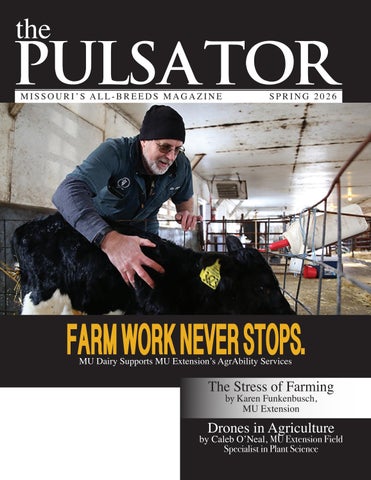
the Pulsator, Spring 2026

Page 1


HINGE VICTORIOUS

7HO17700 Haveitall Blakely Hinge-ET

+2.80

This SHOWCASE™ feature is sired by BLAKELY, a new release sire, and from the worldfamous S-S-I Doc Have Not 8784-ET (EX-96 DOM) family.

Left: Dam of Hinge: Duckett Parfect Holly (EX-90)

7JE5032 River Valley Victorious-ET BARNABAS x Iotola x Duaiseoir

The Triple Crown winner – VICTORIUS was named Premier Sire at WDE, the All American Jersey Show at NAILE, and the Royal Winter Fair in 2025.

Left: Daughter: Oeh-My Victorious Parade (E-94%), 1st 5 Year Old, International Jersey Show 2025

744HO17932 Haveitall Heatw Dax-Red-ET Heatwave-Red x Ranger x DOC

+2.25 PTAT

Hailing from one of Doc 8784’s best daughters, Duckett Ranger 1133 (VG-89), Dax will compliment many of the Red & White bloodline.

Left: Grandam: S-S-I Doc Have Not 8784 (EX-96DOM), 2025 Global Cow of the Year 2025

9AY152 Toppglen Wishful’s Wildcard-ET Autograph x Prime x SARGE

+.4 Type

This bull combines the Premier Sire of WDE ’25 with the five-time WDE Grand Champion of the Junior Ayrshire Show.

Left: Dam of Wildcard: Toppglen Wishful ThinkingET (EX-95), Supreme Champion of Junior Show at World Dairy Expo 2023

DARKSTONE LIMITED

9BS959 Perry Brook H Darkstone P ETV Halano P x Jordy x Delphi

+1.70 UDC

6MS00001 Lazy-M Limited Liam x Wildside

He’s Roan DARKSTONE is a new release with a unique pedigree. He sires good production cows with solid type.

Left: Third dam: Hilltop Acres Bose Dixiland ET 3E93 3E93MS

This roan sire combines World Dairy Expo’s Premier Sire on the top and the show-winning Lady Luck cow family on the bottom.

Left: Fourth Dam: InnisfailWO Mega Lady Luck-ET (E90), Int. & Grand Champion, International Milking Shorthorn Show 2025

Missouri Holstein Association

President John Schoen

Vice President Shannon Kleiboeker

Secretary/Treasurer Jodi Wright

Director at Large Ed Wittorff

Junior Advisor Bailey Keltner (417) 399-3098 417-743-2921 • jwright@missouriholstein.com missouriholstein.com

National Director, Alfred Brandt

brandtdairy@gmail.com

Missouri Jersey Association

President Stacy Dohle

Vice President Michelle Eilenstine

Secretary/ Treasurer Karla Deaver 417-316-0191 • kdeaverk@missouri.edu

Missouri Guernsey Association

President Mark Melander

Vice President Kenlee Calvin

Secretary/Treasurer Cindy Wilson 417-388-0185

Missouri Brown Swiss Association

President Peter Haverkamp

Vice president Brittany Whitehill

Secretary Stephanie Miller

Treasurer Ashley Meyers 417-543-6809

Missouri Ayrshire Association

President Karen Coleman

Vice President Brent Unnasch

Secretary Chuck Scoon

Treasurer Jeff Jensen 319-230-6002 • karayrayrshires@gmail.com

Missouri Shorthorn Association

President Sam Crawford

Vice President Scott Gardner

Secretary/Treasurer Sally Burd 417-839-7002 • sallyburd@yahoo.com

Missouri Dairy

Chairman Mark Fellwock

Vice Chairman John Schoen

Secretary Sean Cornelius

Treasurer Tom Oelrichs

MO Dairy Executive Director Alfred Brandt

Board Members:

Norris Sloan, Davin Althoff, Clay Hemple, Grant Groves Brian Riegel

(573) 680-9564 • Alfred Brandt modairy.org • alfred@modairy.org

University of MO Extension provides free resources for those dealing with the stress of farming. The MU dairy system supports AgrAbility’s missions to bring resources and aid to farmers in need. Dr. Scott Poock, DVM is the Extension Dairy Veterinarian and professor at the University of Missouri.

ADVERTISER INDEX

MARCH

MAY

JUNE

State Dairy Expo

2026 January 23, 2026

THANK YOU FOR COMING

We know that the weather was a challenge for everyone, but we appreciate everyone that was able to break away from the farm for a few hours to take in all of the excellent speakers and programming. It was a successful Dairy Expo. There was a fantastic lineup for the trade show this year. We were privelaged to have the Missouri Dairy Growth Council and State Milk Board meetings in conjunction with the Expo. The weather set in on Friday night, unfortunately cancelling the breed meetings for Saturday.

Now that we’re all recovered and reset from the arctic blastwe ask everyone to please complete the 2026 Expo survey. Even if you were NOT able to make it, your opinion can still help make 2027 successful. Scan the QR code below. Regardless, save the date for next yr: JAN. 22, 2027

Legislative Update

Missouri Dairy is working on your behalf atthe Missouri capital. So far this session, we have testified in favor of two bills.

HB 2713 is a bill sponsored by Represenitive Dane Diehl, concerningmodifying tax credit. This bill allows many of the tax credits to sunset. It affects MASBDA, which is the agency through which many of the state programs, such as the dairy and livestock grants, are run.

HB 3076 is sponsored by Representatives Doyle Justus, and Dave Griffith. It cleans up language on non-point source pollution, as the current statute reads, it could be determined that cows on pasture would need a permit. We are trying to fix that.

These bills might seem mundane to many but they do affect the way you do business and we are happy to have a great working relationship with the other commodity groups. It is a powerful force in Jefferson City when agriculture stands together. Tony Benz and the legislative team will continue to monitor bills going through the capital.

We want you to be a part or Missouri Dairy. Please reach out if you have any questions or concerns.

MO Top BAA for College & Universities

MO Herds in the Top 200 BAA

Emma Coleman

Congratulations to The All-Americans

Missouri Holstein Association

111TH ANNUAL MEETING HIGHLIGHTS

January 23-24, 2026, Oasis Hotel & Convention

Well we knew it would catch up with us one day. We have been having our annual meeting during the winter months for as long as I have been in Missouri. This is the first year that the weather completely got the best of us. We were able to beat the cold and snow on Friday and complete those activities including MO Dairy Expo, Association Committee Meetings, Cornhole Tournament, and the Awards presentation for adults and juniors. However, all breed meetings were cancelled on Saturday. Association business for 2026 will be conducted upon the recommendations of each committee and the Executive Committee consisting of the State President, Vice President, Secretary and Director at Large. Watch the Pulsator and website for activities, due dates and entry forms for the year ahead.

Cornhole Tournament Winners & Sponsors:

Youth Division Sponsors: D Bar J & Summit Genetics

1st: Dallison & Brady Hostetler; 2nd Harper VanZyverden & Faith Ling; 3rd Raygan & Kaylea Dougherty

Family Division Sponsors: Old Missouri Bank

1st Les Parrigon & Gauge Davidson, 2nd Kameron & Kailey Hanson, 3rd Edwina & Emma Parrigon

Adult Division Sponsors: Select Sires Member Cooperative

1st: Jared Kleibeoker & Joel Barrientos; 2nd Randall & Diana Burns; 3rd Trent Miller & Austin Porter

Top L to R: junior member Brantley Keltner selling quilt raffle tickets, C of O manager Ryan Bilyeu chatting with attendees, cornhole tournament, special thanks to silent auction supervisors Janice Perry, Jeanne Luttrell, and Robert Perry, C of O All-Missouri winners, Jr. All-Missouri winners, Harper Vanzyverden holding Kailey Hanson.
Don Ely
Dairy and beef
Summit Genetics is here to help you take genetics to the summit of success and profitability.

MAY 22-23

All-Breeds youth Show

• Entries accepted through Friday, May 22!

• Juniors will host the food booth.

• We will be looking for donations of food/money for this event. Watch Facebook/Website for details

• Open to Out-of-State Youth

• This is an All-Breeds Show

Food Booth: May 23

Juniors will work and host food both at the All Breeds Show Mark your calendar & Make plans to come and work and bring supplies!

DICK LITTLE Memorial Grant APPLICATIONS DUE

Our very own junior member, Raygan Dougherty, made a beautiful holstein quilt to be raffled for the juniors. Juniors made $910! Thank you to everyone. Winner: John Schoen, Oak Ridge

Juniors are asked to write and essay and fill out an application to earn a grant to use towards the purchase of a new Holstein calf. Applications are on website or contact Bailey Keltner: bskeltner@gmail.com

GEPPERT

L to R: Beautiful quilt won by John Schoen, Oak Ridge; 2026 MO Holstein Miss Harper VanZyverden crowned by Hope McClellan; 2026 MO Holstein Princess, Sophie Geppert; 2025 Spring Classic Scholarship winner, Emma Parrigon.

Dairy Farmer Resources

UNDENIABLY DAIRY GRANTS: Turn great ideas for promoting the dairy community to consumers into reality.

PROMO CENTER: Bring dairy to life at your next event with a wide variety of FREE promotional materials including poster sets, coloring books, farm tour booties, and more.

LEADERSHIP GRANTS: Interested in furthering your skills to become a leader in the dairy industry and to better share your dairy story with consumers? Apply for a leadership grant!

Deadline for application is May 1

Enrollment is limited and will be first come first serve. Registration may be completed via 4-H online. Check or cash payment must be mailed to PO Box 388, Mount Vernon, MO 65712. No credit card payments will be accepted for this event.

Camp fee:

$100 in-state 4-H Member

$130 Out-of-state/non 4-h member

Objectives:

1. Increase the knowledge of youth about care and management of dairy animals.

2. Develop awareness of the ethical issues in care of dairy animals.

3. Increase the awareness of issues in the dairy industry.

4. Increase life skill development of participating youth.

5. Certify youth in Show-Me Quality Assurance.

For more information, contact Karla Deaver 417-466-3102 Or deaverk@missouri.edu

Parents and family members are invited to watch the showmanship competition at 10 am on Friday, May 22. Lunch will be served following the contest. Lunch is provided for cow campers, helpers, and workshop presenters. Additonal lunch options may be available for purchase. Parents and others will need to pre-purchase a lunch ticket for $10 each Cow camp entry and health information can be found on missouriholstein.com

Cow Camp:May 20-22,2026

Schedule of Events

Wednesday, May 20

12:30 pm Registration at Fair Grounds

1:30 pm Orientation

8:00 p.m Depart Fairgrounds

Thursday, May 21

7:30 am Begin day workshops/Meals/Speakers

Friday, May 22

7:00 am Begin Day/prepare for showmanship contest 10:00 am Showmanship Contest-guests invited to attend LUNCH Guests invited- pre-purchase lunch ticket

1:00 pm Awards-wash/clean-up (campers may leave or continue to participate)

2:30 pm Cattle for show may arrive

7:00 pm Tri-Tip Dinner (must purchase ticket) 8:30 pm MO Holstein Tag Sale Closes

Saturday, May 23

10:00 am All Breeds Heifer Show (optional event for cow camp attendees )

Accomodations: Cow Camp and Heifer Show

Quality Inn

1125 E Daniel Dr., Mount Vernon, MO 65712

Lodging is provided in camp fee for 2023. A block of rooms has been reserved for those who need hotel accommodations. To reserve your room, contact the hotel above at 417-466-4511. Ask for dairy cow camp rate of $80. Please contact Karla Deaver if you require further assistance or have any questions.

SATURDAY, MAY 23, 2026, 10AM

FRIDAY, MAY 22

7:00 PM TRI-TIP DINNER (must purchase ticket)

In-state and out-of-state exhibitors welcome. Pre-Entry encouraged, but not required must enter by Friday, May 22nd, entry fee $20 per head

SATURDAY, MAY 23

Friday Evening Tri-Tip

Dinner

Tickets may be pre-purchased, or purchased night of. Tickets will be Adults- $12 8 and under-$8

The Sky’s the Limit: Drones in Agriculture

AOne of the featured speakers at the MO Dairy Expo 2026

gricultural production practices are constantly evolving, and in the past few years one of the most notable tools I’ve seen being embraced by many farmers are drones. These versatile unmanned aerial vehicles (UAVs) are reshaping how farmers manage their crops and livestock, offering precision, efficiency, and access to areas once deemed unreachable. From monitoring crop or livestock health to optimizing time and resource expenditures, drones are proving to be extremely useful tools in agriculture.

When I think about drones in agriculture, I often compare them to all-terrain utility vehicles like the John Deere Gator, Polaris Ranger, or Kawasaki Mule. Back in the 1980’s, it would have been rare to see a UTV being used on a farm. Visiting farms today, I’m hard pressed to find an operation larger than 20 acres that doesn’t have some type of UTV that they utilize on a regular basis. The reason for this change is once the equipment made it into the hands of farmers, they realized what an incredible tool these machines actually were, and how they could improve their labor efficiency dramatically. I believe the same thing is happening with drones in agriculture. A decade ago, there might have been a handful of producers who used drone technologies on their farms, but especially with the advent of large utility drones with the capability to spray pesticides or spread seeds and fertilizers, drones are being used regularly by many farmers to help manage weeds in pastures, pests in crops, monitor irrigation infrastructure, and the use cases just keep piling up! Drones have progressed from being a neat toy we might get our kids for Christmas to becoming a necessity for many agricultural operations.

Many of us can immediately think of how we could use a large utility drone to spray or spread products on our farms, but it doesn’t take a highly specialized and expensive piece of equipment like that to show how useful drones can be on the farm. Even a small drone equipped only with a camera can provide extremely useful feedback for our agricultural operations. A drone with a camera can save farmers many hours of opening and closing gates, scouting crops for pests or deficiencies, it can show areas of fields that have poor drainage or low fertility, make crop stand assessments, allow cattlemen to quickly monitor individual animal performance, or check estrus heat patches for optimized breeding timing, locating newborn calves in tall forage, and more. Time is one of a farmer’s most valuable and limited resources, so the more of it we can save while still completing the task, the better.

Precision agriculture is an area where drones truly shine. Using data-driven insights as to where they are needed most, drones can enable farmers to apply fertilizers, pesticides, and

other inputs to maximize return on investment. A pasture with a rash of blackberry weeds in isolated areas has great potential for a prescription herbicide application where only the problematic areas receive treatment via a spray drone as opposed to a broadcast application where the entirety of the field is treated whether it needs it or not. A targeted spray application like this minimizes waste, reduces negative environmental impact, and often can leave more dollars in the wallet of the landowner due to reduced chemical costs. Another area where drones can be extremely useful is in previously inaccessible areas. In my neck of the woods in southwestern Missouri, the topography can be quite unforgiving with some areas too harsh to allow access by ground spray rig or even ATV. With an aerial piece of equipment like a utility drone, landowners can now get herbicide applications on these problematic areas and put them into useful forage production. With current land values reaching for the heavens, it can be difficult to justify buying more acreage as we try to expand our farming operations. This being the case, it may be a more prudent investment to ensure every acre of land we already own is highly productive, as opposed to buying more. If we can reclaim a ¼ acre here and a ½ acre there on property we already own, it can add up quickly and make sense from an investment perspective.

As with any piece of equipment, utility drones work very well in some use cases and can be an absolute trainwreck if used in others! For timely fungicide applications in wet years on corn, drones have been an excellent option. On the other hand, using a drone with a spray output of 2-3 gallons per acre to handle all pre-plant burn down herbicide applications will likely not give you the level of weed control as a wellcalibrated ground rig that can spray at much higher volumes and much closer to the target, thus reducing the chance for herbicide drift. These two pieces of equipment, the drone and the ground spray rig, have their uses and advantages for different use cases, and when used in conjunction with each other we can develop even better methods of livestock and crop production.

At the end of the day, drones are another tool available to modern farmers, and as most farmers will agree - you can never have too many tools. As drone technology continues to advance, its potential uses in agriculture grow as well. On many farms, drones are saving producers time, reducing input costs, and bringing new levels of productivity to their land. Drones are no longer futuristic machines; they are transforming agriculture today, and they are tools that can enable farmers to optimize every acre and ensure their operational success.

POLICY CORNER

PHILLIPS | FINANCIAL ADVISOR | EDWARD JONES 3202 W Republic Rd Suite 300 Springfield, Mo 65807

phone: (417) 413-2490

email: kevin.phillips2@edwardjones.com

The last few months have been marked by significant developments in federal dairy policy. Most notable was the passage and President Trump’s signature of approval of the Whole Milk for Healthy Kids Act (S. 222). The bill passed in the Senate by unanimous consent (all 100 senators agreed), and it passed the House by a voice vote, which is rare. This bill is a huge win for the industry, as it is aimed at increasing fluid milk demand and cultivating the next generation of milk enthusiasts. The bill went into effect immediately after its approval in mid-January.

The next major policy development for the dairy industry was the release of the 2025-2030 Dietary Guidelines for Americans, which is the bedrock policy recommendations updated every five years for all 16 federal nutrition programs, including the National School Lunch Program, SNAP, and WIC, to name a few. The guidelines reaffirm dairy’s role as a core part of a healthy diet, recommending 3 daily servings and recognizing milk, cheese, and yogurt as key sources of protein, calcium, and other essential nutrients. In addition to influencing national nutrition programs, the Dietary Guidelines also shape consumer messaging, which helps sustain baseline dairy demand. By continuing to position dairy as nutritionally essential rather than optional, the guidelines support long-term market stability and reinforce the role of U.S. dairy producers in meeting national nutrition needs.

Even with progress through the One Big Beautiful Bill Act and other interim legislation, important portions of the next comprehensive farm bill are still unsettled and could affect dairy producers. Congress has yet to fully reauthorize or extend many long-standing dairy and agricultural policies beyond short-term extensions, meaning core programs and risk-management tools could face uncertainty if permanent law provisions take effect — a scenario sometimes called the “dairy cliff,” which might disrupt current supports and market rules originally updated in the 2018 farm bill. Additionally, broader dairy pricing and Class I mover formula reforms, marketing order updates, and cost surveys for make allowances are still being debated in ongoing farm bill negotiations; without clear action, dairy pricing mechanisms and transparency reforms remain in limbo. The House Ag Committee is slated to mark up the Farm Bill on February 23rd.

-Blake Wright, Account

Pyle & Associates, Washington, D.C.

Don Ely Dairy and beef Semen Sales
Summit Genetics is here to help you take your herd’ s genetics to the summit of success and profitability.

Farming can be Stressful

airy farming is one of the most volatile agriculture industries. We go from nearly record milk prices a year ago to facing record lows in the coming months. This can be stressful and difficult for everyone involved in the industry. Often there are resources that we don’t even realize are out there. We want to take a look at the signs of stress and how there to those in the dairy community that understand agriculture.

When a farmer or farm family needs help, there are often signs of stress. These signs can be subtle and take time to show, but sometimes they are quickly noticeable, says Karen Funkenbusch, an assistant professor at the University of Missouri Extension.

Show-Me Strong Farm Families is a program led by the University of Missouri Extension to address the growing mental health crisis and stress issues in Missouri’s agricultural community. It understands that farming is a “way of life” that brings specific pressures like long working hours, unpredictable weather conditions, labor shortages, and fluctuating milk prices, all of which can lead to stress, mental health struggles, and feelings of isolation. Despite these stressors, the University of Missouri Extension offers free mental health and prevention of suicide programs, stress awareness resources, and no cost telehealth counseling, to support farmers, ranchers, farm workers, dairy operators and their families.

Visible changes like thinning hair, weight changes or skin breakouts are flashing warning signs from the body that yell, “I need help.” Other signs might be more subtle and not seen until the long-term results can no longer be ignored, says Funkenbusch.

Those who are closest to the farmer - friends, extended family members, neighbors, and clergy – may be the last to notice signs of stress because they see the person regularly and the changes happen gradually.

Other less frequent visitors to the farm may be in a better position to notice changes because the changes may seem drastic, even though they occur over time. People in this group may include seed and chemical salespersons, veterinarians, and the local cooperative truck driver that fills the propane tank or school bus route driver.

“Anyone connected to the farm operation is in a position to notice signs of stress and be of help to the farmer and farm family,” says Funkenbusch. “Everyone connected in production agriculture or agribusiness can play an

Coping with Stress on the Farm

important role in helping farmers maintain strong mental health.”

Funkenbusch pointed to a recent newsletter from Missouri Department of Agriculture with signs of stress:

• Change in routines: The farmer or farm family stops attending church, drops out of activities or no longer stops in at the local coffee shop or feed store.

• Decline in the care of animals: When animals lose condition, appear gaunt or show signs of neglect or physical abuse, the farmer may have lost interest in his work.

• Increase in illness: Farmers or farm family members may experience more upper respiratory illnesses (colds, flu) or other chronic conditions (aches, pains, persistent cough).

• Increase in farm accidents: The risk of farm accidents increases due to the fatigue or loss of ability to concentrate. Children also may be at risk if there isn’t adequate childcare.

• Decline in appearance of the farm: The farm family no longer takes pride in the way farm buildings and grounds appear or no longer has thetime to do maintenance work.

• Children show signs of stress: Children may act out, decline in academic performance or be increasingly absent from school. They may also show signs of physical abuse or neglect.

If you notice any signs of stress in a neighbor or a member of the family, reach out to them Listen attentively and without judgment.

In partnership with the Show-Me Strong Farm Families program, the MU Psychological Services Clinic provides FREE telehealth counseling from a licensed rural mental health counselor who understands agriculture. Any farmer, rancher, farm worker, or immediate family members over

16 in Missouri is eligible for this service. You can call 573882-4677 or visit http://muext.us/PSCFarmRanch to schedule an appointment at no cost

For additional information on stress, depression, and how to refer someone for assistance, you can access resources from MU Extension, North Central Farm and Ranch Stress Assistance Network, and the National Institute of Food and Agriculture U.S. Department of Agriculture at https:// extension.missouri.edu/programs/agrability/show-me-strongfarm-families. Or you can reach out to Karen Funkenbusch at funkenbuschk@missouri.edu.

Build coping skills with confidential, telehealth counseling from a trusted source.

Any Missouri farmer, rancher or immediate family member is eligible.

Farming is more than a job. It is a way of life, and we know it brings both pride and pressure. When stress feels overwhelming, you don’t have to carry it alone. MU Extension is here to listen, to understand, and to connect you with resources that support your well-being, your family, and your farm.

Strong farms start with strong families, and we are here to help you stay strong.

To request free teletherapy counseling, follow the confidential link: http://muext.us/PSCFarmRanch

More information:

Email: adpsc@missouri.edu

Phone: 573-882-4677

Fast Mixing and Cleanout of all types of

Twin Augers for amazing action

Stainless Steel mixing chamber!

Also available in Stationary Models,

Dairy Hall of Honors

Missouri Dairy Hall of Honors recognizes six dairy leaders COLUMBIA, Mo. – The Missouri Dairy Hall of Honors announces their 2025 award winners. To view winners complete biographies go to missouridairyhallofhonors.com

Alfred Brandt, Dairy Leadership. Alfred Brandt is the sixth generation to farm Brandt Dairy that has been in his family since 1840. In 2011, Alfred and his wife Sonya bought the farm from Alfred’s parents. Alfred milked 130 registered Holsteins for over 30 years until selling the herd in 2024. Swan-Creek Holsteins won many awards through Holstein USA including many years the Progressive Breeders Registry and the Progressive Genetics Award. Alfred also bred or developed over 40 Excellent cows. Alfred is the past DFA, Midwest Dairy board member, and is currently the Executive Director for Missouri Dairy and Missouri Dairy Growth Council. He is currently on the Holstein USA board of directors. He was a member of the Young Dairy Leaders Institute and the Missouri Agricultural Leadership of Tomorrow (ALOT), and the Missouri State Milk Board. Alfred and wife Sonya have a son, Sam, 14 years old.

Sue Ann Steele, Pioneer Leader. Sue Ann Steele was born in Adrian, Missouri. In 1957, Sue Ann married Ed Steele. They made their life and home west of Butler, Missouri, on Steele & King dairy farm where she supported the operations while working a full-time job outside the home. Prior to serving as the Missouri Holstein Executive Director and Editor of the Mid-States Holstein News, she worked for many years at the Bates County Shopper. Sue Ann was synonymous with Missouri Holstein for over 25 years. She also served as the Missouri Holstein Executive Director from 1988-2003 and served as the Editor of the Mid-States Holstein News (a multi-state dairy publication) from 1983 until her death in 2022 when she was 84 years old. For a decade, Sue Ann was integral in keeping the Southern National Show and Sale going in Missouri. This event required an enormous amount of coordination, sponsors, sale personnel, show personnel and logistics. Sue Ann also played an integral part of the organization of the National Holstein Convention held in St. Louis, helping to coordinate members, committees and national staff. The Missouri Holstein association honored Sue Ann with their highest honor being awarded with the Missouri Distinguished Service Award in 2019.

Edward K Wittorff, Distinguished Dairy Cattle Breeder. Walt Sr., and Laura Wittorff started Wittspride in Davis, Ill. and moved to Ava in 1974. This herd was then relocated to Ava, Missouri in 1974. Following college, Ed went to work in the AI industry, KABSU, NOBA, Sire Power, then ABS. In 2003, he returned home to work on the farm full time. Currently, his nephew Eric and his son Jacob are helping Ed on the farm. Wittspride farm began with purchasing ten grade Brown Swiss and a few registered heifers as 4-H dairy project calves. Today, with about 120 mature registered Brown Swiss and Holsteins, Wittspride boasts a Holstein BAA of over 109 and several 90 and 91-point Swiss on the premises. It is gratifying to breed from within, to breed an All American 4-year-old, Tonja E94 in 2016. This philosophy and a little luck developed cows like Titan Beth “E”, a Missouri State Fair Grand Champion that sold at the Kansas National Sale and made a big record for her new owner in Colorado. Blend Debbie “E” graced the cover of the Select Sires Brown Swiss Website. Along with those two cows, the prefix Wittspride has went on to have several All-American Nominations and several with new owners that have went on to have great success in the show ring.

Dr. Matthew Lucy, Meritorious Service. Dr. Matthew Lucy is Professor of Animal Science at the University of Missouri. He is known for his work on the reproductive physiology of high-producing dairy cows. A New York native, he developed his interest in dairy while working on a farm near campus as he studied at Cornell. He earned his Ph.D. in Dairy Science from the University of Florida, after studying postpartum dairy cow reproduction at Kansas State University. Following a postdoctoral position at Monsanto, he joined the University of Missouri faculty in 1994. His current research focuses on the physiological processes regulating fertility, specifically early embryonic development and the link between postpartum uterine disease and early embryonic loss. At Mizzou, he teaches introductory Animal Science to freshmen and graduate-level courses, in addition to his research and mentoring numerous successful Master’s and Ph.D. students. Dr. Lucy is a past-President of the Dairy Cattle Reproduction Council. He served as Editor-in-Chief for the Journal of Dairy Science. He received the ADSA Award of Honor in 2020.

Ray Schooley, Pioneer Award. Ray and his wife Margaret owned and operated a 165-acre farm near Niangua, Missouri. Their herd of registered Jerseys were recognized for high production and quality cattle. Ray started his career in 1960, working for the Dupont Company in chemical sales. He then became the Executive Secretary for the American Milking Shorthorn Society, Springfield, Missouri from 1961-1967. In 1967-1976, he served as Treasurer and Superintendent of Records at the American Jersey Cattle Club in Columbus, Ohio. The herd was established in 1979 when the Schooley’s moved from Kansas to Niangua. Cattle were sold in 12 states, having the top selling cow in several regional sales. After selling the herd in 1998, they relocated to Marshfield in 1999. Ray continued working as a market reporter for the Missouri Department of Agriculture and a sales representative for ABS, Alta, and Semex. Ray served as past president of the National Dairy Shrine, President and director of the American Jersey Cattle Club. Ray passed away in October 2024 and Margaret January 2026.

Matt McClelland, Dairy Leadership. Matt McClelland is the Chief Executive Officer and Executive Vice President for Prairie Farms Dairy. Matt has worked for the Prairie Farms Family of Companies throughout the Midwest, including Illinois, Missouri, Oklahoma, Arkansas and Kansas, serving in various capacities within Hiland Dairy and Prairie Farms. On January 1, 2022, Matt became Prairie Farms’ Chief Executive Officer and Executive Vice President. Matt’s vision for Prairie Farms’ future includes the enduring legacies and fundamental beliefs in the cooperative system and to simply “Do Right” for its members, associates and customers; while also emphasizing the need to recognize and adapt to the ever-changing needs of its future consumers, innovations and technologies.

For Sean Cornelius, dairying isn’t just a job — it’s the life he grew up with and the one he still loves today. On his family’s diversified dairy and rowcrop operation, he’s found a way to honor that heritage while steering the farm toward a sustainable future.

The Cornelius’ farm nearly 2,000 acres of owned and rented land, raising corn, soybeans, wheat, and grass hay alongside a mixed herd of Holsteins and Jerseys. Consisting of 102 head, the herd today is the result of intentional crossbreeding, a strategy that blends the strengths of both breeds. With most older cows culled during the farm’s transition to automation, the herd is young, healthy, and productive, averaging 84–85 pounds of milk per cow with strong components of 4.5% butterfat and 3.6% protein. He looks forward to the next several years as the herd ages and milk production continues to grow.

A Big Decision: Bringing in Robots

In November 2023, the family made a major business decision: installing DeLaval milking robots. For Sean, the move was about keeping the farm viable for the next decade. Labor challenges and limited groundwater in the area made adding cows and expansion difficult. Robotics offered a way to maintain efficiency without adding more people or pushing the land beyond its limits.

Two years later, Sean is seeing how the transition has paid off. Cow health has improved, reproduction rates are stronger, and daily labor demands have eased. Still, Sean emphasizes that robotic dairying isn’t handsoff. “You need to have a good understanding of the robot,” he says, noting that most of the occasional breakdowns seem to happen between 1 and 3 a.m. Just like he did in the parlor, Sean has learned to identify issues with the robot from just a change in the way the milking process sounds. The farm works closely with Flory Dairy for support.

Cornelius Farms

Family at the Core

While Sean’s focus is on the cows, he farms alongside his younger brother, Chris, who manages the crops and runs the “green equipment.” Their parents, Barrie and Kathie, still live in the same farmhouse, keeping the family’s roots firmly planted.

Sean and his wife, Rachel, have been married 32 years and raised their children on the farm. While the kids haven’t and don’t plan on coming back to the farm, Sean is proud of the work ethic growing up on the farm instilled in them. “On the farm you get to see the sun come up, and with it comes new life,” he says. “You take care of that life, and the sun goes down.” It’s a rhythm that shaped his life and his children’s lives even as they choose different careers.

The dairy employs one fulltime worker who has been with the family for 18 years, another testament to the farm’s stability and culture.

Cow Care and Management

The cows are housed in a freestall barn with headlocks and spend about an hour on pasture each day. That hour allows enough time to clean stalls and add fresh bedding without disrupting the herd’s routine.

Calves leave the farm at less than a week old and go to a trusted calf raiser who Sean says does a “phenomenal job.” Losses are minimal, and the heifers return to the farm when they’re ready to breed. All breeding is done through AI, with Select Sires handling the mating decisions. First calf heifers are bred to Angus.

Nutrition: The Foundation for Success

Sean is a strong believer in the value of a good nutritionist. “It’s like a good marriage. Work with your nutritionist and have good communication,” he says. Sean is a partner in Best Axis Nutrition Consulting, and strongly advocates working with a nutritionist that “watches the milk check to see what pays the bills on the dairy farm.” Cow production is reflected on that check and “the cows are always right.”

With more than 30 years of rationbalancing experience himself, Sean has seen dairy nutrition evolve over the years. A current trend for today’s rations include feeding higholeic soybeans. It is gaining attention as a homegrown protein source that can reduce purchased feed costs and boost butterfat — a win for both cow health and the milk check.

When feeding cattle, he believes, “cows thrive on consistency!” The cows have been on a cornsilagebased TMR for over a decade, with no hay or haylage in the diet. The ration is reliable, easy to mix, and works year-round.

Sean Cornelius

Leadership Beyond the Farm

Sean’s commitment to dairy extends far beyond his own operation. He currently serves as Secretary of Missouri Dairy, where he helps advocate for dairy farm families across the state. He is also a DFA Central Area Council Member, President of the Caldwell County Farm Bureau, and is a member of the State Milk Board. He was also inducted into the Dairy Hall of Honors receiving the 2023 Dairy Leadership Award.

He credits his family for making this involvement possible. “I’ve been blessed with a family that is able to take care of the farm AND support me taking time away to work on behalf of all dairy farmers.”

His motivation is simple and deeply rooted: “Protect our way of life so we can provide a living for our families while providing some of the most nutritious foods our customers can buy. I love that the fruits of our labor on the farm feed people around the world.”

Looking Ahead

While the next generation may not take over the dairy, Sean is committed to keeping the farm strong and productive for as long as he can. The robots, the herd improvements, and the thoughtful management decisions all point toward a future where tradition and technology work hand in hand.

For Sean, the heart of it all remains unchanged: “I grew up with it. I love the cows.” And on this farm, that is evident in every choice made to keep the operation thriving.

MISSOURI NEWS

Margaret Louise (Nicholson) Schooley of Marshfield, Missouri, passed away peacefully at Mercy Hospital in Springfield, Missouri, on January 3, 2026, at the age of 82. Born on June 5, 1942, in Comus, Maryland, Margaret led a life marked by dedication to agriculture, community service, and family.

Growing up on her parents’ farm in Detour, Maryland, Margaret developed an early and lasting interest in dairy farming. As a young woman, she distinguished herself through 4-H and agricultural programs, earning numerous honors at the county, state, and national levels. She was a Maryland Grand Champion dairy exhibitor and a National 4-H Dairy Award recipient, attending the National 4-H Club Congress in Chicago in 1962. Her achievements reflected success in the show ring but also practical experience in dairy herd management developed early in life.

Margaret went on to attend the University of Maryland, graduating in 1964. Following her marriage to Ray Schooley later that year, she continued her lifelong involvement in agriculture as an equal partner in their dairy operation. In 1977, Margaret and Ray established Schooley Jerseys, first in Kansas and later in Niangua, Missouri. Together, they built a highly respected Jersey cattle herd, with Margaret playing a central role in herd management, recordkeeping, and business operations. Their farm was later inducted into the Missouri Dairy Hall of Fame.

Margaret and Ray shared their experiences with the broader dairy community as co-authors of an ongoing article series, “We Went Back to the Farm,” published in Hoard’s Dairyman from 1982 to 1984. The series documented their work in starting

a new farm from the ground up. Throughout her life, Margaret remained actively engaged in the dairy industry, including participation in national and international events such as the World Jersey Conference and World Dairy Expo. Margaret and Ray traveled extensively to visit friends in the dairy industry around the world, including trips to New Zealand, Australia, and the Isle of Jersey, the island off of the coast of France where the Jersey breed originated. In later years, Margaret remained active and enjoyed trips to New Mexico to watch her grandson Warren play football and win the state championship in 2023 and 2024.

In addition to her agricultural work, Margaret was committed to her community. She was an active member of Marshfield United Methodist Church, where she served as Administrative Assistant and supported many aspects of church life. Margaret also served her community through public service, including her role as Deputy Clerk for Elections in Webster County, Missouri, and working at the Webster County Health Unit. She was known for her integrity, diligence, and professionalism.

Margaret married Ray Ronald Schooley in 1964, and together they shared sixty years of marriage and partnership. She is survived by two sons, Stuart and his wife, K.C. Schooley of Ranchvale, New Mexico, and John Schooley of Austin, Texas, one grandson, Warren Schooley, and other family members and friends who will remember her for her strength, competence, and devotion to family and community. Margaret will be remembered as a capable and respected dairywoman, a committed partner, and a dedicated member of her community. Her contributions to the dairy industry, civic life, and family leave a lasting legacy.

In accordance with her wishes, no funeral services will be held at this time. Cremation arrangements are entrusted to Fraker Funeral Home, Inc., Marshfield. Memorial contributions may be made to the Salvation Army Webster County Service Unit in care of Fraker Funeral Home.

We can’t make your cows dance

But we can make them more comfortable and productive with effective fly control !

 Fly Parasites for basic fly prevention

 We provide full seasonal plans

Complete Fly Control for Dairies

 A multi-use year after year Fly Trap to catch all adult flies .

 A very effective Electronic Fly Zapper for a fly free milking parlor, vet room etc.

 A new organic premise spr ay that kills Horn Flies, Face flies, Stable Flies and House Flies . Spray is safe to use with fly parasites .

 All products are organically approved .

Check out our website for complete Fly Control information: www.flycontrolfordairy.com Email: usefulfarm@gmail.com Call: 888-771-3276

USEFUL FARM PRODUCTS

ClariFly ® Larvicide is more than just fly control. More support. More expertise. More species. More than just a bag of active ingredients. The only thing it’s not more of is work. It is perfectly blended in your mineral supplement to become a part of what you are already doing - feeding your cattle. Visit CentralFlyControl.com to learn more.

ClariFly and ClariFly Larvicide with design are

Turn static files into dynamic content formats.

Create a flipbook