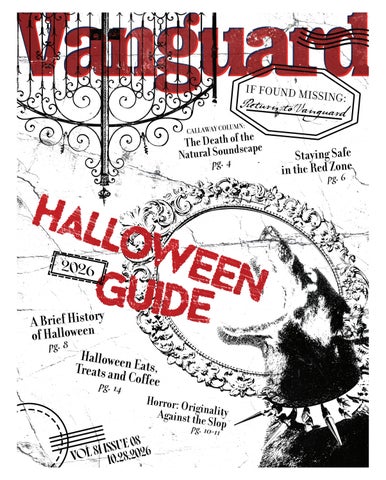
CONTENTS
FRONT AND BACK COVER DESIGN BY ARIELLE CHHUNKEO
NEWS PSU ACCE Program Gets Nearly $8 Million Research Grant Staying Safe In The Red Zone
P. 3 P. 6
ARTS & CULTURE The Subjectivity of Meaning in Kapoor's Artwork A Brief History of Halloween Halloween Happenings The Spooky Origins of Halloween’s Most Iconic Animals Halloween Eats, Treats and Coffee
P. 4 P. 8 P. 9 P. 12 P. 14
OPINION Callaway Column: The Death of the Natural Soundscape Vanguard on Vinyl: "Prima" by Adéla Horror: Originality Among The Slop The Mysterious Allure of Shirtzenpants
P. 4 P.6 P. 10-11 P. 15
SPORTS Another Day in The Office for Bullfighter Miles Barry
P. 5
STAFF EDITORIAL EDITOR IN CHIEF Olivia Hendry Young MANAGING EDITOR Grace Peterson NEWS EDITOR Will Lowe ARTS & CULTURE EDITOR Hayden Neumann OPINION EDITOR Daniela Hernandez SPORTS EDITOR Vacant MULTIMEDIA EDITOR Vacant SOCIAL MEDIA EDITOR Liam Schmitt
COPY CHIEF Jude Callaway ONLINE EDITOR Vacant DISTRIBUTION MANAGER Caleb Dougherty CONTRIBUTORS Drew Dattilo Emily Botter Hanson PRODUCTION & DESIGN CREATIVE DIRECTOR Haley Hsu CONTRIBUTORS Piper Acton Aidan Billingsly Max Bykowsky Arielle Chhunkeo Jeremy Chun Tabria Jones Naue Pagtakhan
ADVISING & ACCOUNTING COORDINATOR OF STUDENT MEDIA Reaz Mahmood SALP ACCOUNTANT Anne Le STUDENT MEDIA TECH ADVISOR Rae Fickle STUDENT MEDIA TECH DEVELOPER Kaylee Hynes WEB DESIGNER Vacant
To contact Portland State Vanguard, email editor@psuvanguard.com. MISSION STATEMENT PSU Vanguard’s mission is to serve the Portland State community with timely, accurate, comprehensive and critical content while upholding high journalistic standards. In the process, we aim to enrich our staff with quality, hands on journalism education and a number of skills highly valued in today’s job market. ABOUT Vanguard , established in 1946, is published weekly as an independent student newspaper governed by the PSU Student Media Board. Views and editorial content expressed herein are those of the staff, contributors and readers and do not necessarily represent the PSU student body, faculty, staff or administration. Find us online at psuvanguard.com.
Fall at PSU brings new students to campus, including those transferring from Oregon's several community colleges.
JEREMY CHUN
PSU ACCE Program Gets Nearly $8 Million Research Grant New grant aims at expanding degree opportunities for community college transfer students
EMILY BOTTER HANSON AND OLIVIA HENDRY YOUNG Portland State University has received a $7.9 million grant from the U.S. Department of Education and the U.S. Department of Labor, aimed at improving and expanding the school’s Access, Connect, Complete, Engage (ACCE) program. The ACCE program was created by both Associate Vice President of Academic Advising Randi Petrauskas Harris, Ph.D., and the Executive Director of Student Success Andrea Garrity in 2024. The program’s goal is to support students who want to transfer to four-year universities from local community colleges, such as Portland, Clackamas, Chemeketa, and Mt. Hood Community Colleges. First-year students at any of the previously listed schools can apply to receive “personalized support, financial guidance, and a structured pathway to a bachelor’s degree” through the program, according to their website. “The Access, Connect, Complete, Engage (ACCE) program provides holistic support to students when they begin at community college to help them successfully complete their degree and then transfer and complete their bachelor’s degree,” wrote Harris in an emailed statement. Students within this program begin working with academic coaches at their current community colleges within their first year of attendance. After transferring, they continue this work with a coach at PSU.
“Once they’re here, we have a dedicated PSU coach. So then they’ll switch them over to the PSU coach who takes over, and all the way up until they graduate, we’ll continue providing support,” said Delaney Ybarra, ACCE program director. In providing additional support, the program hopes to address the gaps and barriers that bar community college students from obtaining four-year degrees. “There’s this big data point that 80% of community college students want to get a bachelor’s degree, but only 30% of them actually transfer. And of that 30%, I think it’s around 15%, or so, that actually end up obtaining a degree,” Ybarra said. “Programs like ACCE aim to change that [statistic], and make transferring and degree completion possible for more students who benefit from obtaining a bachelor’s degree,” wrote Harris. With the nearly $8 million grant, ACCE at PSU aims to accept more community college students into their program, as well as increase career-readiness opportunities. The grant will also support the program’s Work-Based Learning Fund, helping students access paid internships, apprenticeships and other careerbuilding opportunities. “It’s just a real testament that the federal government is believing in our work, [and] seeing that it is making a difference in degree attainment,” Ybarra said.
PSU Vanguard • OCTOBER 28, 2026 • psuvanguard.com
According to Harris, an external party will be working with the program to determine how to best use the money to support both internal and external processes. “The grant we received is a research grant, so we are also working with an external evaluator who will help us understand what is working about the program and what we can change to improve the program in the short and long term,” wrote Harris. Generally, the ACCE program works to reduce financial and academic friction that could delay or deter someone from getting their degree. According to Ybarra, finances are often the main challenge to accessing higher education. Despite PSU being the most affordable of Oregon’s seven public universities, students often experience “transfer shock” when transitioning from community college and being faced with higher tuition rates. Additional funding from the grant may be used to support students through different aspects of “transfer shock,” both financially and academically. “When I think about ACCE and the gap we’re trying to fill … transfer shock is a piece that I feel like isn’t talked about a lot,” Ybarra said. “A lot of students don’t even know what it is, and so it can feel really validating [to acknowledge that] oh no, this is a real thing.” Transfer shock can also describe the anxiety felt by students new to university environments, especially one as urban as Portland State.
“Getting used to moving downtown can be scary and can be a big change,” Ybarra said. “We’ve tried to help remove some barriers by giving some TriMet passes and having some events at PSU and trying to help them see downtown.” Ybarra hopes that connecting students with their program can decrease transfer shock in a multitude of ways. For example, Ybarra uses the downtown environment, and its proximity to employers, as a strength for the transfer students to utilize. Doing so not only benefits PSU, but the downtown community as a whole. “We’re doing a lot of work to try and help the downtown environment thrive, and PSU has such a unique opportunity,” Ybarra said. “I think that’s one of our strengths — like, we are in the city, we’ve got so many connections to employers. We are really in it, and so [we are] helping students see that as an asset.” Ybarra hopes that, by connecting community college students with academic coaches and resources at PSU, students can feel less isolated and, ultimately, walk across the graduation stage at the end of their time at PSU. “Community college life is very different from university life, and it’s a lot harder to find belonging, to feel known on campus,” Ybarra said. “And so to automatically have a person who knows your name … I think that can really help improve a student’s sense of support and that they’re not alone.”
NEWS
3
The Subjectivity of Meaning in Kapoor’s Artwork
The death of the natural soundscape JUDE CALLAWAY An undermourned casualty of time is the morning soundscape of childhood: waking to tweets and trills, lying in bed or walking outside to listen to nature’s vivacity — thousands of creatures orchestrating the vibrant soundscape of an average morning just a decade or two ago. As the sun rose this morning, I heard only a single bird, chirping its loneliness against the nearby cacophony of cars and commerce. This is not an isolated occurrence, nor a trick of memory; it is a documented, alarming ecological shift. Across the globe, the decline of natural soundscapes threatens ecoacoustic impoverishment: the suffocating dominance of what pioneer soundscape ecologist Bernie Krause calls anthrophony; human-generated noise, the monologic dirge of the Anthropocene. For millennia, Earth’s natural soundscapes offered a bridge between humanity and the living world, an opportunity to listen to and participate in the wild. But as human noise expands, it drowns out nature’s distinct, linking frequencies with the relentless bustle of commerce and industry. As our cities get denser and drone louder, our connection to organic life grows colder and more isolated. While the damages of this acoustic decline — failing wildlife reproduction, disrupted food webs and chronic human stress — are unfolding right now, the greatest cultural danger isn’t what our generation feels, but what the next won’t even notice. Through what is defined as shifting baseline syndrome, our collective memory shrinks. Each new generation accepts a quieter, more sterile environment as the natural standard, unaware of the rich chorus lost before their time. Where I mourn this morning’s single bird as an estranged member of a missing orchestra, a child ten years younger than me may be excited to hear a bird at all. The natural soundscape is no passive backdrop. It is the audible pulse of our living planet; a dimming heartbeat we must fight to hear before the silence hardens.
4
ARTS & CULTURE
Museum attendee observes art at Kapoor's exhibit, housed on PSU campus.
JEREMY CHUN
JASPER DUNCAN Anish Kapoor, born in 1954 in Mumbai, India, is a world renowned artist, from representing the United Kingdom at the 44th Venice Biennale to winning the Turner Prize a year later. Now, Portland State’s very own Jordan D. Schnitzer Museum of Art (JSMA) is exhibiting Kapoor’s “Dissolving Margins,” containing roughly 150 works. In the United States, one of Kapoor’s most popular works is a sculpture centered in Chicago, officially titled “Cloud Gate” — although most know it as “The Bean.” The works at the exhibition currently residing in the JSMA focus particularly on Kapoor’s printmaking, with one sculpture by the front desk of the museum titled “The Mirror.” Having Kapoor’s bold, detailed printworks spanning over 40 years of Kapoor’s printmaking artistry at Portland State University’s own art museum is unique,focusing more on abstract prints rather than sculptures. The exhibit is also unique to Kapoor himself, with it being his first print-focused retrospective in his four decades of being an artist. Previous examples of Kapoor’s work which are not represented in the JSMA includes a sculpture collection of sandstones which represent the void, titled “Void Field.” which was the first sculpture showcasing Kapoor’s interest in this concept of the void. Particularly notable, Kapoor also sculpted a cannon that shoots blood-red wax into a corner of bright white at twentyminute intervals, titled “Shooting into the corner.” Created in 2009, this work brings the emotional intensity of the neo-expressionism art movement. Alexis Garcia, program and outreach coordinator for the JSMA, claims there is not too much stated about the meanings of his art, even what’s on display in this particular exhibit. “There is never a right or wrong interpretation. He really likes to leave space for you as a viewer to interpret it,” Garcia said. If anything specifically inspires Kapoor’s printmaking art, Garcia says
it would be the color red. The exhibit represents this through red titles and red plaques. A lot of color, hue and pigmentation stands out in his printmaking artwork. This ties back greatly to his childhood and cultural upbringing. “He remembers color very vividly […]. He talks a lot about the idea of how red is the color that brides wear [in India],” Garcia said. “It’s got a lot of cultural, spiritual connotations in his childhood. He thinks a lot about the spice markets as a kid and seeing spices in baskets or pigment in baskets.” Garcia points out that much of Kapoor’s work is art one has to observe and pay attention to. She elaborates on how these completely still prints can act as optical illusions. His artwork, even when completely still, allows the viewer’s eyes to play. Each piece comes alive the more one gazes upon it. “They create an optical position. The ‘Workflow Now’ series is standing in front of a quadrant board and creating pulsate. They start to breathe or pulsate. ‘Mirror’ is really funny. It’s got a crazy scale or perception,” Garcia said. However, one of the works people stay at the longest is only the black and white collection of works titled “History,” which resides in the basement of the museum. This collection was made in 2007. Moriah Conkel, a Gallery Attendant at the JSMA, believes these have been admired the longest because of their form. “I like his attempt at capturing infinity or this sense of expansiveness. I feel like he’s pretty much solely focused on this idea of the void or the horizon,” Conkel said. “They are all kind of reaching into what is after, what is further or what comes after we die or before we’re born, or somewhere in this infinite dimension, and I think that’s a really challenging thing to capture.” Like Garcia, Conkel believes the meaning of Kapoor’s art is entirely up to the viewer to create. Each piece may evoke a different memory or feeling for each person and therefore, a different story. “You have to be willing to tell your own
story,” Conkel said. “You have to be willing to engage in that way […]. It’s nice when people come in, and they’re able to let the colors spark their own memories, their own associations, and then I think that it’s almost like a self-reflection,” said Conkel. Madi Hagebush, another Gallery Attendant at the museum, also believes Kapoor’s work is subjective, with inspirations stemming from both emptiness and fullness. These contradictory and metaphysical questions can be found contemplated in many of his works in the JSMA. “It definitely gives a lot of cultural aspects to it,” Hagebush said. “There are collaborative artists that he’s worked with from different parts of the world. He has a big background of where he came from and his story. I feel like there’s just so much of that at [PSU], and I feel like everybody could probably find a little spot of their story or their culture in the art.” Hagebush’s favorite piece of the exhibition is titled “Mother of Light.” Made in 1991, this piece focuses on maternity. With differentiating shades of brown, almost spinning to the center where a small and bright white space is, this piece is inspired by motherhood and the void of what comes before and after life. “He is mainly influenced by emptiness and fullness,” Hagebush said. “He talks about the void. He likes having people interpret what they think, and how they can see that in the art with lack of color in open space.” While many artists take pride in expressing their meaning to the audience, Kapoor allows an audience to create their own story. Kapoor is inspired by themes of the metaphysical and the beyond, creating prints one can only fully witness the illusion of in person. The exhibit is completely free, and anyone can come in and observe Kapoor’s art.. The museum is open 11 a.m. to 5 p.m., Tuesdays through Saturdays, with extended hours on Thursdays until 7 p.m. This exhibition will be available until Dec. 5th, 2026.
PSU Vanguard • OCTOBER 28, 2026 • psuvanguard.com
GRACE PETERSON
Another Day in The Office for Bullfighter Miles Barry Rowdy Barry (left) and Miles Barry (right) with adoptive brother, Ryan Wilson (middle). GRACE PETERSON Editor’s Note: This article has been republished from Vol 81 Issue 2, titled "Passions of the Staff." Peterson grew up alongside the bucking chutes at the Molalla Buckeroo. Her father was a PRCA photographer and a bareback rider, so she learned firsthand the family importance within rodeos. Rowdy Barry was her father’s friend, so she watched Miles Barry grow from a dusty Wrangler jeans-wearing kid to a capable athlete. Most people would be afraid to be eye-to-eye with a 1,600-pound bull with horns and anger. For 25-year-old bullfighter Miles Barry, he doesn’t blink an eye, let alone get nervous. “You obviously get pre-jitter nerves, but as soon as you start going to work, that all goes away, and it's just fun. Once you get by the first bull, it's just another day in the office,” Miles Barry said with a laugh. “Ninety percent of it, I think, is in your mind. It's mental, you know. I've seen big guys step around bulls, no problem. I mean, at the end of the day, it's mental and reading cattle.” Miles Barry has spent the past 12 years as a bullfighter, and the last seven professionally. He averages roughly 30 rodeos a season and has been adding more stops every year. One of his favorite rodeos is the Molalla Buckeroo, a rodeo he grew up attending. Bullfighting is an integral part of rodeo safety, often called the “unsung heroes” and “cowboy protectors.” Bull riding is a dangerous sport, and once the cowboy ends their eight-second ride, they need to get off safely. Bullfighters throw themselves into action, distracting the bull by any means necessary until the bull rider is safely behind the chutes. This often means putting themselves directly in harm’s way, risking injury, limb and life, running and jumping to turn the bull’s attention away from the rider. Bucking bulls are dangerously aggressive, and these athletes use their bodies as targets to create a physical intervention in order to save cowboys every day. It takes a lot of athleticism and practice to get to the point of professional bullfighting. There’s a lot of trust between the rider and the bullfighter, and a lot of responsibility on Miles Barry. He’s got to be agile and ready every night. He doesn’t do much in the way of preparation before the show. “Just a good stretch and warm-up, and make sure my body's loose. Not much mental preparation,” Miles Barry said. “I don't know. I think about it a lot on the days off and the days I'm not doing it. So I feel like when it comes time to do it, there's no need to think or prepare.” It’s not a pretty job, and he’s suffered a range of bumps and bruises. The first time Miles Barry fought bulls at a high school
PSU Vanguard • OCTOBER 28, 2026 • psuvanguard.com
Barry pioneers his own career and carries a legacy
rodeo, he “took a hooking,” getting severely injured. At 13 years old, he broke his arm to the point that he could see his own tendons. This didn’t stop him from wanting to do it all over again. “When you're, you know, a few inches from getting whacked or run over or stepped on, you get that big old rush of adrenaline, and then it's all gone,” Miles Barry said. “It's like, whoo, man, that felt good. Let's do that again.” Miles Barry grew up on a ranch with his family. He spent a lot of his childhood surrounded by cows, and still does. When he’s not on the road, Miles Barry works at a sales barn in Moses Lake, Washington. “I feel pretty tuned up for fighting bulls because I'm working cattle there every Wednesday — and shoot, even on my days off. It seems like I always end up working cows with somebody,” Miles Barry said. “I got some Mexican fighting cows at home. We'll go fight those sometimes.” Miles Barry’s father, Rowdy Barry, was a professional bullfighter for more than 30 years, and Miles Barry would frequently travel with him to different circuits. Rowdy Barry spent years keeping cowboys safe at the Molalla Buckeroo, and Miles Barry saw firsthand how painful the job could be. “I couldn't even tell you how many ribs I broke. You know, I'm going to say in the dozens, breaking ribs and rebreaking ribs, all that type of stuff,” Rowdy Barry said. “Pain was never a big deal to me. It happens. You tough it out.” “I remember watching him [at the Molalla Buckeroo] as a little kid and watching him, bull got him down and split his jaw open, you know. I was scared for him because I was a little kid,” Miles Barry said. “I was more nervous to watch my dad fight bulls than I am to fight bulls now … it’s different.” Rowdy Barry originally steered Miles Barry in the direction of roping — breakaway roping, team roping and tie-down roping. He wanted Miles Barry to be an all-around cowboy, a champion in multiple events. Miles Barry, much like his father, was naturally drawn to bulls. Rowdy Barry recognized his son’s athleticism and talent, and, while he didn’t necessarily embrace it, he trained him to fight bulls. Rowdy Barry never thought too hard about the implications, but his wife had a different view. “People would ask my wife … ‘You're letting him fight bulls. You watched your husband, you know, and had to nurse him through injuries, and so you see the potential of injuries that he could have, and you still are letting him fight bulls,’” said Rowdy Barry. “And she goes, ‘It's pretty hard to discourage a son from watching his dad do what he loved to do for a living, and there never was a day of work.’” While many parents would be stressed watching their chil-
dren get trampled and hit by an aggressive animal, Rowdy Barry shared that he was never too nervous to watch his son fight bulls, comparing it to football. “It's not like I let him just learn to fight bulls and send him to the big wolves,” Rowdy Barry said. “You know the bulls that you're gonna let him get in front of … I was protective of him, and I was- I don't want to say nervous, but you know, I was a little concerned. But once I felt that he was confident and competent at his job, I was his biggest fan.” Miles Barry knew that, going into the same career as his father, he’d have some big shoes to fill. He was grateful for the support that his dad had given him and the Barry name, but he still had to work for his place. Rowdy Barry retired from the Molalla Buckeroo, and even though many people thought that Miles Barry would be a shoo-in, the committee hired someone else at first. Miles Barry did not have nepotistic support; he worked hard to become the professional athlete he is today. Miles Barry said, “I’ve put in my dues. I'm making a name for myself, and I'm just ready, ready for them to start talking about me.” “I think in some ways, he kind of got some doors open that probably would have taken him a little longer to get to because of [it], but on the other side, he had bigger expectations on him because I was his dad,” Rowdy Barry said. “I think he's stepped up. He's done good. His career is growing. He's getting bigger and better rodeos.” Rowdy Barry often works as a chute boss at rodeos, making sure the livestock get loaded into the chutes, that contestants know which bronc or bull is theirs, and signals to the gatemen when to release the chute. Sometimes, Rowdy Barry and Miles Barry will work the same rodeo. “I like being down on the dirt with Miles right there, you know, when I can. And now he's going to different rodeos and a lot more, you know. So I don't see them as often working, but I do like when we are at a rodeo together,” Rowdy Barry said. “I don't really say nothing. I'm just there absorbing it, you know … [if ] they make a good pass or save or something. I always let them know.” Miles Barry wouldn’t be who he is without the rodeo industry and his father’s legacy. Even as a child, he was often in dirty Wrangler jeans and competing in a range of events. Bulls and rodeos shaped him as an athlete, a worker and an individual, and he couldn’t imagine a life without it. “I'd probably be up in the mountains, if I'm being honest. Nobody would probably ever see me again,” Miles Barry said. “Probably have a few cows.”
SPORTS
5
AIDAN BILLINGSLY
Staying Safe In The Red Zone Resources for sexual assault on campus GRACE PETERSON HAYDEN NEUMANN Glitz, glam and grittiness: Adéla’s debut album “Prima” throws you into the life of a hungry popstar who will stop at nothing to etch her name into stardom. The Slovak singer has pursued this dream since childhood, teaching herself English at eight years old by studying American pop culture, as told in “KGB,” the album’s opener. Her newest single, “Nicole Kidman,” utilizes the actress’ filmography to emulate the feeling of being an It Girl: “Moulin Rouge, my corset is so tight. Babygirl in control, I feel like Nicole.” Littered with Kidman references, the song itself is radiant and glamorous, shining with self-confidence. Adéla doesn’t shy away from vulnerability, either. “Red Bottoms,” “Hitachi” and most notably “Therapy” delve into insecurities, fears and worry, with rich instrumentals intertwining with her voice to move and sway the listener. “Therapy” is extremely and especially diaristic, illuminating both the overwhelming nature of her career and her yearning for her family back home in Slovakia. The album ends on a high note with “Ain’t In LA,” an anthem for “the baddest bitches” from lesser-known cities or countries. The music video echoes the story she tells in KGB, showcasing pop culture references and influences, especially Beyoncé and Lady Gaga. In a touching move, the lyrics shift from being about her mom as a young girl (“She’s all that, ‘cause she knows she’s beautiful”) in the first pre-chorus to directly addressing the listener (“You’re all that, ‘cause you know you’re beautiful”) in the second. Adéla’s lyrics, vocals and instrumentals blend together beautifully. Throughout every song, she remains authentic and true to herself while simultaneously giving the listener the chance to see themself in her. “Prima” is an experimental and passionate debut album, taking you along for a ride you don’t want to get off.
6
NEWS
Editor’s note: The following article includes mentions of rape, sexual assault and other violent crimes. Reader discretion is advised. Halloween is on a Saturday this year, creating a ‘Halloweekend’ holiday celebration; many parties or events will happen Friday, Saturday and Sunday. Halloweekend falls in the “Red Zone,” a ten-week period from August to November where, according to a 2007 study, 50% of campus sexual assaults occur, with freshmen especially targeted. The National Sexual Violence Resource Center says that alcohol consumption can increase the chances of sexual assault, with many incidents happening between 6 p.m. and 6 a.m. “For students who are new to campus, especially freshmen, one of the most important things is to build a network of trusted friends and look out for one another,” said Tim Stump, chief of police at Portland State. “Many students are experiencing greater independence for the first time, attending social gatherings and navigating unfamiliar situations.” Stump said that the Campus Public Safety Office (CPSO) will be visible and available during Halloweekend. “We’re aware that many students will be out and about during Halloween weekend and will increase our visibility throughout campus,” Stump said. “Officers and public safety personnel will conduct additional patrols in high-traffic areas, including the park blocks and student residential neighborhoods.” According to the Portland Opportunities Industrialization Center, Portland leads the nation in reduced violent crime. Last year, reports of sexual assault declined by 12% compared to January through June of 2024. As a whole, violent crimes are down by 51%. That being said, Portlanders should still take precautions. Portland has reported over 460 sexual assault cases from Jan. 2026 to Sept. 2026, including
rape, incest, statutory rape and criminal sexual contact. In Oct. 2025 alone, 61 cases were reported. CPSO offers the Campus Safety Escort Service, which is free to students, staff and faculty year-round. Escort services are available if students need help getting places safely. This service will be available during Halloweekend. “Patrol teams are focused on helping students get home safely, monitoring for safety concerns and keeping an eye on individuals who may be walking alone or appear vulnerable,” Stump said. “Our goal is to provide a visible presence and respond quickly to any students who need assistance.” Students are encouraged to report any crime to CPSO, either by submitting the online form or calling the non-emergency number at 503-725-4407. The number is listed on the back of all PSU ID cards. If students are facing an emergency, they should call the emergency number at 503725-5911 or dial 911. “Online reports are reviewed as promptly as possible,” Stump said. “However, response times may vary depending on the nature, urgency and volume of reports received. If a situation requires immediate assistance or presents an immediate safety concern, students should call CPSO directly.” A full list of additional resources is available on the CPSO website, including contact information for the Women’s Resource Center, Portland Police Bureau, PSU’s Title IX Coordinator and more. Most university staff and faculty are mandated reporters, meaning they’re required to report any disclosed information that could begin an investigation. To support more students, PSU offers Confidential Advocacy. Confidential advocates keep disclosed information private, which means the assault will not be reported and will not trigger an investigation. Other resources are available on the PSU website and can help students safely
navigate campus and connect students with counseling. If students are in a crisis, they can use the Emergency Blue Light Phones on campus. More resources were included in previous Vanguard coverage. Call to Safety is a non-PSU resource recommended by Stump. It offers free, confidential support for anyone impacted by sexual violence. It’s available 24/7 at 503-235-5333. “Please be aware of your surroundings. Students should take extra precautions during Halloween weekend, especially when attending parties or traveling around campus at night,” Stump said. Stump’s tips for Halloweekend included avoiding walking alone, staying with trusted friends and looking out for each other, planning your routes and transportation before leaving your residence, keeping your phone charged and easily accessible, and familiarizing yourself with the blue emergency phone locations. Another key tip from Stump is trusting your instincts — according to him, it’s better to be safe than sorry. If a situation feels uncomfortable or unsafe, leave immediately and seek help. CPSO is always there to support students in vulnerable situations. For Halloweekend, Stump also asks students to be mindful of alcohol consumption. Never leave drinks unattended or drink from an open cup. Do not drink above your limits and make sure you are not alone. Stump encourages students to consider location sharing and communicating plans with trusted friends and family members. Check in with your friends throughout the night, and make sure they are prepared as well. “Remember that personal safety is a community effort,” Stump said. “Looking out for friends, intervening when something does not seem right and contacting CPSO when assistance is needed can help keep everyone safer throughout the academic year.”
PSU Vanguard • OCTOBER 28, 2026 • psuvanguard.com
ARIELLE CHHUNKEO
PHOTOS BY AIDAN BILLINGSLEY
A Brief History of Halloween Lone Fir Cemetery, Portland’s oldest burial grounds, holds 25,000 souls. WILL LOWE Halloween wasn’t always the candyfilled, spooky event we have today. It began over 2,000 years ago as a Celtic festival called Samhain, which marked the end of the harvest and the start of winter, when people wore costumes to hide from spirits and built bonfires as sacrifices. It was believed that by blending in with the spirits, people would be safe from any mischievous antics or dangerous entities. Over the next several hundred years, All Saints Day — a Christian holiday that honors the saints that have gone to heaven — and Samhain started to blend together. This fusion celebration eventually became known as All Hallows Eve. As the holiday spread and traditions changed, it slowly became known as Halloween. While the Christian All Saints Day and Celtic Samhain festival are the primary influences on the holiday, modern Halloween traditions come from many different cultures. “Halloween is ultimately a wonderful hodgepodge of traditions rather than the descendant of any single ancient holiday,” said Amber Bepristis, one of the curators at The Skeleton Key Odditorium and a person of Welsh ancestry. “Gaelic Samhain traditions, Welsh and British seasonal folklore, Christian observances such as All Hallows’ Eve and All Souls’ Day, immigration, and centuries of popular culture have all contributed pieces of what we now call Halloween.” Rome was another culture deeply involved in Halloween’s history. Another culture involved in Halloween’s history is ancient Rome. For example, the tradition of bobbing for apples originated from a Roman festival honoring Pomona, the goddess of abundance and agriculture. This game started as a courting ritual in which people could predict their future relationships. When the Roman Empire spread into the British Isles, the festival blended with Samhain. Many traditions of the original Halloween festivities are still around, such as pumpkin
8
ARTS & CULTURE
carving, which came from Irish immigrants who brought the tradition of carving root vegetables with them. “Before the carved pumpkin became an icon of American Halloween, people in Ireland and Britain carved turnips and other root vegetables into lanterns, sometimes with grotesque human faces,” Bepristis said. “Irish immigrants
A holiday touched by cultures around the world the refreshments for themselves. Another theory says that it comes from a German-American Christmas tradition called belsnickeling, where children would dress in costumes to see if adults could guess their identities and get treats if they stayed secret. During the 1950s, a large rise in trick-or-treating encouraged companies to start wrapping up
A local graveyard sits on a fall afternoon. brought carving traditions to North America, where pumpkins provided a much larger and easier canvas.” Trick-or-treating is another common Halloween tradition. Though its origins are foggy, there are several theories about where it started. One theory suggests that Celtic people would leave food and drink out to appease spirits, but people started dressing as spirits to take
small pieces of candy, a change from prior decades where it was just as common to receive coins, nuts and toys on Halloween as candy. By the 1970s, candy was the most popular thing to give to trick-or-treaters. Dressing up in costumes for Halloween is a tradition that’s been around since the holiday began. Though dressing up for Halloween in modern-day times it’s typically for fun and
self-expression, it used to be a form of safety. “Folklore connected disguise with the supernatural beings and spirits believed to wander during this uncertain time between seasons and worlds,” said Bepristis. “Over centuries, these traditions contributed to our modern custom of dressing as something other than ourselves for Halloween.” A common theme around the holiday Halloween is ghosts, the spirits of the dead that have come back to haunt. For the festival of Samhain, it was believed that during the festival the spirits walked the earth to cause mischief. While they are a negative omen during Samhain, ghosts show up differently between cultures and aren’t always something to be afraid of. Día de los Muertos, or the Day of the Dead, is a Mexican holiday that doesn’t see the thinning of the veil between life and death as a bad thing; instead, it’s a time to welcome back ancestors and remember life lived. During Día de los Muertos, people will have ofrendas, or offerings, set up for loved ones that have flowers, candles, photos, and the favorite foods of those passed on. Celtic Halloween celebrations this time of year also don’t need to view spirits as scary, and can have a similar memorial-type meaning to the celebration of Día de los Muertos. “What was once simply a fun holiday filled with mischief, costumes, and parties has become something much more sentimental to me,” Bepristis said. “I now set up altars and welcome the memory and presence of people I have loved deeply and lost.” Halloween looks very different today then it did in its original festivals, and every culture that’s influenced it can still be seen today. From the festival of Samhain to All Saints Day and Día de los Muertosthe Roman festival of Pomona, Halloween is a holiday celebrated around the world in all sorts of different ways.
PSU Vanguard • OCTOBER 28, 2026 • psuvanguard.com
Halloween Happenings appenings From cocktails to curiosities, Portland has a range of spooky season events GRACE PETERSON
HALLOWEEN SPOOKTACULAR
Oct. 29 - 904 Northwest Couch Street The three-hour event show promises table-side magic, tarot readings, a variety show and nonstop live entertainment. The event offers chaos and illusions, and is a fun way to start Halloweekend. Halloween Spooktacular has a focus on inclusivity, and will center queer art. It’ll be hosted by Byson Rynhart & Daisy Chains.
“SCARY HOME COMPANION” LIVE RADIO STAGE SHOW
Oct. 30 - 1441 North McClellan Street Perfect for fans of spooky sketch comedy and long-form drama, the Foley Players present a 1930s themed radio stage show. The event promises audio horror and old-timey fun. Dinner and doors open at 6 p.m., and the show starts at 7 p.m. Attendees will also get to tour the Victorian Belle Mansion before and after the show. Tickets start at roughly $25, and include free parking.
“AN EVENING OF HALLOWEEN MUSIC & STORIES” PRESENTED BY AMBIENCE CONCERTS
HALLOWEEN BASH @ PUNCH BOWL SOCIAL
Oct. 30 - 1126 Southwest Park Avenue Sanctuary Hall will be lit by 1,500 candles for this pre-Halloween concert. The musical performance will feature spine-chilling music by pianos, synths and the historic pipe organ. It will feature award-winning storytellers crafting creepy ghost stories. Tickets are around $35, doors open at 7 p.m.
Oct. 31 - 340 Southwest Morrison Street The Punch Bowl Social is hosting a Halloween bash, promising “no tricks, just a very good excuse to go out.” The party starts at 9 p.m., tickets cost around $12. Every ticket-buyer gets one free welcome cocktail. The Punch Bowl Social offers tarot readings, a costume contest, a local DJ, caricatures and spooky-themed cocktails. Boarding starts at 9:30 p.m., and cruising lasts until 11:30 p.m.
CLINTON STREET THEATER
THE BOO CRUISE BY PORTLAND SPIRIT
Oct. 31 - Salmon Springs Dock, 1010 Southwest Naito Parkway Can’t spell booze without BOO! Spend the night touring the Willamette River on a boat with local DJs, full-service bar and bistro menu, a gorgeous view and a costume contest. Winners of the contest can receive prizes worth hundreds of dollars, according to Portland Spirit. ILLUSTRATIONS BY MAX BYKOWSKI
Oct. 30-31 - 2522 Southeast Clinton Street The Clinton Theater has spent all of October showing cult classics and midnight movies at their Portland Theater. The last two days of the month, they’re showing “The Rocky Horror Picture Show” with the Clinton Street Cabaret. They have shows at 6 p.m. and 10:30 p.m. Tickets are $20, and $2 of every ticket goes to the Clinton Street Cabaret.
CINEMAGIC
Oct. 31 - 2021 Southeast Hawthorne Boulevard If you want to watch another movie, CineMagic is showing “The Evil Dead” (1981). General admission tickets go for $10, but students pay $7. “The Evil Dead” is a supernatural horror film from the 1980s and is Rated R. The theater has lots of retro posters, and first opened its doors in 1914. It’s a single-screen theater, and it opens 30 minutes before the first show of the day.
BRUJOS PRESENTS: DARKNESS OVER THE OLD CHURCH
Oct. 31 - 1422 Southwest 11th Avenue Celebrate classic Samhain at the Old Church. The event promises acoustic folk music, dark magick and warm company. A 13 member choral group will perform ancient European songs. The Old Church’s Hook and Hastings tracker action pipe organ will be used during one of the many performances. The event starts at 6:30 p.m., with tickets available online or at the door.
PSU V. IDAHO VOLLEYBALL GAME SARDINES PARTY
Oct. 30 - Secret location A reverse hide-and-seek that leads to a secret, sea-themed party. The event, hosted by Make Portland Weirder, sends textmessage clues to participants. The final destination is an all-ages party, with on-theme costumes required. It’s free to attend, but registration is required.
HALLOWEEN WAREHOUSE PARTY
Oct. 30 - 3434 Southeast 21st Avenue Tender Loving Empire is hosting a costume party. Four bands will play at the event, including Pillow Spiders, Scarves, BendreTheGiant and The Builders and the Butchers. The event will have food, drinks, live light projections and a costume contest. Winners could win prizes worth up to $300. A raffle will benefit the Portland Immigrant Rights Coalition. Tickets cost $20, and doors open at 7 p.m.
DINNER DETECTIVE
Oct. 30 - 319 Southwest Pine Street Enjoy an interactive show at the Embassy Suites! With a full bar service and a multi-course dinner, enjoy a mystery based on actual cold cases. Audiences can engage with actors and even become part of the show. The Detective crews guide guests through the experience and help them solve the case.
PSU Vanguard • OCTOBER 28, 2026 • psuvanguard.com
Oct. 31 - 930 SW Hall Street Portland State’s Women’s Volleyball team will take on the University of Idaho on Halloween night. Doors open at 6 p.m., and the game starts at 7 p.m. Students get free admission. Attendees are encouraged to dress up and enjoy a spooky volleyball game. Go Viks!
HALLOWEEN BAR CRAWL
Oct. 31 - 350 West Burnside Street 11 bars, three drinks, photographers and an after party — what more could you ask for? Check in starts at 4 p.m. at Dante’s, a bar on Burnside. There, grab a lanyard and drink vouchers. Crawl up to 11 designated bars. Mid parties happy at Stag PDX and Kit Kat between 7 p.m. and 9 p.m. The after party goes from 10 p.m. to midnight, with two locations: River Pool and Sports Bar and Diamonds Gentleman’s Club. Costumes are required. Tickets are $25 online, or $40 at the door.
HAUNTING ON SIXTH
Oct. 1-Nov. 2 - 550 Southwest Oak Street For folks looking for another 21+ outing, the Social Spoon is hosting a Halloween cocktail pop-up right off 6th Avenue. They have retro decorations inspired by late-night horror movies and haunted houses. Their themed cocktails are to die for, including a Liquid Lobotomy, Scream-sicle and Clown Pearanoia, which is served in a creepy clown skull glass. The popup is only available until Nov. 2.
PORTLAND ODDITIES AND CURIOSITIES EXPO
Nov. 7-8 - 777 Northeast Martin Luther King Junior Boulevard Spooky fun doesn’t have to end after Halloween. For folks still enjoying the spooky season, they can check out the Portland Oddities and Curiosities Expo at the Oregon Convention Center. The organizers say that everything you see at the show is legal to own and sustainably sourced. That includes animal skulls, funeral collectibles, preserved specimens and other creepy oddities. Tickets are roughly $20 per person.
ARTS & CULTURE
9
HORROR: ORIGINALIT
Editor’s note: The following article includes brief mentions of suicide, sexual assault, and bodily mutilation. Reader discretion is advised.
Horror is experiencing a resurgence in our zeitgeist. In 2026, the horror films “Backrooms” (2026) and “Obsession” (2025) outperformed “Star Wars: The Mandalorian and Grogu” (2026) at the box office, with “Backrooms” and “Obsession” bringing in a global revenue of $400 million and $516 million respectively, to “Star Wars” $345 million. Beating out such a beloved franchise is no small feat for two relatively low-budget indie films directed by two young filmmakers. Kane Parsons, the 21-year-old director of “Backrooms,” and Curry Barker, the 27-year-old director of “Obsession,” each had strong fan bases due to their online presence, giving their features an advantage most emerging filmmakers don’t have. But that alone doesn’t explain their success; rather, it reflects shifting values towards Hollywood output. Audiences have not been impressed with recent projects that the film industry has released. Disney, for example, has spent its time turning their beloved animated movies into live-action films. The live-action “Moana (2026)” was released in July of this year, only making $43 million in the opening week. According to Variety, “Moana” was Disney’s “weakest” live-action film. Animations like “Hercules” and “Tangled (2028)” seem to be in the works for their live-action moment. Disney’s projects also include extending the plots of movies that they have already released. The Star Wars and Marvel franchises continue to be enlarged with a new movie coming out almost every year. They have even gone as far as bringing back retired characters like the X-Men, Deadpool and members of the Fantastic Four. Whether it is due to a lack of inspiration or not, audiences are growing fatigued with the same characters and the same stories. With all the films that have come out this year, young adults have been gravitating towards horror. Not surprising, considering all the perks that the genre offers. Through horror, audiences find relevance and originality amongst the sea of mind-numbing slop that plagues their streaming services and social media feeds. The genre offers a special type of adrenaline that most genres can’t provide: feelings of suspense, uncertainty and exhilaration, caused by terror and fear. The appeal of horror movies differs for each person. While some watch for the adrenaline, others approach with curiosity to experience terrifying situations. The genre’s appeal also comes from the body being able to experience emotions from the comfort and safety of a chair while enjoying a snack. Yue Ni, Ph.D., an assistant professor in the Department of Psychology at Portland State University, explains why younger audiences, like Gen Z, are drawn to horror films. “From a developmental perspective, sensation seeking, or the desire for novel and exciting experiences, tends to increase during adolescence as the brain’s reward-related systems develop,” Ni said. Recent horror films have incorporated social commentary on issues that concern young adults, further explaining their appeal. Gen Z in particular has grown up in a world of unlimited information on current events. Movies that incorporate modern-day issues tend to draw in more viewers.
10
OPINION
“Research also suggests that horror films can be more emotionally engaging when viewers recognize familiar social or cultural experiences in the stories,” Ni said. Horror movies like “Obsession” and “Backrooms” offer discussion about prominent social issues. “Obsession” follows a plot about Bear, who has romantic feelings for his long-time friend Nikki. Bear comes across and purchases a One Wish Willow, a trinket said to grant one wish when broken. Later, he wishes for Nikki to be deeply in love with him and breaks the One Wish Willow. The next day, Nikki confesses her mutual feelings, and they begin dating. Over time, Nikki becomes obsessively jealous and volatile. Sarah, a friend of Bear, eventually becomes an enemy to Nikki, leading to Nikki killing Sarah. After Bear calls customer service for help, the representative says the only way to reverse the wish is for Bear to die. After making multiple attempts to reverse the wish through the last One Wish Willow through the help of his friends, Bear prepares to kill himself. Nikki is also preparing to shoot herself; however, Bear dies from ingesting oxycodone before she could pull the trigger. His death causes Nikki to gain consciousness. Horrified by her surroundings, the film ends with Nikki screaming in agony. The film comments on issues surrounding sexual assault and bodily autonomy. Bear’s wish stripped Nikki of her autonomy, commanding her love and attention without remorse. Although Bear begins to experience Nikki’s horrifying and unsettling behavior, he refuses to reverse the wish as long as he continues to receive the benefits he wanted. Characters in the movie begin confronting Bear for taking advantage of her. Once it becomes too much for him to handle, Bear kills himself. Bear echoes the men who abandon situations to escape the consequences of their actions. As Nikki gains consciousness, her scream in agony reflects the realization of assault while being under the influence. “Obsession” narrates the stories of many women who have experienced sexual assault at the hands of someone they believed they could trust. “Backrooms” follows Clark, a furniture store owner and failed architect coping with alcoholism and a struggling marriage. He sees his therapist, Mary Kline, who is helping him through his struggles while also trying to heal from her own childhood trauma. One day, while checking a breaker box, Clark notices a glowing slit in the wall. He slips through and enters the Backrooms, a labyrinth of yellow rooms with fluorescent lighting and full of distorted furniture. Clark finds an escape back to the store as an unknown figure chases him. He reports his experience to Mary, who is skeptical. To get proof, Clark brings his assistant manager Kat and her boyfriend, Bobby, into the Backrooms. In the film, Kat and Bobby are slowly taken and killed by unknown entities. Mary visits the store, concerned about Clark, and enters the Backrooms. When she meets Clark, she scolds him for his wife leaving him because he can’t take care of his mistakes. Eventually, Pirate Clark, the store mascot, kills main Clark, leaving Mary alone in the Backrooms. To fight back, Mary uses a piece of concrete from her childhood home. After defeating the monster, the Backrooms researcher, Dr. Phil, takes her to an interrogation room. He explains that the Backrooms are always continuously expanding and are currently creating rooms from Mary’s memories. The film ends with a distorted Mary sitting in a backrooms-ingested interrogation room.
DREW DATTILO
DANIELA HERNANDEZ
Why Horror is Brin
PSU Vanguard • OCTOBER 28, 2026 • psuvanguard.com
TY AMONG THE SLOP
nging Gen Z to the Theaters HALEY HSU
PSU Vanguard • OCTOBER 28, 2026 • psuvanguard.com
The film explores themes of past trauma and accountability. Pirate Clark serves as a symbol for main Clark’s alcoholism. As he tries to defeat Pirate Clark, main Clark is killed by his replica; the event is a metaphor for how bad habits will eventually destroy the self if not confronted and changed. Mary, on the other hand, confronts the monster by using the piece of concrete from her childhood home to hurt him. While hitting the monster, the concrete breaks, holding symbolism for breaking out of bad habits. The scene is commentary on learning to confront past trauma and escaping negative loops, while Clark’s interactions provide commentary on the consequences of avoiding responsibility for one’s actions. Both characters offer insights on the struggles of mental health. Both of these films offer much more than cheap scares, but Parsons and Barker are far from the first to examine social issues within horror. “Cat People” (1943), released by RKO, tells the story of Irena, a Serbian immigrant haunted by her history as a feline shapeshifter as she tries — and fails — to integrate into American society through her marriage to Oliver, a typical American man. Given her ability to transform into a black panther when provoked, Irena is the film’s monster. But the film complicates the audience’s understanding of the character and reveals a much more layered narrative. “Cat People” is as much the story of a failed marriage and assimilation as it is an examination of patriarchal resistance, cultural repressions and the consequences women often face when their sexuality threatens the American familial ideal. Film scholars Alexander Doty and Patricia Claire Ingham, in their essay “The ‘Evil Medieval’: Gender, Sexuality, Miscegenation, and Assimilation in Cat People,” argue the titular Cat People represent a “queer force to be reckoned with.” Irena descends from a queer culture that challenges the heteronormativity of twentieth century America, resulting in the monstrous terror inflicted on her husband. Gender and sexuality are foregrounded in the film, and it is the horror elements that allows the film to examine American culture so vigorously. The film is ambiguous on which character’s side it aligns with, but remains an early example of horror’s unique ability to examine social issues. “Eyes Without a Face” (1960), directed by Georges Franju, is an early “body horror” film — a sub-genre of horror that involves mutilation of the human body. In it, a surgeon named Dr. Génessier kidnaps young women and performs fatal experiments on them in order to rectify his daughter Christiane’s mutilated face. The premise is terrifying in itself, but closer examination reveals a more sinister horror: female oppression at the hands of a murderous, abusive patriarch, who routinely strips his female victims, especially Christiane, of their bodily autonomy. The gendered dynamics of the film are intentional, and it is their placement within a horror setting that makes Christiane’s — and the other young women’s — torment so visceral, forcing the viewer to confront the harsh reality of unchecked male authority and maniacal ego. “Eyes Without a Face” is especially interesting due to its genre classification. According to “The Scalpel’s Edge: Georges Franju’s Les yeux sans visage,” written by film theorist Joan Hawkins, the film has a contested history as both a horror film and an art film. “Eyes Without a Face” challenged what an “art” film was and proved that horror aesthetics could merge with high art.
It is not just academic favorites that have inspired thorough analysis, but popular horror films as well. Stanley Kubrick’s masterpiece “The Shining” (1980) has been relentlessly picked apart by critics, academics and audiences alike. In the film, Jack Torrance takes his wife, Wendy, and their young son, Danny, to the Overlook Hotel for a caretaking job over the winter. Danny soon learns that he possesses telepathic abilities, while his father’s psyche begins to deteriorate, threatening the entire family. Kubrick was heavily inspired by Sigmund Freud’s essay “The Uncanny” when adapting the film. “The Uncanny” describes feelings of terror upon observing something both familiar and unfamiliar, and is reflected in the Overlook Hotel’s unsettling layout. As Jack begins to unravel mentally, the hotel’s mystery only deepens. Spectral characters begin to claim that Jack has always been a part of the Overlook Hotel, eerily suggesting his connection with an unfamiliar place. The film is ambiguous as to the existence of the hotel’s ghostly inhabitants, inviting speculation towards the role the subconscious plays within the characters’ experiences. Some feminist readings have postulated that Jack’s descent into madness represents the fall of the patriarchal American family, reflected by his violent impulses towards his family. Film theorist Elizabeth Jean Hornbeck, for example, in her essay “Who’s Afraid of the Big Bad Wolf?: Domestic Violence in ‘The Shining,’” suggests that America’s broader history of violence informs Jack’s abuse towards his family. Reading the film in this manner creates a new level of terror because it forces the audience to recontextualize Jack’s insanity. Ghostly possession does not influence Jack; trauma does, which makes the horror more tangible because it reflects an issue found in the real world rather than a haunted hotel. Throughout the 2010s, horror began to experience revitalization across various media. With TV shows such as “The Walking Dead” and “Stranger Things,” zombies and other monsters were popular with audiences at the time, but the 2010s also marked the introduction of “elevated” horror into the zeitgeist. Elevated horror describes horror films that focus on characters’ psyche, profound themes and atmosphere. A24, an independent film distributor, began releasing elevated horror films that featured ingenious filmmaking styles and psychological depth in their stories and characters. Films such as “Under the Skin” (2014), “The Witch” (2016), “Hereditary” (2018) and “Midsommar” (2019) broke ground in their ability to resist overreliance on jump scares and instead use complex characters to communicate themes of trauma, grief, persecution and violence. Even outside of indie cinema, originality began to reemerge within the horror genre. “Get Out” (2017), the directorial debut of sketch comedian turned filmmaker Jordan Peele, was lauded for its insight into contemporary racism in the United States. “Backrooms” and “Obsession” continue the longestablished trend of horror’s unique capacity to engage audiences with the terrifying aspects of human nature, and probe the issues relevant to the modern age. Audiences, especially younger ones, are beginning to understand that what they choose to see or engage with matters. A watered-down Star Wars or Marvel film meant to appeal to all simply isn’t going to spark their intellectual curiosity like a horror film with an organic vision.
OPINION
11
The Spooky Origins Cats, spiders, bats, oh my! of Halloween’s Most Iconic Animals
OLIVIA HENDRY YOUNG Nothing represents the Halloween season quite like its quintessential animals. Go down any neighborhood in downtown Portland, and you’re bound to see a lawn with a massive spider web splayed across it, or a black cat peeking out from behind a pumpkin. While they’re easy scapegoats for Halloween decorations and costumes, these animals’ connections to Halloween goes far beyond the latest trends – instead, some of these animals have been associated with death, the occult and all things that go bump in the night for centuries. ILLUSTRATIONS BY TABRIA JONES
CROWS AND RAVENS
BLACK CATS Black cats have been linked with Halloween and occult practices for centuries. One of the earliest associations came in the 13th century, with Pope Gregory IX declaring black cats as being “incarnations of Satan” in the “Vox in Rama,” an official church document published in 1233. Since then, their spooky association has only grown, being seen as one of the classic companions of witches. While it’s not known why specifically black cats are linked to witches, theories include ease of hunting due to their dark color and ability to blend into the night. Combine their history with the superstition of
bad luck appearing if a black cat crosses your path, and black cats have cemented themselves as one of Halloween’s most iconic mascots. Unfortunately, these associations have resulted in negative public relations for black cats, who are statistically less likely to be adopted and more likely to spend extended time in shelters. Despite the superstition, black cats hold no abilities to administer bad luck, and are crossing your path for harmless reasons. Iconic black cats: Salem Saberhagen (Sabrina the Teenage Witch,) Jiji (Kiki’s Delivery Service,) Harley (Vanguard Editor in Chief ’s cat)
SPIDERS As the weather gets colder, spiderwebs begin popping up on porches, lightposts and bedroom corners. Before one knows it, they’re not only seeing spiders as decorations, but also in dark, cold corners of their living spaces. While it’s not known exactly how spiders became associated with Halloween, aside from more potential witch linkage, most of the “spooky” aspects of them stem from basic survival mechanisms and instincts. Spider webs, though spooky, showcase a natural beauty and refined prey-capturing technique. Those spindly legs that give you the heebie-jeebies? They’re actually hallmarks of
12
ARTS & CULTURE
Though different types, both jet-black birds have been lumped together under the Halloween umbrella. Much like the black cat, some of the creepiness surrounding crows and ravens come from their association with witches. Along with being their companion, legends claimed that witches could actually turn into crows or ravens in order to escape sticky situations. When specifically looking at raven’s Halloween association, historians link the creepy connotation to Edgar Allen
Poe’s poem, “The Raven,” as a launching off point. In the poem, a man is driven mad by a raven visiting him one dark December night. This already haunting story added to the raven’s eeriness factor. As for crows, their Halloween tie may come from the official name for a large group – a murder of crows. Iconic crows/ ravens: Raven (The Raven,) murder of crows in Alfred Hitchcock film (The Birds,) Three Eyed Raven (Game of Thrones)
BATS stability, and of the spider’s agile nature – not to mention they can afford to lose one or two if worst comes to worst. All of those large, dark eyes? Those may be used to better see in the dark (and in general – spiders can’t move their heads, so extra eyes can be very helpful.) Though some may classify them as creepy, and despite their Halloween connotations, some spiders are just looking for a quiet, cool place to call home for the winter. And that space might just be your attic. Iconic spiders: Shelob (Lord of the Rings,) Charlotte (Charlotte’s Web,) Itsy Bitsy Spider (of nursery rhyme fame)
Aside from the black cat, there is no other Halloween animal that is more iconic than the bat. Nocturnal creatures that primarily spend their time in dark caves, they’re one of the last things you want to hear while walking around a cave at night. In terms of Halloween connections, there are several ties that can be made between the winged creature and the spookiest night of the year. It should come as no surprise that bat’s Halloween ties are closely related to the tales of vampires. Bram Stoker’s 1897 novel “Dracula” featured the movie’s namesake shielding from the sun, adding bat components to his outfit and even flying away into the night.
It wasn’t just popular media that led to bat’s association with Halloween. Bats were frequent visitors during the Samhaim celebration, which started in Europe – a Halloween-esque event that marked the end of harvest season and the beginning of winter. Parts of this celebration mimic modern day Halloween, with festival goers dressing in costumes to trick evil spirits. During these celebrations, bonfires would be lit in the evening, attracting bugs and, eventually, bats. As the bats showed up at this haunted event, more and more association happened between the animals and the spooky holiday. Iconic bats: Dracula, Batman (Batman series,) Crowbat (Pokemon)
PSU Vanguard • OCTOBER 28, 2026 • psuvanguard.com
halloween pets
COURTESY OF GREG TOWNLEY
COURTESY OF GREG TOWNLEY
COURTESY OF OLIVIA HENDRY YOUNG
COURTESY OF GRACE PETERSON
COURTESY OF HALEY HSU
COURTESY OF HALEY HSU
COURTESY OF KAI MĀLIE BAKER
BERNARD ERNEST
RORY
ROCKY
PUDDING
BRIAN ENO ROBERT SMITH HARLEY
HALLOWEEN EATS, TREATS AND COFFEE EMILY BOTTER HANSON
PHOTOS BY JEREMY CHUN
Portland is a city with no lack of thematic eateries for the Halloween season. BYOB (bring your own broomstick) and take a flight of different bites around the city, starting with caffeine and finishing with confections. No matter what spooky treats you try, remember to stay safe and responsible this spooky season!
A Taste of Halloween VICTOR’S DINING CENTER Ondine Annex, 1912 SW Sixth St. | Fri., Oct. 30 | 11 a.m. to 1:30 p.m. | $12.80 New treats, no tricks! Victor’s is conjuring a special menu for Halloween eve. A Taste of Halloween will be dangerously delicious: start with the Gooey Ghost Pizza or the Mac and Sneeze, before trying the Killer Kielbesa or the Freaky Fruit Salad. Satiate your sweet tooth — and your inner child — with a serving of Dirt and Worms Cake. If you get thirsty, Witch’s Brew Lemonade will be pouring all lunch long. A Taste of Halloween is free for students with meal plans. Students without meal plans, faculty and staff are welcome to enter with the lunch door rate of $12.80.
Haunts RAVEN’S MANOR 235 SW First St. Operated by the same owners as Black Cat Frozen Custard & Coffee, Raven’s Manor will satisfy your cocktail cravings with an eerie flair. Order the Grilled Cheese of Darkness, made with black sourdough bread. This haunted bar is especially busy during October, so make sure to place your reservations in advance.
Coffee BLACK CAT FROZEN CUSTARD & COFFEE
RIMSKY-KORSAKOFFEE HOUSE
133 SW Second St. This downtown haunt serves more than just its popular Midwest-style frozen custard, made extra thick and creamy with the addition of egg yolks in the base. Vanilla and chocolate custard is available year-round, and seasonal flavors currently include Pumpkin Pact, Poison Apple Pie and Bewitched Brownie. Tucked away in Black Cat is the Conspirators’ Coffee Lounge, a password-protected speakeasy for scaredy cats ages 13 and over until 5:30 p.m. Brews of interest include the Date Toffee Latte and Apple Cider Warmer.
MEMENTO MORI CAFE 1533 NW 24th St. Channel your inner vegan goth at Memento Mori. This cafe is known for its skull-shaped cakes and the Gothacino, a macabre interpretation of blended coffee. Hungry visitors need not fear the Grim Reaper, a fully plant-based breakfast sandwich with egg, cheese, sausage, bacon and onion aioli on sourdough.
SINISTER COFFEE & CREAMERY 301 SW Morrison St. Another mystical coffee and ice cream shop, you may recognize Sinister Coffee & Creamery from its presence at the Portland State University Farmers Market. Their ice cream is prepared in small batches and pairs dreadfully well with the cold brew. If espresso is more your style, try the Sinful Affogato, a shot of espresso over a scoop of ice cream. It’s to die for.
14
ARTS & CULTURE
707 SE 12th St.
Treats CHEESE & CRACK SNACK SHOP 22 SE 28th St. This snackery is worth the wait in line. Known for its scrumptious cheese boards, Cheese & Crack also whips up signature soft serve sundaes. The snack shop’s current seasonal offering is the Eye Scream Sundae. It’s gooey with layers of ube pudding and cookie crumbles, topped with blood-red raspberry puree and a bubblegum eyeball. If you crave a bit more substance, order the Sampler Plate to split with a friend.
COOKIE MCCAKEFACE 4727 SE Woodstock Blvd. What may seem like a humble food cart, Cookie McCakeFace bakes some of the gooiest and cakeyist cookies around Portland. But, Her Finger — a peanut butter cookie with chopped peanuts and mini chocolate chips, topped with a gummy finger — is available and served warm all through October.
Enter at your own risk! You’re sure to be forever entranced by Rimsky’s eclectic atmosphere. Perfect for late-night dessert cravings, this cash-only, classical music-themed coffeehouse can draw a crowd most evenings. Don’t forget to “light” your table’s candle when you’re ready to order!
VOODOO DOUGHNUT 22 SW Third Ave. The location closest to campus is Voodoo’s flagship and is a popular destination for locals and tourists alike. Pre-order the Halloween Half Dozen online, which includes the famous Voodoo Doll: a raised yeast doughnut filled with raspberry jam and dipped in chocolate frosting, complete with a pretzel stake poked through its heart. No Halloween in Portland is complete without a visit to Voodoo, and the wait in line is worth it — whether for the seasonal specials or a classic Maple Bacon Bar.
SALT & STRAW 828 NW 23rd St. You won’t want to miss the Halloween scoops at Salt & Straw. This year, the Portland ice cream shop is churning candy-filled and comforting options, including The Great Candycopia, Jack o’ Lantern Pumpkin Bread, Creepy Crawly Critters, Witch’s Brew Fruit Punch Sherbet and Chocolate Graveyard Cookie Crumble.
PSU Vanguard • OCTOBER 28, 2026 • psuvanguard.com
ARI CHHUNKEO
ARI CHHUNKEO
AUTHOR.......................
&
ILLUSTRATOR
The Mysterious Allure of Shirtzenpants
Portland, with all its numerous connotations attached to the city, is known for more than its age-old reputation of being weird and a complete nightmare for the average conservative. Its complicated history has birthed movies about us and press that paints the city as the titular crime-ridden Gotham, and yet it still attracts tourists. We’re “weird,” but that’s the charm. Having attended university here for the past three years while having means to get downtown, I’ve come to know the city’s quirk. Nothing usually normal happens on any given day, almost like you’re gambling on whether you’re going to find peace or actual human excrement on the sidewalk by your favorite coffee shop, and we have plenty of those. Equally, I’ve found that on almost every corner I turn when I’m out with friends, at least one thrift store greets us with that familiar smell of secondhand clothes. I’m a big fan of thrift stores, which is ironic since I don’t frequent them as often as I would like, but when I do, I find clothes you don’t often get from big-name brands. Niche selections, if you will. I thought I saw it all with how quirky thrift stores can be, but then I saw Shirtzenpants. It was a name—a thrift store I wasn’t familiar with, but when it came up multiple times in one day, I had to do some investigative journalism. There’s been a lack of boots-on-the-ground journalism about Portland’s sleeper thrift stores and how they help combat fashion-industry waste. Fast fashion and quick-turnaround trends create an environmental crisis, depleting vital local
PSU Vanguard • OCTOBER 28, 2026 • psuvanguard.com
There’s more than starch in the pants of Shirtzenpants...
aquatic ecosystems and leaving vast mountains of discarded garments to rot in landfills each year. When clothes are made with sustainable materials and practices, it creates a cyclical pattern where pieces can be worn again or repurposed into something new. This is the foundation of Owen and Ethan Gail’s motivation to create Shirtzenpants. Both a resale and thrift store, they opened their first location in Hillsdale after Owen founded the titular brand after college and wanted to expand on his existing workflow on reselling clothes. Shirtzenpants eventually expanded to open two more locations, with their most recent opening in SW Washington. Available by taking the streetcar. When I visited their SW Washington store, I was immediately greeted by a wooden statue, holding a sign to announce the opening of the newest location. Upon entering the actual store, I quickly knew why a place that sells more than shirts and pants became a sensation only notable in a pocket of the internet. Besides the outrageous short-form content that the twin brothers post on social media, the ‘pants’ in Shirtzenpants presented itself in what could be considered the largest set of pants in the world. Pants seems to be a common theme of Shirtzenpants, I’ve found. Ethan, who often puts on a southern accent to answer the “age old question” of how can a real cowboy fit into the most starchiest of pants, doesn’t compare to the pair of pants that welcomed me when I walked in. I was truly amazed seeing pants that were about 20 feet high, hitting the ceiling and about 15 feet wide. They were
some mighty pants that I’m unsure that anyone can fill. Shirtzenpants, as mentioned previously, doesn’t sell just shirts and pants. In fact, I was elated to see a wide selection of vintage, modern, and athletic pieces. It was honestly surprising to see a thrift store be this organized. Perhaps this is a biased take considering I don’t go to many, but considering that I was distracted by the stuffed jeans that hung on the ceiling like planes, I’m easily swayed. Despite my initial amazement, my friends who came with me on this excursion to Shirtzenpants were also amazed by the selection of clothing in different styles and eras. Not to mention that the second floor tucked away hidden gems that deserve to be noticed. I had a conversation with a peer about this second floor, where they said that it was creepy, that it had a haunting charm. Of course, I needed to investigate. It was normal at first, with more clothes, followed by trinkets lit by candescent lighting, and a peculiar closet. As I explored more of the store, admiring all the trinkets and the second floor full of more things, the light began to dim and grow warmer. I felt a strong pull toward the vintage and antique items on display, beckoning any passerby to brush their delicate hands over pieces that carry history and need a new home. It felt intimate, and I fully expected a meet-cute in a store with ambient lighting and a closet with secrets too lucrative to share. However, that didn’t happen. Everyone and their boyfriend was there to shop ethically while I was being lured by the shirts and pants for sale.
OPINION
15