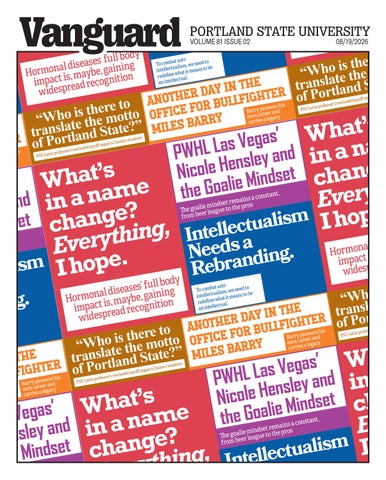
VOLUME 81 ISSUE 02
08/19/2026
CONTENTS
COVER DESIGN BY HALEY HSU
NEWS “Who is there to translate the motto of Portland State?”
P. 9
SPORTS Another Day in the Office for Bullfighter Miles Barry PWHL Las Vegas Nicole Hensley and the Goalie Mindset
OPINION Callaway Column: Fuck You, You're Not Stimming What's in a name change? Everything, I hope. Intellectualism needs a rebranding.
P. 4 P. 4-5 P. 10-11
P. 6-7 P. 8
STAFF EDITORIAL EDITOR IN CHIEF Olivia Hendry Young MANAGING EDITOR Grace Peterson NEWS EDITOR Will Lowe ARTS & CULTURE EDITOR Vacant OPINION EDITOR Daniela Hernandez SPORTS EDITOR Hayden Neumann MULTIMEDIA EDITOR Vacant SOCIAL MEDIA EDITOR Liam Schmitt
COPY CHIEF Jude Callaway ONLINE EDITOR Karli Schwartz DISTRIBUTION MANAGER Caleb Dougherty CONTRIBUTORS Drew Dattilo Noah Carandanis
PRODUCTION & DESIGN CREATIVE DIRECTOR Haley Hsu CONTRIBUTORS Naue Pagtakhan
ADVISING & ACCOUNTING COORDINATOR OF STUDENT MEDIA Reaz Mahmood SALP ACCOUNTANT Anne Le STUDENT MEDIA TECH ADVISOR Rae Fickle STUDENT MEDIA TECH DEVELOPER Kaylee Hynes WEB DESIGNER Vacant
To contact Portland State Vanguard, email editor@psuvanguard.com. MISSION STATEMENT PSU Vanguard’s mission is to serve the Portland State community with timely, accurate, comprehensive and critical content while upholding high journalistic standards. In the process, we aim to enrich our staff with quality, hands on journalism education and a number of skills highly valued in today’s job market. ABOUT Vanguard, established in 1946, is published weekly as an independent student newspaper governed by the PSU Student Media Board. Views and editorial content expressed herein are those of the staff, contributors and readers and do not necessarily represent the PSU student body, faculty, staff or administration. Find us online at psuvanguard.com.
PWHL Las Vegas’ Nicole Hensley and the Goalie Mindset
What’s in a name change? Everything, Intellectualism I hope. Needs a The goalie mindset remains a constant, from beer league to the pros
Hormonal diseases’ full body impact is, maybe, gaining widespread recognition
Rebranding. To combat antiintellectualism, we need to redefine what it means to be an intellectual.
“Who is there to Another Day in The translate the motto Office for Bullfighter of Portland State?” Miles Barry PSU Latin professor’s rescinded layoff impacts Classics students
Barry pioneers his own career and carries a legacy
Summer issue #02
passions of the staff
Fuck You, You're Not Stimming JUDE CALLAWAY An autistic person stims on a public bus, struggling to block out the screeching brakes and max-volume Instagram Reels from the person next to them. They press the heels of their hands into their eyes and rock back and forth on the seat, drawing side-eyes and muttering comments from fellow commuters. Two blocks away, neurotypical college students sit in a restaurant. One of them starts parroting a TikTok audio. The group laughs, echoing the sound or firing back their favorite sound bites. Another friend snorts and says, “Bro’s stimming.” If you resonate with the second example, I’ll be blunt: Fuck you, you’re not stimming. You’re stealing disability jargon for the sake of superficial social interaction. For autistic people, stimming is an involuntary method for sensory survival in a world not built for them. In contemporary youth culture, particularly among Gen Z and Gen Alpha, this mechanism is stolen and stripped of context. It’s co-opted as a cheap speech token to trade in algorithmic intimacy, a way for people to signal they’re in the same digital ecosystem without risking genuine vulnerability. By design, the modern-day algorithm makes context slippery, valuing high-speed engagement over nuance. Users lean into the friction-free vacuum; by chasing the rapidly cycling internet trends that dictate location in the digisphere, they weaponize social media and eagerly play a fuckedup game of digital telephone. They pass the word from screen to screen, utilizing it without recognition. They allow the interface to sanitize the reality of disabled survival until it becomes palatable noise, fit for everyday use. The algorithm certainly lowers the bar for empathy, but humans choose to cross it. In the modern day, ignorance isn’t an accident; it’s a preference. The assimilation of stimming is a cultural byproduct of a broader movement that fetishizes and romanticizes autism. Over the next four parts, this series, “The Fetishized Autist,” exposes how the exploitation of autistic people has evolved and been perverted in contemporary society.
4
OPINION
What’s in a name change? Everything, I hope. Hormonal diseases’ full body impact is, maybe, gaining widespread recognition OLIVIA HENDRY-YOUNG Editor’s note: Hendry-Young has worked in various spaces of menstrual advocacy since high school, whether it be advocating for period poverty education or raising awareness towards reproductive diseases. She knows intimately how hormonal and menstrual diseases can affect menstruating women, after seeing examples in her own life and the lives of her relatives/ friends. In May of 2026, the name of Polycystic Ovarian Syndrome (PCOS) was officially changed to Polyendocrine Metabolic Ovarian Syndrome (PMOS). PMOS occurs when the ovaries produce an excess of the androgen hormone, causing a variety of symptoms that can be exacerbated during menstruation. When it was known as PCOS, the disease was primarily categorized as just affecting one’s reproductive system. The term “polycystic” put ample focus on the potential growth of ovarian cysts that could happen in those with the disease. However, according to an academic paper published by The Lancet, this categorization was incorrect on several fronts. First, though common, those with PMOS can have the dis-
ease without actually developing ovarian cysts. Researchers found that having the focus be on these cysts caused delayed diagnoses, misinformation and patient dissatisfaction. Secondly, research found that instead of just affecting the ovaries, PMOS actually led to increased hormonal and metabolic symptoms. The paper cites a slew of symptoms that are caused by hyperandrogenism that go beyond potential ovarian cysts. This includes hirsutism, insulin resistance, acne, metabolic dysfunction, alopecia, increased risk of cardiometabolic complications and strokes — the list goes on. Categorizing the disease as a polyendocrine and metabolic syndrome demonstrates these risks more than just a polycystic ovarian categorization might. This name change is unprecedented, and comes at the recommendation from 56 different “academic, clinical, and patient organizations,” according to the paper. Within these organizations, 14,360 people with PMOS weighed in on the potential change and their experiences with the disease. The full changeover will take years, and will necessitate the changing of textbooks, global communication, policy, internal classification and more. But it’s a start.
PSU Vanguard • AUGUST 19, 2026 • psuvanguard.com
It’s a start to recognizing hormonal diseases as full-body diseases. It’s a start to taking women’s health more seriously. The recognition of PMOS as a full-body disease gives me hope that other hormonal diseases that primarily affect women will be largely recognized for their full-body effects. I was diagnosed with endometriosis, another hormonal disease primarily affecting women, at 20. However, I’d been experiencing symptoms since I started menstruating. So much is still unknown about why and how endometriosis occurs; the most widely accepted theory is that, due to an excess of estrogen, endometrium-like tissue (what makes up the uterine wall, and what is shed during menstruation) leaves the uterus and attaches itself to other parts of a woman’s reproductive organs. Since the body is expecting to shed this tissue during menstruation, but ultimately can’t, it causes immense pain while menstruating, among other painful symptoms. I remember when I had my first “episode,” as I call them. I was a sophomore in high school, and my mom was driving me to school for an early morning club meeting. I had started my period before I got in the car, and though I didn’t know I had endometriosis at the time, painful periods were the name of the game for me. I took some Aleve before I left, and waited for the pain to subside. But it didn’t. As my mom drove along 99W, my pain grew worse and worse. My most common site of pain, my legs, felt like someone’s large, calloused hands were squeezing them tightly, hoping to break a bone before giving up after a minute or two — eventually gaining the strength to try again a few minutes later. My leg pain grew worse, as did my uterine
cramps. I started to go cold and shake uncontrollably. To this day, I don’t know how I got through that meeting. At the end, my mom had to help me get back in the car. To make a very, very long story short, the increase in episodes and their intensity led me to get laparoscopic surgery in May of 2023, which resulted in a diagnosis of Stage 2 endometriosis. At the time, diagnosis could only officially be done through surgery; however, new diagnostic methods are rapidly emerging. Because there was no way to know for certain going into the surgery, I was terrified that the surgeon would open me up and find nothing, except validation that my pain was just in my head. When I got out of my anesthetic haze and was told my diagnosis, I turned to my parents and fiancé, proudly declaring, “I did it! I was right!” Ever since then, I have been acutely aware of my endometriosis every day of my life. Before I was diagnosed, I thought my pain was only during my period. That was before I realized that I got intense, dizzying migraines as soon as my period was done. Then, about a week or so after my migraines subsided; ovulation would bring hot coals to my abdomen, resulting in hours curled into a ball. Then the litany of symptoms that premenstrual syndrome would bring just a few days after ovulating: nearly debilitating fatigue, uterine cramps, intense brain fog, decreased mood; the laundry list goes on. After my diagnosis, I realized this wasn’t something that just affected me for 4-5 days out of the month; this was my entire life. What I ate, how hard I worked out and how much I slept could all lead to worsening symptoms days or weeks down the line. I began to know where I was at in my cycle not by my
menstrual tracking app, but by how I’d wake up in the middle of the night so hot and nauseous that only distracting myself, a cold water bottle pressed to my abdomen, would afford me sleep. The number of missed deadlines, cancelled meetings and forgotten tasks that coincide with my luteal phase caused me to work twice as hard during those 10 days, often when I had less than half of the energy I normally did. And yet, the common consensus, which is already greatly lacking due to not a lot of awareness about endometriosis, is that it just causes bad periods. That you just have worse cramps while you’re menstruating. As if you get off scot-free for the rest of the month. For my sake, and the sake of the 1 in 10 women who have PMOS and the 1 in 10 who have endometriosis, I hope that we are beginning to enter a new phase in the discussion of women’s health. I don’t mean to sound naive. I know that women’s health is criminally underfunded and under-recognized. Hell, women weren’t even included in most clinical trials until 1993. There is still a fundamental lack of knowledge about women’s health, much less their reproductive system, much less what to do when the hormones that the reproductive system produces go haywire. But I’d be lying if seeing this didn’t give me a slight glimmer of hope. Maybe more recognition for the full-body component of hormonal diseases is coming. Maybe more people will know that (shocker!) hormones affect the entire body, not just when a woman is menstruating. Just maybe. But until then, I’ll take my supplements and try to give myself grace, no matter where I am in my cycle.
Fast Facts
• 1 in 10 AFAB people have PMOS, and 1 in 10 AFAB people have endometriosis • AFAB people were not included in clinical trials until 1993, leading to a severe lack of information about hormonal and reproductive diseases in that capacity
Resource centers for AFAB people with hormonal/ reproductive diseases: PSU’s Center for Student Health and Counseling: pdx.edu/health-counseling/ PCOS Sisters Telehealth Clinic & Wellness Center: pcossisters.com Northwest Women’s Clinic: nwwc.com Pearl Women’s Center: pearlwomenscenter.com Northwest Endometriosis and Pelvic Surgery: nwendometriosis.com
PSU Vanguard • AUGUST 19, 2026 • psuvanguard.com
OPINION
5
Another Day in The Office for Bullfighter Miles Barry Barry pioneers his own career and carries a legacy GRACE PETERSON Editor’s Note: Peterson grew up alongside the bucking chutes at the Molalla Buckeroo. Her father was a PRCA photographer and a bareback rider, so she learned firsthand the family importance within rodeos. Rowdy Barry was her father’s friend, so she watched Miles Barry grow from a dusty Wrangler jeans-wearing kid to a capable athlete. Most people would be afraid to be eye-to-eye with a 1,600-pound bull with horns and anger. For 25-year-old bullfighter Miles Barry, he doesn’t blink an eye, let alone get nervous. “You obviously get pre-jitter nerves, but as soon as you start going to work, that all goes away, and it’s just fun. Once you get by the first bull, it’s just another day in the office,” Miles Barry said with a laugh. “Ninety percent of it, I think, is in your mind. It’s mental, you know. I’ve seen big guys step around bulls, no problem. I mean, at the end of the day, it’s mental and reading cattle.” Miles Barry has spent the past 12 years as a bullfighter, and the last seven professionally. He averages roughly 30 rodeos a season and has been adding more stops every year. One of his favorite rodeos is the Molalla Buckeroo, a rodeo he grew up attending. Bullfighting is an integral part of rodeo safety, often called the “unsung heroes” and “cowboy protectors.” Bull riding is a dangerous sport, and once the cowboy ends their eight-second ride, they need to get off safely. Bullfighters throw themselves into action, distracting the bull by any means necessary until the bull rider is safely behind the chutes. This often means putting themselves directly in harm’s way, risking injury, limb and life, running and jumping to turn the bull’s attention away from the rider. Bucking bulls are dangerously aggressive, and these athletes use their bodies as targets to create a physical intervention in order to save cowboys every day. It takes a lot of athleticism and practice to get to the point of professional bullfighting. There’s a lot of trust between the rider and the bullfighter, and a lot of responsibility on Miles Barry. He’s got to be agile and ready every night. He doesn’t do much in the way of preparation before the show. “Just a good stretch and warm-up, and make sure my body’s loose. Not much mental preparation,” Miles Barry said. “I don’t know. I think about it a lot on the days off and the days I’m not doing it. So I feel like when it comes time to do it, there’s no need to think or prepare.” It’s not a pretty job, and he’s suffered a range of bumps and bruises. The first time Miles Barry fought bulls at a high school
6
SPORTS
PHOTO COURTESY OF ROWDY BARRY Rowdy Barry (left) and Miles Barry (right) with adoptive brother, Ryan Wilson (middle). The only pro rodeo Miles and Rowdy fought bulls together. rodeo, he “took a hooking,” getting severely injured. At 13 years old, he broke his arm to the point that he could see his own tendons. This didn’t stop him from wanting to do it all over again. “When you’re, you know, a few inches from getting whacked or run over or stepped on, you get that big old rush of adrenaline, and then it’s all gone,” Miles Barry said. “It’s like, whoo, man, that felt good. Let’s do that again.” Miles Barry grew up on a ranch with his family. He spent a lot of his childhood surrounded by cows, and still does. When he’s not on the road, Miles Barry works at a sales barn in Moses Lake, Washington. “I feel pretty tuned up for fighting bulls because I’m working cattle there every Wednesday — and shoot, even on my days off. It seems like I always end up working cows with somebody,” Miles Barry said. “I got some Mexican fighting cows at home. We’ll go fight those sometimes.”
Miles Barry’s father, Rowdy Barry, was a professional bullfighter for more than 30 years, and Miles Barry would frequently travel with him to different circuits. Rowdy Barry spent years keeping cowboys safe at the Molalla Buckeroo, and Miles Barry saw firsthand how painful the job could be. “I couldn’t even tell you how many ribs I broke. You know, I’m going to say in the dozens, breaking ribs and rebreaking ribs, all that type of stuff,” Rowdy Barry said. “Pain was never a big deal to me. It happens. You tough it out.” “I remember watching him [at the Molalla Buckeroo] as a little kid and watching him, bull got him down and split his jaw open, you know. I was scared for him because I was a little kid,” Miles Barry said. “I was more nervous to watch my dad fight bulls than I am to fight bulls now … it’s different.” Rowdy Barry originally steered Miles Barry in the direction of roping — breakaway roping, team roping and tie-down
PSU Vanguard • AUGUST 19, 2026 • psuvanguard.com
roping. He wanted Miles Barry to be an all-around cowboy, a champion in multiple events. Miles Barry, much like his father, was naturally drawn to bulls. Rowdy Barry recognized his son’s athleticism and talent, and, while he didn’t necessarily embrace it, he trained him to fight bulls. Rowdy Barry never thought too hard about the implications, but his wife had a different view. “People would ask my wife … ‘You’re letting him fight bulls. You watched your husband, you know, and had to nurse him through injuries, and so you see the potential of injuries that he could have, and you still are letting him fight bulls,’” said Rowdy Barry. “And she goes, ‘It’s pretty hard to discourage a son from watching his dad do what he loved to do for a living, and there never was a day of work.’” While many parents would be stressed watching their children get trampled and hit by an aggressive animal, Rowdy Barry shared that he was never too nervous to watch his son fight bulls, comparing it to football. “It’s not like I let him just learn to fight bulls and send him to the big wolves,” Rowdy Barry said. “You know the bulls that you’re gonna let him get in front of … I was protective of him, and I was- I don’t want to say nervous, but you know, I was a little concerned. But once I felt that he was confident and competent at his job, I was his biggest fan.” Miles Barry knew that, going into the same career as his father, he’d have some big shoes to fill. He was grateful for the support that his dad had given him and the Barry name, but he still had to work for his place. Rowdy Barry retired from the Molalla Buckeroo, and even though many people thought that Miles Barry would be a shoo-in, the committee hired someone else at first. Miles Barry did not have nepotistic support; he worked hard to become the professional athlete he is today. Miles Barry said, “I’ve put in my dues. I’m making a name for myself, and I’m just ready, ready for them to start talking about me.” “I think in some ways, he kind of got some doors open that probably would have taken him a little longer to get to be-
"When you're, you know, a few inches from getting whacked or run over or stepped on, you get that big old rush of adrenaline, and then it's all gone" cause of [it], but on the other side, he had bigger expectations on him because I was his dad,” Rowdy Barry said. “I think he’s stepped up. He’s done good. His career is growing. He’s getting bigger and better rodeos.” Rowdy Barry often works as a chute boss at rodeos, making sure the livestock get loaded into the chutes, that contestants know which bronc or bull is theirs, and signals to the gatemen when to release the chute. Sometimes, Rowdy Barry and Miles Barry will work the same rodeo. “I like being down on the dirt with Miles right there, you know, when I can. And now he’s going to different rodeos and a lot more, you know. So I don’t see them as often working, but I do like when we are at a rodeo together,” Rowdy Barry said. “I don’t really say nothing. I’m just there absorbing it, you know … [if ] they make a good pass or save or something. I always let them know.” Miles Barry wouldn’t be who he is without the rodeo industry and his father’s legacy. Even as a child, he was often in dirty Wrangler jeans and competing in a range of events. Bulls and rodeos shaped him as an athlete, a worker and an individual, and he couldn’t imagine a life without it. “I’d probably be up in the mountains, if I’m being honest. Nobody would probably ever see me again,” Miles Barry said. “Probably have a few cows.”
where to keep up with the rodeo: @rowdy_barry @miles1barry thecowboychannel.com PSU Vanguard • AUGUST 19, 2026 • psuvanguard.com
DREW DATTILO Nearly 27 years after its release, it is a cliché for metalheads and punks alike to sing praises for The Dillinger Escape Plan’s landmark debut album “Calculating Infinity” – and for good reason. Filled with odd time signatures that constantly shift, ferociously heavy riffs and broad generic experimentation, “Calculating Infinity” is impressive in its ability to blend different styles while maintaining a cohesive, vicious energy. The opener, “Sugar Coated Sour,” immediately pummels listeners with its dissonant, fractured rhythm (I use “rhythm” loosely here), with sections layered upon vocalist Dimitri Minakakis’ aggressive, raspy vocal delivery, sounding vigorous and frayed simultaneously. The next track, “43% Burnt,” is the best-known on the album; its famous two-chord, call-and-response riff sandwiches a refrain that could be mistaken for improvisational jazz. “Destro’s Secret” continues the discordant bombardment, with Minakakis’ vengeful lyrics (“I’ve come to cut cupid’s heart out/I’ve come to take your breath away”) complementing the song’s contentious inflection. But the band frequently diverges from its chaotic aggression to create unusual sonic textures. “*#..” builds upon eerie samples and sound effects before moving into a more traditional guitar groove. The title track features an instrumental verse that could be in an alt-rock song. “Weekend Sex Change” forgoes all structural convention and warps excerpts of a newsreel from J Edgar. Hoover, recorded after the Bureau of Investigation’s capture of John Dillinger. On “Calculating Infinity,” the band revolutionized what is now called “mathcore,” a sound that would inspire as many relentless copycats as it did future groundbreakers. The record is nothing short of brutal, messy (in a good way) and confident, filled with the most headbanger songs you can not actually headbang to.
SPORTS
7
PWHL Las Vegas’ Nicole Hensley and the Goalie Mindset
PHOTO COURTESY OF THE MINNESOTA FROST
The goalie mindset remains a constant, from beer league to the pros HAYDEN NEUMANN Editor’s Note: Hayden has been playing hockey since November of 2024 and has looked up to a myriad of goaltenders throughout their journey. One of these goaltenders is Nicole Hensley, whom Hayden had the honor as a follow-up to their piece, “The Goalie Mindset Changed My Life,” published in June 2026. While the speed and intensity vary across the sport’s different levels, goaltending, at its core, is pretty consistent. It all boils down to one thing: stop the puck. While the external pressures goalies face can vary drastically, the internal stress is surprisingly uniform, whether the goalie plays for a beer league or is at the top of the top in the Professional Women’s Hockey League (PWHL). Nicole Hensley, Olympian, two-time Walter Cup champion and current goaltender for PWHL Las Vegas, echoed several thoughts I’ve had during my time playing. It was surprising, and cathartic, to hear a professional voice say the same things I, a recreational goalie who’s only been playing for a year and a half, mull over weekly. “The position comes with a lot of unique pressure and a lot of responsibility,” said Hensley. “We feel things a lot differently than our teammates. A 7-5 win may feel great for the team, but I don’t feel like I did my part. Or if we lose 1-0, I personally feel great, because I gave it my all, but my team is disappointed.” Hensley was the first goalie drafted to the PWHL, going 12th overall to the Minnesota Frost in the inaugural PWHL Draft in 2023. She remains the highest goaltender to be drafted in the league. She spent three years with the Frost and played an integral role in the team’s back-to-back championships, posting a career 2.46 goals-against-average (GAA) and a .910 save percentage (SV%). In June 2026, Hensley signed with PWHL Las Vegas ahead of the team’s inaugural 2026-27 season. “[The move has] been really emotional,” said Hensley. “I’ve lived in Minnesota for six or seven years now. I own a house here; I have a life here. It’s really hard to move forward into the unknown, but it’s also a learning curve. This is pro sports; this is how it works. I’m nervous about starting a new adventure, but I think it’ll be really cool to do something different in a new place.” Hensley grew up playing hockey in Colorado and eventually committed to play at Lindenwood University in Missouri, a Division I school. Before the PWHL existed, one of the main routes for women in hockey was to play for the national team, which didn’t have a traditional season. Once she made the national team, she’d only play once or twice a month every couple of months, and those games were all-in, with “all the pressure,” as Hensley put it. “The mantra I live by is you have to play the game you’re in,” said Hensley. “You have to try not to be so individual about it. The goal is for our team to get three points, and
8
SPORTS
it does not matter how we get those three points. We just have to get them. That’s the end goal. It takes a bit of the weight off — it’s a team game.” For me, in the Portland United Hockey League, we pay to play. The stakes could not be lower. Win or lose, it doesn’t matter. Despite this, I still put immense pressure on myself. I don’t want to let my team down; I want to win. We usually have a couple of people in the stands: friends, family, or other players in the league waiting for their game later that night. No matter who’s watching, I want to put on a good show for them. I want them to watch me and think, “Wow, they’re a good goalie!” When I picture playing at the level Hensley does, with thousands of fans rooting for — or against — you, I shiver. I asked Hensley how she handles it, and she explained that it’s something you grow into. As a kid, there’s no pressure. You’re out there having fun. As you get older, you start taking it more seriously, usually around high school— you want to win more. You want to get noticed. More people come to your games. You start playing at higher levels, and by the time you’re in college, in front of bigger crowds, you’ve built a repertoire of internal skills. Now that she’s in the PWHL, the large crowds fuel her excitement for the game and she doesn’t let them intimidate her. “What matters is inside the glass,” said Hensley has won back-to-back PWHL Championships with the Minnesota Frost, the first in the Hensley. “Everything outside of it is just PWHL’s inaugural season in 2024, and the second in 2025. noise. Sometimes positive, sometimes negative, depending on where you are. In a way, it’s harder now already analyzed what’s coming and I feel ready to tackle to play for a small number of people than a huge crowd. And the next shot.” at the end of the day, it’s more about being thankful that we The very first game I tried this, a teammate pulled me aside get to play in front of those crowds. It wasn’t always like that.” and told me he noticed how well I kept myself present and One of the most important and difficult things for goalies grounded in the game. After conceding a goal, I was able to to internalize is that, despite goaltending being such a soli- reset and go after the next shot much faster. tary position, it is part of a team sport. A loss isn’t our fault Another thing Hensley pointed out, which is important to bear, and a win is ours to share just as much as it is our for goalies of all levels to remember, is that we are here to teammates’. During the game, keeping your head on your have fun. Hockey is a game. We’re doing this because we love shoulders and not spiraling about a goal you let in is what it — the friends we make, the memories to be had — and we can make or break your performance. One piece of advice love the sport. Hensley shared with me, which I have since implemented “Whether you’re paying to play or you’re getting paid to and can vouch for, is narrating the game in front of you. play, that’s kind of the name of the game,” said Hensley. “Be “I need to keep my mind busy,” Hensley said. “If the game’s a sponge, be open to trying new things. Be all in. Enjoy the in the offensive zone, I’m talking. I’m commentating on moment. I love playing hockey. I love playing this game. I what I see and it’s always positive. I don’t want to invite any love my teammates. I love being part of a team and I love to negative energy. When the puck comes back my way, I’ve compete for something with a group of people.”
PSU Vanguard • AUGUST 19, 2026 • psuvanguard.com
“Who is there to translate the motto of Portland State?” PSU Latin professor’s rescinded layoff impacts Classics students
NOAH CARANDANIS Editor's note and correction notice: The research and interviews done for this article occurred in May and June of 2026. Since then, Tim Nidever has been reinstated to his position at Portland State University. Though the circumstances around his layoff has changed, we have decided to continue to run this story for several reasons. One, it was important for us to showcase the special impact that Nidever has on his students. Two, the hurt and confusion felt by Nidever’s students was extremely real at the time of researching. We felt that showcasing this can lend a glimpse into the feelings of students whose favorite professors will be losing their jobs due to layoffs. Third, the piece showcases writer Noah Carandanis’ passion for the Classics, as it combines his Hellenic heritage with his love for academia. This passion fits with the theme of the issue. We believe it is still important to recognize the former points with the publication of this article. We have also kept the article in the tense it was written in to preserve the integrity of the piece, and the voice of the author. Thus, portions of this article may not reflect current standings, but of those when it was researched. In addition, edits have been made to more specifically reflect Nidever’s teaching history at PSU. Upon walking into The Language Lounge in Fariborz Maseeh Hall during a Portland State University World Antiquities Guild (PSWAG) meeting, one is met with the sight of students excitedly speaking in Latin and the aroma of freshly baked bread. The room, buzzing with esoteric excitement, is filled with enthusiasm for a language rarely spoken outside of academia: Latin. PSU is home to the Classical Studies Minor, a program which requires students to undertake two years of Latin language courses alongside courses exploring the history and culture of Roman and Greek antiquity. Within this minor, a community of passionate students have taken up the study of Latin under the mentorship of Tim Nidever. Nidever was hired full time at PSU in 2012 as a non-tenure track instructor, and currently holds the position of teaching assistant professor. In the University’s sweeping cuts to faculty, Nidever was notified that he would be laid off at the end of the next academic year. Since Nidever is the only professor equipped to teach Latin, his departure effectively ends the Latin program at PSU.
“Fortunately, there is a 12 month lead time on [the layoff ] … which is, honestly, a remarkable thing,” said Nidever. “I mean, most people, when they get let go of their jobs, they just have to go immediately. To have a full year to be able to plan and to think about the next step [is something] I’m very grateful for.” Nidever’s journey through higher education was unconventional, like many of the students which make up PSU’s academic community. “I was a little bit older when I got my [bachelors degree],” said Nidever. “I feel like it’s kind of a contemporary, common story where a lot of people are trying to do other things to see how it's going to work. But there’s something that kept drawing me back.” Before graduating with a degree in Philosophy from PSU, Nidever worked odd jobs in the food industry, the coffee industry and at the iconic Powell’s Bookstore. His love of ancient philosophy led him to enrolling in a Latin class during his undergraduate years. “I absolutely loved it. It was just such an unexpected delight, and it was five days a week [of class] at that point … it was tough but it was so much fun,” said Nidever. “That’s when I first got the bug.” Nidever went on to graduate with a masters degree in Classics from the University of Oregon in 2009. He first began teaching at PSU during the 2010 to 2011 academic year as an adjunct professor of Latin when the previous Latin professor David Thompson left the University. “It’s almost shameful to have as much fun as I do in the classroom. It is just delightful,” said Nidever. Christina Osborn graduated from PSU in 2024 is a current graduate student at the University of Kentucky in their Classics program. As the founding president of PSWAG, Osborn worked closely with Nidever within the Latin program. “If [Nidever] is in a group of people and they want something, he’ll try to make it happen so that they can continue their studies and so that their degree will be worth more when they get out into the world,” said Osborn. “There isn’t a classics major, and he knows that if we want to continue and go on to study classics, then he has to give us as much value as we can get.” According to Osborn, Nidever is not only PSWAG’s faculty advisor, but their “patron
PSU Vanguard • AUGUST 19, 2026 • psuvanguard.com
saint.” “A minor in Classics is often just a small thing,” said Angel Antonucci, PSWAG’s president-elect. “But the way Tim has been so passionate and thorough about it [shows that] he goes way beyond just a few classes introducing you to the subject. He really turns a minor into a major … We joke that you major in Tim.” For many graduate programs in Classics, study in Latin is essentially a prerequisite for admission into a degree. Nidever’s layoff effectively means the end of the Latin program at PSU, thereby making it difficult for students interested in pursuing graduate studies in Classics. “I think there isn’t much of a future for classics at Portland State if I’m let go,” said Nidever. “That means, as far as I can tell, the end of the Classical Studies minor which is the only thing that we have here.” According to Osborn, students would need at least two years of Latin, and preferably four, in order to gain entrance into masters or doctoral programs in Classics. Nidever’s students described a classroom environment that emphasized student personalization and tailored instruction that cultivated a deep sense of community within the course. “He works with and understands each person’s capability,” said Antonucci. “You have your life, you have your work, you have your other classes. It isn’t just Latin, and he really values that and understands that and will push you if you want to be pushed.” According to Osborn, Nidever remakes materials for every single class in order to make sure that class materials fit the needs of current students and do not become obsolete. Yet, it is not only the academic material that Nidever is known for. “[Nidever] will sit there and [do] this before teaching anyone Latin. He will sit and memorize every single person’s name in the class,” said Dakota Monro, a founding officer of PSWAG and student of Nidever’s. “He quizzes himself [and] he does it one at a time until he can go around the entire room and say them in order.” Nidever also fosters community through maintaining classroom rituals to mark milestones in student’s Latin careers. According to Osborn, he personally carves miniature wooden swords with “PSU Latin” stamped on the side
to celebrate students successfully completing two years of Latin. “I want people to understand that they are not just a PSU ID number that’s paying for credits of tuition,” said Nidever. “They are people, and I want them to feel like people and that they’re seen.” Outside of his academic education, Nidever attended the San Francisco Baking Institute. At every weekly PSWAG meeting, he offers students a freshly baked loaf of bread to enjoy throughout the course of the event. “Tim is the most passionate person I’ve ever met,” said Antonucci. “There is nothing that kills his spirit, and I’m amazed at how much he cares, no matter what. I’ve never seen a person like that before.” For Monro, Nidever showed that Latin was accessible for students from a diverse array of backgrounds and life experiences. According to Monro, this is demonstrated in the diversity of PSWAG members who hold marginalized identities. “Its incredibly important that we are providing new perspectives into [Classics], and that’s what we’re doing with our club,” said Monro. “Our club is largely queer, poor, trans, women [and] people that have had no opportunity to enter into this conversation.” While Latin may have the stereotype of being a dead language, the University’s motto still is written in Latin. “Who is there to translate the motto of Portland State?” said Antonucci. “What is the point of referencing this academic tradition if you don’t understand why it’s there?” While Nidever recognized the niche nature of Latin, he understood how impactful that education could be for the students involved. “It is a small program, and I realize in the larger picture, it may seem insignificant,” said Nidever. “But it certainly has affected and shaped the lives of a number of my students … and they would like to see that continue.” Noah Carandanis graduated with a Bachelor of Arts in Philosophy. His Hellenic heritage cultivated a deep appreciation for Greek and Roman antiquity, leading him to seek deeper study of classical philosophy. The field of Classics is essential to the story of academia, and Nidever’s layoff from PSU only further illustrates the self-alienation of the University.
NEWS
9
Intellectualism Needs a Rebranding. DANIELA HERNANDEZ Modern-day anti-intellectualists are individuals who reject and are skeptical of intellectuals, academia and scientific institutions. Those who choose to not obtain a higher education due to it being a “scam” or a “waste of time” are part of this phenomenon; same with anti-vaxxers, who don't want to be victims of medical malpractice and have become skeptical of medical professionals. Anti-intellectualists’ forms of protest against intellectuals include rejecting expert information, relying on religious reasoning, opting out of reading and mistrusting respected institutions. The United States has been feeling the impacts of anti-intellectualism. Politicians and their followers who continue to deny climate change have also created a setback in fossil fuel regulations. In terms of schooling, fewer students are choosing to pursue higher education. Portland State University has subsequently been affected, with a 23% decline in enrollment since 2019. Schools have already seen a spike in students unable to read at their expected reading level, according to reporting from The Atlantic. However, anti-intellectuals who choose not to go to college might actually have a good reason. I often wonder why anti-intellectuals wouldn't want to further their education. It’s a parent's dream for their child to become a doctor or lawyer, or to pursue a career that requires education beyond the 12th grade. Humans have a natural desire to evolve as a species, so it is unrealistic to think that people want to be stupid. We are asking the wrong questions. The question is: What is so unappealing about being an intellectual? It starts by understanding the populist ideology that drives anti-intellectuals. A way of living that is anti-elitist and anti-establishment. It focuses on the problems of the commoner over the wealthy. Intellectualism, as we know it today, is inherently elitist. Many intellectuals add morality to the idea of
10
OPINION
being knowledgeable. It’s an "I know more, thus I am better than you” view of life. It's a system people have grown accustomed to since kindergarten. The gold star ranking system that displays the top three most valuable assets in the class. The valedictorian speech at the end of the four years to show off who did better than everyone else. The employee-of-the-month poster in the office for who satisfied the boss more. The rest of the individuals who didn’t understand the lecture the first time, missed a couple of questions on the exam or didn’t close their first deal are left in the trenches of incompetence. People with different learning styles don’t thrive in this environment. Students with dyslexia, as well as kinesthetic and visual learners, often get left behind in lecture-ridden, standardized testing systems of education. It's an atmosphere where ableism can thrive against those with learning disabilities and different learning processes. This creates hierarchies in education, forcing students to internalize the notion they are better individuals because they know more. It’s classism that is present in academic and scientific institutions. Those who excel in these environments get grouped more often, creating cliques of pompous experts. The exact experts in institutions teaching the negative effects of elitism, ableism and classism end up being the ones to perpetuate it; ironic. Instructors, professors and mentors who put down students who have a desire to learn ruin their learning experience by making them feel stupid. This is where hostility towards intellectuals begins to grow. But that doesn’t mean these forms of discrimination are the only issues. Defining what knowledge is is the second problem. What does it mean to know, and what knowledge is required to become an intellectual? What we consider to be knowledge is a very colonial view of knowledge. The United
PSU Vanguard • AUGUST 19, 2026 • psuvanguard.com
To combat antiintellectualism, we need to redefine what it means to be an intellectual.
What we consider to be knowledge is a very colonial view of knowledge. The United States specifically teaches knowledge from a Western perspective, which marginalizes the information of different cultures. States specifically teaches knowledge from a Western perspective, which marginalizes the information of different cultures. An example of this is categorizing Eastern traditions and indigenous oral histories as “myths” or “legends”, while calling Western traditions “historical information”. This is prominent in the medical world. Traditional medicine is rarely seen as part of formal healthcare. For herbalists, the lack of recognition by medical officials also increases a Western view of effective medicine. Institutions continue to classify them as unscientific. How American cinema portrays other countries is another example of this colonizer mindset. Specifically in action movies, countries outside of the United States are often portrayed as cities under clouds of fire with uncon-
PSU Vanguard • AUGUST 19, 2026 • psuvanguard.com
trollable gang violence and drug-dealing lords. Movies like “Extraction” (2020), “Indiana Jones” (1981), “Godzilla” (1989, 2014) and the “Fast and Furious” (2001, 2023) franchise severely misrepresent the state of the countries they take place in. Using the “Fast 5” (2011) movie as an example, the use of an orange filter portrays Brazil as having heavy air pollution. It doesn’t help that part of the movie’s plot is escaping the clutches of a powerful drug lord. The use of an orange filter is an example of misrepresentation of the environmental, political, social and economic states of countries outside the United States. To combat anti-intellectualism, intellectualism needs a rebranding, beginning with the removal of moral superiority from the intellectual mindset. Knowing more does not make you a better person. Moral value can not be added based on how well you excel in your microbiology class or how well you can recite Friedrich Nietzsche. Environments promoting education need to become inclusive. Inclusivity has to exist regarding different learning styles. Additionally, inclusivity has to exist in the attitudes intellectuals have towards those who “know less.” Intellectualism will be able to thrive when it starts becoming more welcoming. Our next step is redefining what we characterize as knowledge. Decolonizing our knowledge will be the beginning of expanding what we know as knowledge. Additionally, we must remove the lens of racism, sexism, xenophobia, homophobia, elitism, ableism and classism in how people view other nations and individuals. This is what intellectualism is supposed to be about. The development of our minds through critical thinking, reasoning, observation and experience is not only essential to our souls, but to the human race. So let's say thank you to anti-intellectuals, because those who have chosen the path of anti-intellectualism were actually on to something.
OPINION
11