
Portland State Vanguard Volume 80 Issue 9

Page 1


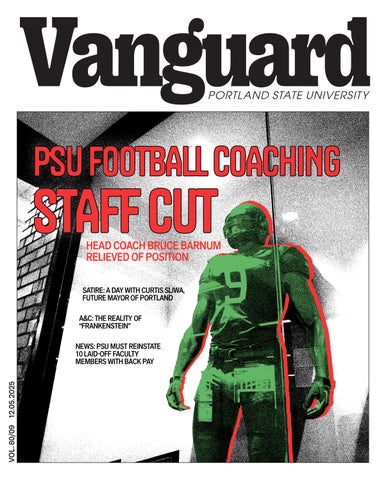
Vikings Football Head Coach Bruce Barnum

Relieved from Coaching Duties Center for Student Health and Counseling

Offers New Counseling Sessions

PSU Must Reinstate 10 Laid-Off Faculty

Members with Back Pay ARTS & CULTURE

OPINION

STAFF

EDITORIAL

EDITOR IN CHIEF

Noah Carandanis

MANAGING EDITOR

Olivia Young

NEWS EDITOR

Vacant

ARTS & CULTURE

Adyan Hussein

OPINION EDITOR

Nick Gatlin

MULTIMEDIA EDITOR

Nash Bennett

SOCIAL MEDIA EDITOR

Liam Schmitt

COPY CHIEF

Jude Callaway

ONLINE EDITOR

Quinn Willett

DISTRIBUTION MANAGER

Caleb Dougherty

PRODUCTION & DESIGN

CREATIVE DIRECTOR

Haley Hsu

DESIGN CONTRIBUTORS

Karli Schwartz

Arielle Chhunkeo

Naue Pagtakhan

Mary Catala

Nikki Marin

Max Bykowski

Jenelle De Leon

ADVISING & ACCOUNTING

COORDINATOR OF STUDENT MEDIA

Reaz Mahmood

SALP ACCOUNTANT

Maria Dominguez

STUDENT MEDIA TECH ADVISOR

Rae Fickle

STUDENT MEDIA TECH DEVELOPER

Kaylee Hynes

WEB DESIGNER

Owen Cook

To contact Portland State Vanguard, email editor@psuvanguard.com.

MISSION STATEMENT

PSU Vanguard’s mission is to serve the Portland State community with timely, accurate, comprehensive and critical content while upholding high journalistic standards. In the process, we aim to enrich our staff with quality, hands on journalism education and a number of skills highly valued in today’s job market.

ABOUT

Vanguard, established in 1946, is published weekly as an independent student newspaper governed by the PSU Student Media Board. Views and editorial content expressed herein are those of the staff, contributors and readers and do not necessarily represent the PSU student body, faculty, staff or administration. Find us online at psuvanguard.com.

COVER DESIGN BY HALEY HSU

PSU Vikings Football Head Coach Bruce Barnum relieved from coaching duties

Barnum and his entire coaching staff cut hours after the final game of the 2025 season

The entire coaching staff of Portland State University’s football program was relieved of their positions on Saturday, Nov. 22, 2025. This includes their head coach, Bruce Barnum, who has coached the Vikings since 2015.

News of the staffing changes was announced only hours after the conclusion of the Viking’s final game of the season, losing to University of Northern Colorado 13-24. According to reporting from the Oregonian, the decision was delivered by PSU Athletic Director Matt Billings at the Portland International Airport in a private room.

“Portland State Football Coach Bruce Barnum has been relieved of his coaching duties following the conclusion of the Vikings season on Saturday. His coaching staff will not be retained,” reads a statement from the PSU Athletics Department.

“With the timing [of] the end of the year, [the] end of the season, I would like to have someone hired before Christmas,” said Billings. “I felt like, you know, make a clean slate. It’s very common to remove the entire group and start over.”

Barnum has been part of the Viking’s coaching staff since 2010, beginning as the school’s offensive coordinator. He then took over as the interim head coach in 2015, which proved to be

a standout year for the team; they ended with a 9-2 record, and Barnum was named Football Championship Subdivision (FCS) National Coach of the Year and Big Sky Conference Coach of the Year.

Before coming to Portland State, Barnum’s coaching resume included Idaho State University, the US Coast Guard Academy, and Western Washington University.

Alongside the firing of Barnum was the disbursement of all 11 members of the coaching staff. This includes PSU alumnus Matt Leunen, offensive coordinator, Kieran McDonagh, quarterbacks coach, Shiloh Ta’ase, tackles and tight ends coach and VJ Malo, defensive ends coach.

This decision came on the heels of another losing season for the Vikings, with the team garnering a 1-11 record. Their one win was against Cal Poly on Nov. 1, with a score of 40-35. With the conclusion of this season, it marks their 10th consecutive season with an overall losing record.

Billings hopes that, with a new head coach, more students can find success both on the field and in the classroom.

“I want all of our programs to be competitive within the Big Sky Conference, who we are a member of,” said Billings. “I need someone who is going to come in here with a new

vision and different ideas and [thinks] outside the box a little bit.”

PSU’s search for a new head coach will be nationwide, and will happen immediately.

According to Billings, the search committee is composed of alumni, a faculty member and four Athletic Department staff members. The process of hiring a new head coach means that the committee fields resumés to then recommend to Billings. After the initial search concludes, finalists are brought to campus and Billings makes the ultimate decision of what applicant gets the job.

In terms of what Portland State is looking for in a new head coach, Billings wants someone who will be a good leader, mentor and teacher.

“This person is in charge of leading young people, 18 to 22, year olds,” said Billings. “They're not just an athlete here. They are a young person learning, and we are providing tools to put in their toolbox for them to move on to the next stage, whatever that may be.”

Billings also placed emphasis on recruiting more local talent and in-state athletes, something he has discussed with coaching applicants.

“I think you build better relationships with high school coaches, [and] just the community at large that they see more of the kids playing out at Hillsboro [Stadium] or [downtown] in

Providence,” said Billings. “I think we’ve missed that in the past.”

This staffing decision came shortly after the PSU Vikings played their homecoming game at Providence Park. According to Billings, the next couple of years could see the Vikings playing homecoming games at the stadium.

“We don’t play in a fancy stadium, but that’s not the be all end all. There’s a lot of really amazing things about playing at an urban university,” said Billings.

The Homecoming game marked a long anticipated return of the PSU Vikings to the stadium they used to frequent. Billings also saw an increase in school spirit at subsequent athletic events.

“After the Providence Park game, they had scarves that [were given] out, [and there] was a basketball game here and I saw a lot of students come in for the first time wearing the scarves, [and] they had more PSU gear on,” said Billings. “That’s a step in the right direction.”

With the firing of Barnum and the search for the new head coach, Billings hopes to continue to foster a competitive athletics program on the Park Blocks.

“My job is to find coaches who will put an exciting product out there and a competitive product,” said Billings.

NOAH CARANDANIS
NASH BENNETT

PSU must reinstate 10 laid-off faculty members with back pay, according to independent arbitrator

According to an independent arbitrator, Portland State University violated its collective bargaining agreement with PSU’s chapter of the American Association of University Professors (AAUP) when it laid off 10 non-tenured track faculty last spring. The arbitrator is now calling for all faculty members represented in the case to be swiftly reinstated to their previous teaching positions with back pay.

The arbitrator’s ruling comes after PSU’s decision to lay off several faculty members from the College of Liberal Arts and Sciences. Mass notices of possible termination were sent to 90 faculty members on Oct. 15, 2024, with specific layoff notices being sent to 17 faculty members on Dec. 15, 2024. It was established that these layoffs were not due to job performance but rather were a result of overarching budget changes and cuts.

After initial layoff notices were sent in October, PSU-AAUP President Bill Knight filed a grievance against the PSU administration. PSU-AAUP argues that these cuts did not follow shared governance procedures as detailed in Article 18 of their collective bargaining agreement. Article 18 states that non-tenured track faculty can only be laid off because of changes in curriculum or programs, not because of budget cuts.

“They didn’t perform any shared governance procedures or processes; they didn’t involve faculty in the decision-making. They didn’t create conversations in curriculum committees or in the Senate and its committees at all. They just consulted among themselves,” said Knight.

Knight said that the University did not go through a process of identifying which courses or faculty should be cut, but instead chose to lay off non-tenured track faculty at random. He also

In a win for PSU-AAUP, an arbitrator found that PSU violated two articles of the union’s collective bargaining agreement. The university calls this an “illogical decision"

said that the faculty were impactful members of PSU’s campus community, and their layoffs affected other professors and students alike.

“In all of these cases, these faculty were incredibly productive,” said Knight. “Their classes were full, they had their service and research agendas that were really productive. They were vibrant parts of our community.”

The grievance was analyzed by arbitrator Dorothy Foley, who has a history of working with labor relations organizations. Foley was a member of the National Labor Relations Board for Region 22 in Newark, New Jersey for over 25 years, and is a member of the National and Oregon Labor and Employment Relations Association.

Foley declined to comment for this article.

After hearing testimonies from 14 witnesses and examining 91 pieces of evidence, Foley eventually ruled in favor of PSU-AAUP. She stated that PSU-AAUP met its burden of proof and that PSU did not follow its contractual obligations during the layoff process. Foley agreed with Knight that there was no distinct process used to decide the layoffs, which violates both

Article 18 and Article 22 of the union’s collective bargaining agreement.

“Where is the analysis on a department-bydepartment basis of which courses are essential, which are under-enrolled, which no longer have relevance to the current marketplace?... Where is the shared governance process identified? Not in this record,” read the arbitration statement.

Foley continued by saying the university was “deliberate” in not going through the processes laid out in Article 22, while also not meeting the requirements of Article 18.

Because of this decision, Foley said the 10 laidoff faculty members should not only be reinstated to their positions, but should receive both back pay and back benefits, which have accrued since June. This decision is legally binding. If the university doesn’t follow the recommendation of the arbitrator, PSU-AAUP would have grounds to file an Unfair Labor Practice against university administrators, according to Knight.

“The arbitrator found resoundingly for us, and that was fantastic. We’re so excited to have our colleagues back and to see them back in

the classroom… to have them back is so, so great for PSU, for their students, [and] for the departments and programs they are part of,” said Knight.

The university strongly disagrees with the arbitrator’s ruling, according to Media Relations Manager Katy Swordfisk, and is exploring how best to proceed with the “illogical decision”.

“We believe that our interpretation of the collective bargaining agreement was correct and that the recent decision is based on invalid assumptions…We greatly value every member of our faculty and staff and are striving to work together toward a sustainable and vibrant future for the university,” read an emailed statement.

This decision not only brings back laid-off faculty members, but also signals a shift in the administration’s relationship with PSUAAUP, said Knight. It also emphasizes the importance of shared governance, which, in the face of more layoffs in the coming years, is important to PSU-AAUP.

“The demand that faculty and staff are listened to by the administration that makes decisions– they have to respect that further now. They have to take that more seriously,” said Knight. “They have to know that we will fight any decisions that don’t respect our role in shared decision-making processes.”

While it is not currently clear when the 10 nontenured track faculty will return to their teaching positions, Knight is hopeful that they will be reinstated soon, as the union is eager to get the faculty members back in their classrooms.

“It’s up to the University council to make this decision, to work with us on this implementation. Our legal counsel is ready to go, and we’re ready to get this done as quickly as we can,” said Knight.

OLIVIA YOUNG
KARLI SCHWARTZ

New Signage From General Counsel Emphasizes PSU's Sanctuary Status

OGC

released a new poster specifying spaces for PSU as ICE remains in Portland

The Office of General Counsel (OGC) partnered with Ann Cudd, Shelly Chabon and Andria Johnson to release new signage. With two color options — a white background and a green background — they are a public announcement to show Portland State University’s’s sanctuary campus status in regards to immigration.

As much of PSU is open-campus, it allows for general access for the public and federal officials. However, not everywhere on campus is public — classrooms, offices, housing, research labs and other spaces are restricted to PSU staff, students and faculty only. The new signage is posted in these areas to clarify that they are for the PSU community only. Federal officials, including U.S. Immigration and Customs Enforcement (ICE) agents, may not enter these spaces with the intention of immigration enforcement.

“PSU will not voluntarily participate in or facilitate immigration enforcement actions,” read the email. “Although we can’t prevent federal enforcement activities, we will not assist in them.”

PSU staff and faculty reached out to the OGC asking for official signage to be posted to help identify, restrict and clarify public and nonpublic spaces. OGC worked with different PSU Departments, including University Communications, to collaborate on the signage.

“The signs simply emphasize what was already true,” said Katy Swordfisk, the Media Relations Manager for OGC, in an email. “Classrooms and offices are non-public spaces.”

PSU staff, faculty and students cannot assist immigration enforcement, but they cannot disrupt it either.

“Although the University cannot hinder or prevent federal enforcement activities, we will not assist or provide information to aid such actions unless required in specific instances by court order,” said Swordfisk.

PSU-affiliates cannot let enforcement officers into these protected spaces, as it is a direct violation of the university’s

sanctuary campus status. There is no definitive definition of a sanctuary campus, as per OGC’s website’s Frequently Asked Questionss, which gives the university to treat each situation with discretion, and in whatever way PSU will best protect its students.

“We view it as a commitment to take whatever steps we can to protect all of our students, regardless of immigration status,” reads OGC’s website.

PSU cannot reveal a student’s immigration status to enforcement officers. Complying with the Family Education Rights and Privacy Act, PSU keeps confidential information private, unless forced by court order or a health/safety emergency.

For the most part, Oregon law prohibits PSU from accessing or gaining information about students’ immigration status. The three exceptions are tuition equity, financial aid and student employment. In rare circumstances, the Office of Student Financial Aid and Scholarships may have access to the student’s information, which could include immigration status. This information may only be used for financial aid purposes and cannot be shared with external parties or other campus departments.

Federal law requires all employers to verify the status of all employees, requiring PSU to ask its student employees for immigration information. Undocumented students could potentially be eligible for in-state tuition, as per the Oregon Tuition Equity (OTE) law. Students must provide their information to the Oregon Student Aid Application to receive this; however, PSU will not release information from the OTE to the federal government unless subpoenaed.

If the university does receive a subpoena or other official directive, it must immediately be provided to the Office of General Counsel— the only University office with the authorization to handle it.

OGC’s website provides students with a range of connections in regards to immigration support. Their low to no-cost options

include Immigration Counseling Service, Catholic Charities of Portland, Soar Immigration Legal Services, Oregon State Bar Lawyer Referral Service and Pueblo Unido. PSU provides its own legal service, Student Legal Services. Free for all students, it allows access to legal advice that has the confidentiality of attorney-client privilege. There is a full-time immigration attorney specifically hired to assist students.

The signage cannot be posted by just anyone. It is official signage that is printed and posted by the OGC, and cannot be removed unless by the OGC. PSU is temporarily waiving its sign posting policy, which does not allow for any signage to be up in classrooms and offices.

Buildings and offices can still be protected spaces even if the signs are not posted. The signs are posted for clarity, the status of the room does not change if the signs are there or not.

If federal officials are found in these areas, contact OGC or Campus Public Security immediately.

Besides warning non-PSU-affiliates away from closed campus areas, the signage is supposed to provide support for students.

“[We want students to] feel more comfortable in knowing what spaces are closed to federal officials,” said Swordfisk. Regardless of immigration status, PSU welcomes all students and wants them to feel comfortable on campus. The signage is supposed to help with this goal.

If students have additional questions, they can check out the Office of General Counsel’s website.

“We are committed to taking whatever steps we can to protect all of our students regardless of immigration status,” read the email from Cudd. The signage is just one step PSU is taking to keep its students safe.

GRACE PETERSON
NASH BENNETT
NASH BENNETT
Signage posted at the Mathematics & Statistics Computer Lab in the basement of Fariborz Maseeh Hall.
Signage posted at a classroom in the basement of Fariborz Maseeh Hall.

The Reality of “Frankenstein”

The blur between man and monster has become impossible to distinguish. What happens when human greed and cruelty produce something it cannot love?

“Frankenstein” originated as a story by Mary Shelly in 1818, where she explored themes of science, morality and ethics. The first-ever publication was anonymous and served as a response to a ghost story challenge; a lot of the information was revised over the following 20 years. Many scholars have stated that the original publication was more faithful to Shelly’s ideas than the following, more conservative iteration.

Shelly was born in a privileged position; her father, William Godwin, was a philosopher, and her mother, Mary Wollstonecraft, was an English feminist. She was also inspired by personal traumas that occurred throughout her life. Her birth mother died from puerperal fever; at seventeen, Shelly was with a man who abandoned his wife. The wife later committed suicide, then her premature illegitimate child died after birth, and her half-sister committed suicide. Shelly explores themes of death and birth consistently through her work; many believe this is because of the traumatic events throughout her life.

Shelly originally began “Frankenstein” one night while her husband and his friend each decided to write a ghost story. It took one night for Shelly to have her story outlined, and she decided to focus on a mad scientist, Victor Frankenstein.

Frankenstein started off as a young scientist with good intentions and an obsession with science. While deep in the research of life and death, he discovers the secret of existence. This soon causes him to form an eight-foottall human made from body parts from different graves. He is terrified of his own creation and abandons it immediately, which leads it to live a lonely life. The creature starts off trying to be good, learning language and gaining intelligence. Only once rejected by humans due to its appearance does it become vengeful, seeking revenge. The creature demands Frankenstein makes him a female companion, which he begins to create but soon destroys in fear of them procreating. The lack of a female companion angers the creature causing it to murder those closest to Frankenstein. It kills his brother, best friend and bride, which later causes a tragic confron-

tation between Frankenstein and his creation.

For a novel created in the 1800s, it was quite progressive for its time. Shelly critiques male ambition and men who try to force female reproductive power through science. Frankenstein is a man attempting to create life without a female partner, which can translate to a patriarchal view of control.

Many also view Frankenstein's relationship with his creation as a mirror of a relationship between mother and child. Frankenstein fails to nurture his creation, which could translate to a patriarchal society failing to care for women and children. The female companion that Frankenstein begins to create, then

What was Mary Shelly’s true thematic objective in publishing “Frankenstein”?

quickly destroys, is interpreted as the destruction of the possible female power.

This piece of literature is seen as progressive due to Shelly being a young woman writing in a very male-dominated era. She lived as an independent woman who supported herself and her child through writing, something that was not common during her time.

Another belief of Frankenstein was that if he created a woman, she’d soon want to reproduce. This, of course, couldn't happen because Frankenstein had to create all things with his own hands. He rejected a woman being involved and believed she’d go against his plans and think on her own, or decide to have children. Frankenstein was terrified of either of these things happening, which triggered his creation to rebel and seek vengeance against him for dooming him to eternal loneliness. All women, including the mothers, are completely absent throughout the novel, which raises multiple questions for readers. What happens when women are kept on the sidelines? What does a society lose when creation is seen as one-sided? What imbalances emerge when a society denies the feminine role in creation and leadership?

Shelly explores themes of ambition in playing the role of God, the consequences of unethical scientific explorations, the patriarchies' role in modern-day issues and has an interesting take on revenge and isolation. It’s quite easy to view “Frankenstein” as a story about the green, vengeful zombie, but it was made with so much more than that.

ADYAN HUSSEIN
MAX BYKOWSKI

A Day With Curtis Sliwa, Future Mayor of Portland A comeback for the funny pages

“You know, this is just like when John Gotti’s thugs ambushed me outside my home and beat me with baseball bats back in ‘92. Boy, those were the days.”

That’s how Curtis Sliwa, former New York City mayoral candidate and Portland mayoral hopeful, greeted me outside his apartment for a day of Rose City sightseeing. Sliwa, 71, has taken up Portland after garnering only 7.1% of the vote in this month’s NYC mayoral election; he hopes to get a head start on the 2028 Portland mayoral race, believing that the Pacific Northwest will be more receptive to his unique brand of politics.

Watching a bus drive down the block, Sliwa began to brainstorm an updated public transit policy for Portland.

“I said in New York, we need more cops on the subway, we need to enforce loitering laws, and we need fare enforcement,” said Sliwa. “Now, for a place like Portland, we could have two, three officers on each streetcar, easy. At least a dozen in each MAX car, checking fares, knocking heads, public safety stuff.”

Despite his insistence that public transit is unsafe, Sliwa still prefers the MAX to a taxi (as many as there are in Portland), recounting an unsavory encounter with the Gambino crime family in the 1990s.

“I get in this cab, some guy jumps up from the passenger seat, wham — two shots to the groin. Right in the — right in the leg by the scrotum area. And I’m grabbing at the door handle, I’m saying, ‘Help!’ to these people on the sidewalk but the window’s closed so they can’t hear

me, just my luck, and then the guy pops me a few more times for good measure and now I’m — you know, I’m mad, I’m bleeding out of everywhere down in my groin and legs, I’m like, ‘Boy, they really got me this time,’ I’m all up on adrenaline, I lunge forward for this guy and just go shooting out the window into the street, I land face down on the concrete, all smashed up and everything, you know, I’m bleeding out on the asphalt here — not a pretty sight, let me tell you.”

“So I know something about crime,” said Sliwa.

Sliwa, a lifelong animal rights activist and self-proclaimed “tough guy cat lady,” praised Portland for its animal-friendly attitudes. “Put a bird on it, wow,” said Sliwa. “I mean, isn’t it adorable? A little bird on your hat, or whatever. How great is that?”

At one point, he suggested members of the Portland chapter of the Guardian Angels embroider birds on their signature red berets, pitching the idea as a self-improvement exercise. “We get the guys together — or gals, you know, my second wife broke my foot at a Guardian Angels demonstration, actually — we get these Portland guys together, get them doing some crafts with their hands, a little embroidery circle, get them talking, maybe, bam — that’s community engagement. We’re bringing the neighborhood together. Maybe even a little arts and crafts, get some materials from one of those local places like, uh, Scrap, one of those shops with the big bins full of googly eyes and little plastic thingies and whosie whatsit,” said Sliwa.

I asked Sliwa if he knew that cats eat birds, given the fact that he decided to transport his 18 cats from New York City to Portland, where they now live in his NW Flanders studio apartment (“I just love ‘The Simpsons,’” said Sliwa). “No, maybe some of them do,” said Sliwa, “but not these cats. These cats were saved from execution, so they have a certain respect for life that other felines might not have.”

Moments later, one cat lunged at a bluebird that had landed on Sliwa’s shoulder. “Tuna, no!” Sliwa yelled before the cat leaped into the bird, bodyslamming it through the window to the ground below. “Oh, don’t worry, he’ll be fine,” said Sliwa. “He’s still got three or four lives left. Just like me, after that business with the Gambinos. Gotti can’t kill me yet!”

Despite Sliwa’s optimism, he’s unlikely to take the keys to City Hall in 2028, with early polling placing him at around 0.3% among likely voters. Generic White Man has taken a commanding lead in pre-election polling at 46% of first-choice votes, but it’s still anyone’s election, and Sliwa intends to make the most of the next three years. “I’ll adopt every cat in this city if I have to,” said Sliwa, neglecting to elaborate.

For now? Sliwa has begun to lobby Oregon lawmakers to pass the Feline Voter Registration Act, which would empower all cats 18 months or older to vote in Oregon elections. “These are my voters,” said Sliwa. “Once we figure out how to get them to read and write, it’s over.”

NOAH CARANDANIS

The soft notes of a piano gingerly take your hand and walk you down a dimly candle lit hallway. You don’t know exactly where you’re going, but there are the distant voices of children’s laughter filled with merriment and joy ahead of you. Entering into the room you are met with a charmingly small Christmas tree, a bald child in a striped shirt and a dog with eyes far too human. This is “A Charlie Brown Christmas” by Vince Guaraldi Trio.

What better way to anticipate Dec. 25 than to listen to the classic song “Christmas is Coming”? The pitter patter of the drums gliding your ears into a piano solo gives one the same sensation of draining the last of your beloved egg nog from the bottom of your holiday cup.

Once the fated day arrives, spinning the vocal version of “Christmas Time is Here” immediately brings forward the childhood whimsy associated with the season. Thoughts of family hugs that go for a moment too long, honeyed hams mixing questionably with gravy and floors covered in freshly desecrated wrapping paper dance in your head as the Peanuts characters sing the arrival of the day.

Sure, is “Für Elise” being the second to last track on the album a little odd? Of course. But this simply adds to the charming texture of the songlist. It cannot be boxed into simply being an upbeat album chalk full of Christmas classics. There are moments of quiet punctuated with playful jazz tracks that make this a very singular album. This Christmas, enjoy the mu-

NICK GATLIN
HALEY HSU
HALEY HSU

That’s all folks!

Turn static files into dynamic content formats.
Create a flipbook