![]()


Noah Carandanis MANAGING
Will
COPY CHIEF
Jude Callaway
ONLINE EDITOR
Karli Schwartz
DISTRIBUTION MANAGER
Caleb Dougherty
CONTRIBUTORS
Daniela Hernandez
Maryam Luqman
Layla Phillis
Faith Younan
PRODUCTION & DESIGN
CREATIVE DIRECTOR
Haley Hsu
CONTRIBUTORS
Naue Pagtakhan
Nikki Marin
Arielle Chhunkeo
Max Bykowski
ADVISING & ACCOUNTING
Reaz Mahmood
SALP ACCOUNTANT Vacant
STUDENT
Rae Fickle
STUDENT
Kaylee Hynes
WEB DESIGNER
Owen Cook
To contact Portland State Vanguard, email editor@psuvanguard.com.
MISSION STATEMENT
PSU Vanguard’s mission is to serve the Portland State community with timely, accurate, comprehensive and critical content while upholding high journalistic standards. In the process, we aim to enrich our staff with quality, hands on journalism education and a number of skills highly valued in today’s job market.
ABOUT
Vanguard, established in 1946, is published weekly as an independent student newspaper governed by the PSU Student Media Board. Views and editorial content expressed herein are those of the staff, contributors and readers and do not necessarily represent the PSU student body, faculty, staff or administration. Find us online at psuvanguard.com.

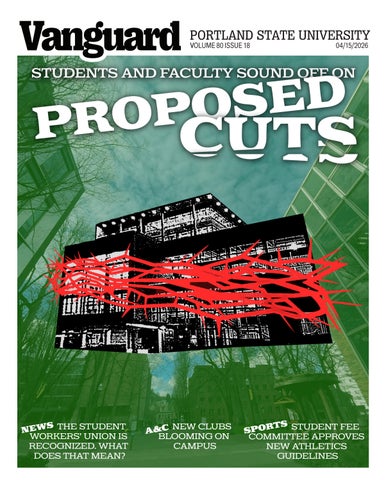
After the enactment of Article 22, both students and faculty members express frustration and confusion over the future of affected programs
Nearly 20 programs at Portland State University are at risk of reduction or elimination with the recent enactment of Article 22. Some students and faculty are not happy.
On March 9, PSU president Ann Cudd officially enacted Article 22, a portion of PSU’s collective bargaining agreement with the university’s chapter of the American Association of University Professors (PSU-AAUP). Article 22 allows the president to reduce or eliminate university departments to mitigate institutional financial stress.
The announcement to invoke Article 22 included a list of vulnerable departments. Three departments were listed as being potentially eliminated: University Studies, Conflict Resolution and Portland Center.
In addition, 10 departments were listed as at risk for reduction: Educator Licensure, Leadership, Learning, and Counseling, History, Philosophy, the School of Earth, Environment and Society, World Languages & Literatures, Criminology and Criminal Justice, Economics, Politics and Global Affairs and Public Administration.
Finally, six more departments were listed as possibly being affected if University Studies were to be eliminated: English, Physics, Sociology, Women, Gender, and Sexuality Studies, the School of Art + Art History + Design and the School of Public Health. The University did not provide additional information on how these six departments would be affected.
Cudd describes these potential eliminations and reductions as a way to “balance the budget in a
way that leads to a financially sustainable future,” according to a message published on March 9.
“...Keep in mind that nothing is changing today and, no matter what happens within your department, your pathway to graduation is protected,” wrote Cudd.
Despite the sentiment, some students are still feeling the pressure of looming cuts to their program. Students now face potential downsizing, curriculum changes, and faculty layoffs.
The possibility of faculty layoffs hits close to home for Maggie Kingman, a student in the World Languages & Literatures department, and the president of both the Korean American Student Association and the Korean Club. One of her parents was an educator, so she grew up seeing education as a vital part of society. For her, Article 22 seems like a “Get Out of Jail Free” card for PSU’s administration and those who work with them.
“It’s troublesome that people that are not involved in the campus as much can make these huge executive decisions, like which professor is better or more vital than another,” said Kingman. “...I think that’s just awful. It’s an awful ending for the school general, [and] for a lot of students out there.”
“When we lose professors, we don’t only lose people, but we lose the variety of topics that we can learn,” said Kiki McMahon, a student in the Philosophy department. McMahon is also a Student Ambassador, a position that allowed her to work closely with prospective and newly admitted students. But though she speaks highly of PSU’s Philosophy department, the threats to
the program make her hesitant to recommend it to students.
“I really, really value the Philosophy department here, and it makes me sad to think of people losing their jobs who I really think are not deserving of that,” said McMahon. “I do have really mixed feelings about recommending that people come here to study Philosophy, given that the future of the department is uncertain.”
For Kingman, languages are a vital part of life, and it should be a privilege to learn about different communities. She worries that reductions to the World Languages & Literature program may hinder students’ abilities to interact with different cultures.
“To truly grow as a person, you truly need to know about others and how to communicate with them, and [know] how you interact with different people. Whether that means a different language or visiting different places… I think to take away from that would be a disgrace, and I think it’s against the heart of PSU,” said Kingman.
Avery Wyatt, junior in the Anthropology and Urban & Public Affairs program and member of the Associated Students of PSU (ASPSU) Senate, also believes that the cuts go against school values. Specifically, Wyatt sees cuts to the School of Earth, Environment and Society as a deviation from the university’s environmental sustainability efforts.
“When we aim at being a green school, but also want to cut programs that allow students to learn about sustainability or the environment and the things that facilitate those, it’s very frustrating,” said Wyatt.
For Wyatt, Cudd’s message of graduation protection isn’t enough. They believe that PSU administration should be up front about what reductions or cuts to programs might look like, something the university has not yet shared with the public.
“There is a very strong lack of transparency… everybody sees their future as up in the air right now, regardless of degrees being secure or whatnot,” said Wyatt.
The enactment of Article 22 and the proposed cuts further highlight the disconnect between PSU administrators and the student body — labelled as the “Administrator Trust Gap” in the most recent Campus Climate Survey.
“I don’t feel like Ann Cudd in particular, and the Board of [Trustees], [are] very in touch with her student body,” said Kingman.
“Why is Article 22 the solution to the problems of enrollment and financial deficiency at PSU? Why aren’t you implementing a recovery plan to solve the problem of funding? Do you [legitimately] believe that laying off staff and programs will solve the issue, short-term and long-term?” said Quinn Vale, a student in the College of Liberal Arts and Sciences. Vale also expressed their frustrations at a recent PSUAAUP rally and march opposing these cuts.
Faculty members are also speaking out about their feelings towards potential reductions and cuts, with Tom Hastings, associate professor and undergraduate advisor for Conflict Resolutions, calling the situation “ill-advised” and “sketchy.”
Read the rest of the story online at psuvanguard.com.

The student workers’ union is recognized. What does that mean?
The Portland State Student Worker Union is one step closer to discussing bargaining contracts.
On March 16, 2026, the Portland State University Student Worker Union (PSU SWU) won its union elections with the Employee Relations Board of Oregon. PSU SWU is now officially recognized as a union by the Service Employees International Union Local 503 (SEIU 503), its parent union. They celebrated their victory on April 2, 2026, at their Union Celebration Party.
The organization has spent the past year petitioning and collecting signed Union Authorization cards from student workers in support of its formation. The confidential signatures were sent to the Employee Relations Board, and the board compared the number of signatures to the number of PSU student employees. The number of signatures exceeded the 30%-50% threshold required for the Board to allow the SWU to hold an election. Elections were held between March 4 and 15., with a majority of “yes” votes needed for the union to be recognized. On March 16, the results showed that 97.6% voted in favor of its formation.
The PSU SWU, now officially recognized as a union, gains the organizational power to influence workplace policies. Under the Public Employee Collective Bargaining Act, Oregon public employees have the right to form and join unions. Unions can engage in collective bargaining, in which union representatives negotiate with employers to increase employee benefits. This may include better wages, sick leave, and other working conditions.
Before bargaining can begin, the SWU still has some work to do. The union has some housekeeping and internal organizing to conduct, so they are fully prepared to represent their supporters. PSU SWU’s next steps are to first establish its bylaws, which are the internal rules that govern the union’s affairs. This begins with choosing the type of process system and the departments they want. The union also needs to create their bargaining team, and elect
student workers who will represent the union and its members. They plan to conduct a survey and have student workers vote on who they want on the bargaining team. These elections will also be opportunities for student workers to vote for what they want to bargain for.
For example, the union may want to increase support for international student workers. PSU SWU claims there is a lack of protection for international workers— a ccording to PSU, international students are not eligible for work study positions. Job-seeking international students without a Social Security number must attend the required in-person interviews to obtain one, which can be challenging when applying for jobs.
Primarily, the union is hoping to bargain for higher wages and more flexible hours, along with better protections for international student workers and improved work environments.
A majority of PSU SWU’s supporters want to see wages increase. However, PSU has been trying to reduce its $35 million deficit. Efforts have started with plans to cut and reduce the University Studies department, along with the Conflict Resolution Program. Budget cuts and layoffs to reduce the deficit may be an obstacle for the union advocating for higher wages and an increase in benefits.
Rhi Soto is a former student worker who voted in favor of the union formation and attended the Union Celebration Party.
“I guess it is nice to just know that there’s representation out there that are students[representing] for students,” said Soto.
Soto would also like to see wages increase alongside better working conditions. He is grateful that the union provides assistance and community for workers when management can’t.
“So if there is an issue that comes up, there’s someone they could fall back on,” said Soto.
Also in attendance at the party was Garrison Christian, a senior who formerly worked at ID Services for PSU. He supports the union
and disapproves of PSU prioritizing metrics over student success.
“Because the administration, not just our school, but at any school, is not here to look after the interest of students[success], but rather the interest of their [financial goals] bottom line,” said Christian
In line with many of SWU’s supporters, Christian wants to see wages increase. However, PSU has been trying to reduce its $35 million deficit. Efforts have started with plans to cut and reduce the University Studies department, along with the Conflict Resolution Program. Budget cuts and layoffs to reduce the deficit may be an obstacle for the union advocating for higher wages and an increase in benefits.
In an email sent on March 30, PSU President Ann Cudd announced her recognition of the Student Union.
“Student employees are vital to the daily operations of our campus and their work is a cornerstone of the student experience,” wrote Cudd. “We respect the decision of our student employees to seek collective representation and look forward to engaging in a productive, good-faith bargaining process.”
Financial disputes, budget cuts and resource availability can be sources of conflict in bargaining between unions and administrations. Christian says that such challenges can be beneficial in demonstrating to the administration that students are dissatisfied with their experience at the university.
“I welcome conflict in the sense that I think it is good for people to see that the university administration is not on their side,” said Christian.
Cudd, however, openly welcomes the PSU SWU to the table with the other unions on campus in her email.
“We welcome our newest union partners to the table as we continue the work of building a resilient future for all members of our community,” Cudd said.

Portland State’s new dog park gives new space for pet owners, but also provides relief, protection and hope for ITECK’s oak savanna restoration site
With spring weather making its way into the forecast, dog owners have been enjoying strolling around Portland State University campus. Next to the Science Research and Teaching Center lies a green space that many dog owners have frequented; however, the presence of dogs can be detrimental to its health and use. The newly opened dog park at PSU gives a new space for dog owners to use, but also adds protection for this green space to continue its goal of fostering community and knowledge.
This area is a restoration space to the Indigenous Traditional Ecological & Cultural Knowledge (ITECK) program at PSU, which centers Indigenous, land-based education. ITECK isn’t just limited to PSU; it’s a growing body of knowledge. Their practices and beliefs value being a connected relative to the land by uplifting Indigenous oral and written knowledge as equal to Western science.
“A lot of people call it walking in two worlds. If you’re Native, or belong to any other culture outside of the Western culture, you’re holding these two things because we have to exist in this capitalistic world that we live in, but also we’re carrying our identities and our cultures,” said Emma Johnson, ITECK coordinator. “[It’s the] balance of walking in those two worlds and honoring who you are and who your ancestors are and how you’ve been taught to care for the world and connect.”
At PSU, ITECK takes the form of an undergraduate certificate program. Beginning in 2022, the certificate aims to help the Portland region better understand and integrate the ITECK framework into the community. Students are able to go to sites across the Portland Metro, participate in land restoration and planting projects, while learning about the history and ecology of the community.
Before the ITECK program came to PSU, Indigenous students and other connected students wanted a space to gather that offered sanctuary and connection to the land. In around 2010, students began holding space, talking circles, seed scattering and land
blessings, while also envisioning what else they could do with the area.
“What came out of a lot of those early-day discussions and dreamings was, what if we reclaim this space to be an urban oak savanna, because that was who the Willamette Valley was in relation to the native people of this place,” said Johnson.
An oak savanna is an open, grassy landscape with widely spaced out oak trees allowing sunlight to reach native grasses and wildflowers. Oak savannas depend on ongoing stewardship, such as low-intensity cultural burning and careful tending to keep the space open and diverse.
The PSU campus used to be a combination of an oak savanna, oak woodland and prairie. These were important cultural ecosystems to Indigenous people in the region, especially for food sources. Due to colonization and farming, the ecosystems have been reduced and mostly do not exist, only maintaining a small historical range.
“The site historically also has had many lives... and so the soil has just been very altered across the different existences on site,” said Johnson.
After years of disruption on the land, the oak savanna has become a restoration project for the ITECK program, but the site has been negatively impacted by the presence of dogs, particularly from owners who walk them unleashed.
According to the City of Portland, dogs must be leashed unless they are in a designated offleash area, such as a dog park. Before the opening of the PSU dog park, the oak savanna site was seen as one, even though it never officially was.
“Off-leash dogs have been a major issue,” said Kendal Gibson, an undergrad PSU student pursuing an ITECK certificate. “I’ve personally seen dogs digging in restoration areas, urinating on native plants, log benches, the micro prairies, and even running through the class sessions and stewardship work.”
For the past year, Gibson has also been a Louis Stokes Alliance for Minority Participation (LSAMP) intern working on the ITECKinformed land stewardship and longitudinal soil study, working closely with the oak savanna site.
Due to it being a small urban restoration site,
the presence of dogs significantly impacts the health of the soil. Urine from the dogs creates concentrated hotspots that disrupt the natural balance of the soil. Other waste has also been repeatedly left in the area, and the soil is very compact from dog walking.
“Dogs and their owners also benefit from the green space, and those relationships really matter. So the issue is that some spaces have specific ecological and cultural purposes, the oak savannah is a restoration site, an outer classroom and a place of stewardship and relationship. It’s still in a fragile state, and it’s not resilient enough yet to absorb the concept of destruction,” said Gibson.
These factors have also impacted the learning space that the site brings for students. According to Gibson, some students have felt unsafe and overwhelmed by the dogs during classes. Unleashed dogs have particularly damaged some areas of the site, such as the willow dome, and there has also been resistance from dog owners about bringing their unleashed dogs to the site.
“We’ve had encounters with [dog owners], and they have clearly stated, like, ‘I don’t care,’ ‘I’m going to come here,’ ‘This is what I’m going to do,’” said Johnson.
Gibson says that these impacts are all cumulative. The soil compaction, nutrient loading and physical damage from digging and trampling overload the oak savanna and affect the restoration process.
“With all of this happening, knowing that the dog’s waste and running through the site is impacting soil health, we were trying to push for the dog park because we needed a site that we could refer people to and be like, ‘Hey, your dog’s not supposed to be off leash here, butthere’s a fence dog park just down the block,’” said Johnson.
The official PSU dog park opened in early March next to the Vernier Science Center, creating an actual space for owners to have their dogs unleashed. Due to the space being new and being muddy from past rainy weather, dog owners still visit the oak savanna site; however, there is hope that with better weather and being able to refer to an actual park, the space
will be used more routinely.
ITECK has also requested signage for the oak savanna site to guide dog owners towards the new park.
In the fall of 2026, the ITECK center will be going under renovation, fencing off the whole site and potentially allowing for further relief of the soil from dogs, and encouraging dog owners to use the new dog park more often.
“I’m super excited about even what things could look like a year and a half from today, and how many more people, I hope it brings together, and I think that everybody deserves to be connected to the place they live in,” said Johnson.
Johnson also emphasized the importance of partnerships with the ITECK program at PSU — encouraging collaboration across disciplines and coming together to work with people who have different specialties has been pivotal in ITECK’s success.
“We really want the oak savanna to be able to play its role as an oak savanna, supporting biodiversity, pollinators, native wildlife,” said Gibson. “…really use that space to serve as an outdoor classroom and a place for cultural learning, ceremony and community connection.”

EMBER GULDEN

As Portland State University faces budget and department reductions, the Athletics department has been collaborating with the Student Fee Committee (SFC) to determine new funding guidelines. Finalized on April 2, 2026, the newly agreed-upon formula, as outlined in Attachment VIII of the SFC Guidelines, is 15% of the final Student Incidental Fee (SIF) revenue collected in the prior fiscal year.
The SFC, a branch of the Associated Students of PSU (ASPSU), is responsible for the financial oversight of student fees allocated to campus services and programs. The SIF, one of the mandatory fees students must pay each term, partially or fully funds Fee-Funded Areas (FFAs), such as Athletics, Vanguard and the PSU Smallwood Food Pantry. As of 2026, the SIF is $374 per term.
Due to Athletics being a unique entity, the guidelines for its funding differ from those of other FFAs. The regulations in place around Athletics and their ability to spend money are not always in their control, such as travel costs going up and down, unexpected fees like uniform changes, and so on. The unique need to strategize for unexpected costs, as well as the ones they know they need to plan for, is one of the key things that sets Athletics apart from other FFAs.
“There hasn’t been the framework or infrastructure put in place for Athletics previously,” said Tom Thake, the SFC chair. “A lot of what we’re trying to do is build a framework so that Athletics has a way of communicating with the committee. That also then influences the avenues for funding and room for adjustments in funding.”
While this specific process has been in the works for roughly two months, the discussion around Athletics’ guidelines pertaining to the SFC dates back longer.
“I would say this has been going on even longer than [since 2023-24],” said Thake. “A prior committee tried to set up some kind of rules, but it wasn’t a binding document. That led to further miscommunications. Last year’s
committee, of which there’s currently no rollover of prior members, made the first potent change to the previous funding mechanism.”
The original formula was based primarily on the total enrollment of students. Over the past few years, PSU’s enrollment has declined, which has directly impacted how much funding Athletics receives. In fiscal year (FY) 2025, fall enrollment was 17,582, and in FY26, that number dropped to 16,405.
Defined in 2024, the original formula was as follows:
the liaison between the SFC and the Athletics department, Carey has helped oversee the guidelines changes for the Athletics department, offering input on behalf of PSU President Ann Cudd and the university. Moreover, Carey represents PSU Athletics in conference and NCAA matters, maintaining an equilibrium between academics and intercollegiate athletics.
“We’re in the bottom 15% of all funding for Division 1 institutions,” said Carey. “The original formula was put together with really good intentions, but was so heavily weighted to enrollment that the Athletics’ share [of the SIF] has disproportionately decreased.”
The SFC’s process of determining the SIF works from the bottom up, meaning the budget scenarios are based on the SFC’s goals for the SIF. Allocations for FFAs are based on the SFC’s funding philosophies, meaning the SFC evaluates all the FFAs and how well they speak to the different processes the committee wants to see. With the new formula designating 15% of the final SIF revenue collected in the prior fiscal year, the funds Athletics receive are more consistent.
“Based on that, you get your budget allocated,” said Thake. “This percentage change is more so to reflect that there is going to be a bit of a lag. Since we’re using the prior year’s incidental fee revenue, which is the most known number that we can offer, it means that their FY28 budget now is going to be based on FY26’s revenue numbers. There’s room for planning, basically.”
Christopher Carey, an Associate Professor in the Department of Criminology and Criminal Justice at PSU, serves as the Faculty Athletics Representative for the Vikings. Working as
The process for determining a new formula and the amount of funding Athletics receives has had a lot of push and pull from both Athletics and the SFC as they worked together to find a compromise. Athletics typically wants more funding, though the SFC has a limited amount of what can be provided. The new guidelines document for Athletics begins by acknowledging the necessity for a different funding mechanism because of the way Athletics operates, followed by recognizing that the SFC is not the only funder of Athletics.
“Athletics gets funding from different sources,” said Carey. “But let’s make no mistake: the most important source of funding is from the Student Fee Committee. SFC funding is probably the most important, and it should be, right? Because this is part of the university -–we’re supporting student athletes.”
Other sources of funding for Athletics include some from a “small reserve funding,” as described by Carey, that is depleting every year. The Athletics department also receives money from revenue streams such as fundraising and donors, ticket sales, the NCAA and Big Sky conference, among others. However, the majority comes from the SFC and the SIF.
Another change to the guidelines is the specific recognition of the Intercollegiate Athletics Board (IAB), which serves as the advisory board for the athletic department.
Per the Faculty Senate Constitution, the IAB is required to include three students nominated by the ASPSU. The SFC will delegate its representatives as an SFC liaison, a student senator, and the Student Athlete Advisory Committee (SAAC) President or their designee. Although the SFC can’t require the SAAC to participate, the wording in the guidelines is intentional to leave the spot available for them. It specifies that if they don’t participate, the SFC will find an ASPSU senator to fill that position. Budget allocation and submission is similar to other FFAs, but with one caveat. For other FFAs, a Five-Year Plan is required, detailing projected growth and strategic initiatives. This plan needs to include cost forecasts, evidence of support and impact on reporting units, an assessment of campus needs and the planned support and benefits for students. For the Athletics department, they are required to submit a Strategic Plan, which differs slightly.
“Since Athletics has a faculty senate committee, they don’t have a five-year plan,” said Thake. “Five-year plans are pretty fluid in the sense that you make a five-year plan every year, whereas a strategic plan is in the frame of five years, but you make it five years at a time.’”
The main theme of the guideline changes, besides the budget allocation and the way the number is calculated, is an increased focus on communication between the SFC and Athletics. Not only are there many items the Athletics department needs to relay to the SFC, but both organizations are complex and have complicated systems in place. The new guidelines for Athletics are an attempt to bridge that gap.
“The attempt [from Athletics] was to try to get the information that SFC wanted: student satisfaction,” said Carey. “How do you measure success? How do you get those metrics that are in line with the philosophy of the SFC, which are also very consistent with Athletics’ philosophies and the President’s philosophies for the growth of the university? That’s what we’re trying to answer with these new guidelines.”
A
CAYLEN BAUGH
With the new clubs that have been sprouting this term, including the Furry club and the Line Dancing club, this spring at Portland State University is opening new doors for students to express themselves.
PSU’s Furry club has been re-established by former members of the club, like Jonah Bloom. Jonah Bloom is a post-bachelor’s student at PSU, who is starting the second year of their graduate program this fall. They’re majoring in electrical engineering and hope to find time to also study music.
“My motivation for helping to get this club started up was sort of an accident. A few [club members] wound up in the previous Furry club’s Discord server, and… had an impromptu meetup. We realized that there was an interest in starting up something of the sort again, and went about figuring how to do so,” wrote Bloom.
The Furry club is currently meeting on Mondays at noon in the Engineering building’s atrium, beginning Monday, March 30. They’re also meeting on Thursday evenings, with plans of creating a community over video or board games and tabletop role-playing games (TTRPG).
to about 35 attendees. They taught dances to “A Bar Song (Tipsy)” by Shaboozey and “Cowboy Up” by Jill Johnson. Throughout the lessons, they introduced the concepts of a tag and restarts that come up throughout line dances.
Ruby Bushman is a freshman undergraduate at PSU majoring in psychology, with an interdisciplinary neuroscience minor. Having had difficulty finding dance communities and line
and sometimes a group from Reed. Besides that, it’s mostly people who are out of college or just older. It would be kind of fun to go storm Norse Hall together.”
Ruby McQueen, an undergraduate freshman at PSU majoring in environmental studies, has been line dancing for a while and wanted to share her interest with more people.

dancing events in Portland, it became important to them to create a community within PSU.
“I’ve been line dancing for over a year in my hometown, Corvallis. I loved it there; it was really hard to find places in Portland, they’re usually 21+. I wanted to start the club because I got [my friends] into line dancing, and that was really fun, so I thought other people would like it too,” said McQueen. “Hopefully, it will be a good welcoming atmosphere for everyone. I know some line dancing places are intimidating or not the vibe for people who would like to try it out. I’m hoping everyone who wants to try it out can here, and it’s just an accessible place for people.”

As mainstream music evolves, emergent genres find themselves increasingly populated by formulaic nothingburgers — vapid productions that pantomime successful hits, leeching the authenticity out of the contemporary scene. During the 2010s, we saw a multitude of popular albums redefine what was stylistically popular, challenging the trends of their time. There’s a silver lining to these synthetic, bulkproduced albums: the acclaim and recognition of the well-executed, ambitious project is elevated — and no artist challenged stagnant inner narratives and systemic preconceptions as uniquely as Kendrick Lamar.
“Good kid, m.A.A.d city” re-popularized the discourse of conscious-gangsta rap, masterfully employing what I would call a Trojan-horse technique. Kendrick creates a challenging — but still culturally relevant, as his undeniable popularity and accreditation will show — story of the cyclical nature of gang violence and its consequences on surrounding communities and their populations.
Though events are still in the planning stages, Bloom has big plans for the club’s future.
“We have more plans for the future, but we don’t want to overpromise. I will mention that a plan we are pursuing for next year… is going to be hosting a smallscale furry convention in the Ballroom,” said Bloom.
Unlike the Furry Club, the Line Dancing club is a first of its kind on campus. The first meeting was held in room 450 of the Recreation Center on Thursday, April 2, at 7:30 p.m. The leaders of the new club, two of them being Ruby Bushman and Ruby McQueen, helped teach two dances
“I had been wanting to go line dancing for a really long time; I just hadn’t had someone to go with or an event to go to,” said Bushman.
Having found people at PSU who enjoyed line dancing, the club founders worked to create their own venue and create a bigger community of people interested in line dancing.
“I wasn’t expecting to have such a big turnout, but it definitely seems like this is something that a lot of people are interested in. It would be really fun to, all as PSU students, go storm our usual line dancing events,” said Bushman. “Normally, it’s just our PSU group and a group from Lewis and Clark sometimes,
Having gathered the attention of both people who showed up in their cowboy attire, as well as those in combat boots or tennis shoes, the Line Dancing club had a wide variety of interests. The first meeting created a diverse community of experienced line dancers and many new to line dancing, achieving the goal of introducing new people to the style. The club welcomes people to the meetings to learn new dances and practice the ones previously learned, like “Tipsy” or “Cowboy Up”.
These new clubs are an important part of the ever-growing and diverse community of Portland State. The creation of new clubs and existing clubs is important for many to find a community that shares their interests and, therefore, makes it easier to harness support throughout the college experience.
To call it a story isn’t a lexical oversight; the album is a coming-of-age story, and it’s based on true events. The album follows a single day in K. Dot’s life, using flashback-like shifts to move around time. It doesn’t just create an auditory landscape; Kendrick’s masterful lyricism draws a mental map of Compton.
Kendrick uses a masterfully executed, highly effective strategy, instrumentalizing his rhetoric through narrative and sound to provide a compelling, easy-toaccess gateway for a wide variety of demographics — including those who may otherwise remain ignorant of the cultural challenges he expounds. Kendrick’s international audience and ubiquitous acclaim are a testament to his reach and widespread impact.
This article serves as more of a contextual backdrop to the album. A cursory overview, and hopefully a call to action. If you haven’t already, give the album a try. If you have, give it another. I’m sure you’ll find more nuance if you dig deep enough.
Truly, it's the contemporary hallmark of a beautiful, nuanced album to be cast under the unsympathetic gleam of the sodium lights in the Target clearance section.