![]()


EDITORIAL
EDITOR IN CHIEF
Noah Carandanis
MANAGING EDITOR
Olivia Hendry
NEWS EDITOR
Grace Peterson
Will Lowe
ARTS & CULTURE
Adyan Hussein
OPINION
Vacant
MULTIMEDIA
Nash Bennett
SOCIAL MEDIA
Liam Schmitt
COPY CHIEF
Jude Callaway
ONLINE EDITOR
Karli Schwartz
DISTRIBUTION MANAGER
Caleb Dougherty
CONTRIBUTORS
Daniela Hernandez
Maryam Luqman
Hayden Neumann
Madi Reed
Trinity Waite
PRODUCTION & DESIGN
CREATIVE DIRECTOR
Haley Hsu
CONTRIBUTORS
Naue Pagtakhan
Dexter Delaski
Arielle Chhunkeo
ADVISING & ACCOUNTING COORDINATOR OF STUDENT MEDIA
Reaz Mahmood
SALP ACCOUNTANT
Vacant
STUDENT MEDIA TECH ADVISOR
Rae Fickle
STUDENT MEDIA TECH DEVELOPER
Kaylee Hynes
WEB DESIGNER
Owen Cook
To contact Portland State Vanguard, email editor@psuvanguard.com.
MISSION STATEMENT
PSU Vanguard’s mission is to serve the Portland State community with timely, accurate, comprehensive and critical content while upholding high journalistic standards. In the process, we aim to enrich our staff with quality, hands on journalism education and a number of skills highly valued in today’s job market.
ABOUT
Vanguard, established in 1946, is published weekly as an independent student newspaper governed by the PSU Student Media Board. Views and editorial content expressed herein are those of the staff, contributors and readers and do not necessarily represent the PSU student body, faculty, staff or administration. Find us online at psuvanguard.com.

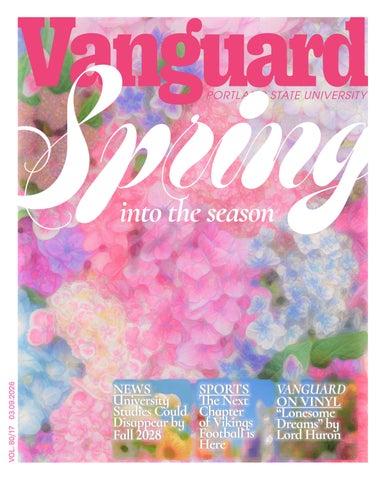
A list of activities to do in Portland over spring break
As Portland State University’s winter term comes to an end and spring break approaches, students who are staying on campus may be looking for activities to fill the time before the spring term starts. Vanguard has provided a list of inexpensive events and activities for students who want to fill their free time during the break.
With discounted tickets for college students, you can get into the Portland Art Museum for only $22.50 with a valid student ID. Hosting several events throughout March, the museum is only around a ten-minute walk from PSU.
One of the events active at the Portland Art Museum, “David Hockney: Works from the Collections of Jordan D. Schnitzer and His Family Foundation,” is the largest exhibit of David Hockney’s work in North America. Hockney is a British artist who’s been called a “defining [figure] of the British pop art movement,” according to the Richard Gray Gallery.
“Included are his iconic subjects and series—California swimming pools, the monumental Yosemite, and British landscapes in full bloom, as well as intimate portrayals of friends, family, and queer desire,” according to the Portland Art Museum
Another exhibit open over spring break is “Rick Bartow: Storyteller.” Rick Bartow was an Indigenous artist and “member of the Mad River Band of Wiyot Indians,” according to his website . This exhibit shows Bartow’s paintings, mixed media sculptures and music. Additionally, there will be short film showings of Bartow’s life and influence in his communities, put on by the Bartow Trusts.
“Bartow’s gift as a visual storyteller takes us on a narrative journey: his self-portraits tell stories of pain, memory, and self-discovery; others reflect on his Wiyot identity, Native history and culture; and his portrayals of beings who walk on four legs, swim, or fly deftly capture their essence,” said the Portland Art Museum on its website
If hiking on a trail isn’t your style, there are still ways in Portland to enjoy nature. Tickets to the Portland Japanese Gardens are available to students with an ID for $18.50 and are open Monday through Wednesday from 10 a.m. to 3 p.m.
Throughout March, the Japanese Gardens hosts demonstrations and performances, many of which come with a general admission ticket. The gardens are accompanied by art exhibits that feature different types of Japanese art and artists. Their Pavilion Gallery is
open Monday to Wednesday, 9 a.m. to 4:30 p.m., and their Tanabe & Living Room Gallery opens just one hour earlier.
Another nature walk to go on is down at the waterfront. Towards the north of Governor Tom McCall Waterfront Park, there are 100 cherry trees that start to blossom in late March. The cherry trees, which were donated to Portland by the Japanese Grain Traders Import Association, are a part of the Japanese American Historical Plaza.
“The Japanese American Historical Plaza and Bill of Rights Memorial was created to raise greater public awareness about the Japanese American experience as well as promote a deep appreciation of the freedoms granted to all Americans by their Bill of Rights,” states the Japanese American Museum of Oregon
Whether just to walk around the park and see the blossoms, or to sit under the trees for a time, they’ll bloom from the end of March to mid-April. The cherry blossom trees are a great place to take in the outdoors and appreciate the beauty of Portland.
The start of spring and improving weather means that the trails around Portland will be healthy and beautiful again. There are many parks and trailheads close to Portland State University’s campus that are easily accessible through public transportation, and are free to use.
South of PSU is Towhee Trail, a three-mile hike that’s ranked as being of moderate difficulty according to AllTrails, a website and app that provides basic information on trails. It’s kid and pet-friendly, though pets are required to be on leashes. This hike is estimated to take around two hours.
Also nearby is the Wildwood Trail and Lower Macleay Trail Loop, a 3.3-mile hike that’s paved for half a mile, making it easier to access for those in wheelchairs or with strollers. Much like Towhee Trail, this route is kid and pet-friendly, as long as pets are on leashes. It also has free parking. Wildwood and the Lower Macleay Trail Loop are classified as moderate, but some reviews label it as an easy hike. The Stone House — nicknamed the Witches Castle — can be found on this trail. The structure is over a hundred years old and is a hot spot for graffiti artists.
If just hiking is boring to you, there are other means of entertainment. You can make plant identification bingo cards, physically or on your phone, to use while you hike. Portland has many native plants, with a full list available on Portland’s website.
For those interested in exploring the city as a whole, the 4T Trail Loop takes you throughout Portland by way of different modes of transportation: trail, tram, trolley and train. The loop takes you
around downtown Portland and up through the hills to the Oregon Zoo. The map of the loop is available on its website
Many more trails around Portland can be found through AllTrails or any other maps app. Before hiking, make sure you have snacks, water and a map. Remember to take care of the trails while you hike, and leave them better than you found them.
The Oregon Historical Society has several exhibits open throughout March. It’s $12 for students with a valid ID, or for Multnomah County residents with proof of residency. It’s open Monday through Saturday, from 10 a.m. to 5 p.m., and Sunday from 12 p.m. to 5 p.m.
It has three permanent exhibits, “Rivers, Roses, and Rip City: The Remarkable History of Portland,” “History Hub” and “Experience Oregon.” All three exhibits focus on what makes Portland the city we know and what makes Oregon unique. While “History Hub” is targeted towards children, they’re all family-friendly and disability accessible.
In addition, OHS currently hosts four temporary exhibits. Of the temporary exhibits at OHS, only one is closing this March, titled, “‘We Were All Living a Dream’: Reflections on TwentiethCentury Lesbian Feminism through the Photography of Donna Pollach.” Its last day open will be March 29.
This exhibit showcases the work of photographer Donna Pollach, who photographed the community she found among Portland’s lesbians throughout the 1970s.
“She captured intimate moments among women as they worked together to deconstruct and redefine conventional ideas and expectations of womanhood, family, motherhood, and relationships,” states OHS’s online exhibit
Another temporary exhibit is titled “101 at 100: The History of Oregon’s Most Iconic Highway,” which talks about the history of the Oregon section of Highway 101. It discusses the economic, agricultural and societal benefits that the highway has had. Its partner exhibit “From Highway 101: Images of Oregon’s Most Iconic Highway,” provides modern photos of Highway 101.
Finally, “The Yasui Family: An American Story” explores the history of Japanese Americans in Oregon. It discusses mass immigration of the late 1800s and early 1900s, Japanese incarceration and the racism they faced upon their arrival to America.
“While the Yasui family endured racism and incarceration, they also shared a commitment to equal justice through engagement with the local, state, and national forces that determined — and withheld — their civil rights,” OHS said on their website
GRACE PETERSON
For Joseph Bull, who holds a Ph.D. in mechanical engineering, 2026 marks his fourth year as the H. Chik M. Erzurumlu Dean of the Maseeh College of Engineering and Computer Science at Portland State University. He received his Ph.D. from Northwestern University. Bull now serves as the country’s first Indigenous Dean of Engineering. It was a long road to get where he is today.
Bull teaches biomechanics, biofluid mechanics, physiology, bio transport and more. His faculty journey began at the University of Michigan, where he had a professorship. After 16 years there, he moved to Tulane University, where he worked for six years. While at Tulane, he was a professor, Department Chair and eventually the Associate Dean.
While teaching, he was also a researcher. During his time at Tulane University and the University of Michigan, Bull studied the use of bioflow mechanics and therapeutic ultrasounds to cure diseases and selectively deliver drugs.
“My lab developed an approach that nobody else was doing at the time,” Bull said. “The ultimate goal is to be able to help somebody you know, to learn a lot of things, but to ultimately be able to do that in a way that makes somebody’s life better.”
After over 20 years of teaching and researching, Bull decided to pursue a new direction.
“I really liked research, but I liked the aspect of working with students and training students about how to do research,” Bull said. “The fun part was their successes. So I felt like, ‘Yeah, I do want to be a dean.’”
Tulane University was not looking for a new dean at the time, so Bull had to look elsewhere. Bull is an enrolled member of the Delaware Tribe of Indians, and wanted to go somewhere with a large Indigenous community. As an outdoorsy individual, he also wanted access to the wilderness. His wife is a physician and had some of her training at Oregon Health & Science University, so PSU was seen as a good option.
“We were pretty familiar with Portland, and really like Portland,” Bull said. “There is a large urban Indian population in Portland, and that was really appealing to me. I wanted to be someplace where there was a tribal community and Native American students and things like that.”
PSU is the only Oregon college to offer a major in Indigenous Nations and Native American Studies. The Native American Student and Community Center (NASCC) is located on campus, and provides cultural, communal and academic support for Indigenous students.
Bull enjoyed his time at the University of Michigan and Tulane University, but was really excited to join Portland State’s team. He related to much of PSU’s demographics as a first-generation college graduate and a minority.
Tim Anderson, who holds a Ph.D. in industrial engineering, first heard about Bull when he applied for the dean position at PSU. Anderson is the Department Chair of the Engineering and Technology Management Department, and is one of the few Engineering Department Chairs in the United States to be a member of a Native American tribe. At the time of Bull’s application, there were no Indigenous Engineering Deans in the country.
“I knew at the time that it would be an incredible fit if he were to join PSU,” Anderson recalled. “With our strong native community on campus and in the regional area in the urban setting of Portland State, the fact that he brings tremendous research and background and strength and rigor there, as well as being so personable and easy going.”
In August 2022, Bull made history as the first Indigenous Dean of an engineering school in the country. Despite his position, he

stays true to his roots — Bull can often be found at local events, and his entire office is decorated with Indigenous art, done by his friends and spouse.
“[I’m] very vested in creativity, in art coupled with STEM [science, technology, engineering, and mathematics],” Bull said. “[And] we have a great pow wow at PSU.”
Since joining PSU, he’s put a direct effort into bringing inclusivity to engineering.
“In terms of things that you might think about as traditional Indigenous world views, [to] incorporate them a bit more … into [the] way we see the world, and the way we do education, I think, makes it better for everybody,” Bull said. “We care about what’s the impact on the world, and how do we be a good relative?”
Bull believes that STEM and humanity go together. According to him, STEM education often enforces the stereotype that there is only one right answer, which is why he says that humanity and humility are important factors in solving real-world problems.
“It sometimes comes down to, well, you make the best decision based on the information you have now and what you’re trying to accomplish now,” Bull said. “How does it impact the things we value…how does it impact people?”
Bull recognizes that there aren’t many Indigenous People in engineering, and says there is a lack of representation for Indigenous People in academia. He also recognizes that other minority groups remain underrepresented.
“[That] speaks to some of the things that are important to me,” Bull said. “How do we make the discipline more inclusive and more accessible to folks? It’s not really about a deficit mentality. It’s really about asset mentality.”
Bull proposed a visual: Imagine if someone has a team project, and wanted the best solution. They would want a diverse team, with different experiences, backgrounds and skills to have the greatest impact. Bull said that diversity is more than just a moral
obligation; it’s an outcome-focused perspective.
“There’s research that shows that the diversity of team members matters more than the team members’ ability in terms of innovative solutions and productivity, which is really cool,” Bull said. “It sort of reinforces the idea that for good, there are moral and ethical reasons why you would want diversity in teams, and those are all really important.”
In his day-to-day as a dean, Bull usually answers emails and talks in meetings. However, he tries to stay grounded in the community as much as possible, visiting the NASCC and hosting lesson observations with students a few times a year. He enjoys the pow-wows at PSU, is a devout supporter of the American Indian Science and Engineering Society, and is on the board of directors for Oregon MESA and Society for Advancement of Chicanos/ Hispanics & Native Americans in Science.
“I’m always happy to talk with students, so that’s one of the fun, funnest things about this job,” Bull remarked.
Anderson said that people are often drawn to Bull’s charm and realism.
“I’ve had some of his old students…and they came back, and they were talking about what it was like working with him.” Anderson said. “It really highlights … the authenticity of his leadership and personal nature.”
Bull said that, from his perspective, humanities and engineering are very intertwined, but it can be easy to get lost in one of the other, as they are not commonly seen as connected. He claims you can’t have one without the other, that they balance each other out.
“It kind of comes back to that idea of, well, you want to be a good relative, you want to be a good ancestor, you want to do things that are intellectually stimulating, but at the end of the day, are impactful and how they benefit people,” Bull said. “And that, to me, really brings in humanity.”

Intersectionality, Critical Analysis and Practical Experience are at the Forefront of the WGSS Department
GRACE PETERSON
The Women, Gender, and Sexuality Studies Department (WGSS) at Portland State University is celebrating 50 years. What started as a Women’s Studies certificate has grown into an intersectional, multi-disciplinary program that seeks to prepare students for a range of careers and daily social interactions.
Miriam Abelson is a professor at PSU and the Chair of the WGSS department. She got her PhD in Sociology at the University of Oregon, along with a graduate certificate in Women’s and Gender Studies. She said she’s always been very interested and impacted by gender, and working for this department at PSU is a “dream job.”
“Some people go ‘Women’s Studies is kind of outdated,’” Abelson said. “There are some things going on right now that we see in the news every day that tell me that Women’s Studies is still pretty important. But our field isn’t just focused on women. It’s focused on gender and sexuality more broadly.”
The Portland State WGSS department emerged in the 1970s as a result of staff, faculty and student activism. It began as a Women’s Studies certificate, but has since grown into its own department and now includes majors and minors in WGSS and Queer Studies. The spring of 2026 will mark the 50th anniversary of when PSU’s Women’s Studies was officially approved and recognized as a certificate by the Oregon State Board of Higher Education.
Renea Perry is a PSU alum and professor, and they’re also an enrolled member of the Central Council of Tlingit Haida Indians of Alaska. They say the WGSS has a lot of valuable intersectional overlap with other fields and brings in their Indigenous experience to add underrepresented voices to their classes.
“[The department is] uplifting that we’re not a monolith. There’s many pieces to who we are, and so bringing in the Indigenous parts of ourselves is really critical,” said Perry. “Women have a lot of leadership. They’ve always had a lot of leadership roles, and TwoSpirit and queer people … so bringing those to the forefront is really important.”
With a major or minor in WGSS, students can learn to develop critical analysis of the world around them, along with reading carefully, writing, researching and developing public speaking skills. WGSS also teaches career readiness. Students who graduate with this degree often go into social work, counseling, public policy, politics and more. Abelson added that many go to law school, medical school, work in the county or even become successful entrepreneurs.
“Our students deeply understand the different things that shape…our societies and how people interact with each other,” said Abelson. “This is a value in Portland and in Oregon, of working with diverse groups of people, and our graduates know how to do that.”
There’s also a requirement for practicums, which are internships that allow students to apply their skills directly to the workforce for a variety of skills, fields and interests. The department has long-term partnerships with many organizations, including the PSU Queer Resource Center and the Rose Haven Day Shelter and Community Center, but also welcomes new opportunities — such as a student interning at the Sports Bra.
Abelson says part of what makes the department so unique at PSU is the professors. It’s a smaller department, offering a range of topics. Consequently, the affiliate faculty have different specialties — including queer his-
tory, English, philosophy, political science, race and ethnic studies, biology, education and more. This allows the department to promote intersectional learning and support the many facets of an interconnected discipline.
While the major is very small at PSU, the minor is popular. Many students take WGSS classes as part of the General Education requirements.
“When folks take our classes, I think that they just learn more about the world, but then they learn they’re always going to learn something about themselves, too, that they didn’t know before. I mean, I think when I teach, I leaarn something new about myself every time,” Abelson said.
Perry agrees with Abelson, and thinks that the department teaches more than just General Education.
“We want people to build self-awareness, to unpack who they’ve been told that they are, and to grow their authentic selves,” Perry said.
Abelson says that it’s important for everyone of all backgrounds to take these classes, regardless of a student’s major. According to her, WGSS provides a unique perspective that advances one’s understanding of the world around them.
“I think our classes can give an important lens [on] how to do that,” Abelson said. “We’re learning what this lens does. You don’t have to agree with it. You don’t have to change anything about yourself. But you’re just learning, ‘what does this perspective tell us?’”
There is a widespread trend of colleges downsizing or cutting their liberal arts departments. Across the nation, many universities are reducing or consolidating their WGSS programs. The University of Oregon and Southern Oregon University are both struggling with major budget gaps and reevaluating academic programs. This leaves
their WGSS departments facing severe restructuring and faculty layoffs. PSU, while facing fiscal hardship, has not announced reducing its WGSS department.
The department has more concerns than budgetary problems. The state of the nation has recently brought a lot of backlash to the major. A range of policy changes and events have brought tension within the WGSS department. The events include Roe v. Wade being overturned and the reduction of Diversity, Equity and Inclusion (DEI) policies, along with recent threats of eliminating the Women’s Bureau at the Department of Labor.
“We’re seeing a real backlash in this moment, against the things that we study and [against the things] we try to understand in Women’s Studies and Gender Studies,” Abelson said. “I almost wish… that I lived in a world [where the] work that we do in this department wasn’t necessary. But I don’t think that’s happening in my lifetime.”
Perry shared that now is a critical time to study WGSS, along with Race and Ethnic Studies, like Indigenous Nations Studies and Black Studies.
“We have the privilege here at PSU and in Oregon to be having these conversations in our classrooms, but also in our personal lives and in public,” Perry said. “So we are.”
Despite the current socioeconomic events, Abelson and Perry are both hopeful and excited for the continuation of the department and ready for another 50 years of development.
“I think, with challenging the status quo, with not only thinking about ‘how do we make the world better?’ ‘How do we make the institution better?’ ‘How do we treat people in a better way?’ I think that is where we can grow, I think we can expand,” said Abelson.

Introducing the new staff of Portland State University football program and their vision
HAYDEN NEUMANN
The Portland State University football team is ushering in a new era, one that the program hopes will transform the team’s identity and perception. With a completely new coaching staff, the Vikings are gearing up for their 2026 season, set to begin in August.
On Nov. 22, 2025, Matt Billings, PSU’s Director of Athletics, announced that football head coach Bruce Barnum and his coaching staff had been relieved of their duties. Before his departure, Barnum had been at PSU for 15 years, starting as the program’s offensive coordinator in 2010 before transitioning to head coach in 2015.
In Barnum’s first season as head coach, the Vikings posted a 9-3 record and a top-10 conference ranking, but Barnum was unable to replicate that success going forward. In 2016 and 2017, the team posted a 3-8 and 0-11 record, respectively. In the most recent season, Barnum’s last, the team had a 1-11 record.
On Dec. 12, 2025, Chris Fisk was named the new head coach. Fisk comes to PSU from Central Washington University (CWU), where he posted a 48-22 record in seven seasons, leading the program to the NCAA Division II playoffs the last three seasons and earning Region IV Coach of the Year in 2025.
“One of the big things I want to bring to the Portland State football program is pride in our football team,” said Fisk. “This is Oregon’s FCS [football championship subdivision] team–everyone in the state of Oregon should take a lot of pride in the Viks and get out here and support the team. I’m really looking forward to seeing these guys get going on the field.”
When it came to his staff, Fisk was very intentional with who he brought in. Over the course of January and February, he an-
nounced his newly hired coaching staff, concluding with his support staff on Feb. 10.
“They’re all great role models for our young men,” said Fisk. “We’ve got a process they all believe in. Almost every single guy on our staff I’ve coached with or have coached personally. If I haven’t, they have a tie-in with someone who can provide great character references, to make sure we’re bringing in the right type of character to the program.”
One of those brought in by Fisk was Grant Torgerson, who was appointed as Associate Head Coach and Defensive Coordinator. Fisk coached Torgerson at Southern Oregon University in 2011 before leaving for CWU in 2016. Torgerson followed Fisk to CWU in 2018, joining as a graduate assistant on the team’s defensive staff before moving into a full-time position coaching their defensive line in 2023.
The PSU football team’s rebuild is fueled by the vision the coaches and staff bring to the program, emphasizing process over outcome. Torgerson specifically highlighted the importance of “going 1-0 every day with everything you do,” prioritizing hard work and dedication to every teammate.
“We have a saying: the more love, honor, or respect, the greater the team,” said Torgerson. “We’re excited to bring that to Portland State and rebuild this football team and rebuild this culture. We’re really excited about that.”
The new staff is tasked with rebuilding both the program and its culture from the ground up. Last season, game attendance numbers averaged roughly 1,551 fans per game at Hillsboro Stadium in Hillsboro, Oregon, according to 2025 NCAA STATS Polls. In 2000, the attendees per game at Hillsboro Stadium averaged roughly 6,718.
“We were good,” said Football General Manager Rashad Floyd. “When I played here, we were good. We had a great football team, we had a great culture. We had a ton of support from the community. We packed the stands, we played exciting football.”
Floyd, a 2001 PSU graduate, played college football for the Vikings. He returned to the Park Blocks this year as the program’s new General Manager.
An Award-winning filmmaker, producer and director, Floyd has had a highly accomplished career on and off the field. Following his graduation, he played professionally for the Orlando Predators (2002-2003) and Colorado Crush (2004-2008) in the Arena Football League.
In 2009, Floyd founded Heart & Hustle Productions, a creative studio dedicated to crafting visually compelling marketing campaigns, branded content and sports documentaries. Over the years, he has worked alongside several brands and teams, including, but not limited to, Nike, Red Bull, New York Liberty, Las Vegas Raiders, Seattle Mariners, and leagues such as the NFL and NBA. He brings his extensive experience in sports branding and marketing back with him to Portland State in an effort to help revitalize the program.
“I’ve always used sports as a vehicle for storytelling, for growth, for change,” said Floyd. “I want to rewrite our narrative. I want people to know the names and stories and blood, sweat and tears our athletes and coaches are putting into making our program respectable again.”
Reintroducing the team to Portland and PSU presents unique challenges and opportunities to the football staff. Fisk, Torgerson and the rest of the staff plan to shift the culture within the team and create strong, resilient men on and off the field. On National
for the team’s future
Football Signing Day, Feb. 4, 2026, Fisk added 42 newcomers to the team, with more signings expected throughout the spring.
“It’s too early to give names of specific players to watch, as we haven’t had a practice yet,” said Fisk. “But we’ve been able to watch these guys running drills. We’ve been very impressed with how hungry they are to change both the outcomes of the game and the competitiveness of what we play in the Big Sky Level.”
Behind the scenes, Floyd is working hard on the organization’s branding, marketing and business aspects. A big focus is Name Image and Likeness (NIL), in which student athletes may earn compensation for their personal brand. Floyd’s approach is to “revolutionize the NIL era” by creating an NIL model that encompasses the whole athlete and taps into the Portland market.
“Our kids should be graduating with so much professional experience and a large professional network,” said Floyd. “A lot of athletes have a hard time transitioning into another identity outside of just being an athlete, so this is an opportunity to use football as a vehicle to help build a legacy for our athletes. When you’re 19, 20, 21 years old, and you’re here because of football, it’s hard to see anything else. But football is just a vehicle. It’s not a destination.”
The Vikings’ 2026 football season starts at home on Aug. 29, 2026, and will run through Nov. 21, 2026. The new season and staff allow the program to rewrite its narrative and create a new culture surrounding the team.
“Let go of the past and offer up your support for the future,” said Fisk. “Help us. Show support for these guys and how hard they’re working to try and bring some pride back to this program for the university, and for the city.”
effects
In 1994, Portland State University created University Studies (UNST) and the University Honors College Department as part of its General Education Program. This program was developed by teachers, mentors and community members to prepare students for career readiness, and the Honors department is designed for students of any pathway, aiming to provide them with the skills needed to succeed in the workforce. According to PSU’s University Studies program learning goals, they aim to expand students' communication and critical thinking skills while teaching diversity, equity, social change, ethics, agency and community.
UNST could be coming to an end. PSU’s management team is considering adjusting General Education to streamline education and cut costs.
On May 3, 2025, the Task Force for the General Education program stated that, at the beginning of the Winter 2025 term, a review of the General Education Program at PSU would be conducted. They aimed to review the program's strengths and weaknesses to understand how to meet the needs of the PSU student body. Then, at the end of Jan. 2026, the Executive Summary of the White Paper was released, detailing the proposed improvement plan for the University Studies Department.
As UNST is unique to Portland State’s education system, it provides unique challenges for students. For students transferring out of PSU, UNST credits do not count for general education credits at other universities. There is also disagreement regarding the different requirements for Freshman Inquiry (FRINQ), Sophomore Inquiry (SINQ), Junior Cluster and Race and Ethnic Relations (RESR) classes. Students need to take three terms of FRINQ, but only two terms of SINQ, and some non-major requirements can double-dip with major requirements, while others can’t. There’s also a difference in credits for the undergraduate Bachelor of Science and Bachelor of Arts.
“University Studies has been under attack since it came into existence, because change is hard, and institutional change is particularly challenging and educational institutional change is also particularly challenging,” said Sonja Taylor, the director of Senior Inquiry and a senator for the
Faculty Senate at PSU. Taylor stands as the faculty lead for the Portland Scholars Program. Her main focus is to build a bridge from high school to college so students can transition with ease. Her initial reaction to the UNST reforms was understanding. She acknowledges that schedules and credits can be tricky for transfer students. When students transfer to PSU after their freshman year, they may have to make up for the missed FRINQ classes, which can sometimes postpone graduation. She thinks highly of the bookends of the program, freshman and senior inquiries, as benefiting students.
PSU is currently in a fiscal crisis and will have to reduce expenditures by $35 million by 2027 to close the budget deficit. In an effort to reduce the gap, PSU announced the Plan for Institutional Vitality and Organizational Transformation (PIVOT), which reviews academic programs and administrative structures while ensuring the strategies implemented by academics keep financial realities in focus. PIVOT aims to create a straightforward path to graduation, keep programs sustainable, make support easier to access and create more capacity for community growth. In alignment with the General Education Task Force, creating a more straightforward path to graduation for students is likely to sponsor the potential phasing out of UNST in General Education.
“I think something that's exceptional about PSU is the award-winning interdisciplinary general education program that University Studies offers,” said Erica Thomas, a faculty member in the UNST department and PSU alum. “It's a real shame that even though this program … has been seen to be quite successful and innovative … to then return to what I see as a more conventional model.”
Thomas is also the Chair of Communications for PSU’s Faculty Association (PSUFA). She currently teaches a SINQ that covers the foundational learning objectives of UNST and teaches students to recognize the designs and structures in their daily lives. All UNST classes must teach the program learning goals, in addition to other course material.
The conventional model Thomas mentions is the General Education Program. Thomas believes that the General
Education Program could be fine, but it’s lacking the interdisciplinary teaching that UNST thrives in.
“I teach in an interdisciplinary college … I was told explicitly that I was hired because of my expertise teaching at PSU in an interdisciplinary studies program,” said Thomas. “It's not like it's just a mishmash of different disciplines; it's its own discipline. Disbanding that is a huge disservice to students and their ability to learn in a more integrated and applied way.”
Taylor does acknowledge that the middle of the program needs reform. She lists transfer student difficulty and student retention as trouble areas, and emphasizes the need for a deeper sense of community at PSU, particularly when considering sophomore classes and junior clusters.
Thomas claims that PSU’s UNST provides a unique way of learning for students. By learning communication, writing, diversity and ethics at the same time, it gives students the opportunity to apply what they learn more acutely to their own studies. Thomas says this helps students learn better and prioritize the program’s learning goals.
Although there had always been criticism of the University Studies Program, the Winter Symposium marked the beginning of administrative action to review the program. In partnership with the peer-mentorship model, FRINQ received concerns about the large number of transfer students. Other issues raised at the meeting regarding the UNST program included cost relative to value for students, lack of literacy data, lack of development of writing skills, and the “middle” section of UNST — SINQ and Junior Clusters.
Since then, subcommittees have been in contact with groups around campus to discuss how to best address the reform. Some of those groups include Campus Housing, the Center for Student Health and Counseling, the Disability Resource Center, academic and career advising and other resource centers around campus.
Some of the other ideas shared at the Symposium included combining RESR with FRINQ and SINQ, replacing SINQ with a distribution model, turning SINQ into pathway courses and adding a dedicated writing instruction course.
For the rest of the article, please visit psuvanguard.com.

MARYAM LUQMAN
Cosmic cowboys, whispering forests and the pursuit of the unknown draw fans into the world of storytelling across Lord Huron’s discography. Their debut album, “Lonesome Dreams,” was released in 2012, was just the start to these adventures.
Lord Huron is more than a band; it's an imaginative world created by frontman Ben Schneider. “Lonesome Dreams” is inspired by George Ranger Johnson’s western adventure novel series, and the album’s tracks are identical to the books. Johnson and his novels are made up by Schneider and do not exist in our world, but in Lord Huron’s. Through their songs and music videos, we learn about the intertwined lives of characters Huron, Admiral Blaquefut and Helena in their dreamlike world.
Lord Huron’s nonlinear stories leave fans to their own interpretations of the adventures sung. From the desire for immortality in “The Man Who Lives Forever” to the timeless, passionate love story of “She Lit a Fire,” each song flows into the next, from beginning to end. The fusion of folk, rock and country gives the band their unique “cosmic cowboy” sound, as they use dozens of instruments to fulfill the wanderlust within us all.
Whether you’re interested in the lore behind this album or simply enjoy the music, “Lonesome Dreams” captures the essence of long drives to the coast, wandering through strange trails and crossing over mountains. It brings me back to being 12, sitting in the back of a car while my dad plays a tune about a “Ghost on the Shore,” and I would sit back and imagine the life they used to live. The nonlinear, nostalgic stories from this album have remained ones that we can explore until the “Ends of the Earth.”