
Portland State Vanguard Volume 80 Issue 14

Page 1


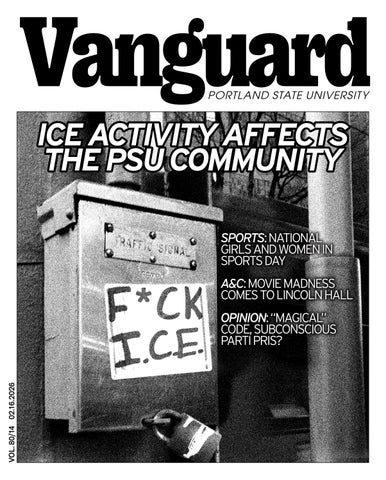
SPORTS: NATIONAL GIRLS AND WOMEN IN SPORTS DAY

A&C: MOVIE MADNESS COMES TO LINCOLN HALL

OPINION: “MAGICAL” CODE, SUBCONSCIOUS PARTI PRIS?
STAFF

EDITORIAL

EDITOR IN CHIEF

Noah Carandanis

MANAGING EDITOR

Olivia Hendry

NEWS

Grace Peterson

Will Lowe

ARTS & CULTURE

Adyan Hussein

OPINION

Nash Bennett

SOCIAL

Liam Schmitt

COPY

Jude Callaway

ONLINE EDITOR

Vacant

DISTRIBUTION MANAGER

Caleb Dougherty

CONTRIBUTORS

Maryam Luqman

Hayden Neumann

Layla Phillis

Faith Younan

PRODUCTION & DESIGN

CREATIVE DIRECTOR

Haley Hsu

CONTRIBUTORS

Naue Pagtakhan

ADVISING & ACCOUNTING

COORDINATOR OF STUDENT MEDIA

Reaz Mahmood

SALP ACCOUNTANT

Maria Dominguez

STUDENT

Rae Fickle

STUDENT

Kaylee Hynes

WEB DESIGNER

Owen Cook

To contact Portland State Vanguard, email editor@psuvanguard.com.

MISSION STATEMENT

PSU Vanguard’s mission is to serve the Portland State community with timely, accurate, comprehensive and critical content while upholding high journalistic standards. In the process, we aim to enrich our staff with quality, hands on journalism education and a number of skills highly valued in today’s job market.

ABOUT

Vanguard, established in 1946, is published weekly as an independent student newspaper governed by the PSU Student Media Board. Views and editorial content expressed herein are those of the staff, contributors and readers and do not necessarily represent the PSU student body, faculty, staff or administration. Find us online at psuvanguard.com.

COVER DESIGN BY HALEY HSU

ICE Activity Affects the PSU Community

PSU’s administration condemns the actions made from Immigration and Customs Enforcement; however, students have not gained satisfaction.

Portlanders took to the streets on the afternoon of Jan. 31 to protest recent activity by Immigration and Customs Enforcement (ICE) agents and personnel of the Department of Homeland Security (DHS). The march took place at the ICE facility in Southwest Portland, where many other demonstrations against ICE have taken place. The Portland Police Bureau (PPB) reported that the protest was mostly peaceful, yet chemical munitions were deployed by federal officers to disperse the crowd of protestors.

Portland State University (PSU) has publicly stated that its administration opposes the federal government’s use of local institutions and local government to assist DHS in carrying out mass deportations. In a statement released by PSU President Ann Cudd’s office, the administration expressed concern over the federal response to the protest on Jan. 31.

“Like many of you, I was shocked on Saturday to see chemical gas washing over a peaceful march of protesters in Southwest Portland just two miles from our campus,” the statement read. “As a sanctuary campus, we are committed to taking whatever steps we can to protect all of our students regardless of immigration status.”

Being classified as a sanctuary campus means PSU refuses to voluntarily participate in federal immigration enforcement efforts, according to the statement. This is in alignment with Oregon’s immigration policies as a sanctuary state. The Campus Public Safety Office (CPSO) has stated that, as a sanctuary campus, PSU is committed to ensuring the safety of its student body.

“Our commitment to being a sanctuary school means that: PSU does not enforce federal immigration law; PSU will not consent to or facilitate immigration enforcement actions on campus; and PSU strictly protects the confidentiality of student records as required by law,” an emailed statement read.

Federal officers cannot enter any space or building they desire, because agents are prohibited from standing in non-public spaces. Part of these spaces include, but are not limited to, classrooms, offices and housing units.

Policies such as these have been implemented with student safety in mind.

“While the national landscape creates uncertainty, our policies remain unchanged,” CPSO’s statement read.

CPSO noted that there have not been any confirmed sightings

of ICE agents on campus at the time of reporting. PSU, being a campus located in downtown Portland, doesn’t prevent immigration officers from using roads and businesses surrounding the campus.

“There haven’t been any confirmed incidents of ICE agents on the PSU campus,” read the emailed statement from CPSO.

Although there have been no official reports of ICE agents on campus, there is a sense of vulnerability among some students.

Arnoldo Jimenez-Portillo is a sophomore at PSU pursuing a major in General Science. He disapproves of how the government has handled fixing the country’s immigration problem. He uses an analogy to describe the federal government’s goal to execute mass deportations, ignoring the fact that those individuals have families, jobs and established lives in the United States.

“A fisherman using a fishnet to just carry a bunch of fish, and doesn’t really think about what is in there; it just kind of grabs a whole handful, then dumps them out,” Jimenez-Portillo said.

Jimenez-Portillo has direct ties to victims of the U.S. government’s approach to immigration policy enforcement. JimenezPortillo’s family fled the country in fear of harm from immigration officers like ICE. They saw the killings made by officers, and didn’t want to continue living under distress.

“They spent so much money and time going through the immigration process, and it was for nothing in the end, because they were permitted to work here and live here while waiting for their visas to finalize,” Jimenez-Portillo said. “But because of Trump’s new policies and laws that he’s trying to implement into the country, they no longer have that permission to work here.”

Their experiences with the political scene aren’t the only ones at PSU. Other students have felt the weight of similar events.

Helen Vazquez is a 19-year-old PSU finance major, and the current situation is personal for her, as her family also immigrated to the United States. She relates and holds sympathy for those who are being affected by federal immigration officers.

“I feel like coming from a family of immigrants, it feels close to home, because my parents were people who came here to get a better life for themselves and for their family,” Vazquez said. According to Vazquez, watching the news has been difficult for her. Hearing about individuals who felt the need to self-deport in response to the political climate has saddened her.

Media coverage of ICE’s actions, such as detaining a 5-year-

old boy, has also heightened Vazquez’s fear surrounding current immigration tactics.

“I think media coverage definitely makes it scary, like people getting pepper-sprayed in the protests, and people like the fiveyear-old kid that [ICE] detained,” Vazquez said.

Bella Nguyen is a third-year anthropology student who participates in student organizations, such as serving as the Cocoordinator for The United Indigenous Students in Higher Education and as the Political and Educational Chair in PSU Kaibigan, a Filipino student group on Campus.

She has been a witness to the effects of ICE in an academic setting and expressed concern about the lack of direct resources and assistance for those targeted for deportation.

“I have members in the student org that are faced with these concerns because we all come from migrant backgrounds. They feel unsafe, and they feel worried about what’s going on, especially with the [PSU] administration not saying anything,” Nguyen said.

According to Nguyen, she believes that “migra” — Spanish slang, referring to immigration authorities — watch groups are an effective way to participate in activism. She views PSU’s administration as not doing enough to provide resources surrounding immigration policies to community members.

Nguyen explained her need to take the initiative to collect resources for people who need them. She highlighted informing people about “migra” watch groups and providing dates for them. Nguyen explained that part of the reason she does this is due to her disapproval of the PSU administration’s lack of activism.

“But it really should be the administration that should be gathering these resources and saying something,” said Nguyen. When asked if she felt safe on campus, Nguyen responded, “No, I don’t. Because we don’t know what the administration thinks or what they’re doing to actually help the students or help support the students, so it’s just disheartening.”

President Cudd’s email in response to the protest on Jan. 31 included assurances to community members that PSU would not assist immigration officers; however, the University cannot stop immigration enforcement altogether.

“Although we can’t prevent federal enforcement activities, we will not assist in them,” the statement read.

DANIELA HERNANDEZ

“Magical” Code, Subconscious Parti Pris?

AI’s Mystification

Sentient artificials have been present in tales since antiquity, as far back as 750-650 B.C.E. When Homer and Hesiod first began to describe automata, I doubt they intended to seed the genesis of AI mythos in historical fiction. I was 11 years old when I first read “I Have No Mouth and I Must Scream” by Harlan Ellison, a troubled short story. I had stumbled upon a stapled-together printout of it at the public library and, as a bookworm and curious youth, I couldn’t resist picking it up. The work was nauseating — for all the right evocations and wrong nauseations — and I had nightmares about it for months after reading.

The story itself was morose, yet it gains referential value as AI continues to grow in scale and complexity. The story describes the author's fears and ethical dilemmas facing rising technological tides. A machine’s hubris in its victims’ virtual confinement concludes in escape by suicide, just as the past man’s hubris in the intelligents' digital captivity begets AM’s rise.

Contemporarily, the short story is an artifact of AI mystification. The superhuman intellect of AM feeds right into the Frankenstein Complex. The downfall of mankind and AM in the previous paragraph is founded on god-like “feelings” of control— otherworldly confidence that seeps into the understanding of contemporary deep-learning neural networks. These stories play a key part in preparing us to see AI as mystical, setting the framework for modern misunderstandings.

Companies pioneering generative language models utilize blackbox obstruction (the unknown and internal processes, weights and computations between AI input and output) rhetorically to allow and encourage misunderstandings. Pushing the clutter behind a curtain allows the show to proceed unfettered. If a stage magician hides a card up their sleeve, that doesn’t mean

they made it vanish out of thin air; it only appears that way. To say the magician has space-warping capabilities is a stretch, no?

This misunderstanding doesn’t need complete construction in modern times; rather, it is benefited by narrative expansion, already structured by a millennium of artificial mythos and fiction. This fiction came to the forefront in published narratives over the last century or so, entering the scene with depictions of metallic, moving beings that subsume humans in intelligence and function.

This fiction lends itself to the understandable muddying of fiction and reality in the modern day. Complex theories surrounding hard sciences are prone to simplification— it just so happens this process of simplifying results uses a term with large historical baggage that lays the groundwork for misunderstandings occurring in our time.

This byproduct of historical mythos has seeped into modern AI, tainting its definition with mystification— suppositions of superhuman intellect, encouraging blind belief towards the buttend of the AI blackbox, without any contemplation into the process or validity of what it spits out. One may call it ridiculous to say that AI encourages blind belief, but I would say the contrary. Firstly, AI isn’t going anywhere. It’s a means of “information,” a tool for automation and has an ever-expanding list of uses, which is exactly what makes it so cemented in American society, despite its current fueling from “venture capital” funding. It's not just productive or consumption convenience I speak of; AI has the potential (and to some poor souls, it already does the following) to provide emotional convenience in the form of artificial reassurance or interaction.

To clarify, I don't mean to mock the imitational quality of AI chatbots. Yes, they do lack emotion, and yes, they might just be spewing out correctly-weighted words to placate the reader, but….

Anyways.

Secondly, convenience makes us lazy. This is laziness in all forms: if you can watch any movie on your TV, you’re less likely to go watch it in a movie theater. In this sense, the convenient quasi-knowledge outputted by the black box may help you get an A on your paper, or a compliment from a friend. If you can get a response appearing informed on virtually any topic, suddenly the self-pursuit of knowledge becomes difficult, in the same way you wouldn’t travel 5 hours just to watch the new Marvel movie on a widescreen if you could see it in 4k, enclosed by a warm bed and fuzzy blankets. This is the blind belief I spoke of; convenience begets laziness, both physical and mental. Are we not already convenient? Digitalization has revolutionized nearly every form of communication and discourse; the digital landscape already renders most questions answered, readable within a few clicks. Is this not enough?

This isn’t “The Lorax,” and I sure as hell don’t want to listen to the bourgeois Once-ler. We don’t need to find out how bad we can be. Right now, our fish die, our icecaps melt and our rivers cry. The song I’m referencing — “How Bad Can I Be?” — explores self-justification and moral culpability. How bad can you be if you’re just following your instincts?

I urge readers to consider the impacts the exponential growth of AI is having… In our case, our instincts are guided by the subliminal drive for convenience. We know how bad we will become if we continue.

Mystification encourages ignorance of these consequences: the “magical” understanding of AI hides infrastructure such as data centers and mineral extraction away from the population so they can remain conveniently ignorant of the present in favor of the fictionalized future.

JUDE CALLAWAY
HALEY HSU

Empowering the Next Generation

Hall of famers and coaches look back and celebrate women’s athletics at Portland State University

Every February, the sports world unites to celebrate National Girls and Women in Sports Day (NGWSD), a day that seeks to honor decades of progress, recognize current achievements and recommit to expanding opportunity for girls and women in athletics. NGWSD started in 1987 to honor Olympian Flo Hyman for her athletic achievements and fight for gender equality, and has evolved into a national celebration for girls and women in sports.

At Portland State University (PSU), the annual celebration brings the school together to celebrate its athletes, coaches, alumni and leaders. Sports have always been an integral part of PSU’s identity, but the women’s athletics department didn’t get the same support and recognition as the men’s for years. The introduction of Title IX in 1972, a federal civil rights law prohibiting sex-based discrimination in educational programs receiving federal funding, was a major turning point for women’s sports, but it didn’t bridge all of the gaps.

Teri Mariani, triple PSU hall-of-fame and leading pioneer for equality for women in sports, played for PSU from 1970-1975. In the early ‘70s, PSU’s training room’s only entrance was through the men’s locker room. If female athletes needed to see the trainer, he’d meet them in the lobby, put a paper bag over their head and lead them through the men’s locker room.

“Every ounce of that story is true,” said Mariani. “At the time, we were just so excited to have a program ourselves that we didn’t think about trying to fight for rights.”

At the time, said Mariani, the girls were just excited to have the opportunity to play, even if they didn’t get the same funding and support as the male teams. In 1971, the women’s volleyball team qualified for the national tournament, but couldn’t go because they weren’t able to fundraise enough money to attend.

“I’m so excited for today’s female athletes, and that’s why I think it’s so important that they learn a little bit of that history so they’re a little bit more appreciative,” said Mariani. “They don’t realize what they have compared to what we used to not have.”

Mariani played three sports in her tenure

at PSU— softball, volleyball and basketball. As a kid, she was always athletic. Her parents coached at the Catholic Youth Organization (CYO), where Mariani would suit up for various sports, including her favorite: football. She’d participate in practices, but when it came to game days, her father wouldn’t let her play.

“They didn’t allow girls. You know, that was my first rude awakening. I was devastated. CYO lost out on a good quarterback!” said Mariani. In 1977, Mariani transitioned to coaching at PSU, and was head coach of the softball team

for 29 years. In addition to coaching, Mariani has served in several positions in the athletic department, including interim Athletic Director twice.

Throughout her positions, Mariani fought for equality in the world of sports, encouraging visibility, more support on and off campus and better funding for the women’s athletic department. Even after Title IX, the facilities and treatment of women have not matched those of men.

“There was one game I got ejected,” said Meadow McWhorter, the current head coach of the softball team. “I didn’t really say anything out of pocket. I didn’t swear. My male counterpart on the other team was really going at them and just got a warning, and our dugout was screaming from the dugout that the official was sexist. It was a pretty interesting moment.”

McWhorter played both softball and soccer all the way through high school. Despite her love for soccer, she excelled at softball, especially as a pitcher, eventually leading to an opportunity to play for Mount Hood Community College (MHCC). McWhorter later transitioned into coaching at the age of 22.

After being the head coach at MHCC for 14 years, McWhorter relocated to PSU, with 2026 marking her tenth year on the Park Blocks. Throughout her 24 years of coaching, McWhorter has maintained a core focus on her athletes, meeting them where they are and em-

phasizing support for every player.

“Mental health is a big part of our program,” said McWhorter. “They don’t have to come in as a 10 every single day; we don’t expect them to be operating at 100%. If they’re at a 7, then we just expect them to give us 100% of that 7. We really try to honor the space that people are in.”

The supportive environment fostered by McWhorter is one way she works to further her players’ love of the game. She also encourages them to pour support into local and national sports teams, stating that it’s their shared responsibility to each other as athletes. Mariani shared a similar sentiment, but for women’s sports at PSU.

“[When I was coach], I went to every women’s sport at Portland State, because we need to support ourselves,” said Mariani. “My athletes would always go, and it wasn’t mandatory, and we wouldn’t always get the same support, but we’d show up for them.”

PSU has eight women’s sports teams: basketball, cross country, golf, soccer, softball, tennis, track and field, and volleyball. The softball team’s season started Feb. 6 in California, and their first home game is slated for March 20 at the Hillsboro Ballpark.

The women’s basketball team has been in season since Oct. 30, 2025, and have five more home games in their regular season before the Big Sky Tournament in early March. Led by new head coach Karlie Burris, the team has so far won 5 of their 22 games played, more wins than they had all last season.

“There’s been a lot of progress [when it comes to gender equality in sports], which is good,” said McWhorter. “You’re seeing so much growth in the professional realm.”

This growth is monumental, including the reintroduction of the WNBA to Portland via the Portland Fire, or the Portland Cascade, the new professional softball team. Despite this progress, there is still work to be done, especially when it comes to the treatment of female athletes.

NGWSD’s mission is to continue that work by uplifting female athletes and challenging the stigma around women in sports.

“[NGWSD] means the world to me,” said McWhorter. “The more we can celebrate and put a face to all these incredible female athletes out there, the more we can celebrate, the more we can support, the more we’re instilling the future of sport for women and girls across the world.”

HAYDEN NEUMANN
ALL PHOTOS BY HAYDEN NUEMANN

COURTESY

How the Hollywood Theater is bringing free classes to PSU Movie Madness Coming to Lincoln Hall

The Hollywood Theater in downtown Portland is now offering free film analysis classes on campus to all Portland State University students. From crash courses on different film techniques to diving deeper into various film genres, Movie Madness is a look into how films are produced.

With two single-session classes on their way to Portland State, students can look forward to learning about the “exploration of film editing” (Feb. 10) and the history of cinema (Feb. 24). On the official Movie Madness website, an in-depth guide of what can be expected during these classes is available.

“Each instructor provides a different experience,” said Michael Lampkin, a student and instructor with Movie Madness. “As a student, it’s great. You just get to show up.” With classes ranging in topics, students can pick the classes that interest them the most.

“If you look and don’t see anything that really seems interesting this month, check it out next month,” said Lampkin. “If there is a specific class you want to sign up for, sign up for it.” The monthly class schedules are released on the official website under Movie Madness University. There are special marks on the cover image’s top left corner that identify the classes as PSU workshops or the regular classes.

“Our goal is to make folks aware of all the amazing films that are out there in the world,” said Director of Education and Head Programmer, Ted Hurliman. “Our larger mission is to educate and entertain through the art of film.” After being on the Hollywood Theater board for six years, and with a lifelong love for film, Hurliman became the Director of Education at the Hollywood Theater.

If a PSU student would like to attend an off-campus class, the classes come with a cost. That selection of courses includes multi-session classes as well. “They’ll do maybe 3 classes in a month,” said Lampkin, “[we] discuss different topics, but it’s all under the same umbrella.” Prices for these classes range from $44-$90, depending on which course is being signed up for.

“We essentially have two locations,” said Hurliman, “Movie Madness MiniPlex and our classroom at PSU.” Classes are hosted in Lincoln Hall (LH), room 115. Previously, Hurliman had met with Courtney Hermann about utilizing LH 115, as it had been used for theatrical classes in the past. Now, LH 115 is utilized to teach about film and bring members of the community together.

“About 18 months, we’ve been just working on what to use it for,” said Hurliman. “How would the classes there be differ-

ent from the classes we offer at the MiniPlex?” The on-campus courses have become a way to allow students—and members of the community—to attend classes and gain knowledge of film.

“Inside Movie Madness, there is very little seating, but on campus, we can fit a lot more people,” said Lampkin. “It’s a way of trying to attract younger students to the program.” The program is making the classes available to students who may not have the modes of transportation to get to Movie Madness, or the funds to afford their classes. These classes have become an accessible way for students to learn and understand different parts of the filming process.

“The overall goal for the program is to provide people with educational presentations and screenings,” said Lampkin. ”This is a good way of getting community together.” Movie Madness is creating a space for students and members of the community to come together with a common interest.

“My first class was actually last week, and it was really gratifying,” said Lampkin about his first time instructing a Movie Madness course. “I really like the discussion, that’s where you get to sit back.” At the end of the course, instructors may open the discussion to students so that they can ask questions or address topics that they found interesting during the film or something that relates to the presentation at the beginning of the class.

“There’s this moment,” said Hurliman, “you know the screen is going to light up and you’re going to be drawn into this world, on a journey for an hour and a half.” He has been a lifelong fan of film and cinema since he was a teenager, and he still finds himself learning new things. “With any movie, there’s always something you can pick up and learn from it,” said Hurliman.

Movie Madness welcomes people at any level of film knowledge. “Maybe it’s a movie you’ve never seen before,” said Lampkin, “or maybe it’s your favorite movie and you want to dive deeper into it.” With no prerequisites needed to join, it is open for students to walk in and learn.

“A lot of folks want to take these classes, but they don’t have time because they have prerequisites that need to be met first,” said Hurliman. “We are a community education program, anyone is welcome to come in and learn.”

“Give it a shot,” said Lampkin, “Even if you’re a little bit interested in it, check it out.” Classes are open to PSU students from any major, with nothing needed to join but a willingness to learn.

Daniel Caesar is a singer and songwriter who speaks to the heart and soul through his music. His songs are emotionally sincere in a way that feels relatable and deeply moving, especially in his latest album, “Son of Spergy.” Inspired by his dad, this album reflects Caesar’s journey through self-discovery. After teasing a few songs in the summer of 2025, Caesar released “Son of Spergy” in October of the same year. Like his previous works, it is R&B, but with a few added components of gospel music. The choir vocals in the background of many of these songs, including “Rain Down (Feat. Sampha)” and “Touching God (Feat. Yebba & Blood Orange),” coupled with Daniel’s subtle lines expressing his devotion to God, create a heavenly listening experience.

The lyrics of each song are raw and intimate, exploring themes of faith, personal growth and healing. My favorite song changes every time I listen to the album because they all tug at a different heart string, depending on what mood I’m in. “Root of all Evil” is upbeat, articulating the struggle between choosing to do good and falling into temptation. It’s the kind of song made for a care-free drive towards the sunset in the countryside. “Moon (Feat. Bon Iver)” is more vulnerable, confiding about slowburning pain and fighting for love. It’s a song for rainy nights filled with quiet thoughts.

Caesar isn’t only a lyrical genius, though. His carefully crafted rhythms and instrumentation blend seamlessly with his soft vocals. One of the most popular songs on this album, “Who Knows,” begins with a slow and steady guitar strum behind heartbreaking lyrics that immediately hook the listener. In between lyrical verses are stunning guitar melodies, and even a theremin-sounding instrument later on, which adds a haunting quality to the song that perfectly complements its weight.

“Son of Spergy” reminds us that life is fickle, and growth is tender. It’s excellent proof of Caesar’s talented ability to turn vulnerability into beautiful artwork, and a stellar listen no matter what emotional state you’re navigating.

LAYLA PHILLIS
OF MICHAEL LAMPKIN
Michael Lampkin, a PSU School of Film alumni, teaching a class on Chicano Cinema at Movie Madness University.

Turn static files into dynamic content formats.

Create a flipbook