NEWS
AI Pornography, Renters’ Rights and More:
New Oregon Laws Taking Effect Karl Muller Center Retail Space Provides Opportunities for Businesses
![]()


NEWS
AI Pornography, Renters’ Rights and More:
New Oregon Laws Taking Effect Karl Muller Center Retail Space Provides Opportunities for Businesses
EDITORIAL
EDITOR IN CHIEF
Noah Carandanis
MANAGING EDITOR
Olivia Hendry
NEWS EDITOR Vacant
ARTS & CULTURE
Adyan Hussein
OPINION EDITOR Vacant
MULTIMEDIA
Nash Bennett
SOCIAL MEDIA
Liam Schmitt
COPY CHIEF
Jude Callaway
ONLINE EDITOR
Quinn Willett
DISTRIBUTION MANAGER Caleb Dougherty
CONTRIBUTORS Will Lowe
Maryam Luqman
Hayden Neumann Layla Phillis
PRODUCTION & DESIGN
CREATIVE DIRECTOR
Haley Hsu
CONTRIBUTORS
Arielle Chhunkeo
Naue Pagtakhan
ADVISING & ACCOUNTING COORDINATOR OF STUDENT MEDIA
Reaz Mahmood
SALP ACCOUNTANT
Maria Dominguez
STUDENT
Rae Fickle
STUDENT MEDIA TECH DEVELOPER
Kaylee Hynes
WEB DESIGNER
Owen Cook
To contact Portland State Vanguard, email editor@psuvanguard.com.
MISSION STATEMENT
PSU Vanguard’s mission is to serve the Portland State community with timely, accurate, comprehensive and critical content while upholding high journalistic standards. In the process, we aim to enrich our staff with quality, hands on journalism education and a number of skills highly valued in today’s job market.
ABOUT Vanguard, established in 1946, is published weekly as an independent student newspaper governed by the PSU Student Media Board. Views and editorial content expressed herein are those of the staff, contributors and readers and do not necessarily represent the PSU student body, faculty, staff or administration. Find us online at psuvanguard.com.

Newly hired head coach Karlie Burris has helped navigate the Portland State women’s basketball team to newfound success. Focused on fostering an environment of inclusion and support, Burris and her coaching staff have led the team to more wins this season than they recorded in the entire 2024-25 season.
When former head coach Chelsea Gregg led the team to a +8 win differential in the 2023-24 season, the largest yearto-year improvement in program history, there was an air of hope. Eight conference wins were unexpected after a 0-20 record the year before. This forward momentum, however, did not carry over. The 2024-25 season saw the team with a4-24 overall record, 1-17 in the Big Sky Conference.
The Vikings announced a coaching change for the team on March 12, 2025: Gregg was to be let go, and a nationwide search for a new head coach was immediately in effect. Three weeks later, on April 4, Burris was brought on board.
Burris, coming off a highly successful stretch as an assistant coach at the University of Nevada, Las Vegas, has already made an impact. Currently, the team sits at a 5-10 overall record and 1-2 in the Big Sky Conference, with more wins roughly halfway through their season than the entirety of last year. Despite this success, the team is striving for more: more wins, more points.
“We’re trying to win,” senior Ajae Yoakum said. “[We’re trying to] put it all together, with these upcoming games, putting the whole four quarters together. We really want to win. I think that we’re going to turn the page and we’re going to win.”
Yoakum, originally from Portland, transferred to Portland State University this year after previously playing for Eastern Arizona College from 2020 to 2022 and Florida International University from 2022 to 2024.
Originally, she had transferred to the University of Arizona for the 2024-25 season, but could not play due to an injury. The move to PSU brought her home and gave her a new opportunity to make a comeback.
“I think just coming back from my ACL injury, it’s easy to fall in the shadows and give up on yourself,” Yoakum said.
“So, this year for me is just about coming back stronger, being the player that I know that I am, and being as aggressive as I used to be.”
This season, she’s played 13 games, recording 102 points and averaging 7.8 a game.
Being the only player Burris signed this season, Yoakum is in a unique position. Although she’s new to the team, she’s a veteran and a leader. Coming into that role has only been made easier by the way Burris leads the team.
“The coach, the whole staff, the whole coaching group, I would say they love the players, honestly,” Yoakum said. “It doesn’t feel like a business. Some places it can feel like that, but I think that we know that we have a staff that cares about us, which makes you want to play for them even more, right? I think that [Coach Burris] pushes us, but she also loves us, and I think that helps a lot of people.”
This sentiment was echoed by sophomore Kyleigh Brown.
“They all just love us so much,” Brown said. “They all build such great relationships with us, [and] that makes us want to just come in every day and work as hard as we can for them, because they care about us. We care about them.”
Brown currently leads the team in points with 279 scored, already surpassing the 264 she recorded in her freshman year. Last season, she averaged 9.8 points a game. This season, 15games in, she’s posted an average of 18.6 per game, nearly doubling her production.
When asked about what her personal goals were for this season, Brown emphasized her role as a team player.
“I always say just whatever the team needs,” Brown said. “I don’t really want to focus on the personal stuff, because it doesn’t matter if we’re not winning. So I’d say just winning first and then whatever happens after that.”
This sense of camaraderie is one of the main components of the team’s culture and environment that Burris has fostered. Players are excited to show up for each other.
“I think that we really enjoy each other’s presence a lot,” Yoakum said. “And I think that we work hard. We’re not afraid to be pushed, and we’re gonna give you our best fight every time, absolutely.”
Sophie Buzzard and Hannah Chicken are two freshmen on the team who are a large part of this environment. Not only are they key contributors to the team’s numbers, but also the energy and emotion.
“They keep me on my toes,” Yoakum said. “I love Sophie. She’s really funny, and like a little sister that messes with you. Hannah’s really good to me, and she gets on my nerves, in a fun way. They’re both pretty funny.”
Burris shared the sentiment.
“Sophie Buzzard just is the ultimate teammate,” Burris said. “She works really, really hard, and [when you’re] talking about a good teammate, she’s one of the best. We didn’t recruit her, but I’ve already told her: if I could have, I would have.”
Chicken also received high praise from Burris, who highlighted her talent and the uniqueness of her game. She moved here from Australia and brought with her subtle differences in her style that introduced a new lens to the team.
Described as a “great spark off the bench” by Brown, Chicken is someone who brings a defensive presence with an instinct for rebounding and scoring. The freshman has recorded an impressive 168 points so far this season, averaging 11.2 points per game.
This fiery passion and positive energy being shown by younger players is a motivating factor for Burris and the team. It gives a snapshot of how the group is growing and what their identity will be in the years to come.
Finding and building a team’s identity is at the forefront of Burris’ mind, and she takes a unique approach, “[blending] the new and the old,” as she puts it. She was a student athlete herself and played for the University of Portland women’s basketball team. Remembering what it was like to be a student athlete, and how much each player has going on off the court, is a big part of her approach to the Portland State team.
“For us, it’s really simple,” Burris said. “We’re just trying to give our best effort, be super intentional with our preparation, and then being a great teammate is huge to me. We’re still trying to get really, really good at it, but we’ll continue to do that throughout the course of the year.”
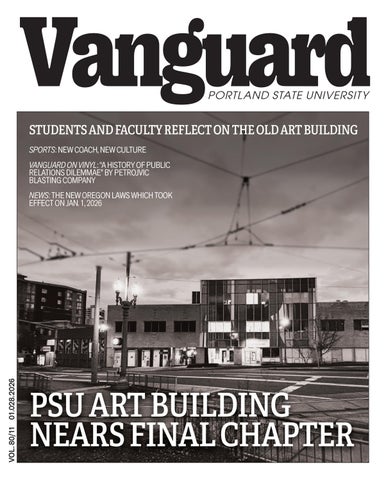
Schnitzer School of Art + Art History + Design students and faculty look back at the culture and memories forged in the old art building.

With plans for Portland State University’s new Schnitzer School of Art + Art History + Design building to open in fall 2026, the current Art Building and Annex is said to be headed for demolition. Home to many different types of rooms, projects and artists, this move marks the end of an era for many people tied to the oddities of this space.
Sean Schumacher, an associate professor of graphic design at PSU, received his MFA in Contemporary Art Practice from PSU in 2012. His graduate studio was located in the Art Building.
“I got so lucky in grad school, my goodness, I got this corner space. And I think it was just luck at the draw, overlooking Lincoln Street. […] It still is such a powerful feeling to go into that room,” said Schumacher.
According to him, the Art Building and Annex have morphed through many uses over the course of their lives. It started out as an office space for different companies, and at one point, the Annex was the factory that produced the largest American flag in the world. During its time in PSU’s possession, it has been home to three different art schools.
Many adjustments to the building have been made to better serve the Schnitzer School of Art + Art History + Design over the years.
“I think what we are best at, as a program, is being scrappy and finding ways to adapt and reuse, and finding things that we can use to improve quality of life. We had this room that had been drifting out of use longer and longer, and I think in 2019, finally, we were able to get approval to turn it into
a student lounge and makerspace, and that space is constantly in use now. Every time I check in on it, there’s more and more people in it, and I find that to be one of our greatest achievements,” said Schumacher.
Schumacher hopes that the hominess and warm energy of the Art Building will be carried over to the new one to make everybody feel welcome.
“The reason that this space served us and was able to continue serving us for as long as it has is that there has been so much care and love put into it. And community investment, really, that was not true in my undergrad, and I feel so proud to have been part of this community that activated this space that kept it alive and growing and adapting to our changing needs,” said Schumacher.
Kate Bingaman, a professor of graphic design and the associate director of the Schnitzer School of Art + Art History + Design, started teaching at PSU in 2008. The consensus among the program was to prioritize acquiring better facilities. Her experiences in the Art Building were a mix of fun and chaos, but they all made good memories.
“I started a weekly lecture series called Show and Tell, which is still running. It was in a classroom, just a small classroom, this was in 2010. That classroom then kind of transformed into a lecture hall, even though it’s just this weird classroom that had this crazy power strip that I seriously tripped over, I would say no fewer than 50 to 75 times,” said Bingaman. “The space was not ideal, but having the ability to not only have a weekly lecture where the students knew they could attend at noon,


but one that the Portland community started coming to, was so exciting.”
Despite having the freedom to arrange rooms to serve the program’s needs, the building is structurally flawed. It has been in long need of repair, with issues ranging from rats to sewage.
“It’s one of those things where it was just a little bit of bonding, in a way. Everyone just knew that there was always going to be some sort of weird alarm going off, or some weird beeping happening in the hallway, some odd lights not working,” said Bingaman. “There are buckets all around to catch the leaks. There was a room on the second floor, which, it honestly looked like, to control one of the leaks, there was a giant beer bong attached from the ceiling.”


Students expressed that these quirks are what shaped the student experience, though. Transforming dull spaces into studios was a project of its own, especially for Sean Bucknam, a graphic design alumna who graduated from PSU in 2014.
“As a founding member of A+D Projects, I remember helping to clean that tiny room to be our workspace. Carrying out old filing cabinets and finding weird old still life props. That room went from storage closet to a workspace that was filled with inspiration and collaboration as we figured out how to build an in-house design studio for the School of Art & Design,” wrote Bucknam.
To Angela Nguyen, a graphic design alumna who graduated in 2023, the Art Building was much more than just a workspace.
“Being in the art building helped shape my early experiences as a designer, from learning the joy of risograph printing, working on my craftsmanship alongside my talented peers and instructors, archiving time with my bathroom mirror selfies and fit pics, to finding community through Show & Tells and other events I would find posted on the walls of the elevator on a random weekday.” wrote Nguyen.
Those small, routine experiences formed the foundation for a larger sense of belonging and facilitated growth beyond technical skill.
“Each time I cross the threshold of the art building, I am met with a confluence of people, colors, textures, and ideas—each element unique in its capacity to elevate my thinking. This environment continuously reshapes my understanding of my identity and my position within the world
I am creating.” wrote Jessica Bahl, a transfer student majoring in graphic design.
As a hub for personal and creative development, she hopes to carry over the innovative community and uplifting spirit that was nurtured in the Art Building.
“Our move is more than a change of address; it is an expansion of the collective soul that defines the Portland State University art community. We bring with us a culture of mutual elevation. As we step through these new doors, we continue to create a world that is inclusive, challenging, and profoundly transformative.” wrote Bahl.
Although the demolition of the Art Building and Annex will leave behind countless decade old memories, its unique legacy will remain as we prepare to give way to the new home for the Schnitzer School of Art + Art History + Design.
Portland State students should be on the lookout for new changes from the Oregon legislature, which took effect Jan. 1, 2026.
On Jan. 1, 2026, a plethora of new laws went into effect in Oregon. With these new laws, you might see some changes in how you buy tickets for concerts, how you buy things, and more. Vanguard has provided a list of some of the most important changes that students should know about going into the new year. For a complete list of new laws, please visit the Oregon Legislature’s website.
HB 2299 expands the definition of unlawful dissemination of intimate images, which is the criminal offense associated with sharing images of people nude or engaged in a sexual act, to include images that use artificial intelligence to create or modify a picture. Unlawful dissemination of an intimate image is a Class A misdemeanor, unless the person accused has prior convictions, in which case it would be a Class C misdemeanor.
Along with this, unlawful dissemination of an intimate image counts if it depicts a person engaged in a sexual act, or is intended to harass, humiliate or injure somebody. The image being that of somebody whose “uncovered human genitals, pubic areas, or female nipples,” according to the bill, are shown.
A person can be charged with a misdemeanor for sharing an intimate image while knowing that the person pictured does not consent to the sharing of it. A charge would also come should the person photographed or any reasonable person be harassed, humiliated or injured due to the disclosure of the image.
The exceptions to this include law enforcement agencies using these images to investigate or prosecute an offense, legal proceedings, reporting an offense, sharing an image that serves public interest within the law, or using them for medical, scientific or educational reasons.
It also doesn’t include intimate images of people who voluntarily display themselves intimately in a public area or engage in sexual conduct in a public way, along with images created for a commercial purpose with consent or provided by a content provider of a service for intimate images.
Section one of SB 605 prevents medical institutions from sharing any debt information, including the existence or amount of debt that their patients owe, to credit bureaus, and allows an individual to sue for the breaking of this law.
Medical debt in this bill is defined as a person who owes a sum of money to any medical
institution, including public and private hospitals and non-profit clinics, for medical treatments. General credit card debt is not included in this definition, unless the funds used were supplied directly to people for the purpose of purchasing any medical services.
Should an individual have an unpaid medical charge, the clinic or hospital will now be required to do a screening to see if the patient qualifies for any financial aid the hospital provides. If so, the hospital will provide a copy of its financial aid assistance policy along with an application for them to fill out. A screening to see if the patient would qualify for financial aid can also be done upon request by the patient or another individual who is allowed to act on their behalf.
Under SB 605, a hospital or clinic is not prohibited from collecting debt from a patient’s family that isn’t responsible for the patient’s
fees, rent prices and terms and agreement for renting. They could also detail the conditions for a refund, should it be necessary.
HB 3551 states that should a rental agreement not be executed due to a failure on behalf of the applicant, the landlord may keep the fees or deposit. However, if the failure happens because the space itself has defects that relate to its habitability, the landlord will not be able to keep the fee or deposit, and would need to return it within five business days, which the bill defines as a timely manner.
Should a refund be required, the landlord would need to refund the fees or deposit promptly, and unless “the failure to repay was not due to an act of God,” according to the bill itself, a charge equal to or greater than the fee or deposit would be applied.

debt. Along with this, when entering into contracts, it must be prominently displayed that the institution is not allowed to report any debt that may come from the contract to debt collectors of any kind. By doing so, the debt would then be considered void and uncollectible.
HB 3521
HB 3521 amended a prior law, ORS 90.297, which prohibits landlords from charging prospective tenants a fee for applying for an apartment. This law now includes that a landlord can charge the renter a fee or deposit, but only after their application has been approved. Additionally, before receiving the payment, they have to send the applicant a statement that details the
Also known as the Fan Fairness and Transparency Act, HB 3167 prohibits people from selling or offering to sell tickets through the use of software unaffiliated with entertainment events designed to confuse people into thinking they were buying from official websites. HB 3167 prevents the use of software that was created with the intent to interfere with security measures used to ensure that the sale or resale of tickets for entertainment events is fair and equitable for all fans.
Included under software that this bill prohibits is the use of online domain titles that use the name of the venue, the name of the event and/or people that will appear at the event. Along with
this, it prohibits the publication of any website that uses images or graphics that are the same or similar enough to mislead persons on the website. This includes the use of the word “official.” For any person to use any of those titles, names, or images, they would require the written permission from the official head of the event.
Items exempt from this act include the venue itself, the event’s sponsors, any official accounts or websites associated with the venue or event, images of seating charts within the venue or images of a view from an area inside the venue.
HB 3167 will cover any and all ticket sales following the start of the new year within the entertainment industry in Oregon. It will also cover all admission tickets except for those bought for commercial movie theaters; along with this, the definition of entertainment event does not include trade shows. HB 3167 will help to prevent websites from falsely advertising themselves as officially aligned with events and from selling tickets priced higher than the official website(s).
SB 430
SB 430 requires anybody selling something online to show the true price for any goods or services they’re offering, including any fees or charges. This doesn’t include any fees or taxes implemented by the government, shipping charges or service fees, though those must be clearly displayed before paying.
SB 430 covers a lot of different scam-related practices, ensuring that Oregonians can purchase safely and without fear of paying too much to the wrong person. For example, under SB 430, a business owner cannot cause confusion as to their identity when advertising a good or service. Any action resulting in confusion or misunderstanding as to someone’s affiliation when selling a good or service would be considered illegal under these circumstances.
Business owners also cannot use “deceptive representation or designation of geographical origin.” This means that a business cannot falsely advertise that they are based in Oregon when, in reality, they are located either out of the state or out of the country.
This bill does not apply to financial institutions, mortgage companies, a licensee or a person or affiliate who provides internet access services as long as it complies with consumer label requirements. Should a person or company fail to comply, they will violate this act and have engaged in an unlawful practice of their business or occupation.


Local business owners, from coffee makers to artisans, have been using the space to promote their business to the Portland State community at large
MARYAM LUQMAN
Located in the atrium of the Karl Miller Center (KMC) is a 500-square-foot-room that hundreds of students walk past daily, often taking a glance at what may be inside.
Although this tiny room is primarily used for students to purchase from local vendors, it also leads to opportunities for students and businesses to engage and connect.
The Retail Pop-Up space in the KMC is a program of Portland State University’s Center for Retail Leadership. It offers local brands and businesses a chance to interact with the PSU community by setting up a retail pop-up for a couple of weeks. Alumni, community businesses, non-profits and startups are all encouraged to use the space as a way to build up their own profile and business. This also offers students a look into the world of retail and helps them build meaningful connections with industry professionals and brands.
Since Oct. 2025, recent PSU graduate Spencer Chilton has been the Pop-up Coordinator.
“It’s a great thing to check out during the community hour,” said Chilton. “If you’re just waiting for your class, if you’re struggling to find something to do, why not check out this space?”
In just a couple of months of managing the space, Chilton says he has learned a lot about responsibility and self-sufficiency, from communicating with vendors, coordinating the pop-up space and marketing it all towards students.
To start off the new year, the pop-up space featured FanWagn, an online resale marketplace that specializes in fan apparel, coining the term “Second Fan Fashion.” Lauren Teague, founder of FanWagn, showcased her startup to the PSU community from Jan. 6 until Jan. 15.
With FanWagn, sports fans can sell their fan gear on the FanWagn website, similar to other resale marketplaces such as Depop or Poshmark, allowing them to connect with other fans and rock their dream pieces of merchandise without being restrained by location. At the PSU pop-up, the room is filled with merchandise ranging from shirts to hats for all sports lovers.
“People are popping in because they see their favorite team displayed, or they’re seeing women’s sports displayed, and they’re curious and want to check it out,” said Teague.
As a resale marketplace, FanWagn not only lets you represent your favorite teams and players, but it is also committed to sustainability. To keep merchandise out of landfills, shopping second-hand “fan” fashion is a way to give a pre-loved jersey a new home. The aspect of sustainability and secondhand fashion has also been a major drawing factor for younger demographics to visit the FanWagn pop-up.
“Some people are really excited about just the pre-owned, because pre-owned can be more accessible, it can be more affordable and sometimes even more inclusive,” said Teague.
The pop-up is a great way to feature businesses to the PSU community for the first time, but also welcomes businesses that have been previously featured.
Beans to Phin, an authentic Vietnamese coffee pop-up, has been a recurring business in the PSU and Portland community. First coming to KMC in fall of 2024, they are set to return to PSU from Jan. 27 until Feb. 5.
“I love that I get to talk to students and get to know them,” said Emily Nguyen, co-founder of Beans to Phin and PSU alum. “I see repeated students come and then you’re just, like, fascinated about, like, what’s going on.”
With a vision to create a gathering space that fosters community through sharing traditional Vietnamese coffee, Nguyen’s passion project with her mom and aunt has been able to grow into a successful business. Now, Beans to Phin remains a continuing pop-up for the PSU community.
The presence of a business doesn’t just allow students to buy products; it also gives them insight into how to lead one.
“We are getting questions about ‘whose business it is? What do you guys do? How can I get in?’” said Teague.
Not only are students able to buy sustainable merchandise, but they can also go into the pop-ups to engage in an interactive business experience and make connections with people such as Teague and Nguyen.
“I think this is a great way to just try something for a startup or an emerging business and really see what works with the student community here,” said Teague.
The pop-up space is always looking for businesses to come and take advantage of being in a student-driven environment. The goal of these pop-ups being located right in the heart of KMC is to let anyone at PSU get into the world of business.
“I love sharing things with [students],” said Nguyen. “It’s not like you just come and grab coffee, it’s kind of like you build conversation and get to know people.”
With potential changes coming to the space, according to Chilton, the pop-up has plans to become a bigger resource to students, whether they need to catch a break from classes or if they want to further their opportunities in the field of business.
“Definitely don’t be afraid to reach out because this is a cool opportunity,” said Chilton. “If you have something in your mind that you’ve always been thinking about trying, this is the time to do it.”
Chilton and the rest of the Center for Retail Leadership are always looking for local vendors that the PSU community would like to see. Any suggestions from students are asked to be sent to schilton@pdx.edu.

Now predominantly referred to as The Blasting Company (producers of the soundtrack in “Over the Garden Wall”), the Petrojvic Blasting Company only released a single album under its abandoned name, titled “A History of Public Relations Dilemmae”. Buried by its more contemporary successors, the album is a representational masterpiece of immense value— successfully capturing flowing melodies, lush harmonies and aurally animated tales reminiscent of Art Nouveau. Employing an energetic, old-timey tune, “The Hungry Klezmorim” ensures you’re awake to hear the songs to come. The confident, omnipresent tuba demands the listener's attention, while the percussion helps depict the enduring and often melancholic melody of Klezmer. The singers tell their own story, travelling from village to village in search of food and song. “Princess Andy” depicts an ironic homage to the writer’s friend, Andy (who owned a print shop called Maldorors), which inspired the morose shark-centricity, à la “Les Chants de Maldoror.”
Contrasting its energetic openers, “Avi Colon” shifts pitch from male protagonist to guest vocalist Leah Harmon, accompanied by a wistful backdrop that accentuates frustrated depictions. “Madame Selma” depicts the lugubrious tale of a saddened wife separated from her beloved; “Fido Oro” and its overwhelming arioso makes you want to bust into barely suppressed dance.
My two personal favorites include “Simon Was”, which depicts a young duo’s journey to independence—before, sadly, the narrator’s awkward departure—and “Love for a Writer, Producer, Director & Star” which is a bizarre, hilariously catchy love letter to George W. Clooney.
“Shadi” is a song of respite, contemplative and centered on the accordion with no vocals. The respite’s purpose is made clear as “Maldetta Orangina” is ushered forth. The song can only be described as… feverish? Finally, “Where We Gonna Leave It” closes the album with an emotionally heavy and depressive acoustic, depicting an old man navigating his wife’s final moments.
Haunting, historical and wonderfully diverse— if you have a taste for narrative music or are looking for a proverbial “trip” back to the Art Nouveau, “A History of Public Relations Dilemmae” is the perfect choice for your next album.