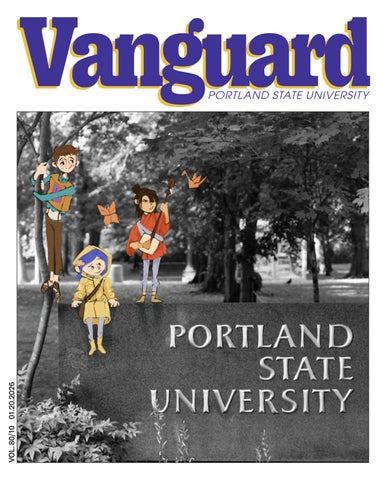
PSU’s First LAIKA Cohort Connects Students
and Faculty to Animation Studio
![]()


PSU’s First LAIKA Cohort Connects Students
and Faculty to Animation Studio
EDITORIAL
EDITOR IN CHIEF
Noah Carandanis
MANAGING EDITOR
Olivia Hendry
NEWS EDITOR Vacant
ARTS & CULTURE
Adyan Hussein
OPINION EDITOR Vacant
MULTIMEDIA
Nash Bennett
SOCIAL MEDIA EDITOR
Liam Schmitt
COPY CHIEF
Jude Callaway
ONLINE EDITOR Vacant
DISTRIBUTION MANAGER
Caleb Dougherty
PRODUCTION & DESIGN
CREATIVE DIRECTOR
Haley Hsu
DESIGN CONTRIBUTORS
Max Bykowski
Mary Catala
Arielle Chhunkeo
Dexter Delaski
Nikki Marin
Naue Pagtakhan
Karli Schwartz
ADVISING & ACCOUNTING COORDINATOR OF STUDENT MEDIA
Reaz Mahmood
SALP ACCOUNTANT
Maria Dominguez
STUDENT MEDIA TECH ADVISOR
Rae Fickle
STUDENT MEDIA TECH DEVELOPER
Kaylee Hynes
WEB DESIGNER
Owen Cook
To contact Portland State Vanguard, email editor@psuvanguard.com.
MISSION STATEMENT
PSU Vanguard’s mission is to serve the Portland State community with timely, accurate, comprehensive and critical content while upholding high journalistic standards. In the process, we aim to enrich our staff with quality, hands on journalism education and a number of skills highly valued in today’s job market.
ABOUT
Vanguard, established in 1946, is published weekly as an independent student newspaper governed by the PSU Student Media Board. Views and editorial content expressed herein are those of the staff, contributors and readers and do not necessarily represent the PSU student body, faculty, staff or administration. Find us online at psuvanguard.com.
Editor’s Note: The Vanguard Editorial Board does not represent the views of the newsroom or all Vanguard editorial staff. It is composed of senior editors at the publication and their views do not impact the reporting practices of Vanguard staff. For more information, you may contact editor@ psuvanguard.com regarding ethical guidelines.
Renee Nicole Good was shot and killed by an Immigration and Law Enforcement (ICE) officer Jan. 7, 2025. In the video taken by bystanders, Good was shown turning her car away from an ICE officer as she attempted to drive away from a hostile interaction. When this occurred, an ICE officer shot three shots through Good’s windshield. A wife, mother of three and American citizen’s death was captured on video, and an analysis by The New York Times has shown that Good was not turning her car to run the ICE officer over— instead, she was trying to drive away from them.
The next day, Luis David Nino-Moncada and Yorlenys Betzabeth ZambranoContreras were shot by U.S. Border Patrol agents during a traffic stop here in Portland, according to reporting by Oregon Public Broadcasting. News of this shooting have continued to stoke the
flames of fear and anger many Americans feel regarding ICE’s actions, culminating in nationwide protests.
That fear and anger is similarly felt by journalists covering these events in a neutral fashion. While we as journalists understand the importance of reporting the news objectively, we also understand the frustrations of readers believing this language normalizes the extraordinary violence we are seeing.
Vanguard’s Editorial Board believes the murder of Good was a senseless, unnecessary act of violence committed by a federal agent on an innocent, concerned citizen.
Language such as that used in the previous sentence is not normally used by journalists. Words such as senseless and unnecessary would be taken out to ensure neutrality. Words like innocent and concerned would be discussed by the editorial staff to see if those words would be appropriate.
These are editorial decisions that journalists must abide by. While the conventions of neutral language and unbiased phrasing bind journalists, you, the reader, can be cognizant of the fact that neutral language does necessitate neutral conclusions.
The Editorial Board at PSU Vanguard is
shocked and horrified at the actions ICE has taken in both Minnesota and across the country, including what is happening in our very own city. As our staff continue to report and cover news related to ICE, seeking the truth and reporting it remains our continual goal. Even if the language Vanguard staff use is neutral in our news coverage, we want to be a forum for fierce debate, discussion and simple expressions of thought. Submit your opinions to our publication and we encourage you to voice your thoughts in this paper.
Our newsroom operates under the Society of Professional Journalists’ Code of Ethics. While this code prizes objectivity and neutrality, it also mandates that journalists “minimize harm” and “show compassion” for those involved in any reporting. We want to assure the PSU community that every action will be taken in Vanguard’s newsroom to uphold these values. In an age where those in power are asking us to deny the reality before our eyes, it is imperative to stay an informed reader.
If you ever want to respond to what you read, you can email editor@ psuvanguard.com. We are happy to keep the conversation going.
The partnership between Portland State University and LAIKA brings engaging opportunities for students and faculty through a three-year program.

Though the studio might specialize in stop motion, the partnership between LAIKA and Portland State University is moving full speed ahead.
The LAIKA and PSU partnership is well into its first year, and cohort members are taking a behind-the-scenes look at an award-winning film company, while creating meaningful con-

LAIKA, the award-winning animation and stop motion production company, has been creating films in the Portland area since 2005. Under the leadership of PSU alumnus Travis Knight, the studio aims to blend cutting-edge technology with timeless artistry to create the classics of tomorrow. LAIKA has produced five films: “Missing Link” (2019), “Kubo and the Two Strings” (2016), “The Boxtrolls” (2014), “ParaNorman” (2012) and “Coraline” (2009). All were
nominated for the Academy Award® for Outstanding Animated Feature. “Kubo and the Two Strings” won the BAFTA® Award for Best Animated Film and received an additional Oscar® nomination for Visual Effects. “Missing Link” was awarded the Golden Globe® for Best Animated Feature Film. LAIKA was awarded a Scientific and Technology Oscar® in 2016 for its innovation in 3D printing. LAIKA is currently in production on its next animated film “Wildwood.” Among the animated films in development are “The Night Gardener,” from an original idea by Bill Dubuque, creator of the hit series “Ozark,” and “Piranesi,” based on the NYT best selling novel by Susanna Clarke with a screenplay to be written by Dave Kajganich.
Both Sam Wilson, producer at LAIKA, and Jenny Torgersen, Senior Scheduling Production Coordinator at the studio, enjoy the collaborative nature of working for the film studio. Through every part of the filmmaking process being done in-house, employees get insights into other departments and encounter growth in filmmaking areas they might not be familiar with.
“Everybody loves sharing their craft and their experience and knowledge with anybody who asks,” said Wilson. “So it's a re-
ally unique place to work, because anybody can learn anything at any point in time, and there's always more to learn.”
“Here, there's a lot more oppor tunity to move around, and you're not locked into one path,” said Torgersen. “Being able to see what everyone else does can help you find what path you want to take, and just knowing that those paths exist.”

In 2024, the animation and stop motion studio announced its partnership with PSU via a three-year pilot program. This program connects a select group of students – named LAIKA scholars – with diverse lived experiences with the studio, aiming to bring about career preparedness. Through this connection, scholars will be able to learn from a wide variety of creative industry professionals. The hope is that these experiences will create a diverse pool of career ready creative students, who are prepared to enter the creative industry upon graduation.


“Portland State University and LAIKA have formed a groundbreak ing three-year partnership to improve accessibility for career-ready graduates from all backgrounds and lived experiences,” reads the College of the Arts website on the partnership. “Together, we're investing in the next generation of creative leaders through scholarships, fellowships and meaningful mentorship.”


Production). These students also re ceived a scholarship as part of the partnership.
“[LAIKA is] a creative powerhouse that pulls people from everywhere into Portland,” said LAIKA grant manager Tekla Hoehn. “And then, of course, PSU is such a creative and strong draw for people from all different backgrounds. So it's just a natural, exciting coming together of two strong creative forces.”
Hoehn works with the LAIKA scholars, the College of the Arts and the PSU Foundation to further develop the part nership and ensure its success. With the newness of the program, there are still ample opportunities to shape it and include different aspects to benefit both the student scholars and faculty.
“It's a three-year pilot program, and so what that means is we have the exciting opportunity to kind of make it what we want, but that means a lot of input and a lot of collaboration,” said Hoehn.


Faculty from the College of the Arts were also selected as part of this partnership, named Faculty Fellows. While the focus for students is mainly to prepare them to work in the creative industry, the focus for the Faculty Fellows revolves more around teaching, ing prepare students to enter the creative workforce. Being part of this partnership also allows them funding and time to hone in on their selected artistic projects. This year’s Faculty Fellows are Alison Heryer (Sue Horn-Caskey and Charles F. Caskey Professor in Textile Arts and Costume Design), Stephen Lee (Associate Professor in Interactive/Experience Design) and J.J. Vazquez (Assistant Professor in the School of Film).

Six students from the College of the Arts were selected to comprise the first cohort of LAIKA scholars — Praveen Badu (Bachelor of Arts in Architecture), Abby Fox (Bachelor of Arts in Theater Arts), Rosemary Gostovich (Bachelor of Arts in Film), Haley Hsu (Bachelor of Fine Arts in Graphic Design), Catherine Olivares (Bachelor of Arts in Film) and Xquenda Penrose (Bachelor of Arts in Sonic Arts & Music
“The goal is to get more diversity in the creative industry,” said Hoehn. “So really, to get more diverse backgrounds, more lived experiences, people from different walks of life into the creative industry fields.”
Though the partnership is still in its infancy, LAIKA scholars have already had a variety of opportunities to connect with each other and industry professionals.
The cohort gets together once a month and engages in activities aimed at developing their connections and creativity. Examples of this include meeting with guest speakers or touring art spaces, such as the Marie Watt exhibit in the Jordan Schnitzer Museum of Art. Students also get a chance to connect with the Faculty Fellows and discuss their creative projects.
“We've had a guest speaker from a local production company, and that particular production company actually did bring one of their former interns who is now a Creative Director. So the students have been able to see different career progressions,” said Hoehn.
Fox, a senior and one of this year’s LAIKA scholars, has enjoyed being able to not only work with one of Portland’s leading filmmakers, but also connect with like-minded students in the College of the Arts and explore other facets of the creative industry. According to Fox, being a LAIKA scholar is not just about highlighting the film industry; the partnership has allowed them and other cohort members to meet with local producers,
dents involved in different aspects of creativ ity and art,” said Fox. “They're really supporting us in what outlet of creativity we explore within our selves [and] in our communities, and are just here to support us.”


As part of the partnership, LAIKA scholars also took a tour of the studio's headquarters in Hillsboro, Ore. Here, the students were able to observe multiple parts of the filmmaking process housed in LAIKA, in cluding engineering, arts and animation. Students were also able to talk with LAIKA staff members from a wide variety of disciplines within the studio.
“You could just tell each person… was really interested in sharing their slice of the LAIKA pie. And everyone at LAIKA is incredibly generous, and you can just tell they feel happy to be there, and not just willing to share their work, but like, openly expressing that excitement,” said Hoehn.
“Oh, my God. It was the coolest thing ever,” said Fox. “We got to see how they film these shots, and what the process is for filming these shots. As someone who does not do film and does not do stop motion animation at all, it was, like, the coolest thing ever.”
For students interested in joining the next cohort of LAIKA scholars, or for faculty who are interested in becoming a Faculty Fellow, applications are now open in Scholarship Universe through March 1, 2026 with decisions releasing in April. Student applicants must be undergraduate majors in the College of the Arts, and will be expected to submit an essay and portfolio on top of the requirements detailed in Scholarship


How a Portland State club fosters career preparedness and community in the sub-basement

“A community of creatives” is the phrase used by manager Catherine Olivares to describe the club Sub Basement Studios (SBS) at Portland State University. With no prerequisites to join, SBS is constantly working on something new. Whether it’s individual projects or their weekly live streams, this student-run club is bringing aspiring directors, playwrights and camera technicians together to give students real-world experience.
“All the members are at different levels,” said Elliott Chong, a freshman studying film. “In reality, there are people with major experience, and people with so-so experience.”
Chong allows himself to continue learning from the members above him, as his time with SBS is just beginning. SBS is not just for those wanting to learn how to use film equipment; there are writing workshops for filmmakers, scriptwriters, and playwrights.
According to Olivares, the program is structured to support anyone who has an interest in film.
“We’ll read their scripts out loud, get the writer into perspective of what they wrote.
See what makes sense and what doesn’t,” said Olivares.
When asked to describe the program in one word, “Community” is what came to mind for Olivares. To Olivares, the program is built to create a support system for students of similar interests, and this community is what brings them together.
“We want to meet people, we want to work with people, we want you to work with people,” said Olivares.
The SBS community has been very welcoming to him as a newcomer, according to Chong. He says the community is structured to bring the members together with one common goal: creativity.
For Chong, the community SBS brings is welcoming and educational. When asked to describe the club in one word, “Awesome” came to mind.
“They were all very nice and warm. I didn’t feel out of place.” said Chong, “I really want to help in any way I can. Networking with new people is really fun.”
During COVID, SBS struggled to rebuild their community with a supportive climate while they simultaneously worked to regrow their student body.
“Things were really dead after COVID,” said Olivares. “There were a lot of blocks and stepping stones.”
According to Olivares, the club is designed to inspire creativity and provide an outlet for students to express themselves without ego taking over, creating an environment where everyone feels comfortable.
“We’re involved in encouraging people to make their own projects rather than working together on one,” said Olivares.
As the year goes on, SBS allows students to produce their own films and plays. They guide students through the writing and filming process while also allowing them to have final say in their projects. SBS’s annual film festival at the end of the spring term features projects that students have created throughout the school year. Students can submit their films for free for the chance to be featured in the three hour event.
“My ultimate goal is to be able to get into those film festivals and make projects,” said Chong. Like many in the club, Chong is an aspiring filmmaker and scriptwriter. He is actively working on his own scripts to submit to the film festival one day.
Tickets for this year’s festival will be available to purchase, and will allow the public to watch the films and recorded plays that are produced. It is a non-competitive event, allowing student filmmakers to support their peers without pressure. This event creates a culture of people who support each other, while also allowing students to express themselves in a way appropriate for them.
SBS is a club by students, for students. They encourage creativity, self-expression, collaboration, and an open-minded learning environment. They continue to inspire more students to bring their visions to life, growing the program alongside their members.
Information on events, workshops, meetings, fun activities and informative sessions can be found on the SBS Instagram page, @subbasementstudios.

“Everybody” Puts The Meta In Metaphorical, Giving Us A Hearty But Digestible Vision Of What It’s Like To Die
Based on one of the oldest morality plays of all time, Everybody depicts the road towards death by personifying some of life’s most challenging concepts.
NASH BENNETT
“Everybody” willingly takes on a daunting task, trying to make sense of the cosmic mystery that is death. How can we say goodbye to the ones we love? What happens to our stuff when we die? The play, performed at the Lincoln Hall Boiler Room Studios in Nov. 2025, addressed these questions in the same existential playground by employing hardcore meta-fictional storytelling all throughout.
Chock full of fourth wall breaks and self-aware references, the cast doesn’t let the confines of the proscenium hold them back. The performers often speak directly to audience members, making acknowledgements about the theater space itself and dipping in and out of reality. Roles were decided by lottery each night, done so by cast members pulling candy out of a coin-operated dispenser that informed them of their character based on color.
“ It was just like pulling from life experiences and making sure that the character is transferable to everybody and not just me ,” said Sara Applin, a Senior Theater major at PSU who received the role of the play’s protagonist, Everybody, on the night Vanguard attended.
The main character, Everybody, is humanity personified into an individual. At the beginning of the play, they receive the news that they are going to die. Everybody then descends into a chaotic existential crisis as they reconcile with various aspects of the human
experience, all while inching closer and closer to their demise.
“I remember reading the script and being like, oh, I have no idea what this could possibly look like,” said Cassie Funmaker, the assistant director of the play. “And every week was sort of a challenge, like what we make here is completely the product of who specifically is in the space. That was a really cool treat to figure out over time.”
Everybody has encounters with a gallery of personified philosophical concepts, such as Friendship, Understanding and Love. On this night, the personification of Love was portrayed by Athena Cosette. Cosette recalled preparing for the role by creating a playlist of songs about love, as well as meeting with Applin for coffee to expand on their character’s roles.
“There was a lot of discovery with [portraying] Love. Not just the concept of love itself, but the love of everyone, and the love everybody has towards themselves,” said Cosette.
The chemistry among the cast was electric. Even with the randomization of the roles, each character interaction felt personal and intuitive.
A standout scene included Love commanding Everybody to run laps like a drill sergeant, which ultimately deflated into a vulnerable embrace referencing the range of intensity and warmth that love can provide. With the themes of the play tackling such
large scale concepts, the actors were able to swiftly ground the characters in digestible ways.
There was a clear synthesis between the story the script was trying to tell, and the production that brought it to life on stage. Between subdued but tastefully expressive lighting and a creative use of darkness, the atmosphere of the space really felt like the viewer was traveling between corporeal realms. Sound effects were used playfully in tandem with this, having select scenes play out fully in darkness with prerecorded dialogue interspersed.
A major highlight of the show was the costuming. Noteworthy depictions included the portrayal of Understanding as a spiffy administrator type with a clip board and ear piece, and the portrayal of materialism’s personification, aptly named Stuff, as a walking, talking pile of tchotchkes and other things you’d find in a backpack.
Portland State University’s production of “Everybody” was theater at its most creative and electric. It shines as an example of the true power performing arts has to work through topics that used to feel unapproachable. The roles in this play required bravery, and this troupe of actors stepped up to the plate. It was effortlessly immersive, pulling off meta in a smart and tasteful way. From the minute the lights went down, these students took the crowd on a ride that confronted themes that’d leave anyone mind-bent.

MAX BYKOWSKI
When I think of “Live at The Greek Theatre in Los Angeles” by MUNA, I think of Christmas cards. Not because it’s an inherently festive album, but because I frequently put it on while I was at my summer job two years ago, bopping my head along to the beat in the sweaty, windowless corner of the greeting card warehouse I worked at. As I assembled, stickered, and packaged hundreds of boxes of “unto us a child is born” cards, it felt like I was there in the crowd, watching the members of MUNA gyrate on each other in skimpy outfits and sing about how much they wanted to make out with women.
MUNA, the semi-ironically, self-proclaimed “greatest band in the world,” is an LA-based indiepop band that looks like they’ve stepped right out of a lesbian bar and sounds like they should be playing at one. Members Katie Gavin, Naomi McPherson, and Josette Maskin come together to make songs about sex, exes, lovers and self-lovers in a high-energy sucker punch of synth and drums.
Every song on “Live at The Greek,” especially those originally from debut and sophomore albums “About U” and “Saves the World,” is an amped-up, infinitely better version of its original, something very few live albums can pull off. This is due to Gavin’s captivating voice and infectious energy, the boosted drums and bass that reverberate through the listener’s chest and the banter between the band members that precedes and follows nearly every song.
Another great change is additional vocals –McPherson and Maskin’s are much more prominent, and multiple songs feature guests, such as The Trans Chorus of LA on “Kind of Girl” and Phoebe Bridgers (in latex, as Gavin points out to the crowd of teenage lesbians, who respond with ecstatic shrieks like they’re being zapped by lightning) on “Silk Chiffon.”
The whole album is a cohesive, perfectly assembled playlist of all of MUNA’s best songs, going beyond just being a recording of a show. If you’ve never listened to MUNA, even if you’ve never heard of them in your life, you have to listen to “Live at The Greek Theatre in Los Angeles.” Maybe then you’ll also claim that they’re the “greatest band in the world.”