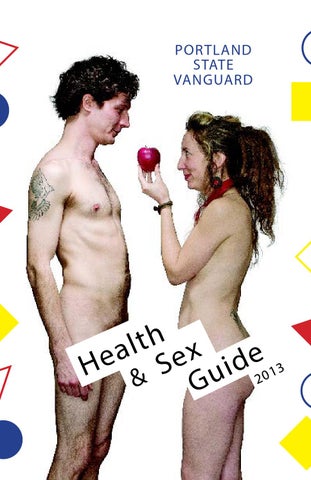
Portland state vanguard
h t l a x e e e H & S u i d 2013 G
Condoms and beyond The many methods of birth control
07 11
12
17 05
08 Contents
03 04 05 05 06 07 08 09 09 10
Condoms and beyond 11 We’re all in this together 11 Erectile dysfunction: beyond Get your sex on the bedroom History of sex toys O...O...O...Orgasm! 12 Where would be without porn? Sex therapy and relationship 13 The truth about online dating coaching in Portland 16 No more SAD face! 16 Help is on the way at SHAC Tell me how you like it Sexercise! 17 Food fundamentals Herpes 101 18 Sophisticated Sesso What turns you on? 18 To Kegel or not to Kegel? Is two (or more) better 19 A taste of enlightenment then one?
EDITOR-IN-CHIEF
Erick Bengel EDITORS
Whitney Beyer, Marco España, Louie Opatz, Meredith Meier, Deeda Schroeder, PRODUCTION MANAGER
Elizabeth Thompson PHOTO EDITOR
Karl Kuchs
ART DIRECTION
Danielle Fleishman Online Editor
Claudette Raynor COPY CHIEF
Emily Gravlin
ADVERTISING MANAGER
Sam Gressett
ADVERTISING DESIGNER
Romeo Salazar ADVISER
Judson Randall ADVERTISING ADVISER
Ann Roman DESIGNERS
Tom Cober, Danielle Fleishman, Dillon Lawrence, Colton Major, Maria Perala
2l
Health & Sex Guide
WRITERS
Tamara Alazri, Kat Audick, Zach Bigalke, Whitney Beyer, Mary Breaden, Adam Bushen, Robin Crowell, Jaime Dunkle, Stephanie Fudge-Bernard, Melinda Guillén, Megan Hall, Ravleen Kaur, Austin Maggs, Alex Moore, Andrew Morse, Janieve Schnabel, Gwen Shaw, Shilpa Esther Trivedi, Jenny Wren PHOTOGRAPHERS
Daniel Johnston, Riza Liu, Kayla Nguyen, Miles Sanguinetti, Corinna Scott, Adam Wickham COPY EDITORS
Kylie Byrd, Rachel Porter ADVERTISING SALES
Brittany Laureys, Kari Tate DISTRIBUTORS
Matthew Ellis, James Putnam This edition of the Vanguard is printed on 40 percent post-consumer recycled paper. ©2011 Portland State University Vanguard 1825 SW Broadway Smith Memorial Student Union, Rm. S-26 Portland OR, 97201
Story by Shilpa Esther Trivedi Photos by Miles Sanguinetti
the pill is frackin’ delicious, no doubt, but try and limit yourself to one a day—unless it’s a special occasion, or Flag Day.
C
hoosing the right birth control option for your specific needs can be frustrating. The Student Health and Counseling Center offers a range of birth control options for you to consider and contraceptive counseling to help you understand the various methods. For other reproductive health care needs, SHAC also offers wellness exams such as pap smears and screenings for sexually transmitted diseases, as well as the human papillomavirus vaccination and trans-specific health care services. SHAC also has a sexual assault nurse examiner on site to help support students of all genders who are survivors of sexual assault. What SHAC provides is actually fairly comprehensive. I’ve broken down some of the most common birth control options below. However, the best way to decide on the method that fits your situation is to meet with a medical professional.
Condoms and Dental Dams Condoms are the only method of birth control currently available (aside from abstinence) that prevent both pregnancy and STDs. Condoms are available at several places on campus including SHAC, the Queer Resource Center, the Women’s Resource Center and in the dorms. For those with latex allergies, it’s also possible to get non-latex condoms. Female condoms—aka dental dams—are another option that can be used for both vaginal and anal intercourse by any gender (the name is a bit of a misnomer). There are plenty of advantages to the female condom, the biggest one being that it can be inserted ahead of time instead of in the moments immediately before sex. Dental dams can be used to prevent STD transmission during oral sex, and there are helpful instructions out there regarding how to turn condoms into dental dams in a pinch. Gloves are another option in this area.
Birth Control Shot The birth control shot is a shot in the arm that prevents pregnancy. The shot is administered every three months. It’s a good option for someone who has trouble remembering to take the pill at the same time every day. It’s also worth considering if you plan on traveling for a time period of less than three months and don’t want to worry about the daily requirements involved with other methods. The shot is commonly referred to by its brand name, Depo-Provera.
Birth Control Vaginal Ring Also called the NuvaRing, this device is a small ring that’s inserted into the vagina to prevent pregnancy for three weeks. As with oral birth control, certain medications make the ring less effective.
Birth Control Pills The birth control pill is a daily medication that, if taken correctly, is effective in preventing pregnancy. There are a number of pills on the market, so it’s worth exploring which one, if any, is best for you. Less than one in 100 women end up pregnant if they use birth control pills correctly. Birth control pills are also used to treat a variety of other health problems. Like all options aside from condoms, these do not protect against STDs. The pill is a wonderful option with a variety of benefits, but some antibiotics and behaviors may make these pills less effective. And smoking while on birth control may cause blood clots.
Intrauterine Devices An IUD is a small device that’s inserted in the uterus to prevent pregnancy. These devices last much longer than some of the other methods (from five to 12 years, depending on which one you choose), and while insertion is more costly than the pill, it’s a one-time rather than monthly expense. They are one of the most effective forms of birth control available. There are two IUDs currently on the market, the ParaGard and the Mirena. The first is a copper IUD and the second is hormonal. Serious problems are rare but, like with any form of birth control, they can happen. If an unintended pregnancy does occur while you’re using an IUD, it’s imperative that you see a doctor immediately because of the increased risks while pregnant with an IUD in place.
Birth Control Patch Also known as Ortho Evra, the birth control patch sticks to the skin and releases hormones that prevent eggs from leaving the ovaries and make the cervical mucus thicker, which keeps sperm from reaching the eggs.
Birth Control Implant The birth control implant is a small rod inserted into the arm that releases hormones to prevent pregnancy. It’s effective for up to three years after insertion.
Emergency Contraception Also known as the morning-after pill or by brand names such as Ella, Next Choice or Plan B One-Step, emergency contraception is a pill that will prevent ovulation if taken up to five days (or 120 hours) after unprotected sex. It will not terminate an already existing pregnancy and will not cause an abortion. The sooner this pill is taken, the more effective it will be. If taken within 72 hours it will be about 85 percent effective. It needs to be taken after unprotected intercourse and will not protect you if you engage in unprotected intercourse after taking it. EC offers no protection against STDs, so if you do have unprotected sex and want to get tested, SHAC can help you with that. Several brands of this pill are also available at most pharmacies to
those over the age of 17, and they can be obtained at clinics as well. I strongly recommend purchasing this pill as a preventative measure. Since SHAC may not be open the moment a condom breaks, it may be helpful to have EC in your dresser drawer. Certain birth control pills can also be used at an increased dosage as EC if no other options are available, but that depends entirely on the brand of pill you use. Consult with your prescribing physician to see if it’s a viable option for you. A ParaGard IUD can also function to prevent a pregnancy if inserted soon after unprotected intercourse.
Abortion Abortion is a safe and legal medical procedure that many women in all sorts of situations from a host of backgrounds and belief systems have chosen. By age 45, about half of American women will face an unintended pregnancy. One in three American women choose abortion. Portland State’s student health insurance will partially cover this procedure if needed. If you do find yourself facing an unintended pregnancy and want to discuss all of your options, Backline (1-888-493-0092) is a toll-free and confidential talk line here in Oregon. Responders offer to listen and will provide support and resources in a nonjudgmental fashion as you consider every possibility, including pregnancy, parenting, adoption or abortion. There are definitely other methods to consider, including spermicide, sterilization, withdrawal, birth control sponges, cervical caps, diaphragms or abstinence, et cetera. Some of these may work for you and some may not. They all have varying degrees of effectiveness in preventing pregnancy, and the best way to decide on the method that works for you is to schedule an appointment with a medical professional. This list is slightly gendered, but unfortunately, temporary or easily reversible male birth control is not yet available in this country (aside from using condoms, outercourse, abstinence, withdrawal or obtaining a vasectomy). However, it’s in the works in a couple different places and is looking less and less like a pipe dream every day. In the meantime I urge people of any gender who find that this article applies less directly to them to communicate with their partner(s) about safe sex and have conversations about the methods used by everyone involved, and what would happen should those methods fail. Lastly, reproductive coercion (sabotaging birth control) is a very serious form of abuse. Forcing a partner to have sex without a condom is just plain wrong. So is tampering with any form of birth control (poking holes in condoms, pulling out IUDs or hiding pills) or pretty much anything else that will impact a person’s reproductive health without their consent. For that matter, lying about one’s STD status is a crime that has been successfully prosecuted. Just don’t do it! Part of safe sex involves ensuring that all parties consent to everything that occurs, and reproductive abuse means going against this consent. ☻
Vanguard 2013
l3
history of sex toys Story by Mary Breaden Photo by Jinyi Qi
V
Get your sex on Abeginner’sguideto Portland sex shops
Story by Janieve Schnabel Photo by Daniel Johnston
B
elieve it or not, loyal readers, we almost didn’t have anyone to write this part of the guide! You’d think it’d be easy to find someone to peruse the wares at our friendly neighborhood sex shops, but you’d be wrong. So I volunteered and went on a last-minute, whirlwind tour of our fun zones. Here’s what I found.
Best for women: She Bop 909 N Beech St. It comes as no surprise that She Bop tops the list for women. Would you expect any less from a shop named after a song about female masturbation? She Bop has a wide selection of female-friendly toys and media, and it presents them in an open environment. Also, unlike many places, it has products for any budget. The menfolk needn’t feel left out, though; there are options for gentlemen as well. And couples can browse their shelves and find massage oils, books, toys, lubes, et cetera that will please both members. The real reason this shop wins, however, is its positive atmosphere. The staff is courteous, knowledgeable and respectful. It’s a sex-positive, queer-positive, body-positive place, and its staff welcomes all patrons with a smile.
Best for both: Fantasy for Adults Only 1703 W Burnside St. Fantasy, a long-standing adult shop located on Burnside, has a little something for everyone. When I went there, a pair of men debated which lube would best suit their needs; a respectable fellow examined the bondage and discipline/ domination and submission/sadism and masochism gear; a young woman was clearly enamored with the lingerie selection; and a nervous-looking girl furtively perused the vibrators. The staff was able to provide useful information for all parties, and I saw nothing but happy faces on their way out. There is a large selection of toys and clothing available, as well as plenty of videos. There are also plenty of gag gifts—penis pop, anyone?— and games to keep the bedroom interesting. The
4l
Health & Sex Guide
staff generally ensures that what you buy is what you want, explaining the pros and cons of everything without up-selling too much. Overall, it’s a big place with an equally big selection. You’re bound to find most of the stuff on your list at Fantasy.
Best for the money: Taboo Video 237 SE Martin Luther King Blvd. After 20 years of serving Portland, Taboo has learned its customer base well. It’s well-stocked with toys for men and women alike, and most of its merchandise fits a college student’s budget. It carries a plethora of dildos, dongs, cock rings, vibrators, lubes, gags—I could go on, but I think you get the idea. It primarily stocks visual aids, with a large video selection ready for most shoppers. Despite the name, I almost expected otherwise. The videos are pretty standard for the genre, but they’re well-priced. There are always deals on select videos, and they’re organized such that topic and price are clear. The best part about Taboo, though, is its regular sale events and the coupons it offers. I was made aware that there are printable coupons available online for special deals on Taboo’s products. I checked the website and, sure enough, I found a 20-percent-off coupon (only through Jan. 31, though—sorry!). Between this and the shop’s already reasonable prices, Taboo gives you the best bang for your buck in Portland.
Best for men: Fat Cobra Video 5940 N Interstate Ave. I knew this would be the top shop for men the moment I walked in and felt out of place. I consider myself sex-positive, but there’s something awkward about knowing that mere meters away people are using the arcade (which, for those unfamiliar with the term, refers to the area where customers can masturbate or entertain themselves in private rooms with friends, partners or strangers). If that’s your thing,
more power to you! But if it’s not, it can be a little uncomfortable. (For the record, Taboo also has an arcade, but it’s easier to miss.) The store area itself is pretty standard. It stocks the usual toys and novelties, as well as plenty of videos. Porn out the wazoo. But there’s not exactly a lot of female-friendly stuff (though I managed to find a good half-shelf or so), and the atmosphere can be a little stifling. The staff, perhaps sensing my discomfort, didn’t approach, which was a relief. Despite what you might expect, it’s a clean shop with clear (and sometimes hilarious) labeling and a wide variety of toys and media, most of which would appeal more to a male audience. It’s not a large shop, but it covers the bases.
Points for Effort: Spartacus Leathers 300 SW 12th Ave. The majority of what Spartacus sells is lingerie, leather and sexy clothes, which most would agree are interesting and of good quality. As you might have guessed from the name, it incorporates plenty of leather, and it’s a fetish-friendly shop. However, it’s not what I’d consider a welcoming atmosphere. I felt like I was being watched no matter what I did, and yet somehow the clerk managed to not be anywhere in sight when I had a question about the vibrators. The shop is separated into two areas, which may have had something to do with it. The clothing and the novelties are in different rooms, with a big difference in atmosphere between them. The clothing section is darker and more alluring, whereas the toys are in a section that feels like an operating room. The clothes are priced comparably to other shops in the area, but they’re higher quality and there’s a good variety. The toys are largely overpriced, however, and the selection is lacking. This shop is good for clothing, but for everything else I’d recommend finding another shop altogether. ☻
ibrators, dildos, butt plugs, ticklers, cock rings, masturbation sleeves: There’s something for everyone. Not everyone likes to admit to what they do behind closed doors, but according to a 2009 study published in The Journal of Sexual Medicine, it’s safe to assume that more than half of Americans use sex toys. One look at the history of personal pleasure objects throughout the world tells us this isn’t a new phenomenon. From prehistoric times through the age of female “hysteria” and into the hypersexual present, sex toys have had quite an interesting ride. The world’s oldest dildo is thought to be a phallic stone sculpture that dates back some 28,000 years. The polished sculpture, discovered by scientists in Germany, looks a little rough when compared to today’s luxuriously soft toys, but you have to give those women a little bit of credit for making do with what they had. Beyond the Upper Paleolithic period, the use of dildos for female masturbation can be seen in Greek art from the sixth century B.C., and around A.D. 500 Ben Wa balls came onto the scene. At first, Ben Wa balls were said to be used during intercourse to increase the man’s pleasure, but later the balls were repurposed as a tool to strengthen a woman’s vaginal muscles. Another instance of a sex toy being used for something other than pure pleasure is the Manipulator, a steam-powered dildo machine invented by Dr. George Taylor in 1869. Back in the late 1800s, women who were sexually dissatisfied were misdiagnosed with anxiety and hysteria. To alleviate the symptoms, male doctors were compelled to provide pelvic massages for female patients until they were brought to orgasm. The Manipulator was invented as a form of hysteria treatment since, believe it or not, most doctors actually loathed giving pelvic massages. Not too long after the invention of the Manipulator, the popularity of vibrators took off in the U.S. At one point, the plug-in home vibrator was one of the most popular household appliances. Various models improved upon Taylor’s firstdraft dildo, such as the electromechanical
Feels like the real thing, baby: Dildos have come a long way since their archaic origins. (Boy, that’s a lot of fake dicks.)
vibrator patented by Dr. Mortimer Granville, whose claim to fame was recently documented in the 2011 film Hysteria, starring Maggie Gyllenhaal and Hugh Dancy. Vibrator mania didn’t last for long, though. The 1930s through the 1960s were what some have referred to as the dark ages of sexuality. Sex toys were popularly used in pornographic films in the 1920s, which led to the American Medical Association’s shut-down of the pelvic-massager party by declaring that hysteria was not a medical ailment. In the era of free love, sex toys made a comeback with the invention of well-known personal pleasure objects like the Hitachi Magic Wand, the Rabbit, the Fleshlight and vibrating cock rings.
“Some of the most positive changes in the sex toy industry have really happened just over the last 10 years or so,” said Evy Cowan, co-owner of SheBop, a female-owned, women-friendly sex toy shop in North Portland. “There are more and more sex toy shops, like SheBop, that are committed to carrying quality, body-safe products and educating customers,” she added. Generally speaking, a society’s lowered stigmatization of sex toys is held to be an indication of greater parity between the sexes. A person’s sexual desire is not a sickness to be cured with a visit to the doctor’s office or a do-it-yourself vibrating dildo. Still, assuming safety precautions have been taken, it can never hurt to try the latter. ☻
O…o…o…orgasm! Why is the female orgasm so hard to achieve? Story by Stephanie Fudge-Bernard
T
he female orgasm seems to be an unending topic of inconclusive research. Solemn male scientists pop up every so often to let people know about some new discovery regarding women’s climax, only to have another study come out a few years later claiming the opposite. Luckily, there are some reputable facts surrounding those illustrious lady fireworks. Psychology Today unfavorably reveals that one of the most important factors in achieving that ultimate finish is a simple one: Orgasms aren’t about intercourse. As unsurprising as this is to many women and bloodcurdling as it is to many men,
having vaginal intercourse has nothing to do with most ladies’ ability to reach the big O. About 80 years of research and 33 studies have shown that only around one in four women consistently achieve orgasm during vaginal intercourse alone. Let’s say the female orgasm is like a pizza: With intercourse alone, you’d only be eating two slices, letting the other six go limp in the box. To reach those other slices, you’re going to have to get a little more involved and inventive than just good old-fashioned missionary. The first step in satisfying a woman is remembering that it’s not how big a penis is, where you stick it or how you thrust it, it’s all about the foreplay that isn’t happening. What many people think of as foreplay is actually the main course for a majority of women, and frankly, we’re getting hungry. According to Woman’s Day Magazine, it’s
also crucial to give women the time they need. It takes 20 minutes for most women to peak, so be prepared for it to take a while. Again, this doesn’t mean you need to keep pounding that vagina in frustration. Guys don’t need to learn to last for hours to satisfy their partners, though that can certainly be fun, too. Whether you’re a dashing broad who’s having trouble cresting that peak or just a regular Jane going through a rough spot, it’s probably time to mix things up. Head over to She Bop in Southeast Portland and get one of those crazy vibrators that you’ve always been too scared to buy; get a funny costume and role-play; buy some candles and set some serious mood music for an evening in—just stop expecting that what works for men is going to work for women. We’re built differently, and that beautiful crescendo takes a few special strokes to really sing. ☻
Vanguard 2013
l5
Sex therapy and relationship coaching in Portland Story by Austin Maggs
N
© Among Friends
eed some help creating a more rewarding sex life? Trying to find ways to rekindle a dying relationship? In Portland, there are a wealth of sex therapists and relationship coaches to help anyone struggling with these or other sexrelated conundrums. In particular, sex therapist Julie Jeske and relationship coach Shanya Luther can provide some expert assistance. Jeske specializes in sex therapy for both men and women. She counsels couples, groups and individuals, teaching them how to feel more comfortable with sex. In their first session, Jeske helps her clients simply by talking to them. “It hits my heart strongly how brave people can be,” Jeske said. “It’s heavy, and what I call processing.” Jeske’s discussions about sex and relationship issues include topics such as sex communication, discussing what clients are comfortable and uncomfortable with, and how to cope with erectile dysfunction. Jeske also assigns “homework” to her clients, helping them discover who they are sexually. “It’s more about self-discovery than putting on an act,” Jeske said. Her assignments include writing about things they’ve learned in the past or about sensuality and romance. “That’s how some people access their sexual-Talk to me: Relationship coach Shanya Luther counsels men, women and couples on communication and sexuality issues. ity. Some people are very romantic,” Jeske said. variHer physical assignments include helping couples spice up their marriages by practicing “It’s different, but it’s a good way to keep kissing or participating in activities such as in touch with clients who normally couldn’t come ations, and were never taught that something visiting a sex-toy shop, or assigning single clito my office,” she said. wasn’t OK. ents to practice masturbation, among other things. Jeske is passionate about her current work “Someone who is labeled a sexual predaJeske also teaches an online class for women, because she feels all women should discover tor because they weren’t taught not to do helping them discover who they are sexually. It’s their sex potential. certain things, what not to say or what not a 10-week course and is based on the book she’s “We don’t have good models for sexuality in to do, is really a failure of our system,” currently writing. our culture,” Jeske said. “There’s this idea that she added. “It’s very exciting,” Jeske said. “It’s you’re either sexual or you’re not. If you don’t Luther teaches her clients what’s right and different compared to working with people in represent what is stereotypically sexy, then wrong verbally and visually, through role-playing a room.” you’re not sexual at all. and by demonstration. It depends on each client’s Jeske keeps in contact with her online “We have ways to teach people how to be a best learning method. students through email and video conference calls. tigress in the bedroom and how to blow his mind, “It really has to be customized to the but we don’t have ways to teach ourselves who we individual…their particular needs and their © Julie Jeske M.s. are and what makes us feel best,” she added. developmental disabilities, because not all Before Jeske opened her practice, she hosted developmental disabilities are the same,” pure romance parties, for which she would go to Luther said. women clients’ homes and teach them about differIn terms of communication in intimacy ent sex toys as well as help them order the pieces and relationships, Luther teaches her clithey wanted. Jeske discovered her sex therapy ents about consent and its importance. passion through hosting these parties. “Being in a relationship is all about consent,” Jeske has had her practice, located in she said. Northeast Portland, for four years. She can be Luther also discusses healthy communicating, reached at julie@juliejeske.com. differences between passive, aggressive and asLuther specializes in relationship coaching. sertive communication, and how to make contact She offers support services to adults with menwith someone. She also teaches communication tal disabilities and neurological variations. Her limits. coaching centers on relationship difficulties, “If a client I have likes someone, they call communication issues with loved ones and issues them 15, 16 or 17 times a day, and that’s not surrounding sexuality. OK,” Luther said. “There [are] all kinds of variations of what Luther also teaches her clients how to have people are looking for support with,” Luther a “fair argument” and to not resort to physical said. “I tend to help people with, ‘I’m lonely or emotional abuse. She also focuses on teaching and I don’t know how to meet people or parther clients about what it means to be intimate. ners,’ to ‘I’m doing stuff in public that might She teaches them the difference between intimacy get me arrested.’” and sex. Luther works with mentally disabled clients “I talk to people about the fact that intito recognize what behavior is appropriate in pubmacy is a drive to feel seen, heard and cared lic and what isn’t. This includes helping them about,” Luther said. “It’s the place where we learn when and where it is OK to touch other feel safe to be vulnerable and don’t try to hide people or themselves and when it isn’t. who we are. “Sometimes they haven’t learned not to touch “Most people mistake intimacy for sex,” she someone without asking, or themselves or their genadded. “Sex and sexuality include intimacy, but itals on the MAX,” Luther said. “One of the things they don’t define intimacy.” sex, demystified: Julie Jeske focuses her work on counseling men and women with sexual concerns. I learned about sexual offenders is that most of Luther also provides her clients a safe place them were mentally disabled or had neurological to identify themselves in terms of gender and
6l
Health & Sex Guide
Tell me how you like it
A guide to communicating your sexual desires
Story by Whitney Beyer Photo by Miles Sanguinetti
S
ome people like it rough, and some people like it really, really kinky. No matter which way you like it, the truth of the matter is that you’re not alone. One look at the diverse array of X-rated material that comprises the $2.9 billion Internet pornography industry will tell you that. Despite the prominent societal presence of all things fetish, certain sexual desires can leave some people feeling alienated and ashamed for wanting or asking for them. This in turn can keep people from expressing their desires, which can keep them from having the sex they really want. “I’ve been with my girlfriend for [more than] two years and I still haven’t figured out
>> I’d say 75 percent of the couples I see lack the courage and skills to ask for these things outside of therapy. << Dr. Nancy Campbell
sex therapist how to ask her if she’d be interested in having anal sex,” said one Portland State junior who asked to remain anonymous. “I don’t want her to think I’m weird or that I don’t respect her,” he said. “It’s just something I really want to explore with her.” According to Dr. Nancy Campbell Hanks, a sex therapist who practices in both Portland and Sacramento, Calif., issues with communicating sexual desire to a partner are incredibly common. “Most of my clients express an interest in anal and anything you’d call kinky, like bondage, submission or role play,” she said.
“I’d say 75 percent of the couples I see lack the courage and skills to ask for these things outside of therapy.” Dr. Sheila Silver, a sex therapist in Portland who also happens to be the only clinical sexologist in the state, believes this is a problem everyone encounters at some point or another. “All of my clients, everybody,” Silver said. “It’s a societal problem.” “There’s a myth in our culture that you don’t have to talk about [sex] and that you should just know [what your partner wants],” she added. Silver explained that the reluctance to ask for what you want sexually stems from a fear of how you might be perceived. “It’s expecting judgment from your partner,” she said. “You may feel vulnerable, embarrassed.” Campbell said the fear goes both ways. Often, she explained, people are afraid to ask for what they want because they are afraid their partner will think they’re weird. For those on the receiving end of communicated desires, there can be a fear of not doing it right or of being compared to a previous sex partner. Whatever the scope and origin of the fear, both Campbell and Silver agree that not asking for what you want sexually can be detrimental to a relationship. “If you decide not to ask the question, you have opted to take things just as they are,” Campbell said. “You’ve opted for things not to change.” According to Silver, an open line of sexual communication with your partner will increase intimacy, closeness and connectedness. “When you don’t ask for what you want, it can perpetuate distances and bleed into other areas of the relationship,” she said. “It’s of vital importance.” Campbell’s and Silver’s best advice when it comes to communicating about what you want is to, well, just do it.
“Just being uncomfortable isn’t an excuse not to do it,” Silver said. Silver recommends that people talk about it outside of the bedroom, in a nonsexual situation, and believes people can use things that have come up in movies or real life as a starting point to initiate this kind of conversation. She also suggests debriefing after sex but only in a way that won’t hurt your partner’s feelings. “Set you and your partner up for success by saying things like, ‘I loved when you did –––––,’ or, ‘I really would like it if you’d –––––,’” Silver explained. “Don’t say things like, ‘Don’t do that,’ or, ‘I hated when you did –––––.’”
>> It takes bravery and willingness to be vulnerable, but it will move your relationship forward. << Dr. Sheila Silver
sex therapist Ultimately, Silver believes it’s necessary to get to the root of the discomfort. If you are having difficulty expressing your sexual desires, she said it’s important to ask whether that discomfort stems from family, religion, culture or elsewhere. Both Campbell and Silver emphasized the level of courage it takes to improve your relationship with sex and your communications about sex with your partner. “It takes bravery and a willingness to be vulnerable,” Silver said, “but it will move your relationship forward.” ☻
Vanguard 2013
l7
What turns you on?
3 1
Students speak out
Sexercise!
Herpes 101
A fun workout to do with a buddy
Clearing up misconceptions
Story and illustrations by Kat Audick
Story by Jaime Dunkle Photo by Riza Liu
4 2
W
hy pump weights alone when you could build muscle with a friend? Sex is a great workout, and by implementing a couple of these sexercise tips you can have a sexual experience that is not only better for your body but also more pleasurable for you and your partner. We’re not talking about vigorous pounding with tense muscles and impossible positions, just the sexual poses you’re used to with added tips to intensify your pleasure. “Sex is great when you let go of any objectives,” said Anna Marti, a Portland-based intimacy coach. “You’re not using sex to boost your self-image or manipulate a partner. You sense yourself deeply relaxing, connecting skin-toskin with another human, and your mind gets quiet,” Marti said. “This kind of sex gives you energy [and] enhances creativity, and you feel light—a natural high!” Proper breathing is key, as with most workouts. Finding patterns of breath with your partner will put you more in sync and bring your moments of ecstasy closer together. “Our physical experience of long, slow breaths can lower our blood pressure and allow for a deep relaxation, while fast and full breaths with pelvic thrusting raises our heart rate, pumps oxygenated blood into our tissues and can give us a cardio workout that lengthens our stamina, burns calories and discharges stress and toxicity,” said Barbara Wynne, a Portland-based somatic sex educator, coach and sexological bodyworker. Wynne teaches erotic and emotional skills to people who long to restore their sacred relationship with their own body, experience ecstatic connection in their sexuality and claim the sexually fulfilling lifestyle they desire.
8l
Health & Sex Guide
“All forms of sex and intimacy—from cuddling, to solo sex, to ejaculatory orgasm during partner sex—have profound positive impact on the human body across the spectrum of physical, emotional and mental experience,” Wynne said. Sex is a perfect way for us to get some interactive exercise while we strengthen our mental health through positivity. Changing positions during intercourse is a great way to cool down. Breathing in between positions prolongs your pleasurable sexual encounter. This sexercise routine will help your muscles feel the burn while your body builds to orgasm.
Partner Two will sit on Partner One’s lap, facing him, with legs resting in kneeling position on either side. Seated partner, strengthen your trapezius and deltoid muscles by using your arms to assist in lifting your partner up and down. Top partner, focus your energy to your core and feel the burn in your quads and glutes as you elevate and drop your body. This is a great position to practice relaxed breathing together because you can inhale and exhale simultaneously with chests pressed together as your bodies rise and fall.
1.Muscle-Toned Missionary
3.Fitness Scissors
The partner on top has better control over rhythm, so while you focus on your abdominal muscle core, vary between faster and slower rhythmic reps. By lacing your arms at an L-shape, with your forearms tucked under the bottom partner’s shoulders, you will not only increase intimacy while thrusting but also achieve a better workout for your triceps while pulling up and into your partner. Bottoms: Relax your back to relieve unnecessary muscle tension and focus on your abdominals and pelvic floor. These muscle groups will enhance stimulation and tighten your tummy. For male couples, throw your bottom’s legs over your shoulders for ease in positioning. This will also add an extra muscular crunch and curl for the bottom partner’s abs.
Partners lie with their legs and genitals interlocked, propped up on their sides, holding onto the bed or legs of the other partner for stability. This position will give your biceps and triceps a workout as you use them to steady yourself while slowly grinding into your partner’s body. Scissoring reps will strengthen your inner thighs and quads as you use them to keep your bodies locked together.
2.Thigh Master Perform this position on the edge of the bed with the penis- or strap-on-toting partner sitting with his feet placed firmly on the ground.
4.Bicep Bridge Partner One will kneel on the bed with arms at his sides. Partner Two then lies on the base of her shoulder blades and angles her hips up to connect pelvises with Partner One. Partner One will assist by holding his companion’s legs. The kneeling partner will feel the burn in his quads and glutes, while gaining the most exercise in the biceps as he holds the legs of his lover. Partner Two should focus the majority of her energy on her thighs and glutes to squeeze and pull pleasure from the intercourse epicenter. ☻
T
he gift that keeps giving. Cat’s tongue. Last-laugh sores. Some even call the herpes simplex virus a life sentence. Two types of HSV exist. Type 1 is a cold sore or fever blister. Type 2 is the usual cause of genital herpes. Both HSV-1 and HSV-2 can infect either the mouth or genitals. “Some people feel like they’re scarred, but I don’t know that it has to be [that way],” said Dr. Mark Bajorek, director of health services at the Center for Student Health and Counseling at Portland State. Studies of heterosexual couples found that 80 percent of the population has HSV-1 and 20 percent has HSV-2. Statistics at PSU reflect the same numbers, according to Bajorek. A man is more likely to infect a woman, but it’s also likely for woman-to-woman transmission to occur, and quite possibly man-to-man as well since anal sex and oral sex increase the risk of infection. “According to the Centers for Disease Control and Prevention, one out of six people 14 to 49 years of age is infected with genital herpes. Women are more commonly infected than men, and in the [U.S.], one out of five women has genital herpes,” according to the National Institutes of Health’s website. Testing for HSV can be difficult. The virus is integrated into the DNA and becomes part of the tissue. False positives are common in blood tests, but false negatives are a possible result of swab tests, according to Bajorek. Well, what does herpes look like? Lesion is such a vague word. What exactly is a lesion? Or a sore? That sounds like it could be anything! Some people have described a herpes sore as looking and feeling like a cigarette burn. Sometimes it’s a bump, but sometimes it’s indented. It can be a blister that scabs, but it can go unnoticed until it does scab. It may even feel like a gnarly zit pressing against the skin before surfacing. Or it might just tingle. So, the answer is that herpes varies from person to person. Genital herpes doesn’t have the same appearance for everyone infected with it. This can make it tricky to diagnose. Bajorek suggests anyone who notices sores or tingling in the shorts district—below the belly button and down to the thigh—ought to be tested.
Stressors that cause outbreaks Anything that can weaken your immune system can trigger both forms of herpes. A lot of student-related stress can cause an outbreak. Lack of sleep, poor nutrition, common cold and flu symptoms, sunlight and even rough sex can trigger a herpes flare.
Debunking urban myths •
• • •
•
Having herpes doesn’t mean a person’s sex life is over; he just has to be careful and mindful. Toilet seats and hot tubs do not transmit herpes. Genital herpes can be transmitted when there is no visible outbreak. If you have HSV-1 it can spread to the genitals (remember, 80 percent of the population has HSV-1). Medication can stop the spread of the virus by decreasing viral shedding.
Quick Q-and-A with dr. mark Bajorek Many students, like Anna Krykun, a junior science major at PSU, don’t know a lot about HSV. She had a few specific questions, and the Vanguard directed them to Bajorek. VG: Do you have to take HSV-2 medication forever? MB: In theory, you could take medicine forever, but typically it’s just for a few years. VG: Will your partner get infected regardless of precautions? MB: Not always. Some folks just have great immune systems or [their] partner isn’t shedding the virus. VG: Is it spread from mother to child? MB: Type 2 can be spread by herpes that gets into the blood of a pregnant mom, or when the infant passes through the birth canal. Bloodborne herpes viruses can cause a number of birth defects—listed under TORCH syndromes. VG: Is the virus transmitted through secretions or skin? MB: It can be with cells in sweat or with cells in the mucous membranes. Krykun said she would be scared if she found out her lover had HSV-2, even if she didn’t have contact yet. “It doesn’t mean I would ditch the person, I would just be cautious and think twice,” she said. A lot of people seem to feel the same way, which means HSV does not have to feel like a life sentence. ☻ For more info, call SHAC at 503-725-2800. Free condoms are available at the Women’s Resource Center, Queer Resource Center and SHAC.
Story by Katie Hoyt Photo by Riza Liu
V
alentine’s Day is here, so we’ve asked a group of students at Portland State what turns them on, both physically and emotionally. As it turns out, girls were much more willing to offer insights, which quickly turned this project into an all-female survey.
What’s a turn-on for you? Sophomore “Surprise dates are always…a big turn on for me. It shows they care, and it makes me feel special.” Junior “I love when my hair is played with…I also love getting kissed on the back of my neck.” Sophomore “I like when someone tickles, scratches or rubs my back—it’s a comforting feeling and makes me feel secure.”
What physical traits do you look for in a partner? Sophomore “I like guys with tattoos [and] piercings [who] can play some type of instrument. It’s always sexy when a guy can play an instrument.” Senior “I think physical attraction is only a little part of what turns me on. If I meet a guy who has a great personality and a nice smile, that’s what turns me on. Also, a guy with a huge laugh.” ☻
Erogenous behavior: Pay attention to your lover’s physical responses—sometimes it’s the little things that turn up the heat.
Vanguard 2013
l9
We’re all in this together
Is two (or more) better than one? Negotiating polyamory in the 21st century Story by Andrew Morse Photo by Kayla Nguyen
I
n his famous novel The Manuscript Found at Saragossa, Polish Enlightenment figure Count Jan Potocki has one of his characters offer a criticism of chivalry, a practice of medieval origin whereby young noblemen offered homage to a (usually) married noblewoman in an exclusive arrangement. Potocki’s character says: “These exchanges were indeed in no way guilty, but their effect was to interest the female heart in a man who was destined never to possess her, and to weaken feelings for the man to whom her person and heart belonged.” In an age and setting in which many marriages were arranged, often for political purposes, this practice recognized one important thing: that the human heart was capable of romantically loving more than one person at a time. However, according to the philosophy of polyamory, this system, despite its intentions, fell short because it would not allow those loves to ever become fully realized. It still demanded institutionalized limitations on expression. Society is long past the age of chivalry, but, at least in the West, monogamy is still by and large the norm. Some couples may allow each other a distant celebrity crush or joke about extramarital attractions, but actually acting on such desires would still be taboo. Indeed, it would be tantamount to cheating. So what is polyamory all about? Why does it claim to be an ethical alternative to monogamy? How does it allow multiple loves to coexist in a fully realized state? The long answer is complex. The short answer is simple: Polyamory is predicated on both communication and permission. In polyamorous relationships all parties are on board, and that’s what makes it ethical. Practitioners of polyamory eschew the notion that there is only one true love for any one person. According to the website morethanone.com: “This is the ‘scarcity model’ of love—the notion that love is rare, that we can only have one true love, and that once we meet that one true love, the part[s] of our brains which take notice of other people suddenly and mysteriously shut off.” On the other hand, “Being polyamorous does not give you license to make like a bunny in heat,” the website continues. “A polyamorous relationship isn’t about sex; it’s about building a romantic relationship with more than one person at a time.” So what about the sex? If that doesn’t matter, couldn’t any emotional bond of love be considered polyamorous? The website states that “if no sex is involved, then what you have is a monogamous relationship where the couple has other friends. It is, in a sense, the fact that sex is involved that defines polyamory as distinct from monogamy.” It is the full spectrum of romantic involvement that makes polyamory different from friendship, and the multiplicity and equality of partners that sets it apart from monogamy, polygamy, bigamy or just plain cheating. Polyamory can take many forms. In some cases it may resemble polygamy, to which it is often erroneously compared. In others it might be two or more couples who choose to open their relationship(s) to the other(s). Marriage may or may not be involved in these situations. And while polyamory may involve group sex, it certainly doesn’t have to.
10 l Health & Sex Guide
Individual relationships still matter—perhaps they matter the most. The form polyamory takes is essentially defined by those involved in the situation. Etymologically, the word polyamory is a combination of the Greek “poly,” meaning “many,” and the Latin “amor,” meaning “love.” That leaves the definition fairly ambiguous. The most important part of polyamorous practice is setting rules. That doesn’t mean a strict, regimented lifestyle like the military or the cloister. It only means that everyone involved in a polyamorous relationship understands the parameters. It means that everyone is consulted when an issue arises or when a new partner is being considered. Naturally, emotions and jealousies can be part of the package. The website cautions: “If you treat your lovers as though they are interchangeable, they’ll be jealous. If you don’t take care to make your lovers feel wanted or needed, they’ll be jealous. If you aren’t careful to make it clear to all of your partners that you value them, you won’t keep any of them for long.”
If that sounds like a lot to deal with, understand that people who practice polyamory don’t claim that it is superior to monogamy, just that it is an ethical alternative to it, one that solves many problems, such as cheating, by demanding communication and permission. It’s not for everyone but is rewarding for those for whom it works. Portland has an active poly scene. One website, portlandpoly.org, has resources for practitioners and the curious alike. Some groups are for general interest, others for the under-35 crowd, and others still for appetites for fetish and BDSM. One can attend potlucks, “munches,” meet-ups and info sessions—whatever seems the most comfortable. Polyamory may not have been a term Jan Potocki had in the late 18th century, but one of his other characters more or less describes it when speaking longingly to two women: “It is always claimed that one can only truly love one woman. This is indisputably false, because I love the two of you equally. My heart does not distinguish in any way between you. You both reign there in common.” ☻
The group sexual experience Story by Melinda Guillén Photos by Adam Wickham
C
ontrary to popular belief, the practice of group sex, or orgies, is not reserved for dirty pornos and manly fantasies. In this day and age, it’s likely that more people have at least given group sex some consideration. For those who have never experienced group sex, however, the question of how to go about it might be tough to answer. Like any sex, whether with one partner or 10, safety should be the top priority—pleasure, of course, running a close second. When hosting a sexual escapade with more than one person, it’s important to first consider the personal boundaries of all parties involved. If embarking on an orgy with your partner of five years makes you slightly uncomfortable, it is best to use caution when choosing other lovers to share the experience. Having another person in the bedroom will teach you a lot about your long-term partner. Like all sex, especially one-night stands, it is a good idea to establish boundaries ahead of time. If someone is not the biggest fan of, say, anal sex, blow jobs or getting kinky, you should probably be informed long before the orgy happens. Nobody wants to be surprised by the vibrating 4-inch anal plug complete with spikes that another person decides to bring. Determining which batch of people will mix the best for your orgy can help to guarantee 100 percent satisfaction. Lastly, always use some form of protective contraception. An orgy with sexually transmitted diseases and a baby on the way? As Internet memester and apartment-fire-escapee Sweet Brown so eloquently puts it, “Ain’t nobody got time for that!”
An Apple A DAY is just good advice, especially when “apple” is a metaphor for “consensual, safe, orgasm-filled group sex.”
Once all partners have been chosen and boundaries have been established, the next part may be the hardest (or maybe the easiest): actually going through with it. It is important for everyone involved to follow through on all agreements and not to overstep boundaries. Couples can learn more about each other than they had ever known before by engaging in group sex. Friends going through with this probably wish to stay friends, and onenight-standers would probably like to leave their sexual adventure as healthy as they went into it. An undeclared PSU student (who requested anonymity) enjoyed her orgy experience.
“I enjoyed the aspect of it being a new experience as well as knowing that I could trust the people I was doing it with to be comfortable with something I’d never done before,” she said. “A threesome can be a wonderful experience. I was able to be safe sexually as well as enjoy new people in sex for a night. I would recommend it because you only live once, and with the right people it will be a night you won’t forget. [Also] it will give you the chance to be more open-minded.” Perhaps, then, open-mindedness is all it takes. When done right, a group sex can leave an unforgettable mark on a lifetime of sexual experience. ☻
Erectile dysfunction: beyond the bedroom EDdoesnotcompromiseone’smanhood Story by Robin Crowell Photos by Corinna Scott
T
All for one, one for all: Unless you’re serious about making it a full-blown lifestyle, polyamory is nothing to toy around with.
hough most men would be far from quick to admit it, erectile dysfunction is not just something that happens to men in their 50s and older—quite the contrary, in fact. Erectile dysfunction, more commonly known as impotence, is the lack of ability to achieve or maintain an erection. “Male sexual arousal is a complex process that involves the brain, hormones, nerves, muscles and blood vessels. Erectile dysfunction can result from a problem with any of these,” according to the Mayo Clinic’s website. So what does this mean? In older men, impotence can be linked to untreated, underlying health conditions. This negates the common misconception about the condition: It is not a matter of a man’s plumbing malfunctioning as a result of old age. The fact that male arousal relies on so many different, interlocking bodily components lends credibility to the idea of interference. If diabetes or heart disease runs in the family, or a less-than-healthy lifestyle is maintained for far too long, further diagnostic testing beyond simply obtaining a Viagra prescription may be the answer. It seems that the reason impotence occurs far less often in younger men stems from these pesky underlying health issues. But young men are not out of the woods.
Poor mental health is also a precursor to erectile dysfunction. Stressful situations like poor communication in a long-term relationship, depression, anxiety and other mental health conditions can cause impotence. Solutions? Engage your partner in more meaningful conversation about the state of your relationship and seek out mental health resources that could potentially lead to a healthier mind and, in turn, a healthier sex life. Women are not exempt from this problem. Although male and female sexual arousal are two completely different sciences, women too are subject to various sexual dysfunctions. Female-centric problematic arousal conditions include hypoactive sexual desire disorder (a chronic lack of interest in sexual activity), sexual arousal disorder (persistent or recurrent inability to attain or maintain sexual excitement), orgasmic disorder (chronic difficulty in attaining or inability to attain orgasm following sufficient arousal), among many others. Like male erectile dysfunction, these conditions can be brought on by many of the same underlying problems, including issues related to mental health. So how does one synthesize this information? If you are in a long-term relationship, open and frequent communication (both sexual and nonsexual) is incredibly important in maintaining a healthy sex life. Problems arising from work, school, family and other social arenas should not be ignored if they are negatively impacting life in the bedroom.
Engage in meaningful conversation on a regular basis with those who are willing to listen, seek the necessary help to abate any underlying health problems contributing to sexual health issues, and soon you will find yourself “in the woods” once again. ☻
Male arousal relies on many interlocking bodily components.
Vanguard 2013
l 11
Where would we be without porn? Answer: bored and horny
T
en years ago when one thought of online dating, the image of a hairy man hunched over his computer with a toothy grin came to mind. Today, however, online dating is a hugely popular tool many singles use to meet potential lovers. “Everyone knows someone who has tried it,” said Dr. Cynthia Mohr, a Portland State professor of psychology. While the image of the typical online dater may have changed, have the stigmas and misconceptions surrounding online dating disappeared as well?
P
12 l Health & Sex Guide
Misconceptions, stigmas and science Story by Kaela O’Brien Photo by Miles Sanguinetti
Story by Gwen Shaw Photo by Kayla Nguyen
ornography is a word that everyone knows. In our society, the word “porn” has a taboo following it around, and the subject rarely comes up in everyday discussion. Yet almost every day each of us partakes of something that would not be here were it not for the existence of pornography. Jeff Hale, liberal arts advisor and professor in new media communications at Oregon State University, teaches an online special-interest class that focuses on pornography and how it has changed the ways we access all that we do. “Every major technological innovation was either created by porn or developed by porn,” Hale said. “So that’s probably its most socially redeemable feature.” As Hale explained, the porn industry has played an important role in the adaptation and adoption of technology. “People like to see naked pictures of other people,” Hale said. It’s something everyone knows is true whether they like to admit it or not. Because of this, when photography was developed the first photos taken were of naked people. When film was developed, the first movies were of naked people. When the Internet was developed, pornography played a big role in making it what it is today. Pornography has provided us with secure Internet transactions (no PayPal without porn), created both streaming videos and two-way videos, and improved closed captioning and the way we do closed captioning today. On the behavioral and societal side, Hale said porn seems to be positive to the extent that when we’ve seen an increase in pornographic access or usage in any given society or any given time, rape and violence against women decreases. “We don’t know exactly how the relationship and the connections work, but we know that there is a relationship between the two factors,” Hale said. Of course, there is other research that supports or seeks to challenge this claim, but the idea seems to hold true in many different cases. With so much talk about the benefits of pornography in society, there is no denying it provokes many concerns as well. First is just how easy it is to access pornography, even for children. Next is that young men seem to be developing an obsessive-compulsive relationship with online pornography. The last big concern about pornography is the health and safety of the sex workers themselves. Recent legislation in Los Angeles County requires condoms to be used in all pornographic productions. There was even a recent All Things Considered segment on National Public Radio regarding this issue featuring Steve Hirsch, the CEO of Vivid Entertainment, one of the larger pornography production companies. These concerns are the ones that seem to be valid for most everyone in society. Big concerns also come from many religious and value-based
The truth about online dating
Misconception #1: Online dating is for losers.
KEEP THAT KEYBOARD CLEAN: Forget what your mama told you–porn is positive and industrious! It created photography, film and the Internet, according to Dr. Jeff Hale of Oregon State University.
people and groups. It’s a common belief among them that pornography should be avoided at all costs. So far in history, pornography has been seen as degrading to women, but Hales pointed out that that could change. “It has the potential to empower women, if women take greater control over the production process and create products that they see [as] more appropriate for both men and women,” Hale said. Women are more accustomed to telling stories: They have different narratives, they are more relationship-based and they develop a storyline more. Hale said that this could change the focus or force of pornography. “Fifty Shades of Grey is pornography,” Hale said. “There’s no other way to say it.” Even just searching ‘romance novels’ on Amazon.com gets you steamier content than
anything you can possibly watch. Samuel Pepys, a 17th-century British Parliament member famous for his diary, said of pornography (before the word “pornography” was even invented) that it was a “book that you read with one hand.” With all these benefits and concerns it’s hard to know where to stand on this complex issue! “Pornography works at a political level, a cultural level, a social and behavioral level,” Hale said. “It’s kind of all-encompassing.” But Hale pointed out that there are many books and research out there that show pornography does have value and is important in our society. “It has helped define our sense of First Amendment rights as well as helping us in a technological way,” Hale said. “ [The] Internet as we know it today would not exist if it weren’t for pornography.” ☻
This stems from the idea that if you were able to meet somebody in person willing to date you, you would have done so already, meaning that online dating is for those who can’t get a date the old-fashioned way. “I don’t think that is true at all,” said Sally Eck, a women’s studies professor at PSU. “I know so many people who have used online dating who are really amazing people.” In fact, Eck seemed almost insulted by the stigma, and revealed that she herself has tried online dating.
Misconception #2: Online dating is easier than meeting people in person. While online dating obviously increases your opportunities to meet people, it is not necessarily an easier way of dating. One PSU student, who preferred to remain anonymous, said, “I joined OkCupid because I wasn’t meeting any interesting guys in my classes. I was looking to meet more people.” However, the same student also said that after only a few months she decided to deactivate her account. “I really wasn’t meeting anyone I wanted to date,” she said. Eck agreed. “I think people [choosing to use] online dating has made the world more difficult because there are so many more first dates.” She also said that the number of potential matches is overwhelming. “Because I am a tall blonde, I had so many comments and winks that I couldn’t manage it all,” Eck said. “It was exciting for a minute, but then it was like a full-time job.” Another reason for quitting, she joked, was seeing her students on online dating sites.
Misconception #3: Everyone lies on their profile. MTV’s new show Catfish, which looks into the harm caused by false online profiles, has left me questioning whether misconception #3 is really a misconception or just an exaggeration. Mohr attended the Close Relationships Preconference (a precursor to the annual meeting of the Society for Personality and Social Psychology) on Jan. 17, and reported: “Research has found that nearly everybody lies about at least one aspect on the profile.”
Every Rose has its thorn: Online dating is here to stay, and though it’s possible to find love, it’s also important to avoid creeps and cretins. Make sure your first meeting is in public and that you stay sober-ish.
While lying online is as easy as typing, Eck pointed out another important fact: “People lie in person, too.” So while this aspect of online dating is still a bit murky, dating in person doesn’t necessarily guarantee an honest conversation either.
Misconception #4: The anonymity of online dating leads to more casual sex. While Eck believes that the high number of dates that people can potentially go on because of online dating might lead to an increase in sexual activity, she doesn’t feel the actual process of meeting online leads to more sex. “People are going to do what people are going to do, whether they met online or at a bar,” she said. Eck did, however, want to remind PSU students that “[w]hen meeting someone on a first or second date, always meet in a public place. And always stay sober!” How scientific is the science behind matching? One of the most successful online dating sites, eHarmony, claims that it takes a scientific approach to matching users, calling their patented formula the Compatibility Matching System. At the same conference Mohr recently attended, Dr. Gian Gonzaga of eHarmony Labs spoke during a 90-minute session about whether the science of close relationships can inform the practice of online dating.
However, the real buzz of the presentation, Mohr said, was the following question: If eHarmony has a viable scientific formula, then why have they not yet opened it up to scientific peer review? While eHarmony describes in detail its patented 29 Dimensions of Compatibility, including such predictors as emotional temperament, values and beliefs, researchers believe there is a reason the actual compatibility algorithm hasn’t been released: The formula is most likely wrong. “The biggest indicator [of] the success of a relationship is the quality of interaction, while personality only makes up 6 percent of success prediction,” Mohr said. The problem lies in the foremost characteristic of online dating: Matches have never met each other, therefore the quality of their impending interaction cannot be known. In fact, of the three biggest indicators (quality of interaction, personality and stress levels) only personality is taken into account by an online matching service: Most sites ask only a vague question or two regarding one’s stress levels, if it’s mentioned at all. “They need valid testing on a control group,” Mohr said. “If eHarmony wants to claim their formula is science, then [they should] prove it.” At the conference, however, Gonzaga had a response for the pressure being put on eHarmony by the scientific community: “We’ve been talking with our lawyers.” So while the science isn’t rock-solid, it is impossible to ignore that thousands of people have met their match through online dating services. Mohr’s only advice: “Don’t put too much stock in it.” ☻
Vanguard 2013
l 13
14 l Health & Sex Guide
Vanguard 2013
l 15
Food fundamentals Kicking seasonal depression
Grocery guidelines to help you eat healthier
Story by Megan Hall Photo by Kayla Nguyen
R
ecognizing that the gloomy weather may be getting you down is important, but treating that depression with nutritious food and exercise is necessary and will help to pull you out of the dumps. It’s that time of year when gloomy, overcast Portland rears its ugly head. We may not see sunshine for days on end, and we all have our heads down, facing the ground as we dodge the rain. Shorter daylight hours and lack of sunshine prompts a biochemical imbalance in the brain, linked to what we commonly know as Seasonal Affective Disorder, or SAD, according to the American Psychiatric Association. “Fall and winter are times of year when we do see folks who have an increase of low energy, low motivation,” said Marcy Hunt-Morse, director of Counseling Services at the PSU Center for Student Health and Counseling. This is true not only because of the weather, but also because of stress and anxiety brought on by school. The APA claims that the farther someone lives from the equator, the more likely they are to develop SAD. In middle-to-northern latitudes, such as here in the Northwest, instances of SAD can be as high as 25 percent. Furthermore, the typical age of onset is between 18 and 30, meaning college students in Oregon are especially susceptible to these feelings of seasonal depression. At a time of year when we’re all feeling a little blah, it can be easier to hide under the covers than show up for class, and outside seems like the last place anyone wants to be. However, if you’re feeling down because of the cold and wet weather, it’s more important than ever to get outside, eat well and get a good amount of sleep, Hunt-Morse advised. “Try to look at your sleep patterns. Get back onto a good sleep rhythm. Get outside, even [if] just for a walk. Breathe in some fresh air,” she said. The APA explains that melatonin, a sleeprelated hormone, could also be tied to SAD. Melatonin levels increase during times of darkness, so the longer you are in the dark the more melatonin you produce.
Story by Zach Bigalke Photos by Jinyi Qi
C
ollege is a time of learning, but not all of that learning comes from a lecture or in a lab. As we leave home and start fending for ourselves, we are forced to learn how to meet our basic needs. Learning how to eat healthfully is one of those paramount lessons. As convenient as happy-hour specials and value menus might be, they’re also a recipe for the dreaded “freshman 15.” So there you are, walking down the grocery store aisles, hoping to improve your diet. With all of the options available, making smart decisions can seem daunting. But eating healthfully doesn’t have to be burdensome, and it doesn’t have to mean bland options or breaking the bank. Here are five simple guidelines for the next time you are at the grocery store that will help you eat healthier without sacrificing flavor or blowing your college-student budget.
How not to deal with sad: Follow this girl’s lead and bury your head in your lap while leaning up against a wall in your dimly-lit apartment listening to Elliott Smith. This will only make it worse.
It therefore becomes very important to regulate how much you are sleeping, taking care not to oversleep and making sure you are spending time outdoors. Even when it seems gloomy, even if it seems that there’s no sunshine, the sun is still there. “People who have been outside, even for 20 to 30 minutes, have seen an improvement,” Hunt-Morse said. At this time of year there is less light, so it’s even more important to seek it out. But if you suspect that it might be more than just the winter blues, it’s important to recognize those symptoms as well. The National Organization of Seasonal Affective Disorder says that there are varying degrees of SAD. While SAD can be debilitating to some, many function well with SAD for a few months a year. And while the most common months for experiencing SAD are December to February,
it is important to keep an eye on your symptoms. If you’re starting to miss class and you’re not enjoying hanging out with your friends, these may be signs of something more serious. “The earlier that someone notices that something doesn’t feel right, that’s when I would encourage [them] to come talk to someone,” Hunt-Morse said. SAD symptoms resolve after a certain period of time, while chronic depression symptoms persist. As we’re almost halfway through winter term, and the days are starting to get longer, try to find ways to get outside and exercise, keep track of your sleep patterns and cook yourself good, healthy food. Have potlucks, see your friends or go for a hike. Pretty soon the flowers will be out, and there will be a brighter sun in the sky. The dreary days are almost over! ☻
Help is on the way at SHAC University program offers assistance when students need it most Story by Alex Moore Photo by Jinyi Qi
Y
ou’ve got midterms. You’ve got finals. You work a job, maybe two. The life of a college student can be hectic and filled with stress. Luckily for students at Portland State, the Center for Student Health and Counseling is here to help. Anyone taking five credits or more can go into SHAC and talk to a counselor about any type of problem they’re having. Whether it’s the strain of an 18-credit course load or the sting of a recent breakup, someone is there to speak with you and help you figure things out. “Seeking help is a good thing,” said Marcy Hunt-Morse, director of counseling and psychological services. “We are here to help students and support them.”
16 l Health & Sex Guide
So, how does someone talk to a counselor? It’s just like setting up an appointment with a doctor at SHAC. The first appointment is called an intake, and is scheduled a month in advance. The purpose of the intake is to determine how many sessions to schedule and which times will work best for the student. According to Hunt-Morse, the number-one issue counselors deal with at SHAC is school- or work-induced anxiety. Group counseling is also available, and can include as many as six to eight students. SHAC even has walk-in counselor hours, during which anyone can stop by and speak to a counselor. It is recommended that interested students first come by during walk-in hours to determine whether further sessions are needed. If so, students will be set up with an appointment to meet with the best person for their situation. “The idea would be [that], by the end of their treatment, we have helped them to better manage whatever brought them in,” Hunt-Morse said. “Sometimes that takes one session, sometimes it take four or five.” ☻
Fresh is always better Packaged foods may seem convenient, but they are also conveniently loaded with calories, preservatives and artificial flavors. Fresh produce and meats not only cost less than equivalent quantities of convenience foods, they are also a blank canvas that allows you to tinker with flavors.
Find vegetables you like
Leafy Greens, not greasy meats: Eschew the double bacon cheeseburger for a plate piled high with weeds and grass!
It was never fun when you were told to eat your broccoli or asparagus as a kid, but you’re not 8 anymore. As our palates evolve, foods that were unappealing in our youth start to become more enjoyable. The more colors you can incorporate into your diet, the better. A diverse variety of vegetables provides important nutrient-rich calories that should be the staple of a healthy diet.
Experiment with herbs and spices What makes you love your favorite foods? It is likely the underlying flavors that are so tantalizing. Investing in herbs and spices can seem cost-prohibitive, but a little bit goes a long way and allows you to mix and match with a variety of cuisines. Just a sprinkle here and a dash there can bring all the flavors of the world right into your home, making your creations more palatable in the process.
Identify good fats
Don’t fret, forlorn undergrad: SHAC can help you fit your binder in your backpack.
“Fat” isn’t a bad word—it’s an essential part of our daily diet. The important part is reducing intake and choosing good fats that help regulate cholesterol. Focus on getting the majority of fat in your diet from vegetable oils, nuts, seeds and fish, and avoid saturated fats and trans-fatty acids. (If you’re eating fresh, you’re off to a good start.) Don’t deny guilty pleasures, moderate them. The most important thing to remember is that eating well isn’t a punishment. If you have a guilty pleasure, indulge it! The key is to eat everything—healthy or unhealthy—in moderation. If you consciously deny yourself something now, you are more likely to overindulge that craving later. Eat well, and your body will thank you. Cheers. ☻
Vanguard 2013
l 17
Sophisticated Sesso © club sesso
Surprising secrets of the infamous sex club Story by Jenny Wren
W
hen someone says the words “sex club,” you likely imagine a place that is dingy, dark and dirty. A place where the clientele are sleazy and the staff stay late every evening to mop up bodily fluids. But when it comes to Ron Jeremy’s infamous Club Sesso in downtown Portland, the atmosphere is surprising, to say the least. Sesso is the Buckingham Palace of sex clubs. While completely ambiguous from the exterior, the club opens up to a Pandora’s box of sexual fantasies inside.
Each floor contains a plethora of sexually themed rooms, from intimate dens for private encounters to large, luxurious halls for frenzied group entertainment. Whatever your preference, Sesso has the setting to suit your needs. The club does everything in its power to run an upscale and appealing venue for its sexually adventurous crowd. As a swingers club, the majority of its patrons are couples, but single men and women are also allowed to apply for membership. Sesso is dedicated to making its clients feel safe and secure while exploring the world of kinks and fetishes. Every member must apply in person, and the screening process is stringent. One of Sesso’s mottos is, ironically, “dress to impress.” While many patrons will eventually
wind up stark naked, Sesso’s dress code keeps it classy. Attendees must dress as they would for any other elegant establishment. And for good reason: The food and drink aren’t your average bar snack fare but luxurious catered delights that entice the palate and prepare patrons for the sexual feast. Clearly, cleanliness is something on everyone’s mind when it comes to sex, and Sesso spares no expense in ensuring that its facility is fresh and inviting. To keep beds in top condition, linens are continually refreshed. Mattresses and furniture beneath the linens have been comfortably rubberized for maximum sanitation. There are gorgeous stone showers on site for patron use, many of which have been customized with multiple showerheads for impromptu wet parties. Privacy is also of the utmost importance at Sesso: Just like in Vegas, what happens at sesso there stays at Sesso. Cell phones are not permitted within the club, even for exchanging contact information, so the public’s prying eyes need never know what your personal fantasies look like. Incognito staff continuously survey the surroundings to ensure that the pleasure of their patrons is untainted. At the end of the day, it’s still a sex club and perhaps isn’t suited for the squeamish or shy. But for those curious about exploring their untapped desires, Sesso is a safe and sexy place to party. ☻
To Kegel or not to Kegel? Story by Tamara Alazri Photo by Corinna Scott
A
ll those students out there who’ve experienced grueling four-hour class sessions, listening to the professor drone on about last week’s homework assignment, you know what I’m talking about: Your eyes steal a glance at the clock and you realize your first and only break is more than 60 minutes away. Your body is overcome with anxiety, restlessness and fatigue. Perhaps you didn’t get your regular dose of morning coffee, forgot to scramble your eggs or simply overslept because, even though you pledged to drink no more than one glass of wine the night before, you ended up downing the entire bottle. I’m here to tell you, don’t fret. There is a solution, and it’s one you’ve probably not thought of: Kegels.
Kegel exercises, introduced by gynecologist Arnold Kegel in 1951, are designed for both men and women and are the perfect way to loosen up some of those tight muscles you might be feeling in class. Kegel performed a study on more than 500 women in California who were experiencing sensitive bladder muscles, which led to involuntary urination (also known as Stress Urinary Incontinence or SUI). Basically, these women had no control over their bladders and were fed up with it. Kegel’s study required women to insert a balloon into their vagina while contracting and relaxing their muscles three times a day for 20 minutes. The study proved to have an 84 percent success rate; Kegels have since been proven to strengthen the pelvic muscles of both men and women. The great thing about Kegels is that they don’t require any instruments and can be done
Guess what i’m doing: Go ahead and do your Kegels—no one will know.
18 l Health & Sex Guide
anywhere, including in class. If time is an issue, “slow Kegels” only take 10 seconds, tops, and “quick Kegels” take just a second. Do this at least three times a day in 10-repetition sets and you’ll notice a huge difference. The first step for women is locating the pelvic muscles, which are in the base of the pelvis near the vaginal area. Once these muscles are located, make sure to lift and squeeze through the vagina, strengthening those core muscles and breathing regularly throughout each rotation. Kegel exercises are also a great postchildbirth routine. Like with any other exercise, you’ll gradually notice your muscles strengthening. The same goes for guys, but you’ll want to flex your muscles every two seconds. For men who desire a secret ingredient that makes for greater sexual pleasure, these exercises can be a great boon. Locating the correct Kegel muscles can be difficult for men, but it’s often easiest to do so while urinating: Halfway through urination, try to stop the flow of urine without tensing your muscles or holding your breath. Once you’ve successfully halted the urine flow, you’ve zeroed in on the male Kegel muscles. Men are encouraged to contract these muscles for a slow count of five and then releasing the same muscles for a count of five, repeating this 10 times a day. Remember not to contract your abdominal, buttock or leg muscles—if you can control these muscles without doing so, you’re on the right track. Not only do male Kegels provide deeper sexual sensations, studies have shown they strengthen male muscles to increase longevity during sex. The following daily routines have been proven to enhance these exercises: drinking plenty of water, eating high-fiber foods, avoiding alcohol and caffeinated beverages, taking a cough suppressant when needed, and avoiding heavy lifting (if going to the gym is your thing). To Kegel or not to Kegel? It’s not even a question. ☻
A taste of enlightenment
There are countless forms of meditation, but mindfulness meditation is a simple, easy-to-implement starting point for beginners wanting to give the practice a try. Branch out into different forms of meditation that capture your interest— every form has its own techniques, goals and health benefits. Take a class for an optimal guided experience. Mindfulness meditation 101 Adapted from Psychology Today Mindfulness meditation involves paying careful, nonjudgmental attention to our present bodily and mental experience: It teaches us to be “unconditionally present.” The philosophy behind mindfulness comes from Buddhist tradition, which teaches that one source of suffering is the attempt to escape our direct experiences.
Body, breath and thoughts The body 1.
2.
Thehealthbenefitsofmeditation Story by Ravleen Kaur Photo by Kayla Nguyen Picture the muddled colors of your mental clutter diverging back into discernible hues. Imagine the cacophony of constant sensory overload assembling into a sense of melody. You are seated somewhere deep within yourself. From the quiet observatory of your focused state, you become acutely aware of your physical tensions, your mental strains. You are meditating. “To really understand meditation, you have to do it,” said meditation teacher Lorna Knox. “It’s like trying to describe the taste of an orange.” The Buddha savored every last drop of that orange. Sitting under the fig-bearing canopy of the Bodhi Tree, Siddhartha Gautama meditated for three days and three nights before attaining what Buddhists call enlightenment. Neuroscientists may have unearthed the mechanics behind that indescribable experience. Meditation, researchers say, literally changes the brain. And this plasticity is at the root of a number of health breakthroughs. According to researchers at UCLA, people who regularly meditate for years show significant increases in cortical folding across many parts of the brain, leading to faster information processing in areas ranging from decision-making centers to regions responsible for emotional and mental health. Too often, mental and physical health are compartmentalized. Ancient medicine, on the other hand, rejected this dualism, recognizing how entwined the two are. For millennia meditation has bridged the chasm between the mind and the body. “We tend to have lives that are out of balance,” Knox said. “We’re either too physically active or not active enough. Too alone or too involved with people.” Meditation seeks balance.
Meditating on ‘meditation’ What exactly is meditation? It isn’t an unusual question; the word has become a catch-all term. Far from being a frivolous new trend, the kind of meditation popular today dates back thousands of years to prehistoric India. The history of meditation is entwined with a variety of religious traditions, from Islam’s mystical Sufi tradition to Judaic Kabbalah to Hindu yoga. Meditation, it’s said, is a vessel toward the divine, an elevation of the soul. But spirituality need not be invoked in modern-day meditation.
3. 4.
Designate a quiet place for meditation. Find a comfortable seating arrangement that allows you to maintain a straight but not rigid posture. Keep your eyes somewhat open and your gaze directed toward the floor. Begin by sitting in this posture for a few minutes. Your attention will wander. Take note of this, and gently bring your mind back into your environment.
“So many things are being called meditation,” Knox said. Defining the many forms of meditation is further complicated by the fact that no two people will have the same experience. Stripped to its essence, however, meditation is very simple. It is the focus and concentration of the mind into a deliberate awareness. “Meditation brings us into the present moment,” said Julie Porter, an instructor in Portland State’s School of Community Health, who teaches a capstone course called “Meditation for Global Healing.” “Although unrelated thoughts may crop up in our minds, letting these thoughts float by without judgment is essential to meditation,” Porter added. Noelle Savatta, a psychologist at the Center for Student Health and Counseling, finds that meditation can help reduce anxiety, depression and chronic pain. She recommends meditation, advising patients of its benefits and potential obstacles. Knox has seen this phenomenon up close. Medical practitioners are sending more and more people to Ananda Yoga, where she teaches. People are referred for reasons ranging from high blood pressure to insomnia to anxiety stemming from high-stress careers. Meditation, Knox explained, slows your heart rate and respiration. Muscles become less tense. The mind begins to relax. “You get all the benefits of sleep, but you’re consciously aware of it,” she said. “Meditation helps people better manage the ups and downs of daily life,” Savatta said. Part of this comes from an increased self-awareness of both mental and physical processes, making one more likely to address any dormant health issues. “As we become more proficient, our mental perceptions change, our bodies change,” Porter said.
“The most common thing I hear is that people say they cannot clear their minds,” Savatta said. “That is not the point of meditation. It is about strengthening our ability to focus.” Another study, led by a University of Oregon professor, found that a form of Chinese mindfulness meditation known as integrative body-mind training led to structural changes in the brain related to mood and behavioral improvement. These coincided with increased axonal density: more brain-signaling connections. Deficits in axonal density have been linked to attention deficit disorder, depression and other conditions. Subjects also showed reduced levels of cortisol, a stress-causing hormone.
Focus, reimagined
The taste of the orange
“Meditation enables focus, which is huge for college students,” said Porter, who focuses on qigong meditation, a form of ancient Chinese medicine that emphasizes a focus on breath or sensation. According to a study published in Psychiatry Research: Neuroimagery Journal, mindfulness meditation can potentially lead to increases in the brain’s gray matter density. Before-and-after brain scans revealed increased gray matter in the hippocampus, which is crucial to learning and memory. At the same time, the amygdala—connected to stress and anxiety—showed reduced gray matter. Still, Savatta encounters students who struggle with this form of meditation. Misconceptions about its aims seem to crop up endlessly.
But it’s the very experience of meditation, not just its long-term results, that draws many people in. “It’s the way we are made,” Knox said, addressing skeptics of meditation. “It’s not abnormal or unnatural. It’s becoming more aware of what is true.” Knox practices Raja yoga, a type of meditation that refers to the holistic teaching of yoga beyond physical postures. “A lot of people come in [who] aren’t necessarily looking for a spiritual experience,” Knox said. “But people want to be more centered, more in tune with their higher, authentic, real self...Meditation gives you an experience of yourself you can’t get anywhere else.” ☻
The breath 1. 2. 3.
Feel your breath as you inhale and exhale. Pay light attention to this, but do not channel all of your focus toward your breath. The rest of your attention will naturally fall on your body and environment.
Thoughts 1. 2.
3.
You will notice a great number of thoughts overlapping. Just notice them as they float by. Eventually, bring yourself back to your breath. Make a neutral label of the ‘thinking’ that just occurred. Keep practicing for anywhere from 10 minutes to an hour.
Remember that the goal of mindfulness meditation is not to become blank or to stop thinking, but rather to be with ourselves as we already are.
Vanguard 2013
l 19
S EX G UIDE 2 0 1 3 H EALT H AND S
EALT H AND S EX G UIDE 2 0 1 3 H EALT H
0 1 3 H EALT H AND S EX G UIDE 2 0 1 3
UIDE 2 0 1 3 H EALT H AND S EX G UIDE
S EX G UIDE 2 0 1 3 H EALT H AND S
EALT H AND S EX G UIDE 2 0 1 3 H EALT H
0 1 3 H EALT H AND S EX G UIDE 2 0 1 3
EALT H VAN G UARD AND S EX G UIDE
0 1 3 H EALT H AND S EX G UIDE 2 0 1 3
UIDE 2 0 1 3 H EALT H AND S EX G UIDE