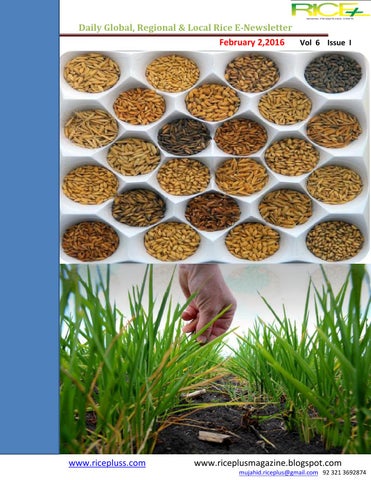
Daily Global, Regional & Local Rice E-Newsletter February 2,2016 Vol 6 Issue I
1|www.ricepluss.com , www.riceplusmagazine.blosgspot.com
www.ricepluss.com
www.riceplusmagazine.blogspot.com mujahid.riceplus@gmail.com 92 321 3692874
Daily Global, Regional & Local Rice E-Newsletter
Today Rice News Headlines...
Editorial Board Chief Editor
TCP scraps rice tender Pakistan has sent a ship to Cuba today carrying 15000 thousand tons of rice to help Cuba Protect rice diversity before it is too late Vietnam hopeful about rice export in 2016 El Niño to damage P21.8 billion worth of crops in first-half 2016 Irrigation chief says drought worst in 22 years but there will be water for consumption Nagpur Foodgrain Prices Open-Feb 02 Protect rice diversity before it is too late Rice exports increase sharply in January DPM Somkid and 6 ministers visit Oman and Iran Local Rice Prices Climb Ahead of Chinese New Year Rice Prices 02/02/2016 Farm Bureau Market Report APEDA RICE COMMODITY NEWS Slovak Oyster Supper -- Eat Good and Feel Good Doing It Thru traffic again Hoarding suspected as rice meant for PDS pile up with millers
News Detail... TCP scraps rice tender February 02, 2016 RECORDER REPORT Following the directives of the federal government, the Trading Corporation of Pakistan (TCP) Monday announced that it has cancelled the rice procurement tender. Last week, the state-run grain trader invited fresh sealed bids (under Public Procurement Rules, 2004) from companies/partnership/sole proprietors dealing in export of rice for purchase of 15,000 tons long grain white rice (IRRI-6) on Cost and Free on Board (C&FoB) basis up to the port of Cotonou, Benin, packed in polypropylene (PP) woven bags as per provided specification. As per the TCP announcement, the tender was to open on February 3, 2016, however, the state-run grain trader Monday cancelled the tender without quoting any reason. Sources said the tender has been cancelled on the directives of the ministry of commerce.
Hamlik
Managing Editor
Abdul Sattar Shah Rahmat Ullah Rozeen Shaukat
English Editor
Maryam Editor Legal Advisor Advocate Zaheer Minhas
Editorial Associates
Admiral (R) Hamid Khalid Javed Islam Agha Ch.Hamid Malhi Dr.Akhtar Hussain Dr.Fayyaz Ahmad Siddiqui Dr.Abdul Rasheed (UAF) Islam Akhtar Khan
Editorial Advisory Board
Dr.Malik Mohammad Hashim
Assistant Professor, Gomal University DIK
Dr.Hasina Gul
Assistant Director, Agriculture KPK
Dr.Hidayat Ullah
Assistant Professor, University of Swabi
Dr.Abdul Basir
Assistant Professor, University of Swabi
Zahid Mehmood PSO,NIFA Peshawar
Falak Naz Shah
Head Food Science & Technology ART, Peshawar
2|www.ricepluss.com , www.riceplusmagazine.blosgspot.com
Daily Global, Regional & Local Rice E-Newsletter The fresh tender for procurement of 15,000 tons IRRI-6 was issued on January 26, when first rice tender was scrapped as the quoted prices were significantly higher than the prevailing local prices. The procurement was being made for Benin as gift from the people of Pakistan. Presently, several African countries are facing food shortage and two weeks ago Pakistan dispatched a consignment of 15,000 tons rice (10,000 tons IRRI-6 and 5,000 tons Basmati) to Cuba. http://www.brecorder.com/agriculture-a-allied/183/12575/
Prime Minister Office of Islamic Republic of : Pakistan has sent a ship to Cuba today carrying 15000 thousand tons of rice to help Cuba in this hour of need.... 02/01/2016 | 06:31am US/Eastern
Pakistan has sent a ship to Cuba today carrying 15000 thousand tons of rice to help Cuba in this hour of need . The decision was taken under the directions of Prime Minister Muhammad Nawaz Sharif who is reported to have said that Pakistan will extend all possible assistance and help to Cuba. The Prime Minister said that Pakistan is reciprocating Cuba with the same good well spirit as Cuba did by sending teams of doctors during the earthquake hit our country.The ship carrying the rice includes 10000 tons of Irri 6 and 5000 tons of Basmati rice. Prime Minister's Office of the Islamic Republic of Pakistan issued this content on 17 January 2016 and is solely responsible for the information contained herein. Distributed by Public, unedited and unaltered, on 01 February 2016 11:30:11 UTC Original Document: http://www.pmo.gov.pk/news_details.php?news_id=472
Protect rice diversity before it is too late Bharat Dogra | 02 February, 2016
3|www.ricepluss.com , www.riceplusmagazine.blosgspot.com
Daily Global, Regional & Local Rice E-Newsletter In personal life it would be considered a huge tragedy if we lost an invaluable treasure simply because its value was not realised in time. Yet at the national level, we seem to be quite oblivious to the dangers of losing invaluable biodiversity possibly for all times to come, as is evident from the highly careless attitude towards the loss of numerous plant species at a rapid pace.Nowhere is this callous neglect more evident than in the case of our most important food crop - rice. India has been blessed with highly favourable agro-climatic conditions in which diverse rice cultivation can flourish. These favourable conditions were utilized by hundreds of generations of farmers to nurture a fabulously rich diversity of rice varieties and cultivars, each of these known to farmers of various regions for their numerous qualities. With the advance of formal disciplines of botany, agronomy, various life sciences and agricultural research conducive opportunities should have been available to use more advanced methods to protect this great heritage of rice varieties in field conditions backed by scientific cataloguing and conservation.Unfortunately what has happened is that instead of adopting protective policies to nurture this bio-diversity with care, highly destructive policies were unleashed which led to the loss of thousands of rice-varieties and their sub-varieties in field conditions so that farmers now find it extremely difficult to get them.During the last five decades the government supported by some international institutions has put all resources into spreading exotic fertilizer responsive dwarf varieties (mistakenly called HYVs). With the support of government subsidies and extension efforts these have spread over a wide area despite several problems including higher susceptibility to pests and diseases. This has led to the ouster and loss of many valuable indigenous rice varieties. This tragic story started in 1965-66 at the time when the Central Rice Research Institute (CRRI) Cuttack was ready with plans to improve rice cultivation significantly using indigenous varieties. If these plans had succeeded, India would have emerged as a world leader in rice, showing the path of eco-friendly farming progress based on protection of bio-diversity. But this was not liked by some international institutions who wanted to spread the exotic HYVs dependent on high doses of chemical fertilizers, pesticides and other expensive agri-chemicals.On 15 March 1966 the director of CRRI wrote a confidential and extremely important letter to the Director General, Indian Council of Agricultural Research, Delhi. ―The International Rice Research Institute (IRRI) Manila, has been sending a lot of rice experimental material from time to time into this country‖, this letter said, ―and these are grown in several states. It has come to my notice that most of this material are susceptible to a very peculiar disease, not known to this country so far; it is suspected to be (a) virus‖. Having sounded this warning the author went on to state, ―I may point out that in the last Rice Research Workers‘ Conference during November 1965, I.R. 9-60 has been recommended as one of the donor parents for hybridization programme in the various rice-growing states. But this material, as has already been reported earlier, has been observed by me at CRRI and two other centres to be infected with the yellowing disease at an early vegetative phase. I may also inform that from some source of information I have learnt that I.R. 9-60 is not only susceptible to Tungru virus, but also to bacterial blight. As such it is not a desirable material for being used as a donor parent; if used, it may spread diseases whereever the material is grown. Under these circumstances it would soon be beyond our control.
4|www.ricepluss.com , www.riceplusmagazine.blosgspot.com
Daily Global, Regional & Local Rice E-Newsletter ―That some sort of inoculum of this dreadful disease is getting built up in the country is evident from the fact that Taichung Native-I which was not showing the yellowing of leaves in the early vegetative phase of the summer crop of last year, has now exhibited it. Since the Ministry of Food and Agriculture has a huge programme of speedily spreading this variety in the near future, timely action has to be taken against any future catastrophe of the kind being observed now.‖ Unfortunately, these warnings and recommendations were ignored by the top authorities, and instead the writer of this letter was pre-maturely retired from his senior post. The pest and disease susceptible varieties were allowed to be spread. All this proved very harmful for India‘s agriculture, and the results become evident all too soon. The massive damage became so worrying that a special task force on rice breeding was constituted of eminent experts in 1979 to examine the issue. These experts met at the CRRI in February.Dr. R.H. Richharia, one of the most eminent rice scientists in the world, was called back from retirement to head this task force. This task report stated clearly and firmly, ―Most of the HYVs are derivatives of T(N) 1 or I.R. 8 and, therefore, have the dwarfing gene of dee-geo-woo-gen. This narrow genetic base has created alarming uniformity, causing vulnerability to diseases and pests. Most of the released varieties are not suitable for typical uplands and low lands which together constitute about 75 per cent of the total rice area of the country. To meet these situations, we need to reorient our research programmes and strategies.‖Referring to this problem of narrow genetic base, the task force says, ―A cursory look at the pedigree of the different rice varieties released in India reveals that a very narrow germplasm base is involved. It is also noticed that many times the same female parent is involved in the cross combination.‖ Thus even though the earlier warnings were now confirmed by the actual experience of about 13 years and supported by the country‘s eminent rice-breeders represented in the task-force, these warnings were largely ignored and the official rice programme/policy centred on exotic dwarf HYVs with a narrow genetic base continued as before. Dr. Richharia emphasised that wisdom of local farmers regarding diverse rice varieties should be utilised as the major resource for improving rice cultivation. He emphasised that rice farmers who possess intimate knowledge of their rice varieties should be involved in the research effort, ―even to guide us with their inherent gift.‖―A special advantage associated with indigenous high-yielding rice germplasm identified for different tracts and situations is that it possesses a good level of resistance to environmental stress and common diseases and pests, coupled with local preference for palatability.‖ Dr. Richharia wrote, ―It may be of interest to record that during our survey in the Chhattisgarh area we came across rice growers in the remote area, maintaining a large collection of rice varieties, year after year, associated with local customs. This also explains how thousands of varieties are being descended down for centuries. Naturally such collections served as ‗local treasuries‘, but in the absence of an organisation to encourage such endeavours, the valuable rices are fast disappearing,...‖From many parts of the country there are reports that now farmers are unable to get seeds of highly valued indigenous varieties. The younger generation of farmers is ignorant about our great heritage of rice bio-diversity, although earlier this knowledge was passed on from generation to generation. 5|www.ricepluss.com , www.riceplusmagazine.blosgspot.com
Daily Global, Regional & Local Rice E-Newsletter This tragic loss of rice diversity can worsen if genetically modified (GM) varieties are introduced, efforts for which have already been launched by very powerful interests. Clearly we need to wake up to the responsibility of protecting indigenous rice varieties with a sense of urgency before it is too late.(The writer is a freelance journalist who has been involved with several social initiatives and movements.) http://www.thestatesman.com/news/opinion/protect-rice-diversity-before-it-is-too-late/120653.html
Vietnam hopeful about rice export in 2016 VietNamNet Bridge – Vietnam will have various advantages in exporting rice this year though it may have to compete with Thai rice in the global export market when Thailand sells rice at stock.
Rice for export. Vietnam is hopeful about rice export in 2016. (Photo: VNA) Vietnam Food Association (VFA) chairman Huynh The Nang said Thailand's government has announced the sale of rice at stock in the near future. This will be one of the factors to pull the world rice prices down and may create negative impacts on Vietnam's rice exports.However, Vietnamese rice still can compete with Thai rice in traditional markets such as China, Indonesia and the Philippines because Thailand has a 6|www.ricepluss.com , www.riceplusmagazine.blosgspot.com
Daily Global, Regional & Local Rice E-Newsletter low volume of white rice while the demand from those markets is for imported white rice, Nang said.Huynh Van Thon, chairman of Loc Troi Group, said not all enterprises in the traditional markets want to import rice at inventory, therefore, Vietnamese rice exporters still have a chance to offer their new rice to those markets. Nguyen Van Tien, general director of An Giang Export and Import Joint Stock Company, agreed that there is a risk in reducing the world price of rice this year to compete with Thai rice at inventory, but how this action will affect the world market will depend on the Thai government's operating policy on the rice at inventory. If Thailand uses old rice at stock to produce ethanol and animal feed, it will not affect the world market. Huynh Minh Hue, VFA general secretary, quoted the US Department of Agriculture as saying that the global rice output in the 2015-16 crop declined by 1.9 percent to 469.3 million tonnes, a second straight year of decline. El Nino was a major factor, causing smaller crops in many rice production countries.Global consumption will, meanwhile, rise by 0.5 percent to 484.6 million tonnes, making it the third consecutive year when consumption will exceed production, leading to a depletion of stockpiles."In general, rice consumption of Vietnam this year will be better," Nang said.This year, the association will focus on boosting exports to near and traditional markets in Asia, including mainland China and Southeast Asia, and increasing exports of fragrant rice to Hong Kong and Singapore, Hue said. It would strive to expand its fragrant rice market share in Africa and gradually retrieve the market for white rice, he said.It will work to enable Vietnamese rice to penetrate new markets, especially countries that have free trade agreements with Vietnam, said Hue, adding that the association will this year focus on building a rice value chain and brands.Tien said the Asian market has demand for rice but Vietnam will face intense competition from Thailand and Pakistan while export of fragrant and high grade rice is expected to increase strongly this year due to high demand from China and Africa. He called on the government to step up quality checks of exports to safeguard the country's prestige and to sell to demanding markets.The association should also provide enterprises with up-to-date market forecasts and trends, he said. The government should crack down on the use of chemicals in rice production.According to the association, Vietnam's rice exports this year, excluding border trade, are expected to remain at last year's 6.5 million tonnes.Last year, exports fetched 2.68 billion USD, a decrease of 3.94 percent in value despite a marginal increase in volumes as prices dropped. Asian countries were the main buyers, accounting for 74.5 percent of exports, followed by Africa (13.77 percent), and the US (6.72 percent), Hue said http://english.vietnamnet.vn/fms/business/150529/vietnam-hopeful-about-rice-export-in-2016.html http://www.thehindubusinessline.com/economy/agri-business/indonesia-working-on-rice-import-dealwith-india/article8179840.ece
El Ni単o to damage P21.8 billion worth of crops in first-half 2016 7|www.ricepluss.com , www.riceplusmagazine.blosgspot.com
Daily Global, Regional & Local Rice E-Newsletter by Mary Grace Padin - February 2, 2016
By Mary Grace Padin Drought caused by El Niño could slash first-semester palay output by 900,000 metric tons (MT) and corn production by 500,000 MT, according to the Department of Agriculture (DA). Based on computation done by the BusinessMirror using the National Food Authority‘s (NFA) buying price, the value of the 1.4 million MT of rice and corn that may be damaged by El Niño could reach P21.8 billion.Christopher Morales, officer in charge of the DA‘s Field Operation Service, told the BusinessMirror the department‘s projection does not yet take into account the two typhoons that hit the country in the last quarter of 2015. ―The estimated damage may be lower as rainfall brought by the last two typhoons that hit the country increased water in our dams,‖ Morales said at the sidelines of the Special Committee on Climate Change‘s meeting at the House of Representatives on Monday.El Niño started affecting the country in March last year, according to the Philippine Atmospheric, Geophysical and Astronomical Services Administration (Pagasa).As early as May 2014, however, Pagasa had already warned that the Philippines could be affected by El Niño. Data from the DA showed that as of August 13, El Niño had already damaged P3.32 billion worth of crops. The corn sector bore the brunt of the extreme weather event and recorded losses amounting to P2.21 billion, while rice farmers lost P1.09 billion. Earlier, Agriculture Assistant Secretary for Field Operations Edilberto de Luna said farmers‘ apprehension over the ill effects of El Niño has caused them to forego planting, which could cause farm output to drop this year.Farmers have been apprehensive over the availability of irrigation water for their crops. The National Water Resources Board (NWRB) cut off irrigation water for Central Luzon farms in May after Angat Dam‘s water level breached the 180-meter critical level.Last October NWRB agreed to allocate irrigation water for 14,000 rice farms upon the request of the National Irrigation Administration (NIA). On Tuesday the agency attached to the Department of Environment and Natural Resources revealed that it has agreed to increase the NIA‘s allocation for irrigation water to 36 cubic meters per second (cms) this month from 35 cms in January.―Farmers in Bulacan and some parts of Pampanga are also assured that sufficient amount of water will be apportioned in their whole cropping calendar. However, allocation for irrigation may decrease as the harvesting season approaches,‖ NWRB said in a statement.The agency also increased the allocation of the Metropolitan Waterworks and Sewerage System to 44 cms in February from 42 cms. Despite the increase in allocation, the NWRB urged the public to continue their water-conservation measures. ―Everyone must not be complacent in the utilization of the precious water resource because there is a possibility that the El Niño may extend beyond June 2016,‖ NWRB said.The DA had earlier requested funds from the national government to mitigate the ill effects of El Niño. Morales, however, said the P2.1 billion it sought from the Department of Budget and Management has not yet been released.―The DA has projected we are going to need P3 billion to roll out El Niño8|www.ricepluss.com , www.riceplusmagazine.blosgspot.com
Daily Global, Regional & Local Rice E-Newsletter mitigation measures. We already have a regular allocation of P900 million for 2016, but this is not enough. We have requested the P2.1 billion to augment the deficit,‖ he said. Morales said the DA hopes the budget could be released before February so the agency could roll out interventions to boost farm output http://www.businessmirror.com.ph/el-nino-to-damage-p21-8-billion-worth-of-crops-in-first-half-2016/
Irrigation chief says drought worst in 22 years but there will be water for consumption BY EDITORON 2016-02-02THAILAND
Irrigation chief says drought worst in 22 years but there will be water for consumption
BANGKOK: — This year’s drought is likely to be the worst in 22 years but the water stored in the country’s four main dams will be enough to meet the need of water for consumption, said Mr Suthep Noipairote, director-general of the Royal Irrigation Department, on Tuesday. Water stored in Bhumibol, Sirikit, Pasak Cholasit and Kwae Noi Bamrungdaen is now measured at 3,489 million cubic metres compared to 6,300 million cubic metres of the same period last year. Although there will be enough water for consumption, Mr Suthep admitted that there won‘t be enough water for agriculture. However, farmers who have planted their second rice crops covering 2-3 million rai, including about 800,000 rai in irrigated area will take care of themselves without help from the government, he said. 9|www.ricepluss.com , www.riceplusmagazine.blosgspot.com
Daily Global, Regional & Local Rice E-Newsletter Mr Suthep is optimistic that rains will come in mid-May in time for the start of the main rice crop cultivation because the effects from El Nino have eased. Although the arrival of cold spells on different occasions in recent weeks have resulted to drought, he said that the cold fronts have also brought rains. However, he cautioned the next rainy season would not bring enough water to fill the main dams and, therefore, cloud seeding is necessary to bring more rains.Regarding measures to help ease drought effects among farmers, the Bank of Agriculture and Agricultural Cooperatives has mapped out three measures which include 72 billion baht for one tambon one SME projects; 6 billion baht in emergency credit to help farmers suffering from drought and community credit programme for farmers in 26 provinces in Chao Phraya and Mae Klong river basins. Source: http://englishnews.thaipbs.or.th/content/149168
http://news.thaivisa.com/thailand/irrigation-chief-says-drought-worst-in-22-years-but-there-will-be-waterfor-consumption/130439/
Nagpur Foodgrain Prices Open-Feb 02 Nagpur, Feb 2 Gram and tuar prices showed weak tendency in Nagpur Agriculture Produce and Marketing Committee (APMC) here on lack of demand from local millers amid increased supply from producing regions. Easy condition in Madhya Pradesh pulses, good overseas arrival and high moisture content supply also pulled down prices, according to sources. FOODGRAINS & PULSES GRAM * Desi gram raw recovered in open market on renewed demand from local traders amid good recovery on NCDEX. TUAR * Tuar varieties ruled steady in open market here on subdued demand from local traders amid ample stock in ready segment. * Major rice varieties reported down in open market here on lack of demand from local traders amid good supply from producing regions like Chhattisgarh and Madhya Pradesh. * In Akola, Tuar New - 8,000-8,200, Tuar dal New - 12,500-13,700, Udid 12,600-13,600, Udid Mogar (clean) - 14,900-16,700, Moong 8,400-8,600, Moong Mogar (clean) 9,400-9,700, Gram - 4,100-4,200, Gram Super best bold - 5,300-5,700 for 100 kg. * Wheat and other commodities moved in a narrow range in scattered deals, settled at last levels. 10 | w w w . r i c e p l u s s . c o m , w w w . r i c e p l u s m a g a z i n e . b l o s g s p o t . c o m
Daily Global, Regional & Local Rice E-Newsletter Nagpur foodgrains APMC auction/open-market prices in rupees for 100 kg FOODGRAINS Available prices Previous close Gram Auction 3,200-3,825 3,400-4,000 Gram Pink Auction n.a. 2,100-2,600 Tuar Auction 6,500-8,270 6,600-8,360 Moong Auction n.a. 6,400-6,600 Udid Auction n.a. 4,300-4,500 Masoor Auction n.a. 2,600-2,800 Gram Super Best Bold 5,800-6,000 5,800-6,000 Gram Super Best n.a. n.a. Gram Medium Best 5,400-5,600 5,400-5,600 Gram Dal Medium n.a. n.a Gram Mill Quality 4,400-4,500 4,400-4,500 Desi gram Raw 4,450-4,550 4,400-4,500 Gram Filter new 4,500-4,900 4,500-4,900 Gram Kabuli 6,000-8,000 6,000-8,000 Gram Pink 6,500-7,300 6,500-7,300 Tuar Fataka Best-New 12,800-14,000 12,800-14,000 Tuar Fataka Medium-New 12,200-12,600 12,200-12,600 Tuar Dal Best Phod-New 12,000-12,250 12,000-12,250 Tuar Dal Medium phod-New 11,500-11,800 11,500-11,800 Tuar Gavarani New 8,100-8,500 8,100-8,500 Tuar Karnataka 8,600-9,000 8,600-9,000 Tuar Black 13,000-13,300 13,000-13,300 Masoor dal best 6,400-6,600 6,400-6,600 Masoor dal medium 6,000-6,200 6,000-6,200 Masoor n.a. n.a. Moong Mogar bold (New) 9,600-10,000 9,600-10,000 Moong Mogar Med 9,000-9,300 9,000-9,300 Moong dal Chilka 8,400-9,100 8,400-9,100 Moong Mill quality n.a. n.a. Moong Chamki best 8,500-8,700 8,500-8,700 Udid Mogar best (100 INR/KG) (New) 16,000-17,000 16,000-17,000 Udid Mogar Medium (100 INR/KG) 13,400-14,500 13,400-14,500 Udid Dal Black (100 INR/KG) 9,600-9,900 9,600-9,900 Batri dal (100 INR/KG) 5,550-5,900 5,550-5,900 Lakhodi dal (100 INR/kg) 4,400-4,600 4,400-4,600 Watana Dal (100 INR/KG) 3,250-3,400 3,250-3,400 Watana White (100 INR/KG) 3,000-3,200 3,000-3,200 Watana Green Best (100 INR/KG) 3,100-3,600 3,100-3,600 Wheat 308 (100 INR/KG) 1,700-1,800 1,700-1,800 Wheat Mill quality (100 INR/KG) 1,675-1,760 1,675-1,760 Wheat Filter (100 INR/KG) 1,650-1,850 1,650-1,850 Wheat Lokwan best (100 INR/KG) 2,100-2,500 2,100-2,500 11 | w w w . r i c e p l u s s . c o m , w w w . r i c e p l u s m a g a z i n e . b l o s g s p o t . c o m
Daily Global, Regional & Local Rice E-Newsletter Wheat Lokwan medium (100 INR/KG) 1,950-2,250 1,950-2,250 Lokwan Hath Binar (100 INR/KG) n.a. n.a. MP Sharbati Best (100 INR/KG) 3,600-3,900 3,600-3,900 MP Sharbati Medium (100 INR/KG) 3,000-3,200 3,000-3,200 Rice BPT best New(100 INR/KG) 2,600-2,850 2,800-2,900 Rice BPT medium (100 INR/KG) 2,000-2,250 2,100-2,300 Rice Parmal (100 INR/KG) 1,800-2,000 1,800-2,000 Rice Swarna best (100 INR/KG) 2,100-2,300 2,300-2,500 Rice Swarna medium (100 INR/KG) 1,800-2,000 2,000-2,200 Rice HMT best New (100 INR/KG) 3,000-3,450 3,200-3,500 Rice HMT medium (100 INR/KG) 2,400-2,800 2,600-2,900 Rice Shriram best New(100 INR/KG) 4,100-4,500 4,200-4,500 Rice Shriram med New(100 INR/KG) 3,700-4,100 3,800-4,150 Rice Basmati best (100 INR/KG) 9,800-11,700 9,800-11,700 Rice Basmati Medium (100 INR/KG) 7,800-8,000 7,800-8,000 Rice Chinnor best New(100 INR/KG) 4,700-4,850 4,800-5,000 Rice Chinnor med. New (100 INR/KG) 4,200-4,400 4,200-4,600 Jowar Gavarani (100 INR/KG) 1,800-2,100 1,800-2,100 Jowar CH-5 (100 INR/KG) 1,700-1,800 1,700-1,800 WEATHER (NAGPUR) Maximum temp. 36.4 degree Celsius (94.3 degree Fahrenheit), minimum temp. 15.6 degree Celsius (60.0 degree Fahrenheit) Humidity: Highest - n.a., lowest - n.a. Rainfall : n.a. FORECAST: Mainly clear sky. Maximum and minimum temperature would be around and 35 and 15 degree Celsius respectively. Note: n.a.--not available (For oils, transport costs are excluded from plant delivery prices, but included in market prices.) http://in.reuters.com/article/nagpur-foodgrain-idINL3N15H2W6
Protect rice diversity before it is too late Bharat Dogra | 02 Februay, 2016 In personal life it would be considered a huge tragedy if we lost an invaluable treasure simply because its value was not realised in time. Yet at the national level, we seem to be quite oblivious to the dangers of losing invaluable biodiversity possibly for all times to come, as is evident from the highly careless attitude towards the loss of numerous plant species at a rapid pace. Nowhere is this callous neglect more evident than in the case of our most important food crop - rice.
12 | w w w . r i c e p l u s s . c o m , w w w . r i c e p l u s m a g a z i n e . b l o s g s p o t . c o m
Daily Global, Regional & Local Rice E-Newsletter India has been blessed with highly favourable agro-climatic conditions in which diverse rice cultivation can flourish. These favourable conditions were utilized by hundreds of generations of farmers to nurture a fabulously rich diversity of rice varieties and cultivars, each of these known to farmers of various regions for their numerous qualities.With the advance of formal disciplines of botany, agronomy, various life sciences and agricultural research conducive opportunities should have been available to use more advanced methods to protect this great heritage of rice varieties in field conditions backed by scientific cataloguing and conservation.Unfortunately what has happened is that instead of adopting protective policies to nurture this bio-diversity with care, highly destructive policies were unleashed which led to the loss of thousands of rice-varieties and their sub-varieties in field conditions so that farmers now find it extremely difficult to get them. During the last five decades the government supported by some international institutions has put all resources into spreading exotic fertilizer responsive dwarf varieties (mistakenly called HYVs). With the support of government subsidies and extension efforts these have spread over a wide area despite several problems including higher susceptibility to pests and diseases. This has led to the ouster and loss of many valuable indigenous rice varieties.This tragic story started in 1965-66 at the time when the Central Rice Research Institute (CRRI) Cuttack was ready with plans to improve rice cultivation significantly using indigenous varieties. If these plans had succeeded, India would have emerged as a world leader in rice, showing the path of eco-friendly farming progress based on protection of bio-diversity.
But this was not liked by some international institutions who wanted to spread the exotic HYVs dependent on high doses of chemical fertilizers, pesticides and other expensive agri-chemicals.On 15 March 1966 the director of CRRI wrote a confidential and extremely important letter to the Director General, Indian Council of Agricultural Research, Delhi. ―The International Rice Research Institute (IRRI) Manila, has been sending a lot of rice experimental material from time to time into this country‖, this letter said, ―and these are grown in several states. It has come to my notice that most of this material are susceptible to a very peculiar disease, not known to this country so far; it is suspected to be (a) virus‖.Having sounded this warning the author went on to state, ―I may point out that in the last Rice Research Workers‘ Conference during November 1965, I.R. 9-60 has been recommended as one of the donor parents for hybridization programme in the various rice-growing states. But this material, as has already been reported earlier, has been observed by me at CRRI and two other centres to be infected with the yellowing disease at an early vegetative phase. I may also inform that from some source of information I have learnt that I.R. 9-60 is not only susceptible to Tungru virus, but also to bacterial blight. As such it is not a desirable material for being used as a donor parent; if used, it may 13 | w w w . r i c e p l u s s . c o m , w w w . r i c e p l u s m a g a z i n e . b l o s g s p o t . c o m
Daily Global, Regional & Local Rice E-Newsletter spread diseases whereever the material is grown. Under these circumstances it would soon be beyond our control. ―That some sort of inoculum of this dreadful disease is getting built up in the country is evident from the fact that Taichung Native-I which was not showing the yellowing of leaves in the early vegetative phase of the summer crop of last year, has now exhibited it. Since the Ministry of Food and Agriculture has a huge programme of speedily spreading this variety in the near future, timely action has to be taken against any future catastrophe of the kind being observed now.‖Unfortunately, these warnings and recommendations were ignored by the top authorities, and instead the writer of this letter was prematurely retired from his senior post. The pest and disease susceptible varieties were allowed to be spread.All this proved very harmful for India‘s agriculture, and the results become evident all too soon. The massive damage became so worrying that a special task force on rice breeding was constituted of eminent experts in 1979 to examine the issue. These experts met at the CRRI in February.Dr. R.H. Richharia, one of the most eminent rice scientists in the world, was called back from retirement to head this task force. This task report stated clearly and firmly, ―Most of the HYVs are derivatives of T(N) 1 or I.R. 8 and, therefore, have the dwarfing gene of dee-geo-woo-gen. This narrow genetic base has created alarming uniformity, causing vulnerability to diseases and pests. Most of the released varieties are not suitable for typical uplands and low lands which together constitute about 75 per cent of the total rice area of the country. To meet these situations, we need to reorient our research programmes and strategies. ‖Referring to this problem of narrow genetic base, the task force says, ―A cursory look at the pedigree of the different rice varieties released in India reveals that a very narrow germplasm base is involved. It is also noticed that many times the same female parent is involved in the cross combination.‖Thus even though the earlier warnings were now confirmed by the actual experience of about 13 years and supported by the country‘s eminent rice-breeders represented in the task-force, these warnings were largely ignored and the official rice programme/policy centred on exotic dwarf HYVs with a narrow genetic base continued as before.Dr. Richharia emphasised that wisdom of local farmers regarding diverse rice varieties should be utilised as the major resource for improving rice cultivation. He emphasised that rice farmers who possess intimate knowledge of their rice varieties should be involved in the research effort, ―even to guide us with their inherent gift.‖―A special advantage associated with indigenous high-yielding rice germplasm identified for different tracts and situations is that it possesses a good level of resistance to environmental stress and common diseases and pests, coupled with local preference for palatability.‖Dr. Richharia wrote, ―It may be of interest to record that during our survey in the Chhattisgarh area we came across rice growers in the remote area, maintaining a large collection of rice varieties, year after year, associated with local customs. This also explains how thousands of varieties are being descended down for centuries. Naturally such collections served as ‗local treasuries‘, but in the absence of an organisation to encourage such endeavours, the valuable rices are fast disappearing,...‖From many parts of the country there are reports that now farmers are unable to get seeds of highly valued indigenous varieties. The younger generation of farmers is ignorant about our great heritage of rice bio-diversity, although earlier this knowledge was passed on from generation to generation.This tragic loss of rice diversity can worsen if genetically 14 | w w w . r i c e p l u s s . c o m , w w w . r i c e p l u s m a g a z i n e . b l o s g s p o t . c o m
Daily Global, Regional & Local Rice E-Newsletter modified (GM) varieties are introduced, efforts for which have already been launched by very powerful interests.Clearly we need to wake up to the responsibility of protecting indigenous rice varieties with a sense of urgency before it is too late. (The writer is a freelance journalist who has been involved with several social initiatives and movements.)
Rice exports increase sharply in January
HCM CITY (VNS) — Viet Nam exported nearly 315,000 tonnes of rice as of January 28, an increase of 46 per cent compared with the same period last year, according to the Viet Nam Food Association.The rice exports were shipped at US$127 million in free on board (FOB) value and $135 million in cost, insurance and freight (CIF) value, up 39 and 42.5 per cent, respectively.According to the association, the increase in rice exports last month was due to the fact that Viet Nam's rice exporters had to complete government-to-government deals with the Philippines and Indonesia.Last year, Viet Nam exported 6.5 million tonnes for $2.68 billion, a decrease of 3.9 percent in value. Asian countries were the main buyers, accounting for 74.5 per cent of exports, followed by Africa (13.7 percent), and the US (6.7 per cent).The association forecast that rice export volume this year excluding border trade is expected to remain the same as last year's. — VNS http://vietnamnews.vn/economy/281951/rice-exports-increase-sharply-in-january.html 15 | w w w . r i c e p l u s s . c o m , w w w . r i c e p l u s m a g a z i n e . b l o s g s p o t . c o m
Daily Global, Regional & Local Rice E-Newsletter
DPM Somkid and 6 ministers visit Oman and Iran BY EDITORON 2016-02-02THAILAND [GOOGLE-TRANSLATOR]
DPM Somkid and 6 ministers visit Oman and Iran
BANGKOK, 2 February 2016, (NNT) – Deputy Prime Minister Somkid Jatusripitak and six ministers are conducting an official visit to the Sultanate of Oman and the Islamic Republic of Iran. The six ministers travelling with Mr. Somkid are Foreign Minister Don Pramudwinai, Science and Technology Minister Pichet Durongkaveroj, Industry Minister Atchaka Sibunruang, Energy Minister Gen Anantaporn Kanjanarat, Finance Minister Apisak Tantivorawong and Commerce Minister Apiradee Tantraporn. Mr. Somkid, the six ministers, and 71 representatives from public and private agencies stayed in Oman from January 31 to February 1 and will visit Iran from February 2 – 5. The delegation will seek new markets for Thai agricultural products in these countries. Initially, Thailand hopes to export at least 300,000 tons in rice to Iran, while the Middle Eastern nation provides for Thailand‘s energy security.Commerce Minister Apiradee Tantraporn revealed that the trade value between Thailand and Oman is worth about 1.1 billion US dollars. She said Thailand‘s key exports to the nation include automobiles, auto parts and chemical products.Ms. Apiradee pointed out that trade value between Thailand and Iran was 600 million US dollars before international sanctions slashed it in half. She expects Thailand will sell more rubber, sugar and rice to these target nations. http://news.thaivisa.com/thailand/dpm-somkid-and-6-ministers-visit-oman-and-iran/130356/
Local Rice Prices Climb Ahead of Chinese New Year By KYAW HSU MON / THE IRRAWADDY| Tuesday, February 2, 2016 |
Price tags are attached to different types of rice offered for sale in Rangoon, November 29, 2011. (Photo: Damir Sagolj / Reuters) RANGOON — Due to high demand on the eve of the Chinese New Year, traders are selling more rice on the China border instead of within Burma, causing the price of the staple grain to rise at home.Higher demand from China, Burma‘s biggest rice buyer, is directing more rice exports through the Muse-Ruili crossing on the Shan State-China border in preparation for the upcoming Chinese New Year, which begins on February 8 and will last for two weeks.With more stock diverted to China, some markets have raised rice prices for local consumers. In areas of Arakan and Mon states, residents reported that the cost of a standard basket of rice increased 500-1000 kyats (US$0.40-$0.80). 16 | w w w . r i c e p l u s s . c o m , w w w . r i c e p l u s m a g a z i n e . b l o s g s p o t . c o m
Daily Global, Regional & Local Rice E-Newsletter
A rice basket in Mon State holds 16 pyi, or just over 40 liters, and previously cost 14,000-15,000 kyats ($10.80-$11.60).―There is high demand in the market these days, and though we‘re looking for more rice, the supply and demand do not match. That‘s why a basket of rice is going up more than 500 kyats,‖ said Kyaw Kyaw Lwin, a rice trader in Mon State‘s Kalathut village.Dr Soe Tun, Vice Chairman of the Myanmar Rice Federation, estimates that about 4,000-5,000 tons of rice are being routed through the Muse-Ruili trading hub every day. Like Kyaw Kyaw Lwin, he linked this to a temporary five to ten percent rise in prices within Burma.―Demand in China is getting high. That‘s why rice prices have increased a little bit, but I can say that it will go down again in the next few days,‖ he said. Merchants began directing more rice through the Muse-Ruili trading hub during the last week of January. Chan Tha Oo, a rice trader in Muse, confirmed that the greater demand for rice from the Chinese side of the border became evident late last month. This resulted in an increase in rice prices in border areas by 500-600 kyats, raising the cost of a 50-kilogram rice bag to almost 29,000 kyats ($22.50).But as official holidays begin in China, Chan Tha Oo said he believes trade will soon come to a halt.―The Chinese stop trading three or four days [ahead of the New Year],‖ he explained.Despite increased exports, he added there was no shortage of rice, and therefore no need for people to worry, a claim echoed by Dr. Soe Tun.―Summer‘s paddy [harvest] has not yet surfaced in the market, so we‘re still consuming old rice. It will be okay later,‖ he said.
17 | w w w . r i c e p l u s s . c o m , w w w . r i c e p l u s m a g a z i n e . b l o s g s p o t . c o m
Daily Global, Regional & Local Rice E-Newsletter Figures from the Ministry of Commerce put Burma‘s total rice exports at more than 1.7 million tons in the 2014-15 fiscal year, bringing in nearly US$645 million. Rice was shipped to China and Japan, as well as over 60 countries within ASEAN, Africa and Europe http://www.irrawaddy.com/burma/local-rice-prices-climb-ahead-of-chinese-new-year.html
Rice Prices as on : 02-02-2016 08:10:31 PM Arrivals in tonnes;prices in Rs/quintal in domestic market. Arrivals
Current
Price
% Season Prev. Prev.Yr Modal change cumulative Modal %change
Rice Gondal(UP)
1625.00 976.16
7642.60
2025
2000
-2.17
Bazpur(Utr)
890.76
38.49
14886.86
2200
2207
57.14
Burdwan(WB)
472.00
-
2489.00
1700
-
-
Etawah(UP)
450.00
-25
12320.00
2255
2255
2.97
Kanpur(Grain)(UP)
320.00
12.28
4425.00
2125
2150
1.19
Manjeri(Ker)
290.00
NC
4350.00
3000
3000
-9.09
Memari(WB)
263.00
-
1794.00
1700
-
-
Guskara(Burdwan)(WB)
258.00
-
1798.00
2130
-
-
Pilibhit(UP)
248.00 -17.33
14498.00
2190
2195
-6.41
Allahabad(UP)
240.00
14.29
3530.00
2085
1980
2.71
Srirampur(ASM)
180.00
50
3575.00
2950
2980
-
Bahraich(UP)
166.00
-5.68
1767.50
2080
2075
NC
Sitapur(UP)
162.00
20
3237.00
2220
2225
5.26
Bareilly(UP)
118.50 -34.89
5200.50
2110
2125
0.48
18 | w w w . r i c e p l u s s . c o m , w w w . r i c e p l u s m a g a z i n e . b l o s g s p o t . c o m
Daily Global, Regional & Local Rice E-Newsletter Agra(UP)
115.00 -17.86
2601.00
2140
2080
4.39
Kalipur(WB)
95.00
31.94
2164.00
2150
2150
-
Kalna(WB)
93.00
-
605.00
1770
-
-6.84
Chandabali(Ori)
85.00
NC
680.00
1800
1800
NC
Saharanpur(UP)
82.00
13.89
2703.00
2030
2030
-4.25
Aligarh(UP)
75.00
-6.25
1040.00
2170
2170
17.30
P.O. Uparhali Guwahati(ASM)
74.00
13.85
1553.00
2100
2100
-19.23
Barabanki(UP)
71.00
-
71.00
2035
-
-
Thodupuzha(Ker)
70.00
NC
910.00
2600
2600
6.12
Achalda(UP)
70.00
7.69
1865.00
2245
2240
-
Gajol(WB)
67.50
3.85
734.00
2800
2800
-8.20
Lanka(ASM)
60.00 -14.29
1245.00
1725
1725
-
Nadia(WB)
50.00
NC
750.00
3200
3200
3.23
Siliguri(WB)
48.00
33.33
237.00
2600
2600
-
Kasimbazar(WB)
45.00
2.27
699.00
2300
2320
-11.54
Jambusar(Guj)
36.30
-
553.15
3600
-
-
Palghar(Mah)
36.00
89.47
378.00
3061
2150
-
Balrampur(UP)
34.00 -10.53
756.00
2125
2125
1.43
Cachar(ASM)
30.00
-25
1000.00
2700
2700
NC
Udala(Ori)
27.00
-32.5
516.00
2700
2700
-
Mirzapur(UP)
27.00
-10
651.50
1915
1910
2.41
Kolhapur(Laxmipuri)(Mah)
26.00 -13.33
526.00
3000
3000
-
19 | w w w . r i c e p l u s s . c o m , w w w . r i c e p l u s m a g a z i n e . b l o s g s p o t . c o m
Daily Global, Regional & Local Rice E-Newsletter Vasai(Mah)
26.00 -18.75
58.00
2840
2860
-
Ramkrishanpur(Howrah)(WB)
25.10
36.41
501.00
2300
2300
-11.54
Haldibari(WB)
25.00
NC
366.50
2350
2350
-11.32
Sirsa(UP)
23.00 -14.81
144.00
2020
2020
-
Jalpaiguri Sadar(WB)
23.00
-4.17
435.00
2700
2725
-4.26
Diamond Harbour(South 24-pgs)(WB)
22.00
NC
106.00
1850
1850
-
Tinsukia(ASM)
20.00
NC
85.00
2200
2100
-
Khair(UP)
20.00
33.33
69.00
2150
2150
-
North Lakhimpur(ASM)
18.90
46.51
678.50
1900
1900
-
Karvi(UP)
18.50
48
73.00
2125
2125
18.06
Dibrugarh(ASM)
16.00 -22.33
441.80
2550
2550
-
Raiganj(WB)
13.00 -13.33
459.00
2730
2700
-
Medinipur(West)(WB)
13.00 -18.75
275.00
2400
2400
-4.00
Dahod(Guj)
11.00 -72.08
649.30
3900
4100
-2.50
Mannargudi(Ker)
10.00
NC
265.00
3100
4600
-
Nilagiri(Ori)
10.00
42.86
236.00
2400
2400
4.35
Baberu(UP)
10.00
66.67
70.00
2100
2125
-
Jahanabad(UP)
10.00 -16.67
138.50
2140
2150
-
Kaliaganj(WB)
10.00 -16.67
308.00
2650
2600
-
Hazaribagh(Jha)
9.80
-
24.10
2945
-
-
Champadanga(WB)
9.00
-50
339.00
2400
2400
-
Chalakudy(Ker)
8.00
-
52.00
2600
-
-
20 | w w w . r i c e p l u s s . c o m , w w w . r i c e p l u s m a g a z i n e . b l o s g s p o t . c o m
Daily Global, Regional & Local Rice E-Newsletter Bhivandi(Mah)
8.00
NC
112.00
3550
3070
108.82
Katwa(WB)
8.00
-5.88
34.00
2300
2300
-4.17
Pukhrayan(UP)
7.50
-
42.50
1980
-
-0.50
Chengannur(Ker)
7.00
16.67
289.00
2450
2600
-15.52
Bolangir(Ori)
7.00
NC
79.50
2300
2200
-4.17
Buland Shahr(UP)
7.00
-30
202.00
2055
2040
0.98
Karanjia(Ori)
6.50
8.33
124.30
2600
2900
4.00
Tusura(Ori)
6.00
NC
82.00
2300
2200
-11.54
Rura(UP)
5.60
1.82
40.60
2190
2170
6.57
Silapathar(ASM)
5.50
5.77
425.30
3000
3000
NC
Jeypore(Ori)
4.40
22.22
114.80
325
325
-
Farukhabad(UP)
3.50 -22.22
148.50
2200
2200
1.62
Jeypore(Kotpad)(Ori)
3.40 -56.96
109.70
3250
4100
NC
Islampur(WB)
3.20
6.67
144.20
2150
2150
-
Visakhapatnam(AP)
3.00
-
3.00
3000
-
-
Aroor(Ker)
3.00
NC
91.00
6900
6900
-25.81
Alibagh(Mah)
3.00
NC
51.00
3750
3750
134.38
Murud(Mah)
3.00
NC
37.00
2750
2750
71.88
Melaghar(Tri)
3.00
NC
62.30
2350
2350
-
Karimpur(WB)
3.00
NC
27.00
3150
3150
NC
Siyana(UP)
2.00
-20
39.00
2050
2060
0.49
Karsiyang(Matigara)(WB)
1.80
28.57
27.40
2600
2600
-
21 | w w w . r i c e p l u s s . c o m , w w w . r i c e p l u s m a g a z i n e . b l o s g s p o t . c o m
Daily Global, Regional & Local Rice E-Newsletter Bonai(Bonai)(Ori)
1.00 -33.33
16.60
2000
2000
-16.67
Kalimpong(WB)
1.00
13.60
2450
2450
-
25
http://www.thehindubusinessline.com/economy/agri-business/article8184225.ece
02/02/2016 Farm Bureau Market Report Rice High Low Long Grain Cash Bids - - - - - Long Grain New Crop - - - - - -
Futures:
ROUGH RICE High Low
Last Change
Mar '16 1123.0 1099.0 1117.5 +17.0 May '16 1152.0 1128.0 1145.0 +16.5 Jul '16
1173.0 +16.5
Sep '16
1183.5 +17.0
Nov '16
1204.0 +27.5
Jan '17
1205.5 +28.0
Mar '17
1205.5 +28.0
Rice Comment Rice was higher across the board, but traded within Monday’s wide range. March continues to find resistance at $11.50. A close above $11.50 could signal a move toward a retest of the $12 area, while 22 | w w w . r i c e p l u s s . c o m , w w w . r i c e p l u s m a g a z i n e . b l o s g s p o t . c o m
Daily Global, Regional & Local Rice E-Newsletter support is at the recent low of $10.65. Weekly exports were a disappointing 22,700 metric tons, down 46% from the previous week and 57% from the prior 4-week average.
APEDA RICE COMMODITY NEWS International Benchmark Price Price on: 02-02-2016
Product
Benchmark Indicators Name
Price
1
Chinese first grade granules, CFR NW Europe (USD/t)
2100
2
Chinese Grade A dehydrated flakes, CFR NW Europe (USD/t)
2000
3
Chinese powdered, CFR NW Europe (USD/t)
1800
1
Chinese sliced, CIF NW Europe (USD/t)
2150
2
Chinese whole, CIF NW Europe (USD/t)
2300
3
Indian Cochin, CIF NW Europe (USD/t)
2850
1
Indian 100 mesh 3500 cps, FOB Kandla (USD/t)
3840
2
Indian 200 mesh 3500 cps basis, FOB Kandla (USD/t)
1240
3
Indian 200 mesh 5000 cps, FOB Kandla (USD/t)
2360
Garlic
Ginger
Guar Gum Powder
Source:agra-net
For more info
Market Watch Commodity-wise, Market-wise Daily Price on 02-02-2016
23 | w w w . r i c e p l u s s . c o m , w w w . r i c e p l u s m a g a z i n e . b l o s g s p o t . c o m
Daily Global, Regional & Local Rice E-Newsletter Domestic Prices Product
Unit Price : Rs per Qty
Market Center
Variety
Min Price
Max Price
1
Amreli (Gujarat)
Other
1150
2500
2
Theni (Tamil Nadu)
Other
1380
1440
3
Solapur (Maharashtra)
Other
1671
2325
1
Dahod (Gujarat)
Yellow
1510
1565
2
Sangli (Maharashtra)
Other
1490
1550
3
Nawarangpur (Orissa)
Local
1325
1521
1
Manjeri (Kerala)
Other
3300
3500
2
Batala (Punjab)
Other
2400
2800
3
Taura (Haryana )
Other
2800
3000
1
Aroor (Kerala)
Other
2400
2600
2
Nagpur (Maharashtra)
Other
400
600
3
Bolangir (Orissa)
Other
1900
2000
Jowar(Sorgham)
Maize
Mousambi
Brinjal
Source:agmarknet.nic.in
For more info
Egg
Rs per 100 No Price on 01-02-2016 Product 1
Market Center Pune
Price 430
24 | w w w . r i c e p l u s s . c o m , w w w . r i c e p l u s m a g a z i n e . b l o s g s p o t . c o m
Daily Global, Regional & Local Rice E-Newsletter 2
Chittoor
418
3
Hyderabad
385
Source: e2necc.com
Other International Prices
Unit Price : US$ per package Price on 01-02-2016
Product
Market Center
Origin
Variety
Low
Potatoes
High Package: 50 lb cartons
1
Atlanta
Colorado
Russet
17
17.50
2
Chicago
Idaho
Russet
14
18
3
Detroit
Idaho
Russet
13.50
14
Cauliflower
Package: cartons film wrapped
1
Atlanta
Mexico
White
15
16
2
Dallas
California
White
16
17.50
3
Detroit
California
White
15
17
Apples
Package: cartons tray pack 1
Atlanta
Virginia
Red Delicious
20
20
2
Chicago
Washington
Red Delicious
28
28
3
Miami
Washington
Red Delicious
26
28
Source:USDA
Slovak Oyster Supper -- Eat Good and Feel Good Doing It By Josh Hankins
25 | w w w . r i c e p l u s s . c o m , w w w . r i c e p l u s m a g a z i n e . b l o s g s p o t . c o m
Daily Global, Regional & Local Rice E-Newsletter SLOVAK, AR -- In this small agricultural community north of Stuttgart, the annual Slovak Oyster Supper, a 50+ year tradition for many around the state, doesn't disappoint but you've got to come prepared. Prepared for the Slovak Oyster Supper is an empty stomach, warm coat and boots, responsible transportation, a knack for communicating with all walks of life, a glass half-full attitude, especially about standing in long, outside winter lines, and, if you plan on dining in (they also have a drive-thru), enjoying fare and fellowship without the wives or girlfriends. This 'men only' gathering is the main fund raiser for the Slovak Knights of Columbus Council but also raises money for other charities and organizations in the area.
26 | w w w . r i c e p l u s s . c o m , w w w . r i c e p l u s m a g a z i n e . b l o s g s p o t . c o m
Daily Global, Regional & Local Rice E-Newsletter The Supper draws local residents, most of whom are behind the counters volunteering, city dwellers, if they are able to find tickets to the sold-out event, politicians, accountants, farmers, and a multitude of vocational backgrounds. Though the company may be diverse, the conversation is not. The supper typically takes place towards the end of duck season, and most are interested in sharing reports on how the season stacked up around the state, while deliberating very complex theories on why it was better or worse than years past. The Supper menu consists of and is delivered in this order at the serving line: large pile of fries, coleslaw, big gulp cup full of fried oysters, smaller cup of raw oysters, and ice cold beverages. The oysters were fresh, and those fried were done to perfection, which is quite the feat when handling a crowd this large. The fried oysters were prepared using local Riceland's own fish fry oil, which is very fitting for the event. In the early 1900's the introduction of rice farming to the small community of Slovak helped fuel the economic boom of the area and the rice industry has remained as the mainstay crop supporting the economic stability to this day. This conservation specialist did brave the lines and cold and it was worth it because once inside I not only ate well but enjoyed talking with growers about duck hunting, yes, but also conservation, tailwater recovery, and the Regional Conservation Partnership Program that will mean so much to the rice farmers here and around the country. If you've never been to the Slovak Oyster Supper, start the conversation for tickets now, and clear the calendar on the last Friday of January, because it's a valuable part of Arkansas history that is well worth the drive to Prairie County.
Dining in
Thru traffic again Mexico Trade Stoppage Averted By Sarah Moran 27 | w w w . r i c e p l u s s . c o m , w w w . r i c e p l u s m a g a z i n e . b l o s g s p o t . c o m
Daily Global, Regional & Local Rice E-Newsletter
MEXICALI, MEXICO -- On December 14, 2015, USA Rice was notified that U.S. rice exporters were having their bagged rice shipments blocked by Mexican authorities here at this important west coast crossing point with Calexico, California. The Government of Mexico (GOM) had, overnight, changed inspection regulations on how railroads and GOM phytosanitary inspection officials cleared bagged commodities, resulting in a stoppage of bagged rice exports. Mexico is the largest export market for U.S. rice, taking 20 percent of the volume worldwide and with a total 2015 value estimated at more than $300 million. The new GOM regulations specifically targeted bagged product with an estimated 2015 market value of more than $100 million. Those familiar with the situation informed USA Rice that the GOM's well-meaning new regulation was untenable and would literally close that border for months and, if implemented across all border points, would stop all bagged U.S. rice exports to Mexico until decision makers at SENASICA (Mexico's Animal and Plant Health Inspection Service (APHIS) equivalent) could be reached to review the regulation. Although most GOM administrative offices were officially closed for the December holidays, Marvin Lehrer, USA Rice's representative in Mexico, immediately took action to mitigate the urgent trade problem. Within days, exporters informed USA Rice that the GOM had rescinded the new regulations and bagged commodity flow would continue as normal. Lehrer continues to serve as the point person and in-country liaison doing follow-up on the recent resolution to lift restrictions on the entry of U.S. rice into Mexico. He said, "A key element of the success was the very personal and trusting relationship USA Rice has built up with key elements of the Mexican trade. This strong association allowed a free flow of information and the enlisting of the trade as allies in providing correct information for the GOM to help resolve the issue.
Hoarding suspected as rice meant for PDS pile up with millers Tuesday 02 February 2016 02:55 PM IST by Joji Simon
28 | w w w . r i c e p l u s s . c o m , w w w . r i c e p l u s m a g a z i n e . b l o s g s p o t . c o m
Daily Global, Regional & Local Rice E-Newsletter Kochi: In a suspected case of hoarding, about half of the total 34,000 metric tonnes of matta variety of rice meant for Public Distribution System (PDS) is found to be lying in different rice mills across the State after wholesale ration dealers refused to collect the stock. Though the stock meant for distribution in February was supposed to be collected by January end, the dealers have so far picked up only 59.64 per cent of the rice procured and processed by the Kerala State Civil Supplies Corporation (Supplyco) under the paddy procurement scheme. That means as much as 13,721 tonnes of rice, i.e., 40.36 per cent of the total stock, have not claimed by the dealers even after making payment. It is learnt that the Supplyco is planning to file a complaint with the Food Corporation of India (FCI) against the erring wholesale dealers. The unprecedented trend has triggered speculations that the dealers were trying to jack up their prices by creating an artificial scarcity of rice and diverting the commodity to the black market ahead of the assembly elections. Rice meant for PDS is distributed through mills in the seven districts of Ernakulam, Pathanamthitta, Malappuram, Thrissur, Palakkad, Kottayam and Idukki. In the remaining seven districts, the wholesale ration dealers purchase the rice directly from FCI warehouses.The district-wise percentage of the uncollected rice is: Ernakulam (52.76), Pathanamthitta (50.01), Malappuram (45.84), Thrissur (45.14), Palakkad (32.61), Kottayam (31.66), and Idukki (2.37). The Supplyco had issued the releasing order for the month of February several weeks ago after rationing out the stock to the wholesale dealers. The procured rice is being distributed among APL cardholders (10 kg for Rs 8.90 per kg), Antodaya Anna Yojana beneficiaries (35 kg for Re 1 per kg), and the other BPL cardholders (25 kg for Rs 2 per kg). The wholesale dealers purchase the rice from the authorised mills by paying Rs 8.40, 45 paise, and Re 1, respectively. Lack of supply of rice will cause shortage in the ration outlets in these seven districts in February. The reluctance to collect the stock despite making full payment is seen as an attempt to derail the rice distribution scheme. The dealers will be able to collect the stocks later and sell it at a higher price while the mill owners can sell it as branded rice by charging more. As the payment was already made, the government cannot take over the stock to distribute it through ration outlets. The Supplyco is now looking forward to the FCI to interfere and initiate action against the dealers. A Karnataka Bulldozers' wicket falls and Kerala Strikers' player Munna, team manager Idavela Babu, nonplaying captain Mohanlal and team advisor Pankaj Chandra Senan celebrate it during the CCL match between Kerala Strikers and Karnataka Bulldozers in Kochi. Photo: EV Srikumar
29 | w w w . r i c e p l u s s . c o m , w w w . r i c e p l u s m a g a z i n e . b l o s g s p o t . c o m