Princeton spent $240,000 on congressional lobbying in the first three months of the year, the second-highest spending total of any quarter in recorded history.
The University’s Lobbying Disclosure Act filing shows lobbying efforts spanning issues including scientific research, financial aid, immigration issues, and the recently increased endowment tax.
The increased spending comes after the Trump administration cut hundreds of millions of dollars in federal grants to the University, investigated Ivy League institutions over allegations of antisemitism, and ended a program sponsoring
active-duty service members in graduate studies.
In a statement to The Daily Princetonian, University spokesperson Jennifer Morrill wrote, “The University advocates with lawmakers and their staff on issues of importance to higher education, with the goal of enabling the University to continue pursuing its research and teaching mission.”
Quarterly lobbying expenditures at many universities across the country have increased over recent quarters, in line with Princeton’s near doubling of its usual low-to-mid $100,000 allocations over the past decade. Princeton spent the third-most on lobbying efforts in the Ivy League, trailing Yale and the University
BY CHRISTOPHER BAO & CHARLIE YALE
of Pennsylvania.
In response to a question about why this quarter’s lobbying spending was higher than normal, Morrill said the filing “included funding to support the Association of American Universities (AAU) related to their lobbying activities on behalf of research universities.” The AAU reported over $125,000 in lobbying spending in its own disclosure, aimed largely at laws affecting research funding.
Assistant Vice President for Government Affairs Julie Groeninger and Director of Government Affairs David Bagby carried out the lobbying work in Washington, D.C. on behalf of the University.
U. AFFAIRS
‘It just gets
Opinion Vote Swamidurai ’26 for Young Alumni Trustee
The Daily Princetonian Editorial Board
The candidates for the Young Alumni Trustee election were narrowed down to three candidates on April 10.
Though Enzo Kho ’26 has extensive experience with policymaking through serving as USG president and Jamil Fayad ’26 has an impressive service record across a variety of campus communities, the Editorial Board believes that Aishwarya Swamidurai ’26 is most likely to be an effective representative for student voices and issues as a Young Alumni Trustee. Based on the values that we hold as an editorial board, we arrived at our endorsement with certain criteria in mind. We looked for a candidate who has shown the ability to represent a diverse range of student voices and the willingness to bring those perspectives to the Board of Trustees. We also hoped for a candidate who understands the broad range of student needs and values and the
imperative of advocating for student well-being.
And, most importantly, we wanted a candidate with a track record of getting the job done.
Ultimately, Swamidurai was a clear standout. Our understanding of these candidates is limited because they are forbidden from campaigning. To arrive at our endorsement, the Editorial Board interviewed all three candidates, reviewed candidate statements and past accomplishments, and spoke with individuals familiar with the candidates. These individuals were granted anonymity to speak candidly on the candidates’ qualifications.
Being a Young Alumni Trustee is perhaps one of the most important ways a newly graduated student can influence University policy. The position was created in 1969 at the behest of the Board, which sought to ensure that the perspectives of those with the most re -
worse and worse’: Humanities at Princeton reels from NEH funding cuts
By Haeon Lee Associate News Editor
History professor Divya Cherian was at home looking after her child in late December 2024 when she received news of a National Endowment for the Humanities award. The $60,000 grant from the federal agency would have funded her second book project, “Conjured States: Witchcraft and Politics in Western India, 1750-1900,” and ensured that she could take a full academic year for her sabbatical leave while maintaining her salary.
nouncing that their grants had been canceled — and she began to panic, thinking her grant “would be the first to get canceled,” she told The Daily Princetonian.
Shortly after, when she checked her junk mail, there was the notification that her grant had been terminated.
BY JAMIE CREASI
One day three months later, she saw a flood of social media posts from fellow NEH recipients an-
Cherian was one of over 1,200 researchers across the United States whose NEH grants were suspended on April 2, 2025, and one of nine Princeton researchers who spoke with the ‘Prince.’ One year after the cancellations, these researchers have had to adapt both their research methods and how they attain funding.
Furthermore, they have expressed doubt and concern about Trump’s proposed fiscal year 2027 budget, which plans to permanently dismantle the NEH.
The terminations came as a result of realigned priorities for the agency under the Trump administration, which issued executive orders in January 2025 for “Ending Radical and Wasteful Government DEI Programs and Preferencing,” “Defending Women from Gender Ideology Extremism and Restoring Biological Truth to the Federal Government,” and “Ending Radical Indoctrination in K-12 Schooling.”
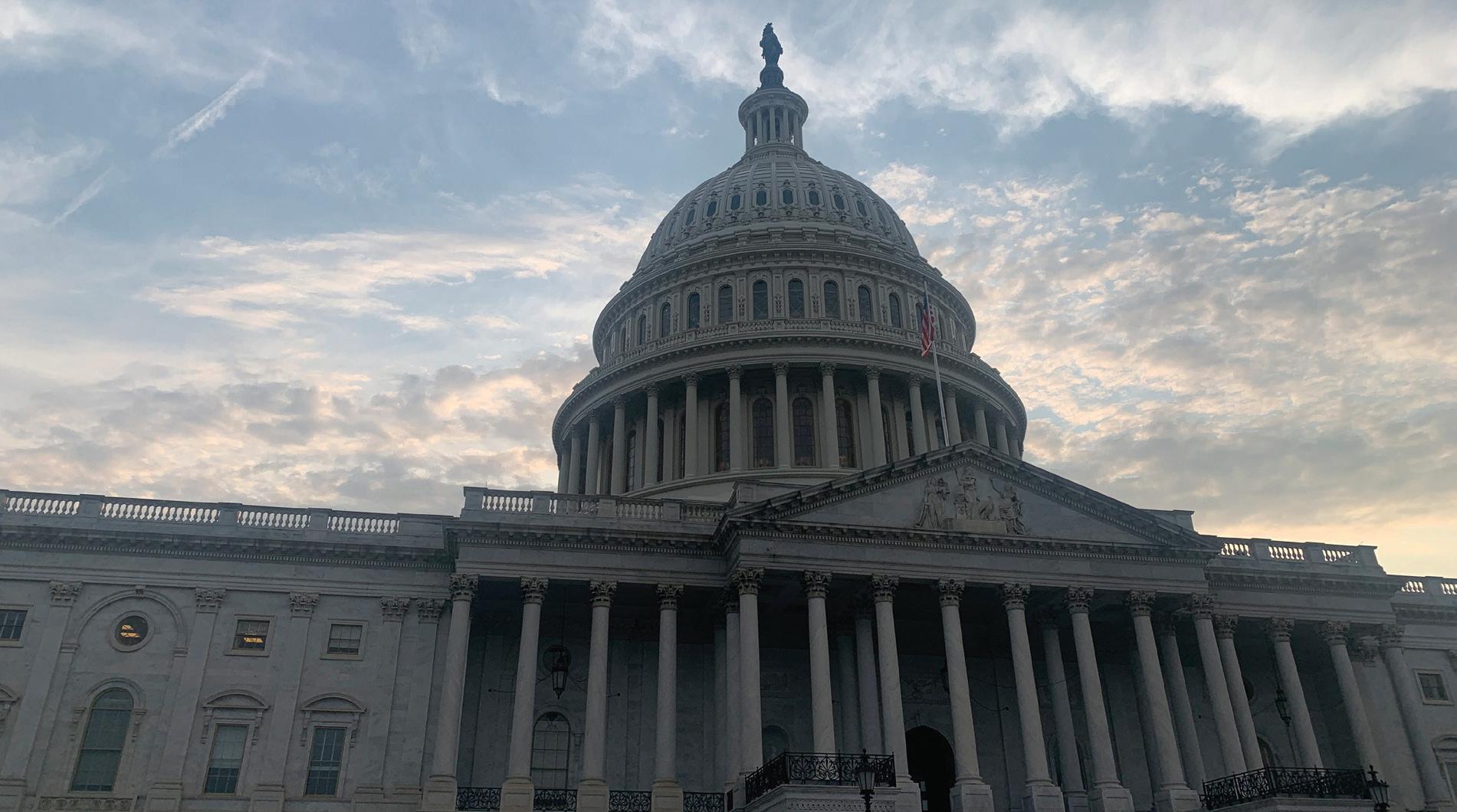
KATHERINE DAILEY / THE DAILY PRINCETONIAN The United States Capitol building.
Morrill: The University advocates for ‘sensible legislation around higher education, tax, science, and immigration policy’
LOBBYING
Continued from page 1
Both have extensive histories working on Capitol Hill as aides to Democratic senators and representatives. Groeninger and Bagby did not respond to requests for comment in time for publication.
Morrill said the University advocates for “sensible legislation around higher education, tax, science, and immigration policy, which includes efforts to make higher education more affordable and accessible, particularly for low- and middleincome students.”
The University also conducted lobbying efforts on the net investment income tax on university endowments, which was raised to eight percent for certain elite schools. Brown, Dartmouth, Harvard, Stanford, and Cornell University also lobbied on issues related to the endowment tax, according to their most recent disclosures.
According to Princeton’s disclosure, Groeninger lobbied on “issues related to international students, faculty, scholars, & staff, including the Deferred Action for Childhood Arrivals Program [DACA], Optional Practical Training, Temporary Protected Status, visa processing delays, visa revocations, travel restrictions, duration of status, & H-1B Fees.”
Princeton admits undocumented immigrants, and University President Christopher Eisgruber ’83 previously urged Congress to give long-term protection to people enrolled in the Deferred Action for Childhood Arrivals (DACA) program. Some faculty are on H-1B visas, for which Trump imposed a $100,000 additional fee to obtain last September. The Davis International Center advised international students to carry key forms after U.S. Immigration and Customs Enforcement actions on college campuses last year.
According to the disclosure, representatives from the Office of Government Af-
fairs specifically discussed fusion energy, quantum computing, neuroscience initiatives, the National Endowments for the Humanities and Arts, and Department of Defense research, among other areas, in relation to appropriation bills for the 2026 and 2027 fiscal years.
Groeninger and Bagby talked with senators and representatives about the Princeton Plasma Physics Lab, a multibillion-dollar joint venture between the University and the Department of Energy. According to the filing, they discussed “issues related to funding pauses and grant cancellations at DOE,” as well as the importance and possible commercial viability of nuclear fusion research.
“Princeton’s policy priorities in Washington, D.C. include funding for the federal research agencies, support for fusion energy research and the DOE national laboratories,” Morrill wrote to the ‘Prince.’
Federal funding pauses and cancellations were mentioned multiple times
throughout the document, in relation to government military and space programs.
The University also lobbied to enact the Financial Accountability in Research (FAIR) model in the 2027 appropriations bill. Supported by the AAU and universities including Yale, FAIR is an updated structure that aims “to increase transparency, accountability, and clarity in federal research funding.”
The Defending Education Transparency and Ending Rogue Regimes Engaging in Nefarious Transactions (DETERRENT) Act, which seeks to increase regulations relating to reporting foreign gifts in higher education, was another focus of the advocacy efforts.
During Eisgruber’s tenure as chair of the AAU, the organization released a letter condemning the act, saying it would hamper international exchange programs and fail to protect scientific research.
Princeton, as well as Yale, Stanford,
and other institutions, lobbied on the Student Compensation Through Rights and Endorsements (SCORE) Act, a piece of legislation that aims to reform the college sports environment, which has been upended since student-athletes have been able to receive compensation for use of their name, image, and likeness.
The lobbyists also covered “efforts to limit military programs at certain institutions.” In February, Secretary of Defense Pete Hegseth ’03 announced that the Department of Defense would end a program which sponsors active-duty military personnel in Princeton graduate programs.
The lobbying disclosure for the second fiscal quarter of 2026, which covers the period from April to June, will be released in July.
Gray Collins is the assistant News editor for the ‘Prince’ leading University administration coverage. He is from outside of Philadelphia.
Greene: ‘It just gets worse and worse … Even if Congress acts to save the NEH, I doubt that its budget will actually grow.’
NEH
Continued from page 1
Simultaneously, 80 percent of NEH staff were laid off.
Founded in 1965, the NEH remains the only federal agency in the United States dedicated to funding the humanities. It has awarded over $6 billion in grants since its inception, supporting over 600 projects at Princeton, according to the official NEH award search website.
The mass termination email came only a day after University President Christopher Eisgruber ’83 sent a letter to the University entitled “Suspension of many federal grants and our response,” in which he cited dozens of Princeton research grant suspensions from the Department of Energy, NASA, and the Department of Defense.
On receiving the notification of her grant cancellation, Cherian remembered, “I didn’t know whether it was frustrating or impressive that the email came from a nongovernment [sender]. It was just some casual email address.”
The sender was acting chair of the NEH Michael McDonald, who was deposed in January as part of a lawsuit filed by the American Council of Learned Societies, American Historical Association, and Modern Language Association against the federal government.
Alexandra Levy, the director of communications and public affairs at the American Historical Association, which comprises a membership of over 10,000 historians, spoke to the ‘Prince’ about the role of the association in the lawsuit. It took issue with the government’s characterization of humanities research as intrinsically connected to diversity, equity, and inclusion frameworks.
“African American history is not DEI. The history of LGBTQ+ people, that’s not DEI,” Levy said. “It’s just history. And that has been one of the most disconcerting things, is to see what is just good evidencebased history distorted as DEI.”
The Princeton research projects terminated under the NEH’s new standards range from the mining economy in the American West to the development of paper in Mexico and African stories about the Virgin Mary. Professor Wendy Laura Belcher, who is jointly appointed
in comparative literature and African American studies, received two major NEH grants in August 2021 totaling over $600,000 to translate and digitize African stories about the Virgin Mary. As the funds were dispersed in multiple installments, Belcher ultimately lost approximately $30,000 between the two grants.
Echoing Levy, Belcher noted, “It struck me that this is … about Christianity and the Virgin Mary and Africa. How is this DEI? Just because it’s about Black people?”
The NEH’s standards for what constituted DEI were largely defined by ChatGPT, which the Department of Government Efficiency employees used to evaluate which research projects fell outside of Trump’s “America First” agenda.
“The DOGE employees … fed the NEH project descriptions into ChatGPT and asked ChatGPT to say whether the project was DEI or not. It did not define what DEI was,” Levy explained.
History professor Corinna Zeltsman, whose research focus is modern Latin America, found it difficult to imagine receiving funding in light of these new standards. “I research the history of Mexico, and in a hypernationalistic context of humanity, that wouldn’t even get funded as a priority to begin with,” she said. “I would not even expect that my research would be considered under a politicized NEH.”
The Papers of Thomas Jefferson — a 78-year project that has wholly centered the documents of the founding father — is one of the only Princeton-affiliated humanities projects still receiving funding from the agency. The Papers is a partner in the collaborative North American Climate History project, which did experience an NEH grant termination. “The cutting of that grant has been a setback for the NACH effort, but has not affected our work on the Jefferson edition,” said the project’s general editor James McClure.
Some with canceled grants said that the cuts did not significantly impact their research. Professor of Spanish and Portuguese and Acting Chair of the Humanities Council Christina Lee GS ’99 was already near completion of her project on an ancient convent in the Philippines by April 2025.
Alongside assistance from the
Humanities Council, Lee said, “My department stepped in, and they helped me with a fund. I used some of my personal research funds to be able to get us to the end of the project.”
Professor of Near Eastern Studies and History Marina Rustow, who also runs the Princeton Geniza project, also used several thousands of dollars to support her research after her NEH grant cancellation. “If I went to a conference, or if I bought books or whatever, I was paying for it out of my own pocket,” she told the ‘Prince.’ “I didn’t have the normal research money that professors always have to buy the things that they [need] or to go to places they need.”
Art and archaeology professor Monica Bravo was able to use the Fowler McCormick, Class of 1921, Fund, a University endowment specifically for research in the history of photography, to continue work for her book project.
“I’m really grateful to my predecessors who had the foresight to establish that research endowment and to have stewarded it so well over the past decades,” Bravo noted.
“Financially, it wasn’t a huge blow. Just morally,” said Leigh Anne Lieberman GS ’18, a digital projects specialist in art and archaeology, referring to the termination of the NEH grant for her project “Networking Archaeological Data and Communities.” However, Lieberman received another grant in August 2025, after the initial round of suspensions.
Though the humanities funding losses were relatively minor for Princeton researchers, they unanimously shared unease regarding the grant application process going forward.
“One of my largest concerns is about self-censorship, about people proposing research projects in ways that whitewash or minimize the complicated identity politics of existing applications,” Bravo said.
“You [used to be able to] trust that there are scholars making decisions about funding projects. And I don’t think that we trust that anymore,” Zeltsman, a past reviewer of NEH grants, noted. “Using AI to identify keywords that shouldn’t be funded … that’s not the scholarly peer-review process that the NEH used to be known for.”
Limitations on this federal fund-
ing source also directly impact the ability for faculty to take sabbatical leave. Professor Molly Greene GS ’93, who holds a joint appointment in history and Hellenic studies, explained the process: “After every third year, the University pays for a semester of leave with the expectation and the hope that you will get outside funding so that you can (a), take the whole year [off] and (b), for the University to say, ‘Their work is competitive.’”
Cherian’s canceled NEH funding was substituted with funding from the History department, allowing her to take the full 2025–26 academic year off and pursue her research. However, Greene was uncertain that the internal funding option would remain sustainable.
“[The history department] is relatively wealthy, but even then, we’ve been told — with the austerity plans — that we’re expected to continue to cut our budget for an undetermined length of time,” Greene said, citing budget cuts that have affected departments across the University. “I very much doubt how things are going to work if our faculty are generally unable to take their full sabbatical every fourth year, particularly for people just beginning their careers.”
Belcher spoke to the continuity of the NEH’s support of large-scale, long-term humanities research, noting, “We have digital copies of [manuscripts] because the NEH, in the ’70s, funded people to go to Ethiopia and microfilm manuscripts in churches and monasteries.”
That continuity has now been severed. “The grants that got canceled [mean] that in 40 or 50 years, people won’t have what they might’ve had to do this really important work,” Belcher said.
Several researchers emphasized the significance of the NEH in fostering collaborative research projects, which are unusual in the humanities.
“In the humanities, traditionally, we don’t work in groups,” Lee told the ‘Prince.’ “But NEH funds, in the past, they encouraged collaboration, which could be quite productive in the humanities.”
Rustow characterized the Geniza lab similarly, stating, “My innovation in this whole operation is to realize this has to be collaborative work, because otherwise it’s just
not going to get done.” The Cairo Geniza stores roughly 400,000 fragments and documents. “We want a lab the way scientists have labs, but we want a lab that’s devoted to these documents in particular.”
Meanwhile, the Trump administration aims to pivot the NEH’s funds to a sculpture garden celebrating the 250th anniversary of the Declaration of Independence and an arch in his honor, reserving $17 million and $15 million of the agency’s funds for the projects respectively.
“I guess there’s some dubious case to be made that if it’s national money, it should support national topics,” Zeltsman offered. “But I really don’t think that that’s the kind of thought process that has underpinned the American university.”
Trump’s plan to provide “$38 million to conduct an orderly shutdown of the Agency” was specified as early as May 2025 in the NEH’s FY2026 budget proposal, and remains in the FY2027 budget proposal announced earlier this month.
While the proposal is yet to pass through Congress, Lee wrote to the ‘Prince,’ “It pains me to even imagine this historically generous resource disappearing.” Greene agreed, stating, “It just gets worse and worse … Even if Congress acts to save the NEH, I doubt that its budget will actually grow.”
“Should they succeed in shutting down the NEH, Donald Trump and this Republican administration will be bitterly remembered for setting research back centuries,” Belcher said.
Characterizing these changes as a “destruction,” Belcher added, “A long time ago, there were the iconoclasts, a religious group that didn’t believe that things should be needed, and they destroyed a lot of buildings and icons.”
“So here we are,” she said, “We have the modern iconoclast.”
Haeon Lee is the associate News editor for the ‘Prince’ leading research coverage. She is from Brooklyn, N.Y. and often covers campus research and academic departments.
Luke Grippo contributed reporting.
Wendy Kopp ’89, founder of Teach for America, announced as Class Day speaker
By Elizabeth Hu Senior News Writer
Some members of the Class of 2026 did not know who Kopp was before reading the announcement.
“I think the fact that she was the spearhead of Teach for America is really cool, but otherwise, I’m not really familiar with her work,” Yiling Li ’26 said. “I do look forward to the Class Day speeches in general, so I think I’m mainly just excited for that, but I guess it’s not specifically linked towards her.”
“The first thing I did was Google her because I didn’t really know who she was,” Mariam Elawady ’26 said. “I think it’s cool that she turned her senior thesis into something so big and I think that’s inspiring.”
Kopp, a graduate of the Woodrow Wilson School (now the School of Public and International Affairs) first outlined the idea of Teach For America in her senior thesis, titled, “An Argument and Plan for the Creation of the Teachers Corps.”
“We wanted to choose a Class Day Speaker who took her thesis, the defining aspect of our Princeton academic experience, and used it to transform countless lives for the better,” the Class Day committee wrote.
“Having someone who advocated with this program that she founded from her thesis is quite nice, a very wholesome way to fulfill the Princeton goal of “In Service of Humanity,” Haroon Adeel ’26 said. “She’s a good person to have talk to people who have just finished a thesis.”
“When I was doing my thesis, I didn’t think it was going to be that impactful, but she took something that she used for her thesis and made it into an actually impactful organization,” Adeel continued. Working to do something that creates a positive impact in the world, Adeel says, is “a beautiful message that we should strive towards.”
According to the 2025 Senior Survey, 4.7 percent of seniors planned on joining the nonprofit or public service sector immediately after graduation.
Alexcis Johnson ’26 had heard of Teach For America before, but she didn’t know who Kopp herself was. Nevertheless, she expressed excitement at the announcement of the speaker.
“I think it’s really inspiring to see women in business coming to top institutions where there’s so many entrepreneurial students here who have so many big dreams and big ambitions,” Johnson said.
Some seniors referenced the controversy surrounding last year’s Class Day speaker, Jay Shetty, when describing their reaction to the announcement.
“I was thinking of our class speaker from last year, who I think got a lot of controversial opinions,” Emily Zhang ’26 said. “I didn’t know who she was, but I was pleasantly surprised to see what she had done.”
“I feel like, as long as it’s not someone who’s obviously problematic … I don’t know if she has skeletons in her closet. She doesn’t seem like that kind of person,” Maia Abiani ‘26 said.
Class Day this year will be on May 25, a day before Commencement on May 26, and features student speakers, remarks from the University president, presentation of awards, and the guest speaker selected by the senior class.
“I think she has a lot of insight to offer when it comes to entrepreneurship, specifically social impact entrepreneurship,” Johnson said. “I know a lot of students are thinking about the world around them and how they can make a meaningful difference in the world, and I think she’ll show us how to make a difference while also being in business.”
Elizabeth Hu is a senior News writer, assistant head Copy editor, associate Data editor, staff Podcast producer, and contributing Features writer from Houston.
B.S.E. major declaration pushed to sophomore fall starting with Class of 2030
By Nico David-Fox Head News Editor
The School of Engineering and Applied Science (SEAS) will allow engineering undergraduates to choose their departments at the end of sophomore fall instead of in the spring of freshman year, starting with the incoming Class of 2030.
The new policy, which will delay the B.S.E. declaration timeline by a semester, marks a significant shift in the undergraduate engineering program and will provide students with additional time to solidify academic plans.
“Since assuming deanship of SEAS, I have worked with my engineering colleagues to implement this timeline change, which will be supported through modifications of our advising structure,” wrote SEAS dean Andrew Houck ’00 in a statement to The Daily Princetonian.
Houck took over as dean last August from Andrea Goldsmith, who left Princeton to become president of Stony Brook University.
“Our new declaration timeline will mean that all B.S.E. students can take departmental courses prior to declaring a major,” Houck added.
The current timeline for engineers requires all students to take prerequisite courses in mathematics, physics, chemistry, and computing in their freshman year and department-specific requirements in their sophomore fall.
B.S.E. students declare their majors typically after just two semesters on campus, whereas A.B. students do not declare their concentrations until the spring of sophomore year.
“While we cannot align with A.B. sophomore spring declaration — our students must launch sooner into the work of their departments — we are confident that a sophomore fall declaration gives students the longer runway they’ve been seeking to explore the cur-
riculum and evaluate their goals,” Houck continued.
The change gives engineering students additional time to explore disciplines before committing to a major and addresses concerns raised by some students about declaring with limited exposure to departmental coursework. These concerns align with the feedback that Houck has received since entering his role earlier in the academic year.
“We have also heard from students that the summer after the first year is a crucial period for reflection, often prompting reconsideration of academic and preprofessional pathways,” Houck wrote.
“The later declaration timeline will encourage students to act on their evolving interests.”
While Adrian Mak ’29 was always set on becoming a mechanical and aerospace engineering major, he said that “for my friends who were a little more indecisive, maybe that one semester difference could give them a bit more opportunity to figure out which of the majors, specifically, they would want to declare.”
Mak personally knows several B.S.E. majors doing engineering research with professors over the summer and believes that the new policy will give future students in a similar position more leeway to decide whether they are interested in pursuing that particular kind of work.
The new policy will put the engineering declaration timeline more in line with peer institutions. Cornell, Stanford, and MIT all allow engineering students until at least the end of sophomore year to declare.
Mak, who will take three MAE sophomore prerequisites next semester, expressed concerns about the ability of engineering students to fulfill their specific major’s sophomore requirements if not decided on their major by freshman spring. If students attempt to parallel
plan for multiple engineering degrees with stringent requirements, he added, they might end up unduly compromising their social lives and extracurricular obligations.
“For example, if the advising mechanisms can ensure someone who is taking MAE courses sophomore fall, but then afterwards wants to change to a different B.S.E. major, and they can still keep on track … I think that’d be a good thing,” Mak said.
Rose Weathers ’27, an electrical and computer engineering major, said she was skeptical the change would have a meaningful impact for most students. She noted that sophomore fall is when B.S.E. course requirements begin to diverge across departments, meaning students would still face pressure to have effectively decided by then regardless of when they officially declare.
“I feel like the effect is kind of the same where you have to make up your mind freshman spring,” she said.
Weathers added that the benefit of the extra semester would depend heavily on which majors a student was deciding between. For students torn between electrical and computer engineering, computer science, and operations research and financial engineering — which share many course requirements — the extended timeline could be useful, Weathers noted. But for others, she believes the structural reality of the curriculum would remain similar.
“If you’re not sure what B.S.E. major you want to do, your sophomore fall is going to be five really hard engineering classes in the different departments you’re deciding between. In reality, no one’s going to want to do that,” Weathers said.
Nico David-Fox is a head News editor for the ‘Prince.’ He is from Washington, D.C. and often covers breaking news.
Trenton Arts at Princeton suspended for the 2026–2027 academic year
By Meghana Veldhuis Senior News Writer
Trenton Arts at Princeton (TAP) will not continue for the 2026–2027 academic year, according to multiple sources affiliated with TAP. The University will be spending next year trying out new outreach programming, according to University spokesperson Jennifer Morrill.
TAP is a multidisciplinary group of dancers, artists, and musicians on campus, which aims to “build a community of young artists across Trenton and Princeton University through student leadership and volunteer opportunities, youth programming, community performances, and more,” according to its website.
In February, the department announced the elimination of the program coordinator position for TAP. This elimination came following the annual State of the University letter, which anticipated across-the-board fiscal tightening.
The program’s cancellation, announced last week via email to the program by the Office of the Provost, will also include Saturday Morning Arts, which brings about 30 students in the Trenton area to Princeton.
Morrill wrote in a statement to The Daily Princetonian that the decision is part of a broader effort to reassess community engagement programming in a time of “careful budgeting.”
“We hope to use the next year to test out new ideas, experiment with new programming models, and develop new partnerships with the goal of creating sustainable programming moving forward,” Morrill wrote.
Nancy Agosto, the most recent program coordinator, shared that TAP members have been in discussions with the other staff and faculty in the Lewis Center for the Arts and the music depart-
ment to discuss ways for the program to move forward without dedicated administrative support.
“It has been back and forth conversations with our partners in the Lewis Arts Complex and the music department of ‘Where do we proceed from here?’ And it’s kind of been that way for the past few months,” Agosto told the ‘Prince.’
Jenia Marquez ’25, the current director of Trenton Youth Orchestra, described how, “earlier this year, in around December, we’d been each told individually that the program was going to be significantly defunded, and that, looking forward to future years, the program would have to look significantly different.”
Even before Agosto’s position was eliminated, TAP had already begun downsizing, according to multiple members of the program.
Lou Chen ’19, previous director and founder of TAP, told the ‘Prince’ that TAP began downsizing a year ago. He said that he left TAP in 2024 and, instead of hiring a replacement, his role as program manager was cut in 2025.
Marquez added that TAP used to be functionally larger, running multiple programs such as Saturday Morning Arts and the Neighborhood Music Project. Saturday Morning Arts was canceled this year and, according to Chen, the Neighborhood Music Project came to an anticipated end in the 2024–2025 school year.
“TAP has been kind of subjected to multiple levels of funding decreases over the years, so those had all been eliminated prior to this year,” Marquez said.
Chen noted that TAP’s “heyday” was the 2023–2024 year.
“I would say 2024–2025 was also shaping up to be a pretty major year,” Chen said. “That year ended up being a slightly pared back version of our normal year. And then this year has been the most
pared back version.”
According to Agosto and Rachel Schwartz, director of Trenton Youth Dancers, TAP staff were asked not to inform Trenton students about the program’s suspension before an official University announcement planned for later this summer. However, staff chose to notify students at the final Saturday session on April 18.
Hannah Bonbright ’28, a student coach who worked with Saturday Morning Arts this semester, said that she learned of the decision alongside students during their weekly session last Saturday.
“It was really heartbreaking,” Bonbright said. “We sat with the kids while they were hearing the news, and hearing them talk about what TAP means to them and what they’ve learned really broke my heart.”
Schwartz stated that there was “a range of reactions” among students who
had heard the news. “We all went in a circle…those who [spoke] used words like ‘devastating.’”
Marquez shared that, “I have heard this program described to me as the most meaningful way that the University engages with Trenton, and I just think it’s a real shame that it’s being discarded so cavalierly.”
Schwartz said that the future of a Trenton-Princeton collaboration is not yet over. She told the ‘Prince’ that the University “has said that they want to run pilot programs next year for different ways that a Trenton public schoolPrinceton arts collaboration could materialize,” but that she has no details on what it would entail. “They are soliciting proposals, although not very efficiently.”
Marquez added that the University “has indicated that they want to do some sort of programming … once a year, or bring students to come see a concert at
Princeton, things like that.”
Chen did not anticipate the suspension of TAP when he left Princeton, but he now has doubts about his decision to leave.
“A year [after leaving], TAP is being gutted along with similar initiatives, and my former colleagues are feeling deeply disillusioned. Was I naive? Or was I misled? Perhaps yes to both.”
Clara Docherty is the assistant News editor for the ‘Prince’ leading faculty, graduate students, and alumni coverage. She is from Lafayette, N.J., and can be reached at clara.docherty[at]princeton. edu.
Meghana Veldhuis is a senior News writer for the ‘Prince.’ She is from Bergen County, N.J., and typically covers graduate students, postdocs, faculty, and campus unions and labor.
Students say ‘hey, what’s up, hello’ to Fetty Wap at Lawnparties
By Devon Rudolph & Gavin McLoughlin Senior News Writer & Head Prospect Editor
While the cold and dreary start to what the USG Social Committee branded as “Princhella” was entirely unlike its Californian inspiration, excitement quickly built ahead of Fetty Wap’s headlining performance. As the sun slowly peeked out from the clouds, flocks of students migrated from Prospect Avenue to Frist North Lawn.
“He played his really good songs, he was really engaging in the crowd,” Connor Roeser ’28 told The Daily Princetonian. “Overall Lawnparty experience, I would say a good nine out of 10.” Princeton’s Spring 2026 Lawnparties featured five guest musical performances across the street’s eating clubs, ranging from chart-topping pop artist Jay Sean at Colonial Club, to alternative rock band Vundabar at Terrace Club, pop rock singer Leah Kate at Tower Club, Anastazja at Ivy Club, and EDM duo LUCØ at Tiger Inn.
Although eating club performances often draw far less attention than the event’s headliner, Jay Sean’s performance was well-attended, with hundreds of people swarming the front lawn of Colonial singing along to his 2009 Billboard number-one hit, “Down.”
The event featured 10 food vendors alongside Prospect Av-
enue, which included Alfalfa for the second time, alongside familiar local and chain favorites such as Tico’s Eatery & Juice Bar, Nomad Pizza, Jammin’ Crepes, Rita’s Italian Ice & Frozen Custard, and Maddalena’s Cheesecake.
Lines for the food trucks remained long throughout the day, and the catered Taco Bell and Alfalfa at Campus Club ran out around 1 p.m. Pizza was provided at the concert venue.
Unlike many previous Lawnparties, the usual barbecue selection from The Wandering Que was noticeably absent, replaced in front of Bendheim House by boxes of kosher sushi.
“I think warm sushi is a strange move,” Katherine Ren ’26 told the ‘Prince.’ “I think that we can bring barbecue [back]. I would rather have slightly cold barbecue than warm sushi.”
Every year, student performers open for the headliner. After a brief performance from the student-run Princeton DJ Collective at 2 p.m., student band Motel Glow took the main stage at 2:30 p.m., delivering covers of songs by The Weeknd, Lana Del Rey, and Taylor Swift, among others.
In contrast to previous Lawnparties headliners NLE Choppa and A Boogie Wit da Hoodie, whose performances were each delayed by over 45 minutes, Fetty Wap’s performance started on time, with festivities concluding at 4:15 p.m.
“I didn’t go deep into the mosh pit, but I was on the outside,
and I thought it was really nice, a very chill vibe, very different from previous years where people would push up a lot and it’d be everyone just kind of in chaos,” Anthony Pleitez-Rivas ’28 said in an interview with the ‘Prince.’
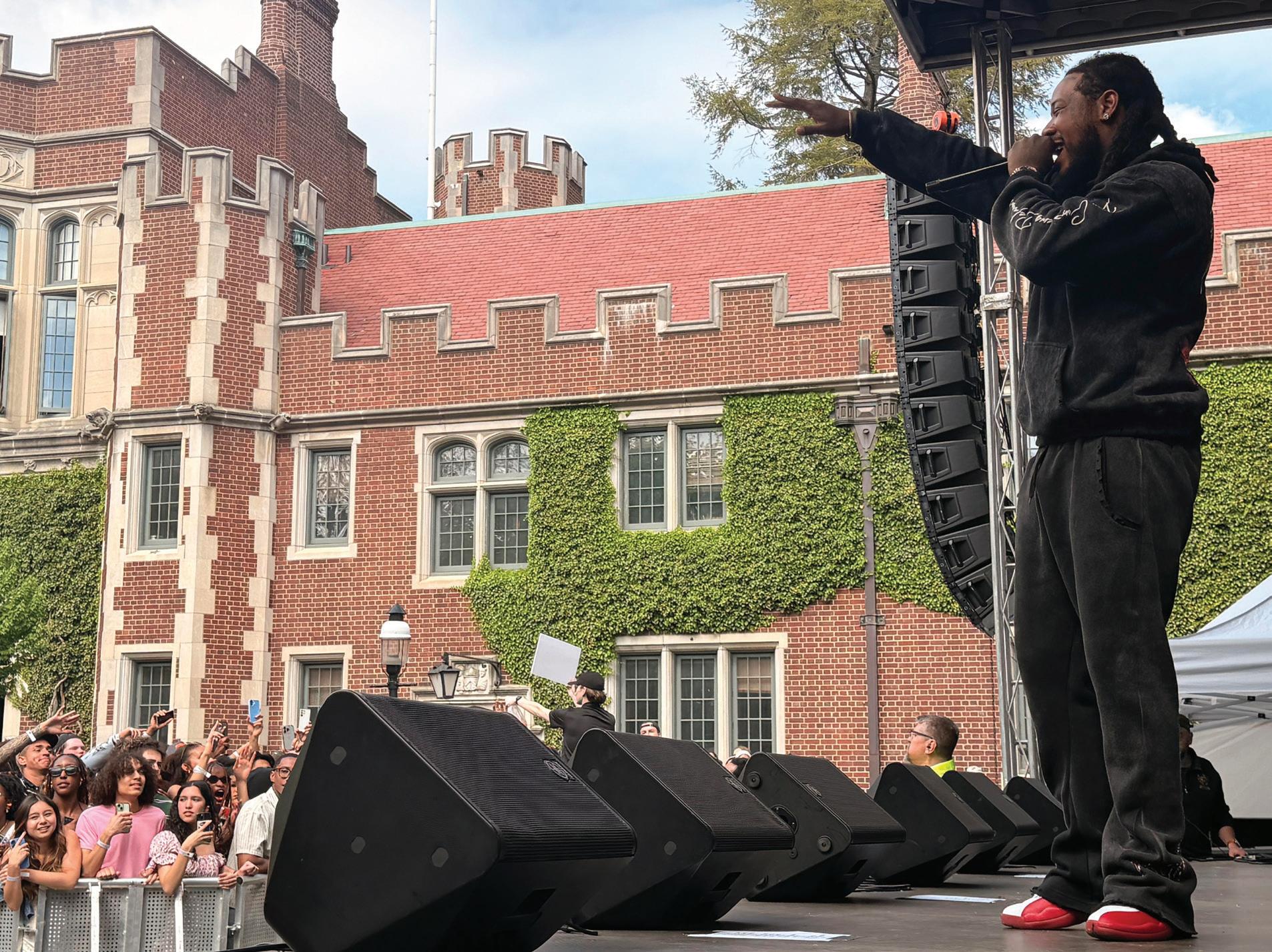
Fetty Wap’s performance lasted just under an hour, delivering classic hits such as “Again” and “679” with special guest
rapper Monty before concluding his set with top hit “Trap Queen,” which currently sits with 1.6 billion streams on Spotify.
“A lot of students hate rappers and complain every single year about [Lawnparties headliners] being rap, but this is the hottest genre out. You can’t get mad because it’s Fetty Wap,” Jediah Worrell ’28 told the ‘Prince.’ “No
shade to A Boogie, but [Fetty Wap] is blowing him out of the water … I just love a good New Jersey rapper.”
Devon Rudolph is the head Podcast editor and a senior News writer. She is from Fairfax, Va. Gavin McLoughlin, a member of the class of 2028, is a head editor for The Prospect.
ANGEL KUO / THE DAILY PRINCETONIAN
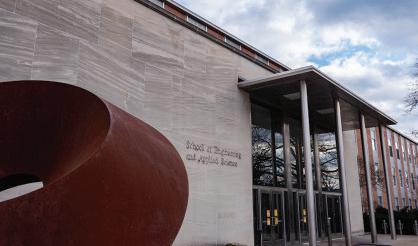
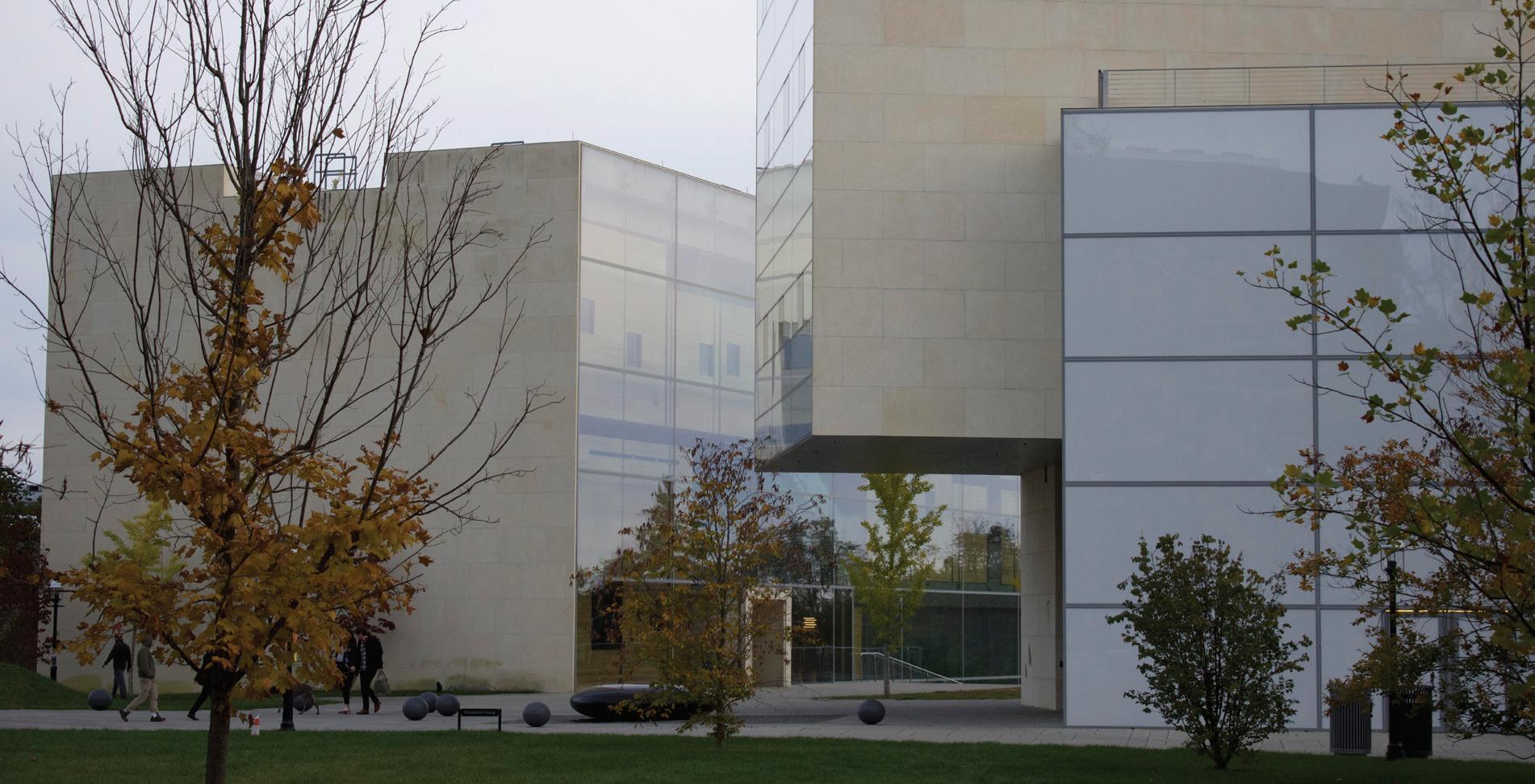
The Lewis Center for the Arts, which is home to Trenton Arts at Princeton.
Executive editor of the New York Times discusses student reporting, modern journalism
By Leela Hensler Staff News Writer
Joseph Kahn, the executive editor for The New York Times, spoke at Princeton on Wednesday as part of the Dean’s Leadership Series at the School of Public and International Affairs. Before his talk, Kahn sat for an interview with The Daily Princetonian, where he emphasized the role of student journalism and how the Times has adapted to the modern media landscape.
Kahn, a two-time Pulitzer Prize winner, has been the executive editor for the Times since 2022, overseeing the publication’s global newsroom. His tenure, according to the Times, has been characterized by “a push to become a fully digital-first news operation,” a feature he told the ‘Prince’ is becoming essential to the journalism field.
His talk focused on the status of the Times as an independent entity in an evolving professional field pressured by questions of accuracy and efficiency in the advent of social media.
“Political pressure … is more and more a reality. We live in a very polarized, almost tribal … moment, where a large number of people demand news and information that tend to conform to their pre-formed notion about what’s going on and their belief system,” Kahn said during the talk.
“The important work of good quality, original reporting, fact checking, factbased journalism that requires expertise and sourcing and reporters who invest the time and energy to understand …. is still a really valuable service that we and a relatively small number of peer
organizations provide,” Kahn told the ‘Prince.’
Before his 28-year reporting and editing career at the Times, during which he served as a business reporter, an economic and foreign correspondent, and an editor on the International desk, Kahn served as the president of the Harvard Crimson. He graduated from Harvard in 1987.
Kahn spoke to the ‘Prince’ about the importance of student and local journalism in the modern day.
“I think a good student news organization is providing critical training to a new generation of people, whether they end up becoming journalists or whether they go into other professions,” he said. “Having that experience of asking questions, getting a door slammed in your face, sometimes getting an answer, sometimes having [an] impact and getting results [by] publicizing good reporting is, to me, critical to almost any good professional skill set.”
He also discussed the importance of upholding First Amendment principles and protecting free speech at both universities and news publications in the current political and media landscape, saying that both venues for free speech were founded upon principles and values that are “not ultimately worth the piece of paper they’re written on if you don’t stand up for them under pressure.”
“Free and independent journalism and the First Amendment and freedom of the press and the ability of journalists and news organizations to ask tough questions, pursue stories the way they believe they should be pursued, to try to uncover the truth, even when the party
in power or the people don’t want those stories written,” he said in the interview. “To me, having that force is an essential part of any democracy.”
“We stand strongly behind the work that our journalists do, including our columnists,” Kahn said in the interview regarding the commercial and political pressures the Times has faced in the past. “So if we publish it, we’ll stand behind it.”
Kahn acknowledged the role of platforms such as Substack and TikTok in providing new spaces for “opinion journalism” but said that “even as [the media] ecosystem changes, we think the work that we do will still be urgent and relevant” in the interview. Kahn does not oversee the opinion section of the Times.
Kahn also discussed how the Times has adapted to engage a younger audience who prefers to consume media in nontraditional formats.
“We feel that good quality reporting news and information are essential services that all of you should have, regardless of the way that you want to consume it,” he said. “We’re finding a really large engaged audience of curious news consumers who are significantly younger than the core demographic or traditional legacy if you provide that [news] in a form that people want to consume.”
Kahn discussed part of the Times’ approach to evolving formats in the interview, including a concrete way in which the Times hopes to evolve.
“We also want to do more journalism in the formats that people want to consume it in,” he said. “That includes high quality, reporter on camera, short form video, [which] is a much bigger part
of what we do now than we did a year or two ago, and it will become larger in the future.”
Discussing dwindling career prospects for prospective journalists, especially in the wake of the Washington Post layoffs earlier this year, Kahn emphasized that the work journalists do is still relevant.
“If people are strongly inclined to do the work that a good journalist does, to dig deeply on stories, to become an expert in a subject area, to share their knowledge with a broader audience, I don’t think they should steer away from seeking opportunities in journalism,” Kahn said.
Even for those who do not want to be journalists, Kahn said that involvement in a “good student news organization”
provides critical skills — including the experience of asking questions, practicing thorough reporting, and dealing with rejection — which still have practical and meaningful applications in other professions.
“I strongly encourage students who want to get involved with student journalism and editing, even if they’re not sure that they want to … be a professional journalist, because I think it’s just good training.”
Leela Hensler is a staff News writer and a staff Sports writer for the ‘Prince.’ She is from Berkeley, Calif.
Nico David-Fox contributed reporting.
Graduate student CPUC representatives elected for first time by popular vote recommendation with 1.6 percent turnout
By Meghana Veldhuis Senior News Writer GRADUATE SCHOOL
Candidates for graduate student representatives on the Council of the Princeton University Community (CPUC) were recommended by popular vote for the first time this year. The candidates were then formally confirmed by the Graduate Student Government (GSG) Assembly, which voted on the candidates Monday evening. Each of the CPUC positions were uncontested, and only 1.6 percent of the graduate student population participated in the vote.
The CPUC, which includes undergraduate, graduate, faculty, staff, and community representatives along with administrators, is a University deliberative body that meets six times a year. It discusses and votes on broad issues concerning the University and community at large.
Dayton Ashby GS was elected to the Executive Committee, Qingyang Wu GS and Natalie Sum Yue Chung GS to the Rights and Rules Committee, Dustin Chen GS and Zoë Gorman GS were elect-
ed to the Priorities Committee, Andrew Nguy GS to the Resources Committee, Fiona Brauer GS to the Judicial Committee, and Nicole Shi GS to the Naming Committee.
Ashby, Chung, Nguy, Brauer, and Shi, the top five scorers in the election, will also serve as CPUC members-at-large in addition to the GSG vice president and president.
Per an email sent by Gorman to the GSG Assembly, only 54 graduate students voted, a comparable number to the numbers of members in the GSG Assembly. The University has around 3,365 enrolled graduate students, meaning just around 1.6 percent of graduate students voted.
No candidate ran for a seat on the Governance Committee. Gorman wrote in her April 28 email to graduate students that, if somebody were to run for this position, another election could happen over the summer.
Originally, the CPUC vote was going to take place via a direct popular vote in January, but current GSG President Jan Ertl GS objected to CPUC elections oc-
curring at the same time as the general GSG election. Ertl had noted a GSG bylaw that states CPUC elections are to be held in April and voted on by the GSG assembly, according to a January email to the assembly obtained by the ‘Prince.’
CPUC representatives were previously selected without a popular vote recommendation by GSG’s 13-member executive board and 40-member assembly. GSG Executive Board members are also selected by popular vote from the entirety of the graduate students.
Because the assembly currently does not have enough members to change its bylaws, it cannot technically institute a direct popular vote to elect its CPUC representatives.
“Our bylaws prohibit us from changing the official structure of CPUC elections without a two-thirds approval from all Assembly seats,” Gorman wrote to the ‘Prince.’ “Unfortunately, we lack sufficient active Assembly representatives [to hold this vote].”
Dayton expressed excitement over his new role, writing to the ‘Prince’ that he is “excited to represent my fellow graduate students in advancing their interests and I look forward to working with university administration to do just that.”
Similarly, Nguy wrote to the ‘Prince’ that he is “happy to represent the graduate students on CPUC.”
Other winners did not immediately respond to requests for comment.
Many GSG members expressed support for the new popular vote recommendation.
“Opening the CPUC elections to popular vote is part of a broader effort on this year’s GSG Executive Board to make university governance more accessible to grad students,” Gorman wrote in a statement to the ‘Prince.’ “We received enthusiasm for the change both among students during the GSG elections.”
“I think [the popular vote] is a great idea, especially as more students can get involved and participate in this governance process,” Ananya Chakravarti GS, the GSG Health and Life Officer, wrote in a statement to the ‘Prince.’
However, some also said the popular vote recommendation did not affect their campaigns.
Nguy wrote before the results were released that he was running because he was “curious to see what University democracy actually looks like from the inside,” although that the change to the popular vote didn’t influence his decision to run.
Wu echoed Nguy’s sentiment, expressing to the ‘Prince’ that “the shift to a popular vote is a positive step… [but] my original commitment to serving the graduate community remains exactly the same.”
Notably, Gorman’s April 20 email noted that 21 departments are missing GSG Assembly representatives. These departments include several STEM fields — including bioengineering, molecular biology, and physics, — as well as the language departments French and Italian, German, and Spanish and Portuguese.
Chakravarti wrote to the ‘Prince’ that “Assembly membership is one representative per [department] or organization,” so increasing Assembly membership is reliant upon recruiting from unrepresented departments.
Nguy expressed that a nomination and selection process is not an effective method to choose GSG departmental representatives.
“I think most graduate students are unprepared when the departments ask for a volunteer at the beginning of the year,” Nguy wrote to the ‘Prince.’ “In my experience, the nomination and selection process is haphazard and often
leads to selecting a reluctant GSG representative.”
Ashby, who ran uncontested for the CPUC Executive Committee, wrote, “More people should be interested in serving on the GSG Assembly, or on the Executive Committee, or running for CPUC, but they aren’t, which only leads to worse electoral competition and worse outcomes for graduate students.”
Ashby also said that the lack of competition left him slightly disheartened. “Honestly, I hoped for more interest and competition. My hunch is that [a] lot of students have immense workloads and probably don’t have time to spare on committee meetings,” Nguy wrote.
Gorman wrote, “We have reached out to the Graduate Program Administrators as well as to all graduate students to increase representation on Assembly. As an Exec board, we have spoken with students in the inactive programmes to encourage them to serve as reps. We have seen some steady progress in filling seats and generating interest and continue to welcome new reps to the Assembly.”
Per Gorman’s communication, voting concluded April 27 at noon, although the election page stated that voting closed at midnight on April 26. Gorman wrote to the ‘Prince’ that the accurate conclusion time was April 27 at noon. Voting for the election was completed online.
“We would have loved to see more participation in this vote, but this number is still greater than the Assembly members voting,” Gorman wrote to the ‘Prince,’ attributing the lack of participation to the lack of contested positions.
Meghana Veldhuis is a senior News writer for the ‘Prince.’ She is from Bergen County, N.J., and typically covers graduate students, postdocs, faculty, and campus unions and labor.
EMILY TANG / THE DAILY PRINCETONIAN
Staff News Writer Leela Hensler (left) and Head News Editor Nico David-Fox (right) speaking with New York Times Executive Editor Joseph Kahn (middle), Wednesday, April 22, 2026.
Princeton middle school student dies following e-moto collision
By Luke Grippo Head New Editor
A middle school student has died following his collision with a motor vehicle two days prior, according to a Tuesday morning press release from the Princeton Police Department. The crash remains under investigation by the police department’s Serious Collision Response Team and the Mercer County Prosecutor’s Office.
An email to the Princeton Public School community from Superintendent Mike LaSusa, sent early Tuesday morning, identified the student as Abraham Abed. As reported by TAPinto Princeton, the email shared that Princeton Middle School will be initiating “crisis protocols,” with counseling support from both the school district and the Mercer Counter Traumatic Loss Coalition.
The collision occurred on Sunday afternoon at the intersection of Ewing Street and Terhune Road, when the e-moto Abed was riding reportedly collided with an eastbound motor vehicle on Terhune Road while travelling northbound on Ew-
ing Street. The Princeton Fire Department, the Princeton First Aid and Rescue Squad, and the Princeton Police Department responded to the scene, whereupon Abed was transported to a local hospital in critical condition.
According to Google Streetview, traffic on Ewing Street has a stop sign at the intersection, while cars on Terhune Road do not.
The area surrounding the incident was closed for “approximately three and a half hours” while the preliminary investigation was ongoing.
Under currently enforced New Jersey law, “class 3” high-speed e-bikes, known as motorized bicycles, are banned for those aged 15 and under. There are no age restrictions for lower-speed e-bikes. A new law signed in January, which mandates compliance by July 19, will require all operators of e-bikes be at least 15 years old, have a license, and have proper registration with the NJ Motor Vehicle Commission.
Earlier this month, the University announced that e-bikes will be prohibited on the ma-
jority of campus beginning on June 1. This policy will go into place over a month before the new statewide restrictions on e-bikes are officially imposed. Currently, in Princeton municipality, e-bikes cannot be ridden on sidewalks and can only accelerate up to 20 mph.
The specific type of e-moto used by Abed has not been disclosed.
Last winter, a pedestrian was struck by a car while crossing Nassau Street at a marked sidewalk. Earlier this month, a male University student on a bike was trapped under a motor vehicle for over 20 minutes after a collision on campus, to which the University’s Department of Public Safety responded.
A representative from the Princeton Police Department declined to comment on whether legal action will be taken against the individual operating the motor vehicle. Under New Jersey statute, the operator could be charged with reckless vehicular homicide, if it is proven beyond a reasonable doubt that the individual who was operating the motor vehicle was driving recklessly, and that the death would
not have occurred had the driver not struck.
“We extend our deepest condolences to the juvenile’s family, friends, and all those affected by this tragic loss. This is an incredibly difficult time for the family and the broader community, and we ask that their privacy be respected as they grieve,” the release stated.
Luke Grippo is a head News editor for the ‘Prince.’ He is from South Jersey, and typically covers highprofile interviews and University and town politics.
Princeton employees donate to Altman, Cohen, Wang in N.J.-12 race
By Ryan Buschman
Following the federal campaign filing deadline for the first quarter of 2026 on April 15, updated individual contributions to candidates running in the N.J.-12 congressional primary are now available. University employees, including administrators and members of the faculty, contributed to the campaigns of Sue Altman, Brad Cohen, and Princeton neuroscience professor Sam Wang, The 12th congressional district contains Princeton. The seat is open following Rep. Bonnie Watson Coleman’s announcement that she would not seek reelection.
Some of the race’s most prominent candidates, including Adam Hamawy and Altman, announced their candidacies following the end of the previous filing period on Dec. 31. There is a large gap between the total amounts received among the 13 Democratic candidates who submitted filings, with Hamawy receiving $546,965.40 compared to Elijah Dixon’s total donation amount of $7,980.00.
On April 21, Dixon dropped out of the race and endorsed Hamawy. Wang, Altman, and Cohen have received $196,867.02, $406,374.87, and $424,371.18 in total contributions, respectively.
In 2024, Altman ran as the Democratic nominee in New Jersey’s 7th congressional district, losing to Republican Tom Kean. She announced her candidacy in the 12th district in February. Cohen is the mayor of East Brunswick.
Hamawy, a former army combat surgeon, did not receive
any donations from Princeton employees, though he raised the largest total amount. No other candidates, including the sole Republican candidate, Gregg Mele, received donations from University employees.
Wang had the greatest total number of individual donations from the faculty. Professors who donated to Wang’s campaign included physics professor Robert Austin and neuroscience professor Carlos Brody.
Additional Princeton employees who donated to Wang’s campaign include politics and international affairs professor Jennifer Widner, sociology and public affairs professor Paul DiMaggio, Chair of the Department of Sociology Mitchell Duneier, assistant grants/business manager at the Princeton Neuroscience Institute Yi Liu, and chemistry and genomics professor Joshua Rabinowitz.
The total amount of donations from Princeton employees to Wang’s campaign was $2,800, not including the $110,000 Wang donated to his own campaign.
When asked why they chose to support Wang’s campaign, Austin and Brody emphasized the importance of having a scientist in Congress.
“I feel that we desperately need more scientists in Congress,” Austin, who donated $250, wrote to The Daily Princetonian. “The present administration is launching an unprecedented attack against science in both academia and the national labs, which are the Crown Jewels of America’s strength in fundamental science. More scientists, fewer lawyers!”
Brody, who donated $300 to Wang’s campaign, echoed Austin’s concerns over the Trump
administration’s efforts to limit funding for science research.
“Science has been under ferocious attack from an administration that is using detailed knowledge of how science funding works in an attempt to permanently hobble public scientific research in the United States,” Brody wrote to the ‘Prince.’ “Sam Wang has the indepth knowledge and skills to defend against that.”
Other University affiliates who donated to candidates did not respond to multiple requests for comment.
Altman was the candidate with the second most number of campaign donations from University faculty. The three faculty members who donated to Altman are neuroscience
and psychology professor Kenneth Norman, School of Public and International Affairs Professor of the Practice Heather Howard, and chemical and biological engineering Professor of the Practice Jean Tom GS ’93.
Howard’s campaign account “Heather Howard for Council” also donated $1,000 to Altman. Howard is a former Princeton councilmember.
Additionally, Liz Lempert, an assistant director at Princeton’s research development office and a former mayor of Princeton, donated to Altman’s campaign.
Norman has contributed to Altman’s previous run for Congress, donating $1,500 in 2024 and $500 in 2023. Howard also donated to Altman in 2024,
giving $550 in total. The total amount of donations from University employees to Altman’s campaign was $7,760. This represents a greater sum than Wang’s campaign. A majority of the donations to Altman came from two faculty members: Howard and Norman, who both donated $3,500. One University administrator donated to Cohen. Randy Hubert, director of gender equity and Title IX administration in the Office of the Provost, donated $1,000 to Cohen’s campaign. Hubert did not respond to a request for comment.
Ryan Buschman is a News contributor for the ‘Prince.’ He is from Haddonfield, N.J.
EMILY TANG / THE DAILY PRINCETONIAN Flowers growing on a tree by McCosh Hall.
Hum r
FEETURES: How USG is boosting attedance in statistics classes
By Tarun Iyengar Head Humor Editor
With the final week of classes over, professors are now revealing how they have dealt with the typical end-of-semester dip in class attendance. Although some faculty implemented mandatory attendance policies to boost turnout, others have turned to the Undergraduate Student Government (USG) to find ways to attract students. To their classes, that is.
This past March, student leaders in USG and instructors from statistics courses ECO 202, ORF 245, POL 345, and SML 201 came together to develop a new campaign to boost class attendance in the final weeks of the semesters: Sheistys for Statistics. Modeled after previous USG giveaways at sporting events, the program aims to lure students to braindead and monotonous statistics lectures with guarantees of tuff bright orange ski masks.
“I am often shattered by week 12, given so many students stop showing up,” operations research and financial engineering lecturer Bay Sian said. “However, the USG’s idea of giving bright orange face cover-
ings, popular with the youths — as I am told — will certainly increase the likelihood of students considering attending class.”
Students also voiced such support for this innovative program. Lacie Bum ’29 shared that before USG’s intervention, she felt learning about standard deviations and significance tests was boring. Now, Bum is exhilarated by “covering both course content and head simultaneously.”
USG officials also expressed joy at the start of this program. After taking a moment from indulging herself in self-congratulations and roleplaying as a competent politician, USG Communications Director Demi Cratik ’28 said, “This ski mask giveaway campaign represents the biggest step forward in building a stronger, more inclusive Princeton.”
“This was just another instance of USG listening to student needs, responding to crises, and demonstrating invaluable leadership and resilience all-around,” Cratik said. “The student body would have been robbed if not for these face coverings.”
Despite its relatively simple ori-
gins, Sheistys for Statistics outperformed other more serious campaigns USG has initiated, including “Let’s go mental for mental health” and “Getting P.E.G.G.E.D (Princeton Eating Groups Getting Extraordinarily Destroyed).
Fetty Doo-Wap stuns as Lawnparties headliner
By Tarun Iyengar Head Humor Editor
This past weekend, campus was taken by storm by yet another successful Lawnparties. This time around, it was driven by William Maxwell II, better known as Fetty Doo-Wap.
Doo-Wap, who rose to fame in 2014 with hit songs like “Substance Distributor Queen,” delivered a stellar performance for the crowd using his classic mix of group harmony and the I–vi–IV–V chord progression. Students, guests, and the community at large were transported back to the simpler times of the 1950s, when Princeton and the world alike were at peace.
The atmosphere of this performance was marked by Doo-Wap’s punctuality, as he was the first performer to arrive on-time for a performance since Fall 2009, when there was no headliner. His performance also marks the first time a Lawnparties performer has served time in a penitentiary since CupcakKe, who was jailed under the Comstock Act for communicating heinous obscenities across state lines.
Doo-Wap also engaged the crowd
in conversation throughout the performance. He frequently dedicated songs to the “pretty young dames” in the crowd, regardless of whether they were being actively courted.
According to students after the show, they really felt as if he had “an eye for the maidens.” However, as The DailyPrintsAnything noted, this seems to be the same eye that was used for the gentlemen in the crowd, and for seeing in general.
In contrast to last spring’s performer, NLE Choppa, Doo-Wap did not have a harem of posterior shakers flanking him. Rather, he employed a barbershop quartet to provide heavenly backing vocals as he sang of long-lost love on “Again.” He also employed the youthful voice of his 9-year-old nephew, who provided a wonderful, soulful rendition of “Nasty.”
For those who weren’t able to witness Doo-Wap’s suave references to the year of our lord “1738” or utterances of “Yes, nursling,” they will unfortunately never know what it is like to be forced to go out for a 25cent milkshake with an offputting man and do the twist uncomfortably close to him.
Tarun Iyengar is the head Humor editor. He did his civic duty and voted for all the candidates this past U-Councilor election.
Tarun Iyengar is the head Humor editor. He got flattened by a Fetty mega fan while standing in the back row of
the concert. Thankfully, that means no more finals for him.
PHOTO ILLUSTRATION BY NATHANIEL VOSS / THE DAILY PRINCETONIAN; SOURCE PHOTOS COURTESY OF ANUJ KRISHNAN, “PHOTO OF TWITCH STREAMER RECONNATHAN” BY HOMESLICE441133 / CC0 1.0
Anuj Krishnan, who is still wracked with guilt over that ECO202 lecture he skipped freshman year, proudly reps his USG sheisty.
GAVIN MCLOUGHLIN / THE DAILY PRINCETONIAN Fetty Wap performing at Spring Lawnparties 2026.
‘Ultimately,
cent undergraduate experiences were represented.
Once elected, Young Alumni Trustees are full voting members of the University’s Board of Trustees, with the ability to push for significant changes on University policy and overall direction on issues ranging from divestment to financial aid.
We are impressed by Fayad’s range of experience. Individuals we spoke to who worked with him on the Scholars Institute Fellows Program and the Science Olympiad emphasized his character. They portray him as a student intent on mentoring others. However, the job of being a Young Alumni Trustee is made much easier by a familiarity with the bureaucracy of campus administration.
While extensive experience interfacing with ad -
www.
Swamidurai was a clear standout.’
ministrators is not strictly necessary for the job, we believe a candidate who already has a policymaking track record can more quickly act as a Young Alumni Trustee, which is important when each representative only serves for four years. Fayad has demonstrated himself to be a leader in campus organizations, but we have concerns that the ideas in his candidate statement lack the precision to impact the systems that students interact with.
Kho is perhaps best known for serving as the president of the Undergraduate Student Government. Kho was successful in hosting events that encouraged cultural engagement during his term as social chair, and we recognize and appreciate his continued focus on diversity and issues pertaining to international students. However, we are unimpressed by his record as USG president.
According to people who worked with him in USG, Kho was generally deferential as USG president, more inclined to expedite processes and defer to other perceived authorities than assert himself. While informed and strategic deference to others is a necessary skill for a member of the Board of Trustees, a good representative of student interests also needs to step up to the plate, stand firm on principles, and be willing to stir conflict when necessary.
We believe Swamidurai’s record and priorities are best-suited for students’ interests. According to interviews with people in USG, it was Swamidurai as USG vice president who prepared for and entered negotiations with administrators, leading to the walkback of the paid Block 32 plan, which would have required all students regardless of dining status to pay for a dining hall meal pack-
age. Conversations with individuals who worked with her on USG also paint her as a leader who was successful in outreach to constituents and familiar with the intricacies of policy creation. Swamidurai’s candidate statement and interview also identified important issues that affect the Princeton students like mental health, career preparation, and disciplinary processes as important issues affecting students. While Swamidurai no doubt also shoulders some blame for USG’s failures in the past year, we believe that her institutional knowledge and commitment to advocacy on behalf of students will make her an effective and assertive leader as a Young Alumni Trustee.
150th Editorial Board
Christopher Bao ’28, Chair Raf Basas ’28
Juan Fajardo ’28
Preston Ferraiuolo ’26
Lily Halbert-Alexander ’28
Ian Rosenzweig ’29
Maya Mukherjee ’27
The 150th Editorial Board is an institutional voice of The Daily Princetonian and consists of seven members. It convenes on a regular basis to discuss issues and current events of interest to the Princeton University community, as well as collectively write signed editorials addressing them, which reflect the consensus of a majority of the Board’s membership. To ensure independence, the Board works separately from the newsroom of the ‘Prince,’ and its members do not cover the topics of their editorials in that capacity for the paper.
Why can our peers see our search history?
Christopher Bao & Charlie Yale Editorial Board Chair & Head
editor
Are you signed into eduroam?
If you are, the University has the ability to know that you visited The Daily Princetonian’s website or app to read this article. It can also find out that you were looking at your favorite shoe brand’s website during your chemistry lecture, and it can even see if you’re watching pornography. While you’re connected to Princeton-administrated Wi-Fi systems, authorized University representatives can request access to data about the domain names you visited and the routers you used as long as they have a “legitimate operational need” to do so. It’s one thing when administrators are looking at our internet usage data. But it’s another when our peers can, too.
Search history can play a crucial but little-known role in the adjudication of academic integrity investigations for both the Honor Committee and the Committee on Discipline (COD). Information you thought of as being private can suddenly appear in front of panels of your peers and professors.
This feature is not at all obvious to students — we were all introduced to the honor system during our freshman year, but the programming focuses on what happens before an investigation and what can lead to an investigation, not on what actually may happen during proceedings.
Nadia Makuc ’26, the chair emerita of the Honor Committee, said in an interview with the ‘Prince’ that in programming directed towards incoming first-years, “we don’t really talk about what happens when you have an alleged violation.”
Efforts to prevent academic integrity violations are good and neces-
sary, but they shouldn’t preclude the University from transparency about the procedures that will transpire and evidence that will be brought forward in the event of an investigation.
We believe that Princeton must enact a two-fold change in the way that search history is handled during investigations of alleged academic misconduct. First, the University must be more forthcoming about how search history is used during investigations. Second, the Office of Information Technology (OIT) must restrict what specific data is accessible to student investigators in order to preserve student privacy to the greatest extent possible.
We hope that there will soon be comprehensive discussions between student representatives and administrators about the broadest range of privacy protections that can be afforded to students. This is a complex topic that will no doubt take time and willpower to resolve. In the meantime, however, we believe that the actions we call for are a clear and meaningful way to protect student privacy.
To see how your search history can be used, you’d have to thoroughly read the OIT policies and the Rights, Rules, Responsibilities manual. This information isn’t hidden, but it also isn’t communicated directly to the students to whom it might become relevant.
It doesn’t have to be this way — students deserve to know and understand the ways that their data might be used to build a case against them.
But understanding who might request your data, and why, is crucial. In many cases, website usage data is requested by investigators on the Honor Committee and the COD, through which Princeton adjudicates allegations of academic misconduct.
Investigators can request data from a specific time range if they
suspect a student may have used their device to cheat on an in-person exam. For example, if someone were accused of using ChatGPT on a final, Honor Committee investigators can ask OIT for data for the time period during the scheduled exam.
On the COD, ODUS administrators or investigators who are removed from the student experience filter through OIT data. But in Honor Committee cases, which address all alleged infractions pertaining to inperson exams, it is our peers who assume that responsibility.
After the data is requested, the student investigators assigned to a case comb through a packet that includes all the instances a student’s devices hit the Wi-Fi network within a certain timeframe. While investigators cannot see the content of any sites that a student visits, they’re able to know what websites a student visited and when. What this means is that there will often be searches visible to the investigators that do not relate to the alleged misconduct at hand.
Investigators don’t have a say on whether students are found responsible for academic infractions, and those who do make that determination receive a filtered version of the full data packet.
This degree of access exposes student investigators — who might later end up in a class or social situation with the student under investigation — to a trove of potentially personal and intimate data that is not necessarily relevant or useful to the adjudication process. The number of students able to request this data is not large in number — 17 students sit on the Honor Committee — but the principle remains important.
One issue is that it is not clear whether such data is actually meaningful in making a determination of whether a student has cheated. Samantha Baldwin, a policy and research staff technologist at the
Electronic Frontier Foundation, explained to the ‘Prince’ in an interview that a website can show up on someone’s history even when they are not actively using it. An app refreshing in the background, a roommate using a shared device, or even a push notification from an app can all show up as accessing that particular website or app, she noted. Or, for instance, if a student ends their exam early and uses their device for personal reasons, that data may also show up.
The primary risk isn’t deliberate exposure of personal content in a student’s search history, but rather that allowing investigators access to a broad, unfiltered body of search data could provoke implicit character judgments that have no place in a space of academic integrity adjudication. Imagine an investigator sees that a student under investigation visits political websites that they find extreme and distasteful. Is it possible that such knowledge would unwittingly skew their opinion of the student in question?
There are certainly cases when it is legitimate for the University to use student search data to investigate academic misconduct. It is useful, for example, to bring internet usage data into an investigation when a student gets reported by one of their peers for taking out their phone during an exam. But the current access policy presents a glaring privacy issue: our peers should not be able to see our personal search histories, some of which contain very private and sensitive information that is not relevant or appropriate evidence for the adjudication of academic integrity investigations.
The University must change its policy of how student or ODUS investigators can request information from OIT. Baldwin noted that one potential solution was filtering the data available to misconduct investigators. OIT “can redact information
that they share as well,” she added. Instead of being able to request all internet usage data from a given timeframe, investigators should have to request access to specific sites, like ChatGPT or Claude, with reasonable rationale. This way, a balance can be struck between preserving the student’s right to privacy and the University’s need to hold students accountable for academic integrity violations.
Beyond reforming its policy, the University must be forthright about how search history can be used in disciplinary investigations. This process should be explained at the beginning of every academic year to the incoming freshman class. A more transparent policy will inform students about the full implications of University Wi-Fi usage, as well as equip them with a complete understanding of what academic disciplinary proceedings entail and what they can expect from the Honor Committee.
Few students at Princeton may suspect that their search histories could one day end up being used against them. But the University can better balance respecting student privacy with upholding academic integrity by both increasing transparency about what data can be used in investigations and limiting how much of that data is available to investigators — particularly student investigators — in the first place.
Chair of the Editorial Board Christopher Bao is a sophomore economics major from Princeton, N.J.
Head Opinion Editor Charlie Yale is a sophomore history major from Omaha, Neb. Yale is a Peer Representative. This piece does not represent the view of the Peer Representatives as a whole.
editor-in-chief
Frances Brogan ’27
creative director Juan Fajardo ’28
Corbin Mortimer ’27 Maya Mukherjee ’27
Sections listed in alphabetical order.
head
head
associate
head
Li ’28
Thompson ’27
Sampaio ’28
Xia ’28
’28
’29
’29
head features editor Nikki Han ’28
associate features editors Jamie Creasi ’28 Mara DuBois ’28
head humor editor Tarun Iyengar ’28
associate humor editors Nicolas Rohou ’28 Francesca Volkema ’28
head news editors Nico David-Fox ’28 Luke Grippo ’28
associate news editors Sena Chang ’28 Haeon Lee ’28 Caitlyn Tablada ’27
head newsletter editor Ryan Choe ’28
associate newsletter editor Annika Plunkett ’28
head opinion editors Lily Halbert-Alexander ’28 Charlie Yale ’28
associate opinion editors Isaac Barsoum ’28 Shane McCauley ’28
head photo editor Emily Tang ’28
associate photo editor Siena Sydenham ’29
head podcast editor Devon Rudolph ’28
associate podcast editor Julia Hack ’29
head print design editors Jamie Creasi ’28 Albert Rho ’29
In New Jersey’s service, pass the Climate Superfund Act
Shane Cytrynbaum Guest Contributor
When I first arrived at Princeton about eight months ago, I was amazed at the plethora of academic and extracurricular opportunities available to students passionate about climate justice. From classes on environmental media and climate migration to Sunrise Princeton’s campaign against PetroTiger to the Princeton Climate Symposium, it quickly became clear to me that many Princeton students see the fight against climate change as part of our mission to act “in the nation’s service and the service of humanity.”
But as a proud New Jersey resident since the age of three used to batting away jokes about my state and explaining the many distinct personalities of its different towns and cities, one thing troubled me. While Princeton students are quick to mobilize around global and national issues, as well as issues limited to the University, most Princeton students are not nearly as eager to stand in solidarity with local communities in our state. Yes, Princeton students act “in the nation’s service” — but doing so must mean acting in service of New Jersey as well.
On May 6, a broad coalition of local and statewide climate justice groups will come to Princeton to rally for the Climate Superfund Act in the penultimate stop on a statewide tour fighting for a bill years in the making. Princeton students’ responsibilities to our communities and the nation do not end at FitzRandolph Gate: we must fight to protect the state that we all call home during our time at Princeton. Supporting the effort on May 6 is one way to join that fight.
The Climate Superfund Act would raise $50 billion to pay for climate resiliency projects across the state, including flood protection infrastructure, upgrades to roads and transit systems, home buyouts, energy efficiency upgrades, and preventive healthcare programs. The act would be funded by finally holding fossil fuel companies that do business in New
Jersey — and have produced more than one billion metric tons of greenhouse gas emissions since 1995 — liable for damages to our communities.
It is hard to understate how monumental this bill is. New Jersey would become only the third state to pass this kind of “Polluters Pay” legislation, after Vermont and New York. But similar bills are also making their way through legislatures in ten other states, and a win here would further propel the movement nationwide.
And the bill is particularly necessary here. New Jersey ranks fifth in the nation for per capita spending on climate disasters — in other words, it is one of the states most financially hurt by these disasters. All of New Jersey’s 21 counties have been hit at least five times by disasters in the last decade and a half, costing more than $7.9 billion.
The forecast for the future looks even worse. Flood risk threatens $435.9 billion in property value and $5.9 billion in annual property tax revenue in New Jersey by 2050, and over 1.3 million people will face high flood risk and a third of public facilities will face flood risk. In Mercer County — where Princeton sits — two-thirds of our wastewater treatment facilities and one-third of our hazardous waste sites are currently in flood-prone zones. Inundation at a hazardous waste site in Trenton can send toxins along the Delaware and Raritan Canal to Princeton, and, without adequate flood resilience infrastructure, the next hurricane will likely affect us too.
Though its impacts may not yet feel as tangible as the wildfires in California or the hurricanes in Florida, the climate crisis is already touching our lives all over New Jersey. A classmate here at Princeton, who hails from Cranford, N.J., described to me how his neighbors escaped their inundated homes in kayaks during floods. And communities down the shore contend with coastal erosion and sea level rise. My own hometown, Livingston, experienced a brushfire a year and a half ago that burnt nearly 200 acres, following a particularly dry summer that triggered several more blazes across the state.
It comes as no surprise, then, that 77
percent of New Jersey voters say they are concerned about extreme weather events, and 93 percent say that it is “somewhat” or “very” important that the state invests in damage mitigation projects, like the ones the Climate Superfund Act would fund. These investments pay dividends in the future: according to the U.S. Chamber of Commerce, every dollar invested in disaster resilience saves $13 in future costs.
Within Princeton’s idyllic magnolialined Orange Bubble, the ravages of the climate crisis often seem far away, save for students’ complaints about the temperamental temperatures this spring. But the truth is that our campus sits in a climate vulnerable state, and it is high time that our students see themselves as a part of it.
On Wednesday, May 6, climate organizations from across the state will rally at Princeton for the Climate Superfund Act. This is the perfect moment for Princeton students to both stand in solidarity with and take pride in their New Jersey community. We will be meeting at 5:30 p.m. in Firestone Plaza, and the rally is being led by Climate Revolution Action Network, Empower NJ, Food & Water Watch, and more. All students are welcome to simply show up, and signs will be distributed to students who don’t have their own.
If New Jersey won’t fund critical climate resilience projects, it won’t protect Princeton students. Whether or not you consider yourself a climate activist, whether or not you have ever even been to a climate rally, you are a part of the New Jersey community. It is time that Princeton students realize that acting “in the nation’s service and the service of humanity” means protecting our neighbors, our community members, and even our own campus in the great state of New Jersey.
Shayne Cytrynbaum is a first-year from Livingston, N.J., intending to major in SPIA with minors in Environmental Studies and Near Eastern Studies. He has been a climate activist since age 12, and is now a member of Sunrise Princeton.
Pedal to the Metal
By Tabish Farrell | Contributing Cartoonist
Juan Fajardo ’28
BOARD OF TRUSTEES
president Thomas E. Weber ’89
vice president David Baumgarten ’06
secretary Chanakya A. Sethi ’07
treasurer Douglas Widmann ’90
assistant treasurer Kavita Saini ’09
trustees Francesca Barber Kathleen Crown
Suzanne Dance ’96
Gabriel Debenedetti ’12
Stephen Fuzesi ’00
Zachary A. Goldfarb ’05
Michael Grabell ’03
Danielle Ivory ’05 Rick Klein ’98
James T. MacGregor ’66
Rohit Narayanan ’24
Marie-Rose Sheinerman ’23
Julianne Escobedo Shepherd Abigail Williams ’14
Tyler Woulfe ’07
trustees ex officio
Jerry Zhu ’27
Alistair Wright ’27
Two nights at the opera: Princeton Opera Company’s return to the stage
By Anamaria Artola Contributing Features Writer
While a comedic plot about a greedy Florentine family scrambling over an inheritance might not be the first thing that comes to the average mind when thinking of an opera, Princeton Opera Company (POCO) performed exactly that in “Gianni Schicchi,” which sold 600 tickets across two nights in Richardson Auditorium according to POCO President Gabrielle Liberman ’28.
“Whether you love the music, or you love the staging, or the costumes, there’s something for everyone,” Lukas Palys ’29, who played the titular Schicchi and serves as POCO’s opera chair, said.
Since the founding of POCO in 2011, the organization has gone through many cycles of activity and quiet. COVID-19 drove the most recent decline, with lockdown and virtual classes leading the group to become entirely inactive — until now. Opera at Princeton had become closely tied to existing choral groups like the Glee Club, Liberman said, but for students and audiences who wanted to engage with more traditional opera, there weren’t any options available.
Liberman and Yehyun Hong ’28, POCO’s treasurer, wanted to change that. Last summer, they set about rebuilding the company: reviewing the constitution, consulting POCO alumni, and meeting with faculty from the music department. Their goal? To stage a full opera.
“[Staging a full opera is] probably not going to be possible first year back,” Liberman recalled thinking in an interview with The Daily Princetonian.
As it turns out, they proved themselves wrong. On March 27 and 28, POCO performed Giacomo Puccini’s “Gianni Schicchi” at Richardson Auditorium, with hundreds of eager audience members watching each night.
For Nora Glass ’29, watching “Gianni Schicchi” was an entirely new experience. “I had never been to an opera before,” she said. She went mostly because she knew people in the cast, but her previous experience with opera was limited: for a class in a previous semester, she had watched an online opera that she described as serious, not entertaining, and hard to follow. Going in, she thought this one might be more of the same.
That wasn’t her experience at all. “The comedy stood out the most,” she said. She recounted how the physicality of the performers in their expressions and movement conveyed the humor in a way she hadn’t anticipated. “There were a lot of people who didn’t know what they were getting into,” she said. “Everyone was having a good time.”
Glass is a contributing Copy editor for the ‘Prince.’
The enthusiastic audience reaction surprised even the cast, said Vanessa Niu ’29, who played
Zita and serves as POCO’s publicity manager. “People laughed at a lot of things we weren’t expecting them to laugh at,” she said.
POCO’s choice of opera had been deliberate. Palys said “Gianni Schicchi” made sense on multiple levels. “It’s one hour long … easy to sit through,” he said, a fraction of the length of most operas. The storyline itself, he explained, does not demand much prior knowledge: it is a piece, at its core, about greed, social class, family, and deception.
Palys wanted to play the eponymous character from the start, even though there were two characters in Palys’s vocal range. “Schicchi fits my acting style better,” he said. “ It’s more playful.”
The production was almost entirely student-run. Aside from David Kellett, a performance faculty member in the music department who served as one of the production’s directors, the remaining responsibilities fell to students: producing, stage management, publicity, and even learning the music independently over winter break before rehearsals began in the spring.
Niu, for example, designed the production’s poster, drawing inspiration from Dante’s “Inferno,” which also inspired the opera.
The high level of musicianship in POCO is not accidental. Several members, Liberman said, applied to conservatories alongside Princeton. Niu and Palys were both deciding between Princeton and Juilliard before ultimately picking Princeton. Palys said he chose Princeton because he wanted to study history, languages, and literature alongside music and “understand different types of people, because to be a good artist, you need to be able to represent a variety of different things in life.”
For Niu, the most demanding part of the production was not so much the singing as the transformation required to become Zita, the family’s imperious mother. “It’s not every day that you act like a 70-year-old woman,” she said. “I had to figure out how to walk like
her, how to stare like her, how to get around the stage.” Navigating a different vocal range was an additional challenge, since in opera, singers typically play roles within their voice type.
For Palys, the main challenge was time. Members had to learn sophisticated music in a short time frame of eight weeks, with much of the preparation completed independently. Alongside being a member of an a cappella group and Glee Club, “it can be a lot,” he said.
Behind the production lies a larger goal: reviving broader interest in opera. Liberman explained that opera’s reputation of exclusivity and elitism has more to do with culture than with the appeal of the music itself. “I just felt like people might not realize how much they could like something,” she said.
Contributing to this reputation is also opera’s historically expensive prices. “There’s always been kind of a financial barrier,” Liberman said. A student ticket to “Gianni Schicchi” cost $10; a typical ticket to the Metropolitan Opera is around $130. Richardson Auditorium, one of the most competitive performance spaces to book on campus, reserves only one student group for one week in March, according to Liberman. But Richardson Auditorium chose to give POCO that slot, giving them the capacity to popularize opera within the Princeton community.
“We got the news [about Richardson Auditorium] over fall break, and we’re thrilled,” Liberman said.
POCO has made other efforts to extend opera beyond the main stage through informal concerts, collaborations, and a deliberate effort to bring opera to students who might never have sought it out. Opus and Tea, a collaboration between POCO and chamber music group Opus, brought opera to the New College West Coffee Club location for an afternoon of tea and classical music last November. POCO also hosted “An Evening of Arias,” an event last
September that featured singers with accompaniment by student pianists in the common room of Rockefeller College.
POCO also collaborated with Sinfonia, one of Princeton’s orchestras, in February, with singers performing alongside the ensemble in a concert titled “A Night at the Opera.”
“It’s always nice socially to meet people who might share some sort of interests,” Liberman said, emphasizing that the collaborations also had the larger aim of changing opera’s reputation as inaccessible.
The phrase “Because Opera is for Everyone” is featured proudly on POCO’s website, a sentiment the members share.
While POCO continues to work to make opera accessible,“Gianni
Schicchi” made Liberman realize that the demand for opera was already there, both among performers and audience members. POCO’s membership now includes singers, instrumentalists, and students interested in production, some with no prior experience at all. For Liberman, this makes complete sense. “I’ve just found that opera is one of the most moving forms of music,” she said. “It’s incredibly unique in that it’s a human voice able to project over a huge orchestra with no mic.”
Looking ahead, the goal is to make POCO not a question of “if it’s going to happen,” Liberman said, “but when.”
Anamaria Artola is a Features contributor for the ‘Prince.’
IMAGE COURTESY OF GABRIELLE LIBERMAN
Opera Company members performing “Gianni Schicchi.”
IMAGE COURTESY OF GABRIELLE LIBERMAN
The poster for “Gianni Schicchi.”
From Quadrangle Club to the Federal Reserve: Princetonians reflect on Jerome Powell ’75
By Jamie Creasi Associate Features Editor
Last May, Chair of the Federal Reserve Jerome Powell ’75 delivered the Baccalaureate address to the Class of 2025. Only a few months later, on Jan. 9, he was served grand jury subpoenas as part of a criminal investigation into cost overruns on the Federal Reserve’s Washington headquarters renovation project.
President Donald Trump accused Powell of lying to Congress about the predicted cost, which initially was $1.9 billion. The current cost of the project is around $2.5 billion. On Friday, April 24, the Justice Department dropped the investigation after prosecutors acknowledged in a hearing that there was no evidence of criminal wrongdoing, leaving the matter to the Fed’s inspector general.
“I’d like to know … how many Trump buildings have cost overruns. Buildings have cost overruns like almost the law of nature,” Economics professor and former Vice Chair of the Federal Reserve Alan Blinder said in an interview with The Daily Princetonian before the allegations were dropped. “I guess the criminal offense was they’re claiming that [Powell] lied about [the overruns] … he’s not a liar.”
Powell said that the true reason behind his criminal investigation was his refusal to cut interest rates despite Trump’s constant pressure. On Jan. 11, Powell issued a public statement claiming that he was charged because the Federal Reserve set interest rates based on evidence, economic conditions, and what best serves the public, without giving into political pressure. As of late January, the target range for the interest rate set by the Federal Reserve is 3.50–3.75 percent.
According to economics professor Nobuhiro Kiyotaki, Trump “wants to stimulate the economy to please the voters,” and lowering the interest rate would achieve this. “It’s not just the Trump government. Any government has a temptation to stimulate [the economy],” he told the ‘Prince’ in an interview.
Princetonians, past and present, reflected in interviews with the ‘Prince’ on Powell’s time at the University and his role in the Federal Reserve. Powell declined to speak on the record to the ‘Prince.’ “When it came to a criminal investigation, [Powell] had had enough, and he went on television and he didn’t engage in antiTrump rhetoric, but he defended the independence of the Fed and said how important it was,” Blinder explained, reflecting on Powell’s actions when the investigation was still taking place.“[Powell] viewed [the investigation] as an attack on the Fed’s interest rate decisions, which are not the President’s decisions.”
At Princeton, Powell was a politics major and a member of Quadrangle Club. His senior thesis was titled “South Africa: Forces for Change” and examined the parameters for potential political
change within apartheid South Africa, including its “economic interdependence,” the “strategies and strengths of the emerging Black nationalist movement,” and the “position of White South Africa.”
“White South Africa must learn to afford her Black countrymen the human dignity to which they are entitled. The failure to do so will render violent confrontation inevitable in the long run,” Powell wrote in his introduction.
Eric Edmunds ’75, a fellow politics major, member of Quadrangle Club, and friend of Powell, recalled their college days fondly.
They regularly spent their time in Quad, playing a game called “Blow Pong,” which entailed two teams standing on opposite sides of the netless ping pong table, blowing one ping pong ball towards the other end. According to Edmunds, the goal of the game was to blow the ball over the edge, and losers would then have to chug a beer. After explaining the rules, Edmunds laughed, “yeah, we did that at Quad Club.”
As he reminisced on these experiences, Edmunds described their bond as “totally random, totally social, nothing political.”
“We just had fun,” Edmunds said.
Beyond their four years at Princeton, both have continued to be involved in the Princeton community, especially with Class of 1975 alumni activities. In addition, Powell has served on the advisory council of the Bendheim Center for Finance.
While serving as a class officer for four years during the pandemic, Edmunds helped organize virtual class meetings over Zoom. One particular meeting highlighted classmates who had since taken on positions of distinction, which Powell attended. During the Q&A session, Powell was asked, “what Princeton experiences best qualified him to be Chair of the Fed?”
“Serving as beverage manager for Quad Club,” Edmunds recalled Powell saying.
In his Baccalaureate speech, Powell said that after graduation, while his friends all followed paths in graduate school or positions in the government, he had “no plan.” He had turned down the one piece of academic advice his parents gave him — to major in economics, which he found “boring and useless” at the time.
“After 13 years at the Federal Reserve, I fully admit that I was completely wrong about that,” he said in his 2025 speech.
For six months following graduation, Powell worked as a legislative assistant to Republican Senator Richard Schweiker of Pennsylvania before going on to earn his law degree from Georgetown University Law School.
“We all move at our own pace, and that’s okay,” he told the Class of 2025.
Powell went on to become a lawyer, investment banker, and Treasury undersecretary. Then in 2011, former President Barack Obama nominated Powell as a member of the Board of Governors of the Fed-
eral Reserve, America’s independent central bank that implements monetary policy.
In 2014, Obama reappointed Powell to the Board of Governors for a 14-year term, which will expire on Jan. 31, 2028. In 2017, President Donald Trump nominated Powell as the Chair of the Federal Reserve. After his four-year term ended in 2022, former President Joe Biden reappointed Powell for a second term, which is scheduled to end on May 15.
“I don’t think any of us had a clue that [Powell] would go on to the career that he has had,” Edmunds said.
In his role at the Federal Reserve, Powell has frequently clashed with Trump, as Powell’s cautious “wait and see” approach to monetary policy often became a target of Trump’s hastier attitude. In December 2018, Trump was critical of the Fed’s decision to raise the interest rate by a quarter of a percentage point from 2.0–2.25 to 2.25–2.5 percent. In March 2020, Powell faced threats of removal from the President.
While under investigation, Powell addressed accusations of falsifying overrun costs to Congress, explaining that the extra unprecedented costs came from unexpected challenges, such as sudden price surges for materials just before construction began. That is “not lying,” said William Neumann ’27, an economics major and co-captain of the Princeton Federal Reserve Challenge Team, in an interview with the ‘Prince’ before the investigation was dropped.
“That’s telling the truth,” Neumann reflected.
Maintaining Fed independence without interference from Congress and the White House is important, multiple professors say. The Federal Reserve is an independent agency, but the President has the authority to appoint the Chair and members on the Federal
Reserve Board of Governors. The president may also remove members “for cause,” which includes inefficiency, neglect of duty, or misconduct. However, the president may not remove members for policy disagreements.
After the president nominates members, “he’s supposed to just wind up the toy and let it go through the water. Don’t try to mess around,” Blinder noted. “Now, many presidents don’t have that kind of discipline, and the one that we have now certainly doesn’t have that kind of discipline.”
“[Powell] expressed, ‘I’m going to keep maintaining the independence of the Central Bank,’” Kiyotaki said, reflecting on Powell’s motivations, “which is important, not just this time, but also [in the] future.”
The importance of Fed independence goes beyond Powell’s case, as it more broadly ensures that monetary policy focuses on long-term economic stability and remains resilient to short-term political influence, professors say.
After the era of “stagflation” in the U.S. economy between 1964 to 1980, in which inflation grew from 1 percent to 14.5 percent and unemployment grew from 5 percent to 7.5 percent, the Fed decided that it needed to keep monetary policy independent from the government. “That’s what we do in most countries,” Kiyotaki said, “and the Trump administration just kind of ignores this lesson.”
“[The Fed wants] to make sure that there’s an insulation between monetary policy and between elected officials,” Layna Mosley, professor of politics and international affairs and the associate chair of the Department of Politics, said. “There’s always this worry that elected officials might precommit to monetary policy restraint, but then that commitment is not credible.”
The independence of the Fed is
also significant for public trust, according to Mosley. “The idea was that whatever its inflation target or its mandate was, the central bank could better convince investors and firms and households it was going to do what its mandate was, if it wasn’t subject to political influence,” Mosley continued. “And so the idea there is that this then kind of allows for greater policy credibility.”
While politicians often want to lower interest rates to appeal to voters, the consequences of lowering the interest rate to such an extent is extreme levels of inflation. “Every president in the history of our country, since we had a central bank in 1913, wants to have lower [interest] rates because they want to stimulate the economy … they want to tell all the voters, ‘hey, look, you have your job,’” Neumann said.
This is why the Fed consists of “technocrats who are not influenced by politics,” Neumann said.
While Powell’s term as chair is scheduled to end in May 2026, his term on the Board of Governors does not expire until Jan. 31, 2028. However, it is unclear whether he will stay on as a governor after his chairmanship ends.
In late January, Trump nominated Kevin Warsh to succeed Powell as the Chair of the Federal Reserve. “I think he’s qualified for [the position],” Blinder said. “[Warsh] has a history of being a hawk, and Trump wants a dove.”
At a press conference in midMarch, Powell said, “I have no intention of leaving the Board until the investigation is well and truly over with transparency and finality.” The criminal investigation is over. What will Powell do now?
Jamie Creasi is an associate Features editor and head Print Design editor for the ‘Prince.’
ILLUSTRATION BY CAROLINE NAUGHTON / THE DAILY PRINCETONIAN; IMAGES: “FEDERAL RESERVE” BY WILLIAM WARBY / CC BY 2.0, “CHAIR POWELL PRESENTS THE MONETARY POLICY REPORT” BY THE FEDERAL RESERVE / PUBLIC DOMAIN
the PROSPECT. ARTS & CULTURE
Fuzzy Dice is on a Roll
By Mia Mazzeo | Contributing Prospect Writer
With finals swiftly approaching, it can be hard to make time for good old-fashioned laughs. Yet, despite the constant pressure of Princeton, there is one group on campus that will always manage to crack a joke. Last Monday, April 20, Fuzzy Dice, Princeton’s self-proclaimed most attractive improv troupe, sat down with The Daily Princetonian for a wide-ranging discussion about their club’s history, creative process, and approach to collaboration.
Founded in 2004, Fuzzy Dice was the first student group on campus to perform both long and short-form improv comedy. Embracing the absurd, the troupe continually constructs new, outlandish realities for its audience, setting its comedy apart from other clubs. “We can be cartoonish, we can
bounce off the wall. And we encourage that in our comedy. We don’t want anything too tight,” explained co-Board Director Tyler Wilson ’26. Emphasizing this approach, Wilson shared an example prompt: imagine a kid tying his shoe. While other improv groups would instinctively act as the child, Fuzzy Dice would instead play the shoe lace.
One of the main drivers behind the group’s elastic, eccentric comedy is their tight-knit collaboration behind the scenes. “We often joke that we enter a hive mind when we do improv — which is honestly not that far from the truth,” joked Executive Director Shivani Sahu ’27. This chemistry was clear before the interview even began. As the group got used to the recording equipment, I couldn’t help but laugh at their jokes. Playing with noise-cancelling headphones and audio feedback,
all their interactions felt like welltimed comedic bits. Once the interview began, the group was constantly riffing off one another’s jokes, chiming in after each sincere answer. To build this comedic connection in their live performances, Fuzzy Dice experiments with different partner pairings in practice throughout the year. According to Sahu, “It’s really [about] testing out each iteration and seeing how each member can shine the best in their own way.”
Since improv is unscripted, the timing and delivery of jokes relies heavily on building a rapport with your scene partner. “[It] requires a lot of watching and listening to the other person,” noted Sahu. “With a partner, it becomes more of a real interaction between two people, whereas stand-up comedy is one person writing it.”
Since improv relies heavily on these observations, Fuzzy Dice often prepares for their shows with innovative games, helping the members hone their creativity and wit. One such game is called Kick It. When prompted, a member has to break into a freestyle rap in the middle of their scene. During the interview, Sahu played this game, freestyling, “So here’s the deal. This is what I’m gonna say. Kick It is the game I like to play. And I [could] go on from there.” Many of the games they play in practice are also featured in their live show, adding some structure to the performances despite the lack of scripting.
Although improv might seem daunting at first, Fuzzy Dice welcomes all Princetonians to try out for the group, regardless of experience. The group makes an effort to get to know each prospective member at auditions, giving them plenty of time and trying to showcase their skills. “I didn’t join my freshman year, but I watched their shows, and it was like magic, just creating something funny out of basical -
ly nothing,” described Max Marcus ’28. “And so my sophomore year, I decided I needed to do that.”
As I observed during my interview, Fuzzy Dice is not just an improv club — it also acts as a full-time friend group. The jokes don’t stop when practice ends, but find their way to shared meals, retreats, and even alumni weddings. Sharing his favorite memory with the troupe, Marcus cited a recent trip to a Whitman College karaoke event. “We all sang [together], and we put our arms around each other, and we subsumed that space into a Fuzzy Dice space,” Marcus recounted. “We were so strongly bonded together. It felt very significant to me.”
It is these friendships, formed during countless performances and hours of practice, that are pivotal to each troupe member’s Princeton experience. Reflecting on his four years with the group, Wilson described his experience with Fuzzy Dice as life-changing. “It gave me a voice, and all of the relationships I built with people older than me in that group, completely guided me through my first couple of years here.”
In the end, Fuzzy Dice’s clever jokes, remarkable creativity, and undeniable chemistry help craft some of the funniest improv shows on campus. With their original brand of absurdist humor, the troupe set itself apart, cultivating a unique, welcoming community behind the scenes. If you are looking for a good laugh, look no further than Fuzzy Dice’s next performances on April 30 and May 2 for their senior show “Aura.”
Mia Mazzeo is a contributing writer for The Prospect and is a member of the Class of 2029.
COURTESY OF SHIVANI SAHU ’27 Fuzzy Dice members.
1
swallow:
Exhibition by Mary Ma ’26
May 4–8, Weekdays 9 a.m.–6 p.m.
Hagan Gallery, 185 Nassau St.
swallow is an exhibition of new work by Mary Ma ’26. Ma uses pumpkin seeds, translucent white materials, human hair, surgical gloves, orange peels, fishnet stockings, and cotton stuffing to evoke the body through shell, skin, trace, and surrogate. The exhibition is free and open to the public.
Weekly Event Roundup
By Amaya Taylor, Associate Prospect Editor
Sakura Fest 2026
2 3 4
2026 Junior & Senior Film Screening
5 6
May 6 at 7:30 p.m.
James Stewart Film Theater, 185 Nassau St.
Featuring 11 short animations, documentary, experimental, and narrative films, Princeton’s Program in Visual Arts and the Department of Art and Archaeology present a screening of works by juniors and seniors. Admission is free and open to the public.
8
May 3, 12–5 p.m.
300 Witherspoon Street
Join Ooika for its second annual Sakura Fest, which celebrates the coming of spring and the beginning of the tea harvest. The festival features dozens of local businesses, food stands and trucks, artists, an au- thentic Taiko drums performance, and more. This event is free and open to the public.
Rooted Protrusions: Exhibition by Boya Shi ’26
April 28–May 8, 10 a.m.–8 p.m.
Hurley Gallery, Lewis Arts Complex
Rooted Protrusions by Boya Shi ’26 features a series of multimedia artworks. Shi explores the tension between point and plane, flatness and dimension, land loose and taut. The exhibition is free and open to the public.
Princeton ART BAZAAR
May 2, 11 a.m.–4 p.m.
Arts Council of Princeton, Princeton, N.J.
The Arts Council of Princeton presents its fifth annual Art Bazaar, a day of community and creativity, including outdoor art markets, open studios, and bodegas. List of 2026 artist vendors can be found at the Arts Council website. The event is free and open to the public.
Sinfonia Orchestra
May 1 at 7:30 p.m. Richardson Auditorium, Ale ander Hall
Conducted by Ruth Ochs, Princeton’s Sinfonia presents its annual concert. Tickets are $6 for students and $16 for the general public. Tickets are Passport to the Performing Arts eligible.
250th Exhibition Premiere & Founding Feast
May 2, 6–9 p.m.
Morven Museum and Garden, 55 Stockton Street
In honor of America’s Semiquincentennial, the Morven Museum and Garden will offer guests a first look at “Five Independent Souls: The Signers from New Jersey,” an exhibition that reflects on the lives, legacies, and enduring impact of the state’s five signers of the Declaration of Independence. This event is free and open to the public.
KAPUSO: Filipino Cultural Show
May 3 at 7:15 p.m.
Frist Theater, Frist Campus Center
Join the Princeton Filipino Community for an evening of food and cultural performance. Tickets are $10 for students and faculty and $13 for the general public.
7
Mrs. Christie
May 6–31
Berlind Theatre, McCarter Theatre Center
Written by Heidi Armbruster and direct- ed by Donya K. Washington, the play “Mrs. Christie” follows the story of Agatha Christie superfan Lucy, who makes the pilgrimage to the author’s estate, where she resolves to crack the case of Christie’s famous 1926 disappearance. Tickets can be purchased from McCarter Theatre’s website.
BodyHype Dance Company Presents: SHUTTER
May 1–2 at 5 and 10 p.m.
Theatre Intime, Hamilton Murray Theatre
Princeton’s contemporary and hip-hop dance company BodyHype presents SHUTTER. Tickets are $9 for students and $14 for the general public. SHUTTER is Passport to the Arts eligible. 9
New Works Festival
May 1–2, 7–8 p.m.
Wallace Theater, Lewis Arts Complex
This year’s New Works Festival, presented by The Princeton University Playhouse Ensembles and the Program in Theater and Music Theater, will feature works and performances by Princeton student playwrights, composers, and performers. The two-day festival will showcase five student-written plays — “It’s Called Telling a Story?” by Mira Ho-Chen ’26; “Sistine” by Will Grimes ’27; “Quite Contrary: A Ghost Story of Creation” by Marlie Kass ’27; and “The Doctor Drama” and “Dessert Wasteland,” both by Lilly Hutcheson ’28. It will also feature “The Gift of the Crane,” a musical by Yuri Lee ’27, and performances by the Playhouse Ensembles. The festival is free and open to the public; advance tickets are required.
Women’s tennis wins Ivy title, makes return to dynastic dominance
By Julian Benkin Danoff
Writer
Princeton women’s tennis (18–3 overall, 6–1 Ivy League) ended its regular season in triumph, bringing the Ivy title home to Princeton for the 19th time. The moment of victory came with sophomore Madeleine Jessup’s win at No. 4 singles against Brown. Coming back from a set down, she hit a forehand winner to seal the match and claim the title, which is shared with Yale. With a roar of “come on!” she was immediately mobbed by her screaming teammates.
“To be honest, I kind of forgot the title was on the line in the moment and was just so happy to celebrate another win together,” Jessup wrote to The Daily Princetonian after the game. “I think what made this season so special is that we played every match like there was a title on the line and celebrated every win the same way, which is why we’ve come this far,” she continued.
Princeton is sharing the Ivy League title with Yale, which was the Tigers’ only loss in the ECAC tournament. After a blazing 9–1 start to the year, the Tigers headed out west during spring break for a three-match slate in sunny Southern California. Not only did they sweep all three dual matches, but the Tigers dropped only one point, as junior Bella Chhiv and senior Eva Elbaz shone in both singles and doubles.
But the Tigers’ path to clinching the title was not without tribulation. The team was brought down to earth with a 4–3 loss to Wake Forest, their second loss of the season, but this evidently did not curb their momentum. As conference play began against Penn, vengeance was on the agenda; last season, the Quakers overcame the Tigers in painful fashion.
This time, Princeton made quick work of Penn with a 4–0 sweep. The Tigers kept rolling against Harvard and Dartmouth, defeating both with clinical singles performances despite dropping the doubles point. The win over Dartmouth was particularly significant, as another difficult loss last season came at the hands of the Big Green.
After a win against Cornell, the next big test was against Columbia, the only other remaining undefeated team in the Ivy League. After a standout performance by junior Alice Ferlito at first singles, which saw her save a set point and later rip three consecutive winners to win the match, the Tigers were the last team standing in Ivy League play.
But would the Tigers be able to avenge themselves agaainst Yale, who earlier dismissed them 4–1 in the ECAC tournament? Not this time, as the Tigers fell by that same scoreline. Princeton dropped first through third singles in straight sets, and the team’s lone point was delivered by Jessup. That loss meant everything would come down to Princeton’s final match of the season against Brown, with the title still in play.
After two straightforward doubles victories, as well as straight-set singles victories for Ferlito and Chhiv, Jessup sealed the deal in a moment that won’t soon be forgotten.
“Winning a share of the Ivy League Title with this team is an amazing feeling that really isn’t quantifiable,” Women’s Tennis Head Coach Elizabeth Johnson wrote to the ‘Prince.’ “We really believed the last month that they would do it, so it was a great feeling when that last ball was hit.”
Jessup was even more effusive: “This is definitely one of the greatest moments of my tennis career, and probably always will be,” she wrote. “Winning for some-
thing bigger than just yourself, with incredible people right next to you, is a really tough experience to beat.”
As Princeton shares this title with Yale, which also had a 6–1 conference record, and lost the head-to-head against the Bulldogs, it is Yale that received the automatic bid to the NCAA tournament, leaving Princeton in the difficult situation of waiting to see if they will make it in.
“This is an unusual position to be in,” Johnson wrote. “There are still conference tournaments playing this weekend, so hopefully the cards fall into place, and we get in.”
Despite the stressful circumstances, Princeton players are handling the end of
the season with optimistic equanimity.
“It goes by so fast,” Jessup wrote of her time playing tennis with Princeton, “and before you know it, you’re playing the last match of the season and your last one with your senior(s). Whether that’s in the postseason or next season, I just want to keep leaving it all out there and be proud of the way we compete together.”
Johnson was similarly hopeful but grounded: “It’s hard to predict what we could do in the tournament,” she wrote.
“We have won a lot this season, and I wouldn’t be surprised if we continued to do just that.”
Whatever happens when the NCAA Tournament field is announced on Monday, Princeton has a season they can be
proud of forever. This is Princeton’s fifth Ivy title in six seasons, which cements the Tigers as a dynasty, and it is Johnson’s first title with the team in her second year.
More than any outcome, Johnson wants to linger on the process. “Something I want to emphasize [is] the way they win,” she wrote. “They make it fun. They come up with new cheers. They really do pull each other over the finish line every match, and I am so happy they get the recognition of an Ivy Title.”
Julian Benkin Danoff is a Sports contributor for the ‘Prince.’
League Tournament
By Kai Kim Assistant Sports Editor
On Saturday, No. 19 Princeton women’s lacrosse (8–6 overall, 4–2 Ivy League) earned an 11–9 win over Brown (7–6, 3–3) away in Providence, R.I. The Tigers led for most of the afternoon, but the Bears kept it close throughout before Princeton made key plays late in the match to secure the victory.
With the win, the Orange and Black has clinched the No. 3 seed and will travel to Yale (12–2, 6–0) for the Ivy League Tournament. Princeton’s first game will be against No. 2 seed Penn (7–6, 5–1) on Friday, May 1 at 7 p.m.
“Ivy League play is always competitive and as the season comes to a close everyone is fighting to get into the tournament,” senior attacker Haven Dora wrote to The Daily Princetonian. “Clinching a spot is a really good feeling going into our last regular season game.”
The Tigers set the tone early behind senior attacker Jami MacDonald, who finished with a seven-point game, scoring four goals and adding three assists.
Princeton opened the scoring in the fourth minute when senior midfielder Maggie Molnar finished a feed from MacDonald. Less than a minute later, Mac-
Donald scored to make it 2–0, and she added a free-position goal shortly after to push the Tigers’ lead to 3–0.
Brown answered with three straight to tie it at 3–3, but Princeton steadied quickly. Molnar scored again off another assist from MacDonald, and MacDonald managed another strong unassisted finish right at the end of the quarter to make it 5–3.
The second quarter slowed into more of a defensive battle. Brown scored in the first minute to cut the margin to 5–4, but junior attacker Meg Morrisroe responded less than a minute later with an unassisted finish to restore Princeton’s twogoal cushion.
From there, neither side found much rhythm for nearly the entire rest of the half. Senior goalkeeper Amelia Hughes helped the Orange and Black manage through that quieter stretch, consistently preventing the Bears from converting their chances.
Brown finally scored with just over two minutes left before halftime, cutting Princeton’s lead to 6–5 heading into the break.
Princeton extended its lead in the third quarter. With three minutes left in the period, junior attacker Merrill Watson scored on a man-up opportunity
off an assist from MacDonald to make it 7–5. Less than a minute later, MacDonald scored again to give Princeton an 8–5 lead.
“It was a crazy start to the game with a lot of back and forth,” senior defender Abigail Roberts wrote to the ‘Prince’ after the game. “But as we got more comfortable we started to gain a lead, and it just felt like we were going to win the game at that point.”
Brown scored late in the quarter to make it 8–6 heading into the fourth.
The Tigers struck first in the final quarter, as junior midfielder Ella Sloan scored in the third minute to make it 9–6. The Bears responded with a man-up goal in the sixth minute, then scored again in the eighth minute to cut it to one, 9–8.
The Orange and Black responded quickly. In the ninth minute, Morrisroe finished an assist from Dora to restore the two-goal lead at 10–8.
“As an attack unit, this weekend we played against a man as opposed to a zone, which was a different look for us,” Dora wrote to the ‘Prince.’ “We played cohesively as a unit and scored in many different ways against their man defense.”
From there, the Orange and Black leaned on their defense to close it out. In the fourteenth minute, with the Bears pressing, the Tigers managed to force
a rushed pass behind the net, where Hughes stepped in to pick it off. Sloan then converted a free-position opportunity to make it 11–8.
Brown scored once more in the final minute, but Princeton managed to hold their ground for the remaining seconds. The final score read 11–9.
“Brown was a huge win for us,” Roberts wrote to the ‘Prince.’ “It secured us another week together and I’m excited to see how far we’ll go.”
Princeton will conclude the regular
season at home against Dartmouth (8–6, 2–4) next weekend.
“We cannot get complacent at this point; we need to continue to grow as a team to prepare us for the remainder of our season,” Dora wrote to the ‘Prince.’ “This weekend, it’s important for us to be ready to compete for all four quarters and fight hard from the very first draw.”
Kai Kim is an assistant Sports editor for the ‘Prince.’
MEN’S LACROSSE
Men’s lacrosse soars past Dartmouth on senior night to secure the Ivy league regular season title
By Cadigan Perriello Assistant Sports Editor
On Sherrerd field, No. 2 Princeton men’s lacrosse earned their first Ivy League regular season title since 2015.
“They set the standard,” Head Coach Matt Madalon said of the thirteen graduating members of the class of 2026 on their senior night game. With six goals, four from senior midfielder Chad Palumbo and two from senior midfielder John Dunphey, the class of 2026 showed the Tigers’ prowess today, even on a rainy midday game.
After a back-and-forth first quarter that saw four ties, the Tigers made a clear shift after the break, gaining the lead for the remainder of the game. The game took place under
less-than-ideal weather.
“It was a little nasty,” Madalon said about the rain. “We are always happy to be down on 52, but I wish we had better weather for our seniors.”
The Tigers started off on unsteady ground, losing two goals to Dartmouth early in the first quarter. Palumbo was the first on the board for the Tigers, over six minutes into the game. Dunphey followed less than a minute later to tie up the game at 2–2.
“It was really a sloppy first half,” Madalon told The Daily Princetonian. “They played, they executed early on. We had a couple mistakes in the middle of the field.”
Dunphey agreed, stating that the team took “steps to clean ourselves up throughout the game and just
make plays. We’re still looking to play a full 60-minute lacrosse game, so we’re just taking steps. This is one step on the track to the big goal.”
Junior midfielder Tucker Wade followed to get Princeton in their first lead of the game, but Dartmouth responded immediately. Junior attacker Nate Kabiri tallied another goal for the Tigers, but Dartmouth again responded with one of their own to tie the game at 4–4 .
The Big Green found the back of the net once more, but Palumbo finished the quarter with a goal assisted by Kabiri to keep the game tied at 5–5.
Something shifted after the first quarter — the Tigers found their footing and did not look back. With five Princeton goals to only one for Dartmouth, the Tigers ended the
half up 10–6.
Senior goalie Ryan Croddick aided in the effort, with junior goalie Colin Vickrey subbing in for the end of the fourth quarter. In total, the two Tigers had ten saves, seven to Croddick and three to Vickrey.
The momentum shift clearly gave the Tigers the confidence they needed to surge. “We all know that there is no limit for us, so even when a team hangs in for a little bit, confidence doesn’t waver,” Palumbo told the ‘Prince.’
With goals from junior attacker Colin Burns, first-year midfielder Parker Reynolds, sophomore attacker Porter Malkiel, sophomore attacker Aidan McDonald, and another for Dunphey, the Tigers had clearly shifted the momentum of the game.
Senior face-off specialist Andrew McMeekin delivered another star performance of the game, helping Princeton win 23 of 27 face-offs.
“He executes,” Palumbo said regarding McMeekin’s performance. “Today was just a little window into how hard he works, into the consistency he takes to his life, both on and off the field, week in and week out. And you just saw it show itself today.”
The third quarter followed the same pattern, one goal from Big Green to five Tiger goals. Kabiri clearly wanted to end his time at Sherrerd Field on top, and that he did. With two more goals, Kabiri became the first ever Princeton player to have three seasons with 30 goals and 25 assists.
Ending the third quarter 15–7, the Tigers were able to get more 2026’s on the field for their senior night game. Kabiri got his 30th goal for the season in the final quarter, with junior midfielder Carson Krammer getting the last Tiger goal of the afternoon. After two Dartmouth goals, the Tigers ended the game 17–9, holding the Ivy trophy they haven’t secured in over ten years.
“It’s a little bittersweet, but still awesome to get it done,” Madalon said of sharing the Ivy title with reigning national champions Cornell. However, the Tigers will have ample opportunity to prove their dominance next week with the start of the Ivy League tournament. The Tigers face off against Yale in Ithaca, N.Y. on Friday, May 1 to kick off a weekend that will surely be full of intense and incredible lacrosse.
Cadigan Perriello is an assistant Sports editor for the ‘Prince.’
This Week in History: Princeton’s very own Facebook
By Canina Wang Contributing Archivist
From following each other on Instagram to finding someone’s email address on TigerNet to requesting connections on LinkedIn, the options for Princetonians to form online links with their peers are endless.
But, just over 20 years ago, before electronics infiltrated our mainstream, networking looked a little different.
On April 28, 2004, The Daily Princetonian published a piece featuring Princeton’s first personalized social media platform: ULink. Originating from a COS 333 project developed by students Michael Li ’07, Ben DeLoache ’07, Cindy Lee ’04, and Reona Kumagai ’06, the platform was described as “a local and independently invented version of Friendster and/ or theFacebook.” The website allowed students to register with their NetID, create a profile with personalized information like
their residential college and eating club affiliation, and befriend fellow Princetonians.
ULink launched just months after Harvard student Mark Zuckerberg began working on thefacebook.com, but the creators of U-Link emphasized the originality of their project, although both platforms were similarly designed to connect students on campus.
“We thought of the idea independently of [thefacebook.com], and started working on the programming well before we knew it even existed,” Li told the ‘Prince’ in 2004 after ULink’s release. The students came up with the idea in February and began development in late March; Zuckerberg began work on his project in January. In a recent interview with the ‘Prince,’ ULink co-founder DeLoache described the inspiration behind the group’s class project. The assignment instructed students to develop a program that utilized both an Internet-based
level and a database level.
DeLoache and Li were influenced by a talk given by their computer science professor, Brian Kernighan (who still teaches at Princeton), on the increasing importance of digitalization for university students.
“Everyone was on really fast networks with personal laptops for the first time. We wanted to take the social environment we were living in and use it to create some sort of digital representation or artifact in a fun and interesting way,” DeLoache said.
DeLoache reflected that, despite what he lamented as the site’s “horrible bugs” and rudimentary functionality, the website was warmly welcomed by undergraduate students and garnered widespread usage in the first few weeks of its release.
“I went to bed the night we released it, and then I was shocked the next morning when there were hundreds of people on there — people I didn’t even know,” De-
Loache recalled.
At its peak, according to DeLoache, ULink boasted 428 student users, around 10 percent of the university’s undergraduate population at the time.
Student users highlighted the Princeton-specific features of ULink and the popularity rating it gave to each user, calculated based on the number of friends they had, as their favorite parts of the platform.
Although the site’s usage died down by the end of the school year due to Facebook’s rising popularity, the project represented the beginning of digital social networking at Princeton. As the University continues to expand its digital infrastructure today, ULink is a creative reminder from the past of how burgeoning technology on campus may be used to foster personal connections in a digital age.
Canina Wang is a contributing Archivist for the ‘Prince.’
PHOTO COURTESY OF PRINCETON ATHLETICS Princeton has not won the Ivy league regular season title since 2015.