All Keller Center staff laid off in first mass termination of academic unit staff in years
By Luke Grippo Head News Editor
The entire Keller Center staff will be laid off due to a restructuring of the center amid ongoing University-wide “budget constraints,” according to an email obtained by The Daily Princetonian. This change is resulting in nine layoffs.
The wholesale layoff of the staff of an academic unit is unprecedented at Princeton in recent years. Faculty in the Keller Center are not “immediately” affected by the layoffs, according to the email.
University President Christopher Eisgruber ’83 announced in February that the University will implement multi-year budget cuts due to lower projected endowment returns. The University has since cut employee benefits and scaled back salary increases across the board, amid other fiscal tightening measures.
The Keller Center for Innovation in Engineering Education, according to its website, is focused on creating “societal impact through entrepreneurship, design, and innovative education.” It is housed within the School of Engineering and Ap-
plied Science (SEAS).
In a March 5 email announcing the layoffs to Keller Center-affiliated faculty, SEAS dean Andrew Houck ’00 described the change as a “very difficult decision” that will ensure the Center’s “longterm financial stability and strategic growth.” The layoffs will be effective two months after the announcement.
Director of the Keller Center Sigrid Adriaenssens and Associate Director Janet Vertesi will retain their leadership positions at the center. Adriaenssens is a professor of civil and environmental
Fifteen seniors running for Young Alumni Trustee, sharp decline from previous years
By Sena Chang
Fifteen seniors are running for Young Alumni Trustee, representing a sharp decline from previous years. Thirty-one seniors ran in the primary election last year, compared to 27 in 2024 and 23 in 2023.
The elected candidate will serve four years on the Board of Trustees and have the same powers as other members of the Board, including votes on the University’s budget, tuition and fees, and admission policy.
A questionnaire sent by The Daily Princetonian yielded 14 responses from the 15 candidates, in which every candidate was provided the opportunity to speak with the ‘Prince.’ Kunsel Subrahmanyam ’26 did not respond to the circulated form.
The responses show that the candidates represent a diverse subset of the Princeton community, including four international students. Tower Club and Tiger Inn were the two eating clubs most represented in the candidate pool, with three seniors running from each club. Four are not
UNIVERSITY RESTRICTS ANTI
-INTEGRATIONISTS LAUGHLIN TO DELAY COUNCIL’S CHARTER
MARCH 24, 1964
in any eating club, and the School of Public and International Affairs was the most represented major, with three candidates from the school.
The candidates, who hail from across the globe, cited their backgrounds in areas like community service and student government as factors that would help them fulfill the responsibilities of the role.
“I grew up in Ghana, and I’ve worked in various nonprofits there, on alumni boards,” Kelih Henyo ’26 told the ‘Prince’ in an interview.
Features
Steven Mackey ends his Princeton career on a high note
By Lola Horowitz Assistant Features Editor
It’s the summer of 1992 and while in England on a six-week tour with Kronos Quartet, Princeton Professor of Music
Steven Mackey is watching the demise of Jim Morrison on the television. The biographical film “The Doors” had been released the year prior and followed Morrison’s life, from his Californian college days and formation of his rock band to his untimely death in a Paris bathtub.
Mackey was newly tenured, sleep deprived from touring, and packing up his bags and changing hotel rooms every night — all while an impending divorce weighed on his conscience. He was haunted by his decision to temporarily give up stability for an intrepid life on the road. Mackey couldn’t help but recognize a tame shade of his overwrought life in Morrison’s self-destructive tendencies.
While the film played, Mackey couldn’t help but wonder: “Am I Jim Morrison? Am I throwing away the stability of my marriage to traipse around the world with this famous
string quartet?”
Now a Grammy-winning composer, father of two, former chair of Princeton’s Department of Music, William Shubael Conant Professor of Music, and member of the composition faculty at the Curtis Institute of Music since 2022, Mackey is soon to retire after 41 years of teaching at Princeton.
Mackey began his teaching career at the College of William & Mary when the College Music Society came in to advertise a job opening at Princeton.
“I thought Princeton was way up here,” he says, gesturing his hand upward. Mackey is perched on a red couch beside his daughter, Dylan, for an interview with The Daily Princetonian in the Nassau Inn. A fire crackles beside him. Back in his twenties, Princeton seemed like an exotic, lofty institution.
“When I saw this job announcement, I thought, ‘old boy network,’” he said. “And so I didn’t apply.”
Mackey went to high school in Northern California, began his undergraduate studies at the University of California, Davis as an intended physics
See MACKEY page 13
Despite budget cuts, Eisgruber says municipal commitments to continue as planned
By Toby Chang Staff News Writer
University President Christopher Eisgruber ’83 met with the Princeton Council on Monday for its annual meeting to discuss town-gown relations. Amidst widespread budget cuts, Eisgruber said the University will maintain its existing commitments on voluntary contributions to the municipality. Councilmembers acknowledged the impacts of budgetary constraints and largely refrained from making further financial
This Week In History
In 1964, the University found itself home to a new student group on campus: the “Council for Racial Reconciliation.” The group, originally committed to advocating for racial segregation, was, during its shortlived, eight-month existence, usurped by integrationists, ending under the leadership of a Black vice president.
JERRY ZHU / THE DAILY PRINCETONIAN
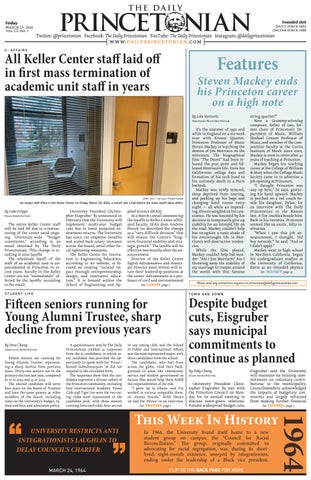
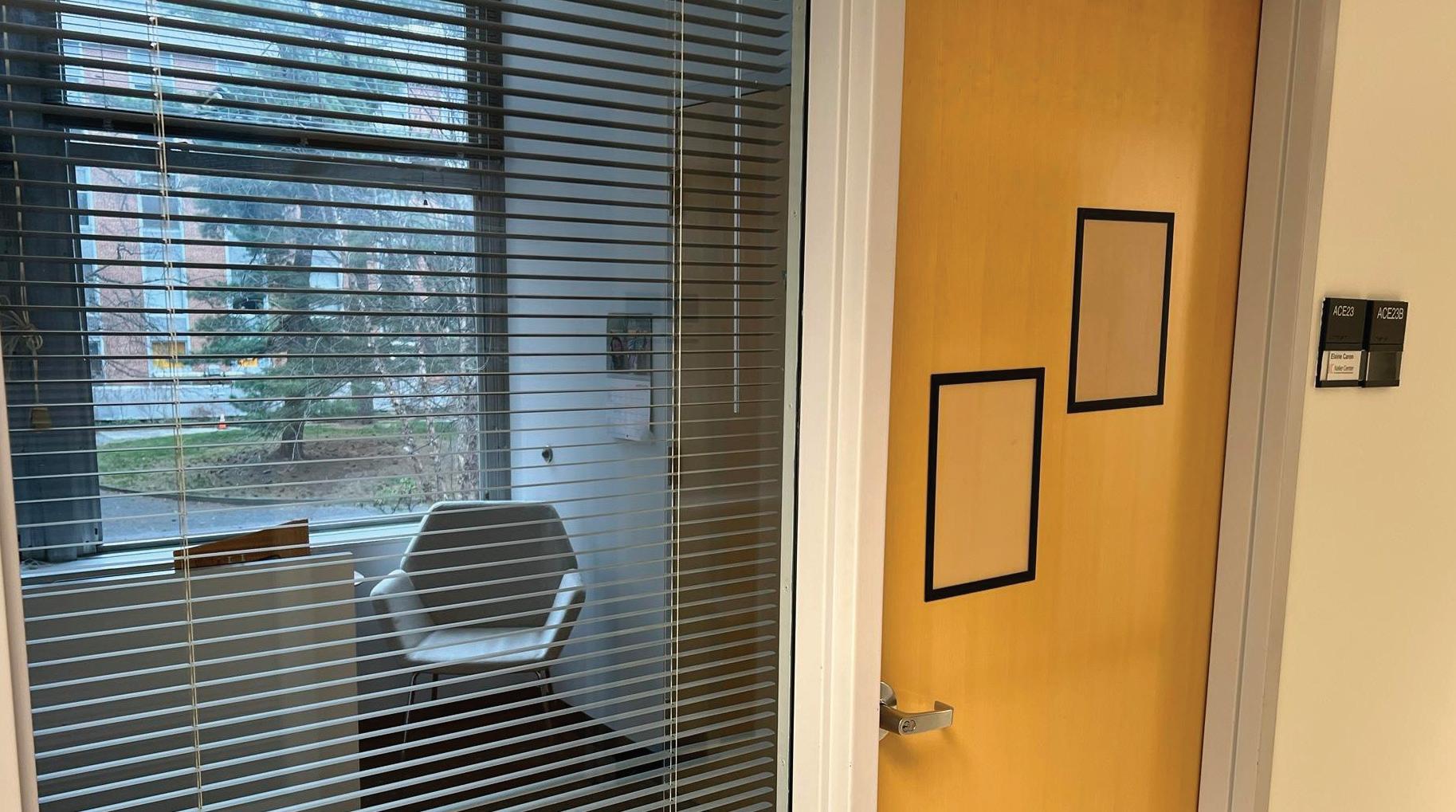
An empty staff office in the Keller Center on Friday, March 20, 2026, a month and a half before the mass layoff takes effect
Associate News Editor
TOWN
‘The
wholesale layoff
of the staff of an academic unit is unprecedented at Princeton in recent years.’
LAYOFF
Continued from page 1
engineering, and Vertesi is an associate professor of sociology.
The email from Houck stated that those laid off will have the opportunity to apply for new positions at the center. In a statement to the ‘Prince,’ University spokesperson Jennifer Morrill wrote that there were four new positions created within the Keller Center to which the laid-off employees will
have the opportunity to apply.
The University has publicly posted three of these positions on its job listings: an executive director, an undergraduate administrator, and a communications and events specialist.
There is no open listing for the fourth position at time of publication. According to Morrill, the position is manager of finance and administration at the Center. Morrill wrote that there is also a new engineering dean’s staff position available.
Multiple Keller Center staff and faculty declined to comment or referred the ‘Prince’ to the Office of Communications.
“The School of Engineering remains committed to the Keller Center’s critical mission of interdisciplinary education in entrepreneurship, design, and societal impact,” Houck wrote in the email.
The Center’s future plans will be done in consultation with “faculty and staff task forces” who help guide the center “in the cur-
rent budgetary environment,” Houck continued.
The email stated that this decision was not rooted in any “dissatisfaction with the Center’s talented and hard-working staff.”
“I share your deep appreciation and concern for our affected colleagues. Please be assured that the School and University will carefully support Keller Center staff through this difficult transition,” the email concluded. “Your teaching and mentoring are key to the Center’s continued success and I
am grateful for your dedication to the Center’s work and to our students.”
As of now, faculty positions and course offerings are not affected by the restructuring, and the minors in entrepreneurship and technology and society will continue to be offered.
Luke Grippo is a head News editor for the ‘Prince.’ He is from South Jersey, and typically covers high-profile interviews and University and town politics.
‘I arrived at Princeton as someone’s dream of what was possible; I hope to leave having expanded what’s possible for the next.’
TRUSTEE
Continued from page 1
Henyo cited his experiences in a “resource-constrained context” as applicable to the Princeton context, especially as the University faces a series of budget cuts.
Enzo Kho ’26, the former Undergraduate Student Government (USG) president, also cited his global experiences as a key motivator for running.
“I came to Princeton after my family and I experienced political violence in the Philippines — an experience that changed the trajectory of my life, shaping my sense of purpose in service,” he wrote in a statement to the ‘Prince.’
Kho cited his work in the USG as informative in understanding “the University’s complex structure” and learning how to “strengthen bridges between students and the administration during a period of institutional change.”
“As the first student from my public high school to attend Princeton, I know people from backgrounds like mine have not often had a seat in rooms like the trustee room,” Jaisnav Rajesh ’26 wrote in a statement to the ‘Prince.’
Rajesh, who hails from Plainfield, Ill., believes that his background and experience serving the student community as a Pace Center Student Leader and a Residential College Adviser would inform his role as a potential trustee.
Alexcis Johnson ’26 expressed similar sentiments and told the ‘Prince’ about the diversity of viewpoints and experiences she has had throughout her four years.
“Over the course of my time here, I’ve come to see so many of my perspectives … challenged, and so many courses that I have taken and enjoyed that I never would have considered as a high school student,” Johnson said.
“I hope to encourage more people to consider how their Princeton journey can help them develop and decide
their own ambitions,” she continued.
Many expressed wishes to ensure that a diversity of perspectives are reflected at the decision-making table and to continue Princeton’s institutional legacy.
Richard Kertatos ’26, a non-traditional student who served in the Coast Guard prior to transferring to Princeton, expressed that he wished to serve as a “bridge” between the University administration and the campus community.
“I think the purpose of the Young Alumni Trustee is really to bridge that gap and to provide recent student perspectives to the Board,” Kertatos told the ‘Prince’ in an interview.
Similarly, Kriti Garg ’26 wrote to the ‘Prince’ that her experiences as an RCA and a class officer have prepared her for the role and expressed a wish to expand opportunities for future classes.
“I arrived at Princeton as someone’s dream of what was possible; I hope to leave having expanded what’s possible for the next,” Garg wrote.
“I think one of the biggest challenges that Princeton faces is preserving and defending that kind of higher education that it represents, and especially during a time … of skepticism and political pressure and potentially questions about access,” Shannon Yeow ’26 said in an interview with the ‘Prince.’ “I think Princeton, definitely in the long term, must really continue standing up for these values.”
Young Alumni Trustee candidates are prohibited from campaigning and are allowed only a brief statement about themselves and their intentions for running.
The remaining candidates are Minna Abdella ’26, Sol Choi ’26, Cole Crosby ’26, Jamil Fayad ’26, Roberto Lachner ’26, Connor McCord ’26, Subrahmanyam, and Aishwarya Swamidurai ’26.
Voting for the 2026 Young Alumni Trustee primary election will begin Monday, March 30 and end on April 7, with voting open only to the members of the Class of 2026. Through a
process of ranked-choice voting, seniors will rank the 15 candidates in order of preference.
Following the primary, the top three candidates will advance to the general election, which will be open to voting for the senior class, the junior class, and the two most recent alumni classes. Online voting for the general election will begin on April 29 and end on May 13.
The 2026 Young Alumni Trustee will be announced on May 22 during Reunions at the Alumni Council Annual Meeting.
The Daily Princetonian will continue reporting on the candidates and the election.
Sena Chang is the associate News editor for the ‘Prince’ leading investigations. She is from Japan and South Korea, and she often covers local politics and student life. She can be reached at sena[at]dailyprincetonian.com.
Luke Grippo, Nico David-Fox, and Oliver Wu contributed reporting.
New restaurants expand halal dining options in Princeton
By Aitana Camponovo Staff News Writer
In just four months, a three-block stretch of Nassau Street has transformed into a hub for halal fast food, with BurgerRunn, Best Grill and Fries, and Food Street all opening within walking distance of the University’s campus.
“As someone who’s been here for five years, the variety and depth of halal food has increased,” Ariyan Sajid ’25 GS told The Daily Princetonian in an interview. He compared the current landscape — which features Mediterranean, South Asian, and fast casual options — to a more limited set of choices just a few years ago.
Students who keep halal cannot eat pork, any form of alcohol or alcoholcontaining product, or meat that is not properly slaughtered according to Islamic belief.
These restaurants are becoming important social hubs outside of convenient on-campus dining options. For Abdullah Rizvi ’27, the president of the Muslim Advocates for Social Justice and Individual Dignity at Princeton, the impact is especially visible during Ramadan.
“It’s been nice to gather there at late hours and grab food,” he said of BurgerRunn. “It feels like a little taste of home sometimes.”
In the past, Muslim student groups
have often used restaurants like Best Grill and Fries for event catering as a “huge draw” for attendance and engagement, according to Rizvi.
“The expansion of halal dining is also helpful for peer leaders hosting study breaks as they are able to easily accommodate for Muslims,” noted Yahya Habib ’26.
“Muslim business owners have realized the potential that the Princeton area has,” Rizvi said. “We’re in a 15-minute radius from [two] mosques.”
He also noted the prominence of religion in the restaurants. “One of the things that stands out to me about Best Grill is that if you walk in, they have free Qurans for people to take.”
The owner of Best Grill and Fries, Shoyeb Shikder, emphasized their short menu and discounts directed towards students.
“If you think about halal and affordability, then we’re the best.” Shikder told the ‘Prince.’
Food Street, just across the street from Best Grill and Fries, also promotes a similar model. Within their specialty of Pakistani and Indian food, their rolls are their most popular product.
“The best sellers that we have — the ones that we’re known for — are the rolls. People come from a long distance to have these rolls already,”
Hasan Bhai, owner of Food Street, told the ‘Prince’ in an interview.
Some students compared these new
restaurants to the University dining halls, noting that restaurants offer increased flexibility and a more informal setting.
“As a Muslim, I’m always on the lookout for halal options near campus that are not dining hall food,” said Aaima Tariq Malik ’29. While she noted that Princeton provides consistent halal options in dining halls, she also explained that “one does get tired of eating the same thing over the course of the semester.”
“We started in 2024. We’re now at four locations,” said Mohammed Abdhul, the owner of BurgerRunn. “We’re planning to expand nationwide with DoorDash on our side. … They’re helping us expand and helping us choose territories in order to grow.”
“So far, the community has been very supportive, and we’re very appreciative of that,” said Abdhul.
Most dining halls close at 2 p.m. for lunch and at 8 p.m. for dinner. In comparison, Best Grill and Fries remains open until 3 a.m. on Fridays and Saturdays, and until midnight on other days. BurgerRunn closes at 11 p.m. Sunday through Wednesday and at midnight Thursday through Saturday, while Food Street shutters at 10 p.m. every night.
Despite enthusiasm toward expanded halal dining options, students still weigh practical considerations when choosing where to eat. Armita Kazemi ’28 pointed to the downsides
of halal dining on Nassau Street.
“At the end of the day, late meal is free,” she told the ‘Prince.’
In recent years, the University has made efforts to expand halal-friendly dining options, with residential dining halls piloting a halal card program and Hobson College Dining Hall, set to open in 2027, featuring a halal-certified station.
“I’m so appreciative [of] what the dining hall staff does in terms of creating opportunities for halal food, but it’s nice that these different options have been opening up,” Rizvi said.
Aitana Camponovo is a staff News writer for the ‘Prince.’ She is from Washington, D.C.
IN TOWN
AITANA CAMPONOVO / THE DAILY PRINCETONIAN
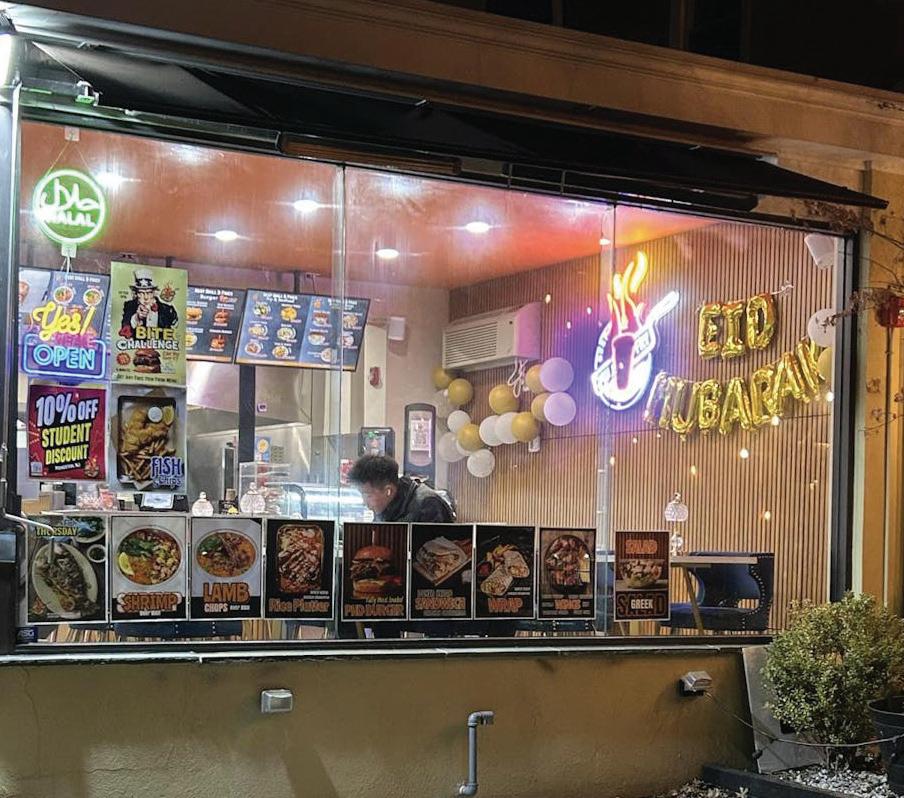
Best Grill and Fries, one of the newly opened halal locations near Princeton’s campus.
‘We no longer want to look at you as the golden goose, but as just a goose.’
COUNCIL
Continued from page 1
“asks” to the University.
“We have an agreement with this town where our voluntary contribution will increase year over year 4 percent, and we intend to adhere to that commitment,” Eisgruber said. “We regard that as an important commitment that we have made, both for our partnership and for the University’s mission.”
“Traditionally, we see this [meeting] as an opportunity for us to … make our ask,” Councilwoman Leticia Fraga said. “But I’m not going to do that tonight.”
The meeting with Eisgruber and the Council has occurred every year since he took office in 2013. This year’s discussion centered around financial challenges, continued federal attacks on universities, and long-term goals.
Citing a shared feeling of financial strain, Fraga noted, “We face challenges that threaten our ability to sustain services, both those that enhance daily life and those that are essential to our community.”
“It’s clear to me that you guys are in a position where you have to look at things very carefully, as do we. We no longer want to look at you as the golden goose, but as just a goose,” Councilman Leighton Newlin said.
In his opening statement, Eisgruber said that threats to federal funding and academic freedom — challenges that were discussed in last year’s meeting — persisted. He referenced his annual “State of the University” letter from this February, titled “From Growth to Focus,” in which he discussed declining long-term return expectations on the University’s endowment. The Princeton University Investment Company recently reduced return expectations from 10.2 percent to 8 percent.
In 2024, the University announced a five-year plan to make voluntary contributions totaling nearly $40 million towards the municipality. The funds include investments in infrastructure and public services. The contributions are set to increase by 4 percent year-over-year through 2028.
Councilman Brian McDonald asked Eisgruber about supporting each other in the context of the Trump administration’s continued attacks on private universities, acknowledging the mutually beneficial relationship between academic institutions and the country’s prosperity.
“The partnership model has weakened, and there is no question that this will hurt our country now and for decades to come,” McDonald said. “What can we do, and what can members of our community do to support the university and its peer institutions?”
Newlin, who previously served as the liaison for the Princeton Housing Authority, suggested the University could be more involved in building affordable
housing for its staff. Newlin proposed a formal partnership between the University and the Princeton Housing Authority. He stressed that the proposal was a “vision, not an ask.”
“My vision is for the University to, at some point, enter into a formal partnership with the Princeton Housing Authority … with a meaningful commitment to supporting members of the University’s workforce,” said Newlin.
Newlin also questioned Eisgruber about the $1.25 million settlement that the University agreed to contribute to the Witherspoon-Jackson Development Corporation after a lawsuit was filed in 2016 to overturn the University’s tax-exempt status.
“Where is the transparency? Where is the accountability? Where are the tangible results tied to that investment?” asked Newlin.
Eisgruber did not directly answer the questions regarding the settlement, and instead suggested a general goal towards affordability and emphasized future collaboration.
“I respect the many concerns that you raise,” said Eisgruber. “We’re very interested in making sure that we can work with this council and the town to ensure that the zoning is appropriate around potential projects that I think would be very beneficial, not just to the University, but to the town,” he continued.
Council members continued to discuss other ways in which the University’s relationship with the greater Princeton area has evolved.
“A top priority for me has been rebuilding the relationship with the University in a way that I feel like it has frayed,” said Councilwoman Mia Sacks.
Fraga, who is currently serving her final term, reflected on the past several years of collaboration between the University and the municipality. She spoke about the collaboration with Habitat for Humanity, the Paw Points program expansion, and community building events hosted at the Princeton University Art Museum.
Council President Michelle Pirone Lambros raised concerns over declining participation in the Princeton Fire Department Associate Member Program. The program, first piloted in 2009 to bolster the fire department’s volunteer force, enables University employees to volunteer as firefighters during their work shifts. Lambros highlighted revitalizing the program as another opportunity for collaboration.
The meeting concluded with remarks from Mayor Mark Freda, who reaffirmed a commitment to a continued dialogue.
“In today’s world, people being able to just have an honest, open dialogue is sometimes a challenge. We truly appreciate all the effort, the respect, and everything that goes along with that between the University and the town,” said Freda.
Toby
Hundreds gather for first Interfaith Iftar in seven years
By Sophia Hopper News Contributor
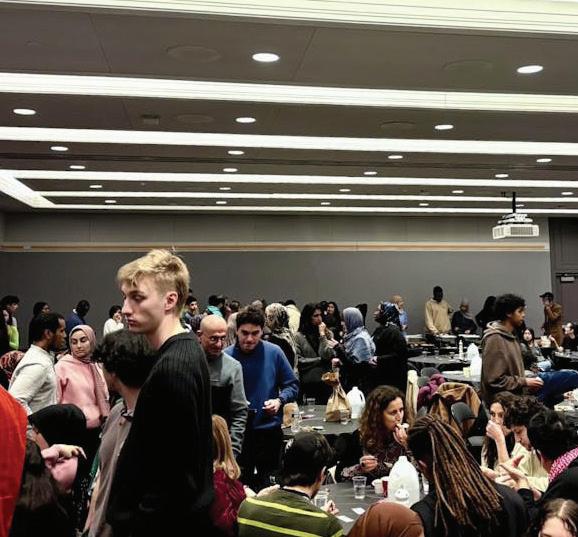
On Tuesday, March 17, the Princeton Muslim Life Program and Religious Life Council co-hosted in Frist Campus Center’s Multipurpose Room the Interfaith Iftar, an opportunity for students observing Ramadan to break their fast with the broader community.
The sunset event drew over 350 students, faculty, and community members. This exceeded the organizers’ expectations, requiring overflow seating and additional catering. As the first formal Interfaith Iftar hosted in seven years, the success of the event has created excitement for an annual tradition.
The Muslim Life Program hosts around nine community iftars throughout the month of Ramadan on Tuesdays and Thursdays each year, open to all students regardless of faith. These weekly events serve upwards of 275 students and are often attended by Muslim students and their friends.
However, this most recent community iftar was a concerted effort to create space for dialogue, learning, and support among an even broader group as one of many interfaith events hosted by the Office of Religious Life (ORL) throughout the year.
The event began with a studentled call to prayer, followed by an English translation delivered by Assistant Dean for Muslim Life Imam Khalil Abdullah. Following the traditional breaking of the
fast with water and dates, attendees shared a halal meal including shawarma, falafel, and hummus, which included kosher options.
Abdullah encouraged the crowd to engage in reflection using prompts provided by the ORL. The crowd also engaged in conversation across religiously-mixed groups, with many students asking questions and discussing faith-based practices and commonalities.
“At my table were Jewish people and we were able to talk about our different religions. I really enjoyed learning [that] our religions are more similar than maybe we thought,” Hiba Samdani ’27, co-president of the Muslim Student Association told The Daily Princetonian in an interview.
“We’re not preachy, you know, we just bring people together and let the magic happen … The two words that came to mind were food and friendship,” Abdullah told the ‘Prince’ in an interview about the event. “As I stood there, I just thought, ‘what a wonderful group of friends’ … After the food ran out, people stayed and they talked and they laughed and they made plans and they met new people.”
Sarah Rinzan ’27, another student in attendance at the iftar, emphasized the importance of space for students to break their fasts together, especially considering the centrality of family and community to the observance of Ramadan.
“Faith is such a big part of all
of our lives and it’s kind of hard to bring that into conversations regularly. Having a space where we’re able to do that is really nice … I feel like it helps [others] know me as a more well-rounded person,” Rinzan said.
Mohammad Afzal Shadab, a postdoctoral research associate, emphasized the importance of these exchanges. “In today’s world, which is quite polarized, it’s important that people come together and just exchange ideas because that helps break all those barriers we would have of the unknown. It was nice to know about people and people’s religions and faiths, just to learn and to make new friends,” Afzal said.
The event followed the Feb. 27 “Fast-a-Thon” led by the Muslim Student Association. While both events saw high engagement, organizers noted that the Interfaith Iftar attracted an even larger crowd, with lines extending around the room.
Abdullah said that members of the community plan to gather again in Frist Campus Center on Friday to celebrate Eid.
“We like to practice a joyous version of Islam. There will be a lot of laughter, there will be balloons, there will be face painting, there will be food and chai, and more food and more chai.”
Sophia Hopper is a News contributor for the ‘Prince’ interested in Town and Faculty, Graduate Student, and Alumni coverage. She is from Raleigh, N.C.
Postdocs demonstrate outside of bargaining session, confident despite budget cuts
By Meghana Veldhuis Senior News Writer
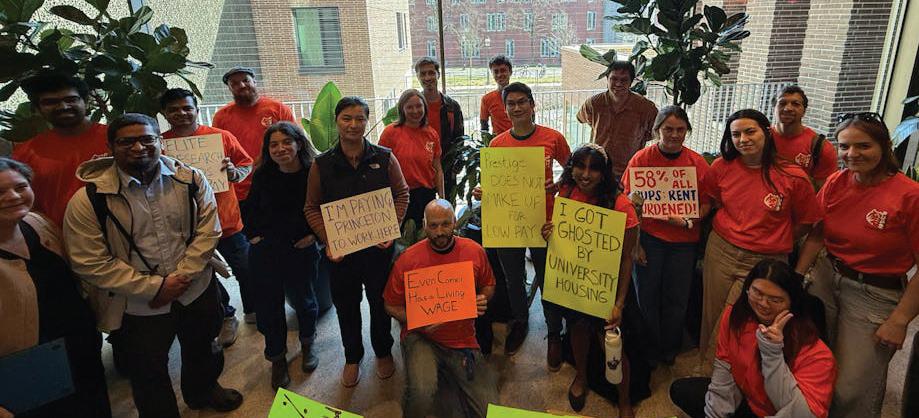
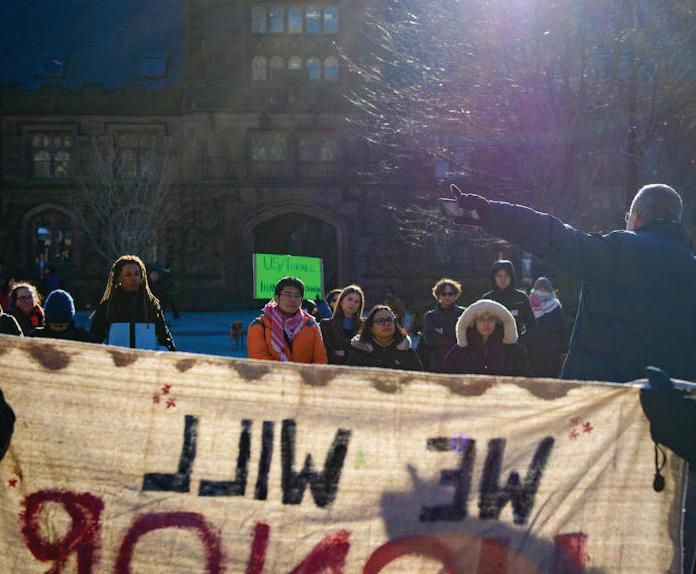
On March 9, members of the Princeton University Postdocs and Scholars union (PUPS-UAW) protested with signs outside of a bargaining session between PUPS-UAW and the University, aiming to show solidarity with the limited number of union members present in the bargaining session.
In the bargaining room, eight PUPS-UAW negotiators and five observers — a limit imposed by the University — argued for their proposals regarding salaries, healthcare, legal protections, and layoffs. Specifically, they discussed a University proposal of a 12 percent increase in postdoc salaries over the next three years, as well as the retention of University benefits regarding childcare subsidies and the number of sick days.
Bargaining between PUPSUAW and the University began in 2024. After about a year and a half of bargaining, 13 out of 44 proposals have reached tentative agreements, according to the PUPS-UAW bargaining tracker.
Once the University and PUPSUAW reach tentative agreements on all 44 proposals, PUPS-UAW can draft a contract that all postdocs can vote on.
Grace Flores-Robles, a postdoctoral research associate in the Princeton School of Public and International Affairs, was in the bargaining room. Flores-Robles said that postdocs are confident they can achieve their goals
IN TOWN
through continued negotiations, despite the University’s fiscal tightening in light of diminishing endowment returns, which resulted in the cutting of benefits and salary raises to University employees, including postdocs, in February.
According to Zara Albright, a postdoc present at the demonstration, “the University proposed no changes to the status quo” regarding postdoc benefits. However, the University reserves the right to alter existing postdoc benefits at any point.
PUPS-UAW proposed a pay increase plan in November 2025 in which salaries would be adjusted by number of years of experience as well as a yearly increase to adjust for the cost of living. Administrators presented counterproposals at the recent meeting after a Feb. 23 meeting was cancelled due to snow.
University spokesperson Jennifer Morrill wrote to The Daily Princetonian that “bargaining sessions have been held exclusively in-person since bargaining began,” and that March 9 was the earliest date both parties were available.
“We brought a bunch of postdocs from across the University. We all wore our orange PUPS shirts and held signs that were intended to show why we care about our proposals,” Albright told the ‘Prince.’
In 2024, the minimum salary for a postdoc at Princeton was $65,000 a year. PUPS-UAW’s November proposal suggested a base salary of $92,000 for postdocs
with zero years of experience, a 42 percent increase from the 2024 minimum, as well as annual increases of three percent. The minimum yearly salary for an associate research scholar with zero years of experience would be $102,000.
The University’s counterproposal of a 12 percent increase over three years would result in a minimum annual salary of $73,000 after three years. If PUPSUAW’s proposal were enacted, after three years the minimum annual postdoc salary would be $100,530 — $30,000 more than the University’s proposal suggests.
The union’s proposal would cost at least $24 million more for the University’s 800 postdocs per year after three years.
In addition to salary demands, postdocs raised concerns about housing availability, as “[the ma -
jority] of postdocs are rent burdened,” according to Jessica Ng, a postdoc present at the demonstration. The University stated it was not in a position to build more housing for postdocs.
“We wanted to show how much postdocs support these demands that we’re asking for from the University,” Ng told The Daily Princetonian. “It’s easy for [the University] to pretend that those [in the room] are the only people who care and who are involved.”
The contract being negotiated by PUPS-UAW would apply to all postdoctoral researchers and associate research scholars at the University regardless of their membership in the union.
“It took [the University] five months to get back to us on an economic proposal. So there’s really no saying how long it will take,” Flores-Robles said. “It’s a waiting game at this point.”
“First contracts such as this one often take more than a year to complete,” Morrill wrote to the ‘Prince.’ “The University has and will continue to bargain in good faith so that the parties can reach a reasonable agreement.”
Meghana Veldhuis is a senior News writer for the ‘Prince.’ She is from Bergen County, N.J., and typically covers graduate students, postdocs, faculty, and campus unions and labor.
Flores-Robles told the ‘Prince’ that the biggest issue PUPS-UAW faces is the length of negotiations. It can take several months to reach a tentative agreement on a single proposal, and most postdocs only remain at the University for a few years.
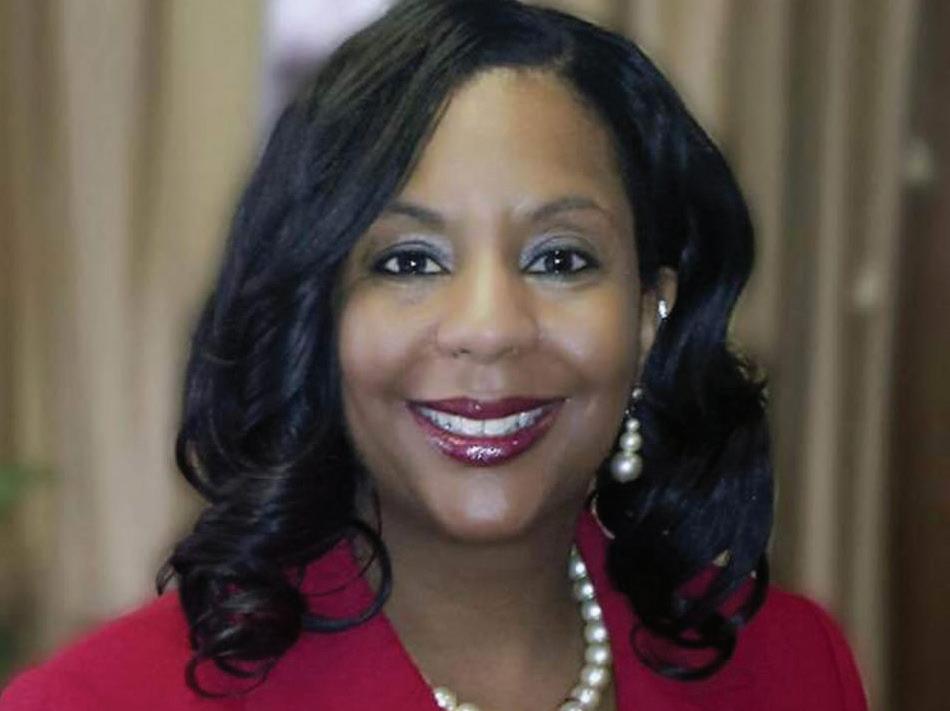
Verlina Reynolds-Jackson, N.J. Assemblywoman, runs for N.J.-12 Democratic nomination
By Emily Murphy Senior News Writer
Assemblywoman Verlina ReynoldsJackson is one of 17 candidates running for the Democratic nomination to represent New Jersey’s 12th Congressional District, which includes the Princeton area.
Last month, Reynolds-Jackson won the endorsement at the Mercer County Democratic Committee Convention and received the fourth-most votes at the Princeton Community Democratic Organization endorsement vote. Reynolds-Jackson sat down with The Daily Princetonian to discuss her political background and her campaign priorities, including access to healthcare, affordability, and voting rights.
Reynolds-Jackson is from Trenton, N.J., and has a background in social work. She was the first African American woman elected to serve as East Ward Councilwoman in the Trenton City Council and later served as Council Vice President. In 2018, she won election to the New Jersey General Assembly for the 15th Legislative District and is currently in her fourth term. She is chair of the Education Committee, vice chair of the Appropriations Committee, and a member of the Budget Committee.
Weighing in on a controversial debate that has divided the Democratic party, Reynolds-Jackson said that Immigration and Customs Enforcement should be abolished and expressed her support for reallocating its funds to the Federal Emer-
gency Management Agency or Transportation Security Administration. Additionally, she argued that utility rates should be capped and that data centers should “pay their fair share” in electricity costs. New Jersey has roughly 80 planned or operational data centers, according to Data Center Map, and the high energy demand from these data centers has contributed to rising electricity prices in the state.
If elected, Reynolds-Jackson said she hopes to increase community engagement, especially with younger generations.
“We have a large population of young people that want to get into public advocacy and public policy. They just don’t know where to start. And so I think I have that opportunity to create that partnership,” she stated. “I think I have the ability: Because I teach public policy [and] because I have the mentorship program, I think we can take what [Representative Bonnie Watson Coleman] has and make it even better.”
Reynolds-Jackson also acknowledged certain barriers, describing mental health as one of the most important issues facing the youth.
“I think there’s a lot of things that young people just keep to themselves versus sharing. I think we need to be more open [and] remove the stigma away from having counseling or just talking about rejection,” she said.
Regarding the ongoing and accelerated expansion of presidential power, she argued that Congress should hold more hearings to hold the executive branch accountable, especially when it comes to foreign policy.
“Congress needs to act. I believe there should be some accountability. I believe
there should be some oversight. I believe that the Supreme Court needs to step in and say, ‘there are things you can do, Mr. President, and there are things you cannot do,’” Reynolds-Jackson said. “Right now, we’re in a war that I don’t believe the American public had a chance to weigh in [on],” she continued, referring to the Iran war that began on Feb. 28 when Israel and the United States jointly attacked Iran.
Reynolds-Jackson argued that her background as an assemblywoman differentiates her from other candidates in the crowded race.
“I am the only state representative assemblyperson that is running that has a record of accomplishments. I also believe that I have a pathway unlike others.”
She has advocated for the expansion of the state’s Child Tax Credit and has sponsored multiple education-related bills, including a bill which passed the New Jersey General Assembly in December that would remove the state’s high school graduation exam. She also sponsored an unsuccessful 2019 nonbinding resolution that called for the removal of Huckleberry Finn from school curriculums due to racist portrayals and a successful bill mandating studies on diversity and inclusion in New Jersey schools, which became law in 2021.
Reynolds-Jackson said that affordability would continue to be one of her priorities as congresswoman. She specifically hopes to expand affordable pathways to both trade school and college for young Americans.
Regarding excessive medical costs, she specifically highlighted the 2024 Louisa Carman Medical Debt Relief Act that she cosponsored, which limited when medical
debt can be reported to credit card agencies. As a further measure, she suggested increasing Medicaid reimbursement rates.
“Just because you get sick [or] you have a chronic disease shouldn’t mean that your paycheck should be garnished or your credit report should be impacted,” Reynolds-Jackson said. “I have a legislation that I got passed to eliminate that: to stop those predatory lenders from attacking people.”
Reynolds-Jackson said that she has been working to pass the John R. Lewis Voter Empowerment Act of New Jersey for the past four years, and she believes it will successfully pass the State Legislature this year. The act would give state courts broader power to counteract election rules viewed as discriminatory, including a preclearance process before localities with a history of discrimination can make changes to their election rules, and lower the threshold of non-English proficient residents needed in a municipality to mandate multilingual election materials.
She also supported a bill passed in 2022 that requires police officers to stay at least 100 feet away from polling locations and voter drop boxes.
“I’m extremely proud of the work that I did around eliminating law enforcement from inside polling locations. I want families to be able to tell the story about how they go to the polls, not to see a police officer there with their gun,” she said. “That, to me, is intimidation, and a lot of other people think that as well.”
Emily Murphy is a senior News writer, senior Copy editor, and chief correspondent regarding the N.J.–12 Congressional election. She is from New York City.
Four graduate students awarded Jacobus Fellowships, discuss research and future plans
By David Estrada & Diya Kaur Staff News Writer & Contributing
Writer
Philip Decker GS, Victor Geadah GS, Sayash Kapoor GS, and Eliana Rozinov GS were awarded the 2025–26 Porter Ogden Jacobus Fellowship, the University’s top honor for its graduate students. The fellows were honored at Alumni Day on Feb. 21.
The fellowship is awarded to one Princeton Ph.D. student each in the humanities, social sciences, natural sciences, and engineering divisions for their scholarly excellence. The award recognizes “scholarly ability, achievements, and character” and supports a student’s final year of study at Princeton.
The fellowship recipients were interviewed by The Daily Princetonian to discuss their research at Princeton and future plans.
Decker is reframing what we know about the NaziSoviet Pact
Decker’s Ph.D. dissertation, “The Molotov-Ribbentrop Pact: A Cultural and Diplomatic History,” focuses on the relationship between Nazi Germany and the Soviet Union at the beginning of World War II through a lens of cultural similarity, rather than the common geopolitical explanation for their brief alignment.
Decker studied history as an undergraduate at Swarthmore College and minored in German and Political Science. Decker later pursued a master’s in international relations at the University of Oxford to further explore the intersection of history and political science.
In an interview with the ‘Prince,’ Decker said that his motivations for pursuing this research angle came from his grandfather’s experience of the Nazi invasion, but also an appreciation for German culture.
“I grew up hearing about my grandfather’s story, and it just struck me — obviously, there’s more than you see to this national relationship, and that story is what I’m telling in my dissertation,” Decker explained.
Decker explained that his approach to an extensively studied topic, like the rise of Nazism, is finding a niche and sticking to it.
“I tend to be a little contrarian,” Decker said. “And so I like to look at a problem that has been looked at before. And I say, ‘Well, okay, what is new territory that has not really been covered?’”
His advisor, Professor of History Yair Mintzker, remarked that “after Philip’s work, we will not think about those two crucial years in European history in the same way.”
Spending months traveling for archival research and searching through
thousands of telegrams between Berlin and Moscow, Decker hopes his dissertation “to be a revision of the origin story of World War II.”
Rozinov and the question of what women want Coming to Princeton in 2020 after obtaining an undergraduate degree in comparative literature and English from Cornell, Rozinov wanted to expand on her research through the interdisciplinary studies offered in Princeton’s English department.
Her dissertation, “Riddles of Women: Mythical, Modernist, Freudian” explores Freud’s great unanswered question: “what does a women want”?
Rozinov cites the figure of Gradiva, a Roman sculpture, as central to her dissertation, in order to displace the emphasis on Freud’s Oedipus complex. In an email to The ‘Prince,’ she wrote that “most people associate Freud with the drama of Oedipus and his belief in the Oedipus complex … it overlooks so many figures of women and queer women and women of color, throughout history, who were actually central to Freud’s work.”
Rozinov also designed her own undergraduate seminar, ENG 441: A New Eve: Women, Myth, and Power. She co-taught this seminar with Professor of English and Comparative Literature, Maria A. DiBattista.
“Teaching is at the heart of my research, because it’s also the audience I hope will be interested in reading my work,” Rozinov noted. The focus of ‘A New Eve’ was on a number of socalled ‘fallen-women’ in literature, film, and culture, which the students engaged through their questions, essays, and class discussions.
“Princeton has exceeded all my expectations — not only the English department itself, but also the courses I’ve taken in others, like those in the Program in Gender and Sexuality Studies, where I’m getting a graduate certificate,” Rozinov wrote.
She added, “I could not have a better or more generous group of mentors: I work with Anne Cheng, Maria DiBattista, and Zahid Chaudhary. On top of being amazing people, they are brilliant scholars. I hope to do for my own students what my dissertation advisors and my amazing undergrad advisors have done for me.”
Rozinov eventually wants to turn her dissertation into a book. She hopes people will recognize that “we shouldn’t shy away from creativity and our idiosyncrasies — our uniqueness helps bring us together.”
Geadah is providing nuanced neuroscientific answers
Victor Geadah, a fifthyear Ph.D. candidate in Applied and Computational
Mathematics, won the fellowship for his dissertation “Statistical Inference of Normative Processes in Neuroscientific Data,” which created mathematical models that identify irregularities in neuroscientific data.
Geadah, who previously studied applied math at the University of Cambridge, spoke extensively about exploring the intersection of theory and experimentation for his project — a “middle ground,” which he sees as ingrained into the Princeton research environment.
“I sought to operate in the middle, using an experimental background but still being in touch with theory to actually draw insights from real data, its complexities and its irregularities,” he told the ‘Prince.’
For Geadah, collaborating with others is also a core part of the thesis research process.
“I get personal fulfillment out of just interacting with smart people who come to me with beautiful ideas,” Geadah said. “I love to ask questions and get involved and try to integrate what they’re telling me. It makes for a quite symbiotic relationship,” he added.
Jonathan Pillow, Geadah’s thesis advisor and a professor at the Princeton Neuroscience Institute, said in a press release that Geadah is “the go-to person when someone has a new idea.”
“Jonathan gave me all this freedom, and it was a perfect alignment with what I was interested in,” Geadah said.
Geadah will be a postdoc at the Flatiron Institute in New York following his time at Princeton, where he will work on statistical modeling and neuroscience theory. Eventually, Geadah plans to go into academia and cited Princeton as an “amazing” institution to work for in the future.
“I like the idea of leading a lab where we care about good theoretical work that is statistically driven as data-grounded, with the goal [of] eventually really understanding how we make decisions and what the unobserved processes are that guide those decisions,” he said.
Kapoor is evaluating artificial intelligence (AI) models
Sayash Kapoor, a fifth year Ph.D. candidate in Computer Science, has won the fellowship for his dissertation “AI’s Impact on Science and Society,” which is advancing evaluations of AI.
Kapoor, who holds a bachelor of technology in computer science from the Indian Institute of Technology Kanpur, told the ‘Prince’ that his background as a software engineer at Facebook has influenced his view of government policies on “trillion dollar” technology companies.
“I really saw how much leverage there is, if you can influence policy in the right way,” he said.
“When I was looking for grad schools, Princeton stood out because it not only takes computer science research seriously, but also takes tech policy seriously,” he continued, citing his experience working at Princeton’s Center for Information Technology Policy.
Kapoor has shared that his dissertation is the product of a coincidental collision between civil war prediction using AI models and concerns about AI prediction methods leading to irreplicable conclusions.
“When I started my dissertation, I started by looking at the field of civil war prediction in political science,” he stated. Many papers had found that AI models were far better at predicting civil wars than previous methods.
But Kapoor then ran into
inconsistencies. “I spent a few months … trying to reproduce the results. And I ultimately found that every single paper that claimed AI was better than decadesold [prediction] methods failed to reproduce,” he stated. After fixing errors in the AI prediction models, “AI methods did not outperform the decades-old prediction methods in any of the cases,” he added.
This research became a “light bulb moment” for Kapoor, and he expanded his work to “many other fields.”
“We found that similar problems affected like two dozen fields and hundreds of papers,” Kapoor said. “I realized that good evaluations really are a bottleneck to AI’s impact on society.”
Kapoor then shared why the false scientific consensus that AI has been producing is harmful. “I think science and technology research are responsible for many positive improvements in people’s lives. I think if we can’t trust the science that we are doing, then all of that progress gets stopped,” he noted.
“Developing more rigorous evaluations is one way towards improving confidence in scientific results,” Kapoor added.
“It’s a real honor to receive this fellowship, but I think it’s also a testament to how seriously Princeton takes societal impact,” he said. “It really feels like a testament to Princeton’s commitment to its mission of serving the public that it recognizes this type of work and awards it as it did in my case.”
Kapoor plans on going into academia and is currently searching for a job at a university.
David Estrada is a staff News writer for the ‘Prince.’ He is from Los Angeles.
Diya Kaur is a News contributor for the ‘Prince.’
Community members hold teach-in, vigil, and rally amid US-Iran War
By Daphne Lewis & Elizabeth Hu Staff News Writers
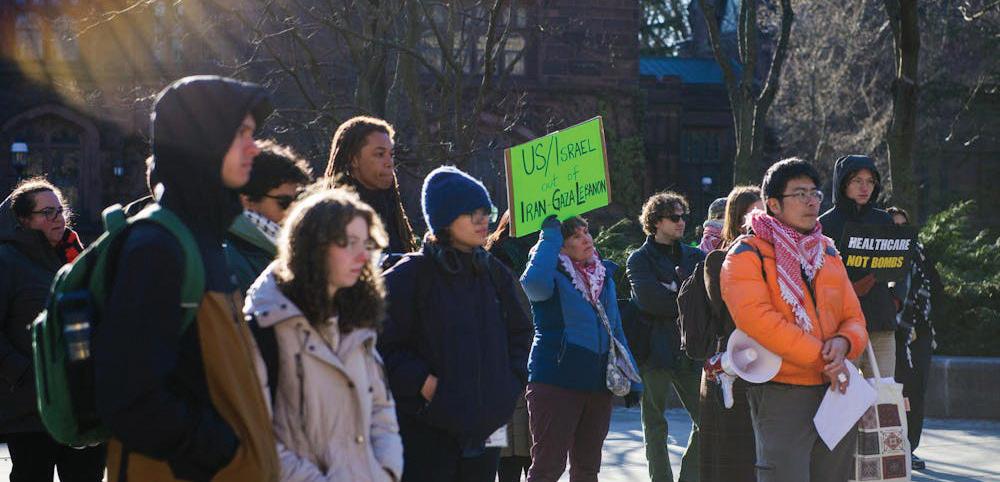
Several dozen members of the Princeton community gathered for a teach-in, a vigil, and a rally responding to the ongoing war in Iran, which began with U.S. and Israeli strikes on Feb. 28. The events featured scholars, activists, veterans, and community members who examined the war’s political, historical, and human dimensions.
The Sharmin and Bijan Mossavar-Rahmani Center for Iran and Persian Gulf Studies (MRC) hosted the teach-in, and Princeton Israeli Apartheid Divest hosted the other two events. Speakers contended that the wars in Iran, Lebanon, and Palestine all constitute a single crisis in which the United States is an active participant, pushed back against prevalent narratives about the region and its people, and scrutinized Princeton’s relationship with U.S. and Israeli military powers.
On Tuesday, the MRC hosted a teach-in at Robertson Hall, attended by over 60 people. Six Princeton scholars and field experts gave short presentations covering nuances of the war, while organizers distributed a list of alternative news sources for coverage of the conflict.
Postdoctoral Research Associate Maral Sahebjame kicked off the teach-in by emphasizing that Iran is not a monolith, being composed of many different ethnic, religious, and linguistic groups. Only around 60 percent of Iran is Persian — the other 40 percent includes Kurds, Azeris, and Lurs. With this in mind, the question of “what Iran wants” does not have a simple answer, she said.
Anthropology professor Arzoo Osanloo addressed Iran’s 150-year history of oppression and struggle for liberty from both state and imperial forces, and history professor Max Weiss discussed the role of Israel in Lebanon. He argued that Hezbollah exists as both a Lebanese national liberation movement and a refraction of the Islamic Revolution in Lebanon.
Negar Razavi, an associate research scholar at MRC, addressed the military dimension directly. She said that the U.S. war games and simulations conducted over more than two decades had consistently shown that the United States would lose a conventional war against Iran, and that the current approach reflected that conclusion. Analysts of security in the Middle East suggest that while the United States is unlikely to be defeated in a war with Iran, the conflict will likely incur catastrophic costs on both sides, leading to a “grisly end.”
Sareh Afshar, another associate research scholar at MRC, was the last to speak before an overview from Zia Mian, physicist and codirector of the Program on Science and Global Security. Mian considered how the United States has supported Iran’s nuclear program in the past and how Israel’s nuclear program and Cold War architecture fostered nuclear ambitions in other countries.
Following the teach-in, a candlelight vigil was held on Firestone Plaza, where community members spoke and shared personal stories while candles were lit in memory of those killed. Official statistics estimate death tolls at over 1,300 in Iran and about 1,000 in Lebanon. The war in Gaza has left over 72,000 dead, according to the Gaza Minis -
try of Health.
Aditi Rao GS, an organizer with Princeton Israeli Apartheid Divest, opened the vigil by framing the moment within a longer arc of regional violence.
“Since October 7, it’s clear Israel’s plan was always to have a greater Israel,” Rao said after the event in an interview with The Daily Princetonian. “They planned to decimate Gaza, annex Lebanon, and then attacked Iran, which protected the people of Palestine.”
Rao described the vigil as a space for grief, accountability, and humanization. “The United States is being conscripted into fighting Israel’s war, dropping bombs over children and displacing people,” she said. “Today, we are here to mourn the lives lost. To understand how we can take full accountability. But also, we need to humanize those people.”
A representative from Princeton Israeli Apartheid Divest read “Apologies to All the People in Lebanon,” a poem by June Jordan dedicated to the 600,000 Palestinians who lived in Lebanon between 1948 and 1983.
A representative from the Alliance of Jewish Progressives read the Mourner’s Kaddish. “Israel uses Jewish scripture as a justification of crimes,” they said. “Today, we use Jewish scripture as a justification of humanity.”
On Wednesday, a rally began on Firestone Plaza before moving through campus. The group of about 15 chanted “From Princeton to Palestine, occupation is a crime / From Princeton to the Philippines, stop the U.S. war machine” as they walked to McCosh Courtyard and Cannon Green, where speakers addressed the crowd, before returning to Firestone Plaza.
Among those who spoke was Afshar, who drew on her own experience growing up in Iran to challenge the narrative that bombing the country would liberate its women. She noted that women comprise up to 60 percent of university students in Iran today and have historically been the country’s most powerful internal opposition force.
“Bombing these women today is not going to liberate them,” Afshar said. “If anything, it’s going to hinder their ability to organize and reshape the world around them.”
Maral Sahebjame, an interdisciplinary scholar at MRC, read aloud a text from her friend. The message described U.S. bombers circling above the city for half an hour before striking — signing off with bitter sarcasm: “My beautiful bombs. My beautiful bombers had arrived and lit up the night sky over Tehran.”
She cautioned against treating people in Iran and across the Middle East as merely a casualty rather than as political actors with their own ideas and futures. “United States-Israeli imperial attacks must be condemned, and bombs, and sanctions — both of which are weapons of mass destruction — must be stopped,” she said.
Adam Hamawy, a surgeon and candidate for New Jersey’s 12th Congressional District, spoke about his time serving as a combat surgeon in Iraq and his volunteer work in Gaza in 2024–25. He described witnessing children wounded by U.S.made bombs and linked the cost of ongoing wars abroad to declining living standards at home.
“I saw what the bodies are like of little boys and girls shot in the head. Shot in the chest, blown apart by the bombs that we’re making
with our tax dollars,” he said. “We can’t afford healthcare. We can’t afford education. We can’t afford to rebuild our roads,” he said. “But we always have enough money for the bombs.”
Irfan Khawaja ’91, a member of Princeton Alumni for Palestine, closed with remarks that turned inward toward the University itself, tracing what he described as a decades-long pattern of institutional silence on Palestinian rights. He pointed to two events, in 1984 and 1988, in which Whig-Clio invited ultra-nationalist Israeli politician Meir Kahane to speak on campus. Both times, Kahane explicitly advocated the ethnic cleansing of Arabs from Israel.
“He was very clear that anyone who defied the orders of the IDF to leave would be killed,” Khawaja
claimed in an interview with the ‘Prince.’ “There was no particular big deal made about it.” The ‘Prince’ could not independently verify this specific claim based on past reporting.
The pattern, he argued, continued into the present. “I remember, in 2024, the dismissive indifference with which the University received our petition for divestment,” he said. “February 28th has changed that calculus altogether. The United States is now at war.”
Daphne Lewis is a staff News writer for the ‘Prince.’ She is from Washington, D.C.
Elizabeth Hu is a staff News writer, assistant head Copy editor, associate Data editor, and staff Podcast producer from Houston, Texas.
EMILY TANG / THE DAILY PRINCETONIAN Demonstrators protest the Iran War on Wednesday, March 18, 2026 in Firestone Plaza.
Hum r
Brospect reviews: U-Store free samples
By Daily PrintsAnything Staff
In case you subhumans missed it, the U-Store had hella good motion this past week. And I mean that gooooooood-good motion (aka free samples every day). Cause we’re the GOATs, the Brospect decided to make the most of it and rode the wave of free stuff like a baddie foid. Enjoy the reviewmaxxing below, chuds!
Monday — Orgasm chocolates
Imma be honest, this one wasn’t all that. I ate six of them jits thinking they were some of that regular chocolatey goodness, but after like five minutes I started looking over at the brodie Kyle and feeling some type of way. Let’s just say, the gym’s never given me this kind of pump. Kept the socks on though so we chillin’.
Lowkey, would do again and I totally anal-play-mogged Kyle so he owes me a pack of Zyns. Totally touse.
Tuesday — Ozempic
Tricep Tuesday is usually where I hit up Dillon to flex on non-alpha males, but today I decided to cosplay a little b**ch and try Ozempic. Walking into the U-Store to grab a quick protein gain before my 4 a.m. workout, some baddie with a bod offered me a needle.
Shooting up a half needle instead of my usual ’roids, my
sculpted body REJECTED the drug. The needle couldn’t pierce my biceps or my rock-hard abs. After she saw me bod-maxxing, it’s safe to say, she gave me a different type of bone smashing.
Fellas don’t take if you want to keep up your sick gains at the gym. Ladies, if you want to ride my needle, shoot up. Besides, it’s bulking season cuh, the only thing getting cut around here is the membie discount.
Wednesday — Baby Oil
Happy motherfreaking Hump Day chodes! On Wednesday, the crodies and I made our way back to the glorious U-Store to check out the day’s sample.
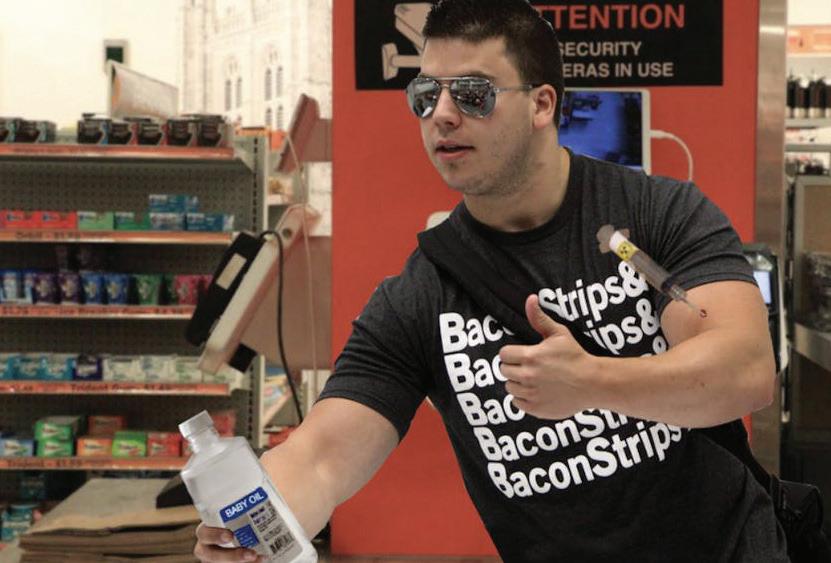
Upon walking in, we spotted a line-up of five different bottles of baby oil! Tight! The boys and I were absolutely stoked because we happened to be running low on our own stash.
While the other brands were hella slick and moisturizing, they were mid af when compared to the OG JnJ (Johnson & Johnson). Those two dope homies upheld their reputation for the smoothest, butteriest feeling when I rubbed that jawn all over my body. Some of the other loser customers couldn’t keep their eyes off my glorious oiled up bod, so we growled at them and stole the extra for our own rec use.
Thursday — Taco Bell Baja Blast Pie
Rise and shine bootylickers! It’s Thursty Thursday!!!! What could
possibly be better to mog dehydration than Taco Bell’s goated Baja Blast? You guessed it! It’s the non-liquid, jelly-fied version of the bevvie baked into a PIE. Nom, nom, nom.
The U-Store workers stood up and applauded for me as I put my hands behind my back and absolutely went to town on that pie in the littest display of ferda. Normally I don’t munch crust but I made an exception for this lil’ treat. Plus, GOOD NEWS! The jelly’s roofie-ready.
Friday — Fent FREAKY FRIDAY! Have you ever put fent up your bum? Just
bend over and administer it like the U-Store administered the discount cut.
Good stuff; left me slumped in pleasureland for an hour. Wandered onto Nassau and took some guy’s child. MINE NOW!! Abandoned him in Dillon. Kid might make a good mogger someday if he overcomes his BETA dad’s genes.
A collaboration by Head Humor Editor Tarun Iyengar, Associate Humor Editors Francesca Volkema and Nic Rohou, Assistant Humor Editor Nate Voss, and Staff Humor Writers Paige Baker and Kadin Parham.
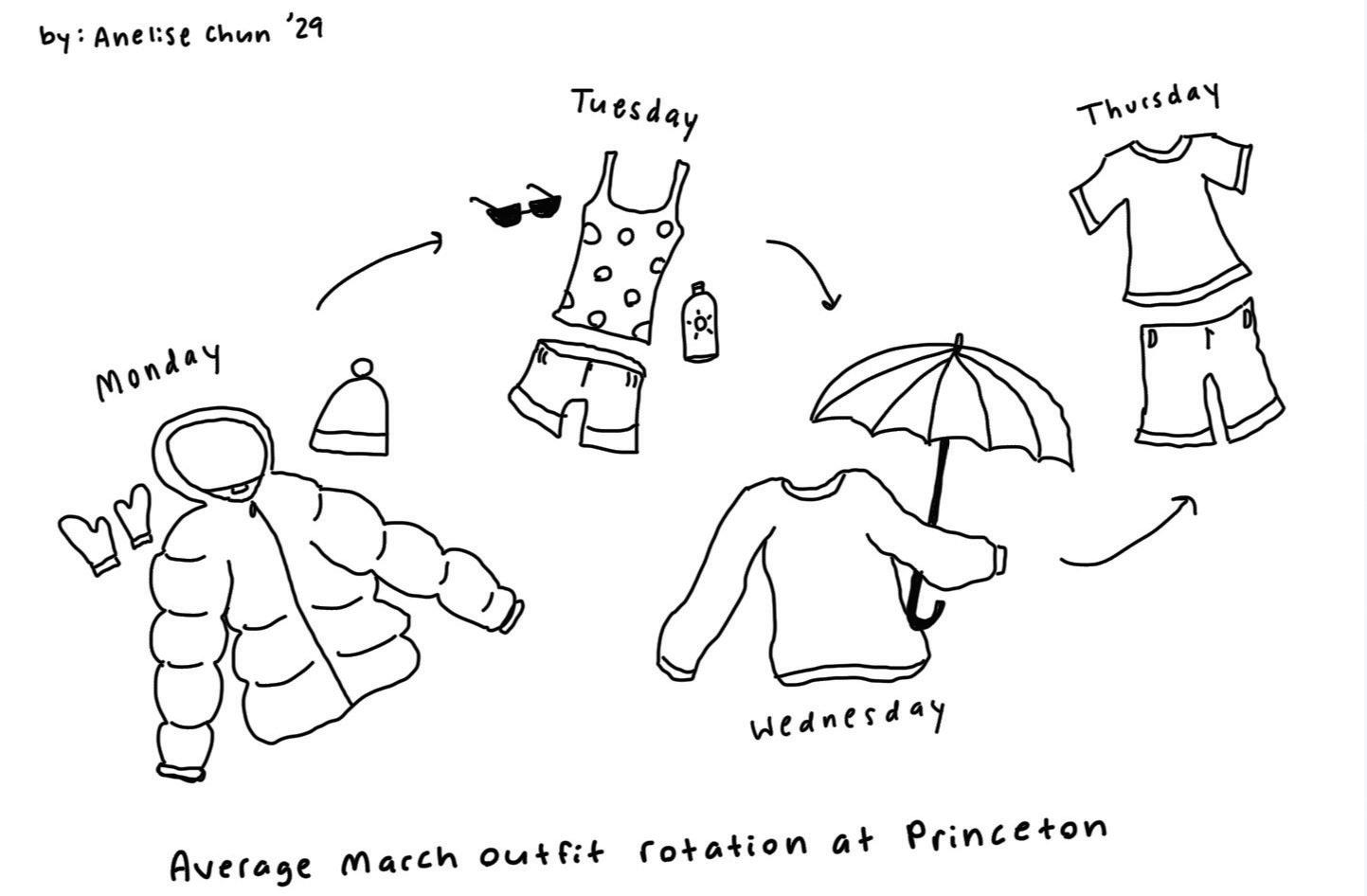
Average March Outfit Rotation In Princeton
By Anelise Chun | Contributing Cartoonist
PHOTO ILLUSTRATION BY NATHANIEL VOSS / THE DAILY PRINCETONIAN; SOURCE PHOTOS BY JEAN SHIN / THE DAILY PRINCETONIAN, “MUSCLES GLASSES” BY GAGE SKIDMORE / CC BY-SA 2.0, “RADIOACTIVE SYRINGE” BY THIRTEEN OF CLUBS / CC BY-SA 2.0, “MINERAL OIL, FRONT” BY ANGELA MABRAY / CC BY-SA 2.0 Brospect reviewer Kyle getting a sendy sampler at the U-Store.
“I n a n utshell”
By Eliza Nichols Staff Constructor
1 One more than one 4 Spanish appetizers
9 Sauna site
12 1952 Steinbeck saga spanning nearly 60 years
14 A pirate's favorite letter?
16 Lifeboat, to Luke or Leia
17 Infamous Roman emperor
18 Not this 19 Tolstoy's 1869 magnum opus set during the Napoleonic era
22 "___ looking at you, kid"
24 Mononymous Irish singersongwriter
25 Mess up
26 Hosp. departments
27 Customizable Nintendo character
30 Opposite of tasteless
32 ___ borealis
35 Ladder rung
36 Summary of complex tale, or how four of this puzzle's clues might be described
41 Capital of West Germany
42 "Yes, Captain!"
43 Flemish painter and diplomat
46 Writer Rand
47 Progressive mascot
50 Sch. in Tempe 51 Mates of rams 54 ___ and dagger
56 George Eliot novel originally published in eight installments
60 Sephora competitor
61 Narcissists have massive ones
62 Sport featured in "Heated Rivalry"
64 Vehicle taken back by lender, for short
65 Homeric epic about a hero's decade-long journey home
66 Base of decimal system
67 Sink of "Stranger Things"
68 Pay stub abbr.
Aquire canines? 2 Laundry appliance
Academy Awards 4 Not bottom
Some 6 Salt-N-___ 7 Hold dear 8 Capacious car 9 Summer shoe
Type of school 11 Accepts
Singer McRae 15 More sore, as a throat 20 Big Apple initials
Room for remains
Self-satisfied
Tax agcy.
Tiny amount 31 Tennis trailblazer Arthur 32 Bonny, Boleyn, or Brontë 33 Pam's ex-fiancé from "The Office"
Length times width
Biblical patriarch
Worse
Spending as planned
Yippee!
Lip-___
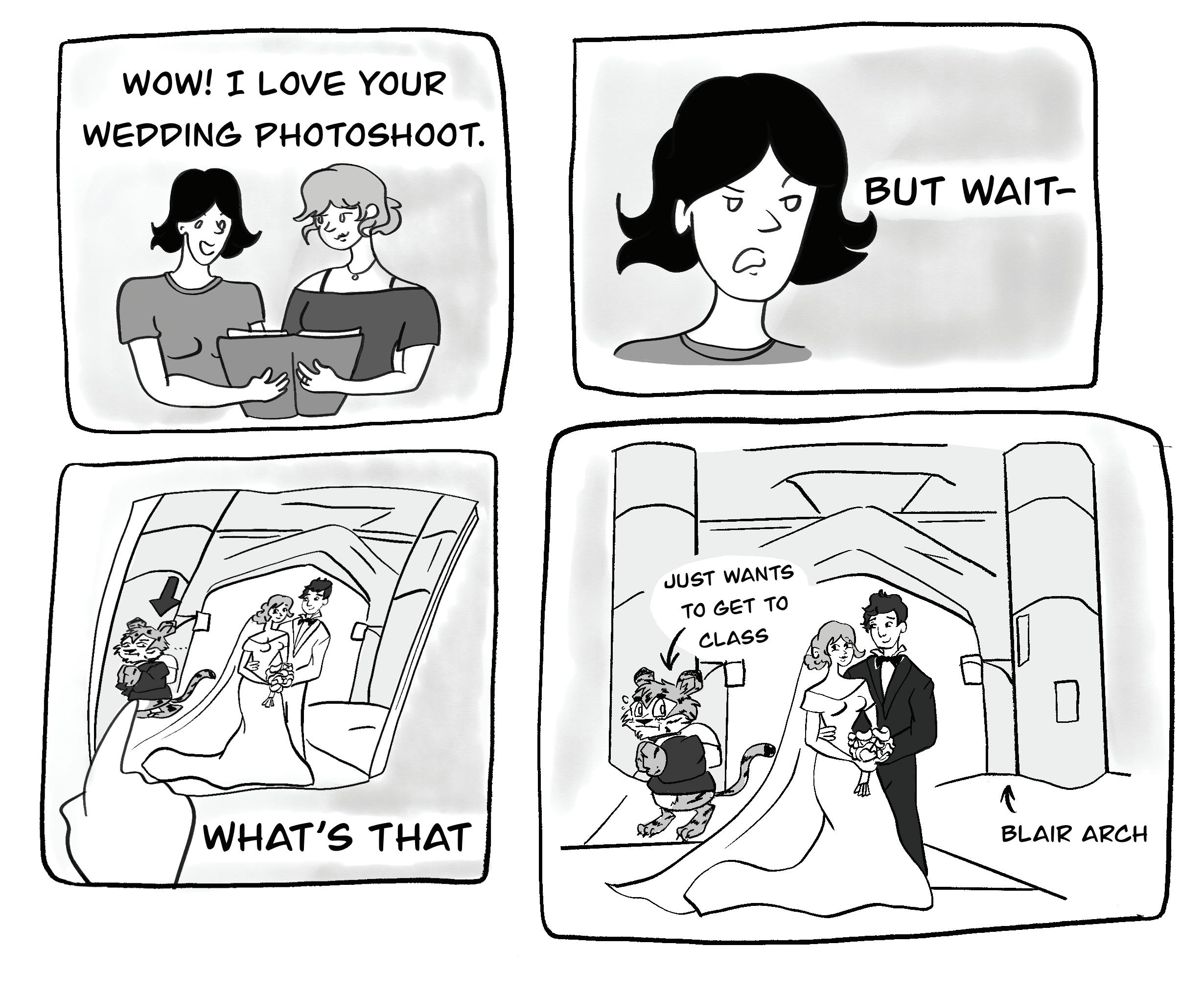
The Princeton Photobomber
By Paulette Martinez | Associate Cartoon Editor
Neighbor of Nor. and Fin.
Quaint 48 Most recent 49 Authorized
52 Gives off
53 Borat star ___ Baron Cohen
55 Peanuts character known for football pranks 57 Drug
58 Bassoon bit
59 Beloved Princeton dining hall 63 Poem of praise
I was the Honor Committee chair. It’s time for proctors.
In 1893, Princeton was experiencing rampant cheating that heightened distrust between faculty and students. As a result, students took it upon themselves to draft and institute an entirely student-run honor system. Students recognized that it was up to them to maintain academic integrity during their exams, so they took investigating and adjudicating instances of supposed cheating into their own hands.
Faculty and administration agreed to this system, and to emphasize students’ responsibility to academic integrity, Princeton did not allow professors in exam rooms for over a hundred years. While there have been many changes to the honor system since 1893, this distinctive feature has remained. But the time has come to update our system, because Princeton’s tradition must not come at the expense of our integrity. For the sake of the Honor Code, Princeton needs proctors.
Princeton’s honor system, asis, emphasizes the responsibility of students to uphold Princeton’s commitment to academic freedom, rigor, and integrity. As the chair emerita of the Honor Committee,
which handles suspected academic violations on in-class exams, I have intimate knowledge of the strengths and weaknesses of the system’s fidelity to the pursuit of knowledge.
Indeed, commitment to this mission is what makes Princeton’s undergraduate education the best in the country — and the 5,826 undergraduates who are currently enrolled have the responsibility to keep this status.
We come to Princeton from all sorts of backgrounds and we study all sorts of subjects, but the one common thread among us is our commitment to scholarship. Exams are just a small part of our education, but they literally “test” whether we carry out the entirety of our academic pursuits with integrity. The testing environment is a microcosm of the time we spend studying, solving, reading, and researching with dedication and care. Procedures for all our scholarship here should cultivate a culture that is conducive to the advancement of knowledge.
Recently, however, the Honor Committee has experienced new strains, including an uptick in cases in the last year and challenges such as generative AI, and student sentiment has recognized that its procedures need to better reflect
the current challenges to academic integrity. The Honor Committee is dedicated to continuous change: It recently expanded to 18 members and alerted administration about the need to have clocks in exam rooms. It has updated internal procedures by updating training, and tried to bring awareness to students by sending reminders about best test-taking practices around exam seasons. For years, the Committee has had conversations about introducing proctors into exam rooms, to serve as another potential witness and reporter — and the time has finally come to take this step.
The two-fold obligation agreed to by all students upon matriculation states that, “individually, they must not violate the code, and as a community, they are responsible to see that suspected violations are reported.” As a student community, we recognize that some methods of cheating, including access to cellphones and other devices, have become both prevalent and difficult to report. Proctors will be able to help pick up the slack where students might not be able to keep each other accountable by addressing concerns during the exam as they arise and reporting matters to the Honor Committee for evaluation. Introducing proctors would not be a punishment for abuse of the sys-
tem, but rather, another means of prevention that corresponds to the realities of our time.
Proctors will not change each student’s responsibility to maintain academic integrity, but they do provide another measure of promoting a testing environment that is fair to all. By looking at peer institutions like Harvard and Yale and listening to the student body, it seems clear that adding someone whose responsibility is promoting a fair environment and who can serve as a reporter and witness will be beneficial to academic integrity.
While there are details to be worked out with the faculty about the number of proctors and the procedures they would follow to ensure equitable enforcement, it is time to begin the conversation about proctors. As recently outlined, the process for instituting proctors requires faculty and administrative votes. But as the people who know best what taking exams at Princeton is actually like, it is important that, as students, we voice our experience and opinions about what will best serve the test-taking environment in forums like this paper and through student representatives in the Honor Committee and Undergraduate Student Government. As students, we do not lose any rights by introducing proctors into
exams, and we certainly do not lose any responsibilities. The entirely student-run honor system would remain unchanged, and would still investigate and adjudicate alleged Honor Code violations. Simultaneously, proctors would provide clarity to investigations. The investigation and hearing process would become more robust with the opportunity to interview proctors as potential witnesses. Proctors’ word would not be treated infallibly, but rather considered just as seriously as any other piece of evidence. Most importantly, introducing proctors for exams does not rid us of the onus which is ultimately on us as students to maintain academic integrity — it only reflects our commitment to maintain and promote academic scholarship, the core value which makes Old Nassau so great. The age-old Honor Pledge on exams will remain, because for each exam we take, we will continue to pledge our commitment to scholarship and academic integrity.
Nadia Makuc is a senior in the Department of Classics from Monterey, Mass. She served as the chair of the Honor Committee in 2025.
The N.J.-12 congressional race isn’t worth our precious time
Ian Rosenzweig Assistant Opinion Editor
In the last two weeks, I have received four text messages from Professor of Neuroscience Sam Wang’s congressional campaign. These texts took up 70 lines in iMessage — more extensive than even my grandmother’s voicetyped paragraphs — to ask me for money.
Wang is one of 17 candidates running for the Democratic nomination in N.J.-12, the congressional district in which the University sits. I am not registered to vote in Princeton, and I’m more invested in politics in my home district. I don’t have the desire to contribute money to a primary candidate outside my district. And I certainly didn’t sign up to receive announcements from any campaign. I’d imagine a majority of Princeton students feel similarly.
I suppose I could have replied “STOP” and removed myself from the list, but regardless of how and why my name and phone number were added to Wang’s contact list, the texts inappropriately demand disproportionate attention to the N.J.-12 primary.
A crowded race where any one voter’s preferred candidate is extremely unlikely to win isn’t the best outlet for our limited political energies; the attention on this primary doesn’t mean it deserves a monopoly over our political consciousness. Instead, we should focus on being effective constituents of the polities to which we belong: Princeton’s campus and our home districts.
Our optimal political engage-
ment will manifest as a convergence of our true passions and interests with the issues and regions where we have the best chance of making an impact. For certain local and interested students, that golden mean might be the N.J.-12 primary. But that won’t be true for most Princetonians. As we build our schedules and select our priorities, we must not let long and sensationalized text messages or any amount of ‘Prince’ coverage convince us that it is so.
There are far more effective means of political advocacy and opportunities to speak directly on the local issues we care about to a community who will listen. Publishing — on campus or beyond — about the impacts of budget cuts, protesting to raise awareness on campus about Immigration and Customs Enforcement, and engaging in dialogue to enrich your own and your opposite’s perspectives can all impact the political playing field of the campus we share. Even working with the incumbent N.J.-12 representative, who already holds an actual position of influence, to inform policy is far more effective than contributing to a candidate with a one in 17 — granted, unweighted — chance to hold office .
Excessive discussion of the N.J.12 primary — admittedly a fun election to which we can personally connect — is the same kind of political junk food as that which our social media algorithms feed us, clogging our systems and distracting us from more substantive priorities. Just as we must look beyond the echo chambers of our Instagram feeds or avoid losing our sense of fun in Princeton’s academic pressure cooker, we must
not allow heightened discussion and reporting, the candidacy of a Princeton professor, or even excessively long text messages to distract us from our more substantive political engagement.
To clarify, I’m not suggesting that Princeton students should be politically apathetic. In fact, I think it’s extremely important for us to show up to political debates and engage with a range of complicated views. But I draw a distinction between worthwhile and trivial engagement.
That worthwhile engagement does not look the same for everyone. I seek opportunities to build bridges across differences, whether through debate, writing, or a spontaneous conversation in the ‘Prince’ newsroom. Others prefer protest and political organizing. And others still find canvassing for a candidate to be most fulfilling. None of these methods are more or less important than others. But no matter what your stylistic predilection is, you can’t fight every battle; it is difficult to find time to engage with our political passions amidst our myriad responsibilities.
N.J.-12 is not a swing district, the candidates are not of special renown and the race concerns candidates who should be far more accountable to the over 700,000 N.J.-12 constituents than to University students transplanted from their home districts.
Of course, there are implications of Professor Wang’s candidacy that are particular to his role as a member of University faculty, and these might be of interest to our community. To discourage any disproportionate attention to the N.J.-12 campaign on our cam-
pus is certainly not to undermine the value of local politics. Indeed, the recent “ICE Out” protest responded, partially, to ICE’s presence in the Town. Furthermore, Princeton’s congressional representative may be more likely to defend higher education than any of our home district’s representatives. Especially in today’s climate, advocating for our educational experience through our legislative channels is especially important.
For those of us not voting in N.J.12 and not particularly passionate about any of the candidates, let’s focus on issues and races that we know more intimately, and where our impact can be more deeply felt. Rather than writing about or canvassing for a candidate in N.J.12, get involved with the election
for your district’s congressional seat and work on behalf of a candidate who is more beholden to your interests than whoever N.J.12 elects. Focus on on-campus advocacy or organizing through one of Princeton’s many student groups. If, after all of that, you still have the capacity to invest in N.J.-12, by all means go ahead. But if you’re going to choose one cause that commands your time and attention, don’t let it be the N.J.-12 primary.
Ian Rosenzweig is an assistant Opinion editor and prospective SPIA major from Bryn Mawr, Pa. He likes following elections just as much as the next guy — if not more — but would rather spend his time getting something real done.
Nadia Makuc Guest Contributor
editor-in-chief Jerry Zhu ’27 business manager Alistair Wright ’27
150TH MANAGING BOARD
Frances Brogan ’27
Victoria Davies ’27 Managing Editors vol. cl
creative director Juan Fajardo ’28
Corbin Mortimer ’27
Maya Mukherjee ’27
Sections listed in alphabetical order.
head archives editor Jillian Ascher ’28
associate archives editor
Lucy Zschoche ’29
head audience editors
Natalia Diaz ’27
Loreta Quarmine ’27
head cartoon editor Noam Rabinovitz ’27
head copy editors Sarah Li ’28
James Thompson ’27
associate head copy editors
Roberto Sampaio ’28
Felix Santiago ’28
Bobby Xia ’28
head data editor Madeline Wadsworth ’28
associate data editors Christine Cai ’29 Elizabeth Hu ’29
head features editor Nikki Han ’28
associate features editors Jamie Creasi ’28 Mara DuBois ’28
head humor editor
Tarun Iyengar ’28
associate humor editors Nicolas Rohou ’28 Francesca Volkema ’28
head news editors Nico David-Fox ’28 Luke Grippo ’28
associate news editors
Sena Chang ’28 Haeon Lee ’28
Caitlyn Tablada ’27
head newsletter editor Ryan Choe ’28
associate newsletter editor Annika Plunkett ’28
head opinion editors Lily Halbert-Alexander ’28 Charlie Yale ’28
associate opinion editors Isaac Barsoum ’28 Shane McCauley ’28
head photo editor Emily Tang ’28
head podcast editor Devon Rudolph ’28
associate podcast editors Anastasiya Chernitska ’28 Julia Hack ’29
head print design editors Jamie Creasi ’28 Albert Rho ’29
Ahdieh ’28 Jamie Creasi ’28 Marley Hartnett-Cody ’28 AND COPIED BY Sarah Li ’28
BOARD OF TRUSTEES
president Thomas E. Weber ’89
vice president David Baumgarten ’06
secretary Chanakya A. Sethi ’07
treasurer Douglas Widmann ’90
assistant treasurer
Kavita Saini ’09
trustees Francesca Barber
Kathleen Crown
Suzanne Dance ’96
Gabriel Debenedetti ’12
Stephen Fuzesi ’00
Zachary A. Goldfarb ’05
Michael Grabell ’03
Danielle Ivory ’05
Rick Klein ’98
James T. MacGregor ’66
Rohit Narayanan ’24
Marie-Rose Sheinerman ’23
Julianne Escobedo Shepherd
Abigail Williams ’14
Tyler Woulfe ’07
trustees ex officio
Jerry Zhu ’27
Alistair Wright ’27
Continue funding access and opportunity
Vitalia Spatola Staff Opinion Writer
Amidst budget cuts, Princeton recently laid off the entire nineperson staff of the Keller Center for Innovation in Engineering Education. But in the past few months, quieter changes have affected programs that support underrepresented and non-traditional students. This year, the Transfer Scholars Initiative (TSI), a summer program for community-college transfer students hosted by the Emma Bloomberg Center for Access & Opportunity (EBCAO), is shifting to a commuter-only model.
For years, students participating in TSI lived on campus, allowing them to share meals, go on late-night Wawa runs, and play sports after class. These interactions complemented EBCAO’s formal programming and fostered a sense of community. Making TSI commuter-based will make maintaining that sense of community more difficult. But this decision has already been made. Going forward, programs for first-generation, low-income students must be treated as essential: Princeton must stop cutting funding to EBCAO.
EBCAO provides a variety of programs for students, including mentorship pairings, academic workshops, and communitybuilding events designed to help them adjust to Princeton. Beyond TSI, its initiatives also include the Scholars Institute Fellows Program (SIFP) and the Freshman Scholars Institute (FSI).
FSI and TSI run side-by-side, giving Princeton students and transfer students a chance to learn from each other and build community. A critical part of my own FSI residential experience
was interacting with TSI students on campus after hours. These informal connections, like eating together, playing volleyball, and attending events late into the evening created a sense of community that was integral to my first experience here at Princeton. With TSI now commuter-based, this interaction will be harder, and future students will lose a foundational aspect of peer mentorship — and friendship — that complemented EBCAO’s formal programming.
Reflecting on the shift from a residential to commuter model, TSI alumnus Victor Gil ’26 told me, “The opportunity to engage with Princeton’s own Freshman Scholars [Institute] becomes limited …which I found vital to navigating my own transfer journey.”
“Coming from community college, having the option to be residential was a transformative experience that made CC students feel ‘normal,’” wrote Gil. Furthermore, according to Gil, the change to a commuter system “makes the program inaccessible to people coming from distant NJ community colleges.” Now, only some students, by virtue of their location, will be able to access Princeton’s immense resources — resources which previously benefited more prospective transfer students.
As programs like TSI lose their residential component, the community EBCAO creates becomes more fragile. For transfer and non-traditional students, living among peers with shared experiences is foundational. A commuter model risks isolating students who already face barriers.
Budget cuts will force difficult decisions, but this shouldn’t be one of them. Reducing funding for EBCAO, especially alongside layoffs and program restructur-
ing elsewhere, would disproportionately affect students — both Princeton and transfer — who already face systemic barriers. It would limit student success and undermine the diversity Princeton has worked to build.
Cutting EBCAO programs directly impacts students’ ability to succeed. But the funding cuts to TSI are also symbolic of Princeton’s broader commitment — or lack thereof — to access and opportunity.
Programs like EBCAO affirm that access to Princeton is not just about getting in, but about the support to do well once students arrive. While this change isn’t a termination of the program, it shows that when budgets shrink, the University begins to treat programs supporting FGLI, veteran, and transfer students as secondary. In recent years, Princeton has expanded access to students from diverse socioeconomic backgrounds. But access without sustained support is insufficient.
As Princeton prepares for permanent budget cuts of 5 to 10 percent over the next three years, treating EBCAO as expendable would be a mistake. Ultimately, budget decisions are statements of values. When resources are limited, institutions reveal what they are truly committed to protecting. If Princeton is serious about access and opportunity, protecting EBCAO amidst budget cuts cannot be treated as optional. While no program can be truly “safe,” converting TSI into a commuter program reflects a belief that programs that support underrepresented students are supplementary rather than central to Princeton’s mission.
Vitalia Spatola ’28 is a staff Opinion writer from South River, N.J. She is also an FGLI student.
VITALIA
Gender dynamics inform our intellectual experience, whether we know it or not
Lily Halbert-Alexander Head Opinion Editor
Tis semester, T half of my classes are comprised entirely of woman-identifying students. This is entirely a coincidence: the courses aren’t titled “Women in X” or “Women in Y”; they aren’t cross-listed with the Gender and Sexuality Studies program, nor do they make any claims in their course descriptions that suggest they would amplify or centralize the feminine experience. We simply show up each week, reading and writing about works by authors of all genders, without a male student in sight. It is entirely distinct from any academic environment I have ever experienced.
Of course, there are myriad spaces dedicated explicitly to women on campus, which specifically encourage members to discuss the feminine experience and role of gender in an academic or career-oriented setting. These opportunities are both a privilege and a sign of progress: many generations of women did not have access to a slew of organizations dedicated to supporting them in their particular academic or career pursuits, from Women in Business to Law to Medicine.
But there’s a difference between designated spaces for women — where the expectation is that discussion will focus on feminine identity and experience itself — and a circumstantially all-women classroom, where gender might not be discussed but is impossible to ignore.
The reality of gender in the classroom, especially at a modern and relatively
progressive university like Princeton, is more nuanced than a simple shortage of leadership opportunities or the need for a supportive group to confide in.
It’s difficult to institutionalize formal solutions addressing intangible or implicit gender dynamics, but that makes it all the more important to keep these issues in our minds as students and faculty — and to openly acknowledge how they shape our academic experience.
It’s impossible to dismiss the enormous accomplishments of women in academic fields and the opportunities available to women at American universities, particularly at schools like Princeton where extensive academic resources exist. But that doesn’t mean we can forget that the foundations of elite academic institutions are entangled with gender discrimination. Gender-based disparities in our perception of who is intelligent, authoritative, and important are baked into the way we speak, write, and think. The issues at play in the classroom are larger and far older than any of the individuals sitting at the seminar table, making any attempt to assign individual blame unproductive.
But classrooms consisting solely of women manifested a learning dynamic which I had never experienced or even conceived of as possible, despite having taken many classes with a balanced gender distribution and a relatively comfortable and inclusive discussion environment. The fact that such a dramatic change was possible without any alteration in the material or format of the course suggests that the student gender
identity has a greater impact on academic environment and experience than we might believe.
It’s admittedly difficult to articulate — and I’m sure isn’t experienced uniformly by my classmates — but there’s undeniably something distinct at play in these women-only environments. Our discussion of readings feels more like an authentic conversation and less like an audition or script, as if we’re giving ourselves more time to develop our own thoughts and permit uncertainty without embarrassment. We also seem less inclined to preface our comments with preamble like “I’m not sure, but” or “this probably doesn’t make sense.”
This intellectual empowerment in classrooms is likely entangled with the sudden absence of implicit gender imbalances that many women, myself included, have internalized since childhood.
This isn’t to say that men have an inherently negative impact on the classroom, nor that women cannot actualize their full intellectual potential in coeducational environments. But they do show that impediments to women-identifying students’ confidence and comfort in the classroom go beyond whether or not they’re being talked over or are welcomed in the room.
It’s understandable that we might think refraining from discussing gender in the classroom creates a more egalitarian learning environment, especially given the long history of gendered harms in academia. We have no qualms talking about gender when it’s explicitly on the syllabus. But we rarely acknowledge the
subtler ways gender shapes a classroom environment and our engagement with the material and with one another.
Princeton, alongside its peer institutions, was late to the coeducational party and has an extensive history of gender inequality. Princeton and Yale first admitted women to their undergraduate classes in 1969, and it wasn’t until 2004 that Princeton achieved gender parity in enrollment.
Even if women aren’t being talked over, excluded, or overtly harassed in the classroom, gender still actively informs the energy and productivity of our intellectual engagement. We seem able to own up to the challenges women have historically faced in academia in their more egregious forms — and create supportive spaces outside the classroom in which to discuss them. But that acknowledgement stops at the classroom door, neglecting the more subtle and implicit impacts that might not warrant their own dedicated support group.
Classroom gender dynamics can also be misunderstood when they are chalked up exclusively to a matter of social comfort, which undermines their capacity to dramatically alter the nature of an intellectual environment by placing the onus on those they disadvantage. My high school college counselor cautioned me against women’s colleges by presenting them as echo-chambers cloistered from the “real world.” But this narrative negates the significant and lingering consequences of anti-woman discrimination in academia by condescendingly suggesting that women’s colleges are primarily ad-
vantageous as less intellectually serious social havens and places to make friends.
I’m not proposing more women-only academic spaces as a perfect fix: it’s as oversimplistic and inaccurate to imagine women-only academic environments as paradises as it is to dismiss them altogether. But the dramatic difference in learning experiences in these classes — which do not concern subject matter specific or catered to women’s identities — indicates that gender plays a consistent role in students’ ability to learn. That’s why we must directly address and explore gender’s impact on the classroom rather than leave it to fester, visibly or invisibly, in an effort to deny its existence in the first place.
It’s dangerous to ignore these dynamics, subtle as they may be. Students are drawn to Princeton in large part because they care about having challenging and impactful academic experiences. But implicit gender dynamics generate insecurity and a constant percepti on of judgment, replacing joy and confidence in intellectual exploration with performativity. Even if we as women don’t need “a room of [our] own” to feel like full participants in Princeton’s intellectual community, it’s up to all of us to address the elephant in the (class)room and have honest conversations about how gender informs our academic experience.
Head Opinion Editor Lily Halbert-Alexander is a prospective English major from San Francisco, who thinks that Virginia Woolf said it best. Reach her by email at lh1157[at] princeton.edu.
‘So maybe they’re looking for something that they haven’t seen yet. Maybe it’s me.’
Dump Truck,” a pizza is delivered in the middle of the piece to the double bass player.
major before switching to music. He received a M.A. in composition at the State University of New York at Stony Brook.
It was at Brandeis University while completing his Ph.D. that Mackey met his lifelong friend and mentor, Paul Lansky GS ’73, who retired as the William Shubael Conant Professor of Music in 2014. Lansky had been invited up to Massachusetts on a visiting committee to review Brandeis’ music department and faculty performance. He was walking through the hall when he heard a string quartet rehearsing one of Mackey’s pieces.
While listening, Lansky thought the piece “sounded like somebody from Brandeis, except really good.”
He opened the door. “What’s this?” he recalled asking.
The string quartet motioned to Mackey and the two introduced themselves, but it wouldn’t be their last encounter.
Forgetting about the job application, Mackey went away and visited his parents for the holidays. Upon his return, he noticed the deadline for the faculty position had been postponed. “I thought, if they already knew who they wanted, they wouldn’t have postponed the deadline. So maybe they’re looking for something that they haven’t seen yet. Maybe it’s me.”
After he applied, Lansky invited him to an interview over dinner.
“Members of the faculty were very enthusiastic about him,” Lansky recalled. “He was primarily a guitar player, and this was sort of unusual for a new music position. But things were changing at that point, and a guitar player was no longer a creature from another planet.”
When Mackey was hired in 1985, music was “aesthetically at a crossroads. We were coming out of a period of, what I would call, academic modernism: a modernist movement starting in the beginning of the 20th century [that] got taken over by academia.”
At the time, Princeton was the leading institution of serialism, a movement that shook the classical music world by replacing the long-established tonal system with structured atonality. One faculty member in particular, the late mathematician and former William Shubael Conant Professor of Music Milton Babbitt, championed the technique by uniting classical, jazz, and electronic genres.
When Babbitt retired in 1984, Mackey didn’t inherit his predecessor’s strict and contrarian twelve-tone legacy. Mackey understood the intellectual processes of musical composition and also had a soulful groove. He brought a wide taste, inventiveness, and eclectic sensibility to the music department at Princeton. For instance, in one of his compositions titled “Banana/
“I brought a rock music background, a vernacular music interest that was earnest and with experience,” he recalled.
Or, as Lansky used to tell Mackey, “The DNA of your music is made up of equal parts Led Zeppelin and Igor Stravinsky.”
At 29 years old, Mackey’s first course was MUS 205, a music theory class that gave leeway for Mackey to improvise in his teachings based on what he wanted to discuss and what he wanted to inspire in his students. It was taken by a relatively small group of students, but Mackey remembers one in particular: Michael Artin ’87.
Artin was also one of Lanksy’s senior thesis advisees and the only music major of his graduating class. He became interested in music through writing and recording rock-and-roll songs which, he believes, is what bonded him to Mackey.
“As a music major, I felt very much alien because there were other people taking music classes who had a much more traditional classical music background,” Artin said. “They could hum and sing the Brahms melodies when people said, ‘Do you know the Second Symphony?’ And I didn’t know that.”
Artin lived with his grandmother instead of the dorms, so Mackey would visit his grandmother’s house, where they did improvisational jamming sessions.
Being a young instructor meant students objected to Mackey’s authority and made respect in the classroom precarious during his first year teaching, especially among some graduate students who were deep into their 30s and early 40s.
“‘What’s this kid doing? You know, teaching me?’” Mackey recalled his students’ attitudes toward him and even a petition that argued: “Steven Mackey didn’t even go to Princeton. How is he qualified to teach at Princeton?”
Mackey’s colleagues, however, ignored the students’ criticisms.
“He was in touch with cultures that we have only limited contact with,” Lansky said, viewing Mackey’s younger age as an advantage.
These schisms in the Music Department are ones Artin remembers well — how old school and new school approaches could collide in the same room. When music majors in the Class of 1986 presented their creative theses in front of all the professors, Artin recalls how the end of one student’s rock song faded out. While traditional composers were appalled that a piece could end not in an earned cadence, but in a simple fade-out, Mackey took no offense.
“Steve was like, ‘No, no, no. This thing is continuing in the air, and you’ve dipped into it, and you’re experiencing it for a while, and now you’re just pulling yourself back out, and it’s continuing on without you,’” Artin recalled.
Mackey received the University’s President’s Award in Distinguished Teaching in 1991, the first year it was awarded. In the same year, he emerged from a graduate seminar and checked his mailbox with all his students surrounding him to find an envelope inside from Harold T. Shapiro, the then-president of the university. He had received tenure.
Mackey, now 70, has experienced various stages of teaching over his career as a professional composer. In the beginning, he tried teaching students everything he knew, but came to learn that composition doesn’t have an “absolute truth” that every composer can be cloned as. There’s no right or wrong. A quirky sound in a piece might be interpreted as a weakness but, if worked on, that weakness can become someone’s trademark.
“Then I went through a few years where I was overly permissive, a cheerleader — just trying to help people.”
Now Mackey has reached the point of candidly conveying his opinion.
“It becomes really ironic. Now that I’m retiring, I think I’m doing my best teaching in the last 10 years because of that comfort in my own skin; comfort with my knowledge; confidence in what I have to say; and security that if you don’t take my advice, it’s not a slight on me,” he explained.
A down-period in Mackey’s life came in the wake of 9/11.
He expressed that the terrorist attacks made everything feel so useless. He couldn’t bring himself to compose a guitar orchestra piece commissioned by the Holland Festival, set to premier in 2003.
“What’s the point of composing music?” he thought, then remembered the illnesses in his family. “Mom’s gonna die, and my dog’s gonna die, and the country’s going to shit — you know, just
bleak. I have no interest in composing. I can’t concentrate.”
Despite his nihilistic feelings, Mackey eventually brought himself to composing again. With a TA covering his class, he cooped up in his house and didn’t change out of his pajamas until he finished the commissioned piece. It was cathartic for him to undergo so much trauma and make art out of it. “Dream House” was a metaphor for being lied to about the existence of weapons of mass destruction, the subsequent invasion of Iraq, and Mackey’s own feelings of culpability as an American deceived by the CIA.
As the world has changed dramatically over the decades, so has Princeton. But despite being at the same place for so long, Mackey has never felt stuck in the sameness of his surroundings. Even after all this time spent at Princeton, he feels like he “didn’t stay in one place for 41 years, because students keep coming through.”
Mackey likened his time as a professor to being parked in a car with student passengers hopping in and out while the scenery outside the vehicle constantly changed: politics, culture, musical tastes. Friends coming and going, like Lansky and Artin. Moving offices to the Effron Music Building. Weighing in on the upholstery of the newly erected Lewis Center for the Arts.
While some students are ships passing in the night, others linger at the harbour, seeking Mackey’s continued mentorship.
Yuri Lee ’27 has taken four courses with Mackey since the beginning of her first semester at Princeton. Now, Mackey is her junior project advisor.
“Every time I walk out and away from my JP meeting, I’m always like, ‘Wow. Everything is so beautiful in this world, and it’s so colorful, and I’m so enlightened, and I feel like I’m levitating,’” Lee described. “He has so many useful
tricks, composition tricks, that I’ve never thought about or heard from other people.”
Toussaint Santicola Jones ’25 had Mackey as his senior thesis advisor. He fondly recalled the day he showed Mackey a line of his concerto that led up to what would usually be considered a wrong note. Mackey proceeded to grab his laptop and punch in several more wrong notes.
“Play the wrong notes,” Mackey constantly told him.
When Mackey mentors students, he simultaneously observes their youth, vitality, and the possibilities ahead of them. While he sometimes faces nostalgic fantasies of returning to the past and reliving his career, Mackey feels settled in this stage of his life.
“If my fairy godmother came down and said, ‘I can make you twenty-eight again, put you right back there,’ I would say, ‘No, thank you. Everything worked out just fine. I have a fantastic daughter, fantastic son, fantastic wife and career,” he said.
Mackey is stepping away from Princeton at a moment in his career where he still feels a sense of creative freedom, openness, and malleability in the realm of contemporary concert music. However, if he could go back and relay something to his twenty-nineyear-old self, new blood in the Princeton faculty, he would say, “Don’t change a thing.”
“There’s a rawness to where I’m at now that makes me feel like, yeah, I can make stuff with my hands, and dig them in the clay,” Mackey says, uncurling his fingers and gripping that potential of his career. “I can shape things, and make things happen. I want to be able to do that more.”
Lola Horowitz is an assistant Features editor and staff Archivist for the ‘Prince.’
PHOTO COURTESY OF STEVEN MACKEY
Steven Mackey with a giant guitar in Nashville, Tenn.
What Professors and Princetonians have to say about the Iran war
By Elizabeth Hu
Features Writer
On Feb. 28, U.S. and Israeli forces launched joint attacks on Iran, starting a war that has now lasted nearly four weeks.
Despite the six-thousand-mile distance between New Jersey and Iran, many University community members have expressed concerns about the destruction happening in the Middle East, as well as confusion about American motivations for entering the war.
In 2021–2022, there were over 9,200 Iranian international students at U.S. institutions of higher education. In 2022–2023, there were 13 international students from Iran at Princeton, 11 of whom were graduate students and two of whom were in Optional Practical Training, a temporary work authorization for international students on an F-1 visa.
“I have students who grew up in Iran, have families in Iran, have friends and colleagues in Iran. I myself have many friends and colleagues in Iran,” Daniel Sheffield, associate professor of Near Eastern Studies and Director of the Sharmin and Bijan MossavarRahmani Center for Iran and Persian Gulf Studies (MRC), said. According to Sheffield, many graduate students from Iran enter the country on a single-entry visa and do not return home throughout the duration of their studies for fear of not being able to get another visa.
“These are students who have already been unable to see their families for many years, [so] to have to witness immense stress in their families from this great distance of being in Princeton is extraordinarily difficult for them,” he continued.
On March 17 and 18, various events concerning the war were held, including a teach-in and vigil on Tuesday, and a rally on Wednesday. History professor Max Weiss was present at the vigil, where he read “Letter to an Israeli Soldier” by Mahmoud Darwish and Muin Bseiso. He was also a speaker at Tuesday’s teachin.
“I’m especially grateful to my friends and colleagues at the Iran Center for having the courage and the tenacity to make this event, and I know there are more to come. I think it’s especially crucial that we hear from Iranians. I think it’s especially crucial that we hear from the Lebanese,” Weiss said in an interview with the ‘Prince.’ The MRC hosted the teach-in, while Princeton Israeli Apartheid Divest hosted the vigil and rally.
“Ultimately, both the Iranian and American nations are likely to be the real losers, while continued conflict will also have serious negative consequences for regional and international peace and stability,” wrote Seyed Hossein Mousavian, visiting research collaborator with Princeton’s Program on Science and Global Security and former Iranian ambassador to Germany, in a comment
to the ‘Prince.’
For some professors, the war came at no surprise.
“There’s been a long standing view with President Trump and Prime Minister Netanyahu that Iran is the leading state sponsor of terror in the world,” said Professor of Near Eastern Studies
Bernard Haykel in an interview with the ‘Prince.’ “Iran has been in the crosshairs for quite some time, and Iran was extremely weakened in the last two and a half years … it became obvious that, given Iran’s weakness, it would be attacked again.”
Instead, what surprised Haykel was the extent of U.S. involvement, as well as the timing of American attacks, given that the U.S. and Iran were still negotiating the future of Iran’s nuclear program when the strikes happened.
“My sense was that … it would probably happen later in the year, not so early,” Haykel said.
“No one will mourn the degradation of Iran’s military capabilities or the removal of its leadership,” said Daniel Kurtzer, S. Daniel Abraham Visiting Professor in Middle East Policy Studies and former U.S. ambassador to Israel. “But on the other hand, there’s no planning that’s gone into the American involvement in this war, and no explanation of what the imminent threat that Iran supposedly posed meant for the United States.”
American motivation for the war is currently a point of confusion; the Trump administration has cited many reasons from regime change to ending Iran’s nuclear program. The latter was the reason behind the U.S. entering into Israel’s 12-day war against Iran on June 21, 2025, when the U.S. bombed three of Iran’s nuclear facilities.
Throughout December 2025 and January 2026, Iranians held a series of anti-government protests. In response, Iranian authorities implemented an Internet blackout and a brutal crackdown, killing thousands of protesters. Less than two months later, the U.S. and Israeli war on Iran began.
“There are groups which have cheered on the possibility of regime change, especially in the period before the war,” Sheffield said. Seeing the damage, however, “has really sobered the expectations of many within the global diaspora, and the possibility that U.S. military intervention could lead to regime change in Iran.”
“At least several thousand Iranians were killed by the Iranian government in January, and that was a really shocking event,”
Negar Razavi, an associate research scholar at MRC, said. “And then now to layer on the war and the losses that are coming on top of that — they need to be understood as happening within a month and a half of each other.”
Some of the biggest repercussions felt in the United States will likely be economic. Iran has closed off the Strait of Hormuz, a conduit for a fifth of the world’s oil supply, to ships allied with
Israel or the U.S., resulting in oil prices soaring over 40 percent since the start of the war. If the war lasts longer than two months, there could be a major disruption in both oil and liquified natural gas, according to Haykel, leading to a crashing stock market and a rise in inflation.
As of March 13, at least 13 U.S. military service members have died; seven were killed in Iranian attacks, and the other six in a plane crash. As of March 13, according to Secretary of Defense Pete Hegseth ’03, U.S.-Israeli forces have hit more than 15,000 targets. As of March 22, there have been 3,230 deaths in Iran according to U.S.-based rights group HRANA, around 1029 deaths in Lebanon according to Lebanese authorities, 15 Israeli civilian deaths according to Israel’s ambulance service, and two Israeli soldier deaths according to the Israeli military. Millions have been displaced.
“It’s a horrible war. It’s a war that is causing immense destruction in vibrant land full of wonderful and brilliant people, a place that has suffered for decades,” Sheffield said. “It’s an immensely sad and traumatic time, both from the perspective of Iran and from the perspective of the United States.”
Professors also emphasized the role of universities and students.
“I know that President Eisgruber has made it a part of his vision to ensure that the University speaks out in defense of free speech, and I think that we would want to take a step back and say that free speech is only possible in a university that exists,” Weiss said, referring to the fact that there are no universities in Gaza.
“Students should be aware of how interdependent the world is, especially on fossil fuels, on oil and gas and petrochemicals, and how the blockage of a very serious, important maritime choke point — the Strait of Hormuz — can influence their lives in a major way,” Haykel said. “Even if you know nothing about the Middle East, the Middle East has ways of making you realize that it is important to you.”
“During the Gaza war, a lot of campuses were quite active in opposition. It’s been surprising to me how there’s been no campus activity about Ukraine, no campus activity about the famine in the war in Sudan, and now we have Iran,” Kurtzer said. “I’m not advocating anything — it’s not my role — but it’s curious how political activism has become so focused on one issue, right to the exclusion of everything else.”
The use of artificial intelligence in warmaking has also raised concerns. According to Weiss, AI companies enable Israeli and U.S. militaries to target a number of aims “that human intelligence would not have permitted in the first place.”
“Those technologies have … enabled a regression to some of the most barbaric human impulses when it comes to war,” Weiss said. “The question of human respon-
sibility and potentially culpability has now been moved beyond the moral sphere.”
The University is closely monitoring the situation to determine how University-funded programs, class trips, and research projects will be affected.
One class, NES 444: Anthropology of the Middle East and North Africa, had its mandatory spring break trip to Jordan cancelled.
Timothy Loh, the course instructor, and his trip co-leader, Anthar Darwish, canceled the trip “out of an abundance of caution,” although they did not anticipate the students would be in real danger.
“We knew that parents would probably be anxious and we had concerns over getting stuck there if the airspace were to close and there was no consular support from the American Embassy in Amman,” Loh wrote in a comment to the ‘Prince.’
While Loh recognized the cancellation was disappointing for students, he also said it was “relatively minor in the grand scheme of things.”
“We should be more upset that many people in the region and more broadly in the Global South have to live under bombardment and the constant threat of war, and that we are all part of a system wherein imperialist powers can act with absolute impunity and in violation of international law with no consequences,” he continued.
In a comment to the ‘Prince,’ University spokesperson Jennifer Morrill wrote that “the Global Safety & Security (GS&S) team has been actively reviewing University travel registrations to assess exposure to the evolving security environment. The team continues to monitor conditions and will engage with travelers if changes in risk warrant adjustments.”
Individual students also had plans in the region that are now up in the air.
Fiona Bray ’28 was planning on going to Jordan this summer for a non-Princeton-affiliated Arabic language study program with the
Qasid Institute, supported by the Dean’s Fund for Study Abroad. Bray has received emails warning her about the potential difficulty of U.S. students securing visas, although no concrete changes to her plans have been made. Securing flights will also pose a challenge, according to Bray.
“If it gets better in any capacity, it’s fine, but if it stays as it is right now or it gets worse, it’s probably going to be very difficult,” Bray said.
The U.S. Embassy in Jordan has ordered non-essential U.S. government employees and their family members to leave.
Currently, among the countries in the Middle East, only Egypt and Turkey are designated “Level Two: Exercise increased caution – Contains Areas with Higher Security Risk.” The U.S. Department of State ranks countries from Levels One through Four for their travel advisory levels, with one representing the least risk and four representing the most. University travel to destinations GS&S considers to be of the highest-risk is banned for undergraduate students and heavily restricted for graduate students.
Amid all the reporting on geopolitical analysis of the war, Razavi wants to center the people affected by the war.
“I just spoke to a friend who’s in Lebanon, and they all know the different sounds of the different kinds of aircrafts that come,” she said. “No one should have to live under those conditions.”
Razavi’s own grandmother lives in central Tehran. Leaving the city is not an option, as she is wheelchair-bound.
“It’s very hard for people who have not been in that position to understand when a military with so much overwhelming force compared to yours is attacking you,” she added. “It is so terrifying, because you realize how powerless you are.”
Elizabeth Hu is a staff News writer, assistant head Copy editor, associate Data editor, staff Podcast producer, and contributing Features writer from Houston.
the PROSPECT. ARTS & CULTURE
‘You have to change if you’re going to remain the same’: on the Art Museum’s Willem de Kooning exhibit
By Gavin McLoughlin & Amy Jeon
Head Prospect Editor & Associate Prospect Editor
How does one classify an artist who spent their whole career defying classification?
The Princeton University Art Museum’s latest exhibit, “Willem de Kooning: The Breakthrough Years, 1945–50,” takes on this question, giving insight into a pivotal moment in de Kooning’s career, oftentimes overshadowed by his celebrated yet controversial “Woman” paintings. Opened on March 15 and anchored by the revered blackand-white masterpiece “Black Friday,” the show features 18 paintings, leading up to and after de Kooning’s famed 1948 exhibition at the Charles Egan Gallery in New York City. Capturing his artistic development both on the precipice of and in the heart of his meteoric rise to fame, the exhibit delivers a diverse range of works that demonstrate de Kooning’s deep reverence for artists who preceded him and his restless commitment to exploring form.
While de Kooning is today considered a leading figure in the American post-war Abstract Expressionist movement, he spent his whole life resisting association with his peers and evading classification as a pure abstractionist, famously declaring, “flesh is the reason oil paint was invented.” Unlike the work of his “New York School” contemporaries, such as Jackson Pollock’s iconic drip paintings or Mark Rothko’s rectangular evocations of color, de Kooning’s style is harder to pin down, imbued with a certain visual inscrutability.
To take on the challenge of capturing a portrait of de Kooning during this decisive period, art museum director James Steward enlisted the expertise of arguably the person best suited for the job: John Elderfield. The chief curator emeritus of painting and sculpture at the Museum of Modern Art, Elderfield organized the lauded 2011 MoMA exhibit “de Kooning: A Retrospective,” the first major museum exhibition to cover the artist’s entire career, assembling nearly 200 works across a 17,000-square-foot space. Additionally, during his appointment as a distinguished curator and lecturer at the Princeton University Art Museum, Elderfield designed the 2016 exhibit entitled “Willem de Kooning: Drawn and Painted.” Working alongside Elderfield were co-curators Mitra Abbaspour, Houghton Curator of Modern and Contemporary Art and Head of the Division of Modern and Contemporary Art at Harvard, and Lee Colón, a Curatorial Research Associate at Princeton University Art Museum. While the exhibit’s concept partially emerged from the Art Museum’s ownership of de Kooning’s early masterwork “Black Friday,” the process for bringing the exhibition to life was no easy task. In a written interview with The Daily Princetonian, Elder-
field noted the exhibit “developed over a lengthy period, complicated first by Mitra moving to Harvard, then later by the complexities surrounding the museum’s reopening schedule.” Once the vision for the exhibit was solidified, “it was customary for me to reread everything on the subject of the exhibition on which I was working, and to go to see the works we wanted to borrow and be as persuasive as possible in borrowing them,” Elderfield shared before adding, “a few [paintings] had recently changed hands into private collections, whose owners were not ready to part with, but we did pretty well what we wanted to do.”
Unlike the primal, spontaneous style of “action painting” most closely associated with de Kooning’s contemporary and rival Jackson Pollock, the design of “Willem de Kooning: The Breakthrough Years, 1945–50” is much in keeping with the artist’s own approach: methodical and deliberate in its use of space. As Elderfield remarked, the “aim was not to show simply a selection from the roughly 55 works of this kind he made in this period, but to show a development from first to last in the exhibition.”
As a result, the exhibit is separated into three sections: one representing the years prior to the Egan show; one containing works from the show, most notably three central monochromic works, including “Black Friday”; and a final section with smaller blackand-white experimental compositions that skillfully toe the line between a chromatic polarity and “jigsaw” spatiality. Of the 18 paintings, “Black Friday” (1948) is the sole piece originating from the Princeton University Art Museum’s collection, with all remaining works on loan from institutional or private collections, including MoMA’s “Painting” (1948), part of the museum’s core collection.
Entering the compact room where the exhibit is held, one is immediately struck by a surprising influx of color. While perhaps tame compared to de Kooning’s later works, this fact is still quite unexpected at first, as the 1948 show is commonly misrepresented as solely monochrome. In reality, only four of the estimated 10 to 11 paintings in the original exhibition were blackand-white, three of which (“Black Friday,” “Painting,” and “Dark Pond”) are included in the current display. Contrary to the eccentric, frenetic dashes of paint that often define de Kooning’s works, the gallery’s well-balanced design offers a much-needed sense of stillness and order, orienting the viewer and encouraging closer investigation of the works’ intricate details. While the color and spatial structure of de Kooning’s paintings alone are captivating, their true brilliance and beauty lie in their kaleidoscopic detail and visceral physicality. For instance, “Gansevoort Street” (1949) presents a representational landscape of the street in New York City’s meat-
packing district, where an implosion of geometric forms and shrill hues scatters barely intelligible outlines of architectural structures that become increasingly abstracted as they ascend. While a figure in the foreground takes on the distinct outline of a house, grounding the painting in representation, sporadic curved strokes and jagged slashes of black paint intersect towards the top. De Kooning, who apprenticed at a design firm and enrolled in an art school in Rotterdam during his youth, studied his predecessors intently and was particularly influenced by French artist Henri Matisse. In “Gansevoort Street,” the vibrant red that appears to flood the entire physical space closely mirrors the coloring of Matisse’s “Red Studio,” also acquired by the MoMA in 1949.
On the other hand, the frenzied scrawling spelling out “art” in the lower-left corner of “Noon” (1947) reflects a distinct process de Kooning experimented with: beginning a painting by writing words on the canvas. As the letters curl and bend around the bottom corner, the lightbackground paint and the black paint begin to blur. Throughout the canvas, de Kooning seems to be engaged in an internal conflict as he expands on the word “art.” Yellow, green, and red hues peek through at the top of the canvas, suggesting he layered more paint over a more colorful composition — a raw exposure that conveys a discernible sense of restlessness. As wide brushstrokes and narrower ones intermingle and clash, and different layers of paint and color palettes vie for attention, it becomes clear that a sense of turbulence runs throughout the work.
Ultimately, the exhibition effectively delineates de Kooning’s art during an integral period of his career, categorizing the manifold variations of his artistic exploration and delivering extensive insight into his evolving creative process. While there remains perhaps a desire for a more active focus on the fascinating social and political contextualization of de Kooning’s work, “when the art world was re-centering itself in New York in the wake of World War II,” the exhibit is still an impressive accumulation of works and considered, comprehensive research successfully educating new viewers and encouraging those already familiar with the artist to understand his work in a new light. The exhibit’s use of a compact, reflexive structure allows the viewer to pause and take time to untangle and better consider the loose threads of de Kooning’s restless artistic exploration, as well as the nature of de Kooning himself: a pioneering artist, in the words of Elderfield, “always looking forward and always looking back.”
“Willem de Kooning: The Breakthrough Years, 1945–50” is on display until July 26.
Gavin McLoughlin, a member of the class of 2028, is a head editor for The Prospect.
Amy Jeon is an associate editor for the Prospect and a member of the Class of 2029. Jeon is a general board member of the Princeton University Art Museum Student Advisory Board, assisting in the coordination of events for the student body. She is unaffiliated with any exhibitions in the museum.
GAVIN MCLOUGHLIN / THE DAILY PRINCETONIAN Visitors sit in the Princeton University Art Museum’s “Willem de Kooning: The Breakthrough Years, 1945–50” exhibit on Saturday, March 14, 2026.
All hail the newest sci-fi hit: ‘Project Hail Mary’
By Mackenzie Hollingsworth
Senior Prospect Writer
Spoiler warning: This article contains spoilers for “Project Hail Mary.”
For most people, waking up on board a spaceship with no memory of who you are or how you got there would not be an ideal experience — unless you have a very strange concept of a good time. Unfortunately for Ryland Grace, portrayed by Ryan Gosling, that’s the exact predicament he finds himself in during the opening of “Project Hail Mary,” a 2026 sci-fi film based on Andy Weir’s 2021 novel.
The film follows Ryland’s mission aboard the Hail Mary, a spacecraft. It contains a dual narrative, interspersing his memories throughout the film as he begins to remember the events that led to his being on the ship. After waking, he realizes that he is the sole survivor of a group of three aboard the craft. On Earth, scientists discover a microorganism called Astrophage that feeds on solar energy, absorbing enough of the sun’s energy to cause a noticeable dimming. If nothing is done, the sun will continue to dim, crops will fail, a new ice age will emerge, and humanity — or at least a large portion of it — will die slowly. While other stars in our solar system are dimming, one foreign star, Tau Ceti, is not, despite Astrophage’s presence.
This is where the Hail Mary project enters the story. World governments come together, led by Eva Stratt, in order to go on a mission to learn why Tau Ceti is not dimming. Scientists embarking on the mission will be sent on a one-way journey, as there
would only be enough Astrophage to fuel the journey there. The scientists plan to reach Tau Ceti after being put into a multiyear coma, awaken, conduct their research, send their findings back to Earth, and then commit suicide.
The mission shows an ultimate love of humanity — scientists who love others so much that they are willing to die alone in space, light-years away from their loved ones, just for a slim chance to save the world. Governments, instead of competing to hoard resources immediately, choose to work together in a last-ditch effort to prevent the end of life on Earth.
The framing of this story feels refreshing when compared to other sci-fi movies we’ve seen in recent years. “Dune” shows a future of humankind in which we’ve bred a false messiah that brings destruction into existence. Even outside of the sci-fi genre, apocalypse films often depict a world in which humanity is at fault for its own destruction, whether through war, climate change, or an unwillingness to cooperate with one another; in the real world, feels like we might be living in one of those movies as the effects of climate change worsen. So often, it feels like humanity is destined to destroy itself. But “Project Hail Mary” flips that idea on its head, instead depicting a world in which the impending doom that humanity faces is not its own fault. Rather, humans are able to work to prevent it.
Ryland’s character arc does much of the heavy lifting in terms of the emotional stakes in the film. At the beginning, audiences learn that he is the sole survivor of the journey, but his memory loss prevents
him — and the audience — from knowing the full story behind his role on the crew. We assume that he chooses to go on the mission out of a desire to save humanity, perhaps a need to feel like he can save his students. After all, every good movie has a morally upstanding protagonist who does the right thing! But, once again, “Project Hail Mary” subverts those expectations. Instead, we find out that Ryland is chosen because the backup members of the original crew die in an accident caused by the Astrophage. With no other options, Stratt selects Ryland to complete the mission, as he has now become the world’s leading expert on the substance.
He refuses. He is scared. He does not want to kill himself in space with two borderline strangers. So, he refuses, aware that people will die because of his decision. Ryland is not a typical hero who chooses bravery because it is the right thing, and that is what makes the movie so appealing. The mission of “Project Hail Mary” is born out of love and a need to survive, but that is not always enough to overcome the base human instinct to prioritize individual self-preservation. The movie strikes a chord with audiences because we can see ourselves in Ryland; most of us are not heroes who will choose a suicide mission, even if the goal is noble.
Ryland is a coward, and that makes him relatable, but his character’s story does not allow him to remain a coward. On his mission at Tau Ceti, he meets an alien he calls Rocky, who is also trying to save his own planet from the star-dimming Astrophage. Throughout the film, the two work together to research the reason that Tau Ceti does not dim, forming a close connection. It would be easy to relegate Rocky to the role of a goofy sidekick or a pet-like character, but the film does not do that. Sure, it maintains a comedic tone between the two, but at its core it is a deeply special connection. The pair are alone together, different species, working together to save their homes. It is a dynamic of friendship, trust, and an ultimate desire to see the other survive. By the end, they have both collected their findings — an Astrophage-killing bacteria — and are able to save their planets. Rocky gives Ryland enough Astrophage fuel to return to Earth, but after a bacteria leakage, Ryland realizes that Rocky will not be able to make it back to his planet. Ryland, then, has two options: return to Earth, saving himself, or go to save Rocky while knowing that he might never return to Earth. Ryland
The new Marquand Library is the perfect place to
Coming back from spring break means returning to the familiar rise-and-grind culture on campus. As the end of the semester steadily approaches, I have found my usual lock-in spots too comfortable for my current demands, so I sought a much-needed change in scenery. From the Quadrangle Club couches to the Firestone cubicle buried deep underground, I’ve tried a wide variety of environments. Loud and energetic to a still silence you’d be scared to break, my previously explored study spots needed a refresher.
A desperate attempt to escapze the sudden spring rain led me to an unexpected place. The Marquand Library of Art & Archeology reopened on Jan. 27, after the art museum complex construction placed the library in temporary reading rooms on the Firestone Library C Floor. Visible from McCosh walk, Marquand has windows that give a fish tank-like viewing effect from the outside of the library. It sits in front of the landscape of students hustling off to class and clusters of tourists making their way to the neighboring art museum.
I walked along the freshly smoothed pavement across from Murray Dodge Cafe. Pushing through the double glass doors, you’re prompted to show your bag to a student employee, and then, like Firestone, scan in to enter the space. Unlike Firestone, however, even water bottles are restricted from Marquand. While the current spring showers bring a
chilly breeze, the future summer heat might make this annoying.
Walking in, I found students settled, studying at dark wooden tables. The space was simple in design and minimal in furniture. The recent reopening of the library was still obvious, with plenty of shelves waiting to be filled with books. The first floor contains mainly work space, accompanied by a rare books reading room and a conference room.
The other floors, both above and below the main floor, featured mostly stacks of books, save for the occasional empty table by another full-length window. What is unique for a study spot, however, is an aerial view of the Princeton University Art Museum’s entryway. From the vantage point of Marquand’s upper floors, the massive mosaic by Nick Cave, “Let me kindly introduce myself. They call me MC Prince Brighton.,” is visible from a new perspective.
Much in the way that books gradually populated the shelves in Marquand, students took time to discover the space in the months following its opening. The unveiling of Marquand wasn’t grand, and every time I mentioned the library, I was met with the confused “huh” to the resolved “ohh.” But this lack of attention made it appealing; its location is slightly hidden, yet it has one of the best views of one of the busiest crosswalks on campus. In contrast to this busyness, Marquand offers a balanced, tranquil environment of focused silence.
The only thing missing is a pair of couches right by the window to complete the people-watching experience. And while the space is still
is faced with the same dilemma he faced initially: do the right thing knowing you might not return home, or save yourself. He chooses Rocky.
This choice is the emotional height of the movie, and audiences deeply connected with it, if the sniffles in the Garden Theatre the night I saw it were anything to go by. Ryland is not a perfect character, but he is the type of character that we need to see: someone who can change, someone who does good, and someone who learns to make choices out of love rather than fear.
The themes of the film — hope, friendship, and sacrifice — make it an appealing watch for virtually anyone, regardless of whether or not you’re a sci-fi fan. Some people might watch for Gosling’s embodiment of Ryland, which is what I predict will be an award-winning performance. Others might watch for the science of it all. Children will obsess over the faceless-yet-adorable Rocky. Whatever draws you to the movie, it’s a worthwhile watch.
Beyond the general appeal, the film is visually stunning. Adrian, a planet orbiting Tau Ceti, gives audiences some of the richest cinematography. The planet is covered in a vibrant, swirling green atmosphere: beautiful, yet unknown. The reveal of the planet would have been a highlight of the film, but it’s outshone by the sequence that shows the Petrova Line, an infrared trail of light and energy. Though the line itself is invisible, the film gives audiences a stunning scene by revealing what it would really look like in infrared — glittering, intense, beautiful. This moment is the aesthetic height of the film, and it represents a level of allure in the unknown. The Petrova Line is what alerts humanity to danger; it is the cause of the sun’s dimming — and yet, it’s stunning. There is beauty in the things we fear, and in the unknown.
Ultimately, this is a movie about hope — hope for a future in which humanity doesn’t destroy itself; hope for a world in which we can achieve a “hail mary” to save ourselves; and hope that allows us to make the right choice, even when we’re scared. If you want gritty sci-fi, watch “Dune.” But if you want to leave the theater feeling inspired and hopeful, watch “Project Hail Mary.” You won’t regret it. You might need a box of tissues, though, depending on how easily you cry during movies.
Mackenzie Hollingsworth is a member of the class of 2026 and a senior writer for The Prospect.
people-watch
waiting for more books to move in, a couple of throw pillows and charging ports would be welcome additions as well.
Functionally, as a space, Marquand is well-suited to graduate students in the Department of Art and Archeology. Cubicles designed for graduate students and professors alike were off to the end of the bookshelves, which I did not realize as I settled into a cubicle. The builtin outlets, sleek and functional, distracted me from seeing the placard displaying the name of a graduate student or faculty member. After putting two and two together, I retreated back to the main floor.
Returning to my rightful place, I settled for a desk off to the side of the grand windows. Overall, the ground floor is nice and open. If you’re lucky enough to secure a table by the floor-to-ceiling window, Marquand is a nice lock-in spot to add to your usual rotation. Marquand’s atmosphere doesn’t pressure you to work or punish you for taking a break. And on a campus like our own, taking that quiet step back is sometimes the best way to move forward. Philosophies aside, what makes Marquand unique is not what happens within the walls, but what happens on the other side of the glass. If the work on your laptop bores you, or if you’re trying to procrastinate like me, watching the peaceful spring rain outside is a great reason to explore the library.
Amanda Hugas is a member of the Class of 2027 and a senior writer for The Prospect. She can be reached by her email at ah0942[at]princeton.edu.
By Amanda Hugas | Senior Prospect Writer
AMANDA HUGAS / THE DAILY PRINCETONIAN View from Marquand Library looking out upon McCosh Walk.
MACKENZIE HOLLINGSWORTH / THE DAILY PRINCETONIAN The facade of Princeton Garden Theater.
The Prospect 11 Weekly Event Roundup
By Larkin Macosko, Prospect Contributor
Ivy League Jazz Festival
1
Workshop: Expressive
Potential of Everyday Materials: Pantyhose
March 27 at 3 p.m. and 6 p.m.
137 Creativity Lab, Princeton Art Museum
Artist Veronica Olivares-Weber has been teaching art for the past 20 years. This free workshop includes a discussion of South African artist Turiya Magadlela’s works that utilize textiles in alternative ways in the Princeton Collects exhibition. Participants will then use pantyhose and other fabrics in various ways to create their own works of art.
2
3
4
5
The Making of Life on Our Planet: Dinosaurs
March 29 at 3 p.m.
Matthews Theater, McCarter Theatre Center
Netflix documentary host Adam Chapman reveals how dinosaurs were created in this film by combining wildlife and environmental studies with advanced CGI technology. Chapman is an experienced wildlife filmmaker who has worked on several productions for BBC Natural History Unit, Discovery, and Disneynature. Tickets are required and available on the McCarter Theatre website.
8
March 28 at 4 p.m.
Taplin Auditorium, Fine Hall
The Jazz Festival seeks to showcase the possibilities for expression and creativity within jazz, as well as the genre’s social history in American culture. This weekend they are hosting the 2nd Annual Ivy League Jazz Festival, featuring performances from jazz small groups from Columbia University and Yale Univer- sity. This event is free, unticketed, and open to the public.
Build a Boba
April 2 at 6:30 p.m.
Kwanza Jones Hall, C031 Community Kitchen
This unique culinary experience allows participants to make their own boba drink while learning the chemistry behind popping boba and the pH of butterfly pea tea. This event is free and open to students.
Strolling Bunny
March 28 and 29, 1–3 p.m.
Palmer Square
Lean into the spring season and say hello to the Spring Bunny wandering around Palmer Square this weekend. He can be found hopping into shops on Nassau and will be happy to stop for photos.
6
Resist, Reclaim, Restore: An Open Mic
March 28, 6–8 p.m.
Princeton Art Museum
This event celebrates spoken word poetry in conjunction with the Stoutsburg Sourland African American Museum. Attendants are able to participate in an open mic, but the event showcases performances from students, including the groups Ellipses Slam Poetry, Songline Slam, and ForWord Collective. All are welcome to stop by and listen; sign ups to participate in the open mic begin at 5:30pm.
Silkroad Ensemble with Rhiannon Giddens at Matthews Theater: “Sanctuary: The Power of Resonance and Ritual”
March 28 at 7:30 p.m.
Matthews Theater, McCarter Theatre Center
The Silkroad Ensemble is a GRAMMY Award-winning band founded by Yo-Yo Ma. In conjunction with Artistic Director Rhiannon Giddens, they are performing “Sanctuary: The Power of Resonance and Ritual.” This program explores how music cultivates connection and community by helping listeners process loss and find comfort. Tickets are required and available for purchase on the McCarter Theater website.
Princeton Opera Company Presents: Gianni Schicchi
March 27 and 28 at 7:30 p.m.
Richardson Auditorium, Alexander Hall
9
7
“On
the Palestinian Diaspora and the Dream of Return”
March 31 at 6 p.m.
Labyrinth Book Store, 122 Nassau Street., Princeton, NJ
The Princeton Palestinian Studies Colloquium is hosting a conversation between the His- tory Professor Max Weiss and the author Hannah Lillith Assadi on her novel “Paradiso 17.” This novel recounts a story of a Palestinian refugee, inspired by the life of Assadi’s late Palestinian father. This event is open to all, and registration is not required.
PLOrk at 20: Homecoming
April 2 at 7:30 p.m.
Taplin Auditorium, Fine Hall
Princeton Laptop Orchestra (PLOrk) is celebrating their 20th an- niversary with this free, unticketed performance in the Princeton Electronic Music Festival. PLOrk is playing with Sideband, who use specially designed speakers to add dimension into their music.
10 11
Princeton’s only student-run opera group is performing a full staged production of the opera Gianni Schicchi, a comedic opera by Giacomo Puccini. Tickets are $18 for general admission and $10 for students.
NAACHO: Zindagi
March 27 at 8 p.m.; March 28 at 6 p.m. and 9 p.m.
Frist Theater, Frist Campus Center
The Princeton dance group NAACHO specializes in the Indian dance forms of Bollywood, folk, Raas Garba, Bhangra, and classical. Tickets are $8 for students and $10 for general admission on Princeton University Ticketing. Tickets are Passport to the Performing Arts eligible.
By Hayk Yengibaryan Senior Sports Writer MEN’S LACROSSE
If you want to be the best, you have to beat the best.
For No. 3 men’s lacrosse (5–2 overall, 1–1 Ivy League), the path to the top still runs through Ithaca. Princeton has yet to defeat its perennial rival, dropping its seventh straight in the rivalry after a home loss to No. 10 Cornell (5–2, 2–0).
Cornell goalkeeper Matthew Tully was the difference maker, finishing with 15 saves, one shy of his career best. The Big Red took a 9–6 lead into the locker room and never looked back, en route to a 13–11 road win.
“Looking back on it, the team that made the fewest amount of mistakes was able to capitalize,” head coach Matt Madalon told The Daily Princetonian. “I don’t think Cornell will even look back on that as their best game. They had a handful of turnovers; more than characteristic.”
After junior midfielder Tucker Wade got the scoring started for the Tigers, the game was dominated by the Big Red. Up 3–2, Cornell attacker Matthew Perfetto and midfielder Luke Gilmartin scored two goals in a span of eight seconds to go up 5–2, taking advantage of a Princeton defense that looked a step behind and prone to over-sliding.
The Orange and Black were able to force multiple turnovers and cut the deficit to one at the end of the first quarter courtesy of goals from senior midfielder Chad Palumbo and junior
MEN’S ICE HOCKEY
attacker Colin Burns.
Palumbo’s assist to Wade for Princeton’s second goal marked his 100th point in the Orange and Black, making him the 99th player in program history to reach the triple-digit mark. Burns sits at 99 points following Saturday’s contest, and will have a chance to eclipse 100 next weekend. However, Saturday’s game did not get him to this historic mark.
The majority of the second quarter was all Cornell, taking an 8–4 lead and holding the Tigers scoreless for over 13 minutes. The run included an incredible solo behind-the-back goal from Cornell attacker Willem Firth.
How about that?! #NCAAMLAX x ESPN+ / @CornellLacrosse pic.twitter. com/I4vCLz7zkE
— NCAA Lacrosse (@NCAALAX)
March 21, 2026
Arguably the biggest play of the game came at the end of the second quarter. Senior midfielder John Dunphey and Wade scored back-to-back goals, cutting the deficit to two. After a face-off violation, the Tigers had the ball — and with the shot clock off, a chance to cut the Cornell lead to one.
Instead, a turnover by junior attacker Nate Kabiri allowed Cornell star attacker Ryan Goldstein to beat the buzzer on the other end of the field and give his team a 9–6 halftime lead.
“It’s tough to swallow as a coach, but those are the gray areas,” Madalon said. “Those are the parts of the game you hope to execute and capitalize on. They just did a better job.”
After halftime, it looked like the hosts were poised for a comeback after Dunphey and Palumbo each beat Tully to cut the deficit to one, 9–8.
However, Cornell responded yet again. The visitors scored three straight goals and once again held the Tigers scoreless for an extended period of time, taking a 12–8 lead after Firth’s 21st goal of the season.
With just over a minute remaining in the third period, senior goalkeeper Ryan Croddick denied Firth, allowing the momentum to shift. With 38 seconds left, Kabiri scored his 11th of the season off an assist from Wade. After winning the ensuing face-off, the Tigers cut the deficit to two after a goal from first-year midfielder Parker Reynolds.
The theme of the game was timely plays. Every time it looked like the Tigers were mounting a comeback, the Big Red answered. That pattern held at the end of the third quarter, when senior face-off specialist Andrew McMeekin won the draw with ten seconds remaining and raced downfield, only to be denied by Tully.
“I think we ran into a very good goalie,” Madalon said. “[Tully] played a great game, and I think that you just got to hit some of those shots and keep working for good opportunities.”
The fourth quarter was a defensive showdown, with neither side finding the back of the net for the first 11 minutes. Once again, the Big Red delivered in the game’s defining moment. After Kabiri was denied by Tully, a scramble in the midfield broke Cornell’s way,
allowing Firth to find Goldstein for an easy finish that stretched the lead to 13–10 and effectively sealed the game.
A consolation goal from Burns wasn’t enough as the Big Red held on for a 13–11 win, ending the Tigers’ fivegame winning streak and extending their winning streak over Madalon’s squad.
Wade, Kabiri, and Palumbo each had four points to pace the Tiger offense. Wade currently leads the Tigers with 14 goals on the season. Croddick had just nine saves after averaging over 15 in the last four games. On the defensive end, junior defender Jack Stahl had the Goldstein assignment and finished with five caused turnovers, one shy of the single-game re-
cord.
Princeton will hit the road next weekend and play Brown (5–3, 0–1).
After facing ranked opponents in six of their first seven contests, the Tigers will finally have some room to breathe, with their next ranked opponent being No. 19 Penn (4–4, 1–1) on April 11.
“Our sole focus is just on Brown and getting better as a program,” Madalon said.
Hayk Yengibaryan is a head News editor emeritus and senior Sports writer for the ‘Prince.’ He is from Glendale, Calif. and typically covers breaking news and profiles.
Princeton falls 2–1 in ECAC championship in tight overtime battle
By Cadigan Perriello Assistant Sports Editor
On Saturday, men’s ice hockey (18–13–3 overall, 11–9–2 ECAC) lost to No. 9 Dartmouth (23–7–4, 13–5–4) in a tightly contested matchup. Coming off of a semifinal win against Cornell, the Tigers brought the Big Green to overtime, but fell 2–1 with around nine minutes remaining.
“Our group just battled right to the end and fought tooth and nail to an even score,” Head Coach Ben Syer said in a post-game press conference. “There was no quit. And the juice on the bench the entire night was awesome.”
The start of the game foreshadowed the intense and physical play that would last the entire matchup. With both teams having immediate scoring opportunities, Dartmouth was the first to optimize, 12 minutes into the first period. Getting on the board during a power play, Dartmouth took a 1–0 lead that would last most of the game.
The rest of the first period included seven Princeton shots on goal, outshooting Dartmouth by three. The Tigers, however, were not playing with the coordination they expected for a championship win. No goal came and the Tigers went into the first break still trailing by one.
“I didn’t think we played great in the first period,” Syer told The Daily Princetonian. “I thought we were a little bit nervous. I take a lot of respon-
sibility for that. It’s a quick turnaround for these guys.”
The second period was dry for both teams. Dartmouth had a control of possession and momentum throughout the period with ten shots on goal to Princeton’s four. Junior goalie Arthur Smith had ten saves in the second period, keeping Dartmouth from widening their lead.
The real action came in the third period. Something shifted in the Tigers’ spirit.
“Constant positivity,” junior forward Joshua Karnish said when asked what helped change the momentum. “Everyone up on their feet, just screaming. It starts in the locker room, it starts on the bench.”
Again, leading Dartmouth ten-tofour in shots on goal, the third period really showed the style of hockey the Tigers thrive in. The intense, physical, and high-speed play allowed the Tigers to get on the board, tying the game.
After senior forward Kevin Anderson took a massive hit almost nine minutes into the period, first-year forward Malcolm Green caught the puck and swung to the right side of Dartmouth’s goal. After a snappy pass across the goal to Karnish’s open stick, Karnish fired the puck past Dartmouth’s goalie to even the game.
The remainder of the period showed truly determined play from both teams. Even with back-and-forth possessions and numerous shots on goal, nothing was able to break the tie. The
championship game was headed to overtime.
During the intense five-on-five play, the Tigers and the Big Green both had five shots on goal. However, after eleven minutes of play, a Dartmouth forward found the back of the net to end the sudden-death play resulting in a 2–1 defeat for the Tigers.
While the championship loss was a blow for the team, the players highlighted a pride in the team’s success and a love for the game and for each other during post-game interviews.
“These guys show up every single day,” senior forward David Jacobs said when reflecting on the season’s trajectory. “Early mornings, a lot of school work. They put their work boots on and work really hard for each other. It’s a very tight-knit group. That’s been how we’ve found success.”
“Their class really paved the way for us,” Karnish said to the ‘Prince,’ referring to the seniors. “Led us on and off the ice. Pretty much every little detail there is. I will think about that pretty much every day until next year.”
Making it to the championship for the first time since 2018, the experience of competing at the highest level of their league proved immensely rewarding for the team.
“It was a great experience,” Jacobs noted. “I’m really proud of the guys for making it this far. Lake Placid was a goal of ours since freshman year and it was really fun to be up here.”
Syer dedicated the team’s successful
arc of a season to the immense teamwork and community of the players.
From the 3–1 victory against Clarkson in the North Country, followed by a 2–6 loss the next night to St. Lawrence, the season had countless ups and downs.
Syer also specifically highlighted Jacobs and the dedication he has brought to Princeton hockey for the past four years.
“There’s not a guy that cares more about Princeton hockey than David,” Syer said post-game. “He cares about the guys and he puts the guys and our program’s best interest ahead of his own, and that doesn’t always happen.”
“There are some great guys and real valuable members that are associated with that senior class — I’m extremely grateful to be around those nine guys,” Syer noted while reflecting on the strength of the entire senior hockey class.
The 2025–26 Princeton men’s ice hockey season proved to be one to remember. The Tigers conclude with a 18–13–3 overall record, with nine graduating seniors, and the ECAC runnerup title.
Cadigan Perriello is an assistant Sports editor for the ‘Prince.’
PHOTO COURTESY OF @TIGERLACROSSE/X. Senior captain and midfielder Chad Palumbo led the Tigers with four points (2G, 2A).
March 27, 2026
WOMEN’S LACROSSE
No. 20 women’s lacrosse defeats No. 9 Penn State 14–11
By Leila Eshaghpour-Silberman Staff Sports Writer
On Sunday afternoon, Princeton women’s lacrosse (4–3 overall, 1–0 Ivy League) defeated Penn State (9–1, 1–0 Big Ten) 14–11 on the road. After netting a huge lead against the Nittany Lions during the first half, the Tigers fought against an offensive onslaught to prevent Penn State from making a comeback.
This game marks the Tigers’ fourth in a string of five road games, of which they have won three and lost two.
Princeton started off the game strong. Senior Attacker Haven Dora netted the Tigers’ first goal just one and a half minutes into the game.
“The start of this season has not gone the way we anticipated or hoped,” Dora told The Daily Princetonian after the game. “Heading into the Penn State game, we were determined to change the momentum and get a win.”
After Dora’s goal, senior defender Abigail Roberts won the draw control. “Winning the draw was key for us as it gave us more possessions and control,
which allowed us to settle in and play our game,” Dora told the ‘Prince.’
After securing a ground ball pickup, senior midfielder Maggie Molnar netted a goal on a power play, bringing the Tigers up 2–0. After a strong shot by sophomore midfielder Maggie Bacigalupo forced a save from the Nittany Lions’ goalkeeper, the Tigers quickly followed up with a goal by junior attacker Meg Morrisroe, off of an assist from Dora.
Down 3–0 in the first four minutes, Penn State called their first timeout of the game to regroup. They then snuck the ball past senior goalkeeper Amelia Hughes into the net to scrape together their first goal of the game, making the score 3–1.
Penn State continued putting pressure on the Orange and Black, forcing a foul by sophomore defender Addison Barrett. The Nittany Lions converted their free position opportunity to bring the point difference to just one.
The Orange and Black quickly responded. A foul by the Nittany Lions in the ninth minute of the game granted junior midfielder Ella Sloan a free po-
sition opportunity, which she converted, giving the Tigers a 4–2 lead. Dora extended this lead just over a minute later to bring the score to 5–2, closing out the first quarter.
The Tigers’ dynamic performance carried over into the second quarter. Back-to-back goals from senior attacker Jami MacDonald brought their lead up to five over the Nittany Lions. Less than a minute later, Dora converted her free position opportunity to bring the score to 8-2.
Although the Tigers tacked on two more goals to bring the score to 10–2, the Nittany Lions finally broke through Princeton’s defense seven minutes into the quarter. Penn State continued chipping away at the gap with another goal, foreshadowing the near comeback that was to come.
MacDonald responded with a goal for the Tigers less than two minutes later. Three strong saves by Hughes in the last four minutes, including the denial of a free position opportunity just seconds before the end of the period, kept the score at 11–4.
“Our offensive unit is very talented
and capable of scoring in a lot of different ways,” Dora reflected, “so having that control made a big difference.”
After the Nittany Lions netted the first goal of the second half, bringing the score to 11–5, momentum began to shift.
Although Morrisroe netted a goal less than a minute later, this would be Princeton’s only goal of the quarter. Facing an aggressive attack from the Nittany Lions, Princeton conceded another three goals, closing out the quarter 12–8.
“Penn State is a team that always fights hard no matter what,” Dora said, “and we knew they were not going to let up at any moment.”
Having narrowed the deficit to just four, Penn State brought their strong play into the fourth quarter, converting on a free position opportunity to narrow the lead to three. The Nittany Lions built on this goal, forcing two fouls and converting another free position goal less than a minute later. After another score, Princeton’s once large lead shrunk to 12–10.
Despite facing an onslaught from
Penn State, the Tigers fought through every minute. With eight minutes left in the game, Hughes made a big save, stopping Penn State’s chance at an equalizer. A minute later, Sloan netted Princeton’s first goal of the quarter, granting Princeton a slight breath of relief as they restored their two-goal lead. After a little more back and forth, Princeton emerged victorious, 14–11.
“Towards the end of the game when it got close, we stayed calm and composed and took control of the game,” Dora told the ‘Prince.’
Despite the near comeback by Penn State, the Tigers’ dominant start and composure under pressure proved enough to secure them the win. The Orange and Black will look to build on this victory and their victory over Hofstra University (5–5, 1–0 Coastal Athletic Association) as they face Yale (7–1, 1–0) on Saturday, March 28th.
Leila Eshaghpour-Silberman is a staff Sports writer and contributing Features writer for the ‘Prince.’
WOMEN’S
BASKETBALL
Agony on the court: Women’s basketball loses opening March Madness game for third consecutive year
By Alex Beverton-Smith Senior Sports Writer
LOS ANGELES — In a highly-anticipated No. 8 Big 12 vs No. 9 Ivy League matchup, two squads who have never faced each other before fought to the end in a one-sided thriller.
Princeton (26–4 overall, 12–2 Ivy League) were not able to hang on in the fourth despite a strong rally as they fell 82–68 to the Oklahoma State Cowgirls (24–9 overall, 12–6 Big 12) who put up a 52 percent field goal percentage alongside a dominant 36 points in the paint.
Forward Achol Akot led the Cowgirls on the night with a career-high 28 points on 12–15 shooting, all of which came from layups. Low ball-screens prevented the Tigers from effectively guarding Akot as she had free rein in the paint against an undersized Princeton five. This Tiger disadvantage was amplified by the fact that the Tigers were outrebounded 35–26.
“Of course a ton of credit to Oklahoma State, they were really tough and they made things really really hard for us on both ends of the floor,” Head Coach Carla Berube said to The Daily Princetonian. “But I’m really proud of my team and the season we had. We’re not hanging our heads.”
The Cowgirls dominated in the paint from the offset as Akot went 4–6 from the field to no avail for the Princeton defense.
Despite a quick start from the Tigers to go up 6–2, helped by junior guard Skye Belker’s jumper and some defensive physical play, Princeton lost this physicality — and energy — as Akot’s run continued. The Cowgirls were able to hurtle the ball across the court, giving them open looks at every corner and ending Princeton’s only lead of
the game.
After the first timeout following a 6–0 Oklahoma State run, the Tigers still came up empty from three and the Cowgirls conversely found much success — 12 of their 15 points — in the Princeton paint.
The first quarter ended with a deflated Princeton team trailing 23–13 after the Cowgirls hit two triples to run down the clock.
Princeton struggled to respond as the second period started and quickly fell into an 18-point hole three minutes into the quarter. Six more points off layups from Akot only worsened this deficit, as she would end the half shooting 73 percent – a dominant force the Tigers could not handle.
The Orange and Black would not give up, however, going on a 12–5 run and hitting five of their seven field goals to make the score 36–25 Oklahoma State. Belker and junior guard Ashley Chea carried half of the points in this stretch with crucial triples.
More shots began to fall for the Tigers but a sloppy final minute would keep the Cowgirls out of reach at 48–33 going into the break. Princeton had managed to bring their field goal percentage up to a respectable 41 percent, but allowing 57 percent for Oklahoma State was not tenable in the long term.
As they have often this season, Princeton found themselves down at the break. To combat this deficit, the second half began with an essential 11–0 Tiger run, capped off by a pullup jumper from senior guard and First Team All-Ivy selection Madison St. Rose to tighten the match at 48–44.
“The biggest thing in the third quarter was that we were able to knock down our shots and get a stop on the other end,” Belker said to the ‘Prince.’
ARCHIVES
scan to read original article !
“We used that defense to fuel our offense which we’ve been doing all season in every comeback we had.”
“In the fourth quarter it ended up being more trading baskets and by the end a couple turnovers that led to them pulling away,” Belker continued.
The Cowgirls’ first points of the half came from none other than Akot with a layup in the paint and another triple from Oklahoma State — shooting 47 percent from three so far — kept Princeton down 53–44.
The teams traded points to end the quarter but the Tigers would never get closer than their four-point difference in the middle of the third. By the end of the quarter St. Rose, Chea, Belker, and junior forward Olivia Hutcherson all had double-digit points.
The game’s final quarter would see
any hope slip from Princeton’s fingers as the team started out fighting for their lives with the deficit hanging around five after a Belker triple which saw her reach 1000 career points, the 30th Tiger to do so. A 9–0 Oklahoma State run buried the Tigers once and for all, going down 72–58.
Ten more points for each team ended the game at 82–68 and with it Princeton’s season. For seniors St. Rose and forward Taylor Charles, it was added heartbreak as their final Princeton moments came earlier for the No. 9 seed than they would have liked.
“I had an incredible season and incredible journey with this program,” St. Rose reflected to the ‘Prince’ on her Princeton career. “I found teammates and made them my family … when we get on that court we all have that same
goal and that is what I love about playing with someone who has the same values as me such as Skye [Belker] and coach [Berube].”
This is the Tigers’ third-straight first game loss in the NCAA tournament to Big 12 teams, and for their junior core of Tall, Chea, Belker, and Hutcherson, it is all they have experienced in the Orange and Black uniform.
Luckily for them they have one last season together and will undoubtedly be looking to right these wrongs in their last dance.
“Losses like today are what motivate us for next season,” Belker told the ‘Prince.’
This Week in History: When a segregationist advocacy group voted for a Black vice president
By MC McCoy Staff Archivist
On March 10, 1964, Whig-Clio hosted a debate on the merits of racial mental superiority. Two days later, the Council for Racial Reconciliation was created with Marschall I. Smith ’66 serving as president, before resigning less than a day later. The group’s purpose, according to Smith, was to assert that “informed people can favor continued racial segregation.”
The group was supported by one prominent alumnus, Carleton Putnam Class of 1924, who wrote the prosegregation book “Race and Reason: A Yankee View,” arguing that there were genetic inequalities between races. Under Smith’s leadership, the group originally planned to sell said book at the campus center. The group was prevented on the grounds that the University “did not permit any student agency to conduct sales in the Student Center.” Smith also attempted to bring Congressional attention to Smith’s resignation, arguing it was under the “implicit order” of Smith’s Naval Reserve Officers’ Training Corps officer.
Vice President Martin L. Gray Jr.
’66 then took over as president. In his new position, Gray told the ‘Prince’ the Council was supposed to “present the southern viewpoint” on segregation. Furthermore, Gray stated that “because the whole civil rights movement has become so embroiled with emotion that there are automatic hostile reactions to the presentation of the other side of the question.” Gray explicitly outlined his belief in Caucasian superiority and opposition to social equality to the ‘Prince.’
On March 24, 1964, the ‘Prince’ reported that the Council would likely “have to wait at least two weeks more” in order to receive official standing from the University. Assistant Dean of Students James B. Laughlin ’52 argued that there seemed to be “little real substance,” explaining the University was waiting to issue approval until the Council had demonstrated there was adequate student interest. Gray noted that between 15 and 20 undergraduates were interested. Nevertheless, the Faculty Committee on Undergraduate Life granted the Council approval as an extracurricular organization on March 24. Assistant Dean of the College William Lippincott ’41 stated that the club had been contingently approved if ample
participation could later be proven. However, as Dean Lippincott noted, “The approval of the existence of any organization does not necessarily imply that the university endorses the views of that organization.”
At the Council’s first meeting on April 9, pro-integration students staged “the political coup of the year.” The meeting was originally called to meet the “stipulation that the Council show ‘sufficient’ membership before being granted an extracurricular charter.” Protesting the group’s mission, anti-segregationists flooded the meeting and forced an election of officers according to the parliamentary procedures that led to Gray’s assumption of the presidency.
With over 100 integrationists in attendance, Black student Robert F. Engs ’65 was elected vice president, with protesters noting that an integrationist viewpoint was also a “Southern [viewpoint].” Gray responded saying, “I can only find one point of view here, and it’s damn well expressed too.”
In October, Gray and Engs, as de facto presidents of the pro- and anti-segregation sides respectively, decided to disband the Council for Racial Reconciliation. Engs stated that he was “more than happy” to let the organization die and to protect his fellow anti-segregationists from ever being seen to associate with a segregationist group. He went on to tell the ‘Prince’ that their activities succeeded in making segregationists look “ridiculous.”
Gray, in contrast, stated that his group had at least succeeded in calling attention to the existence of segregationist views on campus, but that it produced “no practical result.”
From its first meeting, the Council for Racial Reconciliation faced pushback from the very students it attempted to exclude. At a time of intense political and social tension both on and off campus, the Council was shut down, not by the administration, but by the students themselves.
Five days later, the ‘Prince’ reported that Gray was considering resigning to create another pro-segregation group, even though he asserted prointegration students had “urged him to continue the group and present both points of view on the race issue.”
MC McCoy is a
Alex Beverton-Smith is a senior Sports writer for the ‘Prince.’
LILY PAMPOLINA / THE DAILY PRINCETONIAN
The Tigers have fallen to a Big 12 opponent in each of their last three March Madness appearances.