U. to consider proctoring for all in-person exams, a departure from 133 years of precedent
By
University faculty and administrators will consider a proposal to require proctoring for all inperson examinations, which would mark a departure from the traditionally unproctored exam format under the Honor Code. If passed, the policy could take effect as early as next fall, according to Honor Committee members.
The proposal was discussed in a meeting between Honor Committee leadership and Dean of the College Michael Gordin on Wednesday, Feb. 25. Although conversations about proctored examinations have been ongoing in recent years, the new policy
is now set to enter a multi-stage faculty and administrative review before it can come to a vote by the faculty. Currently, only individual and small group examinations are proctored.
The tradition of not proctoring has existed since the introduction of Princeton’s honor system in 1893. The system has relied on student self-governance and mutual accountability. Students pledge both to refrain from infractions of academic dishonesty and to report any breaches of the Constitution they witness.
“The prohibition on proctoring is formalized in ‘Rules and Procedures of the Faculty.’ Any change to that policy would have to pass through the relevant committees
Faculty hear proposal to shave a week off winter break starting 2027
By Serin Kayserilioglu & Meghana Veldhuis
Starting in the 2027–28 academic year, winter break may be four weeks instead of five, with the spring term beginning a week earlier, on the first Tuesday after Jan. 16. The proposed changes to the academic calendar follow the 2025 cancellation of the Wintersession program due to bud-
get cuts. The proposal will require approval at a second faculty meeting in April before it is formally passed.
The proposal was written by the Faculty Committee on Classrooms and Schedule and presented at the March 2 faculty meeting by Dean of the College Michael Gordin, after the Faculty Advisory Committee on Policy unanimously approved it on Feb. 11. Faculty members vote to decide which of their colleagues sit on the
FACULTY MEETING page 2
DAVID 43, GOLIATH 41 TIGER
ZONE DEFENSE CATCHES UCLA OFF GUARD, KEYS UPSET
and be voted on by the full faculty,” Gordin wrote in a statement to The Daily Princetonian. “Since that process has not begun, I cannot predict when it would conclude.”
“The process — as described by Dean Gordin — would have four stages, involving faculty and administration votes. Because of the way the Honor Constitution and [Rights, Rules, and Responsibilities] is written, there is actually no need for student approval,” wrote Nadia Makuc ’26, Chair Emeritus of the Honor Committee, in a statement to the ‘Prince.’
Despite the policy not requiring student approval, Makuc wrote that the administration is
Opinion
Princeton needs a campus pub now more than ever
By Charlie Yale Head Opinion Editor
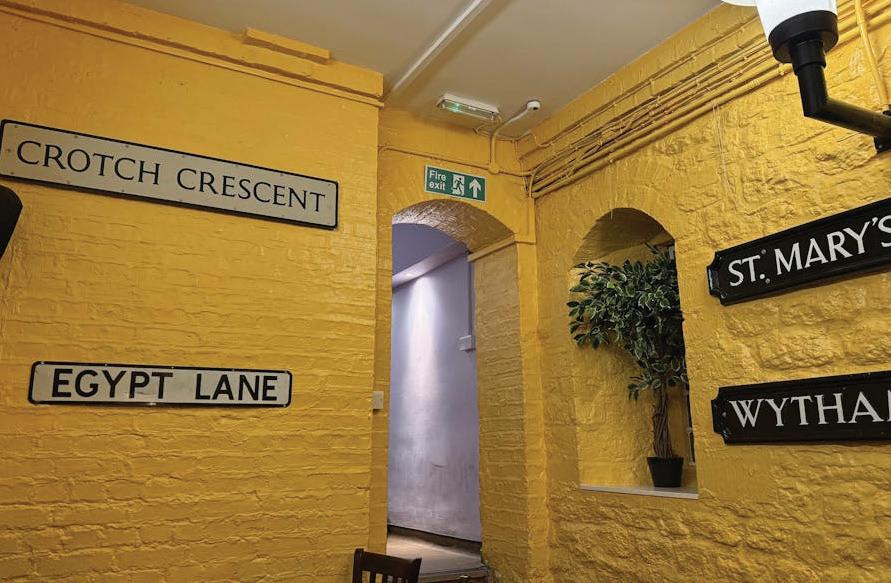
Those of us lucky enough to study in other countries while at Princeton might notice something unique about our social experience abroad: the schooloperated bars. Popular across much of the world — Oxford, for example, has 39 bars operated by its colleges — it might shock readers younger than 60 to know that Princeton once had a bar, too. For 11 great years between 1973 and 1984, there was a pub open to members of the University community in the rotunda of Chancellor Green.
The campus pub is long gone, but the idea has certainly not been forgotten. As recently as 2024, Undergraduate Student Government presidential candidates were debating the feasibility of bringing the pub back to campus. In 2012, 2014, and 2017, the Editorial Board of this paper pleaded for the pub’s resurrection, and in 2011, a committee appointed by then-University President Shirley Tilghman developed
a concrete proposal for its return. But that plan failed.
In the decade plus since the last serious consideration of a campus pub, though, Princeton’s social landscape has changed: the expansion of the undergraduate population and increasing demand for exclusivity has led to incredibly selective Bicker cycles, and this year, more than 100 students were left without an eating club placement. It’s clear that there’s lots of pressure on the Street — as clubs are more selective than ever, now is the time for Princeton to revive its pub.
Now that students aren’t being placed in clubs, there is a larger need for third spaces on campus, making the present as ripe a time as ever for Princeton to re-establish a bar in the basement of Chancellor Green, where the husk of an eponymous café now lies dormant.
For starters, the space is particularly well-suited for a pub. After the University shuttered the Chancellor Green Café last summer due to low patronage, the space built for food and drink handling has been left
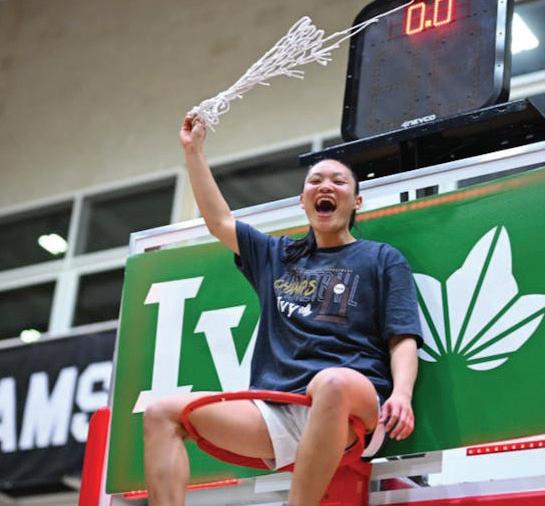
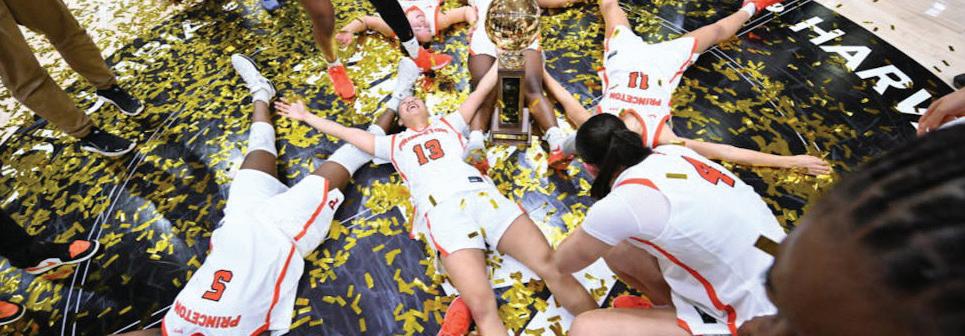
Going dancing yet again: Women’s basketball earns a No. 9 seed in the NCAA Tournament
By Lily Pampolina Head Sports Editor
Make it five consecutive appearances for the Tigers. Princeton women’s basketball (26–3 overall, 12–2 Ivy League) is going dancing.
On Selection Sunday, the Tigers were announced as a No. 9 seed, playing their first March Madness game against No. 8 seed Oklaho -
ma State (23–9, 12–6). This is the Princeton’s fifth straight NCAA Tournament appearance since the tournament’s return after the COVID-19 pandemic.
“It’s always great to see your name called during the Selection Show no matter how times it has happened,” Head Coach Carla Berube told The Daily Princetonian. “I’m excited for my players
and staff as we head out to Los Angeles and prepare for Oklahoma State.”
The team will be playing in Pauley Pavillion at the University of California, Los Angeles (UCLA), which is in the home state of many of Princeton’s players.
“Very excited for the weather, obviously, but it’s also a homecoming for three
page 15
This Week In History
Thirty years ago, Princeton’s men’s basketball team stunned the nation by defeating UCLA in the first round of March Madness. As this year’s NCAA tournament nears, The Daily Princetonian looks back on what it took to overcome the odds and outplay the Bruins.
Devon Williams Contributing News Writer
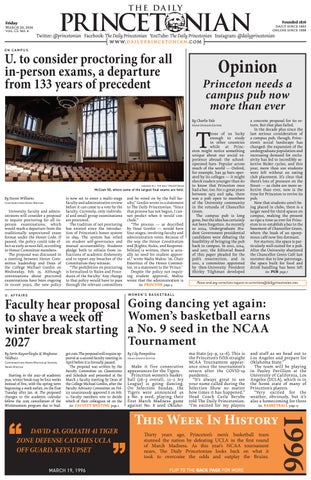
CANDACE DO / THE DAILY PRINCETONIAN McCosh 50, where some of the largest final exams are held.
Medical examiner releases post-mortem for Maria Catotola Bowling GS
By Luke Grippo Head News Editor
Content warning: This article contains mention of student death and suicide.
University Counseling services are available at 609-258-3141, and the Suicide Prevention Lifeline is available 24/7 at 988 or +1 (800) 273-TALK (8255). A Crisis Text Line is also available in the United States; text HOME to 741741. Students can contact residential college staff and the Office of Religious Life for other support and resources.
The post-mortem medical examination for Maria Catotola Bowling GS, acquired by The Daily Princetonian, determined her cause of death as drowning.
“While this likely represents a suicidal drowning, … the manner of death is best classified as ‘unde-
termined,’” the report read.
Bowling, who was a first-year graduate student in the history department, passed away in November, leaving behind a legacy of intellectual brilliance and compassion. She was 26.
Bowling earned her B.A. in international studies from Sorbonne Nouvelle University in Paris, and her M.A. in political science from the University of Paris 8. Her research interests included the linguistic politics and history of Angola and southern Africa.
“Bowling was a brilliant scientific mind [...] with an unbelievable capacity for abstraction, pattern recognition, and revolutionary thinking,” Ella Kare, Bowling’s friend from the Sorbonne Nouvelle, wrote to The Daily Princetonian for her obituary in December.
“She had a great way of making everyone feel just understood and
very special,” Tanner Bowling, her husband, said. “She was able to make people feel welcome, even in situations that were a bit uncomfortable.”
The report noted that Bowling was found in Lake Carnegie. Her personal belongings were found by the edge of the lake. The event had no witnesses according to the report.
Bowling was found with the condition of pulmonary edema, which is caused by excessive fluid accumulation in the lungs.
The report stated that she had “no known history” of depression or suicidal thoughts, attempts, or ideations. Bowling had a “history of anxiety,” had reported being “very ‘stressed out’ from classes and studies” and had recently sought therapy.
The report indicated a blood alcohol content of 0.212 g/dL and 6.9 ng/
mL of Alprazolam, more commonly known as Xanax.
Bowling is survived by her husband, Tanner Bowling, her parents, Crisostomo Mariti Amós Catotola and Maria do Rosario Pinto Catotola, her brother Arialdo Catotola, and her younger sister Ariela Bendita Pinto Catotola.
Luke Grippo is a head News editor for the ‘Prince.’ He is from South Jersey, and typically covers high-profile interviews and University and town politics.
Gordin: ‘We have concluded that, without the benefits of Wintersession, the spring term calendar presents more challenges than it offers advantages.’
FACULTY
Continued from page 1
various faculty committees.
“The decision to end Wintersession prompted the Committee to carefully reexamine the spring term,” Gordin wrote in a letter shared with meeting attendees. “We have concluded that, without the benefits of Wintersession, the spring term calendar presents more challenges than it offers advantages.”
The letter stated that the current five-week break between the fall and spring terms will, without Winterssion, “negatively impact student learning, especially in departments with highly sequential curricula.”
The new term dates would mean a shorter winter break and less conflict with the National Collegiate Athletic Association championships over the final assessment period.
Gordin also emphasized how changes to the spring term schedule would prevent “requiring a large portion of staff to work nearly nonstop over a holiday weekend” due to Class Day and Commencement falling on Memorial Day weekend. The new schedule would allow Class Day and Commencement to be the week prior.
The proposed calendar will be more closely aligned with peer institutions
such as Yale and Brown, which currently start summer holidays roughly a week earlier than Princeton.
The meeting also included the approval of curricular changes to the Department of African American Studies (AAS) and the Program in European Cultural Studies (ECS).
The AAS department will add two new courses: AAS 336: Racial Histories of Gender and Sexuality and AAS 433: Black Worldmaking — Freedom Movements Then and Now. ECS will offer ECS 301: Rethinking European Culture in the Present, ECS 362: Opera — Culture and Politics, and ECS 376: The Body in Space — Art, Architecture, and Performance. No information was provided on when these courses will be offered.
Faculty also approved a new minor in Quantum Science and Engineering. This was proposed by the Princeton Quantum Initiative (PQI), which was launched in 2019 and has “initiated many programs including a Ph.D. program in Quantum Science and Engineering in 2024.” The program will be led by Associate Professor of Electrical and Computer Engineering (ECE) Nathalie de Leon and the PQI executive committee, which includes faculty members across scientific departments.
Current juniors in the Class of 2027 will be able to declare a minor in Quantum Science and Engineering. Currently, there are no prereq-
uisite courses necessary to declare the minor beyond those required by the minor’s required ECE courses, which themselves include prerequisite courses in 100-level physics and 200-level math.
The proposal for the minor emphasizes training “at the intersection of quantum physics and quantum information” to prepare students for professional careers in information science.
“Princeton is also planning a dedicated quantum science and engineering institute and facility to further these efforts,” the proposal stated.
The faculty also voted unanimously to decommission the certificate in
Geological Engineering. Following a vote by Civil and Environmental Engineering (CEE) faculty in March 2024, the certificate was phased out: its current cohort of students in the Class of 2025 will be its last, as no students in the class of 2026 enrolled in the program. The department chose not to convert the program into a minor due to a lack of interested students outside of those already in the CEE program.
The meeting also included memorial resolutions commemorating recently deceased professors David Bellos of the French and Italian and Comparative Literature departments, Alison Isenberg of History, and Ed-
mund Valentine White III of Creative Writing, which were delivered by professors in their respective departments. The minutes of the previous Faculty meeting on Feb. 2 were also approved.
The next faculty meeting will be on April 6 at 4:30 p.m. in Nassau Hall.
Serin Kayserilioglu is a News contributor and Data contributor for the ‘Prince.’ She is from Nicosia, Cyprus.
Meghana Veldhuis is a senior News writer for the ‘Prince.’ She is from Bergen County, N.J., and typically covers graduate students, postdocs, faculty, and campus unions and labor.
MC MCCOY / THE DAILY PRINCETONIAN
The flowers blossom outside of Firestone Library on March 27, 2025.
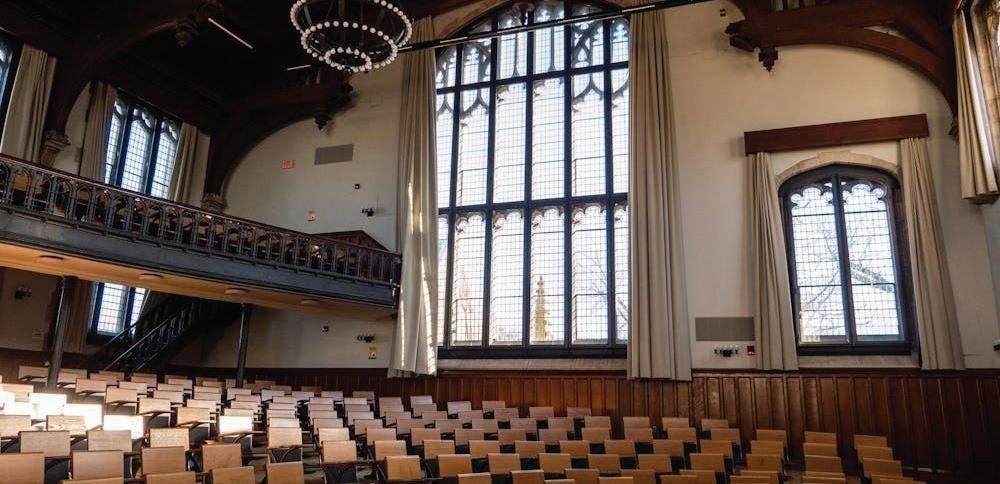
CALVIN GROVER / THE DAILY PRINCETONIAN Nassau Hall covered in snow.
AAUP panel debates academia’s response to Trump’s education agenda
By Toby Chang Staff News Writer
The Princeton chapter of the American Association of University Professors (AAUP) met Monday afternoon for a discussion surrounding academic freedom and the Trump administration’s attacks on higher education.
Fewer than 30 faculty members attended the meeting, compared to the over 50 members present at the chapter’s inaugural meeting.
Faculty members reformed the Princeton chapter of the AAUP last March amid attacks on higher education from the Trump administration. Since then, they have convened monthly to discuss updates and to identify threats to higher education.
Keeanga-Yamahtta Taylor, a professor of African-American studies, co-led the discussion with professor emerita for the Institute for Advanced Study Joan W. Scott.
In her opening statement, Taylor focused on efforts to divide academic fields, discussing “pitting the humanists against scholars of science and technology, or even splintering some humanists versus other humanists by designating some scholarship as activism.”
At the meeting, only two faculty members were from STEM fields, per a show of hands upon request.
Taylor said that restrictions on free speech at universities should not be viewed as unprecedented. Instead, she said that the present situation is a result of decades of government and university policies across America, starting from how student protests were handled during the American invasions of Afghani-
GRADUATE
SCHOOL
stan and Iraq.
“What are the cumulative consequences that have been brought to bear in this political moment that have created conditions of fear, intimidation, and repression on college campuses?” Taylor asked.
After Taylor and Scott discussed attacks on diversity, equity, and inclusion (DEI); the proliferation of right-wing policy agendas; and restrictions on academic freedom, the floor was opened to attendees to voice their concerns and pose questions to the room.
Professor of Neuroscience Sam Wang, who is currently seeking the Democratic nomination for New Jersey’s 12th Congressional District, discussed recent attacks on higher education during the meeting. Wang emphasized that these attacks should be understood as a product of continuous political effort over the past several decades, particularly on behalf of groups like the Heritage Foundation, and not a phenomenon that emerged only recently.
When asked about how instructors should best approach teaching an ideologically diverse classroom, Scott noted growing fear among university professors today over what they teach.
“It’s not only being able to speak to a wide range of students, but not trusting that there isn’t a student in the class who’s going to turn you in for it,” Scott said. She pointed to a case in Oklahoma where an instructor was placed on leave after failing a student’s essay. The student complained that she received a failing grade on a psychology paper in which she cited the Bible, alleging religious discrimination.
Several attendees commented on the low
Graduate students respond positively to new ‘GRAD’ sweaters
By Clara Docherty Assistant News Editor
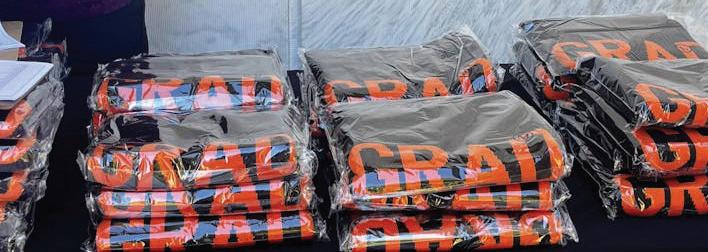
Black knit sweaters with “GRAD” printed in orange, known as GRAD sweaters, were distributed last month to over 1,000 graduate students. The Graduate Student Government (GSG), in collaboration with the Graduate School, launched the GRAD sweater program in February 2024 to parallel the undergraduate Declaration Day tradition, during which sophomores wear sweaters with the class year and take photos with banners of their declared major.
Rias Reed GS ’25 pioneered the GRAD sweater initiative independent of GSG, ordering a bulk amount of sweaters on his own. The graduate student body quickly took interest in his project, however, inspiring Reed to formalize the program with Christopher Catalano GS, vice president of GSG at the time.
“Chris thought, ‘Why don’t we take this to the Graduate School and work out a more formal source of support, to do an even larger bulk order to serve the graduate students?” Reed told The Daily Princetonian in an interview.
He described how he saw a photo from the early 20th century of an undergraduate student wearing a class year sweater and was amazed at how longstanding the tradition has been.
“I think to be included in that, now as graduate students, is something really special, and something that I take a lot of pride in being a part of and in making that happen for other graduate students,” Reed said.
Catalano added, “One of the big themes that we wanted to focus on was to help graduate students feel a better
sense of belonging on Princeton’s campus.”
“I think sometimes it can feel like, for graduate students, we’re a little bit more separate from the campus. We don’t really get as much attention from the University,” he said.
In fall 2024, the initiative received over 1,700 sign-ups in the first round and ended up giving away nearly 2,000 sweaters.
“Putting on the sweater does make you feel more attached to the campus, more included as a student,” Reed said. “I’m super proud of how much popularity they’ve gained.”
Some graduate students have found the Graduate School to be a “tight-knit community.” “There is always some group chat with a fun group activity, whether it’s building a 10-foot snowman, karaoke, or Mario Smash Bros,” Derek Hoot GS wrote to the ‘Prince.’ He plans to buy a GRAD sweater before he graduates in May.
Catalano emphasized the importance of the sweaters to graduate students on campus.
“They are a symbol of our belonging on this campus, our inclusion in the campus life and campus traditions, and I think people are really proud to wear their GRAD sweaters,” Catalano said.
“You just see them everywhere — on the walk to the bus, someone’s wearing a GRAD sweater,” Reed said. “I think it’s all just super special.”
Clara Docherty is the assistant News editor for the ‘Prince’ leading faculty, graduate students, and alumni coverage. She is from Lafayette, NJ.
turnout at the meeting. They proposed reasons why Princeton, and academia more broadly, is currently struggling to organize against the federal government. Speakers compared progressive movements with their right-wing counterparts.
“How come they’re so much better at this than we are?” Scott said. “We tend to be more reactive than forward-thinking.”
Another barrier to movements like the AAUP gaining traction, according to Scott, is in the complicated relationship between faculty and academic institutions themselves.
“One of the difficulties of figuring out how to resist is that many of us have spent years criticizing the university as it exists — as a corporate neoliberal institution producing human capital instead of critical people for a democracy,” Scott said. “How do you defend something that you’ve been harshly criticizing for the last 15 years?”
Faculty also criticized the Biden administration’s handling of campus protests in the wake of the Israel-Hamas war, with Taylor arguing that “the naked attacks on free speech and assembly initiated by the Biden administration opened the doors to a much more brutal authoritarian-led attack by Trump.” According to Taylor, “for the right, it was a Trojan horse, allowing them not only to crush that particular [Palestinian solidarity movement], but to destroy campus life as we know it.”
Taylor also claimed that the universities have leveraged the pressure of the Trump administration as a cover to suppress free speech, terminate DEI programs, and invalidate collective bargaining agreements.
“We have seen the Trump administration quietly drop legal actions over the last several months because there is no need to further pursue legal recourse when college administrations have willfully carried out orders without being forced to do so,” she said.
The discussion then shifted to discuss how faculty can play a more direct role in resistance against the Trump agenda, a centerpiece of which is faculty autonomy within Princeton.
Molly Greene, a professor in the Department of History, noted some policies that seem to hinder the faculty’s ability to organize.
“I don’t have an email list to send to, and I think that’s deliberate,” Greene said. “I realized that the University doesn’t want us speaking to each other without them present.”
Scott echoed this sentiment, alleging that there is no mechanism in which faculty can convene outside of University supervision.
“Eisgruber boasts that you have faculty governance, but you don’t if you don’t have an independent body that can meet and pass actions of various kinds without the president calling you into existence,” she said.
However, Scott noted improvements in faculty governance over the past few University administrations. Over time, Scott explained that some progress had been made toward collective faculty governance — a key milestone in Princeton’s AAUP chapter. Its reformation, she suggested, reflects the continual effort to create spaces where students and faculty can organize independently from the University.
Toby Chang is a staff News writer from Prescott, Ariz. He can be reached at toby.chang[at]princeton. edu.
Makuc ’26: ‘Because of the way the Honor Constitution and [Rights, Rules, Responsibilities] is written, there is actually no need for student approval.’
PROCTOR
Continued from page 1
“certainly looking for student input and consideration.”
Student leadership bodies, including the Undergraduate Student Government (USG) Academics Committee and the Honor Committee, have been consulted on the matter, but do not have the authority to enact or block policy changes.
The Honor Committee is a group of students who “investigate and adjudicate alleged Honor Code violations,” according to the committee’s website.
Although the exact timeline of the review is unclear, the policy, if passed, could go into effect as early as next semester, according to Honor Committee Chair Minh Truong ’27.
“The policy will be voted on by the faculty after other procedural processes, including extensive discussions between the Com-
mittee on Discipline and Faculty Advisory Committee on Policy, amongst others, which will take some time,” Truong wrote in a statement to the ‘Prince.’
An expansion of proctoring already occurred earlier this academic year, according to Makuc.
In November, faculty were instructed to proctor all individual and small-group exams, including make-up exams, exams taken by student-athletes while traveling, and exams taken with disability accommodations.
The University’s consideration of the new policy stems from broader concerns about academic integrity and enforcement, according to Makuc. She added that recent trends have intensified pressure to reconsider the current system of enforcement.
“What we have right now maybe isn’t working,” Makuc said, referring to an increase in reported cases of academic misconduct and changes in academic culture.
“With AI [and] increased use of
technology post-COVID, there’s been a change in the way we learn, and that has directly contributed to us seeing more cases.”
“The policy will primarily impact how faculty have interacted with the Honor Code and will result in modifications to language on exams in Rights, Rules, and Responsibilities such as that in Section 2.3.2, as well as the language in Rules and Procedures of the Faculty Section VI.B.4,” Truong wrote.
Yet, she added that “the policy change will not impact the Honor Committee’s Constitution nor our current roles and procedures.”
Makuc speculated that many students will view proctors as a practical measure, not indicative of a lack of faith in academic integrity.
“On a practical level, most people are like … ‘Yeah, let’s do it,’” she said, citing complaints about disruptions and perceived inequities during exams.
If implemented, expanded
proctoring could alter how academic integrity cases are investigated.
William Aepli ’26, co-chair of the Peer Representatives, which advises students who are accused of Honor Code violations during their investigations, said his organization would likely see changes in the type of evidence presented in hearings.
During an investigation, Peer Representatives deal with eyewitness evidence from other students or faculty who may have been in the room during the alleged infraction. If mandatory proctoring is instituted, there would likely be more people to witness students taking exams.
“There is a possibility that we could be working with more evidence than we previously would,” Aepli said.
However, Aepli cautioned against assuming that faculty testimony would be stronger than student testimony.
“Just because someone comes
from a position of authority … doesn’t mean their word is 100 percent accurate,” he said. “Part of these Honor Committee processes is trying to gather as much evidence as possible.”
Makuc noted that even if the proctoring reform is implemented on her proposed Fall 2026 timeline, logistical questions remain unresolved. These include who would serve as proctors, how proctoring would be standardized across departments, the number of proctors per class, and what enforcement procedures would look like.
“This has been a conversation … since my freshman year,” Makuc said. “Right now, we’re trying to get student opinion on whether this is something [they] want to move forward with.”
Devon Williams is a News contributor for the ‘Prince.’
SEC case against Nader Al-Naji ’14 dismissed after two years of legal battles
By Luke Grippo Head News Editor
Nader Al-Naji ’14 was getting on a flight to Turkey with his wife in summer 2024 for his first family vacation in years when he was arrested by the FBI. He was then charged by the Department of Justice and the Securities and Exchange Commission for crypto fraud.
“I’m getting on the airplane, and these FBI agents are like, ‘Hey, we are arresting you.’ And I’m like, ‘What the hell is going on?’ It shocked me,” Al-Naji told The Daily Princetonian four days after the charges were dismissed with prejudice. “The following Monday, the Wall Street Journal’s writing about it — everybody’s writing about it.”
After a joint stipulation filed on March 12 by the SEC, all charges related to crypto fraud against Nader Al-Naji ’14 have been dismissed. This follows the DOJ charges being dismissed last March, according to Al-Naji.
Al-Naji was a B.S.E. Computer Science major and a member of Princeton’s men’s lightweight rowing team. He has previously worked for the D.E. Shaw Group and Google, and founded Basis, an AI accounting system.
Two summers ago, the SEC announced that the agency was charging Al-Naji with the misuse of investor funds and inaccurately portraying his social media platform, BitClout, as a decentralized project. BitClout went viral with the “Creator Coins” feature, featuring celebrities like Logan Paul and Katy Perry.
According to the SEC, Al-Naji had raised over $257 million from investors, stating that the funds would be going towards compensating himself and other BitClout employees while allegedly using $7 million of these funds for his own personal conveniences.
Additionally, the SEC’s complaint alleges that Al-Naji launched the project under the pseudonym “Diamondhands” in order to avoid “regulatory scrutiny.”
These actions, according to the SEC’s investigation, had violated the registration and anti-fraud provisions of the Securities Act of 1933 and the anti-fraud provisions of the Securities Exchange Act of 1934.
According to Al-Naji, the claims were entirely unfounded: “Literally anyone who I talked to is someone who backed me with my last company, who I’m on great terms with.”
The money that he had been accused of misusing had been used to rent out a “big house” which he and his team had lived out of and coded BitClout in. Further, the pseudonym “Diamondhands,” he explained, had been used to preserve the nouveau, avant-garde industry of crypto.
“When we launched publicly, we just thought it would be cool, kind of like how Bitcoin has an anonymous founder,” Al-Naji said. “So we didn’t do any press. We didn’t do anything. We just shared a link to all the people that we knew, and they started sharing it virally.”
That was six months before Al-Naji and his team began openly sharing his name in communications with users on the platform.
He explained that the DOJ had talked with one investor in the wake of the government’s shift to investigating cryptocurrency. In Oct. 2021, the government created the National Cryptocurrency Enforcement Team (NCET) to double down on efforts to investigate and prosecute criminal misuse of digital assets. The NCET was disbanded in April 2025 by the Trump administration.
Al-Naji’s first move following his
arrest, after posting bail, had been to get in contact with this investor, whose identity he ascertained from the context provided by the DOJ.
“Immediately after the charge, I got in contact with them [the investor] and realized that not only were they not upset, but they wanted the government to stop harassing them as badly as I did,”
Al-Naji told the ‘Prince’ in a statement clarifying the legalities of the case.
“The government had compelled the investor to do an interview and then taken their completely neutral testimony and represented it as adversarial.”
“It was an alleged fraud with no actual misrepresentation nor any actual aggrieved parties,” he added.
The DOJ declined to comment beyond the document announcing the dismissal of Al-Naji’s charges. The SEC did not respond to a request for comment.
“Not only am I on great terms with [the investor], but I had breakfast at their house not that long ago,” he said. “They did not want to have one of their portfolio companies dealing with something like this, especially one that they have a good relationship with.”
Al-Naji did not reveal the identity of this investor, but emphasized that the government’s “star victim doesn’t identify as a victim.”
His experience with these two federal agencies, Al-Naji alleges, exposes flaws in the federal government’s pursuit of crime — who he alleges are “almost removed from actually fighting crime.”
He explained the process defending himself up until this point as complicated and tedious — “like the worst customer service interaction ever.” For Al-Naji, the process involved “explaining to them the facts and how ridiculous those facts are,” while “the person doesn’t get it, or they’re just they’re not really listening to you.”
Furthermore, his experience indicates a de-centralization of the government that punishes more than it helps, he alleges.
“It’s funny how bureaucratic the government is … you would think the government is pretty put together: If they bring a case, then it’s really a lot
of people who looked at it and thought really hard about it, and that’s not really how it is,” Al-Naji said. “It’s more decentralized — someone in some office can think they have something and do a lot of damage with that thought, until eventually someone you know who really thinks about it and takes the time to look at it reverses the decision.”
At one point, he shared that his lawyer was in a room pleading the case against “20 to 30” SEC employees.
Al-Naji shared, however, that the experience has shown him a Princeton community that is, as he put it, “strangely loyal.”
Although he has not been invited back to give lectures since the charges were levied in 2024, Al-Naji shared that “everyone I know, the professors I’m friendly with, and my alumni who I know, and also even people who I haven’t talked to in a long time, reached out and said, ‘This is ridiculous. I know you’ll get through this.’”
“The Princeton community was really supportive … in a way that even though they didn’t know the actual situation, they knew that something was off with what the government was saying, which was great,” he said.
Now, Al-Naji is excited to move past the case.
DeSo, the rebranded version of BitClout, is currently active. In addition, Al-Naji shared that his team “is still here, and we’ve been working on some interesting stuff that we’re going to announce probably in the next few months.”
“Not being distracted anymore… is really amazing,” he added.
Al-Naji and his wife went on their trip to Turkey shortly after the DOJ dismissed his case in 2025.
“Not even one week later, I was in Bozön in Turkey. We were excited to celebrate, and we didn’t waste any time, man. We just were like: This is great. Let’s go.”
Luke Grippo is a head News editor for the ‘Prince.’ He is from South Jersey, and typically covers high-profile interviews and University and town politics. He can be reached at luke.grippo[at]dailyprincetonian.com.
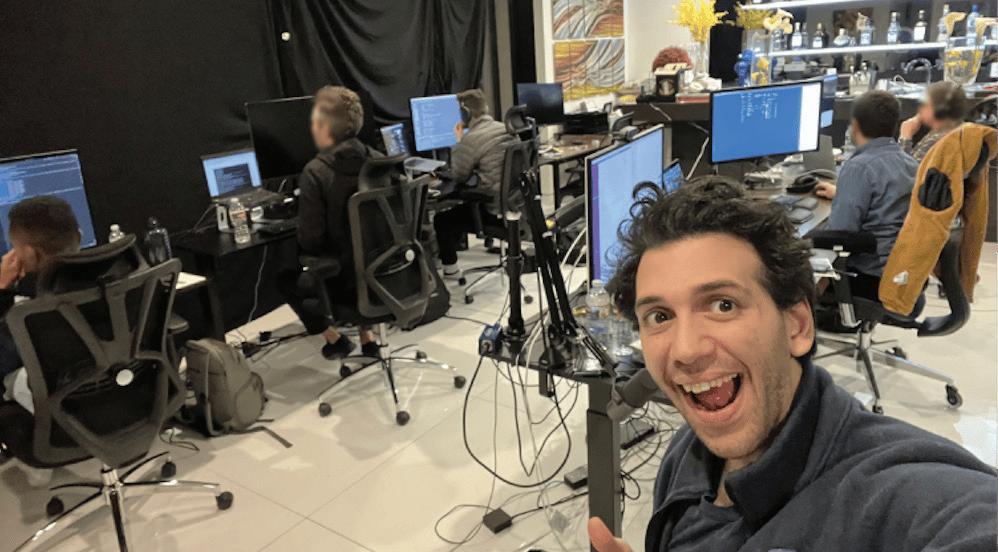
A photo of Al-Naji with his coding team in the Beverly Hills house they rented — which he had used the money he made from BitClout to rent.
Hum r
Punxsutawney Phil declared dead
By Nathaniel Voss Assistant Humor Editor
The following content is purely satirical and entirely fictional.
At 2:34 a.m. Monday, fortyseven Tomahawk cruise missiles screamed down from the heavens and turned the borough of Punxsutawney, Pa., into a fiery, cratered wasteland.
President Donald Trump exalted the attack on Truth Social: “the TYRANNY of FASCIST PUNXSUTAWNEY PHIL is OFFICIALLY OVER. there will be NO MORE COLD DAYS. the ENEMIES OF THE GREAT AMERICAN EMPIRE LIVE IN FEAR!!! = Thank you for your attention to this matter - DJT”
When questioned if such force was truly needed to eliminate a groundhog, Secretary of Defense Pete Hegseth ’03 said, “This targeted strike used the most advanced guidance system in the world, allowing the neutralization of this domestic terrorist without threat to American troops.”
The “targeted strike” in mention killed 897 school -
children and eight survivors of 9/11, obliterated a local nunnery, destroyed 14 historical sites, and damaged one groundhog hole. Despite the President’s claims, Phil seems to be alive and well, having left for Rhode Island on Friday to visit his mother.
Hegseth made a video disputing these claims. Standing awkwardly behind the confused-looking President, he chanted, “Don’t listen to the nay-sayers, listen to us, the Phil-slayers. We groundpounded that ground-hog. America profits when we kill false prophets.”
Providence Ted, who lives next to Mother Punxsutawney, is concerned about his new proximity to a military target.
“I’m considering evacuating my family,” he told the Daily PrintsAnything. “I’ve heard that Mr. Trump is golfing this Thursday, and if his nips pucker he won’t rule out nuclear retaliation.”
Ted noted that he has considered moving for years. “Each time that idiot Phil sees his shadow, it gets harder to be a groundhog in this country. I’m thinking of go -
ing to Canada — for them, only six more weeks of winter is a pleasant surprise.”
Nate Voss ’29 is an assistant Humor editor who thinks there are good people on both sides of the Punxsutawney Phil debate.
Access Denied
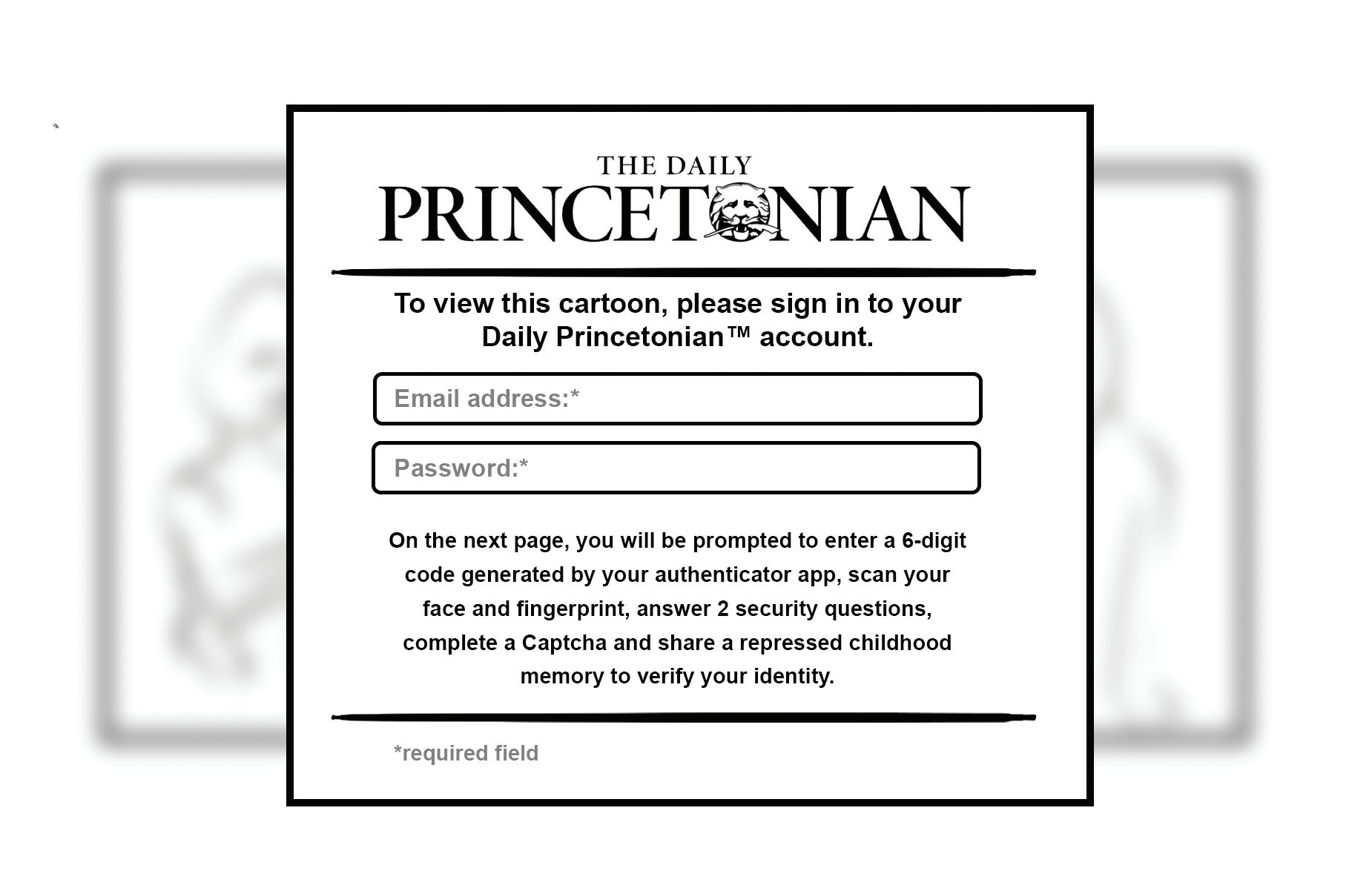
By Nedim Begović | Contributing Cartoonist
ILLUSTRATION BY NATHANIEL VOSS / THE DAILY PRINCETONIAN; SOURCE PHOTOS BY LANCE FISHER / CC BY-SA 2.0 AND NATIONAL PARK SERVICE / PUBLIC DOMAIN. Punxsutawney Phil’s brother in a tragic case of target misidentification.
Midterms shouldn’t be scarier than finals: cut back on exam content
Ana Boiangiu Contributing Opinion Writer
Last semester, my first midterms at Princeton led me to a sobering conclusion: there is an unmatched feeling of dread when you turn over the first page of an exam and realise how much you have to do in so little time. During finals week, despite the increased stress and the higher stakes, my exams left me room to breathe. The format of the tests themselves was a relief: instead of hour-long sprints, they were longer, steadier efforts that felt fair and balanced.
In contrast, the majority of midterm examinations at Princeton are in-class tests during the sixth week of each semester. One would expect this format to reduce pressure, with the classroom environment and Princeton’s no-proctor policy making exams feel more like a regular day of class than an exceptional experience.
However, the harsh time constraints of these exams have the opposite effect. Instead of the fair assessments they promise to be,
Thomas Buckley Senior Opinion Writer
Around this time every year, death comes to campus. If you know where to look — beneath Fine Hall, below Frick Chemistry Laboratory, or outside Choi Dining Hall — you can find carcasses of migratory birds strewn across campus. Since 2022, students, faculty, and staff have advocated for the University to do more to protect the resident and migratory birds that collide with glass buildings on campus every year. In 2024, it seemed like the University had finally started to listen: Bird-safe glass was installed on Prospect House. Yeh College also recently unveiled a new installation to help prevent birds from striking the large glass window in the common room.
While the lower third of the common room window is adorned with a beautifully ornate nature-themed decal, there’s just one problem: it’s not finished. Most of the three-pane window is left completely unchanged. Craig Marshall, assistant director at the Center on Science and Technology and the lead of the project, wrote in an email to me that the more limited installation was chosen because the majority of collisions occur on the first two floors of buildings.
A 2014 study found that 4–11 story buildings were responsible for 56 percent of collisions, while 1–3 story buildings accounted for only 44 percent. It’s therefore reasonable to assume that upper floors bear some responsibility for bird deaths.
If the risk still exists, why not finish the job? It’s hard to imagine adding decals to a few more panes would be prohibitively expensive. This half-finished installation is just one symptom of a broader problem with the way that Princeton seems to pursue the aesthetic of change over genuinely impactful solutions.
midterms often prove unmanageable and discouraging. In the absence of a dedicated class-free midterm week, the best way to fix the unfair time–content ratio is by decreasing the amount of material tested on each exam.
This challenge is especially pronounced in quantitative courses, where the large number of problems often prevents students from even reaching the end of their tests. But crafting an exam with a wide variety of question formats can lead to a volume of material that doesn’t fit within the midterm time-constraints. Granted, quizzing students in a wide range of formats, from true-false questions to open-ended proof-based problems, effectively gauges mastery of material. Courses should retain this variety when designing exams in order to give students a better chance to work through problems and show off their knowledge. In many real-life problem-solving scenarios, especially in fields of research, such harsh time constraints are uncommon and rarely the metric by which skill or qualifications are judged. While being quick on your feet is certainly a
professional advantage, most careers value depth over fast thinking. Princeton exams should test for the former instead of the latter, reaffirming our scholarly community’s values of rigour and thoroughness.
Good tests should provide students with more than a letter grade — they should be opportunities for students to meaningfully assess their understanding and identify points of weakness. For students to achieve this assessment of their own abilities while taking a midterm, they need the time to work through problems instead of focusing on the clock. Exam grades should never elicit reactions of “if only I had more time, I could’ve aced this.” This means that the exam has failed to both gauge our abilities and to give us a useful diagnostic of how we stand in a class at the midpoint of the semester.
This seemingly minor frustration even has deeper implications. Princeton’s rapid-fire midterms contribute to the high pressure of the University’s academic culture by exacerbating the feeling that there’s not enough time in the day
to accomplish everything you need to. Because students are forced to rush to even reach the end of the exam, our midterms quite literally feel like a race, assigning added stress and a scarcity-based ethos to test-taking. An increased sense of control would help reduce the pressure that midterms intensify. Given the obvious downsides of Princeton’s current midterm system, targeted change is required. Because exam formats vary so widely across disciplines, new measures should be developed and implemented by individual departments rather than through University-wide policies. Different departments should communicate with their students through an exam feedback system, focused on identifying points of improvement.
Soliciting and incorporating student input on exam format would help ensure that tests feel fairer. Moreover, it would increase students’ agency over their academic journeys. Not only would students be able to choose their classes or access diverse resources to engage with the material, but they would also have a say in the
Princeton, no more half-measures
But this isn’t just about bird deaths.
The University’s pervasive affinity for incomplete, lazy solutions is what I have begun privately calling Princeton’s “halfmeasures,” in reference to Mike Ehrmantraut’s iconic monologue from “Breaking Bad.” Putting aside the extraordinarily violent specifics of those particular halfmeasures, the concept provides a useful lens through which we can view the administration’s shortcomings, in particular when it fails to take necessary action in furtherance of its clearly articulated values, whether due to cowardice, lack of vision, or incompetence.
The University’s handling of mental health is just one example of its broader reliance on half-measures. The administration has made it clear that it views suicides as an inevitable part of life on this campus — something that occurs “even when people do all the things that they should be doing,” in the words of University President Christopher Eisgruber ’83. Yet a statement like this suggests a troubling lack of ambition on the part of the administration and that, much like in the initiative to minimize bird collisions, they have capitulated in their efforts to address an issue before delivering the promised — or any — results. In lieu of a comprehensive plan to fight suicide, the administration points to the new Frist Health Center as evidence of its commitment to support mental health. While shiny new buildings are nice, Frist alone can’t solve the mental health crisis: A building is not mental health infrastructure.
Numerous other institutions, including the University of Alabama at Birmingham and the University of Utah, have instituted a “zero suicide” approach that aims to provide a comprehensive approach to addressing mental health crises through “the belief and commitment that suicide can be eliminated.” In contrast to this constructive and radically hopeful vision, University administrators present a view of campus mental health that is deeply unambitious and
borderline fatalistic.
The administration’s response to climate change is similarly timorous. Powerful figures on campus and within the administration recognize the pressing threat that climate change poses and acknowledge Princeton’s responsibility to address it. Yet when given the chance to take bold action, the administration hesitates time and time again. The University pledged to divest from fossil fuel companies after years of student activism, only to quickly backpedal. Princeton labs continue to receive funding from fossil fuel companies, and the University refuses to even give up its privately-held oil company. Princeton’s unwillingness to extract itself from oil reflects the same tentativeness and lack of vision that lets it accept a suicide rate far above the national average.
Princeton’s pledge to achieve net zero by 2046 reveals a similar lack of ambition. If the University of Vermont — a school with 4000 more students than Princeton and a fraction of the endowment — can make substantial progress towards their pledge to achieve carbon neutrality by 2030, surely the University can set a more ambitious target than sixteen years later. Of course, the explanation for choosing 2046 as a target year for net zero is obvious to anyone familiar with Princeton history. But is prizing the aesthetically pleasing target of the University’s 300th anniversary really more important than taking aggressive action to minimize its impact on the climate crisis?
Half-measures are never a satisfactory response to any issue, but they are especially dangerous for the University in
pedagogical decisions that shape their academic experience.
To be sure, including students in the process of reevaluating midterms isn’t an invitation for students to complain about exams being too hard. Instead, it’s an opportunity for students to express whether the questions, length, and format of the exam allowed them to perform to the best of their abilities and prove what they have learned.
Given the chaos of Princeton’s midterm system, developing a platform for student input should be a priority. This can be accomplished in a variety of ways, from something as simple as a feedback form to mandatory in-class reflective discussions after each examination. Sustaining improvement through open dialogue would not only enable faculty to make thoughtful adjustments, but also convey an important message: your exams are not out to get you.
Contributing Opinion Writer Ana Boiangiu ’29 is a prospective Mathematics major from Tulcea, Romania.
our present times: Academic freedom is under attack, international students are under threat, and ICE thugs operate in town with impunity. The climate crisis remains as urgent as ever. And students are still dying. Princeton deserves an administration that has the clarity to understand these issues and the conviction to confront them head-on rather than retreating to half-measures, opting to surrender before the battle has even begun. The University must do better to live up to its responsibilities to its students and community. If nothing else, at least finish the damn window.
Thomas Buckley is a senior Opinion Writer from Colchester, Vt. He has never once taken a half-measure and is offended that you’d even ask.
editor-in-chief
Jerry Zhu ’27 business manager Alistair Wright ’27
150TH MANAGING BOARD
Frances Brogan ’27
Victoria Davies ’27 Managing Editors
creative director Juan Fajardo ’28
Corbin Mortimer ’27 Maya Mukherjee ’27
Sections listed in alphabetical order.
associate
’28
associate features editors Jamie Creasi ’28 Mara DuBois ’28 head humor editor Tarun Iyengar ’28
associate humor editors Nicolas Rohou ’28 Francesca Volkema ’28
head news editors Nico David-Fox ’28 Luke Grippo ’28
’28
’28
associate opinion editors Isaac Barsoum ’28 Shane McCauley ’28 head photo editor Emily Tang ’28
associate photo editor Siena Sydenham ’29 head podcast editor Devon Rudolph ’28 associate podcast editor Julia Hack ’29
head print design editors Jamie Creasi ’28 Albert Rho ’29
head sports editors Lily Pampolina ’27 Doug Schwartz ’28
associate sports editors Lucas Nor ’28 Matthew Yi ’27
head web design and development
editors Cole Ramer ’28 John Wu ’28
strategic initiative directors
Graphics Caroline Naughton ’29
150TH BUSINESS BOARD
Education Charlie Yale ’28
assistant business manager
Angela Han ’28
business directors
James Swinehart ’27
Chloe Zhu ’27
Ella Miner ’28 Devin Panalal ’28 Shravan Venkat ’28
software engineers
Nicole Deng ’28
Ziya Momin ’28
Kyaw Naing ’28
Stephanie Sugandi ’27
Albert Rho ’29
Jamie Creasi ’28
Marley Hartnett-Cody ’28
BOARD OF TRUSTEES
president Thomas E. Weber ’89
vice president David Baumgarten ’06
secretary Chanakya A. Sethi ’07
treasurer Douglas Widmann ’90
assistant treasurer
Kavita Saini ’09
trustees Francesca Barber
Kathleen Crown
Suzanne Dance ’96
Gabriel Debenedetti ’12
Stephen Fuzesi ’00
Zachary A. Goldfarb ’05
Michael Grabell ’03
Danielle Ivory ’05
Rick Klein ’98
James T. MacGregor ’66
Rohit Narayanan ’24
Marie-Rose Sheinerman ’23
Julianne Escobedo Shepherd
Abigail Williams ’14
Tyler Woulfe ’07
trustees ex officio
Jerry Zhu ’27 Alistair Wright ’27
‘The pub would facilitate more organic connection between undergrads and grad students, bridging a notorious divide in the campus community.’
PUB
Continued from page 1
empty. By converting it to a pub, Chancellor Green’s basement can be given a new life in what currently seems like an aimless space.
Beyond the logistics, though, a campus pub might serve as a conduit for inclusive social life at Princeton. This year, 111 students didn’t immediately get into an eating club. While many of these students ended up in clubs after other students declined their spots, this represents a larger problem at the University: The student body has expanded, and it has been difficult for the eating clubs to keep up, which has limited social options for students who wanted to join a club but found themselves unable.
While increasing selectivity isn’t inherently negative, students not being able to join any club becomes problematic in the context of nights out. Princeton parties are almost exclusively on Prospect Avenue, except for those set up by clubs or other groups in their own spaces or in dorm basements — and even then, these events don’t happen consistently, and often aren’t open to all Princetonians. Events hosted by the residential colleges or sponsored by the Alcohol Initiative try their best to provide something similar, but are not always what students are looking for.
Eating clubs could, theoretically, expand their space and hire new staff to increase their capacity. While converting Chancellor Green into a pub would take time, the University’s resources far outsize those of the eating clubs. Entirely new construction
would take more time, and some students are feeling isolated now. Renovating Chancellor Green into a pub might relieve some of this social stress.
Besides off-campus options, a Chancellor Green pub would be perhaps the only established social space entirely untethered from the eating clubs where students could socialize with alcohol. A pub could be an excellent solution to ensure that students have a third space long-term.
Of course, not all students want to go out, and not all students want to drink. But for those students who are of age and want to imbibe — responsibly — with their peers, and who might not want to visit the Street (or find it increasingly inaccessible), a campus pub would be an excellent option.
In any case, the option of an on-campus pub would be a boon for all members of the University community. Graduate students would no longer be relegated to the Debasement Bar at Proctor Hall — which undergraduates are not allowed to visit if not invited by a graduate student — and would have an area to socialize in the center of campus.
The pub would facilitate more organic connection between undergrads and grad students, bridging a notorious divide in the campus community.
Students and professors would have another opportunity to connect outside of office hours over a drink in a non-academic, lowpressure context. And, of course, undergraduates would have a new space to spend time instead of — or before going to — the eating clubs.
And it’s not only the students who drink who might benefit
from a pub — the DBar, for example, hosts social events that need not have alcohol for a good time, like dance classes or affinity nights. A pub serves as a good middle ground between the environment of a coffee shop and an eating club, providing a social environment for students who don’t necessarily want to drink, but still want to socialize and spend time with their friends who do.
The University may find a pub beneficial for its own goals, as well. It has been clear for some time that University administrators have understood Prospect Avenue as “fragmenting” students and their social choices — dating back to the inception of the residential colleges, which were founded, in part, to create hubs for connection and community separate from the Street. While the residential colleges hold events that many students attend, it is obvious that they are not meant to — and should not be meant to — replace the parties held by the eating clubs. A campus pub could help to fill the space in between.
For something that has occupied such a significant space in campus discourse in recent decades, the campus community has been markedly silent about a campus pub since 2024. While certainly not the largest problem facing our campus, it’s high — or drunk — time that Princeton considers establishing a campus bar once again.
Head Opinion Editor Charlie Yale is a prospective history major from Omaha, Neb., who recently visited a friend at Oxford and really enjoyed the Hertford College bar. Drop him a line at cyale[at]princeton.edu.
CHARLIE YALE / THE DAILY PRINCETONIAN Down The Bar, the Hertford College bar at Oxford University.
Emily Zhang Opinion Columnist
FStop avoiding a liberal arts education
our years ago, a user on a subreddit for Princeton asked, “What are some easy but interesting distribution requirement fillers for LA, SA, EM, EC? I’m basically asking for the humanities side of ‘rocks for jocks.’”
This sentiment remains widespread at Princeton. During course selection periods, I often encounter inquiries on apps like Reddit or Fizz about easy classes to fulfill Princeton’s distribution requirements.
It’s time we say the quiet part out loud: many Princeton students are gaming the system. Rather than exploring the foundations and methodologies of a broad range of disciplines, they’re engineering the narrowest possible encounters with classes outside of their comfort zone and interests. This is understandable — when confronted with a myriad of distribution requirements, busy students are inclined to take the easy way out, entering classes with the goal of checking a box on their path to graduation. But to prevent the promise of a liberal arts education from ringing hollow, the University needs to encourage more substantial engagement across the disciplines. They can do this by providing students with a more structured set of foundational classes across diverse fields.
Princeton prides itself on offering a liberal arts education, and the general distribution requirements — in addition to the writing seminar and language requirement — are central to this mission. A.B. students must take at least one course across eight different areas, for a total of at least 10 courses. B.S.E. students must take courses in at least four distribution areas, with a total of seven required. These requirements are designed
Luqmaan Bamba Staff Opinion Writer
Electric scooters are gone, and e-bikes could be next. In December, the University’s Environmental Safety and Risk Management (ESRM) Committee raised e-bike issues in a presentation to the Council of the Princeton University Community (CPUC). Many concerns, from indoor storage and charging of vehicles to increased presence of mopeds, were mentioned in the ESRM presentation, which reported that students are split on the issue. But the major concern, as my colleague Charlie Yale put it, is: “I don’t want to get run over by an e-bike.” In other words, what ESRM is primarily concerned about is pedestrian safety. Many characterize this issue as black and white: We keep e-bikes, and pedestrians are run over, or we ban them to ensure pedestrians’ safety. But this view of e-bike policy ignores real concerns about campus mobility, failing to understand ebikers’ legitimate reasons for using e-bikes. At Princeton, e-bikes and pedestrians can coexist, but they’ll need robust and specific University mechanisms like stip-
to ensure that, regardless of major, students are exposed to a multitude of subjects and ways of thinking. As the University academic advising page states, “More than a set of requirements, the general education requirements offer you the chance to develop both intellectual rigor and humility by considering the possibilities and limitations of all forms of academic inquiry.”
This is a compelling vision. But mere exposure to these disciplines is not enough to produce an interdisciplinary education, nor does it encourage students to experience models of “academic inquiry” in fields beyond their major. How students fulfill these requirements matters just as much as the requirements themselves. In practice, many students do not take these requirements seriously — and the University does little to ensure that they do. The motivation behind general education requirements should be to ensure that students gain foundational knowledge across a wide range of fields and methodologies rather than float through surface-level exploration for the purposes of fulfilling requirements. When left on their own, students seek the path of least resistance. This often leads them to classes with niche rather than foundational approaches to their discipline, as a way to avoid immersion in unfamiliar material.
For example, a student may take FRS 139: The Coming of Driverless Cars to fulfill a Social Analysis requirement rather than a foundational course like POL 220: American Politics or PSY 252: Social Psychology, both of which introduce core theories and methodologies of social analysis. Others may take CEE 102B: Engineering in the Modern World, colloquially known as “Bridges,” to satisfy the Science and Engineering with lab (SEL) requirement instead of introductory physics
— courses that build critical technical skills through problem sets and cumulative exams.
These more niche courses can be intellectually rewarding when taken out of genuine curiosity, but they are increasingly used as an “easy way out” to fulfilling a distribution requirement. I have heard fellow first-years refer to these courses as nothing more than “an easy fifth” or “a GPA booster.”
One solution would be to restrict which courses can fulfill each distribution requirement. Princeton should draw from similar systems at peer universities like Columbia University, whose Core Curriculum establishes a restricted set of courses with more general content to fulfill required disciplines. Princeton could adapt and implement this program by providing students with a select few choices for each distribution, much like how major electives are chosen from a pre-approved list. Some areas might require dedicated foundational courses — perhaps modeled after the Princeton Writing Seminar — designed to build core competencies in areas such as quantitative reasoning
or social analysis. A more extreme proposal would be to require engineering and natural science students to minor in the humanities or social sciences, and vice versa. This would mandate and thus generate deep interdisciplinary engagement from students, providing them with substantive understanding of the methodology and knowledge in another field. The University could alternatively establish a new program with a smaller course load than a minor that still generates substantial engagement with a field and require students to choose one from outside their primary field of study. This would be a more honest model of what it means to be “exposed” to a discipline.
At the same time, existing distribution categories could remain in place but with higher standards for what qualifies. For instance, Literature and the Arts (LA) or Historical Analysis (HA) courses might be required to culminate in a substantial research or writing project, while QCR courses would need to engage directly with established STEM methodolo-
gies rather than apply minor quantitative framing to humanities topics. Such reforms would preserve breadth and the possibility for a more specific path of exploration while ensuring that distribution requirements deliver the intellectual rigor they are meant to provide.
But whether Princeton ultimately adopts a sweeping reform or a less radical readjustment, what matters most is recognizing that distribution requirements cannot simply exist on paper. Until Princeton demands that its general education requirements be fulfilled with the substantive intellectual engagement they are designed to promote, many students will continue to check boxes rather than build breadth and depth. A liberal arts education that can be shallowly customized is not a liberal arts education at all.
Emily Zhang ’29 is an Opinion columnist for The Daily Princetonian. She is a B.S.E. student from Poughkeepsie, N.Y., and can be reached at ez5618[at]princeton. edu
Don’t
ulating specific types of allowable bikes.
Campus discourse on the issue rightfully assigns more importance to pedestrians’ safety than to the other side of the coin: convenient mobility — that is, the ability to move around campus, from class to extracurriculars to practice to dinner, with ease. Those 10–20 minute walks add up to hours across days and weeks. We have to acknowledge that convenient mobility is important on a fast-paced campus. And with all our hills and potentially heavy backpacks, it’s much more convenient to ride an e-bike than a normal bike, let alone walk. Admittedly, mobility should come second to pedestrian safety. But it still isn’t to be disregarded. The value of mobility should spur us to avoid the extreme of a blanket ban and instead ask a more nuanced question: Can we have ebikes without pedestrians being endangered, or are these mutually exclusive?
There is a path to keeping ebikes while still ensuring pedestrian safety. A set of regulatory policies and enforcements can allow students to ride e-bikes while keeping pedestrians safe. But to have both requires strict enforcement for a period of adjustment time to foster a new campus cul-
ban e-bikes
ture of harmony between bikers and non-bikers.
The University has expressed concern about an increase in the size and speed of e-bikes on campus, and the correspondingly growing danger. By enforcing specific rules for which e-bikes are allowable — based on wheel size, frame width, top speed, motor type, and so forth — we can avoid these more dangerous motorbikes without a totalizing ban. These guidelines could be enforced by the Department of Public Safety or Transportation and Parking Services. Registration of bikes could also be made more robust, using more obvious signage for approved vehicles. Using disciplinary action, like fines for using unlicensed e-bikes, could also improve compliance.
The University can explore the most effective ways to actually go about enforcing these regulations. Static enforcement is straightforward, scanning bikes when they are parked inside or outside of buildings to identify offending vehicles. Additionally, they could use golf carts to conduct checks on random days and locations, such as when violators are on the road or stopped at intersections. An effective mechanism for enforcement is crucial, and it’s what was missing from the first
PEV policy on scooters. Peak hours and transition times between classes, when pathways are particularly congested with both riders and pedestrians, deserve special consideration. At those times, the University should require riders to walk their vehicle when inside what the University could designate as “dismount zones,” like the area outside of Frist Campus Center or McCosh Courtyard. Wide peripheral routes like Elm Drive, Chapel Drive, and Washington Road could be designated preferred bike corridors, and riders could be required to dismount on McCosh Walk and Goheen Walk. Traffic laws must also be enforced against e-bike users. Integrating with the existing Campus Map project, along with physical signage, would be a perfect way to put all this together.
Biking etiquette should change, as well. Princeton should also encourage bikers to follow “keep right, pass left” rules and announce passes audibly or with a bell. As students, we have to demonstrate responsible ridership behavior. ESRM has said that despite its attempt to educate students, there was no compliance. However, the “effort” was simply writing the policy, which brought no engagement. Greater student
engagement and coordination with the Undergraduate Student Government can bring fruition to these strategies for safe commuting for all. An educational campaign on social media and embedded and engaged training would be good examples of increasing engagement on these critical issues.
Mobility and safety have long been issues that communities have wrestled with, especially since cars have become ubiquitous. It’s why we have crosswalks and bike lanes on roads. As new modes of transportation have emerged over time, we have not banned them, but rather worked to integrate them, mitigating their worst effects through robust regulations.
It’s possible to keep pedestrians on Princeton’s campus safe without an absolute ban on e-bikes if the University takes the initiative to enforce effective regulation. A more nuanced approach can tread the narrow path and satisfy both e-bikers and pedestrians alike.
Luqmaan Bamba is a staff Opinion writer and an electrical and computer engineering major from New York. The last sentence of the piece was definitely a pun. He can be reached at luqmaanbamba[at]princeton.edu.
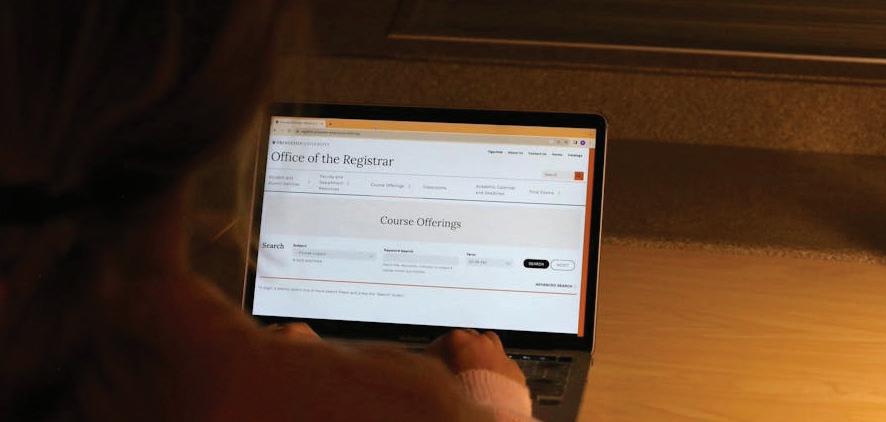
JEAN SHIN / THE DAILY PRINCETONIAN Princeton’s course offerings home page.
What it means to ‘fail’ at Princeton
By Sena Chang Contributing Features Writer
Sitting among 1,264 other undergraduates in Princeton Stadium, Rebecca Berman ’23 did not feel the triumph that usually comes with graduation. Instead, she felt demoralized for most of the ceremony. Over several days of commencement events, Berman recalled that the only students publicly singled out in front of the graduating class were those receiving major prizes.
“You only felt the recognition, or got to feel proud if you got the big awards that you were called out for in front of everyone … the rest of us felt not great about what we’d accomplished,” Berman said, although she generally reflected on her years at Princeton with immense gratitude and fondness.
“That’s the most Princeton thing: graduating is still not enough,” she continued. “Even when we’re graduating, we’re competing for recognition, competing for that validation that all of us want.”
At a university defined by excellence, success is visible and publicly affirmed; failure, by contrast, is rarely part of Princeton’s public vocabulary. Across several dozen interviews with The Daily Princetonian, many past and current students largely defined “failure” at Princeton in similar terms: the inability to optimize one’s time or to extract maximum value from four finite years.
Faced with often overwhelming pressure to “make the most” of vast resources, many students attempt to optimize their lives, strategically selecting classes, internships, and extracurricular commitments. While most students appreciate the opportunities offered by the University, many noted the difficulties of social comparison, seeking help, and engaging in critical self-reflection in such an intense environment.
“Now that I’ve graduated, I really loved so much of the things that I did end up being involved in at Princeton,” Berman said. “But it was hard to breathe sometimes, through all of the possibilities.”
‘A real optimization of childhood’ A restless pursuit for something more has been embedded in American culture since the nation’s inception, said Brigid Schulte, the author of “Over Work,” in an interview with the ‘Prince.’
“It’s this idea for self-improvement, this idea of social mobility: that you can always improve yourself,” Schulte explained.
Beginning in the 1980s, that cultural instinct collided with structural economic change as globalization reshaped the economy and blue-collar manufacturing jobs declined sharply, hollowing out what had once been stable middle-class pathways. During this time, parents dramatically increased their children’s structured activities outside of school. Beneath decisions about test prep, early enrichment programs, and sports leagues, Kimberley Lear, a researcher focusing on the future of work, pointed to “an underlying economic anxiety” that continues to shape childhood and led to a cultural impulse to optimize.
Last year, studies showed that less than a third of 2025 college graduates in the U.S. secured a full-time job in their field. At the same time, recent graduates have expressed anxiety about AI’s impact on the job market.
Anna Nguyen ’29 came to Princeton after graduating from a prep school, where juggling a multitude of commitments felt like a way of life.
“But, I feel like there are some things that I feel nobody really expects at Princeton: how hard the academics are, and how you have to manage time, and [how] people around you are going to do so many different things that you can’t really all get involved in,” she said. “You’re in such a competitive environment [that] what you really care about is the outcome,” Nguyen added, speaking to a culture of competition around grades and internships at Princeton.
“There are a lot of parents who feel like good jobs are getting better and bad jobs are getting worse, and middle jobs are disappearing,” Lear said. Parents, faced with that bifurcation, entered what Lear described as an “arms race — a mad scramble to get their kids on the right side of this economic schism.”
“Childhood is optimized, adolescence is optimized, so then there’s no surprise that college becomes optimized,” Lear said.
‘Am I making the most of the institution?’
Students are fluent in being busy by the time they arrive at Princeton. According to the annual frosh survey conducted by the ‘Prince,’ the percentage of students reporting 10–24 hours of weekly study time in high school has increased slightly since 2020, averaging at nearly 50 percent each year. Roughly seven in 10 members of the Class of 2029 held jobs during high school, a rate more than triple the national average for college students.
At Princeton, this impulse to optimize intersects with an abundance of opportunities: this semester, there are more than 500 student organizations, and a steady stream of guest lectures, performances, and travel opportunities.
What begins as a genuine desire to take full advantage of Princeton’s resources can result in being stretched thin across more commitments than students can comfortably hold.
“If you’re trying to do 100 percent of everything, it might end up being more like 80 or 90 percent,” Samuel Kleiner ’25, who was a varsity rower, said.
“I tried to do many things freshman, sophomore year, and did rather poorly [during] freshman semester,” Kleiner added. After asking for help from teammates and getting accustomed to Princeton’s academic workload, Kleiner ended up receiving a “Most Improved” award from the electrical and computer engineering department.
Undergraduate Student Government (USG) Mental Health Chair Aakansh Yerpude ’27 added, “[Students] want to really immerse themselves in the content of the course, but it’s so hard when they have 10,000 other responsibilities that aren’t just academics.”
Students also pointed to the University’s rigorous academic curriculum as a source of stress. Princeton’s grading system appears less inflationary than some of its peer institutions, though the percentage of A-range grades soared almost 10 percentage points during the pandemic and has generally increased over the past 20 years. 66 percent of graduating seniors in the University’s class of 2025 reported a cumulative GPA of 3.7 or higher, compared to 56.3 percent in the graduating class of 2022.
“This place really does push you. It made me restructure a lot of my habits,” Athena Apaga ’26 said, reflecting on her challenges getting accustomed to Princeton’s workload and the difficulties of finding a balance between schoolwork, social life, and extracurriculars.
And beneath these daily decisions about what to prioritize in a sea of possibilities, students said, lies a more existential concern: whether they are truly making the most of their time.
“I think failure at Princeton mostly boils down to feeling like you haven’t made the most of the major facets of Princeton life,” Jay Crowther ’27 said.
Crowther is a former Sports contributor for the ‘Prince.’
“That gratefulness that I’ve had since freshman fall has never gone away and diminished despite the many difficult times I’ve had here,” Connor Romberg ’27, a former USG Academic Chair, added.
Romberg is a former assistant Prospect editor for the ‘Prince.’
“But every single day, I’m like, ‘Am I making the most of the institution that I fought so desperately to attend?’ And I think that question alone will put this intense weight on anybody.”
‘Average fish in the pond’
This pressure to optimize, students said, does not operate on an individual level. The question is not whether one is working hard, but whether one is working hard enough relative to everyone else.
Mikayla Barton ’28, a Peer Health Advisor, noted that many of the courses she has taken assign grades on a curve, a structure she described as making the experience feel “all about comparison.”
Apaga similarly said that although she would be satisfied with an A-minus or a B-plus, she has seen peers retake classes because they would not get an A.
“In your high school or in your town, you might have been the biggest fish in that pond, but when you get here, it’s going to turn out you’re just kind of an average fish in the pond, right?” politics professor Charles Cameron said.
Cameron recalled teaching POL 329: Policy Making in America last fall, where he added a new final oral quiz to deter artificial intelligence use.
“There was one student who almost threw up,” he said.
This anxiety extends beyond coursework and into the social environment.
“There was so much performative busyness at times,” Berman recalled. “Obviously, everyone was genuinely very busy, but we were helping encourage each other: a lot of times when you have conversations with people, it’s like, ‘Who got less sleep? Who did more studying on a Friday night?’”
According to many students, the dynamic of social comparison is a structural problem due to the selectivity of certain clubs and organizations.
“[Failure] could be sleeping through a class, or not making a performing arts club, or getting hosed from an eating club,” Romburg said. “Princeton has such niche and specific things that students hyperfixate on, and when they don’t find success in those things, it disproportionately affects their mental health and wellbeing as a student.”
Admission into eating clubs, a defining feature of Princeton’s social landscape, has grown more competitive as the University expands class sizes. Similarly, admission into certain student groups can be as low as 1.4 percent.
“It seemed like all of the coolest opportunities were ones that not everyone could be a part of,” Berman said.
‘Anxious about falling behind’
The pressure to optimize in all areas of the Princeton experience may suggest a remedy: pause. But students and professors described an environment in which the drive to maximize one’s time collides with a campus culture
that makes stepping back feel costly.
USG President Quentin Colón Roosevelt ’27 noted that while Princeton does offer many avenues of support, the campus culture makes it difficult to ask for help.
“There is an issue where it seems like you have to be performing at the highest level here all the time, and that causes you to not reach out for support and not even discuss with your friends that you might be struggling academically, mentally, socially,” Colón Roosevelt said.
As a result, rest has become perceived as unproductive, and struggle can feel deeply isolating.
“The students who are really failing … are students who become so anxious about the quality of their work; anxious about falling behind; anxious about disappointing people that they stop communicating, stop coming to class, or stop answering emails,” English professor Jeff Dolven said.
Dolven encouraged students to make use of what he described as one of Princeton’s greatest privileges: faculty accessibility. “There are so many open doors on this campus, and it’s almost the only way to fail at Princeton: to not walk through them,” Dolven said.
The doors, faculty say, are open. But beyond a cultural aversion to asking for help, students expressed that Princeton is institutionally ill-equipped to encourage rest.
“I’ve seen someone be super, super sick,” Barton said. “They can’t come to [Thursday] lab, and the alternative proposed to them is coming in on Friday, one day later, for lab.”
Barton emphasized that the issue was less about unwilling professors than about logistics: while faculty encourage communication, missing a precept can require attending another session or completing alternative assignments, sometimes adding work rather than reducing it.
In a July 2025 article, The Daily Princetonian documented the tensions that can arise between mental health needs and institutional expectations. One student who had missed 11 days of school due to mental health issues recalled being asked by University administrators to choose between completing all of her assignments in the two days before Dean’s Date in December 2023, or taking a leave of absence.
Compared to many peer institutions, Princeton’s semester is also shorter: 12 weeks of instruction in addition to an exam period, as opposed to around 13 to 14 weeks of instruction at other Ivy Leagues.
“The materials are so packed that you’re just going through the motions during the actual academic year,” Nguyen said, referencing the University’s 12-week semester.
“I think Princeton, in its commitment to academic rigor, has gotten in the way of having a flexible environment for students where they can go through life with all of the changes that might come with being a college student and be able to still pursue academics rigorously,” Roosevelt said. “And I think those two things do not have to be in conflict.”
‘You can’t optimize everything’ Recently, there have been efforts among some students to interrogate such a culture and strive toward a more purpose-driven experience.
Early in the 2025–26 academic year, Kyler Zhou ’27 launched a student-run chapter of the School for Moral Ambition, inspired by Dutch historian Rut-
ger Bregman’s book “Moral Ambition.” The movement convenes small “Circles” of individuals committed to addressing global problems.
Kyler Zhou is a former News contributor for the ‘Prince.’
Within weeks, more than 120 students had signed up for the email list, according to Zhou — a sign of appetite for change. “We go to the top school in the world,” he said, “and I think for us to use that and advance our own riches, instead of giving back to the world, to our community — that would be a waste.” Over dinners and guest talks, including one featuring Bregman, participants discuss how to orient their studies and careers around purpose instead of optimization without moral consideration.
On another front, student leaders have sought to address the emotional toll of campus life directly. In February, USG’s mental health committee, led by Yerpude, launched a mental health campaign titled “One Too Many,” in collaboration with the Alumni Mental Health Coalition. Students were invited to share their experiences and beliefs, with findings to be compiled in policy proposals presented to the University administration.
But change, others say, can stem simply from a recalibration of mindset.
“I’m one of certainly many who feel that there’s something lost in the absence of open and unscheduled time,” Dolven said. “I think Princeton could become more of an oasis; the structure is there to permit that.”
Natalie Lord ’29 described the process of reconsidering her own reflex toward optimization. “If you approach [life] with the fact that every experience is valuable, then you’re learning something from everything you do,” she said. “You’re human. You can’t optimize everything.”
Natalie Lord is a staff Copy editor for the ‘Prince.’
Brian Chan ’29 noted a similar shift in his attitude towards failure.
“Rather than trying to grasp at everything, I would rather choose to experience what I’m able to, and what would make me happy,” he said. “So I think the end goal is happiness, which is pretty elementary.”
Despite some students seeking to change their mindsets, campus culture remains one of optimization driven largely by anxiety and social comparison. “I feel like you definitely see more people who are working for the grade and internship, more than those who are more purpose-driven,” Nguyen said.
Ultimately, the question facing Princeton, perhaps, is not whether its students are capable, worthy of abundant resources, or utilizing them to the fullest, but whether they can permit themselves, occasionally, to step outside a culture of optimization and ask what exactly they are optimizing for.
“We are on autopilot,” Yerpude added. “We don’t think that [issues like mental health] are problems, or we don’t have enough time to think that they are problems because we have another problem to go after, we have another p-set [problem set] to do.”
“We can’t spend time thinking about things that aren’t ‘productive.’”
Sena Chang is the associate News editor and a contributing Features writer for the ‘Prince’ leading investigations. She is from Japan and South Korea, and she often covers local politics and student life. She can be reached at sc3046[at]princeton.edu.
From Guyot Hall To Global Health: Dr. Elizabeth Colston ‘87 On Her Path To Immunology
By Zihan (Frank) Xu
Contributing Features Writer
On a muggy afternoon in the summer of 1987, Elizabeth Colston ’87 emerged from Guyot Hall for the last time as a Princeton University undergraduate. She would be graduating cum laude with a degree in Molecular Biology and a senior thesis on cancer cell research. While Colston passed through the FitzRandolph Gate, she had one clear path in mind after graduation: a Doctor of Medicine–Doctor of Philosophy degree (M.D.–Ph.D.).
Nearly four decades later, Colston currently serves as the Vice President and Head of Immunology Clinical Development at Bristol Myers Squibb, operating at the intersection of high-stakes drug development and the foundational rigor she first learned in Princeton’s labs.
When Colston arrived at Princeton in 1983, the Department of Molecular Biology (MOL) was still finding its footing as a nascent program where undergraduates worked alongside scholars in the field. When Colston began her freshman year, the Lewis Thomas Laboratory, which now houses the MOL department at Princeton, was commencing its construction and would not be completed until her junior year.
“We had tremendous exposure to
‘At
the investigators who were running the labs,” she recalled. “I still remember Shirley Tilghman was in the lab adjacent to the lab I was working in,” referring to the former president of the University. Colston’s proximity to breakthrough research shaped more than just her scientific knowledge; it nurtured her passion for discovery that she would carry on for decades to come.
The senior thesis, the final keystone of a Princeton education, proved pivotal during her postgraduate path. Colston, whose father was a physician, grew up planning to be a doctor, but working at the lab bench made her fall in love with the research side of medicine too.
“I remember saying to my dad, ‘I always wanted to go to med school, but I really like this research stuff.’” Colston’s father told her about M.D.–Ph.D. programs, which helped make up her mind. “And I said, ‘Well, that’s for me, because I really love both.’”
Chasing her dream, Colston became an M.D.–Ph.D. student at Columbia University, where she spent five years studying poliovirus-receptor interactions and learned that science moves slowly and projects don’t always pan out. “Sometimes a year into it, somebody has to change their Ph.D. topic, or they get scooped,” she said.
Colston’s advisor, Professor Vincent Racaniello, had a particularly strong impact on her approach to teaching. “He’s so passionate about virology that in his later years, he has launched several podcasts. One of them is called ‘This Week in Virology,’” Colston said. “‘This Week in Virology’ has been going on for years. I still listen to it.” His example proved invaluable as she climbed the ranks of medicine.
“You’re increasingly responsible for teaching the people who are below you in the chain. And so I leveraged a lot of… Vincent’s [teachings] for that. Certainly, in my current job, you have to do that because you have to mentor more junior colleagues,” she added.
Vincent’s lessons about the importance of science communication later informed Colston’s time teaching scientific writing at the University of Pennsylvania following the completion of her M.D.–Ph.D. programs. “Early in my educational career, I thought you needed some type of special brain to be a good writer…But scientific writing is more formulaic,” she stated. Reflecting on her experiences through Princeton’s rigorous writing requirements, Colston added “I had teachers who taught me how to think about it. Paying that forward was really gratifying.”
After Penn, Colston joined Bristol My-
ers Squibb to work on virology, but after seven years, the company pivoted to immunology. She faced a choice: commute two hours to another infectious disease position, or stay at her current position and learn something new. She chose the latter.
“Virology is one half of the equation, but the immune response is the other half…I’m gonna do the opposite now, and work on the immunology side,” she said. Her twin sons also influenced her decision, as staying in her position meant a 15-minute commute and making it to their cross country meets.
That flexibility traced back to another mentor of Colston’s: Harvey Friedman, her department chair at Penn. When she approached him with uncertainty about balancing her career and newfound motherhood, Friedman told her, “Liz, your children will only be little once. Your career will always be here.” To this day, Colston still recounts that story fondly.
In Colston’s high-stakes world of clinical trials, where she now oversees drug development for autoimmune diseases like lupus and psoriasis, humility is essential. Being awarded a C in a genetics course at Princeton taught her a valuable lesson.
“I went to talk to the professor, and
she was so wonderful,” Colston recalled. “She said, ‘There’s no reason to feel like it’s that you’re a failure or that you fail this class. It was a hard class for you, and, take away what you can from it in terms of the learning, but also take away from it the understanding that, you know, we aren’t all gonna be excellent at everything.’”
Looking ahead, she predicts the next decade of immunology will bring discoveries “we haven’t even imagined yet.” She believes that openness to the unknown is what makes science and its pursuit exciting.
Though Colston’s office today may be miles from the gothic spires of campus, the skills of collaboration and intellectual vitality she honed at Princeton remain her North Star.
“The lab, where you’re a single person working on a research problem, is really where I learned about this cross functional collaboration, this learning from each other,” she concluded. Colston often finds herself mentally back in the Guyot Hall/Lewis Thomas laboratory where she revisits the scientific ethos she developed at Princeton; the deepest discoveries come from asking better questions, and the best science is done together.
Zihan (Frank) Xu is a contributing Data, News, and Features writer for the ‘Prince.’
a disadvantage’: Faculty and military community members condemn new DOD policy
By Devon Rudolph
Contributing Features Writer
“My commitment to the United States and to the U.S. Constitution is larger than any one administration,” one undergraduate student in the Reserve Officers’ Training Corps (ROTC) at Princeton told The Daily Princetonian.
The student, who spoke on the condition of anonymity to avoid jeopardizing their military career, emphasized that their statements were not made on behalf of Princeton’s ROTC. Throughout the interview, they continued to select their words carefully.
“I’ve had the tremendous privilege of knowing so many fantastic students at Princeton, who I know will become extraordinary military leaders. And I think that it would be a massive shame if that potential was eliminated,” the student said in response to an announcement that Secretary of Defense Pete Hegseth ’03 made on Feb. 27. In a video posted on social media, Hegseth announced that the U.S. Department of Defense (DOD) will end sponsorship for graduate students at Princeton and other Ivy League institutions beginning in the 2026–27 academic year.
“We’re done paying for the privilege of our enemies’ wicked ideologies to be taught to our future leaders,” Hegseth said in the video. He also claimed that top institutions have “gorged themselves on a trust fund of American taxpayer dollars.”
Though the policy does not directly affect ROTC undergraduate students, a number of current ROTC cadets will enter active-duty service under the current administration after graduation. An active-duty graduate student in the School of Public and International Af-
fairs previously declined a request for comment.
In addition to Hegseth’s video, an official memo from the DOD wrote that they will eliminate “certain Senior Service College Fellowship (SSC) programs for the 2026–2027 academic year and beyond,” though currently-enrolled students would be able to finish their course of study. The SCC is a program through the DOD that finances higherlevel active-duty service members to attend graduate programs and continue their service in the military.
The DOD memo includes a list of schools where SSC fellowships for the 2026–2027 school year have been canceled. According to the list, one fellowship will be canceled at Princeton, whereas other schools with larger graduate programs have more student admissions canceled. At Harvard, 21 student fellowships have been terminated, and a total of 93 fellowships across 22 institutions will be canceled.
The DOD declined to comment beyond the contents of the memo.
University spokesperson Jennifer Morrill wrote in a statement to the ‘Prince’ that there are “a dozen active-duty military graduate students currently enrolled at Princeton, representing all four branches of the U.S. Armed services with all but two of those students enrolled at SPIA.” The Master in Public Affairs in SPIA is fully funded by the University, and additional need-based funds are available for living expenses. As the policy currently stands, activeduty service members may be unable to attend Princeton for graduate school while remaining in service.
In announcing the cancellations, Hegseth cited student “indoctrination” at elite institutions that “undermine the
very values they are sworn to defend.”
“They have replaced the study of victory and pragmatic realism with the promotion of wokeness and weakness,” Hegseth said in the Feb. 27 video.
Professor of History Kevin Kruse disagreed with Hegseth’s characterizations. In an interview with the ‘Prince,’ Kruse described Hegseth’s critique of “wokeness” at elite universities as a “lazy insult.” Since the start of his second term in office, President Donald Trump has attacked higher education universities and Ivy League schools using this same logic, suspending dozens of research grants at “woke” programs, criticizing diversity, equity, and inclusion (DEI) initiatives, and questioning free speech on campuses across the country.
Hegseth “has thrown out this charge of wokeness without any substantiation for what that means,” Kruse told the ‘Prince.’ “It seems like an empty buzzword.”
Kruse said that if Princeton’s history department followed the Trump administration’s view of history, it would lead to a telling of American history that “only talks about the strengths and not the flaws.”
“That’s not history, that’s propaganda, and that’s not what we do,” Kruse said. “If you’re talking about training military leaders, they’re going to need to know the failures as well as the successes, if only to try not to repeat them, if only to be aware of the consequences.”
“That’s not being woke, that’s being aware of reality,” Kruse added.
Retired colonel Doug Lovejoy GS ’68, who formerly served as the commander of the Princeton Army ROTC unit, underscored the divisive nature of Hegseth’s commentary. “It’s not an ‘either/or,’ ‘liberal versus conservative,’” Lovejoy
told the ‘Prince.’
The anonymous ROTC student agreed that the new policy decision “doesn’t seem the most unifying” and “creates a divisive ‘us versus them’ mentality that is not conducive to a strong, cohesive, diverse military.”
The student added that programs that send military personnel to top universities help bridge the gap between military and civilian populations and prevent echo chambers from forming “to ensure that our military leaders are in tune with the population that they serve and defend.” Conservative students also derive benefits from encountering different perspectives at predominantly liberal universities, even if they are in the political minority, the student noted.
“If you are a strong, conservative individual in a liberal institution like Princeton, it strengthens your ability to reason, to critically think about issues, and to encounter conflict, which is the complete nature of a military profession,” they said.
Kruse said that the Democratic party currently has a “more supportive approach to teaching” than the climate created by the Trump administration, pointing to the current administration’s severing of research grants, as well as book bans in states like Florida.
That’s why, for Kruse, professors may align more strongly against the current administration. “It’s not that there are a bunch of dedicated Democrats who rush into academia as a means of advancing the cause. It’s rather that they’re educators first and looking around for which party best reflects their values,” he said.
War veteran Raymond DuBois ’72, who recently spoke to the ‘Prince’ after Hegseth’s initial Feb. 6 announcement regarding the termination of fellow-
ships at Harvard, discussed his views about the latest changes. He believes that the true purpose of Hegseth’s new policy is to “curry favor.”
“As long as Hegseth thinks he’s getting mileage in the Oval [Office], he will continue to do this,” DuBois said. “You will note the professional production values of his videos. The lighting is perfect, the audio is perfect, his makeup is perfect.”
DuBois also pointed to the number of senior military officials, both past and present, who attended the targeted universities.
“Did Hegseth bother to ask his senior military officers what their opinions might be with respect to this policy?” DuBois asked. “Because guess what? Three of the current serving chiefs of staff all went to the Kennedy School,” referring to the public policy graduate school at Harvard.
“Certainly, the presence of active duty military in our graduate programs, when we’ve had them, has been a benefit to our scholarly communities,” Kruse said. “This just struck me as a misguided effort to inflict some kind of punishment on Princeton, which is only going to hurt members of the military themselves.”
The ROTC undergraduate echoed concerns that this policy would put military members “at a disadvantage” and give their civilian counterparts a “leg up.”
“Princeton will continue with or without the military’s support. It’ll continue to produce world leaders,” the student said. “It’s important that the military has a seat at that table.”
Devon Rudolph is the head Podcast editor and a senior News writer. She is from Fairfax, Va.
Feel I ng l ucky ”
By MC McCoy and Maddie Feldman Senior Constructors
the PROSPECT. ARTS & CULTURE
Misery loves ‘Company,’ and so do I
By Mia Mazzeo | Contributing Prospect Writer
It’s not uncommon to experience mixed feelings on your birthday. What should be a joyous occasion is often marked by dread about the passage of time and the pressure of new responsibilities. On Saturday, Feb. 28, while sitting in a packed Hamilton Murray Theater, I was overcome by this familiar whirlwind of emotions. Although it was not my birthday, the joint Princeton University Players-Theatre Intime production of “Company” masterfully projects both anxiety and joy through a bittersweet birthday celebration. This iteration is made special by the cast’s electrifying chemistry, as seen in every song, dance, and simple conversation.
“Company,” written by George Furth with music by Stephen Sondheim, is a concept musical, meaning it focuses more on themes than a traditional plot structure. The series of vignettes that makes up “Company” explores modern love, marriage, and loneliness.
The musical centers on Bobby, a charming bachelor living in New York. We see Bobby’s growth through the songs and interactions with other characters. On his 35th birthday, a group of his closest friends, composed of five married couples, throw him a surprise party. When Bobby
intentionally fails to blow out the candles on his cake, he reassures the party that he wishes for nothing, content with his current friendships and single life. This scene becomes a motif in the musical, giving Bobby multiple opportunities to metaphorically extinguish the candles by grappling with his fear of intimacy.
As the musical progresses, the audience is transported through a collection of Bobby’s interactions with the couples over the years. Although the show can feel disjointed at times given its nonlinear structure, Bobby’s character development and his conversations with his friends serve as throughlines that link each vignette. The cast’s chemistry helps flesh out the relationships central to the story and connect scattered scenes. Each couple conveys a new complex facet of marriage, ranging from commitment and sacrifices to infidelity and divorce.
One example is the male ensemble’s solemn and sweet rendition of “Sorry-Grateful,” in which the five married men both mourn the loss of their independence and appreciate the companionship they share with their wives. These conversations challenge Bobby’s preconceived notions about marriage, opening his eyes to the uncertainty of vulnerability. Interspersed with snapshots from Bobby’s own love life and
the three women he is currently dating, each moment showcases his inability to fully settle down.
Each vignette highlighted the cast’s incredible musical talent, one of the most remarkable parts of the show. With her portrayal of Amy, one of the married friends, Rose Campbell ’29 delivered my favorite performance of “Company.” Her shining moment takes place on the day of her wedding, when Amy voices all her worries about marrying Paul, her long-time boyfriend. Campbell nailed every lyric of the notoriously fast-paced number “Getting Married Today” while still capturing all the emotions of a runaway bride. For reference, one line of this song requires the actress to sing 68 words in roughly 11 seconds.
Furthermore, Khadija Ndiaye ’28, who stars as one of Bobby’s girlfriends, Marta, showed off her incredible vocal chops in “Another Hundred People,” a song underscoring how lonely New York City can be despite its bustling crowds. After expertly belting out the final notes of this poignant number, Ndiaye received a spirited round of applause.
Beyond the talented musical performances from its cast, the choreography in “Side by Side by Side/What Would We Do Without You?” was by far the most electrifying part of the show. Choreographed by
the director, Adam Bathurst ’27, this piece started the second act of the show with a bang, its dazzling kickline and the cast’s frantic reaching towards Robert emphasizing both the connections within the group and Bobby’s position as the odd man out.
Finally, this review would be incomplete without acknowledging the stellar performance of leading man Radon Belarmino ’26 as Bobby, especially during the penultimate number, “Being Alive.” Serving as Bobby’s commitment to embrace the hardships of love and find intimacy, Belarmino’s impassioned gestures, emotional vocals, and heartfelt energy make this song unforgettable. Belarmino renders Bobby easy to root for and relate to, with his character’s infectious charisma and remarkable sincerity shining through in each of the core friendships.
Although each individual performance was riveting, the chemistry shared between its cast made this production truly memorable. Just like marriage, the conversations between characters are full of highs and lows. The seamless portrayal of these emotionally rich relationships made each vignette stand out, making this iteration of “Company” deeply impactful.
Mia Mazzeo is a contributing writer for The Prospect and is a member of the Class of 2029.
Transcending vision in art: a look at the 2026 VIS Book and Poster show
By Alexis Choi | Contributing Prospect Writer
Tucked away in Nassau Street’s Hagan Gallery, the 2026 Visual Arts Book & Poster Show quietly unfolded. From Feb. 16 through March 13, the space has transformed into something both intimate and expansive: a room of 16 desks, “books,” and a gallery of posters lining the walls.
I first noticed the amount of color throughout the exhibit. The wooden desks were arranged in rows, each half-painted in a different hue: one side bare wood, the other dipped in saturated shades of blues, greens, yellows, reds, like colorful tiles scattered across the floor. The faint scent of paint lingered in the air, mingling with something woody and dry. There weren’t any excessive decorations, and the layout was neat and orderly.
A junior project rested on each desk. Simply calling them “books” feels insufficient — each varied in size, medium, texture, and intention. Some resembled more traditional volumes with bound spines and uniform pages. Others unfolded, accordionlike, across the desk. One appeared to be sculptural, with layer upon layer of thick paper cut into vaguely conch-like shapes;
another even had pages made of a green gellike material that stuck together slightly as I turned the pages.
Some works were particularly striking. On a red-painted desk near the entrance sat a spiral-bound volume titled “Eyes Nose Mouth,” created by Logan McNabb ’27. At first glance, each page presents the same composition: a large frontal portrait of a male face, rendered boldly and without distraction. But as you turn the pages, the image shifts subtly. The brushstrokes grow fainter. The shading loosens, then thins. Features start to blur at the edges. The repetition becomes a slow unraveling. You find yourself wondering how far this disintegration will go, how much the face can fall away before it ceases to be itself, until it gives way to another portrait altogether.
Beside it on the same table, there is a second version of this book, transformed through a simple but ingenious intervention: each page was cut into three horizontal sections, dividing the eyes, nose, and mouth. Viewers could flip each section separately, assembling hybrid faces from different features. The piece oscillates between coherence and fragmentation, inviting the viewer to participate in the act of construct-
ing and recombining identity.
A few desks away sat “Commuter Student,” a photography portfolio by Kenneth Simmons ’27 that offered a different kind of intimacy. The book unfolded as a visual journey, from blurred images of empty New York subway stations to vibrant candid shots of New Yorkers crocheting or reading on park benches. The photos captured snippets of the path to and fro from Princeton to Brooklyn, the camera lingering on gestures and spaces that might otherwise go unnoticed. On one page, Simmons writes, “As a Black man, a nontraditional student, and a veteran,” he created the project as “an attempt to explore how space, identity, and mobility shape my perspective as a photographer.” Upon reading this statement, the preceding images were reframed: what at first appears purely observational becomes a type of self-portraiture by other means. The commute isn’t just a route but a way of perception shaped by movement across social and geographic boundaries.
The posters, lining the right and left walls, belong to the seniors’ thesis projects. Where the books felt inward and tactile, the posters asserted themselves outwardly. Large-scale, graphic, bold in typography and image, they functioned as both announcement and distillation — a visual thesis statement rendered in ink and layout.
Particularly eye-catching was a piece on the leftmost wall, of unknown artist and title. It was a cascade of tea bags, arranged in perfectly level rows. The tea bags’ strings extended upward, and each tag read in small letters variations of “SILICA GEL; THROW AWAY DO NOT EAT DESICCANT SILICA.”
The unconventional medium of tea bags was distinctive; visually, there was something breathtaking about them against the pure white wall. Spanning both walls, the posters created a visual corridor framing the quieter intimacy of the desks.
Unfortunately, regardless of the dazzling quality of the exhibition, it is easy to miss. Upon entering the Lewis Center for the Arts at 185 Nassau Street, I meandered around the building in search of signage that might signal the exact location. Finally, after asking a student for directions, I arrived at Hagan Gallery. I was also disappointed to see that several of the works didn’t appear
to display the artist’s name or even a title, and that there weren’t any labels or caption cards for each piece, preventing me from getting to know the context behind each artwork.
Throughout my viewing, I was alone in the room; there was no music, no crowd — though, to be fair, I had made my visit on a random Monday afternoon. All I could hear were the light echoes of my footsteps as I wound around the tables, the quiet rustle of paper. Although I was alone, the exhibition was surprisingly interactive. Each book invites you to lean in. You have to stand close. You have to turn the pages yourself. Unlike paintings mounted high on walls, these works demanded physical participation. They felt meant to be handled — carefully, deliberately — and in that handling, the viewer almost seemed to become part of the piece.
There is something radical about an exhibition devoted entirely to books and posters — formats often considered functional, or even utilitarian. Here, they are elevated, stretched, and deconstructed in ways beyond my imagination. Books and sculptures become sculpture, archive, diary, and experiment.
Yet what lingers most is not spectacle, but atmosphere. The room felt contemplative. The desks — half-painted, half-bare, one for each book — seemed emblematic of the moment these artists occupied: not yet fully finished, still in process, and straddling the raw material and the polished surface. The show does not overwhelm the senses; emotion and ideas build as you leaf through each story. Each table offers a different world. I left not dazzled, but thoughtful — aware of how many forms a “book” can take, how much someone can be captured in a single painted sheet.
The 2026 VIS Book & Poster Show runs through March 13 at Hagan Gallery, 185 Nassau St. It is open weekdays from 9 a.m. to 6 p.m. and is free and open to the public. It may be a bit difficult to find. But once inside, the room holds you — in color, in paper, in silence — longer than you’d expect.
Alexis Choi is a contributing writer for The Prospect and a member of the Class of 2029.
ALEXIS CHOI / THE DAILY PRINCETONIAN “Eyes Nose Mouth” by Logan McNabb ’27.
The Prospect 11 Weekly Event Roundup
By Ysabella Olsen, Head Prospect Editor
Keepsakes: Exhibition by Tessa Mudd ’26
1
Más Flow Presents: FC Flow
March 20 at 6 p.m. and 10 p.m.; March 21 at 4 p.m. and 9 p.m.
Hamilton Murray Theater, MurrayDodge Hall
The 2026 World Cup is right around the corner, with games to be held across the U.S. and North America. While you wait for professional futból moves, Más Flow will set the stage with some serious dance moves. Princeton’s Premier Latin Dance Company’s 13th annual show, FC Flow, is taking place this weekend. Tickets are passport to the arts eligible and available on Princeton University Ticketing.
2
3
March 20–27
Lucas Gallery, 185 Nassau St., Princeton, N.J.
If you’ve ever wanted to see how another person views beloved spaces and objects, Tessa Mudd’s senior exhibition might be for you. Mudd, an Art & Archaeology Practice of Art major pursuing minors in English and History, explores home arrangements, interiors, and knick-knacks to communicate ideas about shaping space. The exhibition is free and open to the public.
Read & Explore: Getting Ready for Spring
Who is putting it on
4
5
Exhibition by Yiling Li ’26
March 20–27
Hurley Gallery, Lewis Arts Complex
Senior Yiling Li uses instruments and architecture to explore themes of computation and circuitry with organic movement. Li is an Electrical and Computer Engineering major with minors in Visual Arts and Statistics and Machine Learning and Robotics. The event is free and open to the public. The exhibition is free and open to the public.
Most students like to experience Terhune’s Orchard in the fall for cozy cider and apple picking with friends. However, it might just be time to experience Terhune Orchards on the cusp of spring. Terhune’s winter program gives participants an opportunity to plant while listening to a story. This week’s selection is from “Frog and Toad Are Friends.” Pre-registration is required and costs $12 per person.
Workshop: Trashion and Upcycling - A New Jersey Makers Day Event
March 21 at 11 a.m.
Conference Room, Princeton Public Library, 65 Witherspoon St., Princeton, N.J.
A new wardrobe doesn’t always require breaking the bank. Head to this workshop to upcycle old clothes, materials, or items into trashion masterpieces. You will be guided by Val Bisdale and Jeffrey Keyton. Key- ton is the former SVP Head of Design for MTV. If you make a stylish outfit that you want to show off, you can participate in Sustainable Princeton’s Trashion show on April 19. Registration is required and available on the Princeton Public Library website.
Expressive Potential of Everyday Materials: Shoelaces
March 21, 2–4 p.m.
Laporte Family Creativity Lab, Princeton University Art Museum
Shoelaces take on a new form in this interactive workshop led by artist Veronica Olivares-Weber. In addition to shoelaces, participants will work with wire and other materials to create three-dimensional structures. This artmaking is inspired by Nari Ward’s “Scape” (2012), which is currently on view in Princeton Collects. Registration costs $50 and is available on the Princeton University Art Museum website.
Glee Club Presents: Säje
March 21 at 7:30 p.m.
Richardson Auditorium, Alexander Hall
The Princeton University Glee Club will perform “Säje,” a Grammy award winning vocal quartet. Under the direction of Gabriel Crouch, this group will be sure to deliver on powerhouse vocals and storytelling. Tickets are passport to the arts eligible and available on Princeton University Ticketing.
10
See Academy Award Winners at Princeton Garden Theatre
March 20 and ongoing
Hurley Gallery, Lewis Arts Complex
The Oscars are over, which means it’s time to watch (or rewatch) this year’s big winners. One Battle After Another, directed by Paul Thomas Anderson, won six Academy Awards, including Best Picture. Sinners, directed by Ryan Coogler, won four Academy Awards. Its lead actor, Michael B. Jordan, won Best Actor. Tickets and viewing times vary; visit Princeton Garden Theatre’s website for more information.
9
The Traveling Waffle House Interviews by Artist Sheryl Bassman
March 21–April 18
Arts Council of Princeton, 102 Witherspoon St., Princeton, N.J.
Waffle House is a classic diner breakfast. What hap- pens when the cultural and social experience of the restaurant becomes art? Artist Sheryl Bassman answers this question by highlighting the myriad of responsi- bilities and unique duties of waiters and waitresses at Waffle House. Bassman’s gallery opens this Saturday, and it’s free and open to the public.
Serysthesiac: Exhibition by Summer Pierson ’26
March 20–27
Hurley Gallery, Lewis Arts Complex
Serysthesiac is an exploration of senior Summer Pierson’s creative journey as a Practice of Art major. Pierson’s themes focus on the artistic process through “creation, destruction, and expression.” Viewers can enjoy narrative elements that tell pieces of Pierson’s life. The exhibition is free and open to the public.
[100] ulla augiam ex eratisi bla feumsan ut at, velenim velis doluptat iureetummod min henisl ipit ut prate borpero od dionulluptat acin ullandignim velit velent aci eu feugiatie feu facidui sisissim velendr eraesectet in henit nit nos am, sit, quissim doloreet prat.
11
Patricia Kopatchinskaja, Violin | Dies Irae
March 26 at 7:30 p.m.
Princeton University Chapel
Pressing themes, from global warming to the refugee crisis, are the subject of violinist Patricia Kopatchinskaja’s Dies Irae project. Dies Irae is a Gregorian chant that symbolizes fear and impending judgement. Experience the East Coast debut of this project that weaves centuries of tradition and musical nuance into a conversation about modern day’s most salient issues. Tickets are available for purchase on Princeton University Ticketing.
Tall: ‘Very excited for the weather, obviously, but it’s also a homecoming for three of our players.’
Continued from page 1
of our players,” junior forward Fadima Tall told the ‘Prince.’
“I’m also thrilled for Skye [Belker], Ashley [Chea] and Emily [Eadie] as they get a chance to go home,” Berube added. “It’s always a great honor to be in the NCAA Tournament and I’m looking forward to the opportunity to represent Princeton University.”
The Tigers are riding a high. After defeating Harvard (18–11, 10–4) just yesterday in the Ivy League Tournament Final, the team rode the bus back to Princeton peacefully, knowing that they had secured their spot in the NCAA Tournament with an automatic bid.
This sentiment is a far cry from last year. Losing in the Ivy League Tournament
MEN’S ICE HOCKEY
By Lily Pampolina Head Sports Editor BASKETBALL
Semifinals yielded an uncertain fate for the young 2025 Princeton squad, and ordinarily would have squashed their hopes of making it to the NCAA Tournament. However, the Orange and Black stamped their names into the history books in being selected as one of three Ivy League teams making it to the big dance, the first time the conference had achieved such a feat.
After winning the Ivy League Tournament, Harvard had earned an automatic win to March Madness, and the competitiveness of the league caught national attention, propelling both Columbia and Princeton into positions to receive at-large bids. The Tigers were a part of the first four, earning an 11th seed that required them to play and defeat another 11th seeded team to earn their spot in the main 64team bracket. Unfortunately
for the Tigers, they were narrowly defeated by the Iowa State Cyclones by a score of 68–63.
This year, the Tigers aim to avenge their early exit and earn an opportunity to play No. 1 UCLA, who they lost to two seasons ago by just three points.
“I’m excited for the chance to play the team we lost to two years ago and hopefully beat Oklahoma State,” Tall told the ‘Prince.’ “Oklahoma State is a really, really good matchup, they look very similar to us. We’re so excited to see how that works out.”
The Tigers will travel to California later this week for their game on Saturday at 7:30 p.m. Eastern Time.
Lily Pampolina is a head Sports editor for the ‘Prince.’
Men’s ice hockey sweeps Union in ECAC Quarterfinals
The Tigers are moving on.
Coming off of a dominant win the night before, Princeton men’s ice hockey (16–12–3 overall, 11–9–2 ECAC) defeated the Union Chargers (22–11–3, 11–9–2) by a score of 5–2 to sweep the quarterfinals series and earn the Tigers a spot in the ECAC semifinals next week.
The ECAC semifinals and championship are hosted in Lake Placid, and Princeton is returning to the venue for the first time since 2018.
“I’m so happy for these seniors especially,” head coach Ben Syer told The Daily Princetonian postgame. “They’ve bought in since day one and set the tone every day. For these guys to have this experience is special, and we’re excited for the opportunity.”
Although Friday night’s 5–2 win mirrored the score of Saturday’s, the matchups looked very different from each other. Unlike in the first game, where Princeton was able to build an unanswered early lead, Princeton’s second game opening goal from junior forward Kai Daniells was relatively short-lived. Nine minutes later in the opening period, the Chargers responded with a power play goal to even the score at 1–1.
The Tigers brought the game back to even strength, and closed out the first period with an offensive flurry that signaled a momentum shift. At the first break, the game remained tied at one goal apiece.
Princeton opened the second period bearing another penalty. However, the Tigers soon successfully killed the advantage despite several quality opportunities produced by the Chargers. Soon after, the Tigers earned a power play of their own, highlighted by a quick shot from the left wing by senior forward David Jacobs that ran wide. Union handled Princeton’s man advantage, preventing the Tigers from regaining the lead.
The Orange and Black earned yet another power play soon after, caused by a boarding call on the Chargers. In an unprecedented
turn of events, however, it was not Princeton who capitalized during these two minutes. Despite a near miss from Daniells that ricocheted off the goal frame, Union stifled the Tigers in their offensive third, driving down the ice and catching Princeton out of position. Exchanging several lateral passess across the ice, the Chargers weaved through the Princeton defenders, allowing Union forward Parker Lindauer to slick the puck into the back of the net. The goal gave the Chargers their first lead of the series at 2–1, with 11 minutes remaining in the second period.
Neither Union nor Princeton lead the ECAC in shorthanded goals, though the score marked Lindauer’s second shorthanded goal of the season, accounting for half of his team’s successes. This season, the Tigers have collectively scored three shorthanded goals.
The rest of the second period yielded shot attempts from both sides, but nobody was able to tally another point on the board. Heading into the final break, Princeton trailed by one.
“Even entering the third period, we were confident that this group had a rally in it,” Syer told the ‘Prince.’
“In a three game series, you don’t change your strategy too much; it’s a culmination of everything you do all season. You trust that the work pays off and everyone believes.”
Despite Union’s lead, the Tigers were not aiming to extend the series.
To open the third period, Princeton turned the tide. After two early Charger shot attempts saved by junior goalie Arthur Smith, Princeton kept the puck out of their end of the ice. A Union penalty for tripping gave Princeton a man advantage, and just a minute later the Chargers were plagued with another violation for roughing. With the golden opportunity of a two-man advantage, the Tigers harvested the energy circulating at Hobey Baker Rink.
The Tigers launched two shots that fell just short of capitalizing on the advantage, but these were shortly followed by senior forward Jaxson Ezman finding the top left
corner of the net to tie the game for Princeton.
From here, the Orange and Black did not look back. Mere minutes after Ezman’s equalizer, Princeton got back to work with senior defenseman Nick Marciano cutting off a Charger pass in the central ice. He flicked the puck to Jacobs, who found a cutting Daniells to cap off the play with a shot too quick to give the Union defense an opportunity to challenge. Princeton now reclaimed the lead at 3–2.
The game-winning goal was Daniells’ second of the game. His Saturday night performance emphatically concluded his scoring dryspell of one goal over the Tigers’ last eight games, an uncharacteristic quietness.
“When Kai is feeling it, it’s fun to watch,” Syer told the ‘Prince.’ “His whole line was on fire all weekend, and he scored some huge goals for us, partnering up with David Jacobs.”
Union looked to equalize the match in the latter half of the final quarter, but was continuously stifled by the Tiger defense. With two minutes left in the game, the Chargers emptied their net in an attempt to gain an offensive advantage. Princeton quickly took advantage, with both sophomore forward Jake Manfre and Daniells scoring empty-net goals and sealing the Tiger win.
As the final buzzer echoed throughout the rink, it was Princeton who ruled the ice with a 5–2 victory.
The Tigers will play in the ECAC Tournament semifinals next Friday in Lake Placid, with their opponent to be decided as the rest of the quarterfinal series plays out.
“We’ve been building all year to keep improving and grow as a team,” Syer concluded. “Our mindset is to have our next game be our best game of the year. The ECAC Championship weekend is a grind, but we embrace the grind. Having more time together is special, and we are fired up to make this trip.”
Lily Pampolina is a head Sports editor for the ‘Prince.’
PHOTO COURTESY OF @PRINCETONWBB/X.
The Tigers are going dancing for the fifth consecutive year.
Sports
www.
Back on top: Women’s basketball stifles Harvard in Ivy League Tournament Final
By Lily Pampolina Head Sports Editor WOMEN’S BASKETBALL
Sometimes history does not repeat itself.
After defeating Princeton in the semifinals of the Ivy League Tournament a year ago, Harvard looked to upset the No. 1 seeded Tigers on an even bigger stage in 2026: the tournament finals. Coming off an overtime win against No. 2 seed Columbia the night before, the Crimson were hungry to upset the Tigers, who had secured a comfortable win over Brown.
Unfortunately for the Crimson, they will be heading back to Cambridge emptyhanded.
On Saturday afternoon, No. 1 Princeton (25–3 overall, 12–2 Ivy League) handled No. 3 Harvard (18–10, 10–4), defeating the Crimson for the third time this season with a final score of 63–53.
“We definitely felt like we fell short last year,” junior forward Fadima Tall told The Daily Princetonian postgame. “We knew that coming into this, and we knew we would have to sweep teams that we’ve beaten twice or haven’t beaten at all. But coming into every single game, we told ourselves it was us who was going to win this game.”
“It is truly just a full team effort,” head coach Carla Berube said to the ‘Prince.’ “As a staff, we couldn’t be happier and prouder of this win and this championship.”
This is the sixth Ivy League Tournament title for the Tigers, their most recent prior to this year being in 2024. Princeton’s early exit in 2025 was the first time they had not made the finals in the tournament’s history. With the win, Princeton secured an automatic bid into the NCAA Tournament.
After defeating the Crimson twice in the regular season, the Tigers acknowledged the difficulty of tackling the strong Harvard team in tournament play.
“Harvard came to play and we came to
win, so we did exactly what we came here to do,” junior guard Ashley Chea told the ‘Prince.’
“A lot of credit to Carrie [Moore] and to her staff and players, we had to fight to the very end,” Berube added, referring to Harvard’s head coach.
Harvard controlled the opening tipoff, but it was Princeton who got on the board first with a layup from Tall. On each of the Crimson’s first three possessions, the Tigers forced a turnover. By the end of the first quarter, Harvard had given up the ball nine times, compared to Princeton’s one.
Junior forward Olivia Hutcherson converted another second-chance shot for the Tigers to counter Harvard’s first bucket, but Crimson guard Olivia Jones hit a triple to give Harvard a one point lead. The Tigers trailed 5–4 early in the first quarter.
Turnovers continued to plague Harvard, though, and Princeton continued to capitalize. Buckets from senior guard Madison St. Rose, Tall, and Hutcherson, put the Tigers back ahead by five.
For the rest of the quarter, the Tiger success continued. Princeton held the Crimson to a six-minute scoring drought, during which the Tigers put up 10 unanswered points. Harvard ended the drought and the quarter with a much-needed jumper, but Princeton continued leading 15–7.
Harvard struck first in the second quarter, hitting a three pointer on their first possession. Tall responded for Princeton with a jumper on the other end of the floor, but from here the Tigers would struggle defensively. St. Rose picked up her second foul of the game with over eight minutes left in the quarter, and Tall and Hutcherson each picked up one of their own. The Crimson fought back against their early deficit, now only trailing by four at 17–13.
After shooting zero for four from beyond the arc, Chea halted Harvard’s run
ARCHIVES YEARS LATER
scan to read original article !
with an uncontested three-pointer near the Harvard bench. Twice in her career has Chea hit game-winning three-pointers against the Crimson, the most recent coming in their matchup from this past January.
From here, the teams exchanged trips to the free throw line, and it was Chea again who hit the first field goal to break the drought. Princeton led 24–15 with three minutes left in the quarter.
Tall continued to pave the way for the Tigers, earning a dominant and-one basket to fire up the Princeton offense. Coming off of a double-double from the night prior, Tall ended the half with 13 points and 4 rebounds.
To close the half, the teams exchanged baskets and Princeton headed into the locker room with a nine point lead at 33–24.
Harvard struck first in the second half with a layup. Each team would turn the ball over twice before Harvard earned another driving layup to cut the Tiger lead to four early in the third quarter.
Having entered halftime with only two points, St. Rose got herself back on the board for Princeton to turn the momentum in the Tiger’s favor. Tall put up a layup off of a dime from Hutcherson, and St. Rose powered to a contested layup to extend the lead to ten at 39–29.
Soon after though, St. Rose and Hutcherson each picked up their third fouls. Luckily for the Tigers, Harvard found themselves in similar foul trouble, with both guard Karlee White and forward Abigail Wright heading to the bench for the Crimson.
The teams traded baskets, and with two minutes left in the third quarter, the Princeton lead remained at ten. However, a brief surge led to two consecutive baskets for Harvard to make the score 43–37 to close out the period.
White’s return to the court put Harvard within four early in the final quarter. Continuing her dominance, White fought
to an offensive rebound for the Crimson, earning a put-back basket to make the score 45–43.
Tall commanded the court for the Tigers with a bucket, but White responded once again to limit the Tiger lead to two. A minute later, Katie Krupa tied the game at 47–47.
Princeton struggled to find their footing and could not hit the bottom of the net from deep. Relying almost solely on contested drives in the paint, a fatigued Tigers squad moved slowly on defense, allowing the Crimson to grab several offensive boards. Twice after the initial tying play, Harvard was able to earn second-chance baskets to respond to Tiger scoring.
White picked up her fourth foul, and Hutcherson put back two layups for Princeton to give them a four-point lead with three minutes remaining. Coming out of a timeout called by Harvard, Hutcherson picked up right where she left off, earning another two points from the Tigers’ defensive stop.
With two minutes left to play, White fouled out of the game, finishing with 15 points; junior guard Skye Belker converted both free throws. An additional foul by Krupa sent the Tigers to the line again, where St. Rose tallied on one more point for the Tigers, now leading 60–51.
In the last minute of the game, Belker found Hutcherson under the basket yet
again, capping off an 11–0 run. The teams exchanged trips to the free throw line to close out the game, and the Tigers capped off a successful trip to Ithaca with a 63–53 win. Tall led Princeton with 20 points and seven rebounds, earning Most Outstanding Player honors for the tournament. Both Chea and Hutcherson boasted double-digit performances, with Hutcherson serving as the Tigers’ key defensive catalyst with six rebounds, three steals, and two blocks.
“We don’t have just one way to win or one way to score, and we don’t just have one or two people that can do it either,” Berube told the ‘Prince’ postgame. “We’re pretty deep in the offensive realm; it’s anybody’s game to have.”
With another championship under their belt, Princeton now has their eyes on an even bigger prize: an NCAA Tournament win. As Selection Sunday unfolds, the Tigers will begin to prepare for gameplay on the national stage and avenge their first-four loss to Iowa State from the year prior.
“We’re definitely not done yet,” Tall concluded. “We’ll have some more games next week, and we’re ready to flip the page, have some recovery this week, and then get at it.”
Lily Pampolina is a head Sports editor for the ‘Prince.’
This Week in History: When Princeton basketball toppled a giant
By Lucia Zschoche Associate Archives Editor
“Long after Pete Carril leaves the coaching profession, last night’s scene here will remain imprinted on the national consciousness,” The Daily Princetonian declared on March 15th, 1996.
While the 2023 men’s basketball team’s Sweet 16 run was monumental, it was not Princeton men’s basketball’s first historic feat. In the first round of the 1996 NCAA tournament, Coach Pete Carril led the team to a major upset victory over the University of California, Los Angeles.
“March Madness back then… it was everything. That’s where everyone wanted to be,” said team member Chris Doyal ’96.
Following the team’s triumph over the UCLA Bruins, Princeton erupted in celebration. As the ‘Prince’ proclaimed the next day, the score was “DAVID 43, GOLIATH 41.” However, Doyal and the team were not there to see Prospect Avenue flood with excited students.
“We missed the celebration on campus, but for about 24 hours, we were the darlings of basketball,” captain and former team coach Sydney
Johnson ’97 explained. He described an influx of interview requests and media attention following the game: “everybody [was] paying attention to how David beat Goliath.”
Aside from what Johnson described as a “brain versus brawn” contest and UCLA’s notoriety, anticipation built over the tournament being Coach Carril’s “last dance,” following his retirement announcement.
However, the game nearly did not end in a Princeton victory, or even with Princeton in the bracket at all. Coach Pete Carril, who had led the Tigers since 1967, was known for “near misses” in the NCAA tournament, including a 49–50 first-round loss against Georgetown in 1989.
“We were this perennial Cinderella team that got to the NCAA tournament six, seven, eight times but could never win a game, even though all the games were close,” Doyal explained. “It was like almost the entire country was rooting for us to actually win one of these games.”
Before making it to the UCLA game, Princeton had to overcome another hurdle: defeating Penn. Until 2017, if Ivy League teams ended the regular season with the same record, they
played an additional game to secure their bid in the NCAA tournament.
“That year we had to beat Penn in a playoff game, and they had beaten us, I think, eight times in a row. So the leadup to the game was very special,” said Mitch Henderson ’98, current Head Coach of Princeton’s men’s basketball team who was on the team at the time.
After defeating Penn 65–63, Princeton was seeded 13th in the Southeast Regional and scheduled to play UCLA — 4th-seed and reigning national champions — on March 14th.
At the start of the game, the Bruins immediately jumped out with a 7–0 run. “We were a good winning team that faced runs before, but it was almost just a wake-up [call],” Johnson explained. By halftime, the Tigers had picked up the tempo, trailing the Bruins 19–18.
“I got a wide open layup to push us with a lot of momentum in the halftime,” Gabe Lewullis ’99 said. “That helped us get ready to go in and compete for the second half.”
Steve Goodrich ’98 and Johnson tied the game 41–41 with 2:58 left. With 21 seconds remaining, Lewullis scored two points on a backdoor play — part of Carril’s classic “Princeton offense”
strategy — to pull the Tigers ahead 43–41.
“The lasting memory is just [that] I was standing under the basket when [UCLA] shot their last shot, and you could see that it wasn’t going to go in, and just knowing you were a part of something like that,” Doyal said.
Despite losing to Mississippi State in the second round, the victory over UCLA remains a high point of Princeton athletics and Coach Carril’s career.
“Coach Carrill is, was, [and] will always be a genius to me and many, many, many of the players and coaches who worked with him, [were] coached by him, and had to compete against him. He taught me to see,” said Johnson.
This year could see another UCLAPrinceton rematch by the women’s basketball team. Seeded 9th in the Sacramento region for this March Madness, the Tigers will play Oklahoma State on March 21. The winner of that game will play the winner of the Cal Baptist and UCLA match-up in the second round.
Lucia Zschoche is the associate editor for Archives and an assistant editor for Features for the ‘Prince.’
PHOTO COURTESY OF @PRINCETONWBB/X.
The Tigers await Selection Sunday for their NCAA Tournament matchup.