Many Epstein files have been released — and two Princeton alumni have legal connections
In the wake of the Justice Department’s gradual release of files detailing the activities of the late New York financier Jeffrey Epstein, Harvard University has been thrust into the national spotlight for its various ties to the convicted sex offender, but Princeton has avoided the same degree of scrutiny.
Princeton’s other peer institutions have also been mentioned in the files. The Yale Daily News reported that Epstein had been offered an introduction to law school professor Jed Rubenfeld, but Rubenfeld denied that they were ever in touch. The Daily Pennsylvanian reported that senior administrator Da-
vid Asch had supposedly toasted to Epstein in 2014. The Dartmouth reported that the University has no “current financial relationship” with alumnus Leon Black, a client of Epstein’s tax and estate-planning services.
Are Princeton alumni also entangled in the Epstein files? The Daily Princetonian reviewed the newly released Epstein files and found two mentions of alumni with legal connections.
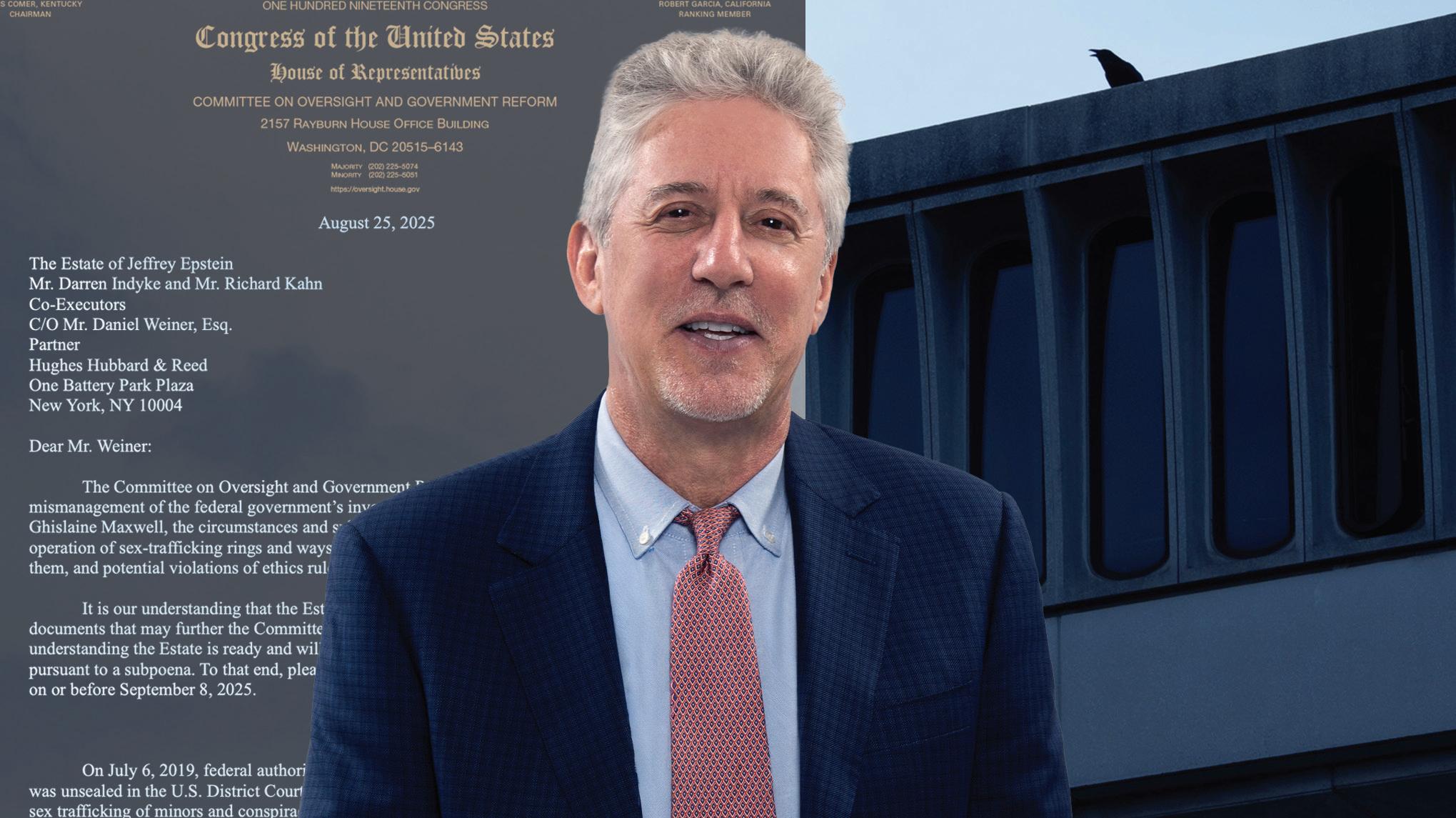
Lawyer Daniel H. Weiner ’81 represents Epstein estate and its co-executors
One alumnus featured in the files is Daniel H. Weiner ’81, who is an attorney for Darren K. Indyke. Indyke was Epstein’s longtime personal lawyer and
is a co-executor of the Epstein estate, which comprises Epstein’s collective assets, property, and legal affairs.
Weiner graduated cum laude with an A.B. in Politics and currently works as a partner at Hughes Hubbard & Reed LLP in New York City. In an interview with the ‘Prince,’ Weiner discussed his legal history with Epstein.
Following Epstein’s death in August 2019, Indyke retained Weiner’s law firm to represent the Epstein estate and set up the Epstein Victims’ Compensation Program (EVCP), according to Weiner. The EVCP was a victim-oriented fund that paid over $121 million to 136 women who suffered abuse at Epstein’s hands.
Within two months of being re-
See EPSTEIN page 2
Princeton researchers weigh cost of impending federal funding rule requiring public access
By Sena Chang & Victoria Davies
News
Emerita
Researchers at Princeton and across the nation who receive federal funding have had a tumultuous year. As of Jan. 1, they have one more thing to balance: a new federal public access policy that could cost researchers thousands of dollars more to publish in academic journals. The new public access policy, known as the Nelson Memo, was released under the Biden administration in 2022 and mandates that any research that is funded by federal agencies be made publicly available at the time of publication. The memo was set to take effect across all agencies by Dec. 31, 2025 at the latest, although the National Institutes of Health (NIH), the Department of Energy, and NASA, among
other agencies, have already implemented a version of the policy.
The Nelson Memo follows a similar policy released in 2013. The 2013 policy, however, applied only to federal agencies with over $100 million in annual research and development spending, and allowed a 12-month embargo for papers being made publicly available after initial publication. The 12-month embargo maintained journals’ ability to rely on subscription revenue from those seeking immediate access to papers.
Making research publicly available immediately upon publication, as is required by the Nelson Memo, can be costly for researchers, as many journals charge substantial fees to offset lost subscription revenue when papers are made public-access. The fees for Nature, for example, can be upwards of $12,690 per paper, while
” GET READY. CRUSADING, WE ALSO PLAN TO HAVE A LITTLE FUN “
2, 2004
Science Advances charges authors a fee of $5,450 per paper.
But the University has not yet committed to cover the fees, known as article processing charges (APCs), going forward. Some Princeton researchers, however, don’t think it will matter.
“We are closely monitoring this and continue to work with and provide guidance to our researchers on their publications consistent with federal guidelines,” University spokesperson Jennifer Morrill wrote to The Daily Princetonian in response to questions about whether the University would cover APCs.
Princeton received $455 million in government-funded grants and contracts, including from the Department of Energy and the NIH, in the 2024 fiscal year. Grants valued at $210 million were
See FUNDING page 3
Opinion
By the way, on Feb. 9, you can ask President Eisgruber anything
By Isaac Barsoum Associate Opinion Editor
Princeton is an undemocratic place. Its premier open deliberative body, the Council of the Princeton University Community (CPUC), is fraught with attempts to filter legitimate dialogue and debate between various campus interests. Indeed, as my colleague Siyeon Lee argued last fall, CPUC meetings “mostly functioned as a Q&A, the decision already made, and the damage already done.”
This institutional problem with CPUC — which Lee identifies as “a contrived performativity” — results in a stark absence of opportuni-
U. AFFAIRS
ties to hold powerful figures accountable for the decisions they make on our behalf. However, in just under two weeks, at the upcoming Feb. 9 CPUC meeting in the basement of Frist Campus Center, the University community — students, faculty, and staff — will have a rare opportunity for unfettered access to University President Christopher Eisgruber ’83. We must use this opportunity to interrogate the various decisions that have been made in the past year, from big-ticket political issues like not dissociating from Israeli companies
See EISGRUBER page 8
Some students stranded by snow storm, U. prepares to resume operations
By Teresa Chen & Leela Hensler Staff News Writers
Beginning on Sunday night, 10 inches of snow blanketed Princeton’s campus. While students already on campus enjoyed the snow, other Princetonians found themselves unable to return for the start of the semester due to widespread travel disruptions.
Members of the improv group Quipfire!, who were in Chicago for their winter tour, had originally planned to return to campus together on Saturday. After their flight was cancelled with just three hours’s notice, members scrambled to make new travel arrangements.
“We thought since it wouldn’t snow in New Jersey until Sunday, we were in the clear, but it actually started snowing in Chicago on Saturday,” Safinabonu Juraeva ’28 said in an interview with The Daily Princetonian.
“I booked multiple flights in an attempt to escape and beat the snow be-
A University TigerAlert Monday afternoon announced that some University facilities, including the Class of 1986 Fitness Center, Dillon Gym, and Firestone Library, would reopen at 5 p.m. Monday. Other facilities, such as the Princeton University Art Museum and the Racquet and Recreation Fieldhouse, are set to resume a normal schedule on Tuesday.
See STRANDED page 4
This Week In History
Returning to campus after winter break marks a fresh start: a new semester, a new schedule, and, at The Daily Princetonian, a new managing board. This week in history, the ‘Prince’ explores a historical changing of the guard, when the 128th Managing Board published its first issue in 2004 and introduced its aims for a new year of publication.
By Luke Grippo Head News Editor
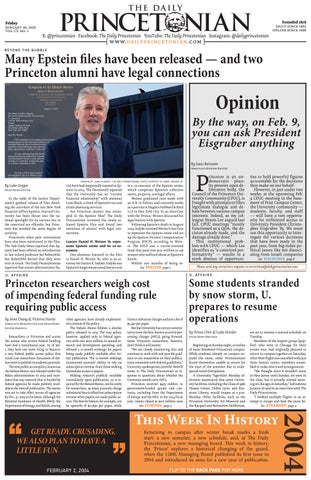
GRAPHIC BY JUAN FAJARDO / THE DAILY PRINCETONIAN. PHOTO COURTESY OF DANIEL WEINER ’81.
Weiner: ‘Epstein was a creep and sex abuser, no one’s denying that. But Indyke and Kahn have not been implicated in his
Continued from page 1
tained, Weiner told the ‘Prince’ that he helped the co-executors hire Kenneth Feinberg, a lawyer who regularly handles large-scale crisis compensation, and his colleagues Camille Biros and Jordana Feldman, to create the EVCP and manage its operations until they ended in August 2021.
The EVCP, designed by the co-executors with significant input from much of the women claimants’ counsel, was administered primarily by Feldman and funded entirely through the Estate. The Estate “just wrote checks,” according to Weiner, and placed no limit, on either individual awards or in the aggregate, on the amounts the EVCP could award. 92 percent of the victims accepted their EVCP awards, which they received after an application process reviewing the details of their relationship with Epstein.
In January 2020, then-U.S. Virgin Islands Attorney General Denise George brought a case against Indyke and Richard Kahn, the other co-executor of the Epstein estate, arguing that the presence of the Estate in the Virgin Islands was a criminal enterprise — and thus, a racketeering scheme. Epstein’s primary residence was in the Virgin Islands. In February 2021, George called Indyke and Kahn “indispensable captains” of the enterprise, which she alleged they “knowingly facilitated.”
Weiner was one of the lead attorneys defending Indyke and Kahn during this suit and helped negotiate a $105 million settlement reached in 2022 — a settlement which, Weiner announced in a public statement, did not constitute
an admission of the executors’ involvement in Epstein’s crimes.
Weiner is currently defending Indyke and the Estate in multiple civil suits.
One of these suits, Allyson Ward v. Indyke et al., was stayed by a New York federal court on Dec. 24, with a positive settlement update sent on Jan. 9.
Weiner is also currently defending the Estate and its co-executors in a civil suit filed by Ghislaine Maxwell, Epstein’s top accomplice, who claims that the Estate should reimburse her legal expenses. Weiner expressed to the ‘Prince’ that he expects this suit to be dismissed.
“We’re not going to pay the bills for someone who has been found by a jury to be a criminal,” Weiner said. “When the suit had been initially filed, she had not yet been found guilty. But her conviction eliminated any possibility that her claim would prevail in court.”
Weiner said that he still continues to handle affairs related to the Estate, which included managing and selling Epstein’s former residences in New York City, Paris, New Mexico, Palm Beach, Fla., and the Virgin Islands.
Weiner also assisted the Estate in its response to two subpoenas issued by the U.S. House of Representatives Committee on Oversight and Government Reform over the summer. Those subpoenas asked for a “complete, unredacted copy” of Epstein’s “Birthday Book,” which contained numerous messages from Epstein’s acquaintances, as well as all video and still photographs taken on Epstein’s former properties. According to Weiner, the Estate cooperated fully with these requests, providing a copy of the book and about 95,000 photographs in which the Estate redacted nudity out of respect for the privacy of the women photographed.
Another subpoena, approved by the Oversight Committee on Jan. 7, will request more material from the Estate’s co-executors. Weiner stated that “the Epstein Estate has pledged to continue its cooperation with the House Oversight Committee, including in response to these latest subpoenas.”
Weiner told the ‘Prince’ that when he first began representing the Estate, his two college-aged daughters asked him why he was involving himself with Epstein. In response, Weiner affirmed his commitment to ethical legal standards.
“I have two daughters, then teenagers now in their mid-20s, who asked me, ‘What are you doing, defending Epstein?’ Epstein was a creep and sex abuser, no one’s denying that. But Indyke and Kahn have not been implicated in his affairs. No court anywhere has found that either Indyke and Kahn had any knowledge of any misconduct by Epstein at the time it occurred,” Weiner said.
Prosecutorial ethics scholar Bennett Gershman ’63 asked to be expert witness in Maxwell trial
Weiner is not the only alumnus with a legal connection to the files. Bennett Gershman ’63 was identified in the files as an expert witness who was contacted by Maxwell’s lawyers to testify in United States v. Maxwell. Gershman is a professor of law at Pace University Elisabeth Haub School of Law and an expert in prosecutorial ethics.
According to the letter submitted to the court by Maxwell’s lawyers in Nov. 2021, Gershman was to be hired to “provide testimony on best practices to ensure the integrity of any prosecution, focusing on investigation, witness preparation, media contact, neutrality, obligations to provide accurate infor-
The Princeton Police Department (PPD) announced the return of free nighttime Uber rides in an effort to reduce impaired driving — a program that is the first of its kind in Central New Jersey.
Rides can be worth up to $15. They are available to be redeemed Thursday through Saturday from 8 p.m. to 2 a.m. at participating local businesses, which include Ivy Inn, McCarter Theatre Center, and Alchemist & Barrister, among others. Users wishing to use the service can scan a QR code found on posters or on the municipality website, which will automatically apply the discount to the next eligible ride.
The program was originally launched in May of 2023, and provided over 900 safe rides before the funding sourced from business donations dried up in late 2025. In a Dec. 30 social media post, the PPD shared that the initiative was revived thanks to community member donations.
In an email to The Daily Princetonian, Princeton Police Chief Matthew Solovay emphasized the initiative’s unique approach, focusing on prevention rather than solely enforcement.
“While DWI [Driving While Intoxicated] enforcement remains essential, the department sought a proactive solution that could reduce risk before a violation or crash occurred,” Solovay wrote.
As of Dec. 9, the PPD recorded 39 DWI incidents in 2025, surpassing the total number of incidents in 2024.
“We want people to enjoy Princeton responsibly, and we want everyone, residents and visitors alike, to get home safely,” Solovay added.
Solovay noted that the reinstatement is only for the short term, as the PPD has yet to identify a viable source for continued funding.
“We want to continue to be able to do [the program]; however, sustainable funding needs to be identified,” Solovay wrote.
The program will run until the current round of donations is exhausted, he suggested.
Ambre Van de Velde is a staff News writer for the ‘Prince.’ She is from Boston.
Nika Schindler is an assistant News editor for the ‘Prince.’ She is from Woodside, Calif.
mation, and relationship with crime victims, their counsel, and case-related civil litigation.”
However, before the case could even reach court, District Judge Alison Nathan filed an order dismissing Gershman as an expert witness and requiring Maxwell’s lawyers to resubmit their request, which they did not do.
The reason, Gershman explained to the ‘Prince’ in an interview, was because prosecutorial ethics did not have any relevance to the case.
“In many cases, it doesn’t seem to have any bearing on the case, the prosecutor’s conduct — that does not factor into the evidence. And I guess that was the way the judge saw the Maxwell trial. There’s no issue involving prosecutorial conduct that really matters here,” Gershman said. “We’re looking at the evidence, conspiracy witnesses, what they say — the prosecutor didn’t apparently hide anything. There’s no claim that the prosecutor did anything wrong.”
Gershman is an acquaintance of Bobbi Sternheim, Maxwell’s lead defense counsel who gave the opening remarks at the trial.
“I think it was a clever move by Maxwell’s lawyers to try to beef up their case with some additional ammunition,” Gershman said of the legal team’s decision to approach him. “The more money you have to hire experts, you might have a better shot, because juries like and respect experts.”
Although he cast doubt on how effective his testimony for Maxwell would be, considering that her associate Epstein was clearly “a vile and contemptible character who did bad things,” Gershman added that, as an expert witness, the morality of the defendant is not of his concern.
“I don’t really have to care about the
defendant. If I’m representing a defendant or if I’m hired by a defense lawyer, it doesn’t mean anything to me,” Gershman said. “They want my opinions. I’m not going to make up an opinion. I’m not going to exaggerate or falsify or misrepresent anything. I would never do that, but I would give my expertise.”
The role Gershman was to play as an expert witness is one that has “a whole range of ways of influencing a jury.” However, Gershman explained that the expectations Maxwell’s lawyers had of him were unclear from the start.
“From the beginning, it wasn’t really that clear exactly what they wanted from me,” Gershman said. “I’ll tell you the truth: I wasn’t shocked that the judge decided to not allow me and other experts to testify.”
However, despite the judge denying the request for him to serve as an expert witness, Gershman maintained interest in the legal dimensions of both Maxwell and Epstein’s trials and published an opinion in the New York Law Journal on the complexities of the “Epstein Saga.”
He has not since been approached by Maxwell’s lawyers. At the time he had been asked to serve as an expert witness, negotiations for payment had not yet begun, and Gershman said that he had no direct interactions with Maxwell.
As of Dec. 24, the DOJ has found close to a million more Epstein documents, which will take “a few more weeks” to be processed and released.
Luke Grippo is a head News editor for the ‘Prince.’ He is from South Jersey, and typically covers high-profile interviews and University and town politics on a national, regional, and local scale.
‘Despite the funding debate,
the new policy may not meaningfully affect Princeton’s research output.’
FUNDING
Continued from page 1
suspended by the federal government in the spring, although around half the total was reinstated over the summer.
For many labs, making their research available to the public is well worth the price. Many researchers told the ‘Prince’ in interviews that the University should not be solely responsible for bearing inflated costs imposed by the journals.
“There’s a temptation to put onus on the University, and maybe that is the right place, but it feels to me that this is a journal-level problem, that journal margins seem to be made through author costs that supply open access,” Kristopher Nichols GS, a Ph.D. candidate in the Psychology department, told the ‘Prince.’
“We pay the amounts right now because we do want things to be open access,” Professor David MacMillan, a 2021 Nobel Prize winner in chemistry, told the ‘Prince.’
“The second thing we do … on our website, we publish all of our papers so that anyone can access them from all over the world for free,” MacMillan added. “This is new science. It should be available to anyone who is curious enough to want to read it.”
Princeton also maintains agreements with 10 publishers to reduce or waive APCs for Princeton researchers. The University also ran a pilot program beginning in 2020 that covered more than $500,000 in APCs and book processing charges across 224 publications. It has since been discontinued due to budget constraints.
“Publication fees in astrophysics can be substantial, and for some researchers, they present a significant barrier,” Caleb Lammers GS, an astrophysics Ph.D. candidate, wrote to the ‘Prince.’
Lammers recalled facing difficulty finding financial support for publication costs as an undergraduate at the University of Toronto and having to rely on journal discounts and research advisors instead.
Joshua Isaacs GS, a Ph.D. candidate in Geosciences, characterized the new federal public access requirement as “naively optimistic given the exploitative nature of publishing.”
“Nobody should have to pay to publish, and nobody should have to pay to read,” Isaacs wrote to the ‘Prince.’
Some researchers and departments
at Princeton already have long-standing practices of making their research immediately available to the public. For researchers who already do this, the Nelson memo won’t change much.
Professor Michael Strauss, the chair of the astrophysics department, told the ‘Prince’ that the department routinely shares papers on preprint archive arXiv, often posting manuscripts before they are formally accepted for publication.
“We basically make it open access even before it gets to the journal,” Strauss said.
Strauss added that a vast majority of papers published in the astrophysics department are in a group of journals under the American Astronomical Society, which made its entire collection of journals fully open access in 2022. “We’ve gotten used to the open access part,” he said.
Researchers in other departments, such as sociology and computer science, also choose to make their research publicly accessible, whether via an archive or choosing to pay APCs during publication.
Despite the funding debate, the new policy may not meaningfully affect Princeton’s research output.
“We’re at Princeton; at other universities, it might be totally different,” Nichols said. “I don’t think that people here are going to stop publishing.”
Lammers wrote that Princeton graduate students are “largely insulated” from paying out of pocket for publication fees anyway, with advisors or labs often covering APCs.
“I think this latest round of rule changes does not have an immediate effect on us. It’s not going to make it even more difficult to publish than it did before,” Strauss said. “The devil is in the details, of course, but speaking in the abstract, open access is definitely a good thing.”
“I think it’s totally normal that taxpayer-funded research should be open to the public,” Nichols added. “The cost is the only substantive issue.”
Sena Chang is the associate News editor for the ‘Prince’ leading investigations. She is from Japan and South Korea, and she often covers local politics and student life. She can be reached at sc3046[at]princeton.edu.
Victoria Davies is a head News editor emerita for the ‘Prince.’ She is from Plymouth, England and typically covers University operations and the Princeton University Art Museum.
Princeton undergraduate on leave dies
By Luke Grippo Head News Editor
The following article includes mention of student death.
University counseling services are available at 609-258-3141, and the Suicide Prevention Lifeline is available 24/7 at 988 or +1 (800) 273-TALK (8255). A Crisis Text Line is also available in the United States; text HOME to 741741. Students can contact residential college staff and the Office of Religious Life for other support and resources. Faculty and staff may speak with a licensed professional by contacting AllOneHealth at 800-451-1834.
Princeton undergraduate Jefferson Voelker ’28 has recently died, according to a Tuesday email from Dean of Undergraduate Students Regan Crotty to the campus community. Voelker was a student in New College West (NCW) residential college, who had been on leave from the University. The email did not mention how long he had been on leave.
A gathering honoring Jefferson’s life will be hosted on Wednesday
ICE detains two men in first Princeton raid of 2026
By Luke Grippo & Oliver Wu Head News Editor & Assistant News Editor
Immigration and Customs Enforcement (ICE) detained two individuals in Princeton early Thursday morning — the first publicly reported ICE detainments in Princeton this year.
“The Municipality was able to independently confirm that two adult males were detained,” a same-day public release from the Municipality of Princeton read.
One of the people detained was a 40-year-old Princeton father who had just dropped his 9-yearold son off at school, according to a statement from State Senator Andrew Zwicker. Resistencia en Acción NJ, a local immigrant advocacy organization, said in a public release that the other person was detained while “on his way to work.”
According to the Municipality, “ICE was unable to provide the reasons [for the detainments] or any additional information.”
Captain Thomas Lagomarsino of the Princeton Police Department shared in a statement to The Daily Princetonian that these detainments occurred “at approximately 8:30 a.m. in the area of John Street.” A crossing guard had reported seeing “two suspicious vehicles” near the intersection of Birch Avenue and John Street, the statement from the Municipality read.
“Several individuals approached the vehicles before they drove away, and the witnesses believed the individuals may have been affiliated with ICE,” the Municipality added.
The Municipality reported that “ICE did not notify the Municipality of Princeton or the Princeton Police Department in advance of their presence or actions.” Lagomarsino confirmed that the police department “was not notified by ICE prior to this incident this morning.”
“The Princeton Police Department follows the Immigrant Trust Directive issued by the New Jersey Attorney General,” Lagomarsino wrote. The Immigrant Trust Directive limits voluntary state law enforcement cooperation with federal immigration authorities in New Jersey.
In their release, Resistencia shared a quote from a relative of one of the people detained.
tation assistance for the two individuals, according to Pazmiño.
Princeton High School (PHS) was placed under a shelter-inplace order for around an hour during the middle of the school day, according to a message from Principal Cecilia Birge. The school is located about a block away from Jefferson Road, where Resistencia reported “possible ICE activity” at 11:30 a.m. During the shelterin-place, entry and exit from the building was barred, but students were still able to move freely within the school.
“Every single entrance of the school was blocked, from the main entrance to the smallest basement door that no one uses — there were teachers in front of each entrance acting like guards,” Princeton High School senior Lilly Ludewig wrote to the ‘Prince.’
She was initially unsure of whether her track team would be able to practice outside after school. The team was eventually allowed to do so, but they had to “stay close to school” and run “in groups,” Ludewig wrote.
“One of my friends was crying. There was, I think, a lot of anxiety,” senior Avery Bahr told the ‘Prince.’ She said she heard “students trying to help other students with different circumstances get rides home because they felt unsafe.”
“It’s kind of surreal to think that something that you see on the news is right outside,” PHS student Winston Jung said.
Several elected officials expressed concern about the incident and other recent ICE activity, including the fatal shooting of Renee Good by an ICE officer in Minneapolis last week.
“The violent raids, lawless detentions, and deadly encounters must stop now,” Zwicker said in his statement. “New Jersey must take steps to protect our residents and fight every senseless kidnapping inflicted on our neighbors.”
“Yet again, it appears the misguided priorities and failed practices of ICE have led not to improvements in community safety but to the breaking up of families,” said U.S. Rep. Bonnie Watson Coleman, whose congressional district includes Princeton, in a statement about the detainments.
munity in the release.
“During this time of aggressive attacks on immigrant communities, we are witnessing ICE kidnapping more fathers, husbands, and workers in our Princeton community,” Pazmiño said. “We will continue to stand up and protect our community with our Rapid Response volunteers, and we urge those with power to stand up and say no to ICE.”
“Our community is in pain knowing that two members of our community were abducted this morning while doing what everyone should be able to do — go to work,” said Asma Elhuni, an organizer of the Resistencia rapid response team. “This is the result of racist targeting, and we will not sit back and watch. We call on others to join us in responding as a community to this violence.”
Last year, there were reportedly over 16 detainments in Princeton by federal immigration authorities. In August, the Princeton Council voted to adopt a resolution that reflected the Municipality’s support of the Immigrant Trust Act, a statewide act that would codify the Immigrant Trust Directive and limit the amount of information that could be provided to ICE by law enforcement officials. The bill was passed by the N.J. State Legislature on Monday and sent to Governor Phil Murphy for approval.
In its statement, the Municipality reaffirmed its commitment to protecting, supporting, and informing the community.
“The Municipality shares the concerns many in our community feel in response to this and similar actions. We remain committed to keeping residents informed and will continue to share verified information as it becomes available,” the statement read.
“Princeton Human Services will continue to provide support, resources, and information to Princeton’s underserved communities. The Mayor and Council remain committed to ensuring that Princeton is a welcoming community for all.”
at 5 p.m. in the home of NCW Head AnneMarie Luijendijk in José E. Feliciano Hall.
Crotty encouraged students “to reach out to one another for connection and consolation, and to call on University resources when you need support.”
The email did not specify a cause or time of death. Voelker’s death is the ninth of a Princeton student since Fall 2022.
“We know that every member of our community joins us in sending condolences to Jefferson’s family and friends and in wishing them strength,” Crotty’s email concluded.
The Daily Princetonian will be writing an obituary for Voelker. Please contact news[at]dailyprincetonian.com if you have memories you’d like to share.
Luke Grippo is a head News editor for the ‘Prince.’ He is from South Jersey, and typically covers high-profile interviews and University and town politics. He can be reached at lg5452[at]princeton.edu.
“My cousin was heading to work. He was no criminal. We’d always meet for coffee in the morning but he never came; he was taken in a van,” the relative said. “He came here to find better opportunities, and now he’s been taken.”
Resistencia is currently in “direct contact with both affected families,” according to the release.
In a statement to the ‘Prince,’ Executive Director of Resistencia Ana Paola Pazmiño shared that the two individuals have not yet been located by Resistencia. The organization is also awaiting a response from Princeton Human Services regarding legal represen-
“A day will come when those who have violated our rights will face justice. It’s up to us to voice our opposition to their actions and serve as witnesses to their crimes,” she continued.
Leaders of Resistencia affirmed the organization’s commitment to protecting the immigrant com-
Luke Grippo is a head News editor for the ‘Prince.’ He is from South Jersey, and typically covers high-profile interviews and University and town politics, on a national, regional, and local scale. He can be reached at lg5452[at]princeton.edu.
Oliver Wu is an assistant News editor and Features contributor for the ‘Prince.’ He is from Stony Brook, N.Y.
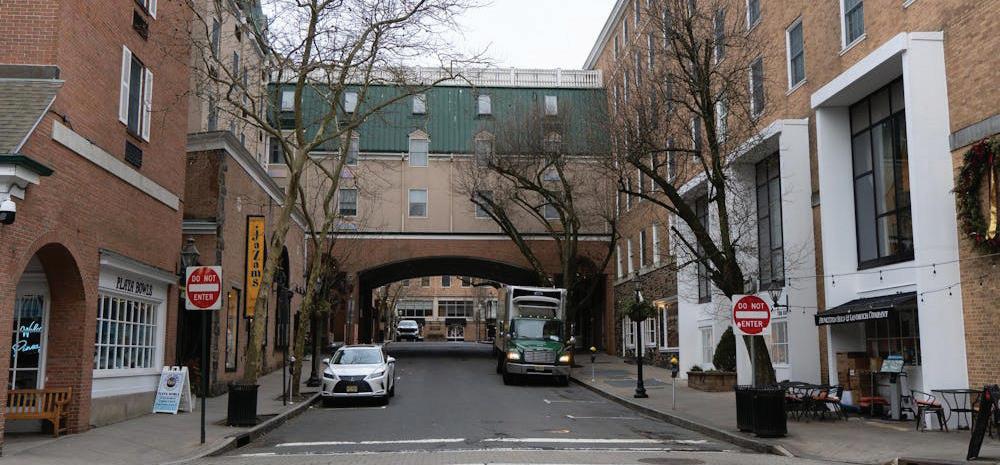
PHOTO COURTESY OF LOUISA GHEORGHITA Palmer Square East in Princeton.
Mikie Sherrill sworn in as governor, two Princeton faculty served on transition teams
By Sena Chang & Gray Collins Associate News Editor & Assistant News Editor
Mikie Sherrill was sworn in as the 57th governor of New Jersey on Jan. 20, becoming an ex officio trustee of Princeton University. In this role, she will hold a vote on major University decisions.
For the period between her election and inauguration day, Sherrill appointed two Princeton faculty members to lead two of her administration’s transition teams.
The first was School of Public and International Affairs Professor of the Practice Heather Howard, who co-chaired a
team focused on affordable healthcare policy. In the role, Howard led multiple state and national experts focused on expanding healthcare affordability. Howard previously served as policy counsel for former N.J. Governor Jon Corzine and as commissioner of New Jersey’s Department of Health and Senior Services.
The other professor, Sociology and SPIA professor Kathryn Edin, co-chaired the Kids Mental Health and Online Safety Action Team. At Princeton, her work focuses largely on the effects of poverty in America.
At her inauguration, Sherrill discussed
her term goals, including issuing a series of executive orders aimed at targeting high utility costs, accelerating renewable energy projects, and boosting government transparency, among other issues.
“I am going to spend every minute trying to make New Jersey more affordable and open doors to opportunity across our state,” Sherrill told an audience of more than 2,000 in her inaugural address. During her speech, the Governor signed two executive orders on stage that were largely in line with promises she made on the campaign trail.
The first order froze utility rates through bill subsidies and declared a state of emergency on the “electricity affordability crisis,” while the second addressed the need to expand energy supplies across the state. According to NPR, New Jersey residents have experienced a double-digit increase in electricity rates in the past year.
“As we see Washington trying to shut the door on opportunity, on your safety and security, on education, on healthcare, on access to good jobs, on innovation, and investments in energy and infrastructure, as we are seeing doors shut for families, for working people, for vulnerable communities, as they attempt to roll back the tide of progress — not here,” Sherrill said.
While Sherrill did not invoke President Donald Trump by name during her address, she compared his actions to the tyranny of King George III. The November election “proved that the people of New
Jersey recognize the parallels,” Sherrill said. “That we see a president illegally usurping power.”
Once again referencing the United States’ founding, Sherrill cast New Jersey as a stronghold in the face of the President’s destructive actions. “On November 4th, the people of New Jersey once again gave the nation a glimmer of something it hadn’t felt in months: hope,” she said in her inaugural address, referencing her own election victory. “Yes, 250 years after the Declaration, 250 years after General Washington crossed the Delaware into the promised land, I am proud that once again, New Jersey is leading the way.”
Lieutenant Governor Dale Caldwell ’82 also delivered remarks on the same day, aligned closely with Sherrill’s characterization of New Jersey as a stronghold against national-level threats and divisions.
Beyond policy matters, Caldwell highlighted the need to “strengthen the social fabric of our state.” He continued, “At a time when Washington is intent on tearing us apart, here in New Jersey, we must rebuild the trust between neighbors.”
While Sherrill did not mention the Trump administration’s attacks on higher education explicitly in her inaugural address, her office is expected to take a hard stance against the President’s cuts to research.
In the first gubernatorial debate held in September, Sherrill expressed strong sup-
port for Princeton University, expressing that she wants to “ensure that we’re continuing to push money into our ally University, including where we are improving innovation, driving up our research.”
On the eve of the November election, The Daily Princetonian interviewed Caldwell, who made clear that the Sherrill administration will actively fight against Trump’s attacks on higher education.
“Donald Trump has targeted the Harvards, the Yales, the Princetons, the Columbias of the world for our research dollars,” he told the ‘Prince’ in November. “They’re trying to pull out billions of dollars out of Ivy League institutions, so they can’t do research.”
Caldwell also expressed the necessity to appoint “a strong attorney general” to fight “these unconstitutional abuses.” Sherrill will serve a four year term as governor, with the possibility of re-election in 2029. Her first Princeton Board of Trustees meeting is scheduled for Jan. 31.
Sena Chang is the associate News editor for the ‘Prince’ leading investigations. She is from Japan and South Korea, and she often covers local politics and student life. She can be reached at sc3046[at]princeton.edu.
Gray Collins is the assistant News editor for the ‘Prince’ leading university administration coverage. He is from outside of Philadelphia and can be reached at graycollins[at]princeton.edu.
‘Some professors canceled classes altogether or switched to virtual options due to the storm.’
STRANDED
Continued from page 1
fore it got too bad… [but] that didn’t work out,” Fayad Haghamed ’28 told the ‘Prince.’
In a Sunday announcement, the University shared that Monday classes would be held at the discretion of individual faculty. Some professors canceled them altogether or switched to virtual options due to the storm.
Juraeva was able to attend her organic chemistry lecture online on Monday, but missed a second class that had maintained in-person instruction.
Haghamed, who missed multiple classes due to the snow delay, shared with the ‘Prince’ that the experience was “rather frustrating.”
According to Haghamed, his math course had announced that “sending out
recordings and doing Zoom apparently goes against department policies,” while his Mechanical and Aerospace Engineering course “also just did an in-person [class] without any virtual support.”
“Two of my classes [on Monday] were cancelled, and the third had a Zoom, but I was unable to attend due to my flight [back to campus],” Eli Padoan ’28 told the ‘Prince.’ After his original flight out of Puerto Rico was canceled, Padoan flew to Florida, where he remained until his Monday flight.
Joe Harris ’28, who had three flights from St. Louis cancelled over the weekend and on Monday, was able to attend his sole Monday class virtually. However, with a new flight scheduled for Tuesday morning, Harris expects to miss all three of his classes that day, as well as mandatory football team workouts.
“You want to be on top of classes, especially for the first week back. So it’s
been kind of aggravating,” he said. Compared to other Division I sports with a pre-semester practice schedule, the football team “already started at a disadvantage coming back so late,” Harris added.
Raven Reid ’28 expressed to the ‘Prince’ that she wished accommodations for stranded students could be extended by more than just one day.
“My flight was rescheduled to Tuesday night, which means I will also miss classes tomorrow. Tomorrow, since I have no additional grace period, I am expected to be in class,” she wrote in a statement to the ‘Prince.’ “I wish the University would take these travel delays into greater consideration.”
Princeton Public Schools stated in an update on its website that schools would reopen on Tuesday using a “90-minute delayed opening schedule” and advised students and parents to be careful re-
turning to school, as temperatures were forecasted to drop once again and surfaces would refreeze.
NJ Transit shared on its website that rail service would operate under “Severe Weather Schedule Level 2.” Bus, light rail, and Access Link will operate on a normal weekday schedule.
Teresa Chen is a staff News writer from Shanghai. She can be reached at tc7069[at] princeton.edu.
Princeton neuroscience professor to seek Democratic nomination in crowded open House race
By Emily Murphy Staff News Writer
You might know Sam Wang because he famously ate a cricket on national television in 2016 after losing a bet that Hillary Clinton would win that year’s presidential election.
Wang is a neuroscience professor at Princeton and the founding director of both the Princeton Gerrymandering Project and the Electoral Innovation Lab. On Monday, he filed with the Federal Election Commission to run for Congress in New Jersey’s 12th district, which includes the municipality of Princeton. In an interview with The Daily Princetonian, Wang said he plans to officially announce his candidacy in the coming weeks.
Incumbent Democratic Rep. Bonnie Watson Coleman announced last fall that she would not seek reelection after 14 years in Congress. Wang is not currently registered with either the Republican or Democratic Party, but he will be running
for the Democratic nomination.
“I think of myself as a nonpartisan, as someone who wants to find ways to make the system work better,” Wang said. “Seeing ways in which our system of government is being undermined in ways that I never could have imagined has made me realize that everyone needs to get involved. My contribution is to do more than I did before, to stop being just a researcher.”
There are more than a dozen candidates running for the Democratic nomination. Regarding how he differs from other candidates, Wang said that he is “a scientist with an extremely solid track record in both medical research and also election reform.”
“What I would like to be is an outsider who comes in and works not just for Democrats, not just for Republicans, but works using evidence and science and data to try to make a country that’s stronger for everybody,” Wang said.
In 2022, the New Jersey Globe reported
that Wang was being investigated by the University over allegations of research misconduct and toxic workplace issues.
A University ad hoc committee found the research misconduct allegations were “without merit” in 2022, and no other policy violations were found from any other investigations.
He was also accused of manipulating data in favor of Democrats while advising two members of the New Jersey Redistricting Commission in the state’s redistricting process. The New Jersey State Commission of Investigation conducted an investigation and subsequently cleared him of alleged data manipulation in September 2023.
“That was a very difficult period of my public service. I thought that helping with redistricting as a technical expert was an important duty,” Wang said of the allegations. “But I’m back, and I hope that it toughened me a little bit.”
Wang also testified as an expert witness in a 2024 election case, which led to
the abolition of New Jersey’s county line voting system.
“That’s an example of an exclusionary policy that made it really hard for outsiders to get it, and I’m running as an outsider,” he said.
If elected, Wang hopes to reform electoral processes.
“In the long term, there are bugs in our democracy that need to be fixed, and those bugs make it hard for everyone to be represented,” he said. “That can involve things like a new voting rights act. It can involve things like protections and changes in voting rules, anything from multi-member districts to ranked-choice voting to all-party primaries.”
Wang also discussed a short-term need to ensure that voters in swing districts experience free and fair elections. He further noted that he was “disturbed at the breakdown in the rule of law.” He gave examples including the gutting of the U.S. Agency for International Development, “the sabotage of scientific research,” and
the actions of immigration enforcement agents.
“It is my belief that the next few years will be an opportunity to rebuild and to build something new,” Wang said. “It involves taking a good, hard look at everything, whether it be the electoral college or redistricting or having an impartial administration of justice. All these things, evidently, need rebuilding, and so it’s a huge amount of work.”
Last March, he wrote a joint op-ed in the ‘Prince’ with other University professors defending academic freedom.
“Our system is so broken right now, and it needs people. I think that it’s easy to feel hopeless, but I’m hoping that we can work to save what we have and rebuild afterwards.”
Emily Murphy is a staff News writer and senior Copy editor for the ‘Prince.’ She is from New York and can be reached at emily. murphy[at]princeton.edu.
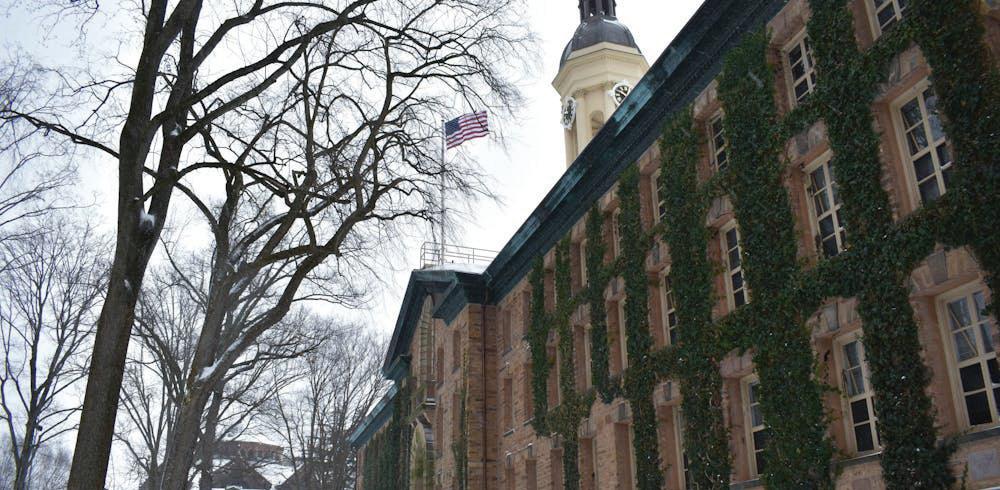
MC MCCOY / THE DAILY PRINCETONIAN Nassau Hall.
Leela Hensler is a staff News writer and a staff Sports writer for the ‘Prince.’ She is from Berkeley, Calif. and can be reached at leela[at] princeton.edu.
EMILY MURPHY / THE DAILY PRINCETONIAN About 10 inches of snow fell on Princeton’s campus.
Hum r
Here’s the biggest headlines you missed while on break
By Tarun Iyengar, Nicolas Rohou, Nathaniel Voss, and Francesca Volkema Head Humor Editor, Associate Humor Editors & Assistant Humor Editor
The following content is purely satirical and entirely fictional.
Over winter break, you may have made the mistake of remaining blissfully unaware of the “buzz” from campus and around the world. As such, we at The Daily PrintsAnything have decided to do the honorable work of summarizing last month’s biggest headlines and breaking news stories, you lazy chuds
Princeton men’s hockey game attendance booms
After averaging less than 50 spectators per game, 780 spectators turned out to Sunday’s nail biter against Bentley. Richard ‘Dick’ Muncher, #26, was happy but confused about his sudden fandom: “They kept chanting my name, and it only seemed to excite them more when I said I was a bench rider. And what does ‘do the Heated Rivalry thing’ mean?”
Trump family announces mobile game
In the game, which critics have denounced as a “total Pokemon GO spoof,” players will take the form of a heroic ICE agent who throws cages to catch immigrant children. Pesky parents can be chased off with pepper spray or pre-caught at church services. Analysts have concerns over the game’s profitability, which will be exclusive
to the PrintsAnything app on Trump Mobile. Saudi Arabia invested $8 billion in the project after the addition of a ‘kill a protester’ function.
Analysis shows entire Class of ’26 AIgenerated
With accusations of dishonesty sweeping across Fizz, the crack investigative journalists on the PrintsAnything multimedia team revealed that the entirety of the Great Class of 2026 was AI-generated. Every member of the class will have to present themselves before the Committee on Discipline for a marathon hearing scheduled for later in February. If the seniors sink when their bodies are tied up in Lake Carnegie or burn at the stake in the Chapel, they will be deemed innocent and zero percent AI.
University totally never implicated in the Epstein Files
With the Department of Justice hard at work to release the much anticipated Epstein Files (rated higher on Rotten Tomatoes than Stranger Things Season 5), there has been no mention, whatsoever, of any Princeton faculty members, alumni, staff, students, parents of students, or any campus acquaintances in the first five pages of the files. In stark contrast, Harvard offered the New York financier-turned-Floridaman an endowed, tenure track position as a professor of developmental psychology.
Students find it more difficult to return to University because of snow than ICE
The alleged “storm to end all storms” has sent the globe into a frenzy with many sources reporting record-low temperatures, record-high snowfalls, and a cacophony of exploding trees. Students traveling from outside of the United States acutely feel the impacts of the snowmageddon, as Newark Airport is completely submerged in snow and will have to be recovered via excavation. Due to the extreme weather, students have not yet had to venture through customs, which causes anxiety for many of the University’s international students. However, Newark’s ICE employees are the only airport staff trapped under the snow and will likely not melt for at least a couple months.
Daily PrintsAnything to “Democratize” Colombia
Get in on our new kickstarter investment campaign to fund our revolutionary new idea: help a South American country with their governmental problems. Our bronze tier members will get a share of United Oil Company, a new subsidiary company created with the goal of supporting those struggling Colombian oil farmers and taking the burden of “owning land” out of their hands. Our silver tier members will share in the Nobel Peace Prize this operation inevitably receives. Finally, our Gold, Super-Platinum, and UltraDiamond tier members will get their very own honorary cabinet positions, with our Super-Mega-Giga-Titanium Top Member automatically elected president.
Tarun Iyengar is the head Humor editor. He
was the founder and former Board president of Woman. He can be reached at ti7371[at]princeton. edu.
Francesca Volkema is an associate Humor editor and also the newly appointed president and CEO of Woman. She can be contacted at fv1281[at] princeton.edu
Nate Voss is an assistant Humor editor and the self-nominated vice president and CFO of Woman. He can be contacted at nv5141[at]princeton.edu.
Nic Rohou is an associate Humor editor. His grandma, the COO of Woman, recently got hit by a bazooka. Kaboom, Kablaow. He can be reached at nr9348[at]princeton.edu.
Rutgers president, sign seized in raids, Eisgruber announces
By Isaac Barsoum Staff Humor Writer
The following content is purely satirical and entirely fictional.
Princeton University carried out a successful raid at Rutgers University–New Brunswick on Saturday night, University President Christopher Eisgruber ’83 announced in a press conference Sunday morning. In addition, the University executed a second raid at Newark Liberty International Airport.
During the first raid, the University seized Rutgers President William F. Tate IV. “He was in an office that was more like a fortress than an office,” said Eisgruber. “It had steel doors. It had what they call a safety space, where it’s, you know, solid steel all around. He didn’t get that space closed. He was trying to get into it, but he got bum-rushed so fast that he didn’t get into that. We were prepared. We had, you know, massive blowtorches and everything else that you need to get through that steel. But we didn’t need it. He didn’t make it to that area of the office.”
In the press conference, Eisgruber revealed that Tate was being transported by Princeton University Public Safety officers to Princeton via NJ Transit. When asked why Tate had not yet arrived on Princeton’s campus, Eisgruber said that the train was
delayed by four hours, and then the Dinky was replaced by a bus.
Once Tate arrived on campus, he would be held on a TigerTransit electric bus and forced to do MAT 104 problem sets, Eisgruber said. Three international human rights lawyers told The Daily PrintsAnything that using MAT 104 problem sets as a punishment is “cruel and unusual” and “probably a violation of the Geneva Conventions.”
Eisgruber stated that Tate will stand trial before the Honor Committee, where he will be prosecuted ac-
cording to the traditional standard of “guilty until proven innocent.” In response to an email from the ‘Prints’, University spokesperson Michael Hotchkiss wrote that “we will seize his cell phone and, if he refuses to give it up, take that as bulletproof evidence of his guilt.”
“We will run [Rutgers] until such time as we can do a safe, proper, and judicious transition,” Eisgruber said during the press conference. “We can’t take a chance that someone else takes over Rutgers who doesn’t have the interests of Rutgersians in mind.” He
confirmed that University Provost Jennifer Rexford ’91 and Vice President for Campus Life Rochelle Calhoun would take over leadership of Rutgers as a “side hustle.”
Eisgruber also announced plans to seize Rutgers’s research enterprise. “We’re going to have our very large Princeton laboratories, the biggest anywhere in the world, go in, spend billions of dollars, fix the badly broken enterprise, the research enterprise, and start making money.”
Just before press time, Princeton revealed that it had carried out a second successful raid at Newark Liberty International Airport, stealing the large Rutgers sign that previously stood in Terminal A and replacing it with a Princeton one.
The Office of the Dean of Undergraduate Students announced in a statement that the stolen sign will be used as kindling in the next traditional Princeton bonfire, in the unlikely event that Princeton football should ever again beat both Harvard and Yale in a single season.
“Princeton’s dominance in the tristate area will never be questioned again,” said Eisgruber.
Isaac Barsoum ’28 is an associate Opinion editor and staff Humor writer. He was a member of the Princeton special operations team that seized the Rutgers sign from the airport. You can reach him at itbarsoum[at]princeton.edu.
ISAAC BARSOUM / THE DAILY PRINCETONIAN Rutgers president, sign seized in raids, Eisgruber announces.
CANDACE DO / THE DAILY PRINCETONIAN
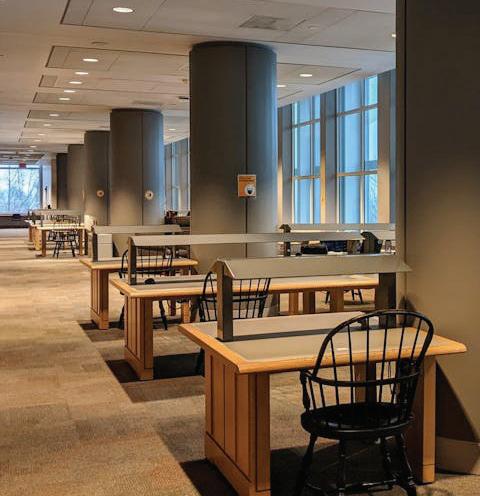
An empty study space in Frist Campus Center.
Why Princeton needs opinion journalism
Lily Halbert-Alexander & Charlie Yale Head Opinion Editors
In an age of social media, access to news and information can seem less like a privilege than a tidal wave. What we end up seeing isn’t fully objective: It’s composed, in large part, of opinions and biased perspectives that arise in the aftermath of striking or unsettling events. As long as you have a device and an internet connection, you can share and consume opinions on any given subject with minimal vetting.
Some of these opinions are wellconsidered; many more are not. And an uncomfortably large number are intentionally malicious, seeking to spread hate, perpetuate misinformation, or cause instability.
There’s no shortage of editorialized content in the world today. So why would you specifically seek out the opinion page of a newspaper, and why ours in particular? What do we, as a student newspaper, have to offer you as a member of the Princeton community?
Our editorial process can begin to answer that question. Every Opinion piece published in The Daily Princetonian passes through the hands of multiple Opinion editors, the copy desk, and the managing editors. We do this to ensure
that we produce quality writing about relevant topics, and so readers can trust that every single piece we publish has been thoroughly fact-checked and revised for clarity of argument and precision of language.
Posts on Fizz or listserv emails do not benefit from the careful attention of editors, and they aren’t held to the same ethical standards. When emotions run high, it’s much more difficult to publish a column than to post to social media. It’s exactly at these moments of intensity that reasoned commentary is most powerful. That’s why it’s essential to get it right through clear, direct argumentation and accountability to the facts.
But the thoughtfulness and integrity behind what we publish isn’t the only reason why the Opinion section might interest you. From understanding how our grades intertwine with politics to a story from a professor challenging a particular framing of college classrooms, reading the Opinion section allows you to access perspectives on issues that you wouldn’t be able to get any other way.
Engaging with Opinion — whether through reading or writing — brings you into closer contact with campus discourse. Just as news reporters provide unbiased coverage on campus developments, we work to communicate to our
readers what these events mean for their lives, and how current campus issues might intersect with their own values and roles in the community.
The Opinion section’s content can do more than just keep you informed. It can give you access to a space where members of the community commit to having difficult conversations about the topics that matter to them, from budget cuts to environmental impact to free speech and international students’ rights.
Campus issues continuously tie back to a high-stakes national political stage, further aggravated by an administration hostile to universities. As such, the discourse that concerns life at Princeton can be divisive, complicated, and confusing. But that’s why our section is here. Listening closely, forming your own arguments, and defending them are all fundamental to being a member of any community, Princeton or not.
But publishing content that people will like is not the Opinion section’s role. New York Times columnist and Pulitzer Prize winner Carlos Lozada GS ’97 wrote that he “[dies] a little inside” every time someone wholeheartedly agrees with an argument he makes. To a similar effect, the goal of Opinion’s writing is not to be the most agreeable or win the largest consensus.
And it is certainly not to simply affirm your thinking.
Instead, we write to stimulate engagement with issues that matter to the daily lives of Princetonians. We write to challenge the status quo, prod at perspectives, and introduce you to ideas you might have never considered. When we edit, we’re concerned with whether a piece is well-researched and well-argued, not with whether or not we personally agree with the opinion at issue.
You may or may not be persuaded by a given piece you read in the Opinion section. But confronting and entertaining ideas you disagree with — no matter how much you’ve thought through your own perspective — can help refine
your arguments against them. The opinions we publish are intended to begin conversations, not end them, and certainly not to put a definitive lid on any issue.
A productive and stimulating campus discourse requires engagement from all sides. This process can be tense and overwhelming. But the best way to respond is with discourse grounded in strong argumentation and a willingness to be challenged — and that’s what our section works to provide.
PAW omits reporter’s Supreme Court appeal — at the cost of journalistic principle
Jon Ort & Laurel Leff Guest Contributors
Last month’s issue of the Princeton Alumni Weekly (PAW) fawns over Michael Park ’98, a right-wing lawyer and, since 2018, a U.S. circuit judge. Park’s portrait commands the cover, while the accompanying long-form profile, titled “The Contender,” speculates that he could become Donald Trump’s next nominee to the Supreme Court.
The author is P.G. Sittenfeld ’07. The piece’s tagline describes Sittenfeld as “a freelance writer based in Cincinnati” who has published in Esquire, Outside, Slate, and The Washington Post. So far, so unobjectionable.
But Sittenfeld is not just any old journalist. Last May, President Donald Trump pardoned Sittenfeld, a one-time rising star in Cincinnati politics, following his conviction on federal bribery and extortion charges in 2022. Sittenfeld, a Democrat, owes his freedom to Trump — the man who nominated his subject Park to his judgeship, and the man with the power to elevate Park further to the nation’s highest court. Nowhere does PAW disclose this striking conflict of interest.
To be clear, we believe in second chances. We do not necessarily object to Sittenfeld freelancing for PAW, which has written sympathetically about his story in the past. And we recognize that the case against Sittenfeld has drawn
legitimate scrutiny. Indeed, the appellate judges who upheld Sittenfeld’s conviction urged the Supreme Court to review the relevant law.
Sittenfeld has sought such review, lodging an appeal, Sittenfeld v. United States, before the Court, arguing that his prosecution was unlawful. The case is a rare instance of the recipient of a presidential pardon having his cake (accepting the pardon) and trying to eat it too (by continuing to use appeals to have the conviction vacated).
Last month, Sittenfeld’s lawyers indicated that he would drop his appeal if the Supreme Court ordered a lower court to vacate his conviction. Trump’s Department of Justice has followed suit with a brief requesting that the Supreme Court clear Sittenfeld and dismiss his appeal.
The Supreme Court is therefore poised to consider whether to wipe clean the stain of Sittenfeld’s conviction. For Sittenfeld, the potential to have his conviction vacated is clearly important — it would help restore his reputation and might lead to revitalization of his political career, even though he has disavowed the possibility. Whatever the merits of the case, having Sittenfeld write an article about that very institution is a clear conflict of interest. Though the University has funded PAW since 2021, the magazine retains its editorial independence and journalistic mission. PAW shouldn’t have had Sittenfeld write the piece, or at least should have let readers know about this
conflict.
Other problems surface in the profile as well. The most obvious: Sittenfeld is overly deferential to Supreme Court Justice Samuel Alito ’72, for whom Park clerked twice, both on the appellate and Supreme courts. Alito has not publicly recused himself from Sittenfeld’s appeal.
Sittenfeld quotes both Park and Alito praising one another. Alito describes Park as “exceptional, very smart, hardworking, dedicated, and a delight to work with,” “a gem,” and “a superb choice” for the Supreme Court. Sittenfeld would have us marvel at Alito’s endorsement: “Even Supreme Court Justice Samuel Alito ’72 says Park, who clerked for him twice, has the right stuff.” But what would any judge say on the record about a protégé? The profile notes that Alito provided PAW with quotes via email, which means we cannot know whether Sittenfeld contacted Alito directly, much less whether Alito knew that Sittenfeld is a petitioner whose case he will review.
Sittenfeld, however, doesn’t grant Sen. Chuck Schumer (D-N.Y.) the courtesy he extended to Alito. When President Trump nominated Park to the Second Circuit in 2018, Schumer declined to back Park but agreed to meet with him. Sittenfeld quotes Park’s reaction to Schumer. Park told Sittenfeld he hoped he “could persuade” the senator “that I’m conservative, but fair.” Sittenfeld then quotes Park making clear that Schumer never gave him the chance: “Instead, the then-Senate
minority leader ‘arrived late, left early, was grumpy the whole time, and spent most of it railing on the Federalist Society,’ says Park.”
Sittenfeld’s presentation of that anecdote is unfair for several reasons. First, he doesn’t indicate that he ever gave Schumer’s office an opportunity to respond, a necessary part of reputable reporting. Second, Sittenfeld doesn’t mention that the Federalist Society has championed his appeal. Third, Sittenfeld doesn’t disclose the reasons why he, not just Park, might not be a fan of Schumer’s. Schumer likely supported Sittenfeld’s opponent in the Democratic primary for an Ohio Senate seat in 2016. Schumer has also been an outspoken critic of Trump’s sweeping pardons of white-collar criminals.
Aside from the abundant conflicts arising from these connections, Sittenfeld’s profile of Park doesn’t meet basic standards of good reporting. Sittenfeld doesn’t quote anyone saying anything remotely negative about Park. Moreover, the PAW article makes it seem as though Park is just another conservative judge, without mentioning the ongoing struggle between principled conservative jurists, such as former Fourth Circuit Judge J. Michael Luttig, and those more willing to bow to Trump’s demands. At least some of that disagreement — and where Park stands on the divide — should have been included in the article.
Although Sittenfeld has cast his appeal as a righteous struggle to defend the First Amendment, it
has become useful cover for the Trump White House. Sittenfeld has an established record of opposing Trump, whom he once called a “buffoonish carnival barker.” JD Vance has cited Sittenfeld’s progressive past to deny that Trump is rigging the judicial system for his allies.
In addition, more is at stake in Sittenfeld v. United States than Sittenfeld’s criminal record or personal reputation. Toughening the requirements to prove bribery aligns with recent right-wing efforts to absolve public officials from accountability. Should the Supreme Court accept Sittenfeld’s appeal, experts predict that a cascade of past corruption convictions would unravel. Money would flow even more freely between donors and candidates. Some argue that right-wing groups are seizing on Sittenfeld’s appeal to cement oligarchic control over electoral politics.
By publishing Sittenfeld’s profile of Park without noting his interests before the Supreme Court, PAW neglected its journalistic duty to alert its readers when a writer cannot fairly cover a story. Given all that hangs in the balance, transparency about Sittenfeld’s conflicts is not optional but foundational to good journalism.
Jonathan Ort ’21 is a Ph.D. student at the University of Chicago and a former editor-in-chief of the ‘Prince.’
Laurel Leff ’78 is a professor of journalism, emerita, at Northeastern University and a former reporter and editor.
Lily Halbert-Alexander and Charlie Yale are the head editors of the Opinion section of the ‘Prince.’ They encourage you to respond to this piece or write an op-ed for the ‘Prince.’
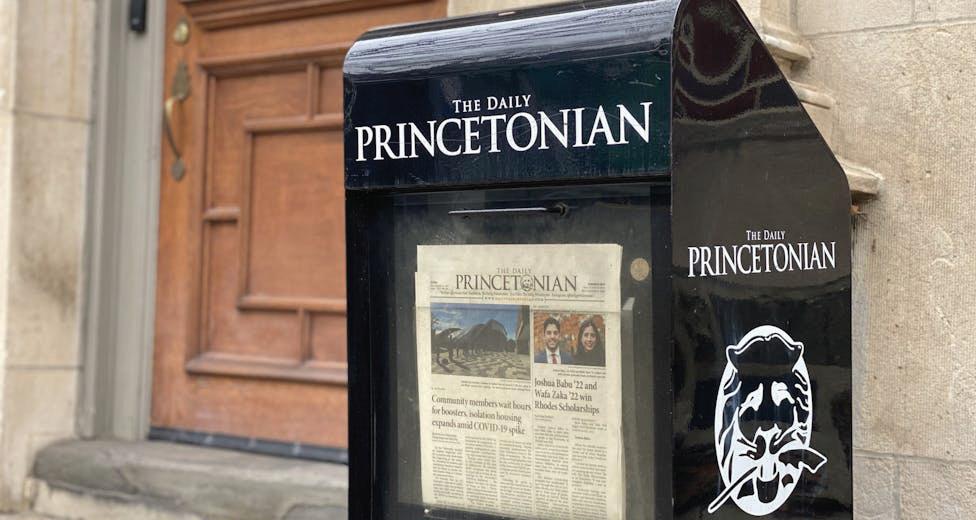
ZACHARY SHEVIN / THE DAILY PRINCETONIAN A box of papers outside of the Student Publication Center at 48 University Place.
‘To an ordinary member of the campus community, Eisgruber is strikingly difficult to reach.’
EISGRUBER
Continued from page 1
to student life concerns such as ending independent dining.
To an ordinary member of the campus community, Eisgruber is strikingly difficult to reach. Aside from his monthly sanitized appearances at CPUC meetings, during which community members can ask prescreened questions and receive pre-prepared answers, he holds biannual conversations with pre-registered groups of students in each of the residential college dining halls, and just two hour-long sections of office hours per year reserved for oneon-one, off-the-record meetings.
The upcoming opportunity is so distinct because of Eisgruber’s inaccessibility. Questions at CPUC are usually submitted three days in advance; this length of time between question submission and CPUC meeting gives Eisgruber and the University administration plenty of time to prepare carefully worded responses to dodge accountability. That often entails bringing other administration figures to answer the questions instead of Eisgruber.
But on Feb. 9, pre-meeting
question submission isn’t required, and Eisgruber alone has to answer our questions. When this sort of opportunity comes around, we should seize it to advocate for our interests and opinions to one of the few true decision makers at the University.
Questions that necessitate unprepared answers often reveal more of the truth. Unexpected questions — in certain cases — can help questioners extract a fuller truth than when their respondents use prepared answers to expected questions.
That is potentially part of the reason Eisgruber was so aggrieved about the unexpected questions he received at the March 2025 CPUC meeting, and why CPUC began to project original questions onto the screen when they are read. Asking questions without allowing the administration to prepare a response will likely produce a more unpolished, whole-truth answer.
In that sense, progress is possible: While pre-screened questions allow Eisgruber to dodge difficult topics, asking him to pick a side on an issue of importance to the University and its students, faculty, or staff without preparation may result in less smoke and mirrors and a
more direct answer.
While in a world of prescreened questions and prepared answers, a decisionmaker can obfuscate their true position behind rhetoric, in a world of unexpected questions and off-the-cuff answers, a decision-maker might be forced to “pick a side.” Given that Eisgruber and his colleagues are likely media-trained, they are perhaps still unlikely to deviate from set talking points. Even in this case, your questions — at the minimum — force them to think about the issues that matter most to you and enter them into the public consciousness as well.
If they do pick a side, though, it’s useful to those who want change, no matter what side they pick. That’s because, either way, the next steps are clear: if they pick the side advocates agree with, it’s a success; if they pick the opposite side, we can more clearly point out the fault in that decision and push for change.
That means that a question for Eisgruber about dining, divestment, international student protections, research funding, mental health, or any of the many other issues facing our community has the chance, however small, to prompt an ac-
tual change in the University’s course of action over the coming year.
We have a rare opportunity on Feb. 9 to ask Eisgruber questions about those issues in a way we wouldn’t otherwise be able to. I urge you to attend the CPUC meeting that day and bring hard, unexpected questions.
CPUC and University governance as a whole are usually mere performances of democ-
racy at best. But on Feb. 9 at 4:30 p.m. in the Frist Multipurpose Room, for an unmitigated hour and a half, President Eisgruber answers to us. Let’s not squander that opportunity.
Isaac Barsoum ’28 is an associate Opinion editor from Charlotte, N.C. He thinks “smoke and mirrors” should be reserved for Terrace, not University governance processes. He can be reached at itbarsoum[at] princeton.edu.
I don’t want to get run over by an e-bike
Charlie Yale Head Opinion Editor
Maybe you weren’t paying as much attention as you should have been on the walk to class, talking with friends or looking at your phone. Maybe you were just standing in the wrong place at the wrong time. No matter what you were doing, your fate remains the same. A person riding a vehicle that can hardly be considered a bicycle speeds past and nearly knocks the living daylights out of you. On certain occasions, there is no near miss: One of my friends was thrown off of their skateboard when an e-bike collided with them at high speed on Goheen Walk. The student operating the ebike was on a FaceTime call during the collision. In any scenario, there
is an understanding that the e-bike situation on this campus is out of control.
But the tides might soon change. At its next meeting, Princeton’s Environmental Safety and Risk Management (ESRM) committee will consider a change to the University’s current e-bike policy. Due to the risk they pose to pedestrians and riders on campus, the ESRM committee must ban e-bikes once and for all.
Princeton’s ban of e-scooters in 2024 came as part of a broader policy regulating personal electric vehicles (PEVs). This policy also regulated e-bikes on campus — but, considering the prevalence of prohibited e-bike activity, you probably wouldn’t know it.
For example, the PEV policy bans the use of e-bikes that don’t require pedaling to actuate the motor. The policy also stipulates that e-bikes
should not be operated at over 10 miles per hour, that they cannot be driven on paths and sidewalks that are also used by pedestrians, and that they aren’t allowed inside of buildings. Tandem riding isn’t allowed, and there are a slew of parking rules regulating where the bikes can and cannot be left.
During my last week on campus last semester, though, I saw every single one of these rules broken. Not just once, either. Anybody trying to get to their 10:40 a.m. class at any point during the semester would tell you the same. Few, if any, e-bikers pedal. E-bikes weave through pedestrians, are parked in the middle of pedestrian pathways, and are definitely driven faster than 10 miles per hour. The University’s enforcement of the current e-bike policy has been lackluster, and it has been campus pedestrians who have faced the peril.
Around the country, studies have shown again and again the risks that e-bikes pose to the health and safety of users and pedestrians alike: A 2024 study found “an increased number of injuries and hospitalizations” with electric bikes and scooters compared to their conventional counterparts between 2017–2022. Oftentimes, those injuries ended up being more severe, and, in some cases, led to deaths, something practically unheard of with conventional bike crashes not involving cars.
In theory, the ESRM committee’s current rules are sufficient. Students would still be able to use e-bikes on roadways like Elm Drive, Prospect Avenue, Stadium Drive, or Washington Road to traverse long distances on campus, and pedestrians wouldn’t have to worry
about getting run over on Goheen Walk because e-bikers would dismount.
In reality, these rules have been broken continually since their implementation, leading to near misses, crashes, and injuries, like the ESRM committee pointed out in their presentation to the Council on the Princeton University Community (CPUC) in early December. I understand that a policy like this is difficult to implement, and the sheer number of e-bikes on Princeton’s campus, anecdotally, has increased rapidly since the ban on e-scooters. But I’m still left scratching my head at how the University ever planned to enforce a policy like this in the first place.
Indeed, the reason that there are so few e-scooters on this campus is because the ban worked — the policy was clearly defined, and it has been subsequently enforced by the University. But one of that policy’s knock-on effects has been an increase in e-bikes, and it is time for the University to address the problem wholeheartedly — not with an unenforceable piecemeal policy.
To that end, the only policy that will get the e-bike problem on campus under control is one that is unambiguous in both its intent and implementation. For Princeton’s campus, the only thing that checks both of those boxes is a total ban on e-bikes.
I am not unsympathetic towards people who use e-bikes to get to and from campus. The ESRM committee should leave a carve-out in the policy for faculty and staff, but they should strictly enforce that, once on campus, riding e-bikes is not allowed, and people should
also walk their bikes when they arrive at a pedestrian pathway. It’s also important that students are able to get across campus in a timely fashion. I’m thinking of athletes in particular, who might have to traverse to and from Jadwin Gym or other locations on the south part of campus on a regular basis. Going up the Washington Road hill on a conventional bike is a miserable experience, but the evidence on the harmful effects of e-bikes to campus is overwhelming. The ESRM committee’s presentation pointed towards e-bike injuries (which they believe are vastly underreported on campus), e-bike parking, which usurped accessible parking spots across campus, and, on one occasion, a dorm fire because of a malfunctioning e-bike battery. Moreover, the passing time between classes is longer, which should — in theory — allow for more movement across an expanding campus.
That’s not to say that banning e-bikes is the perfect solution to this problem. But even with whatever harm it may cause, the ban can at least give pedestrians peace of mind that they won’t ever be run over by an e-bike moving faster than the Washington Road speed limit.
I urge you to fill out the ESRM committee’s feedback form and implore it to ban e-bikes, because a campus without e-bikes is better than a campus with too many.
Charlie Yale is a head Opinion editor from Omaha, Neb. He hopes to never face the wrath of an e-bike collision. He can be reached at cyale[at]princeton. edu.
CALVIN KENJIRO GROVER / THE DAILY PRINCETONIAN
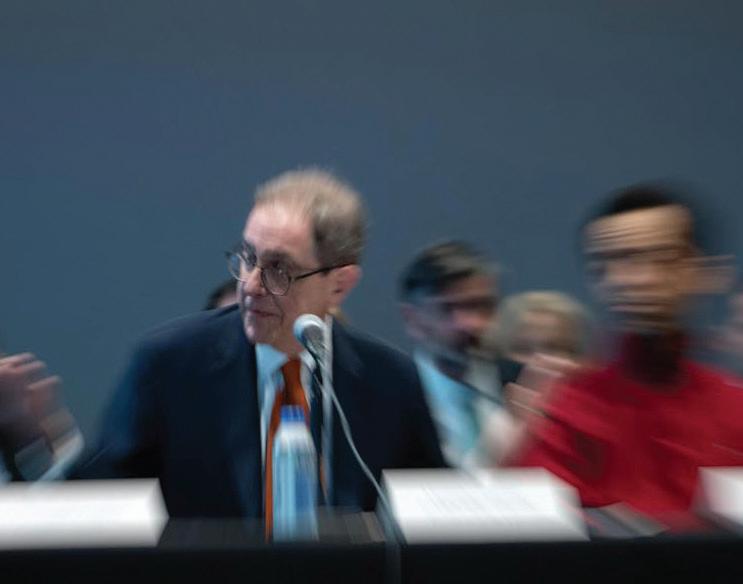
In this long exposure zoom effect, University President Christopher Eisgruber ’83 answers questions at the CPUC meeting on March 24, 2025.
vol.
editor-in-chief
150TH MANAGING BOARD
Frances Brogan ’27
Victoria Davies ’27
Managing Editors
creative director Juan Fajardo ’28
Corbin Mortimer ’27 Maya Mukherjee ’27
Sections listed in alphabetical order.
head opinion editors Lily Halbert-Alexander ’28 Charlie Yale ’28
Zschoche ’29
head audience editors
Natalia Diaz ’27
Loreta Quarmine ’27
head cartoon editor
Noam Rabinovitz ’27
head copy editors Sarah Li ’28
James Thompson ’27
associate head copy editors
Roberto Sampaio ’28
Felix Santiago ’28
Bobby Xia ’28
head data editor Madeline Wadsworth ’28
associate data editors Christine Cai ’29
Elizabeth Hu ’29
head features editor Nikki Han ’28
associate features editors Jamie Creasi ’28 Mara DuBois ’28
head humor editor Tarun Iyengar ’28
associate humor editors Nicolas Rohou ’28
Francesca Volkema ’28
head news editors Nico David-Fox ’28 Luke Grippo ’28
associate news editors Sena Chang ’28
Haeon Lee ’28
Caitlyn Tablada ’27
head newsletter editor Ryan Choe ’28
associate newsletter editor Annika Plunkett ’28
associate opinion editors Isaac Barsoum ’28 Shane McCauley ’28
head photo editor Emily Tang ’28
head podcast editor Devon Rudolph ’28
associate podcast editors Anastasiya Chernitska ’28 Julia Hack ’29
head print design editors Jamie Creasi ’28 Albert Rho ’29
head sports editors Lily Pampolina ’27 Doug Schwartz ’28
associate sports editors Lucas Nor ’28 Matthew Yi ’27
head web design and development editors Cole Ramer ’28 John Wu ’28
strategic initiative director Graphics Caroline Naughton ’29
assistant
’28 Devin
’28 Shravan Venkat ’28 Kosta Botev ’29 Sarah Cai ’29 Mason Dauber ’29 Will Liu ’29 Sara Mironov ’29 Business Manager Emeritus Jessica Funk ’26
chief technology officer Abu Ahmed ’28 Chief Technology Officer Emeritus
software engineers
Nicole Deng ’28
Ziya Momin ’28
Kyaw Naing ’28
Stephanie Sugandi ’27
Federal agents killed two civilians. Princeton must speak up, not remain silent.
Raf Basas
Assistant Opinion Editor
Astorm is brewing in Minneapolis, and it is proving to be a tumultuous test of both our country’s democracy and its protection of free speech and protest. On Jan. 7, an Immigration and Customs Enforcement agent in Minneapolis shot and killed Renee Good, who was a poet and mother of three children. On Jan. 24, in the same city, a Border Patrol officer killed Alex Pretti, an intensive care nurse at a Veterans Affairs hospital. Both were killed while peacefully protesting ICE’s long-term operation in Minneapolis.
But the threat of ICE — and the implications of Good and Pretti’s killings — are not confined to Minnesota. ICE has already raided the municipality of Princeton, taking two members of the community into custody on Jan. 15. Minnesota college students have expressed a fear that ICE may come for them next, identifying the mounting oppression of free speech in protest against political violence. Princeton claims to care about free speech — University President Christopher Eisgruber ’83 has written a book about it, and maintains an official policy of institutional restraint to protect students’ freedom to form and express their own opinions. But in this era of government violence, it is no longer possible to defend free speech with an institutional restraint policy tying the University’s hands behind its back.
It is time for Princeton to deviate from the conciliatory principle of strict institutional restraint. It must stand in vigorous opposition against the cruelty of federal immigration officers, as well as other government overreaches that threaten freedom of speech for members of our community.
To be clear, I empathize with advocates for both strict institutional restraint and the even stronger policy of institutional neutrality. The proponents of these policies are well-intentioned, and seek to protect the ideological diversity of
BOARD OF TRUSTEES
president Thomas E. Weber ’89
vice president David Baumgarten ’06
secretary Chanakya A. Sethi ’07
treasurer Douglas Widmann ’90
assistant treasurer Kavita Saini ’09
trustees Francesca Barber Kathleen Crown
Suzanne Dance ’96
Gabriel Debenedetti ’12
Stephen Fuzesi ’00
Zachary A. Goldfarb ’05
Michael Grabell ’03
Danielle Ivory ’05
Rick Klein ’98
James T. MacGregor ’66
Rohit Narayanan ’24
Marie-Rose Sheinerman ’23
Julianne Escobedo Shepherd
Abigail Williams ’14
Tyler Woulfe ’07
trustees ex officio
Jerry Zhu ’27
Alistair Wright ’27
our campus community by keeping our school’s administration neutral on most or all political issues. It isn’t inherently wrong to defer to individuals or campus groups when it comes time to take firm positions on social and political conflict — it’s intended to make Princeton a safe haven for disagreement, discourse, and protest.
But with ICE raiding our own community, and having shown no hesitation in Minneapolis to punish protesters with uninhibited violence, Princeton must break its restraint in order to defend the free speech it claims to value. As stated in Rights, Rules, Responsibilities, the University is committed to the principle of freedom of expression. It claims to have a “solemn responsibility” to protect the freedom of debate and discussion, including when “others attempt to restrict it.”
More than mere restrictions of free speech, the killings of Good and Pretti are horrifying instances of political violence. They were both killed while engaging in peaceful protest and did not appear to be threatening the lives of federal agents according to New York Times analyses. The implications of these killings are clear: if you protest against federal agents, you risk being killed. Princeton may want to maintain its status as an “impartial forum for vigorous, high-quality discussion,” but the environment around us is far from this vision.
In defending free speech, Princeton would not just be advocating for a specific position on a specific issue — it would be advocating for the right to advocate. Therefore, it is an especially important right for Princeton to fight for.
Standing up against ICE would not be an unprecedented move by Eisgruber, and could even be construed as a responsibility for an educational institution in the face of political violence. The president of Wesleyan University, Michael S. Roth GS ’84 — a longtime and courageous critic of the Trump administration’s overreaches — published a statement on Sunday calling ICE’s actions in Minneapolis “an assault on the fabric of our democracy.” Roth
rightfully points out that violence and education are firmly incompatible concepts. Princeton’s own institutional restraint policy acknowledges that education depends on the active protection of speech. Educational institutions cannot support learning without opposing the violence that makes freedom of expression dangerous and impossible, including when it comes from state actors.
The University must speak out against the threat of ICE: it poses a genuine risk to our community, and represents an unapologetic governmental disregard for free speech that directly violates the very principles on which Princeton stakes itself as a defender of discourse. Princeton’s tradition of institutional restraint restricts the University to only taking stances in rare cases. Given Eisgruber’s plans to speak “less frequently” on political issues, a statement on ICE would be a deviation from the University’s current spin on institutional restraint, and how they try at the moment to protect free discourse in the community. That being said, it is a necessary deviation.
Federal agents have shown a willingness to tread on protesters, killing two of them in the street. Clearly, there are far bigger obstacles to free speech than Eisgruber taking a stance against violence. The necessary defense of “free speech” in the face of violent ICE invasions is not one of silence. It is one that defends the right for protesters to advocate for their beliefs without a reasonable fear that they may be killed, and acknowledges the raids unfolding nationwide as contrary to the University’s values.
So Princeton stands at a crossroads. It can either remain silent, showing that its commitment to freedom of speech is hollow while the federal government grants its agents a license to kill. Or, it can choose to take the brave path forward, standing up against ICE’s injustices on behalf of free speech. I call upon it to choose the latter.
Raf Basas ’28 (he/him/his) is an assistant Opinion editor from Elk Grove, Calif.
The Prospect 11 Weekly Event Roundup
By Gavin McLoughlin & Ysabella Olsen, Head Prospect Editors
MOMIX:ALICE
1
Kim’s Convenience
Jan. 23 – Feb. 15
Feb. 1 at 6 p.m., Feb. 3 and 10 at 7:30 p.m.
Berlind Theater, McCarter Theatre Center
The original stage version of the award-winning CBC sitcom Kim’s Convenience follows an immigrant family running a local convenience store in jeopardy in a changing neighborhood. The play is accompanied by an immersive “pop-up bar” inspired by its story, open from 6:00–8:00 p.m. on show days, offering “Canadian- and Korean-inspired food and drinks.” Tickets can be purchased on McCarter’s website.
2
3
4
5
Tareq Baconi in conversation with Isabella Hammad
Feb. 4 at 6 p.m.
Labyrinth Books, 122 Nassau St., Princeton, N.J.
Palestinian writer, scholar, and activist Tareq Baconi will discuss his new book with author Isabella Hammad. “Fire in Every Direction” explores themes of personal and political identity as well as the true meaning of “home.” The event is free to the public.
8
Jan. 31 at 7:30 p.m.
Matthews Theater, McCarter Theatre Center
Running only once at McCarter, “ALICE” is an imaginative and inventive performance by the interna- tionally acclaimed dance company “MOMIX” based on the classic tale of Alice in Wonderland. Tickets can be purchased on McCarter’s website.
Triple 8 presents: (Off)loading
Jan. 29 at 8 p.m., Jan. 30 at 8 p.m., Jan. 31 at 6 p.m. and 9 p.m.
Frist Theater
Princeton’s “premier East Asian dance company” Triple 8 delivers its newest dance performance, (Off) loading. Tickets can be purchased on Princeton’s ticketing site.
Art for Change by Terrance Cummings
Jan. 10 – Feb. 7
Arts Council of Princeton, 102 Witherspoon St., Princeton, N.J.
Visual artist Terrance Cummings’ work focuses on “uplifting portrayals of marginalized communities [and] challenging stereotypes through layered color, pattern, and texture.” His exhibition “Art for Change” is free to the public at the Arts Council of Princeton, and will feature books available for purchase.
6 7
Music Theater Co-Curricular Workshops with Sam Gravitte ’17 & Vince di Mura
Feb. 2 at 4:45–6:15 p.m.
Godfrey Kerr Theater Studio, Lewis Arts Complex
New York City-based Broadway and off-Broadway actor, playwright, and Princeton alum Sam Gravitte and the Lewis Center’s Resident Music Director Vince di Mura will offer drop-in personalized music theater performance lessons, beginning this Monday, for artistic development or upcoming auditions. No registration is required, and the classes are free to all Princeton students.
Benjamin Bernheim, Tenor | CarrieAnn Matheson, Piano
Feb. 5 at 7:30 p.m.
Richardson Auditorium, Alexander Hall
Experience Benjamin Bernheim’s acclaimed tenor voice through an evening of rich music. His voice will evoke romance, longing, and nostalgia. Bernheim has graced stages and events across the world. Now, his performance will be enhanced by the intimate Richardson Auditorium stage. Tickets are available on University Ticketing.
Emanuel Ax, Piano
Feb. 6 at 7:30 p.m.
Matthews Theatre, McCarter Theatre Center
Emanuel Ax is an eight-time Grammy Award-winning pianist known for outstanding performances that display his artistic depth. He will play works including Beethoven: Sonata Op. 27 No. 1 and Corigliano: Fantasia on an Ostinato. Tickets are available through McCarter Theater.
9
Jordan Eagles: Centrifuge
Now through March 15 Bainbridge House, 158 Nassau St., Princeton, N.J.
In case you were busy in November, a new semester is a great time to visit this Art@Bainbridge Exhibition! Eagles’ art explores the poignant power of blood as an artistic medium. It prompts conversations about health equity and blood donation, centering on the Food and Drug Administra- tion’s 2023 revised guidelines. No tickets are required. The event is free to the public.
Child’s Play Improv/Unsolicited Theater Co. present: Prince of New York
Feb. 5 at 7:30 p.m., Feb. 7 at 2 p.m., Feb. 8 at 2 p.m. Mathey College Common Room
Catch a show by Child’s Play, Princeton’s youngest improv group, and Unsolicited Theater Co. This show is sure to be a riveting mix of comedy and theater. Tickets are available on University Ticketing.
11
Author: Sanyu A. Mojola
Feb. 2 at 6–7 p.m.
Princeton Public Library, 65 Witherspoon St., Princeton, N.J.
Princeton Public Library will host a Zoom conversation with author and sociologist Sanyu Mojola, in collaboration with Labyrinth Books. Tukufu Zuberi and Waverly Duck will join the conversation as Mojola presents her new book, “Death by Design: Producing Racial Health Inequality in the Shadow of the Capitol.” Registration is available on the Princeton Public Library website.
WOMEN’S BASKETBALL
No. 19 women’s basketball earns defense-led road win at Brown to extend 15-game win streak
By Xavier Latimer Contributing Sports Writer
In a tightly contested defensive battle, No. 19 Princeton women’s basketball (17–1 overall, 5–0 Ivy League) extended its winning streak to 15 games after their 58–49 road victory over Brown (11–6, 3–2).
From the jump, the Bears controlled the tempo, holding the Tigers to just nine points in the first quarter. During the final sequence of the quarter, junior guard Ashley Chea scored a tactical left-handed layup through contact. However, on the other end, Brown’s guard Isabella Wesley got loose for an open basket to push the Tigers deficit to 15–9 heading into the second quarter.
Brown’s intense defensive pressure disrupted Princeton’s offensive rhythm, initially forcing contested plays, limiting transition chances. Though the Tigers were held to almost 20 points under their season average, their confidence wasn’t shaken.
“We knew no matter what, we were not going to leave this game without a w[in],” Chea said to The Daily Princetonian after the game.
Princeton took this mindset
into the second quarter, settling into a rhythm. Junior forward Fadima Tall led the charge, knocking down two early threepointers to erase the deficit and tie the game. The teams traded runs for the remainder of the half, with neither side able to generate sustained separation.
A timely three from sophomore forward Emily Eadie in the closing seconds sent Princeton into halftime with a narrow 24–20 lead.
Brown opened the second half with an and-one and a quick basket off the missed free throw to briefly reclaim the momentum, but that proved to be the Bears’ last sustained push. Senior guard Madison St. Rose answered with a three-point play of her own, sparking Princeton’s most decisive stretch of the afternoon. St. Rose ripped off a 16–3 run to seize control and built a sizable lead.
The surge, fueled by a strong five steal performance in the third and efficient half-court execution, gave the Tigers a 41–35 cushion heading into the final period.
The fourth quarter followed a familiar script. Brown repeatedly threatened to close the gap, but Princeton answered each push with composure. Clinging
to a four-point lead, the Tigers strung together seven consecutive points, highlighted by Tall’s and-one finish, stretching the margin to 54–43 with just under four minutes to play. Brown cut the deficit to five with 1:17 remaining, but junior guard Skye Belker calmly converted four free throws down the stretch to secure the win.
Tall led Princeton with 12 points and eight rebounds, while Belker added 11 points and sophomore guard Toby Nweke chipped in ten off the bench. The Tigers’ defense again proved decisive, holding Brown below 50 points and stifling the Bears’ offense in key moments.
“[I] love how hard we compete from minute one to forty,” Head Coach Carla Berube told the ‘Prince.’ “The former sophomores, now juniors, know how to win games,” she added.
The victory added to the Tigers’ impressive resume thus far. The Orange and Black look to continue their impressive rise up the AP Poll with a tough home game against Columbia (13–5, 4–1) on Friday at 6 p.m. in Jadwin.
Xavier Latimer is a Sports contributor for the ‘Prince.’
A weekend of narrow margins: Men’s ice hockey falls to Cornell and Colgate
By Cadigan Perriello
Contributing Sports Writer
During a Friday night game against No. 13 Cornell (12–5 overall, 7–3 ECAC) at Lynah Rink in Ithaca, N.Y., No. 18 Princeton men’s ice hockey (11–7, 7–5) fell to the Big Red, 2–1. Shortly after, the Tigers traveled nearly two hours to Hamilton, N.Y. to face off against Colgate (8–12–2, 5–4–1), falling 1–0. In the two tight matchups, Princeton focused on defensive strategy, testing its consistency, composure, and teamwork.
Challenging Cornell Princeton gained early momentum on Jan. 16, with senior forward Jaxson Ezman scoring a rebound backhand goal less than three minutes into the
game. Speaking to The Daily Princetonian, Ezman noted that the goal came from “movement from low to high defense” as the team worked to protect the puck.
“It was good to get started early, especially against a really good team in Cornell,” he added. The quick goal helped the Tigers to take control of the opening period.
However, the second period saw a shift of momentum. After a strong start with multiple scoring chances by Princeton, the Big Red generated sustained pressure with repeated shots against junior goalie Arthur Smith. Despite aggressive play from Cornell, Smith and the rest of the Tiger defense kept communicating and remained composed.
Reflecting on the weekend, Smith highlighted Princeton’s defensive play.
“We didn’t really give up a whole lot of quality chances to the other team,” Smith said to the ‘Prince.’ “We’ve had a lot of success at our home rink this year, but showing that we can go on the road and also still stick to our identity of playing a strong defensive game was definitely positive to take away.”
Smith’s performance, along with a strong defense composed largely of upperclass students, proved crucial for the Tigers through both weekend games.
Cornell tied the game with eight minutes remaining in the second period with a powerplay goal. The Big Red continued to control the period, outshooting Princeton 17–5 in the second period alone.
Heading into the third period, the score remained knotted at 1–1, with both teams demonstrating increased physicality and emotion in the final 20 minutes of play.
The final period featured frequent possession shifts with each team taking every opportunity to gain momentum. Cornell secured the game-winning goal with 3:09 remaining, capitalizing on a controlled rush and a quick backhand finish to end the game with a 2–1 lead.
“Cornell is a really tough
team to play for,” Head Coach Ben Syer noted. “They don’t give up a lot, they’re very good offensively, so we tried to stop their transition.”
Following the loss, the team quickly shifted their attention to the Colgate matchup. When discussing the team’s reset process between games, Ezman spoke about the need to quickly shift their focus.
“We’ll do a recap in the morning and sit with that on Friday night,” he told the ‘Prince,’ emphasizing the need to “move on individually and also as a group.”
Rivaling
the Raiders
The game against Colgate at the Class of 1965 Arena featured a much quieter audience and environment. Princeton controlled possession early, generating multiple scoring opportunities and power plays. Though the period ended scoreless, the Tigers demonstrated strong game control and a powerful defensive structure.
Colgate broke the deadlock with six minutes remaining in the second period, capitalizing on a cross-ice pass after Princeton’s power plays earlier in the period.
“I don’t think we were nearly as physical as we needed to be,” Syer said regarding Saturday’s game. After being asked about some post-whistle scuffles,
Syer described the fights as showing “sheer frustration at the game,” which should have been channeled into play.
Trailing 1–0, Princeton pushed to equalize the score throughout the final period, but Colgate earned two early power plays, limiting the Tigers’ opportunities. The defensive unit remained composed, a mentality Smith attributed to “predictability from each other.”
“We all trust each other out there,” Smith told the ‘Prince.’ “Knowing that the forwards who are helping to kill the penalty are going to do their job helps the defense do their job, which helps me do my job.”
After the Tigers moved to an empty net to add an extra attacker for the final four minutes of play, Colgate added a long-shot goal to end the game with a 2–0 victory. Despite the weekend results and a tough late goal by the Raiders, Princeton identified key positive takeaways moving forward.
“They battled hard this week,” Syer told the ‘Prince.’ “Some players were a little under the weather; we learned a lot about our team this weekend to use moving forward.”
Cadigan Perriello is a Sports and Research contributor for the ‘Prince.’
PHOTO COURTESY OF @PRINCETONWBB/X
With their win over Brown, the Tigers have reached an impressive 15-game win streak which is the third-longest in the nation.
MEN’S HOCKEY PHOTO
MEN’S BASKETBALL
Men’s basketball resurges from difficult road trip to overcome Brown 63–53
By Kai Kim Assistant Sports Editor
On Saturday, men’s basketball (7–13 overall, 3–2 Ivy League) defeated Brown (7–11, 1–4) at Jadwin Gymnasium with a final scoreline of 63–53. Close and physical throughout, the game ultimately finished in Princeton’s favor thanks to strong late-game performance and perfect freethrow shooting.
With close consecutive losses against Harvard (10–9, 3–2) and Dartmouth (9–9, 3–2) last weekend, the Tigers were looking for a change of events.
“The road trip was really long and rough,” Head Coach Mitch Henderson ’98 told The Daily Princetonian after the game. “We had some tough losses, but I’m proud of our guys for getting it done this time.”
Both sides started the game slowly, trading misses and fouls. Junior guard Dalen Davis finally nudged the Tigers for-
ward to tie the score in the sixth minute, drilling his 100th career three-point shot.
That spark was the beginning of an 8–0 Princeton run. After some back-andforth, the Bears went six straight to move ahead 19–16 with under ten minutes of play in the half.
The Orange and Black’s best first-half spell came late. Junior guard Jackson Hicke buried a wing three, and Davis kept getting in downhill, drawing several trips to the free throw line.
Still, the Bears managed to keep up, slipping in a layup right at the end of the half. The teams headed to the locker room even at 27–27.
“Brown’s definitely got some strong guards and bigs,” Hicke told the ‘Prince’ after the match. “We definitely made it a priority in practice to focus on guarding them and making them take tough twos.”
The Bears came out of the break strong, threatening the Tigers immediately with a 5–0 push. Fortunately for the Tigers,
Davis and Hicke kept the ball moving and steadied the Orange and Black into an even 32–32.
The game turned at 41–41. A technical foul on Brown gave Princeton two free throws, followed by two consecutive threes from the Tigers on their next two possessions, completing a 10–0 run that brought the score to 49–41.
“I’ve been through situations like that my whole life,” Davis said to the ‘Prince.’ “I get more excited when there’s more pressure. Those situations are what we practice for.”
From there, the Tigers managed a strong finish, controlling the tempo and maintaining a steady lead. The Bears cut the margin once, but the clock kept ticking down and the Orange and Black’s line stayed perfect.
The numbers mattered. Princeton shot 17–for–56 and went 7–for–23 in three-point shots, but went a perfect 22–for–22 at the free throw line. Davis led with 22 points,
and Hicke posted his first career doubledouble, with 19 points and 13 boards.
“We focused a lot on fast breaks and situations in practice,” Hicke noted. “I think that’s really been helping us a lot, and it was much better today than it was last weekend.”
The first-year players made notable contributions, too. First-year guard Landon Clark added five points to Princeton’s scoreline. First-year forward Sebastian Whitfield helped with several great baseline drives kicked to the corner for Clark.
“I like the way they’ve been playing,” Henderson said to the ‘Prince.’ “With firstyears, anytime we can get them better, it helps us in the long run. They have very bright futures.”
Davis, coming off the bench for the fifth straight game after an early-season injury, said he doesn’t mind the role.
“I’m just focused on winning the league and making March Madness,” he said. “Whatever the guys or Coach needs
me to do, I’m ready to do it.”
The main theme throughout the game was composure. Princeton committed only seven turnovers and capitalized on Brown’s mistakes. When the Bears tried to muddy the lane, the Tigers kicked for rhythm threes.
“It wasn’t pretty, but it was our best win of the season,” Henderson said. “Those last eight minutes were very important for us.”
The win moves the Tigers above .500 in the league and gives them back-to-back games without a missed free throw, having gone 33–for–33 against Brown and Dartmouth.
The Orange and Black’s next game is away against Cornell on Friday. They will look to keep the free-throw line perfect and bring the same late-game clarity.
Kai Kim is an assistant Sports editor for the ‘Prince’.
No. 20 Princeton women’s basketball prevails over Harvard in overtime in an instant classic
By Jordan Halagao Associate Sports Editor
“She’s got ice in her veins.”
That’s how Princeton Women’s Basketball Head Coach Carla Berube described junior guard Ashley Chea to The Daily Princetonian.
On Jan. 19, Princeton took down Harvard in overtime in a thrilling back-andforth rivalry matchup. With 0.4 seconds left on the clock, Chea nailed a threepointer to tie the game and send it to extra time. From there, No. 20 Princeton (16–1 overall, 4–0 Ivy League) controlled the overtime to secure the win over rival Harvard (9–8, 2–2).
Chea is no stranger to clutch moments. Nearly exactly one year ago, Chea hit a buzzer-beater against Harvard to win the game. On Dec. 20 against George Mason, she had the go-ahead bucket with two seconds left on the clock. On Monday, she led
the team to victory once again.
The Crimson did not make the game easy for Princeton. Harvard’s ferocious defense out of the gate made it difficult for the Tigers to get their first bucket of the game. Princeton’s first three points came from the free-throw line, and their first field goal of the game did not come until nearly eight minutes of play had gone by.
Harvard’s defensive pressure forced Princeton into an uncharacteristic 12 turnovers in the first half, drawing multiple charges, forcing travels, and deflecting passes.
“We were going too fast, doing a little too much one-on-one instead of executing our offense,” Coach Berube said to the ‘Prince.’
Though the Tigers struggled with turnovers, they converted efficiently when they had good looks, shooting on 41.7 percent in the first half.
Despite Harvard’s defensive success,
By Jillian Ascher Head Archives Editor
Nestled in the pages of the inaugural issue of the 128th Volume of The Daily Princetonian, the 128th Managing Board introduced themselves with a call to action: “Get ready.”
In a letter to readers, the new managing board, led by Editor-in-Chief Zachary A. Goldfarb ’05, began its term with a reminder of the paper’s past and its journalistic intentions for the year. Today, the legacy of the 2004 board remains, and the future impacts of the 150th board are yet to come.
The board introduced itself and the ‘Prince’ in the context of former eras “where for decades student journalists used this paper to attack such injustices as the Vietnam War and discrimination against African-Americans and women.” The board announced its ob-
they themselves could not find a rhythm on offense, and led by a just small margin for most of the first half, shooting 10 of 28 from the field.
With the Tigers down by five, junior guard Skye Belker drained a three-pointer. On Harvard’s ensuing inbounds pass, Chea lurked from behind for a steal and an easy layup. The five-point swing tied the game at 22–22.
Chea would later hit a step-back three to put the Tigers up 25–24, giving them their first lead of the game since the opening point in the first minute. After Harvard made a free throw, the game was tied at 25–25 at the half, and shaping up to be a thriller.
The third quarter entertained, as both teams’ offenses started to come alive. Chea and senior guard Madison St. Rose started to heat up, each knocking a three to keep Princeton neck-and-neck with Harvard. The pair led Princeton with 19 points
jective to investigate campus policies and practices that harmed individuals. “We want to expose them,” stated the article.
The letter to readers urged a partnership between editors and the community at large: “We need you to reach out to us and point the wrongs out. We will also double our efforts to reach out to every corner of campus.” In search of true, fair, and down-to-earth coverage, the new year of ‘Prince’ leadership envisioned its role on campus as a tool for Princetonians to engage with fellow students. The paper announced a shift to center student life by writing about the “ordinary lives of Princetonians.” In pursuit of this mission, the board introduced and refashioned the structure of several sections. Once a week, the paper would release a new ‘Street’ section, reporting on weekend activities “on and off Prospect Ave.”
apiece.
Though Harvard would eke out a sixpoint 48–42 lead, a successful and-one finish from junior guard Olivia Hutcherson would cut the deficit in half. Princeton would score the next four points to take a 49–48 advantage into the final quarter of regulation.
After a three-pointer from sophomore guard Toby Nweke and a pull-up jumper from St. Rose, Princeton found itself ahead by seven points with seven minutes to go, 57–50. However, Harvard slowly chipped away at the deficit, scoring eight unanswered points to take back the lead.
With just single digits left on the clock, Harvard’s Katie Krupa hit a go-ahead three to put the Crimson up 64–61.
Coach Berube called a timeout with 2.4 seconds left to draw up one final play. Coming off a screen from St. Rose, Chea found herself wide open on the wing in front of the Princeton bench. As seconds
The board also refashioned the paper’s editorial page as the result of debates, discussions, and research by multiple staff members who sought to present the comprehensive views of the paper on current issues. The publication also featured “The Brief,” a section where readers could find concise summaries of news happening at Princeton and beyond.
Mirroring its content changes, the board revamped the visual design of the physical paper and the website. Aspiring to further the impact of its journalistic media, the board declared, “The ‘Prince’ will be branching out into new places, whether with campus forums or books.” However, no book was published under the 128th board.
Since 2004, tens of managing boards have overseen the ‘Prince,’ each shaping the paper’s direction in different ways. Jan. 1, 2026 marked the be-
ticked off, she let it fly.
Nothing but net.
“We’ve been in tough positions all the time,” St. Rose said to the ‘Prince.’ “We just had to breathe … and execute what Coach was drawing up.”
After Chea’s game-tying field goal, the game went into overtime where Princeton had all the momentum, scoring the first five points. The Tigers maintained their lead for the rest of the game to take an 82–79 overtime victory, sending the Crimson back to Cambridge empty-handed.
“We have so much confidence, especially when we’re all heated up,” Chea said, describing the team’s feelings going into the overtime period.
“We knew we were not going to lose that game no matter what happened,” she added.
Jordan Halagao is an associate Sports editor for the ‘Prince.’
ginning of the 150th Managing Board, whose goals echo ideas of years past. Today, the paper has an anonymous “Submit a Tip” function on the website, allowing anyone in the community to report information to the newsroom. The “Street” section remains rebranded as “The Prospect,” renamed in 2018, announcing upcoming arts and culture news in the weekly Prospect 11. The editorial board lives on and continues to publish opinions as a small collective of students on behalf of the ‘Prince.’ To celebrate the storied past of the publication and the work done 150 years of managing boards, this year the ‘Prince’ will pick up where the 128th board left off and publish beyond the print edition with a commemorative book.
Jillian Ascher is the head Archives editor for the ‘Prince.’