Princeton professor maintained sustained communication with Epstein from 2008 to 2012
By Luke Grippo & Bridget O’Neill Head News Editor & senior News correspondent
Newly released files in the investigation of convicted sex offender Jeffrey Epstein show Princeton professor Corina Tarnita communicated with Epstein between 2008 and 2012, first as a Ph.D. student and later as a junior fellow in the Society of Fellows at Harvard. Emails reviewed by The Daily Princetonian include friendly exchanges, research updates, mentions of trips, and arrangements for two separate wire transfers to Romanian and Californian bank accounts.
U. AFFAIRS
Tarnita, now a professor of ecology and evolutionary biology at Princeton, joins a growing list of academics who communicated extensively with Epstein after his first conviction and deny any knowledge of the criminal activity that led to him being charged in 2019 with sex trafficking of minors.
In her statement to the ‘Prince,’ Tarnita wrote she never saw Epstein “behave inappropriately” and that all her in-person interactions with Epstein were “in the company of senior, prominent scientists.” The files do not include any materials indicating that Tarnita
was aware of or participated in any crimes related to Epstein.
Epstein was a frequent donor to academic and research institutions, including Harvard’s Program for Evolutionary Dynamics, where Tarnita was a graduate student and then postdoctoral researcher from 2008–10.
“Like most people who knew Epstein in his capacity as a donor to scientific research, I am revolted by his depravity and regret having met him,” Tarnita wrote.
The records concerning Tarnita were included in roughly three million pages of documents and
More budget cuts anticipated in annual ‘State of the University’ letter
By Kian Petlin Senior News Writer
In his 2026 “State of the University” letter sent to students on Monday, University President Christopher Eisgruber ’83 previewed major upcoming changes to University finances. The letter, titled “From Growth to Focus,” described a move away from expansion, citing longterm economic factors.
“We expect that budgetary and operational changes will begin in the coming months and occur over a multiyear period,” Eisgruber said.
The changes will come in addition to the 5–7 percent departmental budget cuts over the last year, alongside the hiring freeze instituted last March.
“The long-term endowment trends described in this memorandum are likely to require more targeted, and in some cases deeper, reductions over a multiyear period,” Eisgruber wrote. “The change that I am describing … goes beyond the pace of construction. It will affect everyone on campus.”
The letter also detailed the University’s shift from the rapid physical development of the last decade toward a period of strategic consolidation. Eisgruber attributed the University’s shifting priorities to downgraded long-term economic projections and an increased reliance on endowment payouts in the midst of widespread federal grant cuts.
“The principal cause for this transition is economic,” Eisgruber wrote. “It results
from lowered expectations about the University’s future endowment returns.”
The Princeton University Investment Company (PRINCO) reduced its expected long-term endowment return from 10.2 percent to 8 percent per year. The letter cited the endowment’s 20-year rolling average returns, which show steadily slowing growth rates since the 2008 Global Financial Crisis.
PRINCO’s revised 10-year estimates predict an endowment value $11.3 billion lower and an annual payout $500 million lower than the previous forecasts, according to the letter. The projection assumes a constant spending rate of 5 percent annually.
The letter arrives as the University
Opinion
Why the Honor Code doesn’t work
By Shane McCauley Associate Opinion Editor
Princeton’s vaunted Honor Code can sometimes feel like the butt of a running joke. Despite the policy’s insistence that students report inperson cases of cheating, there’s still a sense that academic dishonesty runs unchecked on some exams.
Last semester, rumors about potential cheating scandals seemed to reinforce skepticism about the Honor Code. And according to students I’ve spoken with, cheating on in-person exams comes as no surprise in some engineering and economics classes.
One student told me that in one Economics exam, there was a line out the door to use the men’s bathroom — suggesting that cheating was ubiquitous.
With rumors like these, it might be tempting to suggest sweeping solutions — like proctored exams or no-technology policies. But academic integrity policies at other schools demonstrate that we shouldn’t give up on allowing students to monitor themselves. Rather than emphasize surveillance, Princeton should attempt to build a collaborative Honor Code that is integrated into broader student life and places true trust in students, instead of forcing them to police each other. For such a policy to function, we must commit to a student culture that prioritizes learning
for its own sake above grades and post-graduate achievement.
The students I spoke with already recognized instances of cheating as unfair to them and their classmates who don’t cheat. But despite what the Honor Code stipulates, no one wants to be a tattletale — a longstanding aversion of Princeton students. Rather than reporting, some students turn a blind eye to cheating, or deliberately avoid sitting near the back row of a lecture hall to avoid catching their peers in the act.
On their face, these anecdotes may sound like an indictment of the feasibility of honor codes. But such policies aren’t inherently doomed.
In The Atlantic, Tyler Austin Harper chronicled how Haverford College’s remarkably lenient honor code has not led to widespread cheating. In fact, Haverford and Bryn Mawr — a nearby college with a similar policy — stand apart from many other schools in that they have minimized academic dishonesty, even in the AI age.
Like Princeton, Haverford does not proctor exams; their honor code allows students to take exams at any time, without any time limit. But the culture underpinning the policy extends beyond academics. Renewed by a student body vote each spring through a months-long deliberation
See HONOR CODE page 8
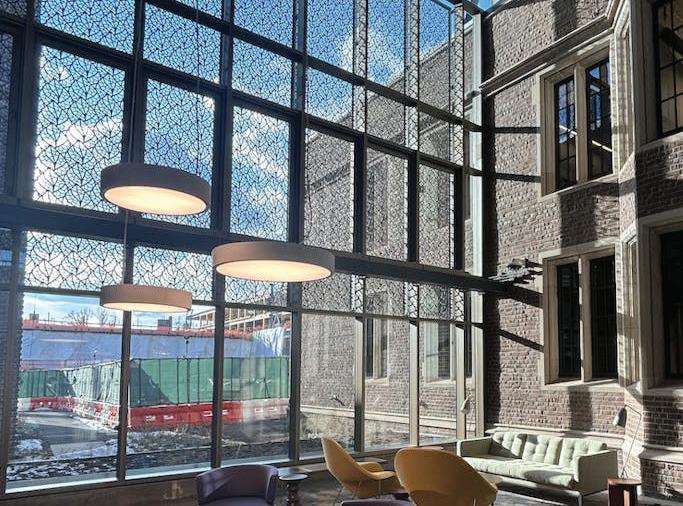
Newly renovated Marquand Library reopens in Art Museum complex
By Leela Hensler Staff News Writer
After five years of renovations, the Marquand Library of Art and Archaeology reopened on Tuesday in the Princeton University Art Museum complex.
The five-story facility offers new study spaces and improved access to the library’s extensive stacks and rare book collection.
Although the rest of the museum complex was officially opened to the
public on Oct. 31, the library’s opening came three months later as additional time was required to move books and special collections from temporary storage.
“This is really one of the most wonderful libraries in the world, and I’m really proud to be the director [because] we are able to serve patrons both here at Princeton and around the world,” Holly Hatheway, the library director, said in an interview with The Daily
This Week In History
The Daily Princetonian takes pride in being Princeton’s only independent, daily campus newspaper. But what happens when war gets in the way? From 1943–1946, the ‘Prince’ closed its doors out of wartime necessity, and the University took over the job of relaying campus news to students.
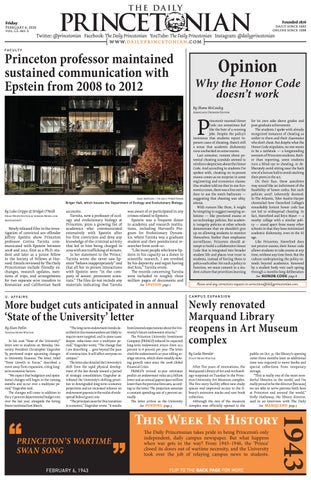
ISAAC BARSOUM / THE DAILY PRINCETONIAN Briger Hall, which houses the Department of Ecology and Evolutionary Biology.
CAMPUS EXPANSION
‘Tarnita helped facilitate wire transfers to two bank accounts, one located in Romania and one in California.’
Continued from page 1
thousands of videos and images released by the Department of Justice on Friday.
In her statement, Tarnita wrote that she was introduced to Epstein in 2008 while she was a graduate student and then a postdoctoral researcher in Harvard’s Program for Evolutionary Dynamics, a program then led by professor Martin Nowak, a longtime associate of Epstein. Tarnita is mentioned at least 344 times in the newest batch of files, which show correspondence between Tarnita and Epstein beginning in 2008. That same year, Epstein was convicted for soliciting prostitution of a minor.
Nowak, a professor of mathematics and biology at Harvard, maintained a close relationship with Epstein. In 2003, Epstein donated an initial $6.5 million to Harvard to establish the Program for Evolutionary Dynamics. Nowak left the Institute for Advanced Study in Princeton to direct the new program.
Tarnita, who was advised by Nowak, was awarded her Ph.D in mathematics in 2009. She remained at Harvard as a member of the Harvard Society of Fellows until 2012.
A series of exchanges from 2009 appear to show that Tarnita helped
facilitate wire transfers to two bank accounts, one located in Romania and one in California. The names associated with the bank accounts have been redacted by the Justice Department. The ‘Prince’ could not independently verify the intended recipient or recipients of the payments or the purpose of the funding.
In one email with Epstein’s accountant Richard Kahn, Tarnita shared the banking information of a “girl from Romania” who she wrote “will receive $10,000.” She later sent Kahn the wire information for a California bank account, which she indicated was to be wired $5,000.
In another exchange from later that year, Epstein’s assistant Lesley Groff asked Nowak for the “name of the University in Romania that you ‘got the people from.’” Nowak forwarded the message to Tarnita, who responded that both students were from the University of Iași.
In her statement, Tarnita wrote that while she was in the Program for Evolutionary Dynamics, Epstein said he was inspired by Tarnita’s career trajectory and wanted to “support other early-career women in mathematics.” She wrote he asked her to help “with such an effort in Romania” — where Tarnita is from — for which he would be an anonymous donor.
Around the same time, Tarnita
wrote that the Program “began to develop a scientific collaboration” with the University of Iași. The collaboration, she wrote, included “a visit by a group from Harvard to give talks, meet with people, and conduct experiments that are published in a working paper.”
“In the context of this developing relationship, we raised with the University of Iasi the idea of an anonymous donor supporting exceptionally promising women mathematicians,” Tarnita wrote. “The University of Iasi put forward candidates, which I helped vet based on their academic promise.”
Tarnita wrote that she recalled that only two mathematicians were ultimately selected for Epstein’s support. She wrote that she helped arrange payment to these women, “in keeping with Epstein’s stated desire to remain anonymous.”
Other correspondence between Tarnita and Epstein included a referral for help with a “visa issue,” Epstein’s facilitating of a haircut for Tarnita with a celebrity stylist, and three files suggesting that Tarnita traveled with Epstein or was invited to do so.
In a Dec. 18, 2008 email, Tarnita told Epstein she was in Romania, asked him to review her paper he appeared to have edited previously, and mentioned “the visit to Florida.” The records do not specify the timing or purpose of the visit.
Tarnita, through a University spokesperson, clarified to the ‘Prince’ that she attended one to two meetings at Epstein’s Florida residence alongside “senior, prominent scientists.”
In an Aug. 11, 2009 email, Tarnita thanked Epstein for a “beautiful” and “productive” trip. “it was great to see you again and it was such a productive trip -- i’ve learnt so much. We have so many new things to think of right now,” Tarnita wrote in the email.
During this time, Epstein had been on house arrest following his initial 2008 conviction.
In a Dec. 12, 2011 email, Tarnita apologized for not being able to “come to the island.” In that same email, Tarnita also described having anxiety over “the Princeton situation,” apparently referring to a faculty hiring process.
Tarnita stated through a University spokesperson that she had been invited by now deceased MIT Professor Marvin Minsky to attend a scientific conference on one of Epstein’s private islands, but declined to attend. Virginia Roberts Giuffre, a prominent accuser of Epstein, said in a deposition released in 2016 that Epstein’s co-conspirator, Ghislaine Maxwell, directed Giuffre to provide sexual services for Minsky.
On Dec. 16, 2011, Tarnita sent Epstein an email saying, “great news: princeton officially wants me!”
“My interactions with Epstein naturally diminished as I moved on from the Program for Evolutionary Dynamics, and they ended after I began working at Princeton,” Tarnita wrote in her statement.
Tarnita joined Princeton as an assistant professor in ecology and evolutionary biology in 2013. She was promoted to associate professor and granted tenure in 2018, then became a full professor in 2021.
“Again, I wish I had never known him,” she wrote in her statement.
The latest batch of files show that Epstein was heavily involved in academic and creative spheres. Professors at Duke, Yale, and Harvard also sustained contact with Epstein after his criminal conviction.
The Daily Princetonian continues to review the newly released documents and will continue to review additional files as they become public.
Luke Grippo is a head News editor for the ‘Prince.’ He typically covers highprofile interviews and University and town politics.
Bridget O’Neill is a senior News correspondent, head News editor emerita, and managing editor emerita for the ‘Prince,’ covering the University administration and the law.
‘ICE Out’ protest in Princeton draws hundreds of attendees
By David Estrada & Amaya Taylor Staff News Writers
On Friday, approximately 200 students and community members gathered at the Fountain of Freedom to protest against the Trump administration’s immigration policies and the killings of Renee Good and Alex Pretti by Department of Homeland Security (DHS) agents. The protest was the first campus rally of the spring semester and was part of a “national shutdown” initially organized by protesters in Minneapolis.
Participants gathered in near single-degree weather, holding signs such as “ICE IS SCUM” and “Immigrants Built This Nation” with anti-ICE and anti-Trump rhetoric. Many also voiced support for Palestine and denounced fascism.
The event featured several stu-
dent and community speakers who spoke out against the presence of ICE in Princeton and the nation at large. Last month, ICE agents detained two individuals in Princeton.
In an interview with The Daily Princetonian, former co-coordinator of Sunrise Princeton Isaac
Barsoum ’28 shared that The Princeton Progressive Coalition (ProCo) aimed to show solidarity with “students, particularly groups of Somali students, in Minneapolis, who initially called for the nationwide protest.”
Barsoum is an associate Opinion editor for the ‘Prince.’
“Princeton and the country together are saying that we are done with the terror and the violence perpetuated against our cities and our neighbors by ICE,”
Barsoum said. “I would hope that as the national movement grows, we will continue to be a
part of it,” he added.
Participants shared that they hoped ICE protests would raise awareness of the Trump administration’s actions and demanded increased accountability for ICE agents.
“[The goal] is to raise any kind of awareness and to be more organized … in terms of getting involved with the community and resisting ICE, terror, and all that this government is doing to communities in this country,” Austin Guo ’26 told the ‘Prince.’ Sam Evangelista ’29 also called for increased accountability for ICE activity.
“The administration is driving fear and using that as a cause to take away Fourth and Second Amendment rights,” Evangelista told The Daily Princetonian.
“The single most warranted change that would cause [protest] action to drop off would be
seeing ICE agents held accountable … and subject to the law,” he continued.
Geosciences professor Allan Rubin said he hopes to be “one more body” in the protest against ICE.
“It’s two things: it’s people dying who shouldn’t be killed, and it’s the government lying about those victims as if they can say whatever they want and get away with it,” Rubin told the ‘Prince.’
“I find that very offensive.”
After gathering at the fountain, organizers led protesters north on Washington Road before turning left on Nassau Street and returning to University grounds. The group eventually congregated in front of Nassau Hall, where students and community members gave another round of speeches.
ProCo, a network of progressive groups including Resis-
tencia en Acción NJ, the Young Democratic Socialists of America Princeton, Sunrise Princeton, Princeton Students for Justice in Palestine, Students for Prison Education, Abolition, and Reform, the Princeton College Democrats, and the Alliance of Jewish Progressives, organized the rally.
“We will continue to protest as long as ICE is invading our cities, deporting our neighbors, killing people in the streets, and the Trump administration continues to practice its tyranny against the American people,” Barsoum said.
David Estrada is a staff News writer for the ‘Prince.’ He is from Los Angeles.
Amaya Taylor is a staff News writer and associate Prospect editor from Memphis, Tenn.
Newly elected GSG officers share goals for upcoming terms
By Toby Chang Staff News Writer
After almost two weeks of voting, the preliminary results of the Graduate Student Government (GSG) elections were announced on Monday. Jan Ertl GS won the election for GSG president, defeating Caridad Estrada GS and Arafat Safdar GS.
The new members of the GSG Executive Board will be approved and finalized during Assembly on Tuesday, Feb. 3.
Several members of the new board discussed their new roles in interviews with The Daily Princetonian. Some of the challenges they expect to face in the coming year include financial uncertainty created by a contentiously handled GSG budget and University-wide budget cuts, alongside their aspirations for the upcoming term.
“One thing that was brought up a couple of times during the election period, is that the budgeting was quite intransparent or somewhat confusing over the past semester, in particular in special events,” said Special Events Officer Kevin Zhang GS. “It does seem like there might not be much budget left for events.”
Treasurer Varun Sivashankar GS echoed this sentiment.
“Currently, it’s a little tricky to find just how exactly the GSG budget is being used,” Sivashankar told the ‘Prince.’
The uncertainty around the budget is not a new issue for GSG. An audit report by Kathy Wang GS last year uncovered what Ertl called “avoidable mistakes.” He ascribed these, in part, to the misalignment of the terms of GSG officers with the fiscal year that the budget is built around, leading to issues during transitions.
One suggestion from the report that Ertl intends to implement is biannual budgeting, so that the election cycle better fits the fiscal year, minimizing issues caused by a new administration coming in mid-budget. GSG operates off of an $83,000 budget for the 2025-26 academic year.
Sivashankar added that, while a brief budget summary is regularly sent out, a more detailed breakdown is needed for more transparency in the budget process.
“Once we just have an entire transparent list of all the expenses that’s easily accessible to students, we can have a lot more productive conversations about how the money is being used,” Sivashankar said in an interview with the ‘Prince.’
Another goal shared by several of the incoming board members is bolstering student engagement and community involvement.
“There’s been a lack of trust in the GSG, and a lot of it centers from the people on the exec [executive] board,” said newly-elected Facilities Officer Noah Zahn GS.
Apart from his goals of revamping how Meadows Apartments processes students’ packages, introducing to-go meals in Procter Hall, and working with TigerTransit to ensure accessible bus routes, Zahn also reaffirmed his commitment to transparency in hopes of building a stronger relationship between GSG and the graduate student body.
“That means making sure that we, as a board, acknowledge the past mistakes that have made lives potentially more difficult or led to issues with the grad students,”
Zahn said.
One unmet need in the community for the past year has been a liaison for accessibility issues.
The position of DEI Officer, which has been vacant since the previous chair resigned from the post, has been filled this election cycle by Yassine Ait Ali GS. Ait Ali has been serving as acting DEI Officer since being appointed towards the end of the fall semester.
The position was vacant for close to a full term, which Ait Ali says damaged GSG’s ability to respond to accessibility-related concerns.
“Not having a DEI officer for such a long time was a big loss for the graduate community because a lot of students were raising concerns … to the GSG, and there was nobody who was officially appointed to report that to the appropriate offices,” he said.
Ait Ali affirmed a commitment to reinstate a close relationship between the GSG and the Graduate School’s Access, Diversity, and Inclusion team.
Both Ait Ali and Ananya Chakravarti GS, a fourth-year re-elected as Health and Life Officer, expressed interest in reestablishing the Graduate Buddy Program, which Chakravarti says has been inactive since her first year.
“I want the grad students themselves to feel that they have a stake in what health and life initiatives are taking place,” Chakravarti said.
One way she hopes to accomplish this is by establishing a Graduate Student Health and Life Committee. She explained that her main goal is to reduce barriers to health and wellness by keeping students involved and informed of their rights and benefits.
Vice President-elect Zoë Gorman GS also shared the same approach to engaging graduate students.
“We started, in this past year, to build up the committee structures. I think that’s something that we can make more robust this year,” Gorman said.
Gorman also shared several ideas of how GSG can support the international student community through recent circumstances, with increased ICE raids at campuses and towns across the country.
“In the early stages of ICE involvement, there were signposts on all the residents’ dorms that in order to enter the dorm, they would need a warrant. And I think we could maybe look into expanding that in some way to protect our international students,” she said. “We can also help to advocate by having improved support structures for international students to get advice on visas or work within their departments.”
“We’re really excited to work with USG [Undergraduate Student Government] as well. I think we can just work more effectively as a community ... as a whole,” Gorman added.
Among the other winning candidates were Vice President of Internal Affairs Niv Kanrar GS, Academic Affairs Officer Poorya Mollahosseini GS, International Student Affairs Officer Viola Chen GS, and Social Officer Robel Geda GS.
Toby Chang is a staff News writer from Prescott, Ariz.
Meghana Veldhuis contributed reporting.
Eisgruber: ‘The change that I am describing … goes beyond the pace of construction. It will affect everyone on campus.’
FUNDING
Continued from page 1
amid rising threats to higher education from the federal government.
The federal One Big Beautiful Bill Act imposes an 8 percent tax on any university where the endowment exceeds $2 million per student. However, the legislation includes a specific caveat: institutions are exempt from this tax if they have fewer than 3,000 tuition-paying students.
This distinction is important for Princeton. The ‘Prince’ previously reported that approximately 65 percent of 5,826 undergraduate students may receive financial aid in excess of tuition following an expansion of undergraduate financial aid earlier this year.
The University has previously declined to comment on the number of tuitionpaying students.
Eisgruber’s letter mentions the endowment tax as well as a number of other “political threats” facing the University’s financial model.
“Princeton and other universities have over the past year faced a variety of threats to research funding, the immigration status of community members, free
speech, academic freedom, diversity and inclusion programs, and our endowments,” the letter reads.
Eisgruber has been outspoken in his defense of higher education, appearing across national media outlets and promoting his book, “Terms of Respect: How Colleges Get Free Speech Right.” He has also launched the Stand Up for Princeton and Higher Education initiative, which members of the Princeton community can join to receive newsletters advocating for universities and colleges in America.
Aggregated survey data of undergraduates between 2017 and 2025 is provided as an appendix to the letter, assessing student attitudes towards different questions of the undergraduate experience. Since 2023, the University has expanded these surveys to specifically address “civil and respectful dialogue” amid a polarized national discourse on campus free speech.
In response to the prompt, “I feel that members of the university community engage in civil and respectful dialogue with one another on difficult topics,” over 70 percent of undergraduates agreed or strongly agreed in 2025, compared to 62 percent in 2023.
A second prompt given to students since 2023 is the following: “I feel that I can voice my true opinions on controversial topics without fear of being unfairly judged.” Responses to this prompt reflect those given on the question of civil and respectful dialogue, with over 59 percent of undergraduates agreeing or strongly agreeing in 2025 compared to less than 55 percent in 2023.
“Free speech and academic freedom are complementary principles; both are essential to the life of a great university,” Eisgruber wrote.
According to the letter, the University community can expect to receive memoranda on budgetary and operational changes in the coming months from Provost Jen Rexford and Executive Vice President Katie Callow-Wright.
Eisgruber will answer questions from the student body during the next Council of the Princeton University Community meeting. The meeting is scheduled for Feb. 9 from 4:30–6 p.m. in the Frist Campus Center Multipurpose Room.
Kian Petlin is a senior News writer for the ‘Prince.’ He is from San Francisco, Calif. and typically covers campus events and student life.
RYLAND GRAHAM
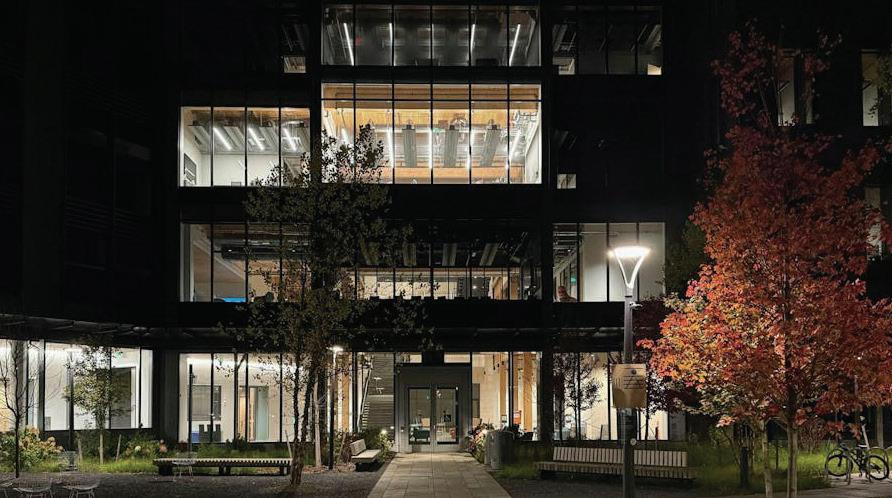
Nassau Hall
2025 treasurer report emphasizes Princeton’s collaboration with federal government
By Gray Collins Assistant News Editor
On Jan. 5, the University released its annual Report of the Treasurer. Following a tumultuous year for higher education across the country, the report emphasizes the University’s lab partnerships with federal departments, close ties to active-duty soldiers and veterans, and involvement in AI and public service.
The report, entitled “In the Nation’s Service,” comes after approximately $200 million in research-specific funding was suspended last year by the Trump administration, then partially reinstated over the summer.
Despite the pausing of federal research grants, the University’s total sponsored research revenue for the 2024–25 Fiscal Year (FY25) increased 5.7 percentage points to $558 million.
“The impact of actions affecting sponsored research funding may not be fully reflected in a single Treasurer’s Report,” University spokesperson Jennifer Morrill wrote to the Daily Princetonian.
Revenues from government grants and contracts increased 4 percent from the previous year across the University, despite a 5 percent decline in revenue on the main campus. The overall increase is due to a nearly 15 percent increase in sponsored research revenue to “independent opera-
ON CAMPUS
tions,” including the Princeton Plasma Physics Laboratory (PPPL).
“The overall increase in grant and contract revenue in FY25 vs. the prior year was primarily the result of 15% growth in revenue from the Princeton Plasma Physics Lab contract from $215 million to $247 million,” Morrill wrote.
Total operating expenses for the year were $2.475 billion, up 11.2 percent from 2024, driven largely by new costs at the Meadows campus and rising salaries of University operations staff.
The report also reflected the final stage of the four-year undergraduate class size expansion plan with the entry of the Class of 2029, with enrollment for the class expanding by 125 to a total of 5,726 and tuition revenue growing by $6 million to $142 million.
Princeton spent $283 million in total financial aid contributions in 2024–25 and saw its largest ever number of Pell Grant recipients. Most families that make less than $250,000 per year pay no tuition.
The University is potentially facing a new 8 percent endowment tax from the One Big Beautiful Bill Act, which applies to universities with endowments of over $2 million per student and a tuition-paying population of at least 3,000.
With a projected increase of financial aid spending to $327 million in 2025–26, there is a possibility that the University will avoid the endowment tax by hav-
ing under 3,000 tuition-paying students.
The University has previously declined to comment on the endowment tax and the number of students that pay tuition.
The fiscal year saw a total net asset growth for the University from $36.3 billion to $38.3 billion, the highest since 2021, driven largely by a 11 percent growth in the portion of the endowment investment portfolio managed by the Princeton University Investment Company (PRINCO).
The 2025 returns lag slightly behind the 12.2 percent and 11.9 percent gains reported by the
University of Pennsylvania and Harvard, respectively. Over the past 10 years, PRINCO has averaged a 9 percent return, outpacing the median national college gain of 8.1 percent, but falling short of many of the University’s Ivy League peers.
Previous years’ reports focused on global connections, the value of liberal arts education, campus construction, and Princeton’s post-COVID future, with only brief mentions of the federal government.
According to Morrill, the title of each report is selected “with the goal of highlighting Princ-
eton executing on its mission.”
“Princeton University’s mission is expansive,” the report read. “Not only does that mean moving the needle in areas from biotechnology to AI to clean energy. It means giving the United States a crucial edge in global competitiveness — solving more problems, guiding more breakthroughs, and inspiring new ways of thinking about our fastevolving world.”
Gray Collins is the assistant News editor for the ‘Prince’ leading University administration coverage. He is from outside of Philadelphia.
Faculty approves Linguistics major and disciplinary reform at meeting
By Benedict Hooper Staff News Writer
The Class of 2028 and beyond will now be able to declare a major in linguistics. The major, previously completed through the Independent Major Program, was created following a vote at the faculty meeting on Monday.
Admission to the Independent Major Program requires an extensive application process. Additionally, eligibility for the program depends on multiple factors including “a strong overall academic record,” according to the Independent Major Program website.
In a letter within the meeting agenda, Laura Kalin, associate director of the linguistics program, advocated for the new major. She outlined the program’s detailed curriculum and noted that the transition would not require a funding increase.
Kalin argued that pursuing the Independent Major in Linguistics discouraged prospective students due to the arduous application process. In addition, the linguistics program did not receive exposure at events intended to showcase majors and departments.
In a conversation with The Daily Princetonian after the conclusion of the meeting, Dean of the College Michael Gordin explained that the decision to create the linguistics major was taken after sustained interest in the linguistics program.
The meeting also included the approval of minutes for the Dec. 1 meeting, the reading of memori-
als for deceased faculty members, and discussions on disciplinary policy reform and committee appointments.
Dean of the Faculty Gene Jarrett ’97 presented a report for the Faculty Committee on Policy which outlined potential amendments to the University’s Rights, Rules, and Responsibilities (RRR). Following the presentation, faculty voted to approve the changes, which aim to ensure impartiality, clarify the role of advisers, and maintain a presumption of innocence during cases within the Faculty-Student Committee
on Discipline.
Key revisions mandate that voting members of the FacultyStudent Committee on Discipline “must be free of any conflict of interest” in any hearing they are presiding over. Furthermore, students may now request a one-week hearing extension for preparation and are explicitly protected by a presumption of innocence until proven responsible for misconduct.
Princeton’s Undergraduate Student Government was involved in conversations with the Executive Committee about RRR
reform.
The faculty also approved a list of nominations for the Committee on Committees and Council of the Princeton University Community.
Gordin proposed curriculum changes to the East Asian studies department, psychology department, Princeton Neuroscience Institute, dance program, and gender and sexuality studies program. These course additions and removals were unanimously approved.
The meeting concluded with the approval of curricular chang-
es to various departments in the Graduate College including Art and Archaeology, Energy Studies, French and Italian, History, History of Science, Politics, Quantitative and Computational Biology, and Spanish and Portuguese.
The next faculty meeting will be held March 2 at 4:30 p.m. in Nassau Hall.
Benedict Hooper is a staff News writer for the ‘Prince.’ He is from Greenwich, Conn., and can be reached at bh3193[at]princeton.edu.
JERRY ZHU / THE DAILY PRINCETONIAN Dean of the College Michael Gordin speaks at the Feb. 2 Faculty meeting.
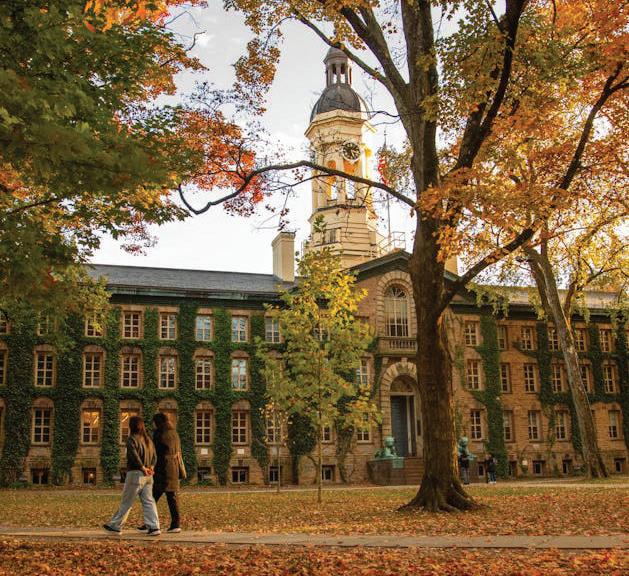
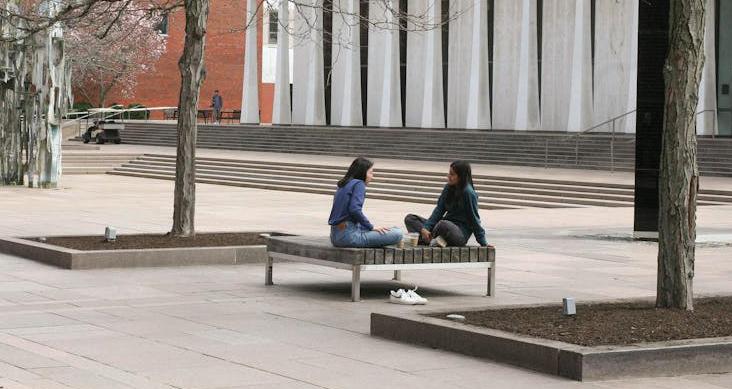
ANNIE RUPERTUS / THE DAILY PRINCETONIAN SPIA Plaza during the springtime.
USG makes electrifying return as Colón Roosevelt lays out plans for term, budget passes unanimously
By Gray Collins Assistant News Editor
The Undergraduate Student Government senate met Sunday for the first time under its new administration, led by president Quentin Colón Roosevelt ’27 and vice president Anuj Krishnan ’27. Colón Roosevelt, despite being audibly shocked by electricity midway through the meeting, set out his plan for the USG term, including focuses on student engagement, transparency, and bureaucratic restructuring. Treasurer Marvel Jem Roth ’28 presented a reworked budget to the Senate, and University Student Life Committee (USLC) chair Oscar Barrios ’27 reported on new communityled working groups.
“We’re going to be adding back a public comment period to USG meetings,” Colón Roosevelt stated in his President’s report. Speaking after the meeting to The Daily Princetonian, he explained that time will be allotted for general student comments at the beginning of each Senate meeting, as well as for specific issues during policy debate periods.
Colón Roosevelt also presented plans to increase transparency in USG through an attendance tracker.
“It’ll track which members show up, which members don’t show up, which members use a proxy, just so students understand how they’re being represented in meetings,” he said.
Major structural reforms to USG were also contained in Colón Roosevelt’s report, including the elimination of the Chief of Staff position and increased supervision of committees.
“Anuj and I have changed a lot of the bureaucracy surrounding USG,” Colón Roosevelt said. “We’re going to be providing a lot more direct oversight this year to committee chairs and to working groups to ensure that they stay on track throughout the semester.”
Colón Roosevelt highlighted the upcoming Council of the
Princeton University Community (CPUC) meeting on Feb. 9, at which University President Christopher Eisgruber ’83 will answer questions from the public. Eisgruber’s annual Letter to the University will be released prior to the meeting.
“It’s just a place where he will be able to answer questions from students, from USG members, from anyone in the Princeton community,” he said. “Definitely, even if you’re not in the CPUC, if you’re not a U-Councilor, show up to that.”
In other matters concerning University administration, Colón Roosevelt told members that the USG sent position papers to the administration about PetroTiger and dining change resolutions that passed in the Winter election cycle. For an advisory referendum, which makes a recommendation to the University but does not go into effect solely based on student voting, the USG Senate submits a position paper to the University administration articulating the position of the student body.
The report also recapped a meeting about free speech with deans in the Office of the Dean of Undergraduate Students.
“We want to make sure that there’s more clear communication with the student body about protest regulations, what they’re allowed to say, how we can ensure that there’s space for civil discourse on campus about keeping campus safe,” Colón Roosevelt said.
USG treasurer Marvel Jem Roth ’28 presented the budget and treasurer’s report, a new initiative that aims to “broadcast to the greater public what USG is really spending its money on, because sometimes there’s a lot of things we’re spending money on that are quite invisible, besides the big tickets like Lawnparties.”
Roth plans to set stricter costper-person guidelines, made possible through the collection of attendance numbers at USG events. Additionally, she unveiled a new
accounting system that includes a contingency column, intended to provide flexibility and efficiency in fund allocation.
“Our goal is to have our activities be actually funded and return as much of the Student Activities fees to students as possible,” Roth said.
The Spring 2026 budget outlines $611,703.70 in expected funding, utilizing all but $7,378.66 in unallocated funds, with an additional $72,725 reserved as contingent funding — pre-approved money that USG can draw from if needed. This is a change from previous years, when large amounts of money were left unspent at the end of each semester.
Projects Board funding increased to $170,000 — with an additional $15,000 in contingent funds — up from $140,000 in Spring 2025. Lawnparties allocation remained steady at $260,000. Dean’s Date received $30,000 in total operating funds, including $15,000 in base funding and $15,000 in contingent funding.
The budget passed unanimously when put up for a vote in the Senate.
Next, University Student Life Committee (USLC) Chair Oscar Barrios ’27 introduced seven community-led USLC working groups. The groups include “Expanding Access to Competitive Clubs,” “Veteran & Transfer Student Experience,” and “University Advocacy for Gun Violence Prevention,” among others.
“These are all led by students outside of USG. Students brought forward ideas that they were very interested in,” Barrios said. “It would be amazing for students to know that these are going to be open throughout — if a student wants to join midway through the community-led working groups, they still can.”
The groups, a new initiative within USLC, will each present reports on March 15 in order to determine whether they should continue for the rest of the semester.
Barrios also laid out a plan to improve communication about dining on campus after the independent dining status was suddenly eliminated last September.
“As street week comes to an end, [the USLC] will work on the estab -
lishment of the Dining Council, bringing USG, ICC leadership, coop leadership, and Campus Dining admin together for the first time,” the presentation read. USLC is also opening a new communications channel on X, under the username @princetonuslc.
USG senate meetings take place each Sunday at 5 p.m. in Robertson 016.
Gray Collins is the assistant News editor for the ‘Prince’ leading University administration coverage. He is from outside of Philadelphia and can be reached at graycollins[at]princeton.edu.
Correction: An earlier version of this article misstated the amount of unallocated funding in the Spring 2026 USG budget; the correct unallocated total is $7,378.66, while $72,725 is reserved as contingent funding. It also mischaracterized the allocations for the Projects Board and Dean’s Date, which received $185,000 and $30,000, respectively, in total operating funds, including contingent allocations. The ‘Prince’ regrets these errors.
Hatheway: ‘This is really one of the most wonderful libraries in the world, and I’m really proud to be the director.’
MARQUAND
Continued from page 1
Princetonian. Hatheway, along with Anne Jarvis, the University librarian, spoke at the library’s opening event on Friday afternoon.
The opening, originally set for Monday, was delayed due to this weekend’s snowstorm.
Marquand Library houses over 500,000 volumes and a special collection of rare books, scrolls, and other ephemera dating back to the 15th century. Four floors of the new space contain stacks open to patrons and organized by book size, ranging from Octavo (standard) to Folio (oversize). Items from the locked Elephant Folio collec-
tion can be accessed in the Charles Rufus Morey Rare Book Reading room by request.
The library’s collection was started by Professor Allan Marquand, the founder of the Department of Art and Archaeology and the first director of the University Art Museum. Marquand taught at Princeton for over 40 years before retiring in 1922. He gifted his collection of 5,000 works of mid- to late-19th century literature to the University and endowed the library, according to Hatheway.
“He really was instrumental in the development of this whole discipline at Princeton,” Phoenix Nutter, a collections specialist at the library, said in an interview. Nutter explained that the library has remained “entirely focused on the fine arts,” allowing them to collect “deeply” in those areas.
“We have unique items when it comes to the history of art, unique artists’ books, things that are very special and very beautiful,” Nutter said.
Nutter also emphasized that the library is not solely for those studying Art and Archaeology. “We’ve already had a ton of people come in, and it’s great as a place to study and work. You
don’t have to be studying art.”
“There [were] special things that we did for our opening today. We have some swag, some pencils and bookmarks,” Ryan Gerber, Marquand Library Operations Supervisor and Special Collections Coordinator, told the ‘Prince.’
“The special thing was seeing patrons who have been waiting to be in this place for five years, their eyes light up when they see their [study] carrels, or they see the collection,” Gerber said. Along with long-term library patrons in the Department of Art and Archaeology, many undergraduate and graduate students visited Marquand for the first time to study.
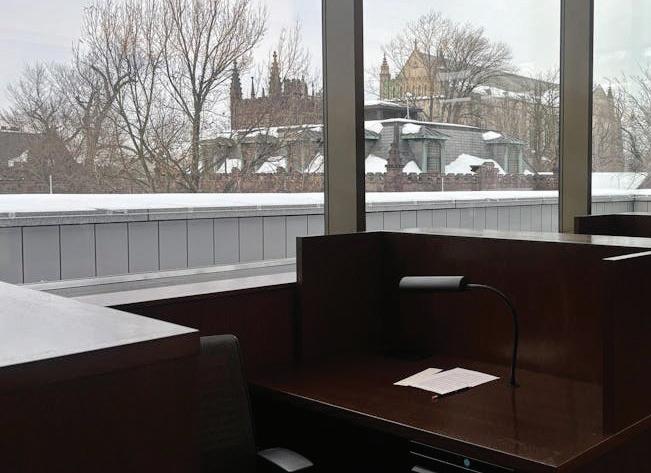
The floor-to-ceiling windows on the first floor drew Maddy Denker ’27 and Sophie Miller ’27 to the new space. “I feel like a lot of the libraries are typically very dark, but this one seems to have a lot of light, and I didn’t realize how big it was,” Denker said.
“It’s so beautiful inside,” Miller told the ‘Prince.’ “I love being able to sit at one of the tables with friends and just do some work and watch the snow on the ground and watch people walking by outside on McCosh Walk.”
“The only thing I don’t like is that you can’t bring your water bottle [inside],” Denker said, referencing the library’s strict no-food and no-beverage policy. However, she and Miller both anticipated returning to study often in Marquand.
Gerber explained that because “there’s no food or drink allowed in this space, it allows us to have more actually in Open Stacks for [students], rather than squirreled away in the vault.”
“Hopefully, undergrad and grad students alike will use the stacks for its unique and vast collection of art history books that is unmatched by most art history libraries in the country,” he said.
Leela Hensler is a staff News writer and a staff Sports writer for the ‘Prince.’ She is from Berkeley, Calif. and can be reached at leela[at]princeton.edu.
Correction: A previous version of this article said that the library’s opening event was on Tuesday morning. It was, in fact, on Friday afternoon. The ‘Prince’ regrets this error.
CANDACO DO / THE DAILY PRINCETONIAN USG Senate Meetings take place each Sunday in Robertson Hall 016.
‘These sT ree T s A re PAved Wi T h G old’
By Elisabeth Forrester Contributing Constructor
1 Princeton’s version of an RA
4 Basketball org.
7 “Back in Black” band 11 ___ enemies
13 These are often candied for a tasty Thanksgiving dish
15 Work your way through “The Count of Monte Cristo,” perhaps
16 Lined up the shot
17 Quintessential high school dance
18 Companion to “pros”
19 Coastal attraction in Iceland named for its sparkling shoreline ice
22 WSW’s complement
23 Suffix with “believe”
24 Companion to “bro”
27 Expressions of pain
30 Where Dorothy goes to meet the Wizard
33 Troy’s best friend in “High School Musical”
35 Anagram of 42-Across
36 Princeton alum Burr
37 Movie theaters
39 Piece of clothing
41 October 24th, for short
42 What ye might lend to a bard
43 Irish music artist known for her dreamy sound
44 The site of a historic attack on Hawaii during World War II
48 Smooth jazz staple, for short
49 French fashion designer initials
50 ___cadabra
51 “I’ve got it!”
53 What pirates use to locate buried riches... or a hint to the solutions of 19-, 30-, and 44-Across?
58 Spiced black tea
61 Aid and ___
62 ___ firma
63 Courtney Love’s band
64 Look, in Spanish
65 Layered vegetable
66 Digital note-taking device
67 What a phoenix rises from
68 Recommended Dietary Allowance: Abbr.
1 Rome, in Rome
2 ___ brûlée
3 “___ more thing...”
4 Big Apple police dept.
5 Nancy’s best friend in season one of “Stranger Things”
6 Single-celled organism, or the second track on Clairo's “Sling”
7 L’Arc de Triomphe, e.g.
8 Company head: Abbr.
9 Aykroyd of “Ghostbusters”
10 Alternative to vinyls 11 Downcast
12 Nintendo gaming console
14 ___ World Coffee
20 Where Hercules killed the lion
21 Type of evergreen
24 Blaring alarms, or creatures whose gentle voices lure sailors to their deaths
25 2017 biopic starring Margot Robbie
26 Sentence structure
27 Take up
28 Complains childishly
29 Vacation footwear
31 Emergency rooms: Abbr.
32 I ___, I saw, I conquered
34 Letter opener?
38 Balloon material
39 Chatter
40 Like the audience at a comedy show
42 Chalk dust collectors
45 Steel support
46 Saudi ___
47 Orator
52 Make changes to
53 Made into a knot
54 Salt Lake City’s state
55 Opera solo
56 Professional, for short
57 ___ Francisco
58 Greek letter between phi and psi
59 Component of the Cha Cha Slide
60 Pie ___ mode
By Noam Rabinovitz | Head Cartoonist
At the Liechtenstein Institute on SelfDetermination, students set diplomacy in motion
By Hannah Adams
Contributing Features Writer
Long before he founded the Liechtenstein Institute on SelfDetermination (LISD), Princeton’s boutique center for handson diplomacy and research, Dr. Wolfgang F. Danspeckgruber was working with Prince HansAdam II of Liechtenstein to hold worldwide private diplomacy colloquiums that subtly influenced United Nations policy. One significant outcome of these colloquiums was the recognition of the former Yugoslav Republic of Macedonia as a sovereign entity, after a 1993 conference in Vaduz, Liechtenstein.
These colloquiums eventually took shape as the institute Danspeckgruber founded in 2000 — what we now know as LISD.
Marking its 25th anniversary late last year, the organization occupies a singular role in international affairs as an intersection of academics and policymaking through student-led research, conferences, and collaborations. In a new era of shifting geopolitical alliances, LISD prioritizes student initiatives to adapt to modern-day challenges to selfdetermination.
Danspeckgruber’s early career in Austria began as a trained
military officer and lawyer. He originally expected to become a diplomat, completing his studies at the Graduate Institute of International and Development Studies before attending Harvard University as a visiting fellow in 1984 where he met HansAdam.
Together they began organizing private diplomacy seminars, but Danspeckgruber decided to take their ventures to Princeton.
“The joke has always been that if I stayed at Harvard, the Liechtenstein Institute on SelfDetermination would have been at Harvard today,” Danspeckgruber explained.
In 1987, Danspeckgruber came to Princeton as a visiting fellow and, a year later, began teaching at the University. When LISD was established in 2000, its focus was on self-determination, the idea that peoples have the right to shape their own political identity, a concept crucial for small nations whose independence rests on the ability to form their own political entity.
Despite being funded by the House of Liechtenstein, Danspeckgruber insists on maintaining LISD’s academic independence.
“The House of Liechtenstein has never ever interfered with
anything concerning what we do here at our Liechtenstein Institute. Never,” he said, instead attributing the success of the institute to Princeton students and the values of their university.
“My idea has always been that we have [LISD] for generations and we do this in view of all the Princeton ideals: with top academic research, to the best of our abilities, non-polemic, and in the service of humanity,” Danspeckgruber said.
With these ideals anchoring the institute, LISD has given their input on many political developments over its 25 years.
Luke Carroll ’26, an International Policy Associate in the institute, described looking at past debates at the institute, from the Iraq War to the expansion of NATO.
“To be continuing in that tradition is really a gift,” he said. LISD is now grappling with modern challenges to self-determination, including artificial intelligence. Danspeckgruber explained the development of AI and technological change as similar to history, where “few things develop linear, upward or downward.”
Yet, he remains optimistic about the role students will play in shaping LISD’s future,
emphasizing the importance of academia in overcoming technological upheaval and rapidly changing global power.
“It is education which will ... come to terms with AI, to somehow grasp its potential and inherent dangers,” he said.
“What does it mean to be a self-determining human in a world where AI is running things?” wondered Professor of Politics and International Affairs
Andrew Moravcsik, Director of LISD.
Moravcsik described the development of a possible project on AI, stating that, “Another priority of mine is to make sure that we do things to the maximum extent possible, partnered with other people and across campus.” This project on AI, he explained, would involve working closely across disciplines, particularly with Princeton Engineering.
LISD’s current research projects span continents and integrate various academic disciplines, allowing students to discuss topics with experts, scholars, and diplomats in order to develop effective and informed policy combating issues such as crisis diplomacy, corruption, reconstruction, and global food and water security.
“There is that huge difference
between us and a think tank — the deep involvement of our students, which in turn offers them unique experiences,” said Danspeckgruber.
Students in partnership with LISD are at the helm of most initiatives where they must organize and administer international diplomacy colloquia hosted by the institute as well as engage with diplomats, Danspeckgruber explained.
Katherine Holden ’26, another International Policy Associate of LISD, emphasized that the institute is “a remarkable opportunity for students to understand where their career trajectories might lead them eventually, and also the different forms of leadership that exist in the world.”
The opportunities students receive surpass graduation, as many alumni returned to Princeton for LISD’s hybrid seminars at Bendheim Hall celebrating the institute’s 25th anniversary.
“As a Princetonian I feel fortunate and grateful that we have the ability to do so because of our wonderful resources — if you can’t find a good answer here at Princeton, where else could you find it?” said Danspeckgruber.
Hannah Adams is a Features contributor for the ‘Prince.’
‘Although it’s framed as a vehicle for student integrity, it centers student-onstudent reporting, treating mass dishonesty as an inevitability.’
HONOR
CODE
Continued from page 1
process, Haverford’s honor code serves as an embodiment of its Quaker values and creates a baseline trust between students and professors. At Bryn Mawr, too, the honor code is explicitly advertised as a “living document.” Both schools host an annual ‘Plenary’ process in which students discuss, amend, and re-ratify the Honor Code.
This stands in stark contrast to Princeton’s Honor Code, which can only be amended via a referendum process requiring vote margins of 75 percent of either the student body or Undergraduate Student Government, hidden behind a 200-person petition or Honor Committee initiative, respectively. It’s no wonder, then, that Princeton students feel no fealty to the Honor Code: most of us never meaningfully agreed to it in the first place. Indeed, the current Honor Constitution — the Honor Code’s guid-
ing document — has not been touched since 2022. Princeton’s Honor Code is also notably more cynical than Haverford’s — and narrow in its focus on academics. Although it’s framed as a vehicle for student integrity, it centers studenton-student reporting, treating mass dishonesty as an inevitability. On the other hand, Haverford’s honor code offers similar privileges to students while outlining a broader culture of “trust, concern, and respect.” In this way, it
deemphasizes punitive policy in favor of an emphasis on broader community trust. As one Bryn Mawr professor put it, it gives students “the benefit of the doubt.”
These differences may seem insignificant. But an honor code can only be a meaningful part of student culture if it truly trusts students to conduct themselves with integrity. If an honor code doesn’t trust students, how can students trust it?
For this reason, Princeton should work toward implementing an honor code that is integral to student identity, not just a perfunctory pledge that we memorize and write on the first page of our exams. That means implementing an honor code that serves as a cultural agreement between students, beyond academics. Like at Haverford and Bryn Mawr, such a policy should also emerge through a collaborative student body process. While a yearly student conference may be difficult at Princeton, which has more undergraduate students than Bryn Mawr and Haverford combined, the University could implement a regular, student-led review process every five years.
A change in policy alone, however, won’t be enough. Haverford and Bryn Mawr’s honor codes do not exist in a vacuum; they are bolstered by cultures that place intellectual growth above material achievement. As a community, we should strive to emulate these priorities, and dispense with our competitive, results-oriented culture. It would be entirely foreign to encounter,
as Harper does at Haverford, a Princeton student that cares so singularly about their learning they don’t even understand why one would cheat. Our excessive focus on grading, achievement, extracurriculars, and post-graduate plans renders it difficult for students to value knowledge for its own sake.
With a problem this widespread and abstract, improving campus culture will be challenging. But as my colleague Siyeon Lee pointed out in November, we can all start by caring more about process than perfection. If we decentered the importance of our own grades and embraced learning for its own sake, classes would feel less like a competition, and cheating might not be so rampant.
Princeton’s Honor Code won’t be fixed in a day. Haverford’s success is seemingly a result of a unique, centuries-old student culture. Even with a new institutional policy, it would be difficult to replicate this culture at Princeton, let alone prevent cheating entirely.
But Haverford’s example shows that, even in the digital age, it’s possible to create an honor code — and an accompanying culture — that fosters trust and discourages dishonesty. Moving forward, we should consider ways that Princeton, as an institution and a student body, can build its own academic culture of trust and knowledge for its own sake.
Shane McCauley is a sophomore associate Opinion editor from Boston.
As endowment returns contract, workers continue to deserve a living wage
Raf Basas Assistant Opinion Editor
On Monday, University
President Christopher Eisgruber ’83 sent his 10th annual “State of the University” letter to the University community, outlining the University’s new direction of “focus” rather than “growth.” In practical terms, this means tempering endowment spending to ensure its long-term durability.
Eisgruber’s response may seem sensible: we must make some sacrifices now so that future generations can enjoy Princeton as we have. But too often, austerity is used as an excuse to sideline workers’ concerns, disarming negotiations for better wages and benefits.
We cannot let this happen at Princeton. Regardless of the endowment’s growth rate, Princeton is capable of giving its workers a living wage of $25.85 per hour — with little negative effect for the University.
Eisgruber attributes the decline in endowment returns to “changing market fundamentals.” This is partially true — many universities have seen decreases in their 20-year rolling returns. However, the urgency of Princeton’s decreases has been exacerbated by recent underperformances compared to other Ivies. For example, the Princeton University Investment Company (PRINCO) delivered a mere 3.9 percent endowment return in the
year ended June 30, 2024, compared to 11.5 percent at Columbia and 9.6 percent at Harvard. In the year ended June 30, 2023, Princeton’s endowment had a 1.7 percent investment loss, while all other Ivies saw minor gains from investment. In both years, Princeton’s endowment had the lowest return in the entire Ivy League.
The University’s endowment has not always struggled, but these two years were especially rough — and probably contributed to the University’s shift in focus. In the year ended June 30, 2025, the University appeared to do well, with a return of 11 percent — but this was still the second-lowest return out of the Ivy League, just above Dartmouth.
While long-term decreases are inevitable, the scale of these decreases depends on PRINCO’s performance. Luckily, the wages of workers are not correlated endowment’s performance: service workers at Princeton are represented by the Service Employees International Union (SEIU), meaning that the University is at least beholden to the terms outlined in the union contract. Barring extreme circumstances, the University must respect its contractual obligations until 2029, when the contract expires.
Ultimately, the issue is not that the wages of service workers might drop. Rather, the issue is that they are already too low — and Princeton’s endowment struggles could be used as an excuse not to raise them, either before or during union contract negotiations. I’ve defended the need for
wage increases before as a response to Trump’s tariffs, but more fundamentally, a living wage is humane. In exchange for their indispensable work, Princeton’s workers deserve to be able to afford their basic needs.
Naturally, detractors will point to the slowing growth of the endowment, claiming that Princeton simply does not have the money. Here’s the problem: even a pessimistic estimate of a living wage’s impact shows a minuscule effect on Princeton’s spending as a university.
According to the University’s contract with the SEIU, custodians are among the least-paid workers at the University, being in the lowest “grade” listed in the contract. Imagine if the lowest salary grade in the SEIU contract were instead fixed to the cost of supporting a single-adult household — the cheapest possible household configuration in MIT’s living wage calculator. Based on the MIT calculator, the hourly living wage for someone in the Princeton-Trenton area would be $25.85 — a $3.70 increase from the current starting rate for custodians.
Because we want to steel-man the argument against a living wage, let’s assume that all of Princeton’s service workers are going to receive a wage increase of $3.70 per hour, regardless of their original salaries. Assuming that someone works for all 52 weeks of the year, for 40 hours a week, this would translate to an annual income increase of $7696 before taxes, a substantial sum for a single, low-
er-income household. For part-time workers, assuming that they work 20 hours a week, this would be an annual income increase of $3848.
In 2024, the University employed 944 full-time workers in “Service Occupations,” as well as 65 part-time workers. If the wages of all service workers increased by $3.70, then the University would need to spend an additional $7.5 million in service wages. On the surface, this may seem like a hefty sum.
However, $7.5 million is less than 0.3 percent of Princeton’s annual operating budget. If then-president Andrew Golden and the five managing directors of PRINCO — who make around $2 million to $4 million dollars each — surrendered just over a third of their income each from FY23, they’d be able to support a living wage for the thousand or so service workers at Princeton.
When I’ve spoken to friends about
a living wage in the past, many of them have assumed that it would be a significant burden to the University — somewhere in the range of tens of millions of dollars. But even without shifting around funds in the budget, the University can easily implement a living wage. It would need to increase its total spending by only $7.5 million, translating to a tiny increase of 0.02 percent in Princeton’s endowment spend rate.
$7.5 million is practically peanuts for the University compared to its total budget, and it has almost nothing to lose. We need to implement a living wage at Princeton, now. It is a common-sense, low-cost policy that we should all get behind.
Raf Basas ’28 (he/him/his) is an assistant Opinion editor from Elk Grove, Calif. You can reach him at raf.basas[at]princeton.edu or @raf.basas on Instagram.
JEAN SHIN / THE DAILY PRINCETONIAN
Morrison Hall, which houses the Office of the Dean of Undergraduate Students and the Honor Committee.
editor-in-chief
’27
Frances Brogan ’27
’27
creative director Juan Fajardo ’28
Corbin Mortimer ’27 Maya Mukherjee ’27
Sections listed in alphabetical order.
head
There’s a better way forward for students in crisis
Thomas Buckley Senior Opinion Writer
associate opinion editors Isaac Barsoum ’28 Shane McCauley ’28
Kosta Botev ’29 Sarah Cai ’29 Mason Dauber ’29 Will Liu ’29 Sara Mironov ’29 Business Manager Emeritus Jessica
software engineers
Nicole Deng ’28
Ziya Momin ’28 Kyaw Naing ’28
Stephanie Sugandi ’27
BOARD OF TRUSTEES
president Thomas E. Weber ’89
vice president David Baumgarten ’06
secretary Chanakya A. Sethi ’07
treasurer Douglas Widmann ’90
assistant treasurer
Kavita Saini ’09
trustees Francesca Barber
Kathleen Crown
Suzanne Dance ’96
Gabriel Debenedetti ’12
Stephen Fuzesi ’00
Zachary A. Goldfarb ’05
Michael Grabell ’03
Danielle Ivory ’05 Rick Klein ’98
James T. MacGregor ’66 Rohit Narayanan ’24
Marie-Rose Sheinerman ’23
Julianne Escobedo Shepherd
Abigail Williams ’14
Tyler Woulfe ’07
trustees ex officio Jerry Zhu ’27
Alistair Wright ’27
The following article includes reference to student death and mental illness.
University counseling services are available at 609-258-3141, and the Suicide Prevention Lifeline is available 24/7 at 988 or +1 (800) 273-TALK (8255). A Crisis Text Line is also available in the United States; text HOME to 741741. Students can contact residential college staff and the Office of Religious Life for other support and resources. Faculty and staff may speak with a licensed professional by contacting AllOneHealth at 800-451-1834.
Every year, members of the Princeton community experience a psychiatric emergency. For around 30 undergraduate and graduate students, this crisis intensifies to the point of requiring inpatient hospitalization, with some forced to take a leave of absence to receive psychiatric care. And sometimes, as this publication has been forced to report all too often, what begins as a crisis often becomes a tragedy. While the endless discourse around mental health can make it seem like such tragedies are just part of running an elite institution in 2026, they don’t have to be.
In a 2022 conversation with The Daily Princetonian, University President Christopher Eisgruber ’83 correctly noted that the mental health crisis is not unique to Princeton. The incidence of mental illness, including severe depression, has increased dramatically for young people in the United States and worldwide. However, this pervasiveness in no way diminishes the University’s obligation to those suffering from mental illness.
Calls for better resources and more therapists are well-intentioned, but such measures are ultimately insufficient. Hiring a few more clinicians cannot address the totality of the problem; throwing money at the problem will not make it go away.
What’s needed is a change of approach: an intensive outpatient program (IOP).
IOPs provide a more cohesive recovery program while allowing patients to remain at home (or in their dorm) and commute to the program, typically for 10–20 hours per week. Those enrolled in an IOP have access to regular group therapy, a psychiatrist to manage or adjust their medications, and a clinician or case manager. It is a major step up from the individual or group therapy Counseling and Psychological Services (CPS) offers, but doesn’t lead to the same removal from outside support as inpatient hospitalization.
As it stands, students in crisis face options that are limited and unappealing. Aside from being deeply dehumanizing and potentially traumatizing, psychiatric hospitalization can be ruinously expensive — even for those with insurance. The student health plan still leaves students responsible for 10 percent of the cost of
treatment, which can amount to hundreds or thousands of dollars depending on the length of stay. The isolating nature of these programs, which entail near-total separation from the outside world, means that even a short stay is likely to derail any attempt to finish the semester. This is worsened by Princeton’s punishing academic calendar, which leaves little room for accommodation.
Rather than pursue inpatient treatment, students in crisis might instead seek out less extreme outpatient measures. Unfortunately, intense demand means that waitlists for both onand off-campus resources can be agonizingly long, leaving those in the lurch feeling helpless. Even when treatment is readily available, it may not be sufficient to meet the needs of some patients.
For those in mental health crises, weekly group or individual therapy alone is insufficient. To have the best chance at success, patients need all of these services working in tandem, which an IOP can provide.
But without an IOP specifically structured to fit within the confines of Princeton’s schedule, this option remains inaccessible to most within our community. Many IOPs provide their services during the middle of the day and are therefore likely to conflict with a Princeton student’s full course load. As such, enrollment in an IOP typically requires taking a leave of absence. By creating its own IOP informed by students’ specific needs, mental health leave will no longer be the only option.
There is nothing wrong with taking a leave for mental health. But when doing so becomes the only available course of action, it puts care-seeking in opposition to community connection. Going on leave loosens the ties between students and the people closest to them. This might mean returning home to stigma and uncomfortable questions, or just feeling like the year has been wasted. Those costs are real, and they create an ugly incentive: forgo adequate treatment and try to muscle through the semester, rather than deal with the high perceived cost of seeking help. Princeton’s mental health infrastructure should aim to allow a smooth path for
treatment, not create barriers that discourage people in distress from seeking the care they need.
The University has plenty of examples to learn from: multiple other institutions have already created models that CPS can and should copy.
As former ‘Prince’ Managing Editor AG McGee ’22 pointed out in 2023, Rutgers University’s mental health program, Rutgers Next Step, provides patients with access to individual therapy, group therapy, and psychiatric services once or twice a week — the services of any other IOP. Since Next Step is run by Rutgers, its schedule and content are catered to the needs of students, allowing them to receive a higher level of care than would otherwise be accessible while on campus.
The College Option Services for Teens at Risk (CO-STAR), run by the University of Pittsburgh Medical Center, provides another model for on-campus IOP care, offering a combination of group therapy, individual therapy, and psychiatry. CO-STAR often enrolls patients from neighboring universities and works closely with college counseling centers, allowing most students to remain enrolled. This is not unusual. At Epoch IOP, which serves UT Austin students, 77 percent of IOP participants were able to remain enrolled in classes. Compare that to Princeton, where attending an IOP essentially necessitates campus exile.
Given the successful programs already present at other universities, Princeton must work to reorient its considerable resources to where they can do the most good for students in distress. If Princeton is serious about combating mental illness, it should follow the lead of Rutgers, Pitt, and others that provide students with an organized and comprehensive program of care that reinforces rather than untethers their supportive campus relationships. The University cannot perfectly address the mental health of every student, but it can do more. While an IOP isn’t a panacea, it can provide much-needed support to students in crisis.
Thomas Buckley is a senior Opinion writer from Colchester, Vt., majoring in SPIA.
The Prospect 11 Weekly Event Roundup
By Amy Jeon, Associate Prospect Editor
1
Reading by Ocean
Vuong: “The Emperor of Gladness”
Feb. 10 at 4:30–6:30 p.m.
James Stewart Theater, Lewis Center for the Arts
Vietnamese American writer Ocean Vuong joins professor Anne Cheng for a discussion of and reading from his newest novel, “The Emperor of Gladness.” While the event is free and open to the public, registration is recommended in advance.
2
3
Drawing from the Collections: Choosing Your Pencil Palette
Feb. 12 at 8–9 p.m.
Virtual Artist-instructor Barbara DiLorenzo will lead a colored pencil art class on Zoom as part of the Princ- eton Art Museum’s Late Thursdays programming. The event is a livestream, free to those who register in advance.
José James Presents the 50th Anniversary of Marvin Gaye’s “I Want You”
Feb. 7 at 7:30 p.m.
Matthews Theatre, McCarter Theatre Center
Vocal improviser José James and singer Lizz Wright reinvigorate the classic Marvin Gaye R&B recording “I Want You” in honor of its 50th anniversary. Tickets are available for purchase on the McCarter Theatre website.
4
Poetry Reading with Anthony Orozco
Feb. 6 at 5 p.m.
Arts Council of Princeton
Join journalist and performance artist Anthony Orozco for a poetry reading, followed by a reception. The event is free and open to the public.
5
Deep Focus: Garden Theatre Screening and Virtual Seminar on “Roman Holiday”
Feb. 8 at 1 p.m. (Screening) and Feb. 10 at 7:30 p.m. (Seminar)
Garden Theatre (Screening) and Virtual (Seminar)
Watch the classic 1950s film starring Audrey Hepburn and Gregory Peck, “Roman Holiday,” at the Garden Theatre, before joining Turner Classic Movies writer Hannah Jack for a discussion of the film over Zoom.
6
Bring Your Own Beverage: Wheel Ceramics
Feb. 6 at 6–8 p.m.
Arts Council of Princeton, 102 Witherspoon St, Princeton, NJ
Give pottery a try with Sela Stazzone, Arts Council of Princeton artist-instructor and owner of Jean Ceramics, and a beverage or brew of your choice. Instructions, materials, and tools will be provided. Register and book tickets in advance for $85.
Bring Your Own Beverage: Carve Your Heart Out, Linocut Printmaking
Feb. 12 at 6–8:30 p.m.
Arts Council of Princeton, 102 Witherspoon St, Princeton, N.J.
Rebel against the cutesiness of Valentine’s Day by carving your heart out with linocut prints. Bring a 4-by-6-inch design and beverage of your choice, and learn to carve your design into the linoleum block. Register and book tickets in advance for $40.
Why Malcolm X Matters, Now
Feb. 10 at 6–7 p.m.
McCosh Hall 50
7
No One is Forgotten: An Immersive Opera Drama
Feb. 7 at 7 p.m. and Feb. 8 at 2:30 p.m.
Wallace Theater, Lewis Center for the Arts
Princeton’s Program in Theater & Music Theater pres- ents “No One is Forgotten: An Immersive Opera Drama,” a workshop of a new performance that tells the story of two captives. While the event is free and open to the public, advance tickets are required. The Feb. 8 perfor- mance will be followed by a discussion with Eliza Gris- wold, Director of Princeton’s Program in Journalism, and Aleksandar Hemon, Professor of Creative Writing.
9
Pop-Up Talk: Curator Perrin Lathrop
Feb. 6 at 2-3 p.m.
Grand Hall, Princeton Art Museum
Join Curator of African Art Perrin Lathrop in a discussion of the installation of artworks in the new building. The talk is free and open to the public.
10 11
In commemoration of the sixtieth anniversary of Malcolm X’s death and the publication of his autobiography, Professor Eddie S. Glaude Jr. speaks on the importance and relevance of Malcolm X and his legacy. The event is free and open to the Princeton community.
Readings by Hala Alyan and Senior Thesis Students
Feb. 10 at 6 p.m.
Labyrinth Books, 122 Nassau St, Princeton, N.J. Poet and novelist Hala Alyan will read excerpts from her work, along with readings by senior thesis students in the Creative Writing department. The event is free and open to the public.
February 6, 2026
MEN’S
BASKETBALL
Men’s basketball recovers on the road with a win against Columbia
By Xavier Latimer Sports Contributor
After a disappointing outing in Ithaca, Princeton men’s basketball (8–14 overall, 4–3 Ivy League) beat Columbia (14–7, 3–4) handily, splitting their off-campus games this weekend. The Tigers played both sides of the ball well, combining a defensive focused first-half with season-best shotmaking in the second half to pull away, earning an 80–68 win Saturday night at Levien Gymnasium.
The Tigers struck first when sophomore forward CJ Happy drilled a threepointer on Princeton’s opening possession, but Columbia quickly found its rhythm. The Lions built an early cushion behind efficient shooting, forcing Princeton to answer with off-ball movement and interior activity.
After a Columbia run to put them up by seven, a backdoor cut for a layup
WOMEN’S FIELD HOCKEY
by sophomore Landon Clark seemed to stop the momentum until Columbia guard Miles Franklin answered on the other end with a powerful dunk to keep the Lions in front.
Princeton began to settle in midway through the half. Out of a timeout, junior guard Dalen Davis drove and kicked the ball out to sophomore Jack Stanton in the corner for a three, and two minutes later sophomore Malik Abdullahi finished a powerful onehanded putback to give the Tigers their first lead since the opening basket at 28–27.
The Lions responded with a three to regain the lead, but another backdoor cut by first-year guard Sebastian Whitfield drew two defenders and opened space for junior forward Jacob Huggins to throw down a two-handed putback slam to tie the game at 30 points a piece with under two minutes to go in the first half.
Defensively, Princeton turned the tide with activity at the rim. The Tigers totaled seven blocks, six of which came in the first half. In one sequence, Stanton rotated over to help with a Columbia big, blocking his shot off the backboard. Though the play did not turn into points for Princeton, junior Jackson Hicke came back down on defense with a block of his own, highlighting Princeton’s strength despite not being able to convert. Even after Davis exited with an aggravated ankle injury, Princeton maintained their intensity.
With under one minute in the first half, Hicke shook his defender free from the corner, drove into the lane, and buried a high-arcing fadeaway to keep the Tigers within striking distance after a Lion’s layup.
Two made free throws by Columbia put them up by two again, but the Tigers held the final possession of the half. Hicke sold a perimeter cut be-
fore darting to the rim, where Stanton threaded a pass for the tying basket. On the ensuing defensive stand, Hicke swatted a Columbia attempt out of bounds and first-year Jacob Hammond altered the Lions’ final look, sending the teams into the locker room knotted at 34–34.
The second half opened as a backand-forth affair, but Princeton gradually seized control. Abdullahi ignited a decisive run with a baseline drive that ended in a forceful dunk, capping a stretch that pushed the Tigers into a double digit lead. From there, Princeton’s shooting efficiency created separation. Stanton knocked down his sixth three of the night late in the game, and timely free throws from Hicke and junior Jacob Huggins sealed the outcome.
Stanton led all scorers with 21 points on a career-high six made three-pointers, adding four assists in a balanced offensive performance. Hicke followed
with 18 points and six rebounds, while Abdullahi posted 15 points on 75 percent shooting and grabbed a gamehigh seven boards. Clark rounded out the double-figure scorers with 11 points, providing consistent energy on both ends.
Princeton finished the night shooting a season-best 57.1 percent from the field and 53.3 percent from beyond the arc, while holding Columbia to 39.7 percent shooting. The Tigers’ seven blocks underscored a defensive effort that steadied the group after an uneven start.
The Tigers will next head to Philadelphia next weekend to face Penn on Saturday, looking to carry their momentum into another pivotal conference matchup.
Xavier Latimer is a Sports contributor for the ‘Prince.’
Switching sides: Talia Schenck to play for Rutgers as a graduate student
By Emilia Reay Senior Sports Writer
Princeton versus Rutgers: the battle of New Jersey. For Talia Schenck, both colleges will be part of her legacy. The senior forward is taking advantage of her last year of eligibility by becoming a Scarlet Knight and spending her first year as a graduate student at Rutgers, playing for their field hockey squad. At Princeton, Schenck has been an offensive backbone, and she looks to have the same impact at Rutgers. In 2024, her last full season with the Tigers, she was a Second-Team AllIvy selection. Schenck started the first seven games of the 2025 season but then sustained a stress fracture in her shin, forcing her to watch her team’s National Championship post-season run from the sidelines.
“I thought it was going to be more difficult than it was when I first
WOMEN’S BASKETBALL
got injured,” Schenck told The Daily Princetonian. “But it wasn’t really that hard at all because that’s just the culture we have.”
Per NCAA rules, Schenck was able to pocket the year of eligibility she missed because of her season-ending injury.
Prior to Princeton, Schenck played just down the road at Lawrence High School where she scored 244 goals and became the fourth leading scorer in American high school field hockey history. She was the first high school field hockey player from New Jersey to reach 100 goals in a season.
After high school, Princeton was the next stop on her New Jersey roadmap. After facing off against Rutgers each of the last four years, going 3–1 in those matchups, Schenck will now be on the other side of this iconic Garden State rivalry.
But Schenck’s ties to Rutgers go
beyond just playing against them in games.
“It was one of the first schools that came to my mind for a lot of reasons,” she told the ‘Prince.’ “I have known their coaches for a long time because they run a U.S. regional training out of Rutgers. Academically, it made a lot of sense, because my dream is to go to vet school, so I wanted to do an animal science program. Not a lot of D1 field hockey schools have an animal science program, but I’ve always known Rutgers does, so it was one of my first thoughts.”
Beyond the Garden State, Schenck was one of 16 American players selected to play in the Junior PanAm Games in Paraguay, where she showed out, racking up four goals to secure the silver medal.
With her skill, there is no doubt that the future is bright for Schenck, but Princeton field hockey contains
a strong culture that she says makes it difficult to leave. “Everyone Loves Everyone” is the informal motto that the field hockey players and coaches use at Princeton. The Tigers play as a unit, and every player, regardless of their statline, has a role on the team.
“When I spoke to [Rutgers] com-
ing out of high school that first time of recruiting, I got a family vibe from them,” Schenck said. “They always talk about being a family and having a sisterhood; I have really grown to appreciate that.”
Emilia Reay is a senior Sports writer for the ‘Prince.’
Strong fourth quarter leads No. 23 women’s basketball to 11-point win over Cornell
By Ify Obianwu Sports Contributor
No. 23 Princeton women’s basketball (18–2 overall, 6–1 Ivy League) dominated in Jadwin Gym on Saturday, securing a 72–61 win over the Cornell Big Red (8–12, 3–4). The game continued the tradition of a longstanding Ivy rivalry and was the 90th time Princeton took on Cornell. It was a solid bounceback win for the Tigers following their loss to Columbia on Friday.
Princeton set the tone early, playing with pace and attacking on both ends of the floor to build a slim advantage in the opening minutes. Cornell kept things tight by answering Princeton’s early runs with timely baskets and
strong interior play, preventing the Tigers from pulling away. By the end of the quarter, Princeton held an 18–16 lead.
The second quarter turned into a back-and-forth battle, with neither team able to seize full control. Cornell found more offensive rhythm, knocking down shots to briefly swing momentum. Both teams traded leads multiple times, and the evenly matched play resulted in a 27–27 tie at halftime.
Coming out of the break, Princeton showed renewed energy, pushing the tempo and capitalizing on key possessions to regain a narrow edge. Cornell continued to stay composed and kept the game within one or two posses-
sions throughout the quarter.
The Tigers and the Big Red proved to be a competitive match, and most of Princeton’s lead was gained in the final minutes of the game. By the fourth quarter, the Tigers were ready to bring home a win, entering with a narrow two-point lead at 48–46.
Junior guard Ashley Chea made good from deep, pulling the Tigers even further ahead, following another three-pointer by junior guard Skye Belker. Belker scored eight total points in the fourth quarter.
“I would say our biggest spark came from our defense,” Belker told The Daily Princetonian, when asked what adjustments the team made at halftime that helped propel the fourth-quarter
run. “We did a much better job with our defensive principles and following the scout to execute our defensive game plan.”
The game proved to be a strong performance from the junior class. Belker and junior guard Olivia Hutcherson put up 20 points each, with Belker and Chea also securing five assists.
“In the second half, we continued to do a great job moving the ball and finding open players,” Belker told the ‘Prince.’ “I was happy that I was able to knock down my shots and extend our lead in the fourth.”
The team also had a consistent and strong shooting game throughout, shooting 17 out of 28 in the second half and finishing the game with a 19/5
assist-to-turnover ratio.
This game was a team effort and proof that the Tigers play for each other.
“Our success is dependent on us playing together and committing to do the little things throughout the game to help us win the game,” Belker told the ‘Prince.’
With this victory, Princeton became first-place in the Ivy League women’s basketball rankings.
The Tigers play their next game against the Penn Quakers at home on Friday.
Ify Obianwu is a Sports contributor for the ‘Prince.’
PHOTO COURTESY OF SHELLEY M. SZWAST Field hockey senior forward Talia Schenck is using her final year of eligibility to play for Rutgers as a graduate student.
Games between Princeton women’s basketball (17–2 overall, 5–1 Ivy League) and Columbia women’s basketball (14–5, 5–1) are never an easy matchup for either team. Tonight, Princeton was on the receiving end of those troubles.
The No. 19 Tigers were riding a 15-game winning streak prior to tonight’s matchup, but they were unable to prove themselves against their Ivy League foe. Princeton lost 67–73. From the blow of the first whis-
tle, the Lions created a quick tempo. Columbia’s star shooter Riley Weiss was able to secure the ball from the tip and get an easy first two points for her team. Princeton senior guard Madison St. Rose was right back at it on the other side of the court, though, collecting two points.
The teams traded baskets, with Columbia earning an early lead of up to seven points. The Tigers fought, but by the end of the first quarter, the scoreboard read 23–21 Columbia.
“I thought we could have come out better, that wasn’t what we talk-
ed about,” head coach Carla Berube told The Daily Princetonian postgame. “It was just the ball pressure once we got over halfcourt that I thought we could have done a better job with.”
The game became more and more physical at the turn of the second quarter. With about six and a half minutes remaining in the half, sophomore guard Toby Nweke was able to tie it up at 27 apiece off a fast break.
Before Princeton could catch up to reclaim the lead, Columbia was already down on the other side of the court, sealing their possession
with a layup. Towards the end of the quarter there seemed to be an unfortunate pattern for Princeton: turnover, Columbia fast break, Tiger foul.
As they have done all season, Princeton was able to stay in the game with a three point shot from junior guard Skye Belker before halftime. At the half, the Tigers trailed 37–36 and the Lions had 11 fast breaks compared to the Tigers’ four.
“I think our dropdown help wasn’t there a lot of the time,” Belker told the ‘Prince.’ “We got beat by not being there for each other and so we just have a lot to work on defensively so we can get more stops.”
Columbia opened the second half with an easy layup. Junior guard Olivia Hutcherson retaliated with a completed and-one play to make the score 41–39. In response though, Weiss did what she does best and drained a three followed by a fadeaway jump shot, forcing the Tigers to talk things over.
After the timeout, the game was so tense that even Berube didn’t see what unfolded next: St. Rose went down, grabbing her knee.
After having torn her ACL last season, the air was knocked out of Jadwin Gymnasium as she laid on the hardwood. Luckily, she made it back to Princeton’s bench, but did not return to the court after five minutes left in the third.
“I think she’s going to be okay. We’re going to reevaluate her on Monday,” Berube told the ‘Prince.’ “She’ll be out tomorrow.”
The third quarter ended 54–50 Lions after Belker hit a two before
YEARS
the buzzer.
You can never count the Tigers out, though. After trailing to the Harvard Crimson just a week prior, Princeton was able to overcome the deficit and earn a near buzzerbeater win in overtime.
Despite their track record, tonight was a different story — the Tigers were not able to find that fourth quarter power.
The final quarter started with a Columbia basket to extend the Lion lead to 56–50. With nine minutes left to play, Weiss committed her fifth foul and sat the rest of the game. If there was ever an opportunity for the Tigers to take control of the game, it was now, but even with the sharp shooter eliminated from the picture, Princeton fell short.
With five minutes to go, there was a five-point differential between Princeton and Columbia. Nweke cut it to a one-possession game with a coast-to-coast bucket, but Columbia came back with a series of shots to extend their lead by nine points. The game ended with fouling, free throws, and a Columbia celebration.
For Princeton, Belker put it best: “You mainly learn from the games you lose.”
This loss snaps Princeton’s 2025–2026 season double-digit winning streak, but it also continues their losing streak to Columbia, who has won the past three contests between these two programs.
Emilia Reay is a senior Sports writer for the ‘Prince.’
This Week in History: The ‘Prince’ Wartime Swan Song
By Lucia Zschoche Associate Archives Editor
“The last Princetonian for the duration [of the war] went to the press last night.”
On Feb. 6, 1943, readers of The Daily Princetonian opened the campus paper to see an unexpected headline blazoned across the front page. Articles on the University’s wartime courses and relief programs were accompanied by the announcement of the closure of the very paper reporting on them. The ‘Prince’ was sending out a swan song before shutting down.
The decision to pause publication of the ‘Prince’ for the duration of the war had been a protracted, deliberative process. Initially, the paper reduced circulation to thrice weekly soon after Pearl Harbor. The only other time the newspaper had fully ceased production was in 1918 due to World War I and the Spanish Flu.
“Expected and planned on for some time by officers of the paper, the suspension of publication was directly caused by the immediate prospect of the call to service of a large number of the present board members,” Managing Editor J. Van Ness Philip ’44 wrote in 1943. The officers were concerned that, with fewer editors, the paper could not “continue ei-
ther adequate news coverage or maintain solvency of finances.”
In their final articles, members of the 66th board reminisced about their ‘Prince’ experience. Much of the staff had been working on the paper since the “days before Pearl Harbor,” when America had not yet invested in the war, according to Managing Editor Ben Walker ’44. He described the writers’ nostalgia as they cleaned the “littered office” and linotype machines fell silent. Without the ‘Prince,’ students turned to its replacement — the temporary University-run Princeton Bulletin — for their campus news.
The Princeton Bulletin was published on Mondays, Wednesdays, and Fridays from Feb. 8, 1943 through Dec. 21, 1945. According to its banner, it billed itself as the “Wartime Successor to The Daily Princetonian,” but had no affiliation with the shuttered student newspaper. The Princeton Bulletin completely replaced The Daily Princetonian for almost three years.
“The University assumes for the duration of the war the responsibility of publishing a campus newspaper,” a notice in the first edition of the Princeton Bulletin read. “The Bulletin is strictly a stop-gap publication, designed to maintain the
necessary contact between undergraduates and the administration and faculty.”
In addition to official notices, the Bulletin covered campus news in each volume, soliciting “assistance” from “the organizations and members of the Princeton community in providing news matter.” Students could send in material for news columns until 10 a.m. on publication days. Each edition was four pages and seldom contained pictures.
On Sept. 24, 1945, a group of students spearheaded by Robert Sharkey ’48 started a coup against the Princeton Bulletin and gained control of it. From the basement of Whig Hall, they composed the first “Undergraduate Issue” using only “one pair of scissors, a small jar of paste, one ruler, and Mark Ethridge, Jr. ’47, son of the globe-trotting editor of the Louisville Courier Journal.” Students avidly read the illicit edition and even “framed the paper and put it up in their rooms,” the writers reminisced in 1946.
“The ‘Prince,’ in embryonic stage, had once more appeared on campus for the first time since February 6, 1943, ” they added.
Eight students, including Sharkey and, temporarily, Ethridge, would continue to work on the Bulletin until Dec. 1945, when they convinced the administration to re-
establish The Daily Princetonian after winter break.
Publication of the ‘Prince’ resumed on Jan. 5, 1946, effectively replacing the Bulletin’s run as the campus newspaper. It resumed daily publication on March 4 for the first time in four years. In a box near the masthead, the ‘Prince’ proclaimed: “Founded in ’76. Reborn in ’46.” By the paper’s renaissance, the Classes of 1945 and 1946 — who had staffed the ‘Prince’ before its closure — were either in their final years or had already graduated. Instead, new Princetonians filled the paper’s ranks, but still paid homage to their older and former classmates. In its first edition back, the 70th Board honored its predecessors and the 355 Princeton men who died in the war, including ‘Prince’ writers Frederic C. Gordon ’45 and Willis Altenderfer ’46, who were on the last prewar board.
“The members of the staff plan to live up to the standard set by the men of the Princetonian of old,” they wrote as the ‘Prince’ reestablished itself under new leadership, taking its place again as the “fingers on the pulse of the campus.”
Lucia Zschoche is the associate editor for Archives and an assistant editor for Features for the ‘Prince.’
The Tigers picked up just their second loss of the season to the Lions.