U. to decommission meal swap system, eating clubs seeking alternatives
By Justus Wilhoit, Lulu Mangriotis & Luke Grippo Senior News Writer, Assistant News
The current meal exchange system will be decommissioned starting in the fall. The system currently allows students on different meal plans to dine together by swapping meal swipes at no additional cost. The meal exchange program itself is not anticipated to end, however.
“The decision was made by the
BEYOND THE BUBBLE
University. However, we were told that the meal exchange software is antiquated and that due to the cost cutting initiative, the University is not in a position to fund the upgrade,” Hap Cooper ’82, chairman of the Graduate Interclub Council wrote in a statement to The Daily Princetonian.
The GICC and Interclub Council (ICC) have been asked to “take the lead” on maintaining the program beginning next fall, according to Cooper. Cooper added that the Univer-
sity, the GICC, and the ICC are working together to find an alternative meal exchange system for the coming academic year.
Meal swaps “will not end,” Cooper wrote. “There are certainly logistics that need to be worked out, such as how we will gain access to University meal data, but given that the University and GICC/ICC are committed to social fluidity and choice, we believe they will work with us to figure it out.”
In a statement to the ‘Prince,’
Opinion Carpetbagging is flourishing in New Jersey. Should voters care?
By Eugene D. Mazo Guest Contributor
The following is a guest contribution and reflects the authors’ views alone.
Bonnie Watson Coleman has represented Princeton’s residents in Congress since 2015. Now she’s retiring, and 17 Democrats have declared that they are running for her seat in June’s primary. Would it be better if N.J.-12 was represented by a candidate with ties to Princeton who understands the federal issues long faced by the University, or by a candidate who moved to the district yesterday? Or does it not matter? This is a choice that voters will soon have to make. That’s because of New Jersey’s new carpetbagging craze. Take the case of Former U.S. Representative Tom Malinowski. Of the 11 Democratic candidates who participated in the recent special primary to fill the congressional seat vacated by New Jersey Governor Mikie Sher-
rill in N.J.-11, only Malinowski had served in Congress before. But there was a catch — Malinowski had represented a different congressional district than the one he was running in this time. Rather than try once more to unseat Republican Thomas Kean Jr. in N.J.-7, Malinowski bet his fortunes simply on swapping constituents. It almost paid off. He finished second to the race’s winner. Malinowski is hardly the only candidate in New Jersey who has recently sought to move to a new, more convenient congressional district to which he doesn’t have any ties. Brian Varela, after trying four years ago to run for Congress against Rob Menendez in N.J.-8, has also swapped districts. Varela is now running against Kean in N.J.-7. Meanwhile, Sue Altman, whom Kean defeated in N.J.-7 in 2024, has declared that she’s running for Congress in N.J.-12 — even though Altman has no real ties to this district.
Gateway tunnel project construction to disrupt spring break travel
By Elizabeth Hu & Giselle Moreno Staff News Writer & Contributing
Writer
Major construction in the Gateway tunnel project began this week, triggering a month-long reduction in rail service along multiple NJ Transit lines, including the Northeast Corridor line. Local officials warn the construction will cause significant delays for travelers — including Princeton students leaving campus for the upcoming spring break.
Starting Feb. 13, one track of rail service will be transferred from the Portal Bridge, a 116-year-old bridge over Hackensack River in Kearny and Secaucus, N.J., to the new Portal North Bridge. Con-
sequently, significant schedule changes will be in effect from Feb. 15 through March 15.
Weekday service will be cut roughly in half. Trains will have added capacity, but will also make more stops. Additionally, delays and cancellations are expected for 280 Amtrak trains during the construction period.
Weekday trains will be reduced to a single track between Newark and Secaucus. While trains will still take passengers to New York, they will do so at a reduced frequency.
In general, customers can expect earlier departure times, reduced service frequencies, longer travel times, and last-minute consolidations or cancellations.
FEBRUARY 22, 1937
The Northeast Corridor line, which runs from Trenton to New York Penn Station with stops at Princeton Junction and Newark Liberty International Airport, is the busiest passenger rail route in the Western Hemisphere.
Some travel plans have already been disrupted: 27 trains were canceled on Sunday, three on Monday, and five on Tuesday.
Passengers, including Princeton students, have been inconvenienced. Tina Le ’29 told The Daily Princetonian she goes to New York “pretty frequently” — about two or three times a month. She was headed to New York on Tuesday when her train was delayed.
Le told the ‘Prince’ that she will be flying out of Newark for spring
break travel — and taking a train to get there.
“I [am] just hoping for the best and that things go smoothly. Because I am going to EWR, I am worried about missing my plane,” Le said.
Still, she does not plan on switching modes of transportation. “Amtrak is very expensive, and NJ Transit’s usually the one at a price that’s affordable … Uber is really expensive.”
Princeton’s spring break runs from March 7 to March 15 this year.
Another student, Olivia Romano ’29, told the ‘Prince’ that she is concerned about her upcoming spring break travel and has to put additional effort into coordinat-
ing her trip.
“I have heard that I have to get off at a certain stop and then make a transfer, and that just seems like something that I don’t really want to do,” Romano said.
NJ Transit is advising passengers to allow extra time when traveling and to expect crowding. Commuters have also been recommended to travel outside of rush hour — before 7 a.m. or after 9 a.m. in the morning, and before 4 p.m. or after 7 p.m. in the evening — and to work from home if possible.
The change has been long in the making. The old Portal Bridge has continuously caused problems for commuters, from fires to mal-
This Week In History
In February 1937, a series of letters to The Daily Princetonian’s editor responded to a student proposal of a “What-Every-YoungGraduate-Should-Know” or “quintessence-of-culture” course for undergraduates. The proposed program, redolent of the present-day HUM Sequence, raised questions about the role of the liberal arts and the fundamental mission of college education.
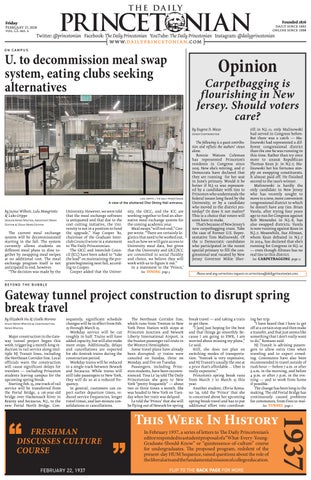
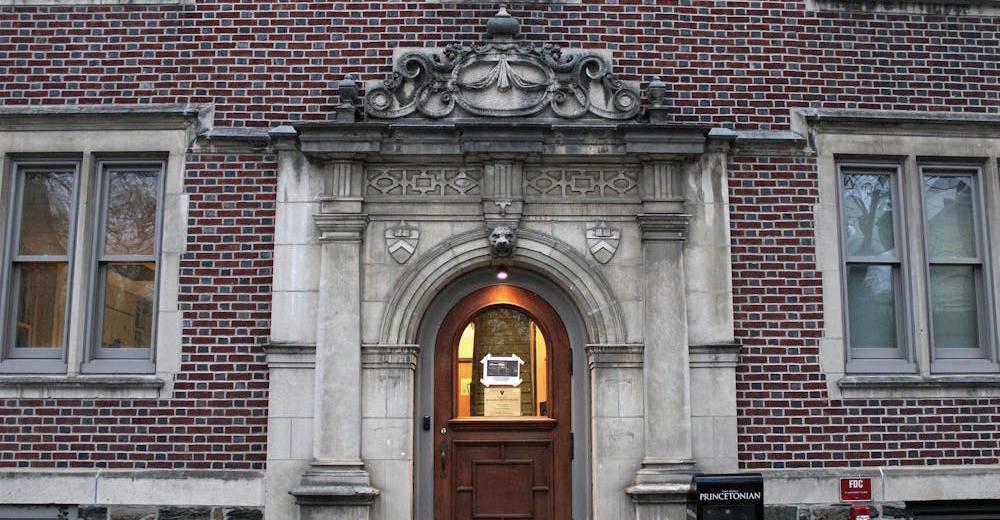
LUKE GRIPPO / THE DAILY PRINCETONIAN A view of the shuttered Choi Dining Hall entrance.
Wolfgang Danspeckgruber, founding director of the Liechtenstein Institute, dies
By Meghana Veldhuis Senior News Writer
Wolfgang Franz Danspeckgruber, founding director of Princeton’s Liechtenstein Institute on Self-Determination (LISD), died peacefully Tuesday night, as announced in an email to the Princeton School of Public and International Affairs (SPIA) and LISD communities.
In 1987, Danspeckgruber became a visiting fellow at Princeton. In 2000, he founded LISD in collaboration with Prince Hans-Adam II of Liechtenstein, whom he met while serving as a research fellow at Harvard.
LISD is an international relations and policy research center housed within SPIA, funded by an endowment from the House of Liechtenstein. The center coordinates programming relating to “self-determination in a globalizing world,” hosting experts, policy analysts, politicians, and others to discuss global challenges. Danspeckgruber was born in Austria in 1956. He earned his undergraduate degree from Johannes Kepler University Linz, completed his law degree at the University of Vienna, and went on to receive a Ph.D. from the Graduate Institute of International and Development Studies in Geneva. Following his education, Danspeck-
gruber served in the Austrian National Defense Army. He wrote or edited 10 books and over 30 articles and opinion pieces throughout his career.
In his email to SPIA and LISD, Politics Professor and LISD Director Andrew Moravcsik said that Danspeckgruber “built up the Institute’s distinguished and ecumenical track record of private diplomacy, Track 1.5 and 2 dialogue, positive engagement in conflict zones, connection with transnational civil society, and commitment to regional and global multilateralism, particularly at the OSCE and UN.”
In recent years, LISD has hosted former global presidents and run panels on weighty geopolitical topics, such as the concept of genocides and wars in Ukraine and Gaza.
LISD’s mission statement states, “Over the past decade, for example, LISD has worked with UN diplomats to host policy proposals and ‘track two’ meetings addressing issues such as climate change and the International Criminal Court … The Institute seeks to prepare the students of today to be the leaders of tomorrow.”
An instructor in SPIA, Danspeckgruber taught seminars focusing on diplomacy and international relations from when he started through the early 2020s, including WWS 471: International Crisis Diplomacy
and WWS 555C: Topics in IR: Leadership & International Relations.
In his roles, Danspeckgruber developed meaningful relationships with students and shared his career interest in international politics with the University community.
In 2005, one LISD student said of Dan-
speckgruber, “He has the biggest heart of anyone I know … Throughout these last two years of the Afghanistan conference series, he has relentlessly tried his best to refocus the international community’s attention on the people of Afghanistan.”
Zach Goldstein ’05 shared that “Danspeckgruber is very much attuned to his students — he sometimes refers to us as his kids ... What he does is not just for the University, it is to directly impact his students.”
Meghana Veldhuis is a senior News writer for the ‘Prince.’ She is from Bergen County, N.J., and typically covers graduate students, postdocs, faculty, and campus unions and labor.
Le: ‘Amtrak is very expensive, and NJ Transit’s usually the one at a price that’s affordable … Uber is really expensive.’
TUNNEL
Continued from page 1
functions.
The current construction is part of the Gateway Program, a set of projects designed to facilitate im-
proved rail transportation along the Northeast Corridor. Despite the delays and cancellations, NJ Transit maintains that the construction will ultimately be beneficial for everybody.
“While disruptive in the short term, these temporary service ad-
justments are necessary to ensure a safe and successful transition to the new bridge infrastructure,” NJ Transit said.
On Sunday, NJ Transit revived its Flexpass ticket option, which provides 20 one-way tickets that must be used within 30 days at a
15 percent discount.
The second phase of the Portal Bridge Cutover is slated for Fall 2026, marking the final transition to the new Portal North Bridge.
Elizabeth Hu is a staff News writer, assistant head Copy editor, associate Data editor, and staff Podcast producer from Houston.
Giselle Moreno is a News contributor from Dallas.
2026 Pyne Prize awarded to Katie Daniels ’26 and Braeden Carroll ’26
By Vanessa Catalano & Lulu Mangriotis
Contributor & Assistant News
Katie Daniels ’26 and Braeden Carroll ’26 have been awarded the Moses Taylor Pyne Prize. The award, considered the highest general distinction for an undergraduate, honors “seniors who have most clearly manifested excellent scholarship, strength of character, and effective leadership.” Both Daniels and Carroll were honored at Alumni Day on Saturday.
From Newtown, Pa., Daniels is majoring in neuroscience and on the pre-med track. Since she was raised just 30 minutes away from Princeton’s campus, the University has been present in Daniels’ life
since childhood.
In her time at Princeton, Daniels has received the George B. Wood Legacy Prize, the Shapiro Prize for Academic Excellence, and the Boyce Batey Senior Thesis Award. She is also an early inductee to the Phi Beta Kappa Society.
Daniels described being recognized with the Pyne Prize as “an overwhelming moment of just entire shock, and even thinking back on it, complete awe.” She credits the achievement to the communities that existed before she even enrolled at Princeton.
“The New College West Team, and my peer academic advisor at the time … made me feel like this was a place where I could succeed, and it could be my home. And
over time, I’ve just seen that grow,” said Daniels.
She is now a PAA herself, and fulfills other roles in student support, serving as a senior fellow at the Office of Disability Services and a health professions adviser.
“I think being a PAA has actually been one of my favorite parts of my Princeton experience,” Daniels noted, “Getting the opportunity to make someone else feel like they have the internal drive and the internal strength to accomplish what they set out to do is probably one of the most meaningful things.”
After taking MOL 214: Introduction to Cellular and Molecular Biology, Daniels found a “phenomenal mentor” in professor Daniel A. Notterman, who now serves as her senior thesis advisor.
Her thesis research followed concussed fruit flies in their recovery, focusing on the cellular and molecular levels that lead to different outcomes, and looking at genetic variants commonly associated with Alzheimer’s disease. Her passion for this topic stemmed from personal experience, as she experienced concussions in her youth.
“[The Pyne Prize is] a culmination of all the effort that I think the Princeton community has placed in me,” Daniels said, “and I feel really grateful to have had their support in guiding me through this journey is also being recognized.”
Carroll, majoring in civil and environmental engineering, is from Kinnelon, N.J. In his time at Princeton, he has received both the George B. Wood Legacy Prize and
the Shapiro Prize for Academic Excellence twice each, and has also been announced as an early inductee into the Phi Beta Kappa Society.
“I’ve been blessed in the past to win a couple things from Princeton, and each of them, I feel like, has been my crowning achievement. And then you get another one and you just have to pinch yourself,” Carroll said.
While he pursues an engineering degree, Carroll has dedicated his collegiate career towards exploring all corners of academia at Princeton.
“In terms of combining different disciplines, I think that is the most powerful part of the Princeton academic program, and why I chose Princeton in the first place. I’ve been able to study engineering and economics and history and politics and everything at such a high level,” explained Carroll.
Carroll’s thesis will focus on historic timber barns at the Howell Living History Farm, exploring how walls in a barn contribute to the stiffness of the structure. He is advised by professor Branko Glisic and supported by Moriah Hughes GS.
Apart from his academic honors, Carroll is also a rower for the Princeton men’s lightweight rowing team. After walking on to the team his freshman year, Carroll has represented Princeton in the third and fourth boats on the water.
“I think rowing is a sport that requires you to be both very personally motivated and driven … but also, when you’re in a boat with eight other people you have to
be doing it for them,” Caroll said. Carroll also attributes his academic success to the structure that rowing creates. Carroll has practice weekdays from 4:30 to 6:30 p.m., and morning practices four times a week.
“It forces me to really focus on spending my time in a measured way,” Carroll noted.
Carroll has also devoted his time to STEM to Stern, a nationwide program that addresses access barriers for underserved communities in the rowing community.
The Princeton University Rowing Association partners with the Princeton National Rowing Association to engage with a chapter of STEM to Stern.
“It’s an opportunity for kids who otherwise would not be exposed to rowing to get a chance to kind of come to the Princeton boathouse and learn how to row,” Carroll said.
“Because [rowing has] had such a positive impact on my life, it’s great to give back and hopefully have a positive impact on others,” added Carroll.
In reflection on his four years, Carroll noted, “I think that that’s probably my biggest advice: don’t make Princeton what you expect it to be. Let Princeton be what it is, and then let yourself change.”
Vanessa Catalano is a News contributor for the ‘Prince.’
PHOTO COURTESY OF BRAEDEN CARROLL AND KATIE DANIELS Carroll and Daniels were awarded the Pyne Prize on Feb. 17.
PHOTO COURTESY OF RICHARD TRENNER ‘70.
Wolfgang F. Danspeckgruber, left, in 2018.
Cooper: ‘Making it easier for students to meet and eat with friends in different clubs, co-ops, and the dining halls promotes a more closely knit campus and is supportive of mental health.’
DINING
Continued from page 1
President of the ICC Lilli Duberstein ’26 affirmed the organization’s commitment to finding a solution.
“The ICC was recently told by the University that it proposes to no longer fund the MealX software come Fall 2026. We are in communication with the Graduate Interclub Council and the University to discuss alternative approaches to the current software,” Duberstein wrote.
According to Cooper, the change was discussed last Wednesday at the monthly meeting between the GICC, the ICC, the Undergraduate Student Government, and “leaders of campus life.”
The news comes after University President Christopher Eisgruber ’83 announced plans to decrease the rate of budget growth on account of lower endowment return predictions, warning that the fiscal tightening would affect programs and create changes around campus. The University did not provide a comment in time for publication.
Currently co-administered by the ICC and Campus Dining, the meal exchange program permits students on different meal plans to share meals by swapping dining privileges. Either a student in an eating club or a student on a University dining plan could initiate an exchange, inviting the other to dine at their location in exchange for a meal at the counterpart’s dining hall or club. The “meal swap” was used to bridge the separation between students on different meal plans.
The digital meal swap was introduced in 2017. Smitha Haneef, Assistant Vice President of Campus Dining at the time, cited the introduction of the digital meal swap “as one of the ways we believe that we are able to bring solutions in service of our students, and here it’s not a differentiation between and amongst students.”
Cooper noted that there used to be a “paper-and-pencil meal exchange system” in the 1970s and ’80s, including when he had been a student at the University. Changes to housing and dining have been on the horizon since Spring 2023, when the University implemented a dining pilot. Three hundred juniors and seniors were selected at random to have five meal swipes per week at eating
Alumni day draws over 1,000, marking Alumni Association’s bicentennial
By Clara Docherty & Leela Hensler Assistant News Editor & Staff News Writer
Over 1,000 alumni returned to campus for Alumni Day on Saturday, celebrating the 200th anniversary of the Alumni Association. The events included the presentation of alumni and student awards, a luncheon, and the Service of Remembrance.
For many alumni, the day was an opportunity to rediscover newly renovated parts of campus. Others praised the awards ceremony for alumni and current students, describing it as highlighting the University’s commitment to academic achievement and service.
clubs, co-ops, dining halls, retail dining locations, and late meal across an eight-week experiment meant to integrate the dining experience among upperclassmen.
Cooper expressed support for the pilot technology in his statement, calling it “fantastic.” He shared that the GICC has “asked for access to that software as we begin to discuss the transition and how the [meal exchange] process might be improved.”
The move to decommission the current system comes after administrators announced in late September that, beginning Fall 2026, all juniors and seniors living in University housing would be required to purchase a Campus Dining meal plan. This effectively eliminated multiple dining options, including the independent dining status, which allowed students to cook and eat without a University or club plan; the 105-block meal plan; and the two University-sponsored meals per week that upperclass students previously received regardless of dining affiliation.
After much backlash from current students, eating clubs, coops, and alumni, the University partially reversed the decision in November, declaring they would continue to cover the cost of the two University-sponsored meals a week for students in eating clubs or co-ops, while independent students would be required to purchase at least a 128-block plan rather than the 160-block.
Despite the University abandoning the current meal exchange system, Cooper claimed that “cancelling meal exchange has never been contemplated. Making it easier for students to meet and eat with friends in different clubs, co-ops, and the dining halls promotes a more closely knit campus and is supportive of mental health.”
Justus Wilhoit is a senior News writer and chief correspondent for the ‘Prince’ covering “The Street.” He is from Kenosha, Wis. and typically covers Princeton’s eating clubs/coops, identity & student life, and the Trump administration.
Lulu Mangriotis is the assistant News editor for the ‘Prince’ leading student life coverage. She is from New York City.
Luke Grippo is a head News editor for the ‘Prince.’ He is from South Jersey, and typically covers high-profile interviews and University and town
Christopher Eisgruber ’83. The Pyne Prize is the highest general distinction for Princeton undergraduates.
Frederick Strobel ’74 told The Daily Princetonian that the Pyne Prize ceremony was one of the highlights of his day. “I get inspiration from what the students are doing today,” he said. “When you see folks who are doing it at an exceptionally high level, that’s meaningful and memorable.”
to “understand what’s happening here on campus and then being able to relay that information back to the alumni community at large.”
Linda Knights ’77 emphasized the importance of having an event like the Service of Remembrance.
For the first year since 2021, a registration fee of $45 was reinstated for alumni who graduated before 2016, while recent alumni paid $25. Associate Vice President for Advancement Communications Erika Knudson told The Daily Princetonian via email that the fee was suspended from 2022–2025.
The day began on Saturday morning at Richardson Auditorium with a presentation of awards to alumni and current students.
Terence Tao GS ’96, a professor of mathematics at the University of California, Los Angeles, received the James Madison Medal, which is awarded annually to an alumnus of the graduate school “who has had a distinguished career, advanced the cause of graduate education, or achieved a record of outstanding public service.”
Graduate students Philip Decker, Victor Geadah, Sayash Kapoor, and Eliana Rozinov were awarded Porter Ogden Jacobus Fellowships, and undergraduate students Braeden Carroll ’26 and Katie Daniels ’26 were awarded the Moses Taylor Pyne Honor Prize by University President
Kevin Gover ’78, Under Secretary for Museums and Culture at the Smithsonian, won the Woodrow Wilson Award, conferred each year on an undergraduate alumnus or alumna whose achievements exemplify the phrase, “Princeton in the nation’s service.” Before being presented with the award, Gover delivered the award lecture, entitled “Fifty Years of Native Agency,” which focused on his advocacy work for Native American tribes.
Jonathan Hines ’74 said Gover’s talk “was just astoundingly inspiring … the mix of what he’s accomplished and his humility about it was just super [admirable] to me.”
At 3 p.m., the annual Service of Remembrance began with a procession into the University Chapel. The service included readings from religious texts and Princeton-specific traditions like the Prayer for Princeton and the singing of Old Nassau.
“It’s a very touching ceremony, and having it every year, it’s a reminder that we’re all mortal and that our time here is limited and that we have an opportunity to meet and live our lives with each other as alums, and we have to live every day,” Jay Weaver ’92 told the ‘Prince.’ Weaver is a member of the CPUC, which meets six times a year to discuss issues pertaining to the University community.
Weaver told the ‘Prince’ that he attends Alumni Day each year
“I love it because it is traditional,” she said. “It doesn’t vary much from year to year. Obviously, the cast of characters in the bulletin is always refreshed, but it’s very moving.”
The day concluded with a closing reception at the recently renovated Princeton University Art Museum, where alumni spent the last hour exploring the interior and mingling over refreshments on the museum’s first floor. Alumni expressed mixed reactions to the new renovations.
“I’m slowly warming [up] to it,” Hines said. “The interior is wonderful.”
Strobel described the museum as “a dramatic change to the campus” but added that “all I’ve heard is that it’s been fabulous.”
During his time as a student, Strobel said that the museum was “much smaller, but in the same location. It [was] a nice place to go and visit, [but] it pales in comparison to what this one is providing.”
Alumni Day has been a Princeton tradition since 1915, when 100 alumni attended.
Clara Docherty is the assistant News editor for the ‘Prince’ leading faculty, graduate students, and alumni coverage. She is from Lafayette, N.J.
Leela Hensler is a staff News writer and a staff Sports writer for the ‘Prince.’ She is from Berkeley, Calif.
Julie Kim, Meghana Veldhuis, Benedict Hooper, and Aitana Camponovo contributed reporting.
Princeton Professor Sam Wang discusses platform in congressional race
By Emily Murphy & Oliver Wu
Senior News Writer & Assistant News Editor
Neuroscience professor Sam Wang is running for the Democratic nomination in New Jersey’s 12th Congressional District. The primary race has 17 Democratic candidates following current Rep. Bonnie Watson Coleman’s announcement that she will not seek re-election. At the Princeton Community Democratic Organization (PCDO) candidate forum on Sunday, Wang received the third-highest number of votes, following Sue Altman and Adam Hamawy.
Wang sat down with The Daily Princetonian on Thursday to discuss his campaign platform. He initially filed to run in January. At Princeton, Wang is also the director of the Princeton Gerrymandering Project and the Electoral Innovation Lab.
Wang said he was motivated to run for office because of increasing polarization and a “breakdown” in the nation’s institutions. “In the last year, that breakdown has accelerated,” he said.
“In the last 30 years, politics has increasingly collapsed down onto one line, one axis of polarization, where you have people who, if you know how they feel about economics, then you can predict how they feel about guns,” Wang said. “That kind of polarization can lead to instability, because when we’re trapped along that line, it’s easy for things to go out of control.”
To address the issue of polarization that he identified, Wang suggested actions ranging from passing a constitutional amendment to end the Electoral College system, addressing gerrymandering through a congressional statute, and expanding the size of the
Supreme Court.
“The people who engineered Project 2025 — they studied the rules,” Wang said, citing examples such as the successful gutting of the U.S. Agency for International Development, “forcing NIH to follow rules that they make up,” and decreased civil service protections for bureaucrats. “I think that the good guys need to also understand the rules well enough to create a fair system. … It’s technical, but it’s at the heart of my reason for running.”
Wang also discussed free speech and expression on college campuses.
“Generally speaking, I think that expression, when it’s truly expressive conduct, should be encouraged as much as possible,” he said. “The limits have to do with physical harm. Once it becomes physically endangering, then the free speech principles have to contend with things like the physical safety of community members or the civil rights of community members.”
“I think that I’ve really admired what’s happened at some universities, where that expression has turned into a dialogue between administrators, faculty, and students,” he noted.
Wang noted that N.J.-12 is one of the most diverse districts in the country.
“In a district like the 12th, diversity and respecting it are very important, and that means helping immigrants and their families. It means respecting people’s civil rights. And that can mean everything from ending the abuses of ICE to giving a reasonable path to … citizenship to hardworking families,” he said.
Wang indicated support for regulating artificial intelligence, noting safety concerns, but did not
specify exactly what regulations he believed were necessary. He described artificial intelligence as a “rapidly evolving industry” and said it would be “important to work with advocacy groups and also [the] AI industry” when developing regulations.
“People who are at risk can go to AI and be egged on to hurt themselves. Children whose prefrontal cortex is not fully developed can work with AI and then be led down a wrong path. People who are not used to technology, like older generations, can be fooled by AI. So AI fundamentally needs some kind of safety regulations,” Wang said.
On the topic of increasing endowment taxes on universities, such as the taxes passed in the One Big Beautiful Bill Act, Wang expressed skepticism. However, he argued that the issue of endowment taxes would be “less prominent” if access to education were improved.
“I think a more important thing
[than endowment taxes] is probably the fact that education is not equally available to everyone, and I think there’s a resentment of elite institutions,” Wang said. “Probably what we should really be thinking about is how to make sure that educational resources are available to everyone and serve as much of society as possible, and attending to that is very important.”
At a Feb. 8 candidate forum, Wang did not raise his hand when candidates were asked whether they agree “Israel has committed genocide in Gaza.” However, during Sunday’s PCDO forum, Wang called the situations in Gaza, Sudan, and Ukraine “genocide.”
“I don’t think my opinion has changed. My willingness to deal with the word genocide has increased. This is because words have consequences,” Wang said when asked if the two forums indicated a change in viewpoint. When asked what he would do
to support younger people, Wang voiced support for “student loan forgiveness or deferment.” He also referenced the success of Zohran Mamdani’s candidacy in driving an increase in youth voter turnout. “I think that’s because he understood that everyone’s struggling, and young people might not see politics as a way of making the world better.”
“A deeply broken government is part of normal life for anyone under the age of 30. That government needs to be more functional,” said Wang.
Emily Murphy is a senior News writer and chief correspondent for the ‘Prince’ covering the N.J.-12 congressional election. She is from New York City, N.Y.
Oliver Wu is an assistant News editor for the ‘Prince’ leading town coverage, focused on the Municipality of Princeton and beyond. He is from Stony Brook, N.Y.
Princeton researchers publish findings on Agouti gene in mice
By Danielle Burke
Contributing News Writer
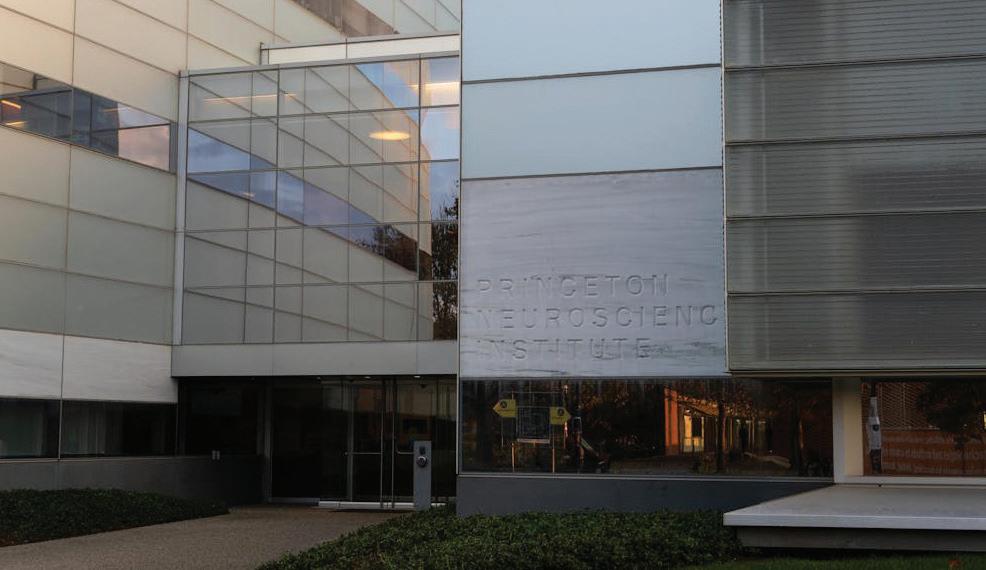
Princeton molecular biology and neuroscience researchers published findings revealing that the Agouti gene, which is found in humans as well as mice, can serve as an on-off switch for paternal aggression in African striped mice. The research was published in Nature magazine on Wednesday.
The Agouti gene, a gene that codes for proteins in the medial preoptic part of the brain, is negatively associated with caring behavior in African striped male mice. This means that high levels of Agouti lead to more aggres-
sive behavior from mice fathers to their pups, sometimes even resulting in infanticide.
Co-authors of the paper, including Postdoctoral Research Fellow Forrest Rogers, Princeton Neuroscience Institute Assistant Professor Catherine Peña, Associate Professor of Molecular Biology Ricardo Mallarino, Taso Callanan ’26, and Sarah Kim ’26, spoke with The Daily Princetonian to discuss their findings.
Rogers said in an email to the ‘Prince’ that the research was inspired by field observations in which they were investigating parental patterns in mice. After running further behavioral experiments and RNA-sequencing
analysis, the researchers found that Agouti made male mice less prone to care for their young.
Mallarino initially worked with African striped mice as part of his research on understanding the evolution of certain traits across species, he described to the ‘Prince.’ He sought out Peña to better grasp the brain regions that were controlling paternal behavior in the mice. Peña then brought on Rogers, who has been studying paternal care in species since 2011, his first year as an undergraduate.
“I think there were a lot of surprises throughout the study,” Rogers said in an interview with the ‘Prince.’ “[Agouti] is a gene that’s not very well-characterized in the brain at all and not previously characterized in playing a role in parental care.”
Mallarino noted that the Agouti gene has previously most been studied for its role in skin pigmentation.
Their research suggests that the environment can affect the expression of the gene. Male mice who spent more time in crowded, social environments had a higher expression of Agouti while those who were more socially isolated had a lower expression of it.
“I think one of the really cool things about this study is that we
found a single molecule that actually responds to environmental conditions and the social environment and takes those cues, whatever those cues are, into the brain, and is able to fine-tune behavior and parenting behavior based on those social cues,” Peña said.
“We’re highlighting that animals are flexible in their behavior and adapt to their environmental circumstances, which is very different from the way that a lot of people talk about their parenting, because people often talk about parenting as something that’s automatic without much adjustment for environmental circumstances,” Rogers said.
Both undergraduate co-authors of the research paper, Kim and Callanan, are using these results as a foundation for their senior theses.
Kim’s project tackles the question of timeline. While the researchers found that the level of gene expression varied as a result of the environment, they are still researching the specifics of the integration process of the gene. Rogers is working with Kim on determining what cue in the social environment is triggering the animals to change their behavior and how Agouti develops.
“My thesis project is, [at] what
stage of the developmental process do we see a spike [of Agouti], if we see a spike?” Kim said in an interview with the ‘Prince.’ “Or, what’s the trajectory [of the gene] while [the mice] grow up during social isolation?”
There are still matters unknown about how Agouti functions outside the medial preoptic area of the brain. Callanan is focused on understanding how the gene works in an entire neural circuit, not just in one specific region of the brain.
“My thesis is more so looking at the molecular basis of Agouti and how it’s expressed brain-wide,” Callanan said.
Ultimately, Rogers noted that “this work hasn’t been replicated in other species yet, so we won’t say whether or not the same exact mechanisms apply to other mammals or humans.”
However, Rogers emphasized: “we do think that there has to be some other mechanism, if not the same mechanism…that allows other animals to take in information about their environments and adjust their behavior.”
Danielle Burke is a News contributor for the ‘Prince.’ She is from New Jersey.
PHOTO COURTESY OF SAM WANG
Princeton neuroscience professor and N.J.-12 Democratic candidate Sam Wang.
USG and alumni campaign ‘One Too Many’ to propose mental health policy with student feedback
By Gus Vogel Contributing News Writer
The Undergraduate Student Government (USG) Mental Health Committee and the Princeton Alumni Mental Health Coalition recently launched a new mental health campaign, “One Too Many,” in response to recent student suicides. The campaign aims to improve mental wellbeing on campus by proposing policies informed by student feedback.
“Princeton is in crisis,” the campaign’s homepage reads. “Since 2021, we’ve lost 7 students to suicide. The system is broken, and we are demanding action.”
The USG Mental Health Committee partnered with the Coalition, a group of over 40 alumni formed over the summer of 2025, to launch the campaign in December 2025. The two organizations are currently preparing a letter of policy proposals regarding student mental health to send to Uni-
versity administration.
While the two groups planned to send the letter by December, former Mental Health Committee Chair Allen Nieva ’26 told The Daily Princetonian that while refining a previous version of the letter, they found themselves “[facing] the scarcity of available data and wanting to generate momentum behind this initiative.” They decided to launch “One Too Many” to solicit feedback from students to inform their policy proposals.
IN TOWN
Nieva said that the letter, which is not yet complete, “will directly demand policy reforms for various areas of Princeton’s wellness system, including counseling services, campus cultural norms, academic stressors, and transparency for data.”
Having collected feedback, “One Too Many” plans to send out the letter in the coming weeks. In early February, the campaign set up a table in Frist Campus Center to spread awareness about the initiative and gather insights about students’ mental health. The committees also sent the student body an anonymous online survey to gather more information.
Aakansh Yerpude ’27, the 2026 USG Mental Health Committee chair, said that the tables were intended “to create low-pressure spaces where students can speak openly without feeling like they’re the problem. Often, campus culture encourages conformity because outwardly everyone appears to be thriving; we’re trying to create room to challenge that and build a stronger culture of care.”
In a presentation to the USG senate on Feb. 15, “One Too Many” organizers said the campaign aims to aggregate feedback rather than focusing on individual insights.
“The name ‘One Too Many’ acknowledges a difficult reality without centering specific people or events. Our focus is on prevention, collective responsibility, and responsiveness when students raise concerns, rather than on retelling individual narratives,” Yerpude told the ‘Prince.’
This campaign is supported by a vast network of students and alumni, some of whom have been working to improve student mental health for several years. Tiffanie Cheng Wu ’24, the Coalition lead, discussed the challenges of mental health advocacy in an interview with the ‘Prince.’
“I have been in this mental health advocacy space at Princeton for a very long time, and it can get really frustrating, and I have burned out from it, and I stepped away from it, and now I’m back,” Wu said.
Wu told the ‘Prince’ that she and other alumni in the coalition recognize the importance of oncampus wellness even after graduating. She said that she believes that after enduring the challenges of Princeton, alumni want to support current students who may be experiencing struggles similar to their own.
The campaign plans to continue its work this semester after the submission of the letter. “Looking ahead, we plan to collaborate with student groups and campus offices on programs that expand awareness and reinforce the message of collective care and agency,” Yerpude said. He also told the ‘Prince’ he hopes to continue incorporating alumni voices, as “hearing from people who’ve navigated similar challenges can provide perspective and reassurance.”
Gus Vogel is a News contributor for the ‘Prince.’ He is from Brookline, Mass.
Princeton Council considers removal of invasive-species, reviews winter storm response and affordable-housing ordinances
By
The salamander has crossed the road — again.
On Monday, the Princeton Town Council heard a proposal for a restoration project at Princeton Ridge East, an open space acquired on Dec. 30, 2024. Open Space Manager Inga Reich presented the first phase of the project. Reich said that the first phase, which is slated for Fall 2026, will focus on removing invasive plants such as Japanese honeysuckle, primarily through manual clearing. Reich said the site is “currently overgrown” and “a very hard site to walk through at the moment,” but that removing invasive species now could prevent them from spreading further into the surrounding forest.
According to Reich, the project could improve soil quality, reduce sediment runoff into downslope wetlands, and create a more accessible wooded environment for visitors, including a potential trail connection that would link habitats and provide an additional route toward downtown.
Reich noted that the project is intended to restore the area’s ecological function from an invasive-species-dominated shrub landscape to a healthier forest community.
“In the long term, planting will not only have a positive effect on
the site in question, but also on the surrounding forest,” she said.
Reich warned that if the town did not intervene, invasive species could continue to expand and create long-term ecological damage.
“The trees will sequester carbon in the soil,” Reich said. Once the site is open to visitors, Reich says it will “look a lot nicer,” because invasive shrubs would be removed and the forest structure would start to recover.
Reich told the Council that crews would be directed to limit disturbance as much as possible.
“We don’t expect the manual removal to take more than a few weeks,” she said, predicting that immediate impacts should be “negligible.”
She noted that some short-term disruption would be unavoidable, including the installation of fencing. Medium and long-term impacts would include improved “soil structure and function.”
Council members questioned the project’s inclusion of volunteer labor and how the work might be organized.
Councilman David Cohen asked whether any groups had expressed interest in volunteering. Reich responded that a Princeton-based high school student volunteer group, the Ridgeview Turtles, had indicated interest in working on the project, specifically on trail creation.
Council President Michelle
Pirone Lambros said that the proposal is “the right direction for the town to go in.”
During the public hearing on the project, residents focused on how restoration work could affect wildlife, particularly amphibians.
Princeton Professor of Neuroscience Lisa Boulanger, who lives adjacent to the property affected by the project, expressed concern over a spotted salamander population in a pond nearby.
In a previous Council meeting, Boulanger expressed concern over the well-being of the Princeton spotted salamander population.
The pond, though not in the treatment area, sits downstream — meaning that pesticides could flow into the pond. Boulanger requested that the town minimize the use of heavy machinery and herbicides, and urged the town to “push the timing into the later spring, early summer” so fewer salamanders were impacted.
Another resident, Stephen Hiltner, thanked the Municipality for acquiring the property and echoed concerns about machinery, adding that rubble removal from an on-site structure scheduled for demolition as part of the project could disrupt the habitat.
A major priority of the Council meeting was approving a funding application to the State of New Jersey for the work, under the Green Acres funding program. Councilwoman Mia Sacks noted that
the “demolition of the [existing] buildings was a condition of the [Green Acres] funding,” and asked Reich how the town could avoid sensitive habitats during that work. Reich responded that if residents identify the location of the salamanders’ pool, staff would be able to plan their work around it.
The Council voted unanimously to approve the resolution authorizing submission of a Green Acres stewardship grant application for the Princeton Ridge East project.
Earlier in the meeting, Princeton Police Captain Thomas Lagomarsino reported on storm operations. He told the Council about recent scheduling changes, and that the police department deployed specialty units over the weekend to help manage storm-related incidents without overtime staffing.
“With these changes and having specialty units working on the weekends [the department was able to] get through with adequate staffing without having any overtime occur due to the storm,” Lagomarsino said.
Council members also asked about traffic safety during the storm, to which Lagomarsino responded by stating that residents were warned about the storm, resulting in the Municipality experiencing relatively few accidents, although there were some issues related to power lines.
Prompted by Pirone Lambros, Lagomarsino added that the Citizen’s Police Academy, an eightweek police training program for residents, has recently opened for applications. If enrollment is not filled by Princeton town residents, it will be opened to others, including Princeton University students.
Later, the Council discussed multiple ordinances that would amend municipal land use guidelines and zoning codes to create a series of affordable-housing districts, all of which were unanimously passed.
The ordinances are meant to enact portions of Princeton’s Fourth Round Housing Element and Fair Share Plan, which was approved by a Mercer County Superior Court judge on Friday, Feb. 13. The Municipality has a deadline of March 15 to adopt all implementing ordinances and resolutions.
The meeting agenda also included presentations on kiosk design contest winners and Palmer Square’s proposed 2026 events calendar.
The Princeton Town Council typically meets on the second and fourth Mondays of each month at 7 p.m. Its next meeting will be held on March 9.
Razvan Verde is a News contributor for the ‘Prince.’ He is from Newport News, Va.
DOUG SCHWARTZ / DAILY PRINCETONIAN
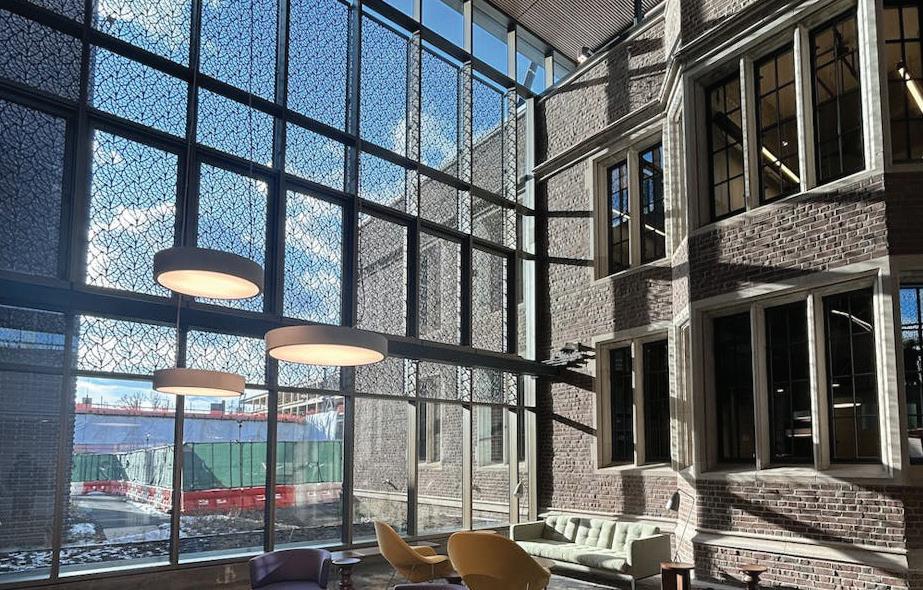
The interior of the Frist Health Center.
Razvan Verde Contributing News Writer
The End of the Take-Home Era: How Exams Have Changed in the Age of AI
By Veda Devireddy & David Estrada Assistant Data Editor & Staff News Writer
Artificial intelligence tools like ChatGPT, Gemini, and Claude have started influencing the way that universities and institutions of higher education operate. AI has not only changed the ways in which professors navigate their classrooms, but it has also upended long-established systems for exams.
This change is well-illustrated by the economics department, which has begun administering only in-person final exams. Senior Lecturer Smita Brunnermeier, the executive director of undergraduate studies for the economics department, spoke with The Daily Princetonian about how this policy development first came to be considered.
“Some of our students submitted a request to the department to switch to inclass final exams,” Brunnermeier said. “The request was discussed in our Undergraduate Steering Committee meeting, and both the faculty and student members of this committee unanimously agreed that the policy made sense given concerns of AI use and academic honesty.”
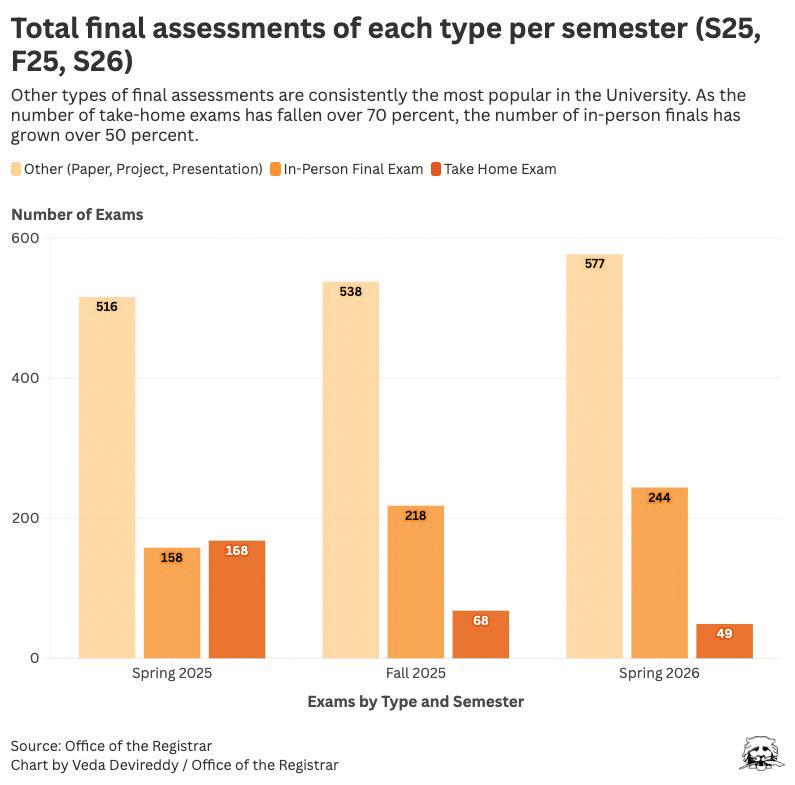
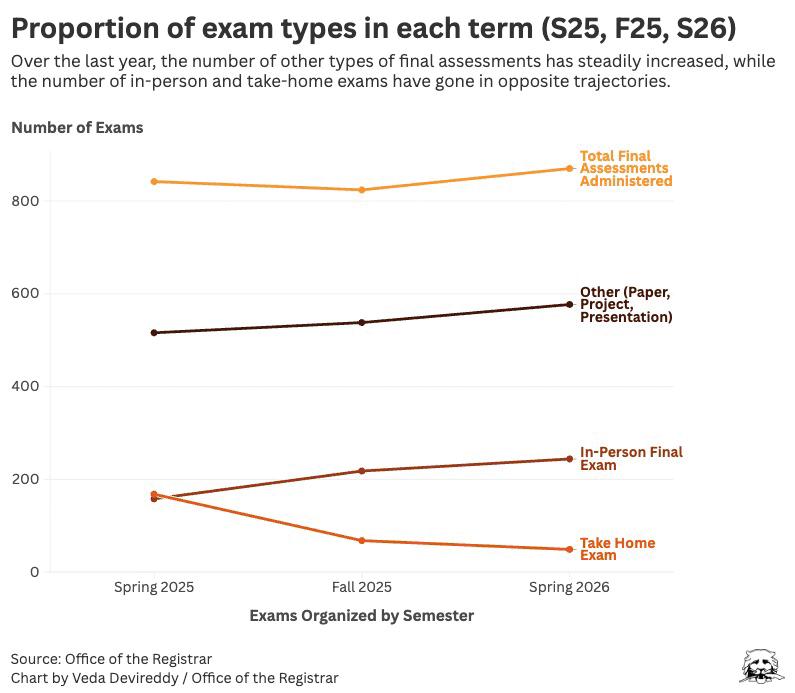
The ‘Prince’ analyzed the final assessment schedules for the last three semesters to better understand how the University is trying to tackle concerns relating to cheating and AI. The number of take-home exams has been continuously declining over the last three semesters. In Spring 2025, they were more popular than in-person finals, but just a year later, they have become scarce as generative AI has become more commonplace, with only 49 take-home exams being administered this semester.
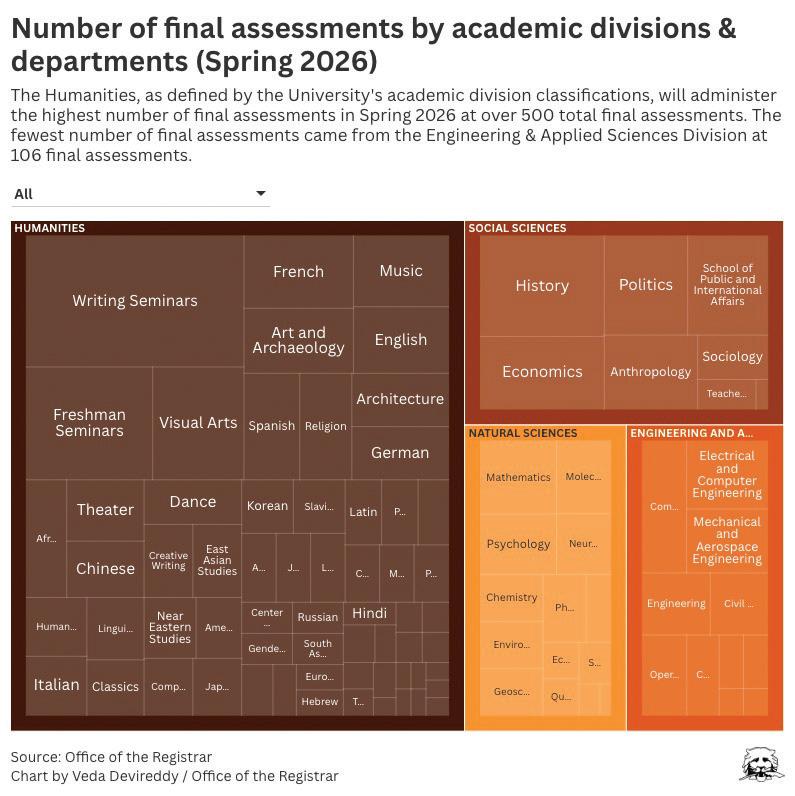
By analyzing the types of exams given, it becomes easier to understand why projects and papers have maintained their lead over in-person final exams.The majority of the University’s offered majors are in the humanities or social sciences, which often rely more heavily on papers and assessments, while natural sciences and engineering courses tend to hold in-person final exams. As such, these other types of non-exam final projects take up a greater share of the collective data. For example, the Writing Seminars, which are required for every first-year student, all have project and paper-based finals, as do the majority of Freshman Seminars and classes in the School of Public and International Affairs — two types of classes which large swaths of undergraduates tend to enroll in. Consequently, as take-home final exams have become less common, non-exam-based assessments have increasingly taken hold.
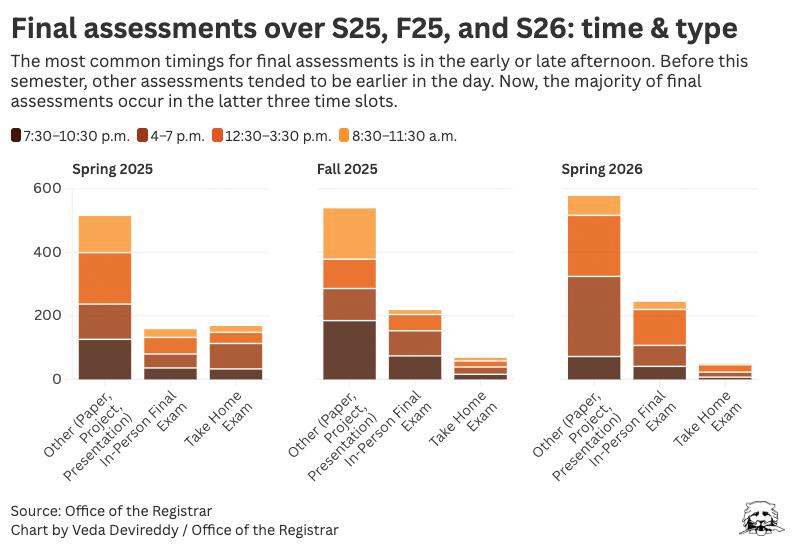
Exam timings have shifted slightly throughout the last three semesters: in Spring 2026, more exams are held in the afternoon when compared to Fall 2025. Most in-person finals will be held 12:30–3:30 p.m., while most other assessments will take place from 4–7 p.m.
The number of take-home exams have more than halved in number since this time last year, from 168 to 49. There were more take-home exams in the Spring 2025 semester than there were in-person finals. Now, there are less than 50 take-home exams scheduled. From Spring to Fall 2025, the number of in-person exams has increased by over 50 percent. The number of papers, projects, and presentations have increased by 61 exams in the span of only a year.
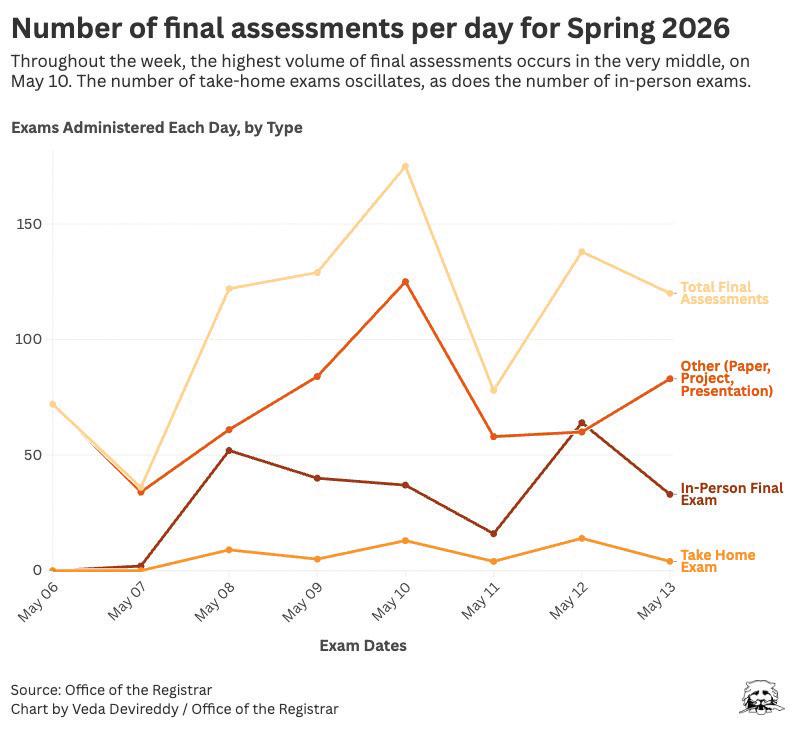
During the final assessment period, inperson exams are more common at the start and end of the week. This is in direct contrast to the scheduling of papers, projects, and presentations, which peak in the middle of finals season, specifically on May 10. Even at its peak, the number of take-home exams is much lower than the other two options.
Brunnermeier gave some insight into the in-person exam policy’s future. “We don’t have enough observations yet to know whether [getting rid of take-home exams] has significantly impacted outcomes like student learning and grade distribution,” she stated. “That said, faculty members who have spoken to their students after the policy was implemented report that the vast majority of their students stated that
they were supportive of or had neutral feelings about this change, so we do not foresee a return to take-home exams.”
The impact of generative AI on the University’s future is still unclear. As these tools rapidly change and their reach expands, individual departments and University administration as a whole have fought to preserve academic integrity. It is hard to say if take-home exams will ever regain their popularity over in-person finals — but regardless of what happens, nothing is certain except death, taxes, and exams.
Veda Devireddy is an assistant Data editor for the ‘Prince.’ She is from Baton Rouge, La.
David Estrada is a staff News writer for the ‘Prince.’ He is from Los Angeles.
Hum r
Little gremlin that steals socks from laundry room steps down
By Nate Voss Assistant Humor Editor
The following content is purely satirical and entirely fictional.
The University announced Monday that Grolb, the tiny goblin that nabs socks from loads of laundry across campus, has retired. “After 147 years of dedicated service, we are very sorry to say goodbye to Grolb,” wrote Dean of the Faculty Job Namur.
Grolb had a humble start in nuisancery, nicking hosiery from clotheslines on the outskirts of 19th-century Tren -
ton. He stumbled upon Princeton’s campus in 1874, and was brought onto the faculty as a professor of looting in 1879. Over his illustrious career, he stole over 1.5 million individual socks. It is reported that the theft of a particularly sentimental sock caused F. Scott Fitzgerald’s academic spiral and subsequent departure from the University.
While the University statement phrased Grolb’s departure as a voluntary retirement, Daily PrintsAnything sources claim that the decision was made under administrative pressure. After
nearly 150 years on the faculty, Grolb’s salary had grown to an annual $2 million, an increasingly unjustifiable cost given federal funding cuts. Cost-cutting hawks had threatened his tenure by resurfacing editorials from the 1890s in which he used transphobic language.
This action seems to be part of a push to streamline various processes on campus. Print and Mail Services appears to be circumventing minimum wage laws by replacing all of its package processing employees with three-toed sloths. The School
of Engineering and Applied Science also pitched in to the initiative, releasing a prototype dryer that automatically launches its still-damp contents onto the dirty laundry room floor. This task was previously performed by Grolb’s cousin Churm, who denounced the action as “capitalism gone too far.”
Nate Voss ’29 is an assistant Humor editor who has been Grolb’s victim three times this year and is not sad to see him go.
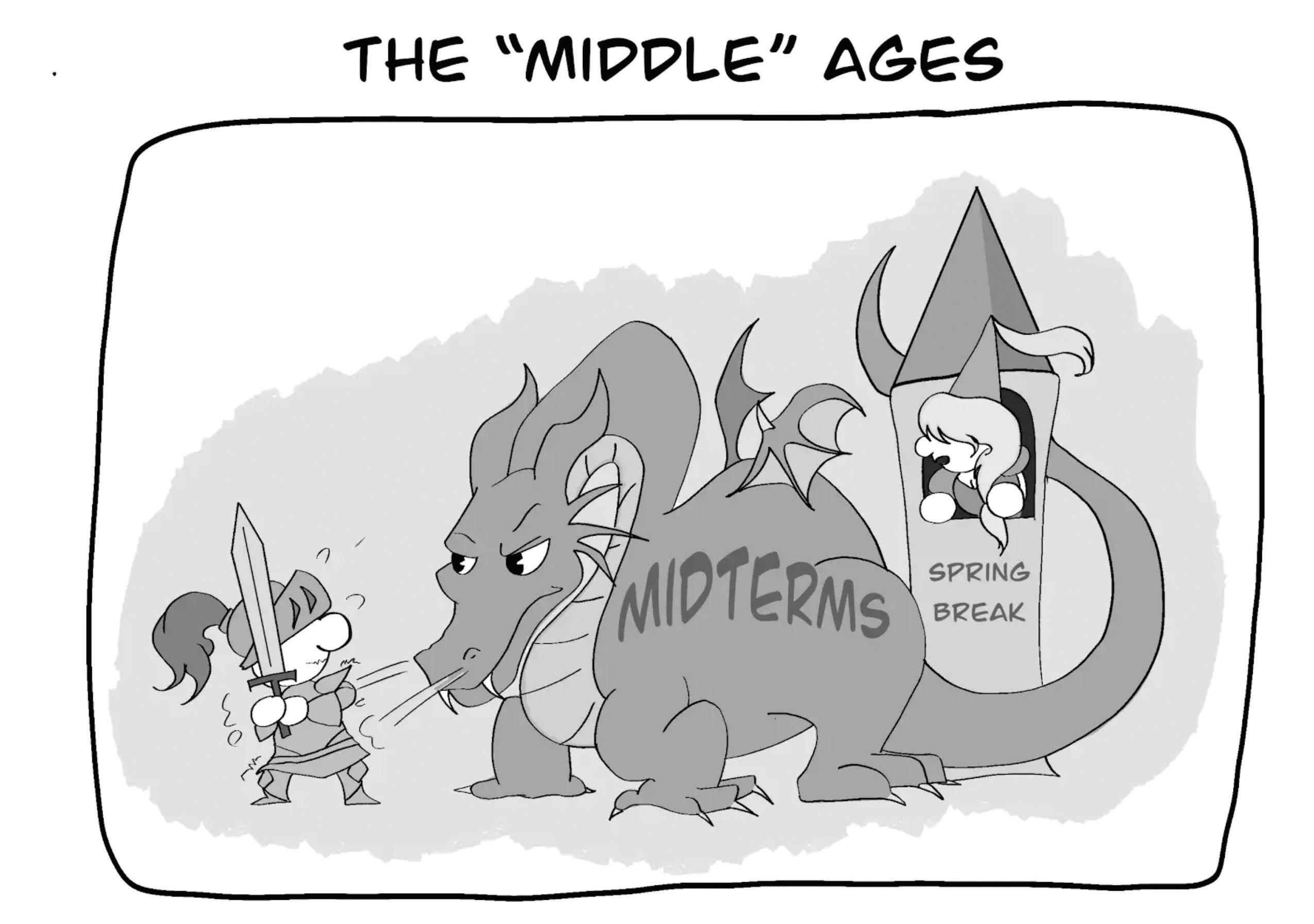
The ‘Middle’ Ages
By Paulette Martinez | Associate Cartoon Editor
ILLUSTRATION BY NATHANIEL VOSS / THE DAILY PRINCETONIAN; SOURCE PHOTO BY CALVIN KENJIRO GROVER / THE DAILY PRINCETONIAN AND “DOBBY BEIM WELTBILD VERLAG” BY WELTBILD VERLAG / CC BY 2.0 Grolb at the Council of the Princeton University Community meeting on March 24, 2025.
“I nnards ”
By Luke Schreiber
Puzzles Editor
17 First woman to land on Earth
18 Study material for many language classes, for short 21 Tucker of country music 23 Bread with a Mediterranean fruit in it
26 Slim
28 Soviet space station
29 One of the FANBOYS
Scoundrel 31 ___-Hulk
32 They slow the flow
33 Treatise written by Sun Tzu 36 Protest songwriter Phil 38 What the letter between L and B stands for 39 Crew tool 40 Wrath 41 Keystone ___ (old comedy figure)
42 Norse explorer Leif
46 Cohabitate outside of wedlock 49 Voila!
50 Squash or skeleton 51 Saruman's palantir, for one 53 Infamously challenging chem class 54 It's needed inside, or a hint to 14-, 23-, 33-, and 46-Across 58 Oldsmobile Cutlass 59 Gifts for ones going through a stationery phase
Tiny
Something given by a starer
Like an abdominal opening
Stoat
Sings, so it seems
Online school ending, often
Pigeon shelter 6 Noah of "The Daily Show" 7 Speedy soldier in an unsuccessful Australian "war"
8 Some batteries
9 Of any kind 10 Cause of points lost, on a test
11 Nightclub with lights, music, dancing, etc.
12 Goes away
15 Electrical unit 19 Graduate 20 Sandwiches with three necessary ingredients other than bread
22 Together, musically
24 That's just what I think, in text
25 Contend
27 First book of "The Inheritance Cycle," by Christopher Paolini 31 Pigpen
32 Little known candidate
33 Singing competition with over twenty seasons
34 Talks with a beat, or beats
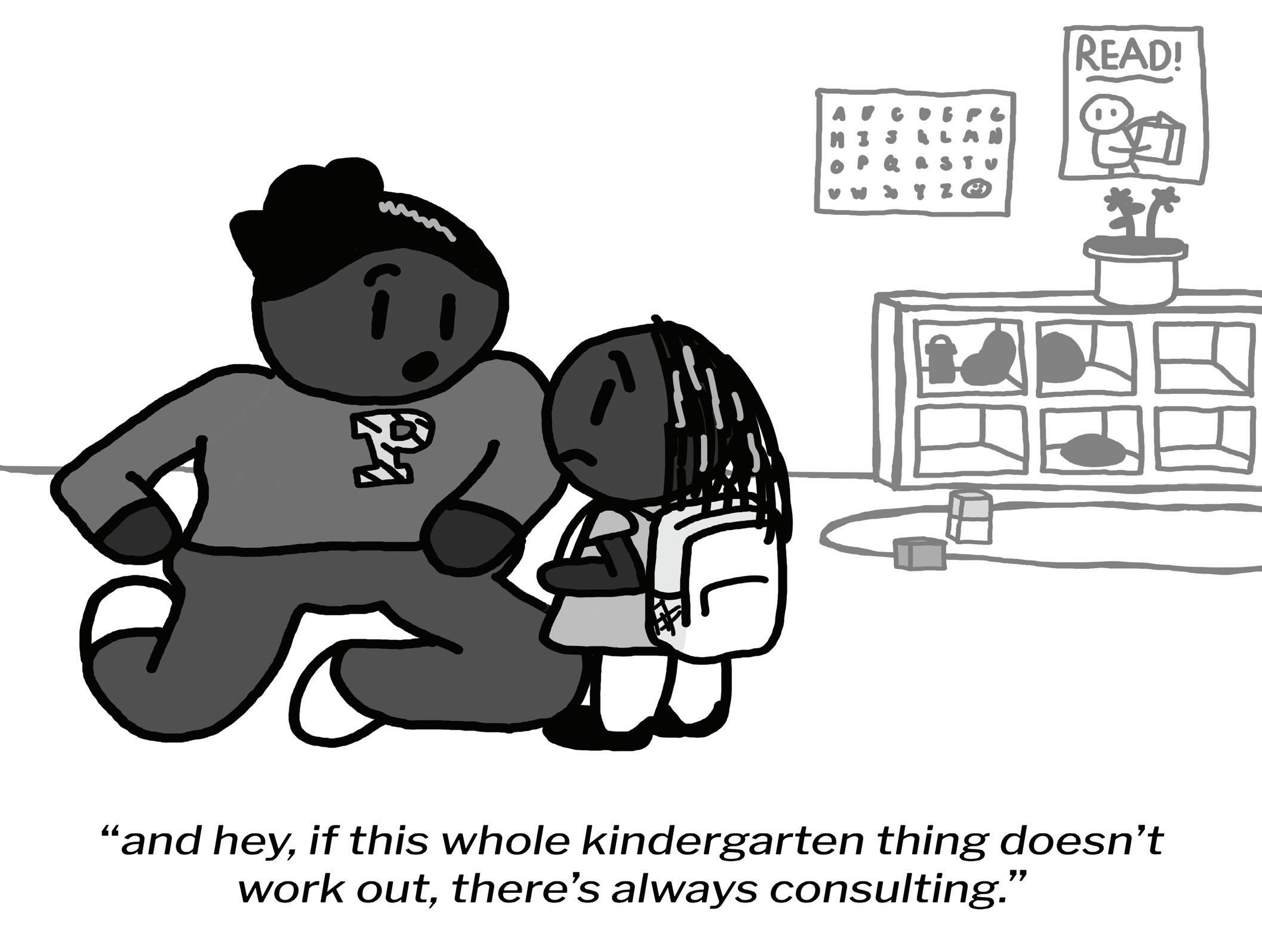
The Universal Backup Plan
By Yacoub Kahkajian | Staff Cartoonist
35 What one often has to do at a doctor's office
36 Motor and vegetable
37 L.A. gangster
41 Eel:Elver::Cat:___
42 Like audiences during a good movie
43 Google co-founder Brin
44 Fundamental Boolean implement
45 Open and Closed signs, often
47 Orange muppet
48 Charged particle
52 Ugh!
55 Common ambulance destinations, for short
56 It can often sting
57 Multiplicative identity
For America’s 250th anniversary, open Nassau Hall
Contributors
The following is a guest contribution and reflects the authors’ views alone.
Princeton recently hosted the New Jersey General Assembly for a special session in the Faculty Room of Nassau Hall, celebrating the 250th anniversary of the independent legislature’s first meeting in August 1776. At the time of that inaugural session, Nassau Hall was still unravaged by the horrors of war. By the time the Continental Congress arrived in 1783, the Battle of Princeton had left the town and campus in utter ruin: Libraries had been sacked, windows shattered, and personal collections raided. Though victory had been achieved, the union of states that had hitherto managed to “hang together” threatened to “hang separately.” In the centuries that followed, the college would be restored to its former glory, and the campus, like the new country it planted, blossomed around it. Something else has happened in those 250 years: Students were kicked out of Nassau Hall. The place where they used to live, dine, pray, and learn is now an untouchable “inner sanctum.” The Faculty Room’s jutting figure, itself the product of a 19th-century renovation, is to most just an edificial curiosity. Nassau Hall is the heart of many Orange Key tours — “where Alexander Hamilton’s cannonball decapitated the portrait of George II!” — but few of the future Princetonians who hear those words will enter its walls and stand beneath the portrait’s replica. You might be surprised to find out that during most hours of the workday, students can technically walk through the building’s main doors. Tour groups sometimes even get the chance to peek into the hallowed Faculty Room. For most, though, this is the most they will ever access the building. In four years, a student may take a hesitant walk around Nassau’s first floor
and, possibly, sneak a brief view of the inner sanctum. But the dim lighting, the Faculty Room’s locked doors, and the specter of roaming administrators will likely shorten the stay.
Luckily for us, we have both entered the storied chamber, each time for a class. Dean Alec Dun GS ’04 teaches the Freshman Seminar FRS 179: “Before Hamilton: Power and History” and Professor Michael Blaakman teaches HIS 372: “Revolutionary America.” Both classes host a session in the Faculty Room, allowing students the rare opportunity to learn as the earliest Princetonians once did.
Though the current space is different from its 18th-century forerunner, the history lingers like a ghost. There, we reflected upon the significance of the room — its renovated grandeur, its arrangement of portraits, its parliamentary layout. The layers of time and meaning that accumulated with dust upon the space. We were face-to-face with the history of our nation, and the legacy of our forefathers. Despite the theoretical nature of our class discussions, we found ourselves in awe of our surroundings.
History must be felt to be truly cherished. One could hardly understand the Battle of Princeton without walking its battlefield, nor could the scale of Emanuel Leutze’s “Washington Crossing the Delaware” be felt without taking N.J. Transit to the Met to see it in person. On the train back to Princeton, you could re-trace the Continental Army’s retreat from New York and then behold Charles Willson Peale’s portrait of Washington in the University’s new art museum. An hour southwest of Princeton at Independence Hall in Philadelphia, you can stand in the room where the Declaration and Constitution were born, and an hour east, you can see the drama enacted on the Broadway stage — or, at least, grab a beer at Fraunces Tavern, where Washing-
ton bid farewell to his officers.
But when it comes to our University’s own historic buildings, you’re out of luck. The oldest buildings on campus — Nassau, Stanhope, and Clio — are the dominion of University administration.
Closing the doors to such historic buildings repeats the mistake made by too many universities: conflating the institution with its administration. While the University could not function without the work of its leaders and trustees, neither could it live without the flesh, blood, and spirit of its students and faculty. Princeton is not only its current inhabitants — its walls and spires teem with the life of those who have come before. Students should not feel that they need a special reason to enter Nassau Hall.
Even if technically open — however limitedly — Nassau Hall still suffers from a lack of openness.
When was the last time a guest lecture or event was held in the Faculty Room? When has the University ever invited students to come inside and see history for themselves? A spirit of hospitality would do much to encourage student exploration.
In the Memorial Atrium alone, they can pay remembrance to the emmarbled names of former students who have, since the days of the Revolution, made the ultimate sacrifice. Students should be encouraged, not merely allowed, to honor the most honorable of their predecessors.
There is luckily some hope on the horizon. In April, an exciting new exhibit at Firestone Library will offer the community a rare look into Princeton’s archival treasures. But the gap between the University’s past and present should be bridged beyond just the celebration of the country’s 250th anniversary. What better way than by actively promot-
ing Nassau Hall as a space for students? What’s more, why not invite more Princetonians to experience the same sense of awe we felt inside the Faculty Room? In this effort of “going back to Nassau Hall,” we will not pursue Alexander Hamilton’s tactic of cannonade — unlike that famous Princeton reject, we cherish “Nassau’s walls.” But the same patriotic spirit that led him to fire upon Nassau Hall should compel us to open it once more.
Zach Gardner is a senior majoring in Politics and minoring in English and History. He is the publisher emeritus of The Princeton Tory. He is from Atlanta.
Samuel Kligman is a senior in the School of Public and International Affairs. He is the former President of the American Whig-Cliosophic Society. He is from El Paso, Texas.
Letter to the Editor: For America’s 250th, we’re opening the Faculty Room
and reflects the authors’ views alone.
Samuel Kligman and Zach Gardner wrote recently in The Daily Princetonian encouraging that Nassau Hall — and in particular the Faculty Room — be opened for Ameri-
ca’s 250th anniversary celebrations. Princeton is offering numerous opportunities to celebrate America’s 250th across campus, including in Nassau Hall. The Office of Community and Regional Affairs, in partner-
ship with the Office of the Provost, has begun planning for a Faculty Room “open house” concurrent with other programming hosted by community organizations during the first weekend of October 2026. We are excited to open the historic Faculty Room to guests as part of the festivities that weekend.
As Kligman and Gardner noted, members of the campus and community-at-large can attend a wide array of programs and exhibits planned on campus as part of the local, regional, and national celebration of our nation’s founding throughout 2026. Earlier this month, for instance, Princeton hosted a ceremonial meeting of the New Jersey General Assembly in the Faculty Room. Additionally, on Feb. 17, the School of Public and International Affairs hosted a panel about the various “reconstructions” throughout American history.
On Tuesday, Princeton University Concerts hosted “Emily-No Prisoner Be.” In April, as Gardner and Kligman mention, Princeton’s Firestone
Library will open the “‘Nursery of Rebellion’: Princeton and the American Revolution” exhibit highlighting Revolutionary War-era treasures from its collection, and in May a new exhibit highlighting the student experience during the Revolutionary War, “Real and Remembered: Princetonians Caught Between Study and Revolution” will open in Mudd Manuscript Library.
We encourage students to take advantage of these unique opportunities, and others planned in Princeton and the surrounding region, to celebrate the founding of our nation and to learn more about the role that New Jersey, the town of Princeton, and the University played during those pivotal times.
Kristin Appelget is the assistant vice president for community and
affairs.
The following is a letter to the editor
regional
Melissa Mercuro is the associate director for community relations in the Office of Community and Regional Affairs.
head sports editors Lily Pampolina ’27 Doug Schwartz ’28
associate sports editors Lucas Nor ’28
Matthew Yi ’27
head web design and development
editors Cole Ramer ’28 John Wu ’28
strategic initiative directors
Graphics Caroline Naughton ’29
assistant
Shravan Venkat ’28
software engineers
Nicole Deng ’28
Ziya Momin ’28
Kyaw Naing ’28
Stephanie Sugandi ’27
Education Charlie Yale ’28
Introducing the 150th Editorial Board
The following piece represents the views of the un- dersigned Editorial Board members alone.
Perhaps you first encountered The Daily Princetonian Editorial Board through our endorsements of USG candidates last fall. Maybe you read our piece last spring, when Trump began his attack on higher education, in which we argued that other uni- versities should join Princeton in speaking out against these attacks. Or maybe you remember when the Gaza Solidarity Encampment was established two years ago and we condemned the University for arresting student protesters. Our voice has actively contributed to debates on some of the most significant developments and controversies on our campus.
But while our readers may be familiar with our arguments, we recognize that not all readers are aware of our identity, mission, and processes. As this piece marks the beginning of a new Editorial Board, we hope to answer any questions about who we are, what we aim to do, and what values we hold as a collective.
In short, the Editorial Board is composed of Opinion writers and edi- tors who have no influence on related coverage from our news-producing sections. As former New York Times editorial page editor James Bennet wrote about the Times’ editorial board, “The editorial board is an institutional voice, but it is not the voice of the institution as a whole.” The opinions we publish do not claim to represent all the staff or editors of the paper. Instead, we are a group of seven student journalists
BOARD OF TRUSTEES
president Thomas E. Weber ’89
vice president David Baumgarten ’06
secretary Chanakya A. Sethi ’07
treasurer Douglas Widmann ’90
assistant treasurer
Kavita Saini ’09
trustees Francesca Barber
Kathleen Crown Suzanne Dance ’96
Gabriel Debenedetti ’12
Stephen Fuzesi ’00
Zachary A. Goldfarb ’05
Michael Grabell ’03
Danielle Ivory ’05 Rick Klein ’98
James T. MacGregor ’66
Rohit Narayanan ’24
Marie-Rose Sheinerman ’23
Julianne Escobedo Shepherd Abigail Williams ’14
Tyler Woulfe ’07
trustees ex officio
Jerry Zhu ’27
Alistair Wright ’27
who draw upon our di- verse experiences and beliefs to debate, research, and write about the most pressing issues facing the University community, as the editorial board of the Times or the Wall Street Journal might for issues facing the nation.
We strive for consensus, but there may be times when members of the Board disagree. In those instances, which have historically been rare, we will publish both the majority position and the dissent. By writing, we hope that our unique voice can enrich campus discourse.
Our opinions will be guided by the values we hold in common. We believe that campus institu- tions that shape student life should be transpar- ent in their decisions. When their actions cause harm or fail to achieve their goals, it is impor- tant to hold them to account. In the same vein, we think that students should have a say in their college experience and play meaningful roles in decision-making. We believe that the diversity of backgrounds and view- points at the University is a strength and that all students deserve an environment that supports their physical, mental, emotional, and intellectual well-being. And we believe in the importance of upholding free speech and expression. Our work is only possible when ex- pression and research at Princeton are meaning- fully protected.
We seek to be as honest and meticulous as possible, but we also ac- knowledge that at times, we may make errors or overlook perspectives. We hope that when this happens, our readers will not shy away from writ- ing to us. Our goal is to provide the most well-
reasoned conclusion we can, and we will strive to meet that objective with every piece.
150TH EDITORIAL BOARD
Chair
Christopher Bao ’28
Chris is an Economics major from Princeton, N.J. He previously served as a head News editor, where he typi- cally covered town politics and life.
Members Raf Basas ’28
Raf is a sophomore from Elk Grove, Calif. He serves as assistant Opinion editor and was a member of the 149th Editorial Board.
Preston Ferraiuolo ’26
Preston is a senior in the School of Public and In- ternational Affairs from Brooklyn, N.Y. He has been a part of the Opinion section since his freshman year, most recently as an associ- ate Opinion editor. He has also served on the Editorial Board in prior years.
Lily Halbert-Alexander ’28
Lily is a sophomore Eng- lish major from San Fran- cisco. She currently serves as head Opinion editor.
Ian Rosenzweig ’29
Ian is a first-year prospec- tive SPIA major from Bryn Mawr, Pa. He is an assistant Opinion editor who is interested in dialogue and discourse on campus.
Maya Mukherjee ’27
Maya is a junior from New York City. She is a manag- ing editor for the ‘Prince,’ and was previously head Podcast editor and a News writer.
Frances Brogan ’27
Frances is a junior History major from Lancaster, Pa. She is a managing editor for the ‘Prince,’ and was previ- ously head Opinion editor.
‘For candidates like Malinowski and Altman, who have a ready list of donors and a campaign infrastructure in place from their previous runs, carpetbagging becomes irresistible.’
CARPETBAGGING
What’s going on here?
For starters, state and federal candidates are treated differently when it comes to their durational residency requirements. Under New Jersey’s constitution, members of the state Senate and General Assembly must be residents of their districts for at least one year before being elected, while New Jersey’s governor must be a resident of the state for seven years. By contrast, the federal Constitution requires that a member of the U.S. House only be an “inhabitant” of the state “when elected.”
This means congressional candidates do not have to reside in their congressional districts. In addition, they are free to swap districts at will.
Moreover, the demise of the “county line” ballot system has encouraged more candidates to run for office in New Jersey. Rather than party bosses determining where a candidate’s name will appear on the primary ballot and challengers being relegated to “ballot Siberia,” the state’s primary ballots now treat all candidates
equally.
But the new ballot system — combined with the rule that a primary winner only needs to secure a plurality of the vote — has created new incentives for carpetbagging. Well-heeled candidates know they can helicopter into a safer district, list their names on a crowded ballot, and make it to Congress simply by securing one more vote than the second-highest candidate. In N.J.-12, as little as 20 percent of the vote may be enough to win in June — so long as one’s opponents all receive less. For candidates like Malinowski and Altman, who have a ready list of donors and a campaign infrastructure in place from their previous runs, carpetbagging becomes irresistible.
It also helps that carpetbagging is a well-worn tradition in the United States. To take one particularly egregious example, James Shields first represented Illinois in the U.S. Senate in 1849. When another term failed to materialize, Shields moved to Minnesota, becoming a U.S. Senator from that state in 1858. At the end of his life, in 1879, Shields was again a member of the U.S. Senate, only this time representing Missouri. Rob-
ert F. Kennedy and Hillary Clinton both represented New York in the U.S. Senate, despite not being from that state. And Mitt Romney, the former governor of Massachusetts, had no qualms about moving 2,000 miles west when a U.S. Senate seat became vacant in Utah.
While Malinowski and Altman might be classic carpetbaggers, their actions are mild in comparison to these folks. They’re not swapping states, just districts. Should voters care?
That depends on what they want from their congressional representative. According to one school of thought, voters elect public officials to be their “trustees,” and these officials are to use their judgment to follow the course of action they believe is best. If voters buy this view, Malinowski’s and Altman’s carpetbagging may not matter, and these candidates need not explain why they’ve switched districts. Representative and Speaker of the House Mike Johnson and Representatives Nancy Pelosi and Alexandria Ocasio-Cortez all perform their duties as trustees. Each has a national profile, and few Americans can tell you which district
in Louisiana, California, or New York elects them. Perhaps that’s the kind of representative Malinowski hoped to be. So that the country could benefit from his foreign policy expertise, he was essentially telling voters in N.J.-11 that they should let his lack of ties to their district slide.
They didn’t buy it.
That’s because another view of representation suggests that elected officials ought to act as mouthpieces for their constituents. Accordingly, politicians have no authority to act on their own. Instead, they serve as “delegates” for their constituents and are elected to carry out their wishes in Congress. If you happen to be a voter who wants your member of Congress to focus on the unique problems of your district, you may be less likely to vote for someone like Malinowski or Altman. A candidate who moved into the district yesterday is less likely to be familiar with its problems than someone who is homegrown.
New Jersey’s small size and population density ensure that its congressional districts are more geographically compact than those of most other states. Because of this, New Jersey’s fed-
eral candidates often enjoy name recognition across district lines. In turn, this makes it easier for them to switch districts. But it also makes it harder to stop voters from asking why the candidate has chosen to do so in the first place. In 2018, when Senator Andy Kim ran for Congress in N.J.3 against Republican incumbent Tom MacArthur, Kim repeatedly emphasized his ties to his congressional district. He had grown up there, he told voters, while MacArthur was the classic carpetbagger who had moved to N.J.-3 for no reason other than to win a seat in Congress. Increasingly, voters across New Jersey are being asked to figure out whether their members of Congress should be homegrown — or if the need for them to have local ties is a relic of the past.
Eugene D. Mazo is a law professor at Duquesne University, a Public Voices Fellow with The OpEd Project, and the editor of “The Oxford Handbook of American Election Law.” Professor Mazo has twice been a congressional candidate in New Jersey.
Princeton must take action to ensure what Epstein did at Harvard can’t happen here
Thomas Buckley Senior Opinion Writer
Earlier this month, The Daily Princetonian reported that Princeton professor Corina Tarnita communicated with convicted sex offender Jeffrey Epstein between 2008 and 2012. When she met Epstein, Tarnita was a Ph.D. student at Harvard working in the lab of Martin Nowak, a long-time Epstein associate. Any connection to such a repugnant figure is bound to elicit strong emotion, but the scandal’s more lurid aspects can distract us from another perturbing question: What the hell was Jeffrey Epstein doing at Harvard anyway?
Epstein embedded himself into elite academic circles through his wealth and influence, forming close ties with professors at both Harvard and Yale. He donated millions of dollars to research groups at Harvard and elsewhere, including $6.5 million used to establish the Program for Evolutionary Dynamics, led by Nowak. Epstein even had an office on Harvard’s campus within the Program for Evolutionary Dynamics that he visited at least 40 times between 2010 and 2018, after his 2008 conviction for soliciting a minor for prostitution. This was not the only time Epstein’s cash and connections caused the rules to be bent in his favor. Epstein’s $200,000 gift to professor Stephen Kosslyn, the chair of Harvard’s psychology department at the time, even earned him — an undergrad
dropout — the title of Visiting Fellow.
Epstein’s wealth gained him an inappropriate influence in the world of elite higher education. Today, in an era of federal funding cuts and University-wide belt-tightening, labs are likely to become increasingly reliant on private monies to fund their research. Princeton must learn from the Epstein scandal and carefully scrutinize the relationship between donors and researchers to prevent external exertion of coercive power. That is not to absolve Nowak of responsibility; professors have the ultimate responsibility for their labs. However, to protect the integrity of their researchers, the University must build institutional controls to prevent donor overreach from those with vast influence, like Epstein.
Epstein’s level of access is sickening given his crimes. But any close, personal relationship between donor and recipient should have generated scrutiny from Harvard’s administration. His case represents a systemic failure of institutional oversight. Universities must implement safeguards to facilitate an orderly flow of donations to ensure that wealth is not a gateway into unwarranted coercive influence.
I’m thankful that no similar ties have yet been discovered between Epstein and any Princeton research groups, but that is no credit to the University’s oversight structures. Princeton has long tolerated ethically dubious relationships between labs and their donors, for example by allowing the Carbon Mitigation Institute
(CMI) at High Meadows Environmental Institute to accept millions of dollars from BP.
It isn’t possible to know how much influence BP has exerted over the research CMI conducted, and that’s the problem. The power imbalance inherent to the donor-recipient relationship exerts coercive pressure that cannot easily be quantified. Even if a donation doesn’t create an obvious conflict of interest, Epstein’s case shows that money exerts an influence over recipients which can put labs in a compromising position.
My colleague Siyeon Lee correctly identified the threats that money from questionable sources — exemplified by Epstein — pose to academia. However, student activism alone cannot sufficiently counterbalance the coercive power that donors hold over the whole campus: Systemic safeguards are imperative. Principal investigators have an obligation not only to the integrity of their research, but to protect their researchers from being put in morally compromising positions.
As a major donor to Nowak’s lab, Epstein exercised significant power over Nowak and even greater power over junior members of the lab. The relationship between advisor and advisee is a deeply imbalanced one, and remaining in an advisor’s good graces is critical if a student hopes to pursue a career in academia. Nowak’s close relationship with Epstein would have strongly incentivized members of his lab to remain silent about any
qualms they might have had regarding the ethics of taking money from Epstein. If your research funding, career prospects, and potentially even your degree are contingent on keeping a donor happy, what leverage do you have to stand up to inappropriate behavior?
These dangerous power dynamics emerge when donors are given unfettered power over their labs, which present University policies fail to prevent. Consistent with the University’s commitments to academic freedom, lab groups at Princeton have been able to operate with significant discretion over the sources and uses of their research funds. However, Princeton’s guidelines for sponsored research impose no restrictions on funding sources besides requiring that its sources and purpose be disclosed, which fails to prevent the influence of donors like Epstein and thus to protect the integrity of its researchers.
The ‘Prince,’ like other newspapers, can serve as a model. As a content-producing member of the ‘Prince,’ my interactions with the business team are very limited: This is by design. Introducing money into the newsroom risks influencing reporting, just as it poses an inherent threat to the integrity of research.
But newspapers need money to operate. I might not like ads running next to my columns, but without them I wouldn’t be able to subject the University community to my inane ramblings. The solution is not to remove money from the newsroom, but instead to establish a
clear separation between the content and business side of the paper.
Labs likewise cannot operate outside of fiscal constraints, and the solution is the same: Establish a clear separation to ensure that this reliance does not compromise the integrity of the research.
One way to address these challenges while still ensuring that faculty have ultimate control over their own work would be to form an independent faculty committee charged with overseeing gifts to the University and confirming that they fall within ethical bounds. All donations over a certain size would be referred to the committee, who would also have the authority to investigate possible ethical conflicts for smaller donations, including by establishing a direct line for whistleblower complaints. These functions presently fall under the authority of the University Research Board, but the board’s scope is too broad to give sufficient consideration to the ethical implications specific to sponsored research.
An independent body would serve as a check on the pressure that donations inevitably exert on those who rely on those funds to conduct their work. While it likely could not prevent every possible abuse, it could limit the worst excesses and prevent a shadow like the one that Epstein cast over Harvard from falling over Princeton.
Thomas Buckley is a senior Opinion writer from Colchester, Vt., majoring in SPIA.
‘Hegseth, do your homework:’
Princeton Alum and War
Vet Raymond
DuBois condemns
By Devon Rudolph Contributing Features Writer
“Hegseth is performing for an audience of one: Donald Trump.”
That was how war veteran Raymond DuBois ’72 described the recent announcement from Secretary of Defense Pete Hegseth ’03. “The notion that Ivy League universities diminish critical thinking is nonsense.”
In a recent video posted on the Department of Defense’s YouTube channel, Hegseth announced that starting next academic year, the Department of Defense (DoD) will no longer sponsor graduate programs for active-duty service members at Harvard University. Active-duty service members can become eligible for the Post-9/11 GI Bill, which includes tuition assistance programs.
The video claimed that all other Ivy League schools, along with some other universities, would be evaluated by Feb. 20. The DoD has not followed up on the video announcement at the time of publication.
Though the University does not publish an exact statistic, last fall there were 22 transfer students enrolled at Princeton who had actively served in the military, and every year, around ten students involved in Reserve Officers’ Training Corps (ROTC) programs are commissioned.
Describing himself as a “traditional Republican” to The Daily Princetonian, DuBois served as a combat intelligence-operations sergeant in Vietnam. At Princeton, DuBois majored in politics, played on the lacrosse team, and was a member of the American Whig-Clio Society and of Cottage Club.
DuBois has since served in several senior leadership roles in Washington, including as acting Undersecretary of the Army.
Since the first Trump administration, DuBois has become a vocal critic of Trump. In 2020, he was among 130 national security officials who had worked for a Republican administration to sign a statement arguing that Trump was unfit to serve as president again.
Hegseth was confirmed by the Senate with the smallest margin in over 50 years, with the tiebreaking vote cast by Vice President JD Vance.
“Unfortunately, America’s highly ranked universities no longer live up to their founding principles as bastions of free speech, open inquiry, and commitment to American values that make our country great,” Hegseth said in the video. “We train warriors, not wokesters.”
DuBois, on the other hand, believes that the critical thinking that prestigious universities cultivate is an integral aspect of success in military leadership.
“Critical thinking, what the hell has that got to do with wokeness or political bias?” said Du-
Hegseth’s
Bois. “Hegseth doesn’t even understand, I think, what critical thinking is.”
The Department of Defense did not respond to a request for comment.
Hegseth, who attended both Princeton University and Harvard’s John F. Kennedy School of Government, is among several current top-ranking government and military officials who have graduated from Ivy League schools. President Donald Trump attended the University of Pennsylvania, Deputy Defense Secretary Steve Feinberg ’82 attended Princeton, Army Secretary Dan Driscoll attended Yale Law
treatment of Ivy League
free speech on campus as well as allegations of antisemitism.
At Princeton, dozens of federal research grants, totaling around $210 million, were suspended as part of an investigation into antisemitism on college campuses, though some were subsequently restored.
“The Ivy League as a whole has pervasive institutional bias and a lack of viewpoint diversity, including the coddling of toxic ideologies that undercuts our mission,” Hegseth said in the video.
At Princeton, along with other Ivy League Universities, a majority of students self-identify as more liberal than conservative.
sense, per se, but rather to introduce different experiences and a different knowledge base, based on those experiences that most students, undergraduate and graduate, do not have.”
The greatest advantage of the U.S. military against opponents, according to DuBois, is the “quality” of senior officers. Removing the opportunity for service members to attend top universities free of charge, he believes, would dilute this advantage.
“Do you want our future military leaders to only go to graduate programs at universities that espouse what Trump and Hegseth determined to be the founding
School, and Navy Secretary John Phelan attended Harvard Business School.
In the video, Hegseth claims that cuts to graduate programs for active-duty service members are motivated by an administration priority to “maximize taxpayer value” which “no longer includes spending millions of dollars on expensive universities that actively undercut our mission and undercut our country.”
Since Trump returned to office, higher education has faced threats. Amid growing “antiwoke” momentum from the Trump administration, elite universities across the country have been criticized for diversity, equity, and inclusion (DEI) initiatives and faced concerns surrounding
According to a report from the National Association of Scholars based on voter registration data, the ratio of registered Democrats to registered Republicans among Princeton professors was 40:1 in 2020.
A number of active-duty graduate students did not respond to requests for comment.
DuBois, however, does not regard these statistics as a problem.
“I like to think that irrespective of the political bias of our tenured professors, [they] would attempt in the classroom to encourage questioning of viewpoints that set the basis of great education,” he said.
DuBois argued that it is not the job of a university to teach “conservative viewpoints in a political
principles and values upon which this country was founded?” DuBois asked.
The University declined to comment on the claim that Princeton lacks viewpoint diversity.
University President Christopher Eisgruber ’83, however, has written extensively about the benefits of free speech and academic freedom in higher education in his 2025 book, “Terms of Respect: How Colleges Get Free Speech Right.”
“At their best, colleges and universities model forms of discourse that are at once unfettered and inclusive,” Eisgruber wrote.
DuBois gives credit to the University and to Eisgruber for supporting graduate programs for active-duty students.
DuBois remembers a meeting he had with Eisgruber early into his presidency. According to DuBois, Eisgruber was surprised to learn that a Navy ROTC contract was not already being negotiated.
Working with DuBois, Eisgruber re-established a Navy ROTC program, and has since facilitated an improved transfer program that allows enlistees and veterans to come to Princeton after, for example, attending a community college.
Beyond the broader national implications of inhibiting future military leaders’ access to elite educational opportunities, DuBois warns that cutting off opportunities for service members to attend these schools will decrease the appeal of staying in service for some.
“It’s a key retention tool for rising field grade officers,” DuBois said. “The opportunity to attend the best graduate programs adds to the prestige of our Officer Corps.”
The decision to suspend graduate programs marks the second major government action levied against Harvard in recent weeks. After reports surfaced that the Trump administration had dropped its demand for a $200 million payment from Harvard, Trump doubled down with a demand for $1 billion.
DuBois believes that the timing of this policy from the DoD was not accidental.
“Why did Hegseth choose to go do a video about Harvard? Because his boss had just filed suit against Harvard,” DuBois said. The video starts with a discussion of the military’s “rich tradition with Harvard throughout American history.” Hegseth said that in 1775, George Washington took command of the continental army in Harvard Yard. DuBois pointed out that this was actually incorrect, as the Continental Army was in the Cambridge Common.
“I mean, come on, Hegseth, do your homework,” DuBois said. At its core, DuBois believes the new policy from the DoD missed the mark on addressing critical thinking within the military.
“We don’t need to teach them what to think, we need to teach them how to think.”
If Princeton and other Ivy League schools receive the same evaluation as Harvard, active-duty graduate students in the Class of 2027 or later may not receive financial support from the Department of Defense.
“This policy is going to be damaging to our military, to our defense department, to our national security and to the schools involved,” DuBois said.
Devon Rudolph is the head Podcast editor, a senior News writer, and a contributing Features writer. She is from Fairfax, Va.
”PETE HEGSETH” BY GAGE SKIDMORE / CC BY-SA 2.0
Pete Hegseth ’03 speaking at the 2019 Teen Student Action Summit in Washington.
the PROSPECT. ARTS & CULTURE Prospect Picks: From the blizzard
Recent favorites in media, trends, and food, brought to you by The Prospect editors.
“The Boy who cried Terrified .” — Fakemink
Gavin McLoughlin, Head Editor
While the UK’s blossoming rap underground may have fully burst into the mainstream with Liverpool rapper EsDeeKid’s collaboration with Timothy Chalamet on the viral “Marty Supreme” press tour, EsDeeKid is far from the only thrilling artist to emerge from this vibrant scene. While EsDeeKid’s gothic blend of trap and cloud rap has amassed millions of streams in the past months, I would argue that Fakemink, his longtime collaborator, is the far more sonically adventurous and fascinating of the two artists. Released Jan. 29 of this year, “The Boy who cried Terrified .” is the second album by the British rapper/producer and represents a more mainstream approach to the “faded luxury” sound he has come to define. With its soundscape that is equal parts industrial and spellbinding, “The Boy who cried Terrified .” is an arresting blend of hyperpop, early 2000s Timbaland-esque production, and early 2020s emo rap that is fragmented, messy, and elegant. The album’s opener, “Blow the Speaker . ,” is a plea of pain and newfound fame that pairs cliched lyrics with brilliant production buoyed by cinematic strings and bobbing 808s. While later songs like “Dumb .” & “Mr. Chow .” are a bit too discordant to deliver on Fakemink’s signature intoxicating blend of buzzy synths, warbling pitched vocals, and jumping bass, the album’s sole single, “fml .” is a true standout. Anchored by an ethereal sample from electronic artist Burial, the song is a captivating mix of ghostly synths, clattering hi-hats, and warped bass that draws you in, absolutely transfixed. This thrilling unity of experimental vocals, hazy production, and classic hip hop cadence is what makes Fakemink such a promising artist, and I can’t wait to see what he does next.
Single’s Inferno Season 5
Kaichen Chou, Assistant Editor
One way I’ve been escaping my winter slump — and now two blizzards — is through immersing myself in the beachy islands of the new fifth season of “Single’s Inferno,” which began airing on Jan. 20. This South Korean dating show follows a small group of singles stranded on a remote island, where they compete in various challenges for a chance to escape to “Paradise” — a luxurious getaway featuring lavish suites, fine dining, and grand saunas and pools — with a romantic partner of their choice. The catch is, no one knows the contestants’ careers, ages, or lifestyles, until they are in Paradise, so viewers must watch to learn more about their favorites.
Now fully released, this season has 12 hourlong episodes packed with heart-fluttering moments, intense cliffhangers, and the perfect amount of conflict that sparks debate. Additionally, Season Five’s contestants deliver no shortage of juicy drama, perfect for those who are conflict-avoidant yet love to live vicariously through others (like me). The panelists watching alongside viewers also provide moments of much-needed comedic relief, especially after fierce challenges and confrontations. “Love Island” enthusiasts
looking for something a little less raunchy but equally entertaining should definitely check out “Single’s Inferno.”
Loose-leaf tea
Amaya Taylor, Associate Editor
As I crack open its metal tin, the aroma of crisp herbs, hints of vanilla, and toasted coconut hits my nose like an enticing wave of fresh ocean water — this is what it’s like to be in olfactory heaven. The pleasantries don’t stop here. I grab a spoonful of leaves, dried fruit, herbs, and flowers — no more, no less — and place them carefully in my drawstring tea filter bag. My electric kettle holds the final and essential ingredient, boiling water, to top it off. Then, all that’s left to do is wait.
Loose-leaf tea has been my latest obsession; so far, I’m at a modest five cups a day. Life at Princeton is undoubtedly busy and fast-paced. For me, making tea is a ritual — an experience — that forces me to slow down and take in the moment. For conscious tea drinkers, going loose-leaf elevates the gustatory experience with a more complex taste and higher nutrient content. Even if you usually opt for an iced oat vanilla latte, making tea can be a nice way to experiment and customize different flavor profiles.
If you’re a fan of quality hot caffeinated beverages, throw away those crummy Lipton tea bags full of microplastics. Reject convenience and embrace the ritual.
The return of Tiffany Blue in fashion
Amy Jeon, Associate Editor
As hues of pastel yellow — better known as last year’s “butter yellow” craze — begin to quietly disappear from the racks, a new color is making its comeback from the 2010’s: turquoise. And I’m all for it.
I’ve particularly been loving Tiffany blue — a lighter hue of robin’s egg blue, delicate and refined. Versatile and uniquely gorgeous, the bluish-green provides a splash of clarity amongst the muted and neutral colors that have been dominating the fashion scene for the past few years. In between infinitesimal variations of beige and quiet whispers of colors, the return of teal feels starkly refreshing. The color turquoise was named Pantone’s Color of the Year in 2010, marking the turn of the decade with a bold color statement. Now, the color seems to be seeping back into the realm of fashion, with the return of 2010’s trends and turquoise gemstones in jewelry.
The beauty I find in the color comes from
traces of my childhood: seven-year-old me settling on a shade of “mint blue” to paint my bedroom walls — a choice I regretted in my teenage years — the black and teal classroom decorations that my fourth grade teacher adored, and undoing the ribbon on a turquoise blue Tiffany box to unwrap the necklace my mother bought me for my sixteenth birthday.
When paired tastefully with complementary shades that bring out the color’s sophisticated essence, turquoise blue makes a statement without being garish. As the color begins to make its way into the fashion world once more, I’m excited to see how people will give it a 2026 spin.
“The Decameron” by Giovanni Boccaccio
Zane Mills VanWicklen, Assistant Editor
Are you looking for a “classic” you can read on the subway that makes you look brooding and mysterious? Do you want biting social satire, absurd and raunchy misadventures, sharp psychological insight, and the occasional moment of genuine tenderness all in one book? Enter “The Decameron” by Giovanni Boccaccio.
Written in the aftermath of the Black Death of 1348, which devastated Florence and killed a staggering portion of its population, “The Decameron” begins with one of the most vivid plague descriptions in medieval literature. But then… it pivots. Instead of remaining in despair, Boccaccio imagines ten young Florentines — seven women and three men — fleeing the city to a countryside villa. Over 10 days, each character tells one story per day, creating 100 tales total. The result? A literary buffet.
Some stories are romantic, some tragic, many wildly funny, and yes, several gloriously indecent. One features a friar posing as the Angel Gabriel to seduce a naïve woman; others skewer corrupt clergy, greedy merchants, and smug moralists. Boccaccio’s satire of hypocrisy was bold in the 14th century and still is; no one can escape his scathing critique.
But it’s more than scandal. Writing in Tuscan vernacular instead of Latin, alongside figures like Dante Alighieri, Boccaccio elevates Italian literature and centers female storytellers, often portraying them as clever, strategic, and socially aware. Beneath the bawdiness lies a serious exploration of fortune, intelligence, desire, sexuality, class,
and survival.
So yes: you can read it to look cool. You can read it for the satire. You can read it for the scandal. But you’ll stay for the sharp wit and the sense that even in the worst historical moments, people still crave stories, laughter, and each other.
Copic Sketch Marker Set, Bold Primaries Ysabella Olsen, Head Editor At the end of last year, I picked up journaling more regularly. Every time I sit down to study, I write an entry in my journal. Sometimes my words fill a whole page and sometimes I scribble down a couple sentences. This habit has stuck for a couple of reasons. First, like every student, I sit down to study all the time. Therefore, my journaling is more consistent because it reflects the beginning of many library study sessions. Second, it helps my brain kick into study mode. Instead of scrolling on my phone or jumping straight into a dense reading, journaling gives me an outlet to transition from real-world to textbook-world.
A set of six, juicy Copic markers contributes to my journaling by bringing color to the white pages. Amid long winter days, I love to sketch as a supplement or replacement to writing. The colors of the markers can express feelings or the broad strokes can illustrate my current campus view. These markers in particular have been my favorite for their striking range of hues and their two-tips on each side of the marker: Super Brush nib and the Medium Broad nib.
Gavin McLoughlin, a member of the Class of 2028, is a head editor for The Prospect.
Kaichen Chou, a member of the Class of 2029, is an assistant Prospect editor and a staff Copy editor.
Amaya Taylor, a member of the Class of 2028, is an associate editor for The Prospect and News staff writer.
Amy Jeon is an associate editor for the Prospect and a member of the Class of 2029.
Zane Mills VanWicklen is a member of the Class of 2029 and an assistant editor for The Prospect.
Ysabella Olsen is a member of the Class of 2028. She is a head editor for The Prospect.
CAROLINE NAUGHTON / THE DAILY PRINCETONIAN
By Kaichen Chou, Gavin McLoughlin, Zane Mills VanWicklen, Amaya Taylor, Amy Jeon, and Ysabella Olsen Prospect Editors
Short films, big talent: student projects from VIS fall film classes
This February, Princeton’s student filmmakers once again made the trek up to the James Stewart Film Theater. Rather than attending their familiar fall classes, they sat alongside their friends and family to watch their creations from last semester up on the silver screen.
These viewings were spread over three days, each highlighting a variety of genres. Under the guidance of Visual Arts faculty Christopher Harris, BentJorgen Perlmutt, Tim Szetela, Nicolás Pereda, and Moon Molson, students produced film projects ranging from alternative fiction to documentaries.
Feb. 11 brought us works from VIS 214: Filmmaking — 16mm Analog Film Production and VIS 260: Making the Vampire Film. Feb. 16 showcased the creativity of the Class of 2029 with films from FRS 138: Representation in Documentary Filmmaking. Last but certainly not least, the Feb. 18th screening included shorts from VIS 220: Animation I, VIS 243: Alternative Fiction Short Form, and VIS 265: Narrative Filmmaking I.
“Dialectic” by Benjamin Martin ’28 was one of the most unique films of the night, bringing together philosophy and video games. Despite the nostalgic visuals of “Dialectic,” this animated short was remarkably topical. An homage to classic Game Boy graphics, the pixelated comedy takes its viewers through rounds of philosophy trivia. We watch a player — the main character — try to answer the age-old questions of Descartes and the Socratics, attempting to decipher the debates of the various contrarian philosophers.
“Dialectic” eventually takes a satirical turn, forcing the player to believe only one philosophy and destroy all others by bombing the parts of the world where they originate. With its constant wit and astonishing animation, this short had the whole audience laughing throughout its three-minute runtime. By contrasting questions about the nature of our existence with mankind’s clear inability to coexist, “Dialectic” does an incredible job at balancing hilarious bickering with darker truths.
The festival took a gloomier turn with “Percept,” by Peyton McLaugh -
lin ’28, a unique take on a ghost story. At six minutes and five seconds, the film clocks in as a longer feature in the screening, but remains captivating throughout. Each moment of this short beautifully illustrates the tragic tale of Gigi, a ghost desperately trying to catch a student’s attention. When Gigi hears the song “Last Christmas” through the student’s headphones, she is transported back to the holiday season, the time of her passing.
After many failed attempts, Gigi finally contacts the student through the supernatural connection of the song. The film memorably juxtaposes the warm lights of Princeton’s iconic Palmer Square Christmas tree with a haunted courtyard. Through these visuals, McLaughlin expertly underscores the weight behind Gigi’s struggle to reach out and make a connection. Although perplexing at first, “Percept” lets viewers slowly sink into its emotional depths, revelling in Gigi’s enduring desperation and eventual hope.
On a brighter note, “Jeff by Roya” by Roya Reese ’26 immediately lifted the spirits of the entire audience.
Reese is a contributing writer for The Prospect.
Centered on Princeton’s own Professor of English Jeff Nunokawa, this film does an exceptional job at capturing the iconic English professor’s unique
5 tips to stay stylish and warm
As a Southern Californian who had never experienced any temperature lower than 40 degrees Fahrenheit before coming to Princeton, surviving the New Jersey winter has been an uphill battle. Through trial and error — and strategic dressing — I’ve mastered how to stay warm, and stylish, in frigid temperatures.
1. Layers, layers, layers
Start your outfit out with a Uniqlo HEATTECH base layer. It’s game-changing. I’ve ventured out on cold days all the way from New College West to Firestone with only a hoodie overtop because of how warm this HEATTECH magic keeps me. But if you’re not a fan of thermalwear, layering with simple basics, such as solid color long sleeves or wool cardigans, is a great way to radiate effortless chicness. I love layering a long sleeve shirt and cardigan on top of a white tank top. It keeps me warm, but it’s also an opportunity to add patterns and texture to an outfit.
2. Establish a jacket rotation
It might seem difficult to stay stylish in the winter because you always have to wear a jacket or coat, covering up the outfit underneath. Sometimes, though, the jacket is the outfit. I’ve curated jacket options that keep my winter wardrobe interesting, like fur coats and barn jackets. Having fun, colorful jackets in your rotation adds character to any outfit. My green fur coat and bubblegum pink puffer have brightened even the dullest, gloomiest winter days!
3. Don’t forget about socks
While socks are a less conspicuous detail, we should give them more credit for how they spice an outfit up. Picture this: a simple monochromatic black outfit, with a black trench coat, and loafers paired with a bright red sock. I take my sock rotation seriously, incorporating bright colors and patterns like polka dots and stripes. Personally, my favorite socks are from Free People and Brandy Melville. Both places have mastered their selection, offering adorable patterned socks and even some with frills that add a nice touch when they peek out from under my pair of jeans, perfect for a stylish — and warm — walk down Nassau.
4. It’s all in the accessories
Fall and winter are my favorite for a reason: every day is a prime opportunity to accessorize to the max. I find myself thinking more about accessories than clothes at times. When else will I have the opportunity to wear my hot pink chunky scarf? This year, my favorite accessory has been a blue and gray striped balabonnet from Free People. It’s a perfect marriage of a scarf and beanie, the ultimate way to keep you warm and fashionable. I also love enhancing an outfit with lots of silver jewelry, like chunky rings and a statement bracelet stack.
5. Experiment with scarves — and anything else
You might have seen the TikTok trend of taking a basic, chunky scarf and wearing it as a hood, something similar to a balaclava. I’ve found that the thicker the scarf is, the better this technique will work. I love seeing people wear their scarf in this
humor and sincerity. Scenes in Nunokawa’s office — which would be better dubbed a library, given the overwhelming number of books bursting from every shelf — embody the professor’s eclectic personality.
The standout shot of this short lingers on Nunokawa’s lengthy monologue addressed to his students as the semester closes, emphasizing not only his quick wit, but his genuine compassion for his students and scholarship. Despite being only six minutes long, “Jeff by Roya” conveys all one needs to know about the one-of-a-kind Professor Nunokawa.
With each of the 22 films at the screening, the sheer amount of hours every student put into their detailed final pieces is clear. Whether you’re an aspiring director or simply a creative looking to try something new, Princeton’s Visual Arts program certainly offers plenty of classes to try your hand at movie-making. I thought this batch of short films superiorly spotlighted our student body’s impeccable talent and overflowing creativity. I believe I speak for everyone in the audience when I say I can’t wait to see what these talented young filmmakers achieve next.
Mia Mazzeo is a contributing writer for The Prospect and is a member of the Class of 2029.
way, especially when paired with a wool peacoat, straight leg jean, and big purse. Winter is the best time to take fashion risks, since every choice feels intentional when dressing to brave the weather. While we can’t control the slushy snow or whether we’ll have class during a blizzard, staying fashionable is one thing we can always count on. With so much opportunity to be creative with our outfits, I hope these tips help you look forward to getting dressed for the last stretch of cold Princeton days.
The screening of a film by Roya Reese ’26.
Monica Zepeda is a contributing writer for The Prospect and a member of the Class of 2028.
By Monica Zepeda | Contributing Prospect Writer
By Mia Mazzeo | Contributing Prospect Writer
MIA MAZZEO / THE DAILY PRINCETONIAN
A film by Peyton McLaughlin ’28.
Princeton Playhouse Ensembles on building community and grappling with loss: ‘How to Be Not Alone’
By Michael Grasso | Contributing Prospect Writer
In life, the community we build is not just with those that are close to us, but the luminaries and mentors that precede us. On Saturday, as McCarter’s Berlind Theatre shut its doors and The Princeton Playhouse began playing, the room flourished with connection and song. Featuring student composers, a chamber orchestra, and a plethora of Princeton students, the ensemble’s 2026 concert, “How to Be Not Alone,” grappled with weighty questions about finding a sense of belonging and reckoning with losing a sense of community while professing a theme of connection through song and dance.
The audience crowded in, directing their eyes at the stage of empty microphones, soon to be filled with students. The show opened with members of the ensemble marching up to the front of the stage to deliver a few choice songs from celebrated musicals like “In the Heights,” “Maybe Happy Ending,” and “Next to Normal,” while the chamber orchestra played along in accompaniment.
After a few performances, it was time for Playhouse to do what it does best: change form. The evening’s special guest was Michael J. Love, an interdisciplinary tap dance artist, scholar,
and professor, who was a Princeton Arts Fellow from 2021 to 2023. Embodying the show’s theme of community, Love expressed his excitement coming back to Princeton to dance with some of his former students.
“Ice Cream Sunday,” a combination that takes inspiration from tap’s connection to black cultural history, is near and dear to Love’s scholarly and artistic interests. As Love approached the stage’s wooden tap board, he commented to the crowd, “Let me pretend I’m Bunny Briggs,” invoking one of his heroes — a legend in the history of tap.
In his shiny blue shoes, accompanied by Matt Cline ’27 on a silver trumpet, Love and his former students struck a playful and explosive call-and-response tap piece in the style of his hero, bringing together history, music, and dance all at once. Inviting the audience into his sonic presence created by sound, movement, and expression, Love crescendoed to a clamoring applause.
Between every few numbers, members spoke to the audience, reminding them about the thread of community and connection following each performance. After Love’s performance, the audience was invited to consider what happens when connection is lost. Gracing us with another marvelous composition, original student composer Marvel Jem Roth ’28 conducted a rendi-
tion of “Without You” from the musical Rent. Cline then transitioned to an entirely a cappella version of Stephen Sondheim’s “I Remember,” from the musical “Evening Primrose,” with lyrics that, detached from an orchestral accompaniment, struck even harder.
To end the show, Solon Snider Sway, the Playhouse ensemble’s director, announced the final two numbers along with an announcement about the Playhouse’s legacy: the release of an EP containing many of the original compositions heard during the performance. Copies of the EP were sold immediately after the show.
Co-presidents Ava Kronman ’26 and Destine Harrison-Williams ’26 took to the stage and revealed the final songs to be “Father Time” from the musical “Kimberly Akimbo,” and “Save The People” from “Godspell.” The final songs both embodied distinct postures towards the passage of time: the former prayed “for another day,” and the latter asserted its agency for the future, asking, “When wilt thou save the people?” As the ensemble concluded their performance, the stage was lit by the smiles of each member looking to each other, enjoying the moment, and exuding community through song.
Sofiia Patkanovtsiy ’29, a first-year ensembleist, expressed her jubilation after the curtain call. “This show was wonderful. I’m thrilled. I feel like my
heart is exploding.”
“We usually meet twice per week, and spend two hours singing and laughing a lot and having a great time getting to know each other,” she said of the rehearsal process.
Taking practice material from over two semesters, the title of the show, “How to Be Not Alone,” manifested itself in the rehearsal room the same way it was felt and presented on stage. When asked about this serendipitous relationship between the theme and the rehearsal experience, Patkanovtsiy replied, “We really wanted to show how special Playhouse is, which is why we decided to center the entire concert around community.”
Unlike other performances, Princeton Playhouse is uniquely positioned towards creating a sense of belonging and community through its form: an ensemble. Layered within this word is a kind of togetherness that can only find itself in performance and artistic expression. By affording the audience a multiplicity of forms — musical theater, tap, a cappella, and chamber orchestra — each working and intertwining within one another, “How to Be Not Alone” created an artistic tapestry as diverse as it is powerful.
Michael Grasso is a contributing writer for The Prospect and a member of the Class of 2029.
The Prospect 11 Weekly Event Roundup
By Amaya Taylor, Associate Prospect Editor
1
Starring ___ as Barbie: Exhibition by Dane Utley ’26
Feb. 23 – March 6, 10 a.m.–8 p.m. Hurley Gallery, Lewis Arts Complex
In this interactive exhibit, Dane Utley ’26 attempts to emulate the aspect of theme parks he finds most valuable: “one’s heightened ability to ‘change the world.’” Utley invites viewers to explore a two-story Barbie Dreamhouse to reflect on one’s dual role as performer and perceiver. Admission is free and open to the public.
2
3 4
PSO Soundtracks: From Score to Stage
March 5 at 6:30 p.m.
Princeton Public Library, 65 Witherspoon Street, Princeton, N.J.
In this discussion, Princeton-based composer Julian Grant will discuss what it means to take music from score to stage with harpsichordist Mahan Esfahani. The world premiere of Grant’s new harpsichord concerto, “Vaudeville in Teal,” will be performed by the Princeton Symphony Orchestra (PSO) on March 7 and 8. Admission is free and open to the public.
8
A Staged Reading of Generation-less by Tiffany Rawlston ’26
Feb. 27 at 7:30 p.m. and Feb. 28 at 2 p.m.
Donald G. Drapkin Studio, Lewis Arts Complex
Generation-less is a spoken word and poetry performance written by Tiffany Rawlston ’26. An age- diverse group of characters randomly meet when their train is delayed, and, in time, confront how their experiences and perspectives intersect in more ways than one might expect. Admission is free and open to the public; advance tickets are required for entry.
Emily Nemens in conversation with Jack Livings: “Clutch: A Novel” – A Labyrinth & Library Collaboration
Join writer Emily Nemens and Princeton creative writing professor Jack Livings as they discuss her new novel “Clutch,” which explores how a group of five friends resolve conflict between personal ambition and personal tumult. RSVP is appreciated, but not required to attend.
Susan Cheever in conversation with Eliza Griswold:
“When All the Men Wore Hats: Susan Cheever on the Stories of John Cheever”
In conversation with Director of Princeton’s Program in Journalism Eliza Griswold, Susan Cheever dis- cusses her book “When All the Men Wore Hats,” which explores her father’s short stories by examining the connections between his personal life and his work. RSVP is appreciated, but not required to attend.
Café Improv
Feb. 28, 7–10 p.m.
Arts Council of Princeton, 102 Witherspoon Street, Princeton, N.J.
Circus Quixote
March 4 – 15
Matthews Theatre, McCarter Theatre Center
Café Improv features an evening of local music, poetry, comedy, and more, where attendees can gather to exchange artistic ideas and inspiration. Admission rates are $1 for Arts Council of Princeton members and $2 for general admission.
The Death Throes of Compé Anansi — Exhibition by Zavier Foster ’26
Feb. 23 – March 6, open weekdays 9 a.m.–6 p.m.
Lucas Gallery, Lewis Center for the Arts
“The Death Throes of Compé Anansi” is a senior thesis visual art exhibition presented by Zavier Foster ’26, exploring themes of Black diasporic lineage and representation through the metaphor of the Caribbean Trickster God of Stories, Anansi. The exhibition is free and open to the public.
Princeton University Orchestra Concerto Concert
Feb. 27 and 28, 7:30–9 p.m.
Richardson Auditorium, Alexander Hall
9
“Circus Quixote” is a Lookingglass Theatre Company production based on Miguel de Cervantes’ “Don Quijote of La Mancha,” and is written and directed by Kerry and David Catlin. Merging Cervantes’ classic tale with acro- batics and circus arts, the play follows a delusional Don Quixote and his squire, Sancho Panza, as they embark on a quest for justice and chivalry. Tickets can be pur- chased on the McCarter website.
Open Curtain
March 5, 6 p.m.–8 p.m.
New College West Private Dining Room
The Princeton Triangle Club, Theatre Intime, and Princeton Uni- versity Players are hosting a theater social to learn more about Tri- angle’s upcoming spring show, as well as Intime and PUP’s proposal seasons. All attendees are welcome to enter a raffle for a prize.
10 11
Princeton University Orchestra presents a concert featuring Concerto competition winners. The program includes Haydn’s Cello Concerto No. 1 in C played by Maurice Neuman ’28; Copland’s Clarinet Concerto, featuring Daniel Kim ’26; “Swell,” an orchestral piece composed by Max Vinetz GS; and a performance of the Barber Violin Concerto by Ian Barnett ’27. Tickets are $16 General and $6 Student. This event is Passport-to-the-Arts-eligible.
All-Nighter Season 14, Episode 3
Feb. 27 at 11 p.m.
Frist Theater
All-Nighter, Princeton’s first, premier, and only late-night talk show, will be hosted by Tyler Wilson ’26 and Sophia Shepherd ’26, featuring Carter Bays, co-creator of “How I Met Your Mother,” a song from Jonah and the Will, and a performance from BodyHype Dance Company. Tickets are free and can be reserved at tickets.princeton.edu.
WOMEN’S BASKETBALL
Bulldozing over Brown: Women’s basketball secures Ivy Madness spot after 69–37 blowout
By Emilia Reay Senior Sports Writer
On Saturday, women’s basketball (21–3 overall, 9–2 Ivy League) beat Brown (15–8, 7–4) in a blowout fashion to guarantee their participation in Ivy Madness and the start of their postseason.
The game started off with Brown pressuring the defense and an easy two for the Bears. Based on that, it seemed like the game was going to be a physical one and a hard-fought battle. It was anything but.
Senior guard Madison St. Rose put Princeton’s first two points on the board with a pair of free throws. She went on to score a new career high of 30 points in front of her home crowd on Princeton Alumni Day.
“I honestly don’t know what came out of me in the second half. I couldn’t even tell you,” St. Rose told The Daily Princetonian. “I just stayed confident, my teammates were confident in me, and I just kept playing.”
By the end of the first quarter, both teams were playing fastpaced basketball with Princeton up 16–10. Princeton scored more points in the first quarter against Brown than they did in the entire
MEN’S TRACK & FIELD
first half of their previous matchup against Cornell, a great sign of what was to come for the Tigers.
In the second quarter, Princeton held Brown to only eight points.
Junior guard Fadima Tall hit a two for the Tigers to get going offensively. Tall tallied a double-double with 11 points and 13 rebounds, as well as five steals against the Bears.
“She was the best player on the court on my end,” St. Rose said.
“She was amazing out there, she was gritty, she led the team and effort plays and we all fed off of her.”
At the end of the half, Princeton commanded the game 31–18. Jadwin Gymnasium was erupting.
“Brown plays very hard, they’re tough defensively, they fill gaps very well. They’re strong,” head coach Carla Berube said about the Bears’ gameplay. While that may be the case, nothing could truly stop the Orange and Black.
Brown showed fight at the beginning of the third quarter, scoring two threes in the first five minutes, but the rest of the game was all Princeton. The Tigers kept their lead going into the last quarter of play.
The rest of the game followed the same Tiger trends, and St. Rose never missed a shot in these final
ten minutes. She went a perfect five-for-five from the field and her offense helped the Tigers limit the Bears to scoring just four points the entire quarter. St. Rose nailed a three to break her previous career high with 4:56 left to go.
“Everything was connecting,”
St. Rose told the ‘Prince.’ “I’ve been waiting for my peak game, and I feel like this was it.”
Princeton won in convincing fashion, tallying up an impressive 69–37 final score. The Tigers will travel to Hanover to play Dartmouth (10–14, 1–10) away on Friday at 6 p.m. It looks like this
team can taste the
a senior Sports writer for the ‘Prince.’
Ivy League record and national qualifier: a deeper look at Princeton’s Indoor men’s 4x400 team
By Cadigan Perriello Assistant Sports Editor
On Saturday, Feb. 14, Princeton’s 4x400 men’s relay team — consisting of sophomore Jonathan York, junior Xavier Donaldson, junior Jackson Clarke, and senior Joey Gant — demolished the standing Ivy League record, Harvard’s 3:05.92 in 2022. Running a blazing 3:03.56 at the Tyson Invitational in Fayetteville, Ark., the Tigers made a splash on the national stage, setting the tenth fastest time in the NCAA this season.
The team has spent the past two months of the indoor season on the climb, besting their time from the Penn Elite Invite on Jan. 24 by almost four seconds. The squad also topped their own Princeton record, previously held at 3:07.16 from last year’s Tyson Invite. Clarke, a typically short-distance sprinter, ran the fastest leg in 45.40, but all of the Tigers were within two seconds of each other. The four runners joined a select few Tigers competing at the Tyson Invitational this year. It proved to be an electric track, with five of the top ten NCAA 4x400 times run in one day. The Tigers came into the meet with a specific agenda — to qualify for nationals — and the Ivy record proved a given after that feat.
“We all warmed up together to
build a cohesive mind and get our bodies and mind right to compete,” Donaldson told The Daily Princetonian, as the coaches emphasized “running as a team rather than just individually.”
“We came to the same mentality that you always do: to execute and dominate,” he added.
With the expectations of a national qualifier, the team did not let the intimidation of running against much larger scholarship schools get to them.
“Just because they have a certain name on their jersey doesn’t mean that we couldn’t be in there with them,” Gant said, referring to schools that traditionally boast fast squads. “And I think we proved that this weekend.”
“I feel like that’s something that we want to show the world: that we can do a lot more than just read textbooks,” Donaldson noted.
“We’re scholar-athletes, not just athletes, not just scholars,” Gant continued. “So we just wanted to put up that display. The Ivy record was something we hadn’t really ingrained in our head. If we execute what we wanted to do, which was making nationals, it would happen. That was our mindset going into it.”
The Tyson Invite gave the team a racing opportunity among fast competitors.
“I feel like some days, the track
is hot and everyone just runs fast times,” York told the ‘Prince.’ “That day the track was hot, and so I knew we were going to run something fast. This was our first chance getting in a real heat; it was exciting, to say the least.”
This performance started months earlier, with the team’s dedication and training in the offseasons.
“We get programs starting July, but the actual NCAA season doesn’t start until October,” Gant told the ‘Prince.’ “It was all captains’ practices, but everyone was always there. There was a lot of base stuff. Our coaches really focused on building our base so we can finish up the 400 and build the speed later in the season.”
The team practiced baton handoffs, hills up Washington Road, and building an aerobic base for a long season.
“This helped us get into the right mentality and confidence to get to a four-by-four at the big stage,” Donaldson explained.
When it came to race day, the Tigers continued to emphasize working as a team, not focusing on the individual aspects of their sport. Donaldson remarked that staying as a unit during warmups allowed the team to get their minds and bodies right. The indoor track, only 200 meters long, necessitates increased technical
and tactical racing.
“You share a lane for at least half of the lap in the four-by-four,” Gant told the ‘Prince.’ “You have to get used to fighting people for the break or getting around the turn. It’s more of just positioning yourself in a spot where you can come off the curve and pass on the straight.”
“I think it’s less about splits, and more about crossing the line in first place or giving your other person the best time possible,” Donaldson said when asked about their specific strategies for racing, including running blind or hearing splits.
“I also feel like that energy in an indoor track is a lot higher,” York told the ‘Prince.’ “Indoors is awesome because everyone’s just packed into one room and when the energy is high, it’s fun in there.”
Coming into the meet with a laser focus on the national qualifying time, the team can now look forward to post-season performances. While getting the Ivy League record itself is an incredible accomplishment, the team consistently emphasized a desire to gain prevalence on a national stage.
“It’s all I care about,” York told the ‘Prince.’ “I just want to win nationals in the four-by-four.”
This lofty goal was reiterated
by all four runners. However, the team has not forgotten about their league.
“We’ll take care of winning Heps,” Gant told the ‘Prince,’ referring to the Ivy League Championships, also called the Heptagonal Championships. “Winning that is very important to the team. But I think we’re at the point where we’re looking beyond that.”
The 3:03.56 that Princeton ran this weekend would have earned them the silver medal and put them just two-tenths of a second from gold in last year’s NCAA Championships, making the goal of winning a national title in the 4x400 completely within reason for the Tigers squad.
One thing remains clear: this race — both an Ivy Record and a NCAA top-ten race — reshaped expectations for Princeton’s team. This record change allowed the team and their fans to see themselves as national contenders, not just qualifiers.
The Tigers will look to secure a victory at the Ivy League Championships on Feb. 28 in New York City’s Armory, with the national championship following in midMarch.
Cadigan Perriello is an assistant Sports editor for the ‘Prince.’
Tiger
postseason already.
Emilia Reay is
PHOTO COURTESY OF PRINCETON ATHLETICS.
Senior guard Madison St. Rose dropped a career-high 30 points as Princeton secured a spot in Ivy Madness.
MEN’S BASKETBALL
Men’s basketball on brink of Ivy Madness elimination following loss at Brown
By Hayk Yengibaryan senior Sports writer
It’s been 18 years since Princeton men’s basketball (8–18 overall, 4–7 Ivy League) endured a season like this.
An 80–71 setback at Brown (9–15, 3–8) on Friday night pushed Princeton men’s basketball to the brink of Ivy Madness elimination and into uncharted territory under head coach Mitch Henderson ’98.
The Tigers now have their most losses of Henderson’s tenure and are tracking toward their worst season since 2008.
An early 14–0 first-half run gave Brown control, and after briefly surrendering the lead early in the second half, the hosts capitalized on Princeton’s turnovers to pull away for the win.
Junior guard/forward Jackson Hicke was a bright spot with 26 points and eight rebounds, while sophomore forward Malik Abdullahi added his fifth consecutive double-digit scoring performance.
“I think it honestly comes down to discipline on the defensive end,” Hicke told The Daily Princetonian. “I feel like we honestly scored the ball pretty well.”
Ahead of the game, junior forward Jacob Huggins was inserted into the starting lineup in place of sophomore forward CJ Happy, marking his fourth career start and second of the season. Happy had started his previous 34 games with the Orange and Black.
Henderson ’98 declined to comment on the change.
Hicke got the scoring started in Providence, R.I. He and junior
guard Dalen Davis scored two early triples to put the visitors up 10–4. After Happy put the Tigers ahead 14–11, it was all Brown. The hosts then went on their 14–0 run to take a 25–14 lead with eight minutes remaining in the first half.
The Tigers cut the deficit to five, trailing 42–37 at the break. Princeton had no answer for Brown guard Luke Paragon, who had a career high 18 points in the opening half.
For the Bears, it tied their highest-scoring first half against a Division I opponent this season. Brown shot 15-for-23 (65.2 percent) from the field and 5-for-10 from beyond the arc in the opening 20 minutes.
After Brown took a 50–43 lead coming out of halftime, Princeton responded with an 8–0 run to go ahead 51–50 with 13:07 remaining, prompting a Brown timeout. The run gave Henderson’s squad its first lead since the 12:04 mark of the first half.
Sophomore guard Peyton Seals scored two triples to cap off the 8–0 run for Princeton. Seals finished with a season-high 12 points and 15 minutes.
Unfortunately for the Tigers, the lead lasted just 25 seconds, and they did not regain it for the remainder of the game. Coming out of the timeout, the Bears went on a 16–4 run to take a 66–55 lead.
The Tigers committed a string of bad passes and turnovers, leading to easy fast-break opportunities for the hosts. After just four first-half turnovers, Princeton had nine in the second half.
“They had a couple runs, one
particular in the second half, where we turned the ball over a couple times in a row, and they scored consecutively and started to pull away when we had some momentum,” Hicke told the ‘Prince.’
“So just not being able to get shots up in those situations really hurt,” he added.
Despite cutting the lead to eight with three minutes remaining, Henderson gave first-year guard Jake Sussberg his first minutes of the night, opting to keep Davis out for the final 8:11 of the game.
Henderson declined to comment on the decision.
Davis finished with just seven points and one assist, shooting two-for-nine from the field and committing five turnovers as Brown held on for an 80–71 win.
Bears forward Landon Lewis finished with 21 points, and Paragon added another 20.
“At the end of games, I gotta do a better job of closing it out and making plays for us to seal it,” Hicke said.
Princeton will face Harvard (14–10, 7–3) and Dartmouth (10–13, 4–6) at home next weekend with its season hanging in the balance.
“We got to take every practice and opportunity we have together
seriously and get better,” Hicke said, noting that without any seniors, this is a group “that’s going to play a lot more games together.”
Another loss would mathematically eliminate the Tigers from Ivy Madness contention, and even a 3–0 finish may not be enough to extend their season.
“Right now our mindset is [to] win out and make somebody else earn it over us,” Hicke said.
Hayk Yengibaryan is a head News editor emeritus and senior Sports writer for the ‘Prince.’ He is from Glendale, Calif. and typically covers breaking news and profiles.
Tigers topple the Terps for the first time in 22 years: Men’s lacrosse wins 13–12
By Emilia Reay Senior Sports Writer
“It was great to start the game by getting a goal on the board, but even bigger was being able to get that first stop,” Mueller told The Daily Princetonian.
The Tigers were working hard on both sides of the field to stop the Terps. It took a full team effort to beat the 2025 national finalist.
By the end of the first, the Tigers and Terps were tied up at four goals a-piece. Senior midfielder Chad Palumbo, senior midfielder John Dunphey, and sophomore attacker Peter Buonanno brought the other three Tiger tallies. The second period started and the Tigers looked hungry to prove themselves. First-year midfielder Parker Reynolds opened with the
first goal of the period, and the first of his Princeton career.
“There isn’t really a true way to describe what it felt like in the moment,” Reynolds told the ‘Prince.’ “I was looking forward to this game all week and was able to get the nerves out last week against Penn State.”
After that, Maryland equalized, but Princeton’s offense was up throughout this contest. Buonanno and junior attacker Colin Burns made quick work, scoring another two for the Tigers. Maryland got one more to go in the second, but Princeton went into halftime up 7–6.
“We felt we had played a great first half, but we definitely had some things to clean up,” Mueller said about Princeton’s halftime message. “The biggest thing we knew was that we had to come out of the locker room and punch first in that second half.”
Just like in the first and second periods, Princeton put the ball through the net first in the third. This time, it was sophomore midfielder Jake Vana with the goal. At the 8:33 mark, Palumbo scored again, giving his team a three-goal
lead.
Maryland then went on a twogoal run leaving Princeton up by one, until Reynolds rocked one into the goal for the Tigers. Out of the subsequent timeout, the Terps managed to get one past the Princeton defense to put them within one yet again. To close the third quarter, Burns nailed in his second goal of the game and Princeton led 11–9.
“[Maryland] does such a great job controlling the pace of play once they’re ahead, so I think our defense really stepped up and did a great job but both of our units really performed,” head coach Matt Madalon told the ‘Prince.’
The fourth quarter was left to decide everything for these two teams. Junior midfielder Tucker Wade scored to extend the Princeton lead to three, then Vana recorded another of his own. With just under seven minutes to play, Princeton had a four-goal cushion at 13–9.
The Terps would not go down without a fight, though. Maryland’s Eric Spanos was a problem for Princeton down until the end, as he scored twice in the fourth to
cut the score to a two-goal differential. Another Maryland shot got behind senior goalie Ryan Croddick, further clawing away at the Tiger lead.
Now a one-point game, the pressure was on Princeton to close this one out.
Croddick, the 2025 Ivy League Goalie of the Year and named on the Tewaaraton Award Preseason Watchlist this season, knew what he had to do.
The nine seconds left on the game clock couldn’t wind down fast enough. Maryland got a clean shot off, but Croddick came in clutch, extending to make a gamewinning save. He had nine in total on the day.
For Croddick, Princeton’s performance sent a pretty clear message: “We can play with anyone.” The Tigers are set to play No. 1 Syracuse, the team that knocked them out in the 2025 NCAA Quarterfinals, this Friday at home. The Tigers managed to change the tides of history this weekend — time will only tell if they can do it again.
Emilia Reay is a senior Sports writer for the ‘Prince.’
PHOTO COURTESY OF @PRINCETONMBB/X.
Sophomore forward Malik Abdullahi finished with double-digit points for the fifth consecutive game.
PHOTO COURTESY OF PRINCETON ATHLETICS.
Senior goalie Ryan Croddick made the game winning save to solidify Princeton’s first win against Maryland in 22 years.
WOMEN’S LACROSSE
No. 9 women’s lacrosse falls to No. 19 Loyola Maryland in season opener 14–10
By Kai Kim Assistant Sports Editor
On Saturday, No. 9 Princeton women’s lacrosse (0–1 overall, 0–0 Ivy League) opened its 2026 season with a 14–10 loss at No. 19 Loyola Maryland (2–2, 1–0 Patriot League). The Tigers kept the game even through the first quarter, but a dominant second quarter from the Greyhounds created a gap that the Orange and Black could not overcome.
“It was definitely tough to open the season against a team that already has four games under
their belt and is in rhythm,” senior attacker Haven Dora wrote to The Daily Princetonian after the match. “Still, the game allowed us to see where we are as a group and identify our strengths and weaknesses.”
Loyola struck first with a manup goal just over a minute into the game, adding a free-position goal shortly after to bring the score up to 2–0. The Tigers, however, were quick to bounce back. First-year midfielder Devan Lange scored in the 10th minute of her collegiate debut, finishing a feed from junior midfielder Colette Quinn to
cut the deficit to one.
A few minutes later, senior attacker Jami MacDonald converted a free-position shot to tie the game at 2–2, and the Tigers looked wellcomposed after the early pressure.
Senior goalkeeper Amelia Hughes was also sharp in the opening quarter, making several saves to keep the Greyhounds from building momentum and helping the Tigers settle into the game.
The game turned in the second quarter. The Greyhounds scored just 34 seconds into the frame to regain the lead, then continued to pressure the Orange and Black in
transition and off the draw. The Tigers struggled to find the same rhythm it had during stretches in the first quarter, while the Greyhounds capitalized on extra possessions.
By halftime, Loyola had built an 11–2 lead after outscoring Princeton 9–0 in the quarter.
“When we had the ball, there were definitely moments where we moved it well, got good looks, and displayed really great chemistry,” Dora wrote to the ‘Prince.’ “Moving forward, as a unit we need to focus on capitalizing on man-up opportunities and staying composed under pressure.”
The Orange and Black responded with much better energy after the break. Junior attacker Meg Morrisroe helped spark that response, scoring on a free-position shot less than a minute into the third quarter. The Tigers looked more aggressive in the attacking third, and generated cleaner looks than they had in the second.
Loyola answered right away to make it 12–3, but Morrisroe struck again midway through the period and then added another on a manup opportunity, trimming the margin to 12–5 heading into the fourth.
The Orange and Black continued to lead the attack in the final quarter. MacDonald opened the scoring less than four minutes into the period. The Greyhounds netted one in just thirty seconds later, but MacDonald followed again shortly after to complete her hat trick and make it 13–7.
“My mindset going into the game was just to be confident in the work that we did as a team over the winter break and focus on executing everything at a high level,” MacDonald wrote to the ‘Prince.’ With less than three minutes left to play, Loyola scored its 14th goal of the game. Morrisroe added two late goals and Dora chipped in one as well, but it wasn’t enough for the Tigers as the Greyhounds held on for a 14–10 win.
Morrisroe finished with five of Princeton’s ten goals, while MacDonald recorded a five-point game with three goals and two assists. Hughes made 12 saves, in a busy afternoon in goal.
“The first half, especially the second quarter, was not our best and Loyola capitalized on that,” Dora wrote to the ‘Prince.’ “Still, we are excited to have more opportunities to redeem ourselves and improve as a team.” MacDonald echoed the sentiment. “We learned a lot about ourselves as a team given that it was our first game,” she said. “We know what we have to work on going forward.”
The Tigers will look to carry those positives into Wednesday’s home opener against Rutgers (3–1, 0–0 Big Ten) at Sherrerd Field.
“This was just the beginning,” Dora wrote to the ‘Prince.’ “With more games and time together, our offensive unit will continue to grow.”
Kai Kim is an assistant Sports editor for the ‘Prince’.
This Week in History: Debating the role of interdisciplinary humanities in a Princeton education ARCHIVES
By Yi (Chris) Xin Assistant Archives Editor
89 years ago, the pages of the ‘Prince’ featured a series of lively debates in the “To the Editor” section about the future of the humanities curriculum at Princeton.
One of the central issues of the debate, as Wallace Irwin Jr. ’40 wrote in his letter to the editor on Feb. 22, 1937, was striking a balance between the breadth of humanistic disciplines and the realistic limit of students’ time.
Irwin’s letter was a direct response to Temple Fielding ’39, who, just a few days prior, wrote a proposal for a drastic curricular change and published it in the ‘Prince.’ Fielding suggested a course combining content from different academic departments, offering undergraduates an interdisciplinary exploration of various cultural fields.
“Because of degree and departmental requirements, time does not permit us to include in our curriculum courses which would prove broadening and valuable in later life,” he wrote. Fielding expected his self-produced proposal to change this situation.
According to Fielding’s vision, this course should take inspiration from the Department of History’s interdisciplin-
ary course at the time History 101/102, which integrated diverse subjects like “anthropology, Near Eastern cultures and economic geography.” Covering a wider array of humanistic studies, the program should include “[a] quick survey of art from classics to surrealist,” a condensed musical education, as well as “a glance at the salient points of architecture, from Byzantine to prefabrication.”
For Fielding, the key was not specialization in a particular humanistic field, but rather comprehensive knowledge that would later prove to be useful in life. All that students need, he wrote, “would be the ability to distinguish Handel from Haydn, or Verdi from Wagner; the number of measures in a minuet would mean nothing to us.”
The agenda of such a course triggered Irwin’s critical response. Irwin was concerned the proposed course would only “enable the specializing scientist to talk in a drawing room with some comprehension of his subject.” Akin to “put[ting] education in Keglined cans,” he argued that the course would not equip students with a thorough and meaningful understanding of the cultural fields they study. Nevertheless, not all members of the undergraduate community shared Irwin’s opposing stance.
Some, like W. B. Hunter Jr. ’37, believed that a combined cultural course was “quite inessential compared, say, to a course in Military Science.” However, Hunter suggested that the practicality of the other sciences does not negate the significance of teaching “what every young graduate should know” through the various humanities. A science student, B. F. Howell Jr. ’39, also wrote to the ‘Prince’ before Irwin, saying the enormous amount of scientific coursework and the limited space for other elective courses discouraged students from “spending much time on any one phase of a cultural subject.” An integrated music-art-architecture course would be a “godsend” for someone mainly pursuing the sciences, he observed. These letter-to-the-editor discussions about the humanities coursework were preceded by an official academic modification made by the University’s trustees less than a year ago. On April 9, 1936, the University adopted “A Divisional Program of Humanistic Studies,” aimed at encouraging undergraduate students to explore the humanities outside of their departments. This new Humanistic Program was considered a significant change at the beginning of 1937, but, as Fielding’s suggestion revealed, it remained unclear how feasible it was for a STEM student to explore the humani-
ties as comprehensively as they might wish within their course schedule.
Today, the Princeton course closest to what Fielding envisioned 89 years ago is the year-long interdisciplinary Humanities Sequence (HUM Sequence), which began in 1992 as a joint initiative between Professor Theodore Rabb from the Department of History, Professor Robert Hollander from Italian, and John Fleming from English. While the sequence was initially centered around Western literature, history, music, and art, it now spans diverse geographical regions and offers versions in three different tracks: the classic Interdisciplinary Approaches to Western Culture, but also courses in East Asian Humanities and Near Eastern Humanities.
Today, with distribution requirements that were first introduced in 1947, both disciplinary breadth and depth of the humanities have been integrated into the liberal arts curriculum of a Princeton student, regardless of whether they are pursuing an A.B. or a B.S.E. degree. For those searching for an intensive humanities crash course, however, the HUM Sequence now exists to fill that void.
Yi (Chris) Xin is an assistant Archives editor for the ‘Prince.’
PHOTO COURTESY OF PRINCETON ATHLETICS.
Princeton fell 14–10 to Loyola Marlyand in the season opener, despite five-point efforts from both junior attacker Meg Morrisroe and senior attacker Jami MacDonald.