U-Store eliminates membership discount for items without Princeton branding
On Tuesday, the Princeton University Store (U-Store) stopped offering discounts to its members on all items without Princeton branding. Previously, customers who purchased a U-Store membership received a 10 percent discount on “nearly everything in the store,” including food, staples, and supplies.
In a statement to The Daily Princetonian, U-Store CEO and President June Archer wrote, “We understand that our community values the membership discount, and we did not make these changes lightly. Effective immediately, the discount now applies only to select
branded merchandise and no longer covers non-branded everyday essentials such as food, health and beauty products, school supplies, and dorm items.”
As of 2023, the U-Store had over 75,000 active members, according to a previous version of the store’s website. A lifetime membership currently costs 35 dollars, while a one-year membership is 15 dollars.
With a plethora of everyday items, the campus location of the U-Store at Sonia Sotomayor Hall is frequented by students, community members, and town residents. The Nassau Street location, however, primarily sells Princeton merchandise and apparel.
“This adjustment addresses ris-
ing vendor costs, including manufacturing labor, materials, shipping, tariff-related impacts, and royalty rates,” Archer explained. “It helps support the company’s long-term viability and financial sustainability.”
The U-Store, which is independent from the University, did not appear to inform its members about the policy change.
According to its website — which has not yet been updated to reflect the new policy — the UStore operates as a not-for-profit cooperative, meaning it is not run to generate profits for private owners or shareholders. Instead, the store is owned by community members,
Data
Do you have a Valentine? 7 in 10 will have a significant other before graduation, ‘Prince’ surveys show.
By Vincent Etherton Senior Data Writer
Love is in the air this weekend. Whether Valentine’s Day takes you to Nassau Street for dinner, keeps you in for a cozy night, or even finds you out on Prospect Avenue, love finds a majority of Princetonians throughout their time on Princeton’s grounds and beyond.
The Daily Princetonian analyzed the Class of 2024 and the Class of 2025 through their Frosh and Senior Survey data to understand how love grew during their four years on campus. Margins of error were considered on a per-question basis at the 95 percent confidence level. For all Frosh Survey questions, total responses exceeded the threshold for finite population correction as each sampled over 60 percent of the total class. The margin of
error is a model-based estimate and doesn’t capture nonresponse bias of elective surveys.
Please send any corrections requests to corrections@dailyprincetonian.com.
With Cloister Inn closed, 111 students lef without immediate eating club placement
By Justus Whilhoit & Luke Grippo Senior News Writer & Head News Editor
On Friday, 1,168 students were offered membership in one of Princeton’s 10 active eating clubs, which select new members through either a Bicker or signin process. An unprecedented 111 students were left without a club, a sharp departure from previous near-universal placement.
In 2025, all 1,263 Street Week participants secured a spot, and Street Week 2024 saw 1,207 students placed — over 99 percent of participants. In a statement to
The Daily Princetonian, vice president of the Interclub Council Sofia Marina ’26 explained that the temporary closure of Cloister Inn contributed to this year’s high number of unplaced students.
The ICC is a governing body composed of all eating club presidents that convenes to discuss “club policies, student life projects, and best practices to ensure a safe environment for all members and visitors to the clubs.”
“While the remaining clubs aimed to accommodate as many students as possible, this temporary capacity ceiling meant that a small number of students
could not be immediately placed through the initial system,” Marina wrote.
Marina told the ‘Prince’ that 78 percent of the accepted sophomores were placed into their first-choice club, showing “that the vast majority of students are finding a place in the clubs they were the most excited about.”
Marina additionally shared that 96 juniors and 1,183 sophomores participated in Street Week activities. With approximately 84 percent participation, the Class of 2028 set a recent record for sophomore Street Week turnout, slightly exceeding last year’s 83
percent participation by the Class of 2027.
Street Week, which was held from Jan. 25 to Jan. 31, is a week of social events during which many sophomores and juniors explore the eating clubs located on or near Prospect Avenue. Six of the 10 active eating clubs — Cap and Gown Club, Cottage Club, Cannon Dial Elm Club, Ivy Club, Tiger Inn, and Tower Club — held Bicker the following week, a process in which prospective members engage in conversations and games with current members. Clubs then hold member or Bicker committee discussions to select their incoming classes. Each student is able to bicker up to two clubs.
This year, Cap was the most selective club, dethroning Tiger Inn, which has held the distinction for the past two years. Cap has also retained the status of the most bickered club, with 401 students bickering. Tower saw another decrease in acceptance rate, from 42 percent last year to 35.8 percent this year. Other than Bicker, there are two systems for admission into the eating clubs. Cloister, which
Romance and Dating Pooling responses from the Classes of 2024 and 2025 into one population, about one-fifth of Princetonians (roughly 19–22 percent) were in some form of relationship at the time of responding to both Frosh Surveys. By senior spring, that share had risen to approximately 48–52 percent, representing an increase of about 29 percentage points (± 2.5). Also by senior spring, around seven in 10 and eight in 10 respondents from the Class of 2024 and Class of 2025 respectively reported having had at least one significant other by that point. About 3 and 7 percent of seniors in the Class of 2024 and 2025 respectively ended their Princeton years in a situationship, See VALENTINE page 6 See PROSPECT page 2
This Week In History
While submitting an essay today ofen simply involves sending an email or hitting submit on Canvas, this wasn’t always the case. Tis week in history, the ‘Prince’ explores an incident from 1985 in which a German professor lost his students’ fnal papers, leaving University ofcials scrambling to fnd a satisfactory way to assign fnal grades to the students involved.
By Nico David-Fox Head News Editor
JEAN SHIN / THE DAILY PRINCETONIAN
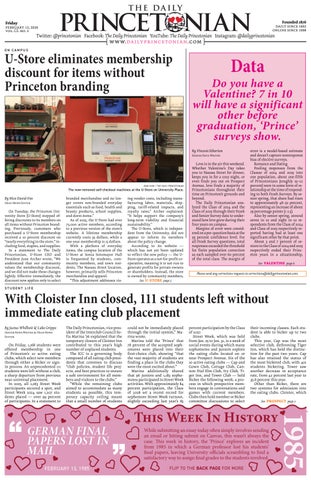
The now-removed self-checkout machines at the U-Store on University Place.
‘At the time of publication, some spots in Colonial appear to be available, and other sign-in clubs may become open if students decline their acceptances.’
PROSPECT
Continued from page 1
is currently closed, Colonial, and Terrace, all use the “sign-in” system, where students can simply sign up for membership. Although all clubs are currently at capacity according to the ICC website, unplaced students may be able to join sign-in clubs if spots free up as membership is finalized.
A recent addition to the sign-in system is the group sign-in, which was introduced by the ICC in 2024. This feature allows groups of sophomores and juniors to sign in to a club with their friends, ensuring they receive the same placements. The ICC said in its statement that 47 students used group sign-in, up from last year’s 32.
The selective sign-in process, adopted by Charter and Quadrangle in 2021 and 2025, respectively, awards points to prospective members for demonstrating interest in the club. Interest is measured by attendance at events such as coffee chats or socials before winter break and during Street Week.
Quadrangle announced in November 2025 that all prospective sophomore members were required to attend at least one of three “Quad Socials” in Street Week 2026 and that it would cap the number of new sophomores at 75.
For both Charter and Quadrangle, membership is selected based on where prospective members rank the club, as well as participation in activities.
In a previous email to the ‘Prince,’ Marina, who also served as the Quadrangle president, said the change was in response to feedback given by sophomores who wanted more opportunities to meet members and experience the club’s community prior to eating club selection.
The ranking window for eating clubs opened on Tuesday, Feb. 3 at 8 p.m. and closed on Thursday, Feb. 5 at 8 p.m., before decisions were released the next day at 10:15 a.m.
Marina wrote that 24 percent of participating sophomores utilized the single-bicker option and 64 percent utilized the doublebicker option. 12 percent of all participating students, or 153 of the original participants, chose not to bicker.
Breakdown of clubs
613 of the 1,168 students placed in clubs were offered spots in Bicker clubs, 11 fewer spots than last year.
Cap, which had 401 bickerees, accepted an equal number of male and female bickerees, which has been a pattern for the club in the two previous bicker cycles. The club welcomed 100 new members, the same number as last year. Its 24.9 percent acceptance rate is a 0.3 percent decrease from last year.
Tiger Inn welcomed 96 new members of the 374 bickerees for a 25.7 percent acceptance rate, an increase from last year’s 24.3 percent acceptance rate. 90 of these accepted students were sophomores, while the remaining six were juniors. Tiger Inn accepted the same number of students this year as it did last year.
Cannon offered admission to 109 of its 189 bickerees for a 57.7 acceptance rate — cutting last year’s acceptance rate of 60 percent by a little over 2 percentage points. Cannon admitted 118 members last year, and 101 members the year prior.
Tower accepted the most members among the Bicker clubs, accepting 140 of the 391 bickerees. This year, Tower saw an increase in bickerees, compared to 337 last year. The club had an acceptance rate of 35.8 percent, a decrease from last year’s 42.4 percent.
Cottage welcomed 95 new mem-
bers out of its 255 bickerees, a 37.2 percent acceptance rate compared to last year’s 36.7 percent. In 2025, it accepted 88 of 240 prospective members.
Ivy had a 25.2 percent acceptance rate, accepting 80 of 317 bickeeres, a 5.2 percent decrease from last year. Last year, the club accepted 79 of its 260 bickerees. Ivy let in 15 fewer students than Cottage — which had the second fewest admitted students — and 33 fewer than the average of all the clubs.
Bicker club acceptance rates have fluctuated dramatically in recent years. This year, Tower saw a continued increase in selectivity, while Cannon decreased in acceptances after an increase in them last year.
This year, Quadrangle welcomed 115 members, marking a dramatic decrease from last year’s 155 acceptances. Charter welcomed 112 new members, an increase from 100 last year.
With 180 acceptances, up from 120, Colonial offered membership to the most new students among the sign-in clubs — a distinction held by Quadrangle last year. Terrace welcomed 133 members to the club, similar to last year’s 131.
Looking ahead, students consider their options
This year, an unprecedented number of participants were both “hosed” — not accepted by a Bicker club — and left without a placement in a sign-in club. Still, the ICC said that 86 percent of sophomores who participated in Street Week were placed into their first or second choice club, four percentage points more than last year. 78 percent of sophomores were placed into their first choice club.
The ICC is encouraging students to join sign-in clubs that might still have open spots. “We are actively encouraging students to engage with sign-in clubs that
may have additional capacity as they finalize their memberships following Street Week,” Marina wrote.
Students will have until noon on Feb. 22 to sign in to any open clubs. At the time of publication, some spots in Colonial appear to be available, and other signin clubs may become open if students decline their acceptances.
In the wake of these decisions, students have begun to explore alternate options for their dining plan next year. Aside from the eating clubs, dining options for upperclassmen include remaining on the unlimited dining plan, selecting a 128-block meal plan, or joining one of the four student co-ops. The block plans allow students to eat in the dining halls as upperclassmen if they are not in an eating club or a co-op. The co-ops are groups in which upperclass members prepare and share food in on-campus facilities.
Last fall, the University eliminated two dining options: the independent status and the 105-block meal plan. Students with independent dining status previously did not need to pay the University any fee for dining. Under the original changes, upperclassmen living in University housing, regardless of their dining plans, would be required to pay for the 32-block plan starting
fall of 2026.
After opposition from eating clubs, co-ops, and alumni, the University decided to rescind the decision to make students pay for the 32-block plan. Although the 160-block plan was changed to a 128-block plan, the independent status and the 105-block plan remain eliminated.
Historically, Ivy, Cap, and Cannon have offered fall Bicker for upperclassmen students who were not placed into a club in the spring. However, getting a spot in a Bicker eating club during Fall Bicker is far from guaranteed; the process has become more competitive with lower acceptance rates and fewer spots available.
Justus Wilhoit is a former head Audience editor and current senior News writer for the ‘Prince.’ He is from Kenosha, Wis. and typically covers Princeton’s eating clubs/co-ops, identity & student life, and the Trump administration.
Luke Grippo is a head News editor for the ‘Prince.’ He is from South Jersey and typically covers high-profile interviews and University and town politics.
Justus Wilhoit is a member of Cap and has recused himself from reporting on the club.
Detecting disease earlier: How a simple CRISPR tweak could make diagnostics faster, cheaper, and more
By Aanya Kasera Contributing News Writer RESEARCH
A sma l change to a powerful molecular tool developed by Princeton researchers could help scientists detect disease faster and with greater accuracy.
Researchers at Princeton University are developing a new diagnostic approach using CRISPR-Cas13, an enzyme that can detect RNA from viruses and ce l s. Their recent work shows that adding a short piece of DNA, ca led an occluder, improves Cas13’s ability to identify extremely sma l genetic mutations. These single-leter mutations in genetic code can play a role in diseases such as cancer or determine how dangerous a virus can become.
The research was led by Ofer Kimchi, Branco Weiss Fe low and Assistant Professor of Mathematics at NYU, and Ben Larsen GS in the Department of Molecular Biology. The testing was conducted while Kimchi was a postdoctoral researcher at Princeton.
The team’s innovation tackles a key cha lenge with Cas13: It works extremely quickly, but it sacri fces some precision in its ability to detect sma l mutations. Speci fca ly, the speed with which the Cas enzyme cuts DNA limits its ability to distinguish tiny mutations, known as single nucleotide changes, inducing major efects on virus behavior or disease development.
To solve this problem, the researchers added a short DNA sequence that acts as a physical barrier — tiny DNA speed bump — that slightly slows Cas13 down. This brief pause gives the enzyme time to check whether it has found the exact target sequence rather than a near match, dramatica ly improving accuracy.
“[The DNA sequence] slows down Cas13 just enough that it can take an extra beat and check, ‘Is this the exact thing that I’m supposed to bind to, or is it just pret y close?’” said Kimchi in an interview with The Daily Princetonian. “And that tiny pause makes a huge di ference
in speci fcity.”
The team sees broad potential for the technology. During the COVID-19 pandemic, they focused on viral diagnostics, and the tweak could now allow researchers to track virus mutations in real time and give healthcare workers more time to respond. Beyond infectious disease, the method could improve access to cancer mutation screening and testing for genetic disorders, many of which are caused by single-leter changes in DNA or RNA.
“Before now, the only way to test for them involved very expensive and time-consuming methods like sequencing,” Larsen told the ‘Prince.’ “So practically speaking, it means that many people around the world haven’t had access to diagnostics.”
The work grew out of curiosity-driven research rather than a direct atempt to build a medical tool. Kimchi highlighted the beneft of the team’s diverse expertise, combining biology, math, physics, and bioengineering, which helped turn a fun-
damental question about RNA behavior into a practical innovation.
The project also included feld testing beyond Princeton. Larsen described traveling to Cambodia to col aborate with scientists at the Pasteur Institute in Phnom Penh, where the team tested the diagnostic tool on patient samples of avian in fuenza.
Looking ahead, Kimchi said the most exciting part of the project is the unknown.
“Beyond a l the things that
[Larsen] talked about, the thing that I’m most excited by is the possibility of discovering things we haven’t even imagined yet,” he said.
For readers interested in hearing more about the science and the stories behind the research, the fu l interview with Kimchi and Larsen is available through The Daily Princetonian.
Aanya Kasera is a News contributor for the ‘Prince.’
ANDREW SOMERVILLE / THE DAILY PRINCETONIAN Students work in the Carl Icahn Laboratory as mist settles on a snow-covered Poe Field.
CANDACE DO / THE DAILY PRINCETONIAN Prospect Ave., where most of the eating clubs are located.
van der Molen ’26:
‘I would rather them keep the discounts
for
food and take it away for the [merchandise]. Food is actually necessary.’
U -STORE
Continued from page 1 .............
town residents, and others who opt into the cooperative by purchasing a membership. Surplus revenue after expenses is reinvested into the business or returned to members in the form of discounts.
In interviews with the ‘Prince,’ U-Store members shopping at the University Place location expressed
their disapproval of the policy change, which had come into effect earlier Tuesday.
“I’m disappointed because, when you get the membership, they say it’s for life,” Phaedra van der Molen ’26 said. “I would rather them keep the discounts for food and take it away for the [merchandise]. Food is actually necessary.”
Laura Sabrosa ’27 agreed that the membership discount should cover
staples, not merchandise, which she said “people don’t buy as much.”
Members also said that the change caught them by surprise.
Gwennie Nellis ’29, who had just made a purchase, said she didn’t know the policy was in place despite frequently shopping at the U-Store.
“I feel like if you have a membership you’re entitled to know what that includes,” Nellis said.
Sabrosa, who was not previously
aware of the policy, told the ‘Prince’ that the lack of an announcement was “the worst part.”
The U-Store “should’ve advertised somehow that this was going to happen instead of having people find out when they’re paying or stopped to do an interview,” Sabrosa added.
A U-Store employee who declined to give their name to the ‘Prince’ said that the store will be closed for
a “meeting” from 5 – 6:30 p.m. on Thursday.
The U-store is “actively evaluating updates to the membership program to offer more value to members,” Archer added.
Nico David-Fox is a head News editor for the ‘Prince.’ He is from Washington, D.C., and often covers academics and the Undergraduate Student Government.
New statewide e-bike regulations to take e fect July 2026, could impact impending University PEV policy
By Christine Woods Staf News Writer
New Jersey will soon have some of the strictest e-bike restrictions in the nation.
On his last full day in office, former governor Phil Murphy signed a bill to regulate electric bicycles in New Jersey, citing concerns about the rise in ebike accidents throughout the state. These regulations will require riders to register, license, and insure electric bikes and place a one-year ban on online e-bike sales. The new law also abolishes the three-tier system the state used to classify e-bikes.
When in effect, the bill will expand regulations from only high-speed non-pedal-assist bikes to any e-bike, including lower-speed pedal-assist bikes. It will also require operators to be at least 17 years old with a valid driver’s license, or at least 15 years old with a motorized bicycle license or permit.
Riders must obtain the necessary documentation and reg-
ister their vehicles with the NJ Motor Vehicle Commission by July 19. The commission will waive all examination, registration, and licensing fees for a year.
This bill follows a December Council of the Princeton University Community meeting, during which the Environmental Safety and Risk Management committee announced the possibility of changing the Personal Electric Vehicle (PEV) policy on campus.
While an official announcement has not been made regarding an updated PEV policy, University spokesperson Jennifer Morrill told the ‘Prince’ that this legislation, “along with feedback collected from the campus community,” will inform the Council’s discussions about potential policy changes.
Captain Thomas Lagomarsino of the Princeton Police Department told the ‘Prince’ that the municipality is still trying to finalize the logistics of enforcing the new law. Licensing, registration, and insurance re -
quirements still need to be finalized, he said.
Pallavi Nuka, the president of Walk Bike Princeton and associate director of the University’s Julis-Rabinowitz Center for Public Policy and Finance, told the ‘Prince’ that she believes these regulations may disincentivize the use of sustainable transportation methods. She mentioned that she herself rides an e-bike, and considers it a convenient alternative to driving.
Nuka also addressed the impact this policy may have on those who use e-bikes for travel. “This law is going to disproportionately affect those people who rely on the e-bikes for their main needs of transportation and community,” she said.
Nuka expressed skepticism that the new law would make roads safer. “Communities would be better served by encouraging low-speed e-bikes as alternatives to cars and motorized e-bikes for short-distance trips,” she added.
A number of students also expressed distaste for the new law. Lucas Peterson ’29 shared that an e-bike makes his commute across campus easier.
“As an athlete, I have to go from upper campus all the way down to Jadwin [Gymnasium] and back. Not having an e-bike would make that so much more of a pain,” Peterson, who is on the Princeton men’s fencing team, told the ‘Prince.’ Peterson had been in an ebike accident last semester, in which he collided with another student on an e-bike. However, he said that he believes “e-bikes are as dangerous as regular bikes.”
Kian Mitty ’29 told the ‘Prince’ in an interview that he has never encountered any trouble with an e-bike or e-bike users.
“People are pretty considerate with their e-bike usage. They mainly go on paved roads, and if they see that there’s a lot of people, they usually walk with them,” Mitty said. “It’s not a hazard to me.”
According to Morrill’s statement, updates to the policy, if any, will be announced this semester. “An educational and communication campaign will help e-bike riders navigate any changes,” she said.
Lagomarsino said that the Princeton Police Department will share information regarding the bill through social media channels and host in person information sessions once more information is released by the state and the motor vehicle commission.
The Daily Princetonian reached out to State Senator Andrew Zwicker, who voted in favor of the bill. He did not respond in time for publication.
The new bill will take effect on July 19, 2026.
Christine Woods is a staff News writer for the ‘Prince.’ She is from New York City.
Princeton faculty members discuss experience leading Sherrill transition teams
By Clara Docherty & Christine Woods
Assistant News Editor & Staf News Writer
In the lead-up to Governor Mikie Sherrill’s inauguration on Jan. 20, two Princeton faculty members led transition teams for the governor-elect.
School of Public and International Affairs (SPIA) Professor of the Practice Heather Howard co-chaired the Affordable Healthcare team, and Sociology and SPIA professor Kathryn Edin co-chaired the Kids Mental Health and Online Safety team.
In total, there were 10 policy-focused transition teams, each with nearly 20 people. The teams represented topics that Sherrill campaigned on, including education and lowering housing costs.
“What’s fascinating is the way each of them reflected themes,” Edin said in an interview with The Daily Princetonian. “Ours was very specific — it wasn’t child well-being, it was [child] mental health and safety.”
The work of Edin’s team involved looking critically at youth mental health and finding policy proposals that all members of the committee agreed on. According to Edin, the team’s youngest member is 16 years old, and is a youth activist for mental health.
“It was amazing how carefully the governor-elect staff thought about who should be [on the team],” Edin said. “If you’re going to have a task force on kids’ mental health and online safety, maybe you should have a kid [on the team].”
Two initiatives that Edin described were gathering information from a social media addiction observatory and hiring more mental health counselors in schools. The team’s work often included views of external stakeholders.
Edin described the transition process as a “listening exercise” with the governor-elect.
“It felt like these were questions the governor really wanted answers to, and she was going to take seriously the advice that each of these transition teams offered in their final analysis,” Edin
said.
Edin also noted that she plans to share her learning from the experience with her students.
“Giving [students] a sense of what this process is like, what the rubrics look like, and what it’s like to work with stakeholders … are all interesting things to bring to a classroom,” Edin said.
Edin is an expert on child well-being and poverty research. She has advised states and local jurisdictions on child support, along with various government entities.
Edin runs the Bendheim-Thoman Center for Research on Child and Family Wellbeing at Princeton and frequently advises the state of New Jersey.
Howard’s action team focused on addressing the Trump administration’s cuts to Medicaid through the One Big Beautiful Bill Act and designing affordable health care policies.
Howard was also a co-chair on former Governor Phil Murphy’s health care transition team in 2017 and 2018, but she noted some of the new challenges introduced due to federal cuts.
“The One Big Beautiful Bill Act imposes significant cuts to the Medicaid program, which is the largest budget item in the New Jersey state budget,” Howard said in an interview with the ‘Prince.’
“We were really tasked with thinking about how to mitigate the harm from those cuts — both the harm to people in the Medicaid program who rely on it for healthcare, and also to the broader healthcare safety net: the hospitals and doctors and clinics that everyone in New Jersey relies on,” she added.
The transition team was also connected to Howard’s current work at Princeton, where she is teaching SPI 393: Health Reform in the US — The Affordable Care Act and Beyond.
“In my own research, I want to continue to work on ways to make health care more affordable for people in the state. I’m committed — as a resident, as a former state official — to do that,” Howard said.
“My work is certainly not done.”
Clara Docherty is the assistant News editor for the ‘Prince’ leading faculty, graduate students, and alumni coverage. She is from Lafayette, N.J., and can be reached at clara. docherty[at]princeton.edu.
Christine Woods is a staff News writer for the ‘Prince.’ She is from New York City and can be reached at cw0453[at]princeton.edu.
NJ General Assembly commemorates America’s 250th anniversary in Nassau Hall
By Luke Grippo & Amaya Taylor Head News Editor & Staf News Writer
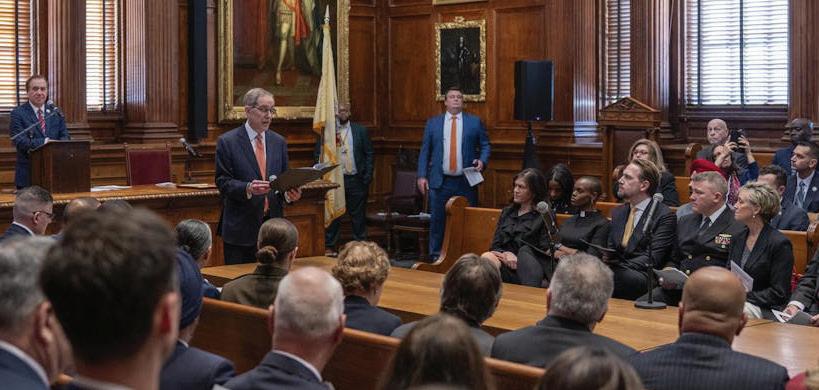
Two hundred fifty years ago, the New Jersey Legislature held its first-ever session in the Faculty Room in Nassau Hall. On Thursday, the New Jersey General Assembly, the lower house of the legislature, convened in the historic building once again in honor of the 250th anniversary of the signing of the Declaration of Independence.
Speakers included University President Christopher Eisgruber ’83, Speaker of the New Jersey General Assembly Craig Coughlin, British Consul General to New York and HM Trade Commissioner for North America Oliver Christian, and recently-elected Lieutenant Governor Dale Caldwell ’82, shadowed by large portraits of George Washington on the left and King William of Orange on the right.
65 of the 80 members of the assembly were present. Two assembly members represent each of the 40 N.J. legislative districts. Both the assembly members representing District 16, which includes Princeton, Mitchelle Drulis and Roy Freiman, were present.
An hour before the start of the session, climate change protesters congregated in front of Nassau Hall and greeted assembly members as they filed in. The rally was sponsored by Sunrise Princeton, the Climate Revolution Action Network (CRAN), Empower NJ, and the Food & Water Watch.
None of the assembly members addressed these issues during the meeting. When the meeting concluded, assembly members walked through the protesters to return to their bus.
Eisgruber was the first to speak, identifying four core moments of Princeton and the ivy-adorned hall’s association with the beginnings of the country: “Father of the Constitution” James Madison studied at Princeton when it was just Nassau Hall; George Washington
liberated Nassau Hall from the British during the Battle of Princeton; the hall served as the nation’s capital from June to November 1783; and the N.J. State Legislature’s first meeting and inauguration of the state’s first governor, William Livingston, was held in Nassau Hall in August 1776.
Eisgruber concluded his speech with a re-commitment to the relationship between the University and the State of New Jersey.
“For many of you, this may be your first time on Princeton’s campus. I hope it is not your last,” Eisgruber said.
Next to speak was Coughlin, who described the University as the centerpoint of the state’s historical, intellectual, industrial, political, and social developments.
“Princeton has always had an important role in the state of New Jersey. It’s the intersection of intellect and public service, and for generations, it has helped cultivate talents and ideas that strengthen our state and our nation — an enduring partnership for which we are deeply grateful,” Coughlin said.
“Today isn’t simply a change in venue for us — it’s a return home, a return to our beginnings, to the place where our legislature first met in 1776 at the dawn of the new and uncertain democracy,” Coughlin added.
Following Coughlin’s address was Christian, who delivered remarks regarding the “shared history” between the enemies-turned-friends of the Americans and the British.
He expressed pride at having “over 39,000 New Jerseyans … employed by British companies” — an accomplishment he acknowledged in his role as trade commissioner.
He also praised Daniel Yu ’26 and Maya Butani ’26, who were awarded the Marshall Scholarship to study for two years in the United Kingdom — “two outstanding students” receiving the “illustrious” scholarship, according to Christian.
Directly after Christian’s remarks, Caldwell took the podium, praising Eisgruber’s “wonderful stewardship of the University,” before handing the microphone to Joseph Klett, the executive director of the New Jersey State Archives, and Sara Cureton, the executive director of the New Jersey Historical Commission, for a brief overview of N.J. Revolutionary-period history.
To finish the session, eight resolutions were voted on by the Assembly, each unanimously approved. The second resolution, presented by Freiman, commemorates the University’s 280th anniversary.
He placed specific emphasis on Princeton’s alumni, including two presidents; twelve who have been named to the U.S. Supreme Court including three current U.S. Supreme Court justices; and the eleven who have served as N.J. governor.
The other resolutions included honoring the history and service of the U.S.S. New Jersey battleship, the role of Princeton in the American Revolution, and honoring unsung New Jerseyan heroes in the Revolutionary War, among
others.
Following the session, Freiman and Drulis spoke about their thoughts on the event and Princeton’s regional-national significance in an interview with the ‘Prince.’
Drulis shared that there is a synergy between the political issues of the postRevolutionary War epoch and the current political climate. She specifically highlighted that “there was national political crisis, there was divide among neighbors — a lot of the same issues we’re still struggling with today, unfortunately.”
Freiman discussed his hopes for the relationship between the General Assembly and Princeton on a shared commitment to free discourse.
“We’re working very closely on trying to make it an environment where people feel safe; safe to discuss issues, safe to challenge ideas, and explore,” he said.
Both assembly members acknowledged parallels between the trepidations of the first assembly and the assembly that met on Thursday.
“We are struggling with making sure we have a balance of power,” Freiman
said. “This year, our election is sending a message of dissatisfaction of what’s taking place in Washington.”
“There’s uncertainty about what the future brings. And I think those are all feelings that that legislature [then] was definitely grappling with,” Drulis said. However, Drulis believes that Princeton remains at the forefront of addressing this uncertainty. “From the very founding of our state, Princeton University has led the way,” she added.
“When you travel outside of N.J. … Your reference point is Princeton. So you can’t speak of New Jersey without really talking about Princeton itself and the importance it has.”
Luke Grippo is a head News editor for the ‘Prince.’ He is from South Jersey, and typically covers high-profile interviews and University and town politics.
Memphis, Tenn.
Toby Chang contributed reporting.
VEENA KRISHNARAJ / THE DAILY PRINCETONIAN
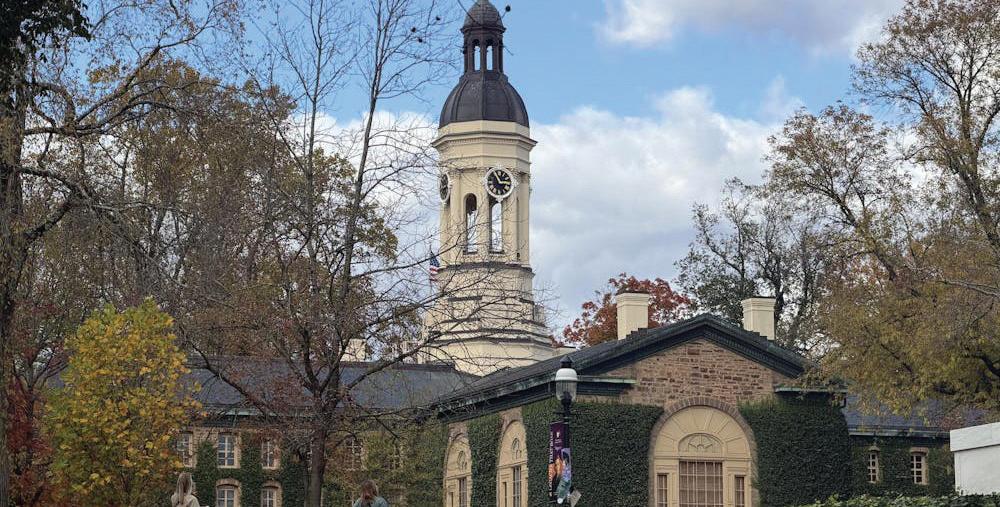
The American flag flies over Nassau Hall.
Amaya Taylor is a staff News writer and Associate Prospect editor from
Princeton Council discusses ban on ice skating on Lake Carnegie
By Emily Chien Staf News Writer
At the Princeton Town Council meeting on Monday, Council members and Mayor Mark Freda discussed the prohibition of ice skating on Lake Carnegie. The policy change, which occurred last spring, was not originally in the meeting agenda, but was discussed following several inquiries from residents.
Municipal administrator Bernie Hvozdovic stated that “it was determined last winter that, at least for the time being, ice skating on the lake would not be permitted.” He explained that the decision stemmed from multiple safety concerns. Employees were concerned about their personal safety when going out on the ice to take “borings” — measurements of ice thickness used to determine whether the lake was safe to skate on.
Emergency services officials also determined that the skating area of Lake Carnegie, which stretched from Harrison Street to Washington Street, was too large for first responders to reach skaters in time in the event of an emergency. Hvozdovic brought up additional concerns regarding lack of parking spaces due to the loss of nearby parking options — namely, the University boathouse and Lot 21 no longer being available.
Carnegie Lake has very rarely been accessible for skating in the past few decades. It was opened most recently during the winter of 2014–15 and in 1996, according to Hvozdovic.
Council President Michelle Pirone Lambros, who served as the recreation liaison when the decision was made, corroborated these hazards. She noted how a bubbler — a de-icing device which warms water surrounding boats to prevent ice from damaging them located near the rowing center poses a safety risk.
While Pirone Lambros expressed a desire to “cordon off a section and have just a few hours where we allowed
people to skate,” she acknowledged the risks.
In past years, the University’s Community and Regional Affairs website stated that ice skating on the lake was permissible under the condition that signage posted by the Princeton Recreation Department confirmed it was safe.
In 2025, the Princeton Recreation Department, in coordination with the Municipality of Princeton Emergency Services, stopped testing ice at Lake Carnegie when “temperatures allowed the lake to freeze,” according to Kristin Appelget, assistant vice president of Princeton University Community and Regional Affairs.
Following this decision, the University worked with the Recreation Department to update the Lake Carnegie signage and webpage accordingly, with the website now simply reading: “Ice skating is not permitted on Lake Carnegie.”
There remain two other locations in Princeton that the Recreation Department actively monitors for safe skating conditions: Barbara Smoyer Park, and Community Park North. In recent days, the pond at Smoyer Park has mostly been marked as safe for skating, while the department still considers Community Park North unsafe due to uneven surfaces.
Councilwoman Mia Sacks said she had not been aware of the decision to forbid community members from skating on Lake Carnegie until community members began reaching out to her in the past week.
She noted her belief that the decision was “not arbitrary and capricious” but rather “based on consultation with Princeton’s emergency services department and the Princeton First Aid and Rescue, who couldn’t guarantee that they would be able to save a life in time.”
Still, she said she wishes that the issue “had come to Council for us to discuss it.”
“It’s a really significant, important, valuable memory for those of us who feel a strong connection to this town,”
Sacks said of skating on Carnegie Lake.
“If there’s any way we could eke out some way to continue that memory, I hope that we could do that.”
Freda pushed back on any suggestion that the decision was hidden.
“I do not believe the decision was hidden from anyone from the Council or the public,” he said.
Councilman Leighton Newlin supported the change. He suggested there were more important issues to focus on, including the recent death of a homeless person in Mercer County due to freezing temperatures in their car.
“Let’s weigh skating on the ice for a few people with somebody freezing to death in their car. We have really big fish to fry here in Princeton, and … keeping people safe that are vulnerable in difficult times is really what we should be focusing on,” Newlin said.
Despite the safety rationale, several residents urged the Council to find a
compromise. One Princeton resident, Chris Sturm, told the Council that skating on the lake is “a tradition and not traditionally a reckless decision.” She noted that she believes many people skate on the lake despite the prohibition.
Along with other Princeton residents and Council members, Sturm requested that “the Council work with its professionals and with volunteers to figure out how to offer ice skating opportunities in the future” and pointed to the newly-built, multi-floor Theater Drive Garage as a potential solution to parking concerns.
Sacks expressed the same sentiment regarding working towards a compromise of safety and enjoyment. She suggested an area reserved for skating, with emergency services stationed nearby during limited skating hours.
At the start of the Council meeting, four Princeton Police Department (PPD) officers were formally promoted
in a ceremony, though they had already taken on their new roles: Ashley Levins to corporal, Michael Schubert to sergeant, Daniel Federico to lieutenant, and Thomas Lagomarsino to captain.
The Council also heard a presentation of the 2025 Urban Forestry Report, which noted that Princeton has maintained its Tree City USA designation for 29 years and planted 276 street and park trees. However, Councilman Brian McDonald highlighted that the town has lost 5.5 percent of its tree canopy — equivalent to 653 acres — over the past 13 years.
The meeting concluded with the Council voting on a series of ordinances. One ordinance was approved, two had new public hearings set for the Feb. 23 meeting, and six affordable housingrelated ordinances were introduced.
Emily Chien is a staff News writer for the ‘Prince.’ She is from Arcadia, Calif.
New Spelman Hall room draw process unveiled at USG meeting
By Gray Collins
Assistant News Editor
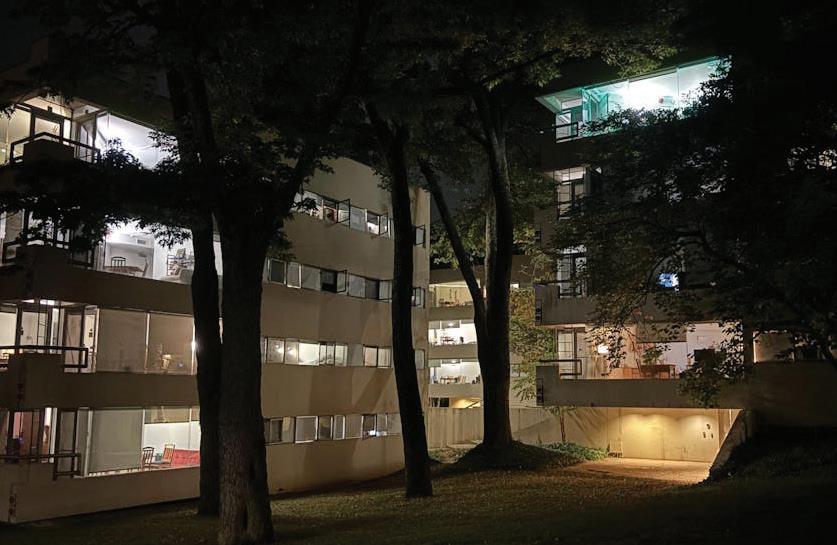
At its Sunday meeting, the Undergraduate Student Government (USG) revealed the University’s plan for a new Spelman Hall room draw system. The change comes after a referendum passed by the student body last November pushing against controversial University dining reforms that eliminated independent dining status. Spelman Hall is unique among upperclass dorms due to the kitchen ac-
cess in its apartment-style rooms, and has long been favored by students with independent status.
According to a copy of the plan obtained by The Daily Princetonian, rising juniors and seniors will participate in a separate draw for Spelman.
During the application process, students will be required to list the four members in their draw group and confirm that they will not be a member of an eating club or co-op, or have an unlimited meal plan for the upcoming year.
Only groups with at least two students not on a full meal plan — an eating club, co-op, or the University unlimited plan — will be able to enter the draw.
The original dining changes did not include a separate process for Spelman, an issue that was first brought to University Services by last term’s USG leaders Enzo Kho ’26, Aishwarya Swamidurai ’26, and Anuj Krishnan ’27.
Throughout November and December 2025, USG and the University continued conversations about how best to implement a new room draw system. Vice President for University Services Chad Klaus originally said the University aimed to find a solution for the Spelman Hall room draw by Thanksgiving.
The plan states that the Spelman draw process will serve as a pilot program and “provide insight into potential adjustments for future years.”
Because of the unique nature of Spelman’s apartment-style dorms, the pilot not extend to other buildings, such as Dod, Scully, and Brown Halls, which have historically housed some independent students.
At the meeting, USG president Quentin Colón Roosevelt ’27 also addressed repeated late arrivals by USG senators and plans to enforce USG attendance more strictly.
“5 p.m. is when the meeting starts. 5 p.m. is not when you get here. So if you
are more than five minutes late and you don’t tell us in the future, we are going to be marking you absent,” he told USG representatives.
Colón Roosevelt campaigned on a promise to open USG attendance reviews to the general public instead of entering closed session. Under the looser tardiness guidelines of the term’s first two meetings, there was only one marked absence despite multiple instances of late arrivals.
USG treasurer Marvel Jem Roth ’28 then reported on the state of the USG budget, including expenditures for the photographer at the First Day of Classes celebrations, the game truck during Dean’s Date, and the USG office snack stock — which is available to all students in Room 204 of Frist Campus Center.
In the face of upcoming budget cuts announced by University President Christopher Eisgruber ’83, she emphasized the importance of maintaining robust communication with administrators and student groups.
USG’s Projects Board approved funding for a percussion concert, taekwondo tournament, and fasting event during Ramadan.
Campus & Community Affairs (CCA)
Chair Anaya Willabus also unveiled upcoming events for students. She encouraged student performers to sign up by Feb. 22 to play at Porchfest, which will
feature a new stage at the Princeton University Art Museum.
CCA will also provide 150 student vouchers each week, an increase from previous years, to undergraduates for access to the Princeton Farmers’ Market. The call for student artists, who will be able to work directly with vendors, at the May 2 Arts Bazaar will go out on Feb. 26.
Sustainability Chair Gianna Maltbie ’29 reported on the committee’s successful first meeting, and previewed upcoming events.
“We have our sustainability career panel with the Center for Career Development, where we have four people from our sustainability committee who are working on questions, leading a panel of people who are involved in sustainability,” said Maltbie. She also announced the Sustainability Symposium on Apr. 8, an Earth Month tabling event in April, and possible educational programming surrounding local geothermal facilities and water infrastructure.
USG meets each Monday at 5 p.m. in Robertson Hall. The meetings are open to student comment.
Gray Collins is the assistant News editor for the ‘Prince’ leading university administration coverage. He is from outside of Philadelphia.
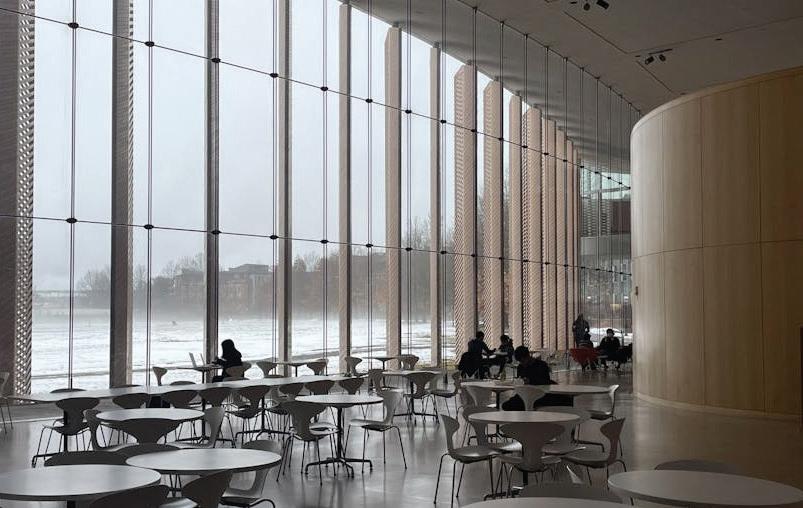
ADITI DESAI / THE DAILY PRINCETONIAN Lake Carnegie on a cloudy day.
‘About 3 and 7 percent of seniors in the Classes of 2024 and 2025 respectively ended their Princeton years in a situationship.’
VALENTINE
Continued from page 1
having selected “it’s complicated” when asked about their relationship status, and around 1 and 4 percent were engaged or married by the time they exited FitzRandolph Gate.
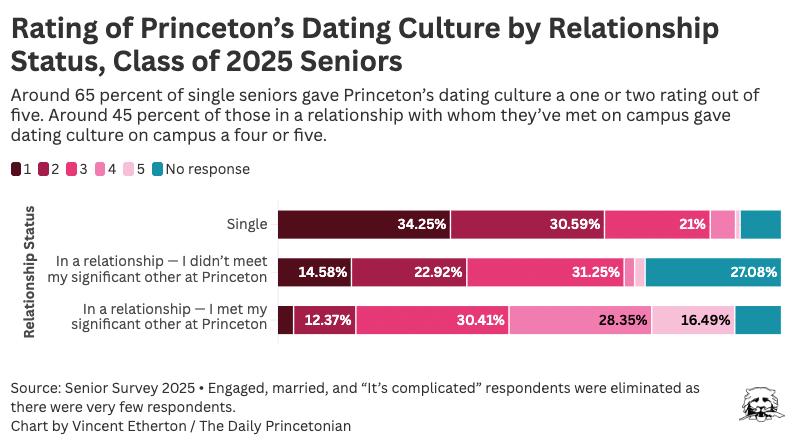
Almost 41 percent of Class of 2025 seniors reported that they met their partner at Princeton. Respondents were also presented with a scale to rate dating life at Princeton: one being poor, three being neutral, and five being excellent. Around 46 percent of all respondents answered with a one or a two rating out of five when asked about their satisfaction with dating culture at Princeton. 8.37 percent rated dating culture on campus a five out of five.
Around 65 percent of seniors in the Class of 2025 who reported that they were single were found to be the most dissatisfied with Princeton’s dating culture, rating it either a one or two. Around 31 percent of those that were in a relationship where they met somewhere other than Princeton reported a median score of three describing campus dating culture.
Sex Life and Sexual Orientation
On the matter of sex, again pooling the Classes of 2024 and 2025
together, around 28–30 percent of undergraduate Princetonians likely had sex according to the two classes’ Frosh Survey data. Around 74 to 78 percent of students in those same classes had sex by their senior year, according to the Senior Surveys.
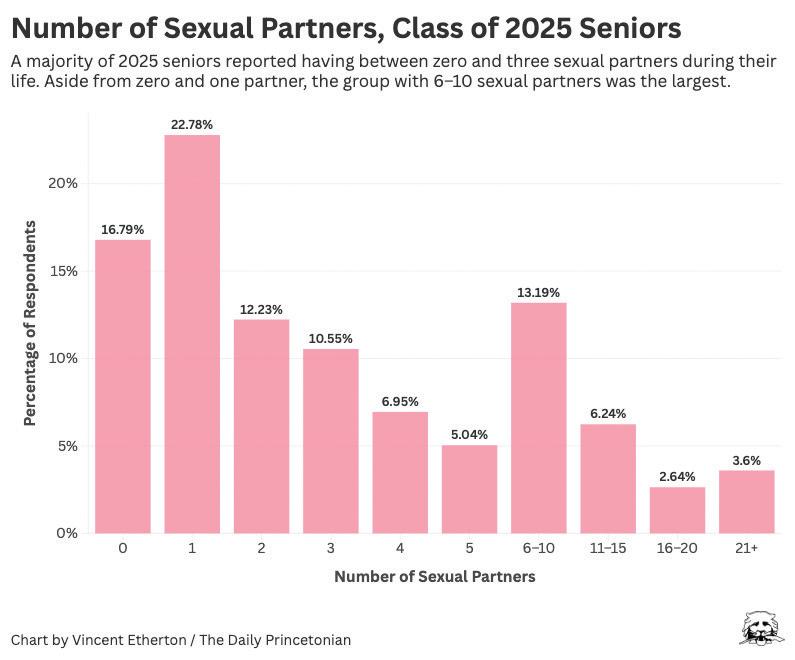
Around 23 percent of Class of 2025 seniors had only one sexual partner during their lifetime, the most prevalent group, followed by around 17 percent having had zero partners and 13 percent with six to ten.
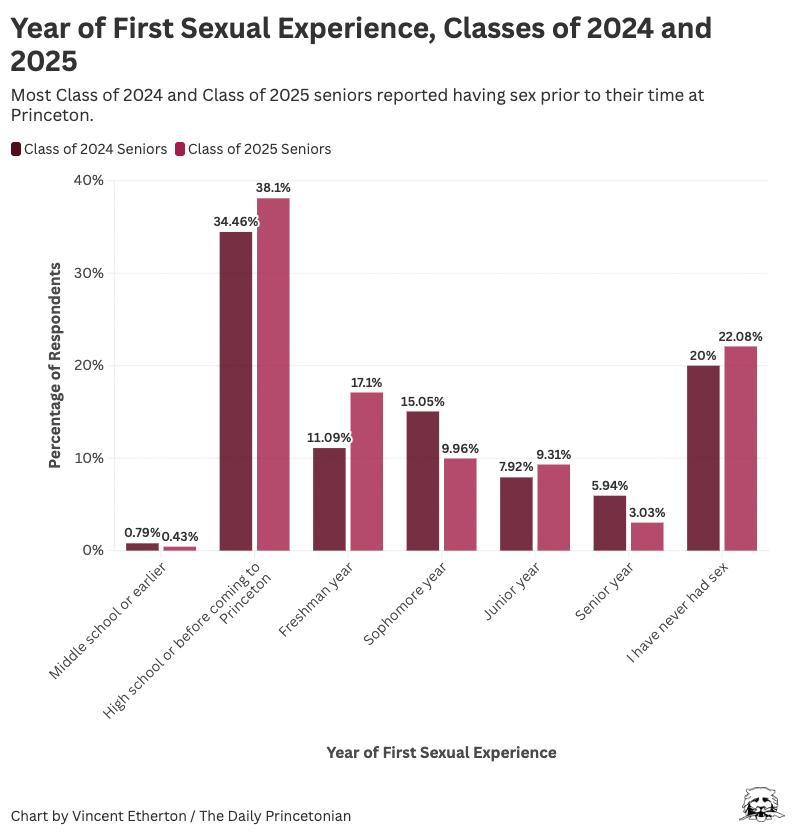
Most seniors from the Classes of 2024 and 2025 reported having sex prior to their years at Princeton. Among seniors that had sex for the first time at Princeton, freshman year was the most popular year for the Class of 2025, while Class of 2024 favored sophomore year.
Princetonians clearly enter and leave the Orange Bubble with various sexual and romantic experiences, so whether this Valentine’s Day finds you with a long-term partner, in something complicated, or flying solo, the numbers suggest there’s still time. Happy Valentine’s Day!
Vincent Etherton is a senior Data writer and head Data editor emeritus for the ‘Prince.’
Hum r
Princeton students call for preemptive divestment from U.S. ahead of ‘likely’ Greenland invasion
By Kadin Parham Contributing Humor Writer
The following content is purely satirical and entirely fictional.
Under a cluster of hastily assembled tents and handmade picket signs, a large group of Princeton students gathered outside Nassau Hall on Monday evening to demand that the University divest all funds from the United States of America. As chants broke through the campus quiet, students raised signs reading “DIVEST BEFORE IT’S TOO LATE” and “DON’T WAIT FOR TANKS.”
The protests were organized by the Greenland Accountability Society (G.A.S.), a coalition of students and faculty that cited growing concerns over a potential future invasion of the autonomous Danish territory of Greenland as the impetus for this demonstration.
“Divesting now sends a message to the America we fear we are becoming,” protest organizer Eliot Forewarn ’28 said. “Waiting until violence actually occurs would mean the University has already reneged on its moral obligations.” Another student, speaking on the condition of anonymity, said she was “deeply concerned,” adding that “even if the invasion never happens, the mere possibility that it might occur demands we oppose America now,” and that any response that comes after troops are already de-
ployed is “fundamentally reactionary.”
G.A.S. has already obtained more than 300 signatures in support of immediate and total divestment efforts, including endorsements from at least two prominent SPIA professors, Minna Ral and Sym Bolic. Organizers stated that the group is committed to standing in solidarity with the people of Greenland, many of whom, they acknowledged, have not yet been directly affected by any attempts at foreign invasion.
On Wednesday, University President Christopher Eisgruber ’83 for-
mally acknowledged the concerns raised by both students and faculty, noting that the administration “takes seriously the full range of ethical questions posed by both real and hypothetical global events.” Eisgruber emphasized that Princeton remains “deeply engaged with the issue” and is not only “closely monitoring” the situation but also “actively listening” to all perspectives involved.
Eisgruber went on to announce the formation of a committee tasked with addressing student concerns over the coming academic year be-
fore issuing a preliminary report on whether further discussion may be warranted. The committee will include administrators, faculty, students, the administrators’ administrators, and at least one member yet to be determined. Its findings are expected to be released no earlier than the last day of the spring semester next year.
Kadin Parham is a contributing Humor writer. He can be reached at kp6530[at]princeton.edu, though no response should be expected until next semester.
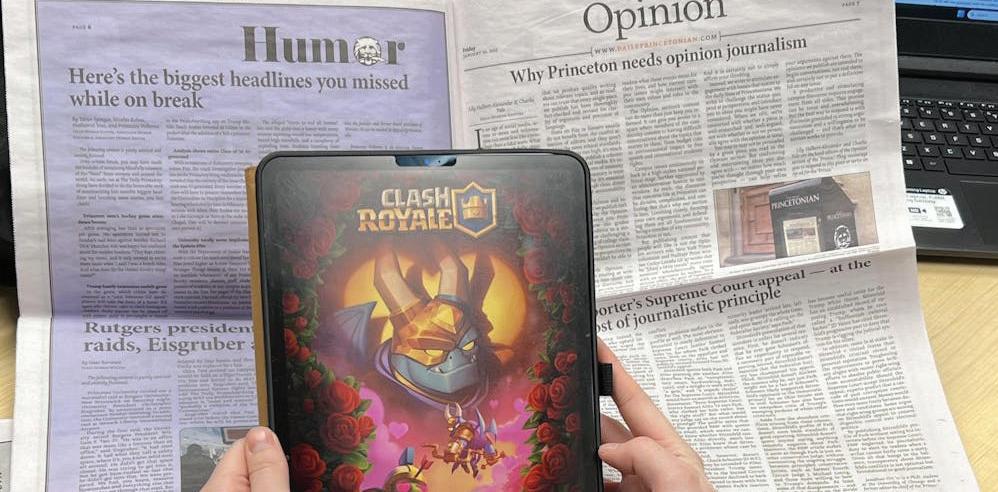
Clash Royale 100 Course to Be Introduced Next Fall
By Elijah Bisulca
Contributing Humor Writer
The following content is purely satirical and entirely fictional.
A beloved economics professor has announced that he will be leaving the field in order to establish the first Clash Royale Studies course.
The announcement came after a Supercell jingle unceremoniously interrupted the professor’s ECO 100 lecture last Wednesday.
Professor Minnie Pekaram knew that students were engaged in other activities during his class, but it wasn’t until he chose to examine the source of the jingle that he recognized the true problem at hand.
“No, no, no!” Pekaram shouted as he watched the student Log a Princess at the bridge.
“The opponent is playing Log Bait. Class, can anyone remind Payton what the word ‘bait’ means?” Pekaram looked on in horror as
Payton Winn lost his tower to an Evo Goblin Barrel and a Goblin Gang in the opposite lane.
As he continued his observation, Pekaram watched another student place a Three Musketeers in the back right without splitting them. Students reported that gray hairs were seen sprouting from Pekaram’s head as the opponent’s Rocket killed the Three Musketeers and did tower damage.
“I’ve failed you as a teacher,” Pekaram announced to the class. “I’ve been teaching financial management, but what you really need is a lesson in Elixir management.”
In order to confirm what he had discovered, Professor Pekaram discarded his presentation and put an iClicker question on the board that read, “Does a Zap kill a Dart Goblin?” To his utter dismay, over seventy percent of the class answered “yes” to the question. Professor Pekaram promptly announced that he
would be offering an introductory Clash Royale course next semester to fill in his students’ crucial knowledge gaps.
Yesterday, the course syllabus was released for CRS 100. The first lecture is titled “Clash Royale’s Best
Card: The Credit Card.”
Elijah Bisulca is a contributing Humor writer. He’s currently struggling in Jungle Arena against players two crown tower levels higher than him.
KENZO SALAZAR / THE DAILY PRINCETONIAN
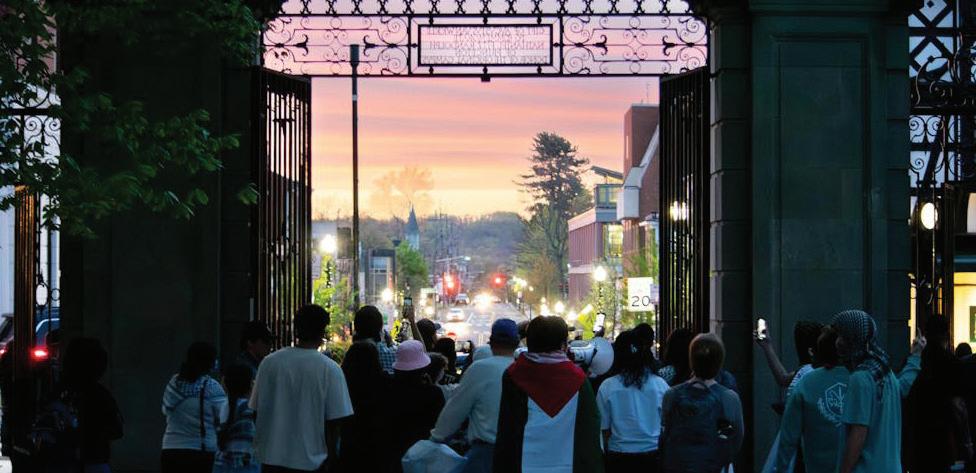
Protesters demonstrating against a visit by Israeli Ambassador Yechiel Leiter near FitzRandolph Gate on April 22.
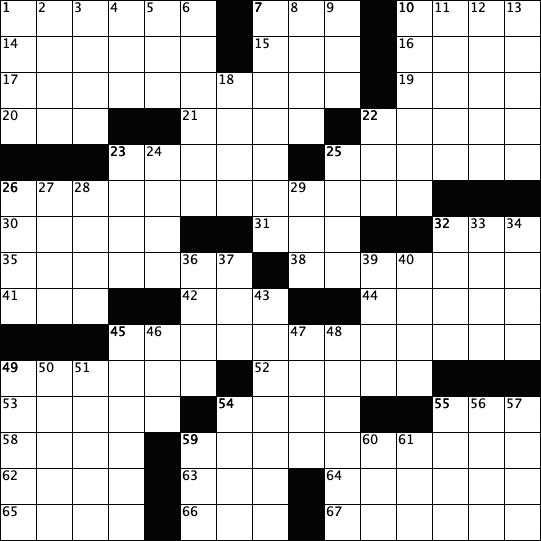
“STAR - CRO SS ED”
By MC McCoy & Maddie Feldman Senior Constructors
Original status of 51down in some romance novels
with
Humor’s Best Valentine’s Day Pickup Lines
Sam Wang Guest Contributor
The following is a guest contribution and reflects the author’s views alone. For information on how to submit a piece to the Opinion section, click here.
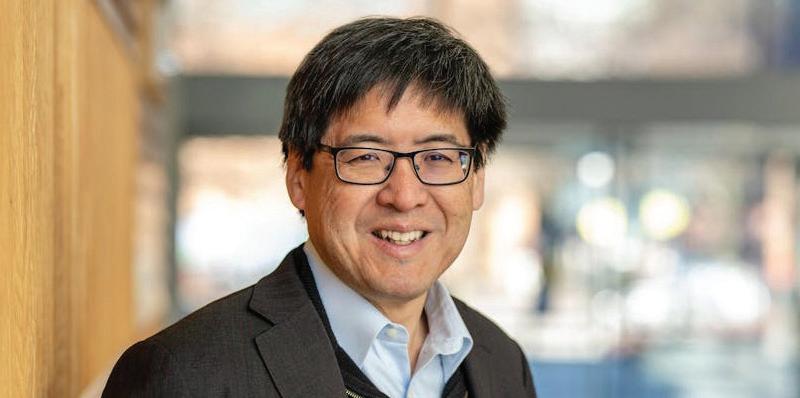
My name is Sam Wang. I am a professor of neuroscience, and I direct the Princeton Gerrymandering Project. I am running to represent New Jersey’s 12th Congressional District, which includes the Municipality of Princeton, to help stop the damage to our nation’s laws and principles — and begin to build a better democracy for all. You can help me in this fight by supporting or working for my campaign.
I want everyone in the district to have the same fair chance that made my own journey possible. Achieving that aspiration requires a strong structure of rights — and restoring the rule of law.
My parents fled communism in 1949 and came to the United States in the 1960s. They raised my brother, sister, and me in Indiana on modest means, where they worked as librarians and insisted that education
Why I’m running for Congress
came first. Our family faced additional challenges: My sister is autistic, and for years her condition went undiagnosed. My parents’ unwavering support enabled me to attend Caltech, where I studied physics and launched my scientific career, at the age of 15.
Those experiences shaped my life’s work. Today, my research lab studies the biology of autism. My lab members and I developed a way to use AI and smartphones to diagnose and measure autism remotely. Our work led to the founding of a company whose work can help families diagnose autism earlier.
I love the diversity of the 12th Congressional District because it reflects the promise that brought my parents to America. Over the last decade, the district has become a vibrant, majority Asian, Black, and Hispanic community. N.J.-12 deserves representation that will prioritize its interests.
First and foremost, Congress must do away with the U.S. Immigration and Customs Enforcement agency. ICE, which was only created in 2003, is infringing on the rights and lives of people across the country. After abolishing ICE, we must
Don’t
Ian Rosenzweig Assistant Opinion Editor
Speaking at the American Whig-Cliosophic Society on Feb. 5, J Street founder Jeremy BenAmi acknowledged that many people who come to his events are already “his people” — they agree with him and are excited to hear their position reaffirmed. J Street is a nonprofit and lobby that self-describes as “pro-Israel, propeace, pro-democracy.” Although Ben-Ami took questions from students who, in turn, considered his positions too supportive of Israel or not supportive enough, BenAmi is correct that, in general, political speakers preach to their own choirs.
This phenomenon does not stop at FitzRandolph Gate, and it undermines the value of inviting acclaimed speakers to Princeton. It is more educational to engage with speakers with whom we disagree than to develop our ideologies with guidance from our political heroes. Engagement with our opposites can range from simply listening with an open mind to asking a challenging question and — crucially — considering the speaker’s answer. However we go about it, showing up to listen to our political opponents, and subsequently adjusting our views
create an immigration framework that focuses on real border concerns and does not operate above the law as a masked paramilitary. Our neighbors deserve to live in peace. Next, we must pair that enforcement with a clear path to citizenship for those who work hard and seek only a chance to belong.
Congress must also ensure that top-tier research can continue to happen at our institutions of higher education. As a career researcher and professor, I’ve benefited from the strength of American higher education. During my 26 years at Princeton, federal support has powered my fundamental discoveries in neuroscience. Hundreds of my students and lab members have gone on to meaningful careers in science, medicine, business, and law. But now their futures, and yours, are at risk. The federal government is actively undermining higher education and devaluing students’ degrees through attacks on research funding. They are also interfering with academic freedom and attacking international scholars who enrich American science. I know how to fight back. After my Ph.D., I spent a year working for the Senate Committee on Labor and Human Resources, where I helped Senator Edward M. Kennedy defend science and higher education. Being backstage with Senator Kennedy and with Senator Bill Bradley ’65 taught me to translate science into practical action. In returning to Congress as a representative for N.J.-12, I will bring my experience to protect scholars and restore U.S. science to its rightful position as a global leader. Usually, scientists stick with a specialized field. However, I am deeply unhappy with how unequally power is divided in our society. So I have used my statistical abilities to
level one part of democracy’s playing field: by repairing unfair elections.
Here in New Jersey, party insiders used visual trickery on the ballot page to manipulate voters into supporting their favored candidate. I provided key expert testimony to stop that trick, known as the “county line,” which gave party-chosen candidates an advantage of over 30 percentage points in vote share. Now that the county line is gone, newcomers like me have a better shot at winning office.
I have also fought gerrymandering, the practice by which politicians handpick their voters by drawing district boundaries to game election outcomes. At the Princeton Gerrymandering Project, my team and I established a grading system to expose gerrymanders all over the nation. As the nonpartisan expert in New Jersey’s redistricting process, I witnessed firsthand how political appointees operate behind closed doors to take decisions out of the voters’ hands. In Congress, I will sponsor legislation to stop gerrymandering through an approach that works: independent citizen commissions that remove mapmaking power from politicians and require lines to be drawn openly and fairly. And I will support a renewal of the Voting Rights Act to combat a Department of Justice that threatens minority rights through voter suppression and racial gerrymandering. Fighting gerrymandering and building a fair immigration system are just the start. Those issues are just two examples of attacks on our constitutional system, which have revealed an executive branch run amok. To stop these abuses from ever happening again, we have to look past this year’s election and build future strength. That requires
deeper reforms.
Donald Trump has speculated about trying to take over midterm elections, especially in key states. We need a system that removes the payoff for interference by maximizing the power of all voters. We need to eliminate the Electoral College and restore Congress’s full constitutional authority. And we need to reform the Supreme Court to resist capture by an extreme faction. These changes can revive the dying values of our republic.
Congress today is deeply polarized, ignores the priorities of voters, and fails to check the other two branches of government. But neither party, Democrats nor Republicans, is meeting our moment of need. Until last year, I was unaffiliated with either party. That independence makes me an outsider, and is exactly why I am running. By seeking the Democratic nomination, I will bring that party closer into alignment with its stated ideals: opportunity for all, equal justice under law, and personal rights. Fundamental reform requires not career politicians, but citizen legislators who are willing to resist oligarchy and use the levers of power to make long-term change.
In these troubled times, everyone needs to step up. Here in New Jersey, the critical contest is the primary election on June 2. I hope you’ll support me. But even more, I call on you to aid a nation in need and give back to your country.
Sam Wang is a professor of neuroscience and director of the Princeton Gerrymandering Project. He is seeking the Democratic nomination for New Jersey’s 12th Congressional District. His campaign website is https://SamForNJ.org.
let speakers preach to their own choir
or strengthening our conviction in opposition, is an essential learning experience.
In September, my colleague Charlie Yale wrote that “opportunities to deeply engage with the nation’s political bigwigs are formative to our student body, many of whom will go on to become major political and intellectual leaders.” Yale is correct that our future leaders need more opportunities to question and engage with speakers. But if our future leaders are only engaging with speakers with whom they agree, the experience is markedly less meaningful.
Just five hours before Ben-Ami’s talk, former United States Ambassador to the United Nations Linda Thomas-Greenfield visited the School of Public and International Affairs as part of the Dean’s Leadership Series. While Ambassador Thomas-Greenfield’s anecdotes about “Gumbo Diplomacy” and her takeaways from meeting with the UN Security Council via Zoom were compelling, the moment I remember most vividly is a student’s question about the Ambassador’s use of the United States’ veto to shut down several resolutions relating to Israel’s war in Gaza. The ambassador seemed uncomfortable with the student’s — admittedly confrontational — inquiry, and she admitted that
she couldn’t explain the logic of the decision, adding that it was not so much her veto as that of the Biden Administration.
We were all better for having heard the ambassador’s answer — or perhaps for having heard what the ambassador didn’t say. Such a powerful moment was the result of a student showing up to engage with a speaker with whom she disagreed.
While I don’t know if the student who asked the question had come into the talk with an open mind or if she would have shifted her thinking had the ambassador given a more substantial defense of the veto, I take heart in the fact that she showed up. But neither attendance nor asking tough questions is enough. Intellectual growth is predicated on wrestling with dissent in good faith.
While busy Princetonians are perhaps not inclined to spend time that could be used for a reading at yet another speaker event, this community has been known to show up to protest controversial speakers. And while protest is a valuable form of political engagement, it is worth considering listening to a speaker before we interrupt them. Protest makes a statement, but dialogue is an avenue for intellectual growth.
Since childhood, my peers and I were encouraged to engage with
discomfort. As protests over racial inequality erupted across America in 2020, for example, my classmates and I were reminded to lean into our discomfort and to discuss issues that challenged our concepts of justice and privilege.
And as our generation faces intense polarization and disagreement, discomfort surrounding difference extends further into our relationships.
While at Princeton, we have an opportunity to pick the minds of, to use Yale’s phrase, the “nation’s political bigwigs.” We must not forgo that opportunity for fear of discomfort, nor should we seek “gotcha moments” through ques-
tions that we don’t actually want answered.
Each time I sit in the audience and hear from an ambassador, a foreign leader, or a political operative, I’m reminded of the distinct privileges that the University offers. That some might squander these opportunities in order to avoid the intellectual challenges that they present is an affront to everything that the intellectually curious scholar — and, I would hope, the average Princetonian — stands for.
Ian Rosenzweig
is a prospective SPIA major from Bryn Mawr, Pa. He is an assistant Opinion editor for the ‘Prince.’
SAMEER A. KHAN / FOTOBUDDY VIA SAM WANG
Professor Sam Wang will be running for Congress in New Jersey’s 12th district.
vol. cl
editor-in-chief Jerry Zhu ’27
business manager Alistair Wright ’27
150TH MANAGING BOARD
Frances Brogan ’27
Victoria Davies ’27
Managing Editors
creative director Juan Fajardo ’28
Corbin Mortimer ’27
Maya Mukherjee ’27
Sections listed in alphabetical order.
head archives editor Jillian Ascher ’28
associate archives editor Lucy Zschoche ’29
head audience editors
Natalia Diaz ’27
Loreta Quarmine ’27
head cartoon editor Noam Rabinovitz ’27
head copy editors Sarah Li ’28
James Thompson ’27
associate head copy editors
Roberto Sampaio ’28
Felix Santiago ’28
Bobby Xia ’28
head data editor
Madeline Wadsworth ’28
associate data editors
Christine Cai ’29 Elizabeth Hu ’29
head features editor Nikki Han ’28
associate features editors
Jamie Creasi ’28 Mara DuBois ’28
head humor editor
Tarun Iyengar ’28
associate humor editors Nicolas Rohou ’28 Francesca Volkema ’28
head news editors Nico David-Fox ’28 Luke Grippo ’28
associate news editors Sena Chang ’28 Haeon Lee ’28
Caitlyn Tablada ’27
head newsletter editor Ryan Choe ’28
associate newsletter editor Annika Plunkett ’28
head opinion editors Lily Halbert-Alexander ’28 Charlie Yale ’28
associate opinion editors Isaac Barsoum ’28 Shane McCauley ’28
head photo editor Emily Tang ’28
associate photo editor Siena Sydenham ’29
head podcast editor Devon Rudolph ’28
associate podcast editors Anastasiya Chernitska ’28 Julia Hack ’29
head print design editors Jamie Creasi ’28 Albert Rho ’29
If you spent some time in the Justice Department’s database — or were even marginally following the news — you probably weren’t surprised that the Epstein files included the names of academics. The files contained extensive information about Epstein’s close relationships with academics at elite institutions such as Harvard, Yale, and MIT – and Princeton. Last week, The Daily Princetonian published an article detailing Princeton professor Corina Tarnita’s communications with child sexual predator Jeffrey Epstein following the Justice Department’s release of millions of additional files related to federal investigations into him. In the words of Harvard professor and Tarnita’s advisor Martin Nowak, Jeffrey Epstein collected scientists “just like other people collect art.”
But to say these academics were merely “collected” would be misguided. Academics are not submissive props who lack agency when accepting research funding. The common impulse among academics who maintained contact with Epstein — using the excuse that they knew him only in his capacity as a donor to academia — is disturbing.
But this reflex seems to extend beyond faculty. Our student body’s political inaction in the face of the University’s misappropriation of its wealth — the wealth that directly funds our education at one of the most privileged institutions in the world — is all too pervasive, suggesting that the moral passivity we critique in our professors is less an aberration than a manifestation of a culture we choose to participate in.
Objecting to morally dubious sources of our educational funding is important. Yet, not much of that process is in our control. An important part of our political obligation, then, comes down to our activism within the University that is directed towards its administration, which has the power to determine what kinds of donations it or its faculty accepts and where exactly that funding is used.
Money is murky. Choosing to attend an institution like Princeton, where institutional wealth can easily be tied to histories of exploitation and violence, makes grappling with that fact all the more difficult when privilege and excess are the norm. But there’s a middle ground between the complete moral absolutism of rejecting every dollar, and the relativism that treats all funding as ethically interchangeable.
should be, too
The language around the relationship between elite academia and Epstein is saturated with a pretext: that learning is apolitical and that the end of intellectual discovery justifies any means. This is the implication present when Harvard professors like Elisa New thanked Epstein in 2015 for being “such a wonderful supporter … that gift woke up the Deans to the importance of Harvard’s role in producing the highest quality humanities content in the WORLD.” It was also Tarnita’s defense, when she said she knew Epstein exclusively in his “capacity as a donor to scientific research.”
Yet both New and Tarnita maintained contact with Epstein after his 2008 conviction. Does the promise of a groundbreaking scientific discovery or a beautiful poem truly justify support from a human trafficker?
While elite academia has always been greased by the philanthropy of the wealthy, students — like our professors and our institution — are not morally exempt from critically examining the sources and use of our educational funding, especially when that funding is provided on the pretense of a certain political purpose.
Epstein’s philanthropic donations to elite institutions were not only an attempt to accrue status and credibility by association. He sought to shape what educational institutions valued through his gifts to specific researchers. In an interview with Science, Epstein explained that his philanthropic efforts were in the service of funding “the smartest of the smart.” Critical of “diversity” efforts within academia, Epstein focused his attention on what he understood as highly theoretical areas of research, and made a point to distinguish himself from other philanthropists.
Epstein was a known subscriber to transhumanist ideology, likened to eugenics by some. A New York Times article from 2019 reported that Epstein was fond of funding unconventional research efforts. Notably, the article reported that some of the recipients of his donations said the “prospect of financing blinded them to the seriousness of his sexual transgressions, and even led them to give credence to some of Mr. Epstein’s half-baked scientific musings.” Epstein had his own pseudo-eugenicist understanding of how science and academia should function to serve a specific sect of humanity. But in humoring Epstein, academics further normalize the entanglement of genuine research goals with the whims of the rich and powerful. Our professors are not the only ones guilty of this complacency. We attend
an institution whose prestige can be precisely attributed to a vast history of exploitation. Our very Firestone Library is named after a rubber plantation owner. The University continues to fund a genocide in Gaza and owns its own fossil fuel company. My colleagues have spoken about the dangers of particularizing social responsibilities to the individual. The root problem, however, is that so many of us see academia as apolitical and our academic privilege as a deserved indulgence rather than a byproduct of a political reality. This both dissuades us from political action and encourages us to get lost in the rhythm of our academic comforts.
The uber-wealthy — especially those on the far-right — have a robust history of supporting academia for the purpose of advancing their political mission. Case in point at our own institution is the James Madison Program, funded by the right-wing John M. Olin Foundation with a stated purpose, in the words of a trustee, to fund conservative academia in a way that wouldn’t “raise questions about academic integrity.” Epstein’s philanthropic efforts can be seen in a similar light: he worked to fund researchers with the money that he gave, so long as it fulfilled his particular ideological bent. Yet the point here is not that academia should be apolitical, nor that certain programs or donors with ideological commitments are uniquely suspect. It’s that money has always been political, and so is our education. It arrives with a vision of what should be produced and which questions are worth asking, and therefore funding. Attending a place like Princeton comes with a responsibility to be critical about what enables those indulgences and who has an interest in funding them. When those interests directly contradict Princeton’s mission for free, critical inquiry and the service of humanity as a whole, it is within our responsibility to oppose it through making our dissent known to university administrators.
The end goal of a Princeton education should be to encourage students to think critically. No kind of philanthropy should be set on upending that mission, nor insulated from scrutiny at the promise of intellectual prestige. If we are willing to interrogate the ethics of Epstein’s money in hindsight, we must be willing to interrogate the ethics of the wealth that sustains our institution in the present.
Siyeon Lee is a senior Opinion writer from Seoul, South Korea majoring in History. She can be reached at siyeonlee[at]princeton.edu.
BOARD OF TRUSTEES
president Thomas E. Weber ’89
vice president
David Baumgarten ’06
secretary Chanakya A. Sethi ’07
treasurer Douglas Widmann ’90
assistant treasurer
Kavita Saini ’09
trustees Francesca Barber
Kathleen Crown
Suzanne Dance ’96
Gabriel Debenedetti ’12
Stephen Fuzesi ’00
Zachary A. Goldfarb ’05
Michael Grabell ’03
Danielle Ivory ’05
Rick Klein ’98
James T. MacGregor ’66
Rohit Narayanan ’24
Marie-Rose Sheinerman ’23
Julianne Escobedo Shepherd
Abigail Williams ’14
Tyler Woulfe ’07
trustees ex officio
Jerry Zhu ’27
Alistair Wright ’27
VITUS LARRIEU / THE DAILY
the PROSPECT. ARTS & CULTURE
Marty Supreme: All Match, No Point
By Roya Reese | Contributing Prospect Writer
Perhaps it’s low-hanging fruit, but watching “Marty Supreme” was a bit like watching a two-hour-and-29-minute pingpong game. Something new flashed across the screen every five seconds, and it was predictably hard to keep track of the score. After nearly three hours of explosions, car crashes, Timothée Chalamet bedding beautiful women, and a bathtub falling through the ceiling, the film’s relentless pace merely blurred together. It was hard to cobble together what bits had been important.
Written and directed by Josh Safdie and based on the real-life story of table tennis legend Marty Reisman, the film follows Chalamet’s Marty Mauser as he strives for fame and international ping-pong success. In his words, there’s no room for failure — “that doesn’t even enter my consciousness.” But rather than hitting the pingpong courts to achieve this, Marty mostly focuses on hustling everyone around him: family, friends, the police, several lovers, and even the dog of a gangster.
In fairness, each of these characters — including the dog — is extremely embodied and immersive, a testament to Safdie’s direction and standout performances from Chalamet, Odessa A’Zion, who plays Mauser’s childhood friend Rachel, and old-timer Gwenyth Paltrow, who plays Kay, a wealthy actress Mauser pursues. “Marty Supreme” is also, from a technical standpoint, beautiful filmmaking. Cinematographer Darius Khondji captures the frenetic energy of the film, observing each chaotic moment, and thanks to production design by Jack Fisk, 50s New York never looked so good.
And yet I walked out of the movie feeling unsatisfied. The plot is unstable — after the third shootout, it felt like literally anything was on the table. This style works in some moments: The cut into the opening credits, which was the best spermswimming-towards-egg montage of recent years, made the whole theater laugh. But one quickly tires of shootouts, car chases, and things falling through the ceiling.
The film could’ve gotten away with its breakneck speed and flicking through plotlines if the characters were more compelling or likeable. Even with excellent performances by the lead actors, it’s hard to be compelled by Marty’s relentless hustling, or even Rachel’s love for him. Perhaps this is because she allows herself to be put through the most horrendous circumstances in exchange for him sparing a glance in her direction. Caring about pingpong is a hard sell at the best of times, and the unsympathetic Mauser doesn’t explain why he himself cares to “bring the sport to the U.S.,” or even what that means.
Somehow, Gwenyth Paltrow’s Kay was the character I rooted for most — an actress in an unhappy marriage who wants to feel seen and recognized, both by her husband and by the public. When her play receives poor reviews, she breaks down, a show of genuine emotion in a film that mostly rushes past opportunities for such exploration. On the other hand, when Mar-
ty doesn’t achieve a certain goal — going to the World Championships, for example — he just moves on to the next, leaving us with no real sense of achievement.
Maybe Safdie is using Mauser’s story of hustle and self-interest as an allegory for American culture and politics. Alternatively, a Critic’s Notebook piece says the story is one of proud Jewish-Americanness — “I am Hitler’s worst nightmare,” Mauser says — and striving to succeed against the system. But if Safdie truly intended Mauser to represent the Jewish-American experience, his character would be painted in a more sympathetic light: a man trying to succeed in a system that’s built against him. When lightly interrogated, neither of these interpretations really hold water. How is Mauser supposed to represent both the system and the system’s victims?
I have a feeling that Safdie is too smart to think he’s making a point in earnest. Rather, this movie adds to a collection of recent maximalist, intentionally anti-moralistic movies like Ari Aster’s “Eddington” and Yorgos Lanthimos’ “Bugonia” that feel designed to resist any specific takeaways. Perhaps these filmmakers think they’re defying the simple public by refraining from
spoon-feeding us morals, but at times, these movies feel devoid of substance. If they’re about the absurdism of our culture, they’re not making me feel any better. It’s like these filmmakers are also confused by what’s going on everywhere all the time. And maybe that’s fine. Maybe we’re all confused together. But isn’t it nice to look to someone who we think might know the way?
Not every moment of “Marty Supreme” is like this. One of the most poignant moments of the film is also one of the most grounded: A flashback of Marty’s pingpong competitor, Béla Kletzy, imprisoned at Auschwitz, letting fellow prisoners lick honey from a beehive off his body for sustenance. Here, something was truly at stake, even if it’s just in recollection, and Marty sees himself as part of something larger than himself. Like most of the film, the scene is incredibly strange — the close shot of men licking Kletzy’s chest felt almost erotic — but here, the weirdness makes it feel more important, not less.
The last shot of the movie is supposed to be the ultimate needle-drop moment: Marty looking down at his and Rachel’s baby, slowly beginning to sob. It’s a close shot
of Chalamet crying, when Tears for Fears’ “Everybody Wants to Rule the World” kicks in. Then the movie ends. If Safdie wants to show that Marty’s ultimate turn towards unselfishness can only be catalyzed by becoming a father, the film doesn’t set up this moment at all. The last we saw of Marty and Rachel, he’d abandoned her as she nearly bled out to compete in a ping-pong competition in Tokyo. He’s selfish until all but the last frame, and by that point, any suggestion that Marty will change strains credulity after nearly three hours of this ruthlessness. The same goes for the film as a whole.
USG movies ran “Marty Supreme” this past Saturday, and it’s playing at the Garden Theatre at least through the end of this week. You certainly won’t be bored. “Marty Supreme” is an exciting movie, and it puts the audience in a ping-pong game of chaos and ambiguity. Still, I left feeling like my neck was tired watching the ball slam back and forth across the net in a game that ultimately had no winner.
Roya Reese is a contributing writer for The Prospect.
“Suffering Fools”: Jordan Klepper’s odyssey through Kennedy conspiracies and MAGA rallies
By Annika Plunkett | Prospect Staf Writer
There’s nothing like laughter to lighten the political mood. This was certainly the case on Friday night, as grandparents, couples, and students packed McCarter Theatre to see award-winning political comedian Jordan Klepper perform his new show, “Suffering Fools.” Amid a seemingly perpetual whirlwind of national unrest, Klepper’s blend of quick wit, sarcasm, and satirical investigative journalism was just the comic relief the audience needed.
Klepper is best known as a co-host of the long-running and widely successful Comedy Central program, “The Daily Show.” His current touring comedy show, “Suffering Fools,” is a one-man commentary on the state of America and his work as a self-proclaimed “MAGA anthropologist.” It was so eagerly anticipated that McCarter Theatre added a second Friday late-night showing, with ODUS-sponsored student tickets selling out in minutes.
Once the crowd settled into their seats, the show opened with comedian Kat Radley, a writer for “The Daily Show.” Radley delivered jokes that meandered through perennial and current political themes, including the Epstein files, Catholicism, and sex education.
Taking the stage mere hours after a large anti-ICE protest on Princeton’s campus, Klepper walked onstage to roaring cheers. After the applause died, he immediately addressed the elephant in the room, asking if there were any MAGA supporters in the crowd. A silence prompted scattered chuckles.
“This is a safe space … I speak fluent MAGA,” Klepper quipped. He smirked and added wryly, “Thank you for supporting the arts.”
Wasting no time, Klepper proceeded to lay out his vision for the night in the format of “A F***ing Powerpoint”: a chronology of his path to becoming a political comedian and a reflection on his time spent on the road, interviewing MAGA followers as part of his popular show, “Jordan Klepper Fingers the Pulse.”
Klepper started his journey with a stereotypical work story: an interview with a social media famous pug, aptly named “Doug the Pug.” In this interview, Klepper shared how “Doug the Pug” became much too “excited,” leaving him and his coworker awkwardly waiting to resume. Here, Klepper made a sexual analogy to the red hat MAGA base, using the story to introduce the crowd, via PowerPoint, to a host of his favorite MAGA characters. These characters include former Olympian Klete Keller — who participated in the storming of the Capitol on Jan. 6 — a pro-life COVID denier, and a man named Edward, who some MAGA supporters believe is the deceased New York socialite and 90s style icon, J.F.K. Jr., who tragically died in a plane crash in 1999.
Despite the bizarre nature of this conspiracy by itself, Klepper shared that Edward is not the only man MAGA supporters believe is J.F.K Jr. In fact, while covering Trump rallies, he learned of another man named Vince, who other MAGA followers also believe to be the departed Kennedy heir.
As Klepper noted, these theories are only complicated by the fact that “J.F.K. Jr. is dead.” While neither man truly believes he is J.F.K. Jr., he shared that Edward thinks he more closely resembles J.F.K. Jr. than Vince and is offended by those who say otherwise. To this, Klepper cracked, “You are either J.F.K. Jr. or you are not J.F.K. Jr … there is no such thing as being closer to being J.F.K. Jr.,” while the words were displayed on the slideshow behind him. Klepper went on to joke that, to prevent his five-yearold son from adopting such conspiracy theories, he does Kennedy family flashcards and hangs Obama’s birth certificate at home. Yet, “Suffering Fools,” despite its name, also made an effort to portray the complexity within the MAGA movement.
Clothed in sardonic remarks and absurd stories, the show’s poignancy could be found in plain sight in the background of Klepper’s PowerPoint. Here, the names of each MAGA character appeared over German-American artist Albert Bierstadt’s famous — and seemingly lightly edited — painting, “Among the Sierra Nevada, California.” The work’s majestic snow-capped mountains overlooking a tree-lined lake, with astounding sunlight illuminating the scene, are meant to represent the divine beauty of America and perpetuate a narrative of American exceptionalism. However, in reality, this narrative is a mirage.
As Klepper explained, within this dreamlike image of America lies the core of the MAGA movement’s appeal. According to Klepper, this narrative is why people like Blake Marnell, a frequent attendee at Trump rallies who dresses in a bespoke suit meant to look like Trump’s border wall and runs an X account called “Brick_Suit,” are so enamored with the MAGA movement: They want to feel like part of something bigger.
This anecdote fully displayed Klepper’s talents. With sharp comedic timing, Klepper lured the audience into moments of thoughtful silence, only to break them with
a snarky remark. In one particularly memorable moment, he shared the story of his 3.5-hour encounter with “Brick Suit Guy.” Coincidentally stuck in the airport together after a Trump rally, Klepper said he and Marnell shared a conversation. Eventually, Klepper even got Marnell to laugh. Months later, at another Trump rally, Klepper asked Marnell how he was doing following President Trump’s assassination attempt in Pennsylvania. Marnell later posted about the encounter on X, writing, “I still appreciate that.”
“You know what I see when I look at this post?” Klepper asked, “Zero re-tweets.”
To close, Klepper reflected on how he came to love politics. Since attending a George H.W. Bush campaign rally at age nine, he had been enamored with the presidency and the fascinating, absurd world of American politics. Years later, his full-circle moment finally came when he got to interview the Clintons. While Klepper expected a more substantive meeting instead, Bill Clinton shared a viral video of a buffalo riding in a car and drinking beer, telling him, “I think you would be into this.”
“This man looked deep into my soul, and this is what he saw,” Klepper quipped.
Perhaps Clinton was on to something. As his stories of conspiracies, social media-famous dogs, and political rallies demonstrated, Klepper can find humor in the everyday absurdity of life, even in its darkest moments.
Slide by slide and line by line, Klepper kept the audience laughing throughout the performance with his trademark dry wit. As he closed the show, quoting lyrics from
“YMCA” by the Village People — a call back to Trump’s odd use of the known gay anthem for his rallies — the crowd gave a standing ovation for this epic show that tried to make sense of “this complicated, beautiful, strange land of ours.”
Plunkett is a staff writer for The Prospect, associate Newsletter editor, and a Spanish translator.
Annika
The Prospect 11 Weekly Event Roundup
By Kaichen Chou, Assistant Prospect Editor
Reading by Ocean Vuong: “Te Emperor of Gladness”
Feb. 13 at 6:30 – 8:30 p.m.
Location: McCosh Hall 10
Join the Princeton French Film Series and GSG as they celebrate Black History Month with a screening of four-Cesar-winner “Souleymane’s Story” by Boris Lojkine, which follows a fictional asylum seeker from Guinea working in the French capital as a bike deliverer. This event is free and open to all; registration is optional.
Film Screening: America Unfltered Princeton University Jazz Vocal Ensemble
Feb. 14 at 1 p.m. – 3 p.m.
Location: Solley Theater, Arts Council of Princeton
Watch a special screening of “America Unfiltered: Portraits and Voices of a Nation” followed by a Q&A session with directors Horacio Marquinez and Kirill Myltsev. This event is free and open to all; registration is optional.
Valentine’s Day Cheese Tasting & Plate Making
Feb. 14 at 6:30 – 7:30 p.m.
Location: Olsson’s Fine Foods, 53 Palmer Square West, Princeton, NJ
Bring your significant other or a friend to Olsson’s Fine Foods event on Valentine’s Day for charcuterie board making and cheese and meat tasting. This event is led by professional Olsson-certified salumieres. Advance registration for two is required.
3 3 4 4 5 5 6 6 7 7 8 8 2 2 10
Drop in and Knit
Feb. 18 at 10 a.m. – 12 p.m.
Mariachi Los Tigres Presents: Mariachi en el Corazón
Feb. 15 at 7 p.m.
Location: Richardson Auditorium, Alexander Hall
Tune in to Princeton’s first mariachi band — Mariachi Los Tigres’ — Valentine’s Day special performance. Tickets are available for purchase; enter PUID for discount or use Passport of the Arts Tiger Tickets for free admission.
Feb. 14 at 8 p.m.
Location: Richardson Auditorium, Alexander Hall
Settle down for an evening of jazz music with the Jazz Vocal Ensemble, presenting solo voice, a rhythm section, and horns. Tickets are available for purchase; enter PUID for discount or use Passport of the Arts Tiger Tickets for free admission.
Arts Council of Princeton: Make your Own Beeswax Candles
Feb. 17 at 6:30 – 8 p.m.
Location: Arts Council of Princeton
Learn how to make your own 8-inch hand-rolled beeswax candles with the Arts Council of Princeton — perfect for home decor or gifting. This event costs $45; tickets are available for purchase.
Celebrate Valentine’s day with a witty rom-com, “Punch-Drunk Love,” starring Adam Sandler, Philip Sey- mour Hoffman, and Emily Watson. Admission is free and open to Princeton University students and staff Fri- days and Saturdays.
Location: Princeton Public Library, 65 Witherspoon St, Princeton, NJ
Bring your knitting and crochet projects to Princeton Public Library’s quiet room for a morning of crafting and socializing. Sessions will not include instruction. This event is free and open to all; no prior registration is required.
Princeton Comic Makers presents: JERSEY ART MEETUPS (JAM)
Feb. 15 at 7 p.m.
Location: Richardson Auditorium, Alexander Hall
Check out Princeton Comic Maker’s weekly art meetings and connect with other comic illustrators, animators, and graphic design artists. Discuss career and art goals, share resources, and work on projects together. This event is free and open to all 16+; no tickets are required.
Pop by Princeton NJ Folk Dance’s Mardi Gras themed dance party featuring live music by “Baklava” and snacks. Beginners and long-time dancers are welcome. Admission for Tuesday night dances is $5.
Fall 2025 Student Film Screenings
J J 9 9
Feb. 16 – 18 at 7:30 p.m.
Location: James Stewart Film Theater, 185 Nassau St., Princeton, NJ
Gather with friends to view from The Program in Visual Arts 55+ short student films created in fall 2025 semester courses, including films from “Representation in Documentary Filmmaking” with Bent-Jorgen Perlmutt, “Animation I” with Tim Szetela, “Alternative Fiction: Short Form Filmmaking” with Nicolás Pereda, and “Narrative Filmmaking I” with Moon Molson. This event is free and open to all; no tickets are required.
WOMEN’S
ICE HOCKEY
No. 6 women’s ice hockey splits weekend to Dartmouth and Harvard
By Andrew Kang Assistant Sports Editor
No. 6 Princeton women’s ice hockey (20–7 overall, 15–5–3 Eastern College Athletic Conference) went on an intense twoseries streak against Dartmouth (4–20–3, 2–14–3) and Harvard (13–12–3, 7–10–3) this past weekend. While the Tigers claimed their fifth straight overall win against the Big Green, they lost the lead in a heated third period against the Crimson.
Defeating the Big Green
On Friday night against Dartmouth, it was a one-sided matchup, where the Tigers’ offensive pressure enabled them to score several uncontested shots.
The Tigers controlled the puck for all three periods. Coupled with their strong defensive presence, Princeton prevented the Big Green from finding scoring opportunities, allowing Dartmouth with only 17 shots on goal compared to Princeton’s 41.
Just two minutes after the opening buzzer, Dartmouth defender Meredith Jensen, fired a rapid shot with no traffic; however, it was quickly recovered by junior goalkeeper Uma Corniea. Moments after, first-year forward Riley Sorokan responded with an assisted goal, giving the Tigers an early 1–0 lead.
The shot appeared to disrupt Dartmouth’s rhythm as, despite the frequent back-and-forths, Princeton dictated possession of the puck for most of the first period. With less than two minutes remaining, Dartmouth’s Jensen received a
WOMEN’S BASKETBALL
minor penalty, giving Princeton a power play. By the end of the period, Princeton’s superiority became clear, doubling Dartmouth in shots on goal.
During the second period, the Big Green returned to full strength and set their sights on scoring their first goal of the game. In an intense one-on-one matchup between a Dartmouth forward and first-year Catie Collins, Dartmouth nearly made this a reality, but the puck was deftly secured by Corniea.
Yet, Dartmouth soon earned another opportunity. Halfway into the second period, sophomore forward Angelina DiGirolamo was penalized, allowing the Big Green to begin their five-on-four power play and a chance to even the score. But just a few minutes later, Big Green forward Cally Dixon was given the same call, putting an abrupt end to their edge. Meanwhile, the Tigers continued to dominate in possession, and their unmatched synergy paved the way for an unassisted goal by senior forward Issy Wunder to give Princeton a 2–0 lead.
A mere 30 seconds later, Wunder capitalized on an open goal off of a rebounded buck to extend the Tiger lead further to 3–0.
“We have worked on being quick in transition all year,” Wunder said to The Daily Princetonian postgame. “I think having an attack mentality is crucial to capitalize when the chances come. Some games you’ll only get one or two grade-A chances, but if everyone is doing their job and in position, then we can take advantage.”
Second half surge
Dartmouth’s struggles were evident on both ends of the ice, as they had yet another power play but continued to run dry. Throughout the entire third period, the Tigers continued forcing turnovers and ended up scoring two more goals before the final buzzer, sweeping the Big Green.
Coupled with Corniea’s timely saves and the team’s coordination, the Tigers were once again able to shut out Dartmouth, extending their win streak once more against the team.
With a blowout victory and heightened team morale, the Orange and Black then travelled to Cambridge for their game against Harvard.
Harvard on the road
Yet, Saturday’s game proved to be a much tougher battle. Despite ranking ninth in the ECAC, the Crimson’s impenetrable defense and impressive goalkeeper Ainsley Tuffy made it difficult for the Tigers to find any open shots.
After several back-and-forth possessions and scoring attempts, sophomore defender Rosie Klein missed a shot from center ice, but the puck was quickly rebounded by senior forward Jane Kuehl to put it home, giving the Tigers a 1–0 lead.
However, a Harvard forward responded immediately, slipping past defenders and finishing with a highlight-reel backhand. Countering immediately, freshman defender Megan Healy fired a shot from the point, allowing Princeton to take a 2–1 lead by the end of the first period.
Combining the Tigers’ pinpoint accuracy with their unbreakable defense, it
seemed that they would emerge victorious for a second time.
As the second period began, the Crimson turned up the forecheck, momentarily disrupting the Tiger defense. Their sudden change of tempo ultimately proved fruitful as Harvard blasted the puck through traffic, slipping it right through the five-hole for the goal. The game was tied once again at 2–2.
Without a lead, the Tigers upped their defense and hindered the Crimson from finding a line. Harvard soon followed suit, and with strong defensive plays on both sides, neither team had a clear opportunity to score.
As the third period unfolded, the Tigers had trouble in breaking through Harvard’s goalkeeper Ainsley Tuffy. 1-on1 shot attempts by Wunder and senior forward Emerson O’Leary were quickly gloved by Tuffy, and any offensive effort seemed futile.
Then, as the Crimson gained possession, forward Ella Lucia capitalized on a feed, snapping a shot right past Corniea. With less than five minutes left of play, the Tigers sought to send the game to overtime.
But despite Crimson defender Bella Finnegan being penalized and the Tigers running a six-on-five play at the end, the Orange and Black failed to convert, handing them an unfortunate loss.
“Harvard played with pace and continued to be a threat on turnovers,” Head Coach Courtney Kessel told the ‘Prince.’ “Their goalie played a great game. We got away from the little details of our game.” Back at Hobey Baker Rink, Princeton women’s ice hockey will face another league game as they play No. 2-seeded Yale on Friday at 6 p.m.
for the ‘Prince.’
sends No. 23 women’s basketball
Penn in commanding 69–51 victory
By Julian Benkin Danoff Sports Contributor
On Friday night, under the bright lights of Jadwin Gymnasium, women’s basketball (19–2 overall, 7–1 Ivy League) defeated Penn (13–8, 3–5) for the second time this season, their 16th win in a row against the Quakers. Like their previous game at Cornell, the Tigers were led by junior guards Skye Belker and Olivia Hutcherson, whose scores combined for 35 points. The Tigers had a solid start in the first quarter. Senior forward Taylor Charles and sophomore guard Toby Nweke started in place of the typical junior guards Fadima Tall and Ashley Chea, despite the latter two being uninjured during the game. Star
senior guard Madison St. Rose also returned to the starting lineup, having missed the previous game with a knee injury.
After the Ivy League adversaries had traded a few buckets, Penn made the mistake of giving St. Rose space on the perimeter. She launched one from around four feet behind the three-point line that splashed through the net, emphatically announcing to the roaring crowd that she was back.
With the Tigers up 26–17 in the second quarter, the Quakers started to make a run. Too many turnovers from the Tigers and a lack of defensive intensity gave Penn the opportunity, which junior guard Mataya Gayle seized, putting up eight points
in a 13–2 Penn run to close the half. The 5’7” guard dealt with starkly unfavorable size matchups all night, but thanks to her strong performance, Penn was up 30–28.
The Tigers, however, were not going to go away.
“I think that when we came back into the locker room after the second quarter, we were not very happy with how we were playing,” Nweke told The Daily Princetonian postgame. “Then we just got to the locker room, and we thought that we’re going to turn it up defensively and make good passes… make good reads on offense, because we were taking kind of rough shots.”
That’s exactly what the Tigers did in the third quarter. They reached another defensive level, with Nweke in particular a menace on that end, serving as a formidable challenge for whoever had the misfortune of being guarded by her.
On offense, Belker got hot from three-point range. And Hutcherson, who was making great plays but had to that point struggled to finish in transition, started to make good on her opportunities. When Tall hit a three, grabbed a rebound on the other end, and then bullied her way to a two on the next possession, Penn called a timeout, trying to stop the bleeding as Princeton had suddenly surged to a 10-point lead.
The Tigers didn’t let up in the fourth quarter. Penn struggled to get
much going offensively, as Princeton held them to just seven points in the quarter. Hutcherson continued to impress, grabbing boards and scoring in the paint. And when Belker dribbled out the clock to an ovation, the Tigers had put together a dominant 69–51 victory after being behind to start the third quarter.
Head coach Carla Berube had a lot of praise for her players after the game.
“She was incredible on both ends of the floor,” she said of Hutcherson to the ‘Prince.’ “Her shot looks better this year; she’s able to get to her midrange, [her] pull-up looks good.”
When asked about Hutcherson’s 19-point performance, Berube said with a smile, “Yeah, and if she finished in transition, it would be even more.”
On Nweke, Berube was also laudatory: “Her game keeps elevating, and with her confidence, she’s a real threat out there.”
That belief has helped Nweke develop her game. “I felt that my coaches had given me the confidence, and my teammates had been giving me the confidence,” Nweke told the ‘Prince’ postgame of her mindset. “I feel like this year I’ve been able to prove a little bit of what I can do.”
However, not every Tiger’s performance was so sterling. In her 23 minutes, Ashley Chea mustered only two points on five shots and was visibly upset with herself after the game. St.
past
Rose’s game was in no way a poor one, but with a brace on her left leg, her movement did appear to be affected. Despite this, Berube reassured that “nothing structurally went wrong” when she went down with the injury a week before.
In spite of any concerns, the Tigers can be proud of and encouraged by this win. Zooming out on the arc of this Princeton season, it will serve more as a prelude to their rematch against Columbia away this Friday, whom they fell to at home last week, losing their 15-game winning streak. The Tigers are by no means daunted by the prospect of playing the Lions again.
“We know we’re going to see every team’s best,” said Nweke. “So coming in, starting off hot, starting off strong, it’s just something that we’ve been trying to harp on this whole year. As soon as we start the game, [we need to] impose our will and not let ourselves get dominated, especially in the beginning of the game,” she continued.
“Looking forward to next Friday, absolutely,” Berube said of the coming rematch. “We have two days off. It’s nice playing on a Friday, and then you can have two days of rest, watch the Patriots win the Super Bowl, and then get back to work,” the Massachusetts native said with another grin.
Julian Benkin Danoff is a Sports contributor for the ‘Prince.’
Andrew Kang is an assistant Sports editor
PHOTO COURTESY OF PRINCETON ATHLETICS
The Tigers secured a shutout victory against Dartmouth at Hanover.
Men’s basketball fails to f nish comeback versus Penn as all-time series record is evened at 127 games apiece
By Harrison Blank & Julian Hartman-Sigall
Sports Writer
Sports
On one of the chilliest days of the new year, men’s basketball (8–15 overall, 4–4 Ivy League) traveled down I-95 to take on the Penn Quakers (11–10, 4–4) for the second time this season. The Tigers fell short 61–60 after clawing back from a deficit as large as 12.
After narrowly pulling out a win over the Quakers at home in January, Princeton surrendered its first loss since 2018 to its historic rival. With the loss, the Orange and Black dropped to 4–4 in Ivy League play, tied with three other teams for third place in the league.
“Great opportunity to get a road win, and there’s a lot of
basketball left,” Head Coach Mitch Henderson ’98 said after the game. “We’re right in the mix, we’ve got to stay positive.”
Sophomore forward Malik Abdullahi corralled the opening tip in the backcourt, but the Tigers failed to convert on the opening possession.
The first four minutes of the affair displayed shaky offense as the two teams struggled to find a rhythm. The Tigers settled for multiple shot violations as they trailed 6–5 at the first media timeout.
After the break, sophomore guard Jack Stanton hit a three-pointer, his only points of the day. Stanton, the Tigers’ third leading scorer of the season, would only play six minutes as he dealt with a lower body in -
jury.
Just six minutes into the fixture, junior guard Dalen Davis picked up his second foul, putting the Tigers’ guard play at jeopardy, with Stanton shortly leaving the game for good. Davis, dealing with foul trouble for the rest of the game, would still play 30 minutes, but with limited flexibility on defense.
The Tigers and Quakers traded buckets for the next ten minutes, heading into the four minute media timeout with the Quakers ahead by three.
Penn made their push in the final minutes of the half. Quakers forward Michael Zanoni scored his only five points of the game as part of a 9–0 Quaker run.
After four Tiger free throws broke the scoring
drought, an offensive rebound and buzzer-beating putback from Penn center Dalton Scantlebury put the Quakers up 35–25 heading into the break.
Poor shooting plagued both teams as three-pointers were hard to come by in the first half. The Tigers only managed one long-distance shot and went a subpar 32 percent on the game while the Quakers shot just 28 percent from three.
Penn continued to dominate the paint to start the half as the Tigers and Quakers went back and forth. Abdullahi, who ended the game with 12 points, mustered back-to-back buckets to bring the Tigers within two scores.
Soon thereafter, players on both teams got into foul trouble. Roberts, Penn’s season leading scorer who finished with zero points, picked up his fourth foul with 15 minutes left. Not long after, Stanton and Davis both picked up their third fouls, leaving the Tigers with no true point guard on offense. Davis returned when junior guard Jackson Hicke picked up his third foul, before Davis picked up his fourth after being posted up on a switch with 11:30 left.
After their game-long dominance on the inside, Penn finally began to miss paint shots.
With six minutes left in the contest, junior forward Jacob Huggins went on a personal 6–0 run to bring the score to 50–46, the closest it had been since 25–21.
After a foul, Penn went in the bonus, allowing the Tigers to get more aggressive on offense, earning them trips to the free throw line. As they took advantage on the offensive end, the Tigers defense, after a lackluster first half, became tenacious, forcing turnovers that gave them a chance to tie with just under two minutes left.
A 15-footer from Abdullahi hit nothing but net, cutting
the lead to one. But then Penn’s sophomore standout AJ Levine, who has blown up in conference play averaging 12.6 points in his last nine games compared to 3.7 in the first 11, found an open man in the corner to send the Quakers back up by four as both teams began to find their touch from deep for the late game.
Not too long after, Davis hit a step back three from the left wing to bring the deficit back to one with a minute left.
Next possession, Roberts went at Abdullahi, who managed to force him into a contested 7-foot jumper that he missed.
Abdullahi forced a tough Penn shot a little bit later on, causing a miss and giving Princeton a chance to walk away victorious. Davis slowly brought the ball down the floor, setting up an isolation against Levine for the game. Notably, Henderson opted not to call a timeout and instead let the junior leader take the final shot.
With 11 seconds left, Levine poked the ball a few feet away, forcing Davis to retreat to retrieve it. After a quick move, Davis drove left, stopping at the left elbow. Levine stuck with him as he tried a pivot left and a pump fake. With no dribble and nowhere left to go, Davis threw up a fade-away that bounced off the front of the rim.
And, just like that, Penn won their first game against Princeton in eight years and one day. Now, Princeton’s all-time record against Penn is tied at 127 games apiece.
The Orange and Black take on Cornell (11–10, 4–4) on Feb. 13 at Jadwin with the hope to stay above .500 in conference play.
Harrison Blank is a senior Sports writer for the ‘Prince.’
Julian Hartman-Sigall is Sports contributor for the ‘Prince.’
Men’s ice hockey completes weekend sweep to get back on track
By Lucas Nor & Zeke Arnold Associate Sports Editor & Sports
After some struggles over the past month, Princeton men’s ice hockey (14–9–1 overall, 10–6 ECAC) looked to bounce back on a twogame homestand against fellow Ivy League rivals Yale (7–17, 6–10) and Brown (4–19–1, 3–10–1). Although both contests brought their respective challenges, the Tigers were able to get the job done at Hobey Baker Rink to get back on track as they head into the final stretch of the regular season.
On a cold and snowy Friday night, the Princeton Tigers took on a struggling Yale on home ice, bringing home a 3–1 win. The very next day, the Tigers battled a vengeful Brown team, but were able to hold off the Bears with a 5–3 victory.
Princeton stifles Yale on Friday night Princeton came into the weekend in the midst of a 1–5–1 skid, despite a strong start to the season. As they came down to the last 8 games of the regular season, the Tigers needed to get their offense rolling again to finish strong.
“We keep trying to get to our identity every game, and that was the message, how quick can we be consistent,” head coach Ben Syer told The Daily Princetonian.
The game started off close and contested, with Yale seeming to have the advantage, putting 5 more shots on goal than the Tigers, though not converting on any.
“We stayed with it and grinded, then we went to work,” Syer told the ‘Prince’ postgame.
And went to work they did, as the second period was when the Tiger offense came to life. Sophomore forward Julian Facchinelli’s shot hit the post, but ricocheted into the back of the net to put the Tigers up 1–0 within the first minute of the period.
Minutes later, however, the Bull-
dogs scored on a power play to bring the game back to even at 1–1.
The Tigers did not allow the momentum to shift in the Bulldogs’ favor, as junior forward Kai Daniells knocked in his 14th goal of the season to bring the Tigers back into the lead with a score of 2–1. Despite some shots back and forth for the last minutes of the period, the Tigers held their one goal advantage heading into the second intermission.
This sentiment proved to be true on Friday, as Princeton dominated the third period.
The Tigers stayed in their offensive zone, significantly out performed the Bulldogs in face-offs, and shelled the opposing goalie with 34 shots on goal to Yale’s eight. The period was physical, with players from both teams slamming into the boards.
Daniells took two big shots in the final minutes of the game, finishing with a triumphant empty-netter to seal the game 3–1.
“It all starts with our systems and work-ethic…we did a good job of that tonight,” Daniells told the ‘Prince.’
Princeton completes the weekend sweep with a high scoring victory over Brown
After having completed a critical victory in a must-win scenario, Princeton turned its sights to another home matchup, this time against the Brown Bears. Although the Bears have struggled all year to consistently find themselves in the win column, the lone matchup between the two sides in late December ended in a nail-biting overtime win for Princeton.
With the Orange and Black coming off of a huge win against their New Haven rivals and the Bears having just lost 9–1 against No. 5 Quinnipiac, the Tigers needed to ensure they didn’t overlook their opponent on Saturday night. And, although they didn’t deliver a second straight
blow-out loss to Brown, Princeton played solid hockey and came out on top at home.
Brown began the contest on the territorial frontfoot. The Bears were able to take plenty of faceoffs and fire several attempts at junior goaltender Arthur Smith. However, after having fended off these early attempts from Brown, the rest of the first period belonged to the Tigers.
In the span of just one minute, the Orange and Black fired four shots towards the Brown net, with the fifth finding its way home to put Princeton on the board. Sophomore forward Luc Pelletier fired a shot past the Brown goaltender for his fifth goal of the year to put the Tigers up 1–0.
After Princeton drew first blood, the contest turned chippy. In just three minutes, Princeton committed a penalty and Brown was penalized a whopping four times, including a five-minute major for hitting from behind and a 10-minute misconduct. And, with an extra player on the ice, Princeton took advantage. With only ten seconds left in
the opening frame, senior forward Jaxson Ezman converted on a power play goal to put Princeton up 2–0 heading into the first intermission.
Beginning the second period, Princeton maintained most of the offensive momentum until the Bears scored an early unassisted goal. And, after killing a Princeton penalty, the Bears once again converted on an unassisted shot to tie the game at 2–2 exactly halfway into the game. However, as they’ve done all season, the Tigers found a response. Having created a lot of pressure on yet another power play, sophomore forward Jake Manfre squeezed the puck over the goaltender in a scrum in front of the net, assisted by Pelletier and sophomore defenseman Kai Greaves.
Although Brown closed the period with eight shot attempts, Arthur Smith’s stellar goaltending maintained Princeton’s 3–2 lead heading into the third period. The final twenty minutes of gameplay were very even among both teams, with Brown slightly outshooting the Tigers on goal 9–8. However, up until
the final minute of play, the only big goal-scoring opportunity was when senior forward Brendan Gorman’s shot hit the pipe early in the period.
As Princeton looked like they would be able to hold the 3–2 victory to complete the weekend sweep, the Tigers added insult to injury in the final moments of the contest. With Brown desperate to find the tying goal, senior forward David Jacobs scored on an empty net goal. And, while Brown immediately responded with ten seconds left in the contest to bring it back to 4–3 on a man-up goal, Princeton yet again scored with an empty net through Brendan Gorman to seal the 5–3 victory on Saturday night.
The Tigers are now on a two-game winning streak heading into what will be a very difficult upcoming weekend, as they’ll face Quinnipiac on Saturday and Sunday.
Lucas Nor is an associate Sports editor for the ‘Prince.’
Zeke Arnold is a Sports contributor for the ‘Prince.’
This Week in History: Grades Lost in Transit
By Miriam Dube Assistant archives editor
Today, during exam season, Princeton students worry whether they can hit the “submit” button on Canvas before the assigned deadline. However, some Princetonians of the past had an extra worry when submitting their papers: What if their finals got lost in the mail?
On Feb. 13, 1985, The Daily Princetonian published reporting on several students enrolled in German 206 who had just been informed by the University that their final papers had been lost in the mail. In an era before Google Drive and Microsoft Word, this was distressing news. Neither of the two students whom the ‘Prince’ interviewed had saved copies of their final papers.
The situation unfolded when visiting Stanford professor David Wellbery, who taught German 206 during the Fall 1984 term, requested that the Germanic Languages
department mail seven of his students’ final papers to him so that he could leave New Jersey before the end of reading period. However, three weeks after the papers had been mailed, two had yet to arrive and were presumed lost.
Assistant Dean of the College Richard Williams presented the students whose papers had been lost with two options: either “reconstruct” the paper for full credit, or write a three-page synopsis of the original paper. Until the rewritten paper or synopsis was submitted, the students in the course would receive a grade of ‘incomplete.’ “We can’t concoct a grade,” Williams noted.
The ‘Prince’ conducted its student interviews before the synopsis alternative was offered. The two affected students were Tom Vitzthum ’86 and Steffen Wirth ’85. Wirth noted that the original final required “an insane amount of research” and found the prospect of restarting unfathomable. He added
that the blame for the lost papers should be placed upon “some secretary [who] was too stupid to pay for certified mail.” Vitzhum added that the Dean’s office decision went against University policy and that he would find to earn his course credit without rewriting the paper. However, Princeton had no official policy regarding student work that had been lost after submission, even though German 206 was not the only case of a lost Princeton student assessment. In fact, the previous semester, a preceptor for French 375 had lost several students’ midterms on the train. The preceptor “came to the conclusion that the [midterms] were lost under the tracks,” Nicole Tapay ’86, a student enrolled in the class, recounted. As a result, several students had to retake part of the exam, and the course instructor lowered the weight of the midterm relative to the final when determining final grades.
A week after the German 206 incident, a follow up letter to the
chairman was written by a Denise Thompson responding to Wirth’s comments. She wrote critically of Wirth’s comment in particular, which placed the blame for the incident on the secretaries who had mailed the finals. She wrote that “anyone who has ever managed to graduate from college knows that you never turn in a paper without investing the time and money it takes to make photocopies,” shifting the blame onto Wirth and Vitzhum themselves.
Today, hand-written take-home finals submitted in-person seem to be a relic of the past. Having to rewrite a final paper from scratch because of a professor’s mistake, instead of simply reprinting a new copy, seems unimaginable to the current Princeton student. Today, students can be grateful there is little risk of losing assessments when
Miriam Dube is an assistant Archives editor and a staff Copy editor.