Graduate student population to shrink, departments to trim expenses
By Luke Grippo Head News Editor
As the University undergoes budget reduction measures, the Board of Trustees has officially approved the operating budget for the 2026–2027 fiscal year. In a report recommending key budget parameters, the University signaled the beginning of a “gradual reduction” in graduate student enrollment, asked academic and administrative units to trim budgets, and revealed curtailed funding available for faculty raises and graduate students. While subject to change, the to -
STUDENT LIFE
tal operating budget for fiscal year 2027, which runs from July 2026 to June 2027, is currently set at $3.407 billion — a small increase from this year’s projected spending of $3.336 billion. The report indicates that the 2026 fiscal year budget has already been reduced by $132 million from the March 2025 projection of $3.469 billion, meaning that the originally-planned 5.5 percent budget increase for this year from 2025 has already been slashed to 1.9 percent.
The budget will increase by 2.1 percent compared to a revised FY2026 figure, making this the
‘Completely surreal’: Princeton releases regular decision results for Class of 2030
By Gray Collins & Luke Grippo Assistant & Head News Editors
“I was just hysterically crying, fumbling with my phone to call my mom — a really emotional moment for me,” Ambrose Cole, a student from Pennsylvania, told The Daily Princetonian after receiving his acceptance notice from Princeton. “I’m just so grateful.”
The University released regular decision admission results for the Class of 2030 on Thursday. Admitted students were able to apply without submitting standardized test scores, a practice that the University announced in October would be discontinued starting with the 2027–28 admission cycle.
This year’s Ivy Day fell on March 26, with all eight Ivy League schools releasing decisions at around 7 p.m. EDT. Princeton also admitted students through the QuestBridge program and the SingleChoice Early Action (SCEA) round in December.
The Class of 2030 will be some of the first students to live in Hobson College, a new residential college scheduled to be completed before the fall of 2027. Around 200 students in the current freshman
and sophomore classes currently live in Forbes. These students are expected to move into Hobson for their sophomore year.
Princeton Preview, the annual opportunity for admitted students to get a better understanding of life on campus, will be held on April 7, April 14, and April 28 this year. In previous years, the University only held two Princeton Preview sessions. According to the University website, Preview allows students to “attend programs and discussions about studying at Princeton, meet current students and faculty members, and learn about our close-knit residential community.”
Since 2021, the University has not released data about accepted students immediately following Ivy Day.
“Princeton does not release information on an incoming class until the class is enrolled,” wrote University spokesperson Jennifer Morrill in a comment to the ‘Prince.’
Multiple accepted students spoke with the ‘Prince’ hours after opening their acceptance letters.
Cole detailed his anticipation while opening decisions right at 7 p.m. “I opened up the little status update. It buff-
TRUSTEES PLAN MORE ROOMS FOR INN
ered for a really long time, and then I saw the top of the tiger’s head … and saw ‘congratulations,’” he said. “I immediately started crying.”
Kyla Leggette from Virginia told the ‘Prince’ that she had never heard of the University before the college process.
“I didn’t know Princeton was a school until I started thinking about universities and what my future could look like,” she said. Leggette then wrote her application in one day during winter break. “I wouldn’t recommend it.”
Leggette and Cole highlighted Princeton’s unique 50-word application essays as an enjoyable part of the process, with prompts like “What brings you joy?” and “What song represents the soundtrack to your life right now?” offering an opportunity for applicants to express their personality and creativity.
Jonathan Gordon from Potomac, Md., was on the metro back home from his internship with Senator Tom Cotton on Capitol Hill. On the ride home, he had been listening to music to calm himself down on what he considered “the scariest day of the year” — Ivy day.
Opinion
Abolish Ivy Day
Audrey Tan Opinon Columnist
The following article includes mention of suicide.
Tomorrow, tens of thousands of students will swarm to their laptops, eagerly awaiting regular-decision admission results from the eight Ivy League schools.
For some, these decisions will feel like the crowning achievement of their high school years. Their excited screams will be posted on the internet, inspiring future applicants for years to come.
For others, however, the infamous Ivy Day brings nothing but disappointment, embarrassment, and a fundamental feel -
ing of inadequacy.
The day when all the Ivy League schools release their regular decision results — coined “Ivy Day” — represents the accumulation of months, maybe even years, of immense stress and pressure to succeed. Compounding the pressures of as many as eight extremely impactful admissions decisions on a single day only multiplies and exacerbates the pressure facing high school seniors. To help alleviate this stress, Princeton should shed its loyalty to Ivy Day and opt to release their regular decision results as early as possible. Ivy League schools do not coordinate the re -
This Week In History
After the university became coeducational at the undergraduate level in 1969, it faced a problem: there was not enough space to house women. Amid financial troubles and deteriorating facilities, plans were made in 1970 to add to the recently acquired
Report: ‘Pursue an “evolve by substitution” mindset’
BUDGET
Continued from page 1
“lowest annual expense growth at Princeton in many years,” said the FY2027 Report of the Priorities Committee of the Council of the Princeton University Community.
The University posits that the budget will support “continued commitments to world-class teaching, research and affordability, while also reflecting the University’s shift from a decade of historic growth to a period of focus on its core mission.” The Board of Trustees approved the budget based on the recommendations put forth in the Priorities Committee report.
The total undergraduate financial aid budget will increase by 5.4 percent — to $342 million. Last year, the total undergraduate financial aid budget for fiscal year 2025 to 2026 was projected to increase by 8 percent. It had initially been announced as $306 million; however, over the summer, financial aid was suddenly boosted, possibly allowing Princeton to avoid a new 8 percent endowment tax levied on universities with large endowments.
“Approximately 70% of undergraduates are expected to receive financial aid, more than 60% of which is supported by dedicated University endowments,” the release stated, in line with last year’s budget announcement. The budget expects 35 more undergraduate students to receive financial aid next year.
For graduate students, whose tuition is typically paid by their department, the tuition rate will remain unchanged, with the Priorities Committee recommending this on the basis of uncertain external research support opportunities and “other financial pressures.” Previously, undergraduate and graduate tuition rates were set identically,
making a decoupling of the two rates unprecedented in recent years.
“During discussions about the FY2027 budget outlook and efforts to help academic departments and principal investigators adjust to pressure on their resources … the Committee endorsed a recommendation to leave the graduation tuition rate in FY2027 unchanged from the FY2026 amount,” the Priorities Committee report said.
In recognition of “changes in local costs of living,” the Priorities Committee added that gGraduate apartments and dorms are recommended to increase “by at most 2.5 percent” for next year.
Additionally, the release stated that the graduate student stipend rate “will increase by 2.25% next fiscal year.” Federal Reserve officials currently estimate that U.S. inflation will rise to about 2.7 percent this year, meaning that graduate student stipend increases will likely not outpace inflation, reducing the real purchasing power of graduate students.
The Priorities Committee also indicated that a “gradual reduction of graduate student enrollment” is beginning, as the University’s four-year undergraduate student expansion plan ended this past year.
“Undergraduate scholarship and graduate fellowship budgets will begin to moderate compared to recent years,” the report said. “The undergraduate scholarship budget is expected to rise by 5.4%, while graduate student support will decline slightly, by 0.6% due to planned decreases in graduate student enrollment.”
The release explained that efficiency is key to this year’s operating budget, addressing how the University is responding to lasting residue from the federal funding suspensions from last year, as well as the ongoing budget reduction measures.
The Priorities Committee report
explained that “most administrative and academic units” will be asked to cut 1 to 2 percent of spending “annually for several years.” The report acknowledged that these “new savings” will “likely require units to eliminate some programs and services,” in order to prevent “a general dilution across all programs, services, and activities.”
“Units must also build flexibility and resilience more generally into their budgets beyond the 1-2 percent margins noted above to anticipate other needs or opportunities that may emerge,” the report said. “Central resources will be limited, as is the budget’s ability to shelter units from price increases, tariffs, emerging compliance issues, and other ‘surprises.’”
“The University anticipates implementing further cost savings measures as a response to federal cuts to research funding, reduced long-term assumptions for endowment performance and rising costs for employee health benefits,” the release added.
Last April, millions of dollars in federally-funded research grants were suspended by the federal government. University President Christopher Eisgruber ’83 revealed in August 2025 that about half of these suspended grants have been restored, although the University has not given an exact number of what grants remain suspended versus restored.
The effects of the federal funding suspensions were widespread, casting uncertainty on the FY2026 budget as the University punted on releasing the total operating budget last April. The University is still seeing effects of that pause in funding, according to the Priorities Committee’s report.
Currently, direct sponsored research revenues for FY2026 are projected to end the year 12.6 percent
below the original estimate from last winter, which was made before the federal government took action against the University in early spring and suspended the grants which contributed significantly to this stream of research revenue.
“The budget projections for next year reflect a further 5 percent decline in federal grant funding,” the Priorities Committee report added, saying they were offset “in part” by growth in non-governmental awards.
At the end of February, the University announced that it would cut certain employee benefits. This followed an announcement of reductions in raises earlier in the year in Eisgruber’s annual “State of the University” letter. The letter added that the University would be tightening its budget due to declining long-term endowment return expectations and continued uncertainty over federal funding.
The endowment supports most aspects of University operations, including “faculty and staff salaries, financial aid, graduate stipends, research equipment, and construction projects.” While the endowment’s projected growth is not expected to increase, payouts from it are “expected to cover 65% of the University’s overall net operating budget” for FY2027.
Additionally, endowments “specified for financial aid will cover an estimated 61 percent” — $209 million — of the $342 million FY2026 scholarship total.
Regarding staff and faculty salaries, “benefit costs will account for more than 40% of the total operating budget increase for FY2027,” according to the report.
“Facing similar constraints and concerns for lower-paid employees as in the case of the staff pools,” the report recommended that assistant professors and lecturers be allocat-
ed a 2 percent salary increase pool, while associate and full professors be recommended no increase except for a special pool for promotions, retentions, or other special adjustments.
The rate of increase in the size of total faculty compensation will drop from a planned 4.75 percent in FY2026 to 1.76 percent in FY2027. Similarly, staff compensation increases will drop from 3.5 percent to 1 percent.
The newest release highlights that future budget reduction efforts could lead to changes on campus, including “the reimagination of campus services, changes to the University’s workforce, and the consolidation or elimination of some functions.”
“While the impacts will vary, most departments will see their budgets rise less than the rate of inflation for the next several years,” the release added.
“Some staffing and budget decisions may appear to be budget-related when in fact other factors may be decisive, including shifts in campus demand for programs and services and changing workforce skill requirements, especially as technology needs intensify,” the Priorities Committee report said.
For now, the budget cuts are still not over — the report announced that the “next round of cuts will be more targeted and strategic,” as the University Budget Group works closely with campus leaders and asks whether staff changes, services, organization, or eliminations or consolidations to functions and units will generate necessary savings.
“Pursue an ‘evolve by substitution’ mindset,” was the report’s recommendation to campus units.
Luke Grippo is a head News editor for the ‘Prince.’ He is from South Jersey, and typically covers high-profile interviews and University and town politics. He can be reached at luke.grippo[at]dailyprinc-
Princeton awarded ‘C’ on ADL Antisemitism Report Card to mixed reviews
By David Estrada
News Writer
The Anti-Defamation League gave Princeton a C in its third annual Campus Antisemitism Report Card earlier this month. In 2024, Princeton got an F on its first report card. Still, many members of the Jewish community on campus consider the C grade to be unreflective of the high quality of Jewish life at Princeton.
The ADL has historically been considered one of the most prominent Jewish civil rights organizations, though its credibility has been contested in recent years. The league assesses antisemitism at 150 colleges and universities nationally. Scott Richman, Regional Director for ADL New York and New Jersey, said that, when taking into consideration structural responses to antisemitism and aspects beyond Jewish student life, the grade is accurate. Richman wrote to The Daily Princetonian that “Princeton’s C grade reflects a combination of remaining policy gaps and ongoing concerns about campus climate.”
The report comes in the wake of University research grants suspended because
of a federal antisemitism investigation launched into Princeton; a fire alarm pulled and an ensuing protest during former Israeli Prime Minister Naftali Bennett’s visit to Princeton; and an investigation over the summer into a swastika on a graduate student apartment building.
According to Richman, “the Report Card evaluates … using 32 criteria across three main categories: Publicly Disclosed Administrative Actions, Campus Conduct and Climate Concerns, and Jewish Life on Campus.”
Richman said that some of the most heavily weighted factors include whether a “university explicitly prohibits antisemitism in its non-discrimination policy, whether it publicly condemns antisemitism, and whether there is an active Jewish organization on campus.”
Some of the persisting problems at Princeton, according to Richman, are “the absence of explicit prohibitions on antisemitism in the university’s non-discrimination policy and the lack of mandatory antisemitism training for all members of the campus community.”
“Additionally, incident
rates — measured relative to student population and compared with peer institutions — continue to be a factor,” he added.
Students interviewed by the ‘Prince’ largely pushed back against the grade, citing the strength of Jewish life on campus.
Jeremy Arking ’29, the education chair of the board of the Center for Jewish Life, said, “It’s nice to see an improvement, but it still doesn’t feel at all reflective of my experience.”
“I feel not only tolerated but embraced by the broader Princeton community. The [Jewish] community is thriving, and more importantly, a lot of my non-Jewish friends have expressed a lot of interest in my religious practices,” he added.
Kylie Shulman ’29, a member of the CJL and Chabad, shared similar sentiments regarding the grade being unreflective of Jewish life at Princeton. “One of the reasons I applied to Princeton was their dedication to the safety of Jewish students on campus,” she told the ‘Prince.’
“I’ve brought friends who aren’t Jewish to things like Shabbat, and they’re always excited to attend, and
I credit Princeton a lot in how they’ve fostered an inclusive environment,” Shulman added.
Sierra Krichiver ’29, the co-community engagement chair on the CJL Student Board and the Shabbat chair on the Kesher Student Board, said she believes Princeton’s grade should be higher, referencing the fact that “the CJL Dining Hall is on the dining plan for every student.”
“There are constantly nonJewish students eating the CJL, which normalizes Jewish life for everyone,” she added.
Sophie Miller ’27, the copresident of the Kesher reform group within the CJL and a member of the CJL student board, shared similar sentiments about the grade.
“I think that the ADL and the C grade they gave us is still not representative of this Jewish community,” Miller said when asked about the ADL in particular. “The report is predicated upon negative factors.”
Though the majority of students interviewed by the ‘Prince’ said the ADL’s grade was too low to reflect Jewish life at Princeton, a few students voiced drawbacks to Jewish life on campus, and
one student affirmed the ADL’s grade outright.
Krichiver, who indicated that she disagreed with the grade, did additionally say, “I do think [Jewish life at Princeton] tends to be split between ‘CJL-ers’ and ‘Chabad-ers,’ and I’ve found that there is less overlap between the two groups than what I would hope for.”
Jordan Green ’29, a member of Tigers for Israel, believes that the ADL’s C grade does reflect the situation on Princeton’s campus, though for different reasons.
“Jewish life on campus is wonderful and vibrant,” she began. “[But] it can be uncomfortable at times to be Jewish or Israeli on campus.”
“There’s definitely an anti-Israel, and perhaps antisemitic, trend on campus which if not reacted to correctly could cause the situation to deteriorate. I definitely think that Zionist Jews and Israelis, as well as Zionist non-Jews, need to do a better job advocating for ourselves,” she said.
David Estrada is a staff News writer for the ‘Prince.’ He is from Los Angeles.
Staff
STUDENT LIFE
Cole: ‘I saw the top of the tiger’s head … and saw “congratulations” ... I immediately started crying.’
DECISIONS
Continued from page 1
Opening his acceptance letter was a dream come true, but not just because Princeton had been at the “top of [his] list.” Gordon said that last year, he had been reading a ‘Prince’ article about the Class of 2029’s admitted students, thinking, “maybe [he] would do this someday.”
Gordon is hoping to continue studying physics, music, and policy while at Princeton. He is specifically hoping to be a part of the astrophysics department, study under Lecturer with the rank of Professor Sam Cohen, and join Princeton Racing Electric.
“Maybe they’ll let me drive. I wrote about that in one of my supplementals,” he said.
Arsh Parekh had been on the couch surrounded by his family when he opened his letter — a tradition he’s carried through every application he’s submitted.
“Just being around Princeton University for the past three years, it’s almost been this surreal place that really seems limitless in opportunities,” Parekh said. “[The acceptance] honestly feels completely surreal.”
At the Hun School of Princeton, Parekh plays multiple sports, serves as the student government president, and participates in Model UN — each of which he hopes to continue at Princeton as he explores all that the University has to offer.
Citing Princeton’s large number of clubs and student groups, especially those “in disciplines that I’ve never even thought about before,” Parekh said, “Having the opportunity to explore that over the next four years is definitely going to be a big task, but something that I’d love to do over time.”
Kate Glover from Colorado got her acceptance when she was out on the tennis courts.
“I had just popped out of our drills for a bit to go check my phone at 5:00. I opened my portals, and I just saw the ‘congratulations.’ Immediately, I was just screaming at my team that I got in, and they were all just so excited for me,” Glover said. “Then we went back to practice, and it was just a really, really happy day for everybody, and it was great to share that with them.”
For Glover, Princeton’s School of Public and International Affairs offers a way to keep doing the public policy work she enjoys and has devoted much of her high school career to, specifically through the Colorado Youth Advisory Council.
Glover also hopes to start a para-athletic tennis team at Princeton and dabble in data journalism.
“I’ve actually been following the polling and data journalism side of The Daily Princetonian for a while,” Glover said. “I’m an adaptive athlete, and that’s been a huge part of my life. I would love to start a program at Princeton that allows me to keep competing at the collegiate national level, and really bring Princeton into that parasport world.”
“Princeton’s mission with public service and service of humanity really fulfills what I’m looking to accomplish in my career with policy,” she added.
Katherine Nguyen said one of her best friends was there to support her as she opened each acceptance letter. Her family stayed in another room, to take off some of the stress.
“I think what brings me the most interest when it comes to Princeton is … the undergraduate focus,” she said. “I think that’s what really brings it apart from other schools — is that you’re treated with so much care, and you have so many opportunities to embark on.”
Lola Ge, an international student from Shanghai who attended high school in the U.S., told the ‘Prince’ that after her SCEA application to Princeton was deferred in December, the regular-round acceptance was exciting news. However, after receiving offers from other top schools, she still faces a difficult decision over whether to commit to Princeton.
Before reaching a decision, she said, “I was thinking that I would definitely visit a lot of schools.”
Multiple students are looking to Princeton Preview as an opportunity to distinguish Princeton from other comparable institutions.
“I’m really excited to meet some of my fellow admits and potential future peers,” said Andrew Stepanyan, who is planning to attend the April 28 session of Princeton Preview.
Matthew Lin, a student from Long Island, N.Y., wrote, “[The] admitted students’ day experience will likely guide where I will be attending.”
Accepted students must make a final decision before May 1 and, if they decide to attend Princeton, will report to campus for orientation on Aug. 21.
Gray Collins is the assistant News editor for the ‘Prince’ leading University administration coverage. He is from outside of Philadelphia and can be reached at graycollins[at]princeton. edu.
Luke Grippo is a head News editor for the ‘Prince.’ He is from South Jersey, and typically covers high-profile interviews and University and town politics. He can be reached at luke. grippo[at]dailyprincetonian.com.
Housing renovations to begin over next 10 to 15 years, U. to accept consultant bids despite budget pressures
By Giselle Moreno News Contributor
The University is developing a plan to renovate Rockefeller and Mathey Residential Colleges over a 10 to 15 year period, along with unaffiliated upperclass housing that has not been renovated since 2010.
This year, the University will accept bids for the renovations from consultants, despite a more constrained fiscal outlook. University President Christopher Eisgruber ’83 announced in February that Princeton will adjust its capital planning in response to lower-than-expected endowment growth and broader economic uncertainty, including reassessing the pace of construction projects. Even so, the long-term plan to renovate older housing will move forward, with the details designed with budget constraints in mind, according to University spokesperson Jennifer Morrill.
The University continues to expand its undergraduate housing, with Hobson College set to open in the spring of 2027, following the unveiling of Yeh College and New College West in 2022. However, much of the student body lives in older dormitories.
Rocky and Mathey College dorms were built in the late19th and early-20th centuries and have not been extensively updated since the 2000s. Most upperclass dorms have not seen significant renovations since the 1999 to 2010 period, according to Morrill.
Students have long had concerns about the living conditions of older dormitories.
“I feel like this year I’ve no -
ticed a lot more issues, for example, the radiator had a lot of problems and I had mice in my room,” shared Angie Rodriguez ’26, who lives in 1901-Laughlin Hall. “I think the radiator was really annoying because there was a point where I had to turn it all the way up in order to stop it from clanking,” she added.
“There’s really no reason why, if the University has so much money, that I should be waking up at 3 a.m. from the clanking,” she said.
“The flooring in my area is really patchy, all of the wax on the floor is gone so if you spill something it seeps into the wood which is a little bit uncomfortable,” said Claire Meng ’26, who lives in Joline Hall in Mathey College.
“I would like to see the bathrooms renovated, there’s some mold that’s been there for six months now,” Rishi Subramanian ’28 said about what he would like to see improved.
“The University will do a comprehensive evaluation of the spaces to determine the scope of the renovation, including a review of bathrooms and building systems, accessibility, finishes, infrastructure, and social spaces,” wrote Morrill in a statement to The Daily Princetonian. “This review will focus on comfort, security, efficiency, sustainability, and functionality,” she added.
The renovation projects will be funded by the University’s capital plan, said Morrill.
Students also shared their thoughts on a 10–15 year renovation plan.
“I think temperature control would be something that I would prioritize … and whatever it is that makes animals
come into residential colleges, let’s improve that,” said Shivani Sahu ’27, who lives in Butler College. “I’ve heard so many stories of people having bats, and mice, and squirrels and things like that.”
“I don’t really know how funding is going for the University, because I know there are a lot of budget cuts, but if we have Hobson and we have enough space to live, I think we should be fine,” shared Emily Chen ’29, who lives in Forbes College.
University spokesperson Ahmad Rizvi stated in 2024 that Forbes would be renovated in the summer of 2027, during which Forbes staff and students would relocate to Hobson College. However, when asked about the current Forbes renovation timeline, Morrill stated that “the plan for any renovations at Forbes is still being discussed and are not finalized.”
In light of ongoing budget cuts, the University says that budgeting concerns will shape the approach of renovations but not stop them from taking place. “The dorm renovation plan is designed to be scalable in an environment of economic uncertainty,” stated Morrill.
The University is currently developing a Request for Proposal that is set to be “competitively” bid by consultants later this year, according to Morrill. The selected consultant will work with the University to identify the scope, tradeoffs, and priorities across the buildings.
Giselle Moreno is a News contributor from Dallas. She can be reached at gm2076[at]princeton. edu.
Altman candidacy survives scare, faces controversy after hundreds of signatures invalidated
By Oliver Wu Assistant News Editor
Following a contentious two-day hearing, Sue Altman appears to have survived challenges to her eligibility to be on the ballot in the Democratic primary for New Jersey’s 12th congressional district, which includes Princeton. Three challenges, including two brought by the campaigns of candidates Sam Wang and Adrian Mapp, questioned the validity of significant portions of the collected signatures in the Altman campaign’s nominating petitions.
Of Altman’s initial 1,022 signatures previously approved by the state Division of Elections, New Jersey administrative law Judge Michael Stanzione ruled that 664 remained valid, above the 500 threshold needed for ballot qualification. Stanzione will issue an advisory opinion on Wednesday, with a final determination to be made by the Secretary of State, Dale Caldwell ’82. Two signatures collected by the Altman campaign are attributed to “Jesus Christ” and “Louie Lunchmeat.” Both of these names, along with hundreds of the over 500 contested signatures, were disqualified by Stanzione during a hearing that lasted over 12 hours on Monday and continued on Tuesday.
Following the hearing, Rob West, Altman’s campaign manager, claimed the challengers were seeking to “disenfranchise” voters in an interview with The Daily Princetonian. When asked about the comment, Randy Jones, a senior advisor on Sam Wang’s campaign, responded by calling Altman’s petitioning issues “embarrassing and deeply troubling.” Additionally, Paul Blodgett, the chair of the Montgomery Democratic Organization, called on Altman to drop out of the race.
“Any leader of a campaign that falsifies signatures should step aside in the interest of preserving our democratic systems that are actively under attack. For these reasons, I believe Sue Altman should suspend her campaign to serve as the Representative of 12th district of New Jersey in our Congress,” Blodgett wrote in a statement to the ‘Prince.’ West declined to comment on Blodgett’s statement.
The challengers alleged that over half of Altman’s signatures had issues, including that some were signed by people who were not registered to vote or were not registered in the right congressional district. The challengers also raised concerns regarding several circulators for the Altman campaign who were involved in collecting
signatures, including four Princeton students, as some circulators were not registered in New Jersey or were affiliated with a different political party.
In addition to Sam Wang and Mapp, Eric Salcedo, representing a group called the Concerned Citizens’ Coalition Against Carpetbagging, also filed a challenge.
Sam Wang is a professor of neuroscience at Princeton. Mapp is the City of Plainfield’s mayor. Salcedo is also the Engagement Director for Wang’s campaign.
West told the ‘Prince’ that the Altman campaign had “contracted a portion of our signatures out to a paid field firm” and that the contracted firm “subcontracted to a few circulators.”
“We expected them to be at a certain integrity, and obviously they weren’t,” West said. “That is disappointing, but nonetheless, we had 664 ballot signatures.”
At the beginning of Tuesday’s hearing, Robert Renaud, the lawyer representing Jansel Fuentes-Jimenez, the Mapp campaign’s chief of staff, voluntarily dismissed the campaign’s challenge. “Based on the rulings that you’ve made thus far, we’ve made an assessment and have decided to voluntarily dismiss that challenge,” Renaud told Stanzione.
Altman was the Democratic nominee for New Jersey’s 7th congressional district in 2024, where she lost to Rep. Tom Kean (RN.J.). She announced her campaign in the 12th district in February and received the endorsement of the Princeton Community Democratic Organization later that month.
Some of the most contentious disputes came over the eligibility of several of Altman’s circulators. Four Princeton students — Aidan Davis ’26, Paul Wang ’27, Jayden Moore ’29, and Michelle Miao ’26 — served as circulators but are not registered to vote in New Jersey. Stanzione disqualified the signatures collected by the four students on the basis of a state statute which reads, “the person who circulates the petition shall be a registered voter in this State whose party affiliation is of the same political party named in the petition.”
Moore wrote to The Daily Princetonian that he canvassed for Altman door-to-door and only collected “about a measly 3 signatures.”
Moore acknowledged he is not registered to vote in New Jersey and remains registered in his home state of North Carolina. He said that the campaign had told him his voter registration “may pose a conflict,” but that “they did still have me sign off because they believed it was not in any violation.”
Brett Pugach, the Altman campaign’s legal representation, said that the campaign had verified the out-of-state circulators with New Jersey’s Department of Elections and that court precedent indicated the signatures should be permitted, but Stanzione rejected that argument and said he had to decide based on his reading of the statute.
“We were advised by [Dawn Schilling, of the Department of Elections], that they could be circulators as long as we provided ID, and we followed suit in all those processes,” West said of the out-of-state students in an interview with the ‘Prince.’
“If you’re not registered in N.J., I guess it wouldn’t make too much sense to be trying to influence elections here,” Moore added about Stanzione’s decision.
Miao and Paul Wang declined to comment, and Davis did not respond to multiple requests for comment. Over a dozen Princeton students have volunteered for Altman’s campaign.
“I think it is very interesting that a professor at Princeton, Sam Wang, was leading the charge on disenfranchising his own students,” West said. “He was directly involved in disenfranchising students from being a part of the democratic process, and I think students should know that, but they should also hold him accountable because I think he has betrayed their trust.”
Randy Jones, a senior advisor on Wang’s campaign, blasted West’s comments in an interview with the ‘Prince.’
“That’s one hell of a way to defend an embarrassing and deeply troubling effort from a supposed veteran campaign, and instead of lashing out at a nationally respected democracy reformer, I suggest Mr. West get his house in order, because currently it’s an unimpressive ill-fit effort for the moment facing our country,” Jones said.
In a statement to the ‘Prince,’ Sam Wang characterized West’s comments as “deeply offensive and knowingly ridiculous.”
“Their campaign turned in hundreds of fake signatures, and they’re sloppily using petition gatherers from outside the district, including a registered Republican. They are in no position to criticize and should be concerned for the legitimacy of their effort,” Sam Wang told the ‘Prince’ via a spokesperson.
Another circulator for Altman’s campaign was a registered member of the Green Party while collecting signatures. The challengers sought to disqualify the signatures she collected, but Stanzione ruled that because the circulator switched voter registrations to Democrat within three days of
being notified of the issue, the collected signatures could stand. Another circulator is a registered Republican, and the judge disqualified the 26 signatures the circulator collected.
Candidates had to submit signatures to appear on the primary ballot by Monday, March 23, and challenges were accepted until Friday. Thirteen candidates submitted signatures for the Democratic primary, four fewer than the 17 who were initially running. In recent days, Mike Anderson, Raymond Heck, and Iziah Thompson have announced they are dropping out. Rick Morales also did not file signatures before the deadline.
The hearing began on Monday with Robert Renaud, representing Mapp’s campaign, raising objections to all of the signatures in the first four packets of signatures, totalling over 150 names. The vast majority of those signatures were disqualified by Stanzione because the written name, signature, and address could not be matched with a registered voter in the district.
Stanzione said the signatures were “construed liberally to not block people’s access to voting,” and that he would allow some of Altman’s disputed signatures to remain valid if their listed addresses or names were similar enough to an identified voter.
Some of the names were difficult to decipher, though Stanzione worked with expert witnesses Jillian Barby, from the state Division of Elections, and Caitlyn Heuman, from the Atlantic Government Superintendent of Elections, to review each name that was individually objected to.
“I’m at a loss,” Barby said of one hardto-read written name, roughly seven hours into the hearing on Monday. “Numbers are jumbling in my head,” Stanzione said a while later.
The Mapp and Wang campaigns announced the challenges in a press release on Monday morning.
“Of the nearly 200 signatures listing Plainfield addresses, only a small number could be readily matched to registered voters in Plainfield,” the release said.
Sam Wang said in an interview with the ‘Prince’ on Monday that he had “developed a method” to randomly sample his signees to verify the accuracy of the signatures. He said that he confirmed the validity of “well over” 90 percent of the sample. He then applied the same process to check all of the other candidates’ signatures.
“When we checked the Altman petitions, our random sampling revealed candidates like ‘Jesus Christ,’” Sam Wang said. “We
found about 30 in a row people who we could not find in the voter file. At that point, we became very concerned, and so then we started checking every signature.”
Sam Wang said he then “got in touch” with Mapp’s campaign, which checked the Plainfield signatures. Of the first roughly 165 Plainfield signatures, Mapp’s campaign “found that virtually none of them were real people in Plainfield,” according to Sam Wang.
West claimed that the three challengers “got together and were part of the typical Democratic machine politics in Jersey in trying to disenfranchise not only students, but voters.”
“I think that these tactics are very Trumpy, that they’re very Republican-coded to disenfranchise and to litigate these sorts of things,” West said. “It’s very telling of how machine politics in Jersey operate, and this is exactly the fight that Sue Altman has been having for the past 10 years.”
“What is actually ‘Trumpy’ is being less than competent and lashing out at others to cover for your actions,” Jones told the ‘Prince’ in response to West’s comments.
Salcedo wrote that “defending democracy sometimes entails challenging questionable signature gathering tactics no matter who is the perpetrator,” in a comment to the ‘Prince.’
Mapp also criticized West’s characterization of disenfranchisement.
“Instead of honestly reckoning with the sheer volume of invalidated signatures and the carelessness exposed in court, they have chosen to attack the challenge itself and mischaracterize a lawful review process as disenfranchisement,” Mapp wrote in a statement to the ‘Prince.’ “That does not reflect respect for voters. It reflects a campaign attitude that seems unwilling to be burdened by facts or truth when they become inconvenient.”
“Even though Ms. Altman survived this challenge, the record established in court raises legitimate questions about the integrity, diligence, and judgment of her campaign,” Mapp wrote in the statement.
Oliver Wu is the assistant News editor for the ‘Prince’ leading town coverage, focused on the Municipality of Princeton and beyond. He is from Stony Brook, N.Y. and can be reached at oliver.wu[at]dailyprincetonian.com.
Luke Grippo contributed reporting.
Following membership changes, the U-Store seeks to expand student partnerships
By Oliver Wu Assistant News Editor
On Feb. 10, the U-Store changed its membership terms so that members’ 10 percent discount applied only to branded merchandise, rather than all items, sparking frustration and disappointment among students. In recent months, the U-Store has also been leaning into student partnerships and collaborations in an effort to bolster connection with the student body.
U-Store CEO and President June Archer ’85 told The Daily Princetonian that the discount change was a “business decision” and argued that the organization has “more ways to interact with the community and students that go way beyond one pricing mechanism.”
“I don’t discount it at all, and I don’t dismiss it,” Archer said of student disappointment surrounding the membership changes. “What I do have to just reiterate, we had to make a business decision.”
The U-Store, though it has a branding agreement with the University, is an independent not-for-profit cooperative organization. The member-based model means that
any surplus revenue is meant to go towards members in the form of discounts or is reinvested back into the business. A lifetime membership costs $35, while a one-year membership is $15.
Archer did not directly respond to questions about the considerations that went into making the decision to change the terms of membership for those who were already members, rather than only for new members, but she said that members of the store could reach out with concerns.
“If there’s anything that a member wants to connect with us about, please, we’ll personally talk to them about their membership … and we will make sure that that member feels like they’ve been heard and they’ve been taken care of,” Archer said.
In recent months, the U-Store has begun collaborations with various students on campus. Archer described thinking about “how we really engage and support student voices” as a key initiative for the store.
Collaborations are planned with the Princeton Entrepreneurship Club (E-Club) design team and The Hungry Tiger, a popular food-centered Instagram account run by Alistair Wright ’27 and James Swinehart ’27. Five undergraduate students and two gradu-
ate students also sit on the store’s board of trustees.
Wright is the Business manager of the ‘Prince’ and Swinehart is a former Business director for the ‘Prince.’
The U-Store is partnering with the E-Club to develop a new student-designed product line. Archer said that the merchandise will not be ready for sale until next school year at the earliest, but she said the organizations have connected with a vendor.
“Everything is in the [E-Club design] team’s hands now, for them to create designs,” Archer said. “For me, it’s a whole other dimension that I personally have been really interested in, because I would love to see students connecting to the designs and the merchandise in a way that’s relevant to you guys.”
Hellen Luo ’28 and Diana Luu ’28, the directors of the E-Club design team, were unable to comment due to time constraints.
On Friday, April 3, The Hungry Tiger will host a “U-Store Takeover” at the store’s Sonia Sotomayor Hall location. Select food items will be labeled as “Hungry Tiger approved,” and purchasers of those items will have the opportunity to enter into a raffle for one of three Hungry Tiger-branded mugs.
Swinehart told the ‘Prince’ that the UStore had reached out to raise the idea of a partnership last spring. The Hungry Tiger’s motivation was “getting our name out there and trying to have something fun for campus.” He said he hopes there is a “continued collaboration” between the two groups. “Be there April 3. It’s gonna be awesome, you could win a mug.”
“The Hungry Tiger is about student voices, crazy energy these guys have, and how that helps us be really connected to students,” Archer said.
Additionally, the U-Store held a “spring sampling showcase” last week, where it offered a variety of drinks and snacks for free over four days. The samples offered included La Colombe coffee and Red Bull, Clio snack bars, and Herr’s chips.
The U-Store has held sampling showcases since 2013, according to Archer, but she described “having an eye toward sampling some things that are fan favorites, along with some things that are just very new,” as a differentiator in this spring’s samples.
The U-Store has, in recent years, seen stark fluctuations in its financial footing. In the 2024 fiscal year, the organization had a net income of only $6,565, a steep decline
from $562,599 in 2023 and $354,197 in 2022. However, the organization’s 2025 net income of $136,496 represented a significant increase.
The 2024 fiscal year ended on June 29, and Archer began serving in the roles in September 2024. Jim Sykes was the previous longtime president.
“I wasn’t the person who put together the business plan for that year … I can’t tell you the actions that drove all of it, because I wasn’t part of all of that,” Archer said of the 2024 figures. However, she claimed that “shifts from year to year are very common.”
“My vision for the future is that we’re really thoughtful, we’re smart about how we balance the fact that this company is about the community, the connections, the engagement, and it’s also about being a sustainable business, and two things are true at the same time,” Archer said.
Oliver Wu is the assistant News editor for the ‘Prince’ leading town coverage, focused on the Municipality of Princeton and beyond. He is from Stony Brook, N.Y. and can be reached at oliver. wu[at]dailyprincetonian.com.
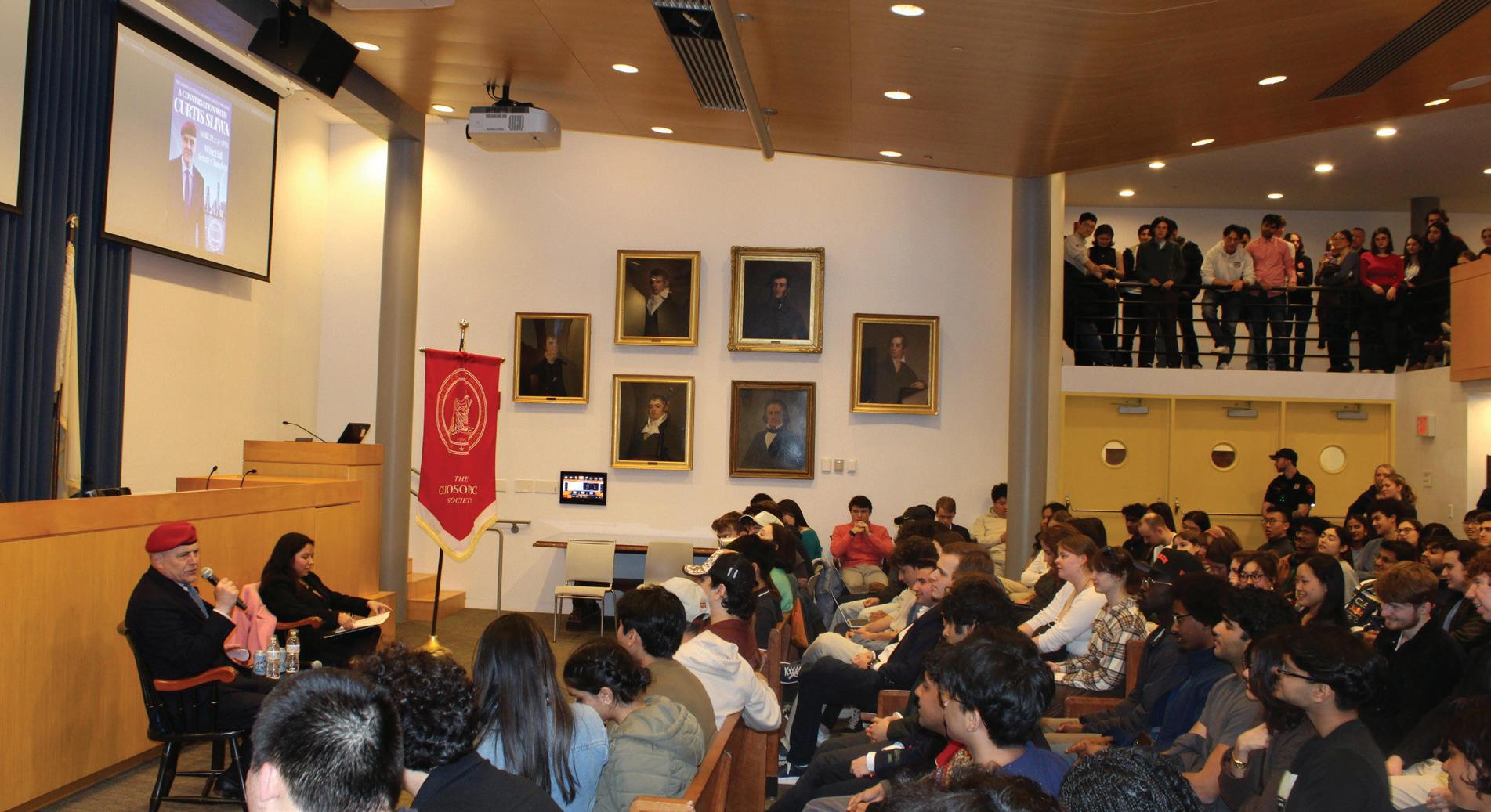
Curtis Sliwa, former New York mayoral candidate, speaks at Whig-Clio event
By Andrew Arthur Staff News Writer
Two-time Republican candidate for New York City mayor Curtis Sliwa joined the American Whig-Cliosophic Society on Friday afternoon for a discussion in the Senate Chamber of Whig Hall. The event had about 200 attendees, according to Whig-Clio President Alejandra Ramos ’27, who served as moderator.
The wide-ranging conversation touched on Sliwa’s upbringing in Brooklyn, his decades of civic activism, the 2025 New York City mayoral race, his views on gun control and climate change, and the concentration of power in Silicon Valley. Sliwa is known for founding the Guardian Angels, a nonprofit organization with a goal of unarmed crime prevention.
Much of the event centered on Sliwa’s recent endeavors in electoral politics. He spoke candidly about his loss to Democrat Zohran Mamdani in the 2025 New York City mayoral race, attributing his opponent’s victory to his disciplined messaging on affordability.
“A good campaign has three issues, a better campaign has two issues, and the best campaign has one issue,” Sliwa said. “And [Mamdani] rode that to victory.”
Sliwa was sharply critical of former New York Governor Andrew Cuomo, whom he accused of believing he was entitled to the Democratic “coronation,” and of former New York City Mayor Eric Adams, who he called corrupt.
While in office, Adams was charged by federal prosecutors with five counts of bribery, wire fraud and conspiracy to solicit a contribution from a foreign national. The charges were dropped in April 2025 at the request of the Department of Justice.
“When [Adams] dies of greed, which he will … when it comes time to close the casket and bring him to the burial ground, you won’t be able to close the
BEYOND THE BUBBLE
casket, he’s so crooked, you’ll have to get a Black & Decker power drill to drill him into the ground,” Sliwa said of Adams.
On climate change, Sliwa broke from some members of his party, calling global warming real and urging the audience to confront climate denial directly.
“You’ll be dead and buried when a new generation has to deal with the ramifications,” Sliwa said of climate change deniers. “I’m going to hear from idiots who say that’s fake news. I’d rather deal with the scientists who dedicated their life to that.”
On the topic of the Iran War, Sliwa voiced criticism toward U.S. involvement in the country’s affairs and attacked U.S. spending on military deployments in the Middle East.
“What the hell are we doing in Iran?” he said. “What the hell are we spending billions of dollars on bombs for theft and destruction?”
Sliwa was openly dismissive of claims that Iran poses an imminent existential threat to ordinary Americans.
“It’s being told to us because of imminent threats on America. Really, the Iranians? Did you go to bed at night thinking, oh, that ayatollah, man, he’s gonna drop the big one? Please. Do you think we’re all stupid? Yes, they do. Yes, they do.”
Sliwa traced the roots of his approach to public life back to Canarsie, the Brooklyn neighborhood where he grew up. He spoke about how he founded the Guardian Angels in 1979, initially recruiting young, predominantly Black and Latino men from the Bronx to conduct unarmed anti-crime patrols at a moment when, as he described it, gang activity had rendered the city’s subways genuinely dangerous.
Sliwa was also candid about the personal cost of his public profile. In 1992, he was shot multiple times in what was widely reported as a mob-ordered hit tied to his criticism of the Gambino crime family on morning drive radio.
He situated the attack within a longer history of confrontations with organized crime that began in Canarsie.
“You have to stand up for the things you believe in,” he said. “I’m not suggesting that other people do this, but I grew up in that culture.”
During a Q&A period with the audience, students pressed Sliwa on gun control, climate policy, and the role of citizen-led safety organizations alongside formal law enforcement.
In response to a student who asked what advice he would give to those hoping to pursue public service, Sliwa acknowledged the frustrations they would likely encounter but did not discourage them from the career path.
“Politics is, without a doubt, the dirtiest business in the world,” he said. “But you can remain positive — you can be a contributor, not a taker.”
In an interview with The Daily Princetonian following the event, Ramos said that the idea of bringing Sliwa to campus first emerged in December
2025 when she and vice president of Whig-Clio Noah Barkan ’28 were mapping out their program for the upcoming semester. Ramos and Barkan sought someone who could draw students from across campus, instead of just those who frequented Whig-Clio events.
“Someone like Curtis Sliwa could bring a lot of people from different social groups on campus,” she said, citing his social media presence and the breadth of issues he covers.
The outreach process itself required some improvisation. Ramos messaged Rusat Ramgopal, a former Sliwa campaign staffer, on Instagram, and commented directly on one of his posts in hopes of increasing the chance that he would see her message.
“I sent him a message on Instagram with the pitch,” she said. “He sent me the organizer’s information maybe 22 minutes later.”
Students in the audience commented on Sliwa’s lighthearted, humorous nature throughout the event.
“[Sliwa] honestly treated the event a little bit like he treats being … a show host, I think,” Mira Schubert ’29 told the ‘Prince.’ “The entrance was surprising,” she added. Sliwa marched in to “Don’t Let Me Down” by the Chainsmokers. Similarly, Tabish Farrell ’29, who closely followed the 2025 New York City mayoral race, was surprised to see that Sliwa was “making fun of himself, and the room was eating it up.”
Sliwa closed by emphasizing a theme that he returned to several times throughout the evening: that the current political moment called for unification over polarization, and that the work of bringing people together was, ultimately, what public service demanded.
“There is no better feeling in the world,” Sliwa said, “to know that you’ve helped other people in need.”
Andrew Arthur is a staff News writer from London and typically covers Student Life and Administration.
Immigrant Trust Directive codified as Sherrill signs trio of immigration bills into law
By Sena Chang Associate News Editor
New Jersey Governor Mikie Sherrill signed three immigration enforcement-related bills into law on Tuesday, including a bill codifying the Immigrant Trust Directive (ITD). The policy was first issued by the state attorney general in 2018, limiting cooperation between local law enforcement and agencies such as U.S. Immigration and Customs Enforcement (ICE).
The other two bills restrict law enforcement from sharing a person’s immigration status without a warrant and prohibit law enforcement from wearing masks when interacting with the public.
“Donald Trump’s untrained, unaccountable, masked ICE agents are putting people in danger,” Sherrill said in a press release.
Since 2018, legislative and advocacydriven efforts to codify the ITD have been fraught. In January, during his last hours in office, then-Governor Phil Murphy controversially declined to sign a measure that would codify the ITD, arguing that the law could trigger challenges in court that could further endanger immigrants. While on the campaign trail last year, Sherrill declined to respond when asked if she would keep the ITD, though she has expressed harsh criticism of the Trump administration’s immigration policies throughout her time in office.
Several key differences exist between the version of the bill that Sherrill signed into law and the one on Murphy’s desk earlier this year. The new bill permits jails to cooperate with federal immigration officials if a person is subject to a final order of removal, which is a new addition. Some people with protections like Deferred Action for Childhood Arrivals or Temporary Protected Status have final orders of removal, but are not considered being subject to imminent deportation.
Additionally, local officials can provide a notice to federal enforcement when someone has been charged with a “violent or serious offense,” without necessarily being convicted. The January bill also barred police from giving federal immigration authorities access to non-public resources — including equipment, offices, facilities, databases, and funds. The revision signed by Sherrill narrows this list by removing “facilities” from the restriction.
Immigration advocacy groups in Princeton and across the Garden State lauded the trio of bills signed into law, noting increased accountability for ICE agents and added protections for immigrants.
Students for Prison Education, Abolition, and Reform “is always happy to see when the immigration system and the carceral system can be disentangled in any way and [when] we can prevent the more car-
ceral and punitive forms of immigration enforcement,” Kristin Nagy ’27, the co-president of SPEAR, told The Daily Princetonian.
“These methods of accountability for ICE officers and the state’s work to prevent their abuses of power are definitely something positive and will hopefully have positive impacts for local immigrants in Princeton,” she continued.
Alan Paluck, clinic coordinator at Solidaridad Central Jersey, a volunteer-led organization aimed at assisting immigrants seeking asylum and legal status, highlighted that the codification of the ITD was “a long time coming.”
“[The bills] have been bounced around for years in terms of codifying [them] into law, and Mikie Sherrill has been able to do that finally,” Paluck told the ‘Prince.’ “I think those were three [laws] that we certainly wholeheartedly support.”
“We are … glad that we got some protections, including putting parts of the ITD into law instead of it depending on who the governor is,” Asma Elhuni, an organizer for local immigrant rights group Resistencia en Acción NJ, wrote in a statement to the ‘Prince.’
“For our communities, that means they will feel a bit safer interacting with agencies that now have clearer guidelines that ensure no unnecessary collecting of private information, which matters in everyday in-
teractions,” Elhuni continued.
Still, some immigration advocates expressed wariness toward ICE’s compliance with the new laws and noted that additional protections were necessary to protect vulnerable populations.
“We know that ICE is a lawless organization — they may not listen to what state government has to say,” Nagy said. “We do know that a lot of these bills are concerned with preventing collaboration between New Jersey police and ICE, but the New Jersey police are also not a benevolent organization.”
At Princeton, law enforcement officials have consistently drawn a clear line between actions led by federal officials and local officials. “The Princeton Police Department does not participate in the enforcement of federal civil immigration matters,” Matthew Solovay, the Chief of the Princeton Police Department, wrote in a statement to the ‘Prince’ in October 2025. In the statement, Solovay also emphasized that officers do not partake in ICE operations.
“The town council has basically stood firm in saying that we choose to honor a system of not working with [ICE] unless there’s a warrant,” Paluck said.
Elhuni criticized how the state still allows law enforcement to share information with ICE when people have charges against them, noting that the status quo “undermin[es]
due process and bas[es] guilt on accusations alone.”
“We’re also disappointed that the privacy bill was watered down, still allowing agencies to share personal information without notifying people, though we are glad to see some limitations on what information is allowed to be gathered,” she added.
The new version of the data protection bill removes a requirement for healthcare facilities to notify people if their information is shared. However, a new 90-day timeline of notification is added for when government entities are compelled to share information. The previous version of the bill did not specify when the affected person had to be notified by.
“We believe that while this is a positive development in the right direction, it doesn’t mean that we can act as if ICE is no longer a threat or a problem, because [ICE] continues to be a threat to our local community,” Nagy said.
“Progress is good, but isn’t enough if the most vulnerable are still left exposed,” Elhuni wrote. “We have more work to do.”
Sena Chang is the associate News editor for the ‘Prince’ leading investigations. She is from Japan and South Korea, and she often covers local politics and student life. She can be reached at sena[at]dailyprincetonian.com.
COURTESY OF MARTIN OROS / AMERICAN WHIG-CLIOSOPHIC SOCIETY VIA ALEJANDRA RAMOS Curtis Sliwa speaks to a student crowd at Whig-Clio on Friday, March 27, 2026.
‘Being together is a form of resistance’:
Speakers urge civic
action at ‘No
By Toby Chang Staff News Writer
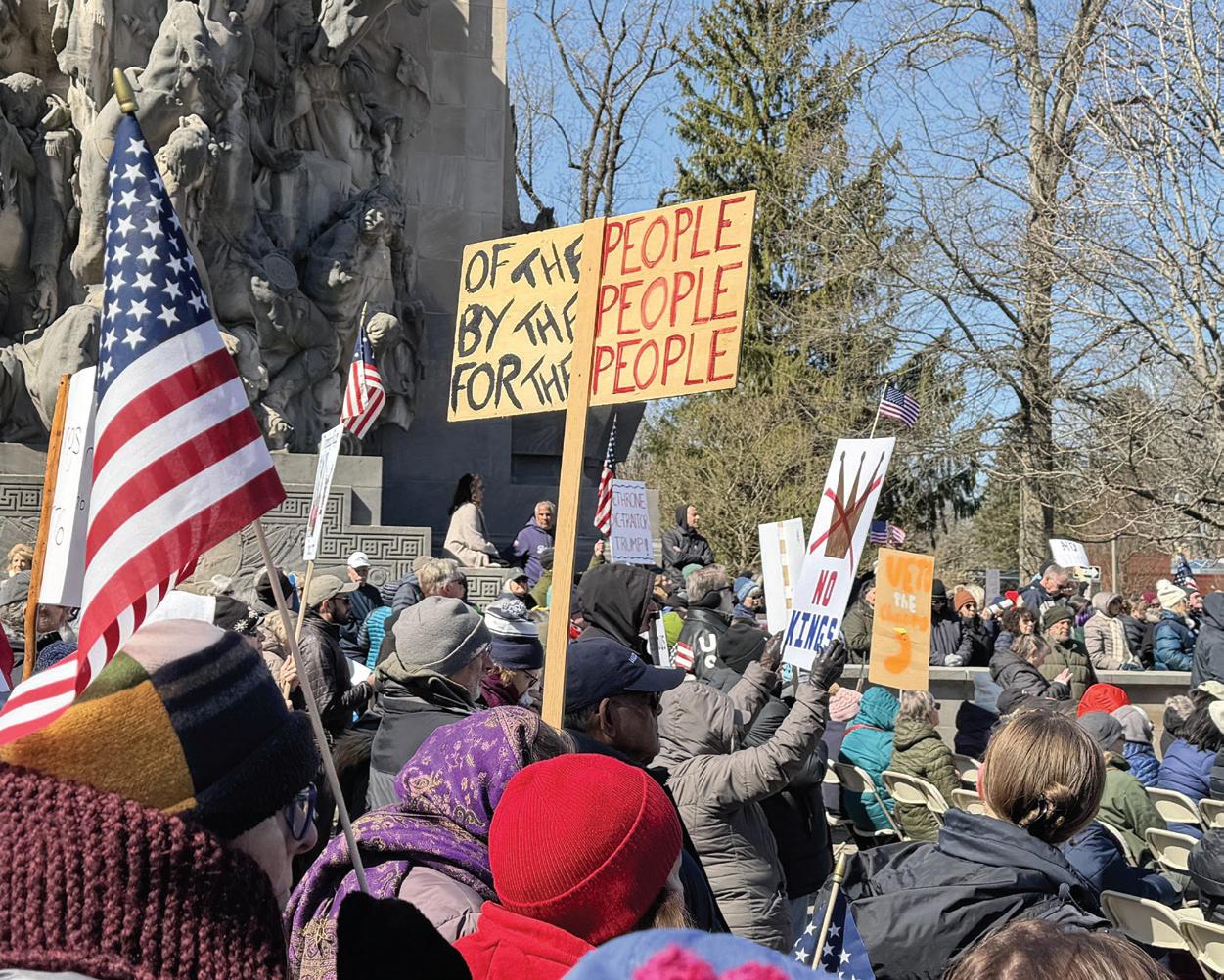
New Jersey Governor Mikie Sherrill, along with several other prominent community leaders and advocates, addressed a crowd of Princeton residents on Saturday morning as part of the third nationwide “No Kings” Day of Action protesting “unprecedented” actions of the Trump administration. Speakers emphasized the importance of sustained civic engagement and the responsibility to stand up against President Trump’s actions.
Event organizers estimated 2,500 to 3,000 protesters gathered in front of the Princeton Battle Monument to rally against President Donald Trump’s actions. The demonstration was co-organized by Indivisible Princeton and the American Civil Liberties Union of New Jersey (ACLU-NJ) as one of thousands of protests nationwide.
The protest in Princeton follows an October 2025 “No Kings” protest, which drew a crowd of 5,000 to the Princeton Battle Monument.
Sherrill, who opened the event, underscored the values underlying the protest while criticizing actions taken by the Trump administration against the state of New Jersey.
“We believe in the Constitution; we believe in the rule of law; we believe in the people,” Sherrill said, addressing the crowd.
Sherrill criticized Trump’s demands for New Jersey to turn over private voter data, the halting of funds for the Hudson Tunnel Project, and the federal funding lapse affecting the Transportation Security Administration.
“I’m getting sick of having to fight tooth and nail against the President of the United States for working people across our country,” said Sherrill.
Following Sherrill’s remarks, Jenni-
BEYOND THE BUBBLE
Kings’ protest
fer Howard, president of the League of Women Voters of New Jersey, spoke to the crowd on the symbolism of gathering at the Princeton Battle Monument.
“This statue reminds all of us of the Battle of Princeton, which was part of the battle to lead this land away from tyranny,” said Howard.
ACLU-NJ Director of Appellate Advocacy Ezra Rosenberg spoke to the audience about the “unprecedented” nature of the current political situation.
“This country has never had this confluence of situations where you have a president who does not believe in democracy, a Congress that is satisfied standing still … and all of this against the backdrop of a Supreme Court opinion that gave this president a get-out-ofjail pass,” said Rosenberg.
State senator Andrew Zwicker, who represents New Jersey’s 16th district, spoke at the rally about the importance of sustained civic engagement.
“Why bother?” Zwicker asked the crowd. “We bother because democracy is not an inheritance you receive — it’s something that you earn. It’s a practice you maintain, day by day, rally by rally, vote by vote, and conversation by conversation.”
Among the thousands of attendees, nine members of the Princeton College Democrats were present at the protest in their personal capacities. In interviews with The Daily Princetonian following the rally, several members of College Democrats spoke about what they view as their obligation to protest the Trump administration.
“Silence makes us complicit,” Lincoln Peacock ’29, the deputy events chair for Princeton College Democrats, told the ‘Prince.’ “We need to make our voices heard, because if we don’t… they’ll keep pushing and pushing until we’re unable to.”
Shayne Cytrynbaum ’29, a mem-
ber of Princeton College Democrats, echoed this sentiment and emphasized that Princeton students in particular have a responsibility to act. “You’re here in the service of humanity and in the nation’s service,” Cytrynbaum told the ‘Prince.’ “This is how you show that.”
“Students need to be included in the coalitions that fight back, and need to mobilize themselves to pour out onto the streets,” he added.
For Paul Wang ’27, the communications chair of the Princeton College Democrats, Trump’s cuts to research funding were a significant reason for attending the protest. “I’m a chemistry major myself, and I really do care about how attacks on chemical research … have impacted us at the University and also the country.”
Students also discussed the protest in relation to broader trends of campus activism at Princeton, alleging that for many Princeton students, work often takes precedence over political engagement.
“The students here aren’t apolitical,” Princeton College Democrats Events Chair Wynne Conger ’27 told the ‘Prince.’ “They have very strong political beliefs, but those beliefs don’t often translate into participation in protests.”
Conger acknowledged the heavy time constraints that Princeton students are often under, echoing that studying, research, and clubs often take priority over political participation. Nonetheless, she encouraged students to show up, if only once or twice.
“There’s something very heartwarming about looking around the crowd and seeing that all of your friends have mobilized towards this effort,” said Conger.
Conger is a former associate Opinion editor and columnist for the ‘Prince.’
Michelle Miao ’26, the former president of Princeton College Democrats,
acknowledged that protest is also a personal choice, noting an “understandable” fear of repercussions. Miao pointed to cases at Columbia University of student protesters being “treated unfairly by the administration, or being unfairly detained.”
Miao emphasized that political engagement can take forms beyond protesting, highlighting students who were unable to attend but contributed by making the signs that the students carried at the demonstration.
Miao is a former contributing News writer for the ‘Prince.’
In addition to criticizing attacks on academic freedom, speakers at the ‘No Kings’ rally voiced frustration about issues including DEI rollbacks in institutions of higher education, the pardoning of Jan. 6 insurrectionists, efforts to repeal birthright citizenship, the risk
of war with Iran, and Trump’s broader rhetoric.
“We have to channel that anger into unrelenting pressure on this administration,” Zwicker told the crowd. “We can do it in the streets, as we’re doing today. We can do this in state legislatures. We can do it in the courts of law, but most of all, we have to do it in the court of public opinion.”
“This is what a rally is for,” Zwicker continued. “In a moment when isolation is [the administration’s] strategy, when they want you to feel small, they want you to feel overwhelmed, they want you to feel powerless, being together is a form of resistance.”
Toby Chang is a staff News writer from Prescott, Ariz. He can be reached at toby. chang[at]princeton.edu.
Former executive director of James Madison Program nominated to be Archivist of the United States
By Clara Docherty Assistant News Editor
Bradford P. Wilson, former Executive Director of the James Madison Program, was nominated by President Donald Trump to be Archivist of the United States earlier this month.
Archivist of the United States is the chief administrator of the National Archives and Records Administration of the United States. The position oversees the maintenance of foundational documents such as the Constitution and the Declaration of Independence, manages presidential records, and establishes policies that determine which documents are preserved or made accessible to the public. The confirmation process for the role can take several months, including obtaining approval from the senate.
“This is not Dr. Wilson’s first rodeo in Washington. In the 1980s, he spent three years as a research associate on the staff of two Chief Justices of the United States,” Matthew Franck wrote to The Daily Princetonian. Wilson and Franck worked together at the Witherspoon Institute, an offcampus conservative think tank in Princeton, for eight years. Franck was also the associate director of the James Madison Program from 2018–21.
Wilson declined a request to comment from the ‘Prince.’ Franck also emphasized Wilson’s
qualifications outside of academia, including working alongside Chief Justices Warren Burger and William Rehnquist. He also worked on the Bicentennial of the U.S. Constitution and received grants from the National Endowment for the Humanities and the Department of Education. Wilson was also appointed by President Joe Biden to be a trustee of the James Madison Memorial Fellowship Foundation, which administers graduate-level fellowships to high school teachers.
While at Princeton, Wilson worked on creating the James Madison Program with Professor of Politics Robert P. George. The program’s mission is to “promote teaching and scholarship in constitutional law and political thought.” Wilson’s role involved many of the day-to-day operations of the program, including finance and budget, hiring and supervision of staff, communication with the parent politics department, and more.
Adam Thomas, the current director of the James Madison Program, described Wilson’s role as “the number two in the organization beneath Professor George.” Wilson served as Executive Director for approximately 20 years before retiring in August 2024.
“He was, in a word, the man who got things done,” Franck wrote. Franck noted that he “had no idea that Wilson was being considered for the position,” but was “pleasantly surprised.”
The James Madison Program’s events have at times emphasized themes commonly associated with conservative thought, as reflected by event titles such as “The Case for Social Conservatism” and “Women in the Conservative Movement,” as well as lectures on topics like natural law and family policy.
Wilson’s work focuses on constitutional law and American political thought. One of the projects he worked on at Princeton was editing anthologies of George Washington’s and Alexander Hamilton’s political writings for the Cambridge University Press.
Thomas characterized Wilson’s nomination as “a culmination of his many years of work in civic education and a kind of life of scholarship devoted to studying American constitutional law.”
Along with Professor George, Wilson “more or less helped to build all the major programs and initiatives that we currently do,” Thomas said, including visiting and postdoctoral fellowships, undergraduate programming, and public events.
Wilson also worked on summer programs for high school teachers of American history, high school students, and for undergraduates.
Thomas described fulfilling Wilson’s former role as having “big shoes to fill” due to Wilson’s influence on the program.
“I have never known anyone with better judgment of people — a quality that is invariably reciprocated by the trust of those who work with him,” Franck wrote.
Clara Docherty is the assistant News editor for the ‘Prince’ leading faculty, graduate students, and alumni coverage. She is from Lafayette, N.J., and can be reached at clara.docherty[at]princeton. edu.
TOBY CHANG / THE DAILY PRINCETONIAN Protesters hold signs at the “No Kings” rally at the Princeton Battle Monument, Saturday, March 28, 2026.
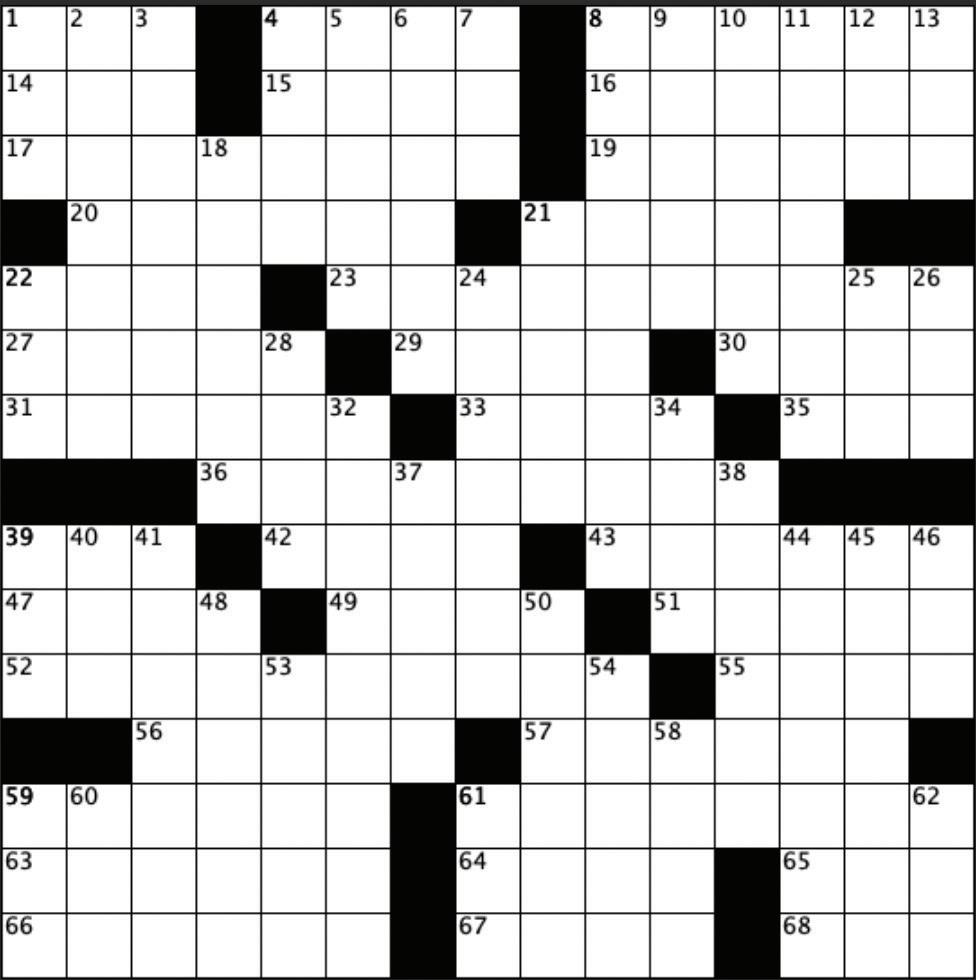
“M usically i nclined”
By Elisabeth Forrester Staff Constructor
1 Snoop
4 No clue, over text
7 “Lord of the Rings” monster
10 Shade close to teal
11 Smoothie bowl superfood
12 Tater
13 Quiet spell
14 You might pitch one at a campsite
15 Jokes that warrant an eyeroll
16 Parties that won't wake the neighbors
19 “___ to Joy”
20 Granola bar ingredient
21 Director Jon M. ___
22 Place where you might open a 55-Down
25 Execute a successful cross body lead, perhaps
29 The 'Impractical Joker' behind Tanka Jahari
30 The second half of a cowboy's holler
31 Get back
32 “___ Rings” (eighth track on Taylor Swift's “Lover”)
34 The chip connecting a cell phone to its network, for short
36 Clairo’s second studio album
37 Jeans cut
39 “___ the music!”
41 College major for literature enthusiasts: Abbr.
42 The site of George Washington’s only military surrender
45 ACDC’s second studio album
46 Yoko ___
47 “___ be no trouble at all...”
48 Nail polish brand
51 Hit single from One Direction... or a hint to the ends of 16-, 25-, and 42-Across?
54 Ziggy ___dust (David Bowie's stage persona)
56 “___, oh my!”
57 Luxury car brand that means “listen” in Latin
58 Bugle call played at military funerals
59 Scorch
60 “Fiddlesticks!”
61 The channel made possible by contributions from viewers like you
62 The number of pins knocked down in a strike
63 Atlanta airport code
DOWN
1 Type of cephalopod
2 Separated into components
3 Safety school
4 Arnold Palmers and Arizonas, e.g.
5 “___ California” (song by Red Hot Chili Peppers)
6 Tacky trinkets, products, or media
7 Magnum ___
8 “___away Baby” (fourth track on Bruno Mars’s debut album)
9 Successors to casettes
10 As well 11 Hitch 12 Life
18 Mononymous singer of “Believe” and “If I Could Turn Back Time”
Parfait starting point
When doubled, a Jessie J. hit featuring Ariana Grande
“Don’t Think ___, It's All Right” (track on “The Freewheelin’ Bob Dylan”)
28 Shoelace tip
29 Where you might find 48-Across products
32 The final exhale of a deflating inner tube or air mattress
33 “Luncheon of the Boating Party” and “Dance at Le Moulin de la Galette,” e.g.
35 Musical that made its Broadway debut in 1957, with “The”
38 Moo ___ (the name given to a pygmy hippopotamus that went viral in September 2024)
40 Biblical queen
43 “Fellow presenter”
44 Investigative journalist and activist Wells
49 It might change the tone on a guitar
50 “___ Over Now?” (bonus track on “1989 (Taylor's Version)”)
51 Snoozes
52 “Shall I compare ___ to a summer's day?”
53 Nothing, in Spanish
54 Longtime NASCAR sponsor
55 Running order total
By Lehua Harris Contributing Constructor
lease of their early decision or early action results to fall together on the same day, meaning there is no reason for Princeton to add to the already overwhelming stress facing applicants by releasing its regular decision results on Ivy Day alongside its peers.
When a student is receiving up to eight high-stakes decisions in the same day, they may not be able to separate and process each decision as they might had they come out as isolated decisions at distinct times. A potential inundation of bad news could cause them to internalize feelings of inadequacy and hopelessness. The compounded effect of collective decision release is exemplified by the thousands of applicants who post about their stress and disappointment surrounding Ivy Day on r/ ApplyingToCollege, a subreddit dedicated to college admissions. One person described how they couldn’t
Charlie Yale Head Opinion Editor
Abolish Ivy Day
fall asleep at 3 a.m. because they kept “thinking about my decision later today.” In response, the top comment agrees, “I feel sick. Like I’m going to vomit. Years of hard work and a few words will tell me if it was enough or not.”
There are also students who have experienced this burden of anxiety, pressure, and diminished selfworth more severely. Last year on Ivy Day, Lucas Lee, a senior at Phillips Academy in Andover, died by suicide after he did not receive any acceptances. While we can’t know precisely why Lee made such a devastating choice, his suicide demonstrates that the simultaneous release of all Ivy League decisions contributes to the extreme pressure that many highly achieving high school students feel.
Competing schools such as the Massachusetts Institute of Technology and the University of Chicago, which also have a similar number of applicants, release decisions nearly two weeks earlier than the Ivy League without coordinat-
ing with other schools and are comparably well-regarded. Thus, there should be no reason why Ivy Leagues need so much time to finalize decisions. Waiting until the end of the admissions cycle to release on the same day feels like a shallow endeavor to generate suspense and thus manufacture increased stakes for Ivy League admissions decisions.
The benefits of moving up Princeton’s decisions aren’t limited to mental health. An earlier decision date would give students more time to consider their acceptances and explore financial options, resulting in a more thoughtful and well-informed decision. Moreover, it could relieve stress early, allowing students to focus on their futures in college and not whether they’ll get into a specific one. The goal of college decisions should not be to play mind games with vulnerable students but rather to provide applicants with clear plans for their futures that are relevant to the fields they’d
like to pursue.
The University should dedicate itself to releasing decisions on the earliest day possible because it should be working to optimize the process for students, not for itself. Instead of clinging to an outdated paradigm of Ivy League eliteness, it’s
time for Princeton to be fair to its applicants.
Audrey Tan is a prospective Economics major from Pullman, Wash. She is an Opinion columnist for the ‘Prince.’ You can reach her at at4887[at] princeton.edu.
The problem with the ADL’s ‘report card’
schools have certain rules or positions surrounding issues related to antisemitism, and includes parameters set by the ADL.
Earlier this month, the AntiDefamation League gave Princeton a C on its annual campus antisemitism report card. It would make sense that the University, like many of its students, wouldn’t be used to receiving grades lower than an A. But this C is one we shouldn’t worry about.
The ADL’s assessments of colleges and universities don’t actually measure antisemitism in any meaningful way, nor do they measure the quality of Jewish student life.
For the past three years, the ADL has released a set of grades for dozens of schools across the U.S., scoring them on criteria ranging from the vibrancy of the campus’s Jewish life to whether they have Kosher dining options or pro-Israel advocacy groups. From there, the rankings are used by politicians like Rep. Elise Stefanik, R-N.Y., to deride schools for their supposedly high levels of antisemitism.
The ADL groups its grading parameters under three broad umbrellas: publicly disclosed administrative action, campus Jewish life, and so-called campus climate concerns, or the pervasiveness of antisemitic incidents on a campus. This third category encapsulates any action ranging from physical assault or threats towards Jewish students to “workshops and trainings organized by students,” or advocacy for divestment from Israeli companies.
The first umbrella, administrative action, measures whether
But the ADL is not — nor should it be — the sole arbiter of what qualifies as antisemitism.
In fact, the ADL’s definition of antisemitism creates problems for Jews in a broader sense: While the organization explains that criticism of Israel’s government is not antisemitic, they also state that language that demonizes or delegitimizes the state does count as antisemitism.
That is duplicitous. Indeed, as Rob Eshman argued in The Forward, an American Jewish publication, there exists a contradiction for a group that claims to both battle antisemitism while also advocating the interests of Israel. Not all Jews are Zionist, and for those of us who aren’t, classifying criticism of Zionism as antisemitism circumscribes the scope of a vigorous debate within the Jewish diaspora.
The organization’s report card considers whether schools have study abroad options in Israel or partnerships with Israeli institutions, and the prevalence of “antiZionist student government activity.” But for many Jews, who do not feel connected to Israel or actively oppose settlements in the West Bank or a ruthless military campaign in Gaza that many consider genocide, grounding a campaign ostensibly against antisemitism in wholehearted support of Israel doesn’t accurately reflect their experience.
The second ADL parameter is the quality of Jewish life. This is an arbitrary metric. Some schools that don’t have a Jewish studies
program or Kosher dining options, like Carleton College, were given the same grade on quality of Jewish life as Princeton, which has both. Princeton, though, received an overall letter grade lower than Carleton, primarily because of its “campus climate.”
This ever-nebulous “campus climate,” the third parameter on the ADL’s report card, is both oversimplified and overbroad in its categorization of “antiZionist,” and by its logic, “antisemitic” incidents. Whenever an organization tries to distill the attitude of a campus into a singular letter grade, it is obvious that there is egregious generalization involved.
No matter how many polls or surveys are distributed, the nuances of specific campus communities cannot be generalized out to the broader higher education community. Moreover, the ADL conflates actions like physical violence against Jewish people with protests or other student events surrounding Israel and Palestine that do not subscribe to the ADL’s view of Zionism. While such oversimplification may be helpful in pushing a political message solely in support of the state of Israel, it does not help fight antisemitism, an issue that is complex and multifaceted.
All of this might be overlooked, though, if Jewish students felt actively unsafe on Princeton’s campus. Except they don’t.
This paper’s own reporting included quotes from a number of Jewish leaders on this campus explaining that they felt the grade didn’t reflect how they felt about antisemitism on Princeton’s campus. In 2024, J Street
U, a center-left Jewish advocacy group which has a chapter on Princeton’s campus, criticized the ADL’s report card as “counterproductive” because of the ways that it oversimplifies issues related to antisemitism.
As I’ve previously noted, Jewish students at Princeton have some of the highest levels of satisfaction with our Princeton experience. This is, of course, not to say that antisemitism does not pose a problem on our campus and beyond. But it is disingenuous for the ADL to claim that antisemitism is pervasive on Princeton’s campus, because evidence continues to show that it is not true.
Through conflating antisemitism and anti-Zionism, the ADL is not making an innocuous error. Such a conflation has serious consequences for the ability to rationally evaluate and discuss Israel’s actions in Gaza and elsewhere. When calls for divestment or student protests are treated as hostile antisemitic activity, the ADL does a serious disservice to the fight against antisemitism.
Head Opinion Editor Charlie Yale is a sophomore from Omaha, Neb. You can reach him at yale[at]dailyprincetonian.com. Yale is a board member of the Alliance of Jewish Progressives.
LOUISA GHEORGHITA / THE DAILY PRINCETONIAN The Admission Information Center.
editor-in-chief Jerry Zhu ’27
150TH MANAGING BOARD
Frances Brogan ’27
’27
creative director Juan Fajardo ’28
Corbin Mortimer ’27 Maya Mukherjee ’27
Sections listed in alphabetical order.
associate newsletter editor Annika Plunkett ’28
head opinion editors Lily Halbert-Alexander ’28 Charlie Yale ’28
associate opinion editors Isaac Barsoum ’28 Shane McCauley ’28
head sports editors Lily Pampolina ’27 Doug Schwartz ’28
associate sports editors Lucas Nor ’28 Matthew Yi ’27
head web design and development editors Cole Ramer ’28 John Wu ’28
strategic initiative directors
Graphics Caroline Naughton ’29
assistant
Chloe Zhu ’27
’27
Ella Miner ’28 Devin Panalal ’28
Shravan Venkat ’28
150TH
’28
Education Charlie Yale ’28
’29
Cai ’29
’29
Liu ’29
Mironov ’29
’26
’26
software engineers
Nicole Deng ’28
Ziya Momin ’28
Kyaw Naing ’28
Stephanie Sugandi ’27
Juan Fajardo ’28
Jamie Creasi ’28
Marley Hartnett-Cody ’28
BOARD OF TRUSTEES
president Thomas E. Weber ’89
vice president David Baumgarten ’06
secretary Chanakya A. Sethi ’07
treasurer Douglas Widmann ’90
assistant treasurer Kavita Saini ’09
trustees Francesca Barber
Kathleen Crown
Suzanne Dance ’96
Gabriel Debenedetti ’12
Stephen Fuzesi ’00
Zachary A. Goldfarb ’05
Michael Grabell ’03
Danielle Ivory ’05 Rick Klein ’98
James T. MacGregor ’66
Rohit Narayanan ’24
Marie-Rose Sheinerman ’23
Julianne Escobedo Shepherd
Abigail Williams ’14
Tyler Woulfe ’07
trustees ex officio Jerry Zhu ’27
Alistair Wright ’27
Continue funding access and opportunity
Vitalia Spatola Staff Opinion Writer
Amidst budget cuts, Princeton recently laid off the entire nineperson staff of the Keller Center for Innovation in Engineering Education. But in the past few months, quieter changes have affected programs that support underrepresented and non-traditional students. This year, the Transfer Scholars Initiative (TSI), a summer program for community-college transfer students hosted by the Emma Bloomberg Center for Access & Opportunity (EBCAO), is shifting to a commuter-only model.
For years, students participating in TSI lived on campus, allowing them to share meals, go on late-night Wawa runs, and play sports after class. These interactions complemented EBCAO’s formal programming and fostered a sense of community. Making TSI commuter-based will make maintaining that sense of community more difficult. But this decision has already been made. Going forward, programs for first-generation, low-income students must be treated as essential: Princeton must stop cutting funding to EBCAO.
EBCAO provides a variety of programs for students, including mentorship pairings, academic workshops, and communitybuilding events designed to help them adjust to Princeton. Beyond TSI, its initiatives also include the Scholars Institute Fellows Program (SIFP) and the Freshman Scholars Institute (FSI).
FSI and TSI run side-by-side, giving Princeton students and transfer students a chance to learn from each other and build community. A critical part of my own FSI residential experience was interacting with TSI students
on campus after hours. These informal connections, like eating together, playing volleyball, and attending events late into the evening created a sense of community that was integral to my first experience here at Princeton. With TSI now commuter-based, this interaction will be harder, and future students will lose a foundational aspect of peer mentorship — and friendship — that complemented EBCAO’s formal programming.
Reflecting on the shift from a residential to commuter model, TSI alumnus Victor Gil ’26 told me, “The opportunity to engage with Princeton’s own Freshman Scholars [Institute] becomes limited …which I found vital to navigating my own transfer journey.”
“Coming from community college, having the option to be residential was a transformative experience that made CC students feel ‘normal,’” wrote Gil.
Furthermore, according to Gil, the change to a commuter system “makes the program inaccessible to people coming from distant NJ community colleges.” Now, only some students, by virtue of their location, will be able to access Princeton’s immense resources — resources which previously benefited more prospective transfer students.
As programs like TSI lose their residential component, the community EBCAO creates becomes more fragile. For transfer and non-traditional students, living among peers with shared experiences is foundational. A commuter model risks isolating students who already face barriers.
Budget cuts will force difficult decisions, but this shouldn’t be one of them. Reducing funding for EBCAO, especially alongside layoffs and program restructuring elsewhere, would disproportionately affect students — both
Princeton and transfer — who already face systemic barriers. It would limit student success and undermine the diversity Princeton has worked to build.
Cutting EBCAO programs directly impacts students’ ability to succeed. But the funding cuts to TSI are also symbolic of Princeton’s broader commitment — or lack thereof — to access and opportunity.
Programs like EBCAO affirm that access to Princeton is not just about getting in, but about the support to do well once students arrive. While this change isn’t a termination of the program, it shows that when budgets shrink, the University begins to treat programs supporting FGLI, veteran, and transfer students as secondary. In recent years, Princeton has expanded access to students from diverse socioeconomic backgrounds. But access without sustained support is insufficient.
As Princeton prepares for permanent budget cuts of 5 to 10 percent over the next three years, treating EBCAO as expendable would be a mistake. Ultimately, budget decisions are statements of values. When resources are limited, institutions reveal what they are truly committed to protecting. If Princeton is serious about access and opportunity, protecting EBCAO amidst budget cuts cannot be treated as optional. While no program can be truly “safe,” converting TSI into a commuter program reflects a belief that programs that support underrepresented students are supplementary rather than central to Princeton’s mission.
Vitalia Spatola ’28 is a staff Opinion writer from South River, N.J. She is also an FGLI student.
VITALIA
Humanistic study at Princeton is doing just fine
Josh Stiefel Assistant Opinion Editor
Princeton faces many domestic threats. In 2024, a Forbes College dryer burst into flames, setting off fire alarms and forcing students to evacuate the residential college. Last year, residents of Yeh College and New College West were plagued by droves of mice in dorm rooms when they returned from winter break. Still, despite the formidable challenges these campus snafus represent, the threat these mishaps pose to the University pales in comparison to recent polemics against Princeton’s humanities education.
In an October podcast episode with The Free Press, Shilo Brooks, a former Princeton lecturer and executive director of the James Madison Program, painted a grim picture of the state of humanities education at Princeton. In the episode, Brooks critiques the “scientization of the humanities,” a process by which Brooks argues that Princeton courses cause students to learn to read quickly and mechanically: to “use a book … as mere data.”
Princeton’s pedagogical “scientization,” argues Brooks, “castrates, neuters, sterilizes the power of [literature] to affect the soul and makes it into something that’s useful for producing scholarly papers in obscure journals.”
The inhuman humanities at Princeton have, for Brooks, moved into the realm of “those July Fourth hotdog eating contests, when the guys are cramming hot dogs into their mouths.”
But Brooks’ issues with the humanities at Princeton are completely unfounded — a simple rebuttal lies in students’ level of passionate and sincere engagement with the humanities. This reality is just the opposite of Brooks’
Ian Rosenzweig Assistant Opinion Editor
Last week, around 200 students packed into Whig Hall to see Curtis Sliwa speak. Fluctuating between a comedy show, an influencer’s soundbiteladen Instagram feed, and a patchwork quilt of disparate policy positions, the event garnered by far the highest attendance of any of the American WhigCliosophic Society’s events this school year. This turnout should not be surprising. Sliwa’s celebrity reached new heights last fall as his viral debate moments and irreverent storytelling flooded social media, where many college-aged Americans receive their news. But while Sliwa’s internet persona is largely based in memes, some students seemed to gain serious respect on Friday for the former mayoral candidate’s political posture and identity. Such a development is, simultaneously, a valuable sentiment and a potentially dangerous folly that could devolve into cynical populism and a misguided idea of what it means to build bipartisan unity.
I must admit that, early in his talk, I found Sliwa quite inspiring. He railed against polarization and division, he spoke about the importance of truth, transparency, and accountability, and he was genuinely funny. But as Sliwa continued to answer questions, I be-
claim: the humanities at Princeton emphasize close engagement with texts. Not only is this level of inquiry in-depth, but it is also hugely popular at the University.
Every academic year since 1992, Princeton underclassmen across a wide range of disciplines have elected to study in the Western Humanities Sequence, a yearlong intensive great books program. This fall, the program was at full capacity, with 60 underclassmen opting in. The “Hum Sequence” is self-selecting, bringing students to pursue extra rigor in the humanities, solely motivated by love of learning itself.
Among national universities, Princeton’s percentage of humanities majors vastly outperforms the national average, with 12.2 percent of undergraduates concentrating in the traditional humanities in the Class of 2024, compared to a national university average of four percent in 2020.
At Princeton, Brooks’ own former employer, the James Madison Program (JMP) in American Ideals and Institutions, works to promote a humanistic education in civics and philosophy. The program’s reach is broad, with 313 undergraduates participating in JMP’s Fellows’ Forum in the past academic year. The Forum offers undergraduates opportunities outside of the classroom to gain “a better understanding of constitutional politics and the moral and philosophic dimensions of political life.”
Still, while Brooks’ claims sound like an educator’s innocuous gripes, there is a far more troubling reality underlying the accusation. Bari Weiss, Brooks’ interviewer, is an opponent of Ivy League institutions with substantial influence in the Trump administration’s educational policymaking. In 2023, Weiss said that universities that “have fancy slogans like Veritas and claims to truth in their
motto and in their mission statement … don’t actually believe in those missions anymore.” As David Klion wrote in the Guardian in 2025, “if you work at a liberal institution and you want the Trump-controlled federal government to step in and discipline it, Bari Weiss is there to help.”
By criticizing Princeton’s ability to educate its students on Weiss’ podcast, Brooks fans the flames of several dangerous critiques of higher education that are prevalent in the Trump administration. And, through The Free Press, an outlet dedicated to covering “stories that are ignored or misconstrued in the service of an ideological narrative,” Brooks and Weiss have an opportune platform for criticizing universities and a powerful audience able to act on it.
Delegitimizing the quality of education at Princeton — and implicitly, at peer institutions — fuels government attacks on higher education. This move by Weiss and Brooks follows a playbook written by American political leaders, including Vice President JD Vance, who in 2021 criticized American universities with a quote from Richard Nixon: “the professors are the enemy.”
Princeton’s successful encouragement of humanistic studies — including work from Brooks’ former employer — exposes these various critiques as disingenuous. Indeed, if Princeton administrators were to capitulate to critics of Princeton’s pedagogy, the University would be destined for a bleak educational reality.
Take, for example, recent events at The University of Austin (UATX), a school partly founded by Weiss in the name of creating an institution in which “students are not vessels to be filled with dogma, but minds to be sharpened with disciplined thinking.” UATX was also founded on the principle that, in the
words of its co-founder Niall Ferguson, “academic freedom dies in wokeness.”
Following the guidance of Weiss and her ilk, UATX’s insistence on creating an inquisitive school descended into the pursuit of uniformity.
Indeed, there is a sinister undercurrent to UATX’s dual emphasis on antiwokeism and educating students “who build character.” Harvard professor Steven Pinker put it best when he stepped down from the school’s advisory board in 2021: an intellectual community shouldn’t coalesce around reaction. “I don’t think universities should be committed to some doctrine, like left-wing political correctness,” Pinker said, “but that doesn’t mean that un-left-wing, unpolitical correctness, un-wokeness is a coherent basis of a university.”
Negative education, the teaching of
students that avoids a specific pedagogical method, is not a legitimate form of education in American universities. When universities lean into this perspective, they move students away from educational fears, rather than towards Brooks’ goal: cultivating positive virtues. The humanities at Princeton aren’t broken, but the political discourse around the University is. And, given the choice between the allegedly broken humanities at Princeton and the pedagogy of fear at Austin, I’ll take the Princeton I know, mice included.
Josh Stiefel ’29 is an assistant Opinion editor for the ‘Prince.’ He is from Teaneck, N.J. and can be reached at js9365[at]princeton. edu.
Unity yes, Sliwa no
gan to find his statements inconsistent and his political platform incoherent. He extolled the virtues of public service and the value of helping others — including, specifically, people in developing countries. But he also sharply criticized the Trump administration, not for cutting funding to the U.S. Agency for International Development but for departing from its promise of “America First” policies.
Sliwa simultaneously seemed like an isolationist and a philanthropic globalist. The only consistent message was that whatever those in power are doing, Curtis Sliwa does the opposite — and through opposing that government power, Sliwa suggests the American public can unite.
Evidently, Sliwa knows how to read a room: his inconsistent positions seemed to work in his favor. After the talk, I overheard two students discussing their seemingly newfound understanding that “not all Republicans are MAGA” and they’re “not all bad.”
This realization is exactly what Sliwa, who repeatedly called for unity and bemoaned polarization, would have wanted to hear. And if Sliwa has simply inspired some students to keep an open mind the next time they hear a conservative viewpoint expressed, then the event, and Sliwa’s messaging, have done important work toward building unity in divided times.
As important as the sentiment of unity is, we must be cautious of achieving the seemingly noble end of bipar-
tisan acceptance through the tactics and advocacy advanced by Sliwa. Two flaws accompany an embrace of unity through Sliwa’s messaging, characterized by the nature of Sliwa’s Republicanism and the dangers of populism.
Sliwa embraces a “Republican In Name Only” (RINO) identity. But unlike some of the traditional conservatives to whom Trump has afforded the RINO label, like Dick Cheney, Colin Powell, and Kevin Stitt, Sliwa is not representative of the more traditional anti-Trump wing of the Republican Party. His policies are largely inconsistent with even pre-Trump Republicanism; for example, he expressed support for universal health care, and he even declared that the recently deceased Cheney was “in hell.”
If it is only an embrace of policies like socialized medicine and a criticism of neoconservative foreign policy — alongside promotion of the “America First” policy that many Democrats criticize — that made attendees realize that Sliwa is “one of the good ones,” then any increased tolerance for “nonMAGA Republicans” expressed by the students I overheard was misplaced and ingenuine. Newfound respect for pre-Trump Republicanism is a positive; unfortunately, tolerating Sliwa, whose positions are far from traditional Republicanism, is not equivalent to tolerating Republicans.
In fact, rather than representing anti-MAGA Republicanism, Sliwa’s ideology matches many of the hall-
marks of populism. Populists are most successful when speaking to a public disillusioned by the inefficiencies and dishonesties of their established government and calling for accountability.
Princetonians must be wary of the danger of falling into this populist, anti-establishment trap in the name of unity, mistakenly believing they are righteous bipartisan warriors without truly understanding the more traditional anti-Trump Republican. There is a big difference between the call for unity expressed by Joe Manchin last fall and Curtis Sliwa last Friday.
While Manchin emphasized bipartisan consensus and legislative compromise — unity between lawmakers and citizens alike — Sliwa called for unity of the people against the government. He repeatedly emphasized that his background is in the counter-culture, noting that he has always chosen to do the opposite of what authority — from his parents to his school principals to the Republican Party establishment — told him to do.
In some cases, populist rhetoric advocates for an important check on government power. But in other cases, excessive distrust can sow instability and undermine democracy through the weakening of political institutions.
The type of unity that Sliwa calls for is a transition from the us-versusthem mentality of the partisan binary to the us-versus-them of disillusioned citizens and a corrupt government. It’s
a classic populist message — one that Sliwa seems to have carried since the Vietnam War. But it’s the kind of call that will replace deep-seated partisan distrust and hatred with deep-seated anti-establishmentarian distrust and hatred, not with harmony.
If you heard Curtis Sliwa speak last week, I hope you learned as much as I did. I hope you laughed as much as I did. And I hope that, on some level, you’ll carry whatever open-mindedness Sliwa may have inspired to the next event at which a political other speaks. And if Sliwa is the spokesman for unity who actually has an impact, maybe his message is the one we should heed.
But we must not conflate Sliwa’s politics with anti-Trump Republicanism, and we must not conflate populism with bipartisanship. If nothing else, drawing these distinctions is important for clarity and a greater understanding of the forces acting on the Princeton community and the nation writ large. I implore you not to allow Sliwa’s incoherent politics to shape your understanding of bipartisanship or political unity. Perhaps the unity for which he advocates is better than nothing, but it’s certainly not ideal.
Ian Rosenzweig ’29 is a prospective SPIA major from Bryn Mawr, Pa. He greatly enjoyed Curtis Sliwa’s stand-up routine last Friday. You can reach him at ir2411[at] princeton.edu.
JOSÉ PABLO FERNÁNDEZ GARCÍA / THE DAILY PRINCETONIAN Chancellor Green Library is part of East Pyne, which is home to various humanities departments.
Socialist New Yorkers and schizophrenic literary characters: famous alumni’s senior theses
By Lucia Zschoche Assistant Features Editor
Since 1926, the Senior Thesis has been a staple of a Princeton education. Aside from those in a few engineering departments, every student who passes beneath the FitzRandolph Gate at graduation has written their own independent thesis.
Senior theses are often early predictors of what someone will pursue in life. Former Missouri Senator and Governor Kit Bond ’60 penned his on “Missouri Farm Organizations and the Problems of Agriculture.” However, some alumni’s careers differ vastly from their undergraduate studies; Jimmy Stewart ’32, of “It’s a Wonderful Life” fame, graduated from the Department of Architecture and designed an airport for his thesis.
As the Class of 2026 prepares to submit their own theses, The Daily Princetonian is walking down memory lane to review those of famous Princetonians to discover what connections, if any, they have to their careers now.
Former First Lady Michelle Obama ’85
Former first Lady Michelle Obama’s senior thesis became a subject of scrutiny during her husband’s 2008 presidential campaign, when the University temporarily restricted access to it.
Written in 1985, Obama’s thesis, “Princeton-Educated Blacks and the Black Community,” explores the effects that four years at the University had on Black students’ relationships with the Black community. In her introduction, Obama outlines her personal motive, stating, “My experiences at Princeton have made me far more aware of my ‘Blackness’ than ever before.” Despite how “liberal and open-minded” her white peers act, to them, she “will always be Black first and a student second.”
Obama sent a questionnaire to 400 Black Princeton alumni, including questions about respondents’ ideologies and comfort levels when speaking to Black versus White people during the “three life-periods” — “Pre-Princeton,” “Princeton,” and “Post-Princeton.” Most questions asked about independent variables, such as the respondents’ upbringing, religion, and age. Eighty-nine of the alumni contacted responded, and nearly three-quarters of the respondents to Obama’s questionnaire were between the ages of 25 and 34 years old.
Obama found that after matriculating at Princeton, 46 percent of respondents began spending more time with Black people in comparison to the 26 percent who spent more time with white people. After graduation, however, the percentage of respondents who spent an increased amount of time with Black people “dropped drastically.”
Obama also found that the number of Black alumni who held “seperationist/pluralist ideologies” increased from 26 percent before Princeton to 40 percent “Post-Princeton.” However, Obama found that only 19 percent of respondents became more separationist after graduation, while 32 percent became more “integrationist/assimilationist.”
Furthermore, Black alumni’s “Benefit Attitudes” toward the Black community “remained drastically unchanged” Post-Princeton.
“Interestingly enough, the percentage of respondents who were motivated to benefit the Black community increased from 46% at the Pre-Princeton point to 63% at the Princeton point, and remained drastically unchanged (64%) Post-Princeton,” Obama wrote. Individual-level “changes in feelings of comfort in social activities” dropped significantly after graduation, though. Thirty-one percent of respondents reported “becoming comfortable with Blacks” during the transition period before Princeton, and decreased to 10 percent in the transition after Princeton. Obama attributed this to factors such as occu-
pations and changed priorities, which caused a decline in attachment and comfort with the Black lower class.
Obama’s major conclusion was that “Despite the respondents’ sense of comfort with Blacks and Whites, their motivation to benefit the Black community, or their attitudes towards the Black lower class before Princeton, more respondents tended to identify with Blacks during Princeton in every measured respect. However, after Princeton this identification decreased drastically.”
Actor Brooke Shields ’87
Brooke Shields ’87 is a model, activist, author, and the current president of the Actors’ Equity Association. However, Shields is most known for her acting, especially in the controversial film “Pretty Baby” where, at 11 years old, she performed some scenes in the nude. Her senior thesis is, in part, about “Pretty Baby.”
Entitled “From Innocence to Experience: The Pre-Adolescent/Adolescent Journey in the films of Louis Malle, ‘Pretty Baby’ and ‘Lacombe Lucien,’” was submitted to the Department of Romance Languages and Literatures on May 1, 1987. The Department split into the Department of French and Italian and the Department of Spanish and Portuguese in 2001.
Shields began her thesis by arguing that Malle searches for a “childlike quality” in his viewers, and that he wants audience members in the same theater to leave with different takeaways.
“His work is never predictable, for life itself is not predictable, and Malle rightfully compares the experience of making a film to that of living,” Shields wrote.
She also discussed how Malle preferred hiring young, non-professional actors, including herself, as they lacked “preconceived ideas or a systematic approach.”
Shields does not explicitly mention her own nude scenes in her thesis, instead focusing on Malle’s use of child actors to show a metaphorical loss of innocence. Shields identified Malle’s use of child protagonists as a means of conveying an “unadulterated” perspective in a harsh world. Both films place their child protagonists in severe situations; in “Pretty Baby,” Shields’ character, Violet, lives in a brothel, and in “Lacombe Lucien,” the protagonist lives in Nazi-occupied France.
The latter part of Shields’ thesis predominantly focuses on “Lacombe Lucien.” She argued that Lucien is an ambiguous character because, despite being a teenager, he was unwittingly manipulated by the Nazi’s fascist regime. Unlike “Pretty Baby,” the “most shocking aspect” of the film is the ease and indifference with which Lucien joins the Gestapo. However, Shields argued that one “cannot contemplate his intentions” because he does not approach “his involvement within the Fascist party as a politically ideological assertion,” but rather, he “lacks understanding of the world.”
Before ending her thesis with a transcript of her interview with Malle, Shields wrote: “By tracing the adolescent’s crucial and inevitable voyage from innocence to experience, [Malle] illuminates all of human life.”
Actor David Duchovny ’82
Known for his starring roles on “The XFiles” and “Californication,” David Duchovny ’82 is a graduate of Princeton’s English department. He submitted his senior thesis, “The Schizophrenic Critique of Pure Reason in Beckett’s Early Novels” on March 30, 1982.
Duchovny chose to center his thesis on how playwright, poet, and novelist Samuel Beckett’s characters exhibit schizophrenic tendencies. The characters “[revolt] against rationalism” and philosophers “who have created structures for consciousness,” such as Plato, Descartes, and Pythagoras.
“The revolution in perspective must pivot
about the Beckettian protagonist,” Duchovny argued. “He is not an everyman; he is a hero.”
Duchovny’s thesis consists of two chapters: “To Be or Not To Be? – Yes. ‘Murphy’ Straddles the Fence of Schizophrenia” and “‘Watt’ Goes All Out: The Autistic Schizophrenic Rag.”
In his reading of Beckett’s novel “Murphy,” Duchovny argued that the titular character’s indecisiveness and “one dimensional desires” are characteristic of Beckett’s writing and “the standard of heroism for the modern picaresque.” Murphy leads a “fractured existence” that prevents him from being a “round character” without an ego.
“But Murphy is not a true schizophrenic,” Duchovny argued. “He has fallen in love with a system of self in which, simultaneously aware of the anonymous, dark flux, he cannot believe. He is a schizo with a preference for certain states of being.”
As for “Watt,” Duchovny wrote that the titular character “strikes a compromise between the frightening revelations of human memory and the autistic, recording automaton that denies all feeling.” Unlike Murphy, Watt’s broken language and retreat into solitude demonstrates his schizophrenia.
“Communication entails an implicit and consequent desire to affect and be affected by the counterpart in discourse. A sincere schizophrenic who maintains no respect for a desire that remains in unchanged form for more than a few sentences … He does not care to be heard; he cares to express that desire,” Duchovny further argued.
Associate Supreme Court Justice Elena Kagan ’81
While her Oxford thesis on the Exclusionary Rule may have stirred more controversy during her nomination process, Associate Justice Kagan’s ’81 senior thesis, like Obama’s, was also scrutinized. Before graduating as a History major in 1981, Kagan, turned in “To The Final Conflict: Socialism in New York City, 1900-1933” on April 15, 1981.
In her thesis, Kagan argued that the lack of American socialism is due to internal divisions in the movement, rather than the “external explanations” to which historians like Daniel Bell and Ira Kipness have attributed its decline. Whereas other historians have responded to the question of why socialism is absent in America, Kagan focused on why the Socialist Party of the early 1900s formed and
quickly failed.
“The effects of the frontier, of class mobility, of an ethnically divided working class may explicate why the Socialist Party did not gain an immediate mass following; they cannot explain why the growing and confident American socialist movement of the Progressive Era suddenly fell apart,” Kagan argued.
Kagan used New York City’s branch of the Socialist Party as a microcosm to analyze American socialism. She discussed the rapid growth of the Socialist Party between 1904 and 1912 as mainly composed of Jewish New Yorkers who “formed the backbone of the SP’s membership and its electoral base.” Kagan attributed their “attraction to the Socialist Party” to the “horrendous conditions” under which immigrants worked and the “coherent radical tradition” they brought from Eastern Europe.
However, Kagan argued the Socialist Party failed to “maintain their momentum” because of their “failure ever to achieve internal harmony.” While “constructive” socialists controlled New York’s Socialist Party, they clashed with revolutionary socialists who were “firmly committed to Marxian principles” over the role of unions. The party split in 1919 as members were inspired by the Russian Revolution.
“In this sense, the rise of the Bolsheviks precipitated the Socialist Party split,” Kagan wrote. “But the roots of this split — the cleavage between revolutionary and reform socialism — had long existed.”
Texas Senator Ted Cruz ’92
Ted Cruz ’92 has served as the junior United States senator from Texas as a member of the Republican Party since 2013. Cruz graduated from Princeton with a degree from the Woodrow Wilson School of Public and International Affairs, renamed the Princeton School of Public and International Affairs in 2020. His senior thesis was titled “Clipping the Wings of Angels: The History and Theory behind the Ninth and Tenth Amendments of the United States Constitution,” and was submitted to current McCormick Professor of Jurisprudence and Politics Robert P. George on April 2, 1992.
Cruz’s thesis attempted “to explore and rectify” the “misunderstanding” of the Ninth and Tenth amendments, attributing this misunderstanding to differences between “rights” and “the distribution of ‘powers,’”
and natural and Constitutional rights. Cruz also sought to “elaborate upon a conception of the Ninth and Tenth Amendments which revitalizes the Founders’ commitment to limiting government, to restraining the reach of our none-too-angelic leaders.”
In another chapter, Cruz also discussed the extent to which the Fourteenth Amendment “‘incorporated’ the Bill of Rights, making them applicable to the states.” He also explained the debate between “advocates of selective incorporation and advocates of total incorporation” of the Bill of Rights.
Cruz argued that considerations of the Fourteenth Amendment must include how much of the initial support for it was “to prevent the South from persecuting former slaves” and the damage that could be done by “conferring upon judges unlimited power to create new rights.”
“Ultimately, it seems to make the most sense to view the Fourteenth Amendment as applying a positive mandate upon the states that they treat their citizens fairly — or at least evenly,” Cruz wrote. “Such an understanding is in line with desire to prevent the laws from discriminating without making the leap to being a blanket invitation to activism.”
Cruz concluded his thesis by explaining the significance of the Tenth and Ninth Amendments, respectively.
“One is led to realise that the Tenth Amendment is more than a mere ‘truism,’” Cruz wrote. “It is reflective of a fundamental idea — that the federal government ought to be significantly limited in its power.”
The Ninth Amendment, he claimed, may seem redundant with the Tenth Amendment, but fulfills “an additional function that the Tenth does not” by preventing the “exercise of new, unenumerated powers” and “exercise of illegitimate means implementing enumerated powers.”
Claiming that the Courts “have not interpreted the Ninth and Tenth Amendments true to spirit,” Cruz ended his thesis by referencing Federalist 51: “And this awakening protector of rights, which the Court is transforming into a power for itself, can remind us — from the dead — that men are not angels, but men — seeking power over the heavens ... and below.”
Lucia Zschoche is the associate editor for Archives and an assistant editor for Features for the ‘Prince.’
Illustration by Caroline Naughton / The Daily Princetonian; Obama portrait by Joyce Boghosian / Public Domain; “Brooke Shields” by Greg2600 / CC BY-SA 2.0; “David Duchovny at the panel Tribeca Talks” By David Shankbone / CC BY 3.0; “U.S. Senator Ted Cruz speaking with attendees at the 2021 Young Latino Leadership Summit” by Gage Skidmore / CC BY-SA 2.0; Kagan portrait by Steve Petteway / Collection of the Supreme Court of the United States
Wake up
By Paulette Martinez | Associate Cartoon Editor
Correlation vs Causation
By Noam Rabinovitz | Head Cartoon Editor
the PROSPECT. ARTS & CULTURE
Busy does not equal valuable: a Buddhist monk’s advice for college life
By Tara Prakash Guest Contributor
Editor’s note: All quotes from the lama were originally spoken in Tibetan and translated into English during the interview by translator Iris Ton.
As I write this, I am sitting at my desk at home in Washington, D.C., watching the afternoon light wash the carpet in gold. My suitcase from Nepal sits half-unpacked in the corner, prayer flags folded between sweatshirts, the mint-green kurta my homestay mother gifted me splayed across the top. In less than a year, I will be a Princeton student.
I spent three months this past fall in Nepal, traveling between cities, living with families, and immersing myself in the Nepali language. For one week, we stayed at the Namo Buddha Monastery, eating alongside the young monks in the dining room, attending pujas — Hindu acts of worship — in the shrine halls, and participating in class with a lama. There, days unfolded slowly. We woke early, ate simply, and sat in silence for hours. Time was not something to optimize; it simply passed.
During our stay, I interviewed our teacher, Lama Karma Migmar, an ordained monk who taught our daily classes and led dharma talks for monastery visitors. When I told him I would be starting at Princeton University in the fall, I expected the usual congratulations or questions about what I planned to study or what career I hoped to pursue. Instead, he raised a different question: “Why do Americans so often confuse being busy with being valuable?”
Lama Migmar proposed an alternative way of life, grounded in Buddhist teaching: practicing virtuous actions and abstaining from harmful ones. This, he said, allows us to live simply, “adhering to the teaching of being satisfied.” Happiness, we learned, does not require a complex accumulation of possessions, titles, or achievements. Instead, it can arise from ordinary things: waking up healthy, enjoying a peaceful night’s sleep, noticing a clear sky.
Still, Lama Migmar was careful to acknowledge reality. Life outside the monastery — especially in the West — is fast-paced, competitive, and expensive. People must work, pay rent, and invest time and money in education. “Of course we need to do that,” he said. The goal is not to reject responsibility but to practice this gratitude within daily life.
I asked Lama Migmar how he would advise Ivy League students who are strained by the pursuit of strong grades or prestigious careers. He paused for a moment.
“This type of competitive mindset is important when improving oneself,” Lama Migmar acknowledged first. “However, when this competitiveness comes up, immediately there is also jealousy –– quite a strong jealousy.”
The antidote, he explained, is a meditation on rejoicing, practiced by “feeling happy for someone else’s happiness, feeling happy for their success.” That morning during puja, I tried the practice myself, wishing a friend fulfillment during their own gap year. Focusing on their happiness quickly pulled me out of my own anxious headspace.
Lama Migmar offered another principle for Princeton students: students should “work on the motivation of bodhichitta,” or the practice of acting from love and compassion. Rooting one’s endeavors in this pure motivation helps counter the poisons — emotions that cause suffering — and reconnect us to our fundamental nature, which is kind and generous.
I wondered whether pursuing success could still align with Buddhist teachings of detachment. According to Lama Migmar, it can. The obstacle to fulfillment isn’t ambition but believing that achieving our goals confers happiness. Happiness must come from within, not from external accomplishments.
As he spoke, my thoughts kept drifting to the campus I hadn’t yet arrived at. Princeton looms large in my imagination — a place of deep friendships, late-night conversations that spill out of common rooms, and afternoons spent wandering the stacks in Firestone. And then the inevitable aspects of that picture: pressure, ambition sharpened by proximity to other ambitious people, the undercurrents of comparison. I’ve heard enough to know that it is easy there to feel perpetually behind, to believe rest must be earned, and to treat exhaustion as proof of commitment.
The monastery offered a different rhythm entirely. But the challenge, Lama Migmar reminded us, is not living this way in a place designed for slowing down and reflecting. It is carrying that intentionality into envi-
ronments that value, often above all else, productivity and speed.
Many students, Lama Migmar observed, fail to study their own minds. During meditation, he encouraged us to analyze our anxieties — examining our thoughts and tracing their origins. When I tried this, the weight lifted; a heavy thought became just another passing one. “We spend so much time cleaning our houses and bedrooms,” Lama Migmar explained. “But we rarely think to clean our minds.”
I asked Lama Migmar about the tension between science and religion and what Western education might overlook. He explained that Western subjects — what he calls “outer sciences,” like math or English — are taught alongside Buddhist education, or “mind sciences.”
“It is not beneficial to have one without the other,” he said. “They should be taught together.”
For American students, many of whom load their schedules with outer sciences, Lama Migmar suggests joining a dharma center. When I returned home, I looked up centers near Princeton and found several, including the New Jersey Buddhist Vihara and Meditation Center and the Princeton Insight Meditation Dharma Study Group. Both offer regular classes and community practice.
However, Lama Migmar cautioned that meaningful change requires patience. “It takes time,” he said, smiling as if anticipating my next question.
Lama Migmar emphasized, too, the im-
portance of cultivating personal relationships in these classes. At many Buddhist teaching centers, he explained, there are lamas and spiritual teachers where individuals can build sustained connections — people to ask questions, to turn to when difficulties arise. “For example, you met me,” he said. “When you go home, you can contact me, and I can support you if things come up.” I smiled and told him I might take him up on that offer.
From my bedroom desk, the afternoon light is still pooling across the carpet. Out of the corner of my eye, my open suitcase waits. For a moment, I sit quietly, recalling Lama Migmar’s words about studying the mind. Before long, Princeton will bring time tables, deadlines, and the familiar urge to measure my worth by how full my schedule becomes. But the monks I met rejoiced in others’ success, took time to learn even the smallest things well, and treated kindness as an act to practice daily. They would probably say there is no rush, that time is much more abundant than I’ve allowed myself to believe.
I stretch the prayer flags across my bulletin board, admiring the vibrant panels inscribed with mantras. There will be plenty to do in the months ahead. But if Lama Migmar is right, the real work will be remembering — amid the stress — to slow down, look inward, and choose how I show up.
Tara Prakash is a gap-year student and incoming member of the class of 2030. The Prospect can be reached prospect[at]dailyprincetonian.com.
IMAGE COURTESY OF LASSEN ZUSA ANDO The Namobuddha Monastery.
Behind ‘The Man of Many Fathers’ is a man of many stories: Roy Wood Jr. visits McCarter
Most touring comedians perform stand-up comedy. Roy Wood Jr. held a book talk.
On March 19, the celebrated comedian and podcast host kicked off a tour for his newly released memoir, “The Man of Many Fathers,” at McCarter Theatre. In a conversation with CBS News national correspondent Jericka Duncan, Wood reflected on his Southern roots, fatherhood, and the life lessons that he received from unlikely sources. Preluded by stand-up comedy and interspersed with wisecracks and the occasional expletive, their conversation was far from a typical book talk.
A former member of the popular late-night program “The Daily Show,” Wood worked as a correspondent and hosted the show’s pandemic-era podcast “The Daily Show: Beyond the Scenes.” Wood’s tour stops at McCarter right on the heels of current “Daily Show” cohost Jordan Klepper’s appearance this February. Aside from “The Daily Show,” Wood has hosted the 2023 White House Correspondents’ dinner and the 85th Peabody Awards, and is a two-time Emmy-nominated writer and producer. Currently, Wood works as the host of CNN’s comedy panel show “Have I Got News for You.”
While the event was not entirely sold out, the Matthews Theatre at McCarter was packed. On stage, two mics were arranged in front of old-fashioned wooden chairs that stood in stark contrast to the upbeat techno music pulsing through the theater’s speakers. As the audience waited for the show to start, a QR
code on the overhead screen linked to a form through which they could submit questions for Wood to answer during the talk, ranging from more serious ones to “Is Central Jersey real?”
As the lights finally dimmed, Wood walked onstage to trap music and cheers. He warmed up the crowd with humorous tangents about being in the Epstein spam folder, his mama’s “smart” clothes dryer, and political campaign solicitations.
“You ever get a political text message, you just think it’s a bot, and then you start talking back, and it’ll be a real person?” he asked the crowd, to an uproar of laughter.
This structure felt like a standard standup comedy routine, albeit with Wood acting as his own opener. With only a few precious people raising their hands when the moderator later asked who had read the book, it was clear that for most, the book was simply an excuse to see Wood.
“I know some of y’all came here for just a regular book tour … and then I know the rest of y’all just want me to come up here and talk shit about politics,” Wood said.
At this point, Wood laid out the ground rules for the evening — or lack thereof. As Wood explained, the crowd was free to record at any time, saying if he messed up, “It’s my fault, I should’ve prepared better.”
For the book talk portion of the show, Duncan joined Wood on stage. The two were a natural team, making even the more serious elements of their conversation amusing. For instance, as soon as the pair sat down, Duncan jokingly interrogated Wood about why
Novelist
he had not been appointed permanent host of The Daily Show desk. Their banter went back and forth for a bit, ultimately culminating in Wood “furiously” walking off stage.
“I think you should have walked off a little bit more angrily,” Duncan told Wood when he returned a moment later.
Soon after, the duo got down to business discussing “The Man of Many Fathers.” Starting as a typed “letter” to his now nine-yearold son, “The Man of Many Fathers” is essentially a collection of memories, with each chapter highlighting a different and often unexpected “father” figure from whom Wood learned a life lesson, which he hopes to pass on to his son.
In response to Duncan’s question about who the book was for, Wood explained, “I think that the book is for anyone looking for a … way to extract some value from [their childhood].”
When his son was born, Wood found himself grappling with the complicated legacy of his own father, who built an impressive career as a Black journalist and co-founder of the American Urban Radio Networks, yet privately fathered eleven kids by five women and was often absent from Wood’s own childhood. Now, as a father himself, Wood wanted to take the best of his dad and leave the rest behind. As he shared, “the only way you can be best for your kids is to identify where you’re lacking.”
Fortunately, Wood quickly realized he didn’t have just one father. In the process of reflecting on all the life lessons he wanted to pass on to his son, Wood soon discovered he had many “fathers” who, each often unintentionally and in their own way, taught him something about navigating the world.
These fathers, however, were not your average role models. While Duncan and Wood were careful not to give the whole book away, some of the stories Wood shared — getting paid in candy written off as shoplifting, or watching his coworker snort cocaine in the kitchen of a restaurant — made it clear that the people from whom Wood learned his most valuable lessons often “taught” him best by showing him what not to do.
Referring to the kitchen scene, Duncan complimented Wood on his descriptive writing and wondered if he had kept a diary. Wood replied laughingly, “Everyone, just think to yourself about the first time you saw a person do hard drugs in front of you — you’re not gonna forget that.”
With his roundabout, meandering delivery that balances casualness with pensive and
insightful ideas, Wood’s style is highly accessible. His clever narrative style was on full display as Wood regaled the audience with an unbelievable tale of credit card fraud he committed in his college days, which eventually led to his arrest and a year-long suspension from school. Using his $7,000 in already dispersed financial aid to his advantage, Wood got into stand-up comedy and zig-zagged the region to perform on the weekends. At the same time, he got a job waiting tables at Golden Corral, where he practiced his standup on customers. Offering the opportunity to interact with people from all walks of life, the job turned out to be an ideal training ground for becoming a stand-up comedian. When he found a joke that worked on everyone, he brought it to stand-up.
“This is no different than Golden Corral,” he teased the crowd.
Wood also spoke about his difficult upbringing, in which he took on numerous odd jobs in the innocent, childish hope of keeping the heat on when his dad didn’t pay the bills. When asked if he is now grateful for those challenging moments, Wood responded, “I am grateful for who I am now. But there’s pieces of the puzzle that I wish I could have learned a lesson a different way to get the same value.”
Before the talk concluded, Duncan asked Wood what he thought the most valuable lesson of his book was. Wood, abandoning his usual long and winding delivery, answered simply: “Be kind to people … it’s gotten me up to whatever ladder is next.”
Wood’s short, yet powerful statement was the perfect closer for what had been the most serious comedy show I’ve ever been to. In a world where comedy so often shines in quick jabs or sexual innuendos, I greatly appreciated the reflective tone of Wood and Duncan’s conversation. All night, Wood’s masterful, hilarious, and provocative storytelling kept the crowd on its toes.
After the show, I got the opportunity to speak to Wood directly, asking him for advice for students on making the most of where they come from, to which he responded,
“Tell the stories that nobody else is telling from the places where you are … that’s most unique … there’s always going to be a need for storytellers.”
Annika Plunkett is a staff writer for The Prospect, associate Newsletter editor, and a Spanish translator. She can be reached at ap3616[at]princeton.edu.
Percival Everett on AI, literature, and not giving a f--k
Public lectures at Princeton are often headlined by huge names, but not every celebrated speaker can command the room as well as they command the pen. Author Percival Everett possesses both literary prestige and charisma in equal measure, captivating the audience the moment he stepped on stage for his Princeton University Public Lecture in McCosh 50 last Wednesday.
Everett discussed his most recent novel, “James,” which won the Pulitzer Prize for Fiction in 2025. The book is a reimagining of Mark Twain’s “The Adventures of Huckleberry Finn” from the perspective of Jim, who travels with Huck on his way to escaping enslavement just before the Civil War. Everett has written more than thirty works of fiction and poetry, including most famously “I Am Not Sidney Poitier” (2009) and “Telephone” (2020). In addition to writing, he teaches English at the University of Southern California. However, he started his career in the arts not as an author, but as a musician, playing blues and jazz guitar to pay for school. In his talk, Everett highlighted his experiences working on ranches in Idaho and Oregon, downplaying his literary expertise. “I want a world, a culture that embraces ignorance,” he remarked, emphasizing the importance of curiosity.
Everett’s humility was on full display throughout the event. He warned that it was “not a lecture” because that would technically imply he “knew anything.” Instead, he instructed the audience to “imagine I’m funny,” as if such a feat would be near impossible. On the contrary, Everett had McCosh 50 roaring with laughter at each of his dry, witty comments. His nota-lecture lecture was just as inspiring as it was funny, and many audience members eagerly jotted down his words.
Everett didn’t shy away from the elephant in the room surrounding academia and the arts: AI. After introducing himself in Chinese, he segued into The Chinese Room Argument, a hypothetical about how learning the patterns of Chinese characters doesn’t actually teach you their meaning that he used as a metaphor for AI. Among the many artists who have spoken out against AI, it was heartening to hear Everett declare that “a digital machine cannot actually think.”
“A machine does not create art,” he continued, “I would argue that it cannot create art, unless we change the notion of how we understand art.” Everett was skeptical about ChatGPT’s literary capabilities. He admitted AI can write a somewhat convincing imitation of renowned authors’ work but wasn’t convinced that we should care — “Who gives a f--k?” He placed more emphasis on the human meaning of art as
opposed to the speed with which technology can imitate it.
But Everett didn’t linger on AI for too long, swiftly transitioning to the role of language in “James.” One of the most striking aspects of the novel is its focus on language and the “slave dialect,” which many works of literature and even historical documents erroneously attribute to enslaved people. Everett cited WPA recordings of formerly enslaved African Americans from the 1930s as inspiration, in which the interview subjects speak modern English and “don’t sound very different from the way I sound right here,” yet their answers were transcribed in slave dialect. Everett claimed that this reflected a desire to paint enslaved people as less intelligent in order to perpetuate racial prejudice.
“James” destabilizes the power dynamic this false dialect presents in “The Adventures of Huckleberry Finn.” In the novel, Jim and the other enslaved characters speak fluent English, only using the dialect with white Americans as a self-defense mechanism in an oppressive society.
A film adaptation of “James” is in the works. Taika Waititi is in talks to direct, and Steven Spielberg’s Amblin Partners will produce. Although Everett is currently writing the screenplay, he joked, “I am so sick of this novel.”
One of Everett’s previous books, “Erasure” (2001), was adapted into the Oscar-
winning film “American Fiction” (2023), which Everett said he enjoyed. “The idea of one work of art generating another makes me happy,” he said, echoing his earlier emphasis on the human-centered nature of art that AI cannot reproduce.
Throughout the talk, Everett continually returned to the political value of reading. “The scariest thing to me about this culture is the inability to read fiction,” he noted. Everett pointed to a lack of empathy, imagination, and willingness to learn about the world that seems to be present in our culture today, which he argues reading fiction would resolve. He made few direct political statements but said at one point, “I don’t think 54 percent of Americans are stupid — I think 54 percent of Americans are uneducated … they don’t read.”
As an English and creative writing student myself, I appreciated Everett’s ability to speak on the importance of language with such wit and lightheartedness. When asked how he’s able to produce so much work, he quipped, “I never feel stress. It’s just books.” Even in the midst of threats to literature like politics and AI, Everett’s talk was a reminder that they can also be a source of community, joy, and fun.
Lily Hutcheson is a member of the Class of 2028 and a senior writer for The Prospect and a contributing constructor for the Puzzles Section.
By Lily Hutcheson | Senior Prospect Writer
By Annika Plunkett Staff Prospect Writer
ANNIKA PLUNKETT / THE DAILY PRINCETONIAN Roy Wood Jr. and Jericka Duncan sit down for a book talk at the Matthews Theater in McCarter.
A quiet archive of living: intimacy and absence in ‘Keepsakes,’ an exhibition by Tessa Mudd ’26
By Kaichen Chou Assistant Prospect Editor
The room revealed itself slowly, inviting careful retrospection. Located just beyond the entrance of the exhibition, a floor mat and pair of dress shoes rested solemnly, silently imploring viewers to step in. An expansive wall laid ahead; save for its latter half’s delicate, floral wallpaper, it was sprinkled with colorful framed artwork, miniature display shelves topped with decorative trinkets, and trailing green vines. As my footsteps echoed through the hollow gallery, I couldn’t help but notice how the intimate atmosphere complemented the wistful, homely nature of the display.
From March 16–27, “Keepsakes” by Tessa Mudd ’26 was featured in Lucas Gallery at 185 Nassau St., where often-overlooked everyday artifacts and childhood memorabilia took center stage. From a children’s book titled “Eat Your Peas” to a glass dish stowing away nuggets of Dove chocolate, this space was a wholesome embodiment of what makes a house a home — cozy, yet faintly somber when unoccupied.
When I first walked in, I was simultaneously overwhelmed and underwhelmed. Visually, there was much to take in, but the emptiness of the gallery lingered with me as I wandered from one wall to the next. Though I initially expected a busier energy, I soon realized that the magic of the exhibit came not from the presence of others, but from careful observation. With imagination and curiosity, this viewing experience quickly morphed into a scavenger hunt as I searched for motifs, stories, and connections between the objects.
Although the room itself was empty, it wasn’t completely lifeless. To the left, a screening of a short film called “Bunyip Country” by Joe Mc -
Cauley ’26 flickered across the wall, illuminating the room with hues of turquoise while blips of audio drifted from headphones resting on the sofa in front of it. On the far right, two posters donned the same pattern as the soft gray floral wallpaper, their text reflecting on themes of memory, discovery, and something elusive yet ever present.
One line stood out in particular: “The more you look, the more you find / It’s all around you all the time.” This sentiment perfectly captured the essence of “Keepsakes” — the more you looked, the more you discovered. Without close attention, it was easy to look past the significance of each piece, but with time, each object revealed its own quiet weight. This quote also speaks to the idea that everyday wonders are often hidden in plain sight.
What struck me most was how convincingly the exhibit mimicked a lived-in space. It was easy to forget that every trinket, photograph, and decoration had been deliberately curated by Mudd. Each item felt extremely personal, yet its meaning remained just out of reach, preserving an enjoyable sense of mystery.
My personal favorites were definitely the sections with shelving. The stand-alone shelf beside the flamboyant heart-patterned mirror served as a nostalgic reminder of my own youth and sparked a deep curiosity within me. I found myself wondering about the somewhat silly, intrusive details: the names of the dogs in the illustration, how they act, and the stories behind certain objects on the shelf. It felt as though I was truly peering into the life and home of a stranger, into a space where intimacy and ambiguity coexisted.
Another set of shelves, fixed above a floor plant and to the left of the shell
and clam paintings, carried a more overtly sentimental tone. Themes of hope and family emerged through objects like a rainbow-colored wishbone and a photo album filled with a grandmother’s stories. The soft pink of the vase on the shelf and rosiness of the tiny flowers in the miniature pot neatly tied into the section’s theme of unconditional love and nurturing.
The exhibit itself was inherently inviting. Warm lighting and subtle color accents created an atmosphere of comfort, while the simple wooden chair to the left of the exhibit introduced an interesting contrast, suggesting presence yet emphasizing absence. It ultimately felt like a space waiting to be returned to.
Mudd describes “Keepsakes” as a reflection “on how we shape spaces — and how those spaces shape us,”
and this idea resonates throughout the exhibition. Quotidian objects, often dismissed as insignificant or unworthy, are transformed into vessels of memory and identity through this thoughtfully arranged space. What lingered most ultimately wasn’t the stillness or any specific object. Instead, it was the feeling of suspended time. Standing alone in the gallery, I felt like a bystander in someone else’s life — close enough to observe, yet distant enough to never fully understand. “Keepsakes” reveals that the meaning of a home is not simply in its material objects, but in the quiet, invisible stories they hold.
Kaichen Chou, member of the Class of 2029, is an assistant Prospect editor and a staff Copy editor. She can be reached at kc2050[at]princeton.edu.
KAICHEN CHOU / THE DAILY PRINCETONIAN
Two posters with text in the Keepsakes exhibition, Wednesday, March 25, 2026.
KAICHEN CHOU / THE DAILY PRINCETONIAN
Framed dog art, a red ladybug planter, and two small trinkets sit on a brown shelf, Wednesday, March 25, 2026.
KAICHEN CHOU / THE DAILY PRINCETONIAN
A gallery wall of framed art, hanging shelves, and indoor plants, Wednesday, March 25, 2026.
KAICHEN CHOU / THE DAILY PRINCETONIAN
Two shelves with a myriad of trinkets, books, and other items are hung next to a piece of oceanthemed art, Wednesday, March 25, 2026.
KAICHEN CHOU / THE DAILY PRINCETONIAN
The opening wall text of Tessa Mudd’s senior exhibition: Keepsakes, Wednesday, March 25, 2026.
1
The Prospect 11 Weekly Event Roundup
By Gavin McLaughlin, Head Editor for The Prospect
2
The Comeuppance by Branden Jacobs-Jenkins
April 3, 4, 10 & 11 at 8 p.m.; April 11 at 2 p.m.
Berlind Theatre at McCarter Theatre Center
Written by Princeton alum Branden JacobsJenkins, “The Comeuppance” is an award-winning play, winning a New York Times Critic’s Pick and Lucille Lortel Award for Outstanding Play. Directed by Vivia Font, a Princeton lecturer in theater, the play follows a group of high school friends who, during a long night, reunite and begin to reckon with the past and what lies ahead in their futures. Tickets are required.
5
Princeton French Film Festival 4th Edition
March 20 – April 23
Location varies
3
The Center Will Not Hold
April 4 at 7:30 p.m.
Matthews Theatre at McCarter Theatre Center
Led by renowned tap dancer Michelle Dorrance and award-winning breakdancer Ephrat “Bounce” Asherie, “The Center Will Not Hold” is an 11-part piece blending several dance styles, arranged to original music by Donovan Dorrance and live percussion by John Angeles. Tickets are required.
2026 VIS Junior Show: Macroplastic Digest
April 1–15, 9 a.m. – 6 p.m.
Lucas Gallery, 185 Nassau St.
Witness stunning works by juniors pursuing minors in the Program in Visual Arts and Practice of Art. Artist, photographer, and faculty member James Welling curates the exhibition.
4
Featuring 23 short films and movies, 14 Q&A sessions, and live musical accompaniment, the Princeton French Film Festival is a month-long event celebrating francophone cultural history and art. Events will be held in either Princeton University’s campus, the Princeton Public Library, the Princeton Garden Theater, or the Arts Council of Princeton. All events are free and open to the public.
8
Unified Pulse: A Diaspora Fusion Experience with Fritzlyn “Fritz” Hector
April 6, 2:25–4:15 p.m.
Roberts Dance Studio, Lewis Arts Complex
As part of the Princeton course DAN 211: The American Experience and Dance Practices of the African Diaspora, award-winning artist, educator, and more, Fritzlyn “Fritz” Hector will be holding a special dance class. The performance is free and open to all Princeton students, faculty, and staff.
6
Coltrane 100
April 8 at 7:30 p.m.
Matthews Theatre at McCarter Theatre Center
Including performances from Joe Lovano, Melissa Aldana, Nduduzo Makhathini, Linda May Han Oh, and Jeff “Tain” Watts, “Coltrane 100” is a celebration and tribute to the centennial anniversary of the famed jazz musician and his lasting musical influence. Tickets are required.
eXpressions Dance Company presents: Encore
April 3 at 4 p.m., April 4 at 2 p.m. & 10 p.m. Frist Theater
The oldest dance company at Princeton, eXpressions Dance Company, premieres its newest show, titled “Encore,” featuring a collection of newly designed performances. Tickets are required and Passport to the Arts eligible.
Glee Club presents: Tallis Scholars
April 9 at 7:30 p.m.
Richardson Auditorium, Alexander Hall
9
7
Atsuko Okatsuka: The Big Bowl Tour
April 9 at 7:30 p.m.
Matthews Theatre at McCarter Theatre Center
Building off of her highly success- ful second standup special “FATHER,” award-win- ning comedian and actress, Atsuko Okatsuka, visits McCarter as part of her nationwide tour: “The Big Bowl Tour.” Tickets are required.
Ébène String Quartet
April 8 at 7:30 p.m.
Richardson Auditorium, Alexander Hall
Presented by Princeton University Concerts, the renowned French string quartet Ébène will visit Richardson Auditorium to perform a new program that includes one of Mozart’s rare string quartets. Tickets are required.
10 11
Directed by Gabriel Crouch, the Glee Club presents a special performance by the Tallis Scholars, an acclaimed music group championing Renaissance works. Tickets are required and Passport to the Arts eligible.
PUP Presents: Next to Normal
April 9–11 at 8 p.m., April 12 at 2 p.m.
Class of 1970 Theater, Whitman College
The musical theater performing group Princeton University Players offers a production of the Pulitzer-Prize winning musical, providing a compelling reflection on mental health and getting through life’s greatest difficulties. Tickets are required and Passport to the Arts eligible.
Princeton Tigers represent at Milano Cortina 2026 Olympics and Paralympics
By Xavier Latimer Contributing Sports Writer
From the women’s hockey rink at Milano Santagiulia Arena, to the halfpipe slopes of Livigno, to the Paralympic rink where history was being written night after night, Tigers past and present made their mark at the 2026 Winter Games in Italy. Forward Sarah Fillier ’24 and defenseman Claire Thompson ’20 suited up together for Team Canada’s women’s hockey squad, while snowboarder Chloe Kim — who left Princeton towards the end of her first year to train for the Beijing Olympics in the spring of 2020 — came within one run of a historic three-peat in the halfpipe. Para sled hockey forward Declan Farmer ’20 put together one of the greatest individual performances in Paralympic history, and referee Kelly Cooke ’13 worked the biggest game of the women’s hockey tournament.
Women’s hockey: Fillier and Thompson fall one win short of gold Fillier and Thompson arrived in Milan as two-time Olympians and defending gold medalists, part of a 16-player core returning from Canada’s dominant 2022 campaign in Beijing. They left with silver after being denied gold by a 2–1 overtime defeat to the United States in a taut final on Feb. 19.
Fillier, a forward for the New York Sirens of the Professional Women’s Hockey League (PWHL) and the No. 1 overall pick in the 2024 PWHL Draft, recorded three goals and three assists across seven games, finishing at plus-two. Her most decisive stretch came in the quarterfinals, where she scored twice to send Canada past Germany 5–1 and into the semifinals.
Thompson, a defenseman for the Vancouver Goldeneyes who set an Olympic record for points by a defenceman at Beijing 2022, added a goal and three assists across seven games to finish at plus-two.
WOMEN’S BASKETBALL
She scored Canada’s second goal in the quarterfinal win over Germany, logged heavy ice time in the knockout rounds as one of the team’s anchor defenders, and opened the tournament with a pair of assists in Canada’s 4–0 blanking of Switzerland.
Canada led 1–0 through most of the third period of the final until Hilary Knight’s redirect tied it with two minutes left in regulation. The US won in overtime. It was a silver-medal finish for both in their second Olympics — frustrating in the moment, but another chapter in Princeton’s long pipeline to hockey’s biggest stage.
Snowboard halfpipe: Kim denied historic three-peat
Chloe Kim arrived in Livigno carrying one of the great individual storylines of the Games: the chance to become the first snowboarder ever to win three consecutive Olympic halfpipe gold medals. She came agonizingly close.
What made the run even more remarkable was the context surrounding it. Just a month before the Games, Kim dislocated her shoulder and her participation looked doubtful. She shook off those concerns by qualifying for the final on Feb. 11, posting a 90.25 to top the field and signal that a three-peat was feasible. In the final the following evening, her opening run of 88.00 was clean and electric, and it held through two rounds as crashes piled up around her.
Then came Gaon Choi. The 17-year-old South Korean came back from a crash on her opening run to post a 90.25 on her final attempt, leapfrogging Kim to the top. Kim fell on her last run, but her 88.00 held, earning her the silver medal.
Kim greeted Choi at the bottom with a warm hug and left Livigno with a third Olympic medal — gold in 2018, gold in 2022, silver in 2026 — having competed weeks after an injury that nearly kept her home.
Para sled hockey: Farmer writes history in Milan
If the women’s hockey tournament was decided by inches, the Para ice hockey competition was a showcase of American dominance with one Tiger at the center of it.
Farmer entered Milano Cortina 2026 as a three-time Paralympic champion. He left as the greatest scorer in Paralympic history and a four-time consecutive gold medalist, after Team USA rolled to a 6–2 win over Canada in the gold medal final on March 15 before a record crowd of 11,795 at the Milano Santagiulia Ice Hockey Arena.
Farmer led the tournament with 26 points across five games — a new record for most points scored in a single Paralympic Winter Games. He recorded a hat trick in each of his first four games, broke the all-time Paralympic scoring record during the group stage against China, and scored in the final to help seal the game in the third period, though his goal briefly went under video review before being confirmed. “It put us up three goals deeper into the third period,” Farmer told The Daily Princetonian.
“That kind of felt like the sealer for sure,” he said.
He was awarded tournament MVP, Best Forward, and Media Best Player.
The final itself was a collective effort, and Farmer was quick to direct the credit toward his teammates. “Jack Wallace got a hat trick, rookie Kayden Beasley scored a big goal for us. Goalie Griffin had a really awesome game in his first Paralympic final start,” he told the ‘Prince.’ “It was an amazing team effort. We had so many friends and family there. The highlight is just celebrating and sharing that with everyone.”
Team USA’s victory extended its record to five consecutive Paralympic gold medals — a dynasty Farmer described as historically singular. “There’s only a handful
of teams across Olympic and Paralympic history that have ever had five in a row,” he said. “Being in that company is pretty crazy.”
For Farmer, whose Princeton years included balancing economics and philosophy courses during the spring of his sophomore year while preparing for PyeongChang 2018, the Milan run represents the full arc of a decade of work. He credits Princeton athletics — which allowed him and future teammate Jack Wallace, then at The College of New Jersey, to share Baker Rink ice time during his undergraduate years — as a quiet but meaningful part of that foundation. Beyond the ice, he now serves on the athlete advocacy boards for USA Hockey and the U.S. Olympic and Paralympic Committee, and holds a long-term vision for a professional sled hockey league modeled on the PWHL.
“We sold out that stadium,” he said. “There’s enough good players to fill a handful of teams. I know it’ll happen someday.” With LA 2028 on the horizon, he is already looking ahead. “Each Paralympic team is different,” he said. “It’s really just about pursuing that next medal.”
Cooke calls the gold medal game Rounding out Princeton’s presence in Milan was Kelly Cooke, selected as one of four American referees for the women’s Olympic tournament — her second Olympic assignment after Beijing 2022. A former Princeton forward turned corporate attorney and PWHL official, Cooke drew the assignment of working the gold medal game on Feb. 19, the highest-profile match in women’s hockey every four years.
“It’s the greatest game that they play,” Cooke told the ‘Prince.’ “Being on the ice with those players, and witnessing that game, not having to watch it on TV, is definitely something special.” She singled out calling the overtime goal as the moment she will carry the longest from the tournament. With Fillier and Thompson wearing the maple leaf and Cooke in stripes, Princeton’s women’s hockey alumni network was well represented on the ice in Milan from start to finish.
Xavier Latimer is a Sports contributor for the ‘Prince.’ He is from New York City and can be reached at xl9194[at]princeton.edu.
From Tigers to Wildcats: Women’s basketball head coach
By Doug Schwartz Head Sports Editor
It is the end of an era for Princeton women’s basketball.
After seven years, women’s basketball head coach Carla Berube has left the program after accepting a head coaching position at Northwestern University. Princeton stated its search for a new head coach has already begun.
“It’s incredibly difficult to put into words what these past seven years at Princeton have meant to me and my family,” Berube said in a statement late Wednesday afternoon. “This place, this community, and this program have impacted me more than words can express.”
Berube’s announcement comes on the heels of a very successful season that saw the Tigers win 24 games, which was enough to claim the Ivy League regular season. The postseason was a success as well, with Princeton beating Harvard for the Ivy League Tournament title en route to an impressive seventh consecutive NCAA Tournament appearance.
The No. 9 seeded Tigers ultimately fell in the first round of
March Madness to the No. 8 Oklahoma State Cowgirls, their third straight loss in the first game of the NCAA Tournament. Nevertheless, seven consecutive NCAA Tournament appearances is no small feat, especially for a mid major team like Princeton.
Berube joins a Northwestern squad that had a much different season than the Tigers. The Wildcats went just 8–21 overall and finished second to last in the Big Ten with a 2–16 conference record, compared to Princeton’s 26–4 overall and 12–2 Ivy League record. Berube has a tall task ahead of her, but if her tenure at Princeton is any indicator, Northwestern is in good hands.
“I am thankful to Carla Berube for everything she has given to Princeton University and Princeton women’s basketball over her seven years as a Tiger,” Ford Family Director of Athletics John Mack ’00 said in a statement posted by Princeton Athletics. “She, her coaches and her student-athletes have represented Princeton at a high standard on and off the court, continuing the program’s reign not only atop the Ivy League but among the nation’s elite teams.”
In her time as head coach, Berube led Princeton to five Ivy League championships in six years, adding two NCAA Tournament victories against the No. 6 seed Kentucky in 2022 and No. 7 seed N.C. State in 2023.
“Everyone associated with Princeton Athletics is grateful for the special moments shared and the championships won in Jadwin and arenas across the country over the past seven years,” Mack said.
“I will always carry Princeton with me, and I am forever grateful for the trust, memories, and love that this program has given me,” Berube wrote.
Doug Schwartz is a head Sports editor at the ‘Prince.’
PHOTO COURTESY OF PRINCETON ATHLETICS.
In her role as head coach, Carla Berube led Princeton to new heights with seven consecutive NCAA Tournament appearances, coupled with plenty of Ivy League success.
PHOTO COURTESY OF @PRINCETON/X.
Declan Farmer ’20 at Milano Cortina 2026, where Tigers past and present made history.
Princeton baseball (7–12 overall, 2–1 Ivy League) took on the Cornell Big Red (3–13, 1–2) to open Ivy League play for the season at Clarke Field in a three game series, including a double-header on Saturday and a final game on Sunday.
The Tigers took home field for the first time this year, after a tour of North and South Carolina had them at a less than desirable 5–11 record coming into the weekend. Despite this, the Orange and Black came into their
home stretch with their heads held high.
“I am proud of the great team win we had against number 14 ranked NC-State,” first-year infielder Bennett Crerar wrote to The Daily Princetonian. “After not even having a single team practice outside, we went down to North Carolina and battled them for three days. Coming out with a win in the third game was amazing. It took the whole team, and will be something I will never forget.”
The Tigers were ready to play on their own diamond and take out some frustration on an Ivy League rival, and that’s just what happened on Saturday.
Game One: Princeton defeats Cornell 13–7
The Texan senior pitcher Justin Kim took the bump to start the first game of the doubleheader Saturday and pitched five solid innings, throwing 82 pitches giving up just two hits and recording eight strikeouts.
BASEBALL
Baseball splits Ivy League opener 2–1 against Cornell
By Zeke Arnold Contributing Sports Writer
The Tigers brought their bats on Saturday and came out hot. Junior infielder Tommy Googins started the scoring in the second with a base hit that brought in first-year pitcher/utility Brady Kaufman to open the scoring.
Senior infielder Jake Koonin hit a towering three-run-homer to left-center field to extend the lead 4–0 in the third, and junior infielder Jake Kernodle’s single scored both Kaufman and sophomore catcher Will Robbins.
Cornell had yet to answer, and Princeton poured it on in the fifth inning. Base hits and sound base running was the story of the day for the Tigers. Junior infielder Jake Kernodle’s basehit scored one, sophomore infielder Grant Werdesheim’s single scored another, and Crerar brought in two with his center-field single before scoring himself on a passed ball later in the inning. This brought the score to a staggering 13–0.
At the top of the sixth, senior pitcher Will Sword came in to relieve Kim. His 75 pitches were more eventful for Cornell, they scored seven runs and tallied seven hits. Despite this, Sword was able to strike out six and get the Tigers out of game one with the win, 13–7.
“We played well on Saturday with contributions from everyone. Jake Koonin, Will Robbins and Jake Kernodle led the offense,” manager Scott Bradley told the ‘Prince’ post-game.
Game Two: Princeton 12, Cornell 0
Saturday’s second game provided another offensive spectacle for Princeton, but this time they were able to sustain the offense throughout the entire game.
The 6’7” sophomore righthanded pitcher James Beasley took the mound to start game two of the day, and he dealt. Beasley threw 88 pitches over five shutout innings, striking out four.
Crerar opened the scoring with a sacrifice fly, which brought sophomore infielder
Grant Werdesheim home.
Then, Koonin hit his second homer of the afternoon to put the Tigers up 2–0 in the first.
In the second, with the bases loaded, Werdesheim was hit by a pitch, forcing sophomore infielder Isaac Lamsoe home to go up 3–0. Crerar tallied another RBI on a fielder’s choice, and firstyear first baseman Tomas Cernius scored another runner on a single.
“When each member of the team takes care of business on pitch by pitch, success is inevitable,” Crerar told the ‘Prince.’
In the sixth inning, junior pitcher Elliott Eaton took the mound in relief of Beasley. He threw 38 pitches over four no-hit innings, and notched two strikeouts.
A throwing error in the sixth allowed Kernodle to steal home, and later in the sixth and seventh innings, base hits from Cernius, Googins, and Kernodle scored three more runs, tallying a 10–0 lead with little resistance from Cornell.
In the eighth inning, Robbins added some insurance runs with a two-run homer to deep left-center. The Tigers closed out Saturday with a 12–0 victory and James Beasley was credited with his second win of the season.
“It was amazing to be able to take the first two games of the series, but the priority was to sweep Cornell,” Crerar said after his career day.
Game Three: Princeton falls 3–6
Sophomore righty Liam Kinneen got the start Sunday, where he had a productive six innings, giving up two runs on five hits, but striking out four in his 87 pitch outing.
Unlike the first two games, however, the Tigers got in a jam early. Looking to cash in, the Big Red capitalized with an RBI single to go up 1–0.
Despite this, the Princeton offense responded quickly. In the bottom of the first, Robbins hit a double to left field which brought Koonin and Crerar home to put
Princeton back on top, 2–1. It was a tight matchup for the third game of the series, with the lead swinging back and forth. A Cornell sacrifice fly in the third inning tied the game back up at 2–2, but in the fourth, Kernodle’s great weekend continued with a monster homer to center field to bring the Tigers back on top by one.
The next four innings were tightly fought and Princeton fought to hold on to its one-run lead. To start the seventh inning, first-year pitcher Ryan Penney came in relief. He managed to get through the seventh but ran into trouble in the eighth.
Cornell hit a home run to tie the game and was able to score on a wild pitch to take a 4–3 lead. Junior pitcher Charlie Wolf came in to relieve Penney but had no better luck against the Big Red, giving up a two-run homer in the ninth.
The Tigers ultimately were not able to rally late to come back against Cornell and lost their first in-conference game of the season.
“We were disappointed with the results today,” Bradley said to the ‘Prince.’ “The offense was not able to produce much of anything after the fourth inning [and] just could not hold the lead.”
Despite Sunday’s loss, the Tigers played excellently, especially on Saturday, ending the day with a total of 25 runs. The team intends to carry momentum as they head into more conference play.
“We always look at each weekend independent of each other and are always looking to win the series,” Bradley said. “We accomplished that this weekend.”
“If we continue to improve our mindset, in terms of making adjustments pitch by pitch, we are going to be a really strong team,” Crerar added.
Princeton will face Seton Hall (10–9, 0–0 Big East) in South Orange, N.J. on Wednesday for a one game stand and Brown University (7–11, 2–1 Ivy League) in Providence, R.I. for a three-game series next Saturday and Sunday.
Zeke Arnold is a Sports contributor for the ‘Prince.’
Totally Tigers: Men’s lacrosse takes down Brown 20–14
By Emilia Reay Senior Sports Writer
On Saturday, No. 3 men’s lacrosse (6–2 overall, 2–1 Ivy League) defeated No. 28 Brown (5–4, 0–2) 20–14 with a lights-out offensive performance from senior midfielders Chad Palumbo and John Dunphey.
“The guys played really unselfishly and were able to capitalize on some great opportunities,” head coach Matt Madalon told The Daily Princetonian. “Between Dunphey and Palumbo, those are some impressive stat-lines.”
The Tigers set the tone early and scored their first goal during their first possession, coming off the stick of junior midfielder Tucker Wade. Dunphey then added the second goal for the Tigers at the 13:34 mark. If there was any early indication of how the
game would pan out, this was it.
The Bears made their own run after that. Their offensive spurt tied the game up at two goals each, for a total of four goals in four minutes from these two teams.
Brown notched another after stopping Princeton from clearing the ball. But in the gameplay following that Brown goal, the Tigers’ momentum was hard to beat.
Palumbo scored off a broken play to make the score 3–3. Then, he scored again to make the score 4–3, and rocketed in a third with a minute to go in the opening quarter. Senior face-off specialist Andrew McMeekin broke up the Palumbo scoring show by taking it straight to the rack himself off of the faceoff. Palumbo ended the first 15 minutes of play with a behind-theback assist to junior attacker Colin
Burns, who then scored his 100th goal. He is the 40th Princeton player in history to reach this milestone.
When Palumbo is producing, Princeton is winning. The Tigers led 7–3 after the first quarter.
In the second quarter, Dunphey added to the Tigers’ run, making the score 8–3. Brown then put a stop to Princeton’s momentum by scoring a goal off their man-up opportunity, caused by a Tiger holding penalty. The teams then exchanged goals, with Palumbo getting on the board again for the Orange and Black. Sophomore attacker Aidan McDonald joined the action after that, bringing the score to 10–4.
Going into the break, the Tigers led 11–5, courtesy of another goal from Palumbo.
“I think that message of taking ad-
vantage of every little play was quite prominent this week in practice and translated into today’s game,” Dunphey told the ‘Prince.’
In the third quarter, the Tigers took over even more. In just 15 minutes, Princeton scored seven goals, and Brown couldn’t seem to keep up, unable to score consecutively without a Tiger interruption.
Going into the fourth quarter, Princeton was on top, 18–9.
At the start of the fourth, Brown scored first and held Princeton to 20–31 clears on the day. The Bears looked for a late surge to tighten the game, but, after losing a league game to Cornell, this league matchup turned the pressure up for Princeton, and, despite the Bears’ defensive efforts, Princeton prevailed.
“Any time you go into those league
games, we put that pressure on ourselves,” Madalon said to the ‘Prince.’ Brown did outscore Princeton in the fourth quarter, but Princeton came out on top. Senior attacker Jackson Kane found the back of the net with only one second left. That topped off a decisive 20–14 win for the Tigers.
“We really focused on playing to our principles today,” Dunphey told the ‘Prince.’ “We pride ourselves on controlling our energy, attitude, and toughness, and this week we really focused on winning the sudden change moments of the game, something we struggled with against Cornell.” Princeton will next face No. 30 Lehigh on Sherrerd Field at 7 p.m. on Tuesday, March 31.
Emilia Reay is a senior Sports writer for the ‘Prince.’
MEN’S VOLLEYBALL
Men’s volleyball ends weekend on a strong note against Charleston in two-game split
By Andrew Kang & James Li Assistant Sports Editor & Sports Contributor
This Friday at home court, the Princeton Tigers (5–10 overall, 1–5 Eastern Intercollegiate Volleyball Association) fell in a high-intensity matchup against the Charleston Golden Eagles (13–10, 4–4), ending with a 0–3 final score. In the rematch the following day, however, the Tigers completely rebounded as they came out on top with a resounding 3–0 win.
Friday difficulties against the Golden Eagles
Despite a display of hustle and heart, the Tigers suffered a straight-set loss 3–0 against Charleston on Friday. While senior pinner Owen Mellon recorded a team high of 11 kills and junior middle blocker Tristan Whitfield made three block assists, Princeton was overwhelmed by a combination of Eagles’ outsider Lucas Torres and their impenetrable defense.
With a controlled but powerful swing by senior pinner Andrew Werner, the Tigers drew first blood, hoping to ignite the early lead. However, the Eagles were quick to respond right back with a spike of their own, and they spearheaded a brief 5–1 scoring run that put the Tigers behind by three.
Princeton continued to trail behind, and after a stuffed triple block against Werner’s deafening spike, the Tigers called their first timeout at 10–5. But despite the reset, the Orange and Black’s troubles continued on both sides of the field. While they displayed moments of a potential rebound — namely, when Werner redirected an out-of-bounds ball for a successful feed to senior middle blocker Ryan Vena — the Eagles always answered back. Even with a brief 3–0 scoring run, the Tigers were still at a five-point deficit, and a series of Eagle kills handed Charleston the first set, 25–17.
“They were serving the ball really well, and we just couldn’t get a good pass for much of the whole set,” Werner told The Daily Princetonian. “That makes it really difficult for our setter to set the ball well, and especially in the out-of-system plays, they got a good block up on us on almost every ball.”
Heading into the second, the Tigers showcased a much tougher fight. Although the Eagles opened the set with a kill by middle blocker Pavlin Ivanov, the Tigers rapidly cut their lead short, tying the game at six apiece.
After a brief exchange of points, the Tigers were first to break through after a poor set from Eagles setter Yotam Briger, putting the Tigers’ lead at 9–8. The momentum seemed to carry over even after the timeout, as Princeton followed with a brief scoring run of 3–0.
However, a service ace from outside Lucas Torres marked a shift in control, as the Eagles snatched the lead once again. As Princeton’s Wer-
ner and Mellon hoped to narrow the deficit with their kills, a Tiger service error gave Charleston their second set of the night. Even with their improved hitting percentage from .069 to .263, Princeton found it difficult to acclimate to Charleston’s playstyle.
“I think Charleston showed a really gritty defense that maybe wasn’t on our side,” Mellon told the ‘Prince.’ “I think that’s a big problem we have to address. I remember hitting several balls that I thought were going down, but they were able to get them back up.”
With the Eagles needing only one more set to close the game, they maintained a solid defense that the Tigers still couldn’t answer. As Whitfield drew first blood with a booming spike, a string of back-and-forth points ensued that tied the game at 4–4. Sadly, a round of attack errors caused the deficit to increase to four, forcing a Princeton timeout.
The Eagles’ momentum remained unchanged, and coupled with the successful challenge call on Princeton’s libero placement during a spike, any prospect of a Tiger rebound was crushed. Even with the service ace from Werner and kills by Vena and Mellon late in the set, the Eagles pulled through with a final score of 25–17.
“I think in the third set, we were trying to change our mentality for the game, more so than our playstyle,” Werner told the ‘Prince.’ “We were really frustrated with how we were playing.”
Tigers victory in rematch resurgence
The following afternoon, the Tigers completely flipped the script in the rematch as they completed a 3–0 victory against the Golden Eagles. Mellon led the team in kills again with 13, and Princeton hit at .444 compared to Charleston’s .079.
“I think we saw part of our floor yesterday and more of our ceiling today,” Mellon told the ‘Prince,’ referring to Friday and Saturday, respectively. “I’m proud of the boys for how we responded. But we’re a very up-and-down team, and we’ve got to find a way to trend upwards.”
The first set started with Charleston claiming the first point as Torres delivered a strong kill, to which Vena responded with one of his own. After a run by the Tigers, however, the Eagles called an early timeout down 5–2. When play continued, sophomore middle blocker Ethan Wells continued Princeton’s scoring run with an ace, and a powerful spike by Torres went out as the run got to 6–0.
Charleston stopped the bleeding as they won the next point, but Princeton had all the momentum, with their blockers able to slow many of Charleston’s attacks. This was epitomized in a point where the Tigers blocked three of the Eagles’ attacks, before Mellon won the point with a booming spike to make it 10–3.
“Sometimes just one or two blocks can change the whole complexion game, because it gets in the psyche of a hitter,” head coach Sam Shweisky told the ‘Prince.’ “If a hitter never gets blocked, they get
more confident, but one or two blocks, then they make errors.”
Throughout the entirety of the first set, Princeton’s suffocating defense prevented Charleston from getting into their rhythm. The Eagles never strung together more than two consecutive points, and the Tigers capitalized with strong plays, culminating on a kill from Vena to win Princeton the set 25–11.
The second set was much more closely contended. Mellon secured the first point for the Tigers with a ferocious spike, but the two teams proceeded to trade points until the score was 6–6. Compared to the first set, the Eagles’ offense seemed much more composed, making fewer errors and being able to get over the Tigers’ blocks consistently.
“The team that can manage the momentum the best is going to be successful,” Shweisky said. “When they get a four or five point lead, it’s hard to catch up.”
Despite the odds, the Tigers went on a run to claw their way back to 16–15 with an ace by Mellon. Torres won back two points for the Eagles with a powerful spike and ace, forcing a timeout for Princeton. This timeout proved to be a shift in momentum as the Tigers capitalized on frequent errors by the Eagles to go on a run.
“As you get into the twenties, you’re trying to keep everyone’s nerves kind of calm and just positive and upbeat,” Shweisky told the ‘Prince.’ “We have to make sure they believe in themselves like we believe in them.”
As the score climbed into the twenties, a powerful kill by Werner and a thunderous block by Vena and Whitfield secured the second set for the
Tigers, 27–25.
Charleston substantially improved in the second set, especially on the offensive end as they had 14 kills to Princeton’s 11. However, it was their errors that cost them the set, as they hit .188 compared to Princeton’s .222.
“They’re great attackers,” Werner told the ‘Prince.’ “We were trying to do the best we could against them and line up the block.”
The Tigers’ momentum carried into the third set as they started off on a 7–3 run, including an ace by Kelly. From there, they didn’t look back, winning 25–14.
The third set was in many ways similar to the first set, as Princeton’s defense locked up with important blocks and digs while Charleston’s defense seemed less concentrated.
“We’re just focusing on the next point,” Mellon told the ‘Prince.’ “That’s all we can really control, and so we were in the moment to play the point we were in. We stayed confident, and it worked out.”
The Tigers will continue conference play with two matches against Sacred Heart (8–11, 1–5) next weekend.
“It’s senior weekend, which is always fun and emotional,” Shweisky told the ‘Prince.’ “And the matches are super important.”
“We’re on the cusp of trying to hopefully make the playoffs,” he continued. “But it’s going to be close, and so we’re really just trying to think about the next match, the next set, the next point.”
Andrew Kang is an assistant Sports editor for the ‘Prince.’
James Li is a Sports contributor for the ‘Prince.’
PHOTO COURTESY OF PRINCETON ATHLETICS.
Men’s volleyball split the weekend against Charleston, rebounding and dominating after their Friday loss.
If you want to be the best, you have to beat the best.
For No. 3 men’s lacrosse (5–2 overall, 1–1 Ivy League), the path to the top still runs through Ithaca. Princeton has yet to defeat its perennial rival, dropping its seventh straight in the rivalry after a home loss to No. 10 Cornell (5–2, 2–0).
Cornell goalkeeper Matthew Tully was the difference maker, finishing with 15 saves, one shy of his career best. The Big Red took a 9–6 lead into the locker room and never looked back, en route to a 13–11 road win.
“Looking back on it, the team that made the fewest amount of mistakes was able to capitalize,” head coach Matt Madalon told The Daily Princetonian. “I don’t think Cornell will even look back on that as their best game. They had a handful of turnovers; more than characteristic.”
After junior midfielder Tucker Wade got the scoring started for the Tigers, the game was dominated by the Big Red. Up 3–2, Cornell attacker Matthew Perfetto and midfielder Luke Gilmartin scored two goals in a span of eight seconds to go up 5–2, taking advantage of a Princeton defense that looked a step behind and prone to over-sliding.
The Orange and Black were able to force multiple turnovers and cut the deficit to one at the end of the first quarter courtesy of goals from senior midfielder Chad Palumbo and junior attacker Colin Burns. Palumbo’s assist to Wade for Princeton’s second goal marked his 100th point in the Orange and Black, making him the 99th player in program history to reach the triple-digit mark. Burns sits at 99 points following Saturday’s contest, and will have a chance to eclipse 100 next weekend. However, Saturday’s game did
not get him to this historic mark.
The majority of the second quarter was all Cornell, taking an 8–4 lead and holding the Tigers scoreless for over 13 minutes. The run included an incredible solo behind-the-back goal from Cornell attacker Willem Firth.
Arguably the biggest play of the game came at the end of the second quarter. Senior midfielder John Dunphey and Wade scored back-to-back goals, cutting the deficit to two. After a face-off violation, the Tigers had the ball — and with the shot clock off, a chance to cut the Cornell lead to one.
Instead, a turnover by junior attacker Nate Kabiri allowed Cornell star attacker Ryan Goldstein to beat the buzzer on the other end of the field and give his team a 9–6 halftime lead.
“It’s tough to swallow as a coach, but those are the gray areas,” Madalon said. “Those are the parts of the game you hope to execute and capitalize on. They just did a better job.”
After halftime, it looked like the hosts were poised for a comeback after Dunphey and Palumbo each beat Tully to cut the deficit to one, 9–8.
However, Cornell responded yet again. The visitors scored three straight goals and once again held the Tigers scoreless for an extended period of time, taking a 12–8 lead after Firth’s 21st goal of the season.
With just over a minute remaining in the third period, senior goalkeeper Ryan Croddick denied Firth, allowing the momentum to shift. With 38 seconds left, Kabiri scored his 11th of the season off an assist from Wade. After winning the ensuing face-off, the Tigers cut the deficit to two after a goal from first-year midfielder Parker Reynolds.
The theme of the game was timely plays. Every time it looked like the Tigers
ARCHIVES
scan to read original article !
were mounting a comeback, the Big Red answered. That pattern held at the end of the third quarter, when senior faceoff specialist Andrew McMeekin won the draw with ten seconds remaining and raced downfield, only to be denied by Tully.
“I think we ran into a very good goalie,” Madalon said. “[Tully] played a great game, and I think that you just got to hit some of those shots and keep working for good opportunities.”
The fourth quarter was a defensive showdown, with neither side finding the back of the net for the first 11 minutes. Once again, the Big Red delivered in the game’s defining moment. After Kabiri was denied by Tully, a scramble in the
midfield broke Cornell’s way, allowing Firth to find Goldstein for an easy finish that stretched the lead to 13–10 and effectively sealed the game.
A consolation goal from Burns wasn’t enough as the Big Red held on for a 13–11 win, ending the Tigers’ five-game winning streak and extending their winning streak over Madalon’s squad.
Wade, Kabiri, and Palumbo each had four points to pace the Tiger offense. Wade currently leads the Tigers with 14 goals on the season. Croddick had just nine saves after averaging over 15 in the last four games. On the defensive end, junior defender Jack Stahl had the Goldstein assignment and finished with five caused turnovers, one shy of the single-
game record. Princeton will hit the road next weekend and play Brown (5–3, 0–1). After facing ranked opponents in six of their first seven contests, the Tigers will finally have some room to breathe, with their next ranked opponent being No. 19 Penn (4–4, 1–1) on April 11.
“Our sole focus is just on Brown and getting better as a program,” Madalon said.
Hayk Yengibaryan is a head News editor emeritus and senior Sports writer for the ‘Prince.’ He is from Glendale, Calif. and typically covers breaking news and profiles. He can be reached at hy5161[at]princeton.edu.
This Week in History: Plans for the Annex
By Katherine Shea Staff Archivist
For the many Forbesians who call the Annex home, one might wonder how such a space — with its cinderblock walls, dimly lit hallways, and cramped bathrooms — became a residential hall. The answer dates back to the 1970s, when the University acquired the Princeton Inn, a formerly functioning hotel, and proposed an expansion, a decision that continues to influence student dorm life today.
On March 31, 1970, The Daily Princetonian reported that, “The Trustee Committee on Grounds and Buildings has approved preliminary plans for a proposed addition of spaces for 140-50 students in the Princeton Inn,” which would become what we know today as the Forbes Annex.
The Princeton Inn first opened its doors on Alexander Street in 1924. After the University’s Board of Trustees decided to admit female undergraduates in early 1969, the school acquired the Inn as it rushed to find housing for its expanding student body. Prior to the creation of the residential col -
lege system, the Inn officially became the Princeton Inn College in 1970.
The University had initially planned to renovate Witherspoon Hall, the oldest dormitory farther north on campus. But “the estimated cost of $1.8 million” was higher than building new facilities at the Inn, which was “expected to cost $1,250,000” and was “as much as we [the University] ever want to spend.” As The Great Inflation gripped the U.S. in the 1970s, the University faced financial difficulties. Then University President Robert F. Goheen ’40 *48 spoke to The New York Times in the summer of 1970, expressing concern over Princeton’s estimated $2.5 million deficit for that fiscal year. The pressure to balance costs while catering to an expanding, co-ed student population led to the Annex.
Final plans for the addition, designed by architect J. Robert Hillier ’59, were revealed later that year in September 1970. The addition would include three buildings constructed around the already existing structure, identifiable by its distinct taupe brick, that was formerly the Inn’s employees’ quarters. These
buildings were to be built south of the main inn in the form of a courtyard. This addition would increase the Inn’s capacity from 150 to 470 students. The project aimed for a “rapid construction” with occupancy expected to start in the fall of 1971, the ‘Prince’ reported. For the new women at Princeton, their housing options, limited to womenonly dorms, were either the new addition or “condemned Witherspoon Hall,” which was renovated by 1974.
Today, the future of Forbes remains uncertain. In 2024, the ‘Prince’ reported that Hobson College, upon its expected completion in 2027, would house Forbes students and staff while Forbes undergoes renovations. But in a recent statement to the ‘Prince,’ University officials wrote, “plans for any renovations of Forbes College are still being discussed and are not finalized.” While no timeline has been announced, the University emphasized that residential renovations follow “a multiphase, data-driven approach” to balance costs and construction logistics while accommodating student life.
University administrators
described how renovation decisions are carefully made and influenced by various factors, such as student demand, infrastructure conditions, and longterm campus planning. These projects must also consider logistical challenges, such as maintaining dining operations and minimizing student displacement, while aligning with long-term priorities for student well-being and community life. The University aims to carefully sequence construction and limit disruption during the academic year “to renew facilities without eroding the traditions and daily rhythms that define each residential community.”
As the University considers potential renovations to Forbes and other dormitories on campus in the coming years, the expansion of the Annex in 1970 seems all too familiar. With an uncertain timeline, how many more students will experience the charm of a half-century-old room in the addition?
Katharine Shea is a staff Archivist for the ‘Prince.’
PHOTO COURTESY OF @TIGERLACROSSE/X.
Senior captain and midfielder Chad Palumbo led the Tigers with four points (2G, 2A).