Class of 2028 celebrates Declaration Day, sciencecomputer sees sharp decrease in majors
By Daphne Lewis and Vanessa Catalano Staff News Writer & News Contributor
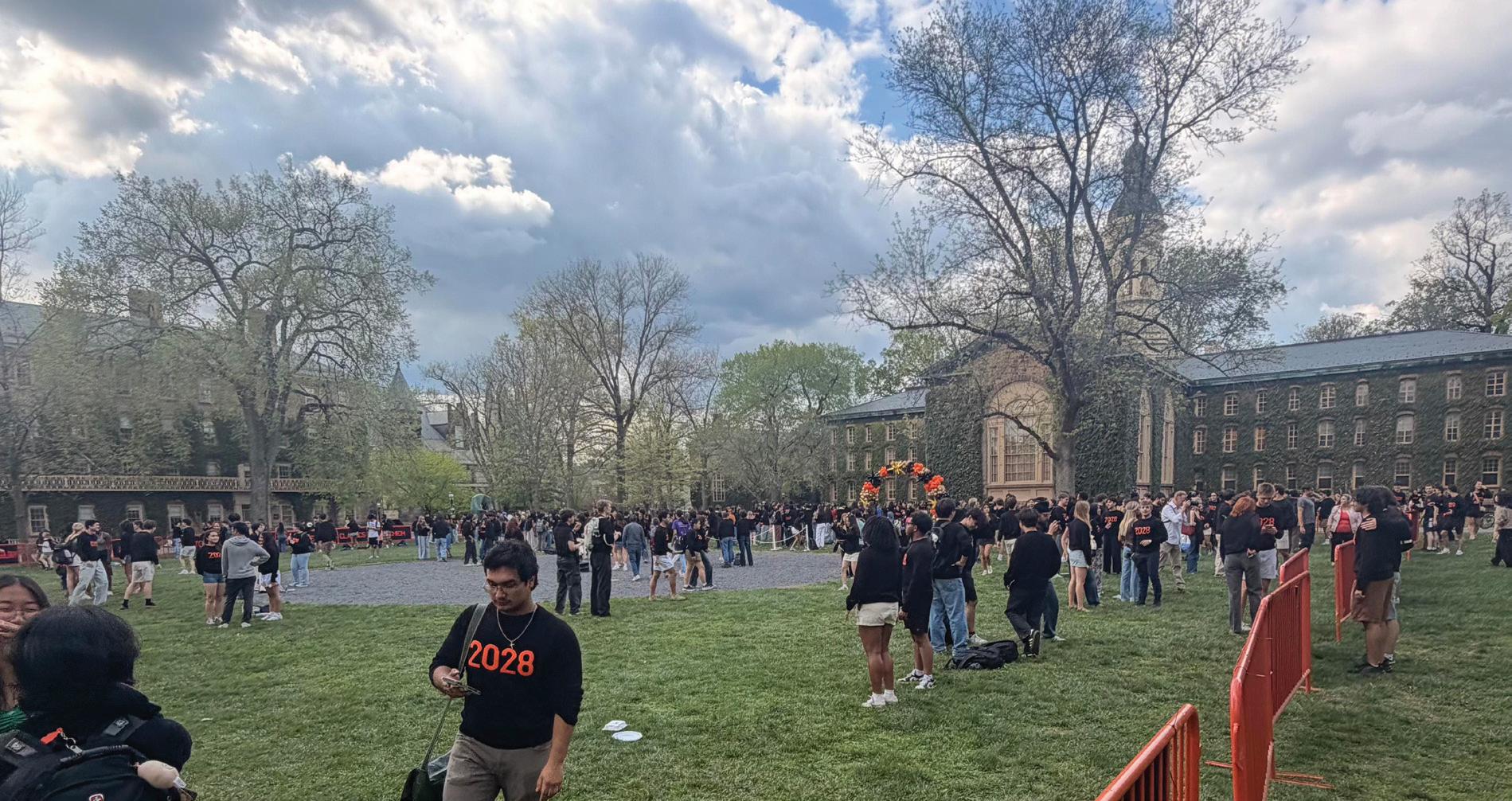
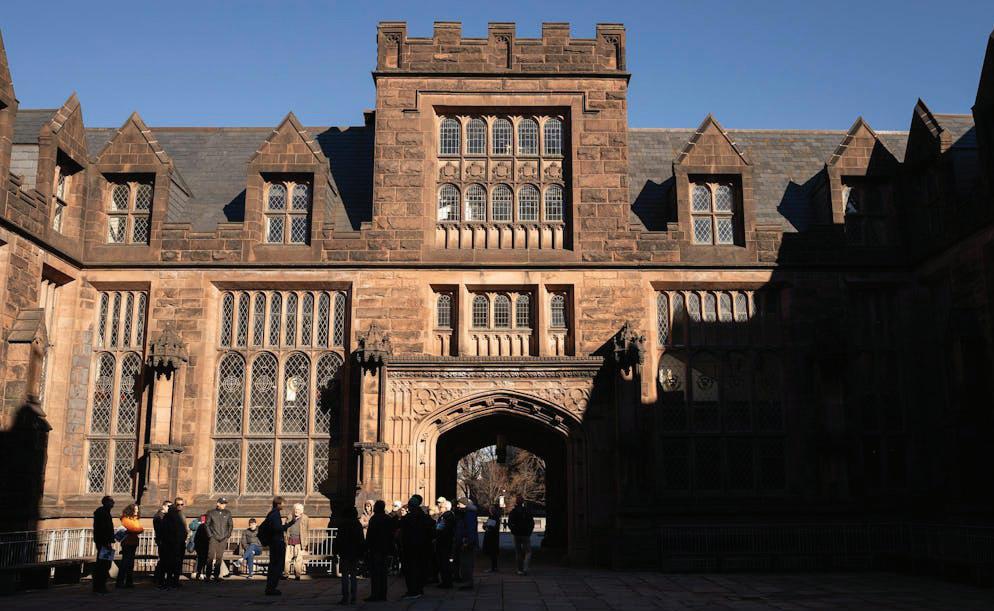
The Class of 2028 gathered Friday afternoon on Cannon Green to celebrate officially declaring their majors. Hundreds of students took part in the event, which featured orange and black departmental banners, balloons, and free food vendors. Students in the Class of 2028 pursuing an A.B. degree declared their majors this spring, while those pursuing B.S.E majors declared in the spring of their first year. Beyond the celebration, the Class of 2028’s major declara -
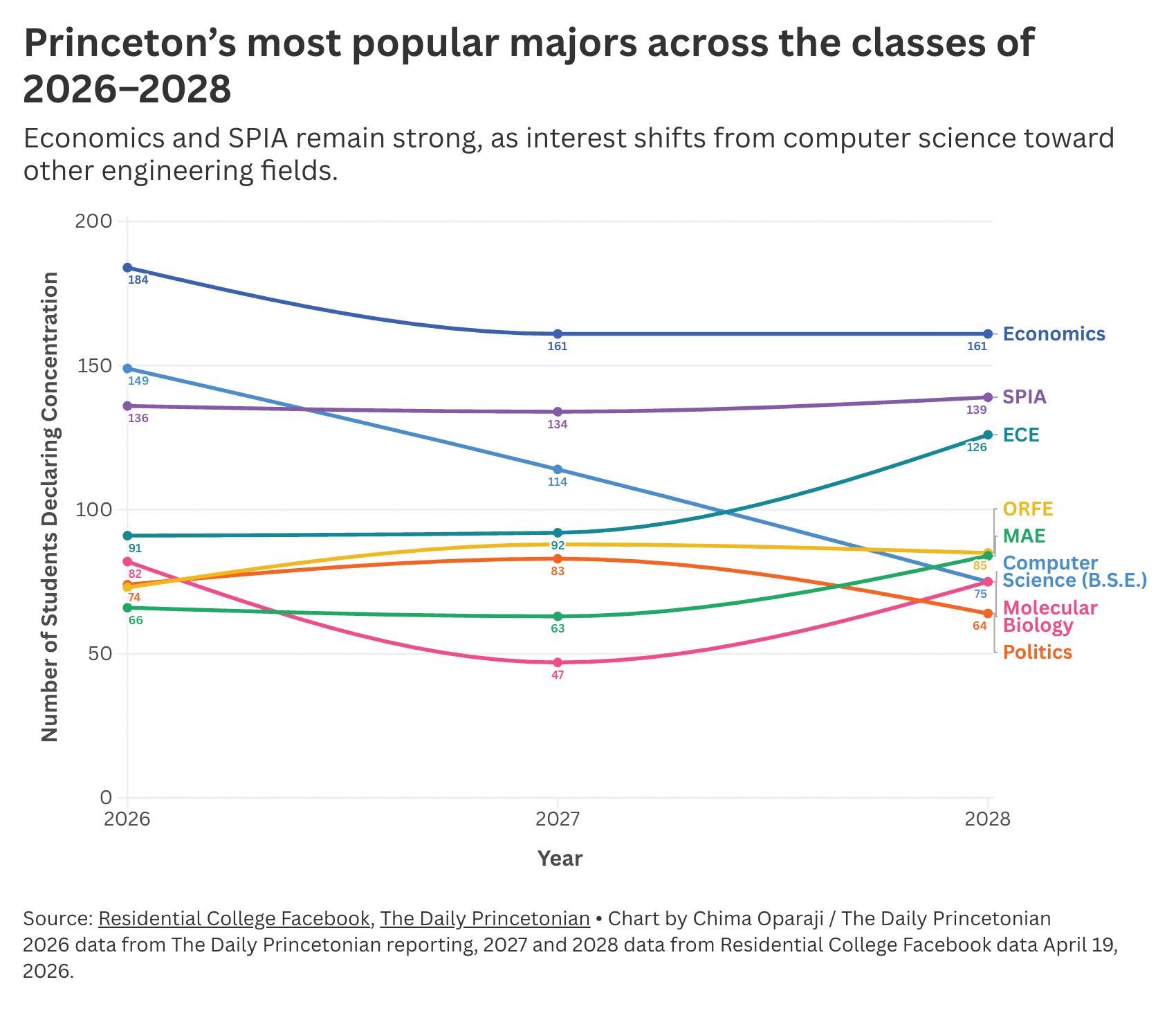
tions show a significant shift away from computer science and toward majors in other engineering departments. The change at Princeton comes in the midst of a national shift away from the discipline, as advances in artificial intelligence and a flagging job market discourage students from pursuing degrees in computer science. At Princeton, computer science has both an A.B. and B.S.E track. Students declaring the B.S.E. major decreased by 39 students compared to the Class of 2027, falling from 114 to 75. Sophomores pursuing the A.B. track dropped from 51 to 30 compared
Daniel Yu, Madeleine Murnick named valedictorian, salutatorian of the Class of 2026
By Gus Vogel & Giselle Moreno
Daniel Yu ’26 has been named valedictorian of the Class of 2026, which was officially approved by the faculty on Monday. Madeleine Murnick ’26 was named salutatorian. Yu and Murnick sat for interviews with The Daily Princetonian on their experience at Princeton and their future plans.
Typically, the process for electing a valedictorian involves the Faculty Committee on Examinations and Standing narrowing a list of a dozen students with high academic standing down to one student based on “their excellence in the curriculum” and “the difficulty of their course of study,” Dean of the College Michael Gordin explained to the ‘Prince.’
However, the salutatorian selection process differs in that the recipient must have proficiency in Latin, since the salutatory is traditionally delivered in Latin. The Committee considers both top Classics majors and other high-achieving students with significant Latin coursework.
Features A Princeton
African American studies major succeeds chemistry major as valedictorian
Yu told the ‘Prince’ that the first thing he thought when called into Dean Gordin’s office was, “Are you sure?”
His journey to this point, aside from the initial shock of being named valedictorian, had been academically unexpected. Yu told the ‘Prince’ that before arriving on campus, he had not considered majoring in African American studies. After taking African American studies professor Marcus Lee’s course AAS 336: Racial Histories of Gender and Sexuality, Yu changed his mind.
He had been especially drawn to how Professor Lee grounded the intellectual coursework in the physical conditions of the world.
“It was really in that class where I was like, ‘Okay, this is what I’ve been looking for: people who are really interested in doing rigorous, intellectual and creative work, but who also are grounding that work in how we create social change,’” Yu said.
Lee would go on to advise Yu on his
When asked about the process of choosing a specific candidate, Gordin stated that “there’s not a single metric you can look at because, for example, you have students who have equally excellent records.”
thesis, titled “Purity Politics: Race, Racism and (Anti-) Blackness in an Era of Anti-Trans Violence,” which, according to Yu, explores “the role of race and racism in the sort of contemporary anti-LGBTQ movement.”
This interest in creating actual social change through intellectual rigor has enabled him to engage with communities who feel supported by his work, both professionally and academically. For Yu, “the most meaningful part has been hearing from people who are excited about the work that I’m doing, who are excited about the necessity of Black Studies scholarship at a political moment like this.”
Yu explained that his academic goal at the University has been immersing himself in studies that emulate the real world — studies that are “grounded in the material realities of the world, the actual inequalities that I was seeing in my own city, in my own experiences and understanding.”
Besides majoring in African American studies, Yu is pursuing minors in English and in gender and sexuality studies. From New York City, Yu was also an early inductee into the Phi Beta Kappa Society and a recipient of the Shapiro Prize for Academic Excellence. He has received 14
‘Jeopardy!’ mastermind: Who is Jamie Ding ’13?
By Hannah Adams Contributing Features Writer
In every one of his appearances on “Jeopardy!,” Jamie Ding ’13 can be seen wearing some form of orange.
At 27 consecutive wins and with upwards of $700,000 in prize money to date, Ding holds a place in the top five all-time victories for regularseason play on “Jeopardy!.”
Ding’s passion for trivia started as a young child and developed at Princeton, where he was a molecular biology major, member of Quadrangle Club, and a staffer in the Copy and Multimedia teams of The Daily Princetonian. Ding auditioned as a high schooler for the “Jeopardy!” Teen Tournament and participated in the 2004 National Geographic Bee hosted by Alex Trebek. At Princeton, Ding joined the Quiz Bowl team and
served as its president in his junior year. Ding credits the University’s liberal arts curriculum in helping him broaden his knowledge base.
“I really like learning about the world in general and all that is in it, and Princeton is a great place to do that,” he explained in an interview with the ‘Prince.’ “If there’s any thread that can be drawn from my time at Princeton, it’s just an eclectic array of interests.”
Ding pointed to clues that referenced both Nassau Hall and his Princeton research. “There was a $2,000 clue about foxglove, and that actually relates to what I did for my senior thesis,” he said.
He added that conversations with friends from a diverse range of departments were influential in getting him to pursue his interests. “At
See DING page 12
Reay:
‘Declaration day is a formality. I wanted to hold the banner and wear the sweater; and now, I am. I’m over the moon right now.’
DECLARATION
Continued from page 1
to the current junior class. Combined, the number of students pursuing computer science degrees decreased by 60 students over the past year, the steepest decline of any field over the two-year period.
The French and Italian department has also seen a major drop off in recent years, with only one major in the Class of 2028 compared to 19 in 2007. For the Class of 2028, history gained five students and philosophy gained seven students compared to the Class of 2027, a bright spot for the humanities and social sciences.
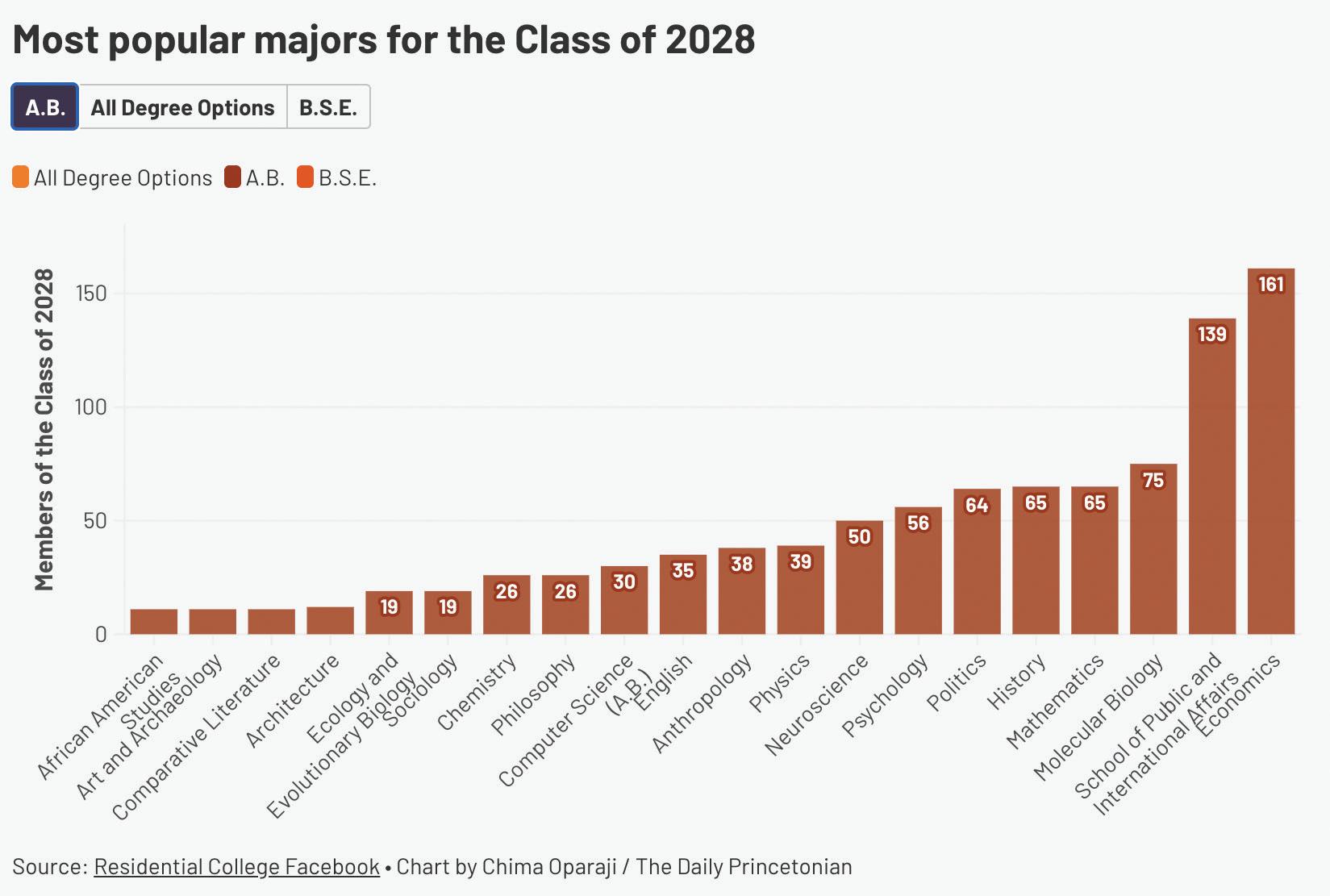
Economics remained the most popular major for the third year in a row, with 161 students, or 11.4 percent of the class, declaring the major.
The School of Public and International Affairs followed closely at 139 students, a 5 student increase in the last year.
Molecular biology also saw a steep increase, from 47 students in the Class of 2027 to 75 students in the Class of 2028.
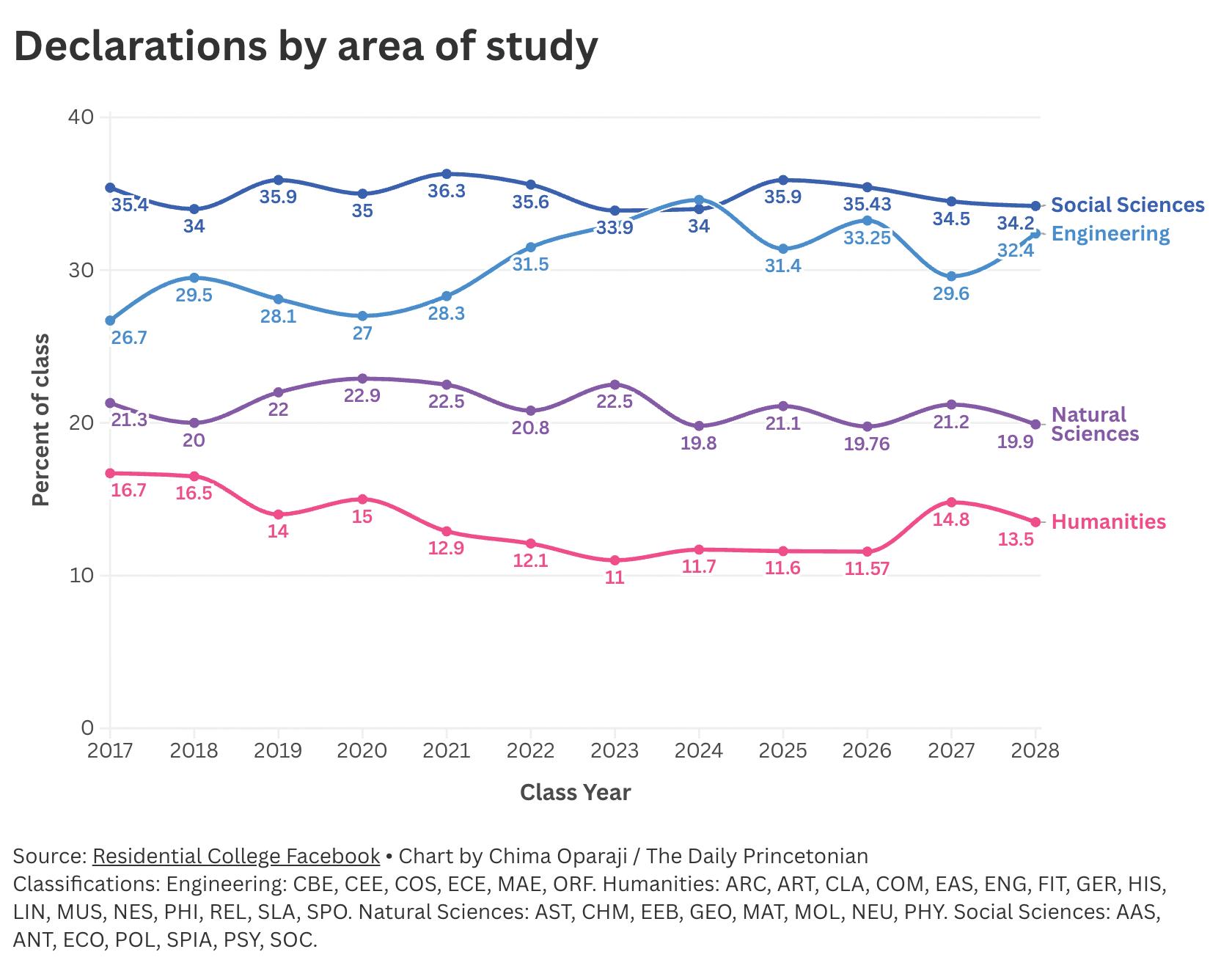
Meanwhile, engineering disciplines saw an increase in students from the Class of 2027 to 2028. Students in the Department of Electrical and Computer Engineering surged by 34 students, from 92 to 126, making it the third most popular major in the class. The mechanical and aerospace engineering department gained 21 students, rising from 63 to 84 students, while mathematics saw an increase of 20 declared majors compared to 2027. In terms of broad areas of study for the Class of 2028, the social sciences hold the largest percentage of majors at 34.2 percent, and engineering is next with 32.4 percent. The natural sciences have 19.9 percent, and the humanities have the lowest percentage of majors at 13.5 percent.
For sophomores on Cannon Green, Declaration Day commemorated their decision on what to major in.
Luca Difelice ’28, who declared SPIA, cited its breadth as its appeal. “The requirements are intentionally interdisciplinary,” he told The Daily Princetonian. “You can take operations research and financial engineering, politics, econ classes. There is a diversity of classes.”
Bella Postel ’28, also a SPIA major, similarly said that she chose it “mainly because it is very interdisciplinary.”
Postel also reflected on Declaration Day more broadly. “[It] is kind of a bittersweet celebration,” she told the ‘Prince.’ “It makes me reflect on where I was even two years ago.”
Sasha Berry ’28, who declared economics after considering multiple majors, told the ‘Prince,’ “I think that it’s really exciting that we have had the past two years to explore different majors.” She also noted that “it’s nice to settle on something.” Beatrice Cassidy ’28, who plans to write her senior thesis in economics on a topic she hopes connects directly to realworld markets, stated simply, “I’m excited to do the real stuff.”
Lecturer Henry Shim in the economics department, who has watched many Declaration Days pass, recognized many faces. “I remember when they took ECO 100 or 101 as a freshman or a sophomore,” he told the ‘Prince.’ “This year, I think we have a really good bunch.”
Many students reflected on how exploration throughout their first two years at Princeton led them to declare a major completely different from what they initially intended to study.
Emma von Scheliha ’28 arrived at Princeton intending to pursue molecular biology as a pre-med student before finding her way to anthropology. “I did not want to do my research in a lab,” she said. A single course last semester, ANT 311: Food, Culture, and Society with professor Hanna Garth, redirected her entirely.
Theodore Peebles ’28 nearly declared civil and environmental engineering before a conversation at the gym pushed him toward electrical and computer engineering (ECE). “My friend was like, why are you doing something you hate?” he recalled. “I thought, ‘he is right.’” Peebles is now part of the increase in ECE majors this year.
Daisy Yao ’28, who declared music, had long assumed she would major in physics. “I felt like music is something I’m really good at and wanted to pursue,” she told the ‘Prince.’
Dean Miller ’28, now a physics major, arrived at Declaration Day with two competing feelings. Physics, he said, had been “extremely difficult,” but “seeing it formalized and standing in front of the sign feels more concrete and like all my efforts and late nights have been building up towards my major.”
Miller was mildly underwhelmed by the event itself, hav-
ing expected something more ceremonial. “It’s kind of like a bunch of friends walking around,” he said. “I feel so hype with my physics majors. I wish there was a time for the physics majors to meet. A bunch of other majors had a specific time to take a photo, but physics did not.”
Emilia Reay ’28 was among the least conflicted. She has known since high school that she would study Spanish at Princeton, drawn
to it because “the department is such a family” and her ambition to become a bilingual sports broadcaster.
Reay is a senior Sports writer for the ‘Prince.’
“Declaration day is a formality,” she said, standing near her department’s banner. “I wanted to hold the banner and wear the sweater; and now, I am. I’m over the moon right now.”
Daphne Lewis is a staff News writer for the ‘Prince.’ She is from Washington, D.C.
Vanessa Catalano is a News contributor for the ‘Prince.’ She is from Los Angeles.
PHOTO COURTESY OF ELISS DE GUZMAN ’29
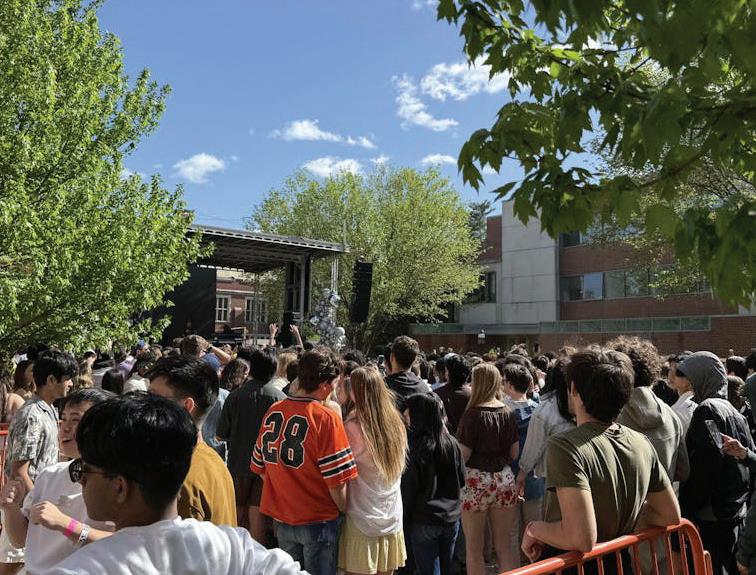
Students from the Class of 2028 celebrate Declaration Day on Cannon Green.
Murnick:
‘I hope to be able to, first and foremost, tell my class what they have meant to me and also what I know that they mean to each other.’
Fetty Wap announced as 2026 Spring Lawnparties headliner
By Ambre Van de Velde & Gray Collins Staff News Writer & Assistant News Editor
American rapper and singer Fetty Wap will headline Lawnparties on Sunday, April 26. Lawnparties is a biannual event featuring a headlining performance on Frist North Lawn, as well as various artists hosted by the eating clubs on Prospect Avenue, food vendors, and other activities.
cial Committee Chair Vivian Chang ’28, 72 students requested Fetty Wap, the most of any artist, in a USG free-response form with 465 submissions meant to solicit student suggestions for the event’s headliner.
The Lawnparties theme was announced Saturday as “Princhella #2016.”
Spring 2024, NLE Choppa in Fall 2024, and A Boogie Wit da Hoodie in Spring 2025.
Fetty Wap has received two Grammy Award nominations and won the 2016 awards for “Best New Artist” by the iHeartRadio Music Awards and “Top New Artist” by the Billboard Music Awards.
A+ grades throughout his time at Princeton — one more than last year’s valedictorian Erik Medina ’25.
In December of 2025, Yu was also named a 2026 Marshall Scholar. After graduation, he plans to undertake a twoyear graduate study at the School of Oriental and African Studies (SOAS) University of London. He intends to pursue a master’s degree in race and gender studies in his first year, and a secondary master’s degree in socio-legal studies.
“I’m excited to both be continuing thinking about these questions of race and gender, but also being able to do it in one of the world’s most diverse and vibrant cities,” Yu said.
“[It is] really a gift to be able to go to Princeton, and that is more reason to speak up than it is to say silent,” Yu added, in reflection of his previous and upcoming socially-oriented work.
Madeleine Murnick follows fellow Classics major as next salutatorian
Murnick had known for a while that she wanted to study Classics — and her time in the Western Humanities (HUM) Sequence at the University confirmed that.
“Once a week after lecture, professors and students in the HUM Sequence used to gather for lunch at [Rocky-Mathey Dining Hall] and talk about class, our readings, and our lives in a casual setting. Those were great opportunities to connect with students and faculty, and I have very fond memories of them,” said Murnick, who later became a mentor for the HUM Sequence.
She had begun studying Latin at the National Cathedral School and furthered her study of the language in her coursework at Princeton. As salutatorian, Murnick will give the opening speech at Commencement — the “salutatio,” which is traditionally recited in Latin — to the graduating class.
“I hope to be able to, first and foremost,
tell my class what they have meant to me and also what I know that they mean to each other. I hope to talk about my class a little bit and to get everyone excited about starting off the commencement ceremony,” said Murnick.
Murnick’s passion for Latin is evident in her thesis, “Latin in the Literary Imagination,” which takes a close look at the practicalities of Latin pedagogy over the past 2,000 years, with a focus on the best practices for teaching Latin today. However, Murnick has also nurtured a love of Greek, which solidified during a trip to Athens with the Classics Department.
“Being there in real life was definitely one of those moments that will stick with me from my Princeton experience,” Murnick said of Athens. “Seeing the ruins of the works I was reading in class was definitely a formative moment.”
Murnick, who is from Washington, D.C., is also receiving minors in humanistic studies and music performance.
Outside of the classroom, Murnick is an Outdoor Action (OA) leader, the 2025 president of Charter Club, a member of the Glee Club, Chamber Choir, and other student-led choral groups.
During the summer and fall post-graduation, Murnick will work at Baxter State Park in northern Maine where she will help update its guidebook, before making a decision about pursuing further education.
Murnick advises incoming students to “take the HUM Sequence no matter what major you’re planning to do. You won’t regret it, and it will go by way faster than you can possibly imagine — try not to forget that.”
Yu and Murnick are both expected to speak at Commencement to the graduating class on May 26.
Gus Vogel is a News contributor for the ‘Prince.’ He is from Brookline, Mass.
Giselle Moreno is a News contributor from Dallas interested in covering the Municipality of Princeton.
Haeon Lee contributed reporting.
The announcement from the Undergraduate Student Government Social Committee comes five days before Fetty Wap is set to perform, closer to the event than all but one announcement since 2022. The Fall 2025 announcement came four days before the event. Motel Glow, a student band, and members of the student-run Princeton DJ Collective will open before Fetty Wap takes the stage on Sunday.
Fetty Wap is an American rapper, singer, and songwriter who quickly rose to fame after his 2014 debut commercial single “Trap Queen.” He was born in Paterson, N.J. and attended Eastside High School before dropping out to pursue his music career.
In January, Fetty Wap was released from federal prison in Minnesota after serving more than half of a six-year sentence for his part in a drug trafficking conspiracy involving over 100 kilograms of fentanyl, cocaine, and heroin.
According to USG So -
“2016 is a year every student remembers… it represents a sense of prepandemic ease that has recently resurfaced in the ‘2026 is the new 2016’ trend,” Chang wrote to The Daily Princetonian. “This year’s Lawnparties draws directly from that nostalgia, bringing a high-energy, throwback atmosphere to Princeton’s biggest social event of the year.”
Fetty Wap’s “Trap Queen” peaked at number two on the Billboard Hot 100 and led Fetty Wap to sign with 300 Entertainment. With the release of “679” featuring Remy Boyz, “My Way” featuring Monty, and “Again” in 2015, he became the first act in the history of the Billboard Hot Rap Songs chart to have four entries simultaneously in the top 10.
Born Willie Junior Maxwell II, he coined his stage name “Fetty,” slang for “money,” and appended “Wap” at the end to pay tribute to Gucci Mane’s alias, “Guwop.”
Fetty Wap’s selection continues Lawnparties’ recent preference for hip-hop and rap headliners. Six of the past eight Lawnparties headliners have been rappers, including Lil Tecca in
Fetty Wap has the secondhighest number of monthly Spotify listeners of the artists who have performed at Lawnparties since 2021, with over 21 million.
According to Chang, the USG Social Committee has coordinated with several University entities, including the Office of the Dean of Undergraduate Students, Public Safety, Environmental Health and Safety, and the University’s Risk Management team, to preserve and strengthen the safety infrastructure for Lawnparties. In past years, tight crowds have led to student injuries.
This semester’s Lawnparties will include food options as usual, including Nomad Pizza, Tico’s Eatery and Juice Bar, Rita’s, Taco Bell, Cheesecake on a Stick, Alfalfa, Jammin’ Crepes, Watermelon Cups, and a new Kosher sushi option.
Ambre Van de Velde is a staff News writer for the ‘Prince.’ She is from Boston.
Gray Collins is the assistant News editor for the ‘Prince’ leading University administration coverage. He is from outside of Philadelphia.
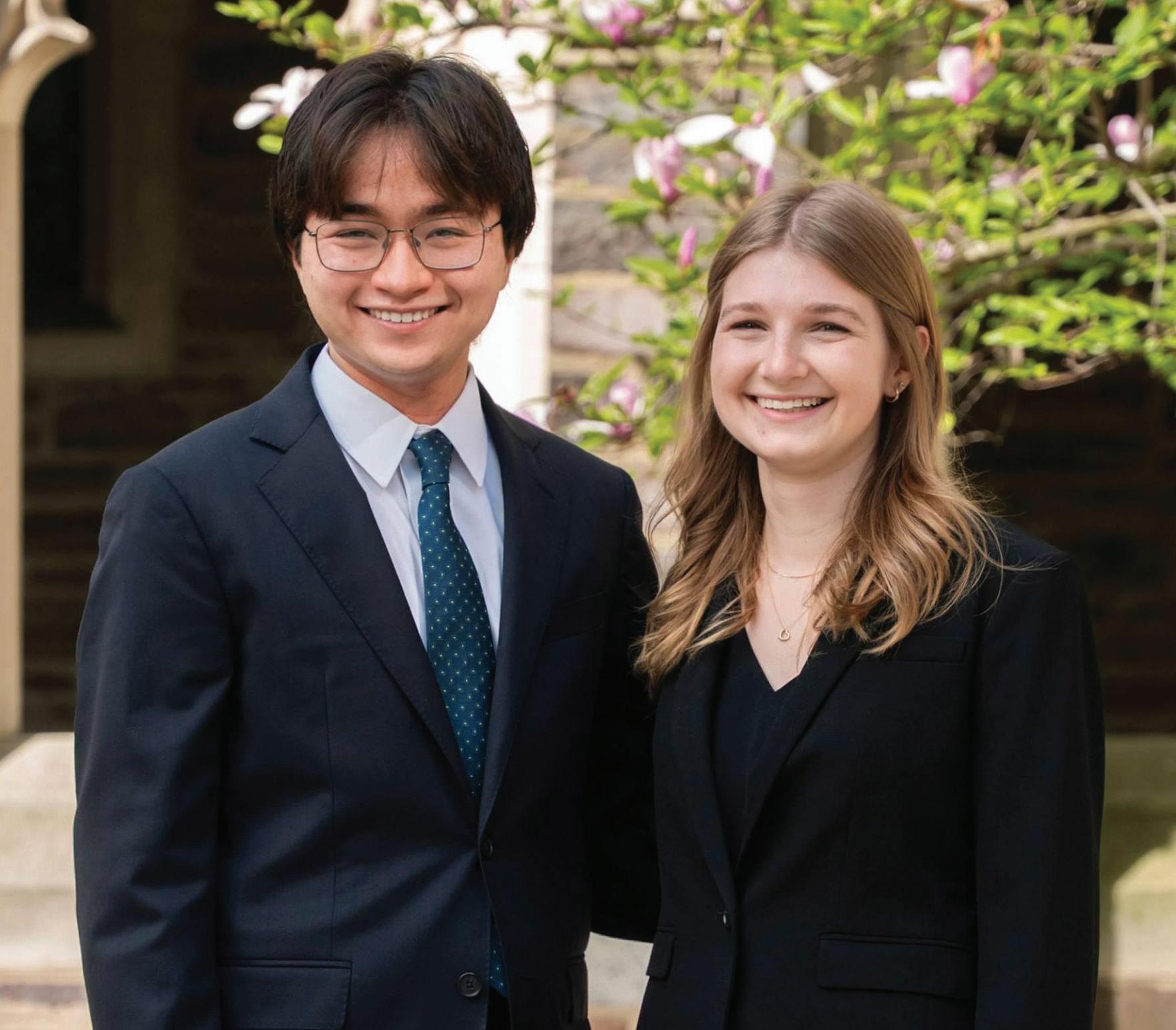
Daniel Yu (left) and Madeline Murnick (right), the valedictorian and salutatorian of the Class of 2026.
New U-Councilors elected, Class Council mishap leads to rerun in spring elections
By Andrew Arthur Staff News Writer
The undergraduate student body elected ten new U-Councilors in its Spring 2026 election cycle on Friday.
The Class of 2029 secretary and Class of 2028 social chair races will be rerun, as it was discovered that elections had been conducted using approval voting rather than the ranked-choice method.
Stanley Stoutamire Jr. ’27 led the field of 17 U-Councilor candidates with 429 votes, followed by Sastha Tripathi ’28 with 359 votes and Isaac Barsoum ’28 with 344 votes. Andrew Chou-Belden ’29 finished fourth with 339 votes. Completing the set of ten elected councillors were Ian Mann ’28, Ai Vy Shulman ’29, Caleb Rosenfeld ’27, Salma Alhsni ’28, Arjun Menon ’27, and Jeanley Boursiquot ’27.
The newly elected councilors will serve one year terms as student representatives on the USG senate and the Council of the Princeton University Community (CPUC), a shared governance body that includes faculty, staff, students, and alumni.
Stoutamire said he plans to use his position to advance student understanding of Princeton’s disciplinary structures, in light of proposed changes to proctoring. In a written statement to the ‘Prince,’ he stated, “One thing I’m excited about is the upcoming student survey on the disciplinary bodies on campus.”
In response to a question about potential roadblocks that could impede his work, Stoutamire stated that “the ball is actually in our court to give our peers reasons to believe that USG can continue to deliver real wins for them.”
Barsoum wrote that “the time for complacency and passivity amongst our student representatives is over. The time for alert, attentive, and aggressive — when necessary — student representation is
ON CAMPUS
here.” He identified the administration’s policymaking process as a structural obstacle, pointing to issues including the elimination of independent dining, changes to exam proctoring, and discounted NJ Transit tickets as topics he intends to address.
Barsoum is an associate Opinion editor for the ‘Prince.’
Chou-Belden said that he and Shulman came to understand USG’s structure only through significant independent research which involved direct conversations with members, attending senate meetings, and reading the CPUC Charter.
Shulman is a former contributing Opinion writer for the ‘Prince.’
“Students shouldn’t have to make these efforts just to understand how USG functions,” he wrote. He added that his first project would be to produce an accessible guide to USG, calling it a “simple, overlooked, and sorely-needed project.”
He also noted that the U-Councilors’ impacts are limited when they pursue separate agendas. “I hope to unite with other U-Councilors so that we can concentrate our collective energy on specific causes,” he continued.
The Class of 2029 secretary and Class of 2028 Social Chair election will be rerun after the Elections Team determined that the online voting platform had administered both contests using approval voting, a system in which voters may select any number of candidates, rather than the ranked-choice format mandated by Section 703 of the USG Elections Handbook.
In a statement to the ‘Prince,’ USG Vice President Anuj Krishnan ’27 wrote that the discrepancy was caught by the elections team before results were officially published. USG leadership, the Office of the Dean of Undergraduate Students (ODUS), and the candidates were all noti-
fied on the same day. “USG leadership is working with the Elections Team and ODUS to examine how we can better deploy our current election software to ensure that this does not happen again,” Krishnan wrote.
Krishnan confirmed that the rerun carries additional financial costs. He wrote that the cost of the Class of 2028 and Class of 2029 elections is each $170 resulting in a combined cost of $340 for both reruns.
The revote for Class of 2029 secretary, which includes Toby Chang ’29, Ehimwenma Ehiosu-Enoma ’29 and Hailey Swyter ’29 as candidates, and the Class of 2028 Social Chair election, involving Antonia Cañizares ’28 and Sam Toledo ’28, is scheduled to start at noon on Monday and continue for two days.
Chang is a staff News writer for the ‘Prince.’
Candidates reacted to the invalidation with a mix of frustration and measured acceptance.
Chang, who is the incumbent, wrote
that the timing of the re-vote compounded existing pressures. “This election cycle has been particularly stressful for me as well as other candidates, with finals coming up and other pressures also mounting,” he wrote in a statement to the ‘Prince.’ “It’s incredibly frustrating that stress will be prolonged by another week.”
Ehiosu-Enoma said she accepted the decision. “Elections should be fair and if the process wasn’t what it was supposed to be, then a rerun is the only way to make sure the outcome actually reflects what students want.”
Swyter was disappointed when she heard the election was invalidated. She wrote, “I don’t know if the approval voting really made a difference because most people I know simply chose one candidate to vote for.”
She expressed concern that the revote would be decided by a substantially smaller electorate. “I predict far less students will vote in the re-vote, and it will likely come down to which candidate
can get most of their friends to vote,” she continued.
In the Class of 2028 social chair election, Cañizares, the incumbent, wrote that the rerun came as a surprise since some results had already been announced, but she welcomed the opportunity to continue her campaign process. “I think the rerun provides an opportunity to ensure the process is clear and consistent, which ultimately supports the legitimacy of the result,” she wrote.
Cañizares’ opponent, Toledo, wrote that he understood why people were disheartened by the rerun but that the “USG Elections Committee is handling this matter in a way that’s transparent and centered on doing right by students.”
Krishnan called the integrity of both races important regardless of their scope. “All class Government and the USG Senate election are incredibly important.”
Andrew Arthur is a staff News writer from London.
‘Nursery of Rebellion’ exhibit brings Princeton’s revolutionary past to life
By Ambre Van de Velde
Staff News Writer
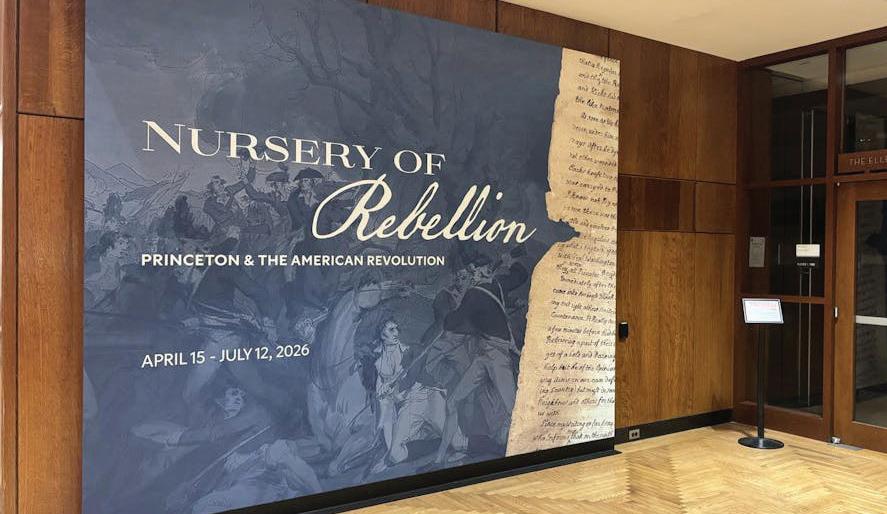
The Ellen and Leonard Milberg Gallery in Firestone Library will be home to “‘Nursery of Rebellion’: Princeton & the American Revolution” until July 12. The exhibition displays a selection of Princeton’s rare books, manuscripts, and borrowed objects from other institutions to illustrate how the American Revolution was lived across gender, class, race, allegiance, and status.
The exhibit was curated by Michael Blaakman, an associate history professor and historian of revolutionary and early national America, and Gabriel Swift, the librarian for early American collections in Princeton University Library’s Special Collections. Planning for the exhibition began about three years ago and draws on loaned objects from federal, state, and community institutions. The opening of the exhibit this year also coincides with the 250th anniversaries of the U.S. Declaration of Independence and the Battle of Princeton.
The collection holds nearly a hundred objects, including early printings of the Bill of Rights and the Federalist Papers, a Yorktown victory invitation printed on the back of a playing card, correspondences with George Washington, James Madison, Alexander Hamilton, and Elizabeth Schuyler Hamilton, and a cannonball found near the Princeton battlefield.
The historical collection also played a role in the undergraduate
course HIS 415: Revolution in the Archives, offered both this spring and last spring. Students enrolled last year researched objects and wrote labels for the exhibition, and students enrolled this spring will help build online resources as part of their final project.
Blaakman told The Daily Princetonian that the title of the exhibit comes from a 1783 College of New Jersey faculty letter inviting the Continental Congress to use Nassau Hall. The letter, which is borrowed from the National Archives, notes that the British had targeted the college during the Revolution because of its reputation as a “nursery of rebellion.”
The collection contains several rare objects. For instance, in the gallery’s entrance, Princeton’s 1776 Dunlap Broadside Declaration of Independence, one of 26 known surviving copies and original 1787 Constitution, one of 14 surviving copies, hang opposite each other. This is the first time in 50 years the Library has displayed its original Declaration and Constitution together.
The show also borrowed numerous pieces from the Princeton University Art Museum, including the only known pre-Revolutionary portrait of an American undergraduate in academic dress, and James Peale’s The Battle of Princeton. In the tour, Swift pointed out that James Peale’s piece is one of very few Revolutionary War battle paintings by a participant.
Blaakman said in the curator’s tour on Friday, April 17, “We are
standing, quite literally right now, in the middle of the American Revolution.”
The exhibit also focuses on local stories, such as the 1774 Princeton Tea Party. A letter by Charles Clinton Beatty, a graduate of the Class of 1775, describes students burning tea on campus, tolling the bell, making “many spirited resolves,” and burning an effigy of then-Massachusetts Governor Thomas Hutchinson with “a tea canister tied about his neck.”
“[The 1774 Princeton Tea Party] is, we think, the first real student political protest at Princeton,” Blaakman said on the tour.
Blaakman also emphasized that the show lets people see the Revolution “not just as the familiar household names on a marble pedestal,” but through “regular everyday people,” across “class and status and background.”
The exhibit highlights the story of Prime, an enslaved soldier in the Continental Army, which Blaakman described as a “very different story” of local participation in the American Revolution.
After being enslaved across Nassau Street in the now Art@Bainbridge house by Princeton alumnus and loyalist Absalom Bainbridge Class of 1762 and taken to New York by his enslaver, Prime ran away and returned to Princeton. Instead of being sold to fund the Revolution, as Blaakman noted was common practice by the state of New Jersey, Prime enlisted in the Continental Army, serving “longer than the vast majority of people who enlisted at some
point in the war.”
The document in the exhibition that recounts this story is a book of laws from the state of New Jersey, titled “An Act for Setting Free Negro Prime.” This is one of three laws, each freeing one person for their service to the revolutionary cause in the state of New Jersey.
The exhibit also emphasizes that Princeton was a key strategic location in the American Revolution, but a place where rare national documents and intensely local lives collide. Princeton University’s own Nassau Hall, which served as Continental Congress from June 30 to November 4, 1783, is a hallmark of the Revolutionary War. Blaakman confirmed on the tour that a cannonball did come through the wall of Nassau Hall and tear down a portrait of King George II.
“It’s recorded in the trustees’ minutes that a cannonball came through
the wall of Nassau Hall and pulled out the portrait of King George II. And the frame was fine enough that they [reused] it for a portrait of Washington,” he said. The new portrait, George Washington at the Battle of Princeton, 1783–84, is on display in the Princeton University Art Museum.
Another public tour will take place on April 28, with additional opportunities to engage with the exhibit at a “Slow Looking Art Activity” on April 24 and April 26. The related “Revolution Up Close” series includes lectures from guest professors Zara Anishanslin on April 23, Serena Zabin on May 7, Cynthia A. Kierner on June 4, and Robert Parkinson on June 30, all at 7 p.m. in Robertson Hall 100.
LOUISA GHEORGHITA / THE DAILY PRINCETONIAN Robertson Hall, which hosts USG meetings every Sunday.
Ambre Van de Velde is a staff News writer for the ‘Prince.’ She is from Boston.
Nineteen Princeton affiliates named 2026 Guggenheim Fellows
By Nika Schindler Assistant News Editor
Nineteen Princeton affiliates were awarded 2026 Guggenheim Fellowships, a mid-career grant celebrating “writers, scholars, scientists, and artists in over 50 different fields of study across the fine arts, social sciences, humanities, and natural sciences.”
The Guggenheim Fellowship was established in 1925, with this year’s fellows marking the 101st class of the program. There are a total of 223 fellows this year, selected from a pool of nearly 5,000 applicants.
This year’s cohort includes eight current Princeton faculty members and eleven undergraduate and graduate alumni.
This is an increase from last year, when 15 Princeton affiliates received the fellowship, compared to 11 in 2024, and eight in 2023.
Bridgett vonHoldt, professor of ecology and evolutionary biology, received the fellowship for her work in conservation genomics, namely her research on the critically endangered red wolf. She expressed the importance of the award to her personally and the broader field of conservation.
“For me, being named a Guggenheim Fellow is both a profound personal honor and a powerful validation of my scientific vision and commitment to the conservation of endangered species,” vonHoldt wrote in a
statement to The Daily Princetonian. She added that the grant “validates endangered species conservation itself as a frontier of intellectual and societal value, at the highest levels of scholarly recognition.”
This sentiment of institutional pride was shared by Matias Cattaneo, a professor of operations research and financial engineering, who received a fellowship for his work in data science. In a statement to the ‘Prince,’ Cattaneo highlighted the “growing importance of data science as a broad intellectual enterprise” and credited Princeton’s “stimulating and collaborative environment” for fostering his cross-disciplinary work.
Some recipients noted the weight of receiving such recognition in the current academic landscape. Kristina Olson, professor of psychology, noted that she and her team feel “incredibly fortunate” to have the support of the Guggenheim Foundation.
“My research team and I are incredibly fortunate to have the support of Princeton — an institution that continues to fight for intellectual freedom and for higher education — and the Guggenheim Foundation at a time when we are experiencing dwindling government support for the American research enterprise and social science research, in particular,” Olson wrote to the ‘Prince.’
“I hope this award can serve as an acknowledgement of the work not
only by me and my team, but by my entire field,” she continued.
Christopher Harris, professor of visual arts, won the fellowship for his work in film and video and expressed that he was “deeply honored” by the recognition in a statement to the ‘Prince.’ Harris’ work often explores experimental themes and African American historiography by drawing on archival material.
“Receiving this fellowship in my second year at Princeton is especially gratifying given the level of support for my work the university has demonstrated,” Harris added. “The Guggenheim Fellowship is another indication of the value of a supportive community such as the one I have found here at Princeton.”
Additionally, Alexander Ploss, a professor of molecular biology, was awarded a Guggenheim fellowship underwritten by the Eleanor Schwartz Charitable Foundation. He highlighted that Princeton is “an absolutely remarkable place to do science and tackle some of the hardest questions in biology.”
“The generous support will allow us to continue pushing the next frontier in infectious disease biology,” he wrote in a statement to the ‘Prince.’
Silas Riener ’06, a dance program faculty member, was recognized for choreography. Nathan Arrington ’02, a professor of art and archaeology and Hellenic Studies, was awarded for his
work in fine arts research. Former member of the School of Historical Studies at the Institute of Advanced Study (IAS) Jamie Kreiner GS ’11 and newly elected member of the IAS Sarah McNamer were also awarded fellowships.
Several Princeton alumni also received the Guggenheim Fellowship this year, including Scott Redford ’78, John Wood Sweet GS ’95, W. Anthony Sheppard GS ’96, Alan Baker GS ’99, Sang-Heon Dan Shim GS ’01, Faith Hillis ’02, Erik Linstrum ’06, Zubin Jacob GS ’07, Mina Cikara GS ’10, and Aaron Pollack GS ’14.
The John Simon Guggenheim Me-
morial Foundation has awarded nearly $450 million in fellowships since its establishment in 1925. As Foundation President Edward Hirsch noted in the announcement, the new class represents “the world’s best thinkers” who remain “undaunted by the challenges ahead.”
Nika Schindler is the assistant News editor for the ‘Prince’ leading university operations coverage. She is from Atherton, Calif. Nico David-Fox contributed reporting.
Princeton Council shifts on special event regulations amid community backlash
By Giselle Moreno News Contributor
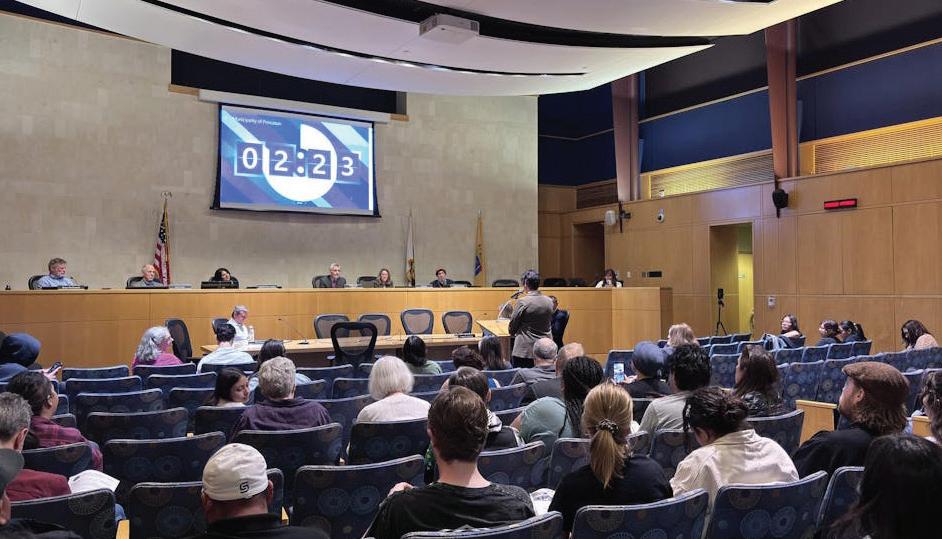
The Princeton Council is changing course on proposed modifications to the municipality’s special event regulations after over 40 people assembled at the Council’s Monday meeting to register opposition to what they viewed as potential restrictions on the community’s ability to organize.
Council member Mia Sacks shared a statement from the Council which said the municipality is “currently working to draft an updated ordinance governing special events and the use of public space.” The potential ordinance that local activists objected to, which was discussed by municipal attorney Lisa Maddox during a work session at the Council’s March 23 meeting, would impose increased fees, a new permitting process, and space restrictions on large public events.
The potential ordinance drew criticism from local activist groups, who called on community members to show up at Monday’s meeting in opposition to the proposed chang-
es. The proposed changes were denounced in an op-ed from the leader of Indivisible Princeton, Lynda Dodd GS ’04 and a post from Resistencia en Acción NJ, a local immigrant advocacy organization.
During her presentation, Maddox discussed how a new ordinance could impose fees on “special events” with over 100 attendees to offset associated costs for the municipality, including police costs and lost paid parking space. She defined a special event as “any organized gathering of people, where they are going to be using an outdoor municipal area” — a category that includes protests.
Maddox’s presentation included an exception for spontaneous protests held within 48 hours of particularly high-profile events but did not otherwise clearly delineate between protests and other public events, such as festivals and sporting events.
Dodd and Resistencia have raised concerns over the First Amendment implications of such an ordinance, arguing that the changes could infringe on the right to protest by imposing increased costs. The Council clarified at the Monday meeting that
the Municipality did not intend to impede on First Amendment rights.
“Recent commentary has suggested that this initiative could restrict or burden free speech. That characterization is incorrect and reflects a misunderstanding of the discussion that took place during a recent council work session,” the statement read. The statement said the March 23 discussions were intended to pertain to “non-expressive special events.”
Currently, public gatherings in the municipality are regulated under two separate categories, drawing a distinction between gatherings in parks or plazas and those on roads or sidewalks. A “public meeting, assembly or demonstration” in a “municipal park or public plaza” that has over 25 people must get a permit from the municipal clerk. Events on public streets or sidewalks, defined as parades, include “march[es]” or any “organized group having a similar common purpose or goal.” Parades with under 25 people must get a permit from the chief of police, and the Council issues permits for those with over 25 people. Some events, including funeral processions, are exempted.
“One of the reasons for [the proposed change] now is to streamline the procedures and to put everything into one chapter,” Maddox said, citing “a pretty big increase in public interest in holding events in Princeton” in recent years.
At the Monday meeting, Sacks acknowledged, “there was some veering in [the previous meeting] into some things that touch on First Amendment speech.”
Members of Resistencia who spoke at the meeting said that they opposed the potential ordinance in its entirety, including regulations on events deemed non-expressive.
“What we want to make sure is
that the city council just throws this in the trash,” Ana Paola Pazmiño, the executive director of Resistencia, told the ‘Prince.’ “None of it is good. It’s not good to hinder the freedom of expression, of speech, of assembly, anywhere in this town.”
“Even if you mean well, this is not progressive … this is exclusive, and charging us for police overtime or because we want to express ourselves, that is oppressive,” Resistencia president Jorge Torres said at the meeting.
Richard Torres, another member of Resistencia, also argued that the proposals were inequitable. “We do not support measures that create barriers to protests or freedom of expression,” he said.
In an interview with the ‘Prince’ after the meeting, Sacks acknowledged the “anxiety” the discussed changes caused and said the Council wants to be “very careful” moving forward. Although Maddox said that some council members had been collaborating with the municipal attorney’s office on developing changes over the past two years, Sacks said she did not have knowledge of the specific changes that would be proposed.
“If there was anyone on Council who knew anything about this before the work session, I’m not aware of it. We were completely blindsided,” Sacks said.
However, Sacks said she still believes a new ordinance on the subject is necessary, in part because she said the municipality’s existing ordinances as written do not provide sufficient free expression protections.
“If there were a different set of elected officials in Princeton, what we have in our ordinance, in my opinion, does not provide sufficient protection [for free expression], and I do believe that we need an ordi-
nance to provide clear guidelines for administration to avoid inconsistent rulings,” Sacks said. “Now that this has been brought to our attention, I feel like we have a responsibility to create an ordinance.”
“Whether it was your intention or not, our constitutional rights were brought into the equation when it was suggested that public assemblies should be treated in the same manner as a celebratory parade,” Resistencia member Alison Perkon said to the Council.
Juliana Lopez ’27, a member of Resistencia, raised concerns that the fees in the proposed ordinance would unduly burden “marginalized communities.”
Dodd, a lecturer at the Princeton School of Public and International Affairs since 2018, expressed concerns that the potential ordinance could create a “‘pay-to-play’ model for democracy” in an op-ed published in TAPinto Princeton and Planet Princeton.
“I considered what has happened so far as people power,” Dodd told the ‘Prince.” I think now [the Council is] aware of the constitutional violations and I hope they will move forward following the Constitution.”
“My takeaway is that it was a very unfortunate episode, which I think will have a silver lining,”
Sacks added after the meeting, regarding the new direction of the ordinance being drafted by the municipality.
The next Princeton Council meeting will be on April 27.
Giselle Moreno is a News contributor from Dallas interested in covering the Municipality of Princeton.
Oliver Wu contributed reporting.
ISAAC BARSOUM / THE DAILY PRINCETONIAN Briger Hall, which houses the Department of Ecology and Evolutionary Biology.
Rentzou and Finkelstein appointed heads of residential colleges
By Ambre Van de Velde & Aitana Camponovo
Staff News Writers
Mathey and Rockefeller Colleges are getting new heads.
On July 1, French professor Effie Rentzou and computer science professor Adam Finkelstein will begin four-year terms as heads of Mathey College and Rockefeller College, respectively. The new appointments were unveiled in a staff intranet story on April 7.
Rentzou is replacing psychology and public affairs professor Stacey Sinclair, who has served as Mathey’s head since 2018. Finkelstein succeeds mechanical and aerospace engineering professor Clancy Rowley ’95, who has been head of Rockefeller College since 2017.
Each of Princeton’s seven residential colleges has a faculty head. The Rules and Procedures of the Faculty state that the faculty heads cultivate a “welcoming and inclusive environment in the undergraduate residential colleges which supports and enhances the educational mission of the University.”
Sinclair, the outgoing head of Mathey, emphasized the importance of fostering a warm and inclusive environment. Mathey “is truly your home. This is your family, and we accept you as you are,” said Sinclair in an interview with The Daily Princetonian.
Rentzou described similar aspirations for residential college culture. “I want our students to feel that they … have a home, they have a space where they are welcome, they’re protected, they can
thrive,” she told the ‘Prince.’
In her new role, Rentzou hopes to highlight the liberal arts opportunities that Princeton offers. Her research focuses on modernism and the avant-garde, especially literature’s relationship to other arts.
“I would love for our students at Mathey to be as much as possible exposed to the wonderful creative and healing power of art and the humanities,” she said. She hopes to carve out opportunities for students to interact with art “in a way that is casual, low stakes, but at the same time creative.”
When speaking about her goals as the incoming head of Mathey, Rentzou emphasized that she aims to foster a more casual and relaxed relationship with students.
“I intend to be very present at the dining hall and just meet students as much as I can on a casual level — go towards students and not bring the students to me.”
Both the outgoing and incoming head shared how rewarding the position has been for them. “Being head of Mathey was a highlight of my career. I’m very grateful for the time in the community and for the time with the students and for the incredible professional staff,” said Sinclair.
Rentzou also voiced her enthusiasm about the new role. “I’m really super, super excited. I can’t wait to start.”
Outgoing Rockefeller head Rowley’s leadership philosophy also prioritizes inclusivity.
“I wanted Rocky to continue to be a place where all students felt welcome and comfortable
enough to be themselves,” Rowley wrote in a statement to the ‘Prince.’ Equally important, he noted, was ensuring that college staff had the “resources needed to effectively support students.”
Cadigan Perriello ’29, a Rockefeller resident, noted that Professor Rowley “brought a positive and happy energy to Rockefeller College” and did an “amazing job making our residential colleges feel like a community and a family.”
Perriello is an assistant Sports editor for the ‘Prince.’
Additionally, Rowley made the Resident Graduate Student program a key focus. “I tried to bring some more structure to the RGS program,” Rowley said, adding that he is “really pleased with how that has evolved.”
As he prepares to pass on the role, Rowley expressed full confidence in the college’s future leadership. “Professor Finkelstein doesn’t need any advice. He has been an advisor in Rocky for years, and I know he will be absolutely fantastic,” he wrote.
Finkelstein’s perspective signals continuity in the college’s emphasis on accessibility and community. “[The role] affords an opportunity to interact with students in a different and perhaps more natural and informal way than the typical academic and classroom roles of professors and students: sharing meals, being present in the college in everyday life, and building the kind of relationships that aren’t really possible across a seminar table,” he wrote to the ‘Prince.’
Finkelstein noted that both the
structured community activities and informal interactions that defined Rowley’s tenure will remain central to Rockefeller’s identity moving forward.
Rentzou and Finkelstein will conclude their four-year terms as residential college heads in July 2030.
Ambre Van de Velde is a staff News writer for the ‘Prince.’ She is from Boston.
Aitana Camponovo is a staff News writer for the ‘Prince.’ She is from Washington, D.C.
PSafe alerts community of driver harassing students on campus
By Nora Linssen Staff News Writer
The Department of Public Safety (PSafe) received multiple reports of a male driver soliciting students and offering cash near campus roadways last week, according to a Monday afternoon TigerAlert sent to the University community.
The alert, issued four days after the first reported incident on Thursday, warned of multiple incidents of a male driver allegedly harassing passersby near campus on Thursday, April 16 and Friday, April 17. Only one “harassment” incident from April 16 at 9:30 a.m. in the general location of the Center for Jewish Life appears on the PSafe daily crime logs for those days.
A PSafe officer declined to comment about the reports on behalf of the department.
According to the alert, the driver approached students and asked for directions to a nearby Starbucks. After receiving directions, he allegedly offered students cash before making inappropriate solicitations or requesting that they enter his vehicle. The individual was described as a male in his 30s or 40s driving a dark van or SUV.
The incidents occurred on Prospect Avenue near Roper
Lane, Washington Road at Guyot Lane, and Ivy Lane, according to the TigerAlert.
PSafe is actively investigating the incidents and has notified the Princeton Police Department. The alert urged anyone
with additional information to contact PSafe at (609) 258-1000. Community members can also report suspicious behavior by calling 911 or using one of the blue light emergency phones located throughout campus.
A spokesperson for PPD was not available for comment at the time of publication.
The University directed students to its safety and security resources page at publicsafety. princeton.edu for additional
crime prevention guidance. Nora Linssen is a staff News writer for the ‘Prince.’ Nico David-Fox contributed reporting.
REBECCA CAO / THE DAILY PRINCETONIAN
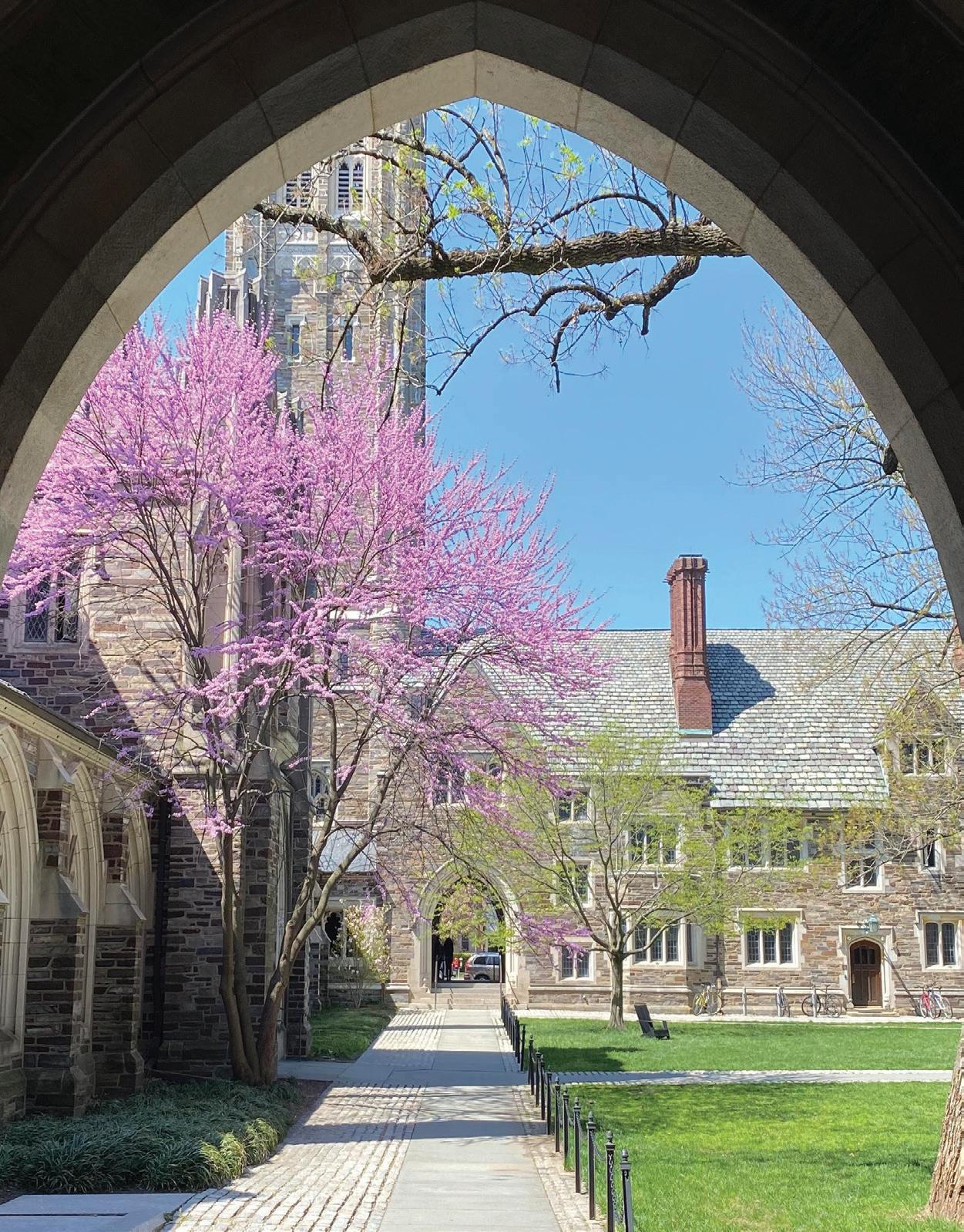
An archway near the Rocky entrance of Rocky-Mathey dining hall.
ON CAMPUS
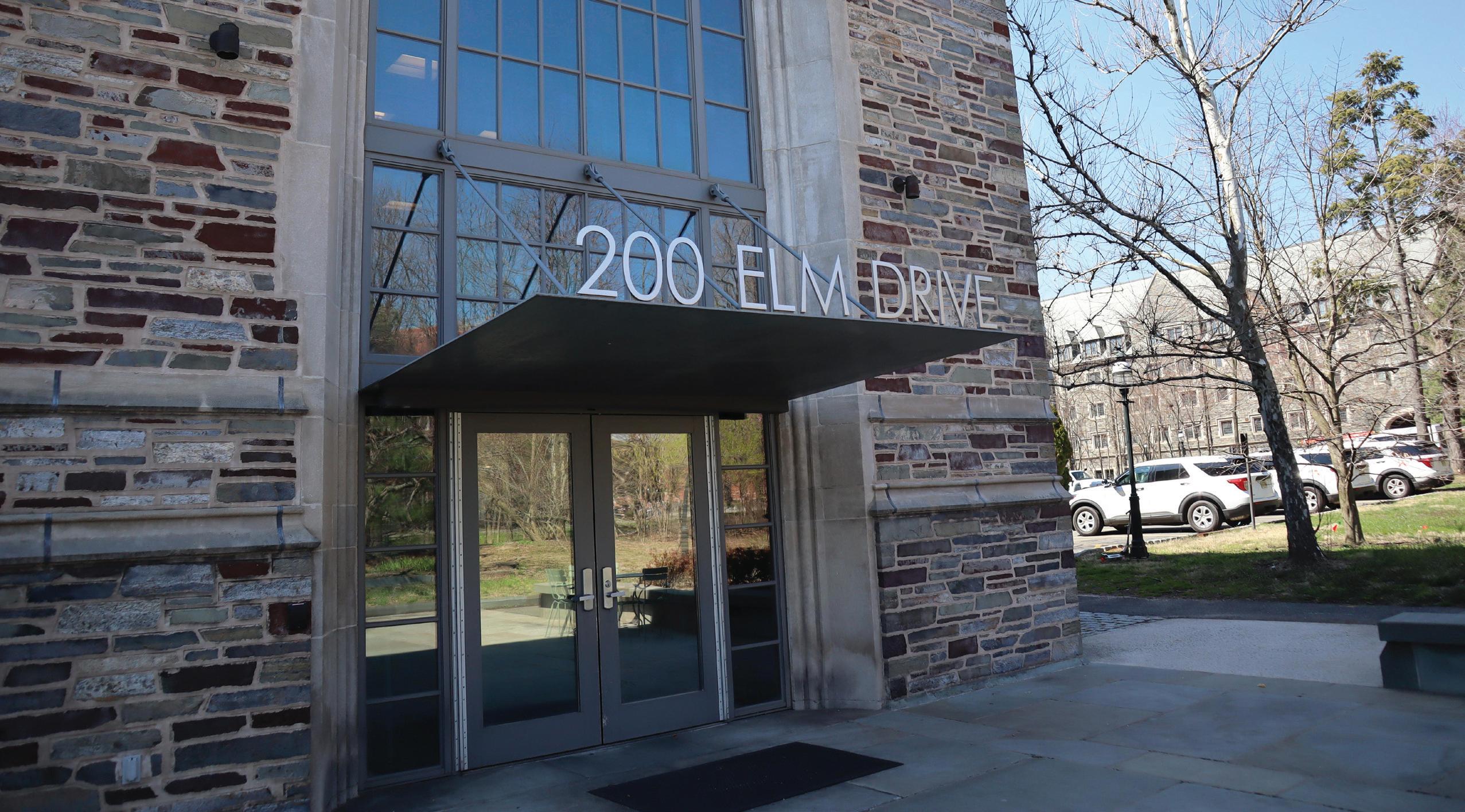
TIFFANY TSAI / THE DAILY PRINCETONIAN 200 Elm Drive, the home of PSafe.
Dod, Scully, and Wright fall first: a look at rising junior room draw
By Veda Devireddy & Vincent Etherton Assistant Data Editor & Senior Data Writer
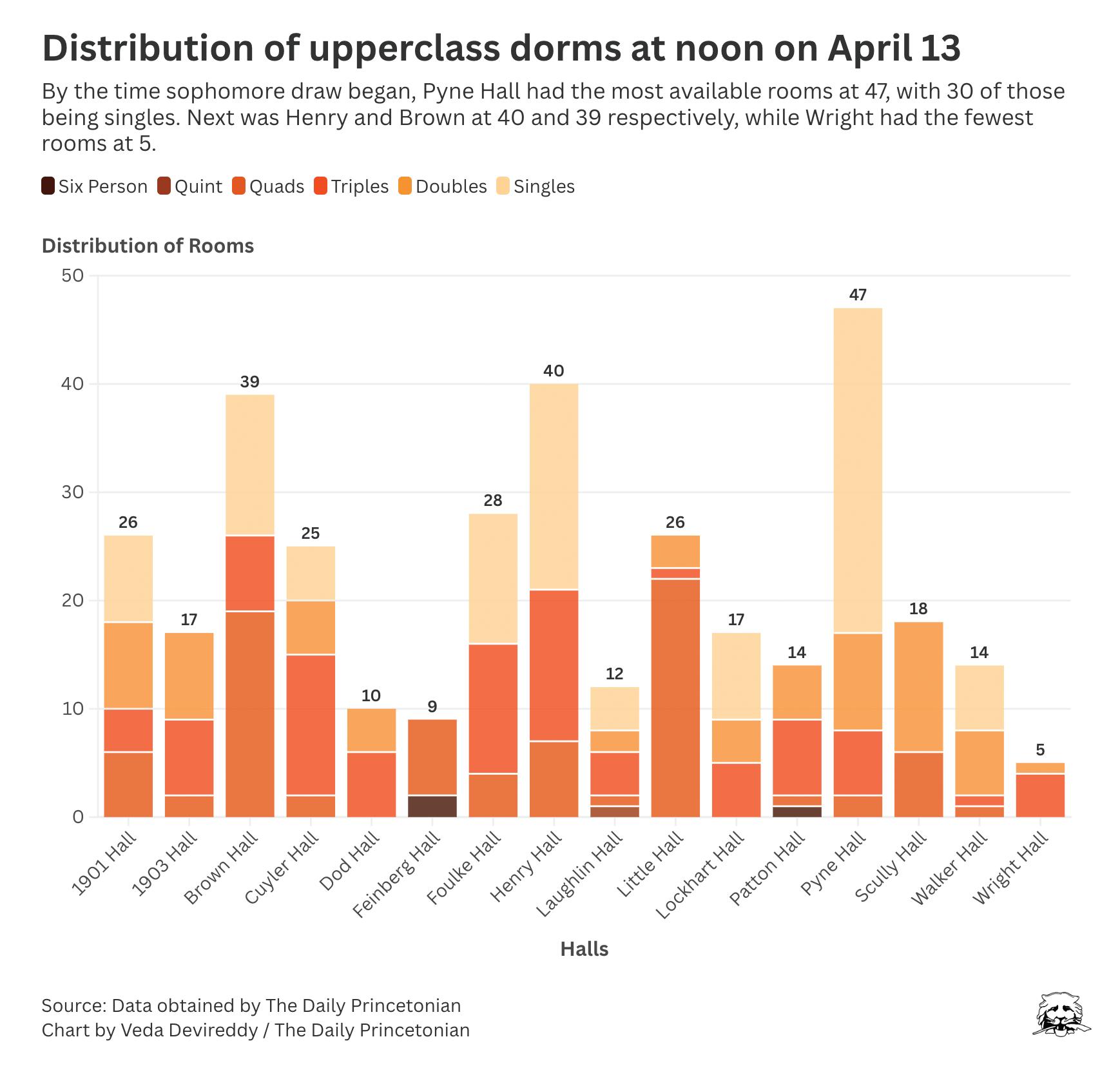
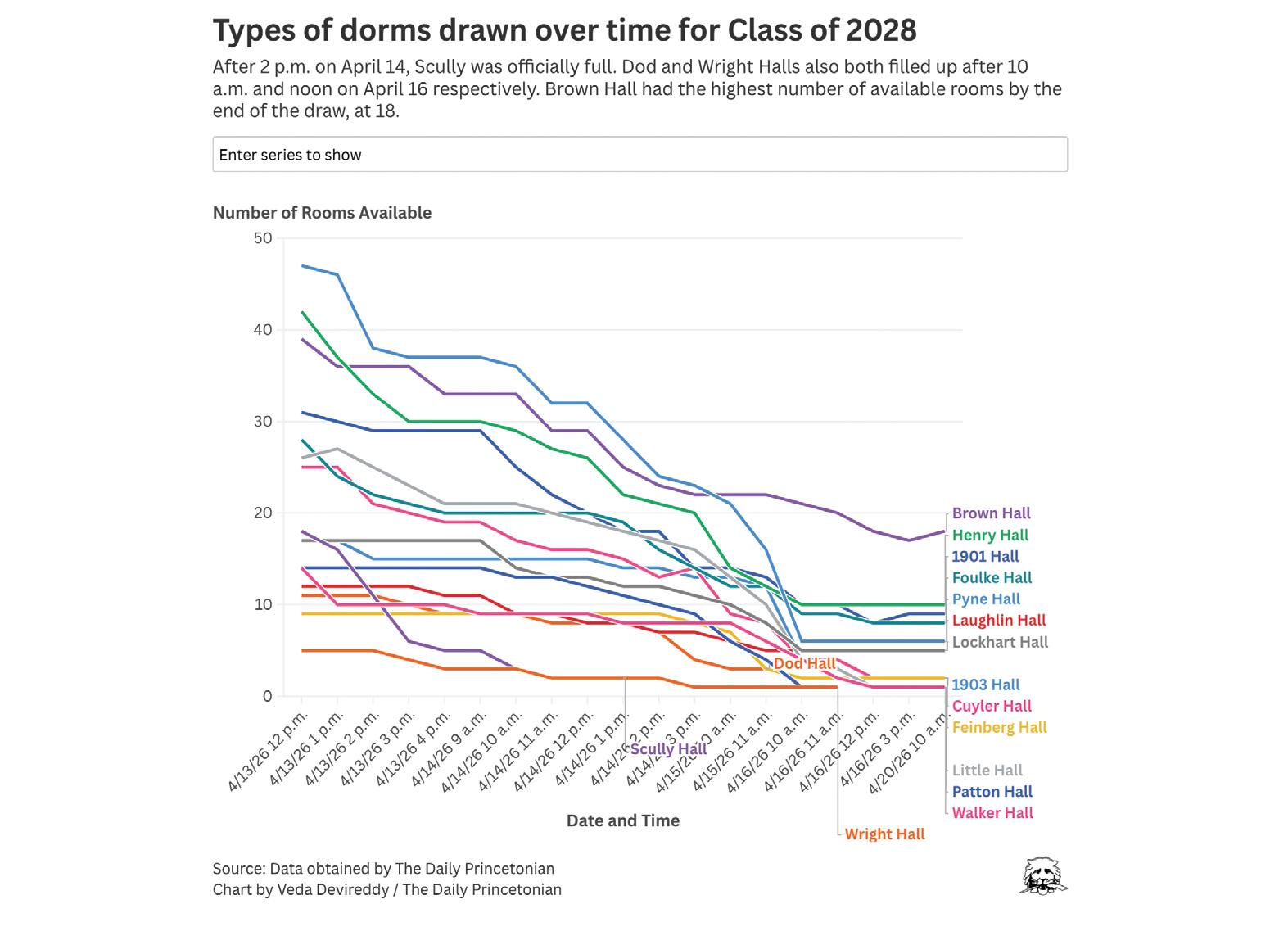
The Class of 2028 finished picking their dorm rooms for the next academic year at 10:38 a.m. on April 17, their first experience of a revamped room draw system. While there were 355 rooms and 869 upperclass beds available at noon on April 13 — around the start of rising junior draw — there were only 70 rooms and 242 upperclass beds left by 10 a.m. on April 20. In total, 285 rooms and 627 upperclassmen beds were chosen by rising juniors, with an average of 2.2 individuals per room. This is 0.8 individuals higher per room than last week’s rising senior draw, which had only 1.4 individuals per room on average.
At noon on April 13, Pyne Hall had the highest number of available upperclass rooms at 47, with 30 of these rooms being singles. Next were Henry and Brown Halls with 40 and 39 total rooms, and 19 and 13 singles available, respectively. Scully, which had the highest number of available rooms at the start of rising senior draw at 159, had only 18 rooms left by the start of the rising junior draw. Some halls, like Feinberg, had not been drawn into at all by the Class of 2027, and so were fully available for the sophomore draw.
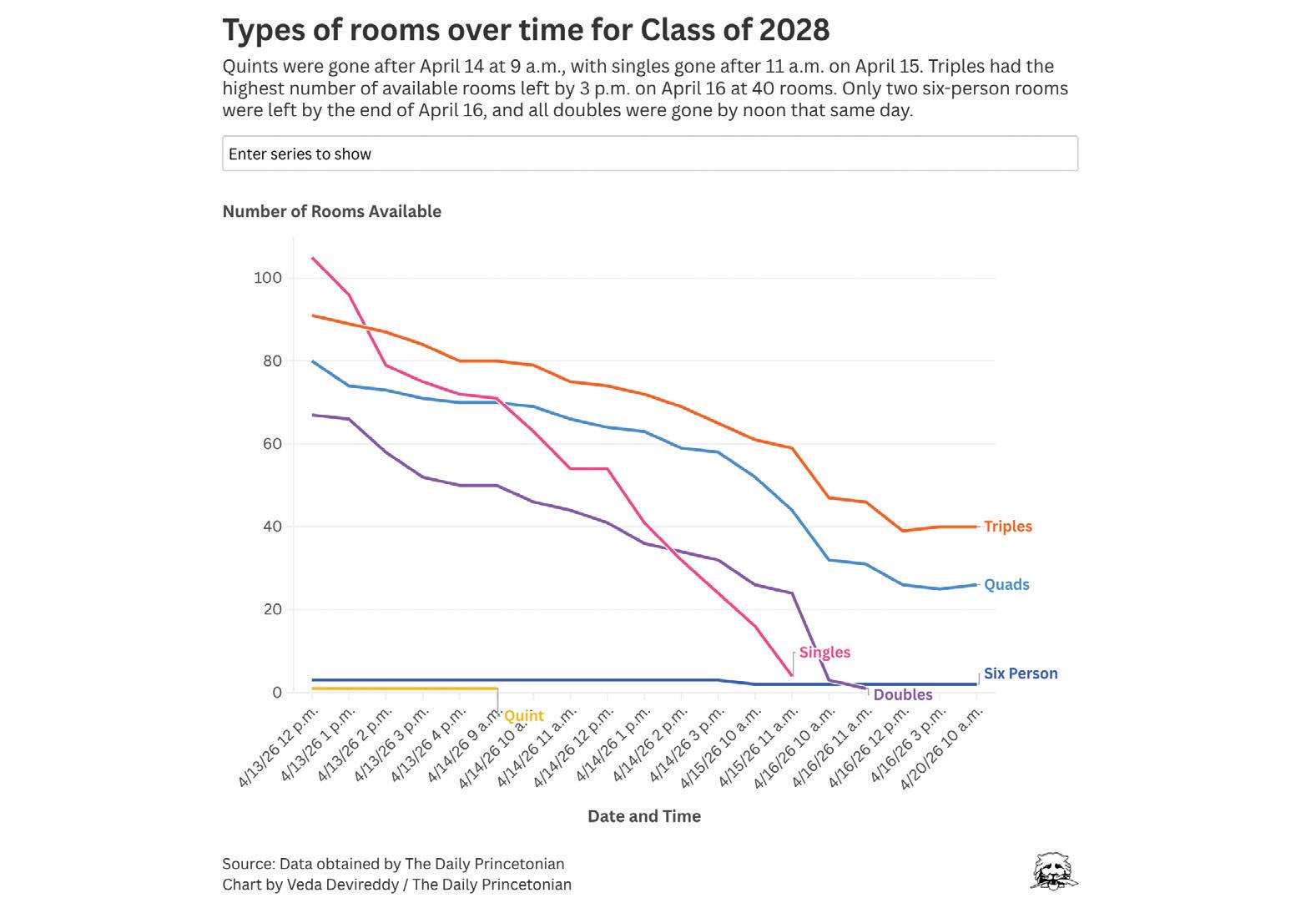
Singles, which were by far the most popular room for the Class of 2027, were gone by the second day of sophomore draw. Quints were also filled, with the second of two originally available quints gone by 10 a.m. on April 14. After 2 p.m. on April 13, when the number of singles fell from 105 to 79, triples had the highest number of available rooms for the rest of sophomore draw. By the morning of April 20, the remaining number of triples was almost twice that of quads, at 40 and 24 rooms respectively. Only two six-person rooms were left by the end of the rising junior draw, and all doubles were gone by noon on April 16. Notably, between 3 p.m. on April 16 and 10 a.m. on April 20, there was little change in the data, although around 38 groups were still left to draw after 3 p.m. on April 16.
Singles, which were by far the most popular room for the Class of 2027, were gone by the second day of sophomore draw. Quints were also filled, with the second of two originally available quints gone by 10 a.m. on April 14. After 2 p.m. on April 13, when the number of singles fell from 105 to 79, triples had the highest number of available rooms for the rest of sophomore draw. By the morning
of April 20, the remaining number of triples was almost twice that of quads, at 40 and 24 rooms respectively. Only two six-person rooms were left by the end of the rising junior draw, and all doubles were gone by noon on April 16. Notably, between 3 p.m. on April 16 and 10 a.m. on April 20, there was little change in the data, although around 38 groups were still left to draw after 3 p.m. on April 16.
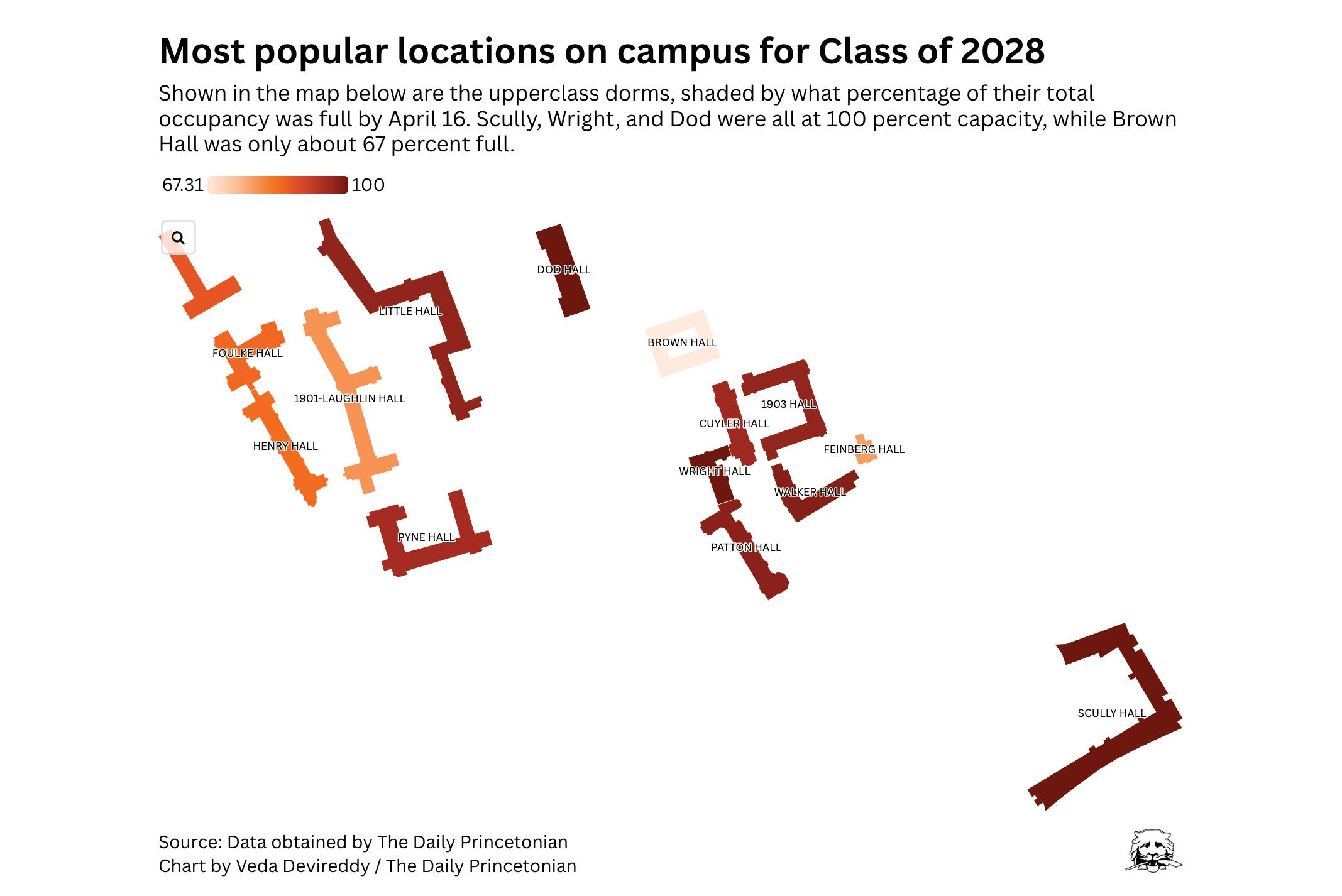
In terms of location, sophomores generally followed trends established by the current junior class. By the end of rising senior draw, the very popular Dod, Scully, and Wright Halls were all over 60 percent full. By 3 p.m. on April 16, all three of these dorms had reached capacity. Pyne continued to be in-demand as well, filling to 94.78 percent. Brown Hall, one of the least popular choices in senior draw, still reached over 65 percent capacity overall. And Feinberg, which had none of its nine rooms chosen by the Class of 2027, had seven of its rooms selected by the Class of 2028. Still, the least occupied halls, by percent, were Brown, Feinberg, and 1901-Laughlin.
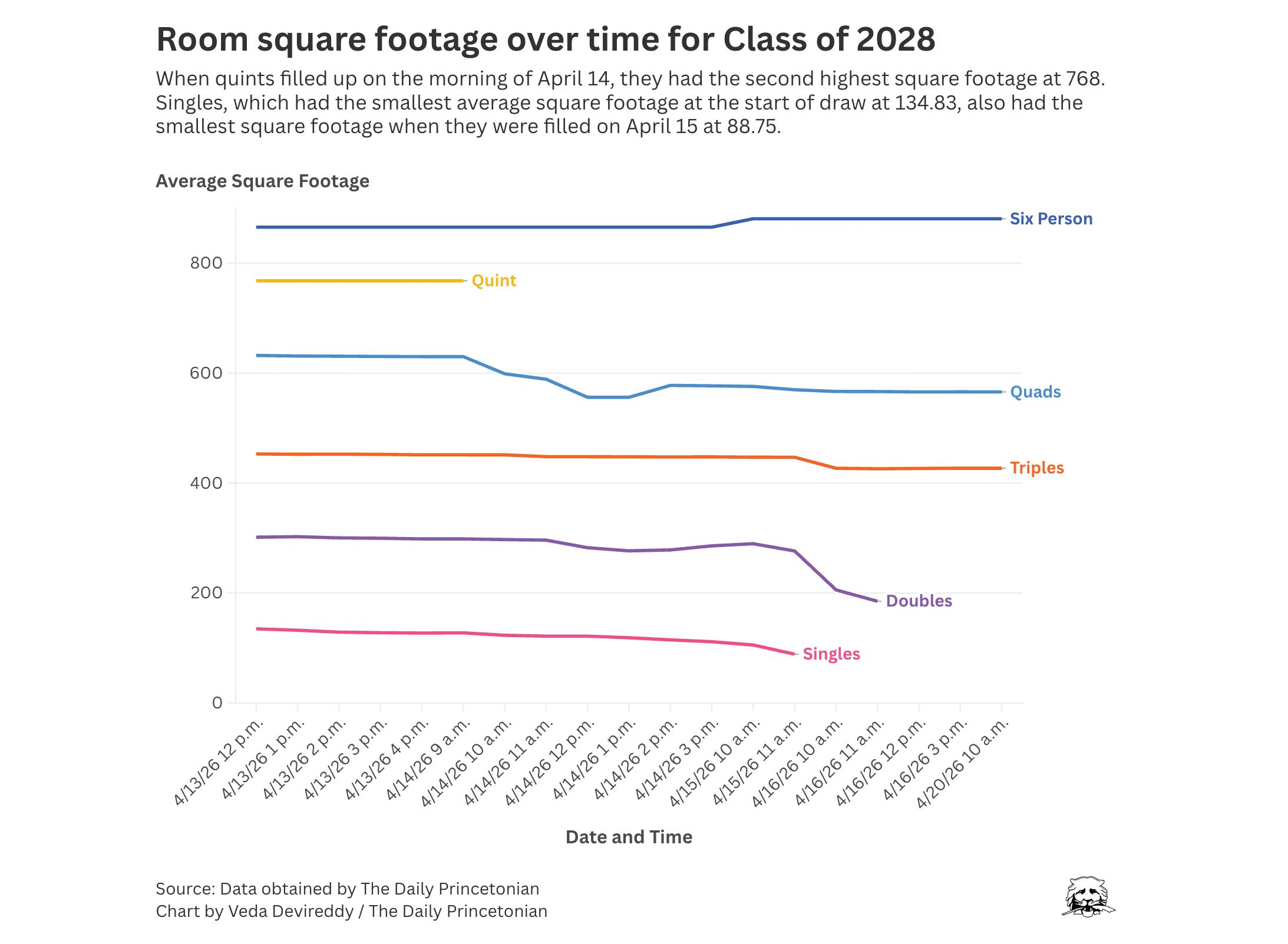
In terms of the size of the dorms chosen over the course of sophomore draw, doubles saw the most noticeable decrease in average size, starting at 301.59 square feet and ending at just 185 when they filled up on April 16. Quads fell from 632.3 to 566.04 square feet, a loss of an average 66.26 square feet over the four days. When quints filled up on the morning of April 14, meanwhile, they had the second highest square footage at 768. Singles, which had the smallest average square footage at the start of draw at 134.83, also had the smallest square footage when they were filled on April 15 at 88.75. Triples and six-person rooms remained fairly constant in size throughout the draw.
Data from 10:06–11 a.m. on April 13 for rising junior draw was not available for this article, nor was data from 9–10:38 a.m. on April 17. Regardless, the graphs above serve as a sample for what the Class of 2028 was looking for in their future dorms and characterizes the array of metrics — from size, to capacity, to location — that they used to make their choice.
Veda Devireddy is an assistant Data editor for the ‘Prince.’ She is from Baton Rouge, La.
Vincent Etherton is a senior Data writer and head Data editor emeritus for the ‘Prince.’
Andrei Dragomir Contributing Opinion Writer
According to the Senior Survey for the Class of 2025, graduating Princeton seniors’ most-studied language was Spanish, with a full 29.2 percent of students studying it. However, the second-most-studied language, with a representation of 23.7 percent, is no language at all.
Many engineers don’t study a language. While only 10 percent of A.B. students go through Princeton without taking any foreign language classes, the same statistic for Bachelor of Science and Engineering (B.S.E.) students is a whopping 56 percent.
Because studying a foreign language is not a requirement for completing a B.S.E. degree, many engineering students don’t make space for them in their schedules. More importantly, introductory language classes don’t even count towards B.S.E. students’ humanities and social sciences distribution requirements. As a result, B.S.E. students often go through Princeton without the incentive or space in their schedules to learn a new language. To remedy this, Princeton should allow B.S.E. students to count language courses at the 102-level or above as credits toward their humanities requirements.
Studying a language at Princeton is one of the most unique and
Encourage engineers to learn a new language from scratch
satisfying academic experiences available on campus. Though language learning is not an opportunity unique to Princeton, the small size of the classes and consequent approachability of instructors is hard to find outside universities like Princeton. Studying Japanese in my first semester changed my academic trajectory in a way I wouldn’t have imagined possible before Princeton: I declared East Asian studies as my major partially thanks to how much I enjoyed Japanese. Cultural immersion, mediated through language learning, has the power to change lives. However, for a significant number of students, particularly engineers, learning a completely new language doesn’t seem like a viable option. Engineering students need to take seven humanities and social sciences courses during their four years at Princeton, but languages count towards this requirement only for classes at the intermediate level — that is, 107- and 108-level for Romance languages and 105- and 107- level for other languages — and above. Under this system, without any previous background in a foreign language, if a student wanted to satisfy their requirements using a language class, they would have to take two or three classes to satisfy just one requirement. Why would anyone — save for those most committed to language-learning for its own sake — do this when they could just
take one relatively undemanding intro-level humanities course to satisfy the same requirement?
Furthermore, consider how many requirements engineering students need to complete in order to graduate: six engineering prerequisites, seven humanities requirements, and at least nine departmental requirements.
Within such tight constraints, it’s often unfeasible for B.S.E. students to take elective classes that don’t fulfill any requirements. Most of the introductory sequences have either one or two classes before students reach the intermediate level. For example, in French or Spanish, the 101-102107, 103-107, and 105-108 sequences are considered equivalent. In Japanese, the only way to reach the intermediate level without previous proficiency is 101-102-105. Plus, intro language classes cannot even be taken with the pass/D/ fail grading option, something available for many humanities courses engineers could use to fulfill their requirements.
In light of this, there is little reason to completely discount introductory level language classes from counting towards the humanities requirement. There isn’t any fundamental change in the structure or purpose of language classes once they reach an intermediate level, and the School of Engineering and Applied Sciences policy should reflect that. If classes starting with the 102 level counted for the humani-
ties requirement, engineering students would be able to obtain credit for language courses from their second course in the sequence, or even the first if they have previous background in it. This wouldn’t encourage shallow study: since students would not receive credit for 101 level classes, they are still incentivized to engage deeply with a new language and not stop learning after acquiring the most basic competency level.
With this change, B.S.E. students who truly wish to learn a new language would have a better incentive to do so. Even if bilingual B.S.E. students could theoretically try to take advantage of this requirement by taking introductory-level courses in a language they already know, it would either be a mind-numbing experience to lower their language ability for the class or professors would instruct the student to take a more advanced class.
Engineering students have a host of reasons they might want to learn a new language at Princeton. On the one hand, research has shown that language acquisition and proficient bilingualism improve both divergent thinking abilities, which is used when coming up with creative ideas during brainstorming, and convergent thinking, which is used when needed to focus and push through with one singular idea. Both of these skills are essential
to solve problems engineers face daily in their careers, so language learning would be directly beneficial to them.
On the other hand, language learning has value to it as a key component of a liberal arts education. One of the pillars of liberal arts education is cultivating a sense of awareness and appreciation for the diversity of ways human knowledge and expertise can come into being. There is no better way to engage with this diversity than by encountering it in its native language, whatever that might be. In a world where artificial intelligence and similar technologies promise to impact humanity at an unprecedented scale, we need engineers who understand this scale not only as a number, but as a human and intercultural reality.
Engineering students at Princeton would benefit significantly from developing proficiency in foreign languages, and they should have the option to do so without setting them back in their degree progress. Aspiring engineers are expected to master programming languages like Java and Python. It’s past time they got to learn Spanish or Chinese, too.
Andrei Dragomir ’28 is a contributing Opinion writer from Brasov, Romania. He is majoring in East Asian Studies, with prospective minors in computer science and history of science.
Applications won’t solve the undervaluation of creative writing courses
Lily Halbert-Alexander Head Opinion Editor
Student course reviews have assigned a clear epithet to the classes offered in Princeton’s creative writing department: “easy.” While most comments address the low workload and time commitment, even the occasional praise for the discussion environment and readings are mostly niceties plastered over the foundational mission of the review: assuring future students that they won’t have to work very hard.
This tension is amplified by the pressure of high demand and limited seats for the classes, which raises considerations on how to balance inclusivity with an engaging class environment. But the politics of enrollment are the organizational symptom of a larger concern: The normalization of labeling these courses as “easy” is an indicator of a diminishing perceived value for the intellectual and social impact of the personal voice.
Two years ago, Sarah Park published a column in support of reinstating the application process — the norm for creative writing classes until Fall 2022 — as a solution for the undervaluing of creative writing courses. The applications would function as a weed-out mechanism for students who dismiss the classes as easy credit fulfillment and fail to take advantage of the opportunities which might better serve a more engaged or, at minimum, more interested student. If the issue of the dismissal of Creative
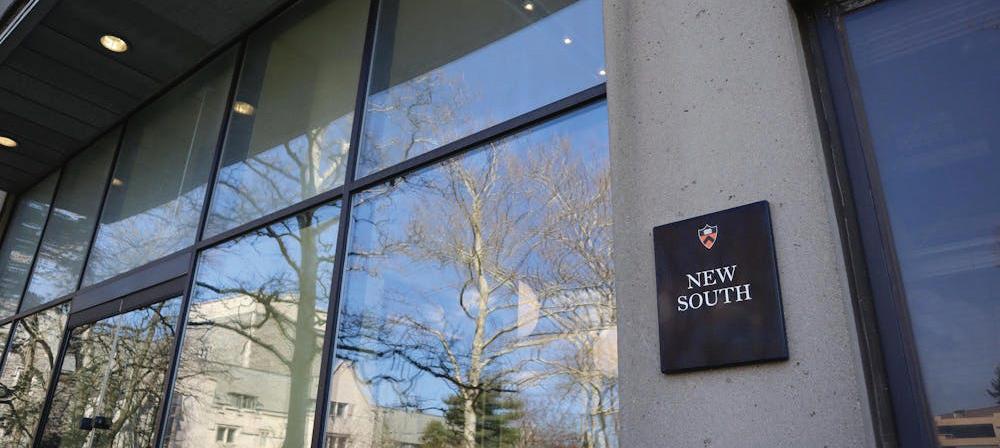
Writing courses as “easy” is defined as or consolidated into the fact that the wrong students are ending up with seats, applications would present a very neat solution. But the problem is not the possibility that some students sit in New South, enrolled in CWR 204: Creative Writing (Fiction) as their “easy fifth,” while a future James Joyce is roaming uneducated around campus, disadvantaged and lost to history as a result of the randomized admission process. Rather, what should concern us is how the deliberate and meaningful process of creative writing — the work of close attention and response to the world outside us, as well as the exploration of the sensations and experiences that make us human — is dismissed as “easy.”
The Princeton Courses website is a forum for candid evaluations of course demands, and Creative Writing is by no means the only department whose reviews advise students to enroll to meet a distribution requirement with minimal pain. It’s not unusual — nor is it surprising — for Princeton students, inundated with responsibilities, to seek out less demanding courses in order to balance their schedules.
But the degree to which introductory Creative Writing classes as a collective are branded as “easy fifths,” “easy sixths,” and “easy LAs” — or, more eloquently, “so chill” — is unique. It’s indicative of more than a resigned student attitude toward distribution requirements. It’s especially problematic to distill the experience of a Creative Writing class into an easy passing grade when these courses are con-
cerned with deepening the emotional and intellectual human experience, beyond just conveying knowledge. Learning to develop a creative consciousness is a way of learning to be present — more intelligent and more caring about our own lives and the lives of those around us. This isn’t just a theoretical practice: It informs our daily life and capacity to exist in meaningful community.
Part of the challenge of creative writing is the process of negotiating the complexities of our experience in language: That is an inherently human challenge, which is why the dismissal of these classes as easy is all the more concerning in the age of artificial intelligence. The New York Times published an article a few months ago quizzing readers on their ability to distinguish samples of creative writing written by artificial intelligence from those written by humans.The justified uncertainty this piece raises indicates a rising instability about how to define real writing, how to define good writing, and ultimately why we should bother writing at all.
Leading yet another discussion of the creative and humanistic fields back to an anti-AI soapbox feels almost clichéd. But the preoccupation with product over process that arises in this NYT article suggests that personal, human creative labor and the experience that informs it are increasingly devalued, or are at minimum misunderstood as easy or mechanical, so long as its product can be adequately and impressively mimicked.
Meaningful creative writing is a pro-
cess of discovering what interests, upsets, and moves us, not just in writing itself but in our individual lives and the world we share. Writing and translating are not only about what you create but how you create it. The notion that this work is “easy” is the notion that it’s no big deal to be a thinking, feeling human individual.
As such, in a time when there appears a growing devaluation of the intellectual and emotional significance of creation, it would be remiss to simply attribute the undermining of creative writing courses to the fact that too many spots are going to the ungrateful students over the engaged ones.
You could also make the case that creative writing classes are deemed “easy” simply because they are P/D/F-only, and not because of a larger social and existential undervaluation of the development of the self. It would be nice if all this started and ended with the P/D/F.
But it’s worth noting that the very
things we’re dismissing en masse as “easy” — self-reflection, individual voice, personal insight, and close sensory observation — are exactly what we’re doing less and less of. The widespread miscomprehension of these classes as easy is, at its most basic, annoying. But more fundamentally it’s a sign that our value of individual identity and experience — and their capacity to inform our intellectual and human existence — is deteriorating. This problem isn’t going to be solved by increased exclusivity. But it might be remedied by a greater recognition of the challenge and subsequent reward of sharp observation and close analysis of our own and others’ experience. None of us have to be Joyce: we just have to be — in the spirit of another cliché — our own thinking, feeling human selves.
Head Opinion Editor Lily Halbert-Alexander is a sophomore in the English department from San Francisco.
editor-in-chief Jerry Zhu ’27
150TH MANAGING BOARD
Frances Brogan ’27
creative director Juan Fajardo ’28
Corbin Mortimer ’27 Maya Mukherjee ’27
Sections listed in alphabetical order.
associate
editor Annika Plunkett ’28 head
The humanities don’t need to be afraid of AI
Ava Chen Contributing Opinion Writer
reels editors Angelyn Ansah ’28 Molly Ziskind ’28
head cartoon editor Noam Rabinovitz ’27
associate cartoon editor Paulette Martinez ’29
head copy editors Sarah Li ’28 James Thompson ’27
associate head copy editors Roberto Sampaio ’28
’29
DuBois ’28
editor Tarun Iyengar ’28
associate humor editors Nicolas Rohou ’28 Francesca Volkema ’28 head news editors Nico David-Fox ’28 Luke Grippo ’28
associate news editors Sena Chang ’28 Haeon Lee ’28 Caitlyn Tablada ’27
’28
editors Lily Halbert-Alexander ’28 Charlie Yale ’28 associate opinion editors Isaac Barsoum ’28 Shane McCauley ’28 head photo editor Emily Tang ’28
associate photo editor Siena Sydenham ’29 head podcast editor Devon Rudolph ’28
head sports editors Lily Pampolina ’27 Doug Schwartz ’28
associate sports editors Lucas Nor ’28 Matthew Yi ’27
head web design and development editors Cole Ramer ’28 John Wu ’28
strategic initiative directors
Graphics Caroline Naughton ’29
assistant
Education Charlie Yale ’28
Cai ’29
Dauber ’29
Liu ’29
Mironov ’29
’26
150TH TECHNOLOGY
’28
’26
software engineers
Nicole Deng ’28
Ziya Momin ’28
Kyaw Naing ’28
Stephanie Sugandi ’27
Albert Rho ’29
Lucy Zschoche ’29
Jamie Creasi ’28
Marley Hartnett-Cody ’28
BOARD OF TRUSTEES
president Thomas E. Weber ’89
vice president David Baumgarten ’06
secretary Chanakya A. Sethi ’07
treasurer Douglas Widmann ’90
assistant treasurer Kavita Saini ’09
trustees Francesca Barber Kathleen Crown
Suzanne Dance ’96
Gabriel Debenedetti ’12
Stephen Fuzesi ’00
Zachary A. Goldfarb ’05
Michael Grabell ’03
Danielle Ivory ’05 Rick Klein ’98
James T. MacGregor ’66
Rohit Narayanan ’24
Marie-Rose Sheinerman ’23
Julianne Escobedo Shepherd
Abigail Williams ’14
Tyler Woulfe ’07
trustees ex officio Jerry Zhu ’27 Alistair Wright ’27
ast semester, my English professor acknowledged that he probably wouldn’t recognize an essay generated by artificial intelligence, but also warned students that if this was the route they chose, they would only be cheating themselves. The value of a humanities education should not come from a desire for a good grade, but rather from a love of learning and the process of developing original ideas, and he trusted that his students felt the same, he argued. Princeton’s humanities departments are far from a consensus on the regulation of AI usage. Some have instituted department-wide policies, like the history department’s ban on using AI as a “text-generation tool,” while others, like the English department, have not yet implemented an official policy. Many of my own professors have expressed concerns over the capabilities of AI to author convincing essays, interpret dense sources, and create shortcuts.
From higher ed journalism to concerned professors, AI is often portrayed as an unprecedented frontier to be tamed, a danger to both the future of the humanities and the independent, critical thinking abilities of its scholars. But a strict AI ban is superfluous, not to mention difficult to enforce: If students are plugging essay prompts into ChatGPT en masse, there are larger issues at stake that a band-aid AI ban won’t fix.
Yet AI does not actually destabilize or introduce any new threat to higher education in the humanities. Upper-level courses in the humanities overwhelmingly self-select students who are genuinely passionate about the material and do not want to replace their original thinking with AI. The demanding workload and complexity of these courses inherently draw a
body of students motivated to think for themselves, and they are unlikely to take AI shortcuts. Furthermore, the unique specificity, creativity, and originality required to study these subject areas are inherently difficult for the homogenization and generic writing style of AI to adequately replicate.
In my current English seminar on film adaptation, for example, close reading and watching is essential for successful and substantive engagement. In each discussion and Canvas post, we analyze specific punctuation choices, the slight expression shift of an actor, and thematic parallels with a text discussed weeks ago. We frequently disagree and debate interpretative arguments, and the productivity of this conflict represents exactly the kind of insight which AI’s regurgitated material fails to replicate. Generative AI can summarize, but it cannot offer the highly individual and varied set of perspectives that emerges from a discussion between a group of advanced humanities students. It can give a homogenized, Western-centric, and bland perspective, but it cannot come up with the unique, differing personal viewpoints that are so central to a meaningful seminar. Studies have routinely shown that AI writing displays lower rates of ideological and stylistic diversity than human subjects.
But even if AI eventually develops the ability to meaningfully close-read and come up with unique arguments, the future of the humanities will not necessarily be in jeopardy. While some students in humanities classes see no problem with AI usage — and would prioritize passing a course or minimizing effort over meaningful engagement — there still exist passionate humanities students who want to contribute to their fields with original thinking driven by their human perspective and experience. AI will not replace human scholars, even if it becomes capable of an A-level
paper, because motivated students won’t allow AI such influence and power.
One may reasonably argue that this view is too idealistic — after all, the overbooked schedules of Princeton students makes efficiency the academic ideal, driving students toward AI due to perceived necessity. Indeed, if one can get away with AI-generated essays for a decent grade, freeing up valuable time and mental effort, then why wouldn’t they? But underlying this question are the issues of profit-seeking and misaligned motives in education, which have existed far before AI. AI is a new manifestation of the same problem, and no technology ban will solve it.
In suggesting that AI will not undermine the intellectual integrity of the humanities, I’m not saying that the humanities won’t evolve. But evolving is not the same as vanishing. To suggest that AI-generated analysis and sped-up research techniques will replace real humanistic scholarly work is not just to overestimate AI’s capabilities, but to underestimate the passion of the students who care to do this scholarship themselves.
Humanities departments should approach AI not as an unprecedented antagonist but rather as a tool with both admissible and inadmissible use cases. AI is not fundamentally revolutionary to human thought, nor capable of replacing it. It enables jaded students to cheat more easily, and it helps motivated scholars to pursue their original research with new and innovative strategies. In other words, it only amplifies and enables our existing tendencies. AI’s effects are more human — and less artificial — than its name may suggest.
Ava Chen is a contributing Opinion writer and an English major from Massachusetts who is pursuing a minor in Computing, Society, and Policy.
A major rethink: pushing back B.S.E declaration
Emily Zhang Opinion Columnist
In a recent article published in The Daily Princetonian about Declaration Day, an A.B. student expressed satisfaction at having had adequate time to choose a discipline: “I think that it’s really exciting that we have had the past two years to explore different majors.” If A.B. students are granted this necessary time, why can’t B.S.E students get the same opportunity?
Indeed, last week marked the end of the sophomore A.B. and first-year B.S.E. major declaration period. For me, it was a rushed experience: I, as a firstyear, both switched from A.B. to B.S.E. and then had to declare in quick succession.
That sense of urgency was not unique. Many of my peers in math and physics classes described feeling as though they had made the declaration decision under pressure. And for many of us, declaring came before ever stepping in an engineering departmental classroom.
In reality, we had very little class experience on which to base our decisions about the department we were to join for the next three years. Instead, we made our decisions based on what we heard at departmental open houses a week
prior to the declaration period — namely, presentations from faculty and upperclassmen. For many, this was not enough to understand what studying in any of the fields truly involved.
At a University that prides itself on student independence and intellectual curiosity, the expectation that first-year engineering students declare a major before taking a single departmental course feels out of step with its values. Though technically “tentative,” the declaration still creates a sense of commitment that limits exploration and adds unnecessary pressure.
Engineers undecided between multiple majors are often informally advised to choose the major with the most required courses, like Mechanical and Aerospace (MAE) or Chemical and Biological Engineering (CBE), even if they don’t plan to stay within those departments. One Reddit user on r/Princeton noted that many students in the CBE department declare without taking a single CBE course, and ultimately “dislike the major.”
Others declare majors while fully expecting to switch later.
The fact of the matter is that students are being asked to choose a path before they understand what that path entails. The common justification is that early declaration helps students stay on track
with strict B.S.E. requirements.
But this logic is inconsistent. In their first year, prospective engineering students already manage prerequisite courses and strict requirements effectively without belonging to a specific department. There is no reason to expect that same responsibility wouldn’t carry forward another year. Princeton engineering students are capable of navigating degree requirements — they do not need a relatively binding label at the end of their freshman year to do so.
Engineering students are required to take a total of eight foundational STEM courses: four in math, two in physics, one in chemistry, and one in computing. When prospective A.B. STEM majors with a comparable number of required foundational courses — like those in chemistry and molecular biology — get two years to declare, having B.S.E. students declare a year earlier seems less sensible, and not necessary to keep them on track to graduation.
An argument in support of early declaration is to connect students with a faculty adviser in their department, theoretically offering more tailored guidance. In practice, though, the merits of this policy are mixed. Many of my B.S.E. peers and I find ourselves relying primarily on departmental websites and peer advice
to plan our coursework, not faculty. As professors and researchers first, advisers are not omniscient about the exact requirements of their department.
A.B. students have faculty advisers that are assigned to them when they enter Princeton, and remain with them through the time they declare their major in their sophomore year. If the School of Engineering and Applied Science were to adopt a similar approach, with advisers for the first two years who have general knowledge about how the B.S.E. degree works, it would give students a more consistent resource and allow them to make an educated decision later in their academic careers.
While advising can help students stay on track, it is also not the sole determining factor in whether students do so.
If anything, the need for advising suggests a different solution: Instead of requiring B.S.E students to declare, at the end of prospective B.S.E. students’ first year, Princeton could allow them to select multiple simultaneous advisers based on majors they are considering at the time.
Making students declare a major this early isn’t necessarily ill-advised. But if Princeton expects students to do so, it should first provide meaningful exposure to the disciplines they are choosing between.
For example, a first-year engineering design program across engineering fields would give students a basis for comparison. At Duke — which similarly expects engineers to declare after their first year — students not only take a first-year design course, but also an engineering course in a major of interest. Without this kind of exposure, it’s difficult to justify this expectation to declare so early.
Faced with limited information, students often choose what seems most prestigious or safest rather than what genuinely interests them. This runs counter to the purpose of an engineering education, which should foster curiosity and thoughtful engagement. An institution like Princeton emphasizes independent thinking. Requiring early declarations suggests the opposite — that students cannot be trusted to explore while progressing nor to make informed choices in time. If Princeton values intellectual independence, it should reflect that by giving its engineers the time and flexibility to make informed decisions.
Emily Zhang ’29 is an Opinion columnist for the ‘Prince’ from Poughkeepsie, N.Y. She is a recently but tentatively declared operations research and financial engineering major.
Bring back the old Late Meal hours
By Melissa Gonzalez Solis | Contributing Cartoonist
“L ive and L et d rive ”
By Ethan Cole Contributing Constructor
ACROSS
1 Strives (to)
5 Cheese that is made backwards?
9 Engine cover
13 Texter’s response to a funny joke
14 Spice Girl Halliwell
15 Boo-boo
16 “Fur is Dead” org.
17 Biotech products, for short
18 Depend (on)
19 Solo actor
22 Darth Vader’s childhood nickname
23 Pops
24 Black eyeliner wearer’s genre, maybe
25 Airport org.
28 “Big” actress who won a Tony and Oscar in the same year
32 Watts, Campbell, and Osaka
34 “No idea,” in a text
35 Overlook for an Oscar nomination, say
36 Laura of “ER”
37 Hosp. staff, for short
38 One Direction’s Liam
39 Thor’s father
40 Flock talk?
41 Envoy
42 Rocket’s human voice
45 Snakelike fish
46 “___ be an honor”
47 Bugs on the road
48 Genetic material
51 Films built around a single talent... or a hint to 19, 28, and 42 Across
54 Uproar
56 Dublin’s land, to Dubliners
57 “That’s ___” (sarcastic response)
58 “Survivor” immunity token
59 China’s continent
60 ___ upon a time
61 The ___ of one’s existence
62 QB Stafford
63 Co. heads
1 ___ : first :: omega : last
2 Let me clarify
3 Of or relating to marriage
4 Fly high
5 Where spiders develop
6 Out of fashion
7 Elvis’s middle name, originally
8 Printer problems 9 Friday the 13th genre
10 Had to pay back
11 Tin Man’s need
12 Susan of “L.A. Law”
20 Actor Elba 21 Siberian city 25 Boundary for “first and goal” plays
26 Push aside
27 “Who’s Afraid of Virginia Woolf?” playwright
29 Correct, as text
30 1933 Physics Nobelist Paul
31 Word application 32 Weeper of myth
33 Wrestling’s ___ the Giant
37 Mind wandering
38 Coke rival
40 What follows 1-Down
41 Oven setting
43 Teensy
44 Having lost interest
49 Classic brand of candy wafers
50 Campfire remains
51 The “S” of A.S.A.P
52 Foriegn traveler’s need
53 Shoe with holes
54 One of 24 in the human skeleton
55 Jounalist ___ B. Wells
Somewhere in a Rocky dorm...
By Anelise Chun | Contributing Cartoonist
Stories Woven Together: TEDx returns to Princeton
By Melinda Huang Contributing Features Writer
On March 28, Princeton hosted its first TEDxPrincetonU conference since November 2020. As more than one hundred people crowded into Frist Theater to listen to speeches relating to the theme “Interweave,” a spotlight lit up the stage. On the left of the stage sat the signature 3D red letters: TEDx. In white letters on the right: Princeton, a 3D model printed by Misimi Sanni ’28, president of TEDxPrincetonU.
In high school, Sanni was heavily involved in public speaking, something she wanted to continue pursuing at Princeton. “I thought the next natural extension was a speaking conference [at Princeton],” Sanni said in an interview with The Daily Princetonian.
Sanni was “really surprised” that no one had hosted a TEDxPrincetonU event in recent years. “I wanted to see a general speaking conference. And then I realized that we could apply for a TED license, and that’s why I did it there,” Sanni added.
Looking for others to join her in her mission to expand the club, she reached out to Madison Jung ’28, who became copresident. Now, with eight board members and after a year of planning, the TEDxPrincetonU event came to fruition.
The event was divided into two sessions, with four speakers per session.
Students, faculty, and external speakers were eligible to apply for a speaking slot. Sanni stated that applications, including required video samples, were solicited from the student body. During the selection process, organizers evaluated both proposed topics and applicants’ public speaking abilities. The team sought speakers that brought new perspectives and engaging topics, and “speaking quality, memorization, [and]
expression” were also considered.
As for external speakers, around 20 to 30 contacted the TEDxPrincetonU team, expressing their interest in delivering a speech, Sanni said. In the end, only 2 external speakers were accepted: Caitlin Begg and Andrae Alexander.
Mechanical and aerospace engineering major Wilson Moyer ’27 spoke in the first session, discussing the power of small acts of kindness in our everyday lives. Inspiration for his speech emerged one day while Moyer was on a flight back home. The stranger who sat down next to him helped put away his jacket, figure out which train to take upon landing, and even turned on closed captions when they noticed Moyer was watching their movie out of the corner of his eye.
Acts like these had a bigger impact on Moyer’s day than the strangers might have expected. “What they didn’t know was that I was on a plane flying home from saying goodbye to my dog for the last time,” Moyer told the ‘Prince.’
For this reason, Moyer used his speech to urge others to recognize the importance of kindness and gratitude.
“I hope people walked away from my TEDx talk feeling like even if it’s just a small thing, it can still have an impact,” he said.
The first session concluded with Andrae Alexander, a Grammy Awardwinning composer and professor of music industry studies at the University of Southern California. Alexander’s talk focused on the potential harms of permitting artificial intelligence-generated music to replace human artistry.
Inspiration for his talk emerged through his experiences as a career musician, which made him understand the intimate relationship between performers and the audience. “There’s a relationship between the audience and the performers that most don’t realize has been
in existence since Socrates and before,” Alexander told the ‘Prince.’
“With the introduction of AI, that sacred relationship [between performers and the audience] is being tainted, because now you have these private entities that train their models on intellectual property,” Alexander continued, explaining the threats to intellectual property that occur when AI profits off man-made works without crediting the maker.
Alexander proposed multiple solutions to this problem, including “clear labeling between humans, mostly human, and AI created works so that people know,” and “options on every platform to allow consumers to have the choice whether to engage with AI or not.”
The second session began at 1 p.m. with another four speakers. Matthew Sierra ’29 began the session with an anecdote from his eighth-grade self. Pointing to a photo of himself that he described as a “devilishly handsome young gentleman,” he described the moment he discovered the guitar in eighth grade and played a recording of a song he thought was his own original music.
Upon sending his song to his teacher, Mr. Ferguson, however, Sierra recalled how he started to panic. He’d accidentally copied “We Shall Overcome.”
“I felt like a fraud. I thought it was terrible,” Sierra said in his talk. He recalled how his song was proof of “stealing.” This moment, however, taught him a lesson: “musicians exist in a lineage.”
After playing various clips from famous songs and highlighting their similarities, Sierra concluded, “I encourage you all to remember to stand on the shoulders of giants and to look at the contributions that came before you, because it’s only by acknowledging this past tradition that we can hope to make something good in the future,”
The next speaker, Catherine Marie Mellett Felix ’29, spoke about her educational journey from Mexico to America. Felix was used to excelling in school ever since kindergarten, a common experience among Princeton students. However, transitioning to Princeton, she “went from being the smartest kid in the room to the dumbest,” she said.
Felix is a contributing Podcast producer for the ‘Prince.’
“I wasn’t the perfect student now, I was just a learner, because being dumb is kind of like a superpower,” Felix continued, noting that it allowed her to embrace her love for learning without fear of high expectations.
The final speaker of the day was Alex Tseng ’26, an electrical and computer engineering major. Tseng encouraged the audience to embrace technological advancements and to think twice about whether or not “organic” farming is truly better for the planet, as opposed to industrial agriculture. “Higher yield, more efficient farming methods, means less land is used for agriculture [and] more land can be conserved,” he said.
Referring to the rise in nuclear fission and fusion technologies, he told the ‘Prince’ that “we need to find ways to fund and support research because we’ve outgrown the idea of naturalism.”
Tseng said that in the agricultural field, abandoning all technology will not be the best decision in the long run given the size of the population, and instead sustainability should involve the efficient use of technology. “We need to leverage our size and sort of intuition as humanity to build solutions that will be able to provide our vast population with food that is still sustainable,” he told the ‘Prince.’
The TEDxPrincetonU team is currently planning for next year’s event and hopes to establish the event as an annual tradition.
The speeches are “something that can resonate with people and that matters in their daily lives, but that is something new that they may not have heard too much of before,” Sanni added.
Melinda Huang is a contributing Features writer for the ‘Prince.’
Ding ’13: ‘There was a $2,000 clue about foxglove, and that actually relates to what I did for my senior thesis.’
Continued from page 1
a place like Princeton, in every single department, everybody is a nerd, like they care about learning and the things that they do, and you can pick up on that passion.”
Friends of Ding who have watched his runs have been unsurprised by his success. “I’ve always known Jamie was really good at trivia. I feel vindicated,” said Dat Nguyen ’13, a close friend of
Ding since their Princeton Preview.
Another friend, Julia Blount ’12 explained, “I think under pressure, he can remain chill, which is the other part, right? Part of it is a mental game as well as facts.”
As a former member of Quadrangle Club, Jamie occasionally joins fellow alumni on Zoom who hold watch-parties of his “Jeopardy!” episodes. “Some of his wagers are nods to us, like little inside jokes about certain numbers,” explained Stephanie Ochoa ’12, an
alumna of Quadrangle club who hosts the watch-parties. Quad members “develop a fondness for the number 33 because it’s our building number,” she continued. Ding bet $33 on the final question in his first appearance on “Jeopardy!” on March 13.
Ochoa is one of many in a community of friends that speak of Ding’s character with affection. Blount commented that the different friends and family members Ding mentions in his anecdotes on the show are a “testament
to the way he cares about people, gets to know people, values people. He really is as humble and kind as he comes across on the screen.”
Ding works as a program administrator at the New Jersey Housing and Mortgage Finance agency, which constructs affordable housing units in New Jersey. He describes his motivation for this work as being “interested in policy and helping people, using government to help people, and building a better world.”
This passion for government drew Ding back to Seton Hall Law school as a member of their Class of 2027. Ding explained that his interest in law stems from the desire to use legal knowledge to advance policy. Ding compared his aspiration to build a better world with Princeton’s unofficial motto: “In the Nation’s Service and the Service of Humanity.”
“I think that’s a good idea to follow,” Ding said. “I’m not sure how often we get it right, but I think it’s good — I think we should try.”
This effort is recognized by those around him. “He’s one of those rare people who honestly believes in making the world a better place. And that’s what I admire about him the most,” Nguyen said.
As Ding continues on a recordsetting win-streak on “Jeopardy!,” his friends look forward to following
along, finding excitement in various aspects of Ding’s play.
“I personally enjoyed some of the big swings he took in some of his Final Jeopardies,” said Ochoa, referring to Ding’s large wagers on the final questions of each “Jeopardy!” episode. “They haven’t always panned out, but he has the knowledge base to back it up. So one of these days, he’s definitely going to hit it out of the park,” she continued.
Friends noted that they even found certain aspects of Ding’s run amusing.
“Jamie is generally not a fan of puns. When we use puns, he likes to roll his eyes at us, and so we’ve been enjoying when the category is a pun, he has to read all of the answers in puns,” Blount explained.
No matter the form, Ding’s eclectic interests motivate his excitement to play trivia. He praised the “Jeopardy!” writers, explaining that even when he answered a question incorrectly, he still felt he came away learning something interesting.
Ding summed up his experience on stage. “For Jeopardy, the best way to prepare is to just be a curious person that’s always looking to learn things and, hopefully, remember some of them.”
PHOTO COURTESY OF MISIMI SANNI
President Misimi Sanni ’28 and Co-President Madison Jung ’28 speaking at the TedxPrinceton U Event.
Hannah Adams is a Features contributor for the ‘Prince.’
PHOTO COURTESY OF JAMIE DING
Jamie Ding ’13 (center) watching his seventh game in Nassau Inn.
the PROSPECT. ARTS & CULTURE
From roots to runway: A look at Princeton’s African fashion show ‘Sankofa’
By Amanda Hugas | Senior Prospect Writer
The Princeton University Art Museum is typically home to static art, pinned to the walls or displayed neatly in glass cases. On Saturday, dynamic art came to the museum through Sankofa’s African fashion for us to enjoy in full motion.
For this year’s show, entitled “The Reclamation,” the museum’s Grand Hall, packed with rows of seating in the intimate space, already set the tone for this year’s eclectic collections on display. Rows of students and supportive family members clustered from the middle of the floor to the walls, leaving only a narrow runway gap and making sure all the attention gravitated towards the center. From a wide range of designer brands, spotlighting both student creatives and independent artists, the runway became a moving canvas for us to watch in awe. As a deep blue hue flooded the room, artistic directors Gloria Simmons ’27 and D’Schon Simmons ’27 took center stage to introduce themselves and this year’s theme to the packed room. The Sankofa show was centered on its titular theme of reclamation in a“celebration of pan-African culture at the intersection of art, fashion, unity, and ideas,” according to the show’s pamphlet. Under the framework of reclamation, the show focused on the themes of presence and placemaking, as well as references to the Congolese movement, La Sape, hallmarked by individuals defining their own access to elegance and luxury. Featuring 31 student models, the night was divided into seven distinct sections, each conveying its own aesthetic and showcasing its respective designers. What made this show unique from past shows was the ability to tie in what the art museum symbolizes to the message of reclamation. Before the first model crossed the runway, the first few minutes were spent introducing different historical accessories connected to pan-African culture, such as belts and crowns from the 20th century to modern-day designs made in 2019. The runway became the ultimate link, displaying the rich African history outside of the marginal display cases that museums often confine these artifacts to. As for the show itself, Section I, “Purple Reign,” presented six bold, royal purple looks. Playing with silhouette shapes and figures, while sharing in shade and pattern, each unique combination complemented the model’s look and runway performance. For Section I, repeating patterns didn’t mean a repeating vibe.
Moving to Section II, “Regalia,” the focus was centered on adornments overlaying the solid colors of contrasting whites and blacks. From shells to gold clasps, the suits and blazers were a personal highlight. For men’s blazers, most mainstream designs lack exploration beyond the basic button. This collection brought a revisualization of the men’s blazer, elevating the look to a designer level through earthly elements or bold hardware. This masculine-centered collection of neutral colors with minimal patterns contrasted with the color of the subsequent collection.
Section III, “Threads,” showcased a
unique collection of dresses that featured a bright range of neon yellows to blush pinks. The focus of these dresses? Fabrics, texture, and asymmetric patterns. These components were stunningly bold with stylistic categories clashing and blending as models made their way down the runway. As Section III came to a close, colors fought to stand out on their dresses, eventually fading as a shadow of black, sleek designs followed close behind.
Section IV, “Remonstrate,” displayed a uniform-like collection of blocky black suits and fringe dresses. The Black Ivy League jacket was a standout. The brand took on the traditional Ivy League aesthetic of a varsity jacket, a mid-trench length distinctly marked with a letter A patch taking up the left side of the front panel. Another highlight within this section was a mid-length navy trench coat with a muralistic-embroidered design using bold yellow, green, and maroon threads depicting a woman on the left panel. The piece was modeled by Larry Ejiofor ’26, and one of his personal favorites.“Clothes are a form of expression. So being able to try on these new pieces, making new combinations, different poses to express yourself, it’s a really unique opportunity,” he said in an interview with The Daily Princetonian.
Returning to bold colors, Section V, “Sapeur,” plays into a distinct separation from the tops to the bottoms. Performing in duos or in groups of four, models here were more playful with their walks and
interactions with each other as they made their way down the runway. As the audience took in the full mobility of the piece, the colors seemed to become dynamic and shift across the models.
This playfulness in performance continued on in later section VI, “Mrabaha,” where model Eva-Labelle Kenmoe ’27, who was returning to walk in her third Sankofa show, opened with a stunning yellow dress and blazer. Taking up space as she moved back and forth across the stage, the bold black and yellow pattern grabbed the attention of the room with ease as she waved her blazer over her shoulder. From bright teal blues to earthy greens and mustard yellows, the range was extensive in both color and pattern.
And in traditional Sankofa fashion, the best of this year’s show was displayed passionately in Section VII, “Reclaimed.” Displaying bold contrasts of scarlet red suits to electric blue leather dresses, this section was a powerful finale. A piece that particularly caught my eye from this grand finale was the unique walk Aulani Daniel ’29 embodied. Playing into the rigid structure of her dress with a black structured wiring outlining and a caged skirt, her steps were stiff and doll-like. Contrasting with the usual walk scenes on the runway that night, it was a bold artistic choice that paid off well. Returning model Matthew Okechukwu ’27 also stood out with a matching scarlet red suit and pants set, accompanied by layered gold necklaces to match the gold clasp on
the blazer. As a returning model, he said being a part of Sankofa carries many different experiences and meanings to Okechukwu. “It’s really being able to touch this aspect of our culture, of our diaspora, with these clothes. You get to know the bigger picture and bigger meaning when doing it with your friends and peers, ” he said in an interview with the ‘Prince.’
As the show came to a close, the models were followed by the board, who worked tirelessly behind the scenes to elevate the Sankofa experience. With this team of committed students, it’s important to walk away from the show with the vision set by them. Reclaiming their cultural history in a physical display of elegant looks and unique walks, they have set a new standard for the group with this year’s bold vision. As the goals of Sankofa are set higher with each year, this expectation was something that Gloria Simmons had to grapple with. “It’s such a strong responsibility placed on my shoulders, but it propels me to want to do good for all of them,” she told the ‘Prince.’ Embodying themselves, their culture, and Sankofa’s brand, each section was executed with attention-grabbing details.
“I feel like referencing past shows and staying close with the history of Sankofa is really what makes this show what it is, and makes it widely known on Princeton’s campus,” Gloria Simmons said.
Amanda Hugas is a member of the Class of 2027 and a senior writer for The Prospect.
GAVIN MCLOUGHLIN / THE DAILY PRINCETONIAN “Sankofa” fashion show at the Princeton University Art Museum.
Nish Kumar on racism, technology, and politics in comedy show at McCarter Theatre
By Annika Plunkett | Staff Prospect Writer
“The Daily Show” strikes again — or rather, the British version of it. On April 2 in McCarter Theatre, British stand-up comedian Nish Kumar went on a tirade about politics, discussed generational differences, and almost forgot his own punchline in a rollicking show that had the audience rolling in their seats.
Hailed as one of the 50 Best Comedians of the 21st Century by The Guardian and The Telegraph, Nish Kumar is a progressive political comic, on par with the likes of Jon Stewart and John Oliver. Kumar also co-hosts the podcast “Pod Save the UK.” Interspersed with more personal commentary and crowd work, his show on Thursday, “Angry Humor From a Really Nice Guy,” kicked off his American stand-up tour with a segmented yet rapidfire, uproariously funny survey of the problems facing American and British politics today.
The driving tempo of the rock music that heralded Kumar’s entrance on stage should have been my first hint that this show would be fastpaced. As Kumar strode into the lights, the audience — which included many Brits and other comedy fans whom, I would soon realize, were already keenly familiar with Kumar — erupted into applause.
“What an absolute pleasure to be back in America,” Kumar remarked amid the cheers. Though his tone carried no hint of sarcasm, the audience still caught onto his sarcastic reference to U.S.
politics, and burst into laughter.
After a brief detour about middle age, workout routines, and the effects of white imperialism on black and brown people’s bodies and fat — “we carry the weight of history,” he said — Kumar launched into a recap of the state of American politics as he sees them at the moment.
“It’s amazing how quickly you guys clarify that you didn’t vote for him,” Kumar began, poking fun at American tourists that he recently encountered while on vacation. He went on to suggest that non-Trump supporters should take a play out of MAGA marketing by creating an opposing blue hat that reads “Whoops” so they wouldn’t feel the need to apologize to every non-American they met.
Without once naming the president, Kumar also bashed Trump for his administration’s handling of the Epstein files; the war in Iran; and the recent firing of U.S. Attorney General Pam Bondi, which he compared to cutting off the head of a hydra — her replacement, surely, would be just as bad.
Kumar concluded by reading — with a straight face — a prepared statement satirically declaring full support of Trump, because, as Kumar said, “I am here on a work visa.”
Kumar’s delivery could be characterized only as passionately fast. He spoke so quickly that he outlined the current state of American politics in a mere 14 minutes. This rapid pace would last the entire show; it was truly a hold-onto-your-hat
Hope Gantt ’28 is
Whether it be pirouetting onstage, skating across the ice rink, or performing songs under arches, students find creative outlets in many different places on campus. For Hope Gantt ’28, her oasis of choice is the ceramics studio just across from Addy Hall. With floor-to-ceiling windows that allow natural sunlight to gently pour in, the ambiance of the studio envelopes stocked shelves, potter’s wheels, and apron-clad students in a soft, comforting glow. You can often find Gantt sitting at any one of the potter’s wheels, using her hands to gently mold curves, boundaries, and outlines until what was once an amorphous block of clay begins to resemble pots, bowls, and more. Twice a week, she also serves as an instructor, carefully guiding her peers through the process of crafting their own piece.
An art history major, Gantt began her ceramics journey in high school. On campus, she kept up her artistic practice through classes offered in the campus studio. Although she had always used ceramics to express herself, it was here that she began to develop a deeper appreciation for the craft, especially its unique medium, clay.
“Clay’s one of the coolest materials, because there’s no pressure. You can just put it back into a bowl and use it again.”
It’s this flexibility inherent to the material that Gantt feels has made it such a great escape away from Princeton’s academics and rigor, and especially from the need to explain the art you create.
“You get so comfortable with being bad and throwing things away and recycling,” she said. She also added that working with ceramics allows
kind of performance.
Kumar then hopped back across the pond to discuss UK politics, starting with the Unite the Kingdom rally which drew over 100,000 people into the streets of London on Sept. 13, 2025 for what he described as a “white riot.”
Kumar did not shy away from condemning the rally’s racist roots. “If you’re still blaming problems in our society on people of color and not on our collapsing economy, that is racism,” he said to applause.
He also used the topic of the riot to highlight the inherent contradictions of racism on both sides of the Atlantic. With his elbow propped on the mic stand, Kumar noted that with its current Muslim mayor, many people say that London is “the most dangerous place in the world.” Under Mayor Mamdani, he warned half-jokingly to the crowd, New York City will be next to receive that title.
Kumar also dove implicitly into the field of immigration politics. In a comment that dually served as both an expression of sadness about the previously-mentioned racist march that took over his home city, and as a comment against ICE in the United States, Kumar explained that he loved London not just because it was his home city, but because of his city’s openness to everyone. “If you want to be a Londoner, you can be a Londoner,” Kumar said.
One of the biggest problems with politics, Kumar continued after a water break, is rooted in modern technology. Thanks to algorithms, he said, “we are struggling to agree on basic facts.”
In a nod to recent government crackdowns in countries such as Ireland and Australia on adolescent phone and social media usage, particularly in public schools, Kumar engaged in some crowd work and asked the audience how they felt about removing phones from teenagers. An 18 year-old teenager spoke against the idea. “I was 16 once…” the audience member stated, “and I needed a phone for everything.”
“You know what?” Kumar responded to the teenager. “I agree with you!” Leaning down, he yelled into the mic, “You have to take the phones off the f**king old people!!!”
Here, Kumar took a detour to compare different generations. The old people “have ruined the f**king world with their cell phones!” he said. In Kumar’s opinion, Gen X is radicalized and “gets away scot-free,” while political leadership has fallen on the “dumbest generation” — the millennials.
“As for the Gen Zers in this room, I’m not going to say anything about you,” Kumar finished. Having inherited a politically and environmentally unstable planet from the previous three genera-
kiln it in
the
tions, “Gen Z is entitled to be annoying.”
Getting back to his point about technology and politics, Kumar called for people to “rest [back] control of the systems by which we disseminate information” from the rich tech industry oligarchs.
Later, Kumar announced that, because his girlfriend and would-be opener for the show had ditched him — though only in the professional sense, for another gig — he would be taking any question for the next ten minutes in order to fill his allotted time of 90 minutes. I thought he was joking, until the lights came on.
Over the next ten minutes, Kumar answered questions ranging from the differences between American and English comedy audiences (“you heckle less”) to his main influences (Chris Rock’s stand-up special from when Kumar was 14 years old). Then the lights went down again so that he could finish his set.
This is where the show officially went off the rails. As he crescendoed to the finale, in the middle of discussing the importance of honesty in relationships, Kumar suddenly broke off and covered half his face with his hand. Chuckling, he said, “I’ve just realized that this whole thing has built to a callback that I haven’t done yet.”
The audience roared with laughter.
So Kumar went backwards — “let’s consider this an appendix” — to talk about ICE, noting how it was funny that the 70-year-olds who “never forget” World War II forgot about it in the context of ICE raids. He then explained that WWII was fought over six years, the same amount of time that he had spent without a girlfriend, building to a climax of why “I never forget.”
And that was the show. I have to admit that the joke was somewhat lost on me, though it seems that the rest of the crowd had followed, as the audience around me cheered and clapped with their hands over their heads. Or perhaps they, like me, were simply laughing at the accidental joke that Kumar had forgotten the one portion of the show that centered on the phrase, “never forget.”
Either way, the 90-minute show had truly been a rollercoaster of comedy at its finest. Kumar’s memorable clever remarks — on racism, generational use of technology, and politics at large — kept me laughing long after I left the theater and re-confronted the news of American politics. His fast-paced wit brought levity to otherwise serious topics, and seemed designed to truly maximize our ticket without sacrificing comprehension — a perfect balance. I’ve decided I’m a fan.
Annika Plunkett is a staff writer for The Prospect, associate Newsletter editor, and a Spanish translator.
ceramics studio
her to appreciate the function, not just the form, of her art.
“In contemporary art, there’s a lot of theorizing and talking about influences […] I don’t want to always have to explain my work,” she explained.
“I love that pottery is usable […] it’s such an everyday aspect of art compared to a high art like painting. Being with clay — there’s something more grounding about it.”
At any given day in the studio, you might also catch her practicing one of her favorite techniques: sgraffito. The technique, which means “to scratch” in Italian, is a special decorative method in which the top layer of a piece is carefully scratched off to reveal the clay underneath. After firing and glazing, the result is a gorgeous contrast between colored and blank spaces, with a rich textural surface and patterning unique to the individual strokes used to shave the surface.
For Gantt, the contrast magic happens in the moment before firing the clay, when it is “leather hard.”
“You dye the clay, then carve away the top layer, revealing the contrasting layer underneath … I started doing that all the way back in my sophomore year of high school. It just stuck with me,” she said.
Many of the patterns incorporated into these pieces reflect Gantt’s various personal travels and her interest in Byzantine and Islamic art from the early Middle Ages. She often finds inspiration in the architecture of buildings and other objects surrounding her, carrying a digital camera and a sketchbook to museums and travels abroad to track her ideas. Gradually, elements like vegetal motifs pulled from the very-early-Middle-Ages manuscripts she has studied as well as mosaic-inspired designs from her
time discovering basilicas in Sicily have also trickled into her work.
“Wherever I end up, I hope to have a home studio in my dream home,” she said, when asked about what the future looks like. “I definitely want to work in the art world, probably in a museum in a curatorial capacity. But for becoming a working artist, I would just need to have financial security in other ways.”
Gantt’s stance on art and the practice of ceramics as a personal creative outlet without the academic pressures of explanation serves as a reminder to slow down and create. The hum and lull of the wheel, the feel of the clay, and the unbounded creative potential that lies on its blank surface beckon those seeking a new creative refuge.
Leia Pei is a contributing writer for The Prospect.
CANDACE DO / THE DAILY PRINCETONIAN McCarter Theatre.
By Leia Pei | Prospect Contributor
‘Hurricane
Diane’ plants queerness, climate individualism, tragedy, and pawpaw on the front lawn
By Amaya Taylor | Associate Prospect Editor
The signs were clear that a storm was coming. A gust of wind ruthlessly charged through the delicate walls of Theatre Intime, its howls forcing the audience into a collective silence. Between flashes of lightning and the sound of collapsing waves, I was terrified it might’ve been the end. Was this the final catalyst of our destruction? Seconds later, my anxieties were put to rest — it’s only Dionysus. After thousands of years, she has returned and is ready to restart her cult of mortal followers.
In Theatre Intime’s latest production, “Hurricane Diane,” the infamous Greek God of wine, fertility, ritual madness, and theater is reimagined as a butch lesbian permaculture gardening specialist. This “tragicomedy,” written by playwright and author Madeleine George, draws on the ancient Greek tragedy “The Bacchae” by Euripides, in which Dionysus returns to Thebes to exact revenge on King Pentheus for denying his divinity. He forms a following of devoted women, whose connection to nature and removal from the domestic world helps restore natural order.
From its premier on April 10, the show quickly introduces the audience to Dionysus, or “Diane,” played seductively by Ren Dzyuba ’28, with a hilarious monologue reminiscing about her prime, when women would come at her every command. With her days of fame and glory now behind her, Diane keeps herself busy running a landscaping business while living among lesbian separatists in Vermont. As time ticks on the cosmic clock, Diane desperately needs to find her four acolytes to save the planet from climate change. This critical mission brings her to Monmouth County, New Jersey, where Diane sets her sights on a cul-desac inhabited by a friend group of four housewives. By seducing them into converting their traditional lawns into more eco-friendly landscapes, Diane hopes to break their attachment to consumerist, capitalist comfort and ultimately initiate a new era of climate consciousness.
Playing out on a set of a modern kitchen that felt straight out of an IKEA display, the show is structured around conversations between the four women, whose actors exhibit incredible chemistry with one another, and scenes between Diane and each housewife.
The first to commission Diane’s services is Carol, played by Kailani Melvin ’28, who, with her slick-back bun and polished demeanor, embodies a quintessential housewife with an incredibly specific vision for her lawn. When Diane refuses to fulfill Carol’s HGTV-inspired dreams, Carol decides her unconventional ideas of lush primeval forests with pawpaw trees mean they aren’t a good match.
Soon after, we meet the second housewife, Beth, played by Lucy Grunden ’27, who is described as emotionally vulnerable and timid following her recent divorce. Beth comes by to visit Carol when she notices Diane’s truck in the driveway, and she is immediately intrigued. Despite Carol’s constant skepticism, Beth’s fragility makes her Diane’s easiest conquest. With her theatrical interpretation and unnatural, exaggerated intonation, Grunden’s unsettling performance of Beth stole the show, delivering a highly compelling contrast to the rest of the cast. In my view, she sounded more alien than human, which worked for comedic effect, but also felt like the perfect choice for demonstrating her character’s loss of self. She relied too heavily on her husband, Scott, for support and stability, at one point explaining that her new marriage meant she didn’t have to “hold herself so hard” anymore. Evident by her lengthy monologue on how her husband Scott was her only security net, Beth’s humanity seems intrinsically linked to her identity as a housewife.
Renee, played by a remarkably chic Iman Monfopa Kone ’28, is the third housewife to join Diane’s bacchae. Classy, educated, and dressed in flowing cashmere, Renee is the head editor of Carol’s sacred HGTV magazine. Unlike the other housewives, Renee is far more open to out-of-the-box ideas, as it doesn’t take much convincing for her to let Diane transform her yard into
a natural ecosystem and to rip off her clothes shortly after.
Pam is the final housewife to join Diane’s small following. She is an eccentric figure whose signature animal-print dresses made her one of the standout characters. While I can’t speak for the Jersey Italians, I thought Pam’s accent was so convincing that it was surprising to learn that Kaydance Rice ’28 was actually born in Michigan. In a climactic scene, Pam lets go of her stubborn insistence on dominance and her concerns about home security and finally relinquishes control to Diane.
Throughout their interactions with each woman, Dzyuba plays Diane with a sense of quiet confidence and nonchalance that at times can come off as annoyed or uninterested, characterized by Diane’s constant short responses, such as “Okay,” “Right,” “Great,” or “I don’t do furniture.” Yet whenever Diane addresses the audience, her flamboyant, grandiose personality returns, eliciting loud bursts of laughter. While this intentional contrast initially serves to give each actor their individual moments to shine, it also functions as an intriguing narrative tool, creating the initial impulse to ask why three of the women fall for Diane so intensely. Once you look beyond the dialogue, it makes sense that the show isn’t operating under traditional representations of love and intimacy. Diane’s character embodies divine authority and nature, and she doesn’t have to do much for the characters to succumb to her intrinsic charm. For me, this was effective for pulling the show’s metaphorical themes forward — highlighting the tension between human desire for comfort and aesthetics versus nature’s struggle for power and freedom from humanity’s damage. By the end of the play, Diane successfully recruits Pam, Renee, and Beth. They transform into hysterical versions of their former selves, erupting into a frenzy of animalistic dance and chants that signal the near completion of Diane’s ritual. Unfortunately, Carol refuses to compromise and let go of her carefully curated suburban American dream. As a result, the
storm takes over, launching their polished homes into chaos. The play ends with an equally enchanting and eerie chorus sung by the three transformed housewives asking, “What have we done? What can we do?” While the actors’ singing is unexpected, their dramatic, intentional dissonance makes the show’s metaphorical ending and overarching message abundantly clear.
While “Hurricane Diane” has received praise from critics for its commentary on our current climate crisis, it leans too heavily into climate individualism for my taste. It proposes that if we all “rip up our lawns with our bare hands and let native flora take over,” as Pixley Marquardt ’27 writes in her Letter from the Director, we can combat the release of greenhouse gases and global warming that will eventually lead to our demise.
Although I would personally let Diane plant her pawpaw on my front lawn, I don’t think Carol’s resistance and obsession with “curb appeal” make her the villain that the show paints her as. The play largely fails to acknowledge the responsibilities that fossil fuel companies and other industries have in the climate crisis. Despite the play’s metaphorical focus on the climate-related actions of individual characters, when I left the theater, I couldn’t help but reflect on who is truly responsible for solving the climate crisis.
But I’d say that the fact that I was prompted to reflect on these important themes means that Marquardt’s directing successfully executed the original play’s message. Theatre Intime’s production of “Hurricane Diane” engaged its audience with stellar acting that kept my attention the entire 90 minutes. Between Grunden’s uncanny execution of Beth and Rice’s ability to embody the form of a suburban Jersey woman, I was hooked by the cast’s array of compelling performances. Even with very little interest in Greek mythology, I found myself being pulled into the storm.
Amaya Taylor, a member of the Class of 2028, is an associate editor for The Prospect and News staff writer.
Princeton Porchfest
April 25, 12–6 p.m.
Downtown Princeton
Explore the fifth iteration of Princeton Porchfest, a community music festival where countless musical acts play sets on “porches” around and in downtown Princeton. The event is free and open to the public.
Weekly Event Roundup
By Gavin McLoughlin, Head Prospect Editor
1 2 3 4
“Cavity”: Exhibition by Joey Nartker ’26
April 24 – May 1, open weekdays 9 a.m.–6 p.m. Hagan Gallery, 185 Nassau St., Princeton, N.J.
Taking inspiration from his own experiences and community, Joey Nartker’s senior exhibition employs “cyanotypes on glass, glass sculpture, animation, and other oddities” to delve into “internalized abjection through the subject of teeth” as well as central themes of identity, youth, and community. The exhibition is free and open to the public.
diSiac Presents: “Fashion Week”
April 24 at 10 p.m.; April 25 at 4 p.m. and 10 p.m.
Hamilton Murray Theater, Murray-Dodge Hall
Contemporary and hip-hop student dance group, diSiac, delivers its latest show, “Fashion Week.” Tickets are available for purchase for $10 for General Admission and $8 for students through University ticketing. Tickets are Passport to the Arts eligible.
Triangle Club Presents: “Darty Supreme”
April 24 at 5 p.m.; April 25 at 4 p.m. and 10:30 p.m.
Class of 1970 Theater, Whitman College
Join Princeton’s classic musical comedy group for their spring show, “Darty Supreme.” Tickets are avail- able for purchase for $15 for General Admission and $8 for students and staff through University ticketing. Tickets are Passport to the Arts eligible.
5
Aerial Arts Company Presents: “A Film Noir”
April 25 at 7:30 p.m.; April 29 at 7:30 p.m.
New South Main 108
Watch Princeton’s Aerial Arts Company at their newest show, “Film Noir.” Tickets are available for purchase for $7 through University ticketing, and Passport to the Arts eligible.
6
African Music Ensemble
April 25 at 8 p.m.
Richardson Auditorium, Alexander Hall
Join the Princeton University African Music Ensembles for Afrobeat, Balafon Music, Mandingo Rhythms, Sabar, and Desert Nomad Music curated with the artistic direction of Oliver Tarpaga. Tickets are available for purchase for $16 for General Admission and $6 for students through University ticketing; tickets are Passport to the Arts eligible.
7
“Blasphemy”: Exhibition by Deniz Sezgin ’26
April 24–May 1, open weekdays 9 a.m.–6 p.m.
Lucas Gallery, 185 Nassau St., Princeton, N.J.
What does it mean when the things that once brought us comfort become disturbed? In his exhibition, Deniz Sezgin ’26 explores this question, discovering how “comfort can invoke a sense of tension and unease” in traditional art forms. The exhibition is free and open to the public.
8
“Rhinoceros in Love” by Princeton Chinese Theater
April 24 at 7 p.m.; April 25 at 7 p.m. Frist Theater, Frist Campus Center
Watch Princeton Chinese Theater’s latest show, “Rhinoceros in Love,” telling the story of a lonely rhinoceros keeper entirely consumed by unanswered love. Tickets are available for purchase for $10 for General Admission and $8 for students through University ticketing; tickets are Passport to the Arts eligible.
Lisa Batiashvili, Violin | Giorgi Gigashvili, Piano
April 30 at 7:30 p.m.
Richardson Auditorium, Alexander Hall
9 10 11
Watch renowned violinist Lisa Batiashvili perform a rare and intimate duo recital with pianist Giorgi Gigashvili, covering a range of classical works from Beethoven to Bartók. Tickets are available for purchase through University ticketing, but only a limited number remain.
Princeton University Ballet Presents: “Bloom”
April 30 at 8 p.m.
Hearst Dance Theater, Lewis Arts Complex
Princeton’s ballet student dance group presents its spring perfor- mance, “Bloom.” Tickets are available for purchase for $15 for General Admission, $10 for students, and $12 for faculty and staff through University ticketing. Tickets are Passport to the Arts eligible.
“Feast”: Exhibition by Zehma Herring ’26
April 24–May 1, open weekdays 9 a.m.–6 p.m. Lucas Gallery, 185 Nassau St., Princeton, N.J.
A “Gesamtkunstwerk” of paintings, handmade ceramic pieces, and live performance, Zehma Herring’s senior exhibition is the result of the premise: “the dinner table meets the pool table.” The exhibition is free and open to the public.
Lauren Gosselin introduced as 11th head coach of women’s basketball program
By Hayk Yengibaryan Senior Sports Writer
On Thursday afternoon, Lauren Gosselin was officially introduced as the 11th head coach of the women’s basketball program, replacing outgoing head coach Carla Berube, who departed for Northwestern in March.
Gosselin was introduced on the court at Jadwin Gymnasium in front of her family, the women’s basketball team, and dozens of members of the athletics department, including fellow head coaches from across Princeton’s 38 varsity teams.
“This is a place that means so much to me, both professionally and personally,” Gosselin said. “I’m truly grateful for the opportunity to lead this program into its next chapter.”
Gosselin will be a firsttime head coach at Old Nassau after spending seven years on Berube’s staff, the last three as associate head coach. Her appointment, which came just two weeks after Berube’s departure, followed what Director of Athletics John Mack ’00 described as a thorough national search that ended right where it started.
“We went around the nation and ended up down the hallway back here at Jadwin,” Mack said. “I could not be more thrilled to have Lauren stepping in as our head coach.”
During the press conference, Mack was candid about the pressure he felt following Berube’s exit.
“I kept having people saying, ‘You have to move quickly because you’re gonna have student athletes jumping in the portal if they don’t know who their coaches are.’” Mack said.
“I said our student athletes, especially this team, have an uncommon commitment to this University and an uncommon commitment to each other, and that was evident throughout the season. So I was never worried about having to go so quickly at the risk of losing them.”
Mack later added that roster retention was not a deciding factor, saying that “you can’t make long-term decisions based on temporary circumstances” and that “the goal is to hire the best person, with an eye towards the long term.”
He described the criteria for the hire as threefold: character, a shared embrace of Princeton institutional values, and a demonstrated track record of winning.
“It’s not just enough to understand Princeton to know that our academics-
first commitment is not lip service,” Mack said. “You have to share that value, because you can be the best X’s and O’s coach in the world, but if you don’t fundamentally understand and embrace our values in the way that we live them out in the lives of our student athletes, this isn’t the place for you.”
Mack added that “we do things differently here at Princeton, but our recipe for success has been proven time and time again.”
Following the press conference, Mack said to reporters that he had been mentally preparing for this possible scenario long before Berube’s departure. When it was announced that longtime Northwestern head coach Joe McKeown was retiring, Mack — who had worked at Northwestern for five years and was in Evanston when McKeown was hired — began forming a contingency plan.
Mack said that Northwestern’s Vice President for Athletics and Recreation Mark Jackson reached out “towards the end of the season,” but did not provide a clear timeline of events. He also noted that Berube’s endorsement of Gosselin came immediately, and that over the past five years, he has received calls from various athletics directors about both Berube and Gosselin.
“She won’t say it, but I will say because it’s true, [Gosselin’s] had opportunities to leave Princeton over the last several years to be a head coach at a number of different places,” Mack said. “I’ve gotten tons of calls over the last five years about Berube; I’ve gotten just as many about Lauren Gosselin.”
When asked whether he was at all hesitant about hiring from within, Mack firmly said “no,” adding that Princeton has an “incredible track record over the last 10 years of promoting.”
He pointed to women’s lacrosse head coach Jenn Cook, men’s track and field coach Jason Vigilante, and men’s wrestling head coach Joe Dubuque as successful examples of hiring within.
“It’s not the goal when we start a search … but when you’ve been here, when you can speak to the experience, when you have demonstrated that you share our values, and when you’ve done good work that shows up in interviews in a lot of ways that people coming from the outside aren’t quite able to speak to as well,” Mack said, adding that credit
should also be given to the head coaches who brought on the assistants.
Thursday’s press conference also touched on the impact current players had throughout the hiring process.
Mack said that within an hour of the players learning that Berube was leaving, several student-athletes were in his office vouching for Gosselin.
“They talked about the interpersonal relationship,” Mack said. “Her communication style really showed and demonstrated how much she cared [for] them. But they also talked about the times when she had to be really tough, which is rare for student-athletes to appreciate when a coach has to hold a line, has to hold them accountable.”
Mack said that while other student-athletes in similar situations have spoken highly of an assistant coach they liked, the players on the women’s basketball team were able to give concrete examples.
“I’ve never been a head coach before, I understand that,” Gosselin said. “For them to have that trust and confidence to know that I could do it without ever seeing me do it … I hope that the confidence they instill in me, I [hope] can do the same, and I see what they’re capable of.”
“All their journeys take different paths, but they’re capable of much more than they ever know. The same way that they believe that I’m much more capable than what I knew,” she continued.
Gosselin also acknowledged the three primary mentors who shaped her path.
She credited her high school coach, Laney Clement-Holbrook, for instilling in her the importance of being part of something bigger than yourself. She pointed to Barbara Stevens, her college coach at Bentley and Naismith Basketball Hall of Famer, as the person who taught her how to prepare, stay humble, and win with class. Lastly, she thanked Berube.
“I know I have big shoes to fill, but luckily, Carla and I are the same size, and I’m fortunate that she left a few pairs from her collection upstairs for me, and I promise to wear them well,” Gosselin said.
Beyond X’s and O’s, Gosselin said that Berube modeled something even more important: balance.
“In this profession, where it certainly can consume you and become all-encompassing, she was able
to show me that you can be successful and still have that balance and not stray from your value system,” Gosselin said.
“You can know everything, but if you don’t have that relationship piece with your players, with the alumni, with our supporters, you’re not going to go very far,” she continued.
Gosselin also confirmed that she expects to retain all returning players and incoming first-year students.
“We have such a strong group returning, a veteran squad, so I understand that the continuity piece will be key,” Gosselin said. “I don’t want to recreate the wheel. We have a system that works, and now it’s just enhancing that.”
“In a collegiate world that is becoming increasingly transactional, Princeton remains transformational,” she said. Furthermore, as first reported by The Daily Princetonian last week, Gosselin confirmed publicly that assistant coach Jordan Edwards is staying on the staff and will also be elevated to recruiting coordinator.
“She understands this place, has such great relationships, and we’re going
to build on that together, and that gives me great, I won’t say, flexibility, but the ability to not rush the hiring process [with the remainder of the staff],” Gosselin said.
Gosselin will still need to fill two vacant assistant positions and the Director of Basketball Operations role vacated by Lilly Paro, who took on the same role at Northwestern.
The new era of Princeton women’s basketball is now officially underway as Gosselin will look to build on her predecessors and take the Tigers to greater heights.
“At the end of the day, this place challenges you, it stretches you, it demands more of you, and if you embrace that, you grow into something much bigger than you ever imagined,” Gosselin said.
“I am certainly one example of that, which is why it’s such an honor and a dream to be standing here today as your next head coach. I’m excited to get to work.”
Hayk Yengibaryan is a head News editor emeritus and senior Sports writer for the ‘Prince.’ He is from Glendale, Calif. and typically covers breaking news and profiles.
Men’s volleyball clinches spot in EIVA tournament with back-to-back weekend wins over Harvard
By James Li Contributing Sports Writer
In a pivotal weekend for their postseason hopes, Princeton men’s volleyball (7–14 overall, 3–9 EIVA) defeated the Harvard Crimson (6–18, 3–9) in back-to-back matches in Cambridge. Facing a must-win scenario to keep the season alive, the Tigers battled to a thrilling five-set victory on Friday night before completing the sweep with a dominant 3–0 win on Saturday. The back-toback wins clinched Princeton the last spot in the upcoming EIVA tournament.
Tigers edge out Crimson in Friday five-set thriller
The Friday match started with Harvard coming out of the gates firing. The Crimson mounted an immediate 6–0 run to open the first set. Soon after, the Tigers began to climb back, courtesy of crucial kills by senior pin hitter Andrew Werner and senior blocker Ryan Vena, but Princeton was never able to recover from the initial deficit, and the first set fell to Harvard, 25–18.
“Harvard is a really wellcoached team and we have a lot of respect for what they’ve built over there,” Head Coach Sam Shweisky told The Daily Princetonian. “Going in, we knew we had to be sharp in our serve receive and limit our unforced errors.”
The second set began with all the momentum in Princeton’s favor as the Tigers utilized an early 4–0 run to take a 5–2 lead. After Harvard narrowed the gap to 10–9, the Tigers exploded for another dominant stretch to take a commanding 18–10 advantage. Senior pin hitter Owen Mellon anchored the offense with six kills in the set, allowing the Tigers to cruise to a 25–16 win.
However, the Crimson struck back in the third set, jumping to an early 7–4 lead. Though Princeton fought back to tie the game at eight with a 4–1 run, they couldn’t close the deficit again as Harvard continually strung together runs of four or five points throughout the set. The Crimson steadily pulled away to a 25–20 victory, pushing the Tigers to the brink. Drawing on past setbacks, the Tigers refused to fold.
“[George Mason University] was a really valuable experience for us,” Shweisky told the ‘Prince.’ “Going into Harvard, we talked a lot about staying present — one play at a time — and I thought our guys did a much better job of that.”
Responding in the fourth set, the Tigers kicked off with an early 3–0 run before extending their lead to five with another offensive burst. With Mellon racking up seven kills in the set, Princeton took a 15–9 lead mid-set. A kill and an ace by Mellon later expanded the margin to 19–11, and the Tigers equalized the match with a 25–17 win to force a fifth set.
The fifth set was inchclose, with razor-thin margins defining every rally. The Tigers trailed by a single point for most of the set until an offensive surge led the Tigers to a 13–11 lead, their largest of the set. At every disadvantage, the Crimson were forced to take a timeout. Harvard battled back to tie the score at 13 and again at 14, but two clutch kills by Mellon sealed the 16–14 set win and a 3–2 match victory. Mellon had eight kills in the set, and a career-high 26 kills in the match.
“Friday was a great battle,”
Mellon told the ‘Prince.’ “Personally, I was just focused on doing whatever I could to help us get the win.”
“Honestly, I think it came down to our guys trusting each other in the big moments,” Shweisky added.
“When a match is that close, it’s rarely about X’s and O’s — it’s about belief and togetherness.”
Princeton completes the sweep on Saturday
Princeton returned to the court on Saturday afternoon with all the momentum from the Friday match, looking to officially punch their ticket to the EIVA tournament. They accomplished exactly that, dispatching the Crimson in straight sets (25–21, 25–23, 25–19).
“Friday gave us a lot of confidence going into Saturday,” Mellon told the ‘Prince.’ “The mindset stayed the same […] but I think we were able to play more freely and impose ourselves early, which made a difference.”
This shift in rhythm was clear from the opening serve. The Tigers burst out the gate with an early 4–0 run to start the first set. As the Tigers kept command of the set, Vena, Werner, and junior blocker Tristan Whitfield added two kills apiece. This built a massive seven-point advantage for the Tigers at 19–11. Though Harvard attempted a late push to trim the deficit, Princeton comfortably closed out the frame 25–21.
“After Friday, we had a good conversation as a staff and with the players about a few things we wanted to clean up,” Shweisky told the ‘Prince.’ “Friday felt like we were finding our rhythm; Saturday felt like we had it from the opening whistle.”
The Crimson seemed to recompose themselves in the second set, during which the Tigers were tasked with their largest challenge of the afternoon. Indeed, Harvard took an early lead and went up by as much as five points midway through the frame.
Despite the deficit, Princeton began to climb back even with kills by Vena and Whitfield. The crucial equalizing point was delivered with an ace by junior setter Nolan Kelly, making it 20–20. The two teams then traded points up to 23, after which the Tigers secured two crucial points to win the set, 25–23.
“I think more than anything, we just needed a moment to breathe and refocus,” Shweisky said. “Our guys didn’t panic, and that’s a credit to them more than anything we said in [our timeout].”
The third set saw the teams trade points tightly through the first five scores before Princeton began to pull away thereafter, building a small cushion. The Crimson stayed close throughout the set, but the Tigers relentlessly maintained their lead.
Finally, a 5–1 late run by Princeton secured victory, finalizing the sweep with a 25–19 victory. Vena and Mellon had 11 and 10 kills, respectively, leading an highly efficient offense that hit .262 compared to Harvard’s .237. Meanwhile, Kelly led in as -
sists, dishing out 29 over the course of the match.
With a winning conclusion to their last regular season match this year, Shweisky summed up their season with pride.
“This group has been really special to coach this year,” he told the ‘Prince.’ “I’ve seen so much growth — not just in our play on the court, but in the way these young men lead and hold each other accountable. We’ve had some bumps along the way, as every team does, but I think those moments made us stronger. We’re a better team today than we were in January, and that’s all you can ask for.”
With their postseason spot now secure, the Tigers are looking ahead to performing in the EIVA tournament.
“Our focus going into the Harvard weekend was to keep this group together and give ourselves a chance to keep playing.” Mellon told the ‘Prince.’ “Now that we’ve done that, we’re just going to take it one match at a time and try to extend the season as long as we can.”
“Our goal is to play our best volleyball when it matters most and to compete with the kind of effort and togetherness that this program stands for,” Shweisky added. “We’re excited for the challenge.”
James Li is a Sports contributor for the ‘Prince.’
No. 2 Princeton puts No. 9 Harvard to bed 15–14 after fourth quarter finish
By Emilia Reay Senior Sports Writer
Two teams. Two identical records. Only one could come out on top this Saturday.
No. 2 Princeton (10–2 overall, 4–2 Ivy League) had the last laugh against No. 7 Harvard (9–3, 3–2) on the Crimson’s Senior Day. The tight game was expected out of such an evenly matched Ivy League showdown, and Princeton took it in the final 17 seconds.
“I was actually just talking to Brody Upton and saying it felt like the Syracuse game last year,” senior faceoff specialist Andrew McMeekin told The Daily Princetonian postgame.
The Tigers struck first, with junior attacker Colin Burns burying the first of his five goals with less than a minute off the clock. Sophomore attacker Aidan McDonald added another to the Tigers’ total before Harvard got going. The first quarter ended in Princeton’s favor, 3–2.
The second quarter was more of the same neck-and-neck play, but this time ending in Harvard’s favor. Princeton scored first again with a goal by sophomore attacker Porter Malkeil. Junior midfielder Tucker Wade put on a dodge masterclass to get another one on the board for Princeton too. With 8:36 remaining in the half, Harvard answered with a goal of their own. This started what would become a 4–0 run for the Crimson.
Some might say that Burns was Princeton’s hero on Saturday, and he certainly showed up when it mattered. He tied the game up at 6–6 to end the Harvard run in the second quarter.
However, Harvard tallied another three goals to end the first half, and going into the recess, the Tigers found themselves down 9–6.
“Man, we have to bring these guys together,” Burns said of his halftime mentality. “We have to fight. If we’re not able to fight now, we’re not going to be able to fight late in the year.”
Junior attacker Nate Kabiri answered the call, scoring a goal with 10:36 remaining in the third quarter.
McMeekin followed up by producing a goal of his own off of his face off win. The Tigers trailed 9–8.
Then it was the Crimson’s turn, adding on another goal to extend their lead to two. Princeton wasn’t letting up, though. Kabiri buried another in between Harvard’s goalie’s legs and straight to the back of the net. Burns scored to end the quarter and tie the game up 10–10.
If Princeton didn’t prove themselves against Harvard and win, they would hand the Cornell Big Red the outright Ivy League title. This season, that wasn’t going to happen.
“I think in the second half we were able to get some saves, some consistent clears, and claw our way back,” Head Coach Matt Madalon told the ‘Prince.’
Harvard opened immediately with a goal to start what would become an unbelievable fourth quarter. First-year midfielder Parker Reynolds rocketed one in on the other end of the field to tie the game again at 11–11. Kabiri kept up the momentum for the Tigers to make it 12–11 with just over ten minutes to play.
Harvard scored another goal, and
the teams were tied again. Over the course of the game, the teams were tied a total of five times. The Crimson added another goal, but sophomore midfielder Jake Vana scored his lone goal of the game to tie yet again. Then, Harvard put one past senior goalie Ryan Croddick. It was back and forth until the end.
If you’re reading this and wondering “Where is Chad Palumbo?” — he woke up in the fourth quarter. Palumbo recorded two assists and one goal against Harvard. His one goal tied the game for the final time. The score was 14–14 with 1:41 to go. Back to Burns: what people will remember from this game. The attacker got a feed behind the goal and went to work. Harvard hung their heads. Princeton partied. The scoreboard read 15-14 Tigers.
After that, there was just one faceoff left. McMeekin won, draining the clock and crippling the Crimson offense to seal the Tiger victory.
Princeton will play their final regular season game at home on Saturday at 4 p.m. against Dartmouth.
Emilia Reay is a senior Sports writer for the ‘Prince.’
Claiming victory at Clarke: Princeton baseball wins home series against Penn 2–1
By Hayk Yengibaryan Senior Sports Writer
A torn ACL cost senior guard and captain Madison St. Rose a season. It also bought her one.
St. Rose — the Ivy League Rookie of the Year in 2023 and a first-team All-Ivy selection this past season — committed to the University of Notre Dame Fighting Irish on Sunday, as first reported by Talia Goodman, who covers women’s college basketball for On3.
St. Rose tore her ACL early in her junior season, appearing in just four games before her year was cut short. Per Ivy League rules, graduate students are ineligible to compete in athletic competitions, meaning the year of eligibility she preserved could only be used elsewhere.
“My injury was a blessing in a way because nothing really got taken away from me, just that one year when I got hurt, unfortunately,” St. Rose told The Daily Princetonian.
“But the fact that I’m able to play again, and now the hardest part was just finding the right school for me, because all the schools that were talking to me were really good.”
Her loss was felt immediately. Without St. Rose, Princeton failed to win the Ivy League regular season title or Ivy Madness, being the only season of former head coach Carla Berube’s tenure without either, though the Tigers still earned an NCAA at-large bid.
St. Rose entered the portal at the conclusion of the Ivy League regular season, attaching a do-not-contact tag to her name as she finished out her career in the Orange and Black.
“I wanted to get my name out there so that people can watch me, but at the same time, I didn’t want all these schools to
start talking to me while I was in the most important part of my season, which was during March,” St. Rose said of the decision to enter with a do-not-contact tag.
“[The portal] was a little bit overwhelming at times, but once I got the chance to finish my season out and wind down a bit, that’s when I was able to really, then just focus my time into, ‘what kind of school do I want?’” she continued.
The answer came down to Notre Dame and Virginia Tech, with St. Rose visiting South Bend, Ind. on April 16 and the decision coming quickly after.
“When I got there, it felt like home,” St. Rose said. “Notre Dame is a really high academic school, just like Princeton, and when I was looking through my choices, I really wanted to still find a way to get an education” at a highly academic school while playing basketball at a high level, St. Rose explained.
She went on to say that Notre Dame felt almost like a “copy and paste” from her experience at Princeton, adding the appeal of the campus, location, and the coaching staff’s welcomeness.
“We are thrilled to welcome [St. Rose] to our Notre Dame women’s basketball family,” Fighting Irish head coach Niele Ivey said in a statement.
“She strengthens our backcourt with her experience, three-level scoring ability and leadership. Maddie brings size, defense and versatility on the wing, plus a high basketball IQ that fits perfectly with everything that makes Notre Dame special.”
A central draw for St. Rose was the opportunity to play alongside star senior Hannah Hidalgo, one of the nation’s top guards and a fellow Garden State native.
“That was some familiarity with me, which made me feel comfortable knowing that I already know at least one person
on this team,” St. Rose said.
Hidalgo led Notre Dame to an Elite Eight appearance this past season in the NCAA tournament and a top five finish in the Atlantic Coast Conference (ACC). With Hidalgo returning for her senior year, the fighting Irish will now lean on St. Rose to supplement a backcourt that lost key contributing guard Cassandre Prosper from that run.
The two were high school rivals, with St. Rose beating Hidalgo’s team on her way to a third consecutive state championship at St. John Vianney. However, the pair were also teammates on the AAU circuit for the Philly Rise, a team coached by current Philadelphia 76ers assistant coach Doug West.
“I think that we are both really good scorers, and we can create for ourselves and each other,” St. Rose said. “Not having all the pressure on Hannah and allowing me to help her out, and also vice versa, no pressure on me, so then Hannah can also do her own thing. I think our solid play really complements each other.”
St. Rose credited former Tigers Kaitlyn Chen ’24 and Chet Nweke ’24 with helping her navigate the process. Both Chen and Nweke had a graduate season due to the COVID-19 pandemic, with Chen transferring to UConn and ultimately winning a national championship and Nweke heading to Georgetown University.
“They told me not to rush and to really enjoy the moment, because I’m lucky to have an extra year and to play more basketball,” she said.
With St. Rose graduating, the Tigers will need someone to step up as their primary scorer. She led Princeton in scoring this past season at 15.8 points per game, adding 4.5 rebounds, 2.2 assists, and 1.1 steals while shooting 47.9 percent from the field. She finished her career ranked
15th on the program’s all-time scoring list, scoring 1,215 points in just three full seasons.
Those numbers were central to a 26–4 record, as well as an Ivy League regular season and tournament title in her final season as a Tiger, including a fifth consecutive NCAA Tournament berth for the program.
“I had an amazing four years here at Princeton,” St. Rose said. “It definitely wasn’t easy, but why would I ever want anything easy? I think I really grew a lot as a person, as an athlete. I made so many relationships.”
“The journey wasn’t easy here, but just being able to now look back and say that, ‘wow, I’m about to graduate next month’ and really reflect on all the growth that I had, it means a lot,” she continued.
In South Bend, St. Rose will pursue a one-year master’s program in digital marketing. On the court, she was candid about what the jump to the ACC demands.
“The biggest thing for me is trying to translate my game from the Ivy League to
the ACC, which the basketball play … it’s a little bit fast paced and a little bit more physical,” St. Rose said. “I might see a lot more height in the ACC as well. So now I’m finding ways to now prepare myself when I have to play against strong, athletic, taller people in the next year.”
Beyond the 2026–27 season, the goal remains to “get the most [she] can with basketball, whether that’s play pro or even trying to make it to the WNBA.”
“It’s not right around the corner, so that’s not like my main focus, but those are definitely the big goals that I definitely want to achieve at the end of next year,” she concluded.
St. Rose and the Fighting Irish will open the 2026–27 seasons with high expectations and an international game in Rome on Nov. 1 against Villanova University.
Hayk Yengibaryan is a head News editor emeritus and senior Sports writer for the ‘Prince.’ He is from Glendale, Calif. and typically covers breaking news and profiles.
WOMEN’S BASKETBALL
PHOTO COURTESY OF @TIGERLACROSSE/X.
Junior attacker Colin Burns secured the victory for the Tigers on Saturday.