Faculty pass proposal shaving six days off winter break starting in 2027–28
By Toby Chang & Sena Chang Staff News Writer & Associate News Editor
Starting in the 2027–28 school year, winter break will be shortened by six days, with spring term beginning on the first Tuesday after Jan. 16. The proposal, written by the Committee on Classrooms and Schedule and unanimously approved by the Faculty Advisory Committee on Policy in February, was passed with one dissenting vote at the April 6 faculty meeting.
“There were many issues considered by the Committee on
Classrooms and Schedule,” Dean of the College Michael Gordin told The Daily Princetonian in an interview following the meeting.
Gordin pointed to the gap between the end of fall term exams and the beginning of spring term being longer than peer institutions as well as reducing conflicts between the National Collegiate Athletic Association (NCAA) playoffs and the final assessment period as some of the reasons behind the proposal.
“Five weeks is a very long time for students to be away from campus — especially first-years, who are away from … peer groups that
they’ve just made,” Gordin added. He also said that the longer break “produces issues with learning retention, especially in math and languages.”
Starting in the 2027–2028 school year, Commencement Day will fall on the Tuesday between May 16 and May 22. In previous years, Class Day and Commencement have fallen on Memorial Day weekend, requiring staff to work over a holiday.
Prior to the vote at the faculty meeting, Gordin fielded questions from the faculty in the audience. Lecturer in the Princeton
Students voice mixed reactions to new room draw process after draw times released
By Caitlyn Tablada Associate News Editor
Undergraduates received their room draw times for the 2026–27 academic year with the University’s updated housing selection system on Thursday. Students expressed a range of reactions about the new process, from praise for added room-visualization tools to frustration over technical issues and uncertainty about how favorable their assigned times were relative to
other students.
This year, the University replaced its previous housing platform with the commonly-used StarRez and reorganized room draw into a three-phase process: application, group formation, and room selection. Among the new features were a 360-degree room viewer, an optional roommate-matching profile tool, and a new system in which students or draw groups could see only their own assigned draw time, rather than a full list of students’
assigned times for their relevant housing pool.
This year, a student’s assigned draw time is a 4-minute period where they have the option to pick their room. Rising sophomores can only draw into a room in their assigned residential college, while rising juniors and seniors are able to draw into upperclassmen housing or their residential college, subject to availability. Several students said the 360-degree room viewer
Opinion
End the Conversation
By Isaac Barsoum Associate Opinion Editor
A few months ago, I heard from one of the greatest antitrust legal scholars of our time — Lina Khan, the former chair of the Federal Trade Commission (FTC) — in an event hosted by the Princeton Program in Law and Public Policy. The event was billed as the “Donald S. Bernstein ’75 Lecture,” with the subheading “Economic Inequality and the Law.” I attended the event hoping for an engrossing talk about the intricacies of economic inequality and law, wherein Khan would expound on her experience working in the Biden administration in service of a way forward for antitrust in 2026 and beyond. Instead, the event turned out to be a “fireside chat” between Khan and Director of the Program in Law and Public Policy Deborah Pearlstein, an all-too-familiar manifestation of the “conversation” format that plagues Princeton events. Instead of letting visitors speak for themselves, we filter their thoughts and ideas through a moderator, who all too often serves to dilute whatever interesting points the speaker might have to share into a superficial overview of their career and accomplishments. When a speaker’s biography is interesting, the conversation format makes sense. But when it
is their ideas and expertise that are interesting, it’s imperative that they give a lecture instead.
The conversation began with Pearlstein first asking Khan what she had been doing on New York City Mayor Zohran Mamdani’s team after he won the election. After an explanation of her role as chair of the mayoral transition, the conversation turned to Khan’s work as FTC chair, a notable paper she wrote as a law student and how it catapulted her into antitrust stardom, and more career highlights. Khan, for her part, gave reasonable answers to the questions she was posed. But Pearlstein’s questions focused almost exclusively on Khan’s experiences, rather than her expertise. While these two elements are obviously intertwined, the “conversation” format forced the event away from a rich discussion of policy, regulation, and litigation and toward “Lina Khan’s Greatest Hits.” It isn’t Pearlstein’s fault that the event was rather uninteresting. The conversation is an overused and uninteresting format at Princeton. Instead of watering down the ideas of presenters, Princeton should host speakers whom we ask to speak for themselves and ask attendees to engage wholeheartedly with their ideas, both by listening critically and participating in rigorous Q&A.
See CONVERSATION page 10
N.J. Governor
to
move to Princeton mansion with ties to the U.
By Luke Grippo Head News Editor
Governor of New Jersey Mikie Sherrill will be moving to Drumthwacket Mansion in Princeton, the official residence of the Governor of New Jersey that has not been inhabited for 22 years. The move puts Sherrill on Stockton Street — only one mile away from the University — potentially deepening her connection with both the University and the town. Sherrill currently serves as an ex
officio member of the University’s Board of Trustees, a position she holds as the governor of New Jersey. Earlier this year, she succeeded former governor Phil Murphy, who resided in Middletown Township. Her secretary of state and lieutenant governor, Dale Caldwell, is an alumnus of the Princeton Class of 1982. Of the 11 governors that have been in office since Drumthwacket’s official naming as the New Jersey Governor’s residence, Sherrill will be the third to have opted to live in it.
This Week In History
This week in history, in 1977, The Daily Princetonian published an article covering an April Fools’ Day prank executed by members of WPRB. The tricksters played recorded tapes of a carillon from speakers within Holder Tower, leaving students confused about how bells rang from within the tower, which ordinarily stood silent, looming over the northwest corner of campus.
IN TOWN
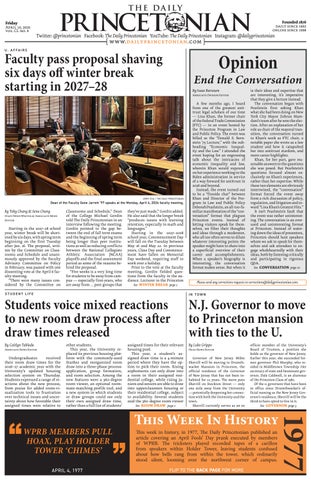
JERRY ZHU / THE DAILY PRINCETONIAN Dean of the Faculty Gene Jarrett ’97 speaks at the Monday, April 6, 2026 faculty meeting.
Gordin: The longer break ‘produces issues with learning retention, especially in math and languages.’
WINTER BREAK
Continued from page 1
Writing Program Echo Thompson raised a question about the impact that a shorter winter break may have on the timeline for independent work.
“There is a trade-off where some students would have six fewer days to do work in January, and other students would have six more days to do work in January, because they will be back on campus,” Gordin responded. He said that while this was a tradeoff that the various committees acknowledged, this was a “balanced” approach for the entire student body.
Gabriel A. Vecchi, a geosciences professor and a Princeton Athletics Fellow for the women’s hockey team, asked about the impact that the new schedule could have on athletic tournaments. Gordin responded that the changes would “beneficially impact those groups,” citing less conflict with the NCAA playoffs during final assessments, which have often required the rescheduling of exams for student athletes.
Vivian Brennan ’29, a member
of the Women’s Swim and Dive team, expressed doubt over general claims that these changes would benefit athletes.
“I don’t know if I would say that it necessarily benefits us, or at least for my sport,” Brennan said. “We try to fit in a lot of meets and that kind of thing during winter break so that we don’t miss class. So it might make us miss one or two more days of class than we would otherwise.”
Other students offered mixed reactions to the policy change. Some expressed disappointment, while others welcomed the change, noting that the current break does not align with the schedules of many peer schools.
For students who do not return home for shorter breaks like Thanksgiving, abbreviating winter break takes away from the little time they had to spend with their families.
“Having such a long winter break has been so helpful for so many students, because for a lot of us, it’s the first time we get to go back home,” Iman Bedru ’28 said.
“[Winter break] is the biggest block of time I get to spend with my family where I don’t have the
pressure of needing to be doing something else,” said international student Shaimaa Colaiacovo Abdelhalim ’27.
Allyson Walsh ’27 said that the longer break helped students recover from academic burnout, especially given that Princeton’s semesters are shorter than those at peer institutions.
“I would really like the extra week to go home and just relax,” Walsh said. “It’s sad to see that they are cutting back on it.”
On the other hand, several students described the shorter break as a positive change, saying that the current break does not align with the schedules of many other schools.
“It seemed very long in comparison to everyone else,” Clara Sun ’29 said.
“When I’m home for winter break, most of my friends are already going back to college earlier anyways,” Mark Lancaster ’27 said. “It’s kind of inconvenient ending so late, especially if you’re planning to do a summer internship or travel over the summer, you end up having to start work right after your finals.”
Students also perceived the policy change as reinforcing that
Wintersession, which was permanently discontinued in August 2025 due to budget cuts, will not be returning.
“I’m a little sad about [the end of Wintersession] because that was something that I was excited about. I wrote about it in one of my Princeton essays,” Brennan said.
Sun also expressed disappointment, sharing that Wintersession “seems like a really cool experience … it’s a shame that we don’t have [it] any more.”
Karen Villanueva ’27 noted concerns over a shortened timeline for junior papers and senior theses.
“If the deadlines don’t move in the semester, it would still be decreasing the amount of time that students would have, typically by a week,” she pointed out.
“As long as the information is communicated clearly and students are given the support they need to make that adjustment between this academic year and next academic year, then it should be a smooth transition,” Villanueva added.
At the faculty meeting, chemical and biological engineering (CBE) professor emeritus Ilhan A.
Aksay also read a memorial resolution on the death of chemical and biological engineering professor emeritus Morton Kostin, who passed away at age 89 on May 23, 2025.
Aksay highlighted Kostin’s contributions to quantum mechanics and chemical engineering, noting that Kostin “holds the distinction of longest service by a regular faculty member in the CBE department.”
Aksay concluded his remarks by reading comments from Kostin’s former students, who described him as “a very good teacher” and as “one of the very first or very few chemical engineers at the time working in quantum mechanics to understand molecular dynamics.”
The next faculty meeting will be held on April 20 at 4:30 p.m. in the Faculty Room of Nassau Hall.
Toby Chang is a staff News writer from Prescott, Ariz.
Sena Chang is the associate News editor for the ‘Prince’ leading investigations. She is from Japan and South Korea, and she often covers local politics and student life.
Verde: ‘It’s very confusing and unclear overall.’
ROOM DRAW
Continued from page 1
was one of the clearest improvements in the new system.
“I really liked the addition this year of the 360 [degree image] viewer,” Ava Dippel ’27 said in an interview with The Daily Princetonian. “Previously, we had to rely only on the floor plans, and couldn’t really get a good sense of what the rooms looked beyond room dimensions. This year, I could really get a sense of each room in detail.”
Eliana Linder ’29 similarly said the room viewer tool made the process feel more concrete.
“The 360 viewer was helpful, and it was great to be able to really see the features and sizing of each room before the draw,” she told the ‘Prince.’ “I am a freshman, so I don’t know what the housing process was like before this, but I felt like I was able to clearly see the features of different rooms.”
However, various students described Thursday’s release of draw times as stressful, particularly when the housing site became difficult to access.
“I thought the [housing] website was easy to navigate … but it did crash when draw times came out, which was annoying for students, because we couldn’t see our times for a while,” Linder said. “We were refreshing the site for a long time.”
Razvan Verde ’29 said he had a similar experience. “The website didn’t load when I went to check my draw time … the site had crashed,” he shared.
Verde is a News contributor for The Daily Princetonian.
For some students, the biggest point of confusion was the lack of transparency around where their
assigned draw time stood relative to others’ times.
Under the previous system, students could see a complete list of who was assigned what room draw time for their housing category, allowing them to immediately gauge whether their slot was relatively early or late in the order. This year, students were shown only their own time.
“Our group got April 22 for our draw time … I had no idea if the time was good or not, because I couldn’t see what others had for their times,” Linder said. “It should’ve been more clear where you were compared to other people in your grade and in other grades.”
Verde echoed that sense of uncertainty. “Our draw group got April 22 as our draw time, but we didn’t know what that meant,” he told the ‘Prince.’ “At first we thought it was pretty good, but then we learned that April 6 was the very first room draw date of the process, and so then we thought [our time] was horrendously bad.”
The rising senior class have the first draw times; after them, rising junior times begin on April 13.
Verde added that while he found the general draw system understandable, the context around draw timing in particular felt insufficient.
“We had no information or confirmation from the University about when everything starts or ends,” he shared. “It’s very confusing and unclear overall.”
Linder also said she was disappointed with her group’s assignment after hearing about others’ times. “I was not happy with my draw time, because it was not early in the day,” she said. “I’m not insanely disappointed, but think it could’ve gone better.”
After getting a better sense of where his time stood in the overall schedule, Verde said his group’s expectations for housing had shifted accordingly. “A quingle would be nice, but we’ll probably be in a quad because of our draw time,” he shared. A “quingle” refers to a four-person suite that includes four singleoccupancy bedrooms.
Dippel expressed feeling a similar sense of ambiguity with the room draw assignments, even though she ultimately felt good about her slot.
“Last year, we were sent our room draw time in a list of all the upperclassmen draw times, and so you could immediately tell if it was a good time or not,”
Dippel told the ‘Prince.’ “This year, we were just given our own draw time without being able to see others’ times, and so I didn’t know how good it was at first. After asking around though, I am very happy with my draw time this year.”
Students also differed in how they assessed the clarity of the overall process and the University’s communication around it.
Dippel said that although “there were definitely a ton of emails that flooded [her] inbox from the Service Point,” she still felt “the steps of the process made sense.”
Verde similarly wrote that “the three steps [of the housing process] were pretty clear.”
Others, however, were more critical of the clarity of the process. Paras Dodd ’29 said the volume of communication from University Housing Services made it harder, not easier, to keep up with key deadlines.
“I found the process to be quite unclear,” he told the ‘Prince’ in an interview. “[Housing] sent out so many emails that I just
stopped opening them, because a lot of them were useless junk. The amount of mail they sent out disincentivized me from checking their emails.”
Dodd added that in the initial room draw application phase two weeks ago, he didn’t receive any reminders from his Residential College Advisor about filling out the room draw form when it was due. “I felt like as freshmen, we should’ve been provided with more reminders from outside the Service Point.”
As a result, Dodd missed the deadline to sign up for room draw. Afterwards, he said he had gone to the Service Point — the support center where University Housing services are located, emailed his dean, and filed two support tickets. “I was told there was absolutely nothing they could do to add me back into room draw, and I would get bottom priority with a random roommate,” he said.
But, according to Dodd, that decision was later reversed. “They then emailed me four days later, adding me back into room draw as an individual applicant,” he wrote. “So I was able to form with my original group in time for the room draw stage. And clearly, it wasn’t true when they told me there was no way I could be added back.”
For Dodd, the experience pointed to more widespread confusion. “I know there are a lot of others who missed room draw,” he stated. He added that he felt as though “there was some sort of issue here with the way in which the steps for housing were communicated to students.”
University spokesperson Jennifer Morrill wrote in a statement to the ‘Prince,’ “Students had a full week, from March 17 to March 24, to submit their hous-
ing applications online. This was publicized widely in advance via email, Prince coverage, social media, multiple information sessions, and other channels. Unfortunately, a number of students failed to meet that deadline as is the case every year. This year, it should be noted, that number is less than years past perhaps in part due to the additional outreach around the new system. Because rising sophomores are required to live on campus, despite not meeting the deadline, they were manually added. Rising juniors and seniors who missed the deadline will need to apply to the waitlist starting April 30. All upperclassmen who apply to the waitlist to live in campus housing will receive an offer for on-campus housing.”
Even students who completed the process without major disruptions described the new platform as anxiety-inducing at moments, especially given the stakes of housing selection.
“The process was a bit stressful,” Victoria Outkin ’28 said in an interview with the ‘Prince.’ “I kept thinking I was restarting the application or something to find the one that I submitted. You have the doubts of … did I make sure everything goes through? Did I submit it correctly? Did I [accidentally] start a new application? Because [room draw] is an important thing.”
The room selection phase is scheduled to begin on April 6, and the last day a room can be selected is April 30.
Caitlyn Tablada is the associate News editor for the ‘Prince’ leading internal strategy. She is from New York City, and typically covers student life.
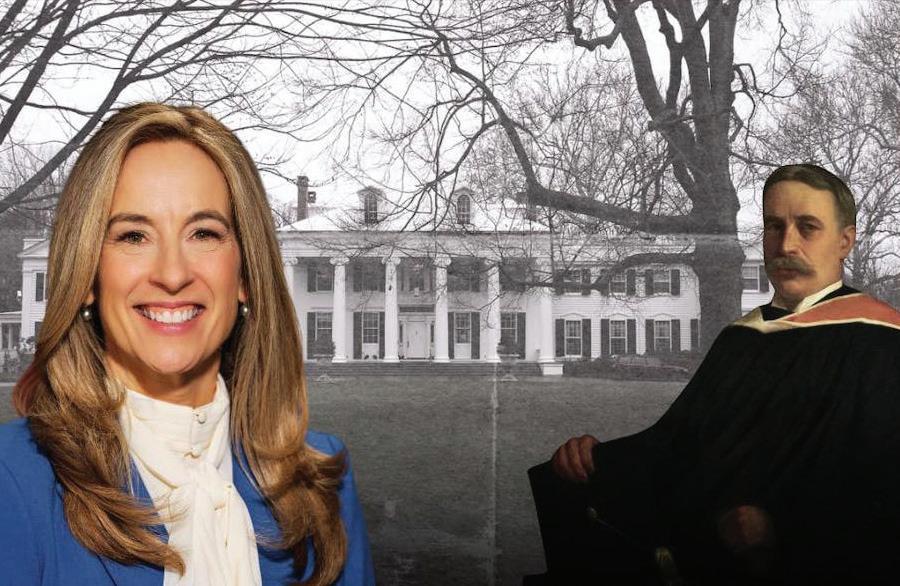
Sherrill and Hedberg:
‘Drumthwacket is the people’s house, and we look forward to continuing to bring it to life for New Jersey residents.’
owned by his grandfather, Thomas Olden.
Princeton-led
By Razvan Verde Contributing News Writer
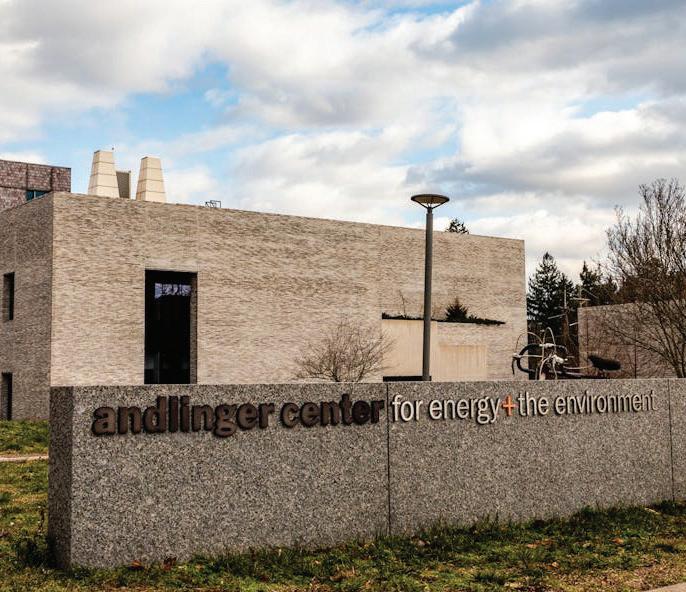
Countries around the world may be significantly underestimating greenhouse gas emissions from wastewater systems, according to a Princeton-led study published on Feb. 11 in Nature Climate Change.
Continued from page 1
In a press release on Friday morning, Sherrill and her husband, Jason Hedberg, officially announced the move, writing that the family move will take place this summer.
“From Day One this administration has committed to getting to work in Trenton to deliver on our commitments. We’re thrilled to further strengthen that commitment by living full time in the Governor’s official residence and being much closer to the Capital City and the State House,” the press release read.
Sherrill currently lives in Montclair, N.J., where she is registered as a voter. A move to Princeton would mean a change in voter registration under New Jersey law, which prohibits registered voters from having multiple domiciles — a citizen’s permanent home where they have “the intention of returning.” She would then become an active participant in the contested N.J.-12 Congressional election, whose primaries will be held on June 2.
Sherrill has not publicly endorsed any of the election candidates.
In a statement to The Daily Princetonian, Amy Cradic, chair of the Drumthwacket Foundation, which preserves the Drumthwacket Mansion, affirmed the foundation’s excitement surrounding the governor’s arrival.
“As stewards of the Official Residence of New Jersey’s Governor, the Foundation offers a warm welcome to the First Family,” Cradic wrote to the ‘Prince.’ “We are excited they are making this important residence their home and taking part in the property’s rich history.”
In 1893, Moses Taylor Pyne, Class of 1877, who is widely regarded as one of the University’s most influential trustees, purchased Drumthwacket from Phebe Ann Smith, the widow of former New Jersey Governor Charles Smith Olden. Olden, who served from 1860 to 1863, had ordered Drumthwacket’s construction in 1835 on land
Architect Raleigh Colston Gildersleeve was later brought on by Pyne to add the east and west halls to the estate, aiding with the Pynes’ 20-year expansion of the estate. Gildersleeve, a graduate of the Class of 1849, also designed McCosh Hall, the Upper and Lower Pyne dormitories on Nassau Street, Cap and Gown Club, Campus Club, and Elm Club. He also designed multiple in-town residences.
Princetoniana Museum writes that Pyne had opened Drumthwacket’s doors for many Princeton visitors — both from the town and the University — where they could enjoy the natural beauty of the estate’s grounds.
Pyne then bequeathed the house to his granddaughter, Agnes Pyne Davis, when he died in 1921. Twenty years later, she sold the house to Russian immigrant Abram Spanel, who remained the owner until 1966, when the state of New Jersey purchased the mansion.
After fifteen years of gathering funds for renovations, it became the official residence of the Governor of New Jersey in 1981. However, James Florio, who was elected in 1990, was the first governor to live in the house since it gained this title. Florio would live in it until he lost his reelection in 1994. Since then, only one other governor besides Sherrill has opted to live in the house — Jim McGreevey, who served from 2002 to 2004.
“Drumthwacket is the people’s house, and we look forward to continuing to bring it to life for New Jersey residents and highlight all the incredible history it offers,” Sherrill and Hedberg’s press release read.
“Our family looks forward to this exciting next chapter, and we thank the dedicated New Jersey state staff and the team at the Drumthwacket Foundation for all their work to truly make the residence a home.”
Luke Grippo is a head News editor for the ‘Prince.’ He is from South Jersey, and typically covers high-profile interviews and University and town politics.
A team of researchers led by Zhiyong Jason Ren, the associate director for research in the Andlinger Center for Energy and the Environment, found that national inventories may be undercounting emissions by 19 to 27 percent, in part because it is difficult to account for the many disjointed sanitation methods utilized in each country. The study looked at 38 countries across five continents and estimated that 94 to 150 million metric tons of carbon dioxide equivalents are missing from annual global emissions data.
Ren noted that unlike energy or transportation, wastewater lacks a unified policy framework. “Only … 40 countries have a national inventory for [the] water sector,” Ren told The Daily Princetonian. Countries tend to focus on energy and transportation as their priorities. Wastewater, by contrast, is decentralized and spread between different industries.
Ren said that many countries still rely on the Intergovernmental Panel on Climate Change’s (IPCC) 2006 guidance on greenhouse gas emissions instead of updates issued in 2019. He described the for-
mer as “too simplistic” and “does not represent the huge variety of fluctuation among the different countries, among the different utilities or treatment plants, and among the different economies or technologies.”
“That’s why [the] IPCC is there … if you cannot afford to do more details, measurements, or come up with a more nuanced and comprehensive approach, you can just use a default number,” Ren told the ‘Prince.’
Ren added that one of the main reasons for driving the push to get the accounting right is because of the long-lasting infrastructure of treatment plants and sewer networks, which can remain in place for decades. “I don’t want the industry or policymakers to make … suboptimal decision[s] that will have long-lasting bad consequences,” he said.
As a result of his work in the field, Ren was named a Fellow of the American Association for the Advancement of Science (AAAS) in March, alongside Dean of the Graduate School Rodney Priestley.
Ren was cited specifically for his contributions to the waterenergy-climate nexus, joining a cohort of over 400 scientists including 15 Princeton alumni. The AAAS, one of the nation’s most prestigious scientific societies, will formally recognize the new fellows at a May 26 ceremony in Washington, D.C.
Ren told the ‘Prince’ that the fellowship came as a surprise. “I truly felt, at the time, it was like
two angels appeared with a sweet surprise,” Ren said, “I had no idea, to be honest.”
He also praised the Princeton community, saying that he appreciated the support of his former mentees who, he later found out, were the ones who nominated him for the fellowship. “So I would hope that really gives you the spirit of Princeton. In a way, we’re such a kind and close community,” Ren said.
Beyond research, Ren helped found Princeton Critical Minerals, which focuses on increasing lithium and other mineral production using a Princeton-developed technology. “We went from … lab validation on the rooftop of the Andlinger Center to the field in Chile,” Ren said, once more praising the Princeton community for being incredibly supportive. He added that a former postdoc of his, Sean Zheng, is now the full-time CEO of the company. Ren said that his work has recently focused more on bridging the gap between technology and policy. “How our research [can] not only develop technological solutions, but inform the industry and the policymakers with solid scientific evidence to help with better policymaking increasingly becomes my interest of research,” Ren said.
“Technology is only one part of the puzzle,” he said.
Razvan Verde is a News contributor for the ‘Prince.’ He is from Newport News, Va.
Stellic, centralized academic
hub, to be used this spring for course selection — here’s how it works
By Clara Docherty & Luke Grippo assistant News editor & head News editor
Stellic, a degree-management platform, is set to replace TigerHub for student course selection beginning in Fall 2026. The platform is also a centralized hub where students can track degree progress, plan different schedules, and make appointments with advisors.
Stellic, designed at Carnegie Mellon University, is used at various peer universities including Columbia University and the University of Chicago. Graduate students have used Stellic for about a year. Undergraduates have had access to Stellic since last fall, but this semester will be the first time the site is used for undergraduates, including course selection.
“They’ve always been doing [course planning] with pen and paper or with spreadsheets or with other apps, but [Stellic provides] a cool opportunity to actually see how your current coursework fits into a different department,” said Cecily Swanson, the associate dean for undergraduate affairs for the School of Engineering and Applied Science.
Course selection and other academic functions, including planning courses, accessing degree progress reports, and parts of the Academic Planning Form, are cur-
rently done on TigerHub. TigerHub will still remain active for other student actions, such as electing pass/D/fail and requesting official transcripts. Course schedules will automatically be transferred to the site after registration is completed in Stellic.
“We think it’s an improvement to what we had built, which was mostly a homegrown system, and it’s ever evolving,” said Deputy Registrar Justin Bronfeld.
The main uses of Stellic can be broken down into three categories: registration, planning, and tracking.
Course registration
Students on Stellic will have the opportunity to search courses by course code and add them to a weekly schedule planner, where they will be able to see their lectures, precepts, seminars, and classes mapped on a divided-byhour weekly calendar.
Students will be able to register for their courses straight from the website. In the fall, there will be a course ranking option, where students will be able to rank their courses from most wanted to least wanted. This will make it easier for students to enroll directly into their second or third-choice courses, in case they do not get into their first-choice courses. This feature is still in its “preview phase,” and will be available to students for course
registration in the fall.
Previously, students needed to externally prepare replacement courses and input their course codes into TigerHub after they had completed the initial attempt at course registration, often missing the crucial first few seconds of course enrollment.
Students will be able to change precept or lab section times on the site as well.
“There will be a button that says change registration, and you just pick the precept [or lab section] that you want to change into,” said Graduate Student Systems Specialist TJ Branin.
Additionally, these courses can be added to the academic plan, under the “Plan your Path” tab.
Academic Planning
Frequently, students use various student-created apps, such as TigerJunction and TigerPath, to plan their courses for each semester. Now, the functions of each app are centralized in one website. One difference between TigerHub and Stellic is that the site will allow students to view what requirements they have satisfied for a certain distribution, major, or minor.
Within the “Plan your Path” section, students can view the courses they have completed each semester, and add classes to future semesters.
The program also offers a feature where students can search for all
courses that satisfy a general requirement, such as Social Analysis (SA).
Stellic also includes a schedule generator, which can help sort or add courses into a schedule that works time-wise for the student.
Branin noted that this feature is particularly helpful for students who are interested in lots of courses.“If you’re thinking about a lot of courses, and you click that auto generate it’ll tell you, ‘what days do you want to be in classes? Do you want to lean more towards the morning, the night?’ So there’s options there,” Branin said.
Stellic lets students parallel plan multiple semesters simultaneously and compare different academic paths. Users can evaluate different majors, and see their progress in various departments.
“You can make a couple different plans, and think about what it would be like to major in English versus Comparative Literature versus History,” Swanson said.
Tracking Students are able to track their degree progress using the “track progress” button, which displays a student’s major requirements, distribution requirements, and courses that will count towards their degree.
Students can also auto-generate a different academic plan for a different major, to see how many of a stu-
dent’s currently completed courses would fulfill the requirements for that major.
Branin emphasized that Stellic is intended to be very user-responsive, and operates using feedback from students.
“[Stellic] takes our feedback and [students’] feedback on course items as well,” said Branin.
The administrators who spoke with the ‘Prince,’ including Swanson and Natalia Córdova Sánchez, the assistant dean for studies for Mathey College, have used Stellic for making appointments with students, as well as to see their course plans, which they say has been making engaging with undergraduates much easier.
Course selection for current juniors will be on Wednesday, April 15. For current sophomores, it will be on Thursday, April 16, and for current first-years, it will be on Friday, April 17.
Clara Docherty is the assistant News editor for the ‘Prince’ leading faculty, graduate students, and alumni coverage. She is from Lafayette, N.J.
Luke Grippo is a head News editor for the ‘Prince.’ He is from South Jersey, and typically covers high-profile interviews and University and town politics.
Princeton Preview moves indoors amid budget cuts
emony with Dean of Admission and Financial Aid Karen Richardson ’93, a student panel, and dorm tours.
Hundreds of prospective students with orange and black lanyards swarmed campus on Tuesday — but the massive tents that usually accompany their arrival were nowhere to be found.
Due to budget constraints, the University is hosting Princeton Preview primarily indoors this year, according to University spokesperson Jennifer Morrill. Current students voiced mixed opinions on the implications of an indoor Preview, but for prospective students, the day couldn’t have been brighter.
“I’ve absolutely loved it here. Everyone has been so kind and welcoming, and it’s been great to hear from so many current students and faculty,” said prospective student Charlotte Kleid. “Everyone’s just been so willing to share their experience and their stories, and it just makes me feel at home.”
Every year, the University organizes days full of programming to give accepted students an impression of the student experience on campus, often swaying students in their final decisions on college commitment. In past years, Princeton has held this event on two separate dates, but this year the Office of Undergraduate Admission announced a third date. This change, motivated by budget constraints, allows smaller cohorts to attend each Preview day. Preview is being held on April 7, 14, and 28 this year.
Prospective students and their guests attended a variety of events, including an opening cer-
“[The student panel] gave us the student perspective, which is really nice. They were real with us, but it was very encouraging,” Aayushi Bharati said during lunch in the Rocky-Mathey dining hall. “I was very intimidated coming into the program thinking, okay, everyone’s gonna be so smart and scary, but actually everyone’s super nice.”
For lunch, parents ate on Nassau Street and at Frist Campus Center while prospective students ate in the dining halls.
“I think it’s great that they separated the parents and the kids so that, you know, they can go off and do their thing, and then we can get our questions answered, but we’re not hovering,” said Rimma Fehling, a parent of a prospective student.
Another parent noted enjoying her experience both on and off campus, feeling assured of Nassau Street’s safety by her experience at Alfalfa.
“This is my first time really being in the town… I feel like [Alfalfa] is very safe, clean, secure, vibrant, happy,” parent Ali Roukas said.
While the town is an integral part of Princeton life, some students said they were more excited about trying the dining hall food.
“This is the food that I’d be eating with an unlimited plan most of the time, so I had to see for myself,” Katya Geyer said. “But I like the option of … the food is nothing to worry about, and then if I want to go for a special treat outside, it’s also available.”
“I really like the food,” Juliet Wei said. “I just got my wisdom teeth removed, so the availability of soft food that’s still delicious, that was great.”
Princeton Preview, as usual, included an activity fair held in Dillon Gym. Students walked around looking at various booths displaying the many clubs and organizations at Princeton.
“I really like the political clubs, as well as the singing portion of the clubs,” Valentina Angon said. “There’s literally something for every student here.”
To some students still deciding between schools, Princeton Preview has played a role at pushing them one way or another.
“It’s so beautiful. I love it so much. The architecture is so cool, and the events that they’ve planned are very pushing me for Princeton,” Geyer said.
“It’s been very nice to see lots of different people from all over the country, and see what kinds of different things people are interested in, and get to talk to a lot of current students and faculty … to envision what the environment would be like if I chose to come here next year,” Madeline Rugg said.
To others already committed to Princeton, Princeton Preview helped them cement the reality of their decision.
“[Princeton Preview has] honestly made it all feel real. I had this idea of what Princeton was broadly, but now I’m walking around here, realizing Princeton students are just like any other students, really welcoming. So it’s been great so far,” Edward King’oo said.
The day has also allowed stu-
dents to picture the next four years of their campus life.
“It’s been very busy, very jampacked, but I’ve loved it. I think it’s definitely a great introduction to what a day at Princeton would look like, some of the interests my peers would have, how the faculty interacts with students,” Arsh Parekh said.
“It’s surreal. I think there’s really no better way to put it — it truly is a dream come true,” he added.
“It has made me feel like I did make the right choice,” Angon said.
While the day went swimmingly for prospective students, the change from previous Previews is evident to current students, especially with the absence of the tents.
In a statement to the ‘Prince,’ Morrill wrote, “The Office of Admission made the decision to host three smaller previews to eliminate the reliance on tents, which are a significant expense.”
Tents, in the past, have allowed for an indoor and outdoor experience to Princeton Preview, showcasing all aspects of the campus. This year, many activities that would usually be held outside are being held in Richardson Auditorium and Dillon Gym. Additionally, the welcoming address, held in the University Chapel in the past, will also be held in Richardson Auditorium.
“It was a really nice environment with several hundred of us packed in,” Emmett Appel ’29 said about the Chapel address University President Christopher Eisgruber ’83 gave last year.
“It’s kind of sad, because I feel like our campus is so beautiful, just being outside,” Appel added
in response to this year’s Preview being mostly indoors.
Cindy Liang ’29 noted that, while she “liked the outside aspect,” she doesn’t believe it would have significantly influenced her decision to come to Princeton.
On the other hand, Nora Glass ’29 said, “if I had gone to Preview last year, and it would have been partly in Dillon Gym, I maybe would not have gotten the same sense of jaw dropping, being in love with the school, everything being perfect. That definitely was the sense that I got from Preview.” Additionally, Elli Sourli ’29 said of the presence of tents and outdoor events, “when I came for orientation, it was pretty similar to Preview, and that was really reassuring.”
While the format has changed, students continue to emphasize the magic of Princeton’s campus.
“Everyone here has been so welcoming. Everyone’s always stopping to talk to one another. I feel able to approach so many people, and I’ve already met so many future classmates,” prospective student Natalie Surges said.
Benedict Hooper is a staff News writer for the ‘Prince.’ He is from Greenwich, Conn.
Elizabeth Hu is a staff News writer, assistant head Copy editor, associate Data editor, staff Podcast producer, and contributing Features writer from Houston.
Lulu Mangriotis is the assistant News editor for the ‘Prince’ leading student life coverage. She is from New York City.
By Benedict Hooper, Elizabeth Hu, Lulu Mangriotis
Staff News Writers & Assistant News Editor
Faculty to vote on the implementation of ‘universal’ proctoring
By Devon Williams & Giselle Moreno
A proposal for proctoring on all examinations will be considered by two faculty committees before potentially reaching a faculty vote in May, according to Dean of the College Michael Gordin. This unprecedented proposal comes amid administrative concerns about cheating, especially given the prevalence of generative AI tools.
The change would constitute the most significant alteration to date to Princeton’s honor system since its establishment in 1893. Under the Honor Code, students pledge both to refrain from infractions of academic dishonesty and to report any academic integrity breaches they witness. The institution of proctors would not change the text of the Honor Code or students’ obligations — rather, proctors would serve as an additional layer of academic integrity monitoring, and would report misconduct to the Honor Committee, according to former Honor Committee Chair Nadia Makuc ’26.
Gordin commented that should the policy pass, “the Honor Committee Constitution and the text of the Honor Code — which are governed by students — would not be altered.” The Honor Code gives students a twofold obligation: “individually, they must not violate the code, and as a community, they are responsible to report any suspected violations.”
If the policy passes, proctoring on all examinations, including those taken by students with accommodations through the Office of Disability Services, would begin at the earliest in Fall 2026. “Spring finals are not affected at all,” Undergraduate Student Government Academics Committee Chair Isaac Bernstein ’28 told The Daily Princetonian.
Bernstein is a former staff News writer for the ‘Prince.’
The proposal will need to pass through three rounds of voting: the Committee on Examinations and Standing, the Faculty Advisory Committee on Policy, and a full faculty vote, in that order. “If the process went as fast as humanly possible, the final vote would be at a faculty meeting in May,” Gordin wrote in a statement to the ‘Prince.’
“[The ‘Rules and Procedures of the Faculty of Princeton University’] is the only governing document which prohibits supervision of examinations,” Gordin wrote. “If this act for universal proctoring passes the vote, the relevant sections in both ‘Rules and Procedures’ and the University’s ‘Rights, Rules, and Responsibilities’ would need to be amended for the first time since their 1893 publication.”
Professors and students expressed varying opinions regarding the proposal in interviews with the ‘Prince.’
“Pre-Covid-19, cheating was seen as a really bad thing to do. But during Covid, people were more likely to cheat, and now it’s more socially acceptable,” Kelly Noonan, an economics lecturer who teaches the popular ECO 100: Introduction to Microeconomics, told the ‘Prince.’
In the ‘Prince’ 2025 senior survey of over 500 seniors conducted by The Daily Princetonian, 29.9 percent of respondents reported cheating on an assignment or exam. 44.6 percent of senior respondents reported knowing of Honor Code violations that they chose not to report. Only 0.4 percent of seniors responded saying they had reported a peer for an Honor Code violation.
“I think that cheating has become fairly prevalent. Students are very, very upset with it, but again, they still don’t want to report. And if they don’t report, the Honor Code doesn’t work,” Noonan said.
Jason Puchalla, a lecturer in the physics department who has created an AI training interface for his students, said that “my belief is and from my conversation with students, folks are on board to have proctoring as a regular part of campus.”
Puchalla added that while proctoring
may become a more regular part of testing, he hoped it would not create distrust between students and faculty. He continued, “It would be an unfortunate way to approach education if the assumption is that students are cheating all the time, and our job is to stop them from cheating.”
Not all proponents of reforming the current system expressed support for proctoring, however.
Princeton Writing Program lecturer SooYoung Kim argued that the current system “places unnecessary stress on students, both by rendering them responsible for making judgements that they shouldn’t be put in a position to make and by cultivating a climate of mutual suspicion.”
“I do sincerely value the core desire articulated in the honor system to establish a campus community on the basis of collective responsibility among students, and rejection of external mechanisms of compliance, but it just seems to me that there are less harmful ways to get at these goals,” Kim wrote to the ‘Prince.’
Despite the tentative timeline for the proposal’s consideration, many details remain uncertain, such as the number of proctors per exam and the process for selecting proctors.
“You don’t want one proctor in a room of three hundred and fifty … and you don’t want four proctors in a room of 10,” said Bernstein. Noonan expressed a similar sentiment, saying that assigning too many proctors “creates an environment of anxiety and distrust … ensuring proportionality is vital.”
Gordin confirmed that if the policy passes, discussions about these details would begin immediately. Proctoring practices could be altered even after the policy’s implementation.
“[These] are administrative matters that would be worked out after the faculty opted to make the change,” Gordin wrote. “Like all administrative regulations, [the details of proctoring] could be revised to learn from the experience of implementation. The only issue to be resolved by the faculty at this stage is whether there are to be proctors or not.”
Students expressed skepticism about the proctor institution, telling the ‘Prince’ that the current absence of proctors cultivates trust.
“I think [the absence of proctors] represents a big degree of trust between the faculty and students,” Pierce McCarthy ’28 told the ‘Prince.’ “I think a happier middle ground could be reached, something along the lines of leaving your backpack outside and collecting phones while still leaving students alone in the test room,” he added.
Israel Adeboga ’28 echoed support of the current system to discourage cheating, stating, “I think it’s one of the fundamental parts of the University that we have that trust, in the end we are here for our own learning so the implementation of [proctoring] takes away from the fundamental spirit that Princeton has developed.”
“The trust that students already have is very important, I think that having proctors during exams erodes that to some level,” added Leonardo Bene ’28. “I don’t know how effective having proctors in exams would truly be.”
The policy would affect Honor Committee hearings, according to Bernstein, although it is unclear exactly how. These hearings are confidential, student-led proceedings addressing potential violations of Honor Code. Accused students can present defenses, call witnesses, and be assisted by a Peer Representative. If students are found responsible of Honor Code violations, penalties range from a Reprimand, a warning that is excluded from a student’s permanent record, to expulsion.
Bernstein said that if the proctoring policy passes, proctors may be called on to testify in Honor Committee hearings. However, he added that proctor testimony will not automatically hold more weight than that of student witnesses or consti-
tute an instantaneous indictment of those being investigated for alleged academic integrity violations.
While there is no student representation in any of the three committees set to vote on this policy, the USG Academics Committee has created a form for students to share their feedback on this possible change, and that data will be directly shared with the faculty committees.
Devon Williams is a News contributor for the ‘Prince.’ She is from Menlo Park, California, and she often covers Student Life, Arts, and Culture.
Giselle Moreno is a News contributor from Dallas.
JERRY ZHU / THE DAILY PRINCETONIAN Dean of the College Michael Gordin speaks at the Feb. 2 Faculty meeting.
‘A post-America world’: Sen. Andy Kim says U.S. must build resilience
By Toby Chang Staff News Writer
Senator Andy Kim (D-N.J.) spoke at the School of Public and International Affairs’ Dean’s Leadership Series Tuesday afternoon, warning that a “post-America world” is emerging. Amid a turbulent global landscape, Kim emphasized national security and innovation as priorities for the U.S. going forward.
The Dean’s Leadership Series is a speaker series featuring prominent leaders and policymakers. The event drew 215 attendees, according to organizers.
“One leader I talked to at [the Munich Security Conference] said that in their government deliberations, they [talked] about America as a security threat to Europe,” said Kim, who previously worked for the U.S. Agency for International Development and the State Department.
“In the eyes of the world, we are no longer the indispensable nation. We have instead become the undependable nation,” said Kim. He noted that these concerns exist on a domestic level as well.
“The anxiety Americans feel is a symptom of a country that senses its own fragility,” said Kim, citing statistics showing that 53 percent of Americans can no longer afford to cover an unexpected $1,000 emergency expense.
“Opportunity isn’t secured by recklessly committing American forces to conflicts around the world,” said Kim. “It requires us to build a strategy to make sure we are on the cutting edge of technology, [work] with our allies and partners, and understand that production, not just destruction, will be key to keeping our future safe.”
He continued, “A window to act is narrowing, and the cost of complacency has never been higher.”
Arguing for the need for “a national project of resilience” and “a new era of opportunity,” the senator likened the U.S. to a skyscraper without shock absorbers to mitigate an earthquake. “We are tall and impressive, but our foundation is weak and rigid and inflexible to the tremors. We lack the cross bracing reinforcements in the dampers,” he said. “It is time that we correct these structural flaws and build a way forward that leans into ourselves.”
Kim outlined seven principles that would serve as the foundation for such a transformation: economic security, resource and energy security, redefined diplomatic partnerships, modernized defense capabilities,
pragmatic adaptation, renewed faith in the federal government, and an understanding of resilience as a means, not an end.
“The goal isn’t to somehow just persist and endure in this current era … but to instead break this crisis loop that we experience and be intentional in transitioning towards a new era,” he said.
In a conversation with the ‘Prince’ after his speech, Kim also discussed the importance of educational institutions to the country’s resilience, citing the impact of education on his own family’s path.
“My family got opportunities because of schools, because of education. That’s why my father came here, received study,” Kim explained. “But it is getting more expensive, and it’s becoming less of an investment that some families — especially those that don’t have much means — are willing to take.”
Turning the issue to the University, Kim questioned, “Why does education cost so much to start with? That’s something that we need to hear answers from — from Princeton, and elsewhere.”
Kim’s speech was followed by a town hall-style Q&A session, during which students raised questions about economic inequality, healthcare, xenophobia, and foreign assistance. In response to a student who pointed out that government policies are often “invisible” to the average person, Kim acknowledged that there is a communication gap between government and constituents.
“You’re absolutely right. We should have done better to talk about some of the climate wins that we got, deliverables that we got during the Inflation Reduction Act, and other things of that nature,” Kim responded, in reference to the Biden administration.
The issue extends beyond messaging, however, according to Kim. He described a “crisis of empathy” that prevents deeper political engagement with younger generations.
“We assume everybody has had the same lived experience that we have, and should see things in the same way that we do, but it’s not the case,” he said, noting that he empathizes with how the political climate has led to disillusionment among Gen Z. “I can understand so deeply why so many feel very cynical about our politics. I feel it too,” said Kim.
Amid the current political climate, Kim urged students to take action.
“Do not let the gravity and the enormity
of what we face make you think you cannot shape what comes next,” Kim said. “There is nothing worse in this moment right now than for us to be paralyzed by a sense of helplessness.”
“Right now, with so much craziness happening in the news and our government, our politics, it’s so easy to burn out and [say] ‘Screw it, I’m going to go into the private sector and make a lot more money,’” Kim told the ‘Prince.’
Instead, he encouraged students who are passionate for public service but disheartened by the political climate to find others to connect with, emphasizing community.
“The only way people are going to sus-
tain is if they are able to find others, and remember that service is about community,” Kim told the ‘Prince.’
Kim concluded the interview by emphasizing the potential for students to change the current political conditions.
“Keep in mind that what we see right now in this country — it doesn’t have to be this way. It’s not how it’s always been,” Kim reminded. “I ask people to stay away from the helplessness and the apathy — to reject that and recognize that we do have agency still.”
Toby Chang is a staff News writer from Prescott, Ariz.
Student struck by car on Elm Drive, in stable condition
By Luke Grippo Head News Editor
Originally published April 8 at 1:55 a.m.
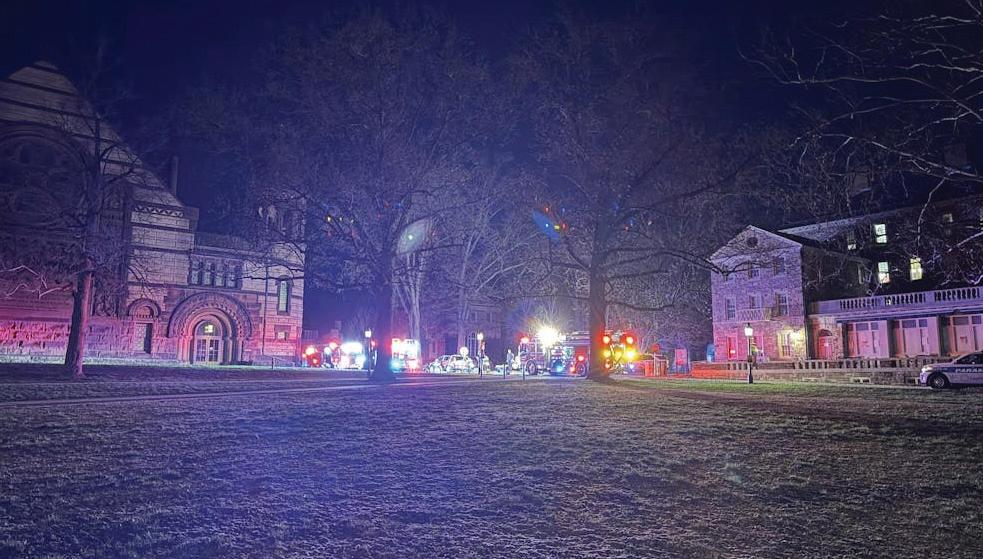
Late Tuesday night, a student was struck by a red car and was trapped underneath for over 20 minutes. The male student is currently in stable condition and at the hospital, according to a Public Safety (PSafe) officer on scene.
The incident occurred on Elm Drive outside of Alexander Hall, which contains Richardson Auditorium. According to three students who witnessed the incident, the student was cycling on Elm Drive when the car collided with him. Witnesses say the student had been riding a bike.
At least two fire trucks and an ambulance were at the scene. At least six firefighters
and five PSafe officers were present. Multiple PSafe vehicles surrounded the area between Alexander Hall, Cannon Green, and Morrison Hall.
Students reported seeing firefighters trying to lift the car, and the student being successfully pulled out from underneath. The Daily Princetonian has not been able to confirm any further details regarding the incident, including the identities of the student who was struck and the individual driving the car.
A call and email to University spokespeople were not immediately returned.
Luke Grippo is a head News editor for the ‘Prince.’ He is from South Jersey, and typically covers high-profile interviews and University and town politics.
Fewer new classes, less global travel in Fall 2026 course offerings
By Christine Cai
Wildlife documentary making in Kenya. Migration reporting in Germany. Learning Chinese history through video game development and world building. Fall 2026 classes were released on Thursday, March 26, ahead of course selection beginning on Wednesday, April 15. At time of publication, 1,438 total classes are available to be chosen for the upcoming semester, down from the 1,649 being offered in Fall 2025, according to the Course Registrar.
Total courses
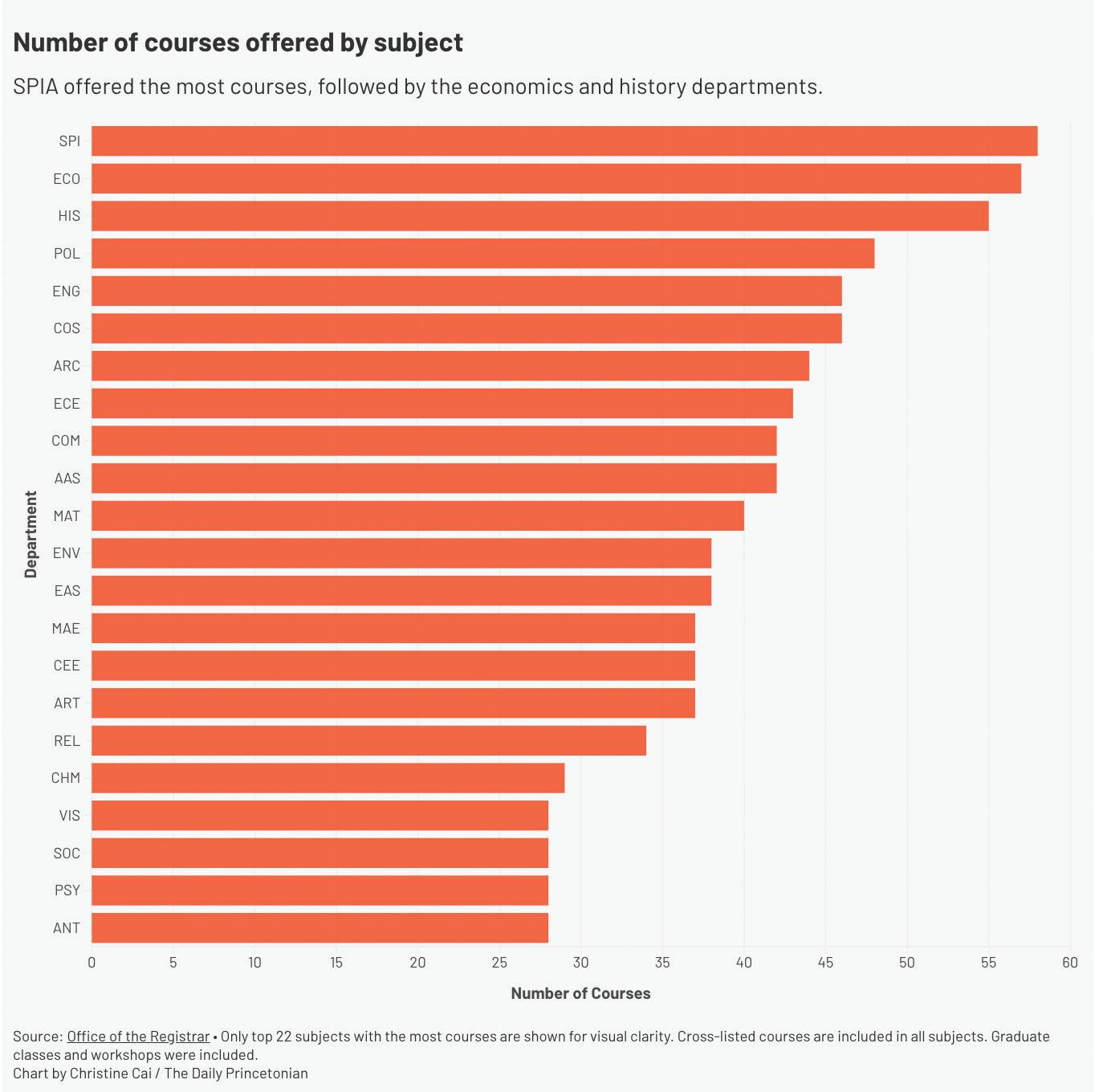
The School of Public and International Affairs will be offering the most courses next semester, with 58 options, including cross-listed courses. This is closely followed by the economics and history departments at 57 and 55 options, respectively. This is consistent with previous years, as SPIA has consistently offered the most courses in Spring 2026 and Fall 2025. Even after the University’s class sizes have expanded over the last four years, the total number of course offerings this fall has not changed significantly since Fall 2023, which had 1,562 course offerings.
New courses
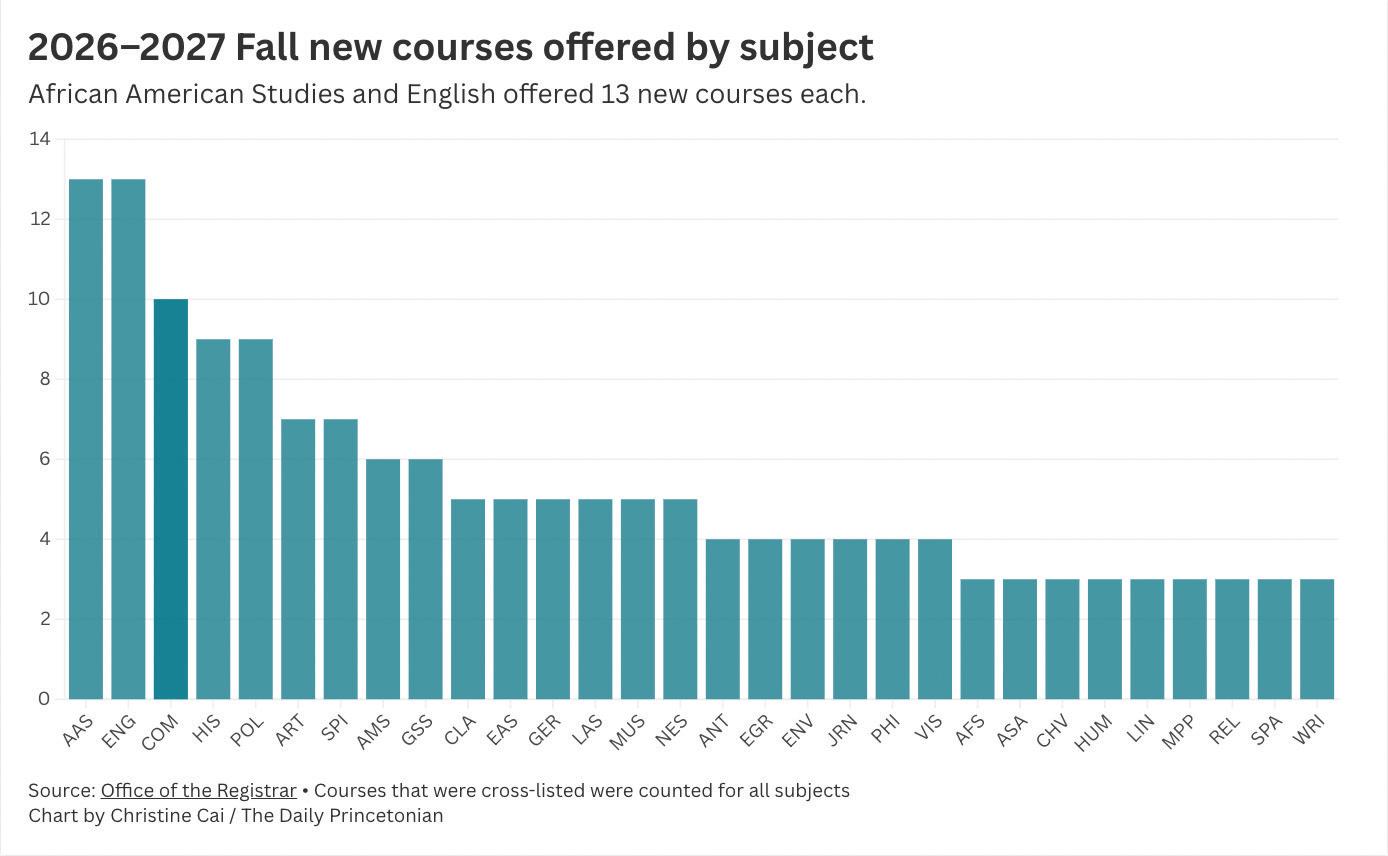
There are 127 new courses offered this fall across 67 subjects, a seven-course decrease compared to Fall 2025. African American Studies and English are the departments offering the most new courses this semester, with 13 per department, followed by comparative literature with 10 courses and history and politics, both with nine.
Courses by distribution requirement
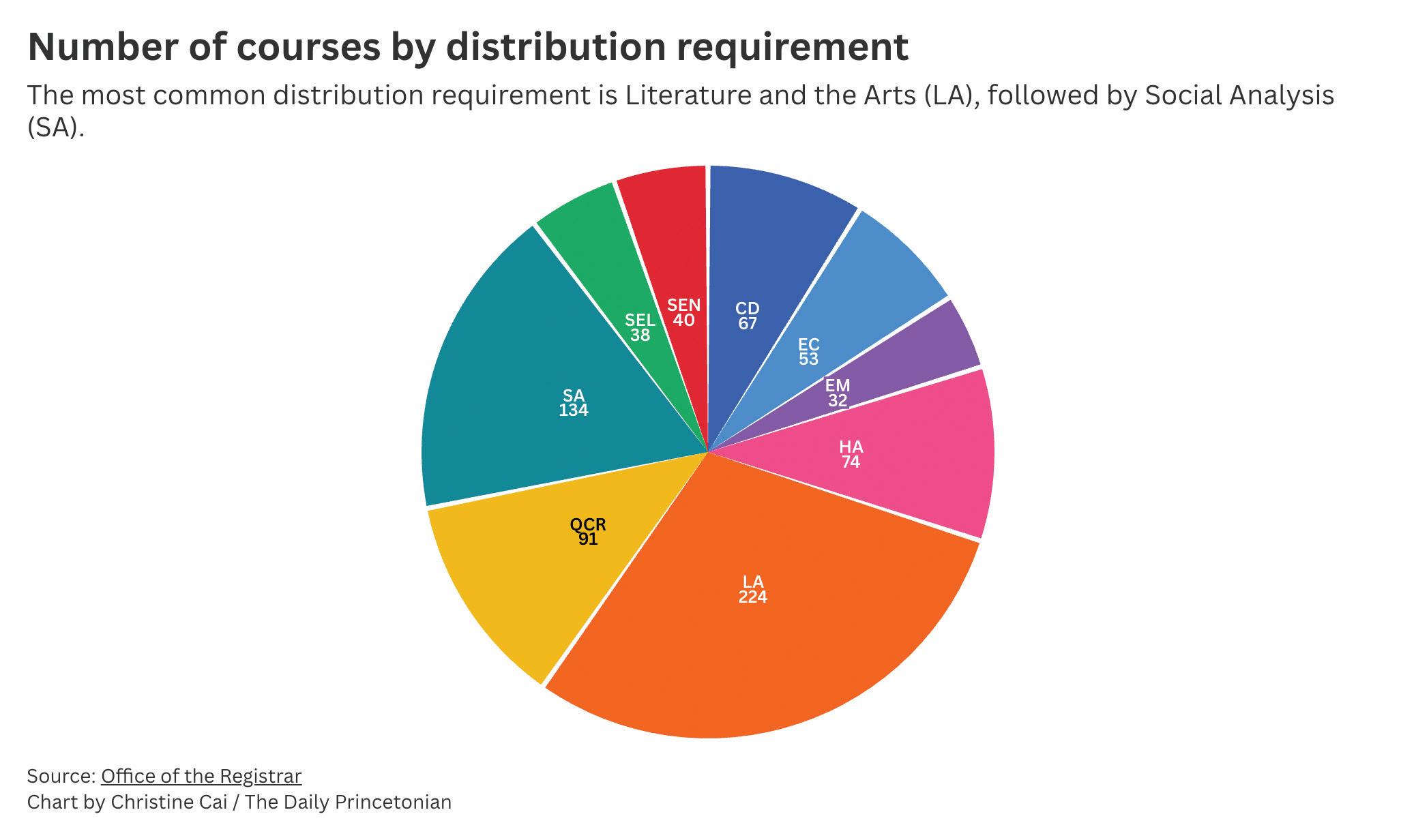
Across all fall courses, Literature and the Arts (LA) is the distribution requirement with the largest number of courses offered, at 224 classes. This is followed by Social Analysis (SA) with 134 courses, making it the second most popular distribution, and Quantitative and Computational Reasoning (QCR) with 91 courses. This remains largely consistent with the trends across the courses offered in Spring 2026,
although there were more Historical Analysis (HA) courses than QCR courses that semester than in the upcoming semester.
International Travel
For this upcoming fall semester, three courses offer international travel, a decrease from five in Spring 2026. These are ANT 455: Visible Evidence — Wildlife Films and Multispecies Documentary; JRN 449: International News — Migration Reporting; and FRE 217: Revisiting Paris. All three are returning courses: JRN 449 and ANT 455 were both offered last fall, and FRE 217 was last offered in Fall 2024.
In JRN 449, students will travel to Berlin, to report from the field. In ANT 455, students have the opportunity to visit Kenya to create films about the scientific and conservation work happening at the Mpala Research Centre, while FRE 217 brings students to Paris, over fall break to better understand Parisian cultural identity.
FRE 388: Theater Making in the Age of Climate Change, will no longer bring students to France to understand how French and European plays are engaging in climate change initiatives, as it did last fall.
Enrollment limits
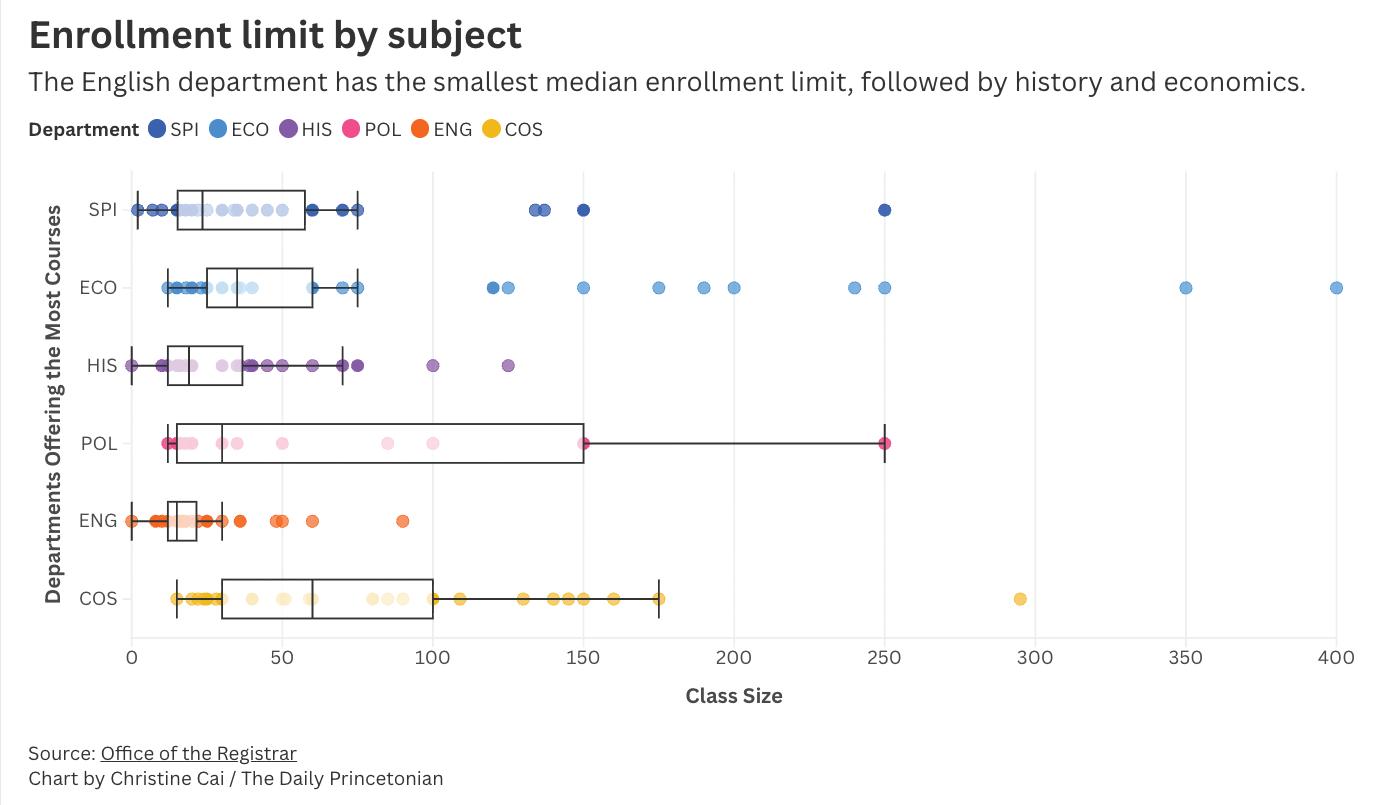
Among the six departments offering the most courses in Fall 2026, the average class size was found and compared across departments. Of these departments, English offers the smallest class sizes with a median of 15 spaces for students per class, followed by the history department with a median of 19 students per course. In contrast, of these departments, computer science is the one that offers the largest median class size, with 60 students per course. So, whether small classes, a trip to Kenya, or no classes on Fridays are on your agenda for next semester, this schedule will depend on course registration. Course selection for rising seniors is on Wednesday, April 15, followed by rising juniors on Thursday, April 16, and rising sophomores on April 17, all at 7:30 a.m.
Christine Cai is a contributing Data writer for the ‘Prince.’
University declares intention to increase ass size
By Francesca Volkema Associate Humor Editor
As this year’s Princeton Preview days for newly admitted students approach, University officials reiterated their commitment to make the Princeton experience accessible to a wider population.
At the Council of the Princeton University Community meeting on March 23, University President Christopher Eisgruber ’83 unveiled the University’s intention to admit a bigger ass size each year for the foreseeable future. Many of these bodacious admits for this upcoming fall will be visiting campus over the next few weeks to learn about the University experience and how students throw it back and relax.
As part of the University’s holeistic admissions process, staff in the Office of Admission consider a spread of factors when selecting students for each term, including GPA, parental net worth, and number of trips to Brazil. With the new consideration of posterior magnitude, students have opted to include more tongue-in-cheek writing in their applications.
“We look forward to watching each larger ass bouncing around
“E ast E r E gg”
By Penelope Cohen Contributing Constructor
campus, making the University a much more attractive and wellrounded place for community members, faculty, and staff,” said Dean of Admission and Financial Aid Karen Richardson ’93.
Many current students voiced positive opinions about the increase in ass size. “I’m absolutely titillated with excitement! The University absolutely nailed this decision,” Perv Eart ’28. “I cannot wait to spend some time with each ass, getting to know the students more intimately.”
Criticism for the decision comes from students who believe that the ass increase is making the admissions process less cum-petitive for future applicants. A member of Princeton Flatties Association (PFA) — who declined to provide their name for fear of having their acceptance rescinded — expressed concern to The Daily PrintsAnything that students “lacking junk in their trunk” will be discriminated against in the admissions process.
To celebrate this oncoming onslaught of voluptuous cheeks in the upcoming weeks, the Undergraduate Student Government has announced Sir-Mix-a-Lot as the headliner for Lawnparties, with students expect to be clapping along to his hit
single “Baby Got Back,” a cacophony of “I like big butts and I cannot lie” ringing through Frist Lawn.
Francesca Volkema is an associate Humor editor. She is confident that her acceptance was not due to her merit, but her absolute dump truck. BEEP, BEEP,
BEEP.
A “correction” was made April 6, 2026: It has come to our attention that this article is based on a significantly altering misunderstanding. Sir-Mix-aLot will be performing “Cake Boy.” The ‘Prints’ regrets this voluminous error.
PHOTO ILLUSTRATION BY NATHANIEL VOSS / THE DAILY PRINCETONIAN; SOURCE PHOTOS BY NATHANIEL VOSS / THE DAILY PRINCETONIAN, SIENA SYDENHAM / THE DAILY PRINCETONIAN, “MOTIVATION” BY CHUCKOUTREARSEATS / CC
University President
Sam Wang tried to silence us. We’re not going anywhere.
Michelle Miao & Paul Wang Guest Contributors
The following is a guest contribution and reflects the authors’ views alone.
On March 31, Princeton professor Sam Wang’s campaign for Congress messaged one of us asking for a donation. We might have considered it if he wasn’t actively trying to limit students’ participation in the very election he was asking us to donate to.
Last week, staffers from both Sam Wang’s and Plainfield Mayor Adrian Mapp’s N.J.-12 Democratic primary campaigns attempted to disqualify 83 petition signatures for Sue Altman gathered by us and two other Princeton students not registered to vote in New Jersey. But the statute that the challengers alleged we violated has been ruled an unconstitutional violation of the First Amendment. In 1988, the Supreme Court unanimously affirmed that petition gathering is “core politi-
cal speech” in which “the importance of First Amendment protections is ‘at its zenith,’” and in 2021, a federal court determined that New Jersey’s ban on out-of-state circulators infringes upon their First Amendment rights. Before student volunteers circulated petitions, Altman’s campaign confirmed this unambiguous precedent with the New Jersey Department of Elections and later appealed the initial ruling disqualifying the petitions to New Jersey Secretary of State Dale Caldwell ’82, who reversed the decision Thursday.
This attempt to bar students from gathering petitions is an attack on our fundamental right to participate in democracy. In a statement to The Daily Princetonian, Wang accused the Altman campaign of “sloppily using petition gatherers from outside the district.” First, there’s nothing sloppy about empowering students who are eager to get involved. Whether registered to vote in Princeton or elsewhere,
Raf Basas Assistant Opinion Editor
Since Princeton discontinued its grade deflation policy in 2014, grades have steadily been rising, leading many to worry about the potential negative effects of grade inflation. In this very paper, multiple columns have been written about the dangers of allowing grade inflation to run rampant — and we’ve seen problems arise at peer institutions as a result of inflation.
I personally have no issue with grade inflation — my grades aren’t terrible, but I wouldn’t complain if they were a bit higher — but I’ve also realized that it presents a legitimate concern to students’ GPA, counterintuitive as it may seem. Specifically, in an inflated grading system, receiving a single, lower-than-usual grade will decrease a student’s relative academic standing more significantly than it otherwise would. A straight-A student who receives a single C- may still have a comparatively high GPA under a deflated system, but may fall closer to the median under an inflated system.
Luckily, recourse to this problem already exists in Princeton’s academic structure: Students are allowed to take four classes under the elective pass/D/fail (PDF) option. The problem, however, is that this system is arbitrarily restrictive as it is currently set up — students must choose to take a course as PDF before the end of
Princeton students spend the vast majority of their four years in this congressional district and feel the effects of its representation in Congress. For Princeton, that representation matters even more now. Recent cuts to federal research funding, broader assaults on academic freedom, and ICE activity in Princeton’s neighborhood have shown how vital it is that Princeton has a voice in choosing its representative in Congress. In his campaign platform, Wang emphasizes college affordability and restoring funding to the Department of Education, issues that affect students more than anyone else. Wang wishes to be seen as the premier candidate fighting for higher education, yet he seems to be perfectly comfortable sidelining student voices when convenient. His actions either demonstrate that he’s willing to curtail students’ right to petition so he can further his own campaign or that he finds no issue with adhering to a legally unsound and unjust interpretation of the rights of his potential constituents. Given that his campaign had no qualms about targeting students to further his political goals, one might question if Wang would adequately represent Princeton students’ interests if elected.
Without the Altman campaign’s appeal to the Secretary of State, this attempt to prevent anyone registered to vote outside the state of New Jersey from collecting petitions would have succeeded, jeopardizing student involvement in all campaigns this cycle and in the future. Compared to older demographics, college-age voters are already more reluctant to engage with politics, especially at the local level.
the ninth week or remain stuck with the final grade that they earn in the course. As GPAs continue to trend higher, the consequences of not PDFing a course in which a student unknowingly underperformed — whether because of midterm grades being returned late or simply due to someone misjudging their own performance — become more severe.
To fix this, Princeton should implement a retroactive PDF option, which would still permit students to PDF up to four courses but would extend the decision-making period and allow students to PDF courses they have already completed as well as those in which they are currently enrolled. This is not an unprecedented idea. At Davidson College, students may elect up to three classes as Pass/Fail, after they’ve received their final grades in these courses, until the last semester of their senior year.
Under the current system, the deadline to PDF a course is far too soon in the semester for many students to have a good understanding of their performance in a class. They may underperform on finals, or an emergency may come up in the final few weeks, or the grading of a class may simply have been too opaque for them to gauge how they were doing. It’s difficult for someone to accurately predict their grade when there’s still a quarter of the semester remaining.
In short, the choice to PDF a class comes down to students’ ability to speculate about their performance thus far and anticipate their potential
We turn out to vote at the lowest rates, particularly in primaries. Attacking a primary avenue for students to engage with the political process is far from helpful in addressing this problem. Every student should be able to participate meaningfully, regardless of which candidate they support. We firmly believe that any student who supports Sam Wang — or another candidate — should have been able to speak to voters and collect petitions, just as we did for Sue Altman.
Moreover, we were not “sloppily” enlisted by the Altman campaign as arbitrary out-of-state volunteers with no interest in the district. Over the past three years, we have canvassed for candidates up and down the ballot, from U.S. senators to state legislators to county commissioners. Last cycle, we organized 48 student volunteers to knock on over 7,000 doors for now-Governor Mikie Sherrill (search “Mikie Sherrill” in your emails — you probably got at least a few emails from us about canvassing!).
Our experience with the best and worst of New Jersey politics is what drew us to volunteer for Altman’s campaign. A key reason we support Sue Altman is her commitment to bringing people into the political process, not pushing them out. We’re grateful that Altman’s campaign fought to protect our rights and challenged a blatant attempt to sideline volunteers just because we don’t support a certain candidate. Altman has built a campaign that values all voices, which is why we chose to spend over 10 hours knocking on doors and having personal conversations with voters, whether they agreed with us or not. Just like Altman, we be-
to succeed in the coming three weeks, forcing students to gamify their own and their classmates’ ability in a way that is entirely unnecessary and that detracts from their ability to simply enjoy the material and challenge of a class.
If the University has no problem allowing us to elect to PDF in the ninth week of a class, what’s wrong with allowing us to do so retroactively with the same quota of four courses? If anything, delaying the PDF deadline to senior spring — when students can look back at their overall academic record and make a more informed decision — might inspire more sustained engagement throughout the semester.
It’s certainly not the case that students universally slack off after electing to PDF a class, but it’s unlikely that students who choose to PDF will exert the same effort as they would if anticipating a grade. Meanwhile, a student struggling in the ninth week who has the option to PDF after completing the course may choose to try harder. The fact that they can wait to make the choice until later on might keep them from rushing into a decision and surrendering to a lack of confidence or anxiety — and they might surpass their own expectations for themselves as a result.
The urgency around the PDF deadline is reductive to the experience of learning itself. During our time at Princeton, we take a wide variety of classes that challenge us in many ways. That’s the point of a liberal arts education — to figure out what
lieve this political process should uplift every voter’s perspective. We view our participation in this process as exercising our right to participate in democracy within our community. Wang’s attempt to invalidate our participation reveals his willingness to sacrifice democratic principles for political gain. We hope Princeton students will not be deterred from participating in this likely once-in-a-decade opportunity to elect a new representative for our congressional district. We chose to get involved with Altman’s campaign because we believe she will be an effective progressive legislator in Congress. However, we urge you to get involved with supporting any of the many candidates running that speaks to you rather than let yourself be sidelined and told that you don’t have a stake in the outcome of the race.
Wang has said that he wants to “build a better democracy for all.” We do, too. That’s why it was so disappointing to see him at the forefront of an attack on the exercise of our democratic rights, when what we really need is a movement representing all of the diversity in our district — including students.
Michelle Miao is a senior in the Politics department from Oxford, Ohio. She is president emerita of Princeton College Democrats and a former contributing news writer for The Daily Princetonian. She can be reached at mm3530[at]princeton.edu.
Paul Wang is a junior in the Chemistry department from Queens, N.Y. He is the former outreach chair of Princeton College Democrats and can be reached at pw8622[at] princeton.edu.
excites us most by exploring diverse disciplines and ways of thinking, some of which will feel natural and comfortable and others which will prove intimidating or frustrating. Implementing a retroactive PDF would allow students to embrace the breadth of that experience without constant strategizing and speculation about their performance, which only distracts from their learning.
Meanwhile, maintaining the maximum of four elected PDF courses ensures that students won’t simply use the PDF to neglect their class work and reduce the overall quality of their academic experience. A retroactive PDF system still requires students to stay engaged and make smart decisions about the courses which they choose to PDF, but it also allows them to make more informed decisions on the matter. At the very least, it would give professors slightly
more freedom in how they grade their students, as they would know that their students may have a fallback if they don’t get an A in the class. Academic exploration is always going to have risks, but an environment that seeks to promote such exploration should do its best to make these risks as minimally harmful as possible. No matter what, students will learn a lesson from a course that goes poorly, whether retroactively PDFed or not. But they cannot remove poor grades from their transcript, and that is a shame.
Raf Basas ’28 (he/him/his) is an assistant Opinion editor from Elk Grove, Calif, whose grades are very good — this article was written on behalf of other students and totally not because he’d benefit highly from a retroactive PDF option. You can reach him at raf.basas[at]princeton. edu or @raf.basas on Instagram.
LOUISA GHEORGITA / THE DAILY PRINCETONIAN
The Princeton Neuroscience Institute, for which Sam Wang serves as a professor.
Julian Atlas Mišút Guest Contributor
The following is a guest contribution and reflects the author’s views alone.
That students today find the second part of the Honor Committee’s dual mandate repugnant will surprise no one. The mandate stipulates that students not only maintain their own academic integrity, but also report fellow students for infractions. Reluctance to adhere to the latter clause is no new phenomenon. As far back as 1996, when matriculating students were still required to submit an essay affirming they understood both parts of the mandate, Chair Emeritus David Cushman ’96 noted that nearly 30 percent of freshmen failed to acknowledge the latter. While the essay was phased out in 2023, that number has been even higher in recent years, according to senior members of the Committee.
In conversations with peers, I have often heard this reluctance framed in terms of another kind of honor — the honor of student solidarity. This might be seen as an extension of the values of trust and loyalty we place in each other: a mutual promise not to tear each other down. Those who adhere to this dictum presumably believe the negative consequences of reporting outweigh those of the act of academic dishonesty itself and that those who cheat do so for necessary reasons. But these two conceptions of honor — student solidarity versus academic integrity — need not be opposed.
The Honor Code finds itself at a pivotal moment. In her recent piece in The Daily Princetonian, my colleague Nadia Makuc ’26 discussed the major considerations for supporting the faculty’s forthcoming decision whether
‘The
A case for the Honor Committee
to reinstate proctors for in-person exams, which include the changing modalities of cheating over the past 133 years. Not only have our technologies, backgrounds, and academic environment changed since then, so too have our conceptions of honor and the honor system. I hope to weigh in in support of the faculty’s decision, situating the new policy in regard to the role of the Honor Committee on campus today.
While previous generations of Princeton students may have held that reporting their peers for suspected violations was itself honorable, today this seems at odds with the principle of student solidarity. From what I have heard from alumni, student reporting was once, if not ubiquitous, certainly the expectation. Today, we are often reluctant to implicate our peers by sharing our testimony in a formal context.
Still, as we have seen in recent posts on anonymous social media platform Fizz, concerns over academic integrity and the wish to call out offenders among the student body continue to be prevalent, voiced without guilt in an informal setting. Fundamentally, we are still committed to academic integrity, even if the ostensibly punitive nature of the Honor Code seems to get in the way of our predominant moral commitments.
Many students may balk at the possibility that their peer or friend could face institutional repercussions for an act which they do not believe to merit those consequences. Their dispute is not that academic dishonesty is excusable — much less moral — but that the honor system’s adjudications and recommendations are miscalibrated.
Combining this fear of institutional ineptitude with the overwhelming
stigma against reporting, we must ask ourselves if the Honor Committee is recognized by the student body any longer as a source of legitimate authority to decide cases of academic dishonesty. These cases have negative repercussions not only for the moral characters of those who cheat but for us all: for everyone’s academic standing, the curves against which we are graded, or more fundamentally, the standards of performance professors come to expect of their students. The question, then, is of the most serious caliber for an institution like Princeton. As an enduring part of our undergraduate community and one of the most powerful branches of student self-government on campus, the Honor Committee must grow to meet the values of Princeton’s students today in order to promote our best interests as a community.
Part of students’ hesitancy to report may be attributed to some systematic errors in the moral arithmetic they perform. While confidentiality of student reports to the Honor Committee is essential and the Committee takes measures to protect the identity of reporters, identity protection may still be a worry. Conceivable or possible personal consequences — culpability for institutional repercussions, the fear of social ostracization, or the discovery of a breach of trust — may cause the perceived “negative consequences” of a report to outweigh those of an unreported act of academic dishonesty, at least in the eyes of a potential witness. Given this predicament, our community may nonetheless uphold the second part of our mandate: fulfilling the responsibility to see that suspected violations are reported. Proctors are a natural solution. As a community, we
want to prevent violations while standing in solidarity with our fellow students. Proctors allow for this, providing a non-biased third-party who can attest to violations, allowing students the opportunity to focus more solely on their exams.
Proctors in examinations would ensure the Honor Committee, formally accountable to the student body, has an accurate picture of academic dishonesty on campus, allowing it to better commune with the sentiments of the student body. If proctored exams produce vastly different results from student reporting alone, the Committee will naturally have to reassess its precedents for recommendations of disciplinary action. In fact, proctors should be just one of the ways the Honor Committee aligns its process with the needs of the student body. I hope to see the Committee open itself up much more to direct conversation with undergraduates. As a start, two members of the Committee, Nadia Makuc and myself, appeared at the Undergraduate Student Government Aca-
demics Committee Town Hall in February to answer questions about academic integrity and our procedures. The honor system rests on the collective spirit of Princeton’s students, and on that alone. The best service we might pay to the value of honor or personal integrity that so many of us share is to leave all to that spirit. Today, that means taking the requisite steps to ensure that students are not disadvantaged by maintaining their personal integrity in academic work — instituting, according to a fair standard, proctors in examinations. Beyond this shift in policy, it means affirming the power of the Honor System as a tool for the student body to self-govern, to assess itself according to fair principles, and to ensure honest standards for student performance.
Julian Atlas Mišút is a sophomore in the Department of Philosophy from Southampton, N.Y. He currently serves as the clerk of the Honor Committee. This piece reflects his personal beliefs and is not the position of the Committee.
lecture allows ideas to thrive. The conversation often
CONVERSATION
Continued from page 1
For decades, if not centuries, well-known academics have traveled the country, giving lectures at universities and having spontaneous intellectual dialogues with students, faculty, and community members in attendance. This process allows them to develop their ideas, while simultaneously giving the audience a chance to engage with them critically.
On Monday, I heard a lecture from the Brown University historian of genocide Omer Bartov, where he spoke about his forthcoming book “Israel: What Went Wrong?” While I am more familiar with the subject area of modern-day politics surrounding Israel’s genocide in Gaza, it was still fascinating to hear Bartov explicate the intricacies of Israeli history and a dramatic shift in the philosophy of Zionism — from emancipatory to ethnonationalist.
Bartov, in his older years, is not necessarily the most compelling speaker. But his talk was more engaging, more instructive, and more relevant than the fireside chat with Khan, simply because he was allowed to speak uninterrupted for an hour. Moreover, students and community members asked questions about and pointed out con-
tradictions in his argument during a Q&A session after the talk, where he confronted the ambiguities and complexities of Israeli politics throughout history. If this event had had a moderator, it would likely have been much less detailed and engaging than it was.
The lecture allows ideas to thrive. The conversation often kills them.
Not all conversations are bad ones: Exceptionally good interviewers can elicit interesting ideas from exceptionally good interviewees. The essayist James Baldwin frequently gave compelling interviews and recorded conversations in which he made sophisticated arguments about race, gender, sexuality, love, and his contemporary America in response to questions and challenges from the likes of Audre Lorde and Nikki Giovanni.
But this level of sophistication requires special, unusual conditions, and precludes the generalizability of the conversation to all events, all speakers, and all moderators.
Of course, conversation is important to all academics, especially as a research method, or a way to develop one’s ideas across disciplines. But it is the act of putting conversations on stage that can render them cursory. Especially when one is trying to construct and defend an academic argument,
kills them.’
a conversation-style event simply does not afford the space to do so. We ought to be engaging deeply with thinkers like Khan, Bartov, and Pearlstein. The structure of our
CANDACE DO / THE DAILY PRINCETONIAN
McCosh 50, where some of the largest final exams are held.
forums must allow us to do so, not reduce them to a Wikipedia page.
Isaac Barsoum ’28 is an associate Opinion editor from Charlotte, N.C. He likes conversations, but usually not enough to watch other people have them.
vol. cl
editor-in-chief
Jerry Zhu ’27
business manager Alistair Wright ’27
150TH MANAGING BOARD
Frances Brogan ’27
Victoria Davies ’27
Managing Editors
creative director Juan Fajardo ’28
Corbin Mortimer ’27
Maya Mukherjee ’27
Sections listed in alphabetical order.
head archives editor Jillian Ascher ’28
associate archives editor Lucy Zschoche ’29
head audience editors Natalia Diaz ’27 Loreta Quarmine ’27
head sports editors Lily Pampolina ’27 Doug Schwartz ’28
associate sports editors Lucas Nor ’28 Matthew Yi ’27
head web design and development editors Cole Ramer ’28 John Wu ’28
strategic initiative directors
Graphics Caroline Naughton ’29
For proctors to work, students need a say
150th Editorial Board
“To come at once to the point,” the editorial began, “we wish to see the present system of suspicion and surveillance give place to the more natural one of confidence and personal honor.”
In a piece that took up nearly a full page, our predecessors argued against proctored exams, instead favoring an unusual system of selfand peer-enforced integrity. In other words, they were advocating for the foundations of the Honor Code as we know it today. In the years since, the expectations and enforcement of academic integrity have undergone significant changes, but its core principle, that students should hold themselves and others accountable during in-person exams, has remained largely unchanged.
Today, however, we believe the system must be revised.
Last month, this paper reported that the Faculty is considering a proposal to institute proctors for in-person exams. We urge the Faculty to adopt this proposal. However, despite the commendable recent efforts from the Undergraduate Student Government (USG) to involve students in the conversation, this outreach should have been initiated by administrators instead. We are disappointed in the University’s overall failure to seek meaningful student involvement throughout the process of altering the honor system, and we are concerned that this policy could strip away an important part of students’ meaningful self-governance.
opted not to report it to the University. As parties with a further degree of separation, proctors may help increase the consistency of reporting and attention in the exam room.
The greatest potential benefit of proctoring lies in its capacity as deterrence: students will likely be less inclined to cheat if they feel it is more likely they will be caught, and a designated proctor presents — at least in theory — as a more vigilant and attentive figure than the student busy taking their own exam at an adjacent desk. Proctoring is by no means a perfect solution, but the sentiment around enforcement of the Honor Code is already saturated with mistrust and anxiety among students. We believe that simply letting somebody watch us take our exams, and having the pressure of that presence discourage dishonesty, would be an improvement.
Still, while the introduction of proctors may deter some cheating, academic dishonesty in exams will almost certainly not be eliminated. And we worry that, for all the good they may do, proctors may also introduce unintended challenges.
Primarily, no two proctors nor two exam rooms are created equal. One proctor may be more observant and committed to their responsibilities than another. A larger lecture hall will likely be harder to proctor than a small classroom. And it will be difficult to set, let alone enforce, standards for proctor conduct and policies.
ademics Committee about a month before the proposal was publicly reported, and did not inform USG of the imminence of the vote until the end of March.
Although this proposal does not require student input to pass, we believe that the University should still have engaged undergraduates more deeply on one of the few features of academic life that remains student-led. On a practical level, when the student body gets a meaningful say in the creation of a policy, we believe the rules that are passed will be more respected and followed. We also believe if students are deprived of a meaningful democracy and self-governance, we are also deprived of the chance to improve as ethical thinkers and leaders.
The Honor Committee and USG should have been given a real chance to respond constructively to the proposal, instead of simply being informed of possible developments just a month before its announcement. We commend the recent efforts from USG Academics Chair Isaac Bernstein ’28, a former staff News writer for the ‘Prince,’ to incorporate student opinions, but student involvement has come too little, too late.
Education Charlie Yale ’28
150TH BUSINESS BOARD
assistant business manager
Angela Han ’28
business directors
James Swinehart ’27
Chloe Zhu ’27
Ella Miner ’28
Devin Panalal ’28
chief
Shravan Venkat ’28 Kosta Botev ’29 Sarah Cai ’29 Mason Dauber ’29 Will Liu ’29 Sara Mironov ’29
’28
’26
software engineers
Nicole Deng ’28
Ziya Momin ’28
Kyaw Naing ’28
Stephanie Sugandi ’27
Albert Rho ’29
Jamie Creasi ’28
Marley Hartnett-Cody ’28
’28
BOARD OF TRUSTEES
president Thomas E. Weber ’89
vice president David Baumgarten ’06
secretary Chanakya A. Sethi ’07
treasurer Douglas Widmann ’90
assistant treasurer
Kavita Saini ’09
trustees Francesca Barber
Kathleen Crown
Suzanne Dance ’96
Gabriel Debenedetti ’12
Stephen Fuzesi ’00
Zachary A. Goldfarb ’05
Michael Grabell ’03
Danielle Ivory ’05
Rick Klein ’98
James T. MacGregor ’66
Rohit Narayanan ’24
Marie-Rose Sheinerman ’23
Julianne Escobedo Shepherd
Abigail Williams ’14
Tyler Woulfe ’07
trustees ex officio
Jerry Zhu ’27
Alistair Wright ’27
Students have always found a way to cheat. Academic dishonesty, however, has become pervasive because cheating is easier than ever. Generative artificial intelligence models can now produce correct answers in an instant, allowing students to successfully cheat with just a few taps on their phone. As the most recent Honor Committee chair emerita, Nadia Makuc ’26, recently pointed out in an article in the ‘Prince,’ the Committee has seen an uptick in cases in the last year. We can only expect that if the system remains unchanged, cheating will only become more rampant. Incentives are high for students to cheat. Exceptional grades, often heavily dependent on exam performance, are now necessary prerequisites to stand out in cutthroat career-defining internships and increasingly competitive graduate school admissions. We also acknowledge that the incentives are low for students to report others: beyond the adage “snitches get stitches,” few students wish to be accountable for the potential demise of another student’s academic career.
In theory, proctoring in-person exams could help prevent cheating, as well as potentially ease the onus on students to hold their peers accountable. A designated proctor can enforce exam integrity without concern for social pressure or internal conflict. This is not to say that students are unable to identify cheating, but there’s a clear reticence towards reporting in some number of students: 44.6 percent of respondents in the ‘Prince’ 2025 Senior Survey reported that they had knowledge of a peer violating the Honor Code but
Furthermore, the introduction of proctors adds another layer to and creates challenges in the Honor Committee’s evaluation of allegations, a process that can already be difficult.
Take the following two inverse scenarios. In the first, a proctor reports a student for allegedly using a phone during an exam. The Honor Committee finds no other witness to the event, and the students sitting around the student in question are adamant that they saw no phone usage. To which account does the Committee default? Would the proctor be perceived by students on the Committee to have extra authority by virtue of the job?
In a second scenario, a student reports a peer’s phone usage, but the proctor in the room saw nothing. Is the case still open? Does the student in question have the right to assert that, if the proctor — whose sole responsibility is to monitor the room — saw nothing, then is it reasonably likely that nothing happened?
In these cases, proctors could introduce extra doubt into the Honor Committee process, further challenging the Committee’s search for truth and complicating students’ abilities to defend themselves. And it goes without saying that it is more likely than not that a proctor’s confident testimony will likely carry more weight than a student’s account — especially a student distracted by an exam. Such a situation deprives students of our power and historic self-governance.
The process behind the potential proctor policy notably did not involve student input. According to previous ‘Prince’ coverage, the University only had general conversations with certain members from the Honor Committee and the USG Ac-
The USG’s brief survey of students conducted in less than a week almost certainly reflects a biased sample of the students who are most informed and opinionated, leading to recommendations that fail to reflect the student body’s wishes. Had there been, for example, multi-month focus groups with students across academic departments and class years, a wider range of undergraduate perspectives would be represented.
But we do not fault Bernstein and the USG; his efforts are a good-faith attempt to bring student voices into the decision-making, and the survey is perhaps the best solution in the light of the University’s lack of outreach and communication.
Moving forward, the University has the opportunity to right its wrongs — it is not too late to seriously solicit the perspectives of students prior to enacting a proctor system. While introducing proctors may lead to substantial benefits for Princeton’s students and academic culture, the special history of this covenant between the faculty and students deserves the latter’s input, if not their consent.
If the University decides to implement proctoring, then we wish for a successful implementation that would deter cheating and improve the accuracy in finding violations of the Code. Beyond a mere philosophical or moral obligation to its student body, all Princetonians would benefit from successful dialogue between administrators and students on changes to the Honor Code.
150th Editorial Board
Christopher Bao ’28, Chair Raf Basas ’28
Preston Ferraiuolo ’26
Lily Halbert-Alexander ’28
Ian Rosenzweig ’29
Maya Mukherjee ’27
Rosenzweig is a member of the Honor Committee. This piece does not reflect the view of the Honor Committee as a whole.
Collective memories in the museum collections
By Lucas Escobar Contributing Features Writer
Before the Princeton University Art Museum galleries open for viewing at 10 a.m., small parties trickle onto Princeton’s campus. They descend the wide terrazzo stairs and, before even entering the newly-constructed building, gaze reverently up from the museum’s entrance at artist Nick Cave’s grand mosaic, whose central figure leans down towards them. Light from the sun filters through an atrium high above visitors’ heads.
Once inside, the layout of the museum facilitates intimate interactions between museumgoers and encourages them to explore rooms they might have otherwise missed. On Oct. 31, 2025, the new art museum opened its doors to the general public with a 24-hour grand opening celebration. Since then, the museum has been visited by Princeton classes, families, and couples alike. Visitors have expressed that they often find greater meaning in the art when in the company of others — not despite their differing interpretations and interests, but because of them.
On March 21, an early Saturday in spring, a stressed group of parents supervised girls in princess dresses running wild in the Prints & Drawings hallway. Barbara DiLorenzo, an artist and instructor of the Arts Council of Princeton, was celebrating her daughter’s birthday with pizza on the outdoor patio and a scavenger hunt through the museum.
This scene may appear unbefitting for a university museum, which might be expected to receive mostly silent observers,
but the art museum’s free entry appeals to visitors with children, some even younger than DiLorenzo’s.
Art historian Debora Silverman ’75 GS ’83 was also visiting with her three-month-old grandson and her family of artists. Having guided them through the museum, Silverman took a rest in the Hans & Donna Sternberg Viewing Room, engaging in conversation while gazing up at “Cosmos Beyond Atrocity,” a museum-commissioned piece on the ceiling by American artist Jane Irish.
“He’s probably a little young to appreciate it,” Stacy Eriksson said, cradling her newborn against her chest while reflecting on her child’s museum experience. Still, she said that she noticed him looking around at the fresh patterns and textures in the art and on the walls.
Appreciating artwork clearly doesn’t have an age limit. Fiveyear-old Nora Dean, who asked her parents to take photos of certain pieces as they explored the collection, succinctly explained why she took interest in the intricately carved “Tall back chair” by Charles Rohlfs: “Because it looks pretty.”
Elizabeth Moore, visiting with her daughters eight-year-old Farrah and twelve-year-old Luciana, found that their individual art tastes sparked new topics of conversation. “It’s fun to look at art with other people, and especially different generations, because they pick up on things that I didn’t notice,” Moore said.
While the average adult museumgoer might have admired the bronze sculpture “Coming through the Rye” and moved on, Farrah’s shorter stature put
her at eye-level with the horses’ hooves. She noticed that one of the leftmost animals appeared suspended in a midair gallop, also observing that it was connected to the horse beside it.
Farrah’s curious observations deepened her family’s understanding of the collection. “She brought a new perspective to how the paintings and statues are similar, but different,” Luciana said.
While children’s perspectives on art can spark fascinating conversations and learning experiences with their families, older groups also seek out the museum as a place to connect with each other. Student couples roam the galleries, like Blake Brown ’27 and his girlfriend, Aminata
Latifah Mbaye. Brown said that he learned more about her from her interests in the collection, especially about the countries in which she lived as the daughter of diplomats.
“I’ve been able to grow with her more, understanding her through her appreciation of artifacts in the museum,” Brown said.
The couple recalled their experience of viewing the untitled 1961 piece by Jean Nakadulu Luvwezo ’63, which depicts a village scene using abstract brush strokes. “At first, I’m not gonna lie, I didn’t really see anything,” Brown said, until Mbaye began to notice the figures hidden in the painting.
“Oh my god, this is art,” Mbaye added, remembering her impression when viewing the painting for the first time.
Eliza Aamir ’29, who had come with her friend, Krishiv Bulsara, said that she was overwhelmed by the museum’s collection when it first opened and that she wanted to wait to step inside the gallery until she was with someone else. “It also just makes it more fun,” she added.
They said they appreciated viewing art originating from the South Asian countries their ancestors lived in. Aamir is Pakistani and Bulsara is Indian, so they traded folktales from their respective cultures with each other to contextualize the artifacts surrounding them.
Some visitors came in pairs, but others had more solitary experiences — even if they didn’t walk through the doors alone. Retired visitor David Mesinoff, sporting a striking orange coat and a white beard, found humor in the collection. Gazing intently at the interlocking pipes of Ai Weiwei’s “Porcelain Cube,” he reflected on the wall labels he had read, some of which feature commentary from the artists themselves.
“It’s funny. It’s humorous,” Mesinoff said. “The meaning of art is what it means to you as the
person who’s looking at it; and what the intentions of the artists were … [they’re] irrelevant.” Mesinoff was accompanied by his wife. When asked whether his museum experience was impacted by her presence, he responded candidly: “No, not really.”
Members of visiting affinity groups resonated deeply with art from regions and cultures beyond their own. On a guided tour, members of the South Jersey Chinese Women’s Group crowded around a Maya Uk’ib, known as the Princeton Vase, a chocolate-drinking cup and notable piece of pre-Colombian American artwork in the collection. After the tour, Dave Armstrong, the spouse of one of the members, said that he resonated most with this drinking cup, which was made in Guatemala.
While some visitors quietly soaked in pieces, others, like Dean’s parents, took photos of them to share. Some visitors also captured photos of friends and family to keep record.
Bulsara recalled snapping photos, enjoying pieces of art, and more than a few people — including a member of photography meet-up group Beers And Cameras — took pictures of their friends and family members being interviewed.
About twenty members of Beers and Cameras toured the museum, equipped with digital, film, and even toy cameras.
“It’s a fun excuse to take pictures of each other,” one member, Alberto Serrano-Calva, said.
“The museum is the backdrop for the social stuff to happen,” Beers and Cameras co-host Jason Weinpel added.
The Princeton University Art Museum’s tagline might be “Find Yourself Here,” but when examining artworks from their cultures and beyond, visitors find more than just themselves — they also find each other.
Lucas Escobar is a Features contributor for the ‘Prince.’
LUCAS ESCOBAR / THE DAILY PRINCETONIAN
The photography group Beers and Cameras poses for a photo at the Princeton University Art Museum, Saturday, March 21, 2026.
LUCAS ESCOBAR / THE DAILY PRINCETONIAN
Debora Silverman ’75 GS ’83 (third from left), Stacy Eriksson (fourth from left) and their family at the Princeton University Art Museum, Saturday, March 21, 2026.
the PROSPECT. ARTS & CULTURE
Three Eyes, Three Films: Princeton Pictures’ spring directors talk vision, inspiration, and process
By Annika Plunkett | Staff Prospect Writer
Founded in 2023, Princeton Pictures is the University’s premier filmmaking club, which produces three films written and directed by students, each semester. On a blustery Monday, The Daily Princetonian met the three writer-directors — Juna Brothers ’28, Jemima Smith ’28, and Hannah Bonbright ’28 — in the lobby of the Lewis Center for the Arts for a filmmakers’ roundtable. Serenaded by the Princeton University Orchestra’s nearby rehearsal, the writer-directors discussed the evolution of their films, from initial ideas to surprises during filming, in an hour and half long-interview. The following are the highlights of our conversation.
The transcription has been edited for clarity and brevity.
The Daily Princetonian: Without giving away the ending, could you guys share the essential theme or plotline of your film?
Juna Brothers ’28: “Scouting” is a family drama about how people fight over their children within a mixed-race, Korean American family.
Hannah Bonbright ’28: “Proximity” is a thriller about a girl who’s a stalker and discovers that she has her own secret admirer and accomplice.
Jemima Smith ’28: “Networking” is a strange existential interview that takes place after the death of the main character and explores different facets of social anxiety.
DP: Could you walk me through your writing process? Where do you come up with the idea? Where did you start?
JS: I like to sit on ideas for a very long time before I start writing them. One important part of this short film is practical special effects makeup, so I was working on special effects makeup designs that aligned with the vision of the film long before I ever started writing the film. An embarrassing amount of the plot of the movie came from the pun of networking, and also networking with mycelium networks. I’m also just really interested in near-death experiences and the scientific explanation of what happens in the brain as you die.
JB: My idea began last spring. I was taking a playwriting class with [Visiting Lecturer in Theater] Sylvia Khoury, and I had never written a script before, so I was kind of daunted. I always felt that dialogue was really difficult to write, and my playwright teacher treated dialogue as this reaction. She was like, you have to set up the scene perfectly, and the characters have to have these specific relationships. Once you set it up right, the scenes just write themselves. She really helped me come up with the initial relationships between the characters. In this script, the core relationship was between this white woman and her Korean American sister-in-law, and they’re a cultural clash. The core inspiration was just a typical, little bit dysfunctional family dynamic, letting these different identities create the conflict and seeing how the story progresses.
It’s interesting to see how far it’s come from my initial idea. I adapted it somewhat over the summer and added more non-speaking moments, but it is definitely a dialogue-driven script.
DP: Is that the case for all of you? Has your piece really come far from what you started with?
HB: Mine has not. It’s interesting to hear you guys talk about starting over the summer, because I wrote the whole thing over winter break, like a week before the deadline. I really wrote this for Princeton Pictures, and I feel like mine is still very similar to the way that it was when I started.
DP: Just a week?
HB: I mean, it was only 15 pages. I knew I wanted to write something for Princeton Pictures because I’ve gone to the last two premieres, all my friends have done movies here, and I thought they were so fantastic. I’d never really written a full play or screenplay, but I just thought I would give it a go. I had a lot of fun trying to write something my friends would enjoy filming and acting in. My initial idea was — I was just thinking about how all of us keep our doors taped, and also about that story that came out in the fall about the girl who faked her way into Yale. I think a lot of us assume that we’re unreachable, or that at least no one cares enough about us individually to try and break into our room, or steal our stuff, or anything like that. I thought that ignorance or apathy was really interesting.
DP: I know one of you wrote [in your script] that your story came from a dream — but I’m curious if there was anything else that influenced you during the writing or filmmaking process. Where did you draw inspiration?
HB: In the original script I wrote, “based on a dream,” because it was true; it was based on a dream that I had that I was impersonating someone here at Princeton. And I thought, wow, that would be a really great idea for a solid thriller.
I really like the movie “The Novice,” which is a thriller set at college about excellence and what happens when you have people in a really highpressure environment. I was also inspired by a lot of great high-stakes dramas, like “The Social Network.”
JB: I wrote this as a play first, and I think I had the idea that film was essentially the same as putting a play on screen or recording people talking. But in my class last semester, it became clear that cinema emerged as something very different from the oral tradition and playwriting. Pure cinema has no dialogue, no words. It just gave me a lot more appreciation for wordless scenes.
There are movies that are similar, in some ways, to what I’m doing, like “Minari” or “Moonrise Kingdom” or, because of this cultural conversation between America and Korea, there’s this film called “Columbus” that I really enjoy.
JS: I like to collect all my inspiration before I start writing, sift out what I like about certain things, and try to recreate that in my own work. So I’ve got — this is embarrassing to show you — I’ve got an Instagram page full of random reels where I was like, “this vibe, this I want.” Some of them are Hank Green talking about mushrooms, and some of them are clips of what childhood makes you feel like. There’s a scene at the end of this Mike Flanagan show called “Midnight Mass” that was very influential to me, where one of the main characters is dying. She’s narrating her experience as she dies, this idea of, “we are the cosmos dreaming of itself.” So just the fact that your consciousness is really part of something larger and more beautiful than you could imagine. “Bullet in the Brain” was really important, in terms of melding anatomy and experience. “Severance” was big because I’ve got some of that corporate horror in there. I usually create a very specific feeling before I end up doing it; so much so, I have a playlist of music that inspires me.
DP: Were you all thinking about the music — and the visual effects — as you wrote, or did that come afterward?
JS: Visual effects were big for me, specifically because I knew that I would be doing the makeup for the shoot. I had a very specific idea of what I wanted it to look like as I was writing, but in terms of music, honestly, not specifically. That [playlist] was created to help me find the right vibe.
HB: I was coming to this from a theater actor
perspective, so I was really focused on the lines. When I was doing the revisions, I was just reading it over and over, trying to make it sound natural, so, for me, it was less about visuals and more about how it sounded.
I wrote the script with only one needle drop, and now we’re thinking about maybe doing more. The song “Alabama” by Neil Young was what I was listening to when I was writing it. It’s one of my favorite songs. All my friends are gonna laugh because I will never stop talking about that song, but it was what I was picturing when I was thinking about the last scene, which is the only one where I’ll say I had a very specific visual image.
JB: The thing that I am most specific about is editing. There are times when I want the audio from one scene to overlap with the video from another, like a split edit. It really helps me think about how I want to plan things out. Sound effects are also important in these other scenes that I’ve written to go around the dialogue.
DP: How did you balance show and tell when you were writing the script, and/or how are you balancing it as you film?
HB: For me, originally, it was a lot of show and no tell because I was only writing for my own eyes. As we’re filming, I think it’s gotten more “tell” in a way that’s helpful to make things clearer for the audience. But, I mean — I don’t know if you guys feel this way — but I feel like for “Proximity” in particular, because it’s a thriller, it relies on mystery. I actually am pretty sure that you guys feel this way, because I think it’s true for a family drama, or for that corporate horror, that there has to be some kind of element of something you don’t know. And it also is a short film, you know, so there’s only so much information you can slam into under 15 minutes before the audience is falling asleep in their chair.
JS: I feel like my script started off kind of the opposite. It was very tell rather than show, because, you know, it’s kind of dense. And, in terms of motifs introduced and returned to, it’s a lot of “tell.” As a result of that, one thing that I’m trying to do is make sure my characters are very clear and well defined because I think that if it’s a script that’s just chock-full of tell, then people don’t have investment in it. That’s a difficult balance to strike, between interesting and why you should care.
JB: I feel pretty similarly. It started off as basi-
cally more wordy, and then I realized that there were opportunities to get across the information without having to speak it outright. People will come away from the film having an idea of what I want them to take away, and it’ll probably be a slightly different idea for each person, but I’m okay with that.
DP: I had a chance to read your scripts, and I think at least part of your films have an element of very complex or disturbing or just heavy subject matter, but at the same time, they’re kind of surreal or even funny. I’m wondering, how did you strike that balance?
HB: I mean, it’s just murder, you know [laughs]. I just feel like it’s impossible to write anything that’s not serious now, or, like, a totally lighthearted comedy which has no feet in reality, because if you even have a little toe in reality, I feel like it’s gonna drag the tone down a little bit, you know? Especially for a thriller where there is, you know, murder. It’s like, how do you have that without minimizing it? And then also let the characters still be funny and be happy? But I think it’s something that we’re all figuring out now, just going through our lives. How can people sit around and relax, or do anything, or hang out with their friends? Like, where is the levity of this frankly, kind of depressing world?
JS: I think one thing is, comedy only works if your characters are taking it deadly seriously. That’s very important: your characters have to really feel the stakes and be deep in it to create comedy.
I don’t feel like my script is particularly funny, but it is a lot about nature, and in nature, the line between something that’s funny and something that’s horrifying is incredibly thin. There are so many different instances of illusion, of usurpation, of underhanded cheating, but also beauty and transcendent, supposedly moral things.
JB: We’re the last to shoot, but we had our very first shoot yesterday. I was unsure how the cast and crew were gonna bond, but I will say the set is full of laughter. Everybody’s very jolly all the time, even if the things that we’re filming are pretty serious, so I think that a lot of the balance comes from behind the scenes, too.
DP: What were you guys looking for in casting and in your composer? What do those relation-
ANNIKA PLUNKETT / THE DAILY PRINCETONIAN
The screenwriters and directors of Princeton Pictures’ Spring 2026 films, Monday, March 30, 2026.
JB: I think I was unique because a composer reached out to me first through a friend of a friend and asked if she could compose for my film. Composing is the aspect of the film that I am least knowledgeable about, so I’m really glad to have her.
I also think that we had a unique situation with casting because it’s a racially specific cast. The one character I had a person in mind for when I was writing ended up being the producer, Seryn Kim [’27], so she can’t act. We were kind of scrambling to find someone who would play this Korean mother. Eventually, we did. I’m sure she’ll be great. We are still trying to find a child actor. I’m hoping to use a family friend, but we’re asking everyone to reach out.
Casting and finding the crew was also special because other people could tell me about how they felt connected to the script, or their reactions to the script, and that was validating because I wrote it in part because I felt like there wasn’t representation for that kind of family dynamic or about Korean identity. There’s also a lot of Asian American representation behind the scenes, too.
HB: We have one weekend of filming left, so we’re almost done. Music is something that we’re going to figure out in post, but I’m really super excited to hear what he [composer Quinn Dorward ’27] puts together. We chatted a little bit at the very beginning about what kind of vibe we wanted. As we’re putting the film together, editing certain scenes, and seeing how everything fits and what we want tonally, we’re really gonna bring him in, and I’m super excited to hear what he does.
Casting for me was pretty easy because I wrote it for the two people that I wanted to star in it, and luckily, they both agreed, Connor [Roeser ’28] and Hallie [Graham ’27], my two very dear friends. I asked Connor what kind of role he wanted to play. He was in “Momo-Chan” last semester, and he was a man who wanted to be a dog. I think that he wanted something different. So I was like, “I’ll write you a really suave, cool guy.” And then I wrote him a loser. Now it’s a great running joke. I actually did write the character for him, and for Hallie, who’s our lead. Her voice was really strong in my head. She has a southern accent. She’s from a tiny little town in Tennessee, and, as I was doing rewrites, I started taking out her curse words because she doesn’t like cussing, and so I was just trying to, I don’t know, make it more and more Hallie, and really honing in on them. I think that was the most special thing. The rest of the cast kind of just fell into place, and they all did a fantastic job. It was so magical to hear the script and their voices during our table reads.
JS: I actually came straight here from a meeting with my composer, [former podcast contributor] Isabelle Tseng [’27]. We’ve been speaking a lot about music as kind of a systematic mathematical structure, which I think is really interesting when paired with such a strange, abstract script. And I think the way that it will guide the viewer is going to be really useful. We’ve been talking about nontraditional sounds, and she, very kindly, has been talking me through some musical technical vocab because I agree that music is something I’m least experienced with.
In terms of casting, I didn’t really write this with anyone in mind, and I’m so grateful that we ended up with the cast that we did. One of the things that was particularly difficult is that someone has to have this very distinct feeling of HR-trained, but also something really eldritch and terrifying about them. We found [Associate Podcast Editor] Julia [Sophie Hack ’29], who plays Liam, and she’s just incredible. As for my two other mains, Caleb, the main character, is played by Spencer [Fitzgerald ’29]. He brought such a sensitivity to the role that I think was absolutely necessary. He’s a brilliant listener, which is really important in film and acting generally, the ability to listen to other people and be vulnerable enough to telegraph in your eyes what’s coming from that. Zach [Lee ’26] [former Reels contributor] plays
Dylan, and he’s just a massive charisma, which is exactly what we needed. He’s warm and friendly enough that we understand why Caleb is interested in being his friend, but he also maintains authority in a way that makes you aware that he considers himself to have a higher social status than Caleb.
DP: How did you factor constraints into writing and producing the film? What’s been the most challenging part of making your film?
HB: I mean, I wrote this for Princeton Pictures knowing we would be filming on a shoestring budget, if that — like a half of a shoestring maybe. Every time I was writing something, I was picturing a place here at Princeton. I didn’t have to change much from the original to make it doable. And luckily, we have such an amazing producer and executive producer, Leela [Hensler ’28, staff News writer] and Xuan [Stabb ’27], for “Proximity,” who have handled everything logistical and budget related. I haven’t looked at a number since we started filming, which has been really nice.
JB: Last semester, I worked on “Proof of Love” for Princeton Pictures. It was a really fun shoot. But also, I was like, “Oh my gosh, audio is so hard,” because I was the sound tech. Knowing what I know now, I think there are things I would do differently, but I think I was trying to avoid shooting outside, especially because it was just so hard to control audio in public spaces or outside, like you were saying [to HB], hold for train, hold for everything.
JS: I had a similar thing to you because I also worked sound for “Proof of Love.” We had those street scenes that were such a nightmare to film with cars. So I was like, “We are not filming anywhere near cars.” I had initially written in the script to film outside Princeton Garden Theater and have a very pivotal scene take place with dialogue outside the Princeton Garden Theater. And then I was like, “No, the cars, the cars. We can’t do it.” So I rewrote around that. One of the things we did in terms of location was, the lovely people at [2 Dickinson St. co-op house] let us use their space for an afternoon. Shout out to them.
DP: Is there anything that’s surprised you about the filmmaking process so far?
JB: I think what surprised me was how excited everyone was to make the film. I was really seeing it as everybody doing a favor to me, to show up and do this work and make something, because it was ultimately my story that I wanted to have produced. I thought everyone would be kind of begrudging about the work they put in, but everybody was genuinely excited.
HB: What has surprised me? I don’t know, everything! It happened really quickly. I think that the number one thing that has surprised me is that we’re almost done. It’s such a brief period. I feel like I could work on this short film for the next six months and never feel like it’s finished.
JS: I feel the same way. I’m kind of pre-grieving it already. I’m like, “Oh, this is gonna be over so soon, and then it’s gonna be done.” But is it done? It’s strange. One of the things that surprised me was — I had similar feelings to you — it’s been so much fun.
DP: What is it like being the first wave of allfemale writers/directors?
HB: I think it’s really exciting. It seemed like every semester there was a rom-com that a girl was doing, and that was like the “girl movie,” you know what I mean? The entire team was female, and it felt like doing a disservice to the person who had done this wonderful work. And so I think it was really exciting that I don’t have an all-female team, like it actually doesn’t have to be a “girl movie” just because it’s written by a woman. And nothing against rom-coms, but none of us are writing romances. We can actually write thrillers, dramas, and really funny corporate horror. We’re moving in a good direction, and I hope that it creates some momentum.
JS: I don’t know if you guys feel this too, but I feel like it’s kind of created a connection between the three of us, just in terms of, this is new, and
it’s cool to be one amongst such a talented group of directors and writers.
HB: It’s really the network that I’ve been searching for — being in proximity to you guys is such a treat.
JS: That was good, bring it home. [Laughter] Have you been scouting for this kind of place this whole time?
HB: Yeah, that’s good!
JS: Making a movie is so fun. I feel like most
people, even if they don’t consider themselves film people, will get something out of it. People should definitely get involved.
DP: That’s a wrap! Thanks, everyone.
“Networking,” “Scouting,” and “Proximity” will premiere in Princeton later this April.
Annika Plunkett is a staff writer for The Prospect, associate Newsletter editor, and a Spanish translator.
COURTESY OF DANIEL PARK On the set of “Scouting.”
COURTESY OF ANTONIA CAÑIZARES
Actress Hallie Graham ’27 working on the set of “Proximity.”
COURTESY OF DAVID GALARZA Students working on the set of “Networking.”
COURTESY OF DAVID GALARZA Actors on the set of “Networking.”
COURTESY OF DANIEL PARK Camera work on the set of “Scouting.”
COURTESY OF ANTONIA CAÑIZARES
Actress Hallie Graham ’27 behind a camera on the set of “Proximity.”
A first look: The making of eXpressions “Encore”
By Michael Grasso | Prospect Contributor
Across Frist Theatre, hefty backpacks, half-empty water bottles, and discarded hoodies line the aisles in a sea of soon to be filled seats. As the theater’s lights dim, enclosing the room in darkness, I watch as dancers of eXpressions make their way to the stage for one of the final dress rehearsals for their Spring 2026 show entitled “Encore.” After taking an array of formations on the stage, the dancers briefly stand in silence, frozen, before all shouting as one, “we’re set!”
As the stage erupted into a flurry of music and choreography, there was an immediate visceral sense of the dancers’ collective hard work and excitement. With a wide-ranging selection of genres and bold performances, the group’s collection of experimental styles wielded physical storytelling,
balancing fixed and fluid movements, and several props to create a space for each dancer to assert their talent and take over the stage. Maddie Rohde ’27, the choreographer for an upcoming performance of “Tous les Mêmes” by Stromae, explained the risks she took in an interview with The Daily Princetonian.
“I was really trying to push myself as a choreographer and make something new that I hadn’t considered before. And I think my cast was so receptive to it, and it’s been such an amazing experience just being able to experiment in a way that I haven’t really before,” she said.
Evocative experimentation is most certainly a defining theme of the group’s upcoming show. Commenting on the show’s innovative style, Rohde described, “often during the show there’s a sad piece and then a really
upbeat piece, and a sad piece again, so it feels like whiplash for the audience, but I feel like that’s the amazing part.”
With subsequent pieces featuring motifs such as flickering streetlamps and a revolving door of dynamic costumes, the show’s innovative, creative atmosphere was as compelling as it was genuine — with each choreographer’s unique touch and each dancer’s distinct personality shining through. Yet, these bold stylistic and choreographic choices didn’t come about without a great deal of creative consideration and grueling nights during tech week.
Touching on the camaraderie before opening night, Rohde shared, “I feel like tech week is the time when we come together as a company and, grow a lot closer, and obviously, we’re here for very long hours, and it’s very exhausting, but it’s so rewarding to see the pieces come together.”
This overwhelming sense of camaraderie wasn’t bound to the stage. One of the most special parts of the group’s dress rehearsal was hearing the interaction between the dancers and the rest of the company in the audience. During the pieces, as well as after the songs ended, silly exclamations such as “Disco divas!” floated down from the balcony.
Explaining the group’s lighthearted “heckling” traditions, choreographer Nina Zeltser ’29 noted, “My favorite part of any show is screaming from the balcony. It’s my favorite thing just being up there, because you see your friends dancing, the costumes, the lights, it’s amazing, and you’re just supporting them.” Zeltser even encouraged me to take part in the electric atmosphere, noting “If you like something, scream, we’d appreciate it.”
By cheering on the dancers, the audience has the opportunity to take part in the encouraging atmosphere and feel the amount of support they have for each other. For instance, since the dress rehearsal took place during Passover, the company decided to host their own Seder before the show began for all their members who wanted to participate. Zeltser emphasized how these intimate moments have strengthened the group’s bond, sharing that “everybody understands that it’s going to be challenging, but the team has been amazing. It’s just a very good support system, despite how hard it’s been.”
With polished choreography ready for opening night and the hard work put into every piece palpable, you could feel the group’s collective anticipation for an excited audience. After the rehearsal, Zeltser reflected on the title of the forthcoming performance and what it means for the group’s senior members, sharing “if we’re thinking about an encore, that’s like your final moment to really show everything … for the seniors, it’s like the encore at the end of the giant performance that’s been their whole time in eXpressions.”
Rohde described her interpretation of theme as “a distillation of what the company is, in a way that feels very representative of how an encore is the crux of what a performer is.”
“Encore” opens April 3 at 4 p.m. running through April 4 at 2 p.m. and 10 p.m. in Frist Theatre.
Michael Grasso is a contributing writer for The Prospect and a member of the Class of 2029. He can be reached at mg7604[at] princeton.edu
Coffee Club’s spring drinks are fresh, fruity, and fabulous
As we move into April, the signs of spring at Princeton are here: warmer weather, cherry blossoms, and Coffee Club’s spring drink menu. This year, the menu features four new drinks, two espressobased, one matcha, and another with iced tea. Here is my review of the 2026 Coffee Club Spring Menu.
Paradise Palmer
The first of two peach-flavored drinks, Paradise Palmer, is the only non-coffee or matcha option in the spring drink lineup. The drink is an Arnold Palmer — a lemonade-iced tea combo — with a twist: peach syrup. Since an Arnold Palmer is already so light and refreshing, I went into this drink worried that the peach wouldn’t add much to the drink, but it proved me wrong. The base Arnold Palmer is akin to the Arizona brand tea in terms of sweetness and flavor balance, but the added peach elevates the drink and adds complexity to the flavor profile of the sweet refresher. This
drink made me want to lie in the sun on Cannon Green with a game of Spike Ball to my left and a picnic to my right.
PB&B Latte
This latte was already poised to be my favorite, combining peanut butter and banana to make a drink version of the PB&B sandwich. In past seasonal reviews, warm and sweet lattes have always been my pick, like this fall’s Slippery Slope, a banana bread latte. When I got the new latte, it smelled like pure peanut butter, and I was worried it would overpower the banana and coffee flavors. Instead, it was as good as I initially expected: homey, cozy, and perfect for a chilly spring day. The saltiness of the peanut butter combined well with the sweetness of the banana and the richness of the coffee. I highly recommend getting the latte hot, as the milk foam on top was the ideal final touch for this drink reminiscent of elementary school lunches.
Peachy Matcha
Fruit and matcha are a match(a) made in Heaven. Earthy, grassy matcha perfectly compliments lighter, sweeter, tangier fruit flavors. This might be my new favorite fruit and matcha combination. It reminded me of a strawberry matcha, but it was lighter and more refreshing, making it the perfect pick-me-up on one of those muggy, rainy spring days. I think this drink works best iced, highlighting the freshness of the peach.
Coconut Cloud
Sparkling coffee drinks are controversial — you either love them or hate them. The traditional sparkling coffee drink is an espresso tonic, which garners criticism for bringing out the bitterness of the coffee rather than balancing it. However, this drink uses sparkling water instead, a more neutral option, as well as coconut syrup. I really enjoyed this combo; it wasn’t
too sweet, but it wasn’t overly bitter like an espresso tonic. The coconut, beachy and a little floral, gets to take center stage. I felt like I was drinking out of a coconut on the beach in Hawaii –– or maybe at the Jersey shore. Even if you usually hate sparkling coffee drinks, I recommend giving this one a chance. As a whole, these new drinks are bright, fruity, and ready for the warmer, sunnier days ahead. In the lineup, there’s something for everyone, so whether you’re in the middle of thesis season or cruising through the end of the year, I recommend checking out these new drinks.
Lulu Pettit is a member of the Class of 2027 and a senior writer for The Prospect from the suburbs of Philadelphia. She can be reached at lp3153[at] princeton.edu or her Instagram [at] itslulupettit.
MICHAEL GRASSO / THE DAILY PRINCETONIAN eXpressions dancers during rehearsal on April 1.
By Lulu Pettit | Senior Prospect Writer
Balanced, bold, and fresh — Small World’s new menu items make the perfect bite for spring
By Alexis Choi | Prospect Contributor
“Oh — this new menu is only available at our other location!”
Deflated, I blinked at the sunny barista who smiled at me with the saintlike tranquility somehow shared by all Small World employees. I gazed forlornly at the glossy poster that had so enraptured me — NEW MENU NEW FLAVORS — and noticed, belatedly, the address printed below: 254 Nassau Street, not Witherspoon.
I was dimly aware of this mysterious second Small World located somewhere down Nassau, but being too lazy to walk further than across the street, I’d never been particularly compelled to visit. This review presented the perfect opportunity to check out the lesser-known Small World, and of course, taste their revamped menu.
From East Pyne, the walk took around ten minutes. The Nassau location is significantly smaller, with limited indoor seating, but makes up for it with a smattering of outdoor tables. When I arrived, people were sitting outside, celebrating the rare day of sun with cups of coffee.
Inside, the new menu was displayed front and center: an expansive list that, according to owner Jessica Durrie, constitutes the café’s new “core menu.” After much deliberation, I ordered the Roasted Tomato Soup and Toastie, a plate of tater tots, and the “Daily Driver” from their wide selection of breakfast-sandwich called “Drivers.”
I tried the soup first, which was vibrant crimson, speckled with flecks of pepper. It tasted exactly how tomato soup does in my imagination: hot, familiar, with that full-bodied tomato flavor. It was delicious, though not particularly revolutionary. The Toastie on the side contained cheese pressed between two perfectly circular slices of bread, both sides crisp and buttery. Bread, butter, and cheese — a fool-proof combination that paired well with the soup.
On to the tater tots. Seven of them sat beside a homemade ketchup dip. Each one was a deep golden brown and closer in appearance to coconut macaroons than traditional cylindrical tater tots. Upon taking a bite, the crisp outer layer broke apart with a light crunch, and soft, starchy potato filled my mouth. It was surprisingly balanced: slightly buttery, salty, and texturally satisfying.
The ketchup on the side made it even better. I’ve always been a proud ketchup hater, repelled by the sickly-sweet chemical flavor that taints everything it touches. This homemade ketchup was no Heinz, however. Made, according to Durrie, from the same tomatoes used in the soup, it was tangy and faintly sweet in a way that cut through the greasy undertones of the potatoes and brought out their richness.
At last, it was time for the Driver. It came parceled up in white parchment with a charming “HELLO MY NAME IS: Daily Driver” sticker. The sandwich itself looked like a burger, piled high and colorful. The first bite was unforgettable; the brioche bun was pillowy-soft and my teeth sank through with ease. But the real revelation was the egg. The wedge of soufflé egg, signature to all the Drivers, blew me away. If I dislike anything more than ketchup, it is cold egg — something about its rubbery texture and sulfuric odor triggers my gag reflex — but the Driver’s egg was a melt-in-your-mouth texture reminiscent of Japanese steamed egg. Coated in Cooper Sharp cheese and garlicky aioli, it created the richest, creamiest bite. The bold, earthy notes of the fresh arugula curbed any excessive heaviness. I was stunned by the cohesiveness of texture and flavor.
Finally, I explored the other house-made dipping sauces: specifically the Green Sauce and Raisin Hell Chutney. I was pleased to discover that both tasted natural, fresh, and flavorful. The Green
Sauce was a creamy blend of herbs in the loveliest spring-green hue. The Raisin Hell Chutney was my favorite. Tomatoes, peppers, and spices merged into a chunky, sweet-and-sour sauce with a subtly piquant aftertaste. Both paired well with the sandwich.
By that point, I wished I could try the other menu options. Besides the Daily Driver, there are several variants: the Pile Driver with a layer of bacon confit, the Potato Driver with a thick hash brown patty, the Jersey Driver with a pork roll, and the Turkey Driver with a house-made turkey sausage.
The new menu also includes the
Crispy Hippie Bowl, which features a mixture of marinated kale, tater tots, chickpea and potato cakes, and pickles, topped with the Green Sauce. These, I’ll save for next time.
The new menu is available daily from open to 2 p.m. With the weather finally softening, the walk to Nassau’s Small World could be the perfect opportunity to take in the flowers while discovering a new brunch spot.
Alexis Choi is a contributing writer for The Prospect and a member of the Class of 2029. She can be reached at ac7729[at]princeton.edu.
Five things to cross into spring
On March 20, Princeton officially passed over the threshold and into spring, but it’s only just beginning to show. With warmer temperatures finally arriving, I’ve got a few recommendations to start leaning into the season:
Album: “Fleeting” by Sarah Kinsley
Atmospheric and oscillating between subtly emotional and ecstatic registers, Sarah Kinsley’s 2026 EP embodies a moment of transition. The EP provides a nonlinear journey through feelings of freedom, reckless beginnings, and an intermingling of interpersonal love and primal wonder directed at the world itself. “Fleeting” opens with “Lonely Touch,” a song that fades in with Kinsley’s vocals over a spare drum beat and twinkling keys, reminiscent of the slow waking of the earth in early spring. In “Truth of Pursuit,” Kinsley builds to a cinematic, sometimes overwhelming intensity, blending orchestral and synthetic sounds. But right when the EP could become too overpowering, she retreats back into a more contemplative sound in “Reverie” and “After All,” the third and fourth songs on the album, respectively. These songs provide a moment of quiet amidst all the change, echoing the tenor of a rainy spring day. “Fleeting,” the final song and the EP’s title track, ruminates on change itself as both a positive and negative force, ending on the repetition of the simple phrase: “It’s not forever, it’s just for now.” Not a bad sentiment for Princeton students fighting their way through the spring semester slump!
Drink: Lavender Fog from Small World
In my mind, the flavor of spring is fresh and understated — and luckily, both of these apply to Small World’s seasonal lavender fog. Composed of an earl grey tea and steamed milk flavored with housemade lavender syrup, this drink provides a spring-appropriate flavor profile
and a bit of warmth for the still-crisp mornings. While not as caffeinated as your average cup of coffee, an average cup of earl grey tea still has between 40 mg and 70 mg of caffeine. That’s just enough to give you a kick in the morning, but not so much that you have to worry about picking up the drink at 6 p.m. after two cups of coffee. It’s perfectly suited for a walk through Palmer Square or a breezy afternoon studying in Chancellor Green.
Film: “People We Meet on Vacation” (2026)
While this 2026 film takes place mostly during the summer, not spring, there’s nothing better to get you through spring than having something to look forward to. The film follows Alex and Poppy, who meet at Boston College, developing an intimate, complex friendship and committing to vacation together every summer. Alex and Poppy embark on adventure after adventure together, travelling to places like New Orleans, Tuscany, and Barcelona. Their story spans twelve years, inviting the viewer into a world that is funny, romantic, hopeful and a little nostalgic all at the same time. If that weren’t enough, “People We Meet on Vacation” is also lighthearted enough to serve as a brain break when you finally have a moment to pry yourself away from your assignments!
Fashion: Incorporate Bold Splashes of Color Tiger hand holding out heart Support nonprofit student journalism. Donate to the ‘Prince.’ Donate now » Now that the season of the superpuff has passed, it’s time to get creative! Spring is the most colorful season of the year, and though Princeton spring hasn’t bloomed yet, I’d like to see my peers bring more color and personality into their wardrobes this season. A Vogue article from January 2026 identified royal purples, kelly greens, and several other saturated jewel tones as trending colors for
this spring. This is a notable divergence from last spring’s fixation on muted pastel colors like butter yellow. 2026 seems set to trend towards bolder, brighter hues, perfect for an entirely vibrant spring outfit or subtle pop of color for those who are more inclined towards minimalism. But regardless of what’s hitting the runways, I encourage you to adopt colors you enjoy wearing, not just those that are trending.
Book: “Days at the Morisaki Bookshop” by Satoshi Yagisawa
It’s safe to say that most Princeton students read hundreds of pages each month, or even each week. Nonetheless, I suspect you’d be hard pressed to find many students on campus who regularly sit down and read a book simply for pleasure. “Days at the Morisaki Bookshop,” however, offers a cozy escape from the chaos of daily life at Princeton for only a quick 160 pages. The book is set during summer, but thematically reminiscent of spring with its focus on new beginnings and embracing change. It follows protagonist Takako, a 25-year-old woman in Tokyo who is faced with rebuilding her life after breaking up with her boyfriend and quitting her job. She ultimately finds herself living and working at her uncle’s used bookshop, rediscovering the beauty of everyday living and discovering the beauty of books for the first time. The story is both playful and at times surprisingly emotive and precise, urging readers to enjoy the process of reading — something many of us may have forgotten amidst reading-heavy courses.
Emma Cinocca is a member of the class of 2027 and a staff writer for The Prospect. She can be reached at ec1078[at]princeton.edu.
ALEXIS CHOI / THE DAILY PRINCETONIAN Small World Coffee’s new breakfast sandwich, “The Driver.”
By Emma Cinocca | Staff Prospect Writer
The Prospect 11 Weekly Event Roundup
By Amy Jeon, Associate Prospect Editor
Theatre Intime Presents: “Hurricane Diane”
“Dependence” by Grace Wang ’26
April 10, 11 at 7:30 p.m.; April 12 at 2 p.m.
Wallace Theater at Lewis Arts complex
Written by Grace Wang ’26 and directed by Lucy Shea ’27, the dramatic comedy “Dependence” narrates the explosive and turbulent relationship between two creative partners, David and Sammi. The show is free and open to the public; advance tickets are required.
1 2 3 4
Theatre Intime
April 10, 11 at 8 p.m.; April 12 at 2 p.m.
Hamilton Murray Theatre, Murray Dodge Hall
Set in suburban New Jersey, “Hurricane Diane” follows Greek god and part-time permaculture gardener Diane as she drops in on four mortal women to redesign their lawns, while preventing climate disaster and restarting her cult of mortal followers. Written by Madeleine George and directed by Pixley Marquardt ’27, “Hurricane Diane” is a tragicomedy and social commentary. Tickets are $12 for general admission, $10 for staff and seniors, and $8 for students; tickets are Passport to the Performing Arts eligible.
Princeton African Student Association Presents: SANKOFA26
April 11 at 7 p.m.
Grand Hall, Princeton University Art Museum
A celebration of pan-African art, fashion, culture, and idea, “SANFOKA26: The Reclamation” will display an array of fashion styles inspired by art from the Museum’s collections. While tickets are currently sold out, check the website in the case tickets are available for reservation.
Artist Talk: Cristina Iglesias
April 16, 5:30–6:30 p.m.
Grand Hall, Princeton University Art Museum
Join the Museum’s Sarah Lee Elson, Class of 1984, International Artist-in-Residence Cristina Iglesias for a discussion on her newest commission “Below the Visible,” installed outside Briger Hall. The event is open to the public.
5
ART OF Remembrance and Survival
April 16, 5:30–7 p.m.
Arts Council of Princeton, 102 Witherspoon St., Princeton, N.J.
Join Executive Director of Art and Remembrance Bernice Steinhardt as she honors the art of her mother, Holocaust survivor Esther Nisenthal Krinitz. The program will include a screening of a short documentary, slides of Krinitz’s works, and a discussion with Steinhardt. Tickets are available for purchase for $35.
6
Taiwanese American Students Association Night Market
April 11, 8–11 p.m.
East Pyne Courtyard
Join the Taiwanese American Students Association for an evening festival featuring student performances, games, and food — inspired by Taiwanese night markets. RSVP in advance for the event or register to volunteer.
7
“is the cold more intimate?”: Exhibition by
Madison Davis
April 10–18, open weekdays 9 a.m. – 6 p.m.
Hagan Gallery, 185 Nassau St., Princeton, N.J.
Working with metal sculpture, printmaking, and glass, Madison Davis ’26 considers the joining of objects through analog means, as compared to ‘hot’ methods such as welding or gluing. The exhibition is free and open to the public.
8
Merlin Holland Lectures on “After Oscar: Wilde Between The Li(N)Es”
April 10 at 4:30 p.m.
James Stewart Film Theatre, 185 Nassau St., Princeton, N.J.
Learn about the posthumous ‘life’ of Oscar Wilde with biographer and editor Merlin Holland, who is the only living grandson of Oscar Wilde, as he lectures about his newest book “After Oscar: the Legacy of a Scandal.” At the event, the books will be available to purchase and have signed. The event is free and open to the public; free tickets are required through University ticketing.
9
Cortney Lamar Charleston in conversation with Patricia Smith: “It’s Important I Remember: Poems”
April 16 at 6 p.m.
Labyrinth Books, 122 Nassau St., Princeton, N.J.
Join poets Cortney Lamar Charleston and Patricia Smith in conversation about Charleston’s newest collection of poetry from Northwestern University Press. Considering American history and life after 2016, Charleston explores themes of American racism and fascism, along with Black persistence. The event is free and open to the public.
Francophone Festival of Princeton
10 11
April 11, 1–5 p.m.
Hinds Plaza, Princeton Public Library, 65 Witherspoon St., Princeton, N.J.
A celebration of Princeton’s Francophone community, the Francophone Festival of Princeton will include an afternoon of food, music, and dance — along with displays by local artists and vendors. For a full schedule, refer to the Princeton Public Library website.
Princeton Garden Theatre’s Screening of “Caravaggio”
Explore Caravaggio on screen through an extensive documentary including testimonies from experts. The documentary immerses viewers in Caravaggio’s art through focus on his intricate detail, dramatic lighting, and the painter himself. Tickets are available for purchase for $15 for General Admission and $12 for Members.
MEN’S LACROSSE
Men’s lacrosse dominates Lehigh 15–8 on Tuesday night showdown
By Cadigan Perriello
Assistant Sports Editor
Under the lights of Sherrerd Field on a humid March evening, No. 3 Princeton men’s lacrosse (7–2 overall, 2–1 Ivy League) showed clear control of their game, securing a seven goal victory against Lehigh (5–6, 2–3 Patriot League).
Despite defeating the Mountain Hawks 17–12 a year ago, the Tigers did not come into the game with any expectations.
“We try not to take that mindset,” Head Coach Matt Madalon told The Daily Princetonian when asked about expectations. “Sometimes rankings do show that. I think that’s the scariest part about just trying to put together 60 minutes and make sure we do it well.”
“We really understand how valuable every single game is, and we don’t want to waste it, no matter who we’re playing,” sophomore midfielder Jake Vana told the ‘Prince.’ “The mindset is we have to play our brand of lacrosse regardless of who we’re playing. So just knowing that we only get 13 guaranteed games a year, we want to make the most of every opportunity we have.”
The Tigers set the tone early with intensity and speed. Starting only a little over a minute into the game, junior midfielder Tucker Wade took a quick roll off
MEN’S VOLLEYBALL
the left side of the goal for an unassisted shot to put Princeton in an early lead.
After a goal by sophomore attacker Porter Malkiel only a minute later, the Tigers were up 2–0. The domination had begun.
The defense remained composed during every Lehigh possession, with senior goalie Ryan Croddick leading the front.
After two saves by Croddick, Lehigh got on the board with nine minutes left in the quarter. Croddick responded soon after with another quick save.
The gap that allowed for the Lehigh goal was quickly sealed as Princeton responded with three successive goals. Junior attacker Nate Kabiri used his speed to power down the field for a quick goal, and only a minute later added a second with a dodge close to the crease. Junior attacker Colin Burns joined the board with three minutes left. The Tigers were up 5–1.
Lehigh added another at 1:31, evading the Princeton defense. However, the Tigers did not want to end the quarter on a low. Senior midfielder Chad Palumbo fired a last shot with 30 seconds remaining to end the quarter 6–2.
The second quarter remained largely similar, with Princeton slowing the game down while still remaining in control. Palumbo and Wade added two goals during this quarter but the standout performance was from Vana. Vana took a
behind-the-back assist from Palumbo for a goal with four minutes remaining. To add on, with only thirty seconds left, Vana had an unassisted goal to end the half 10–3.
The team was electric, playing with an excitement and fun expected of a national contending team.
“A lot of guys were super excited,” Vana said, reflecting on a pregame comment from Offensive Coordinator Jim Mitchell. “That was our only Tuesday game of the year. Before the game, Coach Mitch told our seniors, that’s the last night game. That’s the last time in your life you’re ever going to be able to come from class and play a lacrosse game.”
The third quarter included a goal by sophomore attacker Aidan McDonald and junior short-stick defensive midfielder Cooper Mueller. Mueller had an absolutely beautiful finish off of a lightning-fast passing display from the offense, ripping it past the Lehigh defenders and goalie. Kabiri and Palumbo each added another goal, followed by an unassisted Lehigh goal to end the quarter 14–5.
“We emphasize communication and energy,” Vana told the ‘Prince.’ “If we notice that they’re going to zone, we got to call out. We have to talk to each other.”
“We want to give each other space to dodge, because they’re a really good
defense, and we want to give our guys chances to make reads,” he continued. “So definitely, communication and energy on the perimeter was our huge focus.”
The fourth quarter slowed down, and Princeton switched up the lineup, giving more of the roster a chance to see the field. Sophomore midfielder Beau Hokanson capitalized on this chance. With a run from almost midfield, Hokanson used his momentum to fire a shot to the top-right corner of Lehigh’s goal, earning his first goal of the year with ten minutes remaining.
in Burlington at noon.
Cadigan Perriello is an assistant Sports editor for the ‘Prince.’
Men’s volleyball falls in back-to-back matches against Sacred Heart on senior weekend
By Andrew Kang Assistant Sports Editor
With Dillon Gymnasium lit once more for the final home games of the season this weekend, men’s volleyball (5–12 overall, 1–7 Eastern Intercollegiate Volleyball Association) faced back-to-back losses against the Sacred Heart Pioneers (9–11, 2–5). Despite showcasing highlight-reel saves and extended rallies that energized the crowd, the Tigers struggled to break through the Pioneers’ early scoring runs and consistent offensive pressure.
Leading the games were senior pinner Owen Mellon, who recorded a double-figure 18 kills on Friday, and sophomore pinner Mason Rice with 13 on Saturday. Defensively, junior middle blocker Tristan Whitfield tallied four block assists on Friday and five blocks the following game.
Princeton comeback forces fifth set, ends in narrow defeat
On Friday, moments after the starting whistle, the Tigers went on an early 4–1 scoring run with a booming service ace by senior middle blocker Ryan Vena. The Pioneers attempted to respond, but continued to trail behind the Tigers’ early momentum.
After a Sacred Heart timeout, the Pioneers slowly began to gain traction, tying the game at 14 apiece. While the Tigers initially broke through, marking the score 16–14, the Pioneers were quick to answer right back, earning their first lead of the set at 18–17.
From then on, the Pioneers’ suffocating offense began to shine. Despite Mellon tallying two more kills
late in the set, a final kill by opposite hitter Aleksa Mandic handed them the opening set at 25–22.
“I think the set just got away from us, and they went on a run that we simply didn’t stop fast enough,” Mellon told The Daily Princetonian. “We have to be able to stop those runs early and play to our speed.”
Even with the Tigers regrouping before the second set, their struggles persisted. Upon drawing first blood, the Pioneers went on a merciless 9–1 run that forced an early Princeton timeout.
While the Tigers were awarded some easy points, such as the Pioneers being out of order, they needed a sharper defense and more digs for a chance at tying set points. Without that, the Pioneers continued to dominate, and, coupled with a multitude of service errors, the Tigers lost the second set at 25–19.
“SHU had a very balanced attack,” Head Coach Sam Shweisky told the ‘Prince.’ “It was their service pressure that enabled them to take control of the game in the first and second. It’s crucial that we’re consistent in our block and defense systems.”
Heading into the third, however, the Tigers completely changed the rhythm, recording a team hitting percentage of .344 compared to the Pioneers’ subpar .083.
After a standout performance from Whitfield, numbering two kills and a double block, the Tigers gained an early 6–2 lead in the third.
After another 6–1 scoring run with the help of sophomore libero Roan Alviar’s crucial digs, the score was 13–7. Princeton continued to ride the wave of momentum for the re-
mainder of the set, and a final blow by Vena gave the Tigers their first set point.
Late in the fourth set, four kills apiece from Mellon and senior pinner Andrew Werner helped the Tigers to lead at 22–16. Eager to force a fifth set, the Tigers capitalized on the Pioneers’ growing errors, namely their lapses in defense and poor sets, to earn their second set point at 25–18.
“I think we started playing to our speed and level we know we’re all capable of,” Mellon told the ‘Prince.’ “We played to our style and worked hard to get those sets.”
As the crowd stood in anticipation, Princeton’s Werner opened the final set with back-to-back, deafening service aces that instantly electrified the court. Carrying this energy forward, the Orange and Black maintained the lead until the Pioneers tied the game at 8–8.
Princeton pulled ahead once again as Werner brought the Arizona heat with a kill, putting them at 12–11. Moments after, an acrobatic out-of-bounds save by junior setter Nolan Kelly kept the next rally alive and enabled Princeton to earn another point after a double-block by Whitfield and sophomore pinner Ambrose Engling.
The Tigers’ celebration was quickly put to an end as the Pioneers tied the set again at 14–14, ultimately closing the set with a kill from outside hitter Petr Beranek, handing them the Friday victory.
Attempted rebound during senior night
While the Tigers hoped for a different outcome, the first and second
sets mirrored those of the day prior, as they trailed behind the Pioneers throughout.
Within the opening points of the first, Sacred Heart recorded a 3–0 scoring run and maintained their three-point lead until halfway through the set. Despite two kills apiece from Mellon, Werner, and Vena, the score gap continued to widen, and an unfortunate service error by Werner ultimately gave the Pioneers the opening set yet again, 25–19.
“Volleyball is a very mentally and physically taxing sport,” Whitfield noted to the ‘Prince.’ “A win on night one makes night two much easier to approach mentally, which oftentimes translates into physical abilities. Even though our teams both expended equal effort on night one, Sacred Heart had the mental benefit of Friday’s win to replenish their energy going into Saturday.”
Calling a timeout down 9–2, the Tigers remained powerless for the rest of the second set, unable to find consistency from the service line and cut down on errors. While kills from Werner, Rice, and sophomore middle blocker Ethan Wells helped to narrow the deficit, the Pioneers stood victorious once more, taking the second at 25–16.
“SHU played again with very strong service pressure, particularly from Mandic, which we had a lot of trouble siding out,” Shweisky said to the ‘Prince.’ “His service runs made it difficult for us to stay in rhythm.”
The Tigers struggled in their attacking efficiency as they posted a mere .135 hitting percentage in the first and .067 in the second. Nonethe-
less, hoping to replicate their thirdset success from last night, the Tigers gave it their all in the third.
The set was initially a rough start, as another Pioneer scoring run forced an early Princeton timeout at 5–1. But with back-to-back kills from Rice, paired with a service ace from Vena, Princeton slowly showed flashes of momentum.
And with a crucial 4–0 scoring run by the Tigers, the set was tied at 23 apiece, giving Princeton a chance at their first lead of the match. Ultimately, Princeton closed the set thanks to an error in Sacred Heart’s and a key block from Whitfield, pushing the match to set four.
Late in the fourth set, though the Pioneers maintained a small but critical lead; the Tigers refused to back down and tied the set for the final time at 18 apiece due to a kill from Rice and a double block.
Sacred Heart’s playstyle, however, was simply unmatched. Princeton, in contrast, was plagued by service errors, with one from Rice crushing Princeton’s hopes of a rebound, ending the set at 25-22 for a Pioneer victory.
“I think Sacred Heart deserves a lot of credit here,” Whitfield told the ‘Prince.’ “They played relentless defense, which led to a lot of the backand-forth rallies resulting in points for them.”
The Tigers will face George Mason away at Fairfax next, aiming to earn their second conference win of the season.
Andrew Kang is an assistant Sports editor for the ‘Prince.’
Junior goalie Colin Vickrey got into the action as well, adding two saves under his belt. With three Lehigh goals in the quarter, the score settled at 15–8 for a Princeton victory.
The Tigers will be on the road again for their last non-conference game of the regular season against Vermont (4–4, 2–1 American East Conference) on Saturday
PHOTO COURTESY OF PRINCETON ATHLETICS Princeton started off hot against Lehigh on Tuesday night, jumping out to a 6–2 lead after the first quarter. The Tigers never looked back, winning 15–8.
BASEBALL
Despite comeback efforts, Princeton baseball falls to Yale in three game series sweep
By Siena Sydenham Contributing Sports Writer
This past weekend, Princeton baseball (7–19 overall, 2–7 Ivy League) lost all three of its games against Yale (16–9, 7–2) in a bitter battle at Clarke Field. Princeton played impressive defense and fought to the end with standout eighth-inning performances in both Saturday games, but were unable to hold their leads, leaving Yale to emerge victorious.
Game One: Yale 7, Princeton 6 Princeton got off to an electric start, putting up the first points of the series in the bottom of the first inning with a home run to right field from first-year first baseman Tomas Cernius. Cernius’ hit also drove in first-year infielder Bennett Crerar, who had singled on his turn at bat. The Tigers began the series strong with a 2–0 lead.
By the end of the fourth, Yale had evened the score 2–2. An error from Princeton and a wild pitch in the third put the Bulldogs on the board, as Yale catcher Owen Turner scored, and two hits in the fourth drove catcher Bryce Miller home.
Singles from first-year utility
Joe Montembeau, junior infielder
Tommy Googins, junior infielder
Jake Kernodle and sophomore infielder Grant Werdesheim in the fifth allowed Princeton to regain the lead scoring three runs across the four hits.
Sophomore infielder Isaac Lamson stole second, putting the Tigers into an additional scoring position. The inning ended soon thereafter, however, after a foul out, leaving Werdesheim and Lamson on base. Nonetheless, the Tigers had once again pulled ahead 5–2.
Yale responded aggressively, and a series of singles in combination with a wild pitch and a hit batter
MEN’S BASKETBALL
allowed the Bulldogs to get back on top. Scoring an impressive five runs across four hits, Yale took the lead 7–5.
Kernodle demonstrated impressive offense in the seventh, making his way around the bases on a wild pitch and passed ball, after he had singled at bat. He delivered the Tigers another run on the sole hit of the inning to narrow Yale’s lead 7–6, but the comeback attempt just wasn’t enough.
“We just came up short,” Head Coach Scott Bradley told The Daily Princetonian postgame. “We’ve got to figure out how to finish games, figure out how to win. It’s not just about competing, we’ve got to win games, that’s what we’re here for.”
Game Two: Yale 12, Princeton 7
Though Princeton made a strong comeback effort in the final three innings, Yale boasted a formidable lead throughout game two and secured the series win.
The Bulldogs had early success on both sides of the baseball. Yale’s pitcher retired Princeton’s side in order in the first three innings.
Yale led 4–0 in the fourth as Princeton first reached the bases. A double from Lamson and a walk for Cernius put Tigers in scoring position, but both were left on base as the Yale pitcher retired the side.
Yale scored two more runs in the top of the fifth by making two hits, successfully stealing bases, and advancing on wild pitches.
Yale had further success in the top of the sixth scoring four runs across three hits. Through the top of the seventh, Yale racked up ten unanswered runs, dominating the gameplay.
Junior utility Dylan Zdunek shifted the tides for the Tigers as he lobbed his first career home run to right field and put Princeton on
the board late in the seventh.
“In the [second] game, when Dylan hit the homer, we’re down ten-nothing at that point, so the home run was nice,” Bradley told the ‘Prince.’ “We kind of got back, but still the game was almost out of reach.”
Werdesheim started off the eighth with a single to center field. Lamson and senior infielder Jake Koonin walked, respectively, and, for the first time all game, Princeton’s bases were loaded. All eyes fell to Cernius who, though flying out to centerfield, brought Werdesheim home.
Sophomore catcher Will Robbins stepped up to the plate next, and hit a homer to left field scoring another three for the Tigers.
“Each time I get up there I’m trying to have a quality at bat, trying to see the ball, and just hit the ball hard to do the job for the team,” Robbins told the ‘Prince’ postgame. “I think that’s the most important thing, when you get up there you do what it takes to make a quality at bat and help the team win.”
Yale scored another two runs in the top of the ninth to increase their lead 12–5.
Princeton resumed their comeback effort, scoring two more runs and reaching bases with five players. Unfortunately for the Tigers, this offensive motion came too late in the game, and Yale took the series.
“It seemed like we had a little more fight in us, a little more competitive spirit,” Robbins reported. “I think we need to take that for the next couple of games.”
4
Game Three: Yale 5, Princeton
The third game was a contentious battle as Yale was vying for the sweep and Princeton fought to
salvage a weekend win. Despite a late surge, Yale held on to secure the sweep.
Sophomore pitcher Liam Kinneen started for the Tigers and kept Yale’s aggressive offense largely at bay. Kinneen struck out five batters across six innings amid changing weather conditions and rain, proving a challenge for the Bulldog lineup.
Yale reached primarily on walks or hit batters, and only scored in the second through successful stealing and an error in the fourth by Princeton’s third base fielding.
“It was a really good pitchers battle, Liam Kinneen threw really well, and their pitcher threw well,” Bradley reported. “We hung in there.”
Princeton made crucial catches in the outfield throughout the game, namely from Koonin in the third and fifth innings, to prevent Yale from pulling away as they were able to in the second game.
“Jake’s a terrific athlete, he’s spent most of his career in the infield, and [since] we’ve put him in the outfield he’s done a very nice job,” Bradley said when asked about Koonin’s performance.
Princeton found their offensive rhythm in the bottom of the eighth on a series of walks and a single from Werdesheim.
A single to the right side from Kernodle saw two runners home and advanced Werdesheim to third. The score now stood tied 2–2.
Koonin reached on a fielder’s choice, Kernodle advanced to second, and Werdesheim scored, putting the Tigers in the lead. Cernius’ double to right center allowed Kernodle to reach home and Koonin to advance to third.
“We’ve got faith in each other,” Cernius told to the ‘Prince.’ “Hits
are contagious, so if one person starts hitting the rest start hitting. The gameplan’s to stay behind each other and get going when the hits come around.”
By the end of the inning, the Tigers had turned the game around, scoring four runs across three hits and leaving an additional three on base. The teams entered the final inning with a 4–2 Princeton lead. Unfortunately for the Tigers, they couldn’t finish the job. Yale scored three runs across only one hit as five of their batters advanced on walks, a wild pitch, or being hit by the pitch. The game-winning play came from a single up the middle to bring two Bulldogs home.
“You score four to take the lead, you have to be able to close that game in,” Bradley said. “It was a tough weekend. In games one and three we had nice comebacks, took the lead, and then immediately gave it up.”
The Tigers will play at Clarke Field again on Wednesday, April 8 for a midweek matchup against Monmouth University (15–13, 11–4 Coastal Athletic Association). Then, Princeton will travel to New York over the weekend to play against Columbia (6–18, 4–5 Ivy League).
“[We’ll] just want to reset, take a few days, especially heading into this mid-week game, get back to playing good baseball, get back to doing the basics well: throwing strikes, quality at bats.” Cernius said.
“[There is a] lot of the season left and we want to prepare and put our best baseball out there.”
Siena Sydenham is a Sports contributor for the ‘Prince.’
Former men’s basketball associate head coach Brett MacConnell named Dartmouth head coach
By Hayk Yengibaryan Senior Sports Writer
It took just one season for former Princeton men’s basketball associate head coach Brett MacConnell to find his way back to the Ancient Eight. This time, he returns as the man in charge.
The hiring was first reported by Pete Thamel of ESPN on Monday.
Dartmouth named MacConnell as the 29th head coach of the program, giving the 39-year-old MacConnell his first head coaching position of his career.
MacConnell spent the 2025–26 season as an assistant coach at Stanford University under Head Coach Kyle Smith, where the program had its second straight 20-win season after previously having just one in the previous nine years.
MacConnell will replace outgoing head coach David McLaughlin, whose contract was not renewed earlier this month after “an ongoing review” by Dartmouth Director of Athletics and
Recreation Mike Harrity.
MacConnell started as an assistant coach with the Tigers in 2013. He was appointed as the recruiting coordinator in 2015 before being elevated to associate head coach ahead of the 2018–19 season.
He remained at Old Nassau until his contract was not renewed following a disappointing 2024–25 campaign, as the Tigers also parted ways with assistant coach Lawrence Rowley. Rowley spent the 2025–26 season as an assistant coach for the Air Force men’s basketball program.
Princeton entered that season with high expectations after the return of former star guard Xaivian Lee and former Ivy League Player of the Year Caden Pierce ’26, but finished fourth in the Ivy League and exited in the Ivy Madness semifinals.
“I didn’t see it coming,” Pierce told The Daily Princetonian in October of the decision to let go of MacConnell, while also acknowledging that he isn’t aware of everything that happens behind the scenes.
His departure set off a domino effect: Lee transferred to the Florida Gators, and Pierce decided to sit out the 25–26 season to preserve his eligibility. In February, Pierce announced his commitment to Purdue.
The Tigers finished this season 9–20 overall. It was the first losing season for the Tigers since the 2017–18 season and the first 20-loss season in 18 years.
Under MacConnell, Princeton saw its best recruiting stretch. MacConnell flew to Leicestershire, England, to recruit Tosan Evbuomwan ’23, who is currently the only Tiger in the NBA and the focal point of the Tigers’ run to the Sweet 16 in 2023. Princeton was the only program to respond to Evbuomwan, who sent his recruiting tape to over 100 DI programs.
Other than Pierce and Lee, MacConnell also recruited Jaelin Llewellyn ’22, who was a four-star recruit, and Devin Cannady ’19, the fifth all-time leading scorer in program history, who had a brief stint with the Orlando Magic in the NBA.
“[I’m] super excited for BMac for his new opportunity,” Pierce said, referring to MacConnell. “I know this has been a long time in the making for him. For the longest time, he’s been one of the most successful assistant coaches in the country… I couldn’t be happier for him.”
“He’s an unbelievable coach and unbelievable person, and forever grateful for him recruiting me and others to come to Princeton. I’m just wishing him nothing but the best of luck going forward in his new position,” Pierce continued.
Now at Dartmouth, MacConnell will aim to replicate the recruiting success that helped fuel Princeton’s rise.
The 2024–25 season was the most successful in recent history for Dartmouth, which finished third in the Ivy League and posted a 14–13 regularseason record. They went on to lose to Cornell in the Ivy Madness semifinals. Prior to that season, they last finished in the top four in the 2014–15 season when they finished fourth.
The Big Green will return sophomore shooting guard Kareem Thomas, the team’s leading scorer at 15.9 points per game this past season, but the status of fellow sophomore and starting point guard Connor Amundsen is now uncertain after he entered the transfer portal on Monday morning, leaving it to be seen whether MacConnell will be able to retain him.
The Big Green have not made it to the NCAA tournament since 1959, marking 65 straight seasons without reaching the big dance. His first season will also come with a notable opportunity, as Dartmouth is scheduled to host Ivy Madness in 2027, the first time the Big Green will host the tournament since its introduction in 2017.
Hayk Yengibaryan is a head News editor emeritus and senior Sports writer for the ‘Prince.’ He is from Glendale, Calif. and typically covers breaking news and profiles.
WOMEN’S BASKETBALL
What’s next at Old Nassau? Three potential candidates to replace Carla Berube
By Hayk Yengibaryan Senior Sports Writer
Last Wednesday, Northwestern women’s basketball named Princeton’s head coach Carla Berube as its next head coach, leaving the Tigers without a leader as the offseason begins.
Both Director of Basketball Operations Lilly Paro and Assistant Coach and Recruiting Coordinator Lauren Dillon followed Berube to Evanston, Ill. Dillon is being named Northwestern’s associate head coach, while Paro will retain the role she held with the Tigers.
After years of sustained success in the Ivy League and beyond, Princeton Director of Athletics John Mack ’00 is tasked with leading a national search to identify the next head coach of the Ivy League’s premier basketball program.
Berube, who replaced outgoing Tigers head coach Courtney Banghart in 2019 following a successful stint at Division III Tufts, built the program on the mantra of “Get Stops.” During her tenure, the program won five Ivy League championships in six years and made the Round of 32 twice, in 2022 and 2023.
With the search underway, here are three names to keep an eye on.
Lauren Gosselin
While Dillon and Paro followed Berube to Northwestern, Associate Head Coach Lauren Gosselin will remain at Old Nassau. A member of Berube’s staff dating back to Tufts, she now emerges as a natural candidate to take over the program.
Gosselin is a graduate of Bentley University, where she was a four-year starter,
three-time All-American, and two-year team captain for one of the top Division II programs in the nation. Gosselin graduated as the all-time scorer in program history and capped off her senior year with an undefeated record, en route to becoming the WBCA Division II National Player of the Year.
After her playing career, Gosselin worked for the NCAA office in a postgraduate program. She then pursued a master’s degree in leadership and administration from Boston College while simultaneously working as a graduate assistant before serving as an assistant in Berube’s final year at Tufts.
Gosselin would offer the program a seamless transition as an internal hire. Her familiarity with the roster, Berube’s system, and the team’s culture would allow for immediate continuity, minimizing disruption during the offseason. Promoting from within would also provide stability for key returning players and help preserve the identity and structure that have defined the program’s recent success. The primary concern, however, is her lack of any head coaching experience at the collegiate level.
Addie Micir ’11
Micir is no stranger to the program, having been a finalist for the Princeton job in 2019 before then-Director of Athletics Mollie Marcoux Samaan ’91 ultimately selected Carla Berube.
At the time, Micir was an assistant coach under Banghart. Prior to taking the Princeton job for a year, Micir spent five years as the assistant coach at Dartmouth.
She brings the most Division I head
This Week
By Isa Mena Contributing Archivist
Each year, as April 1 rolls around, Princeton students take advantage of the centuries-old April Fools’ Day tradition and play harmless pranks on campus. Students have moved beds into the dining hall, disrupted room draw, and filled McCosh Hall with balloons and condoms.
But in 1977, student members of WPRB, a Princeton-affiliated broadcasting FM radio station, collaborated with faculty to carry out an especially elaborate prank, convincing students in Holder Hall that bells were ringing in Holder Tower.
The Daily Princetonian reported on the prank on April 4, 1977, detailing how the hoaxers played a recording of bell chimes from four loudspeakers inside Holder Tower, convincing students that bells were actually ringing within the tower.
To carry out the prank, members of WPRB enlisted the aid of University music professor Walter Nollner and recorded music of a carillon, an organ-like instrument composed of many bells. Sneaking to the top of the
coaching experience among the candidates, having led Lehigh University women’s basketball for the past four seasons.
Over the past four seasons at Lehigh, Micir has made a name for herself as a brilliant basketball mind. Her 17 wins in the 2022–23 season were the most wins in program history as a first-year head coach. In the 2024–25 season, the program exceeded expectations when they won both the Patriot League regular season and tournament title, recording a total 27 wins.
Her playing career at Princeton was nothing short of remarkable, as she became the first Tiger to win Ivy League Player of the Year, doing so unanimously in her senior year. She is a part of the 1,000 point-club, a three-time All–Ivy selection, and part of the program’s first ever NCAA squad.
Micir’s candidacy offers a blend of familiarity and proven success. As a former Princeton player, she understands the unique demands of the student-athlete experience and what it takes to succeed within the program’s culture.
Her track record as a Division I head coach further strengthens her case, demonstrating an ability to build and lead a winning program. However, unlike an internal candidate, she has not been involved with the current roster, meaning her hire would likely bring a greater degree of transition as she establishes relationships and implements her own system.
Meg Barber
The final name potentially on the shortlist is Meg Barber. Barber would
tower with a tape and a tape deck through a bolted door that WPRB had sole access to — their studio was located in the basement of Holder Hall at the time — students played the recording from within the historic tower at 9:30 p.m. The cohort went so far as to bolster the prank by sending a fake press release to the ‘Prince’ that announced the donation of a 72-bell carillon valued at over $300,000 by an alumnus who had always wished Holder Tower had a carillon.
Over the course of the next two nights, organ music continued to play from the tower, captivating students who were fixated on identifying who had managed to enter the tower each night.
The prank was well-received by the community. The ‘Prince’ wrote, “Holder residents seemed generally pleased, if surprised, about the possibility of a carillon in Holder.”
Robert M. Ellsworth ’80, chief engineer for WPRB and one of the pranksters, took full blame for the hoax, noting that “no one at the station was responsible for it.” After the prank, Ellsworth told the ‘Prince’ that the prank was planned to show “how nice
in many ways represent the most direct parallel to the Berube hire: a highly successful Division III head coach with a track record of building a powerhouse program.
A 2002 New York University graduate, Barber returned to her alma mater in 2018 and has since turned the Violets into one of the sport’s dominant programs. Under her tenure, NYU has won five straight UAA regular-season titles, captured back-to-back Division III national championships in 2024 and 2025, and entered the 2026 postseason chasing a third consecutive title amid a 90-plus game winning streak. She has also earned back-to-back WBCA Division III Coach of the Year honors and coached the USA Basketball U17 national team to a gold medal in 2024. Before taking over at NYU, Barber built a strong Division I resume as an associate and assistant head coach at William & Mary and Temple University, respectively.
Barber may also represent the riskiest hire of the three. Unlike Gosselin, she would not offer continuity with the current roster, staff, or system, meaning her arrival would likely bring the most significant transition for the program.
And unlike Micir, she is neither a former Princeton assistant nor an alumna who has firsthand experience navigating the unique demands of being a studentathlete at Princeton. While her resume is undeniably strong, her candidacy would require the program to take the biggest leap of faith.
Much like in 2019, Princeton may once again be weighing continuity from within against a candidate with a proven track record of head coaching success elsewhere.
Hayk Yengibaryan is a head News editor emeritus and senior Sports writer for the ‘Prince.’ He is from Glendale, Calif. and typically covers breaking news and profiles.
it would be” to have a carillon in Holder Tower.
Despite the prank’s positive reception, Ellsworth and his collaborators were unsuccessful in introducing a real carillon to Rocky College, and the courtyard remains silent today.
When asked about the possibility of a functioning bell tower, first-year Holder resident Paulette Martinez ’29 told the ‘Prince’ that she imagines that a carillon in the tower could add to the already spirited energy of the courtyard, despite it being a residential college.
Martinez is the Associate Cartoon Editor for The Daily Princetonian.
“I think it would have bettered the atmosphere,” she told the ‘Prince.’ “It’s such a moving area. There’s always people moving. So that sound wouldn’t have harmed it.”
“I’ve never been inside of [the tower], so I don’t know what it has,” Martinez added. “But it’s just gorgeous. It’s a staple part of Rocky.”
Today, WPRB’s fun-loving, positive spirit continues to resonate across campus through its daily radio programming, curat-
ed by a collection of students and community members.
WPRB DJ and Director of Publicity and Promotions Monty Oxman ’28 described the vibrant community at WPRB in an interview with the ‘Prince.’
“It’s awesome that [WPRB] is independent from the University, because it feels sort of like an enclave from everything Princeton,” Oxman noted. “Everyone’s just really cool and really excited about music, and so I think it’s a very collaborative, fun environment with a lot of like-minded people.”
When asked if she thought WPRB would be able to pull off such an elaborate prank today, Oxman said, “Yes, definitely, everyone in WPRB is really creative and fun and wants to have fun in that way.”
In the words of Martinez, “Princeton needs a good laugh once in a while.” Looking back at WPRB’s prank serves as a reminder that Princeton always welcomes a good laugh, and student pranksters are at the ready.
Isa Mena is a contributing Archivist for the ‘Prince.’
PHOTO COURTESY OF PRINCETON ATHLETICS
Associate Head Coach Lauren Gosselin and former Tigers assistant coach Addie Micir ’11 may be in contention for the job.