“It’s not the USG or any of its members taking a stance on the substance of a referendum.”
discussion, the referendum language passed unanimously.

“It’s not the USG or any of its members taking a stance on the substance of a referendum.”
discussion, the referendum language passed unanimously.
By Annie Rupertus Head News Editor
and a half hours.
The first referendum, sponsored by Chris Beloglazov ’26, calls on the Office of Housing and Real Estate Services to notify students of fire inspection dates at least one week in advance. The language review passed unanimously and without discussion.
The second, sponsored by Gustavo Blanco-Quiroga ’25, proposes that the University improve employment standards for undergraduate workers by establishing a two-week scheduling notice policy, sending payment to students within one week of the pay period’s end, and raising the undergraduate minimum wage to $18 an hour, among other items.
The language passed unanimously, after a brief discussion about clarifying language on the referendum regarding which jobs constitute “higher-effort” roles on campus and what it means to “recognize” student workers’ contributions to the University.
The third referendum, sponsored by Anna Buretta ’27, asks the trustees of Princeton University to end their practice of accepting research funding from fossil fuel companies that spread disinformation about the climate crisis and lack credible decarbonization plans. The language mentions 1-2019, a USG resolution passed in 2019 that asks the University to engage students in reaching carbon neutrality and addressing climate change, as well as Princeton’s Carbon Mitigation Initiative. Members asked the sponsors to add hyperlinks to the referendum’s language to inform student voters. After that
The fourth referendum, sponsored by Vivian Bui ’26, proposes that the University adapt the PDF options for 100- and 200-level language courses that will not count toward the A.B. foreign language requirement, a departmental language course, or a minor/certificate language course requirement. After a brief discussion to change the wording to reflect the situation of students taking multiple languages classes at once, the senators unanimously passed the referendum’s language.
USG Senate members told the ‘Prince’ that they made an effort to clarify the purpose of the language review meetings. They felt that the referendum meeting ran more efficiently due to the clarified understanding among USG members that their job was to focus on the language of proposed ballot questions.
Also during the meeting, Vice Provost Jed Marsh spoke about changes made to the seniors’ yearly assessment questionnaire. New questions were added that address protests on campus and how this statistic correlates with students’ sense of belonging on campus. Previous questionnaires have found that students who identify as Black, Latino, or LGBTQ+ reported a lower overall sense of belonging at Princeton.
The next USG meeting will be Sunday, Nov. 17. USG meetings are open for all students to attend and are held on Sundays from 5–6 p.m. in Robertson Hall 016.
Devon Rudolph is a News contributor for the ‘Prince.’
Assistant News Editor Christopher Bao contributed reporting.
By Heidi Kwon

About 70 people gathered in front of the Princeton Public Library for a protest organized by Resistencia en Acción New Jersey on Wednesday, Nov. 6 following Donald Trump’s reelection.
Many spoke about their fears of a second Trump presidency, especially the impact it could have on undocumented immigrants. On almost everyone’s minds was the ICE raid in July that resulted in the detainment of a Princeton resident and reinvigorated immigrant rights activism in the town.
Translating for a community member named Andrea, Resistencia Director Ana Paola Pazmiño said, “She’s a mother. She’s a single mom, and she has a one-year old, and she is fearful of what will happen … what will happen to [her] son if [she gets] deported?”
Trump has promised an immigration overhaul that would implement workplace raids, deploy the U.S. military to carry out mass deportations of millions, and end birthright citizenship.
Speakers implored community members to come together to protect each other. “Last night, we had a very sad moment,” Pazmiño said. “But you know what? This makes us stronger.”
Rev. Erich Kussman, of Saint Bartholomew Lutheran Church, said, “This is about welcoming the immigrants. This is about welcoming our neighbors. This is about welcoming people that are created in the image of God, no matter what rhetoric comes from the top office of this land.”
“Solo el pueblo salva el pueblo,” National Day Laborer Organizing Network Coordinator Jorge Torres said. “We are gonna save ourselves.”
Torres specifically called on the University and the local government to support migrants in Princeton, urging, “We need to keep working together in terms
of protecting ourselves, educating ourselves, keep pushing hard for the Princeton University to recognize that there is an undocumented community in this town, for the mayor, for the borough, to recognize that they need to protect us.”
In interviews after the rally, Kussman and Pazmiño both compelled students to get involved with local organizing in the wake of Trump’s victory.
“Shut it down. Don’t go to class. That’s what I would ask you to do. Have a sit-in,” Kussman said. “Hopefully the University can make more public statements and act.”
Pazmiño stressed solidarity between community members and students, noting, “I think that we have a lot of commonalities. We just haven’t seen them, because we’ve been so isolated.”
Nils Dahlin, a volunteer with the Trenton-based Eastern Service Workers Association (ESWA), urged students to get involved with local organizations. “Now is a time that’s really crucial to get out on the streets,” he said. Dahlin noted that he did not speak on behalf of the ESWA.
Numerous speakers throughout the rally referenced the ICE raid in July.
“We gotta continue to show this message of hope, this message of love, even if it offends the other side, no matter what. When we see our brothers and sisters in trouble; it’s up to us to stand in between that violence. It’s up to us, when ICE comes … that we put our bodies on the line so our brothers and sisters could get free,” Kussman said.
Chants included “sin papeles, sin miedo” and “ICE out of Princeton.” At times, the rally was met with hecklers, including a truck with a Trump flag that blared its horns as it drove by on Witherspoon Street.
While speakers denounced Trump’s racist and xenophobic rhetoric, many also stressed criticism of both major parties for their immigration policies.
Bryce Springfield ’25, a leader
in Princeton’s chapter of Young Democratic Socialists of America, said, “We can’t expect either party to protect migrants when we saw with our own eyes the callous crackdowns that were happening in Princeton under Democratic administrations at all levels of government.”
Regardless of the election results, Springfield said, “either way, they would be calling for militarism on the border, militarism in our communities, with policing and genocide abroad.”
Similarly, Professor of History Vera Candiani denounced Trump and the Republican party as oppressors. “Likewise, the Democratic party is genocidal and imperialist,” Candiani claimed in Spanish.
“We are going to not only mobilize to defend our communities, to defend our unions, to defend our students who are being attacked right now, but also to form organizations that mobilize us and unify in the fight against the system,” she originally said in Spanish.
Springfield urged community members to build a multiracial coalition, saying, “We need to organize in our communities. We have a role to play. We have agency to fight back. We have the ability to reject the division of the working class Trump wants to see.”
Before leading protesters in a loop towards Palmer Square and back to Hinds Plaza, Pazmiño closed the speaking portion of the rally by inviting participants to attend the next Resistencia membership meeting on Monday, Nov. 11.
Annie Rupertus is a head News editor for the ‘Prince’ from Philadelphia, Pa. who often covers activism and campus governance.
Christopher Bao, Miriam Waldvogel, and Charlie Roth contributed reporting.


Eisgruber: “It can’t be that the U. talks to some people who have an interest in an issue, but not to others on the basis of protest.”
Continued from page 1
people were getting a greater say” in decision-making and that “moreover, they were getting a greater say in them by virtue of having done something that broke the rules in some way.”
He cited two particular lessons that he has carried with him since the BJL sitin: “the importance of being clear about notice around the rules, and then secondly, the importance of respecting our community-wide open processes.” In the decade since, Eisgruber has been stricter with the rules, guarding his office door by referring demands of protests to formal administrative processes.
“Whether students protest or not, I encourage them to engage with the community-wide processes through which policy is made at the University. That is how change happens at Princeton,” Eisgruber later clarified in a written comment.
In interviews with the ‘Prince,’ student protesters who participated in activist movements at various points in Eisgruber’s 11-year tenure expressed the same frustration. They view his steadfast commitment to procedure as a roadblock in the path to progress, making change feel problematically slow-moving and impersonal.
Others in the University community see things differently. Some faculty members stand with Eisgruber’s by-the-book approach, lauding official processes as a fair and measured way to handle ideological disputes. For some, this support is caveated by the belief that more can be done to engage critically with students.
While Princeton’s processes to assess contentious issues have been tested time and time again over Eisgruber’s tenure, they’ve come under heightened scrutiny in the past year, after a “Gaza Solidarity Encampment” arose on Cannon Green at the tail end of the spring semester.
The sit-in was driven by a perfect storm — a divisive and controversial conflict in the Middle East, steadfast commitment to protests throughout the fall and spring semesters, and a wave of encampments on college campuses across the country. As a result, protesters actively sought disruption and pushed the boundaries of what protests could look like on Princeton’s campus — employing tactics ranging from vandalism and occupying a building to peaceful marching and hunger strikes. In this new culture of protest, rigid, distant procedure no longer seemed to fit the bill.
When the protesters attempted to cooperate with formal channels early in the spring — submitting a petition to the CPUC in February demanding divestment from Israel — their efforts were initially rejected without the promise of a formal process. It was not until the prolonged sit-in took hold on north campus, 15 students were arrested, and 17 students resorted to a hunger strike that pro-Palestine activists were offered a formal channel. Their divestment petition is now being considered by the CPUC Resources Committee.
Emanuelle Sippy ’25, a student organizer who participated in negotiations with administrators in May, told the ‘Prince’ she trusts the Resources Committee’s evaluation process. But when asked if she has faith in the processes to follow, governed by Nassau Hall and the Board of Trustees, she responded, “No.”
With a University president who has tightened his grip on procedures, and activists who claim that they stall change and lack clear direction, students are left to wonder: does procedure lead to change? Or beckon students to disrupt it?
The ‘promise’ of a process There is no monolithic process — and in some cases, no formally outlined process at all — to bring about policy change at the University.
Advocates backing demands that do not explicitly target the endowment — like
the BJL’s call for a University-wide racial reckoning — are left without formalized guidelines to effect change. Without a clear process, their demands simply faced Eisgruber — or rather, sat at his feet.
Following the 2015 sit-in, some community members expressed dismay at Eisgruber’s approval of the BJL’s demands. Students created petitions condemning the demands, with one calling “for increased dialogue and the creation of a process that properly considers the input of all students and faculty, not merely those who are the loudest.” Prominent alumni, including Ted Cruz ’92, weighed in with their own op-eds and petitions.
Retrospectively, Eisgruber shared that the changes that came out of the 2015 sitin “were regarded with suspicion or with greater opposition than they might otherwise have been,” because they were not evaluated through community-wide processes.
For advocates specifically seeking changes in the management of the University’s endowment, such as the 2020 fossil fuel divestment petition and this fall’s Israeli divestment proposal, there is a clearer path.
First, a proposal must be introduced and considered by the CPUC Resources Committee, which considers policy questions about the University’s financial resources. Once the committee agrees to take up the proposal, they formulate a method to collect community feedback and determine whether there is “consensus” — a process which concluded four weeks ago for the Israel divestment proposal. The committee then writes a report with their recommendation, which is delivered to Eisgruber and the Board of Trustees.
Eisgruber’s emphasis on procedure, in part, moves the focus off of him and onto the undefined threshold of community consensus.
“The discussions actually have to take place as part of a community-wide process. It can’t be that the University talks to some people who have an interest in an issue, but not to others on the basis of a protest,” Eisgruber said.
While the feedback process engages the community, the final decision belongs to Nassau Hall.
“At Princeton, power lies in Nassau Hall alone, and ultimately President Eisgruber himself,” longtime public policy professor Stanley Katz argued in an interview.
“Princeton has become an unusually hierarchical, top-down institution,” he noted. “And I think everyone is really aware that on matters like this, the only opinion that really matters is that of the President.”
Eisgruber concedes that communityengaged processes still ultimately come down to him and the board. When asked if he would advocate for a recommendation from the Resources Committee in good faith to the board, Eisgruber said, “Depends what the proposal is, right? That is, in other words, I don’t regard it as my role in that process to simply be an advocate for a committee.”
“I do think I need to be an advocate for a process and a protector of that process, but it’s really important that our process involves independent judgments, both by the committee and by the Board of Trustees,” he continued.
Daniel Kurtzer, professor of Middle East policy studies at SPIA and former ambassador to Israel and Egypt, judges Eisgruber’s approach as diplomatically sensible.
“What we try to do in diplomacy is think very carefully about what the national interest is before we even get started,” Kurtzer said, likening Eisgruber to a statesman. “It sounds terribly boring when you want something to happen yesterday, but it can lead to better decisions and better outcomes.”
When do we want it? Now. Student activists, no matter the movement, almost always feel a sense of urgency and importance for their cause. This sentiment echoes in a popular call and response chant used in protests by many activist groups: “What do we want?
CHANGE. When do we want it? NOW.”
“The processes really don’t act fast enough to deal issues — whether climate change, whether it’s genocide, whether it’s other issues that are really timely and don’t have years,” Hannah Reynolds ’22, a coordinator of Divest Princeton, said in an interview with the ‘Prince.’
But at Princeton, change can’t happen “yesterday.”
Since 2015, several student movements have attempted to follow procedure, using protests as a way to get their demands heard by the proper committees. Often, access to the processes Eisgruber promotes has required escalation.
In 2019, students staged a sit-in on the lawn in front of Nassau Hall protesting the Title IX office’s handling of sexual misconduct complaints.
Nine days into the demonstration, Eisgruber walked past chanting protesters and into Prospect House to meet with student organizers from Princeton Students for Title IX Reform (PIXR).
The meeting came amid national media coverage of the sit-in, alumni withholding donations from the University, and impending preparations for large end-of-year events widely attended by alumni, like Reunions and Commencement.
In an audio recording of the 75 minute meeting, Eisgruber consistently reiterated the importance of procedure.
“I think it’s really important that those changes go through University governance processes. There are a lot of reasons for that. One reason is that those processes allow people with different interests and different viewpoints to participate fully, and that enables us to produce better policies that really have the support of the community,” Eisgruber told protesters.
Throughout Divest Princeton’s campaign for divestment from fossil fuel companies, organizers felt a degree of escalation — like the sit-in — was necessary to have their demands considered.
Reynolds specifically identified the campaign to withhold alumni donations as a moment that seemed to give them “more leverage than the process itself,” Reynolds said.
Reynolds claimed that in private meetings with administrators, the University was not engaging in “good spirited debate,” but rather placing emphasis on the integrity of University processes.
“They were trying to push us to give up or just trust in the professors who are making these decisions or trust in the board. It wasn’t something where students and faculty and alumni all have this equal input into the process,” Reynolds said.
Reynolds said she felt like Eisgruber in particular attempted to discourage further protests in these discussions. In one such instance, she claims President Eisgruber called her to his office to get a better sense of where protesters were coming from, after students reportedly heckled and chased him and his wife. He reportedly specified that the meeting would not be about divestment yet shared his own perspective on the issue during the interaction.
“It is the kind of thing that we’ve seen time and time again — the administration trying to, in some ways, turn student activists against their own work by trying to convince them that they’re just not seeing the whole picture,” Reynolds shared.
In a comment to the ‘Prince,’ Eisgruber disputed this claim, emphasizing the University’s vigorous protection of the free speech rights of students and faculty. “Activism has a long and important tradition on this campus and in this country, a tradition I honor and respect,” he wrote.
In his view, he invited Reynolds to his office to better understand her views and “identify opportunities for constructive dialogue.”
“As far as I could tell from the meeting and the emails we exchanged afterward, we both thought that the conversation served those purposes,” Eisgruber stated.
Both the Title IX meeting and Divest Princeton meetings left students feeling frustrated over the purpose of the meet-
ing, which seldom deviated from previous University statements emphasizing procedure.
A day into the Title IX sit-in, the University responded by sharing that they referred students’ input to the appropriate committees, namely the Faculty-Student Committee on Sexual Misconduct and the University Life Committee. A few days into the protest, Eisgruber also approved an internal and external investigation of Title IX procedures.
Most frustrating to organizers, however, was the slow-moving nature of the procedures Eisgruber advocated in meetings. Throughout the meeting with PIXR organizers, protesters became more and more agitated about the sluggish nature of the University committees evaluating their demands.
Eisgruber clarified to the protesters in 2019 that he had no say over the schedule of meetings within the committees and had to respect the committees’ “responsibility and authority to set its own agenda.”
Despite going through the official channels, organizers told the ‘Prince’ they feel there has been minimal consideration of the 11 demands first presented on the lawn of Nassau Hall in the four years after the protests. In an op-ed published in 2023, PIXR co-founder Tori Gorton ’21 expressed her grievances over the little change that occurred after the creation of the CPUC Ad Hoc Committee on Sexual Climate, Culture and Conduct, which was formed to consider the demands
Changes have occurred since 2019 including reports which outlined changes like one new SHARE clinician, a new four-year curriculum being developed by SHARE, a new Global Safety and Security unit, and new websites with more information about Title IX procedures and emergency funds available.
Divest Princeton organizers say they also faced a long and confusing path to change through these procedures.
After several years of protests, the passage of an Undergraduate Student Government referendum on divestment from fossil fuels, and a recommendation from the CPUC Resources Committee for divestment, the Board of Trustees announced their decision for selective dissociation in 2021.
Slow action has led to distrust with these processes.
In an interview with the ‘Prince,’ Gorton said that PIXR leaders were in communication with students from the Black Justice League sit-in who warned them not to put their faith in the University’s committees.
“The Black Justice League was saying, ‘This is what the University does. They’ll slap a working group or a committee on anything that students bring up to make it look like they’re doing something,’” Gorton said. “But really, it’s a way to dilute what the problem is into lots of different buckets … it’s a very, very, very slow path to any change.”
Necessary escalation
When asked if they felt escalations were necessary to have their demands considered by the University, both postdoctoral research scholar Jessica Ng and Urvi Kumbhat GS, organizers for Princeton Israeli Apartheid Divest, answered yes.
Nine days into this year’s encampment, PIAD announced students would be participating in a hunger strike until administrators met a list of demands. The first demand, a meeting with administrators, was fulfilled soon after the strike began.
Sippy, who was present at the meeting, said that organizers were again deferred to institutional processes.
“I think that they wanted the hunger strike to end, and they wanted the encampment to end, because it is in their interest for things to appear pristine” for alumni-facing, end-of-school events, Sippy explained in an interview.
Prior to the encampment, student protesters attempted to have their demands for divestment from Israel considered by the CPUC Resources committee as far back as February. Yet, the process never acti-
By Vitus Larrieu & Sena Chang Senior News Writer & News Contributor
Republican David McCormick GS ’94 ’96 defeated three-term incumbent Democratic Pennsylvania Senator Bob Casey on Nov. 7, according to the Associated Press (AP), bolstering the already-decided Republican majority in the Senate.
With his win, McCormick became the seventh Princeton alum to be
elected to Congress this year.
In a tightly contested race, McCormick led Casey by a 0.5 percent margin when the AP called the race at 4:09 p.m. on Thursday. Pennsylvania — whose two Senate seats were previously held by Democrats — saw Casey’s seat flip Republican in a shift that echoed the broader red wave that swept the nation.
As of Thursday night, an estimated 98 percent of the votes were in, with McCormick leading with 49.0 percent

of votes to Casey’s 48.5, a difference of approximately 30,000 votes.
McCormick, 59, made his second bid for Senate after a narrow loss in the primaries to Dr. Mehmet Oz in 2022. He stepped down as CEO of Bridgewater Associates, one of the world’s largest hedge funds, to enter that race. He had previously served as a member of the Defense Advisory Board during former President Donald Trump’s administration and as the U.S. Treasury Under Secretary for International Affairs in the Bush administration.
At Princeton, McCormick was a graduate student in the School of Public and International Affairs (SPIA). His dissertation, which focused on the transformation of the U.S. military following the Cold War, was adapted into his book, “The Downsized Warrior.” Prior to attending Princeton, McCormick graduated from the United States Military Academy at West Point with a Bachelor of Science in Mechanical Engineering and served as an officer in the Army during the First Gulf War.
In 2021, McCormick was a speaker for SPIA’s G.S. Beckwith Gilbert ’63 Lecture Series and discussed U.S. national security challenges and international alliances.
The race was among the most ex-
pensive federal elections this cycle: as of last week, over $130.5 million had been spent by political action committees supporting McCormick.
McCormick’s campaign ran on national issues from taking military action against fentanyl smuggling across the southern border to the conflict in the Middle East. He picked up an endorsement from Trump in April, despite Trump’s backing Oz in 2022.
McCormick faced controversy during his campaign about whether he actually lived in Pennsylvania. While he does own a home in Pittsburgh and several acres of Pennsylvania farmland, he has owned several properties in other states. Previously, he had listed one of his homes in Connecticut as his primary residence on public documents.
Reactions on campus to McCormick’s victory were mixed.
The president and vice president of the Princeton College Republicans, William Neumann ’27 and Santhosh Nadarajah ’25, expressed excitement at McCormick’s win. In a joint statement to The Daily Princetonian, they wrote that “as Princetonians, we are elated at the expansion of the ‘Princeton Republican’ caucus in the U.S. Senate. [We] want to extend our congratulations to McCormick, and wish him
well in the U.S. Senate.”
“It’s really shocking,” Quentin Colón Roosevelt ’27, Social Chair of the Princeton College Democrats, said. “The polls consistently had Bob Casey outperforming Kamala [Harris] by seven points.”
Roosevelt is a contributing Opinion writer for the ‘Prince.’
Roosevelt continued, “It’s really bad that we’re not going to be able to get a shot to pick this up again [for] six more years. It was a pretty major setback to lose [this] seat.”
If McCormick’s final victory margin is less than 0.5 percent, an automatic recount would be triggered under Pennsylvania law — unless Casey requests for the recount not to happen. Casey has not yet conceded the race, and at least 100,000 ballots remain to be counted, including provisional, military and overseas ballots.
A win for McCormick widens the Republican Senate majority to 53 seats and marks the first state-wide general election Casey has lost since 1997.
Vitus Larrieu is a senior News writer and head Podcast editor for the ‘Prince.’
Sena Chang is a News contributor for the ‘Prince.’
By Olivia Sanchez Associate News Editor
At the Nov. 4 faculty meeting, the faculty passed an amendment to the Rules and Procedures of the Faculty by a 124–82–3 vote — the measure introduces remote voting as an option in future meetings. The proposal, brought forward by politics and international affairs professor John Londregan, progressed despite voiced objections from six faculty members.
The amendment is now set to appear for a second vote in front of the entire faculty, according to Londregan.
The proposal, obtained by The Daily Princetonian, reads, “If a measure passes that at least 6 faculty in attendance find objectionable, they can cause it to be presented to the entire faculty via a remote electronic ballot. This would save everyone having to scramble as some of us did on October 21 to attend a surprise meeting.”
The referenced Oct. 21 meeting was not originally scheduled, but the faculty voted to hold a meeting in October at their scheduled September meeting. That meeting had multiple controversial measures on the agenda, including a proposal from Associate Professor of Politics and Public Affairs Jonathan Mummolo that would amend the Rules and Procedures of the Faculty to ban faculty-wide statements on political issues. This is the second time in a month faculty have been asked to vote on measures that would amend the rules.
Two pro-Palestine proposals were introduced by Classics professor Dan-el Padilla Peralta ’06. Padilla Peralta was one of the six faculty who objected to Londregan’s measure. He did not respond to a request to comment in time for publication.
A measure to postpone the votes on the October proposals until the Apr. 28, 2025, faculty meeting from the sixperson Faculty Advisory Committee on Policy (FACP), passed with a razor thin margin. Notably, Londregan’s measure only impacts faculty-led proposals, not committee-led proposals like the one from the FACP.
Londregan’s rationale for allowing
absentee voting included language that some faculty found controversial. He wrote that the proposal is intended “to leave faculty meetings unaffected for most ordinary business, it creates a ‘fire alarm’ for cases in which an organized minority ambushes the agenda on short notice, mobilizing to pass a controversial measure.”
“Putting it this way implies that people are acting in bad faith,” said Molly Greene, professor of History and Hellenic Studies, in an interview with the ‘Prince.’
“Obviously we can’t call a faculty meeting without following all the procedures, and it took a lot of work to set up the faculty meeting [in May],” she added.
Londregan noted that the faculty opposed to the proposal “thought that the language in the rationale was unduly harsh.” He did not clarify whether the proposal referred to the closed May faculty meeting.
In an email to the Engaged Faculty of Princeton University listserv, comparative literature and African American studies professor Wendy Belcher encouraged faculty to go to the Nov. 4 meeting. The email, obtained by the ‘Prince,’ read “there are concerns that this would constitute a decisive and lasting erosion of governance, perhaps even leading to the end of faculty meetings (If voting can be done in absentia, faculty meetings may become inconsequential).”
Belcher did not respond to repeated requests for comment.
In an interview with the ‘Prince,’ Londregan explained that “the motives for the proposal centered on making things more democratic and making faculty meetings more accessible, for example, to people with children.”
He also noted the challenges of finding a space that could fit the entirety of the faculty. The proposal also addresses this concern: “even when more people find the time to attend, the Nassau Hall common room excludes all but the first 10 or 12 percent of the faculty who show up, something that happened in May 2024 when many faculty were turned away.”
Londregan also mentioned his concern that the entire faculty meeting at
once “wouldn’t necessarily be conducive to the free and open exchange of ideas.”
The October meeting was held in Richardson Auditorium in Alexander Hall due to large faculty attendance. The Nov. 4 meeting was also held in Richardson, with approximately 200 faculty in attendance.
Olivia Sanchez is an associate News editor for the ‘Prince.’ She is from New Jersey and often covers the graduate school and academic departments.
Associate News Editor Miriam Waldvogel contributed reporting.
www. dailyprincetonian .com } {
Lillian Paterson
Contributing Opinion Writer
Over the course of the last year, regulations surrounding protests, speech, and freedom of expression have fallen into a constant state of flux. Again and again, public and private universities alike have shifted and respecified their long-established policy, with some even going so far as to introduce new guidelines entirely.
Regulations implemented by public universities are primarily designed to be permissible under the First Amendment. Specifically, speech and expression are regulated under the Supreme Court’s established precedent of “time, place, and manner” restrictions, which student protesters across the country have doubtlessly become intimately familiar with. The basis of these restrictions are primarily outlined by the three-pronged test, which maintains that the rules imposed on citizens must be content-neutral, “narrowly
tailored” to serve significant government interest, and provide “ample” alternative methods for individuals and groups to communicate their message.
Naturally, private schools like Princeton — as well as other elite universities across the United States — are not bound to such protections. Rather, the University arbitrarily sets its own time, place, and manner restrictions, without a clear and consistent set of reasoning to define what is permissible or not permissible. The University should adopt this constitutional framework to set the standard for protest regulations moving forward. This would both provide clarity surrounding Princeton’s policy for speech and expression, and simultaneously force the University to hold itself accountable.
In the words of President Christopher Eisgruber ’83, “the University may reasonably regulate the time, place, and manner of expression” under the guiding principle of ensuring that it does not disrupt University operations and events. He further draws several similarities to the three prong test therein, stating that “like the
First Amendment to the Constitution –[Princeton’s free speech policy] contains exceptions” and that “these time, place, and manner regulations are viewpointneutral and content-neutral.”
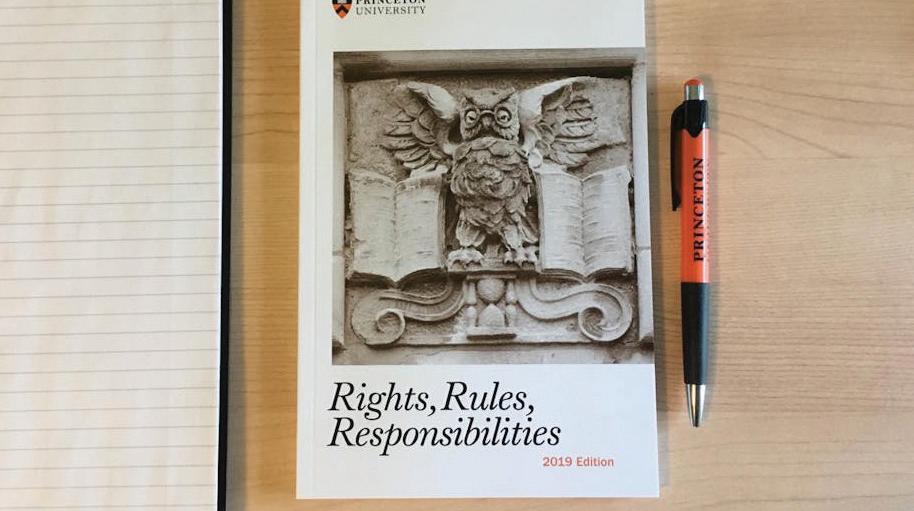
Rights, Rules, Responsibilities (RRR) reads somewhat vaguely that “The University reserves the right to determine the time, place, and manner of all such activities.” However, even as Eisgruber insists that the time, place, and manner rules are content-neutral, there is a discrepancy in how neutral the University really is in practice. Currently, there is no explicit or binding language that forces the University to commit to “content neutrality.”
The absence of a clear system for regulating time, place, and manner only enables inconsistent enforcement for forms of speech and expression later down the line. In order to establish clear regulations, Princeton should codify all three aspects of the Constitution’s three prong test for permissible speech directly into RRR.
At present, Princeton does not satisfy any of the three Constitutional tests. Regarding the first test, Princeton has proved time and time again that they are not viewpoint neutral. Regardless of their claims, actions truly speak louder than words. The University’s treatment of occupations in the past reflects this: during last year’s Palestine encampment, Princeton authorized arrests for students within six minutes of the first tents being set up, but in 2015 and 2019 for the Black Justice League’s sit-in and Student’s for Title IX Reform’s sit-ins respectively, protesters were not warned of nor punished with arrest.
Additionally, the University does not have a singular standard for what is considered to be “neutral” content. For exam-
ple, as the Princeton Progressive Coalition recently pointed out, Princeton’s ban of chalk and tape on University walkways has been historically inconsistently enforced: where USG candidate designs were allowed to stay on walkways, gay pride drawings were banned and removed.
As for the “narrowly tailored” legislation, the Supreme Court’s original ruling dictated that restrictions on speech must be written precisely to place as few restrictions on First Amendment rights as possible, while serving the government’s purpose in creating restrictions in the first place. Regulations which fail this test are considered to broadly restrain First Amendment rights.
Currently, Princeton’s protest policies are far from being narrowly tailored. Chalking is explicitly banned. Posters are prohibited from being affixed to buildings, fences, benches, sidewalks, roadways, and the natural landscape. Bans against high traffic locations, like Cannon Green and Prospect House, are specific in terms of the “place[s]” where protests can occur, but even when these rules are narrow, Princeton arbitrarily applies them. For example, take the ban on Cannon Green, which protesters defied on Community Care Day and yet faced no repercussions at the hands of the University. Accordingly, students often lack clear and narrowly tailored guidelines around the enforcement of time, place, and manner restrictions.
Within the Princeton community, there are many avenues for expression. However, over recent years, Princeton has advanced numerous measures that have sought to limit or restrict free speech on campus. These policies have tended to be inconsistent and vague, and students have expressed that this lack of clarity has limited alternative avenues for expression
that they might have otherwise pursued.
As a private institution, Princeton does not have to be clear in the language of their policy, but they should be. The University is not required to have measures to restrain the lengths their policy, but they should, and they must inform students of it. We not only deserve to know our rights, but we also deserve to know the principles behind — and limits on — restrictions on our rights.
By employing the use of something like the three-prong test, the restrictions and rules around protests are less likely to be applied inconsistently. Such a three-prong test could further enhance the student body’s comprehension and even their impression of such policies. It could also enable the ability of students to more constructively challenge these regulations and further establish productive spaces to contest, discuss, and debate the underlying application.
Above all, Princeton has a commitment to free and open inquiry and our freedom of expression. But in order to create such spaces, the University needs to hold itself accountable and give us the information to hold them accountable as well. By codifying a version of the three-prong test, perhaps starting by specifically codifying their professed “content-neutral” guideline in RRR, Princeton could begin taking steps in improving their accountability over the years to come. But as it stands, Princeton’s simultaneously extensive, vague, arbitrary, and inconsistent policy will only continue to limit and restrict our freedoms of expression without explanation.
Paterson is a first-year from Silver Spring, Md.
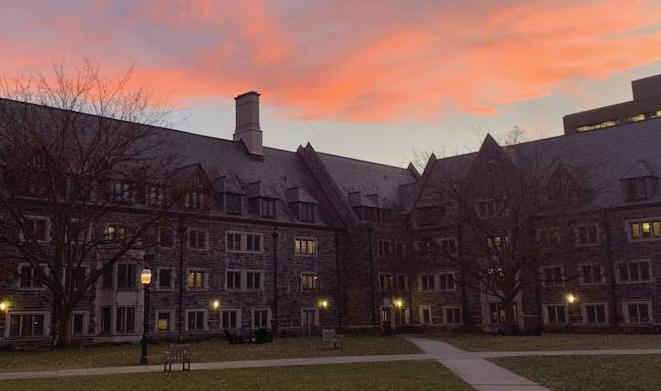
some notable elements of beauty. They have the misfortune, however, of sharing a campus with some of the most beautiful collegiate architecture in the world.
Carved above an entrance to McCosh Hall — a building that has become a venerable emblem of the institution it has served for more than 120 years — is a poem by H.E Mierow, Class of 1914: “Here we were taught by men and gothic towers democracy and faith and righteousness and love of unseen things that do not die.”
To be taught by towers — it’s a strange image. Yet it affirms a feeling intuitive to any member of the roughly thirteen generations who have roamed this campus over the past quarter-millennium: there’s a spiritual dimension to Princeton’s most celebrated buildings that transcend their practical, or even aesthetic value.
Robert Mohan ’26’s “Love Letter to Princeton’s Contemporary Architecture,” was an eloquent and admirable defense of the “gray masses”: the University’s newest additions of Yeh College and New College West, along with its sprawling plans for Hobson College, a new Health Center, and a new Art Museum. These are all sterile designs which diverge from Princeton’s Collegiate Gothic tradition. Mohan argues that the “the new style disengages from traditional footprints and facades to draft a novel visual language for Princeton.” These new hulking, austere blocks of gray cement, Mohan argues, take “assertive aesthetic risks.” That they do.
I acknowledge the privilege of living and learning in these contemporary buildings. Every student should feel grateful to live in up-to-date and well-resourced facilities, and these facilities do contain
In the debate between ‘old style’ and ‘new style’ buildings on campus, Princetonians must consider three imperatives: aesthetics, practical function, and the cultural effect produced from the interaction of the two.
Some may be compelled by the novelty of the new buildings’ style — their unique configurations, random splashes of color, and clean, sharp edges. However, if one were to survey students, professors, administrators, alumni, a random child, or a local squirrel, I think they would resoundingly opt for Blair Courtyard over New College West in a contest of beauty alone. Moreover, the old style has proven timeless. Butler College’s construction followed the contemporary architectural trends of its time, and just forty years later, it looks outdated. It’s not hard to imagine these new buildings meeting the same fate. The collegiate gothic style, meanwhile, was introduced in England some 900 years ago, and we still find it beautiful. When couples start taking wedding photos outside of Yeh’s “Signature Yellow Space,” I’ll measure my confidence. Until then, I think it’s fair to say that, aesthetically, the old style wins out.
Aesthetic value, however, is only one component of architecture. Buildings must also have utility. Most of the collegiate gothic buildings on campus were built in the late 19th and early 20th centuries, and it’s true that they don’t meet some standards we now expect of our facilities: accessibility, temperature control, environmental sustainability, et cetera. This,
of course, is to be expected. These criteria were either infeasible or were not even considered at the time. I see no reason, however, why the collegiate gothic style itself is inherently incompatible with these goals. Older buildings on campus don’t meet modern standards for functionality because the youngest of them are a century old. New buildings in the collegiate gothic style, however, can be reconciled with modern criteria. Take, for example, the new all-electric VW hippie van.
We have a model in Whitman College, which combines traditional style with modern utility.
Mohan calls Whitman an “unsuccessful hybrid” that “does not form a confident aesthetic assertion.” The indictment rests on his observation that Whitman isn’t adorned with the same embellishments and grandeur of the older designs such as Rockefeller and Mathey Colleges.
That’s true. The most ornate features of the old buildings — the archways, intricate carvings, stone figures and the rest — were built by a force of low-wage, trained stonemasons and craftsmen that are rare today. Those features would be unjustifiably expensive in today’s Princeton.
Yet even without those details, Whitman is a strikingly beautiful collection of buildings and courtyards that manage to meet contemporary standards of functionality, accessibility, and sustainability. It proves that it is possible to incorporate wide halls, air conditioning, common rooms, and plentiful bathrooms in a collegiate gothic style building. It may not have gargoyles, but Whitman nonetheless demonstrates that traditional beauty can coexist with practical function.
The most important aspect of this con-
versation is the intersection of aesthetics and practical design: the individual and communal effect which architecture produces. Architecture is both a reflection and a reinforcement of our cultural priorities. As Churchill said, “we shape our buildings and thereafter our buildings shape us.” The new constructions do reflect a positive evolution of institutional values: openness instead of exclusivity, collaboration instead of competition, community instead of cliques. They reflect an earnest effort to emphasize a more modern, inclusive, and healthy campus culture at a university with a reputation for a sometimes toxic brand of elitism. However, the values promoted by the old style of architecture — wonder, aspiration, and growth grounded in reverence for tradition — are admirable as well, and don’t preclude the fostering of new values.
In the words of Demetri Porphyrios, Whitman’s architect, the college “continues and furthers Princeton’s tradition of
collegiate campus life that is conducive to social interaction while fostering the values of leadership.” The continuity of the collegiate gothic style connects all of us to a heritage of intellectualism and excellence. It imbues students with the sense that they are successors of tradition, next up in a storied lineage of thinkers, changers, and leaders. Students a century ago could not have imagined the rich diversity that now makes up the Princeton community, but each of us are connected to past generations of Princetonians by a feeling when we walk through the brownstone courtyard of East Pyne: that we’re in an extraordinary place to pursue extraordinary things. Walking through those arches, you understand how towers may teach a love of unseen things that never die.
Leighton McCamy-Miller is a sophomore from Mill Valley, Calif. He is a prospective politics major.
Rachumallu: “I’m surprised a lot of [students] don’t know about it.”
Continued from page 1
“I want to do what I want to do,” he explained, adding, “I don’t have any pressure. No one telling me what to do, when things need to be done.” As a small business owner, Fils-Aime takes pride in being able to set his own schedule, menu, and hours.
Despite the unforeseen challenges of the 2008 recession and COVID-19 pandemic, Fils-Aime said he has kept his business going by focusing on his work and trying his best. “You don’t really know exactly what’s gonna happen, but you have to be prepared for it,” he noted, shrugging.
“That place is obviously very important to him,” noted Princeton alumnus Sam Harshbarger ’24, who grew up in nearby Cranbury and has frequented the shop since he was young. He described FilsAime as “somebody who really appreciates the independence of his work and enjoys being a small business owner.”
Fils-Aime enjoys the “production” of his pastries the most in his day. Most weekends, he rises before 5 a.m. to make his famous fresh croissants, which he never freezes and always makes from scratch. He has been using the same method and recipe ever since he opened his doors 20 years ago.
“I’m really enjoying what I’m doing to serve [customers], to give them exactly the product they’re looking for — do it differently than other places. I’m really doing my best to continue the same product, the same quality for them to enjoy,” Fils-Aime shared.
At opening, trays on trays of scones and croissants clatter onto the counter of the shop. Right on cue, customers stream into the establishment at 9:30 a.m., their presence announced by a tiny bell above the door.
Since opening in 2003, The Little Chef has accumulated a set of loyal regulars, from those that live and work in the Princeton area to a small handful of student regulars.
Navani Rachumallu ’26 started visiting The Little Chef Pastry Shop in spring of 2024, mainly with the goal of visiting her friends from West Windsor who work at the shop. Since then, she has become more acquainted with Fils-Aime and comes nearly every weekend to the shop.
“He’s pretty reserved at first, but he’s really, really funny,” she said of the chef. Rachumallu’s friend, Sophie Salgian, a student at The College of New Jersey (TCNJ) who has worked at The Little Chef for two years, spoke about their experiences with customers and the regulars they speak with every week.
“In terms of regulars, it’s kind of all over the place. People who live around here, families; we get a lot of cute little kids in strollers who are really excited about chocolate croissants at ten in the morning on a Saturday,” they said.
“People like to open up when they’re buying pastries,” added Salgian, reflecting on the relationships they have built with the shop’s regulars.
On one cloudy and chilly Sunday morning, regulars wait patiently for the shop to open, hands stuffed in pockets. A customer stands in the corner of the shop, hands full with paper bags of almond croissants.
Some customers even travel in from New York City for the pastries, noted Salgian, remarking on these dedicated customers.
“There’s a fan base for this,” added Rachumallu.
When asked about his loyal regulars,
Fils-Aime chuckled, taking stock and adjusting his well-worn and trademark Princeton cap. Some, he says, he has known for ten to fifteen years.
Despite The Little Chef’s relative proximity to Firestone Library — where many Princeton students study — this Princeton establishment finds its customer base to be made up of mainly Princeton townies, with only a handful of student regulars like Rachumallu.
“I’m surprised a lot of [students] don’t know about it,” noted Rachumallu.
The shop is cash-only and opens at 9:30 a.m. on the weekends. Salgian finds that most students are likely sleeping and don’t carry cash, two factors that may result in their lower level of student regulars.
The Little Chef’s unassuming facade and location on Tulane Street may also be a factor in its relative mystery to the student body.
“I don’t think people come down here unless they’re going to the record store,” said Salgian, adding, “We’re kind of tucked away.” The Little Chef also doesn’t find it necessary to advertise directly to students, given word-of-mouth and its steady stream of regulars.
“It’s a small street,” mused Fils-Aime. “Sometimes it’s difficult for people to notice.”
When asked if he would ever consider moving his pastry shop to a more heavilytrafficked part of Princeton, like Nassau or Witherspoon Street, Fils-Aime responded with a definite no.
“I like where I am right now,” he explained. “It’s a small place, and quiet.”
Harshbarger commented on the serenity of the shop as well. He described his nearly ritualistic pilgrimages to the Little Chef on the weekends as “an escape from campus,” to a place that was “hidden away in plain sight” from students.
Gil Joseph ’25, an international student from Haiti, learned of the shop from a professor and has visited the establishment a few times. He sees the location of the shop as a benefit as well, but for different reasons.
“There’s something about this being inconvenient that is actually good,” he said, “Because it forces us to be more intentional about certain things and take time out of our days to wander into town.”
For Joseph, interaction with these small businesses in the Princeton area serves a larger purpose than just renowned croissants.
“I wish there was a lot more intentionality for us to engage with the town,” he said. “Get to know it because we are here for four years.”
Joseph noted how student involvement with the town has often been with the closer, more easily accessible places on campus and highlighted the importance of engaging further with Princeton’s establishments and history.
He added, “I would love to be able to support a business like this that has been around for a while, that’s run by one guy … a small, minority owned bakery.”
For Rachumallu, who continues to frequent the shop, The Little Chef has become a large part of her life at Princeton.
“It’s just an unexpected place of gathering that has just popped up in my life. And I’m very grateful for it,” Rachumallu added, laughing before finishing, “And I’m also grateful for the croissants!”
Mira Eashwaran is a staff Features writer.


By Annika Plunkett | Contributing Prospect Writer
Richardson Auditorium erupted with applause as singer Cécile McLorin Salvant and her musical accompaniment stepped onstage. For the audience, the performance was just beginning. But for the Richardson staff, this show, like any other, was the product of hours, days, and in some cases weeks of preparation.
“Service excellence”
At Richardson Auditorium, an almost 200 member staff consists of volunteers, Princeton students, community members, and University employees. The team’s diverse roles are connected by a common goal of supporting the performer and audience experience. Across the board, the staff of Richardson have gained pride for their work towards this goal, and established a strong community.
Richardson is the main venue for student performances, as well as Princeton University Concerts (PUC), which brings world-renowned guest artists to campus for an accessible ticket price. Richardson staff work with performers to meet their stage needs and create a positive patron experience, following a model which Sharon L. Maselli, Audience Services Manager at Richardson, called “service excellence” in an interview with The Daily Princetonian.
The Richardson staff fall broadly into two categories: front of house and back of house. Front of house staff interact with the patrons, while the back of house, or production, staff work behind the scenes, running the technical elements of each show.
Back of house
The back of house crew are “the people that you don’t see, but if they weren’t there, the show would fall apart,” Maselli said to the ‘Prince.’
Responsible for lights, audio, and overall show production, the back of house staff play a vital role in the choreography of each show. A lighting specialist works with the artists to create their desired lighting effects prior to and during each performance. Before shows, the crew sets up the stage with instruments and equipment. Professional pianist Jonathan Biss even played both of the Auditorium’s pianos to determine which would be better for one performance.
Once doors open, the stage manager and house manager communicate through headsets about the performance, while production’s job is to cue lighting and audio as appropriate.
“For a concert, we usually say when it starts,” stage manager Julio Montero says. “And then we let the concert go.”
During a concert, other back of house staffers like sound engineers sit at a soundboard inside the auditorium and listen to the music through a headset, adjusting the mics in real time to make sure, as Maselli said, “that the audience hears a combined sound.” Meanwhile, in a small room filled with sound equipment, another audio specialist records the concert for future listening.
Student employees
While the back of house consists entirely of hired professionals, the front of house team is a mix of part time adult staff, Princeton student employees, and volunteer ushers from the local community. Maselli, usher program coordinator Ayame Whitfield ’21, and Sarah Spalding, student program coordinator, collectively oversee 184 people.
For the Princeton student employees, work at Richardson has evolved into a hierarchical system akin to a career path.
“It became clear to us that students have so many opportunities at Princeton. It’s amazing what all you can choose. And, we have this job to offer but we want to make it really worthwhile. And, students are so incredibly capable that to have them just come in and hold a door or take a ticket seat is an underutilization of their abilities. So, we thought, let’s create a career path for them to have opportunities for leadership and management development and soft skill development,” Maselli said.
Students begin this “career path” as “Event Assistants,” working with the professional staff and volunteers to create a welcoming experience for patrons, according to the Richardson website. An Event Assistant can become a Lead Event Assistant, Student Manager, and then House Manager, increasing in responsibility and pay as they climb the ranks. A Lead Event Assistant is the right hand to the House Manager, who assists production and supervises student and volunteer front-of-house staff during and outside of a performance. Student Managers, typically students in their junior year, serve as mentors to the Event Assistants. Students are not required to advance.
Talia Czuchlewski ’26 is currently a Lead Event Assistant at Richardson. Describing her job in an interview to the ‘Prince,’ she said, “We have responsibilities as team leaders and also as event leaders.”
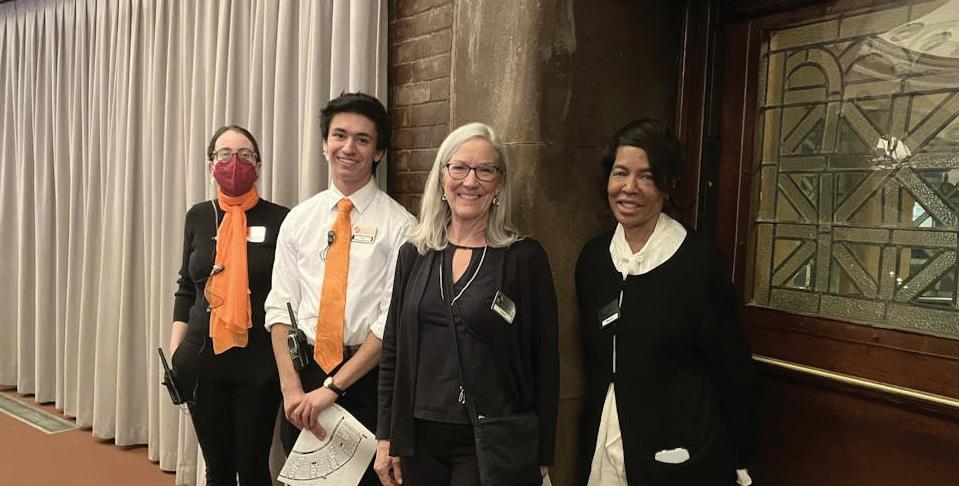
During a shift, students, recognizable by their orange scarves, can set up the audito-
rium prior to patron arrival, be greeters or ushers, or work in the balcony, while simultaneously ensuring audience satisfaction and, as they ascend the ranks, managing other students and volunteer ushers.
“It’s real, hands-on work,” Czuchlewski said.
Part-time employees fill in gaps when students are unavailable. “We do the best we can and whatever we can,” Jocelyn Starr, a member of the adult staff, told the ‘Prince.’
Volunteers
Richardson ushers are volunteers, a mix of adult community members and high school students. Many adult ushers came to Richardson through the Joint Ushers for McCarter and Princeton (JUMP) program, which shares ushers between McCarter Theater and Richardson Auditorium, while high school student ushers come to Richardson through the Community Arts Service in Theaters (CAST) program.
Launched in 2023, the CAST program now partners with 10 high schools in the Princeton area, helping students interested in the arts fulfill their community service graduation requirement in a sector with fewer opportunities for service.
“[T]his opportunity to both appreciate and enjoy the arts but also to actively support it through service,” Whitfield told the ‘Prince.’ “That’s a huge part of the draw of this [volunteer] program.”
A strong Richardson community
Several members of Richardson’s staff told the ‘Prince’ that the best part of their work was not the special concert access as one might expect, but rather the theater community.
“I think we all know each other really well at Richardson,” Whitfield said.
To foster community amongst its workers, Richardson hosts annual holiday parties and a spring dinner, as well as a group training in the fall.
“We have this beautiful Christmas par-
ty,” volunteer usher Colleen Marsh told the ‘Prince.’ “We have a meal onstage, and then we have a sing-along … And every spring, we have a dinner with somebody different from the Princeton community.” She added, “They treat us like gold.”
A newsletter highlighting different workers also releases quarterly to all the staff, including students, part-time adult staff, and volunteers.
“One of my favorite things about [working at Richardson] is that I get to interact with a larger community than just Princeton,” Czuchlewski said.
Richardson leaders also emphasize workplace equality. Once they have trained for and shadowed a position twice, anyone can work any position, so on a given night, a student may manage an adult staff member, or the other way around. Plus, since lead staffers Maselli, Whitfield, and Spalding work shows as well, they get on the ground experience of what does and does not work for their employees and volunteers. In fact, Whitfield worked every show last year as the CAST program launched.
“One thing that has stayed true since I started working as Usher Program Coordinator is that the ushers are not afraid to offer feedback. They will tell me if they think I could do something better or if Richardson could do something better … Ultimately, I’m really proud of being in charge of a program like that where people feel comfortable offering feedback, expressing themselves. It tells me that they feel respected and valued enough to give feedback and make what we do better,” Whitfield said.
The staff are indeed proud of their work supporting world-class performances and believe the opportunities at Richardson are underutilized, especially by students. Echoing many of her coworkers, Maselli encouraged students to use their Passport to the Arts to come see shows at Richardson.
“It’s a hidden gem on campus,” Maselli said.
Annika Plunkett is a contributing writer for The Prospect and a member of the Newsletter team.
By Marley Hartnett-Cody, Contributing Writer
Nov. 15–16 at 8 p.m., Nov. 17 at 2 p.m. Matthews Theatre in McCarter Theatre
Join the Triangle Club as they present their original comedy-musical “Pageant Pending.” Direct from the Triangle Writers’ Workshop, the production follows a competitive American beauty pageant, “America’s Most Wanted.” Come support as Triangle celebrates 134 years of original musical comedy. Tickets are required and range from $33–73 with $10 student tickets. Students can get tickets for free through Passport to the Arts.
Nov. 15–16 at 8 p.m., Nov. 17 at 2 p.m.
Nov. 21 at 9 p.m.
Blair Arch
Stay warm and support the eight Acaprez a cappella groups as they perform their last arch sing before Thanksgiving break. This performance will feature sets from the Katzenjammers, Footnotes, Nassoons, Tigerlilies, Tigertones, Tigressions, Wildcats, and Roaring 20. This event is free and open to the public.
Nov. 15–16 at 6 p.m. and 9 p.m. Frist Theatre
Support the Black Arts Company as they present “After Hours,” a speakeasy-inspired dance performance at Frist Theatre. Tickets are required and cost $7 for students and $8 for the general public. Students can get tickets for free through Passport to the Arts.
Nov. 15 at 7:30 p.m., Nov. 16 at 5 p.m.
Richardson Auditorium in Alexander Hall
Join the Princeton University Glee Club as they celebrate their 150th anniversary with an eventful week- end. They kick off the weekend with a featured performance in the King’s Singers, a well-known interna- tional a cappella group, concert on Friday. On Saturday, catch past and present Glee members in the Gala Concert: “Then, Now, and Onwards!” Tickets are limited and required. Student tickets range in cost from $5–10, while public sales range from $15–50. Students can get tickets for free through Passport to the Arts.
Hamilton Murray Theater in Murray-Dodge Hall
In their second mainstage production of the season, Theatre Intime presents “Eurydice.” Sarah Ruhl’s play is a unique retelling of the Greek legend of Orpheus and Eurydice. Experience love, death, and everything in between from Eurydice’s perspective. Tickets are required and range from $8 for students, $10 for staff and faculty, and $12 for general admission. Students can get tickets for free through Passport to the Arts.
Nov. 15 at 4:30 p.m.
James Stewart Film Theater, 185 Nassau St.
Join Professor of Creative Writing Paul Muldoon for a poetic review of Irish history. As part of the Fall 2024 Lecture Series for the Fund for Irish Studies, Muldoon recounts history through his poetry. This event is free and open to the public.
Nov. 20 at 7 p.m.
Maclean House and Richardson Auditorium in Alexander Hall
Are you looking to meet other music lovers on campus? Princeton University Concerts (PUC) has the event for you: speed dating and appetizers followed by a concert! The speed-dates go through eight-minute circuits separated by three different age groups. After speed-dating, there will be a performance by the Isidore String Quartet in Richardson Auditorium. Registration is available on the PUC website. Tickets are required and cost $50 for general admission and $25 for students.
Nov. 19 at 5 p.m.
Chancellor Green Rotunda in East Pyne Hall
Hear selected works presented by students from the program of Creative Writing’s fall courses. As a part of the Althea Ward Clark W’21 Reading Series, students will read their pieces of fiction, poetry, screenwriting, and translation. This event is free and open to the public.
Nov. 21 at 7:30 p.m.
Matthews Theatre in McCarter Theatre
Listen to the Renaissance Quartet, a string ensemble composed of graduates from The Juilliard School and mentees of esteemed violinist Itzhak Perlman. Violinists Randall Goosby and Jeremiah Blacklow, violist Jameel Martin, and cellist Daniel Hass perform a rep- ertoire of classical and contemporary music with jazz touches. Tickets are required and cost between $43–73 for the public and $10 for students.
“Dancing
on My Own”: Book Talk and Signing with Author Simon Wu ’17
Nov. 21 at 6 p.m. Labyrinth Books
Join Princeton alumni and writer Simon Wu ’17 in a conversation regarding his book, “Dancing on My Own,” with Monica Youn ’93, a visiting professor in creative writing. The recently published text features essays ex- ploring art, capitalism, and identity. After the discussion, there will be a signing and reception. This event is free and open to the public.
Nov. 18–Dec. 6, weekdays 7 a.m.–8:30 p.m., weekends 9 a.m.–8:30 p.m.
Hagan Gallery, 185 Nassau St.
Visit the Fall 2024 Painting Class Show to view featured works from students in VIS 203: Painting I. This course is taught by Lecturers Pam Lins and Colleen Asper. The exhibition is free and open to the public.
By Joe Uglialoro
Staff Sports Writer
After a dominant performance in the Ivy League Tournament semifinals against Harvard (7–4–5 overall, 3–3–1 Ivy League), the Princeton women’s soccer team (15–4, 7–1) beat the Brown Bears (7–4–6, 3–2–2) 2–0 in the final match of the tournament. In their usual fashion, the Tigers got out to a strong start and controlled the game on the way to an Ivy League Tournament title. Now, they head to compete in the NCAA tournament.
“This team was resilient, and they battled all the time,” Head Coach Sean Driscoll told The Daily Princetonian. “They have such a good attitude; it’s just fun to watch.”
Princeton and Brown last faced off in October in a game that was notable in multiple ways. Princeton handed Brown their first regular season-loss since 2018, and the 8–0 trashing was one of the most striking performances the Tigers have ever produced in Ivy League competition.
Unlike last year, when four Ivy League teams made the trip to the NCAA tournament, this season’s edition may only feature one: the league’s tournament champion. No Ivy League teams have received votes in the NCAA Top 25 poll. Princeton ranks the highest in the NCAA RPI ranking — a metric that takes record and strength of schedule into account — at No. 34.
In the opening minutes of the game, it was clear that the Tigers were facing an opponent far
stronger than the Harvard squad they dismantled on Friday. Whereas the Tigers kept possession early in that game and smothered their opponents, the outset against Brown was backand forth, with each team displaying quality across the pitch and Brown threatening more early. A shot by junior forward Pietra Tordin in the 24th minute was the first real chance for the Tigers, but was quickly saved by Brown goalkeeper Bella Schopp.
Throughout the first half, this game seemed to be destined for a deadlocked state at the half. Suddenly, in the 34th minute, that changed when junior winger Drew Coomans did what she does best: use her speed to apply pressure on the back line. A long through ball into the middle of the Brown box seemed harmless as two defenders attempted to decide who would clear it. Out of nowhere, Coomans zipped in between them in a flash. Gaining possession of the ball, she pivoted and sent a soft lobbed shot over the head of Schopp. The ball floated into the back of the net, leaving the crowd in delighted shock and the Tigers in a frenzy, up 1–0. Coomans ran to the sideline to celebrate with her teammates, willing the Tigers ahead with an effort only she could produce.
When asked about her ability to pressure the ball, Coomans chalked it all up to effort. “One thing I can always control in the game is how much effort I put in,” she told the ‘Prince.’ “If it’s not the best game touch-wise, I know I can work as hard as I can,
and I’ll produce results that way.”
After Coomans’ goal, the Tigers dominated the rest of the first half. The back line, led by sophomore defender Zoe Markesini, stifled a potent Brown attack featuring speedy super-sub Ayla Sahin, a second-team AllIvy selection. Princeton went into the half leading 1–0 but looking for more.
“I really thought our defending was excellent today; we controlled their chances against us,” Driscoll said of the team’s defensive effort. “In general, in the first half, I thought we did a really good job in the wide spaces and created some really good chances as well. The team handled a really good opponent very well.”
Right out of the half, an excellent save from Schopp led to a corner kick taken by Princeton in the 47th minute. As the ball floated in the air off the kick from senior captain and forward Heather MacNab, it dropped to the feet of senior midfielder Lily Bryant. Bryant volleyed the ball, sending it past Schopp and into the back of the net. The two seniors combined for a bit of magic in their final Ivy League Tournament, putting Princeton up 2–0 and one step closer to a title.
“We ran a play that we had been working on a lot, and I don’t even know if I was necessarily where I was supposed to be,” Bryant told the ‘Prince.’ “I saw the ball coming in, and there was no way I was letting it get past me. We needed a second goal to feel some security, so that was awesome.”
A pa ir of consequential calls by the refs denied Princeton the chance to go up 3–0. A beautiful through ball from the back line found Drew Coomans wide open in on goal, but the play was blown dead for a foul against Brown all the way back from the site of the pass. Minutes later, a goal on a free kick by MacNab was disallowed for a seemingly nonexistent foul on the goalkeeper. MacNab, running towards midfield in celebration, was rudely awakened by the call.
Even without a third goal, the Tigers remained confident and in control throughout the second half. No chances by Brown developed into anything serious, and the Tigers kept the ball in the opposing half for most of the game. As coach Driscoll brought his substitutes into the game and the Tiger back line kept stifling Brown, reality on the field began to set in.
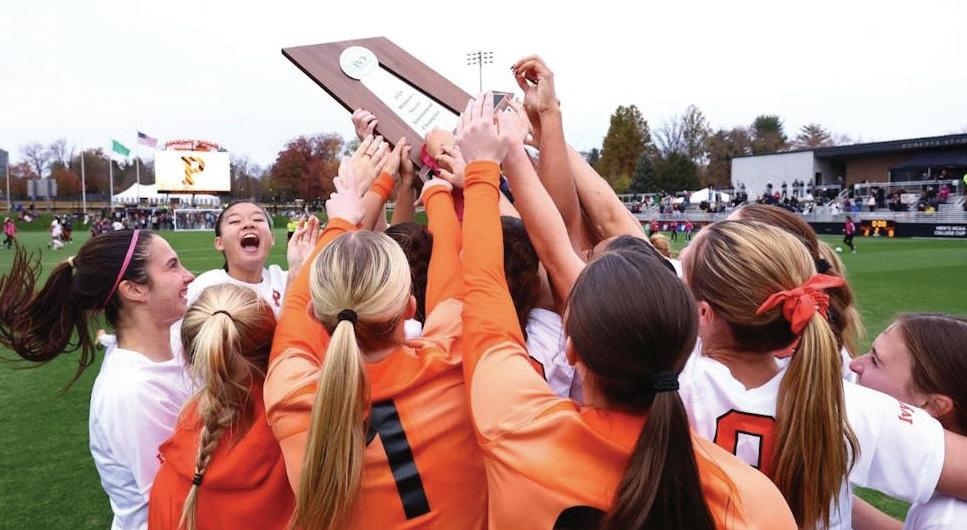
Applause from the crowd grew louder with every tough pass and bit of skill as anticipation built for the final whistle and all that waited after. When it finally came, the team stormed the field as they lifted the coveted Ivy League trophy.
The Tigers had not been crowned champions of the Ivy League since 2018 and had never won an Ivy League Tournament title. This iteration of the team had won big games in the past, but never reached the heights they now attained. Now, they had dominated their conference and slayed every opponent that had stood in their way for years.
For Heather MacNab, the team
captain and a senior who has been with the team for her entire Princeton experience, the tightness of the team was perhaps her favorite part of the whole season.
“This team loves each other so much,” MacNab told the ‘Prince.’ “It’s really difficult to find a group where there’s 26 girls, and we’re able to not only get along but also just love and have a mutual respect for one another. I think as team captain, that was my biggest goal going into the season, and it exceeded my expectations.”
Now, the Tigers have a chance to exceed MacNab’s expectations in yet another way: a deep run in the NCAA tournament.
“I’ve been to the tournament twice now, and only made it to the Round of 32,” MacNab added. “This team has a chance to go so much further this year and really do some damage.”
The Tigers await their placement in the NCAA tournament, which they will receive on Monday at 4 p.m. Last year, the team beat Michigan at home before falling to Texas Tech on penalties in the Round of 32. The Tigers should host a tournament game this week, with any games after that likely coming on the road. All signs indicate that they’ll be more than ready for the challenge.
Joe Uglialoro is a staff Sports writer for the ‘Prince.’