83 percent of sophomores participate in Street Week, surpassing last year’s milestone
By Justus Wilhoit and Luke Grippo
Senior News writer & Staff News writer
Street Week 2025 has concluded, with all of the 1,263 students who chose to pursue an eating club given a place according to a press release from the Interclub Council (ICC). 83 percent of the Class of 2027 participated in Street Week, up from 80 percent of the Class of 2026 last year. Tiger Inn (TI) remains the most selective club, Cap and Gown Club has reclaimed the distinction of being the most bickered club, and Tower has seen a near 17 percentage point decrease in acceptance rate from last year, from 59 to 42 percent.
U. AFFAIRS
Street Week refers to a week of conversations and social events during which many sophomores and juniors explore the various eating clubs located on Prospect Avenue. This year’s Street Week was held from Feb. 2 to Feb. 7. In a press release issued to The Daily Princetonian, President of the ICC Vincent Jiang ’25 shared that 119 juniors and 1,144 sophomores were placed into the 11 eating clubs.
Last year, the ICC failed to place a small number of students — less than one percent — into an eating club due to the demand from the unprecedentedly-
large class of 2026. This year, the ICC was able to place all students who took part in Street Week activities, as all registered students were required to rank all five sign-in clubs, instead of just two, which was the practice in years prior.
“The Street as a whole has successfully adapted to the larger size of the Class of 2026 and beyond, reflected in our increased numbers with many clubs reaching physical capacity,” Jiang wrote.
The ‘Prince’ contacted officer teams at every eating club, as well as the ICC. Jiang told the ‘Prince’ that “the eating clubs have discussed and we have de-
Features
‘Our Marriage Comedy Act’: Q&A with Professors Deborah and Frank
By Valentina Moreno associate Features editor
Deborah and Frank Popper have been married for 58 years and both hold visiting faculty positions in the Department of Civil and Environmental Engineering. As academic and life partners, they have coauthored papers and cotaught classes, including ENV305: Topics in Environmental Studies: Building American Style: LandUse Policies and Rules. For the week of Valentine’s Day, the ‘Prince’ sat down with the Poppers to discuss their love story and how they navigate academia as a married couple.
The Daily Princetonian (Prince): How did you two meet?
Frank Popper (FP): We got married in August 1968 in what was my parents’ apartment, and we are sitting here right now — or looking at the computer —
in pretty much the exact place we got married all those years ago.
Deborah Popper (DP): Oh, wow! That’s right. We live in Manhattan now and his parents moved into this particular apartment in 1967 which is the year we actually met. And although he was a graduate student at Harvard, I was an undergraduate at Bryn Mawr and spending the summer working at Boston Public Library at the time. We got married in 1968 in the living room in front of the window that we’re sitting in now. FP: Deborah went to Bryn Mawr as an undergraduate and I went to Harvard, pretty much paired schools. They’re a mile from each other. Students take courses back and forth. There were mu -
See COUPLE page 14
Please send any corrections requests to corrections@dailyprincetonian.com.
‘Keep Calm and Carry On’: Eisgruber responds to Trump executive actions at CPUC meeting
By Luke Grippo & Cynthia Torres staff News writer & Assistant News editor
University President Christopher Eisgruber ’83 advised the campus community to “Keep Calm and Carry On” and offered other World War II-era words of advice at the Council of the Princeton University Committee (CPUC) meeting on Monday, as the University grapples with challenges posed by the Trump administration.
During the meeting, Eisgruber broadly reiterated main points from his annual letter to the community, and he took questions from the audi -
ence at the end. Representing the faculty, the undergraduate and graduate populations, and staff, 33 of 52 members of the Executive Committee of the CPUC were present. Around 80 people attended the meeting in the Frist B-level multipurpose room.
Eisgruber outlined the University’s philosophy for responding to executive orders that may affect campus.
“I said in the course of the annual letter that I wanted to concentrate on strategic issues that are longer term for us, rather than trying to respond directly to the orders that are coming out of Washington,” said Eisgruber in his
VALENTINE DUCK AWAITS RETURN OF SOPHOMORE AFTER HEAVY WEEKEND FLOW OF LOVE MESSAGES
FEBRUARY 16, 1937
opening remarks.
He explained that rather than updating each change as it comes, the administration will choose to wait until executive orders and their legal status are clear to update the campus community.
“We will communicate about them when we have things to share, and we’ll often do that by creating FAQs,” said Eisgruber.
The website for the Office of the Dean of Research, for example, was updated over the weekend to provide guidance on a National Institutes of Health (NIH) order that capped the indirect cost recoveries on research grants
at 15 percent. Eisgruber explained that these costs are often facilities and administrative costs, which are “real costs of doing research.” This slash to NIH costs will have a significant impact on universities around the country that house opportunities for research.
“For all of the universities that perform research around the country, these kinds of orders that are coming out of Washington do pose serious risks to their budget model and to the ability to proceed forward with the research that we are doing,” said Eisgruber.
To illustrate the University’s policy regarding executive or -
ders, Eisgruber introduced an unofficial motto: “Keep Calm and Carry On.” The slideshow presentation featured a graphic with a tiger above the motto. Eisgruber explained the motto “didn’t mean be oblivious or pretend there’s nothing of concern happening or just go about ordinary life. It meant press forward with our mission, but keep calm and move forward.”
Another slide, titled “More crisis management advice from WW2 Britain,” re-emphasized the phrase alongside two others: “Freedom is in peril, defend it with all your might” and “Your courage,
This Week In History
As February overtakes us and Cupid readies his bow, The Daily Princetonian reflects on Princeton Valentine’s Day traditions from the 1930s to the present. While current Princeton students content themselves with the bravado of Band-O-Grams, a review of past valentines reveal traditions of duck-giving, uncooked meatballs, and a barrage of mysterious messages that left postmen speechless.
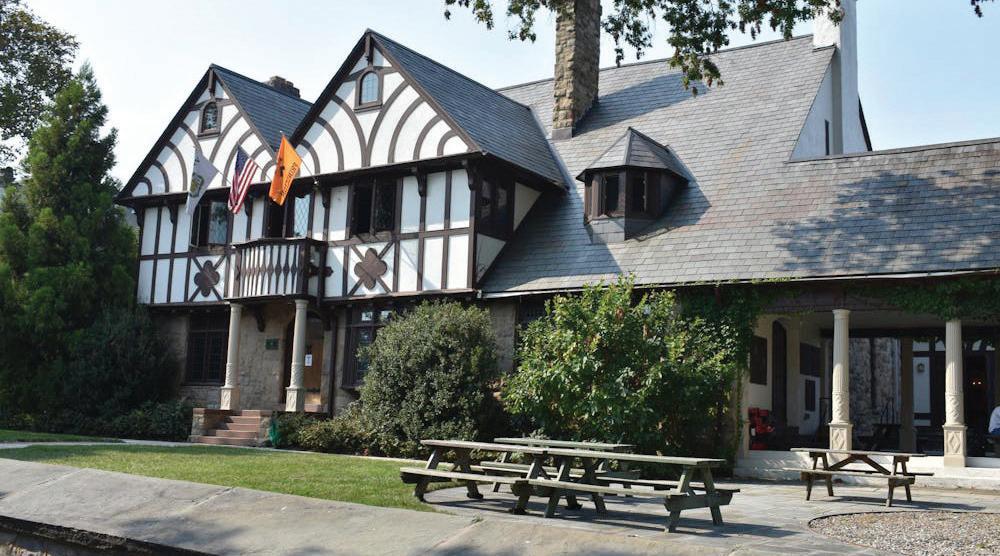
ISABEL RICHARDSON / THE DAILY PRINCETONIAN Tiger Inn was the most selective Bicker club in 2025.
‘Keep Calm and Carry On’: Eisgruber responds to Trump
EXECUTIVE
Continued from page 1
your cheerfulness, your resolution will bring us victory.”
Next, Eisgruber reintroduced another motto he attributed to former Princeton president Bill Bowen ’58, “Princeton is always under construction.”
“In addition to being physically under construction, we’re always transforming ourselves in a push to make Princeton better than it has been in the past,” he continued.
He updated the community on the recent completion of the largest campus construction projects. He began by showing rendered images of the completed Art Museum, promising that its opening in October would be “an amazing event on this campus.”
Eisgruber also highlighted the completion of the Frist Health Center and the fitness center on the Meadows Campus.
Eisgruber continued to reiterate updates he shared in his annual letter to the community. He emphasized the importance of the endowment and explained how its sustainability is a lifeline for the University as it funds faculty salaries and research. He also emphasized his decision to publicize diversity and inclusion data and shared many graphs to visualize the demographic data during the meeting.
To conclude the first meeting of the spring semester, Eisgruber opened the meeting up to committee members for questions, then to audience members.
The last question of the
meeting was asked by a student regarding the progress of the three referenda approved by undergraduates last fall. The referenda called for the University to divest from weapons manufacturers, improve employment standards for student workers, and to dissociate from certain fossil fuel companies.
“What steps will you take to implement these three [referenda] specifically, and on what timeline?” asked the student.
“The student referenda are part of something that the student government created. They’re not part of something that is a part of university administrative processes,” replied Eisgruber.
Seated in the audience were 10 pro-Palestine protestors, holding signs with phrases such as “Genocide,” “the Students have Spoken,” “I refuse to support a university that funds genocide and arrests its very own students for standing for human rights,” and “Pay Up, Princeton.” After this question, the meeting officially ended and the remaining pro-Palestine student protestors swiftly exited to join the ongoing protest on Frist North Lawn.
Cynthia Torres is an assistant News editor and an Archives contributor. She is from New Bedford, Mass. and typically covers University administration.
Luke Grippo is a staff News writer for the ‘Prince.’ He is from South Jersey and usually covers administrative issues, including USG, the CPUC, and institutional legacy, but loves to write in any
THE MINI CROSSWORD
By Jessica Curran CONTRIBUTING CONSTRUCTOR
Progressive groups protest lack of administrative action over referenda
By Christopher Bao & Nikki Han Head & Assistant News editors
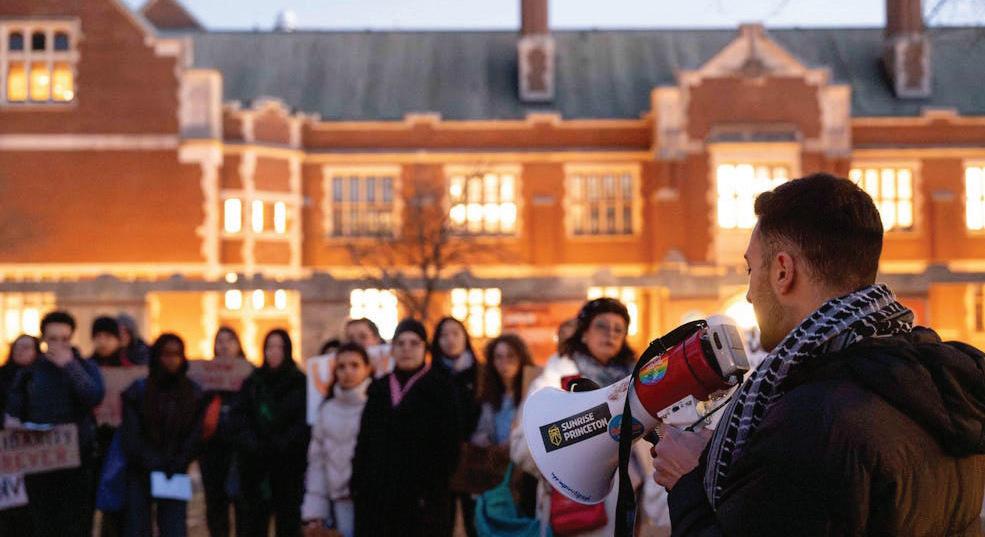
A small crowd of undergraduates and community members gathered on Frist North Lawn on Monday to protest a lack of administrative action over three undergraduate referenda passed last fall — referenda that University President Christopher Eisgruber ’83 expressed are not the most effective change agents in a campus setting.
The rally started at 5:30 p.m., while the February Council of the Princeton University Committee (CPUC) meeting was still in session, although it did not go into full swing until 5:50 p.m., once several protestors who were asking questions at the CPUC meeting arrived at the front lawn. At its peak, there were more than 50 students and community members in attendance at the protest. It eventually moved to Nassau Hall.
According to flyers passed out, the rally was organized by the Princeton Progressive Coalition, and speakers included members of Young Democratic Socialists of America (YDSA), Sunrise Princeton, and Students for Justice in Palestine (SJP). Resistencia en Acción, a local immigrant rights organization, was also present.
“We’ll continue to show [the University] not just that we’re willing to go through their formal institutional process, but that we’re willing to put pressure on them day and night, that we’re not going to let them rest until we get actual action,” said Zach Goldberg ’28, an organizer for Sunrise and YDSA.
Last November, the undergraduate student body voted to pass all four referenda on the ballot. Three of them dealt with progressive issues, calling for improvements in employment standards for undergraduate workers, dissociation from fossil fuels, and divestment from companies involved in weapons
manufacturing. The fourth referendum supported language classes to be taken pass/D/fail.
While these referendums passed with greater than twothirds support — only 68 percent of votes were in favor of divestment from weapons manufacturing companies — the University has so far not changed its policies.
During the rally, protestors booed when an audio clip of Eisgruber speaking at the CPUC played, where he said that the referendums did not fall into Princeton’s governance process.
”I am not particularly a fan of referendum processes in general. I don’t think that they’re the best way to implement the ideals of any kind of republic or democracy,” Eisgruber said at the meeting, pointing to the CPUC‘s lengthy process for considering dissociation instead.
“We cannot pretend like the University is going to roll over,” Goldberg continued. “What we need are constant reminders that students won these demands, and we need continued demands that they are going to be seen through to the end.”
This protest is the first organized protest among a coalition of progressive organizations since the spring semester has started. A pro-Palestine protest to divest from Israeli companies was held several weeks ago on the first day of classes.
“We’re in solidarity with all of you guys,” a member of Resistencia en Acción told the students through his translator Richard Daniel. “Your fight is our fight, your struggle is our struggle.”
Multiple speakers at the rally criticized what they saw as a lack of transparency and student input throughout the referendum process.
“You students exercised the democratic rights and the democratic mandate last semester when you passed those referenda … we’re talking about thousands of people who turned out to vote
in favor of three referenda,” Associate Professor of History Vera Candiani said, addressing the students at the protest. “[The administration’s actions are] fundamentally undemocratic, and it’s not just undemocratic, but actively anti-democratic, by refusing to even discuss, to even consider the limited options of the referendum that you all voted for.”
Referendums in recent years have had mixed success at Princeton. In 2022, undergraduates narrowly passed a referendum supporting a boycott of construction company Caterpillar Inc. due to its connections to alleged human rights violations against Palestinians. The University did not pursue dissociation.
Kristin Nagy ’27, who attended the rally as an organizer with SPEAR, told the ‘Prince’ that she believes a coalition of groups will make pushing for change more effective. Nagy is a former Prospect writer for the ‘Prince.’
“I think that when we all fight together, we’re stronger and we have much more power,” Nagy said. “So it makes me really happy that different organizing groups with different beliefs and different ideas were able to come together and have this community protest.”
One counter-protester, who played the Israeli national anthem off a phone, was present at Nassau Hall.
Starting this Thursday, weekly picketing related to referendums will happen in front of Nassau Hall, according to Goldberg.
Christopher Bao is a head News editor for the ‘Prince.’ He is from Princeton, N.J. and typically covers town politics and life.
Nikki Han is an assistant News editor for the ‘Prince.’
Luke Grippo and Cynthia Torres contributed reporting.
‘Devastating’ and ‘shocking’: What Princeton stands to lose from Trump’s science freeze
By Sena Chang Senior News writer
Federal funding has long been the bedrock of Princeton’s research. In 2004, Princeton established its Center for Quantitative Biology with an initial $3 million grant from the National Institutes of Health (NIH). The center later pioneered novel gene sequencing techniques and developed new methods of computational analysis. Grants from the National Science Foundation (NSF) funded the early work of 2021 Nobel Laureate in Physics and Princeton meteorologist Syukuro Manabe on large-scale atmospheric circulation. Only three months ago, the NIH awarded $207 million in grants to 67 “high-risk, high-reward” researchers, including four from Princeton.
In the 2024 fiscal year alone, Princeton received $58 million in NIH funding and spent over $70 million in NSF-funded research and development. This federal support now faces uncertainty under the Trump administration, which has characterized universities as “infected” by the “radical Left and Marxist maniacs.”
A Jan. 27 memorandum from the Office of Management and Budget (OMB) directed a temporary freeze on federal grants and loans pending a comprehensive review of funding programs. Though the spending freeze was rescinded on Jan. 29 following a federal court injunction, more than 20 states, including New Jersey, have sued the administration in response.
In a Jan. 28 letter to the Princeton community, University President Christopher Eisgruber ’83 addressed these recent developments, informing scholars that they could receive “guidance from the Office of the Dean for Research, which is coordinating University-wide efforts.” Recently, the Office of the Dean for Research unveiled a new website featuring updates, announcements, and an email address for questions: GrantsQuestions[at] princeton.edu.
Despite the policy reversal, concerns and confusion persist among students, researchers, and education advocates, who remain apprehensive about the future of science funding and the broader impact Trump’s actions are having on academic research. The Daily Princetonian spoke with community members and education nonprofit leaders about the turbulence of the past two weeks and the challenges that may lie in the next four years.
“Confusion and chaos for our institutions”
For years, the NSF has supported the climate research of Professor Michael Oppenheimer, Director of the Center for Policy Research on Energy and the Environment (C-PREE). However, climate research has faced heightened scrutiny under the Trump administration, which has ordered the removal of climate references and scientific data from numerous federal web pages and withdrawn from the Paris Agreement. On Tuesday, reports surfaced that the NSF’s review of existing grants flagged terms like “diversify,” “women,” and “minority,” causing widespread concern among academics.
Oppenheimer described OMB’s memorandum halting federal
funding and grants as “a cruel thing to do,” emphasizing its questionable legality and the ambiguity on which specific funds were affected. “It was shocking — something you shouldn’t pull on professionals who are trying to do their work and depend on government funding,” he said.
Further complicating the situation, Oppenheimer received an email from the NSF sent to grantees shortly after the order, assuring that regular operations would continue.
“It was at the wild, far edge of anything that I, or anybody whom I talked to, expected,” he continued.
Stanley Stoutamire ’27, a premed student who interned with the American Heart Associationfunded study EPIPHANY, also expressed confusion over the memorandum and uncertainty about Princeton’s response to a potential funding freeze.
“I think there’s a lot of things that aren’t necessarily clear at this time in terms of what policies affect who, and how those policies are supposed to be enacted,” Stoutamire told the ‘Prince.’
During Trump’s first week in office, hundreds of scientists reported abrupt and ambiguous cancellations of meetings and events on government-funded research. These disruptions coincided with a broader communication freeze imposed on federal health agencies.
Sarah Spreitzer, the vice president of government relations at the American Council of Education (ACE), a nonprofit that conducts advocacy and promotes higher education in Washington, has observed “confusion and chaos from our institutions and our researchers” in the past week. “We are trying to be flexible and rolling with all the changes that are happening across the executive agencies,” she said.
Spreitzer explained to the ‘Prince’ that ACE is actively monitoring developments and sharing updates with member institutions while working to understand how the White House’s executive orders impact specific aspects of funding and research.
“We haven’t seen such a broad freeze before,” she said.
“Research output is likely going to suffer”
Although federal judges have challenged the legality of temporarily freezing federal funding, experts warn the freeze has already caused short-term disruptions, affecting everything from salaries to research planning and hiring.
“Even if [these actions] don’t hold for the long term, they are having severe repercussions in the near term,” Dr. Hannah Safford ’13 GS17, Associate Director of Climate and Environment at the Federation of American Scientists, wrote to the ‘Prince.’ “Successful research depends on planning and continuity. Turning off support even for a few days and weeks can undermine months or years of work. Successful research also depends on having the people there to conduct it. But those people aren’t going to show up if their institutions don’t have the money to pay their salaries,” Safford wrote.
Advik Eswaran ’27, who researches Antarctic climate reconstruction with the University of Washington, emphasized the
potentially negative impact of the sudden departure of scientists from federal agencies. At the time of publication, over 20,000 federal employees — around one percent of the workforce — have accepted a resignation offer from the Department of Government Efficiency (DOGE) as part of a buyout plan.
“In an organ as big as the U.S. Federal Government, you’re going to have key scientists retiring on a regular basis — many of them have already retired since the hiring freeze was announced, and they’re not getting replaced by people in equivalent positions,” Eswaran said. “Naturally, research output is likely going to suffer as an account of that.”
Meanwhile at Princeton, community members fear salary cuts for doctoral students, postdocs, and researchers.
“If the lab funding is cut suddenly, it’s doctoral students, postdocs, the researchers who work in the lab, whose salaries are getting paid by these grants — then, you’ve got people here at Princeton who are hit,” School of Public and International Affairs (SPIA) professor Kim Lane Scheppele, who has received many NSF grants throughout her career, told the ‘Prince.’ Scheppele coled a Tuesday, Feb. 4 “Teach-in: Implications of the New Administration for Scientists and Citizens” geared towards Princeton scientists alongside professors Udi Ofer and Ali Nouri and researcher Sam Wang.
In 2023, 74 percent of Princeton’s extramural research funding came from U.S. government sources, with the NSF and NIH accounting for 58 percent of federally sponsored research funding.
Federal funding also covers not only direct expenses, but also indirect “overhead costs” tied to operations and facilities. The University regularly negotiates a rate agreement with the government to set its indirect cost rate, which stood at 64 percent as of July 2024. Scheppele says that funding to cover these indirect costs is also at risk.
Trump has also floated the idea of taxing the University’s $34.1 billion endowment. “We can survive a lot of economic chaos, but if they start going after the endowments, then that’s serious,” Scheppele said.
Concerns about universities and labs struggling to cover costs are more pronounced out-
side Princeton, particularly for publicly funded institutions that heavily rely on federal support. In 2024, federal funding accounted for approximately 18 percent of all U.S. research and development and 40 percent of basic research.
“Alternative sources can make up the difference if federal funding priorities shift around on the edges, but there’s simply no way they can plug the huge hole that would be left by major or sustained funding freezes,” Safford wrote.
“There’s scientific results that may be neutralized or nullified,” Scheppele said. “You may never get to finish the study you were doing. There’s the human cost of the people who were employed on these grants. Many of them will be here.”
“Devastating to a whole generation of promising scientists”
Beyond immediate concerns over research output, community members expressed broader worries about the potential longterm effects of Trump’s freeze on science, including challenges for early-career professionals seeking roles in science and government and the erosion of America’s leadership in global research.
At Princeton, several internship opportunities at federal agencies such as the U.S. Department of Justice and the Federal Energy Regulatory Commission have been canceled or put on pause as a result of Trump’s 90day federal hiring freeze. Stoutamire, who personally knows students whose summer offers have been rescinded, expressed concern that these recent developments could influence interest in public health and science.
“When you don’t have that opportunity, the field becomes less attractive,” Stoutamire said. “What we could see is that policies like this lead to fewer people working in public health, in the sciences, doing the type of work that we so desperately need right now,” he continued.
The ‘Prince’ spoke to more than half a dozen SPIA undergraduate and graduate students, all of whom requested anonymity out of concern for retaliation or impacts on job prospects. Many revealed they were seriously contemplating shifting to careers outside Washington, such as roles in NGOs or academia.
“The hiring freeze and targeting of bureaucrats has made fed-
eral employment not only inaccessible but undesirable at this time,” one graduate student in SPIA wrote to the ‘Prince.’
The GOP’s confrontational rhetoric on academia, Oppenheimer believes, is “not a good way to encourage the best and the brightest to serve in the scientific enterprise of the U.S. ... It could really be devastating to a whole generation of promising scientists.”
Experts say that cuts and freezes to federal funding could also have international repercussions. The U.S. currently leads the world in research and development spending, although China recently overtook it in 2022 for the highest number of published and cited scientific papers.
“If we’re not investing in critical research and development, and if we’re stepping away from global research collaborations, then other countries are going to take the lead in our place,” Safford wrote.
Amid a wave of executive actions impacting higher education and particularly academic research, the Princeton community is pushing back.
On Feb. 4, faculty members hosted a “teach-in and briefing” that drew over 100 attendees, addressing threats to free speech, research, and non-citizens, while outlining steps to safeguard the academic community.
Even if federal funding is permanently frozen or reduced under the administration, Scheppele believes that the increasingly global nature of science will foster opportunities for international collaboration. “American scientists can collaborate with scientists from other countries where the funding is not being cut and not being politically conditioned, [and] form an alliance with other scientists,” she said.
“Three weeks into the Trump administration, we are already witnessing widespread attacks on civil liberties and civil rights,” SPIA professor Udi Ofer wrote to the ‘Prince.’ “This is a moment when we must stand firm in defending the most vulnerable in our communities against government abuses of power.”
Sena Chang is a senior News writer for the ‘Prince’ from Tokyo, Japan. She typically covers campus and community activism, the state of higher education, and alumni news.
Will you find love at Princeton? We
broke it down.
By Iman Monfopa Kone staff Data writer
This Valentine’s Day season, love is in the air and the numbers. Though the legend says — depending on who you ask — that 50 or 75 or 90 percent of Princetonians find love during their time as undergraduates, The Daily Princetonian analyzed responses from the Frosh and Senior surveys about love, sex, and romance to distinguish fact from fiction.
Here’s what the numbers tell us about love in the Orange Bubble:
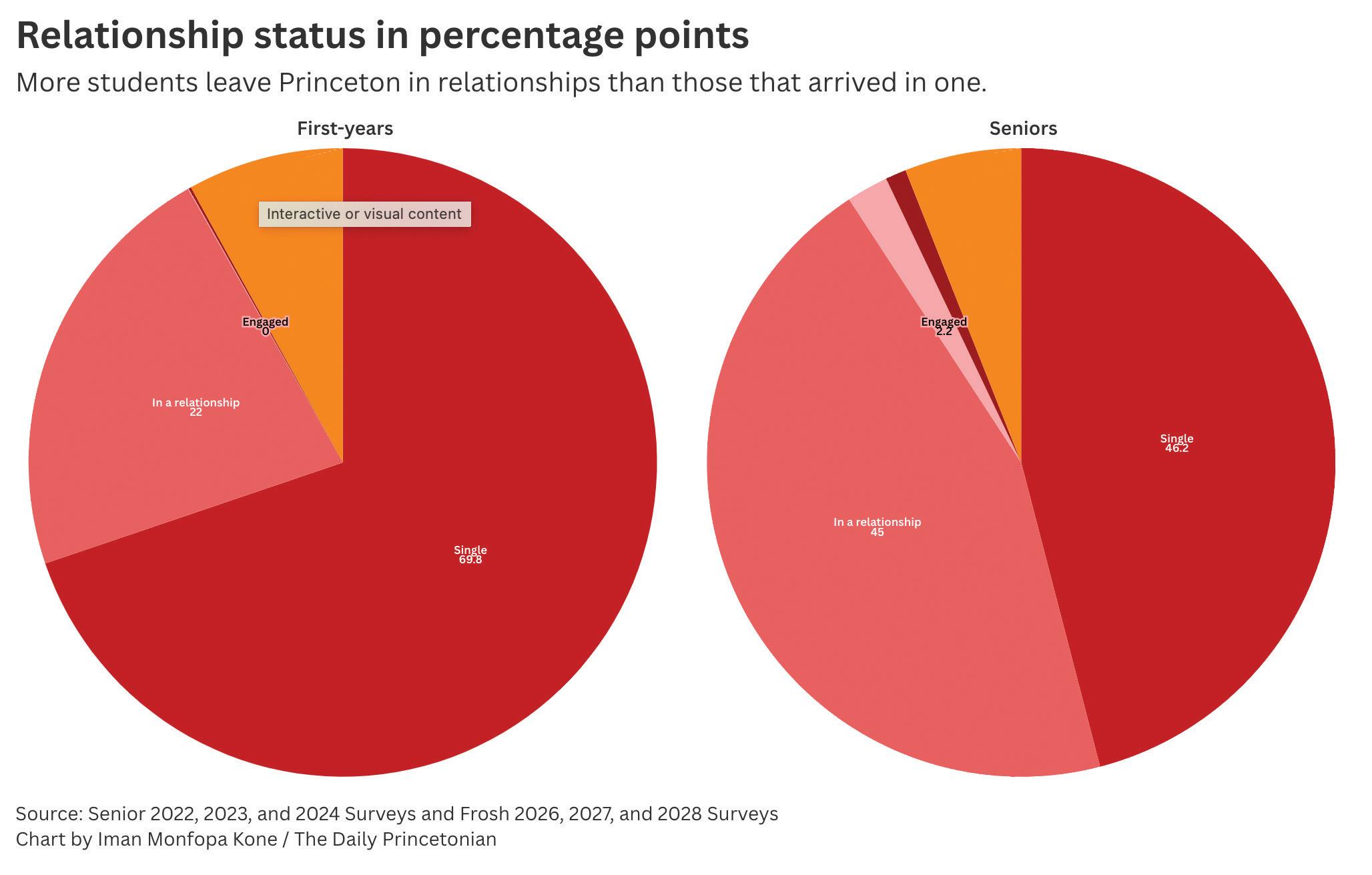
According to the Frosh Surveys for the Classes of 2026, 2027, and 2028, an average of 69.8 percent of Princeton first-years are single upon starting their first semester of college. This number decreases to 46.2 percent for graduating seniors from the Classes of 2022, 2023, and 2024.
These trends suggest that a significant part of the undergraduate student body enters a relationship during their four years at Princeton.
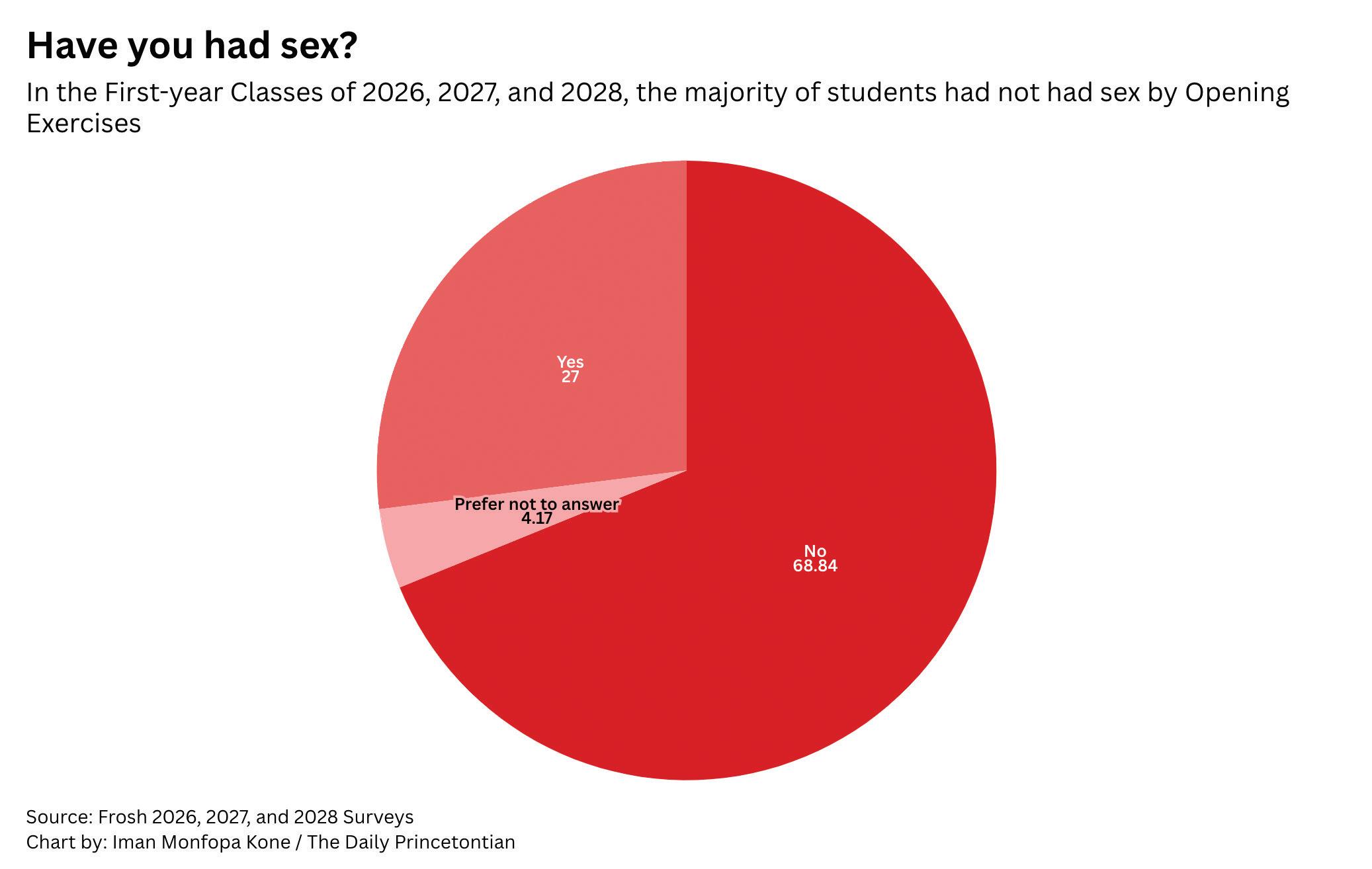
However, it’s not all sunshine and orange-hued rainbows — in the 2024 Senior Survey, 2.4 percent of the surveyed seniors reported cheating on a partner. Another challenge for underclass students is navigating elements of hook-up culture at Princeton. Only 27 percent of first-years have had sex before coming to Princeton.
In fact, according to the 2028 Frosh Survey, only 55 percent of this year’s incoming first-years had had their first kiss before they arrived on campus this Fall.
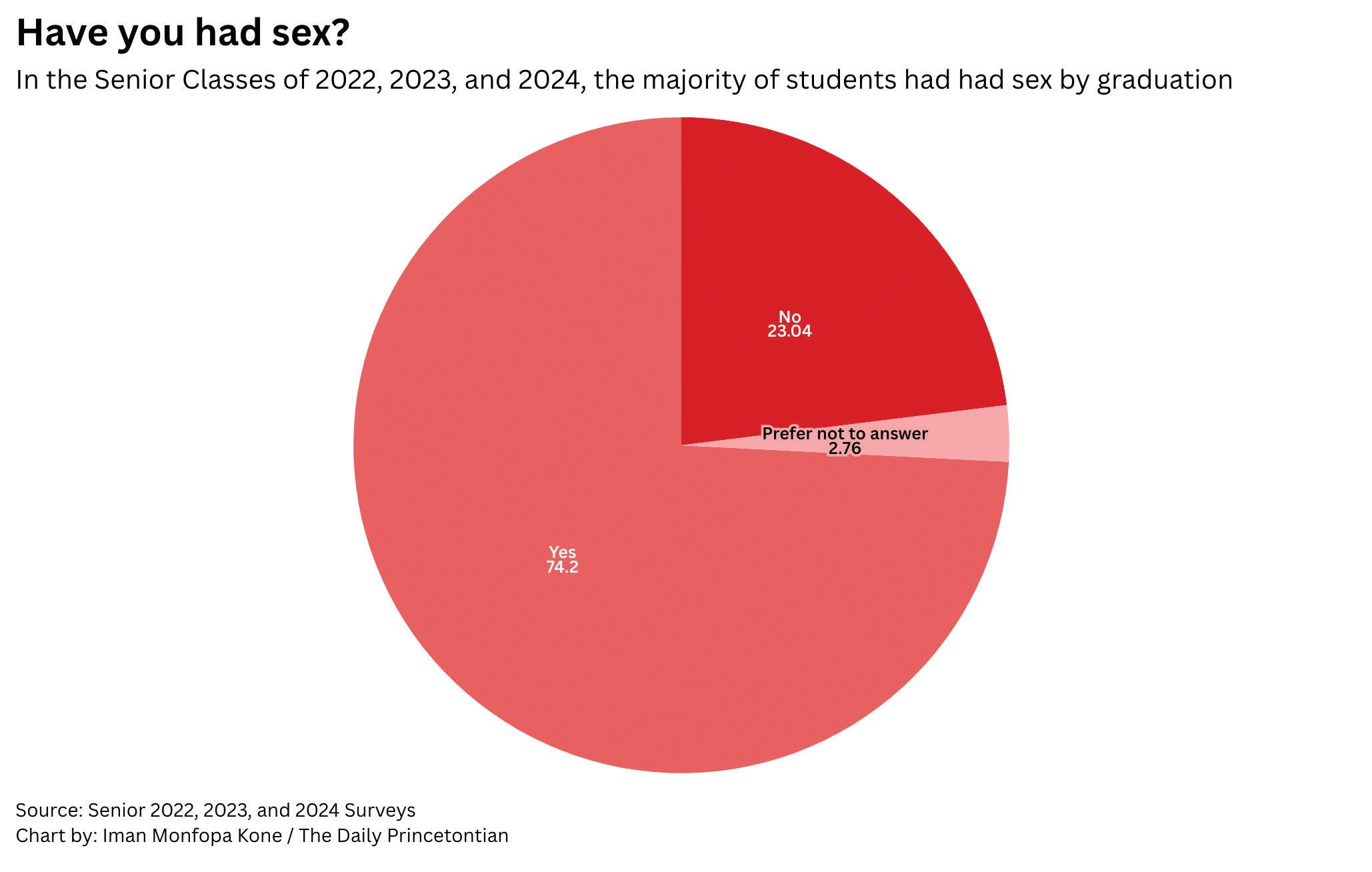
However, by senior year, this significantly changes, as, on average, 74 percent of outgoing seniors are no longer virgins.
If you haven’t found your match yet, you are not alone and might be part of the 46.2 percent of Princeton seniors who leave the Commencement ceremony single.
Additionally, while more than half of the surveyed seniors in relationships met at Princeton, the majority of the married seniors met their spouse outside of the Orange Bubble.
Then where does the 70 percent figure come from? Alumni often testify to reconnecting with former classmates long after graduation.
Another way that Princetonians meet on campus is through the Marriage Pact. The question-based algorithm matches students based on their compatibility, and though the Marriage Pact code remains mysterious, its creators claim that their methods are “research-backed.” During Valentine’s Day in 2024, 2,000 people signed up for the Marriage Pact and 1,500 for Datamatch, hoping to find “the one.”
So, if love hasn’t found you yet, who knows when it might come? The numbers say it could be just around the corner.
Iman Monfopa Kone is a staff Data writer for the ‘Prince.’
“S ecret A dmirer S ”
By Andrea Brinson
The Minis
By Jessica Curran CONTRIBUTING CONSTRUCTOR
In case you haven’t noticed, the target is already on our back
Isaac Barsoum Columnist
On Jan. 27, the White House Office of Management and Budget (OMB) issued a memo halting all federal grants and loans indefinitely. Justified as a measure to halt funding for “foreign aid, nongovernmental organizations, DEI, woke gender ideology, and the green new deal,” the Trump administration’s order threatened wide-ranging consequences, including for universities like Princeton. From research to financial aid, a shocking number of University programs and operations might lose access to the $456 million in federal grants Princeton receives each year. Although the memo was later rescinded after being blocked by a judge, significant uncertainty remains surrounding the funding.
But Trump has been threatening not just unilateral budget impoundment, but also attacks on the university accreditation system, a broad endowment tax, and an assault on diversity programs since at least 2023. So Princeton mustn’t be surprised.
What is surprising — or, rather, frightening — is the University’s silence on the funding issue and other threats posed by the Trump administration. The Jan. 28 email to the community from University President Christopher Eisgruber ’83 was laced with unspecificity, indicating that the University has either accepted various executive orders with no real resistance or is scrambling behind the scenes to combat them, instead of having a plan in place for threats we’ve been aware of for more than a year.
This adds up to a concerning and unjustifiable pattern of silence the University has exhibited since the 2024 election. Instead of fighting for its faculty researchers and undocumented, low-income, or minority students under its policy of institutional restraint, it has engaged in a dangerous form of institutional reticence. And that new habit must end in order for the University to survive.
In the aftermath of the 2016 presidential election, Eisgruber and hundreds of other university presidents signed a statement supporting Deferred Action for Childhood Arrivals (DACA) and undocumented students threatened by Trump’s deportation policies. In addition to that, Eisgruber issued dozens of political statements during the first Trump administration, mostly related to immigration.
In contrast, Eisgruber now promises
that “while I have issued statements only rarely in the past, I expect that I will do so even less frequently in the future.” At a time when a strong and unrelenting defense of our universities is more necessary than ever, Eisgruber is ceding his platform at the helm of one of the most powerful.
Today, Eisgruber’s (and other university presidents’) lack of action on protecting undocumented students, research freedom, financial aid, and more, seems to come from a well-intentioned but faulty attempt to keep a target off the back of the University. If Princeton avoids attracting the ire of Trump and his allies, the common wisdom goes that perhaps we can escape unscathed.
But universities have already provoked the wrath of Trump over issues such as diversity, equity, and inclusion programs, international student protesters, and the “radical left,” ideologies which he claims these institutions promote. We are, to put it simply, already under fire. The metaphorical target cannot be on our metaphorical back any more than it already is. And our silence does not bring us refuge; it will bring about our downfall.
So if I could say anything to the University about this, here is what it would be: When there is a target on your back, you do not stand still and wait for the arrow to strike. You put on a bulletproof vest,
hunker down into a foxhole, and fire back. This moment is existential for Princeton: More than 20 percent of our total revenue is at stake, and the academic freedom we seek to uphold is in jeopardy. Now is the time to fire back.
To President Eisgruber and the Board of Trustees: The Princeton community is depending on you to protect our institution during this volatile time. You must not roll over, and you must not give in. Princeton must defend the important role of universities and the funding we receive from the government that makes our work possible.
But statements are not enough. For the continued existence of the University, we require bold and immediate action. The Trustees and the Princeton University Investment Company (PRINCO) must begin moving to find ways to liquidate enough of the endowment to support Princeton research and financial aid programs in case we permanently lose access to federal grants. We ought to lead and join federal court filings seeking injunctions against programs that aim to curtail University operations.
We must also vocally oppose a potential large endowment tax, should it be proposed later this year (and President Eisgruber’s statements in this regard are a good start, at least). My colleagues have made good-faith arguments for smaller
or statewide endowment taxes, but the damage that even these might do may be irreparable in an era when the federal government is weaponized against us.
As the university with the highest endowment per capita, we have an unparalleled ability to accomplish all of this and more. To protect Princeton — and our status as a bastion of academic freedom, meaningful research, and affordable world-class education — it is time not for silence, but for action.
It is the restriction of intellectual freedom — of ideas — that often represents a first step toward tyranny. Today, we are in the crosshairs of the president and at the crossroads of fascism and democracy. Our pursuit of knowledge, our democracy, and our fundamental freedoms all depend on our continued existence on the right path of history. Princeton must exist — boldly, defiantly, and loudly. The target is already on our back. Will we escape unscathed, or will we be amongst the first casualties in a war on democracy itself? Fortunately, that is mostly up to us.
Isaac Barsoum is a first-year intended Politics major from Charlotte, N.C. He believes that loving Princeton means finding ways it can become a safer, happier, more inclusive place. His column, “A Princeton for All,” runs every other Thursday.
Reactions: Building a better Bicker?
This year, 83 percent of sophomores participated in Street Week, and 1,263 students were placed into an eating club. We’ve all heard the arguments for and against bicker and for and against eating clubs as institutions. This year, we asked our writers to share more nuanced reflections on what works and doesn’t work about Street Week 2025 – what should be preserved, and what should be reformed.
Why are co-ops so underrated?
By Siyeon Lee, Associate Opinion Editor
Laughter, music, and damn good tacos were my main takeaways from the Brown co-op’s sophomore dinner a few weeks ago. In the warm beige glow of the bustling kitchen, I kept thinking to myself, “Why does nobody talk about how nice this is?” While I was set to bicker in the upcoming week, I saw myself thriving in one of Princeton’s four co-ops, student-run dining communities where members cook, eat, and clean together.
Co-ops are a niche choice at Princeton, but they deserve more appreciation. They offer a tight-knit community, cost nearly 95 percent less than eating club dues, and teach critical life skills — Cooking? Cleaning? Who would’ve thought? It’s natural to gravitate toward the Street when most upperclassmen join eating clubs — I did, too. But while people cite social life and community as their reasons for joining, co-ops offer both at a fraction of the price. Sure, they’re different — you won’t have members-only formals or hundreds of members to constantly interact with, as most co-ops range from 30–50 people. But my friends in co-ops still enjoy the street through guest meals, and many use the money they save on multi-city trips across the globe or even a car.
Though I love my eating club, I plan to reevaluate next fall whether a co-op might be a better option. Whether you’re in an eating club or not, you absolutely should, too.
Associate Opinion Editor Siyeon Lee is a sophomore from Seoul, South Korea intending to major in History. She can be reached at siyeonlee[at] princeton.edu.
Clarity about eating club life goes a long way — not just during Bicker
By Shane McCauley, Assistant Opinion Editor
This bicker season, Princeton students of all class years got a unique look into eating club life through an Instagram account called The Hungry Tiger. In a series of reels, the account’s creators tried club cuisine, interviewed members and dining staff, and gave a glimpse into each club’s unique traditions.
With uniformly positive food reviews and quick jump-cuts, I wouldn’t call the account’s content independent journalism. But as a first-year with little knowledge of eating club culture, it still helped assuage my anxiety about club life. Clubs should continue offering digital glimpses into club life to familiarize first-years with eating clubs beyond parties and reputations.
Before I arrived at Princeton, I saw eating clubs as intimidating, elitist institutions shrouded in mystery. And as a first-year, attending their parties doesn’t exactly convey what being a member is like. The Hungry Tiger’s content — simple as it is — still offered valuable information about club atmospheres as my sophomore year draws closer.
While students can learn about club cultures by participating in meal exchanges or pre-bicker events, many firstyears don’t have close friends in several clubs with whom they can meal swap, and pre-bicker events are generally limited to sophomores.
Unfortunately, the account was unable to film inside Cottage or Ivy, in the latter case due to a strict no-filming policy. But clubs can maintain their alluring reputations without keeping themselves entirely secret. To increase transparency about club life for all students — including first-years — clubs should take every opportunity to expand their digital presence, perhaps beyond simple food reviews.
Shane McCauley is an Assistant Opinion Editor from Boston intending to major in Anthropology. He can be reached at sm8000[at]
princeton.edu.
Bicker isn’t better behind the scenes
By Christofer Robles, Editorial Board Chair
While I have previously defended Bicker in this paper, this year I am feeling much less sympathetic. I call on The Interclub Council (ICC) to investigate and publicize the Bicker processes of each club. Without transparency about various clubs’ Bicker processes, it’s impossible to know which aspects of bicker are essential to preserving club cultures and which ones are inequitable. Only then can any reasonable debate on the merits of the process be had.
I continue to believe in the spirit of Bicker: “every club on Prospect has an identity — Bicker just makes that identity intentional.” But while I, and others before me, have called for “a strong commitment to a better Bicker,” it is becoming increasingly clear that “better Bicker” is too ill-defined of a goal for a few twenty-somethings to accomplish without a commitment to finding concrete reforms.
Listing grievances with a specific club would be counterproductive — the shortcomings of Bicker are shared between the selective clubs. Talk to any upperclassman in any Bicker club: injury is a feature of the process writ large.
I call on the ICC to hire an independent law firm to investigate problematic Bicker practices, publish their findings, and push Prospect Avenue towards a more progressive Bicker. Bickerees are often ignorant to the inner workings of their prospective clubs — they are owed transparency. Clubs should be beholden to common standards of inclusivity — scandal is not foreign to the Street, and social stigma and club loyalty prevent Bicker from receiving its due open criticism and correction.
Christofer Robles is the Editorial Board Chair for the 149th Board and a member of the illustrious Cap & Gown Club. He can be reached at cdrobles[at]princeton.edu.
Why Cap & Gown was the most bickered eating club
By Jorge Reyes, Columnist
This year, Cap & Gown was the most bickered club. As a first-year on financial aid planning on bickering next spring, this does not surprise me.
While club culture, leadership, and other factors certainly contribute to the choices made by bickering students each year, strong financial aid policies can encourage students to consider clubs that are otherwise inaccessible and impact the makeup of clubs’ Bicker classes.
For students seeking to join a club whose dues exceed the University’s financial aid allowance, Cap & Gown is one of the most accessible. Their commitment to ensure students on full financial aid pay no out-of-pocket expenses, as well as the grant provided to sophomores to cover the difference between fees and University aid, does not go unseen. Ivy and Cannon are the other clubs with dues over the University allowance.
Although the rest of the Bicker clubs also have ways to reduce the financial burden for students on aid, Cap & Gown stands out by assuring that all students on financial aid receive a grant to help with fees rather than hold a “case-bycase” process like some of the other clubs.
For future Street Weeks, I encourage the leadership of all clubs to consider the role their financial aid policies play in attracting members. Take it from a current first-year who participated in the Freshman Scholars Institute and is already planning for Street Week: Cap & Gown’s transparent financial aid policies make it an attractive choice for many bickerees.
Jorge Reyes is an Opinion columnist for the ‘Prince.’ You can read his column, “No Tiger Left Behind,” every three weeks on Tuesday here. He can be reached at jr7982[at]princeton.edu.
Spread Bicker Out so Students aren’t Boxed In
By Sophia Zuo,
Contributing Writer
While Princeton students are no stranger to rainbow-striped Google calendars, or sprinting from one commitment to the next, the compressed duration of Bicker adds unnecessary strain and fatigue to an already stressful situation.
As I witnessed firsthand, double bickerees had to move from a morning of classes to a grueling afternoon of bicker sessions, and chose chugging caffeine over getting a good night of rest in order to do it all.
Students inevitably take bicker extremely seriously — it’s a heavy determinant of future social circles. But its condensed timeline creates a pressurecooker environment where students are constantly on edge, yet must appear relaxed and carefree in order to make a good impression.
Bicker is comparable to standardized testing: both are one-shot, widely boughtinto, and high-stakes. But while the SAT or AP exams may measure intelligence or understanding of an academic topic, bicker serves to measure something as volatile as personality, which, during the bicker process, we lose control over.
It can be argued that a process as stressful as bicker should be as short as possible. However, if the length of bicker means students are performing worse and unable to reflect their best selves, it’s worth reconsidering alternatives.
Clubs could spread their Bicker sessions over longer periods, or the ICC could mandate that clubs host sessions across different days. For those who choose to double Bicker, such changes would make Bicker a much more forgiving process, and allow students to come to sessions unexhausted and as genuine as possible.
Sophia Zuo is a sophomore contributing writer from Hsinchu, Taiwan. She can be reached at sz5856[at]princeton.edu.
the PROSPECT. ARTS & CULTURE
Single this year? 10 ways to celebrate Valentine’s Day on campus with friends
By Lulu Pettit | Staff Prospect writer
A box of chocolates. A bouquet of red roses. A romantic candlelit date. These are the images of a stereotypical Valentine’s Day. But that’s not all the holiday has to represent.
With the long list of December and January holidays behind us, it’s officially Valentine’s Day season. As a day intended to celebrate love in your life, Valentine’s Day doesn’t only have to be about cherishing romantic relationships. Here at Princeton, we are all constantly surrounded by friends who love us. So, why not celebrate having those people in our lives? Here are 10 recommendations for how to spend Valentine’s weekend with your friends.
1. Watch a romantic comedy at the Garden Theater
What better way to spend the day of love than watching a movie about love? I find myself turning to the classic 90s films like ”10 Things I Hate About You” or “Clueless” when looking for a comfort movie. But you could also head to the Princeton Garden Theater, where they’ll be doing a “Pretty Woman” Galentine’s screening on Feb. 13 and “Wild at Heart” on Feb. 14.
2. Have a candlelit dinner on Nassau — or in your common room
While traditionally reserved as a couple’s activity, nothing is stopping you from having a candlelit dinner with your friends! Head to Pinterest
for inspiration on how to set a table worthy of a Galentine’s party, and make it a potluck so that no one person has too much responsibility — food is love, after all. Or, go to Nassau Street and have someone else do the cooking for you. You could splurge on a nicer restaurant like Mistral or La Mezzaluna, or go to student favorites like PJ’s Pancake House — just make sure you check if you’ll need a reservation for the holiday.
3. Five-minute paintings
This popular TikTok craft has each person paint for five minutes on a canvas before swapping with someone else to complete the painting. You can do this with as many or as few friends as you’d like. If you want, you can add a theme to the paintings, like “love” or “friendship” or let your creativity run free. In the end, you’ll have a unique painting for everyone in the group to add to their dorm decor.
4. Friendship bracelets
This is one of the most classic activities to celebrate your friendships. Whether you go oldfashioned and use string and knots or choose to use beads instead, the possibilities are endless. Pair it with another idea on this list like a movie, and you’ve got a fun night with friends!
5. Make playlists
Crafting a perfect playlist takes time — why not set aside some with your friends to curate your own favorite list of love songs, complete with a catchy playlist name and cover? You could even
Bonjour, Princeton! New
offers variety of pastries
By Lulu Pettit | Staff Prospect writer
On a quiet side street off of Nassau, the buttery smell of croissants wafts out the door of the newest addition to our community — a French café called Belle Journée. Princeton’s business district already boasts two French-style cafés: Maman and Chez Alice. To see if Belle Journée brought anything fresh to the scene, I took a trip to Chambers Street.
Unlike the cramped countertop cafés of France, Belle Journée offers a spacious interior filled with cases of picturesque pastries. The setup is reminiscent of the bakery chain Paris Baguette, where customers use trays and tongs to select their own pastries before approaching the counter. With modern, muted shades and stock images of the pastries on the walls, the new café doesn’t have as much character as Princeton staples like Small World Coffee or The Bent Spoon. However, the alluring pastries were enough to draw me in.
On a Monday afternoon, only a few other patrons populated the building, and the pastry cases were full of both traditional French and Americanized pastries — guava danishes, croissants, pain au chocolat, tiramisu doughnuts, and more. They also had a vegan croissant, a rarity due to the pastry’s dependence on butter. There was also a fair selection of savory options. To get a sense of the bakery’s range, I ordered something savory and something sweet, along with a classic vanilla latte.
I started with the latte. It was sweet but not cloying, with the vanilla flavor dominating over the bitterness of the coffee. Although I appreciated the fast service, I found the coffee
make it a game and have everyone vote on their favorite playlist at the end of the night.
6. Bake brownies
Chocolate is one of the most classic symbols of Valentine’s Day, and what has more chocolate than a batch of gooey brownies? You can go as simple or as complex as you want with this one. I once used a recipe that had me whip egg whites for ten full minutes, and on other days I grabbed a box mix from the store and ate spoonfuls of the batter raw. Find a friend with a key to one of the communal kitchens and get baking. The important part of this activity is the fun you’ll have while baking together!
7. Valentine’s card swap
Channel your inner little child and make cutout heart cards for all of the people in your life. If you have the time, write a personalized message for each person about a good memory you had together. On Valentine’s Day, swap cards with all of your friends. To bring in more childhood fun, tape a piece of candy to each of your cards or decorate a shoe box to store the cards you receive. To find craft or coloring materials, check out residential college common areas or the Lewis Library Makerspace.
8. Go to the city
With Valentine’s Day falling on a Friday this year, why not hop on New Jersey transit to have some weekend fun on a trip to New York City with your friends? Once there, the possibilities are end-
less: visit a museum, see the attractions, eat at a nice restaurant, etc.
9. Get dressed up together
Even without an event, it can be fun to get dressed up with your friends. Wear your best pinks and reds, and if you are looking for a destination, walk up to Nassau Street in your fancy clothes and get a sweet treat together. Maybe do a photoshoot at one of the classic campus locations like Blair Arch or East Pyne.
10. Karaoke party
Everyone has a favorite love song, whether it be a classic like “I Will Always Love You” or dedicated to friends like the Spice Girls’ “Wannabe.” Find a karaoke version of your song of choice, blast it in your room, and sing along with all of your best friends. If one of your friends plays piano, head to Rockefeller or Addy Hall to perform a love song.
Whether or not you’re in a relationship, Valentine’s Day is a chance to celebrate all of the love that fills your life, including your friends. These are some of my favorite ways to celebrate Galentine’s Day, but no matter how you choose to celebrate, your Valentine’s weekend will be filled with love.
Lulu Pettit is a member of the Class of 2027 and a staff writer for The Prospect from the suburbs of Philadelphia.
French café Belle Journée
to be quite average. At $6 for a 12-ounce cup, the price is on par with other Princeton coffee shops, but I wouldn’t go out of my way for this latte — though it did pair nicely with the pastries.
Next, I tried the savory pastry: a ham and cheese croissant. Topped with a melted, herbcovered slice of cheese, the croissant was certainly beautiful — but did its taste live up to its look? In short, it mostly did. The pastry was exceptionally flaky and buttery, and the ham and cheese filling wasn’t overly salty. Inside, they used two types of cheese: an orange-colored sliced variety akin to grocery store American cheese, and a smooth cheese spread. I especially savored the spread, which added some muchneeded creaminess to the room-temperature sandwich. The artificial orange color of the cheese turned me off slightly, but the taste was a mouth-watering combination of rich, salty, and savory. For a quick lunch or an afternoon snack, this croissant is a fantastic option.
For my sweet pastry, I opted for something unfamiliar: chocolate mont blanc. After a quick Google search, I realized that Belle Journée’s take on this pastry is far from traditional. Usually, a mont blanc has some combination of chestnut puree, baked meringue, and whipped cream, sometimes over a base of a tart crust. Here, the mont blancs resembled pain au chocolat in taste. It had a circular, domed shape with tall sides made of croissant dough filled with a light, milk chocolate cream and was covered in melted chocolate and pearl sugar. This dessert was probably my favorite of the selection. The flaky, soft center was contrasted by the crunchy outer layer. Although messy, the chocolate coat-
ing on the top added depth to the flavor, balancing the buttery pastry. The chocolate cream filling was light and fluffy. Smooth and sweet, I could eat an entire bowl of it on its own if they offered it.
Beyond pastries, Belle Journée’s website advertises soups, sandwiches, salads, and other lunch offerings. Like the pastries, some are traditional French options like the croque madame, but others are more American adaptations, such as their “Hawaiian Crunch” salad. Although I didn’t try any of the meal options, my experience with the pastries suggests they would live up to expectations.
Like its name suggests in French, a visit to Belle Journée would make a beautiful day. Whether you prefer your pastries sweet or savory, Belle Journée will certainly have something new for you to try — and it just might be worth the walk.
Lulu Pettit is a member of the Class of 2027 and a staff writer for The Prospect from the suburbs of Philadelphia.
The Prospect 11 Weekly Event Roundup
By Lily Hutcheson Assistant Prospect Editor
3 1
Princeton University Jazz Vocal Ensemble
Feb. 20, 2025, 8–10 p.m.
Taplin Auditorium, Fine Hall
Enjoy a night of music with Princeton University Jazz Vocal Ensemble! The ensemble presents their winter concert with a special guest, singer-songwriter Becca Stevens. Stevens is a GRAMMY-nominated artist who is influenced by genres such as jazz, pop, indie-rock, and folk. This concert is presented by Jazz at Princeton University, a program that promotes jazz music’s musical and social history to the Princeton community through academic programs, performance ensembles such as the Vocal Ensemble, and more. Tickets are $5 for students and $15 for the general public. They can be purchased at tickets. princeton.edu.
7
Quipfire! Valentine’s Day Show
Feb. 14 at 9 p.m.
Whitman Theatre/Class of 1970 Theatre
Come see one of Princeton’s oldest improv groups perform unscripted comedy for a night of Valentine’s fun and hilarity! Tickets are $7 and can be purchased at tickets.princeton. edu.
8
Mandy Patinkin in Concert: Being Alive
Feb. 14 at 7:30 p.m.
Matthews Theatre
2
Althea Ward Clark W’21 Reading by Hanif Abdurraqib & Douglas Stewart
Feb. 18 at 6 p.m. Labyrinth Books
Award-winning writers Hanif Abdurraqib and Douglas Stuart read from their recent work. Abdurraqib is a poet, essayist, and cultural critic whose newest release, There’s Always This Year: On Basketball and Ascension is a New York Times Bestseller. Stuart is an author who is currently adapting his novels Shuggie Bain and Young Mungo for A24 Pictures. No tickets are required.
6
To Dream About Wings
Feb. 14, 15, 20 at 8 p.m.
Wallace Theater, Lewis Arts complex
To Dream About Wings is a new play by Stephenie Chen ’25. It follows teenagers Anna and Leo, who meet at church and whose lives become entangled when Anna is swept up in Leo’s plan to create a flying machine. The play explores themes of dreams, grief, and the family dynamics of Asian American and immigrant households. The event is free, and tickets can be reserved at tickets.princeton.edu.
Perhaps best known for his role in The Princess Bride as Inigo Montoya, Emmywinning actor Mandy Patinkin is also a legendary Broadway singer. Patinkin presents a collection of his favorite show tunes and American classics, culminating in a dazzling evening of music. Tickets can be purchased on the McCarter website.
Peruse a range of poster designs and artists’ books created by the juniors and seniors in the Program in Visual Arts. Based on past years’ exhibitions, expect a range of materials and styles, from clay sculptures to colorful paintings. No tickets are required.
With Love, Raqs
Feb. 14 at 9 p.m. and Feb. 15 at 6 p.m. and 9 p.m. Frist Theatre
Princeton’s only belly dance company, Raqs, presents their annual spring show! Raqs focuses on belly dancing in a variety of styles, from Middle-Eastern to fusions such as Latin dance, American tribal, and Caribbean. Enjoy a night of spectacular dance from around the world. Tickets are $7 for students and $10 for the general public. They can be purchased at tickets.princeton.edu.
4
Safe Harbor
5
Student Playwrights
Festival
Feb. 14 and 15 at 8 p.m. and Feb. 16 at 2 p.m.
Theatre Intime
Theatre Intime presents three studentwritten one-act plays at their annual Student Playwrights Festival! Come celebrate new theater with the world premiere of Electrical Connection by Kailani Melvin ’28, REAL by Alexander Picoult ’26, and Spunk by Lily Hutcheson ’28. Hutcheson is an assistant Prospect editor for the ‘Prince.’ The event is free, and no tickets are required.
10
Fall 2024 Student Film Screenings
Feb. 17 and 18 at 5-6:30 p.m., and 20 at 7:30-9 p.m.
James Stewart Film Theater, 185 Nassau St.
Wondering what film students got up to last semester? Come find out! Each night work from different courses will be featured, ranging from animation, to narrative, to documentary. Films from a documentary-based freshman seminar will be screened on the 17th, and the rest of the documentaries will be shown on the 18th. The screening on the 20th will feature the narrative and animated films. No tickets are required.
Feb. 14 and 15 at 7:30 p.m. and Feb. 16 at 2 p.m.
Donald G. Drapkin Studio, Lewis Arts complex
Come try your hand at performance with this interactive play written and directed by Dominic Dominguez ’25! See if you can survive a post-apocalyptic world full of moral quandaries that acts as a “choose-your-own adventure video game come to life.” participants can be actively involved in the story, or simply observe from the sidelines. Stage managers will be available to assist those who may need any additional support to participate in the activities. The event is free, and tickets can be reserved at tickets.princeton.edu.
11
Feb. 15 at 7:30 p.m.
Matthews Theatre
GRAMMY Award-winning musician Meshell Ndegeocello presents her new album No More Water: The Gospel of James Baldwin. Ndegeocello infuses Baldwin’s words and themes with her genre-defying music, combining jazz, funk, soul, and spoken word. A conversation with Ndegeocello and Princeton poet and professor Patricia Smith will follow the performance. Tickets can be purchased on the McCarter website.
MEN’S BASKETBALL
Men’s basketball beats Penn for 12th consecutive rivalry win
By Hayk Yengibaryan Senior Sports Writer & Education Director for the Prince
On Friday, men’s basketball (16–6 overall, 5–2 Ivy League) traveled to Philadelphia to take on the Penn Quakers (6–14, 2–5) at the iconic Palestra in the 251st edition of the storied Princeton-Penn rivalry. The rivalry is said to be the third-oldest consecutively played rivalry in NCAA Division I basketball. After a back-and-forth game, the Tigers beat the Quakers for the 12th consecutive time, 61–59.
“We were really fortunate to get that one,” Head Coach Mitch Henderson ’98 told The Daily Princetonian. “We couldn’t pull away at all. We were sloppy.”
The win also came with a milestone for junior standout guard Xaivian Lee, who scored his 1000th career point for Princeton and became the 38th Tiger to reach quadruple digits. Junior forward Caden Pierce is at 998 career points following Friday night’s game and will most likely join Lee in the 1000 point club this coming weekend.
For the second straight game, Henderson started first-year forwards CJ Happy and Malik Abdullahi. Prior to the Brown game, sophomore guard Dalen Davis had started the first 20 games of the season. For Penn, guard Ethan Roberts was ruled out for the contest. Roberts is the leading scorer on the Quak-
WOMEN’S BASKETBALL
ers roster, averaging 17.8 points per game.
The Tigers got off to a fast start in Philly, scoring three unanswered triples and a transition basket to take an 11–0 lead early. Two of the three triples came from Happy, who scored a game-high 13 points.
“I’m just looking to learn as much as I can, as fast as possible, because we’re already in the second half of the league season,” Happy told the ‘Prince.’
Turnovers and missed shots by the Tigers allowed the Quakers to get back into the game. With just over 12 minutes remaining in the first half, the Tigers lead was down to three, 13–10.
The low-scoring first half continued, but a triple from senior guard Blake Peters put the Tigers up 25–19. Heading into the game, Peters had been playing some of the best basketball of his collegiate career, making 18 triples on 54 percent efficiency over his last four games.
At halftime, Princeton led its rivals by seven, 31–24. Happy led the Tigers with 11 points before heading to the bench with two fouls. Despite shooting 30 percent from the field, Penn’s defense helped them to remain in the game.
Coming out of the locker room, a quick 6–2 run put the Tigers up by 11. However, the Quakers quickly responded with eight unanswered points to reduce the deficit to three.
Then, Peters came up big on the defensive end,
recording his seventh career block before blowing by his defender for an easy layup. The next offensive possession, he found Davis for a triple in transition to make it 44–37.
The milestone moment for Lee came with just over 11 minutes remaining in the game as a shot from beyond the arc put the Orange and Black up 47–42. The celebrations were short-lived as Penn scored the next five points to tie the game at 47.
As the Palestra erupted, Henderson called a timeout to calm his team down. Off the break, the Tigers went on a 7–1 run to take the lead back.
“I thought tonight, the crowd was great and loud, and it contributed to what I thought was a very good atmosphere,” Henderson said.
However, the next seven minutes of game time saw Princeton score just two points. The Orange and Black were struggling to take care of the ball — Penn scored 18 points off Princeton turnovers during the game. With under a minute left, the Quakers led 58–56.
Down by two, the ball went into the hands of Dalen Davis, who buried a triple to put Princeton up by one. Before the shot, Davis was one-for-five from the field and had played just 15 minutes.
After Penn went one-for-two at the line, Princeton had the ball with the game tied at 59. Lee lost his dribble before finding sophomore guard Jackson Hicke,
who was fouled and went to the line with 0.6 seconds remaining. Missed free throws proved costly for Penn as Hicke made both free throws for a 61–59 Tiger win.
“I knew there had to be at least one second on the clock, so I kind of just pump faced and hoped to get a foul, and I did,” Hicke explained. “My teammates were great at just keeping me confident.”
“It’s definitely a testament to our team that we stuck together and pulled it out,” he continued.
With Cornell (13–7, 5–2) losing to Yale (14–6, 7–0) on Saturday afternoon, Princeton is now tied for second place in the Ivy League standings.
If Henderson’s squad wants a chance to win a fourth consecutive regular season championship, they must go 2–0 next weekend. The latter of the two games is against the Bulldogs, who are on an eightgame win streak and have won 12 out of the last 15 against the Tigers.
“If they [the team] keep working, I feel like we can get so much better,” Henderson told the ‘Prince.’ “I really don’t think we’re even close to being what we can be.”
Hayk Yengibaryan is an associate News editor, senior Sports writer, and Education Director for the ‘Prince.’
Women’s basketball clobbers Penn to clinch Berube’s 500th victory
By Max Hines Senior Sports Writer
In front of a vocal home crowd, Princeton (16–5 overall, 7–1 Ivy League) took advantage of their best first quarter of the season to cruise past Penn (11–10, 2–6) 74–60, clinching Head Coach Carla Berube’s 500th career win.
Berube is now coaching her sixth season for the Tigers after serving as the head coach at Tufts for 17 years.
“I’ve been at two really incredible universities with a lot of great student-athletes and coaches,” Berube told The Daily Princetonian postgame, referring to her times at Princeton and Tufts. “I’m just really grateful to be around so many great people.”
Entering Saturday’s game, the Tigers looked to extend their three-game Ivy win streak.
Sophomore guard Ashley Chea led all scorers with 25 points, 21 of which came in the first half. Chea’s shooting set the tone for the Tigers’ offense,
MEN’S FENCING
going five for eight from long-range.
“My teammates instill a lot of confidence in me and my shot,” Chea told the ‘Prince.’
The Tigers jumped on Penn early in the game and did not look back. After four different players scored in the first three minutes, Chea connected on her first three of the day, after which the Tigers were already up 11–3. Six minutes later, the combination of a stifling defense and offense that refused to miss brought the lead to 19–3.
“The defense was great, and it definitely fueled our offense,” Berube said. “We got out, did a great job in the break, and did a great job breaking their press.”
Princeton kept up their momentum into the second quarter. Three minutes into the period, Chea connected on another three to extend the lead up to 37–10. The Tigers continued to capitalize on Penn’s mistakes, gaining a 13–0 advantage in points off turnovers and a 7–0 advantage in second-chance points.
While dormant for the first 15 minutes, Penn’s offense slowly woke up, led by Katie Collins. Collins scored three three-pointers in quick succession, leading the Quakers to a 12–0 run to bring the margin down to 14. For the first time since the opening minutes, the crowd in Jadwin moved ever so slightly towards the front of their seats.
However, just as she had all day, Chea took the ball and asserted her strength. Scoring five points in quick succession, she stopped the Quakers’ momentum, helping Princeton lead 44–29 at the break.
“We knew to just play our game and just slow ourselves down,” Chea said. “Coach was mad, and when Coach is mad, we know to play better.”
In the second half, the Princeton squad once again started hot, going on a 10–2 run through much of the quarter to once again go up by 20. With just over 10 minutes to play, the 2,631 Jadwin faithful people exhaled for good, watching their team cruise to another Ivy victory.
As the minutes of the fourth quarter ticked
down and the Tigers’ bench played the final possessions, Berube solidified her 500th win in just over 20 years as a head coach.
Along with Chea’s 25 points, Princeton benefited from a combined 20 points and 9 rebounds from senior forward Parker Hill and junior forward Tabitha Amanze.
“Parker and Tabbie were great,” Berube said. “We have an advantage inside.”
For the Tigers, it was a successful return to Jadwin in their first home game since Jan. 11, continuing their 8–0 undefeated streak at home.
Up next for Princeton is a weekend doubleheader at home. The Tigers host Brown (10–11, 4–4) Friday at 6 p.m. before a Saturday game against Yale (2–19, 1–7) at 5 p.m. “It’s going to be a really important week of practice heading into another big Ivy League weekend,” Berube said.
Max Hines is a senior Sports writer for the ‘Prince.’
Men’s fencing wins back-to-back Ivy League titles, first outright in 12 years
By Matthew Yi Assistant Sports editor
Heading into Sunday’s final rounds, both the men’s and women’s teams remained undefeated. With the men sitting in first at 3–0 and Columbia right behind them at 2–0, the stage was set for a thrilling showdown.
Saturday’s strong performances across all weapons helped the Tigers battle through tough matches, including a narrow 14–13 victory over Penn and a decisive 15–12 win against Harvard. Sophomore epeeist Alec Brooke led the épée squad with an outstanding 8–1 record on the first day.
The Tigers, securing hard-fought victories over No. 7 Yale, No. 4 Penn, and No. 13 Harvard, looked to defend their Ivy League title with their final match against Columbia. The match didn’t disappoint.
With the Ivy League Championship on the line, the Tigers were up 13–12 and needed a win from Brooke in order to secure the Ivy League Championship.
“There was one épée and one foil match left, and Alec’s match was the first one up.
We knew if he won, we would win the whole thing,” sophomore épéeist Alexander Liu told The Daily Princetonian.
As the pressure mounted, the weight of the situation became clear to Brooke.
“At the start of the day, I was feeling confident as I had fenced well the day before and felt ready for the final match-up.” Brooke told the ‘Prince.’ “I knew I was the last match, and as other weapons were finishing, I knew that if I won, we would win the championship, but if I lost, we would lose it.”
With the entire stadium watching, Brooke stepped up and delivered the final touch, lifting the Tigers to victory and clinching the Ivy League title in dramatic fashion.
“It was sudden death. I tried to spend extra time to compose myself, and it worked … I scored that last touch, and we won.” Brooke said. “It was one of the hardest mental moments I’ve ever had in my career … At the end of the match, I just remembered being so relieved.”
The score was finally settled, and the Tigers clinched the championship, winning 14–13.
“After I took my mask off and saw the whole team running at me cheering, the moment fully started to sink in that we had won the championship,” Brooke said to the ‘Prince.’
Throughout this tournament, Princeton’s success was driven by standout individual performances, particularly in épée, where the Tigers dominated this competition. Brooke (10–2) and Senior épéeist Nicholas Lawson (9–2) earned First Team All-Ivy League honors.
“I feel so proud to be first team all-Ivy as it tells me that I was doing well to help the team as much as I could,” Brooke told the ‘Prince.’ “Last year, in my first year, I also ended up 2nd individually, and even though I’ve been close to first place both years, I’m happy that I’ve been fencing consistently.”
First-year foilist Allen Chen (8–4) led the foil team and also secured a First Team AllIvy selection, while junior saberists Matthew Limb (7–5) and Adam Lai (6–5) earned Second Team saber honors.
“I’m super proud of Allen. Being a firstyear in this intense environment is not easy,
and he fenced so well. It was super impressive, and he beat a lot of strong opponents. We’re all super proud of him,” Liu said to the ‘Prince.’
Princeton’s épée squad dominated this tournament. Against Yale, they swept their bouts 9–0, with Brooke, Lawson, and Liu leading the charge. The épée dominance continued against Penn (8–1) and Harvard (5–4).
“We have a really talented group of fencers. At the beginning of the season, we weren’t fencing as well, but over the last few weeks, we’ve really turned it up a notch,” Liu said to the ‘Prince.’
With Ivy League play behind them, the Tigers will look to continue to build off their momentum as they shift their focus to the upcoming NCAA regionals on March 11.
“Regionals is a different atmosphere. We will be training super hard every day and look to beat the best,” Liu said.
Matthew Yi is an assistant Sports editor for the ‘Prince.’