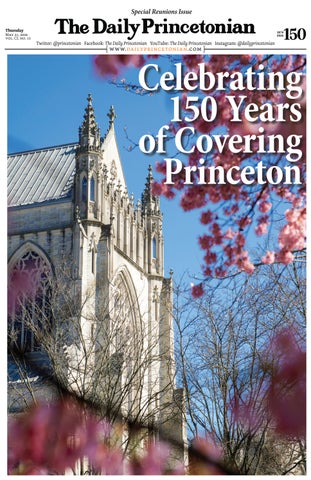
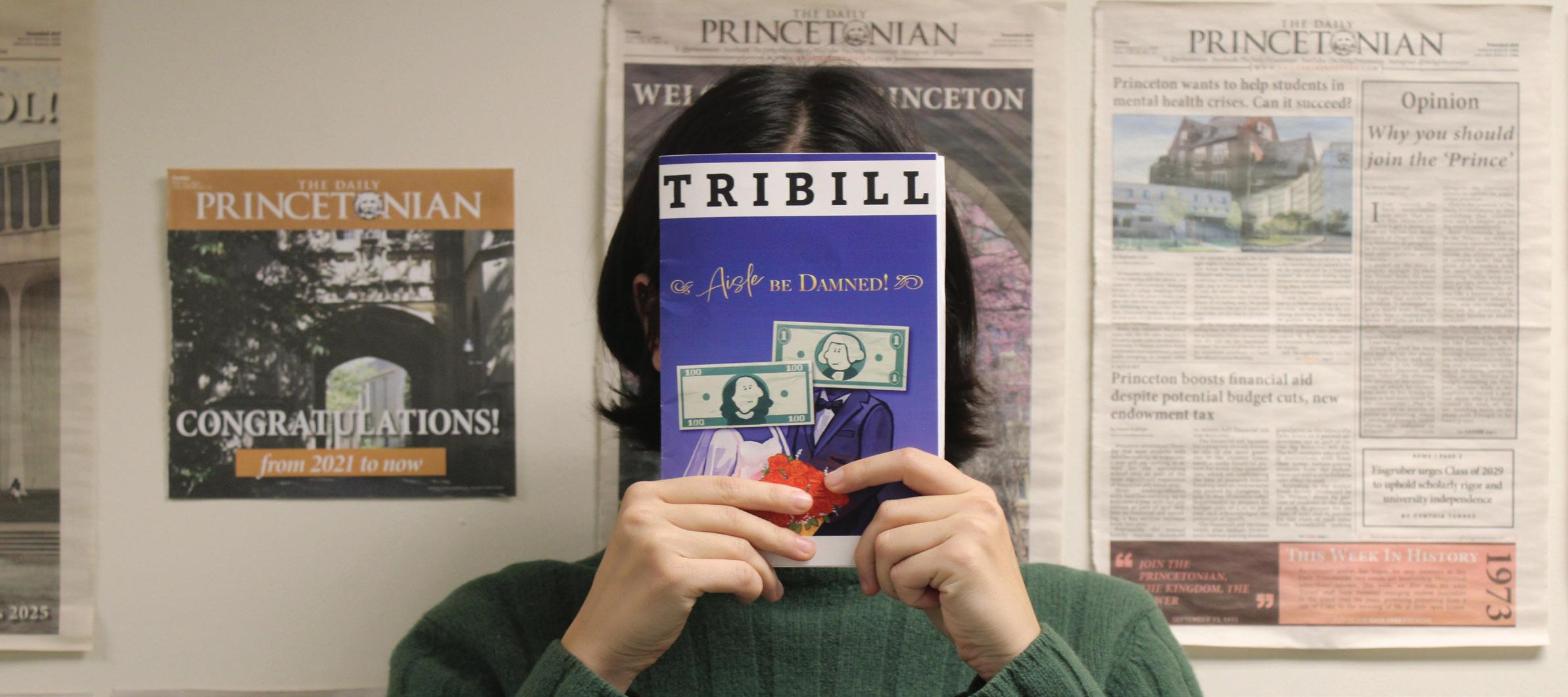
Since 1876, The Daily Princetonian has served as the paper of record of Princeton. Now in our 150th anniversary year, we continue to persevere in our mission of reporting on Princeton, while also taking a look back at our legacy.
An editorial in the first few issues of the ‘Prince’ in 1876 advocated for the implementation of an honor code, and for faculty to leave exams unproctored. Less than two weeks ago, we broke the story that the faculty had decided to reinstitute proctoring amid concerns related to AI-assisted cheating on in-person examinations.
In 2026, much else has transpired: Budget cuts have resulted in continued tweaks to the academic calendar, freezes on senior faculty salaries, and cuts to programs. The role of the eating clubs has become more prominent than ever as sophomores have been left without a club placement and independent dining has been gutted. Challenges to the U.S. research university model continue to loom on the horizon.
Much else has passed through our pages in the intervening years. You’ll notice that the logo on our masthead is a throwback to a version previously used by the ‘Prince’ in the early 20th century. This year, we will also be holding a number of anniversary events — catch us at a special panel celebrating 150 years of covering Princeton on Saturday at 11:15 a.m. in East Pyne 010. ‘Prince’ alumni and family and friends are invited to our annual Reunions BBQ outside 48 University Place, starting at 4 p.m. Saturday. And to cap it all off, the ‘Prince’ will be holding a special 150th anniversary gala dinner Friday, Oct. 16 at the New York Historical.
To learn more, visit and subscribe at prince150.org.
We’re also publishing a special anniversary book, “Campus in Our Words: 150 Years of The Daily Princetonian,” containing modern reflections into our rich archives. Our writers and editors have dug deep into the stories told by the ‘Prince’ over the past century and a half, spoken with contemporary editors and reporters, and put it all together to explore the traditions, stories, and lives of those who have passed through Princeton before us. We are incredibly excited to share these stories with you — pre-orders are now available.
Reunions is a place to reconvene, celebrate, and remember. As we commemorate our history, it is our great pleasure to welcome you back to Old Nassau.
Sincerely,
Jerry Zhu
Jerry Zhu is the 150th editor-in-chief of The Daily Princetonian.
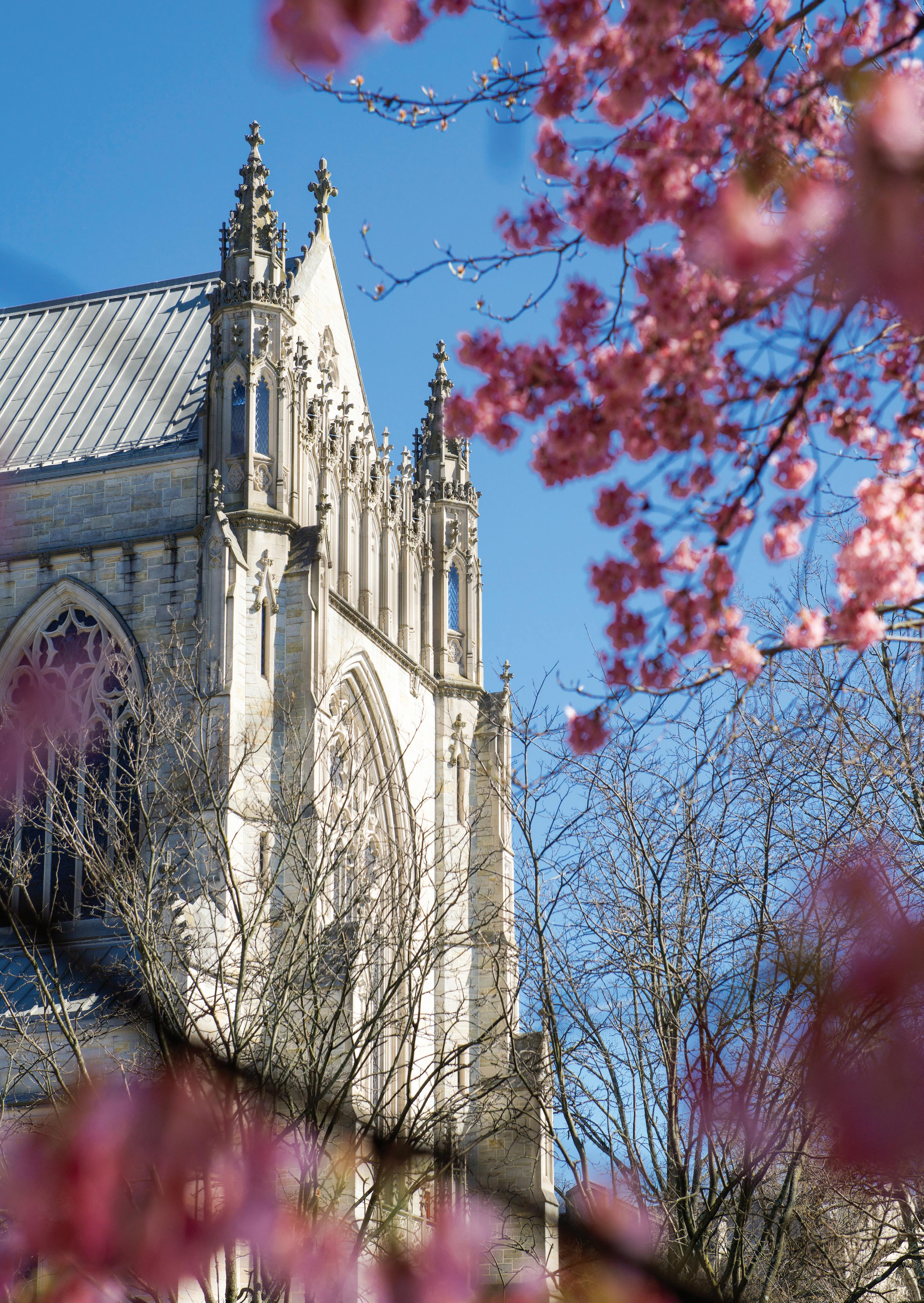
Cover image photo credit: Emily Tang / The Daily Princetonian
Jerry Zhu Editor-In-Chief
Princeton faculty mandate proctoring for in-person exams, upending 133 years of precedent
By Devon Williams News Contributor
All in-person examinations at Princeton will be proctored starting July 1, representing the most significant change to the honor system since it was established in 1893. The faculty passed a proposal requiring instructor supervision at Monday’s faculty meeting, with one opposing vote.
The historic vote was the culmination of months of deliberation within the administration and student governing bodies about how to address increasing concerns over academic integrity violations, including the proliferation of AI usage. The proposal cleared a full faculty vote as the final of three required rounds of approval, having already been passed unanimously by the Committee on Examinations and Standing and the Faculty Advisory Committee on Policy.
According to the policy proposal, previously sent by Dean of the College Michael Gordin to the Faculty Advisory Committee and included in Monday’s meeting notes, instructors will remain present in exam rooms
“as a witness to what happens,” but are instructed not to interfere with students. If a suspected Honor Code violation occurs, proctors will document their observations and submit a report to the student-run Honor Committee, where they may later testify under the same standards used for other witnesses.
The proposal notes that additional details, including proctor-to-student ratios and guidelines regarding monitoring practices, will be finalized in consultation with faculty and student representatives before the policy takes effect.
Princeton’s honor system dates back to 1893, when the faculty first instituted the Honor Code following a student petition to eliminate proctoring during examinations. Since then, the honor system has relied on individual accountability, with students pledging both to refrain from academic dishonesty and to report those they witness in violation.
Following the Honor Code’s original implementation, proctoring was explicitly banned in the Rules and Procedures of the Faculty and the Rights, Rules, Responsibilities of the University, which remained in effect
for 133 years up until Monday’s vote. The policy proposal cites AI and personal electronic devices as major catalysts behind the policy shift. “The ease of access of these [AI] tools on a small personal device have also changed the external appearance of misconduct during an examination,” it reads, making cheating “much harder for other students to observe (and hence to report).”
The proposal also points to a growing reluctance among students to report peers directly. The proposal claims that anonymous reporting of allegations has increased in recent years, fueled by fears of “doxxing or shaming among their peer groups” online.
In The Daily Princetonian’s 2025 Senior Survey of over 500 seniors, 29.9 percent of respondents reported that they had cheated on an assignment or exam during their time at Princeton. 44.6 percent of senior respondents reported knowledge of Honor Code violations that they chose not to report. Only 0.4 percent of seniors responded saying that they had reported a peer for an Honor Code violation.
An Undergraduate Student Gov-
ernment survey of students cited in the proposal reportedly found that “a majority would favor proctoring or are indifferent to any change,” though a “sizeable minority opposes it on the grounds that students should behave honorably, and that faculty and students should trust each other given the 1893 Honor Code compact.”
Similarly, students and faculty previously interviewed by the ‘Prince’ expressed divided views on the policy’s implementation. Some cited the inadequacy of the current student reporting model, while others said the introduction of proctors could erode the trust that defines Princeton’s academic culture.
The historic change comes in the wake of a November policy change mandating proctoring for all individual and small-group exams, including make-up exams, exams taken by student-athletes while traveling, and exams taken with disability accommodations.
In a March guest Opinion column in the ‘Prince,’ Honor Committee Chair Emerita Nadia Makuc ’26 wrote that the Honor Committee, which adjudicates suspected violations of the Honor Code during in-person examinations, had long discussed introducing proctors as an additional witness and reporter in exam rooms, and that the time had come to take that step.
“The Honor Committee has experienced new strains, including an uptick in cases in the last year and challenges such as generative AI, and student sentiment has recognized that its procedures need to better reflect the current challenges to academic integrity,” Makuc wrote.
Honor Committee hearings are confidential, student-led proceedings addressing potential violations of the Honor Code. Accused students can present defenses, call witnesses, and be assisted by a Peer Representative. If students are found responsible for Honor Code violations, the maximum penalty that can be assigned is expulsion.
William Aepli ’26, former co-chair of the Peer Representatives, which advises students accused of academic integrity violations, previously told the ‘Prince’ that his organization would likely see changes in the type
of evidence presented in hearings in Honor Committee hearings.
The Honor Committee Constitution and the Honor Code itself will not need to be changed following the institution of proctoring. Gordin previously confirmed to the ‘Prince’ that just the Rules and Procedures of the Faculty and Rights, Rules, and Responsibilities will need to be updated.
The section of the Rules and Procedures of the Faculty that previously banned proctoring will replace those lines with language mandating instructor supervision during in-person examinations, according to the proposal. A one-sentence revision to Rights, Rules, and Responsibilities will be made before the start of the new academic year.
The proposal states that Gordin met with and received endorsements on the policy from “current and former student chairs of the Honor Committee; colleagues from the Office of the Dean of Undergraduate Students and the McGraw Center for Teaching and Learning; the FacultyStudent Committee on Discipline; and the Academics Chair of the Undergraduate Student Government.”
“Undergraduates and faculty are realistic in understanding that having an instructor supervising examinations will not eradicate cheating,” the proposal notes. “However, they believe that there will be a significant deterrent effect, and that having an additional witness in the room will reduce pressure on students to notice and report concerns while they are themselves completing exams.”
Multiple faculty members declined to comment on the new policy following the meeting. Professor of English and Theater Jill Dolan, who served as dean of the college from 2015 to 2024, briefly discussed the change in an interview with the ‘Prince.’
“I think it’s a shame, but it’s necessary,” Dolan said. “But I also do understand why it passed. I think we need some different practices in this day and age, but it does mark a moment.”
Devon Williams is a News contributor for the ‘Prince’ from Menlo Park, Calif. Luke Grippo contributed reporting.
Princeton boosts financial aid despite potential budget cuts, new endowment tax
By Devon Rudolph Associate News Editor (Former)
Princeton announced Thursday that most students with families making up to $150,000 a year will pay nothing to attend for the upcoming school year as part of the most significant expansion of financial aid since 2023. Most undergraduates with families earning up to $250,000 a year will not pay tuition as part of $327 million in financial aid spending, a $44 million increase from last year. Previously, the annual family income threshold to receive full financial aid was $100,000. The financial aid increase for a program already known as one of the most generous in the country comes amid a rocky financial picture for many elite universities, which are confronting the loss of research federal funding and an endowment
tax passed by Congress in July. In May, Princeton asked departments to prepare for budget cuts of 5 to 10 percent and acknowledged the potential of layoffs.
The financial aid increase could also reduce Princeton’s tuition-paying student population as the University faces down an 8 percent endowment tax as part of the One Big Beautiful Bill Act. The bill exempts educational institutions with fewer than 3,000 tuition-paying students from the endowment tax and is scheduled to take effect in 2026.
According to the annual Frosh Survey conducted by the ‘Prince,’ about 69 percent of students in the class of 2028, 65 percent for the class of 2027, and 63 percent for the class of 2026 came from households making under $250,000. All PhD students, as well as masters’ students in the School of Public and International Affairs, pay
no tuition. Other master’s programs have alternative aid options and have comparatively lower enrollment (around 200 last school year).
The University declined to comment on the number of tuition-paying students at Princeton.
The announcement made by the University calls its financial aid program “one of the most generous in the country.”
“Through our increased investment in financial aid, we are making the transformative experience of a Princeton education more affordable for more students than ever,” said Provost Jennifer Rexford ’91 in the announcement.
The announcement also acknowledged the alumni and other donors who contribute to the University’s ability to have a strong aid program. It does not, however, reference the increase on the tax on endowment, whose
payouts cover about 70 percent of the financial aid budget.
In a press release announcing the expanded program, the University also said that Pell Grant recipients accounted for the 25 percent of the incoming Class of 2029, the highest percentage in Princeton’s history.
Devon Rudolph is an associate News editor and staff Sports writer for the ‘Prince.’ She is from northern Virginia and typically covers student life and USG.
U. AFFAIRS | AUGUST 2025
LUKE GRIPPO / THE DAILY PRINCETONIAN
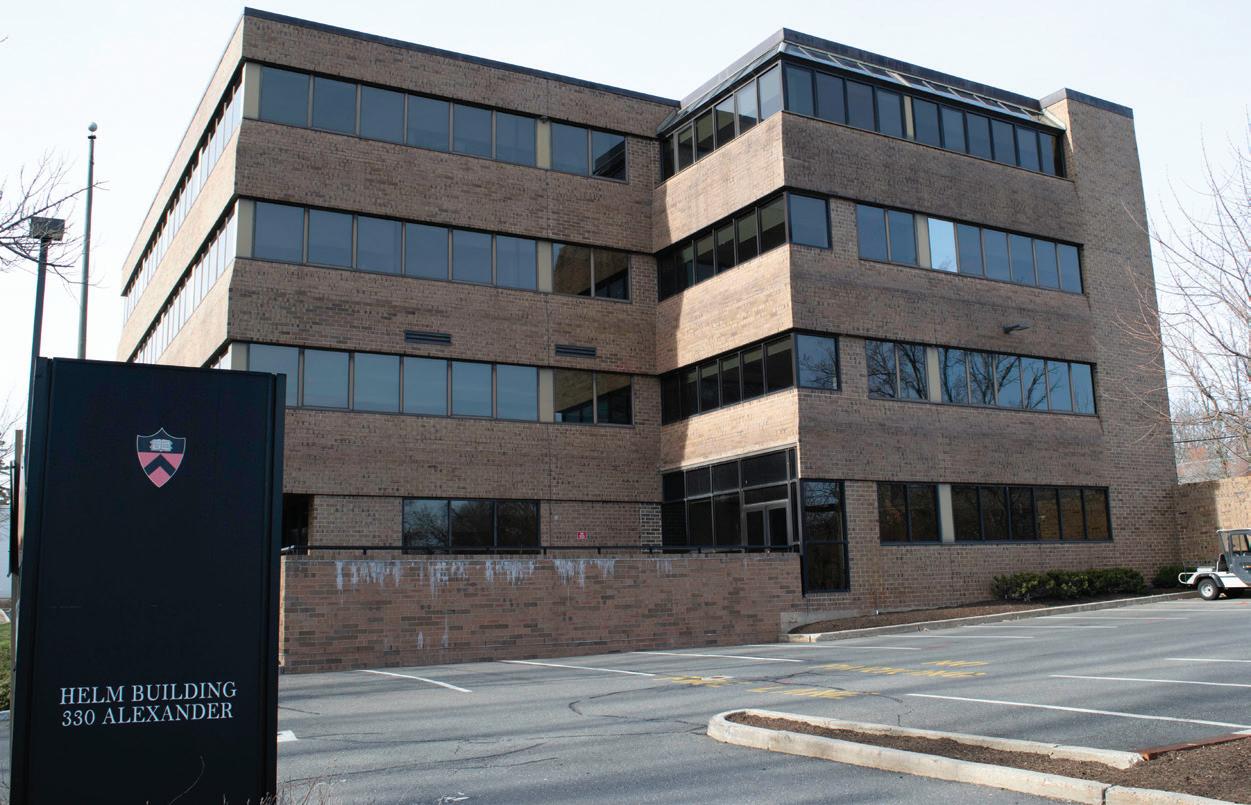
Helm Building, which currently houses the Financial Aid office at Princeton.
HAEON LEE / THE DAILY PRINCETONIAN
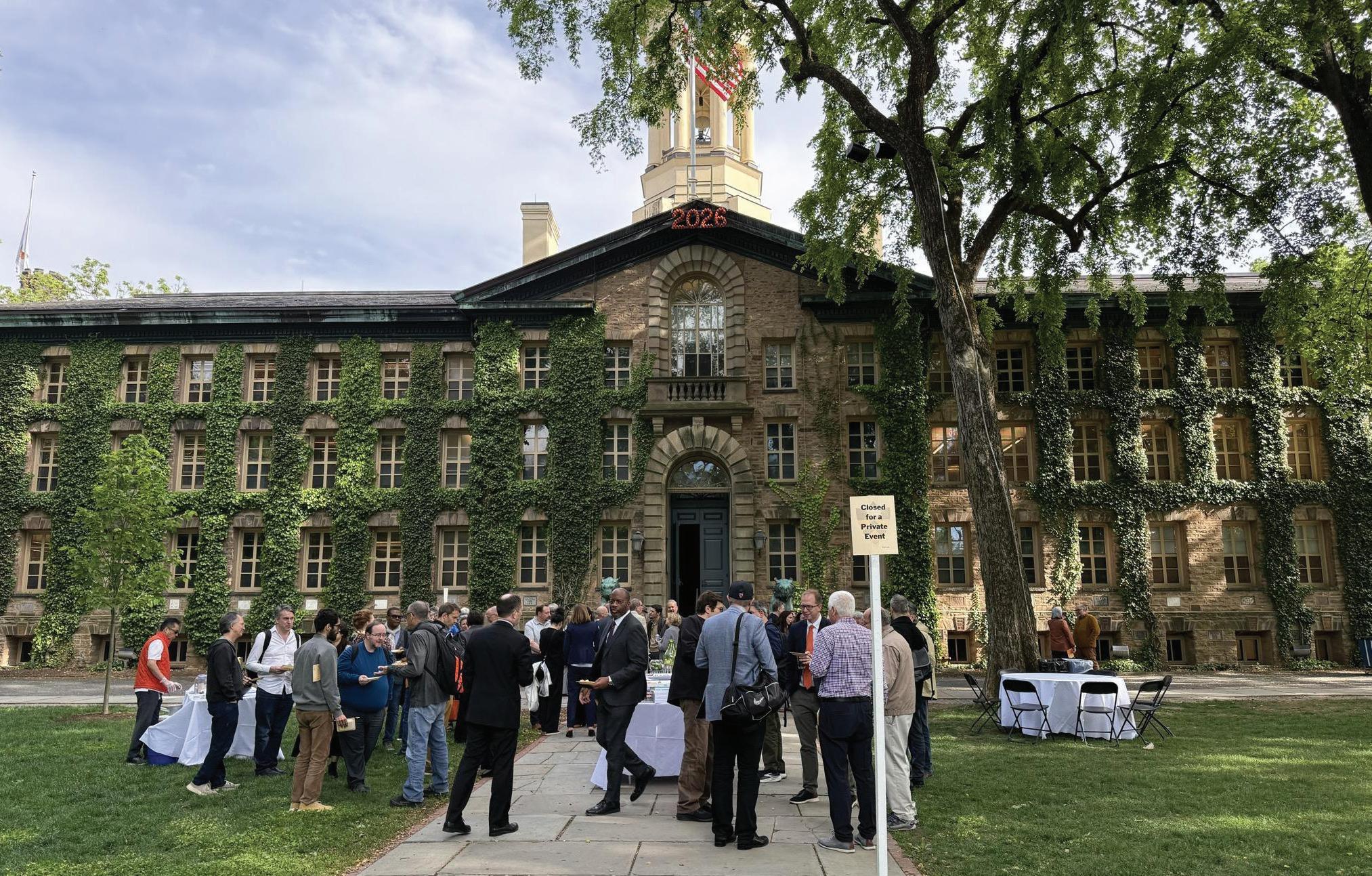
Faculty gather for a reception celebrating those transferring to emeritus status outside Nassau Hall after passing a policy mandating proctoring on examinations during a faculty meeting, Monday, May 11, 2026.
Two-thirds of undergrad grades at Princeton last year were A-range, faculty report says
By Haeon Lee & Nico David-Fox News Contributor (former) & Assistant News Editor (former)
Two-thirds of grades awarded in Princeton undergraduate coursework in the 2024–25 academic year were A-plus, A, or A-, according to a Monday report distributed to faculty, a dramatic increase over the past decade.
Dean of the College Michael Gordin briefly discussed the report at Monday’s faculty meeting, expressing concerns about grade inflation and the allocation of A-plus grades. However, Gordin noted that grading is under the jurisdiction of departments.
The 2024–25 academic year set a record for the highest percentage of A-plus and A grades given out by the University in the past 20 years, representing 45.5 percent of all grades, a nearly 20 percentage point increase in the past decade. Although the incline in A-range grades over the past 20 years has been drastic, the most significant jump was over the pandemic, with the percentage of A-plus and A grades increasing almost 10 percentage points between 2019 and 2021. The average GPA similarly increased 0.1 points over the same period.
“Even in introductory 100–200 level classes —
where one might expect to see a broader distribution of grades — 62.6 percent of grades last year were Arange,” the report stated.
The report cited independent work as the most extreme example of what it termed “grade compression,” more commonly known as “grade inflation.” In 2025, across all departments, 17 gave no grade lower than a B for a thesis. Eight of the ten largest departments awarded thesis grades of B or above to at least 94 percent of majors, the exceptions being history and sociology.
While A-range grades are more common in the humanities and social sciences, A-plus grades are more commonly given out in natural sciences and engineering courses, the report said.
Gordin reminded faculty in attendance that A-plus grades should be dealt in exceptional cases. “A-plus is an unusual grade at this University. It is specified in the Rules and Procedures of the Faculty,” he said. “No other grade has that status.”
The Rules and Procedures of the Faculty states that the A-plus “should be
regarded as an exceptional grade reserved for work of extraordinary merit.” Professors are required to write a statement noting “how the student’s course work or independent work meets the instructor’s standards for truly outstanding work.”
Notably, the faculty meeting agenda claims that “faculty practice does not currently reflect the stated policy,” referring to the faculty’s use of A-plus grades. It notes that “some faculty feel strongly that given the number of A-range grades that are awarded in our cur -
rent context, the [A-plus] is a necessary tool to differentiate performance.”
Rather than awarding an A-plus solely to students who produce exceptional work, these faculty use the grade to “mark the top N% of performers in their class,” the agenda adds.
The new grade report follows a faculty report at Harvard characterizing grading practices there as “failing to perform the key functions of grading” and “damaging the academic culture of the College more generally.” In 2025, 60 percent of undergraduate grades at Harvard were A’s. Until 2014, Princeton had a formal grade deflation policy capping A-range grades at 35 percent for coursework and 55 percent for independent work.
“If any departments want to discuss good practices in grading and want to consult with the Dean of the College’s Office, we’ll be more than happy to speak with you,” Gordin said.
Haeon Lee is a News contributor for the ‘Prince.’ She is from Brooklyn, N.Y.
Nico David-Fox is an assistant News editor for the ‘Prince.’ He is from Washington, D.C. and runs the Administration coverage area.
U. will cover expense of Block 32 plan after backlash; Independent students still required to purchase a meal plan
The University will cover the cost of the Block 32 plan for all students next year, effectively eliminating the controversial new requirement for students in eating clubs and co-ops to pay for a dining plan. Independent students, however, will still be required to purchase a meal plan.
The announcement was made by University administrators at the Undergraduate Student Government (USG) Senate meeting on Sunday after weeks of sharp backlash from students and alumni across the dining spectrum.
The announcement added that students not affiliated with an eating club or co-op will be required to purchase at minimum a Block 128 meal plan, a change from the previously proposed Block 160 plan. This plan, in addition to the 32 meals provided by the University, total in 160 meals per semester. The Block 128 plan will cost $3,600, a $900 reduction from the proposed block 160 plan.
Students on financial aid will effectively see no change from the Sept. 29 policy. Under that policy, the University would increase financial aid by $900 to compensate for the cost of the Block 32 plan. There will be no such increase under the modified policy.
The change follows weeks of student and alumni criticism over the proposed dining plan. Independent students have voiced concern over the elimination of a separate room draw process for kitchen-equipped dorms like Spelman Hall. The Inter Club Council (ICC) and co-op members have criticized the potential financial burdens on students, limited capacity issues, and the University’s decision to proceed without consulting students. Alumni joined the effort, too, with the Graduate Interclub Council (GICC) flying a plane over the Oct. 25 homecoming football game for its “Don’t Harvard Our Princeton” campaign protesting the change for
eating club and co-op classes.
University Services is still determining how Spelman Hall, which is equipped with in-room kitchens for independent students, will fit into the updated room draw process. The University aims to make a decision by Thanksgiving Chad Klaus, Vice President for University Services, said at the meeting.
“We really want that to be a student-led decision as to how we will allocate Spelman going forward,” he said, noting that USG was “very critical” in making the change.
Under the new policy, Block 32 meals can be used during fall or spring breaks as well as at Late Meal. Unused meals will roll over from week to week, allowing students to use swipes at their discretion — a change from the two dining hall swiped all upperclassmen receive per week, which expire at the end of each week and cannot be used during breaks. The change stems from a policy memorandum presented by Anuj Krishnan ’27, University Student Life Committee Chair, on behalf of USG at an Apr. 21 meeting with University Services.
“We are grateful to USG for identifying this option in their memorandum and for articulating why it was important to students that the meals be available in block form,” Klaus said at the Senate meeting. At the Sunday meeting, he also thanked USG representatives for their engagement in a meeting that took place on Friday, Oct. 31 between USG members and University administrators.
“We’re incredibly grateful to the
university administration for being committed to taking in student engagement and utilizing that moving forward,” USG Vice President Aishwarya Swamidurai ’26 said. “We’ll continue to be persistent about matters that are important to students, including Spelman draw and so we’ll keep you guys looped in on that conversation.”
The University first announced its housing and dining restructuring on Sept. 29, citing a desire to address upperclassmen student isolation and foster a greater sense of belonging. This plan followed recommendations from the Huron report released last spring, which assessed the state of campus dining.
Members of the ICC did not respond to requests for comment in time for publication. On its website, the GICC claimed victory, writing that “existential crisis for Princeton’s eating clubs and coops has been averted due to alumni and student support.”
“This outcome shows the power of our community when we stand together. Princeton’s eating clubs and co-ops will continue to be the vibrant, student-led institutions that have defined the undergraduate experience for generations,” the GICC said.
Kian Petlin is a staff News writer for the ‘Prince.’ He is from San Francisco, Calif. and typically covers campus events and student life.
Gray Collins is a News contributor for the ‘Prince.’ He is from Villanova, Pa.
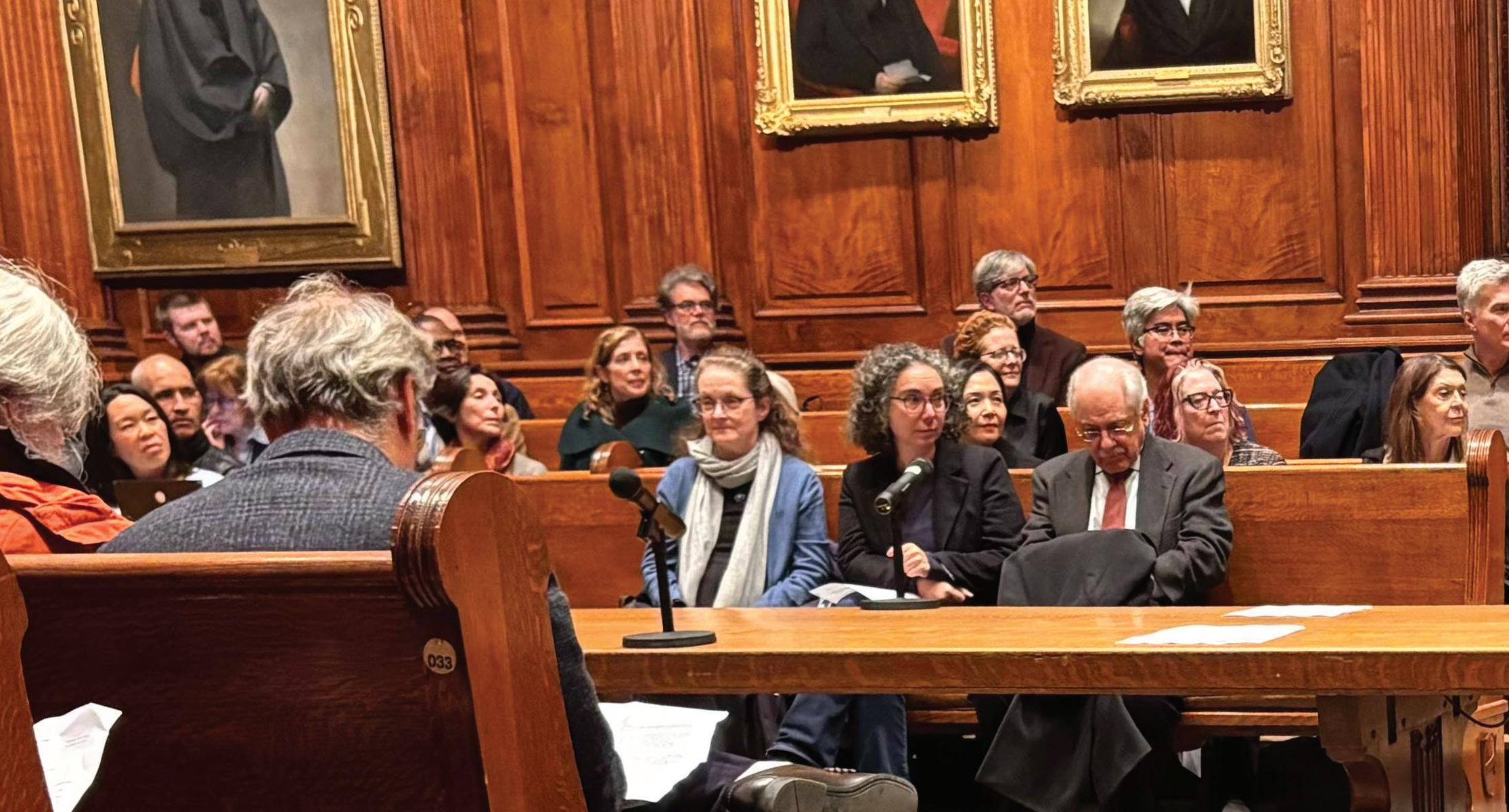
HAEON LEE / THE DAILY PRINCETONIAN The Faculty Room in Nassau Hall.
Princeton spared from endowment tax, PRINCO executive says, saving hundreds of millions
By Gray Collins & Nico David-Fox Assistant News Editor & Head News Editor
Princeton will not have to pay any net investment income tax on returns from its $36.4 billion endowment, a University investment official said at a private event in January, after a recent expansion of its undergraduate financial aid program left the University below a 3,000 tuitionpaying student threshold to qualify for taxation. Experts had projected that the new tax on wealthy university endowments — enacted under H.R. 1, the omnibus tax and spending bill passed by congressional Republicans in July 2025 — would have cost Princeton roughly $180 million annually.
The 8 percent endowment tax was predicted to impose one of the country’s highest university tax burdens on Princeton, which currently enrolls 9,100 undergraduate and graduate students. According to University President Christopher Eisgruber ’83, recent widespread budget cuts have been driven by decreased long-term endowment projections — growth estimates that likely would have been further eroded if the University were required to pay the tax.
The University currently pays out about 5.35 percent every year of its $36.4 billion endowment — the fourth-largest in the country — which accounts for 64 percent of annual revenue and supports key University priorities such as financial aid. The revised tax modified a provision enacted in 2017 that imposed a 1.4 percent excise tax on investment income at wealthy private colleges with over 500 students, which the University has since paid annually.
In interviews with The Daily Princetonian, several attendees of the Princeton Class Leadership Conference in January confirmed that Princeton University Investment Company Managing Director Susan Ciniglio ’09 said the University’s endowment was exempt from the tax, set to kick in for the fiscal year starting on July 1, 2026.
According to the attendees, who were granted anonymity to speak about the closed-door event, Ciniglio stated that the number of tuition-paying students at the University was under the 3,000 threshold to qualify for the tax, in response to an audience question. This comes after a $44 million expansion of the financial aid program for the 2025–2026 academic year, which eliminated tuition for most families making less than $250,000 and followed previous aid increases.
The University has previously de -
clined to share the number of tuition-paying students it enrolls.
In a statement to the ‘Prince,’ University spokesperson Michael Hotchkiss wrote that “Princeton University fully complies with all its tax obligations. Our payments under the revised tax will be calculated and disclosed in 2028, as required by the government.”
PRINCO and Ciniglio did not respond to requests for comment.
In July, amid several Trump administration attacks on higher education, Congress set the 8 percent tax rate for universities with over $2 million in endowment funds per student and over 3,000 tuition-paying students. At around $3.9 million in endowment funds per student, Princeton was expected to be subject to the tax, and many of its peer institutions are still likely to pay hundreds of millions annually.
“The endowment tax is a serious threat to Princeton and other top research universities which it targets,” Hotchkiss wrote. “It reduces the higher education sector’s ability to provide student financial aid and to make investments in research and teaching that support U.S. prosperity, innovation, and security. We continue to advocate against it.”
Republicans argued the new tax increase was intended to ensure elite universities with massive endowments contributed more federal revenue, arguing that the schools had benefited from favorable tax treatment. House Ways and Means Committee Chairman Jason Smith wrote after the tax was enacted that the measure would “hold woke, elite universities that operate more like major corporations accountable.”
The new endowment tax emerged in 2025 as one of Princeton’s federal lobbying priorities. In the first quarter of 2026, it spent its second-highest quarterly total ever on lobbying, $240,000, part of which was focused on the endowment tax.
In a September 2025 interview with the ‘Prince,’ Eisgruber briefly discussed a lobbying group he organized, which included about two-dozen peer institutions and discouraged the implementation of an increased endowment tax. One of the group’s proposals was reportedly to implement a mechanism to spare universities that increased spending on financial aid.
Emeritus Professor of Economics
Burton Malkiel GS ’64, who has publicly written about how universities benefit from the illiquid assets of endowments, called the University’s endowment tax strategy a “brilliant response to a punitive and discriminatory tax.”
The expansion of financial aid “in-
creases our income and produces much-needed student support,” he wrote to the ‘Prince.’
However, not all experts on the matter shared Malkiel’s view.
Economics and public affairs professor Owen Zidar took fault with what he saw as a lack of transparency in the University’s financial operations.
“It’s remarkable how little input faculty have had in this process despite the material implications for research and teaching,” Zidar wrote.
Professor Edward Zelinsky of Cardozo Law School, a legal scholar and expert in tax policy, believes that some funds from all endowments — including those of universities, private and community foundations, and donor-advised funds — should be directed to the federal government.
“I really think that the appropriate law, which is far from where we are today, is a flat tax, where every such institution pays the same amount to help the federal government,” Zelinsky said in an interview with the ‘Prince.’ “So from that vantage, I would say it’s not a good thing that Princeton is able to avoid the tax.”
However, he affirmed the legality of Princeton’s expansion of financial aid as a mechanism to avoid the tax.
“Assuming that Princeton has been able to adopt policies so that it is below the 3,000 student threshold, then that strikes me as a legally appropriate position for Princeton to take,” Zelinsky said.
He argued that the endowment tax should not function as a regulatory tool to influence university behavior. He noted that some supporters of the law — including Senator Chuck Grassley, an early advocate of the original endowment tax — viewed wealthy university endowments as underutilized and wanted institutions to direct more resources toward students.
University administrators have consistently pushed back on this notion, pointing to the nationally recognized financial aid program and robust academic opportunities made possible by the previously taxfree status of the endowment.
“For better or worse, we have the social overhead of the federal government, and an income tax ideally
should be a tax that is economically neutral … that tries to impose its obligations similarly on similar institutions,” Zelinsky added.
Princeton’s total enrollment falls well below that of peer institutions such as Harvard, Stanford, and Yale, which remain likely to pay hundreds of millions due to the 8 percent tax. These institutions have responded to the expanded endowment tax with austerity measures. In June 2025, Stanford University announced plans to reduce its operating budget by $140 million, citing “federal policy changes” including increased taxes on university endowments, while also extending a staff hiring freeze and delaying some capital spending.
Harvard extended a universitywide hiring freeze as administrators warned that federal actions, including the higher endowment tax, could place as much as $1 billion in annual revenue at risk. Yale, meanwhile, announced spending cuts and hiring slowdowns while emphasizing that most of its endowment consists of donor-restricted funds dedicated to financial aid, research, and academic programs.
A July Opinion column by Isaac Barsoum in the ‘Prince’ argued that Princeton could potentially avoid the expanded federal endowment tax by increasing financial aid enough to reduce the number of tuition-paying students counted under the law. Barsoum noted that the University was uniquely positioned to avoid the tax because, unlike many peer institutions, it lacked large tuitionpaying law and medical schools and had a comparatively small student body already receiving strong financial support.
After aid expansions in August, subsequent reporting by the ‘Prince’ estimated that the share of students paying tuition had declined to around 3,000 as more undergraduates qualified for substantial aid.
Gray Collins is the assistant News editor for the ‘Prince’ leading University administration coverage. He is from outside of Philadelphia.
Nico David-Fox is a head News editor for the ‘Prince.’ He is from Washington, D.C. and often covers breaking news.
With Cloister Inn closed, 111 students left without immediate eating club placement
By Justus Wilhoit & Luke Grippo Senior News Editor & Head News Editor
On Friday, 1,168 students were offered membership in one of Princeton’s 10 active eating clubs, which select new members through either a Bicker or sign-in process. An unprecedented 111 students were left without a club, a sharp departure from previous nearuniversal placement.
In 2025, all 1,263 Street Week participants secured a spot, and Street Week 2024 saw 1,207 students placed — over 99 percent of participants. In a statement to The Daily Princetonian, vice president of the Interclub Council Sofia Marina ’26 explained that the temporary closure of Cloister Inn contributed to this year’s high number of unplaced students.
The ICC is a governing body composed of all eating club presidents that convenes to discuss “club policies, student life projects, and best practices to ensure a safe environment for all members and visitors to the clubs.”
“While the remaining clubs aimed to accommodate as many students as possible, this temporary capacity ceiling meant that a small number of students could not be immediately placed through the initial system,” Marina wrote.
Marina told the ‘Prince’ that 78 percent of the accepted sophomores were placed into their first-choice club, showing “that the vast majority of students are finding a place in the clubs they were the most excited about.”
Marina additionally shared that 96 juniors and 1,183 sophomores participated in Street Week activities. With approximately 84 percent participation, the Class of 2028 set a recent record for sophomore Street Week turnout, slightly exceeding last year’s 83 percent participation by the Class of 2027.
Street Week, which was held from Jan. 25 to Jan. 31, is a week of social events during which many sophomores and juniors explore the eating clubs located on or near Prospect Avenue. Six of the 10 active eating clubs — Cap and Gown Club, Cottage Club, Cannon Dial Elm Club, Ivy Club, Tiger Inn, and Tower Club — held Bicker the following week, a process in which prospective members engage in conversations and games with current members. Clubs then hold member or Bicker committee discussions to select their incoming classes. Each student is able to bicker up to two clubs.
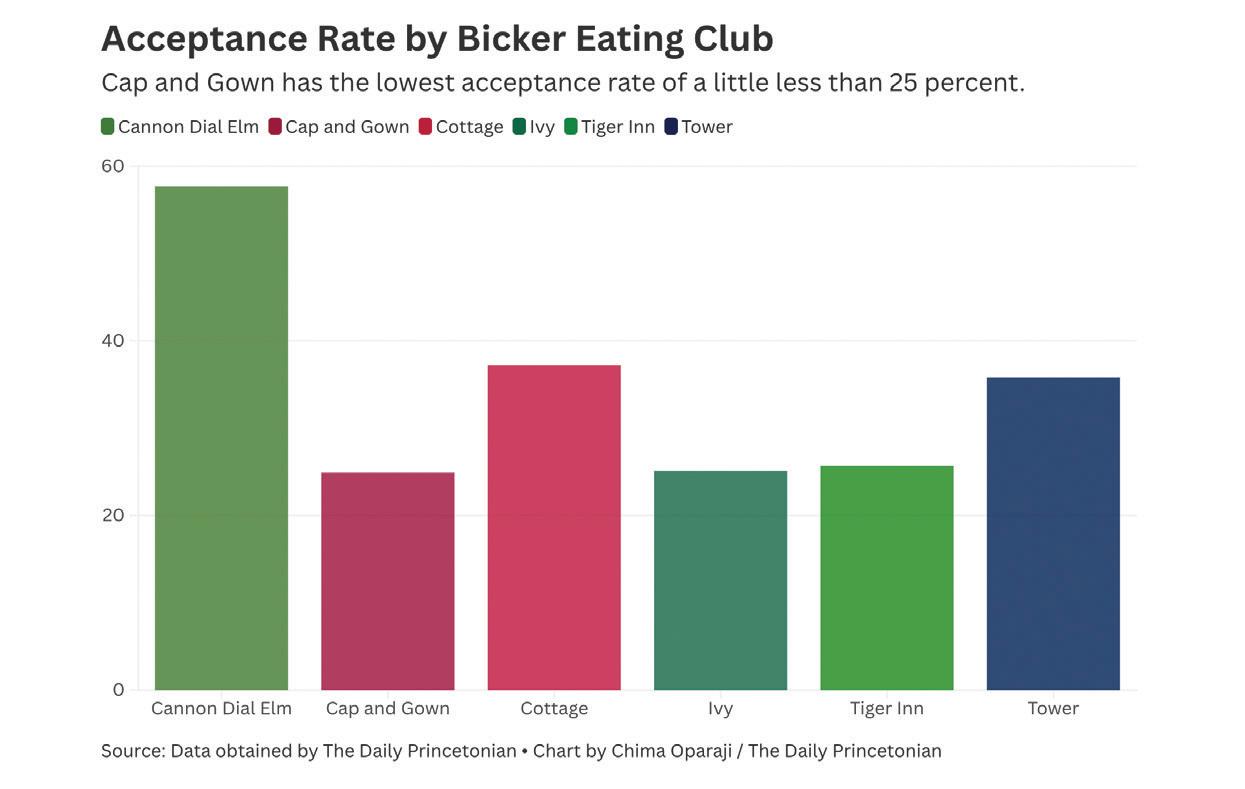
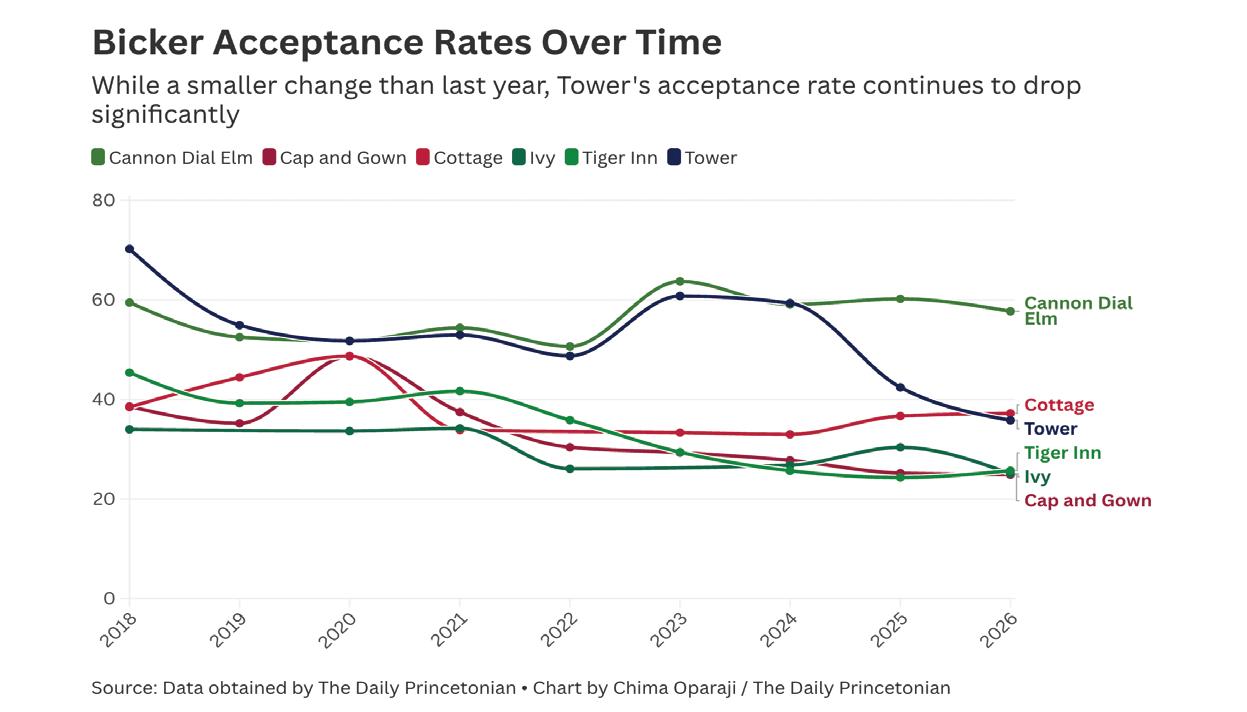
This year, Cap was the most selective club, dethroning Tiger Inn, which has held the distinction for the past two years. Cap has also retained the status of the most bickered club, with 401 students bickering. Tower saw another decrease in acceptance rate, from 42 percent last year to 35.8 percent this year.
Other than Bicker, there are two systems for admission into the eating clubs. Cloister, which is currently closed, Colonial, and Terrace, all use the “sign-in” system, where students can simply sign up for membership. Although all clubs are currently at capacity according to the ICC website, unplaced students may be able to join signin clubs if spots free up as membership is finalized.
A recent addition to the sign-in system is the group sign-in, which was introduced by the ICC in 2024. This feature allows groups of sophomores and juniors to sign in to a club with their friends, ensuring they receive the same placements. The ICC said in its statement that 47 students used group signin, up from last year’s 32.
The selective sign-in process, adopted by Charter and Quadrangle in 2021 and 2025, respectively, awards points to prospective members for demonstrating interest in the club. Interest is
measured by attendance at events such as coffee chats or socials before winter break and during Street Week. Quadrangle announced in November 2025 that all prospective sophomore members were required to attend at least one of three “Quad Socials” in Street Week 2026 and that it would cap the number of new sophomores at 75.
For both Charter and Quadrangle, membership is selected based on where prospective members rank the club, as well as participation in activities.
In a previous email to the ‘Prince,’ Marina, who also served as the Quadrangle president, said the change was in response to feedback given by sophomores who wanted more opportunities to meet members and experience the club’s community prior to eating club selection.
The ranking window for eating clubs opened on Tuesday, Feb. 3 at 8 p.m. and closed on Thursday, Feb. 5 at 8 p.m., before decisions were released the next day at 10:15 a.m.
Marina wrote that 24 percent of participating sophomores utilized the single-bicker option and 64 percent utilized the double-bicker option. 12 percent of all participating students, or 153 of the original participants, chose not to bicker.
Breakdown of clubs
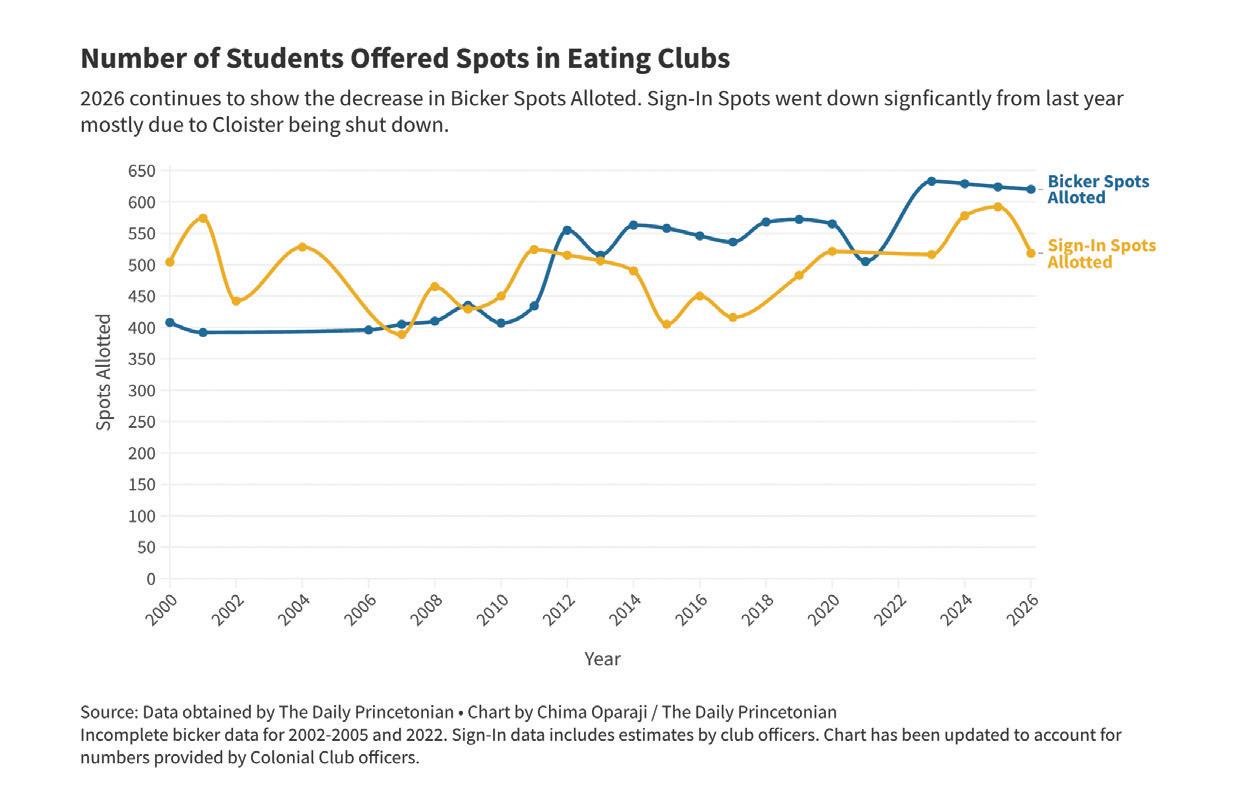
613 of the 1,168 students placed in clubs were offered spots in Bicker clubs, 11 fewer spots than last year.
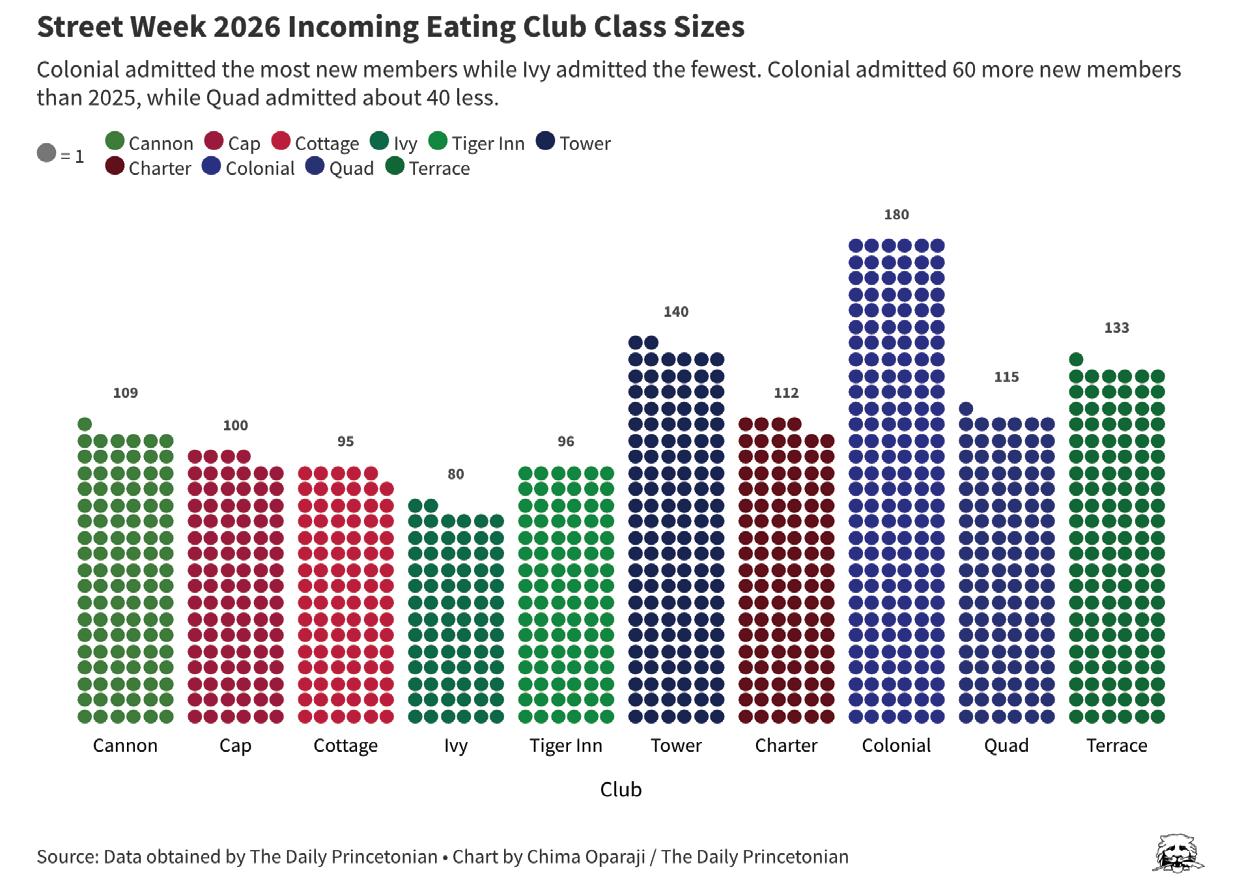
Cap, which had 401 bickerees, accepted an equal number of male and female bickerees, which has been a pattern for the club in the two previous bicker cycles. The club welcomed 100 new members, the same number as last year. Its 24.9 percent acceptance rate is a 0.3 percent decrease from last year.
Tiger Inn welcomed 96 new members of the 374 bickerees for a 25.7 percent acceptance rate, an increase from last year’s 24.3 percent acceptance rate. 90 of these accepted students were sophomores, while the remaining six were juniors. Tiger Inn accepted the same number of students this year as it did last year.
Cannon offered admission to 109 of its 189 bickerees for a 57.7 acceptance rate — cutting last year’s acceptance rate of 60 percent by a little over 2 percentage points. Cannon admitted 118 members last year, and 101 members the year prior.
Tower accepted the most members among the Bicker clubs, accepting 140 of the 391 bickerees. This year, Tower saw an increase in bickerees, compared to 337 last year. The club had an acceptance rate of 35.8 percent, a decrease from last year’s 42.4 percent.
Cottage welcomed 95 new members out of its 255 bickerees, a 37.2 percent acceptance rate compared to last year’s 36.7 percent. In 2025, it accepted 88 of 240 prospective members.
Ivy had a 25.2 percent acceptance rate, accepting 80 of 317 bickeeres, a 5.2 percent decrease from last year. Last year, the club accepted 79 of its 260 bickerees. Ivy let in 15 fewer students than Cottage — which had the second fewest admitted students — and 33 fewer than the average of all the clubs.
Bicker club acceptance rates have fluctuated dramatically in recent years. This year, Tower saw a continued increase in selectivity, while Cannon decreased in acceptances after an increase in them last year.
This year, Quadrangle welcomed 115 members, marking a dramatic decrease from last year’s 155 acceptances. Charter welcomed 112 new members, an increase from 100 last year.
With 180 acceptances, up from 120, Colonial offered membership to the most new students among the sign-in clubs — a distinction held by Quadrangle last year. Terrace welcomed 133 members to the club, similar to last
year’s 131.
Looking ahead, students consider their options
This year, an unprecedented number of participants were both “hosed” — not accepted by a Bicker club — and left without a placement in a sign-in club. Still, the ICC said that 86 percent of sophomores who participated in Street Week were placed into their first or second choice club, four percentage points more than last year. 78 percent of sophomores were placed into their first choice club.
The ICC is encouraging students to join sign-in clubs that might still have open spots. “We are actively encouraging students to engage with sign-in clubs that may have additional capacity as they finalize their memberships following Street Week,” Marina wrote. Students will have until noon on Feb. 22 to sign in to any open clubs. At the time of publication, some spots in Colonial appear to be available, and other sign-in clubs may become open if students decline their acceptances.
In the wake of these decisions, students have begun to explore alternate options for their dining plan next year. Aside from the eating clubs, dining options for upperclassmen include remaining on the unlimited dining plan, selecting a 128-block meal plan, or joining one of the four student co-ops. The block plans allow students to eat in the dining halls as upperclassmen if they are not in an eating club or a co-op. The co-ops are groups in which upperclass members prepare and share food in oncampus facilities.
Last fall, the University eliminated two dining options: the independent status and the 105-block meal plan. Students with independent dining status previously did not need to pay the University any fee for dining. Under the original changes, upperclassmen living in University housing, regardless of their dining plans, would be required to pay for the 32-block plan starting fall of 2026.
After opposition from eating clubs, co-ops, and alumni, the University decided to rescind the decision to make students pay for the 32-block plan. Although the 160-block plan was changed to a 128-block plan, the independent status and the 105-block plan remain eliminated.
Historically, Ivy, Cap, and Cannon have offered fall Bicker for upperclassmen students who were not placed into a club in the spring. However, getting a spot in a Bicker eating club during Fall Bicker is far from guaranteed; the process has become more competitive with lower acceptance rates and fewer spots available.
Justus Wilhoit is a former head Audience editor and current senior News writer for the ‘Prince.’ He is from Kenosha, Wis. and typically covers Princeton’s eating clubs/coops, identity & student life, and the Trump administration.
Luke Grippo is a head News editor for the ‘Prince.’ He is from South Jersey and typically covers high-profile interviews and University and town politics.
Justus Wilhoit is a member of Cap and has recused himself from reporting on the club.
CANDACE DO / THE DAILY PRINCETONIAN Prospect Ave., where most of the eating clubs are located.
Five percent of Class of 2029 identify as Black or AfricanAmerican, lowest since 1968
By Sena Chang Senior News Writer (former)
In the Class of 2029, 5 percent of students identified as Black or African American — the lowest share in many years.
The last time that Black enrollment stood close to five percent was in 1968, according to data compiled from the Common Data Set, Office of the Registrar records, and The Daily Princetonian’s archives. In the last few decades, the percentage of Black students in incoming classes has averaged around eight or nine percent.
The Class of 2028, the first class admitted after the Supreme Court banned race-conscious affirmative action, saw little change in racial diversity. However, this year, the percentage of Black or African Americanidentifying students fell by nearly four percentage points. At the same time, the number of students who did not disclose their race rose from 7.7 to 8.2 percent.
“This is one year of data, and there are natural fluctuations that will happen given the variability of the applicant pool,” University spokesperson Jennifer Morrill said in a statement.
Princeton has “scrupulously adhered” to the Supreme Court’s decision, Morrill added. “Neither application readers nor any personnel involved in admissions have access to demographic race and ethnicity data collected on the application form until the incoming class is finalized, after the waitlist closes in the summer,” she wrote.
Some Black students at Princeton told the ‘Prince’ that they markedly felt effects of the undergraduate demographic composition on campus life.
As Halaylah Lewis-McGlothan ’29 partook in various orientation events, she and her friends were struck by the scarcity of Black students. LewisMcGlothan, who hails from Pennsylvania and attended predominantly white schools her entire life, was looking forward to being at a place where “more people looked like [her].”
“We were looking around and wondering: ‘Where were the rest of us?’” Lewis-McGlothan told the ‘Prince.’
“We kind of expected there to be more of us, especially considering what we had heard,” she added, pointing to the University’s values of diversity and inclusivity.
Students such as Tova Jean-Louis ’29 and Michael Njoku ’29 pointed to the end of affirmative action as a key contributor in lowering Black enrollment. Njoku, who grew up in Anchorage, Alaska, said that Princeton’s campus felt reminiscent of his predominantly white hometown.
“I think it’s important for us to pay attention to make sure that our university is still representative of our public, and that no matter the amount of students that get into a university, to make sure that all voices are heard — especially minority voices, in a time where we’re facing a lot of changes,” Chris-Tina Middlebrooks ’27, the president of Princeton’s newly-reactivated chapter of the National Association for the Advancement of Colored People (NAACP), told the ‘Prince.’
Meanwhile, the number of Hispanic students remained stable, and the share of Asian students in the incoming first-year class increased from approximately 24 percent last year to 27 percent.
Notably, the number of international students increased by about
three percent, even amid visa revocations and heightened scrutiny of foreign scholars under the Trump administration.
With respect to Black student enrollment, peer institutions saw comparable declines a year earlier than Princeton: Black enrollment in Harvard’s Class of 2028 fell four percentage points, while the Massachusetts Institute of Technology (MIT) reported significant declines among Black, Hispanic, Native American, and Pacific Islander students.
“The nation is now seeing — or perhaps more accurately, not seeing — a lost generation of Black students on the nation’s foremost campuses,” Justin Driver, a Yale Law School professor who studies race and affirmative action, wrote to the ‘Prince.’
“I fear Princeton’s plummeting Black enrollment rate augurs ill for many other leading colleges,” Driver continued.
Eric Ginsberg, a college advisor for New Jersey-based test prep company Solution Prep, said he feared Trump’s attacks on initiatives deemed to be DEI-related would push colleges towards “oddity, inequity, and exclusion.”
In the wake of affirmative action, Princeton and its peer institutions have sought new admissions techniques to continue cultivating classes with diverse backgrounds. Immediately following the Supreme Court ruling, University President Christopher Eisgruber ’83 expressed Princeton’s intentions to “work vigorously to preserve — and, indeed, grow — the diversity of our community while fully respecting the law.” Changes included new essay prompts focused on
applicants’ identities and an ad hoc committee responsible for evaluating new admission policies.
“While I understand that the Trump Administration’s assault on higher education places universities in an unenviable position, I also believe that they possess numerous viable mechanisms for pursuing racial diversity that honor the Supreme Court’s decision,” Driver wrote. A recent executive order asked the Department of Education to collect race, gender, and other demographic data from college applicants to expose “unlawful practices” regarding the “consideration of race in higher education admissions.”
It is unclear if Princeton’s reported Black enrollment will continue to fall — a trend complicated by the growing number of applicants choosing not to
disclose their race. But students say that the impact may be immediate.
“As far as what this means for our classes’ future at Princeton, or the future culture at Princeton, I hope that we see a positive effect: Black students decide to come together with more purpose, and the Black student unions thrive,” Lewis-McGlothan said.
“But it’s very likely that we see the opposite of this, and that Black students become more isolated; it could even have negative effects on their academics,” she added. “I’m hoping for the best.”
Sena Chang is a senior News writer for the ‘Prince.’ She typically covers campus and community activism, the state of higher education, and alumni news.
CANDACE DO / THE DAILY PRINCETONIAN Students at the Class of 2025 orientation.
‘It just gets worse and worse’: Humanities at Princeton reels from NEH funding cuts
By Haeon Lee Associate News Editor
History professor Divya Cherian was at home looking after her child in late December 2024 when she received news of a National Endowment for the Humanities award. The $60,000 grant from the federal agency would have funded her second book project, “Conjured States: Witchcraft and Politics in Western India, 1750-1900,” and ensured that she could take a full academic year for her sabbatical leave while maintaining her salary.
One day three months later, she saw a flood of social media posts from fellow NEH recipients announcing that their grants had been canceled — and she began to panic, thinking her grant “would be the first to get canceled,” she told The Daily Princetonian.
Shortly after, when she checked her junk mail, there was the notification that her grant had been terminated.
Cherian was one of over 1,200 researchers across the United States whose NEH grants were suspended on April 2, 2025, and one of nine Princeton researchers who spoke with the ‘Prince.’ One year after the cancellations, these researchers have had to adapt both their research methods and how they attain funding.
Furthermore, they have expressed doubt and concern about Trump’s proposed fiscal year 2027 budget, which plans to permanently dismantle the NEH.
The terminations came as a result of realigned priorities for the agency under the Trump administration, which issued executive orders in January 2025 for “Ending Radical and Wasteful Government DEI Programs and Preferencing,” “Defending Women from Gender Ideology Extremism and Restoring Biological Truth to the Federal Government,” and “Ending Radical Indoctrination in K-12 Schooling.”
Simultaneously, 80 percent of NEH staff were laid off.
Founded in 1965, the NEH remains the only federal agency in the United States dedicated to funding the humanities. It has awarded over $6 billion in grants since its inception, supporting over 600 projects at Princeton, according to the official NEH award search website.
The mass termination email came only a day after University President Christopher Eisgruber ’83 sent a letter to the University entitled “Suspension of many federal grants and our response,” in which he cited dozens of Princeton research grant suspensions from the Department of Energy, NASA, and the Department of Defense.
On receiving the notification of her grant cancellation, Cherian remembered, “I didn’t know whether it was frustrating or impressive that the email came from a non-government [sender]. It was just some casual email address.”
The sender was acting chair of the NEH Michael McDonald, who was deposed in January as part of a lawsuit filed by the American Council of Learned Societies, American Historical Association, and Modern Language Association against the federal government.
Alexandra Levy, the director of communications and public affairs at the American Historical Association, which comprises a membership of over 10,000 historians, spoke to the ‘Prince’ about the role of the association in the lawsuit. It took issue with the government’s characterization of humanities research as intrinsically connected to diversity, equity, and inclusion frameworks.
“African American history is not DEI. The history of LGBTQ+ people, that’s not DEI,” Levy said. “It’s just history. And that has been one of the most disconcerting things, is to see what is just good evidence-based history distorted as DEI.”
The Princeton research projects terminated under the NEH’s new standards range from the mining economy in the American West to the develop-
even expect that my research would be considered under a politicized NEH.”
The Papers of Thomas Jefferson — a 78-year project that has wholly centered the documents of the founding father — is one of the only Princetonaffiliated humanities projects still receiving funding from the agency. The Papers is a partner in the collaborative North American Climate History project, which did experience an NEH grant termination. “The cutting of that grant has been a setback for the NACH effort, but has not affected our work on the Jefferson edition,” said the project’s general editor James McClure.
Some with canceled grants said that the cuts did not significantly impact their research. Professor of Spanish and Portuguese and Acting Chair of the Humanities Council Christina Lee GS ’99 was already near completion of
cal Data and Communities.” However, Lieberman received another grant in August 2025, after the initial round of suspensions.
Though the humanities funding losses were relatively minor for Princeton researchers, they unanimously shared unease regarding the grant application process going forward.
“One of my largest concerns is about self-censorship, about people proposing research projects in ways that whitewash or minimize the complicated identity politics of existing applications,” Bravo said.
“You [used to be able to] trust that there are scholars making decisions about funding projects. And I don’t think that we trust that anymore,” Zeltsman, a past reviewer of NEH grants, noted. “Using AI to identify keywords that shouldn’t be funded
ment of paper in Mexico and African stories about the Virgin Mary. Professor Wendy Laura Belcher, who is jointly appointed in comparative literature and African American studies, received two major NEH grants in August 2021 totaling over $600,000 to translate and digitize African stories about the Virgin Mary. As the funds were dispersed in multiple installments, Belcher ultimately lost approximately $30,000 between the two grants.
Echoing Levy, Belcher noted, “It struck me that this is … about Christianity and the Virgin Mary and Africa. How is this DEI? Just because it’s about Black people?”
The NEH’s standards for what constituted DEI were largely defined by ChatGPT, which the Department of Government Efficiency employees used to evaluate which research projects fell outside of Trump’s “America First” agenda.
“The DOGE employees … fed the NEH project descriptions into ChatGPT and asked ChatGPT to say whether the project was DEI or not. It did not define what DEI was,” Levy explained.
History professor Corinna Zeltsman, whose research focus is modern Latin America, found it difficult to imagine receiving funding in light of these new standards. “I research the history of Mexico, and in a hypernationalistic context of humanity, that wouldn’t even get funded as a priority to begin with,” she said. “I would not
her project on an ancient convent in the Philippines by April 2025.
Alongside assistance from the Humanities Council, Lee said, “My department stepped in, and they helped me with a fund. I used some of my personal research funds to be able to get us to the end of the project.”
Professor of Near Eastern Studies and History Marina Rustow, who also runs the Princeton Geniza project, also used several thousands of dollars to support her research after her NEH grant cancellation. “If I went to a conference, or if I bought books or whatever, I was paying for it out of my own pocket,” she told the ‘Prince.’ “I didn’t have the normal research money that professors always have to buy the things that they [need] or to go to places they need.”
Art and archaeology professor Monica Bravo was able to use the Fowler McCormick, Class of 1921, Fund, a University endowment specifically for research in the history of photography, to continue work for her book project.
“I’m really grateful to my predecessors who had the foresight to establish that research endowment and to have stewarded it so well over the past decades,” Bravo noted.
“Financially, it wasn’t a huge blow. Just morally,” said Leigh Anne Lieberman GS ’18, a digital projects specialist in art and archaeology, referring to the termination of the NEH grant for her project “Networking Archaeologi-
… that’s not the scholarly peer-review process that the NEH used to be known for.”
Limitations on this federal funding source also directly impact the ability for faculty to take sabbatical leave. Professor Molly Greene GS ’93, who holds a joint appointment in history and Hellenic studies, explained the process: “After every third year, the University pays for a semester of leave with the expectation and the hope that you will get outside funding so that you can (a), take the whole year [off] and (b), for the University to say, ‘Their work is competitive.’”
Cherian’s canceled NEH funding was substituted with funding from the History department, allowing her to take the full 2025–26 academic year off and pursue her research. However, Greene was uncertain that the internal funding option would remain sustainable.
“[The history department] is relatively wealthy, but even then, we’ve been told — with the austerity plans — that we’re expected to continue to cut our budget for an undetermined length of time,” Greene said, citing budget cuts that have affected departments across the University. “I very much doubt how things are going to work if our faculty are generally unable to take their full sabbatical every fourth year, particularly for people just beginning their careers.” Belcher spoke to the continuity of
the NEH’s support of large-scale, longterm humanities research, noting, “We have digital copies of [manuscripts] because the NEH, in the ’70s, funded people to go to Ethiopia and microfilm manuscripts in churches and monasteries.”
That continuity has now been severed. “The grants that got canceled [mean] that in 40 or 50 years, people won’t have what they might’ve had to do this really important work,” Belcher said.
Several researchers emphasized the significance of the NEH in fostering collaborative research projects, which are unusual in the humanities.
“In the humanities, traditionally, we don’t work in groups,” Lee told the ‘Prince.’ “But NEH funds, in the past, they encouraged collaboration, which could be quite productive in the humanities.”
Rustow characterized the Geniza lab similarly, stating, “My innovation in this whole operation is to realize this has to be collaborative work, because otherwise it’s just not going to get done.” The Cairo Geniza stores roughly 400,000 fragments and documents. “We want a lab the way scientists have labs, but we want a lab that’s devoted to these documents in particular.”
Meanwhile, the Trump administration aims to pivot the NEH’s funds to a sculpture garden celebrating the 250th anniversary of the Declaration of Independence and an arch in his honor, reserving $17 million and $15 million of the agency’s funds for the projects respectively.
“I guess there’s some dubious case to be made that if it’s national money, it should support national topics,” Zeltsman offered. “But I really don’t think that that’s the kind of thought process that has underpinned the American university.”
Trump’s plan to provide “$38 million to conduct an orderly shutdown of the Agency” was specified as early as May 2025 in the NEH’s FY2026 budget proposal, and remains in the FY2027 budget proposal announced earlier this month.
While the proposal is yet to pass through Congress, Lee wrote to the ‘Prince,’ “It pains me to even imagine this historically generous resource disappearing.” Greene agreed, stating, “It just gets worse and worse … Even if Congress acts to save the NEH, I doubt that its budget will actually grow.”
“Should they succeed in shutting down the NEH, Donald Trump and this Republican administration will be bitterly remembered for setting research back centuries,” Belcher said.
Characterizing these changes as a “destruction,” Belcher added, “A long time ago, there were the iconoclasts, a religious group that didn’t believe that things should be needed, and they destroyed a lot of buildings and icons.”
“So here we are,” she said, “We have the modern iconoclast.”
Haeon Lee is the associate News editor for the ‘Prince’ leading research coverage. She is from Brooklyn, N.Y. and often covers campus research and academic departments.
Luke Grippo contributed reporting.
CALVIN KENJIRO GROVER / THE DAILY PRINCETONIAN East Pyne, home to several humanities departments.
Faculty pass proposal shaving six days off winter break starting in 2027–28
By Toby Chang & Sena Chang Staff News Writer & Associate News Editor
Starting in the 2027–28 school year, winter break will be shortened by six days, with spring term beginning on the first Tuesday after Jan. 16. The proposal, written by the Committee on Classrooms and Schedule and unanimously approved by the Faculty Advisory Committee on Policy in February, was passed with one dissenting vote at the April 6 faculty meeting.
“There were many issues considered by the Committee on Classrooms and Schedule,” Dean of the College Michael Gordin told The Daily Princetonian in an interview following the meeting. Gordin pointed to the gap between the end of fall term exams and the beginning of spring term being longer than peer institutions as well as reducing conflicts between the National Collegiate Athletic Association (NCAA) playoffs and the final assessment period as some of the reasons behind the proposal.
“Five weeks is a very long time for students to be away from campus — especially first-years, who are away from … peer groups that they’ve just made,” Gordin added. He also said that the longer break “produces issues with learning retention, especially in math and languages.”
Starting in the 2027–2028 school year, Commencement Day will fall on the Tuesday between May 16 and May 22. In previous years, Class Day and Commencement have fallen on Memorial Day weekend, requiring staff to work over a holiday.
Prior to the vote at the faculty meeting, Gordin fielded questions from the faculty in the audience. Lecturer in the Princeton Writing Program Echo Thompson raised a question about the impact that a shorter winter break may have on the timeline for independent work.
“There is a trade-off where some students would have six fewer days to do work in January, and other students would have six more days to do work in January, because they will be back on campus,” Gordin responded. He said that while this was a trade-off that the various committees acknowledged, this was a “balanced” approach for the entire student body.
Gabriel A. Vecchi, a geosciences professor and a Princeton Athletics Fellow for the women’s hockey team, asked about the impact that the new schedule could have on athletic tournaments. Gordin responded that the changes would “beneficially impact those groups,” citing less conflict with the NCAA playoffs during final assessments, which have often required the rescheduling of exams for student athletes.
Vivian Brennan ’29, a member of the Women’s Swim and Dive team, expressed doubt over general claims that these changes would benefit athletes.
“I don’t know if I would say that it necessarily benefits us, or at least for my sport,” Brennan said. “We try to fit in a lot of meets and that kind of thing during winter break so that we don’t miss class. So it might make us miss one or two more days of class than we would otherwise.”
Other students offered mixed reactions to the policy change. Some expressed disappointment, while others welcomed the change, noting that the current break does not align with the schedules of many peer schools.
For students who do not return home for shorter breaks like Thanksgiving, abbreviating winter break takes away from the little time they had to spend with their families.
“Having such a long winter break has been so helpful for so many students, because for a lot of us, it’s the first time we get to go back home,” Iman Bedru ’28 said.
“[Winter break] is the biggest block of time I get to spend with my family where I don’t have the pressure of needing to be doing something else,” said international student Shaimaa Colaiacovo Abdelhalim ’27.
Allyson Walsh ’27 said that the longer break helped students recover from academic burnout, especially given that Princeton’s semesters are shorter than those at peer institutions.
“I would really like the extra week to go home and just relax,” Walsh said. “It’s sad to see that they are cutting back on it.”
On the other hand, several students described the shorter break as a positive change, saying that the current break does not align with the schedules of many other schools.
“It seemed very long in comparison to everyone else,” Clara Sun ’29 said.
“When I’m home for winter break, most of my friends are already going back to college earlier anyways,” Mark Lancaster ’27 said. “It’s kind of inconvenient ending so late, especially if you’re planning to do a summer internship or travel over the summer, you end up having to start work right after your finals.”
Students also perceived the policy change as reinforcing that Wintersession, which was permanently discontinued in August 2025 due to budget cuts, will not be returning.
“I’m a little sad about [the end of Wintersession] because that was something that I was excited about. I wrote about it in one of my Princeton essays,” Brennan said. Sun also expressed disappointment, sharing that Wintersession “seems like a really cool experience … it’s a shame that we don’t have [it] any more.”
Karen Villanueva ’27 noted concerns over a shortened timeline for junior papers and senior theses.
“If the deadlines don’t move in the se-
mester, it would still be decreasing the amount of time that students would have, typically by a week,” she pointed out.
“As long as the information is communicated clearly and students are given the support they need to make that adjustment between this academic year and next academic year, then it should be a smooth transition,” Villanueva added.
At the faculty meeting, chemical and biological engineering (CBE) professor emeritus Ilhan A. Aksay also read a memorial resolution on the death of chemical and biological engineering professor emeritus Morton Kostin, who passed away at age 89 on May 23, 2025.
Aksay highlighted Kostin’s contributions to quantum mechanics and chemical engineering, noting that Kostin “holds the distinction of longest service by a reg-
ular faculty member in the CBE department.”
Aksay concluded his remarks by reading comments from Kostin’s former students, who described him as “a very good teacher” and as “one of the very first or very few chemical engineers at the time working in quantum mechanics to understand molecular dynamics.”
The next faculty meeting will be held on April 20 at 4:30 p.m. in the Faculty Room of Nassau Hall.
Toby Chang is a staff News writer from Prescott, Ariz.
Sena Chang is the associate News editor for the ‘Prince’ leading investigations. She is from Japan and South Korea, and she often covers local politics and student life.
Princeton professor maintained sustained communication with Epstein from 2008 to 2012
By Bridget O’Neill & Luke Grippo Senior News Correspondent & Head
Editor
Newly released files in the investigation of convicted sex offender Jeffrey Epstein show Princeton professor Corina Tarnita communicated with Epstein between 2008 and 2012, first as a Ph.D. student and later as a junior fellow in the Society of Fellows at Harvard. Emails reviewed by The Daily Princetonian include friendly exchanges, research updates, mentions of trips, and arrangements for two separate wire transfers to Romanian and Californian bank accounts.
Tarnita, now a professor of ecology and evolutionary biology at Princeton, joins a growing list of academics who communicated extensively with Epstein after his first conviction and deny any knowledge of the criminal activity that led to him being charged in 2019 with sex trafficking of minors.
In her statement to the ‘Prince,’ Tarnita wrote she never saw Epstein “behave inappropriately” and that all her in-person interactions with Epstein were “in the company of senior, prominent scientists.” The files do not include any materials indicating that Tarnita was aware of or participated in any crimes related to Epstein’s 2019 charges.
Epstein was a frequent donor to academic and research institutions, including Harvard’s Program for Evolutionary Dynamics, where Tarnita was a graduate student and then postdoctoral researcher from 2008–10.
“Like most people who knew Epstein in his capacity as a donor to scientific research, I am revolted by his depravity and
regret having met him,” Tarnita wrote.
The records concerning Tarnita were included in roughly three million pages of documents and thousands of videos and images released by the Department of Justice on Friday.
In her statement, Tarnita wrote that she was introduced to Epstein in 2008 while she was a graduate student and then a postdoctoral researcher in Harvard’s Program for Evolutionary Dynamics, a program then led by professor Martin Nowak, a longtime associate of Epstein. Tarnita is mentioned at least 344 times in the newest batch of files, which show correspondence between Tarnita and Epstein beginning in 2008. That same year, Epstein was convicted for soliciting prostitution of a minor.
Nowak, a professor of mathematics and biology at Harvard, maintained a close relationship with Epstein. In 2003, Epstein donated an initial $6.5 million to Harvard to establish the Program for Evolutionary Dynamics. Nowak left the Institute for Advanced Study in Princeton to direct the new program.
Tarnita, who was advised by Nowak, was awarded her Ph.D in mathematics in 2009. She remained at Harvard as a member of the Harvard Society of Fellows until 2012.
A series of exchanges from 2009 appear to show that Tarnita helped facilitate wire transfers to two bank accounts, one located in Romania and one in California. The names associated with the bank accounts have been redacted by the Justice Department. The ‘Prince’ could not independently verify the intended recipient or recipients of the payments or the purpose of the funding.
In one email with Epstein’s accountant Richard Kahn, Tarnita shared the banking information of a “girl from Romania” who she wrote “will receive $10,000.” She later sent Kahn the wire information for a California bank account, which she indicated was to be wired $5,000.
In another exchange from later that year, Epstein’s assistant Lesley Groff asked Nowak for the “name of the University in Romania that you ‘got the people from.’” Nowak forwarded the message to Tarnita, who responded that both students were from the University of Iași.
In her statement, Tarnita wrote that while she was in the Program for Evolutionary Dynamics, Epstein said he was inspired by Tarnita’s career trajectory and wanted to “support other early-career women in mathematics.” She wrote he asked her to help “with such an effort in Romania” — where Tarnita is from — for which he would be an anonymous donor.
Around the same time, Tarnita wrote that the Program “began to develop a scientific collaboration” with the University of Iași. The collaboration, she wrote, included “a visit by a group from Harvard to give talks, meet with people, and conduct experiments that are published in a working paper.”
“In the context of this developing relationship, we raised with the University of Iasi the idea of an anonymous donor supporting exceptionally promising women mathematicians,” Tarnita wrote. “The University of Iasi put forward candidates, which I helped vet based on their academic promise.”
Tarnita wrote that she recalled that only two mathematicians were ultimately selected for Epstein’s support. She
wrote that she helped arrange payment to these women, “in keeping with Epstein’s stated desire to remain anonymous.”
Other correspondence between Tarnita and Epstein included a referral for help with a “visa issue,” Epstein’s facilitating of a haircut for Tarnita with a celebrity stylist, and three files suggesting that Tarnita traveled with Epstein or was invited to do so.
In a Dec. 18, 2008 email, Tarnita told Epstein she was in Romania, asked him to review her paper he appeared to have edited previously, and mentioned “the visit to Florida.” The records do not specify the timing or purpose of the visit.
Tarnita, through a University spokesperson, clarified to the ‘Prince’ that she attended one to two meetings at Epstein’s Florida residence alongside “senior, prominent scientists.”
In an Aug. 11, 2009 email, Tarnita thanked Epstein for a “beautiful” and “productive” trip. “it was great to see you again and it was such a productive trip -- i’ve learnt so much. We have so many new things to think of right now,” Tarnita wrote in the email.
During this time, Epstein had been on house arrest following his initial 2008 conviction.
In a Dec. 12, 2011 email, Tarnita apologized for not being able to “come to the island.” In that same email, Tarnita also described having anxiety over “the Princeton situation,” apparently referring to a faculty hiring process.
Tarnita stated through a University spokesperson that she had been invited by now deceased MIT Professor Marvin Minsky to attend a scientific conference on one of Epstein’s private islands, but
declined to attend. Virginia Roberts Giuffre, a prominent accuser of Epstein, said in a deposition released in 2016 that Epstein’s co-conspirator, Ghislaine Maxwell, directed Giuffre to provide sexual services for Minsky.
On Dec. 16, 2011, Tarnita sent Epstein an email saying, “great news: princeton officially wants me!”
“My interactions with Epstein naturally diminished as I moved on from the Program for Evolutionary Dynamics, and they ended after I began working at Princeton,” Tarnita wrote in her statement.
Tarnita joined Princeton as an assistant professor in ecology and evolutionary biology in 2013. She was promoted to associate professor and granted tenure in 2018, then became a full professor in 2021.
“Again, I wish I had never known him,” she wrote in her statement.
The latest batch of files show that Epstein was heavily involved in academic and creative spheres. Professors at Duke, Yale, and Harvard also sustained contact with Epstein after his criminal conviction.
The Daily Princetonian continues to review the newly released documents and will continue to review additional files as they become public.
Bridget O’Neill is a senior News correspondent, head News editor emerita, and managing editor emerita for the ‘Prince,’ covering the University administration and the law.
Luke Grippo is a head News editor for the ‘Prince.’ He typically covers high-profile interviews and University and town politics.
JERRY ZHU / THE DAILY PRINCETONIAN Dean of the Faculty Gene Jarrett ’97 speaks at the Monday, April 6, 2026 faculty meeting.
U. to cut employee benefits following raise reductions, eliciting mixed reactions
By Leela Hensler Staff News Writer
In a series of February memos, the University informed faculty and non-union staff of raise cuts and benefit reductions for the coming fiscal year, with a decrease in personnel also on the horizon.
The adjustments to employee pay and benefits came shortly after the annual State of the University letter from University President Christopher Eisgruber ’83 reported that the University would be tightening its budget primarily due to declining long-term endowment return expectations and continued uncertainty over federal funding. Eisgruber discussed some of the raise cuts at his annual Council of the Princeton University Community town hall on Feb. 9.
On Feb. 18, Provost Jennifer Rexford ’91 and Executive Vice President Katie Callow-Wright sent an email obtained by the ‘Prince’ to employees informing them that benefits would also be cut.
“We want everyone to be aware that some reduction to the University’s generous benefits structure is coming,” Rexford and CallowWright wrote. “Overall headcount at the University will decline as we reallocate resources to protect our highest priority areas,” they also warned.
The email did not specify whether this referred to layoffs or not renewing positions after retirements.
According to a memo sent by Vice President for Human Resources Romy Riddick on Feb. 4, many non-teaching staff will receive an acrossthe-board 1 percent salary increase regardless of performance, unlike previous years where raises were determined by merit. Members of the President’s Cabinet and recently hired employees will not receive a raise.
Riddick clarified that union employees, including public safety and security officers, cogeneration plant employees, library assistants, and hourly service employees in dining services and building services, should follow their contracts and are exempt from the acrossthe-board fixed salary increase.
A Feb. 6 memo from Dean of the Faculty
Gene A. Jarrett ’97 informed faculty that assistant professors, instructors, and lecturers would still receive salary raises based on “a modest merit pool.” Associate professors, full professors, senior lecturers, University lecturers, and professors of the practice will not receive salary raises in the next fiscal year.
According to a review of Department of Education statistics conducted by the ‘Prince,’ non-instructional University staff, including union staff, received an average raise of 3.67 percent on average for the 2023–24 year. Faculty salaries increased by 5.57 percent on average between 2024-2025 and by 6.45 percent on average between 2023–2024.
Exceptions to this year’s raises will be given from a “special merit pool” for “faculty who receive raises for a promotion, retention, or professional achievement,” according to Jarrett’s memo.
“We anticipate a return to more typical salary increases after next year, assuming we can address the benefits costs,” Jarrett added.
In the email about cuts to benefits, administrators cited “dramatically rising costs of medical and prescription benefits here and nationwide.” They said that staff could expect to learn more before the open enrollment period for the next academic year began.
A University spokesperson declined to comment about any of the policy changes.
Many administrative staff expressed disappointment over the raise reduction, while faculty reactions ranged from frustrated to supportive.
“I’m disappointed that hard-working staff are not getting a merit increase, when just a few months earlier the University announced that families making up to $249,000 are not having to pay tuition,” Keisha Craig, an events and office coordinator in the philosophy department, said. “My income is nowhere close. That’s not a low-income family, it’s very disappointing … Hard-working staff are being asked to do without while [these] kids get free
tuition.”
Another staff member, Anna Faiola, the philosophy department manager who has worked at the University for 42 years, recalled that similar cuts were made following the 2008 financial crisis, where the University endowment dropped 22.7 percent. “It was very scary because a lot of people were being let go,” she said.
As academic professionals, physics senior specialists Jackson Puchalla and Andrew Bazarko were also subject to the one percent raise policy. However, both said they understood the rationale behind the decision.
“It’s a complicated environment right now, on many levels,” Puchalla said. “There are certain levels where we all have to work together to make the system work. I’m willing to be in the position that I’m in.”
Bazarko told the ‘Prince’ that the salary changes were “perhaps not unexpected” due to federal funding cuts that the Trump administration issued last year. “Telling faculty they get no raise at all, I see that as sort of [saying] everyone’s in this together,” he said.
Kai Mesa, an assistant professor in the molecular biology department, said that he was mostly disappointed and concerned on behalf of the staff in his laboratory, whom he believed would be unfairly harmed by the policy.
“It really impact[s] people that work in my lab. [There’s] this feeling that this is a massive or an unexpected financial burden for people at the University that, on average, compared to faculty and higher-ups in the University, are relatively making much, much less,” Mesa said.
“I’m not upset,” tenured physics professor Robert Austin told the ‘Prince.’ “The University is under a lot of financial pressure right now [due] to the Trump administration. I understand why they’re doing that, and I’m glad they’re giving raises to the assistant professors.”
Tenured religion professor Seth Perry shared Austin’s perspective.
“I’m very proud of how Princeton is handling relationships with this administration,” he said. “And if this is the kind of sacrifice that we’re making at this point, benefits and salary, then I think that’s just what we’ll have to do.”
Fellow religion professor Garry Sparks and University Lecturer in Classics Ilaria Marchesi were less supportive of the administration’s decision.
“I understand that there are measures that the University sometimes has to take, but the fact that we don’t even have an adjustment to the cost of living is worrisome, especially given [that] they are also diminishing our benefits,” Marchesi told the ‘Prince.’
Both Marchesi and Sparks also felt that the changes to faculty salaries disproportionately affected those in non-STEM fields due to salary disparities between disciplines.
“If you’re humanities or non-quantitative social sciences, you’re already making less than, in my case, associate professors in the [STEM] fields. So, I think at that level, [the cuts] sort of pinch more,” Sparks said.
“We’re all putting in the same amount of hours. We’re all trying to get published,” he continued. “[But] faculty in humanities usually aren’t submitting patents. We don’t have other sources of income like our peers in STEM.”
Marchesi also said that she felt there was “a huge discrepancy in salaries” between STEM and humanities professors, which the University should have accounted for.
“Humanities professors should have at least [received] an adjustment to the cost of living. [Faculty] in the other disciplines can live better, even if for one year they don’t get a raise, because they are earning much more already.”
Perry pushed back against concerns regarding salary discrepancies.
“Look, we teach at Princeton, it doesn’t get better than this in terms of salaries,” he said. “And any [faculty] here who really wants to complain about that at this moment needs to reconsider their priorities.”
Leela Hensler is a staff News writer and a staff Sports writer for the ‘Prince.’ She is from Berkeley, Calif.
All Keller Center staff laid off in first mass termination of academic unit staff in years
By Luke Grippo Head News Editor
The entire Keller Center staff will be laid off due to a restructuring of the center amid ongoing Universitywide “budget constraints,” according to an email obtained by The Daily Princetonian. This change is resulting in nine layoffs.
The wholesale layoff of the staff of an academic unit is unprecedented at Princeton in recent years. Faculty
in the Keller Center are not “immediately” affected by the layoffs, according to the email.
University President Christopher Eisgruber ’83 announced in February that the University will implement multi-year budget cuts due to lower projected endowment returns. The University has since cut employee benefits and scaled back salary increases across the board, amid other fiscal tightening measures.
The Keller Center for Innovation
in Engineering Education, according to its website, is focused on creating “societal impact through entrepreneurship, design, and innovative education.” It is housed within the School of Engineering and Applied Science (SEAS).
In a March 5 email announcing the layoffs to Keller Center-affiliated faculty, SEAS dean Andrew Houck ’00 described the change as a “very difficult decision” that will ensure the Center’s “long-term financial stabil-
ity and strategic growth.” The layoffs will be effective two months after the announcement.
Director of the Keller Center Sigrid Adriaenssens and Associate Director Janet Vertesi will retain their leadership positions at the center. Adriaenssens is a professor of civil and environmental engineering, and Vertesi is an associate professor of sociology.
The email from Houck stated that those laid off will have the opportunity to apply for new positions at the center. In a statement to the ‘Prince,’ University spokesperson Jennifer Morrill wrote that there were four new positions created within the Keller Center to which the laid-off employees will have the opportunity to apply.
The University has publicly posted three of these positions on its job listings: an executive director, an undergraduate administrator, and a communications and events specialist.
There is no open listing for the fourth position at time of publication.
According to Morrill, the position is manager of finance and administration at the Center. Morrill wrote that there is also a new engineering dean’s staff position available.
Multiple Keller Center staff and faculty declined to comment or referred the ‘Prince’ to the Office of Communications.
“The School of Engineering re-
mains committed to the Keller Center’s critical mission of interdisciplinary education in entrepreneurship, design, and societal impact,” Houck wrote in the email.
The Center’s future plans will be done in consultation with “faculty and staff task forces” who help guide the center “in the current budgetary environment,” Houck continued.
The email stated that this decision was not rooted in any “dissatisfaction with the Center’s talented and hardworking staff.”
“I share your deep appreciation and concern for our affected colleagues. Please be assured that the School and University will carefully support Keller Center staff through this difficult transition,” the email concluded. “Your teaching and mentoring are key to the Center’s continued success and I am grateful for your dedication to the Center’s work and to our students.”
As of now, faculty positions and course offerings are not affected by the restructuring, and the minors in entrepreneurship and technology and society will continue to be offered.
Luke Grippo is a head News editor for the ‘Prince.’ He is from South Jersey, and typically covers high-profile interviews and University and town politics.
Graduate student population to shrink, departments asked to trim expenses in FY2027 operating budget
the summer, financial aid was suddenly boosted, possibly allowing Princeton to avoid a new 8 percent endowment tax levied on universities with large endowments.
As the University undergoes budget reduction measures, the Board of Trustees has officially approved the operating budget for the 2026–2027 fiscal year. In a report recommending key budget parameters, the University signaled the beginning of a “gradual reduction” in graduate student enrollment, asked academic and administrative units to trim budgets, and revealed curtailed funding available for faculty raises and graduate students.
While subject to change, the total operating budget for fiscal year 2027, which runs from July 2026 to June 2027, is currently set at $3.407 billion — a small increase from this year’s projected spending of $3.336 billion. The report indicates that the 2026 fiscal year budget has already been reduced by $132 million from the March 2025 projection of $3.469 billion, meaning that the originally-planned 5.5 percent budget increase for this year from 2025 has already been slashed to 1.9 percent. The budget will increase by 2.1 percent compared to a revised FY2026 figure, making this the “lowest annual expense growth at Princeton in many years,” said the FY2027 Report of the Priorities Committee of the Council of the Princeton University Community.
The University posits that the budget will support “continued commitments to world-class teaching, research and affordability, while also reflecting the University’s shift from a decade of historic growth to a period of focus on its core mission.”
The Board of Trustees approved the budget based on the recommendations put forth in the Priorities Committee report.
The total undergraduate financial aid budget will increase by 5.4 percent — to $342 million. Last year, the total undergraduate financial aid budget for fiscal year 2025 to 2026 was projected to increase by 8 percent. It had initially been announced as $306 million; however, over
“Approximately 70% of undergraduates are expected to receive financial aid, more than 60% of which is supported by dedicated University endowments,” the release stated, in line with last year’s budget announcement. The budget expects 35 more undergraduate students to receive financial aid next year.
For graduate students, whose tuition is typically paid by their department, the tuition rate will remain unchanged, with the Priorities Committee recommending this on the basis of uncertain external research support opportunities and “other financial pressures.” Previously, undergraduate and graduate tuition rates were set identically, making a decoupling of the two rates unprecedented in recent years.
“During discussions about the FY2027 budget outlook and efforts to help academic departments and principal investigators adjust to pressure on their resources … the Committee endorsed a recommendation to leave the graduation tuition rate in FY2027 unchanged from the FY2026 amount,” the Priorities Committee report said.
In recognition of “changes in local costs of living,” the Priorities Committee added that graduate apartments and dorms are recommended to increase “by at most 2.5 percent” for next year.
Additionally, the release stated that the graduate student stipend rate “will increase by 2.25% next fiscal year.” Federal Reserve officials currently estimate that U.S. inflation will rise to about 2.7 percent this year, meaning that graduate student stipend increases will likely not outpace inflation, reducing the real purchasing power of graduate students.
The Priorities Committee also indicated that a “gradual reduction of graduate student enrollment” is beginning, as the University’s four-year undergraduate stu-
dent expansion plan ended this past year.
“Undergraduate scholarship and graduate fellowship budgets will begin to moderate compared to recent years,” the report said. “The undergraduate scholarship budget is expected to rise by 5.4%, while graduate student support will decline slightly, by 0.6% due to planned decreases in graduate student enrollment.”
The release explained that efficiency is key to this year’s operating budget, addressing how the University is responding to lasting residue from the federal funding suspensions from last year, as well as the ongoing budget reduction measures.
The Priorities Committee report explained that “most administrative and academic units” will be asked to cut 1 to 2 percent of spending “annually for several years.” The report acknowledged that these “new savings” will “likely require units to eliminate some programs and services,” in order to prevent “a general dilution across all programs, services, and activities.”
“Units must also build flexibility and resilience more generally into their budgets beyond the 1-2 percent margins noted above to anticipate other needs or opportunities that may emerge,” the report said. “Central resources will be limited, as is the budget’s ability to shelter units from price increases, tariffs, emerging compliance issues, and other ‘surprises.’”
“The University anticipates implementing further cost savings measures as a response to federal cuts to research funding, reduced long-term assumptions for endowment performance and rising costs for employee health benefits,” the release added.
Last April, millions of dollars in federally-funded research grants were suspended by the federal government. University President Christopher Eisgruber ’83 revealed in August 2025 that about half of these suspended grants have been restored, although the University has not given an exact number of what grants remain suspended versus restored.
The effects of the federal funding suspensions were widespread, casting uncertainty on the FY2026 budget as the University punted on releasing the total operating budget last April. The University is still seeing effects of that pause in funding, according to the Priorities Committee’s report.
Currently, direct sponsored research revenues for FY2026 are projected to end the year 12.6 percent below the original estimate from last winter, which was made before the federal government took action against the University in early spring and suspended the grants which contributed significantly to this stream of research revenue.
“The budget projections for next year reflect a further 5 percent decline in federal grant funding,” the Priorities Committee report added, saying they were offset “in part” by growth in non-governmental awards.
At the end of February, the University announced that it would cut certain employee benefits. This followed an announcement of reductions in raises earlier in the year in Eisgruber’s annual “State of the University” letter. The letter added that the University would be tightening its budget due to declining long-term endowment return expectations and continued uncertainty over federal funding.
The endowment supports most aspects of University operations, including “faculty and staff salaries, financial aid, graduate stipends, research equipment, and construction projects.” While the endowment’s projected growth is not expected to increase, payouts from it are “expected to cover 65% of the University’s overall net operating budget” for FY2027.
Additionally, endowments “specified for financial aid will cover an estimated 61 percent” — $209 million — of the $342 million FY2026 scholarship total.
Regarding staff and faculty salaries, “benefit costs will account for more than 40% of the total operating budget increase for FY2027,” according to the report.
“Facing similar constraints and con-
cerns for lower-paid employees as in the case of the staff pools,” the report recommended that assistant professors and lecturers be allocated a 2 percent salary increase pool, while associate and full professors be recommended no increase except for a special pool for promotions, retentions, or other special adjustments.
The rate of increase in the size of total faculty compensation will drop from a planned 4.75 percent in FY2026 to 1.76 percent in FY2027. Similarly, staff compensation increases will drop from 3.5 percent to 1 percent.
The newest release highlights that future budget reduction efforts could lead to changes on campus, including “the reimagination of campus services, changes to the University’s workforce, and the consolidation or elimination of some functions.”
“While the impacts will vary, most departments will see their budgets rise less than the rate of inflation for the next several years,” the release added.
“Some staffing and budget decisions may appear to be budget-related when in fact other factors may be decisive, including shifts in campus demand for programs and services and changing workforce skill requirements, especially as technology needs intensify,” the Priorities Committee report said.
For now, the budget cuts are still not over — the report announced that the “next round of cuts will be more targeted and strategic,” as the University Budget Group works closely with campus leaders and asks whether staff changes, services, organization, or eliminations or consolidations to functions and units will generate necessary savings.
“Pursue an ‘evolve by substitution’ mindset,” was the report’s recommendation to campus units.
Luke Grippo is a head News editor for the ‘Prince.’ He is from South Jersey, and typically covers high-profile interviews and University and town politics.
JERRY ZHU / THE DAILY PRINCETONIAN
A staff office in the Keller Center on Friday, March 20, 2026, a month and a half before the mass layoff takes effect.
By Luke Grippo Head News Editor
U. AFFAIRS | APRIL 2026
More budget cuts anticipated in annual ‘State of the University’ letter
By Kian Petlin Senior News Writer
In his 2026 “State of the University” letter sent to students on Monday, University President Christopher Eisgruber ’83 previewed major upcoming changes to University finances. The letter, titled “From Growth to Focus,” described a move away from expansion, citing long-term economic factors.
“We expect that budgetary and operational changes will begin in the coming months and occur over a multiyear period,” Eisgruber said.
The changes will come in addition to the 5–7 percent departmental budget cuts over the last year, alongside the hiring freeze instituted last March.
“The long-term endowment trends described in this memorandum are likely to require more targeted, and in some cases deeper, reductions over a multiyear period,” Eisgruber wrote. “The change that I am describing … goes beyond the pace of construction. It will affect everyone on campus.”
The letter also detailed the University’s shift from the rapid physical development of the last decade toward a period of strategic consolidation. Eisgruber attributed the University’s shifting priorities to downgraded long-term economic projections and an increased reliance on endowment payouts in the midst of widespread federal grant cuts.
“The principal cause for this transition is economic,” Eisgruber wrote. “It results from lowered expectations about the University’s future endowment returns.”
The Princeton University Investment Company (PRINCO) reduced its expected long-term endowment re-
turn from 10.2 percent to 8 percent per year. The letter cited the endowment’s 20-year rolling average returns, which show steadily slowing growth rates since the 2008 Global Financial Crisis.
PRINCO’s revised 10-year estimates predict an endowment value $11.3 billion lower and an annual payout $500 million lower than the previous forecasts, according to the letter. The projection assumes a constant spending rate of 5 percent annually.
The letter arrives as the University faces a possible increased endowment tax amid rising threats to higher education from the federal government.
The federal One Big Beautiful Bill Act imposes an 8 percent tax on any university where the endowment exceeds $2 million per student. However, the legislation includes a specific caveat: institutions are exempt from this tax if they have fewer than 3,000 tuition-paying students.
This distinction is important for Princeton. The ‘Prince’ previously reported that approximately 65 percent of 5,826 undergraduate students may receive financial aid in excess of tuition following an expansion of undergraduate financial aid earlier this year.
The University has previously declined to comment on the number of tuition-paying students.
Eisgruber’s letter mentions the endowment tax as well as a number of other “political threats” facing the University’s financial model.
“Princeton and other universities have over the past year faced a variety of threats to research funding, the immigration status of community members, free speech, academic freedom, diversity and inclusion programs, and our endowments,” the letter reads.
Eisgruber has been outspoken in his defense of higher education, appearing across national media outlets and promoting his book, “Terms of Respect: How Colleges Get Free Speech Right.” He has also launched the Stand Up for Princeton and Higher Education initiative, which members of the Princeton community can join to receive newsletters advocating for universities and colleges in America.
Aggregated survey data of undergraduates between 2017 and 2025 is provided as an appendix to the letter, assessing student attitudes towards different questions of the undergraduate experience. Since 2023, the University has expanded these surveys to specifically address “civil and respectful dialogue” amid a polarized national discourse on campus free speech.
In response to the prompt, “I feel that members of the university community engage in civil and respectful dialogue with one another on difficult topics,” over 70 percent of undergraduates agreed or strongly agreed in 2025, compared to 62 percent in 2023.
A second prompt given to students since 2023 is the following: “I feel that I can voice my true opinions on controversial topics without fear of being unfairly judged.” Responses to this prompt reflect those given on the question of civil and respectful dialogue, with over 59 percent of undergraduates agreeing or strongly agreeing in 2025 compared to less than 55 percent in 2023.
“Free speech and academic freedom are complementary principles; both are essential to the life of a great uni-
versity,” Eisgruber wrote. According to the letter, the University community can expect to receive memoranda on budgetary and operational changes in the coming months from Provost Jen Rexford and Executive Vice President Katie CallowWright.
Eisgruber will answer questions from the student body during the next Council of the Princeton University Community meeting. The meeting is scheduled for Feb. 9 from 4:30–6 p.m. in the Frist Campus Center Multipurpose Room.
Kian Petlin is a senior News writer for the ‘Prince.’ He is from San Francisco, Calif. and typically covers campus events and student life.
Senior class jacket abruptly changed following accusations of AI design
By Vitus Larrieu Senior News Writer (former)
For more than a century, Princeton seniors have donned “beer jackets” to protect their clothes during Reunions and commencement celebrations, typically with elaborate designs chosen by a class-wide contest. Now, with a selection process marred by accusations of generative AI use, the Class of 2026 may have written its own spot in Princeton history.
After two rounds of voting, the Class Jackets Committee announced the winning design by Samuel Henriques ’26 last week. Almost immediately, members of the Class of 2026 accused the jacket, featuring a snarling tiger surrounded by roses, of being created by generative AI. By Saturday, that design had been replaced.
“[FreeFood] AI Slopbowl at class 2026 jacket,” read the subject line of a FreeFood listserv email from Derek Geng ’26, accusing the design of being AI-generated about 40 minutes after the announcement. The following day, Margaret Miao ’26 started a petition calling for transparency on whether the designs were created with AI, which received over 600 signatures.
“Our class jacket symbolizes a member of our class, and I don’t think a generative AI program is a member of our class,” Miao said in an interview prior to the design change.
One of her main motivations for starting the petition was to highlight contest rules that barred AI use, which were only made clear to jacket artists, including Miao. In the final round of ranked choice voting, artists
were also asked to sign a form that their design did not incorporate AIgenerated content.
The email, from Class of 2026 Vice President Sol Choi ’26, also said that designs would “undergo AI detection,” before being confirmed for the next round. It was unclear how AI use would be detected.
When asked whether Henriques’s design passed AI detection, Choi referred the ‘Prince’ to the email announcing the replacement design and said the Class of 2026 Council would not be commenting further.
The email announcing the new winning design by Zavier Foster ’26 called his design the “highest-ranked eligible jacket design,” suggesting Henriques’s design was disqualified. However, the email did not acknowledge any disqualification or explain why the original design was deemed ineligible.
The ‘Prince’ was not able to independently verify whether one or both of Henriques’ designs were created in part or in whole with generative AI. The initial announcement had included Henriques’ original design alongside a modified version made by Henriques and the jacket committee. Some students pointed to visual artifacts that can be characteristic of AI image generators, such as variation in the jacket’s shape and irregular coloring. Henriques did not respond to the ‘Prince’ despite multiple requests for comment.
Most seniors were happy about the change in design, though some students said the communication from Class Council about the decision wasn’t transparent.
“I feel pretty good about the design being changed after the first design was disqualified, but I think the situation was handled very poorly given the fact that there was no official statement,” wrote Jacob Jackson ’26.
Emma Jean Hermacinski ’26 also wrote that she was glad to see the original design disqualified after student outcry.
“It’s heartening to see that our voices matter in an age where AI slop feels inescapable,” she wrote.
Most seniors reached by the ‘Prince’ also said that they viewed the use of AI as problematic, regardless of whether the design won the initial contest.
“I do think it matters that the first design was made with AI because I do believe it undermines the other
students’ entries that were labored over with hours of care,” wrote Abigail Girma ’26. “I also think it speaks to an increasingly frightening trend of the human eye being unable to differentiate between artwork that is artificially generated from that which isn’t.”
Olivia Lechner ’26 wrote that she was worried about the impact an AIgenerated design would have on the legacy of the class.
“Everyone at Reunions talks about the seniors’ jacket, and it would have been pretty sad for the whole alumni network to know we didn’t even get our own design,” she wrote.
Miao said she was satisfied with the Class Council’s decision and hopeful for its impact on future class jackets.
“I hope this sets a precedent for the next few years on transparency,” she said in an interview. “Glad that now we have a design that we can confidently say is made from a member of our class.”
Though this is the first time the class jacket contest has had explicit rules governing generative AI use, it remains to be seen how those rules will evolve as the technology changes. Class jackets will be distributed to seniors during Senior Checkout on Wednesday, April 29, and Thursday, April 30.
Vitus Larrieu is a senior News writer for the ‘Prince.’ He is from Pensacola, Fla. and typically covers community activism, the state of higher education, and construction and architecture.
RYLAND GRAHAM / THE DAILY PRINCETONIAN Nassau Hall.
Class of 2028 celebrates Declaration Day, computer science sees sharp decrease in majors
By Daphne Lewis & Vanessa Catalano Staff News Writer & News Contributor
The Class of 2028 gathered Friday afternoon on Cannon Green to celebrate officially declaring their majors. Hundreds of students took part in the event, which featured orange and black departmental banners, balloons, and free food vendors. Students in the Class of 2028 pursuing an A.B. degree declared their majors this spring, while those pursuing B.S.E majors declared in the spring of their first year.
Beyond the celebration, the Class of 2028’s major declarations show a significant shift away from computer science and toward majors in other engineering departments. The change at Princeton comes in the midst of a national shift away from the discipline, as advances in artificial intelligence and a flagging job market discourage students from pursuing degrees in computer science.
At Princeton, computer science has both an A.B. and B.S.E track. Students declaring the B.S.E. major decreased by 39 students compared to the Class of 2027, falling from 114 to 75. Sophomores pursuing the A.B. track dropped from 51 to 30 compared to the current junior class. Combined, the number of students pursuing computer science degrees decreased by 60 students over the past year, the steepest decline of any field over the two-year period.
The French and Italian department has also seen a major drop off in recent years, with only one major in the Class of 2028 compared to 19 in 2007. For the Class of 2028, history gained five students and philosophy gained seven students compared to the Class of 2027, a bright spot for the humanities and social sciences.
Economics remained the most popular major for the third year in a row, with 161 students, or 11.4 percent of the class, declaring the major.
The School of Public and International Affairs followed closely at 139 students, a 5 student increase in the last year.
Molecular biology also saw a steep increase, from 47 students in the Class of 2027 to 75 students in the Class of 2028.
Meanwhile, engineering disciplines saw an increase in students from the Class of 2027 to 2028. Students in the Department of Electrical and Computer Engineering surged by 34 students, from 92 to 126, making it the third most popular major in the class. The mechanical and aerospace engineering department gained 21 students, rising from 63 to 84 students, while mathematics saw an increase of 20 declared majors compared to 2027.
In terms of broad areas of study for the Class of 2028, the social sciences hold the largest percentage of majors at 34.2 percent, and engineering is next with 32.4 percent. The natural sciences have 19.9 percent, and the humanities have the lowest percentage of majors at 13.5 percent.
For sophomores on Cannon Green, Declaration Day commemorated their decision on what to major in.
Luca Difelice ’28, who declared SPIA, cited its breadth as its appeal. “The requirements are intentionally interdisciplinary,” he told The Daily Princetonian. “You can take operations research and financial engineering, politics, econ classes. There is a diversity of classes.”
Bella Postel ’28, also a SPIA major, similarly said that she chose it “mainly because it is very interdisciplinary.”
Postel also reflected on Declaration Day more broadly. “[It] is kind of a bittersweet celebration,” she told the ‘Prince.’ “It makes me reflect on where I was even two years ago.”
Sasha Berry ’28, who declared economics after considering multiple majors, told the ‘Prince,’ “I think that it’s really exciting that we have had the past two years to explore different majors.” She also noted that “it’s nice to settle on something.” Beatrice Cassidy ’28, who plans to write her senior thesis in economics on a topic she hopes connects directly to real-world markets, stated simply, “I’m excited to do the real stuff.”
Lecturer Henry Shim in the economics department, who has watched many Declaration Days pass, recognized many faces. “I remember when they took ECO 100 or 101 as a freshman or a sophomore,” he told the ‘Prince.’ “This year, I think we have a really good bunch.”
Many students reflected on how exploration throughout their first two years at Princeton led them to declare a major completely different from what they initially intended to study.
Emma von Scheliha ’28 arrived at Princeton intending to pursue molecular biology as a pre-med student before finding her way to anthropology. “I did not want to do my research in a lab,” she said. A single course last semester, ANT 311: Food, Culture, and Society with professor Hanna Garth, redirected her entirely.
Theodore Peebles ’28 nearly declared civil and environmental engineering before a conversation at the gym pushed him toward electrical and computer engineering (ECE). “My friend was like, why are you doing something you hate?” he recalled. “I thought, ‘he is right.’” Peebles is now part of the increase in ECE majors this year.
Daisy Yao ’28, who declared music, had long assumed she would major in physics. “I felt like music is something I’m really good at and wanted to pursue,” she told the ‘Prince.’
Dean Miller ’28, now a physics major, arrived at Declaration Day with two competing feelings. Physics, he said, had been “extremely difficult,” but “seeing it formalized and standing in front of the sign feels more concrete and like all my efforts and late nights have been building up towards my major.” Miller was mildly underwhelmed by the event itself, having expected something more ceremonial. “It’s kind of like a bunch of friends walking around,” he said. “I feel so hype with my physics majors. I wish there was a time for the physics majors to meet. A bunch of other majors had a specific time to take a photo, but physics did not.”
Emilia Reay ’28 was among the least conflicted. She has known since high school that she would study Spanish at Princeton, drawn to it because “the department is such a family” and her ambition to become a bilingual sports broadcaster.
Reay is a senior Sports writer for the ‘Prince.’ “Declaration day is a formality,” she said, standing near her department’s banner. “I wanted to hold the banner and wear the sweater; and now, I am. I’m over the moon right now.”
Daphne Lewis is a staff News writer for the ‘Prince.’ She is from Washington, D.C.
Vanessa Catalano is a News contributor for the ‘Prince.’ She is from Los Angeles.
The Princeton Photobomber
By Paulette Martinez | Associate Cartoon Editor
Correlation vs Causation
By Noam Rabinovitz | Head Cartoon Editor
www. dailyprincetonian .com } {
Seniors deserve to know if their class jacket is AIgenerated
Jacqueline Zhou Guest Contributor
The following is a guest contribution and reflects the author’s views alone.
Was the Class of 2026 class jacket design dishonestly created using AI? On Tuesday, Margaret Miao ’26 started an online petition titled “Demand for Integrity for Class of 2026 Jacket.” I signed the petition, agreeing with its essential demand: that students receive confirmation that the jacket design for Princeton’s Class of 2026 is a human creation, not algorithmically generated.
Class jackets, also known as senior jackets, are issued to all graduating seniors prior to Reunions and Class Day, where they are traditionally worn. Each class year’s jacket is typically designed by a member of the graduating class and chosen through a design contest. Dozens of designs were submitted to the Class of 2026’s contest in October, and after two rounds of ranked choice voting, a design submitted by Samuel Henriques ’26 was announced as the winner of the contest on Monday.
As a digital artist, I find parts of the final designs suspicious. For context, the 2026 Class Jackets Committee initially provided an optional black and white lineart template of the jacket’s front and back to all contestants. In Henriques’s Version #1, we see the template in the shape and outline of the design used by most submissions in previous rounds of voting. But in Version #2, the shape has changed; the outline has disappeared; the front collar is unnecessarily shaded where Version #1 was flatly colored. These inconsistencies could be signs that Version #2 is an AI modification of Version #1.
Version #1 is also worth a second look. On the front of the jacket, the coloring
is asymmetrical, with only the right rose having a singular light yellow petal that also vaguely resembles a thorn. On the back of the jacket, the last stripe on the tiger’s tail is light yellow, and there is a singular petal on the left rose that is colored both orange and light yellow. Though these details are less suspicious than those on Version #2, AI-generated images often contain details that humans have trouble rationalizing.
We do not have conclusive evidence that either Version #1 or Version #2 was made with the help of AI tools. But in our current world of convincing deepfakes and AI slop, these details warrant reasonable suspicion.
AI use is a blatant violation of contest rules, and evidence that the jacket was designed without it should be easy to provide: a time-lapse, a Photoshop file, or a display of the layers used in the design program. Anything that clearly documents a human creation process for both versions of the final design would do. Although the requested evidence is simple, the longer we wait, the harder it will be to re-establish integrity, since there are ways to use AI to generate evidence too. Students need immediate transparency from the 2026 Class Jackets Committee about how the chosen design was created.
All finalists had to sign a disclosure statement in order to advance in the competition. As a finalist myself, I was required to sign a statement acknowledging that “any use of AI tools in the creation of my design would result in disqualification from the Class Jackets Design competition.” An email from the Class Jackets Committee indicated that the committee and Henriques “worked together collaboratively” to create a second version of the winning design, and voting between the original and secondary design closed on Wednesday. The announcement of the
contest winner and release of a second version sparked controversy around whether AI tools were involved in the creation of either version.
Echoing the petition’s words, which were endorsed by 600 signatories, our class jacket is an enduring emblem of our class’s Princeton experience. The question of the provenance of this design echoes the challenges we face with AI in academic work. After all, integrity and honesty are cornerstones of our obligations to the University community — they should carry over into our extracurricular pursuits.
Allowing an AI-generated design to represent our class would be disrespectful to the classmates who labored for hours over honest designs. Handing out such jackets would be an insult to graduates who expect a jacket designed by a fellow member of the class. As an artist, I would
not want a jacket designed using AI.
This year, the Committee created new structures aimed to ensure integrity: adding an AI clause, requiring all designers to sign a disclosure, and passing submissions through an AI detection tool. These steps are appreciated but ultimately insufficient. Signing a disclosure does not prove that AI tools were not used, and AI detection tools are notoriously unreliable. Requesting an additional step of providing evidence of human creation wouldn’t be burdensome, and it would provide essential reassurance to the University community.
The Class of 2026 saw the release of ChatGPT in the first semester of our first year at Princeton. We are the first class that has had to navigate the use of AI tools for the entirety of our undergraduate education, and our decisions today will set a
precedent for future class years. AI tools will only improve in the future, making it increasingly difficult to distinguish between human and AI work and presenting new challenges in ensuring integrity. By being willing to respond to reasonable demands for evidence, the 2026 Class Jacket Committee can set a standard of transparency and accountability, combating how irresponsible uses of AI undermines those values.
The festivities surrounding Commencement are symbolic. Class jackets, caps and gowns, and even the diplomas are symbols that mark a meaningful end to our time at Princeton. I want our jacket to represent our commitment to integrity, not a capitulation to irresponsible AI use.
Jacqueline Zhou is a senior majoring in philosophy.
Eisgruber eats at Olives. Why can’t I?
Jerry Zhu Guest Opinion Editor (former)
At noon on Monday, I took a stroll down Witherspoon St. to grab a simple lunch from Olives, a popular local takeout market (one that University President Christopher Eisgruber ’83 is known to frequent for lunch). I ate a delicious sandwich for $9.95, much cheaper than a $16.75 swipe in a dining hall. Yet in the eyes of University administrators, my quotidian Monday lunch was emblematic of “challenges … related to food access and isolation concerns” — a “problem” they are now stamping out.
In an email on Monday, administrators announced significant changes to
Princeton’s dining and housing policies, effectively making it impossible to be an “independent student” for those living in University housing.
But rather than a genuine commitment to improving student well-being, the memo and policy behind it show a continued ignorance of and disinterest in real student concerns, and a continued trend of counterproductive and paternalistic policy decisions aimed at protecting undergraduates from themselves.
Juniors and seniors have spoken about being “independent,” meaning that they do not join an eating club or purchase a University meal plan, since at least the 1960s. One student’s defense in The Daily Princetonian of opting to be independent in 1964 rings true to-
day — the option can be convenient, economical, and more satisfying than other choices. Yet in a blunt decision that will satisfy no one, the University has decided to make going independent impossible by forcing the purchase of a 10-meals-per-week plan if one does not have another fixed dining contract with an eating club or co-op.
The reasoning behind the change starts in the right place. Campus administrators cited a study completed by Huron Consulting Group during the 2023–24 academic year, which showed that independent students “experience a lesser sense of inclusion and belonging” than those in a co-op or eating club. The University is right to address this problem, but the “solution” it has come up with completely fails to help the students who are actually in need.
The Huron report noted that students asked for expanded options for independent dining, not for the entire option to be shut down. Responses also indicated that independent students chose the option because of cost concerns, a greater sense of choice, and a better way to address dietary restrictions — all issues left unaddressed by a dining hall plan.
Instead, University decision-makers seem to have cherry-picked the results of the report, and simply discarded any conclusions and concerns not amenable to their ultimate decision. In the memo, absolutely no mention was
made of how students impacted by cost concerns or dietary restrictions would be supported after the change. Since the new 10-meals-per-week plan will likely cost more than $5,000 per year based on current rates, this move will leave students with much less to work with. Moreover, the University has not indicated any systematic changes coming to Campus Dining that would help support those with significant dietary restrictions.
Some students in the study indicated that their choice to go independent was in response to eating club culture — either they wanted to avoid the “negative social and mental health impacts of clubs” or they were not accepted into a bicker club. It is therefore unsurprising that some may be “involuntarily independent,” and the University should seriously investigate approaches that can resolve isolation resulting from these choices.
Whatever the answer to these questions may be, it should absolutely not be to eliminate the independent option. A moment’s thought and a modicum of common sense would result in the obvious conclusion that limiting the options of already marginalized students while imposing upon them a forced purchase would only make them worse off. I would hope that the University administrators would have recognized this; perhaps that did not matter.
The decision reveals a foolish ap -
proach to finding the root causes of the problem, and a dangerous mindset that eliminating the symptom can cure the disease. It should hopefully be clear that the social concerns or isolation that some independent students face will not go away when they are forced onto a meal plan they did not want to elect.
As an independent, I feel much more satisfied now than when I was on the Unlimited meal plan, and I am spending less money too. A campus meal plan is not the magical panacea that administrators seem to think it is. Ultimately, the imposition of this mandate will do the exact opposite of what administrators are claiming they are concerned about — “improv[ing] your residential experience.”
I’m sure that when the responsible University administrators see Eisgruber walking from Nassau Hall to Olives, they do not think, “what a pitiable, isolated person who is struggling with food access.” If only they would apply the same respect to our decisions and ability to care for ourselves, too.
Jerry Zhu is a junior in Economics who thanks his microeconomic theory professors for teaching him that limiting the options an individual can choose from will not make them better off. He serves as the guest Opinion editor of The Daily Princetonian, and encourages you to submit a response to this piece or write an op-ed for the ‘Prince.’
CALVIN KENJIRO GROVER / THE DAILY PRINCETONIAN Seniors wearing their Class Jackets at Class Day on May 26, 2025.
head sports editors Lily Pampolina ’27 Doug Schwartz ’28
associate sports editors Lucas Nor ’28 Matthew Yi ’27
head web design and development
editors Cole Ramer ’28 John Wu ’28
strategic initiative directors
Graphics Caroline Naughton ’29
editor-in-chief Jerry Zhu ’27 business manager Alistair Wright ’27 150TH BUSINESS BOARD
assistant business manager Angela Han ’28
business directors James Swinehart ’27
Chloe Zhu ’27
Ella Miner ’28
Devin Panalal ’28
Why can our peers see our search history?
Christopher
Bao & Charlie Yale Chair of the Editorial Board & Head Opinion Editor
Are you signed into eduroam?
If you are, the University has the ability to know that you visited The Daily Princetonian’s website or app to read this article. It can also find out that you were looking at your favorite shoe brand’s website during your chemistry lecture, and it can even see if you’re watching pornography.
While you’re connected to Princeton-administrated Wi-Fi systems, authorized University representatives can request access to data about the domain names you visited and the routers you used as long as they have a “legitimate operational need” to do so. It’s one thing when administrators are looking at our internet usage data. But it’s another when our peers can, too.
Search history can play a crucial but little-known role in the adjudication of academic integrity investigations for both the Honor Committee and the Committee on Discipline (COD). Information you thought of as being private can suddenly appear in front of panels of your peers and professors.
This feature is not at all obvious to students — we were all introduced to the honor system during our freshman year, but the programming focuses on what happens before an investigation and what can lead to an investigation, not on what actually may happen during proceedings.
Education Charlie Yale ’28
Shravan Venkat ’28 Kosta Botev ’29 Sarah Cai ’29 Mason Dauber ’29 Will Liu ’29 Sara Mironov ’29
Business Manager Emeritus Jessica Funk ’26
Chief Technology Officer Emeritus
chief technology officer Abu Ahmed ’28
software engineers
Nicole Deng ’28
Ziya Momin ’28
Kyaw Naing ’28
Stephanie Sugandi ’27
Albert Rho ’29
Lucy Zschoche ’29
BOARD OF TRUSTEES
president Thomas E. Weber ’89
vice president David Baumgarten ’06
secretary Chanakya A. Sethi ’07
treasurer Douglas Widmann ’90
assistant treasurer
Kavita Saini ’09
trustees Francesca Barber
Kathleen Crown
Suzanne Dance ’96
Jamie Creasi ’28
Gabriel Debenedetti ’12
Stephen Fuzesi ’00
Zachary A. Goldfarb ’05
Michael Grabell ’03
Danielle Ivory ’05 Rick Klein ’98
James T. MacGregor ’66
Rohit Narayanan ’24
Marie-Rose Sheinerman ’23
Julianne Escobedo Shepherd Abigail Williams ’14
Tyler Woulfe ’07
trustees ex officio Jerry Zhu ’27 Alistair Wright ’27
Nadia Makuc ’26, the chair emerita of the Honor Committee, said in an interview with the ‘Prince’ that in programming directed towards incoming first-years, “we don’t really talk about what happens when you have an alleged violation.”
Efforts to prevent academic integrity violations are good and necessary, but they shouldn’t preclude the University from transparency about the procedures that will transpire and evidence that will be brought forward in the event of an investigation.
We believe that Princeton must enact a two-fold change in the way that search history is handled during investigations of alleged academic misconduct. First, the University must be more forthcoming about how search history is used during investigations. Second, the Office of Information Technology (OIT) must restrict what specific data is accessible to student investigators in order to preserve student privacy to the greatest extent possible.
We hope that there will soon be comprehensive discussions between student representatives and administrators about the broadest range of privacy protections that can be afforded to students. This is a complex topic that will no doubt take time and willpower to resolve. In the meantime, however, we believe that the actions we call for are a clear and meaningful way to protect student privacy.
To see how your search history can be used, you’d have to thoroughly read the OIT policies and the Rights, Rules, Responsibilities manual. This information isn’t hid-
den, but it also isn’t communicated directly to the students to whom it might become relevant.
It doesn’t have to be this way — students deserve to know and understand the ways that their data might be used to build a case against them.
But understanding who might request your data, and why, is crucial. In many cases, website usage data is requested by investigators on the Honor Committee and the COD, through which Princeton adjudicates allegations of academic misconduct.
Investigators can request data from a specific time range if they suspect a student may have used their device to cheat on an in-person exam. For example, if someone were accused of using ChatGPT on a final, Honor Committee investigators can ask OIT for data for the time period during the scheduled exam.
On the COD, ODUS administrators or investigators who are removed from the student experience filter through OIT data. But in Honor Committee cases, which address all alleged infractions pertaining to inperson exams, it is our peers who assume that responsibility.
After the data is requested, the student investigators assigned to a case comb through a packet that includes all the instances a student’s devices hit the Wi-Fi network within a certain timeframe. While investigators cannot see the content of any sites that a student visits, they’re able to know what websites a student visited and when. What this means is that there will often be searches visible to the investigators that do not relate to the alleged misconduct at hand.
Investigators don’t have a say on whether students are found responsible for academic infractions, and those who do make that determination receive a filtered version of the full data packet.
This degree of access exposes student investigators — who might later end up in a class or social situation with the student under investigation — to a trove of potentially personal and intimate data that is not necessarily relevant or useful to the adjudication process. The number of students able to request this data is not large in number — 17 students sit on the Honor Committee — but the principle remains important.
One issue is that it is not clear whether such data is actually meaningful in making a determination of whether a student has cheated. Samantha Baldwin, a policy and research staff technologist at the Electronic Frontier Foundation, explained to the ‘Prince’ in an interview that a website can show up on someone’s history even when they are not actively using it. An app refreshing in the background, a roommate using a shared device, or even a push notification from an app can all show up as accessing that particular website or app, she noted. Or, for instance, if a student ends their exam early and uses their device for personal reasons, that data may also show up.
The primary risk isn’t deliberate exposure of personal content in a student’s search history, but rather
that allowing investigators access to a broad, unfiltered body of search data could provoke implicit character judgments that have no place in a space of academic integrity adjudication. Imagine an investigator sees that a student under investigation visits political websites that they find extreme and distasteful. Is it possible that such knowledge would unwittingly skew their opinion of the student in question?
There are certainly cases when it is legitimate for the University to use student search data to investigate academic misconduct. It is useful, for example, to bring internet usage data into an investigation when a student gets reported by one of their peers for taking out their phone during an exam. But the current access policy presents a glaring privacy issue: our peers should not be able to see our personal search histories, some of which contain very private and sensitive information that is not relevant or appropriate evidence for the adjudication of academic integrity investigations.
The University must change its policy of how student or ODUS investigators can request information from OIT. Baldwin noted that one potential solution was filtering the data available to misconduct investigators. OIT “can redact information that they share as well,” she added. Instead of being able to request all internet usage data from a given timeframe, investigators should have to request access to specific sites, like ChatGPT or Claude, with reasonable rationale. This way, a balance can be struck between preserving the student’s right to privacy and the University’s need to hold students accountable for academic integrity violations.
Beyond reforming its policy, the University must be forthright about how search history can be used in disciplinary investigations. This process should be explained at the beginning of every academic year to the incoming freshman class. A more transparent policy will inform students about the full implications of University Wi-Fi usage, as well as equip them with a complete understanding of what academic disciplinary proceedings entail and what they can expect from the Honor Committee.
Few students at Princeton may suspect that their search histories could one day end up being used against them. But the University can better balance respecting student privacy with upholding academic integrity by both increasing transparency about what data can be used in investigations and limiting how much of that data is available to investigators — particularly student investigators — in the first place.
Chair of the Editorial Board Christopher Bao is a sophomore economics major from Princeton, N.J.
Head Opinion Editor Charlie Yale is a sophomore history major from Omaha, Neb. Yale is a Peer Representative. This piece does not represent the view of the Peer Representatives as a whole.
Thomas Buckley Senior Opinion Writer
Around this time every year, death comes to campus. If you know where to look — beneath Fine Hall, below Frick Chemistry Laboratory, or outside Choi Dining Hall — you can find carcasses of migratory birds strewn across campus. Since 2022, students, faculty, and staff have advocated for the University to do more to protect the resident and migratory birds that collide with glass buildings on campus every year. In 2024, it seemed like the University had finally started to listen: Bird-safe glass was installed on Prospect House. Yeh College also recently unveiled a new installation to help prevent birds from striking the large glass window in the common room. While the lower third of the common room window is adorned with a beautifully ornate nature-themed decal, there’s just one problem: it’s not finished. Most of the three-pane window is left completely unchanged. Craig Marshall, assistant director at the Center on Science and Technology and the lead of the project, wrote in an email to me that the more limited installation was chosen because the majority of collisions occur on the first two floors of buildings.
A 2014 study found that 4–11 story buildings were responsible for 56 percent of collisions, while 1–3 story buildings accounted for only 44 percent. It’s therefore reasonable to assume that upper floors bear some responsibility for bird deaths.
Princeton, no more half-measures
If the risk still exists, why not finish the job? It’s hard to imagine adding decals to a few more panes would be prohibitively expensive. This half-finished installation is just one symptom of a broader problem with the way that Princeton seems to pursue the aesthetic of change over genuinely impactful solutions.
But this isn’t just about bird deaths. The University’s pervasive affinity for incomplete, lazy solutions is what I have begun privately calling Princeton’s “halfmeasures,” in reference to Mike Ehrmantraut’s iconic monologue from “Breaking Bad.” Putting aside the extraordinarily violent specifics of those particular halfmeasures, the concept provides a useful lens through which we can view the administration’s shortcomings, in particular when it fails to take necessary action in furtherance of its clearly articulated values, whether due to cowardice, lack of vision, or incompetence.
The University’s handling of mental health is just one example of its broader reliance on half-measures. The administration has made it clear that it views suicides as an inevitable part of life on this campus — something that occurs “even when people do all the things that they should be doing,” in the words of University President Christopher Eisgruber ’83. Yet a statement like this suggests a troubling lack of ambition on the part of the administration and that, much like in the initiative to minimize bird collisions, they have capitulated in their efforts to address an issue before delivering the promised — or any — results. In lieu of a comprehensive plan to fight
suicide, the administration points to the new Frist Health Center as evidence of its commitment to support mental health. While shiny new buildings are nice, Frist alone can’t solve the mental health crisis: A building is not mental health infrastructure.
Numerous other institutions, including the University of Alabama at Birmingham and the University of Utah, have instituted a “zero suicide” approach that aims to provide a comprehensive approach to addressing mental health crises through “the belief and commitment that suicide can be eliminated.” In contrast to this constructive and radically hopeful vision, University administrators present a view of campus mental health that is deeply unambitious and borderline fatalistic.
The administration’s response to climate change is similarly timorous. Powerful figures on campus and within the administration recognize the pressing threat that climate change poses and acknowledge Princeton’s responsibility to address it. Yet when given the chance to take bold action, the administration hesitates time and time again. The University pledged to divest from fossil fuel companies after years of student activism, only to quickly backpedal. Princeton labs continue to receive funding from fossil fuel companies, and the University refuses to even give up its privately-held oil company. Princeton’s unwillingness to extract itself from oil reflects the same tentativeness and lack of vision that lets it accept a suicide rate far above the national average. Princeton’s pledge to achieve net zero
by 2046 reveals a similar lack of ambition.
If the University of Vermont — a school with 4000 more students than Princeton and a fraction of the endowment — can make substantial progress towards their pledge to achieve carbon neutrality by 2030, surely the University can set a more ambitious target than sixteen years later.
Of course, the explanation for choosing 2046 as a target year for net zero is obvious to anyone familiar with Princeton history. But is prizing the aesthetically pleasing target of the University’s 300th anniversary really more important than taking aggressive action to minimize its impact on the climate crisis?
Half-measures are never a satisfactory response to any issue, but they are especially dangerous for the University in our present times: Academic freedom is
under attack, international students are under threat, and ICE thugs operate in town with impunity. The climate crisis remains as urgent as ever. And students are still dying. Princeton deserves an administration that has the clarity to understand these issues and the conviction to confront them head-on rather than retreating to half-measures, opting to surrender before the battle has even begun. The University must do better to live up to its responsibilities to its students and community.
It’s the early 1900s, you’re a young (male) Princeton student, and it’s time for your weekly humanities precept. You’re probably heading to the house of Dean Andrew West — classics professor and the first dean of Princeton’s graduate school — for your weekly, multi-hour discussion of Horace’s Epistles with four of your peers, smoking cigars around a wood fire.
Princeton’s precept system was launched by Woodrow Wilson in 1905 to give students a “first-hand command” of material. The goals of precept have always been lofty, transcending weekly quizzes designed to catch those who skipped readings and aiming to promote closer and more organic engagement with course content. Ideally, precept was supposed to help students mature into assertive contributors to academic, social, and moral conversations.
It’s a far cry from 2025. Right now, I’m in a ten-person English precept that frequently stalls when the preceptor asks a question and receives no response. It would be easy to just say that people aren’t doing the reading, but I’m sure at least some are. The problem feels more difficult: We are supposed to be working through these difficult texts together, including our confusion, but no one will take a swing at a question. When comments come, they are isolated, and we just move on. Making it through the fifty minutes feels like a Herculean task.
It was imagined that a Princeton education — a precept education — would give students “the responsibilities as well as the opportunities of maturity.” This original conception is that precept — being asked to do the thinking, the messy and uncertain parts of scholarship for ourselves — is teaching us how to grow up and be in the world as adults. Since that
process of maturation seems to be floundering today, it’s time to reevaluate the purpose of precept in direct conversation with the current tumultuous academic climate.
Renewed attention to precept, not just for basic academic success but to genuinely embrace criticism, confusion, and interest in the people around us, might not just make us smarter. It can teach us, as we face a diminishment of both critical thought and perhaps more frighteningly of human care and relationships, to be empathetic and astute adults.
Student engagement is a touchy subject. Right now, Harvard students are under scrutiny for slacking off. At Princeton, it seems like insufficiently engaged students fall into one of two camps: indifferent, or so anxious about saying the perfect thing that they don’t say anything at all.
Elizabeth Armstrong GS ’93, Associate Professor of Sociology and Public Affairs and Head of Butler College, told me in an interview that there has been a postCOVID shift “in how people perceive their interactions with other human beings.” A reduced interest in engaging with others, perhaps even on some level a fear of others, drives what Armstrong described as a fraying of the social contract.
“Trust in peers is probably lower than it used to be, lower than when I first started teaching, and I think social media probably has something to do with that,” she told me. As our ability to focus — on readings and on each other — diminishes, so does the quality of precept conversation.
David Tubbs GS ’01, Visiting Associate Professor of Politics, also attributed students’ increased struggle with reading completion and comprehension — a topic which has lately received great attention in national media — to technology use.
These observations should not be misconstrued to justify accusing today’s college students of laziness. Instead, they emphasize how precept is particularly
vulnerable to the ways in which technology is changing our brains. Armstrong suggested that social media has not only shortened our attention spans, but also exacerbated anxiety by provoking the pervasive sensation of social judgment, which may drive many students’ hesitation to participate in discussion.
But this is not a new problem. For nearly as long as precept has existed, administrators have reminded students that they’re supposed to throw themselves into spirited precept participation. In 1953, 1962, and 1983, the Dean of the College published and drafted preceptor guides and mission statements. In 2002, the Undergraduate Student Government launched a “Precept Reform Initiative” to “revitalize” the system. And in 2008, the University released a booklet about the purpose of precept, entitled “Inspired Conversation.” All of these guides say the same (vague) things: deepen your understanding, take initiative, engage thoughtfully.
While it’s true that participation in precepts might just be what you’re ‘supposed to do’, repeated, vague extolment of close engagement and discussion hasn’t done much to motivate students. These guides aren’t working—hence their repeated pleas for engagement—because they advertise precepts as roundtables meant to churn out clever model students. But the ability to defend our ideas, to explain what matters to us and listen to others do the same, underlies not just our intellectual but our social existence in the world. Precept doesn’t just teach us about the material particular to the class: it’s where we learn to balance our individual principles and ideas with our capacity to care for others. Armstrong points to that as a “foundation of human life.”
It’s impossible to evaluate the crisis of student engagement without considering this highly particular context of what it is to be a young learner today. Questions of what is and what is not worth our time
are shaped by the twin threats of AI and the Trump administration’s attacks on free academic thought. How we treat our precepts matters now, right now, because there has never been a worse time to stop paying attention to the world and to one another.
Precepts have always faced problems. In order to address them, to actually make progress towards that lively discussion idealized in the pamphlets, we need to look not to generic sentiments but to how the world around us is changing. Our modern relationship to technology may have made precepts more stagnant, but they can also wake us up to what renewed engagement can actually mean for us today.
The threat of intellectual censorship and the rise of AI have forced universities, again and again, to ask themselves who they are. Part of Princeton’s answer to that question for the last century has been precept: a practice “basic to Princeton’s understanding of itself.” Others have praised us, and we’ve praised ourselves, for how we don’t just absorb knowledge but rather commit to challenging and remaking it for ourselves. It can be messy and frustrating, but it’s never passive.
Precepts in the Humanities Sequence exemplify the progress that can emerge from that frustration. In HUM, there’s no avoiding participation. Not only is precept engagement factored relatively highly into grading, but the whole experience of the class is based on coping with material you’re not necessarily equipped to grasp in its entirety. Precepts are extensive — two eighty-minute meetings per week — but they don’t stall, because they are driven by authentic confusion, anger, and even amusement with the texts: the experience is not of mastery but of young people relearning the experience of reading and embracing the vulnerability that comes from being forced to argue over and interpret challenging material.
In that space, precept can bridge the gap between the material and the world of our daily lives: my freshman year, we discussed sexual abuse and the 2024 election in our precept on Ovid’s Metamorphosis, and queer theory in medieval love fables, to name a few. The discussion was no more polished academic jargon than it was silence: it taught us to tackle the real issues of the world around us, and on a larger scale to talk to and spend time with each other as fellow readers and fellow beings in the world.
So if struggling precepts are a symptom of a cultural struggle with care, attention, and socialization, their reevaluation might be an opportunity for Princeton and its students to take a timely diagnostic of the University’s most monumental task: making smart people smarter by teaching them to care about and understand the world beyond their immediate orbit. This might sound trite, but in a cultural moment seemingly devoid of empathy, we can’t treat these skills as givens.
Precept isn’t easy: It asks for openness and attention, for us to deepen our intellectual journeys by caring about what the people around us have to say — and by proxy, caring about them as people. No one, as Armstrong remarked, wants to “say the wrong thing,” and it might feel stressful to figure out what the right thing is.
But it’s dangerous, in the world today, to be anything less than a close listener and a strong speaker. To transform the challenge of precept into the deliberate embrace of intellectual and social vulnerability is to get better at being with others, at the act of thinking itself, in the face of chaos and confusion. That’s bad for authoritarianism, and good for human beings.
Lily Halbert-Alexander is an assistant Opinion editor and prospective English major from San Francisco.
Thomas Buckley is a senior Opinion Writer from Colchester, Vt. He has never once taken a half-measure and is offended that you’d even ask.
THOMAS BUCKLEY / THE DAILY PRINCETONIAN
A bird-safe addition to Yeh College windows only covers some of the windowpanes.
Could Princeton avoid the endowment tax by expanding financial aid?
Isaac Barsoum Columnist (former)
On July 4, President Trump signed a budget reconciliation bill that has been cited as “the largest upward transfer of wealth in American history.”
It is, unsurprisingly, a tax cut for the wealthy paid for mostly by cuts to existing programs, including Medicaid, clean energy tax credits, and food stamps.
And 8 percent of Princeton’s endowment returns, every year.
That’s from a massive increase to the existing tax on university endowment returns tucked into the omnibus legislation. Considering the 9.2 percent average endowment return over the past 10 years, the new tax could cost Princeton a fortune.
Because certain types of investment returns are exempt from taxes, it’s not entirely clear what Princeton’s financial burden would be exactly, and a University spokesperson declined to provide the amount Princeton currently pays on the 1.4 percent tax.
However, the president of Yale University, which will also be hit by the higher tax, has estimated that it would cost Yale $280 million in just its first year. (Princeton’s endowment in 2024 was about $34.1 billion, while Yale’s was slightly bigger, at about $41.4 billion.) And the American Enterprise Institute (AEI) has estimated Princeton’s tax liability for 2026 at $217.4 million.
University President Christopher Eisgruber ’83 has warned that increasing the endowment tax would be devastating for the University. In his State of the University letter, he wrote that such a tax would make it “much harder to make long-term commitments that depend on annual endowment spending, such as expanding financial aid.” Whatever the exact impact is, it is certain to deal a blow to student financial aid, research programs, and other University initiatives.
According to the legislation, institutions will have to pay 8 percent on endowment returns if they have “at least 3,000 tuition-paying students” and “a student adjusted endowment in excess of $2,000,000.” Princeton checks all the boxes. So, we have to pay. Right?
Actually, maybe not. Instead, Princeton could not only preserve its financial aid programs, but expand them — and potentially render itself exempt from taxation under the new law. By reducing the number of “tuition-paying students” to 2,999 or less, Princeton would become exempt from the tax. (But don’t worry, dear reader, you aren’t getting expelled.)
You see, existing law stipulates that “Whether a student is tuition-paying is determined after taking into account any scholarships and grants provided directly by the educational institution.”
So students on full financial aid — or even students whose financial aid totals at least the total cost of tuition and fees ($65,210) — don’t count as tuition-paying
students under the law.
The bad news for Princeton: The University currently has more than 3,000 students that pay tuition. The good news: It might not be much more than that.
A University spokesperson declined to provide information to The Daily Princetonian about how many undergraduate and graduate students are “tuition-paying.” But we can make some rough estimates.
According to The Daily Princetonian Frosh Survey over the past several years, out of 5,726 undergraduate students, about 40 percent have household incomes under $125,000. That means their expected family contributions are generally less than the cost of tuition, according to Princeton’s own estimates of expected family contributions. While there are students whose households earn more than that and still don’t pay tuition, this estimate gives us about 3,450 tuition-paying undergraduates.
Princeton’s Ph.D. students receive full tuition as long as they are progressing through their degree at a reasonable pace. Master’s students in the School of Public and International Affairs also receive full funding. Based on the University’s enrollment data, that leaves at most 400 graduate students who would have to pay some amount of tuition (with many of them receiving some form of aid along the way). Princeton is different in this way: It lacks a law school, medical school, or other large pre-professional graduate programs.
This all means that by expanding financial aid for about 850 undergraduate students, Princeton could put itself below the small-college threshold for the tax. Since these students already receive partial aid, bumping them up to the $65,210 line would not necessarily be too expensive. Even if those students hypothetically receive no financial aid at all, the maximum price tag would be about $60 million.
But it’s probably less than that. Based on survey data from the ‘Prince,’ there are far more than 850 undergraduates with household incomes between $125,000 and $250,000, meaning their current cost of attendance is around $37,500 or less. To bring each one below the tuition-paying threshold would cost about $12,000 per student — for a total cost of just over $10 million.
The University would also likely need to stop accepting external scholarship money for students, as this makes them “tuition-paying” in the eyes of the law — something that would become perhaps just another idiosyncrasy of going to Princeton.
There are a lot of uncertainties here, and these are all back-of-the-envelope estimates. It’s not clear exactly what our true endowment tax burden would be, as there are lots of ways for Princeton to shelter its money from taxes. However, tax sheltering could mean that “fewer resources would be available to students, especially those who would benefit the most from support,” as the Tax Policy
Center notes.
Expanding financial aid would achieve the opposite effect, expanding support and increasing available resources. And if Princeton’s tax liability is anything near the $217.4 million figure estimated by AEI (or even a tenth of that), increasing financial aid could be a bargain in comparison.
In 2017, powerful Republicans associated with the endowment tax passed that year said that it was intended to encourage universities to use endowment funds to make college more affordable. This year, the current chairman of the House Ways and Means Committee justified the increased tax as a way to hold “elite, woke universities and nonprofits accountable.” But it won’t accomplish that. Instead, it could force universities to cut important programs in order to pay the tax that will redistribute wealth to America’s most elite class.
It may finally be in Princeton’s financial interest to do what’s right for its present and future students. With this poisonous legislation comes a potential antidote that can simultaneously improve the outcomes of the student body and the longevity of the university. If the numbers line up, it’s a no-brainer. Expand financial aid — it’s what this moment demands. Let’s get it done.
Isaac Barsoum ’28 is a sophomore prospective Politics major from Charlotte, N.C., who thinks Princeton shouldn’t subsidize tax breaks for billionaires.
PAW omits reporter’s Supreme Court appeal — at the cost of journalistic principle
Jonathon Ort & Laurel Leff
Contributors
The following is a guest contribution and reflects the authors’ views alone.
Last month’s issue of the Princeton Alumni Weekly (PAW) fawns over Michael Park ’98, a right-wing lawyer and, since 2018, a U.S. circuit judge. Park’s portrait commands the cover, while the accompanying long-form profile, titled “The Contender,” speculates that he could become Donald Trump’s next nominee to the Supreme Court.
The author is P.G. Sittenfeld ’07. The piece’s tagline describes Sittenfeld as “a freelance writer based in Cincinnati” who has published in Esquire, Outside, Slate, and The Washington Post. So far, so unobjectionable.
But Sittenfeld is not just any old journalist. Last May, President Donald Trump pardoned Sittenfeld, a onetime rising star in Cincinnati politics, following his conviction on federal bribery and extortion charges in 2022. Sittenfeld, a Democrat, owes his freedom to Trump — the man who nominated his subject Park to his judgeship, and the man with the power to elevate Park further to the nation’s highest court. Nowhere does PAW disclose this striking conflict of interest.
To be clear, we believe in second chances. We do not necessarily object to Sittenfeld freelancing for PAW, which has written sympathetically about his story in the past. And we recognize that the case against Sitten-
feld has drawn legitimate scrutiny. Indeed, the appellate judges who upheld Sittenfeld’s conviction urged the Supreme Court to review the relevant law.
Sittenfeld has sought such review, lodging an appeal, Sittenfeld v. United States, before the Court, arguing that his prosecution was unlawful. The case is a rare instance of the recipient of a presidential pardon having his cake (accepting the pardon) and trying to eat it too (by continuing to use appeals to have the conviction vacated).
Last month, Sittenfeld’s lawyers indicated that he would drop his appeal if the Supreme Court ordered a lower court to vacate his conviction.
Trump’s Department of Justice has followed suit with a brief requesting that the Supreme Court clear Sittenfeld and dismiss his appeal.
The Supreme Court is therefore poised to consider whether to wipe clean the stain of Sittenfeld’s conviction. For Sittenfeld, the potential to have his conviction vacated is clearly important — it would help restore his reputation and might lead to revitalization of his political career, even though he has disavowed the possibility.
Whatever the merits of the case, having Sittenfeld write an article about that very institution is a clear conflict of interest. Though the University has funded PAW since 2021, the magazine retains its editorial independence and journalistic mission. PAW shouldn’t have had Sittenfeld write the piece, or at least should have let readers know about this conflict.
Other problems surface in the profile as well. The most obvious: Sittenfeld is overly deferential to Supreme Court Justice Samuel Alito ’72, for whom Park clerked twice, both on the appellate and Supreme courts. Alito has not publicly recused himself from Sittenfeld’s appeal.
Sittenfeld quotes both Park and Alito praising one another. Alito describes Park as “exceptional, very smart, hardworking, dedicated, and a delight to work with,” “a gem,” and “a superb choice” for the Supreme Court. Sittenfeld would have us marvel at Alito’s endorsement: “Even Supreme Court Justice Samuel Alito ’72 says Park, who clerked for him twice, has the right stuff.” But what would any judge say on the record about a protégé? The profile notes that Alito provided PAW with quotes via email, which means we cannot know whether Sittenfeld contacted Alito directly, much less whether Alito knew that Sittenfeld is a petitioner whose case he will review.
Sittenfeld, however, doesn’t grant Sen. Chuck Schumer (D-N.Y.) the courtesy he extended to Alito. When President Trump nominated Park to the Second Circuit in 2018, Schumer declined to back Park but agreed to meet with him. Sittenfeld quotes Park’s reaction to Schumer.
Park told Sittenfeld he hoped he “could persuade” the senator “that I’m conservative, but fair.” Sittenfeld then quotes Park making clear that Schumer never gave him the chance: “Instead, the then-Senate minority leader
‘arrived late, left early, was grumpy the whole time, and spent most of it railing on the Federalist Society,’ says Park.”
Sittenfeld’s presentation of that anecdote is unfair for several reasons. First, he doesn’t indicate that he ever gave Schumer’s office an opportunity to respond, a necessary part of reputable reporting. Second, Sittenfeld doesn’t mention that the Federalist Society has championed his appeal. Third, Sittenfeld doesn’t disclose the reasons why he, not just Park, might not be a fan of Schumer’s. Schumer likely supported Sittenfeld’s opponent in the Democratic primary for an Ohio Senate seat in 2016. Schumer has also been an outspoken critic of Trump’s sweeping pardons of white-collar criminals.
Aside from the abundant conflicts arising from these connections, Sittenfeld’s profile of Park doesn’t meet basic standards of good reporting. Sittenfeld doesn’t quote anyone saying anything remotely negative about Park. Moreover, the PAW article makes it seem as though Park is just another conservative judge, without mentioning the ongoing struggle between principled conservative jurists, such as former Fourth Circuit Judge J. Michael Luttig, and those more willing to bow to Trump’s demands. At least some of that disagreement — and where Park stands on the divide — should have been included in the article.
Although Sittenfeld has cast his appeal as a righteous struggle to defend the First Amendment, it has become
useful cover for the Trump White House. Sittenfeld has an established record of opposing Trump, whom he once called a “buffoonish carnival barker.” JD Vance has cited Sittenfeld’s progressive past to deny that Trump is rigging the judicial system for his allies.
In addition, more is at stake in Sittenfeld v. United States than Sittenfeld’s criminal record or personal reputation. Toughening the requirements to prove bribery aligns with recent right-wing efforts to absolve public officials from accountability. Should the Supreme Court accept Sittenfeld’s appeal, experts predict that a cascade of past corruption convictions would unravel. Money would flow even more freely between donors and candidates. Some argue that right-wing groups are seizing on Sittenfeld’s appeal to cement oligarchic control over electoral politics.
By publishing Sittenfeld’s profile of Park without noting his interests before the Supreme Court, PAW neglected its journalistic duty to alert its readers when a writer cannot fairly cover a story. Given all that hangs in the balance, transparency about Sittenfeld’s conflicts is not optional but foundational to good journalism.
Jonathan Ort ’21 is a Ph.D. student at the University of Chicago and a former editorin-chief of the ‘Prince.’
Laurel Leff ’78 is a professor of journalism, emerita, at Northeastern University and a former reporter and editor.
By Sena Chang Staff Features Writer
What it means to ‘fail’ at Princeton
Sitting among 1,264 other undergraduates in Princeton Stadium, Rebecca Berman ’23 did not feel the triumph that usually comes with graduation. Instead, she felt demoralized for most of the ceremony. Over several days of commencement events, Berman recalled that the only students publicly singled out in front of the graduating class were those receiving major prizes.
“You only felt the recognition, or got to feel proud if you got the big awards that you were called out for in front of everyone … the rest of us felt not great about what we’d accomplished,” Berman said, although she generally reflected on her years at Princeton with immense gratitude and fondness.
“That’s the most Princeton thing: graduating is still not enough,” she continued. “Even when we’re graduating, we’re competing for recognition, competing for that validation that all of us want.”
At a university defined by excellence, success is visible and publicly affirmed; failure, by contrast, is rarely part of Princeton’s public vocabulary. Across several dozen interviews with The Daily Princetonian, many past and current students largely defined “failure” at Princeton in similar terms: the inability to optimize one’s time or to extract maximum value from four finite years.
Faced with often overwhelming pressure to “make the most” of vast resources, many students attempt to optimize their lives, strategically selecting classes, internships, and extracurricular commitments. While most students appreciate the opportunities offered by the University, many noted the difficulties of social comparison, seeking help, and engaging in critical self-reflection in such an intense environment.
“Now that I’ve graduated, I really loved so much of the things that I did end up being involved in at Princeton,” Berman said. “But it was hard to breathe sometimes, through all of the possibilities.”
‘A real optimization of childhood’
A restless pursuit for something more has been embedded in American culture since the nation’s inception, said Brigid Schulte, the author of “Over Work,” in an interview with the ‘Prince.’
“It’s this idea for self-improvement, this idea of social mobility: that you can always improve yourself,” Schulte explained.
Beginning in the 1980s, that cultural instinct collided with structural economic change as globalization reshaped the economy and blue-collar manufacturing jobs declined sharply, hollowing out what had once been stable middle-class pathways. During this time, parents dramatically increased their children’s structured activities outside of school. Beneath decisions about test prep, early enrichment programs, and sports leagues, Kimberley Lear, a researcher focusing on the future of work, pointed to “an underlying economic anxiety” that continues to shape childhood and led to a cultural impulse to optimize.
Last year, studies showed that less than a third of 2025 college graduates in the U.S. secured a full-time job in their field. At the same time, recent graduates have expressed anxiety about AI’s impact on the job market.
Anna Nguyen ’29 came to Princeton after graduating from a prep school, where juggling a multitude of commitments felt like a way of life.
“But, I feel like there are some things that I feel nobody really expects at Princeton: how hard the academics are, and how you have to manage time, and [how] people around you are going to do so many different things that you can’t really all get involved in,” she said. “You’re in such a competitive environment [that] what you really care about is the outcome,” Nguyen added, speaking to a culture of competition around grades and internships at Princeton.
“There are a lot of parents who feel like good jobs are getting better and bad jobs are getting worse, and middle jobs are disappearing,” Lear said. Parents, faced with that bifurcation, entered what Lear described as an “arms race — a mad scramble to get their kids on the right side of this economic schism.”
“Childhood is optimized, adolescence is optimized, so then there’s no surprise that college becomes optimized,” Lear said.
‘Am I making the most of the in- stitution?’
Students are fluent in being busy by the time they arrive at Princeton. According to the annual frosh survey conducted by the ‘Prince,’ the percentage of students reporting 10–24 hours of weekly study time in high school has increased slightly since 2020, averaging at nearly 50 percent each year. Roughly seven in 10 members of the Class of 2029 held jobs during high school, a rate more than triple the national average for college students.
At Princeton, this impulse to optimize intersects with an abundance of opportunities: this semester, there are more than 500 student organizations, and a steady stream of guest lectures, performances, and travel opportunities.
What begins as a genuine desire to take full advantage of Princeton’s resources can result in being stretched thin across more commitments than students can comfortably hold.
“If you’re trying to do 100 percent of everything, it might end up being more like 80 or 90 percent,”
Samuel Kleiner ’25, who was a varsity rower, said.
“I tried to do many things freshman, sophomore year, and did rather poorly [during] freshman semester,” Kleiner added. After asking for help from teammates and getting accustomed to Princeton’s academic workload, Kleiner ended up receiving a “Most Improved” award from the electrical and computer engineering department.
Undergraduate Student Government (USG) Mental Health Chair Aakansh Yerpude ’27 added, “[Students] want to really immerse themselves in the content of the course, but it’s so hard when they have 10,000 other responsibilities that aren’t just academics.”
Students also pointed to the University’s rigorous academic curriculum as a source of stress. Princeton’s grading system appears less inflationary than some of its peer institutions, though the percentage of A-range grades soared almost 10 percentage points during the pandemic and has generally increased over the past 20 years. 66 percent of graduating seniors in the University’s class of 2025 reported a cumulative GPA of 3.7 or higher, compared to 56.3 percent in the graduating class of 2022.
“This place really does push you. It made me restructure a lot of my habits,” Athena Apaga ’26 said, reflecting on her challenges getting accustomed to Princeton’s workload and the difficulties of finding a balance between schoolwork, social life, and extracurriculars.
And beneath these daily decisions about what to prioritize in a sea of possibilities, students said, lies a more existential concern: whether they are truly making the most of their time.
“I think failure at Princeton mostly boils down to feeling like you haven’t made the most of the major facets of Princeton life,” Jay Crowther ’27 said.
Crowther is a former Sports contributor for the ‘Prince.’
“That gratefulness that I’ve had since freshman fall has never gone away and diminished despite the many difficult times I’ve had here,” Connor Romberg ’27, a former USG Academic Chair, added. Romberg is a former assistant Prospect editor for the ‘Prince.’
“But every single day, I’m like, ‘Am I making the most of the institution that I fought so desperately to attend?’ And I think that question alone will put this intense weight on anybody.”
‘Average fish in the pond’
This pressure to optimize, students said, does not operate on an individual level. The question is not whether one is working hard, but whether one is working hard enough relative to everyone else.
Mikayla Barton ’28, a Peer Health Advisor, noted that many of the courses she has taken assign grades on a curve, a structure she described as making the experience feel “all about comparison.”
Apaga similarly said that although she would be satisfied with an A-minus or a B-plus, she has seen peers retake classes because they would not get an A.
“In your high school or in your town, you might have been the biggest fish in that pond, but when you get here, it’s going to turn out you’re just kind of an average fish in the pond, right?” politics professor Charles Cameron said.
Cameron recalled teaching POL 329: Policy Making in America last fall, where he added a new final oral quiz to deter artificial intelligence use.
“There was one student who almost threw up,” he said.
This anxiety extends beyond coursework and into the social environment.
“There was so much performative busyness at times,” Berman recalled. “Obviously, everyone was genuinely very busy, but we were helping encourage each other: a lot of times when you have conversations with people, it’s like, ‘Who got less sleep? Who did more studying on a Friday night?’”
According to many students, the dynamic of social comparison is a structural problem due to the selectivity of certain clubs and organizations.
“[Failure] could be sleeping through a class, or not making a performing arts club, or getting hosed from an eating club,” Romburg said. “Princeton has such niche and specific things that students hyperfixate on, and when they don’t find success in those things, it disproportionately affects their mental health and wellbeing as a student.”
Admission into eating clubs, a defining feature of Princeton’s social landscape, has grown more competitive as the University expands class sizes. Similarly, admission into certain student groups can be as low as 1.4 percent.
“It seemed like all of the coolest opportunities were ones that not everyone could be a part of,”
Berman said.
‘Anxious about falling behind’
The pressure to optimize in all areas of the Princeton experience may suggest a remedy: pause. But students and professors described an environment in which the drive to maximize one’s time collides with a campus culture that makes stepping back feel costly.
USG President Quentin Colón Roosevelt ’27 noted that while Princeton does offer many avenues of support, the campus culture makes it difficult to ask for help.
“There is an issue where it seems like you have to be performing at the highest level here all the time, and that causes you to not reach out for support and not even discuss with your friends that you might be struggling academically, mentally, socially,” Colón Roosevelt said.
As a result, rest has become perceived as unproductive, and struggle can feel deeply isolating.
“The students who are really failing … are students who become so anxious about the quality of their work; anxious about falling behind; anxious about disappointing people that they stop communicating, stop coming to class, or stop answering emails,” English professor Jeff Dolven said.
Dolven encouraged students to make use of what he described as one of Princeton’s greatest privileges: faculty accessibility. “There are so many open doors on this campus, and it’s almost the only way to fail at Princeton: to not walk through them,” Dolven said.
The doors, faculty say, are open. But beyond a cultural aversion to asking for help, students expressed that Princeton is institutionally ill-equipped to encourage rest.
“I’ve seen someone be super, super sick,” Barton said. “They can’t come to [Thursday] lab, and the alternative proposed to them is coming in on Friday, one day later, for lab.”
Barton emphasized that the issue was less about unwilling professors than about logistics: while faculty encourage communication, missing a precept can require attending another session or completing alternative assignments, sometimes adding work rather than reducing it.
In a July 2025 article, The Daily Princetonian documented the tensions that can arise between mental health needs and institutional expectations. One student who had missed 11 days of school due to mental health issues recalled being asked by University administrators to choose between completing all of her assignments in the two days before Dean’s Date in December 2023, or taking a leave of absence. Compared to many peer institutions, Princeton’s semester is also shorter: 12 weeks of instruction in addition to an exam period, as opposed to around 13 to 14 weeks of instruction at other Ivy Leagues.
ILLUSTRATION BY SENA CHANG / THE DAILY PRINCETONIAN; PHOTO BY CALVIN KENJIRO GROVER / THE DAILY PRINCETONIAN Many students define failure at Princeton as the inability to optimize one’s time.
“The materials are so packed that you’re just going through the motions during the actual academic year,” Nguyen said, referencing the University’s 12week semester.
“I think Princeton, in its commitment to academic rigor, has gotten in the way of having a flexible environment for students where they can go through life with all of the changes that might come with being a college student and be able to still pursue academics rigorously,” Roosevelt said. “And I think those two things do not have to be in conflict.” ‘You can’t optimize every- thing’
Recently, there have been efforts among some students to interrogate such a culture and strive toward a more purpose-driven experience.
Early in the 2025–26 academic year,
Kyler Zhou ’27 launched a student-run chapter of the School for Moral Ambition, inspired by Dutch historian Rutger Bregman’s book “Moral Ambition.” The movement convenes small “Circles” of individuals committed to addressing global problems.
Kyler Zhou is a former News contributor for the ‘Prince.’
Within weeks, more than 120 students had signed up for the email list, according to Zhou — a sign of appetite for change. “We go to the top school in the world,” he said, “and I think for us to use that and advance our own riches, instead of giving back to the world, to our community — that would be a waste.” Over dinners and guest talks, including one featuring Bregman, participants discuss how to orient their studies and careers around purpose instead of optimization without moral consideration.
On another front, student leaders
have sought to address the emotional toll of campus life directly. In February, USG’s mental health committee, led by Yerpude, launched a mental health campaign titled “One Too Many,” in collaboration with the Alumni Mental Health Coalition. Students were invited to share their experiences and beliefs, with findings to be compiled in policy proposals presented to the University administration.
But change, others say, can stem simply from a recalibration of mindset.
“I’m one of certainly many who feel that there’s something lost in the absence of open and unscheduled time,” Dolven said. “I think Princeton could become more of an oasis; the structure is there to permit that.”
Natalie Lord ’29 described the process of reconsidering her own reflex toward optimization. “If you approach [life] with the fact that every experience is valuable,
then you’re learning something from everything you do,” she said. “You’re human. You can’t optimize everything.”
Natalie Lord is a staff Copy editor for the ‘Prince.’
Brian Chan ’29 noted a similar shift in his attitude towards failure.
“Rather than trying to grasp at everything, I would rather choose to experience what I’m able to, and what would make me happy,” he said. “So I think the end goal is happiness, which is pretty elementary.”
Despite some students seeking to change their mindsets, campus culture remains one of optimization driven largely by anxiety and social comparison. “I feel like you definitely see more people who are working for the grade and internship, more than those who are more purpose-driven,” Nguyen said.
Ultimately, the question facing Princeton, perhaps, is not whether its students
are capable, worthy of abundant resources, or utilizing them to the fullest, but whether they can permit themselves, occasionally, to step outside a culture of optimization and ask what exactly they are optimizing for.
“We are on autopilot,” Yerpude added. “We don’t think that [issues like mental health] are problems, or we don’t have enough time to think that they are problems because we have another problem to go after, we have another p-set [problem set] to do.”
“We can’t spend time thinking about things that aren’t ‘productive.’”
Sena Chang is the associate News editor and a staff Features writer for the ‘Prince’ leading investigations. She is from Japan and South Korea, and she often covers local politics and student life.
Amid the AI boom, Princetonians swap school for Silicon Valley
By Sena Chang Staff Features Writer
Athan Zhang was three course credits shy of graduating with Princeton’s Class of 2026 when he took a leave of absence last fall to pursue a startup. “I was waiting around, waiting to get a degree, but I had already gotten the education, gotten the network, and made the relationships I wanted to make, so it made sense for me,” Zhang told The Daily Princetonian. Zhang, a computer science major who had already worked on two startups in high school and college, left campus in fall of 2025 and headed to San Francisco.
His company, Copperlane — co-founded with Brianna Lin, a graduate of the University of Pennsylvania — was accepted into the Winter 2026 batch of Y Combinator, the influential startup accelerator known for backing early-stage companies. Copperlane “helps mortgage lenders originate loans faster and eliminate intake errors” with assistance from an artificial intelligence agent named Penny.
Zhang is part of a small cohort of Princeton students stepping away from the classroom to build companies, a cohort which has become increasingly visible as the AI boom has reshaped how businesses are started and scaled.
Venture funding for AI startups has surged in recent years, with Silicon Valley firms raising a record $150 billion in 2025, up from the previous peak of $92 billion in 2021. At Princeton, where roughly 90 percent of students graduate in four years, students describe a growing interest in startups and venture capital, reflected both in anecdotal experiences and in rising enrollment in entrepreneurship courses.
Many of the startup founders interviewed by the ‘Prince’ said the benefits of leaving school outweighed those of staying, and often framed the decision in terms of opportunity costs and time.
“Think of college as a four-year subscription product,” Kelvin Yu, the founder and CEO of NewCo and a former member of the class of 2021, told the ‘Prince’ as he scarfed down a sandwich over Zoom. “And like any product, evaluate whether it’s worth keeping the subscription.”
NewCo, which is “building the substrate for growing U.S. industrial GDP” according to Yu’s LinkedIn, was founded in 2025 following a stint in Washington, where Yu served as a policy advisor in the U.S. House of Representatives.
Yu believes that there are five value propositions to a Princeton education: academic enrichment, community, strong networks, prestige, and exploration. “The reason I dropped out [at] the particular time I did was because I thought I reached diminishing returns on these fronts,” Yu, who dropped out during COVID in his junior year, said. “I decided that the opportunity cost of not being in San Francisco working for a high-growth company wasn’t worth it relative to staying in school.”
Unlike peer institutions such as Harvard, MIT, and Stanford, which have long been associated with startup culture and high-profile dropouts, founders of startups said Princeton lacks a similarly prevalent entrepreneurial ethos. According to private market data platform PitchBook, Princeton produced the 15th-highest number of venture capital-backed founders and companies in the decade up to 2025, trailing behind every other Ivy League university except Dartmouth and Brown.
“We’re definitely not an entrepreneurial school,” Zhang said. He argued that Princeton’s high return on investment post-graduation discourages stu-
dents from dropping out, reinforcing a campus culture that “breeds really risk-averse people.”
“In Princeton, I don’t think people are as intrinsically motivated to just do cool things, and the like,” Windsor Nguyen ’25 added. “People do things, but it’s because they want to get an internship, or they want to settle; it’s not like you’re just staying up coding on Sunday for the love of the game.”
But some say that this landscape is beginning to shift, fuelled by the impulse to capitalize on the rapid pace of AI developments. Nguyen, who dropped out of Princeton’s Ph.D. program in Computer Science, was passionate about research but thought his degree timeline was too long. “The only thing I didn’t like about a Ph.D. was it takes at least five years, and that is an eternity in AI time,” Nguyen told the ‘Prince.’
Nguyen is a former Opinion and Humor contributor for the ‘Prince.’
In 2025, Nguyen co-founded Dedalus Labs with Cathy Di ’26. Dedalus Labs is a platform where users build and deploy agentic AI applications, systems that can autonomously complete complex tasks without requiring much supervision. The company, which was accepted into Y Combinator’s Spring 2025 round, raised $11 million in seed funding from investors last fall.
“Now is probably the best time to start a company, ever,” Nguyen continued. “It’s probably analogous to the internet boom, when you just have so much opportunity … AI moves so fast — I don’t know where we’re going to be in two to three years.”
The rapid growth of AI has also removed barriers around starting companies with little technical experience.
“It is the easiest time to start and create a company, because we have AI tools like OpenAI or Lovable, where you can actually create a platform without having a super technical background,” Sarah Phillips ’27, the CEO of Girls Into VC, told the ‘Prince.’
Beyond the opportunities provided by AI, some students also expressed that they provide unique value to Silicon Valley: The archetype of the Ivy League dropout carries weight in Silicon Valley, where leaving school can signal ambition and intelligence to investors.
Joseph Tso, the co-founder of Haladir who took a
leave of absence in fall 2025, described his status as a former student as “a pride point” in Silicon Valley. “Our YC group partners — our mentors — often tell us to wear it with pride: You should present yourselves as dropouts of prestigious universities,” Tso told the ‘Prince.’
“No one views you as lower status because you dropped out; if anything, you’re viewed as higher status,” Yu said. “That’s almost like a default reaction … if [investors] know that you dropped out of Princeton, they will assume you are smarter than if they just knew you were at Princeton,” he continued.
These reasons are coupled with Princeton’s streamlined leave process and a “lenient” return policy, adding to the appeal of taking a leave for these young founders.
At Princeton, a standard leave of absence typically lasts two semesters, though students who take a leave are eligible for reinstatement if they return within three years. Students remain eligible for financial aid upon reinstatement, and residential college deans oversee the leave and return process. Undergraduate students may also choose to withdraw permanently at any time.
Tso spent his only weeks at Princeton splitting time between freshman orientation and settling into classes. Two months into the semester, he decided to take a leave of absence, a process he described as “relatively easy.”
“When I had made the decision to leave, within a week, I was fully moved out.” Tso left to co-found Haladir, an applied AI product lab working on what he described as “operational superintelligence”: enhancing the ability of AI to synthesize complex information and determine the best course of action.
“You can always go back to Princeton,” Yu said. “There’s a very lenient policy on returning.”
The heightened visibility of startup founders on social media has also helped encourage entrepreneurship culture at Princeton.
“It’s very clear that more and more people are trying to build something at Princeton,” Zhang added. “I think part of it is because there [are] more and more founders like us who are making that choice, and there’s a lot of publicity around it, so people are realizing it’s something that’s possible.”
Princetonians also spoke highly about the growth of institutional infrastructure supportive of entrepreneurial ventures in the past decade. The Keller Center for Innovation in Engineering Education, which “creates societal impact through entrepreneurship, design, and innovative education,” was established in 2005.
“The first thing that’s completely changed the Princeton ecosystem is the Keller Center, and it’s a pretty new part of Princeton,” Phillips said. She praised the Center’s vast educational resources and support of student entrepreneurial ventures, noting that many Entrepreneurship (ENT) classes she had taken were “entirely full.”
“There’s clearly that momentum on campus right now that we haven’t seen historically, but that is changing,” she added.
“We’ve seen a steady growth in student interest in entrepreneurship, going back to 1997 when the engineering school introduced the popular course EGR 491/ECE 491/ENT 491: High-Tech Entrepreneurship,” Director of the Keller Center Sigrid Adriaenssens wrote in a statement to the ‘Prince.’ “The Keller Center has built on that momentum.”
According to Adriaenssens, the Keller Center now offers about 10 entrepreneurship and design courses each semester. The minor in entrepreneurship, which was transitioned from a certificate program to a minor program in 2025, had 35 graduates last year.
In March, the ‘Prince’ reported that the entire nine-person Keller Center staff will be laid off as part of a restructuring of the academic unit amid University-wide “budget constraints.” Adriaenssens wrote that the restructuring “creates greater capacity to focus on the successful courses and programming that have brought life-changing benefits to generations of Princeton entrepreneurs.”
Nguyen, who took “High-Tech Entrepreneurship” when at Princeton, said that campus not only served as a place for academic enrichment, but also as a place to network. “You should keep … close tabs of your most cracked friends, your most talented friends — even people who are really good at writing, are really good at sales,” he said. Most of Nguyen’s staff at Dedalus are fellow Princeton students.
For many, the decision to return to Princeton is dependent on how their company fares, and some expressed an interest in completing their education.
“Maybe this is just a characteristic of being in San Francisco and the tech world, but it’s always hard to see beyond like a year or two,” Tso said. “But I do know deep in my heart that I really want to go back [to Princeton] and round out my educational journey there. It feels like I just left something sort of unfinished.”
“But for now, I see the value in being in SF and the tech world, the value in doing this company and being part of this company, as much greater to me, at least in the current moment.”
“On whether or not I see my leave of absence as a more permanent thing — I don’t know,” Zhang said. “The best answer is that I want the company to do well, and if the company does well, I’m probably not coming back.”
Sena Chang is a staff Features writer and the associate News editor for the ‘Prince’ leading investigations. She is from Japan and South Korea, and she often covers local politics and student life.
ILLUSTRATION BY CAROLINE NAUGHTON / THE DAILY PRINCETONIAN; “THE HESSIANS - OPERATIONS IN PENNSYLVANIA AND NEW JERSEY” BY EDWARD J. LOWELL / PUBLIC DOMAIN; “AERIAL VIEW OF TECH CLUSTER IN SILICON VALLEY’ BY PATRICK NOUHAILLER / CC BY-SA 2.0 Princeton students describe a growing interest towards startups and venture capital.
Steven Mackey ends his Princeton career on a high note
By Lola Horowitz Assistant Features Writer
It’s the summer of 1992 and while in England on a six-week tour with Kronos Quartet, Princeton Professor of Music Steven Mackey is watching the demise of Jim Morrison on the television. The biographical film “The Doors” had been released the year prior and followed Morrison’s life, from his Californian college days and formation of his rock band to his untimely death in a Paris bathtub.
Mackey was newly tenured, sleep deprived from touring, and packing up his bags and changing hotel rooms every night — all while an impending divorce weighed on his conscience. He was haunted by his decision to temporarily give up stability for an intrepid life on the road. Mackey couldn’t help but recognize a tame shade of his overwrought life in Morrison’s selfdestructive tendencies.
While the film played, Mackey couldn’t help but wonder: “Am I Jim Morrison? Am I throwing away the stability of my marriage to traipse around the world with this famous string quartet?”
Now a Grammy-winning composer, father of two, former chair of Princeton’s Department of Music, William Shubael Conant Professor of Music, and member of the composition faculty at the Curtis Institute of Music since 2022, Mackey is soon to retire after 41 years of teaching at Princeton.
Mackey began his teaching career at the College of William & Mary when the College Music Society came in to advertise a job opening at Princeton.
“I thought Princeton was way up here,” he says, gesturing his hand upward. Mackey is perched on a red couch beside his daughter, Dylan, for an interview with The Daily Princetonian in the Nassau Inn. A fire crackles beside him. Back in his twenties, Princeton seemed like an exotic, lofty institution.
“When I saw this job announcement, I thought, ‘old boy network,’” he said. “And so I didn’t apply.”
Mackey went to high school in Northern California, began his undergraduate studies at the University of California, Davis as an intended physics major before switching to music. He received a M.A. in composition at the State University of New York at Stony Brook.
It was at Brandeis University while completing his Ph.D. that Mackey met his lifelong friend and mentor, Paul Lansky GS ’73, who retired as the William Shubael Conant Professor of Music in 2014. Lansky had been invited up to Massachusetts on a visiting committee to review Brandeis’ music department and faculty performance. He was walking through the hall when he heard a string quartet rehearsing one of Mackey’s pieces. While listening, Lansky thought the piece “sounded like somebody from Brandeis, except really good.”
He opened the door. “What’s this?” he recalled asking.
The string quartet motioned to Mackey and the two introduced themselves, but it wouldn’t be their last encounter.
Forgetting about the job application, Mackey went away and visited his parents for the holidays. Upon his return, he noticed the deadline for the faculty position had been postponed. “I
thought, if they already knew who they wanted, they wouldn’t have postponed the deadline. So maybe they’re looking for something that they haven’t seen yet. Maybe it’s me.”
After he applied, Lansky invited him to an interview over dinner.
“Members of the faculty were very enthusiastic about him,” Lansky recalled. “He was primarily a guitar player, and this was sort of unusual for a new music position. But things were changing at that point, and a guitar player was no longer a creature from another planet.”
When Mackey was hired in 1985, music was “aesthetically at a crossroads. We were coming out of a period of, what I would call, academic modernism: a modernist movement starting in the beginning of the 20th century [that] got taken over by academia.”
At the time, Princeton was the leading institution of serialism, a movement that shook the classical music world by replacing the longestablished tonal system with structured atonality. One faculty member in particular, the late mathematician and former William Shubael Conant Professor of Music Milton Babbitt, championed the technique by uniting classical, jazz, and electronic genres.
When Babbitt retired in 1984, Mackey didn’t inherit his predecessor’s strict and contrarian twelve-tone legacy. Mackey understood the intellectual processes of musical composition and also had a soulful groove. He brought a wide taste, inventiveness, and eclectic sensibility to the music department at Princeton. For instance, in one of his compositions titled “Banana/Dump Truck,” a pizza is delivered in the middle of the piece to the double bass player.
“I brought a rock music background, a vernacular music interest that was earnest and with experience,” he recalled.
Or, as Lansky used to tell Mackey, “The DNA of your music is made up of equal parts Led Zeppelin and Igor Stravinsky.”
At 29 years old, Mackey’s first course was MUS 205, a music theory class that gave leeway for Mackey to improvise in his teachings based on what he wanted to discuss and what he wanted to inspire in his students. It was taken by a relatively small group of students, but Mackey remembers one in particular: Michael Artin ’87.
Artin was also one of Lanksy’s senior thesis advisees and the only music major of his graduating class. He became interested in music through writing and recording rock-and-roll songs which, he believes, is what bonded him to Mackey.
“As a music major, I felt very much alien because there were other people taking music classes who had a much more traditional classical music background,” Artin said. “They could hum and sing the Brahms melodies when people said, ‘Do you know the Second Symphony?’ And I didn’t know that.”
Artin lived with his grandmother instead of the dorms, so Mackey would visit his grandmother’s house, where they did improvisational jamming sessions.
Being a young instructor meant students objected to Mackey’s authority and made respect in the classroom precarious during his first year teaching, especially among some graduate students who were deep into their 30s and early 40s.
“‘What’s this kid doing? You know, teaching me?’” Mackey recalled his students’ attitudes
toward him and even a petition that argued:
“Steven Mackey didn’t even go to Princeton. How is he qualified to teach at Princeton?”
Mackey’s colleagues, however, ignored the students’ criticisms.
“He was in touch with cultures that we have only limited contact with,” Lansky said, viewing Mackey’s younger age as an advantage.
These schisms in the Music Department are ones Artin remembers well — how old school and new school approaches could collide in the same room. When music majors in the Class of 1986 presented their creative theses in front of all the professors, Artin recalls how the end of one student’s rock song faded out. While traditional composers were appalled that a piece could end not in an earned cadence, but in a simple fadeout, Mackey took no offense.
“Steve was like, ‘No, no, no. This thing is continuing in the air, and you’ve dipped into it, and you’re experiencing it for a while, and now you’re just pulling yourself back out, and it’s continuing on without you,’” Artin recalled.
Mackey received the University’s President’s Award in Distinguished Teaching in 1991, the first year it was awarded. In the same year, he emerged from a graduate seminar and checked his mailbox with all his students surrounding him to find an envelope inside from Harold T. Shapiro, the then-president of the university. He had received tenure.
Mackey, now 70, has experienced various stages of teaching over his career as a professional composer. In the beginning, he tried teaching students everything he knew, but came to learn that composition doesn’t have an “absolute truth” that every composer can be cloned as. There’s no right or wrong. A quirky sound in a piece might be interpreted as a weakness but, if worked on, that weakness can become someone’s trademark.
“Then I went through a few years where I was overly permissive, a cheerleader — just trying to help people.”
Now Mackey has reached the point of candidly conveying his opinion.
“It becomes really ironic. Now that I’m retiring, I think I’m doing my best teaching in the last 10 years because of that comfort in my own skin; comfort with my knowledge; confidence in what I have to say; and security that if you don’t take my advice, it’s not a slight on me,” he explained.
A down-period in Mackey’s life came in the wake of 9/11.
He expressed that the terrorist attacks made everything feel so useless. He couldn’t bring himself to compose a guitar orchestra piece commissioned by the Holland Festival, set to premier in 2003.
“What’s the point of composing music?” he thought, then remembered the illnesses in his family. “Mom’s gonna die, and my dog’s gonna die, and the country’s going to shit — you know, just bleak. I have no interest in composing. I can’t concentrate.”
Despite his nihilistic feelings, Mackey eventually brought himself to composing again. With a TA covering his class, he cooped up in his house and didn’t change out of his pajamas until he finished the commissioned piece. It was cathartic for him to undergo so much trauma and make art out of it. “Dream House” was a metaphor for
being lied to about the existence of weapons of mass destruction, the subsequent invasion of Iraq, and Mackey’s own feelings of culpability as an American deceived by the CIA.
As the world has changed dramatically over the decades, so has Princeton. But despite being at the same place for so long, Mackey has never felt stuck in the sameness of his surroundings. Even after all this time spent at Princeton, he feels like he “didn’t stay in one place for 41 years, because students keep coming through.”
Mackey likened his time as a professor to being parked in a car with student passengers hopping in and out while the scenery outside the vehicle constantly changed: politics, culture, musical tastes. Friends coming and going, like Lansky and Artin. Moving offices to the Effron Music Building. Weighing in on the upholstery of the newly erected Lewis Center for the Arts.
While some students are ships passing in the night, others linger at the harbour, seeking Mackey’s continued mentorship.
Yuri Lee ’27 has taken four courses with Mackey since the beginning of her first semester at Princeton. Now, Mackey is her junior project advisor.
“Every time I walk out and away from my JP meeting, I’m always like, ‘Wow. Everything is so beautiful in this world, and it’s so colorful, and I’m so enlightened, and I feel like I’m levitating,’” Lee described. “He has so many useful tricks, composition tricks, that I’ve never thought about or heard from other people.”
Toussaint Santicola Jones ’25 had Mackey as his senior thesis advisor. He fondly recalled the day he showed Mackey a line of his concerto that led up to what would usually be considered a wrong note. Mackey proceeded to grab his laptop and punch in several more wrong notes.
“Play the wrong notes,” Mackey constantly told him.
When Mackey mentors students, he simultaneously observes their youth, vitality, and the possibilities ahead of them. While he sometimes faces nostalgic fantasies of returning to the past and reliving his career, Mackey feels settled in this stage of his life.
“If my fairy godmother came down and said, ‘I can make you twenty-eight again, put you right back there,’ I would say, ‘No, thank you. Everything worked out just fine. I have a fantastic daughter, fantastic son, fantastic wife and career,” he said.
Mackey is stepping away from Princeton at a moment in his career where he still feels a sense of creative freedom, openness, and malleability in the realm of contemporary concert music. However, if he could go back and relay something to his twenty-nine-year-old self, new blood in the Princeton faculty, he would say,
“Don’t change a thing.”
“There’s a rawness to where I’m at now that makes me feel like, yeah, I can make stuff with my hands, and dig them in the clay,” Mackey says, uncurling his fingers and gripping that potential of his career. “I can shape things, and make things happen. I want to be able to do that more.”
Lola Horowitz is an assistant Features editor and staff Archivist for the ‘Prince.’
IMAGE COURTESY OF STEVEN MACKEY
Steven Mackey with a giant guitar in Nashville, Tenn.
IMAGE COURTESY OF STEVEN MACKEY Steven Mackey teaching.
In an age of distraction, Princetonians adjust how they teach and learn
By Nikki Han & Chris Braun
Head Features Editor & Contributing Features
“I definitely feel like my mind is wandering a little bit more compared to freshman year,” Angie Ling ’26 said, reflecting on her decreasing attention span and the compulsive need to scroll. “With all the short form content, like Tiktok and Instagram Reels, etc. I think that’s definitely had an impact on me … That’s affected my ability to consume longform content.”
“Damn,” she continued. “Kind of sad, reflecting on that.”
Since 2020, approximately half of incoming students reported spending five or more hours on their phone per day, according to The Daily Princetonian’s Frosh Survey. As short-form content has proliferated and increasingly dominated young people’s media appetites, much attention has been placed on how this has impacted college students’ abilities to focus, learn, and read.
In conversations with the ‘Prince,’ students and professors at Princeton reflected on how constant exposure to technology has decreased attention spans and increased levels of distraction in academic settings. In recent years, faculty members have begun to experiment with new policies around technology and different methods of teaching, such as taking more breaks during class — and many students saw the policies produce positive changes in their lives. However, debates over cutting down on assigned readings or whether or not to ban technology still persist.
“I definitely think universities should experiment with all kinds of different policies to make more and more of the university a tech-free zone,” politics professor Gregory Conti said. Distraction due to technology, he continued, is an “existential threat to the University.”
The relentless scroll
In classrooms across Princeton’s campus, laptops are a constant presence, with artificial light and the tapping of keyboards filling each room. In settings like these, the urge to check notifications and scroll on social media can be difficult for students to resist.
Sarah Hu ’27, a Peer Academic Advisor (PAA), watches all her recorded lectures and videos at two-times speed. “My attention span is definitely very cooked,” she admitted. “And that’s what the short-form content is designed to do: make your brain like that, which is really terrible.”
It’s easy for students — even those who take handwritten notes or attempt to pay attention — to get distracted when their peers are off task.
“Many computer screens are doing so many things at one time,” Nadia Makuc ’26, chair emerita of the Honor Committee, said. “Even if I’m listening, I can’t fully pay attention, right? Because it’s like, ‘Oh, someone’s playing 2048, and someone’s shopping for handbags.’”
Economics professor Ulrich Müller views distraction as a “negative externality,” where the initial actions of several distracted students leads to later learning losses for others.
Distracted students “signal to the other students that this is not interesting,” Müller said. While distraction during lectures has been an issue for decades, recent technological advances have exacerbated the problem. With the advent of artificial intelligence, many students don’t bother taking notes during class. Instead, they record lectures or flick through summary slides posted on Canvas to make AI-generated transcripts, notes and flashcards.
“What I’ve seen a lot of people doing is plugging those notes [from Canvas] directly into ChatGPT and saying, ‘Please explain this as if you are a four year old,’” Luke Chatham ’27, a Peer Representative, said. Peer Representatives provide support for students who are accused of Honor Code violations or have cases before the Honor Committee or Committee on Discipline.
Geosciences professor Christopher Griffin makes a point not to post lecture slides. In his own experience as a student and teaching assistant, Griffin came to believe that posting class slides effectively discourages students from actively listening and taking notes. Griffin also does not use a textbook, and his course content is difficult to find online, so students “kind of have to pay attention.”
“If you’re in an 80-minute lecture, this thing,” Griffin said, holding up his phone, “comes out. We think, ‘what’s going on on Instagram?’”
For Makuc, distraction in class can be attributed to what she believes is the increasingly utilitarian framework with which students view higher
education — that higher education is intended for students to find employment, rather than learning for the sake of learning.
“I feel like people are more likely to be flipping between online shopping in lecture than if they were at their internship in the summer and they’re at a meeting with their boss,” Makuc said.
“The mission — why we’re here — of academic excellence is just one of the things among social and international experiences, securing jobs, and participating in clubs, and it’s lost some of its respect,” Makuc added.
Offloading reading loads
The same issues that lead to distraction inside the classroom also translate to distraction outside of it. Reading for an extended period of time has become mentally taxing, students noted, though some say that they eventually finish their assignments and homework — it just takes longer now than it used to.
Conti has noticed significant changes in students’ ability to read and digest lengthy texts. He says they have more difficulty summarizing the main ideas of a text compared even to eight years ago, when he began teaching as a professor.
“It’s harder for students to read a sustained amount of difficult text,” Conti said. “[The average student] used to find it easier to recapitulate what they’ve read in their own words, even if it was something quite difficult. Already in my time you see that more and more students struggle to do that … because it’s harder for them to pay attention when they read with all the distractions they have.”
“There is no continued 40-minute focus. It’s really, really rare and quite hard,” Hu said. “But I also don’t think it’s been debilitating for my ability to do work; I just get on with it.”
Many have embraced the art of skimming readings, or strategically reading just the introduction and conclusion to get the best gist of a paper.
“I do this thing where if it’s under 20 pages, I do read the whole thing. If it gets more than that, I’m just like, ‘let me get the main point,’” Colin Hepner ’29 said.
“For assignments, there’s really no incentive not to take the shortcut and just look things up for instances where it’s not built into the assignment to do deeper thinking,” Makuc said.
Whether or not this has affected scholarly integrity is unclear. Chatham believes that students’ distraction in class translates to a higher inclination to be academically dishonest in assignments and exams. A proposal to proctor all examinations is currently being considered by two faculty committees. If passed by a majority faculty vote, it would end the University’s traditionally unproctored examination system, which has been in place since 1893.
“I tend to believe that people are now more inclined to violate some form of the Honor Code because they’re paying less attention in class,” Chatham said. “There’s a lot of pressure academically to perform, and with people’s attention spans decreasing, they’re understanding things a lot later, which means they’re cramming the nights before exams.”
However, Attending Peer Representative and Co-Chair of Peer Representatives Seryn Kim ’27 said that “it is a bit of an assumption that attention span or access to technology is the primary driver of academic misconduct accusations.”
Kim explained that the reasons behind Honor Code violations are “multi-factored.” The most common reasons, she said, included time limits, seating, and the way students write and turn in assessments, rather than using unauthorized aids.
Experimenting with no-technology policies
Faculty are actively discussing technology policies, although no consensus seems to have been reached. Undergraduate Student Government (USG) Academics Committee Chair Isaac Bernstein ’28, who often engages in discussions with faculty members, said that “there’s not necessarily a policy that we believe would be the best fit for passing towards students.”
Bernstein is a former staff News writer for the ‘Prince.’
Some faculty members have implemented notechnology policies in their classes.
Professor of Politics and International Affairs
Frances E. Lee used to simply suggest that students put their devices away during her lectures — a policy which she now acknowledges had no effect — but this year, she outright banned technology during her lectures. Instead, she handed out notebooks to every student in her class POL324: Congressional Politics, telling them to take physical notes instead. “I’m not authoritarian in my approach, but I
do try to establish a classroom norm where we’ll be looking at each other, and do[ing] more active engagement rather than looking at a screen,” Lee said. “Students [now] do seem to be more engaged. I have regarded the experiment as a success in my classroom.”
After more than 20 years of teaching ECO202: Statistics and Data Analysis for Economics, Müller introduced a similar policy forbidding students from taking out their laptops and phones during lectures. Students in his class are also given a small grade bonus for attending lectures, and Müller enforces his technology policy by removing this bonus for any students caught using a device. He still allows students to annotate on iPads, however.
“Of course, you can also browse the internet or buy socks using your iPad,” Müller said. “There’s sort of an understanding that people don’t do that. I don’t know if that is always successful, but that’s the compromise that I’m currently running with.”
Students said they generally appreciated the engagement that comes with a technology-free class.
“When there’s no phones in the class or the precept, it’s caused me to make friends,” Hepner said.
“I had started to have a more positive experience in classes where it was handwritten notes only,” Ling added.
However, some students still prefer being giv-
a 25-minute period of exercises and other activities, seeking greater student engagement. The lengths of assigned readings have also come under fire. Makuc recalled a class she took in which a professor “totally just cut the syllabus from what it used to be.” This professor made sure to keep a strict grading standard, but “changed the content by lowering the reading,” Makuc said.
Changes in the lengths of assigned reading may appear extreme, but some instructors at other institutions have also adopted the practice. The Harvard Crimson reported that many instructors in the humanities and social sciences at Harvard have had to trim or entirely cut readings due to student complaints.
Conti, however, strongly opposes reducing reading load, especially for his graduate-level courses. As someone that teaches political theory, Conti said that reading theory in full is necessary for students to truly grapple with its ideas. Likewise, he explained that AI summaries are counterproductive to student learning, as they replace student engagement with generic answers and reduce the nuances of texts.
Long reading is “the only way to actually know anything,” Conti said. Part of the learning process is “going through a whole process of trying to figure out how some problem makes sense to you,”
en an option as to whether or not they want to use technology. “Banning technology [entirely in courses] is not a solution, and it’s not helpful for a lot of the students that prefer taking notes on electronic [devices],” Bernstein said.
Müller is ultimately hopeful about student responses to restrictive technology policies. He has not encountered much resistance with his own laptop and phone bans.
“I’ve never gotten really much pushback on any of these things,” Müller said. “So it’s not as if I feel I’m really putting myself out there by having these policies.”
Changing course content and pedagogy
While some faculty members have implemented strict no-technology policies, others have been more adaptive.
Bernstein said some of his professors have incorporated more videos in their classes in order to respond to the way some students now learn most effectively.
“A lot of them are open to using that technology as well, which is a really exciting innovation,” Bernstein said. “I think the faculty, just like the students, are continuing to adapt and help make sure that their content is absorbed in the most effective ways possible.”
Many professors are incorporating small changes in their teaching pedagogies.
“I try to incorporate more shifts of gears,” Lee said. “We’ll talk about a topic for a while, and then I signal a change. I spruced up my slides to make them more interesting. I will take pauses and do a little discussion, or at least ask a rhetorical question and take a pause.”
In past years, students had approached Müller and told him they had trouble focusing during the 80-minute-long class. For this reason, he now introduces new content in a 50-minute lecture block, then gives students a short break before beginning
he said.
“One thing I worry about is students [asking ChatGPT], ‘Rousseau says X, and he also says Y, but these don’t seem to fit. What’s the answer?’ And ChatGPT will tell you some way to make them consistent. But why? How do you know that’s right? Maybe they’re not consistent. There’s no substitute for doing your own thinking,” he continued.
Changing habits, changing mindsets
While University policy can shift and faculty can experiment with their teaching strategies, students acknowledged that any solutions are ultimately dependent on their own behavior. Hepner summed up the problem with the idiom, “You can lead a horse to water, but you can’t make it drink.”
“The University can take you to the water with the strictness about technology, but then you inevitably have to make a conscious effort,” Hepner said. Most students don’t see a clear way out of the attention span crisis. But some see small reprieves. Ling’s simple solution involves forcing herself to read more books. Beyond these smaller habits, students expressed that more lasting change may require a shift in the cultural mindset.
“We’re here to get an education, and it’s really important to have the patience and integrity and care to go through long readings or to watch very long documentaries,” Kim said. “And I’ve definitely noticed that your brain, once it gets primed to just expect reel after reel after reel, has to sort of reset and decide, ‘Alright, you just need to lock in and do this.’”
“Just kind of reminding ourselves that we as humans have that ability to create and not just to consume — I feel like that is important,” Ling said.
Nikki Han is the head Features editor for the ‘Prince.’ Chris Braun is a Features contributor for the ‘Prince.’
ILLUSTRATION AND PHOTOGRAPHS BY AVELINE HERYER / THE DAILY PRINCETONIAN
the PROSPECT. ARTS & CULTURE
‘You have to change if you’re going to remain the same’: on the Art Museum’s Willem de Kooning
By Gavin McLoughlin & Amy Jeon | Head
Editor and Associate Prospect Editor
How does one classify an artist who spent their whole career defying classification?
The Princeton University Art Museum’s latest exhibit, “Willem de Kooning: The Breakthrough Years, 1945–50,” takes on this question, giving insight into a pivotal moment in de Kooning’s career, oftentimes overshadowed by his celebrated yet controversial “Woman” paintings. Opened on March 15 and anchored by the revered blackand-white masterpiece “Black Friday,” the show features 18 paintings, leading up to and after de Kooning’s famed 1948 exhibition at the Charles Egan Gallery in New York City. Capturing his artistic development both on the precipice of and in the heart of his meteoric rise to fame, the exhibit delivers a diverse range of works that demonstrate de Kooning’s deep reverence for artists who preceded him and his restless commitment to exploring form.
While de Kooning is today considered a leading figure in the American post-war Abstract Expressionist movement, he spent his whole life resisting association with his peers and evading classification as a pure abstractionist, famously declaring, “flesh is the reason oil paint was invented.” Unlike the work of his “New York School” contemporaries, such as Jackson Pollock’s iconic drip paintings or Mark Rothko’s rectangular evocations of color, de Kooning’s style is harder to pin down, imbued with a certain visual inscrutability.
To take on the challenge of capturing a portrait of de Kooning during this decisive period, art museum director James Steward enlisted the expertise of arguably the person best suited for the job: John Elderfield. The chief curator emeritus of painting and sculpture at the Museum of Modern Art, Elderfield organized the lauded 2011 MoMA exhibit “de Kooning: A Retrospective,” the first major museum exhibition to cover the artist’s entire career, assembling nearly 200 works across a 17,000-squarefoot space. Additionally, during his appointment as a distinguished curator and lecturer at the Princeton University Art Museum, Elderfield designed the 2016 exhibit entitled “Willem de Kooning: Drawn and Painted.” Working alongside Elderfield were co-curators Mitra Abbaspour, Houghton Curator of Modern and Contemporary Art and Head of the Division of Modern and Contemporary Art at Harvard, and Lee Colón, a Curatorial Research Associate at Princeton University Art Museum. While the exhibit’s concept partially emerged from the Art Museum’s ownership of de Kooning’s early masterwork “Black Friday,” the process for bringing the exhibition to life was no easy task. In a written interview with The Daily Princetonian, Elderfield noted the exhibit “developed over a lengthy period, complicated first by Mitra moving to Harvard, then later by the complexities surrounding the museum’s reopening schedule.” Once the vision for the exhibit was solidified, “it was customary for me to re-read everything on the subject of the exhibition on which I was working, and to go to see the works we wanted to borrow and be as persuasive as possible in bor-
rowing them,” Elderfield shared before adding, “a few [paintings] had recently changed hands into private collections, whose owners were not ready to part with, but we did pretty well what we wanted to do.”
Unlike the primal, spontaneous style of “action painting” most closely associated with de Kooning’s contemporary and rival Jackson Pollock, the design of “Willem de Kooning: The Breakthrough Years, 1945–50” is much in keeping with the artist’s own approach: methodical and deliberate in its use of space. As Elderfield remarked, the “aim was not to show simply a selection from the roughly 55 works of this kind he made in this period, but to show a development from first to last in the exhibition.”
As a result, the exhibit is separated into three sections: one representing the years prior to the Egan show; one containing works from the show, most notably three central monochromic works, including “Black Friday”; and a final section with smaller black-and-white experimental compositions that skillfully toe the line between a chromatic polarity and “jigsaw” spatiality. Of the 18 paintings, “Black Friday” (1948) is the sole piece originating from the Princeton University Art Museum’s collection, with all remaining works on loan from institutional or private collections, including MoMA’s “Painting” (1948), part of the museum’s core collection.
Entering the compact room where the exhibit is held, one is immediately struck by a surprising influx of color. While perhaps tame compared to de Kooning’s later works, this fact is still quite unexpected at first, as the 1948 show is commonly misrepresented as solely monochrome. In reality, only four of the estimated 10 to 11 paintings in the original exhibition were black-and-white, three of which (“Black Friday,” “Painting,” and “Dark Pond”) are included in the current display. Contrary to the eccentric,
frenetic dashes of paint that often define de Kooning’s works, the gallery’s well-balanced design offers a much-needed sense of stillness and order, orienting the viewer and encouraging closer investigation of the works’ intricate details.
While the color and spatial structure of de Kooning’s paintings alone are captivating, their true brilliance and beauty lie in their kaleidoscopic detail and visceral physicality. For instance, “Gansevoort Street” (1949) presents a representational landscape of the street in New York City’s meatpacking district, where an implosion of geometric forms and shrill hues scatters barely intelligible outlines of architectural structures that become increasingly abstracted as they ascend. While a figure in the foreground takes on the distinct outline of a house, grounding the painting in representation, sporadic curved strokes and jagged slashes of black paint intersect towards the top. De Kooning, who apprenticed at a design firm and enrolled in an art school in Rotterdam during his youth, studied his predecessors intently and was particularly influenced by French artist Henri Matisse. In “Gansevoort Street,” the vibrant red that appears to flood the entire physical space closely mirrors the coloring of Matisse’s “Red Studio,” also acquired by the MoMA in 1949.
On the other hand, the frenzied scrawling spelling out “art” in the lower-left corner of “Noon” (1947) reflects a distinct process de Kooning experimented with: beginning a painting by writing words on the canvas. As the letters curl and bend around the bottom corner, the light-background paint and the black paint begin to blur. Throughout the canvas, de Kooning seems to be engaged in an internal conflict as he expands on the word “art.” Yellow, green, and red hues peek through at the top of the canvas, suggesting he layered more paint over a more colorful composition — a raw exposure that
conveys a discernible sense of restlessness. As wide brushstrokes and narrower ones intermingle and clash, and different layers of paint and color palettes vie for attention, it becomes clear that a sense of turbulence runs throughout the work.
Ultimately, the exhibition effectively delineates de Kooning’s art during an integral period of his career, categorizing the manifold variations of his artistic exploration and delivering extensive insight into his evolving creative process. While there remains perhaps a desire for a more active focus on the fascinating social and political contextualization of de Kooning’s work, “when the art world was re-centering itself in New York in the wake of World War II,” the exhibit is still an impressive accumulation of works and considered, comprehensive research successfully educating new viewers and encouraging those already familiar with the artist to understand his work in a new light. The exhibit’s use of a compact, reflexive structure allows the viewer to pause and take time to untangle and better consider the loose threads of de Kooning’s restless artistic exploration, as well as the nature of de Kooning himself: a pioneering artist, in the words of Elderfield, “always looking forward and always looking back.”
“Willem de Kooning: The Breakthrough Years, 1945–50” is on display until July 26.
Gavin McLoughlin, a member of the class of 2028, is a head editor for The Prospect.
Amy Jeon is an associate editor for the Prospect and a member of the Class of 2029. Jeon is a general board member of the Princeton University Art Museum Student Advisory Board, assisting in the coordination of events for the student body. She is unaffiliated with any exhibitions in the museum.
GAVIN MCLOUGHLIN / THE DAILY PRINCETONIAN Visitors sit in the Princeton University Art Museum’s “Willem de Kooning: The Breakthrough Years, 1945–50” exhibit on Saturday, March 14, 2026.
Prospect
MARCH 2026
Triangle’s
‘Aisle Be Damned’ shows it’s the fun that matters, not the point
Editor’s note: This is the third year of the Editor-in-Chief’s review of the Triangle show, a recently revived tradition with little to no trace of its prior existence. This review is not entirely satirical and sadly not at all fictional, though it does discuss fiction. But nonetheless, it is definitely not serious.
You graduate from college and get a job as a software engineer. You move to Bushwick, get a dog, and start canvassing for Zohran Mamdani. You get really into public radio, The New York Times, and all the other superficial trappings of yuppie life. But despite the fact that your job pays an average of $184,000 a year, you still feel lonely and poor, in the New York City sense.
Sound familiar? This is the plight of Will Chung (an ever-smiling Radon Belarmino ’26), one of the leads of Triangle’s “Aisle Be Damned.” Will, however, is lucky. He is about to marry the girl of his dreams: Carrie (a superbly talented Ella Williams ’29), whom he literally bumps into on the street — a serendipitous collision, if you will. But before they can tie the knot, Carrie’s impressively wealthy, very conservative family — tipped off by Rudy Giuliani — intervenes to halt the marriage. Now, our poor lovebirds will have
to endure the chore of a lavish wedding, paid for by people who are immediately unimpressed with Carrie’s choice of fiancé.
“Aisle Be Damned” is much stronger than recent Triangle shows, thanks to a deep bench of talent and some truly killer jokes. Unfortunately, the main characters are not that interesting; it’s difficult to make sense of the choices they make, and the sparse background details tend to go for immediate laughs rather than depth. But perhaps this is beside the point: this is the Triangle Club we’re talking about, and the cast, crew, and pit maintain an electric energy for a real fun time.
Carrie’s crazy family is where Triangle’s writers shine the most. There’s Carrie’s mother, Summer, a plastic surgery control freak played with effective terror by Kavya Bhat ’27. Jack Musser ’27 stuns in drag as Carrie’s grandmother (grandmère) Margie, who always seems to be within arm’s reach of her snuffbox.
Almost immediately, Summer begins plotting to undermine Will. Her solution is Felipe (a swaggering George Tidmore ’26), a crown prince of a not-tobe-disclosed European nation who tangoes into the rehearsal dinner. Will sweats, but this is quickly overshadowed by an even bigger development: Margie has kicked the bucket at the ripe old age of 105, and, Knives Out-style, turned over her $87 billion fortune to Will.
The show’s second act takes some time to get back to this main thread, although the individual scenes are compelling enough that you don’t notice it. Wedding planner Spencer (a scene-stealing Spencer Fitzgerald ’29) could crash out or execute a perfect pirouette at any moment. Agnes, a clinically anxious 14-year-old, is played with perfect muttering and bookishness by Cynthia Jacobson ’26. Courtney Candy (a giddy Sophia Vernon ’27) is Carrie’s maid of honor and ostensibly her best friend, although her grinning drug use is hard to square with Williams’ buttoned-up leading lady.
After an assortment of these ancillary character beats, we’re finally at the wedding, rudely interrupted by a slow-building penguin kickline. But Carrie this time has cold feet, and she runs out of the ceremony. After a talking-to from Margie, she finally decides she’s going to stand up to her controlling mother, and that involves … taking a break from Will?
It doesn’t matter in the moment because the scene is really funny, with Musser’s Margie returning from the dead to throw out line after line — “Like that time I told Andy Warhol, ‘Soup cans, and a lot of them.’” Also, it extra doesn’t matter because Will and Carrie end up getting married three years later anyway.
The show’s biggest sin is its waste of acting talent. Williams, whose last stage appearance was on Lon-
don’s West End, has a magnetic stage presence, but was given little to work with. Carrie, despite ostensibly being one of the leads, might be the flattest character of the show. Her headline number, “Have My Cake,” tells us that she went to Smith, she loves Will, and is terrified of disappointing her family — not exactly groundbreaking. Summer is also a missed opportunity. Bhat plays her with a deliciously malicious edge, but never gets a chance at full-blown villainy or even her own song.
There are other, smaller missteps. The choreography is fairly static and relies on bland hand gestures (although excellent props, including Carrie’s cakes, make this less noticeable). The score is just like that of most other musicals — especially other Triangle shows — which is to say campy and dull. The music in Felipe’s opening number, “A Million Bucks,” was especially disappointing given Tidmore’s flouncy yet elegant presence, opting for a hokey bastardization of Carmen when Bizet’s original would have done just fine.
But why bother grousing? The show is a great time. Triangle gets to show off its dancing talent in “Shim Sham Shimmy,” which is fabulous in both sight and sound. The Wiggles-inspired “Fellas,” a four-person, one-guitar music group, provide real comedic relief without feeling cringe. The costumes are also a highlight, decking out Margie in Cruella de Vil from head to toe, Felipe in flamenco frills, and Courtney in perfectly clashing neons.
Belarmino’s cheerful performance manages to obscure the fact that Will is deeply lonely. Will has only one friend, Benji (a vest-clad Ayushmaan Kher ’27), who’s just as nerdy as he is. It’s not quite clear why he and Carrie like each other, beyond a saccharine “Care Bear” or seven. His family is long-gone in witness protection. He’s insecure enough to repeat the mistakes of the last two Triangle show protagonists and throw away his perfectly good life for (empty) external validation.
Is Gen Z doomed to be like Will? We’re broke and lonely, plenty of us end up living in Bushwick, and we keep striving for things — money and marriage — that are ultimately constructs. Plus the “Service of Humanity.” Perhaps we are (although I would kill to have Will’s lucrative DuckDuckGo salary). But it doesn’t matter. While meaning is nice, as “Aisle Be Damned” shows, it’s not necessary to have a good time.
Miriam Waldvogel previously operated the sound board in Stockton Civic Theatre’s 2019 production of “Matilda.”
Yiyun Li writes from the abyss in ‘Things in Nature Merely Grow’
Yiyun Li’s latest memoir, “Things in Nature Merely Grow,” begins with a careful analysis of a sentence often used to deliver news of death: “There is no good way to say this.” Li writes that these words, which police have delivered to her on two separate occasions, once after each of her sons died by suicide, border on cliché. Yet they are precise. Li’s characteristic insistence on describing reality with precision, no matter how painful, is evident from the first chapter. She even rails against oft-used words like grief and mourning, which she believes imply an end to the pain of loss. For her, the pain will never end. This new work is not catharsis, but a reminder that life will never be all right again.
Li, the Robert F. Goheen Professor in the Humanities, wrote the memoir in the year after her younger son, James, died by suicide as a first-year at Princeton, and is publishing it eight years after her older son, Vincent, died by suicide as a sophomore at Princeton High School. The book has been well-received by critics and is a finalist for the nonfiction category in this year’s National Book Awards. Even before I read it, the book held a special interest for me: I was James’s classmate in high school, where we were both on the fencing team. I wasn’t a close friend but knew many who were. When I interviewed many of them last year for James’ obituary in our pages, they all talked about his kindness and reliability and humor, but they also talked about how quiet and enigmatic he was. The portrait of James we created always felt incomplete, so part of me wondered if reading this book could help me understand a person so mysterious in life.
Yet Li, too, often found James enigmatic in life. She writes about how Vincent, her older son, was flamboyant and captured people’s attention; James, on the other hand, turned away from notice. Much of James is explained in relation to his older brother, as if he remains too elusive to be defined independently. “Vincent lived feelingly, James lived thinkingly,” she writes. Li dreaded Vincent’s suicide long before it happened, but James’ choice stunned her. Earlier parts of the book are dominated by descriptions of Vincent, which initially surprised me — but an attempt to understand James is impossible without understanding others around him, she writes. This is par-
ticularly true of his brother, who may have been the only person to truly understand James, despite their differences.
In death, James remains enigmatic — Li acknowledges throughout the book that writing in a way that is true to who James was is no easy task, and both her answers and her questions may miss the truth.
Li explains early on that she tried to orient this book not around feelings, but logic, reflecting James’s personality. In this, she succeeds — the close analysis gives rise to a philosophy of life fractured by deaths, a topography of loss. Li writes from an “abyss,” or what a friend of hers describes as a “space outside place.” This abyss, this place she is unable to remove herself from, is a radical acceptance — no denials, few what-ifs — of the fact that her life will never again be all right. Death is like a point in a timeline, while the sorrow in life after death has no endpoint.
It’s ideas like these that make the book different from many other works on loss, and it’s also what may make the book difficult to process for readers who believe there is no logic after loss. But for readers who can suspend judgement and allow themselves to be swept away by Li’s writing, this book is well-worth the read.
The structure of the work, however, is where Li’s ability as a writer shines. Her sentences can travel a few minutes or several years in the same paragraph. Motifs and ideas are always consequential, and Li bends phrases to create surprising meanings. “To philosophize is to learn to die,” from Montaigne, temporarily becomes, “to philosophize is to learn to live with deaths.” Reality and unreality, life and death, mother and son, are pairs described as two hands placed close to each other, with fingers just touching or intertwined.
Parents can hold their children’s hands through some of life, but Li recognizes that parents cannot protect their children from everything. Even though she is a better mother than her mother, and her husband a better father than his own, both of her children chose — and she is particular about this word — to exit the world. “Both my children chose a hard thing. We are left with the hardest: to live after their deaths.” What is to be done in the face of helplessness? How do parents live after their children die? There are some answers: for instance, Li recounts how she chose to “do things that work,” an idea
she remembered from psychologist Marsha Linehan. Yet most of the answers are hard to find, and the questions harder to ask.
Despite the serious and sad questions the book tackles, the slim volume — just 172 pages — is largely absent of melodrama. Li’s prose in this memoir, as in her fiction, is precise and sharp. Adjectives and adverbs are used sparingly. Short sentences are stark and painful. “Thinking about my children is like air, like time. Thinking about them will only end when I reach the end of my life.”
But there are some moments that brought up strong emotions in me; I felt disbelief at the callousness of strangers and ex-friends. Li details how one writer used the news of James’s death as an opportunity to introduce himself and ask for referrals to a publisher. In these moments, Li’s writing can border on darkly funny. (She directly addresses a parent who tries to impress her with the gesture of his daughter’s violin-playing: “I am a bereaved mother who happens to teach at an Ivy League university; I don’t work for the admissions office.”)
This work lingers less on the “why” of the deaths of her two children, although in a few instances, Li writes about the what-ifs, the what-could-have-beens. Each time, however, she catches herself and edits — or, to use a word she prefers, pressures — her thoughts to display rigor and respect for language and narrative. Alternatives, she writes, are fiction.
Other than a correction of her own thoughts, it seems that she is also admonishing members of the public who read more into her son’s deaths than anyone can understand — she dedicates several pages to American and Chinese newspapers and tabloids who were all too happy to revel in her tragedy.
Nowhere is this caution against interpretation clearer than in the title, which comes from a phrase Li thinks of when she gardens, a hobby she began a few years ago. Things in nature have no “metaphorical or symbolic meaning beyond nature’s mere way of being.” Things in nature live, and they die. And those of us who lose will continue living, until we die as well.
Christopher Bao is a senior News writer for the ‘Prince.’ He is from Princeton, N.J. and typically covers town politics and life.
AMAYA TAYLOR / THE DAILY PRINCETONIAN
By Miriam Waldvogel | Editor-In-Chief (Former)
By Christopher Bao | Senior News Writer (Former)
I tried the $13 matcha at the Princeton University Art Museum so you don’t have to
By Amy Jeon | Contributing Prospect Writer (former)
When I sat down to view the menu of Mosaic in the Princeton University Art Museum, I didn’t expect to see a list of shocking prices — the $13 matcha latte left me floored. For a restaurant in the middle of a college campus, the prices didn’t seem to reflect the spending abilities of the average students passing through.
The matcha latte came with a thick layer of deep green foam, hinting at hopes of richly concentrated, ceremonial matcha. However, the drink itself was disappointing: pale, milky green, and tasting similar to Starbucks matcha. Clumps of matcha remained at the bottom of the mug, suggesting poor blending, and the taste was overwhelmingly vegetal with no complexity. For an outrageous price of $13, the matcha latte was a huge let-down.
The rest of the beverage selection — including soft drinks, teas, coffee drinks, and mocktails — was more impressive. In addition to the matcha, I ordered a mocktail called “Fruit From The Tropics” and a regular latte.
The Fruit From The Tropics mocktail stole the show in its refreshing flavor profile. Presented in a glass topped with a slice of lime, the mocktail consisted of passionfruit, citrus and coconut. Passionfruit was the main note, but the citrus zest added a sour tinge that complemented the beverage’s fruity sweetness. The coconut took a backseat, only appearing as a slight hint. At $12, the drink was a delicious investment.
The latte arrived with a teaspoon and sweetener on the side. Both the latte and matcha latte came in distinctive ceramic mugs, underscoring the restaurant’s implicit artistic eccentricity. The warm latte was unsweetened, with a silky layer of foam on top. The coffee itself was extremely deep in flavor with a strong aftertaste. The restaurant uses a locally-sourced blend from Small World Coffee. For a price point of $7, the latte was extremely worthwhile.
The pastry menu featured an impressive variety. I ordered a cinnamon bun, pumpkin oatmeal cookie, chocolate croissant, and crepe cake. Every pastry arrived on a colorful ceramic plate, turning the dining
table into a visual palette.
The cinnamon bun was warm and comforting with roasted apples — a spin on a classic dessert. The glaze, slightly caramelized, held notes of chai and autumnal spices. Meanwhile, the bread itself was a delicious dichotomy of textures. It was slightly crisp on the outside and soft on the inside. A quintessential autumn staple, the cinnamon bun was well worth its $12 price point.
On the other hand, the pumpkin oatmeal cookie came slightly stale, with a hardened glaze and a sprinkle of crumble toppings. The cookie’s texture was a distinct combination of chewy, crunchy, and grainy. The flavor profile featured a deep nuttiness, while the pumpkin was barely detectable. Although the cookie wasn’t entirely unenjoyable, it was quite unremarkable. For $3, it felt appropriately priced.
The chocolate croissant was on par with those from most cafes. The croissant was flaky on the outside, and the inside was soft and spongy. There was very little chocolate in the pastry itself, despite its name. For $4, the croissant was worth its price.
Ultimately, the crepe cake took the cake, literally, with its deliciously absurd combination of orange mascarpone and cranberry curd. While many of the restaurant’s other desserts were classics, the crepe cake was daring. Its main flavors of orange and cranberry took turns taking charge, creating a curious but pleasant tasting experience. The cake was visually appealing in its alternating layers of white and pink with the mascarpone and curd. Priced at $12, the crepe cake was my favorite pastry and one that I highly recommend.
Generally, the restaurant’s item prices were on the higher end, and the beverages in particular felt overpriced. A trip to Small World or Maman would offer beverages with the same quality at far lower prices.
However, many of the pastries and desserts were well-priced, especially given that the restaurant’s bakery prepares them. Although the restaurant is housed in a location central to students on campus, the menu suggests a target demographic of tourists and professors.
Amy Jeon is a contributing writer for The Prospect and a member of the Class of 2029.
AMY JEON / THE DAILY PRINCETONIAN
A hot latte from Mosaic.
AMY JEON / THE DAILY PRINCETONIAN A matcha latte from Mosaics Restaurant.
AMY JEON / THE DAILY PRINCETONIAN A croissant from Mosaic.
AMY JEON / THE DAILY PRINCETONIAN A croissant from Mosaic.
Start exploring the new art museum with these five standout pieces
In the Princeton University Art Museum’s mazelike galleries of eye-catching material, it can be hard to know what to look at first. While there are many paths, there are also highlights you won’t want to miss. If you’re planning a visit to the museum, but only have a short time to stop by or feel overwhelmed by the abundance, consider our recommendations for your itinerary.
“Water Lilies and Japanese Bridge” by Claude Monet
By Emma Cinocca | Staff Prospect Writer
Inhabiting a wall of its own in the European Pavilion, Claude Monet’s “Water Lilies and Japanese Bridge” is both a classic and one of many — it is one in a series of about 250 oil paintings of water lilies by Monet. Princeton’s entry recalls similar pieces in the National Gallery of Art in DC, the National Gallery in London, and the Metropolitan Museum of Art in New York City.
In Princeton’s museum, the saturated blue pattern backing the painting’s ornate golden frame strongly contrasts the pastels of Monet’s impressionist water garden. The longer I looked, the more the contrast pulled me towards the painting. The pale greens and blues almost melt into the backdrop of willows. The colors — while muted — do not blend entirely. The painting’s overall atmosphere exudes quiet serenity. When viewing the piece, I was surrounded by a group of fellow captivated onlookers. “Water Lilies and Japanese Bridge” serves as a place of refuge. A moment of calm to slow down, reset, and start again.
Emma Cinocca is a member of the Class of 2027 and a staff writer for The Prospect.
“Notary” by Jean-Michel Bas- quiat
By Amy Jeon | Contributing Prospect Writer (former)
Bold, electric, and delightfully hectic, Jean-Michel Basquiat’s “Notary” captures art as a commodity. The art seems set into motion, transforming into a bank note. In his scrawling artistic style, Basquiat weaves haphazardly placed words together under the theme of transaction. The word “PLUTO” is repeatedly crossed out and rewritten with a copyright symbol. Meanwhile, the words “LEECHES,” “FLEAS,” and “DEHYDRATED” are painted on the right side of the canvas — which implies that creating art under the pressure of art collectors can suck the creativity from the art-making process. A frenzied anatomical figure takes charge of the center of the canvas, while the phrase “study of the male torso” is written on the right — possibly an allusion to da Vinci’s anatomical drawings.
In “Notary,” Basquiat’s weaves seemingly disparate motifs, evocative phrases, and frenetic brushstrokes to create a thrillingly curious viewing experience. The piece’s combined elements have a striking freneticism as they trace the feverish movement of figures and subtle themes.
Amy Jeon is a contributing writer for The Prospect and a member of the Class of 2029.
“Torso of an emperor in armor, ca. 50-100 CE”
By Mia Mazzeo | Contributing Prospect Writer
Despite being fragmented remains, this marble torso looms over the Ancient Mediterranean gallery. Immortalizing a now unidentifiable Roman emperor, the sculpture asserts its presence with its hulking size, intricate carvings, and fascinating history. The breastplate is adorned with the fatal head of Medusa, and the striking flourishes of the armor also demand attention. The winged Victories at the center of the torso erect a trophy by nailing non-Roman shields to a tree, a powerful symbol meant to legitimize the unknown emperor as a respected conqueror.
The sculpture, like many others in the gallery, would have once been painted with vibrant hues. Remnants of ancient restoration hint at the complex political backdrop surrounding the statue’s iterations. Having been knocked down and altered, the statue underwent a process known as Damnation Memoriae, the purging of all traces of an evil emperor after their reign.
Whatever emperor the torso belonged to, the magnitude of this figure are apparent with its elegance and detail.
Mia Mazzeo is a contributing writer for The Prospect and is a member of the Class of 2029.
“The Center of Creation (Mi- chael)” by Mario Moore
By Lily Hutcheson | Assistant Prospect Editor (former)
The museum’s second-floor orientation gallery is a hodgepodge of some of its most impressive and arresting works, each one vying for patrons’ attention. However, “The Center of Creation (Michael)” by Mario Moore stands out for its stature and contrast to other oil portraits nearby. The painting was created during Moore’s 2018-19 Hodder Fellowship at Princeton, during which he produced portraits of numerous Black staff members on campus. Here, Moore’s painting portrays security guard Michael Moore — no relation to the artist — who was employed at the art museum itself before its revamp. He holds the elevator door open to reveal the Kienbusch Galleries of the old museum building, now reimagined as an exhibition of Black artists, including Charles White and Barkley Hendricks. The portrait captures the softened realism of an excellent oil painting, and its sharp details give the sense of its subject’s fully fleshed-out life.
Among a globe-spanning lineup of household names and artworks, “The Center of Creation” provides an opportunity for patrons to connect with the museum’s local and historical context. According to the corresponding wall plaque, the piece is a “visual corrective” to the museum’s previous systems of collection and display. Centering this painting is a striking claim that these past issues have been addressed, and will hopefully serve to keep the museum accountable for continuing to create a space that highlights diverse artworks and the people who take care of them.
Lily Hutcheson is a member of the Class of 2028 and an assistant editor for The Prospect and a contributing constructor for the Puzzles Section.
“Intrigue” by Morris Louis
By Leia Pei | Contributing Prospect Writer
From a series of paintings known as the Veil paintings, “Intrigue” is a work from Morris Louis’ period of stylistic maturation. Familiar with his work, I recognized signature atmospheric colors, particularly hues layered upon one another with a harmonious lightness. The colors intermingle with both the material of the canvas and each other. Intrigue’s tones are muted while still engaging. Louis’ masterful manipulations of color led to an atmospheric and aura-like effect in the viewing experience, particularly arising from the manner in which they drip across the entirety of the canvas.
Leia Pei is a contributing writer for The Prospect. She is a member of the Class of
2029.
XIN YAN ZHENG / THE DAILY PRINCETONIAN Princeton University Art Museum.
EMMA CINOCCA / THE DAILY PRINCETONIAN
“Water Lilies and Japanese Bridge” by Claude Monet
AMY JEON / THE DAILY PRINCETONIAN
“Notary” by Jean-Michel Basquiat
MIA MAZZEO / THE DAILY PRINCETONIAN
“Torso of an emperor in armor, ca. 50-100 CE”
LILY HUTCHESON / THE DAILY PRINCETONIAN
“The Center of Creation” by Mario Moore
LEIA PEI / THE DAILY PRINCETONIAN “Intrigue” by Morris Louis
150 Years of History
The Archives
Where the girls were, before they were at Princeton
By Lucia Zschoche Associate Archives Editor
In the fall of 1965, Peter Sandman ’67 was a junior, in a relationship, and, in his own words, “as far from a ‘Princeton man’ as you get.” So, when he was instructed by ‘Prince’ Senior Editor Jim MacGregor ’66 to write a dating guide, he adopted the “guise of the hypothetical, stereotypical Scott Fitzgerald Princeton man.”
“This was a book written by a very nonpreppy, New York Jewish male, pretending to be a ‘Princeton man’ writing for high school and college women, pretending to be writing for other men. It was a pretense on top of a pretense.”
Over the course of the 1960s, The Daily Princetonian published three dating guides for the University’s all-male student body, as well as students nationwide: two editions of “Where the Girls Are” in 1965 and 1967, and “Who the Girls Are” in 1968. Filled with jokes and insulting jabs alike, the first “Where the Girls Are” and “Who the Girls Are” described east coast women’s colleges and strategies on how to approach dating their students. The 1967 edition of “Where the Girls Are” expanded the scope, covering public and coeducational institutions as well as women’s colleges.
Although both editions of “Where the Girls Are” saw success nationwide among high school and college students, attention waned by the time “Who the Girls Are” was available for purchase in 1968. All three guides provided helpful logistical information about getting to each college, housing accommodations, rules, and more for men to navigate an east coast school culture that was still separated by gender. However, the descriptions of the girls and schools — at some points misogynistic, by today’s standards — were so outrageous that they were understood as satire at the time.
“I don’t have a sense that anybody was seriously [offended]. I have a sense that some
people were seriously misled; I hate the idea that high school kids were looking at this and saying, ‘Oh, I better not go to the University of Missouri, they’re all dumb.’ It was too bad that happened,” Sandman explained. “I remember a lot of people being mock angry at our mock descriptions, but everybody knew the whole thing was mock.”
60 years later, the ‘Prince’ looks back at these light-hearted relics of a school on the cusp of coeducation.
‘Where
the Girls Are’
The idea for “Where the Girls Are” was conceived by MacGregor. After losing the 1965 election to be chairman of the ‘Prince,’ MacGregor was appointed senior editor, which meant he “was in charge of all the stuff that doesn’t happen everyday.”
In his role, MacGregor made the move to introduce the long-form style, deviating from short-form daily content to more comprehensive or specific pieces.
“And that started out with [taking] whole pages and devoting them to a single topic, which nobody had ever done. We discovered that people liked reading it, and people really loved reporting it,” MacGregor explained. MacGregor and the business team also worked on one-off projects, including special editions that were not the daily paper but focused on a singular topic. Spurred by conversations with the paper’s business team, the first special edition published under MacGregor’s supervision was a booklet called “Business Careers After College,” which was distributed to over 200 schools.
Following the initial success of “Business Careers After College,” MacGregor and the business team discussed how they could better appeal to their main audience: Princeton students.
“Who are the students? They’re all guys, and, with the exception of three of my classmates … they’re all white, and then twothirds of them went to prep schools all over
the country. So if they want to get a date, how do they find one?” MacGregor explained.
Not only were there no women’s colleges in the immediate Princeton area, but Princeton men were not allowed to have cars. This made Princeton’s dating pool small, which was further compounded by the social ineptitude of some of its students who hailed from all-male high schools, according to students who were at Princeton at the time.
Thus, MacGregor and the business team dedicated their next special issue to helping male college students find dates. With this, the first iteration of “Where the Girls Are” was born.
Each chapter of the book included a satirical description of a different school, campus map, and information about travel, special
dates, accommodations, telephones, rules and hours, restaurants and night spots, and “other things to do.” Sandman was credited as the writer and editor “under the eye, thumb and feet of” MacGregor, and the “dirty work [was] turned over” to Ned Scharff ’68 and Lane Lasater ’68 — “two bright, young freshmen who didn’t know what they were going to do, but had a lot of fun.”
“We were trying to make the newspaper staff freshman year, and somebody had this idea,” Scharff said. “It caused kind of a minor sensation. There was a front page article about it in the New York Times, but it’s really just these over-privileged, uppity kids [writing it].”
The writers began selecting women’s colleges to include and sending questionnaires to their students to collect information for the book. MacGregor recalled that Lasater and Scharff would cold-call dormitories at these colleges in the evening and ask whoever answered for anecdotes and stories. They would end up talking to “six girls sitting around [the phone] who couldn’t wait to just tell stories,” he said. They also collected information on the rules, dorm visiting hours, dormitories, and events at each college. The writers then began asking Princetonians if they knew students at women’s colleges like Vassar and Bennett, and for information about those schools.
Some of the responses from the women’s college students were less than precise. As MacGregor explained, the person who answered the phone for Smith College was vague with instructions. These imprecise instructions became the start of their section: “There is a gas station down the road just after you have passed Smith. They’ll tell you how to get back.” Other schools did not send in school crests; student cartoonist Jean-Christophe Agnew ’68 drew seals — the animal — in their place.
“Where the Girls Are” went on sale at Princeton Commons for $1 a copy on Sept. 14, 1965. By October, the “little black book” was seeing major success. On Oct. 19, The New York Times ran a front-page article on “Where the Girls Are.” According to the article, 10,000 copies were on sale at twenty-five men’s colleges in the East. The Associated Press distributed an article about the guide to newspapers across the country, appearing as far apart as Texas, and Pennsylvania.
“The weird part was that we never expected that anything would happen other than the fact that we had fun putting out something, and we thought maybe somebody would en-
THE DAILY PRINCETONIAN Pages of the Douglass section of the first “Where the Girls Are.”
joy it. And when it showed up on the front page of The New York Times, we had no idea what had just happened to us,” MacGregor explained.
On Nov. 9, The Dial Press, “one of the nation’s largest publishers of paperback books” and owned by major publishing company Dell Publishing, bought the publication rights to “Where the Girls Are” and began distributing the first of 25,000 additional copies. Sandman became a minor celebrity, even appearing on the CBS television show “To Tell the Truth.”
Despite its success, many of the anecdotes in “Where the Girls Are” offended some women at these colleges. While Sandman’s girlfriend at the time — who attended Vassar — did many of the illustrations, the ‘Prince’ staff was, like all of Princeton, entirely male.
“Always keep in mind that a Smithie is looking at you not only as her date, but also as the man who may some day be footing the bills to send her daughter to Smith,” the Smith College section read. According to the guide, exam period at Bennett College was “one week of not-too-strenuous study and fairly active dating.”
“Understand, I don’t think we hurt anybody’s feelings. I hope we didn’t, because no one in their right mind would take this seriously,” Scharff explained. “But I was 18 years old and pretty callow, and I didn’t really have a good grasp of other people’s feelings. I do think it’s so silly and sophomoric, really. I doubt anybody was hurt by it.”
“We were conscious of the fact that the people who would be reading this were going to be both the guys who took interest, and also the girls who took interest in what was being said about their place. And they weren’t going to mind having a little fun poked at them,” MacGregor said.
In April of 1966, Amherst College students, in conjunction with the Mount Holyoke News and Smith College Sophian, published “Where the Boys Are.” In it, they ranked Princeton’s eating clubs and judged Princeton men.
“Princeton is the only place in the world where when a boy and his date walk past a mirror, it’s the boy who stops to comb his hair,” Amherst’s guide said about Princetonians.
In all, the ‘Prince’ made a “phenomenal amount of money” on “Where the Girls Are,” according to MacGregor. That year, MacGregor was the second-highest compensated person on the news board, making the equivalent of $29,000 today, according to his own assessment.
‘Where the Girls Are’ goes na- tional
As the first “Where the Girls Are” continued to be sold nationwide, the ‘Prince’ discovered that the book wasn’t being consumed by its intended audience. As Sandman explained, the staffers “thought [the] audience of [“Where the Girls Are”] was going to be men in men’s colleges, who are traveling around to women’s colleges.” However, they discovered that the first edition sold predominantly to college and high school women.
“It turns out we were selling to college women who wanted to know what we thought of them, and high school women, who, God help us, were using us to decide where to go to
college,” Sandman added. Although the writers never intended for the exaggerated stereotypes in the book to be taken seriously, some high school girls used “Where the Girls Are” as a reference for which schools had the least negative caricatures, according to Sandman.
With the publishing rights in hand, Dell Publishing wanted to capitalize on the success of the first edition of “Where the Girls Are” and its newly-discovered audience by publishing a sequel, according to Sandman. However, this version would not be constrained to the east coast women’s colleges Princeton men tended to visit — it would cover universities across the country.
“Dell contacted The Daily Princetonian and said, ‘We want to do a national edition.’ So the second edition … was a Dell paperback that sold a couple hundred thousand copies,” Sandman explained.
According to Sandman, the ‘Prince’ placed an ad in the New York Times over Thanksgiving break, soliciting college students from all fifty states to submit information. ‘Prince’ staffers sat at the phone the entire vacation, fielding calls from women and men alike who joked and talked about their schools. From the beginning, the “whole concept was meant to be snarky” and satirical, which callers knew, Sandman said.
The second edition of “Where the Girls Are” “[hit] the newsstands of America” in February 1967. It featured 126 institutions, from Bryn Mawr, to UCLA, to Georgetown, to the University of Oklahoma. There were no photographs and only a few illustrations. The vast majority of the guide was descriptions of each school and its standard information.
“It was some mix of big schools, schools people had heard of, schools where there was a stereotype that we could imagine might be fun to make fun of,” Sandman explained.
While still successful, the nation-wide “Where the Girls Are” drew stronger criticism than the first because of its sharper jabs. The guide claimed that female students at the University of Missouri were “almost uniformly unintelligent and uninspiring,” and didn’t “care about studying anyways.” Women from several colleges sent in complaints to the ‘Prince,’ with one Centenary University graduate “hoping that [the writers would] all soon be in Vietnam.”
‘Who
the Girls Are’
Since Princeton didn’t admit women until 1969, dating at Princeton and other single-sex colleges remained difficult. So, an idea for a third installment of the book was hatched during the summer of 1967. This new guide would go a step further in facilitating love affairs, including photographs of first-years from each women’s college.
“Dating was so different. It was men’s schools, women’s colleges, and I never went to a party unless I had a date,” Carol Ferring Shepley, a member of the Wellesley College Class of 1972, explained. She added, “You had to wait for someone to choose you — that was awful.”
Shepley’s headshot, name, and home city of St. Louis are in “Who the Girls Are,” although she does not remember giving permission to be featured.
“Who the Girls Are” was spearheaded by roommates Peter Brown ’70, Greg Diskant ’70, and Tom Hyde ’70. Brown, the special projects director, is credited as the writer and editor, while Diskant and Hyde, who were on the ‘Prince’ business team, directed the project. None of them had worked on either edition of “Where the Girls Are.” They also had “collaborators at the various schools,” according to Hyde.
According to Diskant, ‘Prince’ staffers spent the summer of 1967 tabling at firstyear orientations at various women’s colleges. Having received legal advice that the ‘Prince’ needed consent to publish women’s photographs, staffers asked first-year students and their families if they wanted to appear in the book, and for written consent.
“I promise you that no pictures were in that book for which we did not have written consent,” Diskant explained. “If you see the book, there are many women for whom there’s no picture, and that means they didn’t give consent.”
However, “Who the Girls Are” fell flat. According to Brown, news coverage about the guide peaked several weeks before the book was ready. A picture of Hyde and Brown perusing the book with Elizabeth Grottle GS ’74 looking over their shoulder was carried on the AP wire nationwide. By the time 10,000 copies of “Who the Girls Are” — each containing 1,487 different photographs of women
and schools — were printed on Dec. 6, 1968, demand had diminished as readers’ attention moved to other subjects.
“This incredible promotion completely failed because there was a lot of demand for the books, but we couldn’t provide them,” Brown explained. “Three weeks later, the books came out from the printer and nobody wanted them. I think attitudes had changed pretty much overnight, and here we were with this silly dating idea, and everybody was suddenly interested in very serious topics like the [Vietnam War] and keeping out of the war, and nobody wanted to think about just having fun.”
“I remember being in the basement of the ‘Prince’ building, and there were just boxes of them sitting there. I think somebody was saying, ‘These are never going to go anywhere, let’s get rid of them,’” Hyde explained.
In addition to the usual descriptions and new headshots, “Who the Girls Are” featured photography from students such as Rich Edwards ’69 and a foreword by C. Holly Davies ’70, one of the first women on the ‘Prince.’ In her foreword, Davies wrote separate letters to the men and girls purchasing “Who the Girls Are.”
“Unless someone puts out a ‘Who the Boys Are,’ [a girl is] not going to know whether you’re King Kong or the man of her life. As I said before, this is unfair, and any decent young man would refuse to buy this book,” Davies addressed the men reading her foreword. However, to the girls, she acknowledged that “if you were one of 16 undergraduate girls at Princeton,” you would know why the guide was necessary.
Although fun at the time, “Who the Girls Are” has a mixed legacy amongst its former writers.
“I remember it as a whole lot of fun, and maybe that was the prime intention. We never got into trouble. The ‘Prince’ didn’t go bankrupt or anything. If the real aim was to have fun, that was successful,” Hyde said.
“I’m not as amused by it all as I was when I was twenty and writing for The Daily Princetonian. Either I’ve lost my sense of humor, or as a society, we’re no longer as indulgent as we once were,” Davies said in a comment to the ‘Prince.’
Today, “Who the Girls Are” may seem like a rudimentary version of Facebook or a dating app. To the writers, it was a fun opportunity to push boundaries and meet young women “in a time in which that was hard to do,” as Diskant recounted. However, to the women on the precipice of coeducation, these guides reflected east coast college culture’s reluctance to accept them as equals.
Lucia Zschoche is the associate editor for Archives and an assistant Features editor for the ‘Prince.’ She is from St. Louis, Mo., and does not agree with the evaluation of Mizzou girls in “Where the Girls Are.”
THE DAILY PRINCETONIAN
An ad printed in the ‘Prince’ for “Who the Girls Are,” featuring Brown, left, and Hyde, right.
The rise and fall of Hoagie Haven
By Jillian Ascher & Mara DuBois Head Archives Editor & Contributing Features Writer
It’s not a sub. It’s not an Italian sandwich, or a grinder, or a wedge, or a hero. And definitely don’t call it just a sandwich.
For more than 50 years, Princetonians have turned to a little shop far down on Nassau Street as the signature spot for sandwiches loaded with sliced deli meat, gooey cheese, lettuce, tomatoes, onions, and even mini tacos — hoagies, in distinctly south-central Jersey parlance. A Hoagie Haven sandwich was a delicious, affordable, grease-stained offering for students at all hours of the day and night, whether they were crawling out of Firestone Library or stumbling out of a drunken reverie on Prospect Avenue.
“I got homesick, and I was a stranger in a strange land, so I definitely took comfort in [Hoagie Haven]. And it was bad for you, but it was good for the soul,” Roben Farzad ’98 told The Daily Princetonian. But over the years, Hoagie Haven has had to contend with stiff competition. Students can now satisfy their late-night cravings at Frist Campus Center, Butler College’s Studio 34, or Wawa clear on the other side of campus. After the family-owned shop cut hours over the pandemic, the flood of student customers has slowed to a trickle. And having hiked their prices, “The Haven” is no longer a budget-friendly option for students to escape the high costs of Nassau Street.
“We’re not that late-night stop anymore. I think Wawa is really winning there,” current Hoagie Haven co-owner Niko Maltabes said.
Traditional town staples like The Haven are falling to newer, trendier alternatives. Alfalfa, opened in December 2024, and has quickly asserted itself as a dominant player in the Nassau Street food scene. Its
popularity seems to mark a wider trend of students favoring healthy options over the comfort of a footlong hoagie, leaving places like Hoagie Haven behind for nostalgic alumni. Has The Haven simply fallen victim to college town gentrification?
The era of the ‘Hoagie men’
When Hoagie Haven opened its doors to the Princeton community in 1974, the hoagie was already a beloved staple within the student diet. Prior to The Haven, a Princetonian could enjoy the Philadelphian delicacy from A&S luncheonette, Aljon’s, or from one of Princeton’s many “Hoagie men” that roamed campus.
The Hoagie men were employees of the “Hoagie Agency,” started in the early 70s by Peter Joseph ’72, who already had the Student Weenie Agency, which sold hot dogs out of a New York-style cart. Armed with a combination of tuna, Italian, and cheesesteak hoagies supplied by A&S luncheonette and a styrofoam cooler, the “Hoagie man” covered campus from 9 p.m. to 1 a.m.
“Everybody ended up kind of developing their own shtick when they would go out and sell, whether they would sing or chant poetry or hurl invectives,” recalled Michael Rodemeyer ’72, the manager of the Hoagie Agency in 1971. “Whatever was needed to kind of get people out.”
Rambunctious “Hoagie men” would serenade the campus, yelling “Take them [hoagies] to bed with you,” and “Pet them. Make them your friends.”
When it opened in 1974, Hoagie Haven was quickly deemed by a ‘Prince’ reviewer to be superior to its primary competitor (and sup -
plier of the Hoagie men) A&S Lunchonette. Hoagies had cost around $2, and Hoagie Haven was open from midday to 2 a.m. on Mondays to Saturdays and 1 a.m. on Sundays. Its late hours quickly earned praise from students: “One of its chief virtues is that it stays open until 1 a.m.,” lauded the ‘Prince.’
The Hoagie and Weenie Agencies, however, quickly faded into the abyss of hoagie history. The two agencies merged in 1976 and began making sandwiches in the Edwards kitchen. The following year, the Agency stopped selling hoagies and refocused its attention on Weenies.
The rise of Hoagie Haven
Despite the ‘Prince’ ranking Hoagie Haven’s cheesesteak as only the second best in town, behind The Athenian, by the early 80s, Hoagie Haven had solidified its place on Nassau Street as a go-to for students.
Andy Russell ’82 recalled the particular significance of The Haven for Princeton engineers. Russell noted that indulging in a hoagie was one of the few options available late at night. Spending all hours of the night in the E-Quad, when people would start to get hungry, Hoagie Haven was close and convenient spot.
In 1988, ‘Prince’ writer Craig Stuart captured how Hoagie Haven quickly became a Princeton staple. “For many Princeton students, Hoagie Haven is as much a part of their college experience as Firestone Library or the eating clubs,” he reported. George Roussos, the co-owner of Hoagie Haven at the time, was such an integral part of Princeton life that he received an honorary membership from the Class of 1988 on Class Day. Another part-owner and Rous -
sos’s cousin, George Angeletopoulos, attributed the loyalty and popularity of the establishment “to efforts by The Haven to keep quality high and prices low.” At the time, a full-sized hoagie measured 15 inches long and cost a little over $3. Stuart fondly noted that if you referred to your order by the corresponding number on the pinboard menu, you signaled you were a regular.
But Hoagie Haven had not yet cemented its status as the chosen carbohydrate to soak up the beer of the Street. At the time, it only stayed open until 1 a.m. Instead, it offered a comforting meal all day long, rain or shine, for both the late night studier and mid-day snacker. One cold and rainy New Jersey day, Stuart and friends even suited up in ski goggles and a jacket to bike and head out on a hoagie run for everybody.
Hoagie’s Hey-Day
By the 1990s, Hoagiemania hit its stride. In October 1990, B. Curtis Williams ’91 and Douglas Anderson ’91 started “Cutting Edge,” a delivery service solely dedicated to Hoagie Haven. Anderson and Williams bought from Haven as regular customers, took orders over the phone, and delivered the hoagies all over main campus and to the eating clubs. The venture was extremely successful, and the duo made $80–150 a night despite an official, competing fast food student agency delivering hoagies from The Athenian, Hoagie Haven’s onetime cheesesteak competitor. Without the deterrent of a long walk, students placing delivery orders added 40–60 extras to Hoagie Haven’s regular 150–200 walk-in orders each night. At the time, Williams attributed
GRAPHICS BY RENEE CARGILL
the success of their venture, despite the competition, to The Haven’s reputation. “I remember in my freshman year, everybody was just nuts about it. We also have the best service, 20 to 30 minutes.”
Just a few months later, the success of the Cutting Edge caught up to the entrepreneurial pair, and Angeletopoulos, overwhelmed by the additional orders, shut down the delivery business. Luckily, students remained willing to make the trek and still viewed the store as central to their Princeton experience.
Will Borden ’94 recalled going there late at night. “[After] nights when we were out at the Street, we’d go there and order cheesesteaks … the lines were long whenever you got there,” Borden said.
In a 1995 report on town dining, the ‘Prince’ described The Haven as reigning supreme over the town as the best late-night study snack. “By whatever name you call them — hoagies, subs, heroes or grinders — The Haven’s sandwiches are enormous and cheap.” Compared to rival restaurants, Hoagie Haven was lauded as cheaper and heftier. That was a key focus of Angeletopoulos, who told the ‘Prince’ in 1996 that his goal was to keep prices low.
“Anybody can go to the business, you see. Some people put the prices high on Nassau Street, but we know the students don’t handle a lot of money, so we like to care for them,” he said. Then, he said he had only changed the prices three times since opening in 1974.
“It was a machine, and it was just so cheap, we’re talking ’94 to ’98 but it seemed to have 1970s pricing,” said Farzad, who wrote the profile. “It defined us, and it connected us … If you say the word salt-pepper-ketchup-mustard, everybody would know,” he said, referencing the classic combination of hoagie condiments customers could choose from.
Hoagie Haven also established itself as the premier stop for latenight food, despite the opening of other late options like Wawa and Victor’s Pizza, a shop on Nassau Street.
The restaurant had a cult following, as the ‘Prince’ wrote in 1997: “The legendary eatery is known to have denizens who eat there three times a day. But be careful, if the stories of the students who contracted scurvy after eating nothing but chicken parms while on campus for fall break are true, you can have too much of a good thing.”
In 1998, student delivery of Hoagie Haven reemerged on campus with the Hoagie Haven Delivery Agency, started by Tom Johnson ’00 and Josh Greenhill ’00. To establish their business, Greenhill and Johnson approached Angeletopoulos and asked to put a phone line in the back of the restaurant. Just like its predecessor, Cutting Edge, with students answering the phone and employing drivers with cars on campus to deliver the food to campus, Hoagie Haven just had to make the sandwiches. Greenhill noted that the agency “made a little bit of margin on the food and then the drivers basically worked for tips.” Greenhill recalled having 50 orders on the first night of the venture and Johnson remembers being “very busy for the short period of time that it was in existence.” The Agency closed after a few years, but Greenhill attributed the short-lived widespread success of his venture to Hoagie Haven itself: Hoagie Haven was “part of the fabric of the University.” “It wasn’t anything we did that was special,” said Greenhill. It was simply The Haven. Missing from the delivery service, though, was the community: “There was a social aspect to Hoagie Haven, meeting people there, sitting on the benches outside, get-
ting it on the way to or from the street,” Johnson recalled. By 1998, co-owner Gus Liras estimated that half of his business came from the University.
Changing of the guard
Throughout the early 2000s, the shop continued to be a hallmark of the Princeton student experience, even with a change in ownership in 2005 when current co-owners Niko Maltabes and his brother Costa Maltabes took over from their uncle.
“I was able to make good friends with all the staff over the course of those four years. They certainly knew me by name when I was a junior and a senior,” Sándor Kovács ’07 recalled. An engineering student, he included Hoagie Haven in the dedication page of his senior thesis.
In a 2002 review of the Best Food in Princeton, the ‘Prince’ characterized The Haven as a Princeton cornerstone.
“Spending four years at Princeton without ever going to Hoagie Haven is like graduating without ever going to a football game. It can be done, but you’d be missing out on more than chicken parm and the occasional touchdown,” the reviewers wrote.
But The Haven’s star status was beginning to slip. The reviewers awarded Olives, which opened in 1995, the title of best “Sandwich” with “quality ingredients, quality presentation.” Hoagie Haven did not snag the title of best late-night haunt either, with Wawa earning the honor “for its cornucopia selection.” The Haven, with a 12-inch chicken parm costing less than $5 and late hours, received the titles of “Student Friendly” and “Place to go on a Tight Budget.”
In 2008, the Princeton University Store reopened, selling healthier alternatives like fruit cups, yogurt, and hummus. Following the opening of Butler College’s Studio 34 in 2009, students living down campus also found a new, more convenient late-night option. Studio 34 joined Frist Late Meal, which opened in 2000.
Wawa also served as “an additional option for students craving late-night snacks.” Its pastries, hot hoagies, and drinks drew students to the franchise. In 2010, a Wawa roast beef and American cheese hoagie cost $5.19, while the meatier, larger 12-inch Hoagie Haven steak sandwich cost $6.00.
Hoagie Haven’s menu in the 2000s included ‘fat sandwiches’ like the Phat Lady, a cheesesteak featuring mozzarella sticks, french fries, ketchup and hot sauce, and the “Sanchez” made with chicken tenders, mozzarella sticks, fries, cheese, and a special sauce. In 2012, the ‘Prince’ published “Street vs Hoagies: Street staffers sample Hoagie Haven’s finest and fattest.”
Writer Sara Wallace wrote a “Haven” review on “El Mexicano,” a cheesesteak stuffed with chicken tacos, sour cream and hot sauce. In a recent interview with the ‘Prince,’ while she recalled her now-husband going to Hoagie Haven after the Street, Wallace preferred to go to the much closer Frist Campus Center if she wanted greasy, take-out food. Despite her positive review of the tasty, artery-clogging hoagie, Wallace reflected, “I honestly cannot believe that someone’s ordering a taco in a sandwich.”
Despite Frist, Studio 34, and Wawa all remaining open late, students and tourists thought of Hoagie Haven as the leader in affordable, after-hours eats. The latenight student crowd still made up
20 percent of Hoagie Haven’s business, even with competing options and a seeming shift to prioritize healthier eating.
In the 2010s, the shop was grappling with increasing competition, the draw to maintain tradition, and small modernizing changes. The Maltabes brothers started an active Twitter and Facebook for the store and featured innovations on their menu, serving “novelty hoagies piled high with fries, mozzarella sticks and chicken tenders.”
Despite those innovations, students were starting to raise eyebrows at the distance of the shop, especially with respect to the other options on campus. In 2015, the Prince published a “Frosh Food Guide for Under $10,” lauding Hoagie Haven as the affordable “Princeton classic,” but also “an unfathomable distance from Princeton civilization.”
Despite the changing food scene on campus, Hoagie Haven in the 2010s was still open late, remained remarkably affordable, and served giant portions. On The Haven, the Frosh Food Guide wrote: “Often the ultimate destination for a night on the Street, Hoagie Haven is open really late. Also, buy a half-sub, not a full. Trust us, it’s plenty of food. We wish the best of luck to your arteries. Subs start at $5.50.”
Who still goes to Hoagie Haven?
The decline of Hoagie Haven’s popularity on campus was cemented by the pandemic. Despite maintaining its visual old-school charm, the shop has raised prices and now closes its doors by 10 p.m. on weekdays and 12 a.m. on weekends. The cost of a whole hot hoagie now ranges between $13.79 for a meatball parm to $22.99 for The Haven’s specialty “Wake-Up Call” cheesesteak with bacon, eggs, pork roll, and hash browns.
In 2020 and 2021, the ‘Prince’ First-Year Dictionary referred to Hoagie Haven as a “Princeton institution.” It further describes the establishment as a “small Hoagie shop on Nassau Street that serves sandwiches filled with things like french fries, chicken tenders, multiple burger patties, and buffalo sauce, often in combination. The most dangerous of drunk food destinations.”
Yet following the reduced hours from the pandemic, things began to subtly change. The First-Year Dictionary in 2022 and 2023 continued to denote Hoagie Haven as a “Princeton institution” but noted the “earlier closing times” and said it was “tied with Wawa for the most dangerous of drunk food destinations.”
In the Senior Survey 2025, only 0.6 percent of the Class of 2025 said that Hoagie Haven was their favorite late-night meal option. Wawa — the favorite of 34 percent of seniors — was the most popular.
Niko Maltabes, one of the current owners, acknowledged this shift. “We’re not that late-night stop anymore. I think Wawa is really winning there.” He said he believes this is likely due to the decrease in hours of operation since the pandemic. Currently closing at 12 a.m. on Saturdays and Sundays, fewer students populate the store after nights out.
Now, local town residents comprise the majority of Hoagie Haven’s customer base.
Steven Feng ’27 is one of the few student regulars at the shop, trying to go at least once a week. He attended the Hun School of Princeton, a nearby boarding school which he said was the beginning
of his love for Hoagie Haven. Feng grew up in China and said going to high school in Princeton was an adjustment for him.
“I felt that [Hoagie Haven] was my way into American life, in a way,” Feng said. “It was very different from what I was used to, but I still loved it.”
Hoagie Haven became an instrumental part of Feng and his friends’ high school experiences. His habit of frequenting the shop has carried into his college life, but while attending Princeton, he noticed that significantly fewer of his college peers visit the store than town locals.
“I see a lot of regulars that are not students,” Feng said. He largely attributes this fact to students being unwilling to walk the half-mile all the way to the store from campus. Feng said, “If it were [closer] and everyone saw it, people would go more often.”
Like Feng, Hadley Hempel, a 43-year-old marketing executive who grew up in Princeton, has a relationship with Hoagie Haven dating back to high school. Hempel attended Princeton High School and recalled that back then, Hoagie Haven was very popular among kids. “I don’t live here anymore, so I’m in town visiting. [Hoagie Haven] is on the bucket list anytime I’m here,” she said.
Some faithful alums still make the occasional appearance at The Haven, too. Keith Wilbur ’96, who now coaches the Santa Clara men’s water polo team, returns to Princeton annually. Almost every year, his team travels to Princeton for a tournament in early September. Without fail, Wilbur brings the team to Hoagie Haven after their last game.
“So there are guys at Santa Clara walking around with Hoagie Haven t-shirts because they all love going there,” Wilbur said.
So, where have all the hoagies gone? They’re still there, awaiting their revival.
While the old-school charm of Hoagie Haven remains, its popularity in the University community has undoubtedly decreased over the past decade. The store used to be a hub of student culture, dominating the late-night scene following weekend activities on the Street or fueling engineering students studying late into the night in the E-Quad. Now, the existence of closer alternatives, less competitive pricing, and the Covid-related change in hours has diminished its appeal for many students.
“Whenever I go out with my friends, we are always headed to Witherspoon Street, so no one really goes to Hoagie Haven,” said Helena Purves ’28.
Although Hoagie Haven is now less frequented by students, it remains popular among town residents and is still a celebrated institution in the town of Princeton.
“Professors, students, town workers, the garbage man, we serve everybody,” Niko Maltabes said.
But today, students are definitely a lesser percentage of that “everybody.”
Ask a friend: have you ever been to Hoagie Haven before? Purves’s answer is “No, I have never gone.” Today, it seems that most students have not experienced the gut punch experience that is a full-size hoagie from The Haven. But that’s not to say they never will.
Jillian Ascher is a head Archives editor for the ’Prince.’
Mara DuBois is a contributing Features writer for the ’Prince.’
Hum r
Michelle Obama’s brother selected as Baccalaureate speaker off of his own merits
By Nate Voss Assistant Humor Editor
The following content is purely satirical and entirely fictional.
The brother of Michelle Obama ’85, Craig Somethingorather (class year unknown), has been selected as Baccalaureate speaker thanks to his own accomplishments, such as basketball or maybe finance.
According to the minutes of an October Board of Trustees meeting, Craig narrowly beat out his former coach, the legendary Pete Carril, for the speaker bid. University spokes person Jennifer Morrill stated that Carril, being dead, presented logistical difficulties that tipped the decision in Craig’s favor.
However, further investigation showed that being alive may not have been the only deciding factor in the trustees’ decision. A proposed post-speech Q&A, obtained by the ‘Prints,’ indicates confusion around which Craig Robinson the University invited.
“Kiss, marry, kill: Michael Scott, Ryan Howard, Dwight Schrute,” one question read. Another proposal included a live re enactment of iconic scenes from “The Of fice” with University President Christopher Eisgruber ’83 as Michael and Dean of the College Michael Gordin as Dwight. The idea fell through after a minor brawl over which trustee would get to play Jim and kiss Pam resulted in a broken hip and three lost hear ing aids.
Craig, unaware of the circumstances of his selection, expressed a mix of excitement and nerves preceding the event. “I hope I’ll be interesting for the students who are graduating,” he told the ‘Prints.’ If not interesting, Craig will at least be relatable as an athlete who left college with big dreams, ended up in a middling finance job, and had a mid-career crisis that culminated in a podcast.
Unsurprisingly, Craig majored in sociology at Princeton. We interviewed Greg Stevens, his former professor, mentor, and thesis advisor.
told the ‘Prints.’ “He had this special way of stringing words together in a way that made sentences.” As to what the thesis was about, Stevens responded confidently: “sociology.”
The content of next week’s speech, on the other hand, remains a mystery. University administration expects that Craig will stick to the usual script of teamwork and friendsmade-along-the-way. They remain wary, though, having programmed a kill switch in case Craig’s podcasting instincts kick in. Trigger phrases like “hear me out…” “would you rather…” and “actually, eating bull tes-
shut off all University microphones and detonate a short-range EMP device to disrupt audience filming.
According to University Trustee Bradford L. Smith ’81, head of the speaker selection committee, the risk of such a slip-up is worth it in the long run.” Michelle followed Craig to Princeton, maybe this means she’ll speak in a couple of years, too.”
Nate Voss is an assistant Humor editor who rode his overachieving sister’s shirttails straight into college and intends to ride them out.
Don’t Princeton our Harvard
By Tarun Iyengar & Nic Rohou Associate Humor Editor (former) & Staff Humor Writer (former)
The following is a guest contribution from Anx Iyetee ’29, an undergraduate at Harvard College. If you would like to submit a guest contribution, consider running your idea by some family and friends before embarrassing yourself in our newspaper. This guest contribution reflects the author’s views alone.
Dear Princetonians,
I write to you today as a refugee of the crisis in Boston. I understand that we Crimson are usually the enemy of you Tigers, but my plea to you today extends beyond our simple rivalry. Despite our recent crushing victory against you, I am humbly willing to step off my high-horse — if only for a moment — to ask you to heed my request.
Just as Martin Luther King Jr. wrote his famous letter from a cell in Birmingham to denounce the criticism of the way that his people rebelled against oppression, I write this from the deck sofa of my daddy’s yacht to ask, pretty please, that you make my problems go away for me.
My institution, Harvard, released a report on grading, lambasting our current policies in which 60 percent of under-
graduates receive A’s. Our current system at Harvard — did I mention I attend Harvard? — is labeled as failing by our administration, and major changes seem all but inevitable.
Frankly, I am scared of what the future holds. This summer, at my parents’ vacation home in the Hamptons, I have been living in fear about the fate of our international peers at Harvard after the Trump administration’s relentless attacks. Now, I
surely have greater worries than they do; what will happen to my stellar Harvard 4.0 grade point average?
This is a personal struggle: I am currently fighting in my Harvard classes to have my Aadjusted to an A. It is already hard enough not to even do the bare minimum, and now Harvard expects me to actually complete my readings and attend classes to receive the same grades. As a Harvard student, I
used to pride myself on flaunting the name of my humble institution in Cambridge; now, I feel disgusted by being associated with this small liberal arts college in the Boston area.
If you find my story compelling, I ask that you, my noble Princetonian peers, help a Boston brother out and advocate for our Harvard grade inflation system to stay in place. I fear that you may be the only people left to help us, since you know firsthand what the disease of “hard work” and the “grindset” can do to a once-flourishing campus.
Gone are the days I can flash my Harvard triple-legacy card and have the professors on their knees. Is this the America we live in? We can still save higher education; that’s why I am calling on the only people with the brain power left to do so.
Sincerely,
Anx Iyetee
Tarun Iyengar is an associate Humor editor who is also a sick freak because he wants to see Harvard and Yale students suffer under grade deflation.
Nic Rohou is a staff Humor writer who can definitely match Tarun’s freak even though he would never admit it.
WOMEN’S TRACK & FIELD | FEBRUARY 2026
A record broken twice at BU Valentine: a closer look at Princeton’s two top women distance runners
By Cadigan Perriello Assistant Sports Editor
On Saturday, February 14th, the women’s track and field team traveled up to Boston for the Boston University Valentine Invitational. In the second heat of the 5000m race, junior Anna McNatt raced a time of 15:56.79, besting the previous Princeton record of 16:01.51 from 2015. However, minutes later in the third heat, sophomore Meg Madison broke that same record, running 15:54.20.
The Tigers broke two other records during the same meet. A team of first-year runners Laila Payne, Elizabeth Yeboah-Kodie, and Delia Gregory along with senior runner Maisha Atkinson demolished the Princeton record in the 4x400 relay. Atkinson also added to the day’s accomplishments by breaking the 200m record. These outstanding performances only begin to show the depth of Princeton’s current program. With a win at the Ivy League Championship this coming weekend, the team would complete its second consecutive and fourth all-time Triple Crown, winning cross country, indoor track and field, and outdoor track and field Ivy Championships.
While the indoor season is fre-
quently riddled with sickness and tough running conditions, both McNatt and Madison were able to capitalize on cross country training and a mental toughness to race two program records within minutes of each other.
“Indoor in general can be a bit of a grind,” McNatt told The Daily Princetonian.
The BU Valentine meet is uniquely energetic, producing fast times and a high atmosphere. With multiple NCAA records and top-times broken, the meet allowed the Tigers to thrive.
With the entire team staying from Thursday to Sunday, Princeton fed off both their teammates’ energy and encouragement, and other athletes’ record-breaking performances.
“Sitting there watching NCAA records being broken, that’s always gonna hype you up,” McNatt noted.
Madison, originally from the Boston area, had a uniquely special experience going back home to race.
“I love racing at BU. I raced there a ton in high school,” Madison told the ‘Prince.’ “It was fun to be back there, and obviously always great to get to sleep in my own bed at home and see my parents.”
On the other hand, McNatt also discussed the exciting environment
MEN’S SOCCER | SEPTEMBER 2025
of an entire weekend away with the team.
“It was nice to have a real travel, cause we’ve been doing meets at Penn and not really travelling at all,” McNatt said.
While this past weekend produced the record-breaking times, the 5000m races remain the culmination of cross country and even summer training.
“We really do the same thing,” Madison said when asked about any particularly difficult workouts. “We run k-repeats with either two hundreds or hills at the end, at least once a week.”
“We just did it on Tuesday,” she continued. “So that is a staple for us.”
“Our training stays pretty much the same,” McNatt added, referring to the difference between cross country and track season.
Despite their outstanding performances, neither of the runners came into the meet with the Princeton record on their mind.
“There was no time goal explicitly stated by Coach Hunt,” McNatt told the ‘Prince.’ “I think he kind of stays away from that in general.”
Madison discussed that BU is set up for success in terms of running fast times. Whether it was the newly
installed pacing lights at most indoor tracks or the intensely close seed times of those in each heat, the meet created a successful racing environment.
“I think BU does such an excellent job running these meets, and everyone and every heat is within a few seconds of each other,” Madison said. “So they really set you up for success, where you’re going to have people to chase and run with and sort of drag you through it to a quick time.”
A 5000m on the 200-meter indoor track takes 25 laps, requiring intense mental toughness to remain calm and in the race. McNatt said her race strategy was to stay composed and relaxed.
“I guess when I’m racing, I just try to channel knowing that we have run the exact same pace we do in practice,” she told the ‘Prince.’
“I think in a meet like that, you really don’t have to do much of the work because you’re not out there running alone,” Madison said. “As much as you can just stay and relax and almost zone out, the better it will go. So my strategy is just to sit in behind the girls I’m competing with and get through as many laps as I can, and then, once you get into the later end of the race, it becomes a little bit
more competitive.”
Looking ahead, McNatt and Madison both confirmed the team’s desire to win the Ivy Heptathlon this weekend.
“It would be awesome if the team won indoor Heps,” Madison said. “I’d say that’s the main goal for us right now. And then individually, obviously, just compete to the best of my ability in whatever race I’m in.”
When asked about her goals for the Ivy League Heptagonal Championship, McNatt said she was aiming to place high and score points for her team.
“I know we’re trying to go for a point-scoring record as a team, so it’s exciting to contribute as much as I can,” she said.
Both runners also noted an excitement for the outdoor season, specifically with two home meets in the regular season on April 4th and May 1st.
Looking to take home a men’s and women’s victory, the Tigers will attend the Ivy League Championships at the Armory Track and Field Center in New York City on Saturday, February 28th and Sunday, March 1st.
Cadigan Perriello is an assistant Sports editor for the ‘Prince.’
Heroics from Ittycheria, Samuels secure 1–0 win against Harvard in Ivy League opener
By James Li Sports Contributor
During a tense match at Jordan Field in Boston, men’s soccer (6–1 overall, 1–0 Ivy League) defeated Harvard (3–2–2, 0–1) with a final score of 1–0 in the Tigers’ Ivy League opener. A goal from senior forward Daniel Ittycheria proved to be enough for Princeton in an opportunity-laden matchup, combined with penalty heroics by junior goalkeeper Andrew Samuels.
“Vibes are really high,” Ittycheria told The Daily Princetonian regarding the team’s first league win. “And [we’ll] just keep moving forward.”
Head Coach Jim Barlow ’91 entered the game with a specific focus on defensive prowess.
“We knew how important it was to keep track of their guys up the field,” Barlow told the ‘Prince’ postgame. “They’re very good dribblers, they can pass in tight spaces, and they can get dangerous without committing a ton of numbers forward.”
Barlow’s tactics immediately showed results. While Harvard’s attack was suppressed, finding it hard to even enter the box, Princeton saw good chances to score off runs down the wings. In the ninth minute, quick passes between Ittycheria and junior forward Kevin Kelley down the left of the box led to Ittycheria’s shot on goal, which was saved. Ten minutes later, a long shot outside the box by Kelley was also narrowly saved by the Crimson
keeper. From the start of the game, it was Princeton knocking on Harvard’s door.
The Tigers’ breakthrough came in the 23rd minute. After Kelley picked up the ball just behind the halfway line, a pass into open space sent junior forward Bardia Hormozi running down the right side of the pitch. After beating his defender, Hormozi lifted a cross into the box, perfectly placed for Ittycheria as he leapt high to head it into the goal.
But after finding the net, Ittycheria went down, clutching his head following a heavy collision with the Harvard goalkeeper. Unable to continue, he soon left the pitch.
“We have a deep team,” Barlow told the ‘Prince’ when asked about the injury. “We’re fortunate that we have guys that we can go to pretty much in every position that we have confidence in.”
Following the goal, Harvard began to regain their footing and seek out better offensive chances. Samuels was forced into action in the 33rd minute as he made a closerange save. In the 43rd minute, Harvard’s Nicholas Nyquist placed a header just over the goal.
“I give Harvard a lot of credit for [their play],” Barlow said. “I thought they did a good job taking away some of our strengths and our ability to pass and counter press.”
Harvard’s momentum continued into the second half. Although the Tigers began with some solid chances, it looked like the Crimson were still calling the shots. In the 53rd minute, a Harvard corner led
to a shot that went just above the bar.
The pivotal moment came in the 61st minute. After the referee called a foul on Princeton for holding in the box, Nyquist stepped up to the spot. As he prepared to take the penalty, Samuels began taunting him, jumping up and down and pointing to the right as if inviting Nyquist to shoot there.
The crowd held its breath as Nyquist ran up, placing his shot low and down the middle. Samuels dived to his right, but the ball met his trailing leg and was deflected high in the air. The Princeton bench erupted in cheers and the players scrambled to clear the ball, denying
Harvard the equalizer.
“You got to get in their head, all the pressure’s on them, and I’m gonna do every little thing I can to get an advantage there,” Samuels told the ‘Prince.’ “You always do that before penalty kicks. I’ve been doing it lately, and it’s been working, so I want to keep doing it.”
After the save, momentum shifted back to Princeton as the Tigers’ defense tightened back up and their offense came close to goal a few times. The late game also saw several fouls, with four yellow cards coming out in the last 15 minutes of play.
The match was intense until the very end. In the 89th minute, a
Princeton handball gave Harvard a free kick just outside the box. The curling shot by Harvard’s Alejandro Palacio was aimed well towards the side of the goal, but Samuels reacted with an incredible save to keep the clean sheet. The final score ended at 1–0.
The Tigers will stay on the road as they face Army on Tuesday, Sept. 30 at 6 p.m. in West Point.
“[Army’s] another good team, another tough place to play,” Barlow told the ‘Prince.’ “It should be a really good game.”
James Li is a Sports contributor for the ‘Prince.’
MEN’S BASKETBALL | OCTOBER 2025
Caden Pierce ’26 is now a NARP
By Hayk Yengibaryan Senior Sports Writer
When afternoon classes are let out, the men’s basketball team heads towards Jadwin Gymnasium and Caden Pierce — 2023–24 Ivy League Player of the Year — heads another way.
“At first, it felt really weird,” Pierce said in an interview with The Daily Princetonian. “I’m in classes with [my teammates]. Class would end and they would go to Jadwin, and I’d go back to my room to kind of get my afternoon started.”
Pierce isn’t injured or ineligible to play under NCAA regulations. Instead, he chose to step away from the Princeton team to finish his economics degree and preserve his final season of eligibility. This decision reflects a broader shift in college sports, where limited Name Image and Likeness (NIL) opportunities in the Ivy League have pushed top players to pause and reassess their options.
“I wanted to finish what I started here,” Pierce said. “Academics is really important to myself and my family as well, and I’ve built really strong and genuine relationships here. I could have transferred for the immediate basketball impact, but I really wanted to graduate from Princeton.”
Pierce announced his decision in early July. It came after a tumultuous 2024–25 season for Princeton men’s basketball that ended with standout guard Xaivian Lee transferring to the University of Florida, fellow rising senior Jack Scott transferring to Duke, and two assistant coaches being asked to not return.
The decision to let go of former Associate Head Coach Brett MacConnell, who was responsible for recruiting both Lee and Pierce, shocked Pierce.
“I didn’t see it coming,” Pierce said, acknowledging that he isn’t aware of everything that happens behind the scenes. “Within the span of a few days, everything happened.”
Pierce was forced to weigh his options. “Wow, this is a much different program now than what it was three days ago,” he shared. “All of the departures were significant.”
Pierce and Lee had considered transferring during the 2023–24 season, but both decided to run it back at Old Nassau for one more season. Pierce said that he largely followed Lee’s decision: “I was non-stop texting him because I knew he was on the fence with it.”
“We thought we had all the tools needed to have a really successful junior year and things didn’t necessarily go the way we wanted,” Pierce told the ‘Prince.’ Reflecting today, Pierce does not regret the decision to stay.
But this year’s season was different. “It didn’t feel like the right situation for me to use my last year of eligibility.”
“I’ve never taken a year off of basketball,” Pierce said. “It’s something that not many people have done, and so I was kind of wary of doing it.”
When the decision was made, he told Head Coach Mitch Henderson ’98 and his teammates one by one.
“It wouldn’t be fair to let it linger,” he said. The conversations were “super emotional.” Henderson ’98 did not respond to repeated requests for comment from the ‘Prince’ regarding Pierce’s decision.
“This program has given me so much,” he said. “This decision was nothing against Princeton … It was definitely a really tough phone call.”
Pierce is now a student like anyone else. He doesn’t use the varsity facilities, and he structures his day around his academic schedule instead of an athletic one. He is what some on campus call a NARP — a nonathletic regular person.
“I assumed I was going to be completely
shut off, which I fully understand and respect,” he said in reference to access to Jadwin Gym. “I did check in with [Coach Henderson] just to confirm that. And obviously that’s the case.”
He now wakes up before 7 a.m., lifting at the new Wilkinson Fitness Center in the Racquet & Recreation Fieldhouse before heading to morning classes.
“I go there because it’s really nice, it’s brand new,” Pierce said. “And there’s not that many people there, so I can kind of get away and do what I need to do over there.”
At first, the contrast with teammates was jarring. “It’s been an adjustment,” he said. “I’m incredibly thankful to them. They’ve accepted me, and they understand the decision I made, and they don’t hold anything against me … I can still be cool with them and not feel like a foreigner.”
Pierce said he is looking into joining local programs as a practice player to get organized practice opportunities. He noted that he is also trying to navigate NCAA eligibility rules.
Since the opening of the fall transfer portal on Oct. 1, Pierce has heard from over 20 schools.
“It’s been busy,” Pierce noted. “These are the schools you dream of going to when you’re in high school … Now that I’m having this experience, it’s a cool, full circle moment.”
While Pierce does not have a concrete timeline, he’s aiming at having a decision made by a soft deadline of the end of the calendar year.
For Pierce, the decision will be based on two primary factors: winning and development.
“I want to go to a program that’s going to continue to win a lot of games, potentially maybe win a national championship,” Pierce noted. “I [also] want to continue to go to a program that’s going to develop me and push me to be the best player I can be, because I want to keep playing basketball as long as I can, ideally at the NBA level.”
He added that his older brother, Justin Pierce, played overseas for four years and loved it, a path Pierce would consider.
The Pierce family is no stranger to the transfer portal and chasing professional opportunities. Justin Pierce transferred as a graduate student after three years at William & Mary, ultimately choosing North Carolina. His middle brother, Alec Pierce, had a stellar football career at Cincinnati University and now suits up for the Indianapolis Colts. Both of his parents played Division I sports at Northwestern.
Pierce is also recovering from a grade three ankle sprain suffered in a December 2024 game against Akron, where Pierce tore both ligaments on the outside of his ankle and one on the inside of his ankle. At the time, he didn’t know how long the recovery would take.
“I later found out that it was a two to three month recovery,” he said. “I’m a competitor, there’s no way I was going to let myself sit on the bench for essentially the remainder of the season … I felt like if I didn’t play, I would be letting the team down.”
Following the ankle injury, Pierce’s production took a hit as he managed the injury and pushed himself through the pain.
Once the season ended in mid-March, he shut things down, avoiding any live basketball until the beginning of June. Pierce noted that his ankle is now “feeling a lot better.”
Pierce played 3x3 for USA Basketball in multiple events throughout July and August, culminating in the U23 3x3 FIBA World Cup in September, where he led the USA in scoring. He won’t play organized basketball for the coming months.
Now that Pierce’s day-to-day revolves around class and individual training, he’s reminded often that he’s no longer techni-
cally an athlete.
“It happens often,” he said. “I’m more than happy to kind of talk through the situation. I understand it’s a weird and unique one, so I get that people have questions, and so I’m always happy to answer those.”
After all, few players in modern college basketball willingly step away at their peak.
Pierce’s decision also reflects a larger reckoning for the Ivy League. In the past two years, Harvard’s Malik Mack went to Georgetown and Chisom Okpara to Stanford, Yale’s Danny Wolf to Michigan, and Penn’s Tyler Perkins to Villanova — decisions all motivated by NIL opportunities.
“After [freshman year], it wasn’t even a thought to anybody on the team to transfer,” Pierce said. “The money and the compensation out there after my sophomore year was still not what it is today … This past year, it
seems like the numbers skyrocketed, and now it’s complete madness.”
When asked whether the Ivy League should change its NIL policy and adopt collectives, Pierce said it’s not an easy decision.
“The easy answer is to say the Ivy League needs to adopt collectives to remain competitive,” he said. “But then again, that goes against what the Ivy League has stood for hundreds of years … It’s a loaded question.” That paradox now defines the Ivy League.
“College athletics nowadays is just so different, and so it’s just the reality of the situation,” Pierce said.
Hayk Yengibaryan is a head News editor, senior Sports writer, and education director for the ‘Prince.’ He is from Glendale, Calif. and typically covers breaking news and profiles.
AMMAAR ALAM / THE DAILY PRINCETONIAN
Caden Pierce ’26, former Ivy League Player of the Year, is adapting to life away from basketball as he sits out his senior season.
WOMEN’S FIELD HOCKEY | NOVEMBER 2025
Field hockey advances to national championship for first time since 2019
By Emilia Reay Staff Sports writer (former)
The Ivy League foes were on the national stage this Friday. This game was the third time No. 2 Princeton (18–3 overall, 7–1 Ivy League) and No. 3 Harvard (19–2, 8–2) have met this season, each team earning a win of their own — Harvard in their regular season contest and Princeton in the Ivy League Tournament Championship. The Tigers pulled it out when it mattered to punch their ticket to the NCAA Division I Championship game, a first since 2019, when they lost to the North Carolina Heels.
“Everyone came up to us being like, ‘Aww Harvard that’s a tough one … not again’ but we just played them and it was fresh in our minds, so I think it was a great game,” sophomore midfielder Anna Faulstich told The Daily Princetonian.
This game was gritty from the get go. In the first quarter, there was high ball pressure on both sides. The battle between two of the top defenses in the country was going to come down to offense.
Princeton was able to get a sequence of corners five minutes into play. Senior
MEN’S LACROSSE | MAY 2026
midfielder Beth Yeager employed her drag flick three times, and on the fourth corner the Tigers switched up the play. Junior defender Ottilie Sykes sent a bullet to the keeper’s pads.
The back and forth led to a scoreless first quarter, and scoreless first half.
In the second quarter, Princeton started with momentum. With less than 30 seconds played in this quarter, Yeager drew another corner for the Tigers. She tried to reverse the ball in, but Harvard stopped it. Both of these programs’ defenses were on display today.
“I think we’re both very defensively good and I think it was always going to be a battle of who could get the goals in,” Faulstich told the ‘Prince.’ “Defense is both of our strong points.”
The Tiger defense held Harvard to just five shots on the day. The Crimson were able to get one of those five shots off during a corner play with five minutes remaining in the first half. Junior goalkeeper Olivia Caponiti was on the ground to stop Harvard’s hit.
Halftime came and it was tied 0–0.
Thus far, the game was playing out like the teams’ last matchup, with both sides tied at halftime yet again.
“I thought it was a stalemate [during
the first half],” head coach Carla Tagliente told the ‘Prince.’ “The message going into the game was to be present, come out and get a quick first start and throw the first punch.”
The third quarter would follow the same pattern of the second half: defensive battles and circle opportunities for both teams, but no goals to show for it. Princeton earned their seventh attack corner with about seven minutes to go in this quarter, and Yeager had a drag flick that looked like it was goal-bound, but Harvard’s Ivy League Rookie of the Year goalkeeper Linde Burger got the stick save mid air to deter the attempt.
Princeton was in the Crimson’s circle to end the quarter, foreshadowing the attack efforts they would make in the fourth to win this semifinal.
“I think we knew that we would make a goal happen,” Faulstich said. “We had trust in ourselves. That’s the kind of team we are.”
Less than two minutes into the final 15 minutes of the game, sophomore forward Pru Lindsey was issued a green card, and Princeton went down a player. Then about six minutes later, Harvard’s Ivy League Defensive Player of the Year Bronte-May Brough was issued a yellow
card. The time was now for Princeton.
With under four to go, Faulstich worked her way onto the baseline of the pitch, and sent a cross cage ball into the circle. It trickled through the pads of Harvard’s Burger and into the goal.
Princeton took the 1–0 lead.
“I definitely didn’t expect it to go in,” Faulstich told the ‘Prince.’ “It was meant to be a pass but we often talk about not playing prissy hockey anymore. A goal wins the game, and it doesn’t have to be a pretty one.”
After that, Harvard’s forward Sage Piekarski, the Ivy League’s Co-Offensive Player of the Year (shared with Yeager) was issued a yellow card. Harvard still found a way down to Tiger territory, but Princeton’s Caponiti made a milliondollar save. Harvard earned a corner off that play, however they couldn’t connect.
The Crimson had no choice but to pull their goalkeeper as the clock wound down. Princeton now had the numbers advantage on the field, and a wide open goal.
With 15 seconds remaining, first-year midfielder Caitlin Thompson clanged the ball against an unprotected cage. The Tigers won it 2–0, sending the Crimson packing. The Orange and Black proved to
Kings of the Ivy: No. 2 men’s lacrosse finally
be the Achilles’ heel for Harvard, handing them their only two losses of the season at crucial junctures.
Now, Princeton is set to play the Northwestern Wildcats for the national championship. Like Harvard, the Wildcats’ only loss this season came from the Tigers in Evanston, when Yeager’s fourth quarter goal sealed the win.
The Tigers’ previous and only national championship came in 2012, in a 3–2 victory over North Carolina. Northwestern sits as defending champions after thrashing Saint Joe’s 5–0 in last year’s title game. The Wildcats also finished as the nation’s top team in 2021.
After a season of giant killing, Old Nassau has one more foe to fall. The national championship will begin at 1 p.m. on Sunday in Durham, N.C., and will be available to watch on ESPNU or NCAA.
“Obviously it’s special because [Grace Schulze ’24], our old teammate, plays for them,” Faulstich said. “It will definitely be sad when we beat Northwestern. I’ll feel bad for her.”
Emilia Reay is a staff Sports writer for the ‘Prince’ and the Spanish Language Pilot Program Director.
topples No. 4 Cornell 19–9 to claim tournament title
By Hayk Yengibaryan Senior Sports Writer
Following Friday’s win over No. 9 Yale (9–5 overall, 4–2 Ivy League), senior captain and attacker Chad Palumbo was as excited as ever for the rematch against No. 4 Cornell (11–3, 5–1), who had beaten the Tigers seven straight games dating back to 2018.
“We’ve wanted Cornell, we’ve thought about this ever since we lost to them earlier in the year. This is exactly how we wanted things to play out, and this group is hungrier than ever,” Palumbo told The Daily Princetonian.
That hunger was on display all game long as No. 2 men’s lacrosse (13–2, 5–1) jumped out to a 3–0 start and didn’t look back. Ten Tigers found the back of the net en route to a 19–9 win for Head Coach Matt Madalon’s squad.
“Good to get the monkey off,” Madalon told the ‘Prince.’ “Obviously, [Cornell] has beat us up a little bit, so to be able to get that done, just another accomplishment for this group, but eyes are still looking far, far ahead here.”
Junior attacker Nate Kabiri — named the Ivy League Most Outstanding Player — led the Tigers with two goals and five assists. Palumbo and junior attacker Colin Burns both tallied three goals and two assists, while junior midfielder Tucker Wade had a second consecutive hat trick.
“It felt great,” Palumbo said of the win. “It’s been a long time since somebody beat that team, so we did go into it pretty hungry, and we worked our tails off, and ended up going in our favor.”
At midfield, senior face-off specialist Andrew McMeekin got off to a slow start but finished 14-for-26, keeping Cornell face-off specialist Jack Cascadden at bay. In the process, McMeekin broke the alltime faceoff record with his 647th career win, breaking a 34-year record set by Greg Waller ’92.
Defensively, as has been the case all year, junior defender Jack Stahl got the opposing team’s biggest offensive threat. Stahl held Ivy League Attackman of the Year Willem Firth to two goals on nine shots. Senior goalkeeper Ryan Croddick — who had a season low of around 41 percent save percentage in the regular season game against Cornell — finished with 18 saves.
In the regular season, Stahl was on Big Red attacker Ryan Goldstein, but with Firth establishing himself as the No. 1 option during the season, Madalon and defensive coordinator Jeremy Hirsch made the switch. Sophomore defender Finn Fox was on Goldstein, holding him to one goal on seven shots.
“I think [Goldstein and Firth] are two of the best in the country, so I think just being able to prepare Fox and Stahl as best we could, knowing those matchups were going to be tough, and those guys did a really good job,” Madalon said.
Wade got the scoring started for the Orange and Black. Shortly after, sophomore midfielder Jake Vana and Burns made it 3–0 within five minutes. Princeton was playing a physical game, with a tenacity it had rarely shown this season. However, the Big Red didn’t back down early, cutting the deficit to one late in the opening quarter.
“It’s always good to get on the jump on any team early in the first half,” Wade said. “Also, that’s been some of our struggle throughout the season, and some of the games that we dropped, and the first one against Cornell, pretty much my entire career, when we played Cornell, we’ve had to dig ourselves out of holes, so being able to not start at that deficit was pretty huge.”
As was the case at several points in the game, once Cornell got within striking distance, Princeton delivered another big punch. Up by one and having not scored in the last 15 minutes, the Tigers rattled
off three straight goals to take a 6–2 lead.
Following a Cornell timeout, tensions were high at Schoellkopf Field. Goldstein received a penalty for shoving junior midfielder Cooper Mueller to the ground. After a penalty kill by the Big Red, it was sophomore attacker Aidan McDonald getting the same flag.
Defensively, Princeton ran a man-toman defensive scheme, avoiding sliding and helping, and making Cornell beat them with individual plays. The Big Red had just four assists on Sunday afternoon and one in the first half.
At halftime, the Tigers led 7–5 after two quick goals by the Big Red to end the half. Cornell held a 10–4 advantage at the faceoff X. The Tigers felt that if McMeekin could get going, the opportunities would open up more and more.
And so they did. Coming out of the locker room, McMeekin won six of his nine face-offs in the third quarter as the Tigers exploded for a 9–0 run.
“We pride ourselves offensively on
being able to stretch the box score and have a lot of guys get involved,” Palumbo said. “It’s a Princeton win offensively, and then defensively, the boys held it down all game. They played lockdown.”
An individual goal by Palumbo got the visitors started before Burns found first-year midfielder Parker Reynolds for his goal of the afternoon. After Palumbo completed his hat trick, it was Burns scoring back-to-back goals to make it 12–5.
Up 12–5, Palumbo found a cutting McMeekin, who scored a behind-the-back goal for his fourth goal of the season. The Tigers continued to pile on, with junior midfielder Jackson Green and sophomore attacker Porter Malkiel joining the scoring party.
After Cornell gave up 16 goals in under 44 minutes, their head coach Connor Buczek had seen enough, subbing off starting goalkeeper Matthew Tully. However, it was too little too late. Cornell managed to stop the bleeding with its sixth goal of the afternoon to end the quarter, but the
damage was done.
Both sides exchanged goals as the Tigers closed out with a 19–9 win, making it three Ivy tournament championships in the last four years for Madalon’s squad. The focus now turns to the NCAA tournament. The NCAA selection show is slated for 9:30 p.m. With the win over Cornell, Princeton moved up to No. 1 in the RPI and is expected to receive the No. 1 seed in the NCAA tournament.
“There’s just a ton of uncontrollables, so we just got to focus on taking each day, one day at a time, and let the chips land where they may, do our best,” Wade said. The No. 1 seed is significant. Since the NCAA’s expansion to a 16-team format in 2003, all but one No. 1 seed has made the final four, with the lone exception being the 2011 Syracuse team that lost 6–5 to Maryland in the quarterfinals.
“Great accomplishment for the program… but just next game mentality,” Madalon said. “We gotta get better every week. That’s what we’ve preached all year, so if we can just keep getting better and fine-tuning our game plans, we can give this crew an opportunity.”
Sophomore attacker Peter Buonanno — the reigning Ivy League Rookie of the Year — was kept away from the team as he continued to recover from a hamstring injury. Madalon said that the staff looked to get him “another week of rest” ahead of the tournament.
Barring any surprises, the Tigers will open the NCAA tournament against the winner of Marist (11–4, 7–1 Metro Atlantic Athletic Conference) and Stony Brook (10–5, 4–2 Coastal Atlantic Conference). Madalon’s squad will be looking to make the final four for the first time since 2022 and win their first national championship in 25 years.
“The sky’s the limit,” Palumbo said.
Hayk Yengibaryan is a senior Sports writer for the ‘Prince.’ He is from Glendale, Calif.
WOMEN’S BASKETBALL |
2026
The Carla Berube era at Princeton
By Hayk Yengibaryan Senior Sports Writer
Six seasons. Five Ivy League titles. Five NCAA tournament appearances. Two NCAA tournament wins.
And one coach behind it all: Carla Berube, who in March decided to leave Princeton for Northwestern.
The decision came fast, finalizing just before the Tigers’ NCAA Tournament game this March, capping a season in which Princeton went 26–4, won the outright Ivy League regular season title, and claimed the Ivy League Tournament championship.
“I kind of knew that was probably my last game coaching at Princeton when it was over,” Berube told The Daily Princetonian.
The news broke to the team days after the loss to Oklahoma State, with Berube addressing the team shortly before the official announcement.
“Very difficult, to say the least,” Berube said of her announcement to the team. “It was a very tough decision, a very emotional meeting.”
“We were just really, really sad about it. A bunch of people were crying,” senior forward Taylor Charles told the ‘Prince,’ while acknowledging that the players are aware that Berube is “not out of [their] lives completely.”
Berube will now take over a Big Ten program and face a challenge unlike anything she encountered in the Ivy League. She will be succeeded by Associate Head Coach Lauren Gosselin, who was named the program’s 11th head coach on Wednesday afternoon.
***
When Berube arrived at Old Nassau in 2019, she replaced outgoing head coach Courtney Banghart, who had spent 12 years building Princeton into a powerhouse that reached the NCAA tournament eight times in 10 years.
The Tigers’ 2015 season saw them finish 31–1 before losing to No. 1-seeded Maryland in the second round. That season earned Banghart recognition as the 2015 Naismith National Coach of the Year. The transition from Banghart to Berube provided an uncertain period, particularly for players recruited by Banghart.
“When Coach Berube came in, it was a very uncertain time for me,” said Grace Stone ’23, who had been recruited by Banghart and played her first season under her. “She took what could have been a really uncertain and scary and maybe not-so-great three years left at Princeton and really made them incredible for me.”
All non-seniors from the 2018–19 roster remained on the team under Berube the following season, with the incoming Class of 2023 committing to the new era at Jadwin.
“I honestly never even considered actually reopening my
recruiting,” Ellie Mitchell ’24, who took a gap year during the COVID-19 pandemic to preserve her Ivy eligibility, said. “I was excited for the opportunity to play under Coach Berube and it turned out being the biggest blessing in disguise.”
Berube herself described the transition as “amazing,” crediting the players for making it so.
“Everybody was super welcoming and just so kind to me and my family, just letting us in and teaching us all about Princeton and the Princeton women’s basketball,” Berube said.
In her first season, the Tigers went 26–1 with their only loss coming in overtime against the Iowa Hawkeyes. Berube’s squad finished the season with an AP poll ranking of 22.
Unexpectedly, the pause created by the pandemic gave the team space to adjust and, in many ways, to grow closer under a new staff.
guard Toby Nweke and junior forward Fadima Tall.
“A lot of people could speak to how good the program was, including people that played under her,” Hill said. “I think just having the positive word of a lot of people in the Princeton basketball network … that was another big motivating factor as well.”
Charles — part of Berube’s second recruiting class — had a similar experience after catching a local game.
“She had a great head coaching record previously, before being at Princeton. And then I was able to watch her coach a little bit after COVID, just see kind of if she walked the walk and she did,” Charles said.
What followed the pandemic proved to be one of the most successful stretches in program history. The Orange and Black went 121–28 over the next five seasons, winning the Ivy League regular season and
kind of ingrain a trust and love for the process, however hard it may be. And I think that’s really attributed to our successful postseason play,” Meyers continued.
That process translated into a defensive identity, one built around Berube’s mantra of “Get Stops.”
“A lot of teams like to throw that around, defense wins championships, but it’s not simply a slogan for us,” Hill said. “I do think it’s a big core of the way [Berube] coaches and plays and prepares for games.”
While many fans immediately think of the defensive mentality that shaped Berube’s tenure, her impact extended beyond the court. Multiple players described a coach whose sideline tenacity was masked by a day-to-day warmth and humor that defined the program.
“She’s actually very goofy and loves to joke around,” Mitchell said. “And I think something
“Berube, having [the COVID-19 break], in some sense, helped give her some time to get her head around things,”
Abby Meyers ’22 said.
“It gave us an opportunity to just get to know each other really well, work on just cultivating leaders and what we want for the program moving forward,” Berube added. “We made the most of that time.”
During that time, Berube also recruited her first class with the Tigers, which included Parker Hill ’25. Hill got to see Berube coach a local game before committing to Princeton.
“We were the first people that she picked to come, which was very exciting,” Hill said. “And I found that every time I took an issue with a call or saw something, she would stand up and be talking about it.”
Hill joined a long list of Tigers from the Maryland area, including Chet Nweke ’24, Ellie Mitchell ’24, Abby Meyers ’22, and Bella Alarie ’20. That list now also includes sophomore
tournament four times and earning an NCAA tournament bid every season.
During her tenure, Berube coached three Ivy League Player of the Year winners, three-time Ivy Defensive Player of the Year Ellie Mitchell ’24, three WNBA Draft selections, and a total of 21 All-Ivy honorees.
This includes Alarie, a unanimous Ivy League Player of the Year and two-time AP All-American, whom Berube coached for her senior season, as well as Meyers and Kaitlyn Chen ’24, both of whom earned All-American honors under her.
“It’s just the winning mindset,” Meyers said. “That comes with the practices. The preseason is some of the toughest times that I’ve ever played basketball, and the drills that we did are ingrained in my memory in a kind of post-traumatic way … but it makes you really appreciate the process.”
“I think with Berube and her coaching staff, they’re able to
the connections with those players … that’s what it’s all about,” Berube said.
That relationship is most evident with Mitchell, who still speaks with Berube regularly since graduating in 2024.
“My relationship with Coach Berube is one that I’ll carry with me for the rest of my life,” Mitchell said. “She obviously helped me become a better basketball player on the court, but more importantly, a better person off the court.”
No moment crystallized the program’s rise under Berube more than the success in March in both 2022 and 2023.
In 2022, the 11-seeded Tigers upset six-seeded Kentucky 69–62, who had just won the Southeastern Conference tournament. In the next round, the Tigers lost in heartbreaking fashion to No. 3 seed Indiana, 55–56.
Following the news of Berube’s departure, Meyers spoke with Tani Brown ’10, co-president of Friends of Princeton Basketball.
“[Brown] was just like, ‘We need to figure out a way to continue this legacy and this winning mindset, and show how important Princeton basketball is, and she mentioned the Kentucky game,” Meyers said.
“The next year as well, they went into the round of 32, and they were able to beat [North Carolina State],” Meyers said.
For Stone, the win against N.C. State was capped by a game-winner that traces back to Berube’s trust in her.
“That shot that I hit was one that Coach Berube had drawn up for me before against Columbia … that same exact three, to send the game to overtime,” Stone said. “It was something that we prepared for.”
“The confidence that Berube had to draw that up … meant a lot to me. Berube’s confidence when she has it never wavers,” Stone continued.
that’s so special about her is that she’s able to demand this excellence from her team and coach at an extremely high level, but at the same time, she’s able to balance the relationships with her players.”
“One of the things that she would say before every one of our games was, play hard, play smart, have fun. And that’s on our team room wall, and I think that ‘have fun’ piece is something she always really brought, and we were able to joke with her on and off the court,” Stone said.
Senior forward Taylor Charles echoed similar sentiments, adding that Berube is “really good at bringing us all together and creating a community that we are so bought into and want to be a part of for four years.”
That community was, by Berube’s own account, what she was most proud of.
“You can say the championships were incredible, but I think it’s the relationships and
Berube capped off her tenure at Princeton this past season by winning the Ivy League regular season title outright and the Ivy Madness tournament. This was the first time in four years they had won both outright, having shared the regular season title with Columbia in the 2022–23 and 2023–24 seasons.
“That was always a goal,” Charles said. “We shared it with Columbia a couple of years and that’s just not as sweet as winning it completely by yourself. So I think that really was probably the most defining moment of the four years that I’ve had here.”
While Berube’s time on the Princeton sideline has come to an end, her place in the program will remain.
“She’ll be a tiger forever, and she’ll always be in our corner,” Mitchell said.
Hayk Yengibaryan is a senior Sports writer for the ‘Prince.’ He is from Glendale, Calif. and typically covers breaking news and profiles.
PHOTO COURTESY OF PRINCETON ATHLETICS.
Berube hoisting the 2024 Ivy Mandess title inside Levien Gymnasium.