
Grand reopening of ARCH andstudents,attractsstaff,administrators
The Middle East Center on Sept. 7, 2022.
JARED
PHOTO BY JESSE ZHANG
When she was learning cursive in the second grade of Catholic school in North Dakota, Mary Eliz abeth Magill decided to change her name to “Liz.” It took until eighth grade for the change to stick, Magill said during an October 2019 talk in which she introduced herself to the University of Virginia after being named as the school’s provost. At the age of 7 — a time when she re calls “nothing but happy memories” with her parents and five siblings — Magill stopped seeing herself as “little Mary” and began intro ducing herself more simply: “I’m Liz Magill.” Magill told the packed audience in UVA’s Old Cabell Hall that her name change symbol ized rebellion against the life created by her mother and father — a Reagan-era federal judge whose conservative politics she grew to disagree with. She preserved, however, the “M” before “Elizabeth” — a decision she made to honor her upbringing and “the craziness of being from NorthUVADakota.”nursing professor Kimberly Acquaviva, a triple Penn graduate who was in the audience during Magill’s talk, said that Magill’s delivery of such a personal story as a high-level univer sity leader “stuck with” her.
Magill’s path to the Penn presidency
The Daily Pennsylvanian sat down with 30 people who know Magill — and the president herself — to understand how she emerged as the “clear consensus” candidate JARED MITOVICH & JACOB POLLACK Senior Reporters

CONTACT US: 215-422-4640SEND STORY IDEAS TO NEWSTIP@THEDP.COM ONLINE AT THEDP.COM JOIN Where: 4015 Walnut St. When: 7PM-8PM theDP.com/join OPEN HOUSE TONIGHT THE INDEPENDENT STUDENT NEWSPAPER OF THE UNIVERSITY OF PENNSYLVANIA • FOUNDED 1885 PHILADELPHIA, THURSDAY, SEPTEMBER 8, 2022VOL. CXXXVIII NO. 18
The DOE informed staff that the University was not sufficiently supporting the center with its own money and efforts MITOVICH
The reopening event included a ribboncutting ceremony and remarks from Penn President Liz Magill MATTEO BUSTERNA Senior Reporter See ARCH, page 3
PHOTO BY JESSE ZHANG
public scholarship through film festivals, conferences, and academic symposiums, Bakri said. “With the loss of the funding, all of a sudden, our four years of planning came to an abrupt halt,” Bakri said. College junior Sarah Asfari, a Modern Middle Eastern Studies major and board member of the Penn Muslim Students Association, said she was “frus trated” and “confused” after learning the center had lost its funding. As a result of the loss, she said that she will lose the FLAS Arabic studies scholarship that she was awarded over the summer, making it more difficult for her to afford college as a first-generation, low-income student.
See MAGILL , page 4
Penn Middle East Center loses all federal funding, a ‘devastating’ blow to its future
Senior Reporter See MIDDLE EAST, page 3
The ARCH building reopened to the Penn com munity in an event this Wednesday following months of renovations, expanding space for cultural centers and minority groups on campus. The reopening event — which took place Sept. 7 from 11 a.m. to 6 p.m. — welcomed students, fac ulty, and members of the community to “reimagine the ARCH” as a space for community gathering and inclusion. The event included a ribbon-cutting cer emony and remarks from Penn President Liz Magill. Students enjoyed performances, cultural foods, and speakers at the reopening event. The redesigned ARCH building reopened its doors as a dedicated space for the school’s cultural resource centers and minority coalition groups after years of advocacy and months of discussion with students, staff, and administrators about a renovation project. Magill spoke at the ceremony at around 12:30 p.m. about the importance of cultural resources at Penn and cut a ribbon with students to mark the grand reopening. “For us to be a great university, we must be a welcoming, inclusive, and equitable community,” Magill said. “We should be working on anything and everything we can do to strengthen ties, to build sup port, and to improve spaces and services for Penn students and the wider community.”
The MEC is also heavily involved in the broader Phila delphia community as the city’s only center for the study of the Middle East. The MEC provides free lectures at K-12 schools, offers workshops for teachers, and participates in
The Penn Middle East Center has lost its federal Title VI funding due to insufficient institutional sup port from the University, threatening the future of Middle Eastern studies on campus. In August, the United States Department of Educa tion denied the MEC’s application for grant money, which it had consistently received every four years since its founding in 1966. The MEC was previously one of several federally recognized National Resource Centers at Penn, a status that granted it funding, which was allocated to student language fellowships with the DOE’s Foreign Language & Area Studies program. On Aug. 4, the MEC learned it had been stripped of its NRC funding eligibility and FLAS fellowship grants, amounting to nearly $500,000 in lost funds — nearly all of the center’s financial support, MEC Assistant Director Ibrahim Bakri said. DOE officials informed MEC staff that the Uni versity was not sufficiently supporting the center with its own money and efforts, leading its grant applica tion for the 2022-2026 cycle to be denied. This comes despite the MEC emphasizing Penn’s commitment to Middle East studies in the application and receiving perfect scores for its plans and how it has previously administered the grants. The MEC employs several full-time staffers and supports the work of dozens of faculty, students, and Ph.D. candidates. It also oversees the Modern Middle Eastern Studies major and minor, which have become increasingly popular, and the Penn Law School cer tificate in Middle East and Islamic Studies. Students, staff, and faculty affiliated with the MEC described the loss of funds as an unexpected and “devastating” blow that — if no remedy comes from the Univer sity — will jeopardize every aspect of the center’s operations, including staff salaries, student scholar ships, and center programming. “Alongside our outstanding faculty and education programs, the Middle East Center is an important component of the School of Arts and Sciences’ ongo ing commitment to research and teaching in Middle East studies,” School of Arts and Sciences Dean Steven Fluharty — who oversees the MEC — wrote in an emailed statement to The Daily Pennsylvanian. “SAS is now considering the challenge of how to sup port the Center in the absence of its federal funding.”

Coons after President Biden’s speech at Independence
This Labor Day weekend, Penn students flocked to attend Made in America, an annual Philadelphia music festival to see performances from household names like Tyler, The Creator and BadTheBunny.two-day event, founded by rapper and music industry executive Jay-Z, has been a staple in the city since its inception in 2012. The festival, which takes place on Benjamin Franklin Park way in front of the Philadelphia Museum of Art, is easily accessible by public transit from Penn’s campus. While several Penn students raved about their experiences at the concert, some local resi dents voiced qualms about Made in America’s impact on the city. College sophomore Wangari Mbuthia, who at tended the concert both this year and in 2021, said she thinks the festival is “a really big” event for Penn students to attend. She added that the highlight of the day for her was Burna Boy’s performance. “I knew most of the songs, so I could sing along and I could dance along. People were dancing, strangers were dancing with me, which [was] really nice,” Mbuthia said. College senior Sneha Ravi, who acquired her ticket to the festival from a last-minute giveaway, said she was excited to have the opportunity to attend Made in America for the first time.
JESSE ZHANG Senator
1, 2022.

OPEN LATE & LATE NITE DELIVERY Domino’sTM SUN-THURS: 10AM - 2AM • FRI & SAT 10AM - 3AM LOOKING FOR FULL OR PART TIME WORK? WE’RE jobs.dominos.comHIRING! 4438215-662-1400ChestnutSt. 215-557-0940401N.21stSt. WE MAKE ORDERING EASY! PhonesSmart CALL DIRECT OR CHOOSE YOUR ONLINE OR MOBILE DEVICETablets Made in America draws praise from Penn localmixedfestivalgoers,reviewsfromresidents The two-day festival has been a staple in Philadelphia since its inception in 2012 ANNA O’NEILL-DIETEL Staff Reporter PHOTO BY MARCUS KATZ Senator Chris Coons talks college activism with the DP at PhiladelphiaBiden’sspeech





PHOTO BY Chris Hall on Sept.
After President Joe Biden’s speech in Philadelphia Thursday evening, The Daily Pennsylvanian spoke to Sen. Chris Coons (D-Del.) about the importance of college student political activism and his thoughts on Biden’s remarks. Biden’s speech, delivered in front of Indepen dence Hall at 8 p.m. on Sept. 1., characterized the upcoming general election as a battle between the Democrats and “ultra-MAGA Republicans.” After the speech, Coons spoke with the DP about the im portance of civic engagement among college students and his takeaways from Biden’s speech. Coons told the DP that he believed college students and activists have had an essential role in the devel opment of recent legislation, citing student activism toward climate justice and student loan forgiveness. “It is because of the energy and advocacy of col lege students that you’ve seen significant actions by our President and Congress in the last few months,” Coons said. “I do not think you would have seen the action on climate that we took just a few weeks ago without advocacy and engagement by the folks who will bear the costs and the burdens of climate change.
I don’t think we would have seen the student loan

forgiveness actions without persistent advocacy over the last several election cycles.” Coons added that he appreciated the speech’s op timism, noting that he believed Biden’s comments “came from [Biden’s] heart.” “The President had a tough challenge to deliver a speech where he, at the same time, issued a dire warning about the threats to our democracy, urged all Americans of whatever their ideology or politi cal background to come together in sustaining our democracy, and then concluded with a note of great optimism about the potential of our future,” Coons said.Biden began the speech by recognizing the im portance of Philadelphia as a birthplace for the Declaration of Independence and the United States of “TonightAmerica.I have come here to the place where it all began to speak plainly to the nation about the threats we face. About the power we have in our own hands to meet those threats. And about the incredible future that lies in front of us if only we choose it,” Biden said.Biden added that “MAGA forces are determined to take this country backwards.” In his speech, Biden painted a visionary picture of what he believes America should look like. Biden argued that recent legislation — including his bipar tisan infrastructure law, gun safety law, and climate and health care law — serve as progress toward this “different America” that he believes Americans should strive to create. “When MAGA Republicans look at America, they see carnage and darkness and despair. They spread fear and lies, lies told for profit and power,” Biden said. “But I see a different America. An America with an unlimited future. An America that is about to take Duringoff.”the speech, Biden was met with hecklers with bullhorns attempting to interrupt his speech — shouting “f**k Joe Biden” repeatedly. Biden ac knowledged the disruptor while speaking about the importance of courage and empathy for a healthy democracy.“Ourdemocracy is imperfect. It always has been — notwithstanding those folks you hear on the other side there. They are entitled to be outrageous. This is a democracy,” he said. Biden then concluded by encouraging listeners to stay politically engaged during November’s election and“Webeyond.cannot afford to leave anyone on the side lines,” he said. “We need everyone to do their part. So speak up, speak out, get engaged. Vote. Vote. Vote.” Pennsylvania is a battleground state this year — with key competitive races for both U.S. Senate and the governorship. This event in Philadelphia was one of three events that Biden had scheduled in Pennsylvania within a week’s time. Biden spoke in Pittsburgh on Labor Day.Former President Donald Trump was also in Penn sylvania for the weekend. He was campaigning for the Republican nominees for Senate, Mehmet Oz, and governor, Doug Mastriano, at an event last Satur day in Wilkes-Barre, Pa.

“I was really excited. I’m a big fan of Tyler, The Creator, so I had a really good time,” said Ravi. “Jazmine Sullivan is also a really amazing live vo calist. So seeing them both, I think, was worth it.”

2 NEWS THURSDAY, SEPTEMBER 8, 2022 | THEDP.COMTHE DAILY PENNSYLVANIAN


The Made in America music festival, which at tracts herds of tourists and Philadelphia residents, is a major moneymaker for the city. The Philadel phia Tribune estimated that roughly 50,000 people attend the event each year. Made in America has also paid millions of dol lars to the city to rent out its venue. Historically, the festival has donated to poverty relief charity United Way of Philadelphia and Southern New Jersey.Some Philadelphia residents, especially those that live in neighborhoods near the Parkway, have voiced qualms about the festival’s impact on the city. In the week leading up to the event, street clo sures, concert construction, and limited parking can complicate daily activities for these residents. Mayor Jim Kenney’s office previously an nounced that 2018 would be the last year that Made in America was held on the Parkway, due to the costs and the congestion associated with the event. Yet, the festival has continued to be held on theCarolineParkway.Cahill, a longtime Philadelphia resi dent in her fifties who lives just blocks from where the festival is held, spoke to The Daily Pennsyl vanian about the impact of major road closures, packed public transportation, and inescapable noise during the weekend of the music festival. “You feel trapped in your own neighborhood,” Cahill said. “I can kind of understand the Fourth of July, the other events that they have in the Park way — they seem to be really, you know, for the public. Whereas [Made in America] seems to be like a private enterprise, and they’re just totally taking advantage of this beautiful area.” Several other local residents voiced their qualms with the festival’s impact on the city to CBS Philadephia, citing fears of crime, as Benja min Franklin Parkway was the location of a July 4 shooting that injured two police officers. “We live a couple of blocks off the Parkway, we just don’t feel safe,” Philadelphia resident Tony Collins previously told CBS.

Biden’s
speech was delivered in front of Independence Hall on Sept. 1 IMRAN SIDDIQUI & JARED MITOVICH Senior Reporters
“‘[Lee’s] vague assertion that some unspecified provision in the Faculty Handbook creates a right to ‘academic freedom’ is plainly insufficient to show that [the] defendant undertook a contractual commitment to guarantee plaintiff continued reap pointment,” Merriam said. Merriam added that Lee’s position was a volun tary, unpaid contract with the university that was renewed yearly as per the university’s judgment. Yale spokesperson Karen Peart wrote that the Uni versity was “gratified” that the court agreed with Yale’s belief that the lawsuit had “no legal basis,” reported the News. “[Yale] does not consider the political opinions of faculty members when making appointment deci sions,” Peart said in a statement. Lee said that while she plans to appeal the ruling of her lawsuit, she was not surprised by the outcome, according to the News. Lee said that the outcome of the ruling was a “vigorous refusal to investigate the facts.” Penn Law School professor Amy Wax has also sparked controversy surrounding academic freedom at Penn, repeatedly making racist remarks disparag ing Asian and Black Americans, and consequently coming under fire from the Penn community. These events have led to a campus conversation surrounding tenure and potential sanctions, with Penn Law Dean Ted Ruger recommending “major sanctions” and convening a hearing board to investi gate her actions and comments.
PHOTO BY KYLIE COOPER Yale University on April 21, 2021.
4420 WALNUT MANAKEESHCAFE.COMST(215)921-2135 CHARBROILED LEBANESE KEBOBS GRILLED OVER WOOD CHARCOAL WRAPPED IN FRESH BAKED PITA WITH CREAMY GARLIC SAUCE TWO YEARS FOR OUR HANDMADE BAKLAVA FAIRPENNABROAD Friday, September 9th 11:00 AM - 2:00 PM Perry World House EXPLORE GLOBAL OPPORTUNITIES semester & academic year research | internships short-term | summer LEARN MORE & SIGN UP FOR REMINDERS: global.upenn.edu/pennabroad/event/fair


PHOTO BY JESSE ZHANG
“The scholarship is worth $15,000. I’m a FGLI student; my dad has been unemployed for weeks,” Asfari said. “This is a really important amount of money for me because I need scholarships and grants to help me get through my time at Penn for things that financial aid doesn’t cover or doesn’t coverSheenough.”attributed the MEC’s loss of funding to “es sentially, Penn’s negligence” and said she believes this loss of funding is emblematic of a larger issue of a lack of University support and resources for Middle Eastern, North African, and Arab students. She added that it is worthy to note that Middle East ern students currently do not have their own cultural space on campus, unlike other marginalized groups. On Sept. 2, Asfari sent an email to College of Arts and Sciences Dean Paul Sniegowski, in which she wrote that she hopes that her personal experience will help stress how the campus community is suf fering from the MEC’s defunding.
front
MIDDLE EAST, from front page College sophomore Bill Chan, who attended the grand reopening event, said he enjoyed learning about the inclusive programming from the nowexpanded“PeopleCRCs.aremore likely to come here and get involved,” Chan told The Daily Pennsylvanian. College first year Sierra Marelia said the expanded space for CRCs will connect more people of similar backgrounds and provide important resources. “I could definitely see myself going here more often,” Marelia said. “I’ve always wanted to get con nected more with my culture on campus, and I think it’s great that [Penn] has such a central space for it.” College junior Timethius Terrell said that he plans to continue using the ARCH’s resources and thinks there should be more space for CRCs on campus. “It’s a move in the right direction,” Terrell said. “We should never stop pushing for more space for marginalized communities.”
“It is my hope that we can begin to have a con versation about how to support the center until the next Title VI funding cycle begins in order to keep its amazing work going,” Asfari wrote in her email to Sniegowski.Asfarisaidthat, as of Sept. 7, she has not received a reply to the message. Joseph Lowry, an associate professor of Arabic and Islamic Studies who is affiliated with the MEC, wrote to the DP that the loss of funding was a “nega tive development” for the study of the Middle East at Penn “in many, many respects” — including fund ing for undergraduate and graduate study of Middle EasternBakrilanguages.saidthatthe MEC is meeting with SAS ad ministrators in the next week. He said that center staff are hopeful that the University will “provide clarity” on the situation and offer a solution that will let the center “rebuild.” “With the support of the University, I am hopeful that the value and the importance of the work that we’ve done is known,” Bakri said, “and that in time, we will be able to build something not only as good as it’s been, but something even more rich, some thing greater.”
Former Yale professor will appeal dismissed lawsuit, claiming Yale fired her over Trump tweet Lee argued that Yale fired her in response to her 2020 tweets, which claimed that “just about all” of Trump’s supporters were suffering from “shared psychosis”

EVA NEE Senior Reporter
3NEWSTHURSDAY, SEPTEMBER 8, 2022THEDP.COM | THE DAILY PENNSYLVANIAN


The grand reopening event was the first phase of the “reimagining” project, with further plans of possible expansion to cultural space on campus to come. The Office of University Life encourages students to provide feedback on the newly rede signed ARCH building. “We welcome and encourage your feedback, as this is only the beginning phase of this project. We will learn and grow together,” Associate Vice Provost for University Life Will Atkins said at the event. Students — including leaders in the 7B and staff at the CRCs — were included in the conversation to remodel the ARCH building and decide how to equitably distribute the space. Magill said at the event that the reimagining was “strongly guided by student input, and student leadership is a critical milestone on that ongoing journey we’re all working on.” ARCH, from page
The ARCH building reopened as Penn’s cultural resources center on Sept. 7, 2022.
Former Yale University professor Bandy Lee plans to appeal the dismissal of her lawsuit against the university, in which she claimed that she was unlawfully fired over her tweets criticizing former President Donald Trump. Lee — a psychiatrist and former Yale School of Medicine and Yale Law School professor — argued that Yale fired her in response to her 2020 tweets, which said that “just about all” of Trump’s support ers were suffering from “shared psychosis,” reported the Yale Daily News. Lee also wrote that Alan Der showitz — Trump’s former attorney — had “wholly taken on Trump’s symptoms by contagion.” Lee first filed her complaint against Yale in 2021, stating that the university violated her freedom of speech when it terminated her contract. Some of Lee’s claims drew information from Yale’s Faculty Handbook, which describes Yale’s codes on aca demic freedom. United States District Judge Sarah Merriam dismissed Lee’s claims last Tuesday, ac cording to the News.

MAGILL continued from Front Page
Triantis said that the task force earned Magill re spect across campus, but was criticized by some for its “highly charged” nature. Students and administrators who worked with Magill at UVA during the COVID-19 pandemic de scribed a similar dynamic as she worked long days and nights to navigate ever-changing circumstances.
PHOTOS BY JESSE ZHANG
4 NEWS THEDP.COMTHE DAILY PENNSYLVANIAN 5NEWSTHURSDAY, SEPTEMBER 8, 2022THEDP.COM THE DAILY PENNSYLVANIAN
Liz Magill Penn’s ‘Clear Consensus’ President
“It’s interesting to think about [Magill] in that space [as president], given that she had been really active as a student to reflect student voice in that sort of decision-making process,” Marchese, her Yale classmate, said.
Winning support for University priorities “I articulate priorities and then work with others to execute them.” — Liz Magill When Magill took office as UVA’s provost in 2019, trust between students and administration was at a “low point,” according to 2022 UVA graduate and the university’s former Student Body President AbelThatLiu.fall, debate reignited over UVA’s use of a “watch list” to track applicants — many related to donors, alumni, and friends of the university — who were granted an additional review by admissions. While Magill inherited this controversy, Liu said he was surprised that she attended a Student Council town hall on the issue early on. “That surprised me, because very few admin istrators had been willing to answer questions in real time that way in my previous student govern ment experience,” Liu said, adding that Magill
emphasized the issue of rebuilding trust between administration and the student body in follow-up emails to him, working to clarify how the watch list is used.During the COVID-19 pandemic, Shalaby, a former UVA Board of Visitors student representa tive, recalled his frequent Zoom calls with Magill, saying that their exchanges before and after meet ings lightened the heavy workload. “This titan of a woman — this brilliant, former dean of Stanford Law School, one of the most pow erful people of this essentially small state that is the University of Virginia — came in and is doing all this, and she’s sitting there wearing this call center headset,” Shalaby recalled with a laugh. “Every time I saw it, I would just crack up — and she wore that thing, I swear, to the bitter end of Zoom.” Three months into her presidency at Penn, Magill is striving to fulfill the objective she outlined to the DP in late July: “Get to know Penn and get to know everything and everyone who’s important to our suc cess.”Thus far, the President has met with dozens of student group members, including Wharton and College senior and Undergraduate Assembly Presi dent Carson Sheumaker and College junior and Vice President Alex Eapen. Sheumaker said that Magill has been soliciting feedback from those she speaks with and asking what the University can improve upon before she formally outlines a set of priorities. Throughout her leadership experiences, Magill has earned the admiration of a wide range of stake holders, from skeptical students to deep-pocketed donors. Magill told the DP after she was nominated for president in January that securing financial sup port for the University is a “top priority.”
Ultimately, she opted for a different policy, where students had to decide mid-semester if they wanted to take the course for a grade or take it for credit, general credit, or no credit. Student voices played a major role in persuading Magill to make that deci sion, as well as to continue the system through the fall 2020 semester, Liu said. “[Magill] was initially opposed to any sort of optional credit, no credit policy at UVA,” Liu said. “But as our campaign continued, with data, testi monials, presentations to different stakeholders and constituents that reported up to her, Magill did ulti mately change her position.” By the time they worked together as president and provost, Ryan and Magill had been Yale classmates and longtime friends and colleagues, raising their children at the same time and bringing them to the law school to ride bikes around the building. During Magill’s time as provost, Ryan said he greatly relied on her insight while navigating the pandemic at UVA.“Iknew [going to Penn] was a great opportunity for Liz, so I encouraged her, even though I selfishly hoped she would stay,” Ryan wrote. Several colleagues and friends of Magill also described a longstanding commitment to diversity, equity, and inclusion, such as with the LGBTQ com munity. Acquaviva, who watched Magill’s 2019 talk as UVA provost, said that it was significant to hear an administrator with her upbringing speak openly about“Asinclusion.aqueerperson, I remember how powerful it was just to hear someone in a position of [leadership] just even acknowledging the existence of LGBTQ people, let alone a clear commitment to inclusion,” Acquaviva said. “I think we’re doing hard work that’s im portant, and very compelling. And we should enjoy it.” — Liz Magill It was winter 2002, and Richard Schragger was only a few months into his new position as a junior faculty member at UVA Law. Earlier that year, Magill had recruited him and his wife, Risa Gol uboff, to teach alongside her. A snowstorm was bearing down as their daughter Eliana, six weeks old and too young to be vacci nated, became sick with the flu. Schragger was not sure which hospital to bring Eliana to, and their Honda Civic was snowed in. When Magill picked up a distressed phone call from Schragger that night, she immediately replied, “I’ll be right over.” Minutes later, she arrived in her four-wheel-drive Subaru, drove them to the hospital, and stayed with them overnight as Eliana was treated. Nearly two decades later, Eliana started at Penn this fall — and Schragger said that she has Magill’s phone number, just in case. For her closest friends and colleagues, Magill’s acts of selflessness are emblematic of her leadership. Vuono recalled Magill being there for her repeat edly during difficult times even years after attending UVA Law together. “Twice that year when my husband was deployed to the war zone [in Iraq], she got in the car from Charlottesville and drove several hours to meet me, which meant a lot to me,” Vuono recalled. “Liz, she’s the kind that just shows up.” Magill is now a new face in a new city, like many of her friends once were to her. She will be ceremonially inaugurated as Penn president on Homecoming Weekend, and plans to be “out and about as much as possible.” She plans to continue introducing herself to the many students she comes across as “Liz Magill,” but the “M” will be a lasting tribute to the upbringing that helped bring her to the steps of College Hall. “The ‘M’ is not just about my past, it’s also about who I am today,” Magill said in 2019. “When I’m at my very best, I feel like there’s some of my mother in me, a deep interest in others, a desire to learn about them, [and] a warmth and a joy in everyday living.”
Penn President Liz Magill speaking at Convocation on Aug. 29, 2022.

Pat Lampkin, who was the chief student affairs officer at UVA for over 40 years, said that Magill worked heavily with the UVA Health System — out side the provost’s purview — and brought in doctors to advise the university, which was one of the first to conduct COVID-19 wastewater testing. Lampkin, who was also Magill’s neighbor in Charlottesville, called her a “driving force that kept people going” during the pandemic.
The Daily Pennsylvanian sat down with 30 people who know Magill — and the president her self — to understand how she emerged as the “clear consensus” candidate to replace Amy Gutmann, with the academic credentials, fundraising ability, management experience, and personal qualities that Board of Trustees Chair Scott Bok said the Univer sity search committee was seeking. Magill’s colleagues, friends, and students de picted her as a persuadable but resolute leader who prioritizes listening and works behind-thescenes to enact change. Among those who know her best, Magill has earned a reputation as a warm-hearted person who also loves to kickbox, attend Wilco concerts, and joke about the harsh winters in North Dakota. Academic credentials “A big part of the job is supporting tal ented leaders across the organization.” — Liz Magill When asked what drew her to Penn, Magill listed the school’s “Franklin-esque quality” — which she described as learning and generating knowledge to make a difference in the world. For most of her pro fessional life, however, Magill has worked within the university of another founding father — the Uni versity of Virginia — which she entered as a law student and left as its first female provost. UVA is at the heart of Magill’s 30-year journey through higher education. She earned praise from colleagues and students at the school for her genuine personality and intelligence. After graduating from Yale as a history major in 1988, Magill first served as a legislative assistant for her home state Senator. In 1995, Magill gradu ated first in her class from the University of Virginia School of Law, having met “life-changing profes sors” that she credited with drawing her into higher education.AtUVA Law, Magill also met her husband, envi ronmental lawyer Leon Scypetzki, with whom she has two college-aged children and a goldendoodle named1980Olive.College graduate Michael Klarman, who taught Magill at UVA, called her “one of the small handful” of his finest students across his decadeslong“Lizcareer.was a very unusual student,” Klarman said. “She was an adult, knew a lot about politics, wasn’t intimated, and super fun to talk to.” Magill’s “un usual” personality was in fact a compliment shared by her Eleanorclassmates.Vuono met Magill at UVA Law in the same first-year section. The two became close friends and shared traditions together, such as a weekly “Wine at Nine” gathering emerged. “Every Monday at 9 o’clock, it didn’t matter what you were doing, you just dropped everything and showed up on the porch and Liz would always be there,” Vuono said. When Magill graduated from UVA Law, it was Klarman who sent late Supreme Court Justice Ruth Bader Ginsburg a letter highly recommending Magill for a clerkship. “[She] is quite extraordinary,” Klarman wrote in a January 1995 letter to Ginsburg. “She will, am confident, prove herself to be an outstanding lawGinsburg,clerk.” who Magill clerked for from 1996 to 1997, called her “the kind of law clerk wish could have kept forever” in a 2017 conversation with the World Justice Project.
Penn President Liz Magill working in her office on Aug. 31, 2022.
Steven Marchese — who was involved in student government and political organizing with Magill while they were undergraduates at Yale University — mused that her “no-nonsense, just get stuff done” personality is likely rooted in her Midwestern child hood. He credited these qualities with fueling her rise from a law clerk of Ruth Bader Ginsburg to her newest name change, which took effect on July 1: Penn’s ninth president. “You have to have a lot of drive to get to the posi tion that [Magill] is in right now,” Marchese said.
“Philanthropy is about a human connection between two people who have a passion for an insti tution and a belief that it can change the world and finding the connection between the two sets of inter ests,” Magill Maintainingsaid.the University’s donor circuits will be no small task, following in the footsteps of former President Gutmann, who secured record fundraising and quintupled Penn’s endowment to over $20.5 billion. As Stanford Law dean from 2012 to 2019, Magill secured the school’s largest alumni dona tion in its history, an alumni gift of $25 million that went toward establishing the W. A. Franke Global Law Program, an initiative for the study of global business law to gain a better understanding of inter national business. “Lots of schools talk about the importance of a global perspective, but [Magill] actually executed on it in a way that was innovative,” Triantis said. “She did it by persuading people of the vision internally with the faculty and then externally with the rest of the2016university.”Stanford Law graduate Clifford Mpare was one of the first members of the Religious Liberty Clinic — a clinic for students to work as lawyers in real human rights cases that opened after a $1.5 mil lion donation during Magill’s tenure. Throughout her seven years at Stanford Law, Magill accumulated over $130 million in donations, resulting in programs like Stanford’s Law and Policy Lab, a set of courses that give students legal experi ence on policymaking and international issues. As provost, Magill worked with Ryan to launch UVA’s $5 billion “Honor the Future” campaign, which aims to make the school the “best public university by 2030.” Management experience “There’s a kind of figurehead quality, that I think until you watch people do it, it’s very hard to appreciate how important that is.” — Liz Magill On a balmy Monday evening in late August, Magill stood before a sea of first years on College Green. With palpable excitement in her voice, Magill began to formally induct the new class at Convoca tion in her first major address as Penn president. She shouted out Amy Hong, the only first year from North Dakota; praised the class’ historic di versity; and began a speech centered around the importance of engaging with the best version of your opponent’s argument. In Magill’s words, this meant learning to disagree productively and understanding opposing views.
She told the DP in late July that she has met with civic and political leaders in Philadelphia, including Mayor Jim Kenney and the head of United Way. “[Magill] was very impressive, very engaged, and showcased her commitment to ensuring Penn remains a world-class and uniquely Philadelphia in stitution,” Kenney wrote in an email to the DP. Magill’s leadership experience with activism and political organization began as an undergraduate at Yale, where she involved herself with anti-apartheid protesting, oversaw the campaign strategy of a class mate who ran for New Haven City Council, and served as student body president.
Penn President Liz Magill speaking with students during first-year Move-In.


As Stanford Law dean, Magill served on the school’s Diversity Cabinet and supported a “diein” demonstration by about 100 students protesting police violence against Black Americans in the wake of the death of Michael Brown in December 2015.
Laura Brill, who clerked for Ginsburg along side Magill, said that Magill was relentless when it came to her work and embodied a Ginsburg mantra: “Fight for the things that you care about, but do it in a way that will lead others will join you.” Magill also clerked for federal Judge Harvie Wilkinson, where she worked alongside Sri Srini vasan, who is now the chief judge of the U.S. Court of Appeals for the D.C. Circuit. Srinivasan said Magill helped him adapt to life in Charlottesville, Va., adding that he “formed a really favorable im pression of her from the very beginning.” In 1997, Magill returned to UVA Law as an as sociate professor, befriending many of her former mentors, — Klarman, her former professor, counted her as one of his best friends on the faculty — while earning popularity and respect among students. Magill was known as an approachable yet “tough grader,” according to Brandon Butler, director of information policy at the University of Virginia Library, who had Magill as his professor for his ad ministrative law class. She also developed a reputation as a desirable person to work for. Magill told the DP that recruiting and retain ing “fantastic leaders” for Penn, an institution of nearly 60,000 employees, will be a major aspect of her job. So far, she has named new vice presidents for alumni and finance, James Husson and Mark F. Dingfield, respectively. As the former dean of Stanford Law School and provost of UVA, Magill was tasked with similar challenges. Stanford Law professor George Trian tis told UVA Law that a quarter of Stanford’s law faculty — 17 new hires total — were brought on within her first four-and-half years as dean, while UVA President Jim Ryan told the DP that Magill helped onboard five new deans and other key staff during her three-year provost tenure. “I don’t know anybody who had a record like that in terms of convincing people to join the faculty. She did that because of her great personal connec tions,” Triantis said. Several people said that Magill cultivates rela tionships beyond small talk, becoming a stable presence in their lives. James Gibson, a classmate of Magill’s at UVA Law, recalled visiting Magill in Charlottesville as a fellow law professor when Magill invited several colleagues to her home for dinner before a concert featuring Wilco, a rock band which Gibson said Magill is a “huge fangirl” of. Wilco’s lead guitarist, Jeff Tweedy, will perform at Magill’s inauguration celebration on Oct. 21. Magill’s connection with UVA faculty contin ues today. Coincidentally, she will play a decisive role in deciding the future of a former colleague at UVA Law, tenured Penn Law School professor Amy Wax who is under a faculty investigation. Wax has sparked waves of national criticism by making repeated racist, xenophobic, and homo phobicMagill,remarks.whowill also serve as a professor at Penn Law School, said she is awaiting the outcome of the hearing as the recommendation on how to sanction Wax, if at all, will ultimately be sent to her desk. While serving as UVA’s provost, Magill assisted in appointing a committee to develop the Univer sity’s own version of the Chicago Principles, a set of standards protecting freedom of expression on campus established in 2014 by the University of Chicago. The statement has been adopted by other universities, though not by Penn.

“She wasn’t particularly well-known as an indi vidual among the student body,” Perry said. “Most students thought about her as being the bearer of bad news, because it was always her name on the emails that were like, ‘We will not be returning to campus for the fall.’” As provost in spring 2020, Magill faced pres sure to offer a blanket pass-fail grading system.
Penn President Liz Magill during first-year Move-In on Aug. 23, 2022.
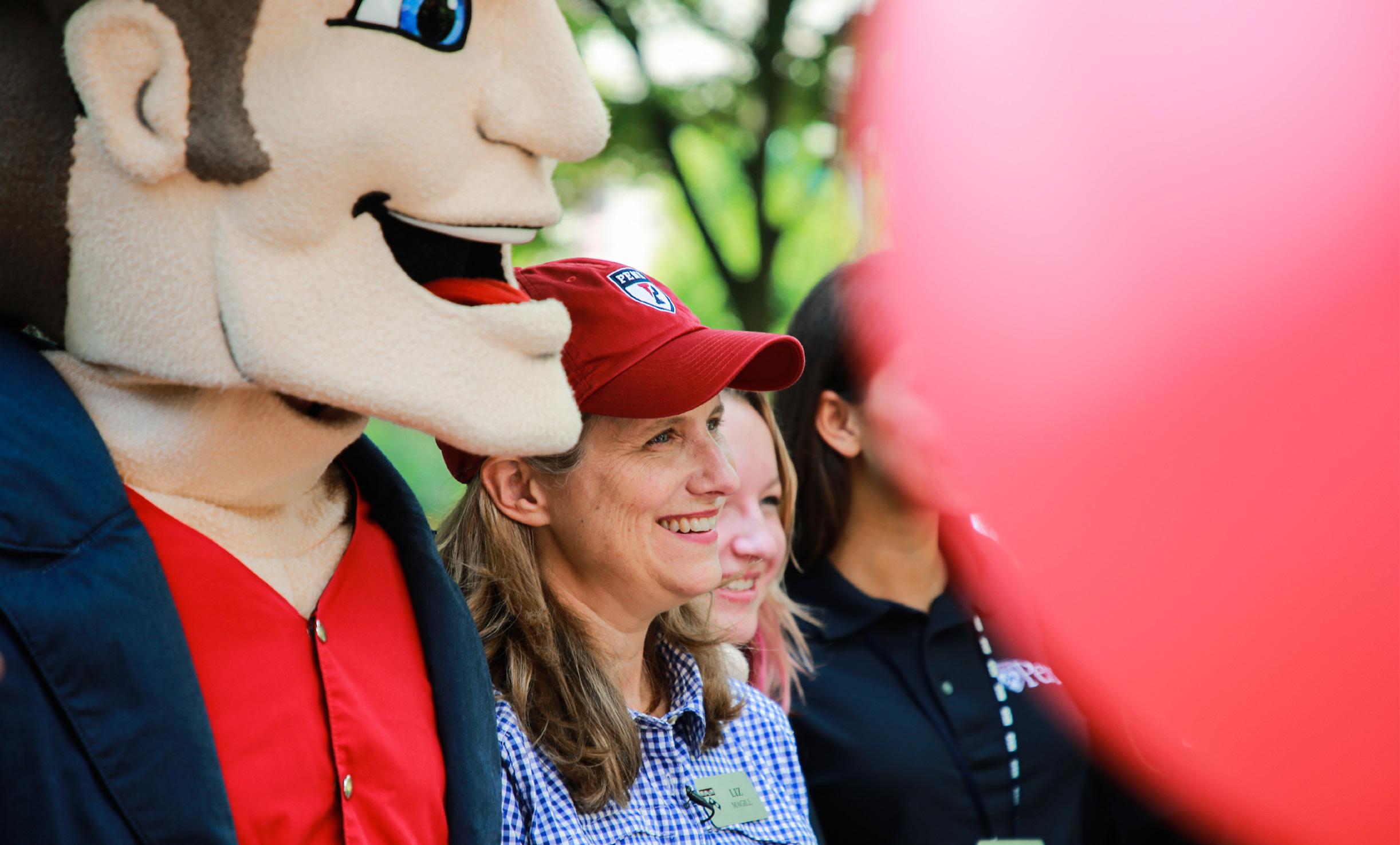
2021 UVA graduate Mazzen Shalaby, who served on the UVA free speech committee and worked closely with Magill, said Magill is cognizant of the balance between protecting freedom of speech and maintaining an environment where community members are not made to feel “overly unwelcome.” “Very broadly, I am deeply committed to aca demic freedom,” Magill told the DP. “I think it’s very connected to exactly who we are.”
The choice of topic soon became doused in irony, as over 100 protestors associated with the Coalition to Save the UC Townhomes promptly interrupted Magill minutes into her speech — bringing her address to an abrupt end. The dramatic event under scored one of the biggest challenges facing Magill: the University’s strained relationship with members of its surrounding community. Under Gutmann’s tenure, relations between Penn and the surrounding West Philadelphia community became increasingly contentious. The University’s cur rent inaction regarding the University City Townhomes marks the first such controversy of Magill’s tenure.
Mpare, who was the co-president of the Black Law Students Association at the time, praised Magill for how she managed meetings where many different coalitions and perspectives on racial equity were“There’spresent.not just one entity or organization that prevails at school, of course, but she was always very respectful of everyone’s positions, and always very kind of even-keeled when it came to making deci sions,” Mpare said. At Stanford, Magill was also appointed to cochair the Provost’s Task Force on Sexual Assault Policies and Practices, developing proposals like a confidential response team, and establishing expul sion as the “expected” sanction for sexual assault.
As part of the public face to UVA’s COVID-19 response, Magill was not immune to the attention that came with being attached to every pandemicrelatedMadisonemail.Perry, a 2022 UVA graduate who was involved in the Young Democratic Socialists of America, added that Magill’s relationship with un dergraduate students was limited.
Penn President Liz Magill and Penn men's basketball coach Steve Donahue on July 5, 2022.

meetings
GUEST COLUMN | Two students highlight the benefits of civic engagement with the Netter Center
Add civic engagement to your fall semester schedule
Students at Penn are often involved in an immense number of meaningful activities ranging from academic research to sports, the arts, and many more. Yet, there is one vital component of their edu cation that many undergraduates remain unaware of: civic engagement, a transfor mative activity, which, at Penn, is offered through the Netter Center for Community Partnerships, an organization dedicated to fostering meaningful partnerships be tween Penn and West Philadelphia. The journeys of two Penn students — 2022 College graduate Luke Coleman and Engineering senior Jessica Ford — show how involvement with Netter can enhance your Penn experience, mold your career goals, and evolve your per sonal beliefs. “I had an experience my freshman year that wasn’t what I wanted to get out of Penn, so I came back [the year after] with a desire to get more involved with the community,” Coleman said. As a conse quence, Coleman joined the Silverman Fellows program — one of the Netter Center’s various University-assisted com munity school partnerships — during his sophomore year. Coleman utilized the program to provide writing tutoring to students at Paul Robeson High School three times each week. He described the experience as fun and rewarding, offering deep gratitude for having an opportunity to learn and grow outside of the “Penn bubble.”During the summer of 2020, Coleman continued his involvement by interning with the Penn Program for Public Service, through which he authored a research paper on how to effectively prepare and train Penn undergraduates to engage with the larger West Philadelphia community.
Penn’s four undergraduate schools cater their curricula to enhance student learning in all fields. These gen eral requirements cover a wide range of academic disciplines from hard sciences and mathematics all the way to arts and humanities. While these four curricula address the necessary elements for a wellrounded education, one major discrepancy remains: the lack of an environmental foundation.Theglobal environmental emergency remains one of the most pressing issues of this century. This generation is forced to grapple with various environmental poisons, such as rising carbon emissions and pollution of our air and water. Rising environmental leaders, such as Greta Thunberg, show how the current youth can take action against a deteriorating planet through a combination of activism and education. However, large gaps still exist in the knowledge of these environmental solutions in order to reverse the damaging effects of the environmental crisis. What can we do? Better our environmental edu cation systems. An environmental education is an allencompassing term for various areas of environmental arenas. Agricultural life sciences, sustainable technologies, and green policymaking all contribute to this large umbrella term. An effective envi ronmental education is one that explores one of these such categories and makes it applicable to the line of work a student is interested in. For example, engineering students could use a STEM-heavy envi ronmental requirement that exposes them to developing green technologies. Nurs ing students would most likely prefer an environmental education that targets life sciences and human health. Instilling an awareness of environmen tal issues early on can help individuals to think broadly about how various career pathways integrate with sustainability. Additionally, educational programs can provide the right tools for students to inculcate deeper understandings of the environmental crisis, and to critically examine these challenges. As a result, col lege educational curricula need to include a comprehensive component of environ mental education to effectively confront environmental issues. Recently, Wharton’s Legal Studies De partment launched the course LGST 299: “Climate and Environmental Leadership in Action.” As one of the first 20 students to pilot the course, I was introduced to an interactive classroom setup with both indoor and outdoor components. Part of the course required each student to attend a camping venture in Harpers Ferry, W. Va., where we had to apply the skills we learned from class. As I had never been camping before, I was tasked with chal lenging chores such as setting up tents, monitoring the amount of waste produced, and navigating the terrain. During all of this, I was simultaneously relating vari ous classroom lessons such as ecosystem services and leadership skills. This is en vironmental coursework as it should be: integrating environmental knowledge with real-world applicability, bridging the gap between experience and education. Although there are a few other classes like this, most environmental programs at Penn remain rooted in student interest and are only offered as optional electives. Hence, many students remain unfamiliar with some of the groundbreaking courses in sustainability and eco-friendly technol ogies that Penn offers. On the flip side, environmental science course prerequisites such as ENVS 100: “Introduction to Environmental Science” give a generic view of the topic as a whole that often leave students uninterested in how they can connect this course with their interests. Additionally, the Student Sustainability Association at Penn and its partner environmental clubs take on a traditional approach to environmentalism that focuses on Penn’s campus itself. Both courses and clubs need to exceed beyond the scope of Penn and break into creating impact for all sorts of communities and places.TheUniversity of Minnesota integrated a general education requirement that re quires most students to take at least three credits in environmental-related classes in their undergraduate years. This require ment has gotten faculty from all different university departments to engage in envi ronmental literacy. As a result, students are better able to connect their interests with environmental responsibility. This goes to show that the same can be done even at Penn. Penn can create targeted en vironmental course requirements for each undergraduate school to foster interest in decreasing our global environmental foot print.
topics. 138th Year of Publication
campus.
PHOTO BY KELLY CHEN PHOTO BY EMILY XU
Editorials represent the majority view of members of The Daily Pennsylvanian, Inc. Editorial Board, which meets regularly to discuss issues relevant to Penn’s Participants in these are not involved in the reporting of articles on related


BOARDTHISTEAMTHISSUBMISSIONLETTERISSUE’SYEAR’S
6 THURSDAY, SEPTEMBER 8, 2022 | THEDP.COMTHE DAILY PENNSYLVANIANOPINION BECKY LEE Deputy Design Editor CALEB CRAIN Deputy Design Editor ALICE CHOI Deputy Design Editor ALLYSON NELSON Deputy Copy Editor DEREK WONG Opinion Photo Editor ANNA VAZHAEPARAMBIL Sports Photo Editor LILIANN ZOU News Photo Editor TAJA MAZAJ Deputy Opinion Editor ANDREW YOON Deputy Opinion Editor VALERIE WANG Deputy Opinion Editor LEXI BOCCUZZI Deputy Opinion Editor CAROLINE MAGDOLEN Deputy Opinion Editor LILLY FRIEDMAN Copy Associate ABBY WEINSTEIN Copy Associate TIFFANY PARK Copy Associate Have your own opinion? Send your letter to the editor or guest column letters@thedp.com.to PINTADO-URBANCALESSANDRA President PIA SINGH Executive Editor JONAH CHARLTON DP Editor-in-Chief TYLER KLIEM Design Editor TORI SOUSA News Editor EMI TUYẾ TNHI TR ẦN News Editor DELANEY PARKS Assignments Editor SOPHIE APFEL Copy Editor JESSE ZHANG Photo Editor ASAAD MANZAR Opinion Editor PHOEBE LEUNG Social Media Editor MATTHEW FRANK Sports Editor ESTHER LIM Sports Editor KAVEEN HAROHALLI Video Editor NICOLE ZHAO Podcast Editor GREG FERREY Business Manager RAUNAQ SINGH Technology Manager ANVIT RAO Analytics Manager BAILEY CAMPBELL Marketing Manager SUNNY JANG Product Manager
“It was the first time I felt like I actu ally had any sense of agency or control in terms of altering something about soci ety,” Coleman reflected. This internship was “one of, if not the most, impactful” academic experiences that he had at Penn.
Coleman’s work with the Netter Center helped inform his post-graduate aspi rations. He graduated from Penn with a Fulbright Scholarship to teach English in Madrid. His time with the Netter Center influenced his desire to eventually attend law school before landing a career within the civil or human rights sectors. Similar to Coleman, Ford also became involved with community partnerships via Netter by joining the Penn Program for Public Service. She later utilized her re search project to create the Robeson Youth Society of Engineers, a student group that seeks to increase diversity in engineering at the high school level. She credited the Netter Center for providing her with an in valuable opportunity to engage in public service, a field which she now considers a future career prospect. “The Netter Center gave me so much more context for the type of work I could be doing in public service. It allowed me to use skills that I had never really used in such a big context before, like creat ing my own program, implementing it, and even running day-to-day logistics. … Now I feel like I can use those skills in any career that I pursue,” Ford said. Most importantly, civic engagement with Netter can transform your per sonal beliefs. When Ford was juggling the creation and implementation of her program, she gained confidence in her personal abilities. “I found out that I was able to handle a lot more than I thought I could,” she said. “My program grew from just a few students to over 15 students, and I was able to handle it well thanks to the support I received from the Netter Center.”With Ford’s and Coleman’s stories in mind, seize the new academic year and involve yourself with civic engagement through the Netter Center. You could work as a mentor or classroom assistant via Community School Student Partnerships, promote nutrition education through the Agatston Urban Nutrition Initiative, or support diversity in STEM through Moelis Access Science. If none of those appeal to you, you can still join other pro grams within Netter’s varied catalog of over 30. In addition to participating in Netter programs, students have opportunities to enroll in Academically Based Community Service courses — a unique course format which integrates research, teaching, and learning with community engagement. Be sure to attend the Civic & Community Engagement Fair on Sept. 9 to learn about more similarly exciting pro gramming.Fordsummarizes her Netter experi ence well: “There are so many different programs and aspects of the Netter Center that everyone can find their niche easily. No matter what your major is, no matter what your career goals are, there’s defi nitely a part of the Netter Center that can feel fulfilling for you, where you can use your specific skills and strengths to both grow your confidence and support your local community.”
SANGEET ANAND is a Wharton sophomore studying economics and concentrating in business, environ ment, energy, and sustainability from Potomac, MD. Her email address is sangeet@wharton.upenn.edu. OM MANGHANI is a College junior studying economics and sociology. His email is manghani@sas.upenn. edu. EMILY SHENG is a College senior studying biochemistry and biology. Her email is elsheng@sas.upenn.edu.
Environmental education should be a requirement, not an option DO YOU GEET IT? | Universities must integrate environmental coursework into their curriculua
Opinion
12,
The inauguration will also feature a conversation between Magill and U.S. Supreme Court Justice Elena Kagan. Though the conversation will be in vite-only, livestream options will be available from Irvine Auditorium and the inauguration website. Musical guests Jeff Tweedy and Sheryl Crow — two of Magill’s personal favorites — are scheduled to perform on College Green after the inauguration.
to inaugurationhold ceremony for Magill HomecomingduringWeekend
colleges
Attendees can expect to pick up exclusive give aways from local restaurants like Zahav, Federal Donuts, and Goldie, or sample a scoop of “Pennaugural Berry Chocolate Chunk” — Bassetts Ice Cream’s flavor custom made for the occasion. In the inauguration announcement, Board of Trustees Chair Scott Bok called the newest Penn president “a leader of proven strength and a person of unquestionable principle.” “Her upcoming inauguration will reflect both the solemnity of this historic moment for our cen turies-old University, as well as the wonderfully festive spirit that we all have come to know and love about Penn,” Bok wrote in the announcement. College junior and Undergraduate Assembly Vice President Alex Eapen and Wharton and Col lege senior and Undergraduate Assembly President Carson Sheumaker wrote in a joint statement sent to The Daily Pennsylvanian that they believe this is a “really exciting moment” for the Penn com munity because the University has not had a presidential transition in 18 years. “President Magill’s inauguration will serve as an opportunity for Penn to gather and, together, reimagine our values, hopes, and visions for the future of our campus, our students, and our neigh bors,” Eapen and Sheumaker wrote. Magill, who previously served as the University of Virginia’s provost and executive vice president, assumed the position on July 1. Gutmann’s suc cessor was nominated on Jan. 13, and the Board of Trustees voted to confirm her nomination in March.
SEJIN PARK Senior Reporter
College senior Sienna Robinson, a Philadelphia native, said she thought that this finding was inter esting.“Iwouldn’t have thought of that as a behavior I saw super often, but I’m not sure if that’s because I’m used to it and don’t notice it, or if it doesn’t happen super often,” she said. “The first thing that came to mind was not saying hi to people on the street or walking around with headphones in.”

Born in 1927, Nathanson earned his bachelor’s degree and medical degree at Harvard University before re ceiving clinical training at the University of Chicago and post doctoral training in virology at Johns Hopkins University. Nathanson also served as the president of the American Epidemiological Society and edited the American Journal of Epidemiology at Johns Hop kins University. In 1979, he established the journal Epide miologic Reviews with Johns Hopkins professor Philip Sartwell.Nathanson’s roles at the Medical School included vice provost for research and associate dean of the global health programs. Nathanson left his position as research provost in 2003 in what he called his “fourth retirement” to return as a professor emeritus of microbiology. “I retired as professor at Penn, then I was the vice dean for research, then I was the director of AIDS research at NIH and this one makes four,” Nathanson told The Daily Pennsylvanian in 2003. “When one story’s done, it’s time to move on to the next.” Nathanson is survived by his wife, Valerie Epps, his brother, Larry Nathanson, his daughter, Katherine Na thanson (a professor at the Penn Medicine Abramson Cancer Center), two sons, and seven grandchildren.
BY ZIHAN CHEN The Philadelphia
NEWS BAND SLAM BAND SLAM BAND SLAM BAND SLAM BAND SLAM BAND SLAM BAND SLAM BAND SLAM BAND SLAM BAND SLAM BAND SLAM BAND SLAM BAND SLAM BAND SLAM BAND SLAM BAND SLAM BAND SLAM BAND SLAM BAND SLAM BAND SLAM BAND SLAM BAND SLAM BAND PENNLIVE215.898.3900ARTS.ORG/BANDSLAM FREE EVENT! ANNENBERG CENTER OUTDOOR PLAZA @ 4 PM PENN STUDENT BANDS THE MASK AND WIG BAND PENN GLEE CLUB BAND BLOOMERS BAND FREE FOOD | TICKET DEALS BAND SLAMBAND SLAM 16
average
Penn announced that Liz Magill’s presidential inauguration is scheduled for Homecoming Week end — Oct. 21 and 22. The inauguration will feature a variety of events, including a procession down Locust Walk, a 5K around Penn Park, and a pet-friendly walk with President Magill and her goldendoodle. The two-day program will represent Magill’s official installation as the University’s ninth president, ac cording to the University’s announcement.
Students rudest U.S. city Philadelphia beat out Memphis and York, with a 6.43 rudeness
PHOTO BY JESSE ZHANG President Magill speaking at Convocation on Aug. 29, 2022.

While a recent survey found Philadelphia to be the rudest city in the United States, several Penn stu dents who grew up in Philadelphia disagree. The survey, which was conducted and released by Preply, a language-learning app, found that Phila delphia — with an average rudeness score of 6.43 out of 10 — beat out second- and third-rudest cities Memphis, Tenn. and New York, which earned rude ness scores of 6.05 and 6, respectively. The average rudeness score of all the cities included in the study wasPreply5.10. surveyed 1,500 residents in the 30 largest metropolitan areas across the nation, asking locals to rate the rudeness of their cities. The survey included questions regarding which common rude behaviors were most prevalent around their cities, such as talk ing on a speaker in public, not letting people merge in traffic, watching videos in public, closed-off body language, and being absorbed by your phone in Thepublic.survey also asked whether respondents found locals or non-locals to be ruder. Philadelphia was one of the cities where locals were credited with rude ness.Philadelphia was determined to be the city most likely to have locals talking on speaker in public of the common rude behaviors considered in the study.

Penn
PHOTO BY JESSE ZHANG

disagree with Philadelphiasurveyrecentrankingas the
Former NealDepartmentPerelmanChairNathanson.
Former diesNealDepartmentPerelmanChairNathansonat94 Nathanson joined the Medical School as a department chair in 1979 and led research in polio epidemiology

The two-day program will represent Magill’s official installation as the University’s ninth president
Penn ranked No. 10 in Forbes Magazine’s 2022 “America’s Top Colleges” list, dropping a rank since lastDespiteyear. dropping in the rankings, Penn remains the top-ranked school in Pennsylvania this year. Penn was also No. 4 among the Ivy League, surpass ing Harvard University, which was ranked at No. 14 thisForbesyear. also ranked Penn No. 6 in the Northeast, No. 9 in Research Universities, and No. 8 among Pri vate Colleges. Forbes’ description of Penn highlights its notable alumni, including singer-songwriter John Legend, journalist Andrea Mitchell, Elon Musk, and former President Donald Trump; as well as Penn’s financial aid and work-study awards. After Forbes redesigned its methodology in 2021 to take into account access for students of a wide range of backgrounds, several Ivy League univer sities have dropped in the rankings, while public universities have risen in the ranks. The list spe cifically highlighted the Massachusetts Institute of Technology, ranked at No. 1, and California-based public colleges such as the University of California at Berkeley, ranked No. 2. The Forbes 2022 Top Colleges list ranked univer sities with more than 300 undergraduate students based on seven factors. The measures weighted alumni salary for 20%, debt load for students for 15%, graduation rate for 15%, alumni in the Forbes American Leaders List for 15%, return on investment or amount of time it takes for a student to re-earn the cost of their education for 15%, retention rate or stu dents who stay after the first year of school for 10%, and academic success for 10%. According to Forbes, the intention of the rank ing list is to spotlight “schools that offer an excellent education at a great price, graduate high-earners and propel students to become successful entrepreneurs and influential leaders in their fields.” The data for the list was provided by the Inte grated Postsecondary Education Data System and College Scorecard — two federal government da tabases — as well as from Payscale, the National Center for Science and Engineering Statistics, and some of Forbes’ own lists.

Penn ranks 10th top list, surpassing Penn remains the top-ranked
Harvard
7THURSDAY, SEPTEMBER 8, 2022THEDP.COM | THE DAILY PENNSYLVANIAN
New
TORI SOUSA Senior Reporter
in Forbes Magazine’s
Robinson echoed Shelton, adding that the quali ties of “independence” and “self-sufficiency” might be perceived by some as rudeness, but these qualities may be requirements to thrive in a city atmosphere.
Former Perelman School of Medicine Microbiology Department Chair Neal Nathanson died on Aug. 11 at age 94 due to complications resulting from leukemia and pneumonia.Nathanson — who joined the Medical School as a department chair in 1979 — led research in polio epi demiology and spearheaded research on lentiviruses, a genus that includes HIV, the virus which can progress into AIDS. He was named the director of the National Institutes of Health’s Office of AIDS Research in 1998. Memorial services will be held in the fall in Cam bridge, Mass. and Philadelphia.
“I feel like you need a certain edge to live in the city. With so many people and so many different things going on, I feel like it’s most beneficial to just do your own things and have your own interests in mind, which I’m sure can come off as rude,” Rob inson said.
school in Pennsylvania and fourth among the Ivy League RADWAN AZIM Staff Reporter
College senior Megan Shelton, also a Philadelphia native, said that while she thinks Philadelphia resi dents engage in some of the behaviors mentioned in the survey, she has never thought that natives were particularly rude before. “I’ve never thought of Philly as one of the ruder cities out there. I always figured places like New York City would be ranked ruder than Philly, so I was surprised to find out it’s the opposite,” she said.
PHOTO skyline on Sept. 2019.
score KOMAL PATEL Senior Reporter
Luckily for Stefanski, he has a sturdy defensive unit to rely on along with stud running back Nick Chubb. The work is cut out for Stefanski and the Browns, but if they can soldier through the first 11 games of the season, they may be able to sneak into the playoffs.
Watson is a tall but quick receiver who will add a deep ball element that the Chiefs are missing since the departure of Tyreek Hill. Watson is a secondstring receiver, but it will be interesting to see if he can crack the regular rotation to give Mahomes a weapon downfield. Recently, the 26-year-old was mentioned on The Bill Simmons Podcast as a poten tial threat in the Kansas City wide receiving corps. In his first preseason contest as a Chief, Watson impressed, leading the team in yards and receptions while also catching a 22-yard touchdown at the end of the second quarter.


their sports teams

Kevin Stefanski — Head Coach, Cleveland Browns
Brandon Copeland — Linebacker, Netflix Although Copeland likely won’t be on a roster come the start of the NFL season, he’ll still be on TV screens this fall. The linebacker, who played for five seasons in the NFL on four different teams, recently appeared on the new “Shark Tank”-like reality series, “Buy My House,” which debuted on Sept. 2 onTheNetflix.show consists of Copeland and three other in vestors sitting in plush chairs and vying for a seller’s piece of real estate. For the 31-year-old, the project serves as a natural progression from his NFL career, in which he split his time between playing, practic ing, and teaching a financial literacy course at Penn.
Checking in on Penn in the NFL: Start of season edition
The Browns have had a very tumultuous offsea son. They moved on from former number one pick Baker Mayfield in favor of Deshaun Watson, who has been the center of controversy for the last year now. Watson will be out the first 11 games of the season due to suspension, so it will be up to QB Jacoby Brissett and third-year head coach Stefanski to hold down the fort. On top of that, they are play ing in the extremely competitive AFC North division that features Baltimore, Pittsburgh, and Cincinnati.
MIKE CARLSON/TAMPA BAY BUCCANEERS
Justin Watson has moved from Tom Brady to Patrick Mahomes as his QB ASHIL SRIVASTAYA Sports Associate PHOTO BY CHASE SUTTON
BRANDON PRIDE is a Wharton senior from Morgan Hill, Calif. studying finance who was a Senior Sports Editor for the 137th Board of Edi tors. He can be reached at pride@thedp.com.
passionate about is that there is not an easy way to watch their peers play — it’s not like they’re being broadcast on national tele vision. But they are being broadcast somewhere — and that place is ESPN+. That’s why Penn Athletics should make the platform broadly accessible to the undergraduate student body. Almost any Quaker athletic event — from women’s lacrosse to football to baseball — is available on the streaming service. There are multiple ways to go about this. Penn could give every student their own subscription. But at $10 a month for about 10,000 students, even with a big group discount, I would understand if there was pushback against this method. Another, much cheaper, idea is for Penn Ath letics to pursue a commercial business license from ESPN+. This would allow Penn to broad cast games and matches in dorm gathering areas, classroom hallways, rooftop lounges, Pret-a-Man ger — anywhere you can think of. It would also encourage community viewing environments, which is what really brings about passion in sports fans.If students start seeing our teams on TV, they might be more willing to go to games in person. Once our reputation for school spirit improves, I envision a nice feedback loop where more highly recruited athletes will choose our school over some of our upper-tier competitors. While Penn Athletics already devotes a lot of resources to home-game student engagement (nearly all home events are free to attend), this investment would be by far the largest of its kind toward away-game engagement. At a yearly price of a low five-figure sum, Penn’s $32,017,644 annual budget can certainly withstand it. Now, before you think this is some paid promo tion coming from ESPN’s marketing team, know that I am no huge fan of the network. From its over-sensationalizing for the sake of analysis to its bias toward certain teams and sports, and perhaps worst of all, what it has done to our once-beloved Monday Night Football, the company surely has its faults. But right now, ESPN+ is the best and only way to view “obscure” college sports. Penn Athletics knows it has a problem on its hands with school spirit. If the often empty stands don’t already paint the picture, look no further than the 50% Papa John’s pizza coupons they use to try to entice us to attend games (heads up, guys, Penn students prefer &Pizza). Of course creating national contenders in foot ball or basketball is the best way to improve school spirit, but that’s hard and takes years. My idea only requires a couple phone calls and a credit card. All I’m saying is an investment in ESPN+ is a better use of the marketing budget than some twobit pepperoni pizza. Three years ago, the Penn Champions Club raised over $60 million for Penn Athletics, a large portion of which was said to be dedicated to “student engagement.” For a small fraction of that sum, Penn can ensure that the next time Penn squash is competing for a national championship, the next time Matthew Fallon is breaking a record, and the next time Penn basketball is beating Villanova, there will be a good group of freshmen cheering them on together from their TVs.

Although they never crossed paths at Penn, Watson and Van Roten will play for rivaling squads this season, as Watson, a fifth-round pick in 2018, signed with the Kansas City Chiefs. After remaining injured last year, the Tampa Bay Buccaneers — with whom Watson won a Super Bowl — decided to move on from him, and now Watson will go from catching passes thrown by Tom Brady to Patrick Mahomes.
With just days until the 2022-23 NFL season kicks off, it’s time to once again keep up with the Penn alumni in the pros and see how they’re doing.
ESPN+, from page 10


8 THURSDAY, SEPTEMBER 8, 2022 | THEDP.COMTHE DAILY PENNSYLVANIANSPORTS Complete the grid so each row, column and 3-by-3 box (in bold borders) contains every digit 1 to 9. Skill Level: Create and solve yourSudoku puzzles for FREE. Play Sudoku and win prizes at: prizesudoku.com Source of “Daily Pennsylvanian”. Solution to Previous Puzzle: SUDOKUPUZZLE NEWYORKTIMESCROSSWORDPUZZLE ACROSS 1 Cubans are full of it 4 Order in New Orleans 9 subjectSexology 14 Dish world?aroundseenthe 15 Go all in, in poker lingo 16 Sam sequel“Doctordirectedwho2022’sStrange” 17 World’s oldest golf familiarlytournament, 19 Animal in the same family as the wolverine 20 Vexed 21 Airer of “Tiny Desk” concerts 22 ___ a.k.a.JohnsonTheRock 23 One of Obamasthe 25 “Great ___!” 27 “Yeah, right!,” e.g. 28 Ecstasy 32 Collar perhapsfeature, 35 crossed”“Fingers 36 Sound at the doctor’s office 37 Today, in Toledo 39 Abbr. meaning “in particular” 40 One of “them” 41 After-dinner drink made with crème de menthe 44 pieceLetter-shapedofpiping 46 Trying to be quiet, in a way 47 Whiz 48 Von Trapp girl who sang about being 16 49 Baby carrier 52 Deal 55 Tobiko or ikura, at a restaurantJapanese 57 Part of Florida 59 Shinto gate 60 Temporary spot to do business … or a hint to 41-Across17-,answering35-and 62 “Sorry, someoneaskelse” 63 Rest area on a hike 64 Put the food away 65 Set of flippers? 66 Dispense 67 Finishing touch, so to speak DOWN 1 Centers 2 Styles Questlovefor and Jon Batiste 3 Mother “Schitt’sonCreek” 4 Inflation spec 5 “You just got burned!” 6 He Halesamediscoveredindependentlythecometas 7 Superintend 8 Craving 9 Something a teen experiencesusually 10 Straddled 11 Feel for 12 interpretedSomething from a bird’s behavior, in the ancient Greek practice of ornithomancy 13 Word before iron or chain 18 Model Y maker 22 Dimwits 24 Gaiety 26 Shaman, at times 29 Teeming 30 Privy to 31 Dry-___ beef 32 Roderigo’s killer, in Shakespeare 33 “Nuts!” 34 “What’s ___?” 35 informallypropositions,What-if 38 Chose 42 Keeping isolated 43 Sushi order with a saucesalty-sweet 45 Has about?reservations 47 Imitation 50 ___ center 51 Home of Nijo Castle, built by the shogunateTokugawa 52 Bickering 53 2017 Pixar film set in the Land of the Dead 54 Beginning of some blended juice flavors 56 Stone with silica 58 Blow out 60 Tour group, for short 61 Kind of project PUZZLE BY ELLA DERSHOWITZ Online subscriptions: Today’s puzzle and more than 7,000 past puzzles, nytimes.com/crosswords ($39.95 a year). Read about and comment on each puzzle: nytimes.com/wordplay. ANSWER TO PREVIOUS PUZZLE ORAL ADZ MOMS TACOS CUE REVEL INASCRABBLEGAME SKITRIP RIVALED PIMP ABIT SEEP ELF EROS WHATTILEISWORTH OARS SLASH NORI ONT BAA HUP MAN STARRY TAKEIT HYGIENE VISIONS TWOPOINTS STRAP ODD EMBER UHURU DIE LEAKY R AND B E CO TR EE The New York Times Syndication Sales Corporation 620 Eighth Avenue, New York, N.Y. 10018 For Information Call: 1-800-972-3550 For Release Thursday, September 8, 2022 Edited by Will Shortz No. 0804Crossword 123 45678 910111213 14 15 16 17 18 19 20 21 22 23 24 2526 27 28 293031 323334 35 36 3738 39 40 41 42 43 4445 46 47 48 49 5051 59 60 61 62 63 64 65 66 67 ACROSS Breakoutcompany of the 1970s 6 What 7-Down is pig Latin for 9 Unpopularworker 13 What often has Fox, but not FX 16 knifeMachete-like 17 Comment upon calling back 18 “Ma Belle ___” (1970 #5 hit) 19 Pics on pecs, say 20 Rogers of old westerns historyEmployment 23 One of two 25 ___ Hall, former “Today” host with a showdaytimeself-titledtalk 26 “Well, commentmy sure sounds dumb now ...” 30 Area around the mouth 31 Blows wildly 32 Tooth driller’s deg. 35 God representedoften as a beautiful winged youth 36 Falafel shop stock 37 Prohibition of Leviticus 11 38 Not forward 39 It looks better with curls 40 “You must be dreaming” 41 Remark from one who gets a round 44 Judged to be 45 Retirement plan, informally 46 Strip 47 World’s busiest airport: Abbr. 48 Sound of skimmingattemptunsuccessfulanatstone 52 French flavoringliqueur 53 Cry after pulling a prank 56 Liquid weapon, or a solid one 57 Sole proprietors? 58 Dishes served in the final scene of Andronicus”“Titus 59 Cards, say 60 Coffer, e.g. DOWN 1 Some 2 “Cheerio!” 3 One who helps out briefly? 4 Acousticflourishes during a comic’s set 5 Something can’t be neat if you add this 6 Motley skill set 7 Where a town in Wyoming was once sold $900,000)(for 8 Man found within state lines? 9 Uno alternative 10 Daytime catchphraseTV 11 moreXenomorph,familiarly 12 Dutch “farmer”for 14 Eric ___, author of “The Very Lonely Firefly” 15 Wraps up 22 First namedaprophetHebrewtohavebiblicalbookforhim 24 Lead-in to a street perhapsname, 25 Fun sheets?betweentimesthe 26 Impression 27 Feudal underling 28 Red herring, for one 29 Hall of collaborator?fame 33 1/8 oz. 34 Isle along the Sound of Sleat 36 They’re broken just for fun 37 Dismiss 39 Stack at a checkpointT.S.A. 40 Bun holder 42 Candy brand with packagingcoloredautumn43 Takes a turn, in a way 44 Land between the Gulfs of Aqaba and Suez 46 Still not done in the dryer, say 47 M.L.B. all-time leader in grand slams informally(25), 49 Legends 50 Cries during a match 51 Secret indication 54 It’s written as a vertical line bisecting a circle 55 Org. with trust issues? PUZZLE BY ROBYN WEINTRAUB Online subscriptions: Today’s puzzle and more than 7,000 past puzzles, nytimes.com/crosswords ($39.95 a year). PUZZLE ANTI C AD O HOME R DIANA POR ABOVE UNRIG RHAPSODIC BESTIR TOHEEL ARI NEAREST AGAVE HAVE N BOSC DON E GADOT BRIT SITKA LANE CARIB DOIN OMEN LIVE R UNGER DARTGUN AS S TECHIE SALLOW CANOODLED MILNE ALONG IDO EMAIL DESKS CUT LOYAL The New York Times Syndication Sales Corporation 620 Eighth Avenue, New York, N.Y. 10018 For Information Call: 1-800-972-3550 For Release Friday, September 2, 2022 Edited by Will Shortz No. 0729Crossword 12345678 9101112 13 14 1516 17 18 19 20 2122 2324 25 262728 29 30 31 323334 35 36 37 38 39 40 4142 43 46 47 48495051 52 5354 55 58 59 60


Emili was not signed to the Bills’ practice squad or another roster, so he’ll likely have to play the waiting game through this season and potentially until next to reach another training camp or roster.

The Bills are undoubtedly one of the favorites to win the Super Bowl, loaded with talent on both sides of the ball, but their most dangerous weapon is quarterback Josh Allen, who has taken the team to several deep playoff runs in his young career. He’s a dual-threat QB with the ability to throw long, ac curate passes but can scramble for an easy 20 yards with no issues. Van Roten will potentially be protecting Allen for the first time this year. Van Roten is entering his eighth season in the league, the Bills being his sixth team across that span. After leaving the New York Jets following last season, he signed a one-year deal with the Bills and will likely back up starting left guard Rodger Saffold. Throughout his career, he’s dealt with a multitude of injuries, but seems healthy entering this year and will be ready if there are any injuries to the starters. During the preseason, the journeyman played in two of the Bills’ three games, starting the first one and coming off the bench in the second.
Justin Watson — Wide Receiver, Kansas City Chiefs

Greg Van Roten — Guard, Buffalo Bills
Prince Emili — Defensive Lineman, Un claimed Fresh out of Penn football after six years with the program, Emili looked to have a shot at reaching the final 53-man roster of the Buffalo Bills this offsea son, but came up just short on the last round of cuts.
Cross Country On Friday, Penn men’s and women’s cross country will open its season at the Spike Shoe Invitational, which will be hosted by Penn State. Following its road trip to State College, Pa., the Red and Blue will be on the road for four meets across six weeks before reaching the Ivy League Heptagonal Championships on Oct. 28 and the NCAA Mid-At lantic Regional Championship on Nov. 11. Last season, Penn men’s cross country finished third out of eight at Ivy Heps and sixth out of 26 at NCAA Regionals, while the women’s team placed fifth out of eight at Ivy Heps and 10th out of 27 at NCAA Regionals.
Penn NationalonsecuresMatthewswimmerFallonspotU.S.Men’sTeam Fallon’s times in the 200-meter breaststroke have proved among the best in the nation
FROM PENN TODAY
ASHIL SRIVASTAVA Sports Associate
Contact Alessandra Pintado-Urbanc at: pintado-urbanc@theDP.com to schedule an interview
On Wednesday, Matthew Fallon, a sophomore phenom on Penn men’s swimming, was named to the 2022-23 United States National Team along with 98 other swimmers. Fallon — who has set stellar performances since his Penn debut — earned the spot after a recent race in the 2022 Phillips 66 National Champion ship in which he finished with the fastest time in the 200-meter breaststroke, touching the wall at 2:07.91. The time marked the No. 7-fastest 200 breaststroke swim in U.S. history. The U.S. men’s national team that Fallon was just named to features 36 Olympians — 31 of which are medalists — and accomplished stars like Caeleb Dressel. The national team has many swimmers that are favorites to compete at the 2024 Olympics in Paris as well as some up-and-coming swimmers looking to qualify for the first time. “My goal is always to just improve. I sort of set goals as they come,” Fallon told the DP this summer. “I haven’t pinpointed any goals for the season yet. Right now, I’m just working on improv ing even further.” Fallon also performed well at the collegiate level during his sole season as a Quaker, as he is cur rently the reigning 200 breast champion, runner-up in the 100 breast event, and eighth-place finisher in the 200 IM at the Ivy Championships. Fallon also qualified for the NCAA Championships last year in the 100 and 200 breast events. The Warren, N.J. native’s strongest stroke is the breaststroke, specifically the 200 event, which is the expected event he will swim for the national team.“Separating the kick and the pull a little bit was something small that I put into my training, that I think helps in the long run,” Fallon reviewed fol lowing his training in Athens, Ga. through the summer. “But this summer was just all about im proving and building on what I had done previously in the Fallonyear.”has many competitive years ahead of him — three with the Red and Blue — as he looks to elevate his name on the stage of competitive swimming. At his current form, the star Quaker forecasts a bright future ahead, and making the national team is a gateway to accomplishing higher goals.

The Daily Pennsylvanian is hiring students to work in its circulation department. Distribute papers, manage the database, check rackboxes, place posters and earn $15 an hour.

Volleyball This weekend, Penn volleyball has a farther trek than all other teams, as the Quakers will be travel ing to California for three matches over a two-day span.On Friday, the Red and Blue will go head to head against Cal State Northridge (1-5) and Saint Mary’s (0-4) before closing out the trip on Saturday against San Francisco (6-0). Like Colgate men’s soccer, though, don’t be de ceived by San Francisco’s record. Last season, the Dons went a whopping 0-25, achieving not a single victory across three months of play.
Field Hockey Following losses against two highly ranked op ponents last weekend (No. 9 and No. 2) at the ACC/ Ivy League Conference Crossover, the Quakers will face a lesser challenge, but not by much. On Friday, Penn field hockey (0-2) will play its first home game of the season against No. 20 Boston College (1-3). The Eagles lost both of their games last weekend at an ACC conference crossover of their own (against the Big Ten), but they’re coming off a season in which they went 12-6 and narrowly lost in the ACC Championship. Two days later, the Quakers will face Villanova (3-1), a team Penn defeated 2-0 last season in a midSeptember contest. Golf Penn women’s golf will begin its season this weekend at the Yale Fall Intercollegiate on Saturday and Sunday. There, the Quakers will seek to bounce back from a sixth of six finish at the Ivy League Championships just over four months ago. Leading them in that effort are the veterans of the team, which includes a senior class of three — out numbering every other age group. The men’s team, on the other hand, will be com peting in its second tournament of the season after finishing 11th out of 14 at the Alex Lagowitz Memo rial.The Red and Blue are led by senior Mark Haghani, who finished 10 strokes better than any other Quaker last weekend and ended up placing fifth among a field of 90 total golfers. Sprint Football On Saturday, Penn sprint football will open its season against Penn sprint football. Yes, the Quakers will face themselves, as the cur rent roster faces members of its alumni base. Last season, the varsity team narrowly edged out the oldtimers in a 27-20 victory. After the Red and Blue’s test against the ghosts of its past, the team will officially begin its season and compete against Collegiate Sprint Football League foes for seven consecutive weeks. They’ll look to im prove on their 5-2 record last season in the hopes of taking their first CSFL title since 2016.
Hand newspapersoutGetmoney
“You can see it in going for those second balls — like, even inside the box, it’s just our mentality to win the ball whenever we can.” Zazueta’s goal occurred just three minutes after the first score, all within the first 10 minutes of the match. Sophomore defender Leo Burney’s fifth-minute conversion of a deflected free kick reminded the crowds of his immense season as a freshman in 2021. The Monday after the weekend, Burney’s own deflected shot on goal was rescued by senior midfielder Nick Schimbeno into his first goal of his collegiate career, and the only Penn score at DedicationTemple.toward chasing those second chances has been one of Penn’s most noble merits that the team has carried on from the 2021 season. Despite ending as a scoreless half, the Quakers proved the difference in the second half against Rider, leaving no second to rest as they kept a con stant advance toward the Broncs’ goal. But the chase for second chances notes the significance of missed first touches, which are crucial to efficiently moving the ball up the field, and being precise in every opportunity in front of goal.This early in the season, however, Penn was not the only victim of imperfect first touches and inaccurate aerial challenges, as Rider and Temple each presented similar levels of early-season match“Anyfitness.ofthese games early on in the season can really be flipped with a coin,” Gill said. “They [Rider] have some talented individuals, and they’re probably trying to figure out some of their best fits in their setup. You saw it on display to night — and they were a little bit slow getting started, but by the end of it, they were quite ag gressive and could carry the game, and you can see their effect, for sure.” After the Rider win at home, Zazueta rated his fitness an “8” out of 10; an exciting optimism nec essary to set bold expectations through the early season, while still recognizing much room to build. And with the underclassmen stepping up into decisive roles, there are yet many names on the roster who could serve stellar performances through the season. “There are yet tests for us to still take on,” Gill said. “There are still challenges ahead of us, and I think some players on our team that didn’t nec essarily play tonight, will play an important role somewhere for us moving forward.” Because Penn spent most of its 2021 season at home, the Quakers will be on the road for most of the season. Only four games remain to be played beside the Schuylkill, with the rest of the season’s home games scheduled at Penn Park. Penn men’s soccer will spend this weekend in New York, facing Albany on Sept. 9 and Colgate on Sept. 11.
PHOTO BY KYLIE COOPER Senior middle hitter Elizabeth Ford attempts to block a hit during the game against Canisius at the Palestra on Sept. 4, 2021.

SPORTS

PHOTO
Senior quarterback Andrew Paolini gets tackled by Caldwell defenders during a game at Franklin Field on Oct. 22, 2021.

SOCCER , from page 10 PREVIEW, from page 10
9THURSDAY, SEPTEMBER 8, 2022THEDP.COM | THE DAILY PENNSYLVANIAN the Penn Invite, which runs from Friday to Saturday at the Hamlin/Hecht Tennis Centers. Over the last several years, the Quakers have been a model of consistency, achieving winning records every season since 2019. Following a sophomore class with four members, the Invite will serve as the opening meet for a fresh man class with just two members, Juliana Munhoz and Maya Urata.
PHOTO BY JULIA VAN LARE
See SOCCER , page 9 Tennis, cross country, women’s golf kick off season Men’s soccer and volleyball will each face a team that went winless last season
PHOTO BY BORNA SAEEDNIA Sophomore Sabine Rutlauka competes in a doubles matchup against the University of Maryland at Hamlin Tennis Center on March 22.

Late summer soccer games at Rhodes Field ha bitually serve vivid stories. Teams grapple with capturing an amorphous early-season tenacity into a precise tool to wield. Less familiar names of the previous few seasons become enthusiastically more frequent on the loudspeakers. The squeaky bleachers and river winds feel less torturous when the weather is kind to both players and the crowd.
And although ambition may sometimes outrun match fitness so early in the season, the moments when the results prove through are electric, as Penn men’s soccer (1-0-1) proved within just the first 10 minutes of its 2022 campaign. “We might not be that old of a group, but I think there is maturity that has happened over the last year,” coach Brian Gill said immediately following Penn’s home win against Rider. “I think part of that is a willingness and a confidence to try to get forward into the attack — and when you’ve lost the ball higher up the field, how quickly can you try to repress the ball and try to create those second opportunities in the attack.” Gill guided his brigade to balance the Labor Day weekend with one win and one draw. The Quakers opened the season at home, receiving Rider (0-3) as guests to the Schuylkill-side field and knocking the Broncs to a 2-1 win. On Monday, Penn visited Temple (1-1-2) on the other side of the river, taking the city rivals to a 1-1 tie. Under Gill, who remains undefeated in sea son-opener games, the Quakers are leveling the unpredictability of early-season games with drive — filling in weaknesses with the confidence to do greater, and working through the season until precision comes to mend the rest. “Our last season was a little rough, but this year we’re all hungry,” junior midfielder Mateo Zazu eta reflected following the Rider win — just his second time starting for Penn — to which he con tributed the necessary difference for the victory. The exciting early season, a driven young team, and ever-so-high ambitions to win stand behind the Quakers’ first two results of 2022 ESTHER LIM Sports Editor
As the fall season kicks into gear, some Penn teams are preparing for season openers, and several others look to improve upon their previous outings. Here’s a breakdown of what to expect from all of Penn Athletics’ competing teams this weekend. Soccer Penn women’s soccer (1-0-3) earned a victory last weekend in a 2-1 contest against Lehigh (03-1). The win followed three consecutive ties to begin the season, and now, the Quakers will look to build on their momentum in two home weekend contests.Firstup, the Red and Blue will take on Navy (3-22) on Thursday at 6 p.m. The Midshipmen have been on a tear the last five years, having not produced a sub-.500 season since 2016. The last time these two teams played — almost four years ago to the day — Navy emerged victorious by two goals. Then on Sunday, Penn will face Stony Brook (3-3), a team that’s coming off two straight losses. The matchup will mark the first between the two schools in over 20 years. Penn men’s soccer (1-0-1) enters the weekend coming off two games in which three different play ers scored goals and the team let up only one goal in eachThiscontest.weekend, the Quakers head to New York for two road matches against Albany (0-3-1) and Colgate (2-0-1),Don’trespectively.letAlbany’s current standing deceive you, though; the team went 10-7-1 last season and notched a 7-1-1 home record. Colgate, on the other hand, went 0-18 last season and suffered a 3-0 loss against Penn almost a year ago to the day. Tennis Penn women’s tennis kicks off its season this weekend in a tournament the team will host at home, See
See ESPN+, page 8
PREVIEW, page 9
Every year when freshmen move onto campus, they learn about a few of Penn’s “secrets” that they just couldn’t elicit from the Admissions Office’s marketing material or even the coolest Kite and Key tour guide. Some of these secrets are better kept than others. Most people know about the cursed com pass on Locust Walk, fewer have been taken up the stairs of the Philomathean Society, and, as a senior, I’m still dubious about whether the secret underground Quad tunnels actually exist. But the worst-kept secret of all? That our school has almost no athletic spirit. It’s been well-documented that Penn students would rather spend their hard-to-come-by free time doing things other than cheer on their sports teams. And while it’s great fun for the few Quaker enthusiasts on campus to complain about the way it is, I thought, for a change, I’d propose a solution — or at least a start. I’m not here to make the argument that our school spirit can rival the likes of Alabama’s or Michigan’s, but I know we can definitely move in that direction. We have some seriously talented teams and players — from national contenders in squash and lacrosse to outstanding individual per formers in track and swimming, to a basketball team that regularly competes with March Mad ness heavyweights. In my view, a big reason Penn students aren’t
MATTHEW FRANK Sports Editor
Men’s soccer proves early-season ambition

CONTACT US: 215-422-4640SEND STORY IDEAS TO DPSPORTS@THEDP.COM ONLINE AT THEDP.COM THE INDEPENDENT STUDENT NEWSPAPER OF THE UNIVERSITY OF PENNSYLVANIA • FOUNDED 1885 PHILADELPHIA, THURSDAY, SEPTEMBER 8, 2022VOL. CXXXVIII NO. 18 SPORTS
PHOTO BY ANNA VAZHAEPARAMBIL Graduate student Ben Stitz looks to pass the ball around a Rider defender during the game at Rhodes Field on Sept. 2.
Pride | One thing Penn Athletics can do to fix its school spirit problem
ESPN+ gives Penn students a way to cheer on their peers from anywhere BRANDON PRIDE Senior Sports Associate