on the totem pole’: Penn lecturers allege job insecurity, lack of representation
The DP spoke with lecturers across the University, many of whom said their roles were marked by restricted benefts, uncertain career prospects, and limited representation in administrative decision-making
AIDAN SHAUGHNESSY Staff Reporter
Penn’s Faculty Handbook describes lecturers as “eminent scholars” who provide “valuable instructional services” to Penn and its student body. But in interviews with The Daily Pennsylvanian, non-tenure track faculty said that their day-to-day experiences and treatment do not reflect that description.
This past summer, the Faculty Senate’s annual report raised concerns about the equity of treatment of non-tenured faculty members, explicitly noting discrepancies in faculty pay and representation. The DP spoke with lecturers across the University, many of whom said that their roles were marked by restricted benefits, uncertain
career prospects, and limited representation in administrative decision-making.
As the name implies, non-tenure track faculty, including lecturers, are not eligible for tenure at Penn — which is defined by the Faculty Handbook as a “continuous appointment that extends until retirement.” As of 2024, nontenured faculty members made up over 60% of all University faculty, according to the Penn chapter of the American Association of University Professors.
Multiple lecturers interviewed by the DP requested anonymity, citing fears of professional retaliation.
College first year Daniel Kim elected president of Class Board 2029 by 23vote margin
In a statement to The Daily Pennsylvanian, Kim wrote that he ‘really appreciated the connections and friends’ he made throughout the election process
CHRISTINE OH Staff Reporter
Penn Student Government announced the results of the Class Board 2029 and Undergraduate Assembly elections on Monday.
College first year Daniel Kim was elected 2029 Class president with 187 votes — 23 more than the first runner-up, College first year Zheng Kang Teo, who is also a staffer at The Daily Pennsylvanian. Wharton first year Esteban Machorro was elected as the Class of 2029 executive vice president with 238 votes.
In a statement to the DP, Kim wrote that he “really appreciated the connections and friends” he made throughout the election process, recalling how he campaigned as “Daniel Kim, DK, and [his] barber name DKUTz” while cutting hair for three hours outside McClelland Cafe.
“I wanted people to believe in me as a person first, rather than my policies and implementations,” Kim wrote, adding that he talked to voters not about the policies that he wanted to establish, but “about the person that [he] was.”
The Class of 2029 elected College first year Solon Osei-Agyemang as vice president of external affairs, College first year Shiven Dawda as vice president of internal affairs, and College first year Ryan Loughran as vice president of finance. College first years Sophia Chen — also a DP staffer — and Sara Turney were elected as the College class chairs, and Engineering first year Wesley Leeroy was elected as Engineering class chair. Running unopposed, Wharton first year Sinan Erkurt was elected Wharton class chair, while Nursing first year Ariana Escarne was elected Nursing class chair.
Osei-Agyemang, Teo, and Loughran were also elected to fill seven of the eight new-student representative seats on the Undergraduate Assembly, along with College first years Ameera Karim,
Charmaine Chinodakufa, Sophie Rivell, and Wharton first year Samyam Khatiwada. College first years Advait Wattal and Cavance Snaith, who is also a DP staffer, tied for the eighth seat, after both receiving 217 votes.
“A runoff election will be held only between the two tied candidates,” College sophomore and Nominations and Elections Committee Vice Chair Ananya Shah — who is also a senior columnist at the DP — wrote in an email sent to the candidates.
Voting for the runoff election will open on Thursday, Sept. 25 at 9 a.m. and is set to close on Friday, Sept. 26 at 11:59 p.m.
“When I opened the form to read the results, I was in shock that I tied with another candidate,” Snaith wrote in a statement to the DP. “During the campaign, I found it difficult to convince Penn first year students to participate in the voting process, and now I imagine it is going to become more difficult.”
Despite his initial reaction, Snaith described his optimism for the upcoming election, writing that he is “excited to get back out and [take] this as an opportunity to socialize more with first years and potentially establish new relationships.”
A request for comment was left with Wattal.
College sophomore Eshaal Ubaid — who is also a DP staffer — was elected as the new UA transfer representative, winning 29 votes, 9 more than runner-up and College sophomore Kate Patterson. The election round also included contests for four special elections, two seats for UA College representatives, two seats for UA Engineering representatives, one seat for Class Board 2027’s Engineering representative, and one seat for Class See 2029, page 2
Joe Biden’s public career is waning. The Penn Biden Center’s influence has faded with it
The fate of the Penn Biden Center has mirrored Biden’s shifts from public offce to private life
—
and back again
WILLIAM GRANTLAND Senior Reporter
When the Penn Biden Center for Diplomacy and Global Engagement opened in February 2018, then-Vice President Joe Biden laid out his hopes that it would serve as a “gathering place” that could foster the exchange of ideas for years to come. But seven years later — after an exit from the Oval Office and amid a drastically different political landscape — the center’s presence has all but disappeared.
The fate of the Penn Biden Center has mirrored Biden’s shifting path from public office to private life — and back again. First launched by then-Penn President Amy Gutmann, the center’s establishment appeared to position Penn as a focal point of Biden’s post-political career.
After Biden began campaigning for the presidency, the center experienced a sharp decline in external-facing activity, beginning a period marked by partisan controversies and culminating in an eventual restructuring under a new initiative.
“Penn Washington is now the physical and programmatic home for the University of Pennsylvania’s engagement in the nation’s capital,” Penn Washington Executive Director Celeste Wallander wrote in a statement to The Daily Pennsylvanian. “The Penn Biden Center is now one component of this broader entity.”
A spokesperson for Biden did not respond to multiple requests for comment.
In many schools and departments across the University, lecturers are tasked with teaching introductory courses — many of which are also requirements for various majors. This includes the Critical Writing Seminar, which is taught exclusively by lecturers and is the only course that is mandated for all Penn undergraduates.
“So much of the teaching at Penn is done by non-tenure track people,” Critical Writing Program lecturer John Kehayias said. “I think that’s a big thing that students don’t know about and don’t understand.”
Formally, lecturers are separated into two
See LECTURERS, page 2
Biden’s early ties to Penn
The former United States president’s personal involvement with Penn preceded the center’s establishment and any official appointments. His late son Beau Biden graduated from the College of Arts and Sciences in 1991. Several of Joe Biden’s grandchildren also would go on to attend the University.
Biden spoke at the School of Social Policy & Practice’s graduation ceremony in 2010 while serving as vice president and again at Penn’s 2013 See BIDEN, page 7
New H-1B visa fee could cost Penn millions of dollars each year, DP analysis finds
According to data from United States Citizenship and Immigration Services, Penn ranks frst among all Ivy League universities as an employer of H-1B visa benefciaries
ANVI SEHGAL AND SRISHTI BANSAL Senior Reporter and Staff Reporter
Penn may be forced to pay millions of dollars to continue employing certain international workers after the federal government imposed fees on new H-1B visa petitions.
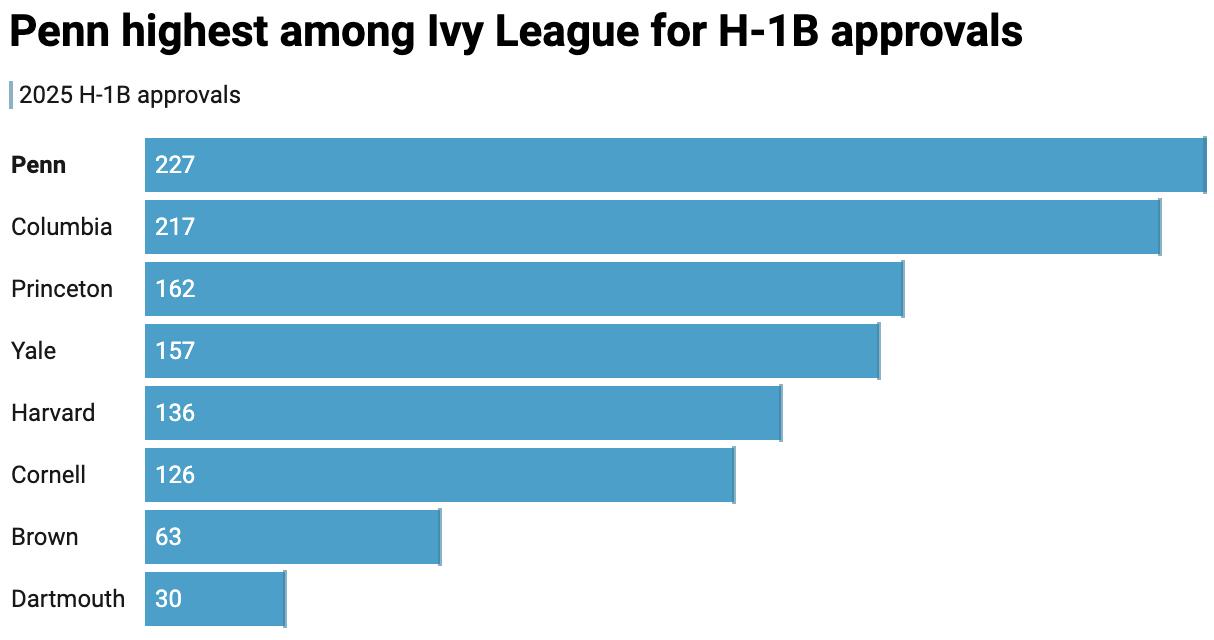
According to data from United States Citizenship and Immigration Services and an analysis by The Daily Pennsylvanian, Penn ranked first among all Ivy League universities as an employer of H-1B visa beneficiaries. Under a proclamation made by 1968 Wharton graduate and President Donald Trump last week, each new H-1B petition will be subject to a $100,000 fee.
In 2025, the University secured 111 new approvals, which could cause Penn to face more than $11 million in fees each year if it maintains similar levels of sponsorship.
Penn sponsored an average of 269 H-1B visas
annually — including both new applicants and renewals — between 2020 and 2025. The University had 227 approved H-1B employees in 2025.
A University spokesperson did not respond to a request for comment.
H-1B visas are for employees with “highly specialized” knowledge and education who are able to work temporarily in the United States. The visas last for three years but can be renewed for a period of up to six years.
In an interview with the DP, President’s Distinguished Professor of Political Science and immigration expert Michael Jones-Correa characterized the proclamation as “not very well thought out” and highlighted the “substantial cost” that will place a financial burden on employers that sponsor See VISAS, page 7
CHENYAO LIU | SENIOR PHOTOGRAPHER
SRISHTI BANSAL | STAFF REPORTER
Vice Provost for the Arts Timothy Rommen talks integrating the arts across Penn in DP interview
Rommen described his tenure as an opportunity to create a space where the arts are central to the University’s mission
AYANA CHARI Senior Reporter
Vice Provost for the Arts Timothy Rommen discussed the future of Penn’s arts scene and how to integrate creative disciplines across the University in an interview with The Daily Pennsylvanian. In the 10 months since he took office in January, Rommen — a professor of music and Africana studies — has begun the process of reshaping Penn’s priorities for the arts. Rommen described his tenure as an opportunity to create a space where the arts are central to the University’s mission.
“I’m really interested and invested in bringing a cultural change to align the arts at literally the core of what we’re doing,” Rommen said. “That isn’t the way it’s been in the past — there’s so much
2029
, from front page
Board 2027’s Nursing representative.
College sophomores Ayesha Mallick and Ishika Narsingani — who is also a DP staffer — were elected as UA College representatives, and Engineering sophomore Jack Moriarty won one of the two UA Engineering representative seats after running unopposed. The other UA Engineering representative seat remains vacant.
Nursing junior Elayna Rinker was elected Class Board 2027 Nursing representative. The Class Board 2027 Engineering seat remains vacant, as no candidates ran for the position.
Reflecting on the election, Kim wrote that he hopes to be a “president who anyone is comfortable enough to come up and talk with.”
“I believe that Penn is an amazing school,” Kim wrote. “However, because of its amazing qualities, sometimes it presents challenging moments for the students, especially us freshmen, who are getting used to coffee chats, interviews, and hours of homework—the preprofessionalism. During these times it’s hard to find a light in a day, a chance to smile and ease off, the president I want to be is a friend.”
LECTURERS, from front page
official designations: lecturer and senior lecturer, with the former appointed only under one-year contracts unless promoted to the more senior position. While the annual contracts can be extended, individuals said that communication from the University about these extensions is often poor.
“People often get concerned when they haven’t gotten a letter for their upcoming academic year,” Kehayias said. “People want to know.”
Computer and Information Sciences senior lecturer Travis McGaha said that the department would deliver the news via a letter in his mailbox. He said that the message read, “Congratulations, here’s your annual raise, see you in the fall,” adding that he would get “a little scared” when he had not received anything.
Many lecturers work part time and are paid on a per-course basis, but most departments impose limits on how many courses a lecturer may teach — with the exact cap varying by school and department.
In foreign language departments, for instance, part-time lecturers are restricted to teaching just one or two courses per semester — a cap that several lecturers told the DP creates financial strain, particularly since their per-course pay has not increased in over a decade.
“[Many lecturers] are given a one-course max per year,” one lecturer said, noting that he would “gladly” take on additional courses if he was allowed. “It’s a really tenuous situation for labor and trying to piecemeal your money.”
great stuff happening, but it’s sort of peripheral.”
Rommen described the process of “going back to school” to learn about the arts at Penn, including programs at the Stuart Weitzman School of Design.
“I’m learning about all of our amazing arts and culture units — things that I knew existed but didn’t understand just how vital they are to our arts ecosystem,” he said.
Rommen added that his ultimate goal is for students to come to Penn “because of the arts.”
That vision requires strategic planning, according to Rommen. More specifically, he noted that the University’s new framework — titled “Penn
Forward” — can be used to shape and “articulate” priorities for the arts.
“It is a fundamental shift in the conversation [and] the way that we understand what the arts offer us that I’m really going for,” Rommen said.
“The creation of this office is a down payment on that kind of a culture change.”
Rommen characterized his priorities as developing the “four spheres of activity” across Penn’s arts and culture programs. He described the first area of focus as building an interdisciplinary connection across the University, rather than keeping each department separate.
The remaining spheres — which include new
resources, communication, and “how to be a good neighbor” — aim to help Penn capitalize on the “vibrant arts city” of Philadelphia.
Rommen also hopes to make faculty arts projects more sustainable and expand student resources through the new Student Performing Arts Center, which has been under construction since 2024. The new center, located in the triangular site between Hill and Lauder College Houses, will be 37,300 square feet and cost $75 million to construct.
Penn first announced its plans for the building in 2021. The proposal originated with a 2019 study by the vice provost for University Life that identified a need for additional student spaces to “meet current and future demand.”
Rommen characterized the center as a “home for extracurricular student arts,” including dance, theater, and other rehearsal and academic spaces.
“It’s going to transform what’s possible for our student groups, and I just can’t wait,” Rommen added. “During the day, there’s a chance for curricular integration where we could have courses taught in SPAC that otherwise wouldn’t have space.”
He noted that while SPAC’s use for academic purposes will ultimately be decided by individual schools, the opportunity is “exciting” to think about.
“I’m in this role for five years, and what I’m hoping to have accomplished by then is that many of the priorities that come out of this strategic planning process are really well underway and we’re seeing real progress,” Rommen said. “If I step out of that role at that five-year mark, I can hand a train that’s moving on the tracks to whoever comes next.”
Rommen assumed the inaugural role as vice provost for the arts after participating in various communities on campus.
“I have an interdisciplinary home in music, I have an intellectual home in Africana, and I have a methodological home in anthropology,” he said. Rommen emphasized that the arts at Penn can facilitate such collaboration across the disciplines by “integrat[ing] knowledge” and drawing on “multiple perspectives.”
“It’s really important to emphasize how much amazing work is already happening on Penn’s campus,” Rommen said. “One of the things that I think needs to happen going forward is we need to stitch that together into a cohesive whole, so that we can actually see the whole ecosystem.”
Several lecturers who spoke with the DP noted that there is significant insecurity in terms of employment benefits. For example, certain departments and schools do not provide official policies regarding faculty leave for health and parental issues for part-time employees.
“I know people who have left teaching because they cannot medically do this,” another lecturer said. “There’s no parental leave policy, there’s no medical leave policy. It’s always a case-by-case negotiation.”
While non-tenure track faculty are eligible to enroll in a Universitywide health care plan, several lecturers said that Penn failed to clearly communicate key information and updates about this.
One lecturer recalled that the University recently cut summer health insurance coverage for several part-time lecturers “without [anyone] being told.”
“Myself and many colleagues went months without realizing we did not have health insurance,” the lecturer said.
In a written comment to the DP, Penn’s Division of Human Resources wrote that “fulltime lecturers are eligible for employee benefits if they work at least 35 hours per week,” adding that the cost for benefits is the same across “all schools and centers.”
Lecturers also stated that they have very few opportunities for career advancement. In most schools, a small number of lecturers are eligible to be promoted to the role of senior lecturer — a role that offers contracts of up to four years and treatment as full-time employees. However, the process for promotion is often “totally unclear,” according to a Stuart Weitzman School of Design lecturer.
“There’s no clear set of criteria for [promotions] that any of us have access to,” the lecturer said.
Likewise, McGaha noted that while he trusted his colleagues, the promotion process was “a little opaque.”
“I tried looking into it, but I couldn’t find much,” McGaha said. “That was a little worrying, just [to have that] in the background of my mind.”
Chinese Language Program Director and senior lecturer Melvin Lee added that faculty members in his position “just do their job, try to perform well, and hope somebody will notice.”
Lecturers also suggested that tenured faculty members play an outsized role in determining lecturer promotion — even when lacking the expertise to evaluate lecturer instruction. Lee cited an example where the lecturer promotion panel for his department consisted of tenured professors who had never taught Chinese at Penn.
“They decide who can be promoted, but they don’t get involved in the day-to-day language teaching,” Lee said.
Such frustrations appear to be compounded by the fact that lecturers have limited involvement in the University’s shared governance structure.
All part-time and full-time lecturers are defined as “academic support staff,” and as such, have “no formal mechanism” for involvement in Faculty Senate governance, according to the group’s 2024-25 report.
According to the report, this leaves the Faculty Senate “encumbered” to only address standing faculty topics, despite the fact that many issues — like compensation and employment benefits — affect non-standing faculty members “much more pervasively and seriously.”
Lecturers emphasized that their lack of representation has consequences for students as well. A lecturer for the Critical Writing Program noted that lecturers are often tasked with teaching courses that “onboard students.”
“Ultimately, this hurts students,” Rafael Khachaturian, a lecturer in critical writing, added. “If the voices of faculty are left out of the governance process, then so [are] the needs of the students they serve.”
On the University Council, full-time lecturers are currently represented by only one elected full-time lecturer representative. Foreign Languages lecturer Ye Tian — who currently serves as that representative — noted in a statement to the DP that lecturers only have one seat, while tenured faculty members have over 45.
“That imbalance limits influence, but it also underscores why this role is important: to ensure lecturers’ concerns are not absent from the conversation,” Tian wrote.
A spokesperson for the Office of the Provost wrote to the DP that the Faculty Senate is “reviewing” the status of non-tenure track faculty in shared governance efforts.
This exclusion also extends to administrative policies. Lecturers told the DP that they are not paid to attend general faculty meetings. In the Department of East Asian Languages and Civilizations, for instance, lecturers are “not invited” to attend standing faculty meetings, according to Lee.
One School of Design lecturer described a “top-down approach” in administrative discussions, particularly when requesting certain classroom spaces and tools.
“We’re the lowest on the totem pole,” another School of Design lecturer said.
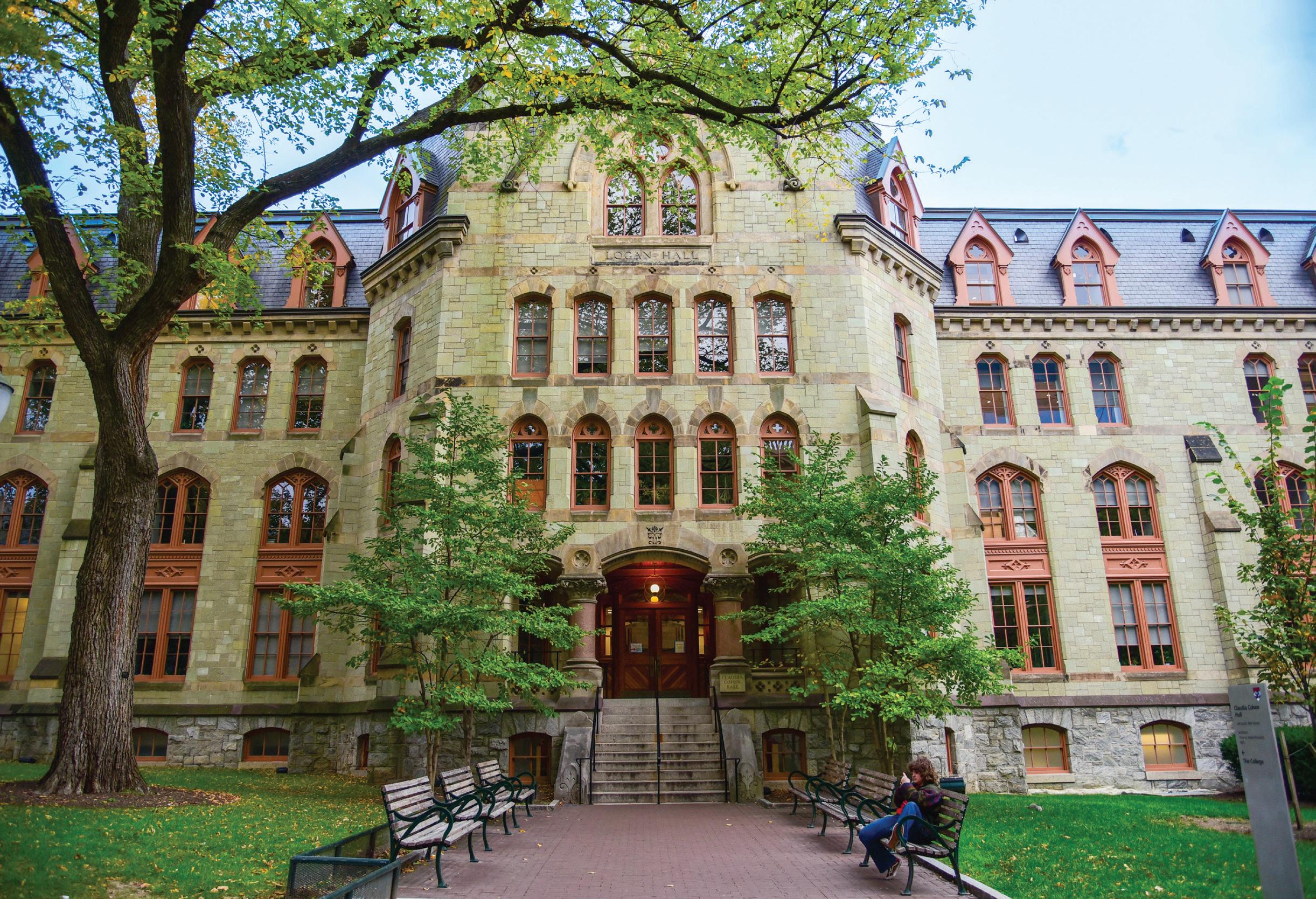
PHOTO COURTESY OF DANIEL KIM Kim was elected Class of 2029 president.
SADIE SCOTT | STAFF PHOTOGRAPHER
Rommen pictured on Sept. 24.
Penn Institute for Urban Research receives $10 million donation to support research, policy solutions
The donation — announced by Penn President Larry Jameson on Sept. 22 — will support a co-director position as well as a postdoctoral fellowship at Penn IUR
PHOEBE ANAGNOS Staff Reporter
The Penn Institute for Urban Research received a $10 million anonymous gift to advance its city research, education, and policy mission on Tuesday.
The donation — announced by Penn President Larry Jameson on Sept. 22 — will support a co-director position as well as a postdoctoral fellowship at Penn IUR. The funds aim to enhance the institute’s ability to address critical issues facing cities today, from housing affordability and fiscal stability to the role of anchor institutions and the financing of climate resilience.
“This gift advances the University’s commitment to creating knowledge that benefits communities locally and around the world,” Jameson wrote in the announcement. “It also ensures that Penn IUR can continue developing urban leaders and practical solutions for rapidly growing cities worldwide. Providing support for leaders whose expertise connects finance, policy, and planning strengthens Penn IUR’s impact on a global scale.”
Established in 2004, Penn IUR serves as a hub for shaping policies and strategies on relevant urban issues. Penn IUR co-director Susan Wachter described the need for robust urban research in an interview with The Daily Pennsylvanian.
“We think it’s so important to bring together faculty from across the University to work on urban issues,” Wachter said. “Urban issues aren’t informed by just one discipline. We need many different disciplinary approaches to fully inform public policy and the urban
challenges of the cities of today and tomorrow.”
Wachter leads the institute with Eugénie Birch, who also teaches urban research and education at the Stuart Weitzman School of Design. Birch similarly emphasized the potential opportunities afforded to students by the donation in a written statement to the DP.
“This gift expands Penn IUR’s capacity to prepare the next generation of urban leaders,” Birch wrote. “Through enhanced opportunities for postdoctoral scholars and collaborations across Penn’s schools, students will gain access to research and policy initiatives that address the complexities of managing cities.”
The funds are set to sustain collaboration between urban research professionals from diverse fields and cultivate technical skills for new students.
The announcement comes amid a series of large donations to Penn, including a $21 million legacy gift in support of the Herbert D. Katz Center for Advanced Judaic Studies, the Penn Libraries’ Rare Judaica Acquisitions Endowment Fund, and the Morris Arboretum and Gardens. The gift was delivered from the estate of 1982 College graduate Louise Strauss.
On Sept. 15, Penn received a $60 million gift from Bruce Jacobs — a 1979 School of Arts and Sciences graduate, 1986 Wharton School Ph.D. graduate, and former Wharton faculty member — which allowed the Wharton School to launch its first new degree program in 50 years.
Penn professor wins 2025 Clinical Research Prize from American Heart Association
Gerontology professor Barbara Riegel will receive this award at the AHA’s Scientifc Sessions 2025 in recognition of her research in self-care science
SANDY WALLS Contributing Reporter
Barbara Riegel, professor emerita in the School of Nursing, is set to receive the 2025 Clinical Research Prize from the American Heart Association in November.
Riegel — the Emerita Edith Clemmer Steinbright Professor of Gerontology — will receive this award at the AHA’s Scientific Sessions 2025 in recognition of her research in self-care science. The AHA grants the prize to scientists whose research plays a significant role in advancing cardiovascular science and who lead distinguished laboratories in cardiovascular clinical research.
“I’m deeply honored to receive this award from the American Heart Association,” Riegel said in the Penn Nursing announcement. “I have spent my career focused on research aiming to make a true impact on those living with heart disease and other chronic illnesses. Focusing on self-care for patients and their caregivers has been my priority for many years, and I am humbled by this prestigious recognition and look forward to continuing to support the association.”
Riegel’s recent research was published in the AHA’s Circulation: Heart Failure journal and focused on the self-care of unpaid individuals acting as caregivers for adults living with chronic heart failure. Through a randomized controlled trial, Riegel created a “virtual health coaching intervention” to assist domestic caregivers with managing different medications, dealing with variable symptoms, and promoting general wellness, while also helping them navigate the stresses that come with this role.
The trial facilitated 10 support sessions over video call with caregivers, with each session focused on the physical and mental impact of being a carer. A separate control group, which only received support through a web page, was monitored alongside the coached intervention group.
After this six-month trial period, the study revealed that the coached intervention group had attained improved scores in stress and self-care as compared to the control group.
Riegel is also the co-director of the International Center for Self-Care Research, in association with Sweden’s Linköping University. This organization was established to coordinate research in self-care and close the gap in knowledge that surrounds this field of science. By stimulating international cooperation in self-care science, the center aims to build a complete and international wealth of resources.
Riegel is most renowned for her globally recognized Self-Care of Heart Failure Index, an evaluative tool that assesses how people with chronic heart failure manage symptoms. Having been tested and refined since its inception in 2004, the index has become commonplace in both academic and practical contexts.
Penn’s Seymour Gray Professor of Molecular Medicine Daniel Rader won the AHA’s 2012 Clinical Research Prize for his research on the metabolism of fat particles in blood and their relation to atherosclerosis.
In 2009, Riegel was named as one of the “Top 10 Cardiovascular Scientists” by the AHA’s Council on Cardiovascular and Stroke Nursing. Her other accolades from the University include the Claire M. Fagin Distinguished Researcher Award and the Trustees’ Council of Penn Women Award for her mentorship work.
Last year, The Daily Pennsylvanian reported that Riegel is the sixth-most cited Penn-affiliated researcher.
CHENYAO LIU | SENIOR PHOTOGRAPHER
Jameson announced a $10 million donation to Penn IUR on Sept. 22.
PHOTO COURTESY OF PENN NURSING
Riegel will receive the 2025 Clinical Research Prize from the AHA in November.
Greek life isn’t daycare
EDITORIAL | The 100-person limit on parties missed the mark for Penn’s social scene
As busy individuals with an everpresent workload, students strive to counter their academic stress with an active social life. For many, the latter entails going to parties — largely hosted by fraternities and sororities. However, the recent enforcement of a 100-person capacity limit on these events by the Office of Fraternity and Sorority Life not only complicates this balance by ensuring a weaker social environment within the University, but also worsens safety concerns surrounding fraternity and sorority events. While the need for some regulation is understandable, is a 100-person rule the most effective policy to achieve this goal?
In 1849, Penn’s first fraternity was established. By the early 1850s, several fraternities had set up camp, creating one of the nation’s oldest greek life systems. Today, nearly 40 such organizations — including fraternities, sororities, and
co-ed groups — are active at Penn, engaging roughly one-quarter of the University’s undergraduate population. Penn owns 24 of the 31 fraternity and sorority houses on campus, covering their maintenance costs and exempting them from property taxes. Last academic year, Penn began enforcing a 100-person limit on fraternity and sorority social events. At the time, OFSL — the administrative arm of University Life that oversees these organizations — only imposed the attendance cap during big party weekends like St. Patrick’s Day. However, fraternity and sorority leaders were recently notified that the cap will apply to every registered event — and Penn has introduced new measures to carry out that goal.
At their core, though, fraternity and sorority parties are private events — not public gatherings. These events lie at the heart of Penn’s social scene, offering a
The school of sellouts
space for community and connection
among students. Imposing a strict 100person limit is a significant overreach by Penn’s administration. Not only does this new rule undermine the autonomy of student-run organizations to organize their own activities, but it also stifles their ability to foster the very community they exist to create.
Furthermore, students will continue to party with or without official approval and despite the new restrictions.
A 100-person cap doesn’t stop gatherings — it just turns them into a challenge. The rule creates a thrill in breaking it, fueling resentment toward authority and encouraging students to bend the system however they can. What was meant to be a safety measure has instead created a cat-and-mouse game — pushing social life into riskier, unregulated spaces in the shadows.
OFSL writes on its website that its role
PENN UNSAID | When neutrality becomes the new normal
“Where is your Penn pride?” I remember hearing this question from my friend after getting stuck behind a swarm of high schoolers touring our campus during my first year. These days, following certain administrative policy changes, a similar question rings in my head for different reasons: Where exactly do we come together as a school?
Every school has its unifying force: The University of Notre Dame has the brawn, the Massachusetts Institute of Technology has the brains, Harvard University is Harvard University, but where do we come into play? We might mention the Wharton School, but that doesn’t seem right to say when we have three other undergraduate schools (yes, they matter too). And in the era of institutional neutrality, I would argue that Penn comes together not from a mutual yearning for community or social change, but from a deep inclination to uphold just that: neutrality. The topics that go unacknowledged and the current events we do not mention stand out more to me than the ones we do. We are no longer the school of brilliant academics or highbrow thinkers; we are now officially the school of proud sellouts.
You would have to be living under a rock to forget Penn President Larry Jameson’s statement on neutrality from the previous year. It is easy to believe that these statements have no bearing on our academic careers or even our personal lives, but it’s actually the opposite. Though Penn’s website encourages students to pursue interdisciplinary research or a life of public service, Penn’s compliance in response to highly historic geopolitical events simply encourages otherwise. In fact, there seems to be a phenomenon I’ve noted among the majority of classmates, friends, and even myself: The longer students remain at Penn, the less their passion remains. How many times have you seen your friends forgo their dreams to enter another preconsulting route? How many times have you had conversations with students who always seem to skirt around their own political affiliations? How many times have you encountered people who drop a class they deem interesting because attendance is mandatory, it has a “no-tech” requirement, or the workload is too high? It is completely possible that none of these particular statements ring a bell, but it’s
is to create a “welcoming and inclusive community” for all students. But where is the inclusivity when students are turned away from being allowed inside? The policy essentially promotes favoritism and the “name three brothers” golden rule. Where is the welcoming spirit when even fraternity and sorority presidents feel overwhelmed and scared to speak out against their plight?
Criticism of fraternity and sorority life is not without its merits. From discriminatory experiences to documented assaults in frat houses, there have been multiple instances in which on-campus fraternities have found themselves in trouble. These instances are not directly caused by the number of people allowed at parties; rather, they speak to larger systemic problems within the greek life system. And while some may argue that these regulations will prevent incidents like the above from happening, students will still gather regardless of the rules. OFSL should work with the students it is meant to support — not against them. It’s understandable that Penn wants to regulate parties and prioritize the safety of its students. However, OFSL shouldn’t have to surveil campus to promote safety. If Penn is worried about student drinking habits or other hazards of greek life, OFSL could work to equip students with the skills needed to prevent risky behaviors instead of essentially shutting these parties down. To further promote this, OFSL could implement certain compliance standards and reward the houses that address its concerns most effectively. The solution shouldn’t be to demonize partying, but rather to reshape the mindset and teach students to use parties as social settings where safety is still a priority.
THE DAILY PENNSYLVANIAN EDITORIAL BOARD consists of senior staffers in the Opinion department and is led by the DP’s Editorial Board Chair Sangitha Aiyer. Currently, that team includes Ananya Shah, Diya Choksey, Harman Chahal, Beatriz Báez, Mariana Martinez, Mritika Senthil, and Mia Vesely. Questions and comments should be directed to letters@thedp.com.
impossible to deny that Penn students exist in this bubble of apathy. There is nothing inherently wrong with Penn taking a more impartial stance; some people would even go so far as to classify its neutrality as mere open-mindedness. But in the larger context, when dealing with a long-historied institution started by one of the Founding Fathers, it’s a little ironic to be the school that pleads the fifth. We call ourselves an Ivy League school, reaping all the benefits of being classified as such, but it’s a fair case to make that Penn can’t even begin to compare with a university like Harvard and other colleges that didn’t back off without a fight. As such, it’s not enough that we sell out; we are worse because we settle for the decisions that are most convenient simply to maintain our status. Obviously, there are always exceptions, and at Penn, these are the students
who are willing to break the mold. There are students who are willing to be put on academic probation or have their visas rescinded for an important cause. On a smaller scale, there are also plenty of students who are not sacrificing their initial plans to work in investment banking or defense contracting. But how many of our classmates really check these boxes? In this bubble, it is not that there is an absence of students who care, but rather a severe lack of individuals who are willing to burst the bubble to show they do. It is true that we don’t always have the right to criticize our fellow classmates for taking the road more traveled by. Coming from a working-class background, I recognize how much pressure there is to pursue lives that seem more stable, more beneficial to our 10-year plans, and less detrimental to our social lives. Besides, if a globally renowned institution like Penn
stands for nothing, then why should we act any differently?
Even still, coming from someone who used to loudly declare that “selling out” was a choice as valid as any other, we need to reflect on when “selling out” became less of a Sidechat joke and more of a campus culture. Penn might have become a school of neutrality — in other words, a school of nothing — but we all came here to do something. Have pride in your University, put it on your resumes and Hinge profiles, but let us not forget, we are people first and Penn students second.
EDWIN MEJIA | DP FILE PHOTO
LAYLA NAZIF | STAFF PHOTOGRAPHER
Columnist Lindsay Muneton discusses Penn’s culture of “selling out.”
LINDSAY MUNETON is a College junior from Bergenfield, N.J. studying sociology. Her email is lmuneton@sas. upenn.edu.
I sufered, so you should too
A VS K | The prevalence of a culture of gatekeeping at Penn
September typically signals a bittersweet end to summer, an eagerly anticipated start to classes, or perhaps the typical dread of readjusting your body to 8 a.m. wakeups. At Penn, however, September mostly indicates the onset of palpable stress from a taxing new cycle of club applications, emanating particularly from first years. Penn’s rigorous club culture has long been regarded as cutthroat, demanding, and simply unnecessary. This September, my sophomore peers and I revel in the relief of a less chaotic, less arduous, and slightly less Google Form-filled start to the semester.
No one can deny that the first preview of Penn preprofessional culture can be daunting. Wharton-affiliated clubs in particular are infamous for their exhaustive, multiround interview processes that often require a closet full of business casual attire and a prerequisite of extensive work experience at the ripe age of 18. Though, with the Wharton School’s new ban on multiple-round interviews for affiliated clubs, one would think there is cause for celebration. Right?
Not quite.
Even with new regulations, an “I suffered, so you should too” mentality seems to be pervasive on campus, with the transition out of first year causing many to clam up and become guarded around their strategies for success. While some are eager to share their triumphs and frustrations, others lean toward cryptic answers and vague advice. What’s most unsettling is seeing sophomores, only months out of their first years, already adopting a similar nature of guardedness that we once avidly resented.
I can recall leaving coffee chats feeling more confused than I did prior to the meeting. I can also recall feeling as though each line uttered at these meetings was evidently rehearsed. What many expect to be a conversation of advice and potential tips turns into an onslaught of “it’ll all work out” and “be yourself.” I understand that vagueness stems from a competitive instinct, one I clearly remember during college application season. However, this meticulous confidentiality is excessive when coming from upperclassmen who have already secured spots at top consulting firms, prestigious banks, and their club counterparts on campus.
Our club culture seems to mirror that of these consulting and banking institutions, where the recruiting cycle
will award only those who know how to decode the covert networks and the cryptic interview preparations. Just as making it to the second-round interview of the Wharton Undergraduate Finance Club provides a badge of honor, making it through multiple rounds of interviews for JPMorgan instills the same sentiment of prestige. This is a system that thrives on scarcity and exclusivity, so no wonder those that break through adopt the logic of gatekeeping. The same can be said for hazing, when suffering becomes endorsed because we went through it, and therefore you should too. When you live to successfully see the other side, of course, you won’t want to break the cycle — you’ll want to perpetuate it. No one can fault you for that, and I certainly have no room to speak.
However, students don’t actually go out of their way to induce stress on the new class of students out of spite. Rather, at its core, it just seems unfair. Of course seeing other students fly through their first semesters in a manner way more composed, organized, and on top of it than you were will arouse frustration. But that frustration simply reveals how suffering has been turned into a sort of initiation rite at Penn. Just as our parents remind us not to take the easy way out, we put pressure on ourselves to perpetuate this sentiment in every aspect of our lives.
The network, the mentorship, and the potentially careeraltering advice from these clubs is worth it if not for a bit of struggle. Yet, we tend to ignore the years of tenacity and persistence we underwent to attend Penn or even the ongoing struggle we will face after our undergraduate years, when we will truly be left to our own devices. Once we start affording ourselves some leniency, we will afford the same to others. For once, resist the temptation to ration out advice and instead, try making it easier for the next person. I promise one relatively non-vague answer won’t come back to bite you. We must realize that the benefit of another is not a detriment to ourselves.
ALYMA KARBOWNIK is a College sophomore from Maplewood, N.J. studying international relations and environmental studies. Her email is alymak@sas.upenn.edu.
Careers in Journalism & New Media
What you need to know to get a real job in print or
LUIS FERRÉ-SADURNÍ C’17 is an immigration reporter at the New York Times. He joined the Times in 2017 and has covered breaking
crime, housing, and politics for the Metro Desk. MATT FLEGENHEIMER C’11 is a correspondent at the New York Times. His primary focus is long-form profles of notable fgures - in politics and otherwise - for the Times and Times Magazine.
BEATRICE FORMAN C’22 is a breaking news reporter at the Philadelphia Inquirer and a co-author of Taylor Swift (Spotlight on a Legend), an Amazon-bestselling retrospective on the pop star published in 2024 by Hearst. At the Inquirer, Beatrice specializes in coverage of Philly’s distinct pop and youth cultures.
ASHLEY PARKER C’05 is a staf writer at T e Atlantic. Previously, Parker — a three-time Pulitzer Prize winner —spent eight years at the Washington Post, where she covered all four years of Donald Trump’s frst presidency, was White House bureau chief covering the frst two years of the Biden presidency, as well as the entirety of the Trump presidency.
ISABELLA SIMONETTI C’21 is a media reporter at the Wall Street Journal in New York where she covers the media industry broadly, spanning sports rights, new media, cable TV and publishing. Before, she served as the David Carr Fellow in Business Reporting at the New York Times.
MODERATORS JESSICA GOODMAN C’12 is the New York Times and USA Today bestselling author of young adult thrillers T ey Wish T ey Were Us, T ey’ll Never Catch Us, T e Counselors, and T e Legacies. STEPHEN FRIED C’79 is an award-winning journalist and best-selling author who teaches at Penn and was a cofounder of the Nora Magid Mentorship Prize.
Tuesday, September 30 • 5:30 pm Kelly Writers House • 3805 Locust Walk or watch on YouTube
A thank you to my parents
ASHTI’S AFFIRMATIONS | Honor generational sacrifces with gratitude, not guilt
If you stop me on Locust Walk for a fit check, most of what I am wearing started in my mom’s closet. My apartment tells the same story, furnished with the “good” hand towels, the sturdy pots, and the dishes my parents once kept for guests.
But this is not about plates and clothes. It is about what they represent: the sacrifices that set my foundation. Taking the best from your family as your baseline carries pride and pressure at once, and I am still figuring out how to hold both.
I call this second-generation guilt: the pressure to turn my parents’ sacrifices into achievement and the unease I feel when I accept comfort or ease.
As the daughter of immigrants, I carry a real, necessary burden to honor what it took to build a new life. But second-generation guilt is not remorse for existing or for having opportunities. It surfaces when leisure starts to feel like waste, or when I catch myself forgetting how I arrived here.
The sharper edge of this guilt comes from forgetting — losing sight of the work, risk, and love that paved my way. I would have nothing without the generations before me. Now, that does not require living in perpetual debt, but it does require deliberate acknowledgment. Dealing with second-generation guilt, at its core, is a commitment to remembering where I come from and to honoring those sacrifices with intention.
But that is easier said than done. As new opportunities open, it is easy to lose sight of my purpose, and enjoying what was once out of reach becomes complicated. At Penn, dinners out, downtown nights, spring break trips, and new wardrobes are part of our routine. For me, those things were once unimaginable. I am grateful to participate, yet the casualness can feel like a betrayal of how rare these experiences used to be.
I want to keep the first-time awe: the gratitude of a nice restaurant, the awe of traveling outside of the country, and the respect for $5 that used to feel like a fortune. When that feeling fades, I sense distance from the values with which I was raised. The gap between my new normal and my old reality can leave me ungrounded, and even entitled, unless I actively try to
reconnect with those values.
That same distance also appears as the luxury of choice. I have access to opportunities my parents didn’t have at my age. My mom once dreamed of studying chemical engineering but chose accounting instead, whereas I have been able to immerse myself in the liberal arts, learn to code, and even consider fine arts, if I can make room for it in my senior year.
Being able to choose my path is a real privilege. I live my life with my parents’ steady support and advice, yet indulging in options they never had can feel like I am flaunting what they were denied. So I try to hold that tension with gratitude and make choices that honor their sacrifices.
In that light, gratitude may be a better frame than guilt. The guilt often feels one-sided in that my parents are not asking me to feel remorse for using what their sacrifices made possible. They wanted me and my brother to live this way, as the immigrant dream was meant to be lived with ease, not carried as a punishment.
Thus, the privilege of being a second-generation immigrant can be honored without guilt. Gratitude can replace the urge to forget. Practiced consistently, it pays respect to the past while keeping eyes on the future.
There are also moments when guilt can be worn like a badge of honor, a motivation to work harder in college. Even then, the point is not self-reproach. Past generations did not sacrifice so we would feel ashamed of opportunity. The right balance is ambition guided by gratitude, not progress powered by remorse.
The privileges from first-generation sacrifice are not a burden to carry; they are a dream realized. Honoring the sacrifice means living with grace in how we show up, gratitude in how we remember, and responsibility in how we choose.
ASHTI TIWARI is a College junior from Corning, N.Y. studying philosophy, politics, and economics. Her email is ashti@sas.upenn.edu.
DEREK WONG | DP FILE PHOTO
Columnist Alyma Karbownik argues that students involved in club culture need to make it more open for the next generation.
BENJAMIN MCAVOY-BICKFORD | DP FILE PHOTO
Columnist Ashti Tiwari discusses second-generation guilt and her journey navigating it.
Penn rebounds three spots to No. 7 in 2026 U.S. News rankings
The rankings put the University at fourth place among the Ivy League institutions
AIDAN
SHAUGHNESSY Staff Reporter
Penn placed No. 7 in the U.S. News & World Report’s 2026 rankings of Best National Universities on Tuesday, moving up three spots from last year when the University earned its lowest ranking since 1997. The rankings, published on Sept. 23, put the University at fourth place among the Ivy League institutions, with Princeton University claiming the top spot in national rankings, followed by Harvard University at No. 3 and Yale University at No. 4. Penn tied with Duke University, Johns Hopkins University, and Northwestern University for the No. 7 spot.
The Wharton School, which has historically held the No. 1 spot on its own at the top of the undergraduate business program rankings, is now joined by the Massachusetts Institute of Technology’s Sloan School of Management. The School of Nursing remained at No. 2 — tied with Emory University — among undergraduate nursing programs, and the School of Engineering and Applied Science moved up six spots to rank at No. 21 among undergraduate engineering programs.
Improving from last year, Penn also climbed up four spots to No. 13 in the category of Best Value Schools. That ranking — according to the U.S. News website — is determined based on academic ranking and net attendance costs for out-of-state students with average financial aid awards. Princeton earned the top spot on that list as well.
The change comes after Penn’s announcement of the Quaker Commitment in November 2024, which raised the income threshold for families eligible to receive full-tuition scholarships from $140,000 to $200,000.
The University also tied for No. 3 in U.S. News’ ranking of lowest acceptance rates. In June, Penn announced a 4.9% acceptance rate for the Class of 2029 — the most selective year on record.
According to a U.S. News article, the Sept. 23
VISAS, from front page
H-1B beneficiaries.
“For nonprofits, like universities, that’s going to be a really substantial cost, and will probably reduce the demand for the number of H-1B visas overall,” he said. “It might mean moving some people that they would normally hire and have employed in the U.S. … overseas.”
“It begins to add up pretty quickly,” Jones-Correa added. “I do expect that it would mean a reduction in the number of sponsorships by the university.”
However, Jones-Correa noted that relative to smaller institutions that are less capable of
BIDEN, from front page
Commencement, during which he also received an honorary degree.
“I was asked why I wore a Penn tie [to the ceremony]. My answer is, I earned it,” he said during the speech.
After months of speculation about a possible Penn appointment after his vice presidency, Biden was formally named as Benjamin Franklin Presidential Practice Professor in February 2017. The University simultaneously announced the establishment of the Penn Biden Center.
“The Penn Biden Center and I will be engaging with Penn’s wonderful students while partnering with its eminent faculty and global centers to convene world leaders, develop and advance smart policy, and impact the national debate about how America can continue to lead in the 21st century,” Biden said.
At the time, Gutmann praised Biden’s “unsurpassed understanding of diplomacy and far-ranging grasp of world issues” and called him “an ideal fit” to further Penn’s global engagement.
Establishing the center
In March 2017, the center underwent a soft opening and began offering semesterlong internships for students around the same time. It also co-hosted former Mexican President Felipe Calderón for the inaugural Penn Biden Leaders Dialogue later that October.
The center formally opened at 101 Constitution Ave. in Washington in February 2018. The ribbon-cutting event featured a panel discussion between Biden, Gutmann, and 1967 College graduate and longtime NBC News anchor Andrea Mitchell.
“At Penn, I look forward to building on the work that has been a central pillar of my career in public office: promoting and protecting the postWWII international order that keeps the United States safe and strong,” Biden said in a 2018 statement following the center’s announcement. For 14 months, Biden used the center as his primary office and employed several of his closest confidants, including future Secretary of State Antony Blinken and personal adviser Steve Ricchetti. During that time, Biden’s involvement at the center consisted primarily of campus speaking engagements; he never taught any classes.
During this period, the center also published several articles about foreign policy. Many of them were written by Biden himself and other staff at the center — including individuals who would come to hold foreign policy roles under the Biden presidency.
The first major policy project undertaken by the center was a 2018 report on democratic vitality in the United States that was published alongside the George W. Bush Institute and Freedom House. Additionally, the Penn Biden Center partnered
rankings reflect less changes than usual, as some data came from previous editions due to delays in updates from the Department of Education’s College Scorecard. This year’s U.S. News rankings reflected several
affording an additional six-figure annual sponsorship fee per worker, the fee “won’t impact Penn as much.”
Though Penn’s H-1B sponsorships have remained relatively stable over the past few years, Jones-Correa highlighted how the numbers might drop as the fees “make it harder for people to come.”
“Universities and companies are acting sort of as global actors — universities hire for talent across the world, not just the U.S.,” he added. “So reducing the numbers of people who can come to the U.S. is going to diminish what universities can do and also what for-profit companies can do.”
In 2025, Penn employed more H-1B beneficiaries than any other Ivy League university. The data is calculated by employer — which, for
with the School of Arts and Sciences and the Embassy of Japan to sponsor the Kakehashi Project, a weeklong cultural exchange program in Japan for Penn students.
During this time, Biden made several public appearances at Penn — including participating in a forum alongside former Florida Gov. Jeb Bush and a talk about his 2017 book titled “Promise Me, Dad.”
Columbia University professor of international relations Michael Doyle — Gutmann’s husband — described the forum with Bush as “an extraordinary occasion.”
“It was even cordial despite all of their differences,” Doyle added. “I was floored by the quality of that debate, and so were the students.”
According to Doyle, Biden also participated in private events at Penn, such as a meeting between Biden and the University Board of Trustees during which he “answered every question at incredible length.”
“[He was] at the top of his game, articulate, well-informed, inspiring, taking questions,” Doyle said.
Biden’s campaign for president
In April 2019, Biden announced his presidential run. Five days later, Gutmann announced that Biden would be taking an “unpaid leave of absence” from his work at Penn and the center.
At the time, the center’s communication director wrote that “the Penn Biden Center will continue to advance the values that have formed the core of our mission since we opened.”
“We will remain active in shaping the debate around important foreign policy issues and fostering a new generation of leaders,” the statement read.
Shortly after, Blinken and Ricchetti also left their positions at the center to join Biden’s presidential campaign. During this period, the only visible outputs from the center came in the form of articles published on the website’s “News and Insights” page.
Throughout his 2020 presidential campaign, Biden alluded to his involvement with Penn, often asserting he was a “professor [and] teacher” at the University.
After Biden’s victory and inauguration, the center continued to maintain its commitment to “carry on its mission of conducting original research, analysis, and commentary.”
It stated it would “remain completely independent of the Biden administration.”
Later that year, Biden tapped Gutmann to serve as the next U.S. ambassador to Germany and former Chair of the Board of Trustees and 1981 University of Pennsylvania Carey Law School graduate David Cohen as the next U.S. ambassador to Canada.
During the presidency
For the four years of Biden’s presidency, the center did not produce any public policy projects.
The center’s final managing director, Michael Carpenter, departed in November 2021 to serve as
changes in methodology. Expenditures per student were calculated using credit hours rather than fulltime or part-time status, and SAT and ACT scores were eliminated as a factor in certain regional rankings with certain schools remaining test optional.
Penn, includes all schools, administrative offices, and affiliated institutions such as the University of Pennsylvania Health System and the Penn Museum. Other universities’ employment statistics do not always include affiliated systems and institutions.
“Any institution that has a large medical school, research in science in particular, and engineering — all of these will be impacted,” Jones-Correa said. “Universities are more vulnerable as nonprofits.”
Penn classifies its H-1B visa recipients as “specialized workers,” which includes a variety of faculty members and researchers.
“The whole purpose of a university is to bring people together at the university, so the kinds of businesses that can’t offshore are going to be particularly impacted by this new rule,” Jones-Correa explained.
“This administration is so changeable, it’s hard to know what the long-term implications will be, or whether this will remain enforced,” he added. “It will almost certainly be challenged in court.”
Earlier this week, Penn’s International Scholar and Student Services warned H-1B employees to remain in the country “until the situation stabilizes.”
Following a USCIS memorandum that clarified the proclamation, ISSS acknowledged the “unsettling” situation and noted that current employees can continue working and renew their visas without paying the new fee.
The new H-1B petition fee comes amid a federal crackdown on immigration, including thorough social media vetting for new international student visa applicants.
the U.S. ambassador to the Organization for Security and Cooperation in Europe. By January 2022, the center’s site only listed three employees. Despite its inactivity, the center was a source of significant controversy for both the Biden administration and Penn.
In 2021, Republican lawmakers alleged that the University had failed to properly disclose millions of dollars in donations from Chinese entities to the center. Two years later, the U.S. House Committee on Oversight and Accountability revisited the same line of questioning toward Gutmann’s successor, former Penn President Liz Magill.
“The University has never solicited any gifts for the Center. Since its inception in 2017 there have been three unsolicited gifts, from two donors, which combined [to a total of] $1,100. Both donors are Americans,” a University spokesperson told the DP at the time.
In October 2022, classified documents dating to Biden’s vice presidency were found at the center. 1968 Wharton graduate and President Donald Trump — who was facing his own investigations related to improperly filed government documents — released a video criticizing both the center and Biden’s involvement.
“At the very same moment my ultrasecure Mara-Lago home was raided by the FBI, Joe Biden was harboring classified documents in his Chinafunded Penn center,” Trump said in the video.
The controversy would ultimately lead to a special counsel investigation by the Department of Justice, which published its findings in February 2024 — 10 months after Biden announced a controversial reelection bid for a second term.
In the report, DOJ Special Counsel Robert Hur referred to Biden as a “sympathetic, well-meaning, elderly man with a poor memory” and declined to press charges against the then-president.
The report added to mounting concerns over
Biden’s age, which came to a head in June 2024 after a pivotal debate against Trump. A month later, Biden withdrew from the presidential race. The center, restructured
Following the end of his reelection campaign, Biden expressed interest in reengaging with the center after leaving office.
“There’s so many other things I want to do in terms of the Biden Institute at Penn on foreign policy and the Biden Institute in Delaware on domestic policy, to keep the things going that we started,” Biden said.
In June 2024, then-Interim Penn President Larry Jameson announced the launch of Penn Washington, an umbrella program joining the newly launched Franklin Initiative with the Penn Biden Center. According to Jameson, Penn Washington would serve as a “physical and programmatic home for the University of Pennsylvania’s engagement in the nation’s capital.”
Despite limited activity in recent years, Biden has continued to suggest future involvement with the University — including floating the idea of housing his presidential library on Penn’s campus.
In September 2025, however, Biden’s office announced that his library would instead be built at the University of Delaware. A Penn spokesperson told The Wall Street Journal that the University “was never asked or in conversations about hosting the library.”
According to internet archives, the center’s former website redirected to the primary Penn Washington webpage beginning in October 2024. This fall, the center reappeared on Penn Washington’s website under a banner that reads, “Here you will find future Global Programs initiatives and events.”
“Future programming in development,” the site read at the time of publication.
INSIA HAQUE | DESIGN EDITOR
This year, 79% of over 1,700 ranked institutions reported data to U.S. News, a 0.9% increase from last year. In the 2023 rankings, Penn sat at No. 6 on the list of Best National Universities.
MAX MESTER | DP FILE PHOTO
Penn placed No. 7 in the U.S. News & World Report’s 2025-26 rankings of Best National Universities.
Men’s and women’s cross country impress at Main Line Invitational
The men’s team fnished frst overall, while the women’s team placed second
EMILIE CHI Sports Reporter
It’s off to the races for Penn cross country.
At the Main Line Invitational on Sept. 19, both the men’s and women’s cross country teams saw impressive results. The invitational, which was hosted by Haverford, featured two events: the men’s 6.44-kilometer and the women’s 5-kilometer races.
The men’s team had a strong collective performance, capturing first place overall at the invitational with a total of 24 points. Senior Sahil Dodda had an outstanding performance, leading the race with a time of 19:19.6 and placing first overall.
“It’s been a while since I’ve ran well and been confident racing, so Friday meant a lot for me,” Dodda wrote in a statement to The Daily Pennsylvanian regarding his individual win. “Overall though, it’s a good stepping stone for myself and the team as we approach the tradition[al] 8k distance and get ready for the real season.”
Dodda’s teammates also had standout performances. Junior Kofi Fordjour scored a time of 19:37.6, securing him third overall. Following closely behind, sophomore Shane Murphy placed fourth with a time of 19:38.7. Sophomore Esfan Daya captured seventh with a time of 19:45.9, followed by freshman Vinay Raman with a time of 19:55.3. Sophomore Chris Larnard with a 19:55.5, senior Liam Going with a 19:58.7, and sophomore Joseph Ruiz with a 19:59.5 all helped bolster Penn in the rankings. Penn’s men’s team had eight runners place in the top 15, securing the team a first-place win.
In the days leading up to the event, the team adjusted its training — and it paid off. Dodda wrote that the men’s team has “been doing a lot of longer efforts and running high mileage. It [was] all about just stacking weeks and days of training and feeling strong on race day.”
The women’s team also built on its exceptional performance from last week at Princeton, notching second place overall at the invitational. Senior Lily Murphy had an impressive showing in her first race back, running 16:48.6 — a dominant first-place finish overall in the women’s 5K race.
“I think the win for me really represents the start of a new season,” Murphy wrote in a statement. “I was injured for much of last year and have[n’t] truly raced in a long time, so I wanted to go into this race with the intention of ripping the Band-Aid off and practicing the racing mindset before we get into the thick of the season.”
Senior Kyra Compton finished with a time of 17:34.4, netting her third place overall. She was followed by sophomore Courtney Kaiser with a time of 18:01.2 and senior Anna Weirich with a
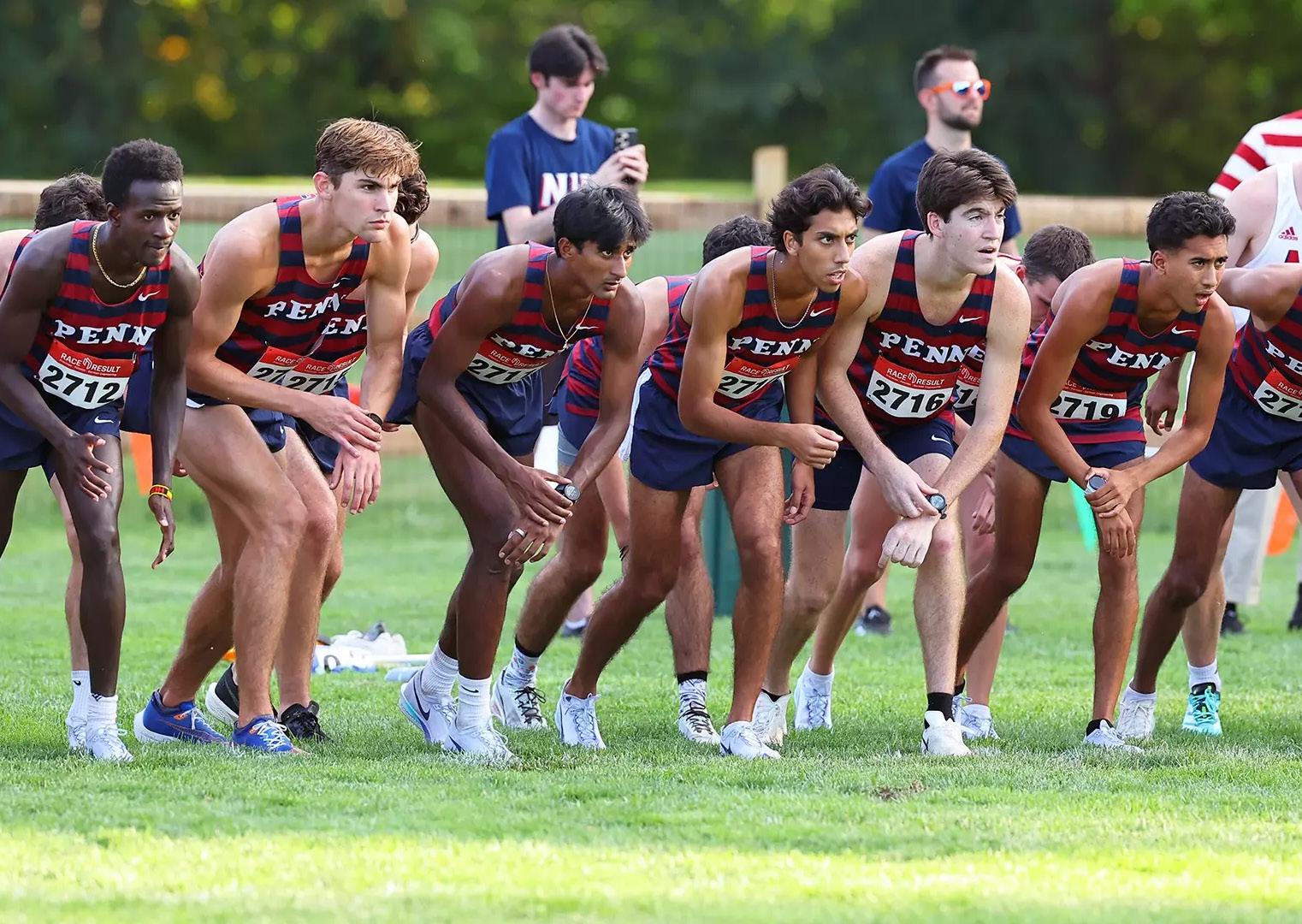
Men’s cross country pictured preparing to race.
time of 18:35.8, who placed seventh and 13th, respectively.
“[The] team has been training really hard and putting a lot of effort into racing execution going into the meet,” Murphy wrote. “Many of my teammates had great races at our previous meet in Princeton but had things they wanted to work on in terms of race execution. A big goal for our team was to focus on being our best through the second half of the race and moving up in placement over the last mile.”
The Quakers hope to extend this success in their
been strong against the Mountain Hawks, with a 22-13 record against them since 1929.
next competition at the Paul Short Run on Oct. 3.
“It’s definitely a huge stage, which is an exciting opportunity to compete against some of the best teams in the NCAA,” Murphy wrote. “I was unfortunately injured the last time I raced Paul Short, so I personally am working on keeping a confident mindset going into the race, and I’m super excited to get a race in such a competitive field.”
She added that “the team overall couldn’t be more pumped about the race as well as the opportunity to compete against few other teams in the Ivy League ahead of Heps and really allow the work we’ve been putting in to shine on the big stage.” Dodda echoed the same sentiments, emphasizing the importance of the Paul Short competition.
PREVIEW, from back page PICKS, from back page
Mountain Hawks will fly high no longer.
Penn 28, Lehigh 21 — Sonal Sukhatme, DP Sports associate Coming into the match, both teams have a winning record, with Penn posting a close 24-21 victory against Stonehill last week and Lehigh putting up a 4-0 record in their preseason. Despite Lehigh being nationally ranked this year, Penn has always historically
It’s been a while since the teams have been face-toface, but their most recent meeting reflects very well on Penn. The Quakers won 20-0 in 2021.
While I think the Quakers will be victorious, I doubt it’ll be a blowout. Lehigh has put up some impressive scores in its previous matchups, including last week’s 41-24 win against Bucknell. The Mountain Hawks have an aggressive rushing offense, averaging 234.5 yards per game, so the Quakers’ secondary will have to be prepared for that.
quarterback Liam O’Brien told The Daily Pennsylvanian. “But at the same time, we had a lot of mistakes and a lot of execution errors that we want to get cleaned up.”
“Paul Short is the first big race that we’ll be a part of, and a lot of other Ivy League teams are going to be there. So it’ll be good to see how we stack up against the rest of the conference,” he wrote. “We’re going into that race with the same mentality we’ve had, focusing on running as a pack and working together through the middle miles and staying tough [in] the last part of the race.”
Mountain Hawks are undefeated in their four games since the start of the season, scoring an average of 31.25 points per game and holding their opponents to a mere 17.25.
After beating Bucknell in a 41-24 win last week, the Mountain Hawks are poised to take on Penn on their own turf. With a dominant running game averaging 234.5 yards per game on nearly six yards per attempt and an accurate passing game going for 166.75 yards per game, Lehigh’s offense has dominated opponents all season long.
pictured preparing to take the field on Sept. 20.
have time to think. You just go out there and execute.”
The Red and Blue have the focus and strength to pull through this weekend, but a win is certainly not a given. WALTERS, from back page
TV and be like, ‘That looks super fun.’”
“I started learning how to [kick] when I was nine, [but] I didn’t start playing football until high school,” Walters added. “Everyone I talked to said to keep playing soccer, keep developing athleticism, play a sport that uses your feet. [Once] I got to high school, I started really honing in on [kicking] more.”
A three-sport star at Valor Christian High School, Walters also played soccer and volleyball while rewriting the football program’s record book. He holds the records for the two longest field goals in Eagles history, 55 and 51 yards, and made his first foray into clutch kicking along the way.
During Walters’ sophomore year, Valor Christian faced a three-score deficit in the fourth quarter of its homecoming clash with rival Ralston Valley. Then, after the Eagles scored on consecutive drives to bring the score within a touchdown, it was time for an unknown kickoff specialist to seal the deal.
For the first in-game onside kick of his career, Walters did not hesitate, delivering a pinpoint boot that was recovered by Valor Christian. The Eagles went on to win 27-23.
“It was another situation where [coaches] said: ‘OK, we need you,’” Walters said. “I just went out there, watched, let one go. … You [don’t] really
Penn sophomore defensive lineman Alex Jordan was on that Valor Christian team and said he and Walters still discuss the kick to this day.
“There’s not a lot of Colorado guys that come out here, and it’s been cool to watch [Walters] grow into the player he is today,” Jordan said. “I was telling all my friends ever since he showed up how good he is, and I’m glad they [all] finally got to see it.”
Walters’ teammates — old and new — have served as valuable resources as he adjusts to both college life and college football. When Walters needed to know what to pack for his dorm, he asked Jordan. When he wasn’t sure what to bring for his first away game, he asked Smith.
“I would have looked like a lost puppy, but because of [the kicking room], I don’t feel like one as much,” Walters said. “Before the game — it’s my first time traveling — I’m [asking] the group chat, ‘Where am I supposed to be? When am I supposed to be there?’”
Priore has long employed a two-kick approach: one for short-range field goals and one for longer attempts. He and Ulrich said the plan for the position will change week to week, so there’s no telling when Walters will get his next call.
But if you ask the freshman, Saturday was only the beginning.
“I just got here. There’s still work to do. I’m here for the next four years, so [I] can’t focus on what happened this week.”
In last week’s win against Stonehill, costly penalties, blown coverages, and a fourth-quarter interception allowed the Skyhawks to stay in the game up through the final minutes after being down 21-7 at the end of the first half. A game-winning field goal kick in the final seconds from freshman kicker Mason Walters allowed Penn to come away with a win, but just barely.
Last week, O’Brien went just 16 for 31 in passes, good for a 51.6% completion rate. What O’Brien didn’t get in the air, however, he made up for on the ground. Last week, he ran for 38 yards on nine carries, netting two crucial first downs to get the Quakers in field goal range.
“Whatever the play call is, I’m just trying to do my job, make my reads correctly, and get the ball to the right guy, whether that be myself or someone else,” O’Brien said of his scrambles. “And so, on the last drive, my number got called a couple [of] times. [I was] just trying to make a play on the ground with my feet.”
O’Brien’s rushing threat is especially important given the departure of star running back Malachi Hosley — the 2024 Ivy League Offensive Player of the Year — at the end of last season to Georgia Tech and a youth-heavy, revamped running room.
To beat Lehigh, both the Quakers offense and defense will have to execute at a high level. The
Last week against Bucknell, the Mountain Hawks’ game featured a one-two punch of offense on the ground and in the air — with Lehigh running backs Luke Yoder and Jaden Green combining for 301 rushing yards and four total touchdowns, while Lehigh quarterback Hayden Johnson tossed two touchdown passes and completed 16-of-20 pass attempts.
To win, the Quakers will have to avoid turnovers and take advantage of Lehigh’s defense, which is stronger against running than it is against passing. Opportunities will likely be abundant for senior wideouts Jared Richardson and Bisi Owens. Richardson notably had an explosive 69-yard catch and run on Penn’s opening drive last week, and both Richardson and Owens have quickly turned into O’Brien’s favorite targets.
O’Brien is up for the challenge.
“They got great players, very physical, but you know, we have great players too,” he said. “We got physical players, too. And I really think it’s going to come down to who wants it more, who’s willing to put their body on the line, who’s willing to do whatever it takes to get the win.” The Quakers are set to take on the Mountain Hawks at Goodman Stadium at 12 p.m. on Saturday.
Smith | Football’s win over Stonehill was not
pretty — that’s OK for now
Penn picked up a sloppy win in its season opener. Still, fans have to hope the Quakers were just shaking off the rust
On Saturday, Penn football eked out a 24-21 win on the road at Stonehill (1-3). Like something out of a cliche sports flick, a first year was called off the bench to kick the game-winner.
Freshman kicker Mason Walters did just that as he drilled a 45-yarder with only nine seconds remaining in the game, lifting Penn (1-0) over Stonehill. The game winner was Walters’ first collegiate field goal attempt — Hollywood should be calling any day now.
some miraculous catches on multiple high balls. Owens, who finished with six receptions good for 79 yards, couldn’t corral them all, though. On a jump ball to Owens in the end zone, O’Brien threw a costly interception on a would-be touchdown pass that could have iced the game late in the fourth quarter. There was visible frustration on Penn’s sideline — which had lost all of its early momentum.
But O’Brien still got it done. On the final drive, Chimera called for his quarterback to run the ball himself on a multitude of draw plays. O’Brien showed incredible patience on these keepers, finding space behind one of the best offensive lines in the Football Championship Subdivision. In seven plays and just over one-and-a-half minutes, O’Brien got the Quakers into field goal range.
Walters, deservingly, got his flowers postgame. However, Penn wouldn’t have won if O’Brien did not show great composure. The senior signal caller was having a subpar game by the high standard he set for himself last year, before physically willing his team to a win.
Penn’s season-opening loss to Delaware last season resembled Saturday besides the final outcome. Down by seven points with just under two minutes remaining, then-senior quarterback Aidan Sayin looked to shock the FBS-bound Blue Hens. Instead, Sayin overthrew an outlet pass to the running back, resulting in a drop and an ensuing game-sealing interception. This trend continued into 2024, as the Quakers were down 0-5 in single-possession games. Simply put, last year’s team would not have responded in the way this year’s did on Saturday. This is a great sign, but Penn cannot be expected to continue pulling out sloppy wins. It is not sustainable — especially with Ivy play starting in two weeks.
Fans have to hope that Penn’s poor play can be attributed to the team shaking off rust after a long offseason. This is the simplest explanation, especially given that Saturday marked Stonehill’s fourth game of the season. After the game, players reacted differently to this assumption.
“With starting late, the first game of the season comes with some jitters,” senior defensive lineman Carter Janki, who recorded two sacks on Saturday, said. “There’s always a lot of mistakes to be made. The biggest improvements come between game one and game two.”
With Penn holding a 21-7 lead at halftime, fans packed into Stonehill’s stands didn’t expect such lategame dramatics.
Mistake after mistake by Penn allowed the Skyhawks to soar back into the contest. Penn’s secondary, which lost key members in the offseason, fell apart in the fourth quarter. Costly penalties and blown coverages allowed Stonehill’s offense to score two touchdowns in the final 15 minutes of the game. Meanwhile, Penn’s offense was not showing much
life either. After explosive plays carried the Quakers in the first half, the unit stalled after the break. Before its final possession, Penn’s second-half drives ended like this: punt, punt, punt, interception, punt — not exactly what offensive coordinator Greg Chimera envisioned after the quick start.
Senior quarterback Liam O’Brien struggled with accuracy throughout the game, completing just 51.6% of his passes. This percentage would have been even lower if senior wide receiver Bisi Owens had not made
Senior running back Julien Stokes, who ran 63 yards for a punt return to score Penn’s second touchdown, held a different point of view.
“[Stonehill] hasn’t seen us on film in 2025, but we watched three of their games, so I think [that is why] we started pretty fast,” he said.
Either way, the Quakers will need to clean up some of their errors going up to Lehigh this weekend. Especially, as Stokes noted, the Mountain Hawks now have film on Penn to study.
Men’s soccer triumphs over Villanova in final matchup before Ivy play
Sophomore forward Romeo Dahlen scored two goals against the Wildcats
JUSTIN LEE AND AVERY BROBBEY Sports Editor and Sports Associate
The win hits a little sweeter when it’s close to home.
In a rivalry between schools under 20 miles apart, Penn men’s soccer triumphed over Villanova in a 3-0 victory on Sept. 23. The Quakers’ (3-2-2) victory came at the heels of a 2-2 tie against the Wildcats (2-3-3) just one year prior, and after a series of losses dating back to 2011.
The Wildcats saw the evening as an opportunity for redemption following two ties and two losses in their previous matches. Under goalkeeper Sebastian Cutler DeJesus, the Wildcats held strong with 10 total saves across the game. But for the Quakers, this match represented a final tune-up before Ivy League play begins on Sept. 28 at Columbia. It was a chance to showcase a steadfast offense that saw 13 shots on goal across the night, nearly triple Villanova’s five. A cornerstone of that offense was sophomore forward Romeo Dahlen, who scored two goals — hitting four goals total in the season thus far.
“It’s great to get off to that start. … An emotional game [with] a local team that you’re playing against, and obviously getting on top … it gives you a little bit more confidence as you go,” coach Brian Gill said.
From the opening whistle, the Quakers started with an explosive offense. In just 52 seconds, senior midfielder Patrick Cayelli capitalized on a free kick, and senior defender Oliver Pratt notched the first goal of the night. That goal set the rhythm of the game — Villanova was unable to keep up with the Quaker offense.
“It’s a great way to start the game — [getting] momentum right away. Being up a goal super early just gives us confidence the rest of the game,” Pratt said.
A big part of Penn’s offensive capability stemmed from its experience compared to Villanova’s starting team consisting mainly of underclassmen. That experience showed through when a string of blocked shots by the offense culminated in a goal made by Dahlen halfway through the first half.
But with 14 minutes left in the first half, a foul committed by former Penn and now-Villanova midfielder Michael teDuits left junior midfielder Jack-Ryan Jeremiah injured. Jeremiah, who earned first team All-Ivy
honors last season with a career-high 12 points, gripped his ankle while he was helped off the field. Despite being down a key player on the offense, the Quakers still prevailed, heading into halftime with a 2-0 lead.
“He just took a knock, and we’ll see as it goes to the rest of the week. I think he knows how to handle himself and to get himself back on his feet,” Gill said of Jeremiah’s injury.
The second half opened with Penn mounting pressure, but at the cost of three fouls against the Wildcats after just five minutes. The game’s pace soon died down as both teams entered a defensive standstill. While Villanova nearly found its first goal 13 minutes into the half, two successive saves by senior goalkeeper Phillip Falcon III kept the Quakers in the lead. This was Falcon’s second start this season, as he has largely sat out of non-conference play. The Wildcats were unable to make any other shots on goal for the rest of the evening.
Villanova’s defense also held strong, with Cutler DeJesus making three saves in the second half. But the Quakers drove the nail in the coffin for the Wildcats with another goal by Dahlen with eight minutes remaining in the second half. Dahlen took to the field in a substitution just four minutes prior.
“It feels great, obviously, being trusted with the opportunity. Both my coaches and my teammates trust me a lot, so it means a lot to me to be able to go in and do a job I know I can perform and [to] have great guys around me to help,” Dahlen said.
Penn will face Columbia on the road on Sunday afternoon for its Ivy League season opener.
“Even with a 3-0 win, there [are] definitely things we can look at [and] can improve on. The second half wasn’t our best,” Pratt said. “It definitely gives us a lot of confidence that winning a game 3-0, we still have a lot to improve on, and a lot of things to get better with before we start Ivy play.”
Sports reporters Ben Brown, Ellie Clark, Angel Gallardo Aguilar, Sean Gawronski, Noah Jeong, Eva Li, Aubrie Mascaro, Vir Mahadevia, Cavance Snaith, Angel Shi, Aoife Shovlin, Javier St. Remy, and Nathan Wang contributed reporting.
CONOR SMITH
Deputy Sports Editor
WEINING DING | MULTIMEDIA EDITOR
Deputy sports editor Conor Smith analyzes the Quakers’ game at Stonehill on Sept. 20.
JESSICA HUANG | STAFF PHOTOGRAPHER
Penn men’s soccer played Villanova on Sept. 23.
Football freshman Mason Walters
hasn’t taken his first exam yet. He’s already kicked a
game-winner
Walters’ frst collegiate feld goal attempt lifted Penn over Stonehill in the Quakers’ season opener
CONOR SMITH AND WALKER CARNATHAN Deputy Sports Editor and Former Sports Editor
unproven freshman with the big leg.
Last Monday, Penn football freshman kicker Mason Walters did not know if he was making the trip to Stonehill for the team’s season opener. This Monday, he was named Ivy League Rookie of the Week.
After surrendering a 14-point lead on Saturday, Penn found itself in a 21-21 tie late in the fourth quarter. The Quakers drove into the Skyhawks’ territory before stalling out at the 28-yard line, forcing Penn coach Ray Priore to make a decision: Stick with senior kicker Sam Smith or turn to the
Priore consulted with special teams coordinator Rick Ulrich. “Let’s go with Walters,” they agreed. They called him over.
“You gonna hit this?” Ulrich asked.
“Yes,” Walters said.
“OK, let’s go do it.”
Walters set up for a 45-yard kick from the left hash mark. The ball was snapped and placed. The freshman took one step, took another, cocked his right leg, and followed through. As the referees
The picks are in for Penn football at Lehigh
The Quakers are heading up to Lehigh for a Keystone State matchup THE DAILY PENNSYLVANIAN SPORTS DEPARTMENT
Lehigh 35, Penn 24 — Valeri Guevarra, DP Sports editor
I’ll keep it short and sweet. There’s no room for the same mistakes Penn football made in its season opener when it’s playing in this weekend’s matchup at the undefeated Mountain Hawks — the Quakers’ first nationally ranked non-conference opponent since 2019. At Stonehill, the Quakers’ secondary was exposed in the second half, committing penalties and blowing coverages. This weekend, the Red and Blue’s defense needs to stay intact during the entire 60 minutes of play to keep Lehigh’s offense at bay — especially Lehigh running backs Luke Yoder and Jaden Green, who rushed 301 yards for four touchdowns as a duo in their last game against Bucknell. With the first matchup of the season under his belt, senior quarterback Liam O’Brien has to start to resemble his passing form from the beginning of last year to lead the Quakers to a win. Against the Skyhawks last Saturday, O’Brien struggled with his throws, only completing 51.6% of them. Meanwhile in 2024, in three of his four starts, O’Brien had a 72.2% or greater passing percentage.
While I’m optimistic for the rest of the season as a whole, I don’t think one week is enough to clean up these mistakes to prevail over the undefeated Mountain Hawks.
Lehigh 28, Penn 17 — Tyler Ringhofer, deputy DP
Sports editor
After opening the season with a dramatic win on a game-winning field goal by freshman kicker Mason Walters against Stonehill, the Quakers now turn their attention to a much tougher challenge: a road matchup at Lehigh. In its second of three non-conference games, the Red and Blue will face a Mountain Hawks squad predicted to finish first in the Patriot League and coming off an FCS playoff victory. The margin for error will be far slimmer this week, meaning that Penn must find consistency on both sides of the ball for all four quarters of the game — something that eluded it in
the second half at Stonehill.
For Penn to have a chance, the offense cannot fizzle out the way it did in the second half last week, or else the Quakers won’t be able to keep up with Lehigh’s high-powered attack. The Mountain Hawks have opened the season undefeated through four games, relying on a balanced rushing attack that featured four different players reaching the end zone on the ground in a win over Sacred Heart. That depth has translated into firepower on the scoreboard as well, with Lehigh putting up 35 points against Duquesne and 41 against Bucknell in consecutive weeks.
Although it’s still early in the season, this game serves as a valuable barometer for where the Quakers stand heading into Ivy League play.
Penn 35, Lehigh 17 — Avery Brobbey, DP Sports associate
History has its eyes on Penn football. Or, more specifically, the history of Lehigh and Penn’s matchups does.
Penn football has already started the season off on a high note after its win against Stonehill last week, and there is no doubt in my mind that Penn’s record will be 2-0 by the end of this Saturday’s away game, especially considering Penn’s past contests against the Mountain Hawks. In the 35 matchups between these teams since 1929, the Quakers have lost only 13 times, having gone on a five-game losing streak in the 1990s.
In fact, in Lehigh and Penn’s most recent game in 2021, Penn defeated the Mountain Hawks 20-0, and this victory marked the Quakers’ first win at Franklin Field in 700 days. Obviously, Penn has the proclivity to beat this team.
However, the odds are stacked against the Quakers this time. Lehigh is coming off of a four-game win streak, and in the history of this matchup, the Quakers have only won three times at Lehigh’s stadium, which is where they will play this season.
Nevertheless, Penn will pull through, and the See PICKS, page 9
signaled the kick was good, Walters was already being mobbed by his teammates.
“He didn’t have much time to think; [he] went out there and just stroked it,” Priore said. “He hit that like a driver right down the fairway.”
The Ivy League bars freshmen from participating in summer workouts, so Walters arrived on campus just over five weeks ago. In more ways than one, he’s still getting used to life at Penn.
“My first midterm is next week. I’m preparing. I’m actually gonna start studying for that
tonight,” Walters said with a smile after practice on Tuesday. “It’s funny that I played my first game before my first test. You hit the ground running [at Penn].” Before Walters was hitting big-time kicks for the Quakers, he was doing the same at an even higher level — the fields of elevated altitude in his hometown of Littleton, Colo.
“I was always interested in it,” Walters said of kicking. “When I was six, I’d watch football on See WALTERS, page 9
Football prepares to battle undefeated Lehigh
The Mountain Hawks are currently 4-0 for the frst time since 2016
ISHA CHITIRALA Sports Reporter
WEINING DING |
Penn’s offensive line pictured before a play at Stonehill on Sept. 20.
After a scrappy win in its season opener, Penn football is preparing to take on the undefeated Lehigh this Saturday. The Quakers (1-0) have plenty to build on from last week’s win, but they are focused on playing mistake-free football as they prepare to take on the
Mountain Hawks (4-0) — their first nationally ranked non-conference opponent since 2019.
“[We] walked away … with a win, which is very positive and feeds into the energy for this week,” senior