Penn experts link political violence to misinformation, polarization after Charlie Kirk assassination
In today’s political environment, Penn experts argued, isolated acts of violence can reverberate far beyond those directly involved — and foster distrust in public institutions while deepening polarization
Following the assassination of conservative activist Charlie Kirk, Penn experts spoke to The Daily Pennsylvanian about the role of political violence in American life — both past and present — warning that misinformation and polarization are exacerbating the problem.
RIANA MAHTANI Senior Reporter
Penn faculty members universally agreed that political violence has long been part of United States history, from clashes on the congressional floor in the mid-1800s to the racialized politics of the Jim Crow era. But professors told the DP that what distinguishes the current period is how
Wharton launches Master of Science degree in quantitative finance funded by historic donation
Bruce Jacobs’ gift — the largest single contribution in school history — will support the new Dr. Bruce I. Jacobs Master of Science in Quantitative Finance program
JACK GUERIN Senior Reporter
The Wharton School launched its first new degree in 50 years after receiving a $60 million gift from Bruce Jacobs, a 1979 School of Arts and Sciences graduate, 1986 Wharton Ph.D. graduate, and former Wharton faculty member.
Jacobs’ gift — the largest single contribution in school history — will support the new Dr. Bruce I. Jacobs Master of Science in Quantitative Finance program. The program is open to Penn undergraduates, and its inaugural cohort will begin their studies in fall 2026.
“Wharton is the world’s top business school because it consistently leads at the forefront of
CHENYAO LIU | SENIOR PHOTOGRAPHER
Wharton announced the launch of its new Master of Science in quantitative finance program on Sept. 15.
fields like quantitative finance,” Penn President Larry Jameson said in a press release announcing the gift. “Dr. Jacobs has long been a champion for Wharton’s preeminence in this essential area, and we are deeply grateful for his historic gift.”
In a statement to The Daily Pennsylvanian, Jacobs stated that he was motivated to create the program to support “the next generation of leaders in the asset management industry.” He emphasized that the program would offer students a strong foundation in financial economics while also providing technical skills in areas like machine learning and artificial intelligence.
The donation follows a 2023 email from Jacobs to the DP discussing his concerns with “antisemitic incidences” at Penn. In the email, Jacobs wrote that his future donations to the University “would be dependent upon the administration ensuring a safe, inclusive, and respectful academic environment for its students.”
The donation brings Jacobs’ total contribution to Wharton to over $80 million.
He previously donated $12 million to create the Jacobs Levy Equity Management Center and another $8 million to support a quantitative finance MBA major at Wharton. The 2025 donation surpasses 1984 Wharton graduate Marc Rowan’s $50 million gift in 2018, which was previously the largest gift Wharton had ever received.
In an interview with the DP, Wharton Dean Erika James emphasized that the new program was “a perfect representation of [Wharton’s] innovation in both what and how we teach.”
“We’re very interested in trying to keep our pulse on where the needs are in the economic landscape,” James said. “And right now, quantitative finance and quantitative asset management are growing fields, and we want to be the supplier of choice for those going into that domain.”
James added that the program will also allow students across Penn to access Wharton’s resources.
“One of the things that I’ve recognized during my time is there’s great desire by Penn students to
the rapid spread of information intensifies public reactions and exacerbates partisan divides.
In today’s political environment, faculty members argued, isolated acts of violence can reverberate far beyond those directly involved — and foster distrust in public institutions while
deepening polarization.
Political Science professor and Director of the Andrea Mitchell Center for the Study of Democracy Jeffrey Green emphasized that the current moment cannot be understood without
See VIOLENCE, page 2
Penn students say new club funding model has caused ‘immeasurable stress’ for campus organizations
The changes follow nearly two years of collaboration between student leaders and administrators in the Offce of Student Affairs
TANISHA AGRAWAL
Staff Reporter
Penn’s Office of Student Affairs has introduced new policies for student group registration and funding in a move it says makes the process more efficient and equitable.
The changes follow nearly two years of collaboration between student leaders and administrators, according to Katie Bonner, the executive director of OSA. In an interview with The Daily Pennsylvanian, Bonner said that the updates were made in response to longstanding frustration among students with regard to the distribution of funding.
“The primary motivation for the change was from student feedback over many, many years, about a frustration with a funding system at large that felt like it didn’t equally serve all student organizations,” Bonner said. “We kept adding things on … but maybe it was time to just really rethink how we were doing this.”
According to Bonner, student organizations must first register with OSA to be eligible to apply for funding through the Student Activities Council. Those approved by OSA will receive budget codes to manage all financial transitions.
In a written statement to the DP, Penn Outdoors Club board members noted that the new funding rules have left them unable to plan major trips and events, with their budget cut to a fraction of past levels.
UPOC wrote that new contingency requirements and “lack of communication and transparency” have caused event delays, including the cancelation of its annual Labor Day trip and various general body meetings. It added that the sudden transition has created stress and uncertainty for the club as it prepares for the semester.
“SAC’s new funding structure has directly impeded our ability to hold GBMs, host trips, and plan other events that are core to UPOC’s mission,” UPOC wrote. “When we disputed the budget cuts at last semester’s SAC GBM, we were informed we would no longer receive our full budget because the board didn’t trust us to run trips independently.”
OSA has also eliminated the “SAC-recognized” status, meaning that clubs now only need to register with OSA to receive funding. The organization
will take over funds previously managed by Penn’s Social Planning and Events Committee, the Intercultural Fund, and Undergraduate Assembly contingency funds.
Funding decisions will be made using a rubric that evaluates how activities align with organizational missions and the appropriate use of University funds. The overhaul comes as the UA approved a budget of more than $3 million for student organizations in 2025-26, a 2% increase from last year.
SAC received $1.03 million from the budget — about 12% more than it requested — and took on funds previously allocated to the SPEC “fully planned” fund and the UA contingency fund, in line with the new consolidated funding model.
Marissa Prager, the Penn Glee Club’s finance manager, wrote in a statement to the DP that the organization relies heavily on SAC support to cover the costs of running a 70-member group, often needing contingency funds beyond its annual award.
Prager added that while the Glee Club received more than $14,000 in total support last year, its award this year was cut to less than half that amount.
“I’m anxious to see how much of our contingency request will be approved, especially since the new model essentially shifts everything to contingency funding rather than a full-year award,” Prager wrote. “That said, I do appreciate the shift toward a rubric-based process, even though the transition was messy at first. The new system feels more transparent and hopefully will lead to a more equitable approach to funding student organizations.”
The first round of funding applications is in progress, with results expected on Sept. 18. Bonner acknowledged that the transition has not been without its challenges.
“Even though we felt like we had planned and prepared for these changes, it is [a] large-scale change for hundreds of organizations,” she said. “We did go into this fully anticipating that there
INSIA HAQUE | DESIGN EDITOR
Penn Carey Law unveils new fellowship program, scholarship honoring Sadie Alexander
In August, the University of Pennsylvania Carey Law School suspended a full-tuition scholarship program honoring Alexander, drawing criticism from local politicians and Penn community members
CHRISTINE OH Staff Reporter
Penn
The University of Pennsylvania Carey Law School has announced a new postgraduate fellowship in honor of civil rights activist Sadie Alexander — the school’s first Black female graduate — following controversy surrounding the suspension of a previous program in her honor.
The Dr. Sadie T.M. Alexander Fellowship, set to launch during in fall 2026, will provide two years of funding to Penn Carey Law graduates pursuing work that advances civil rights. According to the Sept. 12 announcement, the program will give special consideration to projects that address racial and economic justice and benefit communities in Philadelphia or Washington — reflecting Alexander’s “pioneering work” and “deep ties to both cities.”
The new measures follow mounting criticism in response to Penn Carey Law’s rollback of diversity initiatives. In August, the law school suspended a full-tuition scholarship program honoring Alexander, drawing criticism from local politicians, along with Penn students, faculty, and alumni.
“The University of Pennsylvania Carey Law School is strengthening its commitment to access, both to its innovative and interdisciplinary legal education and, for its graduates, to impactful careers of their choosing,” the announcement read.
The fellowship will be offered alongside a full-tuition scholarship initiative for incoming students in greatest need of financial support.
“Together, [the fellowship and scholarship] affirm Penn Carey Law’s dedication to reducing barriers to entry and ensuring that students— regardless of financial circumstances—can embark on their legal education and carry it forward into their choice of meaningful careers,” the announcement continued.
Philadelphia City Councilmember Jamie
Gauthier — whose district includes Penn — previously criticized Penn’s suspension of the scholarship and acknowledged her “hope” for the new program in a written statement to The Daily Pennsylvanian.
“I’m glad Penn Law listened to our feedback, as well as that of its Black alumni, in restoring some initiatives that make the school more welcoming and inclusive,” Gauthier wrote. “I hope this is the start of a larger, university-wide recommitment to diversity.”
In an Aug. 7 statement on LinkedIn, Gauthier described Penn’s decision to cut the scholarship as a “cowardly, short-sighted move [that] is as disappointing as it is immoral.”
“Dr. Alexander’s work had far-reaching impact in public and private life,” Gauthier wrote. “Penn’s decision will too — but in a way that closes doors and rolls back opportunities for Black and Brown students.”
Gauthier added that “we deserve better from Penn.”
Around the same time, Penn Carey Law also shut down its Office of Equal Opportunity and Engagement, marking the latest closure contributing to a widespread removal of diversity, equity, and inclusion initiatives across the University.
Despite Gauthier’s grievances, Penn Carey Law Dean Sophia Lee emphasized that the school has remained committed “to ensuring access and opportunity for all” in a statement regarding the closure.
Alexander, who earned both a Ph.D. in economics and a law degree at Penn, was one of the first Black women in the United States to become a practicing lawyer, dedicating her life to racial and economic justice. By providing funding for projects in these areas, the fellowship is meant to continue her legacy.
Med partners with American Univ. in Dubai to launch ‘first-of-its-
kind’ medical school in UAE
The AUD-Penn Med alliance will offer an MD program incorporating American medical education practices in the United Arab Emirates, with a focus on health care priorities
SAMEEKSHA PANDA Staff Reporter
Penn Medicine announced a partnership with American University in Dubai to establish a school of medicine in the United Arab Emirates on Tuesday.
AUD launched its alliance with Penn Med to offer an MD program incorporating United States medical education practices in the United Arab Emirates, with a focus on health care priorities. The program aims to establish a hub in Dubai for medical education, research, and innovation, according to AUD President Kyle Long.
“Today marks a historic moment with the project launch of the first-of-its-kind American medical school in the UAE,” Long said at a ceremonial partnership signing on Sept. 16. “This alliance supports the nation’s ambition to become a global leader in health care … while creating a lasting impact on communities across the region.”
Also in attendance at the ceremony were Penn President Larry Jameson; Glen Gaulton, the vice dean and director of the Center for Global Health at Penn Med; Elias Saab, AUD’s executive vice president; and various government dignitaries, industry partners, and medical and academic leaders.
Jameson emphasized the benefits of the partnership, noting that the establishment of the medical school would elevate AUD’s global ranking and Penn’s reputation — and “enrich” the future of health care and education.
“May this partnership stand as a lasting symbol of our dedication to building bridges, advancing knowledge, and creating new pathways for human flourishing,” Jameson said.
WHARTON
, from front page
have access and exposure to some Wharton content,” James said. “And the way we’ve structured this degree, at least initially, will allow Penn students who are not undergraduates within Wharton
VIOLENCE, from front page
remembering how frequently violence has marked U.S. politics in the past.
“We’ve lived through many periods of political violence, and it’s not obvious to me that ours is, from a quantity standpoint, significantly worse,” Green said.
He noted that what stands out today is that attacks appear “less obviously connected” to policy or constitutional issues and more so based on “grievance or rage — or in some cases, conspiratorial thinking.” Over the past few years, the country has experienced several bouts of political violence. Two assassination attempts were made on 1968 Wharton graduate and President Donald Trump last year — one in July 2024 and another in September 2024. In June of this year, former Minnesota state House Speaker Melissa Hortman (D-Hennepin, Anoka) was killed alongside her husband in a politically motivated assassination. Two months later, a man fired hundreds of rounds of ammunition at the Centers for Disease Control and Prevention headquarters, killing one police officer.
Other professors also pointed to the way political anger spreads in the digital era. Annenberg School for Communication lecturer Murali Balaji said that while Americans today are not facing the same level of violence as during the 1960s, highprofile attacks receive far more coverage than in previous decades.
“Political violence is more heavily scrutinized and broadcasted across multiple mediums, unlike
In a statement to The National, Gaulton stressed the importance of increasing the number of trained doctors in the United Arab Emirates, given the nation’s rising population and current reliance on overseas medicine.
“Hopefully then [students] would stay for the residency [programs] and hopefully stay longer term to build their whole lives and careers here,” Gaulton told The National. “That breeds a continuance of excellence [and will have a] dramatic effect on improving health care.”
He noted the alliance was just one of Penn Med’s various global initiatives, of which over 60% focus on enhancing medical education to strengthen health systems.
In 2018, Penn Med entered an alliance with Vingroup to create undergraduate and graduate medical training programs in Vietnam, similar to the AUDPenn Med alliance announced on Tuesday.
Gaulton described the alliance as a continuation of this work, aiming to develop a medical school that would incorporate many of the “distinctive” programs established at Penn. This includes its use of new medical developments in artificial intelligence and virtual reality, which he noted could rapidly revolutionize medical practice in the United Arab Emirates within a decade.
The school will bring “Penn’s legacy of excellence” to Dubai and help AUD “become a regional leader in healthcare innovation.”
“Working with Penn is humbling and inspiring. … We wouldn’t be doing this if we didn’t think it was going to have a transformational impact,” Long said.
to be exposed to and get a degree from the school.”
The program will initially be open to Penn students in all four undergraduate schools who have completed the necessary prerequisite courses.
Students would then stay for an additional fifth year at Penn to complete the program, engaging in a curriculum that includes a range of foundational quantitative finance courses, required core courses, and electives.
previous decades when social media did not amplify these sorts of acts,” Balaji said. “I think this speaks to an era in which there are a lot of people who are angry. This anger is not necessarily politically motivated, but the anger manifests itself in our political sphere.”
While these media dynamics may make the problem feel more widespread, research suggests that only a small minority of Americans actually endorse violence. According to the Polarization Research Lab — directed in part by Political Science associate professor Yphtach Lelkes — at most 1-2% of Americans support the use of deadly violence, a figure that has remained consistent across party lines.
Yet the rarity of violent attitudes does not mean the threat is negligible. Balaji and Lelkes both warned that algorithm-driven media consumption is fueling radicalization and social isolation among young people.
“Algorithms amplify extremist voices and turn opponents into caricatures, creating a dangerous illusion that fringe ideologies are mainstream,” Lelkes wrote in a statement to the DP. “This illusion can convince isolated individuals that their radical views are normative and that violence is a celebrated, necessary tool against a perceived enemy.”
A recent study published in the Proceedings of the National Academy of Sciences further found that much of the danger comes not from mass endorsement of violence, but from exaggerated perceptions. Partisan actors often believe that members of the opposing party are more supportive of violence than they actually are, and correcting those misperceptions can significantly reduce willingness to engage in violence.
Political Science professor Matthew Levendusky highlighted this distinction in a statement to the DP.
“The Jacobs MSQF is designed for quantitatively minded students who want to apply their skills in finance,” Wharton professor and MSQF faculty director David Musto wrote in a statement to the DP.
“We’re looking for students who are majoring in quantitatively demanding fields and enjoy that kind of work, and who are intrigued by the challenges encountered in the financial industry.”
Musto added that MSQF would include several
“The danger is not so much mass support for violence, it is radicalization of a few individuals. The onus of stopping this does not lie with ordinary Americans, nearly all of whom find violence abhorrent,” Levendusky wrote. “Instead, it lies with political elites, who fan the flames of hatred and intolerance in pursuit of their own selfish aims.”
Still, the perception of widespread approval for violence can create its own risks. Political Science professor Marc Meredith pointed to online discourse following Kirk’s death as an example.
“Anyone looking at social media in the wake of the Charlie Kirk assassination was likely to observe a small number, but also non-trivial number, of people posting justifications of political violence,” Meredith told the DP. “While only a tiny slice of Americans hold these horrific views, effectively polarized people who see these postings may attribute them to the entire group of partisan opponents.”
Political Science professor Jane Esberg connected the present moment to broader questions of democratic stability. She pointed to the assassination of Horton and her husband in June as an example of how partisan hostility can erupt into violence.
“Democracy works when both sides can accept the rule of the other as tolerable,” Esberg said, adding that elite rhetoric and the spread of conspiracy theories online have eroded that acceptance.
Esberg’s sentiment was echoed by Political Science professor Roxanne Euben, who emphasized that “dissent and disagreement at its best has always been a feature of American politics.”
“The word politics really ought to describe the capacity to argue and disagree about how we want to live collectively together,” she said in an interview with the DP. “Once someone pulls out a gun
student support resources, including a class manager, internship programs, and work placement programs. According to him, the program would be supported by an advisory board representing a wide range of practitioners and perspectives.
“When I was at the Wharton School, quantitative finance was in its infancy,” Jacobs wrote to the DP. “Now, it is an essential discipline in this data-driven world.”
and says, agree with me, it no longer deserves the word and the name politics. It has become something else.”
The Kirk assassination has also renewed attention on the controversial opinions and decisions Kirk made throughout his career.
Included among them is the “Professor Watchlist,” a database created by Turning Point USA — a conservative nonprofit founded by Kirk — that accuses academics of advancing “leftist propaganda.” A recent Chronicle of Higher Education investigation found that the list, championed by Kirk, “made some professors’ lives a living hell.”
The site currently names 12 Penn professors, along with two from the University of Pennsylvania Carey Law School, citing statements and research initiatives that are viewed as progressive. Critics argue that such lists fuel harassment and threats, blurring the line between ideological disagreement and personal targeting — an occurrence Penn faculty said is especially troubling amid recent political violence. Euben alluded to the list and other actions taken by Kirk in her interview with the DP. “[Free speech] is not what Charlie Kirk stood for,” she said, criticizing those who have characterized him as a “martyr for freedom of speech.”
“He did not want freedom of speech for many, [he believed] that freedom of speech was only a freedom for some people to speak and to speak in a monologue,” Euben added.
“My worry is that this could end up leading us into a feedback cycle in which people believe that they need to respond,” Meredith added. “While I don’t think such a feedback cycle has been what has driven the uptick in political violence in recent years, I do think we are starting to edge dangerously close to it.”
JEAN PARK | DP FILE PHOTO
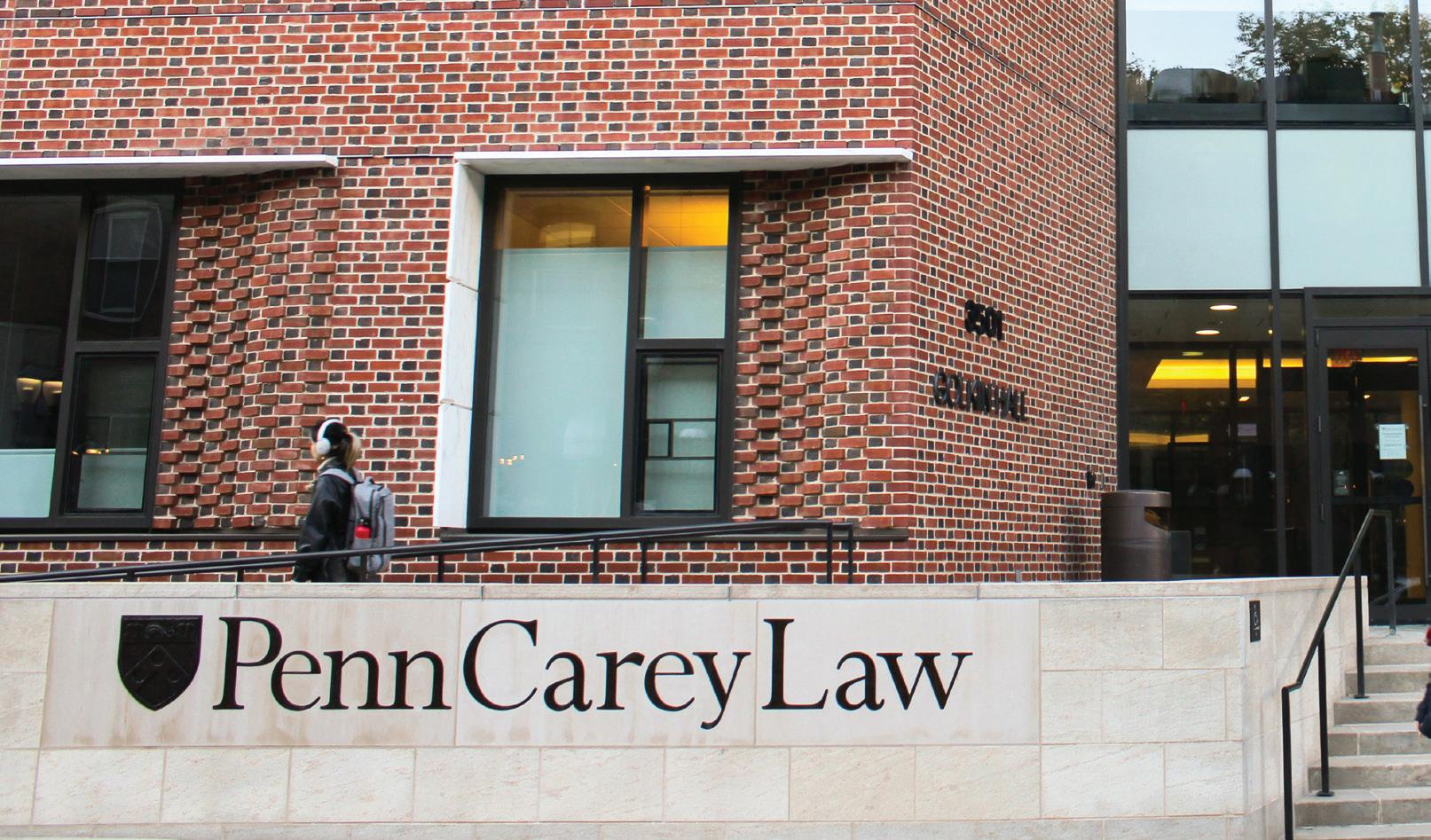
On Sept. 12, Penn Carey Law announced the launch of the postgraduate fellowship program in honor of Alexander for students working on a civil rights project.
CHENYAO LIU | SENIOR PHOTOGRAPHER Penn Med and AUD announced a partnership to establish a school of medicine in the United Arab Emirates.
Marc Rowan writes letter supporting Penn alum Charlie Javice, urges ‘lenient sentence’ in fraud
case
Rowan sent his letter to the judge on Sept. 11, writing that he hoped to ‘offer a more complete picture of who Charlie is as a person’
AYANA CHARI Senior Reporter
Prominent Penn alumnus, 1984 Wharton graduate, and 1985 Wharton School MBA graduate Marc Rowan sent a letter of support to United States District Judge Alvin Hellerstein ahead of 2013 Wharton graduate Charlie Javice’s Sept. 29 fraud sentencing.
In March, Javice was found guilty on all charges of fraud and conspiracy in JPMorgan Chase’s $175 million acquisition of her startup, Frank — and currently faces a possible three-decade prison sentence. As the sentencing date approaches, the defense has filed letters written by individuals close to Javice asking Hellerstein to consider Javice’s “full character” in the court’s final decision.
Rowan — who serves as the chair of the Wharton School’s Board of Advisors — sent his letter to Hellerstein on Sept. 11, writing that he hoped to
SAC, from front page
would be some bumpiness. … But come next year, we won’t all be on such a learning curve.”
The funding rollout has coincided with frustrations from student leaders across the University over the University’s handling of this fall’s Student Activities Fair. In August 2025, several club representatives criticized OSA for its last-minute scheduling and unclear communication, with one leader calling the process “stressful and uncertain.”
At the time, OSA acknowledged the scheduling error and said it extended deadlines after student requests, but many groups said the delays strained recruitment efforts and added to the challenges
filed a letter asking the U.S. district judge
when passing a sentence.
“offer a more complete picture of who Charlie is as a person.”
Rowan declined a request for comment.
“I was impressed by Charlie’s passion, creativity, intelligence and hard-work to develop the educational platform that grew into Frank,” Rowan wrote in the letter. “I became an early investor in Frank (in my personal capacity) and also became a board member. I watched Charlie grow as a young, creative and dedicated entrepreneur.”
In 2018, Javice told The Daily Pennsylvanian that Rowan served as Frank’s lead investor.
In the letter, Rowan highlighted his role as CEO and chair of the board of Apollo Global Management, writing that he invested in Javice because “she was hard working, thoughtful, humble and creative.”
of navigating the new funding and registration system.
Bonner emphasized that while not every group will receive all the money it requests, the goal is to center student voices and create clarity in the process.
“Our hope is that this is a system that works for students,” she said. “And if there are people out there who feel like it is not, we want to know that, because we want it to be effective.”
Despite their frustrations, UPOC wrote that it sees potential in the new system over the long term.
“Overall, we believe that the new system run by a large committee will help make the process fairer and more streamlined in the future but as of now, the dramatic and sudden transition has caused immeasurable stress and uncertainty regarding how our club will manage this semester,” UPOC wrote.
Rowan cited Javice’s activity as a special advisor to the Wharton Social Impact Initiative programs during “college years at the University of Pennsylvania.” He wrote that her “thoughtful commitment to this mission” was one of the reasons he “decided to invest with her.”
He also emphasized Javice’s “resilience, intelligence and dedication to helping people in need,” adding that she has remained a “positive and upbeat person through these challenging past years.”
In March, Rowan testified as a defense witness and expressed similar sentiments.
Javice also mentioned her “resilience” in her own letter to Hellerstein, dated Sept. 12.
“These last five years have been defined by pain and loss—of my company, my career, my reputation, and many friendships,” Javice wrote. “As the
day of my sentencing grows near, I am sustained by hope—hope that has been tested but never broken, and embodied in the words of Golda Meir: ‘Pessimism is a luxury that a Jew can never allow himself.’”
Javice will be sentenced in two weeks at the Daniel Patrick Moynihan United States Courthouse in the Southern District of New York.
She also noted that her letter’s intent is not to seek “forgiveness or to erase the seriousness of the past,” but for a “chance to rebuild” so that she can “learn, grow, and do better every day.”
Rowan similarly expressed confidence in Javice’s personal character.
“I feel she will make many meaningful contributions to society moving forward,” he wrote. “I respectfully ask that you impose a lenient sentence.”
The letters of support come after a five-week trial — which began in February and concluded on March 28 in New York — that investigated Javice and her partner, Olivier Amar, for their involvement in falsifying records that exaggerated Frank’s customer base tenfold in order to secure the company’s acquisition.
JPMorgan filed a lawsuit against Javice in December 2022 — one month after firing her. The bank alleged that Javice lied about the number of customers her startup had, claiming she created over 4 million fake user accounts. According to the lawsuit, Frank had less than 300,000 actual users.
In 2018, Frank settled with the federal government over accusations that the startup was misrepresenting its ties to the Department of Education.
Two years later, bipartisan members of Congress wrote a letter to the Federal Trade Commission claiming that Frank was creating confusion for students by advertising a nonexistent universal application for COVID-19 pandemic-era student relief funds.
Javice countersued JPMorgan in 2023, claiming that 4 million users did go on Frank’s website to read articles about financial aid processes. She did not dispute that less than half a million users used the platform to complete financial aid forms.
What you need to know to get a real job in print or broadcast journalism, book publishing, new media & beyond present
Careers in Journalism & New Media
Hoping to work in journalism or publishing after college? A dynamic panel of six Penn alumni — all of whom worked in diferent roles at the DP as undergrads — will discuss the early trials, tribulations, and eventual bliss of working in the media. Come get the scoop, as these professionals will feld your questions and advise aspiring writers and editors on the everchanging landscape of new media.
LUIS FERRÉ-SADURNÍ C’17 is an immigration reporter at the New York Times. He joined the Times in 2017 and has covered breaking news, crime, housing, and politics for the Metro Desk.
MATT FLEGENHEIMER C’11 is a correspondent at the New York Times. His primary focus is long-form profles of notable fgures - in politics and otherwise - for the Times and Times Magazine.
BEATRICE FORMAN C’22 is a breaking news reporter at the Philadelphia Inquirer and a co-author of Taylor Swift (Spotlight on a Legend), an Amazon-bestselling retrospective on the pop star published in 2024 by Hearst. At the Inquirer, Beatrice specializes in coverage of Philly’s distinct pop and youth cultures.
ASHLEY PARKER C’05 is a staf writer at T e Atlantic. Previously, Parker — a three-time Pulitzer Prize winner —spent eight years at the Washington Post, where she covered all four years of Donald Trump’s frst presidency, was White House bureau chief covering the frst two years of the Biden presidency, as well as the entirety of the Trump presidency.
ISABELLA SIMONETTI C’21 is a media reporter at the Wall Street Journal in New York where she covers the media industry broadly, spanning sports rights, new media, cable TV and publishing. Before, she served as the David Carr Fellow in Business Reporting at the New York Times.
(MODERATOR) JESSICA GOODMAN C’12 is the New York Times and USA Today bestselling author of young adult thrillers T ey Wish T ey Were Us, T ey’ll Never Catch Us, T e Counselors, and T e Legacies. She is the former op-ed editor at Cosmopolitan magazine and has held editorial positions at Entertainment Weekly and Huf Post.
Tuesday, September 30 • 5:30 pm Kelly Writers House • 3805 Locust Walk or watch on YouTube
The Povich Journalism Program at
The Nora Magid Mentorship Prize
PHOTOS COURTESY OF THE WHARTON SCHOOL Rowan (left)
to consider Javice’s (right) “full character”
CHENYAO LIU | SENIOR PHOTOGRAPHER
OSA introduced new policies for student group funding for the 2025-26 academic year.
Penn has lost the art of pleasure
When’s the last time you heard a Penn student say, “Because I wanted to?”
Choosing to stay in is always followed by “Because I have an economics quiz tomorrow.” Eating unhealthily signifies having a “cheat day” or being sick. Joining a club has to be for networking or career advancement. Enjoyment for its own sake has disappeared in our community. Penn, it seems, has lost the art of living life for pleasure: Doing things only because they feel good, and that being enough. Italians call it dolce far niente — literally, the sweetness of doing nothing. The Greeks had a goddess dedicated to it, Hedone, who embodied pleasure as its own reason. In a recent conversation with a friend, I confessed that I missed the quiet and peace of home. The people in my hometown live for simple pleasures: sunsets on porches, good music, and love. And those are their gems of life; that’s all they need. It was enough for me too.
He replied by saying that the noise of Penn — the chaos of always having to be “on” — is an extreme of how the real world
works. After graduation, he said, he’d strike the balance between enjoyment and “realworld responsibilities.”
Wise, I thought. And a big relief. Until it wasn’t — why must we leave Penn before we’re able to truly enjoy life? What happened to happiness right now?
At home I know the feeling of delight well. This summer, I spent time in my hometown shedding Penn’s religion of productivity that I’d formed over my first year and living without every choice needing to serve a purpose. I read a lot — not necessarily books that would make me smarter, just happier. I would wake up sometimes early, sometimes late. Spend days with friends or days in solitude. Eat and do whatever it was that my heart desired. By Penn’s standards, it was a massive waste of time. Penn’s students’ gems of life include fewer porches and more Fortune 500 jobs. On campus, it feels as if pleasure needs to be justified as career-building, health-conscious, or, at the least, productive. Students feel the need to justify all of their choices with a “valid reason.” If they spend a day
lounging and watching low-quality television, it’s always reframed to “I needed to recharge” and never “I wanted to.”
My time in London this summer was an even sharper contrast to the demands of Penn’s social climate. The enjoyment of life felt greater. I saw people taking leisurely and aimless walks (without tracking steps) through parks. I witnessed nights that spilled out loudly and unhealthily through rampant drinking and smoking culture. It seemed like residents of the United Kingdom didn’t have to feel ashamed for living this way; it was the very purpose of their lives to do things that made them happy. And of course, Americans also care too incessantly about living a happy life, which is precisely the problem. Americans are, as Ruth Whippman writes: “Obsessed with happiness.” Life enjoyment “has become the overachiever’s ultimate trophy.” We know the United States has a culture of productivity, long work hours, and relentless self-improvement. But, it appears even time outside of work has become somewhat optimized. Our language betrays us. Rest
Death by a thousand (funding) cuts
EDENLIGHTENED | When culture becomes pay-to-play
Money is the one concept that binds all of humanity together. You need money to buy groceries, hold events, or pay rent. At Penn, clubs need a lot of it. We use money to pay for caterers, pay for venues, and pay for equipment. Clubs used to have ample opportunities to receive said funds through fundraisers, funding boards, Student Allocations Commission budget, and sponsorships. Now, that’s all gone.
On Aug. 25, one day before Penn’s club fair, club leaders were called in for a mandatory meeting. The group consisting mostly of club treasurers was told without any warning that multiple funding boards were swallowed by the jaws of the Office of Student Affairs and SAC, recently rebranded from the Student Activities Council to the Student Allocations Commission, will be by far the largest funding resource. They were also told there will be no retroactive funding even though the first round of funds will only be doled out on Sept. 18. Make no mistake, I don’t have a problem with OSA changing how the school wants to spend the money it has; that’s its right. However, what is disturbing is the rush with which this whole system was rolled out. What is concerning is how vague the new funding guidelines are. What is troubling is the expectation that clubs adapt to unclear rules without enough time, training, or support.
With a new system comes new funding guidelines. Starting this semester, funds will only be disseminated for “mission based” activities. What counts as mission based? Good question — nobody knows. How would it be judged? No idea. Essentially, every club will be in the dark about what qualifies as “mission based” until the next round. Do cultural dinners count as mission based? How about GBMs? If the food at GBMs can’t be funded but the food at cultural dinners can be, where is the line?
One could argue this isn’t a big issue. Even if OSA is changing its rules about funds, there are still alternative sources of funding like the Wharton Council, but the options are only less significant than SAC. Cultural clubs don’t have access to this luxury, and they stand to lose the most from this new funding jungle. Cultural clubs can only depend on the Asian Pacific Student Coalition and United Minorities
becomes “recovery” for the next day of work. Walking becomes “getting steps in.”
Cooking becomes “meal prep.” Leisure is “grounding” another step toward these lofty goals to be “healthy, successful, and happy.” Penn takes this ideology and magnifies it. The preprofessional culture we perpetuate on our campus alters every activity to be a means to an end. Join clubs to get an internship. Go out to network and build connections. What is simply fun in other spaces is now for an ulterior professional motive. I’m not saying this doesn’t make our students wildly successful — it does. But, at what cost? Seeing everything as a step toward professional success deprives us of the sweetness of living.
Naturally, we shouldn’t abandon the responsibilities of life or glorify laziness and poor health. However, Penn needs a culture that’s kinder to its students and celebratory toward more than career success. College is formative, and it should shape us into people that work well. But also live well. Even when students have job success and deeply lined pockets, they should understand how to live a fulfilling life. That’s not a skill that only appears after a steady income. Fighting the pressures of constant productivity is difficult, especially for Penn’s overachieving students. Students need to learn how to stay in without studying for an exam or how to join a club simply because they enjoy it. When they become adults, they must know how to turn off their email and take a vacation. Maybe even skip a day of work, just because. Some pleasures are futile, and may be imperfect for health goals or career plans, but they’re still a part of living. Life isn’t something to balance with work. It is literally the entire point.
If we want students to enjoy their time at Penn and truly treat it as a bridge into the rest of their lives, we must instill in them a greater value in pure delight. Believing every action must be justified will leave us with rich resumes but lives empty of inner joy. Pleasure isn’t an indulgence; it is an essential part of life. Penn culturally and structurally must make room for it for the sake of its future adults.
PIPER SLINKA-PETKA is a College sophomore from West Virginia studying health and societies. Her email address is pipersp@sas.upenn.edu.
Council, but both have limited budgets to work with and are already bending backwards to get everyone the help they need (hats off to them for that).
OSA noted on its website talked about the four great challenges: a patchwork funding system with over 15 sources, a lack of central oversight, over 550 student organizations increasing demand, and unclaimed funding despite high demand. OSA may have solved the problems it laid out, but the solutions themselves created even more problems. One key problem with the new funding regime set by OSA was the loss of welcome week. Without this age-old tradition, recruitment is going to take a hit, and with it, the principle of inclusivity. Many people have classes during the SAC Fair, so they can’t make it to each booth. Some people are just scared of walking up in broad daylight and striking up a conversation with random people they’ve never met before (I
know I am). Scheduling or temporary personal issues shouldn’t be barriers to entry to participate in campus life. Clubs holding events during welcome week make it a point not to charge ticket prices for their events. But if SAC funding doesn’t come through, they can’t do that anymore. To veer away from the threat of bankruptcy, dues have to be paid, and open events now have to become restricted affairs. Welcome week events often carry a heftier price tag because clubs are pulling out all their stops to showcase what they are all about. Yes, this also means they are really sticking their necks out for the cause of inclusivity. Here at Penn, we already see ourselves as four different schools instead of one major University. Cultural clubs have been one of the few uniting areas. But these clubs inherently suffer from a positive externality problem. In the past, University funding has had a hand in fixing this
market failure. But without continued financial support, these clubs will have to choose between their own iron triangle. They must pick between bridging divides, inclusivity, and keeping financial integrity. Clubs were designed to be welcoming to all; OSA even makes it a mandatory requirement when clubs first register. But by severely hampering funding sources, OSA is doing what it precisely set out to prevent — making clubs even more exclusive. Penn should never be a place where one’s liquidity and personality dispositions hamper them from finding a home here; clubs need cavalry, but there seems to be none coming.
EDEN LIU is a College sophomore from Taipei, Taiwan studying philosophy, politics, and economics. His email is edenliu@sas.upenn.edu.
ANA GLASSMAN | DP FILE PHOTO
Senior columnist Piper Slinka-Petka argues that students at Penn have lost the ability to make choices without a productive justification.
GRACE CHEN | SENIOR PHOTOGRAPHER
Columnist Eden Liu discusses the issues with the implementation of Penn’s new student group funding system.
Political violence has no place in our country
VESELY’S VISION | Charlie Kirk’s assassination follows growing problems of divisive rhetoric
Last week, right-wing political activist Charlie Kirk was assassinated as he spoke at Utah Valley University. And while I can’t recall a thing Kirk ever advocated for that I agreed with, I denounce using violence as a political tool. Debate and public discourse — a cornerstone of our democracy — cannot happen if people are killed for sharing their views in the public sphere. I am a person who always shares my opinion, and it’s scary to think that for some in the United States, that can mean a death sentence. The beauty of a democratic system is that views can be shared without the fear of violence, but I fear that has changed.
Kirk’s views were not unique, with conservatism on the rise among Generation-Z Americans, especially young men. And for those who condemn his values — many of which are hateful, divisive, and frankly, racist — I still believe you should be very upset about what happened to him. Here’s why: His status as a figure is replaceable, and his making into a right-wing martyr will only grow support for his views. Reactions from the left, especially those grounded in saying he somehow brought this tragedy upon himself, dilute valid arguments denouncing his hateful rhetoric.
Just as with any celebrity, many people formed parasocial relationships with Kirk by regularly consuming his content — much of which was delivered in a style that was meant to form affinity between the viewer and Kirk himself, and channel disdain for those who thought differently. With Kirk sharing his political views and debating with people all over the country, some felt that this humanized and validated their own extreme views. His status as a podcaster rather than a politician seemingly allowed for more authenticity in his delivery.
Our system is broken, people are angry, and for some, that predicament is used to justify violence. Many people praised Luigi Mangione for assassinating a CEO just last year, which drew attention to some of the injustices in our health care system related to health insurance and quality of care. School shootings are on the rise — with over 47 taking place this year alone. Not to mention the ongoing genocide in Gaza, which has taken the lives of or injured over 200,000 individuals — an unimaginable number.
I have heard too many people channeling that anger and the inability of our government to fix
these issues as a reason to celebrate Kirk’s murder.
There’s a blatant irony to praising an assassination as a way to advocate for gun control — not to mention that a targeted strategic attack with a hunting rifle is inherently different from the problems caused by unregulated assault-style weapons used in school shootings.
Kirk’s assassination goes beyond issues of gun violence prevalent in American society and ultimately speaks to an increased normalization of violence more broadly — brought on by growing political polarization and fearmongering as a means to stifle conversation and what should be at the core of our politics: cross-party dialogue and compromise.
Americans are both desensitized and extremely reactive to violence at the same time. Unfortunately, a lot of it falls along party lines. Let me remind those of you who need it: This is not normal. Assassinations should never be normal, and if you rest your outrage on the political opinions of the victim, I fear we have lost the plot of our humanity in a way that is cruel and unusual.
Kirk’s killing or the tragic murder of Iryna Zarutska in North Carolina should not be used to advance political motivations or stereotype an entire side of our political spectrum. We exist in a renewed age of normalized political violence that is ever-growing as hatred for thy neighbor spreads like the plague around our country.
I am in no way trying to be in the middle of the road, but on this specific issue, I believe the answer lies beyond political debates. This is not strictly about the gun violence epidemic, nor should it be an opportunity for those who are mourning Kirk to be criticized for not speaking out about other world issues. Renewed and repeated political violence — on both sides — shows that for some, the time for cooperating may be past us, but I truly hope for the sake of our democracy that this pessimistic view is incorrect. Kirk was a hateful individual with dangerous rhetoric, but this can be said while also acknowledging the tragedy that was his assassination.
MIA VESELY is a College senior from Phoenix studying philosophy, politics, and economics. Her email is mvesely@sas.upenn.edu.
Charlie Kirk’s legacy lives on GUEST COLUMN | Why
Since I became invested in politics at the age of 13, Charlie Kirk had been a dominant voice in the political world. While he had opinions and methods I disagreed with, I always saw him as an example of the kind of political influence I aspired one day to have. He founded Turning Point USA at just 18 years old, by 22 he was speaking at national conventions, and by 24 he was shaking hands with the United States president. His explosively exponential rise was simply unheard of, and it’s now been topped by his equally shocking fall.
Kirk’s assassination is a tragedy for all those who knew and loved him, a stain on the page of modern U.S. history, and a harbinger of what’s to come if the U.S. body politic fails to recognize the growing cancer of polarization in our society.
This is not a critique or condonation of Kirk’s viewpoints, his sphere of influence, or the impact he had on American politics and society. Frankly, the kind of person Kirk was and the ideas he advocated for are irrelevant in the wake of his assassination. His death represents a threat to the tenets of our nation and Western society as a whole. A cornerstone of our democratic republic has always been our championing of free speech, and our defense of the right of the individual to assemble and petition, to speak, and to write. These freedoms are the fundamental tools with which one is to actively participate in our society.
Kirk was known by his allies and, especially, by his enemies, as the person who would speak to anyone. He was the man sitting at a table at one college or another, microphone in hand, eager to engage any and all people in civil conversation. Kirk’s murder for the crime of speaking his truth and defiantly embodying the First Amendment will serve as a turning point in the minds of the generation he wished to influence.
There are thousands like me, first years in college, just beginning to enter the big leagues and endlessly debating whether or not to take a stand.
We ask ourselves: Do I join my school’s political club? Do I start writing for my school’s political journal? Or do I remain silent, keeping my views private for fear of their impact on future job interviews or graduate school applications?
Two days before Kirk was assassinated, I was in that exact position, my applications for Penn’s political organizations having laid open and
You’re not as open-minded as you think M’S MANIFESTO | From classroom silence to political violence
Have you ever felt like you can’t speak your mind in class or a social setting because you are afraid your friends and classmates will misunderstand and get angry at you? I certainly have. As a political science student, I’ve found myself sitting in class several times listening to how professors and classmates recount past stories about governments and countries that I, as an international student, have had close experiences or encounters with. Sometimes, I would like to say that I disagree for whatever reason — perhaps because my experience with certain policies is different and more nuanced — yet, I often just stay quiet because I want to avoid what would be a very challenging and even upsetting conversation. I think of the names I would get called if I were to
speak my mind; names that I’m sure you can imagine, if you have been in similar situations. It had happened so often that I normalized it. I had simply accepted that perhaps I was in a school with a very specific demographic and that it was normal that my political views were uncommon. But this doesn’t sound right. Isn’t Penn supposed to be one of the most diverse universities? Don’t Penn students always claim to be open-minded and all about diversity? In theory, perhaps. But not in practice. Voices that deviate from the dominant, progressive narrative are constantly shut down and labeled as “fascists” or “Nazis” — something that doesn’t even make sense, given that fascism by definition refers to the suppression of all political opposition and the subordination of individual
interests. If someone is open to having a conversation with you, that directly contradicts this now common notion of “fascism.”
At Penn, we have a misunderstanding of what open-mindedness is. Open-mindedness has become about respecting each other’s opinions, as long as the opinion only resembles yours and what you think is morally correct. It then becomes a free speech problem, where students find themselves self-censoring, afraid of the consequences of speaking out against widely media-fueled, progressive narratives. As a student put it: “Students can be quick to anger or become easily upset when hearing opposing opinions.”
Some students assume that their stance is the right one; they get on a progressive moral high horse, claiming they can’t even bear to listen to someone with a take that slightly veers from what they think.
Here’s the thing, though: There is no single, ultimate truth, and in politics, there is never just one right answer. Instead, politics hinges on lived experiences. What we go through inevitably shapes our political alignment. Which is why it’s not fair, let alone rational, to silence someone after learning what they think on “issue X” or who they voted for. Someone’s take on issue X is just the tip of the iceberg, and by silencing them you are missing out on an entire life story, let alone what could perhaps be a very fruitful discussion.
Penn students claim to be diverse, but sometimes they are not even interested in hearing the other side’s arguments. You can’t claim to be openminded and in support of diversity if you silence entire experiences just because they don’t fit your preferred narrative. This progressive orthodoxy has reached a point where it gets hypocritical. True diversity isn’t only about gender, race, or background, but also about thought and perspective. We often talk about the silent minorities, but if you ignore and block out every single person with a slightly different opinion, you don’t have a silent
untouched on my computer for weeks. Now, in the days after Kirk’s assassination, students like me are faced with the gravity of these pending decisions. We tell ourselves that we just don’t want to risk it. We don’t want to risk slander and hate, bullying and harassment. And now, we don’t want to risk death.
But if we choose to remain silent — if we choose to take Kirk’s death as a sign to keep quiet rather than raise our voices — then his murderer will have taken not only Kirk’s life but will have snuffed out the thousands of voices he sought to inspire.
Do not let Kirk’s assassin kill our voices. Do not let public debate and conversation become a thing of the past. Do not let the free market of ideas turn into a ghost town of people scared into silence.
Kirk’s death leaves behind a vacuum of influence where he once stood, thousands of batons waiting to be picked up by the generation he worked so hard to inspire. Not just picked up by the right, but by every young voice who has an opinion and has been too afraid to share it. I urge you, speak to someone you view as “radical” or “crazy” and you’ll find them to be more moderate than they seem. The echo chambers on social media have convinced us that politics live only in extremes, yet the more you dialogue with tangible human beings, the more you’ll realize just how much common ground we as Americans share.
I implore you, my fellow students, to join me in unabashedly stating your views and in engaging in dialogue with those with whom you vehemently disagree. Conduct yourselves civilly and responsibly, and walk away with a hug and perhaps a slightly altered outlook on life.
Kirk’s assassination was a turning point in the United States, and we must do everything in our power to make it a turn toward something greater. As Americans and human beings, we can and will do better.
Rest in peace, Charlie Kirk.
minority. You have a silent majority that is afraid to speak, fearing the effects speaking will have on their social and professional circles. Thinking that we can’t have challenging conversations because some takes widely differ from yours is not only close-minded but antidemocratic. I’m not saying you have to agree with every single person who thinks differently from you, but these people still deserve your respect.
Political violence doesn’t start at the macro level. Political violence and exclusion start in small, micro settings like this, like Penn — the college campus where social dynamics give way to intolerance. Every time someone calls someone else a fascist or a Nazi — who’s likely not even fascist let alone Nazi aligned — because of their opinion they are increasing polarization even more. When you claim you can’t be friends with someone because they voted for someone different, you are being close-minded. This isn’t you being morally right. In reality, this brews intolerance and eventually violence. People can’t pretend to be sad or shocked when someone gets shot for speaking their truth, if, day to day, they ostracize students with perspectives outside the progressive mainstream, talk poorly about them behind their backs, make hate posts on Sidechat, and more. Diversity and openmindedness are not something that should solely be taken care of by governments and congressional officials. It starts with you being open to having a difficult, challenging conversation with someone with a different perspective, and taking the time to understand where they come from. It starts with us being able to approach different political positions without violent labels.
NATHANIEL BABBITTS | DP FILE PHOTO Senior columnist Mariana Martinez writes about open-mindedness and conservative thought on Penn’s campus.
INSIA HAQUE | DESIGN EDITOR
Senior columnist Mia Vesely points out the growing danger of political violence in the United States.
INSIA HAQUE | DESIGN EDITOR
Guest columnist Eliav Zendehdel reflects on the assassination of Kirk.
MARIANA MARTINEZ is a College junior from Bogotá, Colombia studying international relations and classical studies. Her email is marmari@sas.upenn.edu.
ELIAV ZENDEHDEL is a College first year from Los Angeles, Calif. His email is eliavzen@ sas.upenn.edu.
PAID ADVERTISEMENT
ON THE GREATEST MORAL ISSUE IN LIFE LAYMEN AND EVEN MOST PROFESSIONALS MUST NOT FORFEIT THEIR MORAL REASONING TO A FEW EXPERTS
Julian W. Haydon – A 97-Year-Old Layman
Is there a more profound moral question in human life, than whether Free Will (FW) is true or an illusion? You judge if it is so:
•• Billions of Christians and Muslims are taught that how you use your FW determines whether you will suffer forever in “a lake of re” or live in bliss eternally after death.
•• For the non-religious, whether Free Will is true is crucial to our understanding of justice, ourselves and all others.
DEFINITIONS
Laymen – means all non-professionals.
Most Professionals – refers to professionals in elds unrelated to the FW question such as dentists, accountants and geologists.
Free Will – means a supposed ability to choose among alternatives, free of any hereditary and environmental in uence if either would be decisive in that choice.
Determinism – asserts that all events are caused by prior events.
Compatibilism – is the view of a relatively small but powerful few who claim what they have is compatible with FW because it means acting according to one’s motivations,
I want to make the case that most people must not forfeit their need to take a position on this portentous moral question just because they do not have expertise in philosophy or the specialized science disciplines.
Experts in science and philosophy at the deepest levels speak a language we do not understand. Furthermore, on the matter of FW, experts always disagree – especially philosophers. So how can the majority of people determine their position?
They must decide by the fair use of common sense, which means examining their own experience honestly. Then, and essential, to learn as much as they can from the relevant experts on both sides. Finally, to weigh it all and then taking the stand making the most sense to you, subject to change if your belief changes.
desires, or reasons, without external coercion, even if those motivations are themselves determined by prior causes.
Responsible – means the decider is the only cause of a decision, except they are not responsible if acting under force, too young or mentally incompetent.
Accountable - the doer of an act, such as a ve-year-old who pulled the trigger is but not , because too young to understand the consequences of the act.
Stanford U., Professor David Eagleman, in his acclaimed book, INCOGNITO, said: “If you think genes don’t affect how people behave, consider this fact: If you are a carrier of a particular set of genes, the probability that you will commit a violent crime is: 4 times as high as it would be if you lacked those genes, 3 times higher for robbery, 5 times higher for aggravated assault, 8 times higher to be arrested for murder, 13 times higher to be arrested sexual offense. The overwhelming majority of prisoners carry these genes - 51 times higher to be on death-row98.1 percent are male. As regards that dangerous set of genes, you’ve probably heard of them. They are summarized as the Y chromosome. If you’re a carrier, we call you a male.”
Professor Robert Sapolsky, also a neuroscientist at Stanford U, in his thousand page book, BEHAVE, explained in mind-numbing detail the science
which he said he thought would pretty much settle the FW debate. It did not, so he wrote DETERMINED for nonexperts. There he tells why he is convinced that science overwhelmingly proves that FW is an illusion. He confronts the arguments of FW advocates and explains the evidence which, taken all together, he sees as proving them wrong. He focuses on claims that FW is an EMERGENT PROPERTY; those citing QUANTUM MECHANICS as proving FW; and on CHAOS THEORY, that causes are so complex they cannot be predicted.
The very premise of FW is that all - but those forced, too young and mentally incompetent - have a freedom, enabling them to make seriously deliberated decisions free of the decisive in uence of their biology and heredity. This is a BREATHTAKING CLAIM on its face but many times so, when you compare the claim to what you know was your own experience in life.
The common sense case for FW as an illusion is based on the undisputed fact that our very existence, our abilities and our experiences in life, were imposed on us without an iota of choice, much less free choice.
Why do so many believe they have FW? There are two very persuasive reasons, and some not at all:
•• We all know we choose every day between alternatives, and then do as we decided to do.
•• It is certain the world works on that premise - as it must in order to demand and expect adherence to promises and understandings, the essence of relations between family, friends, and others of every kind. [But we are also certain of other illusions too, such as the earth is standing still, though it is spinning at the equator at some 24,000 mph.]
•• We all desire to be re-united with deceased family and friends, to see the horrors suffered in this world made right, both from natural and man-caused disasters, and to punish those who caused the man-made suffering. [But, these are emotional-reaction wishes, not the way the world works.]
Do those teaching FW have motives? For most Christians and all Muslims it absolves God for the evil of his own creations. Saint Augustine, 386-395 A.D., wrote, “Evil deeds are punished by the justice of God. They would not be punished justly if they had not been performed voluntarily.” De Libero Arbitrio, translated as On FW.
[His moral reasoning was right then and for all time.]
Also, with glaring motives to teach FW are the hundreds of thousands of priests, mullahs, theologians and underlings who will not stand by and let the foundation of their religion, the need for a God, and Savior, collapse. I suspect compatibilists of wishing to validate their selfesteem and claim earned and deserved credit for who they are and where they are. Some are very smart and even eminent. They must be atheists since acting as you want can land you in hell to suffer forever. [My common sense tells me they are quite wrong, they were just very lucky in the stacked lottery of life – stacked because as Matthew quotes Jesus as warning “many” go to eternal suffering, while only “few” are saved.]
Though certainly not a compatibilist, I have more than once seen (on YouTube) that great biologist and atheisthero Richard Dawkins, equivocate when asked his opinion about FW. Because of his enormous prestige, this does great damage to the case against FW. I suspect his criteria for proof are too stringent, he has not yet seen what he considers conclusive science to disprove FW.
I hope he will consider the common sense case as convincing enough to be his opinion until and unless he sees de nitive proof to the contrary.
Ponder the factors which caused each of the 8,000,000,000 now alive, the 109,000,000,000 estimated dead, and the yet unborn, each unique – truly one of a kind, ever
Who you are depends – On you mother’s behavior while you are gestating. The century and nation of your birth, mutations in your brain and body, nurture and experiences in infancy and childhood are also decisive.
You will recognize these too, as of supreme importance in your life:
•• Physical stature, looks, smile, voice and intelligence, sexual drive and proclivities, wit, personality, natural ability in sports, music and dance, early life;
•• Religious indoctrination, economic circumstances, cultural in uences, political and civil rights, and the prevailing customs of your times.
•• Add the blizzard of un-sought experiences from womb to tomb interacting with your biological self.
Do we not have you at every point in your life, always unique – and none of these were chosen by you? This is the backbone of the common sense case because you know better than anyone how these factors made you who you are
This uniqueness is the product of the continuous interaction of our biological inheritance and experiences that is our 24/7 daily life. That this common sense conclusion is supported by a vast and growing body of science pointing to FW is an illusion, as Professor Eagleman is quoted above and Professor Sapolsky has no doubt about. Another quite certain case is made by Dr. Antonia Cashmore, of the U. of Pennsylvania, in an article you can nd on the internet called THE LUCRETION SWERVE. Also, on YOU TUBE an hour-long presentation, YOU DON’T HAVE FREE WILL by the acclaimed Professor Emeritus of the U. of Chicago, Dr. Jerry Coyne
It is well established in science that all people are a bundle of wants - often contradictory. Most of these are in our unconscious minds, they compete for our conscious attention, There is no uni ed you or me. It is why we have no knowledge of what we will think of next.
Consider Tom’s case of con icting wants: For many years he has been happily married to Mary whom he dearly loves. He has the chance far from his home town for adultery with a younger and very attractive Emily, who has signaled her willingness several times. He lets it pass three separate and widely spaced times because he thinks it is a sin and would devastate Mary if discovered. But the fourth time he accepted.
Advocates of FW ask you to believe: That Tom’s FW operated all four times and every time without any decisive in uence from his biological inheritance and all environmental in uences as they interacted over time.
Determinists ask you to believe: The reason why Tom made his to-do decision was, determined because he was born male, heterosexual, had a very strong drive for Mary, which was turbo-charged by his certainty she wanted the affair too, thought the chances of discovery
were remote and for other reasons that neither he, we, nor all the wise men, could ever know.
Which does your common sense choose?
For all these reasons, people are not xed at birth, they are in constant ux, their biological selves interacting with their experiences changes them – two-year old piano prodigies scream biology, but not without interacting with music and a piano!
This malleability permits us to apply to others, measures, such as education, good example, praise, blame, scorn and even punishment, knowing the experience will cause changes and hoping the change will be as desired. It commonly does as with education. That it often does not, is because we do not know what experience will work with a particular individual when each is uniqueespecially not with criminals.
Finally - just logic - what has to be true if the de nition of FW is true – a supposed ability to choose among alternatives, free of any hereditary and environmental in uence if either would be decisive in that choice. [People by their human nature must decide, of their human nature!]
But, let’s grant it for argument. If the will is free from any tendency or tilt, any decision must be random, grounded in nothing; it will produce any logically possible outcome – which will surely NOT be your will, except by chance!
It is therefore NOT a leap for the majority of nonspecialists to fairly conclude that we can be free of external compulsion, but never free of ever-present internal compulsion, the source in our brains of all thoughts and deeds.
Our uniqueness explains why behavioral, medical, psychological, and sociological studies, reveal only fractional correlations with identi able factors; the rest of the story lies in the not-yet-identi ed and maybe the never-to-be identi ed factors. It also explains why it is virtually impossible to think we will ever have a 100% explanation for any individual’s behavior.
Despite all the foregoing, there is a great paradox with
Determinism - that determinists regularly conduct their lives as though we have FW. It is not hypocrisy, but more like humility.
It takes a non-emotional state to remind ourselves that our choices are the effects of causes over which we had no control. Determinists’ reaction to certain kinds of events is just as emotional, and when emotional, just as judgmental. It requires real effort to remember that it is a necessary ction
Albert Einstein af rmed the great bene ts in Determinism - in his 1922 speech, My Credo: “This awareness of the lack of FW keeps me from taking myself and my fellow men too seriously as acting and deciding individuals, and from losing my temper.”
••This is surely salutary for those among us who take pride in ‘not suffering fools gladly’.
•• It converts “love your neighbor as yourself” from a utopian reach to a prerequisite for fairness and justice.
•• It makes one more understanding and patient, thus, reducing tension and stress.
•• It is a cutting come-uppance to those (compatibilists, included) who confuse good luck with deserved merit –as if there were any better explanation for the good luck of the George Clooneys and the horrible luck of the Elephant Men of the world.
••••
I am one month from the 98th year of life and am grateful not to be in thrall to the FW illusion, the source and begetter of judgment, condemnation and hate.
I am grateful too, that my luck caused me to conclude that the real reason we should not hate our fellows is not because it is a command from some God, but from the profound meaning entailed in “there, but for pure luck go I”.
What does your common sense tell you?
Independence National Park will ‘alter’ slavery exhibits in accordance with Trump executive order
The planned changes follow an executive order directing the National Park Service to remove exhibits that ‘inappropriately disparage Americans past or living’ ahead of the nation’s semiquincentennial
GEORGE
CHANG AND ALEX DASH Senior Reporters
The Trump administration plans to alter exhibits that depict slavery at the President’s House Site in Independence National Historic Park.
Thirteen items at the President’s House that tell the story of the slaves George Washington kept while residing in Philadelphia came under review in July, along with other exhibits at Independence Park. The planned changes follow a March executive order signed by 1968 Wharton graduate and President Donald Trump directing the National Park Service to remove exhibits that “inappropriately disparage Americans past or living” ahead of the nation’s semiquincentennial in July 2026.
The President’s House opened in 2010 after archeological work uncovered the remains of the slaves’ quarters in the house Washington lived in during his presidency. Today, the exhibit displays the remains of the slaves’ quarters and houses a series of signs that tell the story of the nine slaves Washington kept while living in the house.
1991 School of Arts and Sciences Ph.D. graduate Sharon Holt, who helped facilitate the creation of the President’s House Site, told The Daily Pennsylvanian that diminishing the story of slavery in the monument creates a “false narrative” and prevents Americans from being correctly informed about slavery.
“If the monument doesn’t acknowledge slavery, you just open the door to massively defrauding the citizenry, and you have a self-governing society that doesn’t know what it is, doesn’t know its history,” she said. An influx of tourists are expected to visit the park next summer, when the nation will celebrate the 250th anniversary of the signing of the Declaration of Independence. Trump’s executive order directed Secretary of the Interior Doug Burgum to ensure “all public monuments” within the Department of the Interior’s jurisdiction “focus on the greatness of the achievements and progress of the American people.” The order singled out the advancement of “corrosive ideology” in Independence Park and ordered the park’s infrastructure to be improved ahead of July 4, 2026. A request for comment has been left with the Interior Department.
“I’m proud of our country, particularly the noble ideals upon which it was founded. We have to be honest about our history, both the positive and the negative,” United States Rep. Brendan Boyle (D-Pa.), whose district contains Independence Park, wrote in a statement to the DP.
“Millions visit Independence National Historical Park each year to learn the full story of our nation’s founding. Rather than censoring our history, the administration should be giving Independence National
Historical Park the resources it needs, especially during our upcoming 250th anniversary.”
Graduate School of Education professor Jonathan Zimmerman, who specializes in the history of education, called the removal of the exhibits without explanation “cowardly.”
“If the Trump administration thinks its display down in Independence Park is somehow skewed or biased or incomplete, well then it should say how. But you know what? It’s too cowardly to do that. The courageous thing would be to explain which parts of it they thought were somehow biased or misleading,” he said. He added, “They don’t believe that Americans can understand or accept or discuss difficult parts of the
past. If you believe in America, you would believe in our ability to do that, and they don’t.”
History professor Kathleen Brown, who is the lead historian of the Penn & Slavery Project, similarly recognized the exhibit’s role in facilitating “our nation’s honest reckoning with its past.”
“Any nation has points in its history that are not easy to reconcile with a fairy-tale story of that nation’s greatness,” she said. “Every nation that has a mature view of itself has to reckon with hard histories.”
Pennsylvania Gov. Josh Shapiro also criticized the move in a social media post on Wednesday. “There is an organized effort by the federal government to erase our shared history and whitewash our museums and monuments,” the post read.
He added, “But they don’t have the power to dictate our values in Pennsylvania.”
Several groups have protested the possible removal of the exhibits since they came under review in July.
A rally took place outside the President’s House on Aug. 2, where protesters called for the site to remain unchanged. Advocates for the exhibit’s preservation sent a letter to the National Park Service on Sept. 11, aiming to prevent the exhibit from being edited.
“This story’s not going away, and the people who care about it aren’t going away, so whatever [the administration] does today, tomorrow, or the next year, we’ll be back,” Holt said. “If we have to fight it again, we’ll fight it again, because it’s too important not to.”
CHASE SUTTON | DP FILE PHOTO
Independence Hall pictured on July 4, 2020.
After dominant win over St. Joe’s, Penn women’s soccer’s win streak snapped by Villanova
Before the weekend, the Quakers were 4-0-2
HANNAH CHANG
Deputy Sports Editor
Perfection never lasts forever.
Penn women’s soccer had yet to lose a game when the team went up against St. Joseph’s on Sept. 11. Last week, the Quakers continued their hot streak against their Philadelphia rival, but Villanova got the best of the Red and Blue on Sunday — marking the Quakers’ first loss of the season.
The Quakers’ season was off to a running start compared to previous years, and a dominant 2-1 win against the Hawks (3-4-1) was continued proof of that.
Though it was a game peppered with yellow cards and started by a first goal by the Hawks within seconds of the game’s commencement, the Quakers (4-1-2) managed to keep calm and control the game’s pace and intensity. An early-game goal from St. Joe’s turned out to be its only one of the match, though it was not the only one its team attempted. The Hawks made 12 shot attempts — seven of which were on goal — but Quakers junior goalkeeper Megan Graves made six saves, her career best.
But Penn’s next game against Villanova (5-3) on Sept. 14 would prove to be its hardest challenge yet.
“I think Villanova is probably the most talented team that we faced so far this season, so we knew that it was going to be a tough game,” Penn women’s soccer coach Krissy Turner said. Although Penn would end up losing 3-1, the game was not without its shining moments. Graves once again would keep the Quakers in competition at the start of the match. Villanova held possession for most of the first period, and with the Wildcats’ 12 shot attempts compared to Penn’s five, Graves protected the goal on multiple occasions. This included a free kick by Villanova defender Olivia Neal, who made a strong strike to the bottom right of the net that Graves pushed away. Graves and the defensive line were an iron wall that frustrated Villanova’s multiple attempts to score. Otherwise, the undefeated team didn’t look like itself. The offense, when it did get possession
NIL , from back page
Ticket sales, TV rights, and merchandise gains without athletes profiting: Gone.
In powerful conferences, this has meant alumni forming gigantic NIL collectives and athletes turning into microcelebrities with drink sponsorships.
What does this mean for the Ivy League? It means we could finally incentivize top recruits to play at schools like Penn or Harvard. Why choose between prestige and heavy pockets when you could have both?
In reality, nothing about House v. NCAA and other developments in collegiate athletics forces the Ivy League to change anything.
The conference has one of the most, if not the most, extensive (and wealthy) alumni networks with money to put on the table; the question is, will we do it? Likely not. The Ivy League and its students have chosen tradition and academic excellence over competitiveness for decades.
Then-freshman forward Hailey Adamsky pictured playing against Temple on Sept. 22, 2024. of the ball, could not seem to keep it. The defense kicked the ball out to the right side of the field and tried to push it toward the Wildcats’ goal — only for the offense to get clogged toward the center and be unable to generate any good looks; this created weak shot attempts that fell too easily into Villanova goalkeeper Hannah Dickinson’s waiting hands.
Eventually, Villanova forward Avrie Nelsen made a tricky diagonal shot that Graves got a touch on but couldn’t stop — the ball floated into the goal to give the Wildcats the upper edge. But Penn’s offense woke up for a brief second with a goal of its own less than a minute later. Senior midfielder Mallory Lucas had dribbled the ball to the upper left corner of the penalty box before kicking it across towards the upper right corner of the goal box, where junior forward Mia Fuss came running to push the ball into the net.
But Fuss’ goal wasn’t enough, as Villanova responded with two quick goals in succession around 10 minutes before halftime. Graves had
Naturally, most students attend Penn and its counterparts for an elite education, so why put donor money toward a lacking sports program when it could go towards the education that brought them here in the first place?
Even if we managed to get our athletes bigtime contracts and rally our alumni to pool funds for our athletes, would it really make star recruits choose us over places like North Carolina or Michigan?
Probably not. Because money is only a part of the deal. Facilities, exposure, playoff access, and a school culture that makes athletics a priority are factors that make a big difference. Singing “Country Roads” at the backyard brawl night seems like a small thing, but to a recruit considering West Virginia, it means loyalty, dedication, and unwavering support. That kind of culture can’t be created in a week, and the Ivy League hasn’t ever invested in it. Maybe that’s the point. The Ivy League has never wanted to be Alabama, and most students don’t want it to be. Perhaps some schools don’t have to be good at athletics, either. Students fight for spots at Penn for career gain, not
saved four shots before, but these two quick scores came in the midst of confusion and chaos, with the Quakers seeming disorganized and unprepared.
“[Graves] did a fantastic job, and it’s unfortunate that we gave up three goals in the span of six minutes and 32 seconds, which needs to be a much higher level of focus in those moments,” Turner said.
Going into the second half, Turner emphasized the need to “play a little bit faster,” which the team did as it “had less touches on the ball, [but] we moved it faster, which I think created some issues for [Villanova].”
Fuss echoed a similar change of mindset entering the second half.
“We weren’t really playing our style the first half. … But I think in the second half, we were able to get the ball forward because we were really focused [on] switching the ball and keeping it on the ground more than lobbing it,” Fuss said.
Though the Red and Blue weren’t able to get
Saturdays at Franklin Field. Athletics are essentially a side dish instead of the main course Penn has to offer.
Yet, if athletics is really something important to our conference and the Ancient Eight want to take a step towards greatness, they can. The House v. NCAA ruling presents us with a decision. The money is there if alumni want to spend it. The recruits are there if the Ivy League decides to pursue them. However,
any more goals, they did reclaim their style of play, which showed in their 10 shot attempts compared to Villanova’s four in the second half. Penn succeeded in stopping the Wildcats’ frenzied run at the end of the first half, and their faster pace was an improvement. But Turner sees more ways to improve as the team begin Ivy play this Friday against Princeton.
“It looks like we had 15 [shot attempts] but only four on frame, so that’s not enough. You know, that percentage needs to be closer to 50%,” Turner said.
Taking the lesson from the game against Villanova, Fuss emphasized the importance of focusing on sticking to their identity from the onset.
“We’re going to hold it all 90 minutes, and we’re all really excited for this Ivy season,” Fuss said. “I feel like we’re definitely more prepared now.”
The Quakers are set to defend Rhodes Field against Princeton on Friday to open Ivy play.
unless administrators, alumni, or even students actually choose competitiveness, Ivy League athletics remains stagnant.
The rules of collegiate athletics have changed, but the Ivy League has not changed what it stands for: tradition and academic excellence. Until we decide differently, Penn athletes will continue to play hard and coaches will continue to train hard just to watch recruits pass on us, and players will leave for greener pastures.
COURTENEY ROSS | STAFF PHOTOGRAPHER
SAMANTHA TURNER | DP FILE PHOTO
Sports columnist Piper Slinka-Petka argues that even if the Ivy League participated in pay-for-play, more athletes would not be attracted to the Ancient Eight.
The Daily Pennsylvanian Sports department predicts the outcome of the frst football game of the season THE
Penn 24, Stonehill 17 — Walker Carnathan, former sports editor
It’s a new day for Penn football, and the sun will rise on the Quakers in Easton, Mass. Before they vie for the Ivy League’s first-ever FCS playoff berth, the Red and Blue kick off their non-conference campaign against Stonehill — their first meeting with the Skyhawks in program history. Luckily for Penn, other aspects of the game will not be so unfamiliar — senior quarterback Liam O’Brien and senior wide receiver Jared Richardson are back, as is Penn’s entire starting offensive line. The Quakers averaged 37.5 points in O’Brien’s four starts last season and scored 28 or more three times. But in other areas, Penn will be forced to adjust to a new reality. With veteran defensive backs Shiloh Means and Julian Talley out the door, new faces
Ivy League to begin policing NIL deals over $2,000 to distance itself from ‘pay-for-play’ era
Ivy League athletic departments are now required to sign off on outside NIL payments to athletes of over $2,000
CONOR SMITH Deputy Sports Editor
The Ivy League is continuing to uphold its “Ancient Eight” nickname by continuing to fight directly against the current era of college sports.
On Monday, Bloomberg first reported that the eight Ivy athletic departments will begin signing attestations of independence for payments to athletes over $2,000 for an athlete’s name, image, and likeness. An attestation of independence, in this context, is a signed document that claims that a NIL deal with an outside donor was not brokered by the signing institution’s athletic department in any way.
All Division-I athletes are already required to report all deals over $600 to a clearinghouse, so the conference’s decision is an addition to the existing NCAA requirement.
“We attest as athletic directors that we are not in any way, directly or indirectly, asking a donor
, from back page
brothers] always ask me questions. I ask them questions. It’s nice to have two other guys and even my dad in the house, where we can talk football pretty much every single day and talk about what’s going on with their team[s] and what’s going on with our team,” Grusser said.
Heading into high school, Grusser’s commitment to athletics did not waiver, and he decided to attend Parisi Academy — a high school preparation academy — for a year in order to develop and grow athletically and academically.
“[Parisi Academy] really set me up for success in high school. … The Parisi training program was super beneficial for me, as it allowed me to come bigger, faster, and stronger going into high school. I was a little undersized in eighth grade going into high school,” Grusser said on Instagram.
That experience proved to be beneficial when Grusser entered powerhouse high school Bergen Catholic in 2019 as quarterback of the freshman team. Grusser led the Crusaders to an undefeated 10-0 record with 19 passing and eight rushing touchdowns. When it became clear that Grusser wouldn’t be able to ascend to the starting quarterback position at Bergen Catholic, he seized an opportunity to join another powerhouse program — his hometown high school, Ramapo — to fill its QB1 spot, left open after star Charles DePrima went on to play for Harvard. Alongside DePrima, Ramapo’s program produced a long line of stars, including two-time Super Bowl champion and Patriots wide receiver Chris Hogan.
In 2021, in his first game with the Ramapo Raiders, Grusser settled in quickly and became a “Jack of all trades” in his debut, throwing three touchdown passes and showing off his ability to run to the ball himself. Beyond football, Grusser was also involved with lacrosse and track and field at Ramapo. Even amid adversity at the end of the season with the sudden passing of Ramapo football coach Drew Gibbs, a pillar of the North Jersey community, Grusser’s dedication to the game and his team never wavered.
will fill out the Quakers’ secondary, and they’ll face an early test against a Stonehill air attack that has averaged over 200 yards per game. That said, I expect Penn’s new stop troops to hold up, while its own passing attack will find enough success to offset Ivy League Offensive Player of the Year and former running back Malachi Hosley’s departure. Expect O’Brien to toss multiple touchdowns and lead the Quakers to a season-opening win.
Penn 42, Stonehill 13 — Vivian Yao, former sports editor Penn football is officially back. The team is coming off a disappointing 2024 campaign, finishing the year with two straight losses to land at a flat 4-6 record. However, there were flashes of hope for the Red and Blue faithful as O’Brien emerged as a bona fide starting signal caller. Now with half a season of starting experience under his belt, expect O’Brien to elevate the offense heading into this year. Expect Richardson and fellow senior wide receiver Bisi Owens to get a lot of looks early, as their chemistry with O’Brien was apparent in the tail end of last season. There will be big shoes to fill after Hosley transferred to Georgia Tech following an all-time great performance with Penn, but the team will have plenty of time to check out who can step up against Stonehill, which has struggled in its first three games this season — especially on offense. Even after Stonehill notched its first win of the season last week, I see this week being more like the Skyhawks’ 42-26 loss against Lafayette.
Penn 34, Stonehill 8 — Conor Smith, deputy sports editor Penn football will beat the brakes off Stonehill if the defense does its job against a subpar opponent.
Penn’s defense ranked No. 6 overall in the conference last year. The unit was consistently outplayed on long, time-sucking drives last season.
Opposing teams converted on third and fourth down against the Quakers at a combined 47% in 2024. This allowed teams to control the clock in close games against Penn, which ranked seventh among the eight Ivy League schools in average time of possession. The most damning example of this came in Penn’s 20-17 loss to Dartmouth, during which the Big Green put together a 21-play, over 10-minute drive to put the game away in the fourth quarter.
Luckily for the Quakers, Stonehill’s offense has been abysmal in its first three games. The Skyhawks are averaging just 15.3 points per game and have only gotten into the red zone six times. They stole a win last week after a fourth-and-21 touchdown to win the game, but do not be fooled by that prayer ball. Stonehill is bad. Penn will win if its defense can get off the field — unlike last year.
Penn 24, Stonehill 13 — Lucy Rupertus, sports reporter After pulling off a victory last weekend against Maine, Stonehill is looking to continue its winning ways this weekend against Penn. Despite the energy this should give Stonehill, I believe that the Quakers will pull through and set their season off on a strong foot. While this game might be Penn’s season opener, it is not Stonehill’s opener. Thus far, the Skyhawks have three games under their belt: consecutive losses to Sacred Heart and Lafayette before getting on top of Maine.
Since the Quakers have yet to begin their season, this game is an opportunity for them to set the tone for the rest of this fall: one that I believe they will seize. After becoming the Quakers’ starting signal-caller in the middle of last season, O’Brien will come in ready to lead this team to an opening victory. Additionally, I expect to see an exciting performance from Richardson and Owens. These veterans will be confident and eager to show up for their team, and I believe that will drive them to victory.
or alum to give money to somebody as a recruit inducement, or if they want to go into the transfer portal as a retention inducement,” Dartmouth athletics director Mike Harrity told Bloomberg.
A request for comment has been left with Penn Athletics.
The move by the Ivy League to distance itself further from “pay for play” comes after the conference’s decision to opt out of the House v. NCAA settlement. The $2.8 billion settlement paved the way for athletic programs to pay former and current athletes directly. The decision was another in a long line of maintaining tradition for the conference, including the banning of athletic scholarships.
“The Ivy League’s decision doesn’t surprise me much, but I still don’t understand it,” Penn football’s then-senior quarterback Aidan Sayin wrote in a statement to The Daily Pennsylvanian
His potential and athleticism soon became apparent to schools across the nation. In spring 2022, Grusser had offers lined up from 15 schools — including Bucknell, Connecticut, Harvard, Columbia, Dartmouth, and Penn. Following in his Ramapo predecessor’s footsteps, Grusser committed to Harvard in June 2022.
Heading into the 2022 season, Grusser was in the top 10 of the returning passing yards leaders with 2,693 yards.
Grusser had a strong senior high school season, in which he threw for 2,140 yards — even while missing part of the season with an ankle injury — and led the Raiders to a second-straight championship final.
Something was brewing in the background, however, and Grusser made a late decision to be a preferred walk-on at Michigan — a program he had been “a fan [of] since I set foot on this Earth” and his father’s alma mater.
And it was a worthwhile switch. While he didn’t see any game action, Grusser was part of the Wolverines in their national championship-winning season in 2023. Grusser served as Michigan’s scout team quarterback and wide receiver, in addition to taking a role on special teams. Even while off the field, Grusser relished the learning opportunities he had in Ann Arbor.
“Being on the team right now is awesome, and I’m super grateful I was given the opportunity. Going against the best of the best makes me a better player and makes me elevate my game that much more,” Grusser said at the time.
However, at the end of the day, Grusser wanted to be back on the field.
“For me, it just came down to playing football,” Grusser told The Daily Pennsylvanian.
Penn was of interest back in Grusser’s high school days, and when he contacted coach Ray Priore as he entered the transfer portal, Priore seized the opportunity.
“We knew how talented he was. We had some folks at Michigan that told us of his abilities and everything else. We were really excited when he entered and decided to join us,” Priore said.
It was too late in the process for Grusser to join the Quakers in fall 2024, so he decided to take a year off to train on his own before donning the Red and Blue.
Now, finally at Penn, Grusser is ready to play whatever role the Quakers need him to.
“We see him playing a couple [of] different things for us. One is [a] quarterback in a situational type thing, but also some running plays and [a] little wide receiver as well. He’s a tremendous athlete and can impact us and help us do a lot of different things,” Priore said.
“I’m going to do everything I can to help the team in any way, shape or form, wherever, wherever that position is on the field for me,” Grusser added.
While senior quarterback Liam O’Brien has the QB1 role locked up, O’Brien admires the deep experience Grusser brings to the quarterback room.
“Coming from Michigan, he lived and breathed football. Definitely very different. Having someone
that understands what that environment and that culture is like really adds to the team,” O’Brien said.
There’s a lot to take away from being part of a Power Five football team, but what Grusser took away from his time in Ann Arbor, Mich. is a simple lesson that describes his journey to the Quakers: commitment to the game and the process.
“Just staying locked in at all times and being committed to the process is a big [lesson]. Taking one day at a time, chopping away no matter what, because it really is a grind every single day,” Grusser said. “It’s a grueling process, and you only get one day a week to reap the fruits of your labor. … But as long as you stay committed, you’ll be fine.”
ABHIRAM JUVVADI | STAFF PHOTOGRAPHER
Penn Park pictured on Oct. 28, 2022.
MEERA RATNAGIRI | STAFF PHOTOGRAPHER
Football pictured during a game against Dartmouth on Oct. 5, 2024.
in January. “Opting into ‘House’ as a league could provide an easier pathway for its schools to compensate their players. … With no current
athletic scholarships, it would be a radical change for the Ivy League, much more than any other league.”
GRUSSER
Grusser
process and playing the game. Athletics have been ingrained in Grusser since birth. His father played hockey in college, and in Grusser’s hometown — Wyckoff, N.J. — it’s a tradition to immerse kids in numerous sports during their
childhood. And the Grusser family did just that with its four children.
Grusser and his two younger brothers eventually gravitated to football, and Grusser cited their shared appreciation for the game during his childhood
Isaiah Carroll commits to men’s basketball, becoming program’s highest-rated recruit this decade
Carroll, a small forward, is set to graduate from Blair Academy in 2026
Penn men’s basketball head coach Fran McCaffery continues to prove that recruiting is one of his top priorities as he leads the team into a new era. McCaffery added another three-star recruit to next fall’s roster in 6-foot-6 small forward Isaiah Carroll — the No. 5 player in New Jersey in the Class of 2026 and the highest-rated high school recruit this decade for Penn men’s basketball, according to 247 Sports.
“I couldn’t just stop thinking about it. I couldn’t really see myself playing anywhere else,” Carroll told The Daily Pennsylvanian of his decision. Carroll, who currently plays for Blair Academy in New Jersey, previously played for HarvardWestlake — California’s No. 1 high school basketball team — and was an integral part of Harvard-Westlake’s quest for a third-straight state title. But after being underrecruited in his senior year at Harvard-Westlake, Carroll decided to transfer across the country to Blair Academy to further develop his game.
During his second round of recruitment this past summer, Carroll fielded additional offers from Cal Poly, UMass Amherst, Northeastern, Hofstra, Seton Hall, Seattle University, and Cornell. After narrowing down his choices to Penn, UMass Amherst, and Northeastern, Carroll decided to join the Quakers after considering the role that McCaffery planned for him to hold on the team.
“[McCaffery told me that I’m] gonna be a big piece here next year, and [I’m] gonna play as a freshman, and have the chance to start. … I feel like I can make an impact right away,” Carroll told the DP. He will join fellow Garden State star Ethan Lin, who is the No. 7 player in New Jersey and a fellow three-star recruit, in the Quakers’ Class of 2030. Recruiting was a point of contention during former Penn men’s basketball head coach Steve Donahue’s tenure, as he struggled to attract and retain top talent. McCaffery has made it a priority at the start of his tenure as head coach.
In April, when McCaffery hired assistant coach Ben Luber, he noted that Luber “was an excellent recruiter [and] phenomenal in skill development” and “really relates well to everyone.” Carroll said that Luber and his interest in his
Carroll pictured posing at the Palestra.
life on and off the court were a huge part of why he chose Penn.
“[Luber] was the first one to come out to [watch me] practice [at Blair], stay to talk to [me] before and after. … I think that really showed above all the other staff that [Penn] was really bought into me,” Carroll said. “While we were on the visit with my mom, they just took interest in us beyond basketball. They were talking to my mom about all the TV shows that she writes that they’ve seen and asking about my family and my brother.” Carroll also had a more personal factor in his decision to attend Penn: his family. Carroll’s parents — both Penn alumni — met each other and Carroll’s godparents at Penn. Carroll’s cousins go to school just 25 minutes from campus. In addition, Carroll’s father is a Philadelphia native and
was an athlete while at Penn, competing for men’s swimming and diving.
“More important to me, beyond basketball, [is how] many family members and people that I know that I’m so close to have a connection to Penn,” Carroll said.
“Welcome home son. I can’t [even] talk right now!!” Carroll’s father wrote on Instagram of the news.
NIL money and lack of pay-for-play were not a factor in Carroll’s decision, and his excitement for joining the program stems from being part of Penn’s rise in the Ancient Eight next season and during the years after.
“I’m just excited to see hopefully this year, but most definitely when I get there next year, [being] able to turn that [losing record] around, and hopefully win a championship,” Carroll said.
— whether it was throwing in the backyard or playing tackle or snow football in the winters — as an influence on his game.
“We always bounce ideas off each other. [My See GRUSSER , page 9
The Ivy League needs to make structural changes, not just pay its athletes
While the term “Ivy League” was first coined to describe a coalition of northeastern schools that played against each other, the schools within it were never really intended to be sports powerhouses. When the conference was created in 1954, it was created on a shared philosophy of academic excellence. It was supposed to be for men of “scholarship” and “character” who also engaged in athletics on the weekends.
This distinction is still the Ivy League’s motto today: No athletic scholarships, no FCS playoff appearances until this year, and a severe lack of commercialization. The conference has resisted the money-driven culture that has permeated college sports. Ivy League athletes aren’t given packed stadiums; hefty name, image, and likeness deals; or lucrative facilities. What they are promised, though, is an elite education, prestige, and the chance to keep playing even if they aren’t five-star recruits.
It’s starting to look like this trade-off isn’t enough anymore. This offseason, for Ivy basketball, former Penn guard Sam Brown transferred to Davidson, while former Princeton guard Xaivian Lee became a Florida Gator. These athletes were stars for their schools, yet they traded it in for the platforms, money, and opportunity that the Ivy League simply can’t give its athletes anymore — who wouldn’t?
The House v. NCAA ruling and other previous lawsuits have completely altered the ways college athletes interact with their programs. Schools can no longer hide behind amateurism, and athletes are entitled to the money made from their names, image, and likeness, as well as revenue from games. Coaches getting paid millions while athletes get nothing: Gone.
PHOTO COURTESY OF ISAIAH CARROLL
stays committed to the
KATE AHN | SENIOR DESIGNER AND PHOTOS COURTESY OF U-M ATHLETICS