Penn among nation’s worst universities for free speech this year, according to national nonprofit
Penn’s score went up 6.5 points and 17 places from 2024 after adopting a policy of institutional neutrality
JACK GUERIN Senior Reporter
Penn ranked among the worst universities in the nation for free speech, according to a new report on college campuses released by the Foundation for Individual Rights and Expression.
FIRE’s 2026 College Free Speech Rankings gave Penn an overall score of 51.5 out of 100, earning it an F grade and placing it at No. 231 out of 257 schools in free speech. Penn’s score went up 6.5 points and 17 places from last year’s ranking.
University scores are determined by assessing “student surveys, campus policies, and recent speech-related controversies,” according to the report. Any institution scoring below 60 points receives an F mark — Penn was one of 167 schools to receive an F — producing an average score across all institutional assessments of a failing 58.63.
In last year’s FIRE report, Penn ranked fourth from the bottom, while in 2022 and 2023, Penn was ranked second to last — followed only by Harvard University.
A University spokesperson declined to comment.
FIRE’s Chief Research Advisor Sean Stevens explained in an interview with The Daily Pennsylvanian that the rankings are meant to “provide students, parents, alumni, [and] the media a pulse of what’s going on in terms of the climate for students’ abilities to express themselves in the classroom and on campus in general.”
Stevens explained that certain colleges and universities can be lightning rods for speech controversies.
“What happens a lot of times at schools like Penn
‘Outrageous’: Penn fraternity members criticize University policy capping events at 100 attendees
Members of Penn’s on- and off-campus fraternities told The Daily Pennsylvanian that they remain confused about how the policy is being implemented and enforced
Penn fraternity members alleged that stricter enforcement of capacity limits for registered parties this semester has created safety concerns and diminished the quality of social gatherings.
Last year, Penn implemented an 100-person capacity limit for fraternity and sorority life events.
Following recent communications between University administrators and organizations this semester,
Wharton bans multi-round interviews for club applications, citing hazing concerns
The update will change the recruitment process for student organizations recognized by the University — a process previously criticized as overly competitive
ANVI SEHGAL Senior Reporter
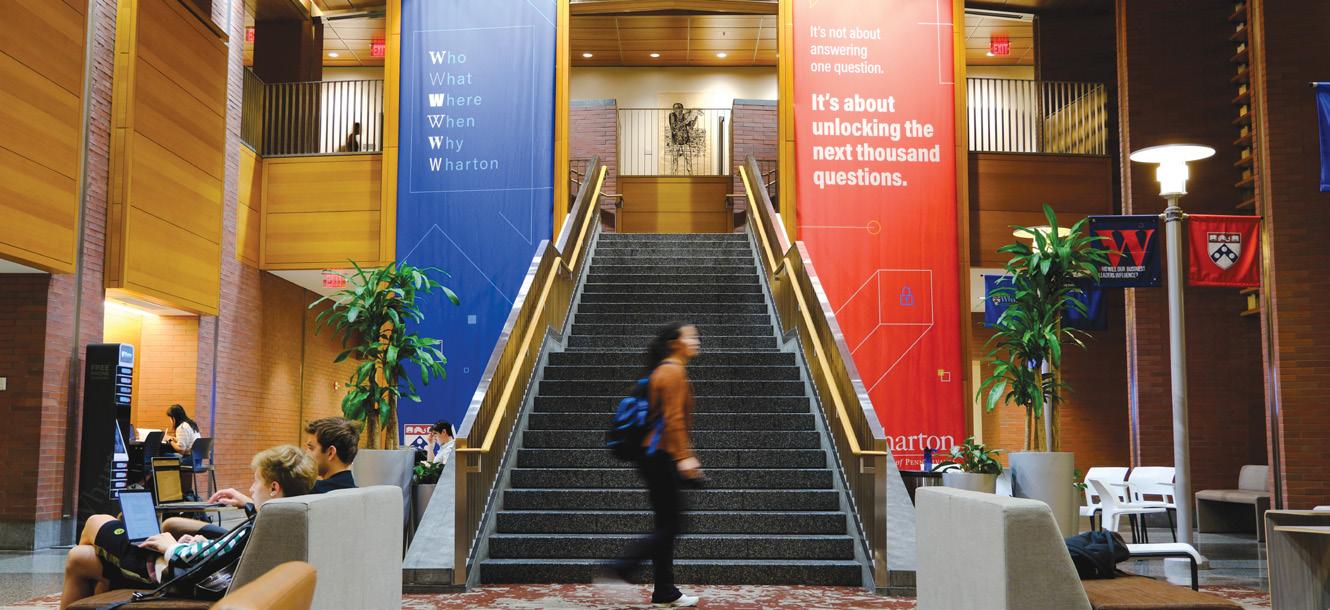
As student groups begin welcoming new members for the 2025-26 academic year, the Wharton School has implemented new guidelines for affiliated clubs’ recruitment processes — including a ban on multiple rounds of interviews.
The update, first announced in an email to Wharton club leaders on July 30, will change the recruitment process for student organizations officially recognized by the University, which have previously been criticized as overly competitive. In the email, Mike Elias — the senior director of strategy and operations for the Wharton Undergraduate Division — described the need to stop
“activities that create barriers to access or impose undue stress” upon students.
Elias cited the Stop Campus Hazing Act, which was first signed into law in 2024 by former Benjamin Franklin Professor of Presidential Practice and President Joe Biden. He wrote that activities that induce “physical, emotional, or psychological” stress are not permitted, as they “may be classified as hazing, even if they are traditional or longstanding club processes.”
In the event that a student files a report of oncampus hazing, Penn will be legally required to
See WHARTON, page 2
HSIUNG AND FINN RYAN Senior Reporters
members of Penn’s on- and off-campus fraternities told The Daily Pennsylvanian that they remain confused about how the policy is being implemented and enforced.
All individuals quoted in this article have been granted anonymity due to fears of retaliation from University administrators.
One fraternity president said that while the rule
has “been in place” since the 2024-25 academic year, the University has “failed to enforce it” — with the exception of St. Patrick’s Day weekend during the 2025 spring semester, when fraternities traditionally host parties during the day. The fraternity president said that the Office of Fraternity and Sorority Life’s enforcement of the rule that weekend
Penn Class of 2029 admissions report shows rise in first years from
underrepresented groups
Dean of Admissions Whitney Soule told The Daily Pennsylvanian that the admissions trends refect the University’s broader intentions for future classes at Penn
AYANA CHARI Senior Reporter
Penn released demographic data for the Class of 2029 on Friday, revealing an increase in the percentage of students from groups historically underrepresented in higher education.
According to the Sept. 5 report, 21% of the Class of 2029 are first-generation students, and 24% are from historically underrepresented backgrounds in higher education, as opposed to 19% and 23% of the Class of 2028, respectively. Dean of Admissions
Whitney Soule told The Daily Pennsylvanian that the admission trends reflect the University’s broader intentions for future classes at Penn.
“We’re pleased to see an increase in students who are the first in their family to attend college and students who are eligible for a Pell Grant,” Soule wrote in a statement to the DP. “Welcoming first-generation and lower-income students continues to be a priority for us, made possible by Penn’s significant annual investments into undergraduate financial aid.”
In the Class of 2029, 23% are eligible for Pell Grants, and 259 students were admitted through the QuestBridge program, reflecting a 2% increase in Pell Grant-eligible students and 20 more students
affiliated with QuestBridge than the Class of 2028. The Class of 2029 is also larger as a whole than the Class of 2028, containing 2,421 students as opposed to 2,396. The change is in line with the larger pool of applicants — 72,544 applications in comparison to last year’s 65,236 — that Penn saw during the 2024-25 admissions cycle.
As Penn remained test-optional, data — reflective only of first-year students who chose to submit test scores during their admissions processes — reported that the middle 50% of the class showed a shift in the distribution of scores compared to previous years. For the interquartile range of students in the Class of 2029, 63% submitted an ACT score of 35 or 36, while 83% submitted SAT scores between 1500 and 1600. The gender breakdown of the incoming class has remained consistent over the past two years, with 53% identifying as female, 46% identifying as male, and 1% identifying as transgender, nonbinary, or gender-questioning. Other demographic data of the Class of 2029 — including geographic, gender-identity, and the early decision acceptance rate — remained comparable to previous years.
SAMANTHA
KATE AHN, ANNELISE DO, AND CHENYAO LIU | SENIOR DESIGNERS AND SENIOR PHOTOGRAPHER
SANJANA JUVVADI | STAFF PHOTOGRAPHER Wharton implemented new guidelines for club recruitment for the 2025-26 academic year.
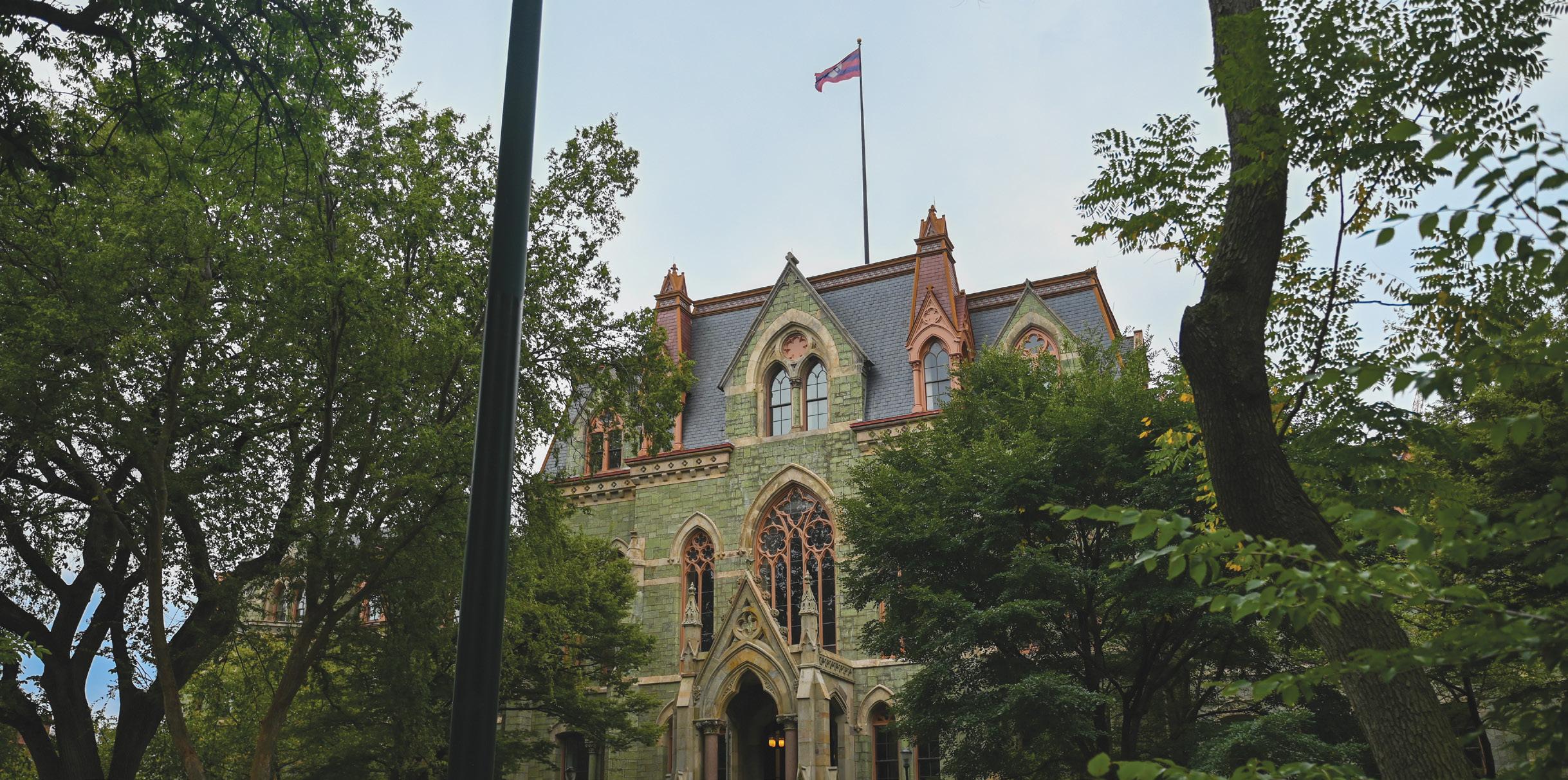
CHENYAO LIU | SENIOR PHOTOGRAPHER The Undergraduate Admissions Visitors Center is located in Claudia Cohen Hall.
See SPEECH, page 3
See OFSL , page 3
Newly appointed SAS Dean Mark Trodden discusses plan to ‘champion excellence,’ promote liberal arts
In the role, Trodden will lead 28 departments in the School of Arts and Sciences to form an interdisciplinary school based in the liberal arts
ANVI SEHGAL Senior Reporter
Dean of the School of Arts and Sciences Mark Trodden discussed his vision for the liberal arts and advocating for students across disciplines in an interview with The Daily Pennsylvanian.
In the role, Trodden will lead 28 departments across various areas of the humanities and sciences to form an interdisciplinary school based in the liberal arts. He previously served as the school’s associate dean for the natural sciences and holds the Thomas S. Gates Jr. Professorship in the Department of Physics and Astronomy.
Trodden’s June appointment came after former SAS Deputy Dean Jeffrey Kallberg completed his term as interim dean.
In an interview with the DP, Trodden discussed how the school will prioritize equity among students as it faces a year of “unknowns” and “difficult decisions.” He emphasized the importance of the “strategic update for the school” — the recently announced Penn Forward framework — that will help “address these big questions and issues in ways that are unique to our School of Arts and Sciences.”
“Often when a dean comes into a job like this, they do a very lengthy strategic planning process for the school,” he said. “We’re not going to do that. We want to get going quickly.”
For his first six months, Trodden’s primary goal is to construct the new framework and travel across the United States and internationally to “tell the story of the School of Arts and Sciences.”
To engage the SAS community across disciplines, Trodden is visiting faculty meetings from each department and hosting events open to students across the school — an experience he described as “really exciting.”
Trodden has been a member of Penn’s faculty since 2009, including as a professor, co-director of the Center for Particle Cosmology, chair of the Department of Physics and Astronomy, and associate dean. He is also a fellow of the American Physical Society, the American Association for the Advancement of Science, and the United Kingdom’s Institute of Physics.
“I bring a perspective to this that comes from the sciences — that is a great strength,” Trodden said, referencing his background as a physicist. “The flip side of that is that there are parts of the school that I’m less familiar with and have their own ways of thinking about things, and those are just as valid and important, and my job is to make sure I don't miss things.”
Trodden explained that he is “still learning” and is working on the “balancing act” of acknowledging various perspectives.
“I want to use the strengths that come with my experience as a scientist, as a professor, [and] as an administrator, but I want to make sure I’m open to all these other perspectives as I try to figure out how I’m going to do this job,” he added.
Trodden emphasized that he will avoid prioritizing one over area of study over another. His goal,
Trodden said, is to “champion excellence.”
“I’m trying to make sure that all our students, no matter what their interests are, have access to an ability to explore all the amazing things that are going on in the school,” he continued. “We want to have the best scientists, the best social scientists, the best humanists, and ideally, the best of those people who know how to talk to one another and explore avenues that no one else has thought of.”
In the context of the current higher education climate, Trodden noted that the school faces “challenges to the core of how we think of ourselves as a School of Arts and Sciences, and what’s important to us.”
In February, Penn reduced graduate admissions rates and rescinded acceptances across graduate programs in the face of federal research funding cuts. Trodden, who was a part of the group making the decision, explained that they did not take it lightly.
Penn projected to hit record lobbying spending amid Trump-era funding threats, DP analysis finds
The increased spending comes after the University’s federal funding — which amounts to over $1 billion annually — was threatened several times by the Trump administration this past year
TANISHA AGRAWAL, SRISHTI BANSAL, AND GABRIELLE OSTAD Staff Reporters
Penn is projected to spend record amounts on federal lobbying in the 2025 fiscal year, according to The Daily Pennsylvanian’s analysis of financial disclosure documents.
Utilizing reports mandated by the Lobbying Disclosure Act of 1995, the DP found that Penn has significantly increased its federal lobbying spending in the past year on issues including National Institutes of Health funding, scientific research, and graduate medical education. The increased spending comes after portions of the University’s federal funding — which amounts to over $1 billion annually — were threatened by the Trump administration’s return to power.
A request for comment was left with a University spokesperson.
In February, $240 million of Penn’s funding from the NIH was jeopardized after the agency issued a directive capping “indirect costs” — which fund overhead expenses, including laboratories and support staff — at 15%. The NIH reinstated funding for three grants in August following faculty appeals and federal court rulings in lawsuits challenging the executive action.
In March, an additional $175 million of Penn’s federal funding was frozen by the Trump administration. The decision, according to the White House, was due to Penn’s “policies forcing women to compete with
WHARTON, from front page
“prominently publish” a description of the report — including the club’s name — on its website, according to the email.
Student club leaders attended the Student Organization Summit on Aug. 25 and Club Leader Training on Sept. 6 for “further conversation and guidance” on the updated policies.
In the email, Elias encouraged club leaders to focus on “gauging student interest, goals, and willingness to satisfy the necessary time commitment or expectations associated with club
men in sports.”
One month later, the Department of Education found Penn in violation of Title IX for allowing 2022 College graduate and transgender woman Lia Thomas to compete on the women’s swimming and diving team during the 2021-22 season. To recoup its frozen funding, Penn entered into a resolution agreement with the White House in July and complied with the government’s demands regarding its Title IX compliance.
Over this period of time, Penn steadily increased the amount of money it spent on lobbying the federal government.
In May, Penn contracted BGR Group — one of Washington’s largest lobbying firms — to advocate on its behalf with federal policymakers.
According to a disclosure filed in May, the four BGR lobbyists representing Penn were David Urban, Dan Murphy, Remy Brin, and Bob Wood.
Urban — who serves as BGR’s managing director and also received a Master of Public Administration from Penn in 1994 — was a senior advisor to 1968 Wharton graduate and President Donald Trump’s 2016 presidential campaign and is credited with securing Trump’s victory in Pennsylvania.
“Penn regularly engages with policymakers and diverse partners to advance work that helps power
participation” without requiring “prior experience or subject matter expertise.”
The Wharton Undergraduate Division also recommended a shift toward engaging general body members as opposed to only student leaders.
The email urged “first-year students to participate in the General Body Membership (GBM) as a pathway to committee engagement.” Potential committees, for example, should be determined based on “GBM engagement and demonstrated capacity observed during the Fall semester.”
Penn’s anti-hazing guidelines and resources currently include methods of reporting instances of hazing, training to improve overall club culture, and a description of the Rethink Hazing Campaign — which specifies how certain activities
“I work with graduate students every day — they are the lifeblood of my research and everything that goes on in my department and pretty much every other department,” he said. “Having a robust, energetic, [and] well staffed graduate program is one of the highest priorities I have.”
Then-Interim Dean Kallberg attributed the school’s decision to cut graduate admissions to National Institutes of Health funding changes in an email at the time — a circumstance Trodden called an “unusual situation.”
“We had no choice but to do what we did,” Trodden said. “We’re going to decide soon what we do for the coming year.”
For future and prospective students, he encouraged people “not to get hung up on last year and decisions that had to be made very quickly in a very rapidly moving environment.”
“The School of Arts and Sciences is a place where everyone should feel welcome and supported and nourished to do what they came here to do — to
explore the frontiers of knowledge, to learn as much as they can, about as many things as they can, and to leave here better prepared to be a citizen of the world than they were when they came,” he said. “That should be open to everyone — no matter who you are.”
Trodden said that he wanted to be a “good listener” by listening to student organizations, letting students “make their opinions known,” and encouraging open expression and dialogue for the whole school.
He added that Penn should be “a place where people are unafraid to take on big questions and difficult questions” and encouraged students to ask questions and listen to as many perspectives as possible when they have the opportunity to do so.
“There are things that are taught in lessons I didn't know existed before I became a professor,” he said. “Do it all. Do what you can, take advantage of as much as you can. You won't have this opportunity again.”
economic opportunity, drive medical and scientific breakthroughs, and expand access to learning and wellness for communities across the country,” a University spokesperson wrote to the DP at the time.
Penn also retained Mehlman Consulting, another prominent D.C. consulting firm, paying the firm $40,000 in the second quarter of fiscal year 2025. These increases aligned with decisions made by other Ivy League universities which have similarly increased their federal lobbying spending in response to federal pressure.
A recent CNN analysis found that Penn and other peer institutions — including Harvard University, Columbia University, and Brown University — have spent millions of dollars hiring Trump-affiliated lobbyists in Washington. The analysis found that colleges and universities targeted by the Trump administration ramped up their
“do little to build a member’s skills” and may still qualify as hazing.
The Daily Pennsylvanian previously reported on student concerns that the Wharton club application process is stressful and unfair — falling under the definition of hazing, according to the Wharton Undergraduate Division and the Stop Campus Hazing Act.
At the time, students voiced frustration about clubs with single-digit acceptance rates and multistage application processes, particularly when looking to meet new people and learn more about chosen interests. Students also noted that most written applications precede one or two rounds of evaluative interviews before clubs notify applicants of their decisions.
lobbying efforts in the second quarter of 2025, spending 122% more than the same time last year.
CNN’s analysis showed that Penn ranked sixth in the Ivy League for percentage change in spending on lobbying from the second fiscal quarter of 2024 to the second fiscal quarter of 2025.
The DP additionally found that Penn ranked fourth among the Ivy League institutions for percentage increase in lobbying spending between the first fiscal quarter of 2024 and the same fiscal quarter in 2025.
Penn’s July resolution agreement with the federal government — which several Trump administration officials suggested could serve as a “model” for other institutions — was quickly followed by the announcement of settlements by both Brown and Columbia, along with the start of similar negotiations with other peer institutions.
The Wharton Council — the student body that supports Wharton clubs — has made efforts to make the application process more equitable over the past several years. In 2016, for example, the organization included measures designed to make the recruiting process more transparent and casual. Other proposed changes included a standardized application, uniform decision notification dates, and restrictions on conducting group interviews. In 2017, Penn’s Undergraduate Assembly and the Student Activities Council partnered to revise club recruitment across the University. A survey from the UA at the time found that the club recruitment process is characterized by students as competitive and discouraging.
CHENYAO LIU | SENIOR PHOTOGRAPHER
Trodden began his term as SAS dean in June.
CHENYAO LIU | SENIOR PHOTOGRAPHER
Penn is projected to spend nearly $1.8 million on federal lobbying in the 2025 fiscal year.
Wharton fraternity reinstated after suspension for hanging flyers alleged to mock Oct. 7, 2023 hostages
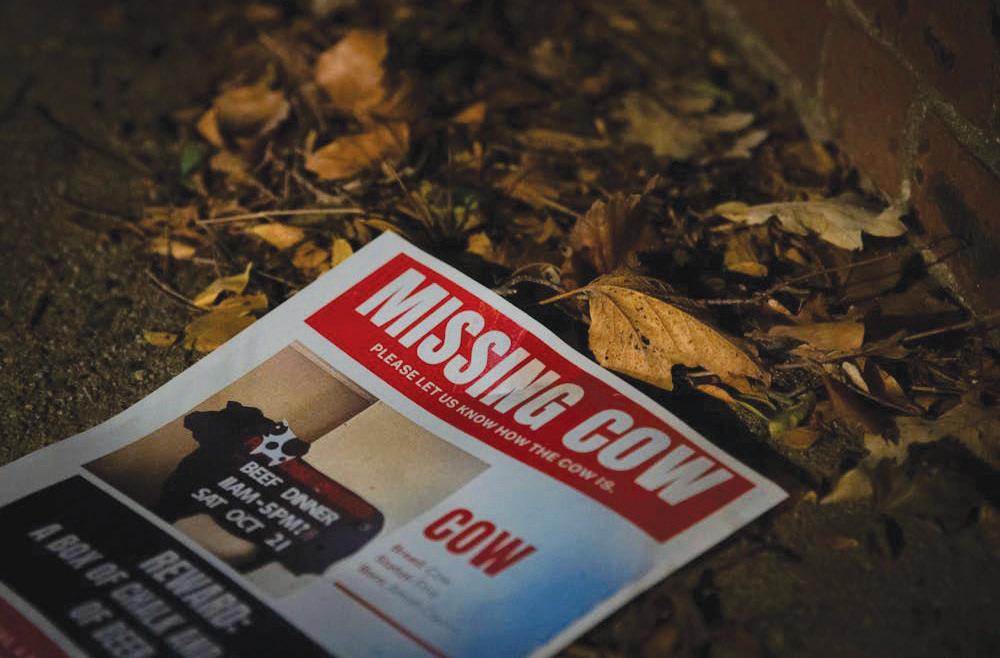
The disciplinary measure was enforced after an investigation found that Delta Sigma Pi members were responsible for posting ‘Missing Cow’ fyers across Penn’s campus in November 2023
JASMINE
NI News Editor
The Wharton School reinstated its chapter of the Delta Sigma Pi business fraternity as a University-affiliated student organization following an 18-month suspension.
The disciplinary measure was enforced after an investigation found that DSP members were responsible for posting “Missing Cow” flyers across
Penn’s campus in November 2023, which were alleged to mock hostages kidnapped during the Oct. 7, 2023 Hamas attacks on Israel. In a statement to The Daily Pennsylvanian, a Wharton spokesperson confirmed that Penn’s chapter of DSP had been “reinstated as an active business fraternity.”
According to DSP’s Instagram page, the chapter
DSP was found responsible and suspended for posting flyers resembling those displaying the names and
SPEECH, from front page
is, because of their prestige, there’s more opportunity for controversy to occur,” Stevens said. He added that “high-profile” schools “tend to get more attention” from potential free-speech controversies, such as outspoken professors or guest speakers.
Stevens pointed out that prominent institutions like Penn are more likely to attract controversial guest speakers “because the speaker is probably not turning down an invitation to go to one of these schools.” However, he noted that they also have “much more opportunity to do well and model the right behavior for other colleges and universities.”
“What comes up a lot of the time with the Ivies is that most of them have a lot of controversies — and they have more than a lot of schools — but they often don’t really handle them very well,” he continued.
A survey of 341 Penn students was used as data to determine the rankings. Concerns included selfcensorship and hesitation to express disagreement with professors or in class discussions, while students also indicated support for restricting speakers with certain views from appearing on campus.
Penn’s score was brought down by four “speech controversies” — though none were from 2025.
FIRE cited Penn’s deregistration of pro-Palestinian group Penn Students Against the Occupation of
OFSL , from front page
was “completely outrageous.”
A social chair for an on-campus fraternity stated that he was unaware of the limit until New Student Orientation of this academic year. He acknowledged that the University “did a good job telling all the fraternities and organizations” but added that the announcement did not come with “any explicit reasons” other than “this is just a new rule, and you have to abide by it.”
The University has gradually enforced the policy beginning by capping the number of attendees on “big weekends” — such as Homecoming weekend and St. Patrick’s Day — and then incrementally lowering the capacity limit of parties each semester, according to a member of an on-campus fraternity’s executive board.
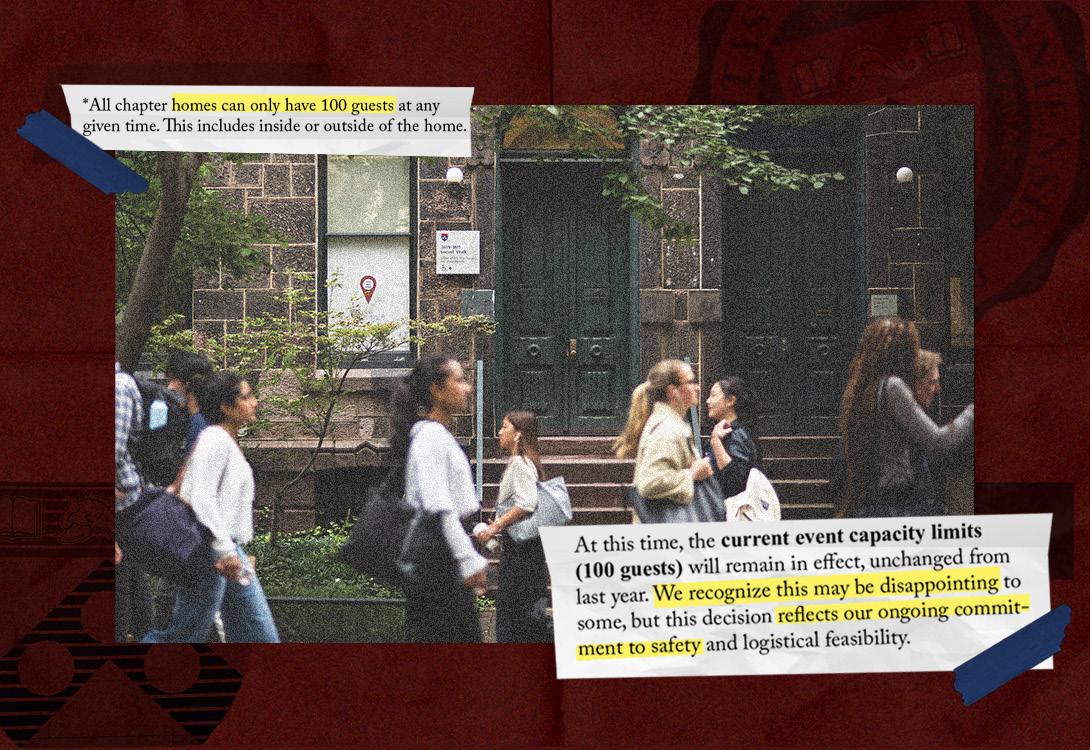
In an August memo obtained by the DP, which was sent to fraternity and sorority leaders, OFSL wrote that “all chapter homes can only have 100 guests at a given time.”
A separate Sept. 5 message sent to an on-campus fraternity — signed by the Community Care Team, a new division of University Life — confirmed that “the current event capacity limits (100 guests) will remain in effect unchanged from last year” and said that the “decision reflects our ongoing commitment to safety and logistical feasibility.”
“The maximum capacity limits of 100 people in residential spaces remain unchanged from last year and all student organizations are expected to follow these parameters,” a spokesperson for University Life wrote in a statement to the DP. “While this policy has been in effect since last year, we are reinforcing communication to ensure consistent understanding across all groups.”
According to the University Life spokesperson, the 100-person limit was “established in collaboration with Fire & Emergency Services, FRES, Risk Management, and the Community Care team to prioritize student safety and well-being.”
This semester, the fraternity president alleged that OFSL has begun requiring the use of crowd counters operated by “school-sponsored” bouncers at registered parties. He explained that once the counter registers 100 people, the bouncer will stop letting students in the fraternity house — a method he described as inaccurate because it does not account for the people leaving the event.
Palestine as a “Students Under Fire” incident. The organization mentioned three other “deplatformings,” including the 2024 cancellation of the West Craft Festival following Penn’s demand for an exclusion of “politically sensitive” artwork and Penn’s refusal in November 2023 to allow progressive Jewish group Penn Chavurah to screen the documentary “Israelism.”
“[Deplatforming events] matter because they send a signal to other people on campus of what is and is not acceptable discourse and acceptable behavior,” Stevens said.
According to history of education professor and free speech expert Jonathan Zimmerman, the rankings show how political disagreements have affected free speech on campus.
“As the new FIRE report shows, right-wing students are as eager as their left-leaning peers to censor allegedly ‘problematic’ speech,” Zimmerman told The Washington Times. “And students across the political spectrum are biting their tongues, lest they incur the wrath of their opponents.”
Zimmerman explained how the results display a shift in attitudes among conservatives regarding freedom of speech at universities in a statement to the DP.
“For years, conservatives have been indicting higher education for suppressing their views. But in the age of [Donald] Trump, turnabout has become fair play,” Zimmerman wrote. “Our entire educational model is based on the free exchange of ideas. If we are censoring others — or ourselves — we won’t learn. Period.”
In addition to the crowd counters, the social chair claimed he has also witnessed University-affiliated event monitors “basically bombarding” parties they suspect of having more than 100 people and pulling fire alarms to “evacuate” the event space.
According to the fraternity president, all on-campus fraternities were informed that the 100-person capacity limit would be implemented to make fraternity and sorority life safer for students. However, he said that the cap has made “these situations more unsafe for students who have to go off campus and are drinking outside of a protected area.”
A member of an on-campus fraternity’s executive board similarly told the DP that OFSL attributed the policy to the lack of fire escapes available in on-campus housing. However, he noted in an interview with the DP that his fraternity house has “two different exits” and any further restrictions feel “dumb.”
He added that as a result of the policy, parties have become “more unsafe.” He cited incidents he witnessed where students were entering chapter houses through windows and friends were separated from each other at the door due to the “one in, one out” policy.
One member of an off-campus fraternity added that their house has seen property damage from people trying to enter their parties through “whatever unofficial way” they can.
“Kids are gonna have injuries from these situations,” he added. “If they’re breaking down windows to get in, someone can get hurt.”
The fraternity president suggested “increas[ing] this capacity constraint to a reasonable 250.” He also noted that the current policy has not been applied evenly to all members of Penn’s fraternity and sorority life. Multiple brothers that spoke to the DP echoed the sentiment.
“From what I've seen, off-campus fraternities and sororities don’t get the same repercussions,” the fraternity president — who leads an organization registered with the University — said. “They’re not being held accountable, whereas [for] on-campus organizations who have to register, it really hurts us because now we can’t have a fun event.”
However, a member of an off-campus fraternity wrote in a statement to the DP that his organization was experiencing similar issues with the University’s enforcement of the 100-person limit.
“The school says it wants to make Penn’s social life more inclusive and less cliquey, but by imposing this 100-person limit on parties, it actually makes them more exclusive, worsening the very problem the school claims it wants to fix,” he wrote. “We all
hosted open recruitment events on Sept. 6 and 7 — including an internship panel and affinity events with current members. The group also advertised a closed recruitment form for interested students. Requests for comment were left with members of the fraternity. At the time of publication, DSP has not been added back to the school’s list of registered business fraternities. Access to the group’s Facebook page has been restricted, and the official site for the fraternity chapter has not been restored from “maintenance mode” since it was stripped at some point between October 2023 and February 2024, according to internet archives.
The fraternity’s profile on Penn Clubs, a directory accessible to users with a PennKey, stated at the time of publication that there are zero active members. A site banner displayed says that there are “changes to this club page that are still pending approval from the Office of Student Affairs.”
An Oct. 31, 2024 report — titled “Antisemitism on College Campuses Exposed” — by the United States House Committee on Education and the Workforce included several pages of Penn’s disciplinary records, in which the DSP incident was described as part of an “‘initiation-week’ ‘prank’ by newly-recruited members.”
The document indicated that Penn placed DSP on an 18-month suspension and required the chapter to “comply with requirements to demonstrate cultural change” and accept reorganization. At the time, a Wharton spokesperson told the DP that the chapter was “working collaboratively with the National DSP Office to reorganize chapter operations and work towards reinstatement.”
DSP’s National Executive Director Jeremy Levine wrote in a statement to the DP that the organization was “excited to be collaborating with the Wharton School of Business as the Beta Nu chapter regains recognition.”
“Chapter members are actively recruiting and participating in educational programming designed to strengthen operational knowledge and reinforce a culture of positive impact,” Levine stated. “We look forward to the continued partnership with Wharton in reestablishing the chapter and advancing its contributions to both the campus community and the Fraternity.”
The investigation centered on a Nov. 16, 2023 incident when hundreds of flyers were hung across Penn’s campus. The design of the flyers appeared to resemble the “Kidnapped” posters displaying the names and faces of Israelis being held hostage by Hamas.
At the time, a University spokesperson described the posters as “crude” and “deplorable,” adding that Penn was working to identify the individuals responsible for them.
An email address, howsthecow13@gmail.com, was included at the bottom of the posters. In response to a request for comment at the time of the incident, the email account stated that the poster was not intended to be antisemitic and was “a joke to promote veganism.”
“The format of the poster was an unintentional mistake that we now realize could be misconstrued,” the message read, adding that it “condemn[ed] the kidnapping of Israelis that took place and did not mean to allude to that situation.”
go to class and study hard, so we should be able to socialize without the added stress of only being able to invite a few friends.”
The fraternity president similarly noted that the rule has diminished Penn’s “social Ivy” culture, which he described as “part of the reason students come to Penn.”
“At the end of the day, if a party is empty, nobody’s really having fun,” the fraternity president said. “I definitely think the quality of parties have gone down.”
A member of another fraternity described the negative impacts of the policy enforcement in a written statement to the DP, emphasizing that the “energy dies down” due to large spaces not being filled.
“It ultimately comes down to the school trying to get more power in all aspects of student life, no matter if that’s capacity limits, limiting the amount
of parties that can be had during a certain night, or increasing the different regulations that we have to go through in order to register a party,” the fraternity executive board member said.
The social chair echoed that sentiment, saying in an interview with the DP that “it just seems like the University — possibly due to budget cuts, possibly due to liability — is just trying to exert power over greek life.”
“I think we’ve seen the school cracking down the hardest on greek life they have so far in a long time — just from every party being much more monitored,” the social chair said. “The amount of power and freedom these organizations have had on campus is rapidly diminished, and it’s pretty clear the University strategy is working over time; they’re just weakening greek life, and at some point, they can fully eliminate it.”
CHENYAO LIU | SENIOR PHOTOGRAPHER
faces of Israeli hostages kidnapped by Hamas.
CHENYAO LIU | SENIOR PHOTOGRAPHER
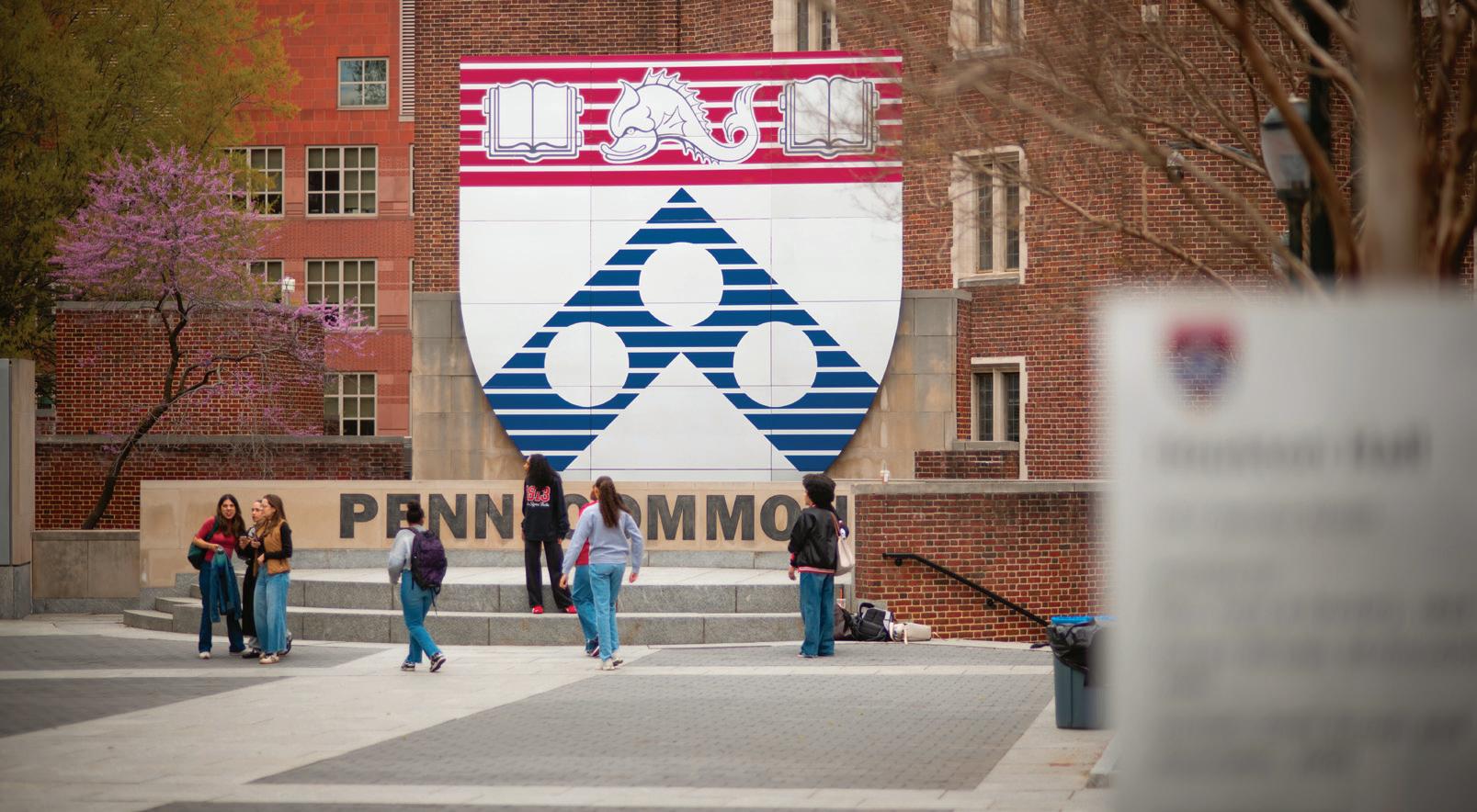
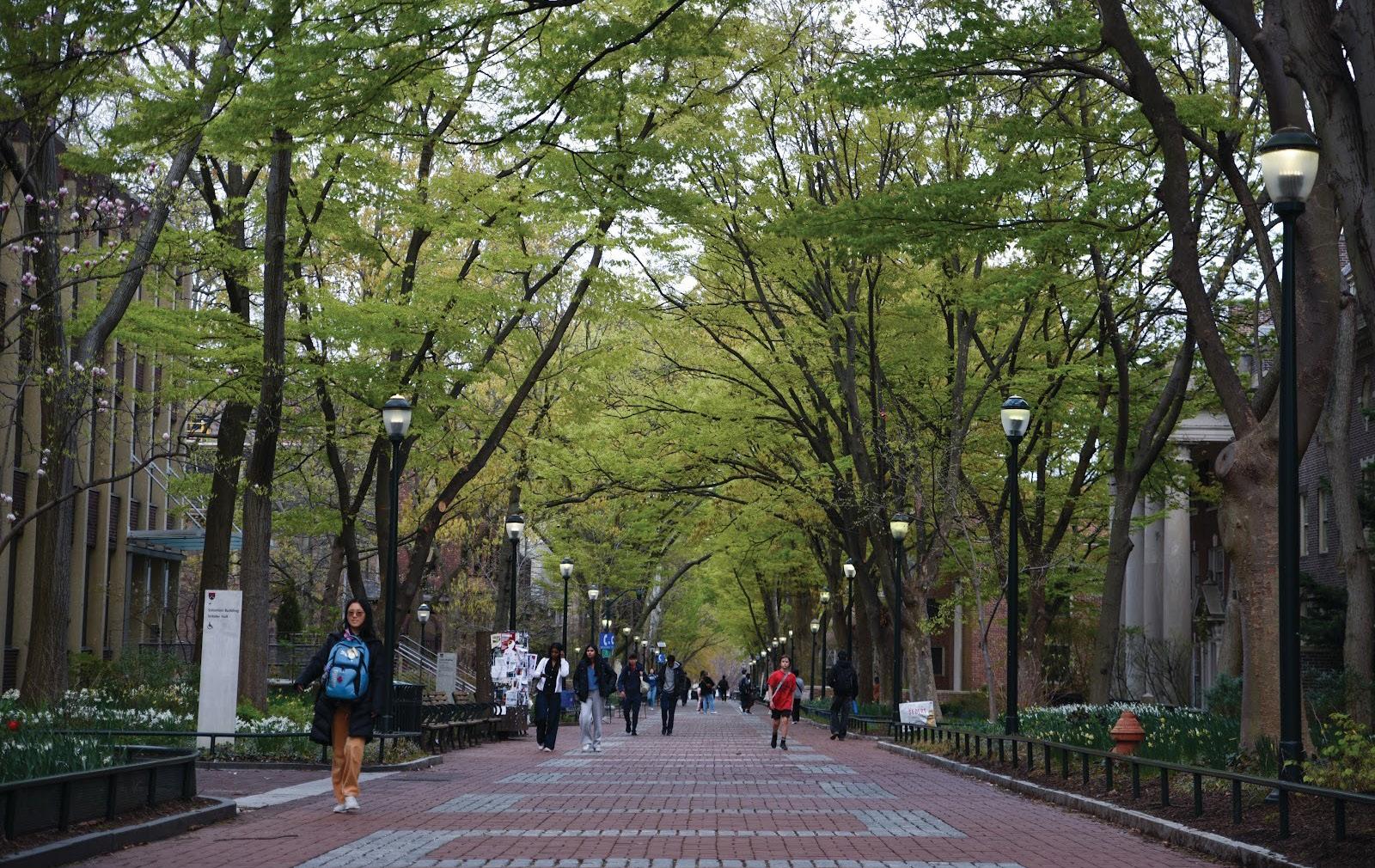
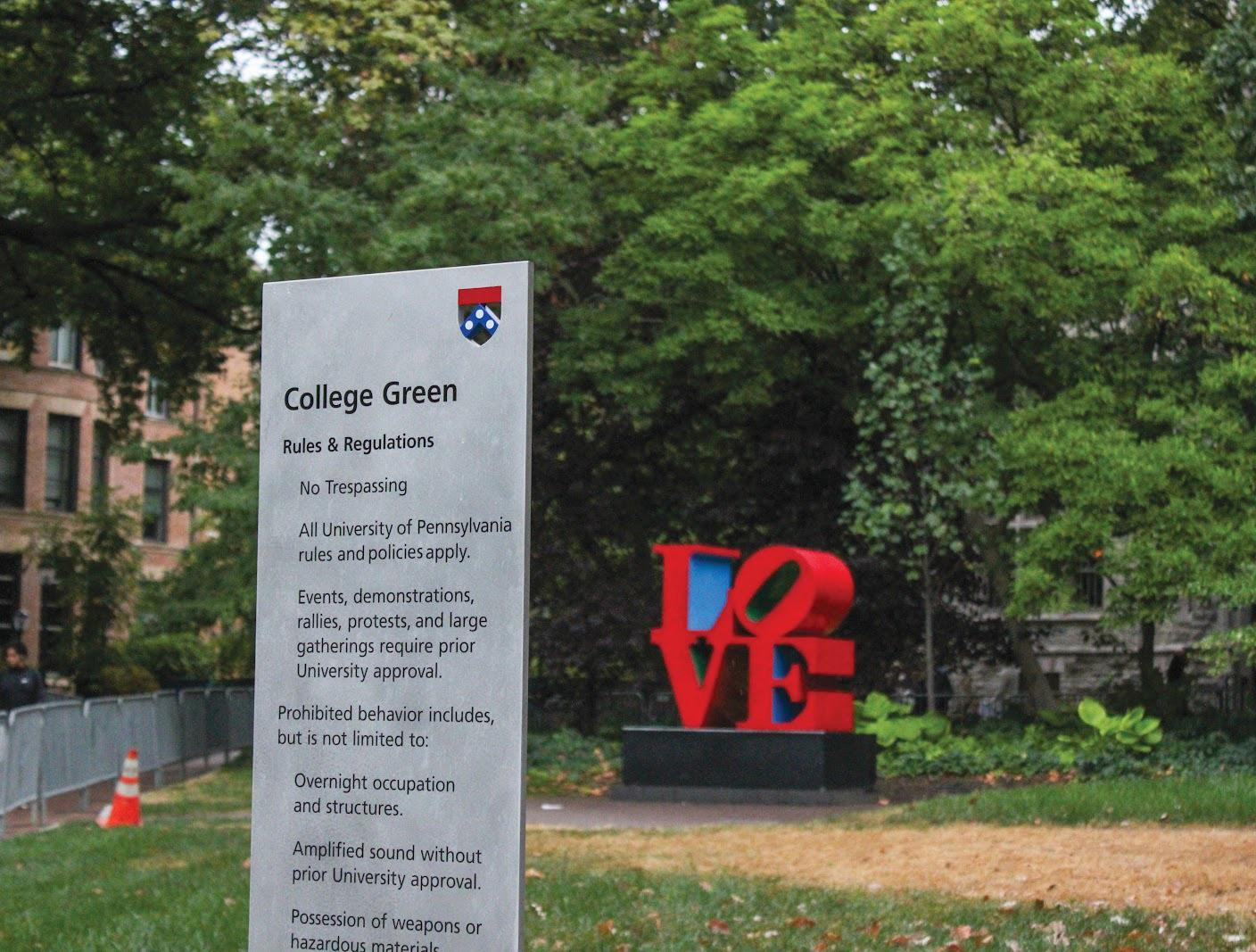
FIRE categorized Penn close to last in free speech among universities in its 2026 College Free Speech Rankings report.
Leaving is hard. Staying will be harder
IN ADY-TION | The best way to brace for discomfort is to acknowledge it
After graduation — when the fanfare dies down and the posts slip out of the algorithm — what’s left for the Class of 2029 is only a countdown. I’m sure that for many, what lies within said countdown is a future of possibilities, learning, and undeniable growth. But for those who live absurdly far from Penn, the countdown is also a stark reminder that we’ll be leaving so many, for who knows how long, and returning who knows when.
For Penn’s international students, this reminder is both prophecy and reality. As part of this unique demographic, we know so much about our own countries and cultures, but we can apply only so little of it in college. For the first few weeks, months, or even years at Penn,
we are quite possibly doomed to this constant sense of discomfort: language barriers, an entirely foreign environment, distance to loved ones marked by a day’s worth of flights, and all of this with the quintessential college transition experience as the cherry on top. I was fortunate enough to have experienced the past few years far from home. I anticipated this discomfort and tried to be one step ahead. I didn’t make an effort to say sappy goodbyes to friends or mentally prepare for “the big day” when I finally arrived at Penn, a place I’ve only ever seen through computer screens or through the pictures my upperclassmen friends tried their best to form in my head. I simply thought, “I’ll see them again, anyways, in a year or
Much ado about Wharton
AHLUWALIA’S ALCOVE | There’s more to Penn than its business school
The moment I got into Penn, I formed an immediate conviction that I bore a tacit responsibility to correct anyone who mistook Penn for Penn State. “No, not the one with the Nittany Lions,” I imagined myself saying.
That was the first mistake: thinking the identity crisis was an external one, when, in fact, it was an internal one. I had just been accepted into the College of Arts and Sciences when people, with the well-meaning prescience we reserve for the imagined futures of others, mapped out my path for me. I was going to be a cool, quant-finance guy. I was going to be a Wharton man.
The irony is that for a university lauded for its interdisciplinary nature, its public and private attention remains overwhelmingly monopolized by its business school.
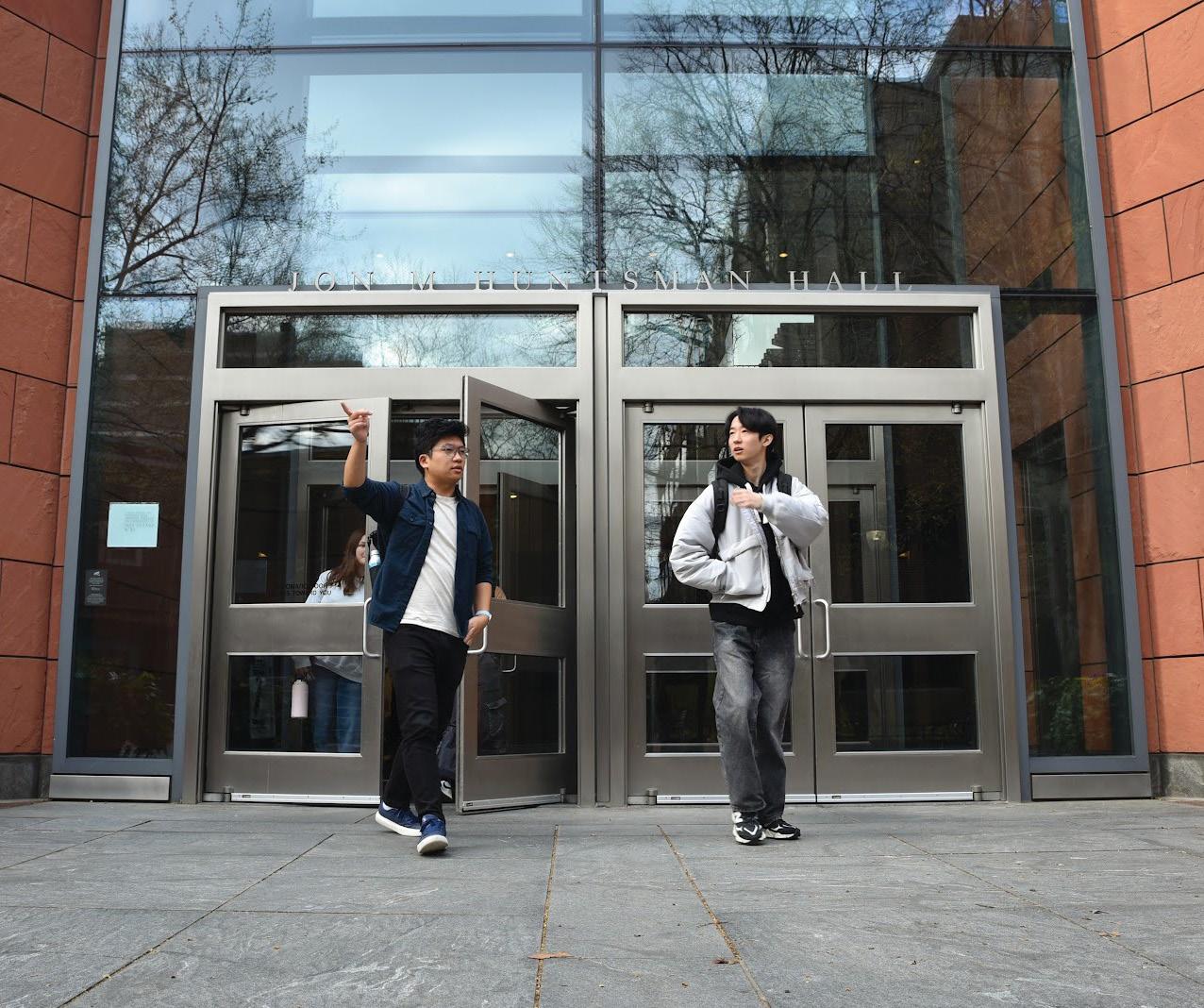
The Wharton School’s reputation precedes it. Every career conversation in Huntsman Hall seems to end at the altar of Wall Street. Its alumni form a priesthood of finance, canonized in television lore from “Suits” to “Billions.’’ Wharton is luminous, but there is peril in its radiance. Too much light, and one begins to believe it is the only illumination.
To be clear, this is not a polemic against Wharton. To vilify it would be too easy. The tragedy is that we have come to believe it is Penn.
The consensus is this: If you go to Penn, you go to Wharton. I experienced this firsthand
when my friends asked if I had always wanted to go to business school after I told them I was matriculating at Penn. That’s when Wharton began to occupy more space in my thoughts. A single, innocuous question, and suddenly, my ambitions began to blur into oblivion. I began to ask myself difficult questions. Is my interest in Wharton sincere, or do I just want to parley in opaque, nearly impenetrable corporate lingo? I could claim that I’m genuinely interested in business. But the illusion of volition is strongest when everyone around you is walking in the same direction. You swear you can swim, but you’re simply following the current. And the crisis is not just Wharton’s dominance. Maybe it is also our subconscious willingness to yield to it. Is it our fault, though?
If the only valorized form of success at Penn is predicated upon an affiliation with Wharton, then the academic freedom ostensibly afforded to students becomes illusory. And maybe that is the most ironic thing about Penn’s “One University” philosophy. On paper, it is all about access: Take a Wharton class as a College student. Explore the Nursing School if you are in the School of Engineering and Applied Science. Mix and match.
But in practice, that freedom is constrained by coercions of social prestige. It is delimited by the belief that Wharton is the most significant school on campus. You see it everywhere.
The Penn community must take action against SEPTA service cuts
GUEST COLUMN | How to help Philadelphia and Penn
In Philadelphia, citizens have relied on SEPTA since 1963. However, SEPTA is currently facing a $213 million budget deficit as a result of yearslong ridership and funding issues dating back to the COVID-19 pandemic. As a result, SEPTA began implementing its plan of extensive service cuts, including the elimination of 50 bus lines and multiple Regional Rail lines, reducing service by 20% on all remaining lines, and stopping service at 9 p.m. These cuts would cause extensive harm to the Philadelphia community, including Penn students and employees. While SEPTA has recently been given permission to tap into a capital assistance fund to reverse service cuts, this is a short-term solution and does not address the heart of the revenue gap. SEPTA cuts will directly affect the over 60,000 students and employees of Penn, the Hospital of the University of Pennsylvania, and the Children’s Hospital of Philadelphia. Penn employees use transit seven times more frequently than the average commuter in Philadelphia. Every week, an average of 9,000 HUP employees use SEPTA to commute to and from work. This includes nighttime healthcare workers, one in six of whom rely on SEPTA. Cut lines and the 9 p.m. service stoppage will significantly limit these doctors, nurses, and hospital staff in getting to work. Furthermore, of the 23,000 students at Penn, hundreds commute to the University each day. Leaders at CHOP and HUP have called on state representatives to fund SEPTA, warning of potentially disastrous public health consequences from the cuts.
Besides immediate threats to healthcare
two.” But as the days pass by and, as I write this, there are only a few weeks left before the fall semester starts, that “year or two” becomes dizzyingly bleak, and we scramble to tie up everything before we leave and regret every goodbye we did not give. While trying to think of what exactly I wanted to say in this column, I weirdly recalled the great wildebeest migrations across the Serengeti in Tanzania, and the Maasai Mara national reserve in Kenya. The animals move in a constant cycle, led only by the survival instinct to find grasslands replenished by the rains. Because of them, I can say that yes, leaving is hard; it’s undoubtedly excruciating to be ripped out of our comfort zones and the people we’ve spent our whole lives with. But staying is worse.
This is not to say that we will die by staying and being steadfast, but just like East Africa’s wildebeests, to remain motionless is to wither by not going where the rains fall and the grasses are lush. What we deem to be an extension of comfort instead is, in fact, complacency, something that, with the ambitious character of Penn’s students, must surely be equal to death.
Simply put, we will have a rough journey. We will leave many things behind and miss out on much more. We will feel the loss of all of those things, and no amount of preparation or contingency plans can truly erase that. But moving forward eventually will. In fact, what is discomfort if not the precursor to change?
As international students, what we can sometimes forget is that we carry with us the dreams of so many, and to honor these dreams means we need to grow and do good. And this notion isn’t just limited to those from abroad; in fact, everyone at Penn is subordinate to this. We owe it to all of them — to the families who’ve helped us pack years into little suitcases, to the ride-or-dies whom we tear up at the thought of leaving, and to the ones who were simply there with us in the moments we needed them to be — to make the hard choices and to grow.
What can be consolation to my fellow members of the Class of 2029 is that we make these choices not to substitute the experiences we’ve had with “better” ones, but to supplement the growth we’ve experienced in our homes with those that are uniquely our own.
So may this serve as an affirming letter to the students who risk it all to grow for themselves and for others. The road is long and winding, and the best way to prepare for all of it is to kiss your loved ones goodbye, hope for the best, and prepare for growth unlike any before.
His email is jlotivio@sas. upenn.edu.
argues that there is more to Penn than
In the preprofessional clubs that conspicuously append the letter “W” to their names. In the conversations that revolve around consulting recruitment timelines and acronyms you’re meant to decode by osmosis.
It is in this way that the idea of a liberal arts education becomes endangered. As a single school has come to symbolize not merely a field of study but an aspirational identity, the University’s broader intellectual system has begun to contract. The other disciplines have not been formally excluded, but are being insidiously relegated to secondary spheres within the institution.
Critical social inquiry is in decline. This erosion has blunted our impulse to ask who holds power and why. Universities like ours are now siphoning intellectual firepower into the very circuits of privilege they once sought to critique. It is like this that the University has become not the adversary of concentrated power, but its incubator. The migration
of Penn students to Wharton, then, is also evidence of the hierarchical revaluation of knowledge, wherein disciplines not immediately “marketable” are rendered peripheral, if not obsolete.
But the opportunity to explore every discipline imaginable is why I am flying to Philadelphia from my hometown in Punjab, India. Penn will offer me the whole orchard. And when people gesture insistently at one particular golden tree, I hope I remember that I have the freedom to sample its fruit, but I don’t have to climb it if I don’t want to. Why? Because the courage to walk past the golden tree and follow your own errant hunger, however uncertain its end, is beautiful.
MALLIK ARJUN AHLUWALIA is a College first year from Patiala, India. His email is ahluwal2@sas.upenn.edu.
access and transportation to campus, SEPTA cuts will increase the necessity for private car use, meaning more traffic and pollution on our streets. Philadelphia has one of the highest rates of traffic deaths among large cities, and an increase in car usage as a result of cuts to public transit will only further increase the number of traffic-related deaths and injuries. A recent report from the Delaware Valley Regional Planning Commission projected an increase of nearly 8% in fine particulate matter, 7% in nitrogen oxides, and roughly 2% in volatile organic compounds into the area from solely the service cuts, in addition to already rising pollution levels. We urge Penn to act to support student and employee access to public transportation and we call on the Penn community, from leadership to students, to advocate about the importance of SEPTA to our local and state representatives. Penn could support SEPTA ridership by fully or partially subsidizing SEPTA passes for students to commute around Philadelphia. SEPTA passes would give roughly 29,000 students a convenient, low-cost avenue to commute to Penn, as opposed to driving or using costly ride-booking services. Subsidizing public transportation also offers an avenue for students to explore the city and surrounding areas, increasing the University’s ties to local communities, the economy, and its commitment to civic responsibility. Many universities across the country and the state invest in public transportation passes for their students. The University of Pittsburgh offers fully subsidized public transit for all
Guest columnists from the Penn Science Policy and Diplomacy Group’s local advocacy team call on the Penn community to back SEPTA funding by promoting institutional investment and engaging in legislative advocacy.
students, faculty, and staff through Pittsburgh Regional Transit. Swarthmore College and Bryn Mawr College offer fully subsidized transit for all full-time students through SEPTA’s Key Advantage UPass program. They report that 89% of students have used the passes, demonstrating the significant uptake and impact of free transit programs. While ridership encouragement from Penn will certainly help the situation on campus, SEPTA will still need to rely heavily on funding allocated from local, state, and federal sources. Long-term funding stability is needed, and a legislative policy approach is necessary. One such bill the Penn community could publicly support is working its way through the state government right now: Pennsylvania House Bill 1364 would increase the amount of sales tax allocated to public transit funds. This measure has passed the state House and is now up for review in the state Senate’s Transport Committee. Individuals can reach out to our local and state representatives through calls or emails (and join Penn Science Policy and Diplomacy Group’s letter-writing event on Oct. 1). It is especially important for students from Pennsylvania districts outside of Philadelphia to share with
their representatives how they would be affected. While the situation SEPTA faces is stark, it is possible for citizens of Philadelphia and members of the Penn community to intervene. At Penn, we can urge the University to invest in fully or partially subsidized passes for students and employees. Collective action is essential in shaping future policy change. As individuals, we urge you to reach out to legislators and voice concerns about this issue. As Philadelphians, we each hold a civic responsibility to advocate for accessible and equitable transportation.
PENN SCIENCE POLICY AND DIPLOMACY GROUP’S LOCAL ADVOCACY TEAM consists of graduate and undergraduate students advocating for evidence-based local policy solutions and community engagement. Members include Georgia Mies, Michael Lyons, Joan Donahue, Andrew Zolensky, Alexander Kang, and Alison Li. Contact them at penn. science.policy@gmail.com.
MAX MESTER | DP FILE PHOTO
Columnist Ady Lotivio tells international students leaving their homes for Penn to enjoy them while they last.
ADY LOTIVIO is a College first year from Bicol, Philippines studying economics and earth and environmental science.
ABHIRAM JUVVADI | STAFF PHOTOGRAPHER
Columnist Mallik Arjun Ahluwalia
Wharton.
ROGER GE | DP FILE PHOTO
No matter how much I try to scrub my mind clean, the residual smudges of my college application process still resurface when I least expect them. Sometimes it’s at 3 a.m., waking up convinced I made a typo in my Common App, only to remember I’m well into my sophomore year at Penn. Other times it’s when I get calls from nervous high schoolers, clinging to my every word as if I’m the Oracle of Delphi, when in reality I am probably — definitely — more lost about life than they are.
The American admissions process is oddly intimate for something so impersonal. You’re asked to excavate your 17 years of life, baring your soul to a faceless committee in a room you’ll never enter. It’s this deeply subjective, person-centric model that has long been the hallmark of higher education in the United States. While Oxbridge or the Indian Institutes of Technology focus almost entirely on scholarly excellence, U.S. universities posture toward the next Noam Chomsky, the next W.E.B. Du Bois, or the next Ruth Bader Ginsburg. In short: They want the human.
And it’s also why the quiet dismantling of that human — starting with alumni conversations — has lingered with me.
At Penn, the long-standing tradition of alumni interviews became non-evaluative “conversations” in 2023. Now, they are gone entirely. Beginning with the 2025-26 cycle, the Alumni Ambassador Program will stop offering applicant conversations and pivot toward a yearlong mentorship model for admitted and current students. University leaders framed it as a way to make alumni time “more relevant and rewarding” while coping with record application volume.
Among its Ivy League siblings, Penn is not alone in this decision. Columbia University discontinued alumni interviews altogether in 2023, citing equity and access. Cornell University now limits formal video interviewing to solely its architecture program. Brown University too replaced its alumni interviews with an optional student video introduction. For Harvard University and Princeton University, the interview process is murky, with availability depending on alumni or the need for “additional context” — which my good friends on Reddit interpret as code for “clearing the first round.” Only Yale University and Dartmout College estrange themselves from their sister schools, continuing to describe their interviews as formally evaluative with written reports alongside the file.
Meanwhile, standardized testing is back with strong force. The rhetoric is about clarity, comparability, and resisting ghostwritten materials. Numbers feel clean and simple and do not risk raising questions about authorship or tone. But being human is messy, subjective, and everything contrary to a dataset. It feels, then, almost bitterly ironic, that in trying to keep artificial intelligence out of the process, we’re shrinking the parts of an application where a living voice can distort this
neatness of data.
I’ll concede the obvious fact that alumni interviews had their logistical flaws. Especially after the transition to “non-evaluative” interviews, many alumni were either non-committed or dropped out entirely. But I still can’t shake the feeling that there is meaning in reaching the student before admittance, when the school is still a mirage, not just to show them what the university can be like, but also to provide a report going beyond their numbers, diversity, equity, and inclusion-based essay prompts that are seemingly impossible to answer without controversy, and character counts in a format where tone, presence, and spark can break through to show the authentic you.
So I asked around. College sophomore Donatella Donovan said she was set on a school in Paris before her conversation with a Penn graduate changed everything. “The way [she] spoke about Penn humanized it for me. She’s still one of the coolest people,” she said. Donovan now leads the Black Ivy League Business Conference, conducts research for the Harlem Walks Project, and mentors younger students. College sophomore Elijah Ramirez from El Paso, Texas recalled that his interviewer was the first person from Penn he had met. “Three people at my high school had similar stats,” he said, “but my conversation stood out. [My interviewer] told me I had his vote of approval, and I
think that gave me the push I needed. So I’m grateful for having it.” College sophomore David Tran, once nicknamed “David Cornell” back home, was drawn to Penn after a local activist and graduate introduced him to Penn Democrats and the Netter Center for Community Partnerships. He now researches labor issues at Amtrak. Across the board, these seemingly different stories with distinctive arcs converged on a shared theme: These students felt seen. Not sorted, but seen. And these are just three anecdotes. There are so many international students or first-generation, low-income students for whom it might have meant even more. I was left with a sinking feeling that, without these interviews, I might not be telling their stories now.
Alumni are feeling the loss too. “People are mourning the loss of the interview program,” said Laurie Kopp Weingarten, a 1986 Wharton graduate and longtime interviewer, in a recent interview with The Daily Pennsylvanian. She called it a simple way to stay connected to Penn, recounting a time when she described the “most incredible candidate ever” to the admissions office, which was then taken into consideration. With the recent institutional uncertainties, administrative changes, and donor fatigue, it feels almost imperative to hold onto any semblance of connection we still have. What should replace the old model, if anything?
I do not have a perfect blueprint. It could look like a return to classic written-report interviews, modeled on Yale’s approach of trained alumni and graduating seniors, scheduled equitably and audited for quality. To address alumni strain, it could model Harvard’s approach of only selecting applicants they “want more information from” to facilitate a more qualified pool. It might even be a hybrid that pairs short, structured video responses, like Brown’s, with a conversation to corroborate voice and reduce bias. The hard truth is that we will only reach an answer when we bring this bureaucratic footnote to the headline and discuss it. If higher education still claims to care about the rebel, the visionary, or the kid who does not test well but can move people toward a cause, then we need to leave room for that kid to be seen. Because that is the very kid we will need when the world is automated and we struggle to hold onto the human. The more we center data over dialogue, we risk not only losing the program but the point of American higher education at all.
DIYA CHOKSEY is a College sophomore studying cognitive science from Mumbai, India. Her email address is dchoksey@sas. upenn.edu.
CHENYAO LIU | SENIOR PHOTOGRAPHER
Senior columnist Diya Choksey explores the recent dismantling of alumni interviews in higher education and its implications in a world centered around AI and data.
Penn swimmer, Olympian Matt
Fallon named to U.S. national team for fifthstraight year
Fallon currently holds the American record in the 200-meter breaststroke and fnished 10th in that event at the 2024 Paris Olympics
VALERI GUEVARRA Sports Editor
Another year, another national team.
On Monday, USA Swimming announced the 2025-26 United States national team, and Wharton and Engineering senior, 2024 Paris Olympian, and former Penn breaststroke specialist Matt Fallon was named to the roster for the fifth consecutive year.
“We’re excited for this year’s roster,” USA Swimming National Team Managing Director Greg Meehan said in a release. “We witnessed some strong performances across national and international events this past summer, reinforcing that our team is set up well for the Pan Pacific Championships and future competitions as we look towards LA28.” Fallon swam his last collegiate meet representing the Red and Blue at the 2025 NCAA Division I championships last March — finishing second in the 200-yard breaststroke for the second year in a row.
The Warren, N.J. native last competed professionally in April at the 2025 TYR Pro Swim Series in Sacramento, Calif. and posted what was then the world’s sixth-fastest time. He currently holds the American record in the 200-meter breaststroke with a time of 2:06.54, set at the 2024 U.S. Olympic Trials, and finished 10th at the 2024 Paris Olympics in that same event.
The six athletes with the fastest times in each
HAGSTROM, from back page
the span of just five seasons, Hagstrom helped flip Bucknell from a losing program to a Patriot League title contender. Hagstrom went down in history as Bucknell’s all-time winningest coach and is coming to Penn off an incredibly competitive 2024 season, during which the Bison finished with a 21-5 record and 0.808 winning percentage, their highest in program history. His experience will certainly be helpful in continuing Penn volleyball’s rise in the Ancient Eight.
“Coaching this team has truly been one of the greatest honors of my career,” Hagstrom said in a press release announcing his departure from Bucknell. “From record-setting seasons to developing a strong team culture, I’m so proud of all we’ve accomplished together. The future of Bucknell Volleyball is undeniably bright, and I’ll be cheering them on every step of the way.”
While Hagstrom is a newcomer to the Penn community, he is not new to the Ivy League. Prior to Bucknell, Hagstrom represented the Ivy League as an assistant coach at Princeton from 2016-19, during which he helped lead the Tigers to an overall 73-27 record, back-to-back Ivy League titles, and three NCAA championship appearances. Hagstrom also coached multiple All-Ivy players. When asked about
individual Olympic event are selected for the team each year. Fallon had the fourth-fastest time during the selection period with his 2:09.58 performance at the TYR Pro Swim Series in April.
Over the summer, Fallon decided to pursue an engineering internship at Axle — a technology startup — instead of competing at the 2025 World Aquatics Championships in Singapore. Fallon won a bronze medal at the 2023 World championships in the 200meter breaststroke.
“Many thanks to my coaches (Mike, Andrew, and Maddie) and of course all of my teammates at Penn who made last season so successful,” Fallon wrote in an Instagram story in May. “For this summer, I’ve decided to step away from major national competitions as I pursue an internship. I plan to continue to train throughout the summer.”
Fallon’s decision also notably leaves him out of the 2026 Pan Pacific Championships, since the selection process for that competition included meets from this past summer. In 2022, Fallon also prioritized his academics, skipping the 2022 International Team Trials due to a final exam conflict.
Fallon told The Daily Pennsylvanian in April that he is set to graduate in spring 2026 and is interested in pursuing quantitative finance as a future career.
the competitive rivalry against Princeton and his history with the Tigers, Hagstrom said he is taking this season one step at a time.
“I liked my time there, but at the end of the day, I want to win here. I want this team to be successful against every team we play,” Hagstrom said. “Rivalries are nice because it means both teams are playing at a high level … but ultimately, there’s a lot of competition in the Ivy League, so it’s important we have that ‘one game at a time’ mentality.”
Though the rest of this season certainly won’t get any easier for the Quakers, Hagstrom has confidence in his team’s ability to continue to improve. From long nights, early mornings, and double-day practices, the Quakers have been working hard to pick up exactly where they left off last season — with the same hunger and fight to reach new heights.
“As a program, we have big goals, and I think we need to try [to] reach them by maintaining consistency. Day to day, we have to play hard and as a team. I think good things happen from there, one day at a time.”
The Quakers’ next match will be in Baltimore as participants in the Towson-Coppin State Invitational this weekend, and they continue non-conference play until the end of the month.
In the Ivy League opener on Sept. 26, the rivalry between Penn and Princeton will reignite as Hagstrom and the Quakers face the Tigers.
As Penn volleyball trains under Hagstrom and irons out its final practices before conference play, one thing’s for certain: The wins are just beginning.
TUPPER , from back page
British Columbia. He went on to play for clubs in Germany and Belgium but left his largest legacy with the Canadian national team, where he played in three Olympic Games and set the all-time record for goals scored.
“Not everyone is like this, but I really like practice — that normal day-to-day stuff that, in the moment, isn’t always super fun, but it sharpens you during your career,” Tupper said following his retirement from Team Canada in 2021.
Tupper played under 12 different coaches between his time on the Canadian national team and his European professional career, a gauntlet that he says taught him “what works and what doesn’t work” when leading a team.
Now, he brings those lessons to the Red and Blue.
“I was exposed to a lot of different coaches,” Tupper said. “Some, I thought, did things incredibly, at a world-class level. Some not as much. So you’re kind of learning along the way. … I’ve been really fortunate to have a front-row seat to what good looks like.”
Tupper’s playing career has also uniquely equipped him to advance the Quakers’ performance. As a veteran of the highest level, he has an eye for adjustments and the ability to demonstrate them, a combination that has elevated Penn’s game.
“Scott is incredibly skilled at field hockey. His skills are exceptional,” Ryan said. “I think learning from the best has been super helpful for
developing my skills, for developing the rest of my team’s skills, because we’re able to actually see the skill in person and see what to tweak.”
Last Friday, Penn dropped its season opener against No. 2 North Carolina before bouncing back for a 4-2 victory over Old Dominion on Sunday in Tupper’s first win as a head coach. The Quakers leapt out to a 3-0 lead before the Monarchs battled back with two goals of their own, but a penaltycorner win from junior forward Emma Nahon set up a final goal from sophomore defender Beau Lilly Barrington-Hibbert to seal the deal.
A program known for its aggressive nonconference scheduling, Penn’s triumph over Old Dominion gave the team something it hasn’t seen in some time: early season momentum.
“No one on this team has been 1-1 before,” Tupper said. “To see them be really pleased and satisfied with having won a game and get that feeling of success, I was super happy for them.”
“It’s a game-changer,” Ryan said. “Getting that first win is major, as it shows that we do have the ability to win, and good teams find ways to win.” Soon, Tupper’s team will be put to the test against a familiar foe: On Friday, the Quakers travel to College Park to take on No. 10 Maryland, a homecoming for the former Terrapins assistant coach.
“I might walk to the wrong player’s bench at the beginning of the game,” Tupper joked.
As always, Tupper has done the work in advance.
“We have some ideas that we’ve already talked about,” Tupper said. “If we can find ways to unsettle them a little bit and keep the tension in the match, to get into the second half a tight game, then we have a chance.”
PHOTO COURTESY OF THE UNIVERSITY OF MARYLAND
Tupper, who previously coached at Maryland, was appointed as Penn’s field hockey coach.
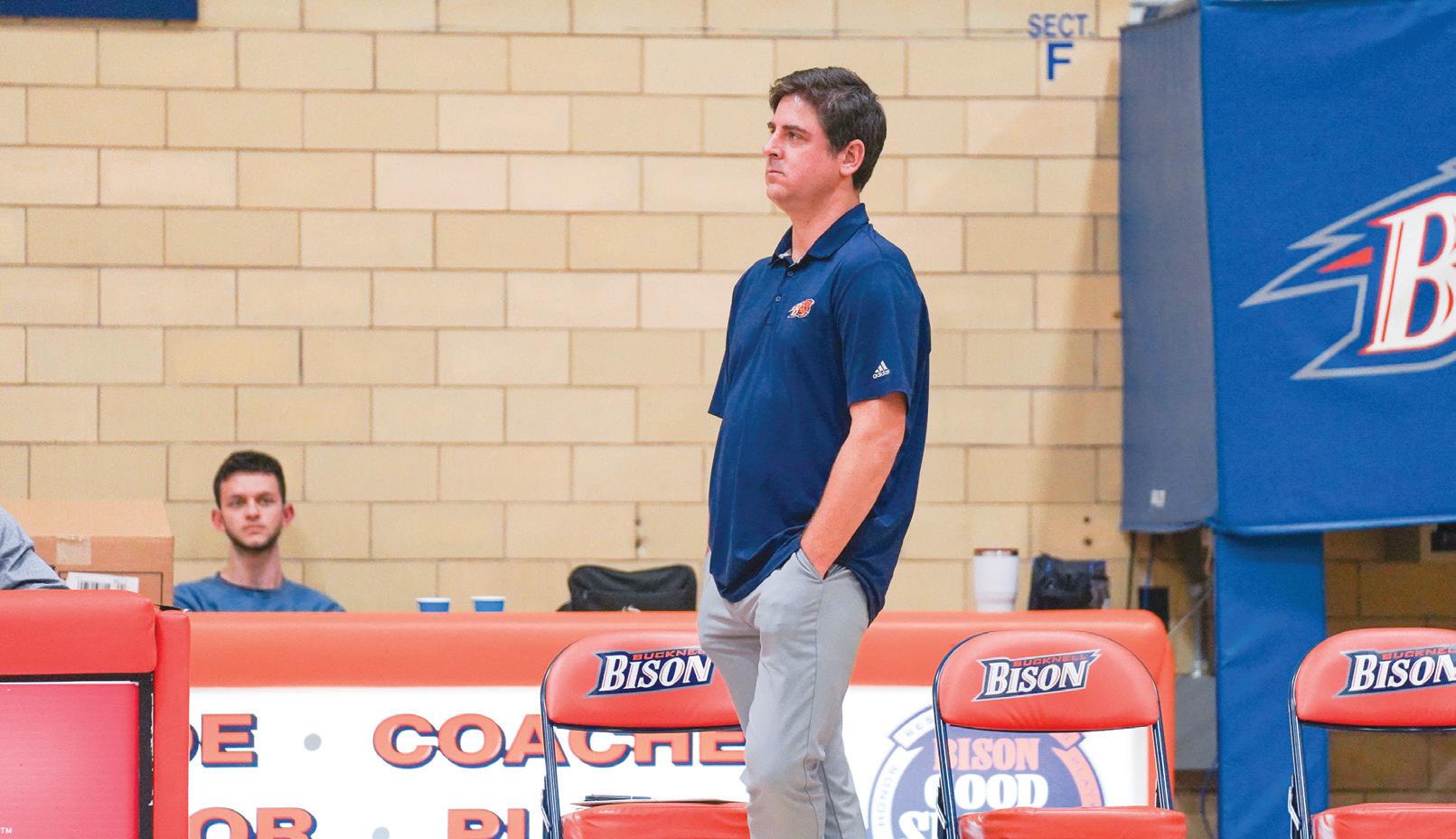
PHOTO COURTESY OF BUCKNELL UNIVERSITY
Hagstrom, previously head coach at Bucknell, took home his first victories at Penn at the UC Irvine Anteater Classic tournament.
COURTESY OF WIKIMEDIA COMMONS
Fallon pictured swimming breaststroke for Team USA. (Swimfan337 | CC 1.0)
Murray, who leads the team with a .341 hitting percentage, played in all 88
ARIEL FADER Sports Reporter
Before every volleyball match, sophomore middle blocker Adell Murray straightens her hair and pulls it into a tight ponytail. Though she doesn’t consider herself superstitious, she enjoys consistency when stepping onto the court. To her, it’s a necessary prematch tradition before the calm soon gives way to chaos once the ball is served. There isn’t any room for nerves at the net, especially for a blocker like Murray.
“Especially for middle, everything’s reacting,” said Murray. “You can’t really be thinking about too much if you want to stay sharp.”
This focused mindset is the product of a journey that began in third grade, when Murray began playing volleyball for her neighborhood’s recreational club. Thanks to her height, she immediately found herself at the net. As she gained a better understanding of the game, she joined her first competitive volleyball club, the Houston Juniors.
Playing competitively elevated her skills and her confidence, helping her solidify her position as a middle. On top of that, living in a volleyball hotspot meant that she was playing against tough teams during school seasons as well, a factor that pushed her to improve.
However, becoming a Quaker wasn’t as straightforward. After dislocating her kneecap multiple times, she underwent surgery in the middle of her high school career. Luckily, she got cleared to play before the college recruiting season began, but the blip in her progress left her wondering about the next stage of her volleyball career.
“I didn’t really know what to expect,” Murray said. “I also just didn’t really know I was even at the level to play at an Ivy League [school], just in terms of academics.”
Still, she secured an offer, and the deciding factor for her commitment was the opportunity to advance both her athletics and academics at a high level. In finding her fit with the Red and Blue, she also found a sense of family in her team.
One connection that has particularly supported her is her friendship with sophomore setter Emery Moore. Though they’d known of each other from competing at the same national tournaments in high school, their paths officially crossed when they committed to Penn within months of each other. After getting to know each other through FaceTime, they soon became fast friends and roommates.
“[Murray] and I just kind of communicate really easily without talking … and that’s kind of how it is at home, too,” Moore said.
This mutual trust is a frequent facet of the
fast-paced volleyball matches, where split-second communication between the setter and the middle marks the difference between a missed hit or a kill. Having this solid connection has helped Murray improve her decision-making and execution when it counts. Even with a new coach, Murray’s success from this dynamic has been noticeable.
“Watching film from last season, she had a great year. She got set a lot,” coach Tyler Hagstrom said, “She’s been fantastic to work with this fall in terms of her work ethic and her
buy-in.”
Murray’s personal growth in confidence notably mirrors the program’s trajectory. Last season, Penn stood out as a team with a significant number of underclassmen as starting players. Despite having less collective experience, the team came within a handful of points of punching its ticket to the Ivy League tournament.
Having played in all 88 sets last season, Murray is ready to take the experience she’s gained to step up her game even more on the court. She’s learned to let go of lost points to
instead concentrate on resetting for the next play.
“I just feel stronger and ready,” said Murray, “I think that, for me, I want to be able to be unpredictable and just kind of have fun with it.”
As Murray ties her hair into another slickback ponytail for this season, she’s leaving behind the nerves and stepping on the court with the confidence that she and her team can finish the job.
“One thing [that] people should know is that we’re out for blood, [but] we’re also a family and that we love each other a lot,” Murray said.
GRACE CHEN | SENIOR PHOTOGRAPHER
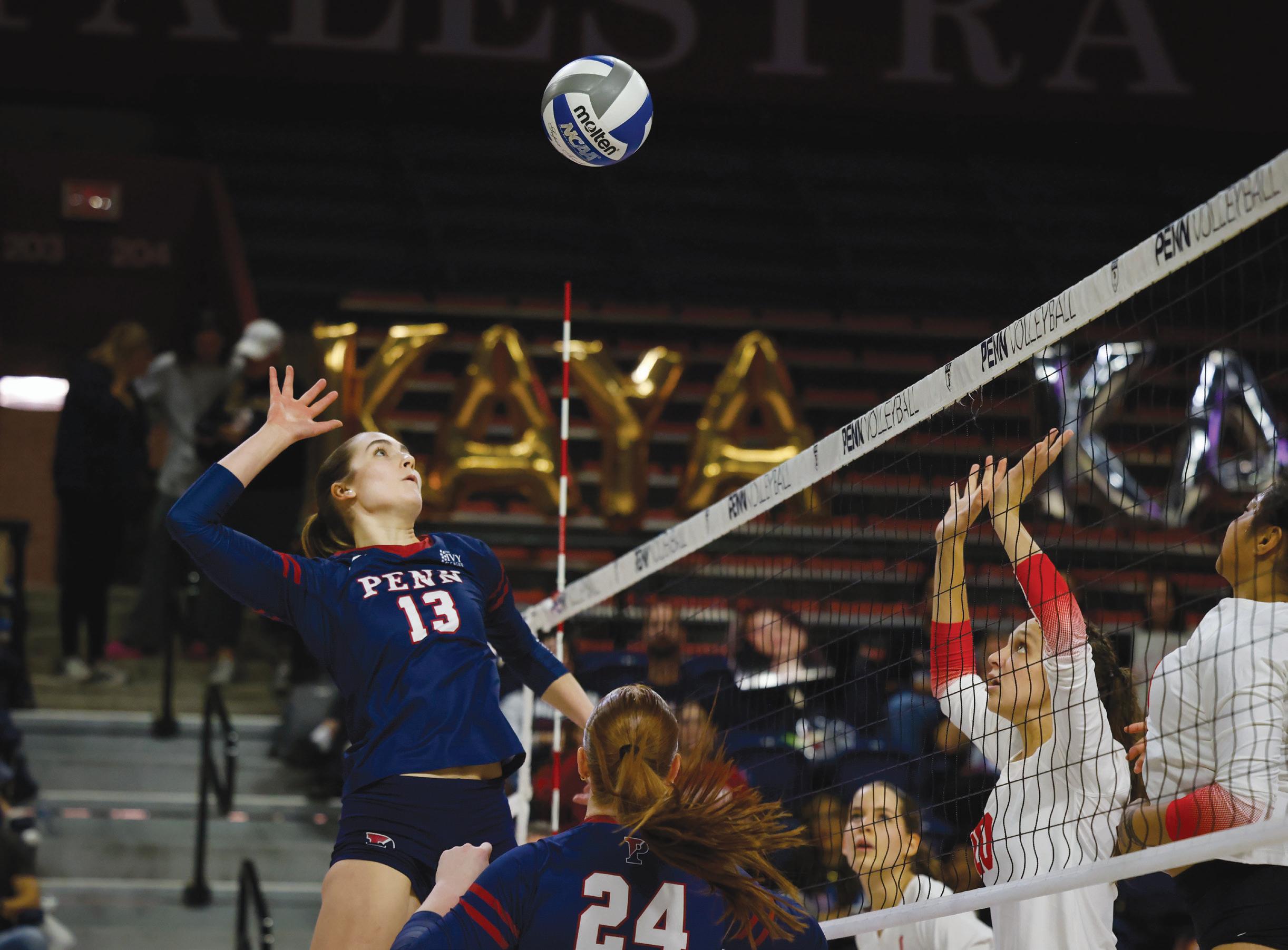
Murray pictured playing against Cornell on Nov. 9, 2024.
New field hockey head coach Scott Tupper has prepared for this
In his frst year as the Quakers’ coach, Tupper brings a coaching style forged at the highest level
WALKER CARNATHAN
Former Sports Editor
From his training philosophy to his wealth of experience, practice makes perfect for new Penn field hockey coach, Scott Tupper.
Tupper, in the midst of his first season at the helm of the Quakers’ field hockey team, is no stranger to leadership. As an assistant coach for Big Ten champion Maryland and a leader on the Canadian national team before then, he has spent years addressing teams, implementing game plans, and scheming for tough opponents.
Now at Penn, Tupper’s coaching style follows a similar blueprint: prepare, improve, win.
“I believe really strongly in practice, and running, and making sure that the kids are getting a whole lot out of all the time they’re on the field,” Tupper said. “If we want to become a better team
in the games, we have to train at a really good level. So I’m going to push the kids to develop their skills, and we’re going to have exercises that are high-tempo, high-energy.”
“There’s been a greater focus on developing our technical skills [under Tupper],” senior midfielder/defender Julia Ryan, Penn’s leading scorer in 2024, said. “There’s definitely a higher level of play at practice, and we all seem to be getting more touches on the ball.”
It’s all part of what Penn hopes will be a new era for the program under one of the sport’s rising stars.
Tupper, 38, began his journey to Philadelphia as an elite player in his hometown of Vancouver,
See TUPPER , page 6
New head coach Tyler Hagstrom is propelling Penn volleyball forward
Hagstrom notched his frst career wins last weekend as the new volleyball head coach
ELIJAH RAMIREZ Sports Reporter
Under new coach Tyler Hagstrom, Penn volleyball notched its first wins — and those won’t be the last.
Last weekend, the Quakers laced up for the first time this season as participants of the UC Irvine Anteater Classic tournament. Over 2,500 miles away from Philadelphia, the Quakers did not have home-court advantage, but the Red and Blue swept both host UC Irvine and Fresno State 3-0 to start the season off hot.
Coming off of its most successful season yet, Penn volleyball was eager to maintain that momentum and keep pushing to exceed expectations. However, the departure of former head coach Meredith Schamun in June meant the Quakers were missing a pivotal piece on their road to success.
But Hagstrom — the heavily decorated former
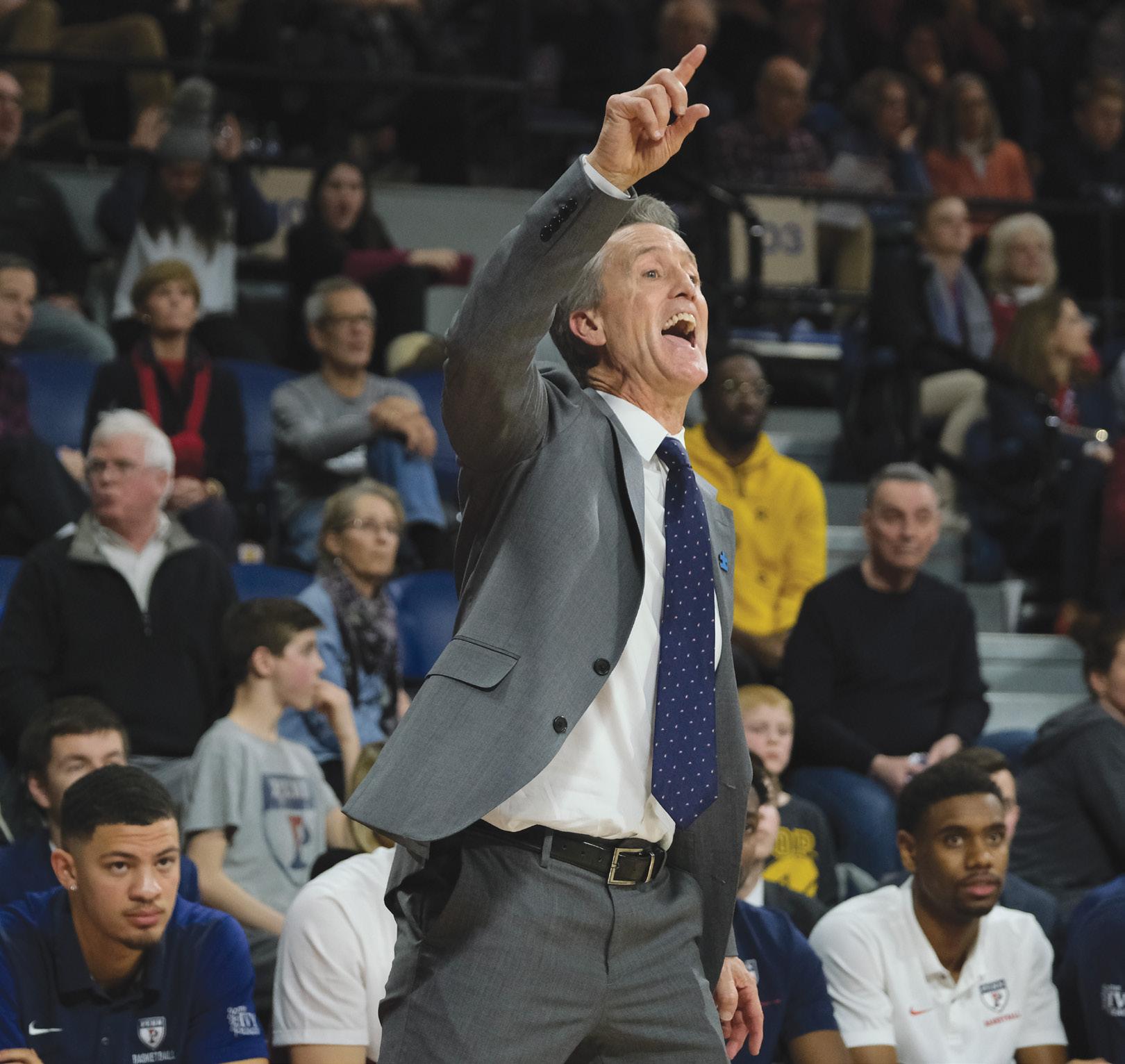
Former Penn men’s basketball coach Steve Donahue
head coach
coach of the Bucknell Bison — will keep that momentum alive. With just two months at the reins of the Red and Blue, Hagstrom has already begun to get the ball rolling and has no plans to stop after notching his first wins last weekend.
At the helm of the program, Hagstrom plans to approach this season with tranquility and determination to keep reaching for success.
“As a team, we talk about having balance. … We set the standard that we hold each other accountable for. For this team, everyone’s got to stay bought in throughout the season and understand that they’re a big piece of this greater puzzle,” Hagstrom said. Before coming to Penn, Hagstrom saw great success as head coach for Bucknell from 2020-25. In
See HAGSTROM, page 6
to take over as St. Joe’s
Donahue will step in for St. Joseph’s head coach Billy Lange, who is leaving the program to join the New York Knicks’ staff WALKER CARNATHAN
Former Sports Editor
Former Penn men’s basketball coach Steve Donahue will take over as head coach of rival Saint Joseph’s, the program announced Wednesday.
Donahue was fired from Penn in March and hired as an assistant coach for the Hawks in May. He replaces Billy Lange — who served as head coach for St. Joe’s for six years — after Lange accepted a job in the New York Knicks front office.
Donahue has reportedly received a multi-year contract to become the program’s 16th head coach. In a press release, St. Joe’s wrote that Donahue “will lead the Hawks into the 2025-2026 season and beyond.”
“I am thrilled to welcome Coach Donahue as our new head coach. He is deeply connected to Hawk Hill and is a proven leader,” St. Joe’s Vice President and Director of Athletics Jill Bodensteiner said in the release. “I have every confidence in him and his commitment to our values and mission.”
“Coach Donahue has had an incredible impact on collegiate basketball up and down the East Coast and on the national stage,” Bodensteiner added. “He is a rare and accomplished coach who is as respected for his basketball acumen as he is for his character.”
Donahue will return to the Palestra later this year when the Hawks take on the Quakers in Big 5 pod play on Nov. 17. Previously, that return was expected to be in an assistant role. Now, Donahue will go head-to-head with his replacement at Penn: new coach Fran McCaffery.
Donahue coached the Quakers for nine seasons from 2015-24 — part of a larger coaching legacy in the City of Brotherly Love. He began his college coaching career as an assistant at Philadelphia (now Jefferson) in 1988 before joining Fran Dunphy’s
staff at Penn in 1990. After 10 years under Dunphy, he then served as coach at Cornell and Boston College before returning to Penn in 2015.
Donahue led the Quakers to an Ivy League title in the 2017-18 season and coached two conference players of the year — AJ Brodeur in 2020 and Jordan Dingle in 2023.
When Donahue was hired as St. Joe’s associate head coach earlier this offseason, it came with a heavy endorsement from Lange.
“In the last 30 years, there is not a single person I have talked more with about basketball philosophies, the challenge of head coaching leadership, and the pursuit of daily improvement than Steve,” Lange said in a release. “I have been blessed to work alongside some great basketball minds, and I hold Steve in the highest regard as a coach.”
Donahue also expressed excitement at the prospect of coaching with Lange.
“I get to work alongside Coach Lange — someone I truly respect and can learn a great deal from,” Donahue said in the same release.
Now, Donahue takes the reins of the program. Last season, the Hawks finished 22-13 overall, including an 86-69 win over Donahue’s Quakers.
Lange, who was an assistant coach for the Philadelphia 76ers from 2013-19, makes his move relatively late in the offseason timeline. St. Joe’s is set to tip off its season against Lafayette in less than two months.
However, with their head coach out of the picture, the Hawks will be forced to implement a new style of play and adjust to a new voice at the helm.
“We are athletic, deep and talented; we have the people, culture and first-class facilities,” Donahue said of his team in a press release about his promotion. “We have everything we need to win.”
DANA BAHNG | SENIOR DESIGNER
SON NGUYEN | DP FILE PHOTO
Donahue pictured during a game against Harvard on Jan. 31, 2020.