Penn hit recordhigh lobbying expenditures in third quarter of 2025
According to a recently fled disclosure, Penn lobbied the federal government on topics including the National Institutes of Health, research, international student visas, and student fnancial aid
LAVANYA MANI Contributing Reporter
Amid the Trump administration’s ongoing higher education reform efforts, Penn spent $360,000 on in-house federal lobbying this quarter — its highest single-period expenditure on record.
According to a recently filed disclosure, Penn lobbied the federal government on multiple issues, including topics related to the National Institutes of Health, research, international student visas, and student financial aid. The University spent and additional $260,000 during this fiscal quarter retaining the services of several external lobbying firms: BGR Group, Mehlman Consulting, and Cassidy & Associates.
Penn listed Associate Vice President for Federal Affairs William Andresen and Penn Medicine Corporate Director for Government and Community Relations Kristen Molloy as individuals who lobbied on behalf of the University in its disclosure report.
A request for comment was left with a University spokesperson.
The quarter — which spans from July 1 to Sept. 30 — included a tumultuous time for the University, which has remained a continued target for the Trump administration.
In July, Penn entered into a resolution agreement with the White House to settle its Title IX violations and recoup $175 million in frozen funding. The University removed 2022 College graduate and former Penn swimmer Lia Thomas’ individual records and issued a public statement specifying that Penn Athletics “will adopt biology-based definitions for the words ‘male’ and ‘female’ pursuant to Title IX and consistent with President Trump’s Executive Orders.”
Earlier this year, an analysis conducted by The Daily Pennsylvanian projected that the University would spend record amounts on federal lobbying during the 2025 fiscal year. So far, in this fiscal year Penn’s internal lobbying expenditures have totaled $810,000.
Penn has continued to retain BGR Group — one of Washington’s largest lobbying firms — which it first contracted in May to advocate on its behalf with federal policymakers.
According to a form filed in May, the four BGR lobbyists representing Penn were David Urban, Daniel Murphy, Remy Brim, and Bob Wood.
Urban — who serves as a managing director at BGR and also received a Master of Public Administration from Penn in 1994 — was a senior advisor to 1968 Wharton graduate and President Donald Trump’s 2016 presidential campaign and is credited with securing Trump’s victory in Pennsylvania.
“Penn regularly engages with policymakers and diverse partners to advance work that helps power economic opportunity, drive medical and scientific breakthroughs, and expand access to learning and wellness for communities across the country,” a University spokesperson wrote to the DP at the time.
Penn paid the firm $140,000 this fiscal quarter.
Mehlman Consulting, another prominent Washington consulting firm, and Cassidy & Associates were paid $40,000 and $80,000 by Penn respectively.
CONNIE ZHAO | STAFF PHOTOGRAPHER
Penn spent $360,000 on federal lobbying this quarter, marking its largest single-period spending to date.
PENN REJECTS COMPACT
A spokesperson declined to answer whether the University would continue to negotiate with the White House or consider signing a later draft of the document
Penn has rejected the White House’s proposed preferential funding compact, which would have provided the University with enhanced federal benefits in exchange for a commitment to sweeping governance and policy reforms.
Penn President Larry Jameson informed the community of the decision in an Oct. 16 message, which came after the Compact for Academic Excellence in Higher Education — initially offered to Penn and eight other universities on Oct. 1 — received swift condemnation from across the Penn community. Penn was the third university to decline the proposal.
“Earlier today, I informed the U.S. Department of Education that Penn respectfully declines to sign the proposed Compact,” Jameson’s email read. “As requested, we also provided focused feedback highlighting areas of existing alignment as well as substantive concerns.”
A spokesperson declined to answer whether the
AAUP-Penn
University would continue to negotiate with the White House or consider signing a later draft of the document.
In the days preceding and following Penn’s rejection of the compact, a total of seven of the nine universities initially asked to sign the White House proposal declined to sign on.
The Massachusetts Institute of Technology rejected the compact on Oct. 10, and Brown University followed suit on Oct. 15. Following Penn’s refusal, four additional schools — the University of Southern California, Dartmouth College, the University of Virginia, and the University of Arizona — also declined.
Only the University of Texas at Austin indicated receptivity to the proposal, while Vanderbilt University said it would continue providing feedback rather than issue an outright acceptance or rejection.
The rejections come as the White House has sent mixed signals about the consequences of refusing to sign.
alleges Title VI ofce
White House spokesperson Liz Huston told The Daily Pennsylvanian after the University’s rejection that “any higher education institution unwilling to assume accountability and confront these overdue and necessary reforms will find itself without future government and taxpayers support.”
In a conflicting statement, a White House official told The Washington Post that universities will not lose their federal funding if they decide not to engage with the compact.
Wharton School Board of Advisors Chair Marc Rowan was a central author of the initial proposal and advocated for universities to “adhere to the compact’s principles of fairness, civility, neutrality and transparency.”
On Oct. 17, university leaders who had not yet made a decision joined senior White House officials in a meeting, which Secretary of Education Linda McMahon described See COMPACT, page 2
summoned faculty over ‘unsubstantiated’ antisemitism accusations
A statement from the group alleged that Penn’s Offce of Religious and Ethnic Interests engaged in unlawful discrimination
ANVI SEHGAL Senior Reporter
Building Community.
The Executive Committee of Penn’s chapter of the American Association of University Professors accused the University’s Title VI office of overstepping its authority and threatening academic freedom in a statement released on Wednesday.
The Oct. 22 statement alleged that Penn’s Office of Religious and Ethnic Interests engaged in unlawful discrimination, adding that faculty were called in for meetings over “unsubstantiated accusations of antisemitism.” The Executive Committee wrote that these meetings have discouraged free speech while promoting an overly vague definition of on-campus antisemitism.
“Even when meetings do not result in further investigation or disciplinary action, summoning faculty members every time the office receives a complaint, however unsubstantiated, chills faculty members’ research, teaching, and intramural and extramural speech,” the Executive Committee wrote.
The office was established in December 2024 in response to rising incidents of antisemitism, Islamophobia, and other religious biases at Penn — as well as on recommendations from the University Task Force on Antisemitism and the Presidential Commission on Countering Hate and
OREI’s title — which originally stood for “Office of Religious Equity and Inclusion” — was changed in spring 2024 amid University-wide rollbacks of diversity, equity, and inclusion language, initiatives, and programs responding to federal directives.
In the statement, the Executive Committee asked OREI to “clarify and modify its procedures to ensure the transparency, consistency, and fairness essential to carrying out the office’s mission,” posing 18 questions for the office to answer publicly.
A University spokesperson declined a request for comment. A request for comment was left with OREI.
“During these meetings, faculty members, who in some cases had already been subject to targeted harassment, were expected to … express contrition or offer some concession to their unidentified accuser, or face the possibility of disciplinary action,” AAUP-Penn wrote.
The statement cited examples of actions that have prompted meetings with OREI, including assigning readings, conducting research, and engaging in personal acts that were viewed as pro-Palestinian or political in nature.
The Executive Committee added that OREI has initiated meetings based on “surveillance of [faculty] social media, without having received any complaint, and has warned them preemptively not to criticize the Israeli government.”
In an interview with The Daily Pennsylvanian, a member of AAUP-Penn’s Executive Committee stated on behalf of the group that “the Title VI office has not defined how it is interpreting antisemitism, and that leads to this vagueness and broad interpretation that is hard to figure out.”
“If someone could interpret [something] as antisemitism … then they have to investigate that, and I don’t think that we should be uncritically accepting whatever definition different people use,” the member said.
“It is clear to us that it’s been speech in favor of justice in Palestine and against Israel that has been disproportionately silenced.”
They added that “there should not be an administrative office deciding what can get published and what cannot.”
The statement similarly highlighted that OREI’s practices “pose threats to … academic freedom” because even complaints can intimidate faculty and
See AAUP, page 3
KYLIE COOPER | DP FILE PHOTO
ISHA CHITIRALA, ALEX DASH, RIANA MAHTANI, AND FINN RYAN Senior Reporters
Penn hosts Israeli, Palestinian leaders to discuss ‘pathways to peace’ following ceasefire plan
Former Israeli Prime Minister Ehud Olmert and former Palestinian Authority Foreign Minister Nasser Al-Kidwa talked about the creation and possible outcomes of a peaceful two-state solution between Palestine and Israel
MISHAL GEORGE Contributing Reporter
Penn hosted a discussion between former Israeli Prime Minister Ehud Olmert and former Palestinian Authority Foreign Minister Nasser Al-Kidwa about the ongoing conflict in Gaza on Monday.
The event — moderated by The New York Times reporter Mark Mazzetti — was open to the University community and organized by Perry World House, alongside other Penn organizations. The discussion focused on the creation and possible outcomes of a peaceful two-state solution between Palestine and Israel.
Two weeks after Israel and Hamas agreed to the initial phase of the Trump administration’s plan for a ceasefire, both speakers expressed that the proposed plan “might lead to something slightly better than the current situation” if the right steps are taken to address the reconstruction of Gaza and find a solution. Olmert — who served as Israel’s prime minister from 2006 to 2009 — cited the ceasefire in Gaza as “an important step” but warned that it should not be mistaken for an end to the conflict.
“This is not a peace treaty,” Olmert explained during the event. “These are 20 points which, if implemented, may bring an end to the war in Gaza, but it’s only the beginning.”
Al-Kidwa, who virtually attended the event from the West Bank, emphasized that Palestine should lead its own reconstruction and future governance.
“Any Palestinian territory must be governed by Palestinians,” Al-Kidwa said during the event. “You cannot have a board of directors governing Gaza. The alternative
should be a new Palestinian body that is organically linked to the president’s authority. Hamas must end its control over Gaza in all its forms — political, administrative, and security.”
He expressed that the United States could take a larger role in negotiations because 1968 Wharton graduate and President Donald Trump “is the only one left that Netanyahu can be assisted by.”
“What I’m hopeful for, and want, is that Trump will use this power of association that he possesses on Netanyahu to force him another step forward into what may start the process of this negotiation,” Al-Kidwa continued. “If the U.S. president takes it one step further and forces the sides to enter into a dialogue about comprehensive peace, it may become a turning point.”
Olmert previously attended the 2007 Annapolis Peace Conference and proposed a two-state peace plan to Palestinian President Mahmoud Abbas in 2008. He acknowledged that deep political polarization in Israel, alongside lingering trauma from the Oct. 7, 2023 Hamas attacks, has hardened public opinion against negotiations.
“In modern Jewish history, there has not been a day since the Holocaust that felt as dark as that Saturday,” he explained. “This is not something that can be changed rapidly.”
Olmert also condemned “violent settlers” in the West Bank from Israel who are “committing crimes of the worst possible kind against innocent people living in the West Bank.”
Both speakers addressed the humanitarian crisis in Gaza, calling for immediate aid.
“It is incumbent upon Israel to make sure that humanitarian supplies are provided,” Olmert said. “We can’t afford even one person starving.”
Al-Kidwa called it “imperative” that the international community “solve the humanitarian crisis” and bring the “people in Gaza to some kind of situation that resembles normal.”
The speakers also discussed the question of future Palestinian leadership following the potential release of imprisoned political figure Marwan Barghouti, with AlKidwa explaining that leadership should ultimately be determined through election.
The event concluded with both leaders emphasizing the importance of “hope” for the future.
“We need to be able to rid ourselves of the experiences of the past in order to be ready to look towards a different future that offers hope for the younger generations of Palestinians and Israelis,” Olmert said. “They are sick and tired of fighting and killing and trying to eliminate each other.”
For many Penn students in attendance, the forum was an opportunity for civil discussion about a complex issue.
College seniors Sarah Usandivaras and Meal Dhaliwal expressed that the event was “really important” because it provided a “unique” opportunity to hear different perspectives.
“The dialogue was extremely essential to what Penn
wants us to learn about the world,” Usandivaras told The Daily Pennsylvanian. “[The speakers] combined realworld situations, but they also represented their respective perspectives.” Dhaliwal told the DP that she appreciated the balanced tone of the discussion.
“I really appreciated that there were two sides,” Dhaliwal said. “I thought it was very indicative of a two-state solution, and it gave me a lot more hope and positivity that it could actually happen.” COMPACT, from front page
as “a positive and wide-ranging conversation” in a social media post. She wrote that the administration looks forward to “continued discussion” and called for “renewed commitment to the time-honored principles that helped make American universities great.”
Rowan — who was a chief architect of the compact — also participated in the Friday call, according to the Post. His participation drew renewed attention to his ongoing influence at Penn, where he continues to serve as chair of Wharton’s advisory board. According to The New York Times, Rowan — who recently made a $10 million donation to Wharton — insisted that the compact be sent to Penn.
In the two weeks leading up to his refusal of the compact, Jameson authored two emails to the Penn community and met with student and faculty leaders who reported that their advice informed his decision. The messages marked a higher level of transparency with the University’s stakeholders compared to Penn’s prior
dealings with the government — including the University’s July resolution agreement with the Department of Education.
On Oct. 5, Jameson acknowledged receipt of the compact, writing in an email that the University had initiated a “review and response” process in advance of the White House’s Oct. 20 deadline for feedback, adding that the University’s response would “rely on a set of principles drawn from Penn’s values and mission.”
The message added that Penn’s next step as an institution — although not finalized at the time — would take into account the input of a variety of campus representatives, including deans, the Faculty Senate, and the University Board of Trustees.
On Oct. 15, Penn’s Faculty Senate overwhelmingly passed a resolution urging the University to reject the compact. The resolution described the importance of “educational excellence,” emphasizing the compact’s threat to the “liberty of individual faculty, trainees, and students to pursue facts and truth.”
The language of the resolution — which underscored the benefits of an “honest exchange of ideas” — mirrored the values described in Jameson’s email, including the “freedom of inquiry and thought.”
Representatives of Penn’s Undergraduate Assembly also met with Jameson to discuss the compact. Wharton junior and UA President Nia Matthews previously told the DP that the president and vice president of Penn’s Graduate and Professional Student Assembly were also present at this discussion.
The University’s approach to evaluating the compact is noticeably different from how Penn’s administration approached negotiations with the federal government in the past.
In April, the Education Department found Penn in violation of Title IX for allowing 2022 College graduate and transgender woman Lia Thomas to compete on the University’s women’s swimming and diving team during the 2021-22 season. At the time, the White House gave Penn 10 days to “voluntarily” respond to a set of three demands or risk losing federal funding.
Penn never publicly acknowledged the announcement. As the Education Department’s deadline passed, the University continued to remain silent.
According to a University spokesperson at the time, Penn quietly submitted its response “on time,” but neither the University nor the Education Department divulged what the response consisted of.
In July, following 10 weeks of silence from Penn, the University entered into a resolution agreement with the White House to settle the violation.
The University had been involved in closed-door negotiations in Washington for months, according to several officials familiar with the matter. The conversations ultimately concluded with Penn’s settlement agreement, which was accompanied by the University’s first public acknowledgement of the demands.
Unlike his response to the White House compact, Jameson made no reference to consulting members of the Penn community prior to the University’s decision in his discussion of the Title IX resolution agreement.
Soon after the announcement, History professor and Faculty Senate Chair Kathleen Brown told the DP that she “was not part of the negotiations with the federal government” and, as a result, could not comment in her capacity as Faculty Senate chair.
Despite increased University transparency regarding the compact, Penn’s communication has still lagged behind that of its peers.
Of the seven universities that have declined to sign the document, Penn is the only institution that has not publicly disclosed its response letter to McMahon.
HANNAH CHOI | STAFF PHOTOGRAPHER Olmert and Al-Kidwa spoke at the Penn Museum on Oct. 20.
Penn appoints Kleinman Center Faculty Director Sanya Carley as new vice provost for climate
The Oct. 20 announcement comes three weeks after Earth and Environmental Sciences professor Michael Mann resigned from the vice provost role
NORAH FINDLEY Staff Reporter
Penn has announced the appointment of Sanya Carley, faculty director of the Kleinman Center for Energy Policy, as the new vice provost for climate science, policy, and action.
The Oct. 20 announcement comes three weeks after Earth and Environmental Sciences professor Michael Mann resigned from the vice provost role, citing conflicts between his science advocacy work and Penn’s institutional neutrality policy. Carley will officially step into the role on Nov. 1 and will work closely with Executive Director of Climate Science, Policy, and Action Stephen Decina and Vice Provost for Research David Meaney, according to the announcement.
Penn Provost John Jackson Jr. welcomed Carley to the “critical” leadership role, praising her as one of the “world’s leading experts on energy policy.”
AAUP, from front page
The Executive Committee wrote that OREI’s practices are “inconsistent, opaque, and in some cases … unauthorized by the university’s written policies,” such as its Faculty Handbook.
The member explained that extramural speech should result only in disciplinary action if it demonstrates that the faculty member is “unable or unqualified to do their job.” They said that “expressing a political opinion does not fall into that category.”
The member also emphasized AAUP-Penn’s “support” for Title VI and the Civil Rights Act of 1964.
“The issue here is that that law that is so important is being twisted in ways that don’t help fight discrimination, but do certainly chill speech and academic
Carley was announced as the new vice provost for
“She is a widely admired teacher, mentor, and collaborator who will be a dynamic catalyst across campus on issues of energy, climate, and sustainability,” Jackson said in the announcement.
At Penn, Carley serves as both Presidential Distinguished Professor of Energy Policy and City Planning in the Stuart Weitzman School of Design and the faculty director of the Kleinman Center for Energy Policy.
She is also the founder and co-director of the Energy Justice Lab, which studies the equity issues arising from community transitions to “diverse, efficient, and low-carbon energy sources.” She is a fellow of the nonprofit research organization Resources for the Future, which partners with leaders of multiple
freedom — and potentially may be discriminatory in of themselves,” they said.
“Harassing, surveilling, intimidating, and punishing members of the University community … does nothing to combat antisemitism, but it can perpetuate anti-Arab, anti-Muslim, and anti-Palestinian racism, [and] muzzle political criticism of the Israeli government by people of any background,” the Executive Committee wrote.
In addition to its statement, AAUP-Penn invited OREI representatives to an upcoming meeting. The Executive Committee member characterized the invitation as a “sincere” attempt to make the office’s practices more “transparent and equitable.”
OREI co-Director Majid Alsayegh previously wrote to the DP that OREI had received “broad support” from “every facet of the University,” adding that the team’s efforts had been “welcomed by the Penn community.”
“I hope that OREI will send a representative to that meeting, and we would be more than happy to work with them to ensure that their concerns with faculty are addressed,” the Executive Committee member said.
universities to conduct economic research that aims to
improve environmental public policies.
“I am honored to assume this important role and very much looking forward to integrating and amplifying our incredible climate work here at Penn,” Carley said in the announcement.
Before her time at Penn, Carley was a professor at Indiana University where she served as associate vice provost for faculty and academic affairs. She has also co-authored two books on the clean energy transition — “Power Lines: The Human Costs of American Energy in Transition” and “Energy-Based Economic Development: How Clean Energy Can Drive Development and Stimulate Economic Growth.”
Carley also received the David Kershaw award from the Association for Public Policy Analysis and Management in 2021 for “distinguished contributions to public policy analysis and management by a researcher under the age of 40,” according to the announcement.
Mann wrote to The Daily Pennsylvanian that Carley “has demonstrated, through her past work, that she has the knowledge base and management skills” to advance Penn’s climate and sustainability work.
“With both Sanya as Vice Provost and Steve Decina as Executive Director, I am confident that Penn Climate is in excellent hands moving forward,” Mann added.
BAMELAK DUKI | DP FILE PHOTO
OREI pictured on 3451 Walnut St.
PHOTO COURTESY OF THE WEITZMAN SCHOOL OF DESIGN
Board calls for
Daily Pennsylvanian
tions and position on the compact.
Last week, Penn’s administration informed the Department of Education that the University would not be signing 1968 Wharton graduate and President Donald Trump’s proposed Compact for Academic Excellence in Higher Education. In an email to the Penn community, Penn President Larry Jameson wrote that Penn “respectfully declines to sign the proposed compact,” citing that it was crucial for the University’s response to reflect “it’s values and the perspectives of [it’s] broad community.”
Accepting the compact would have meant the decline of academic freedom, an increase in barriers for international students, and the structural limitation of how gender can be defined on campus. Rejecting the compact was a crucial first step. But while avoiding these
its
outcomes is a positive choice, Penn’s response to the compact was not a bold criticism of it. Rather, it was a rejection of apathy.
Unlike most other schools that were originally invited to sign the compact and have since rejected it — including the Massachusetts Institute of Technology, Brown University, and the University of Southern California — Penn’s administration did not publicly release the response it sent to the Education Department. MIT openly declared that it was rejecting the compact because “scientific funding should be based on scientific merit alone” in its published letter. Penn’s choice of privacy, by contrast, has left our community and the world blind to its true decision. Is Penn still open to negotiating on a
No opinions allowed!
LOTS OF NOTHING | International students are being scared into silence
When I called my parents a few weeks ago to tell them that I had been accepted as an Opinion columnist for The Daily Pennsylvanian, their response wasn’t quite as congratulatory as I’d expected.
“Be careful,” they told me. They didn’t elaborate. They also didn’t need to.
There was no celebration, no excitement, no questions. It was just a solemn nod toward the potential repercussions of choosing to speak my mind in today’s political landscape in the United States.
As an international student, I simply can’t afford to have an opinion. Not just a particular opinion, but any opinion at all. Whether I lean left or right, liberal or conservative, Democrat or Republican — it’s of minimal significance. Merely existing as a foreigner in the United States at this moment is an inherently vulnerable position. The more you stand out, for any reason, the more vulnerable you become.
This fact is something my American peers often misunderstand. They assume that just because I’m not the type of person to get involved in political advocacy or engage in protest, I have nothing to worry about. But that assumption couldn’t be further from the truth.
In reality, any international student who expresses criticism of the Trump administration, whether publicly or in private, runs the risk of being denied entry into the United States. That is not an opinion — it’s a fact, and one that has been made explicitly clear by the administration itself.
But at the opposite end of the spectrum, a student who expresses support for government policies — whether genuine or appeasing — is unlikely to guarantee their safety either. In such a volatile political environment, it’s nearly impossible to keep up with such rapid shifts in the administration’s focus and priorities. In a world where “hostility” can be defined as broadly as any disagreement with government policy, an opinion that is safe today may very well be grounds for deportation tomorrow.
All of a sudden, you’re worried that the satirical TikTok you innocently reposted two years ago poking fun at the idea of Canada becoming the 51st state could be
different version of the compact? What feedback did we provide — and why isn’t that feedback public? The University has yet to answer these questions, and we need transparency from Penn’s administrators now more than ever. That transparency matters not just for accountability, but because of what’s at stake. The nature of the compact could set a dangerous precedent moving forward.
While some of the terms are truly objectionable, they are irrelevant to the core problem that would arise from signing Trump’s compact: our potential loss of autonomy. For many reasons, the substantive demands made in the compact should never have been proposed. An agreement of this kind, regardless of the demands within it, is a serious threat to the future of education at Penn. The idea of a political administration being able to control a university with such a proposal in exchange for preferential treatment threatens the core of higher education.
We urge Penn’s leadership, faculty, and students to demand full transparency. The administration should release the full letter it sent to the Education Department, clarify whether any additional negotiations have occurred, and publicly affirm that Penn will not enter into any future agreement that compromises academic freedom.
Our University — which also happens to be Trump’s alma mater — has faced intense federal scrutiny since his second inauguration in January. In March, his administration froze $175 million of our federal funding, citing the University’s failure to bar transgender athletes from women’s sports. In July, we entered into a voluntary resolution agreement with the Education Department, complying with its demands that included releasing a statement confirming the University’s compliance with Title IX, removing 2022 College graduate
seen as anti-American. Or perhaps that Instagram post you liked last month debunking conspiracies about the causes of autism might now be against national interests. Call it paranoid exaggeration, but under a government that has clearly indicated its intention to decrease the presence of international students on college campuses as much as possible, it sometimes it feels like the entire country is searching for any excuse to get rid of us.
Living abroad isn’t easy. As international students, we already face the daily struggle of adapting to a culture, religious landscape, political spectrum, and lifestyle that are vastly different from those which have shaped us for our entire lives. As we try to find our place within a foreign environment, we hope to feel welcomed and accepted by our new community, not intimidated or shamed into silence.
Don’t get me wrong, I absolutely agree that hate speech is unacceptable. Coming from a country that also maintains strict immigration procedures, I’m no stranger to the sentiment of caution when it comes to national security. But that doesn’t justify the immense anxiety that has recently become synonymous with the international student experience in the United States.
We don’t just fear saying the wrong thing; we fear saying anything at all. Even more, we fear that anything we do or say could be taken out of context or misinterpreted, with no opportunity to explain ourselves. It’s exhausting, confusing, frightening, and given that I’m a political science student, quite stifling.
At a school where we had to stand out to get in, we shouldn’t live in fear of doing just that. We deserve to be able to learn within a community of diverse political views and peaceful, open debate, not one where our safety and security come with the condition of reticence.
GRETA LYNCH is a College sophomore from Australia studying computer science, cognitive science, and political science. Her email is glynch13@sas.upenn.edu.
and transgender swimmer Lia Thomas’ individual records, and issuing apology letters to “female athletes” affected by her competition on the women’s swimming and diving team. After Penn rejected the compact, a White House spokesperson signaled that universities that reject the proposal may not continue to receive federal funding.
While rejecting the compact breaks a potential pattern of capitulation, this is not the end of Penn’s struggle. More demands or proposals could come from the Trump administration any day, seeking to define the way Penn operates as an institution. If the University continues to hide behind vague statements and closed-door deliberations, it risks ceding the narrative to those who want to redefine higher education in ideological terms. In moments like this, silence is not neutrality.
Rejecting the compact was necessary, but leadership requires more than quiet refusal. It demands public conviction. As the alma mater of the president pushing this compact, Penn’s stance carries unique symbolic weight. Remaining silent shows complacency instead of competence, and speaking out can affirm who we are: a University committed to free thought, open inquiry, and the pursuit of knowledge unshaped by any political ideals.
THE DAILY PENNSYLVANIAN EDITORIAL BOARD consists of senior staffers in the Opinion department. The team for this piece was composed of Opinion Editor Jack Lakis and Editorial Board Chair Sangitha Aiyer. Questions and comments should be directed to letters@thedp.com.
The swingometer rules
EDENLIGHTENED | Penn’s free speech can’t survive as a pendulum
Free speech has always been at the heart of universities, from the medieval disputations of the University of Oxford to the modern lecture halls of the United States. A university is strongest when it allows ideas to clash freely without fear of political reprisal. College students, given their general disposition toward an inflated sense of self-importance more than the average individual’s, have often led the charge for changes deemed incompatible with the emerging values of the next generation.
Penn’s campus has seen its fair share of protests, including the 1969 College Hall sit-in protesting the University’s plans to expand the University City Science Center, the mass protests during the Vietnam War, and the series of protests over race relations that have been present since the ’60s. Previous uprisings, as well as recent, have been pivotal in establishing Penn’s free speech reputation: a distinction in decline.
A recent report authored by University of Pennsylvania Carey Law School graduate and the Foundation for Individual Rights and Expression’s Government Affairs counsel Michael Hurley raises concerns about Pennsylvania Gov. Josh Shapiro’s decision to dispatch a surrogate — who occupies the nonvoting observer seat allocated to the governor under an archaic Penn statute — to the University’s Board of Trustees. Hurley warns that, if handled badly, this move could “risk turning private universities into de facto extensions of the state — undermining both academic freedom and the First Amendment itself,” thereby mortally wounding one of the core qualities of the college experience — free expression.
The governor’s actions were not wrong, per se, given the polarization of the current political climate. Some restraint might be advised, but rather, the problem is with the dangerous precedent this could set for Penn’s free speech policy. Even if Shapiro does not make any moves during his term to suppress free speech here on campus, this doesn’t mean his successor, either conservative or liberal, will share this self-restraint. By intervening, the governor is essentially cracking open Pandora’s box and sending a message to future governors that putting their finger on the scale
is acceptable.
The state of Pennsylvania, in recent years, is as purple as they come. In 2024, the U.S. Senate race was decided by under 30,000 votes, 1968 Wharton graduate and President Donald Trump only carried the state by 1.71%, and the control of the state House of Representatives came down to 496 votes in a northeast Philadelphia district. This means it could be entirely possible that orders out of Harrisburg could change every four years as voters swing back and forth on the political pendulum.
The inconsistencies in the governor mansion’s ideological leanings would prove detrimental to free speech here at Penn. If students and faculty were subject to a completely new standard of free speech regulation every four years, the campus would be thrown into chaos. One year, individuals could lose their jobs for using gendered language. The very next, they might be barred from discussing questions of race or identity altogether. Under such a regime, every member of the Penn community would be ensnared in a catch-22, unsure of which views are even acceptable to espouse.
College education was always meant to challenge your preexisting notions of right or wrong, to make you enlightened. If you go four years without ever having a moment where you question your logic, you’re doing something wrong.
Shapiro’s current efforts may have stopped at securing the premise and maintaining a safe environment for all students to study here at Penn, but the same may not be true for his successor — or their successor, for that matter. If Penn’s free speech future rests on the state making the right call and electing a responsible philosopher king every four years, it’s a pretty big gamble for such a pivotal issue. To safeguard speech is to safeguard democracy itself; if the University falters here, the nation will follow.
EDEN LIU is a College sophomore from Taipei, Taiwan studying philosophy, politics, and economics. His email is edenliu@sas.upenn.edu.
LAYLA NAZIF | STAFF PHOTOGRAPHER Columnist Greta Lynch highlights how international students often feel silenced by the fear of saying something wrong in the current political climate.
NATHANIEL BABITTS | DP FILE PHOTO
Columnist Eden Liu analyzes the implications of Shapiro’s decision to appoint an observer to the Board of Trustees.
SAVANNA COHEN | DP FILE PHOTO
The
Editorial
Penn to clarify
communica -
Marc Rowan does not speak for Penn
| Penn recognized that Trump’s compact would break academia
Nearly two weeks ago, Marc Rowan — the Wharton School Board of Advisors chair and CEO of Apollo Global Management — wrote an essay in The New York Times claiming that countless faculty, administrators, and others, presumably at Penn, believe academia “has lost its way.” He claimed the Trump administration’s so-called “Compact for Academic Excellence in Higher Education” offers a solution. In reality, the compact does nothing to address the problems in academia that Rowan highlights and is nothing more than an attempt to force Penn and others to bend a knee to the Trump administration’s broader attack on higher education.
Though arguments against the compact already abound, the Penn community has voiced its opposition, and the compact (in its current form) has been rejected by Penn. We, writing on behalf of the Executive Committee of the Penn chapter of the American Association of University Professors, feel that Rowan’s attempt to use a national platform to speak in the name of this community while spreading false and misleading statements must be vigorously rebutted.
To establish his case that higher education is broken
and can only be fixed by Donald Trump’s compact, Rowan makes four central assertions: the costs of higher education are excessive; college graduates struggle to find work; international students take jobs from domestic students; and there is too much uniformity of thought on campus, which creates a hostile environment for students with minority views.
Before addressing the main assertions, it is worth noting that Rowan acknowledges that it is not the place of the federal government to use political power to force ideology onto colleges and universities. His response is that reform by other means will be difficult. This argument, that convenience justifies force, is sadly a recurring theme of the second Trump administration and wholly inappropriate in a country that — historically, at least — prides itself on rejecting authoritarianism. Rowan, by his own admission openly aligned with Trump, is in a position of power that leads him to regard fundamental rights of faculty, staff, and students as a mere inconvenience. But this does not change the fact that the Constitution of the United States clearly prohibits him from stripping away our rights by political force, even if it would be easy for him to do so.
The great Penn performance
GLORIA OBJECTS | Performative activism is part of Penn’s culture
Over the past few weeks, campus has been shaken up by a video of two non-Black first-year boys spewing derogatory language against the Black community. This video has sparked many conversations regarding race on campus, but it also brought up discussions about performative activism and its prevalence at Penn.
On social media, the video one of the students made with his friend spread alongside the student’s nongovernmental organization, which he founded in high school. The mission behind the organization emphasized the irony of the controversy: It preached social justice and equity, stating that the organization “aims to foster an inclusive and equitable future through targeted campaigns and innovative grassroots projects that address the unique challenges faced by underrepresented populations. By nurturing the next generation of changemakers, [it aims] to build a global movement led by empowered youth who are united by a common understanding of [their] shared humanity, working together to create sustainable and equitable change for all.”
The organization did have a significant impact, according to its website, with campaigns that worked to support communities from Kazakhstan and Uganda. The project even landed the student a TEDx Talk, during which he preached the importance of globalism and building community in accordance with his work.
I have no doubt that this work was ranked highly on his Common App and written about in an essay or two — it
perfectly matches the Ivy League student archetype. Ivy League universities are notorious for being the breeding grounds of geniuses and future changemakers. In a way, this stereotype has some truth, with Ivy League alumni becoming world leaders, activists, Nobel Prize laureates — the list goes on. Penn in particular looks for students who demonstrate intellectual curiosity and community engagement. Embracing the legacy of its founder, Benjamin Franklin, Penn specifically seeks applicants who “apply their knowledge in ‘service to society’ to [their] community, the city of Philadelphia, and the wider world.” On paper, the student arguably fit this criteria, yet his true persona and beliefs seem to be far from what he presented to Penn as an applicant.
The current controversy has caused me to doubt the high distinction that has been placed on Penn’s student body and opened my eyes to a prevalent performativity I didn’t notice earlier while I was examining brochures or walking through campus as an applicant. How many “changemakers” who sent a message to Penn Admissions about fighting for social justice and equity engage in oppressive actions and beliefs behind the scenes? More importantly, does Penn truly care about the falsified performance students like this put on? The signs point to no — in fact, Penn itself plays a role in this performance.
As I’m writing this, it’s been over a week since the video was leaked, and so far, the only notice students have received from the administration is that there is an
Regarding the cost of tuition, we have no disagreement with Rowan’s premise, only with his conclusion. Indeed, the costs of higher education are truly staggering. At Penn, for example, the total cost of attendance has risen by 38% in the past decade alone, while the median wage in the United States grew by only about 10%. As faculty, we stand with students in demanding that University leaders address this issue. The compact does no such thing, however. What it does do is require universities to cut revenue streams and place themselves in greater financial precarity rather than less. In exchange for weakening their financial positions, signers of the compact receive only unspecified, unenforceable promises of funding priority.
As to the difficulty faced by students in finding work after graduation, this is another real challenge for which the compact offers no solution. The job market for our graduates is being gravely wounded by the Trump administration’s economic policies and geopolitical instability. No amount of thought-policing can create the jobs that graduating students need. Addressing the growing employment crisis requires the federal government to work with employers to incentivize and facilitate the creation of missing jobs. What we have instead is the administration using the erosion of employment prospects of college graduates as a cover for its authoritarian measures.
Rowan’s claim that hordes of undeserving international students are taking jobs from domestic applicants is both inaccurate and xenophobic. International students and scholars make valuable contributions to our communities and the economy. Even if those are ignored, driving international students away would have little impact on employment prospects for domestic students: Only about one out of every 50 college degrees is awarded to an international student who goes on to long-term employment in the United States. During the final year of the Biden administration, for example, 11 out of 12 months saw roughly as many or more new jobs added each month as are filled by all graduating international students in an entire year. If the Trump administration were able to match its predecessor’s level of job growth, there would be more than enough jobs for everyone, regardless of national origin.
Rowan’s final claims of excessive uniformity of thought are similarly misleading. No reasonable person could argue that university presidents sending police in riot gear to arrest student protesters or unilaterally imposing historic restrictions on free expression are a sign of
excessive ideological conformity between administrators, faculty, staff, and students. The compact seeks to impose even more draconian speech restrictions by, for example, “abolishing institutional units” that so much as joke about Rowan’s political beliefs. And yes, the “free marketplace of ideas” touted by the compact is, in fact, state-controlled: It is specifically designed to favor the “conservative ideas” of Rowan and his allies while allowing the government to continue targeting progressive ones.
The compact that Rowan has been so centrally involved in authoring is, sadly, just the continuation of a yearslong effort to undermine academic freedom and silence critics. It characterizes efforts to dismantle racism as discriminatory, a continuation of other efforts to undermine the Civil Rights Act of 1964. It makes other demands about admissions, like requiring the use of standardized tests and limiting the admission of international students, that directly flout the shared governance rights of faculty. It institutes definitions of sex and gender that are incompatible with science, personal liberty, and Penn’s values, undermining research and violating academic freedom and free speech. All institutions must follow the examples of Massachusetts Institute of Technology, Brown University, and now Penn, to reject the compact and any thinly veiled repackaging of it in the future.
Toward the end of his essay, Rowan asks, “[W]ho speaks for a university in the first place?“ A thoughtprovoking question, to be sure, but one that rings hollow coming from Rowan. He himself speaks in the name of an undisclosed throng, presumably the Penn community, to advocate for unprecedented restrictions on our public speech — ones that our community clearly opposes. He concludes by claiming, “With these reforms, America’s institutions of higher education can return to their proper mission.” It seems that Rowan understands the mission of higher education to be to kneel to the political whims of the Trump administration and wealthy donors. We forcefully disagree.
AAUP-PENN is a campus advocacy group for faculty. Jessa Lingel, Lorena Grundy, and Philip Gressman are the president, vice president, and communication secretary, respectively, of AAUP-Penn. The group’s email is aaup.penn@ gmail.com.
investigation into the situation taking place. I wanted to give grace and believe that the students in the video would face repercussions for hate speech and that the administration would properly address it, but I now know that’s not the case. I know this because our Penn student handbook states that hate speech is not grounds for disciplinary action. The handbook states in Section 3 of the Code of Student Conduct that “[t]he University condemns hate speech, epithets, and racial, ethnic, sexual and religious slurs. However, the content of student speech or expression is not by itself a basis for disciplinary action. Student speech may be subject to discipline when it violates applicable laws or University regulations or policies.”
Penn, a condemnation of hate speech with vague — or even nonexistent — grounds of discipline doesn’t do
Why vote in the upcoming Pennsylvania election?
shit. To supposedly seek students who work to serve others while maintaining inconsistencies in the fine print gives the University a significant role in its performative culture. Franklin said it best: “What you seem to be, be really.”
Our campus can’t be the supposed grounds of changemakers while permitting and protecting students who are against change. So, Penn — what do you really want to be?
GLORIA OLADEJO is a College first year from Coopersburg, Pa. studying law and society and Africana studies. Her email address is gloriao6@sas.upenn.edu.
| Elections for positions like those on the state Supreme Court may feel remote or unimportant. They’re not
is involved, the Supreme Court of Pennsylvania has the final word when interpreting both state legislation and Pennsylvania’s own state constitution. So, who sits on the state’s highest court matters a great deal.
This
important legal decisions are reserved for the states, and unless an issue of federal law
Our political culture tends to overemphasize national politics. We pay much more attention to elections for president than elections for governor or mayor. More Americans can name their senators and representatives in Congress than their representatives in the state legislature. And in states like Pennsylvania, where judges appear on the ballot, judicial elections are often bewildering — even for legal and political junkies. For newer voters, the very fact of voting for judges can feel like an anomaly. Of course, federal judges are appointed by the president and confirmed by the Senate; they don’t run for office. And practice in the states varies widely when it comes to judicial selection. Just across the river in New Jersey, for example, almost all state judges are appointed by the governor and confirmed by the state Senate, a process similar to the appointment of United States Supreme Court justices. Here in Pennsylvania, though, state judges, including justices on the Supreme Court of Pennsylvania, run for elected office (or are sometimes appointed by the governor to fill existing vacancies). Once elected or appointed, the justices appear on the ballot for “retention” every ten years. This means they stand unopposed for a yes/no retention vote. Typically, these are uncontroversial affairs. But there’s more interest than usual in this round of judicial elections in Pennsylvania, likely because the partisan balance of the court is at stake. In some states, judicial elections are nonpartisan (that is, judges do not affiliate themselves with a party). But here in Pennsylvania, state judicial elections are partisan, so judicial candidates appear on the ballot as members of a political party. And in this November’s election, the three justices standing for retention are all Democrats. If they lose, the state high
court would shift from 5-2 Democratic composition to a 2-2 tie. Although Gov. Josh Shapiro could in theory appoint justices to fill those vacancies, the appointments would require a supermajority vote in the state Senate, which there’s no guarantee they’d get confirmed. For months, the governor and legislature have been at an impasse in negotiations over a budget bill.
The possibility of both short-handedness and deadlocks on the state high court could be disastrous. In recent years, the court has handed down a number of consequential decisions. The court has ruled against both partisan gerrymandering (which involves the redrawing of political boundaries to increase the power of one political party) and efforts to restrict voting rights, including around recent federal elections. We know that when the composition of state Supreme Courts change, those results can sometimes change – something that was on stark display when a change in the membership of the Supreme Court of North Carolina led to that court’s decision to revisit rulings striking down partisan gerrymandering and voter ID requirements, among other things. North Carolina then created one of the most heavily gerrymandered maps in the country.
The majority of the Supreme Court of Pennsylvania has also voted to protect reproductive rights under the state Constitution — coming to a different conclusion than the U.S. Supreme Court did in Dobbs v. Jackson Women’s Health Organization, which in 2022 overruled Roe v. Wade and held that the federal constitution does not protect the right to terminate a pregnancy. A differently composed state Supreme Court could revisit that question.
In this election, the nonpartisan Pennsylvania Bar Association recommends “Yes” votes for all three Supreme Court justices. Ballotpedia is also one objective source to get more information about each of them, and of course, we urge everyone to make up their own minds! What is most important is to engage in the political process if you
are a citizen and exercise your right and responsibility to vote.
Other judges are on the ballot too, including a judge on the Commonwealth Court of Pennsylvania up for retention and an open seat on that same court. So are important Philadelphia government positions such as City Comptroller. Probably the other most consequential choice involves a challenge to Larry Krasner, Philadelphia’s incumbent Democratic district attorney. The outcome of that election could make an important difference in law enforcement in our city. Who serves as district attorney would likely affect, for example, how the Philadelphia police and justice system respond if President Donald Trump decides to send the National Guard or the military into Philadelphia, perhaps in ironic conjunction with the semiquincentennial (250-year) celebration of the Declaration of Independence this summer.
The news out of Washington, D.C. can be overwhelming: the federal government is in a shutdown, increasingly aggressive immigration enforcement is affecting families as well as students across the country, and the National Guard and even the military have been deployed in U.S. cities. But there’s something close to home you can do right now to play a part in the shape of our democracy. Don’t miss your chance.
ERIC ORTS is the Guardsmark Professor at the Wharton School teaching legal studies and business ethics. His email is ortse@wharton. upenn.edu.
KATE SHAW is a University of Pennsylvania Carey Law professor of law and a contributing opinion writer at The New York Times. Her email is kateshaw@law.upenn.edu.
SYDNEY CURRAN | STAFF PHOTOGRAPHER
Guest columnists from AAUP-Penn respond to Rowan’s guest essay in The New York Times.
CHENYAO LIU | SENIOR PHOTOGRAPHER
Columnist Gloria Oladejo examines the rise of performative activism at Penn, particularly in response to recent hate speech incidents.
CHENYAO LIU | SENIOR PHOTOGRAPHER
Guest columnists Eric Orts and Kate Shaw discuss why Penn students should vote in the upcoming election.
from its current rate.
In a statement to The Daily Pennsylvanian, Division of Finance Communications Director Annie Weinstein wrote that the tax will have a “material impact” on the University’s finances. She stated that the exact amount of taxes Penn owes year to year will vary as it is based on the University’s net investment income, which fluctuates with “market performance, realized gains, and other investment activity.”
“We do know that the higher rate will affect funding for things like student aid, faculty, and research, and remain committed to mitigating these effects through prudent financial stewardship,” Weinstein wrote to the DP.
According to Penn’s Office of Investments, the endowment “provides critical support to the University’s mission and programs by funding financial aid, teaching, research, healthcare, and more.” Weinstein wrote that the tax is calculated based on Penn’s “endowment per student per capita,” which considers part-time students on a “full-time-equivalent basis.” She added that it is not “possible to provide a precise number” for Penn’s “student-adjusted endowment,” because that figure is calculated based on the Internal Revenue Service’s annual asset valuation.
The 4% tax bracket applies to schools with a student-adjusted endowment between $750,000 and $2 million. In an Oct. 12 interview with the DP, Executive Vice President Mark Dingfield described Penn as “right in the middle of that range.”
Penn’s current endowment tax is derived from the 2017 Tax Cuts and Jobs Act, which levied a 1.4% excise tax on private universities with endowments of more than $500,000 per student. In the 2024 fiscal year, Penn’s endowment grew by 7.1%, increasing from $21 billion to $22.3 billion as of June 30, 2024.
Dingfield explained that the endowment tax applies to “all realized investment gains” within the University, which means that even assets beyond the endowment “would be subject to the same broad-based tax.”
The University is expected to face a 4% federal excise tax on its endowment income starting July 1, 2026.
He added that the “vast majority” of the endowment is “legally restricted to specific purposes.” Some contributions, for example, come from donors who attach the funding to specific schools or programs.
“The income from funds directed to or established for a particular school are required to be used by that school in accordance with the donor’s intent and the fund’s stated purpose,” Weinstein wrote. “Endowment distributions are generally categorized under one of several key areas, which include instruction, healthcare, financial aid, and research and other forms of academic support.”
She highlighted that each school is responsible for managing the funding it receives from the endowment.
“There’s very little that the administration says across every school,” Provost John Jackson Jr.
told the DP in an Oct. 2 interview. “Our job is to talk with them about their approaches to dealing with some of these potential deficits.”
After being designated to a school, endowments are typically directed toward supporting “professorships or school-specific areas,” Dingfield said, adding that schools individually “decide how to prioritize the use of those [funds].”
A Penn administrator familiar with the endowment structure told the DP that while the University will be subject to the 4% tax, even that number is not “written in stone.” Penn is still “awaiting guidance from the IRS” about the implementation of the tax.
Weinstein similarly emphasized that Penn will refrain from making reactive decisions in light of an increased rate.
“Penn manages its endowment to ensure
long-term strength and stability, rather than respond to short-term tax considerations,” Weinstein wrote. “The University will continue to comply fully with all applicable tax laws and regulations and will maintain investment and spending strategies that sustain funding for financial aid, faculty support, and research well into the future.”
Dingfield also noted that Penn will not “be forced to make rapid [or] rash decisions as a result of any one federal policy change.”
“We need to really be careful about prioritizing how we’re using those funds and making sure we’re really using them effectively to support the areas of highest priority, like financial aid,” Dingfield said. “Even though there may feel like there’s a lot of day-to-day disruption, on a long-term basis, I think we’re going to be just fine.”
MOLLIE BENN | DP FILE PHOTO
Eight months after Penn reduced graduate admissions, programs report varying impacts
The initial cuts in February drew widespread criticism from Penn students and faculty, who expressed concern for the University’s research projects and academic mission
ISHA CHITIRALA AND FINN RYAN Senior Reporters
Eight months after Penn instructed schools to reduce graduate admissions in response to federal funding cuts, department chairs and academic staff told The Daily Pennsylvanian that their students, faculty, and programs have experienced varied effects across the University.
The initial cuts in February drew widespread criticism from Penn students and faculty, who expressed concern for the University’s research projects and academic mission. Two months into the academic year, graduate chairs and program directors warned that the cuts may have lasting effects on course quality and the availability of teaching assistants.
Several schools made notable cuts — including a 35% decrease in the Perelman School of Medicine’s fall 2025 Ph.D. cohort and a 33% decrease in the School of Arts and Sciences’ graduate cohort. According to faculty at the time the reductions were made, several SAS departments were forced to rescind acceptances.
The February move came in response to a proposed 15% cap on indirect costs from the National Institutes of Health, which could have cost Penn around $240 million. The University filed a lawsuit against the proposal soon after, and the order was permanently blocked by a Massachusetts district judge in April.
A letter from then-Interim SAS Dean Jeffrey Kallberg directly attributed the decision to reduce admissions to the NIH action, which he alleged would have an “immediate and broad impact” on University finances.
The impacts of the cuts have differed across the University, reflecting the varied responses of Penn’s graduate schools. Multiple faculty members spoke to the consequences of the cuts on the availability and quality of TAs for undergraduate courses.
Serving as a TA is a “big” responsibility for graduate students, and departments are “very shorthanded” as a result of the program reductions, according to Political Science professor and former graduate program director Alex Weisiger.
Medical School professor Kim Sharp — who serves as chair of the Graduate Group in Biochemistry and Molecular Biophysics — similarly noted the impacts of smaller class sizes on TA roles in an interview with the DP. However, Sharp noted that the organizational structure of most graduate programs will postpone the tangible effects of the cuts.
“Students don’t TA in their first two years,” he said. “The fact that we have a smaller class size obviously won’t have any impact on the availability of TAs until a year and a half from now.”
Sharp added that if TA shortages arise in the future, faculty members are likely to “restructure where those courses are run or evaluated and graded.”
“It’s nice to have TAs, but I’d be very surprised if any faculty member … would not offer a course that they thought was academically important just because there wasn’t a TA,” Sharp said.
According to Weisiger, an alternative option is to
“hire people from outside” to serve as TAs in place of graduate students. The Political Science department has previously employed students from the University of Pennsylvania Carey Law School to assist undergraduate classes — a practice that Weisiger expressed concerns about.
“Some of those people are great,” Weisiger said. “On average, they’re okay to bad, and some of them are really bad. If you just end up with somebody who’s just not as qualified to perform this role … it creates all sorts of headaches.”
According to Michael Grant — the executive director of communications at the Stuart Weitzman School of Design — the school has “not made cuts to course offerings or TAs based on Ph.D. student enrollment.”
Weisiger and Sharp also noted that previous financial shortages and challenges at the University have impacted their programs in the past.
When Weisiger began coordinating graduate studies in 2018, he said that Penn reduced “the size of the incoming cohorts for all programs, except for the smallest in [the School of] Arts and Sciences.”
“What that means is we have a very large fourthyear cohort right now, and then smaller third- and second-year cohorts,” Weisiger added. “Last year was going to be the year where we kind of got back to being able to bring in a typical number of students. And instead, we were forced to admit fewer again.”
Weisiger said he was “not surprised” by the February decision to reduce admitted class sizes, adding that “graduate students are expensive and have gotten more expensive over time.”
The Medical School also planned to reduce admissions before the February cuts, Sharp said, adding that this “primed” most departments for the eventual changes.
Faculty members emphasized that the admissions cuts and ongoing federal uncertainty have impacted current and prospective students’ experiences in graduate programs.
English professor Paul Saint-Amour — who served as the graduate chair of the English department when the cuts were announced — told the DP that 1968 Wharton graduate and President Donald Trump’s
immigration policy may disincentivize international students from applying to graduate programs.
“The cuts are added to the new difficulties and uncertainties that have been imposed on international students by the federal government’s policy changes forward toward student visas,” Saint-Amour said. “Those compound one another.”
While acknowledging the difficulty of the decision, SAS Dean Mark Trodden previously told the DP that Penn “had no choice but to do what we did.” He recommended that future and prospective students “not to get hung up on last year and decisions that had to be made very quickly in a very rapidly moving environment.”
In a statement to the DP, Graduate Chair of Philosophy Jennifer Morton similarly touched on how students have felt since the changes — despite the fact that she “[hasn’t] received word on what the admissions cycle will look like next year.”
“All I can say is that last year’s cut was demoralizing to our graduate student community, but we have made do with a smaller class and hope that this year we will do better,” Morton wrote.
Saint-Amour added that the reductions may have “extreme” impacts on smaller programs. The decision to “make cuts after admissions offers have gone out” could create “reputational harms” for the University and its programs, according to Saint-Amour.
“The cumulative effect of [the cuts] is pretty large, and it’s partly to do with the program, but it’s also partly to do just with morale,” Saint-Amour said.
In an Oct. 2 interview with the DP, Provost John
Jackson Jr. attributed the different graduate cohort sizes between programs to each school within the University doing their “own assessment” of how many Ph.D. students to accept.
Jackson emphasized that “Ph.D. education is vital,” adding that schools need to determine how many students they can accept while maintaining a standard of education that effectively trains students to do the work they pursue later.
Penn’s Executive Vice President Mark Dingfield also told the DP that the University has prioritized each school’s ability to make “local determinations about graduate student admissions.” He highlighted Penn’s efforts to be “as clear with the schools about what we think the financial conditions over the next five to 10 years may be.”
“Beyond just being clear with them about how we think about the sources of support from especially the federal government, we’re not giving them very specific direction,” Dingfield said.
According to multiple department and graduate chairs, the School of Arts and Sciences will increase admissions rates for Ph.D. programs for the 2026 admissions cycle.
Associate Dean for Graduate Studies Beth Wenger wrote to the DP that the School of Arts and Sciences is “targeting a modest increase in the number of graduate admissions for the coming year, although we are unable to return to historical norms.”
According to Saint-Amour, the policy will remain “pending any decisions to the contrary” due to new funding cuts or uncertainty.
JUSTIN ABENOJA | STAFF PHOTOGRAPHER
Department chairs and academic staff across the University told the DP that they have experienced varied effects after graduate admissions cuts.
The picks are in for football’s matchup at Yale
The Daily Pennsylvanian Sports department makes its score predictions for Penn’s battle at Yale
Penn 31, Yale 21 — Valeri Guevarra, DP Sports editor With Penn football’s proven scoring power and defensive strength, Yale needs some stars to align for a win.
The Quakers are second in the Ancient Eight in scoring, with star duo senior quarterback Liam O’Brien and senior wide receiver Jared Richardson leading the charge. O’Brien has remained consistent in his passing percentage and is second in the Ivy League in passing yards, while history-maker Richardson leads the conference in receiving yards and touchdowns. Last week, the Quakers’ sloppy and turnover-heavy first half against an inconsistent Columbia defense was a concern, but the Red and Blue’s rebound and ability to adjust keep me confident in the offense. This skill will be important this week as star senior running back Julien Stokes will be out with a fibula injury. The nation’s leader in punt return yards has been instrumental in creating short fields for the offense.
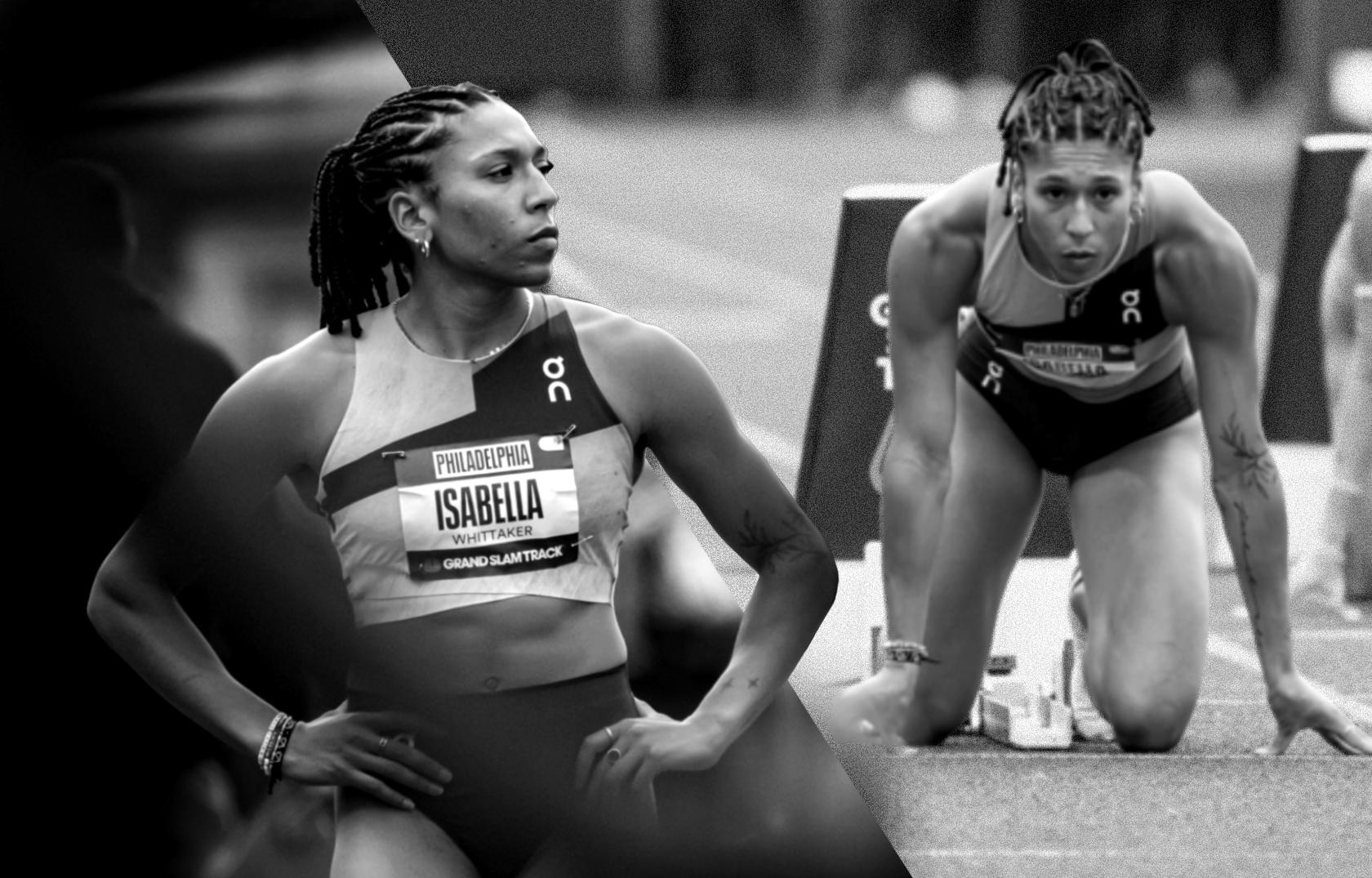
WHITTAKER , from back page
Whittaker said. “[It] is a good step because I was feeling a little bit nervous about whether or not I was [going to] eventually get the money, but I was hearing from them pretty frequently.”
“I was very excited about the league. I still am,” she added. “I definitely think [paying half of what is owed] was a step in the right direction. It’s a shame that [the league] sort of backfired.” Grand Slam Track looked to engage a new generation of track and field fans and offer a fresh take on the sport, pitting the sport’s biggest stars against each other and entering each in multiple races. Every finish was used to tally overall points at the event and throughout the season. Following the Philadelphia Slam, Johnson’s vision seemed to be coming to fruition.
WEINING DING | MULTIMEDIA EDITOR
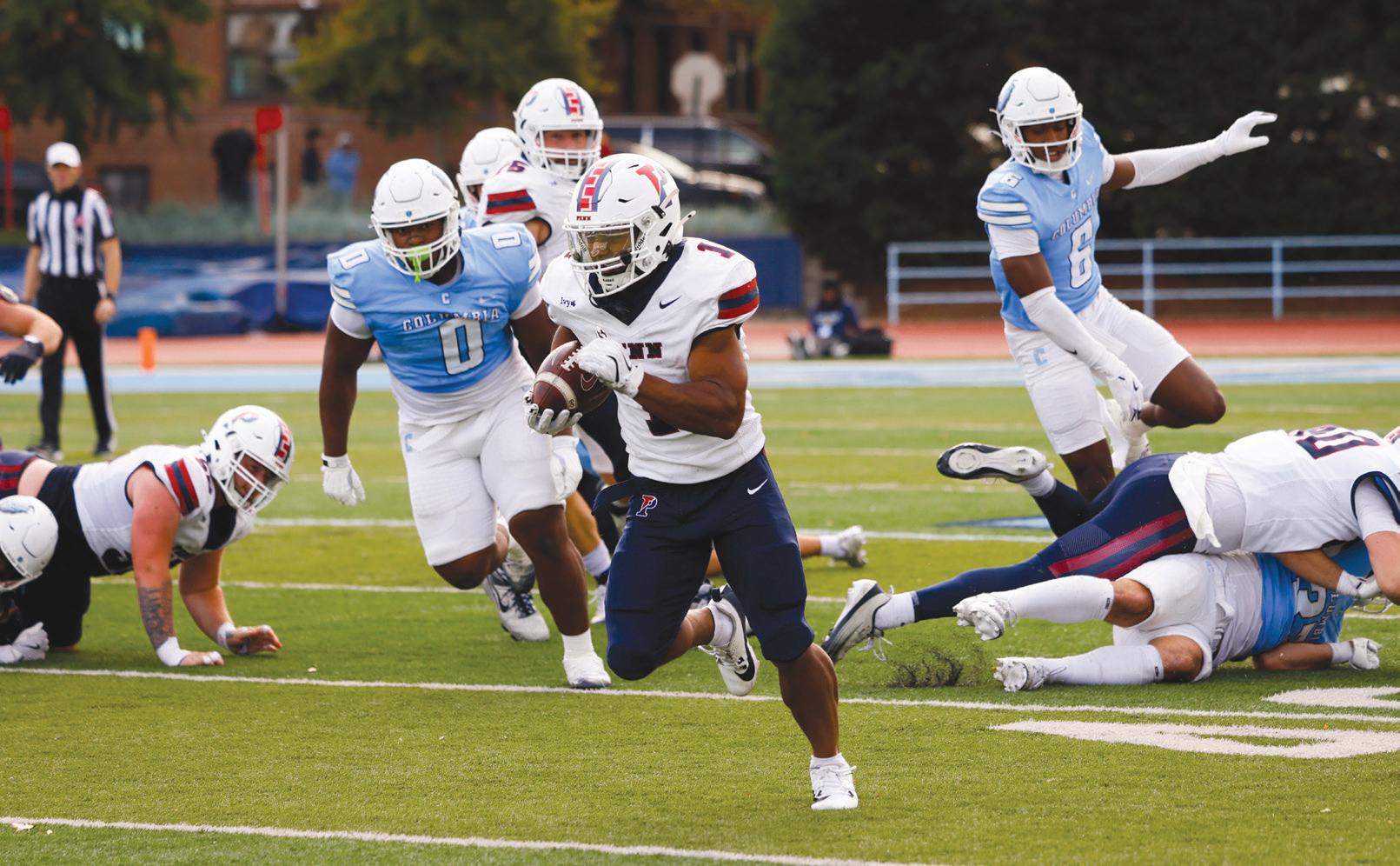
Oct. 21, 2023.
On the other side of the ball, the Red and Blue defense has its work cut out for it against the Bulldogs’ powerful run game. The Quakers are No. 6 in the conference against the run, and Yale running back Josh Pitsenberger leads the Ivy League in rushing yards and touchdowns. However, last week, the Penn defense also proved its ability to respond and adjust. The Quakers and Lions were tied up 14-14 at halftime, but Penn’s secondary shone in the second half, including shutting Columbia out in the fourth quarter. Senior linebacker John Lista, who is No. 6 in the nation in solo tackles per game, will no doubt lead the charge.
Penn 31, Yale 24 — Walker Carnathan, former DP Sports editor It’s been a season to remember for Penn’s offense, which has averaged over 30 points per game en route to the team’s best start since 2022. Most of that success has come in the air, with O’Brien’s 1,308 passing yards good for
Twenty thousand fans came to Franklin Field over the course of the two-day event, marking the highest attendance of the three completed slams. The historic venue, which has held the Penn Relays since 1895, saw 11 facility records fall on day one. Shortly following the meet, Johnson told the media he “couldn’t be happier” with the final product.
Behind the scenes, though, Grand Slam Track gave “serious internal consideration” to canceling the Philadelphia Slam before deciding to continue as planned, as The Athletic first reported. The sports outlet released a report on Aug. 28 that detailed the inner workings and eventual shortfalls of the league. Although Johnson publicly claimed that the league had secured $30 million in funding, sources informed The Athletic that it had only received $13 million at the time of the league’s first meet in Kingston, Jamaica.
It is unclear whether Penn has been fully compensated for the use of Franklin Field. A request for comment was left with Penn Athletics.
second in the Ivy League.
This week, Penn faces an opponent that moves the ball in a less glamorous way. Pitsenberger paces the conference in rushing, racking up 107.8 yards per game and reaching the end zone eight times so far this season. That could pose a problem for a Quakers front that ranks in the bottom half of the league against the run. Penn has given up 146.6 rushing yards per game, including 213 against Dartmouth. But a strong game on the ground does not always equate to a win for the Bulldogs. Two weeks ago, I watched Pitsenberger gash Dartmouth for 138 rushing yards in a game where Yale scored just 16 points and lost on a last-second field goal. It will take more than that for Yale to outpace Penn’s redhot scoring attack, and I think the first two levels of Penn’s defense will do enough to win the day. Watch for more than 10 tackles from Lista and a fourth-straight win for the Red and Blue.
Penn 31, Yale 17 — Justin Lee, DP Sports editor Penn football is off to its strongest start since 2022, and I don’t think its momentum is stopping anytime soon.
The Bulldogs are coming off of a one-sided 47-7 victory against Stonehill, in part due to Pitsenberger, who currently leads the Ivy League in rushing yards. However, the Bulldogs have struggled on defense, letting up 400 offensive yards against Cornell and losing to a last-second field goal against Dartmouth.
Meanwhile, the Quakers have an explosive offense of their own. Last week’s victory against Columbia highlighted another impressive performance from O’Brien and reigning FCS Offensive Player of the Week Richardson. Richardson’s bout against Yale in 2023 ended with him setting a program record for 191 receiving yards in a game. Just last week, Richardson surpassed all-time 2,000 receiving yards, being the sixth player in program history to do so. The stage is set for the O’Brien-and-Richardson duo to keep up the pace and notch another conference win.
Penn 28, Yale 21 — Madison Knier, DP Sports reporter
The members of this Penn football team started
Eldridge, an asset management company, had discussions about investing in the league, according to The Athletic, but it chose not to advance a non-binding term sheet that would have advanced an initial $30 million before granting another $10 million later in the year. Sources indicated to The Athletic that this decision was made following the Kingston Slam, as the meet’s meager audience did not impress Eldridge officials.
“The idea was [to] make it more exciting, make more money, and give it more of a platform. It’s sad that the attempt didn’t create enough revenue,” Whittaker said.
“That’s why my biggest concern is more just, ‘Do we even have a market for track and field right now?’”
After running for Grand Slam Track, Whittaker competed in the Diamond League, the Prefontaine Classic, the USA Outdoor Track and Field Championships, and the World Athletics Championships in Tokyo. Notably, at the WAC, she ran the first leg for Team USA’s championship record-breaking 4x400m
this year with fire in their eyes — the same eyes that are now locked onto visions of a championship ring. Yale may put up a fight, but Penn will not let the Bulldogs interfere with its much larger plans. Yale presents a strong offense, managed by quarterback Dante Reno along with his right-hand man Pitsenberger, who currently leads the Ivy League in rushing yards. However, Penn possesses an even stronger offense led by unshakable veterans: O’Brien, who leads the Ivy League in passing touchdowns; Richardson, who leads the league in receiving yards; and Owens, who has accumulated an impressive 379 receiving yards this season. Not to mention, this offensive trifecta remembers their respective underperformances against Yale last year and will be making sure not to make the same mistakes twice.
Experience alone will help push Penn towards a victory in their brawl against the Bulldogs. Yale may have an impressive stat sheet, but mere numbers won’t be enough to conquer a Penn team that has something to prove.
Yale 27, Penn 24 — Cavance Snaith, DP Sports reporter
This will be a difficult midseason test for Penn.
The Quakers are looking for revenge after they fell to Yale last year 31-10. The Bulldogs are coming off an impressive 47-7 blowout win last week against Stonehill, who the Quakers just barely beat 24-21 at the start of the season.
The Bulldogs’ defense has generally been able to remain competitive, while Penn’s defense is going to have to strategize a way to stop Yale’s rushing game. Pitsenberger is currently the Ivy League’s rushing triple-crown leader.
The Quakers’ defense is not the only one who has to worry. Penn’s offensive unit is going against a very hungry defense, with Yale defensive lineman Ezekiel Larry leading the Ivy League with the most sacks.
This will be a close game for the Quakers. The 81st matchup between Penn and Yale will be a competition between two good teams who are aiming to punch a ticket to the FCS playoffs. Unfortunately, I see the Bulldogs handing Penn its first Ivy League loss of the season.
relay, for which the team won gold. Whittaker had numerous conversations with teammates and competitors on the circuit about the unraveling of Grand Slam Track. Four-time Olympic champion Sydney McLaughlin-Levrone, who anchored Team USA’s first-place 4x400m relay team alongside Whittaker, participated in Johnson’s league as well. Whittaker described the common sentiment among track and field stars as a shared sense of disappointment towards Grand Slam Track, rather than anger.
“A lot of the dialogue was like, ‘Dang, that’s a shame.’ Everyone who engaged in Grand Slam, whether they were a challenger or a racer, really was vibing [with] the idea,” Whittaker said. “It was sort of like, ‘That kind of sucks, but what does that mean for our sport?’ We had some conversations: ‘Is the money even there for track and field? Will it ever be?’” Former DP Sports Editor Walker Carnathan contributed to reporting.
PREVIEW, from back page
“If we play our game [that] we’re capable of playing, I think it’s gonna be a great game.”
A fire has been lit under the Quakers, and with such an explosive start driving them forward, fans should expect a light show from the Red and Blue continuing this Saturday in Bulldogs country. “Accolades are cool, but a ring is better, and that’s kind of the mindset,” O’Brien said.
Football pictured celebrating a touchdown on
WEINING DING | MULTIMEDIA EDITOR Richardson celebrated a touchdown at Yale on Oct. 21, 2023.
JACKSON FORD | SENIOR PHOTOGRAPHER
Whittaker pictured lining up at the block for the 400m race at Grand Slam Track.
Rowing hits the water at Head of the Charles Regatta
Lightweight rowing fnished third across two divisions, while the heavyweight A boat was sidelined due to a mechanical failure
MELONI
ANTONIO
Sports Reporter
Oars at the ready, get set, go! Penn lightweight and heavyweight rowing took off at the Head of the Charles Regatta this past Sunday in Boston. Lightweight rowing finished third in both the varsity fours and eights divisions. The headline of the day, however, came from the heavyweight team. The Quakers had two boats performing in the Men’s Championship Eights division, but to the team’s despair, only one would cross the finish line.
Penn’s A and B boats were off to a fast start in the fall heavyweight rowing season. Scheduled to compete in one of the final races of the day, the rowers across the two boats were eager to begin their race on Sunday afternoon.
The A boat was manned by freshmen Luke Putter and Dylan McConnell; sophomores Marco Dri, Leo Goez, and Hal Hunter; and seniors Cole Riedinger, Austin Straley, Lars Finlayson, and George Rodgers. But Penn’s fastest crew would ultimately fail to complete the race after suffering a boat malfunction — making it the only boat to not complete the course out of 29 total competitors.
“It happened just before the halfway mark of the race. They lost their steering [of] the boat, which is especially critical for a very windy, curvy course like Head of the Charles,” heavyweight rowing coach Al Monte said. “That destabilized us to the point where we couldn’t manage to get to the finish line. It was unfortunate, for sure, and not what anyone foresaw the day to look like.”
While the malfunction was a big blow, the fall season is the most opportune moment for a calamity like this to occur. Since the spring season is when the biggest races take place and when national championships are won, the fall season serves as a preparation phase for what is to come. Crew compositions are constantly changing, conditioning is nowhere near perfect, and team chemistry is being built, allowing Monte to use this as a learning experience ahead of the team’s next outing.
“There’s been an air of optimism for the entirety of the fall,” Monte said. “We graduated a big, talented class last year that did a great job of developing over their time at Penn. We’ve seen real improvement over the past six weeks, especially for some of the younger guys. We have to train like we’re behind, like we have
something to prove.”
The heavyweight B boat finished 23rd in the championship eights. The B boat was composed of freshman Caillen Pieckenhagen; sophomores
Sam Fowlie and Oscar St. Pierre; juniors Red Staunton, Cole Bruen, and James Glomb; and seniors Tommy Schrieber, Matt Radell, and Hailey
Kim. Although it placed in the bottom half of the regatta, the B crew was able to finish ahead of some A boats from rival programs. Ultimately, Harvard’s A boat performed the best out of the Ancient Eight, placing third overall. Considering the Crimson’s familiarity with the course, a strong performance was to be expected.
“They rowed an aggressive race. They beat a
couple of Ivy JV crews that beat us last year in the Head of the Charles. I give those guys a lot of credit for rowing hard and tough,” Monte said. “I think they thought that the race was representative of where they’ve been training, but they also felt like it wasn’t their best effort. We’re kind of in the zone where we need to be, but just like the varsity, we still have to make that progress if we’re going to supersede our rivals.”
Lightweight rowing fared well in its opening two races. Penn’s A and B boats finished third and 10th, respectively, in the Men’s Lightweight Fours race, with the A crew trailing only Harvard and Cornell in the 12-team regatta. Freshmen Henry Alston and Elias Tejpaul, juniors Dylan Folan and
Will Drinkall, and senior Carly Yang finished in the top three.
Volleyball upsets Ivy League leader Cornell, defeats Columbia during Alumni Weekend
The Quakers’ tenacity and roster depth shone in their 3-0 sweeps over Columbia and Cornell ANGEL GALLARADO AGUILAR AND ELIJAH RAMIREZ Sports Reporters
What’s the difference between 6-foot-0 and 6-foot-1? When it comes to height, not much — but in volleyball, “6-1” now takes on a new meaning, marking Cornell’s first loss of the season. Penn volleyball came into the weekend 1-4 in Ivy play and ended it with two crucial 3-0 victories against Columbia (2-15, 0-7 Ivy) and Cornell (11-6, 6-1).
“We’ve been going through some ups and downs in practice the last couple of weekends, but tonight was all about playing for each other. When we face adversity, we just need to go back to the basics,” sophomore setter Emery Moore said.
In an alumni-filled crowd at the Palestra, the basics proved to be more than enough for Penn (9-8, 3-4) to come out on top. In the first set against Columbia, the team steamrolled its way to an early 9-1 lead, only losing one point on a service error. The Quakers’ hitting room quickly found its footing in the matchup, with junior outside hitter Zada Sanger earning four kills in an early run. Sanger went on to finish the game as the team’s kill leader, with 13 total.
The Lions fought their way through the set to cut the Quakers’ lead to one point, forcing the Red and Blue to call their first timeout of the night. However, Penn never gave up its lead and took the set 25-20, losing six points to service errors — a problem that would persist throughout the night.
In set two, the Quakers and the Lions continued their close battle, exchanging point for point until, with the score 7-6, Moore found Sanger for a kill and a two-point lead — a connection that proved to be lethal for the remainder of the night. “I just do whatever I can to get a win, which is all that matters. I am so proud to be able to contribute to this team and be helpful when I’m on the court,” Sanger said. Columbia claimed its first lead of the match at 14-13. After a few service and reception errors, Penn was on the ropes with a 22-19 deficit and was forced to call a timeout — which proved useful when a missed serve by Columbia and back-to-back kills from Sanger brought the set to a 22-22 tie. The Quakers maintained their momentum after two back-to-back aces by sophomore outside hitter Jenna Garner brought the Quakers to a 25-22 win.
The third set was a hard-fought battle. Even with lots of service errors, Penn’s consistent attack game helped it gain a comfortable 18-12 lead after two big blocks from sophomore middle blocker Adell Murray. Columbia then responded by winning nine of the next 12 points — aided by multiple kills and blocks — bringing the two teams to a 21-21 tie. After a Penn timeout, Moore found her trusty frontline in Murray for a big kill, making the score 24-23. The crowd erupted as Columbia missed another hit, giving the Quakers a clean 3-0 victory.
Hot off a big win over the Lions, the Red and Blue were battle-tested heading into their matchup against Cornell. Undefeated in Ivy
middle blocker Haley Kerstetter
“Cornell is a really aggressive team,” coach Tyler Hagstrom said ahead of the game. “They’re physical, and so I think we’ve got to be ready to just go toe-to-toe and battle it out with them for every point.”
STOKES, from back page conference play and at the top of Ivy League standings, the Big Red was the favorite heading into the matchup.
The first set was a back-and-forth battle, with both teams playing past the 25-point mark. Penn led by as many as six points early in the set. With multiple ties and lead changes, the Quakers were headlined by senior middle blocker Jalen Tennyson with four kills and a .429 hitting percentage. Freshman libero Addison Pollock also performed well in the matchup, notching seven digs in the first set alone. Ultimately, the Quakers claimed the first set 29-27 after an ace from Garner.
Expecting the Big Red to bounce back after an intense first set, Penn was prepared for the second set. Initially trailing by two points early on, the team regained the lead with Sanger and Garner’s help. The duo launched a 6-0 scoring run, putting the Red and Blue ahead of Cornell by 12 points late in the second set. But the Quakers weren’t ready to take their foot off the gas.
While Cornell was able to narrowly trail behind the Quakers early in the third set, untimely attack errors from the Big Red allowed
Penn’s fast and fiery offense to take the lead.
While the Quakers led by as many as 11 points in the set, a 4-0 Cornell run forced a Penn timeout for the team to find its footing. Ultimately Penn kept the lead, claiming the third set over Cornell 25-16 and winning the match.
“It’s a privilege to be in a league where any team can win on any given night. … We work to
receiver to running back this season, was off to the strongest start of his collegiate career. His average of 29.4
set ourselves up in practice to have a competitive mentality so that we know we can go out and take any match,” Sanger said. Initially off to a slow start in conference play, the Red and Blue found their footing to hand No. 1 Cornell its first conference loss of the season. Next, Penn volleyball will take on Princeton on the road on Oct. 24.
got landed on kind of high up on my leg,” Stokes said.
Stokes had rushed for 63 yards prior to the injury, his most productive day on the ground so far this season. Penn is 2-0 in Ivy League play and 4-1 overall, thanks in large part to its offense. The Red and Blue have averaged 30.6 points per game and have scored 24 points or more in every contest. Even without its all-world return man, Stokes is confident the team’s hot streak will continue.
“I’ll be back soon, but the team is doing their thing right now, and they’re really unshakable,” Stokes said. “I’m excited for this group and where we’ll lead.”
KEVIN REN | STAFF PHOTOGRAPHER
Freshman
pictured preparing to serve against Princeton on Sept. 26.
DYLAN TIU | DP FILE PHOTO
Lightweight rowing pictured hosting a practice on the Schuylkill River on March 25.
Penn
alum
Isabella
Whittaker ran in Grand Slam Track over four months ago. She has not been paid in full yet
Whittaker is entitled to over $80,000 in prize money. But so far, she has only recently received half of her winnings — and she’s not alone
CONOR SMITH Deputy Sports Editor
Enforcement protests in the city.
2024 Penn graduate and former Penn track and field runner Isabella Whittaker returned to Franklin Field on May 31 to run in Grand Slam Track, a league founded by Olympic gold medalist Michael Johnson.
It was Whittaker’s second go-around with Grand Slam Track after running in the Miami Slam three weeks prior. But in Philadelphia, the former Ivy League champion showed out at her collegiate venue by placing third in the 400-meter race on day one before improving to second in the 200m race the next day. She finished second overall in her group, adding $50,000 to the $30,000 in prize money she won in Miami. Eleven days following the Philadelphia Slam, Grand Slam Track canceled its fourth and final meet of its inaugural season, which was set to take place in Los Angeles. At the time, an unnamed source told Front Office Sports that the cancellation was due to “a new strategic partner/investor,” adding that “the Geopolitical climate in LA also doesn’t help” — referring to anti-Immigration and Customs
Football seeks to remain undefeated in Ivy League this weekend at Yale
After last year’s 31-10 loss, Penn plans to settle the score as its ‘revenge tour’ continues
MADISON KNIER
Sports Reporter
Penn football is off to a hot start.
The Quakers have made a statement by defeating two of last season’s Ivy League co-champions to begin this season’s conference play. Additionally, the Red and Blue have kicked off Ivy play with a perfect 2-0 record for the first time since the 2022 season. Though several more games need to be played to determine who will earn the championship ring this year, the Quakers are ready to do whatever it takes to secure the title.
This Saturday, Penn will trek up to New Haven, Conn. for its second-straight road matchup against Yale, who currently sits at 1-1 in conference play with a hefty 41-24 win over Cornell and a narrow 17-16 loss to Dartmouth. Historically, the Bulldogs have had six victories over the Quakers in their last 10 matchups. Last season, the Red and Blue suffered a blowout 31-10 loss against the Bulldogs under the Friday night lights; however, this year, Penn returns stronger and with a vision of continuing its “revenge tour” on Yale’s home turf.
“We play best when we’re having fun, but at the same time, we’ve just got to be mentally locked in to what our game plan is and how to go execute our strategy,” senior quarterback Liam O’Brien said.
Coming off a big weekend at Columbia, the Quakers’ offense continues to prove its strength. O’Brien accounted for five touchdowns, becoming the first player in Penn history to accumulate five-or-more touchdowns in two separate games. He currently leads the Ivy League with 12 passing touchdowns. Star senior wide receiver Jared Richardson also had a historic day, eclipsing the 2,000 receiving-yards mark and becoming the sixth player to do so in program history. Richardson’s efforts earned him his second-consecutive Ivy
League Offensive Player of the Week title.
A look into the past for Richardson is rarely a visit to a pile of personal accolades, but rather to shortcomings. Last season’s loss against Yale is no exception.
“Going back to last year, I already put that in my notebook. We had a meeting today, [and] I put on the top ‘week six, Yale: 31-10,’ and I put ‘one catch for 11 yards,’” Richardson said. “That just shows [that] the revenge tour is in full effect.”
Yale plans to use its stealthy defense led by linebacker Inumidun Ayo-Durojaiye and defensive lineman Ezekiel Larry to halt the Quakers’ offensive powerhouse. Ayo-Durojaiye currently leads the Ivy League in tackles, while Larry remains second for total sacks. The Bulldogs defensive unit put on a show in its most recent matchup against Stonehill, only allowing seven total points from the Skyhawks.
Even if defense wins championships, a strong offense will aid in the measure. Yale’s offense, helmed by quarterback Dante Reno, put up an impressive 47 points and accumulated a total of 481 offensive yards against Stonehill. Yale running back Josh Pitsenberger contributed abundantly with 69 yards and two touchdowns on the day. Pitsenberger currently leads the league in rushing yards, while Yale wide receiver Nico Brown is No. 2 in receiving yards to none other than Richardson.
Despite going up against strong offensive and defensive fronts from the Bulldogs, Penn remains focused on the elements that it can control.
“It’s not as much, in my opinion, as what Yale or any other opponent will do. It’s how we respond and how we play our game,” coach Ray Priore said.
See PREVIEW, page 8
But the reality was far simpler — the league never had the money. Following the Philadelphia Slam, the league owed $19 million that it could not pay to athletes and vendors, according to Front Office Sports.
“I don’t know what the future is for Grand Slam,” Whittaker told The Daily Pennsylvanian. “I’m not sure if we’re going to try again. I don’t really know what their endgame is, but I do believe that I’ll get my money. … I had a feeling it might take a while for me to get the money, because they basically told us they didn’t have it.”
In total, Whittaker is entitled to $80,000 in prize money between the Miami and Philadelphia races, alongside two $2,000 appearance fees for both races. Four months later, after the league received emergency financing from its initial investors, she has only recently received half of her winnings.
“A week or two ago, [Grand Slam Track was] able to pay all their athletes half of what they were owed,”
Football’s Julien Stokes breaks fibula, hopes to return ‘late in the season’
The Newbury Park, Calif. native currently leads the nation in average punt return yards and ranks third in all-purpose yards
AVERY BROBBEY AND WALKER CARNATHAN Sports Reporter and Former Sports Editor
Penn football senior running back Julien Stokes, the nation’s leader in average punt return yardage, suffered a broken fibula during the Quakers’ win over Columbia on Saturday, he told The Daily Pennsylvanian.
Stokes says he hopes to return before the end of his senior campaign.
“After I get these X-rays, [I’ll] probably immediately start rehabbing … and then from there, try to get back late in the season,” Stokes said. “Now that we’re eligible for the [FCS] playoffs, if our team gets that far, hopefully we’ll see if I can get back in there and help my team out.”
Penn Athletics did not indicate a timetable for Stokes’s return, noting that he is still being evaluated. “The University of Pennsylvania football program comments that running back Julien Stokes is being further evaluated for an injury sustained during this week’s game.” Stokes, who switched positions from wide
DANA BAHNG AND JACKSON FORD | SENIOR DESIGNER AND SENIOR PHOTOGRAPHER
GRACE CHEN | SENIOR PHOTOGRAPHER
Stokes pictured carrying the ball away from Columbia’s defense on Oct. 18.