President Joe Biden stops by Penn’s campus in unexpected visit
 JONAH CHARLTON Senior Reporter

JONAH CHARLTON Senior Reporter
Student leaders in Greek life reported less occupancy, greater difficulty in building community within their chapters
RADWAN AZIM Staff ReporterMembers of Greek life expressed frustration toward Penn’s requirement that sophomores live on campus — which excludes fraternity and sorority housing — one year after the policy was imple mented.
The second-year housing policy, which was first announced in 2018, was enacted for the first time in fall 2021 for members of the Class of 2024, draw ing pushback from students involved in Greek life. Penn has since reaffirmed that on-campus housing will not include affiliated fraternity and sorority housing, prompting changes in how Greek hous ing operates. Student leaders in Greek life told The Daily Pennsylvanian that they have seen less oc cupancy in Greek housing and greater difficulty in building community among their chapters.
Penn’s Office of Fraternity & Sorority Life, the administrative liaison between Greek life and the University, acknowledged that the sophomore housing requirement has caused significant shifts among fraternity and sorority chapters, but said it has worked with Greek life homes to address issues.
“The Office of Fraternity & Sorority Life has adjusted to the sophomore housing requirement by
working with chapters to plan next year’s occupancy during the fall term,” OFSL told the DP via email.
“We’ve [the Office of Fraternity & Sorority Life] also worked collaboratively with campus partners and chapters to review occupancy configurations in each home.”
Greek life housing occupancy has posed a prob lem since the start of the COVID-19 pandemic, but intensified specifically with the second-year policy among Greek life. Before the policy, sophomore members contributed to a significant portion of fra ternity and sorority houses’ occupancy.
College junior Praveen Rodrigo, the president of Penn’s Beta Theta Pi chapter, said that his fraternity house has seen reduced occupancy as a result of the COVID-19 pandemic and the sophomore housing requirement.
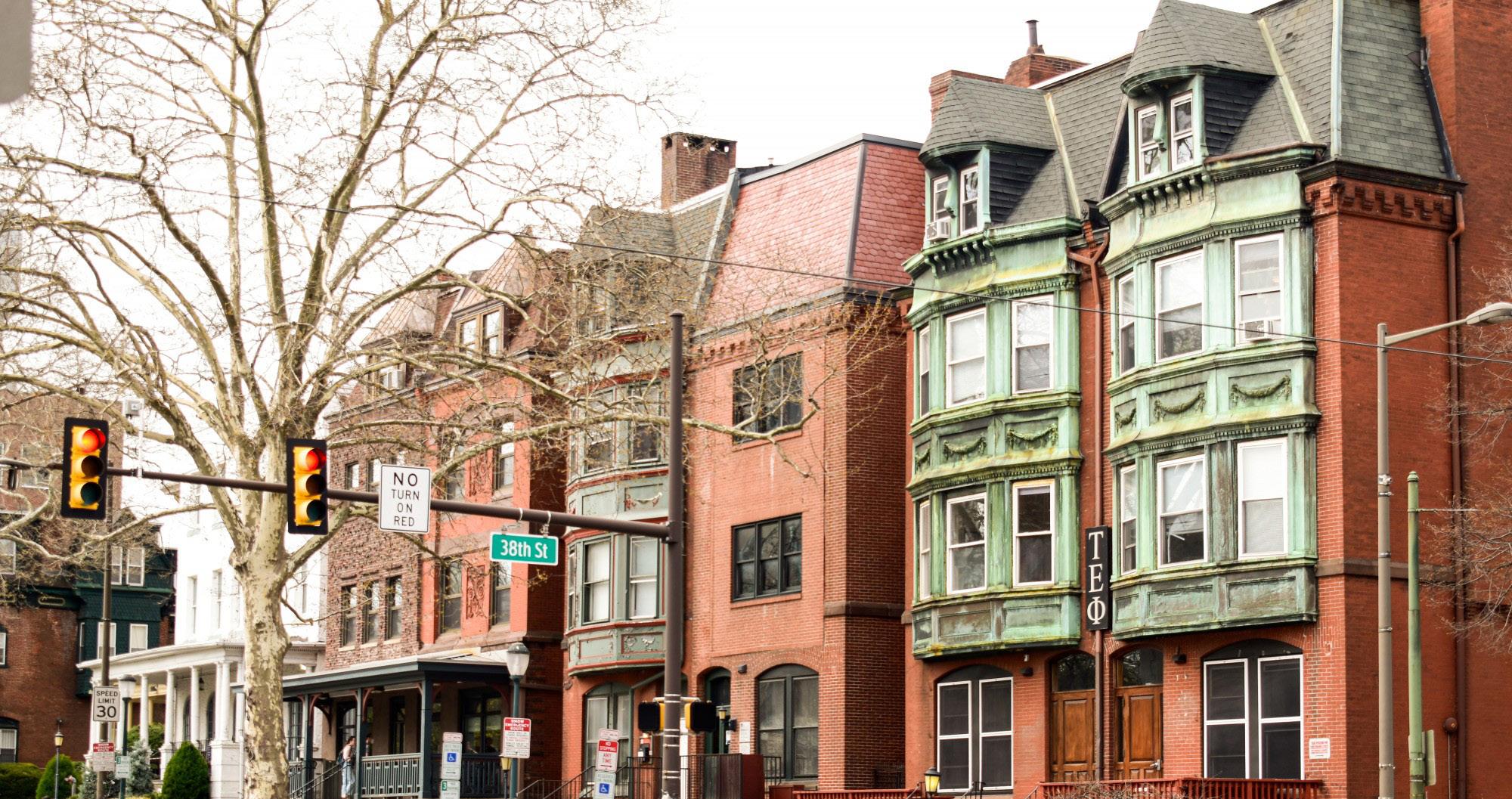
The chapter house currently houses 15 members, coming short of the school’s expected oc cupancy of 25 members. However, Rodrigo expects the numbers to increase to between 20 and 27 mem bers in the next semester.
Rodrigo added that the housing process includes guidelines for the occupancy rates in chapter houses.
For example, a chapter house receives warnings for
each year there is a steady decline in occupancy, eventually leading to the threat and loss of the chap ter house. He said that chapter houses across the board are feeling the pressure of maintaining oc cupancy in order to keep their houses, describing it as a “stressful” situation.
“I would say definitely with the new rules, people adjusting to it, and COVID still lingering, it’s prob ably a problem [that] I would assume many chapters are feeling,” Rodrigo said.
College senior Andrew Wilks, Alpha Epsilon Pi chapter president, expressed similar sentiments and stated that while their chapter has managed to main tain occupancy, other organizations have been more heavily impacted than others.
“I think it’s put a large amount of strain on Greek life. We’ve already seen some Greek organizations lose their houses because prior to it sophomores at least [in] the large chapter houses, sophomores would comprise most of the house,” Wilks said.
In addition to reduced occupancy, students — in cluding College junior Lucas Loschiavo — told the DP that the sophomore housing requirement nega tively impacts Greek life community building.
In a surprise visit, President Joe Biden stopped by Penn’s campus on Friday afternoon, attracting hun dreds of students and community members.
Biden arrived around 3:45 p.m. at the University Meeting and Guest House, located at 3808 Walnut Street, before exiting around 5:25 p.m. and walking down Walnut Street to the Penn Bookstore, stop ping to greet the crowd of students and Philadelphia residents who had gathered along the way. Biden, former Benjamin Franklin Presidential Practice Pro fessor and founder of the Penn Biden Center, was accompanied by Penn President Liz Magill and his granddaughter, Natalie Biden, who was reportedly visiting the University.
The undegraduate concentration requires the
VIDYA PANDIARAJU Contributing ReporterThe Wharton School announced the new Environ mental, Social, and Governance Factors for Business concentration and major, which will be available for students to declare in the 2023-2024 school year.

The ESGB concentration, which will be offered at the undergraduate level, requires the completion of 4.0 credit units of coursework from a list of approved courses. Students can take on the concentration either with or without additional specializations, which are offered in Business, Energy, Environment, and Sus tainability or in Social and Governance and require at least 3.0 CU of required courses in these areas of focus.
Carey
Penn has formed a search committee to select a successor for University of Pennsylvania Carey Law School Dean Ted Ruger.
President Liz Magill and Interim Provost Beth Winkelstein announced the formation of the com mittee on Oct. 4. The committee will be chaired by Wharton Dean Erika James and consists of 17 other members, including faculty, students, alumni, and consultants from Korn Ferry, an organizational con sulting firm.
“We are pleased to announce the formation of an ad hoc Consultative Committee to advise on the selection of the next Dean of the University of Penn sylvania Carey Law School,” Magill and Winkelstein wrote in the announcement.
The announcement precedes the upcoming end of Ruger’s term on June 30, 2023, after eight years in the position. In 2021, Penn extended Ruger’s term through June 2023, along with the term of Graduate
School of Education Dean Pam Grossman, who “ex pects to step down” at the end of her term. According to University policy, deans typically serve no more than 12 years in their position, with a first term of no more than seven years.
Under Ruger’s tenure, Penn Carey Law rose to sixth in the U.S. News & World Report law school rankings, the highest ranking the law school has achieved, and continues to lead in employment rate after graduation, spokesperson Meredith Rovine wrote in an email to The Daily Pennsylvanian.
Penn Carey Law also improved student diversity and access to legal education. Students at the law school today come from a broader range of back grounds, have higher median LSAT scores and grades, and have greater demographic diversity than ever before. Since 2013, financial aid has risen 83%,
The ESGB major, which will be offered to Whar ton MBA students, is designed for “individuals of all backgrounds with a vested interest” in Environ mental, Social and Governance — a field focused on sustainable and socially responsible investing
of
credit
of
— who see it as the future of business, according to Vice Dean and Faculty Director of the ESG Initiative Witold Henisz.
“In order to be a business leader in this century, [one] needs to understand the essentials of how to run and finance a business — the operations, marketing, management, financing — but also to understand the social context in which [one’s] business operates,” professor of Legal Studies and Business Ethics Sarah Light said.
The exact team that started the development of the new concentration is “hard to isolate,” according to Henisz, who highlighted Light’s involvement. He also indicated “lots of stakeholder support,” specifically referencing the Penn senior leadership team, alumni currently working in or pursuing ESGB-related
The visit marked Biden’s first public appearance on Penn’s campus since 2019.
Around 3:15 p.m., dozens of Philadelphia police and secret service motor vehicles restricted vehicle access to 38th Street from Spruce to Chestnut streets. After staying briefly in the Guest House as well as Perry World House, Biden exited out of the front door of the Guest House and walked down Walnut Street to the Penn Bookstore. Stopping several times to speak with people on the street, the President told one stu dent that “the most important thing is taking care of your family.”
Upon leaving the Bookstore, Biden walked to his car and waved to the nearly 500 students who had gathered to a swell of cheers before pulling away with his motorcade. After Biden departed, Magill told The Daily Pennsylvanian that the meeting with Biden had been “great.”
In February 2017, Biden was appointed to the honorary professor position of Benjamin Franklin Presidential Practice Professor. Biden’s role at Penn was largely ceremonial and he did not teach classes and appeared on campus infrequently. Biden also opened the Penn Biden Center for Diplomacy and Global Engagement in Washington, D.C. in early 2018.
When Biden announced he was running for presi dent in April 2019, he took an unpaid leave of absence from his post at the Penn Biden Center. The Center continues to operate under different leadership. Several members of the Biden family have also graduated from Penn’s various schools.
Biden was in Philadelphia on Sept. 1 for a speech from Independence Hall that focused largely on de mocracy and “the continued battle for the soul of the nation.” He characterized the upcoming general election as a battle between the Democrats and “ultraMAGA Republicans.”
The strategic framework for “Penn’s future direction” will be shared in the summer of 2023, according to a message from Magill
JARED MITOVICH Senior ReporterPenn President Liz Magill has formed an advi sory committee to inform the University’s strategic framework over the next century.

The Red and Blue Advisory Committee — which was announced to the University community on Tuesday and held its first meeting on Wednesday — is part of a new initiative entitled “Tomorrow, Together: Penn’s Next Century.” The committee is chaired by John L. Jackson Jr., the dean of the An nenberg School for Communication, and consists of 15 additional members from across the Univer sity — including professors, administrators, and students — who will make recommendations to Magill for potential priorities.
“Penn’s future has never been brighter thanks to every member of our University community. We now have an historic opportunity to envision where Penn goes from here,” Magill wrote in the announcement. “I am writing to invite you to join
as Penn plans for tomorrow, together. Led by a Red and Blue Advisory Committee, we are embarking on a University-wide effort to inform strategic next steps for Penn.”
The strategic framework for “Penn’s future di rection” and its local, national, and global priorities will be shared in the summer of 2023, according to Magill’s message. In a written statement sent to The Daily Pennsylvanian, Jackson added that after holding its first meeting on Wednesday, the com mittee plans to meet “regularly, and often.”
“By design, the process will be broad, inclu sive, and forward-looking, and our committee will create opportunities for all to contribute and have their voices heard,” Jackson wrote.
The two students appointed to the advisory com mittee are Undergraduate Assembly President and Wharton and College senior Carson Sheumaker and Graduate and Professional Student Assembly President Robert Watson.
The “Tomorrow, Together” announcement comes after reports that Magill has begun meeting with and asking administrators close to her how to address pressing community issues, such as the sale of the University City Townhomes, for which the University recently announced its response. Magill wrote to the DP that the Red and Blue com mittee arose from her initial meetings with people from across the University.
“As part of my transition and in my first months as president, I heard a consistent theme from our community,” Magill wrote. “Faculty, staff, and stu dents alike shared a genuine and strong desire to be engaged in a planning process that will consider Penn’s future.”
Magill went on to write that the committee’s work will allow Penn to “improve society for future generations.” According to its website, the commit tee will explore a number of questions, including how the University can advance diversity, equity, and inclusion; how it can cultivate “an ethic of service to others,” and how it can “maximally con tribute” to Philadelphia, the United States, and the
world.
“Far from static, the framework will by design evolve and grow just as Penn evolves and grows, informed by ongoing University engagement, consultation, and collaboration,” according to the “Tomorrow, Together” website.
Magill became Penn’s ninth president on July 1. The formation of the Red and Blue Advisory Com mittee precedes her inauguration, which will take place on Oct. 21.
The encampment remains on College Green and continues to receive organizational support from both local and international climate groups
One month after students first set up their tents at this semester’s Fossil Free Penn encampment, FFP members remain on College Green despite recent abysmal weather conditions and many stu dents’ departures from campus during fall break last weekend.
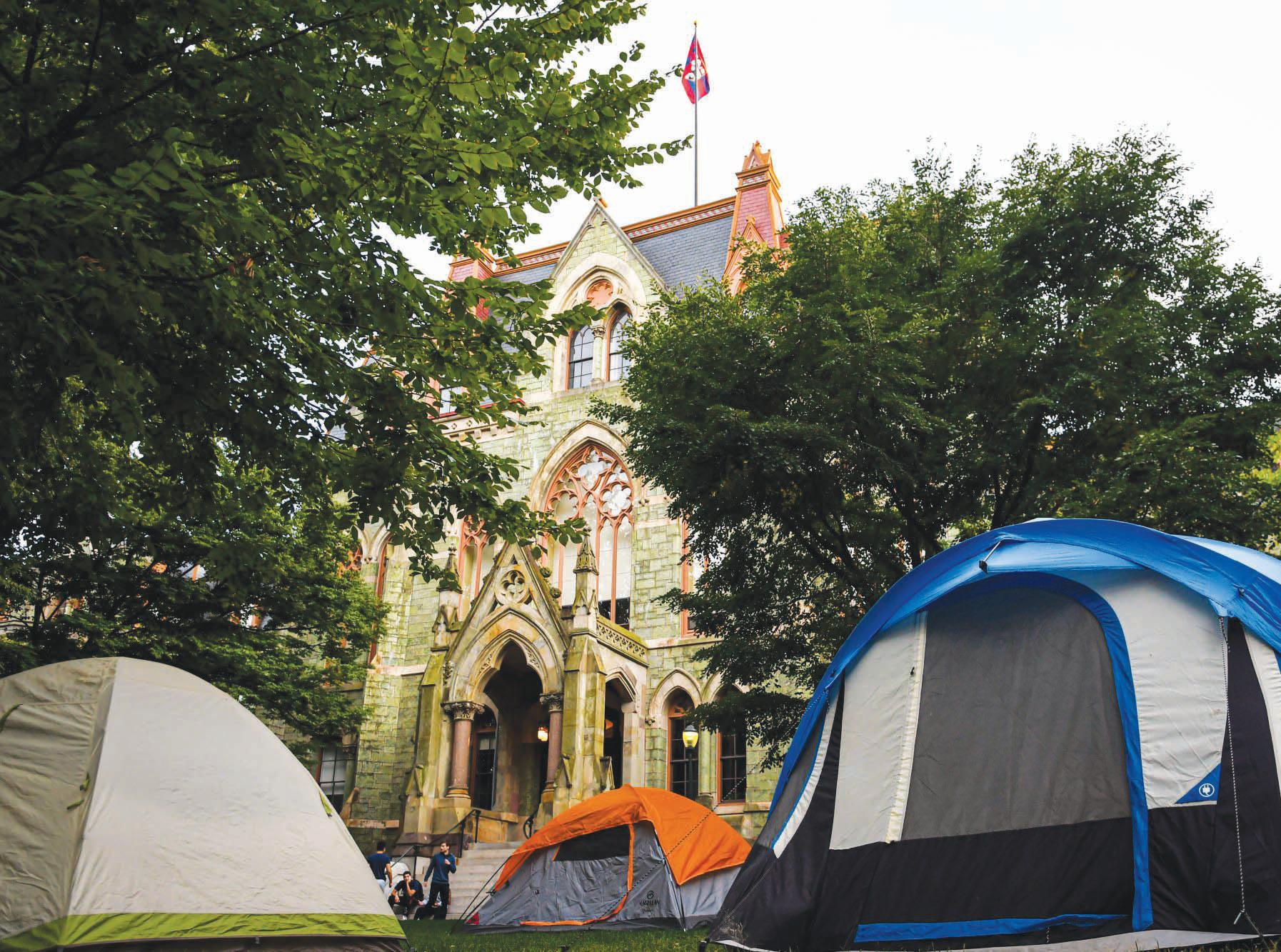
FFP’s encampment, which began on Sept. 14., features three demands for the University: a
public commitment toward preserving the UC Townhomes, complete fossil fuel divestment, and making payments in lieu of taxes, or PILOTs, to Philadelphia public schools. Since the start of the encampment, FFP coordinators have told The Daily Pennsylvanian that they do not plan on leaving until Penn has publicly met all three of their demands.
Even though the majority of Hurricane Ian’s damage affected Florida and other areas near the Gulf of Mexico, many in Philadelphia were also impacted by its rains.
FFP coordinator and College sophomore Eug
Xu said that students partaking in the encampment took storm preparations “very seriously.” After hours of taking down posters, tarps, and other loose items, Xu said that students consolidated their en campment to just four tents set up against the side of College Hall to minimize the force of wind and rain.
“We had seven people sleeping in a four-person tent,” Xu said. “It was a little crowded, but we had a lot of fun.”
Xu said that the following days of continued rain were rough, but it was important to FFP that the encampment remained on College Green and con tinued to spread its message.
“We wanted to make sure that campus knew that we were not gone. We were just protecting the phys ical safety of the encampment,” Xu said.
FFP coordinator and College junior Katie Fran cis said that camping through the storm was a
bonding experience for the group and a testament to their commitment.
“We were not risking our health,” Francis said. “We took breaks, of course, but we were willing to be outside in a hurricane because we care so much about this.”
Xu said that facing the effects of Hurricane Ian was “poetic.” They said that this is the type of natu ral weather phenomenon that is only exacerbated by climate inaction.
“There was never a moment in my head when I said, ‘This is the moment that we go home,’” Xu said. “This is a fundamental part of why we are here, and we’re going to stay through that. This is the stuff that we’re willing to stick through.”
Francis added that those at the encampment are willing to weather the elements because they “feel like change is going to come, and it is going to happen soon.”
Even through fall break, Xu said that coordina tors planned out who would be willing to stay on campus to be in charge of the encampment. They said that while numbers were lower during the break, they were able to continue to foster a com munity on College Green.
The encampment has continued to partner with local environmental justice-focused organizations and global groups advocating for total fossil fuel divestment, according to FFP coordinators.
FFP coordinator and College sophomore Sabirah Mahmud is a strategy organizer for Philly Thrive
— an organization fighting for environmental, racial, and economic justice in Philadelphia. Philly Thrive has supported FFP’s encampment and participated in their press conference last month. Mahmud said that the encampment’s demands are in line with advocacy work that other Philadelphia organizations have been fighting for.
“FFP’s demands for Penn are a part of a larger struggle happening across the city,” Mahmud said.
“Penn can set a massive precedence for global di vestment and even inspire the city.”
Xu said that FFP has also worked with End Fossil, an international youth-driven organization advocating for climate justice worldwide. Xu said that sitting in meetings with students across the globe has allowed them to better understand how Penn fits into the larger picture of climate inaction.
“It is not just local,” Xu said. “There are people in Portugal, Germany, Italy, Egypt, in the Congo, the United Kingdom, and across the U.S. that know about us and who have seen us. It is miles ahead of where we were before.”
Despite the weather conditions, students said that they have no plans to leave the encampment until their demands are met. Mahmud said that as someone who grew up in University City, she knows how constant climate inaction has been “det rimental and traumatic” to her community.
“I feel much more motivated to keep the en campment going and showing up, even when it is difficult,” Mahmud said.
and the Dr. Sadie T.M. Alexander Scholarships were created to increase access to a legal education at Penn Carey Law.
Ruger’s term saw the hiring of 17 faculty members and an increase in the percentage of women faculty members and faculty members of color by 92% and 51%, respectively. Ruger spearheaded partnerships across the University including increasing opportuni ties for joint degree programs, hiring Penn Integrates Knowledge professors, and launching the Future of the Profession Initiative, according to the statement.
professions, current students, the dean’s office, and the Curriculum Innovation and Review Committee.
When Wharton Dean Erika James was installed in 2020, she announced that one of her top priorities was to further develop ESG on campus. According to Light, this announcement prompted Wharton fac ulty to delve deeper into the social and governance dimensions of ESG, while also examining the study of business within an environmental framework in programs such as BEES, which is also an existing program on its own.

Student residents have complained about the quality of maintenance services under the new management
SNEHA PARTHASARATHY Staff ReporterResidents of Hamilton Court, an off-campus apartment complex home to many Penn students, have reported a rise in maintenance issues and de layed responsiveness from facilities following the building’s management switch this summer.
Hamilton Court, located at 39th and Chestnut streets, markets itself as convenient housing for students with services like 24-hour emergency maintenance and secure electronic building access. However, since the complex sold for $87 million this summer, student residents have complained about the quality of these services under the new manage ment, a private buyer.
One source, who requested anonymity fearing retribution from their leasing agent, described their room upon move-in as “filthy.” They added that they noticed “used Q-tips and dental floss on the floor.”
College senior Lily Nesvold, who moved into HamCo last month, said her smoke detector was de tached from the wall when she moved in. Nesvold and the source also describe other residents wait ing over a month to receive furnishing needs agreed on in their leases, including a wardrobe and a desk chair.
Another HamCo resident, who also requested anonymity fearing retaliation from HamCo man agement, said they were forced to move rooms unexpectedly when their building flooded. They have been living with strangers since the incident, and the date they can return to their leased apartment keeps getting pushed back.
“When we asked for a discount, since we are liter ally living with strangers, they said the only option was to terminate the lease,” the anonymous source told the DP. “But I can’t do that because I need some where to live.”

When Nesvold recently experienced a leak in her living room, she called the emergency maintenance line. She said they only followed up on the leak over a day later, despite HamCo’s promised amenity of 24-hour emergency maintenance service.
Electronic key fobs used to enter the complex have also posed difficulties for HamCo residents. Some building doors do not close properly, which allows
non-residents to be to walk in.
“A homeless guy broke in and entered a Hamilton Court building this week. He kicked in an AC unit,” the first anonymous source said.
Teisha Sor, the general manager of Hamilton Court, did not respond to a request for comment. The HamCo office also did not respond to requests for comment over several attempts to call their office and two voice messages.
“[Sor] has done her best to be incredibly accom modating to everybody. Most of these issues seem to stem from the corporate office and not from her,” the first anonymous source said.
While housing complications have posed a signifi cant issue for residents this semester, College senior and former ambassador to HamCo Gina Chryssofos explained that many problems may even extend back to before the management switch.
“Hamilton Court is definitely an old building, so it did have problems. Sometimes, half the electric outlets in the kitchen would go out,” Chryssofos said.
Chryssofos, who moved out of HamCo before the change in management, said she would still recom mend the off-campus residence to other students looking to rent despite the issues.
“Living in Hamilton Court was a good experience overall. There are lots of other students living there, so you are part of a close community,” Chryssofos said.
Nesvold echoed Chryssofos’ sentiments, describ ing her living experience largely as positive despite the obstacles she has faced.
“There is a good side to living in Hamilton Court for the price and proximity to campus. It has flaws, but I am generally happy here,” Nesvold said.
I O N S E S S I O N
T A R T Y O U R M A S T E R ' S D E G R E E I N E D U C A T I O N A S A N U N D E R G R A D .
It is upsetting to see longtime residents forced out of their affordable rental units at the University City Townhomes.
Townhome residents who have, for de cades, lived in their homes are now being forced to relocate and find new residences. Some residents, along with some Penn fac ulty, students, and staff, are disillusioned by these events, and have manifested this through numerous protests to raise aware ness of the plight of those living in the Townhomes. And on a few occasions, these protests have been directed at the University.
As a bordering neighbor to the Townhomes, we share these sentiments. Indeed, the cur rent circumstances evoke great frustration and sympathy.
Yet, while open expressions on Penn’s campus are lauded, such expressions must ensure that they are truthfully informed and are not carried out at the expense of other members of the community. The Adminis tration believes the Penn community should have transparency into the situation and Penn’s role related to it — starting with a few clarifications.
Penn does not own the UC Townhomes property, nor has any influence over its re development
IBID Associates, a private real estate development partnership unaffiliated with Penn, owns the UC Townhomes. Altman Management Company operates the Town homes.
In 1982, IBID purchased the land from the City of Philadelphia with the goal of building affordable housing, eventually constructing the UC Townhomes that we know of today. IBID contracted with the U.S. Department of Housing and Urban De velopment to accept Section 8 vouchers, a government program to assist low-income families in securing housing in the private market.
In 2021, IBID made the announcement that they will exercise their legal right to not renew their contract with HUD — giving the Townhomes’ residents one year’s notice to relocate. Following IBID’s announce ment of the sale and redevelopment of the
deadline of Dec. 27.
Townhomes site, which included replace ment of the existing units, the Philadelphia City Council passed an ordinance in the spring of 2022, rezoning the property to allow only lower density residential use, with some modest retail. The prior zoning allowed a dense mix of commercial and residential uses, consistent with the City of Philadelphia’s 2035 Citywide Vision.
In response, IBID filed a federal lawsuit claiming the rezoning violated their property rights. The continuation of the legal pro ceedings creates ongoing uncertainty for the prospective use of land which is a substantial deterrent for purchase or redevelopment.
No Townhome resident engaged in the re location process will face eviction
The displacement is reasonably causing many Townhome residents great pain and anxiety. Beyond the stress of relocating and the disruption of one’s life, there are the concerns of leaving a community that has been their home. Following IBID’s an nouncement to sell the property, Penn has undertaken measures to advocate for the residents to IBID and the city.
Penn representatives have met directly with Townhomes residents. After hearing concerns about lack of communication and information, Penn directly expressed to IBID the importance of treating Town homes residents respectfully. IBID has shared that they have retained a third-party service to work directly with residents to help identify alternative housing choices and to pay for residents’ relocation ex penses, including security deposits, packing, and transportation.
IBID has also shared with us that, as of now, 65 of 67 current Townhome households have accepted a voucher to secure alterna tive housing and relocation assistance. As of Sept. 20, 2022, more than 30 of the 65 households are in the process of moving, and IBID, working with the Philadelphia Housing Authority and HUD, has contin ued to extend its deadline for residents to leave the Townhomes so that every willing resident is relocated to another affordable housing site in Philadelphia before its new
IBID has assured us that no residents will face eviction, provided they actively engage the relocation assistance and use of their housing voucher.

Affordable housing is a complex, much larger issue
What is occurring at the Townhomes is emblematic of a long and tangled history that is a microcosm of city, state, and federal action and inaction when it comes to afford able housing. What is the role of a university in the current situation? While we recognize the complexity of the problem and know that progress requires government and actors in the private market, we too will be among the parties working to increase the supply of quality affordable housing in West Phila delphia.
Presently, there is a scarcity of quality af fordable housing in Philadelphia. Housing experts report that Philadelphia could lose an additional 1,700 affordable units by 2027, including several hundred units in West Philadelphia. This situation calls for inno vative partnerships among local, state, and federal governmental entities and an array of stakeholders, including Penn and other anchor institutions.
Penn’s efforts on affordable housing in West Philadelphia
This brings us to Penn’s ongoing efforts related to housing in West Philadelphia. Penn, through partnerships with the com munity and collaborations with federal and local governments, private and nonprofit real estate developers, and affordable hous ing organizations, is contributing to solving the issue in the following innovative ways.
We are pleased to announce that Penn is partnering with Rebuilding Together Phila delphia, which revitalizes communities by bringing volunteers, community partners and communities together to transform vul nerable, owner-occupied houses into safe, healthy, and energy-efficient homes. Help ing people, particularly seniors, with modest financial resources remain in their homes in West Philadelphia is important. People with limited incomes are even more vulnerable to
displacement when maintaining their homes becomes too costly. We are finalizing an agreement with Rebuilding Together Phila delphia to provide funding over four years to assist approximately 75 West Philadelphia low-income homeowners.
We are also exploring other steps we can take to work on this problem, specifically to increase the supply of affordable hous ing. Our faculty with expertise in affordable housing and community development have much to contribute to this conversation. In this vein, we have asked the Penn Institute for Urban Research to convene them for a comprehensive study that recommends actionable strategies as to how Penn can support the increase of affordable housing using market-based solutions. One possi bility is working with others to attract and collaborate with experienced developers that are in the business of creating afford able housing. We would be among the actors — along with government agencies and others — to enable such projects by helping finance those developments through low-in terest loans or long-term equity which could enable affordable projects in West Philadel phia to move forward.
PIUR would also explore best practices for university-community partnerships in cluding outreach to our West Philadelphia neighbors.
West Philadelphia is our home, and we are deeply committed to the health and well-being of its residents. We want to engage with our neighbors and our commu nity partners to confront the current crises, effectively fulfilling the functions of a world-class university and a local anchor in stitution. As we have communicated directly to student and faculty activists, the Admin istration remains open and committed to productive dialogue on these important and complex issues.
DEAR PENN | The $1.3 million Reserve Fund Amendment reveals bipartisanship strengths yet major transparency weaknesses
Penn Student Government has kept busy the past two years. Together, the six branches passed resolutions sanctioning Amy Wax, showed support for Fossil Free Penn, and initiated funding for marginalized com munities.
Meanwhile, $1,300,000 of surplus funds have piled up in the hands of PSG behind the scenes. The cash in question is the PSG re serve fund.
At the end of every school year, the Un dergraduate Assembly is tasked by Penn’s administration to distribute roughly $3 mil lion for the following school year to the five other PSG branches — Class Board, SAC, SPEC, SCUE, and the NEC. Ultimately, the goal is for all this allocated money to be spent toward student programming throughout the school year. When money goes unspent by the branches of PSG, the leftovers are pooled into the reserve fund for subsequent distribu tion at the discretion of student leaders.
COVID-19 budget disruptions led funds to pile up into the unprecedented amount of $1.3 million.
At the beginning of the semester, the problem of unspent funds was heavy on the PSG’s mind. Carson Sheumaker, the newly elected president of the UA, saw an oppor tunity to guide the money into the hands of students. On Sept.18, Sheumaker introduced the Reserve Fund Bylaw Amendment with co-sponsors Alex Eapen and Yash Rajani to create a formal process for fund distribution, transferring control to the UA.
The past three weeks of behind-the-scenes work on the Reserve Fund Amendment reveal a commendable story of checks and
balances between leaders. Prominent UA leaders liaised with branches of SPEC, NEC, and SAC to gather qualitative data on how to best handle funding. Representatives submit ted thoughtful changes to the amendment and engaged in hearty debate, as evidenced by pages-long meeting minutes.
This very thoroughness, however, comes at a price: Does the student body understand who controls the money that directly comes from a portion of their tuition?
The new changes to the reserve fund raise a question of transparency within PSG.

Despite the amendment’s heavy implica tions on the internal structure of PSG and the student body at large, little public commo tion arose prior to the vote. In fact, the vast majority of Penn’s campus had no idea the $1.3 million fund even existed. UA meetings are public to all, but the only easily acces sible source of information on happenings are meeting minutes. And while the Reserve Fund Amendment was first introduced on Sept.18, meeting minutes weren’t made pub licly available until over a week later on Sept. 26.
When a system of checks and balances fails, students pay the price. If the vote had occurred on its originally scheduled date of Sept. 25, the only chance that the student body had to observe UA workings — the meeting minutes — would have been with held.
Furthermore, even if full transparency on the subject was granted, the complex nature of the amendment proves difficult for the average student to digest. A quick glance at the 12-page Reserve Fund Amendment
document confirms this. It’s difficult to parse out the committee relationships and require ments of the newly passed amendment, making even the most financially savvy stu dent’s head swim.
Silence speaks volumes. Limited com munication between the UA and the general student body leaves students in the dark. As Penn ranks second-to-last among United States colleges in free speech, a hesitancy to communicate with each other is the last thing our campus needs.
The successful distribution of $1.3 mil lion into the arms of student groups hinges on PSG’s willingness to increase transparency. PSG must ditch its inclination to keep its workings internal. Students care about where their money goes. Despite elected represen tatives receiving the mandate of the popular vote, students still deserve knowledge about what issues are on the table.
This means that the visibility of the voting process of the UA should increase beyond simply posting meeting minutes online. How we communicate matters just as much as what we say — or don’t say — to each other.
The Reserve Fund Bylaw Amendment, while a mouthful, is ultimately an impres sive work of bipartisanship. The nearly unanimous passage of the amendment is a testament to the dedication and passion of our student leaders. If its purpose is real ized, it will reshape student access to pivotal funds.
Yet, the power of an additional $1.3 million brings additional responsibility. If the UA wishes to fulfill its mission of representing student values, it must work harder to build its
relationship with the general student body. A mandate to lead demands transparency from those who lead us.
Right now, PSG has the opportunity to educate the student body on new funding changes. The only question: Will they take it?
Can you feel it? The wash of admiration that fills the room when an M&T student an nounces what they are studying, or the approved nods of their peers when a Whartonite proclaims he is studying finance? And of course, since dual degrees are especially lauded, triple points for those who have ever even considered transferring into one.
Penn hyperfixates on certain schools and majors. The emphasis on Big Tech or the desire to go into consulting after graduation is nothing new. In the most recent 2021 Penn Career Services report on post-graduate outcomes, consulting is listed as one of the top two industries students go into after col lege.
Last fall, Lexi Boccuzzi wrote an article about utilizing the Penn curriculum to explore what it means to be a holistic student. Most significantly, she argues that the resistance against taking certain classes — in her case, economics — is “a detri ment to not only yourself, but your ability for civic participation as well.” Similarly, Penn should en courage its students to take a gender and women’s studies class, especially in today’s cultural back drop: The landmark Roe v. Wade decision which exposed the inadequate medical care for margin alized identities, and Andrew Tate’s social media presence incited the hostile, misogynist mobs al ready looking for absolute male supremacy.
On one hand, Penn’s student body’s gender de mographics are becoming more equal. Last year, Wharton surpassed a historic milestone of over 50% women in its MBA Class of 2023.
However, this enormous leap forward does not erase the University’s long history of centering cisgender white men in higher education. Penn en rolled women as early as 1876 — but the incessant issue of inconsistent support for marginalized iden tities still percolated.
So, yes, Penn was one of the firsts to admit, but let’s not forget that the reason why we have the Penn Women’s Center is not because of the University’s moral imperativea, but due to the impressive work of student activists requesting for a safer space for women on this campus. So as we celebrate our vic tories, we must also deeply analyze what we can be doing more.
Enter the Gender, Sexuality, and Women’s Stud ies Department.
This field of study opens a door for students to critique this integral part of Penn’s culture and history, and it provides us with a lens to better scru tinize the salient political, social, and economic issues of our time.
Moreover, because the patriarchy precedes the existence of colonialism and capitalism, studying it is vital to understanding the sociopolitical context of today.
The field of study can also be cross-referenced with other fields of study, for example, interna tional affairs. Being a marginalized gender identity in one country does not mean that they would have the same experience in another. And like with most majors in the humanities, we can examine human relationships and how they evolved over time.
Perhaps society could benefit from students making more active, collective approaches to understanding women and marginalized identi ties. Fueled by this notion, we could reach more profound conclusions and solutions to some of the world’s most pressing issues. Then, we could commit to reforming our systems: How would we provide women with better medical treatment, when we do not disregard their pain as hysteria?
Perhaps we would also then have more empathy for all marginalized identities in the workplace, or advocate better for victims of assault and bat tery. How do we reconcile the individual roles of
marginalized identities with the roles of the institu tionalized systems that perpetuate oppression and discrimination?
I concede that there are feminist thinkers that alarm others when it comes to studying gender — but the exceptional thought is that feminism is and has consistently evolved to ground itself in its present reality. There exists consensus that the movement leans left; often taking gender and wom en’s classes is conflated with pushing a particular political agenda. But I refute this — instead I am advocating for students to examine the deep his tory of the patriarchy, and decide for themselves what they make of it. Students investing themselves in this field of study could benefit from the bulk of theory necessary to deeply analyze the way they interact with the systems that dominate their worlds. Reading Judith Butler, Angela Davis, bell hooks, and the rest of the dubbed “feminist canon” could provide students with the right tools to upend
C
limate Week at Penn returns, all while the cli mate clock continues to tick.
The climate clock is an innovative instrument that tracks temperature data and global greenhouse gas emissions to calculate the deadline by which global warming must be reduced to fall below the 1.5degree celsius threshold. The current deadline sits at 6.75 years — if the rate of emissions isn’t reduced by then, the impacts will become irreversible. By telling us how quickly the planet is approaching 1.5 degrees celsius, the climate clock serves as an urgent reminder of why transformational action is needed today to combat the climate crisis.
Solid waste — a product of both fresh and ground water resources — is a primary contributor to greenhouse gas emissions. The landfills produced by this waste generate methane, a potent greenhouse gas that traps heat in the atmosphere and spurs cli mate change. As a result, improving our methods of disposal to become more sustainable and less waste ful can effectively reduce greenhouse gas emissions significantly.
At Penn, and universities at large, there is a high potential for accumulating waste given the high fre quency of students utilizing dining halls on campus as well as discarding waste from their dorms. Across
the United States, about 3.6 million tons of food are wasted each year, but universities have the opportu nity to alter these grave statistics by employing more renewable practices for students.
To avert this grave reality, Penn should incorpo rate compost toters or stations in both dorms and dining halls. This way, plastics and nonbiodegrad able materials will not increase our collective carbon footprint. Compost toters are organic containers to place waste for the decomposition process to occur over time. Toters are designed to keep away animal predators, and are easily transported to be refilled.
Regardless of whether Penn decides to enact toters or alternative composting options, these appliances are imperative for environmental sustainability.
Although Penn currently offers reusable dishes and takeout containers at dining halls, a composting option is necessary to significantly reduce meth ane emissions. Decomposition of organic material through composting creates fertile soil that can be recycled on the very grounds of campus and/or the local community.
However, it is not just Penn as an institution that has responsibility in this situation. If a majority of students do not engage in the composting procedures executed with conscious efforts, the initiative then

becomes worthless. Additionally, administration should caution food-packaging buyers to be cogni zant of misleading labels of products and navigate “greenwashing” in which a company may claim that their products are compostable or biodegradable, but in actuality are not particularly sustainable.
Many colleges have already instituted organic practices to confront food waste and have effectively built composting stations while exchanging their plastics and foam for compostable materials to much success.
In 2018, design students at NC State University took to creating compostable takeout containers “with the entire supply chain in mind — containers that are easy to assemble, pack, eat from and dis pose of.” Tsai Lu Liu, professor and department head of Graphic and Industrial Design, emphasized how “people go to a restaurant, bring home food and con sume the food. Maybe you use the package for 20 or 30 minutes, and the next thing you know it goes into the trash can.” This is especially problematic as sin gle-use plastics may take hundreds of years to decay.
Further, in an effort to advance the University of Michigan’s goal of 40% waste reduction by 2025, the university began offering compostable contain ers in all campus buildings during the COVID-19
long-established bigotry and make them better ac tivists and leaders.
Compiled masses of literature, creative nonfic tion, and cultural theory can point to and help us dissect the complicated history of what being a marginalized gender identity is like in America and the worlds beyond the United States. Partak ing in the Gender, Sexuality, and Women’s Studies Department, even if it means taking just one class, will lead us to recognize the restraints of our patriarchy, what it perpetuates, and how we can strive to be a better society by uplifting our mar ginalized communities. All we have to do is step up and sign up.
CATHY LI is a College sophomore studying English and design from Brooklyn, N.Y. Her email address is licathy@sas.upenn.edu.
pandemic. Alex Bryan, manager of the sustainabil ity programs at University of Michigan Student Life noted, “We looked at like-minded institutions when considering materials and developing signage and found that solutions were not readily available elsewhere. We hope that others remain cognizant of waste reduction, waste diversion and composting ef forts.” As of this fall, the program is expanding to educate students on composting as well as piloting an “Adopt a Compost Bin” program to gather student input on where the compost bins should be placed” to circumvent the possible tradeoff of further con tamination.
Granted, Penn may be skeptical about enacting composting services on campus because of concerns regarding costs; however, the program at the Uni versity of Massachusetts demonstrates otherwise. In 2012, UMass instituted compostable dining services and collection bins containing biodegradable green bags with images of acceptable materials for each bin. Moreover, the program significantly dropped waste disposal at the university by up to 3,000 fewer pounds of trash waste per day. When the University’s Office of Waste Management conducted a cost anal ysis it found that “the cost of composting one ton of organic material averages about 35 percent less than the cost of disposing one ton of trash.” Similarly, Central Michigan University also discovered that composting in residence halls reduces landfill fees; composting is not only environmentally friendly but also cost effective.
Similar to UMass, if Penn were to implement composting spaces across campus, visual signs are essential to depict the permissible materials that can be composted in order to avoid tampering with the compostable waste stream only to be discarded in landfills again.
I am a transfer student from Boston College. Ever since my first year, compost bins and food containers were available at every dining hall — environmen tal consciousness was the norm. Noticing this stark contrast from Penn, we also have the potential to transform our waste procedures in a sustainable way. By taking necessary steps to lessen food waste, we can give back to the environment and even convert materials into biofuel, resembling Boston College’s “organic-to-energy” project.
Ideally, transitioning to reusable food service products in all respects would present the most ben efit for sustainability. But, given the common use of takeout options and bustling schedules of college students, adopting a program at Penn for compost spaces and compostable products is a crucial first step for the institution toward protecting our planet, our home.
Earth’s point of no return is closer than we think. There’s no time to waste.

The club has recruited a group of junior and senior powerlifters to mentor younger students on healthy and safe lifting practices
Penn Barbell Club has created a mentorship pro gram to foster a new generation of lifters — from recreational to competitive powerlifters.
Club leadership has recruited a group of junior and senior powerlifters to mentor younger students on healthy and safe lifting practices as they settle into the daily swing of the fall semester.
Many students frequent Pottruck Health and Fitness Center’s crowded weightlifting and cardio wings — which have been named some of the coun try’s top campus recreation programs. For some first years, it is the first opportunity to get involved in fitness and have regular access to a weight room. However, several students said that it can seem intimidating to get started.

“When you don’t know how to use the equipment and when you compare your progress to others, you feel looked down upon,” Nursing first year Ryan Kwong said.
Several beginner lifters echoed this sentiment, especially regarding the Pottruck weight room.
Barbell Club organizers mentioned that many of





those who regularly go to Pottruck are experienced lifters, and that it can be intimidating for students to create routines that suit their needs as learners.






Further, students find it hard to balance their im mense course loads with regular attendance at the gym.
One of the program’s mentors, Wharton and College senior Brandon Li, said that the aims of the pro gram include “creat[ing] a welcoming and supportive pathway to learn the ropes of the gym.”
College sophomore Adrienna Davis, another stu dent in the club, said that the program was also built to make the weight room a more inclusive space. More specifically, she said that the Barbell Club “focus[es] on female lifters” and added that “it’s just very intimi dating to be the only girl in a room full of these big, strong men.”
When it comes to getting started with lifting, Li and Davis said that creating a routine that is easy to follow and implementing methods to hold yourself account able are the best ways to stay on track at the gym. They both cited the importance of learning the correct tech niques for certain exercises from experienced mentors.

The program is not limited to beginners. Li said that intermediate lifters who want “technique help, program ming options, or help with nutrition” can also benefit. While lifting might be less intimidating for intermediate lifters who may have already developed some level of comfort in the weight room, Li said that there are still advantages to training with a more experienced lifter.
Beyond the weight room, Li and Davis emphasized that the Barbell Club was a “community” of people who are passionate about fitness and sharing it with their peers. Davis pointed out that mentors could go beyond their role to serve as “workout buddies” and “friends.”
Barbell Club runs a GroupMe chat and hosts work out events throughout the semester for those looking to get involved. Those looking to join this mentor ship program, either as a mentor or a mentee, are encouraged to contact the club on social media for upcoming opportunities to join.

The apology comes 50 years after researchers deliberately exposed prison inmates — the majority of whom were Black — to various toxins, pharmaceuticals
NILAN NANDISH Contributing Reporter

The City of Philadelphia has formally apologized for experiments conducted by Penn at the Holmes burg Prison from the 1950s to the 1970s.
Researchers at Penn deliberately exposed Holmesburg prison inmates — the majority of whom were Black — to pharmaceuticals, viruses, fungus, asbestos, and dioxin, according to a press release sent on Oct. 6 from Philadelphia Mayor Jim Kenney to the City of Philadelphia that apolo gized to individuals affected by the experiments. The press release condemned the experiments as “unethical practices” and labeled them as a “tragic example” of medical experimentation on people of color, many of whom were illiterate.
[I]t was wrong to exploit this vulnerable popu lation,” the press release reads.























In his apology, Kenney wrote that the trauma of medical racism from experiments like the ones at Holmesburg Prison persisted for generations. He added that the City of Philadelphia would con tinue to fight against and rectify the inequities and disparities in communities of color.
This apology comes after years of efforts by formerly incarcerated people to fight against the unethical practices. In 2000, approximately
300 formerly incarcerated people filed a group lawsuit against the University, Johnson & John son, Dow Chemical Company, and Dermatology Professor Emeritus Albert Kligman, the head of the studies, The Daily Pennsylvanian reported in 2002.



The plaintiffs stated how they were paid to par ticipate in several dermatological studies from 1951 to 1974 that tested many skin care drugs. Many prisoners, at their most vulnerable state, agreed to the testing to save enough money for bail. Inmates involved in the suit thought that the testing later harmed their health, with many of them believing that they had been exposed to infectious diseases, psychotropic drugs, and radioactive isotopes, the DP reported.

Although the lawsuit was dropped, there were pe titions to the University and former Penn President Amy Gutmann that financial reparations should be paid to the victims, the DP reported in June 2021. Kligman developed patents for two popular derma tological products from these experiments, Retin-A and Renova, that make millions of dollars in royal ties.


In 2019, Penn Medicine convened a faculty com mittee to examine the legacy of Kligman at the University. Its recommendations, announced in 2021, included phasing out an annual lecture named for Kligman, renaming the Kligman Professorship, and committing funds to dermatology research fo cused on racial diversity and equity. When asked for comment on the City’s apology, a Penn Medicine spokesperson referred to the 2021 statement.
With Penn’s billions of dollars in its endowment — as well as royalties donated to the Dermatology Department from Kligman’s dermatology products — many believe that financial compensation is the first step in addressing the harm to the victims, even if the late Kligman created great products and was one of “the most important figures in modern der matology,” former assistant professor of Clinical Dermatology Jules Lipoff told the DP in June 2021.



“Recognizing the deep distrust experiments like this have created in our communities of color, we vow to continue to fight the inequities and dispari ties that continue to this day,” Kenney wrote in his apology.
Administration reporter Elizabeth Meisenzahl contributed reporting to this article.











“The time commitment for a golf student-athlete to get in practice is, I feel, a lot more significant than other sports,” he said.
While most other Penn teams can practice at facilities located near the heart of campus, golf is a bit more complicated. Due to the absence of full-size golf courses nearby in West Phila delphia, the team can often find itself traveling upwards of half an hour just to access a nearby course.
According to men’s golf coach Clay White, this burden adds a significant time commitment to the workload of a golf student-athlete.
Not only is the commute an extra burden, but the team plays at several different courses. The team routinely plays at Bala Golf Club, located around 20 to 30 minutes in traffic. Additionally, the team has practiced at Applebrook Golf Club in Malvern, Pa., the 1912 Club in Plymouth Meeting, Pa., and some of the Ron Jaworski courses near Philadel phia.
To utilize these courses, White has relied on con nections that came with the job at Penn.

“Brian Quinn from Temple has been gracious enough to let us play [at the 1912 Club],” he said.

“We have a lot of alumni that help us get onto spots.”




Just like the locale, what players focus on during practice can vary. Some golfers will play nine holes
during one practice, while others will spend the entire time working on specific aspects of golf, such as putting or chipping. White’s role during this time is also unique compared to coaches in other sports.


“I kind of just walk around and … I won’t really instruct players,” he said. “I feel like most players have their own swing coaches [that] they’re comfort able with,” he continued. “So me trying to throw my two cents in really [isn’t] worth that much.”




Yet another way in which golf practice differs from some other sports is the lack of lift sessions. White said that during the fall season, which con cluded last weekend, he didn’t schedule strength training due to the grueling tournament schedule. However, during the offseason, he anticipated start ing the players on a program of lifts with strength and conditioning coach Cory Walts.
Despite the emphasis on practicing on real courses, Penn still has a space for the program on campus. Tucked away in the Tse Sports Center, the Dave F. Posnick Family Golf Center provides space for golfers to improve their game. In addition to White’s office, the center also features a putting green and a pair of Trackman golf simulators, where players can work on their swing in a controlled indoor environment.
However, for White, nothing can beat playing on a real course and its real natural grass.
“You need to play on the surfaces that you are going to compete on,” he said. “For golf, we only play on natural grass.”
Therefore, to White, the team must practice on grass as often as possible, despite the extra commute time that adds to the schedules of golf student-ath letes.
















Most of the combined 19 years are from Jerry Mc Connell, who has been with the program since 2007 when he was named the offensive coordinator. He took over as head coach after the 2019 season with the retirement of long-time coach Bill Wagner, who was the one that brought on Frank McConnell as the offensive line coach during the 2019 season.
Prior to coming on board, Frank McConnell played offensive line for four years at Sacred Heart and served as a graduate assistant from 2015-2017.
from Connecticut, it was easy. Thankfully, Coach Wags brought me on board and it’s been great.”
Jerry McConnell added he was thankful for the opportunity to work alongside his son, especially because his coaching career had often gotten in the way of being able to see his son play.
“I didn’t see much of his high school career,” Jerry McConnell said. “I didn’t see much of his college career, and to be able to share this together with him is truly special.”
“Obviously, I have known him my whole life, so sometimes the conversations can be a little bit candid and direct,” Frank said. “But the one thing that it always ends up being, is we both want what’s best for us or for our team. If he wants us to do something, we do it. He’s the head coach.”
The effective dynamic between the two is noticed by players as well.




They say the best teams are like a family. In the case of Penn’s sprint football team, it couldn’t be closer to the truth.
Head coach Jerry McConnell and his son, of fensive line coach Frank McConnell, have been coaching in the sprint football program for a com bined 19 years.
“It is a pretty special thing being able to come to practice and work with my dad every day,” Frank McConnell said.
His dad, Jerry McConnell, had a big influence on his decision to start coaching.
“It is something I’ve wanted to do for a long time, and he has certainly been a big part of that,” Frank McConnell said.
After leaving Sacred Heart, he knew exactly where he wanted to go next.
“He’s been coaching here for 15 years,” Frank Mc Connell said about his dad. “So when I moved home
One might think that coaching with your father or son would be difficult, especially considering the tough decisions and stress involved in running a football team, but for the McConnells, they have kept to a philosophy that has made the dynamic work.

Jerry McConnell aims to treat all of his staff the same, and the expectations for his son are the same as they are for anybody else.
“They both have this beautiful commitment to the game and they come to work every day, so I really respect that,” sophomore offensive lineman Alex Schrier said.
Frank McConnell, along with his siblings, is con tinuing the family tradition of coaching started by his father. His brother Tim McConnell is a special teams quality control coach at the University of Memphis, and his sister Katie McConnell is the head coach of women’s lacrosse at Lafayette.
“I’m very proud of my children,” the elder Mc Connell said. “Katie was at one point the youngest women’s Division I lacrosse coach. Timmy is grind ing it down in Memphis. I am very happy with their choices.
“My fourth daughter Jeannie, she’s a coach in her own way. She’s got four children. She is coaching, too, but in a different way.”



Frank McConnell was around Penn’s sprint foot ball team even before he became a coach, recalling numerous memories of coming to practice with his father when he was younger, including running through drills with the older players.
While Frank McConnell certainly has continued to look to his father for guidance during his coach ing career, his players have begun to see him as a role model and someone they hope to emulate in the future.
“He’s probably the best lineman coach I have had, to be honest,” Schrier said. “He knows when to trust us. He has a lot of faith in us. His commitment to the game and how much he loves it, you can really see that as something to look up to.”
Jerry McConnell has also taken note of his son’s unique ability to connect with his players, something he has a great amount of pride in.
“You look at it and see how the kids gravitate to him and the uniqueness of the bond they’re forming. It’s neat.”

students. She tested the protocols twice per person and followed up multiple times when students were concussed.
Dungan explained that she felt personally invested in making sure that the team was diligent in its pro cedures, and had a personal investment in making headway in the research. However, her research at Penn came as a surprise.

Michaela Dungan always knew Penn was where she wanted to be, but little did she expect to work both in a medical field she never knew existed while acting as a volleyball coach for a Division I team.
Dungan is Penn volleyball’s newest hire, coming on as a volunteer assistant coach for the 2022 season, while also splitting time at the Hospital of the Univer sity of Pennsylvania as a clinical research coordinator in gastrointestinal cancer genetics for Bryson Katona.
Dungan’s academic background consists of sports medicine, concussion research, and pediatrics, which overlapped heavily with her athletic back ground. During her time as an undergraduate at the New Jersey Institute of Technology, Dungan played four years of Division I volleyball and conjointly conducted a longitudinal study of all NJIT student athletes testing concussion protocols.
She and her research team double-baselined every DI athlete using novel concussion protocols; this in cluded her own volleyball team and totaled about 350
“This was very outside of my comfort zone, but I was choosing between a couple of labs post-grad, and I just knew that Penn was where I wanted to be,” Dungan said. “I’m from Reading, Pa., so it really means a lot to me to serve the community that I’ve been a part of for my entire life. I just love the research that I’m doing there — I am a trained phlebotomist now and I’m researching Lynch syndrome.
“It’s a blessing to get to research something that I never even knew existed — and now it’s my 9 to 5!”
This summer, Dungan reached out to Penn volley ball coach Meredith Schamun over email, detailing her experience as a former Division I volleyball player working at HUP who was looking to get more involved with Penn. Dungan was immediately wel comed by the coaching staff, including Schamun and assistant coaches Evan Feltz and Trevor Weiskircher.
“They’re just amazing, and they’ve made me feel really welcome and part of the team, and the girls are really nice, too,” Dungan said. “And it’s really great to
be around the game again in a different setting.” Dungan’s day typically begins early in the morn ing, waking up early to stretch if she needs to play or put balls in play at practice. She gets to the Palestra around 7:30 a.m., and if she’s not on the court, it’s be cause she’s already in the operating room, which she needs to be at by 6:30 a.m. some days.
“I try to come to the practices as much as I can,” Dungan said. “So today I’ll go in to work around 10 a.m. and I’ll probably stay in until about 4 or 5 p.m. Sometimes I’m in the O.R. or in the endoscopy suite taking biopsies from colonoscopies or drawing blood from patients, and sometimes I’m just doing a lot of emails. It’s really all over the place. I’m studying for the MCAT now, so I head over to the medical library to study for about two to three hours after work.”
Dungan is looking to get even more involved with the Penn community, as she is planning on taking extra classes in the spring semester, such as a science or Spanish course in the undergraduate departments. She also may take graduate classes, which the school would compensate her for.
Despite her short time here, she already feels she’s a part of the community and welcomed by all.
“When I miss games because I have a personal prior commitment or something like that, I’m always following along on my phone and I’m watching,” Dungan said. “I feel like it’s my school and I feel like I’m a part of Penn now.”



Dungan has come to love both the Penn community and team culture. She enjoys watching the team have fun and cherish each other on and off the court.
“It is so heartwarming, and it was so lovely to see how much they care for each other,” Dungan said. “Being completely new this year, they just enveloped me and have made me feel like a part of the team. They’re just really, really nice people, which is all you could want as someone being a newbie on a team.”
At a typical practice, Dungan finds herself help ing wherever she can, whether that’s doing the score, lines, or putting balls into play. Sometimes, she plays with the girls as well, but for Dungan, it’s more about being present with the team.
“My favorite part of working with the team is just being around the game,” she said. “I hope to be a
lifelong volleyball player and spectator, whether that’s in a coaching manner or being a parent of future vol leyball players.”
As she is such a recent graduate from college herself, Dungan is able to bring a different per spective to the team from the rest of the coaching staff.
“These girls might as well have been my team mates,” Dungan said. “I think as a recent grad I can bring that perspective and empathize with them in a different and special way that the other coaches can’t. Which I think is a good thing to bring.”
Looking toward the rest of the season, Dungan is confident and excited. She believes the team is truly hitting its stride now, figuring out previous kinks, and playing well in practices. Penn has its first two Ivy League games this weekend, and is looking for two big wins at home in the Palestra.
“I want to help the coaches and the girls win, and get an Ivy League Championship. I want to do that with all of my being.”
Every year, Brynn Connor looks forward to the day when she can be Penn field hockey’s honorary captain, and you can see the pride in her face as she leads the team onto the field. She feels like a part of the team because she is a part of the team — a team that believes in her. The sense of family that the group creates for her makes the 11-year-old feel like another one of the girls. She is Brynn, number 00 for Penn field hockey.
Brynn Connor was born on July 8, 2011 to Shawn and Kristen Connor. For months, she appeared to be a happy and healthy child, hitting milestones like sit ting up and blowing strawberries at six months. But soon Shawn and Kristen noticed she was not making efforts to crawl or babble. They took her to various specialists, but doctors were unable to tell them what could be causing her delays.
“We had all kinds of tests done on her, and every thing came back negative,” Shawn said. “I thought it was just a bump in the road and they were going to figure out what was causing these delays, and we were going to go about our lives.”

However, in October of 2013, a 2-year-old Brynn sat in the back seat of the car as Kristen picked up the phone to receive news that would change their lives forever: Brynn was positive for Rett Syndrome.
Rett Syndrome is a rare genetic neurological disor der, primarily in girls, that impairs the development of motor skills, including walking and talking caused by a mutation in the MECP2 gene. It is estimated that about 1 in 10,000 girls are born with Rett, meaning that there are only about 15,000 cases in the United States, and 350,000 worldwide.
“Rett Syndrome is pretty underpublicized, and there’s a general lack of awareness,” Shawn said. “We went into this cocoon, in the sense that we didn’t tell anybody about Brynn’s diagnosis other than our im mediate family. We didn’t know about the positivity of Rett at the time, so it took us about five months to wrap our heads around it.”
On Feb. 15, 2014, Shawn and Kristen announced Brynn’s diagnosis to the world.
“In a message, we said that Brynn’s diagnosis wasn’t going to change. But we made it clear that we were going to love her the same way,” Shawn said. “From that point forward, we were joining the fight for Rett Syndrome and were going to become advo cates for raising awareness and research funding.”
From there, the couple started their Believe in
of the wrestling staff were supportive of his choice.
“At the time, they said, do what your heart de sires, do what you want to do,” Slackman recalled.









For the infamous COVID-19 year of 2020-21, Slackman kept up with both teams. The possibility of being on both rosters still lingered.
Being a dual-sport athlete in college is hard, but not impossible. Penn football and wrestling have seen a handful of athletes do it before. One such athlete was another Joey, Joey Allen. Allen com peted both as a football player and wrestler in the ‘90s.
But Slackman had other things on his mind during that COVID-19 year than just sports, as he took a gap year dividing his time working for two very different organizations: Beat the Street and the Delaware State Attorney’s office.
As part of the State Attorney’s office, he got to shadow one of the criminal attorneys as an intern and learn more about what goes on in a law firm. It fit in perfectly with his political science major and helped him see a clearer picture of what he wants for his future (which may even include law school).
And through Beat the Street, Slackman received the opportunity to make a positive impact on the local community.
During this time, Brynn’s story struck a chord with an old friend of Shawn and Kristen: Penn field hockey coach Colleen Fink. Shawn, Kristen, and Fink went to St. Joseph’s University together, but had lost contact over the years. When Fink saw the announcements on Facebook, she decided to reach out to the Connors and offer help.
“Before Brynn was diagnosed with Rett Syndrome, I had never heard of it,” Fink said. “I thought it was especially interesting that Rett specifically affects girls, and I have always been passionate about being an advocate for women’s issues. So, I think that it’s important that women know that this is something that affects many families, but especially the women’s community.”
Fink invited the Connors to visit the Penn field hockey team, and during Easter of 2016, Brynn had her first opportunity to meet her new family.
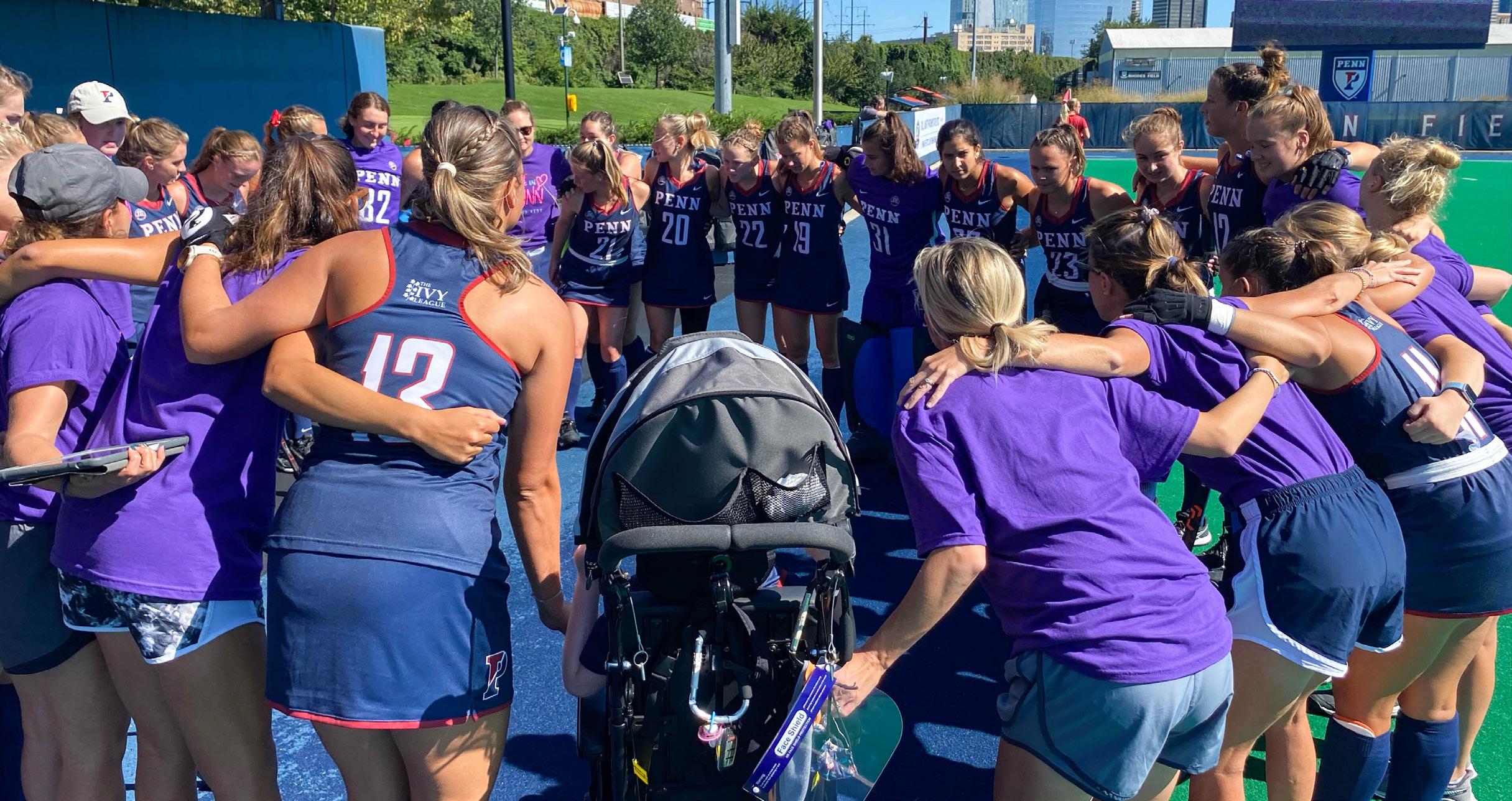
“We came down and we introduced our family, and the girls got to meet Brynn. They could not have been nicer, more accepting, or accommodating. And ever
“It’s a wrestling-oriented organization where we help underprivileged kids in the Philly area get acclimated with wrestling and kind of immerse themselves in the sport. And we provide academic tutoring too,” Slackman said.


Beginning in the 2021 season, though, Slack man’s focus was entirely on football.

“Football kind of took precedent. I had a lot of injuries with wrestling that kind of detached me from the sport a little bit and prevented me from getting back to where I wanted to be as a wrestler goes,” Slackman said.
Now in his second season playing on the his toric Franklin Field, Slackman has been making big plays for the Red and Blue. Through three games, the junior already has 16 tackles, matching his output from last season.
“He works as hard as anybody that I’ve been around,” Priore said. “It’s important that he has an expectation of himself. He’s his harshest critic about himself, which I think helps him achieve the goals that he’s got.”
While his own personal expectations relate to himself, Slackman is solely focused on his role in helping the team reach its goals this season.
“I’m just a cog in the machine, you know?” Slackman said. “I’m here to do my part and my job and win games.”
And now his hardworking mentality and pas sion for the game are fueling an electrifying season for the junior wrestler-turned-football player.
since that day, we go to as many games as possible,” Shawn said. “Every year, we have an annual fund raiser in October, and we typically have four to five players from the team who volunteer their time to do administrative jobs.
“All in all, it’s been a positive relationship that we’re very thankful for.”

For the past seven seasons, Penn field hockey has remained close with Brynn and the Connor family, inviting them to team banquets, preseason practices, and barbecues. The team also hosts the annual Be lieve in Brynn game, which took place this year on Oct. 2; a 2-0 victory over Long Island University.
Due to inclement weather this year, Brynn’s loving older sister, Taryn, represented her for the team’s in troduction. Brynn still got to watch the team from home, though, as she wore her #00 jersey, and you will see her in the crowd with her jersey for most home games with her family by her side, as they sup port the Quakers.
“At the end of the day, when people assess our pro gram, they might base all of our successes on wins and losses. They might say we haven’t won that many games this year. However, I would also offer to assess


it in other ways, and I think Brynn is one of those ways,” Fink said. “The impact that Brynn and the Connors have had on the team, and the impact that the girls have had on her goes beyond wins and losses. Sometimes it’s not just about what we do on the field, but also what we try to do off the field, and Brynn is a very important part of what we do off the field.”
Brynn’s fight against Rett Syndrome continues today, as doctors are still searching for a cure. Shawn and Kristen were told in their first meeting with Dr. Eric Marsh of the Children’s Hospital of Philadelphia that Rett Syndrome would be cured during Brynn’s lifetime, and that has been motivation for the family ever since.
This Saturday, Oct. 15, the Connor family keeps their promise of fighting to find the cure for Rett, as they host the seventh Annual Happy Hour to Help End Rett in Philadelphia.
To join Brynn and the Penn field hockey team in the fight to find a cure for Rett Syndrome, visit the Be lieve in Brynn Facebook or Instagram pages. To make a donation or buy tickets for the Happy Hour to Help End Rett, you can visit https://reverserett.org/events/ happy-hour-to-help-end-rett/.
The Quakers have a 4-0 record for the first time in nearly two decades
CALEB CRAIN, WALKER CARNATHAN, KRISTEL RAMBAUD, & SEAN MCKEOWN Sports StaffNot since 2003 has Penn football (4-0, 1-0 Ivy) had this strong a start to a season, and on Saturday, the Quakers will look to extend their winning ways against a Columbia (3-1, 0-1 Ivy) team that beat them last season 23-14. Four Daily Pennsylvanian Sports reporters make their picks ahead of Penn’s second Ivy League game of the season.
Penn 14, Columbia 10 — Walker Carna than, Sports Reporter
The Quakers occupy rare air at 4-0, but Colum bia will provide a more difficult test than any they have faced thus far. For the first time this season, Penn will face a team with a winning record, and the Lions have come by it honestly. They travel to Franklin Field with a suffocating defense that has let up an average of just 10 points per game, and has not allowed a rusher of more than 25 yards.
Penn may have found its offensive groove in a 59-point explosion against Georgetown, but make no mistake, the identity of this group remains on the defensive side of the ball. That foretells a lowscoring matchup in this Ivy League clash, one that I believe the Quakers will ultimately emerge victori ous from. Look for a high volume of punts, and for the Penn defensive line to get after Columbia quar terback Joe Green, sacking him two or more times.
Columbia 27, Penn 24 — Caleb Crain, Sports Associate
This week, the Quakers face possibly the tough est challenge of the season thus far going up against a stout Columbia squad. The Lions’ defense has been giving up an average of 10 points per game.
On the ground, Columbia has impressed, giving up only 10 rushing first downs through its first four games.
However, its pass defense has been less than stellar, with opponents averaging nearly 300 yards per game. In order to win, Penn’s sophomore quar terback Aidan Sayin has to put up big passing numbers, as the Quakers rushing attack will likely be rendered largely ineffective this week.
On the other side of the ball, Penn’s defense will need to step up. The Lions have been gaining nearly four yards per rush, and Green has been completing over 70% of his passes. Penn’s defense, though, has held opponents to 2.1 yards per carry and an under 55% completion percentage.
So far, the Quakers have only generated three turnovers, two of which came last weekend at Georgetown, and continuing that trend could be the difference between a win and a loss.
This game will probably come down to a few key plays. Penn’s passing game has improved as of late, setting up big throws down the field for Sayin, but look for Columbia’s defense to remain stout in a crucial Ivy matchup.
Penn 21, Columbia 16 — Kristel Rambaud, Sports Reporter
The undefeated Quakers return to Franklin Field this weekend. And in an Ivy League matchup against the Columbia Lions, they’re likely to leave the stadium again with a victory.
How?
Defense.
Penn has been remarkable in stopping oppo nents from scoring via the passing game thanks
to a secondary featuring the likes of senior Ken dren Smith and junior Shiloh Means. Of the seven touchdowns Penn has allowed, only one has been a passing touchdown. Penn’s defense has also ac cumulated 17 sacks this season.
This strong defense can help Penn win the game against a Columbia offense that loves to pass. In Columbia’s Ivy opener against Princeton, junior quarterback Green threw the ball 43 times, lead ing to three interceptions and zero touchdowns. The Lions’ high-scoring offense, which averages 36 points per game excluding the Princeton outlier, is fallible.
And Penn’s defense could very well capitalize off it.
Penn 24, Columbia 17 Sean McKeown, Sports Reporter
Coming off a statement win against a stout Dartmouth defense and an absolute demolition of Georgetown, Penn now looks to trample on Colum bia to continue its hot start.
Helmed on offense by sophomore quarterback Sayin, the Red and Blue have fired on all cylin ders in recent weeks, racking up 59 points against Georgetown in their last outing. This strong show ing by the offense is exactly what the Quakers needed, seeing as they plan to line up against their toughest defensive opponent yet.
The Lions have allowed only 10 points per game so far this season, holding three separate teams to seven points or less. In its recent win over Wagner, though, Columbia’s offense thrived, racking up over 150 rushing yards and three touchdown passes.
I believe that Columbia’s offense isn’t strong enough in the air to prevent the Quakers’ defense from crashing down on the run, which will be the deciding factor in Penn’s favor.
Penn football has been nothing short of impres sive so far this season, with a red-hot 4-0 record acting as evident proof. Coming off an explosive 59-28 win over Georgetown, Penn’s next test comes from within the Ivy League against Columbia.

The Lions are a solid 3-1 overall and 0-1 in the Ivy League, serving the Red and Blue their hardest test yet. Penn’s dual-threat offense led by quarter back Aidan Sayin and running back Trey Flowers will seek to overwhelm the Columbia defense, which gave up 24 to Princeton, its toughest opponent to date. Flowers is having a spectacular start to his season with five touchdowns and an average of 4.9 yards per carry.
Sayin, a sophomore, has been developing nicely in his first full season of being the starter. He has eight TD passes on the season along with four picks. Sayin threw four of his TDs last week with 221 yards passing, a stat line that will likely be necessary again to overcome Columbia this weekend. Sayin and wide receiver Malone Howley are developing a cohesive chemistry as well, which can be yet another weapon for the Quaker offense. Howley had seven catches for 90 yards and a TD last week.
Though Sayin favored Howley against the Georgetown Hoyas, new offensive coordinator Dan Swanstrom’s gameplan has favored more diversity in the receiving corps. Sayin completed passes to at least 10 receivers in each of the team’s first three games.
“I think morale on the team right now is high,” senior offensive lineman and captain Trevor Rados evich said. “It’s been a long time since we’ve had this kind of start to a season, but I think the important thing for us right now is making sure everyone is focused, locked in … [taking] it one week at a time.”
Defensively, the Quakers face a tough challenge. The Lions’ offense is arguably the best Penn will face so far. Columbia is averaging 28.5 points per game, while the Penn defense just gave up 28 to an offensively inferior Georgetown team. The Penn defense is led by standout senior defensive lineman Jake Heimlicher, who has four sacks and 30 total tackles so far this season to lead the team.
“Every single week, I think we’ve really pro gressed as a team … and I think that’s really contributed to how we play on Saturdays,” offensive lineman Ben Hoitink said.
Additionally, Penn football will see a familiar face on the opposite sideline with Lions head coach Al Bagnoli. Bagnoli has the second most wins among active college football head coaches. The leg endary coach was at Penn for 23 years and won nine Ivy League titles with the Quakers.
Since Bagnoli’s hiring with the Lions, Penn has gone 3-3 against its former coach, including a 23-14 loss last season in which the Quakers struggled of fensively. The game marked the final one in which then-senior John Quinnelly started at quarterback before Sayin stepped in at the helm for the back half of the season.
The Red and Blue will play in front of their home crowd at Franklin Field. Kickoff will be at 1 p.m. on Saturday, and the game will be available via stream ing through ESPN+.

But throughout his wrestling career, he was still actively involved with football.
His dad also involved him in football at a young age, and because of his size, Slackman had always played on the line. But wrestling was the sport that helped him get ahead of other linemen.
It’s Friday night, under the dark sky of Ha nover. The Penn football team is lined up against its opponent of the week: the Dartmouth Big Green. On the defensive line, the Quakers stare down their opponents, determined to make a stop. Dartmouth quarterback Nick Howard snaps the ball. But moments into his rushing attempt, he’s tackled onto the turf.
He’s stopped by none other than junior defen sive lineman Joey Slackman. That tackle was just the first of eight for Slackman in Penn’s piv otal win over Dartmouth.
And just to think, three years ago, Slackman wasn’t even pursuing the game of football, ar riving to Penn as a freshman wrestler in 2019.
The Long Island, N.Y. native wrestled from a young age. After some time off, he got back into wrestling in middle school, and then eventu ally in high school. Throughout his high school career, he earned several honors and carved a name for himself as one of the top-tier wres tlers in the nation. The highest ranking he ever earned was No. 12 in the 285 lbs division by Intermat.
“As a wrestler, you’re trying to keep a guy’s hands off you, and get hand control, and get the takedown, and score points,” Slackman said. “It’s a lot similar to a defensive lineman where you’re trying to keep a guy’s hands off you.”
Coaches had told him all his life that wres tling could help him improve as a lineman, even since middle school. And now through college, his coaches at Penn acknowledge how he’s been able to transfer the skills he learned from wres tling to football.
“Wrestling is all about body leverage, playing low and utilizing your hands and feeling lever age points and balancing people. And that’s exactly what you do on the offensive and defen sive lines,” coach Ray Priore said. “And I think that really helps him out.”
Priore hadn’t recruited Slackman out of high school. He didn’t even know who he was until he got a phone call while at home that Slackman was interested in joining the football team.
Priore then spoke to coach Roger Reina of the wrestling team — a friend of his — over the de cision. Slackman said that Reina and the