Presidential historian, author Michael Beschloss to deliver Commencement address
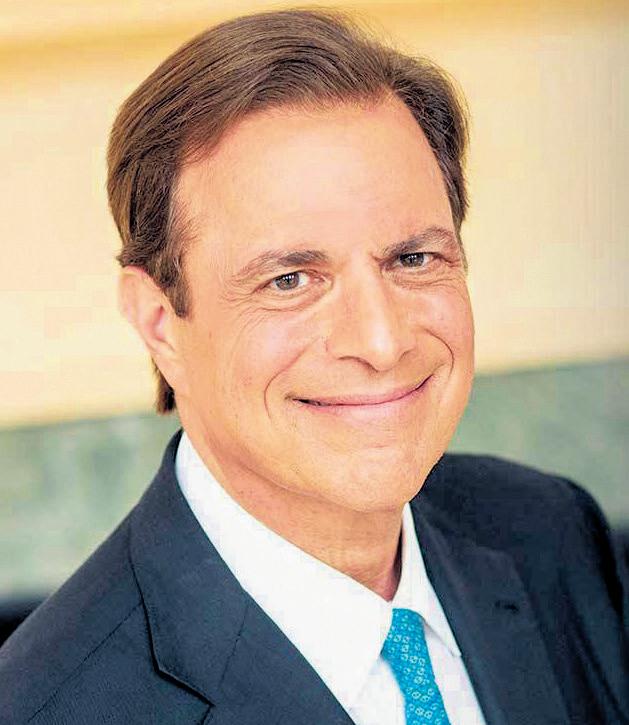
Michael Beschloss currently serves as a presidential historian at NBC News and as a
PBS contributor
ISHA CHITIRALA
Editor
News
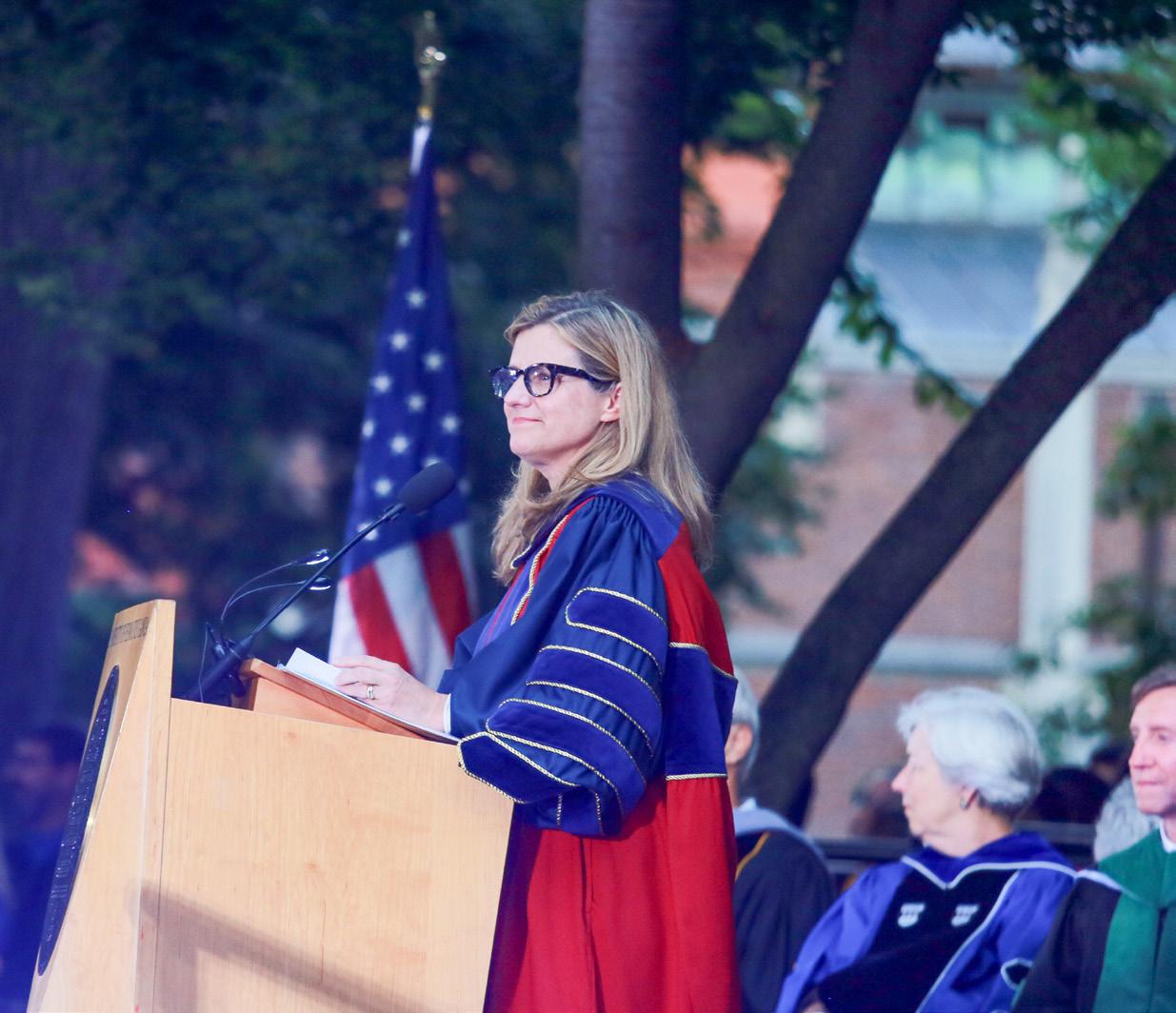
United States presidential scholar and best-selling author Michael Beschloss is set to deliver Penn’s Commencement speech for the Class of 2026.
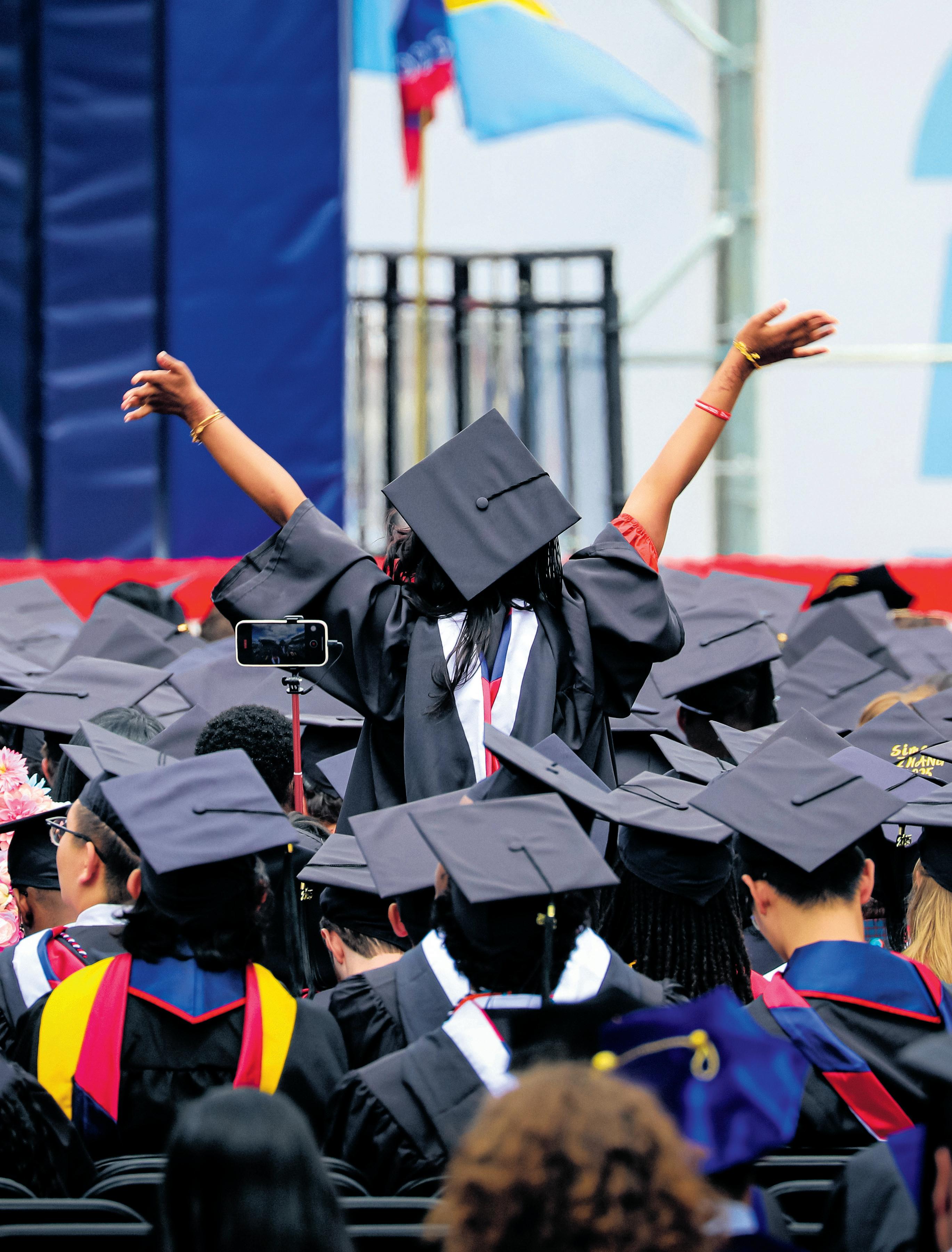
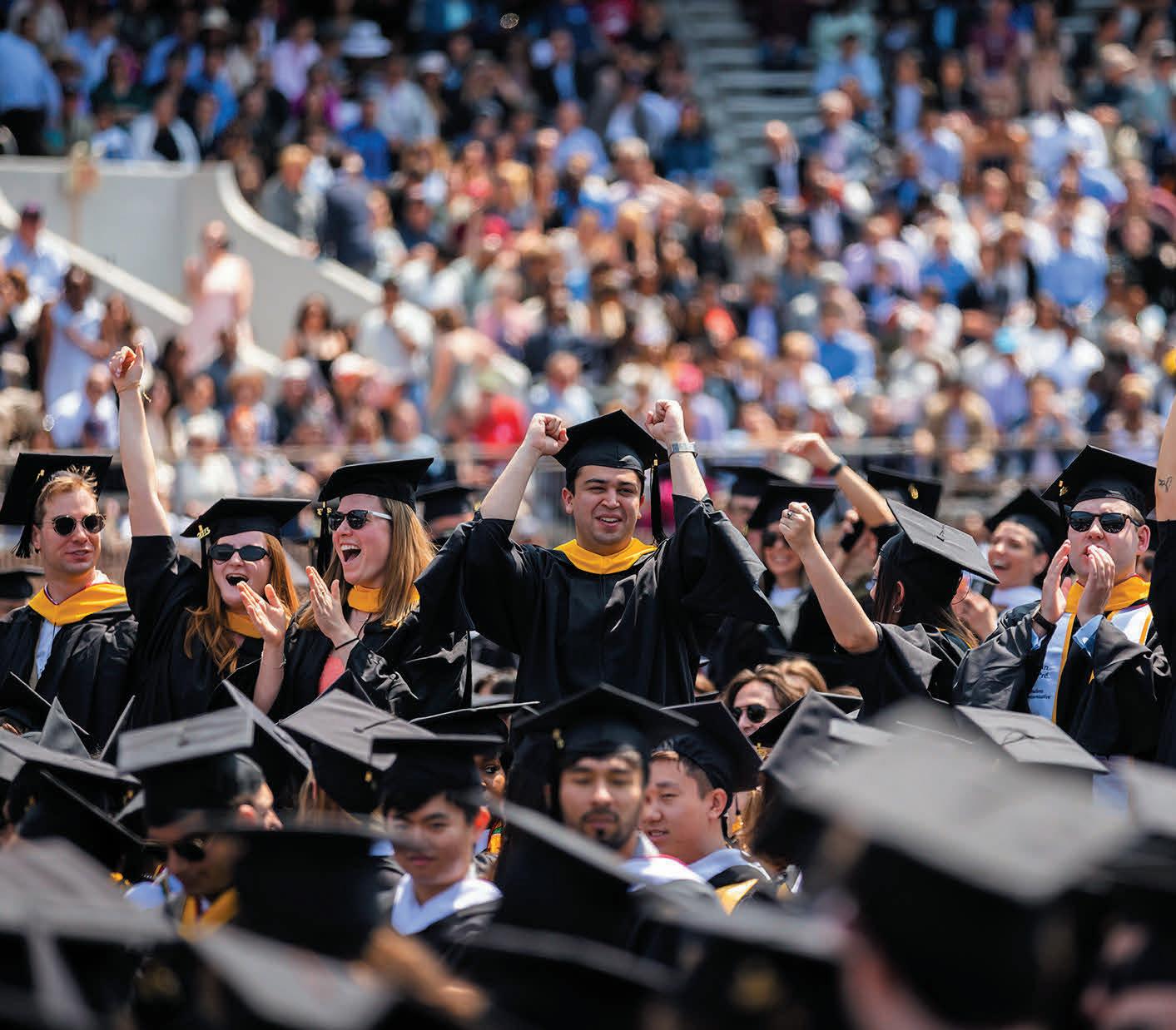
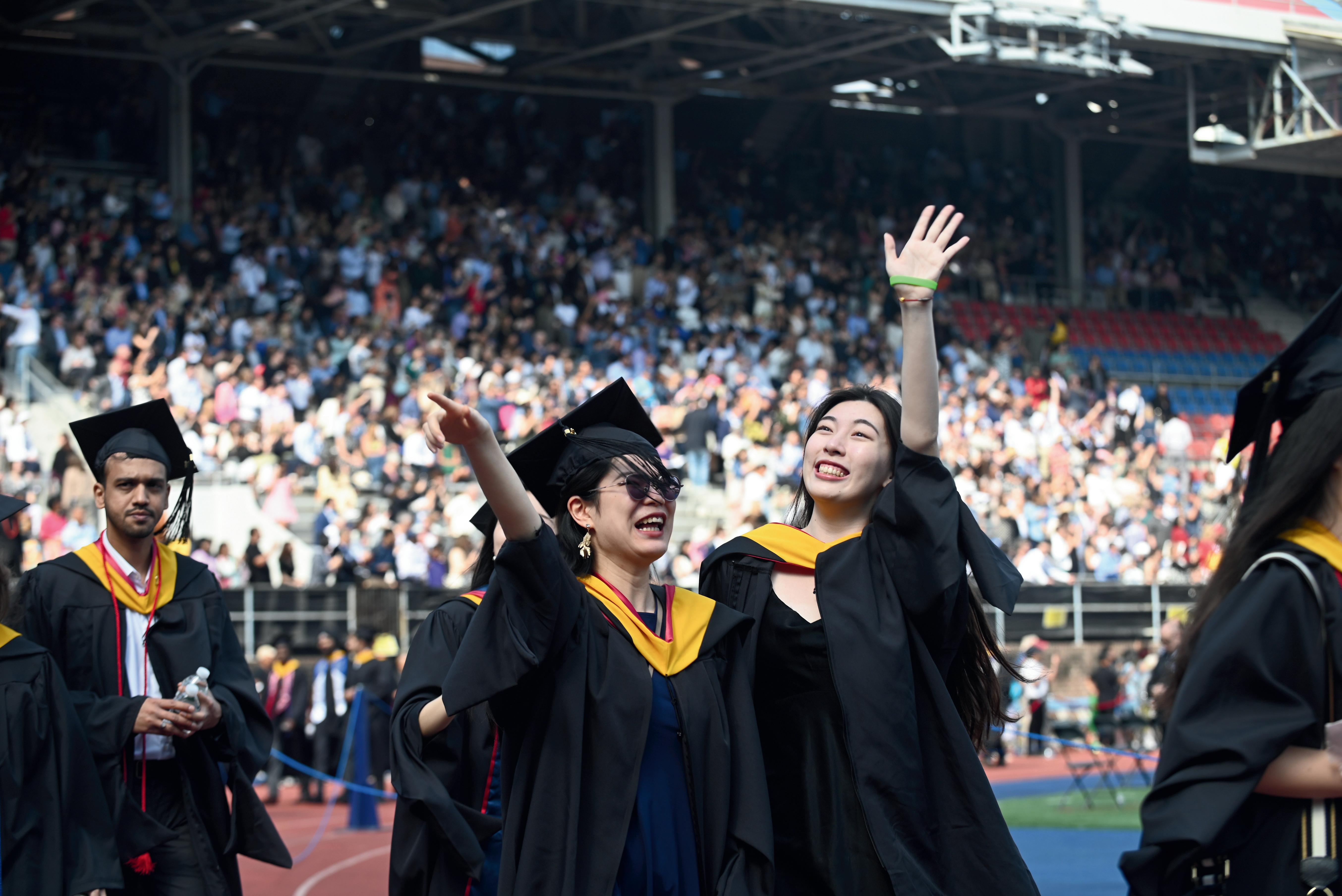
Penn will grant Beschloss — who has published nine books on the American presidency — an honorary doctor of letters degree, according to a March 3 announcement made by Vice President and University Secretary Medha Narvekar. Penn’s 270th Commencement, scheduled for May 18 at Franklin Field, will grant degrees to graduates, recognize honorary recipients, and feature remarks from Beschloss and University officials.
Beschloss currently serves as a presidential historian at NBC News and as a PBS contributor. His most recent book — titled “Presidents of War: The Epic Story, from 1807 to Modern Times” — was published in 2018 and earned a spot on The New York Times bestseller list.
He has also held appointments at the Smithsonian Institution, University of Oxford, and Harvard University. Beschloss has received the National Archives Foundation’s Records of Achievement Award, the Order of Lincoln, and an Emmy Award for his Discovery Channel series “Decisions That Shook the World.”
“In his highly successful, decades-long career as author and media contributor, Mr. Beschloss has pursued the study of leadership and educated us all on many important historical figures,” Penn
President Larry Jameson wrote in the March 3 announcement. “His scholarly research, writing, and insights offer an indispensable source of knowledge for better understanding the past and appreciating how it shapes the present and future.”
Jameson also highlighted Penn’s celebration of “our country’s 250th anniversary of independence,” adding that “we look forward to his perspectives and guidance for the centuries ahead.”
Over the course of this year, Penn and the city of Philadelphia have planned a series of performances, conferences, and exhibitions to celebrate the 250th anniversary of the signing of the Declaration of Independence.
Beschloss described himself as “not by nature a very partisan person” and claimed he was a registered independent in a 2022 interview with Politico.
“I am deeply conservative in terms of preserving institutions of democracy,” he said at the time.
“But if you and I had talked earlier, and we had been told that in the near future, democracy was going to be in danger and a President might be eager to tear apart just about every major institution of democracy that you care about, including free and fair elections as well as the rule of law — would you speak out?” he added about 1968 Wharton graduate and President Donald Trump in the interview. “I would have said yes, I certainly would.”
According to the announcement, four other individuals will join Beschloss in receiving honorary degrees: Carolyn Bertozzi, James Corner, Claudia Goldin, and Ann Hobson Pilot.
Bertozzi — who received a Nobel Prize in Chemistry in 2022 — founded the field of bioorthogonal chemistry and is currently a professor at Stanford University. She will receive an honorary doctor of sciences degree.
She is also an elected member of the National Academy of Sciences, the National Academy of Inventors,
ALUMNI RECEPTION
CORDIALLY INVITES ALL DP ALUMNI, GRADUATING SENIORS, AND CURRENT STAFF TO Saturday, May 16 3-6 p.m. | 4015 Walnut St.
Please join us for drinks and a light bite to eat.
Chat with former colleagues, reminisce about the old days, and see the current DP operation.
A guide to Penn Commencement
specific graduation ceremonies, while the rest will be delivered by mail in July.
Proceedings will be livestreamed and recorded for online viewing. A graduate seating chart can be found on Penn’s Commencement website. Commencement address
United States presidential scholar and best-selling author Michael Beschloss will deliver the Commencement speech. Beschloss serves as a presidential historian at NBC News and as a PBS contributor.
Penn will grant Beschloss — who has published nine books on the American presidency — an honorary doctor of letters degree.
“In his highly successful, decades-long career as author and media contributor, Mr. Beschloss has pursued the study of leadership and educated us all on many important historical figures,” Penn President Larry Jameson wrote on March 3 when announcing Beschloss’ address. “His scholarly research, writing, and insights offer an indispensable source of
knowledge for better understanding the past and ap-
preciating how it shapes the present and future.”
Penn will also grant four honorary degrees at the Commencement ceremony.
Carolyn Bertozzi will receive an honorary doctor of sciences degree. In 2022, she was awarded a Nobel Prize in Chemistry. Bertozzi founded the field of bioorthogonal chemistry and is currently a professor at Stanford University.
James Corner, a 1986 Penn graduate and Stuart Weitzman School of Design professor emeritus will receive an honorary doctor of arts degree. Corner was instrumental in New York’s High Line transformation.
Claudia Goldin, a 2023 Nobel Prize laureate and former Penn professor, will be granted an honorary doctor of laws degree. She currently serves as a professor at Harvard University.
Ann Hobson Pilot, a renowned harpist, will receive an honorary doctor of music degree. Pilot was the first Black principal player to play in the Boston Symphony Orchestra and the first Black female principal player in a major orchestra.
Rules and procedures
Penn prohibits various items from the venue, including bags, signs, noisemakers, alcoholic beverages, animals, and outside food and drinks. Guests are also not permitted to bring seat cushions that contain metal, wood, or hard plastic.
Commencement is set to take place “rain or shine,”
Commencement’s centuries-long history at Penn
The first ceremony took place in 1757 at the University’s original Old City campus
SHAUGHNESSY
Ahead of Penn’s 270th Commencement, The Daily Pennsylvanian looked at how the graduation ceremony has evolved over nearly three centuries.
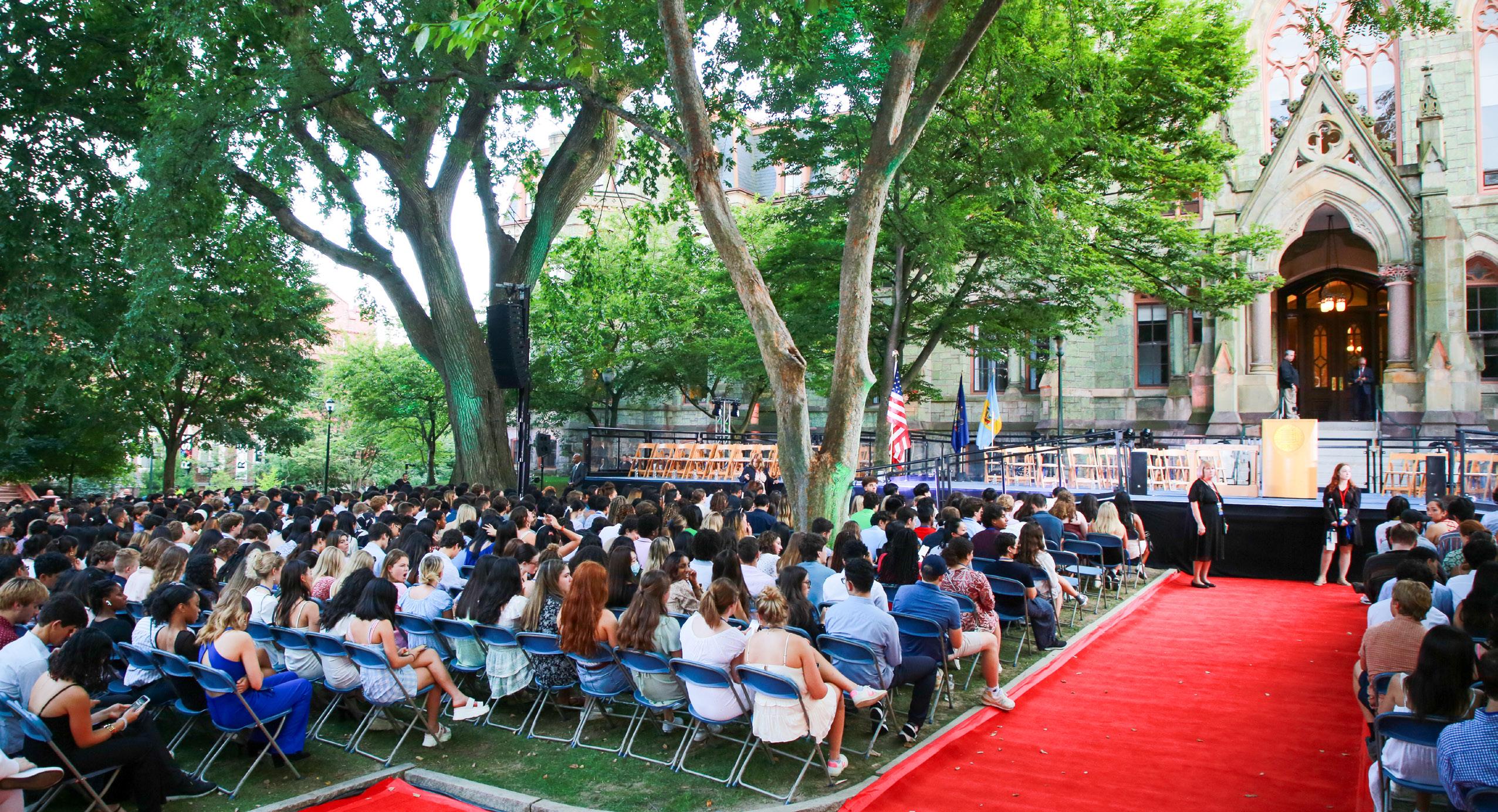
The University held its first Commencement in 1757 at its original Old City campus, just two years after Penn’s charter was established. This year, the ceremony is scheduled for May 18 on Franklin Field and will grant degrees to graduates, recognize honorary recipients, and feature remarks from various speakers.
At the time of Penn’s founding, commencement ceremonies began with a procession from the building now known as Independence Hall in downtown Philadelphia.
Historically, graduating students delivered orations, debates, and poems in languages such as English, Latin, and Greek during the event. The ceremony also included sermons from Anglican officials — reflecting Penn’s early ties to the Church of England. Following the American Revolution, Penn revised graduation protocols under its 1780 rechartering as the “University of the State of Pennsylvania.” Public officials, including members of the Continental Congress and Pennsylvania Assembly, increasingly attended the ceremonies — although student achievement remained the central focus.
The University also began awarding honorary degrees to “heroes of American independence,” including George Washington, Thomas Paine, and the Marquis de Lafayette — all of whom were bestowed with the distinction in the 1780s.
Following Penn’s 1802 relocation to Philadelphia’s Ninth Street, the ceremony was held in numerous venues. Rather than following the traditional route through the city, the University Board of Trustees introduced processional stops at
Washington Hall and Masonic Hall, among other downtown locations. The University regularly hosted Commencement at the Musical Fund Society by the 1830s. During that time, the ceremony often featured speeches from 10 graduating students, which concluded
with a valedictorian address. This tradition continued into the Civil War, despite the Confederacy’s threats to break through Union defenses and into Philadelphia. “Even as soldiers massed for Pickett’s Charge, Penn’s Trustees and faculty conducted the
ceremonies will have differing attendance policies.
Graduating students may also attend the Baccalaureate ceremony, an “interfaith program” that will feature student performances, prayers, an unveiling of the class Ivy Stone, and the distribution of a class pin. The ceremony will take place on May 12 at 4 p.m. in Irvine Auditorium.
Commencement of 1863 and the candidates for degrees demonstrated their well-earned mastery of the liberal arts and sciences,” a Penn Libraries Commencement note stated. “It was an incredible moment in the history of the University of Pennsylvania.”
Although the University moved to West Philadelphia in 1872, its Commencement did not follow suit until the next century. During the late 19th century, the ceremony expanded to include graduating women and students of color — as well as graduates from all academic programs.
The procession — which traveled from 34th and Walnut streets to the Academy at Broad and Locust streets — was a “public spectacle.” University officials led the graduates in the 20-block march by horse-drawn carriage. However, the march was discontinued in 1922 due to complications of coordinating thousands of participants.
The late 19th century also saw structural changes in the ceremony. In 1895, the University removed student speeches from the program, adding opening remarks by the provost. An honorary degree recipient began delivering the keynote address — a role now held by the annual Commencement speaker. Since 1910, the ceremony has remained largely unchanged — though Commencement speakers have become more diverse. The share of women speakers has increased by 22% since the early-tomid 1900s, while 38% of speakers since 2000 have been non-white.
There has also been an increase in speakers representing more diverse fields — such as advocacy and the arts — though politicians continue to constitute a significant portion.
The ceremony was later hosted at both the Palestra and Convention Hall, before settling into its current home at Franklin Field in 1986.
The COVID-19 pandemic marked the graduation tradition’s most recent disruption. Penn held Commencement virtually in 2020, honoring its graduates during an in-person ceremony two years later — in May 2022.
This year, United States presidential scholar and best-selling author Michael Beschloss is set to deliver Penn’s Commencement speech.
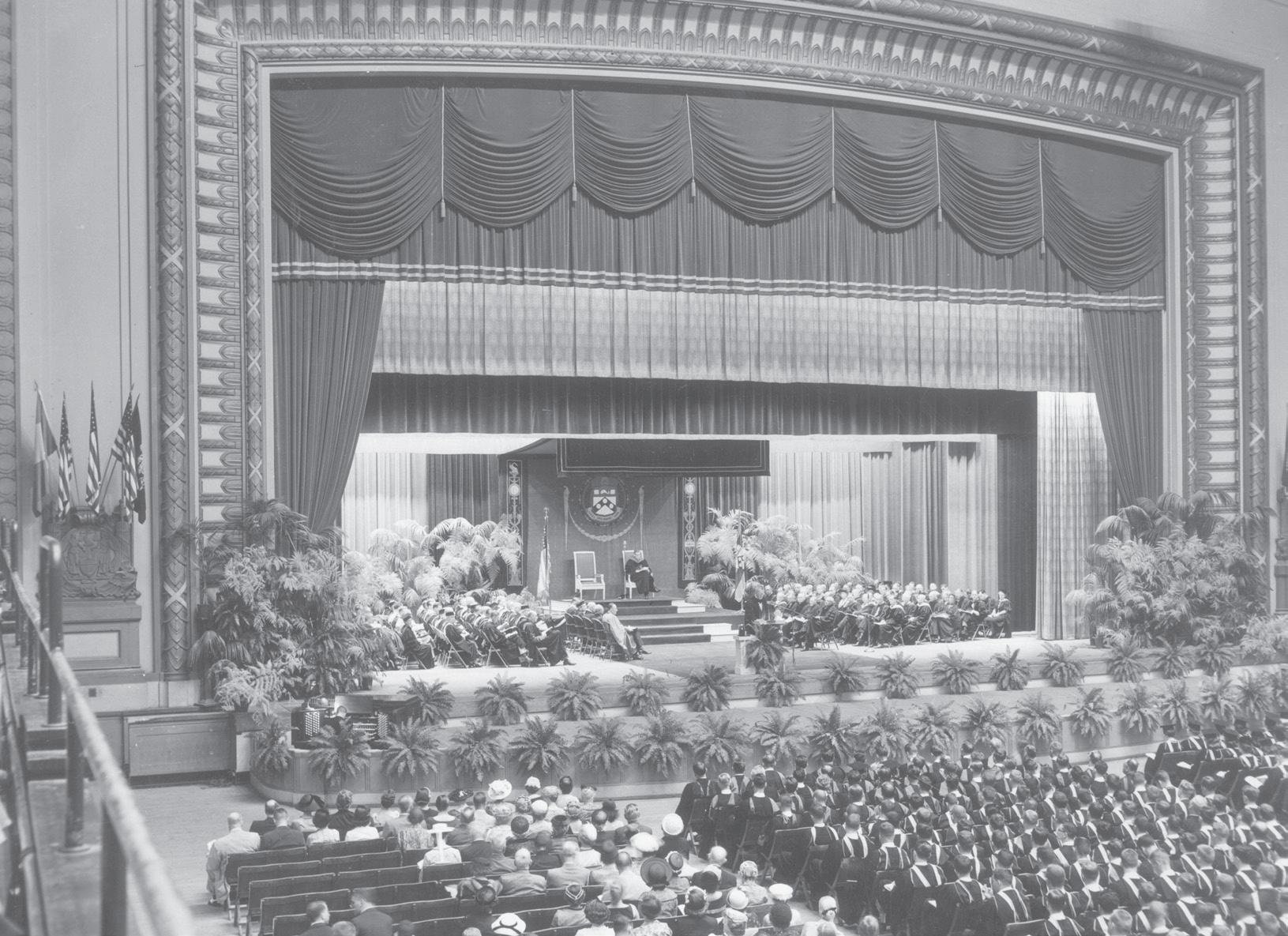
COURTESY OF JULES SCHICK, UNIVERSITY ARCHIVES
Penn’s 1957 Commencement ceremony.
Take the leap
SENIOR COLUMN | On letting yourself pursue things you never thought you could
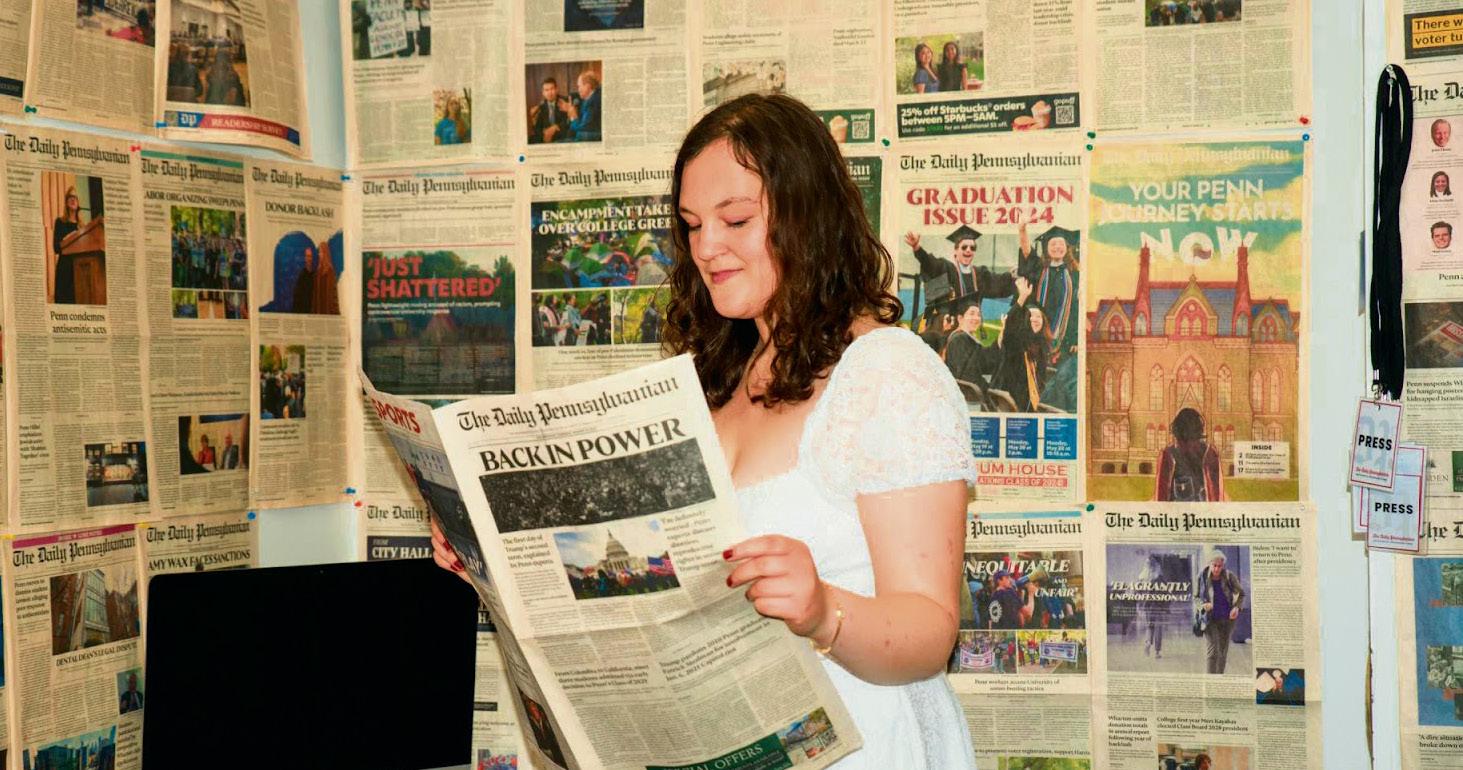
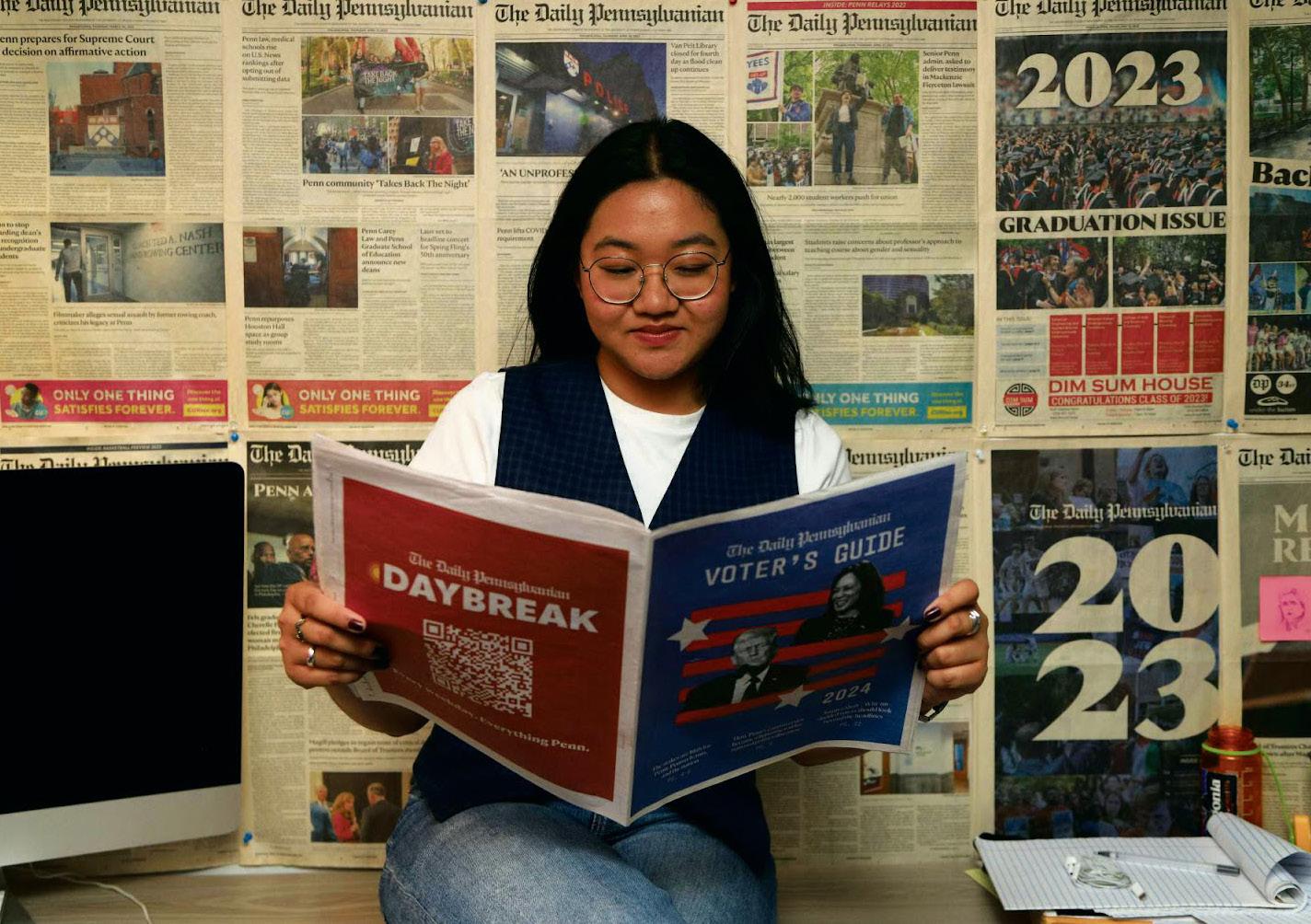
If someone had asked me on my first day at Penn if I’d eventually be the editorin-chief of The Daily Pennsylvanian, I would’ve laughed. Don’t get me wrong, I knew I wanted to join the DP. I started as a summer reporter before my first year. Looking back, maybe that eagerness should’ve told me something. But when I stepped on campus for the first time, my focus was elsewhere — after all, someone who’d never written anything truly serious for her high school newspaper could never dream of being more than a beat reporter for the DP, right? Wrong. Throughout my first year as a reporter, I learned and grew at every turn — literally, when I went to the office for my first in-person edit and got lost trying to find the Blue Room. A year later, I found myself covering the unprecedented resignation of Penn’s president, realizing that no matter how unqualified I felt, we had a job to do.
My time at the DP is marked by the people who believed in me. The ones who pushed me to take the next step, who reassured me when I questioned my abilities. The ones who embodied leadership, who showed me what student journalism could be. With their support, I ran for city desk editor, jumping at the chance to lead a small
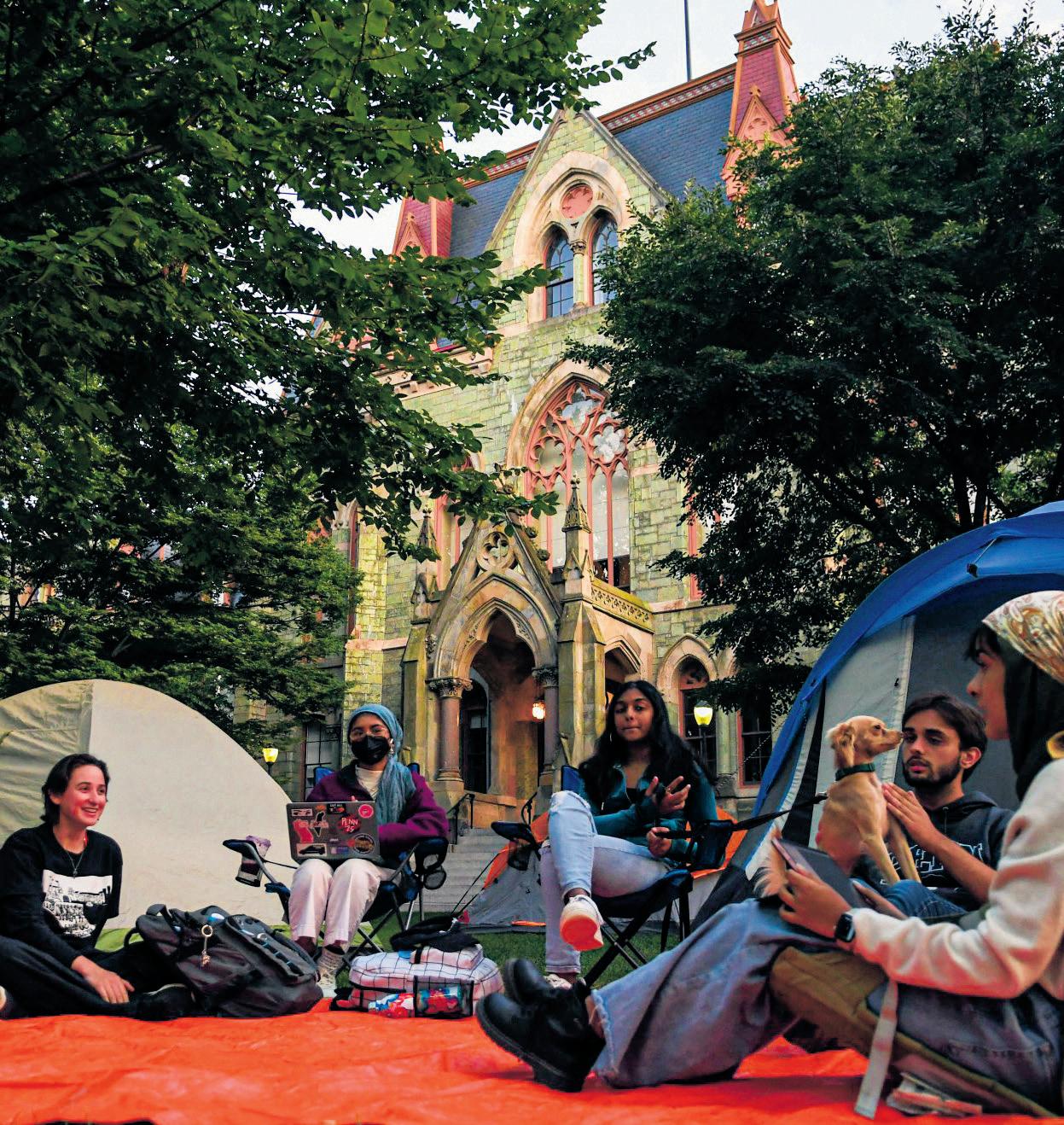
fraction of coverage. I discovered my love for truly community-focused reporting, uplifting historic unionization efforts and unearthing Penn’s ties to the city around us. I learned very early in my DP career that student journalists hold an immense amount of power. We tell stories that nobody else can. We have a front-row seat to Penn’s history, and it is our job to make sure everyone else understands what we live every day. Penn’s Gaza Solidarity Encampment began the day before opening night of my sophomore spring musical. That weekend, I split my time between College Green and the Harold Prince Theatre, checking Slack every moment I had backstage and sprinting to Houston Hall to help file live updates on the campus unrest between shows. I will always remember those weeks of minimal sleep, even less schoolwork, and countless hours in our Van Pelt-Dietrich Library “war room.”
That’s when I realized that maybe, just maybe, I could do this. I trekked up and down Locust Walk to cover countless protests and counterprotests, stood beside reporters from CNN and The Philadelphia Inquirer during impromptu press conferences, and hitched a ride back to campus with a photographer from The New York
The two clocks
I remember the first photograph I published for The Daily Pennsylvanian: avocados at ACME.
This was October 2022, and I had just completed my first photo shift without actually knowing how to use the camera (the drone doesn’t count). Derek, the editor during the shift, patiently guided me through Adobe Photoshop and captioning. This picture wasn’t the last — I’d go on to rack up over 1,000 photo credits over three years — but it was the first credit I could call my own. I went home to my dorm that night with a feeling of excitement from creating something new.
The math here is simple. I started with no credits and ended with one. Fast forward three years, and I was serving as the president of a 142-year-old newspaper. There, I couldn’t tell you the math.
This past December, a close friend from back home, Brendan, told me that we tend to overestimate how much we accomplish in a year but underestimate what we accomplish in five. He’s said this to me numerous times. It has served as reassurance in my head, but lately I’ve started thinking about it differently: there are two clocks running, and they are distinct.
The fast clock asks whether something was worth it. I’ve received this question numerous times, often when someone finds out what being president of the DP was like: 30hour weeks, 2 a.m. Slack notifications, and weekends swallowed by whatever broke that week. The fast clock wants the answer immediately and in a binary sense; it must be a yes or a no with a clean sentence to recap the experience. For those asking, my answer to the
fast clock is “yes.” The job was worth it. I became a more patient person. I learned how to handle frustration. I matured through being handed responsibility. By almost any metric, I became a better version of that first year who walked into a photo shift and completed an avocado assignment. The fast clock looks at the experience and says, “Yes, it was worth it.” Great. Let’s move on.
I don’t think the fast clock is wrong. But it’s just answering a question with too small of a scope. What my friend was really pointing at was the slow clock. It asks something harder. It doesn’t ask for an answer right away but rather asks what I’ll be able to point to in five years (or 10) that wouldn’t exist otherwise. Most importantly, it makes me think whether the trades made by a younger version of myself feel worth it. Whether the composure I learned would continue to define my future self or fade once I no longer need to practice it. Whether the judgment I built making decisions at 21 turns into an instinct that defines my career or turns into a story I tell at class reunions. Whether the things I gave up — weeknight dinners, a slow-starting 20s, and nights at Smokey Joe’s — turn out to be the real deliverables, or the presidency turns out to have been the gauntlet I needed. The fast clock doesn’t have those answers. The slow clock does, but it’s still ticking. I do have data that I will feed into the slow clock whenever it’s ready. A lot of it has names. Jesse and Anna, whose guidance and kindness took a first year and turned him into a photographer and then something I still don’t have words to encapsulate. Ted, who reminded me that an organization this serious survives partly by refusing to take it
An exercise in rejection therapy
Times after rushing to the police station to cover students’ arrests when the encampment was swept. Somewhere in there, I took my finals. I felt like a real journalist. And I really loved that feeling. I loved knowing that the work I was doing was making a difference. I kept pushing, digging further into my beloved campus union beat and standing my ground in front of administrators when they questioned the motives behind our reporting. I loved it all. And so, even as my doubts returned, I began wrestling with what felt like a monumental decision: stick to what felt safe, or take a leap and run for board. I leapt. And somehow, I landed on my feet.
My life went from being defined by rehearsals and tech weeks to production nights, storylists, and deadlines. I went from memorizing my next cues to working tirelessly to understand the inner workings of our University — and of a 142-year-old student newspaper. When I was elected editor-in-chief, I was terrified. A 2:45 a.m. phone call from someone whose shoes I could barely dream of filling had just handed me an immense responsibility. It took me longer than it should have to realize that I could manage it.
But I did manage it. I navigated a whirlwind of executive orders, funding freezes, and federal scrutiny, standing up for student journalism through it all. I stayed up editing sports stories that garnered national attention, editorials that sparked discourse, and investigations that reminded me of the power we hold. There were certainly moments when things went wrong — moments that, to this day, I wish I could erase. But journalism has taught me that no matter how bad something feels, you never want to erase the record. Those moments are what make your story complete.
You learn how to solve problems you never could have dreamed about when you wrote your first story. You strive to make your writers’ and editors’ work shine,
wanting nothing more than to show readers the fruits of the tireless labor you see in the office each night. You learn how to support every single person you can, knowing your job is to ensure that nobody feels like they’re doing this alone. Those are the moments when you learn how to lead. You learn how to stand up for your work, your staff, and even yourself. You learn what it really means to be a journalist.
I’ve always heard that the people make the place, and the DP is no different. There are friendships I would not have gotten through my time as editor-in-chief without, and for which I’m forever, always, deeply grateful. To the ones who believed in me, who pushed me, who trusted me, who had my back, who let me cry to them (even oceans away), and who answered every Slack I sent no matter how trivial, thank you. To my lin, thank you for brightening my days, and I cannot wait to keep watching you grow. To my roommates, past and present, thank you for reassuring me when I needed it most, for helping me see what really mattered, and for reminding me that there was life — and more than one window — outside 4015 Walnut St. There were moments at the DP when I questioned everything. But I’m proud of my work, from my first day as a summer general assignments reporter to my last as editor-inchief, and I’m grateful for every editor who believed in what we created together and every community member who recognized that our work mattered. After three and a half years, I walked out of the Pink Palace for the last time smarter, better, and stronger. And for that, I will always be grateful.
EMILY SCOLNICK is a College senior studying history, communication, and journalism from Wayne, Pa. She served as DP editor-in-chief on the 141st Board of The Daily Pennsylvanian, Inc. Previously, she served as city desk editor. Her email is emilysco@sas.upenn.edu.
too seriously. Caleb, whose late-night chats made the DP feel like a place always worth showing up for. Norah, who made me a more creative version of myself just by being in the room. Katherine and Christine, whose steadiness made the toughest weeks on the job feel so much easier. Peter, whose chats on history and current events kept reminding me why journalism is so important. Max, Brendan, Pranet, Srijan, and the friends back home who kept checking in. My parents and my sister who supported me in taking the job, knowing how demanding it would be. The slow clock will take time to answer, but it will eventually. When it does, the answer will be shaped by those names. So, here’s the honest ending: The fast clock is a resounding “yes,” and it is right. However, it’s not the clock that matters. Yes,
SENIOR COLUMN | Or how 34th Street Magazine taught me to try, try again
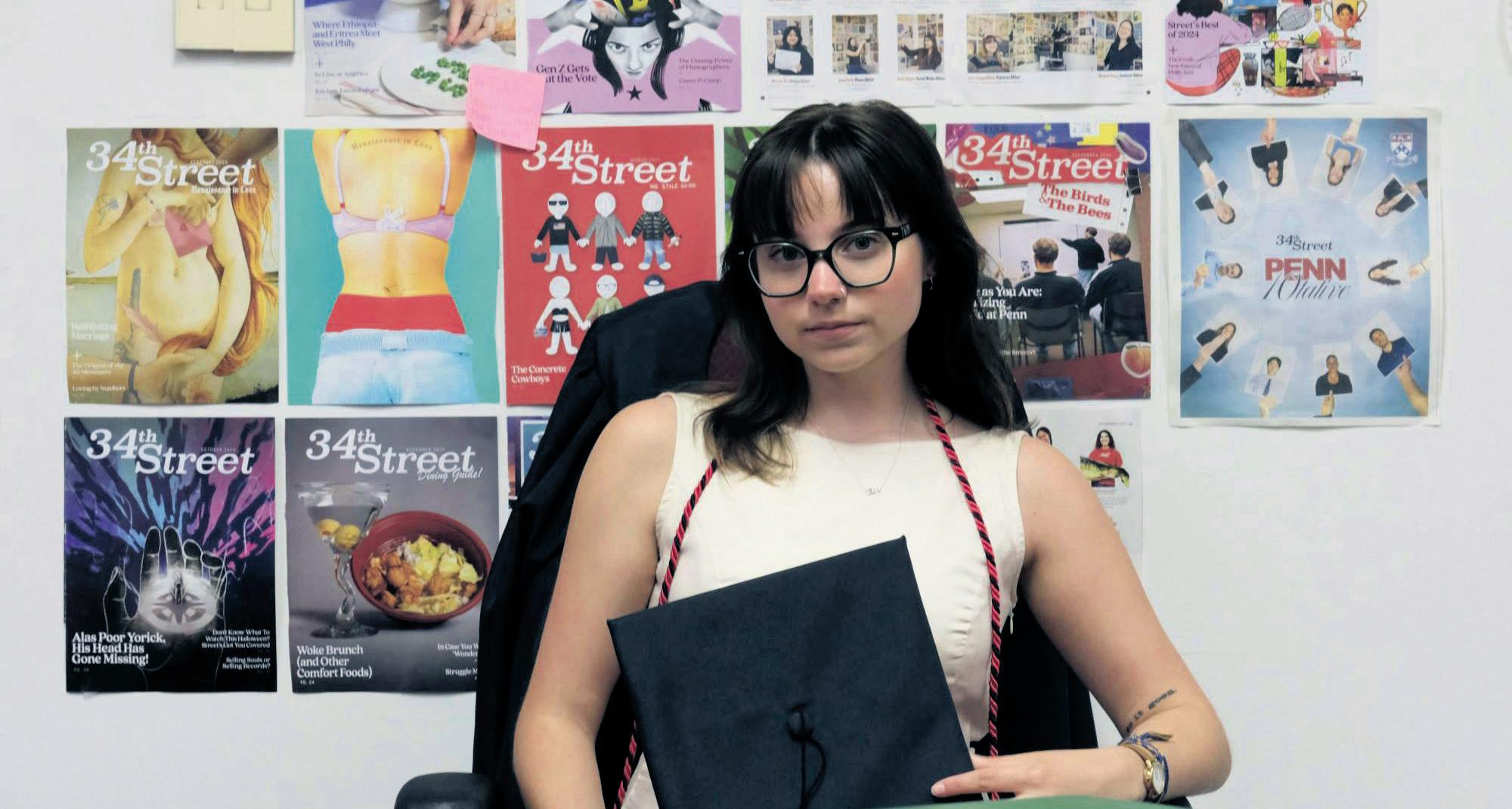
I didn’t get into 34th Street Magazine the first time I applied. It was freshman fall, and like a bad chef, I was just throwing everything at the wall to see what stuck. During New Student Orientation, I took a copy of the Party Issue from a stack in Houston Hall. I didn’t know then that it was the first-ever glossy magazine Street had produced; I just liked the cool cover of a green, glowing cocktail held up by a blurry blue figure. I knew I wanted to write and was toying with journalism, and the editor-inchief at the time showed up to the info session in a teal velour sweat suit — so I was pretty much sold that this was the place I was meant to be. I received my rejection email a week later. In the spring, I threatened to drop out of Penn
just about every other week. My mom received phone calls on a regular basis, sometimes of me just crying into the receiver while she listened on the other line. I applied again to Street. I made a deal with fate: If I don’t get in, I drop out. Dramatic, I know, but didn’t everything feel like life or death that first year?
I received my acceptance on the morning of my 19th birthday. My first editor, Natalia Castillo, had been the one to encourage me to apply to write for Summer Street. Much later, she told me she thought I was cool after that initial meeting because I had pink hair (total accident) and was working as a barista for the summer (I didn’t get any internship offers). The Music editor at the
time, Hannah Sung, whom I knew then as just the girl in my Beatles class, had been the one to tell me to apply for an editor position in the fall.
I didn’t get any of the three positions I applied for, beat out by other candidates. But the then-editor-in-chief Walden Green offered me Style editor because they needed to fill the slot. I met Norah Rami, the then-Ego editor, at our first editor meeting of the semester. She invited me to her housewarming later that night. When I finally made my way to print managing editor — a full circle moment, really — I required that editors hand out the glossy mag on Locust Walk. I sold the idea to them by promoting it as “rejection therapy.” For every one person who takes a magazine, about 15 will ignore you. But how rewarding was it when someone finally made eye contact with you, crossed the brick pathway, and liberated that glossy mag from your hands?
It’s often said that anything easy isn’t worth doing. I learned, from that first rejection, that Street was not easy. And it’s been the single most rewarding thing I have done in all of my time at Penn. I can’t help but flip through all those print issues and feel proud of the work that my editors, writers, and fellow Strexec members have accomplished.
Maybe life is a numbers game. The more times you put yourself out there, the more often you risk failure, but the more likely you are to get one thing right. I like to think of it as a resilience game. You can’t avoid falling down forever, so learn to say, “Ow, that really hurt,” and get back up.
the slow clock is fundamentally flawed. In five years from now, there will be a different version of the person that wrote this piece, reading the dial through whatever avocados life throws on top of this one. The math won’t resolve cleanly, although it might just get a little more certain. Ask me in five years, anyway. I may be eating an avocado.
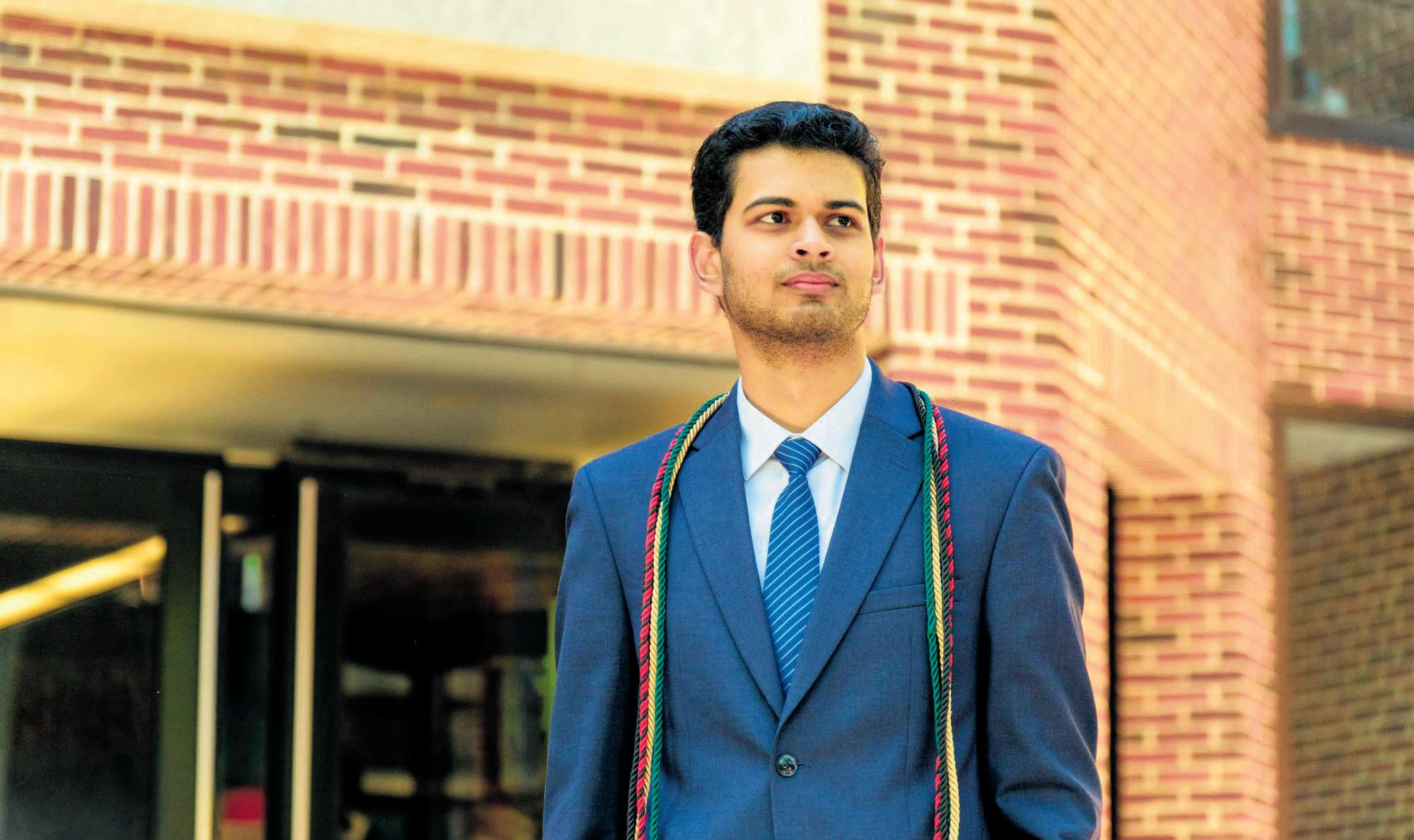
JUVVADI is a College and Wharton senior studying history and finance from Morrisville, N.C. He served as president on the 141st Board of The Daily Pennsylvanian, Inc. Previously, he served as photo editor and news photo editor. His email is abhiram@sas.upenn.edu.
The first ego I ever wrote was for the 2023 Penn 10, and the theme was, fittingly, failure. It’s almost taboo, at a place like Penn, to wear your failures, mistakes, and weaknesses on your sleeve. My interviewee, Niva Baniya, failed an art history class her junior year. As an impressionable first year, she relayed the piece of advice that stuck with her most: “You can’t be perfect your entire lives, no
the friends I’ve been incredibly lucky to hold close, and the glossy mags with my name on the masthead. I’m thankful for that initial rejection and my haphazard path to where I am now. I can’t imagine my college experience without running this little arts and culture magazine with my friends. SSSF,
JULES LINGENFELTER is a College senior studying English, creative writing, and journalism from Zelienople, Pa. She served as the print managing editor of 34th Street Magazine on the 141st Board of The Daily Pennsylvanian, Inc. Previously, she served as features editor and style editor. Her email is jaling@sas.upenn.edu.
ABHIRAM
PHOTO COURTESY OF ABHIRAM JUVVADI
CHENYAO LIU | SENIOR PHOTOGRAPHER
ABHIRAM JUVVADI | SENIOR PHOTOGRAPHER
The angel in the details
SENIOR COLUMN | On the fine art of remembering, and how it makes all the difference
Do not ask me to choose a favorite entry in The Daily Pennsylvanian’s Style Guide. But if you really twist my arm, I might pick the one on government titles. Or Penn President Larry Jameson (we did a moving tribute when we decided to drop the “J,” and another when we dropped the “interim”). Or curse words (damn, among others). Or the Oxford comma (we use it!). Or, controversially, the difference between hyphens, dashes, and em-dashes in the DP and 34th Street Magazine. Clearly, decision-making has never been my strong suit.
The two years I spent as deputy copy editor mean I can probably still recite these rules in my sleep. I remember the bones I picked with section editors about repeat offenses (more often than not, with Sports). I fixed date formatting as a force of habit when I edited the stories that came my way on the politics desk. And even when I had technically moved on from my role in the Copy department, I still kept my eyes peeled for errant straight quotation marks in Instagram post designs. For me, the devil has always been in the details, but — perhaps more importantly — so too has the angel. My time in the DP is shaped by the good that has emerged triumphant out of the moments that, at the time, felt very, very bad — overwhelming, tiring, anxiety-inducing, and sometimes just plain depressing.
Was it hard to navigate what it meant to be a fair and ethical journalist through a never-ending breaking news cycle, an unrestful campus environment, and an unrelenting national spotlight?
To make a huge step into a leadership position that did so much yet was so difficult to articulate?
To skip out on dinners with friends and commit the equivalent of full-time employment to a windowless office with seemingly very little return on my investment? To ultimately decide to pursue journalism in a time when the industry has never looked more precarious? Unequivocally, yes.
I left many early-evening-to-early-morning production nights a little cranky and with none of my schoolwork done. I begged professors for their forgiveness and not their permission when my head was buried in Slack during an eightperson seminar. I remember feeling exceedingly annoyed when Imran, then the DP editor-in-chief,
pleaded so earnestly for someone from the Copy team to check a breaking news article during fall break that I pulled out my laptop in the middle of a Yale University dining hall and got to work.
As campus tensions swelled to their zenith throughout my sophomore year — protests on campus, a sit-in in Houston Hall, former Penn President Liz Magill’s congressional testimony and eventual resignation, the Gaza Solidarity Encampment — I traded sleep for Redbulls and Papa John’s, spent more time in the Blue Room than my dorm room, and witnessed unprecedented disciplinary and police action against members of the Penn community. And when I became executive editor, I had to step away from the reporting and editing I had come to love so dearly — a shift that never really quite took shape as neatly as I wanted it to.
But these aren’t necessarily the things that
Change Penn for the better
have colored my DP experience, many months and years later. Instead, I remember “Sofia” by Clairo playing from the design pit Macs during Street production nights, the countless inside jokes that emerged from out-of-context Slack messages, and the greasy Chinese food I am finally willing to admit I miss.
I remember closing up the LGBT Center early on the Saturday Magill resigned and feeling my heart pounding with adrenaline as I ran to 4015 Walnut minutes after Jared, the then-news editor and editor-in-chief-elect, received a text that started with “OFF OFF OFF the record.” (If my ex-bosses are reading this and learning about this for the first time, I am so, so sorry.)
I remember seeing the sun rise on the Acme parking lot roof after I dozed off at 4 a.m. in the middle of copyediting a huge sports investigation — a sight so beautiful I forgot the fatigue of
SENIOR COLUMN | Penn has taught me that my morals matter more than ever
When I applied to Penn, I had it ranked sixth out of seventh on my QuestBridge match list. I knew nothing about the East Coast, let alone Philadelphia or life at Penn. But looking back, I can’t think of any other school that would have been a better fit for me. The Daily Pennsylvanian was the very first extracurricular I joined, and the one I stayed in the longest. All four years, all eight of my semesters have been spent with the DP. From covering topics like Liz Magill’s resignation — which I found out about on a family vacation and speed-wrote in an Airbnb — to spotlighting some of my amazing classmates, writing for the Opinion section has tested me. All of my columns touched on aspects of my identity or values I hold close. Whether it was covering campus politics or detailing my own experience with sorority rush, my goal was always to share my authentic story and, hopefully, inspire others to share theirs.
Due to the personal nature of some of my columns, people often asked me if I was scared to write any of them. I don’t think they scared me; they invigorated me. As someone who came into college with no writing experience outside of poetry and journaling, I got a chance to craft my passion and explore my own identity in a very public way.
I was no stranger to publicly voicing my opinion; my high school background was in organizing. As a former March For Our Lives state director, my entire job was to organize people and show up in support of our initiatives. Many late nights drafting school board statements, making posters, and rallying people along a common cause prepared me for being a columnist. The excitement to write is something I hope I never lose. I feel very grateful to know what I stand for on a variety of issues. And in general, I feel like Penn needs
This too shall pass
more outwardly opinionated people. I can say for a fact that sharing my voice has opened opportunities to me and is something I will continue to be an advocate for throughout my life.
Through my involvement with the Civic Scholars program, I learned about what the Philadelphia experience is like for those in my community, and had ample opportunities to break out of the Penn bubble. Campus Curlz taught me new ways to do my hair and brought me some of my closest friends. I even joined the dance and community service group City Step, and if you know me, you know I cannot dance — but trying new things is an integral part of college.
These interconnected and uplifting communities have inspired me to start my postgraduate life with the Peace Corps. In a place where we are encouraged to pursue the professional, I am chasing the personal. Cultural exchange and the ability to hear the lived experiences of others are why I love the Opinion department, and why I want to embark on this as my next journey.
Thank you to those who helped me grow through my writing. My editors, all of whom had very different approaches that taught me new ways to look at writing; the people I interviewed about their experiences who so graciously shared their stories with me; my wonderful friends who, even in disagreement, respect my opinions; and even the many people from whom I have received hate emails. I’m graduating with my head held high, and to the probable dismay of some of the hate commenters I’ve encountered: Yes, I could do it. No, I’m not, and never have been, stupid. And I belonged at Penn. My “Vision” for this campus is clear: leave Penn a better place than you found it. Speak up for what you believe and stay true to your identity, but not in the
SENIOR COLUMN | Longing, belonging, and love for Penn
At 17, I had no idea where I would spend the next four years of my life. My mother was certain that it would be Penn. As I sat at our dining table, attempting to construct a college list that felt true to me, she spun tales of ivy-covered — and colored — buildings. The thought was uncomfortable and even mildly revolting. I often joke that my mother knows me better than I know myself. Nine months later, I was stepping into Hill College House with a purple suitcase and her promise echoing in my head that college would change me for the better. My first couple of months at Penn felt like a series of cascading failures. The homesickness was debilitating, and I constantly wondered if I had made the right decision to travel over 23 hours for college. I was drowning in dense readings, late-night fire alarms, and a deep awareness of my own incompetence. When every person living on my floor left for Thanksgiving and I stayed sitting in my shoeboxsized dorm with nothing but my own thoughts, the distance was most palpable. I had become complacent with loneliness. My grandmother used to say, “This too shall pass,” and it was my internal repetition of this mantra that made life bearable.
my all-nighter and the final exam I was to take in a couple of hours, for which I was woefully underprepared. I remember walking into the office every night with the unwavering — but not untested — belief that the work we did was important. Not just for the Penn community or the DP Daybreak readers or the Instagram followers, but as a learning institution for the people within those walls. I remember — and could never forget — the people who made everything worth it, day in and day out: Emily, my partner-in-crime. Sangeeta, Garv, Sarah, and Anissa, who allowed me to be their emotional woman. Anna, Jared, Molly, Imran, Allyson, Julia, Kira, Delaney, and Jonah, who placed their faith in me from day one. The people the DP has given me the privilege to know — especially Ben, Ella, Charlotte, Sophia, Elea, Katie, and Norah — for whom I am so grateful to have found friends for life. My best friend, Yeeun, who simultaneously kept me humble and worried about me when I came home at 4 a.m. And everyone I’ve met, worked with, spoken to, laughed with, fought against, made up with, who has shaped me into the person and journalist I am today. I would not be who I am if not for you. Memory is a funny thing. It has a way of smoothing out the edges, making even the worst times seem like the good times. That is the real reason I could never choose just one favorite style guide entry, or one favorite story I’ve ever written, or one standout moment from the nearly four years I made the walls of the Pink Palace my second home. In every corner I looked, in every second I spent, in every memory I cherished, there was always something worth remembering. And, when faced with the angels in the details, how was I to choose one among them that I loved most?
DIAMY WANG is a College senior studying political science; gender, sexuality, and women’s studies; and Asian American studies, from Alhambra, Calif. She served as executive editor on the 141st Board of The Daily Pennsylvanian, Inc. Previously, she served as politics desk editor, a deputy copy editor, and a 34th Street Magazine staff writer. Her email is diamyw@sas.upenn.edu.
absence of growth. Learn not just from your classes but also from your neighbors, both the Penn students and the West Philadelphia residents. Take long walks on the Schuylkill River, go to Dollar Taco at Loco Pez, and hit up Copabanana happy hour with your friends. And through it all, trust in yourself and your foundations. Your opinion matters, so please share it.
MIA VESELY is a College senior studying philosophy, politics, and economics from Phoenix, Ariz. She has been a columnist at The
Pennsylvanian, Inc. for four years. Her email is mvesely@sas.upenn.edu.
By sophomore year, it had. I joined a sorority and forged a community of compassionate, intelligent women who reminded me who I was and where I’d come from. The sense of comfort that this group afforded me felt emblematic of what I was missing most from Singapore. Touching down in Philadelphia for my third semester felt like a homecoming, albeit one with its fair share of odd-hour Slack messages, Gradescope autograder failures, and Van Pelt-Dietrich Library all-nighters. Nothing was easy, but everything was rewarding.
Writing for The Daily Pennsylvanian taught me that I had a voice worth using — a revelation that was terrifying and liberating all at once. I grew accustomed to my professors stopping me to say that they’d read my articles and strangers recognizing me from pieces that I’d written. I learned to stomach nasty emails and my full name plastered on Sidechat. Each response, both positive and negative, helped me discover that there was little I loved more than speaking with the knowledge that someone was listening.
For that reason, I became a tour guide. Before I applied to Kite and Key, a friend joked that regularly giving tours had brainwashed her into loving Penn; almost three years later, I, too, have taken a sip of the red and blue Kool-Aid. Verbalizing my gratitude for the University to starry-eyed high schoolers each week has made the monotony and occasional gloom of college life feel insignificant. With each round of applause after a tour or declaration that a student has chosen Penn because of me, I was reminded of what my mother saw in both me and the University all those years ago. Penn exposed me to paradoxes that have come to define my college experience. Writing opinion pieces for the DP and being a tour guide, I regularly criticize the University in one breath and praise it in the next. Traveling from Singapore to college, I have found home at 40th and Walnut streets and on the other side of a phone. I came to Penn unsure of who I was, and now I leave unsure of who I will be without it. Here, I have known loneliness and hostility and
every other negative emotion out there. This campus has borne witness to my lowest lows and, in many ways, has contributed to them. It has seen my sleepless nights and relentless fear of inadequacy. It has watched me walk home in tears from CIS office hours, develop a grueling caffeine addiction, and discover firsthand that rock bottom has a basement. But because of Penn, I have encountered people who
PHOTO COURTESY OF MIA VESELY
Daily
CONNIE ZHAO | SENIOR PHOTOGRAPHER
HAILEY HILSABECK Staff Reporter
Penn announced the recipients of its 2026 President’s Engagement and Innovation Prizes in April, recognizing four teams of
projects
such as homelessness, healthcare
workplace
and energy efficiency. The recipients, selected from a pool of 67 applicants, will pursue their projects under the guidance of Penn faculty and staff mentors. Each winning team will receive $100,000 in project funding, along with a $50,000 living stipend per member. College seniors Chloe Chang, Darlene Leohansson, and Connie Ni were recognized for their project, Home for Arts, Voices, Enrichment, and Nurturing, an after-school program at the Jane Addams Place family shelter in North Philadelphia. The program is designed to address gaps in
childhood literacy and emotional development.
“We are unbelievably grateful for this opportunity to bring HAVEN to life and to serve our families at Jane Addams Place,” Ni wrote in a statement to The Daily Pennsylvanian. “As a first-generation college student, my parents sacrificed so much for me to attend Penn — they worked constantly and never took vacations so I could have opportunities they didn’t.” She added that HAVEN is intended to “ease some of that burden for caregivers, creating space for them to pursue employment while knowing their children are supported.”
Leohansson emphasized the personal significance of the project in a statement to the DP, describing the ability “to connect with children in Philadelphia” as the “greatest
honor and privilege.”
“I was raised by a single, immigrant mother in a lowincome household,” she wrote. “My mom’s dedication to providing for my brother and me while finding us accessible avenues to the arts transformed my childhood.”
Chang similarly described how family inspired the project, writing, “when I was struggling to read in kindergarten, my mom took me to the Queens library every day and sat beside me until the words finally clicked.”
“That’s where I found my voice — one that led me to study English in college,” Chang added. “These kids are already so curious and capable; we just hope to build a space that offers that same kind of support, where their voices can grow and learning feels joyful, creative, and empowering.”
College seniors Janine Haros and Justin Wang, along with Eric Lee — a senior in the Roy and Diana Vagelos Program in Molecular Life Sciences — were also awarded the prize. Their project, Shared Vision, will subsidize eye screenings and educational resources within Philadelphia’s homeless shelters.
“I’m incredibly excited and grateful to work on Shared Vision after graduation with Justin and Eric,” Haros wrote. “Our project aims to bring free eye screenings, care coordination, and patient education to Philadelphia’s underserved communities.”
She described the prize as “a unique opportunity,” adding that, “I feel thankful for the chance to pursue Shared Vision through it.”
Wharton senior Margaret Zhu was recognized for her project, Serpent Robotics, an electric rope-climbing
system designed to improve safety for tree care workers. The system also mitigates outages and other risks.
“Workers in the industry experience one of the highest injury and fatality rates, so my team and I wanted to do something to help,” Zhu wrote to the DP. “We started working on Serpent over a year ago, and we’ve been incredibly fortunate to receive so much support from Penn’s entrepreneurial ecosystem.”
Nhlanhla Mavuso, a student in the Vagelos Integrated Program in Energy Research, received the President’s
Inside the new academic initiatives shaping student life at Penn
The changes range from new strategic frameworks to curriculum revisions
NORAH FINDLEY Senior Reporter
Penn launched a variety of academic initiatives across its four undergraduate and 12 graduate schools this academic year.
These changes — ranging from strategic frameworks to curriculum revisions — came amid new technological developments, mounting external pressures, and intensifying questions about the value of higher education. The Daily Pennsylvanian looked back at the initiatives Penn launched in the past year and how they will impact the University’s academic landscape.
Last September, Penn President Larry Jameson announced a new University-wide strategic framework titled “Penn Forward.” The framework, Jameson’s first major institutional effort as Penn’s 10th president, established six working groups designed to help the University adapt to “new challenges and opportunities” facing higher education.
At the time, Jameson told the DP that the framework, which builds on the 2023 “In Principle and Practice” strategic vision established by former Penn President Liz Magill, aims to “develop more tangible, concrete, actionable, timely projects and activities.”
The working groups — which are comprised of undergraduate, graduate, and postdoctoral students as well as faculty, staff, and administrators — developed strategies to address undergraduate education, graduate training, academic research, global opportunity, affordability and access, and University operations. The six groups were also responsible for developing policies on artificial intelligence use on campus. Earlier this year, the groups concluded their work and submitted recommendations to the Penn Forward steering committee for review.
Jameson updated the Penn community on the
framework’s rollout in an April 15 email. The
message outlined nine new initiatives — including programs to redesign tuition and financial aid, strengthen Penn’s position as a national AI leader, and expand the University’s global influence.
The College of Arts and Sciences also launched several school-specific initiatives this past year.
The school piloted its College Foundations program during the 2025-26 academic year, introducing first-year students to a “broad liberal arts education” through an updated curriculum.
With four new courses, the curriculum allowed students to fulfill six College requirements in their first year. The courses included a writing seminar, a first-year seminar, a qualitative “Kite” course, and a quantitative “Key” course.
According to College Dean Peter Struck, the program aimed to help students explore a broad range of subjects during their first year and gain exposure to a variety of possible majors. Last year, students expressed initial mixed reactions to the pilot program in conversations with the DP.
In April, College faculty voted to adopt a new curriculum that featured the College Foundations program alongside changes to the distribution of general education requirements and a restructuring of elective choices. The revised program — set to take effect for the Class of 2031 — passed with 70% approval.
Under the new general education requirements, courses will fall under three divisions: humanities and arts, social sciences, and natural sciences. College students will be required to take at least 12 courses in one division, five in another, and three in the third.
The College also announced a new strategic vision titled “SAS Horizons: Pathways for a Changing
World” in February.
SAS Horizons outlined a reimagined undergraduate curriculum, established the “Dean’s Horizons Fund” to support on-campus research, and launched a project to renovate Penn’s laboratories and classrooms.
Among the buildings to be renovated is David Rittenhouse Laboratory, whose facilities, according to the project description, “no longer meet the demands of modern science.”
Aligning with the SAS Horizons framework, the College also announced a new academic initiative — “SAS Commons” — last month.
Slated to launch in August, SAS Commons will include several “courses, symposia, workshops,” and other initiatives centered around a single theme that will change biennially.
The inaugural theme, “Democracy and Knowledge,” will be led by history professor Sophia Rosenfeld. School of Arts and Sciences Dean Mark Trodden wrote to the DP in April that the theme aims to encourage incorporating natural science disciplines with humanities topics.
On April 13, Annenberg School for Communication Dean Sarah Banet-Weiser announced the release of the school’s first strategic vision, “Connected Futures.” The framework stemmed from a two-yearlong ideation process that consulted students, faculty, and staff to identify potential areas of improvement.
After the announcement, Banet-Weiser told the DP that the plan seeks “to tell the story of what Annenberg does.”
The vision consists of four pillars centered on creating new research networks, strengthening the school’s physical resources, developing academic programming, and fostering partnerships beyond the University.
In addition to strategic frameworks, several of Penn’s schools established plans to support research efforts and curriculum development this year.
This January, the Perelman School of Medicine received an $8 million gift to integrate AI, data science, and other technologies into the school’s curriculum.
RTW Foundation founder and co-chair Rod Wong, who provided the donation, told the DP that the gift was intended to help “prepare students for a career in innovation.”
“President Jameson and Penn leadership have kept what unleashes the potential of students a top priority, and are putting their energy into making learning more efficient,” Wong — who graduated from the Medical School in 2003 and serves as a Penn Medicine Board of Trustees member — wrote in January.
That same month, the University also launched a $10 million StartUP Fund program to invest in startups founded by Penn researchers. According to Chief Innovation Officer John Swartley, the program will serve as a resource not only for biotechnology and pharmaceutical companies, but also for AI, energy, and financial technology.
“The fund is intended to be the earliest stage capital for ideas that are coming out of the entire University,” Swartley explained in a January interview.
In March, the School of Engineering and Applied Science launched the Futures Fund, which will “provide timely, flexible support for leading-edge research and educational advancements over the next five years.”
Amid an uncertain federal funding landscape, the $200 million fund will incorporate monetary support from several philanthropic partners, including Penn Engineering alumni and industry leaders.
feels a connection to us, and wants to represent during graduation.”
According to Foster, a celebration and award ceremony to honor students with close ties to the center will follow the open house. She said while Penn’s Commencement was “always a beautiful experience,” it is also “very big,” which is why PWC decided to honor those affiliated with the center for their specific contributions.
“We want them to know that the Women’s Center is a place for them to come back to as alumni,” Foster said. “Giving them an opportunity to pass the torch to students who are coming up, offering them resources to be able to connect with current students — that’s one thing that we hope they’ll come away with when they become alumni.”
The Pan-Asian American Community House
will also host two events with members of the Asian American Studies Program to celebrate graduating students.
The groups are set to hold an “End of Year Family and Friends Reception” on May 18 at the ARCH. In a statement to the DP, PAACH Director Mei Long described the event as a way to “bring together graduating students, their families, and friends for a warm send-off from the Asian Pacific Islander community.”
“It is a heartwarming opportunity to celebrate our graduating students alongside the people who supported them throughout their Penn journey,” Long wrote. “These events are an important way for PAACH to celebrate students, express our gratitude, and strengthen the community.”
On April 28, PAACH and Asian American Studies Program held a celebration honoring student leaders who made significant contributions to the community this year.
The Penn Center for Hispanic Excellence — Casa Latina will host a “Celebrando y Brindando” event on May 17. The programming will include a ceremony at Zellerbach Theatre from 1-3 p.m., followed by a reception at Annenberg Plaza from 3-4:30 p.m.
Casa Latina Director Krista Cortes told the DP that the ceremony aims to “honor both the graduating students and their loved ones,” and that recipients will receive a medallion for their contributions. She added that the event will be “a bilingual ceremony” to be “as inclusive as possible for folks who may not be English-dominant.”
The event will include speeches from graduating students and feature performances by Penn’s Latinx music group Fuerza and its Latin dance troupe, Onda
Latina. “We add this opportunity to an already fully programmed weekend, but we do that in the hopes that it’s an opportunity for folks to pause and really allow
said.
THROUGH THE YEARS
The Class of 2026’s four years at Penn
ALEX DASH, WILLIAM GRANTLAND, JACK GUERIN, AND ANANYA KARTHIK
Senior Reporters
2022-2023
The 2022-23 academic year at Penn saw a rise in student activism alongside changes to housing, dining, and admissions.
Student advocacy
In August 2022, more than 100 demonstrators interrupted then-Penn President Liz Magill’s Convocation speech to demand administrators take action in opposing the eviction of residents from 70 affordable housing units across the city.
Later that semester, protesters affiliated with Fossil Free Penn organized a five-week encampment on College Green. The group urged the University to divest from fossil fuels, preserve the University City Townhomes, and support Philadelphia public schools. The group stormed Franklin Field during the Homecoming football game, resulting in the arrests of 19 protesters and an hourlong play stoppage.
The next month, students marched across campus to protest the proposed construction of a Philadelphia 76ers arena near Chinatown. The group — Students for the Preservation of Chinatown — continued their demonstrations through late March, when they led a protest during the University Board of Trustees meeting.
within the limitations of University functions.
Housing and dining
Penn entered a three-year lease with the College House at the Radian in September 2022 to provide additional campus housing amid renovations to the Quad. At the time, over 700 juniors and seniors were placed on a waitlist for on-campus housing for the 2023-24 academic year, sparking student concerns over housing options.
JAN MEJIA-TORO| DP FILE PHOTO
Penn Dining also expanded its offerings to accommodate student requests, including breakfast smoothies, all-day breakfast sandwiches at Gourmet Grocer, increased supply of peanut butter and jelly sandwiches, and made-to-order pasta at each location.
Heightened campus activism led to broader debates about free speech on college campuses. Student groups, including FFP, raised concerns in April 2023 about Penn’s Committee on Open Expression’s proposed interpretation of guidelines governing campus demonstrations. At the time, administrators told The Daily Pennsylvanian that the guidelines were meant to protect free speech
In February 2023, Penn Dining locations received 100 health code violations across its locations during a city inspection. Hill House and 1920 Commons failed to meet Philadelphia’s health code standards, prompting Penn Dining to release an action plan to comply with regulations. Hill House passed its reinspection in April 2023. That month, Penn Dining cracked down on meal swipes, requiring students to display their PennCard before swiping into dining halls. The policy, which was intended to prevent students from sharing swipes, led to widespread backlash.
Admissions
Over 59,000 students applied to Penn in 2023 — the largest applicant pool in
2023-2024
Penn received significant national attention during the 2023-24 academic year, particularly following the resignation of former Penn President Liz Magill.
Controversy before Magill’s resignation
Penn’s code of conduct — provoked national backlash.
Magill faced criticism from Penn Hillel, the White House, Pennsylvania Gov. Josh Shapiro, and the state’s U.S. Senate delegation, as well as from students and donors.
Four days later, she announced her resignation. Then-University Board of Trustees Chair Scott Bok stepped down minutes later.
On Dec. 12, Larry Jameson — who
In September 2023, Penn faced backlash following the Palestine Writes Literature Festival. Magill, Provost John Jackson Jr., and thenSchool of Arts and Sciences Dean Steven Fluharty responded with a statement addressing concerns
about speakers who “have a documented and troubling history of engaging in antisemitism by speaking and acting in ways that denigrate Jewish people.”
University history until that point. Despite the record-breaking year, Penn declined to share the admission rate and application data for the Class of 2027.
Penn also eliminated enrollment deposits for incoming students. Later that year, the DP spoke to students, alumni, and college admissions experts about changes to Penn’s legacy admissions policy. Jordan Pascucci was also selected as vice dean and director of admissions, replacing John McLaughlin. Penn also planned for the possibility that the United States Supreme Court might overturn affirmative action. After the Court’s June 2023 decision outlawed the practice, Magill and Provost John Jackson Jr. released a statement emphasizing the importance of diversity at Penn, while confirming that the University would comply with the federal law.
The statement also explained that the festival was not organized by Penn. Campus tensions further flared following the Oct. 7, 2023 Hamas-led attack on Israel. In an Oct. 10, 2023 message to the Penn community, Magill wrote she was “devastated by the horrific assault on Israel” by Hamas, a militant group designated as a terrorist organization by the Department of State.
At the beginning of November 2023, Magill unveiled a University-wide action plan to address antisemitism, prompting mixed reactions from both Jewish and Palestinian groups on campus. That same day, more than 20 Republican members of the United States Congress penned a letter to Magill criticizing Penn’s response. The Department of Education also opened an investigation into Penn over allegations of campus antisemitism.
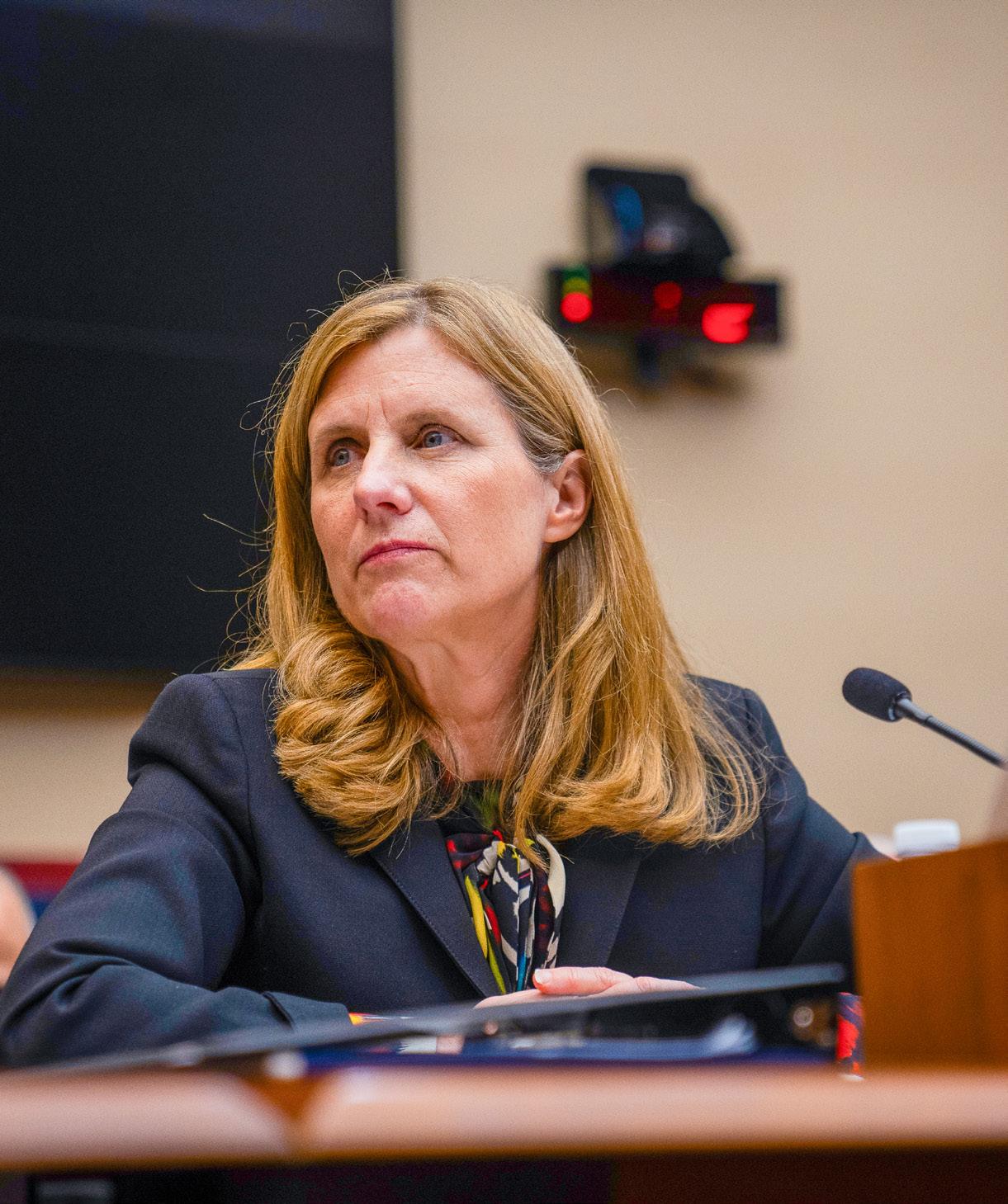
On Dec. 5, 2023, Magill testified before Congress alongside the presidents of Harvard University and the Massachusetts Institute of Technology in a hearing on antisemitism across higher education. Her remarks — including a statement that it was “context-dependent” whether calls for the genocide of Jewish people violate
Department officers, dismantled the encampment and arrested 33 people — including nine Penn students.
Scientific achievements
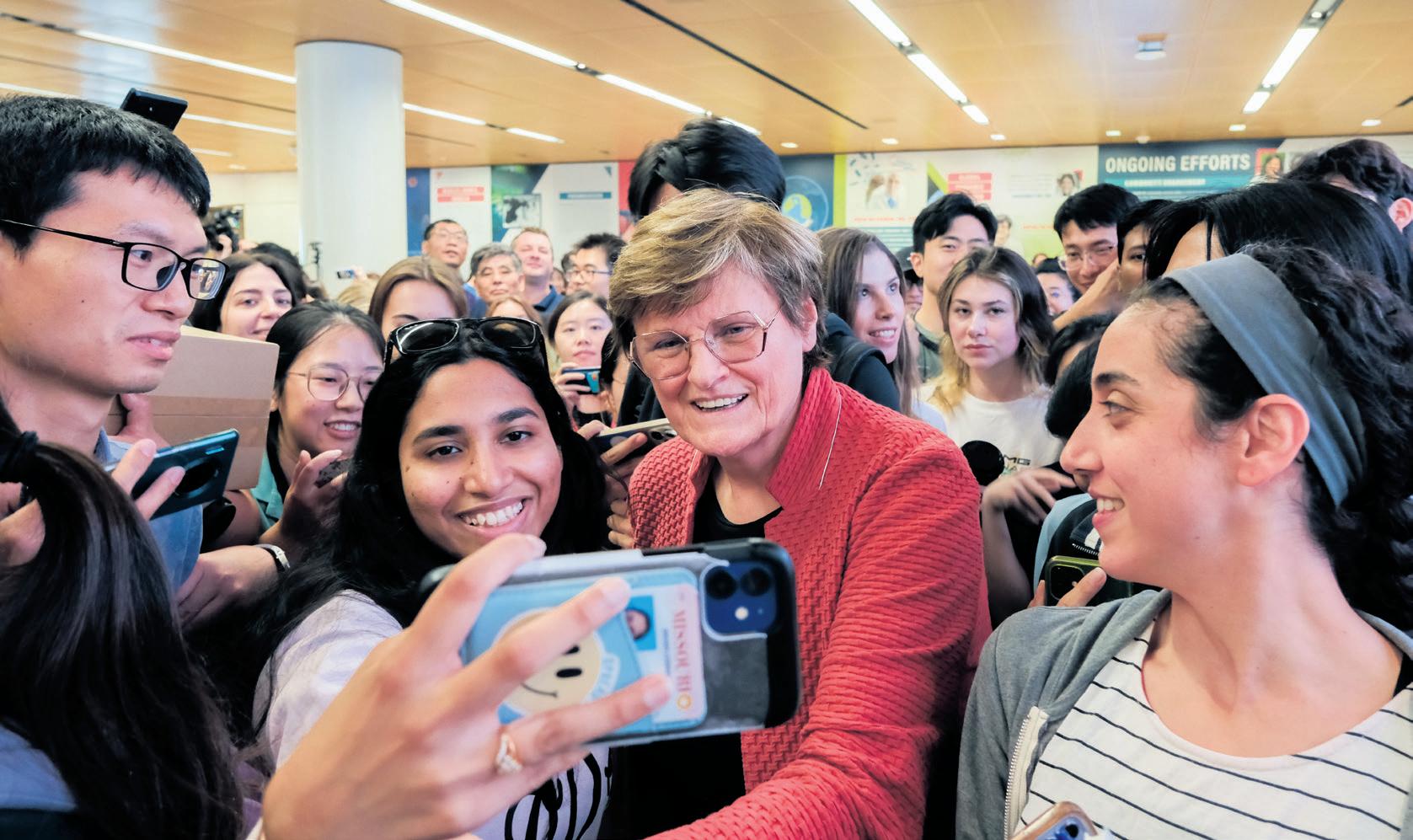
In 2023, Katalin Karikó, an adjunct professor of neurosurgery at the Medical School won the Nobel Prize in Medicine alongside co-laureate and Roberts Family Professor in Vaccine Research at the Medical School Drew Weissman. Their 2005 research was integral to the development of Pfizer/ BioNTech and Moderna’s COVID-19 vaccines, from which Penn has earned around $1.2 billion. At a 2024 event at Hill College House, Karikó attributed her achievements to her indifference to others’ opinions.
“You know, people consider me unsuccessful because I was demoted, I didn’t get the grant, and so on,” Karikó said. “But every day, I [had] to solve a technical problem, and I felt successful when I did my experiments. Don’t let other people define you.”
2024-2025
The 2024-25 academic year was distinguished by increased national scrutiny and significant University-wide policy changes following 1968 Wharton graduate and President Donald Trump’s reelection to the highest political office in the
JESSE ZHANG | SENIOR PHOTOGRAPHER
JESSE ZHANG | DP FILE PHOTO
ETHAN YOUNG | STAFF PHOTOGRAPHER
CHENYAO LIU | SENIOR PHOTOGRAPHER
JESSE ZHANG | DP FILE PHOTO
JESSE ZHANG | DP FILE PHOTO
ABHIRAM JUVVADI | SENIOR
2024 presidential election
In September 2024, Trump and Democratic candidate Kamala Harris engaged in their first and only presidential debate at the National Constitution Center — just miles away from Penn’s campus. In response to Harris’ reference to a Wharton Budget Model prediction about the effects of possible tariffs, Trump stated that he “went to the Wharton School of Finance, and many of the professors, the top professors, think my plan is a brilliant plan.”
While Trump invoked his Ivy League credentials and affiliation with Penn during the debate, he began to distance himself from the University as his third presidential campaign came to a close.
Penn attracted additional national attention when 1999 College graduate and singer John Legend, model Chrissy Teigen, and author Jack Schlossberg visited campus in October 2024 to advocate for youth voter participation and Harris’ campaign. Student organizations — such
Rights included a “Resolution Agreement” requiring Penn to respond to three demands: issuing a statement affirming compliance with Title IX, restoring accolades to “female athletes … misappropriated” by transgender athletes, and sending letters to affected athletes.
for relevance. Last month, Penn’s motion for a stay was granted, allowing the University to refrain from providing information requested by the EEOC until the appeals process is complete.
Cybersecurity concerns
On Oct. 31, Penn experienced a cybersecurity breach after mass emails were sent from Universityaffiliated accounts linked to the Graduate School of Education. The emails — received by students, faculty, alumni, and parents — contained explicit language criticizing the University.
At the time, a GSE spokesperson called the messages “highly offensive” and “in no way reflective of Penn or Penn GSE’s mission or actions.”
Days later, the University reported the incident to the FBI.
as Penn Leads the Vote — encouraged voting through tabling events across campus.
Though Penn overwhelmingly voted blue — with 81.6% of campus voting for Harris relative to 16.3% for Trump — the latter won both the swing state of Pennsylvania and the presidency after a highly contentious election.
Student activism
August 2024 marked the beginning of an academic year during which Penn operated under temporary open expression guidelines — first implemented that June. The document banned encampments and overnight vigils on campus, restricted the use of noise amplification devices, and required events in most spaces to be registered two weeks in advance.
An executive order — signed days after Trump’s inauguration in January 2025 — directed federal agencies to identify and deport non-citizen participants in pro-Palestinian protests. In April 2025, eight Penn affiliates’ visas were revoked by the Department of State — seven of which were later reinstated.
Federal scrutiny
Trump began implementing a series of executive orders targeting higher education in the first days of his second term — including a freeze on federal funding and grants.
The following month, the National Institutes of Health implemented a funding cut that would cost the University $240 million. Penn President Larry Jameson wrote that the cuts would “severely harm our highly impactful research mission” in an campus-wide email at the time.
Penn and 12 other institutions of higher education then sued the NIH — after which, the funding cuts were frozen. However, the University still directed department chairs to significantly reduce graduate admissions due to reduced federal funding opportunities. Faculty at the Perelman School of Medicine, for example, were instructed to cut admissions for its fall Ph.D. cohort by approximately 35%.
The University also implemented several “proactive financial measures” in March 2025, including a hiring freeze and a review of capital spending.
Institutions were also called upon to eliminate diversity, equity, and inclusion programs that might violate federal civil rights laws to maintain eligibility for federal funding in a January 2025 executive order from the Trump administration. The next month, the Department of Education threatened to revoke federal funding for universities that failed to remove DEI initiatives within two weeks.
All mentions of diversity and affirmative action were removed from Penn websites by Feb. 11, 2025 — and Penn’s central DEI website was scrubbed three days later. A few weeks later, the Wharton School renamed its DEI concentration to “Leading Across Differences.” Amid scrutiny by the federal government, Jameson was appointed to serve as Penn’s 10th president following an interim tenure of 15 months.
Title IX investigation
In February 2025, the DOE began investigating Penn for Title IX violations related to the University allowing 2022 College graduate and transgender woman Lia Thomas to compete on Penn’s women’s swimming and diving team in the 2021-22 school year. The NCAA changed its policy to abide by the order shortly after.
The Trump administration announced that it would freeze over $175 million in federal funding to Penn the following month, citing the University’s failure to ban transgender women from participating in women’s sports.
Though Penn motioned to dismiss the case, the Education Department announced that the University was in violation of Title IX in April 2025. The Department’s Office for Civil
2025-2026
The 2025-26 academic year brought increased federal scrutiny, cybersecurity concerns, labor movements, and multiple strategic plans to Penn.
Heightened federal pressure
In July 2025, Penn reached a resolution agreement with the Department of Education to settle a Title IX investigation, becoming the first Ivy League university to do so. As part of the agreement, Penn stripped 2022 College graduate and former swimmer Lia Thomas’ individual records.
At the time, Penn adopted “biology-based definitions” of sex, complying with Title IX “as interpreted by the Education Department.” The changes restored $175 million in previously frozen funding.
Last October, Penn once again dealt with the federal government when it was one of nine universities offered a “Compact for Academic Excellence in Higher Education.” The proposal tied preferential federal funding to significant structural changes, including a five-year tuition freeze, limits on international undergraduate enrollment, and restrictions on the use of race or sex in hiring and admissions.
The University “respectfully” declined to sign the compact the same month, according to an email from Penn President Larry Jameson. He added that Penn had submitted focused feedback highlighting areas of existing alignment as well as substantive concerns.”
In February, cybercrime group ShinyHunters claimed responsibility for the breach. At the time, the alleged hackers released thousands of pages of internal University files — including donor records, internal communications, and documents related to Penn’s antisemitism response. ShinyHunters wrote in a post on the group’s forum that it leaked the data because the University “did not pay a ransom or cooperate and comply.”
Following the breach, numerous alumni filed class-action lawsuits alleging that the University failed to protect sensitive data and accurately represent the scope of the breach. The petitions were later withdrawn or consolidated by a federal judge.
In April, the Annenberg School for Communication warned its community about separate “advanced social engineering attacks” targeting Penn. The attacks included phone calls and text messages impersonating University information technology services.
Penn also investigated a December 2025 cybersecurity breach involving its Oracle EBusiness Suite servers.
they would halt new experiments and lab work during the strike period.
Negotiations continued through early February as the University and GET-UP disagreed over compensation, healthcare, childcare, and support for international students.
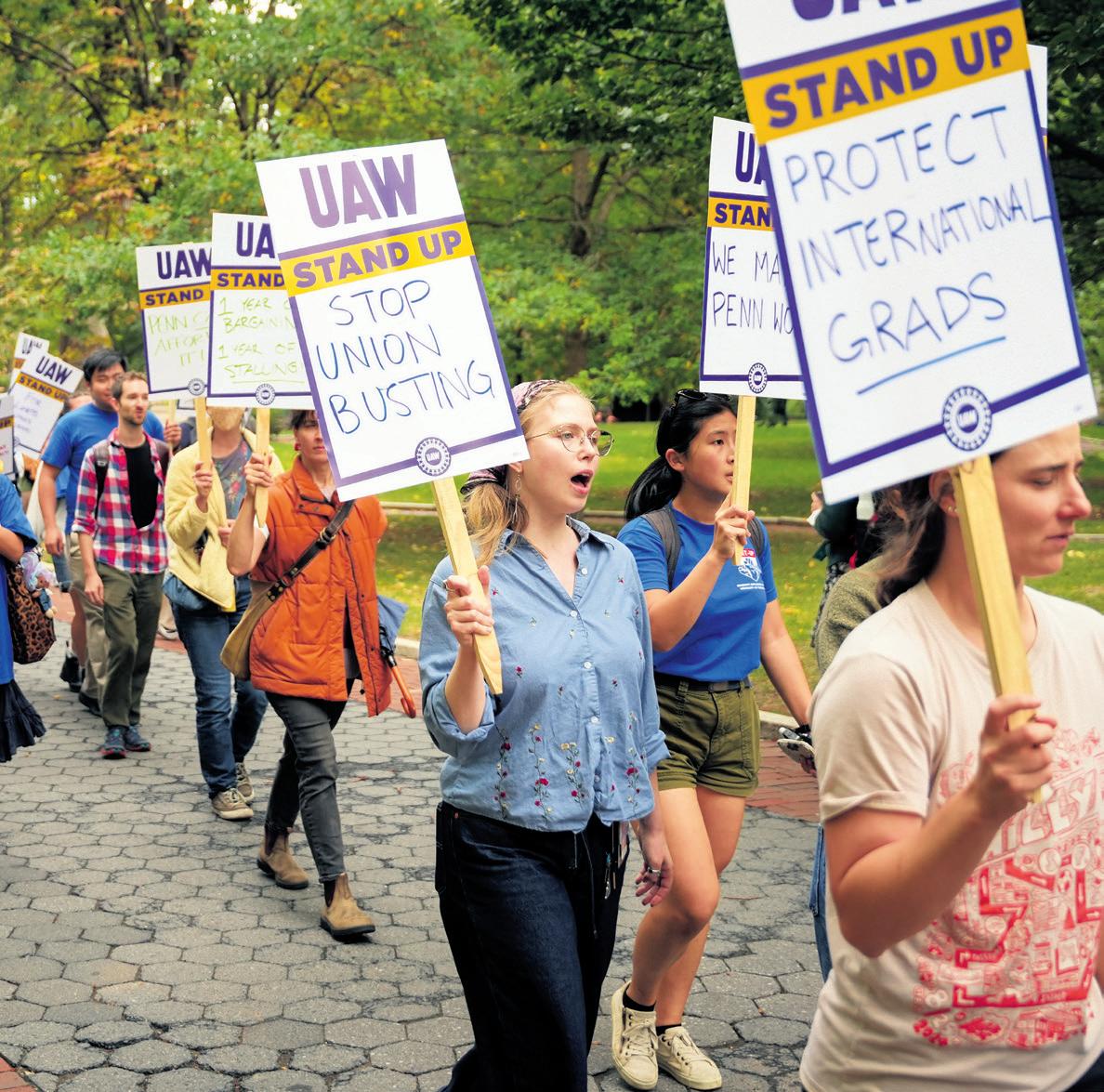
The groups reached a tentative agreement on Feb. 16, narrowly averting the strike. The ratified contract raised the minimum doctoral stipend and enhanced childcare and medical benefits. GET-UP later became chartered as UAW Local 5124, formalizing its status within the national
Penn also faced legal scrutiny over alleged campus antisemitism. Last November, the University was sued by the United States Equal Employment Opportunity Commission over a subpoena seeking information related to Jewish employees and campus groups.
Penn argued in December 2026 that it had “cooperated extensively” but would not provide personal information without consent.
In March, Penn was ordered to comply with the subpoena by May 1. At the time, U.S. District Court Judge Gerald Pappert wrote that the EEOC’s request “easily clears” the legal threshold
Wave of labor organizing
In February, Graduate Employees Together — University of Pennsylvania moved toward a potential strike after over a year of negotiations.
In November, GET-UP — which represents more than 3,700 graduate workers — voted overwhelmingly to authorize a strike. Earlier this year, the union announced that it would indefinitely suspend teaching and research duties if a contract was not met by Feb. 17.
Had a strike taken place, graduate workers would have stopped grading, leading recitations, holding office hours, and conducting certain research activities. Research workers also indicated
labor organization.
Research Associates and Postdocs United at Penn also pushed the University to improve worker conditions. The union proposed a minimum salary of $85,000 for postdoctoral researchers and $103,210 for research associates, in addition to expanded benefits.
Last month, workers at Penn Libraries and the Penn Museum raised concerns over possible changes to employee benefits, including healthcare and retirement plans. A union representative told The Daily Pennsylvanian at the time that the proposed changes signaled a “big red flag” and could reduce existing benefits.
New strategic plans
The University, as well as several individual schools, announced strategic frameworks during the academic year. In September 2025, Jameson unveiled “Penn Forward,” his first major institutional initiative. The plan — which seeks to address both the “challenges and opportunities” facing higher education — came amid mounting external pressures about the industry’s value. The framework created six working groups tasked with proposing “bold, implementable strategies” to address current challenges and long-term goals. The initiative solicited input from students, faculty, and staff.
Earlier this year, the School of Arts and Sciences announced its new framework titled “SAS Horizons: Pathways for a Changing World.” The plan included a reimagining of the College of Arts and Sciences’ curriculum, the creation of the Dean’s Horizons Fund, and future renovations to classrooms and labs.
The Annenberg School also introduced “Connected Futures,” its first strategic vision, in April. Dean Sarah Banet-Weiser told the DP at the time that part of her goal was to “remind people why they should have trust in higher education.”
Athletic success
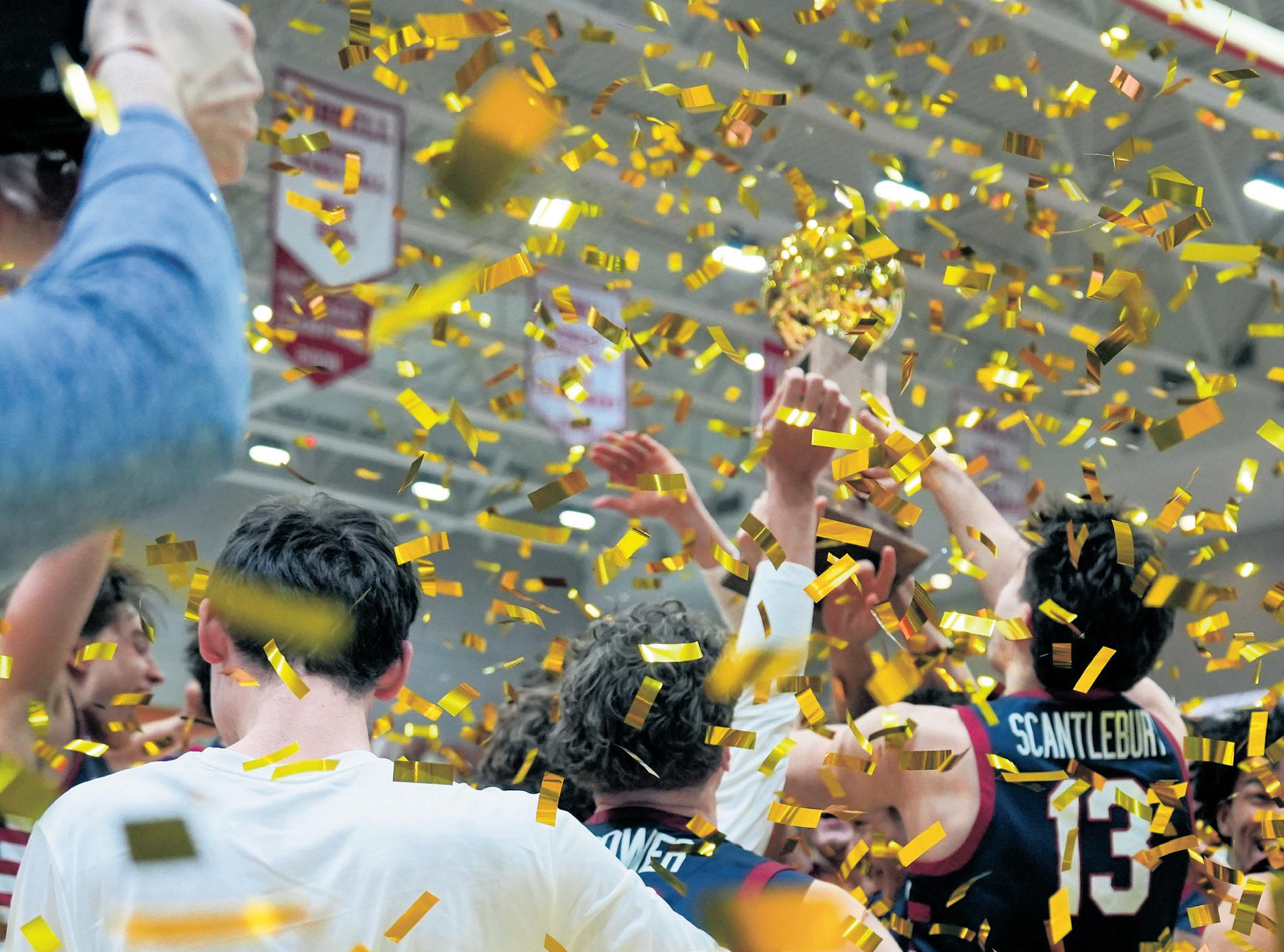
Penn men’s basketball punched their ticket to March Madness this year after a thrilling upset against Yale in the Ivy League championship. The Quakers’ season came to a close in Greenville, S.C., with a 105-70 loss to Illinois in the first round of the NCAA tournament.
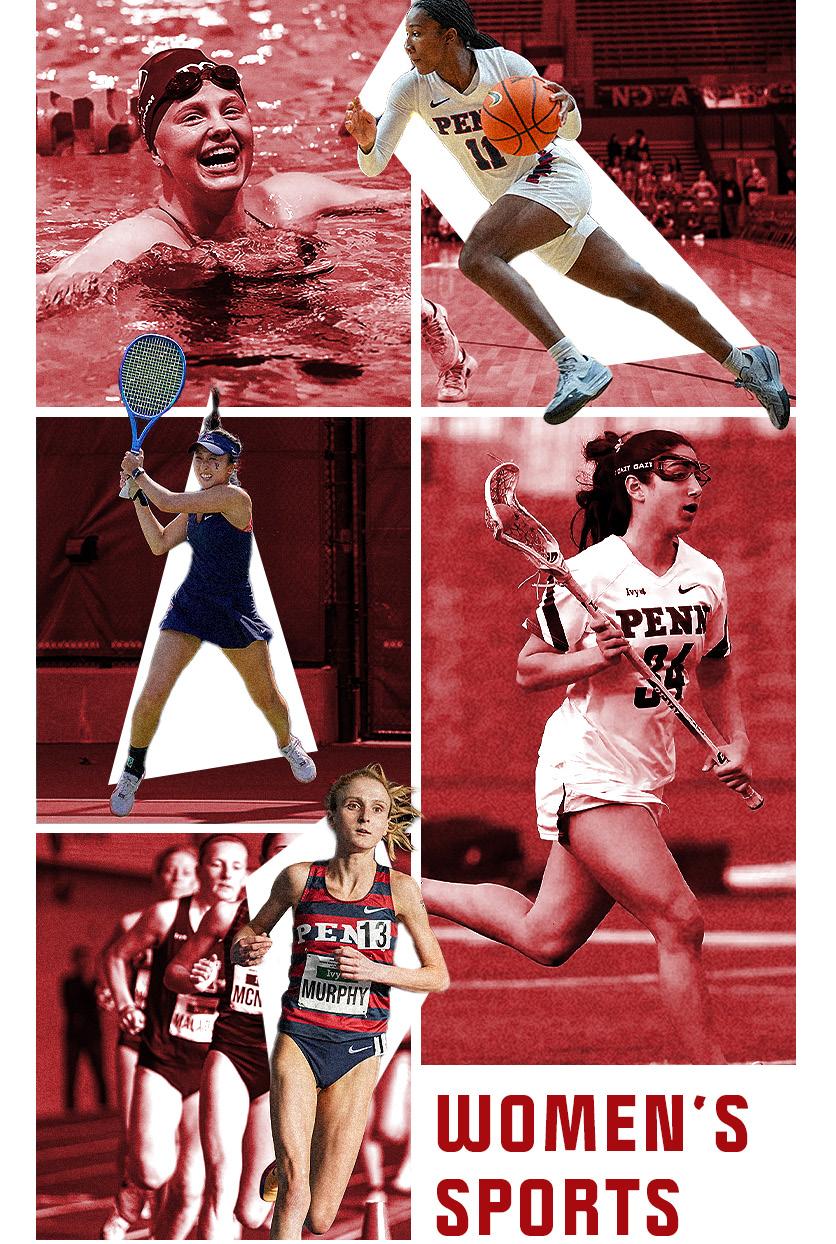
Penn women’s squash also won the College Squash Association national team championship for the first time since 2000, beating No.1 Princeton with a score of 5-4 to bring the Howe Cup back to Philadelphia.
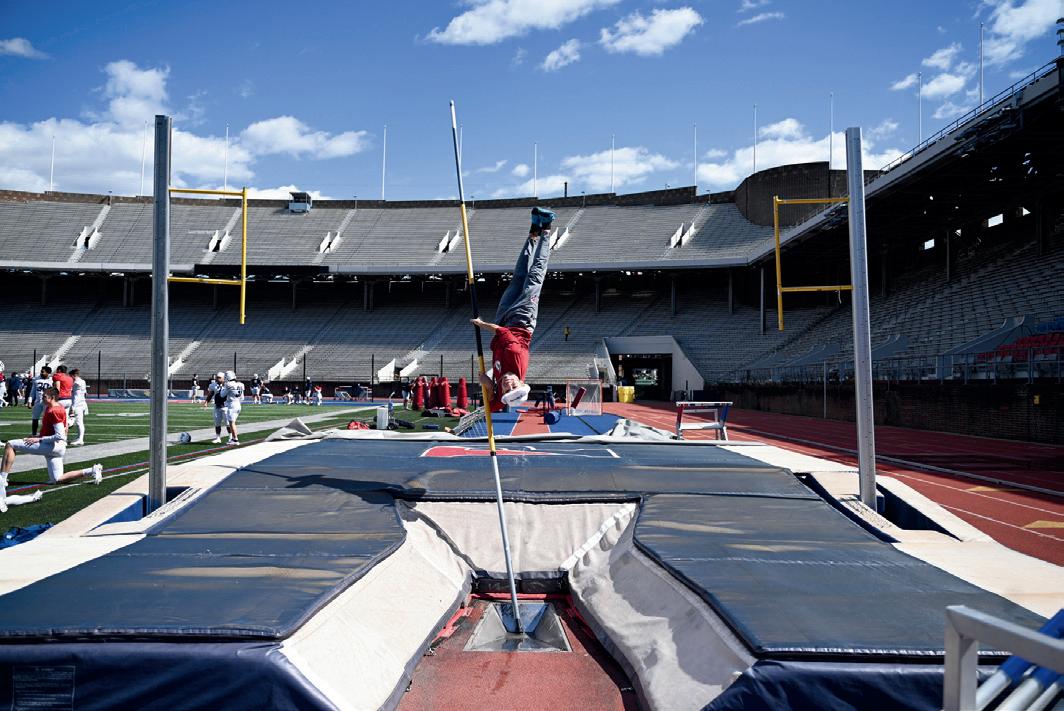
The 130th running of The Penn Relay Carnival took place from April 23 to April 25 and saw Penn track and field athletes joined by competitors of all ages on the hill, the field, and the oval. The three days of competition featured new meet and NCAA records, along with three Quakers who took home first place in their respective events.
KENNY CHEN | SENIOR PHOTOGRAPHER
ETHAN YOUNG | STAFF PHOTOGRAPHER
ABHIRAM JUVVADI | SENIOR PHOTOGRAPHER
KYLIE COOPER | DP FILE PHOTO
WEINING DING | SENIOR PHOTOGRAPHER
KENNY CHEN | SENIOR PHOTOGRAPHER
Since 2022, Penn has allocated over $1 billion to renovation costs
Construction of Amy Gutmann Hall on March 13, 2023.
The Class of 2026 witnessed significant changes to Penn’s campus over their four years at the University.
Since 2022, Penn has allocated over $1 billion to renovation costs. During that time, the University opened new research buildings, overhauled student housing, leased apartment complexes, and renovated historic landmarks.
2022-23
During the summer of 2022, the University honored then-Penn President Amy Gutmann by breaking ground on Amy Gutmann Hall and renaming New College House West to Gutmann College House. Later in the month, the Penn Boathouse — located on Philadelphia’s historic Boathouse Row — underwent a complete overhaul.
In September of that year, the University announced the construction of a performing arts theater named after 1963 Wharton graduate and luxury footwear designer Stuart Weitzman. The auditorium is located next to the Annenberg Center.
Also, during that month, the University Board of Trustees entered a three-year lease with the College House at the Radian, converting it into upperclassman housing to accommodate students displaced by renovations at the Quad. At the time, students already
living in the building raised concerns about the rising cost of rent and the loss of off-campus independence.
In November 2022, Penn Off-Campus Services announced that Sansom Place West — the sole remaining on-campus graduate student housing — would close at the end of the 2022-23 academic year.
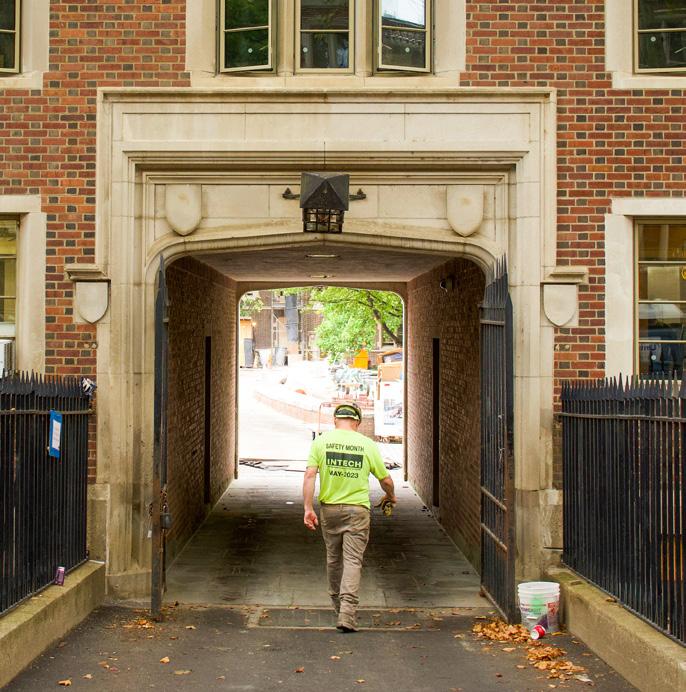
An $87.4 million restoration of College Hall’s west wing began in January 2023. Sections of Perelman Quadrangle and College Green were fenced off for the next two years, rerouting foot traffic from the center of campus. Renovations to the Quad started in May 2023 with an allocated budget of $238.2 million. Construction began with Riepe College House, followed shortly by Ware College House and then Fisher Hassenfeld College House.
To accommodate the displacement, Lauder College House and Van Pelt Manor in Gregory College House became exclusively first-year housing beginning in the 2023-24 academic year.
2023-24
The Board of Trustees reviewed designs for a new Student Performing Arts Center in June 2023, moving the project into its next phase. The building, located in the space next to Hill College House, will
include two theaters, five rehearsal studios, and additional teaching and practice spaces. Construction is
expected to end in winter 2027.
A few months later, Stouffer College House reopened following a $35.6 million renovation. The work — which began in May 2022 — installed single-use restrooms, added mechanical and electrical systems, and increased accessibility. The college house exclusively housed first-year students while Riepe was closed for renovations.
That summer, the building formerly known as Sansom Place East reopened as The Accolade on Chestnut, restoring an on-campus housing option for graduate students. A $94.5 million renovation of the property added HVAC systems, windows, and concrete restoration.
In October 2023, Penn unveiled a $35.6 million expansion of the Graduate School of Education — the building’s first major renovation since 1966. The project connected 3700 Walnut St. with Stiteler Hall and introduced Catalyst@Penn, a new innovation lab.
2024-25
Ware closed during the 2024-25 academic year as part of ongoing Quad renovations. To supplement the housing shortage, Penn leased the Axis — an
Playing the game
SENIOR COLUMN | The greatest shots in college sports are those that don’t get written down
During my freshman year at Penn, I took what would become the first of many trips to see one of the Quakers’ basketball teams face off with an Ivy League rival. After Penn women’s basketball soundly defeated Yale University to clinch an Ancient Eight tournament berth, I wrote up my recap, closed my computer, and walked toward the exit.
But Matt Frank and Brandon Pride, two former sports editors who had also made the trip to New Haven, Conn., had other plans. With the “work” complete and the court at John J. Lee Amphitheater empty, they found the nearest basketball and began a game with no goal in particular — part PIG, part pickup, part half-court shootout.
Frank eventually drained one of the long-range heaves, subsequently declaring that before the end of his career at The Daily Pennsylvanian, he would hit the same look on all eight of the Ivies’ basketball courts. To my knowledge, he never got there. But that wasn’t the point.
In four years at the DP, I’ve grown familiar with the primacy of outcomes. Which team won or lost, how many views a story generated, how quickly breaking news was published compared to the closest competitor. And while sports, journalism, and life are predicated on those objective benchmarks, the best part of all three is the sweetness in between.
Since that late-night scramble at Yale, playing pickup on the road has become a cherished tradition. I’ve done
Do it scared
it with my closest friends after 30-point losses and by myself after last-second wins. Each iteration is rife with the same sensations — the awe of playing on a Division I court, with the fear of a security guard around the corner. But above all, there is a sense of fun unfettered by shots made or missed.
It’s those kinds of moments I’ve done my best to seek out during my time at the DP. A long print production night made worthwhile by the animal cracker-fueled hangout that followed. A picturesque walk back from Franklin Field on a cool fall afternoon. A stack of latenight pancakes at an opposing school’s dining hall. A night of Madden on the eve of the Ivy League championship. When I look back on my time as a college journalist, those will be the times I keep closest to my heart.
Emphasizing the importance of those perfect little supernovas is far from a novel perspective. Indeed, it is the refrain of many a graduate, retiree, or eliminated student-athlete. But the power of the sentiment lies in its portability — in recognizing the fleeting value of my time at the paper, I’ve earned an appreciation that will last far beyond the ink on this page.
In March, I covered my final Penn basketball game at March Madness in Greenville, S.C. The stage itself felt like a dream. Each phase of the experience, from tipoff to press conference, brought a greater sense of wonder and a growing sense of pressure — to meet the moment, to rise to the occasion, to produce a journalistic outcome
worthy of sports’ most famous tournament.
But afterward, when all the other spectators and reporters had cleared out, the DP’s contingent still found its way onto the court. The arena was larger, but beneath the March Madness logo at half-court, it all felt quite the same. In that instant, I knew the game would stay with me forever. I never heard the buzzer.
WALKER CARNATHAN is a College senior studying cinema and media studies and English from Harrisburg, Pa. He served as sports editor on the 140th Board of The Daily Pennsylvanian, Inc. Previously, he served as a deputy sports editor. His email is walkcar@sas.upenn.edu.
SENIOR COLUMN |Fear isn’t a reflection of your abilities; it just might mask your greatest strength
On Feb. 4, 2025, I stood anxiously in a media scrum of dozens of career journalists clamoring to ask twotime Super Bowl champion Patrick Mahomes questions ahead of Super Bowl LIX. In that crowd, I was convinced I didn’t belong.
Sure, I was The Daily Pennsylvanian’s Sports editor at the time. But my previous reporting experience was mainly in swimming. I wasn’t even majoring in anything close to journalism; I was a nursing and healthcare management student. I didn’t grow up obsessed with football, and I had only started following it a few years prior. Yet somehow, I was here in the middle of a loud, brightly lit conference room with a pit in my stomach, and doubt consuming my mind. Despite that, I managed to squeeze in my question about Mahomes’ diverse wide receiver room, which included 2018 Wharton graduate Justin Watson, amid the noise. It wasn’t the last time I’d do something while being
terrified out of my mind. The day after, I sat in a cafe in the Kansas City Chiefs’ hotel, staring blankly at my laptop that displayed a splitscreen: on one side, a 90-page lawsuit filing by former Penn swimmers, and on the other, a blank article draft. Naturally, I was overwhelmed and intimidated. But the deadline didn’t care about that. So I started anyway, sentence by sentence, paragraph by paragraph. By the afternoon, I had written a story set for the front page of the paper. Not even 24 hours later, my Co-Sports Editor Sean McKeown and I sat hunched over on a couch typing away at our computers at the Hartford airport on our way back to Philadelphia, breaking national news about the Department of Education’s investigation into Penn and the takedown of Penn Athletics’ diversity, equity, and inclusion page — even more unfamiliar territory. Looking back, I realize that I wasn’t alone with my
nerves in any of those moments. There was undoubtedly another Super Bowl first timer at that scrum. Multiple journalists were anxiously writing up big stories under pressure at the Chiefs’ hotel. And while I don’t think anyone else at that airport was breaking national news, my DP colleagues also had some nerves as we worked to report that story.
This leads me into the biggest lesson I learned from DP: You’ll never walk into those big moments feeling 100% ready; no one does. Not athletes, not reporters, not you or me. But the difference between those who are successful and those who are unsuccessful is how you manage that fear and do it anyway.
Because at the end of the day, that fear isn’t a reflection of ability. It’s just a reaction to being in a moment that matters. And you don’t overcome fear before the moment unless you step into it.
Those fears and doubts were the biggest illusions for me. Ironically, the thing that made me feel out of place — my unconventional background — was what made my work at the DP unique. As a more casual sports fan, I was able to advocate for content that served members of the Penn community later in my term. I launched the guide series to make major events — from Penn Relays to the Big 5 Classic to March Madness — more accessible to casual Penn sports fans. My background in non-flagship sports, especially swimming, proved valuable when Penn swimming and diving entered the national spotlight.
Today, I still have some nerves before writing an article, even after nearly 150 bylines. But I’ve learned to overcome them by just diving into those moments. As I end my time with the DP, those moments — fittingly unconventional — have included traveling to Indianapolis to cover the Olympic Trials, driving for hours up to Cornell to cover an Ivy League tournament championship and March Madness berth, and staying up until 2 a.m. on a random Monday to break national news about House v. NCAA.
Write
less,
And I wouldn’t be able to say that I could’ve stepped into these moments and made the most out of them without the help of some people. Thank you to my first Sports editor, Alexis Gracia, who laid the foundation for my sports journalism knowledge that led to nearly 150 articles — even though I’ve never taken a journalism class.To my Sports editor predecessors, Walker and Vivian: Thank you for always answering my frantic texts with questions so quickly. I was honored to continue the success you both set. To my partner in crime, Sean: Thank you for always being open to my ideas, helping me navigate the chaos of being an editor, and teaching me how to advocate for our department, and more importantly, myself. To my nontraditional deputy, Conor: while we joined DPOSTM at the same time, I’ve always looked up to you, and your energy and assists this past fall meant the world. To the honorary DPOSTMites, Emily and Diamy: thank you for being patient as I edited content from the most unconventional of places — Spain, Thailand, the Children’s Hospital of Philadelphia — and for curating a supportive culture where I truly felt no question was dumb. Lastly, a special thanks to the original “Sporty Nurse” Kristel Rambaud, who first convinced me to join DP Sports and has been a guiding light in many of the things I’ve done since. To those reading, do it nervously. Do it terrified. Do it before you feel ready, because that’s usually when it matters most.
VALERI GUEVARRA is a Nursing and Wharton senior studying nursing and healthcare management from Wyckoff, N.J. She served as sports editor on the 141st Board of The Daily Pennsylvanian, Inc. Previously, she served as a sports reporter. Her email is valeri@wharton. upenn.edu.
listen more
SENIOR COLUMN | What do we really work for?
When I think back to college, I will first and foremost think of The Daily Pennsylvanian.
I worked plenty of jobs throughout my four years.
A year at the New Deck Tavern, two years at Smokey Joe’s, a couple of months at White Dog Cafe, but no matter what I did to pay the bills — the DP came first.
It was more than a job to me. Every article felt like a renewal of purpose, every hour spent working felt like a challenge to improve, and the people inside the paper always pushed me to be the best version of myself academically, socially, and professionally.
I put more time and energy into journalism than any other aspect of my life, and it gave back to me in fantastic ways. I experienced whole worlds that I never thought I’d be a part of, and those worlds, in turn, will always be a part of me.
Yet today, I find myself at a crossroads. I’ve had every blessing, taken advantage of every opportunity, made it further than most — but right when I’m ready to graduate and leap into the professional world I would’ve begged to enter not even a year ago, I get cold feet.
The job is built for the audience. Everything you read is made to educate you, enthrall you, and shock you. The work behind it is demanding, competitive, and draining. They say journalism is a job you have to love, and it’s not that I don’t love it — there’s just something I love more.
You.
Maybe not you in particular, but, yes, I love you.
I love people, to be more specific, and I love conversation. I love trust. I love the feeling of growing closer to the people around me, and the honesty it takes to get there. Hearing both sides of the story and coming closer together after even the briefest of interactions brings me the proudest feeling possible.
And, shockingly, being a journalist makes me feel like I can’t listen to you. While I love my hour-long interviews and heartfelt conversations, it feels disingenuous knowing that, at the end of the day, I am in that space to create content. You can’t have a conversation with a page.
In 2024, I watched students protesting at Columbia face tear gas and physical violence from police on a computer screen in the DP office, and a colleague in front of me said, “God, I wish that was happening here.”
A week or so later, Penn had its own encampment.
A year or two later, the DP had amassed many awards and accolades for the work surrounding it, and the world keeps spinning.
It didn’t hit me in the moment, but those words are emblematic of my problem with journalism. The job asks you to value clicks and attention over impact. Journalists are told to keep space between themselves and their subjects, but in the name of objectivity, we
excuse straying further and further from what’s real. I am proud of the work I have accomplished. To those who trusted me to cover their hardest moments, thank you. I strove every day to be true to you, and I worked as hard as I could to make stories that protected you, along with many others inside and outside the DP. But I now know that, in the end, my job as a
SEAN McKEOWN is a College senior studying communication from Philadelphia. He served as sports editor on the 141st Board of The Daily Pennsylvanian, Inc. Previously, he served as a deputy sports editor. His email is seanmck@ sas.upenn.edu.
KENNY CHEN | SENIOR PHOTOGRAPHER
CONNIE ZHAO | SENIOR PHOTOGRAPHER
Sports Illustrated from another angle
SENIOR COLUMN | How I ended up in The Daily Pennsylvanian’s only section that matters
For the longest time, I was convinced I was going to be the next Brandi Chastain. I constantly daydreamed of scoring the final penalty kick to win the World Cup, just like she had. When I was alone in my room, I’d rehearse my goal celebration over and over, imagining the moment frozen on the cover of Sports Illustrated.
Then, I stopped growing at the end of middle school. Clocking in at just 5 feet and 3.75 inches, my dreams of an athletic career were long gone by the time I stepped foot on Penn’s campus. Instead, I was dead set on becoming a doctor. But I just couldn’t stay away from sports.
Like it does for most kids at Penn, the fall of my first year came with plenty of rejection. Penn women’s club soccer, Penn Engineering Council, Penn Assistive Devices and Prosthetic Technologies, Penn Biomedical Engineering Society — the list goes on and on. While the no’s continued to roll in, I got the one yes I needed from The Daily Pennsylvanian Sports department — even though I had no previous journalism experience. Well, mainly because they accepted all their applicants. But I didn’t know that at the time.
When I walked into the Pink Palace for the first time, I was greeted by the department’s eccentric leadership trio that consisted of Matthew Frank, Esther Lim, and Eashwar Kantemneni. I felt oddly at home. Suddenly, I wasn’t the weird one for having an encyclopedic memory for statistics and trivia. I was surrounded by a group of people who were equally as obsessed with sports as I was.
The summer after my first year, I was given the chance to write about former Penn softball pitcher Jennifer Brann, who was then working as a baseball analyst for the Miami Marlins. In the feature, I highlighted the challenges she faced as a woman in a male-dominated field. At the time, she was the only female baseball analyst on the Miami staff, and that resonated with me since I was one of just a few women in DPOSTM.
Seeing her carve out a space in a field where she was the exception inspired me to do the same within the DP. I
MEN’S, from page 14
of the Year.
Since rowing for Penn, Riedinger has helped bring the heavyweight program to new heights. The program finished ninth overall at the Intercollegiate Rowing Association National Championship Regatta in 2024, the team’s best performance in decades. In 2025, Riedinger was also a member of the varsity boat that helped bring the Blackwell Cup back to Penn for the first time in 23 years.
Off the water, Riedinger has served as Penn’s representative for the Ivy League’s Student-Athlete Advisory Committee, and as vice president of the NCAA SAAC.
Lightweight rowing — Ian Holly
Senior Ian Holly has rowed in the Varsity Eight for all his seasons at Penn. At the IRA National Championship Regatta, his boat never placed worse than fourth in the grand final. His Penn career is not quite over yet — he has one last chance to compete in the EARC Sprints and IRA Nationals in May.
Two years ago, he was part of the team that took home the Jope Cup at EARC Sprints for the second time in program history — awarded to the team with the most total points at the regatta. In the summer after his junior year, Holly represented the United States at the World Rowing U23 Championships. He leaves the Quakers’ lightweight rowing team having continued their steady upward trajectory.
Graduating from the School of Engineering and Applied Science this May, Holly will remain at Penn for one more year to complete his accelerated master’s degree in robotics.
Men’s soccer — Patrick Cayelli
From bench player to captain and unanimous first team All-Ivy selection, senior midfielder Patrick Cayelli saw a steady rise during his years at Penn. Throughout his four seasons, the Quakers qualified
WOMEN’S, from page 14
Women’s lacrosse — Natasha Yajadda
A defensive force for Penn women’s lacrosse, Natasha Yajadda leaves the program as one of its most impactful defenders. As a senior, Yajadda led the Quakers with 22 caused turnovers, earning secondteam All-Ivy honors. This year, she also scored her first three collegiate goals in matches against Towson and Brown during the regular season. In a standout game, she led the team defensively in a double-overtime win against Princeton, causing a team-high four turnovers to help secure the win.
In 2025, Yajadda caused a career-high 23 turnovers, including a career-high four in the NCAA quarterfinals against Northwestern. She also picked up a career-high 27 ground balls last season.
Women’s rowing — Silvia Harrop-Lopez
Senior Silvia Harrop-Lopez worked her way from Third Varsity as a freshman to a seat on the Varsity Eight as a senior. Harrop-Lopez competed at the 2025 NCAA Rowing championships on the Varsity crew, helping the Red and Blue place 18th nationally. In 2023, she was a member of Penn’s Collegiate 4+ boat that placed first at the Navy Day Regatta. She also competed in the international Henley Women’s Regatta as a freshman.
Women’s soccer — Annabel Austen
Senior goalkeeper Annabel Austen stepped into a starting role in her junior season and never looked back. Across her two seasons in the role, she collected two first-team All-Ivy selections and five Ivy League Defensive Player of the Week awards. She made 136 saves across her career and conceded only 33 goals. In her senior season, she had a save percentage of 0.814 and allowed just 1.17 average goals per game, with four shutouts.
Austen will transfer to USC — a team that regularly sends players to the National Women’s Soccer League — for her final year of eligibility in hopes of starting a professional career.
Softball — Kelly Zybura
Senior pitcher Kelly Zybura has proved herself to be a steady offensive presence on the team. She pitched more than 290 innings across her four seasons at Penn. Notably, Zybura threw only the third perfect game in Penn softball history against Dartmouth in 2026. In the series, she pitched five innings, not allowing any hits, walks, or baserunners, and struck out four batters in an 11-0 victory. With her performance, Zybura helped Penn secure its first Ivy League series win of this season.
Women’s squash — Malak Taha
decided to run for sports editor.
The time commitment almost certainly meant I would have to take a gap year if I still wanted to pursue medicine, and it also meant risking my GPA. Yet, even with all those cons, it never crossed my mind to walk away from the opportunity. Running for sports editor was the first time I chose what I loved over what I thought I should do.
Did my grades suffer? A little. Did I miss out on plenty of social hangouts with friends because of my commitments to the DP? Definitely. But would I change anything? Absolutely not.
I’d like to thank Brandon Pride and Matthew Frank for introducing me to what DPOSTM is all about, Alexis Garcia for guiding me through the elections process, Walker Carnathan for being my partner in crime during our tenure as sports editors, my parents for being incredibly supportive of me as I pursue my passions, and last but not least, my best friend, girlfriend, and ex-HBIC Norah Rami for reminding me that this column was due today.
I am eternally grateful for my time with DPOSTM. It truly was a once-in-a-lifetime opportunity that opened doors I didn’t know existed. As a Maryland native who grew up a diehard Baltimore Ravens and Orioles fan, never in a million years did I think I would return home to cover those same teams as a reporter for The Baltimore Banner.
But that is exactly what the future holds. I may not have become a professional soccer player like the younger version of me once dreamed, but standing on the sidelines this summer, I’ll know I’ve made it to the big stage in my own way.
VIVIAN YAO is an Engineering senior studying bioengineering from Clarksville, Md. She served as sports editor on the 140th Board of The Daily Pennsylvanian, Inc. Her email is vyao@seas. upenn.edu.
for the Ivy League tournament every year and won it twice. In his senior season, the South Carolina native led the team and the Ivy League in many offensive categories, including goals, assists, shots on goal, and points.
In December 2025, Cayelli was drafted by Austin FC in the 2026 MLS SuperDraft, where he is now a regular starter for the developmental team.
Men’s squash — Omar Hafez
The world has been senior Omar Hafez’s oyster as he ends his career at Penn.
In his first year, Hafez had a 16-1 individual record and was awarded Ivy League Rookie of the Year. As a sophomore, Hafez notched another perfect record that helped the Quakers upset No. 1 Trinity to win the CSA National Team Championship — the team’s first in program history. He helped the program win backto-back national titles and a perfect 20-0 season in 2025, even through difficult times in his personal life.
In his final year donning the Red and Blue, the now-senior captain made it to the CSA Individual Championship final again, and this time, he hoisted the Pool Trophy to return the title to Penn squash. In February, Hafez notched his 68th career win — becoming the winningest player in Penn men’s squash history. While Hafez and the team fell short in their quest for a third national title, he finished his career as one of the most decorated players in program history — adding All-Ivy, CSA All-American, and 2026 Skillman Award finalist honors at the end of his senior year to an already-stacked resume.
Men’s swimming and diving — James Curreri
A four-year Ivy League championships qualifier and mainstay on multiple relays, senior backstroke/ freestyle specialist James Curreri has been a consistent presence on the roster, especially following the graduation of a large senior Class of 2024 and three stars last year. In his Ivy League championships debut as a freshman, Curreri won the B-final of the 100yard backstroke and finished 12th in the 200 back. At the 2024 Ivy championships, Curreri hit personal bests in the 500 free and 1,000 free en route
Senior Malak Taha quickly showed her prowess when she joined Penn women’s squash in the 202223 season. She earned first-team CSA All-America, Ivy League Rookie of the Year, and first-team All-Ivy honors in her freshman year. As a senior, Taha earned second-team All-Ivy honors in 2026. She helped Penn win the CSA National Team Championship this year, the team’s first since 2000.
Women’s tennis — Maya Urata
Senior Maya Urata left a mark on the program during her four years with the Red and Blue. She consistently left impactful performances on both the singles and doubles courts. After an extremely strong freshman season with 16 singles wins, Urata went on to post a 21-5 singles record during her sophomore year against key Ivy League competitors, earning an ITA Scholar-Athlete honor.
In her junior year, she maintained this prolific singles performance with a 12-6 overall and 5-1 Ivy singles record, helping women’s tennis secure a second-place Ivy conference finish that earned her an All-Ivy honorable mention in doubles. During her final home match against Cornell in her senior season, Urata clinched the win for the Quakers in her singles match.
to a bronze medal in each event. Curreri also led off
Penn’s 400 medley relay in a personal-best split, helping the team set a new program record. In his final season, Curreri served as a leader in and out of the pool, setting multiple records and supporting the team as its captain. In the regular season, Curreri erased the 200 back pool record by over a second. In his final meet as a Quaker at the 2026 Ivy championships, Curreri shaved about 0.20 seconds off an eight-year-old program record in the 200 back with a time of 1:42.32.
Men’s tennis — Manfredi Graziani
Senior Manfredi Graziani graduates from Penn as one of the most accomplished players in men’s tennis program history. Throughout his four years, Graziani proved to be a prolific force on both the singles and doubles courts. During his junior season, he earned a second-team All-Ivy selection in singles, compiling more than 100 career match wins against nationally ranked opponents. He qualified for the ITA AllAmerican Championships singles and sat at No. 41, the highest ITA Singles Ranking in history for Penn. He continued this success in the doubles court during his senior year. Alongside his partner, junior Aaron Sandler, the pair became Penn’s first-ever NCAA doubles semifinalists and ITA doubles AllAmericans, reaching a program-best No. 2 national ranking.
Graziani was also critical for both of Penn men’s tennis NCAA Championship appearances. In his final season, he earned First Team All-Ivy honors in both singles and doubles.
Men’s track and field — Kampton Kam
She concluded her career with the Red and Blue by earning a CSC Academic All-District honor.
Women’s track and field — Moforehan Abinusawa
Senior sprinter Moforehan Abinusawa leaves Penn having reset a number of program records. She holds the indoor records for the 60-meter and 200-meter dashes, as well as the outdoor record for the 100-meter dash. She also shares the Ivy League record in the 60m. The Pennsylvania native is also second in program history in the outdoor 200m, only behind 2024 College graduate and Olympian Bella Whittaker. Abinusawa garnered All-Ivy selections across all four of her seasons and qualified for the NCAA championships twice, one of them for an individual race and two for relays. The Quakers’ sprints relay squads will miss her, with Abinusawa playing a part in six out of the top seven 4x100-meter relay times in program history. She has also competed internationally, representing Nigeria since 2024.
Volleyball — Anna Shohfi
A two-year captain of the volleyball team, senior setter Anna Shohfi has been an offensive cornerstone for the Quakers. In her freshman year, she led the team in assists, and she came second on the team in all three consecutive seasons. Shohfi leaves with 863 total assists and 327 digs, making her an indispensable player to a young Penn team. Throughout her years at Penn, she also sought involvement off the court, serving as a Student-Athlete Advisory Committee representative and working with the Penn Athletics Wharton Leadership Academy.
WEINING DING | SENIOR PHOTOGRAPHER
BEST OF GRADUATING SENIORS
Meet the best athletes graduating in the Class of 2026
HANNAH CHANG, EMILIE CHI, KAIA FEICHTINGER-ERHART, AND VALERI GUEVARRA
Sports Editors and Senior Reporters
Baseball — Thomas Shurtleff
Senior pitcher Thomas Shurtleff, also the team cocaptain, has been an anchor for Penn baseball. In his collegiate career, Shurtleff helped the Red and Blue win back-to-back Ivy League Tournament titles in 2023 and 2024, with a chance for a three-peat this season. A consistent force in late-game situations, he won Ivy League Pitcher of the Week in 2025 and threw a seven-inning shutout with 10 strikeouts against Princeton this season.
Men’s basketball — Ethan Roberts
After two years at Penn, senior guard/forward Ethan Roberts leaves behind a legacy. Having played at Army and Drake before eventually choosing Penn, Roberts immediately became an indispensable player for the Quakers. During his senior season, the team played in the Big 5 Classic, won the Ivy League tournament, and appeared in March Madness for the first time in eight years. While a concussion kept Roberts from playing in the postseason, his contributions earlier in the season earned him second-team selections in the Big 5 and the Ivy League, as well as a Mid-Major Player of the Week nod in November 2025. As Roberts heads to Notre Dame to play under his fifth coach in as many years, he leaves a gap that will be hard to fill. To borrow his own words from his transfer announcement, Roberts will be ”forever a Quaker.”
Men’s cross country — Sahil Dodda
Senior distance runner Sahil Dodda has put together a respectable career during his four years at Penn. His most notable performances came during his junior year, when he placed seventh in the Ivy League Outdoor Track and Field Championships in the 3,000-meter steeplechase, and finished 22nd in the NCAA Division I Cross Country Championships with a personal-best 10K time. He continued this success into his senior season, setting new personal bests in the 5,000 meters and 4 meters. Dodda also holds a fourth-best time of 14:16.25 in the program record book for the indoor 5K.
Men’s fencing — Simon Kushkov Senior saber Simon Kushkov is all too familiar with success. Kushkov dominated from the moment
he set foot on Penn’s campus. As a freshman, he finished sixth in saber at the 2022-23 NCAA Championships, maintaining a nation-leading win percentage of 0.611. His win streak continued into his junior year, when he placed first at the NCAA Mid-Atlantic/South Regional while finishing second in saber at the Ivy League Championship. That same year, he earned First Team All-Ivy, First Team All-Region, and an honorable mention All-America recognition after finishing 12th in the NCAA Championships. Kushkov capped his career at Penn with an honorable mention All-Region selection.
Football — Jared Richardson Senior wide receiver Jared Richardson broke onto the scene his sophomore season and never looked back. Originally a quarterback, Richardson saw little game action as he converted to the role of wide receiver during his freshman season. But by his sophomore year, the Pennsylvania native had become a
fixture of Penn football. He was first on the team and second in the Ancient Eight in receptions, receiving yards, and touchdowns, garnering a First Team AllIvy selection.
His senior season was his best yet, as he established himself as senior quarterback Liam O’Brien’s primary offensive option. Richardson finished his Penn career with another First Team All-Ivy selection and an FCS Second Team All-American, thanks to his career-high 12 touchdowns and 1,033 receiving yards — becoming the sixth player in program history to reach the 1,000-yard mark.
Richardson still has one remaining year of eligibility, which he will use at last year’s ACC champion Duke.
Sprint football — Jake Wang
Senior wide receiver and tight end Jake Wang first emerged as an offensive powerhouse during his breakout sophomore season, finishing among the CSFL’s top receivers. He ended the season with 481 yards, earning him Second Team All-CSFL honors.
After not seeing any games in 2023, Wang returned and steadily built momentum for a standout senior season. In his final season, the California native led the team with 35 receptions for 504 yards and three touchdowns, while also contributing defensively with 14 tackles. Wang’s all-around presence on both ends of the field earned him Second Team All-CSFL honors again. The three-time All-CSFL honoree has served as a strong presence for Penn Sprint Football’s offensive core across all three seasons he played.
Men’s golf — Owen Hayes
As the sole graduating senior on the men’s golf team, Owen Hayes stood as a reliable presence over the past two years. Although Hayes did not see action during his first two seasons, he still put together respectable performances when it mattered. During his junior season, Hayes posted a 77.8 stroke average across 10 tournament rounds. His most notable performance came in the spring of his junior season when he placed 23rd overall at Columbia’s Roar-EE Invitational. Hayes continued to compete as a reliable performer for the team throughout the spring and into his senior year, helping the team place fifth out of 12 in the Princeton Invitational.
Men’s lacrosse — Griffin Scane Senior midfielder Griffin Scane has been an offensive leader for the team, winning second-team All-Ivy honors in 2025, as well as honorable mention All-America recognition from both USA Lacrosse Magazine and Inside Lacrosse before the 2026 season. In 2026, he won All-Ivy honorable mention, recording 10 games with multiple points. He scored a career-high five goals twice in 2025, against Villanova and Yale.
Heavyweight rowing — Cole Riedinger Captain of Penn men’s heavyweight rowing, senior Cole Riedinger spent almost all four years in the Varsity 8+ boat for the Quakers. As a freshman, he won the Ted A. Nash Award, given to the most promising freshman oarsman; as a senior, he was named Quaker
Women’s swimming and diving — Sydney Bergstrom
Senior freestyle specialist Sydney Bergstrom impressed during her first year donning the Red and Blue, notching personal bests in multiple meets. In her sophomore year, Bergstrom stayed at the top of the conference with a fourth-place finish behind her two teammates and a competitor from Yale. Even amid adversity with the loss of Sheerr Pool in the 2024-25 season, Bergstrom reached a goal she’d been chasing: an NCAA berth. At the 2025 Ivy championships, Bergstrom earned the bronze medal and her first qualification to the national championships.
At the 2026 Ivy championships as a senior, Bergstrom claimed her first Ivy title in the mile, which was crucial in Penn’s second-place team finish at the championships — the highest in program history. With the title, Bergstrom automatically qualified for NCAAs, and her final meet as a Quaker could not have been a better ending to her career. On the national stage, she improved from 36th last year to a 12th-place finish in the mile with a time of 16:04.94 to earn AllAmerican honors. Bergstrom joined an elite group of only three other All-American swimmers in program history, including her training partner Anna Moehn, also a senior freestyle specialist.
Women’s basketball — Simone Sawyer
Senior guard Simone Sawyer was a dynamic two-way player for the Quakers during her time at Penn, evolving from a scoring leader as a rookie to an all-around threat. In her freshman year, Sawyer was awarded Ivy League Rookie of the Week twice after multiple 18-point performances. That first year alone, she scored in double digits 10 times, accumulating 191 points in a single season. She continued her reign throughout her sophomore and junior seasons, making notable contributions to women’s basketball’s Ivy League tournament runs.
In her senior year, Sawyer embraced her role as one of the captains, leading the team with an average of 11.5 points per game alongside an average of 4.5 rebounds. The Lincolnshire, Ill., native also finished first in the Ivy League and 21st nationally with an 88.1% free throw percentage. She consistently made her mark in her final season, delivering 17 doublefigure performances and three 20-point games while ranking amongst the team leaders defensively with 42 steals.
Women’s cross country — Lily Murphy
One of the most consistent distance runners on the women’s cross country team, Senior distance runner Lily Murphy’s time at Penn is coming to an end. Murphy’s career highlight came when she qualified for and competed at the 2024 NCAA Division I Track & Field Championships, although she did not finish the race. Fast from the beginning, the New Jersey native consistently improved throughout the years. She set personal bests in the 5K and 6K in her senior cross country season, but was ultimately unable to compete at the Ivy League Heptagonal Indoor Championships due to injury. In her final weeks as a Quaker, she has a qualifying time for NCAA East Regionals, and will undoubtedly look to make it to Nationals again.
Women’s fencing — Lenna Choi Senior foil Lenna Choi made an indelible impact for during time with the Red and Blue. After a 19-win
freshman season, Choi’s best season came during her junior year, when she earned honorable mention All-Mid-Atlantic/South Region honors after a 22-14 regular season record and a 12th-place finish at the NCAA Mid-Atlantic/South Regional. Choi concluded her Quaker career with a number of strong showings, including an 8-2 performance at the Brian Palestis Memorial Invite and nine bout wins at the 2026 Ivy League championships.
Field hockey — Julia Ryan Senior midfielder Julia Ryan set the tone for her Penn career in her freshman season, winning the team’s Rookie of the Year award. She made the second team All-Ivy in all three remaining seasons and developed into the team’s top goal scorer, setting a career high in goals and points in her senior season. She also led the team in both categories in her junior and senior seasons. A team captain and leader by example, Ryan hopes the team will continue to grow even as her time comes to an end.
Women’s golf — Julie Shin Over four years at Penn, senior Julie Shin built one of the most decorated resumes in Penn women’s golf history. In her rookie season, Shin was in the lineup for all nine tournaments, maintaining a 76.1 stroke average and earning second-team All-Ivy. During her sophomore season, Shin improved, recording a team-low 74.7 strokes. During her junior year, Shin routinely finished as Penn’s top performer. Her most notable performance was at the Ivy League championships, where she placed fifth, shattering a program record for a low 54-hole score and becoming the first player in program history with two under-par rounds at the same championship. In a single year, she earned second-team All-Ivy, ILC All-Championship Team, and Academic All-Ivy honors.
Shin concluded her Quaker career at the 2026 Ivy League championships where she individually tied for an 11th placement, and helped the team finish at fourth. While recounting her four years at Penn with The Daily Pennsylvanian, Shin said, “I’ve been blessed to have such a great team.”
Gymnastics — Skyelar Kerico
Senior Skyelar Kerico leaves Penn gymnastics as one of the most decorated gymnasts in program history. Kerico was named GEC Gymnast of the Year in 2024 and 2025 and qualified for the NCAA regionals in 2025, the first Quaker to do so since 2013. She played a key role in leading one of Penn’s most dominant eras in gymnastics, as the team won five consecutive Ivy Classic and conference titles, including this season. Though Kerico did not compete her senior season due to injury, she has consistently been one of the program’s strongest performers, setting Penn program records in the all-around and vault events, twice for the latter. Kerico was also the Ivy Classic champion in all-around in 2024 and 2025, as well as bars in 2025. She was the first Penn gymnast to win three individual conference titles in a single season, capturing titles in the vault, bars, and all-around events during the 2025 GEC Championships.