Penn strikes antidiscrimination protections in graduate student union contract bargaining
The bargaining committee frst signed its ‘Prohibition Against Discrimination, Unlawful Harassment, and Abusive Conduct’ proposal, including demands against harassment and discrimination, in October 2024
Penn struck out multiple provisions against discrimination and harassment during negotiations with graduate student union representatives, which one organizer called an “attack on DEI.”
After voting to unionize by an overwhelming majority in May 2024, Graduate Employees Together — University of Pennsylvania, which represents 3,700 student workers, began negotiations with Penn administration. The bargaining committee first signed its “Prohibition Against Discrimination, Unlawful Harassment, and Abusive Conduct” proposal, including demands against harassment and discrimination, in October 2024.
In an interview with The Daily Pennsylvanian,
FINN RYAN Senior Reporter
Lauren Perry, a fourth-year JD/Ph.D. student and a member of GET-UP’s bargaining committee, described the group’s initial bargaining demands on behalf of the committee.
“Over 2,300 graduate workers ratified those demands, and it was a huge show of support for what we’re fighting for and what we hope to win through this process,” Perry said. “Since October, we have been meeting about every week — three out of four weeks — with the administration in bargaining sessions that last about six hours.”
Religious Studies Ph.D. candidate Sam Herrmann, who also spoke on behalf of the bargaining committee, noted the group’s preparation before its first bargaining
Trump threatens to withhold federal funding from universities that allow ‘illegal’ protests
In a March 4 post on Truth Social, Trump said that non-citizen student protesters who participate in ‘illegal protests’ would be imprisoned or deported and promised to expel or arrest American student protesters
ALEX DASH AND ANVI SEHGAL Staff Reporters
1968 Wharton graduate and President Donald Trump announced Tuesday that he would pull federal funding from educational institutions that “allow illegal protests” in a Truth Social post.
session.
“From those initial bargaining demands, we crafted a series of articles that we’ve been passing to Penn’s management team,” Herrmann said.
Each of the proposals, which are available on GETUP’s bargaining portal, was deemed “high priority” by the committee, Herrmann said. The group has put forward 27 articles, including proposals on severability, health and safety, and employment records. At the time of publication, GET-UP and the University have reached a tentative agreement on just five articles.
See UNION, page 3
Penn Trustees discuss political challenges, approve tutition increase at annual winter meeting
The Board of Trustees met over the course of two days on Feb. 27-28 at The Inn at Penn for one of three annual stated meetings
GABRIEL HUANG AND AYANA CHARI Senior Reporter and Staff Reporter
The University Board of Trustees discussed recent political challenges to higher education and approved tuition increases and financial aid expansions at their annual winter meeting. The Board of Trustees met over the course of two days on Feb. 27-28 at The Inn at Penn for one of three annual stated meetings. During committee sessions, the Board of Trustees approved campus renovations alongside a new Master of Applied Economics program, discussing the importance of academia as well as the current political environment’s hostility to higher education.
At the stated meeting of the full Board of Trustees on Friday, Interim Penn President Larry Jameson emphasized Penn’s mission amid challenges in higher education. Jameson reaffirmed Penn’s commitment to academic excellence, inclusivity, and open discourse.
“Penn and American higher education face challenges that we haven’t seen in our lifetimes, both fiscal and philosophical,” Jameson said. “While Penn has always upheld the law and will continue doing so, we must be clear-eyed about our future, which may alter dramatically depending on how these developments unfold.”
See TRUSTEES, page 7
Philadelphia to install
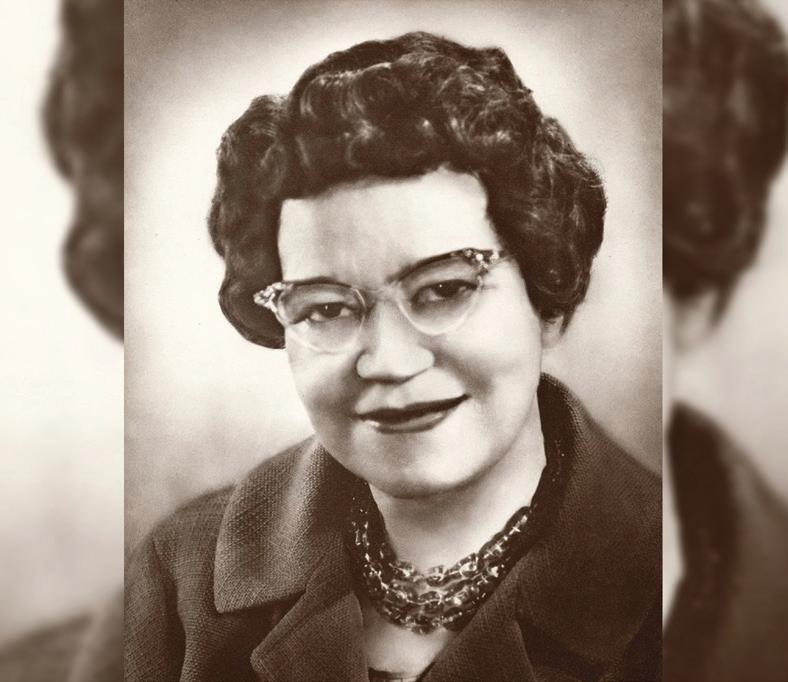
statue honoring Penn alum, first Black woman to receive Ph.D. in economics
In 1921, Alexander earned her Ph.D. in economics, and in 1927, she graduated from Penn Carey Law. She was also the frst national president of the Delta Sigma Theta Sorority.
KATE AHN AND SARAH SHAHED Staff Reporter and Contributing Reporter
In a statement on X, the platform formerly known as Twitter, the Foundation for Individual Rights and Expression — a nonprofit aimed at protecting free speech on college campuses — called the message “deeply chilling.”
“Today’s message will cast an impermissible chill on student protests about the Israeli-Palestinian conflict,” the group wrote. “President Trump needs to stand by his
In the March 4 post, Trump said that non-citizen student protesters who participate in “illegal protests” would be imprisoned or deported and promised to expel or arrest American student protesters. The announcement comes following a January executive order directing federal agencies to identify and deport noncitizen participants — including college students — in pro-Palestinian protests. See PROTEST, page 2 Trump did not clarify what classifies a protest as “illegal.” A request for comment was left with a University spokesperson.
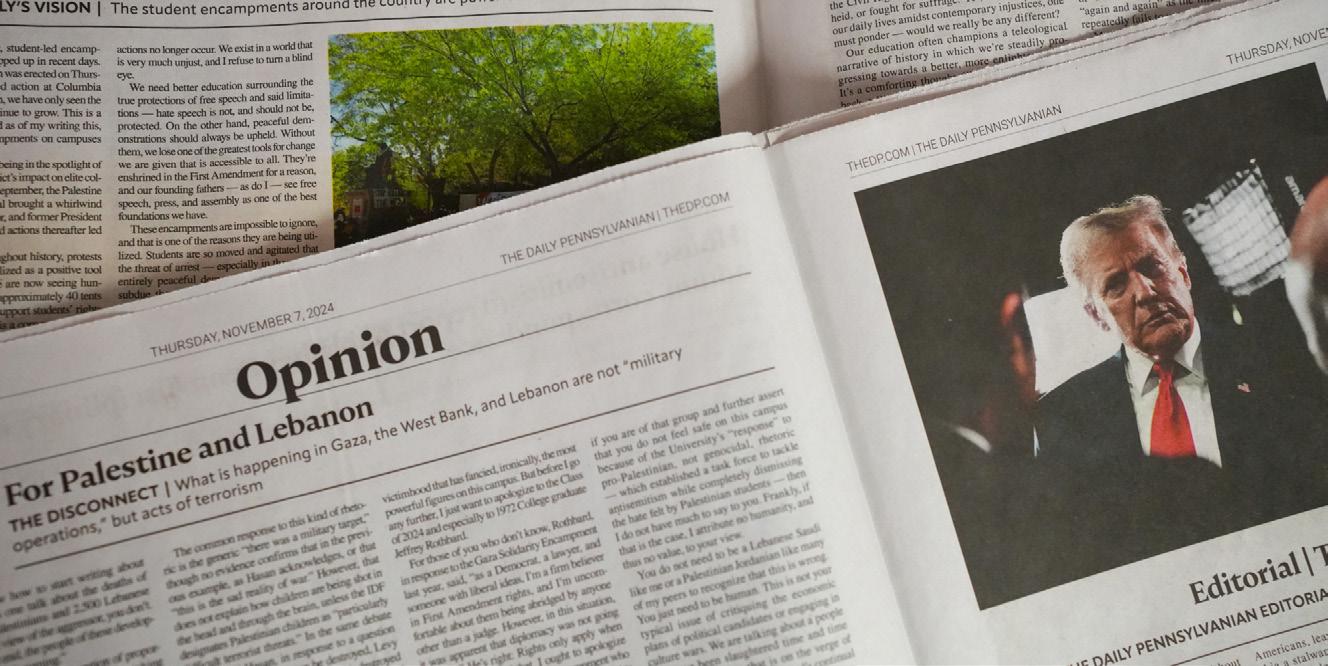
JEAN PARK | MULTIMEDIA EDITOR
Trump stated that federal funding would be pulled from educational institutions that “allow illegal protests.”
The City of Philadelphia will honor Sadie Tanner Mossell Alexander — the first Black woman in the United States to receive a Ph.D. in economics and the first Black woman to graduate from the University of Pennsylvania Carey Law School — with a statue at Thomas Paine Plaza outside the Philadelphia Municipal Services Building.
The statue will be the second art piece dedicated to a Black woman in Philadelphia. In 1921, Alexander became the first Black woman to earn a Ph.D. in economics and the second to earn a Ph.D. in the United States when she received her degree from Penn, and in 1927, she became the first Black woman to graduate from Penn Carey Law.
She was also the first national president of the Delta Sigma Theta Sorority.
In an interview with CBS News, Alexander’s youngest daughter, Rae Alexander-Minter, spoke about the challenges her mother faced as one of the only Black students at Penn.
“She experienced racial isolation,” Alexander-Minter noted. “It wasn’t that she wanted their friendship. She wanted respect.”
After graduating from Penn, Alexander served as assistant city solicitor for Philadelphia from 1928 to 1930 and then from 1934 to 1938, simultaneously practicing law at her own law firm while serving on the National Bar Association.
“She was interested in helping those people who were feeling unrecognized,” AlexanderMinter told CBS News. “She talked about, as an economist and a lawyer, the inequities of
women, particularly women who were working, and the child care.”
Alexander was also a prominent civil rights activist, serving on former President Harry Truman’s Committee on Civil Rights. In 2018, then-Philadelphia City Councilmembers Cherelle Parker, Blondell Reynolds Brown, and Jannie Blackwell pushed for a resolution to honor Alexander’s legacy with a statue.
Creative Philadelphia, an organization dedicated to advancing “public access to arts and culture” and celebrating “the city’s cultural assets,” created the Sadie T. M. Alexander Statue Selection Committee to ensure a proper representation of Alexander’s legacy through the statue by recognizing her background at Penn. The committee invited representatives from Penn Carey Law and the Penn Black Law Students Association to work alongside Alexander’s daughter.
Penn affiliates on the committee include Nigel Davis, co-president of Penn’s Black Law Students Association and Iliana Odette Harris, assistant director for community and engagement at Penn Carey Law.
Creative Philadelphia described Alexander as “a pioneering African American civil rights activist and native Philadelphian who broke barriers in academia and law and fought to protect the civil rights of underserved communities.” The group described the project, in turn, as a “priority” for 2016 Fels Institute of Government graduate and Philadelphia Mayor Cherelle
See STATUE, page 2
ANISH GARIMIDI | SENIOR DESIGNER
ABHIRAM JUVVADI | STAFF PHOTOGRAPHER
Association for Advancement of Artificial Intelligence hosts 39th annual conference in Philadelphia
Attendees engaged in technical paper presentations, speaker sessions, workshops, and discussions on the application of cutting-edge research in artifcial intelligence
HANNAH CHOI Staff Reporter
The Association for the Advancement of Artificial Intelligence held its annual conference on artificial intelligence from Feb. 25 to March 4 at the Pennsylvania Convention Center.
The eight-day conference series aimed “to promote research in Artificial Intelligence (AI) and foster scientific exchange between researchers, practitioners, scientists, students, and engineers across the entirety of AI and its affiliated disciplines” and featured Penn faculty members. Attendees engaged in technical paper presentations, speaker sessions, workshops, and discussions on the application of cutting-edge research in artificial intelligence.
The conference boasted many activities for students over the course of eight days, including a hackathon and job fair. The virtual hackathon was held from Feb. 17-24, and finalists presented their projects on Feb. 26 at the AAAI-25 opening reception. The hackathon was designed to promote innovation in how AI is used in various industries, including healthcare, finance, and sustainability.
Shalini and Rajeev Misra Presidential Assistant Professor Nadia Figueroa was one of the Bridge Program chairs for this conference. Her main research interest focuses on developing human-aware robotic systems. She is a member and faculty advisor at Penn’s General Robotics, Automation, Sensing, and Perception Lab.
STATUE, from front page
Parker’s administration.
On Feb. 19, five finalists were selected to create designs for the statue.
Vinnie Bagwell, Tanda Francis, Rayvenn Shaleigha D’Clark, Alvin Pettit, and a team of three — David Wilson, Stephen Hayes, and Acori Honzo — were honored by the Sadie T. M. Alexander Statue Selection Committee from a pool of 42 applicants. The five finalists will have the opportunity to submit design proposals for the statue.
“The statue will inspire generations of Philadelphians to become leaders and advocates in their communities — especially young Black women who will see themselves in her image,” Parker told The Philadelphia Tribune.
The GRASP faculty are actively involved in AI research similar to the research found in the AAAI conference.
Other Penn faculty that were involved in AAAI include professor of Computer and Information Science Osbert Bastani, who was part of the Senior Program Committee for AAAI-24.
AAAI also hosted a job fair for students with several AI companies, including Openstream AI, which creates special AI agents, and Permanence AI, which develops control systems to ensure the safe deployment of AI.
The conference’s main themes included AI in healthcare, ethics and AI, machine learning and deep learning, and AI in business optimization. AAAI hosted many talks, including “Predicting Career Transitions and Estimating Wage Disparities Using Foundation Models” by economist Susan Athey and “AI, Agents, and Applications” by Andrew Ng.
Additionally, Vivek Gupta, a former postdoctoral researcher for the Cognitive Computation Group at Penn, gave a talk titled “Advancements in AI for Reasoning with Complex Data.” Gupta is currently a computer science professor at Arizona State University and works in the development of AI systems.
In fall 2024, Penn became the first Ivy League school to offer an undergraduate degree
Ph.D. in economics in the United States when she received the degree from Penn
in AI through the Raj and Neera Singh Program in AI. According to a press release from the School of Engineering and Applied Science, the program aims to “produce engineers that can leverage this powerful technology in a way that benefits all humankind.”
PROTEST
, from front page
past promise to be a champion for free expression. That means for all views — including those his administration dislikes.”
MRMJJ Presidential Professor at the Graduate School of Education and free speech expert Sigal Ben-Porath told The Daily Pennsylvanian that she found the ambiguity in Trump’s labeling of certain protests as illegal to be “worrisome.”
“My real concern here is that there could be no clarity,” she said. “If you, as a student, don’t have clarity about what would qualify as illegal, and you would like to protest something … how do you do that?”
Ben-Porath added that she believes the best course of action for Penn to take would be to “wait for further guidance,” as the process for implementing Trump’s order is not immediately clear.
“Typically, public universities and colleges are subject to the First Amendment in stricter ways than private universities,” Ben-Porath said. “But when the statement is that you will lose your federal funding … [they] are basically in the same boat.”
Trump’s message comes days after the United States Department of Health and Human Services, the Department of Education, and the General Services Administration announced that they would begin a comprehensive review of Columbia University’s federal grants and contracts in response to the “relentless harassment of Jewish students” on campus.
According to HHS, the review has prompted consideration of stop-work orders for $51.4 million in federal funding.
On Feb. 28, the Federal Task Force to Combat Antisemitism announced that it would visit 10 higher education institutions that have “experienced antisemitic incidents” since October 2023. Penn was not on the task force’s list of campuses.
PHOTO FROM UNIVERSITY ARCHIVES & RECORDS
Alexander was the first Black woman to earn a
in 1921.
ABHIRAM JUVVADI | STAFF PHOTOGRAPHER
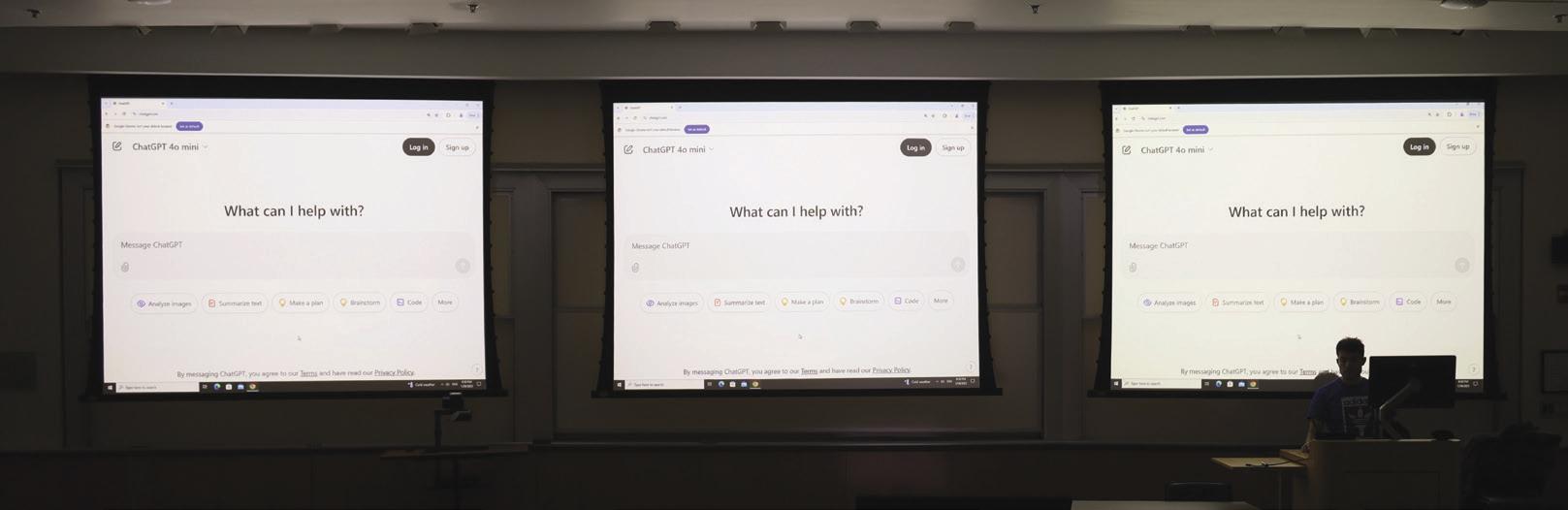
The 39th Annual AAAI Conference on Artificial Intelligence was held in Philadelphia from Feb. 25 to March 4.
Multiple faculty members told The Daily Pennsylvanian that AI has forced them to change how they grade and teach their courses
AIDAN SHAUGHNESSY Staff Reporter
Penn faculty members spoke with The Daily Pennsylvanian about how artificial intelligence has impacted their course structures and curricula.
Multiple faculty members said that AI has forced them to change how they grade and teach their courses. They also expressed concerns about AI-based plagiarism while noting that there is no foolproof way to identify such cases.
In November 2023, Penn established university-wide AI usage guidelines that integrated artificial intelligence into the University’s educational framework.
The statement supports the use of generative AI but stipulates that the databases must be used per Penn’s mission.
“Penn embraces innovations like generative artificial intelligence (‘AI’) models in teaching, learning, research, and the effective stewardship of Penn’s resources,” the statement said.
Since then, faculty say concerns still remain about AI usage in classrooms.
Director of Data Sciences at the Penn Program on Opinion Research and Election Studies Marc Trussler stated that he believes that the way AI tools are often used is an “impediment to the type of learning that people are
UNION, from front page
“Penn is dedicated to providing a working environment of respect, dignity, equity, inclusion, trust, and support that protects civil and professional discourse and is free from discrimination, mistreatment, abuse, or coercion, and without fear of retaliation,” the bargaining committee wrote in the initial proposal.
Among the 13 provisions, the committee stipulated that accommodations must be available for graduate student workers dealing with pregnancy-related conditions, facing harassment by Penn Police, and needing religious accommodations.
The proposal also required “convenient access to gender-neutral bathrooms,” and for graduate student workers to be granted the liberty to use the “restroom that they are comfortable using.” The committee similarly demanded that graduate students workers be “referred to by the names and pronouns with which they identify, both in communications to and about them.”
GET-UP’s demands also included sexual harassment training and increased privacy of personal information.
Herrmann described the protection against discrimination as “the foundation” of the group’s proposal, adding that “the intention of the article is to protect graduate workers from harassment, bullying, abuse, or discrimination on a broad series of issues, including race, sexual identity,
doing in [college].”
“If you farm [work] out to AI, even though it is fully capable of doing it, you’re depriving yourself of learning how to think, which is what you are doing here at university,” Trussler said.
In his “Introduction to Data Science” course, Trussler says that he has had to decrease the weight of programming assignments that can be easily completed with AI and increase the weight of in-person exams. Trussler added that he hopes this will incentivize students to learn the material instead of relying on AI.
“Some of [this] onus is on professors to make sure the assignments they’re giving out are ones that are enriching in a way that people actually want to do,” Trussler said.
Political Science professor Loren Goldman similarly said that AI has forced him to change his courses from essay-based to “almost entirely exam based.” While Goldman said that there are “good uses” of AI, he says that completely trusting students with these tools can be “complicated.”
“Students are often so oriented towards success and getting the grade,” Goldman said. “For people who are results-oriented, it’s almost tragic because it’s the process
HIV status, [and] religion.”
Penn countered the initial proposal on Dec. 9, 2024, striking the entirety of GET-UP’s provisions, including the title. Administrators replaced the original title with the term “non-discrimination.”
“The University of Pennsylvania is committed to fostering a diverse and inclusive environment,” the administrators wrote in place of GET-UP’s provisions. “The University’s Policy on Equal Opportunity and Affirmative Action is incorporated by reference into this Agreement. That policy can be found on the University’s Office of Affirmative Action and Equal Opportunity Programs website.”
“Rather than go point by point in the article and engage with us in terms of the article we presented, they just struck it out,” Herrmann said.
In a written statement to the DP, History and Sociology of Science Ph.D. candidate and GET-UP organizer Sam Schirvar noted that the University’s “counterproposal struck not only the anti-discrimination provisions we are proposing but also any reference to harassment and abusive conduct.”
“Their counterproposal seeks to retain their prerogative to alter all discrimination policies at will without negotiations,” they added.
In response to Penn’s counterproposal, GET-UP put forward a six-page secondary antidiscrimination proposal on Jan. 14. Herrmann described the bargaining committee’s approach to its second proposal as an effort to “reiterate and enshrine into our contract” principles of
of writing an essay that is actually the important part.”
Other faculty members said that, while AI has forced them to change how they structure their courses, it can also serve as a valuable tool to students when used properly.
In a statement to the DP, Computer and Information Science professor Chris Callison-Burch wrote that he encourages students to use AI tools in a “productive fashion.”
“I think that the guiding light is that AI should not be a substitute for critical thinking,” Callison-Burch wrote. “AI should deepen students’ understanding of the course materials and we should strive for that as the bar.”
Callison-Burch acknowledged, however, that there were concerns among Penn faculty members that AI would be used as a “cheating or plagiarism tool.”
While Callison-Burch said these concerns are legitimate, he cautioned against attempts by professors to detect AI use, noting that research shows that “neither people nor AI detectors are particularly reliable at being
antidiscrimination.
The article reinstated a majority of the original provisions and included additional demands regarding pregnancy-related accommodations.
“We added back in certain things, especially in terms of protected classes that were important to us and to our grad workers,” Herrmann said.
On Feb. 17, Penn struck the entirety of GET-UP’s proposal again. The counter retained the proposal’s title but replaced the preamble and provisions with a statement that simply addressed Penn’s dedication “to fostering a diverse and inclusive environment, characterized by a commitment to equal employment opportunity for all individuals.” This time, however, the University included the phrase “to the extent permitted by law.”
According to Herrmann, the counter’s focus on the legal limits of diversity and inclusion “is just a show.”
Describing the original proposal as “an article that we presented before Trump was even elected,” Herrmann said that “the University at large is conceding quite a lot of ground in relationship to DEI in advance of really any requirement to do so by the federal government.”
Herrmann recalled pressing administrators on the specific executive orders that “impinged on their ability as a private institution to make certain policies in regard to nondiscrimination, harassment and abuse.” In response, the University “backed off … and didn’t ever provide a particular executive order.”
Despite “fram[ing] its argument around restrictions from the federal government,” the University has not
able to spot AI-generated text.”
Associate Dean for Undergraduate Education for the School of Engineering and Applied Science and Mathematics and Electrical and Systems Engineering professor Robert Ghrist said he encourages students to use AI tools to enhance learning and prefers to place trust in students’ maturity and academic integrity.
“Trying to punish students for using AI is fraught. There’s no foolproof detector,” Ghrist said. Instead, Ghrist said that has encouraged his students to “use AI to help [them] learn better.”
While he has not had to change his curriculum in response to AI, he has used AI technology to summarize lectures and write notes for his class. He has also developed custom GPT models to serve as online course assistants for students.
“The day that ChatGPT was released, I showed up to class and said ‘Forget what we’re going to learn today. This is the most important thing I can teach you today,’” Ghrist added.
“given any substantive reason why now,” Herrmann added.
Herrmann believes that the linking to the University’s website “gives them the ability to change whatever that policy is or wherever that link takes you.”
In February, Penn’s “Equal Opportunity and Affirmative Action Policy” was renamed to the “Policy on Equal Opportunity.”
“The new policy and statement, which appear below, reflect Penn’s long-standing commitment to values of excellence, freedom of inquiry and expression, and respect,” senior University administrators wrote in a note prefacing the policy change. “We understand that the revisions to federal laws and regulations can be troubling when they change rapidly.”
Perry called the “preemptive” changes “really disappointing” because of their repercussions on Penn’s “core research and teaching mission, which is what we as graduate student workers came here to do.”
Despite the “broader attacks on DEI,” Perry said that graduate student workers are motivated and ready to fight for their rights.
“We’re hopeful that this kind of negotiation process gives us power in the midst of a time where I think people might say they don’t have as much power.”
GET-UP first announced its campaign to unionize in an online statement in March 2017. In May 2024, a GET-UP vote to unionize passed by a 1,807-97 margin. Over 2,300 eligible workers, all of whom are members of GET-UP, cast ballots in the election.
Editorial | What is opinion journalism?
THE DAILY PENNSYLVANIAN EDITORIAL BOARD |
We at The Daily Pennsylvanian recognize that opinion journalism is a necessary counterpart to news coverage. At a university that rarely shies away from the spotlight, what happens at home resonates far beyond campus. Now, our firsthand perspectives are more valuable than ever. The DP’s Opinion section provides a platform for students, faculty, and community members to drive meaningful discussion.
People often assume that news is the sole backbone of the DP. It’s urgent, and it’s informative — and dominates the most-read list. But, in classic fashion, we’d opine that opinion is just as essential. To us, it is a form of news itself — to find the stories buried under hierarchy and power disguised as our “culture.”
At Penn, where “Penn Face” demands perfection, opinion embraces the rawness and vulnerability that grounds us. As an independent organization, we have the unique power to question institutional inefficiencies without being silenced.
Words have power. Opinions create change. It is evident in the White House’s recent announcement limiting journalist and press access. It’s why it’s more important than ever that we keep our opinions and thoughts alive, reminding ourselves of what makes us most human.
Staff columns are written by our columnists. Each with a unique viewpoint and brand, our columnists come from different walks of life and bring various perspectives to our paper. Much like the diversity of the Penn community, we try to represent a diversity of opinions. Consistent writing can allow for personality to
TEAM
This section matters
shine through each person’s words across their various pieces. Each column has a unique title crafted by the columnist that alludes to their writing style and opinions. We have columnists who focus on various topics from politics and campus life, to pop culture, and everything in between. Each of us shows a true dedication to showcasing our opinions and bringing our experiences to bear across our narratives.
Guest columns are written by members of the Penn community unaffiliated with the DP who have strong perspectives on timely issues. They give people a platform to share their perspectives, especially when they have firsthand experience or are challenging the dominant narrative. Often, those caught in the middle of an issue can’t see the bigger picture — guest columns help cut through the noise. By publishing guest columns, we keep important conversations alive and make space for a range of voices. These pieces don’t just add to the discussion; they push it in new directions, making campus dialogue more engaging and reflective of the community.
Editorials are articles reflecting the collective opinion of the DP’s Editorial Board. Unlike the neutrality of news reporting or staff and guest columns, which reflect individual viewpoints, editorials aim to establish a unified stance on critical issues. As an independent newspaper, we have the privilege to use editorials as our platform to highlight concerns and advocate for change. Editorials are essential in shaping campus dialogue and amplifying student voices. At Penn, where decisions affect thousands, maintaining editorials as a record ensures that important issues are
Going test-mandatory is a win
JESS SAYIN’ | The test-optional policy was hurting Penn applicants
This Valentine’s Day, Penn Admissions delivered the ultimate love letter to future applicants: a statement announcing a return to standardized testing requirements.
While it may be a tough pill to swallow, the SAT and ACT — for all of their flaws — are invaluable tools in the college admissions process. Doing away with the test-optional policy is ultimately a winwin for the Penn admissions team and the applicant pool it reviews.
Penn’s statement centered the decision around the idea that a testing requirement removes “uncertainty for applicants” suffering from the mental gymnastics of deciding what score is worth submitting. Everyone who’s applied to college in the last few years can recall agonizing over which scores to send to which schools. As high schoolers navigate an already stressful process, test-optional admissions add on an extra load of angst.
Much of this anxiety stems from the fact that test-optional policies have created unrealistic and unhealthy expectations, as applicants aim to submit scores that fall well within the top admissions percentiles. In 2019, prior to a test-optional policy, Penn’s median SAT score was 1505; by 2023, that number jumped 45 points to 1550. As these scores keep climbing, applicants lose sight of what truly matters. Students began ditching their real passions to obsess over testing and retesting and retesting again, all for a few extra points.
A return to test-mandatory policies is a return to testing sanity. Students will have one less burdensome decision to make, and as the data will show, they will finally be able to breathe knowing a 1600 isn’t the only ticket to an acceptance letter from Penn.
On the other side of things, Penn’s admissions officers will benefit from having an objective data point that is proven to be the strongest predictor of success in college and beyond. Without test scores, the only number admissions officers can use to measure academic success is high school GPA. That’s a pretty flimsy metric, especially in a world where standards vary wildly across the world, and almost every top applicant has near-perfect grades. In fact, students with a high school 4.0 go on to have a college GPA only 0.1 points higher, on average, than those applying with a 3.2.
Now let’s compare that to SAT and ACT scores; students with a 1600 or 36 earn a first year GPA that is, on average, 0.43 points higher than those with a 1200 or 25. Moreover, higher standardized testing scores are strongly correlated with success after college, whether that be attending an elite graduate school or working for a prestigious firm.
Of course, graduating summa cum laude or landing a return offer from McKinsey are not the only indicators of a successful undergraduate experience.
But, they do illustrate a broader point: Standardized testing scores provide meaningful insight into a student’s potential for academic and professional achievement. In Penn’s admissions
The
acknowledged, discussed, and remembered. That being said, the production of editorials is handled by staffers who have no involvement in news coverage. The Opinion department thrives on a diversity of perspectives, each shaping a vibrant and engaging dialogue. Our columnists look at the Penn environment through the lens of their individual backgrounds and work hard to create a platform that narrates the Penn experience through their eyes. As columnists, the Penn community is always on our minds when we write. We ask ourselves how we can introduce fresh viewpoints and explore the nuances of issues that define our campus. Beyond commentary, as columnists, we aim to create an archive, a lasting record that represents Penn and leaves our voices as part of a larger conversation.
process that is clouded by subjectivity, an SAT and ACT score shines as the only objective benchmark — a game-changer in the quest for consistency in an ultra-competitive and highly opaque system.
Even more importantly, the SAT and ACT’s greatest potentials lie in their ability to uplift disadvantaged Penn applicants. Yes, it’s true that low-income test takers, on average, score lower than their wealthier counterparts. But don’t you think that Penn’s highly experienced admissions team is aware of that fact?
Those working in selective admissions understand that test scores reflect societal inequalities, as affluent students often have access to test prep and private tutoring that can dramatically boost their scores. That’s why they also recognize that a modest-income, public high schooler from rural Oklahoma who scores a 1400 is far more impressive than the wealthy Trinity student from the Upper East Side with a 1580.
As has been conceded by Brown University, Cornell University, Harvard University, Yale University, Massachusetts Institute of Technology, and other elite schools, SAT and ACT scores can help admissions officers identify under-resourced students with immense potential. Under Penn’s former test-optional policy, many of these students likely opted not to submit scores below the median — yet, in reality, doing so could have meaningfully improved their chances for admission. Having a test-mandatory policy will take this chance out of the question.
Standardized testing is easy to hate. Naturally, we reject the idea that our “academic potential” can be summed up in a single number — and it’s true that for all their predictive value, the SAT and ACT certainly do not show the whole picture. But they’re not supposed to. Test scores are one valuable number amongst 2,500 words from each Penn applicant and their teachers that help admissions officers understand their background, their passions, and their aspirations. In that light, the end of test-optional isn’t a radical overhaul of Penn’s admissions process but a rational step toward clarity and fairness. For that reason, going testmandatory is a win.
Our editorial policies reflect the principles that have guided the DP since its inception: independence and the pursuit of truth. But meaningful discussions don’t happen in isolation. The most pressing issues demand our collective engagement and willingness to challenge assumptions. We at the Opinion department remain steadfast in our belief that good journalism embraces the difficult questions head-on — that’s what we stand for, and that’s what we will continue to uphold.
The Daily Pennsylvanian Editorial Board consists of senior staffers in Opinion led by the DP’s Editorial Board Chair Sangitha Aiyer. Currently, that team includes Ananya Shah, Diya Choksey, Piper Slinka-Petka, Mariana Martinez, Mritika Senthil, and Mia Vesely. Questions and comments should be directed to letters@thedp.com.
Preprofessional or precorrupt?
THE RAMIREZ REVIEW | Money does not equal morality
It’s no secret that engrained in Penn’s culture is a sense suffocating preprofessionalism — often discouraging the exploration of students’ true interests. As translated to English, the Latin proverb “audentes Fortuna iuvat” means “Fortune favors the bold.” This serves as a reminder that your pursuits will be rewarded for leading noble lives, and I believe that especially on Penn’s hypercompetitive campus, it’s incredibly important that we adhere to this profound mantra by choosing to pursue paths for passion rather than wealth or status.
According to Career Services, 16.2% of the graduating Class of 2023 was recorded to be pursuing further education upon graduation. Alternatively, 75.9% of graduates were recorded to be working full time after graduation. The median starting salary among 2023 Penn graduates working full time after graduation was $100,000. The truth of the matter is that a degree from Penn holds weight to employers. You’re almost certain to land a job after graduation and likely a high-paying one at that. So why is it that, as Quakers, we’ve constructed a society built upon toxicity and competition? The answer: the subscription to business culture. For starters, it’s important to recognize the stratification of Penn’s graduating Class of 2023. Penn’s three largest undergraduate schools are the Wharton School, School of Engineering and Applied Science, and the College of Arts and Sciences. Additionally, these three schools also have the highest starting salaries upon graduation, ranging from $90,000 to $115,000. Surprisingly, a staggering 38.4% of Engineering School graduates accepted jobs in consulting and finance, making this the majority of jobs. As for Wharton, a whopping 58.4% of graduates pursued full-time careers in finance, and 25.4% pursued consulting. Similarly, the majority of graduates from the College, 22%, pursued jobs in finance, while 21% pursued consulting. The most popular employers for Penn graduates were McKinsey & Company, Boston Consulting Group, and Goldman Sachs.
It’s expected for Wharton graduates to work in finance, consulting, and banking. However, when graduates with a liberal arts education or an engineering degree work in the same fields, it questions the rationale of these graduates. Because these industries are unexpected employment outcomes for students with diverse skill sets, the conclusion can be drawn that many choose to sell out to desires for money. Students shouldn’t be conforming to this hunger for wealth, but they most often do. The unfortunate pipeline for so many graduates is to negate their true passions and interests and instead take on careers that confuse lifelong fulfillment for money.
For years, Penn has been a place where some of the most brilliant minds are cultivated, including some incredibly bright alumni that once proudly donned the red and blue. Two of the most prominent Penn alumni include 1968 Wharton graduate and President Donald Trump and 1997 College and Wharton graduate Elon Musk. In recent years, both Musk and Trump have epitomized immense greed and a vast desire to obtain wealth, power, and influence. One of the most prevalent commonalities between them is their degree from Wharton. Although Wharton is not solely responsible for their greed and corruption, we must ensure that the school is not enforcing the same ideals onto its current students and that these aren’t the
models students are aspiring to become. One foundational subject present in the lives of every single Penn student is ethics. Penn should demand ethics to remain at the forefront of every student’s pursuits, yet it’s already failed to do so. One appalling fact is that at Wharton, ethics courses are optional. Wharton students are given the choice to enroll in one of two courses that would fulfill a requirement in the “Business Fundamentals” section of their degree — LGST 1000: “Ethics and Social Responsibility” or LGST 1010: “Law and Social Values.”
Using theory-based approaches to convey themes of ethics and its intersection with capitalism, LGST 1000 helps Wharton students understand moral questions and encourages students to recognize ethical challenges they may face within business. Comparatively, LGST 1010 is an “applied” ethics class where the course “presents law as an evolving social institution, with special emphasis on the legal regulation of business.” In this course, students aren’t taught the concrete ethics of business but rather the basic concepts of law, the rigorous legal analysis of law, and legal processes. The issue is that Wharton recognizes these courses as equal when the two have entirely different implications: LGST 1000 teaches about morality and immorality, while LGST 1010 teaches about legality and illegality. In this failure to teach ethics to Wharton students, ethics becomes an optional subject that many choose to forgo entirely, severely damaging the Penn community by allowing students to become corrupt by desires for status and wealth.
The solution to fixing the culture on campus is still unclear. For starters, we can begin by recognizing ethics as an imperative requirement. Schools like New York University’s Stern School of Business and University of Texas at Austin’s McCombs School of Business both have the “Business Ethics Core,” which is a required foundation that all undergraduate business students must take to obtain their degrees. Teaching the foundational subject is important to improving Penn’s echo chamber of toxic, hypercompetitive business culture. Additionally, teaching ethics will help yield honorable members of society.
The Penn community faces a challenging, uphill battle against the corruption of greed. The very least we can do is try to prioritize ethics and return to pursuing careers that we’re passionate about, because as the proverb “audentes Fortuna iuvat” states, fortune favors the bold.
WEINING DING | MULTIMEDIA EDITOR Columnist Elijah Ramirez criticizes Wharton’s culture of preprofessionalism that places higher value on wealth and status than on passion and ethical responsibility.
is a College
year studying political science from El Paso, Texas. His email is elijah11@sas. upenn.edu.
JEAN PARK | MULTIMEDIA EDITOR
Daily Pennsylvanian Editorial Board emphasizes the importance of this newspaper’s opinion to our community.
JESSE VAN DOREN is a College first year studying political science and earth and environmental science from Baltimore. His email is jessevd@sas. upenn.edu.
INSIA HAQUE | DESIGN EDITOR
ELIJAH RAMIREZ
first
Columnist Jesse Van Doren argues for mandating submitting SAT and ACT for admissions.
Penn must not obey in advance
GUEST COLUMN| Calling on the administration to uphold research, sanctuary, DEIA, nondiscrimination, and the rights of all members of our community
As dangerous and illegal executive orders rain down on all of us who work at Penn, the need for collective action has never been more urgent — and our shared interests have never been clearer. The Trump administration is taking aim at life-saving biomedical research and healthcare; it is attacking the freedom to teach and learn about subjects from climate science to African American history; and it is threatening the safety, human dignity, and futures of our colleagues, coworkers, students, and patients who are immigrants, transgender, LGBTQ+, and people of color.
The Penn administration has chosen the path of anticipatory obedience. But we are encouraged by the resolve among our colleagues who recognize that it’s up to us to push back together, acting in solidarity with each other, our students, our patients, and our communities.
Over the last month, Penn employees across the University and hospital system — medical residents, tenure-track and non-tenure-track faculty, graduate workers, postdocs, museum workers, and library workers representing seven campus labor organizations — have come together to formulate a unified set of demands of the Penn administration. We invite everyone who works at Penn to sign in support, spread the word, and be ready to turn out and stand up for the following principles:
1. The Penn administration must uphold research and counteract federal funding cuts. The administration must provide stopgap funding to guarantee, at a minimum, that Penn affiliates affected by federal funding cuts retain their jobs and are paid on time. Penn can likely do more than that, and it should. All of us who work at Penn deserve a voice in determining where that stopgap funding comes from. In recent weeks, amid NIH funding cuts, administrators at the Perelman School of Medicine and the School of Arts and Sciences have unilaterally ordered faculty to slash graduate admissions by 35% and rescind 18 offers already made, arguing that their only option is to compromise Penn’s core research and teaching mission. They have provided no evidence to convince us. The administration projects that NIH cuts could cost $250 million. Penn could cover that cost on a temporary basis by raising the spending rate on the endowment from 5% to 6.12%. It could cut the salaries of top-paid administrators and fund managers; it could fundraise; and it could reconsider its priorities. Why did the University Board of Trustees just authorize $13 million for a parking garage at the Pennovation Works while administrators are cutting graduate programs? This allocation of funds speaks volumes about what Trustees believe is important to our campus community. Stopgap funding at Penn will improve the health
of every person in the country. Penn researchers have produced life-saving breakthroughs including mRNA vaccines, and Philadelphia’s teaching hospitals train 1-in-6 doctors in the United States. It is also a winnable demand. When the COVID-19 pandemic began, administrators unilaterally imposed austerity policies: layoffs, furloughs, and freezes on hiring, graduate admissions, and pay. But in response to sustained pressure, the University quietly raised the rate of endowment spending from 5% to 7%. Today, administrators will tell you that they were far-sighted.
In fact, organizing worked.
Penn is in the unusually privileged position that, unlike many other research universities, it has the resources to take this kind of immediate action in the short term. It must leverage its wealth to sustain its core mission while pushing back politically against these federal cuts.
2. The Penn administration must uphold its 2016 sanctuary policy and the rights of immigrant faculty, staff, and students. That means not cooperating with federal law enforcement or immigration authorities unless explicitly, legally compelled to do so. It means providing employees and staff with know-yourrights training, legal services, and private spaces on campus that ICE cannot enter without a judicial warrant. Other universities have taken such steps already.
3. There must be no anticipatory obedience to diversity, equity, inclusion, and accessibility. While Penn administrators have been ordering us to scrub websites and censor academic programming, other universities and our own unions have resisted and scored some early victories. Penn must restore policies, websites, and programming that were in place to make the University accessible to all before Donald Trump’s executive orders. It must retain and support the employees whose work is being targeted — not censor us. And future decisions on these issues must be made by the affected members of the University.
4. The University must maintain equal treatment for transgender and LGBTQ+ members of our community. Penn’s health system must continue to provide gender-affirming healthcare, and the medical and nursing schools must continue to train students to care for LGBTQ+ patients. Penn must continue to provide comprehensive medical coverage to all LGBTQ+ employees and students. And everyone must have access to bathrooms and changing rooms that align with their gender identities.
These demands of Penn administrators go handin-hand with demands that we, our coworkers, and our unions are making at the national level as we press for the restoration of federal research funding, file lawsuits challenging Trump’s executive orders, and mobilize for mass action nationwide.
If there is anything to be hopeful about, it is that those of us who work at Penn are better organized than ever. Over the last five years, our campus has seen a rebirth of labor organizing, with five successful union drives reshaping power relations at Penn — the largest employer in Philadelphia. Labor organizing has been a way to win a voice in decisions that affect our lives and those of our students, patients, and community, to stand up for
AMY OFFNER is a professor of History and president of AAUP-Penn. She can be reached at offner@sas.upenn.edu.
SAM LAYDING is a Ph.D. candidate in chemical and biomolecular engineering and a member of the GETUP-UAW bargaining committee. They can be reached at slayding@seas.upenn. edu.
GRACE CHEN | SENIOR PHOTOGRAPHER
Guest Columnists Amy Offner and Sam Layding urge Penn faculty to resist the administration’s compliance with executive orders.
In
Photos: Revisiting the protests, movements, and community that
helped shape Black history at Penn
The Daily Pennsylvanian took a step back to examine the historical injustices the Black community has faced at Penn — and how students have risen up in the face of it
LAYLA NAZIF, AND DEVANSH RANIWALA
ADESIDA,
EBUNOLUWA
Staff Photographers
In 1879, Penn enrolled Black students for the first time in its history. However, it wasn’t until the Civil Rights Movement of the 1960s that Penn began to dramatically increase the number of admitted Black students. In student organizations and clubs, Black students and faculty organized for the implementation of cultural centers, academic programs, and other community-focused initiatives. Now, 146 years after the first Black students were admitted, let’s take a look at the history of students and faculty activism to combat racism and spotlight Black identity at Penn.
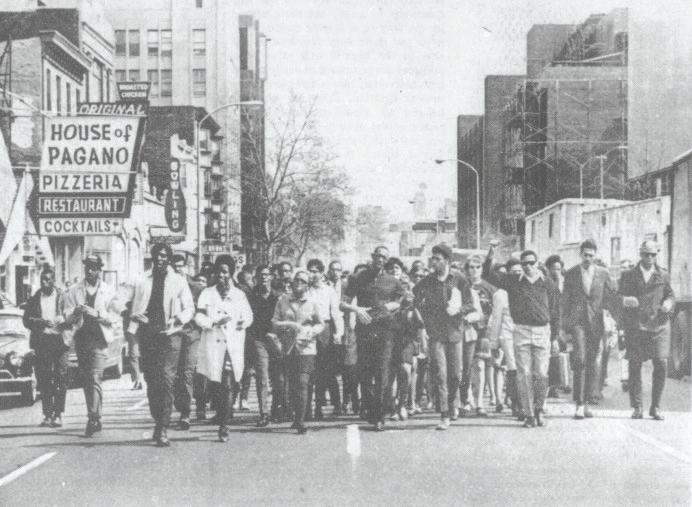
April 8, 1968
The campus mourned the death of Martin Luther King Jr. with a 60-person vigil hosted by the Society for African and Afro-American Students, a precursor to Penn’s Black Student League. After the vigil — which took place in Houston Hall — a group of students marched up Walnut Street, across 37th Street, and down Spruce Street, with songs and speeches featured throughout the rally. The march ended with a memorial service at Irvine Auditorium conducted by Stanley Johnson, the University chaplain at the time, where over 2,500 students, faculty, and administrators gathered to grieve.
April 16, 1993
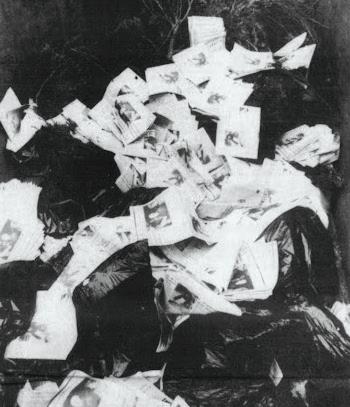
Nearly 14,000 copies of The Daily Pennsylvanian were stolen in a protest against “the blatant and voluntary perpetuation of institutional racism against the Black Community by the DP” and the University. Several students were taken into custody and questioned by Penn Police, but no one was held criminally responsible.
Feb. 13, 1995
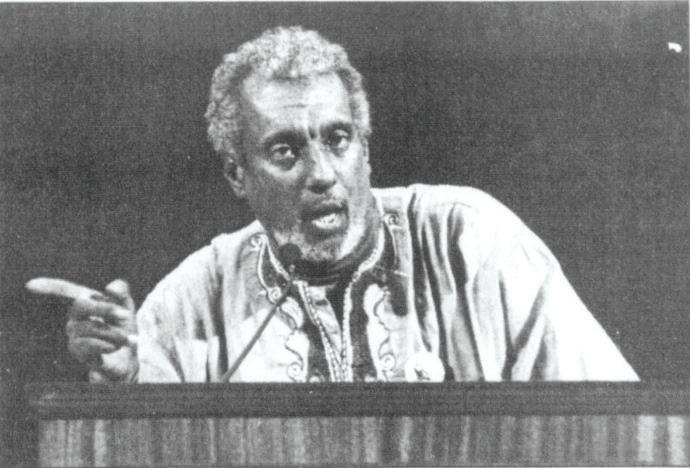
Kwame Ture, formerly known as Stokely Carmichael, spoke to an audience of 200 at Irvine Auditorium amid racial tension and concern over nationwide affirmative action policies. Ture played a major role in the Civil Rights Movement and advocated for a complete revolution and overthrow of the American capitalist society during his speech at Penn. He called for students to actively and consciously participate in the revolution.
“Just saying you are against something doesn’t do anything,” Ture said. “It is what you are for.”
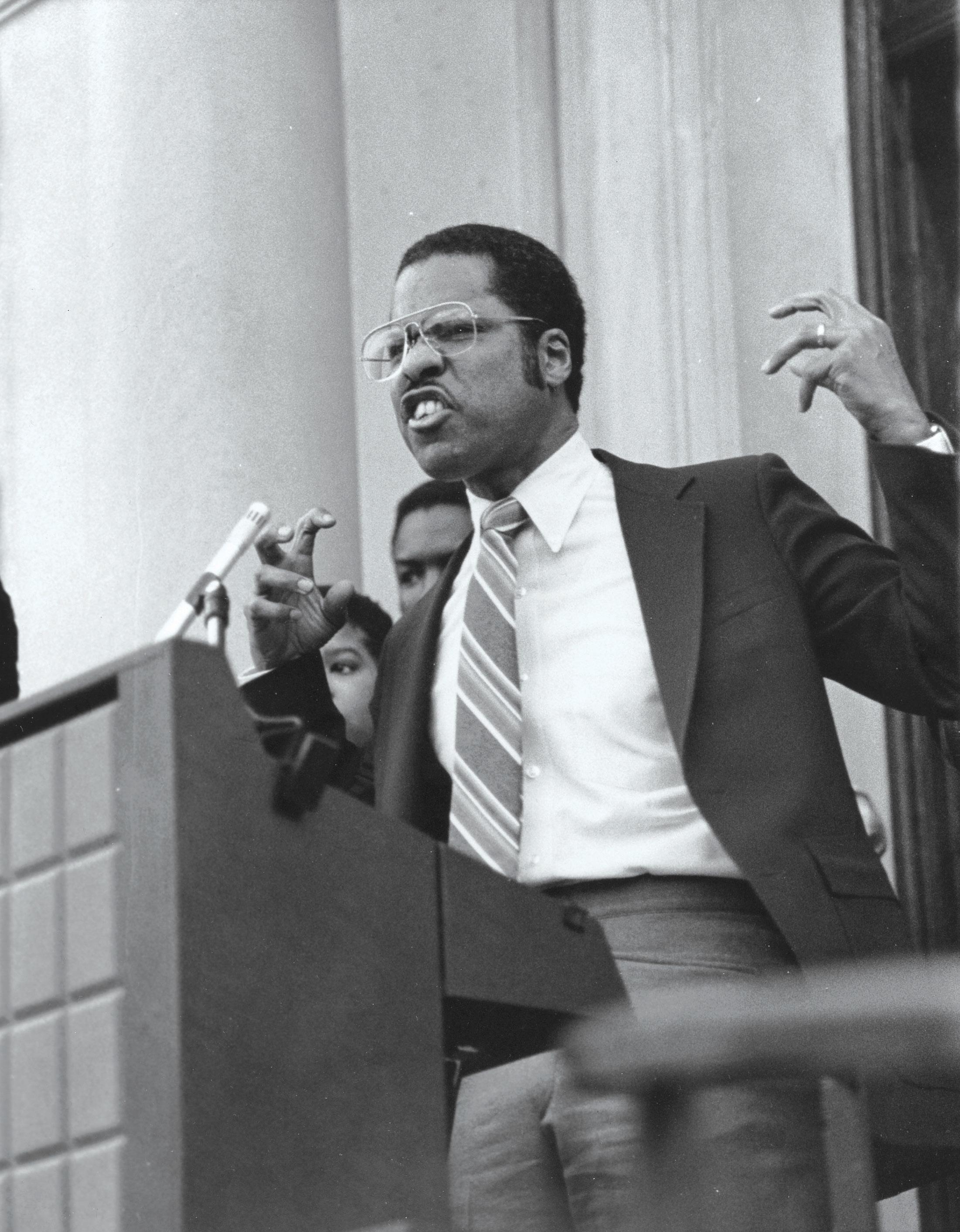
February 1985
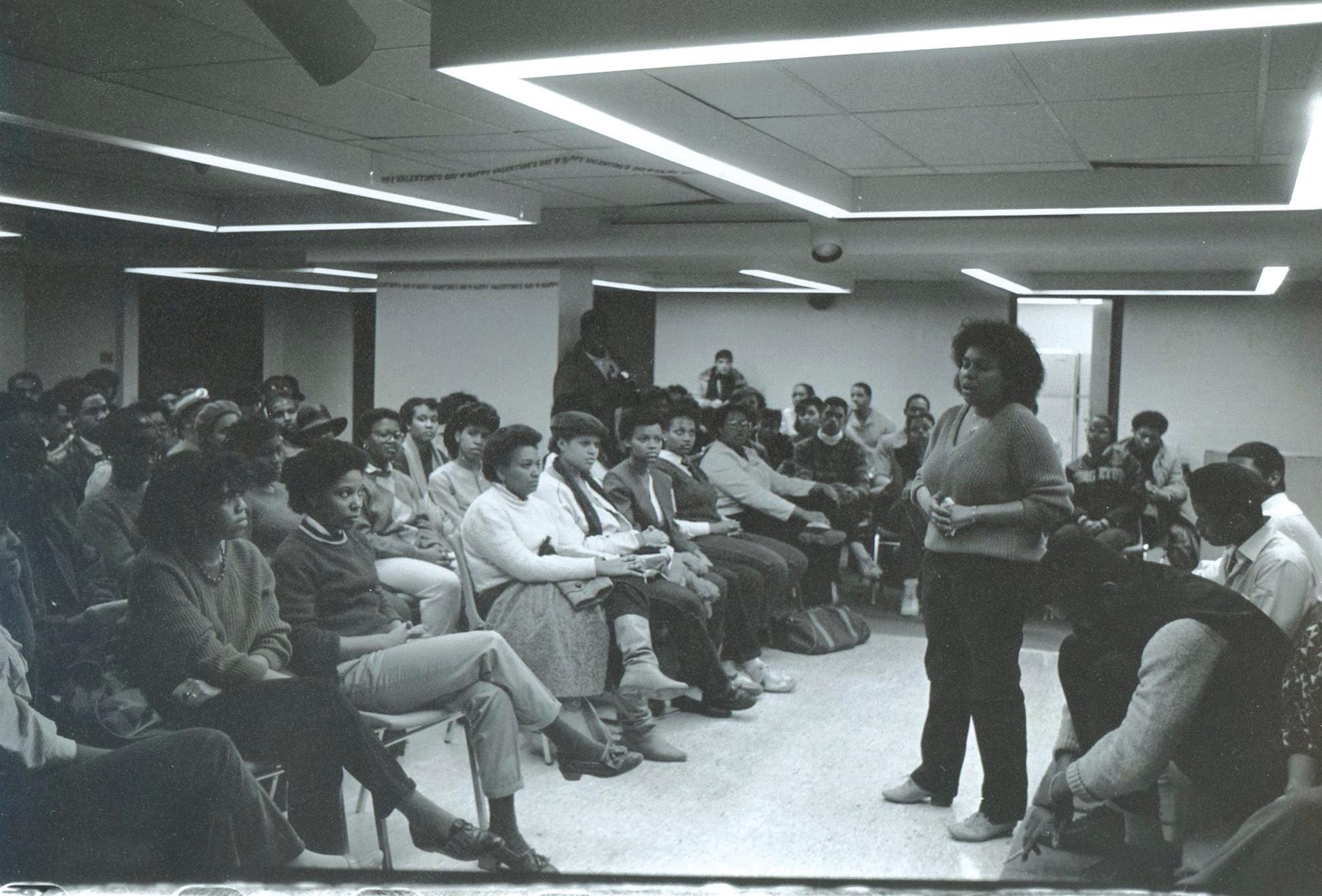
On Feb. 9, 1985, the BSL held an eight-hour vigil where over 300 attendees gathered on former Penn President Sheldon Hackney’s lawn. The protest was held in support of a petition signed by 109 members of Penn’s faculty, administration, and staff calling for mandatory University-wide racism workshops, an increase in minority faculty members, and for racist professors to be appropriately punished.
On Feb. 13, 1985, the BSL held a sit-in during a legal studies class in response to allegations of race-based harassment from Wharton School lecturer Murray Dolfman. On Feb. 19, 1985, the BSL held a meeting with Hackney to discuss Dolfman’s actions, but the students walking out said they were “talking to a stone wall.”
BILL VITKA | DP FILE PHOTO
J. STUART DICKSTEIN | DP FILE PHOTO
STEVE WAXMAN | DP FILE PHOTO
NAILA RAHIM | DP FILE PHOTO
Oct. 19, 1995
The Million Man March was a large gathering of Black men at the National Mall in Washington to unite against social inequality. 1998 Wharton graduate Brandale Randolph, Du Bois College House desk receptionist Stephanie Robinson, and 1998 Engineering graduate Anthony Crawford are just a few of the many Penn community members who attended the march. In an interview, Crawford said it was powerful to “see African Americans sharing brotherly love like [this].”
NAILA RAHIM | DP FILE PHOTO
June 2020
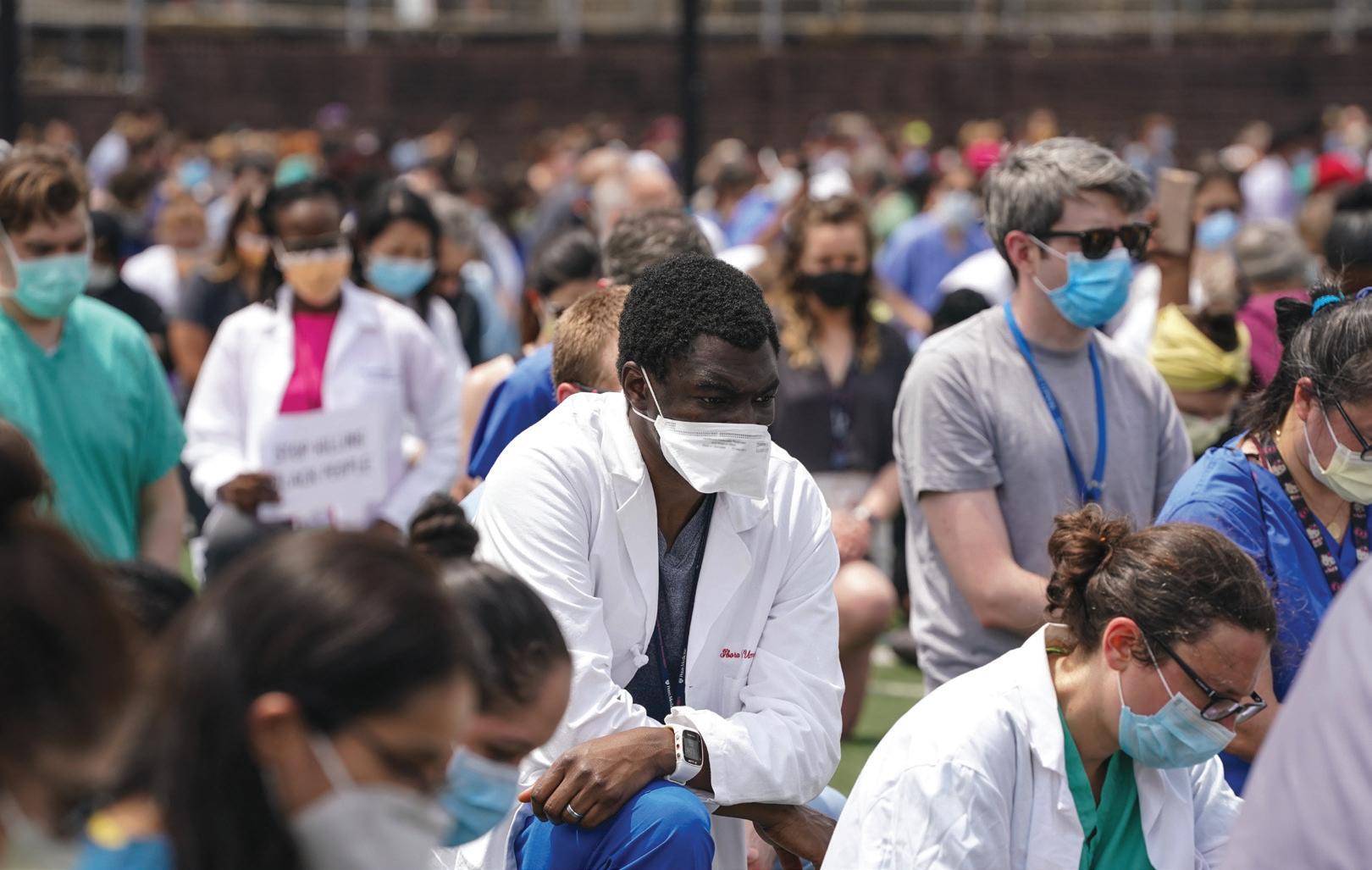
In 2020, after the death of George Floyd and other Black people at the hands of police, protests across the nation sparked a movement for racial justice. On Penn’s campus and in Philadelphia, protests lasted for more than a week straight. Some of the actions organized by Penn students and faculty included a peaceful protest near the President’s House on June 2, 2020 and a walkout against racial inequality in the healthcare system on June 5, 2020.
CHASE SUTTON | DP FILE PHOTO
Kelly Writers House hosts discussion on long-form journalism in modern era
The event was presented by New York Times Magazine contributing writer Michael Sokolove and Washington Post deputy managing editor Ann Gerhart
JACK GUERIN Contributing Reporter
On Feb. 26, the Kelly Writers House hosted a discussion about long-form journalism in the modern era featuring The New York Times Magazine contributing writer Michael Sokolove and The Washington Post deputy managing editor Ann Gerhart.
The event, titled “Long-Form Journalism in a Short Attention Span Era,” was presented by Sokolove and Gerhart and moderated by the English Department’s Maury Povich Writer in Residence Dick Polman.
At the event, Gerhart talked about changing behaviors in newsreaders and shortened attention spans in modern times.
“I do think part of the problem with the short attention span is people so quickly jump to conclusions without any kind of investigation or thorough thinking about what else might be going on or what brought somebody to that particular point in time,” Gerhart said. “It’s the reductive presumption and the assumption that’s immediate about anything that goes on.” Gerhart also discussed her work on the Post’s long-form profile of how the AR-15 rifle affects the human body, titled “The Blast Effect.” The article, which used graphics to visualize the mechanics of the weapon and the physical impact its bullets have on the human body, was part of a series of stories from the Post on the AR-15 that won the 2024 Pulitzer Prize for National Reporting.
While Gerhart was not originally fond of the concept given the destructiveness of AR-15 rifles, she decided to focus on the visual impact of the rifle on the human body, working with visual journalists and animators to develop programs and 3D models.
“I arrived at the thought that what people didn’t really know was how [the AR-15] actually created that destruction inside the body,” Gerhart said. “And so we decided that we would try to show what that bullet does when fired from an AR as a platform in
TRUSTEES, from front page
The Thursday meeting of the Local, National, and Global Engagement Committee opened with a panel discussion on Penn’s environmental engagement. The panel, moderated by Vice Provost for Climate Science, Policy, and Action and Earth and Environmental Sciences professor Michael Mann, discussed a variety of climaterelated issues including climate misinformation, energy security, and sustainability.
Panelists emphasized the importance of climate action by the University amid a political environment that Mann described as “aligned against us right now.”
“It’s critical the University be a place where we teach and make available accurate information,” panelist and Anthropology professor Kathleen Morrison said. “That’s certainly important, particularly at a time when a lot of public information is coming down off of websites.”
Vice Provost for Global Initiatives and Medical Ethics and Health Policy professor Ezekiel
the body.”
Sokolove also discussed long-form journalism at the event, referencing his work in The New York Times Magazine. He talked about how story ideas are influenced by whether reading audiences would be engaged, referencing his piece on “The Blind Side,” a book and movie adaptation about a young Black homeless player that was taken in by a Christian family.
“When I think about long-form stories, I think it’s just going to answer one question,” Sokolove said.
“And you can write 8,000 words on that. So [‘The Blind Side’] was a very natural magazine story. But I think a lot of magazine pieces, a lot of long-form pieces … [are] often answering a question that a normal reader would have.”
In an interview with The Daily Pennsylvanian, Sokolove addressed the evolution of long-form journalism and where he sees its future. While long-form journalism faces challenges due to the convenience of phones and other technology, Sokolove believes that it can still exist.
“It’s proven that if you write something compelling enough, people will and do read it,” Sokolove said. “I’m not saying it’s not a challenge, but I don’t feel like it’s an insurmountable one.”
Sokolove also talked about his own experience with reporting and whether technology posed a threat to long-form journalism in the digital age. He referenced his profile of Bucks County, Pa. during the 2024 election that was published in The New York Times Magazine, which was a picture-driven story.
“It was entirely picture driven, entirely photo driven, so that’s a different form of long-form journalism,” Sokolove said. “It’s not all about the words — long-form journalism can mean photos. It can mean video. It can mean all kinds of other stuff. I don’t think this stuff is a threat. I think it can be an ally if you do it well.”
Emanuel also spoke at the meeting to discuss Penn’s global engagement opportunities.
Emanuel discussed recent efforts to expand international opportunities for Penn students, including increasing the number of global seminars and spots in the Global Research and Internship Program. Despite this effort, Emanuel said that there is still an issue of “high demand and low supply.”
“We have way more interest in this than we can satisfy,” Emanuel said, noting that there were five applicants for every available spot in GRIP.
Emanuel ended the meeting by emphasizing the importance of Penn’s global involvement amid “turbulent times.”
“Across all countries, [there has been] a rise in nationalism and anti-immigrant sentiment. Penn is a countercurrent to that,” Emanuel added.
At the Facilities and Campus Planning Committee meeting, Vice President of Penn’s Business Services Division Michael Scales discussed upcoming campus construction projects, including The Inn at Penn, which will receive its first major renovations since 2011.
According to project principal Caren Foster, the renovation will involve a “complete refresh”
ADL gives Penn ‘C’ rating on 2025 Campus Report Card, marking improvement from last year
The Anti-Defamation League rated Penn ‘above expectations’ in publicly disclosing administrative actions and ‘excellent’ in Jewish life on campus
SAMANTHA HSIUNG Senior Reporter
The Anti-Defamation League gave Penn a “C” rating on its 2025 Campus Report Card, marking an improvement from the “D” rating the University received in 2024.
The ADL — which publishes annual reports about “the current state of antisemitism on campus and how universities and colleges are responding” — rated Penn “above expectations” in publicly disclosing administrative actions and “excellent” in Jewish life on campus. However, the report noted a high number of concerns regarding alleged incidents of antisemitic conduct on Penn’s campus.
A University spokesperson declined a request for comment.
The report card highlighted efforts taken by the University to address antisemitism on campus, such as former Penn President Liz Magill’s creation of an antisemitism task force and Penn’s establishment of an Office of Religious and Ethnic Inclusion.
“Penn has also made efforts to encourage more students to report bias or harassment and has increased its security services on campus,” the report read.
Following the release of the 2025 Campus Report Card, the United States House of Representatives Committee on Education and the Workforce Chairperson Rep. Tim Walberg (R-Mich.) wrote in a statement that the report is a signal “for university heads to take action.”
“Today’s Campus Report Card is a painful reminder of the scourge of antisemitism that is infecting colleges across our country,” the statement read. “Too often, we hear of terrorist-supporting mobs overtaking academic buildings, harassing Jewish students, and causing chaos on campuses — clearly breaking the rules laid out by schools.”
The ADL assigned institutions a grade based on factors including “Publicly Disclosed Administrative Actions,” “Jewish Life on Campus,” and “Campus Conduct and Climate Concerns.” In the “Publicly Disclosed Administrative Actions”
category, Penn met expectations in several areas through its inclusion of antisemitism in its code of conduct and policies, implementation of “mandatory antisemitism education for students and staff,” and clarity of “time, place and manner policies” with regard to free speech on campus.
Penn exceeded expectations in all nine of the remaining criteria within the administrative action category. The University also received the highest marks in the “Jewish life on campus” category due to its active Jewish organizations, with all 13 criteria in the category rated as “excellent.”
However, Penn was flagged in the “Campus Conduct and Climate Concerns” category — with the report noting a “high” level of severe antisemitic or anti-Zionist incidents, anti-Zionist student government activity, anti-Zionist student groups, and hostile anti-Zionist staff and faculty activity.
The report cited several incidents that it deemed “antisemitic,” including campus graffiti vandalism in October 2024 that read “Sinwar Lives” and “Kill Zios” and the 16-day Gaza Solidarity Encampment in spring 2024.
Penn has seen heightened tensions on campus between pro-Israeli and pro-Palestinian groups in the past two years in response to the Israel-Hamas war. The report referenced several incidents from 2023 related to antisemitism on campus, including the Department of Education’s Title VI investigation into Penn following a complaint by the Louis D. Brandeis Center for Human Rights Under Law that alleged the school failed to protect Jewish students from incidents of antisemitism.
The report also cited other incidents that drew national attention to antisemitism at Penn in 2023 before the start of the Israel-Hamas war on Oct. 7, 2023 — including the Palestine Writes Literature Festival that “featured several speakers with a history of antisemitism” and other “issues of antisemitic vandalism [that] also occurred on campus prior to October 2023.”
of the first and second floors of the hotel, as well as renovations to guest rooms, bathrooms, and the University dining club. A grab-and-go market will also be added to the lobby. The project is estimated to cost $43.4 million, with construction expected to begin in November.
Locker rooms for the men’s and women’s lacrosse teams are also set to be renovated. Plans for the project include new lockers, upgraded showers, and additional amenities which are estimated to cost $6.9 million. Construction is scheduled to begin this June and finish in December.
The meeting of the Student Life Committee featured a discussion by faculty and student fellows of the Stavros Niarchos Foundation Paideia Program. The program, now in its sixth year, aims to support Penn students who wish to “learn about dialogue, from dialogue, and how to dialogue” in a diverse environment.
“We’re thinking about all sorts of human differences and building bridges or understandings across these very differences,” SNF Paideia director Sigal Ben-Porath said at the meeting.
At the Academic Policy Committee meeting, the group reviewed a proposal for a new Master in Applied Economics, set to launch in fall 2026, to meet changes in industry demands.
Additionally, Deputy Provost and chair of the University Task Force on Antisemitism Beth Winkelstein provided updates on initiatives to combat hate and foster inclusivity, including efforts to enhance institutional transparency, support affected communities, and promote meaningful dialogue. A panel of faculty and student leaders also discussed strategies for strengthening campus engagement, such as faculty-led discussions and student involvement in programs to promote open conversations on complex issues.
At the stated meeting, tuition increases and financial aid expansions were announced for the upcoming school year.
Prior to the start of the meeting, several faculty held up signs in protest of both cuts to graduate programs and a $13-million authorization to construct a new parking lot at the Pennovation Works.
“The Trustees are creating a climate of manufactured austerity,” a member of Penn’s chapter of the American Association of
University Professors wrote in a statement to The Daily Pennsylvanian. “Penn has many ways to counteract federal funding cuts that don’t damage the University’s research and teaching mission.” At the stated meeting on Feb. 27, administrators announced that the total cost of undergraduate attendance will increase from $87,860 to $91,112. Tuition will increase from $60,920 to $63,204, fees from $7,766 to $8,032, and room and board from $19,174 to $19,876.
“Measured increases in tuition and fees reflect the increasing annual costs of delivering a Penn education, such as employing a world-class faculty and staff, expanding interdisciplinary academic programs, offering the largest no-loan undergraduate financial aid program of its kind, and accounting for inflationary cost increases across many operating expense categories,” the University wrote in a statement.
Penn will no longer consider the value of the primary family home among assets in determining financial aid eligibility and will raise the income threshold for families eligible to receive full tuition scholarships from $140,000 to $200,000 with typical assets. The new policy — which goes into effect at the start of the 2025-26 academic year — will also increase financial aid packages and guarantee full tuition scholarships to a greater number of students.
“The Quaker Commitment is a bold move that makes a Penn education more financially inclusive for middle and lower-income families, while reinforcing the University’s reputation as a leader in fostering greater access to a Penn education,” Jameson wrote in a statement.
The tuition increase is on par with those of other Ivy League universities that have announced their 2025-26 academic costs. Yale University’s tuition and costs will increase by just under 4%, and Brown University’s tuition and fees will increase by 4.85%.
At the meeting, Vice President of Budget Planning and Analysis Trevor Lewis acknowledged recent challenges to Penn’s federal funding.
“Penn receives over a billion dollars a year in federal funding to support research, clinical trials that improve and save lives, and critical programs like our Pell Grants [which] make it possible for students to attend Penn,” Lewis said. “The University is actively working to assess and respond to these challenges.”
ELIZABETH JIANG | STAFF PHOTOGRAPHER
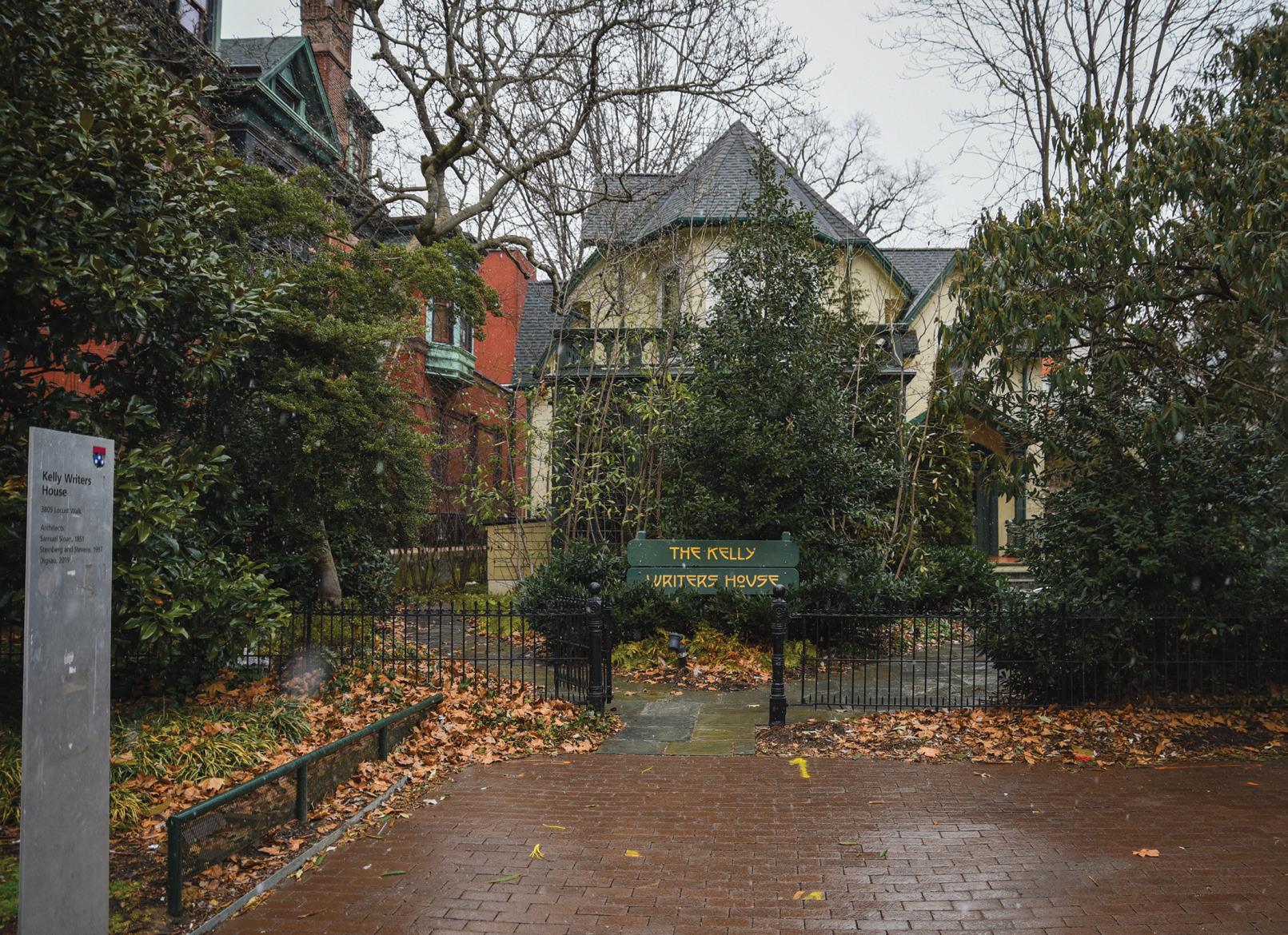
The Kelly Writers House hosted a panel about long-form journalism on Feb. 26
RIYA MITRA | STAFF PHOTOGRAPHER
Board of Trustees chair Ramanan Raghavendran (right) shakes a trustee’s hand during the winter full board meeting on Feb. 28.
JEAN PARK | MULTIMEDIA EDITOR
The ADL gave Penn a “C” rating on its annual campus antisemitism report card.
Baseball’s senior pitcher Will Tobin has one last rodeo
The Tennessee native is looking for an Ivy League tournament win for his last roundup on the mound
WEINING
Two outs and left for dead.
As the sun beat down on the rough southern dirt, a lone cowboy approached the pitcher’s mound in the 10th inning. A southpaw gunslinger with six pitches in his arsenal, then-junior pitcher Will Tobin looked down to home plate and struck down three of his opponents in less than two innings. With St. John’s University at bat and the team’s chance to reach the championships weighing on his shoulders, Tobin had everything to lose.
Unfortunately, there wasn’t enough space in that town for both teams, and St. John’s came out on top in a 12-inning loss for Penn that culminated in Tobin letting up the walk-off to finish the game. Ending his junior season in that heartbreaking duel gave him a score to settle and a desire to win that could not be shot down in his final rodeo.
The first in his family to play baseball, Tobin traveled a long way from home to play for the Quakers. A Tennessee native, he found baseball when he was three years old, and pitching became second nature. Just like his journey to the mound, his journey to Penn seemed like fate.
“Being in, like, a city like Philadelphia, I love the meshing of the cultures and how new and diverse everything was because everything in Tennessee was pretty one-track minded,” Tobin said. “Coming to Penn — also having a good baseball team, great academics, and then getting to experience something new — I felt was the best possible situation I could have found myself in.”
Following the departure of many of the team’s seniors, there was a new pitcher in town: Tobin. Despite his laid-back attitude, Tobin has earned his spurs many times over.
“Will is what you would call, as a coach, sort of the prototypical case of a player that just keeps getting better,” assistant coach Josh Schwartz said. “His role has increased on the pitching staff every year since he’s been here.”
From only pitching eight innings across his freshman year to being in the starting lineup his senior year, Tobin’s success stems from his mindset, where he has learned how to wrangle the anxiety and noise
BRANDT, from back page
League opted out of the 2021 season.
But that was all just fuel for the fire.
Things changed drastically during her sophomore season. Penn went undefeated in the Ivy League. And Brandt herself had a bona fide breakout year, going from scoring 24 goals in a season to 54 — putting her at 78 career goals — and was named the Ivy League Midfielder of the Year.
“I would credit that to the offense and the other players out there and the team. I don’t think that’s really a reflection of anything I did. I think that was just us getting better as a team,” Brandt said. “When you gel more as an offense, when you get to learn each other’s tendencies, you get better looks at the net [and] you get better looks that you want. They’re setting me up more for opportunities that I didn’t get freshman year.”
Because of the team’s phenomenal season, Brandt had the chance to fulfill a lifelong dream of hers: playing in the NCAA tournament.
That May, Penn traveled up to Boston where they beat UConn in the first round of the tournament. The team made it to the second round of the NCAA tournament, but it lost 9-7 against Boston College. But despite losing in the second round, the experience meant the world to Brandt.
to keep his eyes on the prize.
“I try to keep everything out of my head and trust the work that I put in — the weeks, the months, and the years before I got out on the mound,” Tobin said.
This cowboy was never one to settle. In the last year, Tobin has added three new pitches that he could pull out of his holster, making him an ace in the hole for the Quakers. Yet he knows there’s more than just speed and strength involved in the game.
“Baseball, for me, is 25% physical, 75% mental,” he said. “As a pitcher, you’re in command of everything that is about to happen with whatever pitch you’re about to throw.”
His development as a go-to gunslinger for the Quakers has been apparent. From hidden overhead speed on fastballs to arm reliability, Tobin has proven
“Growing up all through elementary school, middle school — that is what you see on TV. Those are the pros. Those are the best of the best,” Brandt said. “When I really think about it, [it] makes me pretty emotional to think about [because] … just to look back and see how far you’ve come too is just awesome.”
One year later, in her junior season, Brandt became just the 15th player in program history to break the 100-goal mark. Her 100th goal came in an upset win against No. 1 Maryland — a program she grew up idolizing.
She scored 60 goals total in her junior year — only three behind the single-season record set just one year prior by her teammate, then-senior attacker Niki Miles. And in the Ivy League tournament semifinal, she scored eight goals for the tournament record in a game.
Penn earned another berth to the NCAA tournament in 2024. It hosted its first two matchups in Franklin Field and advanced to the quarterfinal against No. 1 Northwestern, which was led by the NCAA all-time leading scorer Izzy Scane.
A few months later, she met Scane again — but as a teammate.
In November 2024, Brandt was named to the United States Women’s National Team training roster to decide the roster for the 2026 World Lacrosse Women’s Championship in Japan. She was flown out to Florida for the Intercollegiate Women’s Lacrosse Coaches Association Presidents Cup
time and time again that you’d be wiser picking a fight with a rattlesnake than crossing him on the mound. When describing his sharpshooting qualities, Schwartz said Tobin was “statistically by far our best pitcher.”
“He doesn’t really get rattled and always continues to throw strikes and even throw a second arm slot, which, again, I can’t really undersell how significant that is,” Schwartz said.
A rugged, southern cowboy with a heart of gold, Tobin wants to give back to the teammates who changed his perspective on baseball.
“When I got to college … it was like the first time in a couple of years I’d really loved to go to practice, loved to play, and it didn’t feel like an obligation,” Tobin said.
on Nov. 22-24, 2024. Her idols became her teammates, as she got to compete alongside the stars of the lacrosse world.
“It’s so cool to play the sport with so many talented athletes who have the same love, who share that love, and just have really dedicated their lives to the sport. It’s just really beautiful when it’s played at such a high level,” Brandt said.
She attended another training camp in Boston this past January, and she has another training camp approaching in June back home in Maryland. From there, the U.S. National Team roster will be finalized — and Brandt could be one of the names on the list.
“The dream keeps on going,” Brandt said. “Putting on a USA uniform is a top-two moment of my life.”
Brandt returned from her time wearing the red, white, and blue ready for her final campaign with the Red and Blue. She came back needing just 11 goals to break the program scoring record. But she
“What stood out is how … personal he was, like his EQ,” senior outfielder Nate Polo said. “He was really able to make friends with a bunch of different personalities.” Not many cowboys can walk into a saloon and leave calling everyone a friend, but Tobin sure can. Tobin has his eye on one final duel: a third-straight Ivy League tournament win.
“I can speak on behalf of all 35 guys on the team: There’s no doubt in our minds we’ll go and win another one,” he said. After years of gunslinging for Penn baseball, he’s ready to hang up his hat and try out a new frontier, whether that’s opening up his own bookstore or coaching a little league baseball team. Whatever it is, Tobin doesn’t plan on riding into the sunset without leaving his mark on the Red and Blue.
didn’t even know it herself. Someone else told her just a few days before the season that she was on the doorstep of history.
“I don’t really look at stats,” Brandt admitted with a laugh. “But I just find that I play my best lacrosse when I block out the noise … whether that’s rankings or stats. I think it can be a really limiting mindset when you only focus on ‘this many points’ or ‘this many goals.’”
It’s all part of her mindset, part of the process that brought her to that position.
It has never been about the first goal or the 100th goal or the 149th goal or the ones to come. It’s been about her personal growth, overcoming what’s in front of her and chasing the dreams that she once thought were out of reach. It’s been about playing alongside her team, supporting the rest of her teammates and growing with them so that they can chase titles and greatness together.
The record has been broken. But the road isn’t over.
WEINING DING | MULTIMEDIA EDITOR
Tobin poses at Smokey Joe’s on Feb. 25.
ANNA VAZHAEPARAMBIL | STAFF PHOTOGRAPHER
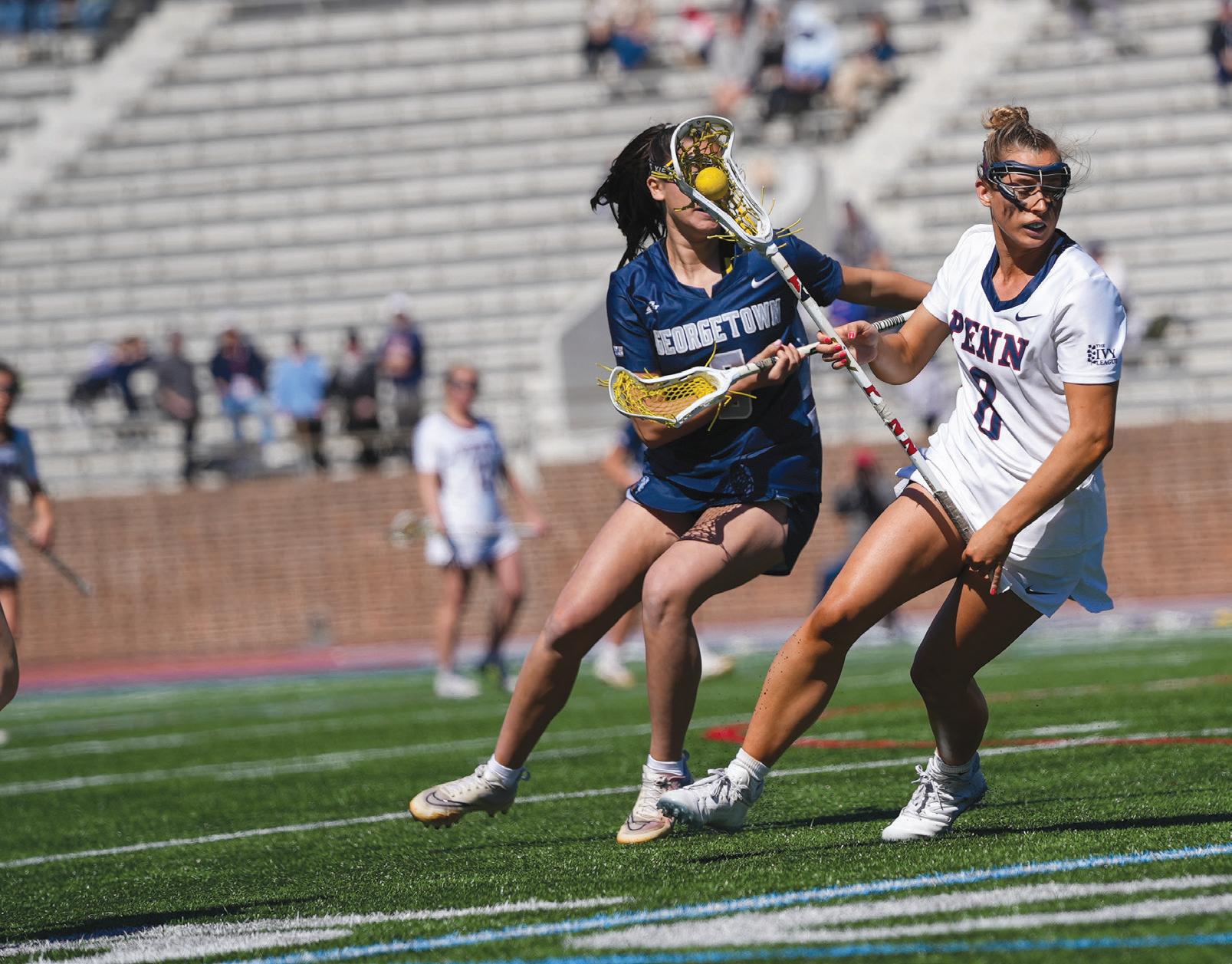
Brandt looks for the pass against Georgetown on March 26, 2023.
A look inside the Ott Center, Penn’s premier indoor track facility
Penn’s newest track and feld arena is a delight to both alumni and athletes
PHOEBE
WEINTRAUB Senior Sports Reporter
It’s been three and a half months since the Ott Center for Track and Field, Penn’s brand-new, state-of-the-art indoor track and field facility, opened its doors for the first time. In the months that followed, the center has seen records shattered as the Quakers hosted six of their nine season meets thus far within the facility.
The Ott Center, which cost a hefty $69.35 million, is clearly one of many successful projects for the University. But, with donors and administrators only stopping by for the occasional meet, the real reviews come from those who spend the most time in the facility: the track and field athletes, who were more than happy to share their opinions.
“It’s fantastic,” senior thrower Scott Dochat said. “Having a place that is our own, that is [for] Penn track to practice inside, is just such a tremendous upgrade. For our home meets for the last two years, we were going to Staten Island and hosting home meets. So this is a tremendous, tremendous upgrade.”
The current athletes are certainly reaping the benefits of the Ott Center, but the facility was in the works long before they were even born. The promise of a new indoor track center was made as far back as 1970, with the idea taking a concrete shape within the last five to six years.
It was used to entice current Penn athletes to attend the University.
“I remember when I was being recruited, that was the selling point,” junior jumper Kampton Kam recalled. “So for it to finally be constructed and we can use it, [is] a blessing.”
The anticipation on the track and field team only grew with time as the center came closer to finishing this past year. Coaches hyped it up and provided the team with regular updates and photos. As news of its completion circulated, chatter among the team increased until their private showing before the official opening.
“Everyone was super excited. I mean, the alums are jealous — it’s ridiculous [for the] seniors that graduated last year,” Kam said. “So it’s just been a long time coming, and there was definitely a lot of anticipation with this indoor facility, not just from us, but from … Penn track alums.”
Without the opportunity to ever compete in the Ott Center, several alumni decided to come back to campus for the Ott Center’s official opening and break in the new track. Dochat recalled that 2023 College graduate and former distance runner Lizzy Bader and 2022 Wharton graduate and former thrower Marc Minichello were among the notable alumni who returned.
Despite spending months practicing and competing in the space, many of the track and field athletes still can’t believe their good fortune in being able to use state-of-the-art equipment every day.
Before the Ott Center was built, the track and field teams practiced in less-than-ideal spaces, which they refer to as “the Annex” and “the Bubble.” The Annex, which, according to Dochat, discolored practice shirts, was demolished so that the Ott Center could be built.
Post-Annex, the track team practiced inside a bubble placed on top of the turf soccer field, which was hard on a runner’s body. They also shared the Bubble with many other sports teams at Penn, leading to a lack of space.
The Ott Center is a major upgrade for each event group of the track team compared with these last practice spaces. Within the 73,000-square-foot cavernous dome is a 200meter banked track — “the highest bank that’s allowed in the NCAA,” according to Kam — two long and triple jump runways and pits, two pole vault runways, an eight-lane infield for sprints, hurdles, and high jump, a separate and enclosed throwing area for shot put and weight throw, and stadium seats capable of seating 1,000 spectators.
field facility with state-of-the-art equipment.
Then, in the final morning heat, Kelly took back his record with a time of 51.25.
, from back page
putting the two dead even at the 125-yard mark. During the final 50 yards, Fallon pulled away and touched the final wall with a time of 1:48.85, smashing his previous Ivy championship record by nearly a second and achieving his third Ivy title in this event. The time puts Fallon as the fastest swimmer in the NCAA in the 200 breaststroke this year, which is especially important as Fallon is eyeing that elusive NCAA title that he has been runner-up and second runner-up to in previous years.
Notably, Kelly’s silver-medal winning time of 1:49.80 moves him to the spot of third-fastest swimmer in the 200 breaststroke this year. After years of racing and pushing each other, Fallon and Kelly have become close.
“It’s been a pleasure racing with him over these past four years. It’s gonna be a pleasure racing with him at NCAAs,” Fallon said, “He’s been a motivator for me. But also, everybody here has been great friends. It’s just a very big community, and I’m happy to have it.”
The 100 breaststroke final had a similar story with a different victor. Kelly and Fallon were also the stars of the show, with the duo trading the Ivy championship records all day. In morning prelims, Fallon won the second heat with a new meet record of 51.46.
In the evening A final, Kelly led the entire race and crushed conference and Ivy meet records in an NCAA A-cut time of 50.60. In his weaker breaststroke event, Fallon gave a great chase, moving from sixth to finishing second at the final wall — just ahead of teammate freshman breaststroke specialist Watson Nguyen.
Nguyen and sophomore individual medley specialist Peter Whittington, while just underclassmen, proved Penn’s breaststroke dominance outside of Fallon this weekend. Whittington and Nguyen finished in fourth and fifth respectively in the 200 breaststroke, and Nguyen finished third in the 100 breaststroke. Last year, Penn also had three A finalists in the 200 breaststroke — Fallon, Whittington, and now-graduated Jason Schreiber. Whittington specifically shined in his own right. In the 400 individual medley, the sophomore dropped five seconds from his personal best to take home a silver medal, nearly chasing down first-place finisher Brown backstroke/breaststroke/individual medley specialist Marton Nagy in the last 50 yards of the race.
The breaststroke group wasn’t the only one to have all the fun. Junior backstroke specialist James Curreri swam a personal best 500 freestyle to earn third and a NCAA B cut. The Kinnelon, N.J. native took home third in this event at last year’s championships
as well. In addition, senior backstroke/individual medley specialist Daniel Gallagher had a strong showing at his final Ivy championships, finishing sixth in the 200 backstroke — improving his seventh-place finish from the 2024 Ivy championships. These victories are hard-earned, as the Quakers have been persevering through the loss of Sheerr Pool this season due to construction. The Quakers have been bouncing between the West Philadelphia YMCA and Drexel pools for practice time, and the team notably honored one of its practice locations by all wearing T-shirts adorned with the YMCA logo.
“It definitely affected us as a team as a whole a lot because you’re swimming in a really bad pool that has so many waves. It’s hard to train,” Nguyen said.
“It also takes so much time out of our schedule [to
The athletes certainly love practicing indoors during the winter and in such a convenient location, but mostly appreciate the efficiency of the Ott Center. Senior jumper Benedikt Sachta commented that having two pits speeds up their practice and allows vaulters to practice taking more jumps.
“The practice just is way more dynamic,” Sachta said. “You’re not just standing there for a while waiting for everyone to take their turn.”
In the past three years, the vaulters have practiced in eight different spaces, according to Sachta, so finally having a permanent place to practice has been incredible. The throwers also now have a caged private space, which allows them to practice safely. Like Sachta, Kam was very glad to have more pits for the jumpers, especially since the ones in the Ott Center are permanently placed.
“Last year … we had to set up every time we wanted to jump with rubber tracks, and then we had to move the pits,” Kam recalled. “And then, for pole vault, we had to do a whole … construction of the runway with the pits. And it was just very time consuming.”
The biggest change as compared with Franklin Field is the banked track. Banking elevates the outer lanes of the track on the curves. Gravity then pulls the runners on the outer lanes inward, allowing them to run faster. Getting used to it can cause some strain on the shins and Achilles tendon, senior sprinter Jocelyn Niemiec noted, but most of the runners enjoy their newfound speed.
Multiple athletes have even noticed improvements in their performance as a result of the new center, Niemiec and Sachta included.
“I have been having a dream season … I [had a personal record] four times out of … the six times I competed there, and … I’m in fourth place on the Penn all-time list right now,” Sachta said. “So I’m super happy about that, but I must say a large part of that … definitely goes to the fact that I have a really good training facility right now.”
Providing the track program with their own space has also resulted in mental benefits in the athletes — specifically, a strong sense of community.
I can feel that the team has a lot more unity now, because before — especially indoors during the wintertime — I would barely ever see the sprinters … or other event groups practicing,” Sachta reflected. “And now we’re all in the same spot, sharing the same space. So I see the sprinters practicing all the time, the hurdlers [and] the throwers, too, and I just really feel like I’m a part of the team.”
While the Ott Center doesn’t seat as many people as Franklin Field, Dochat chooses to see this as an upside, as it creates a competitive aura for the athletes.
“When we hosted these big home meets this year [and] schools like … Duke, Virginia, Penn State and some of those huge track and field schools are coming, the atmosphere in there was palpable, because everything was tight,” Dochat said. “And honestly, I think it makes for a more electric meet.”
According to Kam, Penn now hosts the “premier [track] facility in the Ivy League,” ultimately providing the program with more opportunities to gain the home field advantage and win more championships.
travel to either pool] too. … We were able to manage it really well.”
Beyond Penn, the times at the championship as a whole were fast. 10 Ivy championship records fell, and eleven NCAA A cuts were achieved — speaking to the strength of Ivy League swimming and diving.
“It’s great to see fast swimming all around, and it’s definitely been a motivator for me,” Fallon said. “I think it’s time — very, very soon, people are gonna start taking the Ivy League a lot more seriously.”
Looking ahead, Fallon will be chasing a championship title at the NCAA D-I Swimming and Diving Championships in March — possibly with some company — in his final meet representing the Red and Blue.
GRACE CHEN | SENIOR PHOTOGRAPHER
The Ott Center is Penn’s new indoor track and
FALLON
Matt Fallon notches nation-leading time in 200-yard breaststroke at Ivy League championships
VALERI GUEVARRA Sports Editor
The lights flickered on and off, and the crowd roared as the athletes lined up behind the diving blocks for the highest-profile race of the week — the 200-yard breaststroke. And in the center of it all was senior breaststroke/individual medley specialist Matt Fallon.
And Fallon lived up to the hype in record-breaking fashion.
At the 2025 Ivy League Men’s Swimming and Diving Championships held at Brown from Feb. 26March 1, Penn men’s swimming and diving finished in seventh place as a team, but there were several standout individual performances for the Quakers to be proud of, including from the team’s resident Olympian Fallon.
“I was definitely feeling pretty good and expecting to put up a pretty good time, but I’m really happy with how I felt,” Fallon said. “I’m impressed I was able to take [the race] out that quickly and still bring it home.”
On the final day of the meet came Fallon’s magnum opus — the 200 breaststroke. The race was all about Fallon and Brown breaststroke/individual medley specialist Jack Kelly. Both competed in the A final of this event at the Ivy championships and NCAA Division I Swimming and Diving Championships last year. At the latter meet, Fallon took the runner-up title and Kelly rounded out the field in eighth.
Off the blocks, Fallon and Kelly had identical
Sam Brown’s 42 points fuel men’s basketball’s 92-87 victory over Columbia
Senior forward/center Nick Spinoso also hit 1,000 points in Penn’s fourth Ivy League victory of the season
WALKER CARNATHAN Former Sports Editor
NEW YORK — In a night of statistical milestones, Penn men’s basketball did not let the most important figure escape it: the win.
On Friday, the Quakers defeated Columbia 92-87 amid a slew of historic accomplishments. Sophomore guard Sam Brown hung 42 points on the Lions (12-14, 1-12 Ivy) for the highest single-game point total by a Quaker since Hassan Duncombe in 1989, while senior forward Nick Spinoso surpassed 1,000 points for his collegiate career. Amid the accomplishments, the Quakers (8-18, 4-9) buckled down to pull out a nail-biting victory, converting their free throws down the stretch and playing timely defense to emerge with the win.
“I don’t think it’s fully hit me yet,” Brown said, while also crediting the play of his teammates. “I think it’s just a testament to all the work that I’ve put in. I had, to quote some news writer, a ‘cataclysmic’ non-conference [season], and I think I’m proud of the internal resilience that I think I’ve shown.”
“It’s always great to do it when you have a great group of guys around you,” Spinoso said of his mark. “We’re a team that’s focused on winning — we wanna play hard, we wanna play the right way. But I’m glad we had two good things happen in a hard-fought game.”
Though Penn has already been eliminated from Ivy Madness contention, the Quakers entered the matchup seeking a sweep of the last-place Lions. In Penn’s last matchup with Columbia, the Quakers surged to a win behind their 18 threepointers, a program record against a Division I opponent. The Red and Blue looked just as comfortable at Francis S. Levien Gymnasium, piercing
Columbia’s conference-worst defensive front for eight three-pointers in the first half.
Brown, whose previous career high of 30 points came against Columbia earlier this season, scored effectively at all three levels, including a number of mid-range jumpers. While coach Steve Donahue’s scheme does not always favor the mid-range shot, Brown said it has been critical to his growth as a player.
“I played under Clark Slajchert last year. … I think I’ve taken some of what he’s done,” Brown said. “I want to be a professional basketball player, and I know that I’m going to have to grow my game. Even though I’m not necessarily an abovethe-rim player, I try to find ways to score outside from that.”
“Sam in the preseason wasn’t sure if he should or shouldn’t do [the mid-range shot],” Donahue said. “Now, he’s playing like if he has a shot, he takes it. … The most important thing we want kids to do is play with confidence. So if that’s what’s gonna make him confident, that’s a positive.”
Spinoso’s moment came in the early moments of the second half. Just over a minute into the period, Brown found Spinoso wide open on the block, and the longtime Penn big man finished the play with a layup to put Penn ahead 51-39, giving him 14 points in the game and 1,000 for his Quakers career. He is the 35th player in program history to surpass the millennium mark.
While the milestone was met with little pomp in Levien Gymnasium, Spinoso cherished the chance to hit the mark in his native state of New York.
“This is home to me,” Spinoso said. “I’m from New York, I have so many people here who I’m so
Anna Brandt appreciates the journey on her way to the top of record books
The senior midfelder hit 149 career goals to become the program’s all-time leading scorer
KRISTEL RAMBAUD Senior Sports Reporter
Up at the top of the list of Penn lacrosse players, senior midfielder Anna Brandt sits alone after scoring her 149th career goal against Temple and becoming the program’s all-time leading scorer.
But the road to this moment — to the program record, to an All-American status, to potentially another Ivy League title — didn’t just start when she got to college. Nor does it end now that the record is broken.
For Brandt, it’s never been about the stats or the records or the rankings. It’s been about the process.
The process started for her back home in Maryland. Brandt played for the best club program in the country — M&D Black — but she was often “the last kid off the bench.” She wasn’t the star player; she was barely in the rotation.
“I had to fall in love with the process more than the result,” Brandt said. “Since I was never really motivated by those goals and things because I wasn’t getting them, I was able to block that out and focus on the process — focus on getting better.” She committed to play for West Point, but the plans fell through and left Brandt in danger of not playing collegiate lacrosse. There was even a point where she thought she’d go to community college instead. But during a gap year, she found her way to Penn.
reaction times, and Kelly went out hard during the first quarter of the race. At the first 50 yards, Fallon touched the wall in second, 0.53 seconds behind Kelly. Regarding their strategies for the race, Fallon is historically known for his strong second half
the race, while Kelly is known for his fast front-half sprint speed. During the second 50 yards, Fallon quickly made up some ground, with Kelly now trailing by 0.11 seconds at the wall. Fallon’s first 100-yard split of 52.00 seconds is notably the fastest he’s ever taken out in this race. Kelly made some moves during the third 50 yards,
“Thinking back, it was mostly just gratitude and a pinch-me moment when I put on the uniform because I didn’t even think it was a possibility, and here I am at a top-ranked program getting a chance to play,” Brandt said, reflecting back on freshman year. She was a starter from the first game. And in the second game, she scored her first collegiate goal in a nationally ranked matchup against Johns Hopkins. But freshman year had its growing pains. Besides her adjustments at an individual level on and off the field, the team struggled. In the 2022 season, Penn finished 6-9 overall and 3-4 in conference play — missing out on an Ivy League championship and NCAA tournament appearance for the first time in over a decade.
“It was definitely tough because it was an entirely new team, and we weren’t super experienced because even the juniors and seniors had only played one or two games,” Brandt said. For those upperclassmen, COVID-19 restrictions canceled the rest of their 2020 season, and the Ivy
and excited to go see. … It was great to do it here.”
KENNY CHEN | STAFF PHOTOGRAPHER
Fallon races for first place in the 200 breaststroke final.