Penn appoints Hikaru Kozuma as next vice provost for University Life
Kozuma is currently the executive director of College Houses and Academic Services
NICOLE MURAVSKY Staff Reporter
Hikaru “Karu” Kozuma will be Penn's next vice provost for University Life starting May 1, according to an announcement from Interim Provost Beth Winkelstein.
Kozuma, who is currently the executive director of College Houses and Academic Services, will succeed Mamta Accapadi, who resigned last June after two years in the role. Since then, the position has been occupied by Tamara Greenfield King, who was appointed as interim vice provost for University Life on June 14.
The vice provost for University Life focuses on offering support to academic and career resources for students and works closely with cultural groups on campus.
“Karu Kozuma is a highly experienced national leader in university life, who is well known across our Penn community for his empathy, wisdom, and collaborative skill," Winkelstein wrote in the announcement.
Kozuma will be in charge of a $45 million budget that oversees 16 departments and a total of 135 full-time employees, according to University Life. The new vice provost for University Life is also expected to continue and expand on the initiatives started by Accapadi and King, the latter of whom will stay at Penn as senior associate vice provost for student affairs.
Kozuma — a 2015 graduate of Penn's Graduate School of Education — has been executive director of College Houses and Academic Services since 2021 and previously served as associate vice provost for University Life and executive director of the Office of Student Affairs from 2010 to 2018.
The announcement concludes a six-month search that began in late August, when Winkelstein announced the formation of an advisory committee for the selection of the next vice provost for University Life.
"We are confident that Karu will be an outstanding partner to all of us in leading our university life initiatives in the years ahead," Winkelstein wrote.
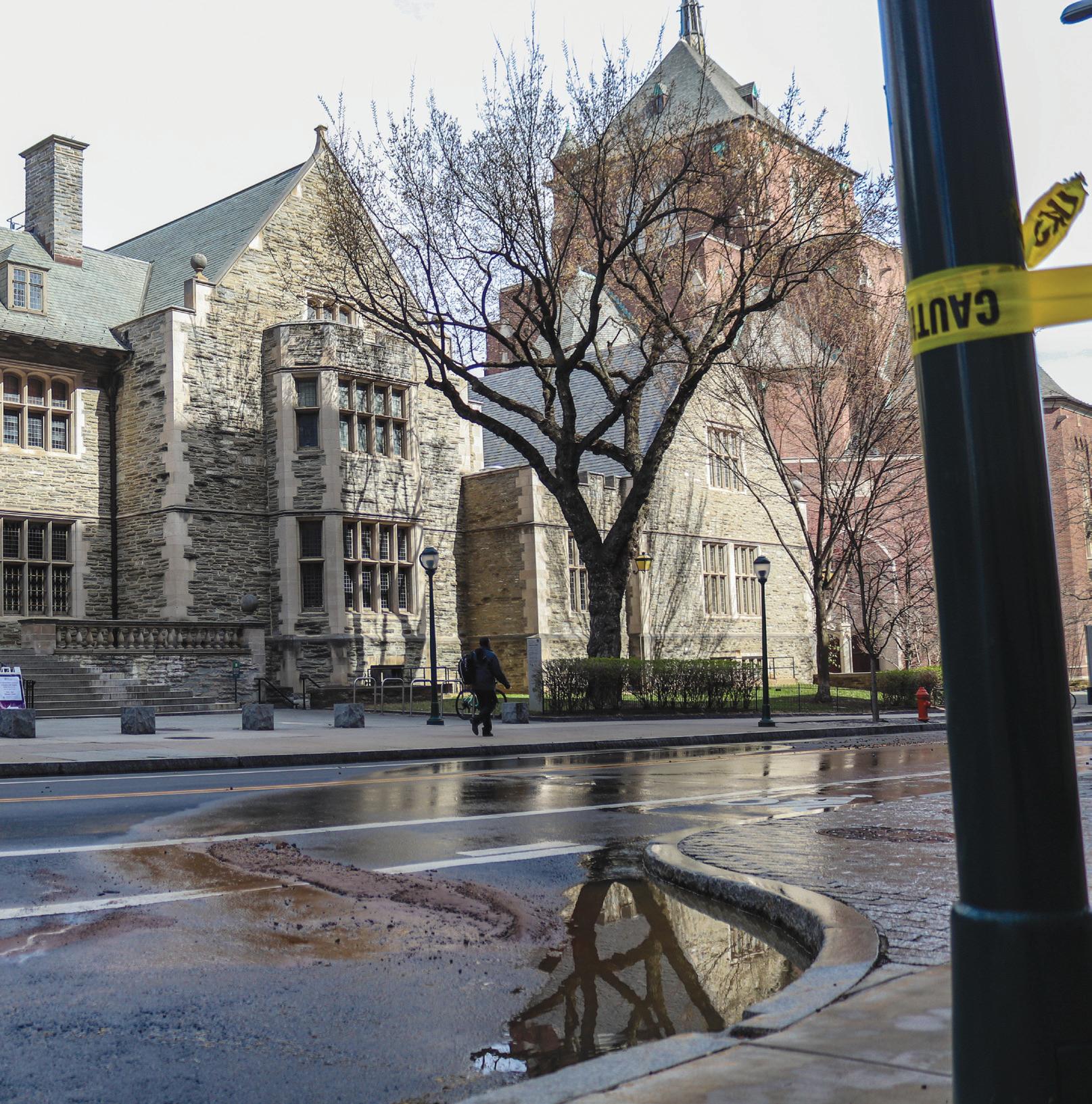
Houston Market closed for five hours due to emergency water repairs
A water main break on Spruce Street also caused street closures
LINA CHIHOUB Staff Reporter
Houston Market reopened Monday afternoon after closing for around five hours due to a water main break on Spruce Street.
The water main break, which occurred in the morning on Feb. 27, reduced Houston Market’s access to running water, Barbara Lea-Kruger — director of communications and external relations for Penn Business Services — wrote in a statement to The Daily Pennsylvanian. Penn Dining notified students via email that Houston Market was closed “until further notice“ while the City of Philadelphia completed emergency water repairs.
Open expression at Penn, explained: guidelines, consequences, and complaints
The DP analyzed Penn’s open expression guidelines and the role of the Committee on Open Expression
SOPHIA LEUNG Staff Reporter
The Penn community saw an influx in student activism on campus this year, and — as a result — administrative response to on-campus protests. Students facing disciplinary action for their participation in protests have received varied communication from Penn’s Committee on Open Expression, Center for Community Standards and Accountability, and vice provost for University Life, as well as open expression observers acting on behalf of the vice provost — all of which are intended to act as separate entities in addressing students’ rights to free expression on campus.
The Daily Pennsylvanian spoke with University administrators and student activists to better understand the impact of Penn’s open expression guidelines and the role of the University's Committee on Open Expression in evaluating the rights of students to protest on campus.
Recent protests and their consequences
Students affiliated with Fossil Free Penn camped on College Green for 39 days last semester with three demands for Penn: a public commitment toward preserving the University City Townhomes, total fossil fuel divestment, and making payments in lieu of taxes — or PILOTs — to Philadelphia public schools.
The original message added that students should visit other dining locations until an update was provided for Houston Market’s reopening.
After the water main break, the PennEats mobile app was updated to indicate that all seven of the market’s dining facilities were closed to orders indefinitely.
Later, in an email to students sent around 4:30 p.m., Penn Dining wrote that Houston Market would be open from 5 p.m. to 7 p.m. Monday for limited mobile and walk-in dining at its Penn Pi, HM Grill, Ivy Leaf, and See HOUSTON, page 3
GAPSA, UA approve resolutions seeking student representation on
Board of Trustees
The Graduate and Professional Student Assembly and the Undergraduate Assembly separately passed revised resolutions advocating for student representation to Penn's Board of Trustees.
This follows a failed joint resolution from January, when GAPSA passed the draft but the UA was unable to reach a majority. Now, both groups have reached their own agreements that are set to be sent to the Board of Trustees.
On Feb. 20, GAPSA sent a joint letter with G12+ school governments — the student leadership from each of Penn's graduate schools — and a revised resolution for student representation on the Board of Trustees to Vice President and University Secretary Medha Narvekar. This is set to be sent out to the Board of Trustees’ chairperson Scott Bok ahead of the Board of Trustees' upcoming meeting on March 2.
On Feb. 26, the UA passed their own revised resolution for student representation and sent a similar letter to Bok, according to College junior and UA representative Charlie Schumer. Both assemblies are awaiting to hear whether their resolutions will be considered.
The Board of Trustees is a decision-making body that directly decides the University's operations. Trustees' responsibilities include the selection of the University president, tuition, fees,
This action was capped off by a demonstration last October where nearly 75 students interrupted Penn’s Homecoming football game against Yale. The protest delayed the game for over an hour and resulted in the arrests of 19 demonstrators, 17 of which were Penn students.
In addition to legal repercussions for trespassing, the students faced disciplinary action from the University for violating the open expression guidelines. As a result of not cooperating with the open expression officers at the protest, the students were directed to CSA.
Read the rest at thedp.com
purchase agreements, administration appointments, and acquisition and development of land. There are currently 54 trustee members with 14 spots allocated to Penn alumni. No spots are currently allocated to students.
The agenda for the Board of Trustees meeting on March 2 does not mention discussion of either resolution at the time of publication. The Board of Trustees did not respond to a request for comment.
The previous attempt for the joint resolution was coauthored with representatives of the UA, but only GAPSA was able to approve it with a majority. Both groups have subsequently revised their resolutions and passed them separately.
On Feb. 11, the graduate school student governments held their G12+ summit where each of the presidents signed a joint letter with GAPSA in favor of student representation, according to thirdyear dual degree master's student and GAPSA President Robert Watson.
Following the summit, Watson said GAPSA passed a revised resolution on Feb. 15, adding two amendments to the original resolution: GAPSA removed the UA’s name in response to their prior tabling of the resolution on Jan. 22, and they extended the student representative’s term from one to two years.
Following UA’s prior decision to indefinitely table the resolution on Jan. 22, Schumer and Wharton sophomore and UA representative Keshav Ramesh — the two undergraduate authors of the initial joint resolution with GAPSA — met with administrators to discuss the resolution further.
Schumer said these administrators include Associate Vice Provost for Education and Academic Planning Gary Purpura, Executive Director of Office of Student Affairs Katie Bonner, Faculty Senate Tri-Chairs Vivian Gadsen, Tulia Falleti, and William Braham, and Associate Vice President to University Secretary Lizann Rode.
During their Feb. 26 meeting, the UA successfully passed their revised resolution to have student representation on the Board of Trustees. The resolution now proposes a two-year term for student representatives.
“The Board of Trustees is the biggest and most important body at the University in terms of decision making, yet we don’t have a lot of information about them," Schumer said. "Having student representation would bring those lines of communication and make their processes clearer."

CONTACT US: 215-422-4640 SEND STORY IDEAS TO NEWSTIP@THEDP.COM ONLINE AT THEDP.COM THE INDEPENDENT STUDENT NEWSPAPER OF THE UNIVERSITY OF PENNSYLVANIA • FOUNDED 1885 PHILADELPHIA, THURSDAY, MARCH 2, 2023 VOL. CXXXIX NO. 8
PHOTO BY ABHIRAM JUVVADI
PHOTO BY KYLIE COOPER
The resolutions demonstrate progress towards students being present on Penn’s governing body
LARA COTA Staff Reporter
The Graduate and Professional Student Assembly and the Undergraduate Assembly are advocating for student representation on the Board of Trustees.
Penn Dining announces action plan
after reports of health code violations at dining locations
This announcement comes days after the DP detailed 100 observations of health code violations across campus
JESSICA WU Staff Reporter
Penn Dining will create a new action plan for meeting health and safety regulations in campus dining facilities and pledged to be transparent with its cleaning procedures after inspections found numerous violations of Philadelphia health code.

In an email sent to students and parents on Tuesday morning, Penn Dining said it understood that there was “considerable concern in the campus community” about the inspections. A statement linked in the email
described the results of the inspections as “unacceptable” and said that “swift actions” had been taken to address concerns.
The statement comes days after The Daily Pennsylvanian detailed 100 observations of health code violations in Penn Dining locations during their most recent food safety inspections conducted by the Philadelphia Office of Food Protection. Hill House and 1920 Commons were found to not be in satisfactory compliance with the Philadelphia health code.
“As was acknowledged in Bon Appetit’s/ Penn’s collective response to the DP reporter, health inspections are part of a process of continuous improvement and are a snapshot in time to help food service operations identify procedures for ensuring ongoing compliance,” the statement read, referring to its food service contractor, Bon Appetit Management Company.
In the statement, Penn Dining said that its facilities have not had repeated violations that went uncorrected or severe violations. In addition, it said that a majority of the violations cited during the inspection were corrected immediately or soon afterwards.
While 1920 Commons passed its regular annual inspection, according to the statement, the dining hall is up for reinspection after the health department performed an unscheduled visit due to bird sightings within the facility. According to Penn Dining, the birds were found to have flown into 1920 Commons from an open loading dock and were removed by a wildlife trapper. Protective curtains were installed to prevent the incident from occurring again.
City Tap House closes University City location after 13 years
The restaurant’s last day of service was Feb. 26, after opening its first location of the chain in Philadelphia
JASPER TAYLOR Senior Reporter
The University City location of craft beer bar and restaurant City Tap House closed just over one year after it reopened.
City Tap shared in an Instagram post on Feb. 23 that the restaurant’s last day of service would be Feb. 26. The post, which was signed by the location’s management team, did not include a reason for the closure. A representative from City Tap did not respond to a request for comment from The Daily Pennsylvanian on the reason for closure by publication.
"It is with a heavy heart that we are informing you that the last day of service will be Sunday, February 26th," the post read. "This was a difficult decision, as this location was the launchpad for our company's growth over the last 13 years."
City Tap was located on 39th and Walnut streets in The Radian. The restaurant opened in 2010 and was the first location of the chain, which has seven locations, including University City. The University City location reopened in January 2022 after nearly two years of closure
due to the COVID-19 pandemic.
The University City location was one of two Philadelphia locations, with the other being located in Logan Square at 100 N.18th St. The Instagram post refers guests to visit the Logan Square location.
Outside of Philadelphia, City Tap has other locations in Washington, D.C., Loudoun, Va., Boston, and Nashville, Tenn. The chain — which serves casual American food alongside a large selection of craft beers — was founded in 2010, with the mission of making craft beer more accessible, according to their website.

City Tap is the latest of multiple University City restaurants that have recently closed. Korean restaurant Koreana closed in April of last year, while Mexican restaurant Distrito closed last summer. Fried chicken restaurant Wishbone suddenly closed its doors on Feb. 19 after 10 years of operation.
“We appreciate all of the love & loyalty we have felt over these last 13 years,” the restaurant wrote on Instagram.
Hill House also did not pass its annual inspection and is up for reinspection. To address observations of fruit flies, Penn Dining said that traps have been set and the biodigester — which was determined to be the source of the problem — has been relocated. The facility has
Penn Alumni event attendees reflect on FFP interruption, condemn protest tactics

Current and former class board presidents said that Fossil Free Penn protestors chose both the wrong occasion and the wrong tactics
MAX ANNUNZIATA Staff Reporter
Attendees of the Penn Alumni Class Presidents Event told The Daily Pennsylvanian that they felt “alienated” and “uninformed” by the interruption from protestors at the event.
On Feb. 10, Fossil Free Penn protestors — along with students and community members from the Coalition to Save the UC Townhomes — interrupted President Liz Magill during the reception for several minutes. Following the incident, two alumni spoke to the DP about their frustration with the method used by FFP to inform the attendees of the issue. Current and former class board presidents said that protestors chose both the wrong occasion and the wrong tactics.
The event marked the attendees’ first chance to speak with the new University president. The tactics of the protestors, which involved a bullhorn and repeating slogans, meant that “there was not an enlightenment about specifics,” Gregory Suss, class board president of the Class of 1975, told the DP.
Suss said that he felt that the occasion itself made alumni less receptive than they might otherwise have been. Still, having earlier that day been given a presentation on University real estate plans, he thought that the protestors may have been able to take advantage of curiosity among alumni.
Senior Class Board president Derek Nhieu said that some of the attendees were “receptive,” yet the alumni reactions were a “mixed bag.”
Luxury suburban 1 bedroom apt. for rent. Walk to RR and be at Penn in 20 minutes. 4 rooms (670 sq ft). MB with walk in closet AC, W/D, large deck, fenced in yard and off street parking. $950. No pets. Call 610-453-4124
Testing the Reward-Drinker Hypothesis of Naltrexone Using an Extended-Release Formulation
University of Pennsylvania

This study is being conducted to compare the effects of a medication (extended-release naltrexone or XRNTX) or placebo (an inactive substance) together with brief counseling on reducing or stopping drinking.
To participate in this study, you must be:
• 18-65 years old
• Express a desire to reduce or stop drinking
• Able to complete all study visits and willing to receive 2 injections of study medication over 8 weeks of treatment.
This is a 7 visit study to occur over 12 weeks. This includes an initial screening visit, an 8-week treatment phase (during which time you will receive 2 injections at 4-week intervals of XR-NTX or a placebo), and a follow-up visit 4 weeks after the treatment phase.
Participants may be compensated up to $345 if they are eligible to participate and complete all study visits.
“Overall, I think a lot of people wanted to be receptive. They just didn’t really know how, or they didn’t think it was the right time or place,” Nhieu said.

One of the demonstrators, College senior Gigi Varlotta, had previously called alumni as “angry” and alleged that one person pushed Varlotta’s bullhorn into their face. One alum, who requested
also undergone a deep cleaning.
“[W]e recognize that public perception of health department violations is that any violation is critical,” the statement said. “Please know that our goal is always to aim for inspections with zero violations.”
anonymity due to fear of retaliation from the University, alleged that this incident did not occur.
The alumni also pointed to an incident in which an alumnus and current professor, recognizing Varlotta as a former student of his, repeatedly offered them the microphone to explain the issue to attendees. Nhieu said that Varlotta’s refusal to switch from bullhorn to microphone was the most “shocking moment of the whole night.”
“When admin refuses to meet any of our demands, we will continue to disrupt and protest. We are not interested in these ideas surrounding what good protest is or is not,” Varlotta wrote in a statement to the DP, citing what they said was a lack of University response to other tactics. “Until Penn acts on its role in this displacement, we will protest by any means necessary.”
Varlotta told the DP that the main target of the protest was Magill, but they said it was an “added bonus” that alumni, particularly class board presidents, were present. They said that the alumni were also influential because of their connections to Magill, Penn, developers in University City, and “other stakeholders.”
Another recent FFP protest where alumni were present occurred at the October homecoming game, which delayed play for over an hour. After that protest, students in Penn Band who participated in the protest were suspended from participation in the band until January 2024. In both cases, the anonymous alum felt that protestors had overstayed their welcome and had lost an otherwise supportive crowd.
Suss also said that the interruption seemed long and the reasons were not made sufficiently clear to attendees.
“What happens is [attendees] just turn off and wait for it to be over so they can continue what they were doing,” Suss said.
Protestors also distributed “leaflets” with information, some of which were accepted by alumni, according to Nhieu.
“I actually got into a conversation with a couple of alumni who were really curious, they didn’t know what was going on,” Nhieu told the DP. “They hadn’t heard about the protesters in the UC Townhomes, so they were asking me if I knew anything about it.”
Nhieu expressed additional concern about how the noise might have affected older attendees, some of whom represented classes as far back as the mid-1950s. While alumni criticized the tactics, timing, and effectiveness of the protest, none went so far as to condemn the protest itself.
“There’s a kind of protesting that is certainly fine and dandy. And there may very well be a genuine issue here that needs to be looked at. And I would appreciate the opportunity to do that,” Suss said.
In addition to the homecoming football game, protestors also interrupted the Convocation of the Class of 2026 in September.
Protestors are demanding that the University commit to putting $10 million toward the preservation of the UC townhomes, according to Varlotta. Penn has said that it has no control over the planned redevelopment, and has no plans to purchase the property.
2 NEWS THURSDAY, MARCH 2, 2023 | THEDP.COM THE DAILY PENNSYLVANIAN
PHOTO BY ANNIE LUO
In response to 100 observations of health code violations in Penn Dining locations after the most recent food safety inspections, a new action plan for meeting health and safety regulations was announced on Feb. 28.
PHOTO BY ANNA VAZHAEPARAMBIL
The University City location of City Tap House closed on Feb. 26, just over one year after it reopened.
PHOTO BY ANNA VAZHAEPARAMBIL
Community members from Fossil Free Penn and the Coalition to Save the UC Townhomes rally outside Huntsman Hall after interrupting President Liz Magill in the Penn Alumni Class Presidents Event on Feb. 10.
Penn Violence Prevention hosts consent workshop, continuing efforts from New Student Orientation
On Feb. 22, Penn Violence Prevention hosted a workshop entitled “Pizza & Fries: Conversations About Consent”
MAKENZIE KERNECKEL
Reporter
Penn Violence Prevention hosted a consent workshop on Feb. 22, inviting members of the Penn community to strengthen their communication skills around navigating consent.
The “Pizza & Fries: Conversations About Consent” workshop was held at Hill College House and facilitated by Julie Millisky, associate director at PVP.
Participants worked in small groups to build a pizza with ingredients that everyone agreed on before moving on to topics like developing boundaries and navigating consent when substances are present.
“Initially, I was expecting a seminar with many people attending, but it was a more intimate space for sharing, and I think that worked out for the better,” Sparsh Maheshwari, a graduate student at the School of Social Policy & Practice, said after attending the event. “My biggest takeaway was that if it's not a confident and enthusiastic yes, it's a no.”
Talia Fiester, College senior and student worker at PVP who also facilitated Wednesday’s workshop, said that the highlight of the night was seeing that students think about consent beyond just the activities that PVP facilitates.
“We had a really good conversation on the way that all of the students practiced community care amongst their friend groups,” Fiester said. Wednesday's workshop was a continuation of
Wharton Global Forum in Singapore to feature over 600 government and business leaders
The conference will take place from take place from March 10 to 11 at the Shangri-La Hotel
NILAN NANDISH Staff Reporter
consent circles that were conducted during Penn’s New Student Orientation in August.
According to Fiester, consent circles work towards making consent a more accessible and approachable topic for first years while also building a culture of consent on campus. PVP created the “Conversations About Consent” workshop in the spring of 2022, according to Millisky. PVP offers the option for the workshop to be requested by Penn student groups, organizations, or departments with two weeks' notice. They also offer another workshop, “Supporting Survivors,” which focuses on how to best support a friend if they experience interpersonal violence.
Millisky estimates that PVP will give around 10 to 15 “Conversations About Consent” workshops throughout the academic year. She added that these workshops have proven to be popular and offer a nonjudgmental space where students can ask questions.
The 2023 Wharton Global Forum will be hosted at the Shangri-La Hotel in Singapore from March 10 to 11.
The conference will bring together over 600 leaders in government and business, Wharton professors and alumni, entrepreneurs, inventors, and industry leaders. The speakers will discuss pressing issues that businesses around the world are facing, focusing particularly on advancement in Singapore and Asia.
Dean of the Wharton School Erika James, former United States Ambassador to Russia and China Jon Huntsman, Jr., and Deputy Prime Minister of Singapore and Minister for Finance Lawrence Wong are scheduled to speak at the forum. Additional speakers hail from companies such as J.P. Morgan and the Monetary Authority of Singapore.
2019 forum in London, due to the challenges of COVID-19. Past Wharton Global Forums have been hosted in cities such as Beijing, Amsterdam, New York, and Miami.
Sam Lundquist, the chief advancement officer at Wharton External Affairs, wrote to The Daily Pennsylvanian that Wharton’s planning for this forum has been “a multi-year production.”
Lundquist said that the event faced many challenges because it was initially planned to take place in 2020 but was finally realized in 2023.
“What excites me most is getting to see Dean Erika James lead a Global Forum for the first time. She’s traveled the world this year, as part of the Wharton Impact Tour,” ” Lundquist wrote. “I can’t wait to see her impact on the assembled alumni and business leaders — she has an inspired vision for the school and its place in the world.”
“At the end of the workshop, hopefully, students feel empowered to navigate consent in their own lives,” Millisky said.
According to a press release, conference topics will include fintech, ESG, and artificial intelligence. The conference will feature roundtable discussions, masterclasses, and networking opportunities.
During April, PVP is organizing the clothesline project for Sexual Assault Awareness Month, which will give survivors a chance to share their stories anonymously by writing on T-shirts that will be displayed on College Green, Millisky told The Daily Pennsylvanian.

The upcoming conference will be the first in-person Wharton Global Forum since the
HOUSTON, from FRONT PAGE
Bento stations. Houston Market reopened for normal operations the following day.
In an emailed statement sent to the DP at noon on Monday, the Philadelphia Water Department said that it was “responding to a break on an 8-inch water main.” The statement also said that the Philadelphia Water Department did not have any information about how this has impacted its customers.
"Emergency crews are working to stop flow to site and will begin making repairs as soon as possible. It is anticipated Spruce Street will be closed to traffic between 34th Street and 38th Street while repairs take place,” the Philadelphia Water Department wrote. Prior to Houston Market reopening, a
spokesperson for the Philadelphia Water Department later wrote to the DP that repairs to the water main were completed and water "should be restored."
At 5:20 p.m., Spruce Street reopened to traffic.
College first year Alison Yau said she saw the water main break while on the way to class. She said that “the dining hall violations, in addition to Houston closing, is pretty severe, especially for a lot of students at Penn that can’t afford to eat out. We don’t have the monetary capability for that.”
Staff Reporters Emily Scolnick and Sophia Liu contributed reporting.
Lundquist went on to write that the Wharton was able to “adapt and evolve” during the COVID-19 pandemic and was able to maintain strong connections with alumni, business partners, and government officials. Gain
•
•
To learn more about the program and sign up for an information session, visit: www.upenn.edu/prehealth

3 NEWS THURSDAY, MARCH 2, 2023 THEDP.COM | THE DAILY PENNSYLVANIAN
the foundational coursework and specialized skills you need to shine on your health professional school applications.
Individualized study plans
• Expert advising and admissions coaching
Application workshops and MCAT prep
• Access to student groups and alumni network
• Penn Medicine research and clinical opportunities
toward
Join us for a virtual information session on March 15
Take the next step
health professional school
Contributing
PHOTO BY PRANAY VEMULAMADA
Penn Violence Prevention hosted a workshop on consent at Hill College House on Feb. 22.
Laundry room etiquette, anyone?
LOU(D) AND CLEAR | Respect for others in communal spaces is a cause we all should embrace
As an on-campus student, trying to find an open washer on Sunday night is like trying to find an available bench at Pottruck at 5:00 p.m. Impossible. At Pottruck, you could at least ask how many sets the person in front of you has left. But in the laundry room? All you can do is hope a washer is open the next time you check.
Over my years at Penn and countless laundry room ventures, I’ve gathered that there exist three main types of laundry goers. We’ll start with the diligent type. These are the people who set a timer as soon as the cycle starts and promptly retrieve their belongings in due time. There’s perhaps a margin of five to 10 minutes, but overall, they are pretty consistent.
The more common types are the forgetful folk. As soon as the clothes go in the washer, they consider the job done. Perhaps they roam around campus going squirrelwatching or decide to pedal a unicycle along the Schuylkill River. We’ll never know. But one thing is certain: they don’t move their finished laundry.
That leaves the dreaded last type — aggressive laundry goers who demand to have

their laundry done this second. They forcibly remove other people’s clothes from the machines, leaving them strewn atop the machine, or worse, the floor. Now, I’ve never seen these laundry goers in action, nor do I know if I would be bold enough to intervene in a moment of laundry room heroism. But I’ve certainly heard the stories from distressed friends and seen evidence of their existence.
All jokes aside, the lack of laundry room etiquette illuminates a bigger theme, which is respect and consideration for others using shared communal spaces. Before you dismiss this as a given, it’s important to realize that this is often a tough standard to follow. Following behavioral norms often involves restraint or curtailing self-interest. For starters, stress will inevitably get in the way. And as college students, living at Penn is the first time that many of us are immersed in using shared communal spaces. Dining halls, gyms, classrooms, study lounges, libraries — we spend much of our waking hours in communal spaces. That’s precisely why maintaining consideration is so hard. It requires discipline. Yet, it is important, lest we
allow our community to devolve into a tragedy of the commons.
Of course, there’s really no hard-and-fast rule that one must be cognizant of others in shared communal spaces. Even if there were, it would likely be unenforceable. However, being cognizant of others can manifest itself in a multitude of ways: wiping down equipment in the gym, holding the elevator open for the upcoming person, or not talking in quiet spaces. It’s the simple, little things. The things that may or may not even cross your mind, depending on how your day went. And they do add up.
What about the flip side of the coin? Is inconsiderate behavior really that harmful? Consider workplace incivility, a more extreme form of inconsiderate behavior. Research shows two things. It’s pervasive — 98% of workers have experienced it during their careers. And it drags us down, in mood and productivity, just by witnessing it occur.
It isn’t hard to see how such behavior might snowball into a self-perpetuating cycle. By witnessing and experiencing poor behavior, we get more stressed and unhappy, which in itself is a catalyst for acting in inconsiderate
ways. Thus, we are more likely to act flippantly to other people.
Part of the difficulty is that most of the time, you don’t see, know, or talk to the people that you share communal spaces with. It’s analogous to how most people believe that online incivility is in part fueled by anonymity. The benefits of being socially considerate are largely unseen. You don’t see how someone’s face lights up when they are able to find an open washer after you remove your clothes in a timely manner or how someone can effectively concentrate for an impending test when you decide not to chat loudly in the library. That’s the challenge. It’s hard to be motivated by what you do not see. But we nonetheless have to hold ourselves accountable for maintaining and sustaining a mutually symbiotic community.
The key is realizing that the aggressive and disrespectful laundry goer lives in all of us. It may not rear its head that often, but it is there. When the clock starts ticking and no one is watching, we all may face the urge of wanting to take out someone’s laundry to run our own. After all, you tell yourself, it’s their fault for not taking out their laundry promptly. The inconsiderate option is just simply more convenient. It would be remiss, however, if we fail to remember that the conscientious laundry goer lives inside of us as well.
As we think about how powerful this negative progression is, we have to realize that it only takes one person to break the cycle — one person to avert a potential cascade of frustration and inconsiderate behavior. So every time that conscientious laundry goer inside of us wins out, count that as a victory. Just as incivility is contagious in the negative cycle, I believe that being cognizant of others builds a positive cycle that is even more resilient and powerful. Each little act of consideration costs so little but pays so much. Before you know it, we’ll hit critical mass.
ANDREW LOU is a Wharton and Engineering junior studying finance, statistics, and computer science from Connecticut. His email is alou6683@ wharton.upenn.edu.
Dude, where’s my ride?
Picture this: it’s 8:30 p.m. You’ve just had three classes in a row, without time for dinner. You run to the PennBus stop at the Penn Bookstore, unlock your phone, and open up the PennTransit Mobile app. Opening the timetable on map, you find that the Penn Bus West just passed the Bookstore, and another one isn’t coming for 18 minutes. So, a PennRide it is. You’re about to reserve it, but you notice the next vehicle won’t come for at least 45 minutes! Sighing in resignation, you begin the walk home in pitch-black darkness. What went wrong here?
The Penn Transit services have not changed substantially since the early 1980s. These include the Penn Bus, a circulator bus serving West Philadelphia and Center City; PennRides on Request, which operates as a door-to-door ride-hailing (aka microtransit) service, somewhat like Uber Pool; and lastly, the Walking Escort service.
The services were originally created as a response to concerns about public safety on and off campus, and had limited operating hours and frequencies. Today, though, students are living farther and farther off campus, with higher than ever demand for a frequent and reliable service that extends far beyond typical peak hours for public transit.
When the PennRides app was launched at the start of 2019, it immediately skyrocketed in popularity. Students used to memorize and dial a phone number and wait from anywhere from one to 20 minutes, without any tracking or notification when one’s ride had arrived. Now, they could download an app and, in theory, know their shuttle’s position far more reliably. In fiscal year 2022, Penn Transit boasted record ridership numbers of 340,000 passengers, or close to 1,200 weekday riders.

However, with that success comes a familiar problem if you’ve ever studied economics: the tragedy of the commons. At peak hours, which are typically when late classes end from 7 p.m. to 9 p.m., the app is inundated with requests that extend waiting times to 30 minutes or more. Journey times lengthen, routings get noticeably more circuitous, and service quality and efficiency overall decrease dramatically. Penn’s strategy thus far has been to double down on on-demand ride-hailing, with an expanded service contract to 40 drivers along with new vehicles.
But brute-forcing the problem here seems futile considering continued demand, with operating and capital costs scaling very poorly as well. In addition, this has come at a time when Penn Bus frequency has degraded from every 15 minutes per route last year to 20 minutes, signaling that Penn Transit has already had
to save service costs elsewhere to compensate and feed the on-demand beast.
In a way, this phenomenon reflects the trend seen at many transit providers across the country — for universities and entire cities — as they find themselves at the crossroads between traditional fixedroute and insurgent on-demand service. With alarming bus ridership declines even before the COVID-19 pandemic, and the new normal of commute patterns post-pandemic, several transit agencies have switched out traditional routes in low-performing areas with on-demand microtransit. But critics have warned that University microtransit, like its private counterparts such as Uber or Lyft, run the risk of cutting into the busiest and most congested transit areas without sufficient restrictions and controls on its usage. What may seem complementary at first becomes competitive, and with far higher operating costs than a traditional 40 to 60 seat bus, ends up costing more in the long run.
Penn Transit, for its part, is very aware of this trend, but thus far seems stymied in its quest to get more students using Penn Bus. In every on-demand shuttle, there is a small 8.5-by-11 inch flier posted encouraging students to take the Penn Bus next time, promoting its “convenient” 20-minute service frequency. But if you’ve never taken the Penn Bus before, it’s pretty daunting figuring out where to start.
Finding the nearest available on-campus stop is a struggle, especially at night. Signs are small, dark, and often torn off altogether, as is the case by the School of Dental Medicine on 40th Street. There is no information at the stop about which routes or what frequency they might be expected to come on the signs — it’s on you to download the app. As you leave campus, you must now peer
outside and discern street signs flashing by.
When you think you’ve reached your stop, you must pull the cord or shout at the driver exactly before the bus passes it, as outside campus stops are only made by request. With such ambiguity, it’s no wonder most students are unaware PennRides can even be used for inbound trips to campus rather than just going home, leading to a bias for on-demand rides.
With this many potential points of failure from the user’s POV, the message is clear enough: if Penn Transit wants more students taking Penn Bus, they need to promote their campuswide bus service and improve user legibility and accessibility in all aspects.
One welcome change: switching to a new PennTransit Mobile app, replacing software and management providers from DoubleMap to TripShot. Now, there are better trip planning features to get directly from origin to destination, along with stop pop-outs where app managers should include helpful user directions. Along with the app improvements, new printed brochures should indicate how to use Penn Buses step by step, with picture references for every campus stop. Additionally, offcampus stops should be clearly marked, both in-app and physically, around every two blocks to remove any ambiguity about where to get on or off. Penn Transit could even share the same bus stops and shelters with SEPTA to reduce confusion on stop locations.
But perhaps the most necessary policy change revolves around service provision: the Penn Bus needs to get back to 15minute, and ideally 10-minute frequency as more students get familiar with it. As transit planner Jarrett Walker said, "frequency is freedom": a service that comes at least every 15 minutes, without having
to read a timetable, is the most attractive to use. But in order to sustain this service increase, we argue that the on-demand service should not be allowed for destinations within a five-minute walk of the Penn Bus — in other words, creating a geofence. Though admittedly controversial, this is a common provision transit agencies leverage to ensure that microtransit doesn’t cannibalize their existing bus service, and it makes sense here as well to reduce PennRide demand for short trips, improving wait time for students who live farther out.
As great as these changes would be, improving Penn Transit is only one piece of the mobility puzzle. Philadelphia already boasts many abundant mobility options, and University administration would do well to further partnerships with Indego bikeshare and SEPTA, bundling fares and passes with employee benefits and student tuition fees, as Penn Medicine has already done. In this way, all employees, faculty, and students, no matter where in the region they come from, are able to get to campus cheaply. But we think Penn Transit has the opportunity to start right in its own backyard with straightforward fixes to its own services.
BEN SHE is a graduate student in the School of Design studying urban spatial analytics. His email is bensh3@ design.upenn.edu.
YIHONG HU is a graduate student in the School of Design studying city and regional planning. Her email is yihonghu@design.upenn.edu.
4 OPINION THURSDAY, MARCH 2, 2023 | THEDP.COM THE DAILY PENNSYLVANIAN The Land on which the office of The Daily Pennsylvanian stands is a part of the homeland and territory of the LenniLenape people, known to the original Indigenous people as “Lenapehoking.” We affirm Indigenous sovereignty and will work to hold The Daily Pennsylvanian and the University of Pennsylvania more accountable to the needs of Native American and Indigenous people. LAND ACKNOWLEDGEMENT JOSEPHINE BUCCINI Deputy Design Editor ESTHER LIM Deputy Design Editor SOPHIA LIU Deputy Design Editor DIAMY WANG Deputy Copy Editor CHARLOTTE BOTT Deputy Copy Editor RILEY NEEDHAM Deputy Copy Editor BENJAMIN MCAVOY-BICKFORD Opinion Photo Editor ABHIRAM JUVVADI News Photo Editor SAMANTHA TURNER Sports Photo Editor EMILY CHANG Deputy Opinion Editor VINAY KHOSLA Deputy Opinion Editor YOMI ABDI Deputy Opinion Editor JESSE ZHANG President EMI TUYẾ TNHI TR ẦN Executive Editor IMRAN SIDDIQUI DP Editor-in-Chief LILIAN LIU Design Editor COLLIN WANG Design Editor JARED MITOVICH News Editor MOLLY COHEN News Editor SAYA DESAI Assignments Editor ALLYSON NELSON Copy Editor JULIA FISCHER Copy Editor ANNA VAZHAEPARAMBIL Photo Editor CAROLINE MAGDOLEN Opinion Editor KIRA WANG Social Media Editor CALEB CRAIN Sports Editor ALEXIS GARCIA Sports Editor GEORGE BOTROS Video Editor RIANE LUMER Podcast Editor MATTEO BUSTERNA Diversity & Inclusion Director JOSH TRENCHARD Business Manager GRACE DAI Analytics Director MADISON SMITH Marketing Manager KRISTEN LI Product Manager AKANKSHA TRIPATHY Consulting Manager ZAIN QURESHI Finance Manager 139th Year of Publication Have your own opinion? Send your letter to the editor or guest column to letters@ thedp.com. Editorials represent the majority view of members of The Daily Pennsylvanian, Inc. Editorial Board, which meets regularly to discuss issues relevant to Penn’s campus. Participants in these meetings are not involved in the reporting of articles on related topics. LETTER SUBMISSION THIS ISSUE’S TEAM THIS YEAR’S BOARD Opinion
COLUMN | Penn must reduce wait time for students using on-demand service
GUEST
PHOTO BY ABHIRAM JUVVADI
Penn transit buses in the parking lot behind Pennovation Works on Jan. 27.
PHOTO BY ALEX BAXTER
The laundry room in Gutmann College House on Feb. 8.
Redefining the ‘silent majority’
tradition in modern American society that increasingly radicalizes the methods of the base, and the left denoting conservatives as extremists.
While Democrats have no doubt had a role in this perception, conservatives have been guilty of creating this image for themselves. With an increasingly cynical outlook on the fate of the American cultural landscape and calls to use big government to impose a paternalistic agenda, conservatives have alienated voters, abandoned their principles, and played (even if unintentionally and falsely) directly into this narrative of extremism. It clearly did not benefit the party electorally, with claims of “threats to democracy” and “deprivation of women’s rights” by the left carrying weight among voters, indicative in exit polling. Many Trump-endorsed candidates flailed in the midterms, underperforming predictions.
encourage them to tap into the patriotic and traditional values that are still in the hearts and minds of what former President Richard Nixon would call the “silent majority." Emphasize America’s hardest workers, military service members, and invested parents. Be true to conservative ideas and prove to the left that there is nothing radical or extremist about issues everyday Americans care about.
For Democrats, this should serve as a reminder that conservatism in its most organic form is not all that foreign, radical, or alien. With roughly similar percentages of Americans currently identifying as Republicans and Democrats, it is very well possible that one of your best friends, closest family members, or neighbors is a Republican or has conservative viewpoints.
Living in Washington this semester, I have largely been struck by the bipartisanship I have witnessed. Many adults in the “industry” have friends across the aisle, and while they certainly don’t let that keep them from being ideological, they assume that the vast majority of their opposition is working in good faith. That said, when a Democratic government official that came and spoke to my class last week asked, “Have you ever been made to feel like you need to apologize for your views … because of your age or gender?” I answered with a disheartened yes. While I have been lucky enough to embrace my politics at Penn, find friends who have been supportive of me regardless of my views, and have platforms where I can express my opinions — notably this column — I am still often caught off guard by the lack of tolerance for conservative beliefs among our
generation. In the last week alone, I heard about a friend getting shunned by her roommates after they found out about her partisan affiliations, and listened in on another friend getting ridiculed by his coworkers for daring to befriend a Republican.
These interactions are backed up by data, with 37% of Democrats saying they would not be friends with a Republican, compared to only 5% of Republicans when roles are reversed. These numbers have an even greater disparity when people are considering relationships, as 71% of Democrats versus 31% of Republicans won’t date outside their party.
These encounters point to how distant people our age feel from Republican ideas. Conservative values are often considered alien or extreme, especially by young people. This is in part due to political rhetoric on both sides, with the right describing a lack of

No devices beyond this point
“Electronic devices are not allowed in this class.”
Many professors, at Penn and elsewhere, have a no-electronics policy for their classes. The reasons for this are numerous, and often valid. For example, paper notes have been shown to be more effective for memory retention, and the presence of electronic devices in classes can easily distract students.

However, as someone who sometimes has difficulty reading handwritten notes, this creates a barrier when I try to review for a class. I can usually read my notes, but I have messy, rushed lettering, and English is one of my two native languages, making it difficult for me to read some complicated or atypical handwriting. Usually, this issue is limited to one or two sections of notes, mostly when I’m rushed to copy down a couple of slides before the professor moves on. There is still a marked difference in how easily I can review my past notes depending on whether the notes are on paper or digital.
The usage of electronic devices in lectures makes learning more accessible for many students. Whether it’s because English is a second language, or because students have difficulties with reading or writing quickly due to other diagnoses, tablets and laptops make the process of taking notes easier and less stressful for many. Non-native speakers, for example, may not have the time to understand what lecturers say due to the rush to write it down.
But what if just the students who experience these difficulties receive special accommodations to use electronics in class?
Accommodations like these publicize a private condition, where there is no real justification to do so for a student’s safety. Hypothetically, if a student struggles with dyslexia or dysgraphia, and they were the only one allowed to use devices in a lecture, other students would inevitably notice the accommodation.
Much like how the Americans with Disabilities Act aims to protect the privacy of people’s conditions, this also is a student’s private matter that we need to protect. Herein lies the difficulty in only granting permission to students with disabilities or other barriers.
Thus, many professors at Penn must either decide to remove devices completely from the learning environment or to allow students to access them with universal rules. It is best for students to be allowed devices for accessibility, but in the case that professors still find it preferable to ban them, there are additional measures that can help. There are different approaches to these rules, each one with their own strengths and weaknesses.
Some professors attempt to keep students attentive and engaged while still allowing them to access their devices. A perfect balance is difficult to achieve, but there are some policies that help.
One common policy is for professors to allow only tablets or laptops, but not phones, since the former are not optimized for distracting software like chat messaging and social media. Professors could also have rules about being on nonacademic sites or distracting other students during lecture.
Another policy is to integrate interactive content into lectures. Studies show that while handwriting one’s notes is generally more effective than typing them out, interactive learning where students engage with the content is even more effective than lecturestyle teaching itself. While allowing students to take their notes electronically, professors could also minimize the amount of actual time students spend on their devices and potentially getting distracted by having them hold discussions, ask questions, and participate in simulations or games.
If professors do decide to ban students from electronics, it’s important to have safeguards that help
In my own experience, both conservatives’ fears and the way they are characterized are unfounded. As a field director and operative on state legislative and gubernatorial races in Connecticut, one of the “bluest” states in the country, I encountered countless voters who expressed concerns directly consistent with American values. They were troubled by the quality of their children’s schools and the increasingly ideological curriculums they witnessed being taught. These voters worried about the fate of their small businesses and the excessive cost of living imposed by punitive taxes, and they shared their distaste over the freedom-encroaching mask and vaccine mandates imposed by Connecticut Gov. Ned Lamont's administration — even if this isn’t always conveyed on social media or at the ballot box. The same can even be said of my college campus. As president of Penn's College Republicans chapter, I notice our membership continue to grow weekly. Penn's American history classes are similarly widely attended, and I am regularly impressed by the showing at our Sunday Catholic masses.
For Republicans, these observations should
Instead of shunning, judging, or assuming things about their Republican peers, Democrat students at Penn should take the time to consider what motivates conservative viewpoints they disagree with. Whether people like it or not, there must be a reason why politicians like Florida Gov. Ron DeSantis are getting reelected by wide margins in a state that had once been purple. Continuing to isolate and assume the worst about our political opposition only weakens our own arguments and ability to deliver substantive policy solutions.
While today’s “silent majority” may not be exactly as Nixon had imagined, the phrase does speak to many views that the average American holds which are being overlooked by both Democrats and Republicans. Common sense, honest conservative values are not radical or extreme, but instead can be found everywhere you turn.
LEXI BOCCUZZI is a College junior studying philosophy, politics, and economics from Stamford, Conn. Her email is boccuzzi@ thedp.com.
students learn without requiring them to take meticulous notes every class. Some classes, in fact, are impossible to do well in without virtually copying down every topic and example discussed, simply because there aren’t enough alternate accessible resources.
Providing ample online class notes is one solution, for example. Presentation slides for classes that actually include answers to the questions posed, a small summary of the content covered in class, which readings to review to understand the material better, or even just a set of page ranges of the textbook in which the concepts are explained are also extremely beneficial to one’s academic experience.
Every course at Penn has a unique topic and a
Take advantage of the venture ecosystem at Penn
BRETT’S BIZ BITS | Penn students have a unique opportunity to engage with entrepreneurship
Startups are exciting.
Businesses founded by Penn students (or recent dropouts) have raked in millions of investment dollars over the past few years from high profile investors like a16z, Founders Fund, Contrary, and 776.

Venture capital is the best performing asset class of the last decade. The value of venture investments has increased every year for the past 15 years to $333B in 2021. Ten years ago, it was cool to be an angel investor, another name for an investor who invests their own money. Now everyone wants to have their own venture capital fund, or a business that invests capital on behalf of limited partners. The venture capital industry is a rapidly changing environment and Penn will play a larger role in its future.
Venture capital is in the midst of a great transition from the world of business to business and consumer software as a service companies to the more gatekept world of artificial intelligence and hard tech.
That’s a lot of buzzwords. But we are really living through an anomaly. Venture and startups have been the best get-rich-quick scheme in human history. Have an idea? Good at selling yourself? You and a computer could raise funds and build a billion dollar company with the help of some venture capitalists and a great team.
That's because software is inherently accessible. Google and YouTube allow you to learn anything you need at home with Wi-Fi and a computer. But those days are over. It has been 20 years since the infrastructure for these advancements was built and the surface area for building a startup in this extraordinarily accessible space is shrinking. It’s the beginning of the end for SaaS and traditional software products.
A great example is the proliferation of nearly identical apps. Sidechat, for example, is a copy of Buzz (now Fizz). Fizz, although different in that it requires people to be students to join communities, is very similar to Yik Yak. Dive Chat, which recently
launched on the Penn campus is an improvement on GroupMe undoubtedly, but a relatively incremental advancement compared to the original genesis of group-based, mobile communication.
As the opportunities in traditional software shrink, robotics and AI are just beginning to take off. AI, because the internet was not as easily harvested, categorized, and universal as it is today. It’s now possible to measure nearly everything that happens to people all of the time. And with that data we can create AI that replicates human decision making and creativity.
Robotics were not as accessible previously — mostly because of Moore's law and lack of infrastructure for widespread enterprise adoption of robotics. Tesla has demonstrated significant leadership here in its gigafactories — indicating that the mainstream use of robotics is only years away.
Robotics and AI are much more gatekept industries. The amount of data you need to access in order to build an industry-specific AI algorithm is mindboggling. A kid with a laptop can't get access to that — only universities, enormous tech companies, and other societally entrenched institutions can.
The amount of hardware, testing, and enterprise exposure necessary for robotics entrepreneurship is similarly daunting. Shinkei Systems, a Penn robotics company started by Wharton graduate Saif Khawaja, has been in and out of accelerators (startup programs) for years. They have received the support of YCombinator and Penn’s many resources. Shinkei still hasn’t launched with customers. Khawaja is brilliant and has assembled a welleducated team of robotics experts — and he is still having these difficulties. The industry is very difficult to break into and requires the pedigree and access to resources that Penn and YCombinator have opened to Khawaja and the Shinkei team.
For Penn students, the increasingly difficult to
access entrepreneurship ecosystem means that we have an even greater responsibility to take advantage of our opportunity. We are all in a unique position to leverage Penn’s reputation and resources to succeed — and Penn students have an even stronger competitive advantage now that more exclusive industries are on the rise.
Get involved with startups in and around Penn.
Hundreds of students are working on side projects or startups that could blossom into a great company with enough effort and luck. Ask around about the data and hardware support that Penn provides to entrepreneurs — they are a powerful differentiator in today’s venture landscape.
If you’re interested in academic opportunities in these areas — check out the new masters program in robotics or machine learning classes
unique way the lecturer teaches it — something I personally appreciate for how interesting it makes every class. However, there are simple steps that professors and other teaching staff can take to make learning much more accessible to every student, in every class.
To guarantee immersion and engagement, course content needs to be accessible. We must recognize the daunting barriers that some course policies and restrictions create, and act on them as necessary.
like CIS 5200. And, if you are looking to get into startups in a more traditional SaaS space, make sure it’s in an industry with enough remaining friction that is so specialized that the collective knowledge of humanity over the past 20 years have been unable to build it.
Penn, as a globally renowned institution, will have access to the hardware, testing, enterprise exposure, and data necessary to power entrepreneurship for the future of the venture ecosystem. Your access to industry-changing data and technology is unparalleled. How you choose to deploy those resources is critical, so get to work.
5 OPINION THURSDAY, MARCH 2, 2023 THEDP.COM | THE DAILY PENNSYLVANIAN
LEXI’S TAKE | True conservative ideals may be more common than you think
PHOTO BY KYLIE COOPER
YOUR SLEEVE | For student immersion and engagement, make courses accessible electronically
ACE UP
PHOTO BY MIRANDA GONG
A Wharton School class conducted on Feb. 3, 2019.
ACE DAHYEON CHOI is a Wharton and Engineering junior studying economics and computer science from Seoul, South Korea. Her email is dhachoi@seas.upenn.edu.
PHOTO BY ABHIRAM JUVVADI Tangen Hall is home to the Venture Lab, an entrepreneurial hub that serves as an innovation space for the Penn community.
BRETT SEATON is a Wharton sophomore studying finance from Manhattan, Kan. His email is bseaton@wharton.upenn.edu.
Boccuzzi argues that conservative values are not radical or extreme.
Penn’s partnership with local school leads to new hires, gentrification concerns
Some community members expressed concerns over rising real estate prices

A year after Penn began its investment into Henry C. Lea Elementary School, some West Philadelphia community members expressed concerns over rising real estate prices and spacing, while others applauded the newly hired support staff.

On Jan. 27, 2022, the School District of Philadelphia's Board of Education approved $4.1 million in funding from Penn for the Lea School — a public school at 4700 Locust St. with approximately 500 children in grades pre-kindergarten through eight. A year later, The Daily Pennsylvanian spoke to Lea School parents, its partners at the Graduate School of Education, and the school district to assess the funding’s impact.
Penn has had a relationship with the Lea School since the 1960s, which has included providing teaching support, music education, and counseling services. The partnership with Lea was structured to “emulate the success of the Penn Alexander
Penn announces new director of admissions after three month search
Jordan Pascucci, who has 13 years of experience in Penn Admissions, was selected after a national search
 EMILY SCOLNICK Staff Reporter



Reactions to Penn’s investment into Henry C. Lea Elementary School, one year after it began, are mixed among the West Philadelphia community.
school,” board documents stated, prompting concerns regarding how local real estate would be affected.



















Penn Alexander — which opened in 2001 — operates as a partnership between Penn, the school district, and the Philadelphia Federation of Teachers. While Penn Alexander has received national recognition, some professors pointed to its construction as a possible increase for a rise in market prices in University City as observed by the DP. The gentrification has caused the displacement of
Jordan Pascucci will be Penn’s vice dean and director of admissions beginning March 2, according to an announcement that Penn Admissions provided to The Daily Pennsylvanian on Wednesday.
Pascucci was selected following a national search that began when former Vice Dean and Director of Admissions John McLaughlin departed Penn last November to serve as dean of admissions at Hamilton College. Pascucci has worked in Penn Admissions for a total of 13 years during two periods. Leading up to her appointment as vice dean, she served as senior associate dean and deputy director of admissions.
McLaughlin’s departure from Penn in November launched a “national search that yielded an exceptional pool of candidates,” Vice Provost and Dean of Admissions Whitney Soule wrote in the announcement. After an extensive search and feedback from interview committees, Pascucci was selected to fill the position.
Pascucci, who received her Master of Liberal Arts from Penn, worked in Penn Admissions from




some low-income residents and people of color.

Philip Gentry, a Lea School parent and member of the West Philly Coalition for Neighborhood Schools, said that he has seen some signs of potential gentrification occurring as a result of the funding granted to the Lea School.
“Housing prices seem to be going up in the neighborhood; almost every listing now brags about the fact that the local neighborhood school is subsidized by Penn,” Gentry said.

At the Lea School, Penn's funding has provided
2007 to 2016 before working in private schools in the Philadelphia suburbs. She served as director of institutional research and co-director of college counseling at the Baldwin School in Bryn Mawr, Pa. She later served as director of enrollment management and strategic initiatives at the George School in Newtown, Pa.

She returned to Penn Admissions in 2020 as associate dean of evaluation and selection. During this time, Soule wrote that “she encountered and managed one of the most complicated admission selection experiences — ever — in the midst of the pandemic,” including remote work amid a 30% growth in the applicant pool.
The announcement comes two years after Penn appointed Soule, the former senior vice president and dean of admissions and financial aid at Bowdoin College, as vice provost and dean of admissions.
“We are thrilled to have Jordan in the role of Vice Dean, Director of Admissions,” Soule wrote in the announcement.
resources for the school to hire additional staff, according to Caroline Watts, the director of school and community engagement at GSE.
Penn's funding is valued at $816,500 per academic year for the next five years, and there are limitations to how the funding can be allocated. According to Watts, the funding can be used for “improving instruction, improving climate, and developing staff.”

Monique Braxton, a spokesperson for the school district, wrote that the funding has been used to hire new support staff and create new roles that “have been critical to [the] success and functioning as a school.”



While the funding has increased the Lea School’s capacity to staff teachers and other support staff, some parents said that the school continues to face challenges with spacing and overcrowding.
"Our principal has been begging the school district for temporary classrooms or any kind of space, and we have not been given that," Gentry said. "It is deeply, deeply overcrowded.”


Braxton wrote in a written statement to the DP that the school district has put in a request to add a “little school house” to the Lea building.
Despite community concerns, the school district pointed out its planning process and engagement with stakeholders.





“It was very important for us to make sure that the vision for this partnership was a collective one shared between the school and community,” Braxton wrote. “To that end, we have engaged in a rigorous school planning process that includes representatives from all of our stakeholder groups.”
The GSE also said that it worked with the community to obtain feedback from the start.
















“We feel confident that not only did the community have an opportunity to be heard, but that their knowledge, concerns, and goals have been — and will continue to be — woven into the plans for the school in coming years," Watts wrote to the DP.

6 NEWS THURSDAY, MARCH 2, 2023 | THEDP.COM THE DAILY PENNSYLVANIAN OPEN LATE & LATE NITE DELIVERY Domino’sTM SUN-THURS: 10AM - 2AM • FRI & SAT 10AM - 3AM LOOKING FOR FULL OR PART TIME WORK? WE’RE HIRING! jobs.dominos.com 215-662-1400 4438 Chestnut St. 215-557-0940 401 N. 21st St. WE MAKE ORDERING EASY! Smart Phones CALL DIRECT OR CHOOSE YOUR ONLINE OR MOBILE DEVICE Tablets
LIU
SOPHIA
Staff Reporter
PHOTO BY DEREK WONG
Penn’s incoming vice dean and director of admissions, Jordan Pascucci.






7 NEWS THURSDAY, MARCH 2, 2023 THEDP.COM | THE DAILY PENNSYLVANIAN Three publications. One convenient app.
Men’s squash’s Nathan Kueh gives up a point to Yale’s Siow Yee Xian during their matchup on Jan.

Men’s squash finishes Potter Cup in fourth after losses to Trinity, Yale


Despite entering the tournament as the No. 2 seed, the Quakers failed to advance past the semifinals
HARTFORD, Conn. — Heading into the Potter Cup tournament, held at Trinity College last weekend, Penn was ranked No. 2 nationally and only lost once in the regular season. But by Sunday afternoon, the team had lost twice more and had finished the season in fourth place.
The tournament began well for the Quakers, with a 7-2 win over Drexel in the quarterfinals — held on Friday — in a repeat of what happened when the teams played in November.
But when the Quakers faced Trinity in the semifinals, things started to go downhill. At the end of January, Penn defeated the Bantams 7-2 at Penn Squash Center. And despite being the No. 6 seed and going 12-4 in the regular season, Trinity had ended the regular season on a three-game losing streak.
But, Trinity did have a home crowd; despite a snowstorm outside, many fans were in the Kellner Squash Center to cheer on the Bantams. And this mattered when Trinity stunned the Quakers in an emotional yet exhilarating 5-4 loss.
The contest was back and forth, with neither team ever really seeming to be fully in control until the final point was scored. In a show of how
even the competition was, Penn won 17 games to Trinity’s 18.
“I thought that our boys were absolute warriors today,” coach Gilly Lane said following Saturday’s match. “We played in a hostile environment against a hungry team that ended up winning more points than we did in crucial situations.”
Saturday’s contest was back and forth throughout the afternoon. Penn won the first match, as Penn senior Dillon Huang defeated Trinity’s Marwan ElBorolossey in four games.
The next game had a much more unconventional finish. Down two games to one and trailing in the fourth game, Penn junior Dana Santry pushed his opponent into the glass, which led to his disqualification.
After four more matches, the two teams were tied at three wins apiece, with three matches left to play. And following a five-game, 68-minute thriller where Penn junior Nick Spizzirri came back from two games down to win in five sets, Penn held a 4-3 advantage and was on the cusp of another victory and a spot in the Potter Cup final.
But in a finish eerily similar to Penn’s only other defeat of the season — at Harvard on Jan. 22 — the Quakers were not able to win either of the last two matches, and ultimately lost 5-4. The final match of the day, which featured Trinity’s Joachim Chuah Han Wen against Penn sophomore Roger Baddour, was particularly heartbreaking, as Baddour was struggling through obvious pain throughout the match.
“[Roger’s] one of the most unselfish people I’ve ever met in my entire life,” Lane said on Saturday. “He’s the kid you always want to coach, he’s the kid you always want on your team, he’s the kid that you would do anything for — and he put his body, his heart, his mind on the line for the team.”
Even though they had already been knocked out of Potter Cup contention, the Quakers had one last match Sunday to try to salvage a consolation in the third-place game against Yale. But after nearly four hours of play, Penn suffered another heartbreaking 5-4 defeat.
While the final scores were the same on Saturday and Sunday, the two matches as a whole were vastly different. One key difference was that Penn made two lineup changes from Saturday’s semifinal, with Shaam Gambhir and Oliver Green in while Roger Baddour and Tushar Shahani did not play Sunday. Gambhir had seen action on Friday against Drexel, but for Green, this was his first playing time of the tournament.
But for Lane, there were still similarities, as he said that “what was similar is we didn’t close out the games well. We had opportunities.”
Once the matches began, Sunday’s game seemed eerily similar to Saturday’s. Penn jumped ahead, but Yale caught up. Just like the day prior, with three matches left, the two sides
were tied at three apiece.

Once the matches began, it didn’t take long for the Quakers to jump out to an early lead, with junior Nick Spizzirri defeating Yale’s Maxwell Orr in three games in the first match of the day to finish.
But instead of Penn jumping ahead to the 4-3 lead, it was Yale. And to put the Quakers’ backs even further against the wall, Penn dropped the first two games in each of the final two matches — of which Penn needed to win both.
But it was then that the Quakers’ stars shone the brightest. Senior Saksham Choudhary won the final three games to secure a win.
“It was an unbelievable win for Saksham in his last match playing for the team [for him to] win in five,” Lane said.
And sophomore Abdelrahman Dweek clawed his way back against Yale’s Nikhil Ismail to tie his match at two games apiece. However, in the end, he couldn’t complete the comeback, as Yale won the game 11 points to seven, the match three games to two, and the day’s contest five matches to four.
“To work back from two-love down, I just think he spent a lot of energy there,” Lane said Sunday. “But I’m really proud of the fight today.”
The Quakers now finish the Potter Cup, and the season, ranked fourth in the country. Yale claims third place. Next up for Penn are the CSA Individual Championships, which will take place next weekend at the Specter Squash Center in Philadelphia.
But despite the loss closing out a disappointing Potter Cup for the team, Lane still complimented Penn’s performance Sunday, remarking that “it was a pretty disheartening loss yesterday, and the boys made a decision to really go for it today, and I couldn’t be more proud of them.”
For answers to today’s puzzles, check page 9!








8 NEWS THURSDAY, MARCH 2, 2023 | THEDP.COM THE DAILY PENNSYLVANIAN NEWYORKTIMESCROSSWORDPUZZLE ACROSS 1 Gradually develop, literally 5 Doozy 10 Gradually develop, literally 14 Cuba’s ___ Castro, brother of Fidel 15 Kind of group in chemistry 16 Like many indie films 17 Last monarch of the House of Stuart 18 Barber’s belt 19 Trademarked coffee holder 20 Sierra ___ (Mexican range, informally) 22 Comicdom’s “Queen of the Jungle” 24 Things you might save while driving 26 More aged, as some cheeses 27 Aptly named mascot of the 2000 Olympics 28 Jean-___ Picard of “Star Trek” 29 “Watch it!” 30 Boom producer, once: Abbr. 31 Leaves in the kitchen? 33 Developing phenomena literally depicted three times in this puzzle 43 One way an animal may be held 44 Shakespearean cries 45 The “Gateway to the West” 46 Chinwagging 48 In a bind 50 Google ___, service beginning in 2017 51 Name hidden in “oleomargarine” 52 Way off 54 Gradually develop, literally 58 Company originally founded as Blue Ribbon Sports 61 Commoner 63 “Let’s ___!” 64 Is the real deal 65 Kitchen gadget with an edge 66 French season 67 Butterfly, but not a caterpillar 68 Hole maker 69 Norse god of war 70 “Are you down for this?” DOWN 1 Pop-pop 2 Farm storehouse 3 Punished for the weekend, perhaps 4 Beer containers 5 One might hit a very low pitch 6 Many an essential worker, for short 7 Put on 8 Game in which the object is to score 500 points 9 High-quality 10 Total phony 11 Some surgical tools 12 Enormous amounts to spend 13 “As far as I’m concerned …” 21 Sushi staple that isn’t served raw 23 Put a fork in it! 25 Quantity contrasted with a vector, in physics 26 Most like a wallflower 32 Foxy 33 Ink holder 34 Kind of power in math 35 Early 2010s 36 You might make waves when you lie about this 37 Bunch of bits 38 Shaving canful 39 Fried food whose name translates to “breaded” 40 Big name in juice pouches 41 All-time go-between 42 Crestfallen 47 Fabled visitors to 49-Down, in brief 49 Southwest city in 1947 news 52 Screen display 53 Kerfuffle 55 Opposite of dry, to a vintner 56 Evidencing physical exertion 57 Suffer in the summer heat 59 Spot for firing 60 “At Last” singer James 62 Palindromic word in classic poetry 64 Hem’s partner PUZZLE BY DAN ZIRING AND QUIARA VASQUEZ Online subscriptions: Today’s puzzle and more than 7,000 past puzzles, nytimes.com/crosswords ($39.95 a year). Read about and comment on each puzzle: nytimes.com/wordplay. ANSWER TO PREVIOUS PUZZLE LISZT WELD ICED ONTOE OKAY NAME AVION MEIN STUN FANTASYDRAFTS EDT BEN SEAMAN RESOLE CUTE ERE PENALTYSHOTS ASHE SIA OWES STARPITCHERS AID AMOK LETSUP PRIMPS AMC UNA TRIPLEDOUBLES PRAY EURO SATAT ACLU NAIR ABASE WALK TUNE LANES The New York Times Syndication Sales Corporation 620 Eighth Avenue, New York, N.Y. 10018 For Information Call: 1-800-972-3550 For Release Thursday, March 2, 2023 Edited by Will Shortz No. 0126 Crossword 1234 56789 10111213 14 15 16 17 18 19 20 21 2223 24 25 26 27 28 29 30 3132 3334353637 3839404142 43 44 45 46 47 4849 5253 54555657 585960 61 62 63 64 65 66 67 68 69 70 ACROSS 1 It can cover all the bases 5 Rocks out? 10 Picks 14 On the safe side, at sea 15 Tom ___, consigliere in “The Godfather” 16 Choice in a slumber party game 17 Apologetic comment from a dinner guest 20 Lined up 21 Comebacks 22 Foul-smelling 24 One using a bib, maybe 25 Promising reply 26 Public house 27 ___ support 29 Organization with a strong track record? 31 Grain stores 33 Take off in a hurry 34 Neologize 37 A message from the Pentagon might be in this 38 Unimaginative 39 Smartphone, at times 41 Orange soda brand 42 Word with tie or fly 45 Crystal object featured in Leonardo da Vinci’s “Salvator Mundi,” the most expensive painting ever sold 46 Appendectomy sites, in brief 48 One purchasing cigars, maybe 50 What helps you see the big picture? 53 Two-___ (many a sports car) 54 Best-selling Israeli author of “Sapiens: A Brief History of Humankind” 56 A Swiss Army knife has many 57 Bicker 58 Put one’s foot down 59 Extra 60 Bee lines? 61 New Year’s Eve song word DOWN 1 Hummus ingredient 2 Friends-andfamily support group 3 Don’t forget 4 Jury members 5 Chinese takeout staple 6 Hip-hop duo ___ Sremmurd 7 Petri dish medium 8 “See?” 9 Easily attached, in a way 10 Things a bettor better know 11 Quark or lepton 12 “Uh-huh, you said it!” 13 Motion detector, e.g. 18 Penny candy morsel since 1907 19 “That could work!” 23 Splashy display 28 Go along for the ride, say 30 Letters that shouldn’t be written big for air rescue (a single V or X is best) 32 Play a mean guitar, slangily 34 Part for a balding man? 35 “Dejection” is a famous one 36 Goes over again 37 Party 39 Get close 40 Grounds for a fight 42 Retro phone type 43 “Wuthering Heights” actress Merle 44 Insult 47 Real bore 49 Some bakers’ wares 51 Screen 52 It’s a long story 55 What many air conditioners do PUZZLE BY ROBERT S. GREENFIELD Online subscriptions: Today’s puzzle and more than 7,000 past puzzles, nytimes.com/crosswords ($39.95 a year). Read about and comment on each puzzle: nytimes.com/wordplay. ANSWER PREVIOUS PUZZLE PALS NATO ORCAS ESAU BOWL TARDY TOYPIANOS SPOOF FIEST SET BABY TRIES NEGATE PRO AAH SANT HENCHMAN SUTRA MAC LUIS LEMMA SUBGENRE BARS BIN USA DEARTH AGASP PAST SRI BROAD ONTAP ESCALATOR SCENE WENT MAZE HERTZ DENS IBEX The New York Times Syndication Sales Corporation 620 Eighth Avenue, New York, N.Y. 10018 For Information Call: 1-800-972-3550 For Release Friday, February 24, 2023 Edited by Will Shortz No. 0120 Crossword 123456789 10111213 14 15 16 20 21 22 2324 25 26 27 282930 31 3233 37 38 39 4041 424344 45 464748 49 50 51 5253 54 56 57 58 59 60 61 Complete the grid so each row, column and 3-by-3 box (in bold borders) contains every digit 1 to 9. Skill Level: Create and solve your Sudoku puzzles for FREE. Play Sudoku win prizes at: prizesudoku.com Sudoku Source of Pennsylvanian”. Solution to Previous Puzzle: SUDOKUPUZZLE
BY
PHOTO
MAITREY PRAJAPATI
28.
CALEB CRAIN Sports Editor
With one regular season game left, Lucas Monroe reflects on his time with men’s basketball
The senior guard has started 23 games for the Quakers this season
NETHRA WICKRAMASINGHE Sports Reporter
It’s easy to see why senior guard Lucas Monroe is a team captain for Penn men’s basketball. With a confidence that can only stem from years of practice and a suave maturity, it’s apparent that Monroe captures the attention of whatever setting he’s in — something he’s proved transcends far beyond basketball.

As Monroe put it, “I don’t want to be one dimensional,” and it’s apparent that he’s not. The multifaceted nature of his interests sets him apart from most collegiate athletes. Monroe has spent his time at Penn making a name for himself, as not only a leader but as an individual capable of creating tangible change, both on and off the court.
His athleticism alone speaks volumes, but his positive outlook sets him apart from most Division I players. Most importantly, he’s someone whose sunny attitude doesn’t waiver, regardless of whether he’s starting or coming off the bench. This effervescence is integral to his personal brand of leadership, which coach Steve Donahue notes is derived from the ability to think strategically and motivate others around him.
Donahue describes him as cerebral, praising his acute ability to analytically evaluate the game and his intrinsic understanding of maximizing the team’s potential. Aggressive is a difficult term to reconcile with someone who greets everyone with a smile; however, Monroe’s ability to apply aggression when the situation warrants it makes him a formidable force on the court — something that Donahue has attributed to the recent winning
BASEBALL , from BACK PAGE

experience playing women’s baseball on the national level back home in Canada to anyone who will listen.
I dream of a world where women have their own baseball teams in the NCAA and in the Olympics.
I truly believe we are progressing towards making that a reality — largely due to high-profile skilled female baseball players like Mo’ne Davis, Kelsie Whitmore, and now Pichardo. Women’s baseball is its own thriving community, and majority male teams should not be the only option for women who want to play baseball. But by fighting their way into spaces that so long rejected them based on their gender, these players are forcing the world to acknowledge their existence and reckon with the idea that baseball is for everyone.

Most female baseball players face an inflection point in their careers where it no longer makes sense to continue playing with men. For me, that happened when I was 17, after my senior year of high school. Without higher goals of college recruitment or scholarships available — not to mention the difficulties that may come with being the only female player on a team — girls who persist in baseball, even just through high school, are in the minority. The pressure to switch to softball is immense.
But Pichardo has pushed past that point. By earning a spot on Brown’s roster, she proves that there’s a possibility of something more for girls who want to play baseball.
I was once one of those girls growing up on a baseball diamond surrounded by boys and men. I heard my whole life that I should be playing softball instead. Half the time, people didn’t even believe me when I told them I played baseball, just assuming because of my gender that I meant softball — at least, until I qualified it with “on a boys’ team.”
But now, every single person who reads an ESPN article or sees a viral tweet that proclaims there’s a woman playing Division I baseball … well, they might rethink that deeply entrenched assumption.

It can be tough to be the first, to be the only. It comes with a lot of pressure, and I can only imagine the weight of Division I. I have distinct memories of watching Sarah Fuller with bated breath when she took the field as Vanderbilt’s kicker in 2020 — the first woman to play in a Power Five football game. The rest of America was watching her too.


streak the team has experienced, championed by Monroe’s effective leadership.


The youngest of five children, Monroe credited his family for shaping his love of the game. He recalled stealing his brother’s old basketball shoes and yearning to follow in his footsteps. Monroe’s interest in the game didn’t fully solidify until seventh grade, when he first began playing competitively.
Family means everything to Monroe, who committed to Penn not just because of the successes of the basketball program and academic rigor, but also for its proximity to his parents and siblings. This sense of family is something that he has also gained from the basketball team — noting that his teammates feel more like brothers than anything else. Given that team members spend an extensive amount of time training, traveling, and playing together, it’s no surprise that the majority of these friendships exist off the court.
“He’s always been like a big brother to me,” sophomore forward/center Nick Spinoso said, recounting how Monroe was one of the first people he met during the recruitment process and gave him a place to stay when he first came to Philadelphia. “He’s one of the most generous people I know.”
Activism is also something that Monroe has woven into his athletic career. He reflected on a series of games last season, where the team had made a collective decision to sit down for the national anthem — a sign of solidarity in actively demonstrating opposition to racism and support for the Black Lives Matter movement.
“People had a lot of choice words for us,” Monroe said, recalling games in Florida, Arkansas, and South Carolina where the gesture was more broadly felt. Monroe noted that despite the backlash, many people appreciated and stood by the team’s decision. For him, the main objective was to spark a conversation, opening an avenue to bridge the intersection of sports and social justice.
Monroe has defined himself as a champion of social justice through his work as part of the first class of undergraduate fellows in the Office of Social Equity and Community. Within this role, he has hosted programming events such as service projects and a sports society that honed in on the work that remains in reaching racial equity in collegiate sports. While his teammates are no strangers to his persuasive and rousing motivational speeches as captain, Monroe has transferred his dynamic prowess as a leader to public speaking — notably addressing a crowd of nearly 900 Black Lives Matter protesters in his hometown of
Abington, Pa. in 2020.

In regard to his aspirations on the court, Monroe has his sights set on hanging a championship banner in the Palestra. While no plans have firmly been put in place, you’ll definitely be seeing Monroe on the court next year — even if he’s not sporting Penn’s Red and Blue. He plans to use his remaining year of eligibility to keep playing at the collegiate level next year while completing a master’s degree.
“That would be a dream, to be a professional basketball player,” Monroe said. The senior has also toyed with the idea of playing overseas, excited by the prospect of applying the culmination of skills he has amassed at Penn while experiencing the novelty of integrating himself into another country.
Despite having a mountain of achievements under his belt and an appetite for success,


Monroe’s personal legacy is refreshingly humble.

“Personally, it’s always nice to be remembered,” he said. “I wanna be remembered as a good person, I guess, as simple as that is. When someone thinks of Lucas, I want people to be like … He’s a goodass dude. If I do that, if I leave here, and that’s how people remember me, I’m OK with that.”


“He’s got endless possibilities basketball-wise, I don’t think he’s close to who he can be,” Donahue added. “I’m excited for the things he can impact in his life. Whatever he decides, he’s someone who will raise the level of whatever organization he’s in, just because that’s what he does.”
For someone who wants to be remembered as a friendly face, it’s clear that legacy has been cemented at Penn. As Donahue put it, “The thing about Lucas is, he’s someone you want to be around.”

To open the second half of that game, Fuller executed a 30-yard squib kick. Under the video of her performance posted by ESPN, the comments were a cesspool. Trolls felt the need to share their opinions: that the kick was weak, that they could do better, and that this was clearly all a publicity stunt. Never mind the fact that the kick was actually a designed play; never mind the fact that Vanderbilt’s head coach said Fuller executed their plan perfectly.
The same sort of nonsense popped up under news of Pichardo making the Brown baseball roster; commenters screeched that it’s all a PR move, or they expressed condolences to the imaginary male player whose spot Pichardo must have unfairly taken.






There is no room for error when you’re a woman playing a man’s game. Even if you are perfect — an impossibility in sports, and especially in a sport like baseball — people will still watch and wait for anything they can criticize, anything to confirm their preconceived notions of you and your skill in their small heads. Whether you like it or not, you are making a statement just by existing,
by doing the same thing that millions of boys have done before you.
But all of that is going to happen to any pioneer. When you break a glass ceiling, the shards may graze you as they fall.
So, to those who might try to discredit her: Pichardo’s accomplishment is incredibly important because it shows what is possible. I am glad to be able to witness it. Perhaps a little girl who grows up loving the Phillies will not automatically sign up for softball tryouts just because it’s the
next best thing; perhaps she will try her hand at baseball because she knows Olivia’s story. Perhaps little boys will more readily accept a female teammate, because they’ve seen that girls can play baseball at high levels. Perhaps the naysayers online will eventually grow quieter — drowned out by the growing support for women in baseball, and the sad trolls will stay just that. Pichardo is the first to break a glass ceiling that even I thought might stay intact forever. Let’s not let her be the last one through it.
9 NEWS THURSDAY, MARCH 2, 2023 THEDP.COM | THE DAILY PENNSYLVANIAN springfield distributor beer (215) 546-7301 Corner of 27th and South St. WE DELIVER! Start Spring Break early. Puzzle Answers ACROSS 1 “Out!” 6 Area of a room, e.g. 10 Characters in the “Iliad”? 15 2010 biodrama co-starring 18-Across 18 See 15-Across 19 Frustrated and betting emotionally, in poker lingo 20 Skaggs of bluegrass fame 21 Trailblazing astronaut Jemison 22 Make, with “out” 23 Some daring ascents 25 1970s-‘80s TV character to whom the phrase “jumped the shark” originally referred 26 Barrett who co-founded Pink Floyd 27 Floats 29 No good at all 30 Deems proper 32 Greek peak 33 Cousin of “Skol!” 35 Inspiration for van Gogh 37 Upset 38 Big source for entertainment news 41 Glowing signs 42 Ran over 43 Not over the Internet, to a texter 46 Cardboard recycling unit 47 Get slick, in a way 49 “I never knew!” 50 Existential question 51 Moriarty who wrote “Nine Perfect Strangers” 54 Match points? 56 1995 alternative rock album by 59-Across that is one of the bestselling albums of all time 59 See 56-Across 60 Where orders come from 61 Actress Taylor-Joy of “The Queen’s Gambit” 62 “Peace” DOWN 1 The Hawks of the N.C.A.A., familiarly 2 Alternative to smooth, at the grocery 3 Back from vacation, say 4 Sweet Italian bubbly 5 Does drudgery, old-style 6 Go for a lap? 7 Form couples 8 Active volcano near Peru’s dormant Pichu Pichu 9 “Squawk on the Street” airer 10 “Just doing my job” 11 One that gives a hoot 12 Burns poem that opens “Wee, sleekit, cowrin, tim’rous beastie” 13 Home of the only active diamond mine in the U.S. 14 Morally repulsive, in slang 16 Tallest freestanding structure in the Western Hemisphere 17 Startled cry 24 Misses 25 Choreographer Bob 28 “___ Nacht” (Christmas carol) 29 Cut next to the ribs 30 River spanned by the Pont Alexandre III 31 Slippery swimmers 33 Genesee Brewery offering 34 Ruffian 36 Lighting of the Olympic flame, and others 39 That’s what you think! 40 “It was worth a shot” 41 Classic arcade game in which players can be “on fire” 43 Set on fire 44 Industry with lots to offer 45 ___ Newman, author of “Heather Has Two Mommies” 48 Ink, so to speak 51 Gifts at Daniel K. Inouye International Airport 52 Fingers 53 ___ mater 55 Sports sticker? 57 Serengeti grazer 58 Aunt, in Arequipa PUZZLE BY JOE DEENEY Online subscriptions: Today’s puzzle and more than 7,000 past puzzles, nytimes.com/crosswords ($39.95 a year). Read about and comment on each puzzle: nytimes.com/wordplay. ANSWER TO PREVIOUS PUZZLE G GR BEAUT F FO RAUL AMINO ARTY ANNE STROP KCUP MADRES SHEENA PRESETS SHARPER SYD LUC HEY SST BASIL SNOWBALLEFFECTS ATBAY AYS OMAHA CHATTER TRAPPED MEET OMAR AFAR S SW NIKE PLEBE EAT HASIT PARER ETE ADULT SPADE TYR WANNA GRO GROW FOR FORM SWE SWEL SWELL Edited by
No. 0127 Crossword 123456789 1011121314 15 16 17 18 19 20 21 22 2324 25 26 27 2829 3031 32 3334 3536 37 383940 41 42 434445 46 47 4849 50 515253 5455 56 57 58 59 60 61 62
Will Shortz
PHOTO BY ANNA VAZHAEPARAMBIL
Senior guard Lucas Monroe lines up a free throw shot against Harvard during the game at the Palestra on Jan. 28.
DESIGN BY ESTHER LIM
After 28 games, 1,120 minutes, and countless ups and downs, Penn men’s basketball’s regular season will come down to a matchup against a familiar foe: the Princeton Tigers.
This Saturday, Penn — currently tied for first in the Ivy League — will travel to Jadwin Gymnasium in Princeton, N.J. to face off with the Tigers, who currently also have a share of the conference’s top spot. The winner of the contest will earn at least a share of the conference regular season title, and a better seed in the conference’s postseason tournament, Ivy Madness.
Earlier this season, Penn lost to Princeton 72-60, a disappointing result that typified a disappointing start for the Quakers. Penn won just two of its first six Ancient Eight matchups, and sat on the outside of the race for the conference crown. After having been pegged as preseason Ivy League champs, the formidable team that Penn had been billed to be was nowhere to be found.
That was, until that very team appeared. On Jan. 23, a decisive 76-52 win over Hartford lit the fuse for a red-hot Quaker run that has yet to be extinguished. The team’s eight-game win streak is its longest since 2006-07, and has seen the group become its most effective form.
“We’re a much better cohesive group,” coach Steve
Previewing women’s basketball’s game against Princeton on Friday night
Despite having a spot in Ivy Madness secured, the Quakers still have much to gain this Friday
VIVIAN YAO
Sports Associate

With an Ivy League Tournament berth already secured, Penn (17-9, 9-4 Ivy) enters its last game of the regular season against Princeton (20-5, 11-2) on Friday, March 3 at 7:00 p.m. in the Palestra with little on the line but pride.
Despite challenging for a share of the Ivy League regular season crown for most of the season, a shocking loss to Brown on Feb. 18 in Providence, R.I. all but eliminated Penn’s hopes of competing for first place. However, the Tigers do have the chance to play spoiler in their home finale — where the Quakers have gone 12-1 this season.
Princeton and Columbia sit atop of the Ivy League with conference records of 11-2 each. For the Tigers, they must win this game and hope for Columbia to lose to lock up the first seed in the tournament. Penn will be more than eager for revenge after Princeton snapped its 11-game win streak in a 55-40 loss on Martin Luther King, Jr. Day.
Donahue said. “We have an understanding of what it takes to win and what it takes to play well each and every game for 40 minutes.”
Junior guard Jordan Dingle has been a scoring machine, averaging 23 points per game throughout the streak. Junior forward/guard Max Martz, who faded during many of the team’s early Ivy games, has emerged as a pivotal factor and is now shooting over 40% from three. As a team, Penn has averaged 81.25 points per game over its eight-game win streak — a notch above its overall season mark of 75.4 — and leads the Ivy League in three-point percentage at 35.9. In short, the Quaker offense has been a buzzsaw like no other.
“[Our mindset is] just to keep getting better,” Dingle said of the team’s focus heading into Saturday. “We’re working hard in practice, focusing on the small things, making sure we don’t lose sight of what got us going on this roll.”
Penn’s offensive onslaught will be put to the test against the Tigers, who own the Ivy League’s third-best opponent PPG average and gutted out a low-scoring 58-56 win over Harvard last Saturday.
The Tigers claimed last year’s regular season conference title, and are back in the mix this season thanks to reigning Ivy League Player of the Year Tosan Evbuomwan.
Last year, Evbuomwan hit a buzzer-beating jumper
in the regular season finale to clinch the title, and he has renewed his status as the conference’s premier all-around gamebreaker. He leads the conference in assists, is fourth in points, and seventh in rebounds. Containing him, or attempting to, is a must for the Quakers.

“With [Evbuomwan], you got to do both,” Donahue said. “You got to limit his ability to get to the rim, and limit his ability to make others better. It’s easier said than done, but that’s the task. You got to compete with him, and you got to compete with the other guys so you’re not totally giving others easy opportunities.”
Despite Evbuomwan’s excellent play, he is not the favorite for this year’s Ivy player of the year award. That honor belongs to Dingle, who has been nothing short of brilliant since the season tipped off all those games and minutes ago. His 23.4 scoring average is second in the nation, and his offense has powered many Quaker victories.
But perhaps Dingle’s worst performance came in Penn’s earlier loss to Princeton. The Tigers made suffocating the dynamic scorer their top defensive priority, and succeeded, holding him to just 6-for-22 shooting from the field and 0-for-6 from three. They dared the other Quakers on the roster to win the game for Penn, and it paid off — the rest of the Quaker starters shot just 10-for-33 from the field, diminishing
the chance of victory with every clank of the rim.
“Obviously, I can’t win by myself,” Dingle said. “So I think the best thing I can contribute to the team is just making sure we’re all ready to compete at a high level.”
Saturday’s game will also prove pivotal to Penn’s seeding in Ivy Madness. Though Yale — the third team tied with Penn and Princeton atop the Ivy — holds the tie-breaker over the Quakers, they still have a path to the top seed if the Bulldogs falter in their game against Brown:
With their berth in Ivy Madness already secure, it would be easy for the team to look past Saturday’s matchup. But with a title on the line, Dingle says they are doing just the opposite.
“Only thing I want to do is win on Saturday,” Dingle said. “None of us have a ring yet. We don’t have a regular season title. I’m really hungry for that, because it proves that we are the best team in this league, and I think we’re definitely capable of it.”
There is no question that Penn has been great over the last eight games. But against such a formidable opponent, in such a crucial game, they cannot afford to be anything but its best. Will Penn rise to the occasion, or crack under the pressure? Only Saturday holds the answer.
Brown’s Olivia Pichardo marks a step in the right direction for college baseball
March | Women have a right, and a role, to play at all levels of America’s Pasttime
LOCHLAHN MARCH
Former Sports Editor
This past winter, Brown’s baseball program added freshman utility player Olivia Pichardo to its roster as a walk-on. When she suits up for the Bears this season, she will become the first woman to ever play NCAA Division I baseball.
In that match up, Penn was out-shot and outrebounded in what turned out to be a complete domination by Princeton. Since then, Penn has never failed to score at least 50 points in a game — even in its losses to Columbia and Brown.
For Penn, winning against Princeton would lock the team into the third seed heading into Ivy Madness and set the team up for a rematch against Princeton on March 10 in the first round of the tournament. A win against Princeton to end the regular season would also go a long way towards building the team’s confidence heading into Ivy Madness — where the stakes are as high as ever. This will also be the last time that senior
captain Kayla Padilla will play in the Palestra while representing the Quakers. While she has one more year of eligibility left, Ivy League rules prevent her from staying at Penn as a graduate student. Nonetheless, her time at Penn has been incredibly impactful on the program as a whole.
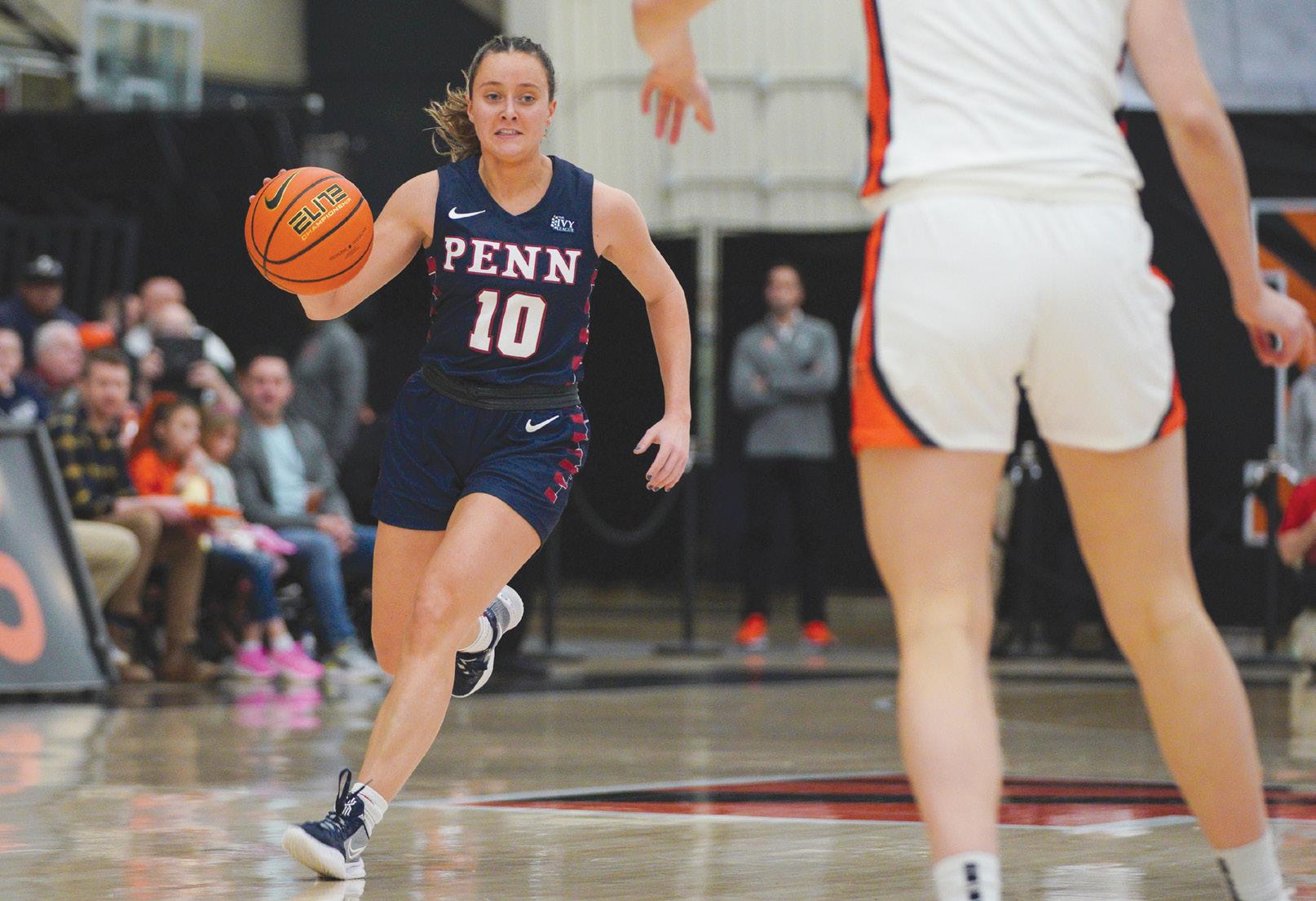
In addition to already receiving two firstteam All-Ivy recognitions with a third likely to follow, Padilla will also finish her career as the program’s all-time three-point leader and the program’s seventh all-time scorer. Averaging 17.5 points per game this season, all eyes will be on Padilla to see what she has in store for the Palestra crowd on Senior Night, capping off what has been an incredible and accolade-full career.
According to Baseball For All, women have played baseball collegiately alongside men since 1987, and at least nine female players are currently rostered on various university baseball teams across the United States and Canada. But Pichardo is the first to make it to the highest level of competition in the NCAA, and she’s doing it right here in the Ivy League. The Bears will host the Quakers for a three-game series on April 15-16.
I have long been an outspoken advocate for the growth of women’s baseball as its own distinct sport from softball. I’ve written about the history of women’s baseball, urged people to pay attention to international competitions like the Women’s Baseball World Cup, and have described my own
See BASEBALL , page 9
CONTACT US: 215-422-4640 SEND STORY IDEAS TO DPSPORTS@THEDP.COM ONLINE AT THEDP.COM THE INDEPENDENT STUDENT NEWSPAPER OF THE UNIVERSITY OF PENNSYLVANIA • FOUNDED 1885 PHILADELPHIA, THURSDAY, MARCH 2, 2023 VOL. CXXXIX NO. 8 SPORTS
PHOTO BY ANNA VAZHAEPARAMBIL
Junior guard Jordan Dingle calls out a play to his teammates during the senior night matchup against Dartmouth on Feb. 25.
PHOTO BY ANNA VAZHAEPARAMBIL
Senior guard Mandy McGurk dribbles during the team’s matchup against Princeton Jan. 16.
