News
Penn researchers co-found independent autism committee to counter federal advisory panel
The group was formed after Secretary of Health and Human Services Robert F. Kennedy Jr. disbanded a federal committee overseeing autism research
MBRESA SIMNICA Staff Reporter
Two Penn researchers are founding members of an independent autism advisory group formed in response to recent administrative changes to the federal government’s autism research panel.
The Independent Autism Coordinating Committee, launched in March 2026, was founded by 12 researchers, clinicians, and advocates seeking to provide evidence-based guidance on autism research and policy. This group was formed after Secretary of Health and Human Services Robert F. Kennedy Jr. removed the entire body of the federal Interagency Autism Coordinating Committee and appointed new members.
The federal committee, which advises the Department of Health and Human Services on autism research priorities and funding, has historically helped shape national research agendas and recommendations for federal agencies.
Psychiatry professor David Mandell, one of the independent committee’s founders, told The Daily Pennsylvanian that changes to the federal committee have raised concerns among researchers that the direction of nationwide autism research policy will shift toward having “nothing to do with the real needs of autistic people or their caregivers.”
“When I saw who was on the IACC — the federal committee — and how many of them deny the importance of vaccines or endorse unproven or even dangerous treatments for autistic people, I felt like I needed to be part of something that was more proactive,” Mandell told the DP.
Mandell, who served on the federal committee from 2012-16, said that the independent committee aims to develop a research agenda grounded in scientific
The skyline of Philadelphia viewed from Chestnut Street. evidence and the needs of autistic people and their families. He added that the group aims to influence private research funders and contribute to public discussions about autism science.
He expressed hope that “private entities that fund autism research will listen to the research agenda that comes out of this independent group and use it to decide what research they will fund.”
Amy Lutz, a senior lecturer in the History and Sociology of Science department, joined the independent committee as a researcher and parent advocate. Lutz told the DP that she came to this work because of her personal experience having a 27-year-old “profoundly autistic son.”
“We, the families like mine, are desperate for better interventions, for more research to understand the condition for better treatments for the biggest problems
Penn expands admissions assistance to military-affiliated applicants
The collaboration between Penn Admissions and the nonprofit Service to School will expand guidance for veterans applying to the University
ARTI JAIN Senior Reporter
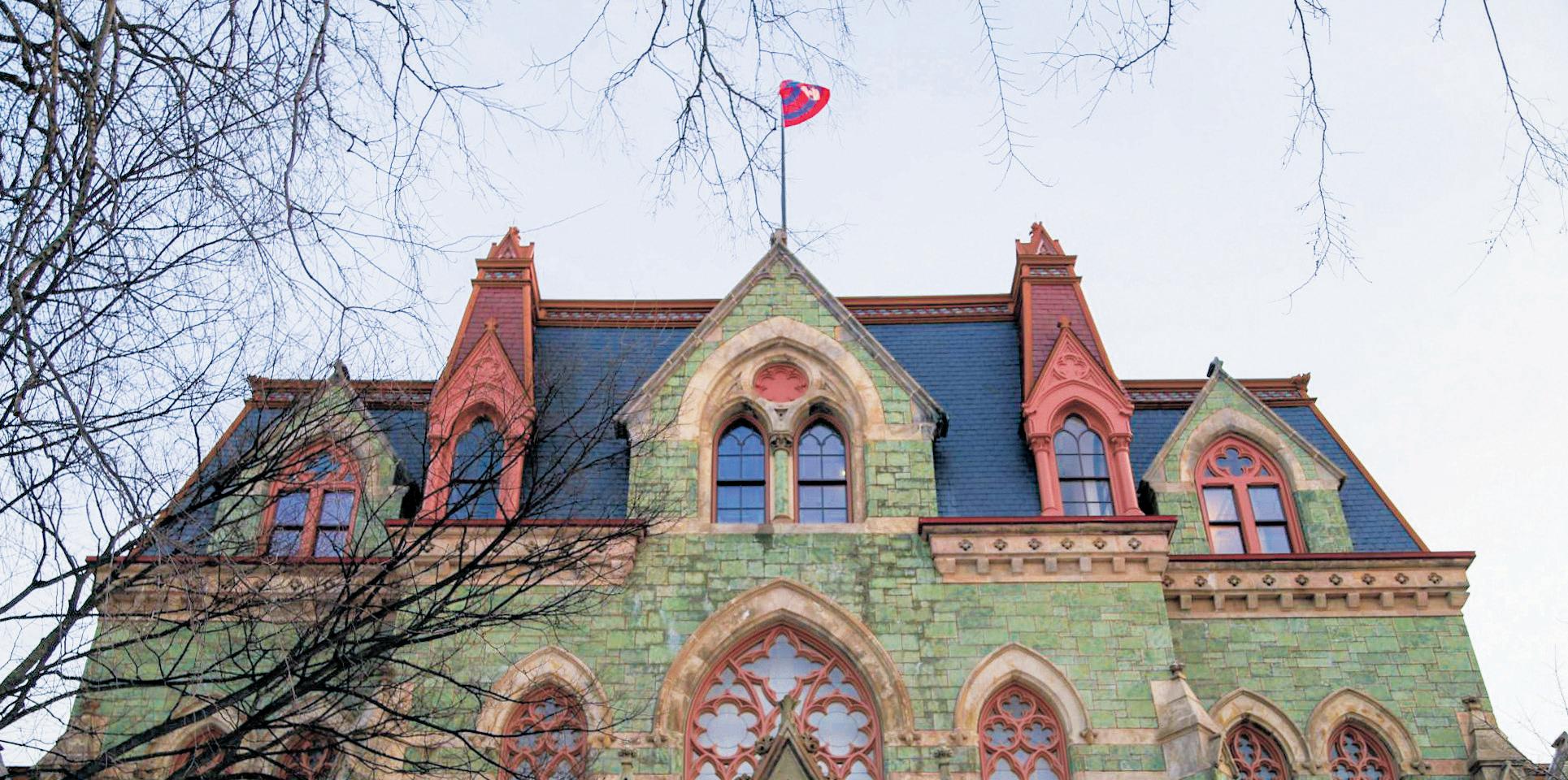
CONNIE ZHAO | SENIOR PHOTOGRAPHER College Hall pictured on Feb. 10.
Penn announced a new partnership to support veteran and military-affiliated applicants last week.
The collaboration between Penn Admissions and Service to School — a nonprofit organization that provides free college counseling to military-affiliated applicants
WCL , from front page
will allow the venue to move forward on a stronger and more sustainable foundation.”
“The Chapter 11 process provides a responsible framework to restructure the organization, attract new capital, and ensure that this important cultural institution continues to serve artists and audiences for years to come,” Diaz added.
A request for comment was left with Diaz.
The venue also announced its rebranding to “World Stage” last week. In a newly launched website, it described the move as the beginning of “Philadelphia’s new chapter in live music” and clarified that the venue plans to remain open and continue hosting shows.
“Every financial decision, every programming
will expand guidance for veterans applying to Penn.
According to a March 11 press release, Service to School will provide application counseling, mentorship, and networking opportunities to veterans and service members hoping to attend Penn.
choice, every partnership we sign goes through one filter: does this serve Philadelphia?” the website reads. “When we generate surplus, it goes back into the work. Youth programs. Free concerts. Artist development. There are no shareholders waiting on a return. There is only the mission.”
The move comes after a tumultuous year for WCL, which has faced mounting debt, worker protests, and legal disputes with Penn and the city of Philadelphia.
Last month, the City of Philadelphia ordered the venue to cease operations by March 11 after citing “serious tax violations.” The Department of Revenue revoked the venue’s Commercial Activity License and posted a notice outside the building instructing WCL to halt operations. Last week’s bankruptcy filing came just one day before WCL was ordered to cease operations.
In June 2025, a dozen WCL workers walked out during a concert to protest an “unacceptable level
plaguing our kids,” Lutz said.
Lutz explained that the committee aims to prioritize research that focuses on evidence-based approaches. She added that “it’s important that we lean into science … focus our efforts on evidence-based interventions, and we don’t waste money going down rabbit holes to chase people’s pet ideological theories.”
Both researchers expressed that the public understanding of autism continues to evolve and can be influenced by common misconceptions.
“Autism now is really conceptualized as a spectrum,” rather than a single condition, according to Mandell. Individuals diagnosed with autism can have a wide range of communication abilities, needs, and daily experiences.
Lutz added that public discourse about autism often emphasizes individuals with fewer-support needs.
“One of my pet peeves about autism discourse today is that I feel it grossly privileges those at the mildest end of the autism spectrum,” she said.
The Independent Autism Coordinating Committee is scheduled to hold its first public meeting on Thursday. During the March 19 meeting, members will introduce their areas of expertise and begin identifying priority areas for autism research.
Mandell said the committee plans to develop recommendations that reflect current scientific understanding and the needs of autistic individuals and their families.
“The idea behind this group is to proactively develop and propose a research agenda that will truly be meaningful, that is rigorous and will advance science in understanding autism and the needs of autistic people,” Mandell said.
“Penn decided to partner with Service to School because we understand that veterans not only bring unique perspectives to our undergraduate population, but also that they face unique challenges in navigating the college application process,” Vice Provost and Dean of Admissions Whitney Soule wrote in a statement to The Daily Pennsylvanian. “We want them to hear loud and clear that Penn could be an option for them!”
Soule added that veterans who went straight from high school to military service might have “different questions and different perspectives” on what they are looking for in higher education.
According to Soule, Penn has been working with Service to School since fall of 2025. Penn is now one of seven Ivy League universities partnering with Service to School through its VetLink program.
“Service to School is proud to partner with Penn to expand opportunity for veterans and service members pursuing higher education,” Service to School Chief Executive Officer Sydney Matthes wrote in the press release. “Penn offers the kind of rigorous academic environment where veterans’ leadership, resilience, and global perspective can translate into meaningful impact both on campus and beyond.”
The move comes after the Department of Defense considered eliminating tuition aid for active-duty service members planning to attend elite universities, including Penn.
Despite appearing on the shortlist, the University was not among the schools targeted in the Pentagon’s final memo. The official list of eliminated programs, published on Feb. 27, included all Ivy League institutions except Penn, Dartmouth College, and Cornell University.
Penn’s Student Registration and Financial Services webpage states that the University is “committed to supporting our veteran and military-affiliated students.”
According to the website, active-duty members, veterans, and military-affiliated dependents are “eligible for education benefits offered through the Department of Veterans Affairs.”
of hostility and mismanagement.” Several workers were later fired, and unions representing employees filed unfair labor practice charges against the venue. At the time, then-WCL CEO Joseph Callahan insisted that there was “zero probability” of WCL closing.
A request for comment was left with Callahan.
WCL is also involved in an ongoing legal dispute with Penn. In July 2025, the University petitioned a court to evict the venue’s operator, citing nearly $1.3 million in unpaid rent and expenses.
In a letter previously sent to Callahan, Penn Facilities and Real Estate Services stated that the venue’s nonpayment of expenses constituted a “Deliberate Event of Default” under the lease agreement, entitling the University to take immediate legal action against WCL. Penn also wrote that WCL “continued to ignore … responsibilities” despite receiving multiple “good faith” opportunities to make payments.
CLASSES, from front page
the process,” Dunn explained. He added that submitting a cart does not immediately enroll a student in a class, but allows students to signal their preferred classes. Ureña shared that advisors help students build their carts by putting “their primary choices” in the main cart and linking alternatives. Once advance registration closes, she said, “there’s an optimization process that happens.”
Dunn said course requests are processed through a “very complex algorithm” that randomizes student selections while working to “maximize student choice.” The system also accounts for course demand, seat availability, and the total number of offered classes.
After the system finishes running, students’ schedules are published in Path@Penn — the University’s central resource for registration, financial aid, and academic records.
Students who do not receive all of their desired classes are encouraged to speak to their pre-major advisor, which Ureña described as “the first line” of support. She also said students can continue monitoring closed courses through Penn Course Alert, which notifies users if a seat opens.
Ureña explained that some courses have specific “attributes,” meaning certain students are given preference based on their academic status. Classes may be reserved for majors within a department, “because those students who are majors in that particular program need that class.” As a result of these limitations, Ureña said advisors encourage students to list backup options. She added that the advising office focuses on how students will “encounter the registration deadlines or the options that may come up at particular moments in the semester.”
According to Ureña, more students are “getting the choices that they have selected,” whether those are their first-choice classes or alternatives.
The advising office also uses Penn’s Canvas platform to communicate with students throughout the registration cycle. Each class year has its own Compass site, where students receive reminders that Advance Registration is approaching and are encouraged to meet with their advisor.
After schedules are released, follow-up messages prompt students to review their results and seek advising support if they have questions or need to adjust their plans.
Ureña noted that she was “incredibly impressed” with Penn’s Advance Registration system, “because the chances of getting your class are more equally distributed.”
“There’s a way that those priorities are set up, but overall, I think that this is a great system because it allows for more equitable access to the courses to more students across the class years,” she stated.
While describing the course registration process, College sophomore Amy Tran told the DP that “it’s so exciting just planning my future and looking forward to all the different classes I get to take, especially with the College’s requirements offering me a sophisticated liberal arts education.”
Despite her “love” for the course registration process, Tran said that she hopes the University could consolidate platforms like Penn Course Review, Penn Course Alert, and Path@Penn.
“I feel like I’m screwing around and lollygagging when I just really want to have my primary cart assembled,” Tran said.
Although Tran described selecting alternatives as “a little bit of a hassle,” she called the process “fair,” adding that while she does not always receive all her preferences during Advance Registration, she has historically been able to stay on track academically.
“Because I didn’t get the specific econ classes I needed, I was like ‘let me just focus on my general requirements,’” Tran said. “I got more sectors and foundations done, and then when I ended up pivoting later, it was nice because I could still apply those, and then I just changed what major classes I was taking.”
College sophomore Helen Liu said previous course registration periods have been both “really fun” and “really stressful,” particularly when she registered for many courses that were “either popular or had application processes.” She emphasized that “it was hard to know whether I would be able to get into those courses before the Advance Registration deadline.”
“I ended up having a lot of chaotic switching of courses at the beginning of the semester, which was really stressful, because not only was I trying to find the right courses, I would also have to make up work when I entered those courses, and then sometimes I’d end up switching out of that too,” Liu said.
Liu also stated that academic advisors have generally been “helpful,” and peers and friends have served as a “less formalized source of help.” She said that Penn Course Review “tries to fill in that gap” by making peer feedback more accessible, clarifying that it can be “hard to get an idea of what a course will be like before actually being in the course for half a semester, and that can just be risky as a student.”
Ureña said students should “feel welcome to share with their pre-major advisor things that they’re thinking about, their goals, their disappointments.” She stated that “what we really emphasize is holistic advising, which includes understanding that as advisors, we may not have all the answers, but we want to be the connectors for you.”
ABHIRAM JUVVADI | SENIOR PHOTOGRAPHER
Penn recieves improved rating on ADL campus antisemitism report card
Penn received a ‘B’ rating on the organization’s annual report, the highest grade given to the University to date
ISHANI MODI
Staff Reporter
Penn received a “B” rating on the Anti-Defamation League’s 2026 Campus Antisemitism Report Card, an improvement from the University’s “C” rating in 2025.
The ADL’s annual report — which has tracked “the current state of antisemitism” on college campuses for three years — rated Penn “above expectations” in publicly disclosed administrative actions and “excellent” in Jewish life. However, the organization referenced broader concerns about “campus conduct and climate.”
In an interview with The Daily Pennsylvanian, ADL Philadelphia Senior Regional Director Andrew Goretsky highlighted improvements both at Penn and nationally, as well as changes to the ADL’s metrics while evaluating campus dynamics.
According to Goretsky, Penn’s higher grade reflects the University’s efforts to support Jewish students on campus, including the work of Penn Hillel and Chabad at Penn, the Jewish Studies Program, and other opportunities for Jewish education.
A University spokesperson declined a request to comment.
Goretsky credited Penn for establishing the Office of Religious and Ethnic Interests and cited the office’s programming as a key campus resource for investigations, mediation, and support.
He added that “when other institutions reach out to me and ask” how to approach campus antisemitism, he points to Penn and Temple University as examples of how to “address these issues.”
This year, Goretsky said the report card adjusted its evaluative framework to account for changing conditions on campuses nationwide. He said that severe antisemitic incidents have been highly weighted in determining the rating in past years, but that their weight has been decreased this year to account for falling frequency.
“There has been a nationally documented decline in severe incidents,” Goretsky added. “The weighting of severe and other incidents criteria has been slightly reduced.”
Criteria previously “assessed as extra credit,” such as a campus climate assessment and rules “policing” encampments and event disruption, also became part of the core grading framework this year.
In June 2024, Penn implemented temporary guidelines on open expression in response to a semester that saw increased protests and tensions on campus, including an encampment on College Green that lasted 16 days.
The temporary guidelines banned encampments, which Goretsky identified as one of the
criteria considered in the ADL’s rating. Having previously served as an administrator at Arcadia University and taught higher education law and policy at Temple, Goretsky also spoke to the limits of free speech protections on campus.
“You have the right to make the argument you want to make,” Goretsky said. “You don’t have the right to disrupt somebody else’s ability to get the education or to learn something that they’re trying to learn.”
He described himself as “a huge advocate and proponent for maintaining free speech rights” while maintaining “that schools have the responsibility to protect the environment for all students.”
The report comes as Penn faces an ongoing investigation by the United States Equal Employment Opportunity Commission over allegations of antisemitism on campus. The EEOC’s investigation — which includes a subpoena that requests information on Jewish students and faculty — sparked criticism from various members of the Penn community and external organizations, including the ADL.
In collaboration with the American Jewish Committee of Philadelphia/Southern New Jersey and the Jewish Federation of Greater Philadelphia, ADL Philadelphia released a statement in November 2025 responding to “the privacy and constitutional implications” of the EEOC’s investigative efforts.
While the organizations noted their shared commitment with the EEOC to combat antisemitism, they cautioned against “any effort (even those that are wellintentioned) to force the production of a list of Jewish faculty, staff, and students by religious affiliation, along with confidential responses from participants in Penn’s internal Antisemitism Task Force.”
“History has taught us to be vigilant when governments compile lists of people based on religious identity, and we hope that the EEOC’s important work can continue without such a list,” the statement continued.
In November 2025, the EEOC filed a lawsuit alleging that Penn failed to comply with the agency’s requirements. At the time, a University spokesperson told the DP that Penn “cooperated extensively” with the EEOC but would not provide “personal and confidential” information of students and employees without their consent. On March 10, a federal judge heard oral arguments as part of the lawsuit. “I stand by that statement that the joint of us put out back when we first learned about the investigation,” Goretsky told the DP.
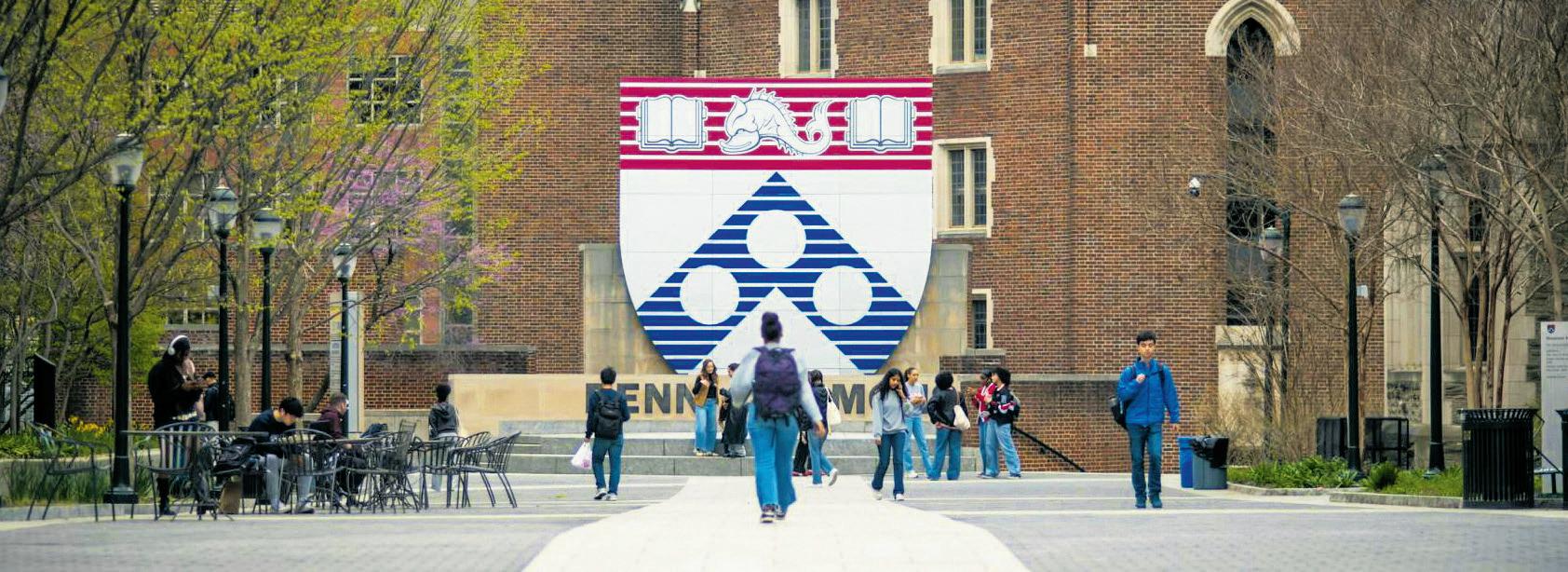
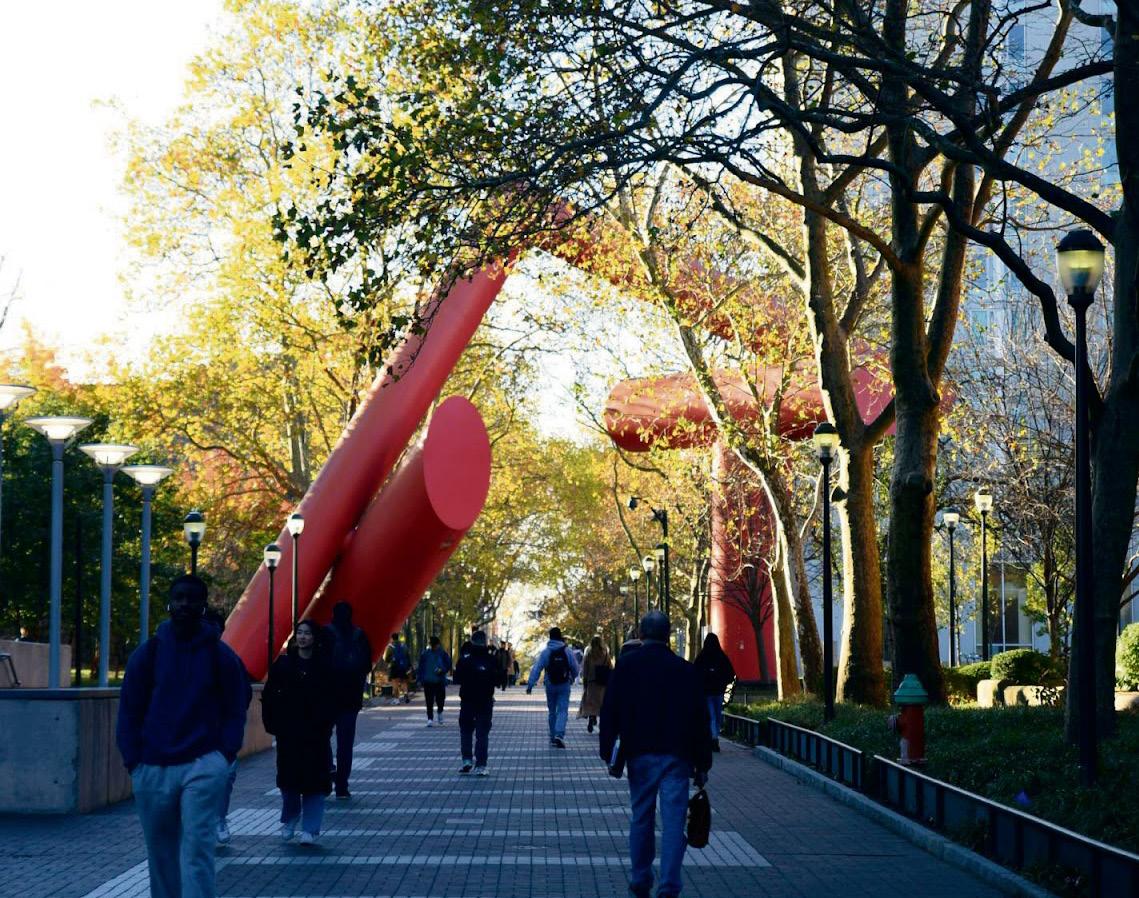
Students walked across campus on April 15, 2025.
EEOC, from front page
would be “unacceptable,” because it would be inappropriate for an employer to set the terms of such an investigation. According to Lawrence, the agency was “disturbed” by attempts to connect the suit with 1968 Wharton graduate and President Donald Trump’s administration. She said it has “tried not to engage in political rhetoric.”
Waxman — who was arguing on Penn’s behalf — alleged that the EEOC’s subpoena was not specific enough to be enforceable. “You will not find a case remotely like this,” he said. He asserted that “there is no specification, much less facts, of an unlawful employment practice” and that Penn had taken immediate corrective action after any antisemitic incidents on campus, characterizing the subpoena as “a fishing expedition.” Waxman also stated that the EEOC has a much more limited scope than other federal agencies.
“This charge fails every single characteristic the Supreme Court said puts this over the line,” Waxman said. He also said that the EEOC’s charge “doesn’t meet regulatory, statutory, or Supreme Court requirements” for relevance. He criticized the agency for compiling what he characterized as “lists of Jews” through the information requested by its subpoena.
Hamermesh and Shanor, arguing on behalf of the intervening organizations, said that the subpoena violated rights to privacy, religious exercise, association, and academic freedom.
Hamermesh stated that affected students and faculty have a significant personal interest in keeping their religious affiliation private from the government, adding that collecting this information would be “shocking to the conscience.”
He also said that the particular combination of knowing someone’s contact information, home address, and religious affiliation warranted a right to privacy, even if the separate pieces of information might not.
Hamermesh pointed to activities hosted by the Jewish Law Students Association, such as Friday night dinners and readings of the Torah, as examples of religious exercise that would be chilled or impeded by the subpoena.
Shanor cited the declarations filed in the
intervenors’ brief as evidence that the subpoena would have a chilling effect on free association. She said that even a risk of impeding the right to freely assemble is sufficient to render the subpoena unconstitutional.
She added that while the EEOC was under no obligation to cooperate with the University, it was required to act in the least harmful way to the constitutional rights of students and faculty.
In response to the defendants’ arguments, Lawrence reasserted the constitutional basis of the subpoena. She stated that fear of possible repercussions was not sufficient to undermine the EEOC’s investigations and said that employer-employee confidentiality could not lawfully exclude federal agencies like the EEOC.
“Antisemitic incidents have plagued this workplace,” she said on Penn. “We are exactly where we should be: here in this case.”
In November 2025, the EEOC filed a lawsuit alleging that Penn failed to comply with the agency’s requirements. At the time, a University spokesperson told the DP that Penn “cooperated extensively” with the EEOC but would not provide “personal and confidential” information of students and employees without their consent.
That month, hundreds of members of the Penn community signed a petition criticizing the actions taken by the EEOC. Faculty and student groups highlighted concerns about the historical connotations of collecting personal information on Jewish individuals.
Other campus stakeholders have characterized the EEOC’s investigation — which included obtaining the personal phone numbers of Penn community members — as “odd” and “amateurish.”
In January, Penn submitted a brief in response to the agency’s claims of noncompliance, stating that the University has agreed to the agency’s demands, but remains unwilling to submit personal information without the consent of the affected parties.
The brief described the subpoena as “disconcerting but also entirely unnecessary,” arguing that disclosing private details would “erode trust between Penn and its employees and the broader Jewish community at Penn.”
In a filing later that month, the EEOC claimed Penn “impeded” the agency’s investigation into allegations of campus antisemitism and that its subpoena was “no different” from other requests for information in previous investigations. The Penn-affiliated groups motioned to intervene as defendants in the lawsuit in January and were approved on Feb. 3.
WASHINGTON, from front page
partnership with the Wharton School, with the Penn Development Research Institute, with Perry World House, any number of other partners,” Schneiderman said.
He said a central goal of the programming will be to involve students in policy discussions and expose them to real-world policymaking processes. Last month, Schneiderman — alongside leaders at PWH — weighed in on the implications of the Iran war.
“It’s intended to inform and enrich the educational experience of students at every level at the University,” he said.
“I intend to be front and center in what we do here,” Schneiderman continued. “If I can play some small role in helping enrich the academic experience of Penn students, both graduate and undergraduate, then I’ll have considered my job done.”
Nicholas — who joined Penn Washington this February as domestic policy programs coordinator — previously worked on child care policy and on artificial intelligence initiatives at the Chamber of Commerce Foundation. She described her move to Penn Washington as a transition to higher education after working primarily in government and with nonprofits.
One of the first things that stood out, she said, was the scale of the University.
“I was very surprised at how large the University of Pennsylvania was,” Nicholas said. “There’s so many moving pieces, but the exciting part is that just within one organization … there’s so many connections you can make.”
Nicholas said the program’s domestic policy portfolio reflects a wide range of policy conversations taking place in Washington — including discussions on “climate, healthcare, AI governance, [and] democracy.”
She added that many of the center’s policy discussions increasingly intersect with AI, which she described as a “hot topic” in Washington.
Nicholas said the center has already hosted programming exploring those intersections, including discussions on the future of work and labor markets as well as research on the relationship between AI, energy demand, and grid reliability.
Hinshaw, who joined Penn Washington earlier this month as a global policy programs coordinator, previously worked at the Washington campuses of Arizona State University and Purdue University.
She characterized her career thus far as being at the “intersection of higher education and international affairs.”
“I’ve always really loved aspects of subnational diplomacy,” she said, describing the concept as using institutions like universities to help influence foreign policy debates.
As she begins her tenure at Penn Washington, Hinshaw said she is focused on learning about the University’s research ecosystem and building connections with faculty and students.
“Learning from all of the incredible expertise across disciplines and starting to think proactively about how we can better engage students through the global policy work will definitely be something I’m excited to do,” Hinshaw described.
The University Board of Trustees discussed plans for Penn Washington’s future at a meeting of the body’s Local, National, and Global Engagement Committee earlier this month.
At the March 6 meeting, Patrick Harker, director of academic engagement at Penn Washington, said he hopes the center will bring “sustained engagement” to Washington.
“But what we’re looking at is sustained engagement to influence policy, to have an impact on policy, and that’s important for a couple of reasons,” he explained. “One, I think the country, the world is hungry for this, right? Fact-based, objective. That’s what we do here at Penn.”
Penn Washington inaugural Executive Director Celeste Wallander echoed a similar sentiment at the meeting.
“Our focus is largely using this fabulous space to create the opportunity for sustained engagement with the policy community and a safe space for speaking about policy ideas and solutions, again, informed by knowledge research and evidence-based findings from the University,” she said.
The new hirings come after Wallander spoke about her intention for the center to build toward a more robust presence in Washington in an August 2025 interview with the DP.
“I think that, especially at a time when there is unfortunately a public narrative questioning the value of the universities in general, it is really important for policymakers, the media, the international community, and really the American people to understand that universities are able to help provide solutions that are really important to people’s daily lives,” Wallander said at the time.
Penn Washington was launched in June 2024 and has already hosted a wide range of programming for students, researchers, and faculty.
CHENYAO LIU | SENIOR PHOTOGRAPHER
MILLIE WANG | STAFF PHOTOGRAPHER
arguments between the University and the EEOC took place on March 10.
JESSE ZHANG | DP FILE PHOTO
Capitol Hill pictured on March 29, 2023.
Editorial | Penn has an AI problem
In 2024, Penn made history by becoming the first Ivy League school to launch a major in artificial intelligence. Gutting its systems engineering major, the University justified the replacement as a program that would “fit the AI-powered needs of the 21st century.”
Since then, AI has become intertwined with obtaining a Penn education in completely unprecedented — and potentially dangerous — ways.
Our AI course offerings have exploded. Penn now offers 10 undergraduate programs, 21 graduate programs, and eight doctoral programs in the field. The University has also launched a new AI fellowship and invested millions of dollars in AI research, particularly within the field of education. In perhaps its strangest display of support for this technology, this April will mark the inaugural AI Month at Penn, with a slate of events planned to “highlight work across AI in health, science, education, business and public life.” In many ways, these changes make sense. In a world increasingly defined by AI, elite universities are doing whatever they can to keep from falling behind. By implementing AI into its education system, Penn aims to produce graduates who can succeed in a newly transformed job market, while retaining its dominance in technology, medicine, and business. Above all else, the University wants to prevent itself, along with the entire institution of higher education, from becoming obsolete. But as this pattern speeds up, Penn’s commitment to AI innovation seems less like an enhancement to our learning and

Back in 2024, The Daily Pennsylvanian polled Penn students and found that nearly 80% of them were planning to vote for then-Vice President Kamala Harris to be the United States’ next president. That striking number paints an all too familiar picture. At Penn, we’re told that most everyone is devoutly liberal and that our University constantly embraces progressivism. That picture, however, does not reflect the reality of our much more ideologically diverse campus. Before college, I thought of Penn, and all of the United States’ most prestigious universities, as consistently left-leaning spaces. Recent political backlash hints at that same conclusion. But once I arrived on campus, I noticed something quite different from what I’d imagined. Whether it was the vigor with which people worship major industries or the intense disapproval of University policies allowing 2022 College graduate Lia Thomas to compete on the women’s swim team, I saw a conservative shadow cast by Penn students. Based on those formative observations, I’ve maintained that Penn students are truly moderate or ambivalent
more like a detriment to our critical thinking abilities. In its tireless support for AI, the University has essentially endorsed shortcuts and the outsourcing of academic thinking, threatening the very freedom of inquiry and open expression it claims to promote.
In spring 2024, a Student Committee on Undergraduate Education survey found that 83% of Penn undergraduates disclosed that they had used AI in an academic setting. Penn is caught up in a national trend — in 2025, 90% of American university students admitted to using AI academically and 75% said that their use has increased over the past year. Ask any student on campus, and they’ll give you an exhaustive list of all the AI programs they use — some to help, some to teach, and some to simply do the work for them. While it may seem convenient to plug a problem set or 40-page reading into ChatGPT, the drawbacks of AI usage are widely documented and increasingly detrimental. Students develop an overreliance on AI, social interaction and communication are reduced, AI programs produce and reinforce biased and false information without any accountability, and critical thinking is inhibited. As Penn students, our purpose is to take advantage of our education, not give it away to an AI model while we sit by passively.
Despite Penn’s apparent focus on AI and its functions, there is no University-wide policy on how students can and can’t use it in the classroom. The only established statement from the University is a vague statement of “guidance,” offering suggestions and
vague regulations on the use of AI. However those “guidelines” mostly favor the use of AI, stating that professors aren’t allowed to check students’ work for generative AI without their explicit permission and that all professors are given the reins to implement AI within their courses as they see fit. So, while some professors may strictly forbid AI in all its forms, others encourage us to generate practice problems or develop an argument with the help of AI. These vastly differing policies and ideologies leave students completely in the dark about potential consequences of AI usage in our education and with no consistency between class guidelines.
Penn’s lack of transparency on its AI policy combined with the University’s everincreasing dedication to AI innovation teaches students an unexpected lesson: AI is no longer a tool with potential benefits, but a prerequisite for living. While elite institutions like Penn would never explicitly endorse the use of generative AI in schoolwork, they seem to welcome the technology in almost every other form and setting.
Through its countless new programs and AI-centered events, Penn has positioned AI as an inescapable future that we all must accept in order to achieve success. There is no doubt that AI is part of the current occupational landscape, and we will certainly encounter it long after we graduate. Nevertheless, we attend this institution to develop hard skills, question the world around us, solve problems, produce new ideas, and the ability to think for ourselves. With the University
forcing AI into our learning every chance it gets, do we end up gaining knowledge or cheat codes?
Goldman Sachs reports that 300 million full-time jobs could be replaced by AI by 2030. Labor turnover is high and hiring has slowed. 71% of Americans worry that AI will cause permanent job loss. As young people about to enter the workforce for the first time, the fear of unemployment is understandable, but we cannot save ourselves with the very tool that is putting us at risk.
The irony is that as Penn pours endless money and energy into AI advancement in its attempt to get ahead, the University is only quickening its own demise. AI cannot coexist with education — it can only degrade it. As technology advances and workers are replaced by machines, schools are some of the only places we have left to explore and wrestle with human thought. With our own university leading the charge, AI is now corrupting those few sacred spaces and leaving us with nowhere to engage in true scholarship.
Editorials represent the majority view of members of The Daily Pennsylvanian Editorial Board who meet regularly to discuss issues relevant to the Penn community. This body is led by Editorial Board Chair Jack Lakis and is entirely separate from the newsroom. Questions or comments should be directed to letters@thedp.com.
as a collective, not just liberal.
To test my theory, I spoke to three leaders in Penn’s chapter of College Republicans, who each asked to remain anonymous. When I asked if they also thought there were more conservatives at Penn than we usually recognize, one interviewee said that “even outside of College Republicans, I’ve noticed many Penn students with more conservative opinions, especially related to economics.” Another interviewee shared, “There are many issues that Penn students who aren’t Republicans will still take more conservative positions on, anyway.” They continued to say that conservative beliefs on social issues also exist at Penn, but many are “scared to share them.”
Aside from a person’s political beliefs, even one’s presence at Penn is a symbol of conservatism. After all, Penn practices legacy admissions, is extremely prestigious, and wasn’t fully co-educational until the 1970s. None of that signals a bastion of progressivism to me. I would argue that each of us has made the deeply conservative choice to attend or work at Penn.
I asked my interviewees if they agreed:
Does Penn have a conservative institutional character? Once again, they all said yes. One shared that they “strongly agree,” and that Penn students embrace this conservatism through faith in “prestige” and “meritocracy.” While the term meritocracy has a philosophical depth beyond any political binary, wanting to chase prestige aligns itself with conservative ideals like hierarchy and traditional authority. I don’t think it’s irrational to want a prestigious education or career, though that desire ultimately buys into a conservative ideology.
So regardless of the self-espoused politics of its students and faculty, Penn is a deeply conservative institution. That’s the uncomfortable part for many of this article’s readers. It’s one thing to recognize that you disagree with an institution, but it’s a different and equally important thing to reconcile your decision to attend and participate in it. Put simply, you may have more conservative values than you even realize, as evidenced by your choice to go to Penn.
Despite our university’s undeniably conservative posture and our ideologically

diverse student body, Penn students don’t feel comfortable expressing conservative dissent. My interviewees each strongly agreed that they had to avoid expressing their political beliefs, citing fears of social exclusion or academic retaliation. Perhaps this is unsurprising, given that Penn consistently ranks poorly in the Foundation for Individual Rights and Expression’s annual campus free speech rankings. FIRE’s methodology relies, in part, on the number of Penn students who regularly self-censor, which they estimate could be as high as 52% of students. I’d wager a bet that most of those students are shying away from their conservative beliefs. It goes without saying that self-censorship is a problem. The marketplace of ideas means that weaker positions fail to gain traction because of their relative inferiority. When conservative or even ambivalent students don’t feel comfortable sharing their thoughts, that marketplace loses value. We all benefit from sharing controversial ideas. It makes our own perspectives sharper. This phenomenon is impossible if conservative students are actually facing social punishment for their views, as one of my interviewees has alleged. This intolerance is especially troubling in a place like the Ivy League, where conservative values, like prestige, benefit all of us. To be clear, I doubt that conservatives outnumber liberals on Penn’s campus. However, it’s important to add nuance to your understanding of the politics of Penn’s student body. Not everyone falls in line to advocate for progressive ideals, and many students don’t label their beliefs at all. You should hold that in mind whenever you engage in discourse at Penn. And, rather importantly, you need to think about where you actually stand and rationalize your own conservatism.
CATHERINE GARCIA | DESIGN ASSOCIATE
Penn is so high school
M’S MANIFESTO | Stop being obsessed with social status
I was having a conversation with one of my friends the other day, talking about how sometimes it feels like it is hard to meet people at Penn who are open and friendly. For a school that’s known as “the social Ivy,” students here seem to be oddly closed off within their respective bubbles. Then, my friend said something that caused me to sit back and reflect: “Penn is more cliquey than my high school was.” At first it sounded weird. Haven’t we outgrown the homeroom drama and era of recess cliques? Aren’t cliques something from our lives in the 2010s when other kids would decide if you were able to enter the playhouse or not?
Unfortunately, at Penn the obsession with cliques and social status is very much alive and thriving, even though most of us are past 20. Even though we claim that we go to “the social Ivy,” our culture rewards exclusivity, undermining the community we claim Penn fosters. The idea of exclusivity permeates every aspect of campus, as if we are still kids competing for spots in the playhouse. Living in the high rises is perceived as “sceney” because “it’s like the Quad for sophomores.” Wearing certain clothes and being able to get into certain clubs all add to Penn students’ social capital. With all this in mind, it’s
Work
hard,
not hard to see Penn as just four more years of high school.
While writing this column, I spoke to two first years, who gave me their perspective on coming to Penn. One of them noted that the first thing that stood out when they arrived on campus was how “exclusionary” everything was. This is ironic, considering Penn has over 10,000 undergraduates. You would assume that having more people around you would make it easier to find community; however, this first year noted how Penn students are “always trying to create extra groups of those who are in versus the ones who are out.”
The other first year I spoke with expressed how creating friendships at Penn feels “unnatural” because people at Penn are very transactional. Even as something that’s supposed to make students’ lives easier, friendships often actually end up making life unnecessarily stressful. Progressing friendships beyond just waving on Locust Walk or grabbing the occasional dinner can be quite challenging when so many refuse to look beyond a surface level.
“We dismiss each other based on status symbols, without even taking the time to find out who they are,” one of the students said.
Yet so many of us pretend this isn’t happening. We call Penn the “social Ivy,” post a few pictures, and call it a day.
post harder
A VS. K | Penn needs a real online community
We need to realize that even the spaces we use to build
community are flattened out into vehicles for social hierarchy.
These hierarchies don’t appear out of nowhere — they are reinforced by the same institutions meant to build connection. Take clubs or greek life, for example. Early in November, sororities market their sisterhood as a way to find community at Penn. However, when recruitment becomes about perceived tiers and insider knowledge (like dirty rushing), it cements the idea that belonging is something you earn through status rather than create naturally through connection.
As a junior in greek life, I couldn’t be more grateful for the chapter I found and the community I was able to build. I’ve seen how much work and care goes into fostering sisterhood. So why do we so often let it get reduced to just a status symbol?
Belonging, whether in a greek organization or a preprofessional club or a performing arts group, should not be treated like a merit badge. Penn students should remember that in four years, the tiers, the rankings, and the letters won’t matter anymore. It is time to redefine what the social Ivy should be; we left the playground years ago, and it’s time our social culture does too.
MARIANA MARTINEZ is a College junior studying political science from Bogotá,
email is marmari@sas.upenn.edu.
I get it, though. No one is racing to watch a video showcasing someone’s Friday math quiz, a 2 p.m. nap, and an unimpressive dinner at 1920 Commons. Yet, those in-between moments are the ones most students can actually recognize. Editing them out can make Penn look more impressive, but it also makes it feel less real.
Constantly consuming this extremely edited content can make our day-to-day lives feel slower, lonelier, and completely unproductive. You no longer look at these “Pennfluencers” and see a shared experience, but instead a reflection of your personal failures. It can begin to feel like you’re not holding yourself to high standards, as if you lack the hustle that everyone else seems to possess so easily.
There are already plenty of sources where our ambition is on display. Our LinkedIn feeds overflow with Penn achievements, and our club social media pages showcase members’ incredibly polished resumes. With the existing Penn Admissions Instagram page and the thousands of “takeovers” highlighted on club accounts, so much of our content is already designed to impress outsiders.
So why not try to create more space that can authentically reflect the insiders? A space where students can talk candidly about college mistakes, the club rejection that stung extra hard, or the quiet periods in between the noise. While it might sound mundane, it could be the type of content that strengthens the community within our University.
Currently, the closest thing Penn has to any sort of centralized online student community is Sidechat. But the app’s anonymity, while freeing, also emboldens our cruelty. I have heard people openly admitting to “trolling” or “ragebaiting,” even when fellow students share vulnerabilities and fears, like failing a midterm. Instead of finding reassurance, you are met with sarcasm or mockery — responses designed to provoke others into unease. In some ways Sidechat feels like Instagram’s evil twin; while Sidechat amplifies negativity and cynicism, Instagram curates extreme perfection. I am by no means suggesting a Penn-centered online community that downplays real achievements and busy schedules to appear more relatable. Rather, showing the boring in-between moments could be the answer to providing some comfort in our student body. At times, a “day in the life” of many, if not most Penn students, can be exciting and truthfully busy. Yet, showing those moments of procrastination and self-doubt can be exactly what Penn needs to feel more human.
Sometimes, it can seem as if everyone around you is excelling in all aspects. And while this can be motivating at times, it also creates an illusion that doesn’t speak to the majority of the student body. Documenting the inevitable bumps in the road won’t make you appear weak; it might actually spur a moment of mutual recognition through the screen. It could even serve as a reminder that behind our polished academic trajectories lies a much more complicated reality.
ALYMA KARBOWNIK is a College sophomore from Maplewood, N.J. studying international relations and environmental studies. Her email is alymak@sas.upenn.edu.
CATHERINE GARCIA | DESIGN ASSOCIATE
Columnist Alyma Karbownik critiques Penn’s performative online culture and advocates for more authentic spaces that reflect student experiences.
CHENYAO LIU | SENIOR PHOTOGRAPHER Senior columnist Mariana Martinez criticizes Penn’s social scene and calls for students to be more outgoing.
Colombia. Her
, from back page
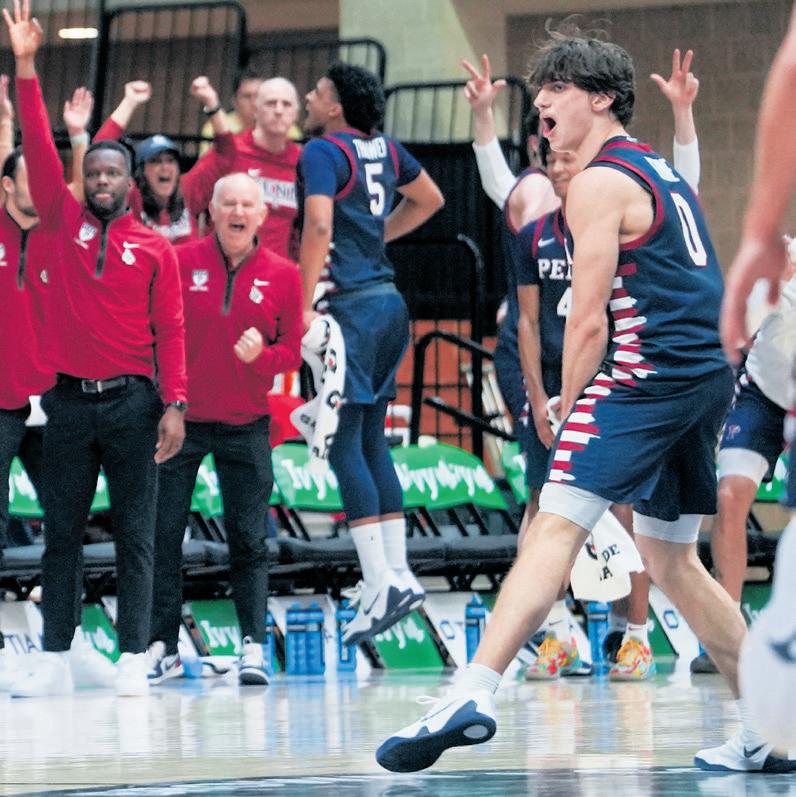
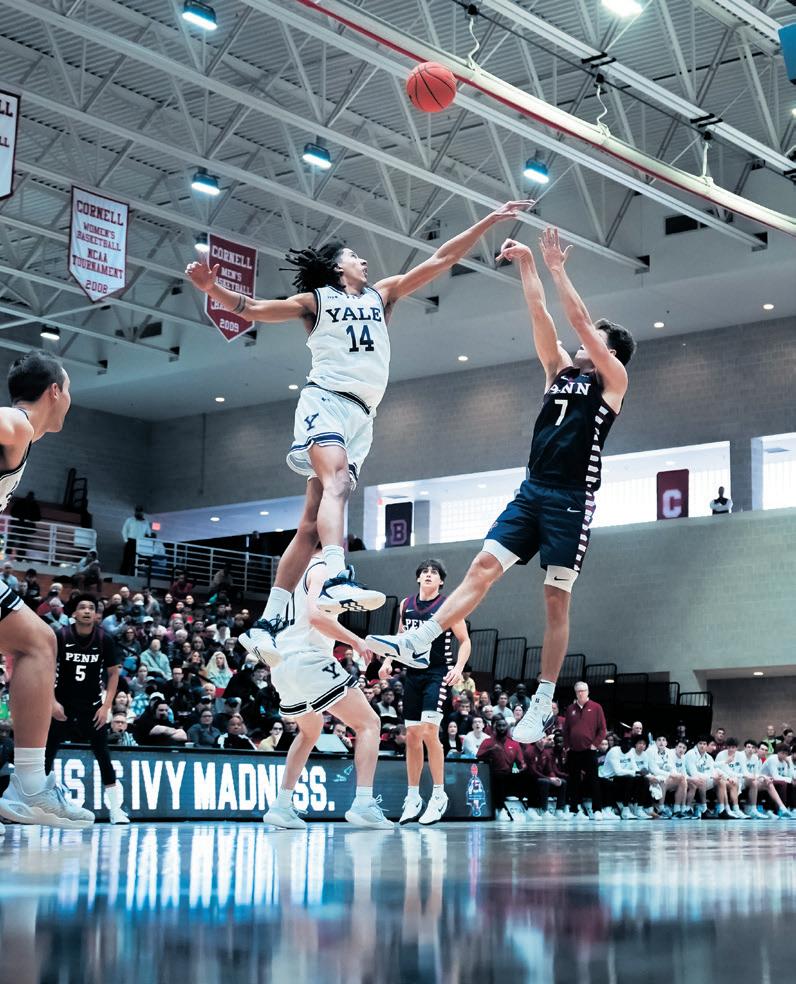
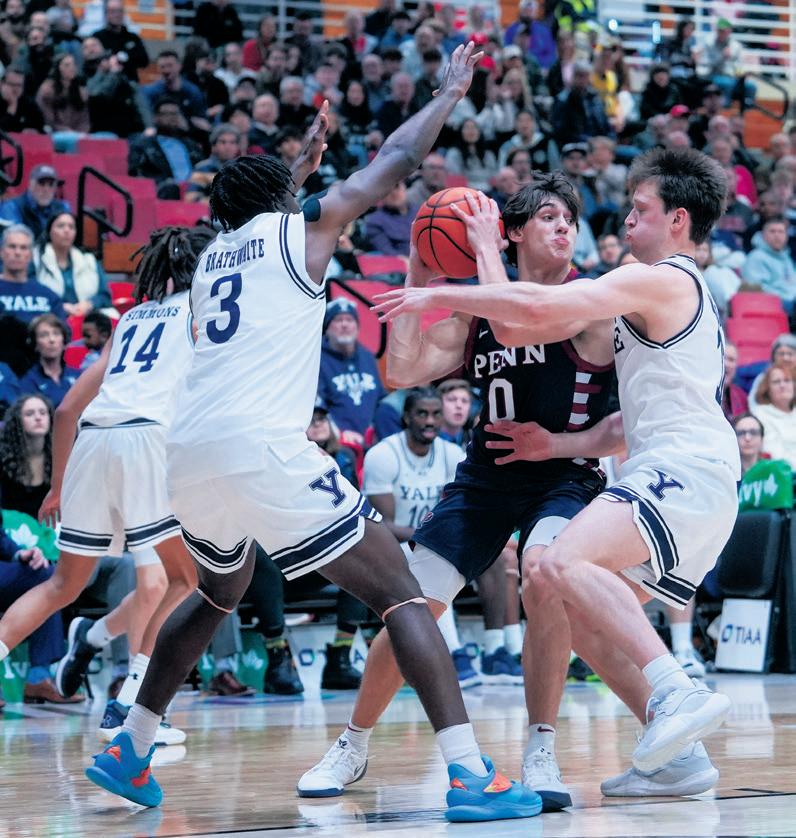
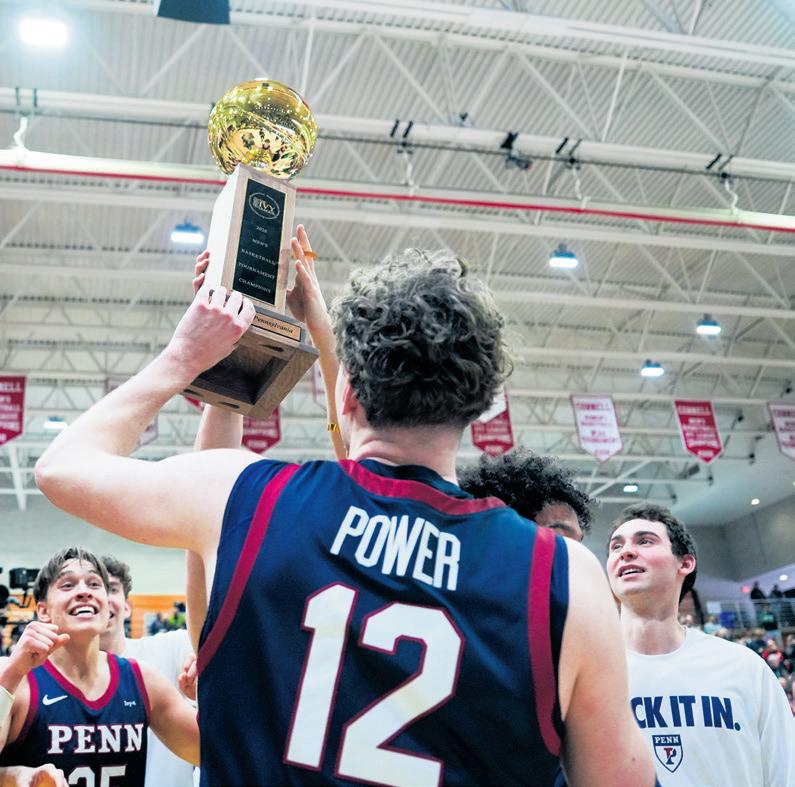
Here, Thrower showed another dimension. As Power caught, Thrower noticed Yale guard Jordan Brathwaite’s ball-watching and smartly cut to the rim, finishing the and-1.
“I appreciate the man to my right for trusting me to make those types of plays,” Thrower said, referring to McCaffery. “Throughout the course of the year, it’s been about how I can help this team win, no matter what capacity. And tonight, I was able to hit some shots, make some plays, and it paid off.”
“From minute one, he separated himself,” McCaffery said of Thrower. “Early workouts, early practices … He’s also a versatile guy. He can play the point, he can play the off-guard position, he makes threes, but he also defends and rebounds, so you can switch with him. And he’s smart, and he’s sort of fearless.”
“When I said to him, ‘[Roberts isn’t] playing,’ he goes, ‘Don’t even worry about it, I got you.’ And right after the game, he said, ‘I told you.’” Defensively, it took a full 45-minute effort for Penn to finally vanquish the conference’s top seed. In two regular-season matchups with the Bulldogs, Penn majorly struggled to contain
Yale’s rare combination of size and strength. On Jan. 24, Townsend barreled through the Quakers for 17 points on just nine shots. On Feb. 21, Celiscar bulldozed his way to 16 points and 14 rebounds.
Penn would not be bullied again. While Yale’s big three of Townsend, Celiscar, and Simmons each found success (all three players scored 17 points, while Mullin added 22), there were enough small victories to keep the Bulldogs from pulling away. The Quakers, who lead the conference in forced turnovers during conference play, forced three apiece on Townsend and Mullin, including one on the latter in overtime that led to a Thrower three-pointer to put Penn ahead at a score of 82-78.
The Quakers’ defense in the extra period was ultimately the difference in the game. Penn held the Bulldogs to 3-for-9 shooting from the field, a clip that stemmed from the ways McCaffery adjusted his team’s front.
In regulation, Yale found tremendous success when it was able to situate Townsend and Celiscar in their offices on the block. When the post phenoms weren’t scoring for themselves, they were dishing to others — the pair combined for 11 assists on the day.
Here, Celiscar drew three Penn defenders near the rim, and from there, it’s pick your poison. Levine takes Mullin away, so Celiscar finds
Townsend for an easy top-of-key triple.
In overtime, Penn deployed a few different approaches, including isolated instances of zone, which it also utilized in the second half. Those tactics helped limit Townsend and Celiscar’s post-wrecking while simultaneously containing their kickout options. The result? One of the nation’s most patient, methodical offenses forced several contested looks, including Mullin’s missed three with 25 seconds to go.
“We mixed in a little bit of zone there, just to give them a different look,” McCaffery said. “They gotta run some different stuff. I think that was helpful. [They] can’t go as much backdown game when you’re in zone.”
Finally, Penn’s championship triumph was fueled by substantial mental toughness and an ability to withstand Yale’s punches.
In the first half, Penn went scoreless for over four minutes as Yale rattled off an 8-0 run, and shortly thereafter, a Townsend free throw put the Bulldogs ahead 25-16. The Quakers then went on an 8-1 run to cut the lead to one.
The game featured eight ties and 13 lead changes as the Red and Blue refused to let Yale out of reach in the second half. And of course, after trailing by six with under three minutes to go, Penn outscored the Bulldogs 10-4 the rest of the way, with all 10 points scored by Power.
“It’s just a will that we have,” Power said.
“We’ve been building that all year. We expected close games; we didn’t expect two overtime games. But I knew once it went to overtime, that’s our advantage every time. We’re fighters.”
There are countless storylines to recollect in the wake of Penn’s stunning victory.
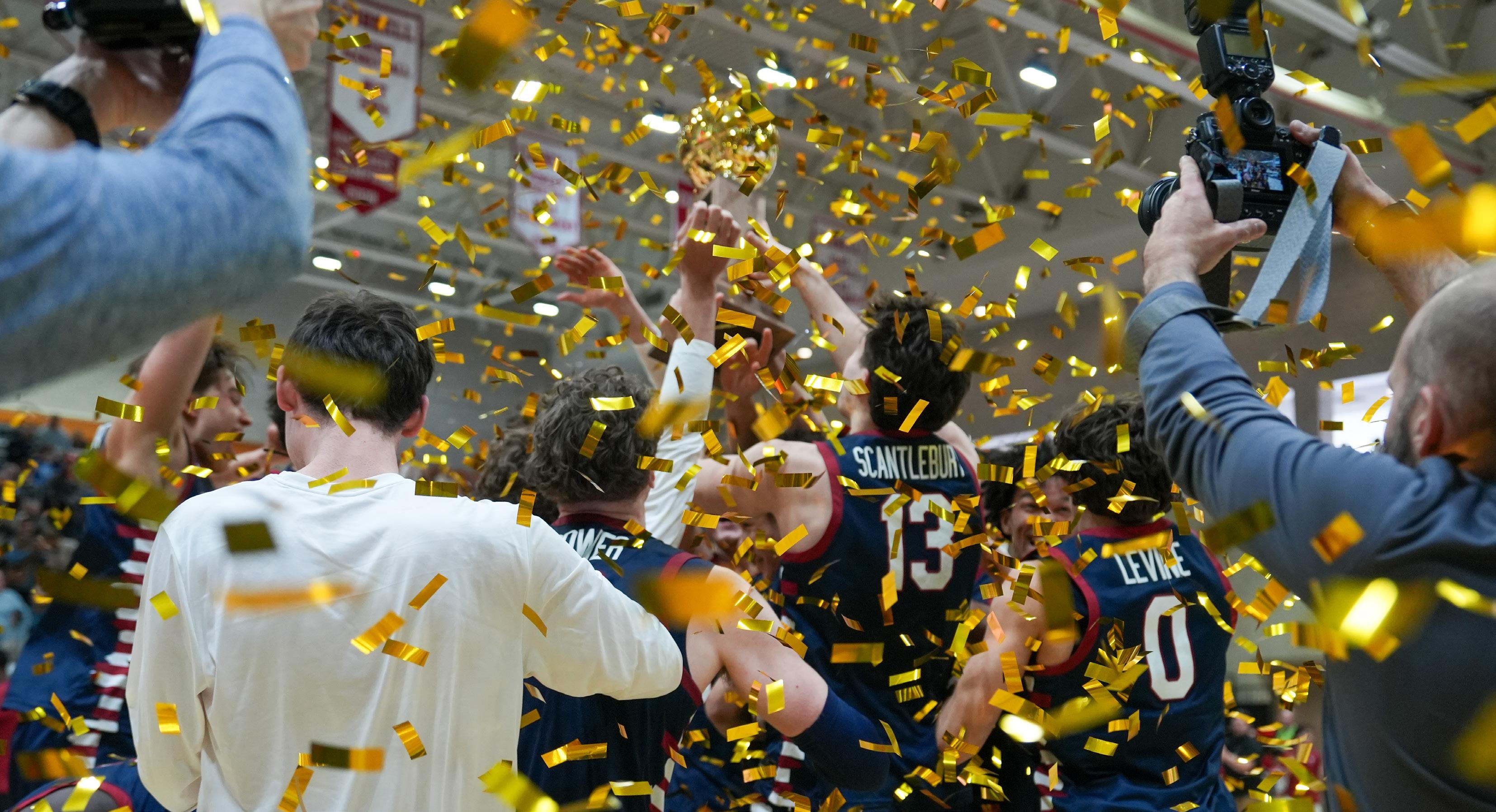
The Quakers finished seventh in the Ivy League in each of the last two seasons before hiring McCaffery, who became just the fifth coach in D-I history to lead five different programs to the NCAA tournament. Penn was picked seventh again in this year’s preseason poll and sat 2-4 in conference play before winning nine of their last 10 games. After losing their senior captain a few days before the tournament, the Red and Blue pulled out victories against the conference’s top two seeds en route to their first March Madness trip in nearly a decade.
The preparation process will soon begin anew for the Quakers after drawing Illinois as their first-round tournament opponent. But for now, and forever, Sunday’s win is etched in gold.
THREADS
WALKER CARNATHAN is a College senior and former Sports editor from Harrisburg studying English and cinema and media studies. All comments should be directed to dpsports@thedp. com.
CARNATHAN
KENNY CHEN | SENIOR PHOTOGRAPHER
an 84-81 lead into the final minute.
Thrower ended the day as the only other Quaker in double digits, with a career-high of 19 points while shooting four of six from beyond the arc.
In the college basketball world of transfer portal shake-ups, Thrower is notably the only senior on the roster to have been with the program since his freshman year, as well as the only player to have experienced Penn’s appearance in 2023 Ivy Madness.
“It feels amazing,” Thrower said of the win. “I appreciate [McCaffery] for trusting in me to make those types of plays … And for me, throughout the course of the year, it’s been about, ‘How can I help this team win,’ no matter in whatever capacity, and tonight, I was able to hit some shots, made some plays, and it paid off.”
Throughout the game, Penn’s defensive efforts also proved critical. The Quakers largely shut down Yale’s elite three-point shooting — holding the team that is second in the nation in three-point efficiency to just 37.5% shooting from beyond the arc. In overtime, the Red and Blue held the Bulldogs’ offense to just three of nine field goals and two of five from beyond the arc.
“We mixed in a little bit of zone there. Just to give them a different look. They got to run some different stuff. I think that was helpful,” McCaffery said regarding his team’s overtime defense. “They showed some grit. And when you’re coming down the stretch in a championship environment, you have to grit.”
As minutes turned to seconds in overtime, Yale fouls sent Penn to the line four times in the final 17 seconds. Senior guard/forward Michael Zanoni’s free throws cemented the victory to send the Quakers dancing for the first time in eight seasons.
On Thursday, the newly crowned Ivy League champions will tip off their first-round matchup against Illinois at 9:25 p.m. at the Bon Secours Wellness Arena in South Carolina.
Containing the Illini will be a tall task for the Quakers. Coach Brad Underwood’s group ranks second in the nation in KenPom adjusted offensive efficiency, wearing down opposing defenses with a rare combination of size and shooting.
Illinois has one of the tallest lineups in the nation with an average height of roughly 78 inches,
SQUASH, from back page
Though Hafez won his individual match, his concern was about the team.
“He is the consummate team player, he’s someone that I would pick on my team any day of the week and place on Sunday,” Lane said of Hafez. “I always want him on my team.”
As Hafez prepares to move on from Penn squash to a full-time professional career, he leaves a team grateful for his leadership and example.
“I think he’s probably one of the grittiest players out there,” junior Varun Chitturi said regarding Hafez. “He’s gone through some really, really, really tough times over the year.” Chitturi spoke about when Hafez had to return to Egypt for personal reasons when the team faced an important match against Yale the following week.
“I distinctly remember him saying … ‘No, I’m gonna be back for the Yale match. No matter what,’” Chitturi said. “That just shows how much he dedicates to this team, how much he’s invested in it, how much grit he has. Even though all this shit he’s been through, he still comes
including twins center Tomislav Ivisic and forward/ center Zvonimir Ivisic, who stand 7-foot-1 and 7-foot-2, respectively. Guard Kylan Boswell, who is 6-foot-2, is the only starter listed below 6-foot-6.
Finding a weak shooter in Illinois’ lineup is even more difficult. All eight of the Illini’s typical rotation players — those averaging more than seven minutes per game — shoot better than 30% from three on more than 2.5 attempts per game each.
“They have talent everywhere,” Power said. “Individually, if you look on paper, you might not favor us or our matchups defensively. But if we can be more connected, if we can be on the same page, we can [succeed].”
“They’re big guys — we have to be super physical with them,” sophomore guard AJ Levine — the hero of Penn’s semifinals game against Harvard — said. “But then it also takes an increase in intensity as the game goes on, understanding personnel, understanding the dudes that are hot and the flow of the game.”
The Illini are particularly effective out of the pickand-roll, and that starts with guard Keaton Wagler, the Big Ten Freshman of the Year and a projected NBA lottery pick. Wagler stands 6-foot-6 and shoots 40.2% from the three-point range, making him a threat when he shoots, drives, or passes.
“I’m just excited for the opportunity, to be honest with you,” Levine said. “Being able to play against a dude that’s going to the NBA one day … I’ve always wanted to have a chance to prove myself as an elite defender, so I’m going to go out there and just play my butt off and see what happens.”
When Wagler does facilitate, Illinois has the shooters to finish. Notably, both Ivisic twins shoot more three-pointers than two-pointers, adding another wrinkle to Penn’s guarding approach.
“It starts with Wagler, but he’s not the only one,” McCaffery said. “They got a lot of different guys that can create and multiple people that make threes, so that makes them really hard to guard.”
“I have so much confidence in this coaching staff, and they have never once put together a scouting report or a gameplan that I didn’t trust,” junior forward Augustus Gerhart said. “I’m just gonna do what coach tells me.”
Illinois is among the best programs in the nation at crashing the glass. The Fighting Illini rank in the top 20 in NCAA Division I in both offensive and defensive rebounds per game, making them the third-best rebounding team in college basketball.
back, and he’s for this team, and so that’s something he taught me.”
Though the team wasn’t able to capture the national title, Hafez remains grateful for the incredible senior season he had and notes that finishing third in the country “is not [a] bad thing at all.”
He said that “a lot of the down moments” were among his favorite memories “more than the up moments” because that was when he felt “how close the team is and how everyone cares about each other and how, actually, this team is just meant to be a family, not teammates only.”
“When I wake up every day, I’m really proud of the choice that I chose Penn and chose this team,” Hafez said. ***
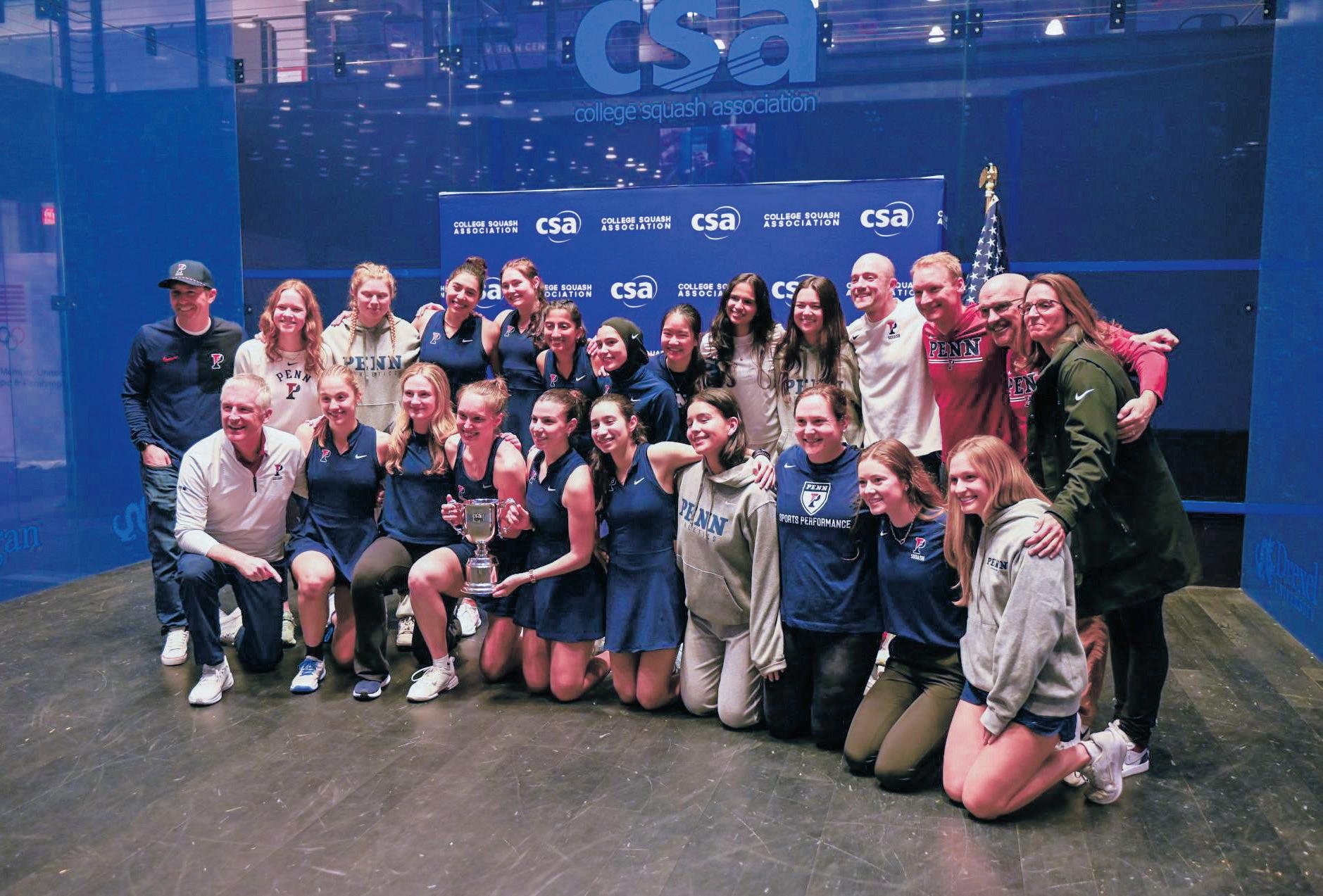
With every stroke of Dweek’s racket, the crowd held its breath and collectively sighed when she returned Princeton player Sonya Sasson’s tricky shots. Teammates and friends cheered “Dweek, Dweek, Dweek!” and then hushed instantly when she bent down to serve.
With Penn and Princeton tied at 4-4 in the finals, the women’s championship came down to one game: Dweek versus Sasson.
In the final round, Dweek and Sasson continuously tied, and each rally drew louder screams. After a bout of hard slashes and light taps, quick sprints and lunges,
Their leading rebounder is 6-foot-9 forward David Mirkovic, who averages 7.8 rebounds a game.
“It’s got to be all five guys. It can’t be one guy boxing out,” Power said. “I think a lot of times teams have bigs that crash hard, it’s our responsibility to kind of get them out of that area, get them out of the paint, and our guards have to do a great job crashing down and getting the ball.”
Power is Penn’s leading rebounder, averaging 7.9 rebounds per game. Although partly overshadowed by his scoring during the Ivy League tournament, the 6-foot-9 forward’s ability to crash the glass was on full display in matchups against Harvard and Yale. Power grabbed 26 rebounds across the two games that sent the Quakers to the NCAA tournament.
Gerhart, Penn’s starting center, is not only one of the Quakers’ best offensive rebounders, but also one of the best offensive rebounders in the Ivy League. With 65 offensive boards on the season, Gerhart tied for second in the Ancient Eight.
“Just going to keep being relentless on the glass. I think it’s really hard to box somebody out for 40 minutes a game, especially when they’re going to the glass every possession,” Gerhart said. “I know the reverse of that is [that] it is hard to box somebody out. I think I’m willing to do that, because I know what it’s like to be on the flip side of having to go for a relentless pursuit of the ball.”
Defensively, Illinois often deploys drop coverage — they defend drives by protecting the rim and forcing opponents into mid-range jump-shots. But Penn has the personnel to counter, with Power and Zanoni excelling in the mid-range.
“We’ve played a lot of drop coverage this year, and we’ve done a pretty good job of exposing it,” Levine said. “The coaches have prepared me throughout the season, getting better at reading what to do out of ball screens and understanding where help is and who the open guy is.”
Levine has taken major steps forward as a slasher this season — look no further than his game-winning layup against Harvard. His ability to penetrate will be needed to revamp Penn’s diminished offensive production for the week.
Senior captain and guard/forward Ethan Roberts will not be competing against Illinois due to a concussion, McCaffery told media Wednesday afternoon. The team’s leading scorer of the season sat out the Quakers’ Ivy Madness championship run after sustaining a concussion during practice.
Dweek sealed it with a 11-9 score, securing the round and the championship for Penn.
“If I’m being honest, I didn’t know if this day would ever come for me, because when you finish, when you’re a runner up so many times in a row, you just think maybe it’s not gonna happen,” Wyant said. “We were pretty broken and pretty fractured in October. … We had a choice to come together and try to build something great or to fracture, and you can see the results.”
Wyant added that he’s “happy for the program” and is “thinking a lot about the teams that were close to achieving this and didn’t do it,” saying, “I can tell you that today wouldn’t have happened without the successes in the past and what they’ve done.”
As players and friends were being ushered out of the squash center postgame, Wyant found a racket left on a bench, which turned out to be Dweek’s.
“She wants to keep this one!” he said.
“I’m overwhelmed,” Dweek said. “I honestly feel like I have so many emotions going through my mind. Just so proud of this team. We’ve come a long, long way. We started D-II my freshman year, so we played in our back courts, in our dungeon, and we watched Princeton and Harvard battle it out on our glass court, so I think we just had all the motivation coming in today.”
Junior Anne Leakey, who tore her ACL while
The injury marked Roberts’ second concussion of the season — he also missed Penn’s final four non-conference games after suffering a blow to the head in the Quakers’ Big 5 Championship loss to Villanova.
“When you’ve had your second concussion, that’s not something you mess with,” McCaffery said. McCaffery also said Power was questionable with an illness and did not practice Wednesday.
“We really won’t know until tomorrow,” McCaffery said of Power’s status. “If you asked me, ‘Do I think he’s gonna play?’ I’d say yes. But he didn’t practice today.”
“That’s a game changer, because a lot of the things we do are featuring him,” McCaffery added on how Power’s status affects the Red and Blue’s game plan. He called Power “one of the most versatile, one of the most talented, one of the most accomplished players in college basketball this year.”
“If he’s not out there, it’s no different than any other time — it’s next man up,” McCaffery added. “You have to have somebody else who’s ready. Cam Thrower, you could not have asked him to do any better than he did in Ethan’s absence. So hopefully somebody else will step up in TJ’s place if he can’t go.”
The team seems more than ready to do so. Emotions are running high and contagious following the euphoria of winning an Ivy League championship.
“It feels awesome,” Gerhart said. “Gosh, you just ruminate in it for a little bit, and you expect it to get less cool and it doesn’t get less cool. It gets cooler! It gets cooler the more you think about it.”
“It’s fun, I’ve never been on a championship team before, and I literally have not stopped smiling since that game ended,” Levine said, sharing a similar sentiment. “It’s been literally the best hours of my life. I’m just extremely excited for the opportunity to go play in March Madness, a dream come true.” With the Quakers taking on the Fighting Illini on Thursday, the group has a quick turnaround. But the Red and Blue hope to make some noise in the NCAA tournament.
“I think it’s just: go in and try and make some history.” Levine said. “You have nothing to lose.”
“At the end of the day, it’s just basketball. We’ve been doing it our whole lives,” Gerhart added. “It’s just another game. The court’s still 94 feet, the rims are still 10 feet high. We’re just gonna go out there and compete at a high level. … I like
competing in the quarterfinals against Cornell, served as another motivation for the team.
“Today’s win was basically for Anne … She’s doing a really good job at not really showing that she’s hurting,” Khafagy said. Wyant said that squash is an “exceptionally difficult sport, and there’s often times where you need extra motivation. And [Leakey is] sitting outside the court, and you know that she’s given her knee for this team in the most inopportune moment.”
“Anne, this is for you,” Dweek said, leaning closer to the voice recorder, “If you ever hear this, I hope we made you proud and we’re so happy to have you on our team.” Leakey, sitting on a chair after the win, said with tears still in her eyes, “I’m tired but I’m so happy … The trophy’s coming home, so nothing more to say.”
The men’s team came to cheer the women on. They high-fived Dweek and lifted Wyant into the air. When the women posed with the trophy for a picture, they invited the men over. Some were still sweaty from competing, others were in knee braces or street clothes, but all fist bumped the air. The women’s team ate at La Scala’s again that night.
About the game itself, Wyant made it clear.
“Princeton didn’t lose it. Princeton didn’t choke it. We won it.”
Basketball alumni react to March Madness appearance
From legendary figures to recent graduates, alumni were unanimous in their support
WALKER CARNATHAN AND SOO YOUNG YOON Senior Reporter and Sports Reporter
On Sunday, Penn men’s basketball won the Ivy League championship for the first time since 2018. But current players aren’t the only ones celebrating.
The Daily Pennsylvanian spoke with former players and coaches to gauge their reactions to the stunning victory. From legendary figures to recent graduates, the alumni were unanimous in their avid support.
“Just rooting like crazy for them,” Fran Dunphy, the winningest coach in Penn history, said. Dunphy helmed the Quakers from 1989 to 2006, claiming 10 Ivy League titles. “[It was] so much fun to watch all of that and see all of that go on, and see how excited everybody was.”
“Just an amazing performance by the team, and certainly, specifically to [junior forward] TJ Power on his amazing run during that game,” Dunphy added.
Dunphy’s career at Penn, which included a 48-game Ivy League winning streak from 1992 to 1996, featured several clutch performers, including 1995 College graduate and Ivy League Player of the Year Matt Maloney. So, when the Quakers faced off with two-time reigning champion Yale on Saturday, Dunphy knew just how crucial it would be for someone to deliver.
Power did so in a major way, pouring in 44 points and 14 rebounds to break the men’s Ivy Madness single-game scoring record.
“He must have some amazing toughness,” said Dunphy. “Those performances don’t occur if you’re not on top of your game, and really, on top of everything that athletics is all about.”
“It just looks like he was not to be denied, and he felt like he could really make a difference in the program over that weekend,” Dunphy added. “Just beautiful to watch. Just absolutely beautiful to watch.”
Power’s performance also drew praise from 1972 Wharton graduate Alan Cotler, the point guard on three consecutive Ivy League championship teams from 1970 to 1972.
“TJ Power saved the season,” Cotler said.
Power, a former five-star recruit, arrived at Penn last offseason after seasons at Duke and Virginia, where he averaged under 10 minutes per game. At Penn, he led the Ivy League with 35.3 minutes per game and averaged 16.8 points en route to a first team All-Ivy selection.
“Instead of allowing a lack of success at Duke and Virginia to defeat him, he chose to learn from it and grow from it,” said Cotler. “After the first 10 games of the season or so, he started to get his legs and his confidence and rose to the occasion.”
Penn’s win also garnered attention from several of the team’s recent alumni.
2025 College graduate Nick Spinoso, who starred as forward/center for Penn and now plays professionally in Germany, noted the effort it’s taken for the team to reach the summit.
“I know all those guys, the work they put in,” Spinoso said. “It was just a wholesome moment to see that hard work pay off for them. I was just so happy.” 2024 College graduate Clark Slajchert, a former second-team All-Ivy selection currently playing professionally in Luxembourg, expressed a similar sentiment.
“I’m so hyped to see it,” Slajchert wrote in a statement to the DP. “I’m still in touch with some of the guys and they’ve worked their ass off for this — it’s obviously been a tough go with the coaching change, but Penn is such a special place and deserving of a March Madness run.”
“I’m proud to be an alum and admittedly super jealous because it was always my dream to make it where they have,” Slajchert added. “Regardless, even all the way here in Luxembourg, I get to say my alma mater is dancing.”
In a tournament known for upsets, the Quakers will seek to pull off another. Penn tips off against Illinois on Thursday at 9:25 p.m. in Greenville, S.C. Win or lose, they’ll have the program’s history behind them.
“It’s March Madness for a reason. Everything is possible,” Spinoso said. “I think anything can be done. I’m rooting for them — I’m gonna stay up till 3 a.m. here to be able to watch it.”
THE INDEPENDENT STUDENT NEWSPAPER OF THE UNIVERSITY OF PENNSYLVANIA • FOUNDED 1885
PHILADELPHIA, THURSDAY, MARCH 19, 2026