Penn’s medical school quits U.S. News rankings
The Perelman School of Medicine joins Penn Carey Law School, which remains resolute in its opposition to the rankings
SARA FORASTIERI, ELEA CASTIGLIONE, AND MAX ANNUNZIATA Senior Reporter and Staff Reporters
The Perelman School of Medicine announced that it will no longer participate in the annual U.S. News and World Report “Best Medical Schools” rankings.
J. Larry Jameson, dean of the Medical School and executive vice president of the University of Pennsylvania for the Health System, publicized the decision in a memo sent to the faculty, staff, and students on Jan. 24. He emphasized the “focus on innovation and impact and shaping the future of medicine as more important cornerstones for measuring the school’s reputation,” according to Penn Medicine's press release.
“The USNWR measures encourage the acceptance of students based upon the highest grades and test scores,” Jameson wrote to the Penn Medicine community, according to the press release. “Yet, we strive to identify and attract students with a wide array of characteristics that predict promise.”

Penn Carey Law also disclosed their decision to withdraw in early December. Subsequently, U.S. News & World Report announced changes to how it ranks law schools in a letter sent to the deans of American law schools on Jan. 2, but Penn Carey Law did not change its opposition in response to the announcement.
The University of Pennslyvania Carey Law School, which most recently ranked sixth in the U.S. News rankings, described them as “unnecessarily secretive and contrary to important parts of our mission” when it said it would no longer submit data on Dec. 2.
A spokesperson for U.S. News did not respond to a request for comment. A spokesperson for Penn Carey Law wrote to The Daily Pennsylvanian that it had nothing to add from its early December statement, where it announced it would end its participation in the rankings.
“In the interest of greater transparency, we will make relevant data public so that anyone can see the inputs that make Penn Carey Law a leading law school and how our alumni launch
Annenberg Dean John L. Jackson Jr. will be Penn’s next provost
Jackson, an urban anthropologist, will take office on June 1
SARA FORASTIERI Senior Reporter
Penn President Liz Magill announced that Annenberg School for Communication Dean John L. Jackson Jr. will be the University's next provost starting June 1.
Jackson, who is also a Richard Perry University professor, will succeed Interim Provost Beth Winkelstein, who has served in the position since former Provost Wendell Prichett took a leave of absence in May 2021. Winkelstein will return to the position of deputy provost.
“I could not be more honored and genuinely humbled to be asked to serve in this important post,” Jackson wrote in the announcement, which was posted today. “I
AMY WAX FILES BACK
Tenured Penn Carey Law School professor Amy Wax filed a grievance against Dean Theodore Ruger, initiating a faculty procedure that serves as a countercomplaint to the University’s ongoing disciplinary proceedings against her.

Accusing Ruger of exploiting University procedures and his power as dean to punish her, Wax requested that her case be evaluated by the Faculty Grievance Commission and the Faculty Senate Committee on Academic Freedom and Responsibility, according to documents obtained exclusively by The Daily Pennsylvanian. In the 43-page grievance filing dated Jan. 16, Wax’s lawyer, David Shapiro, wrote that the grievance
was intended to stop Ruger and the University from using the formal sanctions process to “crush” her academic freedom.
“Dean Ruger’s charges are an attack on Prof. Wax’s academic freedoms and freedom of expression,” the grievance filing read. “And, as the University policies make clear, only the Faculty Grievance Commission (the 'Commission') and the Senate Faculty Committee on Academic Freedom and Responsibility ('SCAFR') have jurisdiction over claims related to academic freedom.”

In the documents, Wax's lawyer also alleged that Ruger is personally biased against Wax because of his
Penn has shortest breaks among Ivy League universities,
SNEHA PARTHASARATHY AND JIN KWON Senior Reporter
Penn has the fewest days off for students among the Ivy League and several other Philadelphia-area universities.
An analysis by The Daily Pennsylvanian found that Penn has only 24 days off this academic year out of all weekdays, reading days, and exam days in the school year. This translates to the fewest number of days allotted to break compared to peer institutions and the lowest proportion of days off compared to days in class during the academic year — even when taking into consideration different school year lengths between universities.
look
The Provost's Office oversees aspects of student life across the University, such as teaching, research, admissions, recreation, libraries, online learning, and global initiatives, according to its website.
The announcement of Jackson as provost follows a search that began in September and which was led by J. Larry Jameson, dean of the Perelman School of Medicine and Executive Vice President for the Health System.
In a Daily Pennsylvanian interview with Magill on Jan. 9, she expressed her thoughts on the importance of the position, calling it "incredibly complicated." Magill, a former provost herself, has previously described the provost as the "chief academic officer" of the University.
“[There are] 32 direct reports to the provost. So in that job, there's a particular making sure [that] the incredibly important business of the University moves forward, and that the provost is a great partner to all the many leaders they work with, as well as someone who can help me articulate a vision and execute on that vision,” Magill told the DP. Jackson, who will be Penn’s 31st provost, currently serves as the chair of
The data shows that a majority of Ivy League schools spend approximately 20% of the academic year on breaks, with Columbia trailing at 14.5% and Penn following in last place at 13.3%.
In response to a request for comment, the Office of the Provost wrote in a statement that “the well-being of our students is one of [Penn’s] highest university-wide priorities.”
“The Office of the Provost works closely with student and faculty leaders to ensure that we continue to balance our strong commitment to wellness, our educational mission, and the requirements of the Commonwealth of Pennsylvania for minimum hours of classroom instruction in a semester,” the Office wrote.
The Office went on to write that the University has consistently updated its policy for religious and secular holidays — including in 2022, when it modified the policy to include guidance that there may be no examinations or assigned work on Election Day in November.
“We encourage students to continue to talk with their student government leaders as we work together to advance wellness across our campus,” the statement said.
Although Pennsylvania law requires that
"kowtowing to the demands of a small number of politically disgruntled minority students and alumni" and because he has "expressed hostility towards [Wax's] politics." Throughout the disciplinary proceedings that began in January 2022, Ruger has functionally served as the prosecutor on behalf of the University.
Wax and a spokesperson for Penn Carey Law did not respond to multiple requests for comment about the grievance filing. Penn Carey Law wrote to the DP in September that Wax’s disciplinary hearings were still underway. The school, however, has otherwise withheld
a semester be approximately 17 weeks long, other Philadelphia-area schools such as Drexel University, Temple University, Swarthmore College, and Villanova University all grant their students a higher proportion of days off than Penn.
Despite updates to University policy, some Penn students told the DP that the lack of days off negatively impacts their mental health.
“Because almost everything at Penn requires such a large time commitment — classes, clubs, dance team — there is inevitably a lot of burnout,” College sophomore Zaina Maqbool said. “The efforts Penn makes to take care of students’ mental health are great, but the best way to make sure students are taking care of themselves is to give them adequate time to do that.”
College and Wharton sophomore Suhitha Kotala said that more days off could be the solution, as it would give students the ability to “catch up on work or [take] time to decompress.”
“It’s rare to see a Penn student who isn’t stressed,” Kotala said.
The number of Penn’s days off during the academic year stayed relatively consistent throughout past years and is similar to many peer universities. However, the length of the university’s winter breaks differs from other institutions. While many Ivies provide students with winter breaks that are around four or five weeks long, Penn’s winter breaks range from around two and a half weeks to just under four weeks.
Penn’s shorter winter break may pose logistical challenges to students traveling home for the holidays, especially for international students.
“Lots of people choose to not go home for winter break since it costs too much and often isn’t worth it for just two weeks,” College sophomore Manya Gupta, an international student, said.
In addition, College first year Tristen Brisky said that shorter winter breaks can hinder burnout recovery and prevent them from feeling prepared for the spring semester.
“After a grueling fall semester, many students experience burnout,” Brisky said. “They are more likely to feel prepared for spring semester with a lengthier break, and have more time to pursue other commitments like improving their health and nutrition or pursuing [activities that are professionally enriching].”
In contrast to its comparatively shorter winter break lengths, Penn blocks out relatively
forward to working closely with President Magill and the entire Penn community as we navigate the challenges and opportunities of today and prepare, together, for the ones that will emerge tomorrow.”
CONTACT US: 215-422-4640 SEND STORY IDEAS TO NEWSTIP@THEDP.COM ONLINE AT THEDP.COM THE INDEPENDENT STUDENT NEWSPAPER OF THE UNIVERSITY OF PENNSYLVANIA • FOUNDED 1885 PHILADELPHIA, THURSDAY, JANUARY 26, 2023 VOL. CXXXIX NO. 3
A grievance complaint leaked to the DP warns of an “attack” on academic freedom
JARED MITOVICH Senior Reporter
PHOTO BY JESSE ZHANG
John L. Jackson Jr., the Walter H. Annenberg dean of the Annenberg School for Communication and Penn’s next provost.
compared to local universities, Penn offers the lowest percentage of days off during the school year
DP analysis finds Even
See BREAKS, page 2 See WAX , page 2 See RANKINGS, page 3 INSIDE: THE FACULTY DECIDING WAX’S FUTURE WHY WAX CANNOT BE FIRED EASILY
BY LILIAN LIU See PROVOST, page 2
and Staff Reporter
DESIGN
How the University’s sanctions and grievance procedures work
Amy Wax’s disciplinary proceedings are part of a rarely used procedure to hold tenured faculty accountable
SARA FORASTIERI Senior Reporter
The University’s disciplinary proceedings against University of Pennsylvania Carey Law School professor Amy Wax, which began in January 2022, have involved complex faculty procedures. The procedures, which have been invoked by both Wax and Penn Carey Law Dean Ted Ruger, are uncommonly used but serve as the main way for the University to punish — and potentially fire — tenured faculty, whose employment is strongly protected.
In light of documents obtained by The Daily Pennsylvanian which reveal that Wax has filed a grievance against Ruger, the DP examined the Faculty Handbook to break down how these complex procedures work.
Sanctions: The rare procedure used to punish tenured faculty
Sanctions are a rarely invoked procedure where some charging party believes that a faculty member has committed either a major or minor infraction of University behavioral standards. The process must “[protect] the rights of faculty members and [address] the legitimate concerns of the University,” according to the Faculty Handbook.
A range of groups is involved in the sanctions procedure. The charging party in Wax’s proceedings is Ruger, who initiated the sanctions process against Wax after repeated inflammatory remarks sparked national scrutiny.
In the sanctions procedure, Wax is known as the respondent whom Ruger has charged.
The charging party can choose to pursue major or minor sanctions depending on how severe they perceive the infraction to be. Ruger is pursuing a major infraction, which “[involves] flagrant disregard of the standards, rules, or mission of the University or the customs of scholarly communities.” Penalties for a major infraction may include terminating, suspending, or reducing the salary of the faculty member being sanctioned.
When an infraction emerges, the dean — Ruger — can give the respondent the chance to resolve the dispute informally. If the charging party and respondent cannot reach a resolution for a complaint involving a major infraction, the dean can decide to invoke a “just cause procedure” to continue pursuing sanctions. If the charging party identifies a major infraction, they will ask the chair of Penn’s Faculty Senate to form a hearing board.
In Wax's proceedings, a hearing board has been formed per Ruger's request.
The Hearing Board is composed of five tenured faculty and makes the formal judgment on the matter, serving “both an investigative and deliberative function.” After the Hearing Board is approved, the charging party sends a written statement detailing the grounds of the investigation and a recommendation of a major sanction.
According to the leaked documents, the Hearing Board has not yet conducted any hearings. However, if they conclude that there is just cause for a major sanction, a hearing will be held where the charging party has to provide “clear and convincing evidence that there is just cause for imposition of a major sanction against the respondent.”
Both the respondent — Wax — and charging party — Ruger — have the right to provide relevant evidence and witnesses.
PROVOST, from FRONT PAGE
the Red and Blue Advisory Committee, which Magill tasked last fall with finding a strategic vision for Penn’s future. Jackson was previously dean of the School of Social Policy & Practice and special adviser to the provost on diversity at Penn. He will be the second Black provost of Penn after Pritchett.
“John Jackson is one of Penn’s most respected and accomplished academic leaders,” Magill wrote in the announcement. “He is an acclaimed scholar who has had extraordinary success in recruiting outstanding
Meet 8 people who will determine Amy Wax’s future
MAX ANNUNZIATA AND NICOLE MURAVSKY Staff Reporters
On Jan. 16, tenured Penn Carey Law School professor Amy Wax filed a grievance against University of Pennsylvania Carey Law Dean Ted Ruger. The grievance filing and a separate letter obtained by The Daily Pennsylvanian list some of the key faculty members and committees who are connected to the disciplinary proceedings involving Wax.
The letter reveals the identities of the five professors who have been elected to serve on a hearing board which will investigate Wax's case and may decide to impose a major sanction on Wax, such as termination.
The Hearing Board serves “both an investigative and deliberative function,” according to Penn’s Faculty Handbook. The board decides whether to recommend a major sanction and then notifies the president of Penn, who typically accepts the recommendation.
The DP examined the key players in the Wax proceedings, which include eight faculty members whose appointments span multiple schools at Penn.
The Amy Wax Hearing Board Harvey Rubin
Harvey Rubin is a professor at Penn's Perelman School of Medicine who teaches in the Department of Biochemistry and Biophysics and the Department of Computer and Information Sciences. Rubin has founded several institutions dedicated to the combat of infectious diseases. He declined a request for comment.
Emily Steiner
faculty, in leading innovations in teaching and learning, and in building an exceptional educational experience for students. John is a superb fundraiser who has raised the profile of both Schools that he has led at Penn. I know he will guide Penn to even greater heights.”
The University will begin searching for Jackson’s replacement as Dean of the Annenberg School for Communication immediately, according to the announcement.
BREAKS, from FRONT PAGE
Penn has the lowest percentage of days off
Penn Columbia
Cornell Har vard Brown Dar tmouth
Yale Princeton
long summers compared to peer schools. However, while winter break lengths have varied during the past two decades, summers have gradually gotten shorter at Penn.
According to Philip Gehrman, a professor of psychiatry at the Perelman School of Medicine, there are other ways for students to decompress besides having more days off from school.
“To me, what would be most effective is if students were able to balance times of stress and work with times of relaxation every week, instead of saving up that stress for those days
CHART BY LILIAN LIU
off,” Gehrman said. “Learning to build that destressing time into your daily schedule is most important to reducing overall stress.”
According to Gehrman, poor mental health at Penn cannot be attributed to the length of the breaks, but rather the culture of the university.
“This is a very intense, stressful culture. I think students put a lot of high expectations on themselves,” Gehrman said. “The University would have to see what we can do as an institution to change that, and I don’t know exactly what that would be.”
English professor Emily Steiner is a noted medievalist whose research focuses on English literature of the 14th and 15th centuries. She received the Mary F. Lindback Teaching Award in 2016, the same award that Wax received in 2015. Steiner did not respond to a request for comment.
Sigal Ben-Porath
Sigal Ben-Porath has been a professor at Penn’s Graduate School of Education since 2004. Ben-Porath is also the former chair of Penn’s Committee on Open Expression and the author of the 2017 book "Free Speech on Campus." Her recent book is titled “Cancel Wars: How Universities Can Foster Free Speech, Promote Inclusion, and Renew Democracy.”
"When some members of the campus community are effectively barred from speaking, when they avoid speaking their minds for fear of humiliation or ridicule, or when they do not feel that they belong or that they are appreciated, free speech is limited just as much as it can be limited by censorship," Ben-Porath wrote in "Free Speech on Campus."
Ben-Porath declined the DP’s request for comment. Camille Z. Charles Camille Z. Charles is the Walter H. and Leonore C. Annenberg professor in the Social Sciences. She holds
WAX, from FRONT PAGE
comment because of University policy’s stipulation that all parties involved with sanctions proceedings maintain confidentiality.
Over a year into these proceedings, the DP broke down Wax’s 43-page grievance, the implications of this decision, and where the process stands today.
Wax’s grievance may delay University’s disciplinary proceedings
In her formal grievance, Wax framed her case as an attack on her academic freedom, contrasting with Ruger’s portrayal of the University’s pursuit of a major sanction against her. After Wax’s repeated inflammatory statements reached a new level of controversy in January 2022, Ruger charged Wax with violating multiple behavioral standards for University faculty, citing student and faculty accounts of the conduct that he believes warrants disciplinary action.
“Academic freedom for a tenured scholar is, and always has been, premised on a faculty member remaining fit to perform the minimal requirements of the job,” Ruger wrote in a June report to the Faculty Senate. “However, Wax’s conduct demonstrates a ‘flagrant disregard of the standards, rules, or mission of the University.’”
In the report, Ruger requested that the Faculty Senate convene a hearing board to conduct a full review of Wax’s conduct and impose a major sanction, as is in line with the University’s policy for punishing tenured faculty members. The leaked documents show that the Hearing Board has now been appointed and is composed of five of Wax’s tenured faculty peers. The board can ultimately determine that Wax’s conduct warrants a major sanction, with the potential penalty of Wax being fired.
Wax’s grievance filing against Ruger may delay the Hearing Board’s progress toward voting on whether to impose a sanction. When a grievance is filed, it is evaluated by the Faculty Grievance Commission and SCAFR, two arms of Penn’s Faculty Senate, which serves as the representative body for full-time faculty. The Faculty Senate can approve University policy changes under its purview and direct focus toward issues raised by members of its Senate Executive Committee.
Wax alleges Penn officials have misrepresented her conduct
In addition to the 43-page grievance filing, the DP also obtained a 52-page memorandum that reiterates many of the same arguments Wax’s lawyer made in a similar memo from August. The latest memo alleges that Ruger declined Wax’s request to postpone the disciplinary proceedings while she was treated for cancer during the fall. It also claims that Ruger responded to the August memo in November, in which he declined to
postings in the Department of Sociology and the GSE, and is the director of Penn’s Center for Africana Studies.
Charles is known for conducting the National Longitudinal Survey of Freshman, designed to test “several competing theories of minority underperformance in college” — a frequent topic of Wax’s controversial commentary.
Charles declined the DP’s request for comment.
Beth Simmons
Beth Simmons is a political scientist who serves on the faculty of Penn Carey Law, fulfilling a University stipulation that one member of the Hearing Board is a faculty member at Wax's school. Before coming to Penn in 2016, she presided over the International Studies Association and directed Harvard’s Weatherhead Center for International Affairs. Simmons declined to comment.
The Faculty Senate
The Faculty Senate has two divisions: the Senate Executive Committee and a set of standing committees which investigate matters important to the administration. Separate from these committees, Ruger requested that the Faculty Senate impose a “major sanction” against Wax and requested that the Faculty Senate convene a hearing board to conduct a full review of Wax’s conduct.
Wax's lawyer’s latest memo to the Faculty Senate alleges that Ruger declined Wax's request to postpone the disciplinary proceedings this fall while she was battling cancer.
Vivian Gadsden
Child Development professor Vivian S. Gadsden is the chair of the Faculty Senate. Her research focuses on cultural and social factors that affect learning and literacy, intergenerational and cross-cultural learning.
Gadsden received Ruger’s 12-page report on June 23 listing the conduct that he believed merited major sanctions. She serves in a presidial role in the proceedings. She also elected the five Hearing Board members.
Faculty Grievance Commission
The Faculty Grievance Commission consists of a panel of three members who are in charge of evaluating grievances and initiating the appropriate follow-up procedure. The commission will evaluate the merits of the grievance filed by Wax.
Sarah Hope Kagan
Penn School of Nursing professor Sarah Hope Kagan is the chair of the Faculty Grievance Commission. Her research focuses on understanding the patient’s point of view in order to provide enhanced care and improve clinical knowledge. Kagan declined a request to comment.
Senate Committee on Academic Freedom and Responsibility
The Senate Committee on Academic Freedom and Responsibility is made up of nine faculty members and one of the tri-chairs of the Faculty Senate. SCAFR works with Penn's 12 schools to decide what to do if someone claims there has been a violation of academic freedom. They can make related investigations, reports, and recommendations on any of these related matters.
In her grievance filing, Wax requested that her case be evaluated by the Faculty Grievance Commission and SCAFR, which handles matters that the commission determines are related to academic freedom.
Raina Merchant
Medical School professor Raina Merchant is the SCAFR chair. Her areas of expertise are disease prevention and health promotion, health care disparities, racism, and the connection between digital health and social media.
provide data or information to substantiate his charges against Wax. Finally, the memo asks that the charges against Wax be “dismissed outright.”
In the memo, Wax’s lawyer asks that the hearing board hold a preliminary hearing in which the board would deliberate Wax’s requests from August as well as Ruger’s response in November. Wax’s lawyer wrote in the memo that the hearing must occur before Wax can decide whether to participate in further hearings related to the charges — which, the memo argues, are flawed and based on a misrepresentation of the facts.
On the whole, the memo reiterated many of Wax’s previous counterarguments to Ruger’s charges. For instance, the memo alleges that Penn Carey Law consented to Wax’s request for permission for white supremacist Jared Taylor to speak in her conservative law class, and that the school reimbursed the lunch at White Dog Café where Taylor spoke with students. Taylor did not respond to a request for comment.
How Wax got here
Wax, a self-described “race realist,” has a welldocumented history of stirring national controversy by making racist, xenophobic, and homophobic remarks on podcasts and national television. Ruger argues that Wax’s public remarks and behavior at the law school have harmed students. In one instance, Wax allegedly told 2012 Penn Carey Law graduate Lauren O’GarroMoore, who is Black, that she had only become a double Ivy “because of affirmative action,” O’Garro-Moore told the DP in September. She was named as a witness of Wax’s conduct in Ruger’s June report to the Faculty Senate.
O’Garro-Moore previously wrote to the DP that, as of Dec. 4, she had not been contacted by anyone to date regarding upcoming hearings or proceedings.
As the disciplinary proceedings have continued, Wax has attacked the process while promising that she will fight the University as it pursues sanctions. In a variety of appearances on conservative talk shows and podcasts, Wax has also attacked Penn Carey Law students for what she sees as persuading Ruger to pursue sanctions against her.
“The students are basically little tyrants,” Wax told podcast host Alex Kaschuta in a Nov. 23 episode of her podcast “Subversive.” “They have learned to be big bullies because the system empowers them, they have a megaphone on the internet and in the media, they can gin up any sort of condemnation you can imagine, and those events and labels and gestures stick, they really do stick.”
Later in the conversation, Wax went on to say that “being racist is an honorific,” describing people who are called racists as people who “notice reality.” She said she encourages her students to adopt this behavior.
“That’s an occasion for praise and admiration,” Wax said. “Being called a reactionary, I tell my students if you’re called a reactionary, you should be proud. There are ways in which we would do well to react and go back to the way things used to be done.”
2 NEWS THURSDAY, JANUARY 26, 2023 | THEDP.COM THE DAILY PENNSYLVANIAN
Leaked documents reveal the five Hearing Board members who will evaluate Wax’s case
See SANCTIONS
page
,
3
Once the hearings are over, the Hearing Board deliberates whether the charging party presented sufficient evidence to impose a major sanction. If so, the Board must provide recommendations about the sanctions to the president. Penn President Liz Magill would make the final decision taking into consideration the Hearing Board’s findings but would normally accept the conclusion.
In the case that the Hearing Board recommends termination, they must also provide a date for termination, which cannot be more than one year after the president’s final action.
Grievances: The procedure where faculty can allege mistreatment
Wax’s grievance against Ruger, filed on Jan. 16, is on the grounds of academic freedom and alleges that Ruger has been biased when conducting the proceedings.
According to the handbook, a grievance is “a claim that action has been taken that involves a faculty member’s personnel status or the terms or conditions of employment” that is arbitrary, discriminatory, or not in compliance with University regulations.
The Faculty Grievance Commission, which has three members, serves as the deliberative body for grievances.
Before a grievant like Wax can file a complaint, they must review it with the dean or, in the case of Wax, the Vice Provost for Faculty, since the grievance is against a dean’s actions.
If the Chair of the Commission concludes that the grievance contains issues of academic freedom — like Wax’s grievance asserts — then it is sent to the Senate Committee on Academic Freedom and Responsibility, which must resolve questions of academic freedom before the Commission can proceed.
SCAFR’s policy states that faculty members are free from censorship or discipline, as long as they acknowledge their obligations and that the public may judge their remarks. The professor should indicate if the remarks that SCAFR is evaluating were not made on behalf of the institution and show respect for the public opinion.
Since Wax’s grievance is filed against a dean, SCAFR has full responsibility and jurisdiction on the matter.
RANKINGS, from FRONT PAGE
careers in every sector of the legal profession,” the spokesperson wrote at the time.
In the Jan. 2 letter, U.S. News addressed many of the concerns raised by Penn Carey Law and other law schools. It promised to place more weight on student outcomes, including employment and bar exam passage, and place less weight on dollarper-student numbers and assessments from legal professionals, which schools have long criticized.
Among the announced changes, U.S. News promised to give “full weight” to universityfunded fellowships which funnel students into public service careers like those offered by Penn Carey Law.
The letter also promised to improve the way it considers programs that are designed to eliminate socioeconomic barriers to attendance, like aid and loan programs — addressing a central complaint raised by the boycotting schools, including Penn. U.S. News wrote that it would need “additional time and collaboration to address” these issues.
However, universities still place importance on the rankings, in part because of institutional pressure and the perceived importance of where they stand among other universities.
Penn Carey Law professor Paul Heaton, the academic director of the Quattrone Center, said that rankings do have value in their capacity to allow applicants to compare schools with a common set of definitions and organized data.
“I question the idea that there’s a single ranking system that is the right one, or one that we ought to emphasize for everyone,” Heaton told the DP.
From smoothies to breakfast sandwiches, Penn
Dining expands food options
Changes were made based off the Fall Dining Survey’s results
CASSIDEE JACKSON Staff Reporter
Penn Dining has initiated several new changes for dining halls and food options, according to a Jan. 17 email.
Director of Business and Hospitality Services Pam Lampitt wrote in an email to The Daily Pennsylvanian that these changes come from student feedback in a variety of forms.
Lampitt wrote in the ‘We Heard You’ email that changes were “based off of survey results, discussions with the Dining Advisory Board and on-going student feedback.”
These changes — which come in response to results from the Fall Dining Survey — include smoothies at breakfast, all-day breakfast sandwiches at Gourmet Grocer, more peanut butter and jelly sandwiches, and more made-to-order pasta.
Smoothies will be available for breakfast at Hill House and 1920 Commons from Monday through Friday. Peanut butter and jelly sandwiches “were one of the most requested items” from the Fall Dining Survey. In response, Gourmet Grocer will have more for future meal exchanges. Finally, made-to-order pasta will be more frequently available at Expo stations at Hill House, 1920
College Hall West Wing to receive two-year restoration, accessibility improvements
The restoration will include new HVAC systems, upgraded windows and roofing, all-gender restrooms, updates to office suites and classrooms, and new elevators
NITIN SESHADRI Senior Reporter
College Hall will be restored over the next two years, starting in early 2023 and ending in January 2025.
The $87.4 million project will principally affect the West Wing of College Hall. The restoration will include new HVAC systems, upgraded windows and roofing, all-gender restrooms, updates to office suites and classrooms, and new elevators. Planning for the restoration began in January 2021.

Since its construction in 1871 as the first building on Penn’s West Philadelphia campus, College Hall has undergone numerous renovations. The West Wing restoration is the continuation of work performed on the east and central wings of the building in the 1990s, according to Jennifer Kinkead, a director in Design & Construction in the Facilities and Real Estate Services.
To provide a staging area for the contractors, a green fence blocking areas of Perelman Quadrangle and College Green has been installed, according to Kinkead. So far, construction has consisted of layout and preparation, with demolition beginning in February.
Kinkead said the fencing will be up in its current configuration for at least 18 months and will start to be removed towards the end of the twoyear renovation period.
Students have expressed frustration with the fencing as it blocks out part of the Perelman Quadrangle that is frequently used to enter Houston Hall and Claudia Cohen Hall.
“I think it’s really inconvenient that you can’t get to Houston,” College first year Elle Baker told The Daily Pennsylvanian. “With the renovations taking up a lot of space, the only way that they can
get to Houston is by going all the way around to Irving Auditorium.”
Mark Kocent, the University’s principal planner, added that all occupants of the West Wing have been relocated to the lower level of the East Wing due to safety concerns and the expected noise levels during the renovations.
Other work that will be performed on the West Wing includes the replacement of the green masonry with a cementitious product, which was already done on the east and central wings in the 1990s, according to Kocent.
“There’s a very soft stone called serpentine that’s original to the building from the 1870s, and the primary project, really, is to replace that stone, as we have on the eastern side of the building,” Kocent said.
Kinkead added that the building will look “much more unified” than it does right now after unifying the current differences in stonework between the west and east wings.
The current single-pane windows in the west, central, and east wings, many of which are original to the building, will be replaced with insulated, glazed ones that are more energy efficient. Moreover, the current window air conditioners will be replaced with a central heating and air conditioning system, according to Kocent.
The renovations will also include accessibility improvements. The current elevator, which is not compliant with the Americans with Disabilities Act (ADA), will be removed from the West Wing staircase and replaced with two new, code-compliant ones, according to Kinkead.
“As a disabled student who relies on the elevators to get to classes in College Hall, I am
pleased to see the University working toward accessible standards set by the ADA,” Disabled Coalition President and College sophomore Lex Gilbert said in a written statement to the DP. “It is imperative that the University move to create more accessible classrooms and lecture halls on campus.”
All-gender, accessible restrooms will also be placed on every floor adjacent to the new elevators, according to Kocent.
“Trans students and staff at Penn have been working for quite some time to get more genderinclusive bathrooms on campus,” Gilbert wrote. “I hope to see the University create more gender-inclusive spaces across campus, including bathrooms and other public spaces.”
Kocent told the DP that the University is working to eliminate student disruptions. Classes will continue to be held in the main lecture hall, College Hall 200, and the Philomathean Society, which occupies the fourth-floor space above College Hall 200, will not be relocated.
“We’re going to work very hard to minimize any disruption to that class during construction by doing some of the noisiest work off-hours in the evenings and weekends,” Kinkead said.
Kocent told the DP that he hopes students will appreciate the restored look and increased accessibility of the building.
“The classrooms that students would use on the West Wing will be completely modernized and be very accessible right off the corridor,” Kocent said.
The Quad and Stouffer College House are among other parts of Penn’s campus that are currently undergoing renovations.
According to Lampitt,
“Beginning of Spring Semester changes are often items that can be made quickly from our Fall Dining Survey results, for example adding menu items,” Lampitt wrote. “Larger programmatic changes for the next school year generally are rolled out in the Fall.”
Lampitt pointed to the creation of the Meal Exchange Program as a previous example of larger program changes that Penn Dining initiates over
the summer for the fall semester.
In spring 2022, Penn Dining expanded meal exchange options, provided more vegan and vegetarian dining options, and extended hours at McClelland based on fall 2021 dining survey results. Expanded Meal Exchange options were phased in at Houston Market — which includes La Plancha, Houston Grill, 34th Street Carvery, Penn Pi, and The Market Cafe.
Joe’s Cafe and Accenture Cafe also introduced hot and cold “grab n’ go” options from the Fall 2021 Dining Survey. McClelland extended their hours to 5 p.m. on Fridays in response as well.
Penn Dining will announce more menu options in the coming weeks.
According to Lampitt, the response from Penn dining hall users to the ‘We Heard You’ initiative has been positive. She also wrote that students are encouraged to continue giving feedback on the dining experience beyond when surveys are sent out.
“Students can submit suggestions on our comment boards at any time and we encourage our diners to share feedback that is specific to a particular café directly with the manager of that location,” Lampitt wrote.

3 NEWS THURSDAY, JANUARY 26, 2023 THEDP.COM | THE DAILY PENNSYLVANIAN
PHOTO BY ANNA VAZHAEPARAMBIL
Commons, and Kings Court English House.
dining hall program changes in response to the survey results depend on the school semester.
PHOTO BY ABHIRAM JUVVADI
SANCTIONS
page 2
, from
A Penn student browses Gourmet Grocer’s new all-day breakfast sandwiches on Jan. 23.
Tenureship is

indulging the Amy Waxes of the
world
JOINT COLUMN | Academia is rewarding knowledge commodification, not contribution
Amy Wax’s racist remarks towards her students and various demographics such as the Asian American community have caused great controversy. For the sake of our own sanity and yours, we will not give further publicity to her exact words. To do so would be akin to catering to the bully. But Wax’s willingness to embroil herself in controversies is a topic worth exploring.
Enrollment in Wax’s law seminars has seen a dramatic decline after her comments on race and immigration sparked a national controversy. Though counterintuitive to her position as a professor, student dissatisfaction and low participation don’t matter to her. After all, law students are hardly her audience.
Richard Schechner is often credited for coining the notion of performance theory. As a concept, performativity does not only include a theatrical performance on stage; it permeates every fiber of the world.
While you don’t need to agree with Schechner’s theory, it is hard to argue against the fact that there is often a performative aspect to the way we go about our daily lives. From mundane things such as the clothes one wears to decisions like the size of the diamond one buys for their fiancé, every action sends a signal — they are all performances of some sorts. The more dramatic the performance, the greater attention it attracts. One might argue that Wax has put on quite the performance herself.
Can you name the second most controversial professor at Penn? Hopefully not. Wax has differentiated herself from the crowd with her performance. She might be an extreme case, but society is no stranger to differentiation. You don’t pass the resume screen with average statistics, nor do you get promoted by being middle of the pack. There is a need to be seen.
Every performance requires an evaluative metric. For academia, it’s citations. We measure professors by the number of citations they have and the publicity they muster. Theories are not only vehicles of knowledge exploration, but a method to build social capital for the theorist. This creates a fundamental tension in the world of academia between the pursuit and commodification of knowledge. It’s an evident example of incentive misalignment.

The quantification of a university scholar’s success is already damaging. It is further exacerbated by the pitifully
limited means at our disposal to do so. We claim that students shouldn’t be evaluated purely on test scores, and instead be looked at holistically. However, we neglect to recognize that professors and scholars deserve the same treatment. A high h-index or impact factor does not define a professor.
What about the strength of their teaching abilities? What about their efforts to maintain a safe campus community? However,
research candidates are often told early on in their careers to focus on narrow areas of research instead of teaching. After all, teaching is rarely the key to tenureship. And yet, the frontier of knowledge that research represents is only valuable if it can be inherited, and the scholars of tomorrow are the students of today.
Here’s a simple observation. In order to get citations, you must get noticed. Now, interestingly enough, you don’t
need people to agree with you. People can cite you in fervent agreement or blatant dispute. After all, simple citation count doesn’t discern between positive and negative citations.
The lack of other dimensionalities fosters a race to the bottom. In marketing, the race to the bottom is pure price competition. Although it’s a situation that companies strive to avoid, the prices are bounded by the costs of product production and sale. Academia’s race to the bottom has to do with the extent to which academics can distinguish themselves. Normally, the act of differentiation quickly gets costly through reputational burdens and job security. But tenure often absorbs these costs and provides a hefty buffer of safety.
Yet the cost doesn’t disappear — it is transferred. Students who belong to marginalized communities might have their well-being and safety damaged by professors like Amy Wax. The psychological harm is unseen, but it is every bit as real as physical harm. The institution and academia overall also bear reputational burdens as a result.

Tenureship attracts talented scholars worldwide, bolsters economic stability, and provides greater freedom for faculty to “pursue research and innovation and draw evidence-based conclusions free from corporate or political pressure,” as defined by the American Association of University Professors. Simply put, tenureship offers the freedom to posit, theorize, publish, and debate in a scholarly setting. But with freedom comes responsibility. And tenureship has allowed Wax’s show to go on for far too long. As it stands today, tenureship allows performativity to transform academia into a contest of publicity, not brilliance.
ANDREW LOU is a Wharton and Engineering junior studying finance, statistics, and computer science from Connecticut. His email is alou6683@ wharton.upenn.edu.
SAM ZOU is a College senior studying political science from Shenzhen, China. His email is zous@thedp.com.
Penn’s foreign language requirement is insufficient
THE AIYER ASSESSMENT | After completing four
Before coming to Penn, I made the goal for myself that by the time I graduated college, I would be, at the very least, trilingual. I am a native English speaker, studied Mandarin for 15 years from preschool to high school, and am now learning Spanish at Penn. However, by the end of my fourth semester of Spanish, I doubt that I will be able to call myself trilingual.
In the College of Arts and Sciences, the foreign language requirement “affords unique access to a different culture and its ways of life and thought.” The Wharton School’s foreign language requirement is intended to allow students to “engage in an important form of critical thinking.”
Yet, Penn’s requirement is futile in truly equipping students with foreign language proficiency.
Penn’s foreign language requirement is inconsistent. The College and the School of Nursing require four semesters of a foreign language. Wharton requires only two semesters and the School of Engineering and Applied Science has no requirement.
The United States Foreign Service Institute has split up languages by how difficult it is for a native English speaker to reach fluency, with Group 1 languages being the easiest to learn and Group 4 languages being the hardest. Following this idea, it takes a minimum of 480 hours to learn a Group 1 language, such as Spanish, French, or Italian. To learn slightly more difficult languages that fall in Groups 2 through 4, such as Hindi, Russian, and Chinese, it takes a minimum of 720 hours to reach basic fluency.
Let’s do the math. A typical Penn semester consists of around 15 weeks of classes. For a Group 1 language, such as Spanish, the first and second semester typically consist of one-hour classes four days a week. The third and fourth semesters typically consist of one-hour classes three days a week. Over four semesters, that adds up to approximately 210 hours of Spanish instruction. This is sufficient to fulfill the Penn language requirement in the College and Nursing School. Even making the generous assumption that students spend an equivalent number of hours studying outside of class, they still fall short of 480 hour mark. Within Wharton, most students stop after the second semester, thus, only receiving 120 hours of foreign language instruction. We see a similar phenomenon with
semesters, have students really reached proficiency?
Group 4 languages, such as Chinese. Similar to Spanish, semesters one and two of Chinese consists of one-hour classes four days a week; semesters three and four follow the same format. This adds up to a mere 240 hours across four semesters, which falls short of the 720 hours that are needed to reach proficiency in Chinese.
A significant facet of Penn education is its pre-professional culture. Our education is structured to provide us with the tools to thrive in the workforce and, more broadly, the real world, both of which are becoming increasingly globalized. As a result, monolingualism is no longer sufficient.
In the workforce, an increasing number of employers are searching for bilingual talent. In 2015, approximately 630,000 job postings were aimed at bilingual workers, compared to less than half that number of job postings in 2010. Given this trend, the number of job postings for bilingual workers has likely increased significantly in the seven years since.
Most Penn students’ first destinations after graduation lie in the banking or consulting sectors. One of the leading
companies that was searching for bilingual workers was the Bank of America, which is popular amongst recently graduated Penn students
It makes sense that employers are searching for bilingual employees, given how multicultural our world is becoming. In the U.S., approximately 20% of residents are able to speak two or more languages, while the percentage is closer to 50 for the rest of the world. The ability to converse in more than one language opens doors, allowing us to communicate with people that we might not otherwise be able to.
There is no point in learning half of a foreign language. It is a waste of time, energy, and is a disservice to us as Penn students.
The solution to Penn’s predicament is simple. The University must strengthen its foreign language requirement across the four schools. Varying by the difficulty of the language, Penn’s language requirement should allow for enough hours of instruction to ensure that students reach fluency. This may mean
more required semesters, longer classes, or more frequent instruction.
I understand that this might be an unpopular idea in the minds of most Penn students. Many of us came to university looking forward to the academic flexibility that we lacked access to in high school. I’ve heard complaints about how frustrating it is to fit foreign language into our already busy schedules and I’ll admit that I’ve voiced similar concerns in the past.
But at the end of the day, we came to Penn to receive an education that prepares us for the real world. By the time we graduate, we must have the capabilities to enter a multilingual society with both the language skills and cultural competence to thrive. It is Penn’s responsibility to provide us with the tools to do so.
SANGITHA AIYER is a College first year from Singapore. Her email is saiyer@sas.upenn.edu.
4 THURSDAY, JANUARY 26, 2023 | THEDP.COM THE DAILY PENNSYLVANIAN OPINION
LAND ACKNOWLEDGEMENT
BUCCINI Deputy Design Editor
JIN Deputy Design Editor
LIU Deputy Design Editor BECKY LEE Design Associate ABHIRAM JUVVADI News Photo Editor DIAMY WANG Deputy Copy Editor CHARLOTTE BOTT Deputy Copy Editor RILEY NEEDHAM Deputy Copy Editor ELEANOR GRAUKE Deputy Copy Editor SOPHIE NADEL Copy Associate LAURA SHIN Copy Associate SOPHIE APFEL Copy Associate JADA EIBLE HARGRO Copy Associate ABIGAIL WEINSTEIN Copy Associate WALKER CARNATHAN Deputy Sports Editor
ZHANG President EMI TUYẾ TNHI TR ẦN Executive Editor
SIDDIQUI DP Editor-in-Chief LILIAN LIU Design Editor
WANG Design Editor JARED MITOVICH News Editor MOLLY COHEN News Editor SAYA DESAI Assignments Editor ALLYSON NELSON Copy Editor JULIA FISCHER Copy Editor ANNA VAZHAEPARAMBIL Photo Editor CAROLINE MAGDOLEN Opinion Editor KIRA WANG Social Media Editor CALEB CRAIN Sports Editor ALEXIS GARCIA Sports Editor GEORGE BOTROS Video Editor RIANE LUMER Podcast Editor MATTEO BUSTERNA Diversity & Inclusion Director JOSH TRENCHARD Business Manager GRACE DAI Analytics Director MADISON SMITH Marketing Manager KRISTEN LI Product Manager AKANKSHA TRIPATHY Consulting Manager ZAIN QURESHI Finance Manager 139th Year of Publication Have your own opinion? Send your letter to the editor or guest column to letters@thedp.com. Editorials represent the majority view of members of The Daily Pennsylvanian, Inc. Editorial Board, which meets regularly to discuss issues relevant to Penn’s campus. Participants in these meetings are not involved in the reporting of articles on related topics. LETTER SUBMISSION THIS
THIS
Opinion
The Land on which the office of The Daily Pennsylvanian stands is a part of the homeland and territory of the LenniLenape people, known to the original Indigenous people as “Lenapehoking.” We affirm Indigenous sovereignty and will work to hold The Daily Pennsylvanian and the University of Pennsylvania more accountable to the needs of Native American and Indigenous people.
JOJO
WEI-AN
SOPHIA
JESSE
IMRAN
COLLIN
ISSUE’S TEAM
YEAR’S BOARD
PHOTO BY OSCAR VASQUEZ
Words fill the blackboard of a Portuguese language class on Jan. 25, 2023.
PHOTO BY JULIO SOSA
Amy Wax, a Penn Carey Law School professor.
Penn Carey Law’s withdrawal from U.S. News changes little
SAM-I-AM|
2022 was a tumultuous year for U.S. News & World Report and the university rankings world.


Columbia University professor Michael Thaddeus’s scathing report disclosed the university’s dishonesty in submitting data such as class size and student-to-faculty ratios to the U.S. News.
Months later, U.S. News’s 2022-23 Best National University Rankings dropped Columbia’s rank from second place to 18th.
Perhaps the most impactful decision was when Yale Law School and Harvard Law School both withdrew from the U.S. News rankings. Yale and Harvard, ranked first and fourth respectively on the 2022-23 U.S. News law school rankings, also inspired a cascade of other law schools to withdraw, including many top law schools such as those associated with Penn, University of California at Berkeley, Columbia, Cornell University, and so on.

Fast forward to Jan. 17, 2023, and Harvard Medical School echoed its law school’s decision to withdraw from U.S. News, arguing that such rankings create incentives for schools “to report misleading or inaccurate data.”
In my last two articles about college rankings, I argued that universities should be held responsible for misreporting data to U.S. News and its consumers. But it is clear that universities have little intention of increasing the accessibility and transparency behind the admissions process. They opted to not report those data altogether.
The universities blame the ranking system and withhold sending annual surveys to U.S. News that include crucial university information. But in reality, it’s not that universities don’t want to top the rankings. It’s that they don’t want the rankings to influence their spending decisions.
For example, in a statement addressing the law school community, Yale Law School Dean Heather Gerken contends that “the U.S. News rankings are profoundly flawed — they disincentivize programs that support public interest careers, champion need-based aid, and welcome working-class students into the profession.”
“My hope is that if a number of schools
withdraw, that will force U.S. News to change its metrics,” said Erwin Chemerinsky, dean of Berkeley Law.
For decades, U.S. News has dominated the law school rankings arena. In fact, the catchy “T14,” referring to the top 14 law schools on the rankings, are often a point of discussion among law school applicants every year. Unlike other higher education programs, U.S. News is the ultimate law school ranking for applicants, students, and the general public.
The predominant influence of U.S. News shapes the perceived exclusivity and privilege of law schools among applicants. Such an outsized influence is perhaps one of the biggest reasons why many law schools like Yale and The University of California at Berkeley criticize the formula, since minute changes can result in seismic shifts in the rankings. Schools have to adjust their priorities and metrics just to remain competitive in the rankings. In short, U.S. News is important because we think it’s important.
You see, rankings won’t just persist because of U.S. News and top universities. They also persist because of us.
It’s about the consumers wanting a quick and easy way to evaluate the quality of thousands of educational programs. It’s about humans’ innate urge to pursue and earn perceived prestige. It’s about exclusivity disguised under the veil of meritocracy. It’s simple supply and demand.
Instead of an attempt to change the demand, law schools devoted their reputations to targeting the supply. But if U.S. News is gone, other rankings will soon dominate the market. The demand is still there.
As a law school applicant in the 2022-23 cycle, I too feel the pressure to conform to these rankings. “T14” has been ringing in my mind from the moment I started researching what law schools to apply to today, as I consider which law school to attend. Over time I’ve become more aware of the rankings’ limits.











The U.S. News ranking, as is, can’t reflect the school culture I desire, the class sizes I prefer, the
Don’t just smile, introduce yourself
The University of Pennsylvania Carey Law School, which recently stopped reporting data to the U.S. News & World Report law school rankings.
specific programs I’m interested in, or the cities I like most.



For better or worse, rankings are effective, persuasive, and influential. Let’s use that to our advantage. Customized rankings allow users to rank the schools according to their own preferences, an option that proved to be tremendously helpful in my law school selection process. We need to change. Not just the law schools or the rankings — it starts with us.
Rankings are always going to be there as long

LOU(D) AND CLEAR | The start of the spring semester is the perfect time to build new connections

opportunities to meet new people. We scout out friends to take courses together; for group projects, we’ve already chosen who we’ll work with before the first day of classes.
But it doesn’t have to be that way. Penn students, from first years to seniors, should still take the initiative to reach out. What’s stopping us? Ourselves.
The old adage goes that college is all about expanding horizons. And truly, what better way to expand your horizons than by meeting and speaking with new people? Deep down, we know this. However, as school work, responsibilities, and expectations pile up, the enthusiasm wanes. We push this opportunity aside repeatedly to attend to other more pressing issues. The original intent of reaching out has withered to but a shadow of an afterthought — a forgotten relic from the first semester of freshman year.
Growing up, I was always told that college is where people should expect to build lifelong relationships. It’s no doubt a rosy prospect and also one with a grain of truth in it. However, it’s also an intimidating standard that can ultimately be counterproductive.
"I don’t think I would be best friends with this person," you think to yourself.
"It might be awkward if I reach out." "What would we even talk about?" "What if we don’t have anything in common?"
For each Penn student, there exists a specific type of connection. By virtue of seeing them around campus, you might know their name or recognize their face. A curt nod of acknowledgement might be also given in greeting, but that’s about where it ends. They lie just peripheral to your circle of acquaintances, but they are not mere strangers either. You know of them. Simply put, you’ve never got around to introducing yourself. The first one or two missed
opportunities to do so are long a thing of the past. And somehow, an invisible, but seemingly insurmountable, barrier has grown in its place stopping you from doing just that.
With every semester at Penn, this pool of pseudo-acquaintances inevitably grows. Yet, with a comfortable number of people to hang out with, there seems to be no pressing need to reach out and build new connections. Inadvertently, most upperclassmen end up avoiding

Your thoughts drift into an ever-rolling list of conjectures. It’s what my elementary teacher used to call the “what if” game. Instead of making conversation, you end up simulating worst-case scenarios — an apocalyptic rewatch of "Everything Everywhere All at Once" in your head. But when you think about it, what do people look for in a friend? What do you look for in a friend? Some traits that probably score high on the list might include authenticity, trustworthiness or
as people are obsessed with them. Law schools will almost always care about rankings because they are a business. They rely on applicants, many of them rankings-obsessed, to apply and pay for tuition.
The variable in this equation is us.
SAM ZOU is a College senior studying political science from Shenzhen, China. His email is zous@thedp.com.
kindness. Did a seamless first interaction make the list? Probably not.
The secret is: you don’t have to be best friends. It’s a bit of an anticlimactic answer, I know — the op-ed equivalent of Po’s Dragon Scroll in "Kung Fu Panda." But by reaching out, you’re not signing a contract declaring you both friends for life. There’s always the potential for something greater to grow out of it. However, not every relationship worth pursuing needs to turn out that way.
What’s more, through reaching out you are living and breathing the diversity that Penn has to offer. The spectrum of backgrounds, personalities, and aspirations enrich the fabric of our campus community. But consider this: Diversity that merely coexists without interaction is no real diversity at all. If Penn students just formed small homogenous cliques that rarely reached out to each other, all that precious diversity is wasted.
As the spring semester starts up, now is our golden opportunity to reach out. Work hasn’t yet started to overwhelm and people are just now entering an array of new classes. So, the next time you walk into your classes and see all the faces — new and old — greet them. It’s great to sit next to your friends whom you haven’t had a chance to catch up with. But instead, try to turn around and introduce yourself to someone new.
There are a wide variety of ways in which friendships can grow and flourish. However, they can all start in a similar fashion. A genuine smile. A warm introduction. The rest takes care of itself. You never know — perhaps you will turn a nodding acquaintance into a friend.
ANDREW LOU is a Wharton and Engineering junior studying finance, statistics, and computer science from Connecticut. His email is alou6683@wharton.upenn.edu.
5 THURSDAY, JANUARY 26, 2023 THEDP.COM | THE DAILY PENNSYLVANIAN OPINION 22nd & Washington ave | (215) 546-7301 WE DELIVERStudying too hard? Take a break with us. springfield distributor beer New Year, New Beer. Order your Penn Ring for Graduation Delivery! On Campus Order Dates Tuesday – Thursday, Jan. 31 – Feb. 2 11 a.m. – 4 p.m. Penn Bookstore balfour4me.com/pennsylvania
you.
SHOP NOW
We’re bringing the to
PENN RING
Rankings will not go away just yet
PHOTO BY ABHIRAM JUVVADI
PHOTO BY SAVANNA COHEN
Students talk together before class begins on Oct. 13, 2021.
The picks are in: Men’s basketball vs. Harvard
The Quakers will attempt to end a three-game conference losing streak
Penn men's basketball will arrive at the Palestra on Saturday with what may prove to be the turning point of their season ahead of them. The Quakers currently stand at 2-4, and have not won a game in conference play since Jan. 7. Even though they currently stand seventh in the Ivy League table, there is a four-way logjam ahead of them at 3-3. A win would put Penn in striking distance of the all-important top four, while a loss would drop the Quakers to 2-5 in-conference and make the second half of the Ivy season that much more difficult.
Harvard 68, Penn 72 — Caleb Crain, Sports Editor On paper, these two teams match up well. Penn has a better offense, scoring over five more points per game
than Harvard, while the Crimson have a better defense, allowing under 65 points per game this year. Harvard's attack is led largely by Chris Ledlum, who currently ranks second in the Ivy League with 19.1 points per game, and first in rebounding at nearly nine per game.

Stopping him will require Penn's bigs, notably senior center Max Lorca-Lloyd and sophomore forward/ center Nick Spinoso, to step up. But to keep up with Ledlum, Penn has the only person scoring more than him in junior guard Jordan Dingle, who is averaging 23.6 points per game this year.
Both teams have shown flashes of brilliance against much better this season, with Penn keeping it close against Missouri and Harvard nearly pulling off a massive upset against then-fourth-ranked Kansas. In the end, I think it will be three-point shooting that
highest total this season. Hartford’s struggles from deep hindered its ability to respond to Penn’s offensive precision.
“Having Jordan and [junior guard Clark
Slajchert] gives us so much off the dribble,” Donahue said. “I think we have to take more threes that are catch-and-shoot and be efficient with it. We have guys who can make them and it’s a big part of our offense. When we shoot well, it helps us with spacing and opens up games.”
Spinoso and senior guard Lucas Monroe were essential forces on the glass for Penn as well,
BY SUKHMANI KAUR
makes the difference on Saturday, as Penn shoots 35% from deep, while the Crimson can barely make three in 10. Look for junior guard Clark Slajchert and junior guard/forward Max Martz making key shots in the second half.
Harvard 57, Penn 62 — Brandon Pride, Former Sports Editor
It's tough to say with certainty what will happen in this matchup, but one thing I can guarantee is that it will be close. The last 12 meetings between these two teams have been competitive affairs — a stretch dating back to early 2017, well before any player on either roster was even close to graduating high school. Penn is a team that lives and dies by the three, and
finishing with a combined 14 rebounds. Hartford fought hard and competed with the Quakers for possession off of second-chance opportunities, yet the team's efforts fell far too short as the Red and Blue notched their seventh double-digit win of the season.
“It was great to get a win tonight, especially a win like this when we felt like we were really flowing,” Spinoso said. “We really needed it
hitting a high percentage of their deep shots will be a necessary component of any win, but especially this one. Both squads are underperforming and badly need a victory. Ultimately, I give a desperate Penn team the win here, especially if the Palestra can be as full as it was Jan. 16 against Princeton. However, with the relatively sloppy way both teams have handled the ball this year, don’t expect a shootout.
Harvard 81, Penn 85 — Griffin Bond, Sports Associate
In last year's match up at the Palestra, Dingle led the Quakers to victory over the Crimson with a thencareer-high 33 points. On Saturday, expect more of the same from Dingle, who has already eclipsed 30 points three times this season and set a new career high with 37 points against La Salle. The capability of Dingle and Slajchert to score, combined with a Harvard team that just won a 95-89 shootout against Cornell, is the perfect recipe for a high-scoring tilt. I wouldn’t be surprised if the game heads to overtime as it has in two of Penn’s last three games at home versus the Crimson. In the end, though, the scoring power of Penn’s stars overpower Harvard to win a close one.
Harvard 70, Penn 68 — Walker Carnathan,

Deputy Sports Editor
In a game that marks the halfway point in Penn’s Ivy League season, the Quakers face off with Harvard, a matchup that favors Penn talent-wise. But after being picked to win the conference prior to the season, the Quakers have not quite lived up to their esteemed billing. They have struggled to finish games down the stretch, and rank sixth in the conference in points allowed.
Penn is still entirely capable of playing like the team they were meant to be, but it is clear something needs to change. Figuring out exactly what is easier said than done, and unfortunately for Penn, the Crimson are not a team they can afford to experiment against. Harvard's Ledlum is the only player in the Ivy League within Dingle’s stratosphere scoring-wise, and has scored 20 or more in three of his past five games, with Harvard winning all three of those contests. In the end, I see a big game from Ledlum and another heartbreaking loss for Penn, but one that will serve as the wake-up call they need to save their season.
desperately. We had a couple of tough losses recently, but now we get to play six out of seven remaining games at the Palestra. I like our odds. We know we're not out of it”.
All of the Quakers’ remaining games this season will see them up against Ivy League opponents, beginning with a much-anticipated match against Harvard at the Palestra at 2 p.m. on Saturday.
scorers, with Charles shooting nearly 40% from three.
Complete the grid so each row, column and 3-by-3 box (in bold borders) contains every digit 1 to 9.
Solution to Previous Puzzle:









Skill Level: Create and solve your Sudoku puzzles for FREE.


go face-to-face with anyone. The question is how to play that cleanly more consistently. One completely unsolicited suggestion for coach Steve Donahue and his staff is to run more of the offense through senior guard Lucas Monroe and senior forward Michael Moshkovitz when they are on the court. The two are currently tied for third on the team with 41 assists, and boast assist-to-turnover ratios of well over two. Moshkovitz’s stat line is especially impressive, as he has managed this in only 13.7 minutes per game, and has yet to start a game this season.
I understand that this will probably mean taking some possessions away from junior guard Jordan Dingle, and Dingle doesn’t deserve to have anything taken away from him; he’s the third-leading scorer in all of Division I and one of the most dynamic offensive players to don the Red and Blue in a long time. However, he also ranks third in the Ivy League in minutes played at 34 per game.
Dingle should not have to carry as big of an offensive workload as he does. Penn has reliable options in Monroe and senior guard Jonah Charles who can give Dingle and junior guard Clark Slajchert more time to rest and remain fresh for clutch time scenarios. Beyond their playmaking abilities, the two are also efficient
This brings us to the other reason for hope with Penn’s offense: three-point shooting. Donahue’s team has decided to determine its entire offensive performance on whether its players can make shots from deep. Over 40% of the team’s field goal attempts have been from long range. In several recent games, this has led to the Quakers dying by the three. But it also leaves room for Penn to thrive by the three.
The game against Columbia earlier this month is a great example of this. That night, Penn made 65% of its three-point attempts, en route to one of its biggest offensive performances of the season in an 84-55 win. Of course, not every game can be against Columbia. But Penn also shot the ball well against Missouri, its toughest non-conference game this year, draining 16 of 32 threes. This strategy kept Penn within striking distance of a team that spent significant time within the AP Top 25 for most of the game.
The point here is that three-point shooting is variable. Sometimes you’re hot, sometimes you’re cold, and when Penn is hot, it can compete with anyone. Now the only hope is that the Quakers can get hot more times than not between now and March.
Just like three-point shooting, chance plays a big role in determining the fate of a college basketball season. If it can get to Ivy Madness, Penn only needs to win two single-elimination games to get a conference title and March Madness berth, which would make the 2022-23 campaign an unmitigated success. So, here’s to hoping…
our staff monitor the factual accuracy of claims made by political figures in TV ads, debates, speeches, interviews, social media and news releases. They also monitor viral claims and rumors that spread through email and social media. They help conduct research on such claims and contribute to articles for publication on our website under the supervision of FactCheck.org staff. The fellows must have an ability to write clearly and concisely, an understanding of journalistic practices and ethics, and an interest in politics and public policy. The fellows also must be able to think independently and set aside any partisan biases.
If you are interested, please submit your resume and two writing samples by the Feb. 6 deadline to FactCheck.org. Deputy Managing Editor Rob Farley at rob.farley@factcheck.org. Please direct any questions about the program or application process to the same address.
6 THURSDAY, JANUARY 26, 2023 | THEDP.COM THE DAILY PENNSYLVANIAN SPORTS NEWYORKTIMESCROSSWORDPUZZLE ACROSS 1 Whom Abraham nearly sacrificed 6 Softball stat 9 Concrete example? 13 Sykes of “The Upshaws” 14 Something to toss but not throw away 15 Org. in 2016’s “Hidden Figures” 16 What smoke coming out of the ears may signal in a cartoon 17 Investments that can’t be recovered 19 Pedometer unit 20 [Correct!] 21 Cheri once of “S.N.L.” 22 Back-exposing top 24 Show, briefly 26 First exit: Milk containers • Second exit: Rebounded, in billiards • Third exit: Wheeled (away) 27 Tuna that’s often seared 28 “Later!” 30 Creative, in a way 32 Dapper ___, iconic hip-hop couturier 33 Stick with a soft tip 34 -speak 35 Dinosaur bone preserver 37 John ___ 39 June gift recipient 42 Blight victim 45 Some history listings 48 Thousandth of a gig 50 One going to court 52 The Powerpuff girls, e.g. 53 Dude 54 First exit: Salad bar bowlful • Second exit: French watchmaker • Third exit: Thanksgiving role 55 Ticket specification 57 English king called “the Great” 59 Maker of the 2600 game console 61 Hard-boiled film genre 63 Bun 64 Skip a round 66 Funny O’Donnell 67 Pretzel feature 68 Has a role 69 Big sportswear brand 70 Knights, e.g. 71 French beverage 72 Chinwags DOWN 1 Cry after getting fooled 2 Top of the holiday season? 3 Name derived from the Greek for “messenger” 4 Very capable 5 First exit: Floor covers • Second exit: Addition signs? • Third exit: Checking the IDs of 6 Indirect path taken 12 times in this puzzle 7 ___-watch 8 Sign 9 Obnoxious sort 10 Cutting beams 11 One way to be led 12 Universal ___ income 14 Forensic inits. 18 Molson’s partner in beer 20 No-win situation 23 “We come in peace” speakers, in brief 25 Follower of Fannie, Ginnie or Sallie 29 Little bit 31 California congressman ___ Lieu 36 Crank (up) 38 Go wrong 40 Those who consume it become immortal, per myth 41 Broken-down 43 Admit 44 Noisy scan, for short 46 One avoiding eye contact, maybe 47 Note that sounds like a music genre 49 Unholy 50 Course in which you might learn “cave canem” 51 Delivery specialist? 54 Winery supply 56 Methuselah’s old man 58 First class, informally? 60 Goes bad 62 “___ time” 65 “Let’s ___!” 66 First exit: Writer Lewis • Second exit: Santana of Santana • Third exit: Dead meat PUZZLE BY DAVID STEINBERG ANSWER TO PREVIOUS PUZZLE BODE LOWER HARP AREA IRISH IDID FIFTYPERCENTOFF TOO OBOE NOISES ANGOLA STINT POLS HUE APP FAME MEGAMERGER AWARE ANT DENSE ROYALFLUSH CITY ELI DOI OUST FEINT FWORDS OWNERS HIFI ERA WHATSTHEBIGDEAL LOVE OBIES EDIT SAYS NORTH NYNY The New York Times Syndication Sales Corporation 620 Eighth Avenue, New York, N.Y. 10018 For Information Call: 1-800-972-3550 For Release Thursday, January 26, 2023 Edited by Will Shortz No. 1222 Crossword 12345 678 9101112 13 15 16 17 18 19 20 21 22 23 2425 26 27 2829 3031 32 33 34 3536 3738 394041 424344 454647 4849 5051 52 53 54 5556 5758 59 60 6162 63 64 65 66 67 68 69 70 71 72 ACROSS 1 Fallout from a hex, perhaps 8 Some ceremonial garments 13 Philosopher known as the “Father of Thomism” 14 Commonly farmed fish 16 Channel through a barrel 17 Annual Roman Catholic service for members of the legal profession 18 Tesla and Toyota 19 Brother 21 Dissenting groups 22 Dark ___ 23 Buildings in bad standing? 25 Syngman of Korean politics 26 Director DaCosta of “Candyman,” 2021 27 Last resort for a locksmith 29 Coyote crusher in cartoons 31 Inspiration for some fashion lines? 32 Some menthols 34 Unhealthy blankets 36 Toasted 38 “Here comes the fight!” 40 Jam producers? 44 Suggestion, in brief 46 Superman’s mother 47 Some mixers 48 Pitted fruit 49 Build up 51 Sound that might follow a buzz 52 Posh shopping district of Tokyo 53 Court order 55 Some hair dressings 57 Used car business 58 Abbott known for her “Treasure Island” and “Grimm’s Fairy Tales” illustrations 59 Gossip 60 Firecracker personalities DOWN 1 Intermediary in illicit transactions 2 Glass houses? 3 It’ll make a splash at a county fair 4 Agrees 5 Chicago-based pizza chain, familiarly 6 Unsettle 7 Advantageous 8 Even up 9 Sharon with a Pulitzer for poetry 10 Handles made to be played with 11 Arizona county that borders Utah and New Mexico 12 Related, as one city to another 14 Spells 15 Jacks and jennies 20 Name synonymous with luxury 23 Some retractable window shades 24 Capitulates 27 Cosmetics brand known for its pore strips 28 Brings (out) 30 Red, fruity alcoholic drink, informally 33 Complete bores 35 Like … all over the place 37 2000 #1 Radiohead album 39 Environmentalist’s goal for harmful emissions 40 Transparent 41 Certain hog 42 Unnamed alternative 43 Went out for a while 45 Ends 48 Royal chronicled on “The Crown” 50 Cause of a game’s end 52 N.Y. footballers, to fans 54 Domain of Thetis, in Greek myth 56 Longtime West Coast brew, informally PUZZLE BY KAMERON AUSTIN COLLINS Online subscriptions: Today’s puzzle and more than 7,000 past puzzles, nytimes.com/crosswords ($39.95 a year). Read about and comment on each puzzle: nytimes.com/wordplay. ANSWER TO PREVIOUS PUZZLE EELING OSLO IDED OROMEO PHEW NINA NEWPOTATOES LETT SANS CLIO MEDIA ADO CHICKENSTOCK GETBEAT WIN WEE OREAD DIET ANDY HEAVYCREAM BESS LIEU BIBLE UNA POE DEEDBOX SAUTEEDLEEKS QVC RCCAR UTNE CREE ITIS VICHYSSOISE DENT ACRE BULBED EDGY LEER YEASTS The New York Times Syndication Sales Corporation 620 Eighth Avenue, New York, N.Y. 10018 For Information Call: 1-800-972-3550 For Release Friday, January 20, 2023 Edited by Will Shortz No. 1216 Crossword 1234567 89101112 13 14 15 16 17 22 23 2425 26 27 28 2930 31 36 3738 39 404142 43 4445 46 47 48 53 54 5556 57 58 59 60 A Project of the Annenberg Public Policy Center
the award-winning political website at the Annenberg Public Policy Center of the University of Pennsylvania, is now accepting applications for its 2023-2024 undergraduate fellowship program. The next class of undergrads will be trained during an eight-week, paid summer program at FactCheck’s offices at APPC (or online, if necessary) from May 30 to July 21. Those who are trained this summer must agree to work 10 to 15 hours per week at FactCheck.org during the fall and spring semesters, if their work merits continued employment.
help
FactCheck.org,
The fellows at FactCheck.org
Play Sudoku and win prizes at: prizesudoku.com Sudoku Source Pennsylvanian”.
SUDOKUPUZZLE
GRIFFIN BOND, WALKER CARNATHAN, CALEB CRAIN, & BRANDON PRIDE
Sports Staff
PHOTO
Now-sophomore guard George Smith looks to drive to the basket during last season’s game against Harvard at the Palestra on Feb. 12, 2022.
HARTFORD, from BACK PAGE OPTIMISM, from BACK PAGE 2022-23 WOMEN’S BASKETBALL STANDINGS Columbia PENN Princeton Harvard Yale Brown Cornell Dartmouth 5-1 5-1 4-2 4-2 4-2 1-5 1-5 0-6
Cam Gunter, a former Penn men’s basketball player, died on Friday, the team announced on Twitter. No cause of death has been disclosed.




Gunter, a 6-foot-9 forward originally from Morton, Pa., appeared in 91 games for the Quakers during his four years at Penn from 2010 to 2014. In 2011, he had a career-high 12 points in 15 minutes of action in a loss against Harvard.


“Cam was an amazing person and mentor to our current players,” coach Steve Donahue said on Twitter. “My thoughts and prayers are with his girl friend Megan his family during this incredible difficult time.”

Although Donahue never coached Gunter at Penn, it is clear that Gunter’s presence was felt around the team for years after his graduation. According to his LinkedIn, Gunter worked as an account director at Anomaly in New York as of September 2022. He had previously worked as a coach at a Philadelphia 76ers camp, among other roles in New York.







While at Penn, Gunter’s coaches knew him as a “great team player” and “hard-working leader” of the team. Coming into college relatively undersized despite his tall height, he was known to have worked hard to gain weight so that he could compete at the collegiate level.

Men’s lacrosse ranked tenth in the nation on Insider Lacrosse preseason poll





 VIVIAN YAO Sports Associate











As the spring season approaches, Penn men’s lacrosse finds itself entering the season as strong contenders, ranking at No.10 on the Insider Lacrosse preseason media poll. Atop the list were No.1 Virginia and No. 2 Maryland.
The Quakers are coming off a season where they went 11-5 in conference play, pulling off upsets against Brown and Yale en route to winning the Ivy League Tournament as the fourth seed. After winning its first game in the NCAA tournament against Richmond, Penn would eventually see its seven-game winning streak end with a 9-11 loss to Rutgers in the quarterfinals.
At first glance, this season is shaping up to be tough for Penn, as the Quakers will play eight of the top 20 teams nationally. Among them are conference opponents No. 4 Cornell, No. 6 Princeton, No. 7 Yale, No. 13 Harvard, and No. 16 Brown. Additionally, Penn will have to face off against No. 3 Georgetown and No. 8 Duke.


Despite the difficult path back to becoming kings of the Ivy League, the Quakers are primed to repeat, returning most of their top players, including the top five point scorers from last
year’s roster.




















The senior trio consisting of midfielder Sam Handley, attacker Dylan Gergar, and midfielder Gabe Furey will be looking to add on to their already impressive resumes. Last season, Handley led the team with 73 points and 37 assists while Gergar led the team with 52 goals scored. Furey also contributed, finishing the season with the third most points scored at 32.
Junior attacker Cam Rubin will also look to improve upon his performance from last year, which saw him scoring the fourth-most points on the roster with 21 goals and eight assists.



Sophomore attacker Ben Smith is also poised to play an even larger role in Penn’s high-scoring lineup, after an impressive start to his collegiate career with 27 points as a freshman and with a full season’s worth of experience under his belt.
The team will open up its season in Washington, D.C. on Feb. 18 at noon against Georgetown, Penn’s highest-ranked opponent of the year. While it will undoubtedly be a tough test, it should also be a great opportunity for the Quakers to reestablish themselves as major challengers for the Ivy League title.

7 THURSDAY, JANUARY 26, 2023 THEDP.COM | THE DAILY PENNSYLVANIAN SPORTS OPEN LATE & LATE NITE DELIVERY Domino’sTM SUN-THURS: 10AM - 2AM • FRI & SAT 10AM - 3AM LOOKING FOR FULL OR PART TIME WORK? WE’RE HIRING! jobs.dominos.com 215-662-1400 4438 Chestnut St. 215-557-0940 401 N. 21st St. WE MAKE ORDERING EASY! Smart Phones CALL DIRECT OR CHOOSE YOUR ONLINE OR MOBILE DEVICE Tablets Former men’s basketball player Cam Gunter dies at 31 The forward appeared in 91 games with Penn between 2010 and 2014
Editor
BRANDON PRIDE Former Sports
Gunter had a career-high 12 points in 15 minutes of action in
PHOTO BY MEGAN FALLS
a loss against Harvard.
Four other Ivies are in the top 15, including fourth-ranked Cornell
PHOTO BY BORNA SAEEDNIA
Now-senior midfielder Matt Palazzi runs the ball down the field during last season’s game against Harvard on April 16, 2022.
Matt Fallon makes a splash
Let’s check in on Matt Fallon, the sophomore Penn swimmer who’s been crushing the competition at every meet.
Before winter break, Fallon recorded an NCAA A-cut time of 1:50.28 in the 200yard breaststroke at the Zippy Invitational on Dec. 1, then the fastest time in the U.S. This time qualified for the 2023 NCAA Championships and still holds the number
one spot. Fallon has continued to thrive since.
Coming off this amazing accomplishment early in the season, Fallon’s momentum didn’t slow down against Ancient Eight foes Yale and Dartmouth on Jan. 14. Despite the Red and Blue reigning over Dartmouth yet falling to Yale, individually, Fallon finished in first place in three events: 1,000-yard freestyle,
Men’s basketball snaps three-game losing streak with 76-52 win at Hartford
forward Jordan Dingle has scored 20 or more points in 16 games this season
ANTONIO MELONI Sports Associate
Earlier this season, Penn men's basketball cruised to a 20-point victory over the Hartford Hawks at the Palestra. On Monday night, the Quakers repeated their rout on the opponent’s home turf.
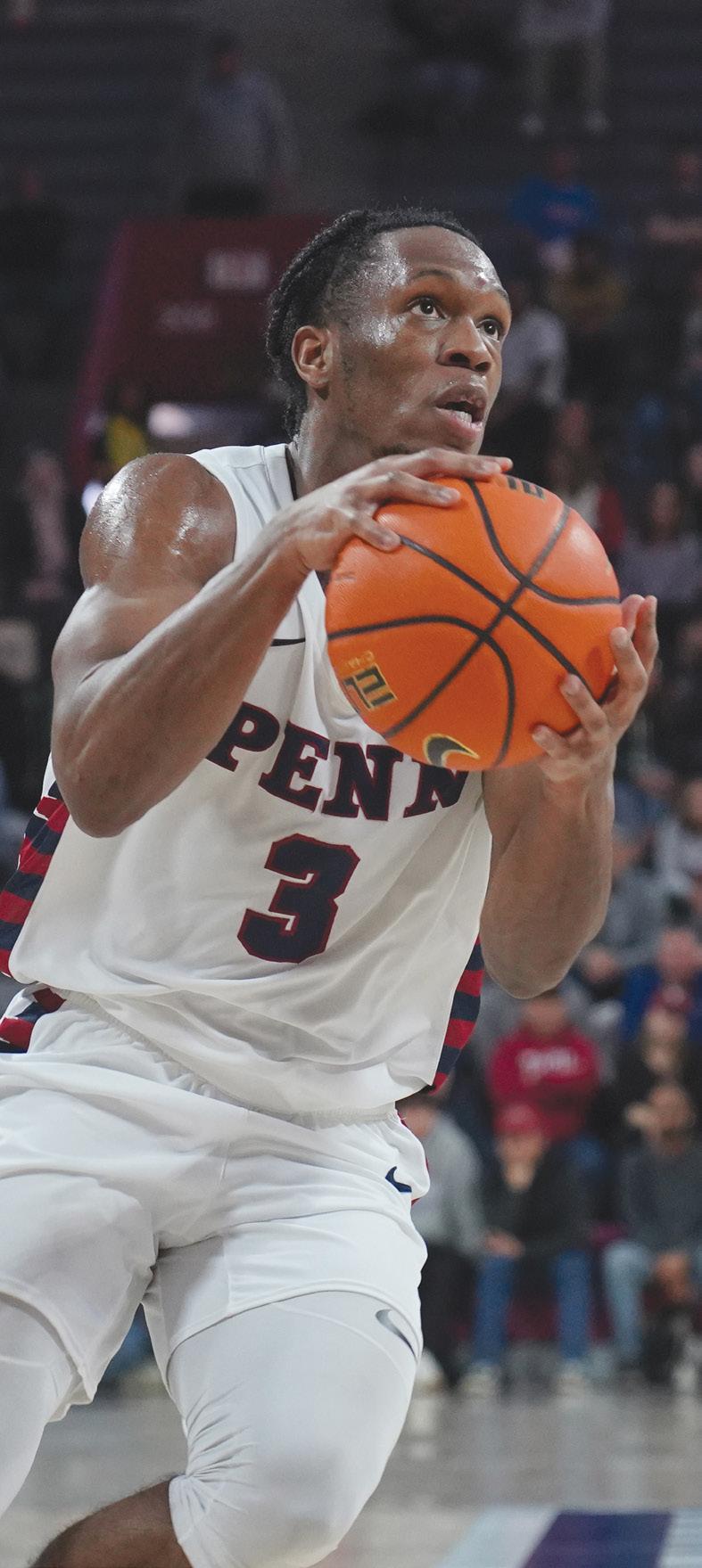


On Monday night, Penn (10-11, 2-4 Ivy) secured a much-needed 76-52 win against Hartford (4-17) after having lost three straight games against Ancient Eight opponents. Having beaten the Hawks by a comfortable margin during the Cathedral Classic this past November, Penn was hungry for a repeat performance. The Quakers’ 50% shooting from the field and 42% three-point rate reflect the team’s efficient offensive display.
“I thought we played really well for 30 minutes or 35-minute periods in each of the last few games," coach Steve Donahue said. "Before tonight, we just talked about making sure we played well for 40 good minutes, [and] I thought we did that after a slow start.”
The contest was neck and neck following the opening tip-off. Hartford was the first to gain momentum, thanks to efficient all-around shooting from the field, but stellar ball movement and sharp cuts to the basket by Penn kept the Quakers within striking distance.
Key passes from sophomore forward/center Nick Spinoso opened up the Hawks’ defense and allowed Penn to gain ground on the scoreboard. Spinoso played a key role in the offense with his rotations and dished out an impressive five assists throughout the game.
“This whole week, we've been working on getting the ball moving, not being so stagnant on offense, and really just trusting each other to make the right plays," Spinoso said. "Coach really stressed it this week so I'm glad to be able to perform and make the right reads.”
If Hartford started the opening half well, Penn finished it in a resounding display of dominance. Hawks fans had front-row seats to the Jordan Dingle show as the junior guard led the Quakers into the midway break. After slamming home a strong two-hand jam early in the contest, Dingle would rest on the bench until late in the first half. He was a man on a mission from the moment he checked back in, especially offensively. He finished his night in Connecticut with 23 points, shooting 4-8 from three.
Following the break, the Quakers came out of the locker room to continue what they started — entering the second half ready to extend their lead. With 10 minutes left to go in the match, Penn sat on a very comfortable 16-point lead.
The undeniable x-factor for Penn was impressive three-point shooting. The Quakers hit 14 shots from beyond the arc, two shy of their
Reasons to remain optimstic for men’s basketball
CALEB
and the 100- and 200-yard breaststroke. Back at Sheerr Pool for a dual meet weekend, the Quakers faced West Chester on Friday and Harvard on Saturday for Senior Day. The Red and Blue defeated the Golden Rams, with Fallon recording yet another win in the 200-yard breaststroke. Ultimately, Penn fell to the Crimson but picked up four individual event wins, three of those from
Fallon. The Warren, N.J. native scored wins again in the 100- and 200-yard breaststroke, along with a win in the 400-yard individual medley.

Fallon and the Penn swim and dive crew will compete against Rider this Friday, Jan. 27, at Sheerr Pool. This will be the Quakers’ last meet before heading to Providence, R.I. for championship competition on Feb. 22.
So far, Penn men’s basketball’s season has been underwhelming. There, I said it.
A team The Daily Pennsylvanian ranked first in Ivy League preseason rankings is now 2-4 against conference opponents, putting the Quakers second-tolast in the Ancient Eight with only eight games left in the season. The two wins were a 30-point blowout of cellardwelling Columbia and an eight-point win at middling Brown that feel like they were a lifetime ago.
Since then, against the schools most likely to represent the Ivy League in March Madness, such as current leader Princeton and last year’s champ Yale, Penn has struggled. What’s worse, the Quakers are also losing the easily winnable games, such as one at Dartmouth on Jan. 14, when Penn led by double digits well into the second half and shot a paltry 6-24 from three. Those are the games Penn needs to get into the top four of the Ivy League and make it to Ivy Madness in March.
However, despite the disappointing conference record
so far, not all hope is lost for men’s basketball. Many of the reasons why the team has lost games this year seem to stem not from a talent disparity, making these flaws infinitely more fixable.
One of the largest problem areas is that Penn turns the ball over too much, as simple as that. No game shows this better than Saturday’s road bout against Yale. In the first half, Penn scored 38 points, only committed two turnovers, and cruised into halftime with a narrow threepoint lead. But in the second half, the Quakers scored 25 points, turned the ball over 11 times, and ultimately lost the game by seven.
While turnovers will vary half by half and game by game, the results from Yale show that when Penn plays clean basketball, like the team did in the first half, it can
PHOTO BY ELLIE PIRTLE
Senior guard Lucas Monroe drives to the basket during the game against Princeton at the Palestra on Jan. 16.
CONTACT US: 215-422-4640 SEND STORY IDEAS TO DPSPORTS@THEDP.COM ONLINE AT THEDP.COM THE INDEPENDENT STUDENT NEWSPAPER OF THE UNIVERSITY OF PENNSYLVANIA • FOUNDED 1885 PHILADELPHIA, THURSDAY, JANUARY 26, 2023 VOL. CXXXIX NO. 3 SPORTS
PHOTO BY ANNA VAZHAEPARAMBIL
The sophomore has finished first in every one of his seven events since the Zippy Invitational on Dec. 1 ANDREA MENDOZA Sports Associate
Crain | Despite a 2-4 start in Ivy play, the Quakers have shown flashes of a highquality team
CRAIN Sports Editor
Junior
See HARTFORD, page 6 See OPTIMISM, page 6
PHOTO BY ANNA VAZHAEPARAMBIL
Junior guard Jordan Dingle looks to put up a shot against Temple during the game at the Palestra on Dec. 10, 2022.
