THE INDEPENDENT STUDENT NEWSPAPER OF THE UNIVERSITY OF PENNSYLVANIA • FOUNDED 1885
PHILADELPHIA, THURSDAY, JANUARY 15, 2026
VOL. CXLII
NO. 1
Penn graduate student union announces Feb. 17 strike deadline If the union were to strike, more than 3,700 graduate student workers would cease work responsibilities to join picket lines across campus DANIYA SIDDIQUI Staff Reporter
ANDY MEI | DEPUTY DESIGN EDITOR
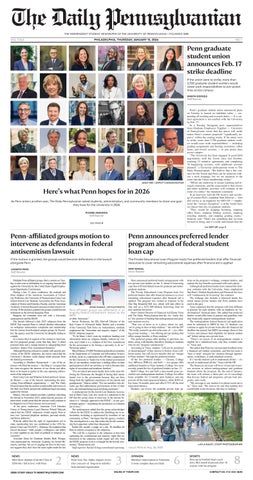
Here’s what Penn hopes for in 2026 As Penn enters another year, The Daily Pennsylvanian asked students, administrators, and community members to share one goal they have for the University in 2026 PHOEBE ANAGNOS Staff Reporter SEE PAGE 4
Penn’s graduate student union announced plans on Tuesday to launch an indefinite strike — suspending all teaching and research duties — if a contract agreement is not reached with the University by Feb. 17. In a Tuesday Instagram post, representatives from Graduate Employees Together — University of Pennsylvania wrote that the union will strike unless Penn’s contract proposals “significantly improve” within the coming weeks. If the union were to strike, more than 3,700 graduate student workers would cease work responsibilities — including grading assignments and hosting recitations, office hours, and review sessions — to join picket lines across campus. “The University has been engaged in good faith negotiations with the Union since last October, reaching 23 tentative agreements and completing 39 bargaining sessions, with additional sessions planned,” a University spokesperson wrote to The Daily Pennsylvanian. “We believe that a fair contract for the Union and Penn can be achieved without a work stoppage, but we are prepared in the event that the Union membership strikes.” “Efforts are underway to ensure teaching and research continuity, and the expectation is that classes and other academic activities will continue in the event of a strike,” the statement continued. In an interview with the DP, history and sociology of science Ph.D. candidate Sam Schirvar — who also serves as an organizer for GET-UP — emphasized the “serious disruption” a strike would have on classes that rely on graduate students. “They would be stopping lecturing, stopping office hours, stopping holding sections, stopping emailing students, and stopping grading exams,” Schirvar said. “That’s not something that we look forward to doing, and it’s really unfortunate that the See GET-UP, page 3
Penn-affiliated groups motion to intervene as defendants in federal antisemitism lawsuit
Penn announces preferred lender program ahead of federal student loan cap
If the motion is granted, the groups would become defendants in the lawsuit alongside Penn
The Private Educational Loan Program hosts five preferred lenders that offer financial resources to cover remaining educational expenses after financial aid is applied
LAVANYA MANI Staff Reporter
ANVI SEHGAL Senior Reporter
Multiple Penn-affiliated groups filed a motion on Tuesday to intervene as defendants in an ongoing lawsuit filed against the University by the United States Equal Employment Opportunity Commission. During a Jan. 13 press conference, the national and Penn chapters of the American Association of University Professors, the University of Pennsylvania Carey Law School Jewish Law Students Association, the Penn Association of Senior and Emeritus Faculty, and the American Academy of Jewish Research announced their intent to intervene. If the motion is granted, the groups would become defendants in the lawsuit alongside Penn. Requests for comment were left with a University spokesperson and the EEOC. The lawsuit followed a July 2025 subpoena from the EEOC that required Penn to submit detailed information on workplace antisemitism complaints and membership lists for various Jewish-related campus groups. In November, the agency sued the University for allegedly failing to comply. In a memo filed in support of the motion to intervene, the five proposed groups wrote that they have “a direct personal stake and a unique interest in safeguarding their members’ distinct First Amendment freedoms.” Although Penn has refused to comply with specific provisions of the EEOC subpoena, the memo stated that the University’s decision could change under pressure from the federal government. According to Matthew Hamermesh — one of the attorneys who filed the motion — the filing is “a request that the court recognize the interests of our clients and allow them to be heard as parties in the case opposing enforcement of the subpoena.” Penn Carey Law and Wharton School professor Amanda Shanor — one of the lawyers representing the intervening Penn-affiliated organizations — told The Daily Pennsylvanian that the motion would enable intervenors to file their own briefs and provide additional legal reasoning against the lawsuit. Shanor, who also helped circulate a petition criticizing the lawsuit in November 2025, added that the presence of intervenors would mean that the lawsuit could continue to be litigated even if Penn chooses not to proceed. At the press conference, American Civil Liberties Union of Pennsylvania Legal Director Witold Walczak stated that the EEOC subpoenas would require Penn to turn over “personal telephone numbers, personal emails, and home addresses.” Walczak added that the right of organizations not to share membership lists was established in the 1958 Supreme Court case NAACP v. Alabama. He explained that forced disclosure “chills people’s willingness and ability to come together in any kind of political or religious association.” Associate Dean for Graduate Studies Beth Wenger, who represented the American Academy for Jewish Research, said that “the act of singling out Jews in this manner suggests they don’t have the same rights under the law
Penn announced preferred lender arrangements with five private loan lenders on Jan. 8, ahead of borrowing caps that will limit federal loans for graduate and undergraduate students. The Private Educational Loan Program hosts five preferred lenders that offer financial resources to cover remaining educational expenses after financial aid is applied. The program was created in response to the One Big Beautiful Bill Act, which will take effect in July and set a $257,500 lifetime borrowing limit for new students borrowers. Penn’s Senior Director of Financial Aid Elaine Varas told The Daily Pennsylvanian that the Act “really limits” the amount of funding that undergraduate and graduate students receive. “That sort of drove us to a place where we said, ‘we’re going to have to help students,’” she told the DP. “We really wanted to go down the route of — yes, offering private lending — but offering private lending that offers unique benefits to Penn students.” The preferred groups offer lending to part-time students, along with benefits that allow lending to students who do not “progress satisfactorily.” According to Varas, students “will not be penalized or disadvantaged” if they choose to borrow from a different lender, but will receive benefits that are “unique to Penn students” through the preferred lenders. Of the five preferred lenders — Citizens, College Ave, MPower, PHEAA, and SoFi — two groups offer additional benefits to Penn students. College Ave most recently joined the list of preferred lenders on Jan. 13. Both College Ave and SoFi a nine-month grace period for non-undergraduate students. College Ave offers loans available for 12-month prior balances and one percent off the total repayment balance, while SOFI offers loans 18-months prior and offer 0.75% off the total repayment balance. Students can review the available private loan op-
NEWS Meet three students from the Class of 2030 who ‘fell in love’ with Penn
2
SEND STORY IDEAS TO NEWSTIP@THEDP.COM
JESSE ZHANG | DP FILE PHOTO
Penn-af fliated groups are defendants in an ongoing federal antisemitism lawsuit by the EEOC. as other Americans.” Steven Weitzman, the Ella Darivoff Director of the Katz Center of Advanced Judaic Studies and a member of the University Task Force on Antisemitism, similarly emphasized the “immediate and negative impact” of the EEOC subpoena requests. “To be blunt, I don’t want my employer handing over information about my religious identity without my consent, and I think it is a violation of the First Amendment for the government to be forcing a university to do so,” Weitzman added. Mitch Marcus, PASEF President and professor emeritus in the Department of Computer and Information Science at Penn, wrote in a statement to the DP that a requirement for the University to “hand over to the federal government lists of our members would have a chilling effect on their participation in all of our activities as well as threaten their rights of association and academic freedom.” “For our retired and senior faculty born in the years following the Holocaust, the thought of having their names turned over to the government because they are Jews brings back the nightmare experiences of our parents and grandparents,” Marcus added. “For our members who decades ago fled authoritarian governments in fear of their lives, this demand brings back terrifying memories.” A spokesperson for the Jewish Law Students Association at Penn Carey Law also wrote in a statement to the DP that the group chose to intervene in the lawsuit because it is “strongly opposed to the EEOC—or any government agency—mandating the production of a blanket list of Jews.” The spokesperson added that the group acknowledges “efforts by the EEOC to address the disturbing rise in antisemitism, including as experienced by members of our community at Penn,” but hopes that the agency conducts “the investigation in a way that makes the Jewish community feel supported, rather than threatened.” Earlier this month, a judge set a Jan. 20 deadline for Penn to submit a response to the subpoena. “We will file a response to the subpoena at that time explaining the constitutional and statutory rights that enforcement of the subpoena would impair and why what the EEOC proposes to do is so fraught for the Jewish community,” Hamermesh said. Staff reporter Rachel Erhag contributed reporting.
NEWS Penn Zeta Tau Alpha chapter closes after concerns of ‘long-term stability’ from national organization
3
tions on the program’s webpage, compare lenders, and explore the key benefits associated with each option. Although all preferred lenders have entered into fouryear contracts with the University, Varas emphasized that Penn’s Student Registration and Financial Services will “continuously be reviewing” the contracts. The webpage also includes a historical lender list, which names private lenders that Penn students have used in the past. Varas explained that the program will look different in practice for each student, with an emphasis on “individualized” financial plans. She added that preferred lenders would offer loans to parents and guardians who may financially support undergraduate students. The undergraduate federal financial aid application must be submitted to SRFS by Jan. 15. Students can continue to apply for private loans after the financial aid deadline has passed, but SRFS encourages them to first “review and exhaust their eligibility for federal student aid” before taking out a private loan. “There’s no reason, if an undergraduate student is eligible for a subsidized loan, why they wouldn’t take it,” Varas said. She added that Penn has incorporated feedback from a financial aid student committee, and that her team is “here to help” navigate the situation through appointments, workshops, or individualized sessions. It’s “not the student’s job to understand all this — it’s our job to understand all this,” Varas told the DP. The financial aid team will host virtual and in-person sessions to inform undergraduate and graduate students about the program. By the end of January, the team will release a three-part set of recordings that discuss federal aid programs, private loan programs, and credit. “My message to any student is to please reach out to us,” Varas said. “We want to be sure that students feel comfortable in the decisions that they’re making.”
LAYLA NAZIF | STAFF PHOTOGRAPHER
Locust Walk on Aug. 26, 2025.
OPINION Martinez | Intervention in Venezuela is more complex than you think
ONLINE AT THEDP.COM
6
SPORTS Penn sprint football head coach Jerry McConnell dismissed after 18 seasons with the program
8
CONTACT US: 215-422-4640
2 NEWS
THURSDAY, JANUARY 15, 2026
THE DAILY PENNSYLVANIAN | THEDP.COM
News Meet three students from the Class of 2030 who ‘fell in love’ with Penn The Daily Pennsylvanian spoke with three students admitted early to the Class of 2030 about what drew them to Penn and what they are looking forward to in the upcoming years ANANYA KARTHIK Senior Reporter
Penn released early decision admissions results for the Class of 2030 on Dec. 18, 2025, welcoming students from over 60 countries and 49 states to campus. During last year’s early decision application cycle — the first since Penn reinstated its standardized testing requirement — Penn received over 7,800 applicants. The Daily Pennsylvanian spoke with three students admitted early to the Class of 2030 about what drew them to Penn and what they are looking forward to in the upcoming years. Cortney Buford is from Dallas and was admitted to the College of Arts and Sciences, where she intends to study health and societies. Buford — who hopes to attend law school after completing her undergraduate degree — is pursuing the major to study the equities of American healthcare outcomes. “This major was so interesting to me because it didn’t approach health as a very black and white thing,” Buford said. “It’s not a monolith — it’s built on a lot of exploitation of different communities.” Buford is also “super excited” about becoming involved with Penn’s cultural centers. “I follow a lot of them on Instagram, and I always see the cool activities that they’re getting up to and speakers that they have come and talk to them,” Buford said. Buford visited Penn’s campus the summer before her junior year of high school, which informed her decision to commit to the “binding aspect” of the University’s early decision application. “I just really fell in love with it,” Buford told
PHOTOS COURTESY OF CORTNEY BUFORD, AKSHAYA SREERAM, ANYA LI
Three incoming f ir st year s in Penn’s Class of 2030: (from lef t to right) Cortney Buford, Akshaya Sreeram, Anya Li.
the DP. Anya Li, who is from Santa Clara, Calif., was admitted to the Jerome Fisher Program in Management and Technology and plans to study electrical engineering alongside a concentration in either finance or accounting. The M&T program is a “great opportunity to explore both sides and truly make a difference,” Li explained. She decided to apply through the early decision process after attending the M&T Summer Institute in 2025, where she met several Penn students and faculty. Li, who has also practiced synchronized swimming and coached athletes with disabilities, discussed how the M&T program offers an opportunity to pursue her interest in creating assistive technology for swimmers and ultimately help athletes with disabilities compete at the Paralympic Games. “I liked the energy there,” Li told the DP. “I really want to be able to use STEM to create technology to make it easier for athletes to maneuver in the pool.” While on campus, Li saw the University’s student clubs — such as Penn Electric Racing — in action. She currently participates in robotics programs at home and found the “larger scale of electric racing cars that these students built” to be “really cool.” “We were able to go into their facility and see the motor cars that they created,” Li explained. “I want to be able to be a part of that when I go to Penn.” The DP also spoke with Wharton School admit Akshaya Sreeram, who explained that her choice to apply early decision was shaped by her proximity to campus and interest in Penn’s extensive network. “I only live 40 minutes away from Penn, I’ve always loved my family, and I’ve always wanted to stay on the East Coast,” Sreeram said. Sreeram emphasized the opportunity to make “lifelong connections” at Penn, “whether it be your friends, industry partners, [or] industry connections.” “It just seemed like a very sociable experience but also a long-term beneficial investment that I would love to put myself in,” Sreeram said. Sreeram explained that she hopes to pursue her interest in financial consulting and Penn’s business partnerships, along with other Wharton offerings. “Through the Netter Center’s economic development partnerships, I hope to work with small business owners to understand their operational challenges and limited access to capital, and really work with them to design strategies to address them,” Sreeram told the DP. These three students will join thousands of others from the 2025-26 application cycle to comprise Penn’s incoming Class of 2030.
The Engineering Quad on Feb. 25, 2025.
CONNIE ZHAO | SENIOR PHOTOGRAPHER
Penn Engineering announces accelerated online master’s program Upon admission and matriculation, the program will allow undergraduate students to take up to three graduate-level courses and apply them toward a Penn Engineering online master’s degree ADDISON SAJI Staff Reporter
Penn Engineering announced its new Online Accelerated Master’s Program — set to begin this fall — on Jan. 9. Upon admission and matriculation, the program will allow undergraduate students to take up to three graduate-level courses and apply them toward a Penn Engineering online master’s degree. After graduation, students will have three years to complete the remaining online degree requirements at their own pace. In a statement to The Daily Pennsylvanian, Penn Engineering Director for Online Student Experience Kristen Burkett explained that the program was conceptualized and developed after the school received student feedback on the difficulty of completing a master’s degree. “Many engineering students plan to continue into graduate study, but once they graduate and start working or move to a new location, staying enrolled in an on-campus program can become difficult,” Burkett wrote. “This program was created to bridge that gap by giving students a way to continue their graduate studies online, without losing the progress they’ve already made.” Senior Associate Dean for Graduate Education and Global Initiatives Boon Loo wrote in
a statement to the DP that Penn’s online accelerated master’s program will allow Engineering students to balance their educational goals with “full-time work, geographic mobility, and evolving career paths.” “This program reflects a broader shift in engineering education toward flexibility, lifelong learning, and alignment with workforce realities,” Loo wrote, emphasizing that students can earn “the same Penn Engineering degree,” but make use of a more flexible program structure. Loo wrote that Penn Engineering’s accelerated pathway is “distinctive” from those at other universities, citing that the program integrates “residential graduate coursework with a fully online, asynchronous master’s degree” in a model that maintains academic rigor. He also wrote that the School of Engineering plans to contact recent alumni who did not complete their master’s programs and inform them of the launch of Penn’s new online program. “For many of these individuals, work, relocation, or other life commitments made it difficult to remain enrolled on campus,” Loo wrote. “And this model offers a practical opportunity to return and finish their degree.”
New $50 million investment fund will support Penn life sciences startups Through seed and Series A investment, the fund supports projects developing novel therapeutics, diagnostics, research tools, and AI-enabled drug discovery ADVITA MUNDHRA AND SAMEEKSHA PANDA Staff Reporters
Penn announced a $50 million life sciences venture fund on Friday, alongside the global biotechnology firm BioNTech and the Philadelphia-based venture capital firm Osage University Partners. The Penn-BioNTech Innovative Therapeutics Seed Fund — or PxB Fund — is designed to provide capital to biomedical companies with roots at Penn. Through seed and Series A investment, the fund supports projects developing novel therapeutics, diagnostics, research tools, and AI-enabled drug discovery. 2009 College graduate Anna Turetsky, who also serves as the general partner of the fund, told The Daily Pennsylvanian that she hopes to invest in “areas of unmet need where Penn innovation has the potential to substantially move the needle for patients.” OUP Managing Partner Marc Singer similarly described the type of companies the fund hopes to work with. “Most of the companies we will invest in probably do not exist today, but given what we do at OUP, we’ve been considering Penn investments for a long time,” Singer said in an interview with the DP.
He highlighted the “long, large pipeline of Penn companies” that OUP has worked with over time, mentioning “a flow of opportunities” that would allow the fund to “hit the ground running.” According to Penn Chief Innovation Officer John Swartley, the fund aims to address the gap in early-stage investment opportunities for life sciences research. Swartley explained that many companies that previously devoted a large portion of resources to the early stage “have either moved to later stage or have capital limitations.” “It’s been a challenging environment, and so we think this is a really good time to bring in some more capital to companies that are having trouble finding money at this stage,” he added. Singer also characterized the fund as a “very natural extension” of the work OUP was already conducting with Penn. “Penn was one of our first partners 15 years ago,” he said. “We’ve invested in over 10 spinout companies already.” He also noted the success of previous Penn spinouts. In the past year, Capstan Therapeutics and Interius BioTherapeutics — both pioneered
by Penn researchers — were acquired in major deals. Swartley also noted “the constellation of available resources” afforded by the fund to the Penn community. “We can’t anticipate all of the things that will be needed to advance those potential product or business ideas, so we want to create this really robust portfolio of support resources,” he said.
College Hall on Feb. 25, 2025.
The fund’s support of early-stage life sciences commercialization is intended to stimulate Pennsylvania’s startup and innovation economy by attracting more specialized investors, according to Turetsky. “We anticipate the establishment and growth of numerous exciting new biotechnology companies which will contribute to the growth of Penn’s innovation ecosystem,” Turetsky said.
JEAN PARK | DP FILE PHOTO
FactCheck.org, the award-winning political website at the Annenberg Public Policy Center of the University of Pennsylvania, is now accepting applications for its 202627 undergraduate fellowship program. The next class of undergrads will be trained during an eight-week, paid summer program at FactCheck’s offices at APPC from May 26 to July 17. Those who are trained this summer must agree to work 10 to 15 hours per week at FactCheck.org during the fall and spring semesters, if their work merits continued employment. The fellows at FactCheck.org help our staff monitor the factual accuracy of claims made by political figures in TV ads, debates, speeches, interviews, social media and news releases. Fellows conduct research, contribute to fact-checking articles for publication under the supervision of FactCheck.org staff, fact-check articles written by FactCheck.org and respond to questions from readers. The fellows must have an ability to write clearly and concisely, an understanding of journalistic practices and ethics, and an interest in politics and public policy. The fellows also must be able to think independently and set aside any partisan biases. If you are interested, please submit your resume and two writing samples by the February 11 deadline to FactCheck.org. Deputy Director Rob Farley at rob.farley@factcheck.org. Please direct any questions about the program or application process to the same address.
A Project of the Annenberg Public Policy Center
THURSDAY, JANUARY 15, 2026
THEDP.COM | THE DAILY PENNSYLVANIAN
NEWS 3
Black first year enrollment at Penn Carey Law hits record low, DP analysis finds Only 10 Black first-year students enrolled to the school in 2025, the lowest figure since American Bar Association began mandating annual 509 disclosures in 2011 JACK GUERIN Senior Reporter
Black first-year student enrollment at the University of Pennsylvania Carey Law School hit a record low in 2025. Demographic data released last month revealed that only 10 Black students enrolled in Penn Carey Law’s Class of 2028 — a 50% drop from the previous class. The Daily Pennsylvanian found that Black first-year enrollment in 2025 was the lowest at the school since the American Bar Association began mandating annual 509 disclosures in 2011. “Penn Carey Law is committed to complying with the law and fostering a community that reflects a wide range of ideas, experiences, and perspectives,” a Penn Carey Law spokesperson wrote in a statement to the DP. “Our first-year class exemplifies the academic excellence, collegiality and collaboration, and ethos of service that define our community.” Penn Carey Law had consistently enrolled roughly 20 Black students each year since 2011. Before the Class of 2028, the lowest number of enrolled Black first-year students on record was 15 in 2017. The recent decrease in Black first-year student enrollment at Penn Carey Law coincides with a nationwide trend. A New York Times analysis of Penn Carey Law and 17 other peer law schools found that only four of the surveyed institutions reported an increase in Black first-year enrollment in 2025. For the Class of 2027 — the first admissions cycle impacted by the United States Supreme Court’s overturning of affirmative action — Penn Carey Law did not experience a decrease in Black first-year student enrollment. Instead, the data showed a slight uptick from 19 Black first-year students enrolling in 2023 to 20 enrolling the next year. The number of first-year Hispanic students enrolled at Penn Carey Law increased by 10 students in 2025. The increase followed a previous decline in Hispanic enrollment, which dropped from 34 students in 2023 to 21 students in 2024. The Class of 2027 was the first group of students admitted after the ABA removed the “U.S. nonresident” classification from 509 disclosures and recategorized nonresident students by race. Following that change,
Penn Carey Law pictured on Dec. 5, 2022. the number of first-year Asian students enrolled at the law school more than doubled from 31 in 2023 to 63 in 2024. In 2025, the number of first-year Asian students enrolled at Penn Carey Law decreased by only 2 students from the year prior, for a total of 61 students. First-year students categorized as “people of color” — which the ABA defines as anyone not identified as “White” or “Race and Ethnicity Unknown” — comprised almost 42% of the Class of 2028, a slight drop from 45% the year prior. Over the past decade, the percentage of Penn Carey Law classes represented by students of color has trended upward. The sudden drop in Black first-year student enroll-
ANGELA YE | DP FILE PHOTO
ment comes after Penn Carey Law eliminated several programs during a University-wide rollback of references to diversity, equity, and inclusion. In August 2025, Penn Carey Law shut down its Office of Equal Opportunity and Engagement and paused a full-tuition scholarship program honoring Sadie Alexander, the school’s first Black female graduate. A month later — as the school’s decision faced mounting criticism — Penn Carey Law established the Dr. Sadie T.M. Alexander Fellowship. The new program, scheduled to launch this fall, will provide two years of funding to Penn Carey Law graduates who are pursuing work that advances civil rights.
GET-UP, from front page Penn administration has put us in this position.” According to GET-UP’s website, graduate workers with research appointments will also be expected to suspend “new experiments” and refrain from attending lab meetings for the duration of the strike — which would last until Penn agrees to a contract or workers “collectively decide to cease striking.” “A strike is not inevitable,” GET-UP wrote in the Instagram post. “Penn admin has forced grad workers to make a difficult decision: we can accept their insulting offers or we can go on strike to win the contract that we deserve.” Schirvar stated that the strike deadline is intended to signal urgency to administrators, adding that “there is a clock ticking.” He highlighted that the union’s ideal contract includes provisions on improved pay, benefits, and support for international workers. “That allows us to live comfortably in Philly, a city with rising costs of living, and thus allows us to focus on our research and teaching without having to worry about paying rent and making ends meet,” he said. The strike deadline announcement follows more than a year of contract negotiations with University administrators. On Oct. 8, GET-UP staged an informational picket in support of the union’s bargaining efforts. Days later, the union reached a tentative agreement on an article protecting students from harassment and discrimination. On Nov. 21, the union’s members overwhelmingly voted to authorize a strike. Before the results of the vote, Penn’s Office of the Provost issued guidance that workers can “choose to continue working” even if they voted to strike and that striking workers would not be paid by the University. At the time, the Office of the Provost also stated that all students are “expected to attend classes even if it requires crossing picket lines,” and students who do not wish to cross picket lines are encouraged to “discuss the implications of this decision in advance with individual faculty.” Senior reporter Ananya Karthik contributed reporting.
Penn Zeta Tau Alpha chapter closes after concerns of ‘long-term stability’ from national organization The Alpha Beta Chapter will not accept new members or participate in Penn’s spring sorority recruitment process, which begins on Jan. 14 CHRISTINE OH Senior Reporter
The Alpha Beta chapter of the Zeta Tau Alpha sorority will no longer be recognized at Penn after its national organization announced the chapter’s closure last month. The organization announced the chapter’s closing — effective immediately — in a Dec. 18, 2025 press release. The Alpha Beta chapter will not accept new members or participate in Penn’s spring sorority recruitment process, which begins on Jan. 14. In a statement to The Daily Pennsylvanian, a University Life spokesperson wrote that ZTA’s national organization made the decision to close the Alpha Beta chapter and later informed the Office of Fraternity and Sorority Life. “All members of ZTA chapter at Penn have been granted alumnae member status by the national chapter organization,” the spokesperson wrote. “Students currently residing in the chapter house will be allowed to remain living there for the spring semester.” The spokesperson added that no direct communication regarding the chapter’s closure will be sent to Penn students participating in sorority rush this
upcoming semester. However, OFSL will continue to distribute its “standard general information” materials to prepare potential new members for recruitment. In the statement published to its website, the national organization explained that the decision followed “extensive support, resources, and guidance” from leadership and staff — which did not result in increased participation or the Alpha Beta chapter’s “long-term stability.” “Despite the efforts of support from the Fraternity, it is apparent the chapter will be unable to meet these expectations,” the statement read. The Alpha Beta chapter was originally founded in 1918 and first closed in 1954 due to the declining number of members. In 2011, Penn’s Panhellenic Council selected the Alpha Beta chapter to rejoin campus and worked with the ZTA national organization to reactivate it. In its announcement, ZTA described the Alpha Beta Chapter as “a treasured part of [its] history,” emphasizing that members will remain involved with
the organization “as a reminder that Zeta Is Forever.” According to the University Life spokesperson, any further updates regarding the status of the sorority will be communicated directly to students in the Alpha Beta chapter from ZTA’s national headquarters. “OFSL will continue to support all students, affiliated and unaffiliated, at the University,” the spokesperson concluded.
CHENYAO LIU | STAFF PHOTOGRAPHER
A speaker at a GET-UP press conference on Nov. 3, 2025.
KENNY CHEN | PHOTO EDITOR
ZTA house on Jan. 13.
START FRESH WITH A NEW SPACE N NO OW W L LE EA AS S II N NG G F FO OR R F FA AL LL L 2 20 02 26 6 4 4 -- 9 9 B BE ED DR RO OO OM M H HO OU US SE ES S A AV VA A II L LA AB BL LE E !!
new year, new beer WE WE DELIVER DELIVER
2206 2206 WASHINGTON WASHINGTON AVE AVE || (215) (215) 546-7301 546-7301
41 ST & LOCUST 41 ST & LOCUST
40 TTHH & SANSOM 40 & SANSOM
41 ST & PINE 41 ST & PINE
Studio - 9 Bedroom Studio - 9 Bedroom Apartments & Houses Apartments & Houses
Largest Floorplans in Largest Floorplans in University City University City
Steps from Campus Steps from Campus
24/7 Package Pickup 24/7 Package Pickup with Amazon Hub with Amazon Hub
Upgraded Apartments Upgraded Apartments Available Available
On-Site Laundry On-Site Laundry
4043 4043 Walnut Walnut Street, Street, Philadelphia, Philadelphia, PA PA 19104 19104 LiveCampusApts.com | (215) 382-1300 LiveCampusApts.com | (215) 382-1300
4 NEWS
THURSDAY, JANUARY 15, 2026
THE DAILY PENNSYLVANIAN | THEDP.COM In 2025, Penn navigated widespread changes impacting higher education. The year saw new faces, initiatives, and academic programs. As Penn enters another year, The Daily Pennsylvanian asked students, administrators, and community members to share one hope they have for the University in 2026. Here’s what they said. “I wish for happiness and peace for everyone at Penn! I also hope that each of you finds purpose, belonging, and joy in whatever you are called to do. We are a community of artists, inventors, athletes, healers, researchers, teachers, problem solvers, and so much more. Together, let’s continue to strengthen Penn and provide value to society in the year ahead. Our University has a long legacy of groundbreaking ‘firsts’ -- launching the nation’s first hospital, medical school, business school, and, more recently, pioneering mRNA vaccine technology and the first FDA‑approved CAR T‑cell and gene therapies. Inspired by Penn’s many historic contributions, I hope everyone gets involved in Penn’s and Philadelphia’s commemoration of America’s 250th, and I look forward to future ‘firsts’ we will create together. As I hear reports from the working groups, I am very excited about Penn Forward. I believe it will be transformative for Penn, positioning us as a leader in a rapidly changing society. Finally, I look forward to learning about the many exciting projects, people, and activities happening throughout our amazing campus every day.” — Penn President Larry Jameson “One hope I have for the upcoming year is that Penn continues moving towards being a campus where student well-being, belonging, and accessibility are treated as institutional priorities. Over the past year, working closely with both students and administrators, I’ve seen how structural barriers around funding, academic pressure, mental health resources, and the everyday logistics of student life can disproportionately impact students who are already navigating a great deal. This especially feels important in the context of the broader external pressures many students are facing right now. This includes everything from economic uncertainty to an increasingly polarized social and political climate, which often show up quietly but boldly in students’ academic and personal lives. I hope Penn continues to recognize these realities and responds accordingly. In that process, I also hope that the Undergraduate Assembly can continue to serve as a platform for elevating student concerns and translating them into constructive conversations and action with the administration.” — Wharton junior and Undergraduate Assembly President Nia Matthews
2026
Penn’s goals for the new year As Penn enters another year, The Daily Pennsylvanian asked students, administrators, and community members to share one goal they have for the University in 2026. Here’s what they said PHOEBE ANAGNOS Staff Reporter
“One of Penn Climate’s most important goals for 2026 is to show the entire Penn community - students, faculty-staff, and alumni - how truly impressive Penn’s existing climate work is. We have some of the foremost experts in the world innovating at the cutting edge on topics ranging from climate policy to materials science to design and beyond.” — Vice Provost for Climate Science, Policy, and Action Sanya Carley “To my fellow campus dwellers, in 2026 I wish you days will be consumed with self-contempt, doubt, and despair; that your carriages will be infelicitous and gestures muted; that your beverages be brackish and your shoes ill-fitting. Friends won’t call, professors will forget to submit letters of recommendation, pay-raises will be frozen, and applications will be ignored. In this unrelenting discontent, when you just can’t stand yourself one more day, you will forget yourself and see the world full of gorgeous artistic, literary, musical, and horticultural distraction from the undeniable reality of your own inadequacy and eventual demise, or you will just meet someone that reminds you nothing of you...I also hope you have at least four good sandwiches.” — Religious studies professor Justin McDaniel “My hope for the Penn community in the year ahead is that we can all continue to sustain our shared values of curiosity, invention, community engagement, entrepreneurial energy, and public service – even in the face of historic threats to the mission of higher education. This is why we are now advancing the Penn Forward initiatives to encourage the vibrant new ideas that can proactively shape our community going forward. It is especially significant for us to honor this historic mission in 2026, when people across the world will celebrate the values embodied in the 250th anniversary of the signing of the Declaration of Independence in Philadelphia.” — Provost John Jackson Jr. “For decades, Penn’s expansion has fueled gentrification in West and Southwest Philly. This year the university has a real chance to prove that it wants to do right by its neighbors. Penn can turn words into action by helping us preserve more than 900 affordable homes now being put up for sale by Neighborhood Restorations, and by partnering with the Black Bottom community on an initiative that honors the history and future of this beloved neighborhood, which Penn and the City razed during urban renewal.” — Philadelphia City Councilmember Jamie Gauthier (D-Philadelphia) “As we mark the Semiquincentennial in 2026, one of my goals is for the Penn community, especially our students, to engage deeply with the enduring ideas of democracy, trust, and truth that have shaped both the nation and the University. Through America 250 at Penn, the Penn Libraries are working with partners across campus to use our collections, exhibitions, and public programming to create spaces for inquiry, reflection, and dialogue that connect historical understanding with contemporary questions. By inviting interdisciplinary exploration of original sources and fostering conversations across difference, I hope the Libraries help strengthen civic engagement and enrich the intellectual life of campus as we consider how the promises of our past can inform a more inclusive future.” — Vice Provost and Director of Libraries Brigitte Weinsteiger “My goal for Penn this year is that we meet the historical moment. For the College, this means pressing the case for fundamental knowledge, the one secure way to make us ready for an always changing future. In a world suffused with AI, we humans need well-honed critical judgement. In a world where quick-twitch, incendiary commentary derails public discussion, we need the wisdom to discern hidden agendas and fallacies. And at a time when too many dehumanize those that think differently, we need people who can understand and learn from diverse points of view. Our moment, like every moment, needs independent thinkers to help us find our way through. My goal is that we in the Penn community all work to enable as many of us as possible to declare our independence.” — College of Arts and Sciences Dean Peter Struck “As we open 2026 and prepare to recognize our nation’s 250th anniversary, I see a need for leaders to prioritize two things at once. At Wharton, this
THEDP.COM | THE DAILY PENNSYLVANIAN
means honoring our foundational strengths while ensuring our illustrious future. We look to achieve this through thoughtful innovations in our majors and degree programs, supported by meaningful infrastructure investments on both our Philadelphia and San Francisco campuses. Our recently launched Dr. Bruce I. Jacobs Master of Science in Quantitative Finance program shows how we’re putting our aspirations into action and is a key focus for us this year. Further, as a leading professional school with myriad stakeholders, we also believe Wharton should be of increasing service to the global business community, bringing needed and novel insights to learners and leaders worldwide. In 2026, we will continue our goal of expanding access to Wharton knowledge in traditional areas of expertise like finance and leadership, as well as in emerging arenas like artificial intelligence, through non-degree and multimedia content for the broader business world. In these and numerous other ways, we look to celebrate what makes Wharton great and what’s needed to maintain our greatness for generations to come.” — Wharton School Dean Erika James
“We’ve already had, I think, seven basketball games at the Palestra, and eight teams competed last weekend so this ‘new year’ is well on its way for those of us who work in Penn Athletics. Philadelphia is going to be an amazing place from a sports perspective in 2026, so I want to be as involved as I can be in some of those events—things like the NCAA Tournament games at Xfinity Mobile Arena in March, the World Cup at Lincoln Financial Field in June and July, and the MLB All-Star Game at Citizens Bank Park in July. It’s events like those that make working in this city so special, and so I can’t wait to sit around next December and take stock of what could be an incredible year from an events standpoint.” — Director of Athletic Communications Mike Mahoney “With the many changes occurring in our world and on our campus, it can feel as though the ground is shifting beneath our feet, touching our students, the people we serve, and each of us personally. These shifts call on us to look closer and stay creative as we protect what matters most: our mission of shaping compassionate leaders who embrace evidence-driven science and policy to improve health and well-being for individuals and communities. As Martin Luther King Jr. said, ‘We must accept finite disappointment, but never lose infinite hope.’ Even amid this uncertainty, I am hopeful for our future because of the people who show up every day with thoughtfulness and skill. The resilience and generosity of the Penn and Penn Nursing communities bring much optimism for what we will accomplish together this semester.” — School of Nursing Dean Antonia Villarruel “In 2026, I hope Penn Hillel continues to serve as a network of support where all students can explore the joy, meaning, and depth of Jewish life. As a board, we hope to continue engaging in dialogue and building relationships with other cultural, ethnic, religious, and other identity-based groups to make our campus community as strong as possible. Bring on 2026!” — College senior and Penn Hillel Co-President Remy Rabin “Last fall, I spent a lot of time engaging with faculty, staff, students, and alumni on what they value about Arts & Sciences and where they hope we go next. One of my main goals now is to launch a new strategic plan in early 2026 that reflects those conversations and lays out a vision for the School. I’m excited for it to give our community a shared sense of momentum and direction, and to spark new ideas about how we can have even greater impact.” — School of Arts and Sciences Dean Mark Trodden “Let’s make a dose of daily laughter our university’s simplest, most contagious, evidence-based, zero-prescription health tool.” — Perelman School of Medicine professor Michael Miller “In 2026 and beyond, one of Penn Engineering’s central goals is to work to reinvent the experience of STEM education for the AI era. This goal is front and center in our new strategic plan, Penn Engineering 2030, which prioritizes expanding hands-on learning, research opportunities and interdisciplinary collaboration for students across Penn, Philadelphia and the world. Our students are essential in shaping an educational future that is centered in creativity, responsibility and impact. Their curiosity and ambition drive everything we do as we prepare them to solve humanity’s greatest challenges and shape a better future for all.” — School of Engineering and Applied Science Dean Vijay Kumar “Penn Carey Law began with a Founding Era effort to make legal knowledge broadly accessible to all those participating in our democracy. This simple but ambitious commitment continues to guide us today. One of our primary goals is to ensure that every talented admitted student can afford to join us, has the resources and support to succeed, and graduates with the freedom to pursue the career of their choosing, whether in public service, private practice, business, government, or an emerging field.” — University of Pennsylvania Carey Law School Dean Sophia Lee “My goal for ISSS in 2026 is to continue strengthening Penn as a welcoming, globally engaged campus by enhancing the way we support international students and scholars, both through clear, timely immigration advising and through integration initiatives that foster belonging, connection, and crosscultural learning. As global mobility becomes more complex, we aim to work closely with partners across Penn to ensure our international community can thrive academically, professionally, and personally, while advancing the University’s broader mission of teaching, research, and global impact.” — Executive Director of International Student and Scholar Services Rodolfo Altamirano “My goal for 2026—one that I share with my colleagues in OGCA—is to enthusiastically encourage the people of our campus community to lean into their civic power in two important ways: voting in this year’s momentous elections, and experiencing America’s semiquincentennial anniversary with a yearlong slate of events on campus and across the City of Philadelphia.” — Executive Director of the Office of Government and Community Affairs Dawn Maglicco Deitch “My goal is to continue our effort to de-escalate the anxiety in the college admissions process by providing clarity and removing friction where we can. We ask ourselves - and students and high school counselors - “How can we make this clearer? How can we anticipate questions and explain the information we need and how we assess it?” and then we make changes. In addition to adjustments we’ve already made in the last several years, I look forward to building more content that cuts through the high
energy (often incorrect) external advice engine and share real guidance in our truth-telling Application PSA video series.” — Dean of Admissions Whitney Soule
THURSDAY, JANUARY 15, 2026
NEWS 5
“Our goal for 2026 is simple: build tighter, trusting collaborations with our community partners, especially the School District of Philadelphia, to make a measurable difference in student and educator lives.” — Dean of the Graduate School of Education Katharine Strunk “At Penn Dental Medicine, one of our goals for 2026 is continuing to expand access to integrated oral healthcare for the Philadelphia community with a special emphasis on persons with disabilities throughout the lifecycle. In February, we are welcoming a new Chief of our Division of Community Oral Health, who will build upon our community partnerships and the care our students and faculty provide at sites in the surrounding West Philadelphia neighborhood and beyond. Plus, we will be increasing access to dental care for persons with disabilities and others who require sedation for treatment with a new general anesthesia/sedation suite that is slated to open at our school this year.” — Penn School of Dental Medicine Dean Mark Wolff “Weitzman is organizing a series of events and exhibitions for America’s 250th anniversary (the Semiquincentennial) to better understand the forces that have shaped our built and natural environment — and what is at stake in the decisions being made today by our elected officials. I hope students, faculty, and staff across the University are inspired to make their own connections across time and space.” — Stuart Weitzman School of Design Dean Frederick Steiner “One hope our Campus Recreation team has for 2026 is that more people across Penn feel comfortable using recreation spaces as part of their everyday lives. Whether someone comes to the gym regularly, joins an intramural team, or just needs a place to move, reset, or connect with others, we want those spaces to feel welcoming and approachable. Recreation plays an important role in supporting both physical and mental well-being, and our goal is to keep creating environments that help people feel supported, connected, and balanced as part of the campus community.” — Director of Campus Recreation James Rogers “I would love to see student organizations, as well as Penn as a whole, create more opportunities for students to explore their interdisciplinary interests. Additionally, I wish that students were more informed about the different career options they can pursue after graduation. The freshman class comes in with incredibly diverse backgrounds and perspectives, and the University should foster their passions by making more meaningful efforts to expose students to the broad range of career paths that our alumni have pursued.” — Wharton sophomore and Wharton Women President Lina Yang “My hope for my great Penn faculty colleagues in 2026 is that we can all find the best ways to continue to thrive, do our best work, and sustain our collective health and wellbeing in the midst of our challenging external circumstances. As Vice Provost for Faculty, I will continue to work with the Provost and other colleagues to monitor the impact of federal policy changes and other external events for faculty work and evaluation, especially for faculty in their probationary period. Last year, we made significant changes to criteria for external reviews and also added the option of “impact” statements for faculty going up for promotion and tenure. In the year ahead, I will continue to work with colleagues across the University to improve the clarity and transparency of the University’s expectations for scholarship, especially in finding new ways to evaluate diverse contributions to knowledge, with the goal of encouraging cutting-edge, innovative, and impactful scholarship that also meets the University’s expectations for rigor.” — Vice Provost for Faculty Laura Perna “This year at TEDxPenn, our goal is to sell out our tickets for our annual conference! We are so excited to host our annual TEDxPenn conference, which is the largest student-run TED Talk event, here at Irvine Auditorium on March 28th! I joined TEDxPenn as a freshman on the Operations Team, and quickly learned just how much goes into organizing a large event that brings together hundreds of people with such diverse interests. I got to listen to talks from speakers across disciplines from linguistics and finance to epidemiology to fashion, entrepreneurship, and artificial intelligence.” — College junior and Co-Curator of TEDxPenn Brady Keith “This fall, we’re thrilled to welcome students to the new Master’s in Communication and Media Industries program. This marks the return of a master’s degree at the School and is a key element of my forthcoming strategic vision.” — Annenberg School for Communication Dean Sarah Banet-Weiser “As we move into 2026, our goal is to bring in a new class of students who are committed to advancing social good, driving innovation, and creating lasting impact. Together with our extraordinary faculty, staff, students, alumni, and campus partners, we will continue to train and educate future social workers, policymakers, and nonprofit leaders who confront complex social challenges and lead meaningful, lasting change in communities across the globe. As a co-chair of Penn Forward’s Access, Affordability, & Value working group, I look forward to advancing the group’s recommendations — expanding opportunities for talented students from all socioeconomic backgrounds and ensuring that the cost and value of a Penn education are transparent — priorities that reflect the core values of both Penn and SP2.” — School of Social Policy and Practice Dean Sara Bachman “University Life’s goals for the coming year are to further strengthen a campus environment where students feel supported, connected, and able to engage fully in the Penn experience. We are focused on improving how students navigate campus resources and experience community throughout their time at Penn.” — Vice Provost for University Life Karu Kozuma “My hope for the coming year is to help ensure that every student—regardless of their background—can seamlessly access the wealth of resources our university offers. Having partnered with schools and Penn’s numerous support programs, I’ve seen the power of an interwoven campus. My goal is to help foster an environment where interdisciplinary knowledge and community engagement are not just opportunities for some, but a reality for all, empowering every student to thrive and lead.” — Vice Provost for Undergraduate Education Russell Composto
CHENYAO LIU | SENIOR DESIGNER
6 OPINION
THURSDAY, JANUARY 15, 2026
Opinion
142nd Year of Publication
THIS YEAR’S BOARD NEEMA BADDAM President JASMINE NI Executive Editor ETHAN YOUNG DP Editor-in-Chief ANNELISE DO Design Editor KATE AHN Design Editor PRASHANT BHATTARAI Copy Editor JESSICA HUANG Copy Editor ISHA CHITIRALA News Editor FINN RYAN News Editor AYANA CHARI Assignments Editor INGRID HOLMQUIST Opinion Editor HANNAH CHANG Sports Editor EMILIE CHI Sports Editor KENNY CHEN Photo Editor UMA MUKHOPADHYAY Video Editor ARINA AXINIA Social Media Editor NIRA GOYAL Puzzles Editor RANVITH ADULLA Business Manager MAYA ECHAMBADI Corporate Relations Manager SRIYA TALLAPRAGADA Media Ventures Manager SHREYA SRINIVASAN Strategy & Promotions Manager
THIS ISSUE’S TEAM EUNICE CHOI Deputy Design Editor CHENYAO LIU Deputy Design Editor AMY LUO Deputy Design Editor ANDY MEI Deputy Design Editor JULIA WANG Deputy Design Editor KIARA ESCUDERO Deputy Copy Editor ANANYA KARTHIK Deputy Copy Editor LUKE PETERSEN Deputy Copy Editor AVA SAVINO Deputy Copy Editor EMMA DESMET Copy Associate EBUNOLUWA ADESIDA News Photo Editor CONNIE ZHAO Opinion Photo Editor
THE DAILY PENNSYLVANIAN | THEDP.COM
Intervention in Venezuela is more complex than you think M’S MANIFESTO | When ideology becomes complicity More than one year ago, I wrote about the lack of action from the international community after the fraudulent elections in Venezuela. I expressed how heartbreaking it was to see international organizations such as the Organization of American States remain still. In July 2024, when former leader of Venezuela Nicolás Maduro committed electoral fraud, the OAS did not go beyond a press release. During that time, the Biden administration also failed to put pressure on a dictatorship that for years had been destroying millions of lives. Instead, the United States government removed sanctions and even released a key ally of the Venezuelan regime. So on Jan. 3, many Venezuelans and other Latin Americans woke up relieved by the news that the Trump administration had finally taken action. Yet again, it was heartbreaking to witness the international response. People on social media began to defend a dictator and even went so far as to ask for his release, all with the purpose of blindly defending an ideology, and refused to listen to Venezuelans about their own experiences. As students at one of the world’s most important academic institutions, the way we produce and reproduce ideas and stories matters. We are the future political and business leaders of the country, and it is crucial that we understand the nuances of international affairs such as the Venezuelan crisis. The discussions we have in the classroom will shape global debates, influence policy, and make a lasting impact on our world. Our community needs to learn how dangerous it is to go along with popular belief and support a regime it know nothing about. For years, Americans have been blindly supporting fascist governments abroad in the name of being anti-Trump. “Hands off Venezuela” protesters have argued in support of a Maduro-led revolution and claimed he was elected democratically. After his capture, protesters gathered to chant “Free Maduro” in New York, with similar arguments regarding sovereignty, democracy, and revolution. Not only are these statements false — Maduro was never a legitimate president, as there is proof of the committed fraud — but they are also offensive. For those of us familiar with the history of Venezuela, it is outrageous to see people defend their own
SANJANA JUVVADI | STAFF PHOTOGRAPHER
Senior columnist Mariana Martinez emphasizes the importance of nuance when reacting to the Venezuelan crisis.
socialist ideologies to the point of invisibilizing millions of people that have suffered for more than 20 years. One of the most common arguments criticizing Maduro’s capture is that it violated sovereignty and international law. However, this argument fails to acknowledge that the Maduro administration was already in violation of international law, not only because he was not a legitimate president, but also because of outright human rights violations. Maduro’s government captured over 1000 political prisoners, enacted policy resulting in food shortages, and caused the deaths of at least 24 protesters the day after the fraudulent elections. Free speech, democracy, and human rights — values the leftist movement claims to support — simply did not exist in Venezuela. It is simply hypocritical for “free speech, no kings” defenders to be calling for the release of a dictator that did not respect free speech nor democracy at all. Another recurring argument invokes
Venezuela’s oil reserves, warning of the potential exploitation Venezuela might face at the hands of the United States. Critics of the intervention have called it “modern-day colonialism.” But once again, this argument falls short. Mainly, it ignores the fact that Venezuela was already selling most of its oil to China, Russia, and Iran, exploiting its economy and citizens in the process. If Americans are so concerned about oil, why wait until now to voice their thoughts? This is just another attempt to defend a fascist regime because it aligns with their socialist ideologies. What do these anti-interventionists suggest as a potential alternative? Should Venezuelans continue to suffer for another 30 years simply because people are more concerned about oil and money than human rights? While many argue that perhaps a more reasonable alternative is through dialogue and diplomacy, they forget that this has already been attempted and has failed. The Biden administration de-
creased sanctions on the country under a diplomatic agreement for Maduro to ensure “fair and free elections.” This happened in 2023, and three years of oppression followed — including the election fraud. So while it was shocking, the Trump administration did what had to be done. Penn, since its founding, has been committed to free inquiry and thought. Right now, our students must be independent thinkers and not just willfully support every anti-interventionist post on social media because it seems popular. This time, it’s important to listen to those who have truly experienced fascism and understand that foreign intervention is never a black‑and‑white issue. MARIANA MARTINEZ is a College junior from Bogotá, Colombia, studying political science. Her email is marmari@sas.upenn.edu.
You’re not a victim, and that’s okay CHARLOTTE’S WEB | We are in the safest place in Philadelphia Location can be a significant deciding factor for college applications, and Penn being in Philadelphia is one of its selling points. Let’s be honest, Ithaca and New Haven don’t bring as much excitement as Philly. But are we still grateful for our living situation, or are we beginning to see the world through privileged lenses? Last semester, the 40th Street ‘gatherings’ and Walnut shooting had Sidechat in a chokehold, with posts flooding in about Penn’s lack of security and how dangerous Philadelphia is. Students argued that they felt unsafe, that Penn didn’t care about the incidents, and that this was negatively impacting their education. In the end, panic had spread so far that instead of a shooting being reported correctly as an isolated conflict between two non-students, it was rumored that a sophomore was shot on campus. Many students were shocked by the few reports of crime around the University. But, in reality, what did we expect? That we would go to a university in West Philadelphia and never encounter or hear about events happening in West Philadelphia? To me, what was more shocking than the Penn safety alerts was students’ reactions to them.
Quickly, the idea of crime around Penn became an ‘us and them’ idea, where Penn students were the harmless, fearful victims of the evil criminals on 40th Street. But really, it is more of an ‘us’ problem, because Penn students are breaking the law just as much, if not more than, any Philadelphia residents. But we don’t like to think of underage drinking and minor drug possession as the crime we should be afraid of — that’s just the college experience. We tolerate student crime when it becomes assault and sexual violence, or theft and destruction of property. We then quite literally look down upon Philadelphia residents from our high rises and judge them based off of Sidechat rumors and Penn safety alerts, when crime is just as much in fraternity house basements and dorm rooms as it is 40th and Walnut. Students argue that the cases of crime around campus diminish Penn’s quality, but applying to Penn means applying to live here as well. And living in Philadelphia is one of the best parts of this school. We can’t accept all of the good things about Philly — the job opportunities, the food, the entertainment, the internships — and then act like we had no idea about the natural consequences
of living in a big city. Students from New York City or Los Angeles will complain about crime around Philadelphia as though it’s some foreign, unimaginable concept. To argue that we should be able to reap all the benefits of living in Philadelphia but be completely oblivious to the actual city of Philadelphia is ridiculous. Just because we go to Penn and get to live in a privileged bubble for four years doesn’t mean everyone else does, and it doesn’t mean we get to ignore the communities we live in. Often, it comes back to a complaint about our tuition. I hear students argue that $90,000 a year should ensure their safety. This is a completely logical argument. What’s illogical is to assume that Penn should gentrify West Philadelphia into becoming suburbia for our convenience. The University of Pennsylvania has the largest private police force in the state, with a 24/7 police presence made up of security, Penn Police, and the Philadelphia Police Department. However, despite any amount of police presence, there will still be crime — in any school, in any city. It’s not a lack of safety resources; it’s a demand for a false sense of security that is leading
to the dissatisfaction of so many students. We want to live on a safe campus, where the only crimes committed are by Penn students, and throw rocks from our glass houses. I am in no way trying to undermine or diminish the experiences Penn students have had with crime. There is real trauma attached to being a victim of crime, no matter the circumstance. However, the stigmatization of West Philadelphia residents and communities has become abhorrent and undeniable. We cannot pretend we’re victims because we live in a big city, especially because the rest of Philadelphia doesn’t get the privilege of safety like we do. The racist, classist, and elitist complaints about criminal activity around the city do not exempt Penn students from the crimes they commit right here on campus, and it definitely doesn’t help the alienation of Penn students and the communities we live in.
and Marriage Pact buzz, Chanté Joseph’s article, “Is Having a Boyfriend Embarrassing Now?”, took the world by storm. In her piece, Joseph also notes this shift in the way women are approaching dating culture; women going to great lengths to hide their boyfriends on social media or even outwardly admitting that a boyfriend brings down their “aura.” As she concluded her article, this line stuck with me: “Being partnered doesn’t affirm your womanhood anymore; it is no longer considered an achievement, and, if anything, it’s become more of a flex to pronounce yourself single.” Joseph’s article is right to point out the shift in changing attitudes towards dating. However, this culture rooted in centuries-old tradition hasn’t disappeared overnight. While many women agree that romantic relationships could be a hindrance to their personal journey and even identity, many still feel the Titanic-esque longing for love, myself included. Given the gender gap on Penn dating services, it’s clear that many female students at Penn feel the same. It’s safe to say that as young women on this preprofessional and competitive campus, a lot of us were the hyperindependent valedictorians, student leaders,
or overachievers in high school. The thing with dating culture, though, is that it is deeply rooted in traditional gender norms, often forcing women to center their lives around male partners. Women who placed value on other pursuits, like academics or career ambitions, struggle to fit into or accept that dating culture. Still, beneath the surface, all of us are craving one thing: love. But the solution for our yearning for love isn’t the dating algorithm platforms or God forbid the fraternity date nights. Love is all around us in both our existing relationships and relationships waiting to be found. We are already so loved by family, mentors, and friends. As college students there is a loving relationship to be found that is way more fulfilling than the love our dating culture advertises to us: a loving relationship with ourselves. Now is time for us to experiment, explore, and create a full sense of security with ourselves, because that’s where true love lies.
CHARLOTTE PULICA is a College first year studying Communications and Public Relations from Enoch, Utah. Her email is cpulica1@sas.upenn.edu.
Boyfriends are embarrassing GLORIA OBJECTS | The gender gap in dating at Penn
LETTER SUBMISSION Have your own opinion? Send your letter to the editor or guest column to letters@thedp.com. Editorials represent the majority view of members of The Daily Pennsylvanian, Inc. Editorial Board, which meets regularly to discuss issues relevant to Penn’s campus. Participants in these meetings are not involved in the reporting of articles on related topics.
LAND ACKNOWLEDGEMENT The Land on which the office of The Daily Pennsylvanian stands is a part of the homeland and territory of the LenniLenape people, known to the original Indigenous people as “Lenapehoking.” We affirm Indigenous sovereignty and will work to hold The Daily Pennsylvanian and the University of Pennsylvania more accountable to the needs of Native American and Indigenous people.
I still recall the anticipation on campus leading up to Penn Date Drop’s first release in October. The dating service, introduced to Penn earlier in the fall semester, has students take an 8-minute questionnaire that results in one compatible match based on a 0 to 100 percentage scale. Like the over 1500 students that signed up for the service this fall, I was intrigued by the potential of finding the “perfect match” in the midst of our generation’s battle with situationships and the seeming absence of true love. Then, two days prior to the release, Date Drop sent an email to participants stating, “We've got a gender gap: 98 more women signed up than men.” This gap didn’t surprise me, but its effects on the matching process did. Many women who signed up didn’t receive a romantic match and instead a “platonic” one — an option never advertised for a supposed dating platform. Out of my group of seven female friends that opened our matches together, only one of us paired with a romantic match. Shortly after, the same situation happened with Penn Marriage Pact, a similar college matching platform. It got me thinking: Why are women at Penn more invested in the dating scene in comparison to the men
on campus? Universally, the target audience for dating culture is women. While sometimes direct, this messaging is often quite discreet and subliminal. The hundreds of women in romcoms and novels whose entire plot is centered around finding “the one” or mainstream songs by female artists longing for a husband are amidst a long list of the ways society tells women that they need the right man to be fulfilled in life. At Penn, this culture is visible in who signs up for these matchmaking platforms and who doesn’t. It is the reflection of the centuries old lesson where women are taught to prioritize romantic relationships while men are not. However, this idealized heterosexual romance is falling apart with our generation. Singlehood, especially amongst women, has spread rampant amongst American society over the past decade. Following the COVID-19 pandemic, the percentage of single women in the 18-29 age group jumped from 38% to 45% in the span of two years. This jump signifies a change in the minds of women, particularly young women, when it comes to dating culture: they are no longer interested in the show. Around the time of the Date Drop
GLORIA OLADEJO is a College first year from Coopersburg, Pa. studying law and society and Africana studies.
THURSDAY, JANUARY 15, 2026
THEDP.COM | THE DAILY PENNSYLVANIAN
NEWS 7
SUBSCRIBE TO OUR
NEWSLETTERS DP DAYBREAK – VOICES OF PENN – QUAKER NATION THE TOAST – PENN, UNBUTTONED
STUDYING LATE? WE’RE OPEN LATE!
Domino’s
TM
SUN-THURS: 10AM - 2AM • FRI & SAT 10AM - 3AM
WE MAKE ORDERING EASY!
CALL DIRECT OR CHOOSE YOUR ONLINE OR MOBILE DEVICE
215-662-1400
4438 Chestnut St.
215-557-0940 401 N. 21st St.
8 SPORTS
THURSDAY, JANUARY 15, 2026
THE DAILY PENNSYLVANIAN | THEDP.COM
Sports
Penn sprint football head coach Jerry McConnell dismissed after 18 seasons with the program McConnell first joined Penn as offensive coordinator before being promoted to head coach in 2019 HANNAH CHANG Sports Editor
Jerry McConnell will not return as head coach of Penn sprint football next season, Penn Athletics announced on Wednesday. The decision comes after sprint football’s underwhelming performance this past fall, ending its season with a 2-6 record overall and losing all three of its conference games. “We are grateful for Jerry’s nearly two decades of service and dedication to our student-athletes in the Penn sprint football program, both as head coach and offensive coordinator,” Director of Athletics and Recreation Alanna Wren wrote in the announcement. “This leadership change is an important step toward elevating the program’s competitive success and enhancing the overall experience for our student-athletes. We wish Jerry the very best in his next chapter.” McConnell first joined the sprint football program in 2007 as an offensive coordinator, before taking over as head coach when Bill Wagner, who had held the head coach position for 50 years, retired after the 2019 season. Due to the pandemic,
the 2020 season was canceled, and McConnell led the team as head coach for the first time in 2021, when the program experienced five consecutive wins and outscored their opponents 252-52 in total. During his time with the program as offensive coordinator and head coach, McConnell helped the team win the Collegiate Sprint Football League titles in 2010 and 2016 and a CSFL South Division Championship in 2017. He has also helped develop offensive players, many of whom went on to receive all-CSFL honors, including three CSFL MVPs. In his first season as head coach, seven players were named all-CSFL first-team. McConnell previously served as head coach at Holy Cross High School and also coached at Temple University, Rowan University, and La Salle University. Although he leaves his position as head coach, McConnell’s son, Penn sprint football offensive line coach Frank McConnell, remains on the coaching staff. Penn Athletics is currently searching for a new head coach for the fall season.
COURTESY OF PENN ATHLETICS
Rick Santos was named the head coach for Penn football. leadership. Santos said he looks to develop not only top-notch football players, but also great people, viewing football as a “platform to teach life skills.” “Becoming the best version of yourself is my ter Payton Award winner with the program. main mission as the head coach of this incredible After a stint in the Canadian Football League, program,” Santos said. Santos began his coaching career at UNH as Santos will get the opportunity to build his a wide receiver coach before transferring to new supporting staff from ground up, and decide Ivy League rival Columbia in 2016, where he whether to retain former head coach Ray Priore’s worked as a staff member under former Penn staff — who worked to recruit most players on coach Al Bagnoli. the roster for next season. Santos said he leaned on Bagnoli when makThe remaining 12 spots in next year’s freshing the decision to take the position, asking him man class will be filled with “highly touted” not only what it is like to coach at Penn, but also players, according to Santos. what it is like to raise a family in the Philadel“Ultimately, it’s about the young men that phia area. have already chosen Penn, and they didn’t choose “I had a deep understanding of what this place me,” Santos said. “So first and foremost, it’s my is from the ability to coach under Al Bagnoli,” mission to put together a really good staff, elite Santos said. teachers, great mentors, people that they’ll conHe also mentioned the deep alignment he fide in and believe in … and when we do that, felt with Penn football’s academic and athletic anything’s possible.”
SANTOS, from back page
COURTESY OF PENN ATHLETICS
Sprint football coach Jerry McConnell was fired from his position.
BASKETBALL, from back page
Threads - 3x2.5
season. The Quakers ended 2025 in the win column with an 80-61 victory over NJIT on New Year’s Eve, a game in which they made nearly 40% of their three-point attempts. In the new year, Penn began the conference campaign with a back-and-forth loss at Princeton on Jan. 5 and a home win over Brown on Jan. 10. The latter marked new coach Fran McCaffery’s first Ivy League coaching victory. Game of note: 78-76 loss to Princeton, Jan. 5 The Quakers’ loss to the Tigers extended their streak in the rivalry to 14 games, but the matchup itself was not without intrigue. Penn took a 13-point first-half lead before Princeton went on a streak of 16 consecutive made field goals to take the lead. A 13-0 Penn run in the final three minutes gave the Quakers a chance to win on the final play, but sophomore guard AJ Levine’s last-second three-pointer was off the mark. Player to note: Senior guard/forward Ethan Roberts Roberts, Penn’s leading scorer, missed four games after suffering a concussion in the Quakers’ Big 5 championship loss to Villanova on Dec. 6, but returned to the lineup against Princeton and led the team with 19 points. Following that game, McCaffery said Roberts had to “get back in rhythm.” The former Drake transfer seemed to do just that against Brown, notching 28 points and bringing home the Big 5 Player of the Week award. Statistic to know: Penn is shooting 39.6% from three as a team so far this season, ranking ninth among 365 Division I teams. Quote that sums up the season so far: “It sort of hit me the first game I coached,” McCaffery said of coaching his alma mater’s team. “But after that, it was kind of like ‘Ok, next game. It’s a Big 5 game, it’s an Ivy League game, it’s somebody else.’” “It’s just: prepare the team, get them ready to try to win, try to improve as the game’s going on. Make adjustments, get [opponents] to make adjustments, and then get better, collectively and individually.” Up next: At Dartmouth, Saturday, Jan. 17, 3 p.m.
Women’s basketball Record: 10-5, 0-2 Ivy The Penn women’s basketball team picked up an impressive 67-62 win over PAC-12 opponent Washington State to open winter break action. The victory was fueled by senior guard Simone Sawyer and sophomore forward Katie Collins, who notched 15 points each. The team then traveled across state lines to Hackensack, N.J., for the FDU Christmas Classic. Penn won the tournament, defeating Maryland Eastern Shore 78-57 and Binghamton 59-54. But the Quakers’ success soured once Ivy play began, losing to Princeton 74-68 and Brown 77-65. Game of note: 77-65 loss to Brown, Jan. 10 In their most recent matchup, Penn fell to Brown 77-65 in a double-overtime slugfest. Throughout regulation, the Quakers never led and trailed the Bears by as many as 12 points. Still, Penn was able to battle back to force extra time twice before the Bears pulled away. Princeton, Harvard, and Columbia have dominated the conference in recent years. If this trend continues, Brown and Penn are expected to compete for the final spot in Ivy Madness. This early loss to the Bears could prove troublesome for Penn as it looks to make the conference tournament. Player to note: Sophomore forward Katie Collins In 34.3 minutes per game, Collins is averaging a team-high 13.2 points alongside eight rebounds and 1.7 blocks per game. After her rookie-of-the-year campaign last season, she was asked to move from center to primarily playing power forward. She has barely missed a beat. At the FDU Classic, she was named the tournament’s most valuable player, averaging 19.5 points, nine rebounds, and 4.5 blocks across two games. Statistic to know: Penn is excelling on both sides. Among the eight Ivies, the Quakers rank third overall in total offense and defense. Quote that sums up the season so far: “I know non-conference games have really helped us prepare,” senior guard Saniah Caldwell said following the FDU Classic. “I know that we have a lot of confidence, a lot of energy, and a lot of excitement heading into Ivy play.” Up next: Harvard at home, Saturday, Jan. 17, 2 p.m.
SPORTS 9
THURSDAY, JANUARY 15, 2026
THEDP.COM | THE DAILY PENNSYLVANIAN
Penn distance and field stars shine at the Penn Select Three Quaker women notched victories in their first meet of the new year ELLIE CLARK Deputy Sports Editor
Winter break may be over, but track season is heating up. Penn track, distance, multi-event and field event squads took center stage at the Penn Select meet after a brief winter break. Distance Senior long-distance specialist and cross-country All-Ivy honoree Anna Weirich dominated the 3,000-meter race by over 7 seconds to finish with a new meet record of 9:42.62, beating the previous time by 24 seconds. Weirich’s pace set the tone for her distance teammates, including senior Kyra Compton, junior Sarah Fischer, and freshman Adele Martin, who finished second, third, and fourth, respectively. Sophomore distance specialist L’Mio Edwards led the charge in the mile with a 4:51.89 finish, trailing teammate and defending indoor 800-meter national champion Nia Akins. Close behind, sophomore distance runner Quin Stovall finished runner-up among her collegiate competitors, setting a 20-second personal record to break five minutes for the first time. Although Akins cruised to a 4:43.32 finish to break the standing meet record in the mile, she scratched in her signature event, the 800 meters. Freshman distance standout Joseph Socarras added to his stacked resume with a second-place finish in the mile. Socarras led the majority of the race to run under the previous meet record, but was out-touched at the line by Rider distance runner Tamrat Snyder by a tenth of a second. Socarras’ finish currently ranks 20th in the NCAA. Senior distance runner Liam Going also ran below the previous mile record to earn the bronze. Distance runners junior Kofi Fordjour and freshman Vinay Raman followed close behind in personal bests to round out the top five, all finishing under 4:10. Professional talent was on display in the men’s distance events as well. Former Texas A&M AllAmerican Cooper Cawthra lowered the 3,000-meter facility record by one second in an all-professional heat before the collegiate competition. Field and multi-event Junior indoor pole vault program record holder JJunior indoor pole vault program record holder Evangeline Thomson added to her undefeated season by tying her season-best performance from the Penn Opener at 3.92 meters. Thomson finished just outside scoring territory at last year’s Ivy League Heptagonal Championships, but her consistency shows promise. Senior thrower Stella Inman improved her season-best mark by a meter-and-a-half to comfortably win the weight throw with a 18.70-meter toss. Inman finished sixth in the weight throw at last year’s Heps behind Princeton thrower Angela McAuslan-Kelly, who was the Penn Opener weight throw champion and Ott Center for Track and Field record holder. All three Penn contenders in the women’s weight throw reached the finals, highlighting the squad’s strength on the national stage. Junior thrower Ella Neskora finished runner-up behind Inman with a season-best 17.73-meter throw, while junior thrower Alexa Dochat came in fifth with a 15.10-meter throw. Defending Ivy League indoor shot put cham-
KUSHKOV, from back page at the Wharton School, Penn’s work hard and play hard culture, but most importantly, coach Andy Ma “[who] has been like a father figure away from home, truly,” Kushkov said. “From the bottom of my heart, he is a very good kid,” coach Ma said echoing Kushkov’s sentiments. “He loves fencing, he loves Penn, he loves our program. Every year I saw him grow. Finally this year, he was voted by the whole team … [for] men’s team captain. He carries the maturity and the leadership. So every year he grew up, he brought more maturity.” Kushkov has made a large contribution to the fencing program so far. Since joining, he placed sixth in sabre at the NCAA Championships his freshman year. He has been honored with first team All-Ivy and with an Honorable Mention AllAmerica. After placing first at the NCAA Mid-Atlantic/South Region last year, he qualified for the 2025 NCAA Championship and placed 12th. Now as a senior, he has embraced the role as a mentor for the team, though it did not come naturally. As a freshman joining the team, Kushkov admitted to the intense pressure of fitting in even
ABHIRAM JUVVADI | STAFF PHOTOGRAPHER
Then-sophomore Alexa Dochat competed at an invitational on April 6, 2024.
pion senior Angeludi Asaah finished third in the shot put to open her senior season, throwing over the previous meet record with a 14.85-meter lob. Villanova thrower Maria Deaviz ultimately came out on top, setting a meet record with 16.15 meters, good for 11th in the NCAA at the time of writing. On the men’s side, the Penn throwing squad went 5-6 in the shot put finals. Junior thrower Zezo Beshir improved his season-best mark by almost a meter, whereas freshman thrower Colter Oldham finished two centimeters shy of his Penn Opener performance at 14.91 meters. Another meet record
with the amount of accolades under his belt. “You still feel like you need to prove yourself and that’s how I felt. There was this whole team full of world champions, and world team members, and youth Olympians, and I mean you name the award, [someone] had it on our team. I definitely felt a really strong need to fit in with the group. I really tried to bring a big intensity to every tournament,” he said. Kushkov’s gradual emergence to the position of captain has led him to appreciate his current role as a mentor for the underclassmen, acknowledging his growth from freshman year. “I really like being a mentor … Also, the tournaments, there’s different timings and there’s different ways to prepare for these events and how to do well. I remember that was a really big culture shock to me, and that’s what I try to bring to the freshmen and sophomores and even to the juniors still.” Having fenced all his life, Kushkov understands juggling academics and fencing, and his wisdom expands to the entire team. Whether it’s giving advice about eating vegetables or leading foot work routines, he’s always steering the team as the captain and a leader of the program. “Oh, he’s the real model. He likes doing. He is always a present leader for us and an influence to the team,” coach Ma said. “He will leave a legacy.”
fell as Delaware State thrower Christopher Johnson threw 16.26 meters to best the prior mark. Rutgers pole vaulter Kevin O’Sullivan ultimately pulled away with a personal-best vault at 5.55 meters, breaking the meet and facility records and ranking eighth in the NCAA at the time of writing. Penn track alumnus James Rhoads currently leads the NCAA in the pole vault with a 5.71-meter jump in his first collegiate meet after an unprecedented gap year. Senior high jumper and three-time All-American Kampton Kam’s absence was felt on the field as Rutgers high jumper Malachi Yehudah broke
the standing meet record with a 2.11-meter jump. Sophomore high jumper Oliver Hassard attempted to fill the gap but came up short with a sixth-place finish, tying his season-best performance with a 1.91-meter jump. The meet closed with the Penn women’s distance squad in the 4x400 relay. Stovall ran an impressive 57-second third leg to propel the Quakers from fifth to third place before handing off to Edwards, who anchored Penn to the bronze. Penn indoor track and field will return to the Ott Center for the Quaker Invitational on Jan. 17, facing competition from teams near and far.
convenience is part of our routine N OW L E AS I N G F O R FA L L 2 02 6 39th & Pine
39th & Sansom
40th & Locust
Studio - 5 Bedroom Apartments & Houses
On-Site Laundry
Upgraded Units Available
24/7 Package Pickup with Amazon Hub
4104 Walnut Street, Philadelphia, PA 19104 SAMANTHA TURNER | DP FILE PHOTO
Senior fencer Simon Kushkov celebrated with the team on Jan. 22, 2023.
UniversityCityAssociates.com | (215) 382-2969
SPORTS
THE INDEPENDENT STUDENT NEWSPAPER OF THE UNIVERSITY OF PENNSYLVANIA • FOUNDED 1885
PHILADELPHIA, THURSDAY, JANUARY 15, 2026
VOL. CXLII
NO. 1
‘Pressure makes diamonds’: Simon Kushkov recounts his fencing journey since age three In his senior year, Kushkov became team captain for Penn men’s fencing following a standout season EMILIE CHI Sports Editor
ence schedule with a 1-2 record, first battling to close losses against Big Ten Rutgers and Atlantic 10 George Mason, which ranks 66th out of 365 teams in the NCAA’s NET rankings this
Between travel, rigorous academics, and 18 years of full-fledged fencing competition, “pressure makes diamonds,” senior fencer Simon Kushkov says. For Kushkov, his fencing career began at three years old when his dad handed him his first sabre. Fencing is Kushkov’s blood — his dad pursued fencing as an Olympic alternate in Ukraine and eventually opened a fencing club in the United States. “So yeah, all praise goes to my Dad,” Kushkov told The Daily Pennsylvanian. Fencing became a crucial part of Simon’s life early on. It helped that he developed a love for sword fighting while watching “Pirates in the Caribbean.” Working day in and day out at his dad’s fencing club since he was ten years old, he led camps and clinics over the summer while still traveling the world for competitions and World Cups. “On Wednesday, I would be flying out to Sofia, Bulgaria for a World Cup. And [this type of travel] lasted the entire year … so I just [did] my homework on the plane.” He was part of the 2020 Cadet World Team and ranked fifth in the world for U17 all before joining Penn’s fencing team. So how was he able to put in so much time, travel, and training from such a young age? “Just seeing my parents do the impossible,” Kushkov said. “We moved to the States and lived out of a basement. Being first generation really built that work. Seeing my parents do the things that other people can’t do, I think I’m really driven to push my limits and not take ‘no’ for an answer.” Kushkov’s decision to come to Penn mainly relied on a “combination of three things”: business
See BASKETBALL, page 8
See KUSHKOV, page 9
DESIGN BY JULIA WANG
Tournament win, Roberts’ return, and more: Recapping Penn basketball’s winter break action The Quakers’ men’s and women’s basketball teams wrapped up their non-conference slates and began Ivy League play CONOR SMITH AND WALKER CARNATHAN Former Deputy Sports Editor and Former Sports Editor
While many Penn students left campus for winter break, Penn’s basketball teams spent much of the month on the court. As the Quakers charge into the teeth of the conference season, here’s a look back at Penn men’s and women’s
basketball during winter break. Men’s basketball Record: 8-7, 1-1 Ivy Penn men’s basketball closed its non-confer-
Here’s where five of Penn football’s finest will play for their final year of collegiate eligibility The players will join teams in the ACC, Big Ten, and Big 12 leagues ELLIE CLARK AND KAIA FEICHTINGER-ERHART Deputy Sports Editors
Next season, five of Penn football’s star players will continue their career elsewhere. Although the Quakers are current seniors, each played four or less games during their freshman year, extending their collegiate eligibility for an additional season. The Ivy League does not allow its players to compete as graduate students, which routinely leads to players transferring to non-Ivy League schools for an added year. The players will join teams in the ACC, Big Ten, and Big 12 conferences. Their commitments come after Penn football finished third in the Ivy League during the 2025 season.
During the conference, which saw football players and alumni of the program in attendance, Santos introduced his vision that focused on instilling a winning culture at Penn
Jared Richardson to Duke University The All-American angel is becoming a Blue Devil. Standout senior wide receiver Jared Richardson is transferring to Duke University for his final year of eligibility. Richardson led the conference with over 1,000 receiving yards and 12 receiving touchdowns — making him the sixth Quaker in program history to receive over 1,000 yards in a single season. The Blakeslee, Pa. native was named a finalist for the Walter Payton Award in addition to numerous first team All-American honors.
ELLIE CLARK AND KAIA FEICHTINGER-ERHART Deputy Sports Editors
Liam O’Brien to University of Cincinnati The king of the gridiron is heading to the Queen City. Star senior quarterback Liam O’Brien heads to the University of Cincinnati to fill the vacancy left by recent transfer junior Brendan Sorsby. O’Brien threw 2,376 yards with a 67.2% completion rate during the 2025 season, earning first team and academic All-Ivy selections. The Boulder, Colo. native became a campus sensation after reaching a record-breaking seven touchdowns in his second career start. John Lista to University of Connecticut (UCONN) The Huskies picked up a rabid defender. Senior linebacker John Lista is off to Storrs, Conn. to add his experience to one of the two independent teams in the FBS. He was a team captain and a unanimous first team All-Ivy selection in his senior season, following a second team All-Ivy selection in his junior season. The Fair Haven, N.J. native became a starter for Penn midway through his sophomore season, and quickly established himself as a defensive cornerstone for the team. In his senior season, he was fifth in the league in solo tackles and posted a career-high 8.7 tackles per game. He joins a UConn team that went 9-4 in the 2025 season for their second winning season after a 13-year drought, but they are experiencing a lot of change during this offseason. The Huskies just brought in a new coach in Jason Candle, and a lot of transfers seem to be heading to Connecticut for 2026. Bisi Owens to Purdue University Senior wide receiver Bisi Owens is ready to boiler up and hammer down. One of Penn football’s favorite offensive targets is heading to West Lafayette, Ind. for one last year of college football. He was a first team All-Ivy Selection in his final season at Penn, which capped off a stellar SEND STORY IDEAS TO DPSPORTS@THEDP.COM
Penn Athletics holds introductory press conference for new Penn football head coach Rick Santos
ABHIRAM JUVVADI | STAFF PHOTOGRAPHER
Franklin Field on Oct. 28, 2022.
senior season for the Maryland native. In the 2025 season, Owens recorded 69.6 receiving yards per game, good for third in the Ivy League and improving even further on his junior season’s 53.8 yard average. His 66 receptions almost doubled his earlier season totals. He joins the Purdue Boilermakers, who are looking to improve a lackluster 2025 season that saw them going 11-2 overall and 9-0 in the Big Ten. As a result of the subpar performance, there will be some turnover both on the coaches’ and the players’ side heading into next season. Netinho Olivieri to University of Pittsburgh (Pitt) He’s booking a ticket on the Keystone Corridor. Senior offensive lineman Netinho Olivieri is crossing the state to join the Pitt Panthers for his final year
of eligibility. Olivieri made his first start during a successful sophomore campaign where the Quaker offense averaged 286.1 yards per game, finishing second in the conference and eighth in the nation. The Newton, Mass. native played an instrumental role in his junior season, protecting then-sophomore running back Malachi Hosley in his Ivy League Offensive Player of the Year campaign while covering the quarterback’s blind side at left tackle. His senior season saw similar action, with the Penn offensive line averaging 378.1 total yards per game while only allowing 1.6 sacks per game. Olivieri notched an AP All-American Honorable Mention to conclude his time with the Quakers. He enters a Panther pit rife with instability and turnover on the offensive line. The Panthers allowed 40 sacks in the 2025 season, the second most in the ACC behind Stanford University.
ONLINE AT THEDP.COM
As Penn students finished finals or traveled home for winter break, Penn Athletics announced football’s newly appointed head coach Rick Santos. On Dec. 16, Santos was formally introduced to the University community in a press conference at the Li Family Auditorium. During the conference, which saw football players and alumni of the program in attendance, Santos introduced his vision that focused on instilling a winning culture at Penn. “We’re going to be tough, we’re going to be disciplined, we’re going to play a smart brand of ball, innovative on offense, relentless on defense, and extremely competitive on teams,” Santos said. “And make no mistake about it, I’m here to win championships.” Football teams can have around 100 athletes, so multiple coaches share the responsibility of leading such a large roster. The offensive, defensive, and special teams coordinators, for example, are a central part of the coaching lineup and make sure the offensive runs and defensive plays lead to a win. Beyond the particulars of the game, Santos said he believes that the head coach functions as a “culture coordinator,” leading the team on the gridiron come rain or shine. The Quakers enter the 2026-27 football season having lost 10 offensive starters including senior wide receiver and FCS first-team All-American Jared Richardson alongside senior running back and return specialist and Ivy League Special Teams Player of the Year Julien “Juice” Stokes. Many standout seniors have already entered the transfer portal for their final year of eligibility. Although coaching a young team may be daunting, Santos is familiar with it. Last season, he rose to the occasion with an underclassmen-heavy New Hampshire team. The Wildcats earned an at-large berth to FCS playoffs but were ultimately eliminated in the first round after a tough matchup against South Dakota State. Santos’ departure from UNH comes after a collegiate career spent as a four-year starting quarterback, three-time All-American, and WalSee SANTOS, page 8 CONTACT US: 215-422-4640