

$90,000 ‘MISSING’
“The kids really need this.”


Wharton student group allegedly withholds promised donation
An incomplete contribution to the Boys and Girls Clubs of Philadelphia has prompted resignations in protest and an ongoing dispute over what happened to the money, according to a Daily Pennsylvanian investigation
For nearly two decades, the “largest philanthropic event” at Penn has raised hundreds of thousands of dollars for a charity that bridges education gaps in low-income Philadelphia neighborhoods. But Wharton’s graduate student government has allegedly withheld at least $90,000 in promised donations from the event — prompting student resignations in protest and an ongoing dispute over what happened to the money.
The annual event, known as Penn Fight Night, pits graduate students against one another in boxing matches and sells tickets marketed in support of the Boys & Girls Club of
Philadelphia. Last year’s event in April raised approximately $165,000, according to multiple students, who added that the Boys & Girls Club was told that the funds would be donated shortly afterward.
However, the Wharton Graduate Association — the umbrella organization which oversees Penn Fight Night and manages its finances — only donated $75,000 to the Club and has yet to contribute $90,000 in promised funding, sources familiar said. An investigation by The Daily Pennsylvanian uncovered evidence of unfulfilled promises about the donation from the
Jewish Penn student to attend House roundtable on antisemitism today
The roundtable with students from nine universities comes as Penn continues to be investigated by the House education committee KATIE
Jewish students at Penn will discuss their experiences with antisemitism on campus at a roundtable next week hosted by the United States House of Representatives Committee on Education and the Workforce.
The discussion about antisemitism on college campuses will take place on Thursday at 2:30 p.m. in the Cannon House Office Building in Washington. The Penn students will accompany students from eight other universities, including Harvard University, Massachusetts Institute of Technology, and Columbia University. Wharton and Engineering junior Noah Rubin will be attending the roundtable, according to a Feb. 28 press release.
Committee Chair Virginia Foxx (R-N.C.) said in the press release that the roundtable will “help inform the Committee’s next steps in the antisemitism investigation as it continues to hold postsecondary education accountable for rampant antisemitism.”
“These students are dealing with antisemitism at their respective universities on a daily basis,” Foxx wrote. “Their courage to speak out and share their stories will give the American people a new look at what is truly happening on college campuses around the country.”
A series of controversies surrounding antisemitism at Penn began in response to the Palestine Writes Literature Festival held in September 2023. The festival sparked fear and outrage among Penn students, alumni, and community members of national Jewish groups. These feelings were compounded after the Oct. 7 Hamas attacks on Israel, after which some donors began calling for former Penn President Liz Magill’s resignation.
The Committee on Education and the Workforce first launched an investigation into Penn on Dec. 7, 2023. The investigation was announced in response to Magill’s testimony at a Dec. 5, 2023 congressional hearing addressing antisemitism on college
WGA to Fight Night leadership and the Club — leading to concern over the status of a donation that the Club deemed critical to support literacy initiatives for over 1,300 children in Philadelphia. Interviews with multiple current and former leaders of the WGA and its affiliated clubs — all of whom were granted anonymity out of fear of retaliation — event sponsors, and Club employees offered insights into the circumstances and consequences of a Fight Night event that has led to nearly a
Inside the Penn & Slavery Project’s fight for greater recognition
Amid a “demonstrated record of nontransparency” by the University, the project is leading a silent push to make itself a household name
DIAMYIn 2016, University spokesperson Ron Ozio told The Philadelphia Tribune that Penn had “no direct university involvement with slavery or the slave trade.”
A year later, that claim came crashing down.
A group of student researchers — who formed as the Penn & Slavery Project in fall 2017 — found that at least 20 of the University’s 126 founding trustees had owned slaves between 1769 and 1800, and were financially linked with the African slave trade. By May 2018, then-Penn President Amy Gutmann had acknowledged that, among other historical facts, at least 75 of Penn’s earliest trustees owned slaves, and that Penn Medicine played a key role in developing prominent theories of “racial pseudoscience.”
More than five years later, the Penn & Slavery Project is still relatively unknown among Penn students. As universities such as Harvard University and Georgetown University make national headlines for their institutional commitment to acknowledging their complicity in slavery, Penn has remained relatively silent — even as the University faces controversy over other issues of racial justice on campus.
The Daily Pennsylvanian spoke with multiple people affiliated with the Penn & Slavery Project about the project’s findings, their attempts to gain wider visibility, and how the University has responded to their efforts.
The Penn & Slavery Project’s background
In the fall of 2017, a group of five Penn students — under the guidance of history professor Kathleen Brown — began conducting archival research into the University’s history with slavery and the slave trade, culminating in a presentation of their findings at the end of the semester. They found that multiple early University trustees, including William Smith, the first University provost, had owned slaves.
The project soon turned into its own course taught by Brown, now known as AFRC/HIST 3173: “Penn Slavery Project Research Seminar.” In subsequent semesters, students have researched topics such as Penn Med’s role in the development of early ideas of medical racism and the origins of skulls in the Morton Cranial Collections held by the Penn Museum.
One of the P&SP’s flagship initiatives is its augmented reality app, which contains a virtual tour of campus with six stops that visually contextualize Penn’s history with slavery.
“People are kind of amazed by it, especially when they realize undergraduates did the research and undergraduates really imagined and designed the whole thing,” Brown told the DP.
Fifth-year history graduate student VanJessica Gladney — who was one of the original researchers on the project and now serves as a public historian for the P&SP — said that Penn’s student-led project is a “unique” approach that differs from similar initiatives at other universities.
Publicity efforts
Members of the P&SP have worked for years to expand its reach both on and off of campus.
Fifth-year history graduate student Breanna Moore — who joined the project in spring 2018 — cited the app, on-campus panels, numerous public tours, and the website as methods of publicizing the Penn & Slavery Project.
“We’ve really just tried our best to let the public know
See PROJECT, page 2 See FIGHT NIGHT, page 2 campuses.
At the hearing, Magill received national backlash for saying it was “context dependent” in a response to Rep. Elise Stefanik’s (R-N.Y.) question asking whether calling for the genocide of Jewish people violated Penn’s Student Code of Conduct. Magill and former Board of Trustees Chair Scott Bok resigned on Dec. 9, 2023 in the wake of the backlash.
A Feb. 7 letter from the Committee on Education and the Workforce, which called for Penn to submit documents on its response to antisemitism on campus, cited multiple examples as “cases of Penn canceling or sanctioning speech it disfavored.” The examples listed included action taken against University of Pennsylvania Carey Law School professor Amy Wax in 2022 and a canceled invitation from the Wharton India Economic Forum to Narendra Modi in 2013, who is the current Indian Prime Minister.
Several other probes have been launched to investigate Penn’s response to antisemitism.
On Nov. 16, 2023, the U.S. Department of Education started an investigation into Penn and six other schools over reported instances of both antisemitism and Islamophobia, the first of such probes to be launched after the start of the Israel-Hamas war. The investigation has since been dismissed due to the existence of a lawsuit containing the same allegation.
In addition, on Jan. 10, the House Committee on Ways and Means called Penn’s tax-exempt status into question, citing the University’s “failure” to support Jewish students on campus and condemn Hamas following the start of the IsraelHamas war.
Rubin did not respond to a request for comment.

The
THE INDEPENDENT STUDENT NEWSPAPER OF THE UNIVERSITY OF PENNSYLVANIA • FOUNDED 1885 PHILADELPHIA, THURSDAY, FEBRUARY 29, 2024 NO. 7 CONTACT US: 215-422-4640 SEND STORY IDEAS TO NEWSTIP@THEDP.COM ONLINE AT THEDP.COM
WANG Senior Reporter
BEN BINDAY News Editor
BARTLETT News Editor
DESIGN BY SOPHIA LIU
United States House Committee on Education and the Workforce will host a bipartisan roundtable with Jewish students at Penn and eight other universities.
ETHAN YOUNG | STAFF PHOTOGRAPHER
FIGHT NIGHT, from FRONT PAGE
year of dispute.
“We really need this money,” one source described being told by the Club. “The kids really need this money.”
A philanthropic event
Penn Fight Night’s annual matches have led to windfalls for the Club, with the 2022 event raising over $175,000 for charity.
Prior to the most recent event on April 8, 2023, Penn Fight Night advertised that it was their “mission” to raise over $200,000 for the Club. This total was not reached, as the 2023 event raised approximately $165,000, according to multiple sources.
A source directly familiar with the matter told the DP that Krishna Shah, the co-chair of Penn Fight Night at the time, emailed the Club after the event concluded. The DP obtained the May 4, 2023 email, in which Shah wrote that a donation of $160,000 would be finalized on the following day.
“We’ve counted all our dimes and all our nickels after everything, [and] we realized that we can give you a donation of $165,000,” the source described Shah as conveying. “You can expect this donation to be transferred.”
Shah declined multiple requests for comment.
The source added that he believed Shah’s email was sent after she consulted with the WGA and its chief financial officer at the time, 2023 Wharton MBA graduate Kip Werner, regarding all of the costs and revenue from the event.
An April 5, 2023 Instagram post by Penn Fight Night and one of its sponsors wrote that “all proceeds” from the event would go to the Boys and Girls Club of Philadelphia.
The 2023 Penn Fight Night included a team of Wharton boxers competing against a team of boxers belonging to other Penn graduate schools — including Penn Carey Law, the Perelman School of Medicine, the School of Veterinary Medicine, Penn Engineering, and the Graduate School of Education.
A Wharton spokesperson originally declined to comment for this story. The spokesperson later added that since the WGA is an independent 501(c)(3) operating separately from Wharton, they do not have any insight into the allegations.
According to Penn Fight Night leaders with whom the DP spoke, WGA manages all of the funds raised by Penn Fight Night. Those leaders alleged that unlike in previous years, the group did not transfer all of the funds to the Boys & Girls Club of Philadelphia before the end of the spring semester.
One leader specifically critiqued Werner, saying that he “ghosted” Fight Night members. The leader contended that bills were not getting paid at this time under Werner’s leadership and individuals were not submitting bills across the board — characterizing the situation as a “whole mess.” Others — including WGA leadership in a letter to clubs — said that financial difficulties that the WGA encountered were not attributable to any one particular leader.
Werner did not respond to multiple requests for comment for this story.
Robert Borghese, an adjunct professor at Wharton and the faculty advisor of Penn Fight Night, also declined to elaborate.
“As faculty advisor to Fight Night, I know that there are issues between WGA and Fight Night as to how funds have been allocated and distributed but I do not have actual knowledge of exactly what transpired so I cannot comment,” Borghese wrote.
PROJECT, from FRONT PAGE
about the existence of the project, and also trying to hopefully open more opportunities for the findings to spread, as well as awareness and people being able to know about and engage with it,” Moore said.
In June 2023, the program worked with the Wharton Global Youth Leadership in the Business World Program — a summer program for rising high school seniors offered through the Wharton School — to take the augmented reality app tour on Juneteenth. School of Social Policy & Practice professor Amy Hillier organized the tour, which reached over 300 participants, according to Brown.
Wharton Summer High School Programs Manager
Allyson Ronayne, a student at the Graduate School of Education, said she first learned about the Penn & Slavery Project through her classes at GSE.
In a statement to the DP, Ronayne wrote that the LBW program “wanted to implement a day of learning for Juneteenth,” since a majority of participants were not aware of the holiday nor Penn’s history with slavery — yet Hillier said that there was “limited interest” in doing so, since the high school participants were not “deeply invested” in the University.
“I think it’s a thing where even if they’re not overtly interested in the tour, what sticks with them afterwards, that’s most important,” College junior Jenna Boccher — who helped lead tours for the LBW program and became involved with the Penn & Slavery Project starting her first year — said.
Multiple people who spoke with the DP emphasized their efforts to get the P&SP and its findings integrated into New Student Orientation.
“Bringing it to the forefront of how students understand the University early on is really crucial to engaging in these conversations about reparative action and about the University’s history,” 2021 College graduate Carson Eckhard, who joined the Penn & Slavery Project as a first year in the spring of 2018, said.
Brown also said that she requested funding to update the project’s website, establish a “centralized physical space on campus” for information about the tour, facilitate training for tour guides, and create QR code markers around campus to link to the tour’s information — requests which were not granted.
“We’ve asked for very modest requests, I think,” Brown said.
Administrative ‘reluctance’
While Penn has publicly acknowledged the project and joined the Universities Studying Slavery consortium, it has lagged behind its peer institutions in terms of addressing its history with slavery.
In her original May 2018 statement acknowledging Penn’s ties to slavery, Gutmann committed to multiple short-term goals — including supporting the P&SP, developing a University website dedicated to consolidating information, and joining the USS.
To date, no official Penn website has been created to address the University’s history with slavery, while universities such as Harvard and Yale have. Penn joined the USS in September 2023, more than five years since Gutmann’s
Financial restructuring
Between April — when Fight Night was held — and August, Fight Night leadership regularly followed up with the WGA to check on the status of the funding, WGA leaders told the DP. During this period, the leaders contended that the WGA repeatedly said that “the money is coming,” relaying those updates back to the Club.
Then, in September, the WGA uncovered widespread financial discrepancies in the funding for the organizations under its leadership — forcing all organizations to reset their balance. WGA Chief Financial Officer and Wharton MBA candidate Loyd Bradley told the DP at the time that the WGA had uncovered a “disconnect” between organizations’ perceptions of their funding and the amount actually in their accounts.
Bradley described a number of systemic issues — including errors with the platform used to reimburse students and pay vendors, problems with the financial software that reports account balances, and “extreme delays” in submissions for expense reimbursements.
In response to a request for comment for this article, Bradley directed the DP to his prior remarks and a letter regarding the WGA’s response to the widespread financial issues, which was sent to all club leaders at the time. Bradley did not respond to a followup request about how this response impacted Penn Fight Night.
Chhavi Gupta, the WGA’s vice president of clubs and conferences, wrote in an email to the DP that the Fight Night committee was among the clubs which had its balance reset for this year.
However, multiple individuals directly familiar with the situation contended that Penn Fight Night was told that the WGA’s financial restructuring would not impact its donation — and that until January 2024, the WGA continued to suggest the donation would be made in its entirety.
“[Bradley] assured us that, although the money was going to get zeroed out as far as our balance, the Boys & Girls Club’s promised donation didn’t change,” one source told the DP.
Another source — who alleged that Fight Night suffered from poor financial management during the planning process of Fight Night 2023, necessitating involvement from the Wharton administration — contended that Fight Night was a key factor in the WGA’s decision to reset organizations’ balances.
“When I was told that WGA was basically seizing all of the accounts from all of us, I knew in the back of my mind, like, Fight Night is the catalyst of this,” the source said.
A donation never completed
Several sources claimed that in November 2023, the WGA said it would be able to begin making incremental payments to the Club. The first donation, consisting of $50,000, was sent on Nov. 8, 2023.
Around the time that the second donation — consisting of $25,000 — was sent to the Club in early 2024, WGA leadership communicated that the Club would not receive any further funds, multiple sources told the DP.
None of the sources with whom the DP spoke for this article were personally familiar with where the funds intended for the Boys & Girls Club currently are.
“I know that a lot of money went missing that should have been in the account,” one leader contended, citing the amount of tickets sold and revenue that should have been generated by the event.
One Fight Night leader spoke of a meeting in early 2024 with Wharton administration — including Wharton Vice Dean of Graduate Student Affairs Maryellen Reilly — in response to the decision not to complete the donation in full. In this meeting, the leader alleged that administrators were “not having it” and seemed surprised that the leader cared
original commitment and over a year after she officially left her position as Penn president.
Many expressed frustration at the University’s comparative lack of attention to the subject.
Penn Ph.D. graduate Paul Wolff Mitchell, who originally joined the project in 2019 as a research fellow, described it as “a demonstrated record of nontransparency and an unwillingness to face these histories.”
“Penn has a uniquely well-organized project through the Penn & Slavery Project to document and research the University’s complicity with slavery,” Mitchell said. “But even though we’re exemplary with regards to the structure of this project … the University of Pennsylvania is among the worst with regards to publicizing the findings.”
In response to multiple requests for comment, a University spokesperson directed the DP to the Provost’s Office.
Moore said that a writer for University Communications had interviewed multiple members of the Penn & Slavery Project — including herself, Gladney, and Brown — as part of an article about the project and its findings.
In an email obtained by the DP, the writer — current Penn Today Managing Editor Greg Johnson — communicated that the article, which was intended to be a long feature more than 5,000 words long, was delayed multiple times in 2018. The piece was never published.
Johnson did not respond to a request for comment. While Penn Today has written about the project since then, no article matching the description of the 2018 story has been published.
Brown said that the faculty — specifically citing the History Department — has offered more support than members of Penn’s administration. In a statement to the DP, History Department Chair Sophia Rosenfeld wrote that the department was “delighted to be affiliated” with the project.
Makuu: The Black Cultural Center Director Brian Peterson wrote in a statement to the DP that he appreciated the project’s student-driven nature.
about the donation being fulfilled.
“They were deeply dismissive, condescending, [and] patronizing,” the leader said of Wharton administrators. “The energy I got was a deep sense of surprise that I would give a shit.”
When the DP contacted Reilly for comment, a Wharton spokesperson responded with a modified version of its earlier statement.
“The University conducted a multi-year independent audit of the WGA’s financials and shared the findings with the WGA, club and conference leaders, and Wharton administrators in Fall 2023,” the spokesperson wrote. “The Boys and Girls Club of Philadelphia received a $75,000 donation following the 2023 Penn Fight Night event, which is financially in line with previous donations from Fight Night events.”
The characterization of the $75,000 donation as consistent with prior Fight Night events differs from information available to the DP. A post available on Penn Fight Night’s Instagram reads that the 2022 event raised over $175,000 for the Boys & Girls Club, and publicly available WGA tax filings show that it donated $173,000 to the Club in the fiscal year ending in June 2022.
As it became apparent in February that the Club would not receive the remaining $90,000 of the event proceeds, the majority of the law students on the Fight Night Committee resigned from their positions in protest, according to multiple sources.
The students’ resignation letter reads: “We believed that this committee had the potential to make a meaningful impact by strengthening our relationship with the Boys & Girls Club; to redefine the culture of the event to bring attention back to the Boys & Girls Club.”
“Unfortunately, our attempts to address this concern within the committee have not yielded the desired results… We feel compelled to direct our energy towards initiatives that uphold their values and are committed to making a positive difference in the community,” the statement continues.
Multiple sources also spoke of the importance of Penn Fight Night’s donations to the Club’s operations. The sources characterized the Club as “incredibly disappointed” upon being told that they would not receive the full $165,000, having made budgeting decisions based on the expectation of receiving it.
“[The Boys & Girls Club] made it very clear that the money — which goes toward their literary program in particular — is critically necessary,” one said. “From their position, they’re a nonprofit, just trying to do good for children in the community, [and] their ultimate concern is getting funding for the kids.”
Several sources criticized the Wharton administration and WGA’s lack of care for the charity and its purpose.
“For some reason, WGA and Wharton are under the impression that the Boys & Girls Club should be grateful for anything that they do,” one said. “If they’re not thankful, I know what’s been floated before is that Fight Night has to find a new charity at that point.”
The 2023 Fight Night event was sponsored by several corporations, including Juno — a company to help students receive loans with low interest rates.
“Our organization takes these allegations very seriously and is conducting an investigation,” Juno General Manager Nicolas Echegaray said in a statement to the DP. “We will continue to find ways to support important causes, and of course, help everyone save money on their student loans.”
Michael Krone, the president of Penn’s Graduate and Professional Student Assembly — which provides funding to Fight Night and is listed as one of the event’s sponsors on its website — wrote that his understanding was that Fight Night donates all profit raised through the event to the Club.
“Makuu has promoted and attended various events and presentations, informed students about the course and research opportunities, and even had the pleasure of having one of our workstudy students also be a part of the Penn and Slavery Project team,” Peterson wrote.
Both Gladney and Brown said that their efforts to include the P&SP in NSO programming faced pushback from the University — with the excuse that “‘Penn is very decentralized,’” according to Gladney.
“The true part of it is there’s not one centralized, powerful administrative authority at Penn that just makes things happen,” Brown said. “But it can also be an excuse for why things don’t happen.”
In contrast, Brown said that former Provost Wendell Pritchett provided “crucial support” during his tenure. The Provost’s Office contributed financial support for the app and named two fellows to the program.
“I am very proud of the support that the Provost’s Office provided and continues to provide to the essential work of the Penn & Slavery Project,” Pritchett wrote in a statement to the DP. “This project has immeasurably advanced our understanding of our history at Penn — and the wider history of slavery in America.”
In response to a request for comment, Associate Provost for Communications Leo Charney wrote that the Provost’s Office under John Jackson Jr. “absolutely still continues to support” the project.
Despite this, Brown said that she has received no response to the request for funding she submitted to Jackson’s office in summer 2023.
What’s next?
The University has never retracted its statements about Penn’s involvement with slavery, nor has it formally issued an apology.
“Penn has a commitment to tell a true story about itself,” Mitchell said. “And the fact that Penn has made public statements at the highest level absolving itself — or attempting to absolve itself — from any complicity with
The remainder of the 2023 Fight Night event sponsors did not respond to requests for comment. Legal and moral obligations
As of the time of publication, Penn Fight Night is scheduled to host its 2024 event on April 6, with ticket sales having begun on Feb. 23. Advertising for the event states that it benefits the Club’s literacy initiative.
Seven participants in Penn Fight Night’s 2023 event told the DP that they participated in part because they were told the funds raised would be donated to charity. 2023 Wharton MBA program graduate Kiet Nguyen — who was one of the 10 fighters on the Wharton side of the event — said he was inspired to participate because he had benefitted from after-school programs in grade school, leading him to view support for the Boys & Girls Club of Philadelphia as an “important cause.”
Another participant in Fight Night 2023, who requested anonymity due to fear of harassment, said that all of the fighters visited the Club to host a boxing clinic. The participant added that it was made “explicitly clear” that the event was to benefit the Club.
The fighter — who voiced familiarity with the allegations against the WGA — said that they would feel “obviously not great” if the funds were not conveyed to the charity. They added, however, that they would participate in Fight Night regardless of whether it was for charity — and would prefer that event organizers not falsely suggest the funds will be donated.
“If you’re gonna say that it’s for charity, and things don’t necessarily end up the way that that you perceive them to be, then I’d feel pretty dumb and not great about what I was doing,” the fighter said.
According to legal experts consulted by the DP, the WGA would be unlikely to face legal liability to the Club for not providing the entire donation.
Three professors indicated that whether the WGA can be held liable depends on whether a legally binding contract existed between the WGA and the Club.
“There’s no binding obligation for the organization to give any particular amount of money, or even to give any money in any given year, even if the organization has given money in past years, absent some sort of contractual relationship,” Hofstra University Deane School of Law professor Norman Silber said, while cautioning that he is not a member of the Pennsylvania bar.
Silber and Temple University Beasley School of Law professor Jonathan Lipson expressed skepticism, respectively, that the email from Shah or an organization’s promises to make a gift to charity could be seen as an enforceable contract.
“If the donors thought that they were donating money to this organization for the benefit of this charity, and it didn’t go to them, they [may] have claims against the organization,” Lipson said. The experts added that any potential legal claims would likely not arise from the Club, but rather from sponsors who supported the event and people who bought tickets or donated under the impression that their money would go toward the Club.
Regardless of potential legal action, multiple students shared their belief that the WGA has a moral obligation to fulfill the donation to the Boys & Girls Club of Philadelphia in its entirety.
“I think marketing this event with the Boys & Girls Club without the intent to actually uphold their end of the bargain is extremely problematic,” one said. “This is supposed to be a charity event, not just another party — and that’s what this is becoming.” Staff Reporter Sheen Gupta and Deputy Sports Editor Sean McKeown contributed reporting to this article.
slavery, to me, that suggests now an obligation to tell a clearer, more honest story.”
Gladney said that the Penn & Slavery Project should have greater recognition — especially from the University — for its work.
“I personally think that there is a large opportunity being missed by the University for not recognizing and celebrating the efforts and research that is conducted at their own institutions,” Gladney said.
Mitchell said Penn has a “real problem” in its response to its history of racial injustice.
“I see the University of Pennsylvania always being reactive rather than proactive in addressing these histories, in talking about these histories, or in finding ways to redress these histories,” he said.
Multiple people who spoke with the DP said that the University should commit financially to redressing its history with slavery and racial injustice beyond simple recognition of the P&SP and aspects of its work. They proposed the construction of a physical center — such as Brown University’s Ruth J. Simmons Center for the Study of Slavery and Justice — as a way to do this.
Hillier said that discussions about financial commitments from Penn “absolutely” included reparations. In recent years, universities such as Harvard and Georgetown have committed large sums of money to redress their historical ties to slavery.
However, Peterson expressed uncertainty as to how the University can better acknowledge its history with slavery and race science, saying that restorative justice initiatives are “new territory for institutions like Penn.”
Regardless, Mitchell said that one conclusion is clear, based on the University’s treatment of the project — Penn has a long way to go in terms of reckoning with its historical complicity in slavery.
“It tells me that they are indeed either dangerously ignorant of these histories, or intent on silencing them,” he said.

2 NEWS THURSDAY, FEBRUARY 29, 2024 | THEDP.COM THE DAILY PENNSYLVANIAN
SUNNY JANG |
FILE PHOTO
DP
The statue of George Whitefield in the Quad, which was removed in 2020, is one of several stops in the Penn & Slavery Project’s augmented walkthrough.
Penn Division of Finance, incoming students reflect on FAFSA changes
The changes include shortening the list of questions, moving back the date the form becomes available, and no longer considering the number of the applicant’s siblings attending other universities
NICOLE MURAVSKY Staff ReporterThe Free Application for Federal Student Aid launched with several major changes for the 2024-2025 academic year.
The changes include shortening the list of questions by more than half, moving back the date the form becomes available, and no longer considering the number of the applicant’s siblings attending other universities. The Daily Pennsylvanian spoke with Penn’s Director of Finance Administration and Communications Paul Richards — as well as incoming Penn students who applied for financial aid — to learn how the changes to the FAFSA are affecting applicants this admissions cycle.
In previous years, the FAFSA form became available on Oct. 1. The application this year opened in December after early decision applications closed on Nov. 1. Penn Admissions has stated that the shifted timeline will not impact students’ ability to apply for financial aid at Penn.
Richards told the DP that the FAFSA simply determines if a student is eligible for federal financial aid. Penn will still provide institutional aid for a student who is not eligible for federal aid or whose award does not meet their full demonstrated financial need.
Penn Student Registration & Financial Services and Penn Admissions encouraged students to submit their financial aid requirements — including their CSS Profile and relevant tax returns — by the posted deadline, according to Richards. He said that students will receive a guaranteed financial aid letter with their admissions decisions.
While the Student Aid Index no longer asks how many of the student’s siblings are enrolled in other universities, Penn will continue to consider that factor in its calculation of demonstrated need. Additionally, the number of members in a student’s household who are in college will not be factored into the Student Aid Index of the FASFA. These changes apply to both undergraduate and graduate students.
Richards said that with the streamlined form, the federal government can still obtain the necessary financial information to determine a student’s eligibility for federal funds.
“You can get a good enough picture of a family’s financial circumstances with a small number of questions,” Richards said. “No one ever needed that much information in the first place. The fact that they were asking 108 questions was deemed excessive.”
Incoming College first-year Cristiah Denise Somoray said that the new form was simpler than she expected. She said that she filled out her financial aid application and FASFA form by herself, as her parents are from the Philippines and are not familiar with the financial aid process in
the United States.
“I knew that they were shortening the FASFA, but I wasn’t expecting it to be that short. It definitely made me think, ‘Did I completely miss something, or did I fill this out wrong?’ because it flew by so quickly,” Somoray said.
In contrast, incoming College first-year Abby Hyken said that that completing the form was still a lengthy process.
“I remember hearing from older friends that it was such a long and tedious process,” Hyken said. “I still feel like it took a considerable amount of time. I can’t even imagine what it would have been like before they simplified it.”
Unlike Penn, some universities that only package federal aid for students use the FASFA as the sole source of information to learn more about a student’s financial need. Richards said that students who apply to these institutions within the early decision period may not know what aid they are eligible for and thus can struggle deciding which school to commit to.
Incoming College first year Suyash Dwivedi told the DP that he has not yet received his financial aid packages from schools that he applied to within his home state of Georgia. Instead, he relied on online financial aid calculators to estimate how much he would receive from those institutions.
Dwivedi said that it gave him a sense of “security” to know that he would be “getting aid for sure” from Penn’s institutional budget.
The undergraduate financial aid budget for the 20232024 academic year was $286 million. The financial aid budget for 2024-2025 will be announced at the University Board of Trustees meeting from Feb. 29 - March 1.
Even though the FASFA will not change the amount of financial aid that a student will receive, Richards emphasized the importance of filling out the form.
“It’s definitely not of no consequence to students, because the institution relies on having access to that federal aid to add into financial aid packages,” Richards said. “When students do receive federal aid, that frees up the institutional aid that can be distributed to more students.”
SRFS is partnering with the various schools to develop a series of workshops and host drop-in sessions for students who want help with the FASFA.
“We’re trying to tackle it from a lot of different angles to make sure that if anyone is having a problem, that there’s a way to get them help,” Richards said. “We’re in a position to be able to guarantee to students that yes, we will meet your financial need, and yes, we can tell you what that is right now.”

The Student Registration and Financial Services offices are located
Walnut Street.
Franklin Building at
Fellowship honoring Weitzman School of Design’s first Black graduate, architect Julian Abele, receives $20,600
The fellowship, now in its fourth year, is awarded annually to a graduate architecture student in honor of Abele’s legacy
SAMANTHA HSIUNG
Contributing Reporter
A fellowship named after Julian Abele, the first Black architect to graduate from Penn, recently received $20,600 in support of its aim to increase diversity in the architecture profession.
Abele became the Weitzman School of Design’s first Black graduate in 1902 and went on to design notable buildings around campus, Philadelphia, and the nation. The Julian Abele Endowed Fellowship, which funds an incoming graduate student in architecture, was established to honor Abele’s legacy and advance diversity and inclusion in the field.
In 2024, Mark Gardner, who received a Master
of Architecture from Weitzman in 2000, donated $20,600 to the fund in Abele’s name. As the fellowship enters its fourth year, members of the Weitzman community — as well as Abele’s great-grandnephew — reflected on the architect’s long-term impact on the field.
Abele designed a myriad of landmark institutions including the Free Library of Philadelphia, the Philadelphia Museum of Art, and the Widener Library at Harvard University. He also helped draft blueprints for the Irvine Auditorium and Fisher Fine Arts Library on campus.

JESSE ZHANG | SENIOR PHOTOGRAPHER
Law professor Amy Wax walks through Penn Carey Law School on April 17, 2023.
Leaked documents shed new light on recommended Amy Wax sanctions, her appeal to Penn
The documents reveal that the hearing board decided to approach Wax’s case as one of “ agrant unprofessional” conduct by a faculty member
ETHAN YOUNG Staff ReporterYears of controversial remarks by University of Pennsylvania Carey Law professor Amy Wax — including two years of unprecedented disciplinary proceedings — came to a head last week with reports that Wax was facing sanctions. Now, documents related to the disciplinary proceedings are providing new insight into the sanctions recommended against her and her appeal to Penn.
The confidential documents, which were first released publicly by the Washington Free Beacon, reveal that a hearing board decided to evaluate punishment for Wax on the basis of “flagrant unprofessional conduct by a faculty member,” seeking to differentiate the case from one revolving around University free speech protections. The documents further reveal that Wax’s appeal is grounded in the argument that “there were several procedural defects” when it came to how the hearing board operated.
At the time of publication, all contacted members of the hearing board declined to comment. Both Wax and her lawyer declined to comment on the documents referenced.
The board’s June 2023 recommendation came after three days of disciplinary hearings in May 2023, which were held at the request of former Penn Carey Law Dean Ted Ruger, who began an investigation into Wax in January 2022 after years of allegedly hateful and racist rhetoric.
In the June 21 letter to former Penn President Liz Magill, the hearing board noted that they “do not dispute the protection” that Wax holds over her views, but said that the way she presents these views violate widely acknowledged “behavioral professional norms” when presented as “uncontroverted.”
The hearing board “unanimously” found that the facts presented throughout the hearing “constitute serious violations of University norms and policies.” The hearing board also concluded that Wax’s behavior “has created a hostile campus environment and a hostile learning atmosphere.”
The recommended sanctions against Wax included a one-year suspension at half pay, a public reprimand, the removal of her named chair and summer pay, and a requirement for Wax to note in public appearances that she is not speaking on behalf or as a member of Penn Carey Law.
While separate from the sanctions, the hearing board suggested that the University and Penn Carey Law should consider having Wax co-teach her classes, and that Wax teach her classes outside of Penn Carey Law
Weitzman announced the Julian Abele Endowed Fellowship Fund in November 2020. According to the announcement, the fund began with a contribution of $25,000 and required at least $100,000 in order to create an endowed fellowship. The fund was first awarded to an architecture student in the 2021-2022 academic year and has been granted three times in total, according to Weitzman Senior Director of Communications Michael Grant.
The names of previous fellowship recipients are not publicly disclosed due to privacy reasons, Grant told The Daily Pennsylvanian.
In recent years, Weitzman has recognized Abele for his enduring legacy on campus. Weitzman Curator and Collections Manager William Whitaker said that Abele had the respect of his peers, despite the struggles that came from working as a Black architect in a predominantly white field.
“He was able to find success because he was talented, because he could do the work at a very high level,” Whitaker said. “He found something that he truly loved to do, and he found a place where he could do it that was supportive and respectful.”
After graduating from Penn, Abele began working for Horace Trumbauer. Trumbauer’s office designed several noteworthy buildings, including a substantial portion of Duke University’s campus. Separately, Abele presented his design for the Free
buildings.
The board wrote that it found Wax “in dereliction of her scholarly responsibilities, especially as a teacher” in part due to her “reliance on misleading and partial information” which result in “sweeping and unreliable conclusions.”
The hearing board also found Wax in violation of University privacy policies due to public comments made about students’ “grade distributions by race,” even after she was given warnings to stop.
“Professor Wax’s history of disrespectful and dismissive treatment of various groups is long, persistent, and well-documented,” the letter added.
The hearing board found that members of various groups — including Black, Asian, and Hispanic students — have been “not only harmed but also wronged by [Wax’s] treatment.” In their appeal to the Faculty Senate Committee on Academic Freedom and Responsibility, Wax’s lawyer David Shapiro argued that there were “several procedural defects” which gives the respondent the right to appeal.
Shapiro wrote that that the most significant defect was that the hearing board that made the decision “about the breadth and extent of a tenured professor’s contractually guaranteed right to academic freedom,” rather than SCAFR.
Another “unfair” defect, Shapiro said, was that the hearing board established a rule — subsequently endorsed by Magill — which prohibited tenured professors from displaying “inequitably targeted disrespect.”
The appeal also alleges that Magill and the hearing board applied an unfair speech standard. Shapiro wrote that Wax was punished under an “incoherent standard, never before articulated, or applied to any Penn faculty member.”
Finally, Shapiro argued that there was no “clear and convincing evidence of major infractions” that were presented to the hearing board, which led to Wax facing sanctions based on “less than clear and convincing evidence.”
Now that Wax has appealed the hearing board’s decision, it is up to SCAFR to decide whether there has been a “a significant defect in procedure” according to the Faculty Handbook. If SCAFR does find a deviance from procedure, it will refer back to the hearing board for additional proceedings.
In response to a request for comment, SCAFR members previously told the DP that the committee’s proceedings are “strictly confidential.”
Library of Philadelphia to the Philadelphia Arts Commission.
“It’s inspiring that someone with talent, with artistic gifts, is able to find a way to find a fulfilling career where he’s able to work at the top of the profession and do really good work,” Whitaker said. “He was a quiet man. He was not someone out there seeking accolades.”
Abele’s great-grandnephew, Peter Cook, currently works as the design principal at the firm Hammel, Green and Abrahamson. In an interview with the DP, Cook shared a quote that Abele is believed to have said of his work: “The lines are Mr. Trumbauer’s, but the shadows are all mine.”
“[Abele] seemed to be … very comfortable without the limelight being shined on him,” Cook said. Gardner, reflecting on his recent donation, said that he hopes that the fellowship will ease the financial burden of a Penn education and connect students to a network of design practitioners. He said that the fund might encourage students to learn about Abele’s influence on signature buildings across university campuses.
“You get to understand the trajectory of a career, especially in what was probably a more difficult time to practice for Black architects,” Gardner said. “And so I hope that’s inspirational, in a way, to the people who get the fellowship.”
3 NEWS THURSDAY, FEBRUARY 29, 2024 THEDP.COM | THE DAILY PENNSYLVANIAN
CYNTHIA DONG | STAFF PHOTOGRAPHER
in the
3451
History can’t repeat itself; stand with Chinatown
CATHY LI AND LIALA SOFI | Don’t stay silent about Chinatown; speak out against gentri cation and displacement

The story of Philadelphia’s Chinatown mirrors other Chinatowns across the nation.
town serves as a home to nearly 3,000 residents and numerous family-owned businesses, restaurants, shops, and community organizations. Whether you are going to Ken’s Seafood Restaurant for a fun night out or Heng Fa for groceries, Chinatown feels like home.
Unfortunately, this community has been under constant attack for decades and is once again facing the threat of displacement and gentrification from a plan to develop an arena for the Philadelphia 76ers merely a block away. We firmly stand with the Students for the Preservation of Chinatown and urge you to do the same.
Since the early 1900s, Chinatown has been a victim of gentrification often driven by predatory infrastructure projects. In 1932, the construction of subway infrastructure at Ridge and Eighth streets — and the subsequent development of the Vine Street Expressway from 1957 to 1991 — resulted in the destruction of buildings and severe divisions within the community. Bringing in noise and pollution, the expressway eroded neighborhoods and people’s quality of life. This was not Chinatown’s sole battle, however, as it also faced multiple proposals of developments for a federal prison in 1992, a baseball stadium in 2000, and a casino in 2008.
Amid the 1994 fiscal crisis in Washington, D.C., then-Washington Wizards owner Abe Pollin negotiated a deal for the downtown Capital One Arena, where the city covered pre-development costs to acquire and demolish properties. Entrepreneurs in Washington’s Chinatown voiced concerns about prices of real estate skyrocketing and parking impacts on businesses in the area. A decade later, most Chinese residents were forced to move out due to unaffordable housing. The parking shortage led to the closure of the last Chinese grocery store, accelerating the decline of the Chinese American population in the area to fewer than 400 residents today. Ironically, as D.C.’s arena now relocates to the suburbs, the community is left behind, having endured irreversible destruction while in the midst of its recovery from the pandemic.
In New York’s Chinatown, threats of displacement and economic insecurity also loom high. In 2021, the Museum of Chinese in America accepted a donation of $35 million in support of a borough-based jail complex which would displace Chinese American workingclass people in the area. On top of that, its board executives were connected to the closing of the last unionized restaurant, beloved Jing Fong banquet hall, and construction of luxury towers that are actively raising rent and real estate taxes in the area.
In Philadelphia, the current 76Place project is being developed by 76 DevCo, an initiative by 76ers managing partners Josh Harris, David
Blitzer, and David Adelman. Adelman is at the forefront of the construction of the arena and has promised not to displace the residents or businesses in Chinatown, but his past actions speak louder than his current words. Adelman works closely with Brett Altman, who also owns the University City Townhomes, and was a key figure behind the demolition and end of affordable housing in the West Philadelphia area that was previously known as the “Black Bottom.” This constant cycle of displacing residents and communities that have lived in the area for generations must end, and we must be the voice to make this happen.
Developers of the project have stated that the arena will “serve as a model for an equitable & inclusive community,” yet there is not a single mention of Chinatown in the proposal. Efforts to ensure communities can benefit from this project read as empty promises when nearly 95% of residents, business owners, and visitors oppose the arena’s construction.
Many questions posed by residents have also gone unanswered by 76 DevCo. How will restaurants and small businesses in the surrounding area be protected? Who will clean the streets after huge events?
Preserving Philadelphia’s architectural heritage demands careful consideration in urban development, but the development of the arena does the exact opposite — jeopardizing accessible low-income and senior housing complexes, healthcare clinics, and schools for children.
Penn has direct ties to the developers in the area, and students should be cognizant
of the situation. Adelman currently sits on Penn Medicine Board of Trustees and is the CEO of Campus Apartments, which houses many Penn students off-campus. But more importantly, Penn students are directly and indirectly involved in the Chinatown community, whether that be Penn Lions performing all throughout the city for Lunar New Year, or student groups like SPOC organizing initiatives to honor traditions celebrating the multi-ethnic communities that reside there.
Despite what greedy developers may suggest, Chinatown is not an ethnic theme park but a home. It’s more than just a place to eat, it’s a support network and a cultural hub for immigrants and visitors alike.
In the face of ongoing threats, Chinatown has demonstrated remarkable resilience and activism, advocating for the needs of all diverse communities of color that are integrated into the cultural fabric of our city. The next time you are in Chinatown, take a look around at all the place has to offer. Venture into Ebisu for some home decor and enjoy a Mochinut donut as you shop. Come by Dae Bak for soul-nourishing Korean barbecue. The opportunities to support your favorite restaurants and local businesses are endless.
Please don’t turn a blind eye to what is happening outside the Penn bubble. Pay attention to what SPOC and other organizers are doing in the fight for the preservation of Chinatown. Educate yourself on what is going on in Chinatowns across the country. If you can, participate in programming like Crane Chinatown Community Center art exhibitions or Show Your Love for Chinatown events to learn more about the challenges facing the neighborhood. Sign petitions.
Adorned with dragon motifs, and gorgeous ornamental roof tiles, the Friendship Archway is not only an architectural masterpiece, but a labor of love — created for community by community. The engineers and artisans from Tianjin, China — Philadelphia’s sister city — came together with residents and the city of Philadelphia to fund and invest in Chinatown, and you should too.
The next time you walk through the gate, remember that the fight for Philadelphia’s Chinatown, and Chinatowns everywhere, is not over. Speak up and fight for the movement so that history does not repeat itself.
LIALA SOFI is a College junior from Roanoke, Va. Her email address is lsofi@sas. upenn.edu.
CATHY LI is a College junior studying English and Design from Brooklyn, N.Y. Her email address is licathy@sas.upenn.edu.
Does Penn’s diversity represent its sense of community?
THE DISCONNECT | We as a community may be self-segregating, and it’s only dividing us further

We all know the typical “types” of high schoolers, the different clichés: Where are my nerds at? But, another attribute of student groups that has become increasingly relevant in the 21st century United States is the diverse ethnic makeup of its population.
And, frankly, do we as a campus mirror all that comes with that national trend of diversity?
Think of the friends with whom you often hang out. Then, ask those friends with whom they usually go out. Finally, think of the groups you are a part of, the extracurriculars in which you partake. Notice a pattern?
“[D]espite increased opportunity to live and work in mixed-race settings, Americans remain racially segregated in their friendship patterns,” a study published by the National Institutes of Health found. “Spatial racism, cultural encapsulation, and personal
choice are contributing factors for patterns of same-race friendships.”
This pattern seems to reflect the divisions present in Penn’s social scene as well. Despite coming from all sorts of backgrounds across the world, the University’s students appear to have unconsciously adopted a policy of self segregation. In other words, we like to “stick to our own” by socializing with others to whom we relate to on a cultural, ethnic, or religious basis. So, regardless of Penn’s efforts to integrate people of differing experiences and beliefs, there still remains a degree of resistance by individuals themselves to cross those racial or cultural lines.
As a result, the potential for diversity of thought is threatened. A narrow mindset develops within these groups that students pledge to, and they effectively act as echo
chambers that exacerbate already crippling political polarization. We relate to each other less, rely on our “own” more, and become less tolerant of the views, and thus experiences, of those who do not necessarily look, think, or speak like us.
This kind of thinking — whether manifested in the form of race, religion, or otherwise — has led to serious tension at times and enabled a distorted view of certain communities and how they experience Penn. I attribute part of that thinking not to the identity groups we are a part of, but to how much we value them over who we are as individuals.
Homogenous communities definitely have their place in the college experience: They help ease our transition when we first arrive at Penn, and their role cannot be replaced. I say this as an international student
myself, who had a hard time acclimating to an entirely different culture and, most radically, diet. Nonetheless, we should treat these organizations as an aid to finding belonging on campus, not a substitute for individual thought and expression.
However, none of this means individuals can’t agree or always need to separate themselves from the group. The use of a large, collective voice can benefit our campus much more than we realize. What is important to note is that there lies a clear distinction between acknowledging the views of others and forcing ourselves to accept those views for the sake of conformity.
There is nothing wrong with disagreeing with the majority, whether it is one against two or one against a nation (though some may try to tell you otherwise). As long as you are respectful and driven by a desire to learn rather than defend, there are no limits on what perspective you may question. So, challenge your beliefs, reevaluate your viewpoint, challenge that of others (no matter who they are), and then reevaluate yourself again. It’ll be hard at first, to express your precise, genuine thoughts without fear. But, remember that you’re not alone (I struggle sometimes myself) and that it’s a process you won’t always get right.
The hardest part of breaking out of groupthink, after realizing it, is talking about it. My advice? Take the plunge and never look back. The next time you are in a group and the majority agrees with an idea you don’t like, let it be known. Talk about it and explain why you think the way you do. Don’t worry if some get offended or others simply do not agree; it is normal and, in fact, expected.
Never forget that disputes you engage in are an opportunity, not a challenge, and our differences are enlightening, not threatening. Only then will we begin to understand and appreciate each other more as unique actors in a truly historic community.
ZAID ALSUBAIEI is a College first year studying economics from Al-Khobar, Saudi Arabia. His email address is zaidsub@sas.upenn.edu.
4 THURSDAY, FEBRUARY 29, 2024 | THEDP.COM THE DAILY PENNSYLVANIAN OPINION The Land on which the office of The Daily Pennsylvanian stands is a part of the homeland and territory of the LenniLenape people, known to the original Indigenous people as “Lenapehoking.” We affirm Indigenous sovereignty and will work to hold The Daily Pennsylvanian and the University of Pennsylvania more accountable to the needs of Native American and Indigenous people. LAND ACKNOWLEDGEMENT INSIA HAQUE Deputy Design Editor KATRINA ITONA Deputy Design Editor JANINE NAVALTA Deputy Design Editor EMMI WU Deputy Design Editor GARV MEHDIRATTA Crossword Editor CHENYAO LIU News Photo Editor SYDNEY CURRAN Opinion Photo Editor WEINING DING Sports Photo Editor CATHY LI Deputy Opinion Editor ETHAN YOUNG Photo Associate MOLLY COHEN President ANNA VAZHAEPARAMBIL Executive Editor JARED MITOVICH DP Editor-in-Chief SOPHIA LIU Design Editor WEI-AN JIN Design Editor CHARLOTTE BOTT Copy Editor LAURA SHIN Copy Editor KATIE BARTLETT News Editor BEN BINDAY News Editor ELLA SOHN Assignments Editor YOMI ABDI Opinion Editor WALKER CARNATHAN Sports Editor VIVIAN YAO Sports Editor ABHIRAM JUVVADI Photo Editor LIV YUN Podcast Editor DEREK WONG Video Editor JADA EIBLE HARGRO Social Media Editor SARAH MARCUS Diversity, Inclusion & Standards Director ZAIN QURESHI Business Manager EDWARD LIU Analytics Manager SANGEETA QUDDUS Finance & Accounting Manager DHRUV GUPTA Innovation Lab Manager IRENE PARK Strategy & Promotions Manager 140th Year of Publication Have your own opinion? Send your letter to the editor or guest column to letters@thedp.com. Editorials represent the majority view of members of The Daily Pennsylvanian, Inc. Editorial Board, which meets regularly to discuss issues relevant to Penn’s campus. Participants in these meetings are not involved in the reporting of articles on related topics. LETTER SUBMISSION THIS ISSUE’S TEAM THIS YEAR’S BOARD Opinion A few weeks ago, the streets of Chinatown came to life with firecrackers and lion dances ringing in the year of the dragon. As you walk through the brightly colored 40-foot paifang — known to most as Chinatown’s Friendship Gate — you enter into a cultural oasis that has stood strong in the heart of Philadelphia for nearly 150 years. Beyond this fixture, China-
ANNA VAZHAEPARAMBIL | SENIOR PHOTOGRAPHER
Students for the Preservation of Chinatown protested outside the Board of Trustees meeting held at the Inn at Penn on March 3, 2023.
ABHIRAM JUVVADI | PHOTO EDITOR
Columnist Zaid Alsubaiei considers the cultural implications of self-segregation in Penn’s social scene.
You are what you read: Sidechat’s impact on campus ELIZA’S
Students need to evaluate how Sidechat may be affecting their perceptions of Penn

thought, I accepted those posts as fact, and in doing so, I allowed Sidechat to have more power than it deserves. In other words, I subscribed to the complaining culture that is pervasive on Sidechat. Using Sidechat, especially without intentional thought, is a way of looking at Penn through hypercritical glasses. Perhaps this is because negativity has been normalized and cynicism gets more upvotes. To some extent, this pessimistic messaging is diluted with the insertion of mildly entertaining memes or jokes, but the result is still the same. With each scroll, Sidechat is perpetuating a defeatist perspective of Penn.
So, I arrived back at Penn to take my final exam: openly unhappy about returning to what I thought would be a bleak campus as a result of discourse on Sidechat. But to my surprise, it was not horrific, and I was able to enjoy my weekend of studying just as I had my week at home. The sheer volume of disheartening posts on Sidechat had clouded my perspective and ability to see the best in the situation. Sure, I was becoming one with a Huntsman GSR while others were at home enjoying break, but on the other hand, I was with my friends and able to have a sleepy campus all to myself.
As is the case with most other social media platforms, Sidechat is consumed passively and without a second thought — it’s used to pass time, curb boredom, and satiate our addictions to our phones. And yet, students are
absorbing and internalizing content more quickly than they can truly digest it.
Given the bandwagon culture on Sidechat, users often build off of one another, creating a chaotic, and often dismal, echo chamber that does not truly represent life at Penn. Whether or not college is the best four years of your life, it is at least what you make of it, and Sidechat enables students to feel like victims of an unknown cause. For those who are actually struggling, Sidechat acts not as a productive outlet, but rather as a meta ether that provides no remedy other than the satisfaction that others are unhappy too. Since winter break, I have in fact deleted Sidechat and am all the better for it. I still get sent the best and the brightest jokes by my friends, but I am no longer overwhelmed by unsolicited complaints on an hourly basis. Without Sidechat, my thoughts on the housing lottery, the floods in the Quad, and upcoming midterms are completely my own. Deleting Sidechat may not be for everyone, but it’s imperative for those who chose to use Sidechat to take a more critical view of what is being circulated and evaluate whether or not they are benefiting from it. It may just change the way they see Penn.
ELIZA CARROLL is a College first year studying international relations and art history from Greenwich, Conn. Her email is elizakc@sas. upenn.edu.

As busy college students, most of us do not have time
overwhelmed with classes, clubs, and homework. For the many students without access to a kitchen in their dorm, this presents an even bigger challenge. Luckily, college campuses have dining halls! Students simply swipe their card to get access to an all-you-care-to-eat dining
experience. Dining halls provide easy access meals to students—but what happens when that food is inedible?
As a picky eater, I know that simply because I do not like a dish does not mean it is unsafe to eat, but food with cockroaches and glass is unsafe for anyone. A seemingly obvious underlying assumption in dining is that food is safe to eat. College dining halls should be a place where students go to eat well-cooked, hairless, and insect-free food. However, that is not the case at Penn: There is a lack of responsibility to make sure the food is meeting basic standards for, let alone satisfying, all students.
Meal plans are far from cheap. For the sticker price, students would expect quality food, but they would be wrong. Both of the first-year student meal plan options cost $6,330, with the maximum amount of swipes being 296. Each meal swipe equates to roughly $17, which is about the same price as a Caniac Combo at Raising Cane’s. As previously stated, Penn dining hall food is far from gourmet, and its price is too high for the quality delivered.
Expensive dining plan meals are not unique to Penn, but other Ivy League schools have similar prices for better quality food. Cornell University offers an unlimited meal plan, so students may visit the dining halls as much as they want with a fixed cost of $6,942 for food ranked second-best in the nation. So, for roughly 600 more dollars, Cornell students have access to unlimited meals and substantially better quality dining.
Aside from price and quality, weekend dining is another struggle. With the popular McClelland Sushi & Market and Houston Market being closed on Saturdays and the other dining halls closing at 8 p.m., food options are limited. Late-night study sessions means having to resort to local food places that remain open, and unlike nearby schools such as Drexel, our dining dollars do not work at off-campus restaurants and out-of-pocket money spent on takeout can add up quickly. Before every school break, Sidechat is flooded with posts of excitement for home-cooked meals. In my classes, when asked what we are excited for, most students reply being able to eat good food. It is not uncommon for college students to miss their home-cooked meals, but when students are excited to actually eat food that is not served alongside insects, it signifies a problem. With Penn’s Bon Appétit contract still in place, we may not know how much Penn can do to change the dining experience. Safe, clean food should not be an unreasonable expectation. In order to enhance a student’s experience outside the classroom, Penn must budget for an edible food experience for all students.
ERIC NAJERA is a College sophomore studying history from Rolling Meadows, Ill. His email is najerae@sas.upenn.edu.



















5 THURSDAY, FEBRUARY 29, 2024 THEDP.COM | THE DAILY PENNSYLVANIAN OPINION STUDYING LATE? WE’RE OPEN LATE! Domino sTM 215-662-1400 4438 Chestnut St. 215-557-0940 401 N. 21st St. WE MAKE ORDERING EASY! CALL DIRECT OR CHOOSE YOUR ONLINE OR MOBILE DEVICE RECEIVE a FREE! 8 Pcs of Bread Twist (3 options) Use Coupon Code [8149] | Minimum $15 Purchase - Delivery Only WHEN YOU ORDER ONLINE SUN-THURS: 10AM - 2AM • FRI & SAT 10AM - 3AM I downloaded Sidechat this fall after my friends sent me too many screenshots of funny memes or jokes posted on the anonymous app. I figured that doing so would simply remove the middleman. I was already being exposed to the same jokes, memes, comments and judgements as those on the app anyway … right? In December, I returned home for reading days and fell into an easy pattern of studying. Nothing I did was wildly exciting or social, but I instead found myself enjoying the routine and satisfaction of productivity. During my study breaks, I would scroll on Sidechat — and from the comfort of my home, I felt myself spiraling into anxious dread about returning to Penn. Each time I opened the app, I was faced with a barrage of posts all echoing the same sentiment: Penn is awful and depressing. Without a second
to cook our own meals, and if you are anything like me, cooking is far from your forte. The hassle of having to go to the grocery store, cook, and clean can be time consuming and even more difficult when you’re
DESIGN BY INSIA HAQUE
Columnist Eliza Carroll explores how Sidechat negatively impacts students’ attitudes toward Penn.
GEORGE BOTROS | DP FILE PHOTO
Columnist Eric Najera calls on Penn to improve its dining services.
EPISTLES
Penn must take action to enhance the dining experience ERIC’S EXPLANATION | The importance of more safety and accessibility
|
Ivy Madness hopes end as Penn men’s basketball falls to Harvard 74-70
A stretch of poor shooting to end the rst half buried the Quakers’ postseason hopes
WALKER CARNATHAN Sports EditorCAMBRIDGE, Mass. — A game, a season, a chance at a title. All out the door in the blink of an eye.
On Saturday, Penn men’s basketball fell to Harvard 74-70 in a loss that officially eliminates the Quakers (10-16, 2-9 Ivy) from contention for the Ivy Madness tournament. It was a game like so many others for this season’s Red and Blue, as the team was once again doomed by a familiar demon: inconsistency. Despite playing the Crimson (14-10, 5-6) close for nearly the entire game, a huge Harvard run to end the first half proved fatal, bringing Penn’s postseason hopes to an end with a single subpar stretch.
“I thought we ran good offense and got great looks, and then we just missed a ton of easy shots,” coach Steve Donahue said of the Quakers’ struggles late in the first half. “That stretch right there … we just didn’t stay poised enough, and it hurt us.”
The Quakers entered Saturday’s matchup riding high after a road victory over Dartmouth, the team’s first win in over a month. But the eight-game losing streak that preceded that victory had already put Penn on the brink of postseason elimination, with the Quakers needing to win out in order to remain in contention.
In the early going, it was a familiar face in a new role leading the way for the Quakers. In just his second game coming off the bench in a Quakers uniform, freshman guard Tyler Perkins scored a quick nine points on 4-for-4 shooting to jumpstart Penn’s offensive engine. It was the Red and Blue’s second impact performance from a freshman in as many days after freshman guard Sam Brown’s 26 points led the way in Penn’s win over Dartmouth on Friday. On the season, Perkins and Brown have combined for 610 points, the most by a freshman duo in program history.
But as the first half wore on, the Crimson began to separate thanks to a frigid stretch from Penn’s offense. The Quakers managed just six points in the final seven minutes of the half, allowing a slight
Harvard advantage to balloon to 13 by halftime. The stretch typified the inconsistency that Donahue has criticized all season long, as a short stretch of poor play again doomed an otherwise excellent performance from the Quakers.
“We’ve got to play 40 minutes,” Donahue said. “It’s not the effort — the kids play hard. There’s some moments — lack of execution, and maybe poise at times — that probably has gotten us through this stretch.”
Despite their closing struggles, the Red and Blue were able to claw their way back in the second half thanks to an efficient, ball-sharing offense. From the start of the second half to the five-minute mark, four Quakers scored at least six points, a testament to the offensive potential the Quakers have flashed so frequently in this lost season.
“I think we’ve made strides,” Donahue said of Penn’s flashes of offensive excellence. “It’s a hard pill to swallow.”
But in the end, the Crimson kept control. Although Penn tied the game twice in the final six minutes, it never led, in part thanks to an overwhelming discrepancy in free throw shooting. Nine of Harvard’s final 14 points came from the line, and Harvard attempted a total of 32 free throws, while Penn attempted just nine.
On the day, Penn recorded more baskets, more three-pointers, and had a better field-goal percentage than the Crimson. And outside of the final seven minutes of the first half, the Red and Blue outscored Harvard 64-59. As the team looks ahead to its final three games, with no title to win and no postseason to prepare for, it is those positives that the team will attempt to build on.
“My view is: we’re building a champion,” Donahue said. “[It] may not be this year, but that’s why everyday, we practice hard. … We have three really good games at home, and we got a lot of work to do to show people we’re a good basketball team. … We want to play and show people Penn basketball’s in a good place.”



Penn women’s swimming and diving traveled to Providence, R.I. for the Ivy League Swimming and Diving Championships from Feb. 21-24.
Penn women’s swimming and diving takes down pool and program records at Ivy League Championships
The Quakers nished in fth place with the distance swim group nding plenty of success
VALERI GUEVARRA Sports ReporterAt the Ivy League Championships, Penn women’s swimming and diving proved that it was more than its 1-6 conference record. The team left Providence, R.I. with a fifth-place team finish, two Ivy titles from senior distance freestyler Anna Kalandadze, and three new program records.
On the second day of Ivies, it was crystal clear that Kalandadze and the Quaker distance group came to win.
Historically, Penn has dominated distance freestyle events. In 2022, the distance freestyle group was headlined by now-graduated NCAA champion Lia Thomas, three-time NCAA qualifier Catherine Buroker, and Kalandadze. In 2023, the group evolved to feature Kalandadze, Buroker, and now-sophomore freestyler and individual medley specialist Anna Moehn. They finished 1-2-3 respectively in the 500yard freestyle at the 2023 Ivies. This year, that trend has not stopped, with Kalandadze and Moehn continuing to lead the charge.
In the 500 free, Kalandadze did Kalandadze things. The Ardmore, Pa. native touched the wall first in a NCAA A-cut time of 4:37.21 to defend her 2023 title. Moehn held on during the last 50 yards to finish second — completing a 1-2 punch for the Quakers.
“Anna Kalandadze is a mad dog every day. She works hard, loves to swim, and has no fear. And she’s somebody who has a lot of confidence in herself, and she knows how good she is,” coach Mike Schnur said. “She knows she’s one of the best in the country and has the work ethic to back up that up, which helps her succeed.”
In the 1650 free, Kalandadze once again impressed. In Katie Ledecky-like fashion, the two-time NCAAs qualifier took home gold — finishing over 18 seconds faster than second place — while claiming a Katherine Moran Coleman Aquatics Center pool record. Moehn and sophomore freestyler Sydney Bergstrom returned to the top of the scoreboard this year with Kalandadze — finishing in second and fourth, respectively. Last year, the distance group trio completed a similar 1-2-3 podium sweep.
“We were talking in the ready room before [the 1650], and we [were] saying ‘This is a Penn heat. We run the show. Let’s go.’ [...] Because we’re training with the same girls every day and that’s who I’m racing against at the end of the day, it’s very comforting feeling having the distance group together until the very bitter end,” Moehn said of the tight-knit Quaker distance group.
Notably, Moehn also finished in third in the 200 free and was Penn’s sole representative in that
SUDOKUPUZZLE
A-final. The event makes sense for the distance freestyler’s lineup, but her medal-winning success in all three is impressive, especially as the 200 free is a interesting mix of sprint and distance swimming.
Kalandadze is in a similar situation. The inclusion of the 400 individual medley on her lineup may raise an eyebrow, but Kalandadze is competitive in the event. The Ardmore, Pa. native proved it last year with her bronze medal in the event and again this year. With her surprisingly strong breaststroke, the 2022-23 Daily Pennsylvanian Women’s Athlete of the Year rebroke her program record in the 400 IM and finished with hardware in fifth.
Kalandadze was not the only one setting records. Four-time Ivy A-finalist and junior breaststroker Izzy Pytel has historically been a lock in the A-finals in the breaststroke events — placing between fourth and sixth in both events at the past two Ivies. This year, a competitive field shut Pytel out of the 200 breast A-final, but Pytel still took home hardware in the 100 breast with an eighth-place finish and a time of 1:01.28 for a new program record. This field was also ultra competitive, with only 0.20 seconds separating third and eighth place.
In addition, versatile freshman freestyle/backstroke/IM specialist Katya Eruslanova rebroke her program record in the 200 IM that she set back in December 2023 twice: once during morning prelims, and again while winning the B-final. Eruslanova actually won the B-final of all her individual events in times faster than some of the swimmers in the Afinal, which speaks to her strong finals performances but weak prelims.
“Katya had a great meet. She’s the second fastest 400 IMer [in program history] and now, second fastest 200 IMer [in program history]. She’s just not a great morning swimmer yet, and something we need to work on as she gets older, but her night swims were super,” Schnur said.
At the end of the meet, thanks to the strong freshman and veteran distance talent, the Quakers finished in fifth place with 865.5 points, improving upon their sixth-place finish from last year. Home team Brown finished just ahead for fourth. Defending champions Princeton took home the championship, with Harvard and Yale rounding out the top three.
The Penn women’s swimming and diving season is not over just yet. A contingent of swimmers and divers are off to Annapolis, Md. this weekend for ECAC Championships, and after, Kalandadze (and possibly some company) head to Athens, Ga. for the NCAA Championships.
Skill Level:
Solution to Previous Puzzle:





6 THURSDAY, FEBRUARY 29, 2024 | THEDP.COM THE DAILY PENNSYLVANIAN SPORTS
SAMANTHA TURNER | DP FILE PHOTO
NATHANIEL SIRLIN | STAFF PHOTOGRAPHER
Senior guard Clark Slajchert looks over his shoulder during a game against Harvard on Feb. 24.
Complete the grid so each row, column and 3-by-3 box (in bold borders) contains every digit 1 to 9.
Junior sprinter Jocelyn Niemiec is o to a fast start and hopes to extend it with nationals on the horizon
Niemiec has already set four program records and will be looking for more at the NCAA Indoor Championships
There’s a fine line between confidence and arrogance, a balance that athletes must maintain consistently when talking to the media. While some may struggle with that line, junior sprinter Jocelyn Niemiec tows it gracefully. She puts forth just the right amount of self-assurance while still acknowledging the help she has received along her track career.
Women’s track and field coach Chené Townsend recalled that “when [she] met [Jocelyn] freshman year, she was already a confident person.” This is something Townsend tries to instill in her athletes from the get-go, but Niemiec didn’t need coaching in this area. Townsend described her personality as “strong” and “bold.”
With the amount of accolades Niemiec has received, breaking four program records, it is hard to believe that she wasn’t always a runner. Never not an athlete, she grew up playing soccer for eight years before making the transition to track in high school. Although it was hidden on the soccer field, Niemiec’s speed lent a helpful hand to her club team.
“In soccer … I was a defender, so they would just put me on the opponent’s fastest person,” Niemiec said. She possessed almost as much talent on the field as she does on the track, but quickly figured out that she didn’t have the passion to continue club soccer in the future. Her parents wouldn’t let her quit without a second option — so she made the leap to track.
While many are unable to make such a transition late in their athletic career, Niemiec landed right on her feet, saying, “It turned out I was really good at it, like much better than I was at soccer.” She started out as a sprinter, but quickly found her niche in the 400m.
Despite her natural talent, she recalls that her first meet was met with nerves: “I had never felt that nervous before … my stomach felt like it was in my throat.”
Maybe nerves are a signifier of passion, because it seems like the track is exactly where Niemiec belongs.
Upon making the transition to Penn, Niemiec struggled a bit before finding her rhythm. High school to college is never an easy switch, but all athletes have to find their place on a new team with a new audience.
“It’s a very typical freshman experience: You come to college, and you’re not the best anymore,” Niemiec said. “You’re like a hometown hero in high school; you win all your heats, it’s easy, and then you come to college and everyone’s good.”
By her sophomore season, Niemiec had found her groove and established herself as a reliable runner for the team. Senior hurdler Aliya Garozzo complimented her consistent success: “She’s very dependable, and I can easily … put my trust in her to get the job done and rise to the occasion when it’s needed.”
Like most professional runners, Niemiec possesses an inner clock and an innate ability to track her pace when running. Describing Penn’s recent race at Clemson (Feb. 9-10) and her 4x400 group, Niemiec said: “Christy [Christiana Nwachuku], when I saw her run her first leg, I knew that that was the fastest I’ve ever seen her go. And when I was running … I knew that I was running faster than ever before.”
Niemiec has run for the 4x400 team since her freshman year at Penn with the same group of five girls. There’s a certain amount of trust that comes with being a part of a relay team, and the 4x400 group has no problem connecting on a regular basis. In addition to seeing each other at practice every day, they make a conscious effort to lean on each other in moments of need and have regular meetings the night before meets.
Some of Niemiec’s best track memories have been with her 4x400 relay team. Both she and Garozzo, the relay team’s anchor, picked their record-setting performance at the recent Clemson meet when asked about their favorite memories.
“Before the meet, we had such great energy about the group,” Garozzo recalled. “[It] was a really awesome moment because [Jocelyn] also had an awesome split and it was just cool to really share that moment with her.”
The women’s team is fresh off of a victory at the Indoor Heptagonal Championships, but the future has much more in store for them.
Niemiec’s excitement only grows as she looks forward to the rest of the season. In two weeks the team will be traveling to Boston for the NCAA Indoor Championships. “It’s the most prestigious meet that you can make,” she said. “Being surrounded by people who have been to the Olympics, … it’s just really a different feeling … you push yourself beyond what you expect.”
Regarding the upcoming outdoor season, which concludes with the NCAA Outdoor Championships, Niemiec is looking to the stars and beyond.
“I don’t know where our boundaries are,” Niemiec said. “The sky is truly the limit. We are writing our own story here [and] I don’t know where it’s going to lead.”
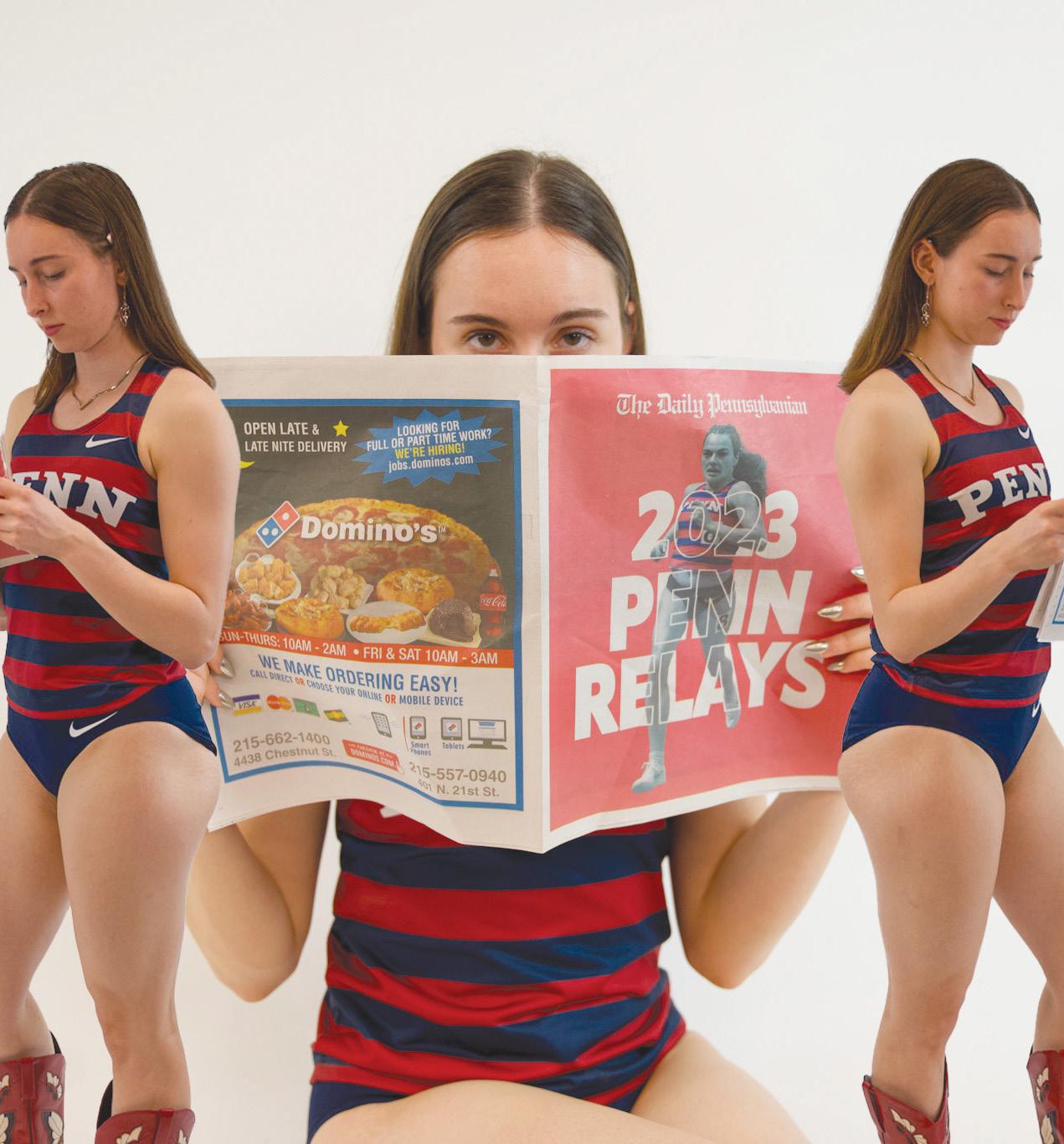

Penn women’s track and field takes first place at Ivy Heptagonal Championships
The weekend saw multiple program records fall as the Quakers brought home nine
Ivy titles
This past weekend, Penn men’s and women’s track and field traveled to Cambridge, Mass. to compete in the 2024 Heptagonal Championships, known as the “Heps.” Founded in 1934, the Heps are a yearly tradition where all Ivy League schools’ track and field teams compete for the coveted first place prize.
The tournament was a major success for Penn. The women’s track and field team came in first place with a score of 140 points, while the men’s team came in third with 106 points, behind Princeton (168) and Cornell (115). Records were broken and many athletes came home to Philadelphia as champions.
In the first day, Penn dominated in seven events, six of which were thanks to the women’s team’s efforts. Junior Scott Toney became an Ivy champion after placing first in the pole vault event, clearing a height of 5.36 meters. Junior James Rhoads placed second. Though he ultimately came in third, Penn junior Scott Dochat set yet another program record in the weight throw, with a distance of 20.74 meters.
Three program records were also broken by the women’s team on the first day, two of which came from sophomore sprinter Moforehan Abinusawa. She previously held the program record for the 200m, set at 24.06 seconds, but on Saturday, she ran the race in 23.55. Similarly, she held the previous Penn record for the 60m at 7.34 seconds, but broke it again on Saturday with 7.27 seconds. Senior hurdler Aliya Garozzo also broke a program record — one previously held by herself — this weekend. On Saturday she ran the 60m hurdles in 8.29 seconds, shaving 0.2 seconds

off of her previous record.
Other Penn winners from Saturday’s meet include senior Isabella Whittaker in the 400m, junior Jocelyn Niemiec in the 500m, and junior Bronwyn Patterson in the 800m. These performances set the Quakers up for an even more successful Sunday to conclude the tournament.
On the final day of the Heps, Penn took home eight Ivy League titles, including four from the women’s team and four from the men’s team. Following up on her amazing Saturday race, Garozzo took home first place in the 60m hurdles. Whittaker also won first place in the 400m. The women’s 60m sprint saw Penn dominating the top three with Abinusawa taking first, sophomore Christiana Nwachuku in second, and Whittaker in third. The one-two-three sweep made another appearance in the 200m event, just in a different order. Abinusawa claimed the top spot; however, Whittaker was able to just edge out Nwachuku for second.
The men’s team also won the 60m hurdles, with sophomore Shane Gardner running it in 7.83 seconds, making it a personal best. The Quakers also found success in the 500m with freshman Ryan Matulonis running the distance in 1:02.22, earning first. Like the women’s team, the men’s team was also able to win the 60m dash, where senior Dimitri Nicholson ran a personal best at 6.71 seconds. The men’s team’s final trophy came from the men’s high jump when sophomore Kampton Kam jumped 2.18m.
Next for Penn track and field is the NCAA Indoor Championships which are set to take place in Boston on March 8 and 9.


springfield distributor beer





7 THURSDAY, FEBRUARY 29, 2024 THEDP.COM | THE DAILY PENNSYLVANIAN SPORTS
Corner of 27th and South St. WE DELIVER! Start Spring Break early.
PHOEBE WEINTRAUB Sports Associate
WEINING DING | SENIOR PHOTOGRAPHER Junior sprinter Jocelyn Niemiec poses with the 2023 Penn Relays issue.
PHOEBE WEINTRAUB Sports Associate
PHOTO
SAMANTHA TURNER | DP FILE
Now-sophomore Moforehan Abinusawa runs in the Penn Challenge on March 18, 2023.
Puzzle Answers T I A O R A H A M B A T A R C W A R H O L S A L E L O C K E D M E O U T R O N K N E E S R P M U R N S S P Y R I E L A R I S E D I T G O T B A D B L O O D A D E O B E Y R U S D E D T U M S I S S O S P T S S A V E P V C B U L L E T H O L E S L E S U N I O N A L T S S U R R E N T L I E S E R R A P A D K A R M A I S A G O D E S E B L E N D E R E D D D E N S A D P S I D E S


 DESIGN BY JANINE NAVALTA
How the Ivy League is fighting the transfer portal in the modern NIL climate
LUCAS MILGRIM Deputy Sports EditorI would’ve said, ‘I don’t see that happening.’”
his stars.
On July 1, 2021, the ground on which the NCAA stood shifted seismically. After losing an appeal case in the Supreme Court, the name, image, and likeness laws — also known as NIL — went into effect, allowing student-athletes to sign endorsement deals. In the years since, chaos has ensued.
“You have students that are constantly school-hopping,” Penn athletic director Alanna Shanahan said. “... For so long, college coaches have spent so much of their time building and sustaining culture, and you have people constantly ping-ponging in and out of a team and starting lineup.”
Now, Shanhan says, there is concern about what the experience is like for students who elect to stay in a program: “There’s clearly some benefit, and there’s significant drawback.”
And while players across college basketball have since chased money during their recruiting process and in the transfer portal, the Ivy League is resisting the new wave of check-chasing. For years, a basketball player leaving an Ivy League school was an unthinkable scenario. In the words of Penn men’s basketball coach Steve Donahue: “Everyone stays for four years.”
This had been mostly true for decades, until the transfer of former Penn guard Jordan Dingle to St. John’s. Dingle’s move was earthshaking, as the reigning Ivy League Player of the Year, Big 5 Player of the Year, ECAC player of the year, and NCAA second-leading scorer left after one of the most successful seasons in school history. While a move to play in the Big East under Rick Pitino is a tough opportunity to turn down,
it isn’t something that necessarily would have happened in past seasons, at least not prior to the inception of NIL.
Donahue described losing Dingle as “losing a really good player, more to the NIL.” Despite the increased exposure and potential NBA scouting that comes from a move like Dingle’s, the money-making potential seems to have been the driving force in more ways than one.
On the court, Dingle is averaging fewer minutes per game at St. John’s than in any season of his Quaker career. His scoring, assisting, and rebounding numbers are all at career lows, as are his shooting stats. While this drop-off isn’t shocking with the change in talent level between the Ivy League and the Big East, Dingle’s opportunities and production as a basketball player have declined significantly since leaving Penn.
Off the court, Dingle’s opportunities have skyrocketed. Deals with on-campus restaurants, chains like Applebee’s and Panera, clothing deals, and more have allowed Dingle to earn infinitely more money as a college athlete than he did during his time at Penn.
Donahue said the Quakers were not exactly blindsided by Dingle’s decision, but it was not something that was expected at the time. Even knowing that there were new NIL opportunities that could be better pursued elsewhere, players transferring away from Penn was not an expected consequence of the new laws.
“I didn’t want to see Jordan go, but, you know, the world’s changed pretty dramatically in college basketball,” Donahue said. “So I wasn’t crazy surprised that he did. I know it’s out there, but I think if you told me before the year that he would leave at the end of the year,
Penn Gymnastics wins Ivy Classic title for first time since 2020
The Quakers put on their best home showing in program history following sophomore Skyelar Kerico’s record breaking all-around performance
KAYLI MANN Sports Reporter
Once the University was informed of this, it still made its best efforts to change the star guard’s mind. Shanahan, Donahue, and others were involved in strategizing how they could try and retain Dingle, but were unsuccessful in doing so.
“Not surprisingly, there was a lot of conversation around a men’s basketball player last year — strategy around how we could communicate that,” Shanahan said.
For Penn and other Ivy League schools, part of the “strategy” surrounding the NIL landscape has been developing their own NIL programs for current players. In addition, while Dingle’s departure may have been partially motivated by NIL, he remains a unique case.
“Even though we lost someone to an opportunity, I think it’s a bit of an outlier,” Donahue said after Penn’s loss to Harvard on Jan. 20. “[Dingle] is the only undergraduate transfer since the [new rules on] undergraduate transfers in the last two years in the whole league.”
Although Penn has been the only Ivy school to experience such a major loss in the transfer portal, the potential is present in the Ivy League. Harvard guard Malik Mack and Princeton guard Xaivian Lee have garnered national attention and even generated NBA draft buzz. Both Harvard and Princeton declined to comment for this story.
Another high profile player from the Ancient Eight is Yale forward Danny Wolf, who has averaged 14.6 points per game while leading the Bulldogs to a 9-2 conference record. And yet, in the face of all of the potential change, Bulldogs head coach James Jones feels no fear of losing
Penn gymnastics hosted the Ivy Classic for the first time since 2019 on Saturday, where the team achieved a season-high 195.8 points. This is the third-highest score in program history and the highest-ever home score by almost three-quarters of a point. It is also Penn’s best score in Ivy Classic history.
In a four-team meet, everyone competes in Olympic order, and Penn began the night on the uneven bars. Freshman Sophia Paris’s stuck dismount was a highlight of the lineup, and sophomore star Skyelar Kerico’s anchoring 9.825 was the Quakers’ highest bars score, enough to place them in second. The back half of Cornell’s vault lineup put up a strong fight, but it was not enough. The Big Red found themselves in third at the end of the first rotation, with Yale in the lead after a strong 9.875 on floor from Ella Tashijan.
“The girls today had a certain focus,” said coach Kirsten Becker. “We talked about being a little more disciplined in the meet. You know, they’re disciplined in practice, but sometimes when the adrenaline is running, it’s hard to hone in on the landings.”
And hone in on the landings they did, as senior leadoffs Kiersten Belkoff and Ana Kenefick began the Quakers’ effort on beam with two scores of 9.825. The scores kept building toward sophomore Samantha Wu’s first 9.900 in her first outing as the anchor. Wu gave all the credit to “the rest of the lineup for building that score.”
“They didn’t tell me I was anchoring beam until last night,” Wu said. “But it turned out really well today.”
A score of 49.275 on balance beam for the Quakers is the best of the season and the second-highest in program history.
Brown made a statement of its own in the second rotation with a 49.100 on floor. The Bears’ Julia Bedell scored a 9.925 to win the event outright. It wasn’t enough, however, as the Quakers took the lead by three-tenths of a point over Yale heading into the third rotation.
The Quakers took floor with a trio of 9.850 scores
“I deal with the here and now; I don’t anticipate my pain of what might happen,” Jones said. “Yale is a tremendous place to go to school and I’m not sure why anyone would want to leave to go to another institution. They’re just not at the same level.”
Jones’ confidence in the strength of an Ivy League degree to draw recruits is a popular sentiment — in the face of the changing NIL landscape, the league’s coaches have continually emphasized the long-term benefits of attending an elite university compared to the short-term earning opportunities presented by NIL.
“[NIL] has not done anything to Yale basketball,” Jones said. “I mean, there’s some guys who have some subtle opportunities, but there’s nothing life-changing in those opportunities, and more power to the guys who have those opportunities, but it’s not something that’s broken what we do here. I haven’t talked to one kid about NIL that I recruited since it’s been indoctrinated into college basketball.”
It is the draw of attending a school that Penn and Yale that has given Jones and Donahue confidence that they will be able to retain their talent even as the world of college sports changes around them.
“[Penn] might be the best situation for all these kids,” he added. “And this is where they had the best chance to do what they want basketball-wise, and then just an incredible education that would benefit them exponentially going forward. Those families made that decision kind of on the front end. I don’t think that’s going to change for 99% of kids. I don’t think it will.”
from Kerico, senior Sara Kenefick, and junior Emma Davies. Cornell’s 49.075 on the balance beam was a season-high, as well as Yale’s 48.925 on uneven bars. Penn’s 48.950 was enough to keep the team in the lead over Yale for the final rotation.
The Red and Blue ended the meet on vault, where a 48.950 total set a new fourth-best score in program history. Freshman Jordan Barrow’s Yurchenko Full for a 9.825 tied Sara Kenefick, and sophomore Marissa Lassiter’s 9.775 was her season-high. Sydney Beers for Cornell stood out on floor with a 9.875, good for second on the event.
Wu’s 9.9 on balance beam earned her the win outright on the event. Becker said Wu “is very consistent, she’s just been somebody that is reliable for us … and we were like, okay, from a consistency standpoint, [Belkoff] and [Wu] are pretty awesome, maybe we try them at one and six! We kind of did bookends there.”
“Beam is such a mental sport,” Wu said. “But I can trust myself and my gymnastics. I’ve always loved beam.”
Sara Kenefick and Barrow also tied for first on vault alongside Cornell’s Michaela DeFrancisco and Tashijan.
In the end, Kerico and Sara Kenefick finished first and second in the all-around. Kerico’s 39.325 is the best score by a Quaker in set the new program all-around record — one that has been untouched for 12 years. With three records set Saturday, including Kerico’s All-Around record, Becker said the team “felt like this is the most put-together meet we’ve had.” She said it was their “best collective meet, and we’ve picked a good day for it!”
Looking ahead toward the rest of the season, Becker summed up the team’s mentality for the remaining five meets as, “Let it fly.” She said the team has “the mentality of not holding back anything. We’ve had a really successful season so far and we’re really proud of them.”
On March 3, the Quakers take on No. 1 Oklahoma and No. 24 Clemson at Texas Woman’s University.
CONTACT US: 215-422-4640 SEND STORY IDEAS TO DPSPORTS@THEDP.COM ONLINE AT THEDP.COM THE INDEPENDENT STUDENT NEWSPAPER OF THE UNIVERSITY OF PENNSYLVANIA • FOUNDED 1885 PHILADELPHIA, THURSDAY, FEBRUARY 29, 2024 VOL. CXL NO. 7 SPORTS
GIULIANA DIBENEDETTO | STAFF PHOTOGRAPHER
Penn gymnastics holds up their trophy after winning the Ivy League Championships on Feb. 24.
Despite growing numbers of transfers and rumors of young talent leaving, Ivy League basketball still believes they can hold on
their best
to