Dean of the School of Arts and Sciences Mark Trodden announced the new strategic plan in a Feb. 25 email
KATHRYN YE Staff Reporter
After roughly six months of planning, the School of Arts and Sciences announced a new “vision for its future” on Wednesday.
SAS Dean Mark Trodden announced the framework — titled “SAS Horizons: Pathways for a Changing World” — in a Feb. 25 email. The plan is “aligned with” the University’s 2023 strategic framework, “In Principle and Practice,” and is committed to “pursuing excellence with empathy.”
“At a moment of sweeping change for society and higher education, it also reflects how we broaden opportunities for our students, empower scholars to venture beyond the boundaries of current knowledge, and channel discoveries into new avenues that allow society to see further and reach higher,” Trodden’s email read.
A new website launched alongside the announcement outlined two foundational commitments for the proposal — “fostering community, culture, and belonging” and “partnering with the public.”
“The School of Arts & Sciences cultivates forms of intelligence that transcend algorithmic reasoning: creativity, judgment, ethical thinking, and the capacity to discern which questions matter and why,” the website reads.
“By enhancing ties and engaging questions raised by emerging technologies and cultural change, Arts & Sciences creates the conditions for sustained inquiry and dialogue, ensuring that innovation and discovery are guided by human understanding and serve the common good.”
The plan includes provisions for a “bold” reimagining of the College of Arts and Sciences’ undergraduate curriculum, the establishment of the “Dean’s Horizons Fund” to fund research at the school, and a project to renovate Penn’s laboratories and classrooms.
During the 2025-26 academic year, the College piloted College Foundations — a new general education curriculum that it aim to formally implement in 2027.
“The College curriculum redesign process is underway and a proposal for a new curriculum is being
See HORIZONS, page 3
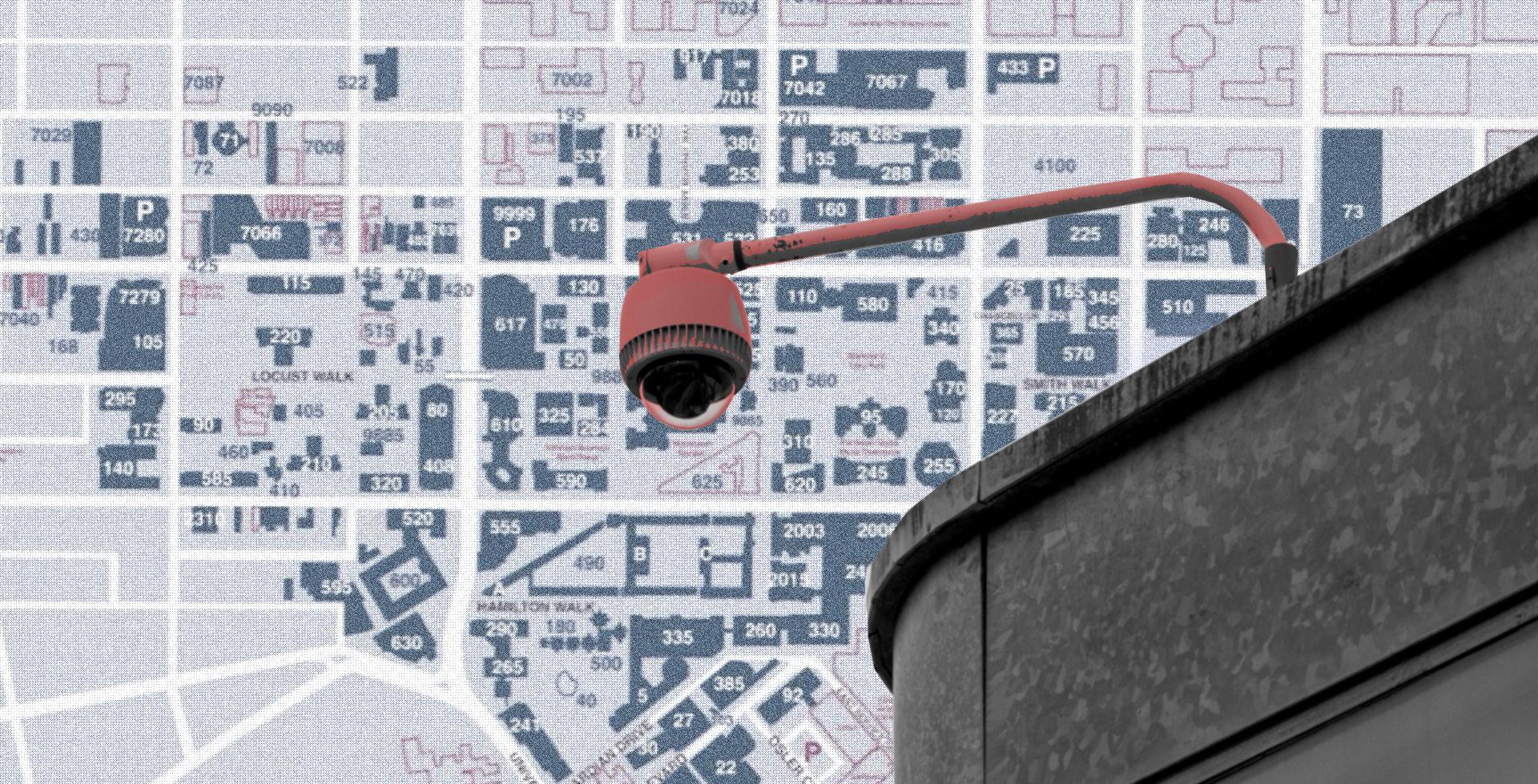
A campus watched: Penn’s network of more than 1,300 surveillance cameras
Since 2021, the number of locations with cameras monitored by Penn has increased by roughly 20%
If you look up while walking on Penn’s campus or one of the surrounding streets, chances are you’ll spot one of the more than 1,300 cameras operated by the University — part of its sprawling surveillance network.
Under Penn’s “Closed Circuit Television Monitoring and Recording of Public Areas for Safety and Security Purposes” policy — first adopted in 1999 and later updated in 2008 — the University’s Division of Public Safety is required to publish the locations of all outdoor CCTV cameras it monitors in semiannual updates. Over the past five years, the number of locations with cameras
PHOEBE ANAGNOS Senior Reporter
monitored by Penn has increased by roughly 20%.
As of January, Penn reported operating more than 145 pan-tilt-zoom cameras and more than 1,200 fixed cameras across campus and within its patrol zone. While outdoor camera locations are publicly listed, the University is not required to publish a list of indoor camera locations.
Penn publicly disclosed a total of 309 outdoor camera locations this year, including 178 “University of Pennsylvania Cameras.”
According to the CCTV policy, camera installations must serve “legitimate safety and security purposes,” including protection of buildings and
Proposed city school closures threaten Penn community service partners
The Daily Pennsylvanian spoke to teachers, administrators, and liaisons at two schools with existing Univeristy partnerships
COSTA GAY-AFENDULIS Staff Reporter
facilities, including plans to close four high schools. The Daily Pennsylvanian spoke to teachers, administrators, and Penn liaisons at two of these schools — Lankenau and Paul Robeson high schools — which maintain various partnerships with the University, including through the Netter Center for Community Partnerships, School of Social Policy & Practice, and the Water Center at Penn. The school district’s proposal, set to be presented to the school board on Feb. 26, outlines a plan to reorganize Philadelphia’s elementary, middle, and high schools. Besides modernizing 159 schools, the plan would also close 20 schools across the area. The district argued that closing smaller magnet high schools, some of which it cited as having unsatisfactory enrollment, would allow them to allocate resources elsewhere.
See SCHOOLS, page 2
Federal agency probe used personal faculty phone numbers to investigate campus antisemitism
The United States Equal Employment Opportunity Commission’s subpoena would require it to hand over information about Jewish students and faculty
property, criminal investigation, pedestrian safety, and compliance with government requirements. The policy specifies that cameras may monitor public streets, intersections, parking lots, bike racks, and building perimeters, among other locations.
The policy also establishes limits on Penn’s surveillance capabilities. CCTV monitoring must not violate a “reasonable expectation of privacy,” and cameras are not permitted in residential hallways or lounges. Recorded footage is automatically deleted after 30 days unless retained for criminal investigations or litigation purposes.
See CAMERAS, page 3
The United States Supreme Court ruled last week that the president cannot impose unilateral tariffs indefinitely
FLORES Staff Reporter
LUKE PETERSEN Staff Reporter Wharton model projects $175 billion in refunds after tariff ruling
Federal investigators have directly contacted members of the Penn community as part of an ongoing probe into alleged antisemitism on campus — offering a window into how the government is gathering testimony and information that the University is simultaneously trying to block its access to in court.
In conversations with The Daily Pennsylvanian, several affiliates of Penn’s Jewish Studies Program reported that they received calls on their personal cell phones from the United States Equal Employment Opportunity Commission. Penn is currently facing a subpoena from the agency that would require it to hand over information about Jewish students and faculty.
In a transcript of a voicemail obtained by the DP, an EEOC investigator asked one JSP member to report any incidents of antisemitism they had seen or experienced at Penn in the past three years.
“We are reaching out to folks affiliated with Penn to see
if they were subjected to or witnessed antisemitism in the workplace within the past 3 years, and if so, how it was handled by the University,” the transcript read.
In a statement to the DP, the member — who requested anonymity due to fear of retribution — wrote that they “have no idea how they got my private cell phone number.”
An EEOC spokesperson declined to comment, citing the ongoing investigation. A request for comment was left with a University spokesperson.
Director of the Katz Center for Advanced Judaic Studies and Jewish Studies professor Steven Weitzman told the DP that “the only thing that was surprising” was that the EEOC reached out to him through his personal phone number.
“I don’t release that publicly, so they must have figured out how to make some connection between who I am on See EEOC, page 3
Jeffrey Epstein tried to court Penn professor Martin Seligman, files show
In a 2010 email exchange, Jeffrey Epstein wrote that Martin Seligman visited his ranch in New Mexico — referring to the professor as ‘great’
ETHAN SUN Staff Reporter
In the months after Jeffrey Epstein was released from a Florida prison in June 2009, he began to court several of the world’s top academics, including celebrated Penn Psychology professor Martin Seligman.
That year, he contacted multiple notable figures — including literary agents, professors, and authors — in an attempt to organize a series of academic gatherings. In a 2009 email exchange, Epstein referred to Seligman, now the head of Penn’s Positive Psychology Center, as a “core participant” of the proposed meetings.
In response to The Daily Pennsylvanian’s request for comment, Seligman wrote that he had met Epstein at a “Billionaire’s Dinner” event in 2004, hosted by the Edge Foundation.
In a 2010 email, Epstein wrote that Seligman had visited his ranch in New Mexico in the past.
“Marty has been at my ranch … he is great,” the exchange read.
Seligman told the DP that he attended a two-day seminar on evolution at Epstein’s ranch in either
2006 or 2007. The ranch is reportedly the site where Epstein planned to “seed the human race with his DNA” by impregnating women, a eugenics project Seligman clarified was not discussed at the seminar.
“I was never involved in such a conversation and I only heard of this bizarre notion recently in the press,” Seligman wrote. “The seminar I attended was highly technical and about the mathematics of evolutionary theory.”
A University spokesperson declined to comment. Seligman has not been accused of any wrongdoing in connection with Epstein or his crimes.
In a 2011 email, Epstein implied that he helped fund Seligman’s positive psychology research.
“You funded his Positive Psychology research, didn’t you?? It has to be you asking him ‘why don’t you come visit us in NY?’ Am I right???” the email read, referencing the first chapter of Seligman’s book, “Flourish,” in which he detailed how he received the first major funds for his research. See EPSTEIN, page 3
EMILY XU | DP FILE PHOTO
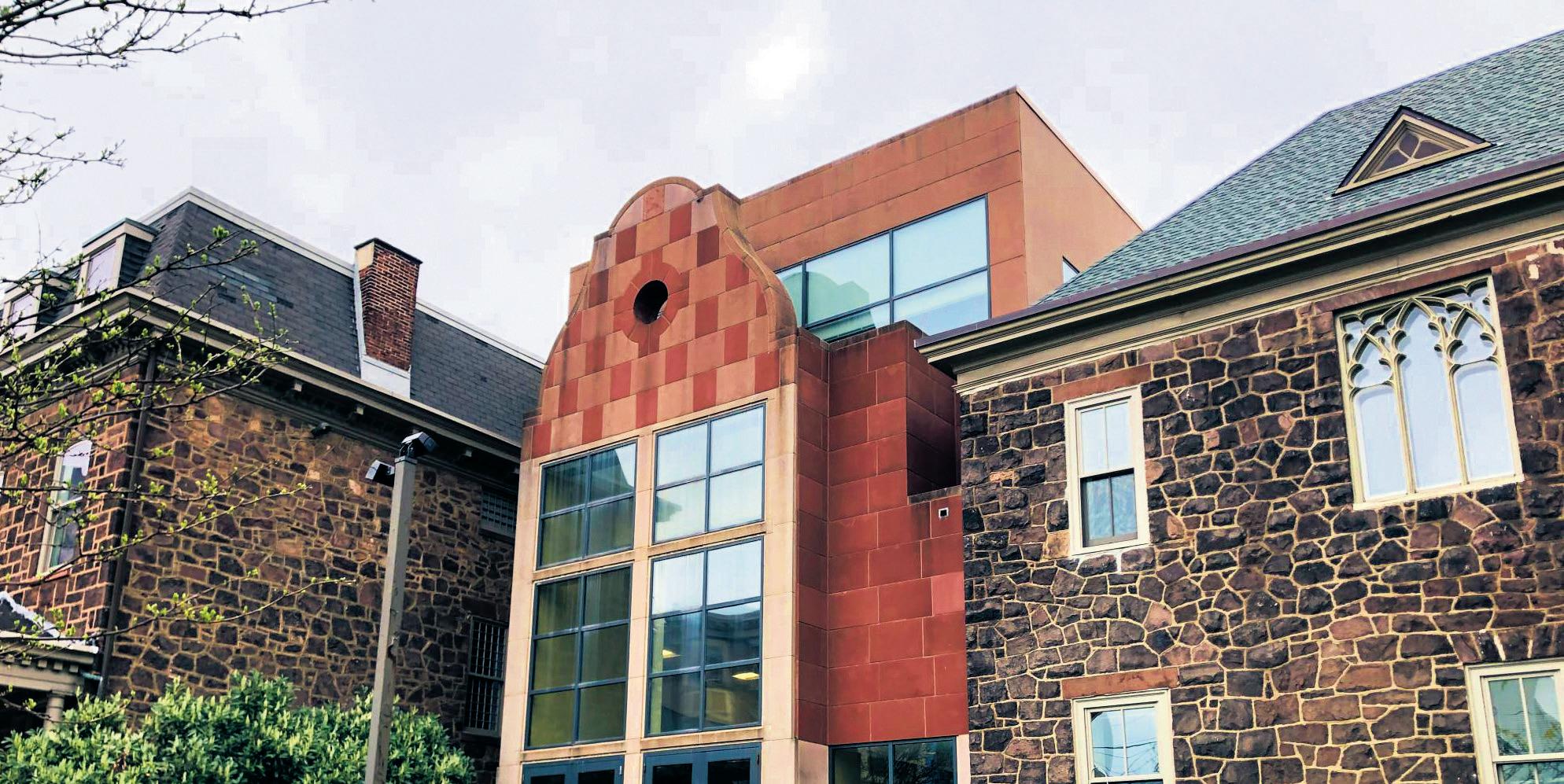
The Netter Center pictured on April 12, 2021.
AMY LUO | SENIOR DESIGNER
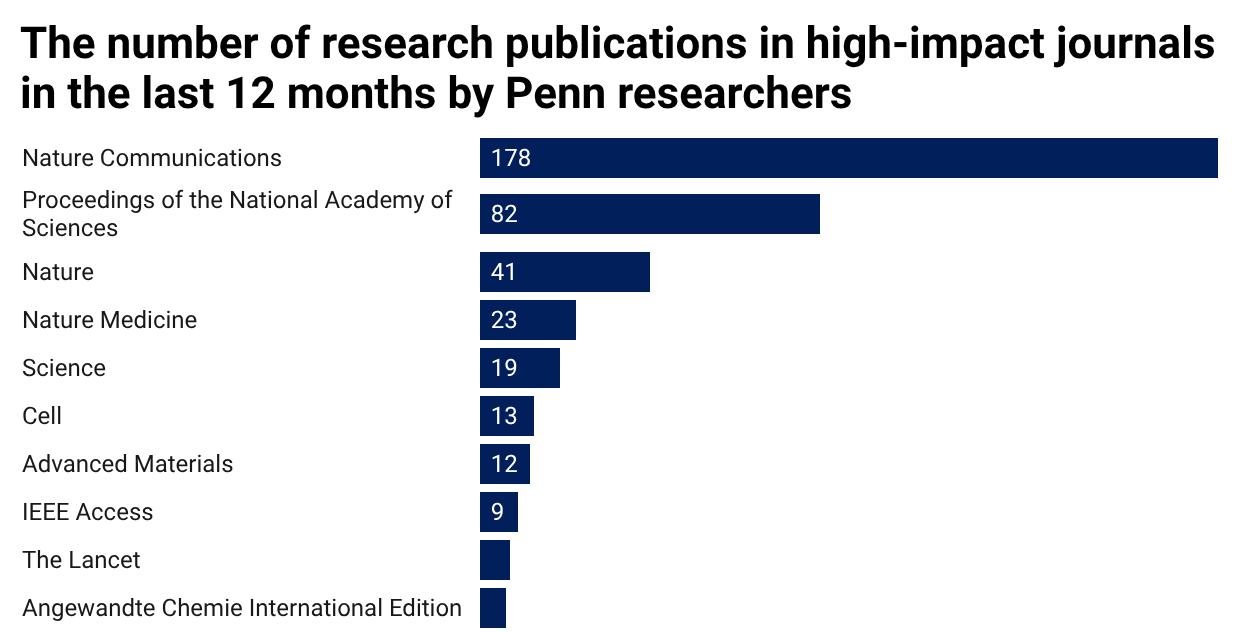
The leading journals where Penn researchers publish their work
The University employs over 5,000 faculty researchers and invests $2 billion annually across 230 research centers and institutes
SAMEEKSHA
PANDA Staff Reporter
As Penn continues to grapple with federal funding cuts to research programs and grants, The Daily Pennsylvanian examined how the University’s published research output compares to that of its peer institutions.
Penn — a designated R1 institution — describes itself as “one of the nation’s top research universities.” The University employs over 5,000 faculty researchers and invests $2 billion across 230 research centers and institutes.
Senior Vice Dean and Chief Scientific Officer at the Perelman School of Medicine Michael Ostap wrote that the University’s R1 designation allows it to pursue a “wide range of opportunities,” including securing large federal grants and philanthropic and industry partnerships.
The DP’s analysis reviewed articles published in 12 top scientific research journals — Nature, Nature Medicine, Nature Communications, Proceedings of the National Academy of Sciences, Science, Cell, The New England Journal of Medicine, Angewandte Chemie International Edition, IEEE Access, JAMA, The Lancet, and Advanced Materials — over the past year. Journals were chosen based on their h-index, which measures the productivity and citation impact of a research publication.
In the past 12 months, Penn-affiliated researchers published nearly 400 original research articles across the selected scientific journals, including over 200 articles published by the Perelman School of Medicine.
“We have also invested in state-of-the-art research infrastructure, which makes it possible for our teams to do truly cutting edge work,” Ostap wrote. “That kind of environment attracts both top talent and major sponsors who want to support high impact science.”
According to Penn Medicine Neurosurgery Department Vice Chair for Research and professor Michael Beauchamp, a university’s publication success often varies based on the size of its research teams.
“If you have a giant team, you’re going to have to publish very frequently,” Beauchamp said. “Alternatively, you might just be a single, solitary researcher working on your own, and then you’re unlikely to publish hundreds of papers, because you’re doing everything yourself — so it’s completely dependent on
SCHOOLS, from front page
A University spokesperson declined to comment. Requests for comment were left with the Netter Center, SP2, the Water Center at Penn, and the School District of Philadelphia.
Lankenau Environmental Science Magnet High School is an environmental science magnet high school in Northwest Philadelphia. One of its partnerships with the University allows classes to participate in labs with the Water Center at Penn. The center travels to Lankenau, which is located in a large wooded area.
According to Lankenau principal Jessica McAtamney, the school’s unique location is a key reason administrators and teachers value the campus.
“I am not sure how that [partnership] would carry on if we’re not on campus,” McAtamney told the DP. Lankenau teacher Meredith Joseph also said partnerships might wane with teacher turnover.
“The environmental partnerships that we have with Penn and with other community partners are relationshipdependent,” Joseph explained. Lankenau outputs 7% of Pennsylvania’s Career and Technical Education students in the environmental field, according to Joseph. The school is also the state’s only environmentally focused three-year technical education program.
“The experience of interacting with a school with the reputation of Penn for any student, for any student, is absolutely invaluable in a way that just visiting the campus isn’t,” Joseph added. “It really allows our students to see themselves in those spaces.”
Joseph also stated that the choice to close Lankenau was an unfair interpretation of enrollment data. The report pointed out that the school’s junior class only had 30 enrolled students, describing the small size as inadequate. She refuted this argument, adding that “every small to medium-sized school has their junior class as their smallest class.”
“Because the lottery [system] was in such disarray, there were schools with waiting lists of 300 and 400 and there were schools that didn’t have kids to fill their seats,” Joseph said.
Penn social work graduate students also provide counseling to Lankenau students through the high school’s partnership with SP2. Joseph said the program makes students “feel seen, feel heard, and overall, makes for a better student and better access to curriculum.”
the size of your research team.”
Penn had the greatest number of articles — nearly half — published in Nature Communications, followed by Nature and PNAS and Nature.
Beauchamp explained that high-impact journals like Nature or Nature Medicine only publish articles “of enormous significance,” whereas more “mundane” research is typically reserved for lower-tier or specialty journals.
“Everything in the scientific ecosystem is dependent on where your work gets published,” Beauchamp said, adding that high-impact journal visibility can help researchers secure funding and get promoted.
Journals such as Nature, Science, and NEJM publish only a limited number of research articles each week, reducing the overall volume of accepted submissions.
Nature reports that only about 8% of submitted
manuscripts are accepted for publication.
“Articles published in Nature have an exceptionally wide impact, both among scientists and, frequently, among the general public,” a Nature webpage reads.
In contrast, Nature Communications operates as an open-access “megajournal” and is designed for articles that may not have the same “scientific reach” as those published in Nature.
Ostap noted that Penn’s publication trends are a byproduct of the University’s research goals.
“A lot of PSOM research ends up in top journals because the work itself is genuinely impactful,” Ostap wrote. “Our investigators are creative, dedicated thinkers focused on big, meaningful questions, and high-impact publications tend to follow.”
“We are chasing important science, not journal titles,” he added. In the past 12 months, Penn-affiliated researchers
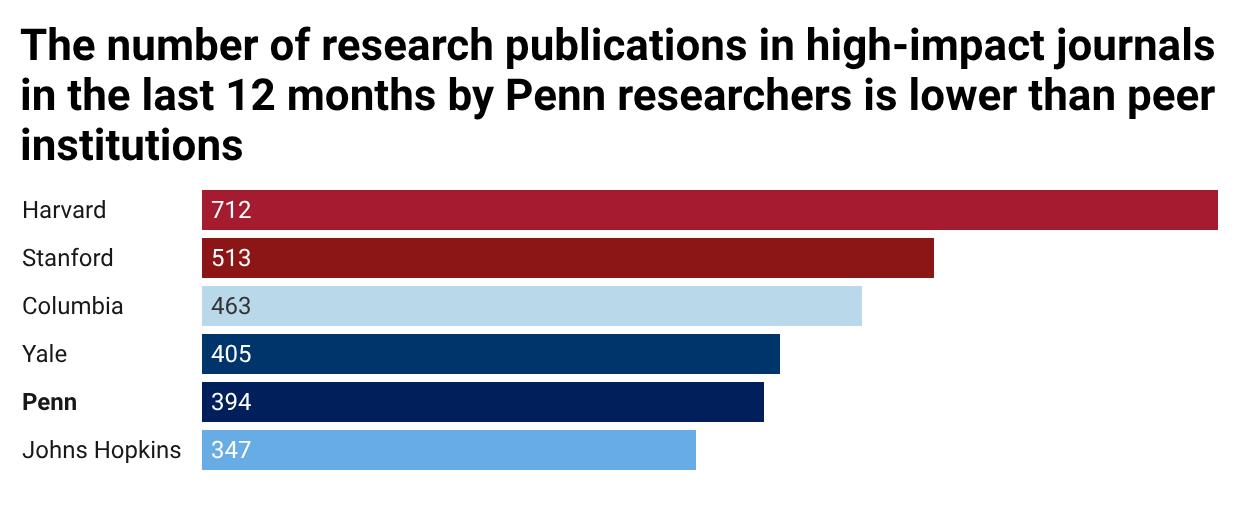
published 394 research articles — fewer than the number published at Harvard University, Stanford University, Columbia University, and Yale University, whose researchers produced 712, 513, 463, and 405 articles, respectively. Penn only ranked above Johns Hopkins University, whose affiliated researchers published 347 articles in the select journals over the same time period.
Like Penn, Harvard, Stanford, Columbia, Yale, and Johns Hopkins have an affiliated medical school. Penn, however, spends as much or more on research than several of its peer institutions. Penn reports $2 billion in annual research expenditures, compared to $2.2 billion at Stanford, and roughly $1 billion at both Harvard and Yale. In 2024, the National Science Foundation ranked Penn ninth among universities nationwide in reported research and development spending for that year.
“Scientific publishing is undergoing a lot of transitions right now, because there’s growing appreciation that it’s not very sustainable in that scientists review other scientists’ articles for free, and then must pay to have their articles published,” Beauchamp described. He noted that services such as Penn Libraries often pay millions of dollars to subscribe to journals and provide the campus community “open-access,” which helps allow many publishers to become “enormously profitable” billion-dollar companies. Researchers who want to increase the visibility of their work have to pay a fee for their article to become “open-access.”
According to a recent analysis in Quantitative Science Studies, scientists paid an estimated more than $1 billion in open-access article fees to five of the largest publishers — Elsevier, Sage, Springer-Nature, Taylor & Francis, and Wiley — between 2015 and 2018.
Beauchamp said that recent federal funding research cuts may inspire some changes.
“The hope is that it may spur changes to the publishing model, because it’s so clearly … not providing benefits to the community, as most of the benefits are occurring to these multinational billiondollar publishing companies,” he said. Staff reporter Rachel Kang contributed reporting.
generated an
TARIFFS, from front page
If the school closes, students and programs will be merged into the larger William L. Sayre High School, which is located farther from Penn’s campus. When asked whether the new location would disrupt partnerships, Kebbe expressed concern.
“They’ll have to form new partnerships with schools and with principals and teachers, and that can be difficult, because it’s not inherent that as soon as Penn walks into a school that we have this amazing partnership,” he said.
Kebbe emphasized how the partnerships are mutually beneficial for both Penn students and Robeson students.
“It’s a transformative experience for [Penn students] to be in a high school, to interact with the kids and realize that their world is guarded from the ills of the outside world and the issues that are going on in West Philadelphia, namely poverty.”
Kebbe also highlighted that one of the factors that attracts students to Robeson is its “intimate learning environment.”
“Teachers know essentially everyone’s names, students can forge really deep and trusting bonds with the teachers and the adults there,” he said. “I think there’s something to be said about that experience when you compare it to a larger high school experience.”
“Paul Robeson is a safe haven,” he added. “The school is an identity that [Robeson students] wear. When you close down part of a person’s identity, that can be really disorienting.”
Urban studies professor Julia McWilliams, who studies education issues in Philadelphia, also said the consolidation could negatively affect students’ experiences.
“It means less sleep, less free time for kids, and higher costs for the district to bus kids,” she said.
McWilliams stated that the change aligns with a trend of “chronic disinvestment in school facilities.” In 2013, the school district closed and consolidated 24 schools — a pattern she has examined in her research.
“We’re leaving closed buildings to go to other schools, and now those buildings are being closed,” McWilliams said. She spoke about how Penn has a responsibility to uphold the institutions it partners with, adding that the University often has “an extractive relationship with West Philadelphia.”
“It ends up being quite performative to not have policies that actually ensure that those Partnership Schools have what they need to function,” McWilliams said. “This is the long-term outcome to that kind of extraction where there’s no investment in the educational institutions in the city.”
Kebbe similarly suggested Penn’s “responsibility to engage with schools like Paul Robeson, because they’re so close, and because of the gentrification that Penn assumes around them.”
“The Netter Center wants Penn students to leave feeling and realize that their education is taking place in the larger context of West Philadelphia, and the impact Penn has can only be observed through these experiences,” Kebbe said.
“Those social workers are absolutely invaluable to our student population,” she said. Paul Robeson High School — located in West Philadelphia — would also close under the new plan. Penn’s Netter Center for Community Partnerships partners with the school through its University-Assisted Community Schools program. Through the program, Penn students perform community service-related tasks at the school. William Kebbe, who leads Penn’s Nutrition Education program at Robeson, emphasized the site’s accessibility for Penn students, telling the DP that “it’s a very easy walk that’s maybe max 15 minutes from the furthest point on campus.”
highlighted that importers can submit refund claims for customs duties on goods liquidated over the past 180 days.
PWBM applied microeconomist Lysle Boller told The Daily Pennsylvanian that refunds on tariffs imposed since January 2025 are likely the “most immediate impact” of the ruling.
“For a lot of the importers that paid those tariffs to the administration, there will probably be some mechanism for them to claim a refund for that money,” Boller said. “Ultimately, there’s going to be lost revenue for the government and money that will be going back into the pockets of the companies that are importing these goods.”
The PWBM report said that large tariffs “may induce consumers to reduce demand for that good or switch to alternatives,” which would lead to a lower tariff revenue than if they assumed there would be no change in consumer behavior.
The analysis estimated that IEEPA duties accounted for roughly half of total customs duties collected since January 2025. The tariffs were initially levied on China, Canada, and Mexico in February and March 2025, before extending to nearly all U.S. trading partners.
CBP collected approximately $133.5 billion in tariffs under IEEPA authority as of Dec. 14, 2025,
day in federal revenue. The model’s estimated $175 billion of refunds is equal to an average of $1,300 per U.S. household. Looking ahead, Boller said that individuals seem to be “skeptical” of whether or not the value of these tariffs will be refunded back to consumers. Shortly after the court’s decision was released, Trump announced that new global tariffs of 10% would begin on Feb. 24. On Saturday, he increased this
PWBM Faculty Director and Wharton professor Kent Smetters told
for us consumers,” Boller added. Following Trump’s Saturday announcement, U.S. stocks dropped on the morning of Feb. 23. “They were expecting their tariffs to be overturned, and then they were basically returned back to this very similar overall affected tax rate,” Smetters said. “There’s differences by country, but nonetheless, the overall effect is roughly the same.”
CALEB CRAIN | DP FILE PHOTO
The interior of Huntsman Hall pictured on Feb. 24, 2024.
Penn terminates free summer housing for graduate RAs
A Feb. 18 message specified that RAs must vacate their current housing by May 19
LUKE PETERSEN Staff Reporter
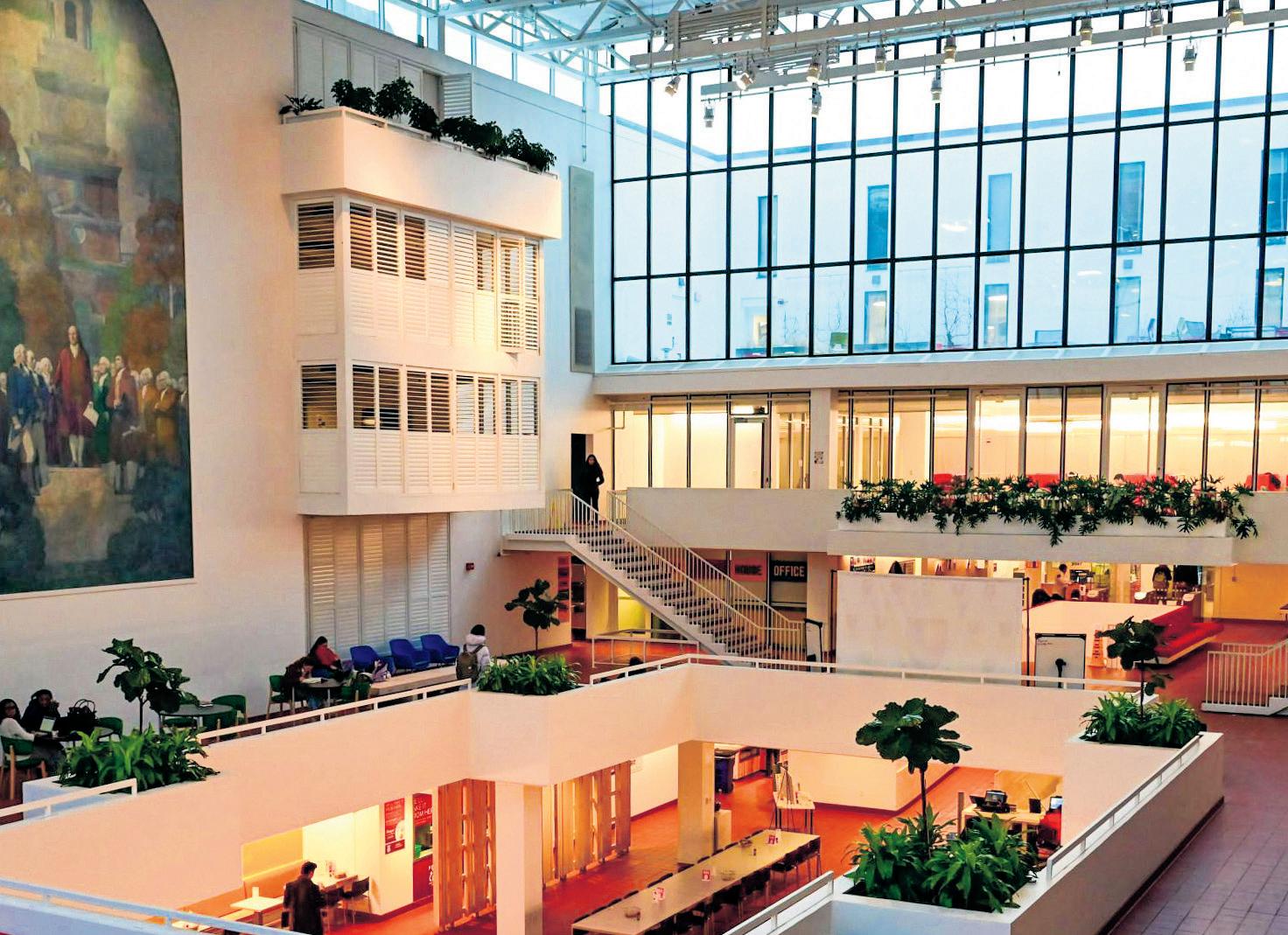
Hill College House atrium pictured on Feb. 6. Penn’s graduate resident advisors are no longer eligible for free on-campus housing over the summer, a change that will require many to pay out of pocket or find alternative accommodations.
The Feb. 18 update — sent from College Houses & Academic Services and obtained by The Daily Pennsylvanian — specified that RAs must vacate their current housing by May 19, leaving a four-day period before summer housing begins on May 23. Rates for summer housing have yet to be posted.
“All students — including undergraduate and graduate RAs — who want to remain on campus and require summer housing must submit a request through Penn Hospitality Services,” the email stated. “If eligible and approved, you will be charged at the published student room rates.”
A request for comment was left with CHAS.
In 2025, a suite with a private bedroom, living room, bathroom, and kitchen cost $75 per night, or $525 per week. A private bedroom with a shared bathroom and living room was priced at $60 per night and $420 per week. Both room types required a five-week minimum stay. Graduate RAs would now be expected to cover this fee. This academic year, the minimum housing rate rose from $12,640 in 2024-25 to $13,132 in 2025-26. It is unclear if summer rates will also increase.
On the same day the housing update was announced, CHAS hosted an event for National RA Appreciation Day at Pottruck Health and Fitness Center, providing food, smoothies, raffles, and access to the rock wall.
Outside the building, members of United RAs at Penn protested the loss of their summer housing during the appreciation event. Two representatives held a sign reading,
EPSTEIN, from front page
Epstein replied, “yes.”
In his statement, Seligman refuted that claim, writing, “Jeffrey Epstein never funded my research or the Positive Psychology Center directly or indirectly.”
In a 2009 email, Epstein wrote that he intended to “fully fund” seven meetings hosting academics in 2010. According to Epstein, the discussions would include “lots of interaction” and “cross pollination.”
A separate email sent to Epstein in August 2009 included previous notes on a “power symposium” that named Seligman as a participant they would like to invite “ASAP.”
The email also listed Stephen Hawking, former Israeli Prime Minister Ehud Barak, and Harvard Law School professor Alan Dershowitz as possible invitees.
Although it is unclear whether the gatherings ever took place, Epstein attempted to associate himself with Seligman several times in the following years.
In September 2010, an individual reached out to Epstein, asking if he would like to attend a symposium with Seligman.
Epstein replied that he’d “always” had “interest in symposiums.”
In June of 2011, Epstein’s assistant attempted to arrange two calls between Epstein and Seligman. Both times, Seligman said he was unavailable and
“I’d rather be housed than have a smoothie.”
According to a URAP spokesperson, many graduate RAs rely on summer housing as they complete research required for their Ph.D.
“As a union leader, I have personally spoken with GRAs that feel that they will need to couch surf and enter uncertain and quite possibly unsafe housing situations over the summer,” the spokesperson told the DP. “We just hope everyone shows solidarity with the RAs and the GRAs during this trying time, and we’re just going to work together to make sure that the people who do so much for our Penn community are respected.”
In December 2025, URAP launched a petition aiming to stop the University from eliminating certain graduate RA positions.
“For years, GRAs have been valued members of the Penn community. Penn’s administration has never articulated concerns about the performance or viability of GRAs,” the petition read. “Now, without any justification, the University has mentioned to some GRAs that their colleagues who perform research or instructional services will be categorically barred from contract renewal.”
The announcement of the end of free summer housing for graduate RAs comes days after Graduate Employees Together — University of Pennsylvania reached a tentative agreement with the University, ensuring higher compensation, increased protections for graduate workers, and narrowly avoiding a strike.
“Both undergrads and grads would indeed be charged for summer housing under the new policy, however GRAs have historically (10 years+) been given free housing and Penn is arbitrary revoking a benefit for GRAs at the exact same time as grad workers have unionized,” the URAP spokesperson wrote to the DP.
asked Epstein to email him instead.
Seligman wrote in a statement to the DP that Epstein did not email him and that he did not recall any conversations that followed the requests from Epstein’s assistant.
“I have no idea what he wanted,” Seligman added.
Although Seligman had referred to Epstein as “Jeffrey” in the past, he maintained that the two of them were not close.
“I have never had a personal relationship with Epstein and had no contact of any kind with him after 2007,” he wrote.
Aside from his responses to Epstein’s assistant in June 2011, Seligman’s last correspondence with Epstein, according to the files, occurred on Sept. 10, 2007, when he forwarded information to Epstein about a conference he would be attending.
While there is little communication between Seligman and Epstein following that point, Epstein continued to reference Seligman in his correspondence in the years afterward.
He discussed Seligman’s research with at least two individuals and attempted to help one individual enroll in Seligman’s psychology class at Penn in 2013.
Seligman wrote that he does not have any record of that woman enrolling in the class.
According to a 2024 DP analysis, Seligman — with almost 300,000 citations — was the most cited researcher at Penn at the time. The list includes previous and current professors, graduate students, and other researchers with a Penn affiliation on Google Scholar.
Members of the University community are invited to bring topics for consideration to
UNIVERSITY COUNCIL
OPEN FORUM
Wednesday, March 25, 2026 4:00 p.m. Hall of Flags, Houston Hall
A PennCard is required to attend University Council meetings
PennCard holders who want to be assured of speaking at Open Forum must submit a request to the Office of the University Secretary (ucouncil@pobox.upenn.edu) by 10:00 a.m. on Monday, March 16, 2026, briefly indicating the subject of the intended remarks. Speakers’ statements are limited to three minutes and should be framed to present topics of general University interest and be directed to University Council as a body through the moderator, and not to an individual.
Those who have not submitted a timely request to the Office of the University Secretary will be permitted to speak at the discretion of the moderator of University Council if time remains after the registered speakers.
the website and my own personal cell phone,” Weitzman said. “I imagine that’s not hard to do, to figure that out, but that is a little odd.”
Weitzman said that while the EEOC’s “intentions may be good,” its methods “are just a problem.”
History professor Benjamin Nathans, who works with the Jewish Studies Program, told the DP that the EEOC has contacted him three times since the summer of 2025. He said the EEOC first contacted him through his personal phone number over the summer, but that he ignored the voicemail. According to Nathans, he complied with the request after being contacted again around the start of the spring semester.
The EEOC then emailed Nathans a series of questions about his experience at Penn, including whether he had witnessed workplace antisemitism, how he was impacted by the incident, and if there was anyone else the EEOC should reach out to.
The questionnaire, which was obtained by the DP, also asked whether respondents identified as Israeli. The documented was attributed to 2008 College graduate and EEOC Chair Andrea Lucas, who initiated the investigation into Penn.
Nathans said that he saw his choice to respond to the questionnaire “as an opportunity to disagree with its premise.”
“I simply hoped that they would take one person’s response as a small indicator of how inappropriate the request was to Penn to deliver a list of names and contact information of Jewish faculty,” he said. “And that they would see that a Jewish faculty member who’s affiliated with the Jewish Studies Program at Penn was opposed to the whole operation from the get-go and was very suspicious of the motives behind it.”
Nathans told the DP that he is “not terribly worried” about how the EEOC obtained his personal phone number.
“Anybody with a computer can go online and get a list of names of Penn faculty associated with the Jewish Studies Program,” he added.
He called the decision to reach out to Jewish faculty members amid the ongoing lawsuit “amateurish … from start to finish.”
CAMERAS, from front page
Outdoor camera installations require review and approval from an eight-member CCTV Monitoring Panel — composed of faculty, students, staff, and a representative from the Office of Audit, Compliance, and Privacy. Proposed outdoor camera locations must be reviewed by the panel and published in Penn’s Almanac before installation.
Requests for new cameras can originate from multiple sources, including various departments across Penn, and installations must be justified to the CCTV Monitoring Panel based on “operational needs that are safety driven,” Vice President for Public Safety Kathleen Shields Anderson explained in an interview with The Daily Pennsylvanian.
“Some reasons are crime related while some are safety related,” Shields explained.
“It might not prevent crime, but it can increase solvability rates,” she added, citing previous examples in which cameras detected rooftop fires or allowed dispatchers to respond to individuals experiencing mental health crises.
According to Shields, expanded coverage has also improved Penn’s ability to resolve low-level theft cases, including bike and scooter theft.
The DP’s review of Almanac publications showed that the most significant increase in recent years occurred in 2021, when 23 additional
HORIZONS, from front page
reviewed by our faculty,” a SAS spokesperson wrote to The Daily Pennsylvanian. “We expect the faculty to vote on the proposed changes later this spring, with a target implementation date of fall 2027.”
David Rittenhouse Laboratory is “one of the most heavily used teaching facilities on campus, yet its mid-20th-century classrooms and labs no longer meet the demands of modern science,” the description of “The Physical Sciences Complex Project” reads.
According to a SAS spokesperson, the Physical Sciences Complex Project — including the renovation of DRL — is “currently in the planning and design stage.”
“We’ve tried to come at it from a high level,” Trodden stated in a Wednesday press release, “not produce a list of line items that we’ll get done, but rather articulate what is important about the School, what principles underlie everything we do, and our philosophy about how we apply those principles to the world and to our students’ education.”
The announcement of “Horizons” comes after Penn President Larry Jameson unveiled Penn
“Many people have pointed out that the optics — quite apart from the legality — the optics of the campaign of requesting a list of Jews who work at Penn are really bad,” he said. “Either you never studied the history of the 20th century, or you’re so tone deaf that you don’t realize what a gesture like that looks and feels like to people on the receiving end.”
Communications professor Barbie Zelizer told the DP that the EEOC investigator called her to ask about the Katz Center, to which she is not affiliated.
Zelizer added that the EEOC’s request for the personal information of Jewish students and faculty was “unsupportable.”
“I don’t know one Jew who doesn’t flinch at the idea that lists of Jews are being compiled,” she told the DP. “I think it’s deplorable, and I’m proud of Penn for pushing back.”
Another source familiar with the matter wrote in a statement to the DP that “even if the EEOC’s intentions are genuine and sincere,” concerns about what would happen if personal information “fell into the wrong hands” are “well-founded.”
The source emphasized that regardless of the scope of the EEOC’s investigative powers, the “context” behind the agency’s calls is “vitally important to understanding why they would be frightening to many Jewish faculty.”
“This is especially so given the administration’s irresponsible approach to data privacy and security, and its stated commitment to information sharing across agencies,” the source wrote. “The fact that the EEOC is continuing to pursue this investigation in the way it is, by trying to compel Penn to hand over lists of Jewish employees against the wishes of those employees, makes the calls especially chilling.”
The EEOC issued its subpoena to Penn in July 2025, requiring that the University submit personal contact information such as names, personal phone numbers, emails, and addresses of Jewish faculty and students. In November 2025, the EEOC sued Penn, alleging that it failed to comply with the agency’s subpoena.
In January, Penn stated in a response to the EEOC that the University remains unwilling to submit personal information without the consent of the affected parties. In the filing, the University described the EEOC’s demands as “disconcerting but also entirely unnecessary,” arguing that disclosing private details would “erode trust between Penn and its employees and the broader Jewish community at Penn.”
outdoor cameras were added to the Hospital of the University of Pennsylvania. In total, the number of outdoor locations with Penn-operated cameras has increased by 18.8% since then.
The increase came soon after the October 2021 opening of the $1.6 billion, 1.5 million-squarefoot Penn Medicine Pavilion, now renamed the Clifton Center for Medical Breakthroughs — a 17-story expansion of HUP that houses more than 500 private patient rooms and a two-story emergency room. The Pavilion significantly expanded the medical campus’ physical presence, prompting additional perimeter and intersection monitoring in the surrounding area. Shields noted that the opening of the Pavilion was likely one reason for the marked increase in camera locations in recent years. She clarified that due to the nature of “health system regulations” and the sensitivity of the services provided — such as medicine prescribed and sold at pharmacies — hospitals are required to have “cameras in specific locations.” Shields additionally cited an uptick in crime rates after the COVID-19 pandemic as another possible explanation for the increase in camera locations. Requests to install new cameras can be motivated by “crime trend analysis,” according to Shields.
While DPS centrally manages outdoor cameras, Shields clarified that different schools and centers typically have their own interior camera requirements. Senior reporters William Grantland and Jack Guerin contributed reporting.
Forward — his first major institutional initiative — in September 2025. Jameson’s framework established six working groups, whose recommendations to the plan’s steering committee are set to be publicly released in “early 2026.” Jameson’s initiative was meant to build on key pillars outlined in the “In Principle and Practice” framework developed by then-Penn President Liz Magill in 2023.
“Penn Forward was an opportunity to really take a bird’s-eye view of what the University is doing about undergraduate education across all schools and departments,” College senior and former DP staffer Max Annunziata — a member of the Undergraduate Education and Innovation working group — previously told the DP.
“I think there’s real promise that there could be really big and really positive shifts in what being an undergraduate at Penn might feel like,” Annunziata added.
“At a moment of sweeping change for society and higher education, it also reflects how we broaden opportunities for our students, empower scholars to venture beyond the boundaries of current knowledge, and channel discoveries into new avenues that allow society to see further and reach higher,” Trodden’s email read.
For the meeting format and guidelines for remarks, please consult the University Council website at https://secretary.upenn.edu/univ-council/open-forum. n It’s time to vote for your favorites! Voting closes on March 8 at 11:59 p m b p 2 0 2 6 e e s n t of
CHRISTINA LE | STAFF PHOTOGRAPHER
Yesterday was the University-wide drop deadline for courses in the spring 2026 semester. While this option is intended to give students flexibility, many will have to make a decision without precise knowledge of their progress in their classes. Midterms haven’t been administered yet. Problem sets and essays are still awaiting grades in Canvas. Students have been left in the dark. We are forced to make academic decisions without real data. It’s not fair, and it’s not necessary. A lack of grade transparency is not an isolated issue. It’s a pattern. Too often, students move through half a semester with only vague signals about how they are performing. We might get a returned problem set with no rubric or a participation grade that is never explained. Not to mention that assignments can take weeks — sometimes months — to be graded.
Grade transparency means more than seeing a letter at the end of the semester. It means knowing, in real time, how your work is being evaluated. At a school with such high academic expectations, this should be the baseline. Without transparency, students are forced to guess. Should they drop a class? Should they invest more time in one course over another? Are they on track for the major they hoped to pursue? These decisions carry real consequences.
They affect GPAs, which in turn can affect internship opportunities, graduate school applications, and mental health. Students’ lives should not be shaped by guesswork.
There are some simple steps that Penn’s administrators can take.
First, every instructor for every course at Penn should be required to enter at least one substantive grade before the drop deadline. This shouldn’t be fulfilled with just attendance or participation, but with a significant, weighted assignment that meaningfully reflects a student’s performance. If the deadline determines whether a student remains in a course, they deserve real information before making that choice. Second, grades must be returned in a timely manner. Taking months to grade assignments or exams undermines the purpose of feedback. If students aren’t told where they can improve, how can they succeed in a course? Faculty should be required to communicate clear timelines for grading, and those timelines should be reasonable. If grades will be delayed, students should be notified. That includes final grades, for which an exact date is never publicized. Students only have access to a vague policy hinting at a final grade deadline, which leaves them guessing about when they might actually
receive a final grade.
Third, students should be able to see their weighted totals in Canvas at any point in the semester. Many courses either hide the total column or fail to set up proper weighting. The result is confusion. Students are left calculating hypothetical grades on their own, unsure whether their math accurately reflects the professor’s eventual assignment of a letter grade.
Once again, this issue seems glaringly obvious. Yet, at Penn, practices like this are never a guarantee. All we have are unspoken “rules” that need to be made into more concrete policies. Some may argue that grading takes time and that flexibility is necessary. That is true. Faculty workloads are real. But transparency is not about speed alone. It is about communication and structure. A clear grading policy, a posted timeline, and an updated Canvas gradebook would greatly enhance the educational experience that Penn provides.
On that note, consistent assessment and feedback is one of the most effective ways to foster growth and learning. Students improve when they understand how their work is being evaluated and where they stand in a course. Research consistently shows that timely, personalized feedback helps students correct misunderstandings and perform better in the
Gloria Oladejo argues that Penn’s culture neglects the humanities
of study they pursue.
Coming into Penn, I was adamant about majoring in philosophy, politics, and economics.
During conversations with current students and fellow admitted students at Quaker Days, I was quick to say “PPE” when anyone asked what I would be studying. In response, I got praise from peers and even connected with upperclassmen majors. But looking back, I wish that more people had asked why I wanted to study PPE rather than giving approving nods as if there was a wrong answer to that question.
When classes began, I fell in love with my first-year seminar titled “Black Queer Traditions.” Fascinated by this class’ material, I started to feel a pull toward Africana studies. But something was holding me back. “PPE” remained plastered on my LinkedIn bio, and I still answered with it during icebreakers — just with way less enthusiasm. I then asked myself the question: Why are you studying that?
My lack of interest in the major came down to two reasons. The first was that I come from an immigrant background where I’m the first to attend college in the United States. With that experience comes a unique pressure to pick from a small selection of majors that seem like the path toward building a secure future not just for myself, but for my family. PPE attracted me for this reason. I could get an interdisciplinary education while still having the promise of financial
security. The second reason was the culture I was becoming accustomed to on campus. In the College, PPE is one of the most popular majors, and sharing something with the majority gave me a sense of belonging and an assurance that I was on the right track. But after seriously questioning this choice, I came to the conclusion that I just wouldn’t be fulfilled studying PPE. When I finally decided to explore the law and society and Africana studies majors, it felt like the cloud of expectations looming over me had begun to dissipate, though it was not gone yet. From student comments listing Africana studies as the “easiest” major amongst other humanities and social sciences, to conversations with peers who didn’t see the value of programs like English or philosophy, the judgement of the liberal arts within Penn’s culture is obvious, especially to those of us in the College that are not into STEM or business. But on the other side of the coin, there are some students who would be interested in taking more liberal arts classes, maybe even majoring in a traditionally liberal arts major. Despite what seems like a popular opinion amongst the student body, I have not received any direct judgement from any student when I mention my plan of studying law and society and Africana. In fact, if anything, it’s praise. College
junior and DP staffer Lindsay Muneton noted similar experiences when she tells people she’s studying sociology. She says other students often think her major is cool or interesting and then follow up with “I wish I could do that.” I, too, had this longing at the beginning of the year with the pressures of familial expectations, my financial security, and wanting to fit in weighing on my back — pressures that are no stranger to many Penn students. On American college campuses, there’s been a steady upward trend of STEM and business majors and a decline in humanities and even some social science majors. One unarguable factor is the horrendous job market we are currently experiencing. Our generation’s unemployment rate is double the national rate and only 30% of college graduates in 2025 are getting entry-level jobs. For many Penn students, the fear of unemployment is paralyzing, especially with our $90k+ tuition. Muneton mentioned that some of her peers have asked, “What are you going to do with that?” when she tells them what she’s studying. Most Penn students don’t realize that one could do so much with a degree in sociology or any other traditional social science or humanities subject. In fact, those who majored in humanities thrive in various industries, even business and technology due to skills gained like critical
classroom. Without clear signals about performance, it becomes much harder to identify weaknesses or learn material that may be misunderstood. Consistent grades are the key to unlocking an even stronger educational environment at Penn.
Penn asks its students to work hard and take ownership of their academics. The University should also make an effort to meet that commitment. Grade transparency doesn’t mean retroactive “inflation” or lowering the rigor demanded from a Penn student. Rather, it means giving students the information they need to grow and to make informed decisions. If Penn is serious about excellence, administrators should ensure that no student has to guess where they stand.
Editorials represent the majority view of members of The Daily Pennsylvanian Editorial Board who meet regularly to discuss issues relevant to the Penn community. This body is led by Editorial Board Chair Jack Lakis and is entirely separate from the newsroom. Questions or comments should be directed to letters@thedp.com.
thinking and emotional intelligence. More importantly, studying humanities has been so fulfilling. In these classes, I have gained an immense amount of knowledge that I’m able to apply in my other classes but also to my everyday life. I’ve also acquired a greater sense of empathy thanks to learning diverse perspectives and an understanding of the various privileges I have within the structures of our society.
Many joke about how students at elite universities who sought to “change the world” end up becoming the investment bankers and consultants that actually contribute to the problems in our society. All jokes aside, this is a concerning trend. At Penn, my humanities classes have stimulated my thinking in ways I’ve never experienced before, causing me to enjoy class discussions and apply material beyond class. I’ve also gotten so much closer with peers and faculty due to the interactive and intimate nature of these classes. On the contrary, those pursuing STEM and business are in big departments that lack community and take in material for the sole purpose of securing a six-figure salary before graduation. While this can be understandable depending on one’s economic status and the financial pressure in this country, it is the very antithesis of a liberal arts education and makes antagonists out of the young changemakers who first entered Penn.
While I am fulfilled academically and emotionally at Penn, that cloud of insecurity continues to loom over me. I still see the evident disparity between the appearance of Huntsman Hall and Fisher-Bennett Hall, of course. But there are even disparities within the College between humanities and social science and STEM departments. Majors like Africana studies and sociology have dramatically small numbers of students to the point where undergraduate and graduate students are often in the same classes. Despite the holistic benefit of these subjects, Penn often overlooks these departments, further justifying a student culture that looks down on them and keeps many students longing to be a part of these subjects from afar. You might be a student like first semester me,, who wasn’t feeling too comfortable following the status quo. So I want you to ask yourself: Why are you studying that? Even if Penn won’t promote the humanities, we can still work to dismantle the culture that deems liberal arts subjects as futile or pointless, both within our undergraduate careers and beyond. These departments have world-renowned professors, transformative curriculums, and vibrant student communities that are worth looking into, whether that means fitting one class in your schedule or picking up a second major.
GLORIA OLADEJO is a College first year student studying law and society and Africana studies from Coopersburg, Pa. Her email is gloriao6@sas.upenn.edu.
HANS BODE | STAFF PHOTOGRAPHER
and hurts all students, no matter what field
INSIA HAQUE | SENIOR DESIGNER
are a large part of our campus culture, bringing members of the community together as they cheer on our Quakers.”
I don’t know about you, but after just one semester on campus, it’s easy to tell that this is a load of nonsense. Although our University may support its athletic department financially, it isn’t making any effort to make it an essential part of the Penn experience. If you survey the scene at Penn, it’s obvious that non-varsity sports are all synonymous with campus life. Whether it’s hometown, intramural, or club teams, Penn students bring passion and dedication to those spaces. So why don’t students rally for their Quakers with the same enthusiasm, avidly repping the Red and Blue? Across the country, there are a myriad of schools similar to Penn in size and academic standard, where sports — and fans — serve as the heartbeat of the university. I recently had the chance to speak with students from a few of those schools, and from Duke to Cornell to Vanderbilt to Yale, it became clear that school pride and spirit do, in fact, exist in parallel institutions. Tabitha Sterman, a sophomore at Vanderbilt, was eager to express how student life is defined by athletics. She told me that “Saturdays have tailgates, frat parties, and pregames that all have to do with football.” If the commodore crowd isn’t actively carrying goalposts out of the stadium, you can find them screaming in SEC spirit, rocking striped overalls, and somehow getting back to their dorms in just enough time to finish the problem sets they began the night before. As Vanderbilt is tied for the 17th-best university in the United States, it’s clear that it’s not an issue of academic quality, but rather culture. If you trek several hours east, you may run into Jack Halperin, a junior at Duke University. “I chose Duke over Penn because when I toured, and everyone was wearing ‘Duke-branded’ things, it made me feel like I wanted to be a part of it,” he said. While Halperin wasn’t originally looking for a “sports school,” he said he “became a part of one at Duke.” It doesn’t matter if it’s tenting outside Cameron Indoor or celebrating the win at Shooters II — having fun at Duke revolves around anything and everything athletic. Even within the Ivy League, other schools’ students are able to acknowledge the undeniable presence of sports on their campuses. A student from Cornell told me that hockey consistently gathers a crowd, and sports are defined by community and traditions, such as tossing fish on the ice when the Big Red take on the
Crimson. A Yale student added that Harvard vs. Yale games are “fun, electric events that bring the school together,” as “rivalry fuels everything.”
While we have our own “rival” repping black and orange in New Jersey, competitions with the Tigers rarely draw substantial attendance. Earlier in February, Penn defeated Princeton in a one-point, 61-60 thriller in their first win against the Tigers since 2018. They may have gathered their largest crowd of the season, but they still couldn’t even fill up half of the Palestra.
After speaking to students from across the country, nothing made sense: Penn has traditions, a formidable opponent, and people who love sports, so why wouldn’t the same formula work here?
I asked a multitude of Penn students this question, but not one was able to formulate a reasonable explanation. College first year Josh Miller said that professional players and teams are often a topic of conversation in parties, classes, and clubs. When it comes to Penn sports, however, he admitted he couldn’t even name a single Penn athlete. Other students mentioned how they want to go to games, but it isn’t normalized to attend Penn sporting events. Many pointed out how even athletic traditions, such as the Homecoming game in the fall, can’t sell out a single section of the bleachers. College sophomore and Penn cheerleader Piper Slinka-Petka, who is also a columnist at The Daily Pennsylvanian, wasn’t afraid to share her thoughts about the Penn athletic experience. “Sports are only a part of student life if you’re an athlete for Penn,” she said when asked about the role of athletics in Penn’s
culture. While she generates more spirit than the rest of the student body combined, Slinka-Petka also noted that “other schools have significantly better sports cultures,” a conclusion she’s drawn from watching hundreds of events firsthand. She also expressed concern that being an athlete at Penn must be difficult due to the constant lack of recognition.
Even alumni, such as 1969 College graduate Howard Dansky and 2004 College graduate Matthew London, recognized the faults in Penn’s stars. Dansky discussed how the Palestra was packed when he was a student, as dominance in the Ivy League — and an eventual 1979 March Madness run — fueled students with pride and energy that we haven’t seen since those glory days. In the decades that followed, athletics became a token of the past. London, a former sprint football player himself, told me that sporting events were never major social occasions for him or the vast majority of his peers. While both alumni are proud to be products of Penn, neither keeps up with the current athletics scene.
After speaking with a member of the women’s basketball team who wished to remain anonymous, I learned that our athletes are also aware of this emptiness epidemic. “It’s quiet at home,” she said, “and when we’re at other places, and the crowd is on their feet, it can be defeating.” She pointed out that “having fans is so important at games, it adds a good pressure and good excitement.” Similarly, Wharton first year and men’s fencing epeeist Simon Lioznyansky, who recently placed third in the Ivy League Championship, attested to how he performs better when fans are
watching. He talked about how sad it is that few Penn students attend sporting events, adding, “It doesn’t make any sense why people aren’t getting involved.” Across all of my interviews with athletes, alumni, supporters, and students, nobody could deny one thing: there is a direct correlation between a team’s success and the number of fans they generate. As teams like the Jets and Browns are defined by perennial subpar seasons, it’s easy to recognize that repetitive losses lead to fans leaving. And while a 5-star signing or a brand new championship banner for the Quakers may help to reverse that pattern temporarily, our attendance should not be reliant upon athletic success. Penn students have access to free tickets, highquality Division I athletes, and legendary, historical arenas — everything a “sports school” could offer. As Lioznyansky said, “the louder we are, the better they’ll play.” From top to bottom, we, as students, need to start showing up and live up to the 250 years of athletic excellence that precedes us. Whether that means throwing a watch party for an away game, rocking a T.J. Power jersey to recitation, or even raising a toast to Dear Old Penn, let’s revive the electric, athletic environment we all want — not only for the athletes and sports we know and love, but also for the Penn that we’re proud to represent.
is a College first year studying international relations from Elkins Park, Pa. His email is blits@sas.upenn.edu.
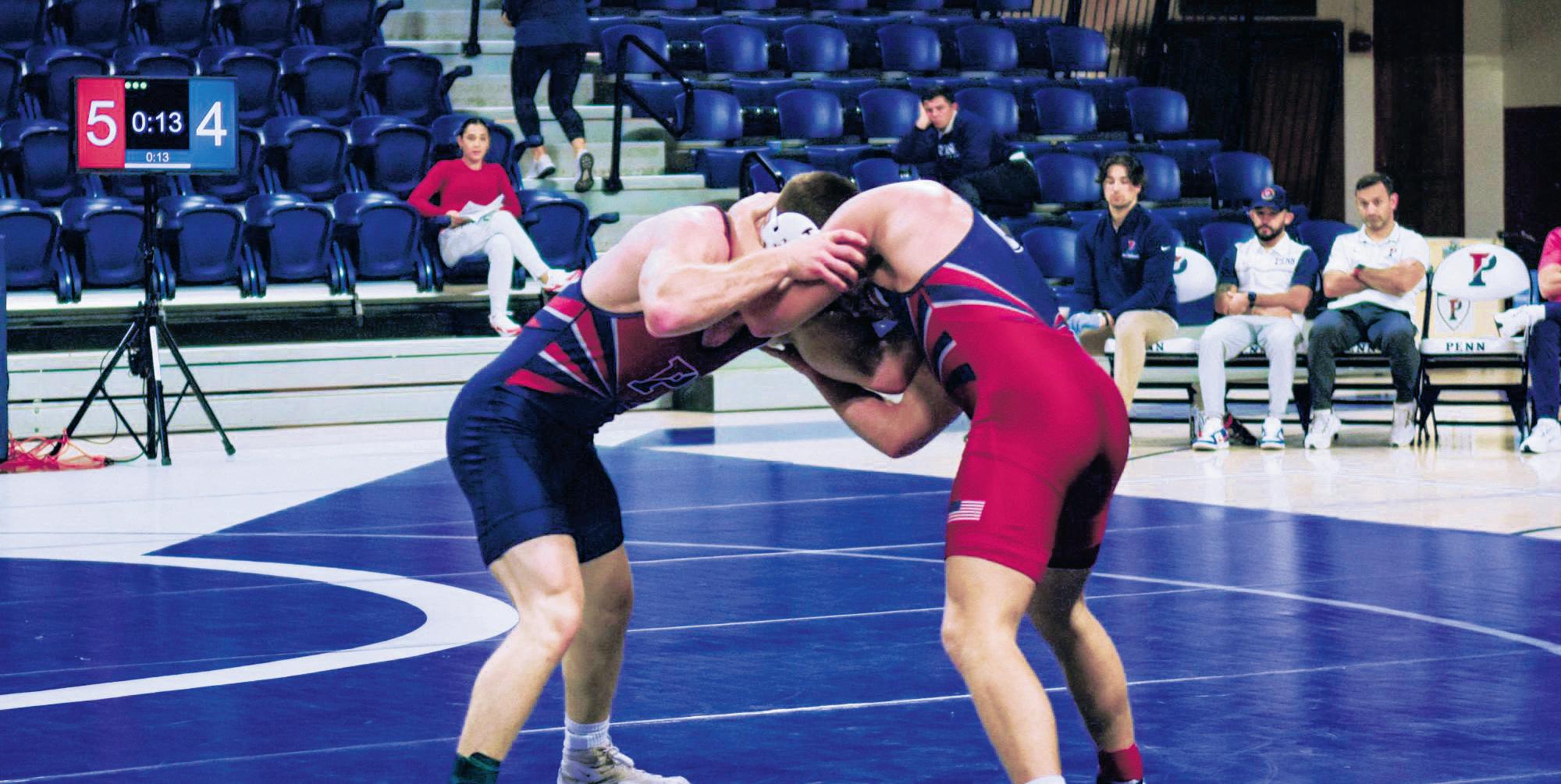
Here’s what’s happening on the mat with Penn wrestling
The team sits in the middle of the Ivy League pack but has shown signs of growth
ANTONIO MELONI Staff Reporter
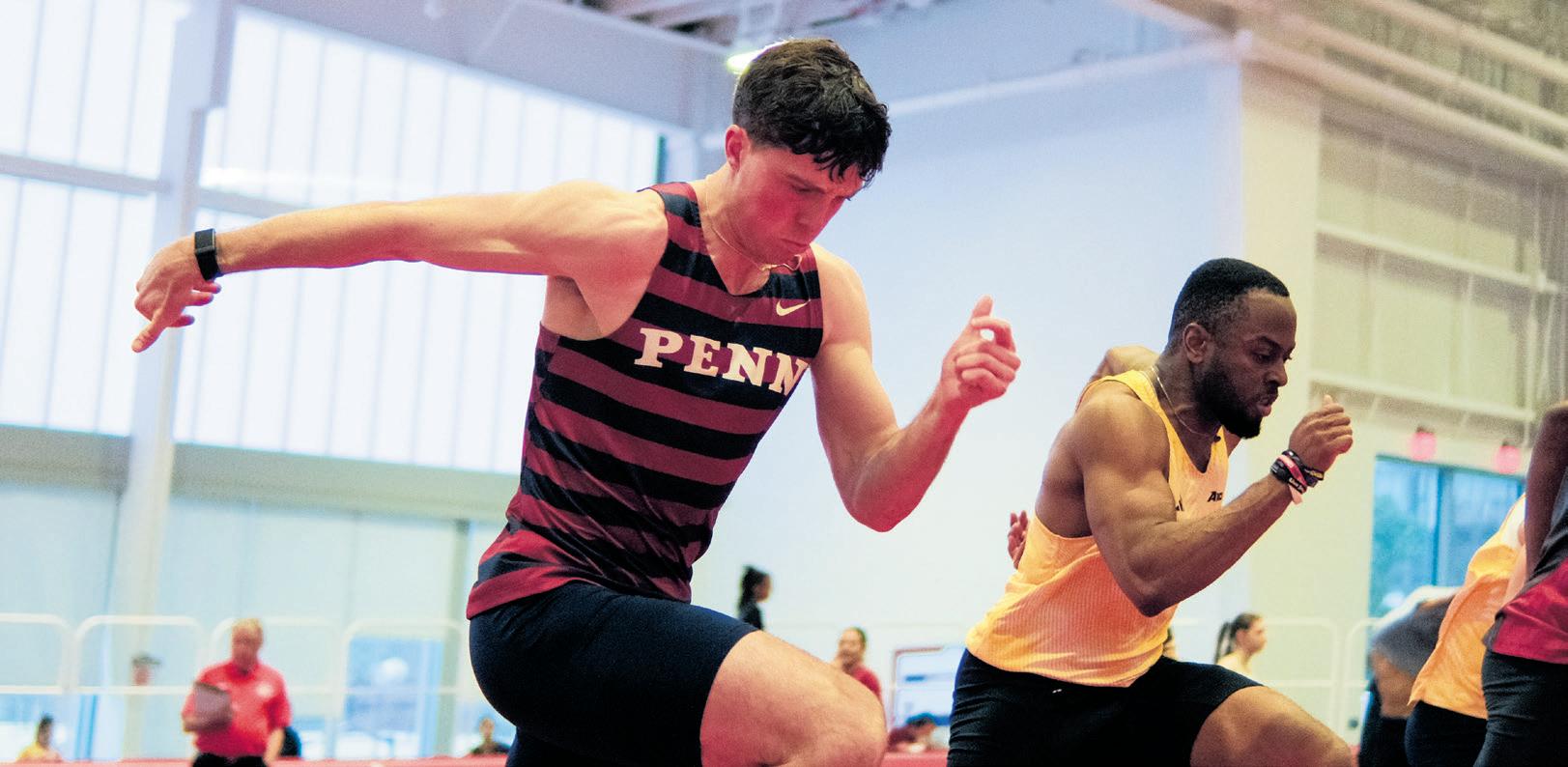
Penn’s season thus far can be summed up by two main trends: youth and volatility. The Quakers are coming off of their last regularseason contest ahead of the upcoming Ivy League Championships. Last Thursday, Penn wrestling bested Rider 12-6 at the Palestra in a tightly contested bout. With a slight lead heading into the final matchup, sophomore heavyweight John Pardo sealed the victory by beating heavyweight Hogan Swenski.
A handful of young freshmen and sophomores have stepped up and filled bigger roles on the team. Pardo is not the only underclassman to come up with big moments under pressure. Sophomore Cross Wasilewski has continued to dominate with a 23-2 record, while freshmen Liam Carlin and Davis Motyka have come away with decisive victories against fierce programs.
Despite being successful in most out-of-conference matchups, three of the Quakers’ four losses have come against Ivy League rivals. The Red and Blue lost to Cornell (9-7, 4-1 Ivy) and conference leader Columbia (11-3, 5-0 Ivy) at the Palestra earlier in the season. Cornell has historically stayed on top of the Ivy League as a favorite, while Columbia has emerged as an unexpected frontrunner in recent years.
This same stretch of matchups also included two resounding Quaker victories at Harvard (6-6, 2-3 Ivy) and Brown (5-9, 0-5 Ivy). After a Valentine’s Day loss at Princeton (4-11, 2-3 Ivy), Penn (7-4, 2-3 Ivy) now sits squarely in the middle of the Ivy pack, tied for third in the conference with the Crimson and the Tigers.
“We’ve had some difficult team losses, especially during that tough stretch,” Wasilewski said in an interview with The Daily Pennsylvanian. “I think as a team, we definitely had to learn a lot about the culture we’re creating and have had to stay diligent throughout the season. Definitely, the recent loss against Princeton was a learning opportunity, but our goals don’t change.”
Last year marked the inaugural Ivy League Wrestling Championships. Cornell and Penn battled for first place in the finals, but the Big Red emerged victorious with Penn finishing close behind as the runner-up. This year, Penn will be out for revenge to surpass favorites Columbia and Cornell in New York.
“There’s a lot of good guys competing at the Ivy [League Championships],” Wasilewski said.
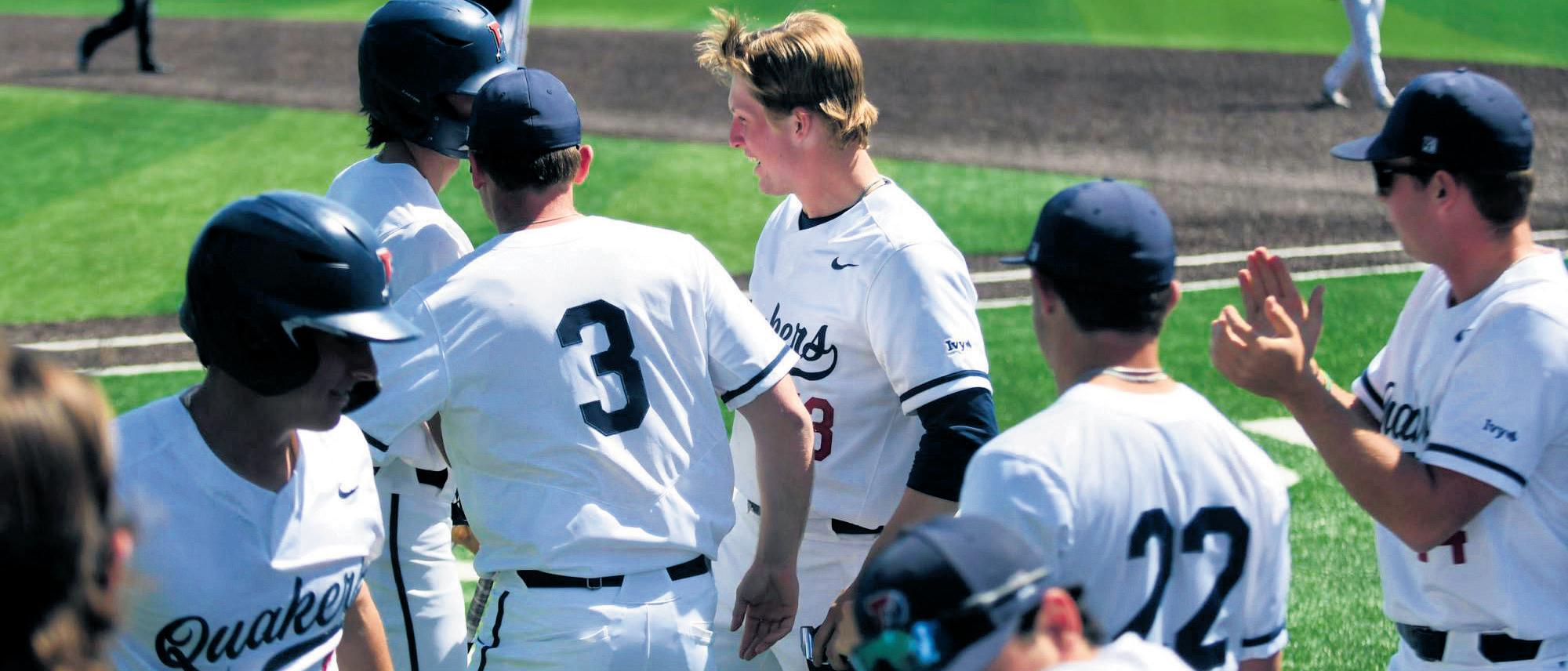
BASEBALL , from back page
catcher Qwynn Ahearn, and junior outfielder
Gavin Degnan all contributed key singles.
On the mound, Moss and junior pitcher Marty Coyne both impressed in their starts, combining
Penn men’s wrestling pictured practicing on Nov. 3, 2024.
“Specifically, at my weight class, I’m gonna have a matchup against a top-five wrestler in the country. A lot of people don’t get that opportunity two weeks before the national championships, so this is definitely something I’m looking forward to.”
The Ivy League Championships, while important in their own right, have not been around for nearly as long as the NCAA Wrestling Championships. Perhaps that’s the reason why members of the Red and Blue are aligning their preparation mostly for the national stage in Cleveland. It is undeniable that this is the most prestigious and grandest stage in collegiate wrestling.
for strong strikeout totals and limiting the Aggies to 11 hits across two games. Coyne was rewarded for his career-high nine strikeouts in the second game with an Ivy League Co-Pitcher of the Week nod. Though Penn didn’t find the start it was looking for, the team’s pitching and defense offer encouraging signs for the season ahead.
Another three-game series awaits the Quakers as they travel to Mercer next weekend.
For coach Matt Valenti, the national stage isn’t something new. Valenti, a two-time NCAA champion and Penn Athletics Hall of Famer, will look for growth and leverage the season finale in mid-March as a measuring stick for his first full season at the program’s reins.
“The national tournament is what we all have our eye[s] on. I would lose the Ivy League Championships 100 times to get the opportunity to wrestle in the national finals,” Wasilewski said. “It does not matter what has happened so far in the season; if you win the national title, no one cares what happened November through February. The NCAAs are really the end-all, be-all, which puts a lot of pressure on the tournament.”
“Coach Valenti was able to do it twice,” Wasilewski said. “He really gave us insight into what it takes. It all starts with belief. When you have the mental capacity to actually believe you can go into a tough tournament and come out on top, it starts to become possible. That’s something I’m individually focusing on, and I think a lot of other guys on the team also have the same mindset.” Penn will return from a brief hiatus at the
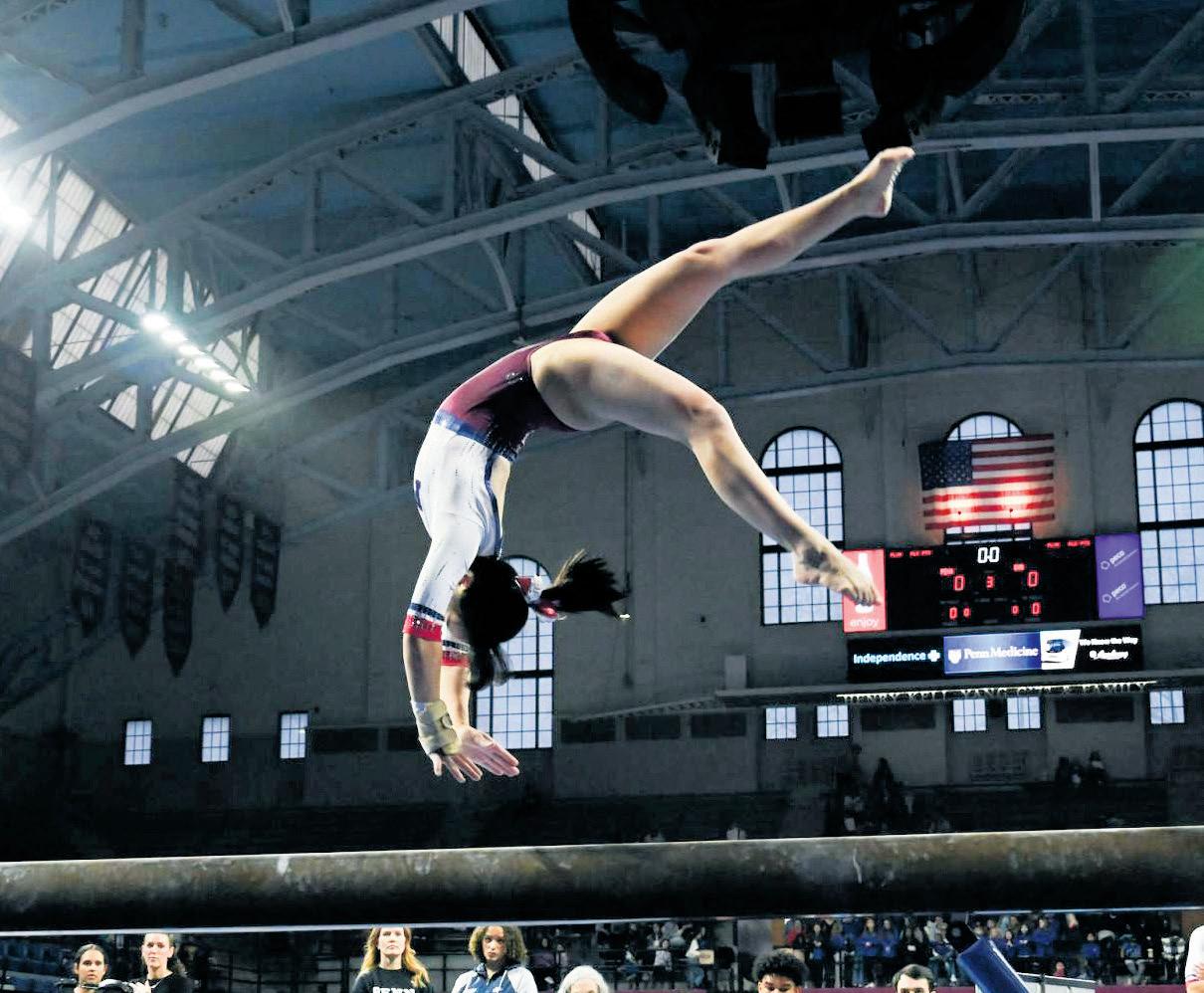
Penn gymnastics wins third consecutive Ivy Classic
The Quakers scored 195.800 points to take the title
CATHERINE ELLIS Staff Reporter
Are the Quakers undefeated or unbeatable?
The No. 36 Quakers traveled north to New Haven, Conn., last Saturday to compete against conference rivals Yale, Brown, and Cornell in the annual Ivy Classic. Penn gymnastics walked away with the title for the third year in a row, putting it on track to conquer the rest of the season and win the Gymnastics East Conference Championships again.
“Winning a third straight Ivy championship really shows how our program has built sustained excellence over my time on the team,” says senior Alyssa Rosen. “Every year the lineup changes and new athletes step into different roles, but what’s stayed constant is our culture and our commitment to each other.”
Floor
Kicking off the meet, sophomore Mimi Fletcher and Rosen both exhibited seamless tumbling with grounded landings and beautiful positions in the air.
Sophomore Maggie Murphy led off her routine with a double full, which earned her extra difficulty points and contributed to her final score of 9.775.
Senior Marissa Lassiter lured in the crowd and judges with extreme power and received a 9.800.
Sophomore Manama Fofana, who has earned three consecutive GEC Gymnast of the Week awards, topped the scoreboard for the Quakers with a 9.875 to win the event. Altogether, Penn had a total team score of 48.925, putting it in first by more than a tenth.
Vault
Lassiter got the momentum going for the Quakers in their second rotation with a stuck landing. Freshman Ananya Patanaku increased her difficulty with a half twist onto the vault table, followed by a back pike off of it. That extra bump helped her achieve a 9.775 final score. Fofana built off her strong floor performance with a 9.800 on the second rotation.
Junior Jordan Barrow anchored the lineup and wrapped up the rotation with the highest score for the team, a 9.825, good for the Ivy League vault title. Penn walked away from the vault with a 48.875, which tied with Yale for first place.
Bars Sophomore Skylar Goodstadt led off the lineup with a strong 9.775 performance, which two of her teammates matched during the rotation. Goodstadt nearly stuck her landing, taking only a small hop. Freshman Ruth Whaley followed with another 9.775 while keeping her feet together and maintaining clean lines in the air. Barrow was the third Quaker to earn a 9.775, demonstrating seamless transitions between the high and low bars. Sophomore Luci Toczylowski earned a 9.850 through solid releases and a nearly stuck landing, which is the highest individual bars score of the season and a new personal record for her. Toczylowski also walked away with the Ivy League bars title. Finishing with a 48.875 team score, the Quakers fell a quarter of a point behind Yale this rotation.
Beam Whaley led off the event with a 9.825, kickstarting a series of great scores for the Red and Blue. Murphy, Fofana, and Fletcher all earned a 9.800. Murphy displayed a gorgeous leap series with an air of confidence. Fofana remained calm throughout her routine, not letting the nerves of a previous fall shake her.
Barrow stunned with a career-high of 9.900, good for third-best in program history and the Ivy League crown. The Quakers evidently saved the best for last, scoring 49.125 on their final rotation to win the Ivy Classic.
Penn took home the title with a 195.800, nearly three-tenths of a point ahead of second-place Yale, and several points ahead of third-place Cornell and fourth-place Brown. This mark also ties the highest Ivy Classic score in program history, set in 2024 at the Palestra.
“The fact that we’ve been able to adapt each year and perform at a championship level speaks to how much this team has grown and how strong our foundation is,” Rosen says.
Fans can catch the Quakers back in Philadelphia next Thursday, March 5, at Temple in a quad meet against Maryland and Towson.
EBUNOLUWA ADESIDA | SENIOR PHOTOGRAPHER
Carnathan |
The
WALKER
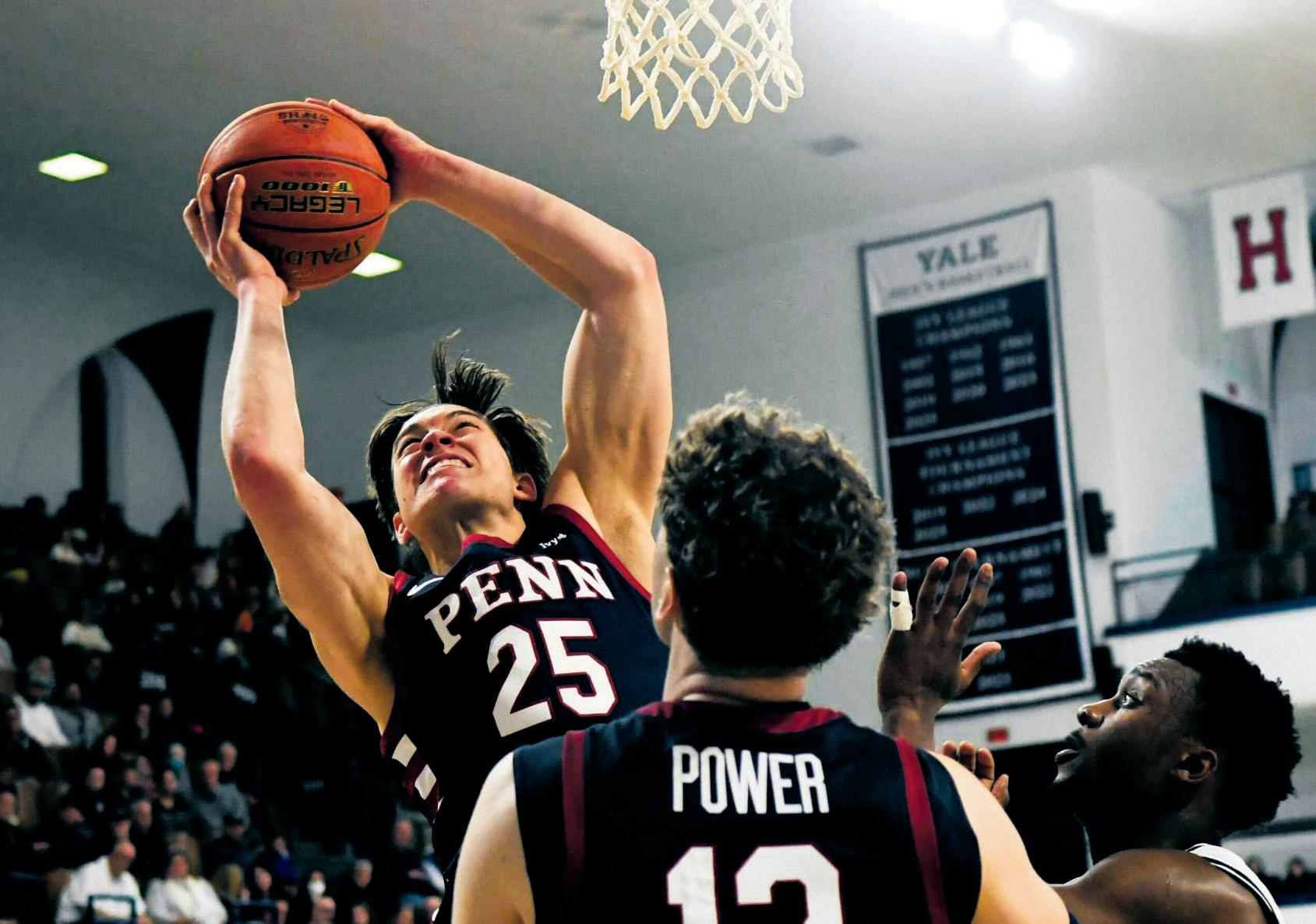
members of its supersized frontcourt: forward Isaac Celiscar and center Samson Aletan. Celiscar, a well-built 6-foot-6, and Aletan, 6-foot10, 223 pounds, are major handfuls down low, forcing opposing defenses to bend around them. Celiscar in particular made life extremely difficult for Penn, physically imposing on the Quakers’ defenders and frequently drawing help. He finished the day with 16 points and 14 rebounds, but the more telling figure may have been his five assists. When Penn sent two defenders, Celiscar made right decision after right decision, dishing off to Aletan and the Bulldogs’ perimeter shooters for open looks.
Here are two examples of Celiscar’s bully-ball-generated open looks from three-point range. In the first, he clears out junior forward TJ Power at the elbow, freezing sophomore point guard AJ Levine just long enough for his man, guard Trevor Mullin, to get off a clean jumper.
The second is even simpler. After Celiscar plows his way onto the block and pulls both junior forward/center Augustus Gerhart and freshman guard Jay Jones into his orbit, he deftly finds forward Jack Sullivan in the corner for a wide-open triple.
“[Celiscar and Aletan] are handfuls, but the reason they’re handfuls is because of what else [Yale has]. They got weapons everywhere,” coach Fran McCaffery said. Yale’s do-it-all forward Casey Simmons also finished with 13 points. “So you gotta pick when you’re doubling, who you’re doubling off.”
Celiscar also called his own number in several key moments. In the final two minutes, he connected on a fadeaway free throw line jumper to put Yale ahead 67-60. Then, after a pair of three-pointers brought Penn back
, from back page
deficit. Yale’s offense was kept alive by Moore, who knocked down a clutch three-pointer in the third quarter to close in on Penn’s double-digit lead. However, several lackadaisical mistakes, including a 10-second violation and a
within two, Celiscar dialed up an isolation against Power and converted a tough baseline mid-range jumper to give the Bulldogs a 70-66 lead they would not relinquish.
“[Celiscar] hit a big shot,” McCaffery said. “You gotta give it to him. It’s a one-legged, fadeaway contested. Up two, that shot was a game-winning shot.”
Penn’s early lead was fueled by a white-hot shooting stretch that saw the Quakers hit six of their first eight three-pointers. Power and senior guard/forward Michael Zanoni accounted for three apiece, and each finished the first half with 15 points.
Zanoni was unconscious for much of the early going, serving as a Cristiano Ronaldo-like play finisher for possessions successful and not. The 6-foot-5 forward has
five-second inbounds violation, reduced Yale’s chances for a comeback.
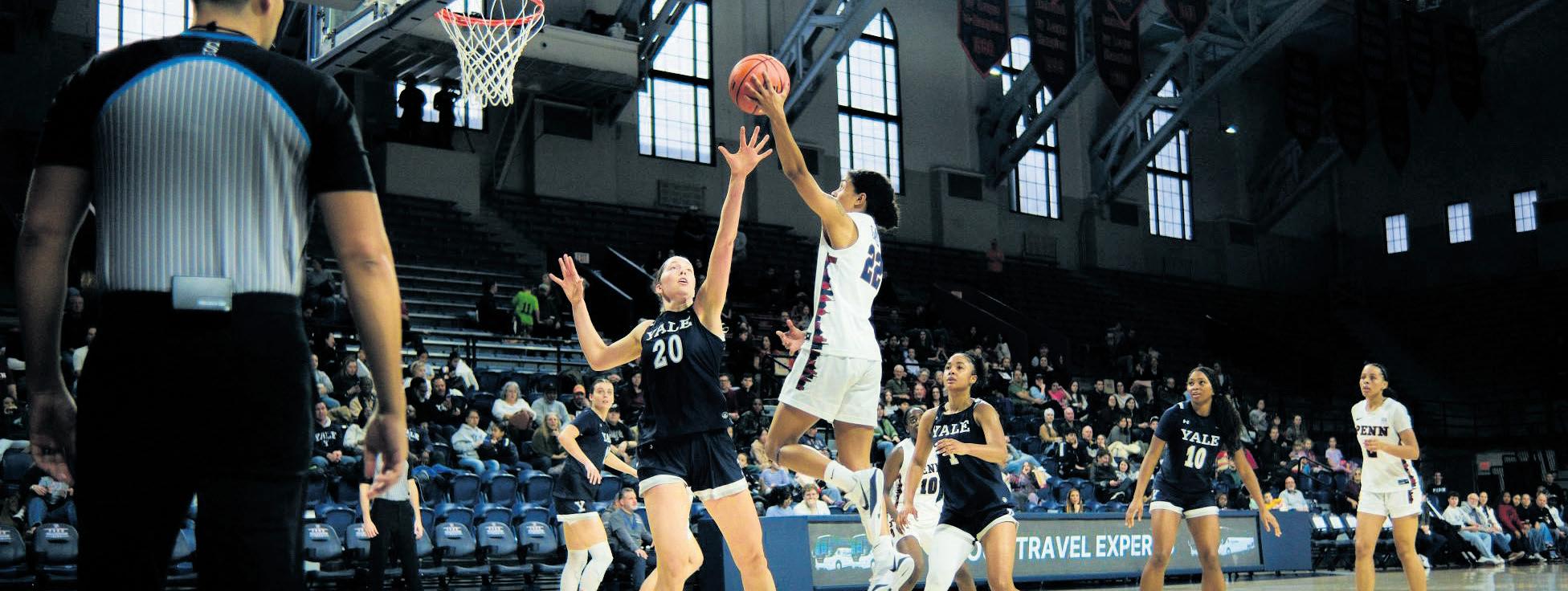
Senior guard Simone Sawyer, another key player, began to find momentum in the latter half of the game with three layups and a three-pointer. In the third quarter alone, Sawyer scored seven points, contributing to the Quakers’ lead just shy of 15 points.
Despite a strong fight from Moore and Yale forward Luisa Vydrova, who finished with 19 points and 11 points, respectively, the Quakers prevailed. Three Quakers reached double-digit performances, with Gayle
spent much of Penn’s recent win streak getting crowded as he moves off the ball, but in New Haven, Conn., he was able to catch cleanly and execute with minimal space.
Some of Zanoni’s makes were well-schemed gems.
Here, near the end of the first half, he darts to the corner after being sprung open by a solid screen from freshman center Dalton Scantlebury, connecting on a baseline jumper to put Penn ahead 36-33.
Others were heat checks — here, after the Quakers’ offense goes stagnant, Zanoni bails them out with a deep catch-and-shoot triple despite a hand in his face.
Here, trailing by five in the final minute, Zanoni waits to time his movement with Power’s inbound catch, then
finishing with 22 points alongside Suttle and Sawyer, who saw 16 and 12 points, respectively.
“This week was … on our turf, our timing, and I think it showed a lot today,” coach Mike McLaughlin said.
“Now we just got to readjust, to find a way to knock off Harvard.”
Driven by the cheers of local youth fans, the Red and Blue put on a dazzling show, dominating the Bulldogs on both ends of the floor. The Quakers will continue their play at Harvard on Feb. 27, as they come close to the end of their Ivy League season.
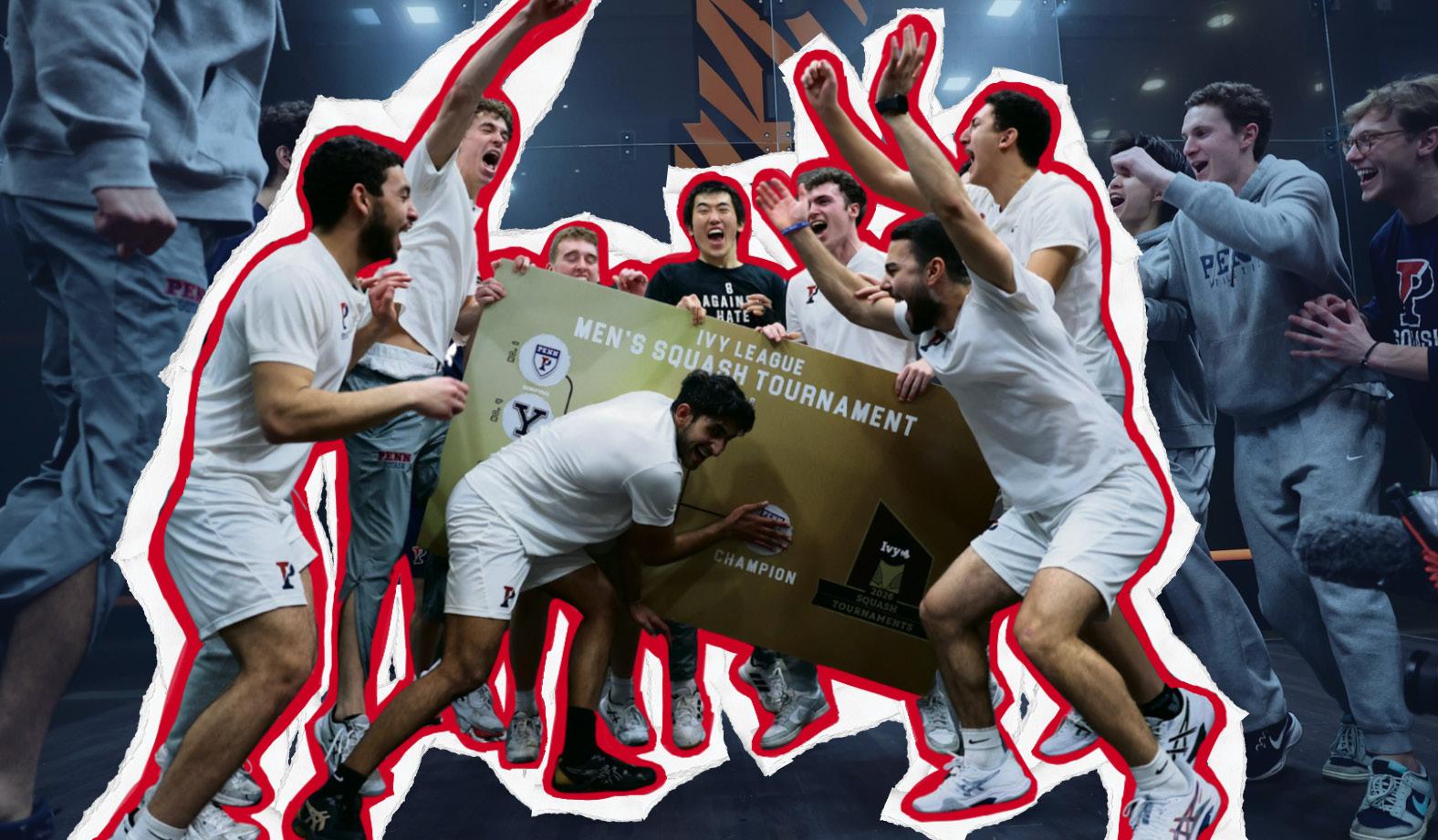
not think about what was actually going on,” Chitturi wrote. “I knew if I started thinking about what would happen if I won, I’d choke. I just kept telling myself to pretend it’s a practice match and focus on playing good squash. However, after we won, it was obviously a surreal experience.”
to make history as they compete for a national championship at the Arlen Specter US Squash Center in Philadelphia from Feb. 27 to March 1.
launches off a Gerhart pick and hits a wing fadeaway with barely any air.
Penn’s primary issue was that looks like those — for Zanoni and Power — were few and far between after halftime. Zanoni was one-fourth from three-pointer in the second half, while Power was one-half. As a team, the Quakers converted just 33.3% of their second-half field goals, struggling to penetrate Yale’s front without fiery shooting to light the way.
“We should’ve done a better job getting
“Having [Patel] win his match in 3-0 (which was a huge turnaround from losing to the same guy just last week) and [Abdelsalam] saving 4 match balls in his match was pretty insane. So when I stepped on for my match I felt a lot of pressure to not let their efforts go to waste,” Chitturi wrote in a statement to the DP. With the Ivy League title on the line, Chitturi won the first two sets. Rome came back at match point during the third set, keeping the Crimson in the game before Chitturi snuffed that hope out, defeating Rome in the fourth set and winning the match 3-1.
“During the match, I was trying to force myself to
And just like that, Penn was named the Ivy League champion once again.
“The joy and happiness of victory wasn’t solely about the result; it was also about how we as a team understood that when we came together we are indestructible, because such a comeback on a big stage doesn’t happen by chance,” Khalil wrote. “It takes belief, brotherhood, and most importantly, it takes everyone.”
And with this new confidence in the team’s bond, both the men’s and women’s teams are still looking
“We are really looking forward to the national championships and using this momentum from last weekend in our favor,” Lane wrote. “It is the most wide open that the nationals have been in many years so it is really important that we are mentally and physically ready to go from the first round.”
The men’s team is looking to win its third straight College Squash Association team title, while the women’s team is also looking to bring a trophy back to Locust Walk.
For team captain Hafez, who won the CSA Individual Championships men’s national title earlier this year, another addition to a list of accomplishments since winning Ivy League Rookie of the Year
WALKER CARNATHAN is a College senior and former Sports editor from Harrisburg, Pa. studying English and cinema and media studies. All comments should be directed to dpsports@thedp.com.
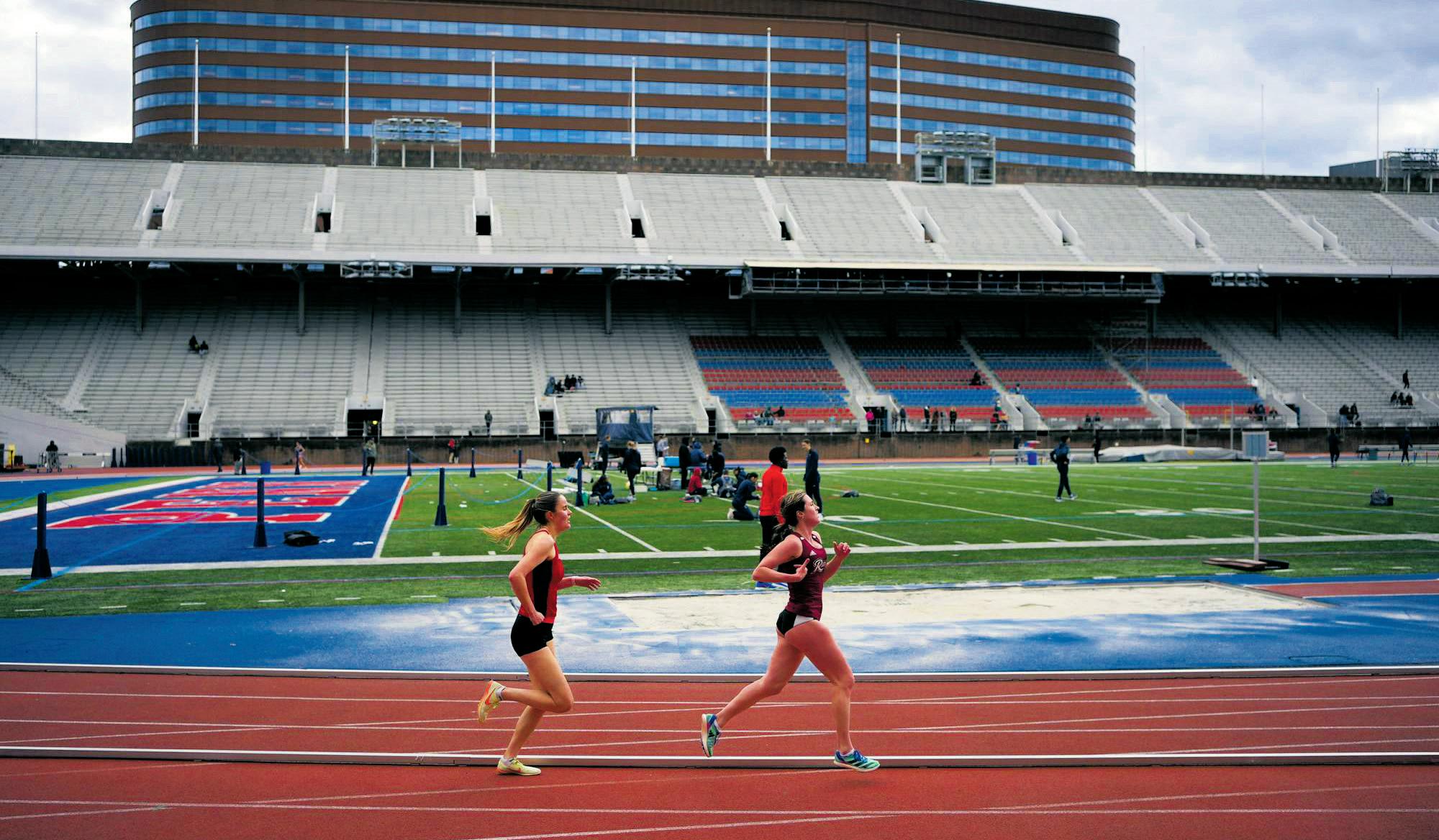
TRACK, from back page
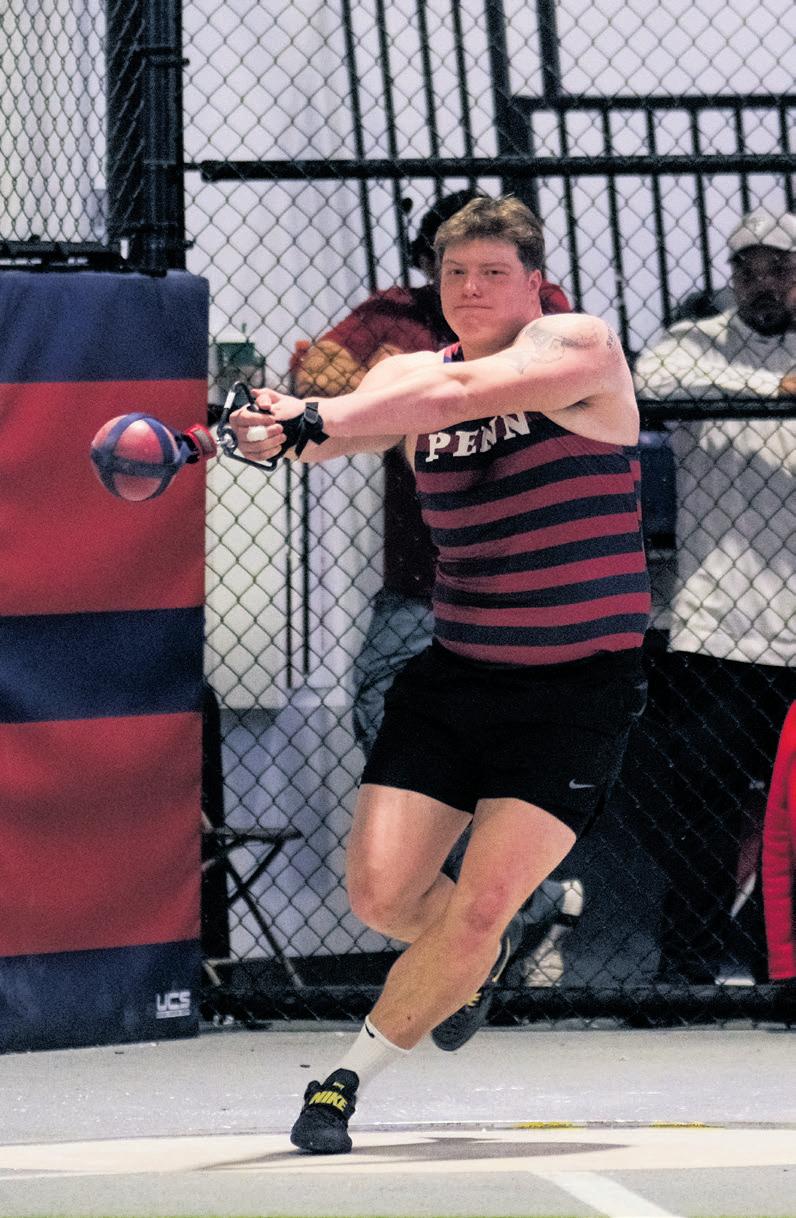
champion in shot put, but freshman Jessica Oji could potentially threaten her reign.
Freshman distance phenom Joseph “Tiago” Socarras lit up the track as a pacer in the 800-meter run. Although Socarras eventually pulled off the track, he propelled teammate sophomore distance Ben Markham to the win in a new personal best 1:49.68, good for eighth in program history.
Junior sprinter Nicholas DeVita finished a mere two hundredths of a second behind Markham for the silver, receiving ninth in program history and a new personal record. Senior distance Nicholas Pizarro also landed on the podium for the Quakers, running 1:50.04 for the bronze. Socarras’ pacing led the distance squad to strong finishes in the men’s 1,000-meter race as well. Senior Liam Going and freshman Vinay Raman were neckand-neck, with Going taking first by a tenth of a second. Both athletes walked away with new personal records, placing No. 3 and No. 4 in program history, respectively.
Senior Kyra Compton and junior Lindsay Yakaboski held it down for women’s distance with their respective performances in the mile and 800-meter race. Despite specializing in longer distances, Compton took the silver in the first mile of her collegiate career, running 4:54.27. Yakaboski finished fourth in the 800m, with an indoor best time of 2:13.98. The Quakers will face off against the rest of the conference for a chance at the Ivy League title at the Armory in New York this weekend.
“I’m stoked to watch and be a part of the team as we give it our all,” Murphy wrote.
as a freshman, it will be a last hurrah with the Red and Blue. Hafez wrote, “I still can’t believe that CSA Nationals are going to be my last competition for me representing Penn. Of course it hurts every time I think about it but I’m trying to focus on winning it with my team and walk out there in the best way possible.”
The team is ready to look ahead.
“Nationals is the time this group is going to make it count,” Khalil wrote. “We are not chasing nationals again, we are not defending anything, this group is going to win nationals for the first time ever ... We have never been on such a high, and never been hungry for more.”
Sports Editor Hannah Chang contributed reporting.
NATHANIEL SIRLIN | SENIOR PHOTOGRAPHER
forward Augustus Gerhart pictured going for a layup against Yale on Feb. 21.
KENNY CHEN | SENIOR PHOTOGRAPHER
Junior guard Mataya Gayle pictured going up for layup in a game against Yale on Feb. 21.
SPORTS
THE INDEPENDENT STUDENT NEWSPAPER OF THE UNIVERSITY OF PENNSYLVANIA • FOUNDED 1885
PHILADELPHIA, THURSDAY, FEBRUARY 26, 2026
Men’s squash crowned inaugural Ivy League tournament champions
This weekend, dear old Penn brought down Harvard to claim the inaugural Ivy League squash tournament crown.
The Quakers defeated the Crimson 5-4 last Sunday in a successful weekend for the Red and Blue (14-2, 5-1 Ivy) that saw both the men’s and women’s squash teams competing at the Ivy League tournament. On the heels of winning their third straight regular-season Ivy title, the Quakers were ready to put up a tough fight in New Jersey.
After all the dust settled, Penn did not disappoint.
“This match was one of the craziest matches I’ve ever been a part of. The recent rivalry with Harvard has been amazing, and this match just added to that history,” men’s squash coach Gilly Lane wrote in a statement to The Daily Pennsylvanian. “I’m so proud of how hard the boys fought when trailing in the match. They stuck together and showed true brotherhood and bond.”
Senior team captain Omar Hafez echoed Lane, writing in a statement to the DP, “it was one [of] the craziest matches I’ve experienced in college squash in a really long time. Also playing back to back matches while fasting because of Ramadan ([junior] Salman [Khalil] and [sophomore] Marwan [Abdelsalam] were fasting too) was really tough and exhausting.”
“When we won it I was actually super surprised,” junior Varun Chitturi wrote in a statement to the DP, “because there was a moment in the middle … that I
Women’s basketball bests Yale
Junior guard Mataya Gayle delivers a 22-point performance in a highscoring win
ABIGAIL JABOIN AND MADISON KNIER Staff Reporters
The Quakers took down Yale once again. The last matchup between these familiar Ivy League foes back in January resulted in a magnificent 64-37 victory for the Red and Blue. The second matchup of the season showed a very similar story. Coming off a loss against Columbia, the 68-52 win over the Bulldogs (6-18, 2-9 Ivy) gave the Quakers (15-9, 5-6) the bounce back they needed. In the midst of the fast-paced game, an abundance of scoring, and gritty defensive efforts, one player shined: junior guard Mataya Gayle. A pregame celebration for Gayle’s 1,000 career points, including a special congratulations from Penn President Larry Jameson himself, may have been the spark the Red and Blue needed. Or perhaps, it was the young basketball players cheering loudly for the Red and Blue that made the atmosphere in the Palestra even more special.
“I was excited about it, I think more so it was a bit bittersweet,” Gayle said. “I’m proud of myself with the work I put in, but [I] just want to keep winning.”
After the eventful celebration, sophomore forward Katie Collins started the game off right by putting up the first Quaker points with a deep three that broke a scoreless first minute of play for Penn. A back-and-forth battle pursued with both teams on the board. Four of the five Penn starters earned themselves a place in the score sheet five minutes into gameplay.
Yale guard Ciniya Moore was an effective threat on the court early on, hitting two floaters for the Bulldogs. However, Gayle had an answer of her own. In the first quarter, Gayle singlehandedly countered Moore’s scoring with a double-digit performance in one quarter led by three-pointers, fast-break points, and shifty finishes inside the paint.
Penn’s scoring was relentless for the first 10 minutes. Sophomore guard Brooke Suttle, coming off the bench, wreaked havoc on the Bulldog’s defense. Suttle was able to score 12 points, connecting 2-of-3 field goals from beyond the arch.
“It just felt really good to be able to go out there knowing that they were confident in me and I was confident in myself,” Suttle said.
CAVANCE SNAITH Staff Reporter
thought we weren’t gonna make it.”
Before gearing up against Harvard, Penn men’s squash opened play against No. 4 Yale (6-5, 4-2 Ivy) on Saturday, looking to bounce back after falling to the Bulldogs earlier in the season. Penn played with a competitive edge from the beginning of the match. Each of the top four Quakers beat their Bulldog opponents to get the ball rolling.
Hafez and freshman Alex Dartnell were on a revenge tour of their own, competing against opponents they lost to in the regular season. Hafez faced Yale’s Tad Carney and Dartnell faced Rohan Gondi, but both Quakers won their matches by a 3-2 margin.
Khalil, Chitturi, and sophomore Zane Patel, all bageled their opponents, leading to a decisive Quaker victory. Sunday, Feb. 22, was championship Sunday for both men’s and women’s squash. Penn made conference history as the first school to have both teams represented in the squash championship final. The men’s team played No. 2 Harvard, while the women’s team faced off against No. 1 Princeton, with the women’s falling 5-1 to the Tigers.
“The mindset going into that tournament was we wanted to create history by being the first ever to win it, while also finding the balance of staying present and taking it one game at a time,” Khalil wrote in a statement to the DP. The team found that they did have to take it “one game at a time,” especially when Harvard came out
strong and won three of the first four matches, including an upset victory that saw Harvard’s Denis Gilevskiy sweep Hafez 3-0 in the No.1 match.
“I had mixed emotions in this match,” Hafez wrote. “[E]specially after losing my match I felt a bit down but I knew I had to be next to my team and I immediately went to coach and support my teammates.”
For a moment, it looked like the Quakers were faltering, but the Red and Blue were not ready to go down without a fight. Dartnell ignited a critical rally to lead the Quakers on a 3-0 run, tying the match 4-4.
Dartnell was named the Ivy League’s most outstanding player throughout the squash tournament after two gritty, physical wins that changed Penn’s momentum this weekend.
“Happy to write the history books today with this special team for the first time and to be the tournament’s first ever MVP,” Dartnell wrote. “This is just the beginning.”
Fired up by Dartnell’s rousing comeback, the team clawed its way back from a slow start.
“This was definitely the most competitive match I have played in my college squash career. Never have I been in a match decided by such fine margins,” Khalil wrote.
The match ultimately came down to one face-off: junior Chitturi against Harvard’s Segev Rome.
See SQUASH, page 7
Baseball opens season with loss against Texas A&M
Penn’s defense kept the team toeto-toe with the Aggies for the first two of three games
SOO YOUNG YOON Staff Reporter
On Friday, Penn baseball opened its 2026 season against No. 24 Texas A&M. After coming up short of the Ivy League tournament title last spring, the Quakers were looking to rebound and set the tone with a win in their season opener. Unfortunately, the Aggies swept the weekend series and sent the Quakers home with a 3-0 loss to start the year.
Lockdown defense from both teams Texas A&M (7-0) pitcher Shane Sdao started the first game of the series hot and denied Penn’s first three hitters with two flyouts and a strikeout. Penn senior pitcher Jake Moss was quick to respond, giving up just one hit before sending
ers a 1-0 lead. In the next four innings, the two teams failed to gain much momentum on offense, combining for just four hits and a final score of 2-1 Aggies. Though the third and final game of the series ended in a blowout, Penn’s strong defense kept the Quakers in the first two games.
Dramatic ninth-inning heroics from the Aggies
Unfortunately for the Quakers, Texas A&M pulled off some ninth-inning heroics to secure the win in the first game. In the final inning of the opener, infielder Boston Kellner doubled to center field, allowing infielder Sawyer Farr to score and give the Aggies the walk-off victory. Penn couldn’t catch a break. In game two, the Quakers held a 1-0 lead through six innings before Texas A&M’s star outfielder Terrence Kiel II lined a hit down the right-field line, allowing him to score and tie the game at 1-1. After a scoreless 10th inning, the Aggies would go on to finish with another walk-off victory to seal the second game.
Bright spots for Penn Going into the series, it was clear that Texas A&M would be a tough opponent. Still, aside from the final game, Penn went toe-to-toe with the Aggies and had multiple opportunities to come out on top.
Senior shortstop Davis Baker led the offense with multiple hits, while Collins went 3-for-5 in game two and drove in Penn’s only run. Secretarski notched his first collegiate hit in his first start, and sophomore infielder Michael Powell, junior See BASEBALL , page 6
Track and field defends Ott Center at Philadelphia Metro meet
Junior sprinter Nayyir Newash-Campbell lowered his program record in the 400-meter race
CLARK
ELLIE
Deputy Sports Editor
The regular season might be over, but the real fun is just beginning.
Penn track and field ended its regular indoor season last Friday at the 2026 Philadelphia Metro meet, hosted at Penn.
Junior sprinter Nayyir Newash-Campbell broke his own program record to win the 400-meter run. Newash-Campbell bested his previous mark by four hundredths of a second, good for No. 1 in the conference and No. 32 in the NCAA.
Although Newash-Campbell is the defending champion in the 400 at Ivy League Heptagonal Championships, he has yet to land on the podium during indoor conference championships. With Heps just around the corner, this could be the season that Newash-Campbell lands on top.
Senior long-distance standout Lily Murphy made a triumphant return to the oval with a victory in the 3-kilometer race, moving to third in the program record books while improving her previous personal record by seven seconds. Murphy’s cross country season was cut short because of injury just before conference championships last October.
Although the Summit, N.J. native didn’t compete last indoor season, she qualified for NCAA Outdoor Championships in the 5-kilometer race and the 10-kilometer race in 2024. If Murphy chooses to contest the 3K at Heps next weekend, she’ll be the dark horse in a stacked field of 2025 NCAA Cross Country Championships qualifiers.
“I was definitely super nervous after being out of running longer than ever before, but I’ve had my teammates’ support and encouragement every step of the way,” Murphy wrote in a statement to The Daily Pennsylvanian. “I’ve worked out in [the Ott Center] for two years, so I was euphoric to finally get to race in the facility for the first time.”
Junior sprinter Jordyn Reed dominated the 60-meter dash, winning the event by over a tenth of a second. With a time of 7.48, it was Reed’s first individual event win of the season. Just last season, Reed ran a time of 7.66 at the same meet. Her performance this year builds on improvement from the 2025 indoor season onward.
“I’ve been putting in a lot of work behind the scenes, so it was great to see that show up on the track,” Reed wrote. “But I still have a lot of goals for this season, and this was just one small step toward them. I’m grateful for the win, but I know there’s more in me, and I’m focused on continuing to improve.”
Other sprinters showed up and showed out at
Friday’s meet. As it was only her second time competing in the event, sophomore sprinter Milan Ramey finished second in the 60m in a personal best of 7.6 seconds. Freshman sprinter/hurdler Ava Nebel won the first 500m of her collegiate career, beating her opponents by over two seconds.
On the men’s side, sophomore multi-eventer Anikwe Duru placed third in the 60m with a season-best time, while junior sprinter/hurdler Sean Golembiewski earned the bronze in the 60-meter hurdles.
After the sprinters vacated the infield, high jumpers stole the show. Senior jumper Mark Hellwig and sophomore multi-eventer Oliver Hassard tied with successful attempts at 2.03 meters, but Hellwig pulled ahead for the win with less scratches overall. Junior jumper Samantha Strydesky secured the gold on the women’s side as the only competitor to make it over the 1.65-meter bar.
Record-breaking action went down on the thrower’s mound as senior thrower Stella Inman shattered the previous meet record mark by over a meter. Junior throwers Ella Neskora and Alexa Dochat also displayed strong performances, filling out the podium for a 1-2-3 finish in the women’s weight throw.
Senior thrower Angeludi Asaah earned silver in shot put with a season-best throw of 15.7 meters. This weekend, Asaah will be returning to Heps as reigning
See TRACK , page 7
ELIZA GREEN | DESIGN ASSOCIATE
KENNY CHEN | SENIOR PHOTOGRAPHER
Penn track and field competes at the Philadelphia Metro competition on Feb. 21.