Penn Med residents, fellows demand union
Nearly 1,000 residents and fellows filed for an election with the National Labor Relations Board
KATIE BARTLETT Staff Reporter
Residents and fellows at the University of Pennsylvania Health System are working to unionize, citing “fundamental concerns” about their experience.

On Feb. 17, the Committee of Interns and Residents sent a letter to the Health System demanding that the hospital system recognize the unionization efforts of their residents and fellows. Over twothirds of the over 1,400 residents and fellows who work at Penn Medicine are represented by CIR, the
Two dining halls found not in compliance with Philadelphia health code
Most locations had at least five health violations during their most recent inspections, DP analysis finds
Penn Dining locations received a total of 100 observations of health code violations during their most recent inspections by the Philadelphia Office of Food Protection.
A Daily Pennsylvanian analysis of food safety inspection reports found that a majority of the 12 Penn Dining locations were found to have at least five health code violations. Among these, Hill House and 1920 Commons were issued the highest number of observations of health code violations during inspections conducted on Feb. 6 and Jan. 18, respectively — contributing 59% of the most recent observations across dining locations.
Hill received 38 points of concern for 16 distinct violations, while Commons was cited for 21 points of concern among eight violations in the report. Due to these observations of violations, Hill and Commons failed to attain satisfactory compliance with the overall standards set by the Philadelphia Department of Health. All other dining locations remained compliant with these standards.
Food safety inspections are conducted at least once annually by the Philadelphia Department of Health, and the severity of violations determines whether a reinspection will be required. Violations such as rodent and insect activity and accumulation of debris are identified as risk factors for foodborne illness. An establishment is in satisfactory compliance when it does not have health code violations.
Barbara Lea-Kruger, the director of communications and external relations at Penn Business Services, wrote in an email to the DP that three Penn dining locations are due for annual inspections in the spring semester. She wrote that Hill and Commons are also up for reinspection because of their current non-satisfactory compliance statuses.
The Lauder College House dining hall and Pret a Manger — which were assessed as not being in satisfactory compliance during inspections in fall 2022 — reduced most of their violations relating to insect activity, debris, and mouse droppings, passing each of their reinspections.
“When evaluating findings, diners should be most concerned when a facility has repeated violations which are not corrected upon reinspection or when the inspection yields discoveries that reflect severe violations that require a facility to immediately shut down,” Lea-Kruger wrote. “Neither of these events
Faculty retirement funds managed by company with billions in fossil fuel investments
Penn faculty’s retirement funds are potentially being invested in fossil fuel companies.
The University’s only service provider for faculty retirement plans has an estimated $78 billion in fossil fuel investments, according to a recent analysis from the Institute for Energy Economics and Financial Analysis. The company, Teachers Insurance and Annuity Association of America, is the primary insurance organization that offers employer-sponsored savings plans at higher education institutions in the United States.
Penn is one of more than 15,000 institutions for which TIAA is the primary or only manager of assets. The investment options are primarily not TIAA funds and include 13 other funds. But all Penn retirement accounts are considered to be administered by TIAA, which serves as the University’s “retirement saving plans partner” and has a $1.4 trillion portfolio.
largest housestaff union in the United States, which is directing the unionization effort.
The University did not confirm the CIR’s request for voluntary recognition of the union by the Feb. 21 deadline given in the letter. In response, the Penn Med residents and fellows filed for an election with the National Labor Relations Board to gain recognition with the CIR, according to a press release sent to The Daily Pennsylvanian.
“This historic move makes the Philadelphia
doctors the first housestaff to organize with CIR in Pennsylvania, a state without any unionized residency programs,” the CIR press release said.
A Penn Med spokesperson wrote on Feb. 17 that residents are a “crucial part” of Penn’s health system.
“We believe that our trainees will best be served by working directly with UPHS administration through our existing Graduate Medical Education
A spokesperson for TIAA wrote that the company aims to make decisions that are in the financial interests of its customers. The spokesperson added that selling investments that generate fossil fuels to other companies on a large scale “won’t reduce carbon output.”
“Our view is that broad divestment from fossil fuels does not offer TIAA an optimal way to influence the policies and practices of the companies we
Protestors from Penn, Drexel call for direct University action to preserve UC Townhomes
Penn and Drexel University students have held protests this week, demanding that their respective universities meet their calls to preserve affordable housing in West Philadelphia.
On Feb. 22, over 30 Penn student and community members from the Coalition to Save the UC Townhomes and Students for the Preservation of Chinatown gathered outside of College Hall ahead of the University Council Meeting and Open Forum, demanding that Penn commit $10 million to preserve the UC Townhomes as affordable housing.
Penn does not own nor have plans to purchase the UC Townhomes property, and administrators have said that it does not have any direct control over the redevelopment plans for the Townhomes property site. In September, Penn announced it would partner with Rebuilding Together Philadelphia, a local community revitalization organization, to assist approximately 75 West Philadelphia low-income homeowners.
Speakers at the Feb. 21 demonstration highlighted Penn’s history of displacing West Philadelphia residents and gentrification. An hour later at the Open Forum, multiple students addressed President Liz
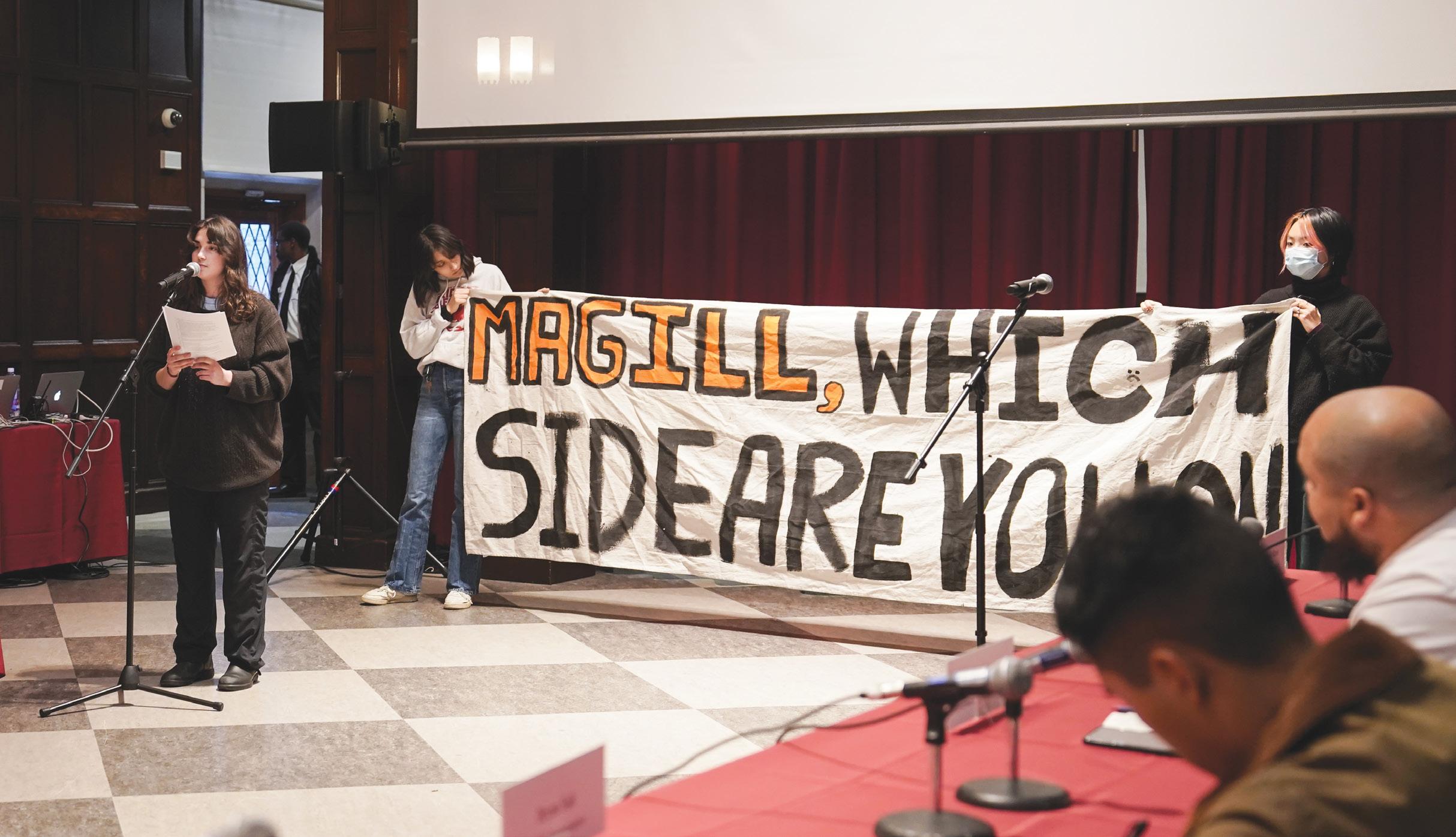
Magill and other University administrators about what they said was Penn’s responsibility to protect the UC Townhomes.
“You, through Penn, have the institutional, financial, and political power to prevent evictions and homelessness, and preserve the longstanding lowincome housing community of the UC Townhomes,” College and Engineering senior Emma Glasser said at the Open Forum.
On Feb. 21, Drexel for Justice — a student-led abolitionist group — and the Coalition to Save the UC Townhomes hosted a rally on Drexel’s campus. In addition to a rally outside the building, Drexel students began a sit-in occupying the main building, which is ongoing as of time of publication.
According to an Instagram post from Drexel for Justice, Drexel President John Fry and Vice Provost Lucy Kerman met with residents of the UC Townhomes on Jan. 30. Drexel has not responded to requests for comment.
Previously, Interim Penn President Wendell Pritchett agreed to meet with the UC Townhomes residents. Executive Vice President Craig Carnaroli and Director of City Relations Leigh Whitaker have
met with the residents twice since last spring.
The UC Townhomes were first constructed as federally-subsidized low-income housing in 1983 to compensate for the displacement caused by gentrification. After nearly 40 years of offering below-market rates to residents, IBID Associates decided not to renew its contract with the United States Department of Housing and Urban Development.
This announcement sparked backlash from some students and residents, who have been protesting the closure of the townhomes and the potential effects of displacement and redevelopment.
HUD has repeatedly extended IBID’s contract, with the goal of offering residents necessary time to acquire housing vouchers and relocate. According to Kevin Feeley, a spokesperson for IBID, the last renewal request was granted on Jan. 31 for 30 days, and they recently put in a request for a new one. Feeley said he was confident that HUD would get back to them within “a few days or a week.”
“I don’t see the end of February deadline as being the last deadline,” Feeley said.
CONTACT US: 215-422-4640 SEND STORY IDEAS TO NEWSTIP@THEDP.COM ONLINE AT THEDP.COM THE
VOL. CXXXIX NO. 7
INDEPENDENT STUDENT NEWSPAPER OF THE UNIVERSITY OF PENNSYLVANIA • FOUNDED 1885 PHILADELPHIA, THURSDAY, FEBRUARY 23, 2023
PHOTO BY ANNA VAZHAEPARAMBIL
PHOTO BY ANNA VAZHAEPARAMBIL
College and Engineering senior Emma Glasser speaks on behalf of the Coalition to Save the UC Townhomes at the University Council Meeting on Feb. 22.
ELEA CASTIGLIONE Staff Reporter
The funds are primarily managed by TIAA, a company with an estimated $78 billion in fossil fuel investments
30 protestors gathered outside of College Hall, demanding that Penn commit $10 million to preserve the UC Townhomes as affordable housing MOLLY COHEN AND NINA DILWORTH Senior Reporter and Staff Reporter
Over
JIN KWON Staff Reporter See UNION, page 7 See DINING, page 3 See TOWNHOMES, page 7 See RETIREMENT, page 7
Court approves fee refunds to some students
following COVID-19 lawsuit settlement



There will be a partial refund of fees for students who participated in a transition to online learning during the spring 2020 semester
SARA FORASTIERI Senior Reporter
A $4.5 million settlement will officially be distributed to some Penn students for online learning fees charged during the spring 2020 semester.
On Jan. 19, a court granted final approval to a settlement of a class action lawsuit against Penn, according to the Penn Covid Refund Settlement website. The settlement addressed claims of a breach of contract by Penn for fees imposed during the remote learning transition at the start of the COVID-19 pandemic. In return, Penn and the lawsuit’s plaintiffs agreed to a partial refund of tuition and fees for all students who participated in a transition to online learning during the spring 2020 semester.
Students enrolled in the University in a course that was not originally meant to be online before March 17, 2020 are considered “Settlement Class Members” affected by the lawsuit. These class members are eligible for reimbursement and do not need to do anything to receive the settlement. If no appeals are filed before Feb. 21, then distribution of funds will occur in April 2023.
The lawsuit’s plaintiffs also alleged that “Penn’s shift to remote learning gave rise to claims of unjust enrichment and conversion,” according to the lawsuit website. The court had previously dismissed the plaintiff’s accounts in April 2022, but one of the plaintiff’s claims was resolved based on a “feebased breach of contract.”
Penn had previously not been found guilty of any liability in court and denied all allegations. The University notified some students of the initial settlement proposal in November 2022, in which it cited the “interest of both Penn and its students in prompt resolution of the matter.”

In response to a request for comment, a University spokesperson directed The Daily Pennsylvanian to the updated version of the notice of proposed class action settlement.
Class Board 2023 President Derek Nhieu told the DP in November that he agreed that Penn should not have charged additional fees for the spring 2020 semester.
“If we ever transition online again, those fees are just not applicable. I feel like [the fees] are very much a disservice to students, when you try to charge them for these types of things,” Nhieu said.
Nhieu said that he received a letter in the mail detailing the class action lawsuit. Although he said he was happy that money would be refunded, he wished that the proposed settlement had been more informative.
The refund of fees for impacted students who are still at Penn will be delivered directly to their student accounts as early as April 2023. Non-continuing students will receive a mailed check or digital payment if requested. Individuals who had opted out before the deadline of Dec. 19 will not receive a settlement.
After 10 years of operation, the
Fried chicken restaurant Wishbone closes University City location after 10 years of service
Wishbone will continue to operate a larger location on S. 13th St.
MOLLY COHEN AND JARED MITOVICH Senior Reporters
Fried chicken restaurant Wishbone closed its University City location on Feb. 19 after 10 years of operation.
The restaurant, which was located at 4034 Walnut St., opened in 2013, replacing Lee’s Hoagie House. Wishbone will continue to operate a larger location on S. 13th St., Wishbone Owner Alan Segel told The Daily Pennsylvanian. Wishbone served customers until 10 p.m. from Sundays to Thursdays and until 4 a.m. on Fridays and Saturdays.
“We’re merging the two stores into one for our Center City location,” Segel said.
Wishbone offered a menu that included buttermilk battered chicken tenders and wings, mac and cheese, salads, biscuits, vintage sodas, and cornbread, along with an array of homemade dipping sauces. The 13th St. location offers the same menu and delivery options as the store near Penn’s campus, and it also has a liquor license, Segel said.
Segel added that the University City location’s closure was “indirectly related to the pandemic,” which changed the “whole economics of running a restaurant.” He said that, since the pandemic, delivery persistently made up the majority of sales at the University City location, which made operating a physical storefront “less practical” and led to a “logical decision” to combine both stores.
According to city records, the property license for Wishbone’s University City location ended in June of 2022. Segel said a new tenant will be moving into the spot soon that will introduce a “new concept” to the neighborhood.

College senior Will Turner said that a Wishbone employee informed him that the restaurant would
close to customers on Feb. 19 when he was picking up food that evening. He said that the restaurant was “only serving chicken and not sandwiches” on Sunday because it was the business’s last night.
While Turner said there was no sign informing customers of the restaurant’s closure, he said that there could have been competition with Raising Cane’s, a fast food Louisiana-based chicken finger restaurant that opened its first Philadelphia location in May of 2022 at 3925 Walnut St.

“With Raising Cane’s opening up a block away for half the price, I am not surprised that [Wishbone] could not compete,” Turner said. “Every time I went in there, there usually was not anybody else.”
Students expressed disappointment that the beloved restaurant was closing.

“We all felt really sad and shocked when we heard the news, since we live right next to Wishbone, and it has been a big part of our college life since we were freshmen,” Wharton senior Edward Yao said.
Turner said that “it’s sad that it’s going away, because it’s delicious.”
The restaurant’s location on 13th St. in Midtown Village opened in 2016 as Wishbone’s second spot following the University City business.
Wishbone joins the closing of other popular University City restaurants last year. Recently, the family-owned Korean restaurant Koreana closed its doors in April of 2022. University City staple Distrito also announced its closure in July of 2022, citing a lack of demand and an inability for the restaurant to sustain itself financially.
“We had a great time. It was a great run,” Segel said. “It led to a bigger restaurant.”
Luxury suburban 1 bedroom apt. for rent. Walk to RR and be at Penn in 20 minutes. 4 rooms (670 sq ft). MB with walk in closet AC, W/D, large deck, fenced in yard and off street parking. $950. No pets. Call 610-453-4124
Moderated by Dr. Tukufu Zuberi
2 NEWS THURSDAY, FEBRUARY 23, 2023 | THEDP.COM THE DAILY PENNSYLVANIAN
Formulation This study is being conducted to compare the effects of a medication (extended-release naltrexone or XRNTX) or placebo (an inactive substance) together with brief counseling on reducing or stopping drinking. To participate in this study, you must be: •18-65 years old •Express a desire to reduce or stop drinking •Able to complete all study visits and willing to receive 2 injections of study medication over 8 weeks of treatment. This is a 7 visit study to occur over 12 weeks. This includes an initial screening visit, an 8-week treatment phase (during which time you will receive 2 injections at 4-week intervals of XR-NTX or a placebo), and a follow-up visit 4 weeks after the treatment phase. Participants may be compensated up to $345 if they are eligible to participate and complete all study visits. University of Pennsylvania Majors & More Dinners Majors & More Dinners Each semester, the College in collaboration with the College Houses and academic departments and programs holds a series of dinner discussions on majors, minors and academic programs. These dinners provide an opportunity to meet with faculty and upperclass students in a small, relaxed setting, and are free of charge. Please RSVP by the required date at the URL below. Contact Rupert Neish at rneish@sas.upenn.edu with any questions. http://www.college.upenn.edu/dinners/ February 27 @ 6:00 PM | RSVP by February 23 Penn Museum Majors & More Harrison College House February 28 @ 6:30 PM | RSVP by February 24 Spanish & Portuguese Majors & More Gregory College House March 14 @ 6:00 PM | RSVP by March 10 Francophone, Italian & Germanic Studies Du Bois College House March 15 @ 6:00 PM | RSVP by March 11 Creative Writing Program Majors & More Gutmann College House The Inaugural W.E.B.
Bois Lecture in Public Social Science A Conversation with Dr. Brent Staples
Tukufu Zuberi
Testing the Reward-Drinker Hypothesis of Naltrexone Using an Extended-Release
Du
Moderated by Dr.
Room
School for Communication
Thursday, February 23, 2023 5:00pm
110 Annenberg
Via Eventbrite
Register
PHOTO BY ANNA VAZHAEPARAMBIL
fried chicken restaurant
Walnut
closed its University City location on Feb. 19.
Wishbone on
Street
PHOTO BY SAVANNA COHEN
A $4.5 million settlement will reimburse fees for online learning during the spring 2020 semester.
Source: Philadelphia Food Safety Inspection Reports











have occurred with any Penn Dining location on campus.”





According to the Philadelphia Department of Public Health, food safety violations are classified either as foodborne illness risk factors or good retail practices, with the former indicating a greater immediate threat to customers. Violations related to good retail practices are generally more common across Penn’s dining locations.
Although many of the possible inspection areas listed in the report pertain to topics such as utilities and facility maintenance, some dining halls at Penn received comments directly related to issues of food and food-contact surface contamination.

For example, the Feb. 6 food facility inspection report at Hill listed six separate sightings of mouse droppings, two of which were observed in direct contact with pans and containers of ingredients. Other noteworthy violations at Hill included utensils with dried food residue being left among clean utensils and a lack of sanitizer available at the dining hall.
The Hill report said that the standards checked by each inspection “control the addition of pathogens, chemicals, and physical objects into foods” and the public health interventions serve as “control measures to prevent foodborne illness and injury.”
Risk factors are improper practices or procedures identified as the most prevalent contributing factors of foodborne illness or injury. Public Health Interventions are control measures to prevent foodborne illness or injury.

Wharton first year Ellis Osborn told the DP that he experienced suspected food poisoning shortly after he ate a burger at Hill, which led to him being escorted to the hospital by the Penn Medical Emergency Response Team.
“When I was at the hospital, they told me that [food poisoning from eating in the dining halls] was very common,” Osborn said. “They said, ‘You are not a rarity among the students at Penn, getting sick from eating at the dining halls.’”
Like Hill, Commons received comments directly pertaining to potential food contamination and hazards such as observations of a cell phone lying on top of a cutting board and “potentially hazardous ready-to-eat food [chicken]” that was not date-marked.

The most recent inspections of the English House dining hall and Houston Market, both from late 2021, also noted insect and rodent activity, as well as accumulation of dust and grease.

While ordering an omelet at Commons, Engineering sophomore Hwi-sang Cho said he saw an employee using her hands to transfer the ingredients while also touching the dishcloth used to clean the counter. Cho said that he was concerned about the food being contaminated with the “other stuff she was touching with her hands.”
“I understand why she did that — the line was pretty long,” Cho told the DP. “I guess at the end of the day, she is preparing our food, so it would be great if [Penn] can [remind] the workers to be aware of the danger of doing something like that.”


Director of Hospitality Services Pam Lampitt wrote in a statement to the DP that the office has taken "corrective measures" and encouraged students to contact the manager at any location where they see problems or have concerns.
“Providing a clean and safe dining experience is our highest priority and formal Health Inspections supplement our own efforts to ensure that we maintain a high standard,” Lampitt wrote.
3 NEWS THURSDAY, FEBRUARY 23, 2023 THEDP.COM | THE DAILY PENNSYLVANIAN THE SEVENTH ANNUAL PENN ARTS & SCIENCES Join us for a day of TED Talk-style presentations by Penn Arts & Sciences graduate students representing the Humanities, Social Sciences, Natural Sciences, and Professional Master’s programs as they compete for first place within their category. Participate in the event by voting for the overall Audience Choice winner. Refreshments served throughout the day, including vegan and vegetarian options. SPEND AN AFTERNOON WITH SOME BIG IDEAS AND FUN COMPETITION #PennGradTalks | #PGT @PennSAS FRIDAY, FEBRUARY 24 SESSIONS START AT 12 P.M. WIDENER LECTURE HALL PENN MUSEUM 3260 SOUTH STREET springfield distributor beer (215) 546-7301 Corner of 27th and South St. WEDELIVER! Start Spring Break early.
CHART BY LILIAN LIU Hill House and 1920 Commons lead in observations of food safety violations at dining locations 38 21 8 4 Hill House 1920 Commons English House 6 Falk at Penn Hillel 6 Houston Market 5 Starbucks 5 Gourmet Grocer Lauder College House 3 Pret a Manger 3 Accenture Café 1 Joe’s Café 0 McClelland
DINING, from FRONT PAGE
PHOTO BY ABHIRAM JUVVADI
Numbers represent total number of comments recording distinct violations during most recent inspection Not in compliance In compliance In compliance upon reinspection
Students eat in the Hill College House dining hall on Nov. 28, 2022.
A message to Penn administration regarding Turkey and Syria

The death toll from the Feb. 6 earthquake in Turkey and Syria exceeds 46,000 — it is one of the deadliest earthquakes worldwide since 2000. Countless apartment buildings were flattened and even conservative estimates of repair costs are in the billions. It is also not over. There was a 6.3 magnitude aftershock just this past Monday, with more to follow.
In such a dire and desperate situation, members and groups in the Penn community have come together to support the Turkish and Syrian people. Penn Arab Student Society, Fenjan: The Middle East Journal, Penn Muslim Students Association, Penn Afghan Students Association, and Penn Students Against the Occupation all joined forces to collect donations for survivors. More recently, the Assembly of International Students hosted a bake sale with Turkish pastries throughout this week to raise further funds and awareness for the cause.
So why haven’t we received ‘A Message to Penn Undergraduates’ from Penn’s administration, or any official statement from President Liz Magill?
Thus far, the only communication that Penn has sent out regarding this tragedy has been from secondary sources. In a Feb. 16 email to students in the College of Arts and Sciences, Dean Paul Sneigowski addressed the “death, injury, destruction, and displacement on an almost unimaginable scale.” Penn Medicine has pledged to match the first $50,000 in community donations dollar for dollar, and a Penn
Today article outlined the most effective ways that we can respond. However, undergraduates in the School of Nursing and Engineering, as well as both undergraduates and graduate students at Wharton have yet to receive communication acknowledging the disaster.
Though these are all admirable efforts on the part of certain groups within the University, key members of the Penn administration have remained silent. In a Feb. 13 letter to President Liz Magill, Provost Beth Winklestein, and other Penn administrators, Penn’s Middle East Center called for University-wide public statements and, if possible, donationmatching.
Penn’s silence from its key leaders is particularly disappointing given the action taken by neighboring Philadelphia universities: both Drexel University and Temple University have shared donation links with students. It is important to highlight events that Penn deems email-worthy during this time — all undergraduates were notified for Super Bowl Sunday, as well as invitations to holiday study breaks and open forums. When Russia invaded Ukraine last year, ‘A Message in Support of Ukraine’ was sent out to all Penn students on Feb. 28, four days after the invasion began. As of publication, it has been 17 days since the earthquake, and Penn has yet to send out a response or make a public statement.
As an educational institution that prides itself on its commitment to global
engagement and social responsibility, it’s surprising that Penn has not sent any University-wide email regarding the crisis in Turkey and Syria. In times like these, unified support from the entire University community sends a powerful message to the Penn community highlighting the significant impact the earthquakes have had on society and even students on campus. While it is commendable that certain groups from the University have expressed their support for Turkish and Syrian students, this lack of unified support from the University sends a message of indifference on the part of key leaders.
Unfortunately, we are not the only student body that feels this way. Harvard, Yale, Brown, and Princeton have also yet to receive any communication from their university administrations. It is disheartening to see such a tragic event being overlooked by other prominent academic institutions. Students at Harvard and Princeton have both called on their universities about the lack of unified communication, stating that “the letter will bring awareness to fundraising organizations that are working to help those affected by the earthquakes” and “perhaps we are simply not considered a part of the humanity that Princeton serves.”
Columbia’s President Bollinger, on the other hand, has taken the lead in providing an acknowledgment of the event promptly a day after the first earthquake: “On behalf of the entire University
community, I send my profound condolences to all those affected by this devastating tragedy.”
We call on President Liz Magill and other administrative associates to take action in providing support for those affected by the recent earthquakes in Turkey and Syria. We urge them to use their platform to raise awareness and to help organize fundraising efforts towards a centralized donation system. We also call on Penn to match the donations collected through community efforts — similar to Penn Medicine. By doing so, we can make a meaningful contribution towards providing aid to those in need and send a message that Penn values global citizenship and social responsibility. It is time for us to come together as a community and take action towards supporting those affected by this tragedy. Best stated by Dr. King, “In the end, we will remember not the words of our enemies, but the silence of our friends.” Penn must be held accountable for its silences on global tragedies, and we must do our best to show support for those in need.
Editorials represent the majority view of members of The Daily Pennsylvanian, Inc. Editorial Board, which meets regularly to discuss issues relevant to Penn's campus. Participants in these meetings are not involved in the reporting of articles on related topics.
One year of Russian aggression: We cannot afford to grow weary of Ukraine
Two weeks ago, Ukrainian Parliamentary member Oleksiy Goncharenko took my call from a train in Donbas, apologetic over a shoddy phone line. The ride was anything but peaceful. That morning, just 10 kilometers from the frontline, he had been preparing for Russia’s new offensive — wave after wave of soldiers like in the First World War. His troops were hopeful, but Goncharenko was reminded that the odds were stacked against them.
Exactly a year after Russia’s unlawful invasion of Ukraine, it is important for the Penn community to remember why we must do everything we can to help them.
Lawmaker Goncharenko says this is a war of values — of democracy, the rule of law, and human rights — which form the basis of the free world. “If they can be violated in Ukraine, they can be violated anywhere.”
We’ve all seen the images that have come out of Ukraine over the past year. Anguished parents clutching the bodies of their children, killed by Russian shelling. Cratered buildings, entire walls sheared away to reveal intimate portraits of a lost peace.
Doctors in blood-spattered surgical gowns, stress etched deep into their expressions as they labor to save as many as possible.
These pictures shock us, as they should.
They are pictures of atrocities, each one encapsulating humanity at its breaking point.
Ukrainians are a stoic, tenacious people. Their history, past and present, has ensured this. But no amount of inner strength and grit can compensate for the mind-numbing violence inflicted upon them. There are harms that cannot be undone and wounds that will never heal. We owe it to Ukraine to take a stand against the unforgivable path Russia has taken. We have a responsibility, as citizens of the United States, to fulfill the promises we made to Ukraine in 1994, when it gave up its nuclear arsenal in exchange for security assurances. So far, we have not yet fulfilled these promises.

We have a responsibility, as inhabitants of a global world, to stand against the genocide, torture, rape, and destruction Russia
is mercilessly inflicting on Ukraine, and ensure that such horrors are not visited upon Ukraine’s neighbors and the tens of millions of citizens residing therein.
There is no reason to believe that Putin will be satisfied by winning this war. He never has been before. Look no further than Georgia, attacked by Russia in 2008, or Crimea, annexed in 2014. The relative ease of these conquests has only bolstered Putin’s misguided ambitions to restore the Soviet sphere of influence in Europe and beyond. Ukraine could very well become the launching ground for Russia’s next bloody war of conquest.
For now, that future is still only a possibility, and while Ukraine is holding their own, they need help. As the war has dragged on, we have become increasingly numb to their plight, scrolling through the pictures that once shocked us without batting an eye. Absent the blockbuster city battles of earlier months, the headlines no longer grab our attention. However, the reality has not changed. This war will not simply disappear. The Russian threat to Ukraine remains constant. To replace their decimated troops, Russia has pardoned criminals and drafted hundreds of thousands of young men. Their artillery mercilessly pounds civilian infrastructure and their forces mass on the outskirts of cities. In sheer numbers alone, they may overwhelm the Ukrainian forces.
Ukraine’s advantage lies in its access to high quality weaponry and in the solidarity of the West, and these circumstances must be maintained or the war may be lost. Some say that we have done enough, but the circumstances show this cannot be true. The U.S. needs to lead the way and set an example by sending more weapons and pushing for greater sanctions and increased international pressure. So long as Putin continues to drag Russia along on this mad path of destruction, our work is not done.
Every contribution, no matter how small, helps. The summer before starting my first semester at Penn Law, I quit my job to lend a hand. I flew to Prague, from where my parents had fled Russian oppression
themselves under communist rule. I volunteered to teach Ukrainian children who had fled their war-torn home. They left behind fathers, brothers, grandfathers, uncles, and, sometimes, mothers who had stayed behind to fight. Their subsequent trauma led even the sound of helicopters to trigger tears. In spite of this and in spite of their precarious circumstances in the Czech Republic — living in crowded cloisters and learning in makeshift classrooms — every day was filled with their laughter and smiles. They taught me the Ukrainian national anthem. I taught them Barney’s “I Love You.”
You may wonder, rightfully so, what you, as individuals, can do to make a difference. The answer is simply to do what you can and do it as well as you can. Call your representatives and senators and express your support for Ukraine, requesting they take action. Donate to the cause, raise awareness in your community, or volunteer your time.
The Ukrainian children I taught are in dire need of $25,000 to keep their classroom going through the spring of 2023. Through GoFundme, I have been able to raise over $13,000 in donations for full-time teachers, supplies, and psychological care. Now at Penn’s law school, fellow classmate Julia
Jarrett and I have co-founded the student group Slavic+, which, in addition to raising visibility about Russia’s unlawful military action in Ukraine, has set out to raise the remaining $12,000 to support these Ukrainian refugee students.
If you aren’t sure where to start, this can be your way to make a difference. The longer we wait, the greater the devastation will be. We can no longer turn away and refuse to look.
The first-hand point of view and accounts in this column are courtesy of Kristina Kotyza, and Rachel Kabat contributed history and current events background.
KRISTINA KOTYZA is Penn Law’s Slavic+ Club co-founder, and a Penn Law first year from Rye, N.Y. Her email is kkotyza@penncareylaw.upenn.edu.
RACHEL KABAT is a member of Penn Law’s Slavic+ Club and a Penn Law first year from Atlanta, Georgia. Her email is rkabat@penncareylaw.upenn. edu.
4 THURSDAY, FEBRUARY 23, 2023 | THEDP.COM THE DAILY PENNSYLVANIAN OPINION
The Land on which the office of The Daily Pennsylvanian stands is a part of the homeland and territory of the LenniLenape people, known to the original Indigenous people as “Lenapehoking.” We affirm Indigenous sovereignty and will work to hold The Daily Pennsylvanian and the University of Pennsylvania more accountable to the needs of Native American and Indigenous people. LAND ACKNOWLEDGEMENT ABHIRAM JUVVADI News Photo Editor BENJAMIN MCAVOY-BICKFORD Opinion Photo Editor SAMANTHA TURNER Sports Photo Editor ESTHER LIM Deputy Design Editor WEI-AN JIN Deputy Design Editor SOPHIA LIU Deputy Design Editor RILEY NEEDHAM Deputy Copy Editor ELEANOR GRAUKE Deputy Copy Editor JADA EIBLE HARGRO Copy Associate SOPHIA LEUNG Copy Associate SOPHE NADEL Copy Associate RIYA NANDAKUMAR Copy Associate DIANNA TRUJILLO MAGDALENO Copy Associate ABBY WEINSTEIN Copy Associate LAURA SHIN Copy Associate EMILY CHANG Deputy Opinion Editor VINAY KHOSLA Deputy Opinion Editor YOMI ABDI Deputy Opinion Editor WALKER CARNATHAN Deputy Sports Editor JESSE ZHANG President EMI TUYẾ TNHI TR ẦN Executive Editor IMRAN SIDDIQUI DP Editor-in-Chief LILIAN LIU Design Editor COLLIN WANG Design Editor JARED MITOVICH News Editor MOLLY COHEN News Editor SAYA DESAI Assignments Editor ALLYSON NELSON Copy Editor JULIA FISCHER Copy Editor ANNA VAZHAEPARAMBIL Photo Editor CAROLINE MAGDOLEN Opinion Editor KIRA WANG Social Media Editor CALEB CRAIN Sports Editor ALEXIS GARCIA Sports Editor GEORGE BOTROS Video Editor RIANE LUMER Podcast Editor MATTEO BUSTERNA Diversity & Inclusion Director JOSH TRENCHARD Business Manager GRACE DAI Analytics Director MADISON SMITH Marketing Manager KRISTEN LI Product Manager AKANKSHA TRIPATHY Consulting Manager ZAIN QURESHI Finance Manager 139th Year of Publication Have your own opinion? Send your letter to the editor or guest column to letters@thedp.com. Editorials represent the majority view of members of The Daily Pennsylvanian, Inc. Editorial Board, which meets regularly to discuss issues relevant to Penn’s campus. Participants in these meetings are not involved in the reporting of articles on related topics. LETTER SUBMISSION THIS ISSUE’S TEAM THIS YEAR’S BOARD Opinion
GUEST COLUMN | It is more important now than ever to continue supporting Ukraine
PHOTO BY SUKHMANI KAUR
Philadephians protest in support of Ukraine on Feb. 27, 2022, shortly after the Russian invasion of Ukraine began.
EDITORIAL
DESIGN BY LILIAN LIU
If you take a quick scroll through your TikTok
For You page, chances are that you may come across multiple videos with the background audio reciting, “Everything is working out for me at any given point in time” — an affirmation stated by Esther Hicks, known for her publications and workshops centered around The Law of Attraction. There are over 49,000 videos using this soundbite, with people from around the world explaining how their lives have drastically changed after replacing their negative thinking patterns with this positive belief system. In just a few weeks, #luckygirlsyndrome has accumulated over 459 million views and counting.
Dubbed “Lucky Girl Syndrome,” this viral tactic is professed as a means to attract your desires by speaking them into existence. But it can also be employed as a wellness tool to improve thinking, behavior, and regulating emotions.
The logic here is that through consistent positive reminders, you can gradually alter your inner voice to become more self-compassionate, thereby distancing yourself from a constant attitude of scarcity, lack, or loss — any one of which may stifle and swallow you in the process.
Affirmations are often clustered with manifestation methods. But whether or not you believe in manifestation as a mechanism to alter your reality, there are significant benefits to practicing affirmations to diminish damaging dialogue in your mind. Our worldviews are formulated by our thinking patterns. Thus, when the self acts, the social framework reacts in a reciprocal system.

Evidence-based research illustrates that affirmations rewire your brain by challenging anxieties. Results demonstrate that self-affirming practices amplify activity in self-processing regions of the brain as well as the brain’s valuation systems. Subsequently, affirmations influence sedentary behaviors. Additionally, psychologists and researchers studying self-affirmations have discovered wide-ranging benefits, including stress-buffering effects, greater adaptability, and enhanced internal reflection.
Of the Ivy League schools, Penn scored a D+ in student mental health. In our hyper-competitive, pre-professional atmosphere, it is easy to fall into the trap of perfectionism and ceaseless dissatisfaction. Given the toxic grind culture at Penn, students frequently neglect their present well-being, impeding their abilities to sit back and recognize their worth.
Rather than legitimizing Penn Face and reinforcing toxic positivity through an unfavorable facade, we can actually work towards improvement by viewing and speaking to ourselves with care. While our thought patterns may seem obscure to us, if we tend to them we can begin to assert control.
It is when you find meaning in these affirmations that you truly begin to believe them and develop a healthier frame of mind.
“I made peace with me. I stopped finding fault with me,” Hicks’ affirmation includes. “I stopped looking for reasons to feel bad and started looking for reasons to feel good.” This perspective offers an optimistic, gentle lens to daily life — that is, if you truly believe its content as opposed to merely repeating it.
Because humans are habitual beings, routine selfdepreciation quickly becomes all that you know. When you repeatedly consider your life in terms of lack, you dwindle your capacity to behave in the ways you truly desire due to burnout. Consequently, you will continue enduring a cycle of goal-seeking without ever attaining happiness.
To overcome intrusive negative and futuristic thoughts, affirmations can play a pivotal role. Since they inform our emotions and change how we feel, they thereby alter our behaviors, responses, and actions. By extension, exercising affirmations helps to mitigate stereotype threat and self-fulfilling prophecies that deprive us from self-actualization.
Keep in mind, simply repeating affirmations has its limits. Although developing a new mindset of growth can assist you in improving your habitual thinking, opportunities and resources vary for all
people. Affirmations do not close yourself off to reality, and ignoring negative thoughts does not fix them. However, solely engaging in negative self-talk largely impacts self-esteem and fuels maladaptive behaviors.
Further, it is important to recognize that affirmations are not intended to invalidate our struggles. It is perfectly natural for negative thoughts to seep in and it is unrealistic to convince yourself of a fantasy life in which everything is always perfect. Rather, Hicks explains how hyper-obsession over unfavorable events and experiences may bar you from true fulfillment. Additionally, hyperfocusing on the missing pieces may prevent you from actually achieving them. Hicks warns, “you can add to this world in a very positive way, but it’s your concern about the things that aren’t going well that keep you from doing that.”
In a world with never-ending expectations, you
is ongoing and multifaceted.
In elementary school, February was the only time I learned about Black historical figures. I recall cutting out paper dolls of Harriet Tubman, Martin Luther King Jr., and Rosa Parks — all the same shade of brown due to the singular brown crayon. While the lack of diverse skin color crayons posed an inconvenience that has since been rectified, the real issue of approaching and teaching the entirety of Black history as a 28-day event has not.
You may leave this very narrow curriculum knowing what year the Emancipation Proclamation was signed, and what the Montgomery Bus Boycott was, but beyond that, nothing more.
Unfortunately, many people don’t seek out information about Black history because they haven’t been taught that it is important for them to know. This very narrow view of Black people’s history in America — one that often focuses on slavery and civil rights but leaves out everything in between — is the extent to which most young people (particularly those who are not Black themselves) interact with Black history. Rather than focusing on Black people’s ongoing contributions, we spend lots of time reliving past trauma
When Black history is treated as a subgenre of history that is never fully explored, teachers neglect the history and accomplishments of Black people. Black
History Month’s origins lie in what was once a weeklong celebration known as Negro History Week. This week was established by Carter G. Woodson with the purpose of encouraging Black history education all year long. Woodson intended for that week to spur the teaching of Black history, not confine it.
Leading up to entering the workforce or attending college, many people are ingrained with the belief that Black history knowledge is not crucial. This lack of proactive learning by non-Black people about Black history does a disservice to not just the person, but to the greater community.
In light of Florida outlawing the teaching of AP African American Studies, and several states banning the teaching of critical race theory, the importance of understanding Black history cannot be understated. Direct attacks on the Black history curriculum mean that seeking out this understanding on one’s own is all the more important.
When asked about his view of Black history, English and Africana Studies professor Herman Beavers expressed the importance of viewing Black history as an evolving process: “We tend to think of it as quantitative … but if you think of Black history as a verb — as this thing that people do, that people make, something else happens.” Rather than unchanging, Black history
Professor Beavers went on to state that “Non-Black people have got to stop looking at Black history as not having anything to do with them — it has everything to do with them.”
Regardless of your race, Black history is your history. Whether you identify as “American” or an ethnic group not of the Black diaspora, American history is Black history and vice versa. As Penn students, the importance of Black history is especially prevalent, as Penn is located in West Philadelphia, an area that was once known as the “Black Bottom.” The very area we occupy is home to a Black community that is being gentrified by institutions such as Penn.
Learning Black history is not as simple as opening up a history book and reading about notable historical figures. It also means learning about the city or state you live in, or the Black people who may have founded the community. It means that when listening to genres of music such as rock ‘n roll, you recognize its origins in jazz and blues genres. It means learning about historical topics that they don’t usually highlight in school such as Black Wall Street or the murder of Emmett Till.
Above all else, it means seeing yourself in Black history. There is a looming sense of apprehension I find myself feeling when I talk about Black history with
as an individual have the power to assume control over your intrusive, futuristic thoughts in order to harness your joy. Recognize that there is joy in your present moment, even in seemingly meager or mundane circumstances.
I compel you to wholeheartedly recognize your potential to alter your daily lived experience by simply understanding your immense value where you are right now, wherever that may be. You are more than enough, and you can reframe your mind to believe it.
So give “Lucky Girl Syndrome” a try — you might just end up feeling lucky too.
RIANE LUMER is a College junior studying political science and journalistic writing from Huntingdon Valley, Pa. Her email address is rlumer@sas.upenn.edu.
non-Black people, as though they shouldn’t be expected to know about it or are ashamed that they don’t. I’m here to tell you that it’s never too late to start learning, appreciating, and valuing Black history.
There are many ways to do this. This month alone ARCH has had many events centered around Black history. And recently, due to Black History Month, there have been several events on the greater campus that I encourage students of all backgrounds to check out and participate in.
There is no expectation to focus on Black history as an adult; it’s something you must seek out yourself. Whether that is in the form of taking a class through Penn’s Africana Studies program, attending a collaborative cultural event in ARCH, or simply learning more online, it can only add to and help you understand your own history.
Even without attending events or taking these steps, Black history is something inherent and inescapable in everyone’s life. We are all a part of Black history every day and interact with it simply by living.
MIA VESELY is a College first year studying philosophy, politics, and economics from Phoenix. Her email is mvesely@upenn.sas.edu.
creates an “egotistically ruinous” experience for the rest who have to listen to a garbled speech for what feels like an eternity. The main goal of a “smart question,” really, serves no valuable purpose. It is not a demonstration of intellectual curiosity. It aims to impress an audience instead of exploring a subject thoroughly. Smart questions are not particularly unique nor revolutionary if the motivation is to present a facade of the all-knowing Penn student.
It is also important to distinguish between Thompson’s example of a smart question and a specific question. Arriving to discussions with specific, relevant questions is a characteristic that many good students already possess, as it shows thoughtful engagement with assigned literature. No one is advocating that you waste class time by asking uninformed questions that will deter a rich, probing conversation from taking place.
Browse the internet for context. Take note of the author’s background when you do so. And then, research the breadth and depth of what is available on the subject so that you regurgitate rich, wordy literary analysis in class, impressing everyone with your innate, effortless intelligence, even though you knew nothing about the subject just three hours ago.
Come to class prepared with neatly typed or handwritten annotations of your readings. And then, ask a smart question.

Penn students want it all, so they ask it all. Intellectually curious and inclined to participate, they ask every kind of question. In my experience, the obligation of knowing what you should want to ask and what you should want to learn generates a certain internal turmoil even before you open your mouth. This apprehension particularly manifests itself in smaller humanities classes, where participation is often weighed more heavily in comparison to lecture-style STEM courses. As an
English major, I find myself anxiously preparing for my discussion-based seminars, so that I can contribute thoughtful, eloquent points, narrowly escaping judgment from my peers and my professor.
The Atlantic recently published an article called “Stop Trying to Ask ‘Smart Questions,’” exploring the design of a “smart question” and arguing that it rarely finds good answers. Paradoxically, Derek Thompson, the author, posits that a “smart question” is incredibly counterproductive to learning, as it often only scratches the surface of a more complex issue.
According to Thompson, here are the characteristics of a suspect “Smart Question”: long and try-hard nonsense often rife with jargon and arcane abbreviations. The “smart” question, then, is really a mini-summary stuffed with contextual knowledge. Often, this so-called try-hard nonsense is used to frame the question as intellectual. Sure, asking a “smart question” shows you did your research, but it
To clarify, specific questions maximize the productivity of a discussion, guiding students to look at topics from all angles. In an English class it looks something like this: “In this paragraph there is a lot of imagery compared to the rest of the page. What is Dickens trying to convey?” A “smart question” on the other hand, looks like this: “Feminist theorist and writer Simone de Beauvoir wrote prolifically about class welfare and gender, in part due to her exposure to London writers, like Dickens’ work on the tough lives of the working life in particular. What would a feminist like Simone de Beauvoir say about how Dickens writes about women in this passage?”
Here’s another example of this phenomenon existing outside your small humanities seminar.
You’re in your Intro to Biology lecture and the week’s material is on DNA replication. Suddenly someone asks about its relevance in senescence, a topic beyond the scope of the class.
Either one of these questions derails your professor for a cool 15 minutes while they clarify what exactly senescence is, or what exactly Simone de Beauvoir thought, before having to speed back to a topic that the entire class can apply their knowledge to. Both these cases are obvious exaggerations, but
the point stands. No one wants to look unprepared. But take the pressure off yourself to be the smartest person in the room. You won’t grow without “failure to prepare,” regardless of what kind of class you are in. A seminar should engage your intellectual curiosity by stimulating active learning, and that requires a little bit of vulnerability, and a willingness to be wrong.
As Thompson explains, we should ask broader, “stupider” questions instead. Ask the big ones that could help you and your peers delve deeper into the implications and real-world impacts. From their simplicity, they can guide the conversation to more helpful “specific questions.” Broader, “dumb,” questions would center less on, say, a particular statistic mentioned in the reading, but more on the larger social context of how that statistic was arrived at. Critically thinking about the social systems and impacts of a subject is far more fascinating and productive than asking a smart question that would most likely have a dry, unproductive answer. Perhaps the best way to participate in fruitful dialogue is, yes, still engaging with the material, but to consider valuing other important aspects of classroom discussion. Active listening and building off the responses of your peers in class triumph over any rambling question that prioritizes your perspective over everyone else’s.
Pulled directly from my discussion-heavy seminar’s syllabus this semester, my professor says, “We all make mistakes and don’t know some things … part of learning how to argue well about philosophical, political, and conceptual matters is disciplining oneself to avoid counterproductive impulses and strategies like insult, oversimplification, and misrepresentation.”
Chill out with the “smart questions.” Ask instead: what do you want to learn?
5 THURSDAY, FEBRUARY 23, 2023 THEDP.COM | THE DAILY PENNSYLVANIAN
OPINION
A RIANE AMONG MEN | Positively modifying your inner dialogue is
act of self-care
VESELY’S VISION | People of all races should see themselves in Black history
Give TikTok’s “Lucky Girl Syndrome” a try
a necessary
DESIGN BY SABINA MEI Black history is your history, too
Ask better, not smarter, questions TALES AND TAKES | Broader questions can achieve more effective conversations
A student raises their hand, preparing to ask a question in class.
PHOTO BY GIULIANA ALLEVA
CATHY LI is a College sophomore studying English and design from Brooklyn, N.Y. Her email address is licathy@sas.upenn.edu.



6 NEWS THURSDAY, FEBRUARY 23, 2023 | THEDP.COM THE DAILY PENNSYLVANIAN Readership Survey Take our for a chance to win a $50 Amazon giftcard
Committee structure, which will continue its commitment to a collaborative, flexible approach which ensures strong human resources support for housestaff," a Penn Med spokesperson wrote to the DP.

The spokesperson pointed to efforts to improve resident life and wellness, such as a raise to resident salaries effective in July 2023 that will increase first-year salaries by nearly 7%, with subsequent increases ranging from 7% to 11% as residents move through the program.
The spokesperson also said there are a number of other benefits that residents receive, including retirement employer contributions, subsidized public transportation and tuition, national testing, and medical license reimbursement.
By unionizing, organizers told the DP that they hope to achieve more representation and better work conditions.

Madison Sharp, a third-year OB/GYN resident and member of the organizing committee, said that the letter from Penn Med residents and fellows marks a milestone in an ongoing
unionization effort that began in fall 2020. Sharp said that a surge of COVID-19 in January 2021 drew more attention to the issue across all housestaff.
Chantal Tapé, a third-year resident in family medicine and organizing committee member, told the DP that the COVID-19 pandemic was a wake-up call.
“For many of us, the pandemic was an awakening in recognizing that the work we do is really essential to the health care system and that our concerns as residents aren’t prioritized in the ways they need to be,” Tapé said.
The organizers said that their movement is not focused on any one issue, but rather on “having a seat at the table” and a say in hospital policies that directly impact them. They hope to enact change that will allow all future residents to be actively involved in conversations about them.
The organizers said that one driving factor in organizing the movement is resident salaries. The residency program salaries at Penn Med currently range from $61,000 to $70,000,
RETIREMENT, from FRONT PAGE
invest in, nor is it the best means to produce long-term value for our investors and other stakeholders,” the spokesperson wrote, citing the company's efforts to tackle climate risk.
Penn professors that the DP spoke with said that there is a lack of awareness about the climate impact of retirement investment options for faculty, with some taking an active role in opposing TIAA's connections to the fossil fuel industry.
English professor Jim English said that he signed a complaint to the Principles for Responsible Investment because of TIAA's connection to Adani Group. Adani is a conglomerate that owns Australia's recently constructed Carmichael coal mine, which could emit 78 million tons of carbon dioxide annually. According to research by Toxic Bonds, TIAA is the secondlargest holder of Adani bonds in the world.
“I think that most professors — most
well-educated people, at least in a city like Philadelphia — do not want to be investing their money in companies like Adani," English said.
English and other professors said that the University's and TIAA's retirement investment policies are confusing. Faculty are largely obligated by Penn to invest through TIAA, which makes it hard to know where their money is going, he said.
"The lack of information is a problem," he said.
One alternative to TIAA's funds is the brokerage option, which lets faculty build their own investment portfolios. Legal Studies and Business Ethics professor Eric Orts said that the problem with this option is that faculty have to follow "some basic principles" of portfolio investing.
“I put in a lot of hours [at Penn], doing academic things, research, working with students,

TOWNHOMES, from FRONT PAGE
However, Winter Schneider, who works in direct contact with the townhomes residents, told The Daily Pennsylvanian that the residents had been given Feb. 21 as the day that the HUD contract expired. Confusion about a potential property sale and eviction deadline is just one aspect of the battle over the Townhomes that lacks a clear consensus. In a press release, residents said that they suspected Altman Management of intentionally neglecting upkeep to induce a faster move, but IBID denied these claims.
“The mice and cockroaches are everywhere. It’s unacceptable how Altman is treating us,” townhomes resident Krystal Young wrote in the press release. Feeley told the DP that IBID has not been ignoring the complaints of the residents, but rather addressing their concerns and providing onsite management services to ameliorate the living conditions.
“From the moment that they decided to opt out, IBID made it clear that it wanted to treat the residents as fairly as possible and try to do the right thing by them,” Feeley said. “On the rodent question, as soon as complaints were filed, we had folks go out there, and we had it remediated by an exterminator.”
According to Feeley, the decision to not renew the contract was a result of “considerable interest” shown in the property for a variety of uses, potentially including research spaces, retail stores, and a replacement of the affordable residential units.
“The highest and best use of that land is as a laboratory research facility. And our preference was to find a buyer who would be interested in building a residence there, so the impact on the residents would be minimal,” Feeley said.
According to the Business Journal, the





property was in the process of being sold to a Philadelphia-based company called National Real Estate Development, but Feeley said that the sale was never completed. He did not name any other prospective buyers.
Feeley emphasized the benefits of the Section 8 vouchers granted to residents, which can be taken to any rental property to obtain a federal subsidy for an apartment of the resident’s choice.
Urban Studies instructor John Kromer said that some landlords might choose to reject these vouchers.
“Discrimination is probably part of it,” Kromer said. “It may be that a landlord doesn’t want to sign a contract with HUD and be subjected to HUD-mandated inspections, or it could be racism.”
Kromer said that a potential solution to the existing problems would be allowing the city to mediate an agreement between Penn, IBID, and the residents.
“I think there was a big opportunity early on for the mayor to get involved,” Kromer said. “Expressing sympathy for the residents is not enough. To say, ‘That’s just the way the HUD program works’ is not enough.”
Students involved in the protest said that they intend to continue pressuring Penn administration to take action.
“We are here to make the universities uncomfortable,” College senior Gigi Varlotta said. “Drexel and Penn have close relationships with all of these billionaires. We know that they have influence over what happens with the townhomes, and we know that once they commit real funds to the preservation, other institutions in the city will follow suit.”
Staff reporter Vidya Pandiaraju contributed reporting.
and resident physicians often work up to 80 hours per week — which amounts to a maximum hourly wage of $16.50 for a first-year resident, the organizers said. In addition to living expenses, residents have an average of $200,000 of medical school debt to pay off.
Medical students are placed in residency programs through the National Residency Matching Program, which requires them to accept the contracts offered to them. Residents cannot leave their programs for a more lucrative offer, which means hospitals have little incentive to raise wages, the organizers said.
“We came to work hard, learn and take great care of our patients,” Tapé said. “We’re not opposed to putting in the work, but it doesn’t feel like the salary and benefits we receive reflect the great care that we provide our patients and the revenue we bring to the hospital.”
Recent cost reduction efforts were another driving factor for residents. Tapé said that they received no salary increase in the 2020-21 academic year. In addition, a recent announcement informed residents that subsidized parking will be ending in June, which impacts those who work at multiple hospital sites or opt to live in more affordable areas farther from the hospital.
“[The parking loss] made us feel like even the benefits that we do have could be taken away at a moment’s notice,” Tapé said. “There
and so on," Simon Richter, a Germanic Languages and Literatures professor, said. "I do not have the time to spend really informing myself or keeping up to date about what's going on in the market so that I'm able to invest my money responsibly.”




Another alternative is environmental, social, and governance investing and social value funds, which people may think have no oil stocks, Orts said. However, Orts and Cornell University professor Caroline Levine said that the reality of social value funds is more complicated.
Some faculty have discussed their concerns about their current retirement options through the Faculty Senate's Select Committee on the Institutional Response to the Climate Emergency.
In November 2021, CIRCE passed a resolution recommending that University administrators “revise the investment menu of retirement funds for faculty and staff to include additional lowcarbon investment fund options.”
A graphic attached to the resolution estimated that faculty and staff retirement funds are equal to approximately 2,470,320 metric tons of carbon dioxide a year, while Penn’s endowment has an estimated 4,263,784 metric
was very little openness to resident concern about that.”
The GME Program — which the Penn Med spokesperson pointed to as a place for trainees to seek human resources support — has a House Staff Governing Council consisting of housestaff who advocate for resident and fellow needs, working with GME leadership to improve patient care and quality of life. Sharp and Tapé, who have both been involved with the council, said that it has failed to make substantive progress.
“It’s incredibly frustrating to have our concerns brushed aside,” Sharp, a former president of the council, said. “After struggling to advocate for my colleagues and not being listened to, it became clear that we really need a union. We’re at the whim of hospital and departmental policies that are subject to change, and we need to be able to better advocate for ourselves.”
The organizing committee plans to continue discussing the benefits of unionizing with other housestaff while continuing to advocate for their right to unionize.
“We hope that Penn will voluntarily recognize our union given that we have a supermajority of residents and fellows who want one,” Sharp said. “But given the response, that seems unlikely, in which case we will move forward with our campaign to compel them to come to the negotiation table.”
tons.
A manual to assist faculty in achieving sustainability goals, published in August 2020, said that CIRCE was working with University leaders to "negotiate the inclusion of fossil free and green mutual funds among individual investment choices" with TIAA and Vanguard. As of January 2023, a guide for Penn's retirement savings plan does not explicitly mention lowcarbon or carbon-free options.
Penn professor Bill Braham, the chair of CIRCE and past chair of the Faculty Senate, said that Penn is "heavily constrained" as a fiduciary to offer investment fund options that will do well regardless of whether faculty pay attention to how their funds are spent. The manual is a part of CIRCE's Penn Faculty Climate Pledge.
Beyond Penn, Levine said she has been trying to inform other TIAA clients who are unhappy with the company's fossil fuel investments.
"We're teachers, so we spend our days — our lives — investing in students so that [they] can live full, rich, flourishing lives," Levine said. "The idea that our earnings are going into destroying the future so that [students] cannot live those lives feels like the biggest contradiction.”
7 NEWS THURSDAY, FEBRUARY 23, 2023 THEDP.COM | THE DAILY PENNSYLVANIAN
ACROSS 1 Close ones 5 Group in which Iceland is the only member without an army 9 “Killer” members of a pod 14 Party in a biblical swindle 15 Get the ball rolling, in a way 16 Not on the dot 17 Kinderklaviers 19 Weird Al Yankovic’s “Amish Paradise,” for one 20 Postseason game played in Phoenix 21 Volleyball maneuver 23 Pamper 24 Tests 26 Wipe out 28 Favorably inclined toward 30 “That’s nice!” 31 Holiday hit by Eartha Kitt 32 Trusted supporter 35 Buddhist scripture 38 Bring down, informally 39 Non-PC? 41 “Despacito” singer Fonsi 43 Step in a mathematical proof 46 Dixieland or bebop vis-à-vis jazz 49 Keeps out 51 “Son of,” in Arabic 52 A founding member of 5-Across 53 Want 55 Audibly blown away 57 All-you-can-eat venues with elbows and bow ties 58 Guru’s honorific 60 Extensive 62 Ready to pour 64 It may have a down side 67 Clip component 68 Traveled to another country 69 Cornfield formation 70 Unit associated with waves 71 Places to rest or sleep 72 Skilled climber in the logo of Italy’s Gran Paradiso National Park DOWN 1 Favored 2 Starting on 3 “I’m all ears” 4 Tiptop 5 Timberwolves, e.g. 6 Multinational financial services firm 7 Ducks, in poker 8 Twins Mary-Kate and Ashley 9 2021’s Illinois vs. Penn State football game featured nine of these, an N.C.A.A. record 10 Rhyming competition 11 Adriatic coast resident 12 Brick material 13 “Resident Alien” channel 18 Pistons great Thomas 22 Some leafy greens? 25 Make-believe 27 Bearded grazer 28 High degree 29 Tackle part 33 One in a skirmish 34 Lil ___ X 36 Accumulate charges … or what you must do to answer four clues in this puzzle 37 Clears (out) 40 Isla de la Juventud locale 42 ___ change (profound transformation) 44 Damage 45 M.M.A. finale? 47 Home run specialists, slangily 48 Log feature 50 Canny 53 Word after circle or square 54 Compound in pheromones 56 “Ditto here” 57 Like V.I.P. accommodations 59 Palm reader’s lead-in 61 Enjoy a bit of downtime 63 Candy originally marketed as a smoking cessation aid 65 ___ Newsroom (daily newscast) 66 Short-armed “Toy Story” character PUZZLE BY DANIEL BODILY Online subscriptions: Today’s puzzle and more than 7,000 past puzzles, nytimes.com/crosswords ($39.95 a year). Read about and comment on each puzzle: nytimes.com/wordplay. ANSWER TO PREVIOUS PUZZLE EBB HANDIN UMNO LEE ELOISE BRAN ITSMYTREAT ERGO OCEAN ITPRO THEGOAT ALI BUY ANSWERTHEPHONE OOH EATUP CLEANYOURROOM FROND SPY DOYOUNEEDARIDE RCA LOL ONETIME LOTSA ALVIN JEFF PICKUPLINE OLAF INVITE NOW BINS NESTED ERS The New York Times Syndication Sales Corporation 620 Eighth Avenue, New York, N.Y. 10018 For Information Call: 1-800-972-3550 For Release Thursday, February 23, 2023 Edited by Will Shortz No. 0119 Crossword 1234 5678 910111213 14 15 16 17 18 19 24 25 2627 2829 30 31 32 33 34 35 3637 38 3940 41 42 43 4445 464748 49 50 51 52 5354 55 56 57 5859 60 61 62 63 6465 66 67 68 69 70 71 72 ACROSS 1 It can cover all the bases 5 Rocksout? 10 Picks 14 On the safe side, at sea 15 Tom ___, consigliere in “The Godfather” 16 Choice in a slumber party game 17 Apologetic comment from a dinner guest 20 Lined up 21 Comebacks 22 Foul-smelling 24 One using a bib, maybe 25 Promising reply 26 Public house 27 ___ support 29 Organization with a strong track record? 31 Grain stores 33 Take off in a hurry 34 Neologize 37 A message from the Pentagon might be in this 38 Unimaginative 39 Smartphone, at times 41 Orange soda brand 42 Word with tie or fly 45 Crystal object featured in Leonardo da Vinci’s “Salvator Mundi,”the most expensive painting ever sold 46 Appendectomy sites, in brief 48 One purchasing cigars, maybe 50 What helps you see the big picture? 53 Two-___ (many a sports car) 54 Best-selling Israeli author of “Sapiens: A Brief History of Humankind” 56 A Swiss Army knife has many 57 Bicker 58 Put one’s foot down 59 Extra 60 Bee lines? 61 New Year’s Eve song word DOWN 1 Hummus ingredient 2 Friends-andfamily support group 3 Don’tforget 4 Jury members 5 Chinese takeout staple 6 Hip-hop duo ___ Sremmurd 7 Petri dish medium 8 “See?” 9 Easilyattached, in a way 10 Things a bettor betterknow 11 Quark or lepton 12 “Uh-huh, you said it!” 13 Motion detector, e.g. 18 Penny candy morsel since 1907 19 “That could work! 23 Splashy display 28 Go along for the ride, say 30 Letters that shouldn’t be written big for air rescue (a single V or X is best) 32 Play a mean guitar, slangily 34 Part for a balding man? 35 “Dejection”is a famous one 36 Goes over again 37 Party 39 Getclose 40 Grounds for a fight 42 Retro phone type 43 “Wuthering Heights” actress Merle 44 Insult 47 Real bore 49 Some bakers’ wares 51 Screen 52 It’s a long story 55 What many air conditioners do PUZZLE BY ROBERT S. GREENFIELD Online subscriptions: Today’s puzzle and more than 7,000 past puzzles, nytimes.com/crosswords ($39.95 a year). Read about and comment on each puzzle: nytimes.com/wordplay. ANSWER PUZZLE PALS NATO ORCAS ESAU BOWL TARDY TOYPIANOS SPOOF FIEST SET BABY TRIES NEGATE PRO AAH SANT HENCHMAN SUTRA DEMO MAC LUIS LEMMA SUBGENRE BARS BIN USA DEARTH AGASP PAST SRI BROAD ONTAP ESCALATOR SCENE WENT MAZE HERTZ DENS IBEX The New York Times Syndication Sales Corporation 620 Eighth Avenue, New York, N.Y. 10018 For Information Call: 1-800-972-3550 For Release Friday, February 24, 2023 Edited by Will Shortz No. 0120 Crossword 123456789 10111213 14 15 16 17 18 19 20 21 2324 25 26 27 282930 31 3233 3435 36 37 38 45 464748 49 50 51 5253 54 55 56 57 58 Complete the grid so each row, column and 3-by-3 box (in bold borders) contains every digit 1 to 9. Skill Level: Create and solve your Sudoku puzzles for FREE. Play Sudoku win prizes at: prizesudoku.com Sudoku Source of Pennsylvanian”. Solution to Previous Puzzle:
NEWYORKTIMESCROSSWORDPUZZLE
SUDOKUPUZZLE
UNION, from FRONT PAGE
PHOTO BY ANNA VAZHAEPARAMBIL
Drexel for Justice and the Coalition to Save the UC Townhomes hosted a rally on Drexel’s campus on Feb. 21.
Women’s squash wins Kurtz Cup
The Quakers captured the second-division title after weekend wins over Bowdoin, Stanford, and Dartmouth
VIVIAN YAO Sports Associate
Despite missing out on the Division A Howe Cup Championship, Penn women’s squash dominated its competition throughout the weekend and claimed the Kurtz Cup.
After a commanding 9-0 performance against No. 16 Bowdoin on Friday, the Quakers proceeded to grind out a slightly more competitive 6-3 win against No. 12 Stanford on Saturday, Feb. 18. Here, the depth of the Penn roster really showed with the bottom portions of the lineup going 6-0 en route to the win. Penn’s fifth win of the day, which clinched their spot in the finals, came from senior Eujung Park — who defeated Stanford sophomore Isabella Rolfe 3-1.
However, Saturday also featured a moment of panic, when Penn freshman Malak Taha suffered an ankle injury early into her second game against Stanford junior Si Yi Ma. Taha, who was recently named Ivy League Rookie of the Year in addition to receiving first-team All-Ivy honors, had become a pivotal part of the team’s lineup, often playing in the number one position.
With Taha injured against Dartmouth, Sunday’s match featured nine different matchups compared to the first time the two teams faced off on Jan. 21 in Hanover, N.H.
“Our number one player was out,” Penn’s senior captain Ashley Manning said about Dartmouth. “Everyone was playing a new player today, which was definitely a little bit nerve wracking, but we were [also] excited to just go in and get a good match and play as well as we can.”
The changes didn’t seem to influence Penn’s performance too much; the team won 8-1 back in January, and in the finals, the Quakers swept the Big Green 9-0.
One of the most exciting matches on Sunday was sophomore Grace Lavin’s 3-2 win over Dartmouth senior Neeya Patel – where Lavin overcame a 2-1 deficit. In the longest game of the day, taking 44 minutes, Lavin set the tone for the gritty “get it done” mentality shared by the rest of the Penn team. The match was also oddly reminiscent of Lavin’s performance last month where she also came back from 2-1 and won against Dartmouth senior Jesse Brownell.
Another highlight of the day came when senior Eujung Park pulled out with the win against Dartmouth junior Priya Verma. After losing the first game 11-1, Park fought back and ultimately won 3-2. To secure the sweep, Penn freshman Natasha Pensler took 43 minutes in a back-and-forth battle against Dartmouth junior Ellie Burke before emerging with yet another 3-2 win.
The season has been full of ups and downs for the Quakers. After placing sixth at the Division A Championships last year, missing out on the tournament as a whole was disappointing, especially for the seniors on the team.
Despite all this, Penn women’s squash’s dominance in the Kurtz Cup shows that the team is eager to show that it belongs with the eight teams ranked above it from this year. And by capping off the season with such a decisive win, the team is eager to show that it is headed in the right direction.

“It certainly wasn’t where we had hoped to end up all season but ending with a win is certainly a good feeling,” said junior team captain Avni Anand. “It’s definitely great momentum and we have lot of plans for next year, so we are excited to get that going.”
Women’s swimming breaks program, conference, pool records at Ivy championships
The Quakers had podium sweeps in several events, but still finished in sixth place overall
VALERI GUEVARRA Sports Reporter
Penn women’s swimming and diving left the DeNunzio Pool in Princeton, N.J. with multiple new program records, a pair of Ivy titles, and a new Ivy League record set by senior Anna Kalandadze.
After a disappointing first day where Penn finished seventh in the 200-yard medley relay and sixth in the 800 freestyle relay, Kalandadze created some momentum for the Quakers on the second day after leading a 1-2-3 Quaker finish during preliminaries of the 500 free, setting them up as the favorites going into the evening finals.
During finals, Kalandadze won the 500 free and led another 1-2-3 Red and Blue finish. Defending two-time Ivy League champion in the 1650 free and fellow senior Catherine Buroker finished in second and freshman Anna Moehn followed two seconds later in third. This result is eerily similar to last year, when Penn recorded a 1-2-4 finish in the 500 free with now-graduated Lia Thomas, Buroker, and Kalandadze, respectively. Kalandadze’s time of 4:38.58 not only set a pool record but also earned her Arena Swim of the Week and the ninth-best time in the country this season.

More records continued to be set on the third day, when sophomore Izzy Pytel broke Penn’s 100 breaststroke record with a time of 1:01.63. She finished in sixth place in a tight A-final where the difference between third and sixth place was only 0.27 seconds. In the 400 individual medley, Kalandadze moved up from 28th on the psych sheets to third — finishing finals with a time of 4:15.13, adding another medal to her collection.
On the final day of championships, Kalandadze’s final individual event of the meet cemented her as a swimmer to watch this
championship season. In another déjà vu moment, she led a podium sweep for the Quakers, and in a Katie Ledecky-like fashion, she won the 1650 free by over 25 seconds and broke three different records at once: a 14-year-old Ivy League record, Penn’s record set by Thomas last season, and a DeNunzio pool record. The 1-2-3 finish showcased Penn’s youth talent with freshmen Sydney Bergstrom and Anna Moehn following Kalandadze in second and third place, respectively.
In addition, Pytel broke another record during the third day’s prelims: her 200 breaststroke personal record with a time of 2:13.75. After finishing fourth at her Ivy League championships debut last year, she returned to A-finals and raced to a strong fifth place finish following some strong freshman talent from the Bulldogs and Tigers. Two-time Ivy League finalist in the 200 breast and fellow sophomore Anna Boeckman finished the A-final in eighth place.
At the end of the meet, Kalandadze was named first team All-Ivy and tied for second-most individual points with 91 — five points shy of the title of High Point Swimmer of the Meet. Despite multiple records being smashed and several top finishes, the Quakers didn’t return to their program-high 1,256 points from last year’s Ivys. This time around, Penn finished in sixth place with 832 points — besting Cornell and Dartmouth. Home team Princeton took the crown — collecting 1,480 points — and defending champion Harvard took second with 1,254 points.
Penn women’s swimming and diving season is not done yet, though, with select swimmers and divers heading to Annapolis, Md. next weekend for the ECAC Championship before NCAA Championships next month.
Previewing men’s squash at this weekend’s Potter Cup in Connecticut
The Quakers look to avenge last year’s second-place finish
ANIKA GURURAJ Sports Associate
This weekend, Penn men’s squash will have the chance to win the first College Squash Association (CSA) Championship in program history at the Potter Cup in Middletown and Hartford, Conn.
The Potter Cup is an annual tournament where the top men’s teams in collegiate squash compete against each other — with a national title on the line. The top eight teams compete in the ‘A’ division of the tournament. 2023 marks Penn’s ninth consecutive entry in the tournament.

Coming into the the tournament, the Quakers are currently ranked No. 2 nationally, behind only top-seeded Harvard. This has eerie parallels to last year’s Potter Cup — where the Quakers entered the tournament as the top seed, only to lose to Harvard in the final match.
In this year’s campaign, the Quakers have a 15-1 record in the regular season, and have only lost matches through their first 11 games before narrowly losing to Harvard in Cambridge, Mass. on Jan. 22. However,
Penn rebounded in fine form, winning each of its final four matches — all against topsix teams.
Several Quakers will be in the spotlight this weekend, with freshman Omar Hafez being named Ivy League Rookie of the Year, and sophomore Nathan Kueh, junior Nick Spizzirri, and sophomore Roger Baddour all receiving first-team All-Ivy recognition.
Given current rankings, Penn is likely to play Philadelphia rival Drexel in the quarterfinals on Friday. But Penn’s toughest challenge should be Harvard — with that matchup likely coming in the final. All time, Penn is 11-1 against Drexel, and the Quakers defeated the Dragons 9-0 in the quarterfinals of last year’s Potter Cup. With an all-time record of 4-80 against the Crimson and following the loss in the regular season earlier this year, that match promises to be an uphill battle. But it also provides a chance for Penn to avenge the only blemish on what has been a stellar 2022-23 season.
8 THURSDAY, FEBRUARY 23, 2023 | THEDP.COM THE DAILY PENNSYLVANIAN
PHOTO BY JULIA VAN LARE
Freshman Omar Hafez competes in a match against Princeton’s Ahmed Wael at the Penn Squash Center on Feb. 4.
PHOTO BYJ JESSE ZHANG
Junior Penelope Oh returns a hit from Dartmouth’s Chelsea Cho in the Kurtz Cup Final at the Penn Squash Center on Feb. 19.
PHOTO BY SAMANTHA TURNER
Freshman Anna Moehn competes in the 1650-yard freestyle against Rider University at Sheerr Pool on Jan. 27.
15 questions with … Sara Kenefick, a Penn gymnastics junior
Even when stuck on a deserted island, Kenefick is a true team player ASH WRIGHT

The Daily Pennsylvanian asked Penn gymnastics junior Sara Kenefick 15 questions about her sport, her time at Penn, and her life overall. Here’s what she had to say.

1. Can you introduce yourself?


I’m Sara Kenefick, I’m a junior on the Penn gymnastics team. I’m an engineering student majoring in Networked and Social Systems Engineering (NETS), and I’m from Charlotte, N.C.
2. When did you start gymnastics?


I started gymnastics probably as soon as I could walk — in the little mommy-and-me classes. Competitively, I probably started in kindergarten at the very lowest level and then you work your way up — level one, two, three — all the way until 10. I started level 10 in ninth grade, so my freshman year of high school, and was lucky enough to do it for four years. Then I committed to Penn late in my sophomore year and I’ve been able to continue my gymnastics career here.
3. What is your earliest gymnastics memory?

I would have to say that the earliest was probably sometime during the rec classes. I did gymnastics at the same club gym my whole club career, so it’s kind of cool to look back and see how I grew up in the program. I have one vivid memory of actually competing where we used to curl our hair — we’d put curlers in the night before — and I don’t know why that’s the memory that sticks out to me. Now we just throw it up in a bun, but when we were little there was a whole process to it.
4. Did you play any other sports growing up?
I did dance for a while, but there’s a photo of me and my twin sister and we look really unhappy in our tutus and pink tiaras, so that didn’t last very long. What did last a while was soccer — we were very into soccer but at some point, probably when we got to level five or so, the hours jumped to 16-20 hours a week so our parents made us choose between soccer and gymnastics.
5.What is it like playing the same sport as your sister?

While there is some competitiveness, naturally, that arises, I think it helped us push













each other. But also it’s so comforting to have a person that’s going through the same exact thing that you are and knows the stress of running from school to gym, staying up late, getting up early, and working a very hectic travel schedule — all of it. I always had a buddy and I always had someone next to me that understood.
6.Do you have a favorite gymnast to watch?
Why?





I would say either Simone Biles or Aly Raisman. Simone Biles is obviously the greatest of all time. Her gymnastics is out of this world and it’s always amazing to watch her when she competes. For Aly Raisman, I think her gymnastics is beautiful as well, but I really like her as a person too. I was able to meet her briefly one time at a gymnastics camp. Just the persona she puts on all the time is so caring, and I appreciate the poise and grace she always carries.
7.Do you have any pre-meet rituals?




I know that’s a big question for a lot of athletes, but I don’t know if I have any — and if I did I’m not sure I could tell you them. I would say my pre-meet breakfast is usually oatmeal and coffee. But that’s the only routine thing the morning of any kind of meet.


8.What are your favorite events to compete in?



Floor is by far my favorite to compete in. I have so much fun, the energy is so electric — especially when you end on floor, which happens when you’re competing at home. Those are some of the best moments and the most energetic ones. Everybody is into it and I love that the whole team gets into everyone’s floor routine. We have a thing we’ve choreographed in, where there are three beats and the team shouts “Go Penn Fight!” Everyone has a place in their routine and it’s one of my favorite things that happens. We do it in the gym and it feels so collective, even when only you’re doing the floor routine, everyone is in it together.
9.What do you do for fun?
Gymnastics and school take up a decent chunk of my life, but I really do love what I’m doing in school so sometimes it doesn’t even feel like work even though it takes up most of


my time. For fun, I like hanging out with my friends. When I have time, and the space, and the resources, I like to cook and bake. It’s a little difficult to do at school but I sometimes do it since I have a kitchen in my dorm. When I’m home, I love bike riding — we have a very nice neighborhood to bike ride and walk. I really enjoy any way I can spend quality time with family and friends.
10.Do you have any hidden talents?


















Usually, gymnastics is my talent!
11.If you could bring any of your teammates to help you survive on a desert island, who would it be?
I would bring different people for different things. I think I would bring Marigold [Garrett] because she’s very low maintenance and I feel like when the rubber meets the road she’ll do whatever it takes to survive — and also help me survive as well. I would take Sara Penuela-Wermers because she’s so caring, [and] so motherly that I would feel the most comforted to have her with me. I’m not sure she could fend off everything, but we would at least be in it together. Then obviously me and Ana [Kenefick] have such a certain chemistry where we work really well together. We know what the other is thinking, and I think it would be pretty easy to survive together.
12.What is your favorite Penn gymnastics moment so far?
Probably [the Gymnastics East Conference Tournament] last season. GECs were the most exciting days and there was so much energy.
Everyone was on fire, getting their high scores, [and] personal bests. We saw some of the highest scores we’ve seen all season; it was amazing to see our team come together and it was the icing on the cake of an already record-breaking season. We put everything out there and I don’t think a single person left with regrets.
13.What is the best piece of advice you’ve received from a coach?
All of our coaches preach that we should trust ourselves: trust in our training, [and] trust in our preparation. For a lot of things, gymnastics is so much more than the actual gymnastics — it teaches a lot of life skills. A lot of what they preach about trusting yourself and having confidence in the work that you’ve already put in can apply to a lot of other areas of life.
14. What advice would you give your younger self?
I would say own who you are. Especially while I’ve been at college — as to be expected — you learn a lot about yourself, I say really own that’s who you are and be proud of that.

15.What are you looking forward to most about the rest of your time at Penn?
There’s so much. But I would say what I’m looking forward to most is to continue seeing this team grow. We’ve proven that we’re very capable of accomplishing big things. We’ll have a new incoming class of freshmen next year, the freshmen this year will become sophomores, and the sophomores become juniors, and it’s really exciting to see my teammates grow as individuals, but also grow as a team.

9 THURSDAY, FEBRUARY 23, 2023 THEDP.COM | THE DAILY PENNSYLVANIAN SPORTS OPEN LATE & LATE NITE DELIVERY Domino’sTM SUN-THURS: 10AM - 2AM • FRI & SAT 10AM - 3AM LOOKING FOR FULL OR PART TIME WORK? WE’RE HIRING! jobs.dominos.com 215-662-1400 4438 Chestnut St. 215-557-0940 401 N. 21st St. WE MAKE ORDERING EASY! Smart Phones CALL DIRECT OR CHOOSE YOUR ONLINE OR MOBILE DEVICE Tablets
Sports Reporter
PHOTO BY SAMANTHA TURNER
Junior Sara Kenefick competes in beam during the meet against Towson, West Chester, and Ursinus at the Palestra on Feb. 12.
CLINCHED
 PHOTOS BY ANNA VAZHAEPARAMBIL AND ELLIE PIRTLE
Women’s and men’s basketball teams secure Ivy Madness berths
ALEXIS GARCIA AND WALKER CARNATHAN Sports Editor and Deputy Sports Editor
Penn has punched its tickets.
On Monday morning, the Ivy League announced that Penn, Princeton, and Yale’s men’s basketball teams, which are all currently tied atop the conference standings, have each clinched a spot in the conference’s postseason tournament known as Ivy Madness. The report comes after a whirlwind weekend of Ivy League action that saw the Quakers jump from a tie for third to a tie for first.
The women’s team also secured a spot in the tournament over the weekend following a double-digit win over Yale — despite suffering a 68-59 loss at Brown the day after. Even though the split weekend raises questions regarding the team’s potential playoff performance, senior guard Kayla Padilla gave the team further reason to celebrate after setting a new program record for three-pointers made.

This year’s Ivy Madness will take place in
Princeton, N.J., on March 10 to 12. The winner of Ivy Madness will claim the conference title and an automatic berth in the NCAA Division I Tournament.
“I’ve been in this league so long … [the season] is a 14-game tournament in itself,” men’s coach Steve Donahue said. “That’s what we want to do, when you’re hanging at the end.”
For the women’s team, its fate in the tournament became clear well before the sound of the final whistle. The Quakers’ 72-58 victory over the Bulldogs moved them three games ahead of fifth-place Yale in Ivy standings and a game ahead of fourth-place Harvard. With only three games to follow, Penn clinched its first Ivy Madness berth in three seasons.
In regards to the men’s team’s fate, many were left anxiously waiting for nearly 38 hours.
While the men’s basketball team was dismantling the Bears on Saturday night, Princeton and
Yale were locked in a thrilling back-and-forth battle. The visiting Bulldogs took the Tigers to overtime before ultimately dominating the extra period, winning 93-83 and creating a three-way tie atop the Ancient Eight standings, with all three teams sitting at 8-4 in conference play.
Though no announcement was made immediately following the conclusion of Saturday’s games, after reviewing potential tiebreaker scenarios, the Ivy League determined that all three teams secured their place in Ivy Madness.
“Making [Ivy Madness] and then getting a chance to go on to play an NCAA tournament is always our goal,” junior guard Jordan Dingle said.
Last season, Penn men’s basketball made the Ivy League tournament as the No. 3 seed, but fell to Yale 67-61 in the first round. After being picked as preseason conference champion in a preseason poll, the Quakers initially struggled

to live up to their billing, losing four of their first six Ivy League matches. But Penn has since found its rhythm, rattling off six straight conference wins and earning its spot among the Ivy League’s elites.
March will see Penn women’s basketball compete in an Ivy Madness game for the first time in four years. In 2019, the Quakers were at the doorstep of a championship title, but a 65-54 defeat at the hands of Princeton meant the Red and Blue settled for second best. The team then narrowly missed a spot in the tournament last season with a fifth-place finish in conference standings. With two regular season games remaining against Dartmouth and Princeton, the Quakers will look to stay hot and carry their momentum into the postseason. But at the very least, Penn can take solace in knowing they will have the chance to prove their mettle when it matters most.


CONTACT US: 215-422-4640 SEND STORY IDEAS TO DPSPORTS@THEDP.COM ONLINE AT THEDP.COM THE INDEPENDENT STUDENT NEWSPAPER OF THE UNIVERSITY OF PENNSYLVANIA • FOUNDED 1885 PHILADELPHIA, THURSDAY, FEBRUARY 23, 2023 VOL. CXXXIX NO. 7 SPORTS
