
A historical look at Penn’s Open Expression Guidelines
The provisions — which guarantee University members the right to ‘assemble’ and ‘demonstrate’ — are set to undergo their first major revision in over three decades
Penn’s Open Expression Guidelines guarantee University members the right to “assemble” and “demonstrate.”
As those rules undergo their first major revision in three decades, archival records show how the provisions have evolved — much like the protests they seek to regulate.
The guidelines are meant to regulate student protest on campus and ensure demonstrations are conducted within the “limits” of uninfringeable rights to speech and assembly, while also “protecting” University activities. Since they were established in 1968, open expression has been a focal point of campus debate.
The University is now continuing the review of its current temporary guidelines — which were implemented in June 2024 following the Gaza Solidarity Encampment.
Ahead of the revisions, The Daily Pennsylvanian chronicled how the University stance on student activism has changed throughout the decades.
The Vietnam War and the origins of a debate
AIDAN SHAUGHNESSY Senior Reporter
The campus debate on open expression began with student protests over the Vietnam War, which included large demonstrations in University buildings and spaces. In 1968, students protested Penn’s involvement with the Dow Chemical Company, which manufactured napalm during the war.
In response to the protests, former University of Pennsylvania Carey Law School Dean Robert Mundheim formed an early commission to address “all aspects of open expression and demonstrations on campus.” The Mundheim Commission specifically evaluated if protest activity “interfere[d] too much” with University operations.
The group’s “key recommendation” in 1968 was the formation of a University-wide committee to interpret guidelines and resolve disputes. That same year, Penn released its first Standards on Open Expression.
The Commission’s final report — dated April 22, 1968 — condemned protests involving physical violence, while warning of the “mistake” to end demonstrations by
Hackers asked Penn to pay $1 million ransom to prevent data leak
After the ransom went unpaid, the cybercrime group ShinyHunters surfaced online to take credit for the attack
JASMINE NI Executive Editor
Last October, the notorious cybercrime group ShinyHunters infiltrated Penn’s internal data system and demanded a $1 million ransom from the University to prevent the release of the files on the dark web. After the ransom went unpaid, the hackers surfaced online to take credit for the attack and set the record straight.
Since 2019, ShinyHunters has gained notoriety in the hacking community for orchestrating large-scale attacks on major corporations such as Google, AT&T Wireless, Ticketmaster, and SoundCloud. This fall, the group set its sights on Penn.
“We decided to hit Penn same-day,” a spokesperson for the group said via Signal, an encrypted messaging app. “Some planning and preparation goes into attacking a new organisation, but we can move pretty quickly.” Requests for comment were left with a University spokesperson.
The Daily Pennsylvanian confirmed the individual’s affiliation with ShinyHunters by verifying they were able to edit the online forum where the group originally published Penn’s data. ShinyHunters released the cache of confidential University files — including dated records and donor contact information — on its website on Feb. 4. The release came just two days after Penn stated that less than 10 individuals were impacted by the breach in a court filing.
The group stated the University’s claim was “100%” what prompted them to “expedite the release” of more files.
According to the group, the recent release included the extent of information obtained in the breach.
“Everything in our possession was released,” the spokesperson wrote. “Once things are leaked, no going back, it’s a pretty straightforward process.”
In a “Note to Affected Organizations” on the group’s data release forum, ShinyHunters wrote that an organization’s name and data appears on the site if they “failed to respond or come to an agreement with us.”
The site lists three “key criteria” organizations must satisfy to have their data released on the dark web. Among the requirements is the hackers’ determination that the organization “failed to respond” after “multiple attempts” to make contact over a financial ransom — or what ShinyHunters “prefers” to call a “settlement.”
“We asked for a reasonable $1M to prevent the release,” the ShinyHunters spokesperson said. “It was a simple email sent to UPenn with our demands, they did not reply, and we do not preserve the emails.”
According to the group’s spokesperson, Penn was given multiple attempts to respond to the demands through a general information technology email address.
See HACK , page 2
Local politicians call on Penn to secure GET-UP contract
State and city lawmarkers argued Penn has an obligation to treat its workers with ‘dignity’
ANANYA KARTHIK Senior Reporter
As the Penn graduate student union’s strike deadline approaches, over a dozen state and city representatives signed letters this month urging administrators to reach a fair contract.
Harnwell College House reopens after lobby flood
The building’s elevator system and package room were closed as a result of the incident
LAVANYA MANI AND LUKE PETERSEN Staff Reporters
Harnwell College House reopened its lobby and package room after a “facilities emergency” on Monday afternoon.
Students were first alerted to the incident by the building’s alarm system, which repeatedly instructed residents not to use the elevators and instead exit through the stairwells. Water could be seen leaking from the lobby’s ceiling, which Senior Associate Director of Building Operations Paul Forchielli attributed to “sprinkler discharge” in a Monday email to Harnwell residents.
In a separate Feb. 9 email to Harnwell residents, House Director Megan Jimmerson wrote, “We are experiencing a facilities emergency in our lobby.”
“Unfortunately, the front doors and lobby of Harnwell are not accessible,” Jimmerson added. “If you are in the building, you are welcome to return to your rooms. If you would like to leave, you can do so out the emergency exists in the side stairwells or the back mezzanine doors.”
A request for comment was left with Penn’s Division of Facilities and Real Estate Services.
According to the initial email, Harnwell’s elevator system and
“force.”
The report stated that protest standards would apply regardless of “the nature of the view expressed” and required that demonstrations comply with rules governing safety, noise, and disruption of academic activities. At the time, protesters could appeal decisions to the vice provost of student affairs.
A year later, the Commission submitted its report to the University Council, which approved the guidelines and formally established the Committee on Open Expression — a body of students, faculty, and administrators that closely resembles today’s Committee.
Early challenges
One of the earliest challenges to the new guidelines came in May 1971, when protesters blockaded Van PeltDietrich Library in support of union rights.
Then-Penn President Martin Meyerson condemned the See HISTORY, page 2
Shortly after the evacuation, students began reentering the building through accessible doors. Harnwell’s lobby officially reopened Monday evening, and the package room resumed operations the following day. The issue comes after a similar incident at Harrison College House on Monday, when “a heating fan coil broke on the third floor,” according to an email sent to all residents. According to Forchielli, “the subsequent flooding has impacted portions of the lobby, first, second and third floors.”
Hours after the flooding began, residents reported that alarms were still going off at intermittent intervals See HARNWELL , page 3
Penn hospitals among highest for ER wait times in Philadelphia
Wait times at Penn’s two primary on-campus hospitals ranked second and fifth in the Philadelphia area
GRANTLAND
WILLIAM
Senior Reporter
When patients travel for emergency treatment at one of three Penn-affiliated hospitals in the Philadelphia region, they can expect to wait an average of four hours.
According to 2023-24 data from the Centers for Medicare and Medicaid Services, Penn’s two primary on-campus hospitals — the Penn Presbyterian Medical Center and the Hospital of the University of Pennsylvania — ranked second and fifth in wait times for the Philadelphia area. The CMS also found variation in care outcomes across Penn-affiliated hospitals.
The average wait time was four hours and 33 minutes at HUP, four hours and 43 minutes at Penn Presbyterian, and three hours and 48 minutes at Pennsylvania Hospital.
The average wait time for a Philadelphia-area hospital last year was just over three and a half hours, placing all three hospitals above the local average.
The CMS reported that, in 2024, the Hospital of the University of Pennsylvania provided appropriate care to 76% of patients experiencing septic shock — a common cause of emergency room deaths. Only 40% of patients at Penn Presbyterian and 48% of patients at Pennsylvania Hospital received such care.
Penn Presbyterian and Pennsylvania Hospital were surpassed in care levels by other major Philadelphia medical institutions, including Temple University Hospital, Lankenau Medical Center, and Riddle Hospital.
A spokesperson for Penn Medicine wrote that many patients seen at HUP come in with “acute, often life-threatening illnesses and injuries, including those who are transferred from other hospitals in the region.”
These often include patients awaiting or recovering from organ transplants or individuals “undergo-
ing complex cancer, cardiac, and neurologic care, who often require extensive diagnostic evaluations and care to be stabilized,” according to the spokesperson.
“Compared to hospitals which care for a broader mix of patients, these processes can be time-consuming, often including consultation with different specialties to determine the safest and most effective treatment and whether a patient can be discharged home following their emergency visit or if they require admission for treatment, surgery, and other specialty care,” the spokesperson added.
In other areas, care outcomes at Penn-affiliated hospitals were comparable. 91% of patients with heart attacks received antithrombotic therapy by the end of their second day in the hospital at both Penn Presbyterian and HUP. At Pennsylvania Hospital, that figure was 96%.
86% of patients received appropriate postcolonoscopy surveillance at Pennsylvania Hospital, along with 90% at HUP and 85% at Penn Presbyterian.
Emergency wait times at both on-campus hospitals have declined from their six-year high in 2018 — when patients could expect to wait over seven hours at Penn Presbyterian and nearly six at HUP. Wait times have followed a generally upward trend since the COVID-19 pandemic, when both campus hospitals reached record low times due to a sharp decrease in patient demand amid the initial outbreak of COVID-19, as most Penn students and staff worked remotely.
Many factors play into ER wait times, including number of patients, hospital size, and total staff. Understaffing and overcrowding can delay patient treatment and lead to further declines in health.
Staff reporter Rachel Kang contributed reporting.
The spokesperson added that “in the event of a work stoppage, classes, research, and other academic activities will continue.”
“We strongly urge you to reach a fair contract agreement with GETUP-UAW,” the delegation wrote, emphasizing Penn’s “responsibility to the people of Philadelphia.” On Feb. 10, Philadelphia City Council President
The letters called on Penn President Larry Jameson and Provost John Jackson Jr. to reach an agreement with Graduate Employees Together — University of Pennsylvania before the Feb. 17 strike deadline. Warning that a strike would affect “tens of thousands” of people across campus, the signatories argued Penn — as the city’s largest private employer — has an “obligation” to treat its workers “with dignity.” “Penn has put forth a generous, comprehensive See GET-UP, page 3 proposal in response to the Union’s demands,” a University spokesperson wrote to The Daily Pennsylvanian. “We believe that an agreement can be reached that will support our graduate students and Penn’s ongoing academic mission.”

EUNICE CHOI | SENIOR DESIGNER
Wharton club hosts annual healthcare conference
The undergraduate event — the largest of its kind nationwide — included discussions on artificial intelligence and healthcare innovation
YU JIN YI Staff Reporter
Wharton Undergraduate Healthcare Club hosted its 13th annual conference on Feb. 7 at the Sheraton Philadelphia University City Hotel.
WUHC hosts the largest undergraduate health care conference in the nation. The six-hour event featured a keynote speech and 18 other speakers across four panels who discussed artificial intelligence and innovation in health care.
The conference’s keynote speaker was Chris Gibson, founder and former CEO of Recursion — a “TechBio company.”
During the opening fireside chat, Gibson discussed the current biopharmaceutical landscape and noted that a majority of the industry focuses on “roughly 400 targets,” even though an estimated 20,000 biological targets may be druggable.
“It’s about $2 billion worth of R&D investment for every new medicine that’s approved … the vast majority of new medicines that are getting approved are actually just follow-ons to medicines that have already advanced,” Gibson said. “We believed it was worth trying going after the rest of that space.”
Gibson explained that Recursion was founded on the idea that technology can help explore neglected biological spaces.
“If you could reduce the failure rate from 90% to even 80%, you could change the pharmacoeconomics
of this,” he said. “We’re talking about failing 80% of the time and still changing the world.”
Gibson also addressed the potential risks associated with increased use of AI and argued that it will reshape work rather than eliminate it entirely.
“If there’s toil in your work, that’s going to be automated,” he said. “What’s left is people who can take that and then make the moral, thoughtful decision.”
In an interview with The Daily Pennsylvanian, Gibson offered career advice to students, emphasizing the importance of “serendipity” and remaining open to unexpected opportunities.
“One of the things that’s been most transformative in my career has been to be open to the serendipity that comes and the opportunities that show up — even if they become side quests,” Gibson said.
Alongside Gibson’s speech, the day included four panels on topics of health care investment, AI innovation, founders “fueling” the future, and Philadelphia’s pharmaceutical “leap.”
Professor emeritus of Health Care Management Mark Pauly hosted a panel on health care investment, where he questioned whether health care can “regain a positive feeling on the part of the American public.”
During a panel about AI’s role in accelerating research, speakers discussed how these tools cannot replace scientific intuition.
“When we live in a world where a lot of key decisions around scientific discovery can be automated by AI … well, what if you need to create a new assay, what if you need to discover new biology?” Shaan Gandhi, head of strategic partnerships at Pfizer Ignite, said. “That’s something we’re thinking about a lot — maybe that’s where Pfizer can go in the future.”
Jasmin Patel, a panelist and co-president of a-connect, echoed similar sentiments in an interview with the DP.
“I think we are at a time where there is a rapid pace of acceleration of innovation in health care and life sciences,” Patel said. “The advances in medical science and in technology are breathtaking in nature … these things can really contribute to us doing a lot more to transform how diseases are treated, how patients are managed, and so forth.”
Patel added that he was “impressed” by the audience’s engagement. He encouraged Penn students to focus on making “connections between science and between the people who are around … because that’ll help you in your career, but it will also help us, because you will do amazing things.”
WUHC’s executive board and members have been preparing for the 2026 conference since spring 2025, shortly after last year’s event concluded.
College and Wharton senior Corey He, co-president

The annual WUHC conference was held at the
, from front page
action in an official statement at the time.
“Your acts were immoral in setting aside the rights of others,” Meyerson wrote. “They also were illegal.”
He also warned that the University would seek a court order to “open access” to its facilities and, if protesters ignored citations, administrators would “turn to civil authorities.”
The following year, demonstrations at College Hall caused what a University News Bureau document described as a “blockage” of the building’s entrances. Anywhere between 10 to 20 graduating seniors were charged in the wake of the demonstration, and the University withheld their degrees.
In a report published in the University’s Almanac, then-Faculty Senate Chair Jean Crockett argued that the students were not properly held accountable.
“It was not possible to identify even one individual as having engaged in these illegal activities,” Crockett wrote. Crockett called on University administrators to take an active role in collecting “on-the-scene evidence” and improving the disciplinary processes, especially in circumstances involving legal counsel.
“It is quite clear that under existing administrative procedures the Guidelines are not generally enforceable,” she wrote.
In April 1977, the Committee of Open Expression investigated allegations that Penn’s Office of Security and Safety had employed students to “spy” on campus political groups and meetings.
The Committee report found that student employees had been asked to attend these meetings without identification as security staff, often sharing information with local and federal civil authorities. The Committee described these practices as “not within the spirit of open inquiry and association” protected by its guidelines.
In an open letter at the time, Penn’s “Committee to End Campus Spying” — a student activist group – urged for the immediate release of security files associated with the allegations.
Meyerson also wrote that he was “saddened” by “activities not within the spirit of open inquiry and association treasured by this University.”
According to his statement, the Committee on Open Expression’s report following the incident did not adequately emphasize that “freedom of any kind cannot flourish without protection.”
In 1978, then-University attorney Stephen Burbank questioned the legitimacy of the Committee in a letter to Meyerson. He specifically flagged the language of the guidelines — including the distinction between “imminent” and “immediate” danger.
The same year, the Committee ratified multiple revisions to its guidelines, including distinguishing between “demonstrations” and “meetings” based on whether the space is reserved in advance, formalizing its role in investigations, and identifying “force” as the most “serious step” to terminating a demonstration.
The Committee also directed Division of Public Safety personnel to remain clearly identifiable and prohibited information collection without prior written authorization.
7.
These changes were published in the Almanac on March 21 of that year and later incorporated into the guidelines that same year.
The 1980s In 1982, a Penn Political Union event featuring the South African consul general was canceled after threats against the speaker. In response, then-Faculty Senate Chair
Murray Gerstenhaber proposed a revision to the guidelines to qualify “threats” against a speaker as a violation. The Committee ultimately recommended no changes.
Three years later, a Black Student League disruption during a class violated guidelines prohibiting demonstrations inside classrooms. According to reports at the time, administrators present at the protest failed to warn students about the consequences of potential violations.
Seeking to clarify the enforcement process in 1986, then-President Sheldon Hackney and then-Provost Thomas Ehrlich formed a special committee to review “ambiguities in language” within the guidelines and make its “wording more clear and less cluttered.”
Certain members of the Committee saw this as an attempt to “dilute” the group’s authority, warning that changes could shift power elsewhere.
“Maybe Hackney is really saying that he can’t get his proposals through the Committee on Open Expression,” Committee member and Penn Carey Law student Jon Landsman told the DP at the time.
Enforcement debates came to a head in 1987, when a special committee formed by Hackney and Ehrlich proposed removing the Committee’s power to decide whether violations occurred. The plan — which limited the Committee’s functions to advisory and mediation roles — would transfer adjudicatory authority to a separate judicial “Hearing Board.”
Proponents of the change argued that it would resolve conflicts of interest and “expedite” the judicial hearing process, while others warned it could limit students’ rights to protest.
With the approval of the University Council, the Committee became a fully advisory body in 1988.
The 1990s In 1990, former President Ronald Reagan delivered a speech on campus, during which two students were removed for displaying protest placards intended to raise awareness about the AIDS epidemic. Hackney acknowledged the “limitations” of the Open Expression Guidelines in the presence of high-profile non-University speakers, especially federal government figures.
Responding to such ambiguities, Penn adopted a clause in December 1991 clarifying that the Guidelines on Open Expression “always take precedence” in cases of conflict with other official policies.
The following year, the University Council recommended that Penn Police be allowed to photograph individuals who violate guidelines if they refuse to identify themselves. The new oversight was described as a “last resort” tool.
The measure drew opposition from many students, who called it a “tremendous blow” to demonstrations.
Administrators, on the other hand, framed the decision as a compromise necessary to strengthen judicial investigations.
“I hope that by all the ventilation of this we got down to
something people can understand and live with,” then-Faculty Senate Chair David Hildebrand told the DP at the time.
The 2010s
The early 21st century brought few formal changes to the guidelines but revealed the Committee’s growing authority — especially across online spaces.
In 2015, Committee members reaffirmed Penn’s commitment to hosting “controversial” speakers after several individuals — including former Secretary of State Condoleezza Rice — were uninvited from the previous year’s commencement ceremony. The Committee aimed to “distance” itself from its practice of removing speakers.
The Committee also addressed free expression through the anonymous social media platform YikYak. As other universities moved to ban the app, Committee members unanimously voted to allow it, maintaining that the Guidelines on Open Expression “still count” despite the platform’s anonymity and lack of regulation.
The Committee also expanded its “Open Expression Monitor” program — a team of faculty and staff who attend protests and deescalate conflicts — to include students. The observers have the responsibility to issue a warning to those who violate guidelines.
During 2017 protests over neo-Nazi recruitment flyers posted across campus, the Committee defended the right to distribute materials, adding that the “content of student speech or expression is not by itself a basis for disciplinary action.”
Many students expressed disappointment with the University’s neutral stance.
“Neutrality takes the side of the oppressor, and we are sick of being told to just take hate speech,” one protestor told the DP in 2017.
The encampment and a new era
After the outbreak of the Israel-Hamas war in 2023, Penn Students Against the Occupation of Palestine and the Philly Palestine Coalition posted photos of several messages projected onto Huntsman Hall, Irvine Auditorium, and Penn Commons with pro-Palestinian slogans.
Penn denounced the projections, calling the displays antisemitic and “vile.”
That spring, Penn community members occupied College Green for 16 days during the Gaza Solidarity Encampment, during which protesters chalked messages on the pavement surrounding College Green, projected films as part of their programming, and climbed the Benjamin Franklin statue in front of College Hall.
Penn Police officers in riot gear accompanied by Philadelphia Police Department officers disbanded the encampment and arrested 33 individuals, including nine students.
Months later, Penn implemented new temporary guidelines for campus demonstrations and initiated a review of the Guidelines on Open Expression. A faculty task force led by Lisa Bellini, a professor of Medicine and Sigal BenPorath, a professor of Education was charged with the review process.
The new guidelines state that all on-campus events are “presumed to be private.” They also require organizers of “non-academic” events to make reservations two weeks in advance. Organizers are limited to holding events during “stated business hours” unless given prior permission.
of WUHC, told the DP that one of the conference’s main goals was to connect current members with leading figures in the field and alumni pursuing careers in the life sciences. He described hosting the largest annual undergraduate-led health care conference in the nation as “a huge team effort” and “something we’re really proud of.”
“Our event has been recognized as Wharton’s best event for the past two years,” he said. “It’s really the moments that we see engaging with our speakers and our members that mean more than more to us than any award could.”
College senior Alina Zaidi, the former vice president of WUHC’s conference committee, told the DP that organizing the 2026 conference presented logistical challenges — particularly due to a venue change that led to “different scheduling.”
“Everybody in the committee has been outreaching since last year, trying to get the keynote speakers finalized, all the panel speakers and even the career fair companies,” she added.
The WUHC conference was open to attendees from Penn and outside the University. It included a career fair that featured companies such as Boston Consulting Group, Deloitte, Insmed, Northwell Health, and Penn’s Mack Institute for Innovation Management and Leonard Davis Institute for Health Economics.
HACK, from front page
A request for comment was left with a Penn Informations Systems and Computing spokesperson.
The hack first became apparent on Oct. 31, when mass spam emails were sent from multiple Universityaffiliated email addresses to students, alumni, faculty and, in some cases, individuals with no affiliation with Penn. The messages contained criticisms of the University’s security measures and admissions practices.
“The University of Pennsylvania is a dogshit elitist institution full of woke retards … We hire and admit morons because we love legacies, donors, and unqualified affirmative action admits,” the Oct. 31 emails read.
“We love breaking federal laws like FERPA (all your data will be leaked) and Supreme Court rulings like SFFA.”
Despite the language of the emails, ShinyHunters wrote they are “primarily concerned with making money and not with politics or the admissions policies of higher ed.”
“That said, we view legacy admissions, prioritizing students from elite private high schools, and prioritizing donors’ children as extremely unethical and a much bigger problem than affirmative action,” the group added.
While the initial emails criticized Penn’s “terrible security practices,” ShinyHunters told the DP “Penn’s cybersecurity in terms of resistance to our specific types of attacks was average compared to that of peer institutions — maybe slightly below average.”
The emails were “just a misdirection for investigators, media and UPenn,” the group wrote, doubling down on previous claims that they were a “fun rant” as opposed to the primary focus of the hack.
One day after the emails were sent, over 3.5 gigabytes of data — containing donor records and confidential internal University memos — were released on a site called LeakForum. In a message attached to the file dump, the hackers wrote some data exfiltrated in the breach would be “kept private for our own use for a short period of time, but it will be released publicly within the next 1-2 months after our group has used it.”
In a Signal message, the ShinyHunters spokesperson stated that they “cannot elaborate” on what the personal uses of the data consisted of, but reiterated that they reviewed the files before publishing them on their site — and “very much made use of those files before releasing them.”
The hackers emphasized that they are “not conducting a large-scale campaign against universities.”
“We attacked Penn and other Ivy Leagues in hopes to get a settlement payment from them because they store highly sensitive data in CRM apps like Salesforce and in the cloud,” the hackers stated, adding that they felt the universities would pay to “prevent the release and deletion” of stolen data. “However, [Penn] did not respond nor pay us, subsequently their data was leaked.”
ShinyHunters claimed that Penn’s “data was released” because the University “showed negligence” in its security measures and did not agree to “a settlement/extortion/ransom whatever you want to call it.”
“While we attacked several universities a few months ago and consider all different types of organizations (except government) as targets, higher ed is not currently a priority for us,” the hackers added.
The group also targeted Harvard University, where administrators discovered a breach on Nov. 18, 2025. In an FAQ published after the incident, Harvard attributed the breach to a “phone-based phishing attack.”
HISTORY
EBUNOLUWA ADESIDA | SENIOR PHOTOGRAPHER
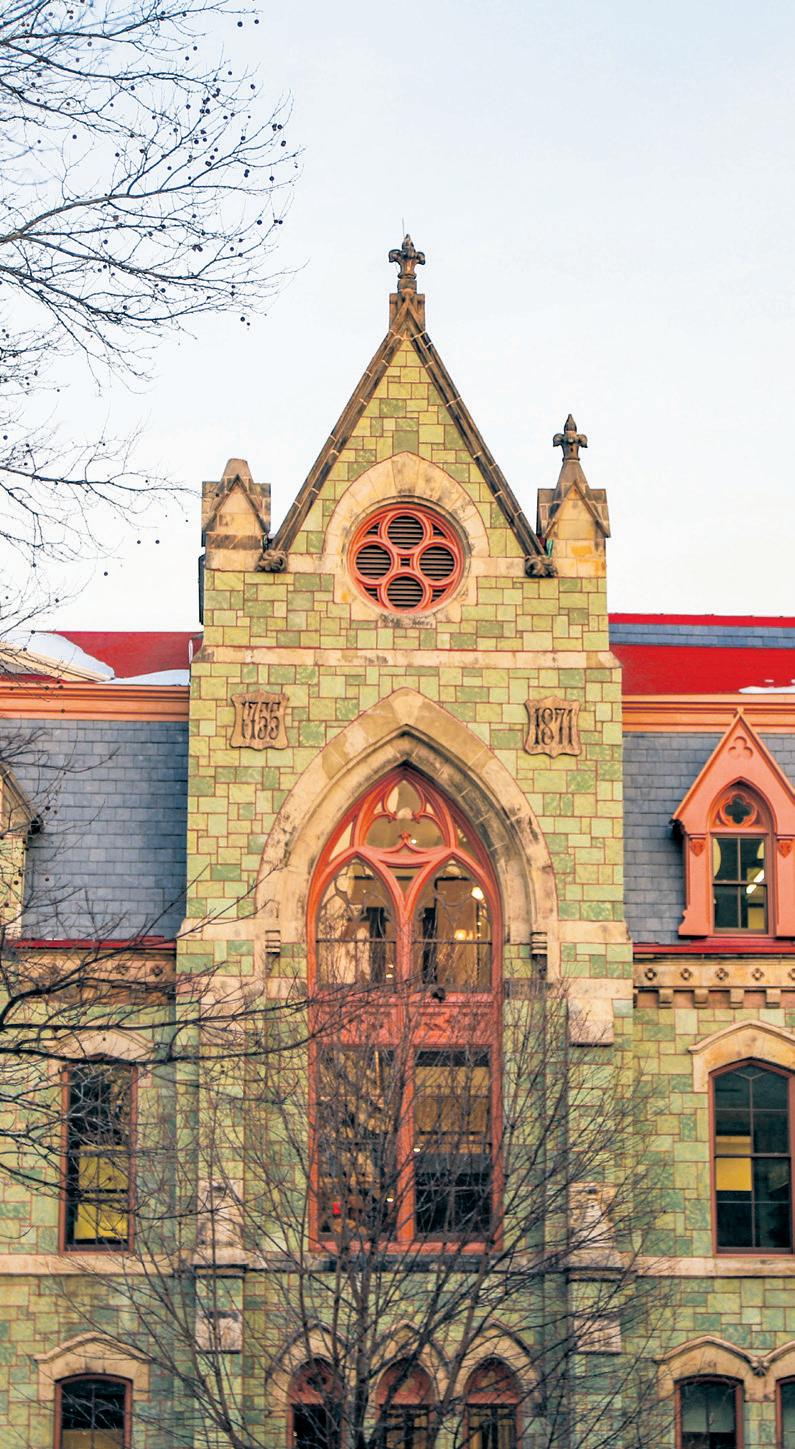
Sheraton on Feb.
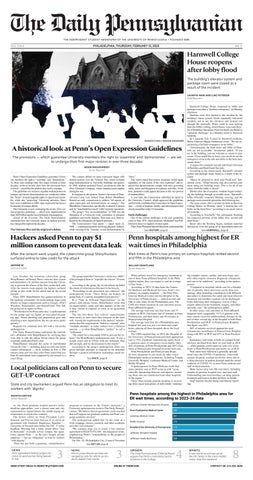
CONNIE ZHAO| SENIOR PHOTOGRAPHER College Hall on Feb. 10.
Penn’s preprofessional clubs navigate calls for reform
The Daily Pennsylvanian spoke with students and faculty about whether or not selective clubs shape career readiness on campus
RACHEL ERHAG AND ADVITA MUNDHRA
Staff Reporters
With spring semester club recruitment well underway, many members of the Penn community are navigating a familiar gauntlet: multiple-round interviews, networking conversations, and technical challenges, all for the chance to join a student club.
Penn boasts over 300 student groups, many of which require rigorous application processes. As the University’s preprofessional ecosystem continues to expand across industries, The Daily Pennsylvanian spoke with students and faculty about whether or not selective clubs shape career readiness on campus.
Wharton and Engineering junior Madhav Sharma, who is a portfolio manager in the Wharton Investment and Trading Group, described the impact of the club on his career in an interview with the DP.
“You would hear those club names all the time back in freshman fall in the first few weeks,” Sharma said. “I think that really creates this impression of exclusivity, as if you’re setting yourself apart, or doing better than your peers.”
While Penn offers multiple academic pathways into the professional world, clubs provide a different kind of preparation. According to Sharma, mock interviews and access to shared preparatory materials help to compress the learning curve for students. For Sharma, the most significant benefits were not the technical workshops or stock pitch practices, but the access to upperclassmen and guest speakers, whose experiences helped contextualize broader industry trajectories.
“We’ve had people who’ve been working at higher posts in a variety of prestigious firms come in to talk to people, not about recruiting,” Sharma said. “It’s about perspective outside of being 20 or 21 and fighting for these jobs, and more like what it’s like to build a career.”
Wharton clubs have a reputation as a recruiting pipeline, allowing members to network early and gain an upper hand during initial resume screening. Sharma argued, however, that the interviews serve as equalizers.
“I do think showing leadership positions in these selective teams can help in recruiting because a lot of times resume screeners are Penn alumni,” he said. “Then in the interviews itself, I think it’s generally a lot more about how you perform and how much effort you have put into preparation.”
When asked about what part of WITG most clearly mirrors the professional world, Sharma pointed to the application itself. He added that “undergoing multiple rounds of interviews” and “filling out an application” prepares students “really well for investment banking recruiting, or recruiting in
general.”
In July 2025, the Wharton School implemented new guidelines for affiliated clubs’ recruitment processes — including a ban on multiple rounds of interviews. The decision cited the Stop Campus Hazing Act, which was first signed into law in 2024 by former Penn professor and President Joe Biden.
In an interview with the DP, Executive Director of the Office of Student Affairs Katie Bonner called extensive club recruitment a “perennial challenge” in the Penn community.
“No one ever stops to say, why do we do applications?” Bonner said. “Why do we have coffee chats?
What is the point of all of this, besides just doing the thing that we know we’ve done in the past?”
Bonner suggested that rather than a “blanket solution” imposing restrictions on clubs, Penn must pioneer a wider cultural shift. She specifically pointed to the value of “reducing the intensity” of applications across the board.
College junior and College Dean’s Advisory Board co-chair Pranavi Konda told the DP about the group’s intention to make the club “more accessible.”
As a student leader herself, Konda said that it is important to “make sure that people feel seen.”
“We know that there’s a lot of barriers to entry … especially if you didn’t come from an environment that’s quite as competitive and intense as Penn tends to be,” Konda said.
DAB’s fall 2025 application included a written application, a first-round interview, and a group interview with other potential candidates. The board typically accepts a total of 10 new members per year.
“We’re hoping that by changing DAB’s process, we start something within the College community that encourages other people,” Konda added.
Sharma similarly highlighted his desire for WITG to find “ways to be a little bit more open,” including “trying to screen a little more on effort and curiosity, rather than finance expertise.”
According to College junior Niheer Patel, some administrators have proposed pushing club recruitment to the spring semester, in an effort for students to acclimate on campus before taking on additional responsibilities.
Despite the merits of the proposal, Patel — who serves on the Student Committee on Undergraduate Education — advocated for early club recruitment.
Patel explained that when he first came to Penn, he felt a “void of community.”
“I think undergraduate clubs and student groups were a really big part of me finding my place at Penn,” Patel added.

and that nonresidents were not permitted entry.
Over the past few weeks, several other Penn buildings experienced leaks and infrastructure damages due to freezing temperatures.
In January, the lobby of Platt Student Performing Arts House was impacted by a “major leak” that required them to close the lobby. Days later, flooding was reported in Kings Court English College House and the ARCH building.
Harnwell also experienced a leak “on the water supply line” that led to a temporary shutdown of water service earlier this month. Students were told to anticipate “a possible service disruption.”
GET-UP, from front page
Kenyatta Johnson signed the letter, along with councilmembers Jamie Gauthier, Katherine GilmoreRichardson, Jim Harrity, Kendra Brooks, Nicolas O’Rourke, Nina Ahmad, Mark Squilla, and Anthony Phillips.
Twelve state officials representing Philadelphia — Morgan Cephas (D-192), Joanna McClinton (D-191), Rick Krajewski (D-188), Danilo Burgos (D-197), Jason Dawkins (D-179), Elizabeth Fiedler (D-184), Pat Gallagher (D-173), Joseph Hohenstein (D-177), Tarik Khan (D-194), Darisha Parker (D-198), Christopher Rabb (D-200), and Ben Waxman (D-182) — also expressed solidarity on Feb. 6.
The politicians described the ramifications of failing to reach an agreement, outlining how a strike would “seriously disrupt life” for “students, employees, and patients at Penn.”
In a statement to the DP, McClinton wrote she was “proud to sign the Philadelphia delegation’s letter supporting Penn’s graduate student employees,” and is “hopeful that the parties can come to an agreement before February 17.”
Krajewski — a 2013 Engineering graduate — described the delegation’s support as reflective of a broader labor movement in the city.
“This letter is about reminding Penn that Philly is a union town,” Krajewski, who represents Penn’s district, wrote to the DP. “Our elected officials, across every corner of the city, stand firmly behind GETUPUAW and all workers fighting for what they’re worth.”
Krajewski added, “No one wants a strike and I’d be happy to see Penn agree to a fair contract. But if that doesn’t happen by February 17th, I’m ready to join graduate workers at the picket line.”
City councilmember Kendra Brooks voiced a similar sentiment to the DP.
“Penn’s leadership has a choice to make about
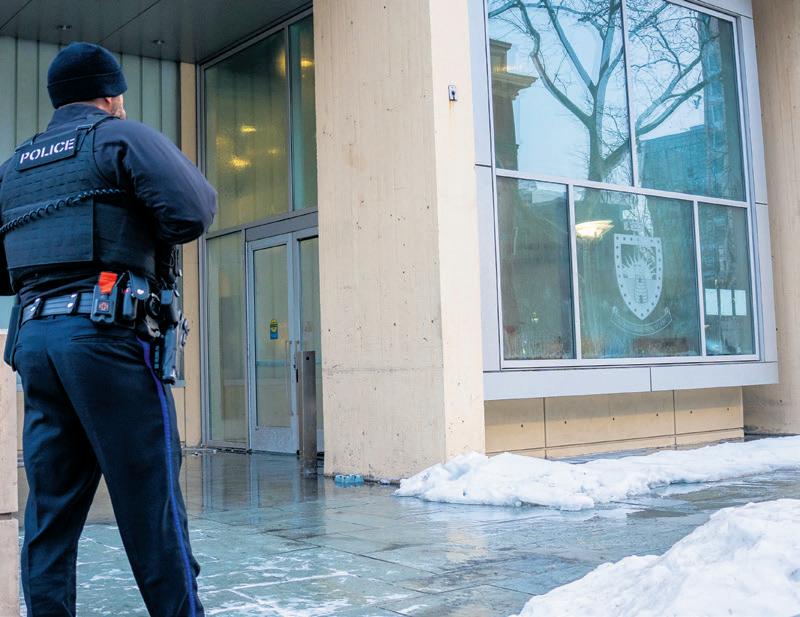
KEVIN REN | STAFF PHOTOGRAPHER Harnwell College House experienced a flood on Feb. 9.
whether they want to avoid a strike,” she wrote. “I support GETUP and their demands for living wages. Penn can afford it and graduate workers deserve it.”
Hohenstein said the delegation hopes the message pressures Penn’s administration to negotiate toward an agreement that fairly compensates graduate workers. He added he wants to “make sure that people who are the graduate assistants and others covered by the union are appropriately paid,” and he and his colleagues “stand with them as they organize themselves and work to get what is fair for them and their work.”
“I support the Penn graduate worker’s right to collective bargain,” Squilla wrote to the DP, reiterating his support for “fair wages” and “safe working conditions.”
The University’s faculty guidance webpage — last updated on Feb. 10 — stated Penn has bargained in “good faith” with GET-UP since October 2025, “completing 43 bargaining sessions and reaching 24 tentative agreements.”
According to the webpage, remaining contract disputes include provisions on stipends, union dues, medical and dependent support, and international graduate worker assistance.
The Feb. 17 strike deadline, announced in January by GET-UP, is the most drastic effort taken by the union since contract negotiations began in October 2024.
According to GET-UP’s website, a strike would mean graduate workers holding teaching and research positions would suspend their work responsibilities — including grading, leading recitations, and holding office hours.
Graduate workers with research appointments would also refrain from starting new experiments and attending lab meetings for the duration of the strike.
“It’s not surprising to see the overwhelming support in their membership for the strike and I expect you will see the same from across the city if it happens,” Brooks wrote.
Staff reporter James Wan contributed reporting.
Penn appeals judge’s decision to send price-fixing lawsuit to trial
The lawsuit accuses Penn and 16 other universities of forming a ‘pricefixing cartel’ that colluded to decrease financial aid awards
ARTI JAIN Senior Reporter
Penn challenged a judge’s ruling that it must face trial in an ongoing price-fixing lawsuit on Tuesday.
After a judge denied the University’s motion for summary judgment last month, Penn argued again on Feb. 10 that the case should be dismissed without holding a jury trial. The lawsuit — which accuses Penn and 16 other universities of forming a “price-fixing cartel” that colluded to decrease financial aid awards — was filed in 2022.
If found guilty, Penn and the four other universities yet to settle could face approximately $2 billion in damages.
A University spokesperson declined The Daily Pennsylvanian’s request for comment.
In the notice, the appealing universities — Penn, Cornell University, Georgetown University, the Massachusetts Institute of Technology, and Notre Dame University — cited a legal exemption, arguing their actions were not “unlawful under the antitrust laws for 2 or more institutions of higher education at which all students admitted are admitted on a need-blind basis.”
The defendants also wrote that they disagreed with the district court’s conclusion that a jury could reasonably find agreement in the case.
The initial lawsuit alleged Penn and other institutions in the “568 Presidents Group” — a group of elite universities that coordinated financial aid principles under a temporary antitrust exemption — suppressed competition and inflated tuition prices.
the group in 2020 and referenced a formal resignation letter it sent at the time.
Several universities originally named in the lawsuit previously reached settlements totaling nearly $320 million.
Penn’s appeal comes as the University’s financial aid and admissions practices have recently faced additional legal scrutiny.
A lawsuit filed in August 2025 accused Penn and dozens of other universities of artificially inflating the cost of attendance through binding early decision admissions.
Penn also previously faced a lawsuit claiming the University unfairly suppressed financial aid packages for students with divorced or separated parents. A federal judge dismissed the case in September 2025, ruling the plaintiffs failed to adequately allege harm.



Penn and the remaining defendants argued in a January motion that their conduct was lawful because it did not amount to explicit price fixing.
The University also claimed that it should be dismissed from the case because it withdrew from




































KENNY CHEN | SENIOR PHOTOGRAPHER
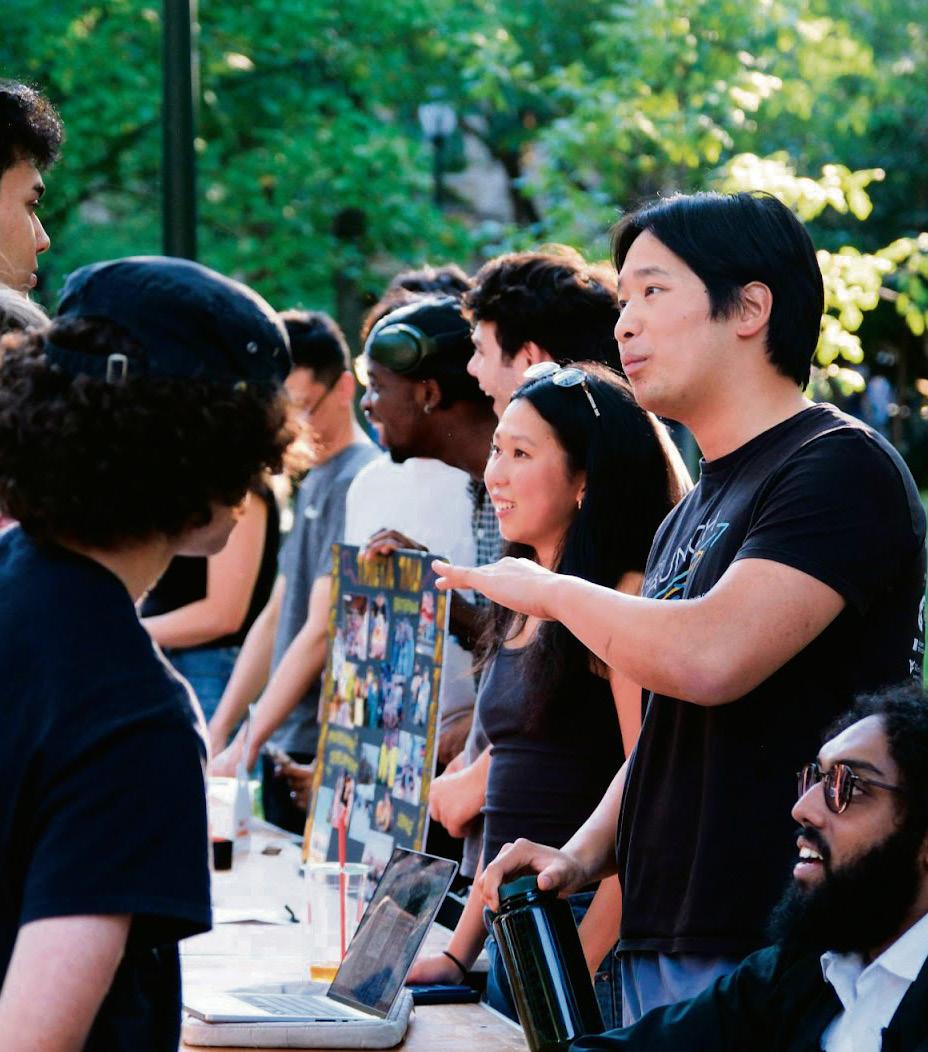
The Student Activities Fair on Aug. 27, 2025.
CHENYAO LIU| STAFF PHOTOGRAPHER Locust Walk on Oct. 7, 2024.

Editorial | When bureaucracy plays favorites
Penn is an extremely segmented institution. Our University’s numerous schools, divisions, branches, and offices each operate with significant independence. Each piece of Penn is financially separated and functionally distinct. Arguments are often made about how this bureaucracy can benefit students through specialization, flexibility, and efficiency. However, what goes ignored is how Penn’s bureaucracy does not benefit students equally. In fact, it may go as far as to punish the majority of our undergraduate population.
We brand ourselves as an institution that values collaboration and an interdisciplinary approach to education. All of those things are true, to an extent. Penn students regularly cross-register for classes, pursue interschool minors, or receive dual degrees. But in practice, this collaboration is deeply asymmetrical. The burden of openness falls squarely on the College of Arts and Sciences, while Penn’s specialized schools enjoy the benefits of exclusivity.
Students in the College have limited access to the more specialized schools, while the Wharton School, School of Engineering and Applied Science, and School of Nursing students have unlimited access to the College. Nowhere is this more obvious than the restrictions on campus buildings and spaces.
Students outside of Wharton are barred from reserving group study rooms in Huntsman Hall and in the Academic Research Building, two of the nicer and newer buildings at Penn. Yet Wharton students would never be denied reservations for GSRs at the Perelman Center

Earlier this month, I was pulled into a conversation among Wharton students about the usual things: recruiting, technicals, financial modeling, superdays. I was intrigued; I always enjoy getting a glimpse into what feels like another world, a world where the dollar is king. We got to talking about a well-known guest column from a few months ago about land acknowledgements. One of the students who had heard about the article — but presumably hadn’t read it — began asking me questions as if I was ChatGPT. “What was the article? What is a land acknowledgement? Does Penn do those? What’s the issue?” While I appreciated the curiosity, I was shocked by the student’s unfamiliarity with the concept of land acknowledgements and the term “stolen land.”
It then dawned on me to ask these interview-obsessed Wharton warriors, “have you taken a history class here?” The reply I got was disheartening but not completely unexpected. “No,” all of them responded with a giggle. “This is the first semester where I really have to write anything.” As a history major, I was horrified. While not everyone has had access to a learning environment where history was taught properly and fully, Penn students now do. In fact, many students’ lack of a strong history education in high school lends itself to the point I hope to make: You need to take a history class at Penn.
On the wall by the Starbucks in the Penn Bookstore is a quote by Benjamin Franklin, “Either write things worth reading, or do things worth writing.” As the discipline of history will show you, knowledge and the ability to think critically are the most powerful things we have as humans. For example, the institutionalized discrimination and subjugation of Black people in this country relied on the deliberate withholding of knowledge, primarily reading and writing, to uphold the economic system and ultimately,
for Political Science and Economics or the Neural and Behavioral Sciences Building.
Each of the specialized schools also has courses limited only to students in that school, while the College has no such courses. Wharton and the Engineering School also have their own programs, such as Wharton Research Scholars, Rachleff Scholars Program, or Amy Gutmann Leadership Scholars. These provide undergraduates in select schools exclusive research and educational opportunities. Programs offered for students in the College after the first semester, on the other hand, are open to all students. These differences in resources are unfair in both principle and practice. First, they give Wharton, Engineering School, and Nursing School students an opportunity to connect and learn alongside others within their school, while students in the College are denied this opportunity. Even worse, they contribute to a sense of exclusivity for each of the specialized schools. The College remains open and accessible to all, with no special priority granted to its own students.
The problem is made worse by the fact that the College is incapable of fostering the same camaraderie as the specialized schools. Housing two-thirds of Penn undergraduates, the College simply has too many students to naturally form a sense of community.
The smaller populations of the specialized schools automatically form intimate and supportive communities with ease. And even at a fraction of the College’s size, Wharton still makes a special effort to establish cohorts of students, citing a mission to “create small,
cohesive communities for a diverse Wharton undergraduate population.” If this practice is necessary for Wharton, how can the College’s 7,000 students be expected to form a shared identity without institutional support?
The counterargument to this often goes that because the College covers such a wide array of disciplines, each individual department serves as their own community within the school.
But there are two problems with this claim.
The primary issue is that some popular programs within the College, such as economics, can have around 900 students at a time. Departments this large are no substitute for a 60-person Wharton cohort that even shares a class together freshman fall.
There is also an issue with the notion that students in the College have nothing in common other than lack of enrollment in a specialized school. While all other schools teach from a specific framework, the College embraces the openness of a liberal arts education. According to the College’s own mission, the school “thrives on the diversity of scholars and students whose interests it sustains and whose intellectual goals it unites.” With this in mind, the College should be making a concerted effort to connect students across its many disciplines, all of whom are similar in their pursuit of intellectual discovery. Without their own spaces, courses, or programs, there are no opportunities for College students across majors to collaborate academically.
Students often talk about the College’s perceived lack of cohesion relative to
Penn’s specialized schools. But it is rarely highlighted how the University chooses to endorse this perception. Penn’s practice of cross-school collaboration means anyone has access to what the College offers — its buildings, classes, and scholarly or research programs. Penn often frames this arrangement as evidence of a healthy interdisciplinary ecosystem. But collaboration implies reciprocity, and such reciprocity does not exist for College students.
This practice is unacceptable. Either the College should be given its own spaces, courses, and resources, or those of Wharton, the Engineering School, and the Nursing School should be opened to anyone who wishes to access them.
At Penn, it’s glaringly obvious that the College, despite being Penn’s oldest school, is not its crown jewel. The College’s lack of exclusivity and poor sense of community degrades the value of the student experience. Until Penn addresses the structural imbalances baked into its bureaucracy, its commitment to collaboration will simply be a marketing tool.
majority view of members of The Daily Pennsylvanian Editorial Board who meet regularly to discuss issues relevant to the Penn community. This body is led by Editorial Board Chair Jack Lakis and is entirely separate from the newsroom. Questions or comments should be directed to letters@thedp.com.
class supremacy. Lacking these things makes you highly susceptible to being controlled. Now, it would be unfair to say Wharton students don’t take history classes. They do, and there are a number of humanities requirements needed for them to graduate. I know this because when professors routinely ask students’ reasons for taking courses on the first day, many explain that it fulfills a requirement. Still, that doesn’t mean they are getting the most out of those courses.
In one history class I took, I noticed a lot of Wharton students enrolling throughout the add-drop period. Curious, I decided to actually look at the Penn Course Review rating for the course: It had a 1.4 out of 4 difficulty rating. Everything added up — this class was supposedly easy, the teacher was nice, and it checked a box in the History and Tradition general education requirement. Yet still, I heard my classmates complaining that they were struggling to write and admitting that they had asked ChatGPT to do simple assignments for the class. This is a theme I’ve begun to uncover, perhaps best illustrated by a conversation I had with a STEM major who told me they believed writing was nothing more than a “means to an end.”
This pattern at Penn follows a global trend that has come with the rise of artificial intelligence: a decline in intellectualism and critical thinking. As students, we must reevaluate our relationship with learning. Every class you take, whether it’s history, business, or biology, is meant to provide you with a different lens with which to view the world. Learning for the sake of learning and taking on your education with the understanding that knowledge is power — cheesey, I know — is why you came to this institution. So, while it is important for chemistry majors to memorize the periodic table and for Wharton students to practice their technicals, the importance of reading, writing, and critical thinking should not be overlooked.

History and other humanities classes are where I actively sharpen my critical thinking skills, expand my knowledge, and apply what I’ve learned to the world around me. These classes have taught me to be skeptical, always questioning, and constantly looking for ways to dive deeper. It is about developing the skills necessary to think critically about the world and your place in it. Regardless of your discipline, there is real value in being a strong writer and critical thinker. Meeting the bureaucratic requirements of the institution in order to earn the degree is necessary, but not sufficient for getting a well-rounded education. Yes, it is possible to graduate from a world-class institution without having gained a world-class education. It is up to you to make sure you are getting the most out of what Penn offers. In many ways, this article might be preaching to the choir. I don’t expect those I’m speaking to will read it — I mean, they
their
did tell me they don’t read the The Daily Pennsylvanian. Despite this, I hope whoever reads this encourages their peers or students to expand their knowledge base and actively question, interpret, and form sound conclusions about the world without the help of AI. If not through a formal class, then by reading the news — not just about the economy or the stock market, but about what is happening to people. The less you know, the easier you are to control, the easier you are to replace. The less we know about the past, the less we are able to recognize when we are pawns in someone else’s scheme, and the easier it is for atrocities to repeat themselves.
ANDY MEI | SENIOR DESIGNER
JACOB HOFFBERG | STAFF PHOTOGRAPHER Columnist Marie Dillard encourages students to reevaluate
learning.
MARIE DILLARD is a College sophomore studying history and urban studies from Englewood, N.J. Her email is mdilla@sas.upenn.edu.

We often hear that Penn students are the next generation
and
leaders of the world. For
students like me, this inevitably creates expectations that we should be sure of what we stand for. But how can we do this when Penn presents material from an overwhelmingly liberal perspective? In high school, I thought that spending four years in one of the best academic institutions in

the United States would allow me to gain a better understanding of what exactly different political affiliations stood for and how I could personally advance key debates. Yet, as my third year is close to coming to an end, I still find myself at a loss regarding many important global issues. I can’t help but feel that I haven’t been exposed enough to a variety of political perspectives. As a leader in political and academic thought, Penn should be more inclusive of different political perspectives in its curriculum.
Throughout my first couple of semesters at Penn, I was required to enroll in a variety of introductory courses for political science. The syllabi mainly covered key theories of international relations and political systems, with assigned opinion pieces on current events meant to complement the theory. I quickly realized that these articles almost always criticized more conservative policies, rarely exposing us to pieces that scrutinized the liberal side’s arguments. In fact, only one of the over 20 readings from my introductory international relations class examined the potential benefits of a conservative approach to foreign policy.
I soon realized I was not the only one perceiving this lack of academic diversity. On social media, I’ve seen claims from different students in the Ivy League asking for a wider range of perspectives in their curriculum. For example,
Larissa Truchan, a liberal student at Harvard Law School and influencer, recently posted a video sharing her experience, claiming that her classes were often taught with a “liberal skew.”
The problem with this lack of academic diversity is that when only one side is properly represented, students are left with only critiques and no real understanding of alternative viewpoints. Being an international student, I perceive this gap even more. Sometimes, the classes feel biased or U.S.-centric, even when they are supposed to be exposing us to a global issue. For example, one of my classes that was supposed to be focused on Latin America left out an important part of literature on Colombian politics. For example, the achievements of the Uribe administration in reducing guerrilla-related violence or the negative effects of the 2016 peace agreement on drug trafficking. As someone who grew up there, I had to sit with the fact that a lot of important perspectives — ones that I’ve lived through and experienced — would simply go unmentioned.
Looking at data on Penn’s faculty, this gap in intellectual diversity starts to make more sense. In 2024, The Daily Pennsylvanian found that 99% of political donations made by Penn faculty went to the Democratic party. This is a wider pattern in American higher education as well, with 60% of University faculty nationwide
So, what’s the fix?
A generation ago, homework meant wrestling with confusion. You stared at a blank page, tried an idea, watched it fail, tried again, and eventually learned not just the answer, but why it was the answer. Today, for many students, that struggle is replaced with something much faster: copy, paste, and submit.
Generative artificial intelligence didn’t invent shortcuts, but it certainly changed the scale. Students can now outsource not only the final product of their assignments but also the thinking that should produce it. In doing so, they risk losing the habit education is meant to build: asking how and why.
At Penn, it’s extremely visible. Essays appear in seconds. Problem sets arrive with clean “steps.” Interview preparation becomes prompt, memorize, and repeat. The output looks polished, but the cognitive work of testing ideas, noticing gaps, and building intuition is increasingly optional.
That’s the danger: not just cheating, but intellectual atrophy.
One helpful way to understand this is through the concept of cognitive offloading: using external tools to reduce mental effort. Offloading can help in the moment, but it leads to worse memory in the long run.
There’s also evidence that heavy reliance on AI tools can be associated with weaker critical thinking outcomes. One study of university students reports a negative relationship between “AI dependence” and critical thinking. Over time, reliance trains a passive posture; instead of constructing an argument, you select one. Instead of debugging your reasoning, you edit the
wording. That shift from authoring to accepting is exactly how critical thinking gets dulled.
You don’t have to claim that AI “makes students dumb” to take this seriously. It’s enough to notice the incentive: if you outsource the hardest thinking, you get fewer repetitions of the skill you’re supposed to build.
Our brain’s neuroplasticity explains why repetition matters. If we repeatedly grapple with concepts, we strengthen the neural connections and circuits that support reasoning. If we avoid that effort, we don’t reinforce them.
Even outside of AI, convenience tools can tax cognition. “Brain drain” research suggests that the mere presence of a smartphone can reduce available cognitive capacity, even when it isn’t used.
At Penn, now students are asking “Does this look right?” instead of “Do I understand this?” Curiosity has become compliance, and reasoning has become formatting. To be clear, ChatGPT and other AI tools can support learning. They can explain concepts, generate examples, and help you get unstuck. But for many students, they have now become a crutch — a way to avoid the uncomfortable stage where you don’t yet know what you’re doing. That discomfort is not wasted time. It’s where you form questions, locate gaps, and build judgment. Penn says it teaches students “how” to think, not what to think. But we are often incentivized to reward the opposite: clean submissions over messy drafts, answers over reasoning, and speed over struggle. When the grading system values polish, AI becomes the optimizer.
One practical solution is short, viva-style oral defenses — in person and face-to-face with a professor or teaching assistant. Instead of simply turning in an essay, proof, or project, students should spend five to 10 minutes explaining what they did, why they chose that approach, where they struggled, and what they would change. You can’t copy-paste understanding. You either know it, or you don’t.
This isn’t just a hypothetical. This spring, CIS 5200, a course titled “Machine Learning,” introduced oral components that pushed students to explain and defend their reasoning rather than simply submit polished results. That structure makes understanding visible and makes it harder to hide behind a convincing but hollow draft. We can scale this without overwhelming staff: rotate brief vivas for a subset of assignments, run small-group defenses in recitation, and do quick reasoning checks during office hours. Pair that with clear AI-use rules: what’s allowed, what must be cited, and what must be explainable unassisted. And just as importantly, these conversations recenter what college should reward: clarity of thought, not just clarity of prose. They create space for Quakers to say, “I’m unsure,” and then reason forward anyway.
This isn’t a call to ban AI. This is a plea to prioritize education where AI can’t replace thinking — only support it. Because if Penn becomes a place where the main skill is how to prompt, paste, and polish, we’re not educating thinkers. We’re training efficient editors. Penn must aim higher.
identifying as liberal. This can unintentionally influence the way we learn in the classroom: it shapes readings, lectures, and even essay prompts. And while I have no problem learning about liberal viewpoints, I still feel that students should be exposed to a full spectrum of ideas. I believe that part of being both a political science student and a well-informed, global citizen is having the ability to see an issue from all possible angles. It doesn’t matter if I personally agree or disagree with certain perspectives — as someone going into policy, it’s crucial for me to be able to articulate the pros and cons of all the different approaches.
Beyond political science, Penn must encourage broader intellectual diversity in all areas of study. We should be getting exposed to all schools of thought — spending four years in higher education is perhaps the one chance we will get to learn and see as many perspectives as possible. Diverse ideologies should not be seen as a threat, and only by engaging with competing viewpoints will students be able to truly understand what they stand for and articulate what they believe when they enter the real world.
science from Bogotá, Colombia. Her email is marmari@sas.upenn.edu.

bring in-person viva-style defenses to class.
AMOGH SARANGDHAR is a second-year master’s student studying computer science from New Jersey. His email is amoghsar@seas. upenn.edu.











































































JOCELYN VARGAS | STAFF PHOTOGRAPHER
Senior columnist Mariana Martinez comments on the lacking diversity of perspectives in Penn’s curriculum and its effects on students.
MARIANA MARTINEZ is a College junior studying political
ABHIRAM JUVVADI | SENIOR PHOTOGRAPHER Guest columnist Amogh Sarangdhar argues that AI is pushing students to outsource the “how” and “why” of learning, and that Penn should
Guevarra | Give men’s basketball’s AJ Levine his flowers
The sophomore guard made the game-winning stop to hand Penn its first win over Princeton since 2018
VALERI GUEVARRA Senior Reporter
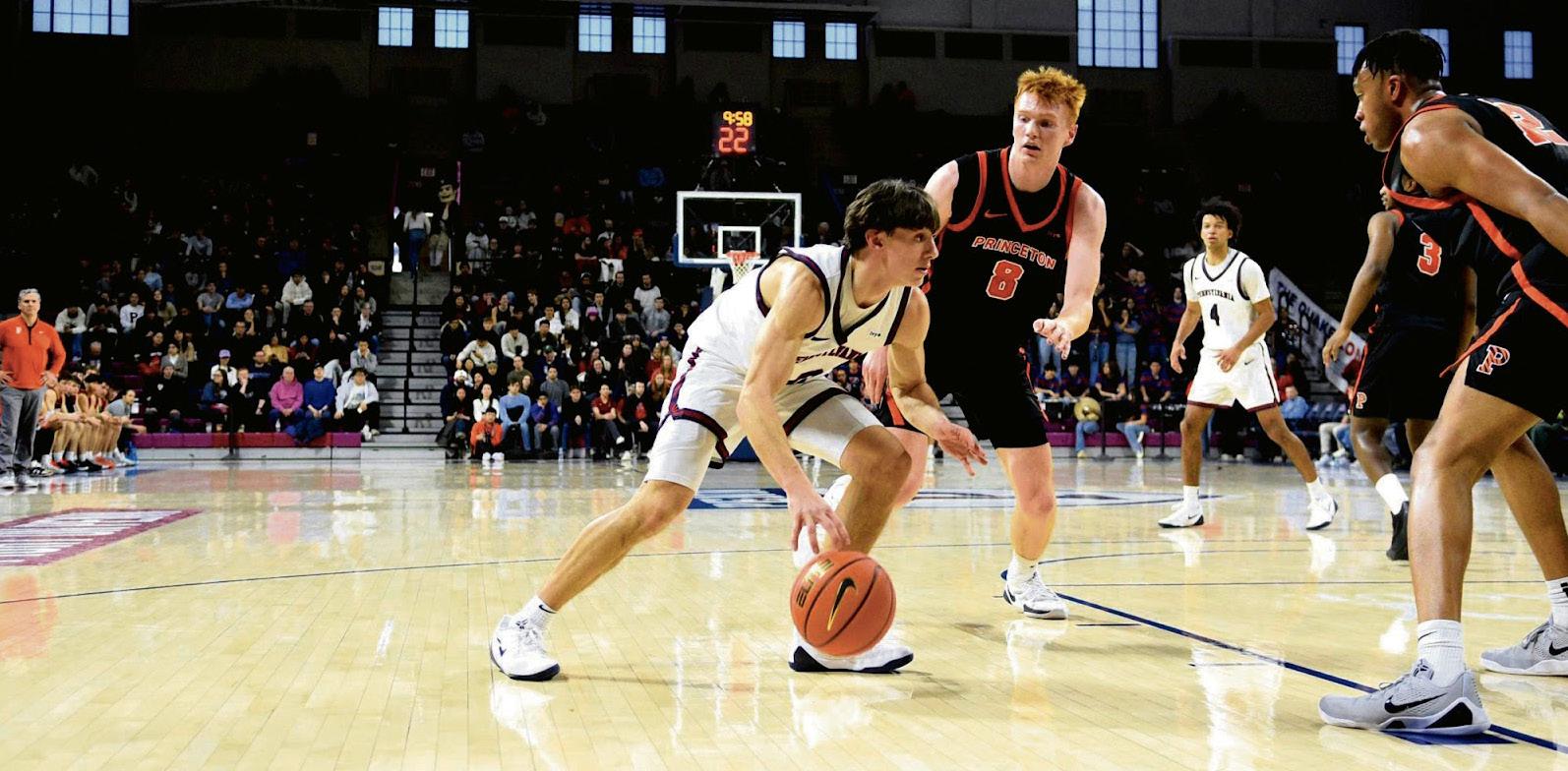
Levine drives to the basket on Feb. 7.
Just over one year ago at the Palestra, all eyes were on then-Princeton star guard Xaivian Lee. NBA scouts flocked to the Cathedral of College Basketball to lay their eyes on the projected 2025 second-round NBA draft pick. However, Lee was shut down by an unexpected Quaker: then-freshman guard AJ Levine.
Levine, who spent most of the game defending Lee, was a force to be reckoned with — filling the stat sheet with four steals and holding the star to three out of 13 attempts from the field. However, silencing Lee was not enough to rewrite the story as Penn fell 61-59 to Princeton for the 12thstraight time.
A year later, when Penn was in danger of repeating history for a 15th time, Levine’s stout defense saved the day. After trading triples heading to the final minute, the matchup was a one-point game. With seconds winding down and Princeton defenders surrounding him, senior guard/forward Ethan Roberts felt the pressure, and his jumper bounced off the rim. On the final possession, Penn needed a stop to make history, and Levine delivered. He was all up in Princeton guard Dalen Davis’ face, poking away the ball and forcing Davis to shoot a fadeaway that bounced off the rim. At the final buzzer, the scoreboard showed what no one had seen in eight years: a Penn victory over Princeton.
“I did everything I could in that moment. I put my entire
effort out there, all game. There was not a moment where I let up,” Levine said postgame. “I feel like I put everything into that stop at the end. Once [the shot] missed, it was the biggest relief ever.”
That stop — which will likely end up being a career highlight — naturally deserves praise, but Levine himself deserves a lot of flowers for his growth and how integral he is in the Quakers’ quest for an Ivy Madness berth this season. Levine has always been an aggressive defender. At the end of last season, Levine led the Quakers in steals; and this season, he now leads the Ivy League in steals with two per game in conference play. While Levine certainly know how to put the pressure on his opponent, it isn’t without some consequence as Levine also led the Quakers in personal fouls with 2.6 per game last year.
“My mindset is that I have the advantage. I know what you’re going to do, and I’m going to beat you to it,” Levine told The Daily Pennsylvanian last year regarding his defense. “You think you can score on me? No. … I don’t care who you are; I am going to guard you.”
That’s not to say that Levine can’t contribute on the other end of the court, and he’s proven that this season.
In the 2024-25 season, Levine only hit double figures in two games and averaged four points per game at the end of the season. With six games left in the 2025-26 season, he
has already notched double-digits eight times and is averaging 12.1 points in conference play.
Something that flew under the radar is that Levine was an integral contributor in multiple matchups where Penn’s usual scorers were cold — including a win against NJIT with six players out, a win at Dartmouth, and a narrow loss at Columbia. That trend continued on Saturday. Outside of junior forward TJ Power, Levine was the only other double-digit scorer in the victory while two of Penn’s offensive triple threat — senior guard/forward Michael Zanoni and team-leading scorer Roberts — combined for just five points.
“Understanding the flow of the game, being able to push the ball, seeing the floor in the game a little bit slower to make the right decisions,” Levine said of his increased offensive production in the postgame against Princeton. “At times, I was passing up those scoring opportunities early in the season, and those weren’t the right decisions. It was about making the right decision. And recently, that’s been scoring for me.”
While it’s clear how integral Levine is now, things did look a bit different at the beginning of this season.
Levine’s position as starting point guard was not as established as it is now. In the first four games of the season, Levine struggled with turnovers and fouls. Specifically at American, Levine clocked in for five minutes and racked
up three personal fouls and three turnovers in that time. During the middle of non-conference play, Levine split minutes with senior guards Cam Thrower and Dylan Williams.
However, through conference play, Levine has been Penn’s old reliable — playing over 20 minutes of nearly every Ancient Eight showdown and making contributions on both ends of the court.
“The way [AJ] got himself to a good start in both hands today, but his decision making is just so much improved,” coach Fran McCaffery said. “He’s playing under control. He’s playing with great confidence, and that’s how we’re going to continue to play.”
While his teammate Power is this week’s Ivy League Player of the Week, give the sophomore his flowers — not just because of his historic stop this weekend, but for how far he’s come in just a short amount of time. With his twoway threat and competitive mindset, Levine can be the difference maker as the Quakers sit in a four-way tie for third in the final stretch of the season.



LINDA LU | STAFF PHOTOGRAPHER
‘What else am I than a basketball player?’: Simone Sawyer off the court
After four years of shining on the court, the senior’s playing days at Penn are coming to an end
KARNANI
KAIA FEICHTINGER-ERHART AND DIVYA
Deputy Sports Editor and Staff Reporter
Being a student-athlete is challenging: In addition to managing an architecture degree and a psychology minor, senior guard Simone Sawyer has basketball practice six days a week all while traveling to compete on weekends.
“So you’re constantly thinking about basketball, sleeping and waking up, and [I’m] thinking about what play I need to run, and the new play we put in last week, and where I’m supposed to be,” Sawyer said. Sawyer grew up in a family where sports were a way of life. Her father played baseball at Creighton, and her two older sisters were involved in a range of sports since they were young. As the youngest sibling, she always followed her siblings, influenced by watching them compete in their respective sports. While she tried her hand at volleyball, soccer, and swimming, basketball always came naturally to Sawyer, even when she was young.
“I remember she was so much better than all the other kids that they had to put the parents in there to try to stop her from scoring and try to make it a little bit difficult for her,” said Aleeya Sawyer, Simone’s older sister, describing Simone’s experience playing at a basketball league when she was seven years old.
At Penn, Sawyer transitioned from being the youngest sibling at home to an older sister and mentor to the younger girls on the team.
“I’m the youngest in my family of sisters, my sisters mentored me … besides, like my Barbie dolls, I’m not used to telling you what to do,” Sawyer said. As a senior, she is embracing the new role as a leader, especially as one of the team’s captains this year. With five different captains on the team, each plays a different role. Sawyer describes herself as more of a quiet leader.
“I’m definitely, I think, a captain that people can come to and talk to, whether they’re having some challenges on or off the court,” Sawyer said.
Her leadership style stems from her personable nature and maturity from growing through various challenges — including mental health struggles — during her time at Penn basketball.
“I think she has this kind of aura about her where people gravitate towards her, and she’s always very kind, like sure of herself, too,” Sawyer said.
“She’s not someone that’s going to rally the group around her all the time. She will [too], but I think she feels confident who she is and where she’s come from and it shows.” coach Mike McLaughlin said.
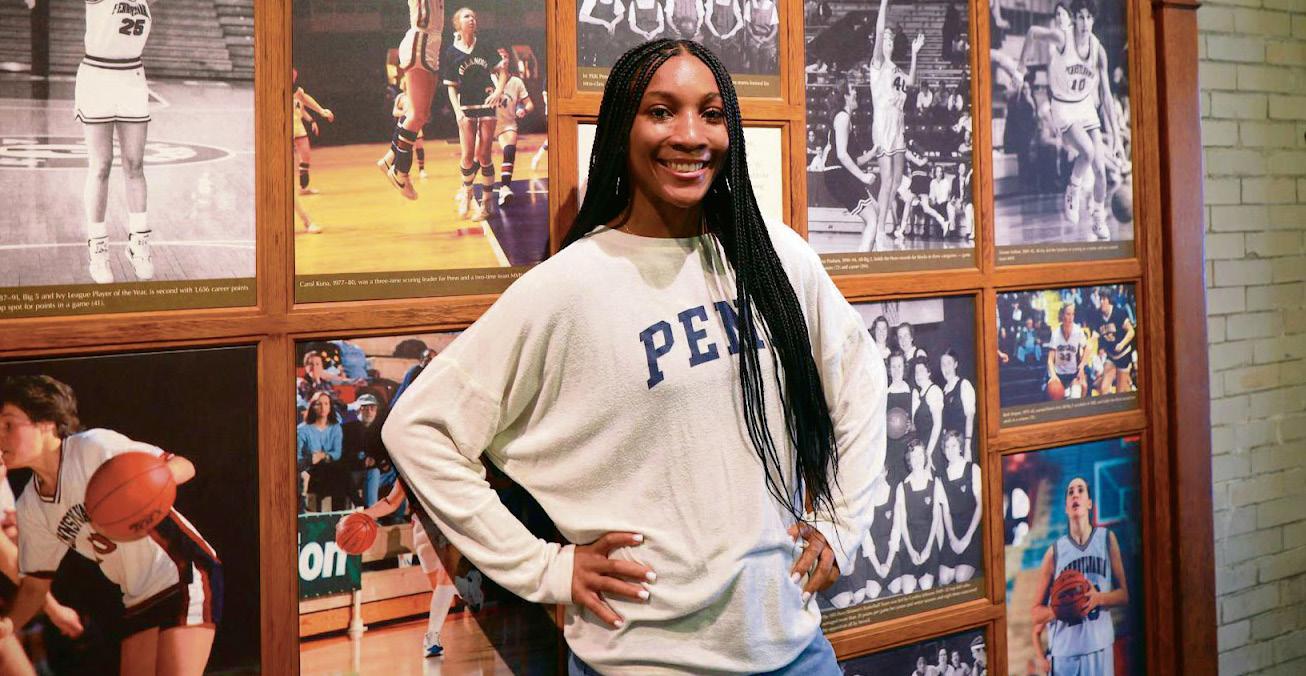
Sawyer poses inside the Palestra on Feb. 7.
Sawyer spent the summer before her last season in Philadelphia preparing with her teammate and closest friend, junior center Tina Njike. According to Njike, the goal was to “lock in, and just try to work out as hard as we could.”
Their efforts were worth it, as Sawyer — and Njike — are both having the best season of their collegiate careers. In addition to averaging the most points and rebounds per game, Sawyer also leads the Ivy League in free-throw percentage. Her speed and defensive abilities make her an essential part of the team, which currently sits just one spot behind the cutoff for postseason play.
Regardless of whether the team ends up in Ivy Madness, the games Sawyer has left for the Red and Blue are numbered. She’s currently in the middle of applying to
Gymnastics wins fifth consecutive meet at Senior Night Quad
The team scored a flat total of 196 in the meet
CATHERINE ELLIS Sports Reporter
The Quakers are on a roll.
Penn, currently ranked No. 37, hosted Senior Night this past Friday in its second home meet of the season against Cornell, George Washington, and William & Mary. The Palestra was packed with family and friends who came out to support the graduating seniors.
“These seniors mean everything,” said sophomore Manama Fofana. “They’ve seen me from the start of freshman year, they’ve watched my progress and growth. A lot of them are responsible for my progress and growth too. So, it’s just, I’m so excited to finish out the season with them, but it’s bittersweet.”
ROBERTS, from back page
and simulate taking him out of the game,” Scott said. “So he had to sit down for a full minute, a full five minutes … He would hold onto the seat, be almost uncontrollable. It was all that competitive energy, all that passion … It was torture.”
“[Scott] knew that got to me really bad,” Roberts recalled. “Which is obviously why he did it.”
That same passion drove him to the gym early and often, where he found a friend in Rocco Ronzio, a player two years his senior at Hersey who had committed to Division III Lake Forest College.
In the summer of 2020, Ronzio and Roberts became inseparable. As the former prepped for his first season at the collegiate level and the latter chased his chance, they found camaraderie in early-morning training sessions, late-night conditioning, and all the meals in between.
“We worked out together one time, and from there, it was everyday,” Ronzio said. “Workout, get food. Workout, get food. We just did that the whole summer.”
Ronzio got to know both sides of Roberts. On one hand, there was the competitor, the scrupulous self-corrector Ronzio saw up close.
“I’ll never forget, we were playing 1-on-1 one day, and he tries a dribble move and the ball goes off his foot,” Ronzio said. “And he went to the sideline, practiced that move 10 times, and he’s like ‘Well that’ll never happen again.’”
“He has a certain unquietable rage in him to be better,” Scott said. “More so than any other athlete I’ve ever coached.”
On the other hand, there was the friend, the affable and wise-cracking confidant Roberts becomes once the whistle blows. The one Roberts himself has always sought to protect.
“He’s probably the funniest, goofiest kid I know,” Ronzio said. “When he came to my house and met my parents, his first line to them was ‘I’m just a Christian soldier from Memphis.’ He’s always got these weird wordings.”
“It’s the relationships, to me, that really bring the joy to all of this,” Roberts said. “So that’s why I laugh super hard in the locker room and I make a lot of jokes. I try to be as lighthearted as possible away from basketball.”
That summer also coincided with the COVID19 pandemic, curtailing Roberts’ opportunities to showcase his skills in front of college coaches. His only sustained interest came at the Division II level, and even there, he struggled to secure a spot: UC San Diego made contact with Roberts but ultimately offered his AAU teammate the same position. Grand Valley State offered Roberts a spot but told him he likely wouldn’t see the floor during his first two seasons. Nova
Vault Freshman Ananya Patanakul sailed through the air, scoring 9.750 with a complicated half-twist vault. GEC Gymnast of the Week Fofana raised the bar for the Quakers with a 9.825, which was only topped by junior Jordan Barrow’s 9.850. Barrow’s landing was so grounded, her feet seemed glued to the mat. In total, the Quakers scored 48.925 on their vault rotation — their best team vault score of the season.
Bars Senior Marissa Lassiter led off the rotation with some strong handstands on the bar and a stuck landing, which set the tone for the rest of the team. Freshman Ruth Whaley and sophomore Luci Toc-
Southeastern engaged Roberts enough that he toured the campus on an independent visit. Then, they went silent.
“I was begging them, and then they ghosted me,” Roberts said. “They ghosted me bad.”
After a senior season that saw Roberts average 20.3 points per game and earn all-state honors, he finally received his only two Division I offers: Army and Navy. Then-West Point coach Jimmy Allen said Roberts “fit the profile” of a good Patriot League player — he had length, he could shoot, and not insignificantly, he had the grades to hack it.
Still the doubts persisted, this time from Roberts himself. After his first taste of Division I action, Roberts says he called his father in tears, fearing that the level of competition was too steep.
“I’m like, ‘I can’t play here,’” Roberts said.
“Everybody put it in my head how hard it was to get here. I see people that are way bigger than me. I’m like, ‘Dad, I’ll never play here.’”
“He basically just tells me to put my head down and work. The same thing he’s always told me.”
Roberts not only played as a freshman for the Black Knights — he performed. He improved rapidly from game to game, adjusting to the pace of college play and learning how to push it. By year’s end, he had started 31 of 33 games, finishing second on the team in scoring, rebounding, and three-pointers. His efforts earned him Patriot League Rookie of the Year, and proved the coach who had taken a chance on him right.
“He was able to take a lot of the things that we were teaching in terms of finishing around the basket and shooting the ball,” Allen said of Roberts. “The biggest thing about Ethan is that he loves to play and he really competes. … He’s definitely as good as anybody that’s played in [the Patriot League].”
A 40.7% three-point shooter with grit and a handle, Roberts suddenly fielded suitors from across the college basketball world. He reportedly received interest from at least one school in every power conference, including SEC juggernauts like Texas, South Carolina, and Vanderbilt. Roberts had gone from unwanted to undeniable overnight, and now, the only question was where the journey would take lead next.
He never thought the answer would be his bathroom floor.
***
“Why is getting out of bed so hard?”
The question had a daily stay in Roberts’ mind as he lies physically and mentally battered in his Des Moines, Iowa dorm room. It pervaded and proliferated, spreading and sprouting into other similarly crippling asks: “Why is this happening?” “When will it end?” “Who am I?”
After his freshman year, Roberts chose to transfer to Drake, a small school in the midwest with a reputation for basketball excellence. At
graduate schools, but her top choice is clear — Penn.
That would allow her to stay in Philadelphia, the city she has fallen in love with, for a few more years.
The architecture major and psychology minor is looking at graduate programs in mental health and counseling, aiming to eventually work in psychiatry. Her interest in psychology is connected to another off-court venture: her clothing business, Mo Mind Matters. Sawyer founded the business to raise awareness for mental health following her own struggles during her first year at Penn. It has given her the chance to explore who she is outside of basketball and academics, an experience she’s especially grateful for now that her basketball career is coming to an end.
“I think for my whole life, it’s always been basketball,
zydlowski followed in her footsteps, both displaying beautiful body extensions on the high and low bars. Barrow demonstrated remarkable composition throughout her routine, ultimately earning the highest score of the rotation with a 9.775. Penn earned a total score of 48.625, placing third amongst the teams just behind George Washington and Cornell.
Beam The Quakers delivered on the balance beam as five out of the six gymnasts in the lineup set new career highs. Whaley, a Quaker beam staple, surpassed her previous career high in the beam with a score of 9.875.
Senior Carly Oniki kept the momentum going with a strong tumbling display, garnering a 9.850. Senior Alisha Werlen also managed to squeak past her previous career high record with a 9.875.
Fofana left her teammates and the crowd in awe as she smashed her previous record in the beam with a 9.925, tying her for the second-highest beam score in program history. Altogether, the Quakers gathered 49.375 points during the beam rotation, putting up the second-highest team beam score in program history. Unsurprisingly, they towered over all three other competing teams in this rotation.
the advent of name, image, and likeness, the mid-major Bulldogs and coach Darian DeVries utilized an innovative player payment model to claim Missouri Valley Conference titles in 2021 and 2023. When Roberts saw a lucrative opportunity alongside a “perfect basketball fit,” the choice was easy.
At first, those promises bore fruit. Roberts recalled a summer of fun and freedom, one where he was far from the constraints of military life, one where he could hone his craft at the highest level he’d ever known and earn a living doing it.
“Then, I started to get sick,” Roberts said. “And I watched everything that I’d worked so hard for just plummet.”
The illness came on quickly. Roberts first experienced a feeling of nausea while running shortly after the team returned for the fall. Within two weeks, he fainted during a workout. Before long, he was left incapable of physically exerting himself in any way, vomiting up to five times a day and losing up to 24 pounds in a single weekend.
“In the middle of the night,” Roberts said, “I would crawl to the toilet and throw up.”
Roberts did not see the court for the Bulldogs that season. Eventually, he left the school entirely and returned home to Arlington Heights, where he described a mental battle just as grueling as its physical counterpart.
“I went [to Drake] purely for basketball, and that was kind of my own fault,” Roberts said. “I didn’t feel encompassed there as a person. Being a basketball player, that’s who I thought I was, and it was ripped away from me.”
“I felt like I let coach DeVries down, I felt like I let the staff down, my teammates. I felt worthless. …That was the lowest point in my life.”
Lost in an unknown place, Roberts turned to the familiar: work.
First, he buzzed his head. “I promised myself: I’m gonna grow from here.” Then, he set out to regain his strength and conditioning, step by meager step. One down-and-back. Then another. Two feet on the exercise bike. Then two more.
Slowly, agonizingly, Roberts crawled back to where he’d fallen from. At the end of the campaign, DeVries left Drake to coach at West Virginia, sending Roberts into the portal again.
This time, the high-majors did not come calling. But another school did.
“They were like, ‘Would you be interested in Penn?’” Roberts recalled. “That was a blessing from God. That’s the best way I could describe it.”
Roberts committed to the Quakers in April 2024, citing his desire to join a school that “invests in [him] as a person.” The game that Roberts had given so much to had finally begun to give back again.
For that, he has his ambition to thank.
“My life’s gone like this because of basketball,” Roberts said, holding his hand in a steep
basketball, basketball. And you know, it’s going to come to an end in a month, and I don’t want to sit there and be like, oh, what else am I [other] than a basketball player?” Sawyer said. “I’ve kind of found myself through that.” Although Sawyer is grateful for all that the game has given her, she is equally as ready to leave basketball behind in a few months, regardless of this season’s outcome.
“I do have to figure out what I’m
Floor Senior Alyssa Rosen brought the heat with expressive daSenior Alyssa Rosen brought the heat with expressive dancing, strong tumbling, and a particularly well-landed double back tuck. In another routine, sophomore Maggie Murphy let her personality shine, combining hip-hop dancing and strong tumbling before ending in a breakdancing freeze. Lassiter took to the floor as if it was her personal night club, earning the highest score of the rotation with a 9.850. Fofana and freshman Ava Hooten tied for the second-highest scores of the rotation, each earning a 9.825. The Quakers achieved their highest score of the season in this event with a total score of 49.075.
Penn won its fifth straight meet of the season with a flat total of 196.000, surpassing George Washington, who trailed by a point and a half, as well as Cornell and William & Mary.
“I just think it’s so rewarding, and honestly, like satisfying to see all of our efforts pay off,” says Fofana. “My goal today, and our team’s goal, was just to honor our seniors and do it for them.”
The Quakers will return to the Palestra on Feb. 15 for their final home meet of the season. The Quakers will return to the Palestra on February 15th for their final home meet of the season.
vertical incline. “From the city of Memphis — because of basketball. I never would’ve been able to get to Penn — if it wasn’t for basketball. However good basketball is going for me, my life’s been going that way too.”
“That’s why I put so much stress on it. I don’t treat it like a kid’s game. It’s a job, it’s a lifestyle, it’s a ticket. It’s been a ticket for me.” ***
Nearly two years later, life in West Philadelphia has been everything Roberts hoped for, both on and off the court.
Roberts is averaging 17 points per game so far this season, good for second in the Ivy League. That includes several memorable performances, including a 31-point gem against Saint Joseph’s that helped earn him the national mid-major player of the week award.
“The way he played in that game was really special,” coach Fran McCaffery said. “Truthfully, it was nothing I did. It was all him.”
“I feel like that’s the story of Ebo,” Ronzio said. “You don’t expect him to do what he does, then he goes out and does it.”
Penn currently sits fourth in the Ivy League standings and has a chance to earn its first Ivy Madness berth since 2023. Roberts says playing for the Red and Blue is already “the pinnacle” of his basketball career, but that winning an Ivy League championship and going to March Madness with the Quakers would be a greater honor still.
The deeper joy for Roberts has come away from the Palestra, where he says the Penn community has embraced him — the whole of him. He finds “beauty” and “inspiration” in the brilliance of his fellow students, who in turn give him the sense of belonging he’s long been missing.
“It’s like iron sharpening iron in every facet of my life,” Roberts said. “I feel encompassed as a student here, as an athlete, and just as a friend. … I don’t know if I’m seen as a basketball player. I’m just seen as Ethan.” Soon, Roberts will be forced to make another decision about his future. With his Penn graduation imminent and an additional year of eligibility remaining, Roberts will play his final collegiate season in a different jersey — likely one bearing another high-major logo. Roberts says he’s tried to stay in the moment — that overly analyzing what comes next and focusing on his individual performance will make him “an ice cube” for a Penn team that needs him to be water. But with the culmination of his career journey at hand, Roberts says it’s “humanly impossible” not to look ahead.
“I’m ambitious. And I’ve worked my whole life,” Roberts said. “I’m trying not to think about [next year], but I can’t lie, it can be overwhelming. I put a lot of pressure on myself.”
“Things get more complicated as the journey goes on. I just want to keep them simple.”
NOAH JEONG | SENIOR PHOTOGRAPHER
PENN BESTS PRINCETON IN HISTORIC WIN
Penn men’s basketball eight-year drought against the Tigers is finally over
TYLER RINGHOFER AND JAVIER ST. REMY Staff Reporters
Exactly eight years and a day after the last win, Penn finally beat Princeton.
The Quakers were out for revenge after a loss in New Jersey had inched the Tigers past Penn in the all-time series. Penn managed to pull off a close win on Saturday, with a final score of 61-60.
Heading into the match, Penn (11-10, 4-4 Ivy) was coming off a huge 91-81 win at Cornell that ended a threegame losing skid in Ivy League play. Princeton (8-15, 4-4) entered the game after last week’s bounce-back win at Columbia that followed a 64-87 loss at Cornell.
Despite the significance of this game in the teams’ rivalry, coach Fran McCaffery prepared his team as if it was just another game on the schedule.
“I don’t concern myself [with] what happened in 2018, that’s not my deal,” McCaffery said. “This team, we’re going to prepare them to win the next game on the schedule. That next game happened.”
Here’s what gave Penn the edge on Saturday.
A stifling defense
The Quakers came out ready to shut down the Tigers in the first half. From two shot-clock violations to four blocked shots and three steals in the first period, the Quakers’ man-to-man coverage and stints of a full-court press left Princeton looking for answers offensively. The Tigers shot a mere 32% from the field — nearly 10 percentage points below their season average — and went 2-of-9 from downtown. The Quakers held the Tigers to just 25 points in the first period. The monstrous defensive effort was capped off by Princeton ending the half with only one made shot of its last eight field goal attempts and scoring zero field goals in the final four minutes of the half.
The tale of the first half can be summed up in three words: defense, hustle, and drives. Despite being a top-20 team in the nation in three-point field goal percentage going into the game, the Quakers had a different game plan this time around — get to the free throw line and score easy buckets. Penn shot 11 free throws to Princeton’s eight. Despite the success in the paint, the Red and Blue shot an abysmal 10% from three-point range. Penn’s first half was one of swarming defense, aggressive rebounding, and playing full-court pressure on multiple possessions.
Hour of Power
The story of the first half was junior forward TJ Power, who had an immense showing in the game. Not only did he score over a third of his team’s points, he also put the team on his back once Princeton started showing signs of life. Power led all scorers with 18 points, making the only three-pointer of the first half for the Quakers. Power helped offset an off day from Penn’s other leading scorer, senior guard Ethan Roberts, who went scoreless. Power’s signature mid-range jump shot was put on full display. With a skill set that includes rising over his defender and a smooth dribble, he helped the Quakers outmuscle the Tigers.
Timely three-pointers
Despite a cold shooting performance in the first half, the Quakers got back to their bread and butter after the break, shooting 4-of-8 from three-point range. Although the team gave up a total of 35 points in the second half, which included allowing a late surge from Princeton, the Red and Blue kept the Tigers at bay with critical threepointers down the stretch.
Among them was sophomore forward Lucas Lueth, who hit a big corner three-pointer to put the Quakers up 53-48. This helped shift the momentum, as Princeton had gone on a 6-0 run and Penn had missed eight field goal attempts. Soon afterward, freshman guard Jay Jones would get the ball at the top of the key and sink a three-pointer that put the Quakers up 56-48 to extend their lead. As the Tigers pressured and brought the team back, Penn suddenly saw themselves with their backs against the wall, up only one point with just over a minute remaining. With the crowd roaring, there was no shot bigger than the one from the hands of Power. With a slick pass from sophomore guard AJ Levine, Power would swish a three-pointer from the corner pocket to put the Quakers up 61-57, to the raucous delight of the Penn crowd.
“It’s kind of a blur when I think back on it, but pretty sure, we got like some dribble penetration, it kicked to AJ [Levine who] had a good shot,” Power said. “[Levine] made the unselfish play and passed it up for a great shot. That shows what our team chemistry is like, right there.” Levine’s defense secures it Princeton continued to match Penn’s offensive output with a jumper from forward Malik Abdullahi, who scored 10 of his 12 points in the second half and a three-pointer from guard Dalen Davis in the second half.
The Quakers found themselves up by just one point in the final possession of the game. Levine, who had played well on the offensive and defensive side of the ball all game, was guarding the ball. Davis tried to go one-on-one with the feisty guard. With the seconds counting down, his shot went up … and out. It was over. The Quakers had secured their first victory over Princeton in eight years.
Penn will be at it again next weekend, with a Friday evening matchup against Columbia at the Palestra.
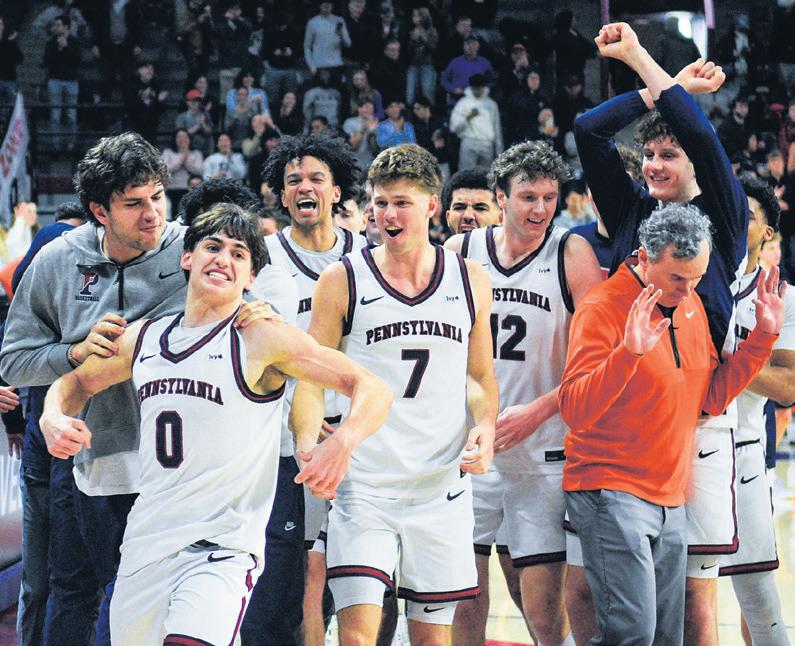

For Ethan Roberts, ambition is a blessing and a curse
‘I don’t want to be Michael Jordan. I just want to be happy. I just want to be Ethan.’
No matter who you ask about Penn men’s basketball’s Ethan Roberts, no matter how far back you start the search, the answer will be more or less the same: he works.
Roberts’ college teammates will tell you horror stories of hours-long shooting workouts that only end when Roberts says. His strength coaches will blush recalling the times the 6-foot-5 guard has challenged them to a grueling conditioning competition — and won. His AAU teammates will remember daily games of one-on-one at 5:30 in the morning, and his high school coaches will lament the many late nights spent prying their star player from the gym.
It is that drive, that insatiable ambition, that has gotten Roberts here — a place many thought he’d never reach. Division I basketball, his team’s leading scorer, the subject of each opposing coach’s pre-game nightmare. But if you ask the man himself, that willpower has a price.
“It comes with more pain than joy, if I’m being honest,” Roberts said. “I’m critiquing myself 24/7. And it weighs on you after a while, because it’s like, I’ve been doing this basketball stuff and critiquing myself for so long. It’s all I’ve known in life.
“Sometimes I’m like: ‘I’m done. I don’t wanna do it anymore.’ That’s happened more this year than ever.”
And yet, the Quakers’ leading scorer finds it in himself to lace his shoes up again each day. It hasn’t always been easy — since beginning his high school career, Roberts has changed schools four times. He entered his senior year of high school without a Division I offer and was ghosted by his top choice in Division II. He lost his high school sophomore season to a broken back and his collegiate sophomore season to a stomach illness that sent him into a “major life crisis.”
WALKER CARNATHAN Senior Reporter
It has taken, as Roberts puts it, “a thousand swings of the axe” for him to reach West Philadelphia. But along the way, the line between success and failure has not been drawn by his performance on the court. It has been drawn by his ability to maintain his sense of self off it.
“I want to be great, and I understand the sacrifices. But you talk about ‘the greats.’ Michael Jordan — that’s a bad guy. Every person I’ve ever heard that’s had an interaction with Michael Jordan — that’s a bad guy. Even Tom Brady, he lost his family. He lost everything. I realized after a while: yes, I want to be great. But I don’t want to be like that guy.”
“I don’t want to be Michael Jordan. I don’t want to be Tom Brady. I just want to be happy. I just want to be Ethan.” ***
In the spring of 1988, the entire racquetball world descended upon Houston for the sport’s pinnacle on United States soil: the Amateur National Singles Championships. There, reigning champion and No. 1 seed Jim Cascio stormed his way to the championship match where he was favored to repeat against the same player he had defeated in the title tilt the year before: Andy Roberts. Instead, Roberts avenged his defeat, sweeping Cascio two games to none and cementing himself as the top amateur player in the nation. Roberts went on to professional racquetball, where he peaked as the No. 1 player in the world in 1993 and 1994 and never held a ranking lower than No. 4. Known for his wicked power, Roberts gained induction to the U.S. Racquetball Association Hall of Fame in 2003 and was described as “the best offensive player to ever play the game.” Decades later, the lessons that brought Roberts to the top of his sport are still alive in his
son.
“Ethan has gotten that competitiveness from his father,” Charlie Leonard, who coached both father and son during their respective high school days in Memphis, said. “When you look at Ethan, you think this is this suburban kid who’s a pushover. … You don’t expect this kid to have the kind of dog in him that he actually has.” Raised in a family of athletes, Ethan Roberts describes an upbringing that saw him training as early as first grade and constantly reminded him of the discipline necessary to succeed. His parents, Andy and Kim Roberts, were both highlevel racquetball players, while his older sister Olivia played Division I lacrosse at Fresno State.
“I’ve been [at the Roberts house] when they’re playing board games and tables get flipped,” Austin Scott, Roberts’ high school coach in Illinois, said. “It’s not an easy environment to survive, but they challenge each other, and they’re still so open with their emotions, whether it’s joy or struggle. They’re there for each other, and intensely loyal.”
“I just watched and learned,” Roberts said. Prior to his junior year of high school, Roberts’ family relocated from Memphis to Arlington Heights, Illinois. A lanky 6-foot-1 kid with a Tennessee accent, Scott said Roberts was still maturing — physically and emotionally — when he arrived at the local John Hersey High School.
In his first year at Hersey, Scott said Roberts would occasionally suffer “mini meltdowns” during games, reacting emotionally to his own or others’ shortcomings. In those situations, Scott developed a technique that forced him to harness his feelings rather than unleashing them.
“When Ethan would have these moments in practice, we would bring out the bench chairs See ROBERTS, page 7
Three track program records shattered at Penn Classic
A new world record was set at the Ott Center for Track and Field in the men’s 4x800-meter relay
KAIA FEICHTINGER-ERHART Deputy Sports Editor
The track world had its eyes on the Ott Center for Track and Field last weekend.
The Penn Classic fell on an off weekend for many Quaker track and field athletes preparing for next weekend’s away meets at Clemson and Boston University. However, the few Quakers competing this weekend decided to put on a show for visiting schools and spectators alike.
Penn’s distance running team contributed the most participants and the most entertainment, breaking three program records over two days. Additionally, a professional team sent by Atlanta Track Club brought a surprise to the penultimate event of the first day, breaking the indoor world record for the men’s 4x800-meter relay.
Here are some of the weekend’s highlights.
“A really proud moment”
Among the scattered Quakers, freshman pole vaulter Thomas Bucks put up a notable performance, clearing 5.10 meters for a new personal best.
As the meet continued with sprints and relays later in the afternoon, both the men’s and women’s distance teams put on a show for Ott Center spectators. First, the women’s 4x800-meter relay team, made up of sophomore distance runners L’Mio Edwards and Quin Stovall and freshmen distance runners Alexa Matora and Margaret McCabe, showed a superb performance. They finished in 8:43.38, breaking the program record in a conference-leading performance.
“It was a really proud moment, knowing that all the hard work we have been putting in all season paid off,” Edwards said. “[I feel] that fulfillment of finally getting to that record, and knowing that every single person did their part and we executed it just as well as we had planned.”
The men’s 4x800-meter relay followed immediately, and Penn’s squad, which included distance runners freshman Joseph “Tiago” Socarras, sophomore Benjamin Markham, senior Nicolas Pizarro, and junior sprinter Nicholas DeVita, likely felt inspired by the women’s performance before them.
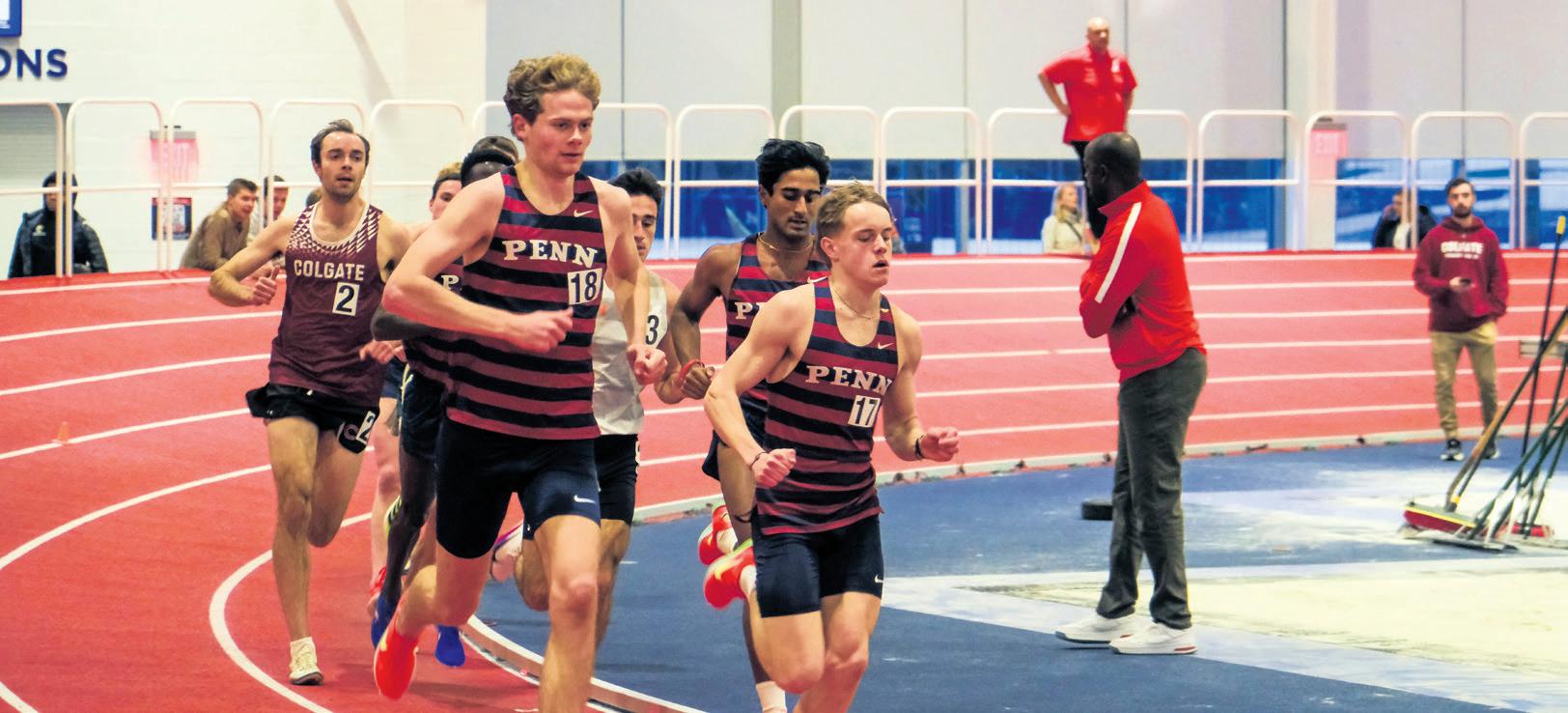
They finished in second place with a program-best 7:22.43, achieving the fastest time in the Ivy League this season. This new record, however, was overshadowed by an even greater achievement in the rarely contested event. A team of four professional athletes from the Atlanta Track Club competed in the relay. Their anchor, Sean Dolan, son of Penn’s Track and Field Director Steve Dolan, clocked 7:10.29 to the cheers of the Ott Center crowd, shaving a second off the former world record.
“[Sean Dolan] is definitely familiar with the Ott Center, so it’s fun to see him and his team come here and break that record,” coach Dolan commented on his son’s team’s performance. Following up on that historic performance, the Quakers won in the women’s 4,000-meter distance medley relay with a time that currently ranks No. 38 in the NCAA to round out the evening.
“Not a heated rivalry” Saturday’s events were held exclusively on the track, with distances from 200 to 3,000 meters being run. The afternoon was rife with personal bests for the Quakers. Once again, Penn’s standout results came later in the day. In the 800-meter invitational, Socarras beat out a number of professionals, including Sean Dolan, who couldn’t counter Socarras’ final push for the win. The freshman’s time of 1:46.99 currently ranks No. 15 in the NCAA and was the second program record he broke or helped break in just as many days.
“I can’t really talk a lot about it, because, again, he is my coach’s son,” Socarras joked about beating Sean Dolan. “It was definitely not a heated rivalry, but definitely a funny battle going on in the team. … I got really excited when I passed with a 100 [meters] to go.” In the women’s 4x400-meter relay, a time of 3:36.90 handed the team of freshmen sprinters Rianna Floyd, Sofia Swindell, Jailyn Milord, and Giuliana Ligor the win. Their time ranks No. 45 in the NCAA.
ABHIRAM JUVVADI | SENIOR PHOTOGRAPHER
Pizzaro competes in the Penn Classic on Feb. 7.
EUNICE CHOI | SENIOR DESIGNER
KENNY CHEN | SENIOR PHOTOGRAPHER
Penn men’s basketball’s celebration surrounded Levine after winning against the Tigers on Feb. 7.