Penn Chief of Police Gary Williams has left his role with the Division of Public Safety. Williams will now serve as the director of community outreach and engagement, according to a statement from Vice President for Public Safety Kathleen Shields Anderson. Deputy Chief Derrick Wood will serve as interim chief. Williams was originally appointed chief of police on Jan. 17, 2023 after being named interim chief in May 2022. He served as an officer for the Philadelphia Police Department before joining DPS in 2001.
Williams served as sergeant patrol, executive lieutenant, liaison to student groups on campus, and captain of patrol before becoming chief. He has helped develop the strategic crime prevention west end grid patrol and spent time as an emergency response team
leader and a member of the DPS Union negotiation team. The role of director of community outreach and engagement “will be dedicated to building and sustaining relationships with the community we serve in West Philadelphia,” Anderson wrote in a statement to The Daily Pennsylvanian. Williams’ new position will focus on implementing projects that examine how and what the Penn Police Department communicates to the University community, Anderson added. He has previously been involved with the Police Athletic League — which aims to engage with children in the community — and will continue his commitment to this group in his new position. He will also assist with revising DPS’ community surveys.
Before joining DPS as the deputy chief of police operations in July 2023, Wood served as a police inspector for PPD for 24 years, later becoming the Municipality of Norristown’s Chief of Police. He is a graduate of the FBI National Academy.
While with PPD, Wood worked to develop police-driven programs to improve how police officers interact with the residents they serve. These programs included SAT tutoring for high school students, connecting adults lacking high-school diplomas with GED programs, and hosting job fairs. Wood has also worked with the Police Athletic League.
Wood holds a master’s degree of business administration and bachelor of science in business administration degrees from Holy Family University in Philadelphia.
How do campaign and communications strategies play out in a presidential election? How can journalists objectively cover a presidential campaign? Is the future of democracy at risk? The following Penn classes attempt to offer some insights.
Here is how Penn is approaching teaching about the 2024 presidential election.
COMM 4280: “Conventions, Debates, and Campaigns”
This class, only offered by the Annenberg School for Communication every four years, focuses primarily on the national conventions organized by both major parties, and subsequent post-convention campaigns leading up to Election Day.
COMM 4280 investigates how political parties share their efforts between persuading and educating the electorate about their agendas, and mobilizing members of their own party. It both examines the roles which political parties play in American life and how nongovernmental organizations can cooperate with parties to reach common goals.
“The class is an amazing opportunity to watch not only how campaign and communications strategies play out, but also, in a broader sense, how history is being made,” College senior Carla Agostini, a current student in the class, said.
Agostini said that she would recommend the class to anyone who is interested in politics, marketing, and journalism, as campaigns involve all of these fields. Enrollment in this class is limited to students considering and having declared a communication major, and therefore requires an application to enroll.
This fall, the course is jointly taught by Annenberg School for Communication professor David Eisenhower — the grandson of former President Dwight Eisenhower and the son-in-law of former President Richard Nixon — Political Science professor Michele Margolis, and Annenberg lecturer Craig Snyder, a former United States
See ELECTION, page 2
Penn’s campus experienced bouts of poor Wi-Fi throughout the day on Sept. 3, disrupting classes and prompting criticism from students. The problems were centered in the morning and early afternoon hours, according to students who reported poor connection in their classes. The students said that many of the problems seemed to be resolved by around 5 p.m. on Sept. 3. According to Penn Information Systems and Computing, 57 campus spaces between 31st Street and 38th Street experienced issues.
A notification sent at 3:12 p.m. on Sept. 3 by ISC attributed the outages to issues with the Vagelos wireless controller. It stated that these issues resulted “in problems connecting to wireless, disconnections, and slow wireless speeds.”
According to the notification, the affected
New Dean of the College of Arts and Sciences
Peter Struck spoke to The Daily Pennsylvanian about the enduring importance of a liberal arts education while also touching on the spate of protests and turmoil that have faced Penn in the past year.
Struck, a Classical Studies professor, assumed his role on Aug. 1 after former Dean Paul Sniegowski stepped down to become president of Earlham College. In a conversation with the DP, Struck discussed the value of the liberal arts in managing political discourse and heightened tensions on campus.
forward from a divisive climate on campus.
Struck is assuming his position in the wake of a semester dominated by activism and the Penn administration’s subsequent implementation of stricter protest and freedom of expression policies. He believes that “principles of dialogue” form the basis of the liberal arts, providing a path
“The core piece of what the art sciences does is precisely give us the tools to talk across great divides in terms of commitments to prior ideas, in terms of cultural difference, questions of value, and notions of justice,” he said, adding that answers to these questions are often “nettlesome, thorny, difficult, cloudy.”
“The impasses we got to came from an inability to talk across vast differences of viewpoints,” Struck continued. “Sorting our way through that is our ticket through these problems.”
One of Struck’s priorities for his first year as dean is rethinking the College’s general
WIFI, page 3 See DEAN, page 2
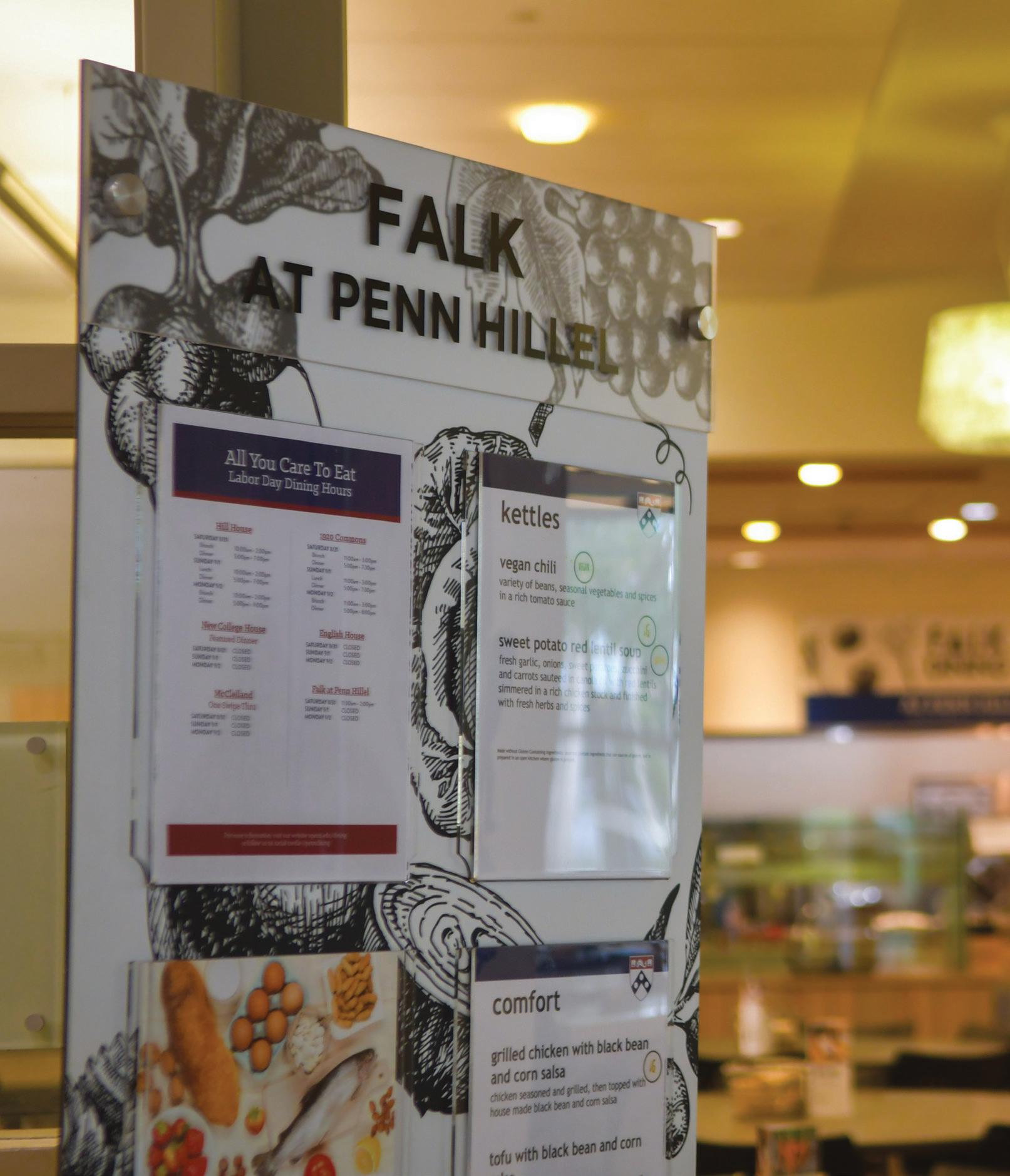
Penn Hillel’s Falk Dining Hall removes dining
surcharge, adds weekend hours
Falk Dining Hall previously charged a meal swipe and an additional $2.75 in Dining Dollars
NITIN SESHADRI Senior Reporter
Falk Dining Commons in Steinhardt Hall will remain open on weekends this year and is eliminating the $2.75 dining surcharge.
Falk Dining Hall — which previously charged a meal swipe and an additional $2.75 in Dining Dollars — will now be on par with the cost of other dining halls at Penn. Falk Dining Hall will also now serve Saturday lunch in addition to continuing its Sunday dinner service from last year.
The change to dining hours came as a result of positive student feedback to the addition of Sunday dinners last fall, according to Senior Associate Director at Residential and Hospitality Services Courtney Dombroski.
“Sunday dinner was added through a collaboration that included orthodox students, Hillel, and the University … [it] continued for the entire spring semester, 2024 due to the popularity among students,” Dombroski wrote in a statement to The Daily Pennsylvanian.
Falk Dining Hall was previously the only dining hall on campus that charged students beyond a single meal swipe.
“The reason for the surcharge was to support the unique operational costs of delivering high quality Glott kosher dining and required kosher food preparation standards — the actual food expense, as well as staffing and operational costs to maintain separate kitchen and dishwashing operations,” Dombroski said.
Engineering first year Ben Zareh told the DP that he welcomed the removal of the surcharge since it made Falk Dining Hall more accessible.
“The no-surcharge is really big considering I keep kosher, and there’s no real other choice unless I want to go to the grocery store,” Zareh said. “So, having a kosher dining hall on campus that doesn’t charge me more than others is great.”
Zareh added that the changes would make it easier to invite his friends to dine with him.
“To be able to eat with my friends and not have to say, ‘Do you want to eat with me? You have to spend extra money,’ is also a huge factor,” Zareh said. “I like paying the same price as everyone else on campus so that it’s easier for my friends to be with me.”
College senior Charlie Samuels said that the extended hours and removal of the surcharge were a “welcome change.”
“For most of the Jewish community, or at least observant [community], it’s less of a question of eating more or less frequently, as much as it is, ‘How many Dining Dollars, if any, will you have by the end of the semester?’” Samuels said. “Every previous semester, you’d run out of Dining Dollars before the semester would end, and you’d have to either supplement that yourself or stop getting meals. Now you can eat here freely.”
College and Wharton sophomore Alexander Kuplicki agreed that the new hours and removal of the surcharge are a positive change that will make dining at Falk Dining Hall “more welcoming of an experience.”
“It adds to the community here,” Kuplicki said. “Eliminating these sorts of charges can foster [Falk Dining Hall] as a dining hall that people want to go to often, and they don’t have to worry about Dining Dollars or other things in their plan.”
Dombroski wrote that she expects that the new weekend meal service hours will be well attended.
“As always, we will monitor participation and consider any adjustments necessary to support success,” Dombroski said.
DEAN, from FRONT PAGE
education requirement. Prior to assuming the new position, he chaired the College Curriculum Committee, which took part in discussions last spring surrounding potential curriculum changes in the College. He explained that a lot of the Penn faculty agree that the University needs to rethink how it approaches general education.
In April, the DP reported that the College is in the process of reviewing its curriculum on a large scale for the first time since its implementation. The review is informed by a decline in the number of students graduating with degrees in the humanities and the social sciences as well as a simultaneous rise in the number of students graduating with degrees in natural sciences since 2003.
Potential changes could impact the sector and foundation requirements, the number of credits in each major, and the College’s mission statement.
Struck noted that this process is not a “months-long conversation,” but one that could take two years or more. He added that rethinking general education requirements would involve consultations with various constituencies within the College and the broader School of Arts and Sciences.
But the curriculum review comes as Penn has become swept up in political scrutiny and a leadership crisis — with donors to the
Senate chief of staff and Republican nominee for Congress. ENGL 3421: “Political Journalism: The Presidential Election”
This journalism class, offered by the English department, teaches students how to write objective and critical stories in “an era when even the very definition of truth is widely under assault,” according to the course description.
The class is taught by Richard Polman, Penn’s Maury Povich writer-in-residence and daily blogger for The Philadelphia Inquirer. Students get a feel of what life in the newsroom or working for a political publication is like with weekly assignments and writing exercises.
“This presidential election will be one of the most consequential in our history,” Polman wrote in a statement to The Daily Pennsylvanian. “I’m inviting my course students to follow it closely and write about every twist and turn in the campaign.”
The class is largely conducted in a workshop-style format, where students read each other’s work and provide constructive feedback as a group.
“The goal is to basically feed off the news as it happens, and to come to appreciate how challenging it really is for journalists to analyze and opinionize — especially because readers today are so polarized and committed to their partisan siloes,” Polman wrote.
ENGL 3421 counts towards the journalistic writing minor, but is open to any students of any major.
PSCI 0010: “Decision 2024: Following and Understanding the Presidential Election”
This first-year seminar serves as an introduction
to elections, voting behavior, and political polling. It discusses topics such as electoral integrity, media coverage, and threats to democracy. The goal of the seminar is for students to understand the election’s implications on American democracy.
“Taking a class that is about the presidential election as the campaign unfolds in real time is one of those opportunities for students to learn, grow, and explore,” Political Science professor Michele Margolis, who teaches the course, wrote in a statement to the DP. “The goal is for students to be able to apply political science theories and findings to the unfolding election in real time and to develop a nuanced understanding of the 2024 election and its implications for American democracy.”
A second first-year seminar, with the same course code, is called “Democratic Erosion, Racial Threat and Studying the 2024 Presidential Election.” Similarly, this course focuses on the recent loss of public faith in the process of democracy and how it can be restored. It explores democratic erosion and how it can be contextualized in a bigger picture of American history. PSCI 1202: “Changing American Electorate”
This political science course focuses on the transformation that has occurred in the American political landscape in recent decades. It explores how American political attitudes and landscapes have changed, and how the fortunes and strategies of the two major parties have been transformed. It also examines potential causes of this transformation, including the economy, suburbanization, race, religion, and immigration. The course is open to all students, and not restricted to a specific major or school.
Photographers for The Daily Pennsylvanian attended the Democratic National Convention as students in COMM 4280: “Conventions, Debates, and Campaigns.”
Penn Dining touts new app as solution for missing, trashed
Green2Go boxes
Reuzzi will notify students when to return containers, a limit on checking out containers, and potential fines
University questioning the value and quality of the College, where all undergraduate liberal arts majors are housed.
Those critics have included Wharton Board of Trustees Chair Marc Rowan, who in a Feb. 27 interview said that faculty members in the School of Engineering and Applied Science, the Perelman School of Medicine, and the Wharton School are committed to “academic excellence and research,” while faculty in the College are “not so much.”
Struck came to Penn in 1999, and has held a number of positions within the University, including chair of the Classics Department and director of the Benjamin Franklin Scholars Program.
He said he first discovered his love for the arts and sciences and teaching when he was a student himself, noting that a passion for teaching is central to his work.
“I’m interested in teaching of all kinds. Big classes, I love small classes, I love one-on-ones, dissertation students,” Struck said. “All of it is just a happy place for me.”
Reflecting on his first month on the job, Struck describes being able to see how staff, faculty, and administrators work together to make operations flow smoothly.
Learning more about Penn in a new role is “just thrilling,” Struck said, adding “it’s just really exciting to be part of this.”
Penn Dining’s reusable to-go box program, Green2Go, has partnered with Reuzzi to track the boxes and make the pickup-and-return process more convenient.
Reuzzi is an app used to track takeout food containers. It has already been implemented by several university dining programs, including the University of California at Los Angeles, Stonehill College, and The College of Wooster.
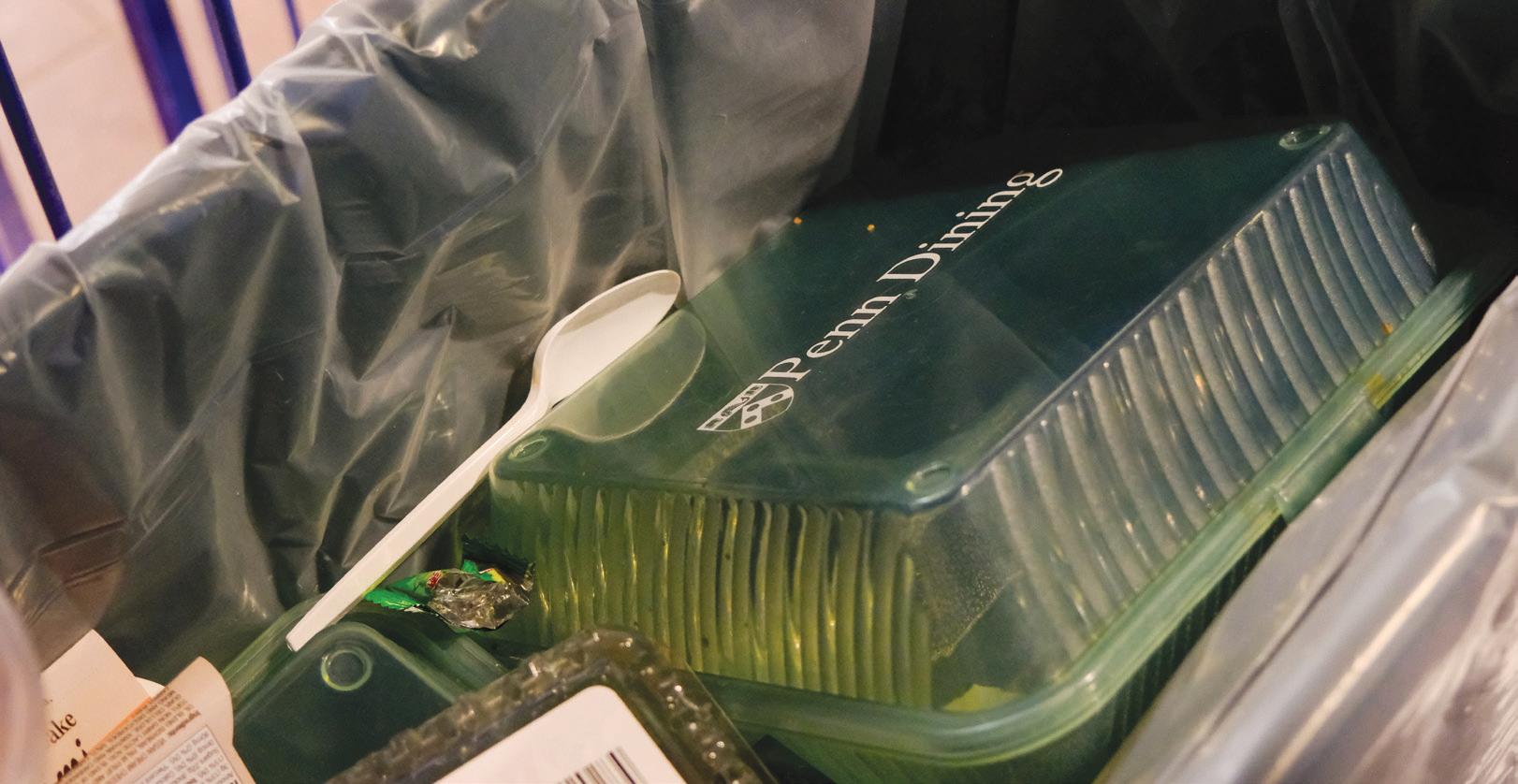
According to Courtney Dombroski, Penn Residential and Hospitality Services’ director of strategic initiatives and planning, Penn Dining noticed a decline in Green2Go containers being returned to dining locations — an issue that she stated hindered the program’s operations. She also noted that several containers were found in the trash rather than being returned for reuse, undermining Green2Go’s goal of furthering Penn Dining’s sustainability efforts and reducing the use of single-use food containers since its introduction in 2013.
Dombroski added that Penn Dining sees the Reuzzi app as a potential solution for this issue, allowing students to track their containers and know when they need to return them.
“The Green2Go containers are convenient to use and save over 180,000 single-use containers from being placed into landfill every year,” Dombroski wrote. “Penn Dining will be able to track exactly how many containers are used every day, semester, or year. The app’s dashboard will also show how many disposable containers were averted and how much CO2 emissions prevented.”
Students will now scan a QR code through the Reuzzi app when receiving a Green2Go container. The app will then notify them when to return their containers to the dining halls. At the collection station, students will need to scan an additional QR code to confirm the return of the container.
Reuzzi will prevent students from checking out more than three containers until they have been returned, and — if they fail to do so — students may be charged a replacement fine, according to Dombroski.
“It’s been fun to watch campuses be enthusiastic and creative with their to-go tracking—from clamshell containers to mugs, cups, and sporks,” Reuzzi wrote to the The Daily Pennsylvanian. “Reuzzi sees a 98% return rate on average for reusable to-go items.”
According to Reuzzi, their mission is “to reduce single-use disposables and ensure that reusables are reused hundreds if not thousands of times to combat climate change, keep costs down, and protect oceans and wildlife.”
Wharton sophomore and Class of 2027 President Steven Li told the DP that he recently used the Reuzzi app to get a Green2Go box.
“In the past, the Green2Go boxes were not held accountable, and I think the implementation we have is going to improve students’ use of the boxes and the sustainability of the product,” Li said. “I’m looking forward to more students using this so we don’t have to go back to the paper boxes.”
HANNAH LAZAR | DP FILE PHOTO Falk at Penn Hillel removed its dining dollar surcharge and is now open on weekends.
JEAN PARK | SENIOR PHOTOGRAPHER
ABHIRAM JUVVADI | PHOTO EDITOR
A discarded Green2Go container at the Class of 1920 Commons on Oct. 19, 2023.
KELLY YANG Staff Reporter
WIFI, from FRONT PAGE
buildings included Huntsman Hall, Houston Hall, Van Pelt-Dietrich Library, Williams Hall, and the Annenberg School for Communication.
“ISC has made some adjustments to back-end configurations and is monitoring this issue,” the notification reads. “More information will be forthcoming when available.”
“Penn and ISC continue to invest in the critical infrastructure that supports our campus,” ISC Director of Communications Jaron Rhodes wrote in a statement to The Daily Pennsylvanian. “It is always helpful to submit a ticket so we can better assess the problem location and identify issues in the most expedient manner.”
Rhodes also directed Penn community members to the ISC website for help determining how to report issues.
Students who spoke to the DP confirmed that they experienced Wi-Fi outages in at least 19 campus buildings. Several reported having technical support staff members standing in their classroom while class was ongoing, professors being unable to take attendance, and instructional videos not playing properly.
Two notifications sent by ISC on Sept. 4 elaborated on the situation. The first, sent at 11:13 a.m., said that ISC rebooted the Vagelos wireless cluster “and committed some other configuration changes to promote better performance,” adding that ISC “continues to monitor the cluster.” The second, sent at 5:16 p.m., wrote that the issue has been resolved after no further significant performance issues were noted.
Stephanie Zou, a College sophomore, told the DP that she dealt with poor connection on Tuesday during a 1:45 p.m. statistics class in Steinberg-Dietrich Hall.
Zou stated that her Wi-Fi stopped working in the middle of class, at which point she looked around the classroom to see if others were having similar issues. She noticed some students closing their laptops because they were struggling with Wi-Fi issues at the same time.
“That did actually affect my ability to save notes in the class, because I have my notes synced to the Internet,” Zou said, adding that some of her notes were not able to sync from Microsoft Word because of the Wi-Fi issue. “So I did actually end up losing a part of my notes
because I had, at one point, turned off my computer to see if it was just an issue of my computer lagging.”
College sophomore Matthew Barotz also reported having issues with his Wi-Fi connection in two of his Tuesday classes. He noted that during his environmental science class, his professor was unable to proctor an “online quiz” due to the poor connection.
Barotz added that, during his history class, he “was sitting next to two different friends, and they were both taking notes on their computer, and then all of a sudden their Wi-Fi just stopped.”
Barotz, who said that he saw many other individuals having problems with their Wi-Fi during their classes today, stated that he has had other issues with AirPennNet in the past — saying that it “has never really been the best Wi-Fi.”
College and Wharton senior Jacob Pollack, who is a former staffer for the DP, stated that in his three years of experience at Penn, the Wi-Fi is “always a little rocky when school begins,” specifically citing his experience in afternoon classes.
Pollack added that his psychology professor stopped using an online tool to track attendance after experiencing issues on the first day, when he said that at least half of the class experienced tech issues.
College senior Emily Maiorano, a former DP staffer, stated that she “struggl[ed]” with trying to listen to her readings on Audible due to the poor Wi-Fi while working in Kelly Writers House on Tuesday afternoon.
Maiorano also claimed that the Wi-Fi this semester has been significantly worse than previous years in her experience, stating that it “just seems like it’s been shut down this semester.” She cited an instance in her psychology class last week, when her class was not able to use its Poll Everywhere software due to poor connectivity.
“All my time here, for the past few years, it’s been very secure with AirPennNet, but my whole semester so far I’ve had to use the guest network,” Maiorano said.
“It’s like … I’m not a guest, which sounds so simple, but am I receiving worse Internet than my Penn ID should provide?”
Senior Reporter Emily Scolnick contributed reporting to this article.
ABHIRAM JUVVADI | PHOTO EDITOR
There have been recent reports concerning internet connectivity on campus.
Philadelphia’s National Constitution Center to host pivotal 2024 presidential debate
The first presidential debate on June 27 led to President and former Penn professor Joe Biden’s withdrawal from the race
JASMINE NI Staff Reporter
The presidential debate on Sept. 10 will be held at the National Constitution Center in Philadelphia.
Harris and former President and 1968 Wharton graduate Donald Trump have both agreed to participate in the debate, which will be moder-
by ABC News anchors David Muir and Linsey Davis. The debate marks a pivotal moment in the 2024 election cycle, particularly in the wake of the first presidential debate on June 27, which led to the withdrawal of President and former Penn professor Joe Biden from the race and his endorsement of Harris as the Democratic nominee. Since the NCC opened in 2003, it has hosted numerous prominent events, including a 2008 Democratic primary debate between then-Sens. Barack Obama and Hillary Clinton. It also held town halls with both Trump and Biden — a former NCC chair from 2017 to 2019 — ahead of the 2020 election.
Former Penn President Liz Magill has also served on the NCC board of trustees since 2023.
In a statement to The Daily Pennsylvanian, NCC President and CEO Jeffrey Rosen — who is also a lecturer in Penn’s SNF Paideia program — wrote that the center feels honored to host the debate.
“It’s appropriate that the debate takes place in Philadelphia, on Independence Mall, the most constitutionally significant place in America,” Rosen wrote. “Independence Hall is the birthplace of American democracy, the place where the Declaration of Independence and the Constitution were drafted, and that makes the NCC and Philadelphia an especially meaningful location for the
Penn Med residents seek unfair labor practice charge after attempt to deliver petition
A supermajority of residents and interns signed the petition
EMILY SCOLNICK Senior Reporter
Dozens of University of Pennsylvania Health System residents and fellows attempted to deliver a petition addressed to Penn Medicine CEO Kevin Mahoney on Aug. 30 demanding an effort to finalize a union contract after a year of negotiations.
But no management representatives were present to receive the petition — which was signed by a supermajority of Penn Med interns and residents — a spokesperson for the Committee of Interns and Residents, which represents the union, wrote in a statement to The Daily Pennsylvanian. The spokesperson added that the union plans to file an Unfair Labor Practice Charge with the National Labor Relations Board in response to Penn security’s actions during recent unionization events.
The petition is demanding an end to a years’ worth of negotiations, asking Penn Med to settle on a contract that would provide better working conditions and help residents avoid burnout while delivering care to patients.
State Rep. Rick Krajewski (D-Philadelphia), who represents the area including Penn’s campus, attended the event, which took place in the Perelman Center for Advanced Medicine. The petition was set to be delivered to Mahoney’s office by “the state’s top Ben Franklin impersonator,” according to a press release. The DP was unable to confirm if the impersonator was present.
“We have continued to bargain in good faith with CIR/SEIU and will not work on that process through the media,” a Penn Medicine spokesperson wrote in a statement to the DP. “We look forward to reconvening with union representatives at the next bargaining session on September 17th and finalizing a fair and equitable contract for Penn Medicine’s housestaff.”
The most recent bargaining session took place on July 23, according to the press release.
In a statement, the CIR spokesperson referred to Penn security’s response to unionization efforts as “violations” that “raise serious concerns for our members who simply want to celebrate their union together.”
“We will continue to take action inside and outside the hospital until hospital representatives meet us at the table to negotiate a fair contract that prioritizes patient care and physicians’ wellbeing,” the spokesperson wrote.
The event took place after multiple collective actions in the same week, according to the press release, including a lunchtime gathering on Aug.
27 in the courtyard of Pennsylvania Hospital.
Hospital security shut down the event, which was designed to celebrate the union, residents claimed.
Second-year family-medicine resident and union organizer Jamal Moss told the DP that the Aug. 27 event was intended to celebrate the union receiving a supermajority of signatures on the petition and to distribute copies of the document to residents.
“During that time, when we were going into the building, security was there, and they were asking for our IDs, which was unusual because it never happens,” he said, referring to the checks of identification upon entry near the building’s escalators. “After we got in there … security didn’t give us too much of a hassle, but they did come over and ask us what we were doing.”
Security’s identification checks extended to Krajewski — a 2013 Engineering graduate — who had difficulty accessing the upper lobby of the hospital where the event took place. Moss told the DP that since Krajewski did not have a hospital badge or proof that he had an appointment with a doctor, he had to “get managers and heads of security involved” to be escorted to where the event took place.
“Rep. Krajewski did eventually meet with a group of workers, and expressed his support for their organizing and his appreciation of their tireless work,” the union wrote in a press release. Krajewski, who is historically a vocal supporter of labor organization at Penn — including the graduate student workers’ and resident advisors’ unions — did not respond to a request for comment by the time of publication.
Penn Med residents and fellows unionized in May 2023, forming the first housestaff union in Pennsylvania, and have been in negotiations with Mahoney and his bargaining team since. Residents previously told the DP that they unionized to improve resident life and wellness, including fighting for higher salaries and the rights to contribute opinions to the hospital system’s decisions.
“If we want to provide the best care, the best medicine, to the patients of Pennsylvania and Philadelphia, we have to be our best selves,” Moss said. “If Penn wants to make sure that their patients have that, then they have to make sure that we as residents and doctors feel supported and are able to live our best lives as well.”
presidential debate.” While a disagreement over whether the microphones should remain on throughout the event stalled negotiations on the debate’s rules between Harris and Trump — with Harris desiring unmuted microphones and Trump preferring muted microphones — Harris’s team recently relented to allow for muted microphones, according to POLITICO.
On Tuesday night, ABC News released the rules for the presidential debate, including muted microphones. The rules also state that Harris will appear in the right podium position on screen, Trump will speak last, no audience will be allowed in the debate room, and that “[m]oderators will seek to enforce timing agreements and ensure a civilized discussion.”
As a crucial swing state, Pennsylvania’s 19 electoral votes have been lauded as the final arbiter of the presidential election. Both Trump and Harris made stops in Philadelphia this past summer. Students are eligible to vote in Pennsylvania as long as they are 18 or older and have been citizens of the United States and residents of Pennsylvania for at least a month before the election — meaning that the vast majority of Penn students 18 and above are eligible to vote on campus in November. Rosen encouraged Penn students to watch the debate on Tuesday and “inform themselves about issues and make up their own minds.”
“Young voters, including those voting for the first time, have an especially meaningful opportunity to educate themselves about the candidates so they can make an informed choice when they vote in November,” Rosen said.
CALEB CRAIN | STAFF PHOTOGRAPHER
The petition asks Penn Med to settle on a contract which would provide better working conditions and help residents avoid burn-out.
ANISH GARIMIDI | STAFF PHOTOGRAPHER
Here are four clear and entirely helpful guidelines to live by as we all excitedly come back to campus or encounter it for the first time:
1. Be Yourself (But also, blend in! You don’t want to stand out too much.)
2. Make New Friends (But don’t forget to cherish the old ones — just not too much, you don’t want to seem clingy.)
3. Get Involved (But remember, burnout is real, so maybe take it easy.)
4. Work Hard (But don’t forget to relax! Because, you know, balance.)
The advice that often fills the pages of op-eds here and in newspapers across campuses, especially during inflection points like the start of the school year, is internally contradictory and hard to traverse. In many ways, we all know what we’re going to hear. At the same time, many may even find the criticism of this classic advice itself to be cliché. The irony being that even dismissing the advice as trite has become, in its own way, predictable — and so the cycle continues. This tension between simply letting college “happen” and attempting
to use help to evade any major mistakes is the crux of college life and really, any roughly defined experience. There is so little non-academic advice that will actually help. Sure, I have some thoughts that I’ve written down, but — believe me — that doesn’t make them useful for everyone. Life, particularly college life, resists a one-size-fits-all solution. At the end of the day, certain experiences can’t be fully conveyed to others or fully understood until we live them ourselves. As my time at Penn races toward its inevitable conclusion, I’ve begun to appreciate the long game. Contrary to the constantly discussed pressure-cooker mentality that often defines our academic years, life is long (please God). Few decisions are truly final, and the stakes are rarely as high as they seem at the moment. Whether you choose to be yourself or strategically blend in, whether you’re constantly expanding your social circle or becoming ever closer with a few close friends, whether you dive into every extracurricular or cautiously limit your commitments — it won’t make or break
your experience here. What matters most is how you respond to the ebbs and flows, and how honestly you assess your needs and desires when you sense it’s time for a change. If you’re skeptical of the cynicism, take it from Robert Frost’s iconic poem “The Road Not Taken,” which echoes this sentiment (take a look). Many people, including Ford Motors, often misinterpret the poem’s final stanza, arguing it encourages us to continuously embrace non-conformity and carve out our own unique path in life. However, Frost’s real focus is on the ultimate ambiguity of choice. He emphasizes that both paths, equally fair, “were worn … really about the same” and portrays the speaker as an older man “telling this with a sigh,” embellishing his life’s choices to entertain his children. Our takeaway is that most decisions only seem life-altering in hindsight, shaped more by how we choose to remember them than by the actual choices we made. Even on a personal level: For many years I ran through business biographies, thinking that if I absorbed enough lessons from corporate
titans, I’d avoid the pitfalls that derailed others. I’m certain that I was wrong. If I’ve learned anything here, it’s that no amount of second-hand knowledge, no matter how good it sounds, will substitute for the firsthand experience of navigating your own path. College, like life, is too nuanced and rich in detail, to be distilled into a set of universal rules. What worked for one CEO in a specific context won’t necessarily work for us in the vastly different landscape of a university. So here’s my advice: Close the advice columns. Instead, dive into your own experiences, and let life happen. Sure, try new things, embrace the possibility of failure and anything else older people may tell you ad nauseam, but make sure to discover what works for you. Because that’s where the real value of college lies — in the active, not the passive. Sometimes, the best piece of advice is no advice at all.
AKIVA BERKOWITZ is an Engineering senior studying computer science from Silver Spring, Md. His email is akivab@sas.upenn.edu.
Rethinking 21: Alcohol and adulthood should start at 18
JACK OUTSIDE THE BOX | Cheers to 18, but you’re not (really) an adult yet
I’ve always said that if I were elected president, three goals would dominate my political agenda: (1) abolishing the death penalty, (2) bolstering civic education, and (3) lowering the drinking age. Today, America is one of very few countries on Earth that regulates alcohol consumption beyond the age of 18. This phenomenon leaves American adulthood in an awkward, incongruent limbo. You’ve probably heard this before, but as adults, we can go to war or take out a sixfigure student loan, yet we can’t have a glass of wine.
The fact is, we launch 18-year-olds into mature situations that make them grow up in real time. With fully-fledged responsibility should come fully-fledged privileges. Even as we look beyond these more cliché arguments, there are real dangers posed to college students when alcohol remains illegal.
We live in a culture where going to college requires more than just buying dorm supplies. Nowadays, fake IDs are present
on many students’ college shopping lists.
This phenomenon means that at least one-third of college students regularly use counterfeit identification to purchase or consume alcohol. That is not a minor issue. In fact, even misdemeanor use of a fake ID could earn you jail time in many states. Jailing students for a socially necessary activity is plain unacceptable. Why must we punish young adults for an activity that is so broadly acceptable and prevalent in American life?
Peer pressure to drink and have a fake ID causes students stress and can hinder their overall college experience. Yet, college students seldom shy away from alcohol. Having to use a fake ID to do something that most young adults do is very unpopular. Perhaps obviously, students rarely support the regulations that limit their freedoms.
Students aren’t the only ones who support lowering the drinking age, though. In 2008, 136 American university leaders joined together to form the Amethyst
Initiative, an organization urging lawmakers to let their students drink. The group’s founder, John McCardell, explained that abstinence-only alcohol consumption laws have “not allowed for any constructive behavioral change in college students.” That shouldn’t be surprising, though. Newsflash: we tried prohibition, and it didn’t work the first time.
The Amethyst Initiative furthers their point to say that even despite medical amnesty rules, clandestine drinking is ever-present and rarely gets reported. These situations put young adults in danger. If students were allowed to more openly engage in alcohol consumption, it would be a much safer pretense than the status quo. Given research that the prevalence of unsupervised drinking has led to unsafe conditions for students, lowering the drinking age is a constructive change that would make room for responsibility and minimize many current risks. Clearly, when you give young adults the
opportunity to have more grown-up experiences, they develop more mature habits.
It’s not like policymakers don’t trust young people with alcohol. In many states, it’s legal for teenagers to serve alcohol and monitor other people’s alcohol consumption long before they’re allowed to partake themselves. Moreover, state legislators have recently begun to propose a wave of reforms to the mandatory legal drinking age.
This year marks the 40th anniversary of the 21-years age requirement on alcohol consumption. At this point, the policy is outdated and ineffective. There are many ways to keep college students safe, but making an inevitable behavior illegal simply isn’t one of them.
JACK LAKIS is a College sophomore studying political science and communications from Kennesaw, Ga. His email is jlakis@sas.upenn.edu.
ABHIRAM JUVVADI | PHOTO EDITOR
Columnist Akiva Berkowitz considers traditional back-to-school advice.
NICHOLAS FERNANDEZ | DP FILE PHOTO
Columnist Jack Lakis advocates for the legal drinking age to be lowered to 18.
United for justice: Standing in solidarity with Bangladeshi students
| Recognizing the global significance of student activism against injustice
Trigger warning: This article contains mentions of graphic violence and violence against children that may be disturbing for some readers.
As the sun set on Dhaka, the capital of Bangladesh, its streets were stained with the tears and blood of its youth. In early July, student protests against the country’s biased quota system escalated into violent confrontations, resulting in the tragic loss of hundreds of students, including several children aged 5 to 18, and causing lifelong injuries among civilians. Some of our Bangladeshi peers who spent their summer in Bangladesh have returned to campus after witnessing these horrific scenes firsthand, carrying with them the weight of the violence and loss they experienced. As a student at a globally impactful institution like Penn, we must stand in solidarity with our Bangladeshi peers, recognizing the profound implications of their struggle for justice and equity. We have a responsibility to hold accountable those responsible for the mass killings, arrests, assaults, lawsuits, enforced disappearances, and murders of students across Bangladesh.
The quota system in Bangladesh had been introduced to benefit the children and grandchildren of freedom fighters from the Liberation War, reserving 30% of government jobs for them. While the intent was to recognize their sacrifices, this high percentage limited opportunities for other highly qualified candidates. Moreover, many children and grandchildren of freedom fighters do not possess the necessary certificates to prove their eligibility, leading to discrimination against students with significant merit and potential. As a result, Bangladeshi students were justified in calling for the outdated quota system to be replaced with a merit-based system, advocating for their rights and demanding a fairer approach. However, their peaceful protests were met with brutal force. When violence erupted on July 15, at least 211 people were killed, and thousands were injured. Approximately 10,000 individuals were arrested in July in connection with clashes at protests and attacks on state properties. Reports of police using live ammunition and tear gas on unarmed protesters shocked
the nation and the world. The government attempted to suppress the protest by closing all educational institutions, using their student wing, the Chhatra League, against the protestors, deploying police, the Bangladesh Armed Forces, and border guards and ultimately declaring a nationwide shoot-on-sight curfew. The army was deployed across the country amid an unprecedented nationwide internet-and-mobile-connectivity blackout for 11 days, cutting off the 171 million Bangladeshis from the rest of the world. As civil unrest grew, working-class individuals joined the protests, facing tear gas, machete assaults, and rubber bullets. Reports emerged of sound grenades, aerial surveillance, and door-to-door raids by plainclothes officers targeting individuals who supported the protests. Since the tragic events surrounding the 1952 Language Movement — when students lost their lives fighting for their linguistic rights — Bangladesh has not experienced such widespread and brutal crackdowns on its youth.
Children were shot from the balcony of their homes.
Young men vs young women: Where did we go wrong?
Naima, a bright 10th-grader, was fatally shot during clashes over the quota reform movement on July 19. Her father, Golam Mostafa, shared that “we hoped our daughter would be a doctor one day. Now, our dreams are shattered.” At least 16 children, including nine students and a preschooler, lost their lives in the brutal clash. Among these young victims, four were killed in their homes. One of them, six-year-old Riya Gope, was fatally struck by a bullet while she was on the rooftop of her home. Another innocent child, Ahad, rushed to the balcony with his parents, hoping to make sense of the commotion. But as they stood there, a bullet struck Ahad in the right eye, leaving him bleeding and unconscious. Their young lives were tragically altered in a moment, their innocence shattered by an unimaginable act of violence.
The violent suppression of student protests in Bangladesh is a stark reminder of the broader human rights challenges faced by young people around the world. A peaceful protest against a state policy descending into such lawlessness shows the government’s lack of foresight and ineffective policy governance. The situation transcended the quota system; it represented a broader issue of students exercising their right to peaceful protest, only to be met with brutal violence. The courage shown by Bangladeshi students resonates with the struggles of youth everywhere.
At Penn, our diverse community includes many Bangladeshi students whose perspectives enrich our lives. The situation in Bangladesh affects us all, urging us to acknowledge their pain and stand in solidarity. Education is a powerful tool for change, and these students fight for their future and that of generations to come. I urge the Penn community to educate themselves on Bangladesh’s current situation and the historical context of the protests. Share this knowledge, raise awareness, and take action, no matter how small. To our Bangladeshi peers, we stand with you in your fight for justice and equality. Your struggle inspires us all, and we are committed to supporting you at Penn and beyond.
TASNEEM REZA is a College and Wharton junior studying economics and statistics from New York City. Her email is rtasneem@sas. upenn.edu.
ALLISON’S ATTITUDE| For the nation’s prosperity and personal happiness, young men and women must reconnect with each other in a meaningful way
It isn’t hard to imagine a dystopian novel where the political parties of a country become split by gender rather than by genuine ideological framework. It seems we may be headed there.
The upcoming presidential election is one of truly indescribable importance. The political and social gap between Americans and the government and between young men and women has rarely been more palpable.
The national mood of the 2020 presidential election felt far more consequential and bleak than this year’s mood because of the uncertainty that the COVID19 pandemic created in the economy and healthcare system. But 2020 sparked a fundamental shift in the American political landscape that will take years to fully understand and synthesize.
One of the immediately obvious effects of pandemic-era politics was the stark decrease of public trust in government. In 2023, only “16% of Americans said they trusted the government just about always or most of the time, which was among the lowest measures in nearly seven decades of polling.”
And perhaps also increasingly obvious yet perplexing is the political divide we now see among young men and women. But, there’s also a larger cultural divide that transcends policy.
For young men, “the hyper-masculinity of the right, many of them said, is at the core of its appeal, not policies or party politics. … Several said they hide their conservative views because women they know have said they won’t date right-leaning men.”
But opposingly, when young woman Isabelle Ems, a Penn State student, was asked about social attitudes between men and women, she “cited widely viewed TikTok videos showing women being asked if they would rather be stuck in the woods with a man or a bear. Most women picked the bear, reasoning that a man might be more dangerous. Ems wasn’t sure which she would pick — though the bear, she said, could well be the safer bet.”
Although I hypothesize that this general distrust largely comes from COVID-19 reverberations, it would be misleading to suggest that COVID-19 is solely responsible for it. As I argued last year, social media is in large part responsible for our distrust in government and each other. It is a vessel for misinformation and disinformation like we have never seen before. Like many other social media users, I find it nearly impossible to decipher what’s true and what’s not, because behind every post we see, like, and share
is someone who’s posting for reasons that may be unbeknownst to us.
Furthermore, social media creates immense opportunities for us to fall into echo chambers, which are media environments fueled by confirmation bias. People are becoming more emboldened and radicalized because they only interact with others who agree with them. If they do interact with others outside of their echo chambers, it often becomes an antagonistic form of internet trolling that rarely yields any productive results.
I find it extremely distressing that young men and women rarely agree on policy issues, but more importantly, don’t seem to trust nor understand each other on the whole. From what I can tell, both young men and women seem to think the other side is out to get them.
Women are scared of men. Men feel they can’t be themselves around women. Men comment “OF detected, opinion rejected” (OF as in OnlyFans) as an excuse to immediately invalidate or disregard what a woman is saying. Through my time spent on social media, I opine that these comments reflect that men view women as hypersexual or, worse, as using their sexuality to manipulate men around them.
As a young woman, I couldn’t find my observations on the ground to be further from the truth. Most young men, just as many young women, are genuinely well-intentioned people. Young women aren’t using their sexuality to manipulate all the men around them. But if you existed solely in the world of media, you would surely believe something very different than what happens in the real world.
What we must remember is that this country needs us to need each other. It’s as fundamental as understanding why diversity is important. We must know all sorts of people with different life experiences and perspectives from us. The difference between men and women, while long studied yet little understood, is one that is not negligible. We have biological differences that have caused us to be socialized differently. The balance will always be fundamental to any functioning society.
But on a more personal level, close and deep relationships are the paramount factor for lifelong happiness, outpacing money and fame. For heterosexual young men and women, finding trust in each other for lifelong partnerships is deeply important. And for the many young men and women who don’t fall into the heteronormative space, there is still deep value in
Complete the grid so each row, column and 3-by-3 box (in bold borders) contains every digit 1 to 9.
having friendships with those of the opposite gender.
Beyond a romantic context, when we lose the connection between men and women, we create a society that is polarized and more conducive to general angst and violence. The problem of rape culture, for example, is one that is purely social. Given that, I refuse to ascribe an overly simplistic black-andwhite view that men are morally inferior to women or vice versa. We lose an understanding in one another that transcends far beyond just a mere difference in political opinion.
As I am speaking to all of you, my imagined audience in this article, I am also speaking to myself. In the bear-man hypothetical, I err on the side of the bear. I find myself disconnected ideologically from many men, especially those in the manosphere. I don’t
understand young men’s support for building the wall, criminalizing abortion, or Trump tax cuts. But I want to. And we need to. We are so obsessed with changing each other’s minds that we forget we need to first understand why people may think and feel differently than us. To both young men and women: The next time you catch yourself scrolling on TikTok, X, or Instagram reels and find a video or meme that antagonizes the other gender, I want you to think twice before liking it and reinforcing algorithmic echo chambers.
ALLISON SANTA-CRUZ is a College senior studying communications from Jackson, Miss. Her email address is allisant@sas.upenn.edu.
RAYHAN AHMED | CC BY-SA 4.0
Students protest in Bangladesh in July.
DANIEL URIBE CARDENAS | DP FILE PHOTO
Columnist Allison Santa-Cruz explores how social media may further political gender divisions.
EAGLES, from BACK PAGE
One passerby, who asked not to be named for this story, said she wished the advertisement was real, calling it “amazing.”
College senior Dominic Woods, a fan of the NFL, was initially confused by the advertisement before the official confirmation of its invalidity.
“I kind of had a feeling it was fake, because I
know the NFL doesn’t really endorse political candidates like that,” Woods said. “My biggest question is, though, how did it get there?”
As Pennsylvania is gearing up to be pivotal in yet another presidential election, one thing remains clear: The way to Philadelphians’ hearts is through their sports teams and city culture. Although these advertisements were not commissioned by the Philadelphia Eagles or the Harris campaign, those living in the city can still look forward to two more months of politicians ordering cheesesteaks and pandering from both sides of the aisle.
of 34th and
FOOTBALL , from BACK PAGE
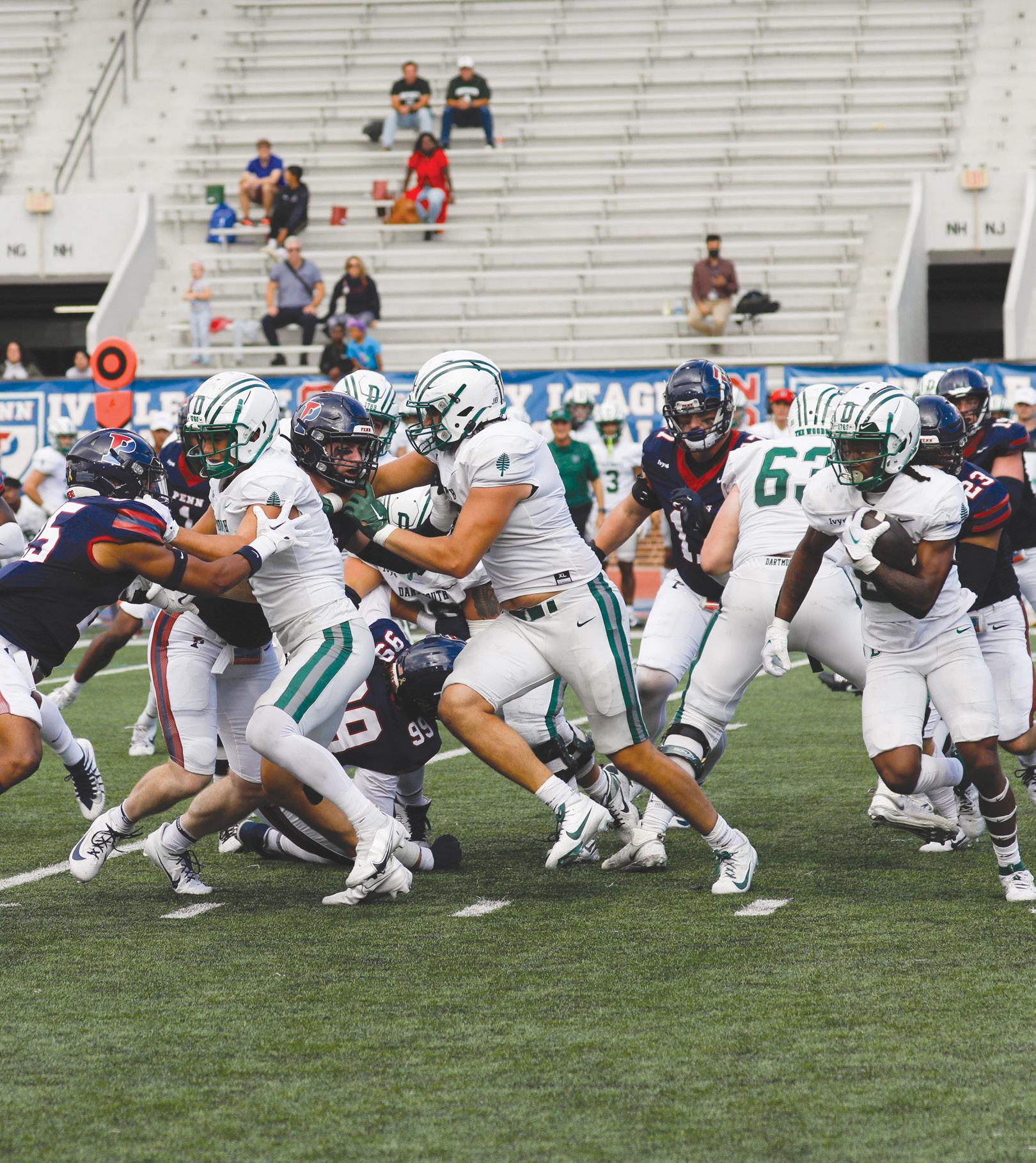
an objective standpoint, Ancient Eight teams are ineligible for the postseason thanks to their 10-game limit. But from a subjective standpoint, the reduced number of games limits the potential of individual teams to showcase their talent, placing an artificial limit on their poll performance.
The participants of the FCS Playoff are determined by the selection committee, which chooses the 24 best teams in the subdivision. In the last six seasons, six Ivy League teams have been ranked in the top 24 of the end-of-season coaches poll. But the most recent of these placements came in 2021, with the Ancient Eight being left off the list in both 2022 and 2023.
There are a number of factors that could be influencing this decline, namely the conference’s relative lack of adaptation to the growing relevance of name, image, and likeness opportunities. But it’s
also important to acknowledge the limits the conference is placing on itself — fewer games equal fewer chances to earn quality wins, hindering the Ivy League’s resume-building potential. Without a conference championship game, the League cannot qualify for an automatic bid as 10 other FCS conferences do. In many ways, the Ancient Eight is competing on an entirely different playing field.
To this point, the Ivy League has not indicated any intention to change its ways. But as the conference’s other founding principles have come under fire, one might argue that the conference is nearing an inflection point — one where it will be forced to adapt in order to survive.
If that is so, an ideal first step would be for the conference to give its teams enough opportunities to reach the goal line.
WALKER CARNATHAN is a junior and current DP Sports Editor studying English and Cinema and Media Studies from Harrisburg, Pa. All comments should be directed to dpsports@thedp.com.
Women’s soccer battles the elements in Arizona weekend road trip
The Quakers ended their tour of the Grand Canyon State with a tie against Northern Arizona University and a loss to Arizona State
VIVIAN YAO Sports Editor
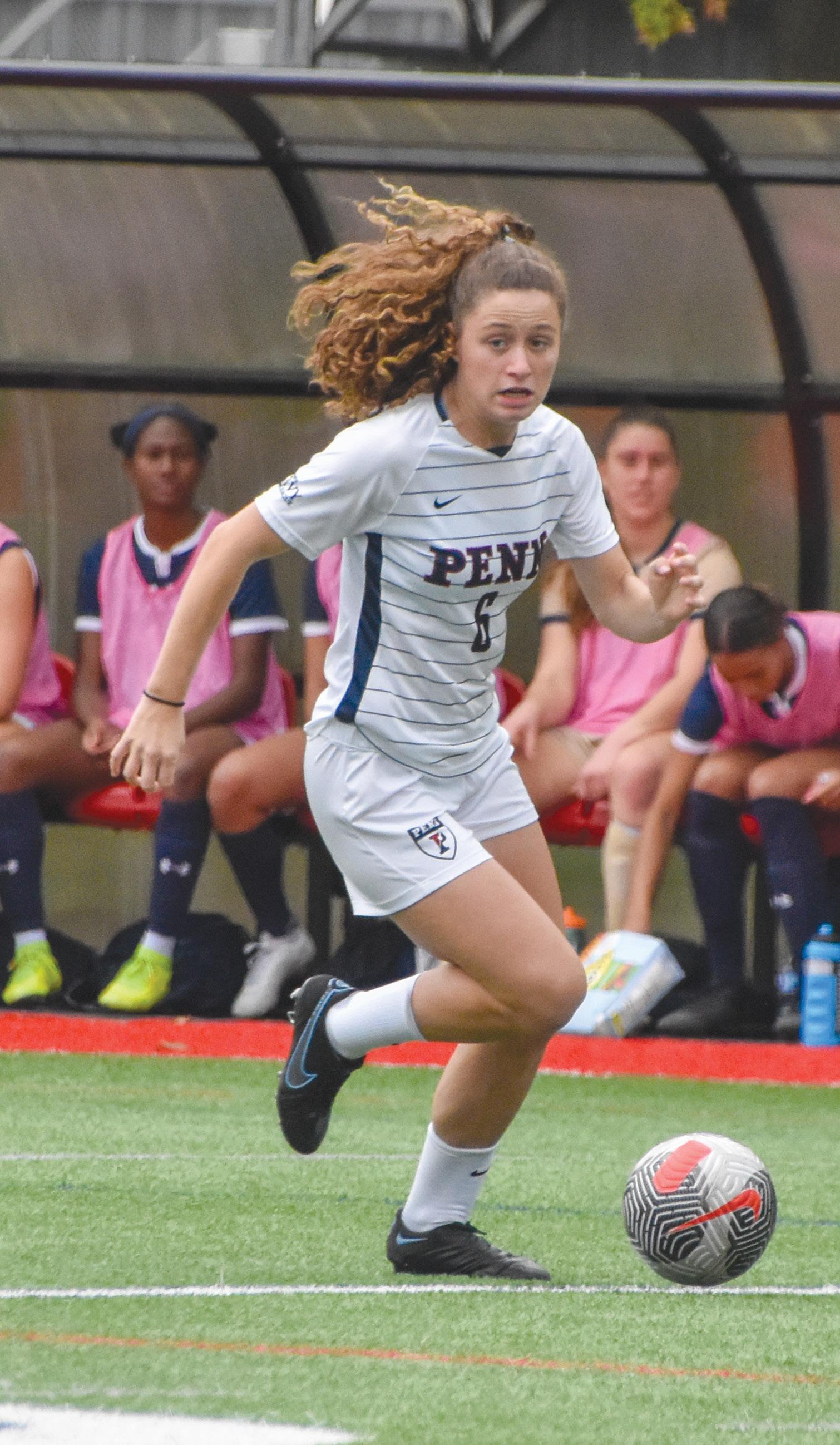
It was a battle against the elements for Penn women’s soccer last weekend as it took on both Northern Arizona University and Arizona State University in the Grand Canyon State. Coming up against some strong programs, the Quakers come back home with a 1-1 tie against NAU and a 3-0 loss to ASU.
On Aug. 29, the battle was against elevation. Northern Arizona University (0-1-2) plays its home games in Lumberjack Stadium, which is located at an elevation of 6,880 feet. The impacts were evident, as Penn (0-3-1) struggled for much of the first half adjusting to the way the ball moved differently. Despite the forwards making a dangerous run behind the NAU defensive line, the Quakers were unable to connect that final pass to set the team up for a goal.
“Because of the altitude being at 7,000 feet, the ball was just traveling a little different,” coach Krissy Turner said. “[It was] skipping and bouncing, just a little more than we’re accustomed to. So I do think it took us a little bit of time to sort of settle into the game.”
As the half progressed, Penn found its footing, and it took a fully extended NAU goalkeeper Trinity Corcoran save to deny sophomore forward Mia Fuss of the game-opening goal in the 38th minute. After starting the first two games and struggling, Fuss came in as a substitute against NAU where her speed and ability to make the correct runs to dissect the opposing backline provided an immediate impact.
Coming out of halftime, the early-game jitters were out of Penn’s system. Once again, Fuss had a great look at goal only to be denied by yet another impressive save from Corcoran. Despite the Quakers knocking at the doorstep, it was ultimately the Lumberjacks who scored first. In the 79th minute, NAU forward McKenzie Coleman was able to slip her shot from far out into the bottom right corner of the net after the ball took a deflection on its way there.
“There’s no quit in this group,” Turner said. “But it was unfortunate because it was a deflection. From a defensive perspective, we were pretty organized. That moment can definitely be a killer for [the team], but we didn’t want it to be that, and that’s part of our identity.”
The team’s persistence and patience paid off. With just seconds left on the clock away from picking, a last ditch effort from sophomore forward Abbey Cook drew the whistle for the potential game-tying penalty kick. Sophomore midfielder Leah Finkelman sent goalie Corcoran the wrong way to secure the team its first positive result of the season.
“In soccer you can create your own breaks based on how hard you compete and how hard you work,”
Turner said. “And I thought we created many great opportunities, so I think in a way, that was rewarding us for the 89 minutes and 59 seconds that we hadn’t scored, and giving a little bit of the game back to us.”
The turnaround was fast, as the team immediately turned its attention to its Sunday afternoon matchup against an undefeated Arizona State team (4-0-2). This time, the major battle was the 105degree weather.
The pace of the game matched the weather as both teams moved the ball up and down the field with energy. In the fifth minute of the game, the Sun Devils caught a lucky bounce of the ball off a corner kick, and Penn was fortunate to see ASU midfielder Addison Haws fluff her shot above the crossbar.
The Quakers weren’t as lucky in the 24th minute when the ball was ultimately turned into the back of the net by ASU forward Kierra Blundell. The goal came off of yet another corner kick where the ball bounced around in the six-yard box after Penn failed to clear the ball cleanly. In the process was a goal line clearance, but it was ultimately for nought as the Sun Devils opened up the scoring.
Just three minutes later, an ill-timed tackle from Penn sophomore forward Taylor Ferraro gifted Arizona State the opportunity to double its lead off a penalty kick. Penn junior goalkeeper Annabel Austen went the right way, but she stood no chance against Blundell’s pace and placement. The two teams went into the halftime break with the Sun Devils leading by two. In the second half, Penn had the better of chances to get on the scoreboard, but its inability to finish came back to haunt the team. Blundell rounded out her hat trick in the 69th minute to give the Sun Devils a three-goal lead. Penn managed to create a flurry of chances in the final minutes of the game, but it was not enough as ASU goalkeeper Pauline Nelles saw out the clean sheet for the Sun Devils.
“It was a game of two halves,” Turner said. “In the first half, we came out very slow and gave up two goals off set pieces, which put us in a 2-0 hole. Against the level of the team that we were playing against, [it] was too big of a hole to overcome.” Moving forward, the team will also be looking to improve when it comes to putting the ball in the back of the net, which the team has struggled with this year. Now four games into the season, the Red and Blue have only managed to score twice despite plenty of chances to do so.
“We need to find ways to create more chances to score,” Turner said. “We’re four games in, and we’ve only scored one goal that was not a penalty.” Penn women’s soccer continues its streak of road games as the Quakers face off against Delaware in Newark today at 6 p.m.
CHENYAO LIU | SENIOR PHOTOGRAPHER
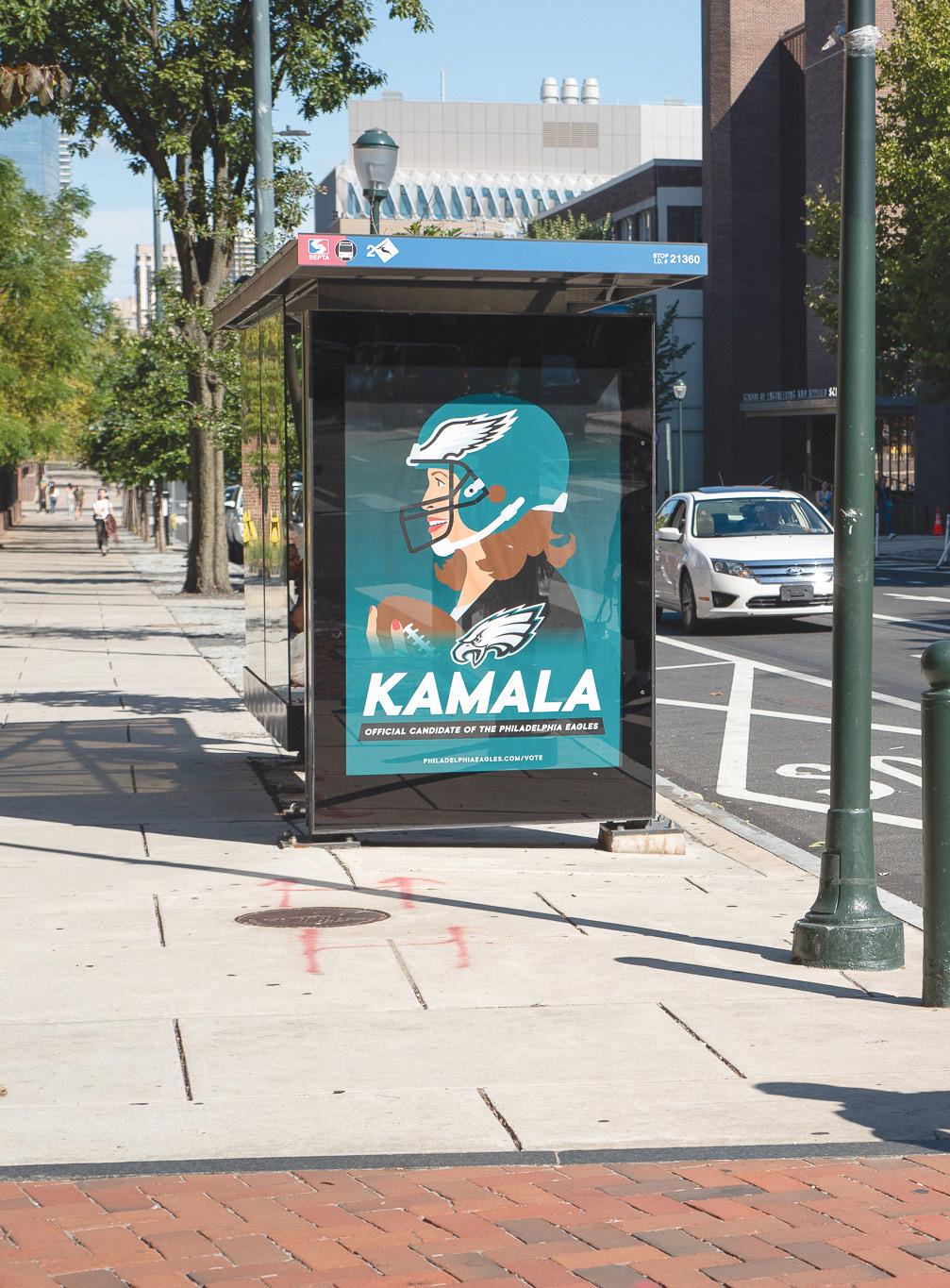
Passersby observing the counterfeit Eagles ad at the bus stop on the intersection
Walnut Streets.
SYDNEY CURRAN | SENIOR PHOTOGRAPHER Women’s soccer played Arizona and Arizona State on Aug. 29 and Sept. 1.
ETHAN YOUNG | STAFF PHOTOGRAPHER Penn football played Dartmouth at Franklin Field on Sept. 30, 2023.
Penn rowing wellrepresented on podium at World Rowing Under 23 Championships
Eight athletes, representing all three of Penn’s rowing programs, took to the water at this year’s event
VIVIAN
YAO Sports Editor
At this year’s World Rowing Under 23 Championships — hosted in St. Catharines, Ontario — up to 1,000 rowers from around the world competed in 22 different boat classes. Among the contingent representing the United States of America were seven Penn athletes, representing all three of Penn’s rowing programs.
“I think it just speaks to the quality of [Penn rowing],” heavyweight senior Sam Sullivan said. “I think there’s a lot of good people here. And every single program is doing a good job of developing those people. And I think we talk a lot about how even though we’re three different teams, we have one boathouse culture. Having a positive boathouse culture and having a culture of success is really advantageous for all three programs.”
Representing the women’s rowing program were recently graduated Amelia Demopoulos and junior Emma Gray. Demopoulos represented the U.S. in the quad sculls while Gray represented South Africa in the pair.
The lightweight team saw seniors Harrison Azrak and George Drago both representing the United States in the lightweight men’s pair. The duo brought with them heavyweight assistant coach Fergal Barry.
On the heavyweight side, senior Charles Jones rowed in the quad scull boat. And rounding out the eight Penn U.S. athletes was the heavyweight trio composed of seniors Sullivan, Jason Kennedy, and Matt Davis who competed in the U.S. Men’s Eight boat.
Azrak and Drago finished their race with a time of 6:53.65, which was just over a second behind the Chile team in front of them, despite a stronger start in the first 1,000 meters of the race. The time was more than good enough for the pair to take home silver medals, continuing the lightweight rowing team’s dominance in the rowing world. Similarly, the heavyweight senior trio also took home silver medals despite leading for a large section of the race. Leading at the midpoint of the race, the U.S. was overtaken in the last 500 meters by Great Britain. The U.S. finished in 5:27.50, about three seconds behind Great Britain and
Eight athletes, representing all three of Penn’s rowing programs competed at the
roughly two seconds ahead of the bronze medalists Australia.
In a sport where team chemistry plays a huge role in how well a boat performs, having rowers who already row together on a daily basis in college was a huge advantage — one of which the Penn athletes took full advantage.
“You’re bringing together so many different
people from so many different universities and programs, and there’s just slight differences in how everybody rows,” Sullivan said. “So to have the three of us knowing where we’re at and being consistent, that was really helpful to just have a baseline to build on.”
The solid performances set up all three programs well for the collegiate season this year.
And while there’s still plenty of time left before Penn rowing takes to the Schuylkill River again, some of the rowers will be back in action very soon.
The senior trio of Sullivan, Kennedy, and Davis have packed their bags for Germany, where they will be representing the U.S. once again in the Eight at the 2024 World Rowing Masters Regatta.
BORNIA SAEEDNIA | DP FILE PHOTO
U23 World Championships.
Men’s soccer takes down No. 3 Pitt in shocking upset
Junior forward Jack Wagoner scored the only goal of the game to secure the Quaker victory
KRISTEL RAMBAUD Sports Reporter
their respective positions.
Penn men’s soccer is back.
Penn (1-0) christened the newly renovated Rhodes Field with a stunning upset win against Pitt (3-1), the third-ranked team in the nation.
After two long seasons, Rhodes Field reopened with a natural grass playing surface. Both men’s and women’s soccer spent the last two seasons at Penn Park, which is covered with artificial turf. The difference in surface has undoubtedly been an adjustment, contributing to the team’s excitement to return to its true home field.
“It’s a very unique setting and I think the guys really take a lot of pride in this being our home facility. It’s got a little bit of Wrigley [Field], Fenway Park type feel to it. You sort of embrace the little imperfections of it but it also creates the atmosphere,” coach Brian Gill said. “It’s such a reward for the guys who put in a lot of work to have this venue and put games on like this.”
In the first ever matchup between Penn and Pitt, seven of Penn’s starters from last season were back in action, including senior defender Leo Burney and senior forward Stas Korzeniowski. Both were named to the United Soccer Coaches watch list for
Korzeniowski and the rest of the offensive unit got right back to work, maintaining a strong hold on the possession battle. While it was a constant back-and-forth, Penn pushed heavily on offense. In the first half, they finished with eight shot attempts to Pitt’s three.
The defense was anchored by Burney as well as senior midfielder Aaron Messer, senior defender Ben Do, junior defender Oliver Pratt, and sophomore midfielder Jack-Ryan Jeremiah to start the match. Pitt had two goals apiece in each of their past three victories, averaging 15 shots per game. But in the first half, they failed to gain momentum, coming close to the goal only a few times before the ball was booted away by Penn defenders.
Meanwhile, Penn’s aggressive push on offense finally paid off during the 40th minute of play.
After the defense launched the ball down the right side of the field, sophomore midfielder Pierce Wagner found himself in a tightly contested battle for the ball in Pitt territory. After Wagner and his defender fell to the grass, senior midfielder Brandon Curran came to secure possession and passed it
Eagles deny involvement with Harris endorsement ads spotted on campus
Counterfeit SEPTA station ads displaying presidential candidate Kamala Harris wearing an Eagles helmet set social media ablaze
CONOR SMITH Sports Reporter
A day after President Joe Biden was spotted wearing a Philadelphia Eagles shirt while relaxing in Rehoboth Beach, Del., it briefly seemed that the NFL franchise had officially endorsed his vice president, Kamala Harris, for the presidency.
Early Monday morning, advertisements were spotted at SEPTA bus stations throughout Philadelphia displaying an illustration of Harris wearing an Eagles helmet and holding a football, revealing Harris as the “official candidate of the Philadelphia Eagles.” The advertisements also feature a web address to philadelphiaeagles.com/vote, the official voting outreach program of the franchise.
Shortly after the advertisements spread throughout social media, the Philadelphia Eagles took to X, the platform formerly known as Twitter, to deny any involvement. The team’s account stated, “We are aware counterfeit political ads are being circulated and are working with our advertising partner to have them removed.”
This official statement from the team did not prevent many on social media from showing their clear disdain for the advertisement. Conservative political commentator and internet personality
Laura Loomer responded to the false advertisements stating, “All Democrats know how to do is CHEAT!”
The artist behind the false advertisements, Winston Tseng, has previously used the branding of ice cream company Ben and Jerry’s in a political manner to protest Biden being pulled out of the presidential race. Tseng has also used the logo of Pepto-Bismol in another advertisement placed in Washington poking fun at 1968 Wharton graduate and former President Donald Trump and the events of the Jan. 6, 2021 insurrection.
The bogus Eagles advertisements supporting Harris have been confirmed to be placed at 16th and Spring Garden streets, 18th Street and John F. Kennedy Boulevard, and on Penn’s campus at 34th and Walnut streets.
The fake advertisement on Penn’s campus, found across the street from Fisher-Bennett Hall, garnered significant attention from those passing by, as many stopped to stare at and take photos of the SEPTA stop.
See EAGLES, page 6
to Messer who, despite a smooth slide on the grass, kept possession for the Red and Blue before quickly passing to junior forward Jack Wagoner.
Wagoner, seeing an opening in the Pitt defense, did not hesitate and quickly launched the ball into the left side of the net — less than a minute after he took the field as a substitute.
“It felt great. Took me a second and a half to process what happened, but such a great feeling seeing the fans go crazy and everybody run over and give me hugs,” Wagoner said. “It’s an experience that I’ve been waiting for a long time, and I hope to replicate that this season and in the future.”
The goal put Penn up 1-0 going into halftime and sent Wagoner and the rest of the Quakers into a celebratory frenzy. It was the first goal back on Rhodes Field and of the season — and most importantly, of Wagoner’s collegiate career.
From there, the blue sky and pink clouds fainted into a pitch-black night sky as the second half took off.
In the second half, the roles reversed as the Quakers had limited shots on offense, only attempting two shots in the last half of play.
Meanwhile, the Panthers had seven — several of which made the home crowd hold their breath in anticipation. But the defensive line held down the fort each time.
“Obviously they’re always going to push the tempo and try to find chances to equalize and maybe eventually try to find a lead of their own,” Gill said. “That being said, we really relied on something we think is a strength for us, which is taking a lot of pride and dealing with blocked shots and passes.”
Penn did everything it could in that second half to keep the ball out of the net, including strong saves by sophomore goalkeeper Phillip Falcon III in just his second collegiate game.
“We came out with the right intensity, but I think still some execution things that could have made the half a little bit easier for us,” Wagoner said.
“But credit to Pitt, they did a great job playing on us, and making us feel it, and I think we did a good job being able to deal with it.”
Penn will look to keep the momentum going in another night game against city rival Temple tomorrow at 7 p.m. at Rhodes Field.
The case for an 11-game Ivy football season
Carnathan | Playing the same amount of games as the rest of the FCS is a critical step for conference relevance
WALKER CARNATHAN Sports Editor
On Saturday, Aug. 31, marked an unofficial national holiday — one so steeped in American tradition that it may as well appear on the calendar — the first full Saturday of college football. And while football fever swept campuses across the country, eight of the nation’s oldest programs remained dormant.
That is because the Ivy League football season will not kick off until Sept. 21, three full weeks after the majority of Division I teams. This is because Ancient Eight teams play just 10 games per season, less than the 12 or 11 that is standard across much of the FBS and FCS. On a scheduling level, this gives each Ivy League team seven conference games and three non-conference games — nearly 20% less action per season than the average D-I program.
The origin of this gap lies in the roots of the conference’s core values, and its effects ensure that the League remains relegated in the greater scheme of college football.
The Ancient Eight’s 10-game slate goes handin-hand with its self-imposed exclusion from the FCS Playoff. The original Ivy Group Agreement of
1945 banned members from playing in “postseason games or any other contests designed to settle sectional or other championships.” Without a chance at postseason play, the conference has no reason to adhere to the FCS standard of playing 11 regularseason games and thus has the freedom to choose a reduced slate for its gridiron athletes. I posit that these intertwined restrictions are not only unnecessary, but arbitrary. While the conference’s postseason ban is outlined in its founding document, its application has been inconsistent. Ivy League programs compete in a number of postseason competitions, namely men’s and women’s basketball, men’s and women’s lacrosse, and baseball. Moreover, the conference’s participation in these tournaments has been fruitful, with Ivy League teams winning games in each of these tournaments during the last two seasons, namely Princeton men’s basketball’s Sweet 16 run in 2023. But Ivy League football players are not afforded the same chance, and the conference’s 10-game schedule serves as a two-pronged sabotage. From See FOOTBALL , page 6
NATE SIRLIN | STAFF PHOTOGRAPHER DESIGN BY JANINE NAVALTA