faculty say shared governance broke down over past year
Some faculty members claimed that the University’s shared governance structures have eroded over the past year amid administrative turmoil and controversies surrounding academic freedom and open expression
JASMINE NI Senior Reporter
The practice of shared governance — where faculty, staff, administrators, boards, and sometimes students share responsibility for decision-making and policy development — has long been considered a foundational pillar of American higher education institutions.
Despite Penn’s boasting of such principles for decades, faculty members alleged an erosion of the historic respect between faculty and administration in the past 12 months. In interviews with The Daily Pennsylvanian, faculty said leadership turmoil and controversies surrounding academic freedom and open expression has weakened shared governance at the University and taken advantage of its institutions. Administrators and trustees, including University Board of Trustees Chair Ramanan Raghavendran, remained adamant in statements to the DP that Penn stood fully behind shared governance.
A request for comment was left with a University spokesperson.
A ‘nod and smile’ from administrators
The professors described widespread frustration with the structure of the University’s governance, accusing the administration of sidelining faculty input, eroding trust, and prioritizing financial interests over academic freedom and community collaboration.
Penn’s primary faculty governance group is the Faculty Senate, which is composed of six officers, 12 at-large representatives, three assistant professor representatives, and 36 elected constituency representatives. Among the six officers are three faculty members — collectively referred to as the tri-chairs — who lead the body.
Law professor and Faculty Senate Chair Eric Feldman, in a statement written on behalf of the tri-chairs, said that Penn’s shared governance model “rests on collaboration” between faculty
It’s been a year to the day since former Penn President Liz Magill testified in front of Congress, leading to nationwide fallout and her resignation just days later.
In the months that have followed, Penn’s campus has seen monumental changes: a new University president and chair of the University Board of Trustees, sweeping new protest guidelines and a policy of institutional neutrality. But it’s
and administration. He added that transparency and communication between College Hall and faculty members are “not a significant concern” and noted that administrators regularly attend Faculty Senate Executive Committee meetings and are available “at will” to the tri-chairs.
In contrast, Andrew Vaughan — an at-large representative to the Executive Committee and School of Veterinary Medicine professor — said that the remainder of the Executive Committee does not share the same access to senior administrators. Vaughan said that, during occasional appearances at the Faculty Senate’s monthly meetings, faculty opinions are often met with a “nod and smile” from the administration.
Political Science professor Anne Norton, who is also an at-large representative to the Executive Committee, said that, when faculty members attempted to communicate with administrators about student demonstrations in the spring, they were “uninterested and unresponsive.”
Faculty Senate Constituency Representative Harun Küçük, a History and Sociology of Science professor, said that he believes the “gentlemen’s agreement” dividing power between faculty, administrators, and the Board of Trustees has “gone away” in the past year.
The Penn chapter of the American Association of University Professors has been a vocal critic of the state of shared governance at the University over the past year. AAUP-Penn Secretary and English professor David Kazanjian told the DP that “Penn has no shared governance whatsoever,” saying that the Faculty Senate has a “purely advisory” role.
‘Challenges’ from Trustees, donors Feldman wrote in the tri-chairs’ statement that “challenges” to “the faculty’s role in shared governance” in the past year originated not from the University’s administration, but “from a few
outspoken members of our Trustees and Boards.” Vaughan alleged that University policies and bylaws that promote faculty-shared governance “seem to be followed selectively,” resulting in decisions being “heavily influenced” by the Board of Trustees.
In a statement to the DP, Raghavendran called shared governance “a tradition” that “plays an integral and time-honored role at our university.”
Raghavendran — who assumed the helm of the board in January 2024 after former Board of Trustees Chair Scott Bok’s resignation — highlighted the “fiduciary responsibility” of the Board of Trustees, specifically noting the body’s responsibility to manage Penn’s endowment, determine cost of attendance, and choose the University president.
“Primary authority on academic matters rests with the faculty and their self-governance process,” Raghavendran wrote. He listed the Faculty Senate, the University Council, and faculty appointments to Trustee Committees and University-wide task forces and committees as avenues for faculty “input.”
School of Social Policy & Practice professor Amy Hillier attributed Penn’s alleged failure to maintain “respect” and “trust” between stakeholders to the University’s interest in protecting its “enormous endowment.”
“I think it’s wealth that really is the source of the conflict,” she said. “Protecting wealth gets in the way of building knowledge, building community, educating people, and making life better for people in Philadelphia.”
Declining faculty morale and disillusionment
Kazanjian said he “couldn’t imagine the morale being lower among faculty” as a result of the “mockery Penn has made of any idea of
Extensive renovations set to occur across campus
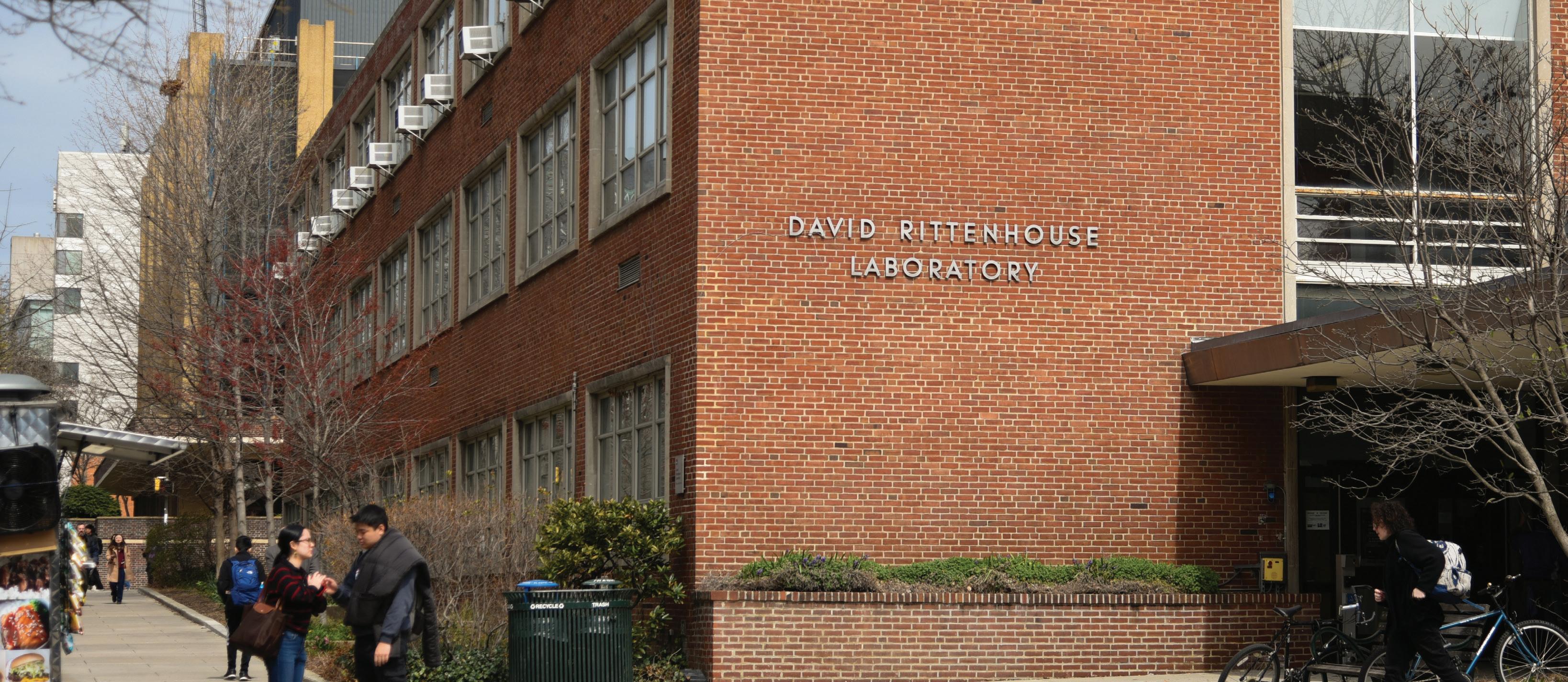
Penn recently announced a renovation of the Fisher Fine Arts Library beginning this fall, and is planning a partial demolition of David Rittenhouse Laboratory and “comprehensive overhaul” of 1920 Commons
BEN BINDAY, JAMIE KIM, AND NICOLE MURAVSKY News Editor and Staff Reporters
Penn is set to launch significant renovations of David Rittenhouse Laboratory, Class of 1920 Commons, and Fisher Fine Arts Library within the next several years. The renovations, and related construction, will have significant effects for Penn students. The construction may alter class schedules and locations, cause campus closures, and make a quiet library noisy.
David Rittenhouse Laboratory Penn will partially demolish David Rittenhouse Laboratory and build a new physical sciences building within the next several years.
The project will involve the demolition and rebuilding of the wing of DRL that goes along 33rd Street and the renovation of the wing that goes along Walnut Street. The renovation project was first introduced at last month’s University Board of Trustees meetings, during which the Board voted to allocate $11.25 million to the construction of the new building and the DRL renovation.
Facilities and Real Estate Services Director in design and construction Jennifer Kinkead told The Daily Pennsylvanian that the renovated buildings — part of a project “to reimagine what … we’ll eventually end up calling the Physical Sciences Complex” — will house the Physics and Astronomy, Mathematics, and Earth and Environmental Science departments, as well as
Penn advises international students, faculty to return to U.S. before Trump’s inauguration
The announcement, posted on the International Students and Scholar Services website, is directed at Penn community members who hold J-1 and H1-B visas and plan to travel internationally over winter break
SAMANTHA HSIUNG Senior Reporter
Penn recently issued a statement recommending that Penn international students return to the United States before 1968 Wharton graduate, former President, and President-elect Donald Trump is inaugurated on Jan. 20, 2025.
The announcement, posted on the International Students and Scholar Services website, is directed at Penn community members who hold J-1 and H1-B visas and plan to travel internationally over winter break. The statement follows plans announced by Trump to implement a travel ban barring Palestinian refugees and travelers from several other predominantly Muslim countries. Trump also indicated that he would sign executive orders on his first day as president focused on economic and immigration issues.
“If there are changes to US re-entry policies which may possibly occur during a change
in administration, we will provide updates as needed,” the statement read. “To avoid any unexpected issues, we advise returning prior to the presidential inauguration on 1/20/2025.”
During Trump’s first term, he issued an executive order that restricted entry into the United States from many Muslim-majority countries. The travel ban was later extended to include additional countries, such as Venezuela, North Korea, and Nigeria.
A representative for the Assembly of International Students told The Daily Pennsylvanian that international advocacy groups — including AIS — have “worked closely with ISSS before and after the recent elections” and that the ISSS’s reminders regarding international travel are “taking a proactive and thoughtful approach, prioritizing clear communication and careful consideration rather than creating unnecessary concern.”
The representative said that the administration — including leaders from Global Initiatives, University Life, and ISSS — has voiced a commitment to providing “well-defined, accurate information” and will maintain “consistent communication” with organizations including Penn’s Office of Government and Community Affairs, Penn’s General Counsel, the Association of International Educators.
“ISSS also continues to engage in proactive consultations with its Ivy Plus peers to stay aligned on best practices and emerging issues affecting international students,” the representative added.
College sophomore John Yang, a student from China, said that he is “not really” stressed about the incoming Trump administration.
“Trump was a president before, so I feel like people [already] have an overview of … the worst case scenario,” Yang said.
College sophomore Amanda Hunt, an international student from Chile, said that while it is “distressing” to hear that there is “uncertainty” over what could happen to international students under a new presidential administration, she believes the impacts will differ depending on the country students are coming from.
“I wouldn’t say I’m worried, because I do believe that my country has very good diplomatic relationships with the U.S.,” she said.
Hunt also stressed that the challenges faced by international students from the Middle East — such as her friends who live in Syria — are not specific to the incoming Trump administration.
“Students under the Biden administration, especially students from the Middle East, have always had issues coming into the country,” she said. “I am worried for Trump being in office, but … it’s always harder for students from the Middle East to come into the country, no matter what the administration is, whether they’re Democrats or Republicans.”
Several other U.S. universities — such as the University of Massachusetts Amherst, Cornell University, and Wesleyan University — have also issued reminders advising students to return to campus before Trump’s inauguration.
Penn leaders warn of
challenges to immigration, financial aid, research during Trump presidency
Vice President of Government Affairs Jeffrey Cooper cited several potential effects of Trump’s leadership, including threats to higher education, changes to tax policies, and altered immigration laws
THEO GREENFIELD AND PAIGE RAWISZER Staff Reporters
Vice President of Government Affairs Jeffrey Cooper warned of threats to Penn caused by 1968 Wharton graduate Donald Trump’s incoming presidency at a recent Board of Trustees meeting.
At the meeting, Cooper listed several of Penn’s priorities as the University moves into a “very challenging and changing environment.” He cited several potential effects of Trump’s leadership, including threats to higher education, changes to tax policies, and altered immigration laws.
“The president- and vice president-elect, as well as many members of Congress … have been highly skeptical and critical of higher education, both in a substantive sense, and also sometimes in a political targeting sense, but we have to deal with both of those, and that’s our challenge,” Cooper said at the meeting.
During the first Trump administration, the 2017 Tax Cuts and Jobs Act introduced a tax on the endowments of higher education institutions with large endowments per student. Cooper said the tax “will stay in place in a Republicancontrolled Congress and White House,” but the University’s goal is to “avoid an increase” in the tax rate.
Cooper also raised concerns about the status of research funding, especially through the
Schedule a tour!
National Institutes of Health amid “proposals to downsize” the agency.
Though he noted the impact was “far greater on colleges and universities that are far more dependent on financial aid,” Cooper also touched on the difficulty of determining financial aid without a “viable FAFSA process” following issues in the rollout for a revised Free Application for Federal Student Aid during the 2023-24 application cycle.
Cooper also addressed possible changes to immigration policy which the Trump administration may enact. He noted that the immigration policy had been “relatively quiet” over the last four years, but that this may change.
He said that immigration policies under the first Trump administration caused an “emotional and health crisis” for students, and could start again in his second administration for international students through issues in obtaining visas or other administrative delays.
“We had many students who were really fearful of going home for holiday break, because they didn’t know if they’d be able to get back,” Cooper said, adding that the University was “gearing up again to address those issues.”
Cooper also said that diversity, equity, and inclusion initiatives may be targeted under the new administration, as well as continued scrutiny of Penn’s response to antisemitism on campus — referencing a recent report issued after a yearlong investigation from the United States House Education and Workforce Committee. He noted, however, that the University was not one of the primary subjects of the report.
“I think because our administration and the Trustees and the whole University was so responsive to the concerns that were raised, that even the committee recognized the work that we’ve done to address the antisemitism concerns and other concerns that were raised,” Cooper said.
In terms of what Penn is doing to address these potential new policy initiatives, Cooper said that there has been “increasing activism” among “Ivy-plus presidents.” He also noted, however, that Penn — as a nonprofit — must remain politically neutral and cannot “take political positions for or against any particular candidate.”
Welcome To Destination Living In the Heart of Northern Liberties, Philadelphia
Piazza Alta is a collection of thoughtfully curated residences nestled in the heart of Northern Liberties. Offering a wide array of layouts and finishes from studios to penthouses each apartment offers spectacular light and air, spa-like bathrooms, and chef-quality kitchens with distinctively modern features.
Exceptional, all-inclusive amenities such as a 25,000 sq ft state-of-the-art fitness and recovery center, coworking lounge, private spa, and access to the Aqua Foro Rooftop Pool Club, not to mention onsite parking, bike storage, and 24/7 concierge services, make the Piazza Alta the premiere choice for your new home.
AQUA FORO POOL CLUB
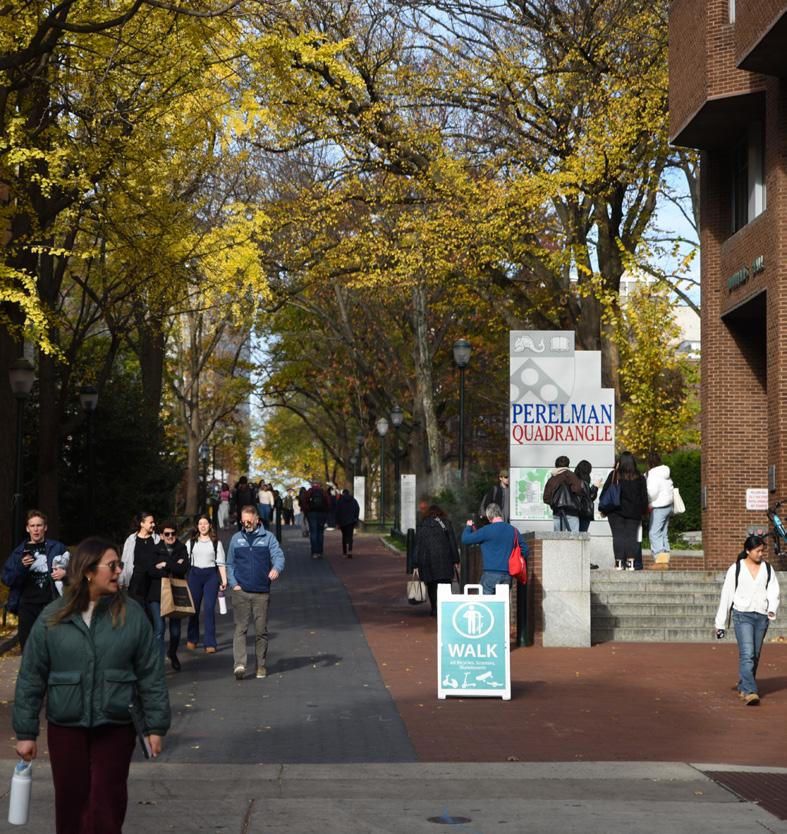
CHENYAO LIU | SENIOR PHOTOGRAPHER Penn advised international students to return to campus before Jan. 20.
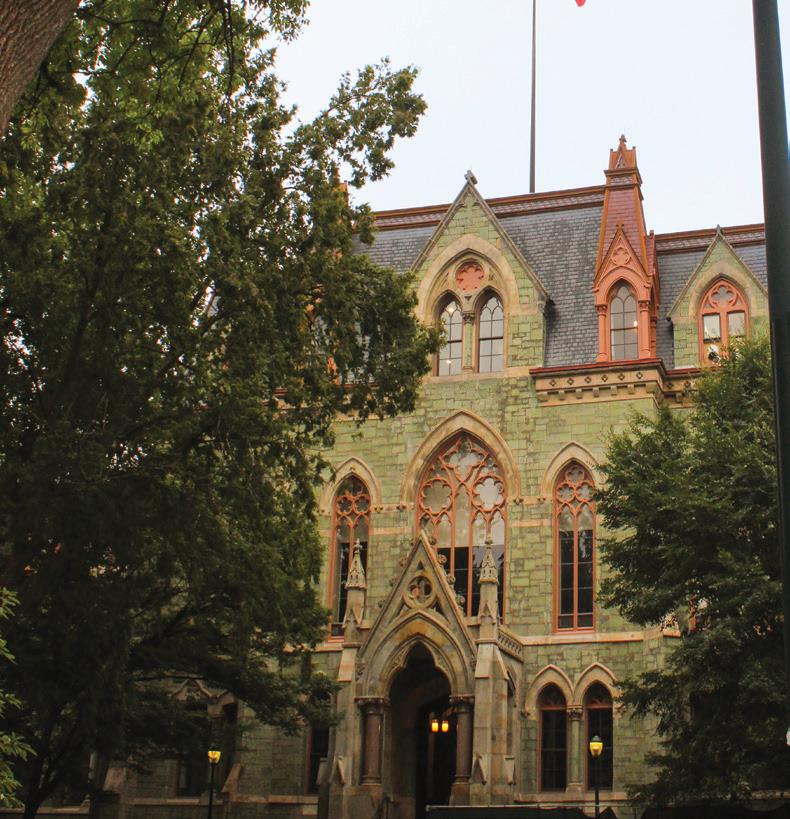
SADIE SCOTT | STAFF PHOTOGRAPHER
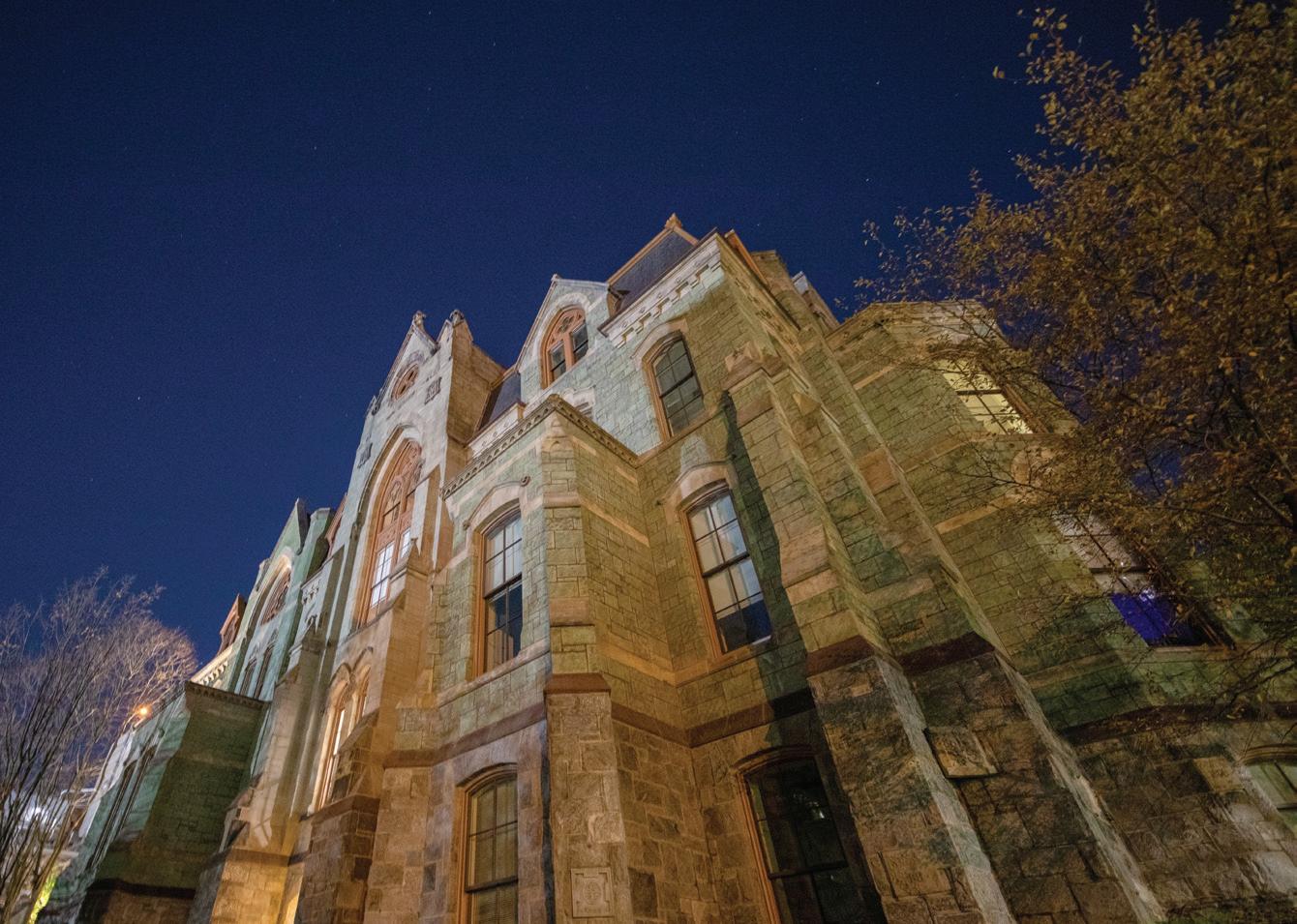
College Hall on Sept. 27.
University is also looking at the commercial market for spaces to lease as classrooms.
According to Trodden, the renovation aims to make DRL a more inviting space for students outside of classes.”
“Right now in DRL, students come in, they take their classes, they leave — and that’s not ideal,” Trodden said. “In all of our minds is the notion that there will be some kind of common space for students to collaborate, to work, and to hang out.”
Class of 1920 Commons
1920 Commons is set to undergo its first complete renovation since its construction in 1971, including significant changes to the building’s interior and exterior appearance.
Penn Business Services Director of Communications and External Relations Courtney Dombroski wrote in a statement to the DP that many of the renovation’s details — including its duration, whether the building will be taken fully offline, and potential changes to walking paths on campus — are not yet finalized.
Construction on the building is not expected to begin for several years, and Dombroski also wrote that the construction start date has not been set.
“Over the years, Penn has made investments in various parts of the facility, such as additions, partial renovations, and infrastructure replacements, but the building has not undergone a complete renovation since it was constructed,” she wrote. “Specific details regarding the renovation are currently being worked on through the design process.”
Penn is currently in the process of selecting an architect to lead the renovation efforts. Ensuing steps will include schematic design, design development, and creating construction documents before the renovation begins.
Dombroski also said that Penn is in the process of evaluating whether the building will be renovated in phases or “taken completely offline.” If the renovation occurs in one phase, “a temporary dining facility will be erected in Hamilton Village,” she added. If the renovation occurs in several phases, Dombroski said that “there may be an
opportunity to have designated areas remain operational,” adding that the dining hall’s all-you-can-eat option will remain open.
She wrote that, while Business Services does not anticipate any campus closures during the renovation, the project may cause changes to walking paths and increased noise.
Penn is also currently working with Envision Strategies, a consulting firm specializing in food service and hospitality, to host focus groups — which occurred on Dec. 4-5 — about students’ dining experiences in 1920 Commons and their preferences. Dombroski said that Penn will continue to gather student feedback about the renovation in the spring semester.
Fisher Fine Arts Library
Penn announced a $17.8 million renovation of Fisher Fine Arts Library, which is scheduled to begin in spring 2025. The “envelope” restoration — which Senior Vice President of Penn Facilities and Real Estate Services Anne Papageorge announced at the facilities and campus planning committee meeting of the Penn Board of Trustees on Nov. 14 — is intended to restore the outside of the 133-year-old building to its original form. Construction is anticipated to take place from April 2025 through
November 2026 and will involve extensive scaffolding around the building.
The renovation will include the clearing of sandstone, replacement of windows, repairs to the roof, and the installation of lightning and fall protection on the outside of the building. The library will remain open during construction, and renovation work will continue during library hours.
At the trustee meeting, Daniel Vodzak — the principal architect on the project — called the project a “noisy operation.”
Fisher Fine Arts Library is a notably quiet space on campus, as occupants are asked not to hold loud conversations or take calls within the library space. Several signs are posted around study spaces in the building reminding students of the policy.
“We will do our best to work with the occupants to minimize the disruption,” Papageorge said at the meeting.
According to Penn Libraries, the Fisher Fine Arts building is “regarded as one of the most important library buildings in the world.” The library was added to the National Register of Historic Places in 1972 and declared a National Historic Landmark in 1985. Papageorge added that it is “time to invest yet again” into the building.
The Holmesburg Prison experiment survivors deserve better from Penn
FROM THE INSIDE OUT | Downplaying harm won’t rectify one of the most brutal atrocities in Philadelphia history
In 1951, Penn dermatologist Albert Kligman walked into Holmesburg Prison for the first time. In front of him were rows of overcrowded cells, filled with hundreds of men struggling through the lowest points of their lives. But Kligman didn’t see these people as people. With the sick giddiness and morbid fascination of a monster, all he saw were “acres of skin.” Using the dehumanization of incarcerated people as a tool for persuasion, Kligman was allowed by the city and the University to conduct a series of horrific dermatological experiments on Holmesburg inmates over the course of 23 years.
In 2024, survivors and their families’ pleas for restorative justice have remained largely unanswered. At an Oct. 27 panel hosted by the Jones Foundation for Returning Citizens at the University of Pennsylvania Carey Law School, these requests were again emphasized by survivors and their families. Although the University and the City of Philadelphia have publicly acknowledged the harmfulness of these experiments, families’ calls for direct reparations have been continuously and systematically ignored. Penn must meet their pleas, and we, as students, must amplify their voices.
Kligman’s experiments were extensive. Dubbed “Philadelphia’s lasting shame,” the experiments reached every kind of horrific level imaginable with the financial support and partnership of powerful groups including Johnson & Johnson, Dow Chemical, the Central Intelligence Agency, and the United States military. These crimes against humanity included injecting men with asbestos, exposing them to Agent Orange ingredient dioxin, and lysergic acid diethylamide (LSD) experimentation — all done without informed consent. Joseph Smith, a veteran who was incarcerated on-and-off between 1956 and 1965, said the gauze wrapping inmates’ chemical-lathered arms would “eat the paint” when stuck to cell walls. Smith also described temporary blindness, painful swelling, numbness, and severe psychological trauma, including symptoms consistent with post-traumatic stress disorder. If this sounds like the stuff of horror films, that’s because it is. Nightmarish experiments left persistent psychological and physical damages, with survivors suffering from tooth loss, glaucoma, schizophrenia, permanent skin damage, and more. These symptoms didn’t simply traumatize survivors either: Their families became deeply impacted by their psychological trauma. Adrianne JonesAlston, whose father, Leodus Jones, was a survivor of the experiments, discussed how his psychological unrest and emotional
disturbance from the experiments led her to run away from home. These struggles ultimately rendered her victim to incarceration and recidivism.
Penn profited significantly from these experiments, indirectly and directly making billions of dollars. Kligman donated $15 million from personal Retin-A profits and promised to continue donating more from Renova sales. An exact number for profit is not published, and one of the demands made by family members of survivors is transparency about the exact amount gained by Penn. Demands also include a more “sincere” and “personable” apology, mandated ethics training and education about Kligman’s experiments, and financial compensation through general support and healthcare funds. As Jones-Alston powerfully stated at the recent panel, “My daddy’s skin is in those jars. Share the wealth … after all, they paid the price.”
To the University’s credit, it has publicly acknowledged the harm done by Kligman. Then-Perelman School of Medicine Dean and current Interim Penn President Larry Jameson issued a statement for Penn Medicine that condemned Kligman’s research practices as “terribly disrespectful of individuals” and “never … morally acceptable” despite also stressing the technical legality of Kligman’s work as well as his “groundbreaking contributions” to dermatological science. In the same statement, Jameson announced that a position and lectureship named after Kligman would be renamed. Additionally, research funding would be set up for scholarships and opportunities to help urban high school students research dermatological issues, a dermatology diversity residency position, and three fellowships dedicated to research on skin disorders among patients of color.
However, a public apology is a bare minimum we should not commend, but rather expect. No perfectly polished statement manufactured for the public eye can mend the literal scars perpetuated by Kligman and Penn. The University’s reconciliatory attempts are moves in the right direction, but even then, the fact that research funding focused on skin of color emerged after criticism as a means of redress instead of a preexisting priority is disheartening. Additionally, it’s worth noting that this doesn’t align with the families’ demands for direct financial compensation or a more personable apology. Although community programs and research funding are impactful, financial compensation for victims’ families is the most important way Penn can recognize the
perpetuating
humanity of those individuals. Sadly and predictably, a Penn spokesperson confirmed that the University currently has no comment on demands for restorative justice.
During the Holmesburg experiments, the social and economic vulnerability of primarily low-income and Black inmates — many of whom signed consent forms (that did not allow for knowledge of what they were being injected with) despite illiteracy — was explicitly used to paint these men as an “idle collection of humanity” and justify the torture they endured. Placed into larger context, these experiments are one horrific tale in a disturbing theme of medical exploitation of vulnerable populations in Penn’s history.
As the first formal medical school in the United States, Penn Medicine is notorious in historical circles for the role it played in medical racism. Penn offered the southernmost medical school in the United States for over 100 years. According to research conducted by the Penn Slavery Project, many proslavery southerners (joined by fellow racist northerners) were attracted to the institution as it facilitated the lies of pseudoscience and phrenology. Until earlier this year, skulls of enslaved individuals which the infamous physician Samuel Morton used to support lectures on “racial difference” were kept by the University. Although the medical field has made progress, myths and false biases derived from pseudoscientific pedagogy continue today.
The dehumanization and scientific objectification of bodies has remained a prevalent
issue in more recent Penn history, especially in the case of the Penn Museum’s ownership of the remains of several 1985 MOVE bombing victims, whose lives were taken by the Philadelphia Police Department’s bombing of a West Philadelphia neighborhood in a standoff with a Black liberation group. Although Penn and Princeton, which also collected these remains, returned them to family members in recent years, more remains are being uncovered, illustrating the extent of Philadelphia’s history of the dehumanization of “othered” bodies.
Addressing and meeting the demands of survivors and their families must be at the top of Penn’s priorities as an institution; after all, we know our University’s history is riddled with waiting far too long to right its wrongs. Let our financial resources be allocated to families directly, how they wish. Kligman died standing by his decisions. Four years before his passing, notably during his time on Penn’s medical ethics committee, he told The New York Times he “still [doesn’t] see there having been anything wrong” with the experiments. Kligman rests now, but the harm he caused persists — and so with it must our efforts to redress these abominable wrongs.
ARSHIYA PANT is a College sophomore studying history and legal studies from Kansas City, Kan. Her email is arshiyap@sas.upenn.edu.
Shaming voters is a losing strategy. Period.
STRIPPING SCAMS | In defense of ‘Stop calling Trump voters racist’
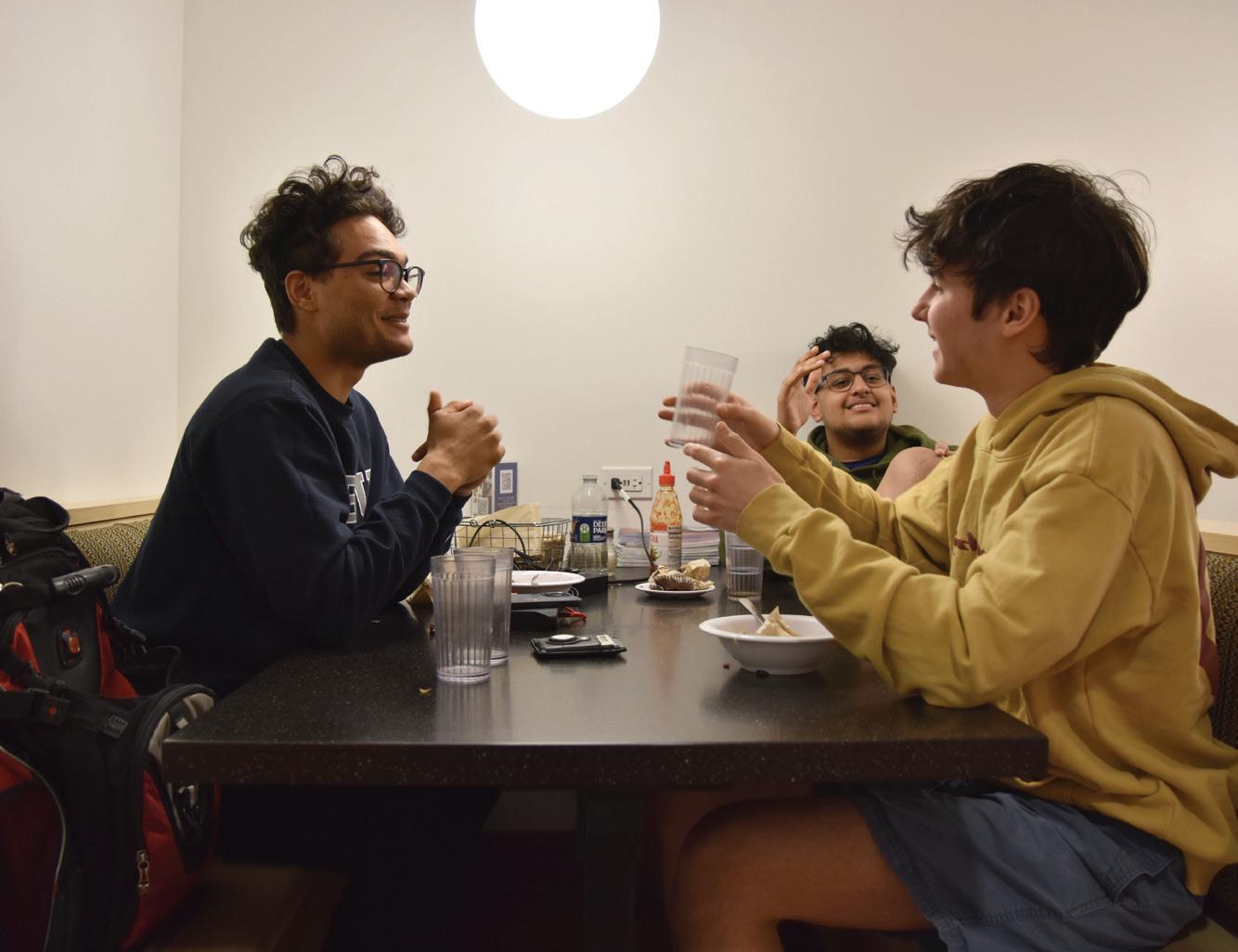
Amidst the munching and gossiping characteristic of Hill Dining Hall, a debate ensues in the booth closest to the omelet station. There, my friends and I are discussing a recent opinion column published in The Daily Pennsylvanian titled, “Stop calling Trump voters racist.” We go back and forth about the arguments laid out in the article as well as those in the DP’s Instagram comment section challenging it. I ultimately walked away from the debate with the conclusion that, yeah, we should stop calling Trump voters racist. It’s misguided and unproductive. To be clear, you have the right to judge others based on their political beliefs and choices. After all, a political opinion can reveal a person’s values, objectives, and perception of the world. However, how you judge one’s politics and the framework guiding your judgment has undeniable consequences. Labeling those who voted for Donald Trump, by and large, as racist and sexist — or, as Hillary Clinton said in 2016, a “basket of deplorables” — oversimplifies and mischaracterizes the choice of millions (and now the majority) of voting Americans.
Equating a vote for Trump as proof of racism would mean that the 77 million Americans who cast their vote for him are racist, defined by Merriam-Webster to be someone “having, reflecting, or fostering the belief that race is a fundamental determinant of human traits … and that racial differences produce an inherent superiority of a particular race.” The most common reason I’ve found underlying this claim is the argument that A) Trump is racist, so B) those who vote for him must also be racist. For argument’s sake, regardless of whether Trump actually is or isn’t racist, let’s hold that A), Trump is racist, is true. Even if A) is true, it doesn’t certainly mean B), those who voted for him are racist, is also true.
I agree that some Trump supporters are explicitly racist, sexist, and emboldened by his rhetoric. However, the key word here is “some.” I don’t believe that the majority of Americans have gotten more racist since voting for President Joe Biden
in 2020. This becomes even more improbable when analyzing the 2024 presidential election’s results. Kamala Harris not only underperformed in rural and suburban areas but also in urban areas where Democrats have historically dominated — and needed — to win swing states. In fact, Harris got just 59% of voters in urban areas, lower than Biden, former President Barack Obama or Hillary Clinton. Additionally, even with the demographics she won — particularly women, Black men, and young voters — Harris won by a narrower margin than Clinton or Biden. Many Democratic voters also failed to turn out this year, with counties delivering the biggest Democratic victories in 2020 receiving 1.9 million fewer votes for Harris than they had for Biden. These losses in traditionally Democratic strongholds indicate that, ultimately, Trump won the 2024 presidential election because the majority of Americans didn’t believe Harris was the best candidate to promote their interests.
I’ve often heard — and used to espouse myself — a variation of the counterargument which is that those who voted for Trump were willing to overlook his racist and sexist tendencies, thus making Trump voters racist. However, these tendencies aren’t being overlooked; they are being weighed. As voters, we are constantly weighing the pros and cons of our candidates. You may not like X about Trump, but your preference for Y outweighs your distaste for X. For example, if you’re a voter whose top priority is maintaining global peace, and you feel failed by the Biden-Harris administration on the issue, why would it be rational for you to weigh Trump’s racist tendencies as more important than his isolationist stance that you deem critical to world peace? The fact is, most voters choose the candidate they perceive as prioritizing their interests. Not only is labeling all Trump supporters racist or sexist a misguided oversimplification, but one that stifles productive dialogue and undermines efforts to foster meaningful change in our democracy. If you are going to retain anything
HANNAH SHUMSKY | STAFF PHOTOGRAPHER
Columnist Solemei Scamaroni encourages Penn students to engage in discussions with their peers about the election.
from this article, let it be this: Accusatory messaging doesn’t persuade people to change their minds, which you need to do if you want your preferred party to win elections and enact change. When you attack a person’s identity by labeling them a racist, you disincentivize the very person you need to convince from questioning their beliefs. Such rhetoric backfires, incentivizing people to hold onto the beliefs you find problematic even tighter. This is especially true in today’s political climate, in which political opinions are becoming intrinsic to one’s identity.
Even if you consider someone to hold a racist belief or be weighing a candidate’s positions incorrectly, it’s more productive to explain how that belief may be racist than to condemn the person as a racist. Beliefs are malleable, identities less so. If you are committed to change, invite and debate people to it instead of shutting down. I understand that those who are directly affected by rhetoric and policies promoting racism, sexism, or xenophobia
may be hesitant — and rightfully so — to engage with those they view as endorsing hate. I admit, it’s difficult. I find it difficult to discuss abortion rights with those who think reproductive choice belongs to the government, but I do it. I choose to, and you should too. Why? Because, fair or not, that’s how change happens in a democracy, by convincing people to change their minds through humanized discourse.
To be “one nation, indivisible,” we must have productive debate, especially with those whose beliefs we oppose. To achieve “liberty and justice for all,” however you define it, you must convince the average American it is worth their vote. Start a conversation with your peers from the other side of the political aisle. I recommend the booth next to the omelet station in Hill.
SOLEMEI SCAMARONI is a College first-year student studying philosophy, politics, and economics from Houston. Her email is solemei@sas.upenn.edu.
ABHIRAM JUVVADI | PHOTO EDITOR
Columnist Arshiya Pant urges the University to take responsibility for its role in
racism in medicine.
Dreams of college connections, realities of classroom cliques
A VS K | How our unspoken
As a naive high school student with practically no conception of what college courses looked like, I was eager to escape from my intimate, 15-person classes to the lively debates and eccentric teaching styles found in college lectures. I’m appalled to admit that the idea of cold calling excited me. I foolishly envisioned myself responding with witty answers that would amass applause from my professor and peers. I personally blame Harvard Business School for fueling my faulty imagination. Fifteen-year-old me would shamelessly rewatch their popular Youtube videos revealing an insider’s view of their case method classrooms, brimming with enthusiasm and eloquent speakers.
Barely a week into classes at Penn, my reality came crashing down. With a schedule now packed with lectures, I eagerly anticipated my first college seminar class. The sizable 100-plus-person classes lacked the open conversations and diverse college voices that I eagerly awaited, and somehow I found myself anticipating the small classrooms once again. While Penn offers top-notch connections and incredible resources, what I most looked forward to were the active discussions and authentic perspectives created from putting people from all across the globe on one campus. What I found instead was a splitting image of my high school dynamic: one not conducive to fully integrated discussions.
Coming into class on the first day my peers and I, still getting familiar with each other, keenly shared funny anecdotes and exchanged names, excited for the prospect of finding new passions and learning from each other. Only a week in, and classes began to show familiar signs of previous experiences.
Walking into a particular college seminar after
crossing the three-week line, I noticed how repetitively similar seating arrangements became. Not even a month in, social divisions were becoming distinct as newly formed friend groups and gender divisions gradually took shape. The novelty of being surrounded by new people gradually lessened, and classmates began to sort themselves by habit.
Comfort takes precedence, and social divisions don’t necessarily happen by choice, but often by chance. The more vocal students sit together on one side, while the silent ruminators take the other. The large group of athletes will sit on one corner, while the girls hoping to rush the same sororities sit in the middle. These patterns are formed by a natural habit, but they stop us from forming an equally engaged classroom.
Writing seminars, notoriously known for being somewhat lackluster educational experiences, are some of the first college seminar classes to which Penn students get exposed. The writing seminar I chose is a part of the SNF Paideia Program, aimed at facilitating productive dialogue. What this program also includes, unbeknownst to many, is a range of opportunities to grow close with your classmates, whether it be through occasional lunches or class dinners funded by the program.
What started as a class subtly divided in cliques slowly morphed into a community of peers completely comfortable with each other.
Crafting a classroom where every person feels included is not an easy task. The Paideia Program, due to its generous funding, has been able to cultivate a stronger community outside school hours.
During a dinner sponsored by Paideia, my class incorporated coursework and topics from class texts
Take down the barricades
into icebreaker questions that got us acquainted with one another. Yet, even within the classroom, simple strategies alone can be used to eliminate the exposure of those social patterns. Most effective in our class was the constant group arrangements preventing us from forming habitual seating patterns, and instead encouraging us to hear diverse voices and a new blend of backgrounds.
As simple as seating patterns are, these little changes are the big make-or-break situations that alter our entire perception of the class. Class is twice as engaging when we can anticipate new ideas and unfamiliar voices. While it’s easy to fall into comfort zones and old habits, a chance to break the typical high school cliques is one worth taking when
JACK OUTSIDE THE BOX | Why does Penn want to keep students off of their own campus?
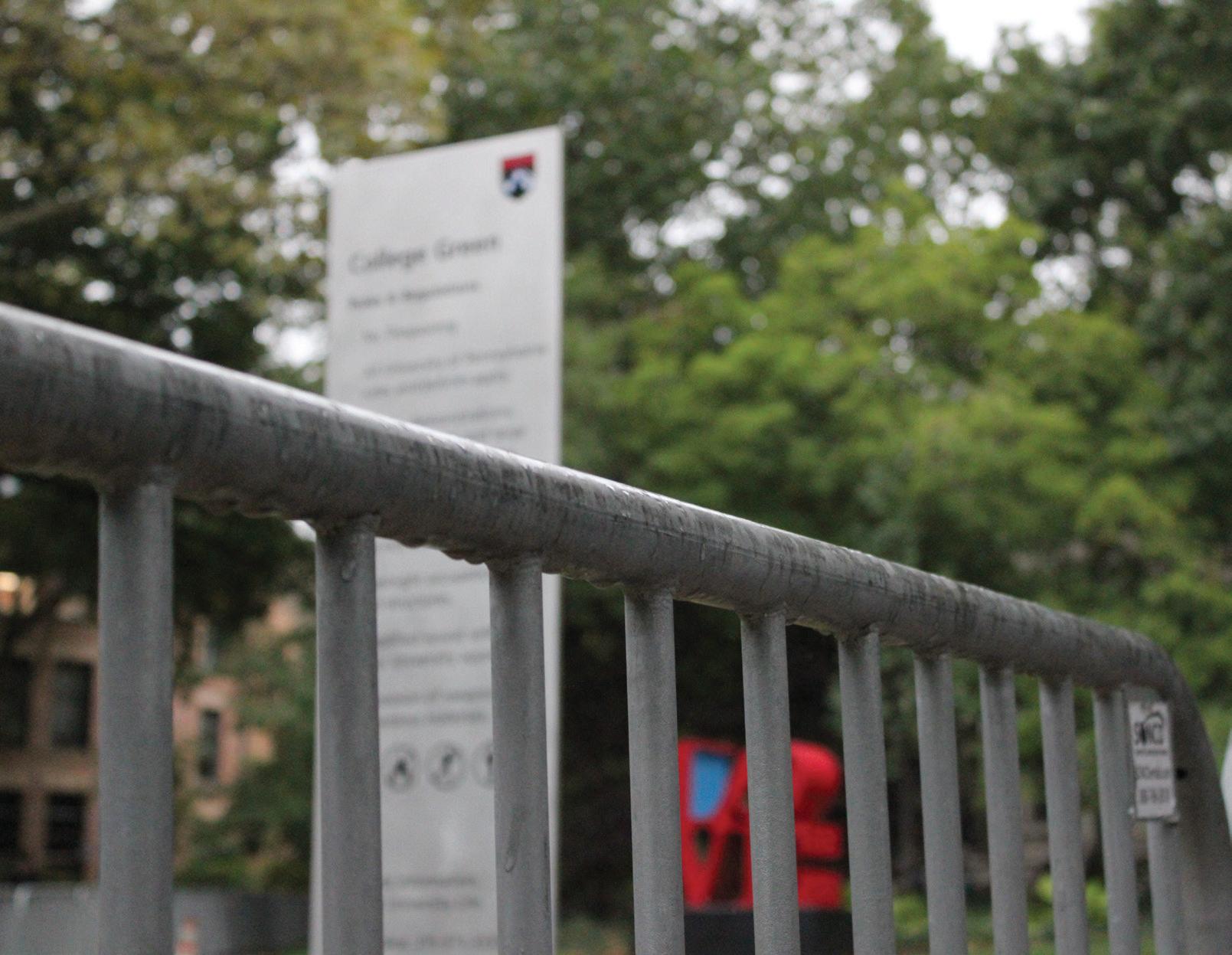
Every Friday morning, I lead tours of Penn’s campus for Penn Admissions. Nearly every time, I field questions from concerned parents about why College Green and other sites on campus are trapped behind gates. That particular question resonates with me because — like most students here — I don’t know the answer.
It’s truly puzzling why the University feels the need to block its students from fields around College Hall and the LOVE statue. Classes are still being held in College Hall and other buildings in its vicinity, but students don’t have access to the area around the building for most of the day.
A remnant of the Gaza Solidarity Encampment, College Green’s barricades are probably trying to prevent any form of protest from starting on that section of campus. This tactic, though, introduces a strong contradiction by the University. Their central argument against protest is that large-scale demonstrations can disrupt Penn’s operations, but their solution to prevent protest is to perpetuate disruption by leaving space off limits permanently? Let me be clear: I don’t believe the encampment was at all productive. It was an imposition to students and achieved very little for the cause it supposedly supported. However, as objectionable as the encampment was, we shouldn’t still have to live with its long-lasting effects.
When I arrived on campus on Aug. 16, fences blocking the entire area between 34th and Walnut streets to the LOVE sign were up, just as they were the day the encampment was cleared from College Green. I was immediately appalled. How could a protest that was dismantled in May still leave campus so excessively surveilled? This was just the beginning, though. When a demonstration was planned to form around the LOVE sign one morning
in September, the area was fenced off for multiple weeks.
Last year, Penn ranked as the fourth-worst college for free speech on campus. After that ranking and a year of turmoil, our university released new Guidelines on Open Expression. These new regulations made it much more difficult for students to conduct many activities they previously could. Even an action as simple as tabling on Locust has found itself under scrutiny. These barriers in student life run parallel to fencing off spaces on campus. They’re both unnecessary and harmful to our community.
Nobody feels safer because of the barricades. They’re a physical obstacle and a symbolic one, too. The free exchange of ideas is a cornerstone of a successful campus and a collaborative learning environment. Our university will thrive when all students feel empowered. Penn succeeded in that mission when they argued that an encampment was harping on the general experience on campus. I respect the University’s initiative to limit impositions on their students, but I don’t align myself with their double standard.
If the University’s argument against protests is that it prevents students from using space, why would the remedy be to literally block students from using said space? Penn has a clear message: Protests are the problem. It’s more convenient for the University to alienate its students from social issues than to confront them. That is more than evident in our declaration of institutional neutrality. Although it’s generally not the University’s role to make politically charged declarations of any kind, it certainly isn’t their job to limit a student’s ability to spread a message either.
The fences we walk past every day are much more than just an eyesore. They’re a reminder that the University needs to control us. They represent
an unwillingness to trust the student body or engage with dissent in any constructive way. It’s time for Penn to take down the barricades — both physical and metaphorical — and recommit to being a space where ideas can be freely exchanged.
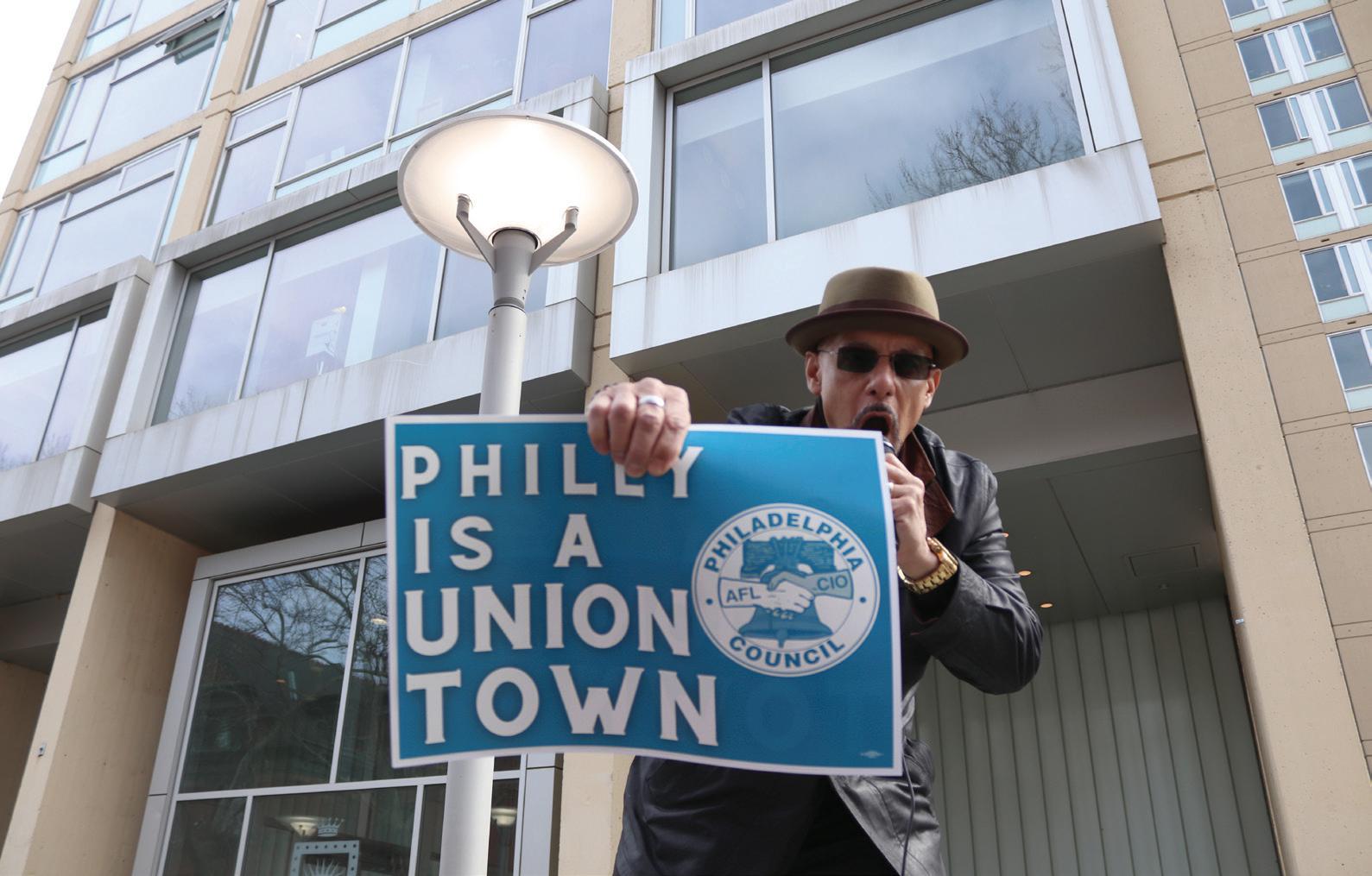
Let’s keep Philadelphia unions strong IN
since the pandemic. Drivers report being verbally attacked, spit on, and physically assaulted. This comes with a string of gun violence incidents on SEPTA buses, including the fatal shooting of bus operator Bernard Gribbin last October. Protected by nothing but a plastic sheet installed as a COVID-19 precaution, drivers are left vulnerable to both indirect and targeted violence. Our unwavering support should lie with these workers as they request both essential safety precautions, such as bulletproof glass and higher wages corresponding to the ever-increasing cost of living. SEPTA bus operators make an average salary of $30,000 a year, lying right on the Philadelphia poverty line for a family of four. Thanks to
the slashing of Pennsylvania Gov. Josh Shapiro’s proposed SEPTA budget by state legislators, the company claims it cannot afford to pay workers more. For the same reason, talks of raising SEPTA fares are heating up, and it’s likely that we’ll soon be spending more than $2 each way on our daily commutes.
This potential strike has been looming over the city for over a week, threatening the service of routes like the Market-Frankford Line that connect West Philadelphia to Center City. Updates on the SEPTA website and emails from the Netter Center for Community Partnerships have made us aware of the ramifications a strike could have on our day-today lives, especially for those commuting to work and school on public transit. Relief swept the city last Friday when it was announced that negotiations would continue, preventing the much-anticipated shutdown of our transit system.
While it is promising that talks between SEPTA and Local 234 have been productive enough to warrant extra negotiation days, there is no guarantee of progress. Reports claim that SEPTA has yet to budge on a wage increase for employees. If they continue to hold back, employees are well within their legal rights to walk out in protest.
Historically, though, this wasn’t always the case. Local 234’s ongoing negotiation process pays homage to a strong tradition of labor organizing in Philadelphia, much of which was considered illegal. In fact, the first labor union in the nation was born in this city in 1794, bringing together bootmakers looking to protect their wages. In the ensuing Philadelphia Cordwainers Trial of 1806, the unlawful status of labor unions was upheld in the name of removing constraints to industrialization. In other words, the city decided that protecting workers was bad for overall business. Brutal labor exploitation simply made the most sense for economic productivity. Considering this history is essential in our
is jlakis@sas.upenn.edu.
response to today’s labor movement. While it is easy to be frustrated by this potential interruption — anyone with somewhere to be and parents who don’t pay for their Ubers would be — it is integral that we recognize the strike as an intentionally disruptive and long-fought-for action. Along with the first union, Philadelphia was also home to the first general strike in the country, resulting in widespread victories for workers across the city. The mass effect of a SEPTA strike will hopefully be the push the city needs to invest in public service workers and, with them, all Philadelphians.
The struggles of union workers and the city’s general population are forever intertwined. Firstly, 32.5% of union members are public service workers, meaning our society runs on their labor. The health and safety of the people who power our communities should absolutely be a top priority. In addition to that, organizations such as the Economic Policy Institute highlight the overall economic benefits of unions, including increased government revenue, reductions in wage inequality, and increased civic engagement. It will never be just union workers in this fight together. It is all of us who depend on someone else to sign our checks. When it comes to fighting corporations, collective action and solidarity are our only hope to make sure workers are getting what they deserve. Unions remind us that the power truly does lie in the hands of the people, without whom businesses would not survive. We must refuse to settle for a society that views its workers as cogs in a machine rather than individuals. Meeting the demands of Local 234 is an essential step in honoring the roots of labor activism in Philadelphia and pushing toward a future of economic justice.
INGRID HOLMQUIST is a College sophomore studying urban studies from Silver Spring, Md. Her email address is ingridhh@sas.upenn.edu.
NATHANIEL BABITTS | SENIOR PHOTOGRAPHER
Columnist Alyma Karbownik compares her expectations of the college academic experience with her experiences in the classroom.
SANJANA JUVVADI | STAFF PHOTOGRAPHER
Columnist Jack Lakis calls on Penn to remove the barricades on College Green.
ALYMA KARBOWNIK is a College first year from Maplewood, N.J. Her email is alymak@ sas.upenn.edu.
JACK LAKIS is a College sophomore studying political science and communication from Kennesaw, Ga. His email
ABHIRAM JUVVADI | PHOTO EDITOR
Columnist Ingrid Holmquist comments on the role labor unions play in Philadelphia.
Her resignation came days after her performance at a multi-hour United States House Committee on Education and the Workforce hearing. Minutes after Magill resigned, then-University Board of Trustees Chair Scott Bok announced that he, too, was stepping down from his position.
Bok declined the DP’s request for comment.
At the hearing, Magill was asked by Rep. Elise Stefanik (R-N.Y.) whether calls for the genocide of Jewish people violate Penn’s code of conduct. Her response described the question as a “context-dependent decision.” These comments sparked national scrutiny and increased calls for her resignation.
At the time, The Wall Street Journal reported that the Board of Trustees remained supportive of Magill at a virtual meeting two days after her testimony. A source close to Magill and Bok confirmed to the DP that the board was largely supportive of Magill during the virtual meeting and that both parties decided to resign independently of the board.
Magill’s resignation was the culmination of a tumultuous fall 2023 semester: Numerous alumni and donors pulled funding due to her handling of the controversy surrounding the Palestine Writes Literature Festival and acts of antisemitism on campus. Dozens of faculty members also expressed “deep concern” for Magill’s failure to discern between Palestinian culture and antisemitism in her statements to the Penn community.
Reflections one year later
A recent DP survey of over 900 Penn undergraduates revealed that a majority of students perceive Magill’s resignation as having no significant effect or a somewhat negative effect on Penn.
“I would say her handling of the Palestine Literature Festival was as much as she could have done as president,” Engineering senior and Penn Muslim Students’ Association Marketing and Engagement Chair Abir Hossain told the DP in a recent interview.
He said that while he agrees with Magill’s decision to resign, it’s “not because of what she said,” but rather, “because she lost the confidence of the people around her.”
“If the Board of Trustees no longer has confidence in you to run an organization, it’s gonna make running the organization a lot more difficult,” he said. “It kind of feels like she kind of didn’t have a choice.”
Wharton senior Ryan Ghose said that Magill’s resignation allowed Penn to move past turmoil that occurred on campus following the Oct. 7, 2023 Hamas attacks on Israel.
“The resignation was a necessary part of Penn being able to shed a lot of the negativity from last year,” he told the DP, describing the transition as a “reset” that allowed the University to reimagine its institutional image.
He added that after the soundbites from Magill’s testimony went viral, “it was clear that any good faith effort to understand or critique the University’s handling of actions after Oct. 7 wasn’t going to be fairly judged.” 1980 College graduate and Harvard Law School professor Michael Klarman — who was also a colleague of Magill’s at the University of Virginia School of Law
— wrote in a statement to the DP that the Board of Trustees treated Magill “horribly” prior to her resignation.
“Unlike the boards at Harvard and Massachusetts Institute of Technology, which stood behind their presidents, the Penn board quickly caved to pressure from the McCarthyite inquisition and abandoned Liz,” he wrote.
“I imagine the failure of the board to show even a modicum of support for a beleaguered president will affect the pool of candidates interested in becoming president of Penn.”
Graduate School of Education professor Julie Wollman — who has served as a president, provost, dean, and faculty member across various public and private higher education institutions — also believes that an overall lack of support from the Penn community ultimately led to Magill’s resignation.
“I think nobody was happy with her leadership, honestly,” Wollman said. “I do think that she wasn’t able to find the right balance and to find her own voice and what she believed. I think she was feeling like ‘I have to say this, I have to say that.’”
1992 Wharton graduate and Wharton Board of Advisors member Jacqueline Reses affirmed Wollman’s perspective, telling the DP that she was “appalled” by Magill’s Congressional testimony and felt she “lacked moral clarity.”
Reses applauded Magill’s decision to resign, describing it as a “very professional approach” that “spared Penn the embarrassment that Harvard suffered.”
Reses was one of the many alumni and donors to pause her donations to the University amid last year’s national controversy. Despite the leadership change, she told the DP that she wants to “understand what the University wants to become” before resuming contributions.
Klarman, who said he “knows of no finer and wiser person in academia” than Magill, said that Penn’s treatment of her has led him to cease any future donations to the University.
“Universities are one of our nation’s strongest bulwarks against rising authoritarian forces in society,” he wrote. “It is a tragedy when those institutions manifest anticipatory capitulation to such forces,” he wrote.
In a recent interview with the DP, Jameson said that his approach to the question would’ve been different from Magill’s. He pointed to his training as a physician, explaining that his response to Stefanik’s question would have been based more on empathy and less “on strict policy.”
Jameson also said that “any call for genocide directed at anyone in our community, no matter what their ethnicity or religious affiliation, would violate our policies.”
At a panel on “Institutional Speech & Administrative Challenges” hosted by the University of North Carolina on Nov. 15 — Magill’s first publicly advertised event since her resignation — she addressed the viral moment publicly for the first time.
“I am empathetic and could definitely understand and have stepped in the shoes of someone who hears something like that on our campus,” Magill said at the panel.
“It was a mistake not to do that, and I don’t think that’s who I am.”
Student and faculty experience on campus since resignation
Wharton and Engineering senior Noah Rubin wrote to the DP that it is “insane that antisemitic university
faculty continue to avoid consequences for their actions” in the year since Magill’s resignation.
“The culture of normalized antisemitism must end, and there must be a single standard applied to all members of the community,” he added.
Rubin compared the sanctions against University of Pennsylvania Carey Law School professor Amy Wax, which sparked both support and warnings of threats to free speech from Penn community members, to the University’s treatment of Annenberg School for Communication lecturer Dwayne Booth — who publishes political cartoons under the pen name Mr. Fish — faced backlash, including a condemnation by Jameson, for his illustrations last academic year.
“NON-tenured lecturers who push blood libel, Holocaust revisionism, and perpetuate antisemitism, such as Dwayne Booth, continue to teach and have no consequences,” Rubin wrote.
In a statement to the DP, Booth wrote that “any attempt to brand [his] work … as a political cartoonist … outside of [his] duties and responsibilities as a professor as being antisemitic is nothing more than a targeted effort to silence criticism of Israel’s actions in Gaza while having absolutely nothing to do with [his] teaching.”
Hossain told the DP that in the past year, he has also seen greater administrative concern with student groups organizing on campus.
For example, Hossain said that while organizing MSA’s annual conference, the club had to notify the University of details much earlier in advance than in previous years.
“Sometimes it feels like they’re taking a closer look compared to some other clubs,” he said. “I understand why they would, but at the same time doesn’t make it feel any less hurtful. Just because we’re Muslim doesn’t necessarily mean we need to be under a bigger magnifying glass.”
In a followup email, Ghose wrote that he “would like the administration to take a more active stance in promoting academic discussion.”
“I feel that any administrative response to student advocacy regarding the Middle Eastern crisis is always reactionary,” he added. “I rarely feel that space is proactively created for students to hear others’ stories or understand why others feel the way they do.”
When asked whether he believes he would have faced similar backlash to his political cartoons had Magill not resigned, Booth wrote that “there’s no way to know.”
“I only wish the university leadership better understood the chilling effect of maintaining steel barriers all over campus,” he wrote.
Graduate School of Education professor Jonathan Zimmerman said that he was “deeply concerned” about the temporary Guidelines on Open Expression that Jameson introduced this summer.
The temporary standards contain updated guidance on “when, where, and how open expression can take place.” The University also announced the formation of a task force to review the existing open expression policies.
The Executive Committee of Penn’s Chapter of the American Association of University Professors condemned the temporary standards in a Oct. 30 statement, alleging the University failed to uphold academic freedom.
The statement characterizes the policies as an “attempt by the central administration to strip faculty, staff,
and students” of rights “necessary to education and to democracy itself.”
AAUP-Penn did not respond to a request for comment.
Contrasting visions for Penn
On Dec. 12, 2023, Penn’s Board of Trustees appointed Larry Jameson — then the executive vice president of the University of Pennsylvania the Health System and dean of the Perelman School of Medicine — as the University’s interim president. In June, current University Board of Trustees Chair Ramanan Raghavendran announced that Jameson will remain in the role through the 2026 academic year.
Since Jameson assumed the presidency, some community members feel there have been improvements and more attention to students’ needs, while others explained that the different contexts of their presidencies makes comparison difficult.
“We’ve been seeing that some parts of the administration are paying a lot more mind to us and the needs of our community,” Hossain said. “They can still tell that part of our community is not satisfied with how they were being treated.” Hossain added that he believes the administration feels “guilty” for not being able to support students but says that it does not always feel authentic. Wollman said that she believes Jameson might be “more comfortable in the role” of president than Magill was.
“I think President Jameson’s messages, right up front, were very much about caring and compassion and community and healing,” she said. “Coming from his medical background … I think he’s more comfortable talking with large groups of people.”
Wollman added that there has been a difference in how Jameson and Magill have approached communication with University constituents — including donors, faculty, staff, and trustees — but noted the “difficult” position Magill was in.
“President Magill was under lots of pressure to take a certain side … and part of it was just pressure from donors in particular,” she said. “President Jameson’s messaging when he started was much more, ‘We’re a community, I care about this community.’”
Chair of the Faculty Senate and Penn Carey Law professor Eric Feldman also noted the differences in Penn’s campus climate this year and last, writing in a statement to the DP that Magill and Jameson “found themselves at the helm of the [Penn] under very different circumstances.”
“Every leader has their own style of leadership, and that style is often the product of one’s personal disposition as well as one’s training,” he wrote. “President Magill was trained in law, Interim President Jameson in medicine, and those fields have different approaches to how to ask and answer questions, how to approach conflict, and how to weigh evidence.”
Feldman added that these circumstances have changed the Faculty Senate’s priorities this year compared to last. He wrote that the Senate previously focused on “threats to academic freedom and open expression,” while this year they have discussed the future of higher education.
He added that he believe challenges to higher education might “accelerate under President Trump.”
shared governance.” He added that the University’s recent policies prevented Penn from fostering “intellectual exchange” and “actual learning.”
“It’s really a dire situation right now,” Kazanjian said. “I’m not always clear on whether the administration understands the desperate mood among faculty who are completely marginalized from substantive decisions — increasingly so — in such a way that our academic freedom is impinged upon.”
Küçük claimed that the weakening of shared governance has been more dramatic during Interim Penn President Larry Jameson’s tenure than that of former Penn President Liz Magill.
He said he observed faculty as uninterested in joining committees within the Faculty Senate or University commissions because they felt it was “just a waste of time.”
From Hillier’s point of view, cultural and structural divides among Penn’s four undergraduate colleges and 12 graduate schools contributed to the weakening of shared governance. The events of the past year, Hillier noted, have caused faculty to “retreat” into their individual teaching and research.
The path forward Kazanjian said that AAUP-Penn has a vision for a “thorough redesign of shared governance”
that offers Penn community stakeholders “real democratic power” in decisions around University policies, budgeting, and determining working conditions. While Kazanjian said that his characterization of shared governance at Penn was not unique to Jameson’s administration, he said the interim president has “certainly taken advantage of the structural lack of shared governance.” Vaughan, however — despite his criticisms — conceded that the current administration did not seem “necessarily averse” to shared governance, citing Jameson’s own background as a faculty member.
Vaughan and Küçük encouraged the University to codify shared governance in writing,
while Hillier, Graduate School of Education professor Julie Wollman, and Kazanjian said that non-tenure track professors should play a larger role in the existing systems.
Küçük emphasized the “pragmatic” appeal of strengthening shared governance at Penn in the face of threats to higher education posed by the second term of 1968 Wharton graduate, former President, and President-elect Donald Trump.
“We are entering a difficult stretch of time for higher education in general. I would imagine administrators and the board members would like to have faculty on their side,” Küçük said. “If this crisis moment is something that we’re going to weather as a community, there needs to be some give and take.”
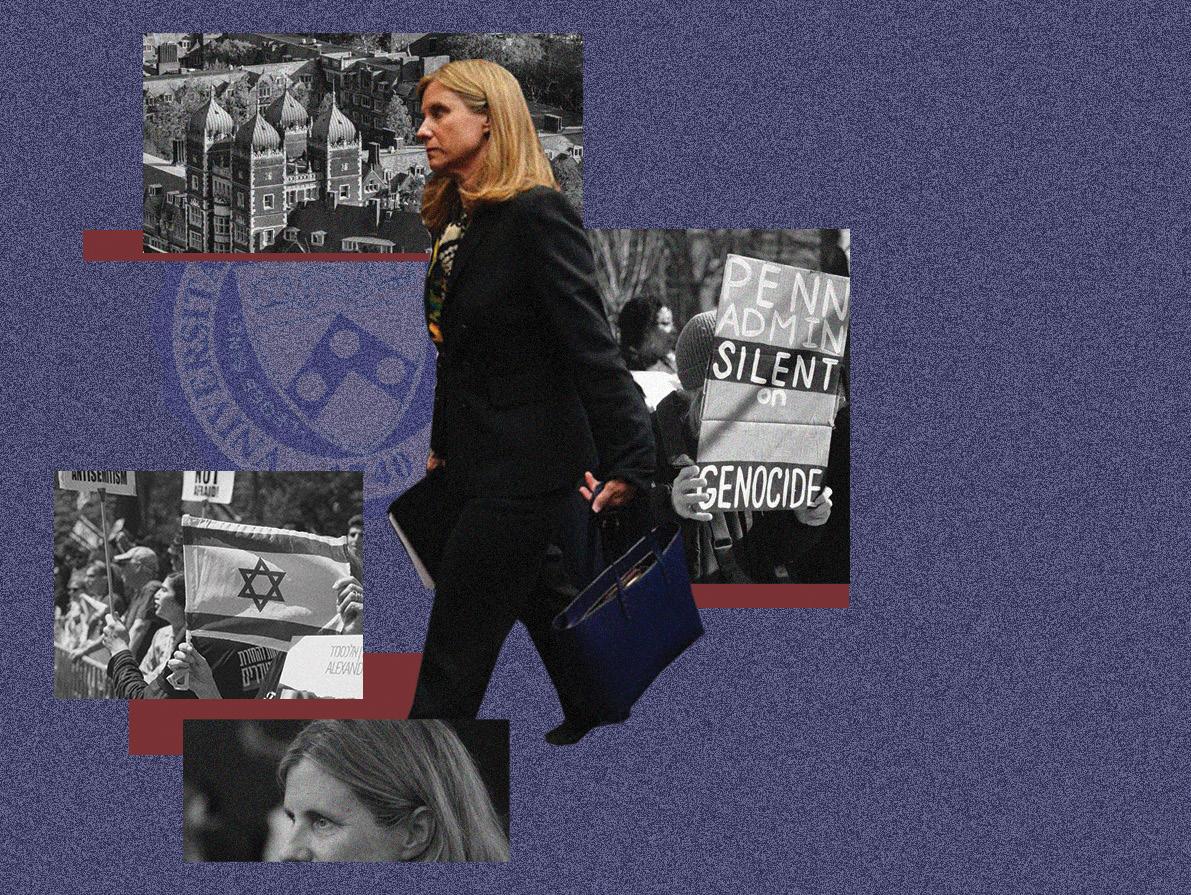
DESIGN BY EMMI WU
Football running back Malachi Hosley named Bushnell Cup finalist
The sophomore announced he would be entering the transfer portal following the Quakers’ nal game
During his time at Penn, sophomore running back Malachi Hosley made electric plays, smashed numerous records, and cemented his status as the “Touchdown Machine.” Hosley made history again as he was named a finalist
for the Offensive Player of the Year in the 2024 Bushnell Cup, alongside Cornell quarterback Jameson Wang and Harvard wide receiver Cooper Barkate. Hosley received the honor thanks to his
nine touchdowns and 1,192 rushing yards this season. Averaging 119.2 rushing yards per game, Hosley ranked No. 4 in the FCS and was the 11th player in the history of Ivy League play to surpass 100 rushing yards per game in a season.
Hosley’s reception of the award was preceded by his sudden announcement to enter the transfer portal. The Quakers held a 2-5 record in Ivy League play this season. Hosley made the decision hours after Penn’s season-ending 20-17 loss to Princeton. Hosley foreshadowed the decision before the game with a post to his Instagram story, calling the contest his “Last Dance.” Hosley enters the portal with two years of collegiate eligibility remaining. Penn Athletics declined to comment on
behalf of coach Ray Priore, while Hosley could not be reached directly for comment at the time of publication. Despite being considered undersized at his position, his game is anything but. Known for his unique combination of speed, agility, and elusiveness, Hosley has been among the most productive members of the Quakers’ offense over the past two seasons.
In his first season, Hosley racked up 723 yards on the ground — good for second in the Ivy League — off of 121 carries along with seven rushing touchdowns en route to one of the most dominant rookie campaigns in program history. Hosley broke the 100-yard mark in three of the 10 games he featured in as a rookie, collecting five Ivy League Rookie of the Week awards, smashing former wide receiver Justin Watson’s record for career weekly awards. The highlight of the season came in his 261yard performance against Cornell on Nov. 4, 2023, which is the third most in a single game in program history and the most in a single game for a freshman. His second touchdown of the game was a 96-yard rip, which broke a centurylong record for the longest offensive play in program history. The performance earned him FedEx Ground FCS Freshman of the Week honors.
Hosley’s performances as a rookie earned him Ivy League Rookie of the Year honors — Penn’s first since wide receiver Miles Macik in 1993. Hosley was also the only rookie to make an appearance on the first team All-Ivy list. He was also one of 22 players recognized as a Jerry Rice Award Finalist for FCS Freshman of the Year. This season, Hosley picked up right where he left off in 2023, establishing himself as the Ancient Eight’s most dominant force on the ground. After posting 176 rushing yards in Penn’s
One
last dance: Senior wrestler Nick Incontrera wants to be an NCAA champion
The senior started the season off with his rst Journeyman Classic title
ANTONIO MELONI Sports Associate
Penn Men’s Wrestling senior Nick Incontrera has picked up this season right where he left off: at the height of his wrestling prowess.
The senior currently sits as the No. 7 best wrestler in the 174-pound weight class for NCAA Division I wrestling according to FloWrestling. Entering the season as the No.9 ranked wrestler in his weight class, Incontrera has lived up to the hype with two standout performances.
In his junior year, Incontrera solidified himself as an elite wrestler on the biggest stage in college wrestling. Incontrera advanced to the second day of the NCAA Championships and would be the only Penn wrestler to earn a win that deep into the tournament. In Kansas City, Missouri, Incontrera would earn two victories, one of which was over Big Ten opponent Andrew Sparks of Minnesota.
Wrestling has been a key part of Incontrera’s life from a young age.
“When I was around five, my dad took me to a local high school wrestling match,” Incontrera said. “I watched the local wrestling team run out on the mat, warm up, and compete. I was having so much fun watching and was like, hey, I want to do that. I started and never stopped since then.”
Incontrera excelled on the mat during high school. An alumnus of Blair Academy, a New Jersey boarding school with a nationally respected wrestling program, Incontrera leveraged his competitive environment and grew alongside his teammates. There, Incontrera made a name for himself. He was ranked No. 15 nationally in the 152-pound division by FloWrestling as a senior, earned the 2019 National Prep Champion title, and was a member of multiple top-ranked teams.
The Blair-Penn connection is nothing new. Two of Incontrera’s current Red and Blue teammates, senior Ryan Miller and freshman Paul Ognissanti, are fellow Blair Academy alumni as well as 2024 graduate Michael Collaiocco.
“Blair was probably the most similar experience to college I could have had,” Incontrera said. “I lived there on campus for four years and was part of a very close-knit wrestling community. We did everything together. It was really a Brotherhood."
Due to the pandemic, Incontrera’s freshman season was scrapped and no competitive matches were held. This gave the young wrestler an opportunity to reflect on his personal, academic, and athletic ambitions.
When it was announced that collegiate sports would be back for his sophomore year, Incontrera was ready to make his mark. That season, he posted a 17-6 overall record, a 7-2 record against EIWA competition, went 4-1 against Ivy opponents, was one of three wrestlers to start every match for Penn, qualified for the NCAA Championships for the first time, and ended the regular season ranked in the top 20 for his weight class by Wrestlestat and the NCAA Coaches’ Panel. Despite an early exit, he took a lot away from his NCAA Championship experience.
His junior year was nothing short of impressive. Incontrera placed sixth at the EIWAs,
again going 7-2 at the competition, and earned an at-large bid to the NCAA Championships for the second straight season. He also walked away with a second-team All-Ivy honor with a 4-1 record against Ivy rivals.
With wins against Harvard, Columbia, Brown, and Princeton for the second straight season, Incontrera solidified himself as a force to be reckoned with in the Ancient Eight. The most impressive were his performances when matched up with top-25 opponents, including his win over, No.12 Phil Conigliaro of Harvard, No.5 Mikey O’Malley of Drexel, and No.20 Ben Pasiuk of Army. The season culminated with Incontrera leading the way for the Quakers at the NCAA Championships, which earned him some national recognition and foreshadowed a strong senior campaign.
At the Journeymen Classic in early November, Incontrera lit up the mat. The senior won the 174A bracket and took home the hammer award. The highlight of the meet was Incontrera’s matchup with Cornell’s Simon Ruiz. Ruiz, ranked No.12 nationally in his weight class at the time. Incontrera defeated Ruiz in a 6-2 decision to win his first Journeymen Title. The win would also earn Incontrera an Ivy League Wrestler of the Week award.
“Winning was a testament to our training,” Incontrera said. “Credit to the guys in that bracket. They were very tough and it was awesome to have a high-level competition. I always enjoy competing against Ivy League opponents. Cornell is a great team and competing against them every year pushes us to be better.”
In the second contest of the season, Penn Wrestling fell to Northern Colorado at the Palestra. Despite this, Incontrera shined individually, dominating his opponent 15-0 and securing the only shutout on the day. His win over Aydin Rix-McElhinney marks Incontrera’s first dual victory this campaign.
After missing the Keystone Classic due to illness, Incontrera is looking to get right back into his strong run of form with the Midlands Championship on the horizon. It’s difficult not to lose sight of upcoming matches while anticipating this year’s national championship tournament, but Incontrera is staying focused.
“The NCAAs are the pinnacle of college wrestling,” Incontrera said. “Any young kid into wrestling wants to win at the NCAAs… It’s a long season, but having a mindset of focusing on what’s in front of us has been important.” This year’s NCAA Championships will be held at the Wells Fargo Center in Philadelphia from March 20-22, 2025. The Penn team is looking forward to representing the city on the biggest stage of college wrestling this spring. Before then, however, Incontrera and the Penn team will battle it out with the rest of the Ancient Eight at the inaugural Ivy League post-season wrestling tournament. The Red and Blue’s year has only just begun and the senior is looking to make the most of his last dance.
“This is my last year and I’ve had a lifetime goal of becoming an NCAA Champion,” Incontrera said. “There would be no better way to finish out my career here than winning at the Wells Fargo Center."
WEINING DING | SENIOR PHOTOGRAPHER
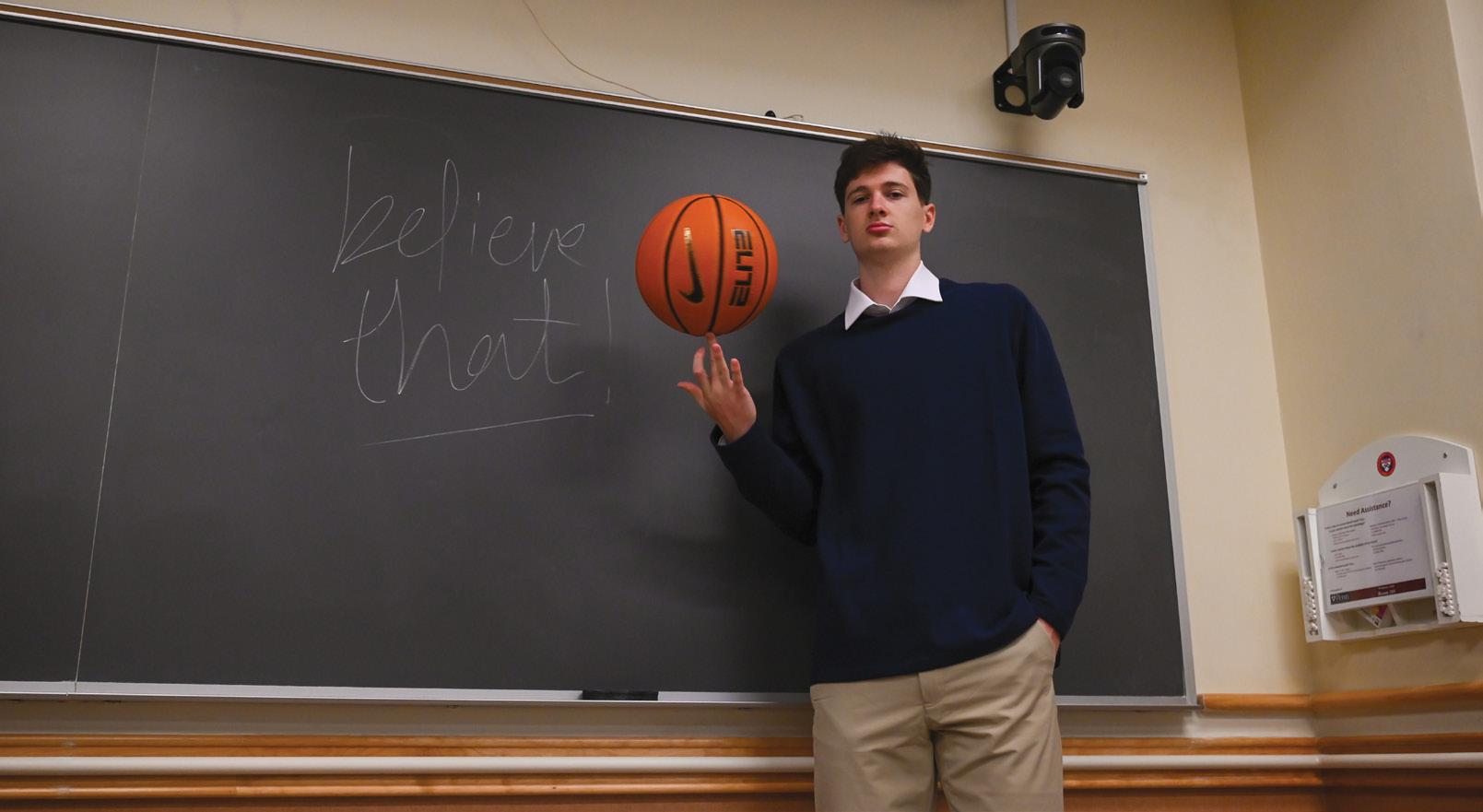
Sophomore running back Malachi Hosley recently announced he will be entering the transfer portal following the 2024 Penn football season.
WEINING DING | SENIOR PHOTOGRAPHER
Now-senior wrestler Nick Incontrera poses at The Palestra on April 5
Senior cross country runner Dylan Throop earns All-American honors at NCAA Championships
This marks the rst time that Throop has achieved such honors
VALERI GUEVARRA Sports Associate
Over the weekend, senior men's cross country runner Dylan Throop earned All-American honors through his 27th place finish in the 10K at the NCAA Cross Country Championships held in Madison, Wis.
The Edinboro, Pa. native finished in a personalbest time of 29:19.60 for his first career All-American honors, becoming the first Quaker since 2015 to achieve cross country All-American honors. November has been a big month for Throop. Last week, at the NCAA Mid-Atlantic Regional Championships, Throop rallied in the final 1200 meters to finish with a time of 29:41.3 to move up to third place, qualifying him for the NCAA Championships. Teammate and junior cross country runner Luke Johnson finished just behind him in sixth. Just a few weeks prior, Throop finished runner-up in programrecord-breaking fashion in the 8K at the Ivy League Heptagonal Cross Country Championships. Throop was second to Harvard’s Graham Blanks, who took home the national title this past weekend.
This season has been a big breakthrough on the cross country scene for Throop, who finished second at last year’s edition of the Ivy League Heptagonal Cross Country Championships but did not compete at NCAAs. The senior has many accolades on the indoor and outdoor tracks, including program records in the indoor 5K and outdoor 10K set in 2023. The senior notably did not compete in the 2024 indoor season and did not finish his only race of the 2024 outdoor season.
This past weekend Throop was also joined by Johnson, who crossed the finish line in 188th with a time 30:39.31. The two were the Red and Blue’s sole representatives for men’s and women’s cross country.
Distance running is notably not a single-season sport, and many distance runners will continue to compete in the upcoming indoor and outdoor track and field seasons. The Quakers open their indoor track season with the Penn Opener at the brand new Ott Center for Track and Field on Dec. 6-7.
Men’s basketball’s Ethan Roberts earns Ivy League Player of the Week honors
The
VIVIAN YAO Sports Editor
guard brought home the award after recording a team-high 76 points at
One year ago, Penn men’s basketball junior guard Ethan Roberts dreamed of stepping on the court again. Today, Roberts was recognized by the Ivy League as the conference’s Player of the Week.
“Last year, I wasn’t even able to run at this time,” Roberts said. “So I guess the award itself is more about perspective to me, leaving me more grateful … I’m just happy to be back out there.”
The honor comes after Roberts racked up a teamleading 76 points across the team’s three games this past weekend at the Cathedral Classic.
Roberts opened up tournament play with a 33-point performance in the Red and Blue’s loss to Navy on Friday. The 33 points were good for a new collegiate career high and was a sign of things to come ahead for the rest of the team’s games.
In the team’s win against Maine on Saturday, Roberts finished with 23 points along with 10 rebounds, four assists, and three steals. Through eight games, Roberts
has now tallied two double-double performances. To close out the weekend, Roberts put up 20 points and six rebounds in the team’s loss on Sunday to Elon.
For these performances, Roberts was also named to the All-Cathedral Classic team. The Ivy weekly honor is the first of the season for Roberts, who is no stranger to earning recognition after being named the Patriot League Rookie of the Year as a freshman at Army. Since then, Roberts’ career has been slightly derailed following an injury that sidelined him for his entire sophomore year at Drake University.
“I’m really just blessed, seeing what it’s like to have the game kind of taken away from you, and at the same time your health be at risk and just not feeling like yourself at all,” Roberts said. “It was probably the biggest low in my life I’ve ever been in. So that’s kind of what makes these little no rewards of scoring a lot … that’s what makes it sweet — just not giving up. It’s encouraging.”
Men’s fencing’s Bryce Louie captures silver at 2024 Tunis Foil World Cup
The senior is coming off a season where he was an NCAA Champion in the event
VIVIAN YAO Sports Editor
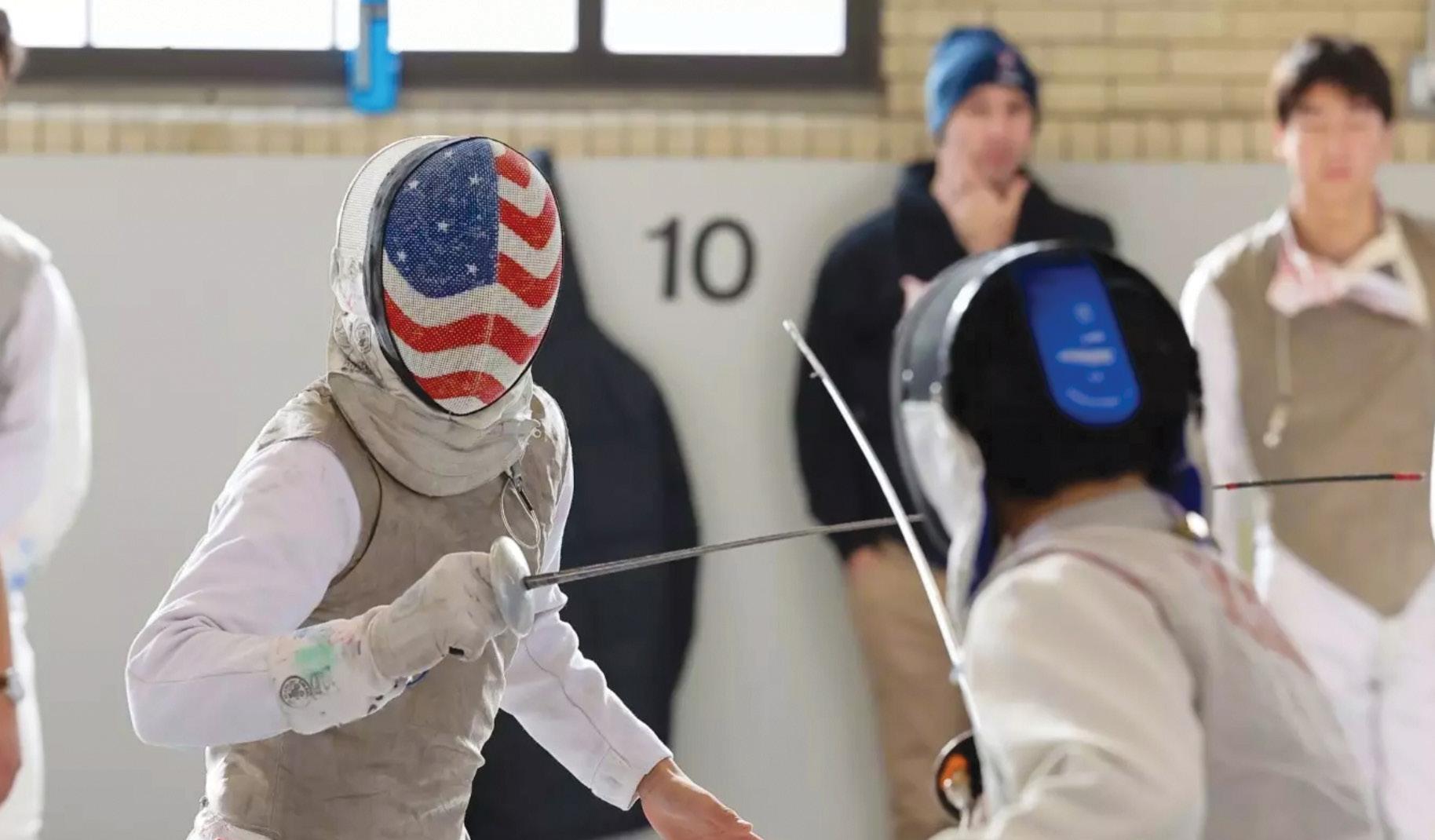
Senior fencer Bryce Louie won silver at the 2024 Tunis Foil World Cup.
While the award feels great, Roberts is less concerned about earning personal recognition. His focus is mainly on how he can contribute to the team and the team’s efforts toward becoming better with each game.
“I’m more high about the direction our team is going,” Roberts said. “I care more or less about our record. We have new guys, but we’re just showing flashes of resiliency and potential to be a really good team. So in terms of how I’m going to be playing the rest of the season … I’m just going to do what’s required to win.”
At the 2024 Tunis Foil World Cup, Penn men’s fencing senior foilist Bryce Louie represented the Red and Blue in addition to the Red, White, and Blue en route to a silver medal finish.
The International Fencing Federation-organized Women's and Men's Foil World Cup is the first senior foil event of the competition season and was held on Nov. 22-23 in Tunis, Tunisia.
In a field that consisted of around 220 fencers, the contestants first participated in a round of pool play. 33 pools were composed with 28 groups consisting of seven athletes, with the last five groups containing six athletes each. The results of pool play helped determine the bracket in which the individuals would compete in for the elimination rounds.
Louie — who claimed Penn’s first NCAA Foil National Championship since 1997 during the 2023-24 collegiate season — started off the competition strong. In his six bouts, Louie was able to win with five touches in four of them. At the end of pool play, Louie found himself ranked 42nd among the field. His positioning was good enough to earn himself a bye in the round of 256.
In the round of 128, Louie cruised past Hungary’s Andras Nemeth 15-4 before eking out a closer match against South Korea’s Kwanghyun Lee 15-11 in the round of 64 to ensure that his competition would continue into the second day. In the round of 32, Louie was able to barely edge out Japan’s Yudai Nagano 15-14 to advance to the round of 16. There, he secured his spot in the quarterfinals by taking down Italy’s Giulio Lombardi 15-9.
A 15-12 performance against Spain’s Carlos Llavador gave Louie a semifinals berth where he handled his business against Egypt’s Mohamed Hamza — a Princeton graduate who is a three-time Olympian and currently
Penn men’s basketball will return to the courts this upcoming Saturday at the Big 5 Classic, facing off against neighboring Drexel at the Wells Fargo Center to fight for fifth place at 2 p.m.
“It’s gonna be my first time,” Roberts said of the opportunity to play at the Wells Fargo Center — the home of the Philadelphia 76ers. “I’m so excited. I can’t wait to play there; it’s definitely gonna be an amazing experience. So I’m just looking forward to getting out and playing again.”
ranked third in the world in the event. Hamza is also the reigning World Cup champion after taking home gold in Acapulco, Mexico at last year’s competition.
Upsetting Hamza set Louie up for an all-United States final as fellow American Alexander Massialas also secured a spot. There, Louie ultimately faltered, falling to Massialas in a highly contested 15-11 bout. Despite the loss, Louie was able to secure himself a silver medal to open up this season’s senior foil event competition cycle on a high note.
Louie’s silver count at this year’s World Cup was doubled when he reached the podium yet again — this time as a member of the Team USA men’s foil team. The team consisted of Louie as well as individual gold medalist Massialas, Chase Emmer, and two-time Olympic bronze medalist and World Championship individual medalist Nick Itkin.
After receiving a bye in the round of 32, Team USA would cruise to a spot in the semifinals after taking down Belgium and Egypt with scores of 45-36 and 45-28, respectively. There, the team came head to head with Japan, which had recently won gold at the 2024
junior
the Cathedral Classic
WEINING DING | SENIOR PHOTOGRAPHER
Junior guard/forward Ethan Roberts poses with a basketball on Nov. 21.
PHOTO COURTESY OF PENN ATHLETICS
PHOTO COURTESY OF PENN ATHLETICS
Senior cross country runner Dylan Throop achieved All-American status.
Previewing the Big 5 Classic: Men’s basketball
The Quakers suffered blowout losses against St. Joe’s and Villanova, but are prepared for a different outcome in the second Big 5 Classic
NEEMA BADDAM AND VIVIAN YAO Sports Reporter and Sports Editor
Wake up, Philadelphia! It’s Big 5 Classic weekend.
On Saturday at 2 p.m., Penn men’s basketball (3-5) will face off against Drexel (5-4) at the Wells Fargo Center to battle for the fifth-place spot in the Big 5 Classic. The event will be played for the second straight year at the Wells Fargo Center, which is the home of the Philadelphia 76ers.
The matchup comes after both teams finished 0-2 in pod play, with Penn dropping games to Saint Joseph’s and Villanova — the latter of which was the Red and Blue’s biggest loss since 2009 — and the Dragons falling to La Salle and Temple. After struggling in the Cathedral Classic over Thanksgiving break, finishing the tournament with a 1-2 record, the Quakers have had a week to regroup before they play in their biggest game yet this season.
“Right now, our focus is just getting better every single game we play,” senior forward/center and team captain Nick Spinoso said. “We feel like we’re making strides, especially over this past weekend: We played three pretty good teams and obviously did not have the outcomes we wanted, but we definitely got better as a group.”
Spinoso added that the group is excited to be back at Wells Fargo and commented on the bittersweet nature of his second time playing in the NBA arena being most likely his last. When asked about his personal goals going forward, Spinoso only has one thing on his mind: winning.
“My goal is just to win every time we step on the court and to end up with an Ivy League championship,” Spinoso said. “We fell short of getting the Big 5 championship, which stinks, but we still get another game to play in the Big 5, which is great. The end goal is still what everything’s about: [getting] to March Madness with an Ivy League championship.”
Drexel was added to the Big 5 in 2023, making it the conference’s newest addition. This year’s Big 5 Classic is also the second edition of the event after the historic Philadelphia basketball association restructured Big 5 play for the 2023-24 season. Previously, the tournament took the form of a round-robin, but the system was replaced with two three-team pods that play two games against each other in pod play. Based off those records, the third place teams in each pod battle it out for fifth place while the second place teams duke it out for third place and the first place teams compete for the Big 5 championship title in a triple-header at Wells Fargo.
The Dragons are 5-4 right now, most recently suffering a tight loss to Bryant. The Quakers have gotten the better of Drexel in recent history, boasting a 7-4 record when playing at home and a 1-2 when playing away. In the last matchup between the two teams in 2022, Penn walked away with a 64-59 win record against the Dragons. Since then, the teams have changed quite a bit.
Junior guard/forward Ethan Roberts dropped 76 POINTS over three games during the Cathedral Classic.
Previewing the Big 5 Classic: Women’s basketball
The Quakers will take on La Salle in the inaugural Big 5 Women’s Classic
KRISTEL RAMBAUD Sports Reporter
History will be written on Friday when Penn women’s basketball takes the court in the inaugural Big 5 Women’s Classic. Penn (6-3) will face off against La Salle (5-4, 1-0 Atlantic 10). Both teams went 0-2 in their respective pods, meaning that they will compete to finish as the fifth-place team in the Finneran Pavilion of Villanova.
Most notably for the Quakers is the loss of former guard Jordan Dingle who entered the transfer portal after that season and led the team in that game with 21 points. However, the changes aren’t just onesided as the Dragons will also be introducing a new selection of players in its own starting lineup.
“They got a few new guys,” junior guard/forward Ethan Roberts — who transferred to Penn over the summer — said. “They’re definitely a respected team and a good one, and it’s gonna be a great matchup for us, so we’re all really excited for it.”
Despite the early season struggles, certain Quakers have recently found their stride. Even with the two losses this weekend, Roberts put up 76 points across the three games to pace the group, including a 33-point career high in a loss to Navy and a double-double in the team’s win over Maine.
For these performances, Roberts became the first Quaker this season to bring home an Ivy League weekly honor, winning Player of the Week. The award comes a year after an injury left him unable to walk during his time at Drake. But for Roberts, the focus is not on himself and his recognition, but on the team and how it can progress moving forward into the rest of the season.
Senior guard Stina Almqvist currently leads the Quakers in scoring with 18.9 POINTS PER GAME
“They always have a good atmosphere, so it’s going to be exciting, but obviously since this is a neutral floor, and … it’s not [La Salle]’s home court, it’s going to be different,” senior guard and captain Stina Almqvist said. “It’s going to be exciting for them to not have the home advantage, and we’re going to be able to use that atmosphere.” For Penn, its two previous Big 5 losses to Saint Joseph’s and Villanova were part of a three-game losing streak that it snapped with a record-breaking 114-39 victory over Immaculata. The Quakers continued to build momentum over the Thanksgiving break. They flew down to Florida to play in the Florida Gulf Coast Univeristy Homewood Suites Tournament where the Red and Blue picked up two wins over Chattanooga and Cal Baptist. “It’s so important to have momentum and we did. Even the games in Florida were really close and then we got away at the end,” Almqvist said. “It’s huge for us, for everyone’s confidence, and our way of playing together has been huge, so I’m excited to see if we can keep that going into the game on Friday.”
Multiple players found a rhythm during that three-game stretch, including sophomore guard Mataya Gayle. She averaged 16.7 points per game across the stretch and continued to add to the stats sheet. She is currently second in scoring on the team and first in total assists and steals. Gayle shares the steals category alongside rookie forward Katie Collins, who has already racked up three Ivy League Rookie of the Week honors. Collins and the rest of the rookie class, including recent starting guard Sarah Miller, will be among the new faces in the newest edition of Penn versus La Salle.
“The mentality is we’re just continuing to improve and trying not to worry about too many outside things, like a record or anything like that,” Roberts said. “It really doesn’t tell how good you are. All that matters is when you go to a conference, you’ve got the best team.”
While the teams played last year, the matchup will look different personnel-wise. La Salle has five freshmen and eight transfers, totaling 13 new Explorers. Three of the team’s five starters — guard Ashleigh Connor, guard Ayisse Magassa, and forward Mackenzie Daleba — are transfers. The starting lineup is rounded out by rookie guard Joann Quinn and guard Aryss Macktoon, who was out all but four games with injuries last season.
“It’s pretty much a whole new team that we’re facing, so it’s going to be different, but their style of play is probably going to be pretty similar to how they do things,” Almqvist said.
Meanwhile, Penn returns with three of its four top scorers from its victory last season: Almqvist, Gayle, and senior guard Lizzy Groetsch. Almqvist, who scored 24 points in the win, has been an offensive centerpiece for Penn. She leads the team with 18.9 points per game, which makes her the 39th leading scorer across all Division-I conference players.
The Explorers do not have a breakout scorer the way the Quakers have Almqvist. Their top two leading scorers are guards Connor and Macktoon, but they are only averaging 11.7 and 10.8 points per game respectively.
But La Salle also was neck-and-neck in its game against Temple, who is playing for the firstplace title against Villanova. With two minutes to go in that game, La Salle led 64-62. A threepointer shifted the momentum in favor of Temple, and La Salle fell 73-68. While it didn’t land in the win column, La Salle proved it could hang with Philadelphia’s best.
And just like Penn, La Salle’s momentum has been building too. The Explorers have gone 4-1 in the past two weeks, including taking home their first conference win against Loyola University Chicago.
It’s not just season momentum at stake — it’s city pride.
The women’s side of Big 5 ball has been played since the 1980s and has been engraved in both programs’ histories. This Classic marks a new era for the citywide rivalry — the first installment in the progressing history of Philadelphia basketball.
“At the end of the day,” Almqvist said, “I think it’s going to come down to the effort level of the team — who’s going to want it the most.”