Penn announces it no longer holds direct investments in fossil fuel companies
JARED MITOVICH Senior Reporter
society will still have to consume fossil fuels.”
Penn clarified that it no longer holds any direct investments in fossil fuel companies, going further than previous announcements about its fossil fuel holdings.
In a written statement published Tuesday, Penn President Liz Magill and Board of Trustees Chair Scott Bok wrote that the University does not hold in vestments in 200 companies whose reserves contain the largest amount of potential carbon emissions. The administrators acknowledged the current argu ments being made against fossil fuels in university endowments.
However, Magill and Bok wrote that policy deci sions are made “complex” by the significant role that fossil fuels still play in the global economy.
“We must move away from fossil fuels, but we can only do so completely once we can produce abun dant, affordable, and secure energy from carbon-free sources,” Magill and Bok wrote. “Even as we are moving down the path toward our collective goal,
In response to a request for comment, Penn spokesperson Ron Ozio wrote that there was no in formation he wanted to add to the statement.
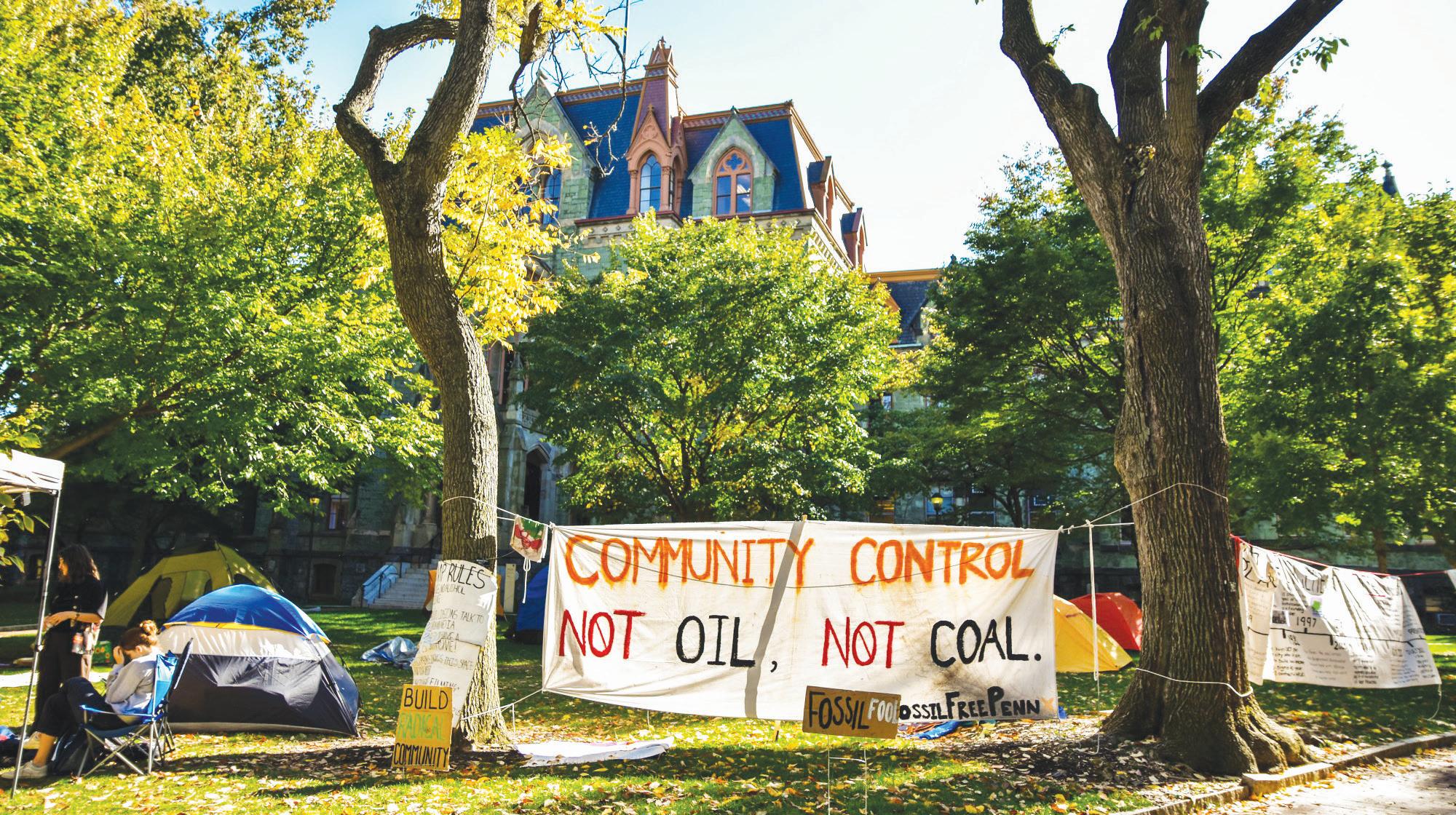
The message appears to address parts of the demand raised in a renewed campaign by Fossil Free Penn this semester that Penn divest from fossil fuels. Most recently, FFP stormed Penn’s Homecoming football field on Oct. 22 during the game’s halftime, leading to 19 arrests.
The disruption marked the last event of the group’s 39-day encampment on College Green, which sought to bring attention to the group’s three demands — which included total fossil fuel divest ment. This demand had three components: that the University end new investments in the fossil fuel in dustry, remove direct and commingled holdings in the top 200 fossil fuel companies within five years, and reinvest a portion of the extricated funds into clean energy assets.
Penn Med develops multivalent flu vaccine using mRNA technology
The vaccine draws on the mRNA technology used in Pfizer and Moderna’s SARSCoV-2 vaccines
STEPHANIE CHEN Staff Reporter
Penn Medicine researchers have developed a flu vaccine that can protect against all 20 subtypes of flu using the same mRNA technology pioneered at Penn to create Pfizer and Moderna’s COVID-19 vaccines.
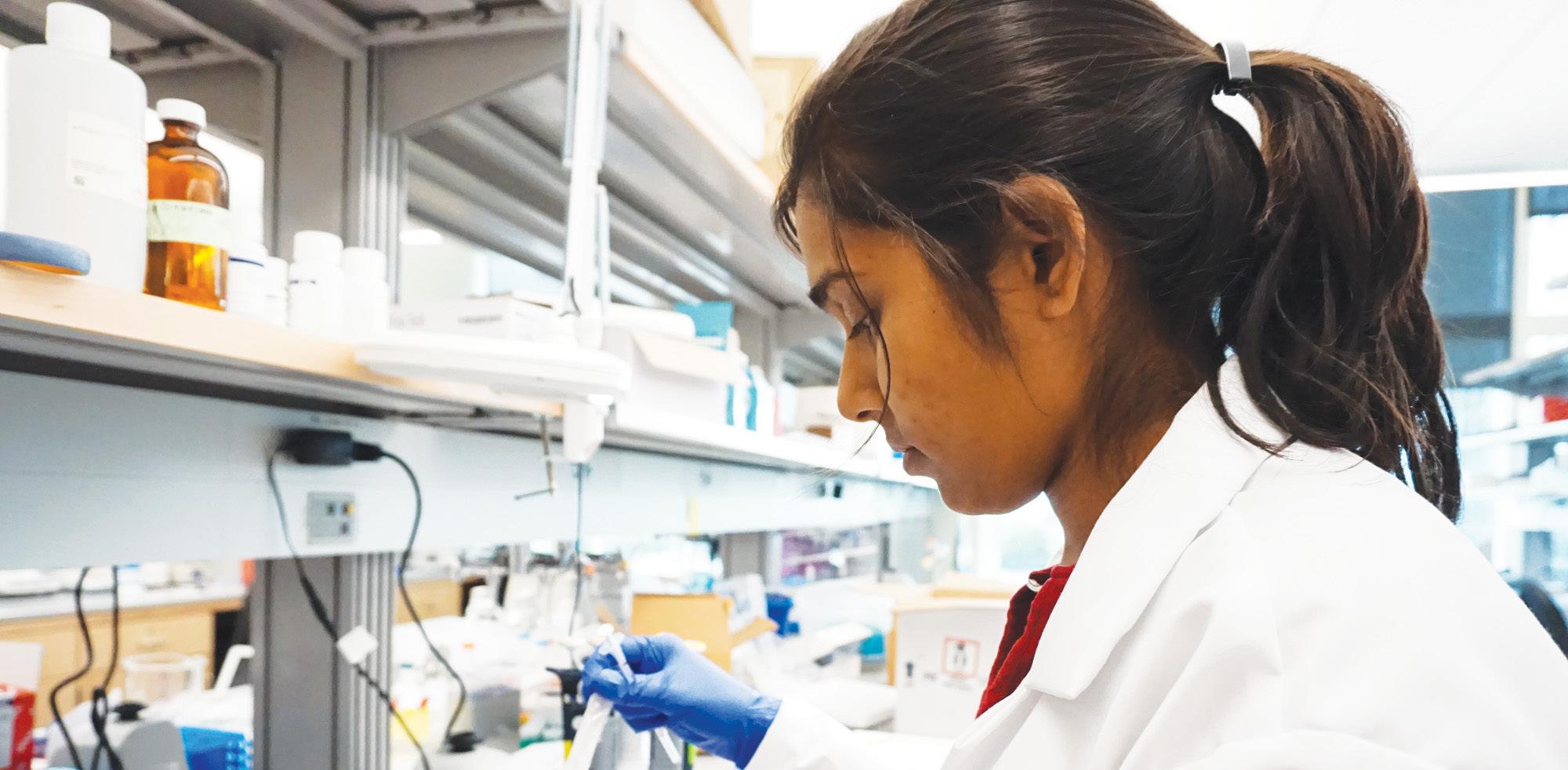
Influenza activity in Pennsylvania has been higher this season compared to the last five flu seasons, ac cording to the Pennsylvania Department of Health. Current flu vaccines are seasonal vaccines, meaning they only protect against recently circulating strains, but Penn Medicine researchers have developed a new multivalent flu vaccine that can protect against future strains, according to Penn Medicine News.
“The idea here is to have a vaccine that will give people a baseline level of immune memory to di verse flu strains, so that there will be far less disease and death when the next flu pandemic occurs,” Scott Hensley, a professor at the Perelman School of Medi cine and the study’s primary author, said.
Hensley’s lab collaborated on the study with the lab of Penn professor Drew Weissman, who pio neered the breakthrough mRNA technology used to make Pfizer’s and Moderna’s COVID-19 vaccines.
Researchers used this same technology to create the new flu vaccine, which can encode certain antigens from all known influenza virus subtypes.
The mRNA-based vaccine is not expected to completely prevent viral infections, but it will elicit a memory immune response that can be quickly re called and adapted to new pandemic-causing viral strains.
“For a conventional vaccine, immunizing against all these subtypes would be a major challenge, but with mRNA technology, it’s relatively easy,” Hens ley said.
The experimental vaccine yielded effective results in mice studies, eliciting high levels of antibodies and reacting to all 20 flu subtypes. Prior influenza exposure also did not lower the antibody response. Hensley and his colleagues are now designing human clinical trials to test this new multivalent flu vaccine.
“We think this vaccine could significantly reduce the chances of ever getting a severe flu infection,” Hensley said.
In a written statement to The Daily Pennsylva nian, FFP coordinators College junior Jae Hargest and College sophomore Eug Xu said that Penn’s claim that having net-zero carbon emissions in its endowment and ending direct, but not indirect, fossil fuel investments constitutes divestment “is false.”
“While both of these policies sound nice on paper, they fail to encapsulate the majority of Penn’s invest ments in fossil fuels,” Hargest and Xu wrote.
They went on to reiterate their belief that Penn should divest from indirect holdings as well in order for the University to stop “‘punishing the world’s most economically vulnerable,’ as they state them selves.”
“[The University’s] power comes from Penn’s status as a prestigious institution, one which boasts the world’s best business school, and making a po litical statement is its most powerful way to signal
Some Penn students eligible for part of $4.5 million proposed settlement to COVID-19 lawsuit
The plaintiffs alleged that Penn “breached a contract” when it transitioned to remote learning during the COVID-19 pandemic
SIERRA WEI Staff Reporter
A class action lawsuit against Penn seeking a refund for the switch to remote learning reached a proposed settle ment of $4.5 million.
On Nov. 3, plaintiffs Asha Smith and Emma Nedley — former Penn students — and the University announced a proposed settlement in response to the lawsuit, which was filed on April 30, 2020 in the United States District Court for the Eastern District of Pennsylvania. The plaintiffs al leged that Penn “breached a contract” when it transitioned to remote learning during the COVID-19 pandemic, de manding a refund for a portion of their tuition and fees for the spring 2020 semester.
According to the settlement notice, Penn previously denied all allegations of wrongdoing and there has been no finding of liability in court. However, citing interest in finding a swift resolution to the issue, Penn and the plain tiffs have agreed for the University to pay $4.5 million into a settlement fund to be distributed to students who fit the class definition in the settlement.
In response to a request for comment, University spokesperson Ron Ozio directed The Daily Pennsylva nian to the University’s notice of a proposed class action settlement. Ed Ciolko, Nedley’s legal counsel, directed the DP to the settlement website upon a request for comment.
Although the court has preliminarily approved the proposed settlement, the distribution of payments will occur only if the court grants final approval of the pro posed settlement. The final approval hearing in this case is scheduled for Jan. 17, 2023, at 9 a.m. At that hearing, the court will consider whether to grant final approval of the proposed settlement, and whether to approve payment from the settlement fund to each settlement class repre sentative and to class counsel’s requested attorneys’ fees.
On April 20, 2021, the court dismissed the tuitionbased claims for breach of contract, unjust enrichment and conversion, and the fee-based claims for unjust en richment and conversion. After the dismissal, the only remaining claim in the lawsuit is the plaintiff’s claim of breach of contract due to fees that were required to be paid, such as technology fees and clinical fees.
In the lawsuit, members of the class are defined as anyone who was enrolled in any Penn program after March 17, 2020 and assessed fees for the spring 2020 semester in a program that was not meant to take place
Five
JARED MITOVICH Senior Reporter
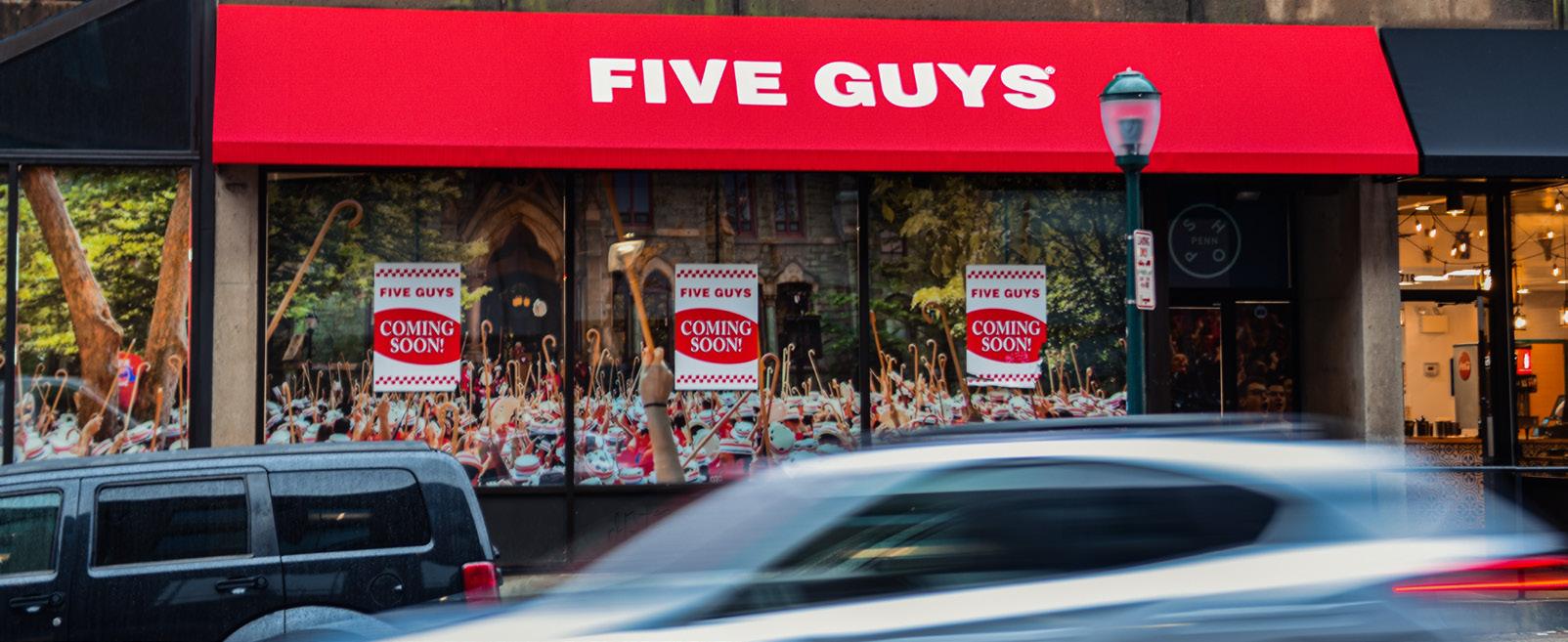
Five Guys plans to open its University City location near campus in mid-December, over a year since its initial announcement.
The new location at 3714 Spruce St., next to the Quad, was first announced in August 2021 with an anticipated opening date of late fall 2021 or early spring 2022. How ever, the opening was pushed back, Executive Director for Real Estate Ed Datz wrote in an email to The Daily Pennsylvanian.
“It’s our understanding that the new Five Guys loca tion is planning for an opening for mid-December,” Datz wrote. “Construction was impacted by supply chain for materials which delayed the restaurant opening until now.”
The restaurant is currently hiring shift leaders and crew members at its Spruce Street location, according to its careers website. A spokesperson for Five Guys did not respond to a request for comment.
The new Five Guys location replaces Beijing Restau rant, which closed its Spruce Street location in September 2020. Datz previously said that one of the reasons the Di vision of Facilities and Real Estate Services advocated for a Five Guys location is because Penn lost its on-campus burger restaurant in 2019 when Bobby’s Burger Palace closed its Walnut Street location.
Five Guys is a fast food chain that serves burgers, hot dogs, french fries, and milkshakes. The chain currently
has three other locations in Philadelphia at 1527 Chestnut St., 1100 Cecil B. Moore Ave., and 2552 Grant Ave.
Wharton junior Xavier Shankle said he grew up ap preciating Five Guys for its consistent high quality and late hours, which he said differentiates it from other food offerings around campus.
“It was like a dream come true” when the chain an nounced its Penn location, Shankle said. “I’m really happy I can have the last two years of my college career with Five Guys whenever I need it.”
Shankle added that it was “naturally frustrating” that the store has taken longer than expected to open, but he is optimistic that the store will open by mid-December.
“One of the jokes that I made was, it’s almost like there are five guys building it,” Shankle said. “It’s taken a while, but I have faith that they can do everything right.”
The opening of the chain’s Penn location comes amid a flurry of new eateries in the University City area. In the past year, four other restaurants — DIG, Raising Cane’s, El Taco, and Amma’s South Indian Cuisine — have opened new locations near Penn’s campus. In addition, Franklin’s Table will welcome two new restaurants in the coming weeks.
Datz previously told the DP that FRES is continuing to explore new retail opportunities in University City, saying that the office wants to grow the number of apparel or ac cessory establishments around campus.
CONTACT US: 215-422-4640 SEND STORY IDEAS TO NEWSTIP@THEDP.COM ONLINE AT THEDP.COM
PHILADELPHIA,
VOL. CXXXVIII NO. 28
THE INDEPENDENT STUDENT NEWSPAPER OF THE UNIVERSITY OF PENNSYLVANIA • FOUNDED 1885
THURSDAY, DECEMBER 1, 2022
PHOTO BY HANNAH SHUMSKY
Fossil Free Penn, a student group calling for Penn to divest from fossil fuels, camped out on College Green for 39 days in fall 2022.
The announcement goes further than any previous statement from the University regarding its fossil fuel holdings
PHOTO BY SUKHMANI KAUR
Penn Medicine researchers’ experimental vaccine could protect against all 20 known influenza virus subtypes.
PHOTO BY LILIANN ZOU
Five Guys will be located on 3714 Spruce St.
scheduled to open by spring 2022, supply chain issues construction
Guys will open on Penn’s campus in mid-December Originally
See ENDOWMENT, page 9 See COVID-19, page 9
JARED MITOVICH Senior Reporter
Franklin’s Table Food Hall on Penn’s campus will soon welcome two new restaurants to its lineup.
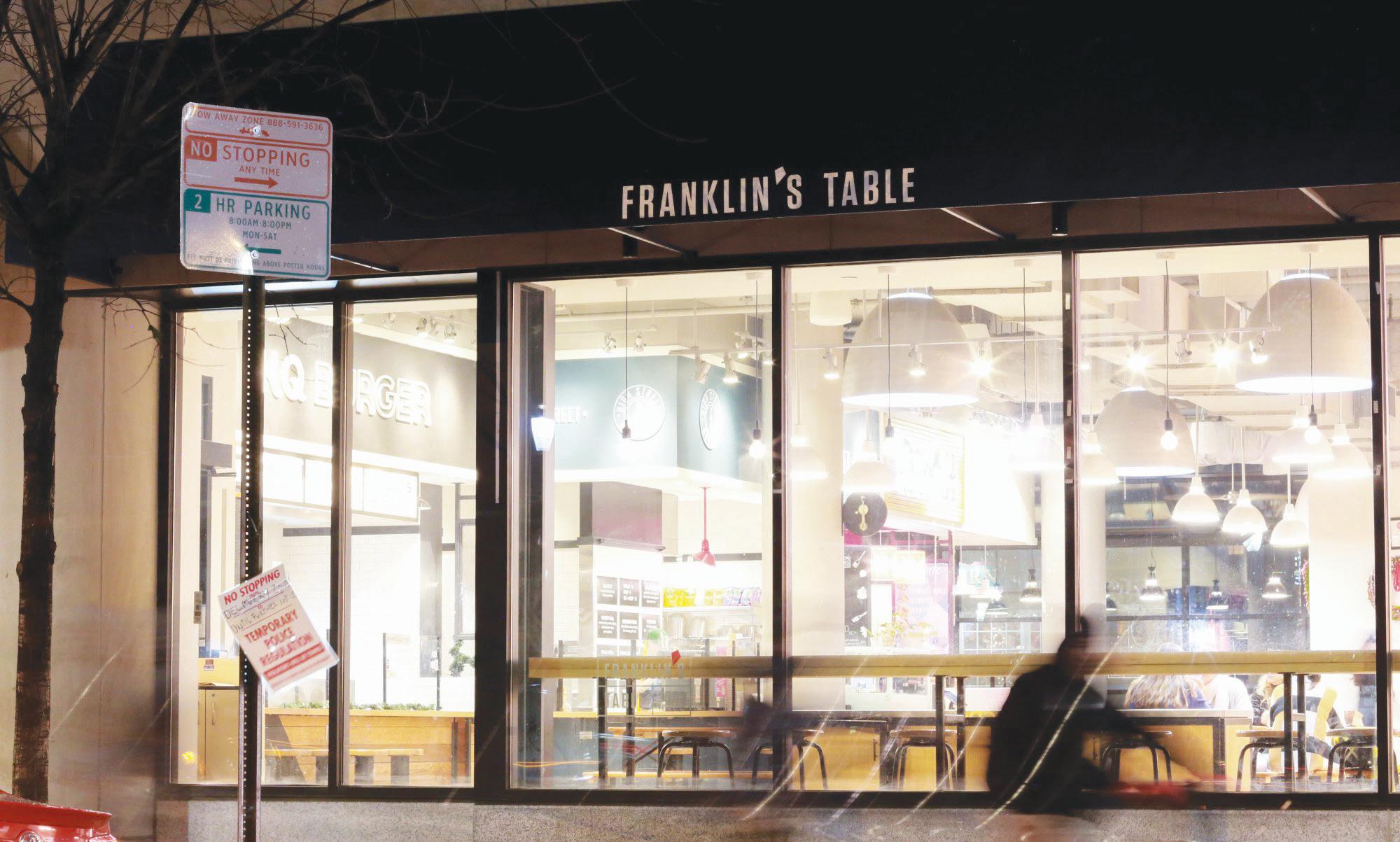






Delco Steaks, a local cheesesteak shop, and Yifang Taiwan Fruit Tea, a boba tea chain, will open at Franklin’s Table in the coming weeks, ac cording to a press release from Penn Facilities and Real Estate Services. Delco Steaks will open on Dec. 5, while Yifang has a target opening date of mid-January, the stores’ respective owners each wrote to The Daily Pennsylvanian.

The new restaurants will join the food hall’s five existing eateries: DK Sushi, High Street Hoagies, Goldie Falafel, PaperMill Fresh Asian Kitchen, and Pitruco Pizza.

“We curate the mix of shopping and dining op tions at Penn to be a destination experience,” Ed Datz, Penn’s executive director of Real Estate, wrote in the release. “The additions of both Delco Steaks and Yifang Taiwan Fruit Tea to Franklin’s Table will add to the lineup of critically acclaimed chefs and local best-in-class operators at the Food Hall, making it a destination for culturally diverse cuisine and local favorites.”

Delco Steaks opened its first restaurant in March 2020, with a menu that includes cheesesteaks, burg ers, chicken, and fries using locally sourced meats and dairy. The restaurant, named after its original Delaware County, Pa. locations, was awarded the “2021 Best of Philly” for cheesesteaks by Philly Mag. The Franklin’s Table location will become Delco Steaks’ first store in the city of Philadelphia.


In response to a request for comment, Delco Steaks Chief Operating Officer Steve Reynolds wrote that the store would work with Penn Athlet ics on including games and a student punch card with the dining experience, as well as Penn-specific Delco Steaks shirts.
Yifang, described as a “cult-favorite” by FRES, infuses raw ingredients, seasonal fruits, and natu ral ingredients in its boba tea offerings, which are based on Taiwanese recipes and include the popu lar pineapple-flavored Yifang Fruit Tea. The store currently has one other location in Philadelphia on Temple University’s campus, at 1501 N. Broad Street.
“Students can anticipate the same high quality organic fruit and milk teas from this new location,” Yifang owner Rob Chen wrote to the DP.

The two additions to Franklin’s Table will join a number of restaurants that have opened around Penn’s campus this year, including DIG, Raising Cane’s, El Taco, and Amma’s South Indian Cuisine. Five Guys plans to open its location at 3714 Spruce St. around mid-December, Datz wrote to the DP.

DIG, El Taco, Five Guys, Delco Steaks, and Yifang Taiwan Fruit Tea are all part of the FRES retail district, SHOP PENN, which has more than 75 outlets. Because Penn owns each property where the stores are located, FRES acts as a landlord and provides funding for opening. Franklin’s Table opened in March 2018.
“Delco Steaks and Yifang Taiwan Fruit Tea are eager to open and will enhance the already thriving food destination in University City with their pre mium offerings,” FRES wrote in the press release.
2 NEWS THURSDAY, DECEMBER 1, 2022 | THEDP.COM THE DAILY PENNSYLVANIAN
STUDIOS STARTING AT $820 STUDIOS STARTING AT $820 ONE BEDROOMS STARTING AT $985 ONE BEDROOMS STARTING AT $985 TWO BEDROOMS STARTING AT $1350 TWO BEDROOMS STARTING AT $1350 3 12 BEDROOMS STARTING AT $1605 3 12 BEDROOMS STARTING AT $1605 Thursday, December 1 10:15 TOUR AT CAMPUS APARTMENTS R E M I N D E R R E M I N D E R 4043 Walnut Street (267) 297 0101 livecampusapts com 11:00 *I can sign online too SIGN BY 12/31 for Fall 2023 AND WE WILL WAIVE YOUR APPLICATION FEE! R E M I N D E R R M N E R 4 1 0 4 W a l n u t S t r e e t P h i l a d e l p h i a P A 1 9 1 0 4 ( 2 1 5 ) 8 3 9 3 5 1 8 | L i v e A t U C A C o m STUDIO 6 BEDROOM APARTMENTS/HOUSES Complimentary Shuttle Pet Friendly Availability Laundry On Site Steps from Campus 24/7 Emergency Maintenance Reliable Customer Service Limited Time Only: Half Off Security Deposits! Sign Today Move In Tomorrow *Restrictions Apply OPEN LEASING BEGINS DECEMBER 15
The two restaurants will open in the coming months. Subscribe to The Daily Pennsylvanian’s daily newsletter. Delco Steaks, Yifang Taiwan Fruit Tea to open in Franklin’s Table The local cheesesteak shop and the boba tea chain restaurant will open in the coming weeks
PHOTO BY JESSE ZHANG
Penn’s Quechua Language Program seeks to expand campus presence, increase resources
SEJAL SANGANI Staff Reporter
Students, faculty, and staff in Penn’s Quechua Language Program are working to raise awareness about the program on campus in an effort to in crease funding and resources from the University.
Quechua is the most widely spoken indigenous language in the Americas and is the only indig enous South American language offered at Penn. While Penn is the one of the first Ivy League in stitutions to offer the language in such a capacity, according to the program website, it suffers from a lack of resources and currently has no full-time faculty members.
The University began offering Quechua lan guage courses through the Penn Language Center in 2014, following a petition by several graduate students. Three Quechua classes are offered at Penn. In 2019, the program began working with the Fulbright Scholar Program to bring one Quechua scholar to Penn each year as a Foreign Language Teaching Assistant.
The program’s founder and coordinator, Américo Mendoza-Mori, said that having Quechua Fulbright Scholars is “a unique opportunity for the University to learn from indigenous scholars because historically, universities have [carried] co lonial legacies.”
This academic year, Sofía Vega-Zanca is at Penn as a Quechua Fulbright Scholar. Hailing from a village in Ayacucho, Peru, Vega-Zanca teaches QUEC 0100: “Elementary Quechua I” and facili tates projects and activities for the program. At the beginning of the fall semester, Vega-Zanca hosted a Quechua welcome night, and she hopes to ar range cultural nights in the coming months.
“It has been such an enriching experience,” she said. “I wouldn’t imagine [that] I would end up vis iting or coming to Penn or an Ivy League school of such prestige and [be] able to share my culture [and] the Quechua language.”
William Andahua-Arellan was Penn’s Quechua Fulbright Scholar during the 2021-2022 academic year. He said he enjoyed his experience as an FLTA and emphasized that teaching Quechua extended beyond simply conveying the language.
“I learned that I was not teaching just a lan guage,” Andahua-Arellan said. “I was sharing my culture.”
Wharton junior Braulio Gonzalez has taken Quechua courses at Penn and served as a stu dent coordinator for the program last semester. Gonzalez echoed Andahua-Arellan’s sentiments, adding that Quechua has been a highlight of his time at Penn.
“The class deals a lot with the Andean culture beyond just learning to speak Quechua,” he said. “We sang during the class; we danced. It's basi cally a super interactive classroom dynamic.”
Gonzalez also emphasized that most of the Quechua Fulbright Scholars grew up in Quech uan communities and experienced the language and culture firsthand.
“Most of the professors, their first language is Quechua, which, given that it’s an endan gered native language, is crazy,” Gonzalez said. “They’re [some] of the only people in the world that are carrying that culture.”
Along with language courses, the program hosts events celebrating and sharing Quechua and Andean culture. Mendoza-Mori said that Quechua Language Program events exemplify the importance of indigenous language programs at Penn.
“There are very few spaces for the presence of indigenous languages,” he said. “Indigenous language programs help to facilitate many other things, like cultural programming.”
The Quechua Language Program, like other small departments and programs at Penn, faces challenges with resources and staffing. While Mendoza-Mori is the program’s founder and coordinator, he teaches full time at Harvard University. As such, the Quechua Language Pro gram has no full-time faculty members.
Andahua-Arellan said he would have liked to have had a physical space to store the teaching books and materials he was using for his courses.
Gonzalez added that he would like to see Quechua added to the list of courses that ful fill general education requirements, specifically the Cross-Cultural Analysis requirement. He also encouraged students without cultural roots or connections to Quechua to take the courses. Vega-Zanca expressed a similar sentiment, saying that she welcomes students of all back grounds and experiences.
“We are so happy to welcome everyone,” she said. “[In Quechua], we don’t have a word for ‘friend.’ We address everybody as brothers and sisters.”
Andahua-Arellan emphasized institutions’ roles in promoting diversity and extending sup port for indigenous languages.
“Universities like Penn are important. They have this important role [as] a gateway,” he said. “Offering Quechua helps a lot because it pro motes the reflection on the relevance of native or indigenous languages.”
Mendoza-Mori echoed this sentiment, urging universities to adapt to their increasingly diverse student bodies.
“Institutions like Penn, or in general, universi ties, are becoming more diverse spaces. But how much are institutions willing to be transformed by the diverse student populations?” he said.
“That means [transforming] the academic infra structure by offering these different traditions of knowledge that historically were overlooked.”
Wharton faculty members win awards at Association for Consumer Research Conference
Contributing Reporter
Three Wharton faculty members won awards at the Association for Consumer Research Confer ence, the main international consumer research association for academics.

Professor Shiri Melumad won the Outstand ing Reviewer Award for the Journal of Consumer Research, Professor Emeritus Wesley Hutchinson was named an Association for Consumer Research fellow, and professor Wendy De La Rosa won the Ferber Award from the JCR.
As a reviewer who is part of the editorial review board for the JCR, Melumad is tasked to evaluate different research paper submissions that fall under her area of expertise: how consumers interact with new technologies.
“Having the privilege of being a reviewer means that I get to learn about all new research in the area that I'm interested in, so it definitely helps me understand what work is being done out there,” Me lumad said.
Every few months, Melumad reviews an article and writes a report that identifies the strengths and weaknesses of the research detailed and what can be done to improve the work. Then, she said that she recommends whether or not the paper should proceed to the next stage of the review process.
As an expert in this field of research, Melumad is currently researching consumers’ interactions with
different types of technologies that affect the deci sions they make and the emotions they experience on that device. She was also a finalist for the Ferber Award last year.
Hutchinson, the Stephen J. Heyman professor, is the recipient of the 2022 Fellow in Consumer Behavior Award — a lifetime achievement for his contributions to the field.
According to the Association for Consumer Re search, Hutchinson was recognized for his “central role” in furthering people’s understanding of roles in consumer expertise and his work in the modern understanding of “consideration sets.” Hutchinson described these consideration sets as the selection of options that a consumer chooses among when de ciding what to buy.
Hutchinson is one of only four scholars in the world to have received the Journal of Consumer Research Best Article Award twice. He also served as president of the Association for Consumer Re search, an area editor at Marketing Science, and sat on the editorial boards of many marketing-focused journals, according to the Association for Consumer Research.
As a fellow, Hutchinson gave a presentation about how teaching can inform, help, and redirect one’s own research. He had this idea as he developed two new courses at Penn, one on the social impact of
marketing and the other on consumer neuroscience.
De La Rosa received the Ferber Award for her dissertation paper titled, “The Impact of Payment Frequency on Consumer Spending and Subjective Wealth Perceptions,” which was published in Sep tember of 2021. This award is given to the author of the best dissertation-based article published in the most recent volume in JCR.
The paper details her findings on how the timing of when workers get their resources or get paid changes people’s perceptions and behavior interests, according to De La Rosa. She said that this research was conducted for her Ph.D. in consumer behavior at Stanford University.
In her dissertation, De La Rosa demonstrated that the timing of when people receive money really matters, even though people may believe that their financial decisions would not change if they are getting paid the same amount of money. She found that increasing people’s payment frequency changes people’s spending habits.
“I feel very honored and surprised and grateful to be the recipient,” De La Rosa said. “I think it gives me a little more confidence that what I am work ing on matters and has mattered from a practical perspective. But it is also great to know that the field and my colleagues that I also respect also think that this work matters.”
Upper respiratory illnesses are on the rise on campus and across the city
JONAH MILLER Senior Reporter
Upper respiratory illnesses are beginning to spread on campus and around Philadelphia at higher rates than in previous years.
The flu and respiratory syncytial virus are on the rise following the relaxation COVID-19 prevention measures, such as social distancing and maskwearing, Associate Director of Public Health and Wellbeing Rebecca Huxta told The Daily Pennsyl vanian. This is the first winter where community members will not be required to mask on campus since 2019.
At this point last year — from Nov. 28 to Dec. 4, 2021 — amid an uptick in COVID-19 cases and positivity rate, the University required student groups to cancel all social events for the remainder of the fall 2021 semester.
Although the threat of COVID-19 on campus has faded, Huxta said she continues to recommend various precautionary measures to avoid becom ing sick, especially before final exams, including practicing good hand-washing hygiene and staying in when not feeling well.
“Even if you’re not staying home, but you’re
COVID-19 cases
not feeling well, you should put a mask on. That’s something that we learned from COVID-19, and everyone is very comfortable with doing it when they’re starting to not feel well,” Huxta said.
Chief Wellness Officer Benoit Dubé said that although there has been an increase in upper re spiratory illnesses, the rise is not driven by an increase in the number of COVID-19 cases.
Dubé also said that he has recognized a “sur prising number” of cases of RSV, an illness usually found in younger patients, which is now manifesting in adults and college students.
“COVID has created a seismic shift in the way respiratory illnesses are presented — why we’re seeing now what we would have expected five to six weeks from now.”
Dubé added that current trends fall in line with the data from the Southern Hemisphere, which experiences the respiratory illness season earlier than the Northern Hemisphere, with the sole ex ception of RSV cases which remain “an enigma.”
“The best advice — as we’re still learning and trying to decipher these new patterns — is
to modify your travel plans in two ways. First, make sure you are boosted against COVID-19 if you’re eligible, and make sure you have a flu shot,” Dubé said. “Second, pack a mask, because if you get a sniffle, it’s better to add an additional layer of protection so that the people you love aren’t accidentally exposed to whatever bug you may be carrying.”
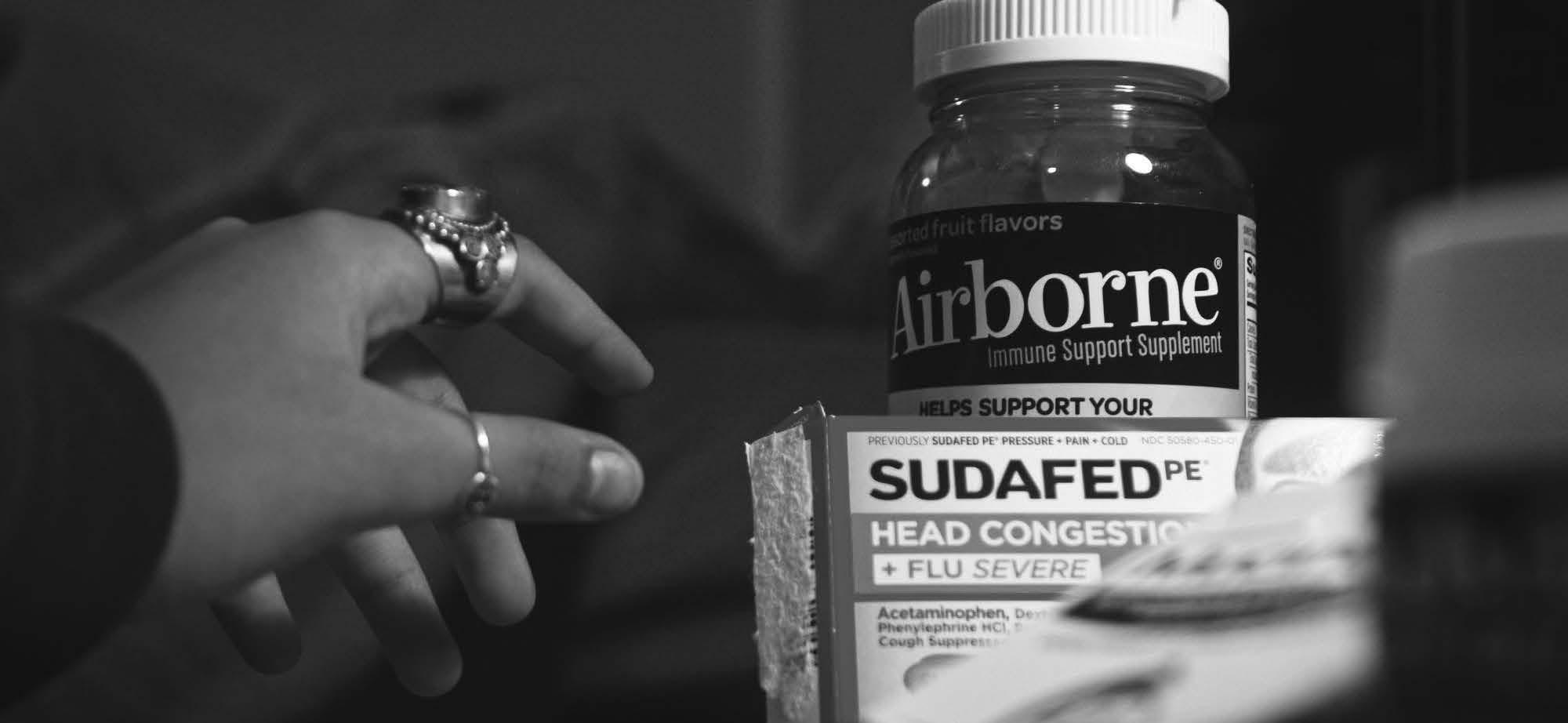
Regarding the annual flu, Dubé said he is seeing the beginnings of the uptick reflected from the Southern Hemisphere, but reassured that the flu shot this year is “quite effective.” It provides adequate protection, minimizing symptoms, lessening symptom duration, and preventing hospitalization for the vulnerable, ac cording to Dubé.
This year, Penn vaccinated over 11,000 mem bers of the community at its annual flu clinic in October.
“We use a little bit of a guessing game every year if we can match what the flu virus will be like, and we’ve done better this year compared to other years,” Dubé said.
3 NEWS THURSDAY, DECEMBER 1, 2022 THEDP.COM | THE DAILY PENNSYLVANIAN
Quechua is the only indigenous South American language offered at Penn
Three Wharton faculty members — Wendy De La Rosa, Wesley Hutchinson, and Shiri Melumad — were honored NICOLE MURAVSKY
(Left to right) Professor Shiri Melumad, Professor Emeritus Wesley Hutchinson, and Professor Wendy De La Rosa.
The increase in upper respiratory illnesses is driven by an increase
PHOTO BY ADYA GUPTA
I am not a STEM person. As a PPE and Italian studies double major, I am happy to leave my application of mathematical and scientific skills in the past as a relic of my high school career. The current Physical World Sector requirements for students in the College of Arts and Sciences, however, force students in non-STEM majors to take STEM courses with high diffi culty levels, according to Penn Course Review, for the Physical World Sector. This requirement must be altered.
Penn claims that the Physical World Sector requirement synthesizes the tenets of experimentation, observation, and “significant” mathematical under standing and “provide[s] insight into the content and workings of modern physical science.” The University’s fancily worded description, simply put, says that part of a well-rounded Penn education is the ability to understand the scientific method in the realm of physical science.
In contrast to this grandiose ideal, a College student in the humanities who completed this requirement disagreed, on the condition of remaining anony mous. They said that, “the classes offered to fulfill this sector require ment are not particularly informative or interesting. The class content and grading is very inconsistent and varies largely on the professor or lecturer teaching the course. There should be a broader range of options offered to ful fill the respective requirements.”
One flaw in the Physical World requirement is that it neglects to ac knowledge that Penn students may have already fulfilled this goal in their high school curriculum. Sector requirements have a blanket rule to not accept any ad vanced placement credit or equivalent like A-Levels, IB, or other examina tion. Furthermore, Sector requirements cannot be fulfilled by a departmental
exam that shows sufficient knowledge in this field. Myself and many other Penn students have undoubtedly satis fied the ultimate goal of the Physical World in high school already.
If Penn wants to justify requiring this coursework, however, to create an even standard across all of its students, then the Physical World requirement should not appear to be so sparse in its course offerings. The College’s description of policies regarding the Sector require ment explains that there are courses
intended for both majors and non-ma jors. The reality is that a majority of the few classes offered under this re quirement are technical classes more suited for majors. For spring 2023, there are 13 courses counting for this College Sector, yet, only three are con structed for non-majors. The remaining nine courses are related to physics and chemistry, which most students would consider to be academically rigorous introduction courses for STEM majors, not the average humanities student
looking to fulfill a requirement.
While the Living World Sector also poses a similar problem, given that out of the 14 courses offered, a vast major ity are more technical classes better suited for majors, the difficulty level of the non-major courses is significantly more varied. The Physical World Sec tor’s difficulty levels are consistently high. For example, all of the courses being offered next semester that are popularly considered more accessible to non-majors, like “Oceanography,” “Survey of the Universe,” and “Intro duction to Environmental Science,” have difficulties ranging from 2.37 to 2.63 on Penn Course Review. The Living World Sector offers a course, “Music and the Brain,” next semester, with a difficulty level of 1.6. By giving students no option but to take a course in an area that may not be of interest with high difficulty, the University is creating unnecessary stress.
The University, however, has the ability to mend some of these prob lems. One option would be to replace the Physical World sector entirely, in stead perhaps creating a requirement with student feedback in mind would be more useful to the Penn curriculum. If it chooses to keep the Physical World as an aspect of the Sector requirements, however, the University should strive to offer a greater variety of options at more varying difficulty levels. Not every student feels comfortable in a STEM-related space; forcing this upon members of the College burdens the curriculum rather than rounding it.
ISABELLA GLASSMAN is a College senior studying philosophy, politics, and economics and Italian studies from Suffern, N.Y. Her email is iglass@ sas.upenn.edu.
My grandmother would be very dis appointed in the University of Pennsylvania. Growing up in an Armenian household, it was made clear to me at a very young age that food should never be wasted; it is a privilege and blessing to have food on the table. If only she knew that her granddaughter’s university uses a breadZamboni.
Penn’s toast-throwing tradition has been around since the 1970s, when alcohol was prohibited at Franklin Field. Since then, the students have honored the historic “Toast to Dear Old Penn” by throwing thousands of pieces of bread onto the field between the third and fourth quarters of football games, in place of “drinking a highball.”

This tradition, though meaningful and a gateway to the University’s past, is not sustainable in modern-day West Philadel phia. The Philadelphia area has dealt with food insecurity and poverty for years, and parts have ranked high among the hungri est areas in the United States. How, then, can the University continue this wasteful practice? Every game, thousands of slices of bread are tossed onto the field and into dumpsters with no further use. One might wonder if this act reflects the carelessness and negligence of some of the student body, or the administration’s indifference toward the problems facing the city.
Similar to other Ivy League institu tions, Penn has a significant percentage of
students from very wealthy backgrounds — people who won’t blink twice before watching all the toast go to waste. With so many people fitting into this box of privi lege at Penn, it’s
Students arrive at games with their own pieces of bread, and sometimes even throw bakery items, like muffins and bagels.
With no concern about waste, or the kind of guilt that pervades your mind when you’re a child of immigrants wasting a perfectly good item of food, Quakers toss away, knowing that a machine, followed by a maintenance crew, will pick up after them.
But the problem isn’t the tradition of throw ing bread: it’s the lack of initiative to find a practical solution for the aftermath.
I believe it is up to the student body — the influential, bright, and driven Quakers — to find a solution that allows us to keep up this tradition while being less wasteful.
In search of solutions that are up to date with sustainability protocols but still allow for the tradition to live on, I reached out to the Marketing Department at Penn Ath letics. They explained that when ordering the bread for delivery, Penn Athletics asks for bread that is going stale or has reached the sell-by date. The department shared that “Penn is partnered up with the UPenn Chapter of Camp Kesem. Members of the club distribute the toast and collect dona tions for the organization.”
At the Family Weekend game against Harvard, I saw this effort myself. Mem bers of the club were walking around with a poster advertising toast for $2 a slice. The club was using the toast tradition stra tegically, raising funds for a good cause. However, this effort only puts people’s dollars at a better use — not the toast itself.
Penn Athletics explained that after the toss, the toast is composted. However, firsthand experience at Saturday’s game would reveal otherwise. After the toast toss, I watched multiple Franklin Field employees pick up the tossed bread and throw thou sands of wasted slices into regular trash cans, not the composting actions the Mar keting Department had described.
I do believe that Penn Athletics has put in the thought to make this tradition more sustainable, especially after Penn was re cently ranked No. 2 in World University Rankings for Sustainability. However, it is not clear how prudent the University is with keeping up with their waste mitiga tion strategies. At the end of the day, the efforts they’ve made and the steps toward sustainability I saw myself at the last game are not enough to justify the toast toss tra dition in the context of West Philadelphia. Many students still bring their own toast, bought most likely from nearby Acme, Giant, or Wawa, and they toss it away with no thought of its harm to the community.
out there. If people can engineer a turf cleaner into a Zamboni-type machine that picks up the bread, I’m sure they can also brainstorm strategies to solve the food waste problem.
At the end of the day, my Armenian grandmother probably wouldn’t find much use for a slice of Wonder Bread (and real istically would criticize it for being “too American” and, therefore, lacking flavor), but she wouldn’t be happy about any food going to waste. So next time you walk onto Franklin Field, ready to throw your bread and give a “toast to dear old Penn,” think of my grandmother, and all the better fates that piece of bread can have and how it can be used to feed someone in the Philadel phia area.
SOSE HOVANNISIAN is a College first year studying history from Los Angeles. Her email is sosehova@sas. upenn.edu.
4 THURSDAY, DECEMBER 1, 2022 | THEDP.COM THE DAILY PENNSYLVANIAN
not surprising that this tradition has carried on for many years.
Hopefully, Penn Athletics can strengthen its efforts when it comes to taking the Franklin Field toasts to a Philadelphia-based compost. Maybe they can create a rule that requires throwing the pieces of bread in sealed bags to keep them clean, so they can later be donated to a local food bank. Whatever the solution, there have to be more sustainable options
OPINION The Land on which the office of The Daily Pennsylvanian stands is a part of the homeland and territory of the LenniLenape people, known to the original Indigenous people as “Lenapehoking.” We affirm Indigenous sovereignty and will work to hold The Daily Pennsylvanian and the University of Pennsylvania more accountable to the needs of Native American and Indigenous people. LAND ACKNOWLEDGEMENT
LEE Deputy Design Editor
CRAIN Deputy Design Editor LILIAN LIU Deputy Design Editor ALLYSON NELSON Deputy Copy Editor EASHWAR KANTEMNENI Deputy Sports Editor DEREK WONG Opinion Photo Editor ANNA VAZHAEPARAMBIL Sports Photo Editor LILIANN ZOU News Photo Editor TAJA MAZAJ Deputy Opinion Editor SAM ZOU Deputy Opinion Editor VALERIE WANG Deputy Opinion Editor LEXI BOCCUZZI Deputy Opinion Editor CAROLINE MAGDOLEN Deputy Opinion Editor CHARLOTTE BOTT Copy Associate ELEANOR GRAUKE Copy Associate MADDIE PASTORE Copy Associate SOPHIA LIU Design Associate SAMITA GUPTA Design Associate ALESSANDRA PINTADO-URBANC President PIA SINGH Executive Editor JONAH CHARLTON DP Editor-in-Chief TYLER KLIEM Design Editor TORI SOUSA News Editor EMI TUYẾ TNHI TR ẦN News Editor DELANEY PARKS Assignments Editor SOPHIE APFEL Copy Editor JESSE ZHANG Photo Editor ASAAD MANZAR Opinion Editor PHOEBE LEUNG Social Media Editor MATTHEW FRANK Sports Editor ESTHER LIM Sports Editor KAVEEN HAROHALLI Video Editor NICOLE ZHAO Podcast Editor GREG FERREY Business Manager RAUNAQ SINGH Technology Manager ANVIT RAO Analytics Manager BAILEY CAMPBELL Marketing Manager SUNNY JANG Product Manager 138th Year of Publication Have your own opinion? Send your letter to the editor or guest column to letters@thedp.com. Editorials represent the majority view of members of The Daily Pennsylvanian, Inc. Editorial Board, which meets regularly to discuss issues relevant to Penn’s campus. Participants in these meetings are not involved in the reporting of articles on related topics. LETTER SUBMISSION THIS ISSUE’S TEAM THIS YEAR’S BOARD Opinion
ISABELLA’S IMPRESSIONS | Penn’s science course offerings need an upgrade for non-STEM students
SOSE’S STANCE | Wasting thousands of pieces of bread during a football game should not be normalized
BECKY
CALEB
Rethinking the physical world
Penn toast-throwing: Tradition or waste?
PHOTO BY SUKHMANI KAUR
PHOTO BY JULIA VAN LARE
Announcing Tomorrow, Together: What about today?
































































































Let’s cut to the chase. Instead of asking what the world needs from Penn, let’s ask what Penn can gain from the world. In an effort to plan Penn’s next 100 years, Penn President Liz Magill has set out to create a committee with this goal in mind. But what about today? I must be realistic and say that I, as a first-year student, want Penn to have big goals for the future. But what about the present? What can the University do immediately to foster the culture that it want sto create? How do we even define that culture?







Opening my email on the Oct. 11 and reading this message from Magill, I was confused as to what the point of it was. Instead of using direct lan guage, Penn uses extensive jargon that seems thick with meaning while simultaneously being quite vague. For example, instead of listing their goals, it lists “recommendations for potential areas of strategic priority.” When placed among recent con troversies and protests that the University has found itself entrenched in lately — including threatening students with disciplinary action for protesting at Convocation — the timing of this announcement is strange when instead of addressing existing issues that impact the student body, we are instead focus ing on the entirety of the coming century.



I understand that change takes time, and I am not unhappy that the University wants to make the future a priority. But I do feel that creating a com mittee tasked with planning the next century of Penn’s involvement with the world does a disser vice to short-term engagement and planning, which is arguably much more impactful to the current stu dent body and community.





Rather than acknowledging any of the student actions that have been going on directly on our campus — some for as many as 39 days straight, 24 hours a day — all undergraduates received an email about this new initiative, which feels very removed from the current things students care about or even witness on campus. For reference, all
Take a break







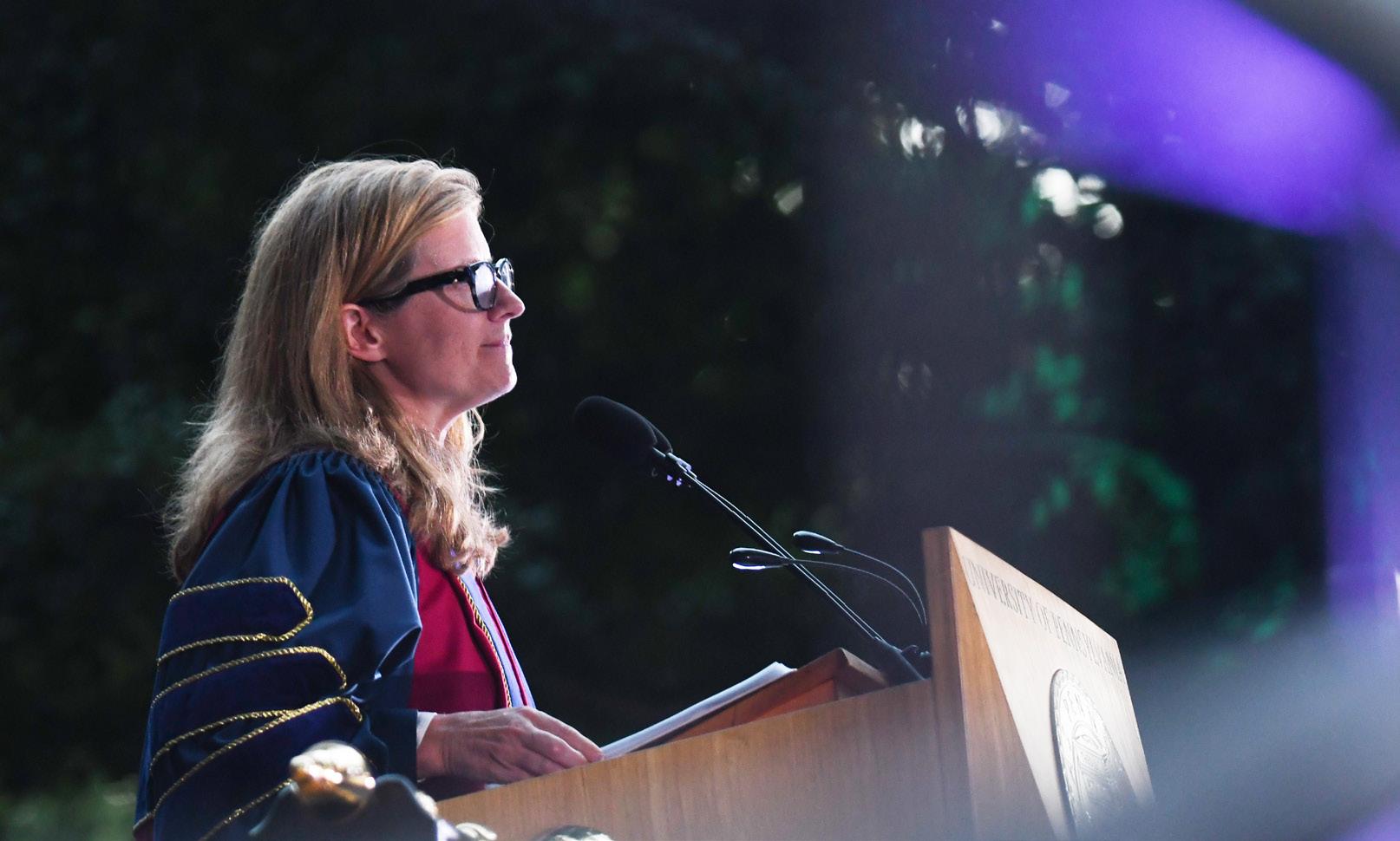
it took was strolling down Locust Walk any time between mid-September and late October, and you would have seen the Fossil Free Penn encampment. Funny enough, the encampment was placed on the same spot that Convocation was held, where Magill spoke to the importance of productive dis agreement and diversity of thought before being interrupted by protesters.


In my opinion, there is more that the University — and Magill herself — can do currently to assist and acknowledge Penn’s community and impact on the world. Students want to be heard and not threatened with penalization for speaking up about what they believe in, and Magill should be open to listening.
I reached out to the Red and Blue Committee about this initiative, and received a response which stated that the committee will meet with the Under graduate Assembly for input on their path forward. I believe that consulting the Undergraduate Assem bly is a step in the right direction, but in order to truly be inclusive to the school community, more could be done. For example, holding things like open forums and referencing what student actions are taking place on campus and on social media is also just as crucial.
Beyond asking broad questions such as, “In pursuing our missions, how can we maximally contribute to our city, nation, and the world?” How about we ask what students need to feel safe and supported on campus, how the University can con tribute to student-run initiatives, and in turn, foster student leadership on campus? In asking these questions, subsequent contributions to the greater world will most definitely arise.














Rather than formulate a committee to address what Penn can contribute in 100 years, how about we address what we need, and better yet, what we can do to begin that process now? When Magill spoke to us first years at Convocation, she spoke of the importance of diverse backgrounds and


viewpoints. While I do believe that she meant these words, change starts from within — and that means acknowledging Penn’s faults before analyzing what we have to offer the world.
In my eyes, that means starting a little bit smaller and first forging a foundation for these conversa tions to take place on campus — and in the effort to encourage these diverse perspectives, include residents of West Philadelphia in the discussion. And by include, I mean actively seek out those members of the community, not simply display empty statements like a “Penn welcomes the opin ions and input of the wider community that cares about Penn’s path forward” clause in the Tomorrow, Together FAQ. Residents of West Philadelphia are part of the Penn community and more than deserve

a seat at the table.




I believe rather than asking what the world needs from Penn, we should take our ego down a notch and instead ask what Penn needs to do in order to become a place in which the world can look to us for consequential answers regarding things like fostering diversity and uplifting differences. Right now, I do not believe we possess them — but we are in an ample position to start looking.























That small statistic stayed in


mind and re played itself in the College Office seconds before the ink dried on my leave of absence agreement. Mind on fire, I had made the most important decision in all 19 years of my life: taking a break.
In my interview with her, Rebecca Schept, premajor advisor for the College of Arts and Sciences, elaborated on Penn’s leave of absence policy. She said, “At Penn, there is only one type of leave of absence, but students take leaves for many reasons. Some of the most common reasons include personal health issues, family concerns, career and internship opportunities, and travel. All leaves appear the same on a student’s transcript with the words ‘leave of ab sence’ and the date the leave was taken.”

For most highly aided students, the main concern
in college is less about paying for the Ivy League education and more about making the right choice on what to study during their four years here. The pressure to choose a more profitable major is insur mountable. In a Inquiries Journal study, researchers found that as the unemployment rate increases for a given major, the likelihood of first-generation stu dents choosing that major decreases. This meant that for me, I had to prefigure the rest of my life in the next four years, and the next decade of my profes sional career.

Although this career crisis is not exclusive to first-generation, low-income students, the pressure is uniquely intensified by under-resourced students’ lack of awareness of the resources readily available to them.
Yes, every first year must get over the obstacle of adjusting to a new environment and finding their people, but based on personal anecdotes from my peers, it is simply not enough to rely on institutional
support. As a FGLI student, some of my best support systems have been ones that I had to build beyond the isolated spheres of Claudia Cohen Hall — slowly and over time.
When I took my leave of absence, I was equipped to examine my situation with a lot more clarity. On my gap semester, I sought therapy and medication, and I realized how important it was to take a step back — and I am not alone. “Students who take a leave during their time at Penn report that their time away from was a helpful and useful experience,” said Schept.
Now that I am back on campus, I still bite my tongue about engaging with campus resources. My own experiences with Counseling and Psychologi cal Services have been like what many students have experienced on this campus — a temporary bandage at best. Needing support beyond CAPS is an issue broader than the scope of this article, but I will say this: There is also a danger in lumping
the rest of the campus resources in with a singular experience.
And though I am apprehensive about some in stitutional resources, I was floored by the support coming from the College Office and from my premajor advisor. If anything, I wish I knew about this support earlier, that the idea of a leave of absence is not off-limits to FGLI students. Schept says this about the general policies for taking a leave of ab sence, as I was confused when I first took one. Do I contact my professors? Who is the first point of contact?
Schept states, “In general, students will talk through the process of taking a leave with their academic advisor. The advisor will help the stu dent weigh the pros and cons of taking time away and guide them through the steps to officially put the leave in place. The College website has a list of policies pertaining to leaves and returns and also provides students with checklists to ease their transi tion.” When a student comes back from their leave of absence, they will meet with an advisor within the first few weeks of their semester back. Schept con tinues, “That advisor will make sure the student is connected to the appropriate campus resources and will provide helpful guidance for reintegrating with the Penn community. Penn also has a returning stu dent organization that helps build community among students who have returned from time away.”
Not everyone needs to take a gap semester: There are certainly many ways to take a break from school. Exploring Philadelphia is a great way to travel out side the Penn Bubble. But for me, I wish I utilized more of the resources available to me on campus, even if not all of them benefitted me equally. Col lege can be so lonely and isolating, especially if you are not ready to navigate it, and so if taking a leave sounds like a viable, healthy opportunity for you, take it.
5 THURSDAY, DECEMBER 1, 2022 THEDP.COM | THE DAILY PENNSYLVANIAN
OPINION Don’t wait for santa We’ve got your holiday beer! (215) 546-7301 | 22nd & Washington ave WE DELIVER Studying too hard? Take a break with us. springfield distributor beer springfieldbeer.net (215) 546-7301 Corner of 27th and South St. DIRECTIONS: East on Chestnut, right on 23rd, right on Lombard WE DELIVER! university enterprises UE Apartments & Townhouses Serving the Penn community for OVER 50 YEARS! (215) 222-5500 4019 Locust St. info@uerealestate.net www.uerealestate.net NOW LEASING Available for June 2023 Renovated kitchens and bathrooms, laundry facilities, and decks! “Your mother will be happy!” 3D Virtual Tours Available! Family-run business for over 57+ years in student housing! 5-10 BR Houses 4000 Block of Locust 40th & Pine, 42nd & Pine
to
Iwas always perplexed when I looked up “Univer sity of Pennsylvania” just
find that its expected graduation rate is four to six years. Four to six years? Don’t students graduate in four?
my
TALES AND TAKES | Students should take a leave of absence if necessary during their time at Penn
VESELY’S VISION | The Red and Blue Committee gives us a chance to envision Penn’s future, but let’s not overlook Penn’s present
MIA VESELY is a College first year study ing philosophy, politics, and economics from Phoenix. Her email is mvesely@upenn.sas.edu.
CATHY LI is a College sophomore studying English and design from Brooklyn, N.Y. Her email address is licathy@sas.upenn.edu.
PHOTO BY DIEGO CÁRDENAS
PHOTO BY ANNA VAZHAEPARAMBIL
Explaining football’s miraculous turnaround
By JONAH CHARLTON, JARED MITOVICH, & KARAN SAMPATH Data Analytics Contributing Reporters SRISHTI BANSAL, ANMOL
Design by CALEB CRAIN & JONAH CHARLTON
by ANNA VAZHAEPARAMBIL
JIN KWON, SOPHIA LIU, & KIRA WANG
A dominant defensive front
Coming into the 2022 campaign, sophomore quar terback Aidan Sayin — who had played in only five games as a freshman — had lofty goals on his mind.
“I’m looking to win multiple championships, and hopefully set records here, and be the best quarter back Penn has ever had,” Sayin said on Sept. 14.

While it’s still too soon to determine his legacy as a Quaker, Sayin’s play this season was a major contributor to the Penn turnaround.
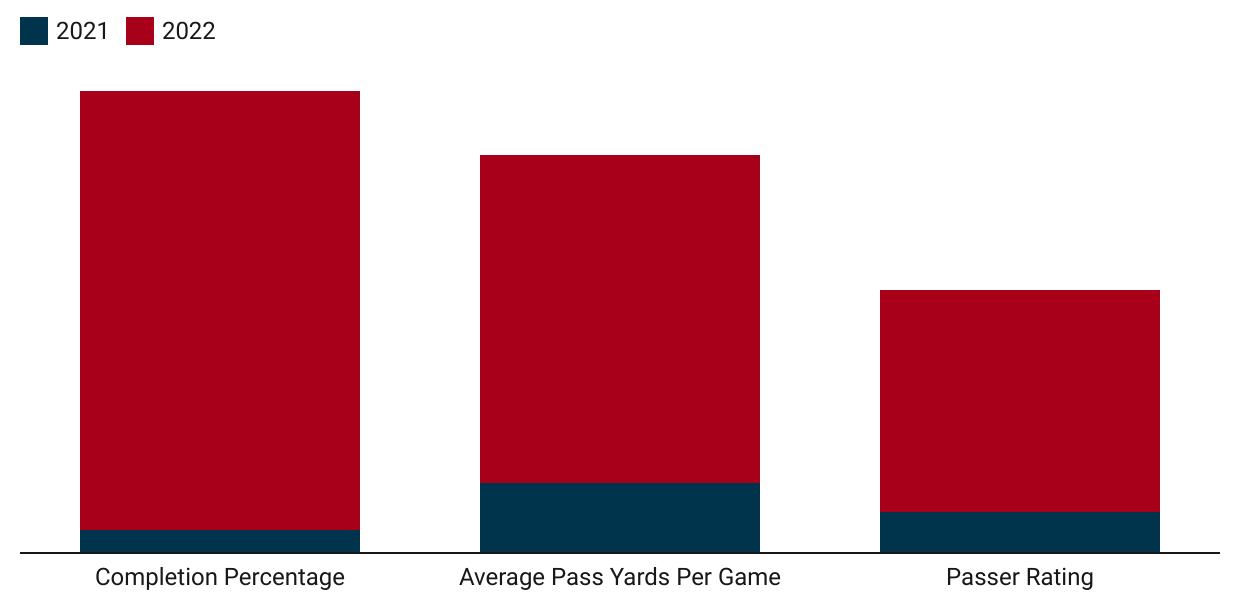
After finishing in the 4th percentile of historical Ivy League completion percentages last year, Penn skyrocketed to the 79th percentile this year, an un precedented jump in a single season. The Quakers also improved from the 12th percentile to the 68th percentile in average passing yards per game from 2021 to 2022.
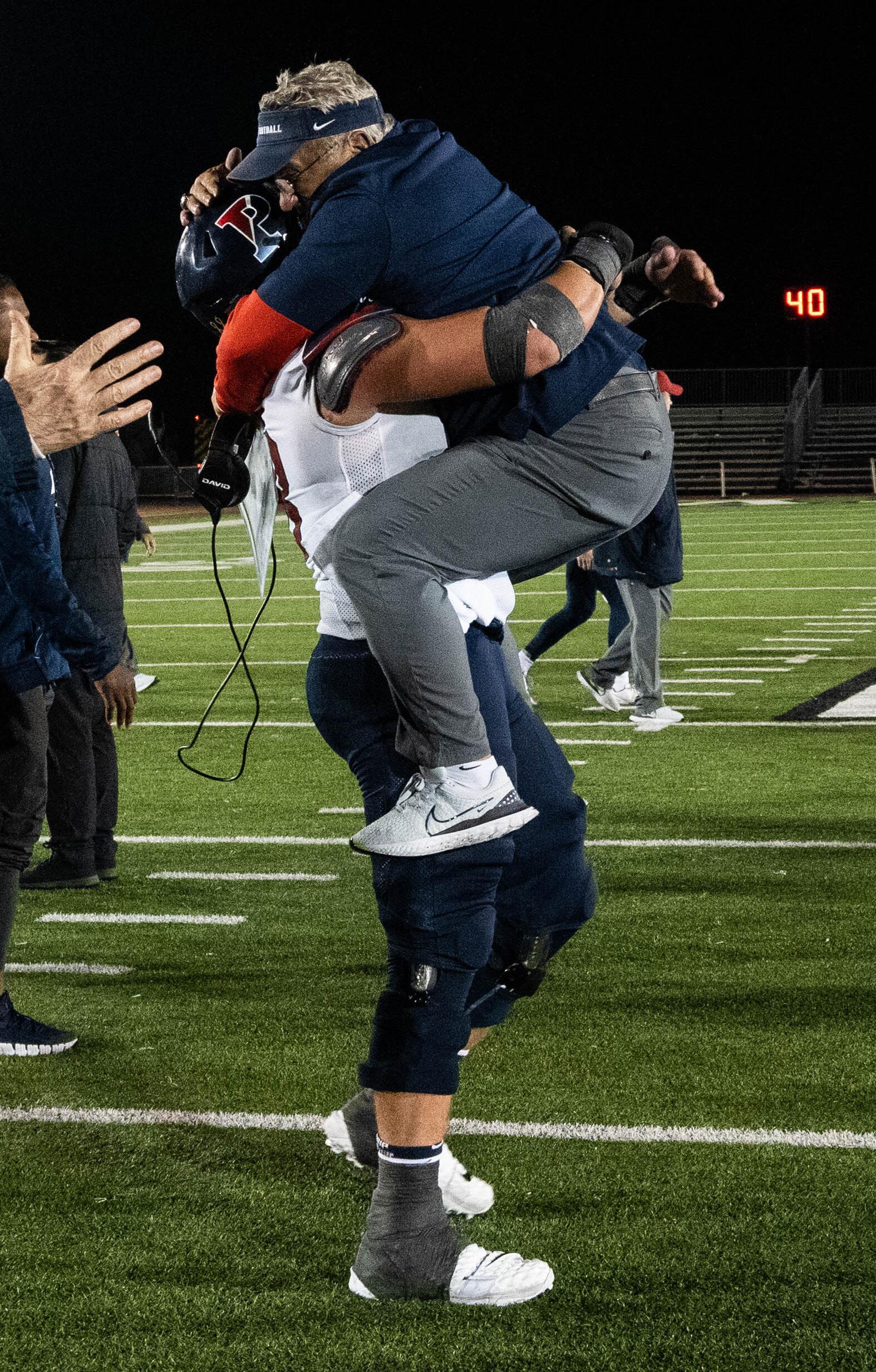




The improvements are thanks in no small part to a complete overhaul of the offense under first-year offensive coordinator Dan Swanstrom. Swanstrom served as Penn’s quarterbacks coach from 2014-2016 and helped to develop Alek Torgersen, a two-time first team All-Ivy selection and NFL player. He re turned to Penn with a clear-cut offensive mantra in mind: Put players in the best positions possible to succeed and make big plays.
“We’re very understanding of what we’re trying to do here as a coaching staff, as teachers, as edu cators, as our commitment to excellence within the program, which we define as incremental improve ment every single day,” Swanstrom said on Sept. 12.

While the statistical leaps in both completion percentage and average passing yards per game are more than incremental improvement, the benefits of Swanstrom’s system are clearest in the leaps in quar terback passer rating. In 2021, Penn’s quarterbacks combined for a 103.5 passer rating, located in the 7th percentile in the Ivy League. Sayin posted a 129.5 passer rating in 2022, a 38-percentile increase from the previous season. The rating still lags slightly behind the 131.7 Ivy average, but with Sayin only halfway through his collegiate career, the passing offense is on an upward trajectory.
It’s difficult to capture the importance of Penn’s defense when it comes to the ways in which the unit was able to keep the team in tight games. The de fense combined to allow 19.7 points per game in 2022, a nine-percentile improvement as compared to the 2021 total.
But it was the defensive front seven — led by first team All-Ivy senior outside linebacker Jake Heimli cher — that truly proved to be the difference-making unit.

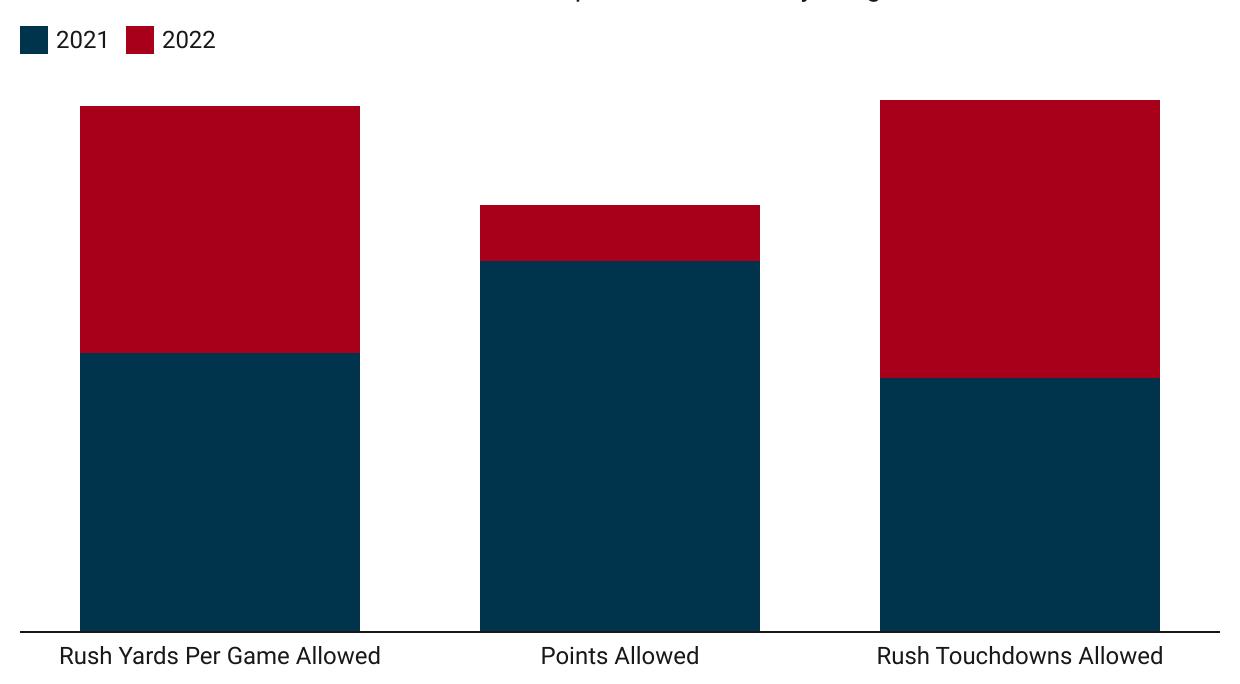
The 2022 Quaker defense allowed 89.4 rush yards per game, ranking in the 85th percentile in the Ivy League, after allowing 135.2 rush yards per game in 2021, which placed in the 45th percentile. In simi larly impressive fashion, the defense allowed only seven rushing touchdowns in 2022 after giving up 15 rushing touchdowns in 2021, a 44-percentile leap year to year. All told, the Penn rush defense leapt from sixth in the Ivy League in 2021 to first in 2022. Even more impressive is the fact that the run de fensive improvements come after the defensive line lost its star in defensive lineman Prince Emili.
“I think our plan to replace [Emili] has been good in terms of planning,” defensive coordinator Bob Benson told the DP before the season began.
“We have a little bit of depth there and a replacement [plan] that we feel good about.”
It turned out that the plan would work. Heim licher’s rise to stardom combined with senior linebacker Garrett Morris’ stellar season, in which he led the team in tackles en route to first team AllIvy honors, would be enough for the defensive front to not only replace Emili, but improve as a whole.
An offensive transformation 1. Clutch in key situations 3.
They call third down the “money down” for a reason. It’s the chance for offenses to keep long drives alive, and this season, Penn’s offense continu ously cashed in.
After converting just 32.1% of third downs a year ago — placing in the 12th percentile in the Ivy League — Penn’s offense moved the chains on 42.5% of its third downs in 2022, ranking in the 66th per centile.
And while the “clutch” factor of a team is nearly impossible to quantify, Penn seemed to constantly convert on fourth down when it mattered most.
Multiple critical fourth-down conversions in its double-overtime upset of Dartmouth on Sept. 30 were strong contenders as Penn’s play of the year.
That is, until the Quakers pulled off an even more miraculous upset at Princeton, scoring a gamewinning touchdown on fourth down with only five seconds left in the game.
Outside of those key moments, Penn converted a massive 52% of its fourth downs in 2022, an im provement from 42.1% in 2021 — good enough for a nearly 25-percentile increase.
To
6 SPORTS THEDP.COM THE DAILY PENNSYLVANIAN 7 SPORTS THURSDAY, DECEMBER 1, 2022 THEDP.COM THE DAILY PENNSYLVANIAN
DASH,
Photos
Sophomore quarterback Aidan Sayin attempts a pass to senior running back Trey Flowers against Princeton.
Offensive coordinator Dan Swanstrom speaks to Penn's offense after their defeat of Lafayette on Sept. 24 at Franklin Field.
conduct the analysis, the DP used cumulative data from Penn Athletics for the 2021 and 2022 Penn football seasons, looking at numbers for both the team and individual players. The DP also analyzed annual football statistics from all eight Ivy League teams across the past five seasons.
2.
Penn's defensive front tees up against Princeton on Nov. 19.
Senior linebacker Garrett Morris brings down a Princeton wide receiver during Penn's season finale at Powers Field on Nov. 19.
4 79 12 68 7 45 45 85 60 69 41 86
Senior linebacker Jake Heimlicher fights through a Colgate lineman during Penn's season opener on Sept. 17.
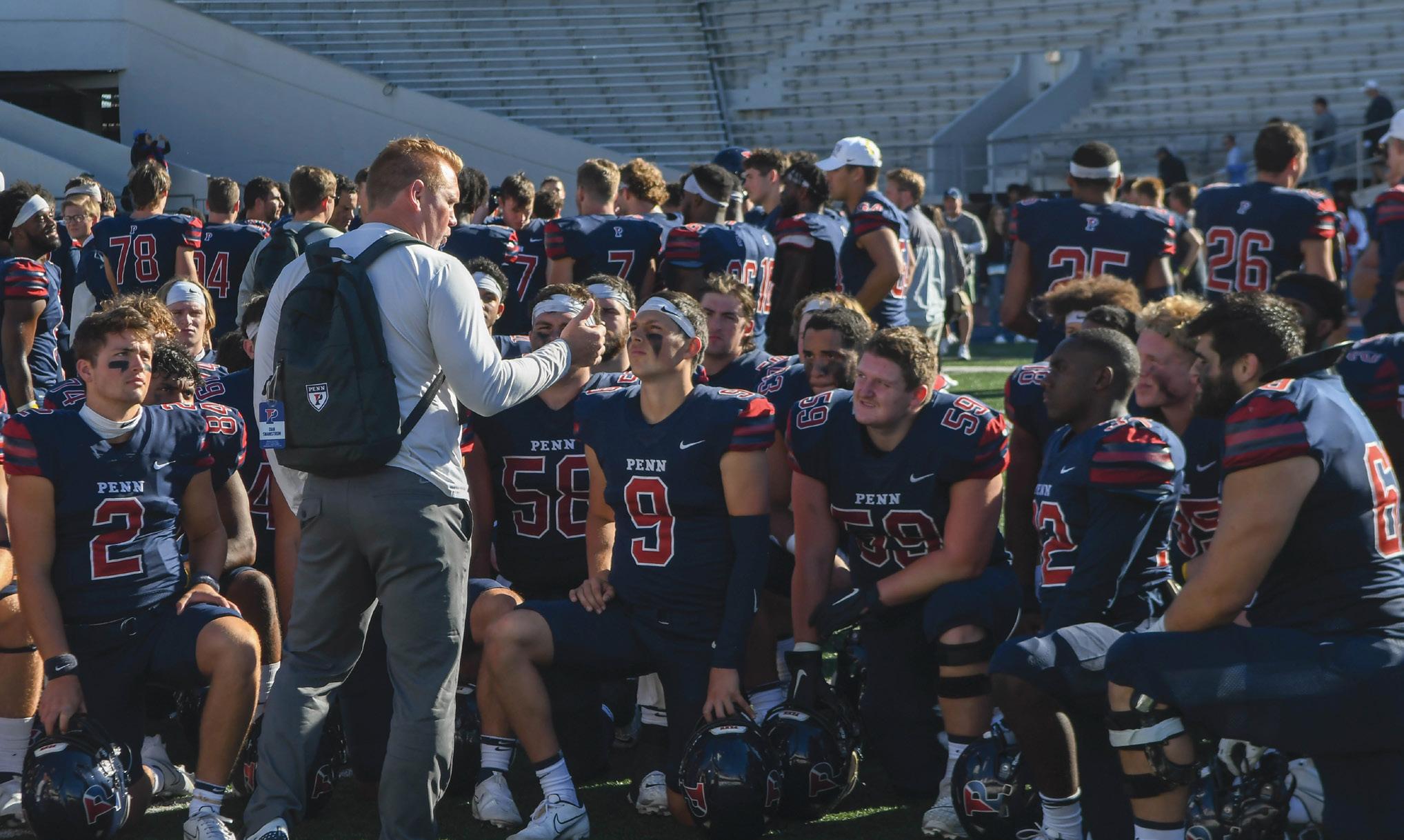
Senior offensive lineman Trevor Radosevich hugs coach Ray Priore following Penn's double-overtime win at Dartmouth on Sept. 30.
Senior running back Trey Flowers scores the game-winning touchdown at Princeton.

8 NEWS THURSDAY, DECEMBER 1, 2022 | THEDP.COM THE DAILY PENNSYLVANIAN 3601 WALNUT STREET • 215.898.7595 • www.upenn.edu/bookstore *In store only. Cannot be combined with other offers. Not valid for the purchase of gift cards, textbooks, electronics and specialty items. Other restrictions may apply. 20% OFF *Restrictions Apply STOREWIDE* ANNUAL WINTER SALE-A-BRATION IS PART OF SHOP PENN’S 12 DAYS OF DEALS SEASONAL FESTIVITIES BOTH DAYS Penn Glee Club Performances 2 PM — 3 PM Free Professional Photo in Winter Scene Setting — Fun Props Provided! 2 PM — 6 PM Hot Chocolate & Cookies 4 PM — 6 PM Wednesday & Thursday December 7 & 8, 2022 MON - FRI: 8:30AM - 8:00PM SAT: 10:00AM - 8:00PM SUN: 10:00AM - 6:00PM Sale-A-Bration-2022-10.875W x 20H.indd 1 11/15/22 3:29 PM
Two recent Penn graduates create career learning platform for students
ANNALISA FANG Contributing Reporter
Two Penn graduates have founded Orpheus Learn ing, a platform where students can learn from young professionals about different career paths by watching Masterclass-inspired video series.
2021 College graduate Stefan Tzvetanov and 2021 Engineering graduate Anushrut Shah began building the platform at the beginning of this year. It currently fea tures seven mentors, each with an individualized video series where they share insights into different industries based on their personal experiences.
The mentors on the platform range from Nick Hamburger — founder and CEO of Quevos, who was featured on Shark Tank and Forbes’ 30 Under 30 — to recent college graduates working in tech and investment banking.

The videos cover various topics, including recruiting insights, interviewing advice, and personal stories about struggling with certain classes or even dropping out of college to work on a startup.
Tzvetanov and Shah said that they saw a need for this platform during their own time in college, as they con stantly found themselves learning from people much older than them. They said while they learned a lot from these people, it was difficult to relate to them due to the age difference.
“In a lot of our classes, the TAs were actually better at explaining the material than the professor — not to say they’re smarter than the professor or anything like that — but they were able to package the information that the professor was trying to convey in a more digestible way to students,” Shah said.
Tzvetanov explained that it can be difficult to find the
same kinds of informative videos on platforms like You Tube and TikTok. Orpheus Learning content, he added, is formatted most similarly to the Masterclass video series, but is free, unlike Masterclass.
In addition, Tzvetanov said that students can some times be restricted to specific networks — for example, Penn students often connect with Penn alumni — but Orpheus Learning expands this network while also pro viding more advice through the video series, which is often longer than a typical conversation with someone.
“I really identify with the mission because especially being at Penn, you’re very much directed to certain career paths, and I think it’s important for people to know what’s out there and learn from other students [who] went through what we went through and can show really valu able perspectives,” College sophomore and ambassador for Orpheus Learning Camila Paranhos said.
Paranhos explained that they recruited people to make the video series from a diverse range of backgrounds — people who took non-traditional paths in their careers and dealt with multiple failures and setbacks in their journeys as well.
Tzvetanov and Shah have an in-depth process for choosing people to work with Orpheus Learning as men tors, spending hours speaking with them and providing a specific framework for the videos.
Tzvetanov said that although people are typically ad vised to learn from experts or seasoned professionals, he would like learning from young people to become the norm.
“Maybe they were in our position two, three years ago, maybe they just graduated, maybe they’re slightly older, but they know how we feel, and they almost speak the same language as us,” he said.
College junior Jack Williams, who is studying math and economics, has used Orpheus Learning and said the videos provided him with a look into different industries.
“It allowed me to connect with some people in indus tries that I wanted to maybe break into or at least hear more about,” Williams said. “[It] allowed me to have a point of contact that I could reach out to and easily hear back from just because of that connection.”
Tzvetanov explained that in the future, they may add a social aspect to the platform to enable users with similar interests to interact more with each other, but the main focus at the moment is to educate students at Penn about all that Orpheus Learning has to offer.
“When we were at Penn, a lot of the talk was about the holy trinity of investment banking, consulting, and tech — and obviously, we do have a few people from there, but we also have people from different walks of life that will be doing non-traditional things,” Shah said. “It’s definitely worth talking about.”
online. Class members are not required to do anything to receive benefits of the proposed settlement.
Wharton senior and Class Board 2023 President Derek Nhieu received a letter in the mail in early November con taining details of the settlement. Nhieu agreed that Penn should not have charged additional fees, such as the tech nology fee, for the virtual spring 2020 semester.
“If we ever transition online again, those fees are just not applicable. I feel like [the fees] are very much a disservice to students, when you try to charge them for these types of things,” Nhieu said.
Students who still have at least one full semester at Penn to complete as of 60 days after the effective date of the set tlement are considered a “Continuing Penn Student” and will be automatically issued a credit to their Penn student account once the settlement becomes effective.
Students who are not considered “Continuing Penn Student[s]” according to the lawsuit’s definition will be sent payment to their last known mailing address on file with the University registrar. According to the notice, they can visit the settlement website to update their address, or elect to receive payment by Venmo or PayPal.
Nhieu said he is happy to be able to receive any amount of money from the settlement, but wishes that the an nouncement was more informative.
Former Executive Director of Human Rights Watch talks spotlighting governmental abuse

The Daily Pennsylvanian sat down for an interview with Kenneth Roth, former executive director of Human Rights Watch, after his recent talk at Perry World House.
During his Wednesday speech, Roth, who is also the Perry World House’s inaugural Thakore Family Global Justice and Human Rights Visiting Fellow, discussed the outlook of international human rights through the context of Russia’s war in Ukraine.
Roth said that he strayed away from a fatalistic approach to understanding human rights’ current status. In his eyes, the observed shifts brought on by prominent autocrats are indeed worrying, but not unstoppable. The solution to combating these advances, he added, is to reassert com munities.
“We’ve just seen, you know, in country after country, huge popular demonstrations against autocratic rule, even at the risk of being detained or killed. And so today, it’s Iran,” he said. “Autocrats tend to have a monopoly of vio lence and can suppress these things. But in the process, they lose any remnant of legitimacy, they can no longer say that they represent the popular wheel that they’re serving the people. They’re just hanging on by the barrel of a gun.”
Reasserting communities, according to Roth, would make politicians less likely to flout political differences and thus infringe upon the human rights of certain com munities.
“The point is more to get people thinking about the need to move political discourse away from solely the divisive issues and find some ways to reaffirm the commonality that I think is still there, but it’s been lost by this populist appeal to divisiveness,” he said.


Roth emphasized, however, that human rights aren’t necessarily something that can be guaranteed.

“I feel like if more people knew about this, maybe there would be discussion,” Nhieu said.
The date that the settlement becomes effective will occur after the last approval hearing and will be posted on the settlement website once it is known, according to the notice.
Individuals may exclude themselves from receiving money from the proposed settlement by mailing a signed opt out request to the settlement administrator before Dec. 19. Individuals who want to object to this proposed settle ment may submit an objection, also before Dec. 19.
Over 1,400 students at Penn petitioned against Penn’s COVID-19 booster mandate last spring, citing high vacci nation and positivity rates. Ethnomusicology Ph.D. student Vincent Kelley, who started the petition, told the DP at the time that Penn and other universities played a significant role in forecasting future COVID-19 policies in Philadel phia and around the country.
A series of lawsuits were filed against schools in the United States who shut down during the COVID-19 pan demic. Last November, Columbia University agreed to pay $12.5 million to settle a class action lawsuit that claimed it failed to refund fees for the spring 2020 semester. In Sep tember of this year, Brown University also agreed to pay $1.5 million to settle a class action lawsuit that claimed it failed to refund tuition and fees for the spring 2020 se mester. The compensation will be divided among nearly 10,000 students who were enrolled at Brown during the spring 2020 semester.
“We also do have people giving up on democracy in the West. And that’s a separate concern that we have to ad dress. So we shouldn’t get all, you know, complacent and heartened by Putin, or Xi Jinping, his troubles, we need to do some tending of our own democracy in the West,” he added.
International organizations have a significant role to play in protecting human rights, according to Roth. He added groups can shame governments by spotlighting their human rights abuses.
“Human Rights Watch gets 1,000 media mentions a day. And so this is an intense spotlight that we can shine on governmental abuse. And no government wants to be known as the human rights hypocrite,” he said.
Several event attendees expressed praise for Roth’s stances and excitement for his arrival at the Perry World House.
For College sophomore Camila Castillo Paranhos, Roth’s message of community rang especially true. Re ferring to the polarization in her home country of Brazil, Paranhos restated the importance of “finding the issues that we can agree on, to unite again.”
Perry World House Senior Executive Director LaShawn Jefferson reaffirmed the pertinence of the event for Penn Students. She hopes attendees walked away with the knowledge that “documents only matter where people are actually able to live them.”






College senior Gabriella Rabito was encouraged by Roth’s discourse on the place of human rights organiza tions. Rabito, who hopes to pursue a career in international law, said that Roth’s positions pushed back against dis course painting human rights work as “aspirational” and “not effective.”


“We shame governments because every government pretends that it respects human rights, but many govern ments fall short,” Roth said. “So that discrepancy between pretense and reality is embarrassing. It’s shameful. It’s delegitimizing, and governments hate it when we spotlight it — and we’re very good at spotlighting it.”
and encourage change,” Hargest and Xu wrote.
The University estimates that around $250 million of its endowment is allocated toward investments related to the clean energy transition, Magill and Bok wrote. They wrote that the University’s thinking regarding in vestment decisions is subject to “ongoing review.”
Members of the Student Sustainability Association at Penn, with the assistance of faculty and profession als, have previously estimated that about 1% of the University’s endowment is invested in fossil fuels. This would translate to about $207 million out of the $20.7 billion endowment, though Chief Investments Officer Peter Ammon previously said that the exact environ mental footprint of Penn’s endowment is difficult to calculate.
“Penn’s endowment, if stewarded responsibly, can provide perpetual support for those core and essential University missions,” the administrators continued. “Our endowment’s net-zero goal, our desire to support real world decarbonization, and our hundreds of mil lions of dollars of investments in the energy transition are all elements of that stewardship.”
Prior to Tuesday's message, Penn announced in
November 2021 that it would halt commitments to pri vate equity vehicles dedicated to investments in fossil fuel production — at the time, this was an update to its existing practice of not making new direct investments in companies engaged in the production of fossil fuels.
According to a newly updated webpage about Penn’s sustainability efforts, the University has reduced over all carbon emissions by 45% as of the end of fiscal year 2022, a step toward its goal of reaching net-zero carbon emissions by 2050.
After Princeton voted to dissociate from 90 fossil fuel companies and divest from all publicly traded fossil fuel companies, Penn and Yale became the only two Ivy League institutions that have yet to divest.
“Indirect investments — what Penn is not divesting from — took up 99.97% of Princeton’s investments in fossil fuels at the time of their divestment,” Hargest and Xu wrote. “We have good reason to believe that Penn’s endowment is not substantially different.”
In a previous statement to the DP, Senior Executive Vice President Craig Carnaroli wrote that the Univer sity has “reviewed peer statements” and found that Penn’s policies are “quite consistent.”
“Governments, almost by their nature, are tempted to violate rights, and the human rights movement or the gen eral public has to push back, they care about rights. So I just think it’s an endless struggle,” he said.
Roth also explained that while autocracy is in trouble, democracy is as well, but just for other reasons.
9 NEWS THURSDAY, DECEMBER 1, 2022 THEDP.COM | THE DAILY PENNSYLVANIAN
NEWYORKTIMESCROSSWORDPUZZLE ACROSS 1 Vacuum 5 Direction for snowbirds 10 Foes of Frodo 14 ___ colada 15 Best 16 The Big Easy 17 Mail opening 18 Brunch offering 19 Subj. that includes the study of bubbles? 20 Eat, quaintly 22 Fatty, as tissue 24 Old T-shirt, maybe 25 Complains, donkey-style 28 Confronts reality 29 Modern ___ 30 They line the Champs-Élysées 31 Finish, as a cake 32 “That’s a bad idea!” 34 “That __ Then, This Is Now” (1971 S. E. Hinton novel) 35 Solution to some chemistry problems? 36 Start of a reminiscence 37 Cynthia who played Harriet Tubman in 2019’s “Harriet” 39 Longtime CBS drama 43 Where to find “Fresh Air” 45 Identity prefix 46 Wildly outlandish story 47 Range maker 50 Frenzied 52 Alternative to a boot 53 Lawn equipment with an engine 54 Hole ___ 55 Rite Aid rival 56 Like some questions that will never be answered 58 Be in direct competition 60 Bergdorf competitor 61 Saguaros, e.g. 64 They may be split or loose 66 Frozen treat 67 Words mouthed to a TV camera 68 Make amends? 69 Frozen treat 70 Give an address 71 D.C. address? DOWN 1 Air Force Two riders 2 Crude industrialist? 3 Not derived from living matter 4 “It’s a ___!’” 5 Place where everything should have a mate 6 Couple’s word 7 Tribe for which a state is named 8 Reason for an end zone celebration, for short 9 Did some gardening 10 Like some families 11 Ornate 12 Places to hang hangers 13 Most reasonable 21 “Shark Tank” airer 23 Highly debatable 24 Give a makeover 26 A ways away 27 Confident assertion 33 Home of Dollywood 35 Moving too slowly, say 38 Prosecco o Chianti 40 Item of feline furniture 41 “Five stars!” 42 Oodles 44 Part of PRNDL 47 College-level H.S. class with scales and intervals 48 Formula 1 locale 49 Rouse 50 Where a trapeze artist performs 51 Co. big 57 Device with Alexa 59 Tiny pedestals, of a sort 62 Nashville awards org. 63 Little one 65 Apt name for a goulash chef PUZZLE BY BARBARA LIN Online subscriptions: Today’s puzzle and more than 7,000 past puzzles, nytimes.com/crosswords ($39.95 a year). Read about and comment on each puzzle: nytimes.com/wordplay. ANSWER TO PREVIOUS PUZZLE ROOMBA THATSUCKS AMPLER HOLEINONE MARKETRESEARCHER PRY RHONE LOEB AMUSE OSLO MASTERSTRATEGIST CRAM OHIO MOO JON ALLFOURS PAD OAT MOOT MEMO BRANFORDMARSALIS OMNI CLEAR DRNO NAVAL OPS READILYAVAILABLE APPLIESTO RODEIN MOSEISLEY SWAYED The New York Times Syndication Sales Corporation 620 Eighth Avenue, New York, N.Y. 10018 For Information Call: 1-800-972-3550 For Release Thursday, December 1, 2022 Edited by Will Shortz No. 1027 Crossword 1234 56789 10111213 14 15 16 17 18 19 20 21 2223 24 252627 28 29 30 31 32 33 34 35 36 37 38 39404142 4344 45 46 53 54 55 56 57 5859 60 616263 64 65 66 67 68 69 70 71 Check back next week for answers to today’s puzzle! Complete the grid so each row, column and 3-by-3 box (in bold borders) contains every digit 1 to 9. Skill Level: Create and solve your Sudoku puzzles for FREE. Play Sudoku and win prizes at: prizesudoku.com The Sudoku Source Pennsylvanian”. Solution to Previous Puzzle: Check back next week for answers to today’s puzzle! SUDOKUPUZZLE
The
features seven mentors,
an individualized video series
they share
platform
each with
where
insights
2021 Engineering graduate Anushruh Shah (left) and 2021 College graduate Stefan Tzetanov (right).
The Daily Pennsylvanian sat down for an interview with Kenneth Roth after his recent talk at Perry World House
NATHANIEL BABBITTS Contributing Reporter
PHOTO BY GEORGE BOTROS
ENDOWMENT,
from front page
COVID-19, from front page
One Olympics down, another to go: Fencer Blake Broszus aims for podiums
BRANDON PRIDE Former Senior Sports Editor
They say not to meet your heroes, but nobody ever said anything about fencing them.
Blake Broszus, a junior at Penn and captain of the fencing team, first discovered the sport during the 2008 Summer Olympics through commercials he saw during other events. Particularly catching his attention was the German Benjamin Kleibrink, a left-handed foil fencer who won the gold medal that year.
“Some people get into it because of the Pirates of the Caribbean or whatever, but I just thought the sport looked cool,” Broszus said. “But I’ve watched [Kleibrink’s] match 100 times. I love his game.”
As fate would have it, Broszus — a fellow lefthanded foil fencer — faced off against his hero in the 2020 Olympic Games well over a decade later. But there was much that would unfold in between.
Before his parents agreed to sign him up for a fencing lesson, Broszus scoured through any books and film on the sport that he had come to love. Eventually, his father became a great driv ing force in his fencing career, and Broszus chose to represent the Canadian National Team in the Olympics. Despite spending most of his childhood in California, his father’s heritage from The Great White North granted Broszus dual citizenship.
Before competing in the Olympics, though, Broszus first arrived at Penn in the fall of 2020 as a freshman. However, due to the COVID-19 lock downs, he didn’t stay for long.
He quickly became friends with fellow Cali fornian Bryce Louie, the foil fencer who finished second team All-Ivy last season. Louie recounts the two fencing each other in their dorm room hallways and running up the Rocky Steps to stay in shape as all of the facilities were shut down.
Three weeks into the semester, Broszus real ized he would need to train more seriously to have a shot at making the Olympic team. He returned home to California and took a gap year to prepare. But even in that short time at Penn, Louie no ticed an immense talent in Broszus as a teammate.
“Blake is one of the best left-handed fencers in the world,” Louie said. “He is extremely strong and very physical as a fencer.”
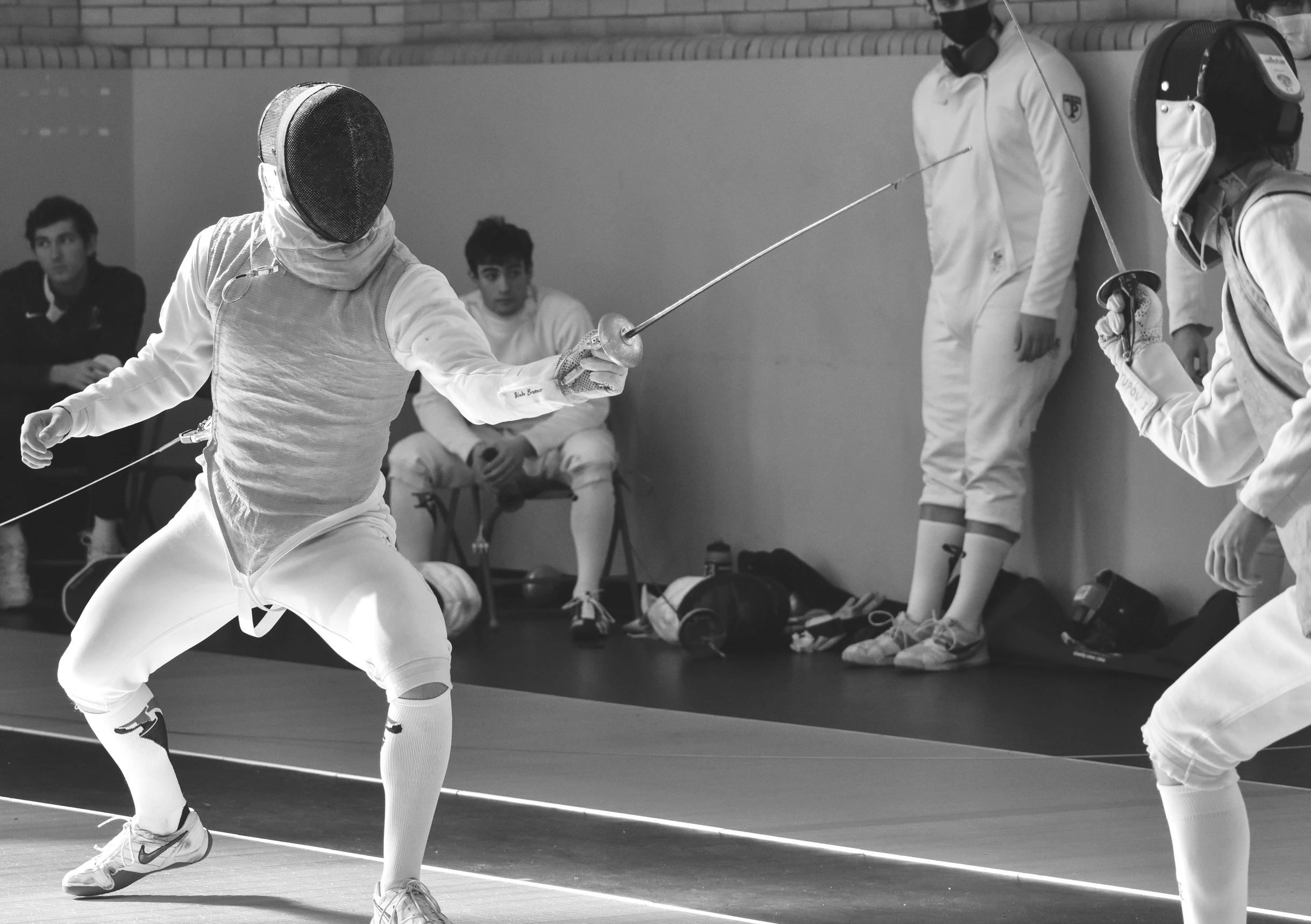
Fencing coach Andy Ma identified Broszus’s skills even earlier, noticing him at a fencing com petition when he was just 12 years old.
“Very disciplined, the best, couldn’t be better,” Ma said.
Broszus stands a tough opponent to take down due to his physical strength, a result of extra hours spent in the weight room.
Louie recalled the first time he lifted with
Broszus at Pottruck. When the latter started his first set, everyone else in the gym paused and stared, blown away at how much he could squat.
“It’s never a good idea to lift with Blake,” he said jokingly.
Combined with his great strength, Broszus is known to pull off impressive, acrobatic moves to corner his opponents. Perhaps even more im portant to his game is his preparation, as Blake dissects his opponents ahead of time to form match day strategies. He then spends hours watching the tape of the top fencers in the world to improve his own game.
As a team captain, Broszus helps implement a practice routine for his entire team. He is known to be willing to make time to fence anyone out side of practice to help them improve.
“He’s very charismatic, very energetic, humble, and he’s a team-oriented leader,” Louie said.
“He’s a good fencer, no question,” Ma said. “But I would say he’s also one of the best human
beings. He doesn’t just focus on himself, but on the whole team.”
With all his remarkable talent and demeanor at just 20 years old, Broszus was unable to topple his hero Kleibrink in the Olympics last summer, falling 5-3 in a pivotal match.
Broszus still enjoyed the Games as an op portunity to learn and meet some interesting people at the Olympic Village. He recalls walk ing around one morning seeing speed walkers power through the facility, and then soon later passing by NBA superstar Luka Doncic on his next turn.
“You have some athletes who are short, stocky, balls of muscle, and then you have the 7-foot volleyball players lumbering around,” Broszus said. “Everyone was so different, but at the same time everyone in there was a very intense, top-notch athlete.”
Broszus has his eyes set on the 2024 Paris Games, with a goal to win a medal. He plans to take another gap year, and expects his routine
to be quite monotonous and intense. He is still enthusiastic for the challenge.
“There’s something about having that very in tense focus and knowing what you need to do to succeed,” Broszus said. “There’s some sort of cool clarity about it.”
After the Olympics, Broszus intends to return to Penn to finish his collegiate fencing career, but what happens after that is still undecided. He is concentrating in statistics at Wharton and is aiming for a related career, potentially in quanti tative trading or biotech.
Ma is certainly excited that one of his top fenc ers will be returning, but he is also enthusiastic about his prospects in Paris.
“Two years ago for Tokyo he was young, but now he’s much more mature,” Ma said. “I think he will have a good chance.”
Whether Broszus will get another shot at taking down Kleibrink is yet to be seen, but it’s safe to say that Broszus will be alright with beating anyone as long as it leads him to the podium.

Track & field prepares to sound the gun on 2022-23 season
The Penn track season is almost underway, and coach Steve Dolan already has big plans for his team this year.
Last season, the track team ended the season with numerous victories, scoring four at the Princeton Invitationals, a third consecutive women’s title at the Ivy League Heptagonal Championships, a title at the NCAA Track & Field Championships, and sending six Quakers to compete at the USA and Canada Champion ships.
Though Marc Minichello — Penn’s NCAA Track & Field javelin champion — has since transferred to the University of Georgia, the Quakers return a host of key pieces from last year’s team, including junior sprinter Isabella Whittaker, sophomore distance runner Bronwyn Patterson, senior middle distance runner Zubeir Dagane, and sophomore jumper James Rhoads. This season, Dolan’s goal remains the same as it did at the end of last year: Keep up the momen tum and bring home more well-earned victories.
“We’re just getting started and fall training has been great,” he said. “In terms of team goals, we won an Ivy League Championship in outdoor track, so that’s exciting to see if they can defend that title. Our men’s team was third outdoors at the Ivy League Championships, which is also a strong result, so we always like to be as strong as we can in the Ivy League because this is impor tant to us.”
Dolan’s philosophy that he imbues into his team is one of maximizing potential. He tries to understand his athletes’ limits, and help them reach and even sometimes exceed them.
Key to that is the comprehension of his team’s strengths and weaknesses, and how they set themselves apart from any other.
“Every team has its own personality,” Dolan said. “We’re going to have our first invitational December 9th, and what’s fun with every team is that there are new people. So, we’ve got a whole new freshman class and a new group of juniors and seniors who are going to lead the team. For me, one of the exciting things is seeing how the personality of the team develops.”
One way Dolan gets a feel for how the person ality of the team will develop is by understanding the newer athletes that are joining, and seeing where they fit in in each event in order to create that well-rounded roster.
“One of the great things about track and field is the diversity of events and, we try very hard,
area,” Dolan said. “It’s going to be really fun to see how they develop. I know we have a couple of new very impactful sprinters
10 THURSDAY, DECEMBER 1, 2022 | THEDP.COM THE DAILY PENNSYLVANIAN SPORTS
Broszus was inspired to join the sport by 2008 Olympic Gold Medalist Benjamin Kleibrink, whom he later faced off against in the 2020 Games
PHOTO BY SAMANTHA TURNER
Now-junior Blake Broszus advances on the strip toward Ohio State’s Ilya Ayupov during the second day of the Philadelphia Invitational at the Tse Center on Jan. 23.
in each recruiting class, to bring in new athletes in each event
and jumpers in both programs that we’ll see for the first time in a couple of weeks at competition. We’re really excited to see them hit the ground running.”
The Quakers will kick off the season at the Seahawk Invitational in Staten Island, N.Y. on Dec. 9 before transitioning into full gear after winter break.
Coach Steve Dolan sits down with the DP ahead of his team’s first meet
JOYCE DAVIS Sports Reporter
PHOTO BY ANNA VAZHAEPARAMBIL
Now-sophomore Bronwyn Patterson crosses the finish line in the women’s 4x800-meter relay race during last season’s Penn Relays at Franklin Field on April 30.
Although temporary exceptions were made for COVID-19, graduate students are not currently al lowed to play for Ivy League teams, even if they have college eligibility remaining. Given that it is very rare for most Ivy League football players to see extended snaps as freshmen, most athletes gradu ate with at least one year of eligibility to spare. This results in many elite players unnecessarily dragging out their graduation date, or worse, transferring away to other conferences that allow them to play (essentially every other conference except the Ivy) their final years.
A number of Penn football players will have this option next year, from linebacker Jake Heimlicher to wide receiver Rory Starkey to offensive lineman Trevor Radosevisch, some of whom are among many others on the team who have officially announced their intent to enter the transfer portal. The Ivy League should allow these players to stay at their un dergraduate institutions if they wish to, where they would serve as veteran presences on their teams and
likely receive a higher-quality graduate education than they might elsewhere.



















































4. Athletic scholarships
The Ivy League’s refusal to offer athletic scholar ships poses a number of issues to its schools’ sports. While all of its schools are need-blind, many top-tier athletes from modest financial backgrounds prefer to play at schools where their scholarships are guaranteed upfront and not subject to an often-confusing finan cial aid process, like they are at the Ivies. Additionally, many players who do not qualify for financial aid — especially those just on the cusp — choose schools that can offer them money over Ivies.

This outdated rule limits the amount of talent that can come into the Ancient Eight, and perhaps explains the limited school spirit at most member schools. It’s not like the colleges can’t afford it either, with Penn for example operating on a $41 million annual athletic budget, in ad dition to its $20 billion overall endowment.





For a conference that is often seen as a bastion of progressivism, the Ivy League has done very little to empower its players. The League hasn’t changed its rules because it knows it doesn’t have to, and the decision-makers in the conference should ask them selves how much they truly care about the players they represent.
“For the first time in my life, I wasn’t swimming. It’s one of those sports where you need to stay in the water, but all the pools were closed,” Leblanc said. “I never got back to a real training schedule until my sophomore year of college, which is really insane to me.”

Like many others, Leblanc wasn’t back on campus until the second semester of the 2020-2021 school year. Even though the swim team was allowed to meet, the restrictions put on the team prevented normal training hours and swim meets versus other schools.
Time restrictions in the water and weight room hampered Leblanc’s progress, and after the academic year was over, the swim clubs in his native Arizona still had pandemic-related restrictions as well. These restrictions devastated Leblanc, but he was deter mined to find a way to continue working on his skills.
“I think my performance really suffered,” Leblanc said. “I went home that summer and I did anything I could to swim. I found this lady who lived 30 minutes away from me, and she had a 25m pool. I paid her to let me swim in her pool, 25 bucks an hour.”
Eventually, Leblanc was able to resume working out with his teammates and coach Mike Schnur. Fi nally interacting with his teammates, Leblanc felt inspired to compete with the help and motivation from his fellow swimmers.
“He’s such a hard worker,” Leblanc’s teammate, freshman Alex Fu said. “On top of that, he’s a very positive guy to be around, always smiling while work ing.”
On top of his swimming prowess, Matt has proven adept at other sports. Inspired by his mother Adri enne, a five-time national champion for Olympic distance triathlons, Leblanc began competing in tri athlons as well.
“I did a triathlon recently. I didn’t train for the bike or run, but I came in first because I dusted everyone else in the swim,” Leblanc said. “I got invited to na tionals, but my goal right now is focusing on college. Once college is over, I’m going to have to look for something new to do, and triathlon is up for debate.”
When asked about what pushes him in sports, Leb lanc credits the winning mentality his parents had instilled in his family. They also taught him the value of balance, something he’s looked to replicate in his own life.
“I have to give a lot of credit to my parents. One story I like to tell is that they never checked our report cards, they just taught us to value education, so we always enforced ourselves,” Leblanc said. “We ad opted that mentality for everything we did, and I have to give a lot of credit to my parents because if they had forced us to do well in swimming and school, I don’t think I’d be where I am today.
“I’m always embracing swimming as part of my life and enjoying every aspect of it. I’m not letting it be who I am, I know having that balance is incredibly important.”
11 THURSDAY, DECEMBER 1, 2022 THEDP.COM | THE DAILY PENNSYLVANIAN SPORTS OPEN LATE & LATE NITE DELIVERY Domino’sTM SUN-THURS: 10AM - 2AM • FRI & SAT 10AM - 3AM LOOKING FOR FULL OR PART TIME WORK? WE’RE HIRING! jobs.dominos.com 215-662-1400 4438 Chestnut St. 215-557-0940 401 N. 21st St. WE MAKE ORDERING EASY! Smart Phones CALL DIRECT OR CHOOSE YOUR ONLINE OR MOBILE DEVICE Tablets AVAILABLE JANUARY 1, 2023 Spring Semester 4000 Block of Locust Brand new! 2 Bedroom 2 Bath 4 Bedroom 3 Bath university enterprises UE Apartments & Townhouses Serving the Penn community for OVER 50 YEARS! “Your mother will be happy!” (215) 222-5500 | 4019 Locust St. info@uerealestate.net www.uerealestate.net undoubtedly a questionable one. Currently, a vast majority of Ivy League sports are allowed to play in the
making this one even more of a head-scratcher. 3. Graduate eligibility
suggestions
carry
postseason,
These last two
could also apply to the entire Ivy League, not just to football, but they do
an added poignance on the gridiron.
MODERNIZE, from page 12
LEBLANC, from page 12
PHOTO BY KENNETH C. ZIRKEL | CC BY-SA 4.0
Flags for the Ivy League schools fly at Columbia University’s Lawrence A. Wien Stadium in New York on Nov. 17, 2018.
BRANDON PRIDE is a Wharton senior study ing finance from Morgan Hill, Calif. who was a Senior Sports Editor for the 137th Board of Edi tors. His email is bpride@wharton.upenn.edu.
3-7 to 8-2: The stats behind Penn football’s one-year turnaround
The team greatly improved on its marks from the 2021 season in all three phases of the game
JONAH CHARLTON, SOPHIA LIU, JARED MITOVICH, & KARAN SAMPATH Senior Reporters
One year ago, Penn football was fresh off yet another disappointing season. The 3-7 finish, highlighted by a third-straight losing record in conference play that left the Quakers at the bottom of the Ivy League, had many calling for change within the program.
So when Penn kicked off its 2022 campaign on a sunny Saturday afternoon in September, pressure was high, but expectations for the team — which had graduated a number of key starters on both sides of the ball — were relatively low.
Suffice it to say that no one — not the Ivy media, not Vegas, and not even The Daily Pennsylvanian — could have predicted the un precedented turnaround that would follow.
Penn ended the season with an 8-2 record, good enough for second in the Ivy League, after pull ing off major upset wins over Dartmouth, Yale, and Princeton — all of whom walloped the Quakers a season ago.
To explain the turnaround, the DP analyzed dozens of data points from the 2021 and 2022 seasons, examining the areas in which Penn experienced the greatest improvements. Here’s what the analysis found.
Pride | Here’s how the Ivy League can adapt to modern times
A vast majority of Ivy sports compete in a postseason, though football does not
BRANDON PRIDE Former Senior Sports Editor
Reflecting on his four years of covering Ivy League football for The Daily Pennsylvanian, former Senior Sports Editor Brandon Pride offers four changes that the conference can make to keep up with the times and empower its athletes.
1. No more co-champions
Going into the last week of Ivy League play, there was a very real possibility that the conference would end in an unprecedented four-way tie. While it didn’t come to fruition (although it came close!), the fact that this was even a possibility is simply laugh able. Half of the teams in a conference should not all be “champions.” In fact, I would argue that there shouldn’t be more than one champion in a given season, as it cheapens the feat, yet five of the last 10 Ivy League football seasons have ended with covictors.
There is of course a simple answer to this prob lem: tiebreakers. Under current rules, if two teams finish with identical conference records, they are automatically co-champions, even if one beat the other head-to-head. Not using tiebreakers is hard to wrap one’s head around, but an even better idea than implementing them is to play a championship game, pitting the two highest-seeded teams against each other after the season. This would be an excit ing game that I would expect few, if any, players to have a problem with. At the very least, tiebreakers should be used, as they allow teams to better take their seasons into their own hands.
2. Allow teams to compete in the postsea son
Despite the conference often fielding squads that have the athletes to top even the most competent FCS teams, the Ivy League does not allow its football teams to compete in playoffs or bowl games. While the reasons for this have been stated to be because of player safety and the need for the student-athletes to have time to focus on their classes during a stressful part of the academic year, if I was an Ivy League foot ball player, I would find these arguments offensive.
There is no reason that our conference’s studentathletes would be less equipped to balance their academics with one extra game. If anything, they would be more well-prepared to do so than the aver age FCS football player. The same goes for injuries. If players want to opt out for either of these reasons, they should have that option, but the decision to not even give the league’s best players a chance is
Women’s basketball snaps losing streak with Big 5 win at La Salle

After two weeks of winless play, the Quakers fi nally find themselves the victors.
On Tuesday Night, Penn women’s basketball grabbed a much-needed second win of the season against La Salle (5-3) at the Tom Gola Arena, lifting the Quakers to a record of 2-5. Penn never once lost the lead throughout the contest, capitalizing on stel lar individual performances.
Both teams started off slowly from the jump, with La Salle going on an early four-minute scor ing drought. Offensive rebounds from 6-foot-4 junior forward Floor Toonders, and interior buckets from junior forward Jordan Obi, gave the Quak ers a slight edge following tip-off. Despite some foul trouble, Toonders managed to snag 10 total rebounds, while freshman guard Simone Sawyer foreshadowed her offensive prowess throughout the game by quickly scoring nine points in the first quarter.
La Salle was smothered in the backcourt from the moment it in-bounded the ball to start the second quarter. Penn utilized an aggressive de fensive scheme, relying on a combination of a full-court press and zone defense. Senior guards Kayla Padilla and Mandy McGurk, along with Sawyer, swarmed La Salle’s guards and forced consecutive second-quarter turnovers. This was pivotal in allowing the Quakers to open up a 21point first-half lead. The Explorers gave the ball away a whopping 17 times across the first two quarters.
Shots just didn’t fall at the beginning of the game for La Salle. The Explorers gradually began to fall behind on the scoreboard after many back-to-back missed open threes. They finished with an 8-27 clip from beyond the arc and only managed 16 points from the paint. Penn ate up the interior, scoring 46 points from inside the paint and grabbing a total of 20 offensive rebounds.
The Explorers emerged from the break blazing hot, quickly chopping down Penn’s lead from 21 to 12 after going a perfect 3-3 from three at the begin ning of the third quarter. Despite this strong effort, the lead had become too large to overcome, and Penn was able to weather La Salle’s quick offensive punches.
Sawyer burst onto the scene, continuing her recent run of dominant offensive performances with a career-high night in three major offensive stat de partments. The freshman guard finished with 24 points, four assists, and seven rebounds, setting the personal bar high for her many games to come. After back-to-back 18-point performances, the fresh man is beginning to establish herself as one of the most lethal Quaker players when it comes to closing games out.
Obi also played a pivotal role on the offensive end and set a personal, finishing the contest with a season-high 20 points, despite having to sit out for the end of the third quarter and much of the fourth due to foul trouble. The junior forward had complete control of the paint, feeding off of crisp passes from Padilla and Sawyer, the former ending with a gamehigh seven assists.
After a bitter voyage to California, where the Quakers lost back-to-back games to San Francisco and USC, a season-high scoring night was just what was needed to lift morale for the remainder of the season. With a plethora of Ivy League games stacked up down the road, Penn is looking to leave its slow start behind and bring its winning momentum to the Palestra for the upcoming game against Stony Brook on Thursday night.
Matt Leblanc follows in his family’s footsteps to swimming excellence
SEAN MCKEOWN Sports

For Penn men’s swimming junior Matt Leblanc, competing at the Division I level seemed inevi table. Leblanc comes from a family with a history of success in the pool; both of his parents were Division I swimmers at Arizona State University.
Leblanc’s father, David, was a French Olympian, competing in the 100m and 200m breaststroke in the 1988 Seoul Olympics. Leb lanc’s parents didn’t pressure him or his two sisters to follow in their footsteps, though. In stead, Leblanc and his sisters found their passion on their own.
“My older sister swam at Columbia, and my younger sister is swimming at the University of Chicago,” Leblanc said. “But I always tell people that my parents didn’t want us to be swimmers. They knew how hard it was, they told us that we didn’t have to do swimming, but somehow, some way, we all just ended up doing this.”
Leblanc, who started swimming when he was 5 and who started club swimming at 10, eventu ally became a four-time 100m state champion, a two-time 200m state champion, and a two-time AISDCA Swimmer of the Year award recipient. Throughout high school, he continued to improve.
“He’s impressive, he’s been winning for such a long time,” Mateja Milovanovic, Leblanc’s high school competitor and friend, said. “And not only did he start well, but he’s only worked harder and
CONTACT US: 215-422-4640 SEND STORY IDEAS TO DPSPORTS@THEDP.COM ONLINE AT THEDP.COM THE INDEPENDENT STUDENT NEWSPAPER OF THE UNIVERSITY OF PENNSYLVANIA • FOUNDED 1885 PHILADELPHIA, THURSDAY, DECEMBER 1, 2022 VOL. CXXXVIII NO. 28 SPORTS
PHOTO BY ANNA VAZHAEPARAMBIL
Senior guard Kayla Padilla drives through La Salle players during the game at Tom Gola Arena in Philadelphia on Nov. 29.
Simone Sawyer and Jordan Obi shined with season-high scoring displays
ANTONIO MELONI Sports Reporter
See MODERNIZE, page 11
gotten better throughout high school, and espe cially now in college.”
Leblanc committed to Penn in 2019, falling in love with the swim team and the coaches on a tour during his junior year. His excitement to start competing for
the Quakers had to wait, however, when the COVID19 pandemic paused his senior high school season and his first season at Penn.
PHOTO BY SAMANTHA TURNER
SEE THE FULL STORY ON PAGE 6
Junior Matt Leblanc competes in the men’s 200-yard breaststroke event during the meet against Columbia at Sheerr Pool on Nov. 5.
Leblanc’s parents swam for Arizona State and his sisters swim for Columbia and the University of Chicago
See LEBLANC, page 11
Reporter
