
Penn knew Apple’s next CEO long before the world did
As John Ternus prepares to lead one of the world’s largest corporations, his former classmates, teammates, and mentors say the traits defining his career have been visible for decades
Decades before 1997 Engineering graduate John Ternus was named Apple’s next CEO, he was a student and varsity swimmer at Penn — known to classmates for his discipline, calm temperament, and easy-going humor.
Apple announced earlier this month that Ternus, currently the company’s senior vice president of hardware engineering, will succeed current CEO Tim Cook in September. As he prepares to take the helm
College faculty approve new undergraduate curriculum
The revised curriculum is set to take effect for the Class of 2031 and includes a new College Foundations program
CATHY
College of Arts and Sciences faculty voted to approve a new undergraduate curriculum earlier this month.
The new program, set to take effect for the Class of 2031, comes after nearly four years of development. The revised curriculum includes three parts: a new College Foundations program, a revised distribution of general education requirements, and revamped elective options.
“This new framework gives us a way to elevate our community of inquiry,” College Dean Peter Struck wrote in an April 22 announcement. “Right from the start, we’re putting each student’s individual curiosity in the driver’s seat.”
The Committee on Undergraduate Education commissioned a revision of the College’s general education requirements in 2024, seeking input from faculty across a variety of disciplines.
Proposals were shared and extensively reviewed over the past two years. The final draft was presented to faculty in March and passed with 70% approval in “mid-April.”
The College Foundations program was piloted by 120 first-year students in the 2025-26 academic year. The program includes “Kite and Key” courses, a writing seminar, and a first-year seminar that allows students to fulfill six general education requirements.
Last year, students expressed initial mixed reactions to the pilot program in conversations with The Daily Pennsylvanian.
The revised program also aims to “streamline and simplify” general education requirements for See COLLEGE, page 2
of one of the world’s largest corporations, Ternus’ former classmates, teammates, and mentors say the traits that defined his career were first visible decades ago.
1997 Penn Engineering graduate Paul Feehery — Ternus’ friend, roommate, colleague, and senior project partner — said Ternus stood out for his consistent approach to work.
“He was always just a very low-key guy,” Feehery
told The Daily Pennsylvanian. “He’s very driven academically, very deliberate, and never, never made rash decisions.”
Feehery said he and Ternus became friends after working together in mechanical engineering classes and study groups. They went on to live together in an off-campus house near 39th Street and worked together on their senior project.
See APPLE, page 3
A peek inside senior societies at Penn
Students, faculty, and staff discussed the draft guidelines at two University-wide listening sessions held last week
to come together and provide feedback on the guidelines. He told attendees that he had “zero authority” over the final draft and that comments would be shared with the University administrators as part of the revision process.
See OPEN EXPRESSION, page 2
Centered around shared interests or identities, these groups help graduating students connect with likeminded peers
AMY LIAO Senior Reporter
Senior societies have long been a part of campus life at Penn, providing students with an opportunity to find a new community during their final year at the University.
Ranging from groups that date back to the early 20th century to modern organizations centered around shared interests or identities, these societies help graduating students connect with like-minded peers. The Daily Pennsylvanian spoke with individuals associated with senior societies at Penn to explore how the groups benefit students and recruit new members.
Traditional societies Traditional societies — such as the Friars Senior Society, Mortar Board, and the Sphinx Senior Society — are among the first established at Penn. While Friars and Sphinx are comprised of campus
leaders and are exclusive to the University, Penn’s chapter of Mortar Board is part of a national honor society that recognizes “scholarship, leadership, and service.”
Wharton senior and Friars member Erin Guzmán described Friars as “a community of leaders that brings together people who have done really well and across many different disciplines or areas on campus.”
Guzmán — who also serves as the president of Mex@Penn — said the society has connected her with other leaders on campus.
“The point is to meet people who you wouldn’t have otherwise met,” she explained.
Unlike traditional campus greek life organizations, Penn’s senior societies have a less formal recruitment process that takes place during a prospective member’s junior or senior year.
Guzmán explained that the selection procedure for many senior societies — a process known as being “tapped” — involves current society members referring people from the junior class who they believe would be “a match” with the organization. She added that students can also be tapped through alumni or by word-of-mouth, emphasizing that “you don’t have to know them personally.”
For Friars specifically, Guzmán said interested juniors “have to be either in a leadership pool or [be] very well-accomplished in a specific area of campus.”
She added that while she does not believe that Friars is a “super exclusive” society, the group’s 40-person cap helps members “make a genuine connection with everyone in the group” and ensures “everyone feels supported by our See SENIORS, page 2
How Penn’s sustainability initiatives have evolved
Through partnerships with nearly 30 groups and centers across the University, Penn Sustainability coordinates efforts to address emerging climate challenges
SAMANTHA DASIKA Staff Reporter
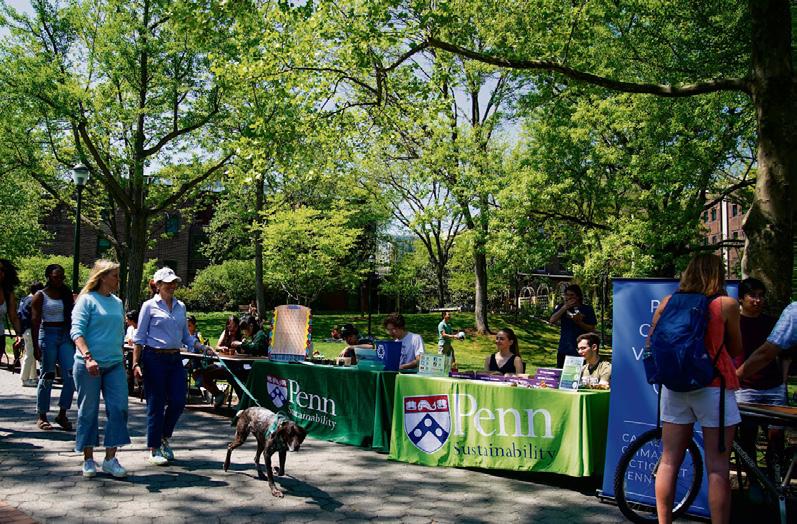
Established to ensure an environmentally conscious campus, Penn Sustainability works with students, faculty, and other services to address the University’s role and long-term impact on the climate.
Through partnerships with nearly 30 groups and centers across the University, the office coordinates efforts to address emerging challenges and efficiently carry out projects. With Penn’s latest Climate & Sustainability Action Plan now underway, The Daily Pennsylvanian explored the history of the University’s environmental initiatives and how they have changed over time.
An evolving approach to sustainability
sustainability dating back to the 1970s, the first University-sponsored sustainability initiative was created in 2007. That year, the Penn Green Campus Partnership was established as a student-led umbrella organization to promote sustainable planning and policy development.
At the time, College junior Mike Poll — the thendirector of the Penn Green Campus Partnership and the associate director of the Penn Environmental Group — told the DP that the University “finally has an idea of where we are and what we do well.”
In 2009, PGCP launched the Student Eco-Rep program, an environmental leadership opportunity for Penn undergraduates.
While Penn has shown a commitment to See SUSTAINABILITY, page 2

Penn South Asian dance team wins first national title
The performance — centered around a ‘Bill Nye the Science Guy’ theme — capped a season of consistent first-place titles for Penn Dhamaka
ANANYA KARTHIK Senior Reporter
Penn Dhamaka won the Desi Dance Network national circuit this month, marking the first time the University’s all-male South Asian fusion dance team has secured the title.
The April 18 victory capped a season of consistent first- and second-place titles for Dhamaka. The national circuit was hosted by DDN Inc., a platform founded in 2014 to support South Asian performing arts through competitions and conventions.
For Dhamaka members, the win represents a culmination of long-term planning amid a highly competitive national landscape.
“It’s something we’ve all dreamed about,” College senior and Dhamaka co-captain Krishna Khawani told The Daily Pennsylvanian, describing the win as “the highest level of achievement that you can get in South Asian competitive dance.”
The DDN circuit operates through a season-long structure. According to College sophomore Aditya Bala, teams first submit audition videos to individual competitions. Each competition typically selects around eight teams to advance, ranking each based on performance.
Dhamaka’s set this year was built around a “Bill Nye the Science Guy” theme, invoking the elements of the science education TV show.
Bala said the concept had circulated among Dhamaka members since 2018 but had never been executed at scale, adding that alumni from multiple generations contributed to the final performance.
He told the DP that the team intentionally pursued a lighter and more upbeat theme for this season’s set, a shift from the “very dark” concepts explored in past years.
College senior Naeem Himani — Dhamaka’s artistic director and co-captain — said the team aimed to prioritize audience engagement and storytelling.
“Making the audience feel something was a huge objective,” Himani said. “Clean choreographies matter, but I noticed entertainment for the audience had gone down, and a lot of people weren‘t enjoying what they were watching.”
Engineering junior Gaurav Malhotra wrote to the DP that at the end of the performance, the dancers handed out globes with QR codes to the audience to raise funds — which he described as one of his most memorable moments.
COLLEGE, from front page
undergraduates in the College. Students will now take at least 12 courses in one division of their choosing, five in a second, and three in the third.
“Previously, our students were restricted to a certain number of courses tagged as fulfilling these requirements, but now, every course counts,” Struck wrote in the April 22 announcement. Under the current system, students are required to take specifically attributed sources courses
SUSTAINABILITY, from front page
Eight years later, PGCP rebranded to Penn Sustainability.
“They laid such an essential foundation that we are still working off of today,” Penn Sustainability Director Nina Morris told the DP.
PGCP spearheaded the still-existing Environmental Sustainability Advisory Committee, a collaborative consortium of various faculty, student groups, and offices across Penn working to help the CSAP “come to fruition.”
As Penn Sustainability’s strategic program, the CSAP is released every five years to evaluate progress and set priorities. Penn is currently operating under CSAP 4.0, which it released last year.
The plan identifies multiple initiative areas for Penn Sustainability: academics, utilities and operation, physical environment, procurement, strategic waste, transportation, and civic engagement and outreach.
According to Morris, each initiative ensures “we have a campus that stewards our corner of our ecosystem as best as we can.”
“One of the wonderful things about working in the climate and sustainability space is that we are constantly iterating and constantly adopting new ideas, and yet we’re always working towards the larger goal of creating a sustainable future,” she added.
The foundation for each CSAP is Penn’s commitment to carbon neutrality by 2042. Since 2009, there
OPEN EXPRESSION, from front page
Attendees were informed that two note-takers would document both the substance and tone of remarks, emphasizing the importance of “not just what was said, but how it was said.”
Recording devices were not permitted, and cameras were disabled to encourage participants to openly share their views.
Throughout the session, many speakers expressed dissatisfaction with the draft guidelines. Several attendees described the document as “unsalvageable” in its current form. Multiple participants said that the proposal requires a fundamental revision rather than incremental changes, arguing that the draft was written through an “illegitimate” process. Attendees also pointed to the absence of senior University leadership at the session — such as Penn President Larry Jameson and Provost John Jackson Jr. Much of the discussion centered on concerns about administrative authority under the proposed guidelines.
One faculty member raised questions about changes to the Committee on Open Expression and its role under the draft, particularly about its advisory function and reporting structure.
Others outlined concerns about the draft’s language, with a graduate student citing the University’s motto — “Laws without morals are useless” — to emphasize how the guidelines have “a lot of rules,” but not “a lot of soul.”
Speakers also discussed how the guidelines may affect protests on campus. Multiple attendees questioned how expectations of advance notice for demonstrations would function in practice.
“Seeing the crowd stand up, cheer, and actually believe in what we were trying to do … that was beautiful,” he wrote. “It felt bigger than just a performance.”
The performance incorporated multiple dance styles, including Bollywood, Bhangra, and hip-hop, alongside props, theatrical lighting, and interactive segments.
Bala told the DP that the team worked to integrate both technical choreography and a narrative foundation, including representations of the water cycle and environmental change.
“We had students go to Amy Gutmann Hall and engineer and make light-up dandiyas using materials there,” he said.
The team’s musical composition also played a central role in shaping the performance.
According to 2018 Perelman School of Medicine
graduate Srihari Sritharan — who served as the set’s DJ — the mix was designed to combine nostalgic “throwback songs” with high-energy transitions, allowing audiences to “sing along to the songs they grew up with” before shifting into more modern and hip-hop elements.
“When it comes to making an impact at the national competition level, attention to every detail, down to song choice and set construction, can make the winning difference,” Sritharan wrote.
Preparation for the season required extensive time commitment, with practices intensifying in the weeks leading up to competitions.
“Given the fact that we’re at Penn, every single guy on the team is doing a million other things,” Khawani said, pointing to challenges in managing coursework, job recruiting, and other extracurriculars.
“To be competing at this highest level and be shooting to be the best comes with a lot of sacrifice,” he added.
Despite those demands, College and Wharton senior Krutin Devesh told the DP that the group prioritized communication and flexibility to accommodate other obligations.
“The balance came in terms of the support that the team gave one another,” Devesh said. “It was really just a balancing act that was grounded in communication and how close we are as a team.”
The members also described the team’s culture
belonging to the “foundational approaches” and “sectors of knowledge” categories.
“Whatever a student takes in the humanities and arts will count toward the humanities and arts distribution; whatever they take in the social sciences and natural sciences will count toward those,” Struck continued. “This is our way of making sure that curiosity leads the way.”
The new curriculum also includes a “revamped” language requirement and requires students to take a course in a new category called “perspectives & difference.” Students will have a broader scope of elective options, including classes offered by other schools.
According to the announcement, the
has been a 47% decrease in campus carbon emissions.
Initiatives on campus
By working with Penn Facilities and Real Estate Services, Penn Sustainability ensures that campus buildings meet standards set by the United States Green Building Council’s Leadership in Energy and Environmental Design rating system.
A map on the Penn Sustainability website shows the certification levels of current and pending projects. Currently, more than 30 recent projects have a gold rating, and two buildings — the Morris Arboretum Horticulture Center and the Vagelos Laboratory for Energy Science and Technology — have earned the highest certification level of platinum.
“We’ve always invested heavily in making our buildings as energy efficient as possible,” Morris said, explaining her collaborations with multiple departments at FRES, including the Office of the University Architect, Operations and Maintenance, and Design and Construction.
In the procurement focus area, Penn Sustainability oversees University purchases and Penn’s membership in the Sustainable Purchasing Leadership Council, a nonprofit organization “committed to driving positive impact through the power of procurement.”
Penn Sustainability also works with Penn Dining to secure locally sourced, plant-based ingredients and implement waste reduction practices. Currently, 67% of Penn Dining’s spending is direct toward plantbased products.
Another focus of Penn Sustainability is on-campus natural spaces and landscapes. Through the Ecologi-
as a defining factor in its success. Bala, Khawani, Devesh, and Himani all characterized Dhamaka as a “brotherhood,” emphasizing the amount of time spent together in rehearsals and during travel for competitions.
The team also collaborated with Penn’s Arts House Dance Company for its final performance. The partnership builds on a longstanding relationship between the two groups, including an annual joint piece known as “Artsmaka,” which has been performed for more than a decade.
For the national stage, AHDC dancers contributed to segments of the performance, including hip-hop and contemporary pieces.
College and Wharton senior Sophia Jorgensen of AHDC wrote to the DP that the collaboration reflects a shared commitment to growth across dance styles, with both groups regularly teaching each other choreography.
“This team is unique,” Jorgensen wrote. “It is palpable how their shared love for dance created something stronger than any team dynamic I have ever seen.”
For members of Dhamaka, the win carried significance for South Asian performing arts on campus.
“It’s not that common to see guys dancing or giving so much time towards dancing, especially in the South Asian community,” Khawani said. “We want to show that it is possible to be successful in academics but also achieve so much in the arts. Things like that do matter.”

curriculum will be evaluated one, three, and five years after being formally implemented.
“Anything this complex is likely to have unexpected aspects arise as implementation unfolds,” the announcement read.
Struck previously told the DP that the general education curriculum was “complicated” — and that his goal was for students to have more freedom of exploration.
“What the world needed 20 years ago is a little different than what the world needs right now,” Struck said at the time. “We want to make sure that the curriculum and whatever requirements we adopt are suited to the moment that we have now.”
cal Landscape Stewardship Plan, the University has worked to improve the ecological design and management of open spaces across campus. Penn’s campus is a level-two-certified arboretum, with 34 green roofs and 6,800 trees.
Morris described the ELSP as an internal document used “to identify how to support biodiversity and steward our campus in a holistic way.” For example, the ELSP helps to support a “bird-friendly Penn.”
Penn Sustainability also assists faculty through its Green Labs program, working with lab staff to determine how to maintain equipment efficiently, manage freezer storage, monitor chemical inventory, and reduce waste.
Efforts across Philadelphia
Penn Sustainability also works to “connect with our broader community” to make sure projects align with “what our neighbors want to see,” Morris said.
The office runs an Off-Campus Move Out program and donation drive to provide free curbside pickup for gently used items for students moving out in May.
These items — including clothes, furniture, and appliances — are redistributed among local families in Philadelphia.
The initiative was created to reduce the amount of litter and trash left in West Philadelphia during the offcampus move out process and to provide students with an opportunity to donate extra belongings.
“That was one of the biggest things that we heard from our neighbors,” Morris said. “We’ve been working on trying to meet the community’s needs.”
Community
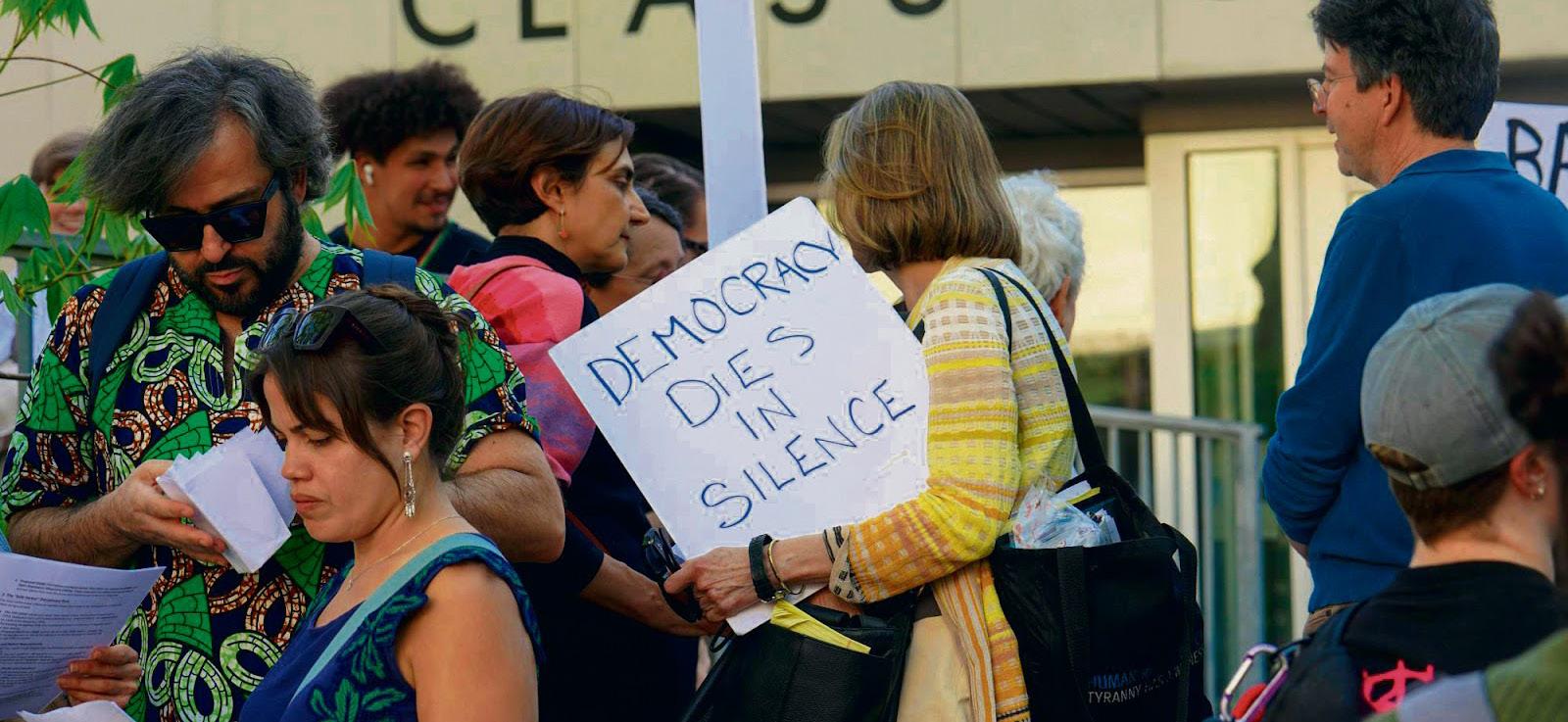
“Protests happen organically,” one faculty member said. While several attendees discussed a “chilling effect” on speech at Penn in recent years, some also warned that the new guidelines could spark intense backlash once finalized in September.
“I see faculty who are mobilized and galvanized,” one graduate student said. “I don’t think they’re going to take this lying down.” Transparency in the feedback process emerged as a recurring theme. Several speakers said that comments from the listening sessions should be accessible to the larger Penn community rather than shared only with administrators.
“What about the community that’s only been given 22
days to review these guidelines?” one faculty member questioned.
Several students noted that the listening sessions had received very little “advertising” and said that the Thursday session — which took place at 4 p.m. — conflicted with class schedules of many of their peers.
During the session, Feldman commented that “a lot of folks have noted the timing” as “unsatisfactory.” He indicated his willingness to “arrange opportunities” for further feedback.
Penn offered an online session on April 24. On Monday, Jackson announced the University would extend its deadline for additional feedback to May 29. Administrators will work throughout the summer to revise the draft.
SENIORS, from front page
community.”
Activity-based societies Penn’s activity-based societies, including the Osiris Senior Society, Kinoki Senior Society, Bell Senior Society, and Order of Omega, connect students with similar academic or career interests. Unlike traditional senior societies, these groups were mostly founded more recently. Bell is composed of seniors interested in entrepreneurship and technology, while Kinoki caters to students hoping to pursue careers in the film and entertainment industry. Order of Omega is a chapter of a national organization recognizing leaders of fraternities and sororities. Osiris invites “senior leaders and outstanding members of the arts community.” College senior and Osiris President Idil Secil told the DP “it’s really important that whoever puts in effort into performing arts or visual arts at Penn can be recognized.”
“It’s just a group where you can connect with other members without competing with each other or being isolated to your own group,” she said, adding that “it’s definitely influenced my senior year.”
Secil said that Osiris began using a “tap-based” recruitment process this semester, where “tapped” candidates are invited to events that allow them to get to know the society’s current members. She added that while Osiris is an “arts community,” the society hosts a variety of social events beyond strictly artistic activities that enable members to get to know each other.
“It’s not just them performing or being involved in their art, but more like a friendship or a brotherhood that is built, which I think is really impactful,” Secil said.
Identity-based societies Penn also has societies for students who identify with certain groups — such as the Carriage Senior Society for LGBTQ+ students, Cipactli Latinx Honor Society for Latino students, and Shamash Senior Society for Jewish students.
The Onyx Senior Honor Society — founded in 1974 for Black students — is the oldest identitybased society at Penn. College senior and Onyx President Aisha Ali said that members have “proven themselves to be devoted to not only just University tradition, but also within citizenship and diversity throughout the city of Philadelphia as well.”
She outlined how the group’s tenets of “humility, humanity, and heritage” are reflected in the group’s membership and programming.
“We were founded with Black excellence in mind, and we hope to carry the legacy of our ancestors,” she added. Along with monthly social gatherings, Onyx hosts monthly community service initiatives — such as preparing food for community fridges in Philadelphia, collecting donations for food drives, and packing toiletry kits. Onyx members also volunteer at Bartram’s Garden and work with Ase Academy, a mentorship program for middle and high school students in Du Bois College House. She described the recruitment process as “very accessible and equitable” because rather than using a “tapping” process, any member of the Black community can apply for Onyx membership. Prospective members can choose to apply either in their junior spring or senior fall, but Ali added that the process can be “highly selective” depending on how many applications the group receives. College senior and Onyx Vice President Marissa Lassiter said getting to meet more members of “Black Penn” through the society has been “something that I’ll remember forever.”
“There’s so many different sub sectors of what it means to be Black on Penn’s campus, and so meeting all those different people […] has been really, really beneficial,” Lassiter said.
The Oracle Senior Honor Society is for students of Asian American and Pacific Islander heritage at Penn. College senior Darlene Leohansson said what drew her to Oracle the most was that “it’s a space to recognize leadership on campus, but specifically Asian American Pacific Islander leadership.”
“It’s nice that there’s a space to connect with people with similar backgrounds or to have this joint identity,” Leohansson said. “Even if all the activities we’re doing are not necessarily connected to Asian American or Pacific Islander identity, just sharing that background does add a sense of comfort and a reminder of home for a lot of us.”
Similar to Onyx, Leohansson said Oracle has an “open recruitment process” and is “extremely cognizant of exclusivity and diversity within the activities that we do and the members that we take.”
She explained that the group mainly hosts social events because “everyone in Oracle has experience being the one at the helm of a student club or student organization here at Penn.”
“So we started to be a space where people can meet other leaders, but also just appreciate spending time with other people, especially during our senior year,” Leohansson said.
School-based societies
School-based societies represent members of Penn’s four undergraduate schools. They include Gryphon Senior Society for students in the College of Arts and Sciences, the Lantern Society for students in the Wharton School, the Nightingales for students in the School of Nursing, and the Hexagon Senior Society for students in the School of Engineering and Applied Science.
Founded in 1910, Hexagon is the oldest schoolbased senior society at Penn. Engineering senior Beccan Simon said the society’s “biggest function” is partnering with the Office of Academic Services to lead tours of the Engineering School buildings to prospective students.
Besides tours, Simon described the society as a “network” and “a community of engineers” that occasionally hosts social and fundraising events. He added that Hexagon uses a “tapping process,” where members reach out to juniors who they believe “would be good fits for both the touring component and the community component.”
“I’ve gotten a lot closer with a bunch of other engineers through [Hexagon] so I would say that’s been very special,” Simon concluded. “On the other side, I think the process of just getting to be a resource to prospective students and showing all that Penn has to offer in your tour is a really fun way to reflect on your journey and then also pay it forward.”
According to Feehery, the two maintain a close friendship to this day.
Katharine Gilbert — who coached Penn men’s and women’s swimming and diving from 1983 to 1999 at Penn — said she first got to know Ternus while recruiting high school athletes for men’s swimming and diving.
“He was very polite and very interesting to me on the phone,” Gilbert recalled. “He was himself, but he was very likable.” 1997 Wharton graduate Robert Brown — who competed alongside Ternus during their first two years at Penn — echoed a similar sentiment.
Brown explained that he and Ternus were part of a first-year class of around a dozen swimmers who trained together daily.
“I remember he was confident, in a good way, and friendly,” Brown told the DP. “He smiled a lot and I never saw him in a bad mood.”
Brown said Ternus competed in backstroke and sprint freestyle events, adding that the team’s practice schedule required constant discipline. During winter break, for example, swimmers traveled to Florida for intensive training twice a day before returning to dual meets and conference season.
“You really had to push yourself about as hard as you could every day and be consistent,” Brown said. In 1994, the DP reported that Ternus won both the 50-meter freestyle and 200-meter individual medley at a men’s swimming meet.
Still, those who knew Ternus were quick to clarify he was never defined by only one aspect of his life at Penn. According to Feehery, Ternus would later become involved with a recreational ultimate frisbee team and had multiple groups of friends across campus.
“He was always a good friend,” Feehery said. “John had a lot of fun in college but always knew when to draw the line.”
“We went skiing in the Poconos at one point,” he added. “He grew up on the West Coast. So I think he was probably not so impressed by the icy slopes in the Poconos.” Gilbert said Ternus had an unexpected interest in music. She recalled being amused when Ternus noticed her Frank Sinatra CD.
“I remember it was John Ternus who said to me, ‘Coach, do you like that CD?’ I said, ‘Oh, I really like it!’ He said, ‘So do I!’ and it made me laugh,” Gilbert said.
prominent undergraduate work took the form of his senior project — the Head Actuated Nutritional Device Feeder, or H.A.N.D. Feeder. He worked alongside Feehery, 1997 Engineering graduate Travis Heinrichs, 1998 Engineering Ph.D. graduate Venkat Krovi, and current Penn Engineering Dean Vijay Kumar.
The device aimed to help users feed themselves by translating head and neck movements into the motion of a spoon. The group’s final paper described the prototype as a “telethesis,” or a passive articulated mechanism coupled to the user’s body part.
Feehery said the project stemmed from earlier work on a foot-controlled feeding device. The team wanted to design something that could be used by people with quadriplegia, who typically retain head movement.
“One of the big things was that they wanted something passive,” Feehery said. “It would give them more autonomy and more freedom.”
The design required the team to translate head movements into precise mechanical control without motors or electronics.
“There’s motions you’re trying to capture, and there’s motions you’re trying to isolate, and to do that is pretty difficult with a fully mechanical, non-electrical device,” Heinrichs said.
“We built lots of prototypes,” he continued. “We actually even used Lego sets to do our initial prototypes and learned quite a bit from those.”
According to Krovi — who worked with the team as a graduate student in Penn’s GRASP Lab — the project would go on to win the Procter & Gamble Best Paper Award at a robotics conference.
“That group was really motivated,” Krovi said. “They were an undergrad group, but the work that they had done was something that could be reported and get the best paper award in an international conference.”
Kumar — who worked with Ternus as a faculty member at the time — reflected on the project in a statement to the DP.
“John’s journey from Penn Engineering to leading one of the world’s most influential technology companies is a powerful reflection of the kind of leadership, curiosity, and technical excellence we strive to cultivate in our students,” he wrote.
Feehery said each teammate contributed different strengths. He remembered focusing on robotics math, Heinrichs working on detailed design, and Ternus focusing on modeling the device to a human through Jack — the human simulation program used.
“I think we all brought our own different things to it, but then we worked together to build it,” Feehery
Ternus, who addressed Penn Engineering undergraduates at the school’s 2024 Commencement, described a mistake he made while working on the project.
“I nearly destroyed Penn’s first, and at the time only, CNC milling machine,” Ternus said.
Feehery remembered the incident as part of the team’s experience learning to use new equipment.
“John was the one that hit the button and the machine. It was just all wrong,” he said. “The machine had just crashed into the table and did tons of damage to it.”
“The guy who ran the machine shop there was a great guy,” Heinrichs said. “He nicknamed John ‘Crash.’ That name stuck for a long time, and that’s a fond memory of that time.”
For Feehery, the story captured Ternus’ willingness to learn by doing.
“John just really developed an interest in learning this thing,” Feehery said.
Ternus emphasized the importance of curiosity and persistence during his 2024 Commencement address.
“The best engineers don’t just solve problems — they stay curious about the world around them,” he told the crowd. “The care you put into your work matters.”
Ternus carried a similar mindset into Apple when he joined the company’s product design team in 2001. He became a vice president of hardware engineering in 2013 and joined the executive team in 2021 as senior vice president of hardware engineering.
The company credits him with work across its iPad, AirPods, iPhone, Mac, and Apple Watch products, alongside efforts to reduce the company’s carbon footprint.
A request for comment was left with Apple.
Those who knew him at Penn said the most recognizable throughline in Ternus’ career was his temperament.
Feehery said Ternus has remained calm, careful, and steady over the years — even as his responsibilities at Apple grew.
“He doesn’t brag about it,” Feehery said. “He’s doing it because this is what he’s loved doing his entire life.”
When asked to describe Ternus, Heinrichs said the one word that came to mind was “integrity.”
“You could tell integrity was just part of his personality,” he added. “I can’t recall him ever saying a bad thing about anybody else.”
Gilbert told the DP that Ternus’ success reflected something broader about student-athletes at Penn.
“Being in a sport and having that discipline of
else that you are interested in, and it makes a big difference,” Gilbert added. “He brings an excellent temperament and intelligence to the position, and there’s no doubt in my mind about that.” Kumar also wrote to the DP that Ternus’ career trajectory reflects both his personal success and the broader mission of Penn Engineering.
“Penn Engineering is incredibly proud to count him among our alumni and look forward to following all that lies ahead,” Kumar wrote. “I have no doubt he will continue to shape the future in meaningful and responsible ways.”
For current Penn students, Feehery said Ternus’ journey offers a lesson in focusing on what is in front of them rather than trying to engineer every outcome too early.
“I think it all starts with doing well at what you do in college,” Feehery said. “Focus on doing a great job and getting good grades. Focus on the next chapter once you get there.”
Heinrichs echoed a similar sentiment, “If you put your head down and work hard at something for a few decades, you’re probably gonna make it pretty far in life, especially if you have the University of Pennsylvania in your background.”
Gilbert said the praise she heard from former teammates after Ternus’ appointment reflected who he had been long before the announcement.
“It’s not because he got this,” Gilbert said. “It’s because he was well-respected and well-liked as an undergrad.”
As he prepares to step into one of the world’s most visible leadership roles, those who knew him at Penn attested to his commitment to doing work well.
“If you stay curious, stay grounded, and keep showing up, you’ll find yourself building things that matter more than you ever expected,” Ternus told the crowd at his 2024 Commencement speech.
“Ternus has the mind of an engineer, the soul of an innovator, and the heart to lead with integrity and with honor,” Cook wrote in an April 20 press release. “He is a visionary whose contributions to Apple over 25 years are already too numerous to count, and he is without question the right person to lead Apple into the future.”
“He’s done incredible things,” Feehery concluded. “I had a great time with him for the four years at Penn. And I just think everybody chooses different paths. And the one he chose, he knocked it out of the park.”
“I love Apple, and I’m deeply honored to take on this role,” Ternus wrote in the same announcement. “We have the most talented teams in the world, and I’m excited to build on everything we’ve accom-




For 30 years, Giovanni & Pileggi Salon has been a cornerstone of luxury hair and beauty in Center City Philadelphia, celebrated for its artistry, innovation, and enduring commitment to excellence. Giovanni & Pileggi consists of unparalleled talent from stylists to makeup artists, offering a full range of luxury services. Celebrating three decades in business, Giovanni & Pileggi continues to set the standard for refined hair artistry in Philadelphia.








On Saturday night at 11:04 p.m., UPennAlert, the University’s emergency communication system, sent a notification that there was “police activity” on the corner of 40th and Sansom streets. What was not disclosed at the time was that this police activity was responding to a shooting at that location, which had occurred almost an hour before that first message. Then, about 58 minutes after the initial alert, the Penn community was sent a second notification that the area was “all clear.” This was the last communication from Penn’s Division of Public Safety about the incident.
At no point during that process was it communicated by DPS that the events of Saturday night were considerably more serious than just “police activity.” While we understand that not every situation can be fully understood and communicated at a moment’s notice, Penn has a responsibility to ensure the safety of its students. Part of that mandate is to clearly transmit as much information as possible about safety risks to the Penn community. With the largest private police force in Pennsylvania, can we really not detect and communicate about a shooting on our campus within a reasonable time frame?
UPennAlert’s delay last week wasn’t a one-off. Rather, it was indicative of deeper structural issues with the DPS approach to keeping us safe.
A particularly egregious shortcoming of the UPennAlert system is its failure to provide intermittent updates during a
situation. All alerts follow the same basic structure: DPS sends an initial warning and eventually, one to tell us that things are “all clear.” But in many cases, this leaves our community in the dark. Many Penn students have commitments that last late into the night and live on blocks that UPennAlerts frequently warn us to avoid. Penn has a responsibility not only to alert students of violent crimes within their neighborhoods but to give them as much information and guidance as possible to help them stay safe. DPS must offer more transparency than just “here’s a situation” and “situation dealt with.” Tell us what the incident was. Give us updates as new developments arise. Then, give us that “all clear” message when it’s appropriate to do so. It seems obvious, but the current system fails to meet even this very basic standard. While DPS often fails to give us necessary updates about actual violence, it overreport about instances that pose no risk to student safety. UPennAlerts have been used as a fearmongering tool by the University, especially in politically charged situations. During the Gaza Solidarity Encampment in 2024, UPennAlerts were used to paint these demonstrations as dangerous, while there was no real threat of violence to students. The stated policy from DPS says that UPennAlerts are only sent in circumstances constituting “significant emergencies or dangerous situations” that warrant the attention of the Penn
community. How is the University choosing to vilify certain protests through an emergency alert system a justifiable practice?
Of course, these intimidation tactics are nothing new in how Penn polices our campus. In November, DPS sent a University-wide email outlining its safety response to “a social media post encouraging people to gather.” Part of this response involved baton-wielding officers selectively turning away Black youth attempting to walk down 40th Street, while allowing other pedestrians through.
Penn frequently points to its expansive public safety presence as evidence of its commitment to student safety. Yet, Penn’s use of 121 full-time police officers does nothing to address the underlying roots of crime on or near campus. DPS could perhaps better protect us by investing more in preventative measures and ensuring greater transparency about crime that does occur, as opposed to its current practice of over-policing residents and under-informing the Penn community.
UPennAlert is also eerily absent in a crucial time of risk for many students at Penn: the increased deployment of ICE agents across the country — including to college campuses. Just a few weeks ago, the Undergraduate Assembly passed a resolution imploring Penn’s administration to set a concrete policy on how to notify and protect students from ICE. This comes after a monthslong campaign of violent ICE raids and
closes more doors than it opens
Penn’s social conditioning into a handful of majors and careers is no secret, and it’s definitely not an unpopular topic to write about. First years arrive on campus and the niche major they applied with, the one they’re actually passionate about, slowly devolves into something more conventional. By the end of New Student Orientation, there are too many pre-med students and philosophy, politics, and economics majors to count. However, seldom do we hear about those who don’t fall victim to the few career paths deemed worth pursuing by Penn’s culture. In reality, the problem isn’t just how so many students choose to pursue the same few majors and careers, but how it has come to affect those who don’t. They’re facing a battle arguably harder than giving up your passion: having to fight to pursue it.
Alyma Karbownik, a staffer for The Daily Pennsylvanian and College sophomore double majoring in international relations and environmental studies, feels as though her field of study lacks the resources and attention it deserves. For her environmental studies major, she says it is “hard finding upper-level classes in general, but also hard finding ones you’re genuinely interested in.”
In fact, she explains how she often has to take classes outside of the environmental studies department to fulfill her major requirements. Advisors have even suggested she take classes without the correct course attribute to later be petitioned to count towards her major. But, lacking a diverse set of classes has implications worse than having to sit through a few boring seminars. When you have to choose classes in other departments to fulfill upper-level requirements, you sacrifice depth in your knowledge of the subject you’re actually trying to pursue. Classes don’t build on each other, and you end up with a curriculum full of niche topic classes that might not even interest you in the first place. Being surrounded by peers whose academic curiosities are satisfied by cohesive and ample coursework forces you to question: Why wouldn’t you just switch your major?
Penn’s funneling problem exists within popular majors as well; it just presents itself
deportations, as well as the detainment of multiple college students. DPS leadership has emphasized that it views ICE simply as a law enforcement agency and that its presence alone is not a reason to send a UPennAlert. But today’s political climate is not sympathetic to a lack of communication about this issue. If a peaceful demonstration or a potential gathering of local teenagers are reason enough to alert the Penn community, ICE’s presence absolutely warrants a warning. This academic year has been no stranger to frightening situations on and around our campus. And yet, the UPennAlert system has utterly failed in its goal to ensure that everyone at Penn understands legitimate risks when they arise. Our emergency alerts should conform to our community’s needs. This includes addressing our concerns, being as transparent as possible, and not manipulating our safety to reach political ends. It’s time for DPS to do better.
Editorials represent the majority view of members of The Daily Pennsylvanian Editorial Board who meet regularly to discuss issues relevant to the Penn community. This body is led by Editorial Board Chair Jack Lakis and overseen by Opinion Editor Ingrid Holmquist. It is entirely separate from the newsroom. Questions or comments should be directed to letters@thedp. com.
lack of
differently. Students set on a career outside of Penn’s presets aren’t awarded the same opportunities as their more traditional peers. When speaking with Cameron Kim, a College sophomore studying biology on the pre-veterinary track, I observed a stark contrast between the pre-vet and pre-med experience. She talked about finding it difficult to get involved in animal-related research or clinical work at Penn, explaining that “anything having to do with animal science is usually using them as models for human medicine.” In contrast, pre-med students have a myriad of opportunities to take advantage of: research, clinical work, and even pathways with admission to the Perelman School of Medicine. Take a look at the pages for pre-vet and pre-med on Penn Career Services; the difference speaks for itself.
Nobody’s expecting Penn to be New York University’s Gallatin School, but the lack of support for paths that are
for
actually quite popular outside of Penn is a bit ridiculous. It doesn’t make sense looking at Penn’s reputation from the outside, either. Penn’s School of Veterinary Medicine is ranked sixth in the nation, but it doesn’t seem like they want undergraduates involved. Penn is a top pick for pre-law studies and boasts environmental initiatives with Penn Sustainability, but environmental policy courses are few and far between. Although two examples are certainly not representative, it doesn’t appear that Penn is lacking the means to provide undergraduates with career and academic opportunities in a more comprehensive set of fields. I understand it makes sense to offer more classes and provide more resources for subjects that students most commonly choose.
But when Penn establishes itself as a place of endless opportunity, educational excellence, and as the seventh-best university in the nation, students come here expecting
pursuing
majors and careers. the chance to pursue what they’d like. When choosing a college, you’d think that by coming to Penn, you’re only expanding your career and learning opportunities. But that’s clearly not the case. In reality, you might be giving up more opportunities than you gain by coming here. Penn loves to boast its interdisciplinary academics. Yet, besides some easy-A geneds and one-off special topics classes, that idea goes out the window. Unconventionality is discouraged and, one way or another, we all end up in the same few majors, pursuing the same few careers, and fighting tooth-and-nail for the same few opportunities. All things considered, maybe you should have just gone to a state school.


program for Nursing students. Passport — the web platform for Penn students to research, apply for, and manage study abroad programs — lists 119 options for students interested in studying on a semester abroad, excluding Global Research and Internship Programs and Penn Global Seminars. Of those 119 programs, only one is available for credit for students in the Nursing School.
The one option for Nursing students accounts for 0.84% of semester abroad programs at Penn, yet undergraduate Nursing students comprise about 3.85% of the full-time undergraduate student population. Shouldn’t access to semester abroad programs roughly reflect student representation? Is it really that challenging for the Nursing School to expand from one program to four or five semester abroad programs, simply to approach parity?
For those who choose to study abroad at Penn’s only option for Nursing students — the University of Queensland in Brisbane, Australia — the experience is undeniably invaluable. Nursing senior Tara Lee spoke about her time abroad, explaining, “I only have good things to say, honestly.” And while UQ is undoubtedly an incredible choice, the issue is that it is the only one. Despite her great experience, Lee still commented, “It would be nice to just have more than one option.”
Other Nursing students shared similar

Every student spends their four years at Penn being taught to think critically, argue ethically, and lead with integrity. That may mean enrolling in a philosophy class, joining a debate club, or even listening to a Palantir employee give a TEDx Talk in our very own Irvine Auditorium. However, all of those glorious skills fly out the window the moment anyone logs onto Sidechat.
If you frequent Sidechat — or any of its adjacent siblings such as Fizz or YikYak — you’re aware of what goes down: Anonymous students post unfiltered, Penn-specific content to a platform monitored by none and seen by all. With hundreds of posts going up daily and their subjects ranging from disastrous midterms to campus crushes, it’s impossible to predict what you may encounter by opening on the app.
When you first download it, you’re asked to validate your school email address before you can log onto our very own, Penn-specific server. After scrolling for a few seconds, you are met with vulgar and generally hateful content. It becomes clear that Sidechat is not a harmless space for Penn students to share their authentic thoughts, but rather a breeding ground for hostility and negativity that has no place on our campus. When I first heard of Sidechat, I questioned if that explained the purpose these anonymous platforms served within our community. I wondered, what is it about a hidden username that makes us abandon our ethics so quickly? Why does being behind a screen make us speak things we’d never think to say in real life? How does this
platform move beyond humor toward something truly harmful?
Over the past few weeks, I tasked myself with answering those very questions, finding posts that displayed how anonymous posting is deeper than just the words on your screen. Some comments discussed sexual activity and romantic relationships in vulgar and graphic terms. Others were more harmful, objectified women, and used stereotypical, bigoted, and racist language.
While it’s one thing to just overshare personal details online, it becomes true chaos when hundreds of Penn students upvote problematic comments, making them more visible to all and essentially encouraging others to recreate posts of the same nature.
Across the country, colleges are facing the same issue: students post freely online, making inappropriate comments much to their universities’ dismay. Some colleges have asked Sidechat to update their terms and conditions, advocating for slurs and other offensive words to be banned and for servers to have outside moderators that detect and minimize bigotry. Other schools have reported the targeted usage of proper names and places, with the app itself simultaneously making no immediate regulations or efforts to conceal identities.
Prior to its acquisition by Sidechat in 2023, YikYak was an independent app with wide national appeal. When it initially launched in 2013, the app had no community-specific qualifications, meaning anyone on the internet was eligible for forums. However, after just months
perspectives. Nursing sophomore Michael Parella, who is preparing to go abroad to UQ this fall, admitted that while he’s excited, he “probably would have gone somewhere else if [he] had the option.”
More significantly, the program is only offered in the fall, which creates social and academic tradeoffs. Given that many students choose to study abroad during the spring term, Parella added that Nursing students planning to attend the program “leave mid-July and return mid-November, so you’re left with this really weird year where you just don’t see your friends for an entire year, which is kind of unfortunate.”
While over 2,500 students at Penn travel abroad for academic purposes each year, only a small fraction are Nursing students. Given the limited options, it’s no surprise that during the Fall 2023 and 2024 semesters, only four and six Nursing students studied abroad, respectively.
Furthermore, the Nursing School previously offered two other semester abroad options in Israel and at Oxford Brookes University in England. While these partner institutions are still inexplicably advertised on Penn Nursing’s study abroad website, they are no longer available for Nursing students to attend.
Perhaps the lack of Nursing study abroad programs reflects a broader trend of Nursing neglect at Penn, and many Nursing students agree. “The
School of Nursing is very overlooked in general,” Parella said. He added that the lack of study abroad options for Nursing students is “kind of ridiculous compared to the College, where everyone goes abroad.”
“I feel like it’s kind of a common thing with the University … that other schools get a little bit more than Nursing,” Lee added.
Ultimately, the issue is grounded not in semester abroad programs, but in how Penn chooses to prioritize its students. A school that claims to promote health in every part of the world cannot continue to limit the experiences that make global understanding possible. Having access to multiple study abroad locations would allow Nursing students to build cultural competence while engaging with a wider range of nursing and health care practices, patient populations, and global perspectives. Expanding study abroad options is a necessary step toward aligning Penn Nursing’s opportunities with its ambitions and ensuring that Nursing students are treated as an equal part of the University they represent.
His email address is joshuacd@nursing.upenn.edu.
of its debut, YikYak’s popularity waned as users reported high levels of toxicity and discomfort associated with the app.
The psychology behind this isn’t new — researchers have long identified what’s known as the online disinhibition effect, the phenomenon in which anonymity strips users of the social accountability that governs their real-world behavior. Without a face, name, or consequence, the brain essentially eliminates all forms of empathy, making it easier to type what you’d never dare to even whisper in real life. Penn students aren’t uniquely cruel or reckless — they’re simply human. And humans, when handed a mask, have a documented tendency to use it. Regardless of the outlet, anonymous online gossiping is proven to have a positive correlation with social toxicity. Unlike the real world, anonymity is easily attainable across online platforms, with users rarely facing consequences for posts on these apps. So, why are we still using them?
Even though there are undoubtedly faults with Sidechat’s servers, the app does provide an open space for self-expression, something rare online today. Users stay for the hit of dopamine that comes from racking up “karma” and laughing over a shared hatred of a professor, trading their integrity for the cheap thrill of digital validation.
While it’s easy to enjoy a joke about an awful midterm or appreciate a photo of a sunset over College Green, students need to remember the impact of their digital footprint — not only for their own sake, but also for the hundreds of

viewers who use the same app, every day. As our Sidechat platform is relevant and accessible to the whole Penn community, we, as users, need to make an effort to think before posting and encourage our peers to do the same. Using Sidechat is a choice to abandon one’s morals. It’s not just another social media app, so don’t treat it like one.
JUDAH BLITSTEIN is a first year studying international relations from Elkins Park, Pa. His email is blits@sas.upenn.edu.





HOCKEY, from back page
in 1964. Varsity hockey was introduced during the 1965-66 season. In fall 1967, then-freshman Bob Finke began his career at Penn. Ten years later, he would have either played with or coached every single varsity hockey player in the school’s history.
In 1968, during Finke’s sophomore year, a group of donors from the Class of 1923 — spearheaded by Howard Butcher III — made a donation for the University to build a state-ofthe-art hockey rink. By the time he was a senior, the team played its first season at the Class of 1923 Arena.
“In this time, it was one of the best arenas around … it had that top area where you could walk around and stand and watch games,” Finke said. “It was kind of a precursor to a lot of the modern rinks.”
Robert Crocker took over in 1972 after Salfi left for Rensselaer Polytechnic Institute. The program was less successful under Crocker, but a 1973 report from the Task Force on University Athletic Policy still denoted hockey as one of four sports at Penn that were not counted as “minor sports.”
Finke eventually came back, first as an assistant coach in the 1974-75 season before taking over as head coach in 1976. He placed a great emphasis on recruiting, attempting to bring the team back to a more competitive level.
“When I was hired, Andy Geiger was the Athletic Director, and I’ll never forget, because it was fairly important to me, he said, ‘I think it’ll take you five years to get this program back to being a contending type of program,’” Finke said.
The Quakers started the 1977-78 season with a large group of new players. The team was made up of three seniors and 11 freshmen.
“Coach [Finke] sent me all this stuff on the rink, and it was a brand new rink,” Tom Bruch, one of the freshmen in the 1977-78 season, said. “I thought, ‘Why would they build a rink if they didn’t have a commitment for a program?’ That was my whole thesis. I was like, ‘Oh, my God, they would never get rid of a five-year-old rink.’”
His thesis proved to be wrong.
Toward the end of Bruch’s freshman year, University administration decided to cut the hockey program, along with some other sports teams and a professional theater at the Annenberg Center for the Performing Arts, citing budget constraints.
Then-sophomore Tom Cullity was one of the squad’s star players. He still remembers the day he found out that the program was cut.
“We skated around before practice, and quite honestly, everybody was looking around at each other, because it was just this weird, eerie feeling as we were skating around warming up … we actually all started looking around, going, ‘Geez, if something happened, did we have something terrible happen to one of our teammates or
somebody die?’” Cullity said. “We had no idea, but you could have that feeling as you skated around the ice.”
“The coaches called us into the locker room and sat us down. … coach Finke addressed the team and was pretty much in tears, telling us that he had just gotten word from the school administration that they were going to drop the program and that we would not have a program after this current season,” he said.
On the administrative side, there were some discrepancies about how the news was communicated to the coaches, both in the moment and in the way it is recalled today.
Finke remembers sitting in his office when a reporter from The Daily Pennsylvanian walked in, asking him for a comment on the University’s decision to terminate hockey.
“He said, ‘Well, I just want to talk to you about the decision that they made last night, that they were going to drop hockey.’ So that’s how I found out about it,” Finke said.
The reporter, Danny Rosenbaum, offered a different version of that story in his February 1978 article for the DP. The termination had been decided at a budget session the previous night and was leaked to the DP. According to Rosenbaum’s article, Geiger had already informed Finke of the decision prior to him arriving in his office.
On March 9, 1978, Finke sent out an edition of the recurring “Friends of Hockey” newsletter addressing how he discovered hockey had been cut.
After the newsletter was sent, Geiger received numerous complaints from concerned community members and University donors. In one of Geiger’s response letters, he claimed that he had informed Finke of the decision and the story was leaked to the DP.
The story of the program’s termination caught
The New York Times’ attention. In an article published on March 3, 1978, the Times alleged that Finke and the team had first found out about the decision when reading about it in the DP.
The Times article also detailed that the athletic department ultimately decided to cut the hockey program to save $150,000. Over a year before the termination, meeting notes from the University Committee on Recreation and Intercollegiate Athletics stated that “… every effort would be made to maintain all 31 varsity sports.”
In Penn’s archival material relating to hockey and athletics, no reference to the impending cut of the hockey program appeared prior to the decision being made.
The news led to public outcry from the broader University community. What was supposed to be a one-hour protest at College Hall on March 2, 1978, turned into an almost four-day sit-in as students voiced complaints about lack of involvement in the University’s decision-making.
Then-University President Martin Meyerson was forced to cut his vacation short to return to negotiations with student leaders, which included then-senior Marc Odette, the hockey team captain.
After countless rounds of negotiations, an agreement was reached between the administration and the students. This agreement mandated the reinstatement of every cut program except the hockey team.
The team’s demand to be reinstated had been dropped during negotiations since the termination of the program already had irreversible impacts on the incoming recruiting class. There




was no future where the program could continue competitively.
Still, the University conceded that the president and the provost would “personally assist in arrangements for the transfer of undergraduate hockey players to the schools of their choice.”
Archival records show that Meyerson personally reached out to admissions offices at a number of schools to advocate for transfer possibilities for players of the final varsity hockey team.
Meanwhile, the team decided to finish out its season, playing its last games in front of large crowds at the Class of 1923 Arena, although not under the Penn name.
“We decided as a team to skate for ourselves for the balance of the season, and somebody had some white satin things made up that we could put over the front of our shirts and cover up the name … so they look like blank shirts,” Cullity said.
Cullity was one of the players who decided to transfer, eventually heading to Vermont. Other members of the team ended up at Princeton, Brown, and Michigan, while an entire group went to Cornell. For them, the NCAA waived the rule stating that players had to sit out a full season after transferring.
Gary Prior, then a sophomore on the team, also transferred to Vermont. For him, “there was never any doubt.”
“For me, playing was just too important. I don’t think I would have been able to just stay there and study,” Prior said.
The players who left Penn for other schools to continue their hockey careers saw considerable success. Five of the players who transferred went to Cornell, a college hockey powerhouse. Cullity himself had two great years at Vermont, where he became known for his goal-scoring prowess. He was eventually inducted into the University of Vermont Athletic Hall of Fame.
But not all players left; some decided to stay at Penn even though that meant no longer playing hockey at the NCAA Division I level. Bruch was one of them. He and two of his former teammates, then-freshmen Jay Wisentaner and David Akre, played an instrumental role in creating the men’s club hockey team, and also helped build out the women’s side.
“There was a women’s team, but it wasn’t that built out yet. And they didn’t have any coaches, they had nothing. So I agreed to start the program or the club team on the men’s side, … build out the women’s side, and that was it,” Bruch said.
He spent most of his time with the club team as a player-coach and also coached the women’s team. Upon his graduation, he handed over the role to one of the younger players on the team.
“The first year was kind of rough, but by the time we were seniors, it was wonderful,” Bruch said.
The club team has continued to play since then, eventually moving away from the player-coach model and hiring a professional coach for the team. It switched from the Delaware Valley Collegiate Hockey Conference to the Mid-Atlantic Collegiate Hockey Association in 2000, and currently competes at the D-II level in the ACHA.
For those involved with the last varsity team, there are still mixed feelings about its termination 48 years later.
“I still haven’t gotten over the way they treated the players. … I mean, these guys are 18, 19 yearolds that were far from home and trusted all of us, and they didn’t treat them with much respect,” Finke said.




“I regret to say this, this is my first time at Penn club hockey,” a Wharton freshman in the crowd said after the first third. “Fantastic experience. I will be back. 10 out of 10, five stars.”
“I would say the same,” a College freshman added. “[It’s my] first time, but [it’s the] best experience I’ve had yet. So ready for more.” Penn men’s club hockey closed its season in the Colonial Cup semifinals with a 5-2 loss against West Chester. West Chester would go on to take the Colonial Cup title, which the Quakers most recently captured in 2024.
The Red and Blue will be back on the ice in August, running tryouts and recruiting prospective members like every other club sport on campus. Although the team doesn’t discriminate based on skill, the squad tends to skew toward former NCAA prospects with a competitive background. Some of these hockey hopefuls even pitch themselves to team members before they come to campus.
“I’ve had some younger guys message me on Instagram,” junior Chris Bugliosi, a defenseman, said. “That’s how I was like, ‘Oh yeah, we have hockey. Here’s what you can do.’” Bugliosi learned how to love hockey from his dad, who grew up in Northern Minnesota. After years playing for travel teams, Bugliosi transferred to the Kent School for his sophomore year of high school. Despite tearing his labrum at the end of his junior year, Bugliosi served as senior captain for the Lions, garnering interest from teams in the North American Hockey League. Instead of attempting to make it as a professional hockey player, Bugliosi decided to commit to Penn and embrace the club hockey environment. During the 2025-26 season, Bugliosi played in all but one game, leading the team with 25 points total.












Present It’s Jan. 30, 2026. Drexel men’s ACHA D-II club hockey is hosting a senior night faceoff against the Quakers. Despite the game being marketed as an away game, the Quakers and the Dragons share ice ownership at the Class of 1923 Arena during the club hockey season. Sticks clash against the side of the wall, creating a percussive momentum before the first tip. Drexel notches an early goal off the Quakers. The lights dim until a navy blue wave descends over the audience. Top-tier theatrics for a non-varsity program, and the crowd loves every second. Friends and family of Drexel seniors proudly display big-head cutouts of their favorite players. A group of Penn fans sit over the home benches, tossing Skittles over the bleachers while downing Natural Light beer. They break out into a fanfare inspired by Gary Glitter’s “Rock and Roll, Pt. 2” whenever the Red and Blue score. By the end of the first period, the Quakers are up 5-1. They notch five more points over the next two periods, closing the game with a 10-2 victory.
Senior and outgoing president A.J. Moshyedi has a similar story. A Washington native, Moshyedi began playing hockey at age 5 after being enticed by a mid-game fight during a Washington Capitals game. Moshyedi transferred to a New England preparatory school before his junior year of high school to play at a high level and garner interest from NCAA programs. The legacy allure of Penn ultimately won Moshyedi over. His dad played as an offensive tackle on the football team from 1985-89, ultimately earning the Penn Football Club Award in his senior season. Regular trips to Philadelphia for Homecoming made Moshyedi fall in love with Penn. A good club hockey program was just the cherry on top. Although he’s departing the program when he graduates in May, Moshyedi believes that Penn club hockey has the potential to return to a Division I program. “[Alumni have] recommended to stay the course, continue being competitive, continue advancing season after season,” Moshyedi said. “I think at some point, as long as the trend continues, [the administration] will eventually take notice and take action.”