

RESET, REPAIR,
CONTACT
Editor@dailyorange.com
News@dailyorange.com
Pulp@dailyorange.com
Sports@dailyorange.com
Opinion@dailyorange.com
Photo@dailyorange.com
Ads@dailyorange.com
The Daily Orange is published weekdays during the Syracuse University academic year by The Daily Orange Corp., 744 Ostrom Ave., Syracuse, NY 13210. All contents Copyright 2016 by The Daily Orange Corp. and may not be reprinted without the expressed written permission of the editor in chief. The Daily Orange is distributed on and around campus with the first two copies complimentary. Each additional copy costs $1. The Daily Orange is in no way a subsidy or associated with Syracuse University. All contents © 2016 The Daily Orange Corporation

Cover photo by Dave Salanitri, staff photographer
POCKET MAN
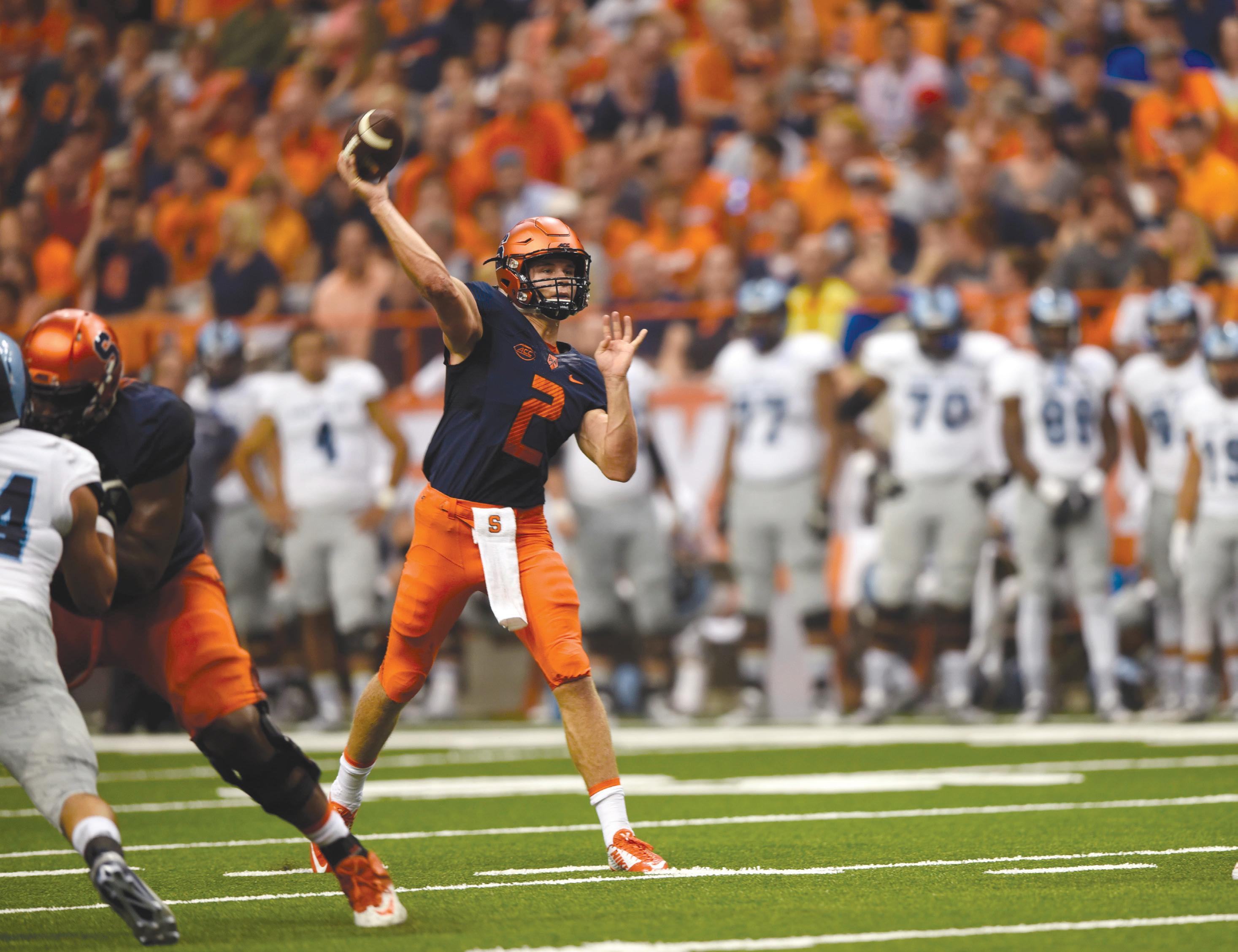
Eric Dungey evolves into a smarter quarterback as rising sophomore
By Matt Schneidman sports editor
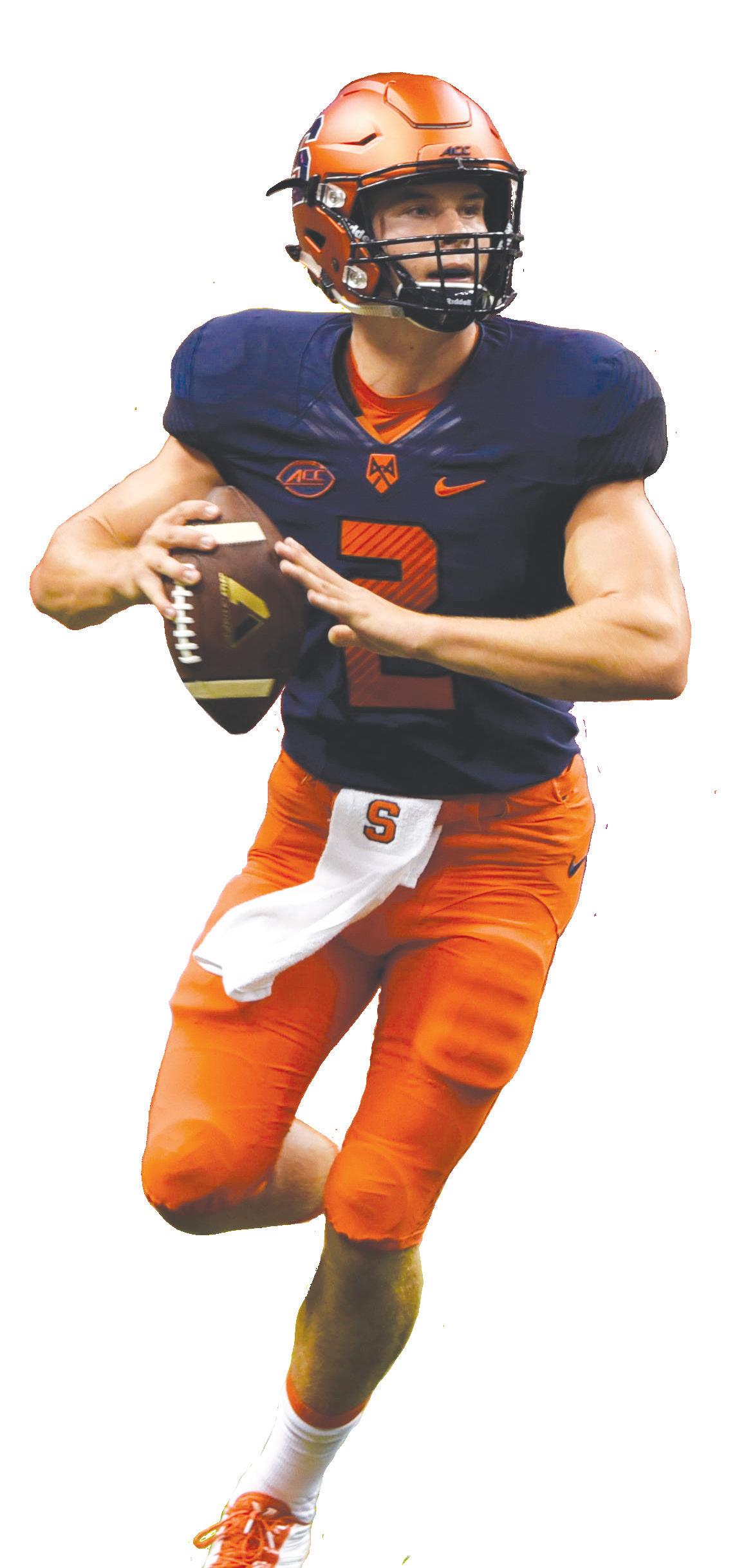
Eric Dungey wasn’t supposed to be the starting quarterback after one game. He wasn’t supposed to hurdle defenders, which he did in 2014 and got his high school fined. He wasn’t supposed to dart out of the pocket and take hits to the “upper body,” which sidelined him for four games in 2015.
Dungey rarely heeded then-Syracuse head coach Scott Shafer’s advice as a raw first-year signal-caller, but with a change in head coach has come a change in attitude.
“Obviously I’ve got to be smarter with my body,” Dungey said.
First-year head coach Dino Babers main-
There’s NO REASON to get 5 yards and take a HUGE HIT rather than just slide and get 4 yards.
tains the quarterback competition is still open, but if Dungey retains his first-team spot he’ll play the role of a transformed player. He acknowledges he took “unnecessary” hits. He admits he was too much of a freshman, eager and anxious to make plays on his own. He concedes the immaturity of a statement he made after a triple-overtime
loss to Virginia that encompassed the biggest flaw of a freshman who didn’t show many: “They want me sliding and not taking any shots. It’s not really in my nature.”
That was after a game in which Dungey hurdled a safety on the goal line for a touchdown while being leveled in the side of the head, a microcosm of the talent and recklessness that complicated a potential bright spot in a lost season. Now, Dungey doesn’t defend his flaws. By design, he’ll be more of a pocket passer in Babers’ offense and Dungey likes it that way. He’s crafted an understanding of the balance between sliding and running, adding an educated dimension to a player whose right arm will likely carry a team that will show off its new-look everything in the spring game on Saturday at 11 a.m.
“Any time that the quarterback is in a safer spot in the pocket and he’s not out trying to take on linebackers and D-ends, everyone feels a lot safer,” quarterback Zack Mahoney said.
Each time Dungey escaped the pocket after his first head injury, it was only a matter of how cringeworthy the reactions would be, even before the play ended. He built up a reputation that any scramble could end in a bone-crunching hit and put a fledgling career in danger based on the fate of a fellow SU signal-caller. Last year, sophomore quarterback AJ Long was medically disqualified after suffering a third concussion at SU in practice before Syracuse traveled to South Florida.
Dungey missed one third of the season because of injury and took four visible shots to the head, one each against Central Michigan,
RIDE THE WAVE
When Eric Dungey wasn’t recovering from upper-body injuries, he had up-and-down performances on the field as the conductor of Syracuse’s offense. Here's his passing yard totals from last year's games.
Pittsburgh, Virginia and Louisville. It wasn’t specified how many resulted in concussions, but Dungey didn’t think about potentially being in the same company as Long.
This year, the cringes will come far less often. Teammates crack a grin when asked if they’ll feel more comfortable with Dungey in the pocket, not looking like a true freshman in the open field.
Number of games Eric Dungey was knocked out of because of an upper body hit
47
Percentage of Syracuse's minutes quarterback Eric Dungey was active in 2015.
“To me that’s, ‘Thank God,’” senior offensive lineman Omari Palmer said. “I plan on him staying in the pocket seven, 10 seconds.”
On March 8, Palmer said Dungey hadn’t been running as many triple-option sets and read options as he did last year. Two weeks later, Dungey said he was still trying to fine-tune his accuracy in the pocket and put on weight. He’s around 214 pounds now, he said, and has a realistic goal of getting to 220 before the regular season.
A bigger, bulkier, more pass-happy quarterback will take the Carrier Dome turf on Saturday and show what he couldn’t for the final three games of last season. Defenders are
forbidden from making contact with quarterbacks, so nobody has to worry about Dungey taking another avoidable thunderous hit.
But when opponents are trying to do just that come September, Dungey will have a stock-piled knowledge of how to balance running and sliding to go along with a more efficient cannon that could be inaccurate on deep balls last season. He’s developed that repertoire by studying Seattle Seahawks quarterback Russell Wilson.
“When we first got here,” Babers said, “we told him that’s somebody he needs to look at.”
“There’s no reason to get five yards and take a huge hit rather than just slide and get four yards,” Dungey said.
And though that polished arsenal won’t be on full display this weekend, Dungey will show flashes of what’s to come. It’s exactly what he did last year, but he never got to finish a season chock-full of potential.
He now has a fresh start and Syracuse has a fresh staff. Babers has predicated his past success on no-huddle offenses, and he’ll look to do the same at Syracuse. And while Dungey may be slowing down, the offense that he’ll likely have the keys to won’t.
“Like coach said, ‘Quarterbacks pass the ball, receivers catch the ball, running backs run the ball,’” Dungey said. “It’s not really our job to get hit. That’s really the big thing, just taking care of yourself.” mcschnei@syr.edu | @matt_schneidman
Eric Dungey su quarterback
ERIC DUNGEY missed several games last season after taking unnecessary hits outside the pocket. As he prepares for his sophomore season, he is watching film of Russell Wilson to be smarter with the ball and his health. david salanitri staff photographer
2016 FOOTBALL SCHEDULE

END GAMES
How SU has shifted players with no collegiate experience at DE to the position
By Paul Schwedelson asst. sports editor
Trey Dunkelberger sprinted so fast he could keep up with running backs. He spent the offseason until that point slimming down to 225 pounds to become an effective offensive weapon. A week before the first official spring practices, he caught the attention of Syracuse’s new coaching staff. The junior tight end didn’t have many opportunities in 2015 and was looking for ways to get more. He didn’t expect them to come at an entirely new position.
END TO THE MEANS
Dunkelberger was asked if he’d be interested in moving to defensive end, a position he’s only played twice in high school before. He was interested in the increased opportunities he’d have: Two defensive ends are in on every play. Sometimes the tight end doesn’t go in at all.
Add Dunkelberger to the list of players that have converted to defensive end since head coach Dino Babers took over. Now he has to bulk back up by eating ground turkey and ground chicken.
Seven of the Orange’s eight defensive ends last season will not be returning in 2016. Syracuse’s only returning defensive end, Jake Pickard, didn’t play in a single game as he spent his freshman season redshirting. So to fill the void, SU’s coaching staff has already converted Dunkelberger along with linebackers Hernz Laguerre, a senior walk-on, and Kenneth Ruff, a freshman early enrollee, to the position.
Throughout spring practice, which concludes with the annual spring game on Saturday at 11 a.m., Babers has been searching for players and answers at the Orange’s thinnest position.
“Someone who’s a pass rusher,” Babers said. “Someone’s got the ability to come off the edge for us and make a play for us in the ACC. That’s something we’re looking for.”
Syracuse’s carousel at defensive end came as a result of Luke Arciniega ending his career with a year left of eligibility, Ron Thompson declaring for the NFL
Draft as a junior and freshmen Kenny Carter, Qaadir Sheppard and Amir Ealey being dismissed from the program.
Between Pickard, Dunkelberger, Laguerre and Ruff, none have played defensive end in a collegiate game before.
Someone who’s a pass rusher. Someone’s got the ability to come off the edge for us and make a play for us in the ACC. That’s something WE’RE LOOKING FOR
Dino Babers su head coach
“The best thing about that is I don’t have any tendencies from before since I never played the position,” Dunkelberger said. “So it’s perfect because I’m learning exactly what they want me to learn.”
But Babers recognizes that Syracuse needs more depth. Junior college transfer Gabriel Sherrod has already committed to SU. Defensive end signees Jaquwan Nelson, McKinley Williams, Joshua Black and Kendall Coleman are all a part of Syracuse’s 2016 recruiting class. On Signing Day, Babers joked that he’ll need to reach out to fraternity brothers to fill the spots.
In the meantime, the Orange’s four defensive ends have gotten ample
opportunities as they’ve quickly rotated through drills. Without much experience to draw from, it’s allowed for extra practice reps for the group to improve, which will be a valuable head start before the newcomers arrive later on.
And it’s even more valuable considering the Tampa 2, the new scheme brought by Babers and defensive coordinator Brian Ward, places a greater importance on the defensive line than Scott Shafer and Chuck Bullough’s prior scheme.
“We blitzed a lot last year. This year we’re not blitzing that much,” defensive lineman Steven Clark said. “It really relies on the D-line to stop the run and to actually get a good pass rush. So that’s a big difference from last year.”
Babers said it becomes difficult to succeed in the Tampa 2 if the front four isn’t getting pressure on the quarterback.
For several players on the defensive line, the plays are simpler than they were in the past. More often than not, SU just needs its linemen to get the quarterback. But the next step is performing on the field, something this group hasn’t done a lot of.
“Now it’s your job to learn the playbook because it’s your ass on the line,” Pickard said. “You can’t look to my senior guy who’s been doing this for three or four years. Now everybody’s starting in the same spot. Everybody’s starting on ground zero.”
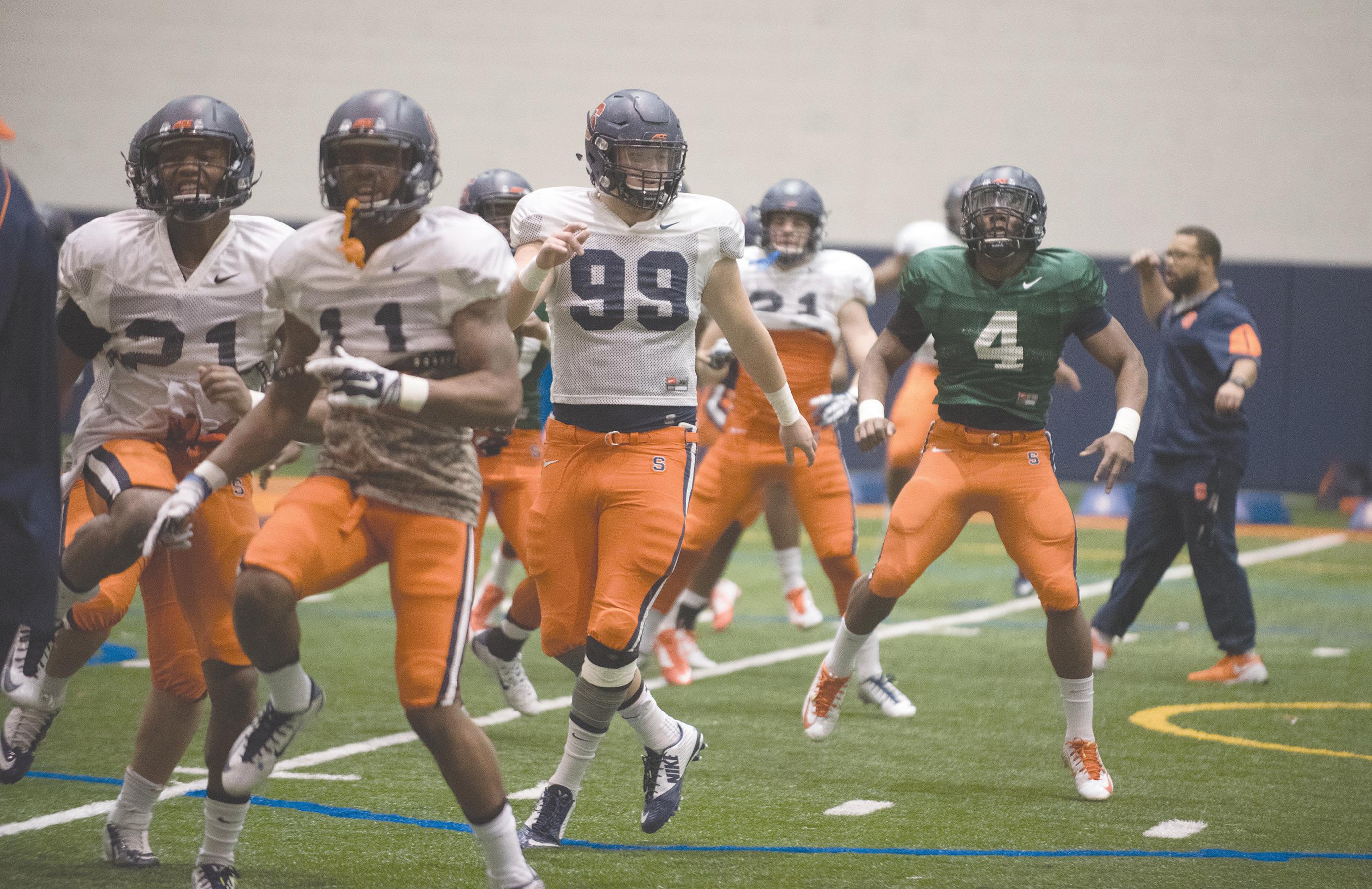
JAKE PICKARD (99) is the only defensive end returning from last year’s roster, but he redshirted and has never played in a game. Syracuse will be counting on Pickard, converted veterans and incoming recruits to help pressure opposing offenses and fill the void left at the position. jessica sheldon staff photographer
SYRACUSE FOOTBALL 2016
ERVIN PHILIPS #3
LOCKING IT DOWN
SU's secondary learns new roles as coaching staff implements Tampa 2 scheme
By Jon Mettus digital editor
Corey Winfield thought he’d been sent back to square one. The wide receiver-turned-cornerback anticipated the new coaches coming in, bringing a new system, new playbook and with it all, a far too familiar challenge.
He had a hard enough time learning the plays when he switched positions two seasons ago. Now, he’d have to do it all over again.
“I was like ‘Damn, I have to start over again,’” Winfield said. “But once we got into it and start practicing it just got easier so. It got easier by the day.”
About a week of practice is all it took to install new head coach Dino Babers’ Tampa 2 defense he brought from Bowling Green. But the success of the defense hinges on more than just learning the plays. The secondary
ZONE OUT
The Tampa 2 defense is a zone coverage scheme where two cornerbacks are responsible for about one-quarter of the field on either sideline and two safeties are in control of deep halves, with the middle linebacker dropping back into coverage to fill in the middle.
has had to learn new techniques, change their mentality and adapt to scheme usually filled with bigger players than those on SU’s roster.
“We’re adapting to it real well,” Winfield said. “We thought it was going to be hard. When we first came we were like ‘Ah, we don’t know what’s going on.’
We thought it was going to BE HARD. When we first came we were like ‘Ah, we don’t know what’s going on.’ But we LEARNED EVERYTHING in a week or so.
Corey
su cornerback
Winfield
“But we learned everything in a week or so and (the coaches) were like ‘We’re done with install.’ We was like ‘What? We’re done with everything?’ That’s it so. It’s pretty easy.”
The Tampa 2 defense is a zone coverage scheme where two cornerbacks are responsible for about one-quarter of the field on either sideline and two safeties are in control of deep halves, with the middle linebacker dropping back into coverage to fill in the middle.
Winfield hardly knew anything about the Tampa 2 defense, so he didn’t know what to expect. But safety Chauncey Scissum watched videos of former Tampa Bay Buccaneers head coach Jon Gruden talking about the defense.
The corners set up four yards away from the line of scrimmage, with their heels five yards back, Juwan Dowels said. They position their inside foot up and get off the snap moving laterally — not back pedaling.
“It was kind of like taking yourself out of
play sometimes,” Winfield said of back pedaling. “But now it’s like you’re always in the play.”
The corners can sit back in their zones and read the quarterback to anticipate where he’ll throw the ball. It’s made Winfield play patient and try to play the game “slow and fast at the same time.”
Syracuse’s cornerbacks will have more chances to jump routes along the sideline, Dowels said. But they also have to knock receivers off their routes before they get to the safeties. If multiple receivers flood into one of the safeties’ zones, the corner has to adjust and help.
“We got to trust our brothers down there at the corner,” Scissum said.
The corners play a large role in the Tampa 2’s run defense, keeping rushers inside. If they see certain keys from the offense, they can blitz for a tackle for a loss or sack.
The safety on the blitzing corner’s side will then often shift over to fill the gap.
“We’re definitely going to blitz,” Winfield said. “… There are times where you can just trigger and go, or just chill, so it’s going to be fun.”
Playing so deep gives the safeties more chances to make big open field hits, but also puts more pressure on them to make open field tackles. It’s required a bit of a change in mentality from the safeties, Scissum said, to being more focused on tackles.
The coaching staff has been showing the secondary film from Bowling Green and film of themselves.
Winfield noticed that he had been biting inside on plays he was supposed to be staying out and was able to correct it.
“That’s how we get better,” Winfield said. “We can watch film on somebody else, but you can’t really put it on the field if you’re just watching them.”
The Tampa 2 usually requires big players
in the secondary that can hit. But only Scissum of the safeties and Winfield and of the cornerbacks are above average in size.
Safety Antwan Cordy stands at just 5-foot-8 and Dowels is only 5-foot-10. Head coach Dino Babers said he’s seen smaller guys pull it off before. Dowels said size doesn’t matter, but being physical does.
“I play big into what I am and I think that’s good and the coaches see it,” Dowels said.
The coaches have put more of an emphasis on several different tackling drills compared to past years, Dowels said.
GROWING PAINS
The average size of SU’s defensive backs , per Cuse.com is 5 feet, 10.7 inches while the average size of defensive backs nationwide , per athleticscholarships.net, is 6 feet.
Despite the challenges of new techniques and figuring out how SU’s small secondary players fit into a defense meant for bigger players, Winfield isn’t worried. He said the group is learning well and won’t roll over for any shootouts expected with the new offense.
“Running the Tampa 2, it don’t get no better than that,” Winfield said. “Just running it. If we run it, we’re going to make the plays.” jrmettus@syr.edu | @jmettus
COREY WINFIELD and the rest of Syracuse's secondary is adjusting to the Tampa 2 defense. Despite having to learn entirely new concepts, several players said they are learning the new system just fine. In the base Tampa 2, each cornerback is responsible for one-quarter of the field.
david salanitri staff photographer
6'0"
IN POSITION
By Connor Grossman asst. web editor
Lining up in the backfield or in the slot, the hybrid position created a dizzying amount of scenarios for defenses to handle last year. Jet sweeps. Triple options. Catch and runs.
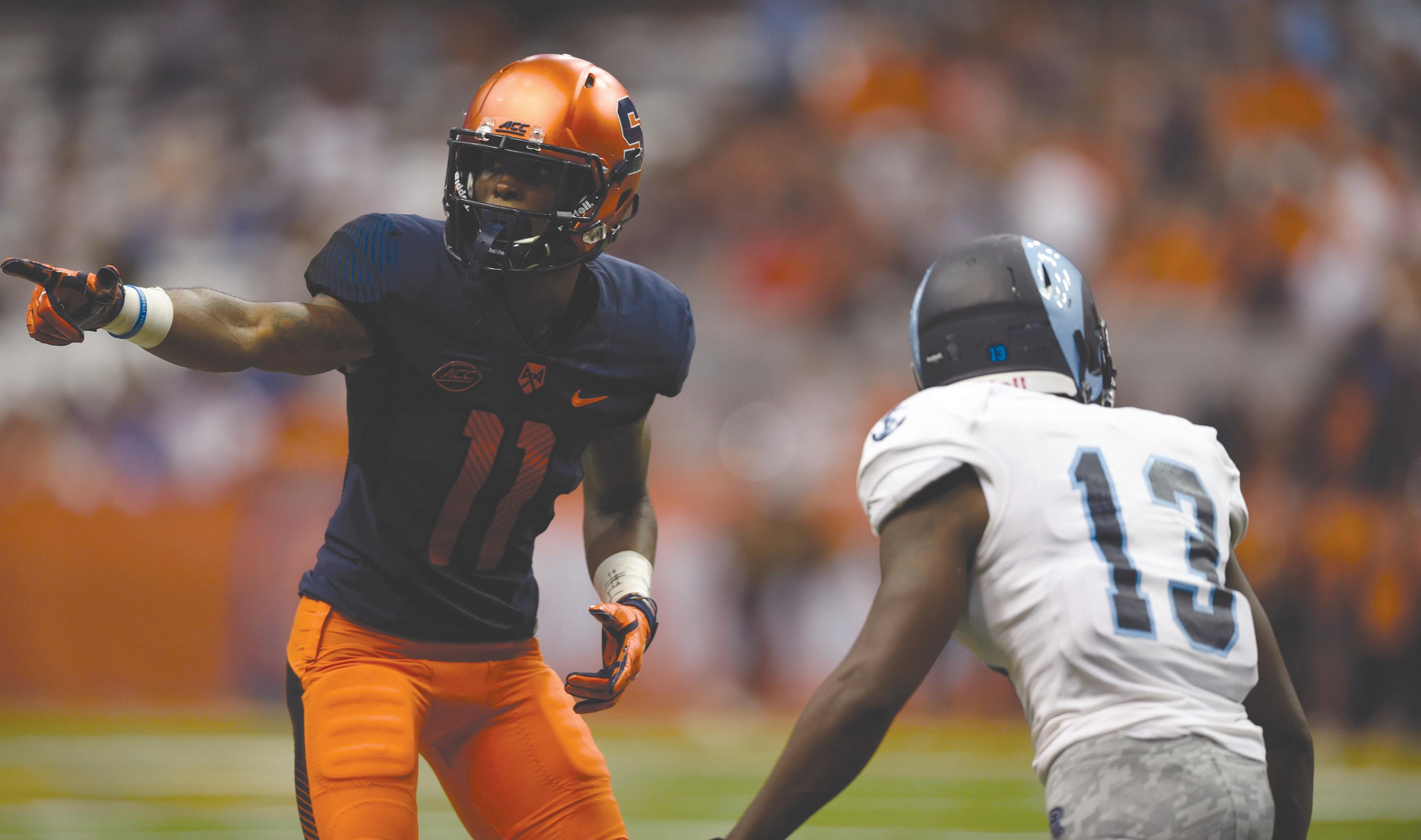
The brainchild of former offensive coordinator Tim Lester, the everything and anything position added receiving and blocking responsibilities to running backs Ervin Philips and Donate Strickland.
But with the hiring of head coach Dino Babers, he made it clear the hybrid would be eliminated. As position groups began meeting to digest the new playbook, Strickland wondered where he’d go without the hybrid position group.
“At first I went to the wide receivers’ room,” Strickland said. “It was kinda just, let’s see where they have me at. I didn’t know where they wanted me.”
His entrance into the meeting was met by funny looks from the coaching staff, Strickland said. Most likely because his bulkier, 5-foot-11, 196-pound frame didn’t fit the lean mold of the other wideouts.
In our offense you kind of get LOCKED IN. Based on (a player’s) personality, they need to fall into either ‘A’ or ‘B.’ We really don’t have guys that kind of blend into two or three different jobs.
Dino Babers
su head coach
Shortly after, he was ushered to be with the running backs, where he’s settled back into a role that dates back to his Pop Warner days. To balance out the offense, Philips, who racked up 286 receiving yards and tacked on 234 rushing yards last season, will transition full-time to the slot position.
Babers’ fast-paced offense doesn’t really lend itself to a fluid, hybrid-type position. So SU’s new head coach said he told the former hybrids to make a decision: Find your most suitable position, and we’ll evaluate. Or at least in Strickland’s case, we’ll help you find your spot.
“In our offense you kind of get locked in,” Babers said. “Based on (a player’s) personality, they need to fall into either ‘A’ or ‘B.’
“We really don’t have guys that kind of blend into two or three different jobs.”
It brought a sense of relief to two players who could recall the difficulties of spring camp last year. Strickland was informed of his move to hybrid two or three days before last preseason, and was “a little bit” ticked about it. He was pelted with a variety of unfamiliar terms and routes he had to master.
Philips was more welcoming of the change to an “athlete” position, enamored with the idea of getting his hands on the ball more often. But his mind was boggled trying to balance a playbook dotted with running, blocking and receiving schemes. The “do-it-all” aspect of the do-it-all position quickly became both its greatest compliment and putdown.
“At the end of the day I’m a team player,” Philips said, “but it was a heavy burden. It was a lot of pressure.”
Now as he goes through the routine of hauling passes from a quarterback or
Where SU’s hybrids moved when their position was eliminated
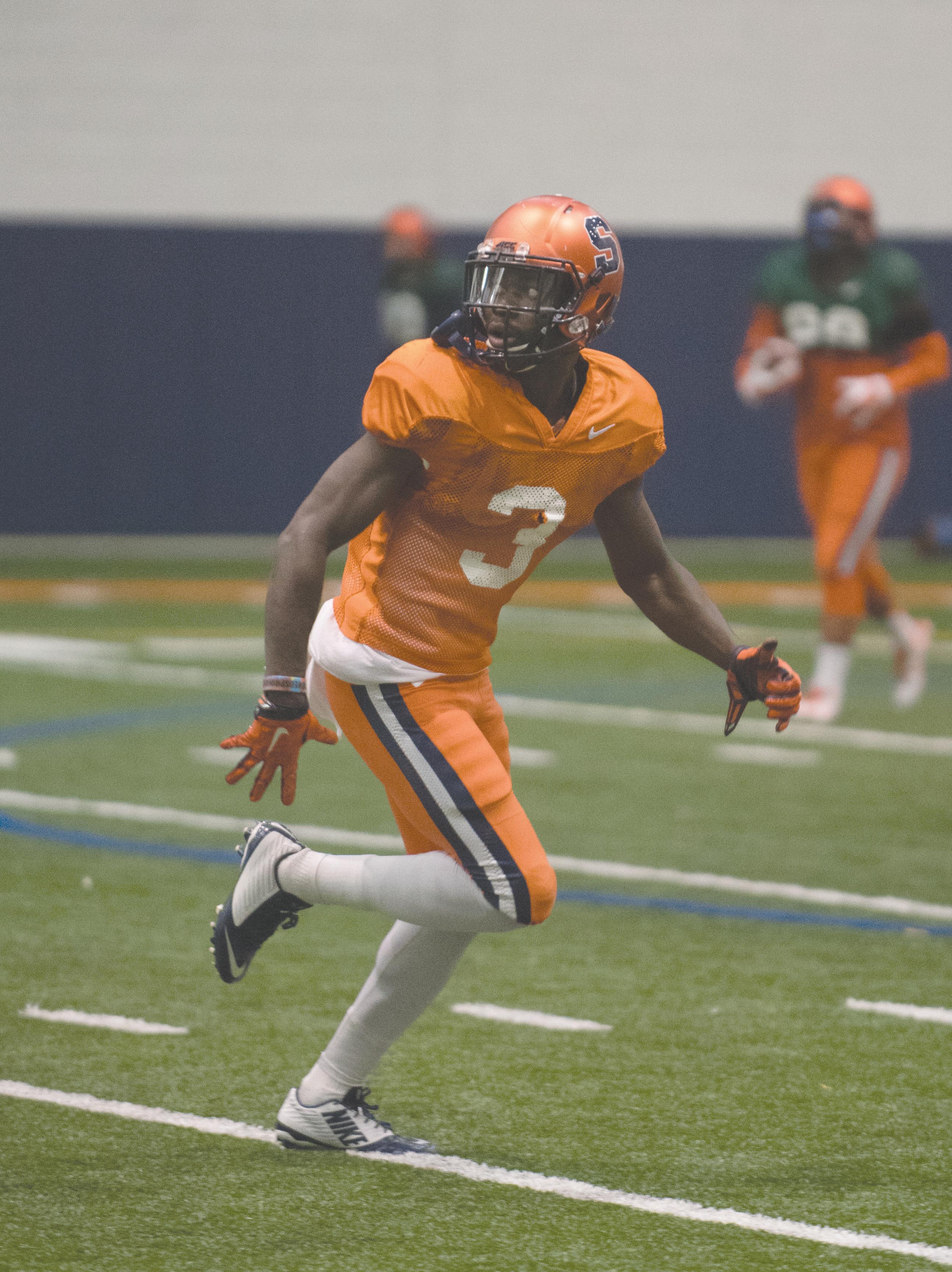
machine, Philips wishes in hindsight he took more snaps as a receiver last year. The hectic nature of the hybrid didn’t lend itself to consistency, and now Philips realizes he’s not as polished of a receiver as he’d like.
He’s fielded tips from senior wideout Brisly Estime to try and smooth over the learning curve. The veteran receiver preaches patience, and demonstrates using his hands to get off the line better and skirt defenders.
And even though Philips has enjoyed the single-mindedness of this preseason, he yearns for another opportunity where one might not come with Strickland’s move: the backfield.
“I actually like the running back position,” Philips said. “Anytime they want to put me back there, I’ll go. Because I honestly kind of miss it.”
“Catching the ball isn’t as easy as people think,” he later added.
It’s a position close to heart for Philips, a running back his entire life before last season. But the same holds true for Strickland, who’s rejoicing in a return to where he once was. He’s hoping to lift the fourth-worst rushing offense in the Atlantic Coast Conference last year, joining team-leading rusher Jordan Fredericks in his second season.
Strickland’s able to freely do that now, unshackled from his receiving and blocking responsibilities from a year ago. In that sense, leaving a position of freedom has given him the most freedom he’s had to help Syracuse.
“Being back at running back is just getting back in the swing of things,” Strickland said. “Coach is talking about winning and that’s all we want to do right now, is just get back to winning and change the whole program.”
cgrossma@syr.edu | @connorgrossman
Ervin Philips hauled in more than a fourth of Syracuse’s 19 receiving touchdowns as a hybrid. 26%
Dontae Strickland averaged 3.85 yards per rush last season as a hybrid. 3.85
ERVIN PHILIPS was one of the three players who filled the hybrid position for SU last year. With a new offense in place, they’ll all have to figure out which position they fit at best, whether that be running back or wide reciever. jessica sheldon staff photogrpaher
How Syracuse’s new offense requires its players to ...
SHAPE UP
By Chris Libonati asst. sports editor
Jordan Fredericks had never seen so many teammates throwing up. More than five or six came out of station drills to get rid of the contents in their stomachs, including Fredericks.
“It might’ve been the first time in football that I’ve ever thrown up three times a day,” Fredericks said. “I just kept throwing up. It got (running backs) coach (Mike) Hart mad, but I felt like I was getting in shape.”
The Syracuse running back hadn’t even taken much time off during Winter Break before coming back to Syracuse. He had wanted to take a week off after coming home, but his mother set him up with his personal trainer in just a handful of days.
“Yeah, I was hurting, too,” offensive lineman Omari Palmer said. “… We came from a team that was huddled up every time to no huddle. That was hard. You gotta do extra stuff, run extra, eat right, just live properly outside of football.”
At 11 a.m. Saturday, SU will put its rapid-fire offense on the Carrier Dome turf for the first time at Syracuse’s annual spring game. When co-offensive coordinator Sean Lewis and Syracuse’s staff created the hashtag #OrangeIsTheNewFast, it became a recruiting tool, but it’s also a message of how SU plans to play, if its offense having the namesake (Baylor) of one of the best quick-strike attacks in the nation isn’t clear enough.
And while the offense’s logistics — its routes, blocking schemes and how it runs — might be a focus on Saturday, the work to shape players
into the offense has been intense.
The offense new head coach Dino Babers brought to Syracuse is supposed to require the players to be conditioned at their best. After running 63 plays per game (127th, second to last, in the country) and about two per minute in 2015 under head Scott Shafer and offensive coordinator Tim Lester, the players will be gears in an offensive machine that ran 83.7 plays per game (seventh in the country) and about three plays per minute at Bowling Green in 2015.
It might’ve been the FIRST TIME in football that I’ve ever thrown up THREE TIMES a day.
Jordan Fredericks running back
“I’m like, ‘Wow, this is some official stuff,’” Fredericks said of the intense workouts. “You know you don’t expect that to happen to you. You think you’re in shape, and it wasn’t just me.”
After Babers was hired, he changed around the football program’s training staff in addition to cleaning out the coaching staff. Will Hicks, now an assistant director of athletics for athletic performance for Olympic sports, had only handled the football team under Shafer and past coaches. Hicks shifted to only Olympics sports once Babers was hired. Players said they received the new train -
ing staff’s workouts when they returned to campus in January.
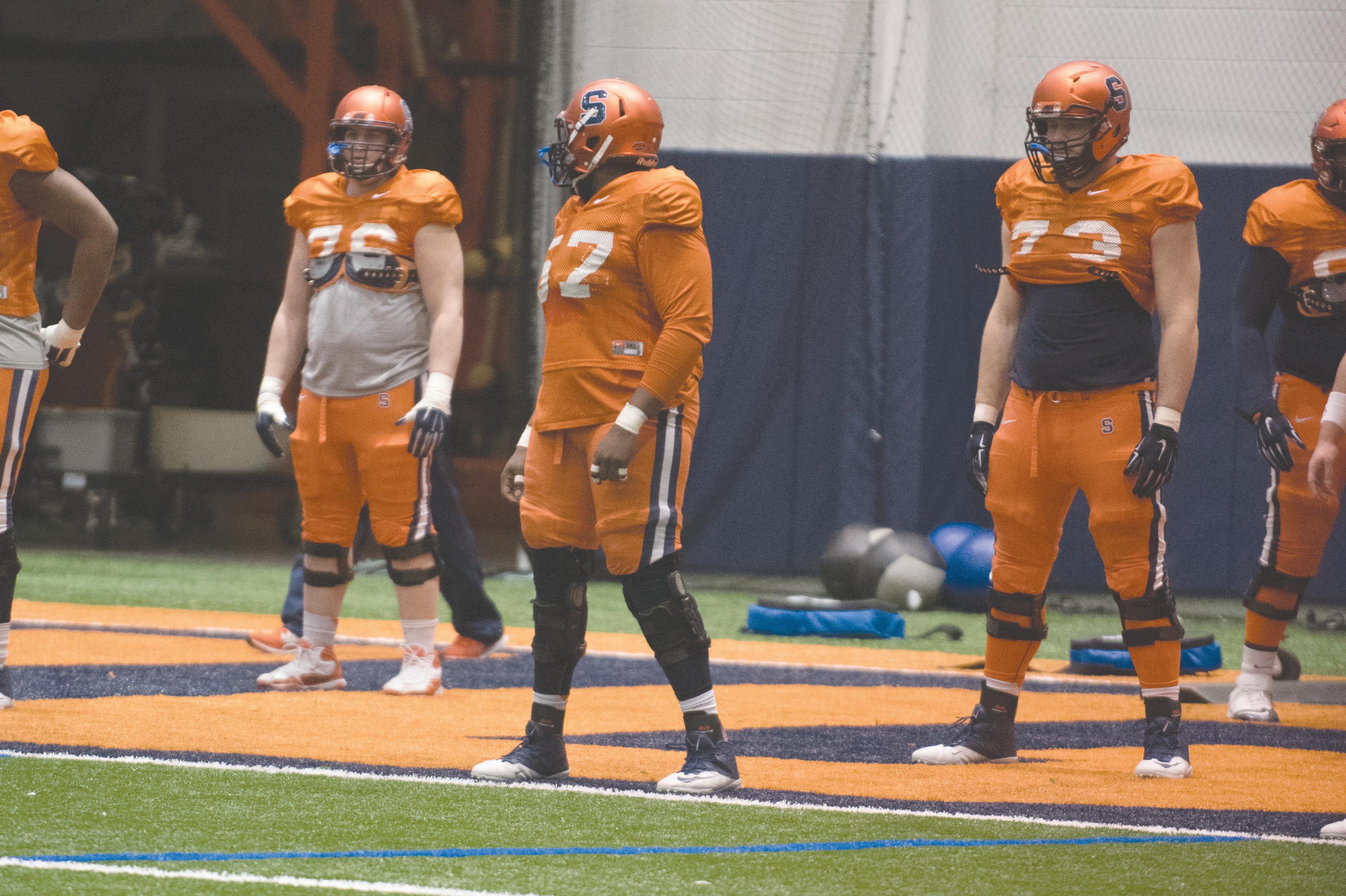
While Babers did his part in getting his players in shape — he and his staff had soda removed from the vending machine — Palmer has adjusted his routines. On lifting days, the offensive lineman will lift twice for an hour apiece. Those workouts are followed by 15 minutes on the elliptical. Other days, Palmer will run a mile and a half and try and finish it in under 12 minutes. Instead of going home for Spring Break, Palmer decided to get some extra work in with Sean Edinger, the newly-hired assistant director of athletics for athletic performance, by hanging back in Syracuse.
SU running back George Morris said the new training staff’s workout centers on explosion more so than the workouts under Shafer’s training staff. But when asked to point to specific drills, Morris said he’s still adjusting to the new workouts.
“Honestly, there’s a lot of names, and I’m still learning,” Morris said in early March. “Every time we work out there’s a new one each day, so I’m still trying to learn the names.”
Fredericks came into the offseason trying to cut weight and add muscle at the same time. Since working out with Edinger, Fredericks said his squat has increased about 150 pounds to nearly 500. The rising sophomore running back came into this spring seven pounds heavier than he was listed on last year’s roster.
Babers has said the linemen in front of Fredericks will have to drop weight. Palmer, who is listed on the 2016 roster at 321 pounds, played in 2015 at 305 pounds.
PEDAL TO THE MEDAL
The new head coach, Dino Babers, brings the offense he learned at Baylor and innovated at Bowling Green to Syracuse, where he’ll try to optimize the nation’s 52nd most efficient offense in points per play.
wThe average size of a lineman at Bowling Green last season was about 299 pounds. Even with a bit elevated weight, Palmer said he feels like he’s approaching the best shape he’s been in.
On Saturday, Palmer will be able to put that to the test in pads during Syracuse’s scrimmage. For the first time, the new offense will be on display and so too will be players’ revamped conditioning.
“Everything is fast,” Jordan Fredericks said. “Everyone needs to be in tip-top shape.” cjlibona@syr.edu | @ChrisLibonati
OMARI PALMER (57) and the rest of the Syracuse offense has been forced to go through rigorous conditioning in order to prepare for Dino Babers’ fast-paced style of offense. Babers will look to get results from his offense that helped him win the MAC championship at Bowling Green last year. jessica sheldon staff photographer