thursday, september 10, 2026
celebrating 122 years
free
O • Selfish endeavor
C • Pizza plans
S • Finding his lane
Page 12
Page 9
Page 16
Our columnist argues Ex-NBA players’ inserting themselves into the WNBA is a selfish publicity stunt, not activism.
Dellas family asserts Varsity’s status will ‘live on’ as management shifts; Brian and Renee Bruno will take over Dec. 2.
After playing three positions over two years at LSU, Ju’Juan Johnson is ready to solely be a running back at Syracuse.
arts
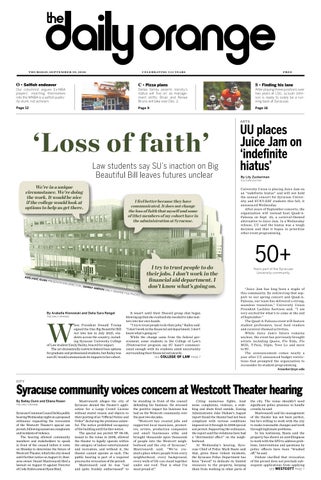
‘Loss of faith’ Law students say SU’s inaction on Big Beautiful Bill leaves futures unclear We’re in a unique circumstance. We’re doing the work. It would be nice if the college would look at options to help us get there.
adelaid e guan present ation dir ector | danny amron daily
I feel better because they have communicated. It does not change the loss of faith that myself and some of (the) members of my cohort have in the administration at Syracuse.
orange file pho to
By Arabella Klonowski and Delia Sara Rangel the daily orange
W
hen President Donald Trump signed the One Big Beautiful Bill Act into law in July 2025, students across the country, including Syracuse University College of Law student Emily Bailey, braced for impact. The act dramatically restricts federal loan options for graduate and professional students, but Bailey was sure SU would communicate its impacts to her cohort.
I try to trust people to do their jobs. I don’t work in the financial aid department. I don’t know what’s going on.
It wasn’t until their Discord group chat began blowing up that she realized she needed to take matters into her own hands. “I try to trust people to do their jobs,” Bailey said. “I don’t work in the financial aid department. I don’t know what’s going on.” While the change came from the federal government, some students in the College of Law’s JDinteractive program say SU hasn’t communicated enough with its students amid uncertainty surrounding their financial aid awards. see college of law page 7
UU places Juice Jam on ‘indefinite hiatus’ By Lily Zuckerman culture editor
University Union is placing Juice Jam on an “indefinite hiatus” and will not hold the annual concert for Syracuse University and SUNY-ESF students this fall, it announced Wednesday. After years of September concerts, the organization will instead host Quad-APalooza on Sept. 25, a carnival-themed alternative to Juice Jam. In a Wednesday release, UU said the hiatus was a tough decision and that it hopes to prioritize other event programming.
50+ Years part of the Syracuse University community
“Juice Jam has long been a staple of this community. By redirecting that support to our spring concert and Quad-APalooza, our team has delivered a strong, seamless transition,” University Union President Lachlan Sartison said. “I am very excited for what’s to come at the end of September.” The Quad-A-Palooza event will feature student performers, local food vendors and carnival-themed activities. While Juice Jam’s future remains unclear, the event has previously brought artists including Quavo, Flo Rida, Flo Milli, T-Pain, Diplo, Tove Lo and more to SU. The announcement comes nearly a year after UU announced budget restrictions that prompted the organization to reconsider its student programming. lvzucker@syr.edu
city
Syracuse community voices concern at Westcott Theater hearing By Bailey Dunn and Eliana Rosen the daily orange
Syracuse Common Council held a public hearing Wednesday night on a proposed ordinance requesting the revocation of the Westcott Theater’s special use permit, following numerous complaints and incidents of violence. The hearing allowed community members and stakeholders to speak in front of the council before it votes on Monday to determine the future of Westcott Theater, which the city closed until further notice on August 13. Business owner Daniel Mastronardi filed a lawsuit on August 13 against Director of Code Enforcement Ryan Shiel.
Mastronardi alleges the city of Syracuse denied the theater’s application for a Large Crowd License without stated reason and objects to their posting of an “Official Notice and Order” declaring the premises unlawful. The notice prohibited occupancy of the building until further notice. The special use permit SP 08-08, issued to the venue in 2008, allowed the theater to legally operate within the category of indoor entertainment and recreation, and without it, the theater cannot operate as such. The public hearing is part of a required process for revocation of the permit. Mastronardi said he was “sad and quite frankly embarrassed” to
be standing in front of the council defending his business. He stressed the positive impact his business has had on the Westcott community over the past two decades. “Westcott has created jobs and supported local musicians, promoters, artists, production companies and small businesses alike and brought thousands upon thousands of people into the Westcott neighborhood and the city of Syracuse,” Mastronardi said. “We’ve created a place where people from every neighborhood, every background, every walk of life can stand together under one roof. That is what I’m most proud of.”
Citing numerous fights, loud noise complaints, violence, a stabbing and shots fired outside, Zoning Administrator Jake Dishaw’s August report found the theater had not been compliant with various conditions imposed on it through its 2008 special use permit. Supporting the ordinance, the report said the violations have had a “detrimental effect” on the neighborhood. At Wednesday’s hearing, Syracuse Chief of Police Mark Rusin said that, given these violent incidents, the Syracuse Police Department has been “forced” to dedicate its limited resources to the property, keeping them from working in other parts of
the city. The venue shouldn’t need significant police presence to handle crowds, he said. Mastronardi said his management of the theater has not been perfect, but he’s willing to work with the city to make reasonable changes and work through legitimate problems. In his testimony, Rusin said the property has shown an unwillingness to work with the SPD to address problems. Interventions and questions by police officers have been “brushed off,” he said. Dishaw clarified that revocation of the permit does not preclude subsequent applications from applying see westcott page 7
2 september 10, 2026
FOOTBALL
about
saturday, september 5
SYRACUSE 66 NEW HAMPSHIRE 3 saturday, september 12
SYRACUSE VS CAL Editor@dailyorange.com News@dailyorange.com Opinion@dailyorange.com Culture@dailyorange.com Sports@dailyorange.com Digital@dailyorange.com Design@dailyorange.com Photo@dailyorange.com BUSINESS 315-443-2315
The Daily Orange is an independent, nonprofit newspaper published in Syracuse, New York. The editorial content of the paper — which started in 1903 and went independent in 1971 — is entirely run by Syracuse University students. The D.O., a 501(c)(3) nonprofit, is editorially and financially independent from SU, and the paper receives no funding from the university. Instead, The D.O. relies on advertising revenue and donations to sustain operations. This fall, the paper will be published Thursday when SU classes are in session. The D.O.’s online coverage is 24/7, including while SU is on break. To show your support to The D.O.’s independent journalism, please visit dailyorange.com/donate. Donations are tax deductible.
scribble
National TV dinner day
how to join us
letter to the editor policy
If you are a Syracuse University or SUNY-ESF student interested in contributing to The D.O. on either its advertising or editorial teams, please email editor@dailyorange.com.
The D.O. prides itself as an outlet for community discussion. To learn more about our submission guidelines, please email opinion@dailyorange.com with your full name and affiliation within the Syracuse community. Please note letters should not include any personal information pertaining to other people unless it is relevant to the topic at hand. All letters will be edited for style and grammar.
corrections policy The D.O. strives to be as accurate in our reporting as possible. Please email editor@dailyorange.com to report a correction.
The D.O. is published weekdays during the Syracuse University academic year by The Daily Orange Corp., 230 Euclid Ave., Syracuse, NY 13210. All contents Copyright 2026 by The Daily Orange Corp. and may not be reprinted without the expressed written permission of the editor-in-chief. The Daily Orange is in no way a subsidy or associated with Syracuse University. All contents © 2026 The Daily Orange Corporation
tara deluca photo editor
The forecast for this upcoming week, per The Weather Channel.
THU 9/10
High of 54° Low of 77°
FRI 9/11
High of 50° Low of 73°
SAT 9/12
High of 80° Low of 66°
SUN 9/13
Get the latest on all things Syracuse!
High of 80° Low of 56°
MON 9/14
@dailyorange
High of 73° Low of 56°
on Instagram, X and Facebook
TUE 9/15
High of 78° Low of 64°
News Editor Editorial Editor Culture Editor Sports Editor Presentation Director Digital Design Director Photo Editor Illustration Editor Social Media Editor Enterprise Editor Asst. News Editor Asst. News Editor
Arabella Klonowski Will Chadwick Lily Zuckerman Jordan Kimball Adelaide Guan Abigail Aggarwala Tara Deluca Emma Soto Claire Zhang Ally Goelz Vivian Collins Ryan Garipoli
Asst. News Editor Asst. Editorial Editor Asst. Editorial Editor Asst. Culture Editor Asst. Culture Editor Asst. Sports Editor Asst. Sports Editor Asst. Sports Editor Asst. Photo Editor Asst. Photo Editor Asst. Photo Editor Video Editor
Mirren Grimason Addy Kimball Dayna Roberts Tara Binte Sharil Joel Pelachik Harris Pemberton Jason Glick Spencer Brod Eli Schwartz Zoe Xixis Christian Calabrese Reese Niccolls
Delia Sara Rangel
Noah Nussbaum
Quinn Postman
EDITOR-IN-CHIEF
MANAGING EDITOR
DIGITAL MANAGING EDITOR
Video Editor Asst. Video Editor Asst. Video Editor Design Editor Design Editor Design Editor Asst. Digital Editor Asst. Digital Editor Asst. Digital Editor Asst. Digital Editor Asst. Digital Editor Asst. Digital Editor
Collin Snyder Thandi McCain Nathan Olszewski Lily Wilkin Zoey Grimes Ana Rodriguez Fiona McHugh Owen Smith Peter Radosh Jack Wood Ava Demcher Alex Rice
Asst. Copy Editor Sydney DePietto Asst. Copy Editor Bailey Dunn Jordan Fendrich Asst. Copy Editor Asst. Copy Editor Gabe Ewen Asst. Copy Editor Caroline Erskine Asst. Copy Editor Kosta Konstantopoulos I.T. Manager Eliza Raphael I.T. Manager Sam Benoit Business Manager Kevin Ross Business Asst. Tim Bennett Circulation Manager Steve Schultz Student Delivery Agent Kaila Hu
DEIA Manager Savannah Stewart Development Editor Eliana Rosen Development Editor Avery Magee Development Editor Mauricio Palmar Alumni Engagement Editor Charlotte Price Alumni Engagement Editor Ben Butler
NEWS
september 10, 2026 3
city
Syracuse’s relationship with Flock after common council ‘breakup’ Following Syracuse Flock data being privately shared with ICE in September 2025, the city’s Common Council began reconsidering its relationship with Flock in November 2025.
By Owen Smith
asst. digital editor
Although Syracuse Common Council experienced a “breakup” with surveillance company Flock Safety in March, cameras remained on Syracuse University’s campus, according to DeFlock, an advocacy group that maps the cameras. Flock has faced rare bipartisan backlash amid an increased amount of Automated License Plate Readers across the United States. The company claims the technology helps law enforcement find missing persons and stolen vehicles. The cameras, also called ALPRs, received increased scrutiny since their expansion. Police officers have also been accused of using the network to track former partners and the company has faced criticism for sharing data with U.S. Immigration and Customs Enforcement, 404 Media reported. Although the cameras’ intended use is to track vehicles, many have questioned its privacy. Sidney Thaxter, a senior litigator at the National Association of Criminal Defense Lawyers, said the “excuse” of vehicle tracking is misleading because of how easily they’re associated with people. “They have this massive network and that’s why they are valuable to law enforcement, as you can track somebody anywhere at any time,” Thaxter said. Syracuse’s relationship with Flock has fluctuated over the past 5 years. Since the beginning of their partnership in 2021, the city evaluated and changed Flocks’ presence drastically, but the cameras remain a point of contention both locally and nationwide.
2021 – 2022
In 2021, former Syracuse mayor Ben Walsh appointed a 13-person Surveillance Technology Working Group to review surveillance proposals. The group eventually approved the tech in 2022. During that year, Flock cameras were installed in over 1,400 cities nationwide — today, it’s over 6,000 communities. There were around 21,000 Flock cameras on September 10, 2025, according to DeFlock. One year later, the number of Flock ALPRs has grown to just under 140,000. ALPRs use an AI-powered network to capture images of passing vehicles, taping footage and storing details, creating a “Vehicle Fingerprint.” The fingerprint consists of a vehicle’s make, model and features such as bumper stickers and dents.
2026
Since the beginning of their partnership, Syracuse evaluated Flocks’ presence drastically, and cameras remain a point of contention both locally and nationwide. quinn postman digital managing editor
2023 – 2025
In August 2023, Destiny USA announced the installation of Flock cameras at every entrance to the mall. Pyramid Management Group, the company behind the mall’s operations, said the technology was a “powerful tool in preventing and solving crime” six months after installation, scanning over 400,000 vehicles per month. Law enforcement reported a 50% drop in property crime at the mall, with the building now hosting 10 Flock cameras along the perimeter, Spectrum News reported. PMG expanded the use to its other malls following the tech’s effectiveness at Destiny. In addition to Destiny, SU installed eight ALPRs on campus in 2025. Although the cameras are part of Flock’s wider network, SU’s Department of Public Safety controls the data, which can be provided to other law enforcement or Flock, an SU spokesperson said in September 2025. The camera’s AI-powered network allows the algorithm, as well as investigators, to detect patterns between vehicles seen in similar places and at similar times, a recognition that Thaxter described as a “convoy analysis.”
The potential of that, Thaxter said, could allow investigators and Flock to draw indirect connections between people who may know each other, such as friends and family members. “These are, at this point, incredibly powerful mass surveillance tools that track the movement of every citizen around the country, whether or not you’re suspected of a crime,” Thaxter said. Joon Park, a cybersecurity professor at SU’s School of Information Studies, said those indirect connections can become revealing when Flock’s data is combined with other widely used databases used by officers and the government. “The license plate database is only one database away from being able to pull up a profile of that person,” Park said. However, Park said he feels the main cause of backlash is due to “bad actors” and not the cameras themselves. “It can help investigators connect the dots when they’re investigating a crime,” Park said. “The technology itself is not necessarily the problem, it’s how you use it.”
Part of the reconsideration was a resolution revoking permission for SU to install Flock cameras near campus. In March, the Council fully revoked Flock’s permission to operate, with the city beginning to seek an alternative to Flock’s ALPRs. Axon Enterprise, which produces police body cameras and makes the same ALPR technology, signed a five-year, $422,000 agreement to replace the city’s Flock cameras. Axon gives the city more control over data access and auditing. Park said Axon requires officers to provide specific documentation on who is accessing the database and why. In response to nationwide protests, Flock changed its stored footage to be automatically deleted after a week unless it’s involved in an active investigation. “It’s less intrusive than 30 days, but it doesn’t solve privacy issues or illegal misuse,” Thaxter said. Most city cameras have since been transitioned to Axon, and Flock removed all of its 13 readers from the city in July, Central Current reported. Despite the terminated Flock contract, Destiny USA and SU still stand as the only locations in the city that host Flock ALPRs, according to DeFlock map data. Jimmy Monto, a key Common Council member who helped propel the Flock revocation, regrets the company’s adoption by the city. “In hindsight, Flock was a bad idea for Syracuse. Time will tell us how we feel about Axon, I myself am skeptical of the technology as a whole,” Monto said. A Flock spokesperson said the company doesn’t conduct mass surveillance, and that agencies own all data collected by the cameras. In addition, the company defended the tech’s legality, pointing to “more than 40” court decisions that concluded license plate readers don’t violate the Fourth Amendment. Regarding several cities’ decision to walk away from Flock, a spokesperson wrote that the company respects decisions made by elected officials. “Flock respects those decisions and believes public safety and privacy can – and should – coexist,” the spokesperson wrote. “We participate in public forums, answer questions from residents and share information about accountability, oversight and policy.” owensmith@dailyorange.com
on campus
SPD allocates funds to combat ‘nuisance parties’ near campus By Vivian Collins asst. news editor
On Aug. 22, several students at Syracuse University, one of the top party schools in the country, received an email from their landlord warning them to keep their festivities to a minimum. The email, obtained by The Daily Orange sent from Rent-From-Ben landlord Benjamin Tupper to his tenants, included a screenshot of another email sent on behalf of the Syracuse Police Department. The screenshot assured residents of the university area neighborhood that SPD will be devoting more funding and resources to handling their concerns, including larger gatherings in the neighborhood. “The Police Department has reallocated funding internally to field a proactive detail specifically to address nuisance parties, parking enforcement and other quality of life concerns in the university area,” according to an email obtained by The D.O. SPD met with SU’s Department of Public Safety to discuss the initiative and DPS will be issuing appearance tickets and referring ticketed students to the Office of Community Standards, to create an “increased level of accountability,” according to the email. Tupper gave his tenants a heads up because he said he wants them to stay safe, but takes issue with the new initiative. “I think it’s hypocritical, adults have fun and they don’t want you to have fun,” Tupper said. “Whenever I get the chance, I speak to that hypocrisy, I speak to those people in power and say, ‘You’re a freaking hypocrite.’” Tupper said the Southeast University Neighborhood Association, who didn’t immediately respond to The D.O.’s request for comment, is behind the emails from SPD. The increased SPD and DPS presence is a result of the “volume and nature of recent
complaints” in the university neighborhood, according to a statement from SPD. In coordination with DPS, the additional personnel is supported by SPD’s current resources and “operational deployment.” DPS may help investigate or conduct a parallel investigation alongside other law enforcement if an SU student was involved in an off-campus incident, according to a statement from DPS. Community Standards is notified if the investigation finds that the student has violated the Code of Student Conduct. Unless it’s a serious violation or crime, DPS tries to treat “out-of-bounds” incidents as a teaching moment, according to the statement. In cases where students may not realize that what they’re doing is dangerous or against the rules, education becomes DPS’ priority. “Officers have discretion, and they understand that following the letter of the law doesn’t always serve our community best,” DPS said in a statement to The D.O. “That said, officers’ hands are sometimes tied by state statutes that mandate an arrest or another enforcement action, and there are times when an official incident report or custodial arrest is the right call to ensure community safety. It’s a delicate balance.” Junior Ryan Rivard currently lives in a Rent-from-Ben property and received the email screenshot from Tupper last week. He said the email was “interesting,” yet scary because he feels like law enforcement is trying to take money away from students through ticketing. Rivard said he noticed more SPD cars in his area but not more DPS patrol cars. In his opinion, SPD and DPS’ partnership has yet to amount to anything, but he said he wouldn’t be shocked if the neighborhood’s party culture changes as the year continues. Junior Terry Heron, a university neighborhood resident who doesn’t live in a Rent-from-
The Syracuse Police Department is working with SU’s Department of Public Safety to address neighborhood complaints and “quality of life concerns.” daily orange file photo
Ben property, wasn’t aware of the partnership but said he’s noticed more sirens passing by his house since coming back to campus. He said more police activity would be beneficial to the area but also doesn’t think it will affect how students behave. “I think what would be good is no loud music past a certain time,” Heron said. “And another thing that I think would be beneficial would be if people could clean up their trash more because people tend to leave a mess when they’re partying and drinking, and it can be an eyesore for local residents.” In its statement, DPS confirmed the office does see “quality-of-life” issues in neighborhoods around campus, primarily during “large gatherings that generate noise complaints and parking congestion.” Tupper also acknowledged that students should make an effort to be respectful to their neighbors.
“If there’s a house having a party and all their neighbors are normal people who have to get up early in the morning and go to work, then the students in that house are being jerks,” Tupper said. There’s a clear divide between regular Syracuse residents and students, Rivard said, but he thinks students taking better care of their homes could help. He feels like there shouldn’t be prejudice against the students just for “where they go to school and where they live.” Tupper shared a similar sentiment and said students are an “easy target” and often used as scapegoats for problems in the neighborhood. He advised students to be smart, have fun and know that “there are people out there looking to get you.” The emails from the police department are proof, Tupper said. “If you love big house parties, go to one somewhere else,” he said. viviancollins@dailyorange.com
4 september 10, 2026
Fair flicks
Memorable musical moments from The Great New York State Fair
The Commodores - Wednesday eli schwartz asst. photo editor
Flo Rida - Sunday, Aug. 30
christian calabrese asst. photo editor
Donning purple Ray-Ban sunglasses, Flo Rida raps at the Fair. His setlist included hits like “Low” and “My House.”
Jesse McCartney - Thursday, Sept. 3 Jesse McCartney sings at the Fair last Thursday. The Ardsley native performed “Beautiful Soul” as his encore.
The Commodores serenade a crowd at the Fa and soul group performed at Chevy Court.
Gym Class Heroes - Sunday, Aug. 30
Gym Class Heroes singer Travie McCoy performs at the Fa ed 15 songs, including “Cupid’s Chokehold/Breakfast in Am
madison cox staff photographer
Stella Lefty - Sunday, Sept. 6
Stella Lefty dances and sings at the Fair’s Che like “Boston,” Lefty also covered Natasha Bed
y, Aug. 26
september 10, 2026 5
zabdyl koffa staff photographer
tara deluca photo editor
Sean Paul - Thursday, Aug. 27 Jamaican artist Sean Paul performs at the Fair. Paul played hits like “Temperature” and “Get Busy.”
air. The R&B
zoe xixis asst. photo editor
air. The Geneva-based rap rock group playmerica” and “Stereo Hearts.”
Third Eye Blind - Saturday, Aug. 29 Third Eye Blind frontman Stephen Jenkins belts a song at the Fair. The band performed classic 1990s hits like “Jumper” and “Semi-Charmed Life.”
avery magee development editor
evy Court Sunday. Along with staples dingfield’s “Unwritten.”
zoe xixis asst. photo editor
Robin Thicke - Sunday, Sept. 6 Dressed in all black, Robin Thicke belts out a tune at the Fair. On Sunday, the R&B and pop-fusion artist performed at Suburban Park.
eli schwartz asst. photo editor
6 september 10, 2026
dailyorange.com news@dailyorange.com
on campus
SU reminds faculty of partisan speech policies in staff email By Ryan Garipoli asst. news editor
Syracuse University’s Vice Chancellor and Provost Lois Agnew reminded faculty and staff of laws and university policies restricting partisan political activity and communication in a Sept. 2 email obtained by The Daily Orange. As a tax-exempt organization under Section 501(c)(3) of the Internal Revenue Code, SU is subject to certain laws and policies. The email outlines three key areas of regulations applied to faculty and staff at the university: Partisan Political Activity, Use of University Property or Resources by SU Employees and Lobbying.
Partisan political activity
SU’s tax-exempt status prohibits the university from “participating or intervening in partisan political activities,” according to the email. Participation includes, but is not limited to, financial contributions to a candidate or official or distributing oral statements in favor of or against a particular official or candidate, according to the email. Staff can participate in partisan political activity as long as they specify they are acting as private citizens and not on behalf of SU.
Violation of this prohibition may result in monetary fines and exposes the university to possible revocation of its tax-exempt status. Use of university property or resources by SU employees
Nonprofit universities and colleges are generally free to restrict employee speech. Lloyd Mayer notre dame law professor
SU employees are prohibited from using university resources, property or funds for personal political activity. University resources include event spaces, letterhead, email and information technology, including computers and websites, according to the email. Colleges, as well as academic and administrative departments within the university, are also prohibited from using university property or resources for political events.
Recognized student organizations are permitted to host certain political activities within the limitations set in the Partisan Political Activity Policy.
Lobbying
SU’s ongoing engagement with public officials and agencies requires it to register as a lobbying organization with both New York state and the federal government. Since SU is a registered lobbying organization, all faculty and staff engaged, or seeking to engage in, lobbying activities on behalf of the university are required to be reported before and after contact with public officials or their staff to the Office of Government and Community Relations. GCR determines which communications or interactions are considered reportable lobbying interactions, according to the email. No public or government funds can be used by faculty or staff for lobbying activity, including travel expenses and expenses “related to preparing for meetings or other communications with public officials,” the email states. SU’s status as a private university allows it to impose stricter speech regulations. Lloyd Mayer, an associate professor of law at the University of Notre Dame, said in a statement to The D.O. that SU and other private institutions are not
subject to the First Amendment’s limitations on restricting speech. Public institutions, however, have stronger First Amendment protections. On Tuesday, a federal judge ruled that the U.S. Military Academy at West Point is not allowed to restrict staff speech policy. This comes after law professor Tim Bakken sued the institution. U.S. District Judge Cathy Seibel ruled that the public academy’s policy restricting what staff can say in public violated the First Amendment. West Point’s rule sought to bar professors from publishing papers, speaking at conferences or even appearing on podcasts without seeking approval from higher-ups, The Washington Post reported. “Nonprofit universities and colleges are generally free to restrict employee speech, except to the extent that accreditation bodies or the institution’s own policies prohibit them from doing so,” Mayer said in a statement to The D.O. While accreditation bodies do not require academic freedom protections, SU’s accreditor, Middle States Commission on Higher Education, requires “a commitment to academic freedom, intellectual freedom, freedom of expression, and respect for intellectual property rights” as part of its ethics and integrity criteria for accreditation, according to its website. rcgaripo@syr.edu
city
CNY Solidarity protesters voice dissatisfaction with administration By Vivian Collins asst. news editor
Holding signs with phrases including “Honk for Democracy” and “Vote them out, flip the House,” members of CNY Solidarity Coalition stood at the intersection of North Geddes Street and West Genesee Street on Friday for their weekly pop-up protest to “protect” the Constitution. Though the exact location changes weekly, CNY Solidarity has organized pop-up demonstrations across Onondaga County every Friday for over a year. The protests are part of the group’s efforts to stand up for human rights and protest the current federal administration, according to its website. “(The demonstrations) serve to remind the public that political opposition to this regime is ongoing and visible in our community,” Former Syracuse University professor Mark Rupert wrote in a statement to The Daily Orange. “It tells people who are not actively involved with us, but share our profound concerns about the anti-democratic character of this regime that they are not alone, that there are many others who feel the same way and are willing to act on those concerns.” Rupert now serves on CNY Solidarity’s Coordinating Committee. The demonstrators are committed to nonviolent exercises of First Amendment rights. Its leadership reminds members not to engage with hecklers or counter-demonstrators. By participating in the events, attendees are agreeing to abide by those guidelines. Volunteer marshals and medics are on site at larger demonstrations to keep participants safe, Rupert said. CNY Solidarity is a sister organization to Indivisible Onondaga County, a grassroots movement “dedicated to creating an inclusive democracy,” according to its Facebook page. Judy Jerome, one of the chairpersons of the Protest Committee of CNY Solidarity and Indivisible Onondaga County, was a member of Indivisible Mohawk Valley before moving back to Syracuse five years ago. She said she immediately got involved with Syracuse’s Indivisible organization when she returned. “We all need to be together and express our dissatisfaction with the rise of the fascist regime, Jerome said. “So, I do my part. The least I can do is show up.” Rupert said he keeps returning to the protests because it makes him feel better about the world, calling the demonstrations a “psychological lift.” He’s been involved with the organization since 2017, and said when he first started he and other members were concerned about the current political state of the world. But now, he said, “we’re in crisis mode.” Heather Gullo has also been involved in protests for nearly a decade, her first one being the 2017 Women’s Marches. She also noticed a shift in people’s opinions toward protesting and the administration as a whole. Gullo’s first protests were joyful, she said, and now they’re “a little more ragey.” Gullo said she brings extra signs to every pop-up for people who stop to join her and the other demonstrators. Another demonstrator,
Members of CNY Solidarity Coalition gather every Friday to protest the current administration and “protect the consitution” serving as reminders of political opposition. daniel carson contributing photographer Christine Herb, said since the pop-ups began, Rupert said “MAGA loyalists” express hostil- banners and flags from bridges across New York she has also seen an increase in support from ity toward the demonstrators, rather than sim- state. The next demonstration will be Sept. 12. the community. ply disagreeing, calling them vulgar names or For demonstrators, these weekly pop-ups will “There’s always been support, but now people revving their engines to drown out their chants. continue to raise awareness and urge people to are so angry. They’re so upset that it’s a relief However, Rupert said it’s clear that the major- vote blue in November. Herb said the demonstrato see people saying something, doing some- ity of people the demonstrators encounter react tions also serve as a reminder for people passing thing about what you’re worried about,” Herb favorably to their messaging. by to check on their voter registration status and said. “Hopefully they’ll even come and make our Looking forward, Indivisible Onondaga hopes the pop-ups can “promote the vote.” numbers larger.” County’s next large event will be joining the “Our country is being destroyed and it gets Not all reactions to the pop-ups are posi- statewide Beautiful Bridge Brigade, encourag- worse every single day and we must fight now tive, with one driver passing through the protest ing people to vote in the upcoming midterm before our right to protest is taken away,” Herb rolling down his window and saying “I support elections. The first bridge demonstration was said. “I have to be here to fight for our country.” viviancollins@dailyorange.com Donald Trump,” before driving away. on August 29, when demonstrators displayed
september 10, 2026 7
dailyorange.com news@dailyorange.com
from page 1
college of law Beginning in July 2026, Trump’s OBBBA significantly limited federal loan options and placed strict caps on graduate student loans, including Grad PLUS loans which ended for new applicants on July 1, according to Federal Student Aid. Several students in the program’s class of 2029 cohort told The Daily Orange the changes to their financial aid have caused extreme stress and will severely impact their futures. The students said they didn’t receive direct cohortwide communication from the university until early September. “Financial Aid issued class-wide guidance this week on disbursement timing, and deadlines and staff from that office are readily available to meet with students individually to walk through how the federal changes affect their specific situation,” a College of Law spokesperson wrote in a Tuesday statement to The D.O. Some students said they’re considering leaving the university, even though transferring or taking a year off would mean losing complete access to their Grad PLUS loans. “I know they’re trying hard,” Nicole Pearson, another student in Bailey’s cohort, said. “But it is unsettling as a student when you realize the people who are helping us are just as confused as us, and again, that’s not their fault… I know that they’re trying to work together to figure out what’s best.” One student, who asked to remain anonymous out of fear of retribution, said they spoke with Courtney Abbott Hill, the College of Law’s Interim Dean of Students, who encouraged them to let her know if students wanted to withdraw or take a leave of absence, so she could help with the process. “It was sad to me that the response from administration was, ‘All right, we can help show them the door,’ instead of ‘Oh my god, no, we don’t want them to leave the program. We care about that. We want them to be Syracuse law students,’” the student said. The OBBBA eliminates new Grad PLUS loans. Active students who’ve previously received the loan — and are pursuing graduate or professional degrees such as a Juris Doctorate — must be enrolled full-time to be eligible for their loan until they complete their program. Students enrolled less than full-time will have their aid prorated, meaning the amount is adjusted based on their number of credits enrolled. According to SU’s website, JDi students typically average nine credits during their second year, to complete the program in the “standard” four years. from page 1
westcott for future special use of the same venue. The position of the Office of Zoning Administration is not for the property to remain vacant, but to eliminate the failure of terms that has become a “detriment” to the neighborhood, he said. Mike Allen, Mastronardi’s attorney, took to the podium at the hearing. Allen said he previously brought forward an action that caused the Syracuse Supreme Court to suspend the notice, preventing Mastronardi from operating. However, the theater remains closed. Allen deemed the notice an “unconstitutional” act and “absolute violation” of Mastronardi’s First Amendment rights. Mastronardi said he feels his business has been treated unfairly, seeing different levels of scrutiny based on an event, promoter or audience. He asked the council to look beyond “one incident, one event or one disagreement” and prioritize “fairness and equal treatment.” His speech, as with the rest of the pro-Westcott speakers, was met with loud applause. Syracuse City Auditor Alexander Marion thanked the Zoning Administration and Common Council for its “exemplary” work, and encouraged it to follow through with revoking the theater’s permit. “I know exactly how important it is to support and develop and nurture our local arts community,” Marion said. “But we also have to keep in mind the importance that bringing public safety to our neighborhoods has. Westcott Theater has a lengthy history in recent years of being a hub of problematic activity.” Marion’s statement was met with boos from Westcott Theater supporters, who donned shirts reading #SaveWestcottTheater. Some gave out extra T-shirts to other attendees after the hearing. Davia Housley, a Syracuse native and independent event coordinator, highlighted the importance of the venue to the Black community. “We are watching Black events face scrutiny that does not appear to be applied equally across Syracuse nightlife,” Housley said.
In some cases, loans are being cut by thousands of dollars, making continuing their education at SU unfeasible. “The College of Law has been in continuous coordination with the University’s Financial Aid Office since these changes took effect to help students understand their options and navigate the current environment,” the spokesperson added. The act set borrowing limits for graduate and professional students, capping loans at $100,000 and $200,000, respectively. Previously, students could borrow up to the full cost of their tuition and fees, ABC News reported. The United States Department of Education argued the new caps will “help prevent borrowers from taking on debt they may struggle to repay” and make higher education more affordable, according to a May release. JDi students in their fourth semester typically take six credits, due to “challenging and important” courses, Associate Dean for Academic Programs Shannon Gardner wrote in a May cohort-wide email obtained by The D.O. However, some students viewed an outdated class plan and thought their fourth semester would contain nine credits, rather than six. Many students hoped the College of Law would offer additional credit options, such as electives or externship credit, to help meet the new threshold. A second student who requested anonymity, who’s involved in the Student Bar Association, said they’re working over 15 hours a week with the law school’s Travis H.D. Lewin Advocacy Honors Society alongside a full-time job and six-credit course load. The student is also a member of the mock trial team, something they said SU provides two credits for once an upperdivision status is reached. They said the College of Law denied their request for additional credit. A third student who requested to remain anonymous for fear of retribution, said they also hoped to complete an externship to reach the credit total needed for aid, but the university said they needed to first complete a supplemental course that wouldn’t be offered in the fall semester. It’s up to the university’s discretion when students are required to take the course, titled “Professional Responsibility.” Other universities, like The University of Texas at Austin and Cornell University, allow students to take it at any time. “All of our students are subject to the same academic rules, including the requirement that lower-division courses be completed before upper-division courses, absent an approved petition showing extraordinary “It’s not only Black-owned businesses being affected, venue owners open their doors to Black promoters, Black artists, hip-hop and R&B artists and audiences are also feeling that pressure.” Kamar Boatman, a representative of the Minority Entertainment Coalition, asked the council to address hypocrisy between the treatment of Westcott Theater and other venues where violence has also occurred. The venue should not be responsible for what happens outside, or Destiny USA mall should be treated the same as Westcott, he said. Destiny USA has been the location of several violent actions, and even a fatal shooting in April. Carlie Morales, owner of Las Delicias, a restaurant on Westcott Street, spoke in support of the theater. She acknowledged she often feels scared when walking at night in the area around the theater, asking the city to increase police presence in the area. However, Morales encouraged the council to avoid revoking the permit, since the theater helps bring customers to businesses in the area. “If you don’t believe me, this month alone, you can stop by Westcott and see the reality. There’s no people on Westcott Street,” Morales said. “If we get rid of the theater, I’m going to tell you within two years, we will see an empty Westcott Street.” Admissions Advisor at SUNY-ESF Rocky Feola said he fully supports revoking the permit. As a local musician and Westcott Street resident, Feola said he doesn’t want live music in the area to go away, however, he’s in favor of the city ordinance because he’s worried about the safety of his community. “What we want to get away from is the negligence that causes us all to feel unsafe,” Feola said. “To go get coffee in the morning, I don’t want to have to walk through police offices and police cars and find out the window’s been shot out.” Ty Bradford, another Westcott Street resident, responded directly to Feola’s comments, speaking outside of his notes. “I live on Westcott Street too and can identify with both the community and with the theater,” Bradford said. “I think a lot of times fear comes
circumstances,” a College of Law spokesperson wrote. Some students also expressed frustration that the College of Law’s administration could add an additional credit for veterans, in the form of an independent study, to counteract a separate policy affecting their housing stipend. “We’re in a unique circumstance. We’re doing the work,” the student involved with SBA said. “It would be nice if the college would look at options to help us get there.” The student said though their circumstances are different, they believe the veterans’ situation was handled differently than the rest of their cohort. “For military-connected students, certain veterans, education benefits are tied to a specific per-semester enrollment threshold that can differ from the standard academic progression,” a College of Law spokesperson wrote. “For a small number of students, those limitations demonstrated extraordinary circumstances under the petition process available to all students.” After Wednesday, which serves as the College of Law’s official deadline to drop classes, JDi students are entirely responsible for their tuition balance, even though they still haven’t received a finalized bill. Bills for the fall semester will be sent out by email on Sept. 18, with payments due on Oct. 16, according to a Friday financial aid bulletin sent to the JDi class of 2029, obtained by The D.O. Many students said there’s uncertainty surrounding the disbursement of Grad PLUS loans, since some may not fully understand their aid awards before the drop deadline. “Unfortunately, like many institutions, we’ve experienced technical issues which hindered packaging and disbursement of federal loans,” the bulletin reads. “We are now up to date with processing, and the University has disbursed about seventy percent of fall loans for College of Law students, with more disbursements forthcoming, but we understand that such delays and uncertainties create worry and concern.” The third anonymous student, who’s involved with SBA, said they didn’t receive their financial aid award letter until a day before the drop deadline. “From an SBA perspective, we are steadfast with our cohort about keeping calm, realizing that we have advocates and people and that we can’t be digging in and expressing our frustrations, in the wrong way,” the student said. “We are encouraging people to give them grace, we just really hope that they’re doing something with that grace.” The second anonymous student said they didn’t receive their award letter until 30 minutes before the 5 p.m. deadline.
To prepare for an unknown aid award, the student said they withdrew $20,000 in private loans, just to cover one year of tuition. “I’ve spoken to several people who that’s not even an option for,” the student said. “It’s not an option for them to get screwed that bad financially.” Since at least May 12, the College of Law has provided information on its website regarding updated federal aid resources available to students and updates on how the resources are affected by OBBBA, according to internet archives. “The changes to federal student aid enacted this year have created uncertainty for some of our students, and we take that seriously,” a College of Law spokesperson wrote. Pearson, also involved in SBA, said she appreciates the financial aid office’s effort to try to answer student questions. “I think that obviously the issue is coming from higher up, the Department of Ed and the Trump administration, and they’re not being clear with the schools, and then the schools don’t know what’s up, what’s down,” Pearson said. “But I know that they have been trying.” The first anonymous student agreed that the Department of Financial Aid has been doing all it can amid the confusion but still felt the university didn’t address student concerns early enough. “I feel better because they have communicated,” the first anonymous student said. “It does not change the loss of faith that myself and some of (the) members of my cohort have in the administration at Syracuse.” Across the country, countless universities and students are grappling with how to adapt financial aid plans following the OBBBA’s impact on Grad PLUS loans. Some law schools at other institutions, including Harvard University, The University of Iowa and The University of Chicago, have updated pages on their websites detailing the specific impacts OBBBA will have on JD students. Despite the uncertainty among students, many said they don’t blame the financial aid office, or even the university, for the current circumstance. They do, however, blame the university for a lack of communication. “I sympathize with the fact that this is difficult for the financial aid situation, and it’s not their fault,” the first anonymous student said. “But again, they could have done significantly more. It is your impetus, your responsibility as the financial aid office, to communicate how those people’s lives are going to be impacted.” news@dailyorange.com
Kamar Boatman spoke on behalf of the Westcott Theater at Wednesday’s Common Council hearing, sporting a “#SaveWestcottTheater” T-shirt. kaitlyn galeazzi contributing photographer
from not knowing. Until you can come outside and see the genuine love that the Westcott gives and receives, it’s easy to stay afraid.” Samuel Gruber, former head of the Westcott Neighborhood Association, told the council he supports Westcott Theater in the way it has operated for years. But, he said, in the last two years there have been management decisions to host parties that end later in the night, into the early morning, which he said caused safety issues. Mastronardi said he’s been hosting the same kinds of parties for the last 18 years.
Gruber agreed that if the permit is revoked, it is unlikely another music theater will come into the same location, an outcome that would be harmful to the community and local music scene. “Keep the theater, keep the great concerts, keep the important parts of our community,” Gruber said. “Just get rid of the damn afterhours parties.” ne, part of a national chain of comedy clubs and restaurants, takes “no responsibility if a comedian makes fun of your outfit,” according to its website. news@dailyorange.com
8 september 10, 2026
dailyorange.com
HAUDENOSAUNEE WOODEN STICK FESTIVAL Get ready for the ultimate football celebration
SEPTEMBER
12-13
ONONDAGA LAKE PARK
Traditional Haudenosaunee Wooden StickMaking The Randy Hall Masters Tournament Smoke Dance Competition and Demonstration Traditional Haudenosaunee foods and crafters
W W W. A I L A . L I / W S F
CULTURE
dailyorange.com culture@dailyorange.com
september 10, 2026 9
Varsity’s vision
Varsity Pizza’s co-manager Jerry Dellas stands in front of his 100-year-old restaurant. Jerry, along with his cousin John, took over the family business in 2001 after Jerry’s father retired. eli schwartz asst. photo editor
Dellas family asserts Varsity’s status will ‘live on’ as management shifts By Lily Zuckerman culture editor
W
hen Jerry Dellas told his 102-year-old father, Ted that he and his cousin John, were retiring from their family business, Ted’s response reflected what he had always known: Varsity Pizza. “My dad at 102 said, ‘Does this mean I can’t go down and get a cheeseburger?’ And I kind of laughed,” co-manager Jerry said. On Tuesday, the Varsity — which is celebrating 100 years of operation by the Dellas family — announced that starting Dec. 1, the cousins will
pass the torch to Brian and Renee Bruno, who will operate the pizza shop. Since the Varsity opened in 1926, the South Crouse Avenue food joint has become a linchpin to Syracuse University — home to SU marching band traditions, pizza slices during the school day, New York Gov. Kathy Hochul’s workplace during her SU days and even the same orange-and-blue color scheme as the university. Jerry said the cousins’ retirement came at a time that was fitting for change — during the Varsity’s centennial anniversary. But the change in management isn’t as large as it seems; the biggest shift came in 2022, Jerry said. In July 2022, SU bought the Varsity’s building and trademark in a $12 million deal, Jerry said,
along with other Marshall Street properties. Since then, the Dellas family has leased the space and branding from SU, an arrangement that was intended to last through July 2027. “It was important to us that the Varsity name lives on, so that was part of the deal,” Jerry said. “You guys get the varsity name, and you know, and we want the varsity to remain open.” Employees like Joseph Robinson were under the impression that by July 2027, the Varsity’s operations would be taken over by SU. Robinson thought he’d be on SU’s payroll and receive the university’s benefits. SU and Brian Bruno did not immediately respond to The Daily Orange’s request for comment. see varsity page 11
campus life
Leasing opens, students network to land off-campus housing By Charlotte Price
alumni engagement editor
A line of eager students snaked out of an orange house on Harrison Street the morning of Sept. 8. A tent shielded them from the blazing sun, while orange and blue balloon pillars decorated both sides of the staircase. The first 100 in line had the chance to win a $50 gift card. But this wasn’t a pop-up shop with an exclusive clothing drop or a viral sweat treat — it was Victory At Syracuse’s leasing office. Giulia Petti, a Syracuse University sophomore, woke up at 5 a.m. to wait in line, waiting to sign her lease for junior year — almost a year in advance.
“It wasn’t too bad,” Petti said. “It really did fly in the beginning, but it was freezing and dark out, and then it got really hot and sunny. And, four hours, that was crazy.” Sept. 8 is the first day of open leasing for Victory’s off-campus properties. The office opened at 8:30 a.m., but students said Victory workers suggested they secure their spot in line earlier in the morning. But some students who have leases passed down to them never have to go to a leasing office until move-in day. Properties like Castle Court and standalone houses are in high demand, Victory property manager Michael Wilson said. Students want to make sure they’re the first to snap up their off-campus housing of choice.
The event felt like a pop-up launch because of more than just the line; Wilson passed out water bottles and Bubbl’rs to those waiting, assuring them the leasing agents inside were “getting through it.” On open leasing day, the agents only let three groups inside at a time, so the line moves slowly. “We want to reward the students who were so excited to sign a lease early,” Wilson said. Though Victory also owns properties at schools like the University of Southern California and Michigan State University, Wilson said SU is the only place he’s seen students camp out for leases. The long lines have been a staple since Victory bought its SU properties in 2022, Wilson said.
But for some students, their leasing experience is far easier than camping out in the Victory line. SU junior Jack Kuper secured his lease for this year over text — he never had to step inside Victory’s leasing office. Kuper’s the latest in a 10-year line of tenants who had their lease passed down to them through fraternity members. His lease for next year is sorted out, too: an apartment passed down from current seniors. Club sports teams and student organizations like CitrusTV offer their members the same perks. SU junior Charlie Scott is part of the third generation of tenants to live in an off-campus house rented from an independent landlord.
Avoiding the open leasing process was definitely a factor in Scott’s choice to move into CitrusTV’s historic house, he said. For him, the process was easy and straightforward, allowing him to live in a spacious house close to campus at an affordable price. When Victory acquired its SU properties in 2022, it connected with every group that historically passed down its properties and asked the current residents if they’d like to re-sign with Victory. Some occupants in the Campus Hill area had to move out while Victory renovated, then moved in again, Wilson said. Of Victory’s 50 properties in the SU campus area, about half of the leases get passed down or re-signed every year, see lease page 11
10 september 10, 2026
dailyorange.com culture@dailyorange.com
arts
Landmark Theatre delivers ‘Jersey Boys’ nostalgia By Caroline Erskine asst. copy editor
Harry Sperduto still remembers the first time he walked into the Landmark Theatre. “I looked up at all the seats and I was like, ‘This is bigger than anything I’ve ever performed in. Can I do this?’” Sperduto said. This week, he proved he could. Sperduto plays band member Tommy DeVito in the national tour of “Jersey Boys,” which opened at Syracuse’s Landmark on Tuesday and will run through Saturday, marking the first stop on the show’s yearlong run across the United States. The jukebox musical tells the true story of Frankie Valli and The Four Seasons, tracing the group’s rise from the streets of Newark, New Jersey, to the top of the pop charts, as well as the financial and personal fractures that came with fame in the 1960s. Built around some of the band’s biggest hits — like “Sherry,” “Big Girls Don’t Cry” and “Walk Like a Man” — “Jersey Boys” has toured intermittently for nearly two decades since its 2005 Broadway debut. Unlike many jukebox musicals, “Jersey Boys” is structured around fourth-wall breaks, with the show split into four “seasons,” each narrated by a different band member. The arrangement allows the story to move quickly through the group’s two-decade career while still grounding the hits in the personal and financial toll of its success. For Sperduto, who grew up in New Jersey and graduated from SUNY Cortland, Syracuse also marks the beginning of his first national tour. He said having an audience that already knows the
music changes the energy in the room every night. “The show has a lot of really iconic Broadway tunes, and I think that seeing the reaction of all the people when we’re singing these songs is something that never gets old,” Sperduto told The Daily Orange. That nostalgia was evident to audience members Jeff and Sue Altman. Wednesday’s performance was the couple’s third time seeing the show, and Jeff said he remembers his mother playing The Four Seasons’ songs around his house as a child. “We were surprised how many songs we knew,” Jeff said. “I never really listened to it until I realized I’d listened to it. It’s cool.” The couple had another tie to the show, though. Jeff’s uncle, Anthony Tedesco, played trumpet in Frankie Valli and The Four Seasons after the original quartet disbanded. One time, Valli even ate pasta at Jeff’s mom’s house. Jeff said the family ties make him and his wife feel more connected to the story. Because of the show’s fourth-wall breaks and emotional honesty, cast members can feel when the audience is truly invested, Sperduto said. That connection is especially visible at the beginning of Act 2, when the extent of Tommy’s debt is revealed to the rest of the band. Throughout the show, the audience was singing, clapping, gasping and laughing as one. But when DeVito dropped the “half a mil” bomb (regarding the money he owes), the audience was in sync, producing a loud, unified gulp. “There is an audible sinking, like almost a grunt, from the audience,” Sperduto said. “They’re feeling the burden that was about to be put onto Frankie Valli and Bob Gaudio as well.”
Pam Olsson of Manlius said she grew up in the Four Seasons era, so the musical was especially nostalgic for her. As an adolescent, Olsson would play their records in her room — though she said it was too long ago to remember which ones. In the musical, she said “Earth Angel” was her favorite. “I grew up with them, The Four Seasons and the Beatles and everyone,” Olsson said. “This portrayal feels very accurate. This is my era.” Because DeVito was a real person, and because “Jersey Boys” tells a specifically Italian American story, Sperduto said the cast has worked to play the characters honestly rather than lean on old stereotypes or caricatures. Coby Oram, who plays Valli, has had considerable experience in the role. He spent years playing Valli on cruise ships and in regional theaters between ship contracts, his father, Clifton Oram, said. Coby’s identical twin has also played Valli in theaters and ships for years. But Clifton still enjoys watching the songs and story, he said. “I’ve seen it more times than I can count,” Clifton said. “But I can honestly say I’ve never gotten tired of it.” The throughline of the musical is family and connection. Audience members said they could feel the theme through the songs and performance on stage, but Sperduto feels it’s also true behind the scenes. “In a show centered around family, it really feels special that we are going to be family off the stage, too,” Sperduto said. cberskin@syr.edu
campus life
Y2K isn’t ‘just a trend’ for Releigh Freya brand By Ava Demcher
asst. digital editor
In 2019, Orezimena “Rezi” Ubogu was a bored high school freshman. Looking at her closet filled with old athletic shorts and Nike soccer windbreakers, Ubogu decided it was time for a purge. So, she downloaded the Depop app on her phone. Ubogu became obsessed with fashion, oftentimes catching herself at second-hand shops and estate sales on the weekend. Out of thrift store bins and Ebay bidding wars, her business Releigh Freya was born. “It started as just a closet clean out,” Ubogu said. “I was making a little bit of money that I could spend on whatever I was doing, like getting acai bowls after school.” Releigh Freya took off when Ubogu, a Syracuse University senior, started seeing “little side hustle” pop-ups grow into brick-and-mortar storefronts that frequent vintage markets like Keep Going Market and Bound Vintage. By the end of high school, Ubogu outgrew her “shy” phase and embraced the flashy, vibrant aesthetics that make her business what it is today. The name Releigh Freya came from Ubogu’s “cringey 2010s preteen” years, she said. Ubogu loved the name Riley but wanted to add more of her personality, which led to adding the extra E’s. The business started as “Releigh’s Finds,” but Ubogu felt her Depop’s name was still too boring. “I went on Google and searched for aesthetic last names or something,” Ubogu said. “So, I found Freya and put it together and thought, ‘OK, this sounds a little chic, a little expensive.’ I just ran with it from there.” Ubogu said thrifting is in her blood. Her grandmother and great aunt introduced her to vintage shopping at age 7 in Ann Arbor, Michigan. It quickly became a family tradition. She now majors in television, radio and film and English and textual studies at SU. Ubogu’s been sourcing clothes for almost seven years, but SU is where her business took off. In her sophomore year, Ubogu attended her first clothing sale popup with University Girl Magazine. Recent SU alum Bella Tabak met Ubogu while the two were on staff at University Girl magazine. After her first market, Tabak watched Releigh Freya grow from a side hustle to a brand with personality. Seeing Ubogu build her brand and relationship with local vintage sellers this fall gave her “FOMO,” Tabak said. Whether it be a 2000s Tony the Tiger tankini set or 1990s leather boots, every piece is curated to have character, Tabak said. Her favorite Releigh Freya piece she owns is a sparkly sequined bag she bought last semester. Tabak was planning on wearing it to New York City pride last June, but couldn’t fit it in her suitcase. “I haven’t had the honor of styling it yet,” Tabak said. Identity and self-confidence is another important part of Releigh Freya. Born in Ohio and
CONCERTS THIS WEEKEND Malmgren Concert: Boston Brass Catch Boston Brass at Hendricks Chapel as part of the Malmgren Concert Series. The quintet blends classical arrangements, jazz standards, and original brass repertoire. WHEN: Thursday, 8 p.m. PRICE: Free WHERE: Hendricks Chapel
Griffin House See singer-songwriter Griffin House perform his blend of folk-rock and Americana live. For over 20 years, House has toured and recorded songs, growing to more than 13 albums in his discography. The event is permitted for ages 18 and up. WHEN: Friday, 7 p.m. PRICE: $39.11 to $76.41 WHERE: The 443 Social Club & Lounge
Ky McClinton Band Come watch this six-piece Albanybased band perform some of its best hits downtown. Drawing inspiration from blues, R&B, country, wand soft rock, the group aims to create a soulful and smooth night. WHEN: Saturday, 8 p.m. PRICE: Free WHERE: Funk ‘n Waffles
The Rail Splitters Spend this upcoming Sunday with Rail Splitters as part of the Middle Ages Brewing Company Loading Dock Series. The outdoor show showcases Rail Splitters’ bluegrass sounds that can be heard around central New York. WHEN: Sunday, 4 p.m. PRICE: Free WHERE: Middle Ages Brewing Company
Surrounded by sequined tops, Orezimena “Rezi” Ubogu poses with a rack of Y2K clothing. Releigh Freya reflects both Ubogu’s personal style and her identity. alex rice asst. digital editor
raised in Birmingham, Alabama, Ubogu initially avoided including herself or even her hand in her Depop listings. “There have been racial tensions at every point in my life,” Ubogu said. “And what that meant for being a Black woman showing my hand in the picture of a Depop listing; I was cautious that it would affect my margins.” Embracing her identity while running a business has been a “journey,” Ubogu said. As a queer woman of color, incorporating identity with style became crucial to the success and integrity of her brand, Ubogu said. “What are the ramifications of me looking the way that I do in this, in this space? And how can I amplify my voice and other people in this community with my business as a vessel,” Ubogu said. Ubogu’s individuality partly drew Tabak to Releigh Freya as well. “It was really refreshing to know another queer woman on campus who was curating,” Tabak said. “That ties back into her asking me if I wore anything to pride. As another queer woman I feel like that identity is important with who you’re curating for.” Charlene Nomeny, Ubogu’s friend and SU senior, considers her style “edgier.” Nomeny enjoys the aesthetics that Releigh Freya makes accessible to all audiences. “A Black woman owning this 90s, Y2K brand is kind of ironic,” Nomeny said. “There’s the representation she brings that could be considered rebellion.” Ubogu’s knowledge and thoughtful curation helps her stand out from the “fast fashion” market through her second-hand sourcing skills, Nomeny said. Although Nomeny has seen her peers move
away from the “Y2K resurgence” in fashion, the style has never been “just a trend” in Ubogu’s life, Nomeny said. What is Ubogu’s style? With the tagline “Your closet’s latest obsession,” Ubogu aims to make your other clothes jealous when you bring home your newest Releigh Freya piece. “It’s things that you would see in your cooler older sister’s room and you would want to steal, but she would immediately know that you had it because she knows you don’t have anything that cool,” Ubogu said. Tabak describes Ubogu’s curation as “fun and playful,” and scrolling through Releigh Freya’s Depop page of bright bold colors and patterns proves it. Sequined Bebe tops, lacy Victoria’s Secret lingerie and Releigh Freyas’s signature cherry stem logo fill its Instagram page, reflecting the “cool 2000s mall rat” vibe, Ubogu said. The first time Nomeny helped Ubogu at one of Releigh Freya’s vintage markets, it was a hot day without a tent. The clothes sparkled and glittered in the sunlight “like a disco ball,” Nomeny said. “I feel like that just sums it up,” Nomeny said. “Bright and cute and sparkly, that’s Rezi and her clothes.” If it weren’t for SU, Releigh Freya wouldn’t be what it is today. “People meet me, people know that I go to Syracuse,” Ubogu said. “I’ve found a place in this community, and I deserve to have those moments of pride for myself and what I’ve built.” DISCLAIMER: Bella Tabak formerly contributed an opinion column for The Daily Orange. Tabak’s column did not influence the editorial content of this article. ahdemche@syr.edu
september 10, 2026 11
dailyorange.com culture@dailyorange.com
campus life
‘A Sexual History of the Internet’ invites SU to online ecosystem By Aaron Scibelli staff writer
Many people use their phones to take pictures of artwork at museums. But Mindy Seu’s performance piece “A Sexual History of the Internet” goes a step further — it’s a participatory lecture conducted entirely through Instagram stories. “I like to keep everything as open and online as possible,” Seu said. “It’s in a living online environment.” “A Sexual History of the Internet,” which has been performed in New York City, Berlin and cities around the world since its premiere last September, came to Syracuse Tuesday night for a show at the Nancy Cantor Warehouse. The roughly hour-long performance featured auto-playing Instagram stories that the entire audience watched on their phones. At the same time, Seu, an associate professor in the Department of Design Media Arts at the University of California, Los Angeles, walked around the room narrating. The lecture — which has an accompanying artist book with the same title — covered the internet’s place in sexuality, exploring topics like the origins of online sex work and sexual images generated by artificial intelligence. Throughout the project, Seu and her interactive audience explore how technology was shaped by sexuality and how it influenced sexuality. Before the performance began, Seu asked the audience to turn their phones’ brightness and volume all the way up. While she narrated most of the lecture, the audience took turns reading some parts aloud. Lauren Baker, the Art Exhibition Operations Coordinator at Syracuse University’s College of from page 9
varsity However, after Tuesday’s meeting with the Varsity’s new managers, Robinson said everything’s going to stay the same — including pay —just without the Dellas family. Robinson said he doesn’t know how long he’ll stay at the Varsity under the new management. In the 11 years Robinson has been at the Varsity, he’s seen the Dellas family put “their heart and soul into the place.” When the cousins were born, both of them lived above what is now Faegan’s Cafe & Pub, which they opened in 1978 and sits right next door to the Varsity. Jerry, who’s 73, and John, 71, will stay in the Syracuse area, but all they’ve ever known is the Varsity — even their first jobs were there. The Dellas family first arrived in Syracuse when what is now University Hill was farmland. Jerry and John’s grandfather immigrated to the United States from Greece through Ellis Island, making a pit stop in Utica before finding his way to Syracuse. Once their grandfather landed in Syracuse, he started selling popcorn and candy near Marshall Street and the Hill, saving up money to buy a house adjacent to SU on South Crouse Avenue. from page 9
lease Wilson said. The other half are usually freed up when their tenants graduate. Passed down leases reduce stress for leasing companies and students alike, Wilson added. This allows a leasing company to build relationships and rapport with tenants. And, Wilson said having guaranteed occupants is easier than starting every year with all new leasing groups. It’s an experience some students who compete for leases covet. “It definitely makes it more stressful because I know that they are guaranteed to have a house, and I don’t know if I’m gonna walk in there and they’re gonna be like, ‘Oh sorry, that’s already taken,’” SU sophomore Samantha Barnes said. Hoping to score a house on Madison Street, Barnes joined the Victory line at 10 a.m. on behalf of a group of four roommates. When selecting their first choice, the roommates considered price, number of bathrooms and demand from other students. Barnes thought houses with more bathrooms would have higher demand, so she aimed for a spot with fewer bathrooms to maximize the chances of ending up with her first choice. Students like Petti left the leasing office victorious and cheered with groups of roommates. Petti snagged her first choice on Harrison Street — ideal for its close proximity to Castle’s lively environment and her home college, the Whitman School of Management.
Attendees of Mindy Seu’s “A Sexual History of the Internet” participate in the lecture on their phones. The experience merges technology and sexuality. courtesy of lia teeuwissen
Visual and Performing Arts, said the event took eight months to plan. Baker said working with Seu — an artist and technologist who’s garnered international attention — was a memorable experience. “It was something that was really exciting for me, personally, because I’ve admired her work for quite some time,” Baker said. “And this is the first time for me to work with an artist of that caliber.” With student participants from VPA’s Setnor School of Music, the Women’s and Gender Studies Department and other programs across campus, Baker said she was pleased to see a
diverse group of students and faculty members take part in the performance. Baker encouraged SU junior Ruby Queen, a studio art major, to attend the performance. Much of Queen’s own work focuses on sexual content and intimacy, but through a “fun, flirty, feminine” perspective. So the topic interested her, she said. The most memorable moment of the lecture for Queen was watching her own phone and observing those around her doing the same simultaneously. “The whole performance just sucks you into your phone and to the environment around you,” Queen said.
When Jerry finally purchased the house, the bottom of the building became the Varsity. Sixty-eight-year-old Jonathan Moen, who graduated from SU in 1993 and grew up in Syracuse, said that the Varsity “looks quite a bit the same” today as it did when he was younger. When Moen was a student, he’d grab a slice at the Varsity twice a week, whether that was after an SU football game or during the school day. Under the new management, he hopes the Varsity stays the Varsity. “It was a constant,” Moen said. “It’s a Syracuse University tradition that I will hopefully be able to get a slice of pizza still.” Since the Varsity’s inception, many Marshall Street businesses haven’t lasted. But even with no structure above the storefront now, the Varsity remains. When Ted was growing up, he lived in that space with his mom, dad and three brothers, Spud, John and Nick. Ted took over the business when his father died in the 1950s. Then, in 2001, Jerry and John took it over from Ted. Some employees, like 79-year-old Elli Darmoyslis, have worked with generations of the Dellas family. Darmoyslis, known as the Varsity’s resident “Pizza Lady,” has worked at the restaurant for 54 years and counting. When Darmoyslis learned about the new arrangement, she cried.
“I’m very upset,” Darmoyslis said. “I think I feel more bad than they do.” At 79-years-old, Darmoyslis has moved from working full time at the Varsity to part time. Even though she’s at the Varsity for fewer hours, she loves working there — especially alongside fellow Greek immigrants. Like Jerry’s grandfather, Darmoyslis moved to the U.S. from Greece. In fact, every Friday, Darmoyslis visits Ted, bringing him food from the Varsity — usually a cheeseburger or slice of pizza — that she picks up from her 6:30 a.m. shift. Now that she knows the Dellas family won’t run Varsity anymore, Darmoyslis’ Friday visits to Ted have become more sentimental. “Sometimes we both cry,” Darmoyslis said. “I tell him, don’t die yet. I’m still there. I’m holding it for you.” That’s why Darmoyslis plans on staying at the Varsity, even under the Bruno family management — at least until June when she celebrates 55 years there. By now, Darmoyslis estimates she’s made more than 3 million pizza pies at the Varsity — she used to keep a tally record, but the number has surpassed counting. When Darmoyslis began working at the Varsity, she helped expand the pizza into what it is today. She’s stayed at the
Barnes’ group didn’t secure their first choice of housing, she said. But, they ended up with a house she said is bigger and better. Wilson said that’s common — though telling students they can’t have the house they want is difficult, he’s usually able to provide an alternative option. Petti said nobody warned her about the many components of a lease until right before it was time to sign. Teaching students what things like “utilities” mean and what’s in a lease for the first time is a big part of Victory’s job, Wilson said. He enjoys working with parents to answer questions, especially because the questions students and parents have often differ, he said. Now that Petti’s lease is signed, she said it’s a huge weight off her shoulders. “It’s been three weeks on campus, and we’re already signing leases,” she said. “So it all happened at one moment, and it was super stressful. But I feel amazing now.” SU junior Hailey Goldman was on an even earlier timeline; she signed her lease for one of Campus Prime’s white apartments in April. Not all passed-down leases go through student organizations — Goldman worked her connections to find hers. Goldman’s sorority big sister knew someone currently living in the unit she wanted for senior year, so Goldman sent him a text popping the question. Goldman said she’s wanted to live in Campus Prime’s white apartments since her freshman year, so finding someone to pass the lease to her so far ahead was a priority. “We know that the white apartments are a very sought out location to live, especially senior
Christian Jones, a second-year graduate student studying art photography in VPA, heard about the event from multiple professors and said he couldn’t miss it. Hearing the videos from the lecture play simultaneously on everyone’s phones was “a really haunting experience,” Jones said. Jones encourages anyone to attend a performance if it comes to their city, calling it a “once-in-a-lifetime opportunity.” Seu, who has performed the lecture more than 20 times at this point, said she feels “kind of high” afterwards. “It starts to feel like an incantation or like a Catholic mass,” Seu said. “It’s very energizing, but also very calming simultaneously.” “A Sexual History of the Internet” made its way to Syracuse because of film and media arts professor Boryana Dragoeva, who knows Seu through a cyberfeminist community. While Dragoeva had seen videos of the performance, seeing it live was completely different, she said. “When you see a live performance, you have this presence of the body,” Dragoeva said. “Presence that the air around you changed.” Despite following the same script and materials for every event — no matter the city — Seu said the audience is what makes every lecture special. “Some people have seen versions of it online and kind of have an understanding. Some people are coming in with no expectations, but either way, performance is a living ecosystem,” Seu said. “So even if you get a glimpse, being there and having the energy of the room will always make it feel unique.” aascibel@syr.edu
restaurant for two reasons: the customers and the Dellases. “They don’t treat us like an employee, they treat us like a family,” Darmoyslis said. Jerry said that it’ll be hard to see the Varsity without his family behind it, but he believes SU is supportive of keeping the Varsity what it is known as today: an extension of the university. “We wanted to get within 100 years, and we wanted to make sure the Varsity was going to be open,” Jerry said. “We liked Brian. He wanted to keep the tradition of the Varsity and so did the university. He would seem like the right guy.” The Brunos have owned Jamesville’s Brian’s Landing since May 2018. During the Brunos’ operation, they will bring their restaurant’s manager, Jaclyn Tesori, and head chef, Tom McNerney, to oversee the Varsity’s day-to-day operations. Even with the Dellas family stepping away, Jerry believes the Varsity name will live on — for 100 more years. “So someday you may see the Varsity in the Dome or around campus, and we’re all good with that because my grandfather started it in 1926, and the Varsity name lives on,” Jerry said. lvzucker@syr.edu
Eager Syracuse University students line up outside Victory at SU’s leasing office. Some students wait for hours to sign a lease. christian calabrese asst. photo editor
year, because they’re nicer,” Goldman said. “They have the kitchen, their own rooms, their own bathroom, laundry units. So, we wanted to get ahead of it.” Campus Prime wasn’t immediately available to comment on how it handles demand for its properties. Passed-down houses come with some inherited nostalgia, too. Scott said a note from the first generation of CitrusTV tenants is still on a bulletin
board in his kitchen, including congratulations for “crushing it” and doing great work. The previous tenants left furniture and a firepit in the backyard for the next generation to enjoy. Rooms in Kuper’s house often stay decorated with furniture, posters and art from past residents. “It makes me feel like it’s more of a home versus just a college apartment,” Kuper said. cprice04@syr.edu
12 september 10, 2026
OPINION
dailyorange.com opinion@dailyorange.com
column
Ex-NBA players’ WNBA escapades have nothing to do with activism By Emmanuel Usiomwanta columnist
The WNBA has many problems worth discussing, from issues with pay to travel to media coverage. Enes Kanter Freedom’s campaign against the WNBA doesn’t address any of them, making the former NBA player’s crusade against the league misogynistic and unnecessary. On Aug. 7, Kanter announced plans to enter the 2027 WNBA Draft while identifying as a woman. Royce White, another former NBA player, soon followed with the same announcement. Both have since been deemed ineligible for the WNBA. But they wouldn’t stop there. Kanter has shown up at WNBA games and confronted players, leading to him being banned from arenas following an incident involving the Chicago Sky’s Natasha Cloud. White has made his own public appearances, including appearing at Indiana Fever games wearing a wig. At some point, it becomes fair to ask what exactly the two are trying to accomplish. If the answer is to defend women’s basketball, as they claim, their strategy becomes even harder to understand. No transgender woman has ever played in the WNBA. Yet, the league is now being pulled into a national debate over transgender inclusion despite the fact there aren’t any transgender women currently competing in their league. As someone who enjoys watching the WNBA, this entire situation is frustrating to me for a reason that has very little to do with the debate over transgender women in sports. It’s inherently misogynistic for men to decide they can insert themselves into women’s sports as they please, turn it into a spectacle and expect society to treat it as legitimate advocacy. Kanter and White aren’t WNBA players raising concerns about their workplace. They’re outcast NBA players injecting themselves into a rising and self-sufficient women’s league to make a selfish political point. Kanter has repeatedly framed himself as someone fighting for women’s sports, but it becomes difficult to take that claim seriously when he simultaneously uses WNBA players as a punchline. After Angel Reese missed a potential gamewinning layup, Kanter took to social media to announce that if he were drafted, Reese would
emma soto illustration editor
be the first woman he’d dunk on. He also told her to lean into podcasts, referring to the female athlete’s growing presence in sports media. If we want to protect women’s sports, we need to defend them from men or women who reduce female athletes to the same worn-out misogynistic jokes that women have been playing and prospering through for so long. Kanter’s crass statements are everything wrong with his advocacy. Women’s sports have spent decades fighting to be taken as seriously as they currently are. The WNBA is finally experiencing unprecedented attention, investment and popularity. After years of being treated as an afterthought, there are now men claiming to defend and elevate women’s basketball while simultaneously making a mockery of it.
“I am identifying as a woman. I should be allowed to play,” Kanter said in an interview with Fox News. This encapsulates the problem with this publicity stunt. It simplifies a complicated conversation about women’s sports into an irrelevant game in which unplayable former NBA players can turn into conservative political activists and threaten to make themselves a hypothetical test case. When two former NBA players make themselves the face of a hypothetical controversy, it becomes hard to see their campaign as anything but patriarchal provocation. If Kanter’s argument is that the WNBA should establish clear, defined policies regarding transgender athletes despite the lack of
transgender athletes in the WNBA, that’s a conversation the league can have. But there currently isn’t a transgender woman playing in the WNBA, nor are there any transgender women declaring for the WNBA Draft. There never has been. Women’s basketball doesn’t need men creating controversy around it to prove that women’s sports deserve protection. If you truly respect women’s sports, you should also respect that not every conversation surrounding them needs to be centered around men. Emmanuel Usiomwanta is a junior majoring in policy studies. He can be reached at eousiomw@syr.edu.
column
DEIA can benefit rural America if reimplemented correctly By Kaelen Kinsella columnist
Diversity, equity, inclusion and accessibility. When Americans think of DEIA, they might picture heated debates about policies balancing systemic prejudice in the workplace. Most studies regarding DEIA focus on racial and gender demographics. One of the most important aspects regarding DEIA, however, has absolutely nothing to do with either of these. Eighty-six percent of American counties experiencing long-term, multi-decade poverty are situated in rural areas. Although rural Americans make up 14% of the population, they reside in 22% of housing units with severe physical deficiencies. More than a quarter of a century after America landed men on the moon, over half a million rural homes in the United States don’t have clean running water. These existing disparities become even more concerning given the fact that rural communities in America have to pull their weight disproportionately, compared to larger municipalities and urbanized towns, to gain access to grants. “The criteria for many federal grants often favor communities with greater population density, and many programs require matching funds that may be a struggle for resource-constrained rural towns to raise,” said Tim Sablik, economic writer for the Richmond Fed. It’s nearly impossible for smaller, rural communities to compete against municipalities with hundreds of thousands, or even millions of dollars in their tax base. Former President Joe Biden’s Administration recognized this issue and combatted it using discretionary scoring criteria and by recognizing new key priorities, such as economic distress, social vulnerability and climate-related disadvantage, that were meant to favor smaller rural communities when applying for major grants. Specifically, the U.S. Department of Agriculture Office of Rural Development altered certain competitive grant frameworks to allow this. This was intended to direct attention and funding toward rural communities experiencing persistent poverty. New waivers were created to
give opportunities to less fortunate neighborhoods. With more focus redirected from urbanized and affluent neighborhoods, there was a genuine hope that these rural areas could overcome systemic challenges. Those aspirations, however, were short-lived. President Donald Trump’s Administration saw these reforms through a hyper-partisan tunnel vision. It recklessly failed to look at the possible plethora of good that these initiatives could’ve done. It inevitably came down to one thing: they were related to DEIA. Along with a slurry of executive orders passed on Inauguration Day, the Trump Administration issued Executive Order 14151, “Ending Radical and Wasteful Government DEI Programs and Preferencing.” In it, Trump described DEIA initiatives as immoral discrimination programs that infiltrated the federal government. He described these programs as if they were diseases. The USDA Office of Rural Development quietly removed DEIA scoring criteria from 14 major federal funding programs, along with equitybased scoring criteria for dozens of programs. “The termination of all discriminatory programs, including illegal DEI and ‘diversity, equity, inclusion, and accessibility’ (DEIA) mandates, policies, programs, preferences, and activities in the Federal Government, under whatever name they appear,” Executive Order 14151 said. The hope for a system to revitalize infrastructure and create a level playing field in rural America was pushing up daisies. And most didn’t even know about it. This is because DEIA is usually thought of as political jargon. The impact that DEIA initiatives can have on rural communities is often ignored. As much as American society wants to believe it’s impartial, we tend to focus on initiatives regarding racial and gender issues. It’s OK not to have realized how DEIA initiatives benefit rural communities. It’s hard – nearly impossible – to navigate all the points of view in the hyper-personalized, rapid-fire media landscape we’re in today. Although we advocate for policies that benefit us, we also have a responsibility as citizens to do so for others.
maria masek contributing illustrator
Find your senators and tell them that we can no longer forget our rural communities. Push your representatives to look beyond the general DEIA narrative, and explain how these initiatives can help those who have little. When a government fails one group of people, it’s us who
must be the badger in the democratic society we live in. Kaelen Kinsella is a freshman majoring in journalism and political science. He can be reached at kaelenkinsella@gmail.com.
september 10, 2026 13
dailyorange.com sports@dailyorange.com
from page 16
incorvaia “We were even asked to (leave) town recreational soccer because when she was on the field, nobody else could ever touch the ball,” Laura said. “It was comical at times.” A rumor once spread that parents griped about Abby hogging goals, Laura said. Heck, even referees asked for postgame pictures. “They all knew that this girl was a special player,” Waldwick travel coach Tommy Schultz said. “You’re going to hear and read about this girl in five years, and they’re like, ‘I want to make sure I have the photo that I reffed this girl when she was 11.’” Abby played up a year with her sister, current UAlbany striker Ava Incorvaia, on 2006 teams with Waldwick and her club teams, The Sports Factory and Cedar Stars Academy. Her competitiveness was contagious through the highs and lows.
Everywhere we went, she had the ball. She kicked it against curbs. She kicked it against my house. Laura Incorvaia abby incorvaia’s mother
Schultz listened. Whenever Abby lost, she’d silently dribble to the parking lot. After one middle school loss, Schultz remembers trying to cool Abby down. He put his arm around Abby and riffed about getting revenge. No response. They got to her family’s car. Abby opened the door and slammed it in her biggest mentor’s face. Ava and Laura burst out laughing. Schultz said Abby could only get mad at him by playing her on defense, but he was wrong. “What I told her, she probably took in and retained at some point,” Schultz said. “That was Abby in a nutshell. She just showed up and worked her ass off.” Abby’s competitiveness extended to family board games on Christmas Eve. One Monopoly game, Abby “threw a fit” because her grandmother made it easier for her 5-year-old cousin to win. Her drive broadened with Elite Club National League at Match Fit Academy, where Abby flourished for six years, her coach Dom Bucci said. She began as a central attacking midfielder and later played false nine, which meant she dropped deeper into the midfield because Bucci preferred her back facing the net. Match Fit frequently qualified for the ECNL Champions League in Seattle and San Diego. “She’s very creative, and when she’s on the ball, she can make some plays,” Bucci said. “She was our playmaker the whole time, and she was from page 15
st. john’s brano’s two in 2025, Ming’s corner kick went untouched through traffic in the box and landed just over the goal line before Aron Wilhelmsen attempted to clear. The Red Storm, entering Wednesday on the heels of a 1-0 win with seven shots against Florida International, didn’t record one until the 22nd. Syracuse had logged four. Then came the substitutions: Jordan Grey, Pedro Gulli and Bryson Rodriguez entered for Nathan Scott, Landon Darko and Badr Laghjibi in the 27th minute.
24
Season-high shots in Syracuse’s win over St. John’s
Grey made an immediate impact. Within five minutes, his cross from the right flank found Kristjan Fortier on the corner of the box. Fortier’s curler forced St. John’s goalkeeper Nico Bezama to make his second of seven saves. Moments later, an SU clearance found Grey behind SJU’s backline. Just beyond the sixyard box, his shot ricocheted over the incoming Bezama, into the path of a sliding Gulli to double Syracuse’s lead. “I thought we started really well. We got ourselves ahead in the game,” McIntyre said. “I suppose we are a team that likes to be on the front foot.” But Syracuse wasn’t done. With three minutes left in the first half, Fortier collected the
abby incorvaia aims to kick the ball in Syracuse’s win over Princeton on Aug. 24. The sophomore has emerged as SU’s goal-contribution leader after having none last year. cole christopher staff photographer
the person that dictated our play up top. Whenever she gets the ball, people stand up and see what this kid’s going to do next.” Stefanee Kivlehan, Abby’s Waldwick coach her senior year, remembers when she hit 100 career goals. Teammates brought poster boards, speculating she’d reach the milestone. The game paused when Abby did via a hat trick, and she snapped midgame pictures. Abby was almost always at a Waldwick field. If anyone came, she asked them to be passing partners. Abby shot, dribbled with cones and used a toy rebounder. She did it half an hour before Kivlehan’s practices commenced, and on weekends, Abby conducted her own. “‘Oh, here comes Abby again,’” Laura recalls her friends saying. “People would pass the field and town and say, ‘Oh, I saw Abby out there working.’” Local coaches also took note. Kivlehan attended a Bergen County coaches meeting in 2024, and others were talking about Abby’s volley goal at an identification camp. Abby even overheard Syracuse coaches talking about that play a year later. Abby didn’t treat recruitment normally. She bought a binder and color-coded it with nearly 40 logo shades and school mascots, separated by categories. The Atlantic Coast Conference was Plan A. She committed to Syracuse on Sept. 2, 2023. ball near the left edge of the penalty arc. He fired a shot from 20 yards out past Bezama’s left side. It was a triumph of McIntyre’s system against a familiar nonconference opponent. “I like that St. John’s team,” McIntyre said. “That St. John’s team will win games this year. I liked them going into it. I think (SJU head coach David Masur) is one of the very best in college soccer.” The Red Storm, like the Orange, recorded a clean sheet against Loyola and fell by one to New Hampshire. Before Wednesday, McIntyre and Masur met six times in official play, with the SJU manager’s three wins and a draw leading the matchup. Despite the heavy deficit, Masur’s side settled to start the second half. In the 61st minute, St. John’s forward Travis Thompson cut into the box and shot. Moments later, Andrew Porucznik weaved through multiple SU defenders before laying it off for a cross. But nothing materialized. Ming and Omeze, who began the second half on the bench, replaced Dario White and Gabriel Oksanen in the 63rd minute. Within 10 minutes, the Orange scored again. Ming’s corner kick pinballed across seven players before Dakota Jonke cashed in. Jonke entered the game for Ivan Irinimbabazi just before the goal. Right after the goal, Scott replaced Buster Honeywood. With Garrett Holman starting the second half on the bench, none of SU’s starting backline was in for the second time this season. By the 77th minute, another Ming corner spelled the Red Storm’s deficit to five. His service, taken from the right end, found Dominic Bell on the back post. Bell headed the ball across the face of goal and into the path of Darko, whose header slipped past Bezama and Xavi Abeijon.
Abby said SU’s coaches trusted her, but it took time. She appeared in every game last year, eclipsing 30 minutes once while landing four of her seven shots on goal. But unlike Abby’s storied Waldwick career, none were goals. She didn’t feel humbled. If you asked Abby who the best player on the field is, she’d say herself. She was still “too good” for her competition. “I got a lot of hate because I was the best player on the high school team, and the scouting report would always be, ‘hit her, bound her, mark her, triple-team her,’” Abby said. “I’d still find a way to make them mad. “Even if it wasn’t the full 90 (minutes), I was able to adjust to the speed of play and the people around me and feel it out,” Abby added regarding last year. It was the first time Abby needed to prove her worth, which made last offseason crucial. Her ball still never left her sight, but she needed to make sacrifices. Abby was either in the gym or at the field. No junk food. She abandoned parties to go to bed by 8:30 p.m. “She just transformed,” Laura said. “There was no such thing as sitting home ever. She’s super regimented and strict with herself. Her motto is ‘outwork everybody.’” This summer, she reconciled her creativity. The one who nutmegged Mickey Mouse. The one who captivated animals. The one who nauseated opponents’ parents.
Abby spent six weeks with United Soccer League W League’s Tallahassee Reckoning. Her international teammates revered her ACC status, seeing her for who she claimed she was. Confidence poured over. As always, she carried a ball. She’d visit a new friend, a stray cat, reconciling those forest visits. The summer eased her internal tension. Abby didn’t have to blend into Syracuse’s rotation. “‘What can you do in between? Can you make the crowd go crazy? Can you do something that no one’s going to expect?’” she asked herself. “Whenever I can, I try to do some flair and do something that no one’s going to expect.” Take her game-winning goal earlier this season against Northwestern, for example. Mentally, there’s a lot on her mind, Laura said, like Bagel Nosh, her favorite restaurant. Physically, the ball’s on her foot, as always. Kivlehan watches on television. She sees Abby “jet it” for the ball after being awarded a 90th-minute penalty kick. Abby steps up to break the draw. Wildcats goalkeeper Nyamma Nelson heckles her. Abby doesn’t hear her. She’s thinking about a wild cat. She leans back and finds the topleft corner. “I wanted to be that game changer,” Abby said. jaglick@syr.edu @jason_glick
sachiel ming celebrates during Syracuse’s win over St. John’s Wednesday. The Orange’s 5-0 victory was their largest since 2023. avery magee development editor
“The conditions were a factor; I thought we did a good job of taking that,” McIntyre said. “That’s a good, well-coached team and that’s a good result. And I think at the end of the season, we’ll look back and say this was a good one.” With full time nearing, Syracuse’s whole team stood as the rain continued. White wrapped a towel around his head; Grey did the same around
his shoulders. Ming smiled once the result was secured, and McIntyre set forth to acknowledge St. John’s before studying the field’s damage. He knows his side has a job ahead as they travel to face Boston College Saturday. Back at home, the groundskeepers will, too. peterhradosh@gmail.com @PeterRadosh
14 september 10, 2026
dailyorange.com sports@dailyorange.com
men’s basketball
Syracuse men’s basketball releases 2026-27 ACC schedule By Nicholas Alumkal senior staff writer
Syracuse men’s basketball announced its 2025-26 Atlantic Coast Conference slate Wednesday afternoon. In head coach Gerry McNamara’s first season at the helm, the Orange will host both North Carolina powerhouses in the JMA Wireless Dome. Duke will pay a visit on Jan. 5, while North Carolina will make the trip on Jan. 23. SU was also handed home-and-home clashes with rival Pitt, as well as Stanford. The Orange’s former coach, Adrian Autry, will return to the Dome on Feb. 3 with Virginia, where Autry was hired as an assistant coach in April after his dismissal from SU. The only ACC team Syracuse won’t play is NC State. SU opens its conference schedule at Florida State on Dec. 29 before coming home to take on Georgia Tech on Jan. 2. Then, it’ll take on the Blue Devils. The Orange will next take a two-game road trip to Miami on Jan. 9 and Pitt on Jan. 12. Following its travels, SU will have a three-game homestand, with matchups against Louisville on Jan. 16, Boston College on Jan. 19 and UNC on Jan. 23.
A West Coast trip awaits afterward, where Syracuse will compete against Stanford on Jan. 27 before meeting Cal on Jan. 30. After Autry comes back to the Dome with the Cavaliers on Feb. 3, the Orange will travel to play Clemson on Feb. 10. Then, their second date with Stanford is Feb. 17 at home. Next, Syracuse will take a trip to Dallas to face SMU on Feb. 20 before returning home to battle with Pitt in the two teams’ second meeting. The Orange’s conference slate concludes at Notre Dame on Feb. 27, at Virginia Tech on March 3 and by hosting Wake Forest on March 6. Seven of Syracuse’s ACC foes reached the NCAA Tournament last year. The Orange didn’t. They’re amid a five-year drought from the Big Dance, the program’s longest stretch away from March Madness since 1967–72. SU’s nonconference schedule includes a meeting with Indiana on Nov. 9 in Indianapolis, a Dec. 1 trip to Oklahoma and a matchup with Providence on Dec. 19 in Boston’s TD Garden. The Orange’s season begins against New Haven on Nov. 2. njalumka@syr.edu @nalumkal
Syracuse men’s basketball warms up before its meeting with SMU during the 2025-26 season. The Orange rematch the Mustangs on Feb. 20, 2027. tara deluca photo editor
from page 16
johnson back now. He had a whole offseason to train at the position for the first time in his collegiate career. Although Johnson missed Week 1 with an injury, he’s set to take the reins as one of Syracuse’s lead backs this Saturday — his first real opportunity to break out. “Even though he played it every fall for the last two years, he was never at running back in the spring,” said Jerry Mitchell, Johnson’s uncle and agent. “This is his first full year playing the position, getting trained, taking care of his body the right way. He’s going to wake up college football this year, I promise you.” Johnson was always an active kid, playing flag football as early as age 5, he estimates. His focus was always quarterback, but coaches said he was so talented with the ball in his hands that they gave him wide receiver reps to keep him on the field. He played safety and running back, too. Mitchell — who became Johnson’s guardian at about 8 years old — enrolled Johnson at Lafayette Christian Academy (Louisiana) in sixth grade. Johnson started high school as the Knights’ backup quarterback, but on the first possession of the 2020 season opener, their starter broke his arm. Just a few days into his freshman year, Johnson stepped in against reigning state champion Acadiana and tossed 26 passes. The Knights lost, but Johnson’s coaches were stunned by his poise. “He didn’t flinch,” said Trev Faulk, LCA’s head coach at the time. “We knew that he was gonna be special from that point on.” And Johnson was. Across four years with LCA, Johnson threw for over 10,000 yards and rushed for 3,713, conquering the Louisiana High School Athletic Association total yards and touchdowns record. He reached the state championship game every year. “He’s the greatest Louisiana high school quarterback ever,” said Hunter Landry, LCA’s head coach from 2023-24. “There was never really a bad play for him. He always made something happen.” But raw numbers didn’t mean much in Johnson’s recruitment. A few schools viewed him as a quarterback, and his high school coaches thought he could thrive if given the opportunity. Yet, at about 5-foot-10 and 170 pounds as a sophomore, Johnson’s stature didn’t jump off the page. At an awards banquet that year, he asked Mitchell how he could get D-I looks. Mitchell said, “You’re going to have to go as an athlete,” and asked Johnson whether he’d rather play defensive back or wide receiver. Johnson chose defensive back, so he began training there his sophomore year. Away from everyday practice, Johnson worked with defensive backs trainer Ken Anio, who developed numerous pros in Louisiana. Johnson’s composure, ability to read defenses and quick feet made it a relatively smooth transition, Mitchell said. Johnson earned his first D-I offer from Nebraska in June 2022, and a few months later, he held 13 D-I offers. Johnson initially committed to Colorado shortly after the Buffaloes offered him in December 2022. But with time, he rethought the decision. He wanted his family to watch him without the hassle of travel, and LSU — a 60-minute drive from Lafayette — had a tremendous history of developing defensive backs. Johnson flipped to his hometown Tigers in May 2023. “I didn’t really want to leave (home),” Johnson said. “I wasn’t ready to leave.”
ju’juan johnson evades a defender in LSU’s 49-25 loss to Texas A&M on Oct. 25, 2025. In two years with the Tigers, Johnson played three different positions. courtesy of lsu athletics
Once he arrived on campus, Mitchell said, Johnson was slated to be LSU’s backup “star” — a position combining elements of safety, linebacker and cornerback. Johnson expected to play in the Tigers’ 2024 season opener against USC, but when LSU arrived in Las Vegas for the game, coaches told Johnson they were shuffling the depth chart to favor a more experienced defensive back. When the team returned to Baton Rouge, coaches told Johnson to redshirt. But he wasn’t interested. “I told them, ‘Even if I’m on special teams, I want to play,’” Johnson said.
He’s going to wake up college football this year, I promise you. Jerry Mitchell ju’juan johnson’s uncle and agent
So Johnson played special teams until starting running back John Emery Jr. tore his ACL in early September. Needing depth at the position and knowing what Johnson did in high school, LSU coaches switched Johnson to running back. He totaled five catches, seven carries and 36 total yards as a freshman. The following offseason, coaches approached Johnson about returning to quarterback. Initially, he was ecstatic. He worked out at QB throughout the spring and fall, but it became increasingly evident Johnson wouldn’t see much playing time behind fifth-year starter Garrett Nussmeier. Johnson said his skill set — making “Patrick Mahomes”-type plays in the backfield —
didn’t translate as well to Southeastern Conference football, anyway. So Johnson returned to running back, this time, for good. In his sophomore year with the Tigers, he ran for 155 yards and two touchdowns. “I always had the ball in my hands my whole life, so it was kind of an easy decision for me,” Johnson said of the move to running back. “Who doesn’t want to score touchdowns?” Simultaneously, things were changing around him at LSU. Head coach Brian Kelly was released in October, and the Tigers replaced him with former Ole Miss head coach Lane Kiffin. The program underwent a complete overhaul, as Kiffin brought about 20 Ole Miss staff members to LSU. The coaching switch added to Johnson’s uncertainty with the Tigers. Mitchell said Kiffin met with Johnson twice after his hiring. Kiffin wanted Johnson to stay. He asked Johnson to choose a position, and the Tigers would make him a contributor. But Mitchell said that only pushed Johnson away. He’d experienced two years of uncertainty, two years of his talent being spoiled as he bounced from position to position. He wanted a real opportunity to play with a coach who had a plan for him. “(Johnson) thrives when you put a game in his hands,” Mitchell said. “But he has to know that you’re putting it in his hands. He has to know that he’s one of the guys that’s gonna contribute.” Johnson had a plethora of options once he entered the transfer portal. In fact, a few days before he met SU head coach Fran Brown, Johnson planned to enact a do not contact tag as he narrowed his list to a few schools. That’s when Brown stepped in. Through a connection between Johnson, Jada Richard — an LSU women’s basketball star — and her family, Brown FaceTimed Johnson on Jan. 3. The next day, Johnson and Mitchell flew to Syracuse for an official visit.
Johnson admitted Syracuse was “not on (his) bingo card” for potential destinations, but he resonated with Brown’s outlook and upbringing. Johnson announced his commitment to the Orange on Jan. 6. He began training with SU in the spring and earned one of Brown’s coveted orange practice jerseys in the fall, indicating he was — at the very least — in the mix to be the Week 1 starter before a minor injury kept him out. In midAugust, Brown hailed Johnson as one of Syracuse’s “champion-level leaders.” Carries won’t be guaranteed in an SU running back room that dominated New Hampshire last week, but Johnson will certainly be toward the top of that list. “He’s just going to keep getting better now that he’s just one position on offense,” SU offensive coordinator Jeff Nixon said. “I’ve seen him grow tremendously since he’s been here this spring.” Johnson’s versatility won’t completely be lost on SU’s playbook. His ability to run after the catch makes him viable in the short passing game. Running backs coach Dennis Thomas said Johnson’s experience at quarterback makes it easy for him to identify defensive looks and help in pass protection. “You can open up the playbook whenever he’s in the game,” Thomas said. But these days, that versatility doesn’t carry the same burden it used to. That’s why Johnson can comfortably stand on this turf field in Ensley, with a smile on his face, knowing his opportunity is here. Somewhere in the back of his mind, he might wonder what it’d be like if he played quarterback. Maybe he could still be a defensive back. Or even a receiver. In a way, this new chapter of his career marks the termination of every other. But right now, that might not be a bad thing. He has some certainty. Some stability. Maybe that’s all he ever needed. harrispemberton@gmail.com @HarrisPemb6
september 10, 2026 15
dailyorange.com sports@dailyorange.com
field hockey
Revamped defense propels Syracuse field hockey to 3-1 start By Jack Wood
asst. digital editor
Lynn Farquhar’s team doesn’t look anything like her previous ones. There’s no Bo van Kempen, no Lieke Leeggangers and no Pati Strunk. Despite losing three of Syracuse’s most productive players from 2025, SU’s fourth-year head coach isn’t worried about the Orange’s current direction. “Probably 75% of our squad is new,” Farquhar said before last weekend’s ACC/Big Ten Challenge. “It’s exciting, and we are going to learn as we go.” Syracuse’s fresh faces are most prevalent on its backline. Farquhar said the entire defense is in its first year playing significant time for SU. Newcomers Jess Liddell and Elisa Carvajal are major reasons why Syracuse (3-1, 0-0 Atlantic Coast) has a winning record through four games despite averaging just 2.25 goals per contest. The Orange’s new-look defense has also let Farquhar experiment with a more defensive playstyle early in the season after playing aggressively with van Kempen last year. “When you’re looking at the NCAA, we have two of the best first runners in the nation,” Farquhar said. Syracuse has held opposing teams to under 14 shots per game and allows just 1.5 goals per game, which is tied with Duke for the fourth-best mark of the ACC’s nine teams. Of course, a key reason for opponents’ lack of goals is the return of goalies Jessie Eiselin and Tane King. While Eiselin has played the lion’s share between Syracuse’s posts and been lights out when in, King has also been an excellent backup, allowing two goals and saving six shots in 60 minutes. Eiselin played almost the entire ACC-Big Ten Challenge, which included an eight-save performance versus Rutgers Sunday.
Syracuse goalie Tane King prepares to defend during SU’s 2025 season. The sophomore has been key to the Orange’s defensive success in 2026. lindsay baloun contributing photographer
“Their job is to make our job tougher with the rotation,” Farquhar said about the goalies’ playing time. “When you look at presence, they both have it, so we’ll continue to take care of them and decide as we go.” As Syracuse transitions from an aggressive playstyle, the hallmark of the van Kempen era, to a more defensive style, Liddell has shined in her first four games. She’s specifically excelled in SU’s defensive penalty corner unit, which allowed zero goals on 12 Northeastern attempts in a 3-2 win on Aug. 30.
SU’s DPC has limited opponents’ chances so far, and Fairfield is the only team that converted a penalty corner against Syracuse on Aug. 28. “When you are celebrating putting the gear on and getting hit, it’s a sign of a strong group,” Farquhar said of Syracuse’s DPC. Youth, however, comes with growing pains. Syracuse has five green cards, and while that’s not alarmingly high, it’s struggled defending down a player, leading to costly goals. However, SU’s most costly goal allowed was on a one-player advantage. With under five minutes remaining against then-No. 20 Rutgers,
RU’s Olivia Fraticelli beat the Orange’s defense to tie the game at one. Soon after, Syracuse’s inexperience showed when Taylor Bigbie was assessed a yellow card and nine-minute penalty after crashing into the Scarlet Knights’ Anna Cogdell. Bigbie left the field under a minute before overtime, forcing Syracuse to defend down a player for the majority of the extra period. SU’s young defenders rose to the occasion, and with Eiselin’s stellar play, the Orange brought the game to a shootout despite Rutgers dominating overtime, outshooting Syracuse 6-2 in the period. But you’ve seen this movie before — Syracuse ran out of magic. SU fell 4-1 in the shootout and 2-1 overall. Despite the loss, SU could take positives from its defense. It went toe-to-toe with its first ranked opponent of the season and defended expertly against one of the nation’s most potent offenses for five periods. Syracuse’s defense has played exceptionally well through four games, and it’s the reason it has three wins to its name. If SU was marginally worse defensively, it would’ve at least one embarrassing loss. While the start starkly contrasts last year’s season-opening six-game win streak, that’s not a bad thing. It means Syracuse will be more battle-tested for its ACC gauntlet, where it plays five teams in the current National Field Hockey Coaches Association poll. Sure, Syracuse’s loss and the three wins before it came with discipline issues and sloppiness. However, with a team this young, those issues aren’t surprising. As Farquhar said, it will learn and improve as the season progresses. The real question isn’t how Syracuse is playing now but how the Orange grow and mature when the postseason comes in November. jwood20@syr.edu @JackWood_55
football
Ian Strong finds his groove after cross-country move to California By Georgia Hudson contributing writer
Two days before Cal football’s 2026 season opener, Ian Strong sat in a chair at Highly Recommended Barber Studio in downtown Berkeley. The wide receiver’s eyes were locked on his phone, watching Rutgers face Massachusetts nearly 3,000 miles away in Piscataway, New Jersey. From this chair, everything Strong laid eyes on was new. Rutgers quarterback Dylan Lonergan was in his first Scarlet Knights game. The Minutemen eventually won their first game in an absurd 677 days. And although he constantly yelled at the screen, that’s all Strong could do as his former team crumbled on national TV. For the old Scarlet Knights wideout, a Rutgers football game is a reminder of the past. He spent three seasons in New Jersey, totaling 1,668 yards and 12 touchdowns. But Strong was always a secondary receiving option behind KJ Duff or Dymere Miller. With one season of eligibility left in 2026, he looked for a No. 1 role. Cal let him compete for one. “I just feel like this place was going to help me become the best player I could be and also the best man I could be,” Strong said in his introductory press conference on May 20. “Cal is a great education. It’s not just about football. My mom wants me to get a great degree. That’s why I picked Cal.” In January, Strong entered the transfer portal. Less than a week later, he settled on the Golden Bears, where he teamed up with talented quarterback Jaron-Keawe Sagapolutele and first-year head coach Tosh Lupoi. Although Cal fell to UCLA in its season opener 45-24 last weekend, Strong’s connection with his new signal-caller was evident. The receiver’s 94 yards on five catches led the Golden Bears, including a 49-yard grab late in the second quarter. As Cal faces Syracuse Saturday, Strong looks to continue his torrid start in challenging match-
ups against top cornerbacks Chris Peal and Demetres Samuel Jr. “All he cares about is playing well,” said Will Platt, Strong’s mentor and wealth manager. “Because he was very focused on that, everything worked out to his benefit, and he ended up exactly where he should have been, which is right now a really good player on a nationally ranked team that has the ability to be drafted.” Strong’s West Coast move ended a rocky journey. Like most high school athletes in the United States at COVID-19’s peak, Strong’s recruiting process wasn’t easy. St. Anthony’s High School (New York) head coach Joe Minucci said Strong’s film was limited after a five-game modified season in 2021. Entering his senior year with the Friars, the Long Island native carried offers from William and Mary, Bucknell and Colgate, among other Football Championship Subdivision schools. Strong and his coaches said they were frustrated, knowing he could make an impact at a higher level. But Strong kept a level head and began showing out. Then, Rutgers, a Football Bowl Subdivision squad, called. “He was a dominant football player,” Minucci said. “It really didn’t matter who the opponent was. It was pretty clear to see that if he wasn’t the best guy out there, he was one of two.” As a two-way senior, Strong compiled 797 receiving yards, 10 touchdowns and 80 tackles. St. Anthony’s won its 16th New York State Catholic High School Athletic Association Championship, and Strong was named conference Defensive Player of the Year. Strong’s near-flawless senior campaign only boosted his resume. 247Sports listed him at safety, but he thrived everywhere. As New York’s No. 1 recruit and a three-star, Army became his second FBS offer.
ian strong (9) rises for a ball in Cal’s season-opening loss to UCLA on Sept. 5. Strong tallied 94 receiving yards in that game and will look to terrorize Syracuse on Saturday. courtesy of liam nevin
Strong’s impact with Rutgers wasn’t immediate, but he slowly grew into his own. As a freshman in 2023, he tallied 45- and 47-yard performances against Wisconsin and Iowa, respectively. The next year, he eclipsed 100 yards for the first time against Virginia Tech and again versus Kansas State in the Rate Bowl. Strong’s final year with the Scarlet Knights was most impressive. He started with three 100-yard games, including a career-high 151 on eight catches in a 38-28 shootout loss against Iowa. The performances caught Cal’s attention after it finished 7-6 in 2025 and lost its top two receivers. Now, Strong’s next up in Berkeley. Alongside Sagapolutele, who shoulders high expectations, Strong knows he’s in the right spot. “His impact should be pretty special,” Minucci said. “I know they have a talented
quarterback out there, and I think as they progress and work with one another and get used to one another, I could see that combination being pretty successful throughout college football.” Before Strong’s arrival, the Golden Bears’ main goal was beating Stanford, longtime Cal fan Liz Smith said. Now, their sights are set higher. “You can’t be a Cal fan without hope,” said Smith, who’s held season tickets for nearly 40 years. “You can be a Cal fan with a dashed heart, but you can’t be a Cal fan without hope.” From the start of Strong’s football career at age 10, he stood apart. He studied his own game and opponents with a mental focus Platt hadn’t seen before as a coach. On the national stage, over a decade later, that dedication paid off. Saturday in the JMA Wireless Dome is another chance for Strong to prove it. gphudson@syr.edu
men’s soccer
Syracuse scores 3 corner kick goals in 5-0 win vs. St. John’s By Peter Hua Radosh asst. digital editor
Just past the center circle, Ian McIntyre wiped the rain off his face. SU’s head coach looked down at the waterlogged field, tested it with a few stomps and proceeded toward the net his team attacked moments earlier. There, he inspected the puddle that engulfed the penalty arc, created by the
unceasing downpour, as if staring into the one thing to slow his team Wednesday. Because amid the rain, Syracuse (4-2-0, 0-1-0 Atlantic Coast) shut out St. John’s (2-3-0, 0-0-0 Big East) 5-0, earning its largest victory since 2023. SU dominated the attacking third, scoring three goals off corners and taking a season-high 24 shots to St. John’s 12. The Orange put 13 of those on target, while the Red Storm managed five.
“(The rain) is not ideal, but our groundsmen have done a great job. We’ve had rain all day long,” McIntyre said postgame. “I’m glad we managed to get through with the game. But by the end, the ball, specifically, was getting a bit stuck.” Syracuse, however, didn’t. It kept the same free-flowing nature that has characterized the team through six games. With both teams lining up in a 3-5-2 forma-
tion, SU overloaded SJU’s midfield, allowing the Orange comfortable possession in St. John’s half. The control didn’t impact Syracuse’s defensive stability. The Orange’s wide midfielders, primarily Sachiel Ming and Chimere Omeze, tracked back, turning the back three into five in defensive transition. Eight minutes in, Ming scored an Olimpico. Albeit not in the same fashion as Carlos Zamsee st. john’s page 13
SPORTS
16 september 10, 2026
dailyorange.com sports@dailyorange.com
room to
run
ju’juan johnson takes a handoff in an SU fall practice. Johnson transferred from LSU to Syracuse this offseason and is set to play a major role in its running back room.
courtesy of su athletics
After 3 positions at LSU, Syracuse’s Ju’Juan Johnson anchors down at RB By Harris Pemberton asst. sports editor
I
t’s Syracuse’s final day of preseason camp, a crisp 71-degree afternoon in the twilight of August. There’s energy in the Ensley Athletic Center as the Orange return from practice and gear up for their first game in nine months. It’s a new dawn for SU, and one of its highesttouted additions of the offseason is standing in the back of the end zone. Ju’Juan Johnson just wrapped up a long first fall with the Orange after transferring from LSU. Now, he’s fielding some questions from reporters.
The 6-foot, 205-pounder is an athlete in every sense of the word. He’s carried the designation since his sophomore year of high school, when he chose the life of a positionless playmaker rather than pursue quarterback at the Division I level. But it’s a characteristic that’s defined him since he first picked up a football at 5 years old. That label — the athlete — has been a blessing and a curse for Johnson. The designation signifies versatility to play multiple positions, but also the instability of not knowing where he thrives best. It meant Johnson could play three positions at his dream school, but it also meant he was constantly searching for a permanent place at LSU. He started
one game in two years with the Tigers and could never focus on perfecting a single position. Eventually, he’s asked if playing quarterback came into conversation with Syracuse. If playing multiple positions is still in his plans. For the first time in his life, Johnson can say no. “I had to start focusing on one,” he says with a smile. That’s why he’s here. Johnson entered the transfer portal last December and chose Syracuse. Because this opportunity represents stability. He bounced between defensive back, quarterback and running back at LSU, but Johnson is just a running see johnson page 14
women’s soccer
Abby Incorvaia always carries a ball. She’s now scored it at SU. By Jason Glick
asst. sports editor
The only thing on Abby Incorvaia’s mind was nutmegging Mickey Mouse. Her mother, Laura Incorvaia, chuckles when thinking of Abby’s former trainer’s old dare. When the Incorvaias ventured to Walt Disney World in 2017, 10-year-old Abby packed two essential objects: a soccer ball and a pump. She brings them everywhere to dribble in public. On this particular trip, she’d been challenged to dribble her ball through the
mascotted mouse’s legs. So she stuffed the ball in her carry-on bag, which bobbled to plane passengers’ dismay. When she arrived at Magic Kingdom, Abby dribbled to Cinderella’s Castle and performed a rainbow. She then approached Mickey, nutmegged him and sent proof to her trainer, who had a “hysterical” reaction. She brought the ball on every ride. Abby still brings a ball everywhere. Her unwavering discipline and obsessive desire to improve helped her break Waldwick High
School’s (New Jersey) all-time goals record with 128. But after playing sparingly at Syracuse as a freshman, she’s leaned back into her younger creative self. The sophomore’s now accrued a team-high four goal contributions through seven games as SU’s featured midfielder. “She just took that ball,” Laura said. “Everywhere we went, she had the ball. She kicked it against curbs. She kicked it against my house.” Abby drives everywhere with a Dick’s Sporting Goods ball bag. Her adventures with it have taken her
everywhere from Disney World to parking lots to beaches. Laura jokes Abby sometimes returns with surprises while mindlessly dribbling, like animals. She rarely follows crowds and wings everything. “She wasn’t ever a Barbie doll kind of person,” Laura said. “She had lizards. She had worm farms. This is Abby. Abby is so different.” When she was 10, she captured her pet snapping turtle while frolicking in a forest. Then, she took home two pet bunnies. At Syracuse, a parakeet landed on her. She found a cat, brought
it to SU’s Ensley Athletic Center and clothed it in Orange gear. “She’s like a magnet for animals,” Laura said. “She is like the animal whisperer. She has this gentleness with these animals that, if a bear walked by, she probably would think she could play with it.” She was an animal herself on the pitch, though. Before she sent a tremor through Waldwick recreational soccer, she already mastered scissors, bicycles and around-the-worlds by watching YouTube videos on her iPad late at night. see incorvaia page 13