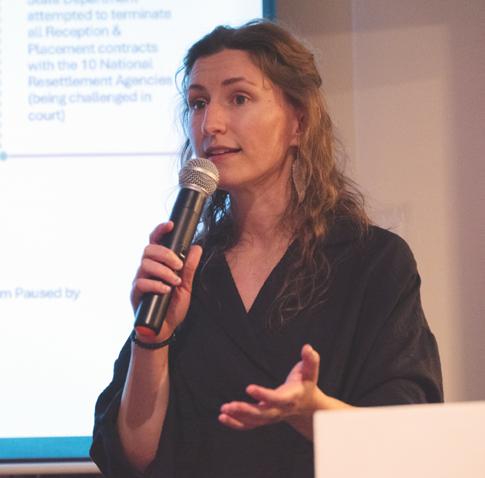
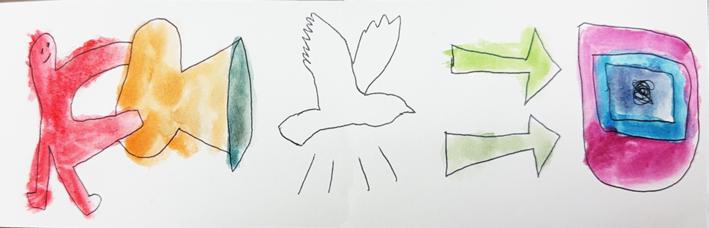
ArtRage Gallery and InterFaith Works discussed the impact of Trump’s anti-immigration policies on local refugees.
N • Refugee resettlement Page 3
C • Spring fever
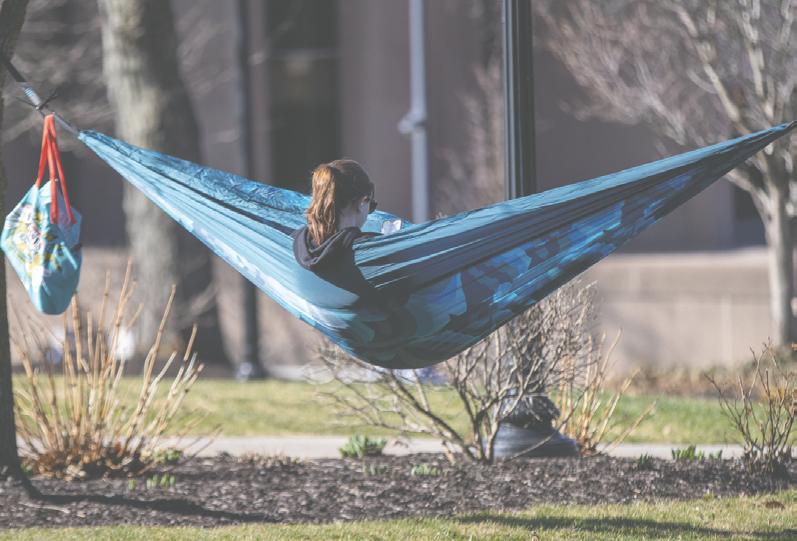
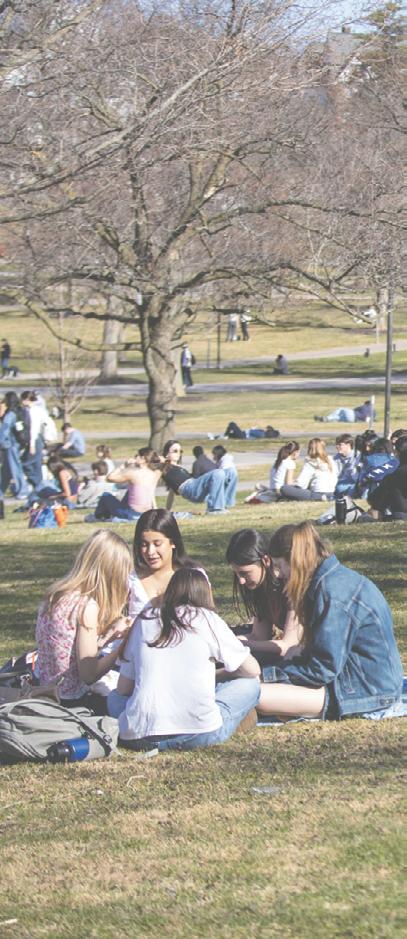
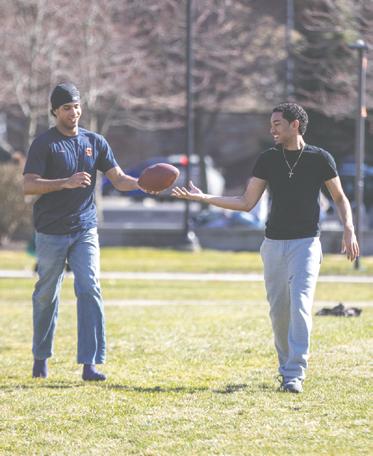
As Syracuse University finally experienced warmer weather this week, students flooded campus to soak up the sun.
S • Last chance
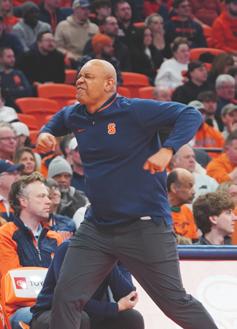
Syracuse has missed four straight NCAA Tournaments. Our columnist writes Adrian Autry should be fired if the skid extends to five.
Page 16
on campus
Clouded access
Students call on SU’s School of Art to increase Adobe CC
access
By Ben Butler culture editor
Dusty Herbig was preparing for an optional five-week course on Photoshop when he encountered a problem: none of his students could access Adobe Creative Cloud services on their personal devices.
Herbig, who’s the coordinator of the Print Media & Graphic Art area of Syracuse University’s School of Art, didn’t find this out until the first day of classes. He searched for roughly two weeks to find a computer lab in the Shaffer Art Building where he could hold class.
“That was when rubber really hit the road for me,” Herbig said. “It’s only a fiveweek class, and it took us two or three weeks to find a lab that people could go to, and it had to be special permission at a lab down in Film and Media Arts in Shaffer.”
Many students in SU’s School of Art don’t have access to Adobe CC on their personal devices through their academic program. Students in SOA, which is housed in SU’s College of Visual and Performing Arts, have lobbied for access over the past year, but said school administrators haven’t adequately addressed their concerns or communicated effectively.
Robert Wysocki, SOA’s director, said his goal is to get Adobe CC personal device licenses for all sophomores, juniors and seniors in the school by August 2025. But that depends heavily on faculty input as well as SOA curricular changes, he said.
“It’s just a matter of purchasing what we’re going to use, and not just throw money into software that most of them aren’t going to use,” Wysocki said. “We have to bake it into the curriculum, so it’s hand in hand with what we’re doing in studios.”
At SU, the School of Architecture, S.I. Newhouse School of Public Communica-
tions, and VPA’s ’ School of Design, Department of Film and Media Arts and Department of Drama grant access to Adobe CC personal device licenses. Other institutions such as Boston University, Colgate University, and Northwestern University grant access university-wide.
Students can log into their SU accounts and access Adobe CC services on SU’s campus computers.
Lily Ryan, a senior studio arts major, said that during their freshman year, there were six computers at the Comstock Art facility, where most studio arts classes are held. Now, there are only four in the entire building, Herbig said. Two of those are maintained effectively, Ryan said.
Studio arts classes tend to have roughly 10 students, so there can be as many as 100 students using the building at any given time, Herbig said. With only two fully functional computers, he said teaching see adobe page 7
Solidarity Coalition trains activists
By Madeline Goodheart asst. digital editor
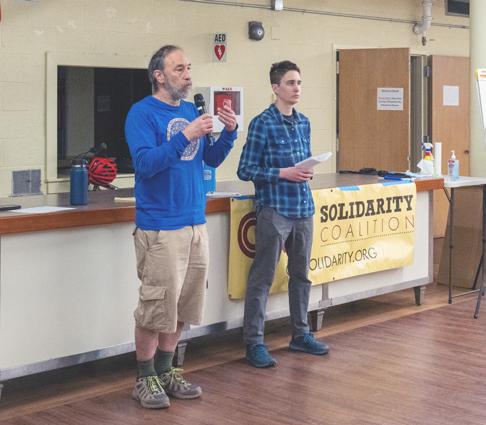
Around 50 community members attended a workshop hosted by the CNY Solidarity Coalition Wednesday evening aiming to teach attendees how to advocate peacefully and effectively in protest settings.
With the event titled, “De-escalation Training for Activists,” Andy Mager, coordinator and social movements liaison for the Syracuse Peace Council, said the coalition’s increasing focus on demonstration tactics is in response to “authoritarian moves” under President Donald Trump’s administration. Mager said the president’s efforts to consolidate power and encourage violence has introduced a newfound need for peaceful protest.
“More and more people are coming to protests, and that’s a great thing,” Mager said. “We want those people to feel confident exercising their democratic rights and to be able to do so safely.”
Since his return to office, Trump has signed 89 executive orders tightening immigration restrictions and limiting diversity, equity, inclusion and accessibility in government. He also introduced the Department of Government Efficiency, led by Elon Musk, imposing limitations on federal agencies’ hiring practices and enacting cost-cutting policies.
Last Friday, the coalition organized a “Tesla Takedown” protest, drawing over 350 attendees to the Central New York Tesla service center to protest Musk’s unchecked power as the leader of DOGE. The large turnout demonstrated the growth in interest in fighting back and protesting the Trump administration’s actions, Mager said.
“Musk has been allowed to do what he’s doing in the federal government,” Peggy Cohee, a workshop attendee, said. “It’s scary, and I think we have to call him out.”
The workshop emphasized that traditional marches and rallies might not suffice in protesting Trump’s actions. Mager said he wanted to help participants be ready for situations where actions like sit-ins and blockades could grow into larger protests, potentially garnering attention from counter-protesters.
Howard and Mager led attendees through several exercises, including “hassle lines,” where participants formed two rows: one roleplaying as protest disruptors and the other as protesters attempting to de-escalate. Facilitators encouraged open communication within the group to foster a collaborative learning environment, while Howard shared tactics including using direct eye contact, breathing slowly and assuming a physically neutral stance.
Mager stressed the importance of establishing clear agreements with counter-protestors during demonstrations to ensure a safe environment for all
Editor@dailyorange.com
News@dailyorange.com
Opinion@dailyorange.com
Culture@dailyorange.com
Sports@dailyorange.com
Digital@dailyorange.com
Design@dailyorange.com
Photo@dailyorange.com
BUSINESS 315-443-2315
how to join us
The Daily Orange is an independent, nonprofit newspaper published in Syracuse, New York. The editorial content of the paper — which started in 1903 and went independent in 1971 — is entirely run by Syracuse University students.
The D.O., a 501(c)(3) nonprofit, is editorially and financially independent from SU, and the paper receives no funding from the university. Instead, The D.O. relies on advertising revenue and donations to sustain operations.
This fall, the paper will be published Thursday when SU classes are in session.
The D.O.’s online coverage is 24/7, including while SU is on break.
To show your support to The D.O.’s independent journalism, please visit dailyorange.com/donate. Donations are tax deductible.
If you are a Syracuse University or SUNY-ESF student interested in contributing to The D.O. on either its advertising or editorial teams, please email editor@dailyorange.com.
corrections policy
The D.O. strives to be as accurate in our reporting as possible. Please email editor@dailyorange.com to report a correction.
letter to the editor policy
The D.O. prides itself as an outlet for community discussion. To learn more about our submission guidelines, please email opinion@dailyorange. com with your full name and affiliation within the Syracuse community. Please note letters should not include any personal information pertaining to other people unless it is relevant to the topic at hand. All letters will be edited for style and grammar.
The Boys & Girls Clubs of Syracuse would like to thank Alpha Epsilon Phi: the top fundraising student group at Syracuse University – for the third year in a row!!!
To follow their outstanding philanthropic leadership, TEXT BGCS to 44-321 and support Syracuse youth trying to grow up in the three low-income and high crime neighborhoods surrounding our Clubhouses.
WEATHER
The forecast for this upcoming week, per The Weather Channel.
COMING UP
Noteworthy events this week.
WHAT: Women’s History Month CEO Roundtable
WHEN: Friday, 1:30–3:30 p.m.
WHERE: Bird Library, Room 114
WHAT: BioArt Exhibition: Trauma Mapping
WHEN: Friday, 4:30–6:30 p.m.
WHERE: Life Sciences Complex
WHAT: UU: A Night with Sarah Sherman and Emil Wakim
WHEN: Friday, 8–10 p.m..
WHERE: Schine Student Center, Goldstein Auditorium
ArtRage Gallery hosts discussion on refugee resettlement
By Arabella Klonowski asst. copy editor
Syracuse’s ArtRage Gallery hosted a discussion on refugee resettlement Wednesday, featuring a presentation from InterFaith Works about how the Trump administration’s anti-immigration policies are impacting the city. The event also explored ways the community can support local resettlement efforts.
Local refugee resettlement organizations, such as InterFaith Works’ Center for New Americans, have lost federal funding due to the refugee resettlement freeze imposed by the Trump administration. The center focuses on integrating refugee and immigrant families into communities, assisting their transition by providing English classes and mental health services.
Syracuse
is a wonderful place, and we will remain that way despite what happens with our government.
Genevieve Marshall, the associate director of Health & Integration Services at InterFaith Works, said it was clear that, under President Biden, efforts to increase immigration were prevalent before slowing in January due to Trump’s second term policies.
“Our world has not been the same since January the 20th,” Marshall said. “They (the Trump administration) said, ‘Not only are we pausing admissions into the U.S. and not welcoming new individuals. We’re going to take it one step further. We want you to stop and suspend all services that you are offering to clients, even the folks that just got here.’”
The panel was part of a collaboration with ArtRage’s current exhibition, A Place to Call Home, which explores Syracuse’s housing crisis through a series of photographs.
InterFaith works joins a long list of refugee settlement organizations across the nation that has suffered financial strain as a result of the
on campus
Trump administration, leading to the elimination of numerous programs across the country.
For InterFaith Works, 10 of its 16 programs that help refugees earn citizenship and provide health and wellness benefits are at risk of elimination or severely impacted by the policies. The organization also had to lay off several employees due to the new budget cuts, a trend that Marshall said is becoming increasingly common for refugee resettlement organizations.
A self-identified immigrant who moved to Syracuse over a decade ago and requested to remain anonymous said access to transportation is one of the biggest challenges refugees face when settling into a new area. Providing reliable transportation from essentials – like grocery stores, schools, job interviews and community engagement opportunities – is key for their successful transition to the United States, he said.
With the various cuts to InterFaith Works’ budget, he said it was important for community members to volunteer for causes like the refugee transportation program and help the organization continue to function.
“From what I heard today, someone is there for you,” he said. “Really, I came from a lot worse than what I heard tonight, so I have no fear now.”
Many of these cuts are currently being challenged in federal court. The lawsuit tackling suspensions of refugee resettlement programs and funding freezes was filed by the International Refugee Association Project after refugee rights organizations like the Church World Service and Lutheran Community Services Northwest announced they’d be unable to provide refugees with critical care under new policies.
Kimberly McCoy, ArtRage’s community engagement organizer who helped organize the event, said the initial purpose of the gathering was to discuss housing design and affordability for refugees, but evolved into a broader conversation about the challenges the organization now faces. She expressed hope that the Trump administration’s policies will be revoked in court.
“That (refugee resettlement) is such an important part of our city, and we need to continue to be a welcoming city that supports everyone who lives here,” McCoy said. “This is going to have a huge impact on our community, even for the people that are already here.”
Onondaga County, the second-largest refugee settlement community in New York, has been home to nearly 6,000 refugees since 2020, according to the state of New York. Judi Kurtz,
a Syracuse resident, said supporting refugee organizations was essential to helping the many members of her community who have suffered from the new policies.
Kurtz said she is working to remain forward thinking during troubling times is important, and expressed positivity despite widespread doubt for the future of programs like InterFaith Works’ Center for New Americans.
“Hopefully, as these things go through the legal process, things will get back to what we need, but if not, the community is there to support anyway,” Kurtz said. “Syracuse is a wonderful place, and we will remain that way despite what happens with our government.”
The anonymous source echoed Kurtz, noting that civic participation from his neighbors has given him confidence in reaching the “light at the end of the tunnel.”
Marshall emphasized the importance of being mindful of the language used in discussions about current funding struggles, assuring the refugee community that regardless of federal policy, local activists will continue to show up for them.
“We have to look our clients in the face, we have made the commitment to them,” Marshall said. “So we’re not going to abandon them, and whether we call it something else or not, we’re still going to be providing services.”
akklonow@syr.edu
USen addresses changes to Department of Education funding
By Delia Rangel asst. news editor
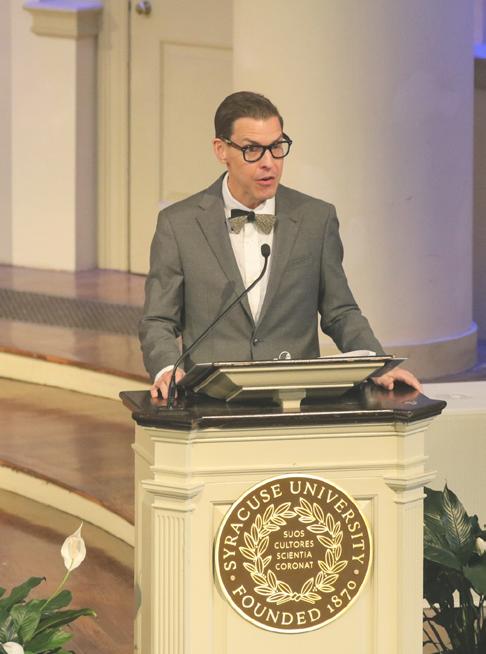
Syracuse University Chancellor Kent Syverud addressed the recent changes within the United States Department of Education during Wednesday afternoon’s University Senate meeting, assuring senators that SU remains in a “strong position” amid funding cuts across American higher education institutions.
Last Friday, the DOEd launched investigations into 45 public and private universities over civil rights violations related to offering race-based scholarships and programs. While he acknowledged the unpredictable nature of the cuts, Syverud said he expects SU to remain off the list of investigated institutions.
“Syracuse University will comply with law as it develops, but we strongly believe all of our university programs do not discriminate against any group,” Syverud said. “... We’re a university that welcomes all and how we do that in each era and under each administration has had to be savvy and has had to be wise, and we’re in a situation where we have to figure out how to continue doing that now.”
As the administration has fired over 1,300 DOEd members and investigates dozens of higher education institutions for alleged civil rights violations, Syverud said he is following developments at Columbia University specifically.
On Mar. 13, the Trump administration demanded Columbia make changes to its student discipline and admissions processes before it would discuss its revocation of $400 million in federal grants and contracts, the New York Times reported. The demands come as the White House says the university failed to protect its Jewish students from harassment.
“It’s not just the scale of what’s being asked of Columbia, but the substance, including the academic substance that’s being requested of
Columbia in order to benefit from federal funding,” Syverud said.
In February, the DOEd announced that any consideration of race in student, campus and academic life would be considered discrimination in violation of Title VI of the Civil Rights Act of 1964, the Times reported. Syverud said he’s working closely with Mary Grace Almandrez, SU’s vice president for diversity and inclusion, to create a “university-wide effort” to determine next steps.
University administrators, including Almandrez, are currently reviewing SU’s programs, resources and services for their compliance with Trump’s DEIA policies, according to a March 6 campus-wide email.
He said Almandrez and her team are reaching out to faculty, staff and students to help shape the university’s long-term strategy.
For many institutions, limited federal funding has already begun to impact annual budgets and planning for the next school year. On Mar. 13, Johns Hopkins University announced it was firing over 2,000 employees in preparation of a reduced budget, the Times reported.
Syverud said the university has maintained its finances well as it wraps up the 2025 fiscal year and doesn’t anticipate similar cuts at SU as the budget committee begins to prepare for the next fiscal year.
“We are not going to do some of the things you’re seeing elsewhere,” Syverud said. “So we’re not going to have large-scale layoffs. We’re not going to have across-the-board hiring freezes. We’re not going to have deep budget cuts or other drastic measures in graduate programs.”
In her remarks, Interim Vice Chancellor and Provost Lois Agnew said SU plans to implement changes to the First Year Seminar curriculum in response to student feedback. Among responses, Agnew said students often requested a greater focus on smoother acclimation to university life in the course.
Agnew said first-year students who don’t attend their FYS classes are more likely to transfer universities. She is working to form a group to develop a revised syllabus that addresses concerns before the end of the semester.
As the course serves as a mandatory orientation for first-year students, Agnew said Trump’s anti-diversity, equity, inclusion and accessibility orders will need to be considered. However, she said these orders aren’t the primary motivation for course revisions.
“We need to be responsive to our student’s needs, and they are telling us this course in its current form is not fully meeting them,” Agnew said. “We’re committed to ensuring that the
course will provide all students with the tools they need to be confident participants in our academic community.”
Syverud closed the meeting by encouraging senators to remember the rapidly changing nature of federal policy impacting American academia. He said he expects significant changes by the senate’s final meeting in mid-April that would impact both DEIA and the university’s budget.
“There will be more changes coming from Washington in the next 40 days,” Syverud said. “It’s 53 days to commencement, I expect in the next 40 days we’ll see more.” dsrangel@syr.edu
Faculty at a fall USen meeting. SU Chancellor Kent Syverud said SU is in a “strong place” amid DOEd funding cuts. christian calabrese staff photographer
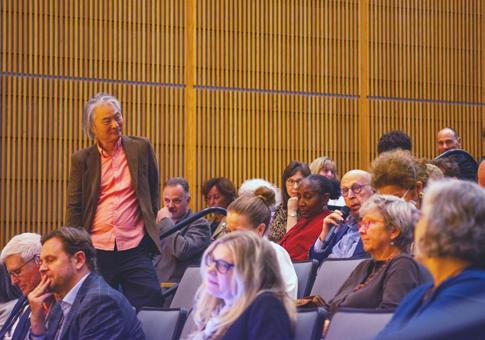
Throughout discussion, speakers evaluated the impact of Trump’s anti-immigration policies and rallied support for the Syracuse refugee community. ike wood staff photographer
Judi Kurtz syracuse resident
By Tara Binte Sharil, Henry Daley, Ben Butler
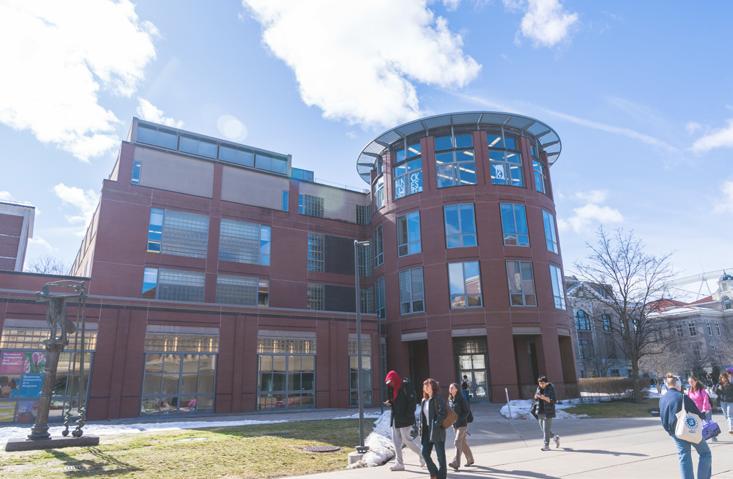
Syracuse winters are infamously cold and snowy. But this Tuesday and Wednesday, it seemed like spring had finally arrived. 2025 has brought a snowier winter than Syracuse has seen in recent years. By January 7, the snowfall total surpassed 40 inches for the year. In 2024, it took until February 29 to reach that benchmark.
Finally getting a break from the harsh winter, Syracuse University freshman Kyle McMahan was more than thrilled to see the sun out and continue his spring break fun.
“It was a pleasant surprise this morning to see the sun out,” McMahan said. “It made me want to go outside and get out of just staying inside a building.”
When the clouds parted, students immediately took to Shaw Quadrangle, relaxing on blankets and setting up hammocks. Hacky sack circles formed. Skateboarders whizzed past the Hall of Languages. Music drifted across campus.
For sophomore Amya Howell, her perfect day out in the sun was complete with country music, like Morgan Wallen’s “Love Somebody,” on repeat. Sophomore Asher Gonzalez opted for his go-to folk band, Richy Mitch & The Coal Miners, to provide a sunny day soundtrack.
While some students plugged into their headphones or tuned into music on speakers, others opted for live music, like senior Dominic Naggar, who strummed his guitar to sharpen his skills for class.
Spring has sprung
This week, warmer temperatures beckoned SU students outside up the sunshine and blast
“I can’t play anything yet,” Naggar said. “But apparently playing the guitar looks cool, so I’m just here for the vibes.”
Bleron Balidemaj, a sophomore computer science major, laid on his backpack with UK drill artists NEMZZZ and Central Cee playing through his headphones.
Balidemaj said he’s most looking forward to playing more basketball this spring.
“I only like hooping outdoors,” Balidemaj said. “I mostly take care of the scoring, but my defense is a little lacking.”
Emma Covey, a junior chemistry major, said she rushed her lab work “a little bit” so she could get outside and slackline with her friends. Slacklining is an outdoor activity similar to tightrope walking.
Originally from Brooklyn, Covey doesn’t usually venture to Central Park when she’s home. But with the quad just a two-minute walk from her house, it was easily accessible for enjoying the weather.
Though she also participates in outdoor winter activities in Syracuse, Covey said she’s glad the weather warmed up. For her, it’s better to “not be freezing, and have the sun on my skin.”
Theo Scott, a freshman film major, said his favorite thing to do when the weather improves is spend time with friends outside.
Scott lives in California and said that after experiencing his first Syracuse winter, he thinks SU students appreciate being outside in good weather than people in California, who might take their year-round sun for granted.
“Everyone’s more happy,” Scott said. “I can tell that everyone is taking much more value out of this nice weather than people would be at UCLA.”
Sam Espiritu, a sophomore public relations major, said she returned to the quad
to use a hammock when her classes finished early instead of heading home.
“I definitely appreciate the sunny weather more after experiencing the very cold winter,” Espiritu said. “I like to sit out when it’s sunny or go to Green Lakes.”
Espiritu said the sunny weather brought students together, especially after everyone on campus endured the winter season.
Hayley Shukiar, an English and textual studies and law, society and policy major, said the weather motivated her to come to the quad because she wanted to get “as much sun as possible” while she could.
Shukiar, who’s from California, said her favorite thing to do at home is go to the beach.
“I’ve seen snow before, but I’ve never lived in it, so this weather is making me very happy,” Shukiar said.
While plenty of students remained outside to enjoy the sun, Maya Rizzo, a sophomore advertising major, said the weather gave her extra motivation to attend classes.
“I’m so happy the weather is nice. I can finally see the grass and the sky, it’s lovely. It’s very refreshing,” Rizzo said.
Rizzo, who’s from Los Angeles, said she’d appreciate Syracuse’s sunny days more often after the winter and try to go outside more with her friends.
Even though the mornings started out with chillier temperatures, Tuesday was still warm enough for sophomore Helaina Stovin to put her winter gear away.
“I looked at the weather and it said ‘feels like 42 (degrees).’ I immediately threw my coat in the closet and jumped for joy,” Stovin said. “I’m so happy to see the sun and the blue sky today.”
culture@dailyorange.com
the daily orange
Photos by Brycen Pace, Leonardo Eriman the daily orange
Syracuse University students sat around campus as they enjoyed the first warm day of the semester. The campus was lively with students enjoying a number of activities.
sprung temperatures outside to soak blast some tunes
Hendricks Chapel honors late students, faculty, trustees
By Anna Clair Levitt staff writer
Hendricks Chapel held its annual Service of Commemoration honoring over 100 Syracuse University and SUNY ESF students, staff, faculty, retirees, trustees and emeriti who have died over the past year on Tuesday evening.
The ceremony celebrated the lives of the deceased and emphasized the importance of coming together to process hardship in a communal setting, Dean of Hendricks Chapel Brian Konkol said. Family and friends of those who died were joined in mourning by members of SU and ESF’s campus communities.
“It’s really important to name and remember the people that have contributed so much to this campus community,” Konkol said. “It’s important that we do that for those who are grieving the loss of those loved ones, and also it’s a great reminder for each and every one of us of the gift of life that we’re currently enjoying.”
SU Chancellor Kent Syverud read the names of all those honored, highlighting many of their contributions to the university. Among those named were Ruth Johnson Colvin, a Syracuse alumna and Presidential Medal of Freedom recipient, and former SU Board of Trustees member Tarky Lombardi Jr., who served as a New York state senator for 27 years.
“Each and every person on this list today has made our community a better place to study and to live and work in. There’s a lot of luminaries on the list today,” Syverud said.
SU’s Student Association President German Nolivos read the names of the students who died in the past academic year, listing Matthew Benedict, a graduate student in the College of Engineering and Computer Science, Liam Zoghby, a sophomore in the School of Education’s InclusiveU program, Christina “Elise” Wobbe, a first-year studying musical theater and Bryce Lander, a senior who was studying political science, law, society and policy and Spanish.
Following Nolivos, ESF President Joanie Mahoney read the names of ESF students and community members that died in the past year. Mahoney said that as others spoke, she reflected on the partnership between SU and ESF, noting
that even in mourning, the two schools benefited from collaborating.
“We share not only a campus and a community but also a unique bond that allows us to celebrate each other’s successes and stand together for times of loss,” Mahoney said.
The first commemoration ceremony, held in 2017, aimed to raise awareness about the victims of the 1988 Pan Am Flight 103 bombing, which resulted in the deaths of 35 SU students who were returning home after studying in Europe. Remembrance Scholar Leondra Tyler, a senior double majoring in psychology and neuroscience, delivered a speech emphasizing gratitude and the importance of living in the present.
Tyler said her time as a scholar has taught her to properly reflect on difficult emotions. While many people struggle to confront their feelings in times of loss, Tyler said it’s important to take breaks from daily life to remember and process grief.
“We’re all over beyond the campus, and I think it’s really important to just lean into that community space that we have here,” Tyler said. “Being a part of this campus is something that ties us all together, and I think that’s really essential.”
The Hendricks Chapel Choir performed multiple times throughout the ceremony. Choir leader and professor José “Peppie” Calvar sang “Danny Boy” during the placement of two commemorative wreaths outside the chapel.
Calvar said choir members cherish the opportunity to participate in the annual commemoration and value opportunities to show up when fellow community members are in need.
Konkol echoed this, encouraging attendees to celebrate the lives of those who have died in the past year and to remember their individual impacts on campus. He said gatherings like this one are a reminder of the many hardships people experience and the importance of empathy, even for strangers.
“This service is a reminder that everywhere you go, you are interacting with people that are breathing, and you never really know where people’s struggles are…” Konkol said. “So I think this year in particular, having a little bit of kindness and compassion is a good thing.”
aclevitt@syr.edu
Hendricks Chapel’s Service of Commemoration honored over 100 late community members with readings of their names and choir performances. avery magee asst. photo editor
courses that require Photoshop or Illustrator is challenging.
“It’s like not being able to show up with pencils to an art class,” Herbig said.
Herbig conducted his own research on how Adobe CC access is distributed among schools. On Facebook, he sent a poll to a network of printmaking professors and asked if their programs provided Adobe CC. The poll had four options: “yes,” “yes but only if enrolled in a class,” “yes but only on university computers,” and “no.”
Of the almost 100 responses he received, only two professors said “no.” Herbig said SOA would technically fall under the “yes but only on university computers” variation, but SU “doesn’t make it accessible.”
“It’s there, but the computers aren’t,” Herbig said. “It’s like, ‘Yeah, I’ll give you a free gas card, but you don’t have a car.’”
Adobe CC charges university students $20 per month for the first year of personal device licenses, but $35 per month for all remaining years.
Shouldering the personal license cost in addition to art supplies and tuition can be prohibitive to students, Zoe Requena, a studio arts senior and international student, said. When choosing schools, SOA stood out to her since she heard supplies were provided through the program.
But once she arrived on campus, Requena discovered this wasn’t the reality. She said she has to pay almost $300 a semester for her own supplies, on top of tuition costs.
“It really, really angers me, because I went to other schools where a lot of things would have been cheaper for me,” Requena said. “But now I don’t even have Adobe.”
Belle Halt, a sophomore studio art major, said internships in her career field require or strongly recommend a basic understanding of Adobe CC. Even though Halt is minoring in design studies in VPA’s School of Design, she still doesn’t have access to the software.
The classes for design typically require or recommend Adobe CC softwares for part of the course load, Halt said, so access is essential to her academics. Along with Abigail Shim, a sophomore studio arts major, Halt turned to René Vetter, a junior illustration major, for advice on how to advocate for Adobe CC access.
On Sept. 12, Vetter emailed a letter with a list of complaints from 27 other junior illustration majors to Wysocki and other faculty at SOA. Among their complaints was the lack of access to Adobe CC.
A few weeks later, Vetter said Adobe CC was only made available for junior and senior illustration majors. Studio arts majors, along with illustration sophomores and first-years, still don’t have access.
Wysocki said he was more open to getting illustration students access to Adobe CC than studio arts students, as the costs associated with the illustration major are lower. “Consumables,” like saw blades, sandpaper and work gloves, in the studio arts curriculum demand “quite a bit of money” from SOA, he said.
When the junior illustration majors returned to campus for this spring semester, Vetter said they initially didn’t have access to Adobe CC, despite their petition in the fall. After the stu-
dents reached out to Wysocki multiple times, Vetter said Adobe CC access was restored on students’ personal devices.
The lapse in access was because the license Wysocki had procured for the students expired over break, which surprised Wysocki.
Halt and Shim said they began contacting Wysocki at the beginning of the spring semester about Adobe CC access for studio arts majors, but didn’t receive a response. They then began emailing other faculty members.
They also sent out a survey to fellow SOA students, receiving 97 responses.
Of the respondents, 86.6% strongly agreed that “having access to Adobe CC would significantly benefit” their creative processes. 83.5% strongly agreed that “Adobe CC access for SOA students being confined to select locations is incredibly inconvenient” and access issues hindered creative processes.
All respondents agreed with the statement, “I am in support of Adobe CC being made accessible to all students in the SOA.”
Wysocki said the question among faculty of implementing Adobe CC into the curriculum has always been whether students will actually use it.
On Feb. 19, Halt and Shim met with Sam Van Aken, SOA’s associate director, about Adobe CC access and showed him the data they gathered.
Van Aken was sympathetic to their complaints, and agreed that personal device licenses would be preferable to increasing lab space at the Comstock Art facility — and likely cheaper.
“(A lab) is a big monetary investment, and what’s the sense in building a lab if students don’t really want to go to the lab anyway?” Van Aken said.
Halt and Shim said Van Aken suggested remote digital desktop as a solution, which allows students to treat their personal devices like an SU computer, complete with Adobe CC.
But students said that solution is inadequate.
Ryan said when they used the remote desktop, they couldn’t transfer files off their computer. When Halt used InDesign through the remote desktop, it frequently crashed, she said.
The department is also facing a fundamental debate in how to organize their curriculum, Wysocki and Van Aken said. The debate between teaching digital and physical techniques is something SOA has been dealing with since the COVID-19 pandemic, Van Aken said.
“First-year students are coming in much more adept on their phone than they are with the pencil,” Van Aken said. “Should we be taking them in a different direction, or meeting them where they’re at and building from that skill set?”
In his work as a sculptor, Van Aken said he uses Adobe CC “weekly, if not daily.” He said first-year students should be learning Adobe CC, but that this debate needs to be resolved at the faculty level.
“When people have a need, they expect it to be addressed immediately, but universities tend to work a little more slowly than that,” Van Aken said. “That’s a good and a bad thing, but it makes sure that the decisions are thorough and takes people into account.”
He said he likes to think the department is responsive to student complaints, but as faculty evaluate the curriculum, students may see the process as delayed. Van Aken said he’s been collecting feedback from students and faculty to figure out if Adobe CC access needs to be required across SOA.
participants. He said the coalition has fundamental agreements, such as respecting all people involved, to guide its approach.
“Keeping your phrases, your words, as simple and as affirming as possible is generally the most effective way of talking to someone who’s escalating,” Howard said. “This is not the time to be giving someone your thesis on why fascism is wrong.”
While these tactics have yielded many effective protests, Mager acknowledged that demonstrations can easily escalate to dangerous levels.
In November 2024, a group gathered at the federal building to meet with Senators Chuck Schumer and Kirsten Gillibrand to discuss the United States’ support for the Israel-Hamas War. During the protest, Ellen Grady, an activist with Ithaca Catholic Worker, was arrested for attempting to assert her right to enter the building and meet with the senators.
Mager highlighted the need to learn other peaceful strategies to help prevent others from ending up in similar situations.
“People need to prepare for (this) so that they’re making thoughtful decisions about how to do (demonstrate) effectively,” Mager said.
“There’s a lot at stake.”
Sarah Howard, a workshop organizer and environmental justice organizer for the
“The first decision that needs to be made is by the faculty,” Van Aken said. “At that point, we can look at how we go about paying for it.”
Herbig said the issue should be resolved at the college level; Adobe CC should be provided to all students in VPA, with the costs taken out of VPA’s budget, he said.
Van Aken told Halt and Shim that if SOA provided personal device licenses to each student, it would likely mean an increase in student fees. He said it would be in all parties’ economic interest for students to purchase private licenses individually, like textbook fees.
Halt and Shim planned to attend a faculty meeting set for March 7, where Van Aken and Wysocki said they would discuss access, but the meeting was abruptly canceled and rescheduled.
Herbig said the rescheduling was partially due to a scheduling conflict with SOA’s MFA opening show in New York City. But Herbig said abrupt meeting cancellations are common, and issues aren’t always circled back to in future meetings.
Van Aken and Wysocki said there will be a faculty meeting on Friday, partially to speak about curricular changes, including the Adobe issue. Wysocki said it’s one of many items on the agenda.
Herbig said he’s brought up the issue of Adobe CC access in several faculty meetings in the past, but administrators haven’t given it “one iota” of attention.
“People always talk about it, but there never seems to be any movement or change,” Herbig said.
DISCLAIMER: René Vetter is a contributing cartoonist for The Daily Orange. He was not involved in the editorial process of this article. bnbutler@syr.edu
Tonawanda Seneca Nation Council of Chiefs, said there isn’t a right way to escalate and de-escalate a protest, but encouraged attendees to practice self-awareness and reflect on their own personal identities and triggers when publicly demonstrating.
They urged participants to consider how power, privilege and identity can influence someone’s approach to nonviolent direct action and inform strategies for de-escalation.
Cohee said her primary motivation for attending the event stemmed from her deep concerns about civility in American political discussion. She emphasized the significant challenges immigrant populations face in Syracuse and the impact Trump’s antiimmigration laws will have on them.
The workshop taught her the importance of staying courageous in public demonstrations and standing up for her beliefs, Cohee said. As Trump continues to attack DEIA initiatives across the federal government, she plans to “stand on the ground” for the causes she cares about.
Mager agreed with Cohee, adding that the most impactful protests come from the grassroots level.
“We’re in this together. Solidarity means sort of working together for a common goal,” Mager said. “In this case, to defend democracy, to defend those in our community who are most threatened by these attacks on immigrants, on refugees, on trans people, on people of color.”
mmgoodhe@syr.edu
from page 1 workshop
With rising tensions in national politics, organizers encouraged protestors to pursue civil dialogue when engaging in demonstrations. collin snyder staff photographer
Many SU School of Art students, including illustration and studio arts majors, don’t have full access to Adobe Creative Cloud Suite for personal use through the program. collin snyder staff photographer
CULTURE
Rave revival
F Shed, once a beloved haven for ravers and rockers, hopes to return with
By Hailey Roy staff writer
Christian Lopez vividly remembers seeing Excision, an electronic music producer known for his bass-heavy hits, at the CNY Regional Market’s F Shed in 2014. Ravers filled the space as the Canadian DJ spun tracks for three hours.
“When Excision came on, after all the other main artists, everyone was looking around the room,” Lopez said. “We were all thinking, ‘Holy crap, we’re gonna die from so much bass.’”
This exact show was a night Lopez won’t forget. The show was promoted as releasing “an earth-shattering 150,000 watts of PK sound.” Yet while the energy inside the venue was electric, the beats led to hundreds of house-shaking noise complaints to Onondaga County 911.
That was over 10 years ago. Today, F Shed is a vacant space in northern Syracuse, only open on weekends to house the market and occasionally available as a rental venue for private events. But the market’s newly appointed CEO, Bill Fisher, hopes to bring back the beloved concert venue by mid-April, complete with renovations to improve noise mitigation.
From 2013-17, F Shed hosted a variety of performances across multiple genres, like heavy metal, country and EDM. American rock band O.A.R., country singer Tyler Farr and EDM DJs like Skrillex and Hardwell — both of whose shows were sold out — all took the stage at F Shed.
It was like walking into a room full of like family that I had never met before. The community was so welcoming.
The venue was also a haven for ravers and rockers in the Syracuse community and beyond.
Classic rave culture thrived. EDM fans traded Kandi bracelets, and F Shed supporters spread PLUR — peace, love, unity and respect. Aside from bringing in DJ legends, F Shed’s piercing lasers, smoke machines and glow sticks all cemented the space as an EDM playground.
“It was like walking into a room full of like family that I had never met before,” Lopez said. “It was just awesome. The community was so welcoming.”
Lopez frequently traveled with family and friends to F Shed from Binghamton. He’s watched Excision three times, along with Skrillex, and attended Safe In Sound, an EDM festival that brought in a string of dubstep DJs. The genre inspired him to become a DJ himself.
The venue was set to reopen on Feb. 22 after an eight-year hiatus, but after Fisher spoke with State Assemblymember William Magnarelli and Syracuse Mayor Ben Walsh about reviving the space, he realized major soundproofing efforts were necessary. The venue’s closure in 2017 was due to a litany of noise complaints from surrounding neighborhoods.
We Are One X-perience, a music group that pays homage to R&B legend Frankie Beverly, was slated to headline F Shed’s comeback performance.
“When the concert promoter came to us, we reached out to the city of Syracuse, and they were generally supportive, but
renovations to improve sound see f shed page 11
New ESF radio station to launch in April with student focus
By Caroline Erskine staff writer
As neighboring campuses, SUNY ESF and Syracuse University share plenty of clubs and organizations. But some ESF students have noticed a lack of ESF-specific groups.
ESF Radio is trying to change that.
The student-run radio will be an ESF-focused, online station run out of Marshall Hall. Its stream will be accessible through a link on the sta-
tion’s Instagram and QR codes posted around campus. It’ll be active from 8 a.m. to 6 p.m. on Monday through Friday, and will also be broadcasted through large speakers in Trailhead cafe inside ESF’s Moon Library. “Students have such an inspiration to create content,” Marco Sciortino, ESF senior and radio founder, said. “Some people just need the motivation to step out there and release any thoughts or expressions about the campus, or
their thoughts about what’s going on in the world.”
The station in Marshall Hall is complete with a soundboard to mix audio and CDs that ESF students donated for the broadcasts.
Maintaining a separate identity from SU is crucial for some ESF students, like Michael Vallarta, a junior who said the school needs more tailored media programming.
“It’s a very specialized school, and a lot of the people who come into the
school have a lot of the same interests,” Vallarta said. “I feel like it’s a very distinct demographic compared to SU.”
The station was partially inspired by Sciortino’s sister, who was involved in a tune-in radio in high school that he often listened to. Last year, he recruited fellow ESF senior Izze Modell-Kowalski for the project and they began looking into the logistics of setting up their own station on campus. They quickly realized a tune-in radio was impractical since they would
need an antenna — and a lawyer. They decided to switch gears to an online radio set up through radio.co, a website that broadcasts from the cloud.
The station received funding from ESF last year and the organizers also fundraised in the fall 2024 semester. Once they had enough money, Sciortino and ModellKowalski procured the radio station just before spring break, and plan to begin broadcasting in April.
see radio page 11
From 2013 to 2017, CNY Regional Market’s F Shed hosted a variety of performances that resulted in noise complaints from residents. brycen pace asst. photo editor
courtesy of christian lopez
Christian Lopez binghamton resident and dj
slice
Inka’s offers new Peruvian, Japanese fusion
By Amelia Fortsch contributing writer
Inka’s is Katy Verzillo’s top pick for celebrating special occasions. On the evening of March 7, the Syracuse resident chose Inka’s for a dinner in honor of her brother’s new house and job. Joined by her parents and two brothers, Verzillo was excited to share the dining experience with her family, who had never visited the Peruvian fusion restaurant before.
“The food is top-notch, top-notch services as well (that are) very informative because a lot of this food is something people haven’t had before, so the waiters always know how to explain it to people,” Verzillo said.
Inka’s opened in November 2024 and is coowned by four partners: Alejandro Gonzalez, Jose Avalos-Rios, Mario Vigil and Mikayla McCandles. With Inka’s, they not only wanted to bring a new flavor to downtown Syracuse, but also create an exceptional dining experience for customers, Sebastian Ramirez, one of the restaurant’s managers, said. Gonzalez, who also owns Margaritas Mexican Cantina in Armory Square, wanted Inka’s to stand apart from the other eatery, Ramirez said.
On any given weekend evening, you can find Inka’s packed with patrons and filled with the sounds of lively chatter and music. Located on the corner of S. Salina Street and E. Washington Street, Inka’s boasts a Peruvian fusion menu for both lunch and dinner.
Ramirez has been working with the owners of Inka’s since the restaurant’s inception. He believes Inka’s fills a gap in the Syracuse food scene.
Flavio Solorzano, a chef who specializes in Peruvian food and pastries, designed the menu,
which incorporates Peruvian and Japanese influences, Ramirez said. Solorzano, who lives in Peru, comes back to the restaurant every two to three months to check in with its staff. In the kitchen, Ramirez said, each chef has their own niche; one handles seafood, while another exclusively cooks chicken, for example.
“Narrowing everyone’s focus makes sure that all of the food that comes out of the kitchen is 10/10,” Ramirez said.
The menu includes traditional Peruvian dishes like ceviche and Peruvian marinated chicken, but the team curated dishes to fit the Syracuse environment, Ramirez said. The chef and staff initially worried some of the flavors may have been a little too extreme for the local crowd, so they tweaked the menu to ensure the cuisine was accessible for everyone.
Verzillo said the cuisine is something new for her and the rest of the downtown Syracuse community to try, and she’s always willing to try a new dish.
“They make trying something new not so scary,” Verzillo said.
Before opening, the owners redecorated the entire space, including a brand-new kitchen with an oven from Peru, Ramirez said. The redesign process took roughly two years and involved input from the owners, who emphasized the importance of tailoring the atmosphere for customers.
“To have a successful restaurant or business, you can’t just slap new paint on the walls and open the doors,” Ramirez said “You have to give a new atmosphere and vibe to the location for it to work.”
Neon signs illuminate the walls, and greenery hangs down from the ceiling in the main
dining room. A mezzanine seating area overlooks the dining room. Directly off the main dining room, there’s a full bar serving specialty cocktails and other drinks.
Several mixologists helped develop Inka’s cocktail menu, including Loyd Von Rose, a quarterfinalist from the TV show Drink Masters. Von Rose helped develop a collaborative cocktail menu that Ramirez said will debut this spring and summer. Pisco, a popular liquor in Peru, is central to many of Inka’s cocktails.
“The same pride that we take in the kitchen, we also take the same pride at the bar with our cocktails,” Ramirez said.
Since its opening almost five months ago, the restaurant has served roughly 2,000 patrons. Its reception has been overall positive so far, Ramirez said.
“It’s been way better than anybody could have anticipated,” Ramirez said. “We have had nothing but good reviews.”
amelia.fortsch@gmail.com
Inka’s, a new Peruvian fusion restaurant in Syracuse, includes a cocktail menu developed by a quarterfinalist from Drink Masters, and a menu developed by a chef who specializes in Peruvian food and pastries. ella
screentime column
‘We
are Storror’ stuns with parkour sequences
By Henry O’Brien senior staff writer
You only have two strikes or you’re dead. That’s how Michael Bay used a baseball analogy to describe parkour.
Bay’s first feature-length documentary, “We Are Storror,” depicts the life and times of the British parkour group Storror. The film portrays the life-and-death stakes of parkour, an activity these seven men have dedicated their lives to.
It’s a perfect match between activity and filmmaker. Both parkour and Bay’s films feature a heavy dose of maximalism and fast-paced, sometimes totally incoherent, action sequences. It’s nearly all instinctual. Sometimes, logic has to go by the wayside in order to survive.
But the true magic of this film, which premiered at the 2025 South by Southwest Festival, comes not from showing the rise of Storror or their amazing parkour stunts (though it’s still pretty exhilarating). Rather, “We Are Storror” questions what one will do for an art form and what happens when an artist is running out of time to fulfill their potential.
The documentary wastes no time showing the excitement and danger of parkour. A montage of the seven group members jumping down a zigzagging staircase next to a dam abruptly ends when a close friend of the group gets seriously injured by landing on the stone surface. The matter-of-fact nature of the friend’s fall in the
CONCERTS THIS WEEKEND
Charlie Parr
This singer-songwriter prides himself on just that: himself. Get to know Charlie Parr’s authentic brand of songwriting, focused on storytelling. He’s visiting Syracuse from Duluth, Minnesota.
WHEN : Friday. Doors open at 7 p.m., music starts at 8 p.m.
WHERE: Funk ‘n Waffles PRICE: $23.63
footage feels terrifying, and the film doesn’t shy away from showing off graphic injuries.
The accident sends Storror into a state of worry and reflection. Now that they’re all into their 30s and have other loved ones, they have to consider how many more parkour feats they can do. While they gleefully boast about choosing parkour over romance, they start to feel a sense of longing and connection that their sport cannot satisfy.
“We are Storror” additionally reveals how each of the members is distinct. Parkour doesn’t mean the exact same thing to each member of the group. While some feel it can be a form of artistic expression emphasizing rebellion, others find it to be a high-intensity sport, requiring precision to stay alive. Although Bay described it as a sport and Storror as a group of athletes, the documentary doesn’t provide answers to these questions.
With all of the inquisitions into the high-stakes world of parkour, the biggest question remains — who on earth would want to do this and why would anyone watch a documentary about it from the man who made “Transformers?”
The simple answer is so that we understand the ecstatic thrill parkour can produce.
Along with using plenty of archival footage from Storror’s YouTube videos, Bay and his team of drone cameras perfectly track the movements and leaps between buildings. This is where we can truly understand the perfect mishmash between Bay and parkour.
Bay, who masterfully used drone shots in his 2022 film “Ambulance,” has a clear knowledge of how to move a drone and add meaning to the action. But there’s one caveat that comes with his documentary; Bay, a member of the Directors Guild of America, could not be on set when Storror was doing their acts unless he wanted to face DGA and their legal repercussions. Since he couldn’t fully guarantee their safety while pursuing the life-ordeath activity, Bay could only give instructions on shooting days.
This may seem like a hindrance and take away any of the stylings that make Bay so distinct as a director. But he more than makes up for his on-set absence in the editing. The sprinting and jumping between abandoned buildings has the rapid cuts that Bay endearingly, and sometimes frustratingly, uses in all of his movies. While the more climactic and suspenseful jumps come from Storror’s old YouTube videos, Bay uses the music and editing to establish classic cinematic tension and payoff.
The combination of Bay and Storror genuinely creates a sense of reward and gives the audience an inkling of why this parkour group does what it does and their hesitancy to say goodbye to it. The film, which still doesn’t have distribution, deserves attention and an IMAX theatrical run for its truly heart-pounding action sequences that serve as one of Bay’s best works yet (shockingly without explosions). But above all else, Bay gives a powerful examination of an artist’s relationship to their art. henrywobrien1123@gmail.com
Young Dubliners
Continue your St. Patrick’s Day celebrations with the Young Dubliners. The Los Angeles-based band performs Celtic rock music. They’ll perform songs from one of their 10 studio albums.WHEN : Saturday, March 8, doors open at 7 p.m. and music at 8 p.m.
WHEN : Friday, 8 p.m.
WHERE: Middle Ages Brewing Company PRICE: $24.90
Malignancy
Blow off some steam with New York-based band Malignancy’s headbanging metal music this weekend. The show also features Concrete, another NY-based band. Malignancy has been performing their “technical death metal” music since the early 1990s.
WHEN : Saturday, 6:30 p.m.
WHERE: The Jugg on Teall Hinds Theater PRICE: $25.08
Appreciate the work of guitar master Jimi Hendrix through a celebration led by his contemporaries. A collection of artists will perform Hendrix’s music and honor his legacy.
WHEN : Tuesday, 8 p.m.
WHERE: Landmark Theatre
PRICE: Starts at $30 Jimi Hendrix Experience
American Pie Emo Night
Celebrate 25 years of the American Pie films with Thomas Nicholas Band. Known for his acting as Kevin Myers in the movie series, Nicholas’ band has played over 1,000 concerts in 12 countries over the past 15 years.
WHEN : Saturday. Doors open at 7 p.m., music starts at 8 p.m.
WHERE: Westcott Theater PRICE: $31.56
chan asst. photo editor
Here’s what you missed in Syracuse over spring break
By Mia Jones asst. culture editor
While Syracuse University students might’ve returned home or set out on vacation last week, the city of Syracuse was still bustling with concerts, St. Patrick’s Day celebrations and other events.
The Daily Orange will catch you up on what you missed in Syracuse over break.
Lots of Celtic celebrations took place in Syracuse for St. Patrick’s Day. With a strong Irish presence, Syracuse’s St. Patrick’s Parade celebrates the city’s history and Irish-American culture. This year’s parade kicked off last Saturday at noon. Though it was a windy day, locals embraced a record-high temperature of 69 degrees, according to weather data from syracuse.com.
Kitty Hoynes Irish Pub and the Marriott Syracuse Downtown both hosted guests before the parade started, with some arriving as early as 7:30 a.m. to kick off the day’s festivities. Paradegoers made their way down S. Salina Street in the warm weather to also recognize 315 Day, celebrated on March 15 to recognize Syracuse’s area code.
they wanted to make sure that we were listening to feedback,” Fisher said.
The market ran out of time to resolve some of the concerns about the venue’s inability to contain the sound before the original reopening date. The concert promoter, Kilo Thompson, wanted to know if these issues would be resolved before the show. The show eventually moved to April 27 at The Palace Theater. There are currently no upcoming shows scheduled at F Shed.
The noise problem stems from F Shed’s tension fabric roof, which allows sound to easily escape. But the market has recently been in contact with Legacy Building Solutions, the company that designed and built the venue
Also for 315 Day, 95X radio station and Home Team Pub hosted an all-day 315 Day celebration at Middle Ages Beer Hall this past Saturday. This celebratory event for central New York included local live music, food trucks, art and vendors.
The 20th Annual Tipperary Hill Shamrock Run started its four-mile run at 11 a.m. on Saturday, too. The neighborhood also held a Kids Fun Run beforehand.
Runners passed historic landmarks, parks and churches in the Tipp Hill neighborhood. The Neighborhood Association Race Committee designed the course, which is USA Track and Field-certified, with input from runners.
Tipp Hill wasn’t the only place that hosted a run over break. In celebration of Pi Day last Friday, Jammer’s Sports Bar and Restaurant also held a 5K run. All participants received a 4-inch homemade pie, a “Run For Pi” shirt, a medal and a certificate. Jammer’s also held a pizza “pi” party after the race.
Even if you were soaking up spring break sun away from Syracuse, the city was still lively with local celebrations outside of SU. mjones58@syr.edu
in 2013. The construction firm recommended hiring acoustic engineers to reduce the amount of noise that leaks from the roof.
Barbara VanDusen, who lives down the street from the market, recalled calling 911 with her own noise complaint during an F Shed concert years ago. Aside from her windows rattling from the venue’s reverberated bass, her biggest issue was that she was unaware a concert was even happening in the first place.
“If I know there’s a concert, then I won’t call the police,” VanDusen said. “The problem was, it really sounded as if the neighbors were doing something.”
In his previous role as deputy county executive for Onondaga County government, Fisher was part of the team that helped develop the Empower FCU Amphitheater at Lakeview, formerly known as the Lakeview Amphitheater.
Initially, some residents raised concerns about the amphitheater. But because the venue was designed with effective acoustic controls, noise complaints were significantly lower than those reported for F Shed, Fisher said.
This showed Fisher that a successful, enjoyable concert venue is possible with proper planning and community engagement.
One standout of F Shed is its lack of chair seating, which makes it ideal for concerts where audiences prefer standing and dancing along to the music. Fisher said he’s been told that between F Shed and Buffalo, there isn’t another venue of this size that can accommodate up to 2,500 standing guests, adding real value to the region’s live music scene.
Without F Shed hosting shows, the lack of concert options and big-name DJs has been a frequent topic of discussion among Lopez and his tight-knit rave group. Now, they have to travel to places like Rochester, Buffalo and Detroit to catch a set.
“If we can satisfy that market need and people can come to our F Shed and say, ‘What other things are happening here? Are there not just the morning markets, but are there evening markets? Are there other types of entertainment events?’” Fisher said. “That’s the kind of ancillary benefits of having this type of event that other people that were looking for events would realize, ‘Hey, it’s a really convenient location.’”
Lopez gets goosebumps at the idea of F Shed’s return. Since booking his first gig in 2015, the DJ has acquired a better computer and improved his sound application. He’s ready to ignite the crowd, just as Excision did for him 11 years ago.
“The F Shed was the first place that I ever went to for a rave,” Lopez said. “To be able to perform there would be absolutely breathtaking. I wouldn’t be able to believe that it’s a moment.”
hroy02@syr.edu
Each radio DJ will have an hour slot to fill with whatever programming they want. Some DJs plan to stream music, while others hope to host political podcasts or comment on stories submitted by ESF students.
The station allows DJs to check out mics and other equipment from the studio and take them around campus to capture audio for their segments.
“Busy college students don’t really have the time to sit down and have a three-hour long meeting just to record,” Sciortino said. “I thought it would be great for people to take it on their personal time and record what they need.”
The station will then mix the audio files DJs submit with a soundboard before broadcasting them.
Modell-Kowalski was involved with SU’s WERW student radio station after she transferred to ESF, but had to stop due to other time commitments. Now, she’s excited to set up a station that specifically caters to her school.
“I think that a lot of people at ESF don’t align with the policies or views that SU has,” Modell-Kowalski said. “It is important that the individuals here remain individual.”
She envisions the station as more focused on podcasts than music, and different from SU media organizations because of ESF’s distinct campus culture.
Though there isn’t a set start date for the station yet, the organizers do want to focus on promoting local bands and plan to cover Quadstock, an ESF music festival that happens during the university’s Earth Week in late April.
“I want it to be everything. I just want it to be the voice of the students,” Modell-Kowalski said. cberskin@syr.edu
julia english cartoonist
St. Patrick’s Day in Syracuse is a massive celebration to honor the city’s Irish community. It was celebrated on March 15. maxine brackbill senior staff photographer
The F Shed hosted a variety of genres in its heyday. courtesy of christian lopez
OPINION
Gen Z prioritizes appearance of productivity over true connection
By Maya Aguirre columnist
Based on how much emphasis Generation Z and the greater professional world seem to place on garnering 500 connections on LinkedIn, I’d assume the digital milestone means you get invited to some exclusive club that grants immediate career success.
Unlike all other social media platforms, LinkedIn stops displaying increases in connections once a member reaches 500. While this feature may have been intended to devalue the excessive and meaningless status boost that a high follower count promotes, it seems to have the opposite effect.
LinkedIn’s intended audience is people who want to maintain professional relationships with those they already know. But for Gen Z users who are often fluent in social media, the habit of following and connecting with others that we haven’t actually met doesn’t achieve LinkedIn’s original goal.
In many ways, professional success has become the most important element of perceived self-worth.
Gen Z’s use of LinkedIn sets a standard for the sake of appearance rather than effective, genuine networking.
In other words, even if your pool of professional connections is made up of friends from elementary school and random people who request to connect with you, you’re still a step closer to LinkedIn nirvana.
As college students, we should be taking advantage of our large in-person network on
campus as our main source of real world connections. LinkedIn has coldly replaced the traditional practice of in-person networking, even when those connections are more meaningful when formed face-to-face.
Making professional connections is as easy as the click of a button in 2025. It’s much less work than making real-life business acquaintances.
Paying $29.99 per month for a LinkedIn
Premium subscription opens up the ability to research potential employers or competitors for the position you’re interested in without them knowing. You can use the tool to stay in the know with friends and competitors alike.
This concept increases the illusion that we’re staying engaged with our networks, when in reality we’re merely keeping up with the calculated, professional versions of our peers. Intermixing our professional lives with our personal lives is often misleading and can become hurtful when making career comparisons.
So while LinkedIn is a positive way to share your professional experiences with friends or attempt to find your dream job, it’s equally a marker of our culture’s continued prioritization of appearance over everything. This cultural phenomenon runs deep in the professional world.
The desire to prove our hardworkingness is ridiculously prevalent in our country. Americans love to look like they “hustle.” To get less sleep and work longer is to wear a badge of honor. Our actual productivity levels may be low, but if we log enough hours — even those spent on self-administered social media breaks — we feel worthy.
On social media, all sorts of professionals post videos aiming to romanticize their work life in the eyes of others. If you don’t feel fulfilled with your career, whether the work itself feels meaningless or the salary is lacking, making a TikTok montage showing the highlights makes it feel easier for some to digest reality.
While romanticizing a difficult job through posting content on social media might be a good way of making day-to-day life more tolerable, our reliance on these meth -
ods is unsustainable long term and reveals a greater issue with our cultural view of work.
In the United States, our identities can be undermined by policies in the workforce that devalue a complex and multifaceted human experience.
As the U.S. maintains its status as one of few countries without paid maternity leave in the world, many new parents are forced back into working before designating time to raise their newborn. These policies, and others that are similar, feed into the idea that one’s professional success is more important than their personal fulfillment.
Posting on LinkedIn about your professional trajectory isn’t the cause of our continual movement toward completely overlapping our professional and personal spheres, but rather a response to it. In many ways,
professional success has become the most important element of perceived self-worth. In other cultures, the concept of work-life balance isn’t a pipe dream, but a balanced, normalized way of living. While this type of culture may not be the norm in the U.S., our still-impressionable generation can take strides to implement it.
By rejecting the commitment to meeting arbitrary measures of success and adhering to our own standards for our personal careers — not everyone else’s — we can find more purpose in our professional journeys.
Maya Aguirre is a junior magazine news digital major. Her column appears bi-weekly. She can be reached at msaguirr@syr.edu.
column Trump’s threats can’t keep students from peacefully protesting
By Will Chadwick columnist
College campuses have fostered peaceful student protests since the Civil Rights movement in the 1960s.
The freedom to assemble is essential for all Americans, as it allows us to cast light on injustices both foreign and domestic.
This right, included in the First Amendment of the United States Constitution, has been attacked in recent years, primarily due to an increasing amount of political division in our nation. It’s created a gap that fuels hatred between parties as each faction attempts to silence the other by any means necessary.
This volatile uncertainty makes it obvious why private institutions would want to interfere with protests in an effort to protect students, but using this framework to completely silence demand for reform can’t become the norm.
Universities are allowed to set guidelines to limit disruptive protests on their campuses, but often fail to do so effectively. Recent events at Columbia University bring these shortcomings into the spotlight.
At the start of its fall 2024 term, Columbia instituted new rules designed to prevent future damages like those inflicted on its campus during protests in the spring 2024 semester.
Dr. Katrina Armstrong, Columbia’s interim president, claimed at the time that these guidelines were designed to limit the amount
of harmful on-campus protests and demonstrations while simultaneously promoting free speech and debate.
Columbia is still struggling with the nature and safety of these protests, making it clear these rules aren’t enough to maintain constructive order on campus. Now, President Donald Trump’s administration has begun targeting campus protests and those involved.
The Department of Homeland Security used its expanded powers to seize Mahmoud Khalil, a Columbia graduate who has advocated for Palestine not only in Manhattan, but nationally. Efforts by the Trump administration to deport Khalil have been unsuccessful to this point, but it remains a possibility.
Khalil’s case is disturbing and illustrates how Trump will cruelly use certain protests to single out marginalized, outspoken international students and do his best to expel them from our nation.
Undoubtedly, under our current administration, universities must put the safety of their students first — but this priority should be followed closely by upholding their right to assemble and speak out.
Though private institutions should be more active in ensuring protests on their campuses are calm and productive, we’ve seen universities overstep the bounds of control.
Syracuse University was quick to dish out unjust punishment to protestors who participated in the Gaza Solidarity Encampment on campus this past April.
The students, who remained in the encampment on the Shaw Quadrangle for over two weeks, advocated for SU to divest from companies and call for a ceasefire. At the time, Allen Groves, SU’s senior vice president and chief student experience officer, released a statement emphasizing the university’s commitment to free expression and students’ right to assemble, while also reiterating that SU does not tolerate harassment or threats.
Even though it was a peacefully conducted protest intended to raise awareness, SU later imposed disciplinary action on these students, claiming the protest violated its Student Conduct Code.
College environments should enable and influence young people to advocate for issues they see in our world, and they shouldn’t be discouraged from doing so as long as it’s done with civility.
Next time a protest like this inevitably happens, SU should be sure to let the demonstration — if it remains respectful — run its course and make sure participating students feel heard and supported in their efforts.
It’s essential that private institutions see the real threat Trump’s administration poses to fundamental higher education rights, no matter the viewpoints held by the student body in question. He’s going beyond his power to divide and separate Americans with ruthless and exclusive ideologies.
Trump recently issued a warning statement, saying that universities that reject his orders
Stephanie Wright EDITOR-IN-CHIEF
against allowing protests will lose funding. This will likely force many into submission.
As a result, certain student groups don’t have the safety they deserve to use their voices and exercise the rights all Americans should possess. Instead, on-campus protests are being forcibly denounced. Even if they’re done in complete composure on a smaller scale, Trump’s unprecedented wrath is likely to follow.
Campus administrators need to confront these difficult truths in search of school policy that both enables and protects, ensuring diverse and historically-excluded groups of people aren’t drowned out in a time of oppression and tyranny.
Private universities need to work harder to help campus resistance remain civil, regardless of the political affiliation of these demonstrations. Until we have an administration that’s willing to enforce and conserve the First Amendment without bias once again, it’s not an option to sit out while our speech is filtered and met with consequences.
As students, we must turn to our academic institutions to uphold a safe learning environment, but also provide a place for productive political conversation. Now isn’t the time to give up our pursuit of advocating for the global issues we care about most passionately.
Will Chadwick is a freshman psychology major. His column appears weekly. He can be reached at wchadwic@syr.edu.
Cooper Andrews MANAGING EDITOR
Aiden Stepansky
DIGITAL MANAGING EDITOR
SU sweeps Niagara, highlighted by walk-off in home opener
By Jordan Kimball asst. copy editor
While Syracuse’s 17-8 start to this season looks dominant on the scoresheet, its games have been relatively routine. When it scores first, it wins. When it scores second, it tends to lose. SU tallied a 13-2 record when scoring first and a 3-7 record when second entering Wednesday’s doubleheader with Niagara.
The Orange have had luck, but in their eight losses, comebacks haven’t been in their favor. With Syracuse set to play at the Skytop Softball Stadium for the first time this season, the script looked primed to be flipped.
And it was. Syracuse (19-8, 1-5 Atlantic Coast) swept Niagara (2-10, 0-0 Metro Atlantic Athletic) 7-6 and 15-0 behind a four-run seventh inning in game one and a complete thrashing in game two.
With Syracuse not starting its ace Madison Knight, the Orange opened with Jackie Pengel in the circle for the second time this season. Having not pitched since SU’s 6-3 win over Appalachian State on Feb. 23, rust was warranted to set in.
However, showcasing SU’s early-season dominance, Pengel retired Niagara’s first three hitters. The second inning presented problems, with Pengel hitting two straight batters, but she recorded three consecutive putouts to leave the frame unscathed.
“Our pitchers do a really good job of holding it down, 100%. They trust our offense to back them up,” SU shortstop Kayla Sigala said postgame.
On the other side, the Orange started with a Jadyn Burney infield single before she stole
Most impactful transfer
Zak Wolf: Eddie Lampkin Jr.
Eddie Lampkin Jr. provided Syracuse with a pure post scorer, something it severely lacked last season after losing Jesse Edwards. The Colorado transfer entered with plenty of postseason experience under his belt and hoped to bring Syracuse back to the big dance. Despite failing at his goal, Lampkin packed a scoring punch in the paint.
He averaged 11.5 points per game on 60% shooting from the field, recording 14 doubledoubles, while leading the ACC with 3.5 offensive rebounds per game. Lampkin was a focal point of SU’s offense, especially toward the end of the season when it emphasized pounding the ball down low.
Justin Girshon: Eddie Lampkin Jr.
Considering SU paid $850,000 to acquire Lampkin from the transfer portal, as Syracuse.com reported, I’m glad for the team’s sake he was its most impactful transfer. While Lampkin didn’t start his SU career on the strongest foot, mostly due to injuries, he came into his own in conference play en route to nearly averaging a double-double on the season (11.5 points, 9.6 rebounds per game).
While Lampkin couldn’t will the Orange to a DJ Burns-like March Madness run like he’s shown he’s capable of in the past, his lone season with the program was a success. Now, SU needs to find its new Lampkin for next year, as he’s out of collegiate eligibility and it has no apparent replacement.
Aiden Stepansky: Jyáre Davis
Once Donnie Freeman went down with an injury, the glue of Syracuse’s team was unequivo-
her eighth bag of the year. But Syracuse failed to capitalize, as Niagara’s Sage Jackson retired six of SU’s next eight hitters.
Pengel’s dominance was short-lived, and in the top of the third, Niagara’s offense came alive. Despite ranking last in Division I in hits (70), the Purple Eagles collected three knocks with two outs. Lindsay Mayo started with a frozen rope single into left field. Natasha Limbani then moved Mayo to second, setting up Shayna Myshrall.
On a 2-2 count, Myshrall jacked Pengel’s pitch over the center field fence, giving the Purple Eagles a commanding 3-0 lead. The knock marked Pengel’s most earned runs allowed since April 19, 2023, at Binghamton.
Although the Purple Eagles took the lead, Syracuse immediately extinguished it. Burney walked before Madelyn Lopez singled. Angie Ramos followed it with an RBI single into right field, driving in Burney while pushing Lopez to third.
Ramos then entered a rundown in an attempt to score Lopez. Niagara’s frazzled defense faltered, allowing Ramos to make it to second base without an out recorded. Taylor Posner then knotted the game at 3-3 on an RBI single.
Sydney Jackson entered the game for Pengel in the fourth, rolling through four Niagara hitters.
But in the fifth, Sydney’s efforts weren’t as smooth. After Mayo walked, Gabby Lantier’s error presented a threat to the Purple Eagles. Myshrall then walked, and Julianna Verni relieved Sydney.
Verni’s dominance, alongside Knight, has helped the Orange to their best start in program
ter. With SU Athletics announcing it “anticipates sharing the maximum revenue share amount ($20.5M)” with student-athletes across all sports next year, the introduction of Champion ’CUSE and additional name, image and likeness funds through collectives like Orange United, that figure should handily increase in 2025-26.
On the surface, Autry has everything in place to set Syracuse up for portal success and thus a return to March Madness. And by looking at ACC rival Louisville, which made the NCAA Tournament after winning eight games in 202324, there’s no reason why a team can’t go from the bottom of the conference’s standings toward the top in one year.
In the Cardinals’ ACC Tournament Championship game against Duke, every starter played for a different program the year prior. That’s not necessarily how Syracuse needs to go about it, but acquiring a
cally Jyáre Davis. While Davis transferred to the Orange expecting a smaller role than he previously played, he still excelled out of the gate off the bench.
Once Freeman got hurt, Davis started every game the rest of the year and thrived with his inside presence while helping to establish SU’s offensive identity on the inside with Lampkin. He finished the season scoring double-digit points in five of Syracuse’s final six games, keeping the Orange together just enough to make the ACC Tournament despite a spiraling season.
Biggest disappointment
Zak Wolf: Jaquan Carlos
This one may be a bit harsh, but Jaquan Carlos simply wasn’t good enough for most of the season. Carlos averaged 6.3 assists at Hofstra and was brought in to be a pass-first point guard following Mintz’s departure. The jump in competition proved to be too much for Carlos, as his assist numbers dropped to just over four per game this season.
Carlos was removed from the starting lineup after 14 games and only reinserted when Elijah Moore got injured. Carlos was a product of his situation. When Starling was injured, he was SU’s only reliable ballhandler. It was a lot of pressure for someone who rose up from the mid-major ranks, and Syracuse’s roster makeup didn’t do Carlos any favors.
Justin Girshon: Chance Westry
I’m going to choose a bit of a wild card here and take Chance Westry. When Westry transferred to SU in 2023, the former four-star recruit plagued by injuries as a freshman at Auburn seemed primed to thrive in a change of scenery. However, like his freshman year,
history. Despite sporting a sub-two ERA, Wednesday wasn’t as trouble-free for the junior.
With bases loaded and one out, Delaney hit a ground ball to Burney, which she threw into the ground, scoring a Purple Eagles run. Sophia Marrero then doubled off the left field wall, driving in two to extend their lead to 6-3.
Fast forward to the seventh inning, SU had recorded just six hits before the frame. But this time, its offense broke through.
Ramos and Kelly Breen knocked bloop singles over Limbani at shortstop before Posner was hit. The pressure was placed on freshman Sigala in undoubtedly the biggest at-bat of her college career. Sigala prevailed, punching a two-run double into right field to cut SU’s deficit to one. The hit brought Tessa Galipeau — who hadn’t recorded an RBI in seven games — to the plate. With the count full, Galipeau roped a single into right field, plating Lauren Fox and Posner to give SU the 7-6 walk-off win in game one.
Although the victory overlooked SU’s miscues, it didn’t have time to reflect.
In game two, with an unfamiliar face on the mound in Rose Cano — who had pitched just 9.2 innings ahead of Wednesday — Syracuse again stood firm defensively. In the second inning, Mayo reached first on a Burney error, her second of the day. A Myshrall double pushed Limbani — who hit a fielder’s choice — to third, but that completed Niagara’s threat. From then on, it was all Syracuse.
SU’s scoreless first inning was disregarded by its dominant second. Sigala doubled to left before Galipeau knocked her in with another two-bagger.
collection of high-impact portal players has proven it can be the difference in rejuvenating a program.
When speaking on Cuse Sports Talk on Feb. 12, SU assistant coach Allen Griffin said the program needs to find its version of Kyle McCord in the portal. The Ohio State transfer quarterback was Syracuse football’s missing piece, leading it to its best season since 2018 while re-writing ACC records.
But for the Orange to get McCord, they first needed to fire Babers and replace him with Fran Brown — who became SU’s first first-year head coach in program history to win 10 games. Even if Autry brings in the adequate piece(s) to position SU for a successful season, it won’t matter if he doesn’t coach his team to March Madness.
And if Syracuse’s NCAA Tournament drought extends to five years, Wildhack should have no choice but to find his version of Brown — someone who can spearhead an instant turnaround — for the basketball program. justingirshon@gmail.com @JustinGirshon
injuries prevented him from playing his first year at Syracuse.
Heading into his junior year, with the Orange depleted at guard after losing Mintz, Quadir Copeland and Justin Taylor while only adding Moore and Jaquan Carlos, the hope was the third time could be the charm for Westry. It wasn’t. Instead, a preseason illness delayed his debut until December. Then, another injury prevented him from suiting up again all season in a stretch the Orange needed any production they could get from their guards.
Aiden Stepansky: Elijah Moore
There could be arguments for many disappointments for SU, but I’m going to go with a promising freshman who quickly became a nonfactor. No, it’s not Freeman. The sharpshooting freshman Moore entered the season as a possible perimeter weapon in the conference.
While Moore had an impressive two-game stretch early in the season with 19 and 24 points, his role quickly diminished as his shot turned cold and his defense remained horrid. Mixed with an injury, Moore became a nonfactor in the final month of the season. His 3-point shooting was a threat, but Moore’s signature elbow celebration didn’t see the light of day in Syracuse’s final seven games.
Worst loss
Zak Wolf: Miami
Syracuse was blown out by some elite teams this season, like Tennessee and Maryland. Those results were bad, but a bigger indication of how far the program has fallen was its loss to Miami. The Hurricanes were by far the worst team in the ACC all season and had just one win prior to beating SU 91-84.
The Orange couldn’t get a stop to save their lives, allowing Miami to score 48 points
“I just wanted to start something for the team. I want to make sure we can get the ball rolling, and honestly, anything helps,” Sigala said.
From there, the floodgates opened. With a Lantier walk and Burney, Lopez and Breen singles, the Orange tallied five runs on five hits, a complete turnaround from game one, when it took until SU’s 13th batter to score.
Cano stayed strong on the mound, and the Orange produced offensively. In the third, Galipeau, Sophia Taliaferro, Burney and Lopez recorded hits alongside another Lantier walk. The effort resulted in three more runs, extending SU’s lead to 7-0.
The Orange weren’t close to done, though. They were going for the run rule in D-I softball — eight runs in five innings. They got there quickly, especially in the fourth.
SU’s offense was so dominant that it took the Purple Eagles 10 batters to record an out. The Orange tallied just two hits but walked five times before a pitching change. With Abbey Steen taken out, the Orange extended their lead to 15-0 on a seven-run inning, tying their most since March 1 against Morgan State.
Cano shined in the fifth, sealing Syracuse’s sweep. While games one and two were drastically different, one thing was clear: SU’s timely hitting paired with command in the circle ensured the job got done.
“When we get the ball rolling, there’s no way to stop us,” Sigala said.
jordankimball28@gmail.com @JordanKimball_
Syracuse’s primary draw taker in its first six games — was much stronger Wednesday. She led a 6-3 second-half advantage in the circle, limiting Loyola’s offensive chances.
And even when the Greyhounds did have the ball, Boyle continued to flounder. The senior turned the ball over twice in front of the net and had her only shot on goal of the game stonewalled by Guyette. From there, SU claimed the win via more defensive stands. While it wasn’t as comfortable as they would’ve liked, the Orange’s win over Loyola was pivotal. A loss would’ve kept Syracuse hovering around .500. But the victory provided a necessary step forward.
“All of these games just give us more experience,” Treanor said after SU’s loss to Johns Hopkins on March 10. “When you have a really young team, you get better as games go.” njnussba@syr.edu @Noahnuss99
in the second half and hit 56% of its shots. Every time Syracuse gained slight momentum with back-to-back scores, its defense couldn’t hold.
Justin Girshon: Maryland
Syracuse’s early season showing was uninspiring. Still, I wrote it showed promise for a hopeful NCAA Tournament return after a narrow loss to Texas Tech that swept it out of the Legends Classic. A month later, SU returned to the Barclays Center for a must-win Quad 1 game against Maryland if it wanted to start building an NCAA Tournament resume.
Instead, the Orange showed why they were the furthest they’ve been from the “Orange Standard” under Autry, suffering a blowout 87-60 loss. For me, this was the game that sealed Syracuse as having no chance of competing for anything of relevance in Autry’s second year at the helm.
Aiden Stepansky: Virginia Tech
Syracuse’s season was filled with plenty of embarrassing losses. While it’s easy to pinpoint some of the blowout contests against an eventual NCAA Tournament team, I’m going to go with a heartbreaker against another middling ACC foe.
Facing VT was an opportunity to knock off one of the conference’s worst offenses and possibly build on a win over NC State. Instead, the Orange allowed the Hokies to nearly score their game average in points in the second half and overtime combined, even giving up 19 points in the five-minute overtime. Oh yeah, and Virginia Tech was without its leading scorer, Tobi Lawal, who’s now famous for admitting how bad the Hokies were all year. Talk about an embarrassing result for SU. sports@dailyorange.com
men’s lacrosse
How SU has replaced Finn Thomson’s offensive productivity
By Zak Wolf senior staff writer
Finn Thomson’s injury against Utah on March 1 came at the most inopportune time. Thomson was in the middle of the best stretch of his career after transitioning to a full-time attack. Following the position change from the midfield, he recorded multiple points in four of Syracuse’s first five games. He was also SU’s second-leading scorer with 14 goals, pouring in a career-high five against Harvard.
In Salt Lake City, Thomson was on his way to another strong outing, recording a goal and two assists in the first half. However, he didn’t appear in the second half.
Eight days later, Thomson remained sidelined for Syracuse’s win over then-No. 7 Johns Hopkins. SU head coach Gary Gait revealed postgame the junior would be “out for a while.” Gait didn’t give an exact timeline, but said he expects Thomson back in a couple of weeks.
During Thomson’s absence, sophomore attack Trey Deere has started alongside Joey Spallina and Owen Hiltz. So far, Deere’s had mixed results. He went scoreless on three shots in a win over Johns Hopkins before recording a career-high four goals in an 18-2 win over Manhattan. With Thomson still labeled as “day-to-day” by an SU spokesperson, Deere and others will have to keep producing as Syracuse heads into the teeth of its schedule.
Thomson’s production is tough to replace, especially for Deere. As a freshman, the lefty played sparingly, with his only start coming in a 13-7 win over Hobart when Owen Hiltz was injured. Deere scored two goals in that game before being sidelined for the rest of the season.
Deere’s minutes have increased this year, but he’s mainly played as a second-line midfielder, with Syracuse rarely rotating reserve attacks. Over the past two seasons, Hiltz and Spallina have been the mainstays of Syracuse’s attack. In 2023, Alex Simmons completed the starting line, while Christian Mulé took that role last year. Thomson joined the fold this season, returning to his natural position.
The transition was seamless. Hiltz is known as a pure goal scorer with 19 on the season, while Spallina is the orchestrator at X, dishing out 26 assists. Thomson isn’t nearly as balldominant and often tries to find spaces within opposing defenses.
“Finn’s an extremely smart lacrosse player,” SU offensive coordinator Pat March said. “He does a great job off the ball. He doesn’t have to have the ball in his stick to be an offensive threat.
women’s lacrosse
finn thomson was Syracuse’s second-leading scorer before getting injured against Utah. The attack is “day-to-day,” per an SU spokesperson. jacob
So he’s done a great job in those in-between situations for us.”
The timeline for Thomson’s return is still not concrete. Spallina said he hopes Thomson returns soon, although he’s confident in Deere’s ability to fill the void.
The connection between the duo isn’t a problem. Over the past two summers, Deere and Spallina have played box lacrosse for the Orangeville Northmen in the Ontario Junior Lacrosse League. In 2024, they combined for 361 points, helping the Orangemen to an OJLL title.
Spallina noted the main difference Deere presents is he’s a lefty. Otherwise, Deere shares similar tendencies, especially finding space on the crease, his most comfortable spot.
“I think we have pretty good chemistry, so it was a pretty easy transition from (Thomson) to (Deere),” Spallina said.
Against Manhattan, Syracuse went the opening 16 minutes scoreless until Deere whipped a behind-the-back shot off a Spallina feed. Later in the second quarter, he was in the right place at the right time after Michael Leo’s initial effort was denied.
Three minutes later, with Spallina controlling the ball behind the cage, Deere popped open on the doorstep for another simple finish. Deere’s three second-quarter goals completed his first career hat trick.
“We have the mentality of just the next man up and I like to be a lacrosse player, and play anywhere as long as I’m on the field,” Deere said of replacing Thomson.
Deere’s career day was a positive sight for Syracuse, but bigger challenges remain. Five of the Orange’s final six games are against ranked opponents. Deere has 12 points (10 goals, two assists) this season, yet 11 have come against Jacksonville, Vermont, Utah and Manhattan. His only point against a team in the top 20 was when he scored in SU’s loss to No. 1 Maryland.
For Syracuse to extend its three-game winning streak, Deere’s production must become consistent. However, he doesn’t bear the sole responsibility of carrying the load.
If he struggles, the Orange already rely heavily on their midfield for goals, with Luke Rhoa totaling 14 and Leo adding 16. This reliance could grow as the season progresses.
Syracuse could also experiment by throwing Leo at attack. Recruited as an attacker and ranked No. 26 in the 2022 class, Leo shifted to midfield because of Syracuse’s forward line depth.
Gait turned to Leo for an offensive spark last season when Mulé’s scoring slowed. Currently on a hot streak with eight goals in his last three games, including hat tricks against Johns Hopkins and Manhattan, Leo’s unique blow-by speed adds a distinct element to Syracuse’s attack.
With Deere moving from the midfield and Jackson Birtwistle’s season-ending injury, new opportunities have arisen for players on SU’s second and third midfield lines. Wyatt Hottle and Tyler Cordes have been the main beneficiaries.
Hottle stepped up with his first-ever multi-goal game against Utah, while Cordes contributed four key points in the win over JHU. After a limited role as a freshman in 2022, Cordes barely played in the past two seasons. His performance against the Blue Jays was only his second-ever multi-goal game and his first game where he scored over two points.
Thomson’s injury has opened up multiple avenues for Syracuse. While Deere was the simple solution, Syracuse’s depth remains its strength, providing other options if the sophomore struggles to meet Thomson’s elite attacking standards.
Entering its contest against No. 17 Loyola, Syracuse hadn’t produced a winning streak since its first three games of the campaign. In the six contests after their 3-0 start, the Orange went just 2-4, including a matching three-game losing streak to move to 3-3.
But the bout with the Greyhounds provided an opportunity to finally build sustained success after SU defeated Pittsburgh on Saturday. The Orange desperately needed a win to change course from a season headed toward mediocrity to one that could produce another deep postseason run.
They did just that. No. 8 Syracuse (6-4, 2-2 Atlantic Coast) notched its second straight win by defeating No. 17 Loyola (5-5, 2-0 Patriot League) 14-12. SU commanded an 11-7 halftime lead, and despite Loyola’s second-half comeback effort, it was enough for the Orange to claim the victory.
“When we get down, it’s not about calling each other out, but it’s about who can be the one to step up and make a big play,” freshman Mileena Cotter said after SU’s win over Stanford on March 7.
On Wednesday, that was Alexa Vogelman. With seven minutes left, SU led just 13-12. But Vogelman scooped up a ground ball off a Loyola turnover and ran the length of the field. After being fouled, she converted a free-position goal to give Syracuse all the breathing room it needed.
The Orange’s defense held strong, with goalie Daniella Guyette stuffing numerous close-range attempts to seal the victory.
To start the game, Syracuse attacked Loyola’s weak defense. The Greyhounds’ unit has been their Achilles heel all season, only forcing opponents into a 29.7% turnover rate, the 70th-best mark in the nation, per Lacrosse Reference. They also entered allowing 13 goals per game.
On Wednesday, that was apparent immediately. By only totaling eight giveaways, Syracuse’s offense was given time to shine. SU sprayed 13 first-quarter shots at Loyola’s Lauren Spence, allowing its offense to heat up.
But it wasn’t through its usual outlet. After Emma Ward was constantly face-guarded by Pittsburgh Saturday, leading to a season-low two points, she was similarly ineffective against Loyola with another two points. But SU’s secondary scorers picked up her slack.
Emma Muchnick and Caroline Trinkaus, who’ve excelled playing second fiddle to Ward this season, pitched in with five of SU’s six firstquarter scores. Muchnick started by converting two of her career-high five goals to put SU up 2-0 three minutes in. The Orange’s offense kept piling on, building a 6-3 lead after one quarter.
“It’s a very balanced attack,” Syracuse head coach Kayla Treanor said after defeating Pitt. “We love to see a lot of different names in the scoring sheet. That makes us a lot harder to defend.”
On the other end, SU faced a tall task. Loyola possesses a high-powered attack led by Chase Boyle and Georgia Latch, who entered with 88 combined points. And the Greyhounds’ phenomenal draw unit — which averaged 18 wins per game, the second-most nationally — presented a threat, too.
But Syracuse wasn’t fazed. It had already held both Clemson and Stanford’s leading scorers to two combined points and Northwestern’s Madison Taylor to zero first-half goals earlier in the campaign. So, SU’s Joely Caramelli and Superia Clark face-guarded Boyle and Latch, holding Boyle, Loyola’s leading scorer, pointless for the seventh time in her four-year career.
Boyle instead made her mark on the draw. She consistently outplayed Caramelli in the circle, helping produce a 16-4 first-half draw advantage. With little time to rest, SU’s defense began to let up. Guyette produced three of her 11 saves on one possession, but Loyola’s constant
After defeating Pittsburgh on Saturday, No. 8 Syracuse won its second straight game by downing No. 17 Loyola on the road Wednesday. courtesy of su athletics
peppering of the net narrowed the score to 7-6 eight minutes into the second quarter.
However, SU locked back down on defense after the run. Caramelli stripped the ball from Boyle twice after two more draw wins. This directly translated to offensive success, as the Orange responded to the Greyhounds’ run with a 3-0 burst of their own to lead 11-7 at halftime.
Though in a game of runs, Loyola bounced back in the third. Syracuse only scored once in the quarter due to four saves by Spence and four giveaways. After leading the entire way until then, this let the Greyhounds deadlock the game for the first time since the opening draw at 11-11.
And still, Loyola’s success came without Boyle and Latch, who often stood to the side motionless, unable to get involved because of SU’s face-guarding. Instead, the Greyhounds ran their offense through Mim Suares-Jury and Gabby Stapleton, whose two goals propelled their comeback effort.
But the attempt was too little, too late. In just a three-goal fourth quarter, a secondhalf draw control rebound helped the Orange pull away. Treanor replaced Caramelli with Meghan Rode in the circle in the second half. Rode — who totaled just 28 draw controls as
halsema staff photographer
no margin for error
Year 3 is March Madness or bust for Adrian Autry
Adrian Autry is getting another year as Syracuse men’s basketball’s head coach, but there should be no guarantees beyond that. As was the case with former football head coach Dino Babers — who failed to win seven regular-season games in 2023 — there must be a predetermined preseason benchmark Director of Athletics John Wildhack sets for Autry heading into next year. And that’s to end the Orange’s four-year NCAA Tournament drought, their longest since missing six straight from 1967-72.
It takes one glance at Syracuse’s record, which was its worst since the 1968-69 campaign, to realize Autry didn’t meet the “Orange Standard” in his second season as head coach. SU’s performance was unacceptable, unrecognizable and unforgivable for a program that should be a March Madness contender instead of waiting nearly seven months for its 2025-26 opener.
Even so, Autry getting a third year at the helm — which Wildhack confirmed on Cuse Sports Talk on March 6 — is understandable. In his first year taking over for Jim Boeheim, Autry won 20 games, which his predecessor last did in 2018-19. He also has 247Sports’ 10th-best recruiting class incoming, which has an even bigger weight stemming from the off-court impact Kiyan Anthony, Carmelo Anthony’s son, brings.
Part of Autry’s 2024-25 failures were out of his control, so the decision to bring him back for next year makes sense. Though, for a program meant to be among college basketball’s best, 2025-26 should be Autry’s last crack at attempting to restore the “Orange Standard.”
“The goal of this program is we should be playing meaningful games in March,” Wildhack said on Cuse Sports Talk after announcing Autry would return for next season.
Instead of positioning itself to play meaningful basketball in March, SU faced a prolonged stretch where even qualifying for
the Atlantic Coast Conference Tournament was in doubt. On Jan. 6, Autry said continuity was a key difference between his first two seasons as head coach.
After winning 20 games and finishing fifth in the ACC — which isn’t the “Orange Standard” but is a step toward it — Autry saw nine players depart the program. This was headlined by leading scorer Judah Mintz turning pro, Maliq Brown transferring to Duke and Quadir Copeland transferring to McNeese State. The three aforementioned players were among the Orange’s top five scorers — alongside J.J. Starling and Chris Bell (who was in the same recruiting class as Mintz and Co.) — and were in their second year with the program.
This year, of SU’s top-five scorers, Starling and Bell were the program’s only returning players; Eddie Lampkin Jr. and Jyáre Davis transferred in, while Donnie Freeman was a freshman. It also didn’t help that Syracuse was hampered by injuries to its leading scorers, Starling and Freeman, who only played together in seven of 33 games. In contrast, Mintz, Starling, Copeland, Brown and Bell played in all 32 of SU’s games last season.
was — having only two assistant coaches because of Gerry McNamarra’s departure to Siena — Autry gets a one-time mulligan.
To no fault of his own, Carlos — whose best season at mid-major Hofstra entailed averaging 10.4 points and 6.3 assists per game — was thrust into the starting point guard role when ideally he should’ve been brought in to be a backup. To replace Mintz, Syracuse essentially slid Starling into his role but failed to replace Starling’s role as a second guard and consistent offensive threat.
Heading into next year, getting a guard to be at least a 1B alongside Starling, who the Orange desperately needs to retain for his senior year, is something Autry must do to keep his job any longer. While Freeman may potentially exit Syracuse, five-star Sadiq White, a 6-foot-8 forward, can make an impact on day one.
While White’s addition is crucial, and even if Freeman stays, adding another impact wing would be wise with Taylor and Davis out of eligibility. Yet a top priority is bringing in a new center, or tandem of centers, to replace Lampkin, who averaged 11.5 points and 9.6 rebounds in his final collegiate season.
With the addition of general manager Alex Kline, who spent eight years as an NBA scout before joining SU in June 2024 (after its 2024-25 roster was built), it’s now inexcusable for the Orange to whiff in the portal.
“I think if (Autry) gets the right personnel, and I think we will, I think his coaching ability and his leadership ability will stand out,” Kline told The Daily Orange in January.
By Justin Girshon, Aiden Stepansky, Zak Wolf the daily orange
Syracuse’s 2024-25 season was one of its worst in program history. Following a promising first season under head coach Adrian Autry, where it won 20 games, SU took a step back. The Orange finished with their fewest number of wins (14) since 1968 and most conference losses ever (13) while missing the NCAA Tournament for a fourth straight season.
Throughout the year, it was clear SU wasn’t a tournament-caliber team. It barely scraped by Le Moyne, Colgate and Youngstown State to start the season, before getting embarrassed by Maryland and Tennessee in nonconference play. The Orange didn’t perform much better in the Atlantic Coast Conference. They won back-to-back games once, one of just two winning streaks on the season.
It culminated with Syracuse barely making the ACC Tournament after finishing 14th in the regular-season standings. SU was the second-lowest seed in Charlotte, North Carolina, and though they defeated Florida State to momentarily stay alive, the Orange wilted to SMU in the second round. The loss was the final nail in Syracuse’s coffin.
Here are some superlatives from Syracuse’s 2024-25 season:
Most Valuable Player
Zak Wolf: J.J. Starling
This is the boring and really only valid pick. During his second season with SU, J.J. Starling was its clear No. 1 option. Whenever the Orange needed a bucket — especially in crunch time — they went to Starling. Without him, there’s no telling how much worse the season could’ve been. Starling missed seven games earlier this year, where Syracuse went 2-5, with its victories coming against UAlbany and Bucknell. Starling’s value was irreplaceable, as he was Syracuse’s lone creator on the perimeter. The Orange’s lack of shot creators made them have an uber-reliance on Starling, and he performed well under the pressure.
Justin Girshon: J.J. Starling
Starling is the only correct choice as SU’s MVP pick, as seen by our unanimous selection. After serving as Judah Mintz’s understudy last year, Starling seamlessly stepped into the lead guard role this year. His 17.8 points per game were the most among Syracuse players by over four points and the fifth most among ACC guards.
Without Starling accumulating the 42nd-highest % shots mark (31.8%) — a KenPom metric that measures a percentage of a team’s shots taken while a player is on the court — in the country, SU couldn’t have competed on any given night.
Beyond injuries and a lack of continuity — which may no longer be possible to attain in college basketball’s current landscape — Syracuse’s biggest setback was its failure to replenish through the transfer portal. While Lampkin, Davis, Lucas Taylor and Jaquan Carlos were fine additions, the group desperately lacked star power that could’ve pushed SU toward contention.
At this time last year, Syracuse was extremely unprepared for the transfer portal season. It’s unacceptable, but given the new landscape and how understaffed SU
While Kline has a proven track record of identifying talent, he said any addition must fit Autry’s system. If Syracuse brings in a talented portal class alongside a top-ranked recruiting class while retaining Starling and possibly Freeman, it’s safe to say Autry’s system is likely the problem if on-court struggles persist.
To get the right players, the Orange should also be in a much better spot financially this portal season. According to syracuse.com, Syracuse had “a little over $2 million” to build this season’s ros
Aiden Stepansky: J.J. Starling
Not too exciting here, but I’m also going with Starling. The proof was in the pudding as the Orange went 2-5 without Starling when he broke his left hand, posting a minus-43 margin. It was often Starling’s heroics that led to a marquee victory, but his absence proved big.
Whether it was 26 against BC to capture SU’s first road victory, or 27 to keep its season alive against FSU in the ACC Tournament, Starling’s ability to take over games with his downhill excellence and sweet midrange jumper gave the Orange a needed star they could rely on when it mattered most.
Our columnist writes that next year should be Adrian Autry’s last as Syracuse’s head coach if he fails to make the NCAA Tournament, which the Orange haven’t done in each of the last four years. angelina grevi staff photographer