SU student organizations reflect on Student Association funding shortages as executives work to prevent similar situations in the future.
N • Finding the funds Page 3
C • Legion legacy
One of the oldest predominantlyBlack American Legion posts has been in Syracuse’s Westcott neighborhood since 1947.
MAJOR LEAGUE STUDENTS
Syracuse University and the MLBPA will offer online degrees to current and former MLB players
By Justin Girshon and Aiden Stepansky the daily orange
Accumulating service time goes hand in hand with Major League Baseball players having successful careers. But doing so now is as difficult as ever.
In an interview with Foul Territory, 10-year MLB veteran Tommy Pham said the average player’s service time was under three years in 2024 compared to five and a half years when he broke into MLB in 2014.
With service time gradually decreasing, players reaching free agency is more of an anomaly. It’s why Chris Singleton, a Major League Baseball Players Association special assistant for player programs, said Syracuse University’s partnership with the MLBPA is vital to helping players have post-baseball career success.
“For a professional player who’s either at the end of his career or thinking about transitioning out of the league, a degree from Syracuse University is pretty good to have on your resume with a couple of years playing in Major League Baseball,” Michael Frasciello, dean of SU’s College of Professional Studies, said.
On Feb. 25, SU and the MLBPA announced an agreement to offer industry-specific online degrees, certificates and credentials to current and former MLB players. To pursue a professional baseball career, most athletes forgo college or never graduate. Whether online or at SU’s campuses in New York City, Washington, D.C., or Los Angeles, players now have the chance to enhance their education at the David B. Falk College of Sport, S.I. Newhouse School of Public Communications, Martin J. Whitman School of Management and College of Professional Studies.
It joins a recent trend of universities partnering with the MLBPA and Arizona State with MLB in offering academic programs to current and former MLB players. Falk College Dean Jeremy Jordan said the university hopes to immerse SU students in the professional sports world and make similar connections with other professional sports leagues in the near future.
SU and the MLBPA have no estimated total for enrollment, but Singleton said the new partnership has already demonstrated the MLBPA’s dedication to its members.
“We’re always looking to be of service to our players and to create more opportunities,” Singleton said. “We understand that even though players don’t want to hear this, that you’re going to be a former player a lot longer in life than you were a current player or an active player, and that’s just the reality.” see mlbpa page 4
S • Generational talent
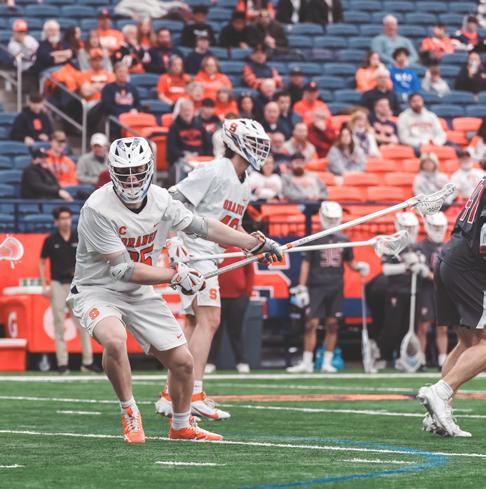
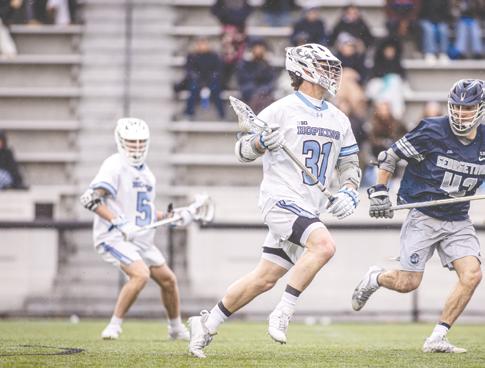
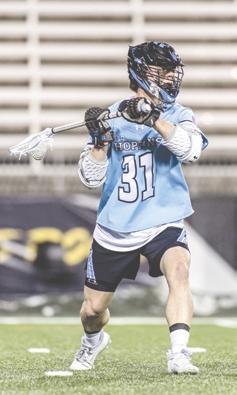
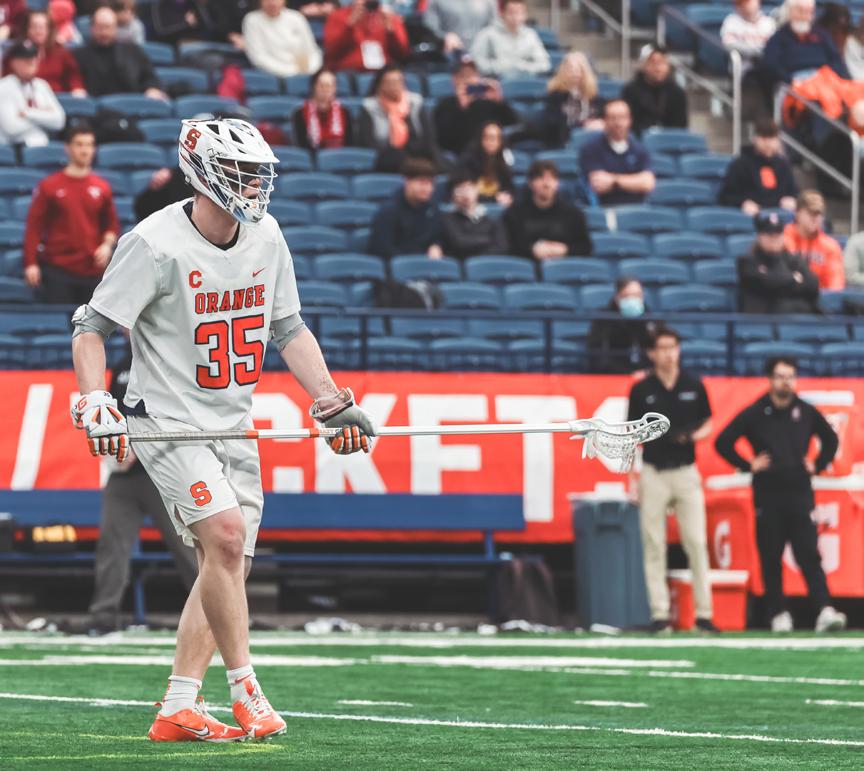
Billy Dwan III has always had an innate ability to create offense despite being a close defender, a difficult position to score from.
Page 16
By Harry Kelly staff writer
When Michelle Schenandoah was in seventh grade, she was excited when she saw a section in her United States history textbook that featured Native Americans. It was a moment she had been waiting for all her life: the chance to learn about her people’s cultures and history in the American education system.
But after reading the chapter, Schenandoah said she found herself disappointed.
“There were only two pages … It had maybe two black- and-white photos of the Lakota people on the plains with teepees,” Schenandoah, a member of the Oneida Nation’s Wolf Clan, said. “It was pretty much the story of the ‘Disappearing Indian.’”
Jamie Jacobs head curator on campus
Metaphorically, many of us are coming in today as brass pots. The motivation should be to rematriate the old knowledge that we used to have.
Schenandoah had similar experiences throughout the rest of her education at Cornell University, Syracuse University and New York Law School. This lack of representation led Schenandoah to found Rematriation, a non-profit organization and former magazine that works to uplift Indigenous women’s voices and share generations of accumulated knowledge.
This past weekend, Rematriation partnered with SU’s Center for Global Indigenous Cultures and Environmental Justice and the SU Libraries Special Collections Research Center to host an academic symposium on Haudenosaunee and Indigenous matrilineality.
Matrilineality is a societal structure in which family heritage follows the mother’s line, not the father’s. In the Haudenosaunee Confederacy, made up of the Six Nations — Mohawk, Oneida, Onondaga, Cayuga, Seneca, and Tuscarora — husbands join their wife’s clan when they’re married, and their children also become part of that clan.
Dr. Scott Manning Stevens, director of CGICEJ, said matrilineality goes well beyond its written definition, especially in Indigenous cultures.
“It’s recognizing the centrality of women in our society…It’s about the equality between men and women…warriors and hunters often go to men. But in our societies, anything to do with village
emma lee contributing illustrator
Editor@dailyorange.com
News@dailyorange.com
Opinion@dailyorange.com
Culture@dailyorange.com
Sports@dailyorange.com
Digital@dailyorange.com
Design@dailyorange.com
Photo@dailyorange.com
BUSINESS 315-443-2315
The Daily Orange is an independent, nonprofit newspaper published in Syracuse, New York. The editorial content of the paper — which started in 1903 and went independent in 1971 — is entirely run by Syracuse University students.
The D.O., a 501(c)(3) nonprofit, is editorially and financially independent from SU, and the paper receives no funding from the university. Instead, The D.O. relies on advertising revenue and donations to sustain operations.
This fall, the paper will be published Thursday when SU classes are in session.
The D.O.’s online coverage is 24/7, including while SU is on break.
To show your support to The D.O.’s independent journalism, please visit dailyorange.com/donate. Donations are tax deductible.
WEATHER
The forecast for this upcoming week, per The Weather Channel.
If you are a Syracuse University or SUNY-ESF student interested in contributing to The D.O. on either its advertising or editorial teams, please email editor@dailyorange.com.
corrections policy
The D.O. strives to be as accurate in our reporting as possible. Please email editor@dailyorange.com to report a correction.
The D.O. prides itself as an outlet for community discussion. To learn more about our submission guidelines, please email opinion@dailyorange. com with your full name and affiliation within the Syracuse community. Please note letters should not include any personal information pertaining to other people unless it is relevant to the topic at hand. All letters will be edited for style and grammar. letter to the editor policy
WHERE: Tennity Ice Skating Pavilion how to join us
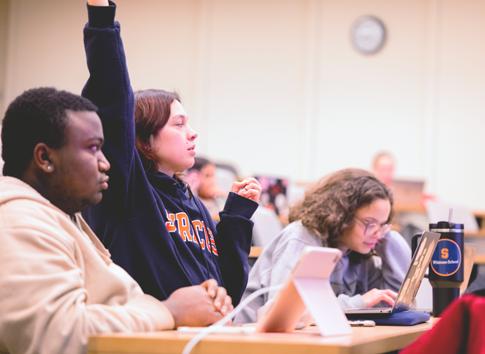
RSOs fundraise amid Student Association budget cuts
By Madeline Goodheart asst. digital editor
Brālyn Louise promised members of her organization, Beyond the Book, free reading material this semester. But after losing funding from Syracuse University’s Student Association, she now relies on fundraising to rebuild the club’s attendance back to its levels from the fall.
Louise co-founded Beyond the Book last semester in hopes of building a community of literature enthusiasts at SU. While the club’s general body meetings attracted about 50 people last semester, only 5 regular members attend this semester, Louise said.
Across campus, from mechanical engineering clubs to student-run magazines, registered student organizations are scrambling to fundraise money because of SA’s limited budget. RSO leaders described SA’s allocation process as confusing, while SA leaders said they’re working to adjust to a smaller budget compared to last semester.
The association’s primary funding power comes through advanced semester allocations, which occur once every semester to allocate funds for the following semester. Throughout the semester in its weekly meetings, SA’s finance board allocates smaller sums as semester allocations.
To mitigate confusion, SA is transitioning away from the term “semester allocations” and instead using the term “special programming allocations.”Alexis Leach, SA’s Comptroller, said the new label better reflects the purpose of the smaller, more frequent funding requests.
“Semester allocations, or special programming allocations, involve a set pool of money for the semester, distributed on a first-come, first-served basis,” Leach said. “Organizations submit their budget, and once the pool runs out, it’s gone.”
Complaints from RSOs come after the association faced significant budget restrictions this school year, receiving only $100,000 for the fall and $150,000 for the spring, SA President German Nolivos said.
This shortage is a result of overspending in past sessions, Nolivos said. To offset the shortage, SA used $250,000 of rollover funds — mostly composed of money leftover from the COVID-19 pandemic — for advanced allocations.
SA received over $800,000 in funding requests at the beginning of the semester, more than three times their budget at the time. As a result, Leach and the finance board were tasked with reviewing and adjusting requested funds to fairly distribute the limited assets, Nolivos said.
This spring, SA capped semester allocations at $31,000 for each of the university’s 27 RSOs. However, within a few weeks, some RSOs submitted requests totaling over $200,000 for general advanced allocations, Leach said. Advanced
allocations, which are reserved for large events and higher-tier organizations, are usually granted before the semester begins.
Louise said the changes to funding processes this semester disrupted her organization’s previously-made plans.
“It’s definitely been pretty discouraging. It was kind of a random hit to the org at the start of the semester,” Louise said.
Julia English, an SU junior and president of Mythos Magazine, said her organization has struggled to complete key projects, including its print edition, in its first semester as an RSO. Without SA funding, English said the comic and illustration magazine plans to look at alternatives to earn revenue, like selling at house show venues — a strategy they also used last semester.
“It’s been really, really difficult urging people to stay true to our deadlines that we have in place without having a printed edition that we promised them we would have by now,” English said.
Like English, Norah Nappi, editor-in-chief of Fetch Collective, is also seeking alternative fundraising options. Last semester, she requested funding to produce 700 copies of the collective’s magazine, but SA denied this and told her to reduce the number to 250 copies, she said.
Two weeks into this spring semester, Nappi received an email from SA notifying her the collective would not be receiving any funding from SA. After consulting with her RSO advisor, Nappi said she’s now scrambling to find ways to fundraise so Fetch can still produce a print publication like it did last semester.
“As a small club, we work really hard as a unit to try to put out something that really showcases the hard work and creativity of students here on campus,” Nappi said. “We’re trying all that we can to produce a second print magazine this semester, so hopefully that comes to fruition.”
At a SA town hall last week, Leach and Nolivos addressed RSO leaders’ concerns about this semester’s lack of funding. Leach said the finance board is actively working to cut unnecessary spending to ensure the current budget issues don’t occur again in the future.
One of these wasteful expenditures is catering costs, Leach said. In 2021, SA’s fiscal codes prohibited allocating funds for food due to the absence of a designated catering budget. Last year, the assembly revised its rules to allow more catering because of the significant funding available after the pandemic, Nolivos said.
To prevent these costs going forward, the association’s finance board introduced a $60,000 total semester catering cap and implemented a tiered system for SA catering funding, Leach said. The tiers are based on an organization’s capital, or history of successful events, as outlined in the university’s RSO handbook.
Under the new catering system, Tier 1 RSOs can request up to $1,500 for catering per semester, while Tier 2 organizations can request up to $3,000. Tier 3 organizations are capped at $4,500, and Tier 4 organizations can request up to $6,000, Leach said.
New organizations automatically begin as Tier 1 and can move up after two years on campus.
Anna Meehan, president of SU’s Ukrainian Student Association, expressed frustration with the tier system. After SU disbanded the organization last year for failing to complete the re-registration process, Meehan said she has no clear understanding of where the club falls within the system, which complicates efforts to secure funding.
“It shouldn’t take this much work to run a club,” Meehan said. Meehan said the Ukrainian Student Association has struggled to maintain consistent attendance, and that food would be essential to attract more participants and boost attendance. With the new catering cap and tier classification, Meehan said she’s worried these factors could create additional barriers for cultural clubs that rely on food to engage with their communities.
Jonathan Link, president of SU’s Biotechnology Society, described his experience requesting funding from the association as “pretty muddy,” citing confusion over the budget’s timeline.
For a recent Valentine’s Day event, Link said he requested $645 from the association, with most of the funds going toward catering. However, Link said the group only received $35 in approved funding and the decision was delayed by over a week. The society organized the event without a finalized budget, he said.
“I’ve submitted a few budgets myself,” Link said. “In the past they’ve gotten denied for the very fine details they require.”
According to the RSO handbook, groups must submit requests at least two weeks before an event and must include proper documentation, such as proof of space and catering costs, to be approved.
To save future funds, SA has launched a Lending Closet which allows RSOs to borrow commonly requested items for events and return them for future use. The association has purchased frequently requested items, including mini stages, DJ booths, photo booths and balloons to stock the closet, Leach said.
Leach said the initiative will cut costs for both SA and RSOs.
As SA looks to the end of the academic year, Leach said she’s focused on improving communication between herself, RSOs and their Student Engagement RSO consultants. To build this transparency, the finance board is putting out updates on SA’s Instagram to inform students about its weekly activity, Leach said.
“I understand it is difficult for them to have as much funding as they normally do,” English said. “It just was really unfortunate timing for us.”
DISCLAIMER: Julia English is a contributing cartoonist and illustrator for The Daily Orange. She was not involved in the editorial process of this article. mmgoodhe@syr.edu
By Delia Rangel asst. news editor
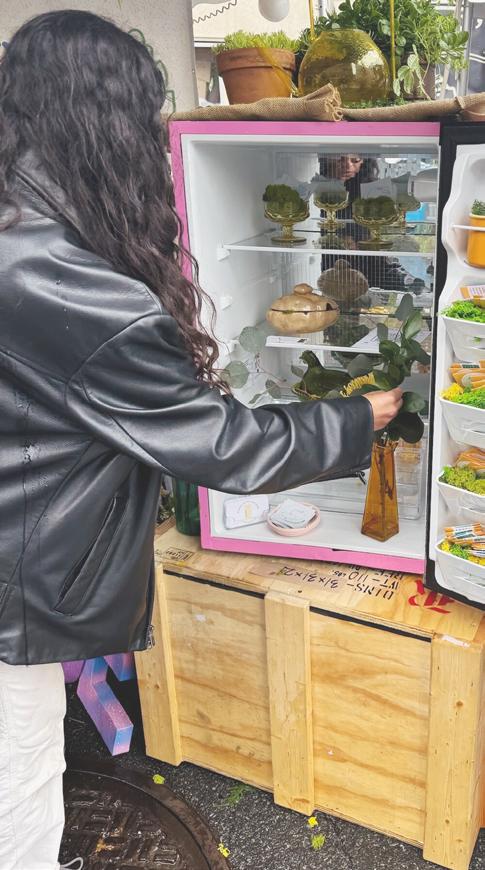
When Lis Webber moved to New York City’s Lower East Side, she found fully stocked refrigerators on the streets of her neighborhood. Intrigued, Webber soon learned they were part of a grassroots effort across NYC known as community fridges.
The refrigerators — stocked with free, fresh food, and maintained by local nonprofit organizations — are intended to serve any person in need of food. Webber, a Syracuse University alum, felt inspired by the concept and the community it created. She returned to Syracuse in January 2024 determined to replicate the model in her hometown.
“I was just so taken with the framework and the community involvement of it all,” Webber said. “So when I moved back to Syracuse, I decided to start my own.”
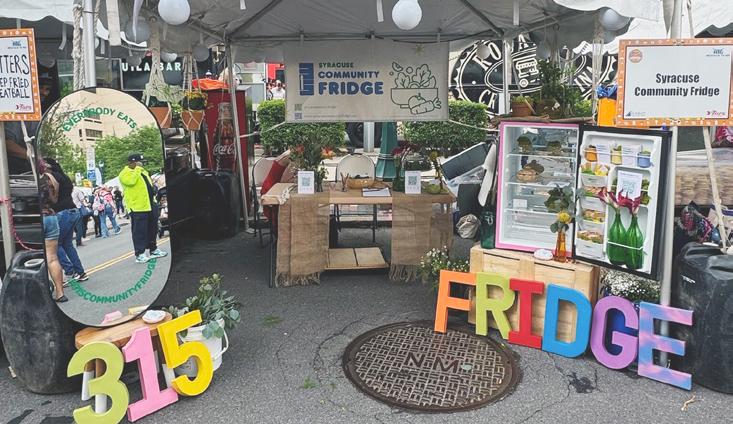
Webber founded the Syracuse Community Fridge in May 2024 to combat food insecurity in the city. The fridge, located at All Saints Church near SU’s South Campus, is set to be fully functional by March 20. It will be the city’s first publicly accessible community fridge.
“It really is a self-sufficient thing that proves as a community, we can take care of each other,” she said. “It’s not transactional. It’s really just like a shared table, a shared fridge for people.”
The fridge system uses a “take what you need, leave what you don’t” model, Webber said. Any-
Following Student Association budget cuts, organizations across campus are working to fundraise money and keep members engaged. ella chan asst. photo editor
national
By Anzor Mustafa staff writer
Following President Donald Trump’s joint address to Congress Tuesday night, New York government officials warned of the negative implications of his economic and social regulations for the state.
NY officials react to Trump’s Congress address on campus Tips to stay safe over spring break
In his address, Trump highlighted his actions in his first month back in office, including tariffs on Canada and Mexico, restrictions to diversity, equity, inclusion and accessibility policies, and federal spending cuts. Among the many cuts, Trump pointed to the CHIPS and Science Act, calling the Biden-era policy that aims to strengthen the United States semiconductor industry “wasteful spending.”
The act has generated billions of dollars for Micron Technology’s planned semiconductor fabrication facility in Clay. The company has continued to expand in New York state as a result of the CHIPS Act, with over $100 billion coming from Micron and multiple significant funding commitments from the federal government.
Chuck Schumer, New York senator and the Senate minority leader, said weakening CHIPS will cause thousands to lose their jobs and weaken the American economy, while strengthening top chip manufacturing nations like China.
“CHIPS has already delivered $450 billion in new manufacturing investment and created tens of thousands of new good-paying jobs,” Schumer wrote in a March 5 statement. “People are already feeling the positive impacts and new economic energy in their towns in every corner of America, from Ohio to Arizona.”
Schumer said cutting CHIPS would force U.S. based companies to rely on foreign manufacturers in countries like China — where Trump imposed a 20% tariff on all imports over the weekend.
The act, which was passed in 2022 with bipartisan support, would negatively impact people across the country if repealed, Schumer said. Its bipartisan support has been apparent in central New York.
Former Rep. Brandon Williams, a Republican who represented New York’s 22nd district, advocated for CHIPS during his 2024 campaign. Speaker of the House Mike Johnson said at a November event in Syracuse that Republicans would “probably” try to repeal it. Trump has made no move thus far to dismantle the act.
Rep. John Mannion, who defeated incumbent Williams in November, has repeatedly asserted his commitment to the act.
The average MLB player accumulates less than three years of service time, earning roughly the league minimum salary. While the league minimum will be $760,000 in 2025, it’s far from what arbitration-eligible players make.
Once players become arbitration-eligible, a period that lasts from the end of their third year until completing six years of service time, they can begin earning millions for the first time annually before becoming eligible for free agency. However, most players must find a new career path before reaching arbitration.
With players having increasingly shorter careers, the MLBPA began finding ways to add educational benefits to its programs. In spring 2024, Jordan attended a meeting in Philadelphia for an unrelated project when an associate from the MLBPA inquired about possible education providers. The associate asked Jordan if SU had interest in a partnership and he immediately expressed a desire to connect.
The MLBPA also works with career development companies, including Keystone Partners and AthLife, to provide its athletes with post-career options and direction. Connecting with institutions like SU, the companies act as brokers to negotiate partnerships with MLBPA members. Singleton said because of SU’s sports pedigree, the university has already stood out among MLBPA members.
“If I’m looking at going into specific industries, and I see Syracuse is already the top at doing it, that’s going to attract me, and that’s going to allow me to trust those programs more,” Xavier Scruggs, a former MLB player and current broadcaster for MLB Network and ESPN, said.
MLB Network, MLB’s premiere broadcasting channel for all content, leans on former athletes to provide coverage. Over half of the network’s on-air personalities listed on its website are former MLB players, managers or general managers, with Baseball Hall of Famer Pedro Martinez and likely future first-ballot selection Albert Pujols headlining the talent.
In the ever-changing landscape of sports media, which has seen a mammoth increase in
New York state Senator Christopher Ryan said he felt disappointed by Trump’s call to repeal the act, calling CHIPS an investment in the future of American industry in a Wednesday statement.
“I believe in the transformational power of this project, and I stand with our skilled trades workers,” Ryan wrote. “I urge Congress to stand by American workers, stand by our national security, and reject any effort to repeal the CHIPS Act. The future of Central New York—and our nation—depends on it.”
Micron is set to begin construction later this year. Its new plant is expected to generate 50,000 jobs in central New York. Syracuse University’s College of Engineering and Computer Science has an academic partnership with Micron, through which it will expand to support more students in fields related to semiconductors.
New York Gov. Kathy Hochul responded to Trump’s address by criticizing him for not discussing rising costs of living while continuing to support initiatives that would raise prices. In a Wednesday statement, she said Trump’s imposed tariffs would cost New York families more than $1,200 each year.
“I’m going to continue our laser focus on affordability, fighting to pass a budget that low-
players and former players in the social media era, most begin media careers while only having experience on the field. With added guidance from institutions like SU, the partnership will help former players learn valuable insights.
“I look at myself like, ‘Hey, this was a program that I would love to be a part of,’” Scruggs said. “Just trying to figure out what are things that I can learn to elevate my own experiences and elevate my own game.”
The Major League Baseball Alumni Association, a branch of the MLBPA, has already provided its members with the necessary tools to break into the broadcasting industry. Its annual Career Development Summit provides a training session on transitioning from the diamond to the broadcasting booth, with opportunities to host a mock radio talk show and record reels to showcase to potential employers.
We’re always looking to be of service to our players and to create more opportunities.
Chris Singleton mlbpa special assistant
Frasciello said both sides expect to leverage Newhouse’s prominence in the sports industry when pitching the opportunity to MLBPA members, focusing on its professional, executive and professional development. While still in the early stages of development, Singleton said he’s been working with Newhouse Associate Dean Brad Horn to create a three-day broadcasting boot camp to launch as early as fall 2025. The workshop will include roughly eight-to-10 players working with Newhouse professors.
Beyond Newhouse, Jordan said they knew the partnership would need SU’s College of Professional Studies to succeed. Led by Frasciello, he said the school already provides a formula based on its structure.
ers middle-class taxes and triples the child tax credit,” Hocul wrote. “No matter what nonsense comes out of Washington, I’ll keep fighting to put money back in your pockets.”
Mannion said he’ll host a town hall to combat Trump’s infringement on constitutional rights. In a Tuesday statement, he wrote that the American people need a government that caters to them and fights for their rights.
As his guest for Trump’s address, Mannion invited local farmer and food insecurity advocate Karin Reeves. While Trump proposes cuts and further restrictions to Supplemental Nutrition Assistance Program benefits, Mannion said he aims to strengthen rural communities and access to food with the help of farmers like Reeves.
“The Trump/Musk agenda is a reckless pursuit of dangerous policies built on misinformation. They are tanking our economy, sinking the stock market, and driving up inflation,” Mannion wrote. “Their so-called ‘golden age’ is nothing more than a gilded giveaway to billionaires and foreign adversaries, paid for with cruel cuts to services for seniors, veterans, and children in need.”
amusta04@syr.edu
Hosting non-traditional students like veterans or military families, Frasciello aids a “high-touch” student support system with unique challenges for each circumstance.
In Professional Studies, he said all online programs are designed specifically for adults working full-time and juggling family responsibilities, among others. The programs aren’t as simple as a typical asynchronous education where students log onto a computer on a bus ride, read a few pages and submit an assignment.
Frasciello said SU understands the format may make the program inaccessible to some players, but it’s the standard it sticks to. MLBPA members will still need to apply to the university and be admitted just as any other student.
Whether retired or still finishing their playing careers, most members will be part-time students in the program. Professional Studies has seen similar connections with former SU athletes and Frasciello said it will use its experience with current students to help MLBPA members.
While the partnership is meant primarily for MLBPA members, Jordan said it’ll naturally be advantageous for all Syracuse students — whether undergraduates, graduates or online students. He said Falk College anticipates the collaboration will also allow students to build relationships with Major and Minor-League Baseball teams.
With 30 Major League clubs and over 200 among the five affiliation levels of the minor leagues, Jordan hopes students will work directly with teams during their senior year capstone projects. Singleton similarly said the MLBPA is looking to bring on interns from SU Athletics and leaders from within the players association could also join classes in person or virtually for leadership discussions.
For all parties involved, Jordan said the partnership will enhance professional opportunities in the sports world and provide players with the chance to finish their education. SU, the only Atlantic Coast Conference university without a Division I baseball program, can now tap into the baseball industry on its biggest stage.
“The more that we can get connected to leagues and teams and organizations and events, the more beneficial it is for our students,” Jordan said. sports@dailyorange.com
By Sydney DePietto staff writer
With midterms underway, Syracuse University students are preparing for spring break next week. The Daily Orange has compiled safety tips and resources for students who are traveling or staying on campus for the break.
SU’s Department of Public Safety recommends that students who are leaving campus for the break lock all doors and windows and close all curtains and blinds. Students should also unplug electrical items, keep valuable items out of sight, and keep a record of important belongings. Students shouldn’t give out their keys or leave them behind while traveling. For students living off-campus, making a residence appear occupied with motion-sensor lights and using security alarms can help ensure safety. Students should also lock and barricade doors.
The break comes following recent crimes reported near SU’s campus. On Feb. 2, DPS reported multiple acts of criminal activity and vehicle larcenies around the 100 and 200 blocks of Comstock Avenue.
On Feb. 26, DPS reported an armed robbery on Van Buren Street near the Brewster, Brockway, and Boland dorm complex. DPS is actively investigating both incidents, and SPD is also investigating the armed robbery. Recent airplane crashes may be another concern for students who are traveling for the break. On Jan. 31, an Army helicopter and an American Airlines jet collided near Reagan Washington National Airport outside of Washington, D.C., killing 67 people. Christine Lane, an SU graduate, was among those who died, along with her son. On Feb. 17, a Delta flight overturned on the runway during its landing at Toronto Pearson International Airport. All 80 people on board survived with 21 sustaining injuries.
Despite national concern over the crash, plane travel has never been safer, according to the National Transportation Safety Board. There were a total of 16 fatal aviation accidents in January and February involving American passengers — below the monthly average of 2o. For students staying on campus during spring break, dining halls and on-campus eateries will operate on a different schedule than usual.
Skytop Marketplace in Goldstein Student Center and West Campus Express will close for the week beginning Saturday. All dining halls will close either Saturday or Sunday, except for Orange Dining Center and Shaw Dining Center, which will both stay open over the break. Schine Student Center will operate during its regular hours. The Campus Store market and the eateries in Schine will all be open during normal times.
Students can also access food pantries at Hendricks Chapel and at the Carriage House on South Campus if they need free groceries. Bus schedules will also have alternate schedules during spring break. Buses will run less frequently over reduced hours.
All university offices will also remain open during standard business hours over the break. Classes resume on March 17.
sadepiet@syr.edu
Following Trump’s congressional address, NY officials warned of the negative implications of his economic and social regulations. young-bin lee daily orange file photo
emily steinberger daily orange
was often the purview of women,” Stevens, who is a citizen of the Akwesasne Mohawk Nation, said. “Yes, we have chiefs that are male. But clan mothers select those chiefs.”
In the centuries since European colonizers first arrived in North America, Stevens and the Rematriation team believes that gender balance has been lost in patriarchal western society, causing women to be relegated to inferior societal roles with little influence in decision making processes.
To combat this shift and help solve other global issues like climate change and growing political divisions, Schenandoah said events like the symposium are vital to shine a light on Indigenous knowledge that has been out of the public eye.
“When we look at the U.S. government today, we can see all these imbalances happening. People’s voices not being represented or heard, one force being stronger than another and a lot of unfairness and inequity happening,” Schenandoah said. “We know how to create balance within our structure of governance and how we care for the people.”
The symposium began on Feb. 28 with an opening discussion, where speakers examined how matrilineality helped Indigenous cultures achieve balance in the past and why it was largely lost when Europeans arrived.
Jamie Jacobs, head curator of the Rock Foundation Collection at the Rochester Museum & Science Center, used an 800-year-old clay pot from an ancient Haudenosaunee village to show how shifts toward materialism slowly weakened matrilineal influence because of colonialism.
As a member of the Seneca Nation’s Turtle Clan, Jamie Jacobs said his ancestors had to relocate about every 20 years when firewood, clay and other essential materials ran out. He explained that Haudenosaunee women were instrumental in deciding where their villages would relocate to, because they knew the best areas for clay, how to
one who needs to can take food from the fridge, while those with extra groceries can donate items to help keep it stocked.
While Webber received grant funding from the Jim and Juli Boeheim Foundation and the Christian Brothers Academy to get the project off the ground, she said the initiative relies on the generosity and involvement of the community to sustain itself.
The flagship location is to be the first of many, Webber said, as the organization plans to open more refrigerators throughout the city in the future.
Though new to Syracuse, community fridges began to appear across the U.S. in 2020 amid the COVID-19 pandemic. Since then, hundreds of fridges have been established throughout the United States, Vox reported.
The growing network of fridges has become vital in cities like Syracuse that face widespread food insecurity and food deserts — areas with limited access to healthy food and grocery stores.
These deserts are common in Syracuse, with neighborhoods like the South Side without a single full-service grocery store. In 2022, New York State Comptroller Thomas DiNapoli reported nearly 46% of children in Syracuse were living under the poverty line.
It really is a selfsufficient thing that proves as a community, we can take care of each other. It’s really just like a shared table, a shared fridge for people.
Lis Webber founder of community fridge
“Food insecurity really knows no bounds, unfortunately, so I don’t have any restrictions,” Webber said. “Anywhere that wants to have a community fridge, I would love to work in that community and with whoever wants it and needs it.”
Michael Songer, a pastoral associate at All Saints, said Webber’s goals with the fridge align directly with the church’s mission to serve all people. He met Webber last June at the Taste of Syracuse Festival where she tabled to spread awareness about her mission. Songer helped design an enclosure for the fridge to ensure it can stay open through the winter.
Songer said the beauty of the fridge is its accessibility, as it’s available 24 hours a day.
extract it and how to create pottery for storing food and water.
It became a tradition for mothers to pass this skill and knowledge down to their daughters for the survival of future generations, Jamie Jacobs said.
To juxtapose the clay pot, Jamie Jacobs also showed a photo of a 17th-century brass pot made by Europeans, noting how the stronger material ultimately made matrilineal knowledge about clay less necessary. Because it was easier for young Haudenosaunee women to trade for European-made brass pots than harvest clay, women’s role in crafting began to disappear.
Jamie Jacobs said the switch from clay to brass indicated a subtle shift to a patriarchal system that still lingers in Indigenous communities today. He said in many ways, the goal of the sym-
Oftentimes, people in need may be apprehensive or not have time to attend local food banks or soup kitchens, Songer said, whereas the fridge is available 24 hours a day and protects its users’ privacy.
“This just provides an open and accessible alternative where there’s food welcome at any time,” he said. “Take what you need, leave what you don’t, and it creates that sense of agency and choice.”
The fridge system also allows users more dignity, Jess Miller, founder of The Kitchen Literacy Project, said. She recalled watching people dumpster-dive after local farmer’s markets, searching for discarded produce that was still edible. With the new system in place, Webber said she hopes market vendors will donate extra food to the initiative, rather than throwing it out.
Miller’s nonprofit shares a similar mission to the fridge, combating food insecurity throughout the city by providing free cooking classes to local teens. With President Donald Trump back in the White House, Miller said alternative, community-oriented strategies for combatting food insecurity are crucial, rather than corporate-driven solutions.
“It’s nice to be able to create spaces that are anticapitalist. I think we need to do more of it, we’re such slaves to these large corporations and it’s to our own detriment,” Miller said. “I’m all about these types of opportunities for us to help each other across political lines.”
Trump’s efforts to end diversity, equity, inclusion and accessibility programs across the nation have raised concerns for Miller and Webber, who said such rollbacks could disproportionately harm marginalized communities already facing food insecurity.
In a since-blocked Jan. 27 executive order, Trump sought to freeze all federal loans and grants so they could be reviewed for their DEIA policies. With the order in place, funding for emergency food systems like food banks and fridges could be at risk of cuts.
“More and more we’re looking for small ways in this political climate where we can activate as a community and offer these things to each other and also be recipients of this type of thing,” Miller said.
As future federal funding for food assistance programs remains uncertain, Miller and Webber remain committed to local solutions. They believe grassroots efforts like the fridge are vital for combating hunger throughout the city.
Webber said while the fridge won’t solve systemic food insecurity by itself, it provides one immediate and accessible resource for those in need. She hopes initiatives like this will strengthen local support systems and inspire broader change.
“What’s so special about the community fridge program is that there’s no barriers to access, anybody can be involved with this project,” Miller said. “And I think that’s what’s so beautiful about this is just the sheer accessibility of it. The second that you put your hand on that fridge, you’re part of this project.” dsrangel@syr.edu
posium was to help attendees transition back to the matrilineal lifestyle their ancestors had.
“Metaphorically, many of us are coming in today as brass pots,” Jamie Jacobs said in the session. “The motivation should be to rematriate the old knowledge that we used to have.”
Over the course of the three-day symposium, SU and Rematriation hosted 22 events that taught attendees about how to access Indigenous archives for research, the importance of Indigenous knowledge and perspective in modern times and how to elevate matrilineality and Indigenous customs through film and media, among other topics.
Devery Jacobs, an actress from the Mohawk Bear Clan, spoke with a panel to an almost-soldout crowd of 700 people at SU’s National Veterans
Resource Center to close the symposium. She described the power of television shows like Reservation Dogs and Marvel’s Echo — both of which she starred in — that tell Indigenous stories, after rare representation in American media.
“By pointing the camera at whose stories are ‘important,’ and having a lack of our stories on screen, it’s been subconsciously telling us we are unimportant,” Devery Jacobs said.
Devery Jacobs said she believes Hollywood may be falling back into old habits, as President Donald Trump’s crackdowns on diversity, equity, inclusion and accessibility may limit opportunities for minority groups in the entertainment industry.
“With our administration rolling back DEI initiatives, that is now reflected in studios and networks saying, ‘We now want to go back to white stories, to straight stories,’” Devery Jacobs said.
In wake of this shift, Jalyn Jimerson, Rematriation’s production assistant and a member of the Cayuga Nation’s Bear Clan, said events like the symposium are more critical than ever as they share Indigenous knowledge that can help the entire country, including people who aren’t Indigenous.
“The more people start to realize our teachings and what we know isn’t just for us, it’s for everybody else to live in a life of balance…I think the world will start to become a better place,” Jimerson said.
Schenandoah said she wants to see the legacy and impact of the symposium carry on long after the weekend, especially for Indigenous students and community members who are in need of support and deserve recognition.
“(I hope) they were able to see themselves reflected in others and that they recognize that they too have the right to be in relationship with the earth,” Schenandoah said. “That they too have the right to have their voice heard and have their work continue to blossom and feel like it’s welcomed in the world.”
hekelly@syr.edu
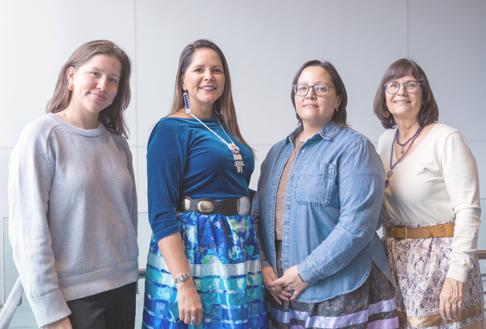
SU Libraries hosted non-profit organization Rematriation for an academic symposium on Haudenosaunee and Indigenous matrilineality. collin snyder staff photographer
The Syracuse Community Fridge is set to open its first location at All Saints Church on March 20 to make fresh food accessible. courtesy of lis webber
‘SECOND HOME’
Westcott’s Dunbar Post 1642 is one of the oldest predominantly-Black American Legion locations
By Sydney Brockington asst. copy editor
One of the oldest predominantly Black American Legion posts stands in Syracuse’s Westcott neighborhood. After it was saved by additional funding last year, American Legion Dunbar Post 1642 remains a hub for Black history in the Syracuse community.
Started in 1919 after World War I, the American Legion aims to support veterans and their families, Dunmore said. The Dunbar Post was created in 1947 when Black World War II veterans weren’t accepted into other posts upon returning from war. The post, now 78 years old, continues to welcome Black veterans through its doors and serves as a safe haven for Syracuse veterans.
“We were not initially invited to attend other post meetings, so we started our own,” Post Commander Herb Dunmore said.
Nationally, the American Legion also works to support local youth through a number of programs, like citizenship and leadership immersion programs for high school students. There are over 12,000 American Legion posts around the world and more than half a million members, Dunmore said.
Dunmore has served as the post commander since 2016. As a Vietnam War veteran, the post connects him to other veterans, he said. Dunmore said he’s always looking for grants to improve the post’s services and make sure it has enough money to keep its doors open. For Dunmore, the post functions as a “second home,” giving him friendships like no other. see dunbar page 9
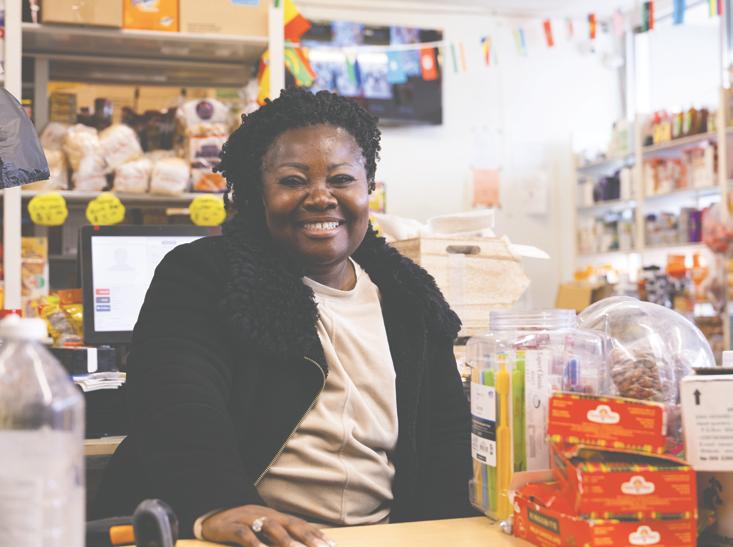
African & Caribbean Central Market offers cultural foods
By Naomi Campbell inclusive journalism fellow
store. Ultimately, money and a lack of competition against other African and Caribbean markets were the deciding factors for her venture.
The road to opening her first market wasn’t easy. Abbey experienced some financial hardships, despite a growing customer base. Her first market operated on a smaller scale in Rochester in a space of only 750 square feet.
After an issue with her previous landlord, Abbey left the Rochester store and opened her current store in Syracuse. With the relocation, Abbey’s mother, Gladys Appiah, can make a shorter commute to visit.
Appiah first came to the United States in 2003 to help her daughter run the store in Rochester. The journey has been difficult, but she said she praises God for guiding her throughout the process. At 75 years old, Appiah said her strength comes from “God’s grace.” Appiah said she and her daughter have been through a lot together. Abbey used to go to Ghana every three to four months to bring goods back to the United see market page 10
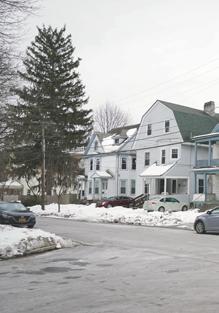
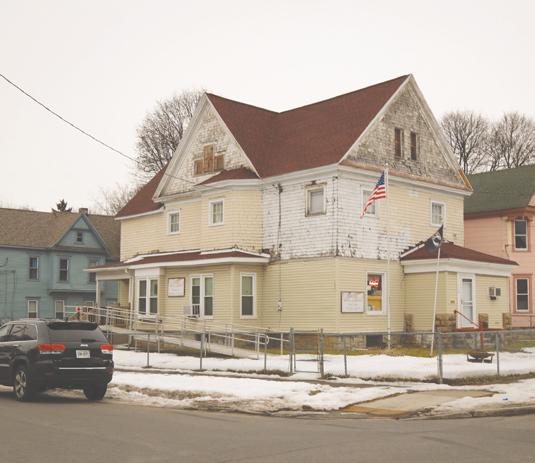
American Legion Dunbar Post 1642 in Syracuse’s Westcott neighborhood serves local veterans in the community. It was started in 1919 after World War I. avery magee asst. photo editor
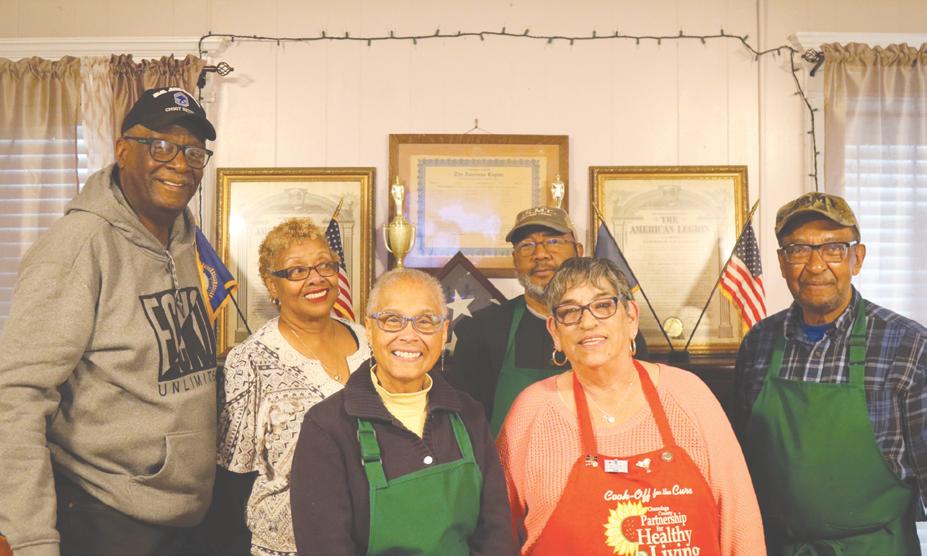
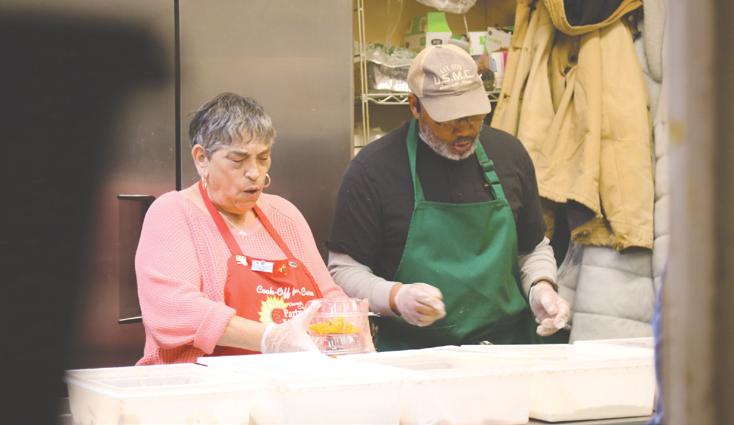
From left: Lonnie Senior, Beverly Heath, Diane Greenpope, Richard Martin, Sue Threat, Willie Turk, volunteers at the Dunbar Post. avery magee asst. photo editor
Talking Cursive brewery offers creative menu
By Tara Binte Sharil staff writer
For the past six months, Cynthia Schrock and her son, Justin Schrock, have made it their tradition to head down to Talking Cursive Brewing Company every Friday night. For Cynthia Schrock, the notion of frequenting a bar would’ve been unheard of. But this Tuesday, they were at the corner of Talking Cursive sipping their favorite beers.
“I was never a bar person even when I was younger,” Cynthia Schrock said. “But when (Justin) brought me down to here, (the Talking Cursive staff) were very friendly and welcoming, and their beers and food were amazing, too.”
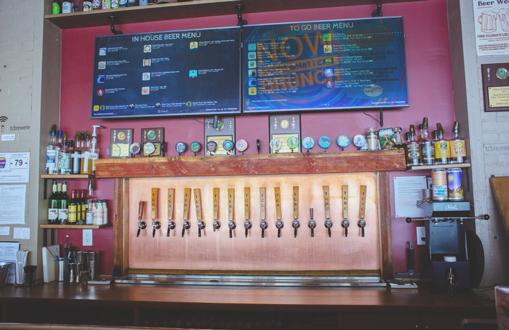
Talking Cursive, located across the historic Niagara Building in Downtown Syracuse, is known for its expansive variety of draft beer brewed right in its facility. The idea was conceived in 2015 by owners Andrew and Patricia Brooks when working long hours in the hospitality industry was no longer tangible for them.
The Brooks first started visiting local breweries before taking classes in different institutions, from the American Brewers Guild in Vermont to an immersion course to Colorado. In 2019, their visions became reality.
The name is inspired by a Dean Martin meme that the Brooks saw on social media; “It’s not called slurring your words. It’s talking cursive and it’s classy,” though Martin had never officially said this.
As the meme suggests, Talking Cursive exudes a high level of class. Its American-classic chandeliers and burgundy walls evoke a warm atmosphere, an environment the Brooks’ strived for right from the beginning.
When Talking Cursive first started, the brewery strictly focused on showcasing its staple beers with a small food menu. Since then, the brewery has expanded to more unique menu items, such as naan pizza, tasty burgers and even a cocktail menu. Without the help of its dedicated staff, the success of Talking Cursive wouldn’t be possible.
“We were unrecognizable from when we first started,” Alexis Colton, Talking Cursive’s marketing and events manager, said. “Our beer, food and cocktail menus have changed a lot, but the passion and drive for why we’re here is still there.”
Unlike many breweries, Talking Cursive focuses strictly on creating a communal experience for its customers, going so far as not showing nationally-televised football games to eliminating live music, though it initially did feature entertainment before COVID-19.
“One thing we found (with live entertainment) is that, yes, that would draw people in, but also people wanted to just come in and talk, and that wasn’t a good environment for them,” Andrew Brooks said. “When we reopened after COVID, we decided to focus more on the beer and the food and have the things that people are really coming here for.”
The lack of live entertainment was no loss for Talking Cursive customers as some of Justin Schrock’s best memories at the bar was getting to know the friendly faces of the brewery and even forging relationships with some of its customers.
After frequenting Talking Cursive for several months, the Schrocks recently signed up to be part of the brewery’s “Mug Club,” where members are offered benefits such as discounted drinks and invitations to “Club Cursive” parties.
As Talking Cursive’s clientele grew over the years, so did the quality of their beers. It was a four year process, but “Spill the Wine,” the brewery’s American Barleywine, became a national success.
From the moment Andrew penned the recipe in 2020, “Spill the Wine” was a trial and error of infusing unique ingredients together followed by a long aging process. After six months of taste testing the beer, Andrew Brooks knew he’d made the perfect concoction. And when the Brooks’
from the stage
CONCERTS THIS WEEKEND
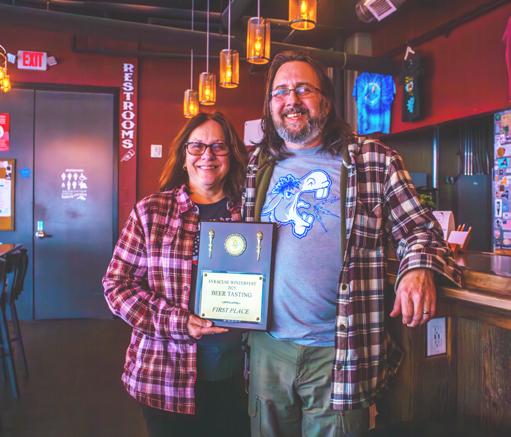
submitted “Spill the Wine” to the 31st annual Winter United States Beer Tasting Championship in 2024, its national win proved the work was worth it.
“We thought, ‘Boy, this is drinking better than it ever has!’” Patricia Brooks said. “Lo and behold, (we’re a) national champion. It’s going to be fun to see how the next batch ages.”
In addition to “Spill the Wine,” Talking Cursive picked up three other regional awards for their porter beer, Vienna Märzen lager and a collaborative double IPA beer with Riseform Brewing.
Andrew Brooks’ immense love for Syracuse is evident in the names of his beers. Talking Cursive’s American lager, “Crash Into You,” is named after semi-tractor trailers brushing up against the Onondaga Lake Parkway bridge and its “Love Will Tear Us Apart” porter in remembrance of the red and historic Central City Provisions building.
While the brewing team’s success in the 2024 Winter USBTC championship recognizes Talking
Cursive’s efforts, representing Syracuse is more meaningful to Andrew Brooks.
“We have a guy from Pittsburgh who comes up to Syracuse several times a year and he always brings a bunch of stuff back and is always checking to see what’s on tap,” Andrew Brooks said. “People want to come and try our beer, so it’s really great to our awards putting Syracuse on the map.”
Though Justin Schrock has tasted most of the beers Talking Cursive offers, “Spill the Wine” is the one beer he hasn’t tried because it had run out before getting his hands on it. Though the next batch of “Spill The Wine” won’t be available until next summer, he’s more than excited to have his first sip of the award-winning Barleywine.
“One of the customers that we became friends with bought one of the last bottles they had because that’s his favorite drink here,” Justin Schrock said. “Even though Barleywine is on the sweeter side for me, I’m never opposed to trying it.” tabintes@syr.edu
‘King James’ uses LeBron to explore friendship
By Diya Chaudhary contributing writer
When Quinn M. Johnson, the actor who plays Matt in the play, “King James,” first watched the production in New York City, he felt it was a personal story he understood. After reading the script, he was compelled to trust his instincts and take on the role.
“Whenever I read something like that, I get a feeling, and as I was reading it, I was like, ‘I know these guys, I know what they’re feeling,’” Johnson said.
Syracuse Stage is currently hosting the “King James” play, which began on Feb. 26 and will run through March 16. The play explores the complex dynamic of friendship while following the trajectory of legendary NBA player LeBron James’ career. Matt, played by Johnson, and Shawn, played
by Enoch King, explore how their love of basketball can either make or break their friendship.
The overall narrative of the play explores a friendship “ebb and flow” under the context of sports and James’ legacy, Johnson said. Matt and Shawn’s friendship demonstrates that love exists in the corners of relationships.
When Matt and Shawn meet for the first time, they’re two diehard Cleveland Cavaliers fans who attend every game together. Matt is more reserved, and Shawn is more outgoing with his emotions, but they both share a love for the game.
They form a bond when Shawn gives Matt the other half of his tickets, leading them to attend games together as their friendship evolves over time. The play occurs over James’ career, from being drafted first overall by the Cavaliers in 2003 to winning the 2016 NBA Finals over the Golden State Warriors.
Donnie Woodard, the play’s associate scenic designer, said he was moved by the actors and that their performances were phenomenal.
“As someone quite familiar with the script and (who has) worked on two productions of it now, I think this was probably the most genuine performance that I’ve seen,” Woodward said. By the end of the play, Matt and Shawn recognized that it wasn’t just about who won the game, but the players, like James, who made it so tense and enjoyable to watch.
“It’s about so much more than sports, it has very little to do with who wins or loses but more about the people who are persevering through the obstacles of life to compete,” Jamil Jude, the director of Syracuse Stage’s production of “King James,” said. Jude discussed how community and loyalty play out in this production and how it’s about who you’re
Tony International Live Jazz Under Spoken Word
Tony International Live Jazz presents a live poetry and jazz music event at the Community Folk Art Center. Groove to jazz music and listen to spoken poetry with house band SMX Shawn Seals. Refreshments will be served as well. Contact Tony Eiland, the event headliner, at (315) 8762284 to purchase tickets. Tickets will not be sold at the door.
WHEN : Friday, March 7, 7-9 p.m.
WHERE: Community Folk Art Center PRICE: $20
AC/DC: Back in Black Tribute
This Saturday, rock out with AC/ DC: Back in Black, an AC/DC tribute band, at Westcott Theater. The show will feature Brian Johnson’s signed 2007 Harley-Davidson motorcycle. Johnson became the third lead singer of AC/DC in 1980. Those who buy tickets are eligible to be entered to win two free tickets to see AC/DC live at Gillette Stadium in May.
WHEN : Saturday, March 8, doors open at 7 p.m. and music at 8 p.m.
WHERE: Westcott Theater
PRICE: $20
Wizard of Oz on Ice
Looking for something to do in Syracuse over spring break? Ice
Creative Entertainment presents “Wizard of Oz on Ice” at The Oncenter next week. Watch Dorothy, the Scarecrow, the Tin Man and the Cowardly Lion glide across synthetic ice in the land of Oz. Only clear bags are allowed into the venue for this show.
WHEN : Monday, March 10, 7 p.m.
WHERE: The Oncenter Crouse
Hinds Theater PRICE: $37.45 to $107.33
Enter the Haggis
Roots rock band Enter the Haggis will be playing at Middle Ages Beer Hall next weekend. For two decades, they’ve blended bagpipes and fiddles with rock music to create a distinct sound. The Toronto-native band has garnered praise from The Washington Post, The Boston Globe and Canada’s Globe. This concert is for ages 18+.
WHEN : Friday, March 14, 8-11 p.m.
WHERE: Middle Ages Beer Hall
PRICE: $25/$30, tickets release the
Elizabeth Sutphen: A Night of American Operatic Storytelling
Enjoy an evening of operatic storytelling with Syracuse-native Elizabeth Sutphen, a coloratura soprano. In tandem with the “Making American Artists: Stories from the Pennsylvania Academy of Fine Arts, 1776-1996” exhibition, her performance will blend American art with music. There will also be a meet and greet with Sutphen following the performance.
WHEN : Saturday, March 15, 7-9 p.m.
WHERE: Everson Museum of Art PRICE: $25 for members, $35 for nonmembers
andrew and patricia brooks opened Talking Cursive in 2019. Since then, they’ve expanded its menu from beer to food cocktails. sean sterling staff photographer
Super Bowl champion executive Scott Pioli talks inclusion
By Cam McGraw staff writer
Scott Pioli, a first-generation college student, explained that whatever he was given in his life, he was required to give back. For Pioli, a former NFL executive for 26 years and current NFL Network analyst, it was about helping the people around him like he was in his upbringing.
“Don’t just open the door,” Pioli said. “Bring people in, sit them down at the table and let them be a part of it.”
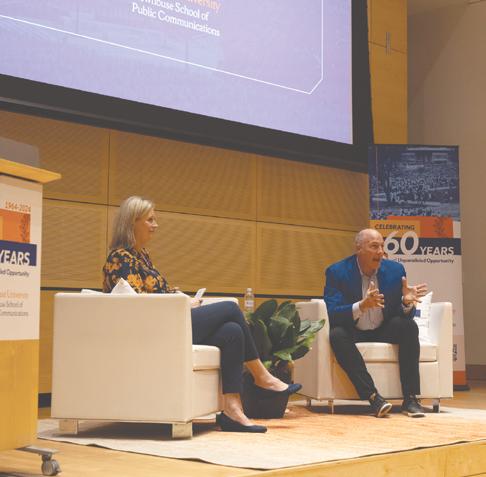
On Wednesday, Pioli visited Syracuse University’s S.I. Newhouse School of Public Communications. In his time in the NFL, Pioli
“We have a place that we can call our own and be of support to others who may have experienced any racism or bigotry within the service and to know their value as much as any other soldier,” Dunmore said.
The 62-member post operates as both a social hub and business. Every Friday, the post hosts a fish fry, welcoming Syracuse community members to do business with them, Finance Officer Marion Ervin said. Along with fried fish, the post sells barbecue ribs, chicken wings and serves drinks. The proceeds from the fish fry support the post’s programs and day-to-day operations, like working with Syracuse youth and providing book scholarships to local students, he said.
“We bet enough off that basic activity to pay the basic bills. We get donations from people, groups, other members. We don’t have to pay any labor,” Ervin said.
Ervin, a Vietnam War veteran and 1968 Syracuse University graduate, said the American Legion provides its members with a sense of camaraderie. Being in the military has provided Ervin with a number of life lessons and skills he carries with him everyday, he said.
The post is also home to Dunbar Post 1642 Auxiliary, led by president Sheila Newport-Jenkins. The Auxiliary units of American Legions are composed of mothers, spouses, daughters, granddaughters and grandmothers of veterans. The main goal of the Auxiliary is to support the post in all of its endeavors, Newport-Jenkins said.
“Each unit does their own thing, so what we do at Dunbar is not necessarily what they do at Cicero or what they do at Skaneateles, but the bottom line is the Auxiliary always supports the Legion,” Newport-Jenkins said.
The post’s members are mostly African American, but the post is open to people of all races and ethnicities, Dunmore said. To Dunmore, the most important thing is a good attitude and willingness to benefit the post.
“I don’t care what color you are to join our post, as long as you have the right attitude and a character to support and serve,” Dunmore said.
Located at the corner of Dell Street and Columbus Avenue, the 127-year-old post requires its fair
earned the NFL Executive of the Year award five times and won three Super Bowls with the New England Patriots. Olivia Stomski, director of the Newhouse Sports Media Center, moderated the discussion.
Despite earning his masters degree in 2005, Pioli’s graduate journey at SU began in 1988. Before finishing his degree, he was offered a full time offensive lines coaching job at Murray State University in 1990. After he left Murray State in 1992, Pioli went on to help manage multiple NFL teams, before finishing his academic requirements in the same year he won his third Super Bowl.
Griffin Bloomstein, a sophomore at Newhouse, said he’s a long time Patriots fan. He
was intrigued with the career path Pioli took and the diverse range of involvement he has.
In his time in the NFL, Pioli hired more women and people of color to his staff than any other executive, Stomski said. Pioli believed everyone should have the same opportunity regardless of how you look.
“You know, I was born with privilege. I’m a white dude,” Pioli said. “There’s something really messed up about that.” With the federal government’s recent policy changes affecting DEIA initiatives, Pioli spoke about how complicated this period of time in the sports industry is. He emphasized the idea to not “lose your crap” and instead keep doing what you believe in and never stop.
Along with being an executive, Pioli serves as a board trustee for the Women’s Sports Foundation and is a member of the Women Leaders in Sports National Advisory Council. Nina Bilotti, an SU graduate student studying advertising, is very passionate about pursuing a position in the sports industry and was thrilled to hear about Pioli’s role in the space.
“I really wanted to hear him talk about his involvement in elevating women in sports,” Bilotti said. “It was super inspirational for me.” Pioli talked about opportunities in sports for women, explaining the unfortunate bias that still exists against women. While getting through the door is an accomplishment, people see pioli page 11
share of repairs and maintenance, Ervin said.
Over the past years, the post has received about $200,000 in grants from New York state, Ervin said. The grants, along with donations from local organizations like The Allyn Foundation, have helped secure a new roof and upcoming restorations for the kitchen and bathrooms.
“By the time we finish, hopefully 95% by the end of August, that building, in the last five years, will essentially be completely renovated,” Ervin said.
The post plans to take on siding and roofing as the final touches of its renovation project.
Members also hope to repair the chimney and repave the parking lot soon, Ervin said. There are a number of avenues that provide the post with
grants, from the New York State Department of Veterans’ Services to the state itself, Ervin said.
The Auxiliary also holds fundraisers and events to give back and financially support the post, Newport-Jenkins said, and works with local youth through programming too. Each year, the Auxiliary holds a Halloween party for local Syracuse youth, she said. It’s a way to work with the community and bring more people out to the post.
Further Auxiliary fundraising efforts include bake sales and working banquet halls, she said.
The post aims to support all aspects of the Syracuse community, not only veterans’ affairs, Dunmore said. Through its grants and youth programs, the post hopes to continue conducting business and outreach with the community.
“We support as much as we can, wherever we can,” Dunmore said.
The post is filled with conversations about old war wounds and military training, Dunmore said. Members come together to share their stories. Their experiences have helped to build their characters, and their service is what connects them all.
Ervin hopes more veterans in the Syracuse area join the post — or one of the 19 other American Legion posts in Onondaga County — to benefit from the community as he has.
“(The military) is made up of that middle 80% of the population. We’re good, solid people and you learn a lot,” Ervin said.
sabrocki@syr.edu
julia english cartoonist
andrew berkman cartoonist
sue threat and richard martin prepare weekly meals at American Legion Dunbar Post 1642 for local veterans. Volunteers come to the Friday fish fry to help engage with the community. courtesy of joanna penalva
States. Appiah watched her daughter wake up at 3 a.m. to travel to New York City to pick up goods, then deliver them to Syracuse. For the mother-daughter duo, faith is at the center of their relationship.
“It is very good for any person to give your dream, to motivate you,” Appiah said. “Whatever you do, you put yourself into the hands of God, in everything you do.”
Abbey recognized a need to fulfill in her community. She wanted to create a space for customers of African and Caribbean cultures to find everything they’re looking for. Customers can find traditional goods like cassava leaves, cocoyam leaves and salted fish.
“Oh, they are excited! ‘Oh my God, you have this?’ Sometimes they say, ‘Where did you get that? You have that here?” Abbey said of customers’ reactions to the stock.
Abbey still has goals she’d like to achieve. She hopes to expand the space and hire an in-house chef to cook traditional meals.
For years, the market on North Salina Street was the only African store in Syracuse. Appiah said because of this, customers were happy to find their favorite kinds of food.
Without hesitation, Appiah identified fufu as the market’s most popular item. Runners-up include Ghanaian hard chicken, smoked turkey and smoked fish. Customers select items based on their cravings and needs.
“There are so many varieties here, they feel at home,” Appiah said.
Hassan recently shopped at the market with his father, who’s from Kenya. The two bought tea and fried fish. They shop at the market not only for fresh produce, but also to support smallowned businesses.
Hassan’s shopping experience has been positive because of the care shown to customers and the supply of tea, which he always looks forward to purchasing with his father.
“I like that the people are very kind,” Hassan said. “I can get the stuff that I would need without any trouble, and I like their tea.”
Though the staff is small, the employees are committed to supporting their customers. Maurine Abur, a cashier at the market, is from Uganda. Abur has worked there for a year and takes pride in her customer service.
“I feel comfort in helping people, especially when they come around and then I help them find what they are looking for,” Abur said. “It makes me feel so good.”
Abbey and Appiah’s attitude encourages employees to continue working for the motherdaughter duo.
“They are so friendly and they treat everyone the same, with a lot of love and you don’t want to move away from that,” Abur said.
Abur wants customers both new and old to know that at the African & Caribbean Central Market, help is always available. The market is committed to customer satisfaction and fulfilling customers’ needs.
“If you’re from Africa or you’re from the Caribbean and you’re looking for something that is hard to find, come down here and if I don’t have it, give me a week or two, I’ll get it for you,” Abbey said. ncampb03@syr.edu
The owner of the African & Caribbean Central Market, Roselinda Abbey, moved from Ghana
loyal to through any relationship and friendship. He said you can see this happen through the play’s narrative, where Matt and Shawn grow together and apart.
“I think that the way Matt and Shawn deal with their problems is so real and it’s so ubiquitous,” Johnson said. “The friendship itself, it’s very rarely just sunny skies and popsicles.”
Six and a half years later, despite career differences, Matt and Shawn are still best friends. Matt is successful, while Shawn is struggling to find a job. When Matt asks Shawn if he’s going to one of the basketball games costing $400, it causes Shawn to think about the changes they have both made in their lives.
Shawn reveals that he got a job in Los Angeles — something he failed to tell Matt — and the two get angry with each other. Matt is
upset because they’ve always gone to every game together. As Shawn tries to find the right words, Matt’s reaction changes from confusion to understanding.
“Matt is not somebody that can handle his emotions, yet, he allows himself to be emotional around this other man because they’ve known each other for so long and he almost doesn’t have another option because he really loves this person,” Johnson said.
Johnson said this play is something the audience members can resonate with. He said they don’t need to leave thinking it was the best show ever, but instead they’ve experienced the play’s narrative in their own lives.
“I want people to feel like they are watching something familiar, what matters is that you can spend time with them and feel, ‘Yeah that was it, I’ve experienced that,’” Jude said. “That moment happened when we see Matt and Shawn four years later, still best friends.”
Johnson explained that Matt and Shawn come from different backgrounds, have different expectations in life and pursue different ambitions. Because of this, their argument becomes very tense, and ultimately, there is a larger conversation about race and friendship.
There’s a moment in the play where Matt says that James should have “known his place” four years prior when he famously left the Cavaliers for the Miami Heat in 2010, which Shawn very strongly disagrees with. Shawn took Matt’s comment about James personally, thinking it also applied to him because he’s Black.
Two years later, Shawn visits Matt at his mother’s shop as it closes down. Although they never openly address their argument, they both knew it was a special day because the Cavaliers had just won the NBA Championship. The play ends with the spotlight highlighting only Matt and Shawn, playing
a makeshift basketball game with a rolled paper and a trash can.
Sean Marchant, an audience member, said he enjoyed seeing the early and developing parts of Matt and Shawn’s friendship. He said this play touches on how friendship has its ups and downs, and there isn’t always going to be agreement between friends.
Marchant felt that the portrayal of friendship between Matt and Shawn felt genuinely authentic and that they had very good chemistry on stage.
Johnson spoke about how people go to see a play for the moments where people crack and break. In “King James,” the audience sees how two men can care for each other through something they both love.
“That final moment very much feels like going home in that way,” Johnson said. “It always affects me very deeply, and it always surprises me.”
dkchaudh@syr.edu
need to continue preaching values like truth and inclusion, Pioli said.
Teddy Caputo, an SU graduate student studying television, radio and film, said this too was his main takeaway from the discussion. He was surprised by some of Pioli’s insights, not expecting a journalistic perspective from someone in business.
Along with opportunities in the media industry, Pioli talked about the growth and bright future of both women’s soccer and flag football. Flag football has been approved to be featured in the 2028 Olympics. Pioli said he was excited for the space and how much attention it’s been getting.
“I’m excited that women are getting seen, and that people are investing real money as a real investment not as philanthropy because it’s not philanthropy,” Pioli said.
While only staying at SU for one year when he first started his degree, Pioli emphasized how prestigious the university is and the importance of staying connected. He talked about the network “beyond the keg parties” and other festivities, but the impact of the people you meet.
Pioli underscored the need to establish relationships with your peers and the need to help others before yourself. Although there are still disparities in the sports industry, Pioli said this generation is being educated about it.
Bloomstein’s takeaways were mainly about how to treat others in the sports industry. Two things Bloomstein noted: leaving the industry better than you found it, and caring for the others around him.
“No matter what situation you were born into, it’s always important to remember how you uplift people and how the world interacts,” Bloomstein said.
crmcgraw@syr.edu
The play “King James” features two characters, Matt and Shawn, played by Quinn M. Johnson and Enoch King. “King James” follows the characters’ love for basketball in their friendship, specifically for players like LeBron James, and how their friendship “ebbs and flows” over James’ career.
courtesy of joanna penalva
from page 9 pioli
olivia stomski and scott pioli spoke to SU students on Wednesday. They discussed the representation of women’s sports in the media. alicia hoppes staff photographer
madison denis contributing illustrator
Step out of the SU campus bubble to see the surrounding world
By Helena Sauriat columnist
I spent my first semester of college abroad in Strasbourg, France this fall — away from my friends, family and the Manhattan lifestyle I’d previously known as the norm. Yet somehow, I felt more connected to the outside world in France than I do on campus.
SU feels like its own microcommunity, one that separates students from the rest of Syracuse, the United States and global events. It seems to me like few students regularly venture out past the fraternity houses and dining halls; it’s like we’re stuck in a bubble.
Because student life is so campus-centric, we don’t truly reconcile our Syracuse experiences with that of the locals. There’s a considerable wealth gap between the students here and the residents of the city, but it seems like the student body we’re part of doesn’t recognize the difference in our realities as a collective community.
The city of Syracuse has one of the highest poverty rates in the nation, but the median income of a student’s family here is $113,800 — highlighting the stark difference between our experiences.
Several local residents outside the SU community experience poor public schools, transportation and a lack of access to affordable nutritious foods, among other inequalities most students aren’t exposed to on campus. The majority of public school
students here live amid some of the most serious poverty in America.
When I chose SU, people warned me about crime and danger off campus.
I’ve noticed the attitude at SU toward the city of Syracuse is typically negative, and it seems to me these systemic disparities are what keep us disconnected and perpetuate the city’s diminished reputation on campus.
As a New York City native living near Central Park allows me to go for a jog or a walk to clear my head when I feel overwhelmed. But beyond needing a car to get to most places, not to mention the weather that makes stepping outside hard to begin with, many students feel like they don’t have this same freedom at SU.
My friend and I ventured downtown for dinner out recently, despite the added effort and negative stigma around stepping off campus that keeps many students from exploring.
Although it was frigid outside, the 20-minute walk to get to this restaurant felt strangely liberating. I was so happy to see beyond the university’s invisible borders and to read street signs other than Crouse and Comstock.
Crossing through fields of snow and encountering a local elderly man bundled up while walking his dog brought me a sense of comfort. It reminded me that people live regular lives just a few feet from one of the most expensive universities in the nation.
It felt meaningful to talk to people not affiliated with my school, people who have stakes in the Syracuse community and who are
affected by policies and decisions made by the local government.
Compared to my current experience on SU’s campus, being abroad was less alienating day to day because we felt encouraged to go places, thanks to the accessibility of short-distance travel. Unlike the United States, Europe’s well-developed infrastructure meant walking or biking were the two most common and accessible ways of getting around, allowing me and my friends to expand our views of the world.
The way people in France seemed more invested in their communities was inspiring.
The Syracuse Center was a part of Strasbourg and we as students were pushed to venture out and connect with other college students, work at local internships and live with host families.
The slower pace of life helped us interact at the boulangerie with locals, making me feel more connected to the residents and areas surrounding Strasbourg. Contrastingly, life at SU feels much faster and self-oriented, where people primarily focus on advancing their own careers.
It’s important for college students to have compassion for people outside of the communities we’re most familiar with. SU students should learn to understand the nuances of the entirety of our city — not just the university. Although it’s a process, I have found different ways to feel more connected to the outside world while still living on campus. The first and most important thing for me is just getting
outside. You’ve got to leave campus to discover what lies beyond the SU bubble.
I encourage every SU student to look at lives different from theirs with less indifference.
Most of us are here for four years or less, and there’s life worth seeing in Syracuse beyond grades, campus organizations and dorm rooms. Regardless of why you’re at SU, it’s vital to make the attempt to integrate yourself with this city’s issues.
I interviewed for a job with SU’s Community Folk Art Center and learned the reason it’s located downtown is to integrate the history of Syracuse locals with the university’s student body. There are institutions here to further our horizons, if we take advantage of them.
Organizations including CFAC and the Literacy Corps give us valuable opportunities to leave our bubble and engage with the broader Syracuse community.
A brisk walk to downtown Syracuse allowed me to get out of my head and connect with other people who possess goals and ideas not centric to SU. Any student can do the same — it requires removing yourself from campus culture mentally, not only physically. Now, to get past the alienation I feel here from the rest of the world, I know I can simply step off the hill.
Helena Sauriat is a freshman majoring in anthropology. She can be reached at hrsauria@syr.edu.
personal essay
specific plays. He loved watching his father’s Johns Hopkins teams and watching old film of Bill’s brother, Matt, a three-time All-American long-stick midfielder at Loyola University who totaled 19 career goals from 1992-95.
Dwan’s detailed ability to dissect opponents through schematic execution has always taken command of a locker room, Bill said. Bill thinks his son is a coach on the field, qualities Dwan learned from his father. Maintaining a heightened lacrosse IQ developed Dwan’s killer instinct, which was easy to activate once he hit high school.
“Billy’s pretty mild-mannered off the field. And when he gets onto the field, he just gets a high-intensity level,” Bill said.
The “race to the midline” piqued Dwan’s tenacity while playing at Loyola Blakefield, a high-level private school in Towson, Maryland. It’s a strategy used by Blakefield lacrosse head coach Gene Ubriaco. When in transition, the first three players who cross midfield continue to push upfield and play offense in the opposing zone, Dwan said.
Ubriaco doesn’t want his players to be hesitant, and he said Dwan took that to heart from the moment he arrived.
Blakefield Assistant Coach Stephen Abrams first noticed Dwan galloping in transition during three-on-three scrimmages during his freshman training camp. Abrams said Dwan was immediately among the team’s best players in three-on-three, and it was “pretty evident” they’d use his skillset one day.
Dwan often bolted past players on fast breaks in practice, even from his starting point near the goal line as a close defender. Dwan loved the feeling of delivering an unlikely goal and took every opportunity to do so.
field stripe before being pressured by a few defenders. As Dwan winded up to shoot in traffic, Ubriaco called a timeout, which he instantly regretted.
Dwan’s shot had already hit the back of the net when the play was whistled dead.
“Billy, I’m so sorry, but I won’t do that again,” Ubriaco told Dwan after he got to the sideline.
“I’ll trust you.”
Ubriaco felt Dwan’s athleticism could translate to a precise shooter as well, and gave him freedom to make snap decisions in transition during his junior year — his first as a starter. But Ubriaco wasn’t completely comfortable with his close defender handling the ball quite yet.
He recalled a moment during a game against Georgetown Preparatory School. Blakefield had successfully cleared and Dwan charged across the mid-
propelling Syracuse to several double-digit comebacks — namely its wins over Clemson and Louisville.
When Fair graduated, there was no immediate No. 1 option to replace her. No player on last year’s team finished within eight points of her scoring average. Legette-Jack heralded Georgia Woolley as SU’s next leader after its loss to UConn.
It was an obvious choice, as she finished second on the team in scoring. But Woolley doesn’t have Fair’s same scoring prowess. With Woolley as SU’s best scoring threat, there was reason for concern. Syracuse needed someone to compliment her if it wanted to win.
It didn’t.
Despite having momentum coming off last season, Legette-Jack didn’t use it to gain leverage in the portal, only snagging Angelica Velez and Journey Thompson. Velez was a four-star recruit at LSU but played just 4.9 minutes as a freshman. Thompson saw more playing time with Arizona State but produced a career-high 5.5 last season.
Still, a few weeks ago, Legette-Jack said the team was one of the best she’d ever coached. That didn’t show on the court.
“This is a more talented team than we’ve had in a long time,” Legette-Jack said on Feb. 26. “They didn’t perform that way this whole season. It was always something, an injury here, a concussion there, that definitely took place.”
Along with missing a top-scoring threat, a true point guard was nowhere to be found this season. Fair assumed that role for the last two years. While Dominique Camp and even Woolley excelled as facilitators this season, there were no impressive scoring options on paper, with Velez and freshman Olivia Schmitt not providing much as backups.
Meanwhile, Syracuse did nothing to improve its defense. It lost Alyssa Latham to the portal, who produced a team-leading 1.3 blocks and snatched 1.2 steals. The Orange surrendered a
Blakefield’s staff began to scheme around Dwan’s innate traits. Abrams said they toyed with putting Dwan on the man-up unit, while Ubriaco added that they slid him to midfield at times, too. But the key to unlocking Dwan’s potential was letting him fly. He won the “race to the midline” seemingly every time, his coaches said. From there, it was about getting out of the way so Dwan had room to rumble.
Abrams was always impressed with Dwan’s physical finishing style, displaying an attackman-esque touch by getting near the crease and finishing close to the goalie.
“He was never one to get a crow-hopping step from the restraining line and let a shot go,” Abrams said of Dwan.
middling 65.7 points per game last year, and Latham’s loss didn’t help.
So, with a poorly constructed roster and many of its top players from last year gone, SU entered the season in a tough spot. It was clear from the get-go this season would be a long one.
Before the campaign, Syracuse hadn’t dropped a nonconference home game since 2019. It racked up three in its five-game opening homestand — including defeats to Saint Joseph’s and UAlbany, teams it would’ve handily beaten a year ago.
SU finished nonconference play 6-5. And nothing changed once conference games rolled around. To her credit, Legette-Jack constantly tried switching things up. She constructed 10 different starting lineups, the most by a Power Five team. Twelve of her 13 players started a game. There were contests when she employed a six-player rotation, like against Virginia, and ones where everyone played, like versus thenNo. 11 Duke.
But with a poor roster, no variation of who’s on the floor would’ve led to long-term success. It led the Orange to a 6-12 conference record, suffering embarrassing blowouts to Duke, BC and then-No. 10 Notre Dame. Even when they were in control — like on Wednesday — they were plagued by secondhalf collapses.
“I think a lot of games didn’t go our way that should have went our way,” senior forward Kyra Wood said after SU’s season-ending loss to BC. “We thought it was in our control.”
That’s why a quick flameout in the ACC Tournament wasn’t a surprise. Syracuse didn’t come in with the talent to contend with top teams. And it lacked a clutch factor to produce dazzling comebacks and hold onto leads.
It was a tall task to meet or exceed last year’s success. But SU didn’t even give itself a chance.
“It was just an interesting year, and I’ve gotta look back and first check me and figure me out,” Legette-Jack said. “And then we have to bring in some more people.” njnussba@syr.edu @ Noahnuss9
coaching staff trusting him helped him quickly adapt to Division I.
Of his eight goals in 2024, Dwan’s signature moment occurred in the Orange’s win over North Carolina on April 13. Dwan streaked past midfield with the ball after a failed UNC chance, then executed a give-and-go with attackman Joey Spallina before Spallina fired a behind-theback feed to Dwan. On the move, Dwan cradled the ball side-to-side then dove near the left crease, squeaking his shot past Tar Heels goalie Collin Krieg.
Dwan described the play as “unbelievable,” complimenting Spallina’s feed but downplaying his own effort. The long pole elicits excitement; Dwan loves to score because of the lift it provides his teammates. Though, sometimes, that hunger comes at the expense of others’ emotions.
“That was the classic, ‘No, no, no!’” Odierna said of Dwan’s goal versus UNC. “As the defensive coach, I wanted us to hold the ball and play a little offense. But Billy made a great play.”
Beardsley couldn’t believe Dwan’s season was a reality. He didn’t even find out Dwan scored more goals in a single year than he ever had until a phone call with Syracuse head coach Gary Gait before the 2025 season.
“Rick’s like, ‘Oh my God, Billy was probably the leading scorer for a close defenseman last year in the country. I only had six goals in my best year as a close defender.’ And I was like, ‘I didn’t realize Billy was at a higher pace than (Beardsley) was,’” Gait said. “He thinks really highly of Billy, as do I.”
Ubriaco saw how difficult Dwan was to stop with his massive stature. Defenders couldn’t reach the ball with how high he carried it when sprinting upfield in transition. That combination of size and speed is what makes him so special, according to Ubriaco.
So, after initial apprehensiveness came back to bite him, Ubriaco’s handling of Dwan’s skillset changed.
“We gave him the green light,” Ubriaco said. Everything came to fruition in Dwan’s senior campaign when he earned All-Maryland Interscholastic Athletic Association honors. He said the freedom Ubriaco and his staff provided allowed him to deliver consistently. The moment he remembers most from that year came against The John Carroll School in Bel Air, Maryland. Dwan scored a twister to put Blakefield up six points in a Friday night victory.
Dwan swiftly transitioned his scoring prowess to Syracuse. He scored once his freshman year as a reserve, then followed up with an explosive sophomore campaign. Dwan said SU’s
Beardsley, a longtime family friend of the Dwans through his connections with Bill and Matt, often invites Dwan to dinner, where they’re joined by Spallina and his brothers, Jake and Brett. Beardsley tries to make them laugh with stories of the old days. Last month, though, the conversation turned to Dwan.
Beardsley and Dwan talked about how they each broke the mold of their position, as Beardsley praised Dwan for his remarkable 2024 campaign. When the two stood up to leave the table, Beardsley was reminded of how improbable Dwan’s numbers were. Beardsley’s no small guy, but he joked Dwan’s stature made him look like a tick.
Face-to-face with a giant like that, you’d think they’re a hard-nosed defender. What you wouldn’t expect is a slithery snake with the ball in his hands. But that’s exactly what Dwan is.
“There are lots of guys that play the long-stick position that get assists, get points, get ground balls, and Billy (scored eight goals) from close defense? I can’t remember anybody that did that,” Beardsley said of Dwan. “Not a lot of guys can set their feet and let it rip 100 miles an hour without effort.”
ccandrew@syr.edu @cooper_andrews
SU women’s basketball had a let-down season after making last year’s NCAA Tournament. Our columnist writes it wasn’t suprising. courtesy of the atlantic coast conference
billy dwan’s unprecedented ability to score goals as a close defender began in high school at Loyola Blakefield before swiftly transitioning to SU in 2023. joe zhao design editor
Billy Dwan’s eight goals as a close defender in 2024 set a Syracuse record.
Russell Melendez’s creativity sparks stardom at Johns Hopkins
By Mauricio Palmar asst. digital editor
Once in a blue moon, Brandon Aviles could retreat from his hectic student-athlete lifestyle to relax in the apartment he shared with his teammate, Russell Melendez.
On those occasions, the two reflected on life while Melendez, an avid musician, played songs on his guitar. Sometimes, Melendez also used his culinary talents to make pasta and chicken, what Aviles calls his best dish.
“I know it sounds simple, but pasta and chicken, there’s something about it … he put a little flavor to it,” Aviles said. “(He) always has a creative mindset to go about things a certain way.”
That mindset isn’t exclusive to the kitchen. On the lacrosse field, Melendez, a senior attack at Johns Hopkins, has used it to become a more versatile attack. In six games this year, Melendez has scored 14 goals and dished out eight assists. He’ll use his creative mindset to lead No. 7 JHU (5-1, 0-0 Big Ten) into its pivotal matchup on the road against No. 11 Syracuse (4-2, 0-0 Atlantic Coast) Sunday.
Melendez’s creativity is cultivated by design. His mother, Christine, played a crucial role in teaching him to cook, while his older brother, Tommy, influenced his robust love for music. In high school, Tommy created original songs and published them on SoundCloud, accruing millions of plays.
When Tommy wasn’t creating music, Melendez often watched him play lacrosse at Archbishop Spalding High School (Maryland). As an eighth grader, Melendez met then-Spalding head coach Brian Phipps, who quickly saw him as a future staple in his attack.
In 2016, Melendez followed in his brother’s footsteps by enrolling at Spalding. Before playing a minute for the Cavaliers, he was determined to hang with the best. So, Phipps allowed him to practice with the seniors during fall workouts.
“He went head to head with our best defenseman (former Holy Cross defender Philip Turner),” Phipps said. “So, I knew he had that competitive nature, that toughness to want to challenge himself to be better.”
Following an injury-marred freshman season, Melendez became a full-time starter the following season, which led to a breakout year as a junior, leading the Cavaliers in goals and assists.
That summer, Spalding participated in the National High School Lacrosse Showcase, a recruiting tournament held in Howard County, Maryland. Phipps said Melendez impressed programs, including Maryland and Penn State, throughout the 30-team tournament, with Spalding defeating Westlake (Texas) to win its bracket.
“There were some plays where Russell just looked unguardable,” Phipps said. “That’s when we were like, ‘Damn. This kid is the real deal, and he’s going to be pretty special.’”
Spalding featured a star-studded lineup in Melendez’s senior year alongside 15 other future Division I players.
“We were lining up to have a pretty special season at Spalding,” then-Spalding assistant coach Evan Hockel said.
The COVID-19 pandemic prevented it. The Cavaliers suspended their season after just two games.
After that abridged campaign, Melendez started his collegiate career at Marquette, which he committed to as a junior in high school. As Inside Lacrosse’s No. 69-ranked recruit in the class of 2020, he became the program’s secondhighest incoming recruit.
“(Watching him) was the same feeling I had when I first watched (PLL defenseman) Mason Woodward play defense for the first time,” former Marquette midfielder Jordan Schmid said. “I was like, ‘This looks way too easy for you, it makes no sense.’”
But Melendez faced a season-ending shoulder injury after seven games. He spent his time studying film and playing wall ball, often connecting to the speakers in the facility and listening to his playlists. By 2022, he was ready to cement himself as Marquette’s top attacker.
In its season-opener against Bellarmine, he looked the part, tallying a program-record five assists in a 9-8 victory.
“It was like, ‘This is a really young player (who’s) really just starting to figure it out,’” former Marquette head coach Andrew Stimmel said
of Melendez’s performance. “You could see the glimpses of why he’s performing at such a high level right now.”
He notched four more goals in narrow losses to Utah and Michigan, bringing his point total to 10 before another shoulder injury halted his campaign.
That setback made Melendez realize he needed more muscle to compete at the highest level, Phipps said. He began to spend more time in the weight room, gaining 15 pounds.
“You’ve really seen him dedicate himself to the weight room to put on muscle and really take care of his body,” Phipps said. “(It’s) been super impressive for him to grow and kind of mature into that frame to play at the highest level.”
The additional muscle prepared him to take a step up in competition. After redshirting the remainder of 2022, he transferred to Johns Hopkins for the 2023 season. For the first time since he was a junior in high school, Melendez played an uninterrupted season and thrived.
Across 17 games, Melendez notched career highs in goals (37) and assists (16). His goal tally ranked fourth in the Big Ten, and his point total placed him sixth en route to First-Team All-Big Ten honors.
“(His biggest strength is) his creativity … he’s just one of those guys that has every tool in the toolbox,” Aviles said.
Aviles, who spent four years at SU before transferring to Johns Hopkins for his graduate
year, didn’t know where Melendez’s creativity came from until living alongside him.
Throughout the Blue Jays’ 2024 campaign, Melendez peppered their apartment with various genres of music. His Instagram highlights, mostly dated to 2020, reveal a selection of hip-hop artists such as Trippie Redd and 21 Savage. But his taste had become much more diverse recently, expanding from Christmas carols to jazz.
One time in the spring, Melendez showed off his father’s old guitar. Aviles recalls it being built like Ol’ Reliable, the infamous jellyfish net from the Nickelodeon cartoon SpongeBob SquarePants. Despite the guitar’s unassuming appearance, it resonated with Aviles. According to him, it sounded like “a million bucks.”
Music became their escape. It helped them disconnect from the grind of collegiate lacrosse. Conversely, it helped Melendez find his creative side on the field. Aviles emphasized that lacrosse has a strong visualization component. As Melendez got reps in practice, he pictured ways to create scoring chances.
That’s continued throughout his final year of collegiate eligibility. Whether he’s playing his guitar or firing a weak hand shot past an unsuspecting goalie, he always keeps a smooth composure, just like the jazz that reverberates throughout his apartment.
“Russell is one of a kind, that’s the best way to put it,” Aviles said. “He really embodies music.” mjpalmar@syr.edu @mpalmarSU
Beat writers agree SU will defeat UVA to close out regular season
By Daily Orange Sports Staff
For the third straight road game, Syracuse fell apart in the second half. The latest rendition was a 77-75 loss to SMU, where the Orange had a 12-point lead with 10 minutes left. Three days earlier against Virginia Tech, SU blew a 13-point advantage in the second half, eventually falling in overtime. Before that, in Pittsburgh, Syracuse let an 11-point advantage slip away.
On Tuesday, Syracuse led for 35 minutes and by as many as 12 points in the second half. With five minutes left, Jyáre Davis extended Syracuse’s lead to eight but that was its last made field goal. SMU then chipped away, and Keon Ambrose-Hylton tapped in a Boopie Miller miss with two seconds left to complete the Mustangs’ comeback.
SU now closes out the regular season against Virginia, a team it hasn’t beaten since 2020. The Cavaliers have had a down season after head coach Tony Bennett retired in October 2024, sitting in the middle of the Atlantic Coast Conference standings.
Here’s how our beat writers feel Syracuse (1218, 6-13 ACC) will fare in its final regular season game against Virginia (15-15, 8-11 ACC): sports@dailyorange.com @DOsports
Syracuse’s collapses this season have been nothing short of spectacular. With each passing game, its capitulations become more predictable. Tuesday night’s loss to SMU was no different. Everyone knew the Orange would eventually lose control; it was only a matter of when. Still, I’m picking them against Virginia this weekend. This boils down to the simple fact this is a home game. All of Syracuse’s collapses have come on the road, and it’s fared OK at home this year, at least against weaker teams.
UVA is the definition of mediocre, and its brand of basketball bodes well for SU. The Cavaliers boast the worst offense in the ACC, scoring 64.8 points per game. Even though Syracuse’s defense is arguably worse, giving up 78.7 points, I believe it can actually stop the Cavaliers’ slow-paced offense. The Orange accomplished that against NC State last week, holding the Wolfpack to 60 points. This will play out in a similar fashion.
It’s hard for Syracuse to perform much worse in the second half than it has in the past two games, and it’ll finally close out a game. J.J. Starling, who’s shot 8-of-31 over his past two games, will come alive when Syracuse needs him. Syracuse hasn’t struggled to score the ball at any point this season, which is why it’ll get the job done this time.
To me, Syracuse’s late-game collapse against the Mustangs felt different from its past blunders. The mere fact the Orange were in a position to lead by 12 against SMU was an encouraging sign, giving me confidence they can take down Virginia to cap a turbulent regular season on the right note.
The Cavaliers are coming off a strong win over Florida State and showed a sense to bunker down on defense, allowing just 67.6 points over the last three games. But, UVA’s biggest weakness caters to SU’s poor defense. Virginia has just 64.8 points per game through 30 games, the 355th-worst rank in the country entering Wednesday. Yes, the Orange recently faced VT, and the Hokies exploded for their most points of the season after entering as one of the worst offensive teams in the country.
But I see this one going differently. SU held down SMU throughout the contest and limited an explosive offense with Miller. Virginia’s lackluster offense, despite being potent from 3, can be stopped if Syracuse plays well enough through the second half, which I see it doing just enough to squeak out a victory. Watch out, though. We could see this matchup just three days later in Charlotte if the seeding plays out.
After taking a gander at Syracuse’s results leading into its final regular season game, I counted nearly 10 games it could’ve won. Even if SU won about half of those games, it would be much closer to the 19-win team I expected in the preseason. But, that’s not the reality. Instead, the reality is Syracuse has been defined by collapses. Across their last three losses, the Orange have had a double-digit point lead but couldn’t hold on. I’d even argue SU has played really well in these losses, the problem is the five-minute stretches where it doesn’t play well outweigh all of the success.
Luckily for Syracuse, it ends the regular season against a weak Virginia team at home. While I fear the Cavaliers’ 3-point prowess could give SU fits, this is an ideal matchup to build confidence heading into the ACC Tournament.
Long gone are the dominant Bennett days, as UVA is ranked No. 103 in the NET Rankings and on KenPom. While the Cavaliers are probably the better team than the Orange on a neutral court, I see them falling just short on the road. Starling will bounce back from an abysmal performance Tuesday, leading
Russell Melendez, who has 14 goals and eight assists in 2025, will lead Johns Hopkins into its matchup against Syracuse Sunday. courtesy of johns hopkins athletics
Inside Chris Bell’s journey through career-worst slump
By Zak Wolf senior staff writer
Chris Bell treats basketball as a game of life; there will be ups and downs. For Bell, it’s hard to get any lower than how he finished 2024. The junior was shooting just 21.6% from 3-point range and went nearly a month without knocking down a triple.
Slumps aren’t abnormal for shooters, especially Bell. This one was different. He called it the “worst of his career.” Against Florida State on Jan. 4, Bell came off the bench for the first time in three seasons.
Bell didn’t have a visceral response to the radical change. He says he can’t be confident all the time. It’s why he tries to have a human reaction to basketball’s ebbs and flows. Bell doesn’t read too much into the numbers. He looks at them as just that. Numbers.
“That’s all people look at,” Bell said of shooting percentages. “When you know you’re a good shooter, you’re going to keep shooting and then eventually the numbers will show.”
Despite being primed for a breakout year as Syracuse’s prime marksman after averaging 12 points per game and knocking down 42% of triples as a sophomore, Bell’s junior season hasn’t gone to plan. He’s averaging 9.9 points in 22.3 minutes per game, almost five fewer than in 2023-24. His volume and efficiency from 3 have drastically decreased, going from 6.3 attempted 3s to 4.1, connecting on a 37.1% clip.
The stats, despite an improved 45% 3-point percentage in Atlantic Coast Conference play, suggest Bell is having an off-year. Syracuse head coach Adrian Autry disputes that, saying he hasn’t regressed. Autry argues Syracuse’s roster construction has just changed.
“When you have guys like Chris, who shoot the ball at a high level, a lot of his success depends on the people around him and I just think the dynamics of our team changed,” Autry said.
The second-year head coach is alluding to Syracuse being without ball-dominant guards
Judah Mintz and Quadir Copeland. That duo and J.J. Starling attracted attention with their dribble penetration last season, forcing defenses to collapse. So, Bell often planted himself on the perimeter, making teams pay with his catchand-shoot ability.
Mintz and Copeland moved on, so Bell climbed the scouting report. Now, teams are running him off the 3-point line, forcing him to drive more. Bell has attempted more free throws this season (86) than his first two seasons combined (58). Bell is best when firing away from deep. He’s not doing that as much this season.
In 2023-24, Bell was the second-best 3-point shooter in the ACC. Bell led SU in attempts (200) and makes (84), shooting 64 more and hitting 40 more triples than Starling, who was second
women’s lacrosse
on the team in both categories. Bell was also the only player with at least 40 3-point attempts to shoot better than 34%.
“The expectation is just for me to be myself and to take shots when I get them,” Bell said.
That mentality was absent in December, going six straight games without a 3-pointer. His previous longest drought was two games. Admittedly, Bell got in his own head. With each missed shot, he said he grew more cautious. Instead of shooting five-to-seven 3s per game, he limited himself to a couple of shots.
While in his slump, Bell stayed in the gym, putting up 200-to-300 shots daily with assistant coaches Allen Griffin and Brenden Straughn to try and get his rhythm back. He also confided in
his parents, Charlie and Natasha, and his trainer, William Lee, to help him push through.
“You always go back to the people who always believed in you in the beginning, not the people who just showed up when you were doing well,” Bell said.
Bell tried to stay the course but didn’t improve. That came to a head in Syracuse’s 81-71 loss to Wake Forest on Dec. 31 after putting up one shot in nine minutes. It was the first time since his freshman season he recorded fewer than 10 minutes. In an attempt to get Bell going, Autry took the forward out of the starting lineup against FSU four days later.
The decision paid dividends instantly. Bell scored 18 points on a perfect 4-for-4 from 3.
“He responded to that well,” Autry said of Bell after his performance. “He had no issues. ‘Whatever I need to do for the team, what’s best for the team.’ And he’s been great.”
Autry’s kept Bell on the bench since then, alleviating pressure off him. He now also sees the game from a different perspective. By not starting, Bell can tell where Syracuse is lacking, either defensively or with its shooting. Once he enters the game, typically six to eight minutes in, Bell tries to provide a spark.
Coming off the bench has made Bell worry less about missing shots, he said. It’s resulted in Bell showing flashes of his previous self, making 31-of-69 (45%) 3-pointers over his last 16 games.
“He’s just been confident,” Syracuse point guard Jaquan Carlos said. “We need Chris to be aggressive and we’re going to live with the shots that he takes because he’s a great shooter.”
Against Pittsburgh on Feb. 18, he drilled seven 3s, scoring a season-high 23 points. It was reminiscent of Bell’s 26-point explosion against NC State last February, where he hit eight 3s in the first half.
Still, his consistency hasn’t stuck. Bell’s only reached double figures in back-to-back games three times since coming off the bench, though he hasn’t had much time to prove himself. Since Jan. 4, he’s only played about 20 minutes per game — the same amount of minutes he logged as a freshman — and hasn’t notched more than 30. At times, he receives a short leash. It’s not uncommon to see Bell get pulled immediately after a bad shot, a poor rebounding effort or a blow-by. Autry is often hard on Bell, berating him after a mistake.
As Syracuse’s longest-tenured player, Bell’s relationship with Autry dates back to when he was an assistant under Jim Boeheim. Bell knows Autry is aware of some of his tendencies, which is why he’s tried to be more open to Autry’s criticisms recently.
“I try to be coachable as much as I can,” Bell said. “I feel like I’ve done a better job with that lately, just going to him and just being receptive, trying to hear whatever he’s saying, and going out there and doing that to the best of my ability.” Bell’s remained flexible this season. He began as a key cog in Syracuse’s system, but his role has shrunk. The junior sometimes flashes an elite shooting touch, but his numbers, compared to last season, remain mediocre. Bell doesn’t remain overly concerned, though.
His job isn’t to look at numbers; he leaves that to the critics. Bell’s role is to shoot the ball efficiently, a skill he’s had mixed success with. Ultimately, it’s about Bell playing within himself and blocking out the noise.
“It just comes down to getting out of my own head and just being confident with the things I do,” Bell said.
zakwolf784254@gmail.com @ZakWolf22
Syracuse struggles to replace Olivia Adamson’s production
By Aiden Stepansky digital managing editor
Olivia Adamson’s been a consistent piece through Kayla Treanor’s four-year tenure. She’s the only Syracuse player to record 10 or more goals in each of Treanor’s years at the helm, and with a natural progression each year, Adamson’s become a focal point of SU’s offense.
“She’s one of the best finishers I’ve ever coached,” Treanor said of Adamson on April 5, 2024.
Adamson’s trajectory into a primary goal scorer continued in Syracuse’s first three games of 2025, recording 16 points, second on SU. However, the Tewaaraton Award watch list member suffered a season-ending lower-body injury, possibly ending her SU career and throwing a wrench into its season.
With the senior sidelined, No. 10 Syracuse (3-3, 0-2 Atlantic Coast) is searching for answers to replace her production. So far, SU’s struggled to get anything going, averaging eight goals and 15 turnovers per game en route to its first threegame losing streak in seven years.
”This is something that we’re gonna have to work through,” Treanor said of Adamson’s absence. “Our offense is definitely a new look, and we’re gonna have to develop chemistry with some new faces.”
Following SU’s 3-0 start, a road bout with No. 2 North Carolina meant the Orange would need all hands on deck. Yet, Adamson remained on the sidelines despite no signs of a clear injury in Syracuse’s previous three games.
Her status was unclear until an SU Athletics spokesperson labeled her as “unavailable” before
its matchup with No. 3 Northwestern. Treanor later confirmed the same postgame. Three days later, it was announced Adamson was done for the season.
Totaling 58 goals and 83 points as a junior in 2024, Adamson was primed to be a top-scoring threat following the departure of leading scorer Emma Tyrrell. Adamson’s role with the Orange has progressed each season, going from a secondary option as a freshman to one of their main threats. Adamson said this past offseason, she specifically worked more on dodging and finetuning her shot.
Her pinpoint accuracy always defined her game, but it worked especially well alongside Emma Ward, SU’s lead facilitator. The duo combined for 33 points through three games, nearly 40% of Syracuse’s offense. While operating through Ward, Adamson’s elite finishing opened lanes for others, making the attack more dynamic.
“It’s a shared offense,” Treanor said after SU’s win over Cornell. “This is not a one-person show. Everybody that’s on the field is a threat, so we have a lot of balance.”
Once Adamson exited, the Orange looked like they needed a one-person show to survive. Hampered by a poor draw control performance and an elite Tar Heels’ attack, SU failed to generate offense. Syracuse pinned a 17-minute scoreless stretch from the first quarter to the second and a 15-minute one from the end of the second to a minute left in the third.
To make matters worse, when SU did get chances, it failed to capitalize. The Orange finished with a season-worst .296 shooting percentage, way under their previous average of .592.
One of the lone bright spots of Syracuse’s loss to UNC was freshman Molly Guzik. The No. 11 recruit in the 2024 class scored two goals, pushing her total to five for the year. Alongside Guzik in the freshman class are Caroline Trinkaus and Mileena Cotter. Trinkaus scored a hat trick against Maryland and has notched 15 points through six games, while Cotter has chipped in with five goals.
With Adamson sidelined, SU’s freshman class now plays a more significant role. Ward likened the situation to her freshman year in 2021. At the time, top scorers Megan Carney and Emily Hawryschuk suffered season-ending injuries and thrust Ward into action. She responded by collecting 73 points to help Syracuse to an NCAA title game appearance.
Ward said it’s about everyone doing their part outside of simply scoring. In three games with Adamson, the freshman trio tallied 23 points. Since her exit, they have seven.
“We’re a young team, but they’re going to learn quick,” Ward said after SU’s loss to the Wildcats. “I’m excited for the future to watch them grow because I remember being in their shoes and how nervous but how exciting it was.”
Versus NU, it was the same story for SU, with its stagnant attack not taking advantage of its limited opportunities. The Orange had zero shots on goal in the first quarter and was held scoreless for the first time since their ACC Tournament Semifinal loss to Boston College last season. Northwestern goalie Delaney Sweitzer wasn’t forced to make a save until 11:22 left in the second frame. SU managed to claw its way back into the game during the second and third quarters. However, the Orange didn’t have the star power
to match Northwestern’s Madison Taylor in the biggest moments.
While it was held to single digits against two top-three teams, Syracuse had a chance at a fresh start against then-No. 12 Clemson. Despite jumping out to a 2-1 lead with two goals in 13 seconds, the Orange once again went cold and couldn’t recover.
The Orange are looking for a new chemistry, so Treanor tinkered with the offense in search of a possible spark. She moved Joely Caramelli from midfield to attack. She experimented with the explosiveness of freshman Annie Parker and threw in Ashlee Volpe despite the sophomore entering the contest with zero college appearances.
Again, Syracuse’s draw struggles allowed the Tigers to dominate possession. But in its set attack, SU committed 16 turnovers, adding to its third-worst mark per game in the ACC, leading to another defeat.
With Adamson out, the Orange’s offense has played at a diminished level. Ward has proven she’ll continue to produce, scoring at least three points in each contest since Adamson’s exit, but the explosiveness of the attack is severely limited without their best scoring threat.
It’s tough to blame Syracuse for struggling without Adamson. Though, as Ward pointed out from her early days with the program, past Syracuse teams have lost a top piece and adjusted accordingly.
The Orange have already dropped their first three games without Adamson and are plummeting on Inside Lacrosse’s weekly poll at a programworst rate. With a challenging schedule ahead, time is running out to replicate her production. amstepan@syr.edu @AidenStepansky
Earlier this season, Chris Bell was going through the worst slump of his career, connecting on 26% of his 3-pointers. leonardo eriman asst. video editor
ONCE IN A GENERATION
Billy Dwan III boasts generational scoring prowess as close defender
By Cooper Andrews managing editor
The king cobra is the longest venomous snake in the world. It’s a vicious, instinctual predator that relentlessly strikes its helpless prey.
If you ask four-time All-American Syracuse defender Ric Beardsley, SU’s Billy Dwan III is the king cobra of college lacrosse’s animal kingdom — because he’s its most intimidating transitional threat.
A 6-foot-4, 220-pound close defender, Dwan racked up eight goals in 2024 from the hardest non-goalie spot to score from. Beardsley, an offensive stud at close defense from 199295, didn’t score more than six goals in a season. Eight seemed like pure fantasy to him, until Dwan came around.
But even Beardsley, arguably the sport’s greatest trash-talker and one of its most ferocious defenders, says he would’ve been scared to step in front of a freight train like Dwan.
“There’s not many guys out there who probably want to square up with him,” Beardsley said of Dwan. “He’s like an ornery king cobra man, like a 12-foot king cobra. The little ones don’t want to mess with you.”
women’s basketball
Dwan, amid his junior season, stands alone in Syracuse men’s lacrosse history as its leading single-season scorer from close defense. His sophomore year not only thrust him into All-American status but established him as a modern-day lacrosse unicorn. Pole goals ignite teams like nothing else, Beardsley said. He compared a close defender tallying two goals in a game to a center in basketball scoring 80 to 90 points. No one that size should be that skilled offensively.
Yet Dwan has always had a thirst for the spectacular. His playmaking style is unmatched and gives Syracuse an edge against any team it faces.
“When a (long) pole scores in general, if it’s a cool trick shot or if it’s just a step-down shot, it provides a lot of energy for the team,” Dwan said of his two-way ability.
Dwan’s eight goals were more than all other SU defenders combined in 2024. He unleashed a two-goal performance in a March 23 win over Hobart. He made a litany of shock-inducing plays, highlighted by an enthralling game-tying pole goal in an eventual victory over then-No. 4 Virginia on April 20. On the play, Dwan corralled a ground ball then catapulted it over his head
with his back facing the cage, whizzing it past UVA goalie Matthew Nunes.
This season, in Syracuse’s blowout of Utah on March 1, Dwan buried a long-range shot from beyond the midfield line in perhaps his most absurd goal yet.
Syracuse defensive coordinator John Odierna said Dwan’s rapid instincts make him dangerous in transition. He also picks his spots wisely, scoring on 72.7% of his attempts in 2024. In turn, Dwan’s mentality allows SU’s staff — which Odierna says emphasizes freedom — to encourage him to run upfield in transition because they trust his judgment and his production.
“We’re just continuing to let (Dwan) flourish and expand the creativity of his game,” Odierna said.
Dwan’s desire to score came from watching legends like the Thompson brothers and his father, Bill Dwan. Bill was a standout defenseman from 1988-91 at Johns Hopkins University and later served as the Blue Jays’ associate head coach for 20 seasons.
Bill remembers a young Dwan sitting on the floor of his office breaking down film and asking questions about see dwan page 13
Nussbaum: Syracuse’s poor 2024-25 season
NOAH NUSSBAUM NUSS BUS
GREENSBORO, N.C. — Syracuse women’s basketball’s uninspiring 2024-25 campaign, which likely ended Wednesday by surrendering the third-largest second-half comeback in ACC Tournament history against Boston College, didn’t come out of the blue. SU was primed for a down year from the start. Its inactivity in the transfer portal and lack of an alpha scorer without Dyaisha Fair — who finished her career top-three all-time in points (3,403) — made Syracuse’s end result easy to pinpoint. It’s far from where the Orange were a year ago when they
were undoubtedly among the best teams in the country. But after SU fell to No. 3 seed UConn in the second round of the NCAA Tournament, it faced significant roster turnover. Fair and many other key offensive pieces departed. So, Syracuse entered the 2024-25 campaign with a completely different squad. And it ended miserably.
Syracuse’s breakdown against BC Wednesday perfectly concluded its up-and-down season. It’d already needed to rip off two wins over subpar teams to even make the ACC Tournament. And playing a team it’d just destroyed three days before, SU was all out of sorts in the second half en route to its loss.
“If I had to give myself a grade, I’d say a C,” SU head coach Felisha
Legette-Jack said of her own coaching performance on Feb. 26. “This is the first year that I think that sometimes I give my best speeches and I say, ‘I don’t even know if anybody was listening.’” Last season, the Orange largely ran their offense through Fair. She averaged a team-leading 22.2 points per game and shot 37.7% from 3. The senior came up big in crunch time,
billy dwan’s eight goals in 2024 as a close defender were more than all other Syracuse defenders combined. joe zhao design editor